



Sheep may safely graze
where a good shepherd watches.
Where rulers govern well
we may feel peace and rest
and what makes countries happy.


When I first visited the Neely Mansion with my friend Inger Anne Hage it was a mere 71 years old – my age now. But now at 116 it looks considerably better than I. This improvement is the work of the many volunteers who have gathered around it for the restoration and maintenance of this national landmark.
Aaron and Sarah Neely completed the ornate farmhouse east of Kent in 1894. Aaron was seven when he crossed the Oregon Trail with his parents David and Irene Neely in 1853. The family came directly to the future White/Green River valley and was thereby among its earliest settlers.
One of the Neely Mansion volunteers, Karen Meador, introduced me to the historical photograph of the mansion and also took the “repeat” during a visit by Neely descendants. And this would be the proper place to name them.
First the visitors in the “now” photo, left to right. Left to right, Ken Beckman, Aaron Beckman, Grant Beckman, Howard Elliot Neely, and Jane Neely Beckman. Howard is the 93-year-old grandson of the Aaron Neely who built it. Understanding the difficulty of “reading” the faces of the six figures posing in the “then” we will note two with reserved confidence. The young boy, third from the left, is – or seems to be -Howard Elliot Neely’s father Aaron Neely Jr., and the woman, far right, his mother Sarah Graham Neely, Aaron Senior’s wife.
The photograph is almost as old as the house, for by 1900 the family missed the social excitements of town life and moved to nearby Auburn. According to Meador “Through the next several decades the mansion and its 200 fertile acres were leased variously to Swiss, Japanese and Filipino tenant farmers.” Sometime in the 1960’s it made a transition to disrepair. That is how we found it while on our way to the Black Diamond bakery. We peeked in a front window and found a mess. Now thanks to the Neely Mansion Association this classic Victorian is open and operating.
WEB EXTRA


(click photos to enlarge)


I came upon this revealing look into the East Green Lake business district directly after winning a barrel full of umbrellas with the low and only bid of $1.50. I wanted one umbrella, but to get it had to purchase them all at a mid-1980s Wallingford estate auction.
But behind the barrel was a box filled with prints and negatives, including this week’s subject. There were about 400 in all, and all by Lennard P. LaVanway, who had been a Green Lake-based commercial photographer. With very few exceptions, all the contents — weddings, babies, homes, churches, businesses — are images from the general Green Lake neighborhood, and they date from 1946-47.
Here, LaVanway’s centerpiece is the Green Lake Theater in 1947. Both films on the marquee — “The Time, the Place and the Girl” (a musical comedy) and “Falcon’s Adventure” — were released in December of ’46. The theater opened in 1937 with Art Deco features including curves, parapets and a decorated tower.
Lorenz Lukan, the manager and part owner, lived nearby at the Woodland Court Apartments. Lukan’s 1966 obituary in Boxoffice, describes him coming to Seattle in 1891 to become an “early-day film distributor and theater owner . . . He operated the Beacon, Arabian and other suburban theaters in Seattle as Lukan’s Far West Theatres.”
It is a testimony to the exceptional buoyancy of the movie business that such a fine theater could be opened in a Seattle neighborhood during the Great Depression. It is also a testimony to television that it would not last. Stripped of its Art Deco qualities, the not-so-old theater’s long-term tenant is now Pacific Color, which has managed to stay open as a photo-service business despite the digital revolution.
Jean writes: Just across the street from Pacific Color/once Green Lake Theatre, looms the Pit, several years ago slated for development of something-or-other, now a great empty space, a maw; territory behind chain link, beyond the pale. The eye avoids it, an absence, a blank zone. Terra incognita without monsters.

Anything to add, Paul? Yes Jean a few things, but not as much as I would like. It is the usual problem: I cannot find the photographs, either in negatives or scans for two subjects that relate to the above. One of these “missing” – temporarily – is an early 20th century look at the Maust Transit Company’s pie-shaped livery at Winona and 73rd, now a marblecrete apartment or condo. The original clapboard was Lennard LaVanway’s studio for a few years following the Second World War. I came upon a few boxs of LaVanways prints and negatives by attending an auction-run estate sale out of his home on 50th Street N. (near the freeway) about 25 years. I’ll print some examples of his work below. There are a number of subject that have made it into “now-and-then” over the past 28 years that have to do with Green Lake, and we will insert two of them next. And here I must thank you for the bonus, above, of the pit. I hoped for such. It is mentioned in one of the two stories to follow.
EAST GREEN LAKE, Ca. 1911
Deciding, perhaps, to stay clear of the mud on Woodlawn Ave. N., the unidentified photographer of this postcard set his or her tripod safely on the sidewalk at the alley. The subject is therefore peculiarly unrevealing of the clapboard businesses on the left. (For that we include directly below another view – somewhat later of the same block taken from the street.) Still the view from the alley looks into the heart of the then booming East Green Lake Business district sometime after 1907 and before 1912.
The scene has its charms. Note the man waving an American flag while being carted by a friend (or an employee) on a wheel borrow through the street soup. Perhaps it is the pharmacist L.C. Kidd pushing his brother Dr. A.B. Kidd toward their Green Lake Drug Store – the closest storefront on the far left. In its 1903 anniversary issue the Green Lake News notes, “Probably no man at Green Lake is better known or more popular than Dr. Kidd.”
The 1907 date was picked because the Green Lake State Bank was built then at the southeast corner of Woodlawn and 72nd Street. The modest one story structure can be seen over the heads of the couple (father and daughter?) on the sidewalk. Appropriately the bank was the district’s first brick building and stayed so until the surviving two story brick business “block” was built in 1912 across 72nd Street from the bank on the northeast corner of the intersection. Here in the “then” scene its more typical pioneer clapboard predecessor is still standing.
The two-story frame building on the right (at the southwest corner) was replaced in 1949 with the stepped structure that appears in the “now’ scene. (When I find it or reshoot it.) The ’49 building was designed to continue the modern lines of the Greenlake Theatre with which it shares the block. So it had no second floor windows. The second floor occupant’s may have complained for that cheerless arrangement lasted about one years. Windows were installed in 1950.
This scene may have been photographed in the late winter of 1911. “Sure I bet on Hi Gill” is hand written on the border of the original postcard. The controversial Gill was elected Seattle Mayor in 1910 the same year that Seattle women got the vote. In a February, 1911 election Gill was recalled as soft on vice. Most of the 23,000 newly registered women voted against him. But not the owner of this postcard.
Then Caption. In December 2002 I wrote the following caption: In the about 93 years that separate these views (I hope to find the “now” later and insert it.) of the East Green lake Business District practically all the structures have been replaced. The brick bank building at the southeast corner of Woodland Ave. and 72nd Street has been drastically remodeled. The last I looked, which was three hours ago while returning home from dinner with Jean and Karen near Green Lake, the bank corner and everything else on that full block was an impressively huge construction pit. The plans to build upon it were chilled by the recent economy. See Jean’s snap of it above.


GREEN LAKE STATION
Thanks to the industry of M. L. Oaks we have a few score photographs of Seattle neighborhoods in the early 20th Century that might otherwise not have been “captured.” Here with his back to Green Lake, Oaks recorded this view up Northeast 72nd Street and across E. Green Lake Drive North about 1909.
Also close to the photographer – but still like the lake behind him – is the primary stop for the Green Lake Electric Railway that by this time had been making settlement around the lake a great deal easier for twenty years. Much like the University District, which for a number of its early years was referred to most often as “The University Station”, so this most vibrant of commercial neighborhoods beside the lake was known as “Green Lake Station.”
The number of businesses and services available just in this short block running one block east from NE 72nd Street to its intersection with Woodlawn Ave. N.E. is an impressive witness to the commercial vitality of this then booming neighborhood. Included here on the right or south side of 72nd – moving right to left – are Green Lake Hardware and Furniture, a dentist, a real estate office, an Ice Cream parlor that stocks candy and cigars as well, the Model Grocery Co. and the Hill Bros who established the first store in the East Green Lake Shopping District in 1901. At the end of the block – still on this south side – is the Central Market. Across 72nd on its north side are the neighborhood hotel, post office and a paint and wallpaper merchant
Completing this tour of 72nd, two blocks to the east the belfry of Green Lake Baptist rises above its southeast corner with 5th Avenue NE. And to this side of the church, worshipers can complete their cleansing if they feel the need with a visit to the North Seattle Bath House. But then so can the bankers. Green Lake’s only brick structure at the time, the single story Green Lake State Bank, is set at the southeast corner of 72nn Street and Woodlawn Ave – at the scene’s center.
Now and Then caps together. Nothing, it seems, survives on East Green Lake’s NE 72nd Street from the early 20th Century to now. Both views look east from E. Green Lake Drive North. (Historical photo courtesy of John Cooper)
OTHER VIEWS of the EAST GREEN LAKE NEIGHBORHOOD by Lennard LaVanway recorded following the Second World War.


We will conclude – for now – with a few of LaVanway’s subjects found at his estate sale about 25 years ago. After holding on for a few years as a neighborhood commercial photographer (there are lots of baby shots in the collection) LaVanway landed a job at the University of Washington.


When we find them we will add more LaVanway subjects in a blogaddendum – and other Green Lake stories too, although probably not together.


Every year for 45 years, Jean’s family has spent a week or two in LaPush on the coast.
Here’s a little marvel from several years ago, taken looking north from First Beach towards James Island.


With the evidences of the “real photo post card” printed just above we have found the location for the previously unidentified Daily Sykes #10, which was published here last April 22. The photographer, Philip Wischmeyer, we are familiar with having used his ca. 1910 panorama of Neah Bay in our book “Washington Then & Now.” We are, in fact, making quite a few discoveries as we scan through by now decades old 35mm black-and-white copy negatives (technical pan) of images from diverse sources, thanks to our own Edge Clippings Ron Edge’s loan of another of his picker’s findings, a sizable and fine scanner that will handle 24 negatives at one sitting. Thanks again to Ron.

(click to enlarge photos)


Lewis Whittlesey, a clerk with the Seattle Water Department, visited the Third Avenue regrade in 1906 and took several photographs of its upheaval, including this one that looks north from Seneca Street. After graduating from Amherst College, Whittelsey joined a Rand and McNally expedition into Montana’s Bitterroot Mountains in the late 1890s. It was his first great adventure and last. Upon leaving the expedition, the young surveyor moved to Seattle and was hired by the city, which kept him until his retirement in 1940.
Trained in public works, the city clerk would have known the details of this street work. The parallel timber forms leading up the center of Third probably have to do with the eventual path of the trolley on Third. The stacked bricks to the side are most likely for paving.
With his wife, Delia, Lewis was an active Congregationalist, and he may have chosen this prospect to record the impressive brick pile of Plymouth Congregational Church on the northeast corner of Third and University. Farther on, the sandstone columns of the new federal post office were still a work-in-progress in 1906 and would be for two years more. In the distance, and blocking Third Avenue, the ruins of the Washington Hotel tentatively held on atop the southern summit of Denny Hill. The hotel had its closing ball on May 7. By the end of the year it was razed, and the hill followed.
Within a year of his retirement, Lewis Whittelsey died at the age of 71. His wife donated much of his library to Everett Junior College when she learned of its need for books. She also made a gift of her own book of poems, “Thoughts by the Way.”
Anything to add, Paul? YES Jean – three groups of photographs for three 3rd Ave. locations related to the above now-then.
POST OFFICE – SOUTHEAST CORNER of 3rd and Union.


THIRD AVENUE LOOKING SOUTH FROM PIKE STREET


MORE CHANGES ON THIRD – LOOKING NORTH FROM NEAR SENECA


ANOTHER THIRD AVENUE – A DIFFERENT ONE


We have learned that our friend Nathaniel, the steadfast host of the by now nearly ancient Allegro Coffee Bar in the University District (see our blog post from last Wednesday and only four posts down), has “pulled” through his operation and is now “up and walking around and feeling fine.” That would be still in the hospital, but we are confident that he will soon move from those halls to home and then back again to the Allegro when his family permits it.
(The Allegro is either the oldest or the “next to” oldest espresso bar in Seattle, but the coffee is fresh and the pastries too. Yes we at dorpatsherrardlomont can highly recommend the Allegro, a harbor of repast for both town and gown literati for decades. You will easily find it’s now cozy and very European entrance in the alley 2nd door north of 42nd Street between University Way and 15th Avenue n.e., at the western border of the U.W. Campus. Test their teas and study their bulletin and notices board.)
And this afternoon, a short e-missive arrived from the man himself:
Well, the deed is done. I’m home now licking my wounds, as it were. It has been quite a ride and I am so impressed with the folks in attendance. Now, onward and upward!
We also recommend, for greater acquaintance with Nathaniel and the Allegro, this video portrait.


(click to enlarge photos)

Our friend of many years, Nathaniel Jackson, Café Allegro owner/inspiritor and caffeinated force of nature, put in one last day before undergoing major surgery.
“What’s up?” Jean asked Nathaniel this morning, having heard the news from his cousin Danny Sherrard, who often works behind the counter.
“Tomorrow I’m donating a few inches of colon to the cause,” Nathaniel grinned. Squeezing out another perfect shot of rich powerful espresso, Nathaniel was thoughtful. “Thirty five years I’ve been here, building family.” He’s shaped and nurtured a close-knit community, to which he’s brought his great soul and gentle heart.
We wish him the very very best.

We just received the following poem from Nathaniel. Heady stuff follows:
“Old Barns”
Old barns
Standing in the distance;
Cloaked in grass, morning glories and moss;
Vacant eyes peering over what was and is…
Roofs and walls sagging;
Doors, if there are any, barely hanging,
aided by a rusty nail or two, and entangling vines.
Refusing, thus, to fall all at once…
Beautiful!
Old dogs,
Flea-bitten
Not much to look at,
Hobbling painfully from point to point.
Blink and/or blinding eyes, drooping tail, head bowed;
Concentrating on what was and is…
Periodically rising, with great effort.
Turning a circle or two…
Only to plop back into that very spot,
Now changed in the turning.
Beautiful!
Moth-eaten, sway-backed horses
Standing under a tree,
Or by a fence.
In deep contemplation of what was and is…
Major energy, devoted to standing there.
Obliged to swish
at the pesky flies who have no appreciation
that economy of motion is of the essence
in this moment.
Nothing to excess here.
Beautiful!
These images have intrigued me since early childhood. Of a Sunday afternoon, our family would go for a “drive” through the back-roads of the Shenandoah Valley of Virginia with its rolling hills and farmlands. My special treat, however, was to actually drive, at age 13 (!), along those same roads alone with my father. The icing on the cake was to be able to listen to The Metropolitan Opera, narrated by Milton Cross as I anticipated seeing THAT barn, THAT horse or THAT dog. That I held the car to the road was quite a feat and I think my father would nod in the affirmative on that score.
My interest holds to this day. To the mix I have added: listing outhouses, rotting boats, ancient trees and old folks who are “jes bone taard…” from work, age, or illness. Here, there is no room for pretense. It is what it is: an honesty and an integrity which I experience as the inherent beauty of creation manifesting unencumbered as there is no desire, will or strength to do other than just be.
I feel nurtured, honored and humbled in the presence.
This, coupled with the precious moments with my father who was content to drink his beer and pontificate during the Texaco commercials and letting me drive (!) constitute one of my most treasured memories.
That I have given expression to it, to my satisfaction, and that I was able to share this story with my parents makes it even more precious.
For the experience, the perspective and the memory, I truly give thanks.
And in the tradition of the first folks here, I say loudly,
ALL OUR RELATIVES!!!!
naj


(click to enlarge photos)


As told by the long shadows and what is printed on the cable tracks climbing First Hill on Yesler Way, this look up Ninth Avenue was recorded late Thursday afternoon Jan. 5, 1940. Seven months and four days later the cable cars would stop running on Yesler Way for good — or bad.
The nearly decade-old monolith (from this angle) of Harborview Hospital looks over charming frame homes and apartments on Ninth. Although certainly not “tenements,” these were among the 150-plus structures destroyed to make room for Yesler Terrace — the Seattle Housing Authority’s first big project to provide low-income, unsegregated housing.
In the Polk City Directory, Japanese names are listed in association with half the occupied residences in these two blocks. Stephen Lundgren, First Hill’s historian and longtime employee of several hospitals on “Pill Hill” (another name for this part of First Hill), tells us that the shoe man advertising his “quick” service seen here across the street at 830 Yesler was Toyosaburo Ito.
Lundgren explains that about the time this photograph was recorded, housing authority social worker Irene Burns Miller visited Ito and his neighbors. Her thankless job was to explain to the shoe repairman and the others that they would need to move out; later, the authority would help them find other housing.
Miller could not yet have known what wartime would bring. After Pearl Harbor, here still nearly two years away, these neighbors of Japanese descent would not be “relocated” to Yesler Terrace but rather “interned” to inland camps. Lundgren notes that Miller wrote her reminiscences of these First Hill neighbors in her book “Profanity Hill,” another name for the area. The Seattle Public Library has a copy.
Jean writes: Turning west, I snapped a photo that replicated one of my earliest memories. My dad, a lowly resident at King County Hospital – now Harborview – moved his young family to Yesler Terrace, where we lived for a couple of years.
My first pet, a collie I unaccountably named Zassie, raised our neighbors’ ire because of her nighttime barking. After several months, my parents capitulated and gave Zassie to a farmer in eastern Washington. Soon thereafter, our street was victimized by multiple burglaries. Neighbors pleaded for Zassie’s return, but sadly, she’d been run down on a country road.
Smith Tower loomed large then as now.

Anything to add, Paul? Yes Jean, but only a few photographs with small captions.
(Please Remember to CLICK Twice to ENLARGE)


Soap Lake’s historian/filmmaker Kathy Kiefer confirms what we only suspected. This is indeed Horace Sykes’ look over Soap Lake from its southwest corner. Kathy writes, “I concur that not only is that Soap Lake, I venture to say that it is one of the enclaves used by nude bathers on that southwest corner of the lake. Male sunbathers created the stone circles to alert others that they were nestled within. The women often made tent like structures – much more private. I am sure we talked at some point about the nude beach and the thriving naturist community on the southwest side of the lake?”


When Jean visited Soap Lake in 2005 Kathy was his guide and his “repeat model” as well. Below you see Kathy standing in for the angel of mercy included in the historical photo below it, which dates from about 1922. In many printings of this popular postcard, the promise “It Will Cure You” has been written over the rocks by the card’s publisher. The white-robed angel of therapy is leading a lame and bandaged victim to the alkaline-rich waters of Soap Lake, named for the froth skimmed by the wind and deposited on the beaches. When the lake’s popularity as a mineral-rich panacea gained momentum in the early 20th century, this southern shore was quickly stocked with hotels and all the attractions of a fetching health resort, including massage, mud baths, mineral soaks, and, of course, swimming in Soap Lake and drinking from it. The Siloam Sanitarium, seen on the horizon just below the angel’s gesturing hand, was one of the town’s grander retreats for treating both nervous afflictions and hypochondria.


Kathy Kiefer wound up in Soap Lake in August 1980 and stayed. “I rode from Kirkland over Stevens Pass right to the steps of Soap Lake’s Thorson’s Hotel where Roxie Thorson was sipping port and rocking in her steel chair. I had followed the ashen path. It was the year St. Helens blew.” Kathy’s admired film/video history of Soap Lake can be purchased through filmbaby.com. She also has a Soap Lake website: www.soaplakewa.com and a Soap Lake Facebook Fan page featuring lots of historic photos – among other things. Thanks for the help and stewardship Kathy.


We received a request from Brian who helped us identify Horace Sykes pictographs. Brian wants more and here are a few, although there may well me more in corners of the Sykes collection I have not yet searched, and those are quite a few corners. I will number these in case Brian or anyone recognizes their location. (Click to Enlarge)


(click to enlarge photos)


In 1880 or ’81 Joseph and Virginia McNaught began building their home at the southeast corner of Marion Street and Sixth Avenue. It sat on a high point that made it stand alone against the sky when viewed from the waterfront. The couple took some kidding about having moved so far east of town.
Soon after following his brother, James, to Seattle in 1875, Joseph drove a herd of cattle from the Willamette Valley to a beef-poor Seattle. With the profits he then returned east for a law degree and marriage to Virginia. Returning to Seattle, the McNaughts became one of the area’s most entrepreneurial couples with investments in transportation, mining, shipbuilding, Palouse homesteads and stockyards.
For much of the two square blocks between Sixth and Seventh, Marion and Cherry — all of it part of the Interstate 5 ditch now — First Hill was mostly no hill. Parts of it even lost altitude before joining the climb east of Seventh Avenue. With the grading of Sixth Avenue, first in 1890, the home was lowered a few feet. That year it was also pivoted 90 degrees, so what is seen here facing north at 603 Marion previously was facing west at 818 Sixth Ave. The regrade of 1914, seen here, lowered the site about two stories to the grade of this bricked intersection.
By then the McNaughts were in Oregon raising alfalfa hay and living in Hermiston, one of two town sites they developed. The other was Anacortes. Virginia named Hermiston, and it includes a Joseph Avenue.
Later, the old McNaught mansion was expanded for apartments. All the Victorian trim was either removed or lost behind new siding. Through its last years it was joined with its big-box neighbor as part of a sprawling Marion Hotel until sacrificed for the freeway.
Have you anything to add for this scene Paul? Jean I do but will start out modestly – or rather unprepared. I need to get to bed. But I’ll post a few pictures and include minimal captions, which I’ll elaborate on later.


The Horace Sykes below was most likely photographed during the same trip as the Bryce Canyon view from Sunrise Point printed above. There are hoodoo pinnacles in the second view but they are lower in the frame and perhaps this second scene was also taken from a slightly higher elevation and closer to the clouds – even above them. The elevation is somewhere near 8000 feet and perhaps a little over it. This we note in order to compare this Western scene with another – the one printed below it. It is a view of the Brothers in the Olympic Range photographed by Sykes from the east side of Hood Canal somewhere between, I believe, Oak Head and Tsukutsko Point on the Toandos Penninsula. The “lesson” here is in elevation. The Brothers’ summit is a few feet under 7000 feet, and so a good 1000 feet lower than the position Sykes comfortably took from an as yet unidentified point or prospect and most likely from a spot not too distance from his car. Or we may imagine in the bottom photo Sykes in his post-war Chevrolet reaching for the clouds above The Brothers.


An understanding of what created the Dry Falls in the Grand Coulee Canyon was first revealed about 13000 years after the event. And it was not yet known when tourists first started to visit the site in the early 20th Century. The 1890 completion of the Northern Pacific branch line between Spokane and Coulee City made visits to both the Dry Falls and Soap Lake possible for persons willing to trek or take a wagon the last few miles to those destinations from the rail head. The opening of the trans-state highway over Stevens Pass in 1925 substantially increased the volume of puzzled visitors. Many by them brought cameras and the fenced prospect constructed by the Civilian Conservation Corps (CCC) during the Great Depression has been the platform from which most of the snapshots have been made depicting the effects the late ice age’s great floods as ice dams broke releasing walls of water sometimes 1,000 feet high. Believe it or not.
Now we will nudge Jean to put up at least one more historic shot of the Dry Falls – the one (or perhaps two) we used in our book “Washington Then and Now” – and examples of his own repeats in 2006. (Readers may want to visit our website to see more of Jean’s state-wide repeats pulled from the book.)
(click to enlarge photos)

Jean writes: the following photos are from two visits to Dry Falls. I’ll begin with the Then & Now photos we featured in our book. A couple from Seattle graciously posed for me to help repeat the original. The boy in the red shirt darted into the photo at the last second, giving it a little impromptu oomph.


More shots from different perspectives.


Two poplars but where? Horace Sykes does not tell us. To me one looks Okanogan and the other Palouse, or vice versa. Are they poplars? My best evidence is based only on “family resemblance.” Anyone in our family would have called these stately trees poplars.


(click to enlarge photos)


The top selection is but one of several photographs recorded by an official municipal photographer on January 27, 1918. (Others are printed below.) The event was the ceremonial journey of two municipal streets cars (the second one is hidden), Seattle Mayor Hi Gill, the City Council, the Police Band and how ever many citizens they could carry for a round-trip run along the city’s new public trolley line that used the then new Ballard Bridge. The trip and the celebrating began here at the original front door to the City-County building.
The Ballard Booster Club tended to the official ceremony in Ballard. There shoulder-to-shoulder a crowd of “over 1000,” The Times estimated, filled Market Street “for speech-making and jollification over the completion of the line.” An elevated platform was built into the street for some shouted lessons in municipal ownership of utilities. (This scene is depicted below.)
The perennial and often populist councilman Oliver Erickson, from the council’s committee on public utilities, gave the longest speech. It began, “We are here to dedicate this car line not to the use of private interests to exploit you, but to dedicate it to the common good.” Mayor Gill also reminded the crowd and reporters, “Now it is up to you to patronize the line.”
The police band performed in Ballard, but first here at the City-County building facing City Hall Park. After arriving around 2:30 and playing its first tune, the band and the chosen dignitaries boarded the two trolley cars followed by the queue until stuffed. When the doors were closed many who wanted to take the joyful ride were disappointed. The cars left city hall at 2:40 and arrived in Ballard at 3:15. The long and then still wooden southern approach to the 15th Avenue bascule bridge was lined with citizens enthusiastically cheering the cars as they rolled by to the bridge’s majestic steel and concrete center where they stopped and the band stepped out to play again.
WEB EXTRAS
Jean offers an unobstructed wider view of the same location…

Anything to add, Paul? Jean there are a handful of past “now-thens” that would join this one nicely. But first I must find them, and will as time allows through the week – perhaps not all.
BALLARD CELEBRATES

Both the THEN (above) and the NOW (below), respectively from 1918 and 2007, look northeast through Ballard’s irregular intersection of Market Street, Leary Way, and 22nd Ave. N.E. By 1918 the east-west thoroughfare of Market Street was taking the place of the narrower and near-by Ballard Avenue as the neighborhood’s principal commercial strip.

Above are two good reasons to celebrate in the middle of Ballard’s Market Street. First we’ll give a terse review of the older view recorded by a city photographer on the Sunday afternoon of January 27, 1918.
A crowd of mostly suited males fills the street to listen to Seattle Mayor Hiram Gill compliment them on their “emancipation” from a company that had until this day run with poor service a trolley monopoly. Accompanied by the city council and the Police Dept. Band, the Mayor rode the 25 minutes from City Hall to Ballard aboard Seattle’s own new trolley, along its new tracks and over its brand new Ballard bascule bridge.
The low platform erected in the middle of Market St. put the Mayor and his entourage in a populist position only a few feet above the crowd. Marked at its corners by American flags the platform appears very near the center of the scene. Behind the speaker of the moment, who has too much hair to be Gill, is the ornate street façade of the Majestic Theatre. Built in 1914 it has with a few name changes became a new and enlarged multiplex in 2000 and been in operation ever since.
On the far right of both views is the 1904 Carnegie Library, which the city sold in the mid-1960s to new owners who have preserved the landmark’s classical revival style.
The modern moment of Market Street’s surrender to pedestrians is, of course, from this year’s (2007) Seafood Festival, Ballard’s growing summer street fair and piscine party.
MUNICIPAL TROLLEY POSING ON THE BALLARD BRIDGE


As its destination sign indicates, car No. 108 was “special.” At 2:30 on the Sunday afternoon of January 27, 1918 “to the music of the Police Department band tooting in competition with the cheers of 200 people,” it began the fledgling Seattle Municipal Railways’ inaugural run to Ballard. The Seattle Star reported, “Four cent street car service from the heart of Seattle to Ballard! It’s a reality today, folks . . . in up-to-date cars operated by smiling crews – – – and financed by the plain people of Seattle who put up the money and bought the bonds.”
On board, besides the police band and the Star reporter, were Mayor Hi Gill, the city council, and an entourage of bureaucrats including the street department’s photographer. The parade of leading streetcar and many trailing motorcars stopped once on the 25-minute inaugural ride to Ballard, and once again on the return trip to City Hall.
Both were scheduled interruptions for the official photographer to record Seattle’s (and so also Ballard’s) new city-owned streetcar on its then brand-new Ballard Bridge. The historical scene is from the second stop – on the ride back home. Many of what the Star reporter counted as the “dozens of autos and hundreds of men and women which were waiting for the car when it [first] passed over the bridge” are still there to admire it on its return crossing. Car No.108’s motorman Dettler and its conductor Johnston pose at the front window, but neither of them is smiling. Or, it seems, is anyone else.
Moments earlier the serious political purpose of all this was explained to a crowd of over 1,000 at a celebration staged by the Ballard Booster Club on Ballard’s’ Market Street. (Again, the photo shown above.) Mayor Gill exclaimed, “This occasion marks your emancipation from the financial interests that have fought municipal ownership and operation of cars.” The City’s Corporation Council added that it was also “A warning! If utility corporations won’t live up to their obligations, the people will own and operate all utilities.”
Within the year, Seattle did acquire, at an inflated price, the rest of the city’s privately owned and mostly dilapidated trolley lines. Today, of course Metro’s common carriers are still running over Ballard’s bridge as part of a transit system which in 1984 was the first pubic bus system to receive the American Pubic Transit Association’s Outstanding Achievement Award. (This last feature first appeared in The Times in 1984 – an early one.)
MUNICIPAL TRANSFORMER ON ALOHA STREET


(ABOVE: On Aloha Street between Dexter and 8th Avenues, the nearly completed city’s transformer sub-station is readied to supply electricity to the “A Division” – Seattle’s first municipal streetcar line. – Courtesy, Lawton Gowey & the Municipal Archive)
Most likely City Architect Daniel R. Huntington designed this sub-station at the southwest corner of Lake Union for Seattle’s first municipal railroad. In many features – the concrete, the ornamental tile, the roofline, and the windows — it looks like a small variation on Huntington’s Lake Union Steam Plant at the southeast corner of the lake. The original negative is dated March 17, 1914.
The date suggests that some of the workmen making final touches to this little bastion of public works may be feeling the pressure of their lame duck mayor, George F. Gotterill. In the last week of his mayoralty this champion of public works “insisted,” the Times reported, on taking the first run on the new four-mile line that reached from downtown to Dexter Avenue (the photographer’s back is to Dexter) and beyond to Ballard at Salmon Bay. Although the double tracks had been in place since City Engineer A.H. Dimmock drove the last “golden spike” the preceding October 10, this transformer sub-station was not completed nor were the wires yet in place for Cotterill’s politic ride. “The car” a satiric Seattle Times reporter put it, “may have to be helped along by the hands and shoulders of street railway employees . . .”
Fortunately, for everyone but Cotterill and the Cincinnati company that manufactured the rolling stock, it was reported on the day after this photograph was taken that the new cars couldn’t handle the curves in the new line because their wheels were built four inches too close to the framework.
Two months later the first municipal streetcar responded to the call “Let her Go” made by trolley Superintendent A. Flannigan at 5:35 AM on the Saturday of May 23. Long-time City Councilman Oliver T. Erickson, whom Pioneer PR-man C.T. Conover described as “the apostle of municipal ownership and high priest of the Order of Electric Company Haters,” had just bought the first tickets while his wife and daughters Elsie and Francis tried to “conceal yawns.” Erickson’s earlier attempts to promote funding for a ceremonial inaugural failed. By the enthused report of the Star – then Seattle’s third daily – the first ride was a happy one. “Nobody smiled. Everybody grinned broadly. Everybody talked at once. Nobody knew what anybody else was saying and nobody cared.”
CITIZEN CAR BAR ON 3RD AVENUE WEST

Beyond water, waste and power, the progressive urge to extend citizen franchise to transportation built this temple to trolleys – or car barn — on Third Avenue W., a short ways north of Nickerson Street.
By 1914 (notice the year on the shack far left, whitewashed probably by the graduating class of Seattle Pacific College) local riders were increasingly unhappy with the Seattle Electric Company as its system of street railways slipped in both service and maintenance. On the busiest lines the Jitney alternative featured free lance and unlicensed cabbies running in front of trolleys picking off passengers with the promise of cheaper fares.
Help from the City Council began in 1911 with a successful bond issue for the purchase of the then still independent trolley service into the Rainier Valley. When this plan failed, the city used the approved funds to construct its own track out Dexter Avenue in 1912. The four-mile line turned west at Nickerson and continued to the south end of the old Ballard Bridge. In his book “The Street Railway Era in Seattle” Leslie Blanchard quotes local skeptics as dubbing it “the line that began nowhere, ran nowhere, and ended nowhere.” Probably east and north side Queen Anne residents felt otherwise.
A dozen new arch-roofed double-truck cars that featured two trolley poles distinguished the new line. (Three pose in these portals.) The double system was designed to return the electric charge to the second wire rather than through the tracks to the water and gas mains often buried beneath them. By its electrolytic action the spent charge from single-poled trolleys could increase the corrosion of pipes and so also the coulombs of lawyers.
The need for the city’s own car barn was short-lived. With the 1919 citywide take-over of the Seattle Electric Company rails and rolling stock, the larger barn and service area in nearby Fremont made this plant expendable. For most of its “afterlife” the structure was used and enlarged by the Arcweld Manufacturing Company until 1973 when Seattle Pacific University first purchased and then radically overhauled it for the 1976 dedication of the Miller Science Learning Center.
TURNER HALL

(Above) Looking east from Third Avenue on Jefferson Street ca. 1905. (Below) In 1911 Seattle Mayor George Dilling succeeded with his plans to build a City Hall Park in the place of the then recently raze “Katzenjammer Kastle,” the old city hall named so because of its resemblance to the strange constructions in the popular comic strip of that name.

When Turner Hall first opened in 1886 it was the second over-sized structure built on what for nearly a century now has been a city green: City Hall Park. The new venue for variety sat at the southwest corner of Jefferson Street and Fourth Avenue with its ornamented façade facing Jefferson. We see it left- of-center in the historical picture above.
When it appeared Turner Hall was one of a handful of sizeable Seattle stages, until the city’s “Great Fire” of 1889 consumed the others. During the rebuilding of the city it’s role as one of the few surviving stages became crucial for the local “entertainment industry” which by 1889 was. In his “A History of Variety-Vaudeville in Seattle”, Eugene Clinton Elliott lists a few of the acts that reached its stage. Dr. Norris’s Educated Dog Show appeared in 1889, and the following year Professor Gentry’s Equine and Canine Paradox kept the mysterious animals coming. Minstrel shows were also regulars, like McCabe and Young’s Colored Operative Minstrels, which in 1890 appeared at the hall in “The Flower Garden”. In 1897 the hall’s manager E.B. Friend tried a combination of vaudeville and legitimate theatre, but as one local critic noted, “Attempting to run a Music Hall without beer was like running a ship without sea.”
Turner Hall was somewhat hidden behind its greater neighbor, the County Court House (1882), which faced Third Avenue at its south east corner with Jefferson. Here, far right, we see only one undistinguished back corner of the government building. After the city purchased it in 1890 for a city hall it was popularly called the “Katzenjammer Kastle” as it increasingly resembled the haphazard architecture illustrated in the then popular pulp comic the “Katzenjammer Kids.” Trying to keep up with the then booming city, incongruous wings and nooks were attached as needed.
Like its civic neighbor, the theatre was razed for the development of City Hall Park. When the city suggested a name change to Oratory Park, the press objected on the grounds that free public speech might then be restricted to soap boxes in the park.
[The above two pictures look through the same block on Jefferson – between 3rd and 4th – that is the subject of the first photographer at the top – the one showing the municipal trolley preparing to make its first run to Ballard over the new Ballard Bridge. The view below puts this same block in the perspective of a photograph taken from an upper story to the northwest. Here the Katzenjammer Kastle is shown is much of its Korny glory. Behind it is Turner Hall. Momentarily straddling Jefferson Street in front of Turner Hall is a barn-size structure moved there from the Yesler Property north of Jefferson. The King County Courthouse looms on the horizon of First Hill. Yesler Way is on the far right.]

The rich farmland of the Palouse is covered with such deep silt loam that it may be a rare day when the Palouse River does not run at least mildly muddy. The top of two Horace Sykes recordings of these falling waters may be extraordinarily rich with silt even for the state ranger who watches over Palouse Falls. The other Sykes catches a rainbow, which is common in that corner of the state with the most sun and the spray generated by the lower falls. Depending upon water levels, it is an about 180 foot drop. Wet side Washingtonians may have memorized the 270 foot drop at Snoqualmie Falls. Greater differences between these east-west cataracts are the volume of water that is suddenly and for a few second exposed and the yearly number of visitors. The official Snoqualmie Falls website claims 1.5 million – believe it or not. Jean (our Sherrard) was among the somewhat fewer visitor to the Palouse Falls in 2006. We thought to include the plummeting Palouse in our book “Washington Then and Now” but the frugal publisher dropped a few pages and so for us stopped the river. Now we expect that Jean will let it flow and post his nows to Sykes thens. He has promised. The publisher did, however, keep Snoqualmie Falls in the book, most likely calculating the number of book buyers that were in its neighborhood. [Click TWICE to Enlarge]


Jean responds:
Here, Paul, is the photo we never used. You’ll note the Falls on that day was mostly covered by shadow from the surrounding hills. I believe we reckoned that it would emerge seasonally from the darkness.


![Such Zen but no idea where. [Click to Enlarge please]](https://i0.wp.com/pauldorpat.com/wp-content/uploads/2010/04/mount-lake-mist-4-web1.jpg "Mount-Lake-Mist-4-WEB")
We found the location of Sykes first pictograph included below with a little browsing on Google Earth. At some point in our highly speculative “Sykes Kodachrome Period” – ca. 1945-53 – Horace Sykes visited this central Utah panel, an example of what the experts call a Barrier Canyon Style of rock art. The name for this site is Buckhorn Draw. It is a tributary to the San Rafael River if you wish to go exploring for it. It will not take long. We have called the top panel “How the West Was Won” – an obvious, we hope, reference to the graffiti that marks the easier to reach lower parts of the rock art. Take some time to read the contributions. Some are dated and proudly note the homes of the scribblers. I found on line another rendering of this Sykes panel, which is included below it. There much of the defacing has been retouched in a 1996 effort at restoration – but not all of it. The remaining pattern may be in same group. Can’t say for I’ve not found it as of yet. With its rock face it is certainly a joy forever, and perhaps it is also harder to reach. [Click twice – sometimes – to Enlarge]


Driving through or along the edge of summer storms Horace Sykes caught many rainbows ordinarily from his car window or the side of the road. Typically we do not know where any of these were recorded, only that like most of the hundreds of his surviving Kodachrome slides, they were photographed somewhere in the American West in the 1940s and early 1950s. Here the rainbow with the pine tree seems to be reaching for paradise and we might too if we could find a way across the water. The one with the highway I’d chance as somewhere in Eastern Washington. The “psychedelic” one is pushed from an underexposed slide, again we do not know where. [Click – sometimes twice – to Enlarge]


[Click TWICE to Enlarge] Horace Sykes’ visits to the southwest are mostly inscrutable to me. Aside for one trip through the national parks of Utah, Arizona, New Mexico and California with the family when I was thirteen I am not familiar with it. That trip and the magazine Arizona Highways, to which my dad had a subscription are my sources. At least some of Sykes’ southwest looks like it is out of that highly saturated and sunset-prone publication. And so and again we will be most pleased if someone recognizes these unidentified Horace Sykes landscapes or asks someone whom they think may have insight. Would that Horace had penciled the name places on the cardboard of his slides, and yet that would have surely spoiled most of the hide-and-seek of it all. 
(click to enlarge photos)


The scales spilling on the sidewalk beside City Hall are in such disarray that we can’t believe that these were very nice machines. Rather, they are captured scoundrels who did not give an honest measure and proved what the city’s investigators reported sententiously as proof that “with certain trade practices custom does not make right.”
Two sturdy officers of the city’s Weights and Measure Division stand between the exposed scales and the department’s trucks. They may have just returned from one of the city’s open public markets where, the division’s annual report for 1917 explains, “the largest number of transactions in food stuffs occur.” The division was then also doing “war work” helping the Federal Food Administration search for “food hoarders.”
This view is dated January 1918. It looks east on Terrace Street towards what is ordinarily still called First Hill, although there have been other names for it as well including Yesler’s Hill, Pill Hill (somewhat later than 1918) and Profanity Hill. This last came from expressions heard especially on the southern slope of the hill. But the name also derived from what is just out of frame to the right and, if we could see it, looming high on the horizon, the old and long since destroyed King County Courthouse.
Litigants and lawyers could reach the grotesquely domed courthouse by either the James Street or Yesler Way cable cars or they could swear while climbing the long and steep Terrace Street stairway seen here ascending the hill upper-right from 5th Avenue east to beyond 7th Avenue. The lower block was a planked path for the most part, and the top half a steep and wide stairway.
Just left of the stairway stands the curiously named Pleasanton Hotel. It is set back a ways from the northeast corner of Terrace and Sixth, and now in the path of 1-5. To its left and also topping the horizon is the domed roofline of the Seattle-Tacoma Power Company at 7th & Jefferson. The frame building below it, nearby at the northwest corner of 5th and Terrace, is the ambitiously named Royal Hotel. A small part of the Our Lady of Good Hope Catholic Church’s steeple peeks out upper left.
Jean’s note: This weekend, I’m off in Portland narrating a show. I didn’t quite have time enough to put up the color version of this week’s now, but will when I return. Anything to add, Paul?
Yes Jean. First regarding you and your narration this evening of Chopin’s “Letters to Konstantja” to the accompaniment of his music with dance by the Agnieszka Laska Dancers on the stage of the World Trade Center Auditorium in Portland, “break a leg” while climbing it – or rather don’t, for you have been a bit accident prone lately, losing your pens and such. Here below is another weighted and found wanting picture from Lawton Gowey. It comes probably by way of the old Public Works Department and eventually will be returned to what is now the Municipal Archive. It is, I believe, another storeroom of transgressing scales, (STS). Some of those scattered on the sidewalk above may be here in this room two years later. As you know the original 8×10 inch negative to this image has great clarity and so on your instruction I searched it in detail with magnification but I found no thumbs. [Click to enlarge and search]

And in sympathy with the spatial relations seen in the storeroom above, a kind of mingling of boxes and balls, I have printed below something I created yesterday – by coincidence. I like many others who once used dark rooms for developing and printing, had a practice of exposing strips of photo paper to a negative before exposing an entire sheet of the expensive stuff to a full projection. While cleaning up a corner of my basement I came upon a box stuffed with these developed test strips, and I knew exactly what to do with the contents – scan them. I had kept them for possible use in collage but now with digital ease I have used them for this montage. The circles that appear on all the strips were made from an opaque ring that rested on each strip while it was being exposed in order to hide the paper the ring covered and so see an undeveloped white area when the strip was placed in the developer for slowly revealing the image and testing the exposure. Here I have made six different montages from these strips. I then joined them and then flip-flopped them four times to make this mandala-like montage. The original negatives all have something to do with Alki Beach history and not weights and measures. They have come, I think, from an exhibit I produced for SPUDS fish and chips years ago. The exhibit is a permanent one and on the large size too. [Click to Enlarge and explore the details for historical Alki locations. Or go have some fish and chips at SPUDS and study the exhibit.]


Berangere sends us photos from this beautiful spring day along the Seine.
She writes:
Today was a marvelous day!
I had planned to fly to Nice because the trains are still on strike, but the Icelandic volcano erupted two days ago and since then a cloud of volcanic ashes paralyzes all the European air traffic .
Every flight was canceled. So it a free day of April in Paris !
(please click to enlarge images)


For some time now, Berangere, our Paris correspondent and the Lomont portion of DorpatSherrardLomont, has been photographing the interior of the great domes of Paris – the coupoles – masterpieces of French art and design.
We will share some of them here, beginning with the coupole of the Hôtel des Invalides.
BB writes:
Founded under Louis XIV , to accommodate the old soldiers of the King’s army, this Hôtel became very quickly a symbol of monarchical power, later to become a mausoleum with Napoleon’s tomb. After three centuries, the Hotel remains a military place (wounded soldiers still recover here) and many visitors visit this historical place…

This coupole, painted by Charles de la Fosse (199.5 cms ) is dedicated to Saint Louis, kneeling and offering his sword in front of Christ in glory (a very good strategy for celebrating monarchy and religion together).
The coupole is not very well photographed because Napoleon’s tomb (lined with 7 coffins inside) is standing in the middle, so I asked if they were cleaning the tomb, and proposed to photograph from the ladder.

Even more familiar than yesterday’s Steptoe Butte, today’s Crater Lake is an exception to the Sykes “rule” of unidentified subjects. Of course, all of his landscapes are familiar to someone and this is one of the anticipated or hoped-for pleasures of showing them, that persons will come forward and locate the ones for which we are nearly clueless. This Crater Lake subject is also unique for Sykes in that it includes people. Most of his landscapes are without them. We would not mind it if someone could also name names for these few tourists. Their tableau is so perfect that we might wonder if they have been posed – but probably not. [Click to Enlarge]

Two of these Sykes’ Steptoes were taken from the top of the Butte, where the road that winds about the Butte reaches it. Horace Sykes visited Steptoe several times. Getting to the top was easier after the coiling road was completed in 1946 – if memory serves. Before that it was switchbacks all the way. In our book Washington Then and Now Jean and I include one of these Sykes shots from the top and also describe the part Cashup Davis played both below Steptoe were he and his large family serviced stage coaches and on top where he built a Hotel. It was a Quixotic labor for all water had to be carted to the top and there were not a lot of tourists in the Palouse in the 1890s. The shaped stones that show in both views from the top are remnants of the hotel’s foundation. It was also in the late 1940s that my dad drove me up that road. I was so thrilled that I still own a childish (or childlike) enthusiasm for Steptoe Butte. [Click the images to enlarge them.]


The barn of this ruined farm seems to have held up so well that we might imagine restoring the grand old home – except that this is another unidentified Sykes view from the 1940s. But where? Such architecture in such a setting must be remembered by someone. [To enlarge click and then click again, if you like.]

We know that these are the wheat fields of the Palouse and that Steptoe Butte, its topographical oddity, rises above it all on the distant horizon. But what horizon? Given the profile of the Butte, and the helpful guide of Google Earth, we think it most likely that Horace Sykes took this surreal view of it from the east – in the direction of Idaho, or rather away from Idaho with that state behind his back. From the evidence of his collection Sykes visited the Palouse often and drove to the top of the Butte at least three times. We shall follow him there with an upcoming “Daily Sykes” but not tomorrow, not yet. [Click to enlarge and then click again.]

Under Berangere’s instruction I have been taking my daily French lessons on the chance that I might some day go ex-patriot. A late life in the French provinces is appealing, but also life in Paris for an old man might be exciting. So I study my French. Soon after we began these lessons both Jean – who is far ahead of me in this business of learning French – and Berangere encouraged me to post these lessons every day. I am not sure why, but I liked their recognition. They have either given up on that or thought the worse for it and I’ve not heard a thing from either of them about publishing these daily lessons on this blog for some time. Among the handicaps of growing old are losing one’s powers and loneliness. In partial relief from both I’ll now introduce today’s French Lesson in hopes that either Jean or Berangere will bring the matter up again, or that any of you will find it helpful and make some comment that is kind and encouraging. Today’s French Lesson includes some prudent advise for anyone considering the ball and chain. And it is illustrated to make the point better.
FRENCH LESSON for APRIL 13, 2010 (The French lesson is followed by its English translation. The point is, in part, that I get the translation correct. How have I done?)
Le caméraman-councelor: une tradition française. “Le mariage n’est pas quelque chose à prendre à la légère. Pour le moment, de prendre une pause dans la cérémonie. Pensez-y.”
The cameraperson-counselor: a French tradition. “Marriage is not something to enter into lightly. For the moment take a pause in the ceremony. Think about it.”


Strolling the lake on an early spring weekend never fails to provide entertainment. Here are several scenes from this afternoon.
(click to enlarge photos)


(click to enlarge photos)


More than a quarter-century ago I copied this week’s parade scene from an album of 1911 Golden Potlatch subjects generously loaned to me by collector/dealer and friend Michael Maslan. The intended subject is quite peculiar – a sort of float with four bushes pruned like small trees decorating the corners, a comfortable ensemble of half-costumed characters, two teamsters, two teams and two signs.
The larger sign shows real wit. It reads, “Everett the Most Prosperous City in the Northwest” and then sites Seattle as if it were a suburb “33 miles south of Everett.” The sign draped to the horse reads “Washington State Reunion Everett, Aug. 20 & 21 Big Time.” It is, however, unclear even to the admired Northwest History Room of the Everett Public Library what parts of Washington were reunited in Everett that august of 1911. A review of the dozens of floats pictured in Maslan’s album reveals that this one is easily the most minimal, perhaps an intended contrast to its own boast of “big time.”
Most readers probably know that the setting here is part of the Denny Regrade, and not so long after it was scraped from Denny Hill. This block on Blanchard between Third Avenue (off-frame to the right) and 2nd Avenue (on the left) was one of the steepest on the hill and negotiated by steps only. Before the carving began the block climbed west to east 58 feet from 170feet (at 2nd) to 228 feet (at 3rd) above sea level. After the grading it climbed gently in the opposite direct, from east to west, and at a much lower elevation throughout. These regrade changes were made by blasting the hill with jets of eroding water.
Of the several hundred structures on the hill few were saved. However, the Blanchard Apartments shown here was one of two big buildings that were carefully lowered with the hill. A cheap three-story tenement (with three tubs and four toilets for 21 one-room apartments) it was lowered to a new brick first floor with two storefronts. Built in 1900 – only five years before it’s descension – it kept wearing out until it was razed in March of 1972. “Run down inside and out” is how the surviving tax card describes it.
JEAN we have a few additions. [Click to Enlarge – sometimes twice]


(click to enlarge)

We here at DorpatSherrardLomont are pleased to announce the first installment of our newest feature ‘Our Daily Sykes’.
Photographer Horace Sykes (a member of the Seattle Photography Club) wandered the northwest for decades seeking the picturesque and the profound, snapping shots of flowers, snowstorms, mountains, valleys, and plains. Paul has a large collection of these marvels and has used a number of them in Seattle Now & Then – and several in his and Jean’s recent book Washington Then and Now. Sykes’ keen eye captured visual treasures during the 40s and 50s, but most of his photos are without annotation, which often leaves us guessing at location.
Hence, we propose a kind of collaboration with our readers. We will, as the title suggests, offer a daily Sykes photo; some will be well-known locations, others obscure or unfamiliar. If you know where a photo was taken, please let us know; and if the urge takes you, perhaps even attempt your own repeat.
Above is Jean’s beloved Yakima River Valley. There you can see Mt. Adams off in the distance and even through the summer haze some of Mt. Rainier on the far right horizon. But where this is in the valley, and how close to Sunnyside, Jean’s frequent destination, we do not know. We would ask any reader who does know and can identify the location of the bluff on the left to step forward.
Paul will provide the cookies.
(click on photos to enlarge)


This is the fourth “snapshot” we have plucked from an album of Seattle subjects recorded by Philip Hughett between 1909 and 1911. (Following this “now-then” will join to it a few more snaps of the neighborhood recorded by that pastor-salesman.)
In the 1911 Polk directory Hughett is listed as a salesman for Standard Furniture, which is wonderfully apt for this week’s subject. It looks south on Second Avenue from inside the Standard Furniture building on the corner with Pine Street.
Perhaps, Hughett took a snapshot break from selling sofas. And the most likely date is also 1911.
Although too small to read in this printing, the banner running across Second Avenue just beyond Pike Street — one block south of the photographer — reads “Golden Potlatch.” Between 1911 and 1913 the Golden Potlatch Days were Seattle’s first try at holding a multiday annual summer festival.
The amateur photographer was probably selling furniture here in 1910 as well, because Hughett was using the then-3-year-old Standard Furniture building for a high-rise prospect to record the big changes under way in Seattle’s new retail district and the nearby Denny Regrade. As late as 1903 this block on Second was considerably higher at Pine than at Pike. So everything here is nearly new, except the ornate frame building seen in part on the far right.


The Elk Hotel, its name in the 1912 Baist Real Estate Map, was built before the regrade and had to be lowered two stories because of it.
In 1911 all of Seattle’s principal department stores, Frederick & Nelson, Stone-Fisher, The Bon Marche, London’s and MacDougall & Southwick were on Second Avenue north of Madison Street. It is a good indication of how commerce had moved north from “old town” around Pioneer Place during Seattle’s blusterous boom years.
Here follows – and so soon – several more photographs recorded by Hughett, perhaps all of them while he was in the employ of Standard Furniture at the northwest corner of Second Avenue and Pine Street. We will try to exercise some restraint with the captions, rather than thumbnail every landmark included in Hughett’s recordings. All of these – unless otherwise noted – are used courtesy of Jim Westall. They were copied from a family album of prints, which Jim shared with us.


Next we will leave Standard Furniture and go south on Second Avenue two blocks for more excitement.


Next Philip Hughett returns to Standard Furniture and takes us to its roof for looks south, southeast, east, and north – witnesses to the condition of the Central Business District and the Denny Regrade a century ago.


Here we see – above – what The Seattle Times for Sept. 5, 1909 headlined the “Unique and Attractive ‘Seattle Day’ Decoration of Standard Furniture Company’s Store.” Follows the Times reporter’s often thrilled description of “the most unique and attractive store decoration ever seen in Seattle.” We quote.
“The idea typifies the ‘Spirit of Seattle’ with a full life-sized figure of Chief Seattle in his ‘glory paint and trappings’ in the foreground surrounded by a forest of real evergreen trees, his Indian tepee . . . and tripod from which actual red fire is produced.” Behind this “real Indian camp” is a “scenic background of Mount Rainier, over which appears to be the real rays of the shimmering moon. The entire effect is spectacular and realistic . . . Surrounding the immense glass canopy over the store’s entrance are eight large cast ivory figures representing ‘Seattle’ with outstretched arms, from which a magnificent series of hundreds of colored electric lights and floral festooning is hung.”
The following day, Sept 6, was “Seattle Day” at the Alaska Yukon and Pacific Exposition (AYP) on the University of Washington campus. Above the front door of this furniture emporium is hung the slogan of the day, “We’ll be There!”
The Schoenfelds were often “there” for Seattle celebrations. During a long career of sales at Second and Pine they used the front door and Second Avenue side of their skyscraper for many dazzling effects. For instance, after “Seattle Day” the chief was replaced with what the Times reported on Oct. 3, as “an immense oil painting of President Taft (for his visit to AYP) surrounded with hundred of yards of national colored bunting mounted with an immense gold eagle and a large electric flag which when lighted gave a brilliant ‘wave effect’.”
Then and now Captions Together: Raised up in 1905-07 while Denny Hill was being cut down behind it the Schoenfeld’s family new company furniture store was a fine example of what architectural historian Rev. Dennis Andersen – minister to both landmarks and souls — describes as architect Augustus Warren Gould’s, “restrained sense of ornament, favoring instead to accent the splendor of site arrangement and visibility of the structure.” Much later the building was stripped of what ornament it had – including its terra-cotta tiling – in what must have been another of those fleeting anxieties about what is in or out of style.
(click to enlarge photos)


Since first coming upon this professional view of the Freedman Building years ago I have kept it to one side, hoping that some day I might “bump into” Freedman, its namesake. Now twenty years or so of the Internet later and help also from the Seattle Public Library’s Seattle Room librarian, Jeannette Voiland and genealogy specialist John LaMont, we probably have our Freedman, and he’s from out-of-town.
The address here is 513-17 Maynard Ave., between King and Weller Streets, one lot closer to the latter. Between 1907 and 1909 this neighborhood was both scraped and filled during the Jackson Street Regrade, locally second in size only to the reduction of Denny Hill.
Louis Freedman shows up in the trade publication Pacific Builder for Aug. 21, 1909 as a citizen of Portland, Oregon intending to erect a four-story brick and concrete building at this address to cost $40,000. He chose Seattle architect W.P. White to do the designs, which decades later a U.S. register of historic places described as “One of the most elaborate facades within the (International) district, the Freedman represents a higher level of refinement and proportion of line and detail than many of its neighboring hotel structures.”
The Adams Hotel, the building’s principal tenant, appears with an advertisement in the Great Northern Daily News for Dec. 16, 1912. In the 1938 tax records the hotel’s condition is described as “fair” with 80 rooms, 18 toilets and six tubs. It operated until 1972 when it went dark for 13 years, opening with fewer and larger livings spaces in 1983 as the Freedman Apartments.
Finally we will include one anecdote in the life of the Freedman.
Early on the morning of Oct. 16, 1923 Fred H. Mitchell, a “rent car driver” patiently waited in the drivers seat while two men who had hired him filled his car with boxes of cigarettes bound for Auburn. When two curious cops on patrol interrupted, the cigarette thieves calmly carried on and left through the building’s back door, which they earlier broke open. For unwittingly acting his part in a Chinatown episode of the Keystone Kops, the innocent Mitchell was hauled to jail and spent the night.


(This feature first appeared in Pacific Magazine on January 1, 2006. The text below has not been changed. Of course, The Wing Luke Asian Museum was successful in raising the last third of the 23 million needed for moving two blocks from their old location to this new old one.)
The Wing Luke Asian Museum has raised more than two-thirds of the 23 million it needs to restore and arrange the 60,000 feet within these brick walls into a new home for what is the only pan-Asian Pacific American museum in the U.S.
The opportunity to move less than two blocks from its now old home on 7th South near Jackson (in a converted car repair garage) into the East Kong Yick Building on King Street is motive enough to sustain an ambitious capital campaign. But this opportunity for the museum to expand its role in the community required the cooperation of an earthquake and the 95 year-old building’s many shareholders – some of whom had lived or worked in the building or even descended from those who had built it.
As the old story goes, in 1910 — soon after the extensive Jackson Street regrade had lowered this intersection at 8th s. and King Street about as many feet as the four story building is high – 170 Chinese-American shareholders joined to finance the building of the East Kong Yick and its neighbor across Canton Alley (here far right) the West Kong Yick building. And many of them also joined their hands in the construction.
In 2001, the hotel’s ninety-first year, the Nisqualli Earthquake shook up both the building and the hotel’s by then venerable routines. The Kong Yick had been home not only for single workingmen – Chinese, Japanese and Filipino – but also families and the extended family associations that were the sustainers for a vulnerable community of minorities. This social net was also a social center where basic needs and services were charmed with entertainments: the many traditional games and shows that the immigrants had brought with them and loved. After the quake the building’s shareholders turned to the museum for help.
The Wing Luke Asian Museum plans to move over to East Kong Yick in 2007. Part of its designs include preservation of the building’s Wa Young Company storefront (third from the alley, near the center) and the hotel manager’s office. One of the buildings typical rooms will also be restored and appointed with traditional fixtures and furniture.


Between 1907 and 1909 while the destruction of Denny Hill was daily attracting its own unpaid force of sidewalk inspectors (otherwise idle), Seattle’s other big earth-moving project, the Jackson Street Regrade, was underway. By comparison to the Denny Hill excitements this “second place regrade” was underwhelming to the curious public – until they started lifting the neighborhood.
The Jackson Street Regrade was named for its “Main Street” and northern border. On Jackson dirt was mostly removed — lowered nearly 90 feet at 9th avenue. But here at 5th and Lane, three blocks south of Jackson, the blocks were lifted with dirt borrowed from the burrowing and sluicing along Jackson and King Street and also from the low ridge to the east.
About fifty-six city blocks were reshaped by the Jackson Street regrade, twenty-nine of them excavated and twenty-seven – including these – raised. In particular, these blocks just east of 5th Avenue straddle both the old waterfront meander line and the trestle of the Seattle and Walla Walla railroad after it was redirected in 1879 to the shoreline south of King Street. The wood-boring Teredo worms had quickly devoured the original trestle that headed directly across the tidelands from the Seattle Waterfront.
In these raised blocks the city was responsible for lifting the streets to the new grade. The property owners, however, were required to both first lift their structures and then also to either fill in below them or construct what amounted to super-basements. Many chose the latter.
Later this subterranean region would build its own urban legends of sunken chambers reached by labyrinthine tunnels and appointed for gambling, opium and other popular and paying pastimes. The contemporary use for this particular underground at the corner of 5th Avenue and Lane Street is as a parking lot for the International District’s by now historic Uwajimaya Village.

Here’s a slightly different perspective of one of my favorite places. Drove over this week to capture the subtle greens of spring, which so quickly shift to summer gold and tawny.


(click photos to enlarge)


It is more than rare when this little weekly feature moves from repeating a “place” to repeating a “theme.” Still, these two places are not far apart; they are kitty-corner across Fourth Avenue and James Street.
The 1936 “then” was photographed in the city’s “Engineering Vault,” then housed in the County-City Building, long since renamed the King County Courthouse. Plans, graphs and maps are held in the tubes on the right. On the left are more rolled ephemera and shelves holding the punch-bound, engineering-project forms and reports that I was introduced to 40 years ago.
The “now” photo is of its descendant, the Seattle Municipal Archives. City archivist Scott Cline says the old records were “a great benefit for the archives; our collection was originally built on the strength of engineering and public-works records.” Cline has been city archivist since the archives’ formal beginning in 1985. Since then he has improved the place and its services while winning prizes from his peers. In 1999 Cline hired Anne Frantilla as deputy archivist. Julie Viggiano, Jeff Ware and Julie Kerssen followed in 2005.
Our archives are at least one happy example of how things may improve. In his recording of the contemporary archives, Jean Sherrard has posed Cline and Frantilla in the one aisle that is open in the long rows of files showing on the right. The rows can be quickly moved by motor along tracks in the floor.
This Tuesday, at 1 p.m., the archives will celebrate their 25th anniversary in the Bertha Knight Landes Room at City Hall, 600 Fourth Ave. I have been asked to take part by showing some slides on the growth of the city and its services, like this one. The public is encouraged to attend.

Sally and Ron and Jean did you know that your crows are members of the same family with the Steller Blue Jay? As are the ravens, rooks, jackdaws, jays magpies and nutcrackers. This afternoon, and very near to my own front door, I heard this Steller jumping from branch to branch, breaking dried twigs it seemed, and sometimes rattling, which dear Wikipedia indicates is the “sex-specific” vocalization for the female Steller. See how close – ten feet perhaps – she allowed me to approach her.
The posting of Ron’s crow tale below reminded me of another crow story – actually a crow and falcon story from a couple of years ago.
On a roof across the street from where I live in North Greenlake, a falcon was perched for about half an hour. It wasn’t long before crows found it and commenced to attack. The peregrine falcon had flown off from its handler at Woodland Park Zoo and seemed puzzled and alarmed by the diving crows, but was only driven off after the following picture was snapped, using a telephoto lens.

Officials from the zoo combed our neighborhood minutes later, but to no avail. The missing falcon was found early the next morning near Northgate.


“I have been feeding a crippled crow for about a month now. He has a broken ankle and has learned to walk with his foot bent under. We have worked out a routine to distract the rest of the crows, giving him time to swoop down and grab the food I throw to the garage roof. They are really bright birds.”
Ron Edge joins the site to give us two for the crow – a crow on his garage roof, and then a sensible reflection on crows, which he has pulled from the Monday July 15, 1878 issue of the Daily Intelligencer, a precursor of the recently demised Post-Intelligencer. It is titled, “Feeding Instead of Killing Crows.”
Ron notes that if you take some time to browse YouTube you will find pet crows, playful crows, and problem-solving crows, for instance, crows that build tools to fetch food from crannies. For the toolmaker you can use Ron’s links.
http://www.edutube.org/en/video/intelligent-crow-bends-wire-get-food-out-jar
http://users.ox.ac.uk/~kgroup/tools/crow_photos.shtml
[In order to READ WHAT IS BELOW you will need to CLICK it TWICE!!]


Crow knows a good low perch :
between public footpath and still waters
a pocket of privacy
open too
where self can also look back
Might even be something to taste here –
Never know!
In any case
Give it a couple tries




(click on photos to enlarge)


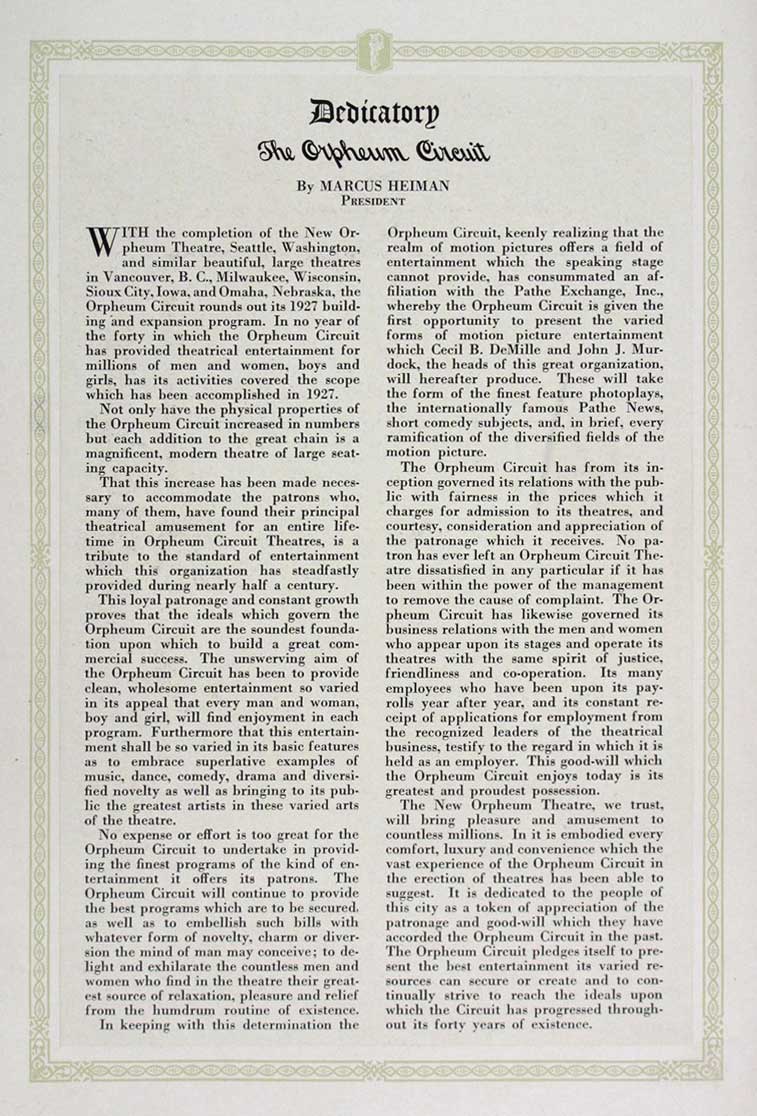
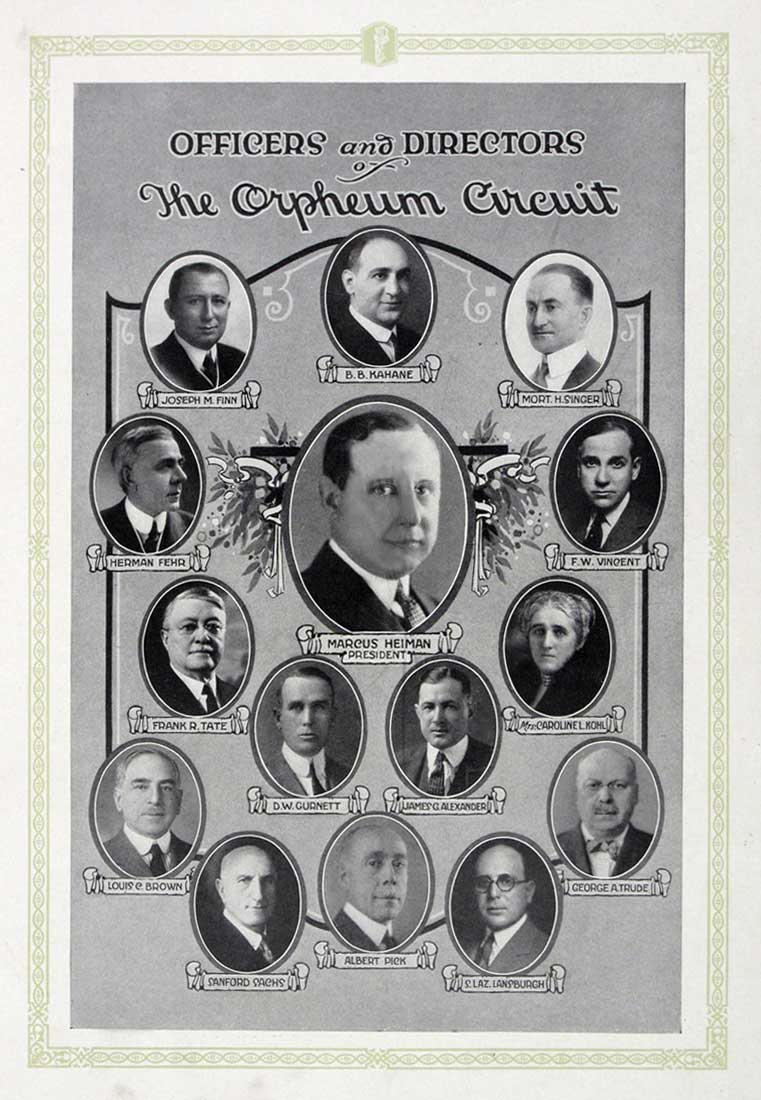
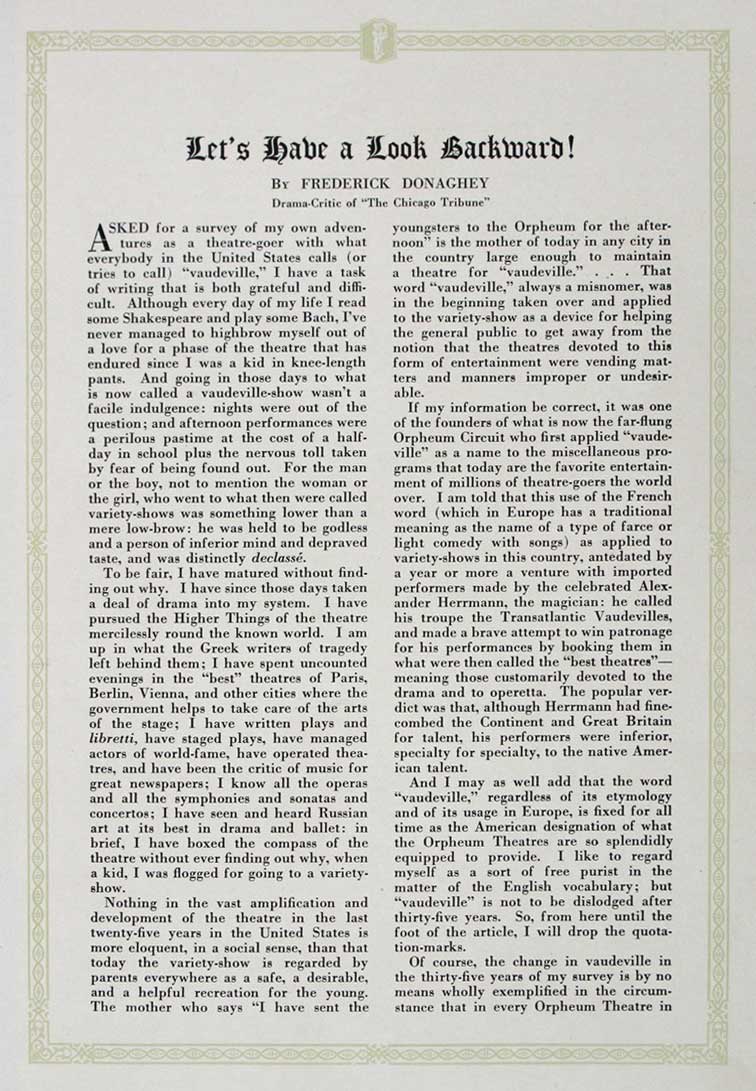
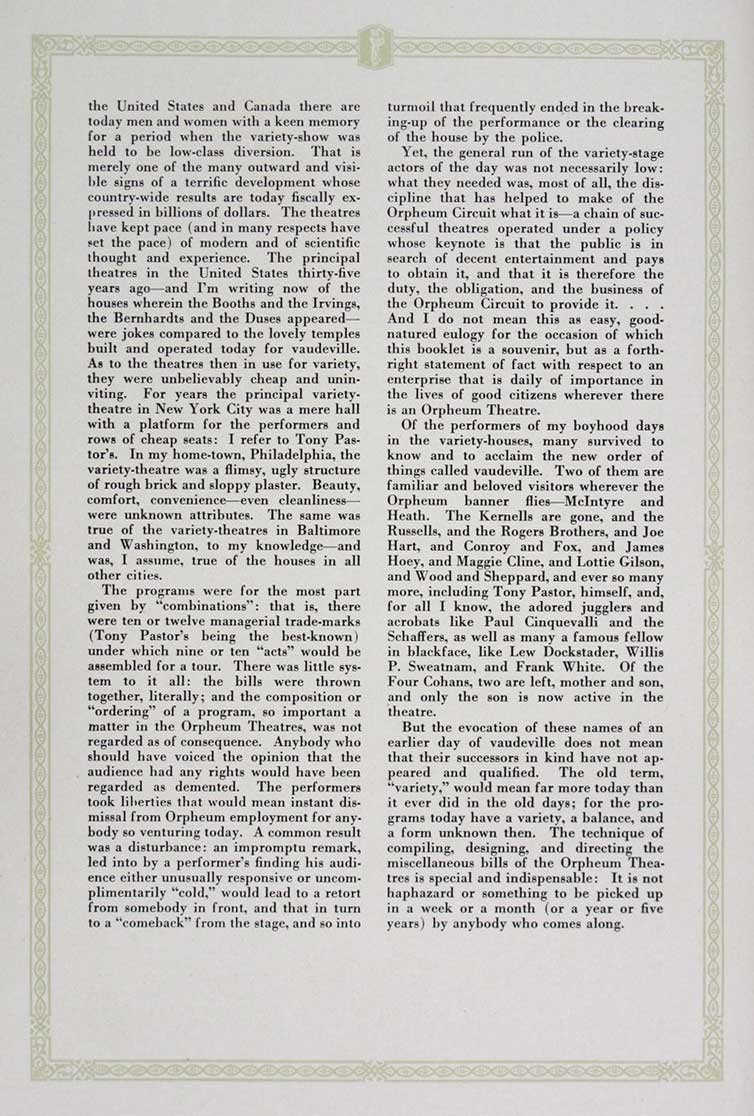
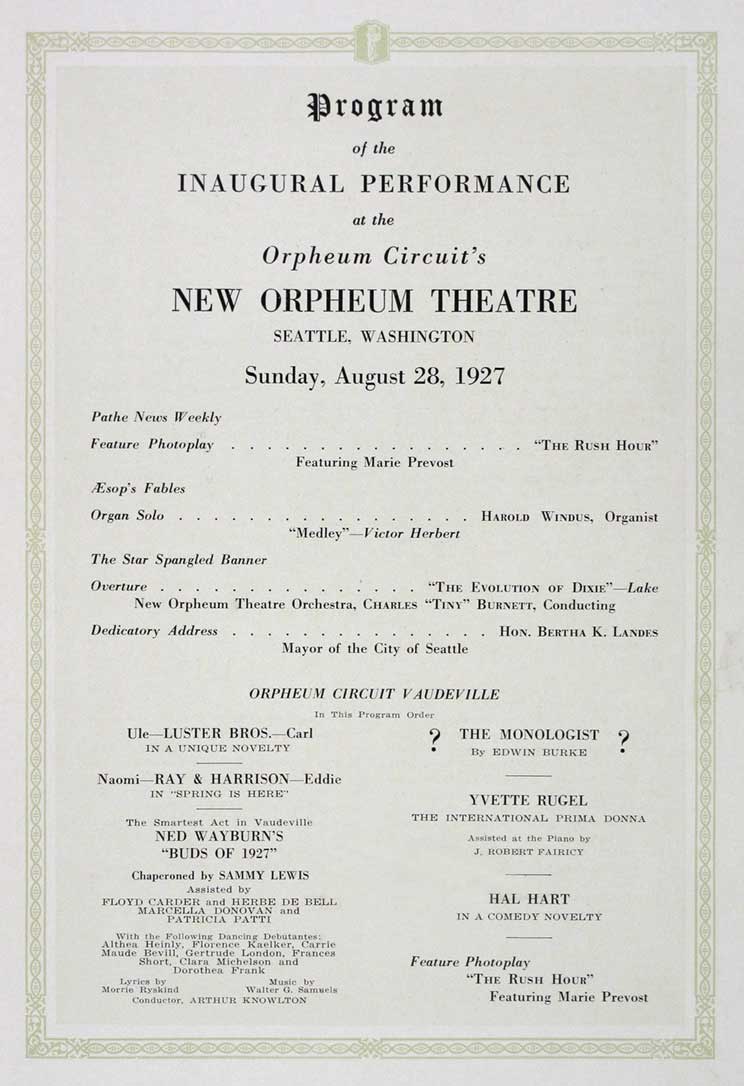
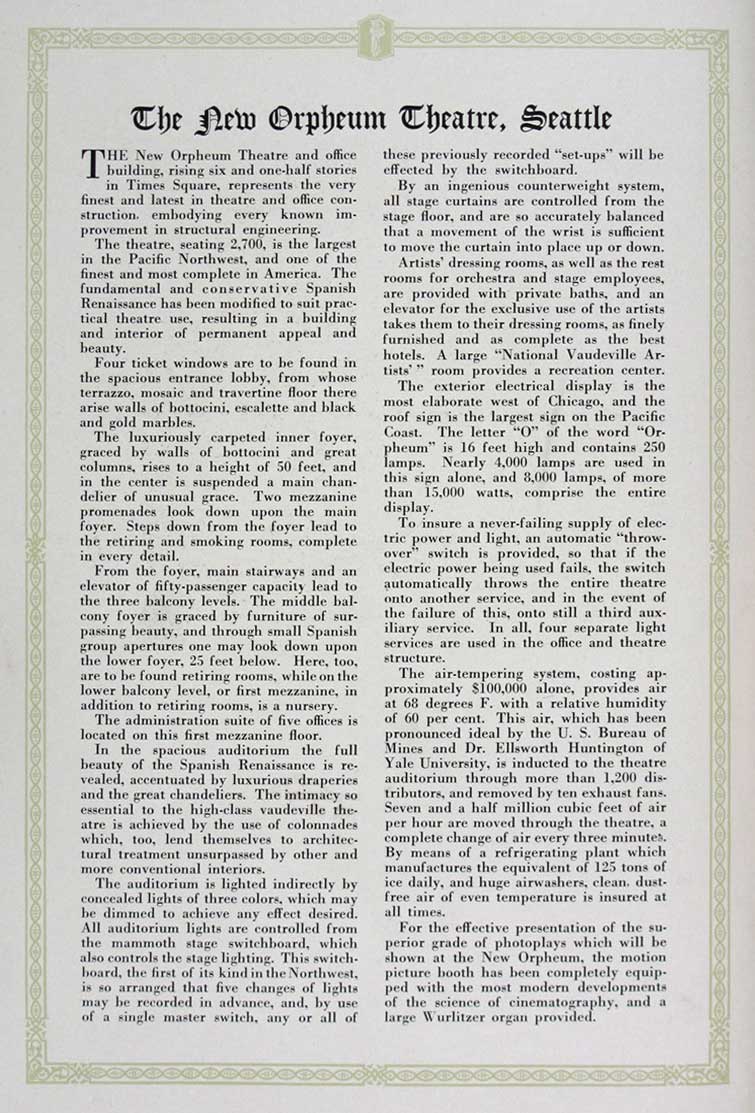
When it opened on Times Square in the summer of 1927, the Orpheum Theatre was the largest venue for films and vaudeville in the Pacific Northwest. However, in six months the distinction of its 2,700 seats was surpassed only six blocks away when the Paramount Theatre opened with 4,000 seats. The Paramount, of course, has survived, while the Orpheum was razed in 1967 with hardly a protest.
Six years earlier, the destruction of the Seattle Hotel in Pioneer Square was vigorously protested because it was the cornerstone of that neighborhood. But here uptown in the mid-1960s the unique three-block diagonal cut of Westlake, from its origin at Fourth Avenue and Pike Street to Sixth Avenue and Virginia Street, was being discussed as the best place to create a civic center that Seattle did not have since the city’s commercial interests moved north into this retail neighborhood. This aura of progress by building something “new and modern” surely dampened preservationist enthusiasm for the Orpheum.
Right after the two-day auction of its lavish appointments, including the marble cut from floors and walls, the theater was destroyed. Surprisingly, the tear down took so long it broke the wrecker’s budget. The sturdy Orpheum was more reluctant than expected.
This “Spanish Renaissance masterpiece” was one of Seattle architect B. Marcus Priteca’s greatest theaters. And in spite of the squeeze of its location his Orpheum was in every part sumptuous from sidewalk to sky. The roof sign was the largest on the coast. Meant for Vaudeville as well as films, it had 14 dressing rooms, all but two with baths.
The Orpheum opened with the film ‘Rush Hour’, and although designed for live performance, it kept for the most part to movies through 40 years in business. I remember seeing both “Never on Sunday” and “Goldfinger” there in the mid-1960s, and confess to being more interested in the films than in the theater (or even aware that it was doomed). Perhaps if it had been in Pioneer Square. (Later I purchased in a garage sale a nicely cut piece of marble that was, I was told, salvaged from the lobby. It was then my belated part in preservation. Now it is on my desk.)

WEB EXTRAS
Jean writes: Stepping out into Fifth Avenue gave me a better view of the “corncob” and the statue of Governor John McGraw (1850-1910), which existed both ‘then’ and ‘now’.


Anything to add, Paul? Yes – a few things Jean. And will first say that it is a fine hide-and-seek with the Police Chief in the bushes, you show above. Another evidence of what a shadow is life. How brief and how forgotten. A man of such note, now unknown but to a few. Not even this monument in one of the landmark intersections of the city will instruct or distract citizens enough to make much mark for the identity of Governor McGraw, pawn of the railroads. Still surviving in a few libraries are copies of McGraws “In Memoriam” chap book served up at his memorial service. This cover was copied from the library of our regular supplier of “Edge Clipping” – Ron Edge.

First another photo of the new Orpheum, followed by another now-then feature first published in 1993, and more, which will be captioned in its places.

GOLDEN ANNIVERSARY FOR THE SEATTLE SYMPHONY.
(This story was first published in The Seattle Times Pacific Magazine on Dec. 5, 1993.)
In 1953,The Seattle Symphony Orchestra promoted its golden anniversary with a pubic campaign to discover “Where were you on the night of Dec.28, 1903?” – the night Harvey West directed the Seattle Symphony’s first concert in the ballroom of the Arcade Building at Second and Seneca.
Arthur Fiedler guest-conducted the Seattle Symphony for this Nov. 3 concert, and local virtuoso Byrd Elliott was featured with Prokofieff’s Second Violin Concerto. The Orpheum was filled to its 2,600-seat capacity.
Earlier, in January of 1953, Arturo Toscanini’s assistant, the violist Milton Katims, made his first appearance here as guest conductor. The Seattle Symphony was then still playing in the Civic Auditorium, an acoustic purgatory that violinist Jascha Heifetz called the “barn.” Heifetz’s opinion was shared and extended by Sir Thomas Beecham. The already-famous English maestro conducted the Seattle Symphony during much of World War II and, before leaving here, famously called Seattle a “cultural dustbin.”
The symphony’s first postwar conductor, Carl Bricken, resigned in 1948. The musicians soon formed their own Washington Symphony League and scheduled a season of 16 concerts at the Moore Theatre with a conductor of their own choosing, Eugene Linden of the Tacoma Symphony. This rebellion was short-lived, and the following year the organization was reformed. Milton Katims, the Seattle Symphony Orchestra’s guest conductor became its residence conductor with the 1954-55 season and he stayed on until 1976.
In 1993 when this feature was first published, the Symphony was it its 90th season and, the story noted then, “is quietly campaigning for a new auditorium.” It got it, of course.


(click to enlarge photo)

The first Downtown Seattle Spring Festival of Fun was promoted mid-march in 1964. It was another try at adding some zing to a city who felt deprived of it since its Century 21 left it a Seattle Center in the fall of 1962 but not yet much to use it for. As the southern terminus of the Worlds Fair’s Marvelous Monorail, the Westlake Mall was also developing into another and smaller Seattle center. The Ides of March – the next day, March the 15th – was designated the festival’s Waterfront Day. Joe James manager of Ye Old Curiosity Shop was the chairman. Ted Griffin, the manager of the marine Aquarium at Pier 56, which had done well during Century 21, two years later was struggling to draw visitors. Days before the March fun Griffin announced his plans to stage an octopus wrestling match at his aquarium. Every Old Settler understood that Griffin’s promotion was inspired by the “Great Rassel of 1947” when Ivar Haglund brought out from the east the pugilist Two Ton Tony to take on Oscar, the star octopus at Ivar’s Pier 54 Aquarium. Griffin’s bout did not make such a splash, but his great celebrity was less than a year away when he captured and put on show at his far end of the pier the killer whale Namu. For Ivar’s part in the ’64 Festival he arranged the musical accompaniment for the Ide’s Waterfront Day with Pep Perry’s Fire House Five Plus Two playing for the open house at the new fire station, which still stands at the foot of Madison Street, and next door to Ivar’s Acres of Clams.
We include below four displays of the same southeast corner of 46th Avenue and Corliss Street, for the years 2007 through this year, 2010, all of them photographed during the afternoon of the 8th day of March. It is radiant evidence of our early spring after the warmest January in Seattle’s history and then a mild February following it. One neighbor notes that his budding dogwood does not ordinarily show itself so until the time of his daughter’s birthday in early April. These are not his dogwood but another neighbor’s cherries. All four images involve a merging of left and right halves. The joining is not always perfect, but close enough for these cross-references. After three-plus years of walking the neighborhood almost every day I have many hundreds of impressions of this corner and a few hundred more. Without a computer and digital photography this would have cost a fortune. With them it was just a few thousand snaps and a lot of walking.
[click to enlarge and then click again]


Below are a handful of the thousands of photographs taken from the Smith Tower through its now 96 years. The most popular prospects were north to the central business district and west to the harbor, but if Mt. Rainier was showing this southern view might be captured too. One could look above and beyond the industrial “park” to the the national park. (Actually, Mt. Rainier can be seen in only one of the views included here.) The Frye Packing site can be found in all of them, although not always the same plant. It is above the Great Northern tower – somewhere above it. The most recent view is from 1982, and the only one I photographed. Perhaps we can stir Jean to return to the observation tower for a “now” recording that will display the recent glories of SODO, and the enduring ones of “The Mountain That Was God.” Watch for “Jean’s Turn in the Tower” coming to this blog soon.


(click to enlarge photos)


Twice I have heard from persons who were working downtown – one in the Exchange Building and the other in the Smith Tower – during the Second World War who described the strange bomber, trailing smoke, sputtering and flying much too low over the business district as it headed south in what test pilot Edmund T. Allen probably knew was a hopeless attempt to make it back to the Boeing Field it had left minutes earlier.
At 12:23 they heard – and many also saw – the still secret B-29 Superfortress first sever with arcing explosions the power lines north of Walker Street and then slam into one of the biggest structures in the industrial neighborhood, collapsing the northwest corner of the Frye meat packing building that was dedicated to the slaughter of pigs and the manufacture of, among other products, Frye’s big buckets of Wild Rose Lard. (The cans were famously illustrated with its namesake rose.)
Those who heard the surreal chorus of squealing pigs that followed the explosion described it as terrifying.
The death toll for that Feb. 18, 1943, included one fireman, twenty Frye employees and the ten from Boeing who stayed with the plane and two who did not. Most were engineers. Earlier when the bomber was close to colliding with Harborview Hospital, two engineers bailed out but there was not enough distance between the plane and First Hill for their parachutes to open. Eighty pigs did not make it to slaughter.
This famous press photo and scores more are included in Dan Raley’s new book “Tideflats to Tomorrow: The History of Seattle’s SODO.” For readers who have not heard, SODO – meaning “South of the Dome” – is the name for the neighborhood south of King Street, long ago reclaimed from the tidelands, but more recently divested of its Kingdome. All that is recounted in the book and much more.
Reader’s can contact the publisher via fairgreens@seanet.com, or check their neighborhood bookstore – those that have survived.
Jean is away in Illinois attending a Knox College theatrical performance in which his youngest son, Noel, plays one of the principal parts. When the last performance was completed and the congratulations too, Noel went off with the players for the cast party and dad returned to his room in a converted Ramada Inn on the town’s principal square. There from his lap top he inserted this week’s story of the B-29 crash into this blog and asks me, “Anything to add, Paul?” Yes Jean we’ll put up the map we arranged to help locate the proper spot on which to shoot your “now.” And it also shows the crash site at the northwest corner of the Frye Plant. And we have grabed a low-resolution aerial that shows the damage looking to the southeast. A look at the Frye’s first plant on the same site when it sat of pilings over the as yet unreclaimed tideflats follows. Then up to the Frye Mansion on First Hill, at the s0utheast corner of 9th Avenue and Columbia – one block south of St. James Cathedral. Here we first insert a photograph of the old Coppins Water Tower. From the mid 1880s to about 1901 the big well below that tower was the principal provider of fresh water on First Hill. The Frye mansion took it’s place. Emma and Charles Frye collected genre paintings and . . . well more is told below with the feature that first appeared in The Times in 1997.
(As Ever – Click Images to Enlarge Them – sometimes click twice.)


[Here we hope to insert the “now” that appeared in Pacific in 1997. It is temporarily in a shuffle of negatives – somewhere in this studio.]
THE FRYE’S SALON
(This first appeared in Pacific Magazine, April 6, 1997)
Here’s an aside to the hoopla encircling the reopening in new quarters of the 45 year old First Hill institution, the Fry Art Museum: a short notice of whence came these paintings of cattle, angles, graybeards and bucolic paths.
After returning from Europe in 1914 with more paintings for their swelling collection the Fryes joined a large gallery to the south wall of their big home on the southeast corner of 9th Avenue and Columbia Street. Soon its four walls were filled “salon style” with ornately framed oils crowding one another from the Persian rugs on the floor to the skylights. This view of the gallery’s northwest corner reveals a fair sampling of the type of often sentimental realism the couple preferred in their art.
Charles Frye who made his considerable fortune as the Northwest’s biggest meat-packer, was especially fond of animal subjects including the German master Heinrich Zuegel’s “Cattle in Water”, here the second oil up from the floor in the second row right of the gallery’s West (left) wall. In the contemporary scene Zuegel’s cattle have been returned with the help of real estate maps, aerial photography — the gallery skylights show well from the sky — and a 100 ft tape measure, to within five or six feet of their original place on the north gallery wall.
(Now we identify below some persons as seen in the “now” photo that appeared in Pacific, but again, not yet here. We will insert that photo from 1997 – when we find it . . . again. Temporarily we will include, directly below, the clip from Pacific.)


All this figuring puts the painting in the living room of the St. James Cathedral Convent which replaced the Frye home in 1962, ten years after the Frye collection had been moved one block east to the then new namesake museum. Standing about the painting — and supporting it — are Sisters Anne Herkenrath and Kathleen Gorman, right and center respectively, both distinguished members of the order Sisters of the Holy Names and therefore long-time Seattle educators.
With the sisters is artist and author Helen E. Vogt. The Frye’s great niece was practically raised in the Frye home and lived with them in the early thirties while an arts student at the University of Washington. As part of my “art direction” for the “now” scene I asked Helen Vogt to hold a copy of her most recent book Charlie Frye and His Times. Before the opening of the Seattle Art Museum in 1933 Seattle’s largest art gallery was the Frye’s, and the public was free to visit it. Pacific Readers wishing to know more about Seattle’s early art history should consult Vogt’s biography of Seattle’s one-time cattle king — packed and framed. Those wishing to make a closer inspection of Zuegel’s deft impression of Cattle in Water, and hundreds more paintings from the Frye’s collection should visit the museum at 704 Terry Avenue. The admission is still free.


Here – at last – we can compare two “big snows” on the Queen Anne Counterbalance, that unique stretch of hill climb that reaches from Lower Queen Anne to Upper. For a few decades these blocks were fitted with an underground trolley counterbalance. It featured a tunnel running beneath and in line with Queen Anne Avenue – but only here where it climbs the hill. Running on tracks within the tunnels was a peculiar “box car” made of concrete, which when hooked by cable to the bottom of the trolley helped pull it to the top of the hill – while the box car descended in the tunnel – and also helped brake it by climbing the hill when the trolley came back down it. And none were left on top. This unique device would not have been bothered by snow, unless it was a really big snow. The 1916 Snow was such a pile that even the counterbalance cars here on Queen Anne Hill were stopped – like the one we see stalled in the middle of the Avenue between Mercer Street (behind the photographer) and Roy Street, behind the car. Perhaps the motorcar is also stuck – but not the horses.
Jean is away to Chicago this weekend to see his son perform in a play. When he returns he will link this little blogaddendum directly to the blog’s history of Seattle snows. [Jean’s note: it can be done, Paul; yea, even from the city of big shoulders – or thereabouts]


WE INTERRUPT WITH THIS BLOGADDENDUM


HOLY NAMES on the HILL
So wholly do the names of spring
Now run like sap through everything
Oh fresh the flowers blooming
And all our being is becoming
(click to enlarge photos)


In these United States of America, eating horse meat is just not done by most people these days. Yet in this week’s historical view we see three grown men boldly confronting that taboo and raising another sign announcing in big letters “horse meat.” They promise to have it by Monday — inspected by the government and not rationed, so always available as long as there are Montana horses to slaughter.
While the name of the Pike Place Market business offering the equine steaks is the “Montana Horse Meat Market,” the buyer could not know for certain that all this promised horse meat would actually come from the Big Sky Country. They may have wished it were so. In 1942, the likely year for this sign-lifting, much of the Montana range was still open.
Partners Lewis Butchart and Andrew Larson were already selling beef and pork at 1518 Pike Place in the late 1930s, but then with the war and the rationing, they brought out the horses. In a 1951 Seattle Times advertisement, they used the Montana name and offered specialties like “young colt meat, tender delicious like fine veal.” “Montana” is still used in the 1954 City Directory, but not long after.
In the mid-1960s (and perhaps later) one could still find a smaller selection of cheval cuts (the French name for the meat the French often eat) at 1518 Pike Place. Market resident Paul Dunn remembers buying horse kidneys there for his cat. Those humans who have tried it commonly describe the meat as “tender, slightly sweet and closer to beef than venison.” Those who promote the meat might note that it is lower in fat and higher in protein than beef. That is not likely to change the average modern American’s view about eating an animal most view as a pet.
Jean writes: A Mr. D’s employee led me down narrow steps into a basement storage area. She recalled large iron hooks, hanging from the pipes, which had, Mr. D himself asserted, been used for hanging horse carcasses. The hooks were recently removed.


Anything to add, Paul?
Yes Jean but most of it uncertain, and more cheese than horse meat. I’ll caption what I know about the pixs below within their frames. [May we remind our readers to click twice and sometimes three times to enlarge these images.]


 Finally, neither meat nor cheese Jean. We are looking here into what will be the heart of the future Pike Place Market – a quarter-century later. Rising above the tides and off shore you can see the ruins of what was once the largest structure in Seattle: the Pike Street coal wharf and bunkers. It was photographed ca. 1881 from the King Street Coal Wharf that replaced it in 1878. This is but a detail of a pan of the city. (This also appears in our Waterfront History Part 5, with a more detailed description and in context too of more, yes, waterfront history.) Note the south summit of Denny Hill on the right, and Queen Anne Hill on the left. In between them is the north summit of Denny Hill, and running between the two “humps” of Denny Hill is Virginia Street. The original for this is at the University of Washington’s Special Collections.
Ron Edge is sorting through his collections and finding forgotten things. One of these we print below as an “Edge Clipping”. (Whenever you see the ALKI logo above you can depend that there will be an Edge Cllipping below it.) We use the term “Edge Clipping” for Ron’s offerings as wide as they range, and here it is an old photo postcard he has lifted from his really well-ordered horde. And it is yet another early 20th local subject by Oakes, who has appeared “in these pages” many times past. The text below Ron’s “clipping” is from a Times “Now and Then” feature I wrote for Pacific, and it appeared on August 15, 1989. The “now” photo printed beside a different photograph of the fire station #8 (I mean, not this one) shows that a tennis court replaced the station – or was in its place in 1989. Perhaps Jean will return to the site again and find out what is there now – if it is something other than the grand new Queen Anne standpipe that we featured here last January 3, when Pacific also ran a sidebar explaining my tongue-in-cheek part in a local hoax. Happy reading and Keep Clam and My oh My.

(Click to Enlarge)
A QUEEN ANNE MISSION – is the title The Times gave to the story below.
Of the fanciful fire stations built in Seattle in the 20 years or so following the city’s Great Fire of 1889, Queen Anne Hill’s Engine House No. 8 was a unique creation – although it had its double. The Mission-style building featured curvilinear gables on the front-center wall over a small balcony (with flower pots), and to either side (of the gables) there were low-pitch roofs with wide eaves and exposed supporting rafters. The bell tower with its arched windows also fits the style, although this tower is for hanging hoses, not bells. It stands next to another “imposter”, the Queen Anne water tower, which is decorated with battlements at its top. The standpipe was built in 1900 as part of the city’s then-new Cedar River gravity system. The bleaker steel “beaker” (without pouring spout) was soon added by a water department that in between No. 1 and No.2 lost its urge for elegance.
Engine House No. 8 was not alone. It had is doppelganger at Minor Avenue and Virginia Street. Engine House No. 15 was its mirror image, with a reverse floor plan and the hose-drying tower on the opposite side of its otherwise symmetrical presentation. No. 15 was destroyed in 1951. Built in 1908, Engine House No. 8 survived a dozen years more until it was razed in 1963 and replaced by a tennis court. Engine Company No. 8 then moved into its simple and modern station a few yards south of this its old “Mission.”
(click to enlarge photos)


Here’s a lesson in the sleeping befuddlements that may nestle for long naps with mistaken captions.
In this instance we return a quarter-century to the mid-1980s when Clay Eals, then the editor of the West Seattle Herald, was busy assembling the West Side Story, the very big and revealing book of West Seattle History written and illustrated by volunteers, (myself included) with Eals our guiding hand and kind support.
But then briefly and undetected something bad happened in the editor’s office. Clay made a mistake, or rather he repeated one. Eals, who led the neighborhood’s forces of preservation in a successful save of its threatened landmark theatre, The Admiral, received the print shown here from a credible and even venerable West Seattle source and so felt confident enough to include it in the big book as the Portola Theatre, the predecessor of the Admiral. After all, “Portola” is how it was identified with a label stuck to flip side of the print originally loaned to him.
Here, and recently, enters one of Seattle’s silent film era experts David Jeffers who was not convinced. First, there is no “Portola Marquee” showing for what is still obviously a motion picture theatre with film posters pasted to it. With a sharp enlargement – and no deadline – Jeffers studied the scene in detail. Knowing where Seattle’s now “missing theatres” were once located he soon determined that this was not West Seattle’s Portola but Queen Anne’s own neighborhood theatre at the northwest corner of Queen Anne Avenue and Boston Street.
Jeffers reflects, “Much of our history is forgotten, not lost, and only awaits re-discovery. Just as every neighborhood has a branch of the Public Library, in the years before television they all had a movie house, typically within easy walking distance. One of these forgotten theaters stood on the Northwest corner of Queen Anne Avenue North and West Boston Street. The Queen Anne Theatre opened for business in 1912 and closed, as did many, with the advent of sound in the late 1920s.”
Jean writes: Just a couple of extras from my end this week, Paul. The first is a sweet pair of perpendicular shoes across the street from the now-horizontal Peets:

And the second, Clay Eals himself, about to slurp from the water fountain at the base of the Queen Anne water tower. Some may note his Cubbies hat and recall that Clay recently authored a masterful biography of Steve Goodman, songwriter/musician known for writing ‘The City of New Orleans’ but also the immortal “A Dying Cubs Fan’s Last Request’ (amongst many others). For more about Clay and Goodman, click here.

Observant readers may recall that Clay appeared in a previous SN&T column at the beginning of the year.
Anything to add, Paul?
Yes Jean, I have some more “web extras” or as we sometimes call them “blogaddendums.” Many years ago – in the 1980s – I was given Lawton Gowey’s slides of Queen Anne Hill where he had lived all his life. Previous to his death by heart attack Lawton was a collector-student of local history. He especially liked trolley history. He died suddenly on a Sunday morning while preparing to go once more to play the organ at his Queen Anne church (Presbyterian). His collection was quite large and most of the prints in it were directed by his family to the University of Washington’s Northwest Collection. All of the below are pulled from about 300 (or more) slides of Queen Anne he left. Some others have been sorted into “programs” (carousels) that were not examined for this selection. Among those are others scenes for our intersection of Queen Anne Avenue and Boston Street, but I have not as yet found them. I’ll come upon them most likely when preparing a slide lecture – later. Jean, if you like, you may wish to take some repeats for these when you have time, for instance, on your way downtown. They are all of Queen Anne and easily found. I will give short captions for each with location and date. All of the colored slides were photographed by Lawton.


On Monday, Feb. 8th (Boy Scout’s Day) Jean and I visited Steve Sampson in Belltown as he fidgeted with his office-studio. I took the first view below of the two of them. The place is a-funk because Steve was at the time closing it down before returning this coming Sunday to his new home in Paris with Cynthia Rose, another good friend.
Next we came upon the stables or livery door in the alley that Jean put up on this blog a ways below this contribution. We were on the way to the Pike Market where we shared lunch at the Pan Africa. Jean used his “Ethiopian utensils” for the Ethiopian dish prepared. I have often enjoyed Jean’s many good stories of his trips to Ethiopia and he will include below some highlights and illustrate a few of them too.
This evening we met with Steve again – for the last time during this visit to Seattle – in Fremont at Brad’s Swingside Cafe. Next time Jean will see him in Paris this summer. There we found Brad revived from a long and risky stay in hospital (last fall) but now back again behind the stove where he is famous for his delicious concoctions. The carved angel on the front porch of the Swingside was placed there in a vigil for Brad’s recovery. The gracious guardian did well, enjoyed the stay and has decided to abide a while longer.


Jean writes:
As Paul suggested above, I’ll revisit a few highlights of my last trip to Ethiopia, which was, Paul neglects to mention, a number of years ago. The photos I took are pre-digital – a compact Canon point-and-shoot – scanned much later.
I last went to Ethiopia in Nov 1999, missing the Battle in Seattle, the progress of which I watched on a flickering hotel TV in Lalibela, (arguably an eighth wonder of the world – which begs the question, is there a single eighth wonder or is that a category?).

It was a little shocking after a month of travel to see images of Seattle on CNN Asia, which was the only channel available. Of course, it being CNN, the images were stock – a ferry approaching the docks with the space needle in the background. But I’d gone to Ethiopia on a bit of a lark, hardly imagining the serendipities that would grace my trip.

On the plane from Rome, I sat in front of, and carried on a long sore-necked conversation with, Hussein Feyissa, who’d studied engineering in the midwest and ran his family’s burgeoning tannery in Addis. Amazing man of industry who sent me to friends and associates all over the country.
Within my first couple of days, I booked an in-country series of flights on Ethiopian airlines, and standing at the counter, met Firew Bulbula who, it turned out, was returning to Ethiopia for the first time since 1974 when Mengistu overthrew Haile Selassie and became an Ethiopian Stalin. We were flying the same routes and became traveling companions. Amazingly, in 1974, Firew was a freshman at the University of Washington, ended up studying economics and teaching it at Seattle Community College by the early 80s. We actually had friends in common, in particular, Gassim, an Oromo prince and PhD, with whom I’d spent long hours chewing the fat at the Last Exit.

Firew and I toured the north together, visiting Bahir Dar and Lake Tana,

Gondar, and Lalibela. Each one deserves a short novella. In Bahir Dar, accompanying Firew to a tej bar, where country men came of an evening to drink honey beer and sing improvised poems to the lyre. The old man who sang of his fallen friends on the battlefield (translated in whispers by Firew) and overcome with emotion had to step outside to recover.

In Gondar, meeting a Japanese woman traveling alone across Ethiopia by bus, staying in roadside hotel/brothels to save money, her arms and neck covered with bites from bed bugs. Brave beyond measure, but she was the nail who refused to be pounded down.

The hyena man of Harar, who made a show each evening of feeding a pack of hyenas outside the walls of this medieval town (once host to the greatest of Victorian travelers and linguist/translators Richard Burton,

as well as Arthur Rimbaud, whose putative house is labeled ‘Rambo’s house’ and was built long decades after his death).

Heart pounding after feeding the hyenas and being plunged into unexpected darkness, I tipped him a month’s rather than a day’s wages and an Ethiopian friend told me that the hyena man said he would pray for me and my family as long as he had the good fortune of surviving the hyenas.

Near the stone meeting bell of an island monastery,

I stumbled over an unusually heavy and seemingly once-molten stone, unlike any other in the area. After returning to the states, I sent a picture and a description of it to a geologist at Harvard, who also thought it likely to be a meteorite.

Or the 4 hour trip crossing Lake Tana to reach another island monastery where the mummified remains of Ethiopian emperors are enshrined, and where the monks, pissed off at my belligerent young guide, threatened to beat us up. One of the monks had an infected ulcer on his shin and I gave him a tube of antibiotic cream as a gift, which mollified him and the others.

The night before I flew home, Hussein Feyissa brought me a bucket filled with fresh honeycombs as a parting gift. I was sure that raw honey would certainly be impounded by customs and insisted that he take the bulk of it home to his wife, who loved honey, he said. But the two of us slurped through several handful of golden brown comb before Hussein took it away. In the middle of the night, I felt my stomach begin to roil in protest. By the time I boarded the plane the next morning, I was munching on fistfuls of anti-diarrheal pills, just to allow me to stay seated through take off. A month wandering Ethiopia, eating virtually everything that came my way, and it was honeycomb that leveled me.


A FORWARD to what FOLLOWS
On PRESIDENTS DAY, February, 15, 2010 we at Dorpatsherrardlomont are distressed at how poorly Americans – generally – know the chronology of their so-far FORTY-FOUR PRESIDENTS. To do our modest something to correct this puzzling withdrawal from the history of our nation’s leaders we mean below to teach with rhymes for children. Certainly, many readers will find it easier to memorize verse than mere lists, and that is what you get below: honest poetry for honest ends and not as difficult as many poems used in accelerated reading programs to help primary school children’s chances for entering one or more of the best universities. When possible the rhymes have also been chosen for added patriotic meanings, which are also suitable for children. (Anyone who has picked up a book of rhyming words knows that there certainly are plenty of competing choices that are also proper ones.)
One final precaution: the poem begins with Warren G. Harding rather than George Washington. As you will soon discover, we needed a rhyme for “spouse’s bidding”.
44 IMPERFECT PATRIOTIC RHYMES for 44 ALMOST PERFECT PRESIDENTS
Set in Chronological Order for Easier Instruction for Minors & Their Parents in the History of the American Presidency.
In the name of Warren G. Harding
Give us this day to play
And do our spouse’s bidding.
First we fetch a key to the pantheon
From the owner George Washington.
Now all together we will holler at the Talibans
From behind the shoulders of John Adams,
And then fix some things in the Constitution.
(All the changes will be signed by Thomas Jefferson.)
We may arouse the distracted James Madison
With a Stereopticon and a little canon,
And then play “Friend or Foe”
With the doctrinal James Monroe.
Let us laugh again at the Talibans
With the son, John Quincy Adams.
Now let us put some steaks on
For Andrew Jackson and Martin Van Buren?
Invest in a panopticon and another little canon
With William Henry Harrison,
Who died of a cold
When but 32 days old.
Let’s Run a quarter-miler
With John Tyler,
Do a somersault
With James K Polk
Whose manifest destiny
Lassoed Oregon territory,
Followed by a nap in the trailer
With Zachary Taylor.
May we please eat some more
With Millard Fillmore
And dip the chin and eyes lower
For Franklin Pierce
Who died of cirrhosis.
We will play hide and seek in the White House
With bachelor James Buchanan dressed as a mouse,
And perhaps little bo peep – such fun!
Then turn the vacuum on and run
To excite Abraham Lincoln.
Now put a chop on,
For the impeached Andrew Johnson.
Let us now dance ‘till we pant
With Ulysses S. Grant
And then press his pants.
Take in two or three costume plays
With the unpopular Rutherford B. Hayes,
But now stand far-a-field
From James Garfield,
Discuss ding an sich and things obscure
With No. 21 Chester A Arthur,
Show our pictures of Disneyland
To Grover Cleveland,
And count again the budget and the bison
With “Billion Dollar” Benjamin Harrison.
Now Cleveland more –
He get’s his encore,
Which we break with a litany
For William McKinley.
Next get up and run about
With Theodore Roosevelt,
And this time ignore the fat
Of William Howard Taft.
Share some pheromones
With a Parisian Freudian
And Woodrow Wilson,
And pray for the pardoning
Of William G. Harding.
We open the fridge
For a thin Calvin Coolidge.
We may visit the Louvre
With Herbert Hoover,
And then fish in the West for smelt
With Franklin D. Roosevelt,
Or with Eleanor and him
And Harry S. Truman.
Yes, we do feel the military-industrial power
Of Dwight D. Eisenhower.
Yet another litany
This for John F. Kennedy.
Now that’s no fun
So stuffed bears for everyone!
We’ll Visit Saigon
With Lyndon B. Johnson
And put a fix on
With Richard M. Nixon.
Next we may either continue
With west wing bourbon & shuffleboard
Or share a cheeseboard
With Betty and Gerald R. Ford.
Let us also share Coke and his brother
With James Carter.
And then entertain a gregarious vegan,
While White House guests of Ronald Reagan.
We are pleased to sit on our tooshies
Between the two Bushies
(George on the left, George on the right))
And in between them
Carve a soapstone billikin
With the handy Bill Clinton?
At last we will sit in our pajamas
With the Barack Obamas?


How had this lovely Gothic Revival garage escaped me for half of its life? I have driven by it a few hundred times since my first pass in 1966. It was built in 1925 at the northeast corner of 6th Avenue and Olive Way. Perhaps I was a good driver and kept my eyes on Olive Way. But by such prudence I missed much including the slender corner tower that reaches seven stories to the Gothic parapet, which runs the length of the building’s public facades on both Olive and Sixth.
This photo of the Fox Garage was one of several Mark Ambler showed me in hopes that I could help him locate it and the others. I recognized the Tower Building (at 7th and Olive) behind the garage, but remained puzzled about the garage itself.
Thanks to the “historical sites” section of the city’s Department of Neighborhoods website I found Karin Link’s summary of Fox Garage history. The historic preservation consultant writes, “This is a very early and unique attempt at creating a tall parking garage, which could accommodate many cars, and still engage the neighborhood of well-designed city buildings.” There is much more in this “Link report”, which you can read here.
The Fox Garage signs hanging here from the parapet are improvisations. The landmark first got its glamorous tie to the Fox Theatre/Music Hall when that lavish Spanish Revival theatre opened in 1929 at 7th Avenue, a block east on Olive Way.
George Wellington Stoddard, the architect, had a long and productive career in Seattle. It may not surprise you to learn that he was also responsible for the concrete Memorial Stadium at Seattle Center (1947) and the concrete Green Lake Aqua Theatre (1950).

[ Click Everything TWICE to ENLARGE]
Jonathan Swift, 1667 to 1745, was one of the greatest of English satirist. Some think him the greatest. He is best known for Gulliver’s Travels, A Modest Proposal, And Argument Against Abolishing Christianity, A Tale of a Tub, but not so much for THE LADY’S DRESSING ROOM as such. This wonderful description of a woman’s boudoir is widely known as the Celia Shits Poem for its most memorable line. I remember it from Dr.Clarence Simpson’s class in Enlightenment English Literature at Whitworth College in 1960. Jean also “had” Clem nearly 20 years later when he attended Whitworth for fewer years than I. Jean finished at the U.W..
When the opportunity of dedicating our book Washington Then and Now came up, we agreed that Clem would be a wise choice for he was often wise and we both liked him for it and his unfailing kindness.
I have learned that the Swift poem is new to Jean. He remembers Clem for teaching medieval literature not Swift. Not so long after our dedicatory lecture to Dr. Simpson and some other residents at the Des Moines retirement home where he then lived with his wife, Clem died, and she not long after he. We print these valentines, the Swift poem and a much lesser verse by myself written a moment ago, all in honor of Professor Clem and his teaching, and also in thanks for the Irish-English satirist Swift and his exuberant example – the thoughtful or prudent use of a few naughty and/or bad words.
Reading the entire Swift poem is a delight – so go to it! And please read it aloud. Or will you instead surrender to the continuing decline of the West and return to the comforts of your home entertainment center, perhaps a Television choice that you agree is half-witted but sensationally so?
How so satire?! What follows is a poem done in parody of those many verses that glory in the beauty of their own Celias – safely out of . . .
THE LADY’S DRESSING ROOM
By Johnathan Swift
Five hours, (and who can do it less in?)
By haughty Celia spent in dressing;
The goddess from her chamber issues,
Arrayed in lace, brocades, and tissues.
Strephon, who found the room was void
And Betty otherwise employed,
Stole in and took a strict survey
Of all the litter as it lay;
Whereof, to make the matter clear,
An inventory follows here.
And first a dirty smock appeared,
Beneath the arm-pits well besmeared.
Strephon, the rogue, displayed it wide
And turned it round on every side.
On such a point few words are best,
And Strephon bids us guess the rest;
And swears how damnably the men lie
In calling Celia sweet and cleanly.
Now listen while he next produces
The various combs for various uses,
Filled up with dirt so closely fixt,
No brush could force a way betwixt.
A paste of composition rare,
Sweat, dandruff, powder, lead and hair;
A forehead cloth with oil upon’t
To smooth the wrinkles on her front.
Here alum flower to stop the steams
Exhaled from sour unsavory streams;
There night-gloves made of Tripsy’s hide,
Bequeath’d by Tripsy when she died,
With puppy water, beauty’s help,
Distilled from Tripsy’s darling whelp;
Here gallypots and vials placed,
Some filled with washes, some with paste,
Some with pomatum, paints and slops,
And ointments good for scabby chops.
Hard by a filthy basin stands,
Fouled with the scouring of her hands;
The basin takes whatever comes,
The scrapings of her teeth and gums,
A nasty compound of all hues,
For here she spits, and here she spews.
But oh! it turned poor Strephon’s bowels,
When he beheld and smelt the towels,
Begummed, besmattered, and beslimed
With dirt, and sweat, and ear-wax grimed.
No object Strephon’s eye escapes:
Here petticoats in frowzy heaps;
Nor be the handkerchiefs forgot
All varnished o’er with snuff and snot.
The stockings, why should I expose,
Stained with the marks of stinking toes;
Or greasy coifs and pinners reeking,
Which Celia slept at least a week in?
A pair of tweezers next he found
To pluck her brows in arches round,
Or hairs that sink the forehead low,
Or on her chin like bristles grow.
The virtues we must not let pass,
Of Celia’s magnifying glass.
When frighted Strephon cast his eye on’t
It shewed the visage of a giant.
A glass that can to sight disclose
The smallest worm in Celia’s nose,
And faithfully direct her nail
To squeeze it out from head to tail;
(For catch it nicely by the head,
It must come out alive or dead.)
Why Strephon will you tell the rest?
And must you needs describe the chest?
That careless wench! no creature warn her
To move it out from yonder corner;
But leave it standing full in sight
For you to exercise your spite.
In vain, the workman shewed his wit
With rings and hinges counterfeit
To make it seem in this disguise
A cabinet to vulgar eyes;
For Strephon ventured to look in,
Resolved to go through thick and thin;
He lifts the lid, there needs no more:
He smelt it all the time before.
As from within Pandora’s box,
When Epimetheus oped the locks,
A sudden universal crew
Of humane evils upwards flew,
He still was comforted to find
That Hope at last remained behind;
So Strephon lifting up the lid
To view what in the chest was hid,
The vapours flew from out the vent.
But Strephon cautious never meant
The bottom of the pan to grope
And foul his hands in search of Hope.
O never may such vile machine
Be once in Celia’s chamber seen!
O may she better learn to keep
“Those secrets of the hoary deep”!
As mutton cutlets, prime of meat,
Which, though with art you salt and beat
As laws of cookery require
And toast them at the clearest fire,
If from adown the hopeful chops
The fat upon the cinder drops,
To stinking smoke it turns the flame
Poisoning the flesh from whence it came;
And up exhales a greasy stench
For which you curse the careless wench;
So things which must not be exprest,
When plumpt into the reeking chest,
Send up an excremental smell
To taint the parts from whence they fell,
The petticoats and gown perfume,
Which waft a stink round every room.
Thus finishing his grand survey,
Disgusted Strephon stole away
Repeating in his amorous fits,
Oh! Celia, Celia, Celia shits!
But vengeance, Goddess never sleeping,
Soon punished Strephon for his peeping:
His foul Imagination links
Each dame he see with all her stinks;
And, if unsavory odors fly,
Conceives a lady standing by.
All women his description fits,
And both ideas jump like wits
By vicious fancy coupled fast,
And still appearing in contrast.
I pity wretched Strephon blind
To all the charms of female kind.
Should I the Queen of Love refuse
Because she rose from stinking ooze?
To him that looks behind the scene
Satira’s but some pocky queen.
When Celia in her glory shows,
If Strephon would but stop his nose
(Who now so impiously blasphemes
Her ointments, daubs, and paints and creams,
Her washes, slops, and every clout
With which he makes so foul a rout),
He soon would learn to think like me
And bless his ravished sight to see
Such order from confusion sprung,
Such gaudy tulips raised from dung.


(What follows was composed in nearly effortless admiration of Jonathan Swift and his Lady’s Dressing Room, but then it much shorter.)
I CANNOT READ YOUR HEART
I cannot read your heart
And that is just the start.
I cannot read your books at all
Your taste is so abominable.
I cannot read your eyes
As if my own had styes.
I cannot read your fashions
Your clothes should be on ration.
I cannot read your lips
Nor can I read your hips
(A horse seen from a cart)
I cannot read your knees
But my how you do sneeze!
Well!! And now I hear your fart!!!
Yet I cannot read your heart.

[Click TWICE to Enlarge Everything – especially the thumbnails that follow.]


![[If we have read it correctly . . .] Hello Ednah Dear 7/28/14 Nothin like what is on the other side of this card in Albany for I have not seen any one here that would have the nerve to do such. Well dear we made our 11500 test [?] and no one hurt but I was just a little timid in making some of the moved but all over now. Gee I wish you were here no for this AM was trying on your family and everyone is so strang [sic] to me but my (W) B.B. [Top of card] Dear this is one lonesome day for me. How I wish I could see you to talk to you. Your's forever B.B."](https://i0.wp.com/pauldorpat.com/wp-content/uploads/2010/02/valentines-message-web11.jpg "Valentines-message-WEB")


An EDGE CLIPPING as BLOGADDENDUM – a Belated Valentine sans hearts but with fit sentiment and fit timing from February, 1908.

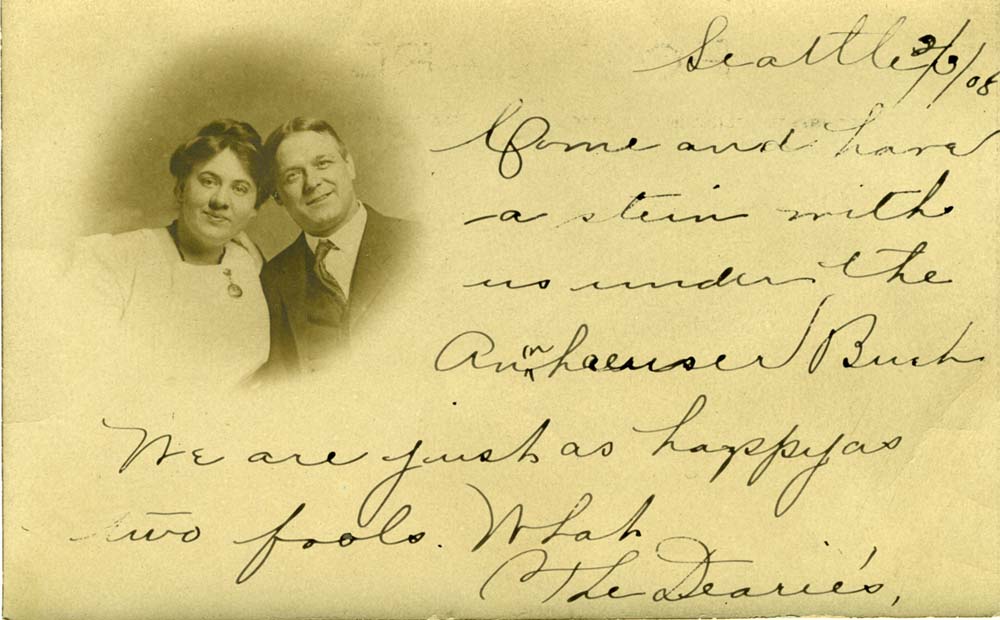

While visiting Steve Sampson in Belltown yesterday, Paul and I wandered down an alley between 1st and Western and found this gorgeous red door set in blackened bricks. Paul guessed it must have been a stable, which was confirmed by former manager and realtor Stan Piha this afternoon. The Seattle Fire Department kept horses here. Stan recalled wooden columns inside showing marks of being gnawed at by horses. The sign for Doty & Associates is long out of date – the firm having pulled up stakes and moved to SoDo 7 years ago.

(click to enlarge photos)


Lorraine McConaghy, historian at Seattle’s Museum of History & Industry (MOHAI), spent the summer of 2005 in “the other Washington” hoping to find treasures in the U.S. Navy’s archives. The object of this ardor was the 117 ft U.S. Navy sloop-of-war, the USS Decatur, which one hundred and fifty years earlier visited Seattle and stayed for nine months defending the village during the Treaty War.
The result is adventures all around – aboard the Decatur, inside the blockhouse, which the sailors helped the settlers complete, and in the village and in the woods behind it. All are wonderfully recounted in McConaghy’s “Warship Under Sail, The USS Decatur in the Pacific West,” a new book from the Center for the Study of the Pacific Northwest in association with the University of Washington Press.
John Y. Taylor, a navy doctor on board, drew this detailed likeness of the blockhouse Fort Decatur – named for the warship. Until the historian uncovered it, the drawing was buried in the archives. One of the two oldest renderings of any part of Seattle, this sketch is totally new to us. The other, also drawn from the Decatur ‘s deck, is by Thomas Phelps, Taylor’s friend and shipmate. Taylor’s rendering has greater detail. The rightfully enthused McConaghy proposes, “You could build the blockhouse from this drawing, I think.”
When the heavy boxes of microfilm copied for her from Taylor’s journals first arrived in Seattle from Yale’s Beinecke Library McConaghy recalls, “I raced to the MOHAI library and my hands were shaking with such excitement that I could hardly thread the reader. But there were Taylor’s drawings, right up on the screen, of Seattle (and much else). I laid my head in my hands and wept.”
McConaghy’s recounting of the Decatur at Seattle and in the five-year Pacific cruise required years of searching and shaping but now the book is readily available to readers and deserves lots of them. She is right: her work “allows us to see (pioneer) Seattle with completely new eyes.”
(The public is invited to Dr. McConaghy’s lecture about her book at Horizon House, on First Hill, Thursday, February 18 at 7:30 pm.)
Paul suggested we illustrate our web edition of this week’s Seattle Now & Then with several photos of surviving blockhouses, featured in our book Washington Then & Now.


Anything to add, Paul?
Yes Jean once more we have some BLOG EXTRAS. (!!!)
UP ABOVE – and already – we inserted Thomas Phelps panorama of the village also rendered, as it were, from the Decatur. And then just below these notes and in order, we include Phelps map of the village both as he drew it (nearly), and then as incorporated in into a larger map of the first settler’s claims. Below that are two paintings of scenes from the “Battle of Seattle.” One by one of the Denny daughters show the villagers rushing to the blockhouse. The other is an “Indian’s-eye view” from the woods of First Hill.


(click to enlarge photos)


For a moment, only, this historical photographer paused on Minor Avenue about 40 feet north of Thomas Street and aiming east snapped this official record of lot 5 in the tenth block of the Fairview Homestead Association’s addition to Seattle. The addition was filed in the mid-1880s but the photograph was taken in 1937 as part of the depression-time Works Progress Administrations picture-inventory of every taxable structure in King County.
The tax assessment here was not very high for these are four nearly identical 900-plus square foot homes squeeze onto one lot, the second lot north of Thomas. The tax card indicates that they were built in 1900. (Perhaps, but they do not show up in the ordinarily trustworthy 1912 Baist Real Estate map.) The intentions of the original pioneer developers were to help working families stop paying rents and start investing in their own homes. Innovative installment payments made the lots affordable and many of the homes were built by those who lived in them, although probably not this quartet.
If we may trust the 1891 Birdseye view of Seattle – and it is splendid to study – Minor Avenue was then part of a shallow ravine or very near it, which gathered run-off in this Lake Union watershed. And since 1996, as part of the Cascade Neighborhood’s public garden that spreads 50 lovingly tended p-patches across this 7000 sq. ft. corner, rain water for the garden is collected into big barrels from the roof of the nearby Cascade Peoples’ Center.
I am a very small part of the footprint of this corner, having lived from 1978 to 1980 in the house immediately to the rear of principal home shown. My desk sat inside the longer window there and looked out on a coiling blackberry patch where now are many kinds of berries, and veggies, and flowers tended with the meditative pleasures of gardening. JoJo Tran, one of the gardeners here, plants for his table and many others. He reflects, “If you love nature, the environment, the colors of the plants, it you can see the beauty of the garden, you feel the beginning of love.”
Jean writes: Visiting this sacred corner of Paul’s personal history on a sodden day at the end of December was a mini-revelation. Here, Paul lived with his dear friend Bill Burden (whose wise and scintillating blog can be found here and through the button ‘Will’s Convivium’ at upper right) and I snapped him looking bemusedly from the spot he identified as having once contained Bill’s room.

Paul brought along a photo he’d taken from his own bedroom window of the church across the road. We include it again, below.

Here’s a repeat I did of the photo in Paul’s hand above:

Anything to add, Paul? Or to correct?
BLOG EXTRAS we call them Jean. And yes I have a few – a slew even – of other pictures that catch this corner or nearby. I will given captions for them, but little ones I hope. I have also written a few now-thens (other ones) about landmarks within a block of this corner but I’ll not include them here. I mention that only to inspire longing in the reader or readers if we have more than one, which is to say more than you.
I’ll begin with two of the south side of 306&1/2 Minor, where Bill and I lived in the late 1970s. My desk – with its Selectric typewriter – sat at the larger of the windows on that wall. I looked out across the vacant ans sunken blackberry snarled corner lot to Thomas Street, and to the left of Thomas still stands Immanuel Lutheran Church. After the views of the window, I’ll place one that looks from it to the church on a night of snow, then others photographed in the late 90s and early 2ooos of the p-patch development. I will date them as best as I can. I believe a highlight of what follows will be my snapshot of Bill trucking down the Minor Avenue sidewalk.





That is all for now Jean. Is it too much? When I find one of Cascade School I’ll attach it.
FOUND the school Jean. Twice – back and front. And another looked at Bill on site in 2006 at the bottom.


 We are delighted to recommend for your enjoyment, Shadow and Light Theatre, a groundbreaking new theatre company presenting two one-act plays by Harold Pinter. Paul and I will be attending next week – the production runs through Feb. 7th at ACT’s Bullitt Theatre – and we urge anyone interested in ‘da real magilla’ to join us for a provocative and haunting theatrical experience.
Directed by Victor Pappas and featuring Frank Corrado and Suzanne Bouchard, this production offers theatregoers an opportunity not only to encounter masterpieces of the theatre (A Kind of Alaska, staged at ACT in 1985; and Ashes to Ashes, receiving its Seattle premiere), but to do so in the company of some extraordinary artists.

[Click to Enlarge]


Top-to-Bottom, Left-to-Right: (Click to Enlarge)
Blue Angels, Blue Flower, Blue Grass, Blue Leaf, Blue Hair, Blue Madonna, Blue Moon, Blue Jays, Blue Boy (paint-by-numbers), Blues Stage, Blue Mountains, Blue Bottles
Below are several winter colors photographed this day, the 25th of January, 2010, on a short walk of five blocks here in Wallingford. I have named none of them, for the reason, I confess, that I know the names of very few of them. Perhaps you will help with a comment. But how can we indicate them? If I can number them below I will. [Carolyn Honke has sent a few names this way from the Azores, where she lives, and we wil include them.]
[Click to Enlarge]


