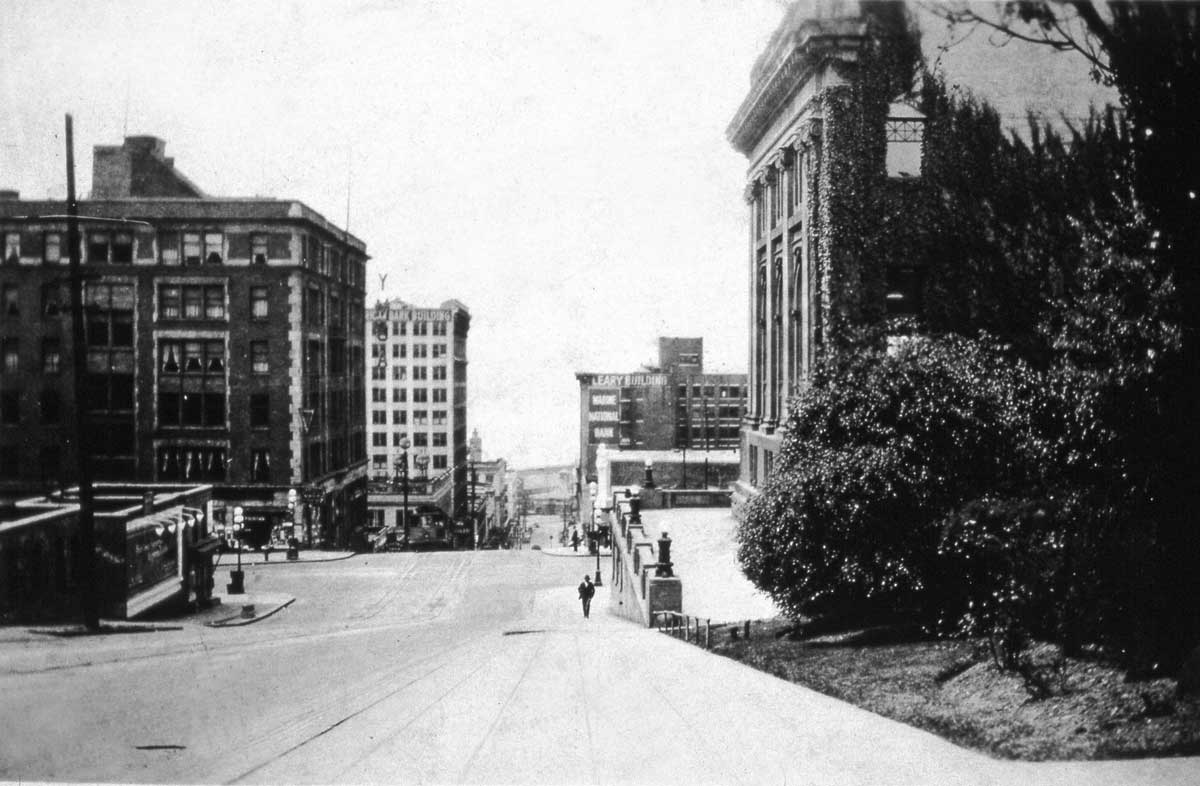
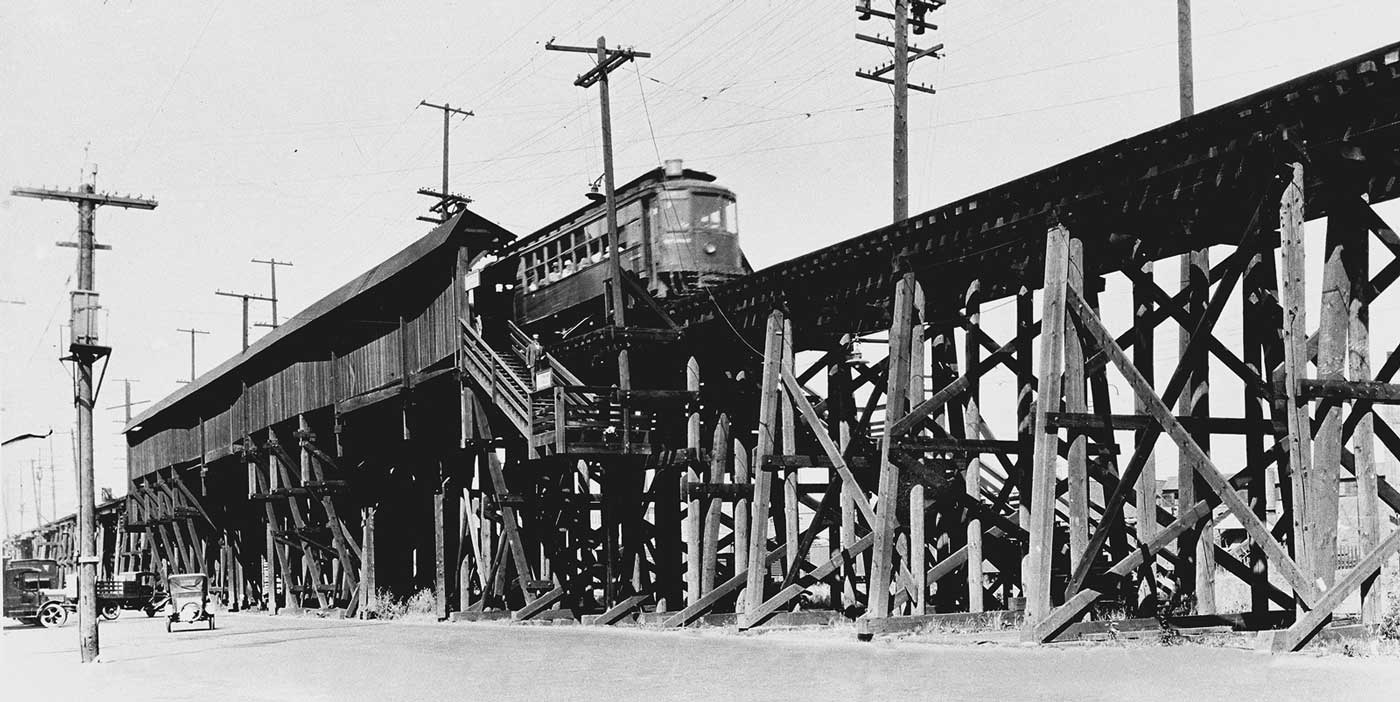
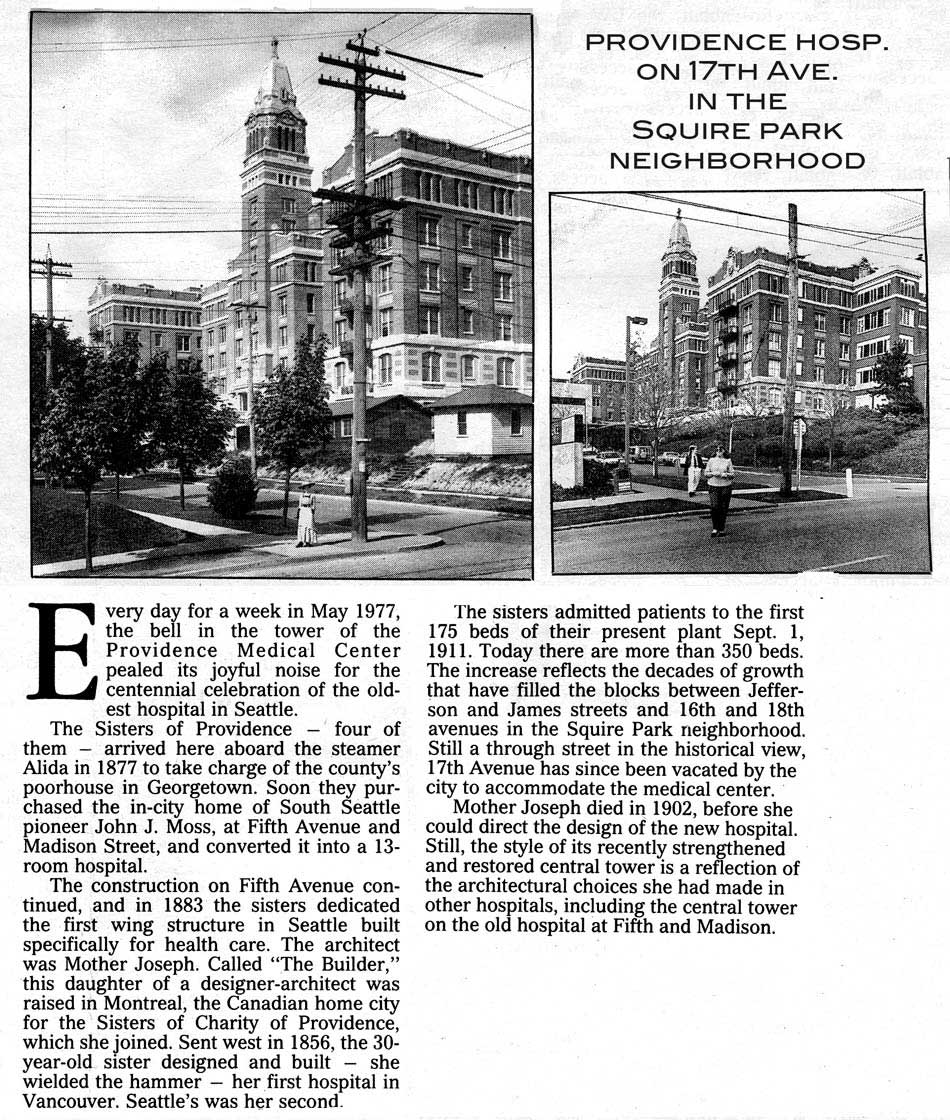
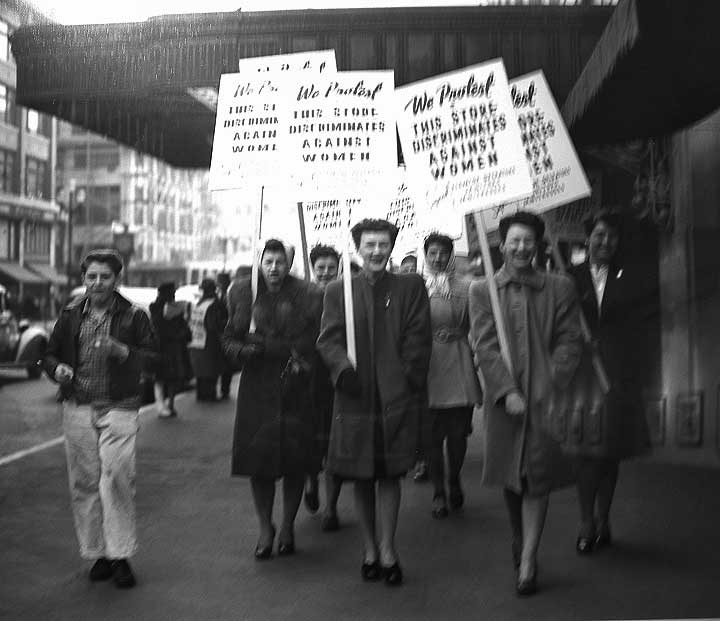
THEN: The Centralia Railroad Depot, recorded not long after its opening in 1912. (Courtesy Dan Kerlee)NOW: In order to catch the tableau of a family greeting on the right, Jean Sherrard moved his camera somewhat closer to the depot and the Amtrak carrier too across the tracks.
On a recent visit to Mt. St. Helens with his family, Jean Sherrard stopped off in both Centralia and Chehalis to photograph their railroad depots. Of course, for these “repeat” purposes Jean carried with him historical photographs of the “twin cities” stations. While in Centralia he was blessed with good “now and then luck.” Picking up and letting go passengers, Amtrak’s Coast Starlight packet was also waiting and posing for him.
Both depots are splendid examples of brick depot architecture and next year both will celebrate their centennials. While making preparations for the birthdays, the Lewis County Historical Society and its museum are fittingly sited. Both have a home in the landmark Chehalis depot.
The Centralia Depot was completed quickly in 1912. Many of the estimated 500 workers were, of course, specialists. The floor was made of terrazzo, the roof tiled, the windows leaded, and hardwood oak was used extensively. Anticipating a booming population the station was also built big. It reaches will over three hundred feet, with five sections separated by breezeways. The restoration took much longer – eight years. It was completed in 2002.
Even before railroads were laid thru them, the Lewis County twins served as halfway destinations between the Columbia River and Puget Sound. Now the railroad line between Portland and Seattle – or with its greatest reach, between Eugene and Vancouver B.C. – is Amtrak’s eighth-busies route, carrying the most passengers of any railroads outside of the Northeastern U.S. or California.
For one dollar the state purchased the station from the Burlington Northern Railroad in 1994 and promptly gave it over to the city of Centralia. The depot is listed on the National Register of Historic Places.
WEB EXTRAS
This time round, I’ve got a few things to add myself, Paul. Several cribbed from our 2007 book, Washington Then and Now:
First, THE CHEHALIS DEPOT:
The Chehalis DepotA photo taken this past summer
Now the Lewis County Historical Museum.
THE CHEHALIS STREET DANCE:
The popular Chautauqua movement began in the east in the 1870s with a mixture of Bible studies and lectures on self-improvement. Here on Market Boulevard in Chehalis the movement has them dancing in the street. The Lewis County Historical Museum figures that this invigorated scene dates from about 1914, and the Chautauqua dances were held at this location until 1918 when the turreted St. Helens Hotel in the background was replaced with the current masonry building. In the right background is the Chehalis City Hall, built in 1912 and still in service, although minus its ornate trim, damaged in the 1949 earthquake that was generally cruel to the region’s cornices. In my repeat, City Hall is barely visible through the trees.
Next, TWO PIONEER SANCTUARIES ON HIGHWAY 6:
The Francis Church
The Claquato Church
Two landmark pioneer churches – at Francis and Claquato – stand above State Highway No. 6 between Chehalis and South Bend. The later (on the right), about three miles west of Chehalis is also distinguished as the oldest standing church in the state. Built in 1858 with a crown of thorns topping its tower the parish lost its parishioners after Chehalis took the county seat from Claquato in the 1870s. Although empty when it was photographed in 1891 it survived for a full restoration in the 1950s. Holy Family Catholic Church in Francis dates from 1892 when the Northern Pacific Railroad was approaching this largely Swiss settlement.
Anything to add, Paul?
Yes, a few subjects Jean, but not the usual horde. Ahh but the above reminds me of what a pleasing time we had building our book “Washington Then and Now,” you traveling the state and me sitting in my basement – for the most – talking with you on the phone.
Here a small back of subjects that are either of Centralia or Chehalis, or they are in the greater neighborhood, like the churches above. I’ll keep the captions brief.
A different look at the Chehalis Depot. (Courtesy Dan Kerlee)Centralia from the sky. One can easily find the depot.A Centralia BankA Centralia street A frame - but big - hotel in CentraliaHUB CITYCompany F stands guard, or poses, on a Chehalis Street in 1895.Pres. Theo Roosevelt on the stump - named for Pres. McKinley - in Chehalis.Pioneer Ezra Meeker and is Ox team pose beside the stump. Real photo postcard artist Ellis visits Chehalis - probably more than once. (Compliments, John Cooper)St. Helens Hotel in Chehalis (See Jean's "now" above for the "dancing in the streets" subject.)The hotel's namesake mountain - three times by Ellis. Note that his numbers are clustered. These were probably taken during the same visit to Spirit Lake, although for order one cannot rely on Ellis numbers because he reused them - according to Ellis expert and collector John Cooper, whom we also thank for helping us with Ellis cards. (Click to Enlarge - throughout.)Back in Chehalis beside the hotel. This is an early Ellis. Elma Birdseye (compliments Michael Maslan)Elma then . . .Elma now - actually about six years ago. This then-and-now looks west on Main Street across 2nd Ave. City Hall is on the right. Elma community librarian Laura Young notes that the bell from the old bell tower survives on the stoop of the new fire station, located a half block north on 2nd Ave. and thus just to the right of this "now" view. Three of Morton, which is 40 miles east Chehalis on a highway named Main Avenue. (All are by Ellis and courtesy of John Cooper.) Mineral - about 40 miles east of Centralia, but not as any highway goes but as the crow flies. Orting, Washington. The crow knows, 43 miles northeast of Centralia.Randle - Another twenty miles east of Morton. Tenino - near the mounds and less than 15 miles north-northeast of Centralia on a blue highway. This Mount Rainier is the postcard artist's impression.
Follow THREE of WINLOCK (“most likely”)
For this someone has penciled on the flip side "Most Likely Winlock."
Jean and I have learned that the Museum of History and Industry is worried about our upcoming talk about our “Repeat Photography” show that is hanging at MOHAI until next June. Then everything comes down for the move to the new home that the Museum is now preparing at the south end of Lake Union.
We have been told that not enough tickets are getting sold. We conclude that either we are not worth the ticket price – ten dollars – or the word about the Oct 13 (next Thursday evening) show has not circulated well. Please study the attached literature promoting the lecture, reflect and, perhaps, check your budget. If you come we will encourage you to ask questions.
–Paul and Jean
(and Berangere too, who, if she can make it here from Paris, will get in free.)
THEN: Looking through the main business intersection of what once called the Wallingford Hill District, but now is simply Wallingford. Trolley 702 looks west on 45th Street and across Meridian Street. (Courtesy Lawton Gowey)NOW: Built in 1929 the terra cotta adorned northeast corner of 45th and Meridian survives, presently as a busy coffee bar for Tully’s. (Jean is on his family’s traditional August vacation to LaPush. I shot this one.)
In 1940 Seattle Municipal Railways started to abandon its trollies before pulling up their rails, and the old orange-colored cars became increasingly photogenic, especially to Seattle’s rail fans. Lawton Gowey, a rail fan extraordinaire but now, alas, long gone, shared this photo with me many years ago.
The intentions of the photographer – perhaps Lawton’s father – might have been to make another 11th hour recording of a cherished common carrier. Lawton would have known that car No.702, which is stopping for a rider here on 45th Street at Meridian Avenue, was manufactured in 1913 in Cincinnati, Ohio for the then still privately owned Seattle Electric Company. No. 702 was one of twenty-two cars built to the same long design – from headlight to tail light cars 701 to 722 extended 49 feet and 2 inches. Trollies on the Meridian Line were abandoned on May 5,1940 and scrapped soon after.
This trolley portrait was photographed sometime between its May ‘40 abandonment and March 11, 1938, the day the A&P Super Market, here at the northeast corner of 45th and Meridian, and another in Ballard had their grand openings. They promised “always one low price and no specials . . . You will know that you shopped by wisely and profitably at the A&P super market.”
The meeting of 45th Street and Meridian Ave began in the forest, when federal surveyors carrying their Gunter Chains described – and marked – the future streets as the west (Meridian) and north (45th) borders for the 640 acres of federal land section number seventeen. That done the settlers could identify their claims with some precision.
A&P’s brick and tile corner was built in 1929, just in time for the Great Depression. From 1935 thru 1937, at least, the well-ornamented corner was vacant until A&P opened it to “wise” shoppers in ’38 and stayed until 1942 when it too moved on. The northeast corner then went dark again. (Many thanks here to Jeannette Voiland, Seattle Room librarian-historian at the Seattle Public Library’s Central Branch, for helping with the A&P chronology.)
WEB EXTRAS
Anything to add, Paul?
SURE Jean, and Ron will start out by making some picture-triggered links to a few other and related features that have appeared on this blog. Then I’ll grab a few past features from Pacific that visit the neighborhood (it’s Wallingford) and whatever else comes forward that seems fit to fit.
FIRST, a few random looks at the same intersection of 45th and Meridian, including another look at A&P MARKET and a sample of its newsprint ads.
Opening Day values. March 10, 1938Dec. 7, 1939 - it ran in the Times. One block west at Burke Ave. a neighbor competitor. You may risk a date by the autos showing. Seafair bagpipes, looking east on 45th thru Meridian. An early Seafair Kiddy Parade, looking east on 45th from Wallingford Ave. (Courtesy Stan Stapp)Scene from the 2008 Kiddy Parade at Corliss and near the starting line.
Three of four of the hundreds of records I made of this corner between 2006 and 2010 when I walked a Wallingford Walk that – on a full day – include repeating more than 400 sites for animation (or time lapse). About 25 examples of these TIMELAPSES are the Wallingford part of the REPEAT PHOTO show that is now on exhibit at the MUSEUM of HISTORY and INDUSTRY. (Come early to the lecture this coming THURSDAY and watch them – and Paris Now-Then too!)
Looking kitty-korner at 45th and Meridian, June 12, 2008.November 8, 2008June 29, 2009. These three - and the hundres more - were photogaphed from the top of the trash can resting to the side of the brick bank that holds the southwest corner.
Follows now a reprint of The Seattle Times full-page photo montage on Wallingford’s 45th Street for the Oct. 25, 1925 issue. Using the same framing I repeated these in early December of 1992. The long Times report that accompanied their montage is on display with many other Wallingford images at the Blue Star Cafe at 46th and Stone Way. Before I could put captions up for the exhibit there, the owner lost interest in the cafe and sold it to the present owner. The pictures are still without captions, except for this S.Times feature. A quick study will reveal that there have been both business and physical changes in the nineteen years since. (Click and click again to enlarge you may be able to read the captions.)
*******
Then Caption: Neighbors pose on the front steps of photographer Lawrence Lindsley’s Wallingford home sometime in October 1918 when the city was “dark” and closed-down during the Spanish Flu’s Seattle visit. The masks were required although the law was rarely enforced. (Picture courtesy of Dan Eskenazi)
Now Caption: Wallingford neighbor’s repeat the 1918 flu shot behind masks pulled from one of the group’s mask collection. Only one among the seven is neither hidden nor unnamed: the Chihuahua Sparky. (now photo by Jean Sherrard)
LAGRIPPE in WALLINGFORD
Dan Eskenazi, Seattle photo collector and old friend of mine, first shared with me these masked ladies posing with masked cats on the unlikely chance that I might know the porch. Had the snapshot revealed a street number the choices would have been narrowed city-wide to a few hundred front steps. But Dan’s little 3×4 inch print does better. The names of the women are penciled on the back. The flipside caption reads, “Top row, Anna Kilgore, E. K. Barr, Ms Anna S. Shaw. Lower row, Penelope and Tommy, Mrs Shaw and Golly.”
So seven creatures including the cats Tommy and Golly and all of them wearing masks by order of the mayor. By the time the 1918 flu epidemic reached Seattle at the end of September la Grippe had caused more deaths world-wide than the First World War. When the rule about masks was lifted for good on Armistice Day, Nov. 11 the streets were quickly filled with bare-faced revelers. Still Dr. T. D. Tuttle, the state’s commissioner of health, warned that “people who have influenza are in the crowds that are celebrating victory. They will be in the street cars, in the theaters, in the stores.” Tuttle also confessed, “the order had been more or less a farce as far as the masks are concerned.” (This explains, perhaps, why there are so few mask photos extant.)
Returning to the snapshot’s penciled caption, four of the five women are listed in the 1918 city directory living at 108 E. 43rd Street, in Wallingford. Since that address is about 100 steps from my own I was soon face to face with Dan’s unidentified porch, except that it was one house west of 108. But this slight move presented an opportunity. It hints, at least, of the photographer.
104 E. 43rd Street was built in 1918, the year that the photographer Lawrence Denny Lindsley, the grandson of city founders David and Louisa Denny, moved in. Perhaps Lindsley took the snapshot of his neighbors sitting on his new front steps soon after he took possession with his bride Pearl. Married on September 20, 1918, tragedy soon followed. Both Pearl and their only child Abbie died in 1920. Lindsley married again in 1944 and continue to live at 104 into the 1970s. When he died in 1974, this son of the pioneers was in his 90s and still taking photographs.
Neighbors Exposed - for this Jean took my place (at the top and nearest the front door) and I his camera. Another 1918 pandemic scene, this one on 3rd Ave. So. south of Washington Street. Max Loudon took this. His sister shared his albums with me long ago. By now this is a local "classic" of that flu, and has been used many times over. We made sure that the U.W. Northwest Collection got a copy - or copies - again, long ago.
*******
Above: Identified as a scene on the east shore of Lake Union the narrow passage between the photographer and the far shore suggests that the photograph was taken from somewhere near the west side of the University Bridge. (Courtesy, Mike Maslan.)
Below: Photographed from the north shore of Lake Union, at the small waterfront park that borders Ivar’s Salmon House on its west side. At the bottom of the featured text is a look east towards the south end of the University Bridge and thru the lumber mill that once held the lots now holding the Salmon House.
“EAST SIDE OF LAKE UNION”
(First appeared in Pacific about five years ago.)
For the first time in a quarter-century of writing this little weekly feature I am, I admit, tempted to not include a “now” photograph to repeat the historical scene.
In the original Lowman family photo album from which it is lifted the roughly 3×4 inch print is clearly titled, “East side Lake Union, 1887.” We may have a general confidence in the caption, for there are many other photographs in the album that are accurately described. But with this caption we are left hanging and asking, “But where on the east side?”
The earliest photographs of Lake Union are a few panoramas photographed from the since razed Denny Hill in the mid-1880s. None of those, however, help in identifying this extremely rare detail of the lakeshore from such an early date as 1887. We can see that there has been some clearing of the forest back from the far shoreline, and in the immediate foreground a sawed-off stump nestles near a still standing cedar.
1887 was the year in which the Seattle Lakeshore and Eastern Railroad was laid along the north shore of Lake Union through the future neighborhoods of Fremont, Edgewater (near Stone Way), Wallingford/Latona and the University District. Perhaps the photographer hitched a ride on the railroad and took this snapshot looking southeast from near the little north shore park that is now at the foot of 4th Ave. NE (just west of Ivar’s Salmon House). By 1887 Lowman, Yesler’s relative and his business manager, was one of Seattle’s primary capitalists, and could have easily persuaded the engineer to stop anywhere along the line.)
This conjecture may also help account for the how in the 1887 scene the shoreline draws closer to the photographer on the left side of the cedar. Historical maps of the undeveloped east shoreline of Lake Union show such an irregularity just south of where the 1-5 Freeway Bridge sinks its piers on the east shore of the lake.
The Wayland cedar shingle mill, now the site of Ivar's Salmon House. (Courtesy, Washington State Archive, Bellevue Community College branch.)
*******
Above & Below: The assorted littered of shingles, coal, and railroad cars are scattered to the side of the Seattle Lake Shore and Eastern Right of way. The photo dates most likely from the day following the “Great Latona Train Wreck” of August 20, 1894. On the far left a crane has begun the clean up. Boys from the neighborhood sit on the roof of the tiled boxcar at the center. The house on the horizon survives at 3808 Eastern Avenue north. Built in 1890 it is easily one of the oldest north end homes. The railroad right-of-way also survives, sans tracks, as the Burke Gilman Recreation Trail. (Historical photo courtesy of Roy Nielsen)
The GREAT LATONA TRAIN WRECK
At 5pm on the Monday afternoon of Aug. 20, 1894 a west bound freight of the Seattle Lake Shore and Eastern entered the curve at Latona on the north shore of Lake Union. Engineer Osborn looked up and saw several cattle jousting near the track. In an instant a cow was gored and fell directly in front of the train lifting the engine off the track. Osborn cut the steam, threw the reverse lever and held on before he was thrown from the cab. (He survived the ejection well enough to frantically run to Fremont to stop the northbound passenger train.)
Within seconds of the derailment the ten cars filled with tons of coal, logs and shingles telescoped, propelling the coal tender beyond the engine. In the process it sheered the left side of the engine’s cab. When two shingle weavers from a nearby Latona mill first reached the wreck they saw through the still swirling steam and dust the horrific sight of brakeman Frank Parrot’s decapitated body propped against the boiler with his head lying between his legs. The mutilated fireman Thomas Black lay nearby. Black had been anxious to complete the trip and pick up his pay check, for his wife was waiting at home penniless and alone with their two children. She was also eight months pregnant.
To the side of the engine the shingle weavers laid the bodies of the two victims and covered them with green brush. Within an hour the coroner arrived aboard a special train that also carried railroad officials and a wrecking crew of 30 men.
The trail of grease left by the dragged cow was used later to determined the distance the engine bumped along the ties before it veered to the right and buried its nose in the small trees and bushes that lined the embankment. The Press-Times reported on Tuesday that the trail ran “about 200 feet.” The stack of the engine peeks above the upset boxcar, just left of center.
Follow another now-then of the Seattle Lake Shore and Eastern right-of-way, but many years later for the running of the Casey Jones Excursion, the last passenger train to use the tracks on June 29, 1957. Lawton Gowey, rail Fan and photographer, got up early to chase Casey Jones with his camera.
*******
Above: The pile trestle of the Seattle Lake Shore & Eastern Railroad was built along Lake Union’s north shore during the summer of 1887. This scene of the passenger train was photographed a year or two later. (Courtesy University of Washington Library, Special Collections)
SEATTLE LAKE SHORE & EASTERN RAILROAD in WALLINGFORD/EDGEWATER
(First appeared in Pacific August 28, 1984)
Photographer David Judkins and the lumberman J.R. McDonald both came to Seattle in 1883. This week’s view of the train posing on the pile trestle on Lake Union’s northern shore was photographed by Judkins in 1888 or 1889. The name of the steam engine, painted on the coal bin at its rear, is the J.R. McDonald. In 1887, McDonald was named president of this railroad, the Seattle Lake Shore and Eastern.
This is probably the oldest view of Lake Union shot from what is now, part of Wallingford. The familiar ridge of Capitol Hill runs across the entire scene – clear cut on the right, but still forested on the left. The darker firs in the middle distance on the far left are on the peninsular tip of what is now Gas Works Park.
Judkins probably got off the train to take its portrait. He set his tripod a short distance east of the present intersection of Stone Way North and North Northgate Way.
In Judkins’ scene, passengers are leaning out of the windows and doors, from between the cars, and that may be the fireman posing atop the engine’s cowcatcher. The train is pointed toward Seattle, and is possibly returning from its popular Sunday excursion run to Snoqualmie Falls.
Perhaps SLS & E president McDonald arranged with Judkins to have this photo taken of his railroad and his namesake engine. The January 1890 issue of West Shore Magazine featured McDonald as a Northwestern paragon of how “brains, energy and enterprise” had made for the “wonderful development of the west.”
But it really wasn’t McDonald’s engine or his railroad. One month after the West Shore’s praises, McDonald resigned his presidency and sued the railroad for the $6,000 annual salary he claimed was owed him. McDonald had been a regional figurehead for a company financed with eastern capital and managed by easterners. Not needed, he returned to his lumber and his name was retired from the SLS & E’s rolling stock.
*******
Above: The Buhtz family’s barrel factory was one of the first manufacturers to put Lake Union to work. Below: This “now” was recorded today – Oct. 8, 2011 – which is to say (and write) yesterday.
WESTERN COOPERAGE
(First appeared in Pacific March 25, 1990)
When the partnership of Albert Buhtz Sr. and Albert Buhtz Jr. started hand manufacturing barrels on the north shore of Lake Union in 1896, they could make 10 of them in a day. Twenty years later, with more than 50 coopers laboring under their roof, their output had increased a hundredfold. All of the Buhtzes’ barrels were made from Douglas Fir felled at the company’s forest reserve on Young’s Bay near Astoria, Ore., and by 1916 Western Cooperage was also manufacturing barrels in Portland.
This historkal view of the Buhtz factory was photographed about 1910, or not long after the Buhtzes changed their business name from Fremont Barrel Company to Western Cooperage. As the scene reveals, Lake Union then reached in as far as the present Northlake Way. To the left of the factory a Northern Pacific boxcar has been switched from the old Seattle Lake Shore and Eastern right-of-way (now the Burke-Gilman Trail) to the shoreside apron, perhaps to unload the bundles of Douglas Fir staves first prepared at the company’s Oregon mill and here stacked neatly on the timber quay.
A Western Cooperage team and wagon pose at Westlake and 4th Avenue. The flatiron Plaza Hotel surmounts.
Some of the company’s biggest consumers of their Lake Union containers were Alaskan fisherman. Other common products wrapped in a Western barrel were pickles and Washington State berries – although not together. The German immigrant Buhtz Senior was no doubt pleased that his barrels were also used regularly to store sauerkraut.
This factory on Northlake Way kept producing barrels long after the Buhtzes had left the scene. The last assembler was active here into the 1970s. Next a protected home for vessels, the elaborately remodeled barrel factory is now (in 2011) in part home for the Marine Diver’s Institute of Technology.
Postcard artist Oakes looks east from the north end of Queen Anne Hill to Western Cooperage on the Wallingford peninsula, ca. 1908.
*******
The Latona Boat House seen from the Latona Bridge that ran in line with the I-5 Freeway's Lake Washington Ship Canal Bridge.
LATONA BOATHOUSE
(First appeared in Pacific Oct. 6,1996)
Faded considerably from when it was first exposed in the unnamed postcard photographer’s darkroom, this view is a one-of-a-kind record of the Latona waterfront, circa 1911, or at least that part of it east of the Latona Bridge, from which it was photographed.
This captioned commercial view was included in a packet of snapshots, postmarked 1911, which depicted a summer day of canoeing and courting – judging from the messages written on their flip side – on Lake Union, Portage Bay and through the old Montlake log canal. Perhap’s the couple’s canoe was rented from the Latona Boat House.
In 1911 Orick and Florence Huntosh were proprietors there. The listing from the city directory that year reads in part, “Fishing boats and tackle in season, storage and boats to let, Latona Station, 651 Northlake Ave, Phone No. 148.”
Other landmarks include the faded roof line of the University of Washington’s Parrington Hall (upper right), and the Cascade Coal Company’s bunkers and spur (upper left) off the Seattle Lake Shore and Eastern Railroad (Burke-Gilman Trail) right-of-way. Cutting through most of the view, the black line of the city water department’s 32-inch wood-stave pipeline completes its bridging of Portage Bay and goes underground again at Seventh Avenue Northeast.
Perhaps the earliest photo of the Latona Bridge, and from the Wallingford side. A contemporary repeat would look, in part, through the Salmon House parking.
By 1911 it was known that Latona’s trolley and pipeline bridges would need to be removed for the Lake Washington Ship Canal. In 1912 water superintendent L.B. Youngs recommended that a tunnel replace the pipeline bridge – one big enough to also carry streetcar lines and other traffic. Young’s ambitious solution to cross-canal traffic would have precluded the need for countless motorists to wait on the University Bridge, since it replaced the Latona Bridge in 1919. Three years earlier, the water department’s tunnel carrying a 42-inch steel pipe replaced the old timber trestle seen, in part, here.
*******
Above: Swanson’s Shoe Repair in Wallingford is one of those few specialist shops that has survived in a consumer culture that is increasingly inclined to throw things away rather than fix them. Photo Courtesy of Swanson Shoe Repair.
Below: The lighting fixture hanging from the ceiling and much of Swanson Shoe Repair’s sanders, buffers and stitcher’s survive from the store’s post World War 2 move from downtown to Wallingford’s 45th Street.
“If George Can’t Fix ‘Em, Skip ‘Em”
(dates from 2007)
When Swedish immigrant George Swanson Sr. moved his shoe repair from downtown to Wallingford in 1946 he counted seven cobblers in the neighborhood. Sixty years later the shop’s motto “If George can’t fix ‘em, skip ‘em” seems certified. His is the only cobbler still cutting it on 45thStreet, Wallingford’s “Main Street.”
The historical interior view is easily dated by the Norman Rockwell calendar on the back wall. It shows January, 1950. From the middle of the scene George Sr. peers above a counter-top sign that is still in the shop and even in place although now half hidden beneath a higher counter. Ten years more and George Sr. passed the business on to George Jr., here left of center, allowing “grandpa” to retire to a corner of the shop and concentrate on handcrafting the traditional wooden clogs he first learned to make as a teenager in Sweden. Grandma Hannah Swason is on the right.
Now George Jr’s. son Danny and his sister Patty Mayhle do the cobbling while protecting the shop from unwanted glitz. They appear in the “now” with Danny’s 12 year old daughter Hannah (standing on a stool) and 15 year old son Daniel to the right.
An early night view of the Swanson's Wallingford shop.An early exterior, but as early as the nut shop - below - that preceded the shoe shop. A WPA tax photo from the late 1930s, used courtesy of the Washington State Archive. (For instructions on how to get a WPA tax photo of a property you are interested in (your home?) call Greg Lange at the Bellevue Branch of the Washington State Archive. His number there is 425-564-3942.)
A visit to 2305 North 45th Street, (next to Al’s neighborhood tavern) begins at the windows with its permanent exhibit of cobbler artifacts collected by the three generations of Swansons. Once inside the collection continues throughout the shop to such a depth as to seem archeological. Swanson’s is one of the “stations” on my “Wallingford Walk” and I visit the shop almost daily.
Mayor Ulman pays a visit to the Swanson's work bench. George Jr. with the shop's black cat standing near the customer counter with bench byond, photographed thru the front window.The bench itself, or a close-up of part of it.
*******
Above: St. Benedict Catholic Church’s original sanctuary was at the southeast corner of North 48th Street and Densmore Avenue North. (Courtesy, Old Seattle Paperworks) Below: A generous panorama of Wurstfest 2008 looks north thru the original site of the parish church.
SOULS & SAUSAGES
The contemporary record was photographed looking thru the site of the old parish – now part of St. Benedict School’s playground – in the embrace of Wallingford annual Wurstfest. The panorama looks north towards North 48th Street with the parish school on the right and the very rear of the modern church that is already 53 years old. (in 2008) It sits at the northwest corner of 48th and Wallingford Avenue.
St. Benedict is one of the oldest North End Catholic parishes; construction began in 1906. The congregation celebrated its first Mass in the basement the following April and continued there until the church’s September dedication. In 1908 the structure’s basement and first floor were busy weekdays serving the parish school, where children entered through the side door, here on the left. Mass was held on the third floor in a sanctuary approached from the front door on Densmore Avenue, here on the right.
By the mid-1930s the congregation left its top-floor sanctuary to celebrate Mass in its new school auditorium and stayed there until the modern church was dedicated in 1955. Soon after the new schoolhouse was dedicated in 1924, the Catholic Progress described it as the “largest and finest Catholic school in the diocese.” Its student body of nearly 400 swelled by the early ’60s to nearly 700. One of its instructors then, Blanch LeBlanc, developed a program for learning disabilities that was copied in Seattle’s schools, where LeBlanc became assistant superintendent.
Historically, Wallingford was a neighborhood of working-class souls -and therefore many sausage eaters. Begun in 1983 as a means of raising money for the parish school, “The Great Wallingford Wurst Festival” has become a community event, attended by an estimated 40,000 – a few more than the 900 families that now belong to the parish.
The modern St. Benedict - now 56 years old - with its topping cross here cropped off.
*******
Built in 1913 in a “shake style” that fit its neighborhood, the Wallingford firehouse was, from the beginning, a joint home for firefighters and police. It stands at the southwest corner of Densmore Ave. N. and 45th Street. The “now” (below) was photograph today! – Oct. 8, 2011.
WALLINGFORD FIRE STATION
(First appeared in Pacific Nov. 11, 1992)
Wallingford’s Firehouse No. 11, was built in 1913. Horse-drawn apparatuses charged from the station’s unique accordion-style doors until 1921, when the animals were replaced by a motor pumper.
Station No. 11 was designed by city architect D.R. Huntington to complement the surge of bungalow-style homes then ascending above Wallingford’s modest properties. The station’s drying tower topped the lot and the immediate neighborhood.
Firefighters shared this cedar-shake station with the police until they left it to them in 1965. The forces stayed on until 1984, when health providers moved in. A year earlier, when the station was first listed on the National Register of Historic Places, the neighborhood’s “re-use task force” determined that a health clinic was No. 11 ‘s most appropriate use, and the landmark fire station became the 45th Street Community Clinic. It is the only community health clinic north of the Lake Washington Ship canal. (Or at least “was” when I first wrote this in 1992.) The clinic’s large Latino clientele is served by a staff bilingual in Spanish.
Part of the old firehouse ground floor is also home for the Wallingford-Wilmot branch of the Seattle Public Library. (No more. The library has moved a block west on 45th.)
*******
Above: When constructed in 1904 Interlake Elementary was literally in the sticks. Below: Since 1985 the classic old schoolhouse has been known as the Wallingford Center.
INTERLAKE SCHOOL
(First appeared in Pacific Oct. 21, 1990)
In 1904, the year the Seattle school board opened Interlake School, the intersection of Wallingford Avenue and N.E. 45th Street was still a mess of stumps and street work. This unkempt isolation was short-lived. Only three years later Lincoln High School was opened three blocks to the west, and trolley tracks were laid from the University District along 45th Street as far as Meridian Avenue, two blocks east of the school. The Wallingford neighborhood was soon full of children, and, in time, Interlake became one of the largest elementary schools in Seattle.
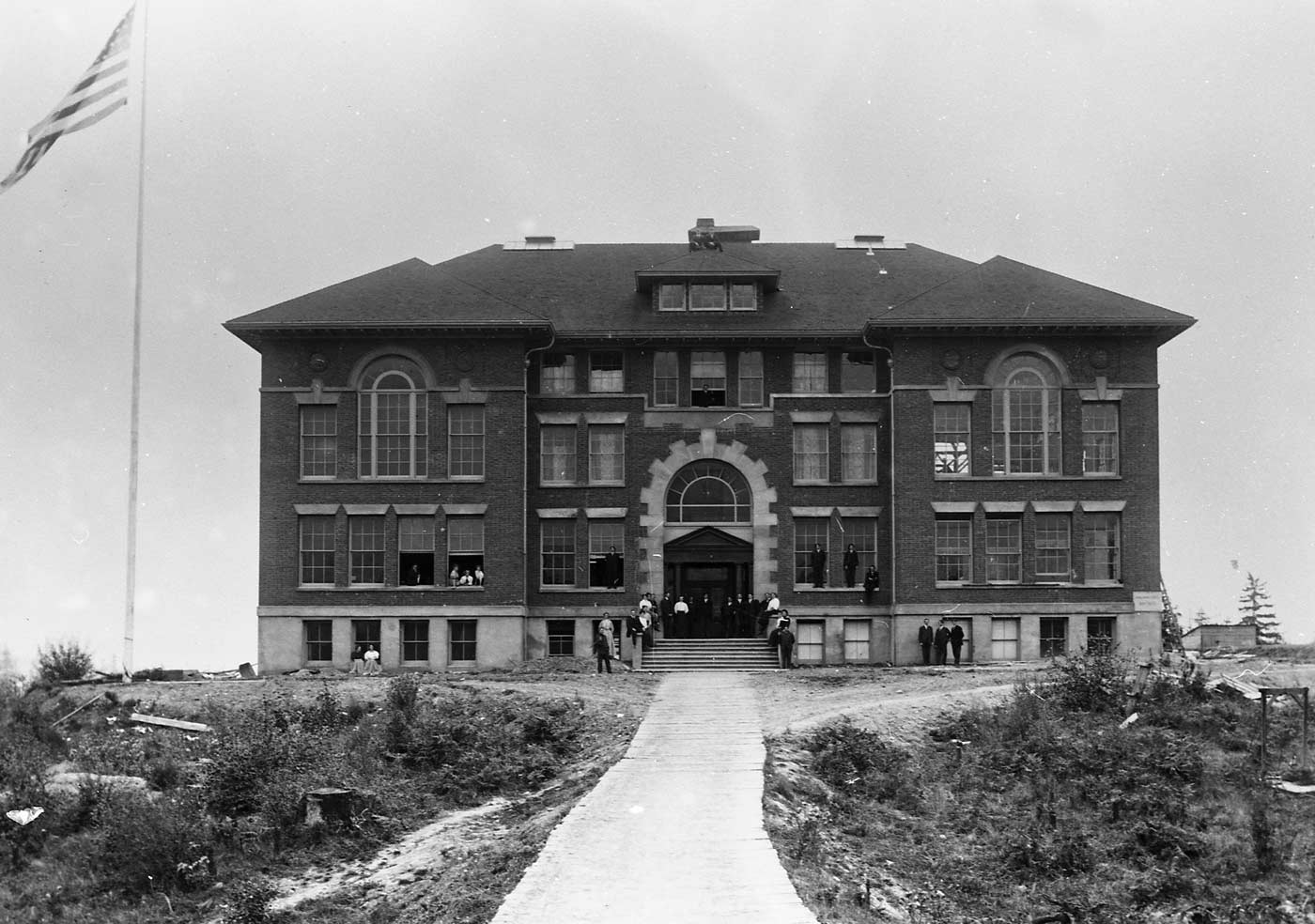
Interlake was an architectural echo of its neighbor to the north, Green Lake Elementary. Both schools, and several others in the system, were concretions of school-district architect James Stephen’s 1902 master plan for outfitting the city with well-lit classically styled frame schoolhouses. That Interlake was not razed (the eventual fate of Green Lake Elementary) after closing in 1981 was the result of a happy wedding of circumstances, including its prime location, its landmark status and the initiative of developer Lorig Associates.
Wallingford Center, opened in 1985, includes 24 top-floor apartments and 38,000 square feet of mixed commercial uses, including two restaurants, a bookstore and a bagel factory. (First written in 1990 the tenants have since changed.) It has developed into the retail focus of the Wallingford community, and this year (again, 1990) was awarded the Seattle Design Commission’s “Neighborhood Design That Works” award.
*******
Above: Carnival rides begin to take shape on the parking lot of Interlake School (The Wallingford Center) circa 1953. The view looks north and a little east from N. 44th Street to Burke Ave. N. The now 103 year old Interlake School – since 1985 Wallingford Center — is just out of the scene to the left. Below: This season since May 16th last, the Wallingford Center parking lot has been a Wednesday destination where families meet farmers, many of them organic growers. (Historical picture courtesy of Stan Stapp.)
Pacific Northwest readers old enough to remember the post-World War Two years may find sufficient clues in the accompanying photograph to figure out what is being constructed. With the flamboyant font typical of circus broadsides, the purveyor, Earl O. Douglas, has written his namesake company’s tag, “Douglas Greater Shows”, on the sides of the big trucks that carry all the gear needed to assemble a week-end carnival.
Here on the rear parking lot of Wallingford’s Interlake School – since 1985 Wallingford Center — Douglas will soon accept dimes from kids in the neighborhood for admittance to his several thrill rides and some cotton candy.
The historical photos came from Stan Stapp, longtime editor of the North Central Outlook, a weekly tabloid that served Wallingford and adjacent neighborhoods for several decades. This old friend, recently deceased, was known for his vivid memory and could, no doubt, have told me when these pictures appeared in his paper. I made an admittedly too rapid search of Outlook issues from 1949 through 1952 and failed to find this construction scene or any of the other carnival shots that Stan shared with me years ago. (One of the scenes in that small collection included a gleaming 1949 Dodge sedan.)
The Wallingford Avenue side looking north to Foodland, the predecessor of first Food Giant and now QFC.
We don’t need the exact year for Douglas’s visit to Wallingford to make the point how tastes have changed in the ensuing half-century – at least those tastes involved in the innovative use of school parking lots. The cotton candy has been replaced with a cornucopia of fruits, vegetables, confections and some crafts. They are barely restrained beneath by the rows of tents pitched every Wednesday during the warm months beside Wallingford Center. (The Wallingford Farmers Market has since moved off Wallingford Center’s parking lot to the grasses of Meridian Park. I think the move had something to do with Wallingford Center residents complaints about parking, or general commotion to the, for them, himby parking lot.)
The Wallingford Center Farmers Market is the latest creation of the non-profit Seattle Farmers Market Association. It first opened last June and is by now and by habit my favorite Wednesday afternoon destination. (This was true when I first wrote it a few years past. Now I need to concentrate on making it to the new location. Yes the parking is not so convenient and neither are these old legs so steadfast.)
*******
Above & Below: Looking southeast from the corner of N. Allen Place and Interlake Avenue North the circa 1914 view of Lincoln High and its new North Wing looks very much like the contemporary record. The original 1907 symmetrical section faces Interlaken Avenue on the far right and in the “now” view only the 1930 south wing is mostly hidden behind the landscaping. (Historical Photo courtesy Lawton Gowey)
LINCOLN HIGH SCHOOL
This little sketch of Lincoln High School history began by consulting Nile Thompson and Carolyn M. Marr’s “Building for Learning, Seattle Public School Histories, 1862-2000.” And within this nearly new book we learn that although Lincoln High closed its doors to Wallingford teens in 1981 the now nearly century old story of the school on Interlake Avenue is far from over.
First in 1997 it was the students of Ballard who used a renovated Lincoln campus while a new Ballard High School was built for them. Next followed the kids from Latona for their two-year stint during the renovation of their campus and now Roosevelt High is harbored in these egalitarian halls while north end students get their own makeover. (The Roosevelt visit, of course, required a special street parking study inWallingford.) And other schools will probably be coming to Lincoln in the years ahead.
In a way the Roosevelt visit is a return of what that school took from Lincoln when it opened in 1922 capturing about half of the older school’s territory with it.
Early in 1906 an anxious school board committee scouted the Wallingford site when there were still stump fields scattered about from the original clear-cutting of the late 1880s. The 30 room “Little Red Brick Schoolhouse” was built with speed and 900 students were enrolled the following September – many of them from Queen Anne. Two years later Queen Anne got its own high school, which it has also since lost. Still Lincoln kept growing.
This view dates probably from 1914, the year its new north wing (shown here) was added. In 1930 a south wing followed and in 1959 an east side addition as well. That year Lincoln was the largest high school in town with an enrollment of 2,800. And yet acting like a barometer for the cultural changes of 1960s and 1970s in only another 21 years Lincoln High School, home of fighting Lynxes, would close for a rest until it would reopen again and again and most likely yet again and again.
*******
Above and below, looking west on 40th Street through its intersection with Bagley Ave. N.
DURN GOOD
(First appeared in Pacific Oct.8, 1989)
Since historical views off of Wallingford’s 45th Street are rare, this week’s “then” is a lucky find. It’s one of a batch of pictures taken for the Seattle Municipal Railway in 1920-21.
Here, North 40th Street is a good example of the cragged byways that served as neighborhood streets before paving. In wet weather they were reduced to impassable quagmires, although at many intersections pedestrians were given substantial assistance in crossing the street, enjoying the use of wood planks like those seen here in line with Bagley Avenue.
For much of its life the North 40th car line was truly a Wallingford service, running a short shuttle between the old Latona Bridge and Wallingford Avenue. Around 1925, North 40th was paved with six-inch thick concrete slabs, and buses replaced electric trolleys. The streetcars had a brief revival on North 40th in the spring of 1931, but by the fall of that year they were replaced for good by buses and the overhead wires were removed.
This intersection does have its community landmark – the Durn Good Grocery on the left. The grocery at 2133 N. 40th has been around since the early part of the century. In 1912 Michael and Sara Regan ran the store. In 1927 Charles and Caroline Irwin were behind the counter, and lived upstairs. The building is still owned by an Irwin descendant. The place was named the Durn in the 1950s by Charley and Cynthia Robbins, its proprietors at the time. In the mid-1970s, store owner Gerry Baired added the “Good” to “Durn” and soon after sold it to its present owners Suzie and Thorn Swink.
Inside the Durn Good is a collection of nearly 2,000 cut-out color portraits. About 75 percent of the faces exhibited still shop at the Durn Good. (Or did in 1989.)
(Since this was first composed in 1989, Durn Good lost its lease and move a few blocks west on 45th to new quarters at the northeast corner of 40th Street and Wallingford Avenue. For a brief and pitiful time the new owners tried to run their own small grocery store, but were avoided by the many neighbors that stood loyal to Durn Good and its ways. The old site shown here was later converted into a comfortable Irwin’s Bakery & Neighborhood Cafe and has survived as such now for a few years.)
*******
Above: A rare – if not so spectacular – view into a Seattle neighborhood ca. 1906. The then still largely rough University of Washington campus builds a dark curtain of evergreens behind the Latona skyline. Below: A few of the homes showing in the “then” survive in the “now” although with one or two exceptions they are now hidden. “Posing” are a few neighbors who were nearby when I visited the scene. (Historical view courtesy Frank Harwood.)
LATONA GLIMPSE (Looking East on 42ND STREET from 1st Ave. N.E.)
In 1906 or perhaps as late as early 1907, the photographer Frank Harwood visited the northwest corner of the Latona Addition and recorded this view looking east on 42nd Street from 1st Avenue N.E. That the scene does not include any obvious landmarks is part of its unique appeal. It is rare to find early views like this of “mere” residential street — rather than commercial ones. (Perhaps Harwood who lived near Lakeview Cemetery on Capitol Hill was visiting a friend in Latona and/or Wallingford, which was directly behind.)
The 1906 date is figured from the Latona Primary School campus, which appears here right-of-center. The white tower just to the left of the power pole (near the scene’s center) tops the first Latona School from 1891, the year that Latona and Brooklyn (University District) and Fremont (and much else in the North End) were annexed into Seattle. To the left of the tower is the larger Latona School No. 2, which was completed in 1906. So this year it celebrates its centennial, helped along by its 1999-2000 restoration.
The 1907 speculation is figured from the screen of trees on the horizon. That is the part of the University District that beginning in 1907 was elaborately changed for the Alaska Yukon and Pacific Exposition of 1909. None of the grant fair structures are yet apparent here. They would be in 1908. However, at the far left border of the scene is a glimpse of the University’s nearly new Science Hall, later renamed Parrington Hall.
The Latona Addition was filed in 1889, one year before Brooklyn. At the north end of its namesake Latona Bridge it was, at least east of Fremont, the primary business center of the North End throughout the 1890s. In 1902, however, under protest Latona lost its federal post office to “University Station” the then “hip” name the University District.
The UW’s enrollment in 1906 was 1200 students, 65 faculty and 40 non-academic employees. Still that year the North End’s weekly tabloid “Vicinity of University” proposed “why not name the whole of the Tenth Ward Brooklyn instead of University Station, Latona, University Heights, Ravenna, Cook’s Corners, May’s Corners.” Latona is still remembered by its school and street. But what became of Cook and May?
The first of the Latona schools. This tower can be found in the above primary view holding just left of the power pole that is nearest the center of Harwood's here halved stereo that looks east on 42nd Street. Another of the 400-plus stations of my Wallingford Walks (2006-2020), and this one one short block west on 42nd from the prospect taken a century earlier by Frank Harwood. Both scenes - the summer and the winter - involve the merging to two images in order to reach the the top of the tree on the parking strip. A QUIZ: One of these members of the Seattle City Council is the namesake for this neighborhood - the one we have been elaborating. Which one, and what is his full name - or at least his first and last names, but by all means in proper order.Another sign of Wallingford's multi-cultural affections.
THEN: M.L. Oakes, Seattle’s prolific “real photo postcard artist,” recorded this interior of Seattle’s First Presbyterian Church most like when it was brand new, or nearly, in 1907. The church was located at Seventh Ave. and Spring Street, and there the congregation has stayed. (Courtesy, John Cooper)NOW: The modern sanctuary, which replaced the classical one of 1907, was designed by Seattle architect William J. Bain Jr., and completed in 1970 on the same footprint.
Saturday, Dec. 14, 1907, a Seattle Times page two headline announced that members of Seattle’s First Presbyterian Church “Will Listen to First Sermon in Half Million Dollar Edifice Tomorrow Morning.” The paper claimed that the new octagonal sanctuary would “seat 2,500 comfortably,” and the congregation’s principal preacher, the tall Tennessean Mark A. Matthews, explained that “there will be no pews for rent, and persons who are not identified with the church as members will be given seats the same as the oldest members of the institution.”
He might have sold tickets. On the Monday following, the Times described the “immense audience” that swelled not only the sanctuary but the neighborhood around it. The streets were “congested for hours” and five thousand were turned away. The enthusiasm was predictable. With his sensational sermons, the charismatic and suitably confident Matthews was the biggest show in town. Since his arrival in Seattle in 1902, he had built First Presbyterian into what was routinely described as “the largest Presbyterian church in Seattle.” Sometimes this was adjusted to “in the world.”
Monday Times coverage of the dedication was printed on page three, while on the front page was another Matthews story that was so foul – it was about two quail – that it now seems fishy. Headlined “Divine Eats Forbidden Birds,” the story describes Matthews “quietly” asking a waiter at the Rathskeller Cafe if he might be served for lunch that same day some quail. Somehow the protracted event was witnessed by the city’s Game Warden. After “two nice hot birds” were served and enjoyed by the cleric, Warden Rief collected the forbidden bones for evidence and arrested the waiter with the likely name John Doe. Rief left no doubt that he thought the Divine was “equally culpable with the waiter” but, he compassionately told the Times reporter, if Mathews “acts properly in the matter I may not prosecute him.”
WEB EXTRAS
The back wall of 1st Presbyterian Church's loft
Visiting the sanctuary of First Presbyterian, my guide pointed over my shoulder at an enormous, vibrant stained glass window, located at the back of the choir loft.
The full monty
It was donated anonymously by a Boeing chairman in the early 60s.
Evidence for this, I was told, lies in the red pane to the right of Jesus’ foot, which evidently sports the faint image of a Boeing jet, but eludes me.
The red pane on the right, it's claimed, contains the image of a Boeing jetliner
Can you make it out, Paul?
No, Jean, I do not see it. Perhaps it requires an even greater enlargement that the one you provide above. If you have time and talent to blow it up real good perhaps a 707 will materialize. Will you try it?
I will indeed, Paul.
Maximum detail
Sadly, Paul, I still can’t see it. Even though my grandfather, Lewis G. Randal, was a Presbyterian minister, I have long-since lapsed. Can your old post-Lutheran eyes see it any better?……
BUT WAIT! I went to the wrong red pane – the plane is much more evident than I’d assumed. Even an agnostic could see it, Paul!
Something springs to mind here – faith in things unseen? The blind leading the blind? The mile high club?
Btw, anything to add?
Yes, Jean, our gracious friend and contributor Ron Edge is providing some links to other features that have appeared in these pages that relate – however remotely – to this week’s feature. Thanks Ron. After those I’ll gather up some other subjects that have sat in these or other pews.
DR. MARK ALLISON MATTHEWS CARICATURES
In the first years of the 20th Century three collections of caricatures of local VIPs were published, and First Presby’s principal pastor got into two of them – a local record for a “man of cloth.” Top one is from “Men Behind the Seattle Spirit, The Argus Cartoons,” published by Argus editor W.A. Chadwick in 1906. The Argus was a long-lived tabloid. I remember it still from the 1970s. The second cartoon dates from 1911 and is pulled from “The Cartoon, A Reference Book of Seattle’s Successful Men with Decorations by the Seattle Cartoonists’ Club.” Frank Calvert was the editor, and yes there are no women represented in either collection.
(DOUBLE CLICK to read the text.)
MARK MATTHEWS SPEAKS – & WRITES
Matthews arrived in Seattle in 1902, and was soon demonstrating his talents for promotions, which included frequent insertions of his sermons and other lessons in local publications. Here are two examples. The first is copied from Pacific Northwest, the tabloids Nov. 1903 issue, and the second from The Seattle Mail and Herald, from May 23, 1902.
(DOUBLE CLICK to read the text.)
HIRAM GILL (right) & MARK MATTHEWS (left)
Seattle Mayor Hi Gill (right) and Mark Matthews (left), especially during the former's prelude to impeachment, were combatants regularly exposed in the local papers. Here for some unexplain reason they share the Smith Tower's observation platform with a unnamed couple that are perhaps betrothed.
NEXT – A PARISH SAMPLER
Above: A procession led by Archbishop Tikhon of San Francisco prepares to carry the church’s relics to the altar during the Dec. 19, 1937 consecration of the then new and unfinished St. Nicolas sanctuary on Seattle’s Capitol Hill. (Courtesy Museum of History and Industry) Below: Jean Sherrard’s contemporary repeat looks east across Thirteenth Avenue near mid-block between Howell and Olive Streets.
ST. NICHOLAS RUSSIAN ORTHODOX CATHEDRAL
(First appeared in Pacific Dec. 13, 2007)
When the St. Nicholas congregation consecrated their new cathedral on December 19, 1937 it was not quite completed. The accompanying photograph of that day’s procession led by Archbishop Tikhon of San Francisco reveals the tarpaper that still wraps most of the sanctuary. Church historian Sergie Kalfov explains that the brick façade was added sometime later in 1938. The sprightly and surviving entryway was also constructed then.
The five cupolas springing from the roof symbolized Jesus Christ and the four evangelists. Kalfov notes that a church with seven cupolas might stand for the seven sacraments, and so on. Ivan Palmov, the architect, was also responsible for the St. Spiridon sanctuary in the Cascade Neighborhood.
Both congregations primarily served Russian immigrants, beginning with those that fled the 1917 revolution, when the church in Russian was persecuted and the Czar Nicholas II and his family assassinated. The Cathedral was dedicated to the memory of the Czar, but its name also refers to the fourth century “wonderworker” St. Nicholas the bishop of Myra in what is now Turkey.
What separated the members of St. Nicholas from those of St. Spiridon was, in part, the former’s continued devotion to the Russian monarchy. This past May 17th the Russian Orthodox Church Outside of Russian and the Russian Church, after nearly 90 years of separation reunited in Moscow. Kalfov explains “St. Nicholas was the first Cathedral to a host a pan Orthodox service shortly after the signing of the Act, where over 14 local Orthodox clergy served for the fist time in such a service.”
The congregation’s 75-anniversary celebration continues until May 22, another St. Nicholas Day.
*******
Above & Below: The obvious continuities between this week’s photographs are the monumental twin towers of St. James Cathedral, upper right, at 9th and Marion and far left the unadorned rear west wall and south sidewall of the Lee Hotel that faces 8th Avenue. Judging from the cars, the older scene dates from near the end of World War Two. The weathered two-story frame building at the scene’s center also marks time. It was torn down in 1950 and replaced with the parking lot seen in the “now.” (Historical photo by Werner Lenggenhager, courtesy of Seattle Public Library.)
NOSTALGIC RECORDER
In 1949 architects Naramore, Bain and Brady began construction on new offices for themselves at the northeast corner of 7th Avenue and Marion Street. Their new two-story building filled the vacant lot that shows here, in part, in the foreground of the older scene. Consequently if I had returned to the precise prospect from which Werner Lenggenhager (the historical photographer) recorded his view ca. 1947 I would have faced the interior wall of an office that was likely large enough to have once held several draughting tables. Instead I went to the alley between 7th and 8th and took the “now” scene about eight feet to the left of where the little boy stands near the bottom of the older view.
That little boy is still younger than many of us – myself included – and he helps me make a point about nostalgia. The less ancient is the historical photograph used here the more likely am I to receive responses (and corrections) from readers. Clearly for identifying photographs like the thousands that Lenggenhager recorded around Seattle there are many surviving “experts.” And more often than not they are familiar not only with his “middle-aged” subjects but also with the feelings that may hold tight to them like hosiery – Rayon hosiery.
Swiss by birth Lenggenhager arrived in Seattle in 1939, went to work for Boeing and soon started taking his pictures. He never stopped. Several books – including two in collaboration with long-time Seattle Times reporter Lucile McDonald – resulted and honors as well like the Seattle Historical Society’s Certificate of Merit in 1959 for building a photographic record of Seattle’s past. The greater part of his collection is held at the Seattle Public Library. For a few years more at least Lenggenhager will be Seattle’s principle recorder of nostalgia.
*******
Above and Below: St. Edward’s Chapel held the northwest corner of Columbia Street and Terry Avenue between 1904 and 1912. It served as the temporary sanctuary for the Catholic see during the development and construction of the St. James Cathedral. Cathedral School, which took the place of St. Edward’s, still holds the corner. Historical photo courtesy of the Archives of the Archdiocese of Seattle.
PRO-CATHEDRAL
In what may be the single surviving photograph of the two together here stand the Cathedral and the pro-Cathedral — the former towering above and behind the latter. (The contrast is made the more impressive by the Cathedral dome which collapsed in the “big snow” of 1916.)
As its name by type suggests, the “pro-Cathedral” was built as a temporary home for worship while the new St. James Cathedral was being constructed. It was designed by James Stephen, a Seattle architect better known for the many plans he created for public school during his term as the Official School Architect for Seattle Public School during the first years of the 20th Century.
Of course, the Catholic pro-Cathedral also had a proper name. A centuryago – this coming Saturday, Nov. 13, 2004 – Bishop O’Dea dedicated St. Edward’s with “full rights of dedication” not typical for a sanctuary so small and short-lived. It was named for the English King who was canonized in 1008, with the added connotation that the Bishop’s first name was Edward and the martyred monarch was his patron saint. Edward O’Dea moved his see from Vancouver to Seattle in 1903. By then Seattle was established as the center of Washington State urbanity and the more likely site for the construction and financing of a Catholic cathedral for the region.
About 200 parishioners attended the dedication of St. Edwards pro-cathedral. Only a year later (less one day) on Nov. 12, 1905 an estimated 5000 were on hand to watch their bishop bending beside a temporary altar helping with the laying of the St. James cornerstone. The Cathedral was itself was dedicated in 1907 and five years later the pro-Cathedral was razed and replaced with the Cathedral School seen here in the “now.”
*******
Above: The landmark Epiphany Episcopal Church at 3719 Denny Way in the Denny-Blaine neighborhood was built in 1911 from designs by Ellsworth Story, a member of the parish. Courtesy, Epiphany Episcopal Church. Below: In order to see around a tree and through the parish landscaping the contemporary photo was recorded from a position somewhat closer to the sanctuary.
EPIPHANY EPISCOPAL CENTENNIAL
(First appeared in Pacific, Jan. 15, 2007)
The city’s boom years of the early 20th century was accompanied by a proliferation of services and institutions into Seattle’s new neighborhoods. This included the churches and this example, the Episcopalians in the Denny-Blaine neighborhood.
Often the idea for a new church was seeded by members of an older or pioneer parish that was founded in the central business district. As Mary Henry, Epiphany Episcopal’s church archivist explains in her historylink.org essay on the parish, the idea for this congregation was promoted when “Bishop F. W. Keator took a group of Episcopalian men from St. Mark’s Episcopal (later St. Mark’s Cathedral) on a yachting trip in Lake Washington and as they passed the Madrona area, he commented on the need for a church in the neighborhood.”
The date for this waterborne inspiration was August 1907, which makes this the Centennial year for the parish. The rustic English Gothic chapel printed here took four years more to build and another sixty-seven years to become an early pick for Seattle’s official registry of landmarks in 1978.
The natural charm of this wood and brick sanctuary was created to compliment the style of the “city beautiful” Denny-Blaine Addition, which is appointed with streets that do not march through the neighborhood on a grid but rather curve through the natural topography as it descends to the shores of Lake Washington. Many of the Denny-Blaine homes are also landmarks, whether listed or not, and a few are by one of Seattle’s most cherished architects Ellsworth Story (1897-1960). Story was both a member of Epiphany Episcopal and the architect of this its first parish.
Mary Henry’s thumbnail history of the parish is, as noted, on historylink.org. and easy to find. (It is Essay 7825.) Later in this its centennial year Epiphany heritage will also get another and longer account with a book history by Barbara Spaeth that is now still a work-in-progress.
*******
Above: Unidentified members of Holy Angels softball team wait and take their turns at bat in this 1937 playground scenes at Ballard’s St. Alphonsus Parish. Perhaps a reader will recognize one or more of these players. Below: The members of the contemporary St. Alphonsus community posing in the “now” scene are named in the accompanying story. (photo courtesy St. Alphonsus School)
‘HOLY ANGELS” AT BAT
(First appeared in Pacific Oct. 11, 2007)
Thankfully centennials will often stimulate an archival rigor in whatever is celebrating its first 100 years. Gloria Kruzner, designated parent-historian for Ballard’s St. Alphonsus Parish School, collected boxes and sacks filled with school ephemera including what she describes as “wonderful and historically significant photos” while preparing her history for the school, which Dominican Sisters first opened as the Holy Angels Academy in 1907, the year Ballard was annexed into Seattle.
This snapshot of eleven members of the 1936-37 Holy Angels softball team is, we agree, a wonderful example. Kruzner has determined that this is a scene from that school term’s “Play Day” program. But who are the players and might a reader know?
1937 graduate Elizabeth Crisman Morrow holds the bat in the contemporary “repeat” photograph. She played shortstop on the 1937 team, but doubts that she is included in this bunch of out-of-uniform players, with the slim chance, she notes, that she is the batter in the historical scene as well.
Behind the players both views show the same three-story brick schoolhouse that opened in 1923 for what was by then with more than 600 students the largest Catholic school in the state. The third floor was reserved for the high school. From the late 1920s on, only girls were admitted to the Holy Angels Academy, which survived until 1972 when it was closed for want of both funds and students. The coeducational St. Alphonsus School carried on with lay instructors and since 2004 with the help of new sisters from the Society of Our Lady of the Most Holy Trinity, (SOLT).
In the “now” reenactment SOLT Sister Mirium James convincingly acts the role of catcher on the far left. Besides the batter-alum, Elizabeth Crisman Morrow, the other members of the Alphonsus community include, left to right, Kathi Abendroth, class of 1955, Maggie Kruzner (daughter of the school historian), Joseph Chamberlin, Megan Chamberlin, Joseph Bentley and Emmiline Nordale who is half hidden beyond the batter. School principal Bob Rutledge is on the right, and climbing the fence, third grader Hanna Nordale takes the part of the “Holy Angel” peering over the fence in the 1937 scene.
*******
Above: Dedicated in 1926 the Seventh Church of Christ Scientists has survived on the roof of Queen Anne Hill as one of Seattle’s finest creations. (Historic photo Courtesy Special Collections Division, U. W. Libraries. Negative no: 26935) Below: Sturdy, intact and wrapped in its own landscape the landmark is yet threatened with destruction for the building of three or four more homes in a neighborhood primarily of homes. Many of the sanctuary’s neighbors are fighting alongside the Queen Anne Historical Society to keep their unique landmark.
QUEEN ANNE LANDMARK – EXQUISITE & SECRETED
On the late morning of Tuesday, May 22nd last (2007), the Washington Trust for Historic Preservation held a press conference intended to turn the fate of one of Seattle’s most exquisite landmarks away from its planned destruction and towards something else – something “adaptive” like another church, a community center or even a home – a big home.
The Trust not only included the Seventh Church of Christ Scientist on its 2007 list of the Washington State’s “most endangered historic properties.” It then also used the front steps of this Queen Anne landmark as the place to circle the wagons for statewide preservation. It was an especially strong sign by the Trust and for its extended family of historians, architects, citizens – including sensitive neighbors of the church – of how cherished is the Seventh Church.
Seattle architect and painter Harlan Thomas (1870 – 1953) created the unique sanctuary for the then energetic congregation of Christ Scientists on Seattle’ Queen Ann Hill in 1926. It was the year he was also made head of the Architecture Department at the University of Washington, a position he held until 1940.
Although a local architectural marvel this sanctuary is not well know because of its almost secreted location. The address is 2555 8th Ave. W. — at the Avenue’s northwest corner with West Halladay Street. Except to live near it or to visit someone living near it there are few extraordinary reasons to visit this peaceful neighborhood, except to enjoy this fine melding of architectural features from the Byzantine, Mission, Spanish Colonial and other traditions.
Since the Trust created it in 1992 the “Endangered List” has not been an immoderate tool in the service of state heritage. Less than 100 sites have made this register, which is really the Trust’s emergency broadside for historic preservation.
*******
Above & Below: For a few years in the 1920s a cross revolved fitfully above the corner of the University Methodist Temple. Since the Methodists moved three blocks to their present home in 1927, the surviving 1907 sanctuary at 42nd and Brooklyn has been used for a variety of sacred and secular enterprises — sometimes together The Vineyard Christian Fellowship of Seattle purchased the building 1991. Fellowship offices in the 1902 chapel receive the rising redolence of the popular Thai restaurant in the basement.
CHURCH of the REVOLVING CROSS
(Appeared in Pacific first in the spring – sometime – of 2007)
For a few years after its remodel in the early 1920s the University Methodist Temple at the southeast corner of Brooklyn Ave. N.E. and 42nd Street was known as “The Church of the Revolving Cross.” The slender spire that had topped the 1907 sanctuary at its corner leaked and was replaced during the remodel with a motorized cross. The mechanism, however, was less than miraculous. It frequently broke down and the cross, seen here, was soon removed.
North end Methodists first met in Latona (now part of Wallingford) in the locally vigorous year of 1891. Seattle annexed new territory as far north as 85th Street in 1891; the first electric trolley crossed the then new Latona Bridge that year. Also in ‘91 the state chose the northeast shore of Lake Union at Brooklyn for a new university campus, although the school waited four years more to make the move. By the time the Methodists built their first small chapel here on 42nd beside the alley in 1902 Brooklyn was just as likely to be called the University District.
The larger corner sanctuary was added in 1907, a year made repeatedly noisy by the dynamite used to shape the nearby campus for the 1909 Alaska Yukon and Pacific Exposition. Besides replacing the spire with the cross, the 20’s remodel also expanded the sanctuary, joining it to the chapel – as seen here. Still in 1927 the Methodists left this clapboard sanctuary for a bigger brick one on 43rd Street, across 15th Avenue from the campus.
Although born in 1927 church historian David Van Zandt was too young to march with the congregation and its preacher Dr. James Crowther the three blocks to its new home. According to Van Zandt, Warren Kraft Jr. is the only surviving church member who walked in that Sunday parade. Kraft was then a two-year-old toddler whose wandering distinguished him at the dedication ceremony. The first words spoken by Crowther from his new pulpit were “Has anyone seen Warren Kraft Jr.”
*******
Above & Below: And official local landmark since 1977, in 2004 the Immaculate Conception Parish at 18th and Marion celebrated its centennial. (Historical photo courtesy Loomis Miller.)
IMMACULATE CENTENNIAL
The twin Italianate towers of the Immaculate Conception Church have distinguished Seattle’s skyline from their pedestal on Seattle’s Second Hill (AKA Renton Hill) for nearly 100 years. The ground was broken for Seattle’s oldest surviving Roman Catholic sanctuary (used continuously for services) in April 1904, and the first ceremonial opportunity that followed was the traditional laying of the corner stone.
The May 15th procession up the hill from the interim parish (in what has since been renamed the surviving Gerrard Building on the campus of Seattle University) to the foundation work for the new parish at18th Avenue and Marion Street was given historical perspective on the spot by diocese Bishop Edward O’Dea. “It is a pleasure to look back into the history of Seattle . . . Twenty years ago one small church sufficed for the needs or our limited membership and now we have four churches and fourteen priests.”
Remarkably, in less than seven months Seattle’s Catholics were ready to march up the hill again for the dedication on the 4th of December. The eight-block procession between the two parishes was led by a platoon of local police and Wagner’s Band, the traditional accompanists for Seattle celebrations. Behind the band marched the Hibernian Knights, the Knights of Columbus, and the Catholic Foresters of Seattle, Tacoma and Ballard — Ballard was then still its own town. Bishop O’Dea and ranked clergy were fit in carriages to elegantly cap but not conclude the procession. “Following them and lining the route” to quote now from an early history of the parish, “was a motley but magnificent parade of priests, sisters and local gentry all in a jovial spirit.”
For the dedicatory High Mass Father Prefontaine, Seattle’s pioneer priest who arrived here in 1867, assisted Bishop O’Dea. The day’s celebrants filled what the local press advised was “the city’s largest seating auditorium.” (The 950 seat record, however, was temporary. It was surpassed by more than one of the large theatres that would soon be built downtown.)
THEN: Throughout much of the first half of the 20th Century, the Pike Street Dock, here on the right, was home to the fishing fleet. If that is snow marking the roof of the Schwabacher Wharf, on the left, the fleet is here on a winter break. (Courtesy Lawton Gowey)NOW: For the “now” Jean Sherrard includes sculptor James Fitzgerald’s fountain at Waterfront Park, which he visited earlier this year for a repeat of a photograph taken during its construction and printed in Pacific last Feb. 20.
The Pike Street Dock (or pier or wharf), here on the right, welcomed Pacific Net and Twine as its primary renter in 1916, and so began the pier’s preoccupation with fisherman and their needs. The wharf in its enduring landmark size was built in 1903-4. The new dock’s principal tenants then were diverse and included, fish merchants, grain dealers and shipping companies.
With Pacific Net and Twine in residence, the dock became the central waterfront headquarters for the fishing fleet which often – as here – packed the slip between itself and the Schwabacher Pier, to the south and here on the left. Many of the fishermen’s voluntary groups like the Fishing Vessel Owners Association and the Purse Seiners’ Association took residence on the Pike Dock and a variety of sail-makers, fish brokers, and other specialists in supplies for the fisheries had offices there as well.
The Schwabacher wharf was the older pier. It was in this slip that the gold ship the S.S.Portland made its historic call in July 1897 with a “ton of gold” and thereby launched the gold rush north to the Yukon and Alaska. An older and smaller version of the Schwabacher pier just escaped the city’s “great fire” of 1889, and for weeks following it most of the materials for rebuilding the business district entered the city across its then mostly uncovered deck.
Recent history of this slip begins, we will say, with the destruction of what remained of the old Schwabacher Dock in 1967. The city purchased – without condemnation – the Pike Pier in 1973 for a bargain of $585,000. Two years earlier Mayor Wes Uhlman switched his advocacy for building a Forward Thrust (1968) funded Aquarium in Ballard to the Pike Street Pier. Construction on Waterfront Park (seen, in part, in the “now”) began in the fall of 1973. By the late 1970s both the park’s promenades and the aquarium’s tanks served a, by then, mostly playful central waterfront.
WEB EXTRAS
Anything to add, Paul?
Yes Jean there are a few items clinging to the sides of the Pike Pier we will put up. Much else has by now appeared in other stories – or their extras – so I’ll lean on Ron Edge to put them up next as hot-links (do you call them?). After that I’ll do some sampling. Much of what follows and more can be found in the Illustrated Waterfront History included in the “books” part of this blog.
Ron has found three primary links, and each features a string of stories and illustrations. Click on the picture (three of them) directly below and you will be carried to them.
But one of many recordings photographer Frank Shaw made on the waterfront while he was regularly visiting it in the 1970s and '80s. I admit to being mistaken about his subject. Until recently I though the reader was sitting directly on Fitzgerald's fountain.Ninety-nine feet long and propeller-driven the Dode's packet took it to Hood Canal on a day-long run as far as Hoodsport, beginning its return to Pier 3 (now Pier 54) the next morning. Here the Dode rests a the south side of the Pike Street Pier.A steamer with no apparent name rests along the north side of the Pike Pier. Like the Dode above it, this view dates from ca. 1912.
Next we’ll lay in three photographs taken of, to me, an inscrutable life-saving demonstration on a low platform in the slip north of the Pike Pier. These look innocent enough and harmless too, and may most likely be tried at home without injury. The most heroic part in this is the performers willingness to appear in swim wear on the central waterfront when all others are bundled against the cold – or at least the rain. Note the stairway to the Pike Street trestle that after 1912 crossed high above both Railroad Avenue (Alaskan Way) and Western Ave and reached the Pike Place Public Market.
The above detail from a 1911 map of the waterfront shows both the Schwabacher and Pike Street piers, and also to the proposed site for a power boat dock, which was never built. There is as yet no 1912 Pike Street trestle spanning Railroad Avenue (Alaskan Way) here.
The Bogue Plan map (1912) above includes the then new Pike Street trestle as well as two novelties that were never built. The proposed line for the Union Pacific Tunnel meant, like the 1905 Great Northern Tunnel nearby, to move trains under the city between the new Union Pacific Depot on Jackson Street and the waterfront below Belltown. The map also shows an incline on Virginia Street that would have moved teams and their wagons up the steep hill from the waterfront to First Avenue.
Another ca. 1912 look at the south side of the Pike Pier with another vessel - this one sturdy enough to steam the Pacific - the Tallac beside it.
First a detail and the below it a “now-then” of the Pike Street Coal Wharf, which was the first of many docks built at the foot of Pike Street. The photograph dates from the 1870s and was taken from the back porch or window of the Peterson & Bros photography studio on Front Street (First Avenue) at the foot of Cherry Street. The contemporary scene (from ca. 1990) was recorded from the parking garage that extends a block south on the west side of First from Columbia. The “now” prospect is much higher than Peterson’s, whose view was not obstructed my structures on Post Alley.
This detail "pulled" from the Peterson & Bros view, directly below, shows both the east end of the Pike Coal Wharf and the incline, on the right, which climbs the bluff to Front Street (First Ave.) with the narrow-gauged rr-track that ran on Pike and the future Westlake to the south end of Lake Union, where the little engine-that-could, named the Ant, moved the coal-filled cars from barges to the tracks and this last leg of the complicated run that began in the coal fields on the east side of Lake Washington. This system continued until 1878 when the new coal railroad, The Seattle and Walla Walla, reached Coal Creek, Newcastle and Renton directly around the south end of Lake Washington from the new coal wharf and bunkers at the waterfront foot of King Street.
The ruins of the abandoned Pike Street Coal Pier seen from Yesler's Wharf ca. 1881. The modest summits - south and north - of Denny Hill are also apparent. Queen Anne Hill is on the horizon. (Courtesy U.W. Libraries)Detail from the 1891 Birdseye of Seattle shows the waterfront north of Union Street with Denny Hill above it, including the Denny Hotel, upper-right. Splotchy but revealing, this scene looks north along the waterfront from the King Street Coal Wharf, ca. 1902 or 3. The dock at Pike Street is a small one with a stepping waterside facade, seemingly third from the right. Actually four from the right because the odd-angled Schwabacher Dock is in there too just to the right of the Pike Pier. The long white-sided pier center-left is the Gaffney Dock near the foot of Virginia Street. Beyond it is the Coast Company's longitudinal dock, which paralleled Railroad Avenue because Elliott Bay was deeper there and building a finger pier directly into the bay prohibitive. Right to left are the Wellington Coal Dock, the Schwabacher Dock, the Pike Street Pier, the two smaller "fish docks" and part of the Gaffney Dock. Also showing it the Pike Street Trestle which "carried" pedestrians safely from the water side of Railroad Avenue back and forth to the public market.Mayor/Dentist Brown's mid-1920s proposal to built a grand pier and on shore an attached commercial structure - and early threat to Pike Street Public Market - failed.Another of the W.P.A. Tax-Inventory photos from ca. 1937. Here the Pike Street trestle has not been rebuilt to cross Railroad Avenue after it was dismantled for the 1934-36 construction of the seawall between Madison and Bay streets.A circa 1934 aerial of the waterfront that shows Railroad Avenue still with its "centerline" of a dangerous drop-off to the beach. This was filled in and covered with the 1934-36 seawall construction. The Pike Street Trestle is here still intact.The Pike Street Pier from . . . when? Another threat to the Pike Place Public Market - the urban renewal proposals of the early-mid 1960s. The Market neighborhood in 1967-8. The Pike Street Pier is lower-right. Finally - this week - a quiz or contest, and still in the neighborhood. The subject dates from ca.1978, and if you were not there this will be tough. Who is the man behind the counter, and what public market restaurant is this? Hints - note the decorations. The man behind the counter - dish washing - opened his namesake gallery in the mid-60s. It was shot-lived but very influential on the local arts scene (With such a helpful hint it feels like I have almost given up the answer.) Our puzzling subject left it to spend a year reflecting on the shadows cast by cloudless skies and moving across the walls of his rented studio in Kabul Afghanistan. Our subject was it seemed, at least, beloved by all who knew him. It was an attack by strangers later on the Seattle Center grounds that weakened him so that it lead to his death.
THEN: Looking south across Spring Street and into the pit along Third Avenue for its 1906-7 regrade. (Courtesy Lawton Gowey)NOW: Jean Sherrard used his ten-foot extension pole again to reach an altitude more in line with the old grade of Third Avenue before its reduction.
The steam shovel at the intersection of Third Avenue and Spring Street works on making one of the deepest cuts during the Third Avenue Regrade, which extended the eight blocks between Cherry and Pike Streets. Like Biblical signs, the shovel spews the good and the bad – steam and smoke – from its roof. An empty wagon waits for the shovel to pivot with its first contribution.
Behind the rising effluvium are a row first of storefronts holding a laundry, a plumber and an undertaker. Beyond them is the popular Third Avenue Theatre with the open tower at the northeast corner of Third and Madison. Its 16-year run is about to end a victim of grade changes on Third. Across Madison are two more towers, both churches. First, the First Presbyterians at the southeast corner with Madison and one block south the second sanctuary for the first congregation organized in Seattle, the Methodist Episcopal Church at Marion Street. Both parishes moved to new sites because of the regrade.
Upper left is the west façade of the Lincoln Hotel at the northwest corner of Madison Street and 4th Avenue. The regrading on both Fourth Avenue and here on Third were temporarily stopped in the summer of 1906 by an injunction brought by the hotel charging “damaged property” – indeed. More than damaged the hotel was destroyed by fire in 1920. The regrading of both Third and Fourth Avenues was necessary, it was explained, if the retail district was to spread east. First and Second were both filled and the steep climb to Third and Fourth needed to be eased.
Frank Carpenter, a visiting journalist featured in the Post-Intelligencer under the head “Ourselves As Others See Us,” described 1906 Seattle as a “city of ups and downs. It has more hills than Rome . . . The climate here gives the women cheeks like roses . . . I am told that men measure more around the calf and chest than anywhere outside the Swiss Mountains. The perpetual climbing develops the muscles and at the same time fills the lungs with the pure ozone from the Pacific.”
WEB EXTRAS
Anything to add, Paul?
Yes Jean and we will keep to Third Avenue, or not stray too far from it. First with the help of Ron Edge of our sometimes feature, “Edge Clippings” and our maps too, here are a few links to past blog stories that include within them at least some Third Avenue subjects.
May 8, 2011 - Looking North on 3rd Ave.
Jan. 29, 2011 - Lake Union from Smith Tower
Aug. 6, 2011 - Denny Knoll's Death Knell
July 30, 2011 - 3rd and Pine 1917
Jan. 15, 2011 - Central District from Harborview
May 15, 2010 - Lewis Whittelsey’s Survey
May 1, 2011 - The Public Safety Building
Continuing on, here follows a sampler of Third Avenue subjects.
Looking east and a little south from 2nd Avenue to 3rd with the Madison Street regrade on the right and the 3rd Ave. Theatre at the northeast corner of 3rd and Madison on the left. Top-left is a peek at the Lincoln Hotel, which we will return to at the end of this string.North on Third Ave. from the Madison Street trestle for the cable line and during the 3rd Ave. Regrade. The spire of Plymouth Congregational Church shows cemter at University Street. To the left of it is what remains of the ruined Washington Hotel atop Denny Hill. (Courtesy Lawton Gowey)
MADISON TRESTLE OVER 3rd Ave. REGRADE
(First appeared in Pacific May 16, 1999)
The intended subject here is the apparatus of the Madison Street cable line, exposed during the 1906-07 regrade of Third Avenue. We can see the cable beneath the center slots for both tracks, and the supporting architecture is extraordinary – stacked 6-by-6-inch timbers hold the cable car on the westbound track while Third Avenue is lowered beneath it.
It seems that car No. 37 of the Lake Washington and Madison Street cable line has paused at Third Avenue (let loose of the moving cable) to pose for the photographer. The conductor is posing as well, a coin dispenser wrapped about his waist. The man on the tracks just left of the westbound cable car flaunts the commands of the banner strung over Madison Street, far right, one block east at Fourth Avenue. It reads “ALL PERSONS ARE· FORBIDDEN To Walk On Street Car Tracks.”
The original Asahel Curtis print is dated Jan. 25, 1907. On this Friday, The Seattle Times carried a photograph of the Third Avenue Theatre, showing here in the full sun•
light behind the cable car. When the regrade on Third Avenue reached a level where theatergoers could no longer reach the front door, the theater went dark. The caption to The Times’ photo reveals that the theater’s managers, Russell and Drew, are about to tear it down.
Russell and Drew use their doomed theater’s billboard to advertise the play “Yon Yonson,” running the previous week nearby at their Seattle Theatre. George Thompson played the title role of a young immigrant Swede who managed to negotiate through every American “vicissitude . . . owing to his sterling honesty and bland-like innocence, which wins him many friends,” said the Post-Intelligencer’s review. The advertisement claims that Thompson is simply “the greatest of all Swedish comedians. A huge scream. A laugh in every line, and the lines are close together.”
=-=-=-=-=-=
The Third Ave. Theatre at the northeast corner of Madison St. and Third Avenue before the regrades.
THE THIRD AVENUE THEATRE
(First appeared in Pacific April 16, 1989)
The Native Americans posing in front of the Third Avenue Theater are Yakimas who performed on the theater’s stage Sunday, June 6, 1897. The montage of posters on the Madison Street side of the theater give the day and month, and Eugene Elliott’s “A History of Variety Vaudeville in Seattle” gives the year in its appendix of performances.
At the time the Third Avenue was run by impresarios Russel and Drew, who held true to the successful family formula inaugurated by showman John Cordray. Opening the theater in 1890 under his own name, Cordray offered Seattle its first “polite vaudeville,” where liquor, catcalls and the stamping of feet were forbidden.
The Third Avenue had two stages, one for variety shows – like juggling and dancing – and the other for plays usually performed by the theater’s own stock company. Occasionally, special acts such as the Yakimas (aka the Yakamas) would appear.
By the 1890s the memory of their resistance to the miners’ and settlers’ efforts to take their lands 40 years before had developed into a generally noble impression of the Yakimas’ courage, skills and loyalties. On their large reservation the Yakimas were able to resist their enculturation into the revolutionary changes occurring in the surrounding society. Exhibits of the tribe’s native skills appealed to non-native nostalgia and yearnings for a lost innocence.
The Third Avenue Theater survived till the Third Avenue Regrade, when its last stock company moved up the avenue in 1906 to Pine Street and the Methodist Protestant church remodeled for melodrama.
The Third Avenue Theatre still on Third but moved here to the old Methodist Church at the southeast corner of Third and Pine. The Methodists had moved to Capitol Hill. Beyond third is the roughage of the Denny Regrade still a work-in-progess here, although well along in reducing the hill to its current grades.
=-=-=-=-=-=-=-=-=-
THIRD AVENUE REGRADE Looking North Through MARION STREET
(First appeared in Pacific Dec. 16, 1984.)
In 1906, The Post-Intelligencer described Seattle of being regrade-mad. “The early pioneer was content to trudge up and down steep grades all day, unquestioningly, as though such things were destined to be permanent. Now any hill with a valley below it suggests a regrade.”
The historical scene looks up the Third Avenue regrade. The photograph was shot on a sunny winter day in 1907. The P-I went on to explain, “Two of the most important regrades ever undertaken in Seattle are those on Third and Fourth avenues. They are the outgrowth of the wonderful expansion of retail business. With First and Second avenues congested, the retail trade must spread . . . The cut on Third runs all the way from nothing at Cherry Street to 17 feet at Madison.”
The deepest cut was below the Madison Street cable car that passed over Third Avenue on a temporary wooden trestle shown here near the subject’s center. The pedestrian trestle in the foreground followed the line of Marion Street. The Third Avenue Theater did not survive even the Third Avenue regrade. In the historical scene, the theater is above the cable car, at the northeast comer of Third and Madison, the present site (in 1984) of the Seattle First National Bank tower. The theatre has lost the top of its corner tower. The home of Seattle’s first stock theatrical company, it ran its fare of farce and melodrama for 16 years until the regraded 17-foot cliff at its front door made it impossible for theatergoers to get into the show.
Up Third at University Street” the digging didn’t go so deep and Plymouth Congregational Church kept its services going beneath the tall brick tower seen above the cable car.
********
We peek up Marion to its intersection with 3rd Avenue and thru the Vancouver B.C. arch, the Canadian supporter-boosters raised as their part of the 1909 Alaska Yukon and Pacific celebration here in Seattle.
VANCOUVER ARCH – AYP 1909
(First appeared in Pacific Jan. 15, 1989)
The city of Vancouver’s classical arch at Third Avenue and Marion Street holds its dignified place in the history of ceremonial monuments on Seattle streets. The Canadian monument was erected for the Alaska Yukon and Pacific Exposition (AYP), which remade the University of Washington campus into a gleaming white city, and added a few downtown attractions, such as this, as well.
At the Aug. 21, 1909, dedication, Vancouver Mayor Douglas explained to Seattle: “The erection of this arch was not actuated merely by a mercenary motive, or a desire to advertise. It is a token of esteem to Seattle and the Exposition . . . It typifies the friendly feeling existing between two great cities of the North Pacific.”
Mayor Douglas concluded by making an ironic lesson of the 500 white-helmeted British Commonwealth troops in his entourage. “Evidences of this peaceful feeling have been made all the more pronounced today by the landing of British troops under arms on American soil.” Seattle Mayor John F. Miller accepted the arch on behalf of Seattle.
For all its monumental girth, this arch was razed with the AYP’s closing at summer’s end. Soon the demands of the motorcar would make, with few exceptions, such ceremonial obstructions a charm of the past.
*********
LINCOLN HOTEL ROOF GARDEN
(First appeared in Pacific June 30, 1985)
When it was built in 1899, the Lincoln was Seattle’s most elegant and prominent hotel. Reaching nine stories high, it was taller than the buildings down around Pioneer Square and taller than those along the city’s growing commercial strip – Second Avenue. The hotel’s elevated setting at Fourth Avenue and Madison Street also made it seem monumental. The Lincoln, made of white brick and stone, glowed when the sun set.
The stately poplars on Madison Street once continued up the street past Boren Ave.
The Lincoln had a garden on its roof. The vine-snarled trellis of the was slightly visible from the street. The garden was mostly enjoyed by registered guests, although painted post cards of the garden were for sale in the lobby.
The above view looks southeast toward the top-heavy cupola of the county’s courthouse (upper right) on First Hill. There on the courthouse roof is the clue that helps date this photo. Barely showing through the haze is a giant welcome sign, set there in 1908 for the Puget Sound visit of Teddy Roosevelt’s Great White Atlantic fleet. The other closer and more classical dome sets atop the United Methodist Church at Sixth Avenue and Marion Street – and still does. In1908, the sanctuary was still under construction; the congregation worshiped in the basement. Now the landmark gives some architectural soul to a neighborhood of skyscrapers.
A retouched pan of the Lincoln Hotel and its neighbors, the Carnegie Library on the right and the YMCA on the left. The view looks northwest through the intersection of 4th Avenue and Madison Street.
When it opened in 1900, the Lincoln was Seattle’s first apartment-hotel. But it didn’t stay that way. The position that gave it prominence on the city’s skyline also put it too far away from the city’s commercial district. The Lincoln was soon converted into a straight commercial hotel, but faltered in this role as well. The business passed through several managers and owners. The last was the Madison Realty Company, which bought the hotel on Nov. 1, 1919 and proceeded to sink $75,000 into remodeling the rooms as well as the shops and restaurant on the main floor.
On the morning of April 7, 1920, in the first hour after midnight, Mrs. C.A. Gross, proprietor of the cigar store, and Mrs. T., Waters, owner of the beauty shop, met for a moment in the hotel lobby before leaving for home. Their chat was quickly concluded when a man rushed by crying, “Fire!” Within the hour, the Lincoln – brick on the outside but wooden within – was a furnace. The hotel was lost including three of its guests and one firefighter. The water dumped on the fire created a river down Madison Street and Third Avenue. It was the last watering for the Lincoln’s roof garden.
LINCOLN HOTEL FIRE
(First appeared in Pacific June 8, 1997.)
First named the Knickerbocker because of its association with Dr. Rufus Lincoln, the New Yorker who financed it, the landmark hotel at Fourth and Madison opened in 1900 with elegant exterior walls of gleaming white brick trimmed with stone. Later the family name seemed more fitting for what its managers claimed was the first apartment hotel north of San Francisco.
Although the Lincoln Hotel was designed with two-and-three-room suites to attract a patronage with the means to stay a while, they did not, partly because of the struggle required to reach it. The two blocks that separated the Lincoln from the developing commercial strip, Second Avenue, were – for the cable cars that climbed them – among the steepest in the nation. The Lincoln switched to standard hotel service.
Looking east up Madison Street. The Elks Club is on the left and the YMCA on the right.
As guests discovered on the early morning of April 7, 1920, the hotel’s elegance was skin deep. It was “little more than a lumber yard with four brick walls around it ” as the fire chief later described it to a Times reporter. By the night clerk’s estimate it took only five minutes from the moment he heard an “explosive thud” in the basement for the smoke to climb the elevator shaft and make impossible his efforts to warn by telephone the nearly 300 mostly sleeping guests.
Looking east across Third Ave. to the ruined west facade of the hotel with the YMCA on the far right, the Elks Club on the far left, and the Carnegie Library across 4th Ave. showing between the hotel and the club.
The next day’s papers were filled with heroic tales of taxicab drivers, hotel patrons and firemen saving all but three guests and one fireman. Blanch Crowe, a stenographer for the popular Chauncey Wright restaurant, died in her room. A candy maker and his daughter jumped to their deaths from the top floor of the west wall. Others wanted to jump but were persuaded to wait for the firemen’s ladders. Sgt. P.F. Looker, the first policeman to approach the burning hotel, saw “a head in every window and a din of screams and cries for help. I hurried around the building shouting not to jump.”
The Lincoln looks deceptively whole - except for the light in the windows - from this prospect looking across 4th Avenue. The Elks are now on the right and the Young Christians on the left.
THEN: Clumsily promoted as “The Nation’s Greatest Playground on the Pacific Coast” Luna Park was “thronged” after it opened in the summer of 1907. During its first Independence Day, Lewis MacEvoy and Angela May claimed to have sold to the crowds on this gated platform more than 4000 copies of their new song “All Aboard for Luna Park.” (Historical pix courtesy Oregon Historical Society)NOW: In the spring of 1931 the last attraction at Luna Park, its natatorium, was torched by an arsonist. Later the pool’s sturdy tank was used in the construction of the small park that reaches with fill 100 feet beyond the shoreline. At the lowest tides some of the piles of Luna Park are exposed.
Extending over the tideflats below Duwamish Head it could be seen from almost everywhere. The lolling tidelands off the Head were too shallow for ships but not this sprawling boardwalk raised on piles for amusements. Once the two tardy boilers were installed in its own power plant, Luna Park was its own billboard, shining across Elliot Bay and up and down Puget Sound.
With the staccato of a running headline, the Friday Seattle Times for June 23, 1907 announced “Luna Park Now Open to Public. Seattle’s Coney Island is Visited by Throngs. New Ferry and New Car Line in Operation. Thronged with People until a Late Hour.” Two days later Youngstown, Alki, Spring Hill and West Seattle voted 325 to 8 for annexation into Seattle. The Times report concluded, “Georgetown is left entirely surrounded.”
Although not evident here at its grand gate, for many of Luna Parks attractions Seattle Architect James Blackwell used the exotic – for Seattle – Spanish style typical of Southern California, like the House of Alhambra, that Blackwell pasted into his picture scrapbook. The rides and amusement were proven ones used at other amusement parks like its namesake, New York’s huge Luna Park at Coney Island. Here to the right of the gate the “scenic railway” called the “Figure Eight” reaches 150 feet, its highest point. From there the ride was embellished with the published claim that it “winds for nearly half a mile through the air.”
The busiest issue during the amusement’s construction was whether or not the West Seattle City Council was correct to give Luna Park a liquor license. The developers had promised that the sale of intoxicants would be conducted properly. This propriety ran out with bad news. For instance, a Post-Intelligencer reporter riding a packed trolley to town after a Sunday Night Dance at the park, noted “The boisterous conduct and the indecent language of the joy-dancers disgusted the respectable patrons of the line.” Except for its cleanest amusement, the natatorium, Luna Park was closed in 1913.
(The top comparison is one of the “now-and-then” features included in Jean Sherrard, Berangere Lomont and my exhibit titled “Repeat Photography” on show at MOHAI thru June of 2012.)
WEB EXTRAS
Anything to add, Paul? Oh a few things Jean, and sticking close to Duwamish Head too – with the exception of something on Sea View Hall.
Above: Between 1888 and 1890 the West Seattle Harbor was developed by the West Seattle Land and Improvement Company, which had residential lots to sell atop Duwamish Head. The view looks north over Elliot Bay to a horizon of Magnolia on the left and Queen Anne Hill on the right. (Courtesy, Lawton Gowey) Below: Trees, on the right, now obstruct the view from Ferry Avenue, on the left. The waterfront seen in the ca. 1890 view was greatly changed with the 1913-18 reclamation and 1924 paving of Harbor Avenue. (Now photo by Jean Sherrard)
WEST SEATTLE HARBOR, EARLY VIEW
This may be the earliest intimate birdseye of the West Seattle harbor. I have grabbed 1890 as it’s date on the evidence of a sketch that appeared in the “Graphic,” a Chicago-based publication that this year included a fulsome article comparing West Seattle to the best that Switzerland had to offer in the way of sublimity. The Graphic’s line drawing of the harbor is in every detail the same as this photograph although it was copied from another photograph taken almost certainly within moments of this one a few feet further southeast on what was then the clear cut and exposed Duwamish Head.
The ferry “City of Seattle,” far right, is moving (it is streaked) into its slip after a run from the Seattle Waterfront. The inaugural trip was made on Dec. 24, 1888. The long Northern Pacific spur that runs through the scene between the ferry and the waterfront was completed in August of 1890. And the two-mile-long cable railway that looped up Ferry Street to the West Seattle addition atop the ridge and back down California Way Southwest to the developer’s headquarters, the big boxish building far left, was formally opened on Sept 6, 1890 with much hoopla.
California Way and Ferry Street meet on the far left of the ca. 1890 view. Neither can tracks be seen running near the center of those streets nor can we be certain that they are not. Like the N.P. spur from Seattle these cable railway tracks were also laid during the summer of 1890.
The homey titled Washington Magazine raised its own 1890 cheer for this harbor. “The landing at West Seattle is very attractive . . . owing to the substantial character of its construction and the beauty of its surroundings . . . What more can be said about West Seattle, except that it will be to Seattle before a year passes what Brooklyn is to New York and Oakland to San Francisco.”
*******
HOW TO GET TO WEST SEATTLE
(First appeared in Pacific on Sept. 12, 1982)
Inquiries on how to get to west Seattle often conclude with the question of why go there. And for years, if there was no dugout canoe to be had or hired, the answer was “you can’t get there from here.”
These recurring questions of why and how to go to West Seattle were ones David Denny probably asked himself many times as he waited for his brother Arthur to find him at Alki Point. David had preceded the “Denny Party” to scout for a settlement on Puget Sound. The Denny Party finally arrived on a wet Nov. 13, 1851.
Fifty-four years later a few survivors of this damp landing, in company with a large party of supporters, returned to that West Seattle beach. There they unveiled a pylon that memorialized themselves as the “founders of Seattle.”
But many others claimed Seattle “began” in mid-September, 1851, when the area’s first settlers, including Henry Van Asselt and Luther Collins, staked claims on the Duwamish River in South Seattle, not West. Others objected that the city was more properly “founded” in 1852 when the Dennys and others abandoned Alki Point and marked new claims on the protected east shore of Elliott Bay. From this Seattle site, Alki Point was hidden behind what the Indians called Sqwudux and the settlers called Lamb’s Point. Today we call it Duwamish Head.
And there were other names. In the 1860s it was changed to Freeport, until 1877 when a Capt. Marshall spent enough buying up Freeport to call it Milton. A year later in 1878 the citizens of Milton heard Colonel Larabee sing “Suwannee River” over a telegraph wire converted for the first local demonstration of the telephone. (He might have recited a short passage from Paradise Lost, if there was one.)
City of Seattle Ferry, far right, beside its Marion Street slip.
Milton was first called West Seattle in the late 1880s when the questions of why and how to get there were first seriously answered by the West” Seattle Land and Improvement Company. This group of San Francisco capitalists bought a lot of land up on the bluff for marking and selling view lots; encouraged development along the waterfront with a yacht club, shipyard, boathouse and first regular ferry service from Seattle on the City of Seattle; and started the area’s first community newspaper. And the news spread.
The gangplank on the West Seattle Harbor Ave. side.
An 1890 issue of the Chicago publication, The Graffic, featuring Washington State, exclaimed, “Hundreds of spots of rare beauty may be found in the state of Washington, but surpassing all others, West Seattle easily stands out as the most attractive of them all.” The Graffic’s praise could not contain itself to the Western Hemisphere. “Switzerland, despite the wealth of magnificent scenery has nothing comparable . . . the wild, rugged and imposing; the soft, harmonious and sublime; the beautiful, magnificent and glorious; all are here.” These sentiments were calculated to first transport one to West Seattle rhetorically, and then physically,
Still, not enough buyers were moved. So the improvement company built a cablecar line that looped through 14 curves (the most, it was claimed, for any cable system) from the ferry dock to the top of the bluff and back. However, it ran only when the ferry arrived, and although Seattle was expanding, it was in other directions. In 1898 the capitalists abandoned their cablecars, and the few buyers they had attracted had to walk to their homes at the top of the bluff.
Ferry City of Seattle, center-left, at its Marion Street slip. On the right is the Tourist, out of Port Townsend, and on the left the Flyer, perhaps the most popular steamer in the history of the "Mosquito Fleet." The Flyer's speedy packet was between Seattle and Tacoma, and it held on long after the railroads has spoiled other water routes with obsolescence.
Our historical view – at the top – of the City of Seattle landing and unloading ferry passengers at the West Seattle slip dates from about 1902, the year West Seattle first incorporated its 16 square miles. The new town also bought and converted the unused cable to an electric line, and proudly claimed it the first municipally owned common carrier in the country. West Seattle was still a small bedroom community for Seattle – most of the city council’s work was done on the ferry – but the boom was coming.
It arrived in 1907. The 1,200 citizens voted overwhelmingly for annexation to Seattle, because they were “plainly designated by nature to form one community.” The two were now also linked by the West Seattle, a bigger and faster ferry. However, the most encouraging connection was at last by land, or rather by trestle, along Spokane Street.
Ferry West Seattle, hand-colored by Robert Bradley.
West Seattle now offered in 1907 the modem suburban dream where one could, the promoters claimed, “fully enjoy the quiet of rural life, combined with the comforts and convenience of the city, and feast on the soul-inspiring scenic charms which in matchless grandeur surround one on every side.” In 1907, at last, the bedroom community was adding a living room and raising a neighborhood – actually several of them – and answers to the questions why and how to get to West Seattle seemed self evident.
When in the mid-l960s West Seattle’s density became higher than the citywide average, the old questions returned with a congested alarm. The living room had been converted into an apartment and “where two once lived now eighty do.” Although they were not building 747s in West Seattle, the multi-unit construction reached its peak with the Boeing Boom.
West Seattle ferry terminal during the 1916 Big Snow.
In 1969 a citizen’s group lobbied for resumption of the ferry service. It failed. In the spring of 1978, when the old dream of a giant bridge seemed to be fading, another citizen’s promotion clamored for secession. Now, at least for a while, the assured completion of the new super bridge dissolves the old questions about how to get to West Seattle. (The above first appeared in Pacific on Sept 12, 1982. Imagine – 29 years ago! We, with the bridge, have survived.)
Near the West Seattle site where the West Seattle ferry once landed.
******
WEST SEATTLE FERRY at COLMAN DOCK
(First appeared in Pacific, June 16, 1996.)
On June 27, 1907, the new and larger ferry West Seattle took the place of Puget Sound’s first ferry, the City of Seattle, for the short hauls across Elliott Bay between the Seattle and West Seattle waterfronts. This was one of several developments that summer that drew these neighborhoods together.
Two days later, in a weekend election, the citizens of West Seattle voted for annexation to Seattle. Then came the opening of Luna Park, a gaudy illuminated pier at Duwamish Head, with sideshows, exhilarating rides, an indoor natatorium and “the longest bar in the West.”
Yet it was the opening of trolley service to West Seattle over the Spokane Street bridge that would steal away the new ferry’s passengers and dissipate the commercial joy of its first summer. Purchased by the Port of Seattle in 1913, the West Seattle ferry continued to lose money. Eventually it was given to King County, which leased it to the Kitsap County Transportation Company as a relief ferry on its Vashon Heights run.
This scene is part of a stereograph photographed by Capitol Hill resident Frank Harwood in 1908 or ’09. Its other endearing quality is the confrontation between the prop wash of the ferry as it leaves its slip at Marion Street and the audacious rowboat heading into it.
At 328 feet, the modern-day ferry Chelan is more than twice the length of the 145-foot West Seattle. (The Chelan appears in the Pacific feature for June 16, 1996, but like much else has since been squirreled in some corner of the basement studio where I do something similar to work.) One of the “Issaquah class” ferries constructed for the state in the early 1980s, the Chelan and its five sisters were plagued by glitches in their innovative computer controls. Since their overhaul in the late ’80s, however, the Chelan and the rest have been the reliable mainstays of the system. Smaller than either the jumbo or super ferries, they are able, with the help of variable-pitch props, to quickly pull in, unload, reload and pull out.
******
SEA VIEW HALL
If there is truth in this naming, then the prospect of Puget Sound from Sea View Hall was most likely unobstructed when the hall was built early in the 1900s. Now that view is somewhat obscured by beachside homes and the hall’s own front-yard landscape.
Sea View Hall is one of three log-cabin survivors in the Alki Point neighborhood. (The others are the Log Cabin Museum and the now closed and threatened Homestead Restaurant.) Like the better-known but since lost Stockade Hotel, the hall was constructed in good part of wood salvaged from the beach, its logs set vertically like a fort. “Sea View Hall” was eventually spelled out in “logoglyph” style; letters shaped with big sticks and hung from the roof, or in this case the upper veranda. In this early view, the sign has not yet been shaped or placed.
John and Ella Maurer are probably among the at least 23 persons posing here. In 1954, the hall’s 50th anniversary, John was identified as its builder by his daughter-in-law. After returning from the Alaska Gold Rush, he took up construction and painting, and built this nostalgic summer cabin for his family’s recreational retreat from Seattle. The rustic theme was continued inside with, for instance, a staircase handrail constructed from a peeled log with banister supports fashioned from the same log’s twisted branches.
The Maurers moved on in the 1910s. In the 1930s, probably, a room made of beach rocks was added to the Hall’s north (left) side. According to neighborhood lore it was used as a playroom for the children living there, and the next name I can associate with the hall after the Maurers seems perfect: Rochfort Percy, listed at 4004 Chilberg Ave. in 1939. He soon moved on and Alma Kastner followed, converting Sea View Hall into a World War II boarding house. She kept the sign. Kastner stayed for about 20 years before passing on this fanciful construction to Alvin and Margaret Ross. This is still Ross Hall. (Apparently it is no longer Ross Hall. Since this feature was printed in the Jan 23, 2000 Pacific, the rustic charmer has been sold.)
******
HALIBUTS Below DUWAMISH HEAD
West Seattle’s waterfront was once an energetic mix of shipbuilders, fish packers and yachtsmen. This beach scene, photographed a short distance south of the Duwamish Head, features all three and a few houseboats besides.
In 1913, 70 percent of the world’s halibut catch was shipped through Seattle, briefly the halibut capital of the world. Here a few of these flat fish have found their way to sorting tables. The proprietors may be Thomas King and Albert Winge, who – in addition to running cod and halibut fleets out of West Seattle – built and repaired ships at their yard here at Duwamish Head. The proud partners were so pleased by their rhyming moniker that they christened one of their halibut boats the King and Winge and another the Tom and Al.
The vessel at the bottom of the scene is, most likely, connected with some King and Winge at Duwamish Head.
The King and Winge firm is most likely responsible for the two beached ships at the left of the scene’s center. The partners, who joined in 1901, repaired tugs, barges and ferries, and in a quarter-century built or aided in the construction of nearly 500 vessels.
The towered structure at the center of this (top) scene was built in the early 1890s as quarters for a yacht club – a predecessor to the Seattle Yacht Club. However, the combination of northerly winds, ships’ wakes and remote quarters drove most of the membership back to the Seattle waterfront by the end of the decade. In this early century view, the yachtsmen’s abandoned quarters house a restaurant that surely had halibut on its menu.
=-=-=-=-=-
NOVELTY MILL
Beginning in the summer of 1890 it was possible to pass between Seattle and West Seattle without the ferry. Nonetheless, the trek over the Seattle Terminal Railway’s trestle above the Elliott Bay tide flats was a long one, and missing the last ferry to West Seattle at 7 in the evening was a mistake clearly to be avoided.
The historical scene was photographed from near the West Seattle end of that trestle probably soon after it was completed in 1890. The photographer’s subject, the Seattle Terminal Railway & Elevator Co.’s grain elevator, was believed to be the first of a system of wharves that would crowd around Duwamish Head.
Once the Southern Pacific Railroad selected West Seattle for its Puget Sound terminus, boomers like the San Franciscan, Col. Thomas Ewing, and the agents for his West Seattle Land & Improvement Co. were understandably encouraged about their coming prosperity. The regional periodical, Washington Magazine, predicted in 1890: “What more can be said about West Seattle, except that it will be to Seattle before a year passes what Brooklyn is to New York and Oakland to San Francisco.”
In the year before this (top) view was recorded, the West Seattle heights were cleared of their second-growth timber, leaving the largely barren ridge showing on the left. Ewing built a cable railway to carry his customers up the hill for an inspection of the denuded view lots. The cable line, subdivision and grain elevator were all laid out by an engineer named Richard H. Stretch.
Novelty Mill appears right-of-center, with Seattle Yacht Club vessels restrained in still open waters of the east shore of West Seattle.
The Southern Pacific and the string of wharves never made it to West Seattle’s harbor, but the mill lived on for many years, after 1893 known as the Novelty Mill. Ninety-nine years later a few of its original 1900 piles support Salty’s Restaurant.
******
LUNA PARK BY DUWAMISH HEAD
Described by its builders as “the greatest outdoor amusement in the Pacific Northwest, Luna Park opened in 1907 below West Seattle’s Duwamish.Head, where its twelve acre timber pile platform above the tides lured Seattle to its attractions.
The park could be easily seen across Elliott Bay, especially after sunset with its 2000 electric bulbs. Getting there was easy both by ferry and by electric trolley, which began running to West Seattle the same year, across an early Spokane Avenue swing bridge.
This view by Seattle photographer O. T. Frasch, looks back at the brow of Duwamish Head from near the middle of the amusement park. Moving left from the Ice Cream Parlor at far right, signs visible are “A Day in the Alps” – probably a diorama depicting a majestic mountain scene; the Comedy Theater, in the large vaguely Egyptian-looking structure where, the billboard reads, “the Trocadero Stock Co. puts on a new comedy every week”; a three-arched façade with the sign “Lost Child’ above it; and an exhibit space over which is the large, inviting sign reading “Admission Free.”
The white bridge in the foreground crosses the splash pool to the Chute-the-Chutes Water Slide. Luna Park also had a merry-go-round, a roller coaster, a large indoor saltwater natatorium, a movie house for one-reelers and a dance hall with bar attached. Some dances continued until dawn, when the first morning trolley returned the revelers to Seattle side-by-side wit more sober and sedate commuters. This nearness of wild life and wage slaves ultimately closed the park in 1913, after campaigning moralists described trolley scenes where young girls sat on the laps of their drunken dates “smoking cigarettes and singing songs.”
The only Luna Park amusement that survived this zeal was the good clean but cold fun of the saltwater natatorium, which stayed open until 1931, when it ended its years with its only instance of heated water. The pool was destroyed by an arsonist.
THEN: One of Seattle’s early examples of honorific public art, caste in bronze, Gov. John McGraw looks over Times Square. Behind him is the freshly lowered and nearly vacant Denny Regrade. The large and all wood Hotel Rainbow on the left barely survived the regrade. (Courtesy, Lawton Gowey)NOW: Last week Jean Sherrard looked over the governor in his repeat of a ca. 1926 Independence Day parade on 5th Avenue with his own record of the Lions International parade last month. This time he is still with the Lions, and has shifted a few feet to the right of the historical photographer’s prospect in order to remove a light standard that would have otherwise seemed attached as a crown to McGraw’s bronze head.
Here facing southeast from his own little park stands this state’s second governor, John Harte McGraw — born in 1850, dead by typhoid in 1910, honored by public subscription with New York sculptor Richard Brooks’ heroic monument.
McGraw was elected governor in 1892, just in time to face the depression that followed the bank panic of 1893. Because of the weak economy he was not re-elected in 1897, the first year of the Alaska-Yukon gold rush. Instead, the former governor packed a miner’s outfit and boarded the S.S. Portland, whose arrival in Seattle days earlier had started the rush.
Although traveling first class, McGraw was peculiarly broke. It was judged that he owed the state $10,000 from some unwarranted expenses during his term. His hopes to find it in Yukon dirt did not pan out, but when he returned to Seattle, his deep connections and investments did. He wound up president of both the chamber of commerce and Seattle First National Bank.
Before his time in Olympia, McGraw had three terms as the sheriff of King County. Earlier this year, at the dedication of the McGraw Square Plaza, the governor’s great-great grandson, Scott Pattison, noted that McGraw considered his “proudest moment” his standoff as sheriff with the anti-Chinese mobs of 1886. It was also his luckiest. After the sheriff took three bullets — one through his hat, two through his coat — the vigilantes scattered.
Seward's statue in Volunteer Park (known then as City Park) with the Conservatory behind it.
In 1909 during ceremonies for the Alaska-Yukon-Pacific exposition, McGraw was squeezed beside the rotund President W.H. Taft in a parading motorcar. McGraw also attended the expo’s unveiling of a statue honoring William Seward. Of course, he could not have known that the same sculptor (Brooks) would soon be casting his likeness in Paris for an unveiling on July 22, 1913.
WEB EXTRAS
Anything to add, Paul? Not so much this morning, Jean. A few asides on McGraw and a few other examples of public art – that’s all. This brings to mind a feature printed here earlier that includes a dozen or more Seattle examples of public sculpture. It is named for the piece that was showcased at the top, The Naramore Fountain. Now forward to McGraw and more – a little more.
While alive the former governor was, no doubt, also known for the grand sweeping bush hiding his upper lip, The McGraw portrait chosen for the cover of this memorial chapbook shows an older ex-governor with a restrained moustache. (Courtesy, Ron Edge)
Aside from his imposing statue in Times Square, McGraw is most often recalled – or rather, named – when one uses or looks for McGraw Street. Below is a clip copied from a Seattle Times Pacific Mag feature that shows the McGraw Street bridge on Queen Anne Hill when it was still a timber trestle. (Click to Enlarge)
=====
In August 1902 this classical arch welcomed both locals and visitors to the two weeks running of the Elks Carnival. It was temporarily mounted at the intersection of Second and James.
ELK’S ARCHES, 1902
Street arches – often spectacular and always temporary – were once almost expected of Seattle’s big events. For its 1902 Seattle Carnival the Elks (the fraternity that started after the Civil War as a club for thespians called the Jolly Corks) raised three unique arches, all gleaming white by day and electrified at night. The above welcome arch at Second and James was similar in size to the arch at First and Columbia, the address also for the Elk’s Seattle headquarters.
The Elks Arch at First and Columbia.
The Elk’s third arch spanned Union Street between 3rd and 4th Avenue. It served as gateway to the old University of Washington Campus that was walled off for the event — like Seattle Center for Bumbershoot. Although then already seven years abandoned by the school for its “Interlaken Campus” the old campus on Denny’s green knoll (not to be confused with Denny Hill) was not yet developed and so offered a wonderful lawn on which to set up the fair that ran through the second half of August.
The Elk's third arch: Union Street and Third Avenue. The view looks east on Union.
The Elks Carnival was really Seattle’s first experiment with an extended summer festival and so an early rehearsal for the Potlatch Days of 1911-1913 and later Seafair. However, as far as I know neither the Potlatch nor Seafair mounted arches.
It was probably the Knight Templar who mounted the last monumental street arch hereabouts for their 1925 Seattle convocation. Spanning Second Avenue at Marion, with its cross on top the Knight’s arch reached six stories. The first welcome arch for which there is photographic evidence was artfully constructed mostly with fir trees and mounted in Pioneer Square for the Independence Day celebrations of 1868.
Framed here on the left by Henry and Sara Yesler's home at the northeast corner of Front (First) and James, and the Occidental Hotel on the right (now the site of the Sinking Ship Garage in the pie-shaped block bordered by Yesler, James and Second Avenue.) This may be the first arch constructed by locals. They did it for the Fourth, and for the visitors from both Whatcom (Bellingham) and Olympia. Both came by way of "Mosquito Fleet" steamers.
Except for Sunday every day during the 13 day Elks Carnival featured a parade and, of course, the parade route was drawn to pass through the arches. Even without parades and arches street life in 1902 was considerably different than it is now. The automobile was then still an extreme novelty and mobility generally meant walking or for distant destinations taking a trolley. Consequently the city streets of 1902 were stages for a cosmopolitan culture that was generally gregarious and even intimate. And sometimes — as with the arches — it was also playfully grand.
=======
AYP’S “PERFECT (SALMON) VALKYRIAN GODDESS”
Of the temporary and monuments scattered about the University of Washington campus for its 1909 makeover into the Alaska Yukon and Pacific Exposition, the Alaska monument was the most pretentious. Three draped figures symbolizing mining, hunting and fishing were set about the base of an 85-foot-high fluted classic column.
Visiting the sculptor’s studio when sculptor Finn H. Frolich’s three “perfect Valkyrian” women were still being shaped from clay, a Seattle Times reporter described the “sublime figures” as revealing the “message and underlying principle of Seattle’s big Exposition – opportunity, glorious, almost infinite – a free offering to a world that now knows it not.”
Frolich was an old master in creating these “magnificent female figures with every line beautiful, every proportion splendid,” to continue the newspaper’s rhapsodic preview. A New Yorker trained in Paris, Frolich returned to the United States to break in big at Chicago’s 1893 Columbian Exposition, for which he created his first set of monumental figures.
Thereafter Frolich was in demand at the string of expositions that followed and largely copied the classical Beaux Arts style of the Chicago fair. In Seattle he set up his studio in the old Territorial University building in downtown Seattle, where he taught classes for the local Beaux Arts academy.
Of Frolich’s three seated female figures, this one, obviously, represents fishing. With her muscular left hand, the figure holds a salmon against her knee. But hanging higher from her right hand is another of the AYP’s preoccupations: electricity. At night the fair was illuminated with 250,000 lamps to emphasize the classical lines especially of the exposition’s Arctic Circle, the “white city” for which the Alaska Monument was its symbolic centerpiece.
=======
A nearly new Plymouth Congregational sanctuary, facing Sixth Ave. Plymouth Congregational Church, Aug. 5, 1964. Photo by Robert Bradley
PLYMOUTH’S COLUMNS
One of our more curious local landmarks is the arrange•ment of four fluted columns and their surrounding screen of trees that look over Interstate 5 from a triangular patch of park at the northwest comer· of Boren Avenue and Pike Street. This week’s “repeat” has followed these now-headless shafts from their original location near the northwest corner of Sixth Avenue and Seneca Street, where they were formerly united for 44 years with their classical capitals above the grand front door to Plymouth Congregational Church.
The mother church of local Congregationalists had its cornerstone laid at this location in July 1911, and ten months later opened all 136 doors of its new sanctuary to the admiring community. The architecture was sober and demure and, except for the classical portico and belfry, showed little ornament. As explained in “The Congregational Washington,” it was a “plain, chaste example of classic architecture . . . peculiarly characteristic of New England.” In “Seeking To Serve,” her history of Plymouth, Mildred Tanner Andrews notes that plans for this church were influenced by the “practical reformist and democratic positions of many of its members.”
Plymouth, March, 21, 1966 - Photo by Frank Shaw
Demolition began the first week of March 1966. By the 20th, all that remained were the columns, and on the 29th, these were pushed and pulled down by a tractor and crane. Meanwhile, the congregation worshiped nearby at the 5th Avenue Theatre.
The four stone columns were reconstituted largely by local builder and art collector John Hauberg, influenced, perhaps, by the example of his wife, art activist Anne Gould Hauberg, and the then relatively new enthusiasm for preservation.
Plymouth’s pillars – each of their seven four-ton segments in place – were dedicated at their new location on Oct. 24, 1967. Thirty years later, the park’s trees have considerably softened the standing stone’s austere formation. (It is an often put – mistakenly – that these columns were saved from the ruins of the Territorial University. Those wooden columns were salvaged, but not here. They have their own “Sylvan Theatre” on the University of Washington campus.)
Pulled from an early 20th Century U.W. yearbook.
=====
Above: Neighbors pose on the front steps of photographer Lawrence Lindsley’s Wallingford home sometime in October 1918 when the city was “dark” and closed-down during the Spanish Flu’s Seattle visit. The masks were required although the law was rarely enforced. (Picture courtesy of Dan Eskenazi) Below: Wallingford neighbor’s repeat the 1918 flu shot behind masks pulled from one of the group’s mask collection. Only one among the seven is neither hidden nor unnamed: the Chihuahua Sparky. (now photo by Jean Sherrard)
SAVING HEALTH & APPEARANCES – LAGRIPPE in WALLINGFORD
Dan Eskenazi, Seattle photo collector and old friend of mine, first shared with me these masked ladies posing with masked cats on the unlikely chance that I might know the porch. Had the snapshot revealed a street number the choices would have been narrowed city-wide to a few hundred front steps. But Dan’s little 3×4 inch print does better. The names of the women are penciled on the back. The flipside caption reads, “Top row, Anna Kilgore, E. K. Barr, Ms Anna S. Shaw. Lower row, Penelope and Tommy, Mrs. Shaw and Golly.”
So seven creatures including the cats Tommy and Golly and all of them wearing masks by order of the mayor. By the time the 1918 flu epidemic reached Seattle at the end of September la Grippe had caused more deaths world-wide than the First World War. When the rule about masks was lifted for good on Armistice Day, Nov. 11 the streets were quickly filled with bare-faced revelers. Still Dr. T. D. Tuttle, the state’s commissioner of health, warned that “people who have influenza are in the crowds that are celebrating victory. They will be in the street cars, in the theaters, in the stores.” Tuttle also confessed, “the order had been more or less a farce as far as the masks are concerned.” (This explains, perhaps, why there are so few mask photos extant.)
Returning to the snapshot’s penciled caption, four of the five women are listed in the 1918 city directory living at 108 E. 43rd Street, in Wallingford. Since that address is about 100 steps from my own I was soon face to face with Dan’s unidentified porch, except that it was one house west of 108. But this slight move presented an opportunity. It hints, at least, of the photographer.
104 E. 43rd Street was built in 1918, the year that the photographer Lawrence Denny Lindsley, the grandson of city founders David and Louisa Denny, moved in. Perhaps Lindsley took the snapshot of his neighbors sitting on his new front steps soon after he took possession with his bride Pearl. Married on September 20, 1918, tragedy soon followed. Both Pearl and their only child Abbie died in 1920. Lindsley married again in 1944 and continue to live at 104 into the 1970s. When he died in 1974, this son of the pioneers was in his 90s and still taking photographs.
======
ANGELINE’S HOME ON PIKE
The Indians of the West were shot twice: fIrst by the cavalry and then by touring photographers. In 1889 the Northern PacifIc Railroad capitulated in its hostility towards Seattle and began giving the city regular service at rates comparable to Tacoma’s. A year later the railroad sent out its offIcial photographer, F. Jay Haynes, in his own plush car to record Seattle’s progress. His subjects included the city’s harbor, its mansions, churches, parks, and one shack.
While she was yet alive and cameras began to proliferated, Princess Angeline, Chief Seattle’s eldest daughter, was the most photographed subject in Seattle. In his search for the photogenic city, Haynes found her resting beside her shack in the neighborhood of what is now the Elliott Bay side of the Pike Place Market.
One year later a Post-Intelligencer reporter accompanied by a pioneer who helped him translate Angeline’s Chinook jargon into his own English journalese, visited the “humble palace of this wizened aboriginal princess.” This time Angeline was inside sleeping. While his guide stirred her, the reporter paused outside to begin his report. His paragraph and Haynes’ photograph “read” somewhat alike.
“Her cabin or shack is about 8 x 10 feet in size, with a roof of split cedar shakes. Half of one of the gable ends has the clapboards put on diagonally . . . At one comer of the house is a huge pile of driftwood, gathered from the ruins of fallen cabins in the neighborhood or picked up from the Bay near by. In the front yard are half a dozen tin and wooden buckets rusty and dirty . . . A narrow, dwarfed door, and a little dirty pane of glass constitute the means of getting into the palace. A horseshoe and mule’s shoe are nailed immediately above the entrance. The door stands open all the time.”
Apparently, the window and shoes had been added to the door since Haynes’ visit, but it was still open, and the reporter followed his guide inside, where “the only space in which the floor was visible was about three feet square. Two low bunks and a shorter one, covered with remnants of dirty blankets, a rickety little cook stove and a few rude cooking utensils and a wagon load of rags, old shoes, pans, boxes etc. were stacked upon the beds, under the beds and on the floor. When Mr. Crawford (the guide) asked Angeline how long she had lived in her present house, she held up her two hands, spreading out her fingers to indicate ten years.”
Despite the reported attempts of “various benevolent ladies to move her to more comfortable quarters,” here Princess Angeline stayed until her death at 86 in the spring of 1896. The door to her shack was then closed and draped in black crepe. She was moved to Lakeview Cemetery and buried in a canoe-shaped casket with a paddle resting on the stern. Princess Angeline was carried there in a black hearse drawn by a span of black horses and followed by the funereal company of what was then left of Seattle’s pioneers.
Angeline's last home was built by lumberman Amos Brown who befriended her. It sat nearby the old footprint at the foot of Pike Street. This photo by Ye Olde Curiosity Shop was produce - it says - in 1910, or fourteen years after Angeline's death.
=====
PRINCESS ON PIKE
There are probably dozens of photographs of Chief Seattle’s daughter, but very few so candid as this one. And yet Princess Angeline probably agreed in an instant to sit for this portrait on the board•walk beside Pike Street and a half block west of Front Street (First Avenue). She was, by all descriptions, not shy. Most likely she also expected to be paid something for her modeling. A quarter was considered equitable.
At the time Angeline was interrupted by the unnamed photographer, she may have been moving between her home near the waterfront foot of Pike Street and Charles Louch’s grocery nearby at First and Union. In the early 1890s the Board of King County Commissioners instructed the prosperous English grocer to give Angeline whatever she needed and to pass the bills on to the county. The meager $1.25 bill for November 1891 included a pack of cigarettes, probably for her grandson, Joe Foster, who then lived with her.
Angeline also moved into a new cabin in 1891 built for her by another pioneer neighbor, the lumberman Amos Brown. Two years earlier, she received her greatest celebrity with a drawing and description in the popular national magazine Harper’s Weekly. The Harper’s correspondent, Hezekiah Butterworth, seems to be imagining a caption for this photograph when he writes, “Her flat, tan-colored face, fiery black eyes and black hair are a familiar picture in the streets of the new city, where she sits down daily on some log or shoe box to marvel at all that is going on.”
Larry Hoffman, my friend and oft-times instructor, introduced me to this portrait at a gathering for his 98th birthday at Hamilton House, the senior center in the University District. Thanks, Larry. (Larry has since passed away.)
For the “now” to Angeline’s posing on Pike you can choose from two – both taken by Jean. The one looks into the subject from Pike Street a few feet west of First Ave. The other looks up from the first arm of the Post Alley as it makes its descent to the waterfront.
=====
ANGELINE’S STONE – LAKE VIEW CEMETERY
KICK-I-SOM-LO, the name of Chief Seattle’s daughter before her pioneer friend Catherine Maynard renamed her, received a lot of whimsical attention from local newspapers in her last years. With layered clothing, unmatched shoes, “skin like the bark of a tree” and bent form, she was at once picturesque and grotesque, a figure for parody. On March 31, 1892, the Seattle Press Times reported under the headline “A Princess Prophecies” that Angeline had visited the local police headquarters and announced that the world would end the following June. Her informant, she explained, was the spirit of Wah-Kee-Wee-Kum, legendary medicine man of her tribe. June came and went, however.
Angeline died four years later on May 31, 1896. For her June 6 requiem Mass, Our Lady of Good Help parish was packed with pioneers and draped with black crepe. The procession to Lake View Cemetery was a stately parade behind black horses and hearse. Everything was donated, including a headstone paid for with ‘pennies and nickels by the schoolchildren of Seattle (partial atonement, it was noted, for years of taunting her), a canoe-shaped casket and the little triangular part of the Henry Yesler lot, No. 111. It was Angeline’s request to be laid next to her friend Yesler, who had died in 1892.
Angeline had also requested of Catherine Maynard that a tree be planted beside her grave. The windblown young maple behind her headstone may well be it. The photograph was recorded mostly likely in 1909. On the left is a portion of the granite curbing for the Yesler gravesite and a slice of the Carrara obelisk topping the plot of real-estate agent Phillip H. Lewis, who died in 1893.
While the dead have slept, much else has changed at Lake View. Dirt paths have been covered with grass, as have many of the old granite curbstones. With the cemetery’s great sweeping lawns, the effect is now more like a park than a pack of plots.
This slide is dated 1997.
In 1958, the Seattle Historical Society attached a commemorative bronze plaque over the original chiseled but worn inscription on Princess Angeline’s headstone.
Chief Seattle in Pioneer Square with Underground Tour guide Celeste Franklin (aka Estelle), ca. 1997.
An unnamed photographer looks south on 5th Avenue thru Times Square during the final stages of an early American Legion sponsored Independence Day parade. After nearly two hours of marching, one-by-one the units were disbanded one block behind the photographer at 5th and Virginia Street. (Courtesy Lawton Gowey)NOW: On Tuesday, July 5th last, Jean Sherrard and his ten-foot camera pole entered the flow of marching Lions from clubs around the world. The club motto is “We Serve,” and here they served this repeat nicely. The “now” view is printed a good deal wider than the historical scene in order to show off the day’s fanfare on Times Square.
Booming Seattle, looking for an open staging place north of Pioneer Square in the business district’s new retail neighborhood, found it here at this — depending on how you stretch it — five- or seven-star corner at Fifth Avenue and Stewart Street.
Two disruptions of the city grid prepared this intersection for civic celebrations. The oldest was the pioneer turn in the city’s street grid at Stewart Street. Next, in 1906, Westlake Avenue, between Pike Street and Denny Way, was cut through the grids, creating along the way pie-shaped blocks and several wide intersections, like this.
The 1915 addition of this newspaper’s elegant terra-cotta tiled Times Square Building (far right in both views) gave this civic space a stage from which to address political rallies, announce and post sports scores, and review Independence Day parades.
Jean Sherrard took advantage of the recently parading Lions on Fifth Avenue to make his repeat for the ca. 1926 American Legion-sponsored Fourth of July parade.
“My shot was taken late morning, with the sun high in the southeast,” Sherrard says. “Fifth Avenue at Stewart didn’t begin to emerge from shadow until the last few minutes of the parade. The crowd was thick enough that I stood in the crosswalk at Stewart, hoisting and lowering the camera pole without causing injury to strolling prides of Lions.
“Waves of parade participants flowed down Fifth Avenue, from the red and black banners and umbrellas of youngish German Lions to the yellow jerseys favored by exuberant marchers from both mainland China and Taiwan.
“Interestingly, American branches tended to be older and a bit more sedate than their international brethren.”
WEB EXTRAS
Anything to add, Paul? Yes Jean, but just a few touches on Times Square.
First another parade, this one from the Great Depression, 1937. (Courtesy, Ron Edge)
Next: Twenty years earlier.
TIMES SQUARE – SEPTEMBER 19, 1917
(First appeared in Pacific, May 22, 1988)
This 1917 view of Times Square features three landmarks. One of them is moving and one survives. The survivor, of course, is the building after which the square was named: the Seattle Times Building, seen here, center-right, topped by six flags. Between 1916 and 1931, the newspaper published in this granite and terra cotta Beaux Arts temple perhaps the best memorial to the art of Carl Gould, Seattle’s most celebrated early-century architect.
Times Square was also named after New York City ‘s Times Square, which was also fronted by a newspaper, The New York Times. To complete the equation, Gould’s design also alludes to the New York paper’s plant. Also, neither of these squares is square. Seattle’s is star-shaped, formed by the chained intersection of Westlake, Fifth & Sixth Avenues, Olive and Stewart streets.
The Times Square Building is but one year old here. During World War I, the open area in front of it was a popular meeting place for wartime rallies. This quiet scene was shot on September 19, 1917, or one day before Seattle’s second “Great Recruitment Parade” was staged to send off 724 King County men to the French trenches.
The second stationary landmark in this scene is the noble little structure in the foreground, which is much too elegant to be called, simply, a bus stop. This combination waiting and rest station was built by the city in 1917 and included, below the sidewalk level, two rest rooms. The steps seen at this end lead to the men’s section. (This documenting view was photographed for the Seattle Engineering Department.)
The third and moving landmark is on the right: Car 51. This is one of the six Niles cars that the Pacific Northwest Traction Company bought from its manufacturer in Niles, Ohio for the Seattle-Everett Interurban. The purchase was made in the fall of 1910, or only a few months after the opening of the line in the spring of that year. Car 51 continued to serve until the evening of the Interurban’s last day, February 20, 1939.
Here Car 51, heading in from Everett, is about to take its last turn, onto Fifth Avenue for the two-block run to its terminus beside the Shirley Hotel on Fifth between Pike and Pine. In 1919 the depot was moved to the southeast corner of Sixth and Olive, and in 1927 to Eighth and Stewart on the site of the present Greyhound Depot.
Looking east from Westlake to the same shelter. Stewart is on the right and Sixth Ave. on the left. The date, Sept. 19, 1917, the same. (Courtesy, Municipal Archive) Everett Seattle Interurban on Westlake, (Courtesy Lawton Gowey)
****
THE COLONEL’S MONUMENT
( First appeared in Pacific on Feb. 14,1999)
In “Raise Hell and Sell Newspapers,” Sharon Boswell and Lorraine McConagy’s 1996 history of Col. Alden J. Blethen marking the centennial of the founding of The Seattle Times, the 69-year-old editor-publisher is shown in shirtsleeves vigorously scooping the first shovel for the 1914 groundbreaking of his new Time’s Square plant.
As the authors explain, this was a momentary vigor, for Blethen’s health was in steep decline. Actual construction was put off until after his death in July 1915, and resumed by his sons as a monument to their father’s uncommon life. The building of Times Square began in September 1915 and proceeded with such speed that one year later, on Sept. 25, 1916, The Times could devote an entire edition to its move north from Second Avenue and Union Street to its new terra cotta-tile palace at Fifth and Olive.
The architects, Carl F. Gould and Charles Herbert Bebb, created a monument as much to Renaissance Revival style as to the Colonel. The new partners repeated the division of labor employed so effectively by Bebb’s former Chicago employers, the famous “prophet of modern architecture,” Louis Sullivan, and his partner, Dankmar Adler. Here the practical Bebb, like Adler in Chicago, handled the business and engineering while the Harvard-educated aesthete Gould, like Sullivan, created the designs. Gould took the Gothic plans Bebb had drawn earlier with another partner and transformed them into this gleaming Beaux Arts landmark. .
This rare view of the full northern facade was photographed before much of it was hidden between its neighbors. The flatiron block was Blethen’s direct and proud allusion to the similarly styled New York Times Building, which also faced a Times Square in Gotham. The newspaper continued to publish here until 1930, when it moved north again, this time to its current offices on Fairview Avenue North.
The Seattle Times at the northeast corner of 2nd and Union.The Seattle Times by real photo postcard purveyor, Ellis. Stewart St. is on the left, Olive Way on the right, 4th Avenue in the foreground. Times Square looking west from the Tower Building at the northwest corner of 7th Ave. and Stewart Street. The Medical Dental Bldg is on the left. (Courtesy, Seattle Public Library)Times Building at the northwest corner of Fairview Ave. and John Street.
PROTEST NOT PARADE
Here are printed two slides by Frank Shaw, which he has dated April 16, 1966. The place, of course, is our extended Times Square intersection and the concern is the war in Vietnam. It is not the earliest protest in Seattle, but still it is early. The individual signs reflect a sometimes more sober rhetoric than that often used later. One of the signs indicates support for the Buddhist – of Vietnam – criticism of the war. I checked the Seattle Times for April 16, 1966 and April 17 too (that’s a Saturday and Sunday) and found a prominent report on the Buddhist story, but not on this Westlake protest. Using the new on-line service for searching The Seattle Times between 1896 and 1984, I studied every page for that weekend but still I might have missed it.* The helpful chronology in Walt Crowley’s memoir of the Sixties, “Rites of Passage,” does not make not of it. For that weekend of the 16th-17th of April, 1966, I did find one Vietnam protest story with a local angle, and I have attached it at the bottom. While it holds no signs, the combined opinions of retired Army Colonel Martin T. Riley, Commander of the Catholic War Veterans, is a kind of broadside for the pro-war sentiments of the time. I was then into my second year living in Seattle, having moved over from Spokane. I did not attend this demo. and no longer remember if I knew about it in advance or learned about it later. If the vacuity of my search is confirmed, my chances of reading about it were diminished by the lack of coverage, at least in the Times. I did not make it to the microfilm reader at the U.W. Library to search the Post-Intelligencer.
* You may wish to do your own “key word” search of The Seattle Times for whatever. All you need is a Seattle Public Library card. It shows your long bar code number, but you will also need to know your private 4-number code aka PIN number. If it will help, mine is 1-2-3-4. Perhaps yours is too. It is a common choice.
THEN: Looking north from Seneca into the Fourth Avenue Regrade of 1907 as it cuts through Denny Knoll, home of the original University of Washington campus. (Photo courtesy Museum of History and Industry)NOW: Jean Sherrard wisely stood clear from the center of 4th Avenue to record this repeat from the sidewalk at its southeast corner with Seneca Street.
For this subject a photographer from the Webster and Stevens studio stood near the center of the intersection of Fourth and Seneca and aimed north on Fourth into an intended mess made by teams of sturdy horses. Beginning in 1861 this was the original University of Washington Campus on Denny Knoll.
Note both the small bluff on the left side of Fourth Avenue, and other and higher vestiges of the knoll hinted on the far right. The subject most likely dates from late 1907. Had the photographer chosen this prospect a few months earlier, he or she would have looked across the green lawn of the campus to the tall fluted columns of the impressive portico to the university’s principal building used then as the city library.
At the scene’s center the light Chuckanut sandstone Federal Building, aka the Post Office, is getting a roof for its 1908 opening. To its left the impressive spire of Plymouth Congregation Church (1891) points to heaven above Third and University, although the congregation was then anticipating a sale and looking three blocks east to their current location.
Far left and nearing completion the eight-story Eilers Music Building became home for one of the region’s biggest retailers for pianos and organs that also promoted itself as “Seattle’s Talking Machine Headquarters” selling Victor’s Victrolas, and Columbia’s Graphonolas. To this side of both the music makers and the Congregationalists is the subject’s oldest structure, the big home of Angus and Lizzie Mackintosh. (Lizzie was one of the immigrant “Mercer Girls” of 1866.) The prosperous couple took residence there in 1887. By 1907 they had retired to California for the weather and sold their mansion to Bonney and Watson Funeral Directors.
WEB EXTRAS
Anything to add, Paul?
Yes Jean – for the most a random sampler of the neighborhood. We have now packed this blog with enough stories that the reader who is interested in a subject suggestion by anything might find more with a key work search on the site. We will start, however, first on 4th a few blocks south at looking north up 4th from Yesler. (Whatever I cannot complete by “nighty bears”* time I’ll insert after breakfast.)
* Bill Burden holds all sleeping rights to the phrase “Nighty Bears,” which we expect will at some ineffable time begin to sweep thru our culture like the current much reported proliferation of bed bugs.
Both historical views – before the regrade and during it – and the contemporary too, look north from where Terrace Street joins Yesler Way. In the “now” view (below) the King County Courthouse is on the left and the familiar waffle iron windows of the county’s administrative building can be glimpsed behind the tree on the right. (Historical photo courtesy Lawton Gowey.)
FOURTH AVENUE UPHEAVAL
Under the headline “Many Evidences of Progress,” The Sunday Times of Nov. 22, 1908 reported that the completion of the Fourth Avenue regrade “comes doubtless something of a surprise to many who did not realized the progress that has been made.” Looking at the evidence of this photograph that looks north on Fourth from the Terrace Street overpass two days earlier we may also be surprised.
But we shouldn’t be. While the new street is not yet completed the lowering of it to a new grade has been. Within a year all of the structures — save for the middle one of five on the right — would be destroyed including the historic Turner Hall on the left. Built in 1886 it survived the city’s Great Fire of 1889 to be renamed the Seattle Opera House, although its standard faire was not Mozart or Verdi but minstrel shows. (Note: on the Friday night this photograph was shot Maud Powell, America’s greatest violinist of the time, played Ernst’s ‘Fantasia’ on airs from Verdi’s Othello to more than 1000 packed into the U.W.’s then new gymnasium.)
Also in the Sunday Times just noted, Henry Broderick, then the most quotable of local real estate agents, shared his philosophy of progress in this upheaval. “Someone has said that, in an American sense, a dead town is one in which the streets are not all torn up.” Broderick added this statistic, “It is interesting to know that at the moment there are not less than 15 lineal miles of Seattle streets in various processes of improvement.”
Finally, November 1908 was also a month for spiritual upheaval between two Presbyterian ministers: the Rev. C. H. Killen and the Rev. Mark Matthews. Speaking at Matthew’s invitation before the Ministerial Federation of Seattle, Killen warned his fellow preachers that if they did not institute early Christian practices like “feet washing ceremonies, love feasts and holy kissing bees” that they with their flocks would “tumble head foremost into perdition.”
Embarrassed at having been “buncoed by a religious crank” Matthews soon put it strait on who is really going below. “There is no place where the ruin of young lives can be carried on so easily as in Seattle. The pernicious dance hall, the wine room and the quack doctor are inseparably involved in the steps of progress toward destruction. After that ring down the curtain, for the next act is in hell.”
Turning around and looking south Yesler Way on Fourth Ave. and the regrading. The photo is dated Nov. 20, 1908.
*************
TERRITORIAL UNIVERSITY from the HORTON HOME
This view of the Territorial University was photographed from the back of the Dexter Horton home at the northeast comer of Third Avenue and Seneca Street. (Horton was the founder of Seattle’s first bank, which was named for him.) The university’s main classical building stood one block east at the northeast comer of Fourth Avenue and Seneca Street. Its south wall, on the right, was about 80 feet north of Seneca.
The campus is about 35 years old here. If the scene was recorded in the fall of 1895 or after, it is no longer the home of the university, which that year moved to its new campus north of Lake Union’s Portage Bay and west of Lake Washington’s Union Bay. (Fittingly, the new campus was called the “Interlaken Campus” by some.) After 1895 the old campus and its main building were used for a variety of meetings and assemblies and for a time served as home of the Seattle Public Library.
This main building measured 50 feet by 80 feet and was constructed in a hurry during the summer of 1861. Clearing of the 10-acre campus from gigantic first-growth forest began on March 1 and the school opened Nov. 4. Only one of its students, Clarence Bagley, was of college age. Rebecca Horton was one of the other 29 scholars, and the young Asa Mercer, taught them all. The 22- year old was faculty, principal and janitor.
The details of the campus’s construction are included in a Dec. 4 report to the Territorial Legislature by Daniel Bagley, Clarence’s father. Yesler’s mill provided the rough lumber, and the finished pieces came from Port Madison or Seabeck on Hood Canal. The stone for the foundations was quarried near Port Orchard and the sand was extracted from a bank nearby the site at Third Avenue and Marion Street. The bricks were hauled in from Whatcom (Bellingham), and all the glass, hardware and other finished items were imported from Victoria. The capitols above the fluted columns were carved by A.P. DeLin, who had learned his woodworking as a craftsman for Chickering Piano Works.
(Above) The Dexter Horton home at the northeast corner of Seneca St. and Third Avenue. (Below) The same intersection and prospect ca. 2000.
**************
This rare view of Seattle’s future business core was photographed about 135 years ago and most likely from the main building of the Territorial University Campus. A “now” view (if we could find it) would point west at an inside wall of the west façade on the, about, third floor of the Olympic Four Seasons Hotel.
SEATTLE Circa 1874 – SEEN FROM The TERRITORIAL UNIVERSITY BUILDING
(First appeared in Pacific, July 2, 1995)
This unique view of Seattle was originally photographed and printed in stereo. The date – possibly 1874 – is cautiously deduced from a caption applied to an accompanying stereo mounted and aged like this, describing a pile driver placing the first piles for the Seattle and Walla Walla Railroad in 1874. Also, in an 1878 panorama photographed from the end of Yesler’s Wharf, these blocks appear considerably more developed.
The photographer’s roost was the territorial university’s campus, either the top-floor of its two-story central building, or perhaps from the bell tower. The avenue in the foreground is Third. The primitively graded street on the right is University.
The scene includes at least four orchards. The largest, far-right, is Arthur & Mary Denny’s half-block-sized orchard between First and Second Avenues and north of University Street. While most of the other features in this scene would change in the following quarter century, Denny would resist the urgings of other capitalists to develop his, or replace his frame home – out of the frame to the right – with a modern business block.
Of the few dwellings that appear in this scene, the most distant may be the home of the insurance agent S.F. Coombs, whose residence is the only listing in the city’s 1876 directory (its first) at the corner of Front (First) and University. Reviewing the city’s construction history, the directory lists 758 structures (barns and sheds included) in Seattle in 1874. As judged from other and later panoramas, the landmark tree beside the home was the tallest deciduous tree in town. By 1882 it had been cut down.
A description of Seattle’s residential areas in 1872 still rings true here: “The main portion of the city occupies a gradually sloping plateau . . . Its location is very picturesque . . . In its quietude it resembles a suburban New England town . . . were it not for the ungraded character of some streets.”
Another stereo taken from the University's main building near the northeast corner of what is now the intersection of 4th and Seneca. Here, circa 1874, Fourth stops at Seneca. Beacon Hill is in the distance.I learned rather late that the image in the above stereo was the left section of a panorama that continues west to show Yesler's Wharf and more. The two-story building at the center is Central School, now the site of SeaFirst - or what was once called SeaFirst. It's latest incarnation is, I believe, as a Bank America branch, but with things goin' the way they are . . .
************
VILLARD’S 1883 WELCOME
This street scene and its lineup of livestock and citizens was photographed on Sept. 14 or 15, 1883. The long afternoon shadow across Third Avenue suggests the former. The sun may have also been shining on the 15th, but Henry Villard and his entourage of distinguished guests arrived in Seattle at about 4 in the afternoon on the 14th and left later than night. These cattle are probably waiting for Villard to enter the University of Washington campus through the ceremonial arch, right of center, erected for the occasion on University Street.
Villard saw many more celebrations between here and Minneapolis after he completed the Northern Pacific Railroad to Puget Sound. Six days earlier and 847 miles away in Montana, Villard drove the golden spike that bound the transcontinental link between New York and Tacoma. Beside him in an entourage of 300 were former President Grant, many senators and the governors of every state along the rail line. Seattle was represented by its mayor, Henry Struve, and its “father,” Arthur Denny.
In this picture we get a sense of what prominence the territorial university held for the community atop Denny Knoll. The University Building is decked with garlands made from fir boughs – like the arch. For this day many of the city’s streets were, to quote
Another look at the decorated Territorial University during Villard's 1883 visit.
Thomas Prosch’s “Chronological History of Seattle,” “thoroughly cleaned and adorned for miles with evergreen trees, arches, bunting and appropriate emblems and sentiments.”
Villard arrived in Seattle not by train from Tacoma but aboard the vessel Queen of the Pacific. Villard’s promise to bring the Northern Pacific directly to Seattle was not completed until the following year, and by the his railroad was in other hands whose interests in Tacoma economy meant poor and often no rail service to Seattle.
****************
We may have inserted this next story on an earlier week end, but since it requires little effort to include here (again?) we do it, because it is ‘in the neighborhood” and about regrading its streets.
SPRING & 6TH AVE. REGRADE
(First appeared in Pacific on June 18, 2006.)
When its last of several additions was attached along Madison Street in 1901, Providence became the largest hospital in the Pacific Northwest. Mother Joseph,”The Builder,” as she was called – of this and many more structures for the Sisters of Providence – died the following year in Vancouver, Washington, where she first “answered the call” with her Bible in 1856.
This rear view of the hospital looks west across the intersection of Sixth Avenue and Spring Street, most likely in the spring of 1909 when the city was regrading Spring and Seneca streets east of Fourth Avenue. The cut here at Sixth, as revealed to the left of the steam shovel, is at least 20 feet.
Aside from its central tower facing Fifth Avenue, the part of the hospital most evident here is the first wing that was dedicated on Feb. 2, 1883. With architect Donald McKay, Mother Joseph designed a three-story frame hospital with a brick foundation, large basement, open porches and the first elevator in town. Mother Joseph also supervised the construction.
Despite the heavily Protestant town’s general prejudice toward Catholics, the hospital was busy. Epidemics of many sorts and accidents at work were commonplace. A laborer’s commonplace workday of 12 hours did not shrink to 10 until 1886.
In 1911, Providence moved to its new plant at 17th Avenue and East Jefferson Street. Two years later, Seattle’s progressive mayor George Cotterill temporarily converted this old Providence – then vacant – into the Hotel Liberty for homeless and unemployed men. However, as Richard Berner explains in his book, “Seattle 1900-1920: From Boomtown, Urban Turbulence, to Restoration,” there were no sisters of any sort at the hotel. “Women were not allowed . . . and had to shift for themselves.” (Berner’s first volume, if you haven’t noticed, is up and ready to be read on this blog.)
=-=-=-=-=-=-=-
Another look at Providence Hospital taken from 4th Avenue over the shoulder of the McNaught mansion, which was later moved to the northeast corner of 4th and Spring for the construction here of the Carnegie Library. (Courtesy, Kurt Jackson) The Carnegie Library looking east across Fourth Ave. (Spring is on the left) soon after its completion and shortly before the Fourth Ave. Regrade would put it one story higher, requiring the addition of the grand stairway, seen in detail and intact two below.)Destroying the library with crowbars in 1957. It took awhile.
The Seattle Public Library - the modern one that followed the classic Carnegie plant - looking east across 4th Ave. from the Elks Club Building. Spring Street is on the left, and the federal court house is on top. (Courtesy, Seattle Public Library)The McNaught mansion on the right, at its new location, the northeast corner of Spring and 4th Avenue. The 4th. Avenue Regrade has given it - like the library - a new street level floor.
***********
A few weeks more than 95 years separate this “now and then.” Both views look south on 4th Avenue and through its intersection with Spring Street to the Seattle Public Library, left of center. The north façade of the Rainier Club at Marion Street is also evident, right of center, in the historical view.
PREPAREDNESS PARADE – 1916
Considering their still dapper demeanor these members of the National Grocery Company’s marching band appear to have been prepared to march for preparedness. They are nearing the end of perhaps four hours of marching up and down the avenues of the Central Business District on the hot Saturday afternoon of June 10, 1916. The last of two reviewing stands was constructed on the stairway to the Carnegie Library, upper-left, facing Fourth Avenue and the serpentine procession’s estimate 25,000 marchers disbanded just behind the unnamed photographer at Fourth and Seneca.
Judging from the parade schedule this may have been first of the twenty bands that entertained the estimate 200,000 spectators that packed the avenues to watch a parade of flags – mostly. No direct advertising was allowed and the few floats were simple ones like the truck that carried Herbert Munter, his aeroplane and employer Bill Boeing or the stuffed elephant float followed by 500 republicans chanting “Hughes Hughes Hughes.”
Chief Justice Hughes, of course, was their candidate for the upcoming presidential election that Democratic president Woodrow Wilson would still win in part on his reputation as the one who “kept us out of war.” But on this day one must at least seem to be prepared to fight. Still the marching members of the King County Democratic Club carried a banner that read “Down with Jingoism, Imperialism and Militarism. We are celebrating the enactment by congress of Wilson’s preparedness program.”
The “Six-Footers” – about 600 of them – soon followed with a banner reading “We are Long For Preparedness.” And hidden just behind these statuesque patriots came “The Runts” who chanted in a monotone ‘we are not six feet tall; we are not six feet tall.”
The Northwest Business Men’s Preparedness League organized the Preparedness Parade, and labor was not very evident. Rather, the powerful Central Labor Council of Seattle advised its members to stay away from an event it described as designed to “increase hysteria [and] thwart the cool, calm and deliberate judgment, which is so necessary to the proper solution of this great question.” The question was answered the following April 17, when America joined the war.
**************
The historical view of the foundation work beginning on the old Carnegie Library was photographed from within the library block. The contemporary construction scene looks into the library block across Madison Street from 5th Avenue. (Historical scene courtesy Seattle Public Library)
CENTURY of LIBRARIES
The distance between these two construction scenes is about forty yards and a century. Both are of the Seattle Public Library’s central branch at 4th Avenue and Madison Street although with the new library soon to open in 2004 it might as well be described as sited at 5th and spring, for the footprint of Dutch Architect Rem Koolhaas’s imaginative pile covers the entire block with 13 floors of acute angles and soaring masses.
In 1902 the newly constituted Library Board chose the home site of one of the library’s founders, James McNaught. The McNaught’s 1883 mansion was so grand that it was saved with a move directly north across Spring Street. Across 4th Avenue it faced the First Presbyterian Church seen here on the far right.
Library philanthropist Andrew Carnegie paid for the institution’s first permanent home on what was called the “Meacham Block” after the real estate dealer who swung the deal in favor of the established downtown interests. They had successfully convinced the library board not to build the city’s first oversized classical structure “far uptown” at 8th and Union.
“Starting the Basement” is written along the planks near the bottom left corner of the historical scene. If we trust the Webster and Stevens studio’s negative numbers (“1843” is written in the lower left corner) as an indicator for the year (a convenience ordinarily but not always warranted with the Webster and Stevens firm) then this scene was recorded one hundred years ago in 1903.
The grant Carnegie Library opened on Dec. 19, 1906 with its front door facing the Lincoln Hotel, upper left, across Fourth Avenue. It was destroyed in 1957 and replaced in 1960 with the modern International Style library whose own term was a brief forty years. Given its fantastic size, futuristic design, and a functionality that is meant to serve whatever it is that libraries will be doing down the digital years ahead of us the Koolhaas Library would seem to have a good chance of standing longer than its two predecessors.
************
Above: The make-over of the University of Washington’s old campus in downtown Seattle began with regrading “Denny’s Knoll,” the hill the campus rested on, and digging pits for foundations of the several new buildings built on the lowered campus between 1908 and 1915. (Courtesy Lawton Gowey) Below: The Metropolitan Company’s grandest block, bounded by 4th and 5th Avenues and University and Union Streets, was razed for the 1977 completion of the Rainier Bank Tower and the many low-rise shops that are attached to it.
WHITE BUILDING PIT
The original negative for this construction scene tells us, lower right, that this the “White Building Site” on January 30, 1908. If you were born that Thursday you would now, of course, be a few months older than 100, and so understandably thankful for both your genes and for not having run into something much bigger than yourself. If you are – or rather were – Franklin Delano Roosevelt, you would be celebrating your 26th birthday with Eleanor, who married you three years earlier on the promise, we assume, that you would behave.
If you were the photographer you would be standing near the curb of Fourth Avenue and Union Street, at the northern border of the University’s original campus, and looking southeast into the excavation pit for the White Building. The White was the first of the many substantial constructions put up by the Metropolitan Building Company on acres leased from the UW to build their “city within a city.”
A few men are standing on the new 5th Avenue on the far side of the pit. One-half block east from there, the old 5th was an alley-sized street that marked the eastern border of the campus and is here easily “implied” by the row of rental clapboards that face it. These homes used to look into the loved landscaping of the old campus. In the smaller and shallower pit between the row of homes or rentable flats and the new 5th Avenue sits the Skinner Building since 1927 with its sumptuous 5th Avenue theatre.
The original campus sat on a hillock named Denny Knoll after Arthur Denny who contributed most of the 10 acres to the campus. In 1905, ten years after the campus had moved north to its present “Interlaken” location, the knoll was still a green sward dappled with small pines, larger maples and a few structures including the original territorial university building from 1861. Regrading of the campus began in 1907 and continued at intervals into 1911. At 4th and Seneca the knoll was dropped 22 feet in 1907, while two blocks north — here at 4th and Union — there was no change in elevation.
Looking south on 4th from its northeast corner with Union Street, on an evening during the Big Snow of 1916.Looking thru the same "territory" as above, only this time to the southeast and across 4th Avenue to the Georgian Hotel at 1420 Fourth, on the left, and to its right the light-outlined Mission Theatre, snug between the Georgian and the Imperial Hotel, which is at the northeast corner of 4th and Union. The Imperial's awning at its front door shows in the snow scene above this one.
*********
A Happy Homeopath’s Home
Not at the very top of Lake View Cemetery but near it lie Kitty Sweet Bagley Glenn and her two husbands, the homeopath physician Herman Beardsley Bagley and the Civil War veteran Col. Mitchell Glenn.
Katherine Sweet and Herman Bagley were 19 when they married in Michigan in 1864. In four years Herman had his homeopathic degree and in four years more a surgery professorship at the Michigan Medical College in Lansing. This they gave up for Seattle in 1875.
Here, Herman rapidly became one of the community’s core of brilliant boomers, and in 1879 he was rewarded with a seat on the City Council. Bagley was as prescient in real estate as he was in medicine, and his fortunes grew. Sometime in the 1880s he and Kitty moved into this home at the northeast corner of Spring Street and Fourth Avenue. In the 1890s, they purchased 600 acres bordering the Black River. There, to quote a 1903 biographical sketch, “they lived very happily, surrounded by beautiful scenery and enjoying all the comforts that go to make life worth the living” – until Feb. 8, 1899, when the physician died too suddenly to cure himself. They had no children.
Two years later, the 57-year-old Katherine married the vital 75-year-old colonel. Glenn was a retired manufacturer from Minnesota and a popular Democrat in what was then its Republican metropolis. He came within 137 votes of being elected mayor of Minneapolis. Glen and Katherine lived 22 years looking down on Renton, the Green River Valley and, after 1916, a dry Black River channel. That year, the river was drained when Lake Washington was lowered to complete the Ship Canal. Part of their Renton property was developed into the Earlington Golf Course.
************
Both views look east on Union Street from 3rd avenue. In the historical scene Union Street has been closed and appointed for the 1902 Elk’s Carnival. Historical view courtesy, Bill Greer
The Fattest Babies
For thirteen days, beginning Monday the 18th of August, 1902, the Elks Lodge managed to fence off a sizeable section of downtown Seattle and produce the city’s first multi-day summer festival, “The Elk’s Carnival.” We may compare this temporary gate to Bumbershoot, which cordons Seattle Center for a long weekend of ticketing and celebrating. And with the One Reel Vaudeville Show as its producer since the early 1980s Seattle’s annual arts festival also behaves in a few of its many corners like a carnival.
The Elks furnished its “center” with booths, circus tents, and rides on the then still open and green acres of the old University campus on Denny’s Knoll. From the northern border of the old campus the closed carnival grounds extended west on Union Street from Fifth Avenue to a grand entrance arch that spanned Union half way between Second and Third Avenue. A shorter arm of this enclosure also ran one block south on Third Avenue to University Street. This section was lined with booths offering, the Seattle Times reported, “the best products of the best city on earth.”
In this scene with his back to Third Avenue the photographer looks east on Union Street to the old Armory, which has been freshly painted “royal purple and purity white” for the carnival. The camera has also captured the rump of “Regina.” The carnival’s “Queen Elephant” is heading in the direction of what a Times reporter described as her own “corner of the campus [where] standing alone in her magnificence” she attracted “an ever increasing crowd of men and boys content . . . to worship humbly at the shrine of one of Africa’s greatest children.”
Meanwhile Seattle’s greatest babies were being judged in a “pretty booth” in the Armory. There were, of course, prizes for the “prettiest girl” and the “handsomest” boy, but there was also an award for the “largest and fattest baby sixteen months old.” A week “over or under sixteen months” was considered “no bar to entry.” After making the awards, the judge, a Dr. Newlands, confided to a reporter, “I have about concluded that it will be wise for me to disappear for a while.”
Kitty-Korner across Third ave. and Union Street to the Carnegie Libary, the P-I building behind it, and the White Building looming over it all from the southeast corner of 4th and Union.
**********
UNION STREET West from FOURTH AVENUE
Here, it seems to me, is an inviting street scene. The photographer has stepped into Union Street and sighted west across its intersection with Third Ave. On the right is the ornamented terra-cotta façade of the Joseph Vance building, Built by a lumber-baron-turned-developer, Joseph Vance’s namesake office building was completed in 1929, two years after his namesake hotel. Both were designed by one of the busiest of Seattle’s historical architects, Victor Voorhees.
Across Union Street on the left is the heavy pile of the Main Post Office. In the 20-plus years it has been in service – it opened in 1908 – the Chuckanut sandstone has grown a few shades darker. In 1936 the Third Avenue Association wrote a letter to the postmaster general lamenting that the “Seattle Post Office is about the dirtiest and filthiest building on Third Avenue and is very much in need of cleaning.” From this view their complaint is hard to figure. Anyway it did not get cleaned in time for the Shriners’ grand parade later that summer.
Across Third Avenue from the P.O. is another satisfying tile office building with an elegant cornice, the Thirteen Thirty One Third Avenue Building. Completing the circuit of the intersection, the neon sign for G.O. Guy drugs hangs over the sidewalk at the northwest corner of Third and Union. A short way down Union Street from the drugstore are the Embassy Theater and an institution still fondly remembered by many: a Mannings Coffee Shop. The elegant touches of this scene include the light standards beside the Post Office steps and, on the right, the ornate street clock for Bender Bros. Jewelers. There is nothing plastic in this scene – except, perhaps, rayon. Nor, as yet, is there a John O’Brien.
In 1942 -about the time he was first elected to the state Legislature – a man who now has his own namesake building in Olympia, then a C.P.A. and politician, John O’Brien moved into the Joseph Vance Building. When this feature was first published he was still there, near the top floor. However, in the interim, John “Mr. Legislature” O’Brien passed in 2007 at the age of ninety-five.
THEN: Where last week the old Washington Hotel looked down from the top of Denny Hill to the 3rd Ave. and Pine St. intersection, on the left, here the New Washington Hotel, left of center and one block west of the razed hotel, towers over the still new Denny Regrade neighborhood in 1917. (Historical photo courtesy of Ron Edge)NOW: Using his extension pole, Jean Sherrard took care to show the Securities Building at Third and Stewart by moving his prospect a few feet closer to Third Avenue then the position taken by the historical photographer. In the “then” the top three stories of the Securities Building show, upper-right, above Fire Station #2.
First introduced last Sunday as a ca. 1905 subject, here is 3rd Avenue and Pine Street a dozen years later on Jan. 23, 1917. Ron Edge, who found the photograph, also uncovered its occasion by using his Seattle Public Library card and searching The Seattle Times on-line.
Ron determined that this is the first stop on a long funeral cortege that carried the body of fire Chief Fred Gilham from the department’s Headquarters, then at 3rd Ave. S. and Main, to the Chief’s assigned Station #2 facing Pine here at Third. The white hearse, here uncannily lit by the winter sun, next led a brass band (you can see the horns across Third Ave. on the left) and long lines of uniformed “fire fighters from eight cities in two states,” The Times reported, to First Presbyterian Church for the funeral service. From there the hundreds of mourners went on to Lake View Cemetery for the interment.
Nearly twenty-five years with the department, Gilham died from effects of a Saturday morning fire that three days earlier crashed the roof of the Grand Theatre on Cherry Street. Attempting to reach the cries of his men – all of them survived – Gilham became lost in the smoke and fell from a balcony to the theatre floor.
Fred Gilham’s brick Station #2 on the right (of the top photo) replaced a wooden one in 1906. (More on this below.) In 1921 the station moved to its then new quarters at 4th and Battery, and this two-story brick corner was arranged for sales including the United Auto Stage Terminal on 3rd, the Fashion Bootery, and the Smart Shop Ladies Apparel, “we give credit.” The Bon Marche (in the “now” as Macy’s) replaced the shops and the entire block in 1928-29.
For the Oct. 14, 1900 opening of "Whose Baby Are You?" Pioneer photographer Peiser recorded the Seattle Grand Opera House interior from the stage with a great flash!
WEB EXTRAS
Anything to add, Paul?
Yes Jean I have collected a few subjects and as early morning fortitude allows I’ll put them up. (I mean, I may have to finish it much later this morning and after breakfast.)
First an advertisement for the Seattle Opera House. It is not dated. The poor lighting hints that it was copied at a window. The tableau – I presume – of the Harlem Railroad Bridge tragedy might have used the high ceiling of the theatre’s stage to create the effect . . . unless I am corrected by someone with better understanding of theatre mechanics.
Next a variety of subjects from the neighborhood.
A "now" for this, when it is found, will look directly into the east facade of the Bon Marche facing 4th Avenue. Courtesy Louise Lovely
DENNY AKA WASHINGTON HOTEL
The looming presence of the Denny Hotel, looking down on the city from its prospect atop Denny Hill, was a sublime delight mixed with nervousness. Soon after its construction this Victorian showpiece became increasingly more of a specter than a hotel. Planned before the city’s Great Fire of 1889, the Denny was built in the first two years after the fire. Squabbling among its developers – which included city father Arthur Denny – kept the imposing landmark closed and unfurnished.
The sudden crash of the 1893 economic panic kept the doors shut for another 10 years. It took Teddy Roosevelt to unbar them during his brief visit to Seattle in May 1903. Seattle super-developer James Moore managed to both exorcise the dismal record of the hotel – he renamed the Washington Hotel – and fulfill its great promise almost instantly with one good night’s sleep for the president of the United States.
Moore’s hotel prospered through the summer. Consequently, rather than fight the city’s plan to cut into the Hotel’s landscape when it regraded Second Avenue north of Pine Street, Moore announced that he would cooperate and build a block-long-theater along the exposed east side of Second between Stewart and Virginia streets.
Moore’s plan for a blending of the hotel he had saved with a theater to memorialize him failed. Moore got his namesake theater (it survives at the southeast corner of Virginia Street and Second Avenue) but soon lost his hostelry when the razing of Denny Hill lowered the site of the “Scenic Hotel of the West” by about 100 feet between 1906 and 1907. With it went the grass, the Victorian terrace and the view.
The top scene is made especially pleasing by the inclusion of the row of nearly new terraced apartments at the southwest comer of Fourth Avenue and Stewart Street.
********
The DENNY aka WASHINGTON HOTEL LOBBY
(First published in Pacific on Feb. 18, 1996.)
This view of the Washington·Hotel lobby was published mid-summer 1903, in an advertisement in the periodical Pacific Northwest. The caption reads, in part, “It is impossible to print more than a hint of the praise that has been spoken of the Washington of Seattle. Suffice it to say that within the two months after the date of the opening, May 16, 1903, the hotel was completely filled each day, and many who had not engaged rooms in advance were turned away.”
This is an architectural shot meant to reveal the glory of the place – the soft chairs, plush Persian carpets, stuffed elk and grand stairway. Most likely the photograph was taken before the hotel’s first patron, President Theodore Roosevelt, registered that spring during his tour of the West.
Planned in 1888, construction began on the Denny Hotel (its first name) in the summer of 1889. Through the same months many other buildings – including several new hotels – were also being raised below it, as the city rebuilt after its Great Fire of June 6 of that year.
Inflated building costs, rancor among the hotel’s promoters and the economic crash of 1893 combined to keep the Denny Hotel dark and empty. It loomed above the city for 13 years before Seattle’s greatest early-century promoter, James A. Moore, filled it with furniture and opened it as the Washington. Less then three years later he closed it, persuaded to allow the hotel’s destruction for the razing also of Denny Hill.
For comparison with the "old" Washington Hotel lobby, here is the lobby to the New Washington Hotel, which still stands at the northeast corner of 2nd Ave. and Stewart Streeet as the Josephimun.
Moore’s turreted hostelry looked south in line with Third Avenue, its lobby about mid-block between Stewart and Virginia Streets. The contemporary photograph (when I find it) looks west across Third Avenue and through the elevated former site of the landmark, at about the level of its ground floor. It was recorded from an open window on the ninth-floor stairwell of the Securities Building, about 90 feet above the regrade.
**********
Fire Station #2 at its original location, the northeast corner of Third Ave. and Pine Street.
FIRE STATION #2 – 3rd & PINE
(First appeared in Pacific Feb. 11, 1996)
Seattle’s Fire Station #2, at the northeast corner of Third Avenue and Pine Street, was one of three fanciful frame and shingle stations quickly built after the Great Fire of June 6, 1889. It opened for Captain W. H. Clark’s Engine Company No. 2 on July 21, 1890, two weeks after Station No.3 opened on Main Street between Seventh and Eighth Avenues South. Three months later Station No.4 completed the. triad at Fourth Avenue and Battery Street.
An early 1890s look east on Pine Street from near First Avenue with the Methodist Church on the right at the southeast corner of Pine and Third, and the Fire Station on the left. The photo is by LaRoche.
The city’s volunteer fire department was demoralized and disbanded by its failures during the ’89 destruction of the business district. Although many of these volunteers were soon hired as professionals by Gardner Kellogg, the city’s first paid fire chief, they resented the weight that insurance companies charges gave to their charged inadequacies, rather than to the failures of mechanics and water pressure in the city’s private water system. The new stations, new rigs and, of course, new uniforms helped some to dissipate these ill feelings.
A LaRoche recording of the city from the top of Denny Hill in the early 1890s. Both Fire Station #2 and the Methodist Church are held in the lower left corner.
The top portrait of Fire Station No.2 and its crew was probably photographed between the 1901 publication of the Seattle Fire Department Relief Association’s history of the department – the view does not appear in the book – and the 1903 lifting of the entire station one-half block east on Pine Street during that street’s regrade. The three women posing on the balcony above the steam fire engine, hose wagon and crew pose are probably wives of the fire fighters.
The new #2 at the northeast corner of 3rd and Pine.
By late 1906 a new brick station was built here and this short-lived frame creation beside it destroyed. Immediately the work of regrading Denny Hill began behind the new quarters. Station No. 2’s last move came in 1921 to its present location at Fourth Avenue and Battery Street, across from the original site of Station No.4, which in 1908 moved north to the future site of the Space Needle.
The new #2 with its teams posing at open doors.After it was deserted for a new station at 4th and Battery, Fire Station #2 was refitted for shops.
**********
(This caption also dates from Oct. 2, 2002.) Built in 1890, the Methodist Protestant Church at the southeast corner of Third Ave. and Pine St. was razed when it was still young for the 1913 construction of a commercial building. There, under golden arches, countless cheap burgers have been sold. Now the nonprofit Housing Resources Group (HGR) is replacing the upper floors of the Third and Pine Building with 65 unites of low-income housing and renaming it the Gilmore Building after John Gilmore, the retired president of the Downtown Seattle Association who helped found HRG in 1980.
METHODISTS at THIRD & PINE
(First appeared in Pacific, Oct. 20, 2002.)
The first two churches in Seattle were both Methodist, although one was Methodist Episcopalian and the other Methodist Protestant (MP). The Methodists had split in 1830 over how much power to give bishops. In 1865, when the Methodist Protestants of Seattle built their church, the primary difference between it and the other was not doctrine but color. The first church was white and the new MP sanctuary was painted brown. From then on they were known simply as the white and brown churches.
Looking from Denny Hill across the rear of the Methodist Church to First Hill.
Here, however, the brown church has lightened up. Actually, this is the third “permanent” home for the MP congregation. The original brown church at the northwest corner of Second Avenue and Madison Street was replaced in 1883 with an enlarged sanctuary. Its new stone veneer skin, however, did not save it from the “Great Fire” of 1889.
This is the parish that the congregation, after worshiping for a year in tents, built in 1890 at the southeast corner of Pine Street and Third Avenue.
Looking southeast from the roof of the New Washington Hotel to the razing of the Methodist sanctuary at Third and Pine. The Federal Hotel, bottom right, is the old Plummer Block that was moved to this position from its original location at the southeast corner of Third and Union - before the Post Office. Behind the church, additional stories are being added to the Northern Bank and Trust Co. Building at the northeast corner of 4th and Pike. It is now called the Seaboard Building.Another and later look from the roof of the New Washington Hotel. The church has been replaced by a new and modest business block. The new Fire Staiton #2 is at the lower-left corner.
Clark Davis became pastor in 1885. He bought the lot and built this church for about $40,000. Next door he raised a comfortable parsonage for himself, his wife Cleo and their two sons. The Gothic Revival sanctuary could seat 1,000 and often did. Clark was a “go-getter” and in 1896, after resigning his pastorate, he went for and won the jobs of registrar at the University of Washington and secretary to its Board of Regents.
The Methodist church is here busy with the Third Avenue Theatre, on the right. On the far side of Pine, Denny Hill is nearly razed - that part of it. The Third Ave. Regrade has added a story to the church-as-theatre and also to the frame hotel on the far left.
The Pine Street Regrade (1903-06) lowered this comer 10 feet and converted the church basement into its first floor. With regrades on Third Avenue and Denny Hill coming at them, the parishioners sold their comer for $100,000 and moved in 1906 to a new stone church on Capitol Hill. As soon as the Methodists moved out, the Third Avenue Theater moved in.
**********
HOLE IN THE HILL
This curious look into the Denny Regrade peers north across Pine Street. The photograph was recorded mid-block between 3rd and 4th Avenues probably in either late 1906 or early 1907. The brick paving on Pine Street was laid soon after the street was lowered about twelve feet at 3rd Avenue. Completed in the Spring of 1905 the Pine Street regrade was prelude or practice for taking away the rest of the hill: the two humps of it north and south of Virginia Street.
The two regrade “inspectors” sitting on the planks to the right of the power pole are looking north into what little remains of the south hump. Only a few months earlier Denny Hill had risen 100 feet higher than shown here and held above it the grand architectural pile of Gothic towers and wide porticos first named the Denny Hotel. Because of its lordly prospect this landmark was publicized through its brief life as “The scenic hotel of the West.”
Another but more modest landmark missing from this hole is the old North School that opened in 1873 directly in front of the knees of the “inspectors.” The school closed in 1887 the year Fire Station #2 was built next to it to the west. The arched doorway on the left is the eastern bay of Fire Station. Some of the dirt taken from this part of the hill survives a little more than one block east beneath Nordstroms. It fills what was the swap at 5th Avenue.
North School at Third and Pine before Fire Station #2.
The distant row of houses at the scene’s center is imminently doomed. They face 4th Avenue from its east side directly north of Stewart Street. The ornate structure with the small tower, right of center, has been moved temporarily from harms way to the east side of 4th Ave. It was originally built on the west side of Fourth.
The narrow gauged railroad engine on the right of this early-20th Century Denny Regrade scene can be imagined as plowing into the Bon Marche’s window display near the corner of Pine Street and 4th Avenue – except that the Bon was built in the late 1920s, a quarter of a century after this week’s historical photograph was recorded.
**********
PLUMMER BLOCK at THIRD AND UNION (Southeast Corner)
(First appears in Pacific, Dec. 13, 1987)
In 1889 Edward Plummer, the 29-year-old son of the deceased Seattle pioneer Charles Plummert, used some of his inheritance to purchase the southeast comer of Third Avenue and Union Street from another pioneer, Sarah Denny. Plummer financed the $32,OOO asking price half in cash and half via mortgage. The site had formerly held John and Sarah Denny’s home.
After the Great Fire of 1889 accelerated the city’s spread north the opportunistic Plummer quickly erected an ornamental two-story frame lodging and commercial building and named it immodestly after himself. “The building was a gold mine.” the Post-Intelligencer observed later. “Plummer’s revenue is said to have been no less than $850 in rentals each month. By the time that turn-of-the-century description was printed, the corner had been purchased as the site of a new combined federal post office, customs house and courthouse.
The government paid $174,750 for the corner but Plummer didn’t get a cent of it. The P-I noted that “like many other property owners who were caught in the crash that came in 1893, Plummer thought the golden stream would never stop flowing and used his income in speculation. One morning he woke up bankrupt. Plummer thereafter “earned his living by hard labor” the newspaper reported, working for the city’s water department as a coal passer and then a pick-and-shovel hand.
Plummer’s building, however, was saved by moving it up the center of Third Avenue to the southwest junction with Pine Street. Plummer’s name, however, was stripped from its corner tower, and the building was renamed the Hotel Federal.
Hotel Federal at the southwest corner of Pine Street and Third Avenue before the Third Ave. Regrade.
**********
Above: The southeast corner of Third and Union before the post office was built and after the Plummer Building was moved two blocks north up Third Avenue. Below: The dismal glass curtain Post Office below has had its skin modified – and improved – since this shot of it was taken a few years back.
BEFORE The POST OFFICE, & AFTER The PLUMMER BLDG.
(First appeared in Pacific, Sept. 15, 2002)
It is likely that the intended subject in this scene is its vacant lot. In 1901 the federal government paid Seattle clothier Julius Redelsheimer $174,000 for this comer. A year earlier he purchased it for a mere $60,000 from Sarah Denny, the widow of John Denny, the father of Seattle founders Arthur and David Denny.
Years earlier, this southeast comer of Third Avenue and Union Street was the home site of John and Sarah. After her husband’s death, Sarah sold the comer in 1889 to Edward Plummer, the son of another Seattle settler. Plummer put up his Plummer’s Block, an ornate, two-story business block that brought him good rents until the “Panic of 1883” bankrupt first his renters and then Plummer himself. His namesake cashcow then reverted to Sarah. (This is recounted in the feature printed on top of this one.)
The government chose the comer, in part, because real-estate agents proclaimed: “Our site is perfectly level and will not have to be filled or excavated. More important still, it will not be affected by a regrade on Third Avenue.” In this they were wrong. When the Third Avenue Regrade interrupted construction of the classical post office, the width and elevation of Third were changed sufficiently to require steps to ascend to the lobby from a narrow sidewalk.
Federal Building under construction. Plymouth Congregational Church at the northeast corner of Third and Univesity Street, shows right-of-center.
On one of the longest planning and construction schedules set for any local building, the job of building the Post Office ran from 1901 to 1909. By then the Armory, facing Union on the left, was replaced with a brick business block while Plymouth Congregational Church on the right was only two years from being replaced by Alexander Pantages’ namesake theater. Many locals will still remember the beau-arts post office and terra-cotta clad theater. The classical post office was replaced with an undistinguished glass-curtain one, and a parking garage long ago dislodged the theater.
The nearly new Post Office / Federal Bldg.
************
ELLIS ON THIRD
(First appeared in Pacific, May 10, 1998.)
Perhaps Washington State’s most prolific postcard photographer was a Marysville schoolteacher who was persuaded in 1926 to stop preparing for classes and instead purchase a photography studio in Arlington. J. Boyd Ellis might have dedicated himself to wedding work were he not convinced by an itinerate stationery salesman to make real photo postcards of streets, landmarks and picturesque scenes that the salesman would peddle statewide. Postcard collectors such as John Cooper, from whom this week’s scene was borrowed, are thankful. .
It’s fairly easy to date this home front street scene, which looks south on Seattle’s Third Avenue from Pine Street. Across the street and just beyond the very swank Grayson women’s apparel is Telenews, a World War II entertainment oddity that showed only newsreels. The marquee promises “50 World Events.” We can figure the date from the headline emblazoned there: “YANKS TAKE BIZERTE!”
On May 7, 1943, the North Africa campaign was all but over when Allied forces marched into Bizerte on the north coast of Tunisia. Five days later about a quarter million Axis soldiers capitulated.
Across Third Avenue at the Winter Garden – most of the marquee is visible at far right – James Cagney’s “Yankee Doodle Dandy” is playing. The vaudevillian George M. Cohan’s life story was one of the period’s great patriotic hits. It is likely that both the newsreels and the song-and-dance biography were well-attended. With war work running around the clock, many theaters, including the Winter Garden, never closed.
This is Ellis scene No. 1011; Cooper has more than 3,000 Ellis cards. For the collector Ellis is a great confounder, for he used some numbers more than once. Ellis’ son Clifford carried on his father’s recording into the 1970s. Cooper suggests that their most popular card shows a young Clifford riding a geoduck. That card is still for sale.
***********
THE WINTER GARDEN
(First appear in Pacific, July 13, 2003.)
In 1979, the 59-year-old Winter Garden theater, on the west side of Third Avenue mid-block between Pike and Pine streets, was closed and remodeled for a Lerner’s store. A downtown branch of Aaron Brothers, an art-supply chain, is the most recent proprietor.
In the summer of 1920 one of the last remaining pioneer homes on Third Avenue was razed for construction of the Winter Garden. This mid-sized theater of 749 cushioned seats was made exclusively for movies – not vaudeville. The Winter Garden opened early in December, taking its name from a famous New York City theater, the successor of which staged the 15-year Broadway run of “Cats.”
The proprietor of Seattle’s Winter Garden, James Q. Clemmer, was the city’s first big purveyor of motion pictures. He got his start in 1907 with the Dream Theater where he mixed one-reelers with stage acts. Eventually, he either owned or managed many if not most of the big motion-picture theaters downtown.
Except for a few weeks in 1973 when the IRS closed it for nonpayment of payroll taxes, the Winter Garden stayed open at 1515 Third Ave. until 1979. In the end it was known simply as the Garden, a home for X-rated films where the house lights were never turned up. Here it is in 1932 showing a remake of a 1919 silent film, “The Miracle Man.”
In the late 1950s, when television cut into theater attendance, many of the downtown theaters, the Garden included, played B-movies in double and triple features. In 1962, an eleven-year-old Bill White would walk downtown from his home on Queen Anne Hill and spend the quarter his mother gave him for bus fair to watch movies in what he describes as “the dark comfort” of the Embassy, the Colonial and the Garden. White, whose mom thought he was at the YMCA, grew up to be an expert on films and a movie reviewer.
*********
CINEMA PENITENTIARY
We have asked Bill White to let us print a dark – or flickering – confessional excerpt or two from “Cinema Penitentiary,” his early education in the motion picture theatres of Renton, first, and then Seattle. And he has agreed. Here’s Bill who was writing reviews regularly – both film and music – for the Post-Intelligencer before it cashed in.
Here are two excerpts from my movie house memoir, “Cinema Penitentiary.” The manuscript runs 90,000 words and covers the years 1958-1981. These selections are from the early chapters, and are set in and around the Garden Theater.
At the corner of Third and Pike, I felt like a gnome caught between two giants. I peered through Kress’s glass doors, and saw a machine popping fresh popcorn in the center of a display featuring vertical glass tubing filled with marvelous candies. Then I looked across the street to Woolworth’s and wondered if it too was like some imagined, idyllic theater lobby, filled with the smell of popcorn and the sweetness of a candy factory. The crosswalk light changed, and I was carried further up Third Avenue in the current of Saturday afternoon’s shopping crowd. Then I was in front of the theater. From the outside, The Garden seemed fancier than The Embassy, if only because of its larger marquee. Since I didn’t want to worry my mother by arriving home four hours late, I waited until the following Saturday to go inside.
The Garden was like the Roxy theater in Renton in that it combined adult and family fare. But instead of getting a preview of “Butterfield 8” before a Jerry Lewis movie, the Garden often double-billed the adult feature with a family movie. After seeing “Peyton Place” and “Heaven Knows, Mr. Allison,” I walked up Pine Street to 4th Avenue and discovered The Colonial. It was smaller that the Garden, and also offered double features for a quarter.
Since “Peyton Place” had been over twice the length of two horror movies, it was already getting close to the time my bus was scheduled to leave Second and Madison, so I shouldn’t have gone in, but I paid my quarter anyway, figuring that if I just watched one movie, I would be able to catch the next bus, and wouldn’t get into much trouble.
One of the things I noticed about the adults in these theaters was that they rarely arrived at the beginning of a movie. They came and went as they pleased, so I did the same, coming into the middle of “Battle Hymn,” which had Rock Hudson as an ex-bomber pilot who rescued over 1,000 people from an orphanage that was in the path of invading Chinese during the Korean War to atone for having killed 27 children in an accidental bombing of a German orphanage during World War Two.
At the Garden, I was no child among parent-like people, but one of the anonymous figures taking refuge in a movie theater. The woman who sold me the ticket never told me I was too young to see the features inside. I paid my quarter, got my child’s ticket, and went inside where the secrets of the adult world were brought into the open where I could contemplate and try to understand them.
In the summer of 1962, I was learning more about my father from “Home From the Hill” than I had while playing center field for the little league team he used to coach. He had put me in center field because I was a lousy ball player and did not have many opportunities to embarrass him way out beyond the batting capabilities of most of the kids. Once in a while I would fumble a pop fly, but there was always the sun to blame for my lack of hand to eye co-ordination. My inability to hit the ball was another issue, one that could not be so easily explained away.
“Don’t be afraid of the ball,” the coach would yell at his sissy son, like some French officer in charge of the firing squad telling the Spanish prisoners not to be afraid of the bullets. When I realized that I was just as likely to be hit by the ball by standing there dumb as by swinging the bat, my father’s estimation of my athletic abilities was fractionally heightened. “Go out swinging, boy!” he would cry, seeing no shame in failure if the failure was the failure of action and not the result of passivity,
Unlike Robert Mitchum in “Home from the Hill,” my father had no bastard son to take on hunting trips. He had no source of secret pride. The only manhood he had was his own, and violence toward those weaker than he was the easiest expression of that manhood. Maybe if my mom had also been a drunk, my father wouldn’t hit her so much,” I thought while watching “Days of Wine and Roses.” Although the movie was about alcoholism, it didn’t have much to tell me about my dad’s drinking. This drinking between a man and a woman created a different world from that of an alcoholic family man.
I did learn one thing from that movie, though. I learned that when a serious movie was made about adult problems, it was usually shot in black and white. The opposite was the case for movies about troubled adolescence. Whereas the cheap JD movies came out in black and white, the important ones, like “Rebel Without a Cause” were in color. I guessed this was a way of telling the audiences that, even though the movie was about bad kids, it wasn’t just for thrill-seeking teenagers, but for the contemplation of serious-minded adults.
Inane war movies like “Marines, Let’s Go” were in color, but the ones with ideas, like Phil Karlson’s “Hell to Eternity,” about how the attack on Pearl Harbor affected the friendship between a white kid and a Japanese-American family, were in black and white. Musicals were almost always in color, as were Westerns. “The Man who Shot Liberty Valance,” which I saw with my father in a South Dakota drive-in, was in black and white. This bothered me. Years later, when I was reading books on Hollywood directors, I discovered that movie had bothered a lot of people, but for different reasons. It was dismissed as an “indoor western,” which meant, I guessed, that it lacked the rock formations that distinguished many of John Ford’s Westerns. That didn’t bother me, though, because I saw it at an outdoor theater, surrounded by the black hills of Dakota. I think it failed because the adults did not consider it a serious enough Western to warrant its being filmed in black and white.
*******
A few of the ornaments or details above have not survived into the below – like the two newsboys standing in the niches above the first floor.
PUGET SOUND NEWS COMPANY Bldg.
(First appears in Pacific, June 4, 2006.)
In “CARL F. GOULD: A Life in Architecture and the Arts,” authors T. William Booth and William Wilson tell us that when the aesthete Gould took his eclectic talent into company with Charles Herbert Bebb, it was a splendid marriage. The architect-engineer Bebb brought to the new partnership a portfolio stuffed with influential . political and commercial contacts.
Bebb also carried a number of projects from his former prosperous partnership with Lois Leonard Mendel. Among these was the “ensemble” of buildings at the Hiram M. Chittenden Locks, the splendid Beaux Arts Times Square Building (a former home of The Seattle Times), and the less ambitious but still tasty Puget Sound News Co. building seen here on the west side of Second Avenue, second lot south of Virginia Street.
Gould and Bebb joined their complementing talents in 1914, the year Gould also founded the Department of Architecture at the University of Washington. The following year the university named Gould head of the department, and awarded Bebb and Gould the commission to plan the UW campus into the field of mostly Gothic landmarks we cherish today. With its Gothic ornaments, the terra cotta-faced Puget Sound News Co. building can be easily imagined on that campus.
Booth and Wilson put the construction date in 1915, though the tax records have it one year later. A tax assessor’s photo of 1937 includes the north facade, where we learn the nature of this “news” company. The company sign reads (without benefit of commas) “The Puget Sound News Co. Wholesale Booksellers News Dealers Stationers School Supplies Holiday Goods.” They might have added “Postcards,” for a quick internet search of the company name brings forth many examples of regional postcards for sale that were published early in the 20th century by the PSN Co.
************
BELLTOWN SCHOOL
(First appeared in Pacific, May, 12, 2002.)
Here is Belltown school, but when the photo was taken is uncertain. The draft of “Building for Learning, Seattle Public School Histories, 1862-2000” gives a “circa” date of 1880, and that will do. It is exactly halfway into the life of this sturdy but stuffed schoolhouse at the northwest corner of Vine Street and Third Avenue.
Belltown School was built during a bit of a boom in 1876. Austin Bell, namesake for it and the neighborhood, sold the comer property to the school district for $200, and for another $2,642 a local contractor named M. Keezer put up this two-story structure.
At Third and Vine, the new schoolhouse was only eight blocks north of North School, on Pine near Third. (A photograph for that is attached directly below.) The psychological distance, however, was greater, for Denny Hill then still stood between them.
By 1882 all of Seattle’s public schools were overflowing. At a January mass meeting in Yesler’s Hall, “10 gentlemen and five ladies” were appointed to visit and describe the schools. At North School, teacher Miss Sandersen declared that for her 40 seats she had 74 students, and that if any more enrolled she would “commence hanging the little fellows on the hooks on the walls of the room.” The air at North School was so stale that the newspaper reporter who tagged along noted that more than one of the visitors left with a headache.
The investigating committee concluded that if changes were not made, the city’s schools would soon become a “disgrace and a stench in the nostrils of all public-spirited citizens.” The following year the 12-room Central School was opened at Sixth and Madison, and in 1884, after another multi-room school, Denny School, was built nearby at Fifth and Battery, Belltown School was closed.
(click to enlarge photos – sometimes click twice!)
THEN: The steps, left of center, and above the steps the one-block long counterbalanced trolley connect to the front door of the Washington Hotel at the top of Denny Hill. The unnamed photographer looks across Pine Street and north on Third Avenue. (Courtesy Lawton Gowey)NOW: Since 1928/9 the Bon Marche – now Macy’s – has held the northeast corner of Third and Pine and much else. For nearly a quarter century previously it was home for Seattle Fire Station No. 2.
This week and next we will abide near the southeast corner of Pine Street and Third Avenue. The two subjects are but twelve years apart, however, as you will see next week the difference is total. An exception might be the curb showing here, in part, behind the man crossing Pine Street. The shadowed hole to the right of the pedestrian was home for Seattle Fire Station No. 2 until 1903 when it was moved a half-block east to make room for a new brick station that will be revealed in next week’s “then.”
While not the earliest of the several regarding projects that cut into Denny Hill the Pine Street regrade was still early. It began in 1903 and continued into 1905 when it paused waiting for the earth movers to return in 1906 to begin carving away the south summit of the hill seen here with the Washington Hotel atop it.
I’ll pick late 1905 for this recording but it could be early the next year. The classy closing party for the hotel was held on May 7, 1906, which was only three years after it first opened to its first guest, then Pres. Theodore Roosevelt.
On the occasion of the landmark’s last good-byes, one of the more influential characters in Seattle history, Judge Thomas Burke (of the museum, trail and monument) lamented to the press “It is a matter of the greatest regret that the Washington Hotel is to be taken down . . . It would have been much better to have saved Denny Hill and to have carried Third Ave under it, (with a proposed tunnel) thus . . . preserving the natural beauty that means to much to any city . . . The site would have been ideal for a park, or even for an art gallery.”
Next week a new corner.
WEB EXTRAS
Anything to add, Paul?
Yes Jean but less than planned. I have made a blog blunder. That is, I prepared extras for a different feature, one that comes around, it seems, in two weeks. Still in a scramble I have tried to make a small redemption with a few things having to do with the hill and the hotel. I am also a little shy about confessing what a horde of features I have written about that damn hill and hotel. So here is only a pinch. We’ll start with two looks at the counterbalance that took folks up the one block from Pine Street to the portico of the hotel. We’ll follow that by grabbing an early feature that appeared in the first collection of the now-and-then contributions in 1984, “Seattle Now and Then, Vol. One.” It is a pretty long feature on the Denny Hotel. Again we will grab and half-illustrate it. It was first written when I was still doing two pages in Pacific. The joint operating agreement with the P-I put a stop to that – I think it was.
A close-up of Moore's counterbalance to his hotel, renamed Washington, from Denny, when he first opened it in 1903. Both the hotel and its counterbalance mostly destroyed. On the right is the new fire station at the northeast corner of 3rd and Pine and still under construction.The city as seen from the "scenic hotel," photographed by A. Wilse before the hotel opened or its counterbalance installed. Third Avenue is below and a part of the old frame fire station appears at the bottom left corner. A likely range of dates is 1898 to 1900. Courtesy Lawton Gowey.
The above first appeared in Pacific on May 29, 1983. The “now” below was photographed this year (2011) for the pair’s part in our exhibit on “Repeat Photography” currently up at MOHAI until next June, 2012, when they take it down and leave the 1952 plant for their new one in the revamped naval armory at the south end of Lake Union. (Historical picture courtesy of Murray Morgan)
DENNY HOTEL
For 16 years from 1890 to 1906, the Denny Hotel stood high above the city. From where it topped the front hump of Denny Hill, the Denny, renamed the Washington in 1903, nearly met the hotel’s huckstering attempts to exaggerate its glories. And example: From this “largest and best equipped hotel in the Pacific Northwest,” one could have “one of the most beautiful views that can be found anywhere in the United States.”
For years Arthur Denny had reserved this six-acre double block atop his original donation claim for a state capitol. He called it “Capitol Hill.” However, in 1888 he was convinced by fellow patriarchs, Thomas Burke included, to abandon these political dreams for another stately speculation.
A clear-cut Denny Hill, on the left, as seem from Elliott Bay in the late 1880s. Here the hill is still without the hotel or much else. The front hump (or south summit) shows but not much of the back elevation.
As the local historian Thomas Prosch described it only a few years later: “It was thought that if a large, showy, modern house were built upon an eligible, commanding site, with spacious grounds and grand view, properly managed and with the money-making idea of secondary consideration, that tourists from all parts of the country would be attracted to it, and that the town would be greatly benefited thereby.”
Denny agreed that his most eligible hill would be the first asset of the Denny Hotel Company. And the plans were indeed lavish, inspired by something more like civic pride than a quick profit. The 200,000 locally subscribed dollars were for a hostelry with 100 more rooms than the competitive Tacoma’s prestigious Tacoma Hotel.
The Tacoma Hotel as seen from the Murray Morgan Bridge, although long before it was so renamed. Courtesy of Murray Morgan.A steamer's stack hides the center portion of the Denny Hotel, when it was still a work-in-progress. Construction shots of the hotel are more than rare. This is the only one I've seen - I think. (Please show me more.) It was photographed by Haynes, the Norther Pacific Railroad's official photographer on his visit here in 1890.
The beginning of construction on the Denny was announced in the March 20th issue of the Weekly Intelligencer, only two-and-a-half months before the Great Fire of June 1889 would wipe out most of Seattle’s hotels. Ten years and ten days later, the March 30, 1899 issue of the P.I. still vainly promised that “within six weeks from today the building which bears the honored name of the pioneer founder of Seattle, will be completed to the original plans and ready for occupancy.” It actually would not open to its first guest, Teddy Roosevelt, for another four years. What happened?
The cost of building the Denny Hotel had more than doubled when the international crash of 1893 stopped the work and put all parties in the courts. While this litigation dragged on toward the twentieth century, the city was running wild with a population and building boom that by 1900 would completely surround Denny’s vacant hotel and make it the centerpiece of over 500 structures that covered his namesake hill. But for more than a decade only a solitary watchman lived in this nearly completed “castle” whose looming presence above the city must have seemed haunted on moonlit nights.
There had been no “quick profits” with the Denny. Yet, after the developer James A. Moore took it over in 1903, spent over $100,000 repairing and appointing it, and renamed it the Washington, it became a paying hotel every day. (It is not recorded whether T. R., its first patron, paid for this inaugural slumber.)
The Denny Hotel fitted with opening-day bunting. Teddy Roosevelt's portrait hangs over the front door. Courtesy, University of Washington Libraries, Special Collections.
Moore set competitive rates with the “hotels downtown by the depots,” attracted special events and conventions to its larger halls, and proclaimed the clumsy but effective line, “a trip to Seattle without a stop at the Washington is no kind of a trip to brag of at all!”
But even before the spring day in 1903, when the Washington Hotel opened to its impressed guests, the regrade rhetoric was preparing for the “great work” of both closing the hotel and dropping the hill beneath it into the sea. Only when Moore was at last convinced that a “New Washington” highrise (today’s Josephinum) on lowland could make more coin than this grand hotel on the hill, did he surrender to the city engineers and their urge to flatten North Seattle into today’s Denny Regrade district.
Mr. and Mrs. Moore hosted the Old Washington’s last hurrah on Monday night May 7, 1906. The lobby and grand ballroom were draped with scotch broom, Easter lilies, ferns, palms, rhododendrons, roses, and carnations. Red tulips shaded the lights. Mrs. Moore was draped in cream silk, lace, and diamonds. Many more of the distinguished guests wore black lace, white chiffon and taffeta, yellow satin, and lots more diamonds.
Both one of the party guests and one of the hotel’s original investors, Judge Thomas Burke, on the hotel’s last day announced to the press: “It is a matter of the greatest regret that the Washington Hotel is to be taken down, and what used to be known as the Denny Hill is to be leveled . . . From a commercial point of view and certainly from an aesthetic one, it would have been much better to have saved Denny Hill by carrying Third Avenue under it, [with a proposed tunnel] thus obtaining the desired result while preserving the natural beauty that means so much to any city . . . If the city could have acquired the hotel, the site would have been ideal for a park, or even for an art gallery.”
This might sound familiar. (Footnote from 1984. “In 1983, when I first wrote this, I was thinking of the failed proposal for an art museum in Westlake Mall. However, there is a long list of frustrated opportunities for preservation and innovative use of old and cherished resources – buildings and hills included. To think the City Hall might have been moved from its travel lodge into the Smith Tower.”)
This postcard is slightly misleading. While the center photo of the three the "same spot," it is also seen from the opposite direction. The artist's vision of "the city on a hill" includes it's own hill, the pimple-like swelling on the far left. Otherwise it is all city-grid and most importantly those ships in Elliott Bay, the artist's real affections.Heads up for the hotel in it last days intact. Courtesy Ron EdgeThe Hotel is more than half razed, but a gleaming new Washington Annex holds the southeast corner of Stewart and 2nd Avenue - now a parking lot. The first steel members for the new Washington Hotel at the northeast corner of 2nd and Stewart are evident on the left.
Above: An early 20th-Century scene during the Second Avenue Regrade looking east into its intersection with Virginia Street. A home is being moved from harm’s way. The hotel on the hill behind it would not survive the regrade’s spoiling. (Photo used courtesy of Ronald K. Edge) Below: The Moore Theatre at the southeast corner of Virginia St. and Second Avenue and, behind it to the right, the New Washington Hotel, replaced the hill here and the old hotel. (Photo by Jean Sherrard.)
MOVE IT!
Like the next “now and then” comparison below, this one looks towards the front entrance of the Moore Theatre. We may imagine this view also peeking into the lobby, or where its plush appointments would be admired about two years after this unique photograph was recorded. It looks east through the intersection of Virginia Street and Second Avenue, during the razing of Denny Hill for the Denny Regrade.
Use Jean Sherrard’s “now” view to grab a sense of where the Moore marquee would later stand after the regarding on Second Avenue was completed and the theatre quickly constructed. It would materialize to the far side of the steam-power excavator with the black roof, which stands right-of-center beyond the house-moving trestle. This crude but workable timber skid temporarily crosses the curving tracks used for the regarding work of removing the hill, most of it into Elliott bay.
Of the scores of homes that covered Denny Hill few were saved. This Italianate box being inched along the skids was one of the survivors. The grand Victorian landmark looming behind it was not. The Washington Hotel was one of the greater architectural losses in our still brief history.
Built in 1890 straddling Third Avenue on the front (south) hump of the hill, the hotel did not open until 1903 when James Moore – of the theatre – purchased it from its squabbling owners, and welcomed Theodore Roosevelt that spring as it first guest. Moore’s first plans were to enlarge the hotel and put a roof garden on his promised theatre that would blend with the landscaping for the hotel. About the time this photo was recorded in late 1905 or early 1906 he changed his mind, and allowed the hotel to be destroyed with the hill.
ABOVE: Steel beams clutter the center of a freshly regarded Second Avenue during the 1907 construction of the Moore Theatre. The view looks north towards Virginia Street. Courtesy, Lawton Gowey BELOW: One hundred and one years later, the Moore is one of early-20th Century famed theatre architect Edwin W. Houghton’s few survivors. (Pic by Jean Sherrard)
MOORE THEATRE CONSTRUCTION
(First published in Pacific in 2008)
Last year (2007) with deserved fanfares and events, the Moore Theatre celebrated its centennial. First imagined in 1903 by its namesake James Moore, Seattle’s super-developer at that time, the opening night curtain did not open until Dec. 28, 1907. Many in the overflow crowd were devoted to live theatre, but then the dulling effects of television were still decades away although the delights of silent films were available.
The inaugural night’s VIPs, included Governor Albert E. Mead who from the stage gave a learned speech on the part played by history in theatre, for the Moore’s inaugural faire was an operetta, “The Alaskan.” The scenario was taken from the book of the same name, written by Joseph Blethen who was also the librettist. Since the author was the son of Seattle Times publisher Col. Alden J. Blethen, the family newspaper fittingly declined to review what was described in another newspaper as “the event of the season.”
This moment in the Moore’s construction was also recorded in 1907. The theatre was built very quickly. Moments before the doors opened to the happy crowd, workers were still installing their seats.
James Moore was another one to climb the stage to share some wit. Once the thankful and admiring applause stopped — and here I borrow from Eric Flom’s historylink essay on the theatre — “Moore’s comments were brief and, quite literally, off-the-cuff. ‘In anticipation I wrote out a very good speech. I wrote it on my cuff and I laid out that cuff tonight to wear. Mrs. Moore is a careful sort of woman and she discovered what she believed as a soiled cuff and took it away. So I come before you speechless.’”
Now (that is, in 2003) but four years short of its centennial, the Moore Theater at Second Avenue and Virginia Street has run touring plays, vaudeville, opera, concert series, musicals, political rallies and lectures. Beginning in 1935 it became the venue for impresario Cecilia Schultz, one of Seattle’s cultural treasures, and in 1976 the Seattle International Film Festival got its start here.
MOORE THEATRE NEARLY NEW
(First published in Pacific in 2003.)
When the Moore Theater opened in December of 1907 its namesake James Moore, then Seattle’s resident super-developer, claimed it was the third largest in the county. Moore was himself both large and large-mannered. When he died in a San Francisco hotel in 1929 this motivating maxim was found in his papers: “Make no little plans. They have not magic to stir men’s blood. Make big plans.”
At the opening night performance of “The Alaskan” a packed crowd gave Moore a standing ovation. Some were already standing for the audience was a few hundred more than the 2436 seat fire code capacity. From every point on the floor one could see Moore, for the innovative balcony was supported by such hefty steel girders than none of the action or oratory on the widest and deepest stage in town was obscured by posts.
That was on the inside. On the outside the Moore was restrained like we see it here looking north on 2nd Avenue towards Virginia Street. This is still very early in the life of the theater. Construction is not yet completed on most of the store fronts to either side of the also unfinished stone arch to the Moore Hotel. Most likely it is the spring of 1908. “Coming Thro The Rye” a fine fair weather musical fabricated from the lines of the poet Robert Burns is advertised on the marquee. (Burn’s ballad is now a popular selection for karaoke artists.)
A part of the old Denny Hill neighborhood is glimpsed on the far left across Virginia Street. Moore first proposed his theater in the fall of 1903 when Seattle contractor C.J. Erickson started lowering Second Avenue to its present grade between Pine and Denny Streets. Before this Second Avenue regrade the intersection at Virginia Street was in the valley between the south and north summits of Denny Hill. It was described as the “saddle on a two-humped camel.”
After the road work the intersection at Virginia was the highest on Second — as it is now. For those who wanted it lower, like city engineer R. H. Thomas, it was forever after the regrade’s stupid “terrestrial dunce cap.” The intersection’s altitude was left as is to serve the theater because the megalomaniac Moore had won his argument with Thomson to keep it so. It was one of the few concessions that Thomson, whom The Seattle Times described in 1907 as one who could “bring the mayor of the city on his knees begging favors,” made in his nearly 20 years with the city.
Readers wishing to learn more about this landmark theater can consult for the detailed essay on it by Eric L. Flom.
Above: Webster and Stevens, the studio responsible for recording these soldiers marching south on Second Avenue towards Stewart Street, describes the scene simply as “drafted men.” The next photo in the studio’s numbered stock at the Museum of History and Industry is also a parade shot and it is dated September 20, 1917. We may safely assume that this too is that parade. (Courtesy Museum of History and Industry) Below: A few of the most substantial structures survive from the 1917 parade scene into the contemporary street setting that also looks north on Second Avenue to Virginia Street.
DRAFTED MEN
By the fall of 1917 Seattle was well practiced in patriotic parading. The first wartime parade for Prepardeness stuffed the central business district with flag wavers on June 10, 1916. It required another nine months of Pres. Woodrow Wilson’s promoting the idea of joining a war to “save the world for democracy” before the periodic hoopla turned outright bellicose. On April 3, 1917 congress was ready to back Wilson’s war plan and the following day uniformed sailors paraded the downtown sidewalks carrying signs reading, “We are recruits and have answered our country’s call. Why don’t you?”
Also on the 4th, Seattle’s third daily, The Seattle Sun, got downright threatening. Across the top of the front page it trumpeted, “Today, in this land of ours, there are only two classes of people. One class consists of Americans. These will stand solidly behind President Wilson. All others are TRAITORS.”
Two days more and on April 6 congress voted 373 to 50 to fight Germany – or “the Hun” or “Kaiserism” or “Prussian savagery.” That evening a “monster parade” was staged downtown. Then after weeks of arguing for conscription the president got it on April 28 when the draft law passed. Eight senators voted against it. The Star tarred these with a shame list explaining that this war was, after all, “a fight made in behalf of all humanity.”
For its June 18 night parade the Red Cross asked merchants to “darken all electric signs” in order to “enhance the value of the spectacular features of the parade.” The next big parade – this one from Sept. 20 — was called to exhibit Wilson’s new warriors. And filling the force had been made easier in early July when the war department revised its policy about small men. Thereafter one needed to stand shoeless at least 5’1” and weigh at least 110 lbs when stripped to shorts. One recruit, a 21-year-old janitor at St. James Cathedral, ask for an exemption because he had earlier lost most of his trigger finger. He was denied and told to use his middle finger.
The startling differences between this week’s now and then are the results of more than 110 years of development. The older photograph looks northeast from a 4th Avenue prospect on Denny Hill. The contemporary scene was recorded in line with the old but from the top of the 4-story garage on the east side of Third Avenue.
FROM ONE HILL TO ANOTHER
When detailed panoramas like this rare look from Denny Hill to Capitol Hill are printed small we are left for the most part with describing impressions and larger features like the fresh grade of Denny Way, upper-right, where it begins to climb Capitol Hill.
The original print shares the photographer’s name, A.J.McDonald, on the border. McDonald is listed only in the 1892-93 Corbett Seattle Directory. Perhaps the economic panic of 1893 drove him back to California. The California State Library preserves a large collection of his San Francisco subjects but only a few Seattle scenes survive in local collections. Probably most of his Seattle subjects – maybe all -were taken during the photographer’s brief stay here.
The street on the right is Stewart, and its most evident part is the then still steep block between 8th and 9th Avenues. The large box-shaped building at the northwest corner of 9th and Stewart is home for Hendrick Bresee’s Grocery. He appears in the 1892-93 directory with McDonald. Ten years later it was J. M. Ryan’s Grocery. In 1910 the intersection was lowered fourteen feet. One block west at 8th Avenue Stewart was also raised with fill, thereby creating the contemporary gentle grade between 8th and 9th appropriate for the Greyhound Bus Depot built there on south side of the street in 1927.
In 1892-93 Westlake Avenue between Pike Street and Denny Way is still 15 years in the future and Virginia Street, one block north of Stewart, has not yet been developed through the two steep blocks east of 8th Avenue. Cascade School, one of the scene’s future landmarks opened in 1895. But the scene is dappled with many residents. All of them are relatively new, the creations of Seattle’s explosive growth in the early 1890s, including the Gothic steeple of the Norwegian Danish Baptist Church at the northeast corner of 6th Avenue and Virginia Street that appears at the border on the left.
Ten years before McDonald recorded this cityscape it was practically all forest. A few stragglers stand above City Park (Volunteer Park since 1901) on the rim of the ridge that in 1900 James Moore, its primary developer, named Capitol Hill. [For more on Capitol Hill history please consult historylink.org]
Bert in Robert, Wisconsin gets a letter from . . . whom? Perhaps it is Eva. And is that Eva posing with a dirt “spike” on the Denny Regrade behind her? Eva – if it is she – lives in Hermiston, Oregon, and misses Bert, if we can believe her. We cannot know what is wrong with Uncle Will. The postcard “taken in Seattle last summer” is a rare moment of candor, even if it is posed. Most regrade shots are about the often dramatic public works with the human content incidental. (Click to Enlarge)
THEN: A century ago the Seattle Parks Department built the large Alki Beach Municipal Bathhouse seen here behind the four posing flappers. None of the woman are identified. The bathhouse was a city-wide magnet for summer fun with thousands often swarming this beach on weekends. (Courtesy Southwest Seattle Historical Society.)NOW: In early 20th Century swim attire on loan from the Goodwill collection of antique apparel, four West Seattle enthusiasts pose in front of the west wall of the replacement Alki Bathhouse. After the original structure surrendered to age in 1955, part of its west façade became the foundation for the west wall of the new structure shown here. (Now photo by Clay Eals)
Next weekend, July 23 and 24, you may wish to visit Alki Beach for its Alki Arts Fair. Former West Seattle Herald editor, Clay Eals, who is also the step-in photographer for this week’s “now” repeat, and for his friend, Jean Sherrard (Jean is away) notes that this beach fair is a “fun raiser” and not a fundraiser. Past editors are permitted such pleasantries.
Apropos the “now” photograph that Clay has both snapped and arranged, the weekend’s beach celebration will include a fashion show of antique swim wear, much of it more than a century old. For his “repeat” Clay persuaded four West Seattle women to take poses, which are improvisations of those held by the four flappers kneeling in the sand, ca. 1920. It took no coaxing on Clay’s part for the members of this modern quartet are connected with the Southwest Seattle Historical Society’s landmark Log Cabin Museum. Both Clay and Carol Vincent, far left, are former presidents of the Society.
Continuing to the right from Vincent, the remaining contemporary women are, Lucy Kuhn, Kerry Korsgaard and Charlene Preston. The swimsuits they model were all loaned to the Society out of Goodwill’s historical collection of diverse duds. They date from ca. 1910 and so are typical of swimwear at least a decade older that the more revealing suits chosen by the women in the “then.”
Wool was once the commonplace material for swims suits, and it may be that all eight of these women are dressed in it. Considering how much of Seattle’s weather in 2011 has resembled Juneau, Alaska’s, wool might be an appropriate material to wear to the beach next weekend. We hope not. Whatever, readers are encouraged to come join in the fashion show this weekend wearing their grandmother’s suit – or grandfather’s – if they can find them. If not, be creative.
Similar prospect but at higher tide.The wind is straightening the flags and cooling the swimmers or freezing them, depending.Tide’s out so if the sun is shining the sand will warm the incoming tide.
Detail from contemporary bath house door.
WEB EXTRAS
Anything to add, Paul?
Yes Jean, a few past features that touch on Alki Beach. First some things on the natatoriam that was one on the beach between Duwamish Head and Alki Point and also something on another and earlier but short-lived ‘nat that was at Alki Point.
For the 19 years that the Alki Natatorium covered the beach it was closed and or in disrepair about as much as it was open to plungers and other recreations. The sprawling facility was camped on the tides side of Alki Avenue between 58th and Marine Avenues Southwest. Historical Pix courtesy of Don Myers.
ALKI “NAT”
If we could but read the license plate on the bumper of the car (that looks very much like the one my dad drove the family west in from North Dakota in 1946) we could date this stark portrait of the Alki Natatorium. Since much of the glass along the Alki Avenue façade is busted out we know that this scene was photographed sometime when the fitful entertainment center was not serving.
But when jumping there was more than swimming here. For instance, the neon sign with the diving swimmer also advertises dining and dancing at the Shore Café. And at least during the late 1930s when the Premier Amusement Company was running it, the “Nat” was also a skating rink.
The short-lived Alki Point Natatorium is marked on this 1906 real estate sales map. Note that there is, as yet, no bath house.It is tempting to think that this is the Alki Nat photogaphed from the dock also indicated on the map. I found this in a collection of unmarked Seattle postcards. No one, so far, has come up with another explanation for this, nor for another photograph of the, again, sort-lived nat on the point.
This natatorium was the last of three built along the beach. The first opened near Alki Point in 1905, but quietly closed while planning an “Oriental-styled” enlargement complete with “real Geisha Girls” serving tea and the “world’s largest swimming pool.” The second opened in 1907 with Luna Park at Duwamish Head. And although the amusement park was soon closed for introducing “lewd and disorderly behavior” the big indoor natatorium stayed open until 1931 when it was one of many targets torched by an arsonist that year. (More on that below.)
Three years later this “Nat” opened a short distance up the beach from the Municipal Bath House towards the Head not the Point. The “Nat” managed to survive the Great Depression but not a lawsuit by an injured swimmer in 1939. In 1942 the Seattle Park’s Department renovated and reopened it in time for the preoccupations and parsimony of the war, and the place again closed. Especially when dark, its great expanse of roof glass was pelted by naughty children (read boys) with rocks borrowed from the beach. Several moves by the Parks Department and City Council to restore it following the war turned out to be good intentions only and in 1953 the Alki Natatorium was razed to the beach.
An Alki Point public works fantasy from the early 1950s. As ever Click to Enlarge.
=-=-=-=-=-=-=-=-
Whatever its name or primacy the Alki cabin in this photograph was razed in the fall of 1892. The photograph is not dated. Its site may have been lost as well – temporarily. The contemporary photograph looks towards the corner of Alki Avenue and 63rd Avenue S.W., the original location of the Founder’s pylon that commemorates the builders of this log cabin. (The pylon has long since been moved across Alki Avenue.) Historical photo courtesy of Seattle Public Library.
The Stockade
LOW DOWN ON THE DENNY CABIN
[Nov. 2004]
Our punning headline plays with the uncertainty about this celebrated photograph. Is this the Denny Cabin or the Low Cabin? To add to the confusion, for reasons that still grieve John and Lydia Low’s descendants, the Low Cabin is most often called the Denny Cabin?
After scouting and then choosing Alki Point for a townsite John Low hired the teenager David Denny to build a cabin beside Alki beach while he returned to Portland to bring back his family and the rest of what later became known as “The Denny Party” and not the Low Party. The foundation was laid on Sept 28, 1851 and when the immigrants (22 of them) arrived on the schooner Exact on Nov. 13th the cabin still had no roof. Injured by his axe, a dismal David welcomed his older brother Arthur so, “I wish you hadn’t come.”
The Museum of History & Industries diorama of the Denny Party landing.
While building a second cabin – the Denny Cabin – the dampened settlers crammed into the Low Cabin. So the Low Cabin was first cabin, but in practically every printing of this photograph the structure is described, in some variation n, as “The Denny Cabin, the settler’s first home on Alki.” I think it is the Low Cabin. Greg Lange, of the Washington State Archive, thinks it is the Denny Cabin – or the second cabin.
Drawing with the cattle yoke showing in the photograph.Drawing with notes but sans yoke.
Both Greg and I are members of the growing “Cabin Committee”—hitched to the Southwest Seattle Historical Society. (Since this is a committee without meetings you might like to join.) Members agree to two collective goals. The first is to investigate and share the early history of the Alki townsite and its architecture. The second is to identify where this cabin sat, and for this our standard is both liberal and circumspect. We want to locate it to within “the length of a medium sized horse, from nose to extended tail.”
When this was first printed in Pacific in 2004 the CABIN COMMITTEE boldly promised to make its public report on Nov. 13, 2005, the centennial of the First Founders Day and the dedication of the Alki Beach landmark, the “Birthplace of Seattle” Pylon. Here in 2011 we are still working on that report. Our calling has been more difficult than we imagined.)
A 1951 Centennial reinactment of the 1852 landing. Courtesy, MOHAI
–=-=-=-=-=-=-=-=-=-=-
The Museum of History and Industry library dates this photograph of the Alki Beach Founders Pylon from September, 1949. The library’s records do not, however, name the members of the monument’s small crew of tenders. Let us know if you know. In the “now” repeat, Jim Seaver, one of SPUD’S proprietors, studies the pylon (Historical photo courtesy of the Museum of History and Industry.)
SESQUICENTENNIAL ADIEU (aka Swept Away)
At the beginning we may have had a hard time either pronouncing or spelling it. Now three years and four days latter while bidding it adieu we should be practiced in saying “Sesquicentennial” and pleased as well to review it. Seattle was founded in 1851. In 1852 King County was separated from Thurston County, and in 1853 Washington Territory from Oregon.
The first year of the three-year celebration featured a re-enactment of the original pioneer “Denny Party” landing near Alki Point 150 days later to the day – the thirteenth of November. Both days – in 1851 and 2001 – turned exceedingly dismal with heavy rain. The children of the founders dedicated the Founder’s Pylon at the West Seattle site in 1905, and here in 1949 an unidentified quartet is cleaning it up, perhaps in early preparation for the Seattle Centennial of 1951.
In addition to staging the re-enactment at Alki the Southwest Seattle Historical Society (of the Birthplace of Seattle — Log Cabin Museum) also made two important additions to the Founders Pylon in 2001: plaques recognizing the roles of both the Duwamish Peoples and the Pioneer Women in the origin of the city. The original carvers failed to mention either.
The added plaques.
For the city’s sesquicentennial the Museum of History and History mounted its “Metro 150 Exhibit” and also gathered a committee of local historians to do the impossible: name the 150 most influential citizens in the city’s first 150 years. The committee generally favored cultural figures over politicians.
Above and below: two looks at the pylon in its original location on the front lawn of the Stockade Restaurant.
Perhaps the most enduringly useful child of our triple anniversary will be historylink.org, the on-line encyclopedia of Seattle and King County history that was launched in 1999 by local historian-pundit Walt Crowley his wife Marie McCaffrey (and myself in a lesser role) in anticipation of the sesquicentennial. On March 2, 2003 – Washington’s 150th anniversary – HistoryLink began to also explore state history with its pithy essays. For more in this line on-line open historylink.org and type “sesquicentennial” in the key-word line.
Pylon 1905 dedication photogaphed from the Stockade balcony.Survivors of the 1851 Denny Party landing pose with the Pylon in 1905. Carson Boren wears the beard. To his left (our right) is Mary Denny, Arthur’s wife. Next to her is her son Roland Denny who was a babe-in-arms when the party arrived.A page from a scrapbook and a lesson too. Never use scotch tape with fastening ephemera.
=-=-=-=-
SEATTLE’S LONG BRANCH
(First appeared in Pacific on Sept. 2, 1984)
For a few thousand years winds and tides have been manufacturing a fine sand on West Seattle’s Alki Beach. Its exposed and rather shallow shore has made an excellent resort but a lousy port.
Yet it was the port that the original settler, Charles Terry, was looking for when he stepped ashore here with the Denny Party in November 1851. Terry had visions of turning this beach into a big city and almost immediately opened the New York Cash Store on this exposed point.
When the Dennys, Borens, and Bells left it to found and settle Seattle on the east short of Elliott Bay early in 1852, Charles and his brother Lee embraced it and named the whole peninsula New York after their home town. For the younger Lee it was probably homesickness that motivated the naming for he soon returned to the real Gotham. But the enterprising Charles stayed on his point New York and sold necessities like grindstones and brandy. It was a good place from which to spot customers.
And the customers could see the point, however, some of them didn’t share Terry’s big-city vision. So, to his name they added the Indian-trade-talk word for “in a while.” It stuck, and for a while it was New York-Alki or New York-in-awhile (or bye and bye) before the point became just plain Alki.
In the summer of 1852 while Terry was in his New York-Alki selling brogan shoes and hard bread to the settlers who didn’t have their own stores, the real New Yorkers were escaping the heat of Manhattan for the recreational sands of a New Jersey resort named Long Branch. Fifty years later West Seattle’s beach would be compared to this New Jersey resort and not New York.
In 1902 the hottest trading on Alki was not in hickory shirts but in bathing suits. Under the heading “Bathing At West Seattle Draws the Summer Crowds,”a summer edition of the Seattle Newsletter drew this analogy: “West Seattle is to Seattle what Long Branch is to New York – the haven of the Sunday crowds and an ideal bathing resort.”
This historical beach scene accompanied that article, which went on to say, “The Seattleite sweltering from the sun’s warm rays can within 15 minutes reach West Seattle and enjoy a swim along as fine a beach to be found anywhere in the world. A welcome breeze is always present from Duwamish Head to Alki Point. For three miles the beach is lined and dotted with tents, with here and there frame refreshment houses, bath houses, dime side shows, merry-go-rounds, ice cream stands and sandwich counters. It is estimated that at least 2,000 people are camping on the beach this summer and on pleasant Sundays the ferry carries hundreds who merely go to see the sights, bathe, buy red lemonade and peanuts . . . there is really no inconvenience in coming from and returning to town.”
The Newsletter predicted, “Some day, when a driveway is built along the shoreline connecting the ferry landing, or with a road circling the head of the bay, Seattle’s Long Branch will be an even more extensively visited resort.”
The trolley made it to Duwamish Head in 1907 and on to South Alki within the year following, making big changes on the beach.Before the beach was graded and reclaimed for tracks and a road the trollies ran above a trestle thru part of their trip around Duwamish Head and onward to Alki Point.A smaller trestle for pedestrians was constructed between the tides and the beach community of tents and otherwise sheltered campers and purveyors.
=-=-=-=-=-=-=-
In 1910 the city purchased much of the Alki Beach waterfront for the development of a groomed park and the seawall showing on the far right of the “now” scene. Both views look east on Alki Beach from near 64th Avenue NW. About one century separates them. Historical photo courtesy of Lawton Gowey. Contemporary photo taken by Jean Sherrard.
ALKI BEACH PARTY
(OCT. 2004)
This beach party scene comes from that most popular and yet unknown source: somewhere. The beach is familiar enough – at the scene’s center is Duwamish Head marking the entrance to Elliott Bay – but neither the year nor the group nor the photographer whose back is to Alki Point are identified.
Depending upon who is throwing it this scene is a stone throw or two from the site where the Denny Party landed on Nov. 13, 1851. Judging from the costumes and the development (or rather lack of it) on the beach it was photographed about a half century later. Most likely then if this is not a group from the neighborhood its members came to their picnic by boat for the electric trolley did not reach the beach until 1907, the year that West Seattle incorporated into Seattle.
By the time this driftwood tableau was photographed the attraction of Alki Beach as a summer retreat was already commonplace. After regular steamer service was launched across Elliott Bay in 1877 the Daily Intelligencer advised “Now is a good time for picnics on the beach at Alki Point, so it will pay some of our new settlers to go over and see the spot where Messrs. Denny, Maynard and others lived during the ‘times that tried men’s souls.’” (I found this reference in “The West Side Story”, the big book of West Seattle history.) We can only imagine what pains those we see frolicking and lounging here gave to the hardships of the founders.
There is a revealing similarity between the beach visitors in the “now” and the “then” scene: how few of them there are. Alki Beach was frequented by throngs after the arrival of the trolley and the 1911 opening of Alki Beach Park with its oversized bathing and recreation pavilion – 73,000 of them in 1913. By comparison Jean Sherrard took this week’s “now” photograph last July 24, one of the hottest days of the summer. While there are surely many more offshore attractions in 2004 then in 1913 when it comes to chilling dips we may also have become less robust.
Not an afternoon for a beach party. Duwamish Head is in the distance, and a pier shed stocked with whaling gear shows far left. Part of the bath house is far right.Alki Beach has been cleaned and regularly kept clear of driftwood in this real photo postcard by the prolific Ellis. The Alki Bath House, painted white, appears up the beack, at the center. Courtesy, John Cooper
=-=-=-=-=-=-
About 80 years separate the two later afternoon views on Alki Beach Park. Both look to the southwest from near the foot of 61st Avenue Southwest. (Historical photo courtesy of Washington State Historical Society, Tacoma. Contemporary photo by Jean Sherrard.)
ALKI BEACH PARK
Last week’s “then” looked northeast on Alki Beach. This week’s record surveys the same stretch of sand but in the opposite direction. Why spend two weeks on one beach? Because about a quarter century separates the two historical photographs – last week’s and this one – and the changes are revealing.
As shown seven days ago a picturesque litter of driftwood distinguished the ca. 1900 West Seattle waterfront. Here a quarter-century later the same waterfront is littered instead with bathers in wool suits and separated from a wide planked promenade by a seawall. Actually the change from the irregular strand landed on by the founding settlers of 1851 to a groomed shoreline occurred very rapidly after the city condemned and purchased in 1910 the nearly 2500 feet of this shoreline between 57th and 65th Avenues Southwest.
In quick order the city built a large bathing pavilion (the historical photo is photographed from its roof) and the wide walk protected by the sturdy wall. This radical makeover was dedicated on Independence Day 1911 and the following year the covered bandstand was extended over the tides. That first year the city’s Parks Department estimated that 103,000 persons were attracted to the 75 concerts performed from its octagonal stage.
From the band stand
In 1925 the wooden seawall was replaced with a concrete one that was designed to protect the beach with a concave profile that inhibited the undertow of high tides. (See the Ellis postcard one feature up.) In five years more the seawall was extended in the other direction (to the northeast) to within 150 feet of Duwamish Head. At last in 1945 this gap was also acquired and improved to make a continuous recreational shore between the Head and the string of homes that lie between the public park and the closed – since 9/11 – Alki Point lighthouse (1913).
This chronology was gleaned from the book “West Side Story” and Don Sherwood’s unpublished (but often photocopied) manuscript history on local parks. Much on Alki Beach history is featured in the exhibits and publications of the Log House Museum (one block from the beach at the corner of Stevens St. and 61st Avenue) and also in permanent display on the walls of the by now venerable SPUDS fish and chips on Alki Avenue.
These look to the greater part of Alki Beach that runs northwest from the bath house, which is seen here during a ca.1913 storm. At the bottom of this view is the beach looking southwest from Luna Park. The chain dance was recorded by Max Loudon. Below are three or four more of the athletic and convivial Max’s beach shots. In his album there are several other examples of such early 20th-century pulchritude.
With this view of Max’s unnamed subject we learn the setting. An outside wall of Luna Park, below Duwamish Head, shows in the background. All these are courtesy of Grace McAdams, Max’s sister.
LUNA PARK
(First appeared in Pacific on Sept. 5, 1983.)
Where West Seattle drops its northern face into Puget Sound, a tideflat continues for a hundred yards or more. Here for centuries an aquaculture of mussels and clams thrived in a deposit of Duwamish silt cleaned by the tides. It was, naturally, a favorite place for the natives. This changed in 1906.
West Seattle residents understood that their exposed Duwamish Head with its shallow tideflat was a tough location for ship-tending piers, and in 1906 their city council agreed it was the perfect place for “the greatest outdoor amusement park in the Northwest.” The pile driving began for an acre or two of thrilling rides and gaudy amusements.
In the spring of 1907, Seattle looked across Elliott Bay at a Duwamish Head with an altered profIle. At night the tideflats would sparkle with thousands of lights that lined the Chute-the-Chutes Water Slide, the Figure Eight Roller Coaster, the Giant Swing, Canal of Venice, Merry-go-round, Salt Water Natatorium, and Dance Palace. With Luna Park the West Seattle
City Council had found another way, besides the ferry from MarionStreet, the trolley along Railroad Avenue, and the real estate atop the bluff to get Seattle to West Seattle. There was another attraction: the “best-stocked bar on the bay.”
Luna, the name for the Roman goddess of the moon, makes one think of romance or lunacy or both. It was the latter that disturbed the residents of West Seattle. The spirits that escaped from their “longest bar” threatened to drive some of them crazy with drunken revelers running the length of Alki Beach. These citizens of West Seattle accused their council of planning a beachhead of bars for “the boozers from Seattle” and thereby turning their “Coney Island of the West” into the “Sin City of West Seattle.” When the council conceded and voted to stop building bars, the citizens soon went further and voted no more council. The 1907 election count was 325 to 8 for annexation to Seattle.
In 1907 Seattle was in an expansionist mood, annexing Ballard, Columbia City, Rainier Beach, as well as West Seattle. It was also in one of its moral moods, electing for mayor a judge named Moore who promised to close the town to unnatural vices and open it to municipal ownership of those “natural monopolies” like water and light. This is just what the citizens of West Seattle landslided for: better city services and an administration with a moralist’s nerve to fight vice.
But like the phases of the moon, Seattle’s moral moods waxed and waned. In 1910 Seattle allowed its new Mayor, Hi Gill, to once again open up the city. This, of course, now included West Seattle, Luna Park and its one long, well-stocked bar.
Almost as soon as Gill took office, a group calling itself the “Forces of Decency” tried to take it back by recall. These progressives, prohibitionists, and newly enfranchised women voters were aided by the muckraking reportage of the Seattle Post-Intelligencer. One P.1. story was headlined “Many Drunken Girls and Boys at Luna Park.”
The January 31, 1911 accusations claimed that at “the Sunday night dances at Luna Park . . . girls hardly 14 years old, mere children in appearance, mingled with the older, more dissipated patrons and sat in the dark corners drinking beer, smoking cigarettes and singing.” Against this spirit of righteousness, his honor Gill temporarily lost his honor in the February recall election.
Gill is best remembered for allowing his chief of police Wappenstein and a few of the latter’s shady cronies to build a 500-room brothel on the side of Beacon Hill. In this Luna Park was implicated. Its manager W. W. Powers, a Gill supporter, was also, the P.1. reported, “the owner of 50 shares of stock in the corporation organized to erect a brothel on a public street at 10th Avenue S. and Hanford Street.”
The industrial-sized brothel with its back to Beacon Hill.
Two years later in 1913, most of Luna Park was closed. Three years later, Gill was once again elected mayor of Seattle.
One of the above views of Luna Park looks west from atop the Figure Eight roller coaster. The merry-go-round’s onion-domed round house is easily found. In the distant center of the photograph is the Bath House. The water was cold and salty. An indoor balcony circled the pool at the level where the roof line meets the great arching domed windows. From there one could enjoy the swimming without getting wet.
In 1931 swimming was still a favorite recreation at Luna Park but the Merry-go-round, Figure Eight, Sunday dances, and Infant Electrobator were long gone. In April of that year, the Natatorium also was gone, torched by an arsonist.
Now the stubby remnants of those Luna Park pilings, which once supported a popular culture of dime sensations, show themselves only at low tide mixing with kelp, clams, barnacles, and human waders. Up the beach on the Alki strip, one can visit, or more properly “cruise” what is still on hot summer days one of the most popular outdoor amusement resorts in the Northwest.
Carl Hinckely and his pig were popular entertainers on the Luna Park boardwalk.
=-=-=-=-=-=-=-=-=-=-=
ALKI POINT LIGHTHOUSE
(First appeared in Pacific on May 19, 1985.)
“YE LIGHT MUST NOT FAIL”
The Alki Point lighthouse was constructed in 1912 and completed the following year. The historical photo dates from then. The guard fence is not yet up, and the ladder leaning against the lighthouse’s west wall (on the right) leads to an oil lantern which may have been used, during construction, as a temporary warning beacon to Mosquito Fleet steamers slipping through the night between Seattle and Tacoma.
Alki’s first warning light was also just a simple lantern hung from a pole. Sometime in the mid-1870s Hans Martin Hanson, who in 1868 bought the point from pioneer Doc Maynard, began his public service of lighting that lantern every night, or encouraging his son Edmund to do it. Edmund soon passed the responsibility on to his cousin Linda Olson who each night and morning precariously negotiated the planking above an old swamp that separated the sandy tip of Alki Point from the rest of the peninsula, to ignite and dowse the light, trim the wick, and polish the brass.
Detail of a 1899 NOAA map of Alki Point shows the marsh that the Linda Olson crossed to reach the lantern. Another map detail shared by Ron Edge.
In 1887 the U.S. Lighthouse Service took notice and replaced the homemade beacon with a lens-lantern mounted on a scaffold. But the tending was still kept in the Hanson-Olson family when Hans Hanson was appointed the official keeper of the light. The pay was $15 a month, and it was probably Linda Olson who kept walking the plank.
Hans Hanson died in 1900, but not before he divided his land among his children. Edmund got the tip of Alki and the tender’s job. Ivar Haglund was Edmund Hanson’s nephew, and remembered him as an odd sort of lighthouse keeper. Edmund was a fashionable dresser with yellow gloves, top hat, and cane and, like Ivar (who was an uncommon sort of fish-seller), he wrote jingles and told stories to the accompaniment of his guitar. Ivar remembered these performances as “incredible, but of the sheerest delight.” The young nephew was, no doubt, both charmed and influenced.
In 1911 Edmund sold the point to the U.S. Lighthouse Service, and with the $9,999 he gained, took his wife, children, and guitar on an extended vacation to California. By 1913, the 37-ft. octagonal tower was up and its light flashing every second for five seconds followed by five seconds of darkness.
The Alki light was converted to electricity in 1918, and 21 years later its control and keeping were handed over to the Coast Guard. In October 1984, its operation was made fully automatic.
Its last officer in manual charge was Coast Guardsman Andrew Roberts. (Roberts stands on the bulkhead at the right of the contemporary scene.) Roberts, who must have one of the Coast Guards’ better billets, now caretakes the grounds and leads weekend tours of the tower. Visitors are invited to sign in on the lighthouse log and make their comments.
There, many pages earlier, in 1954, H. Nelms wrote, “Looked on by ye land-lubbers with but a passing glance, looked on by ye seafarers as a beacon of hope, ye light must not fail.”
(As noted above, this feature first appeared in Pacific more than a quarter-century ago. No doubt Guardsman Roberts has long gone from the Point, and the last time I visited it I was turned back from even approaching the lighthouse campus. This, off course, was another 9-11 inhibition. This feature also appears in Seattle Now and Then Volume 2, the 42nd chapter or feature therein. You can find it on this blog’s homepage under or within in the books button.)
That’s it for now Jean – it’s rolling towards 3am, and so it is once more (and with fond thoughts for Bill Burden the originator long ago of the nightly goodbye, “Nighty Bears”) it is Nighty Bears to you and our readers, what there are of them – bless them. Tomorrow (later this morning) after breakfast I’ll add something on the Alki Beach SPUD. And proof it too.
=-=-=-=-=
SPUD
On Sunday Morning (Remember the poem of that title by Wallace Stevens, with its chocolate, coffee, oranges and fish and chips?) we conclude with a visit to SPUD. This Alki Beach institution is old – older even than I am old, but not by much. It is also well-stocked with beach heritage. We mounted a “permanent” exhibit on its walls about eight years ago. Near the bottom we will attach a pix or two of the hanging when it was in process. We encourage visitors to Alki Beach to visit it and the West Seattle Historical Society’s Log House Museum, which is a short stroll away from SPUD – behind it and off the beach.
Probably the earliest view of SPUD, copied from a 1938 tax card. Courtesy Washington State Archives.
Brothers Jack and Frank Alger opened The SPUD on Alki Beach in June of 1935. It was the beginning of summer but also the dead of the depression. At 10 Cent for a cardboard boat stuffed with fries and two big pieces of breaded ling cod the English-born Alger’s fish and chips serving was affordable, delicious and filling – but only in the warmer months. In late fall the stand was closed and looked as it does here in this Works Progress Administration tax inventory photo recorded on Oct. 14, 1938.
To either side of SPUD in 1938 was a line of small beach homes, a few small apartments, Turner’s Shell station, Sea Home Grocery, Seaside Pharmacy, Alki Bakery, two groceries, a barber, a cobbler, a plumber, a tailor and four other eateries — two serving hamburgers and hot dogs and the other two fish and chips. Most commonly on Alki Ave. s.w. were the late depression vacancies but most importantly for the life of the beach was the Alki Natatorium Swimming Pool built across from Spud on pilings over the tides.
Following the war the shanty seen here was replaced with a nifty modern plant featuring portholes, and SPUD written in big bas-relief block letters over the front door. Sheltered inside was a counter with four stools. By then there were Spuds at Green Lake and Juanita as well. The family continued to run the Alki Spud until Frank’s son Rick decided prudently at the age of 55 that he needed “to slow down and enjoy life more.” Recently retiring to build their “dream home” on Hood Canal Rick and Terry Alger sold Spud to Ivar’s.
This is one of several night exposures of popular cafe’s shared with me by Larry Polmateer
It was a both sensitive and poetic choice for also in 1938 when Ivar Haglund opened his first café – a fish and chips stand at the entrance to his aquarium on Pier 54 — the Alger brothers helped him. Roy Buckley, Ivar’s first employee, learned his fish and chips while working at Spud. All of them, Frank, Jack, Ivar and Roy were West Seattle lads.
SPUD ca. 2002. The Alki Point historical exhibit hangs on the walls of the upper floor and in the stairwell as well.
While both Spud and Ivar’s survive in 2003, we may conclude by listing a few popular restaurants of 1938 that do not. All are still savored in memory only. Manca’s and the swank Maison Blanc; The Green Apple (home of the Green Apple Pie); The Jolly Rogers, The Dolly Madison Dining Room, and Mannings Coffee (several of them); the Moscow Restaurant and the Russian Samovar; Ben Paris downtown and Jules Maes in Georgetown; the Mystic Tea Cup, and the Twin T-P’s, Seattle’s Aurora strip landmark most recently lost to a tasteless midnight wrecker.
Mounting the SPUD exhibit on Alki Point history.A move from personal reflections to neighborhood history – the mirrors come down and the now-then’s go up.
THEN: Beginning in 1942 and thru the duration of World War Two, 45th Street in the University District was regularly blocked for rallies pushing the sale of War Bonds. (Historical photo courtesy of the University Book Store.)NOW: Jean Sherrard has stepped back to reveal a wider look at the University District’s main intersection. He looks east on 45th Street and thru University Way.
About fifteen well-turned women straddle the center line of 45th Street where it begins its climb east of University Way, aka “The Ave.” All are wearing corsages and most are standing tall atop high heels. The women are selling World War 2 bonds and are included in a demographic typical for those times: all are white and the musicians on the stage behind them are all black. Behind the band a higher stage imitating a ship, spans and blocks 45th Ave.
University District citizens and students were repeatedly prompted to buy stamps and bonds here at the neighborhood’s main intersection. This ersatz ship was one of several street-straddling sets used throughout the war. Here locals enjoyed good live music – jazz, swing and military – rousing speeches from heroes – both real and rehearsed – and appearances of visiting celebrities including actresses and community queens that might have inspired those dreamy cartoons painted on the noses of Flying Fortresses.
Canvassing door-to-door for pledges to buy bonds, Seattle neighborhoods competed with each other in bonds sales. In one timed competition, Ballard raised 81 thousand dollars, West Seattle 120 thousand while the victorious University District, sold 125 thousand worth of stamps and bonds. In his University District history, “UniverCity,” Roy Nielsen notes that the “northwest premier of the movie Orchestra Wives with Glenn Miller showing then at the neighborhood’s Egyptian Theatre probably helped the U. District cause.”
By newsreel – in theatres and not yet on TV – Pres. F.D. Roosevelt first announced the bonds drive in May of 1941. He encouraged Americans that by making “a slight sacrifice here and there, the omission of a few luxuries, all of these will swell the coffers of the federal treasury. The outward and visible tokens of partnerships through sacrifice will be the possession of these defense bonds . . .” FDR ended his speech with an earnest “I know that you will help.” Months later following Pearl Harbor the name was changed to “War Bonds.”
WEB EXTRAS
Anything to add, Paul?
Jean, as the early morning hours permit – a few. All stay on or close to the Ave. There are many more that we will not put down – this time. More Ave features will surely come forward later.
Bill White, while on his morning walk, took a few “nows” early this morning to fit a few of these “thens.”
CIVIL DEFENSE SANDBAGS ON THE AVE.
Before Dec. 7, 1941, many Seattle neighborhoods were already mobilized to assist in relief programs for the thousands of Western European refugees scattered by Hitler’s World War II blitzkrieg. After the Japanese attack on Pearl Harbor, locals also organized to defend themselves against the dreadful chance that bombers from across the Pacific would soon come flying over Puget Sound. This scene shows the helmeted University District civil-defense sandbag forces mobilized in front of Davis and Westby Cabinet shop, 5211 University Way N.E. It was most likely photographed by James S. Bush, who lived nearby at the corner of 56th Street and Brooklyn Avenue.
According to his daughter-in-law, Sue Bush, James Bush ran an air-raid office from the basement in the family home. His official stationary reads, “Captain, Air Raid Wardens, Section Four, Zone one.” Bush was familiar with protocol; he served in the Navy during the World War I.
This sandbag scene was, no doubt, a common one in city neighborhoods, where the home forces were organized into captains and block wardens. Curiously, there are no white helmets on the heads of women here. That many of the men standing over the sand carts are quite young suggests that Bush recorded this scene not long after Pearl Harbor and before these youngsters were fitted for uniforms and sent away to a foreign front.
Another WW2 bond rally - this one on Brooklyn Ave. just north of 45th.
Readers interested in reading more about the home front may wish to investigate “The War Years, a Chronicle of Washington State in WWII.” The author, James
R. Warren, will be familiar to many readers for the popular articles and history columns he began contributing to local newspapers in the 1950s. His new book is a joint production of the University Press and HistoryLink; readers can sample it at http://www.historylink.org, the local Web site of Seattle and King County history.
THE AVE – AUG. 3, 1945
This scene on University Way was photographed on Aug. 3, 1945 – just 11 days before the Japanese surrendered in World War II. Of course, the few pedestrians included here could not have known what was coming. The weekly University Herald published a day earlier still included the “Ration Calendar” describing what stamps were valid for what commodities. The front page of the Herald features several wartime stories with a University District angle, including a picture of handsome 25-year-old Marine 1st Lt. Harold P. Logan, a former UW student on temporary leave. Logan, the story explains, was “back from Luzon after blasting Japanese targets in the path of advancing Army ground forces” in the Philippines.
The view looks southeast to the intersection of 42nd Street and “The Ave.” All these structures survive, though not uniformly well. In particular, the white corner home for Collegiate Shoe Renewing (downstairs), the photography studio of Dorothea Zeckendorf Aranyi (upstairs) and the simple clapboard storefront next door have been boxed together with a skin that its creators must have thought nifty. Now it is merely dismal.
The Hollywood Dance Studios, right of center, has an advertisement in the Aug. 2, 1945, Herald. It reads, in part, “Children’s New Summer Classes, Tap, Ballet and Acrobatic. Under personal supervision of Eugene H. Miller.” Schwellenbach Real Estate, far right, also has an ad. It demurely explains: “Don’t consult us if you want to make a fortune when selling your home. But should you need sane, intelligent assistance, we would be glad to help.” That does not sound familiar.
Another repeat from earlier this morning snapped by Bill White.
A SLOWER AVE.
The contemporary intersection of Northeast 45th Street and University Way is one of the busiest in the city – an average of 35,000 vehicles enter it every day. The older view, however, predates this congestion by several decades.
The historical scene w as photographed soon after the University District’s first bank, the University State Bank, moved into its new home in 1913. Its name appears above the comer door in restrained Roman lettering. Now, the financial institution’s newest corporate name, First Interstate, is tacked to the bank’s gleaming white terra-cotta
skin. (This has changed again since this was first published on 8-19-1990. Now after years of heated banks merges and collapses, it is a Wells Fargo bank and so it has been fitted with access to the rear for horse-drawn coaches with yelping drivers and bags full of gold coins contributed under duress or confusion by widows, clever claims jumpers and neighborhood grocers.)
The four-story brick building across 45th Street from the bank is now the home of Bartell Drugs, which this year (1990 still) celebrates its centennial in Seattle. Bartell bought the building in 1926, and moved in next door to Martin and Eckmann’s Men’s Shop, which was then on the comer. Earlier, the haberdashery partners bought out the business and lease of the Collegtown Shop, whose signage is showing in the older view.
Eventually, in 1949, Martin and Eckmann’s moved into their then-new building across University Way. Now the home of Pier One Imports, that structure is included on the right of the contemporary scene. (Ahh but Pier One Imports is another casualty of something – perhaps a loss of the sense that an import is somehow special. It is now commonplace but still cheaper for our consumer culture that is elaborately supplied by things made on the other side of the Pacific Ocean.) The three-story brick pile with the comer bay windows which it replaced shows in the older scene.
Again, the NOW was recorded early this morning July 9, 2011 by Bill White. The sun is still coming out of the northeast, and the place is nearly abandoned. Bill likes the silence and solitude of the district at such times, and the moment does repeat the slower qualities of the historical view well.
UNIVERSITY STATION
(Appeared first in Pacific on July 30, 1995.)
When the University of Washington moved its campus to Brooklyn in 1895 very few students moved with it. With no dormitories and few rentals, the center of Brooklyn was where trolley conductors called, “All out for University Station.” One block off campus at the corner of Beacon (Northeast 42nd Street) and “The Ave” (University Way), the school built an open shed where its commuting students and faculty could wait for the electric cars of the Third Street and Suburban Railway.
A tax photo of the corner ca. 1937.
In the years when “University District” was being increasingly substituted for “Brooklyn,” University Station became a metonym for the neighborhood. For many years University of Washington printed stationery gave its location as, simply, “University Station, Seattle.” In 1902 the meaning was doubled when the Latona Post Office was transferred to just across The Ave from the Station.
The station’s Varsity Inn, a combination store, hotel and restaurant, managed to bake its way into the hearts and stomachs of North Seattle. In between the salted peanuts and the bon bons, the Christmas dinner advertised for 1907 included cheese straws, bouillon, spiced pears, veal with currant jelly, roast turkey with dressing and cranberry jelly, broiled chicken, oyster sauce, French peas in cream, asparagus on toast, a choice of fruit or lobster salad, velvet cream with coconut macaroons, Christmas plum pudding with hard sauce, and a variety of homemade pies (see the sign over the door).
Looking through the intersection of the Ave. and 42nd during a U. District Street Fair in the 1990s.
In 1905 the waiting station was moved onto the east side of The Ave, and then in 1907 was removed for the double-tracking of the street in preparation for the summer-long 1909 Alaska Yukon and Pacific Exposition on campus. After the AYP the University District’s center moved two blocks north to 45th Street, and soon the term “University Station” was little used, except by old-timers.
Kitty-Korner in 1994 - if memory serves.
UNIVERSITY BOOK STORE MOVED TO “THE AVE”
(First appeared in Pacific, Sept. 12, 1999)
In 1924 University of Washington President Henry Suzzallo was clear that an off-campus move for the Universlty Book Store would be temporary. The shift was made necessary by a coincidence of fire – actually, the threat of it – and the student government’s preoccupation with balls (footballs and basketballs) at least as much as books.
A fire in the Mines Building stirred a campus-wide search for fire hazards, such as stacks of paper, bound and unbound. The bookstore had spent three years in the basement below the school’s largest auditorium, Meany Hall. With a two-week eviction notice and no sign of the long-promised student-union building – ASUW leaders were preoccupied with constructing sports pavilions – University Book Store was allowed to make a provisional home in an “Ave” storefront made available by the eviction of a pool hall. It required three days and 45 truck trips to haul the stock – mostly textbooks and student supplies – off campus to 4326 University Way.
"Driver Hurd Porter in a delivery wagon of Murphy's Meat Market on University Way N.E. at 43rd Street looking north. About 1905." The caption was pulled from Roy Nielsen's book "UniverCity."
Doors first opened Jan 28,1925, the bookstore’s 25th year. Suzzallo’s worries were alleviated by the store’s generally happy reviews. Sales jumped 23 percent the first year. “Ave” merchants were pleased that the store added charm to the University District’s increasingly cosmopolitan mix of shops and was paying rent like the rest of them.
This top view was photographed sometime between 1927, when architect Bebb and Gould’s elegant facade first distinguished the store (note the Husky gargoyle above the sign), and 1930, when yet another Academic Gothic front was constructed for a store by then many times larger than the pool hall but still smaller than Husky Stadium.
The second “plant” for the University Book Store is seen here in part to the right of the electric trolley, which is making one of the last runs on the “Ave” before trackless trolleys and buses took their place in 1940. Below is Jean’s repeat from earlier this winter.
A BIGGER UNIVERSITY BOOK STORE
( First appeared in Pacific, Jan. 22, 1995, or four years before the feature printed just above, which repeats some of the points made again – but earlier – below.)
The University Book Store’s abrupt move to University Way in 1925 was expected to be short-lived. A fire marshal concerned about Meany Hall’s concert goers gave the student-run establishment two weeks to leave the auditorium’s basement.
The bookstore had expected to take new quarters in a planned student union building but suddenly needed a temporary home. The state Legislature obliged by expelling a pool hall at 4326 University Way. The student body’s decision to build Hec Edmundson Pavilion before a student union and the store’s early success on The Ave kept it there. This year (1995), the University Book Store celebrates its 70th year off campus (and its 95th year overall) with warranted pride: This student store is the leading bookseller among all college book stores in the nation – including Harvard’s. The book store’s first Ave quarters were charming, a white brick facade with a Husky head in bas-relief centered high above twin Gothic arched front doors. But with the store’s popularity they were quickly outgrown.
The much larger gothic block shown here replaced it in 1930. The Husky’s head was the one feature moved from the first quarters to the top of this new facade, which resembled the new academic quarters then being built on campus. While spacious, the inside was also cozy. The book department offered a fireplace and deep cushioned rocking chairs
for browsers. The store’s gracious devotion to books included publishing them. The University Chapbooks series, printed on the bookstore’s own in-house letterpress, was widely distributed and respected, and was edited by playwright and UW Drama Department head Glenn Hughes.
There’s some Indication that Seattle is an inordinately literate and book-buying community. It is rated so by more-or-less informed but disinterest agents. The University Book Store is still (or was still in 1995) this town’s biggest seller of books.
CHRISTMAS on the “AVE”
If color could be added to this Christmas scene, the multi-hued glow of University Way’s neon would conspire with the lighted wreaths and strands to create a most festive “Ave.” And the seasonal warmth would be kindled by the orange trolleys, their glow reflecting from the wet pavement. (Yes Orange. We’ll attach an example below – although not from the Ave.)
This Christman on the Ave view was photographed in the late 1930s by Lawrence Lindsley, a photographer with pioneer links. The grandson of David Denny, Lindsley did most of his shooting in the Cascades, but he kept a studio in his Wallingford home, and occasionally carried his camera to the Ave. For this holiday record, Lindsley climbed atop the University Book Store’s marquee and sighted north beneath the sturdy block letters of the book store’s neon sign.
In 1939 the Ave’s commercial culture was represented on this double-block between Northeast 43rd and Northeast 45th by more than 30 stores. Included were a dressmaker, tailor, sporting-goods store, stationery shop, Woolworth’s 5-and-l0-cent store, a florist, two barbers, four restaurants, a hardware store, jewelry store, two beauty salons, a furniture store, grocer, baker, the Hollywood Dance Studio (part of the sign shows under the neon “T” in the University Book Store sign), a Masonic lodge, Bartell drugs, a bank, Martin & Eckmann’s Men’s Clothes, a nut shop, a shoe repair and two shoe stores. The signs for both Gallenkamp and Nordstrom shoes are alight on the left. Nordstrom chose the Ave for its second store in 1924, a circumstance that the chain later memorialized in the name of its considerably enlarged Place Two, still on the west side of this block. (No not “still.” It is now a sporting goods store.)
Jean recorded this on a cold February evening after Rich Berner's presentation on his "Seattle in the 20th Century" (Three books, the first one of which may be read on this blog.) series at the U.Book Store. He used his pole (Jean for the photo not Rich for the lecture.)
And in 1939 this block also featured four book stores. The eventual demise of three of these was, perhaps, inevitable as the University Book Store developed into one of the largest anywhere.
OUR EGYPTIAN
(First appeared in Pacific on June 29, 1986.)
In 1925 the University District tried to change its name. It had become such a metropolitan neighborhood that it promoted itself as “UniverCity.” The name didn’t catch on but the district itself did.
One large addition that year was the University Book Store, which moved out of its basement rooms in the old Meany Hall and onto University Way. At the time this move off campus was expected to be temporary, but business on the “Ave” proved so good the bookstore stayed put.
Another evidence of this cultural vigor was district resident and promoter T. L. Murphy’s decision to clear a few front yards and houses, including his own, on University Way north of 45th St. and erect a showpiece 1,300-seat theater. The two historical photos here show Murphy’s home (behind the car) and the Egyptian Theater which took its place,
opening on Christmas Day, 1925. Here the theater is two years old. The license plates on the auto parked below its marquee reveal the 1927 date. The matinee line of Gang comedy fans waits beside what is now the north door to Pay ‘N Save Drugs. (Or was when this was first published in 1986. Pay ‘N Save is long gone as most recently is its replacement, another drug company whose name I have now lost.)
Both these historical scenes are included in the Roy Neilsen’s book, UniverCity: The Story of the University District in Seattle. The commercial urge which replaced the theater with the drugstore in 1960 also unfortunately covered the building’s original delicate details with an undecorated modem facade. This conversion also replaced the theater’s charming chain-supported marquee with the drug store’s plastic sign.
In 1936, or one year before Roy Neilsen graduated from the University of Washington, the district branch of Pacific National Bank started collecting District photos through contests and other promotions. Roy Neilsen eventually became the manager of that bank, and now nine years retired, he returns a part of that collection to his neighbors through his book. (The bank’s and Neilsen’s collection of district photographs was steered to the U.W. Northwest Collections.)
The roofline of this 1960 look at the drug store that replaced the Egyptian reveals the building's original intentions with the backstage raise for storing the mechanics to lift and hide stage props.A 1994 look at the block.
UPPER AVE
(First appeared in Pacific on July 11, 1993.)
In 1921, Seattle citizens were concerned and sometimes obsessed with its tired trolleys and deteriorating tracks. So the subject of this Engineering Department photograph probably was the street, University Way. The scene looks south on “The Ave” across 47th Street Northeast. The date, March 17, is penciled on the back of the original print.
This photo also tells a good deal about the movement of commerce north to “The Upper Ave.” The four-story Adeline Apartments on the right is nearly new here. RE-NU-DYE Works occupies the storefront on the corner; one door south is Paysse Hardware. Sibbe and Belle Paysse’s hardware was the first business north of the lake and west of Fremont when it opened in 1889 not in Brooklyn (an early name for the University District) but in Latona. When the new University Bridge replaced the span at Latona, the Paysses moved to the Adeline. In 1928, they sold out to Ernst.
In 1921 most of the east side of 14th Ave. (renamed University Way) north of 45th was still crowded with the big homes of university faculty members and student societies. The furthest roofline visible directly left of the streaking trolley was the mansion-sized neoclassical quarters for Beta Theta Pi Fraternity. The next year, they moved to their present dormitory two blocks east on 47th. By the end of the decade this east side of the street was crowded with businesses including J.C. Penney, which opened in 1928.
The trolley was on the line named for its northern terminus, Cowen Park. Not until 1925 was the park’s pedestrian bridge replaced at 15th Avenue with one for trolleys and other traffic. At last the city’s “far north” was opened to ‘common carriers other than jitneys. It also allowed students of Roosevelt High to catch a streetcar to their new school’s front door.
Above, the Adeline in 1937, and below in 1994.
POST OFFICE on the AVE
(First appear in Pacific on July 19, 1987.)
One summer morning circa 1930, the photographer Lloyd Linkletter climbed to the roof of the two-story commercial building at the northwest comer of 43rd Avenue N.E. and University Way and shot kitty-corner to the future location of the University District post office. It was not one of those “future-site” photos, for at the time Linkletter could not have known that the random array of clapboard storefronts across the intersection would be replaced in 1937 by the radiantly white-washed P.O..
Linkletter came to Seattle in 1906 on the last of the immigrant trains paying only ten dollars for a one-way fare that was designed to make it easy to move west. For 31 years he worked in the district covering events both on and off campus, moving his studio several times, including a stint on “the Ave” in the Lisbon Apartments, here on the right. When the management raised the rents, the Linkletters made their last studio move in 1931 from the Lisbon and off the Ave. to Brooklyn Street.
The district’s principal photographer died in 1937, the same year that the quaint arrangement of frame storefronts showing here was removed for the construction of the new post office. An estimated 5,000 letters in specially-designed envelopes featuring a sketch of the new post office and stamped with a special opening day cancellation stamp were mailed here on December 30, 1937. That evening a reported “throng” of 2,000 attended the opening ceremonies and were “thrilled” by the state champion University Legion’s drum and bugle corps.
Towering above both the “now-&-then” scenes, the 1927 Gothic belfry of University Methodist Temple gives a distinguished backdrop to the block. The landmark’s education wing on 43rd was added in 1956. These Methodists are one of the oldest congregations in the neighborhood. They were organized in 1891 before they or the district were identified with the University of Washington which was then still downtown.
According to long-time University District real estate scion Don Kennedy, the Lisbon apartments were built in 1908 for tourist accommodations for the summer-long 1909 Alaska Yukon and Pacific Exposition on the university campus. Needing office space, Kennedy bought the Lisbon in 1945, renamed it the Kennedy Building, and in 1948 replaced the old bay windows that overlooked the Ave with a facade of the then-new concrete material called Marble Crete. Both Kennedy and the marble composite are still on the site. (In 1987, and still may be. I talked with Kennedy while doing research for this little feature, and he explained to me that he changed the name of the building from the Lisbon to the Kennedy not so much from pride of being the new owner but rather because “Lisbon is too easily confused with lesbian.”)
Above, 1994 and below a warm August evening on 43rd in 1969. (Or was it ’98?)
HORSE LOGGING on 15th Ave N.E.
(First appeared in Pacific Jan. 1, 1999)
The profile of the University of Washington’s Parrington Hall is still familiar behind trees and bushes in this view, which looks east across 15th Avenue Northeast from near Northeast 41st Street. This may be a scene from the 1916 “Big Snow,” which after the February 1880 storm, was the region’s biggest. Or perhaps it is “about 1906” as Roy Nielsen speculates in “Univercity,” his 1986 history of the University District. Publishing this neighborhood history was the fulfillment of Nielsen’s retirement plans, and he illustrated it for the most part with photographs – including this one – from the collection of his former employer, the University District’s First Interstate Bank. Nielsen chose the 1906 date because, he explained, it was then that “the area north of the University was logged,” referring no doubt to the formal opening of developer James Moore’s University Park Addition, the blocks now crowded with sororities and fraternities.
Whatever the date, this slippery 15th Avenue Northeast offers a rare opportunity for this horse logger to drag his old-growth treasures to the lumber mill operating on Portage Bay near the foot of Brooklyn Avenue.
In the fall of 1890 James Moore hired Harry Cowan to clear 50 acres east of Latona for the development of his new addition. He called it Brooklyn, which still was its name when incorporated into the city a half year later. Seattle’s 1891 expansion – from Magnolia to the future University District – more than doubled its territory but added only about 2,500 citizens to the city’s population of a few more than 40,000.
Most who lived in Brooklyn were building homes along its “main street,” Brooklyn Avenue, two blocks west of this scene. There, in the spring of 1891, the Post-Intelligencer reported that “fifty beautiful residences were being built by some of the best people in the city.” Brooklyn was designed to also be the new neighborhood’s business strip, but when the trolley chose 14th Avenue one block east of Brooklyn for its line, predictably businesses built to the sides of the future University Way, aka “The Ave.”
The old photo, on top, is used courtesy of Hank Reverman who also appears in white, above, wheret he stands side by side with Gus, the Blue Moon's owner at the time this story ran (and not so long ago). It is Gus and Hank, side by side, and Hank folds him arms in both the then and the now.
TWICE IN THE BLUE MOON
Here is Henry “Hank” Reverman posing behind the counter of the Blue Moon Tavern – twice. The newer scene was photographed in mid May of this year when (standing beside him) Gus Hellthaler, the Moon’s present owner coxed the 91-year-old Reverman to return to the tavern he opened in 1934 and draw a few celebrity schooners for the regulars.
The older view dates from a year or two after the twenty-one year old Reverman put the repeal of prohibition and the University of Washington’s “one mile sobriety rule” together and converted a dirt floor garage at 712 NE 45th into the closest legal bar to the campus. Almost instantly and then regularly a “cash cow” jumped over this moon. Second only to the then famous downtown sports bar the Ben Paris, the Blue Moon emptied 25 barrels of beer on a typical Saturday. Since blue laws then kept bars dark on Sunday students who were either old enough to drink or could mature instantly with the help of borrowed identification often carried beer home for the weekend.
Once lubricated Reverman’s typical clientele of sportsman and fraternity brothers could get ornery, so the young owner hired local boxers like Freddy Steele and “Doc” Snell to tend bar. However, neither they nor the ten dollars a week he paid the police (on their request) could protect him from the liquor agents. Still Hank Reverman was only closed down once and that for serving an underage coed who gained entry with false ID. This he soon surveyed was a blessing for it allowed him to wash and paint the floor.
Hank Reverman sold his Blue Moon in 1940 to become a pilot. During the Second World War he flew C-47s over the hump between India and China and earned three bronze stars doing it. Soon after the war Reverman opened the Lake Union Flying Service on Westlake Avenue. He still flies. Columnist Emmett Watson whom he calls “a damn good pilot.” was one his many pupils and a close friend. They often flew short hops to Husky football games and longer ones when the trout were biting in remote lakes. (Hand has passed since this feature first appeared.)
These spirited Blue Moon defenders (during its landmark battle) include the author of the tavern's history, "Forever Blue Moon." Walt Crowley - and his book - were effective preservers of this well-loved watering hole in Seattle's University District. In red and black, Walt wears a hat. He hold Marie with his right hand and Gus with his left. A portion of the Blue Moon Library appears on the left.
THEN: This circa 1915 waterfront scene at Colman Dock show pairs of steamers, towers and smokestacks. Far left is the singular Hogue Building at 2nd Ave. and Cherry Street. (Courtesy Waterfront Awareness)NOW: Jean Sherrard’s wide angle “now” of the Central Business district also includes the Hoge building, this time right-of-center and barely detectable beneath its neighbors.
Colman Dock and the “Mosquito Fleet” steamer the H.B. Kennedy were both built in 1908-09: the later in Portland to join the dock after a maiden voyage across the Columbia Bar, up the Washington coast and through the Straits of Juan de Fuca. Here the 179 foot-long and famously fleet Kennedy is – I think – backing away from the 700-foot dock to resume the back-and-forth “Navy Yard Route” service to Bremerton that it kept at for many years.
This Colman Dock is not quite the same as the one that the Kennedy first made its home in ‘09. In 1912 the ocean-going steel steamer Alameda crashed into and through the dock’s outer end splashing the first tower and dome-topped waiting room into Elliott Bay. This new tower and welcoming façade were designed by architect Daniel R. Huntington, whose surviving landmark list includes the Lake Union Steam Plant, the D.A.R.’s “Mount Vernon” home on Capitol Hill and the Wallingford Fire Station, now a health clinic.
Traumas for Colman Dock returned in 1914 when its neighbor, the Grand Trunk Pacific Dock, the next pier to the north, made the biggest fire in Seattle since the “great one” of 1889. Sparks ignited the top of this Spanish tower, but the fire was hosed before it could reach the clock. The repaired tower and the dock it topped were razed in the mid-1930s for a new Art Deco-style Colman Dock, which complimented the Black Ball line’s newest flagship, the streamlined ferry Kalakala. The H.B. Kennedy’s changes included a name change to Seattle and 1924 alterations into an auto ferry. It kept the same back-and-forth to Bremerton.
Jean Sherrard’s version of what must be one of the most popular photographic subjects in Seattle, is offered considerably wider than the “then” shot in order to show-off the city, and frankly, the clouds above it too. Both these views and others of the 1909 and 1937 Colman Docks, also recorded from the bay, are part of our exhibit on “Repeat Photography” that is now up at the Museum of History and Industry.
WEB EXTRAS
When I was high atop Smith Tower this past spring, I took shots in every direction. This is one of Colman Dock, looking west.
From Smith Tower
A couple more are details shot from the approaching ferry:
Anything to add, Paul?
Yes Jean, we have some additions, again. We will start with some links to stories we have done earlier on this blog that touch on Colman Dock. Below those we will add a few more features (although not many) and pictures.
First we will compliment Jean’s contemporary look at Colman Dock and its waterfront from the Smith Tower with a few more from the same prospect.
Colman Dock with its second tower on the left, and the Grand Truck pier with its first and fated tower on the right, ca. late 1913 to early 1914.Looking back at the Smith Tower in 1913 with the waterfront towers reversed: Colman Dock #2 on the right and Grand Trunk (temporarily) on the left. This is a Webster and Stevens photograph from MOHAI.A while later - early 1914. The Grand Trunk's demise by fire is near at hand.
The Grand Trunk has not only lost its tower, but it's entire warehouse. Here it is rebuilt sans tower. Colman Dock is on the far left. The Hoge Bldg is on the right. It is another Webster and Stevens studio photo.A Century 21 waterfront as seen from the Smith Tower in 1962. Note the "botel" Dominion Monarch on the left tied for the duration of the fair on the south side of the Alaska Pier 50 at the foot of Yesler Way. Pier 51, with more parking and the Polynesian Rest. is at center, and the modern Colman dock to the right of it. To the right of the Colman the towerless Grand Trunk dock survives. Ivar's Pier 54 is far left. and Pier 48 far left. Photo by Richard Schneider.1976 Smith Tower inspection from all of Pier 51 parking and Polynesian Tiki on the left to part of Pier 56 on the right. Photo by Lawton Gowey.This, perhaps, is the classic Colman with its slips crowded by "Mosquito Fleet" steamers and the steam plant at Post Street streaking the sky with its momentarily airborne droppings. A likely date is 1909. This 1911 look at Colman Dock has been copied from a photo album of Golden Potlatch photos collected years ago by local photo and ephemera collector-dealer Michael Maslan. Thanks Mike.
1911 GOLDEN POTLATCH
(First appeared in Pacific, Aug. 21, 1983.)
You would be hard pressed today to attract more than 1,000 people down to the Washington State Ferry Terminal, Colman Dock at Pier 52 to watch first a plane fly by and then one boat arrive. Yet that is exactly what caused all the excitement on July 17; 1911, during the city’s six-day Golden Potlatch celebration.
The scene records an afternoon moment on July 17, 1911 during the city’s six-day Golden Potlatch celebration. The subject is the then three-year-old extended Colman Dock with its impressive dock tower. At exactly 1:25 p.m. (the time on the clock) Eugene Ely, pioneer aviator, took off from the mudflats of Harbor Island in his Curtiss bi-plane and was soon to sweep by overhead to become the highlight of the city’s first summer festival. A short time later, at 2:10 p.m., eyes were turned toward the bay for the arrival (actually a re-enactment) of the steamship Portland with its ton of gold, in approximation of how it had docked fourteen years earlier at the start of the gold rush of 1897. The ship’s gangway touched down at the slip north of Colman Dock, the king and queen of the event stepped to shore and were led off to a parade through the city streets. A second parade, this one afloat, was part of the festivities and included the H.B. Kennedy and Athlon, both in the 1911 photo.
The Golden Potlatch was a potluck of symbols favoring the sea, economic growth, pioneer nostalgia and sentimentality for native ways at a time when Seattle advertised itself as “the fastest growing city in the world.” The golden portion of the title came from Seattle’s enduring obsession with the earlier gold rush and the belief that it was responsible for the recent prosperity.
Such summer celebrations were to continue for longer than the unfortunate clock tower. The next year the entire front end of the old pier was rammed by a steel-hulled steamship named the Alameda and the tower toppled into the bay.
The Golden Potlatch returned in 1912 and 1913, but then discontinued until revived for a few years during the Great Depression. World War 11 put a stop to that and Seattle was without any summer celebrations for nine years until the 1950 inauguration of Seafair.
The Athlon, seen above beside Colman Dock in 1911 or 1912, was one of the mainstays of the “Mosquito Fleet” of small steamers that once buzzed about Puget Sound.
ATHLON
(First appeared in Pacific, Aug. 30, 1992.)
Lying in its slip beside Colman Dock, the Athlon takes on passengers for Bremerton in this scene from 1911 or 1912. The route is promoted along the crest of the pier shed’s roof: “STEAMERS FOR NAVY YARD AND BATTLESHIPS.”
Built in Portland, the Athlon was named for the Irish town Athlone on the Shannon River. It was built for a rate war on the Columbia, and at 112 feet and 157 tons, was sufficiently fleet to persuade its competitors to cooperate in fixing fares on the river. Having won the battle, it was sold to Puget Sound’s H.B. Kennedy Transportation Co. and in 1901 was put on the Navy Yard Route in competition with Joshua Green’s Inland Flyer. Almost immediately Green and Kennedy joined forces.
In 1913, the Athlon was used by the Puget Sound Steamboat Owners Association in wonderfully absurd parody of proposed safety legislation. Following the letter of the law as originally written in the LaFollette Seamen’s Act, the association stacked or tied 19 lifeboats to the 112.4 foot steamer – eight were crammed on available deck space and 11 others attached alongside in a scow. The law was amended.
In 1914, the Athlon was sold to the Moe Brothers for yet another competition – this time with the Kitsap Transportation Company’s inadequate service to Bainbridge Island and Poulsbo. It remained on this route for six years until Aug. 1, 1922, when in a heavy fog it struck Ludlow Rocks at the entrance to Port Ludlow. The crew and nine passengers made it ashore but, except for what could be salvaged, the Athlon was a total loss.
Both “principal” views look north on the waterfront from a little ways north of Columbia Street. In the “now” scene the familiar Marion Street overpass to Colman Dock misses “repeating” the Seattle Coal Co. trestle that shows far right crossing Railroad Avenue at Madison Street in the “then” photograph recorded by the Norwegian Anders Wilse during his residency here in the 1890s. The third view, below the text, features benches at Colman Dock’s Railroad Avenue façade facing east, circa 1909.
GOLD RUSH ODDITIES
(First appeared in Pacific, July, 2005)
With his back to Columbia Street Andres Wilse nearly straddled the most westerly of 16 rails (8 tracks) that crowded Railroad Avenue to record this waterfront gold rush scene. The year is probably 1898 – but it may be 1899.
The flooring here is not dirt but very worn planking almost pulverized in places – soft but dangerous. The planks are very thick and could take the pounding. After about seven years they need replacing. Beneath this wide trestle the tides slipped back and forth through whatever rubble or refuse might have been dumped there. Some planks were removable for convenient dumping.
During the Gold Rush this two-block section between Columbia and Madison Streets was an oddity. The docks were stubby and the services mostly local. In a 99-day period in the late winter and spring of 1898 one hundred and seven ships sailed for the Klondike from this waterfront, but most of them from piers that were either north of Madison or South of Columbia.
The leaning sign nailed to the wall of the building far left reads, “Portable Aluminum Houses, Frost and Fire Proof, Just the Thing for Alaska, Weight 150 Pounds.” (But aluminum would have been more useful for flying to the Klondike than for keeping warm there.) Otherwise – reading more signs – in this section one can buy a salmon either from C&M Fish or AAA Fish, get almost instant nourishment at McGintry’s Oyster and Chops House, board the West Seattle Ferry (through the distinguished façade to the left of the power pole), or catch either of two popular and swift “Mosquito Fleet” steamers: the Greyhound for Edmonds and Everett or The Flyer for Tacoma.
I confess that the contemporary photo was taken a few yards west of the Norwegian Wilse’s position. (Railroad Avenue was later widened for wagons.) That way I stayed out of harm’s way and could “repeat” the cluster of men in the “then” with the 4th and 5th graders of Happy Medium School who at the time were on a waterfront tour with their teacher Reba Utevsky.
Above: Seattle’s future business district recorded from the end of Yesler’s Wharf probably in late 1886. (Courtesy Lawton Gowey) Below: Colman Dock, left, and the still relatively young city’s skyline have both changed notably in the intervening 120 years or so. Courtesy of Shawn Devine, Communications Coordinator, Washington State Ferries.
COSMOPOLITAN SEATTLE, CA. 1886
If I have figured correctly this panorama of Seattle’s then still future Central Business District was photographed late in 1886 or perhaps early 1887. There are so many delicate towers and sun-reflecting facades of residences, churches, schools and a few businesses in this record that one could probably narrow the date to within a month or two – after a day or two of more study. (Study in the Seattle Room at the public library, or at the Northwest Collection in the basement of the Allen Library at the U.W. or in the library at the Museum of History and Industry.)
A thumbnail orientation, right to left, of the scene starts with Columbia Street on the far right; Central School, at Sixth and Madison, the highest structure on the horizon (with the bell tower); the Fry Opera House at the northeast corner of First Avenue. (Front Street) and Marion Street, the large structure with central tower at the scene’s center; the University of Washington main building with its tower escaping the horizon at the northeast corner of Seneca and 4th Avenue (small but obvious enough); and an early Colman Dock, reaching into the bay.
The implied part in this panorama by the photographer George Moore is his perch, Yesler Wharf. It’s dog leg end turned far north into the bay and beside providing a traditional prospect for photographers also gave John Colman, the builder of Colman Dock, an obstruction to reasonably sue. The “Great Fire” of 1889 would solve the problem.
Two 1886 events worth note. The Budlong Boathouse is at the very center of this pan. A sailboat is tied to its south side. The Puget Sound Yacht Club got organize there this year, and also ran its first cup race in August of 1886.
The Anti-Chinese riots of February 1886 was followed by a sullen atmosphere that held throughout the year. The future Seattle judge Everett Smith was scouting Seattle at that time and wrote home to his brother about the riots. “Don’t show this letter out of the family. The city is disgraced enough as it is.” In another letter to his fiancé he answered her question about Seattle’s cosmopolitan potential. “Cosmopolitan? I should say so. Walk down Front Street any day and you meet Chinese, Indians, Irish, Negroes, Italians, Germans, Jews, French, English and Americans from every state. I never saw such a great small metropolis.”
YE OLDE CURIOSITY SHOP
(First appeared in Pacific Oct. 16, 1994.)
Almost certainly the above is the oldest formal (more of less) portrait of what after its founding in 1899 quickly became a waterfront institution. “Beats the Dickens” is the slogan Joseph “Daddy” Standley embraced in allusion to the Victorian novelist, one of whose popular stories was titled for another Ye Old Curiosity Shop. But it was not Charles Dickens’ fiction that originally inspired Standley into the buying and trading of Indian artifacts and natural curiosities, but a volume titled “Wonders of Nature” that his third-grade teacher awarded him for having the neatest desk in his class.
This "now" was scanned from the Pacific clipping. We have temporarily misplaced the original.
But now we have found it, or rather them.
After its move to Colman Dock. Courtesy Waterfront Awareness.
As the organized clutter of Daddy’s shot, inside and out, suggests, Standley required a talent for keeping a neat desk if he was not to be overwhelmed by the stuff that went in and out of his waterfront curiosity. He was, needless to say, a great collector. Only 10 years after he opened his shop, his ethnological collection won the Gold Medal at the 1909 Alaska Yukon and Pacific Exposition. Subsequently he sold this entire exhibit to George Heye of New York, the founder and original curator of the Museum of the American Indian.
Daddy Standley with the photographer Link Lingenbrink's not named friend posing in front of Yes Olde Curiosity Shop ca. 1930.
Enter Kat Duncan, a summertime Ballard resident and professor of art history at Arizona State University. In her study of museums that specialize in the preservation of Indian artifacts, Duncan quickly learned that Ye Olde Curiosity Shop has long been one of the important providers of – as the faded sign above the storefront here puts it – “Indian Curios.” Duncan was pleased to discover that the founder (who worked to within four days of his death in the fall of 1940) was also a good recorder of his own habits and collector of his own ephemera; order books, diaries, photographs and news clippings.
One of the latter-day rewards of Daddy Standley’s “Wonders of Nature” neatness, is Date C. Duncan’s book history of the shop, “1001 Curious Things: Ye Olde Curiosity Shop and Native American Art.”
An Ellis recording of the shop's interiror. (Courtesy Ron Edge)At the Curiosity Shop in its neon years. Another Ellis postcard used courtesy of Ron Edge.
Above: The Spanish-style Colman Dock with its landmark clock tower was only four years old when the steel-hulled Alameda cut through its outer end in an outsize docking blunder. Overhauled with a new tower the 1908 pier was next renovated in the mid 1930s as a moderne terminus for the Kalakala “the world’s first streamlined ferry.” The contemporary Colman Dock, below, dates from 1961 – the dock not the picture. It dates ca. 2004.
The 1908 Colman Dock with its first tower. Seattle's first steel skyscraper, the Alaska Building at Second Ave. and Cherry Street, breaks the horizon on the left.
IRON INTO WOOD
I was recently reminded by Scott Morris who sometimes helps crew the Virginia V, the last of Puget Sound’s “Mosquito Fleet”, that the reason so many of the ports of call around the Sound were called “landings” is because bringing an unwieldy steamer along side them was a kind of “controlled crash.”
Here are evidences of an uncontrolled crash at Colman Dock on the night of April 25, 1912. It ranks high on the waterfront’s list of remarkable blunders. The culprit was not a small Puget Sound steamer but human communication aboard the Alameda, the Alaska Steamship Company’s ocean-going
The AlamedaThe bottom photograph of these two, records nearly the point of view of the Alameda's captain O'Brien soon after he called for full steam astern and got it ahead instead.
liner. With the Alameda resting about 250 yards west southwest of the pier head Capt. John (Dynamite) O’Brien acting as port pilot gave a “full astern” order to Third Assistant Engineer Guy Van Winter who in turn relayed it verbally to Second Assistant Robert Bunton. Bunton, who was at the throttle, either heard or understood the order as “full ahead” and quickly jerked the Alameda into action with these results.
Coming at it from an angle the iron-hulled ship crunched through the end of Colman Dock dropping its tower into the bay and exposing the passenger waiting room beneath the dock’s dome. Slowed but
First tower dropped in Elliott Bay by the crashing Almeda.
not stalled the ship continued slicing, sinking the stern-wheel steamer Telegraph that was berthed on the north or opposite side of the pier. The Alameda might have gone up the waterfront smashing into
The Telegraph in the position she held when sunk by the penetrating Alameda. This look at her is - obviously - before the crash. The Alameda was floated again but the first tower was replaced with the second.
other piers but for the quick thinking of O’Brien. When the ship surged forward the captain shouted for the anchors to be dropped and after 125 fathoms of chain were out, the starboard anchor caught and the next pier north – the Grand Trunk Pacific Dock, then the largest wooden pier on the coast – was momentarily saved. It burned down two years later.
On the left, the first Colman Dock tower from the bay, circa 1909. The two piers at the center replaced Yesler Wharf at the beginning of the 20th Century.
No one was killed although a few were injured and/or dumped into the bay. The hardy Alameda was merely inconvenienced, continuing its scheduled run to Alaska only a few hours late. When the Colman tower was found at sunrise floating in the bay the hands on its big clock read 10:23. (I notice that the clock on the floating tower shown above shows no hands. There was more than one clock.)
=-=-=-=–=
MORE LOOKS AT THE SECOND COLMAN TOWER FOLLOW
The above dates, most likely, from early 1914 before the Grand Trunk, seen in part on the far left, burnt to the water.
Construction work on Colman Dock's second tower with the Grand Trunk tower beyond it.When the 1908 Colman Dock was razed for a modern facility in the mid-1930s, the second tower was intentionally dropped into the bay, before being towed away. (Courtesy, Waterfront Awareness.)Approach the modern Colman Dock probably sometime in the late 1930s.The "post-modern" Colman Dock with the Kittatas beside it. I think this is from the 1970s, but I do not remember taking it - another of the tempoary drifters in my collection. CORRECTION: Gavin sends along this correction: "The Kittitas was built in 1980. I suspect the ferry is new here and that is why the picture was taken, which would date the picture from 1980, not far from your guess (and some would insist that year is still part of the 70s). Someone adept at dating car models might be able to come up with more." Gavin's note helps me remember the source of the above photo. It was got from Washington State Ferries during the course - in the late mid-1990s of writing the book "Building Washington," which is included on this blog - all five pounds of it made light - and can so be read in toto and for free. See the books button. It appears in chapter 1 "Waterways" on page 39 with other ferries.
THEN: The building of tax, license, and gift supported bike paths in the late 1890s catered to a local biking enthusiasm that in 1901, it is estimated, involved ten thousand cyclists in a Seattle of about 100,000 citizens. (Photo courtesy of Michael Maslan) NOW: The combined, for some, claustrophobic and vertiginous effects of Jean Sherrard’s “now” must be endured, for - if we have figured it correctly - by standing at the eastern edge of the I-5 freeway pit where Roanoke Street crosses above it, he is no more than a bicycle pump throw from the prospect taken by the unidentified historical photographer he repeats.
I met Frank Cameron during my first year of contributing this feature to Pacific Northwest, where for the June 6,1982 issue I described him as the “complete cyclist; he rides them, repairs them, and researches them.” Frank was then the bike repairman for Bucky’s Messenger Service, and he had recently published his “Bicycling in Seattle, 1879-1904.”
Frank’s illustrated book provided the first clue – a map – for identifying the accompanying photograph, which Michael Maslan – friend, collector and dealer in historical photographs and ephemera – shared with me then. Anders Wilse’s 1900 map of Seattle’s bike paths indicates the “divide” where the 10-mile long path to Lake Washington heads east around the north end of Capitol Hill on its way to the big lake. The map also marks that point of departure as featuring a helpful “guide board.”
Most likely that is the half-way turn sign showing in our “then.” Although with inhibiting directions, Jean Sherrard’s signs are very close to the mark for a proper contemporary repeat where Roanoke Street heads east from Boyston Avenue first bridging Interstate-5 with an overpass. More evidence for this conclusion is included in a 1953 Seattle Time’s feature researched and written by Lucile McDonald, for decades this newspaper’s prolific heritage reporter.
McDonald quoted George Cotterill, the assistant City Engineer who directed the construction of the bike paths first in 1897, as having followed north along the east side of an as yet undeveloped Boylston Avenue as far as Roanoke Street. From there the future Seattle mayor turned the cinder path east to the “great gullies and gorges indented into the northeast slope of Capitol Hill.” When the local “bike craze” soon segued into a “motorcar madness” that section of the cinder bike path was developed into and survives as Interlaken Avenue.”
WEB EXTRAS
Anything to add, Paul?
Shirley Jean. A few illustrated feature’s from past Pacifics – stories that stay near the bike path to Lake Washington. First we will show off George Cotterill, the progressive engineer-politician who took charge of building the bike trails – and much more. George is in substantial profile, right of center and in an opened dark suit with a white shirt showing.
Here follows another look at the split in the path – near Roanoke. This was photographed by A. Wilse sometime before he returned for good to Norway in 1900. It is not such a good photograph, which suggests that it is a generation or two down the line from Wilse’s normally sharp recordings.
Next a 1905-6 look at the Roanoke neighborhood – from Queen Anne Hill.
This you might wish to click TWICE to enlarge. You will note on the far shore an imposing classical revival mansion, one we will soon examine up close. It still stands at the northeast corner of Harvard Ave. and Edgar Street. Also far right is the then new Seward School’s second plant. (We include a thumbnail history of it below.) The “Wallingford peninsula” is on the far left, as yet without the 1907 Gas Works. Note the undeveloped and irregular shoreline across the lake. The Latona Bridge is there – it is still about fifteen years before the University Bridge was constructed, and when this scene was recorded the University District was still as likely to be called University Station (after the trolley), or even Brooklyn, the name chosen for it by its developer in the late 1880s.
The mansion on Harvard at Edgar stands here above the subject’s center. This is part of a 1910 panorama taken, again, from Queen Anne Hill. Roanoke Street is on the right. Nearly clear-cut, Laurelhurst shows a few tall firs kept – for some reason – far left.
A wider 1964 recording of the neighborhood includes Seward school about one-fourth of the way in from the left border. The I-5 freeway is still under construction. (Again, you may wish to DOUBLE click this for a better study.)
Next is a montage that confesses how Jean and I discussed how to proceed with his “repeat” photo. The parts of this paste-up include a portion of the map made of the bike path when it was new, a reduced copy of the primary “then,” and a grab from Google Earth.
As it developed we decided to take the “now” not from Edgar – where the red arrow points – but rather from Roanoke.
Now we will visit a Golden Potlatch party on the lawn of the Ann and Edgar Webster home, which was north of (yes) Edgar in the block between Harvard and Boylston and so now in the air over the south approach to the Lake Washington Ship Canal Bridge on I-5.
On the afternoon of July 17, 1911, Ann and Edgar Webster hosted a Golden Potlatch party for more than 500 guests on their sprawling lawn, which is now - we like to repeat - “in the carbonated air” suspended above the south approach to the Lake Washington Ship Canal Bridge on Interstate-5. The Edgar Street block between Boylston and Harvard Avenues (also now only imagined) was "decorated" with the parked touring cars of potlatch dignitaries. The Parsons Mansion across Harvard Avenue appears upper-right.
POTLATCH PARTY
(First appeared in Pacific, June 3, 1990.) The above scene of a line of Luxury motor cars parked in front of an expansive Capitol Hill lawn appears near the front of a thick photo album recently discovered by a local collector, Michael Maslan. The wide lawn belonged to Edgar and Ann Webster, and so did the album, full of scenes from the city’s summer festival in 1911, the Golden Potlatch.
Most likely the album was a gift from the potlatch organizers, for the 51-year-old Edgar Webster was elected King Edgar d’Oro of the week-long festival. The affable Edgar was an appropriate choice for an event that celebrated the city’s rise over the territory of Alaska. Edgar Webster was New York Life Insurance’s general agent for Alaska and the Yukon Territory, and part owner of the Washington-Alaska Bank in Fairbanks.
The festival’s first grand event was a Saturday, July 17, motorcade led first through the streets of Seattle and then over the city’s new boulevards to King Edgar’s mansion at, appropriately, 704 Edgar St. Although this scene does not include the Websters’ oversized home, which is out of frame to the left, you can see, on the far right, the stately neoclassical home of his brother-in-law, William Hinkley Parsons. Ella Parsons helped her sister-in-law Ann Webster serve tea or punch with ice cream and cake to the more than 500 parading dignitaries.
The society page of the Sunday Times reviewed the occasion as “An ideal summer afternoon, with the surroundings most ‘conducive to comfort . .. A veritable picture was presented on the velvety lawn, with the tea tables arranged under the trees in little bowers formed of hedges of sweet peas and lilies. A touch of color was given the animated scene by the beautiful summer gowns worn by the ladies. A stringed orchestra, screened from view on the wide veranda, discoursed a program of delightful music.”
Follows next something on Webster’s relatives and neighbors across Harvard Avenue.
This is the Parsons mansion that we have pointed out more than once above in the photographs taken across the lake from Queen Anne Hill. (Compliments of MOHAI).
The PARSON’S MANSION on HARVARD
(First appeared in Pacific on July 8, 1990.) By any criterion the Harvard Mansion is a landmark, and its present owners are attempting to formalize that designation. Its monumental Greek Revival portico looks west over Interstate 5 south of the Lake Washington Ship Canal Bridge and two blocks north of I-5’ Roanoke Street overpass. This showplace was designed and built in 1903 by Edward Duhamel for his use.
The Parsons home in 1990 - long after they had left it.
Ella and William Parsons purchased the home in 1909 and within a year added its Colonial-style railing around the second-story deck. Soon after, the family posed in front. (For the now scene – which is typically in deep storage – the Parsons’ grandson, Allen Engle, of Edmonds, shared the scene with the home’s owners in 1990, Randy Apsel and Olga Bourlin, in the course of their research for the landmark application.)
The Parsons mansion, 1968.
William Parsons retired from Seattle First National Bank in 1934. The following year the family moved to Washington Park, and for six years the expensive mansion stood vacant. Since it was again occupied in 1941, the Harvard Mansion has changed hands five times until last year (1989), when the present owners moved in and started their restoration and research project.
The energy given by local cyclists to funding and building the city’s bike paths developed into the Good Roads movement, which ultimately replaced bikes and exercise with motorcars and speed while sitting. The local cycle clubs were often ambitious in their group excursions. Below is a portrait of club members draped about the large Kent landmark that was their destination. In 1896 it would still be four years before the first automobile arrived in Seattle.
Another Puget Sound cycle club pose follows, although where I have no clue.
Three maps now. First the local bike path map, drawn by the photographer A. Wilse. Following that a composite of the maps from the federal survey hereabouts that was interrupted by the 1856 war between some of the settlers and some of the Salish tribes. Like the surveyor’s map the third map that follows it is early enough to name the lake “Union Lake.” It shows a few of the original donations claims at the south end of the lake – however you wish to arrange its name.
Next an early recording of the “east shore” of Lake Union – one, most likely, looking southeast across the passage between the lake proper and Portage Bay.
Identified as a scene on the east shore of Lake Union, the narrow passage in the above snapshot from 1887 suggests that it was recorded from somewhere near the west side of the University Bridge. For the “now” I photographed the “east side” of Lake Union from its north shore in the old Latona neighborhood near the foot of Fourth Avenue Northeast and within the bouquet of Ivar’s Salmon House.
“EAST SIDE OF LAKE UNION, 1887”
(First published in Pacific on May 27, 2007) For the first time in a quarter-century of writing this little weekly feature I am, I admit, tempted to not include a “now” photograph to repeat the historical scene. In the original Lowman family photo album from which it is lifted, the roughly 3-by-4-inch print is clearly titled, “East side Lake Union, 1887.” We may have a general confidence in the caption, for there are many other photographs in the album that are accurately described. With this caption, however, we are left asking, “But where on the east side?”
The earliest photographs of Lake Union are a few panoramas taken from the since-razed Denny Hill in the mid-1880s. None of those, however, helps identify this extremely rare detail of the lakeshore from such an early date as 1887. We can see that there has been some clearing of the forest back from the far shoreline, and in the immediate foreground a sawed-off stump nestles near a still-standing cedar.
It was 1887 when the Seattle Lakeshore and Eastern Railroad was laid along the north shore of this lake through the future neighborhoods of Fremont, Edgewater (near Stone Way) Wallingford/Latona and the University District. Perhaps the photographer hitched a ride on the railroad and took this snapshot looking southeast from near the little park that is now at the foot of Fourth Avenue Northeast, just west of Ivar’s Salmon House.
This conjecture may also help account for how, in the 1887 scene, the shoreline draws closer to the photographer on the left side of the cedar. Historical maps of the undeveloped east shoreline of Lake Union show such an irregularity near where the Interstate 5 freeway bridge sinks its piers on the east shore of the lake. And so we feel somewhat confident that the right prospect has been found for the repeat.
********
Next we turn to take the fork to the right and head for Lake Washington. Some of our stops will be known, other path photos will be introduced, which we hope were taken on the part of the path system that led to Leschi.
ADELPHIA HALL
(First published in Pacific, on June 23, 1991.) Throughout the 1990s, expect a proliferation of centennials in Seattle. It is a century since this city began its big boom in population and institutions. This year Seattle Preparatory School and Seattle University, both Jesuit institutions, celebrate together.
In 1891 the Jesuits took over St. Francis School, founded in the late 1880s by Seattle’s first Roman Catholic priest, the Rev. F. X. Prefontaine. Soon the order moved to the present site of Seattle University. When the institution moved again in 1919 to the north end of Capitol Hill, it was a combined college and high school.
These, however, are not Catholics in this early view of the school’s Adelphia Hall but Swedish Baptists. Built in 1906 to train Baptist missionaries for Asia, Adelphia College operated until 1917, when World War I depleted the supply of male students. The site was then purchased for the Jesuits by a Catholic couple, Thomas and Elle McHugh, who lived on Capitol Hill.
After Seattle College returned to its Broadway site in 1931, Seattle Prep was left to develop this Interlaken campus. A gym had been added in 1929 and after the 1949 earthquake shook the institution’s foundations, the austere, modern South Wing (Seen on the right of the contemporary scene – if we had found and included it.) was built between the original hall and the gym. Old Adelphia Hall’s roof was removed after the 1965 quake weakened its timbers, and in 1982 its facade was hidden behind the new McHugh Gymnasium.
Earlier, in 1975, Seattle University and Seattle Preparatory School were united again in Matteo Ricci College, a program (with lots of home work) that graduates a high-school freshman from college in six years.
Looking up at Adelphi Hall from what? This is the route of the Bike Path to Lake Washington, but it appears to be here in the process of being graded for motorcars. This seems likely because the hall was constructed in 1906, several years after the bike path was first put through.
We continue a little distance to a prospect that allows one to look due north into the University District, aka then as Brooklyn.
BIKE PATH PANORAMA
(First appeared in Pacific on Jan. 18, 1999.) This is one of the few easily identifiable scenes recorded a century ago by Seattle photographer J.F. Soule along the Lake Washington Bicycle path. Its view looks due north across Portage Bay in line with the University District’s 12th Avenue. This is also the earliest panorama of the Brooklyn neighborhood, as it was more commonly called in the late 1890s.
The cinder path between downtown Seattle and Leschi Park was opened June 19, 1897. The point was not to get to Lake Washington quickly, but athletically. So the trail -built by the Queen City Cycle Club before there were any motorcars in Seattle -wound around the north end of Capitol Hill. After 10 miles the cyclists reached Leschi Heights. And they did it with one gear.
This path is well marked with bike tracks. Although built 6 feet wide, the lane has been narrowed by encroaching weeds, and the little sign at the bend gives prudent advice: “GO SLOW / RING BELL / KEEP TO THE RIGHT.”
Interlaken Boulevard was developed out of the bike path and the contemporary view (after we find it) was photographed within a few feet of the position taken by Soule for his North-End panorama. This section of the boulevard is just below Seattle Preparatory School.
Most of Soule’s bike-path photographs have been copied and appear in many libraries and museums. This copy, however, was made from one of 15 original prints -perhaps Soule’s complete set – in private but still helpful hands. (Courtesy Michael Masland and Mike Fairley.)
This stump with two boys and Portage Bay behind them (with a glimpse too of Montlake too) may be compared to the stump in the photo above it. (Courtesy Michael Maslan)A scene along the path - probably the path to Lake Washington.And another.
GOOD ROADS LUNCH & HALF-WAY STOP
(First appeared in Pacific, Dec.16, 1990.) The rustic charm of the Good Roads Lunch Room was enjoyed by tired bicyclists pedaling the miles of cinder path that twisted along the wooded ravines at the north end of Capitol Hill. This sandwich shack was the 1897 creation of the Queen City Good Roads Club, an organization of bike activists who also built the cinder trail between Lake Union and Madison Park.
Determining the exact location of this halfway house, as it was called, required some speculation. George Cotterill, the assistant city engineer (and future mayor) who helped the bikers build their Lake Washington trail, said it was set in one of the two
largest canyons between Roanoke Street and 23rd Avenue, the part of the bike trail that is now Interlaken Boulevard. A crude “Guide Map to Bicycle Paths,” published in 1900, places the lunch stop near where the then-proposed trail to Volunteer Park (now Interlaken Drive) was to meet the Lake Washington bike path.
Some of the signage in this detail of the Good Road half way house can be made out - or nearly. There is a sign for Lemonade, another for Milk Shakes (well, the "Milk" is easier to read that the "Shakes") and three prices are indicated on a blackboard at the door: 10 cents, 20 cents and 5 cents, although I cannot make out what they will purchase.
Given these hints, it seems likely that the Good Roads Lunch Room was at the curved apex of the large ravine just east of where Interlaken Drive now meets Interlaken Boulevard. Of Cotterill’s two big canyons, the eastern ravine is much closer to Interlaken Drive, which climbs the ridge just above it.
The Good Roads Lunch Room was as short-lived as the cinder trail and the early bike craze. In 1905 Interlaken Drive and the eastern half of Interlaken Boulevard that extended from the “Y” to 23rd Avenue -the part that included the Lunch Room site – was widened and converted into a boulevard for motorcars. In 1908 the other (western) half of Interlaken Boulevard, between the “Y” and Roanoke Street, also was included in the city’s growing boulevard system.
FOREST RIDGE
(This first appeared in Pacific on Jan. 24, 1993.) The Society of the Sacred Heart of Jesus opened its first school for girls in Seattle in an oversized Capitol Hill home in 1907. Its stay was short-lived when anxious neighbors objected to the sisters’ plans to expand. So the school, which was also a convent, moved further north to a spectacular sight 300 feet above Portage Bay, where this brick and sandstone landmark was speedily built and dedicated in 1910. The name Forest Ridge was adopted to avoid confusing the new institution with the local Orphanage of the Sacred Heart.
In his history of Forest Ridge, Seattle historian David Buerge relates how the school’s layout was snipped with scissors from the floor plan of another of the order’s schools, Barat College in Lake Forest, Ill. The collage was handed to Seattle architect F. A. Perkins, who fit it into this neo-classical construction.
Low resolution likeness - Barat College with its own caption grabed of the net.
The first 63 students began classes two weeks late when the school’s furniture was slow to arrive. The day students came mostly from surrounding neighborhoods; the boarders came from everywhere in the Northwest. Enrollment reached 160 in 1927, but crashed during the depression to only 54. Enrollment rose steadily after World War II, reaching 340 pupils in 1958. Thirteen years later, the Forest Ridge school moved out and up 500 feet to Bellevue’s Somerset Hill, 800 feet above Lake Washington, where this year 242 students are enrolled in grades 5 through 12.
Since 1972 the order’s old plant on Interlaken Boulevard has been the home of the Seattle Hebrew Academy where, this year (1993), 263 primary-level pupils study a curriculum of general and Judaic studies.
ALONG THE BIKE PATH ABOVE LESCHI
For a few exhilarating years around the tum of the century, bike riding was a popular craze in Seattle, and the building of bike trails around its hills an ingenious engineering trick. Those were the early pre-gear years of bicycling.
When a writer for Sports Afield visited Seattle in 1897 and tested the new bike trail to Lake Washington, the weekly Argus repeated for the locals the sophisticate’s belief that “had the old Roman road builders dropped into Seattle this spring, they would have been heartily surprised and doffed their hats to the wheelmen who can lead a six-foot path through virgin forests, in and out of a terribly rough country, along the sides of exceedingly steep hills. When completed, the grades will be few and all easy for even a novice to ride.”
Here above is, perhaps, one of those novices on a part of that path. And the photo does a good job of showing both the easy grade and that “terrible rough country.” Its distant view also reveals why the Argus editor dared to draw a moral from the national arbiter’s remarks. “I do not care who the critic is or how many wonderful sights he had seen . . . he cannot pass over the Lake Washington path . . .without being impressed with the magnificent panorama revealed at every tum on this snake-like path.”
But which tum in the snake is this? As often as I have seen this popular photograph in exhibits and publications none of them, including the excellent short history Bicycling in Seattle, 1897-1904 by Seattle’s bicycle authority Frank Cameron, has pinned it down. So 1 first went searching for Frank Cameron and a caption for this photo more precise than the usual generality “along the bike path.” And 1 found that the one-time master mechanic for Bucky’s bike delivery service was now (in 1986) “repairing” or moving humans with his new duties at Traveler’s Aid. Frank and I put our heads together, switched a few gears and soon determined that this view rather quickly gives itself away.
As surely as a fingerprint, the profile of the horizon and the shape of the shoreline identifies the first land across the water as Mercer Island. And more precisely, that is Mercer Island as seen from what was then called Leschi Heights. So this is near the Leschi Park end of the Lake Washington Bike Trail and more than ten wild but relatively level cinder-surfaced snaking miles out from the city center. Frank also remembered from his research that it was here that the cyclists who did not tum around faced a fork in the road, and both ways were steep. The one descended to the amusements at Leschi Park and the other to the top of Leschi Heights. The trail’s split at the photo’s lower left comer may be that fork.
The Argus editor, concluded that this was a “wheelman’s paradise” where “lost in the forest . . . among the birds that spring from twig to twig . . . he drinks in pure air and thanks God for the power which enables him to appreciate nature.” Frank Cameron adds that in 1901 warnings were issued on Capitol Hill about bears frightening bicyclists on the Lake Washington Bike Path.
Much of the old and short-lived bicycle path was eventually transformed into city streets – notably the scenic Interlaken Blvd. that still winds through the woods at the north end of Capitol Hill.
LESCHI LEISURE
(First appeared in Pacific June 10, 2001.) The Topography of Seattle, our picturesque ridges and waterways, has predisposed us to exercise. We may not make a habit of climbing Queen Anne Hill, but if we live on it or any of the 37 or so other hills and hillocks hereabouts, even the most sedentary among us may well have to huff-and-puff to our own front door. That, too, counts as exercise.
But what of reclining in a canoe? Here on the Leschi waterfront nearly a century ago is a crowd that surely delights in itself. Whether pausing on the promenade, sitting on the bulkhead or resting in a canoe, these are mostly young people who otherwise might have been stretching.
Did they, by the end of this day, say in the summer of 1906, also feel the great satisfaction of endorphins got from paddling across the lake? Or the lingering excitement of stretched sinews from biking back to town?
At the east end of the old Indian trail between Pioneer Square and Lake Washington, Leschi quickly developed into one of Seattle’s first pleasure gardens, especially after the electric trolley was completed along that same trail in 1888. Nine years later it was possible to pedal to Leschi very indirectly on a trail around the north end of Capitol Hill, and for about a dozen years biking kept its popularity. Despite vast quantities of lard and sugar consumed, we were in 1900 perhaps as fit a city as we have ever been. The convenience of the motorcar increasingly softened muscle tone.
Today at Leschi the descendants of this lakeside society have moved down a ramp to the locked dock where they keep their sailboats. For a scene as snug and exercise-driven as this it is now best to look through the great plate-glass windows of our many exhibiting health clubs.
The Leschi Park Pavilion, home for theatre, concerts - and beer.
Next we will return to surviving landmarks – a school and an apartment building – that are near the fork in the path at – or near – Boylston and Roanoke.
The second Seward schoolhouse looks down and west over Rogers Playfield towards Lake Union.
SEWARD SCHOOL
(First appeared in Pacific on May Day, 1994.) All three of Seward school’s historic structures survive and are used side-by-side. What’s still called the “new” plant was built in 1917. This slender brick structure looks over Boylston Avenue East to Interstate 5. South of it facing East Louisa Street nestles Seward’s oldest building. Built in the sticks of north Capitol Hill in 1893, it was first named Denny-Furhman School for the families that owned most of the land around the school.
A second eight-room structure was added in 1905 when enthusiasm for things Alaskan was a local obsession. Consequently the school board renamed the school after William Henry Seward, the secretary of state who in 1867 arranged the purchase of Alaska from Russia. The charming architecture of the second schoolhouse is the centerpiece of this week’s comparison. (First published May 1, 1994, the “now” has gone hiding.)
The 1917 addition of the large brick plant now behind it diminished the elegant impression this structure made on those passing below on Eastlake Avenue East. However, in the early 1960s when 1-5 bisected the neighborhood the “new” brick building served as a sound buffer for the older frame school house behind it. By 1970 practically all classes – except the already noisy music class – abandoned the brick plant for the relative peace of this timbered school house.
In the inid-’70s, parents defeated the school board’s attempts to close the school. Since 1990 Seward has been the home of TOPS, an alternative program that emphasizes innovative teaching techniques and parent involvement. Perhaps some of TOPS’ 400-plus students will eventually be numbered among Seward’s distinguished alumni, along with Pearl Wanamaker, former state superintendent of public instruction; Pulitzer Prize winner Edwin Guthman; and molecular geneticist Dr. Henry Erlich.
When new in 1909, the L’Amourita apartments at the northwest corner of Franklin Avenue and Shelby Street were a unique Northwest example of East Coast townhouse living built in a Southwest style. The L’Amourita has been a cooperative since the 1950s.
L’AMOURITA,
(First appeared in Pacific March 3, 2002) L’Amourita, the Spanish Colonial apartment named for lovers, was a half-century old when its tranquility was first interrupted in 1959 by construction of the Lake Washington Ship Canal Bridge above it. The bridge was completed in the fall of 1961, and tenants in the 21 units at L’Amourita would have a year’s hiatus from the noise before that first Seattle section of Interstate 5 opened to traffic.
Residents have mostly gotten used to the clatter, especially from the express lanes, that manages to break in. Grace Hitchman has lived in one of the apartments for 23 years and has slept soundly except when the traffic stops. Then she wakes up. Since the 1950s, the building has been a cooperative run by a board of tenants. Over the years, the story of its origins has several versions. Costi Parvulescu, a member of the co-op’s board, shared one: “The story goes that a Portuguese farmer built L’ Amourita and kept adding sections as he got more daughters.”
This has a grain of truth. An investments speculator named Adolph J. Jarmuth built L’ Amourita whole-piece and lived with his family in its first apartment at the corner of Franklin Avenue and Shelby Street for the first two years only. In the beginning there were only eight apartments, described in The Seattle Times then as “divided by concrete walls and having from seven to nine rooms.” The building, said The Times, was “the first of its kind in Seattle.”
With exterior concrete walls 22 inches thick, L’ Amourita was built nearly for eternity. “I think most of Seattle has lived here at one point,” says present board president Lysa Hansen.
The PONTIUS MANSION
(First appeared in Pacific on Feb. 5, 1995) Soon after Rezin Pontius’1865 arrival in Seattle, he sent for his wife Margaret and son Frank, who followed him from Ohio by way of the Isthmus of Panama. The family grew in numbers and wealth – five children and much land. Then suddenly Rezin fled his family and fortune. He left unannounced and his wife, who never mentioned his name again, did not learn of his destination – California – until years later when Rezin contacted his sons.
Margaret Pontius, who was described as sometimes darkening her great charm with the shadow of a bad temper, was quite capable of making do without him. The family fortune grew, for the Pontius homestead in the future Cascade neighborhood between Denny Way and Lake Union was in the path of a Seattle expansion that exploded after the city’s “Great Fire” of 1889. That year Margaret built her mansion.
The architect, John Parkinson, is described by Jeffrey Ochsner in the University Press book “Shaping Seattle Architecture” as a “major Seattle designer” in the years following the ’89 fire. Later Parkinson continued his distinguished career in Los Angeles. Parkinson chose the then-popular Queen Anne style for Margaret Pontius. Margaret lived in her mansion at Denny Way and Yale Avenue until her death in 1902. Rezin, who had returned to live with his oldest son Frank in Bothell, died 16 years later.
In 1905 Margaret Pontius’ children rented the mansion to the Mother Ryther Home for orphans. It served as an orphanage until 1919, when the Rythers moved to larger quarters in Wallingford. (Since 1958 the Ryther Child Center has been located at 2400 N.E. 95th St.) The landmark Pontius mansion survived until 1930, when it was replaced by a garage for the North Coast Transportation Company, a predecessor here of the Greyhound Line.
REPUBLICAN HILL CLIMB
(First appeared in Pacific on Oct. 14, 1984.) Included on our imagined list of lost places is the Republican Hill Climb. This elegant stairway was designed to reach higher than the hill. Its grand qualities were meant to be enjoyed for their own sake. And for half-a-century they were. The climb’s design involved three half-block sections. Each was comprised of two single stairways and one double, or branching staircase that circumvented a curving wall.
This view looks east from Eastlake Ave. N. The two men in the scene have apparently chosen to take the northern side of the hill climb’s first set of branching stairs. They might then have continued on another half block to Melrose Ave., which is just beyond the second curving wall. The very top of the steps is a half block beyond that, and, on the horizon, a third wall that marks it can be seen, barely, just above the second wall. (This top one-third of the Republican Hill Climb is still intact and in use.)
The Republican Hill Climb was approved “as built” by the Board of Public Works on February 25, 1910. This photograph was probably taken soon after that. The landscaping here is still nascent. Fifty years later, the Times published a different photo (not included here). It reveals that in its last days this Republican Hill Climb was pleasantly crowded by tall trees and bushes. The Times caption stated simply, “This stairway will be torn out when the freeway grading begins.”
Of course, that “dream road” not only ended the steps from Eastlake but also sacrificed a very invigorating connection between two neighborhoods, Cascade below and Capitol Hill above. But, as City Engineer R. W. Finke explained in 1952, soon after this freeway route was proposed, “Freeway traffic moves at relatively high speed without interference from cross-movements…Pedestrians, who are a constant hazard to city driving, are entirely removed.” Pedestrians and much else.
Frank Shaw looks south thru construction on the Seattle Freeway (I-5) north of Denny Way. Shaw dated his slide May 30, 1962. I remember well the apartment building facing Eastlake Ave. on the far right. It was, at least, near Republican.
Above and below: four women – in all – on two bike paths. I have not determined where the above photo was recorded, however the curving rail on the far right is a fine clue. That and the lay of the land. Perhaps a reader . . . .
The scene below, like the freeway construction shot above, is by Frank Shaw, but twenty two years later in 1984. Here the bike path is the lower express level of the Lake Washington Ship Canal Bridge, which has on occasion been closed for the sport of cyclists and joggers. Why there are only two here is puzzling.
We have expectations of more features for these bikeways – if they come together pretty much on their own and a little help from a few friends.
THEN: This record of the southwest corner of Green Lake is another scene pulled from the large Webster and Stevens collection at the Museum of History and Industry. “W&S” was the contracted photography studio used by The Seattle Times for many years and it is possible that this subject first appeared in this paper a century ago. (Courtesy, MOHAI)NOW: For his contemporary repeat Jean Sherrard has kept close to the lowered lake in order to show the racing shell side of the parks’ – both Green Lake and Woodland – recreational diversity. His subject also includes the surviving section of the Aqua Theatre, which when it was built in 1950 seated 5,500 for big aquatic shows that were a mix of costume theatre, stunt and high diving and synchronized swimming.
This Green Lake tableau looks south over the shoulders of young boys enjoying the eternity of a summer day at the southwest corner of the lake. The likely year is 1908 or perhaps ’09. On the horizon is the nearly new Wallingford sanctuary for St. Benedict parish, which was dedicated in September 1907.
This south end of Green Lake was first reached from Lake Union by a wagon trail in the late 1880s, and soon after by an electric trolley. The streetcars completed their run along the east and north shores of Green Lake on the grade of a logging railroad that had helped clear-cut all the Green Lake neighborhood except this Woodland Park part of it, then still a country retreat for the Guy Phinney family.
Green Lake was lowered seven feet in 1911 in order to create the park that now rings the lake. In Seattle Parks historian Don Sherwood’s hand-written manuscript for Woodland Park it is described as including “the first major playfield, swim beach, boating and fishing facility to come under the jurisdiction of the Park Department.” In the century between this “now and then” the park acres (for both Green Lake and Woodland parks) nearby this scene have also been appointed for track and field, soccer, baseball, golf (the pitch and putt variety), lawn bowling, horseshoes, tennis, soapbox racing, and skateboarding.
An exotic moment with the Green Lake Aqua Follies.
For this southwest corner of the lake the most consequential park development was one that did not happen – here. Despite the vigorous objections of, it seems, most Seattle citizens and this newspaper too, the 1932 extension of the Aurora Speedway (Highway 99) was cut directly through Woodland Park. The alternative would have directed the north-south traffic linked to the Aurora Bridge in a detour along Stone Way and the west shore of Green Lake, and so directly thru this scene.
WEB EXTRAS
Anything to add, Paul?
A few features as time allows, starting with the TEXT for the 1903 panorama of Green Lake as see today from a prospect that looks over the 1-5 Freeway. Jean, you will need to put up the images as illustrations for what follows – put up when you get up in the morning, for a richly deserved slumber after directing the last night of “AS YOU LIKE IT” with your students at Hillside School. Bravo. Perhaps you will write something about taking your repeat for the 1903 pan. For now, I’ll insert a photo of the lumber mill that felled the old grown forest that once surrounded the lake, and a ca. 1890 photo of part of the same East Green Lake neighborhood, and describe these briefly within their captions.
Green Lake Panorama by A.Curtis, 1903. Click to ENLARGE.NOW: Jean's repeat, taken for the exhibit at MOHAI. Jean comments, "This was a tough one, given Curtis' perspective and the modern interference of the freeway. After attempting a couple other locations - one atop the roof of a nearby church - we settled on this view between 71st and 72nd overlooking the mare's nest of exits and entrances to and from I-5."
GREEN LAKE PANORAMA
Hidden, but not lost, in the files of the Green Lake Library are the 16 pages of The Green Lake News: Anniversary Number. On November 26, 1903 the News was one year old and excited at having survived to record and promote the suburb’s “amazing growth.” The anniversary number includes a wide-angle photograph of this booming neighborhood captioned “Birdseye View of Green Lake, taken in 1903.” It is a composite of three negatives photographed – probably on commission from the newspaper – by Asahel Curtis. (Curtis’ 1903 panorama is reproduced here with the middle and right panels merged. If I can find the left – north Wallingford – panel I’ll insert it later.)
In 1903 Green Lake was in the midst of its second spurt. John Martin, one of its boomers, confessed in the pages of the anniversary number, “A little more than three years ago an irrepressible desire for freedom from the ‘noisy traffic of the city forced the writer into a search for a quiet home . . . The attractiveness of Green Lake was irresistible. Then not more than 500 people surrounded it. Now there are nearly 10,000!” Martin was not complaining. Three years earlier he had purchased 20 Green Lake lots.
Martin claimed that this flight to the suburban lake was caused by the congested city, effective advertising (like his own), and what he called the “two-mile charmed circle.” This referred to the liquor-free zone which radiated from the University of Washington and “within which by the grace of the legislature, no saloon can come.”
The Green Lake Mill, which was active in the late 1880s and early 1890s, unless Green Lake historian Louis Fiset corrects me on it. It was set near where the Green Lake Library is today.
The first boom was in the early 1890s when settler-promoters like W. D. Wood, F. A. McDonald, and Guy Phinney bought up big chunks of forest about the lake, cleared and platted some of it, and constructed the Green Lake Circle Railroad Loop around the lake and up from Fremont. The international crash of 1893 stopped the land rush and slowed the trolleys. Phinney’s land is now Woodland Park. We can see its uncut verdure on the far left of the pan. And the ridge that runs across the photograph (just under the snowy Olympics) still bears his name.
A stump puller at work in the early 1890s in what is now the principal Green Lake business district, which is on the northeast side of the lake. Phinney ridge is on the horizon. This image was mostly likely photogreaphed by a Green Lake resident, the teacher called Professor Conn, by some. About a dozen of his neighborhood (including Ravenna Park) views survive.
McDonald’s parcel was to the southeast, much of it now included in Wallingford, Wood’s property covers much of the panorama’s center in east Green Lake. Wood was the visionary (and one-time Seattle mayor) who for years pleaded – to quote him from the Anniversary Issue – that “the Green Lake frontage be secured by the city for park purposes, and that the lake be made a water park upon the plan that has made Minneapolis so famous.”
Wood was convincing. The city soon purchased the lake, and in 1911 lowered it seven feet, thereby exposing hundreds of acres for park use. The largest part of this reclamation was the bay that used to dip into east Green Lake and which is now the large playfield across from the Green Lake shopping district.
The one landmark that survived almost into the present is the Green Lake Public School on the far left of the center panel. It was first opened to students in September of 1903 – or within a few weeks of Curtis’ recording it. The wooden school, closed in 1983 by the fire marshal, was designated a landmark in 1981 by the city’s Landmarks Preservation Board. This did not prevent it from being razed, however, in the summer of 1986. It has been replaced by a modern plant in the same location.
The ca. 1855 federal survey and timber marking map - easily the earliest map of Green Lake, surved with a Gunther Chain and marking section lines.Olmsted plan for a Green Lake Park developed on land exposed and relaimed with the lowering of the lake.Circa 1967 aerial looking west over Interstate Five and Green Lake.
WEST GREEN LAKE WAY
(We may have included the above subject previously in this blog, but without the story below that first appeared in Pacific Mag. on May 1, 1984.)
In the late 1970s Don Sherwood, then a Seattle Park Department employee, organized his department’s historical records. The results of this ambitious project are packed into four 5-foot cabinets in City Hall’s Municipal Library. (This was first published on May Day, 1984. Now once access Sherwood’s papers on the Seattle Park Department’s webpage.) The Green Lake folder is the Sherwood Collection’s thickest file, and the original photographic print for this historical subject is from it.
Many of the homes in the older view survive. Because most are now hidden behind trees, I used the overlapping rooflines of the houses across the lake to locate the original photographer’s shooting site. (I have long since misplaced – but not lost – the 1984 “now” for all this.) Wallingford’s Home of the Good Shepherd is faintly evident right of center and through the limbs of the almost leafless tree which is above and to the left of the touring car. Of course, this car and its riders are not touring but posing. There is no one in the front seat because the driver of the car is probably the photographer. “1911” is lightly penciled on the back of the original print. The year is probably correct and the shedding tree suggests it is fall.
It is certainly not spring. If it were, then this planked viaduct would be over Green Lake, not beside it; those two dark boathouses in the scene’s center would be floating on the lake rather than leaning toward it, and there would be no sandy peninsula intruding into this the southern end of the lake. 1911 was the year Green Lake was lowered seven feet. The lake was lowered at the recommendation of the Olmsted brothers, those famous landscapers who designed much of Seattle’s park system. Although the city owned the lake, only a narrow strip of squeezed land lay between the water and the privately owned streetcar line that nearly circled the lakeshore.
In 1908 the Olmsteds proposed that by lowering and thus shrinking Green Lake, it would become “a lake within a park.” They asked for four feet, and three years later the park department obliged and went three feet more. The lake’s lowering created a park; however, it also provoked decades of “swimmer’s itch,” recurring attacks of anacharis cana densis (a lake weed with a political-sounding name) and clouds of algae. This small lake made smaller did not drain itself well, and so was forced to outfall into the city’s sewers. The irritating “greening of Green Lake” followed with three-quarters-of-a-century of emergency studies, chlorinations, dredgings, and lake closings. Swimmers are still scratching.
The 1908 Olmsted report also recommended that a “pleasure drive run south along the shore of Woodland Park by easy curves.” The pile bridge pictured here was the city’s first response. The city council approved its plans on March 8, 1909. The plans (and the photograph in part) show three rows of pilings supporting a roadway of 4″ x 12″ planks, sided by three-foot railings made from 4 ” x 4 ” posts and 2″ x 6 ” top and side rails.
Once stranded with the lake’s lowering, this picturesque pile bridge’s future was insecure. On October 14, 1914, the city council approved another “plan of improvement” for West Green Lake Way. Within a year the bridge was gone and replaced with a paved boulevard that sill keeps to the grade and line of Green Lake Way.
********
GREEN LAKE EAST SHORE – 1913
The city’s early-century regarding mania smoothed many of its downtown streets, and it also reached the shores of its lakes. It was so politically fashionable to propose large-mannered public works that in 1909 City Councilman Hiram Gill, fresh from a nearly finished-off Denny Hill (as far east as 5th Avenue), proposed cutting the top off Queen Anne Hill and filling in most of Lake Union.
Fortunately, when Gill later won the mayor’s race, he was distracted from the project by “regrading” the city’s ethics and opening it up to the good-paying pleasures of gambling, booze and bawdy services. While Lake Union was spared having the city’s highest hill dumped into it, Green Lake was subjected to a less drastic alteration – a kind of manicuring of its rough natural cuticles.
Park building along the east shore of Green Lake looking north to the - marked - Green Lake Public Liberary.
The Olmsted Brothers, those visionary landscape architects, proposed buying up the shoreline around Green Lake, lowering the lake, then landscaping the perimeter as a park. Over a period of years, the city did just that. Showing in this 1913 scene is the intermediate mess between the old and new lake looking north along the eastern shore. The fine-tuning of Green Lake’s shoreline continued until 1933. The final fill dirt was dumped at the south end of the lake in 1932. The soil was grabbed during the cutting of Aurora Avenue through Woodland Park.
******
More than twenty years of work went into shaping Green Lake’s new shoreline and with it the enlarging of Green Lake Park. The East Green Lake Playfield, shown in part here twice, was the largest addition of park land made from fill piled on top of the old lakebed. The view looks north along the curving western border of that fill. I recorded the “now” for use in Pacific in 2005. It is at the bottom of this cluster. Jean took another for our “REPEAT PHOTOGRAPHY” that is now on exhibit at MOHAI – for another year, so take your time. Historical pic. courtesy of Paul G. Pearson
OLMSTED CURVES on the EAST GREEN LAKE ELEVATED
Thanks to Paul G. Pearson who sent along this week’s revelation of how a new shoreline was constructed for Green Lake, and with it the gift of a new city park.
This view of a pile driver constructing its own throughway across the East Green Lake Bay was photographed in 1912. One year earlier the lake was lowered seven feet with mixed results. It robbed the lake of its natural circulation by drying up the stream that ran between the Lake and Union Bay on Lake Washington. (Decades of “Green Lake Itch” would follow.) But it also exposed a shoreline that was the first ground for the new park that was extended with fill.
The pile driver is following the curves of the Olmsted Bros. 1908 design for Green Lake Park. Following the driver a narrow gauge railroad track was laid atop the trestle and by this efficient means dirt was dumped to all sides eventually covering the trestle itself. (Unless I am contradicted “by other means” the trestle seen here in the “then” survives beneath the park visitors walking the Green Lake recreational path in the “now.”)
In all about two miles of trestle was built off shore from which more than 250,000 cubic yards of earth was dumped to form the dike. After another 900,000-plus cubic yards of lake bottom was dredged and distributed between the dike and the shoreline it was discovered that when dry the dredgings were too “fluffy” to support the park’s new landscape. More substantial fill from the usual sources – like street regarding, construction sites and garbage then still rich with coal ashes, AKA “clinkers”– was added.
The historical photograph was recorded by the Maple Leaf Studio whose offices were one block from the new Green Lake Library seen here on the far right of their photograph. The exposed shoreline is also revealed there. Next week we will take a close-up look at this same section of E. Green Lake Way North in 1910 when the library was new and Green Lake seven feet higher.
********
GREEN LAKE LIBRARY
(This appeared first in Pacific Mag., May 15, 1994. The events described within it as contemporary are now in their teens, and so are memories of them.)
“I would rather spend one dollar on libraries than $100,000 reforming criminals.” So spoke Seattle Mayor Hiram Gill to the crowd attending the July 29, 1910 opening of the public library’s new Green Lake Branch library.
Actually, it was Andrew Carnegie not Gill who paid the $35000 required to build this elegant structure in 1910. The way was cleared for the robber baron turned philanthropist’s gift by the libraries neighbors who bought the lot with $3000 raised in part by door belling the neighborhood for contributions. The city library board pitched in the additional thousand required to purchase this site on East Green Lake Drive North.
The Green Lake Library — and this early view of it — is one of the 500 structures treated in the Museum of History and Industry’s major new exhibit, Blueprints: 100 Years of Seattle Architecture. Curated by Lawrence Kreisman, a frequent contributor to Pacific, Blueprints is much more than blueprints. Hundreds of historical photographs, building artifacts and architectural models create a exhibition “main street” for the area’s historical landmarks both lost and extant. (In the coming weeks I will share with Pacific Readers a number of these views.)
This view of its home has also been submitted to The Green Lake Local History Archive, a growing inventory of neighborhood materials — photos and ephemera — cared for at the Green Lake Branch by its manager Toni Myers and her staff.
******
Before Green Lake was lowered in 1911 a stream ran between its eastern shore and Union Bay on Lake Union. The first few hundred feet of its course took the creek through what is now the Albertson’s Supermarket parking lot. From there it cut through the block between 5th Ave. NE and NE Ravenna Blvd. Although there is no telling where along the creek the historical scene was recorded I chose for its contemporary repeat this temporarily rapped duplex facing Ravenna Boulevard. (Historical view courtesy MUSEUM OF HISTORY and INDUSTRY)
GREEN LAKE OUTLET
The original print for this scene is preserved with its variation – a second print of the same log, stream, bridge, and gun but of a different person – in the air-conditioned library of the Museum of History and Industry. In this scene a woman sits on the bridge aiming the rifle. In the other a man (or older boy) stands merely holding it. For the two shots they may have traded instruments – gun for camera.
Or was A.P. Dukinfield the photographer. It was the pressman Dukinfield who donated the snapshots to MOHAI in the 1950s. In 1910, the year typed in his caption, the printer lived on 11th Avenue NE, a stones throw from this stream he calls “Duke Creek – under Ravenna Blvd, an outlet of Green Lake.” I know this outlet as Ravenna Creek. Neither Green Lake historian Louis Fiset nor I know of any Duke. Surely this is not the “Duke” in Dukinfield. (Alas, hereabouts no contemporary Dukinfield has been uncovered.)
Following the Dukinfield caption, this is the stream that once flowed gently from Green Lake to the southeast to the Ravenna Park ravine where it rushed along through rapids and swirling pools until it slowed again in the lush wet lands of Union Bay, now mostly the parking lots of University Village. There are a number of photographs of the stream in the park, but this is the only view I have ever encountered of it near its source where Green Lake John built his log cabin in the early 1870s.
Given the scene’s scrubbiness it was probably taken closer to Dukinfield’s home and Cowen Park than to Green Lake. By 1910 the lake was surrounded with manicured dwellings. It was no longer a suburban community. The reader of 2002 might find the selling of the neighborhood in the Nov. 26, 1903 issue of the Green Lake News revealing and/or amusing. “Every businessman of common sense knows that the farther away he gets in the evening from his daily commercial association the better off he is and the wiser life he leads. As to the women, it is a safe assertion that the majority if given their own free choice, would live out in the suburbs, away form the nerve-distracting tumult and hubbub of the city.”
To create the park that circles it today Green Lake was lowered 7 feet in 1911. This, of course, dried up the creek a year after this scene was recorded. At the same time a good deal of dredging was done along the eastern shore of the lake and the greater part of this was used to build Ravenna Boulevard above the old creek bed. This fluffy fill was loose enough to create its own urban legends including that surrounding Green Lake blacksmith Alfred Nelson’s wagon team. Heading south on Ravenna Boulevard soon after it was completed the teamster reached a spot in the road of especially light fill (opposite the future site of Marshall School) where both the horse and wagon sank out of site. And there – believe it or not! — they remain buried.
*******
I have another uncanning feeling that we have included the above subject in this blog earlier but, again, not the story that appeared with it in Pacific.
The primordial grove of Douglas Fire and Cedar giants that were just saved from the lumberman’s axe by the creation of Ravenna Park in the late 1880s were later felled by Seattle Park Department axes following World War One. The site was then developed for tennis courts and picnic grounds near the park’s eastern entrance off of Ravenna Boulevard. (Historical photo courtesy of Kurt Jackson.)
RAVENNA PARK EXCURSION, ca. 1888
This may be the oldest surviving photograph of Ravenna Park. It is part of a collection of a glass negatives recorded by Charles Morford in the late 1880s along the then new line of the Seattle Lake Shore and Eastern Railroad (now the Burke Gilman Trail). Morford worked temporarily for the railroad.
The trout stream that once flowed from Green Lake through the future Ravenna Park ravine to Union Bay on Lake Washington was first crossed by the railroad late in 1887. The following year the Presbyterian Preacher and north end real estate developer W.W. Burke bought up the ravine and developed 60 acres of it as a park. With the new interurban conveniently at the front gate of “Natural Ravenna Park”this well-appointed party was almost certainly delivered to Ravenna station and park by friend Morford on “his” railroad.
The photographer has artfully arranged his friends in front of one the park’s giants. With Douglas Firs 15 to 20 feet in diameter and 300 feet tall the exceptional grove near the park’s southeast entrance was considered one of the natural treasures of West, before it was strangely felled (at least in part for chord wood) after the City purchased the park by condemnation in 1911.
Eventually this tree and most of the others were named by the Burkes for distinguished or oversized persons many of whom visited the park like the musician Paderewski (a friend of Mrs. Burke, herself a musician) and Seattle Mayor Hi Gill. The violinist Fritz Kritzler kissed and hugged one of the big trees. His wife explained, “Fritz is always wild about the woods.” The biggest tree was christened for Theodore Roosevelt after his visit to the park in 1908. At the time Mrs. Burke made allusion to TR’s slogan “Walk softly and carry a big stick.”
The Mineral Spring noted by the attached sign was one of about forty springs in Ravenna Park. Many were also given names such as Lemonade, Petroleum, Sulfur and Iron, and the Fountain of Youth. An early-published source describes the bubbling Mineral Spring as containing “many health-giving properties whose waters are unlike many mineral springs in being exceedingly pleasant to the taste.”
********
EAST GREEN LAKE WAY NORTH
In this 1910 photograph the lake still rests against it northern shore. That was the year that the Green Lake Library opened and while we can see it on the far right we cannot, of course, tell if all the tables and books are yet in place. As noted, by perhaps too often, after the lake was lowered 7 feet in 1911 this shore, like all others, was exposed. The Seattle Park Department did not simply drop a few grass seeds and plant a few exotics on the exposed beach but rather prepared and extended the new park land with considerable fill.
Most of the homes showing in the historical view were built in the first years of the 20th Century — Green Lake’s boom years. It is a double block extending between Latona and Sunnyside Streets. With three exceptions these homes survive, although most have had lots of changes. For instance, the big house on the left at 7438 E. Green Lake Way North is here nearly new. Built in 1908 it has by now lost its tower, but gained much else. (But you’ll have to visit the sidewalk beyond the park trees to inspect these additions for yourself.) The missing homes have been replaced with a row of three nondescript multi-unit boxes. For these the park landscape is an effective screen.
One of Green Lake’s principal early developers, W.D. Wood, proposed to the city in the early 1890s that they acquire the lake’s waterfront for a surrounding park. Had the city followed Wood’s advice there would have been no need to lower the lake and so dry up the stream that ran from its east side to Lake Washington. Nor of course would the homes we see here have been built on park-land.
Wood, a man of ideas and initiative, was later elected Mayor of Seattle in time to resign and join the Yukon gold rush n 1897.
*******
GREEN LAKE’S NORTHWEST SWIMMING BEACH
In 1921, Seattle’s health department closed Green Lake to swimmers. The seven-foot lowering of the lake 10 years earlier had accelerated its natural tendency to become a swamp. In 1922, runoff from the nearby Green Lake and Maple Leaf reservoirs was diverted into the lake to freshen it. The south end of the lake became especially stagnant with aromatic algae. So, also in 1922, the Seattle Parks Department carefully disassembled its bathhouse and moved it from the southwest (Woodland Park) corner of the lake one mile north to the crowded beach scene recorded here by Asahel Curtis.
The new beach was sanded and made sporting with a couple of large off-shore rafts, one with a high-dive platform. With this, the park department created a decent beach for swimmers. The more-or-less unisex swim gear of the time did not encourage sunbathing and, anyway, a “good tan” was a carcinogenic desire not yet widely cultivated.
Soon after the swimmers moved north, however, their end of the lake developed the same algae soup that gave the lake its name. By 1925 the beach was closed again, and Dr. E.T. Hanley of the city’s health department made the radical proposal that Green Lake be drained so that the muck on its 20,000-year-old bottom might be scraped away. After three years of tests and debates, Hanley’s plan was abandoned, as well as another drastic proposal that would have transformed Green Lake into a salt lake, with water pumped in from Elliott Bay.
Rather, in 1928, temporary relief was engineered by a combination of chlorinating the Licton Springs water that fed the lake; sprinkling the lake’s surface with copper sulfate, an algae retardant, and increasing the feed of fresh water from the Green Lake reservoir’s runoff.
At this beach, 1928 was also a big year for changes ashore. With the 1927-to-1928 construction of the brick bathhouse the shoreline was terraced with a long line of gracefully curving concrete steps. The same modern mores that exposed the skin disposed of the need for bathhouses. The bathhouse, which in its first year, 1928, serviced 53,000 people, was converted in 1970 into a 130-seat theater. Now bathers come to the beach in their swim suits. Given the recurring restraint of the “Green Lake Itch,” many of them stay on the beach.
Above: a look at the beach showing raft with diving tower and Green Lake Primary School on the far shore. Below: a look back to shore from the diving tower.
We include this Green Lake subject taken by Price (the founder of Price Photo on Roosevelt) in the 20s (or thereabouts) as a challenge. We may know where it is but leave it to you to figure it out. If you correct our own hunch we will admit to your instruction. Whatever, we will put up a "then" - when I find it - that I recorded perhaps six years ago. What say you dear reader-commenter?Not so mysterious in its location but perhaps in its appointments. The view looks south from near the northwest "corner" of the lake. The still impressive timber of Woodland Park marks most of the horizon. On the far left is the profile of Lincoln High School and its tall chimney. This is another Price photo.
******
GREEN LAKE STATION
Thanks to the industry of M. L. Oakes we have a few score photographs of Seattle neighborhoods in the early 20th Century that might otherwise not have been “captured.” Here with his back to Green Lake, Oaks recorded this view up Northeast 72nd Street and across E. Green Lake Drive North about 1909.
Also close to the photographer – but still like the lake behind him – is the primary stop for the Green Lake Electric Railway that by this time had been making settlement around the lake a great deal easier for twenty years. Much like the University District, which for a number of its early years was referred to most often as “The University Station”, so this most vibrant of commercial neighborhoods beside the lake was known as “Green Lake Station.”
The number of businesses and services available just in this short block running one block east from NE 72nd Street to its intersection with Woodlawn Ave. N.E. is an impressive witness to the commercial vitality of this then booming neighborhood. Included here on the right or south side of 72nd – moving right to left – are Green Lake Hardware and Furniture, a dentist, a real estate office, an Ice Cream parlor that stocks candy and cigars as well, the Model Grocery Co. and the Hill Bros who established the first store in the East Green Lake Shopping District in 1901. At the end of the block – still on this south side – is the Central Market. Across 72nd on its north side are the neighborhood hotel, post office and a paint and wallpaper merchant.
Completing this tour of 72nd, two blocks to the east the belfry of Green Lake Baptist rises above its southeast corner with 5th Avenue NE. And to this side of the church, worshipers can complete their cleansing if they feel the need with a visit to the North Seattle Bath House. But then so can the bankers. Green Lake’s only brick structure at the time, the single story Green Lake State Bank, is set at the southeast corner of 72nn Street and Woodlawn Ave – at the scene’s center.
********
Above: Photographer M. L. Oakes “real photo” postcard looks from Corliss Avenue west on 62nd Street towards Green Lake during the week-long “cold snap” of 1909. Photo courtesy John Cooper Below: Jean Sherrard used a ten-foot pole – and his 6 feet 6 inch frame – to lift his camera to the point-of-view Oakes took more easily from a neighbor’s second floor window. Jean’s “now” was photographed at noon on Jan 16th last.
GREEN LAKE SNOWSCAPE, 1909
If we accept the date scribbled at the bottom of this print – it reads “January 6, 1909” — then this is not only a rare glimpse into the Green Lake neighborhood but also a record from what The Seattle Times described three days later as the “longest cold spell on record.”
This Wednesday view looks west towards Green Lake and the Phinney Ridge horizon through the southwest corner of Corliss Avenue and 62nd Street. The stately home on the left takes advantage of its corner setting with a tower and a wrapping front porch. The home is listed in the 1905 assessment roles but not in those from 1900, so it is here somewhat new and perhaps very new. In both 1905 and 1910 Alice Leroy George is listed as the owner, but it is George A. Kelly who is paying the taxes, and Kelly is also listed as the resident at late as 1911 – but not in 1912. So here in 1909 this is probably the Kelly home.
Early the next morning, Thursday, the temperature dropped to15 degrees, and by Saturday the Times notes “Green Lake is taking on a coating of ice sufficient to bear a man’s weight in safety.” But the kids of this neighborhood had by then already been skating on the still unlined floor of the unfinished Green Lake Reservoir at 75th and 15th, which was covered with the six inches of trapped water frozen solid.
This snowscape includes a horse drawn buggy descending – carefully – 62nd Avenue. “Laundry” is written on the back flap. Here, at least, the freeze actually improved deliveries. As the Times again explained, before the storm many of the still new Green Lake neighborhood’s unpaved streets had “been impassable owing to the deep mud.”
Since the trolleys kept running throughout this cold snap the city schools stayed open, except for Broadway High School, which closed on Friday for want of fuel. The storm’s greatest worry was the city’s shrinking reservoirs. Residents were warned to stop running their water through the night or have the mains shut down.
*******
GREEN LAKE METHODISTS STONE HOME
The landmark Green Lake Methodist Church is best known for its formidable stone work and the more than fifty stained glass windows that at Sunday morning service transform the light of day into a reverent kaleidoscope. And in 1918, the year of this week’s historical scene, the Methodists at First Avenue NE and 65th Street were also known for the size of their Sunday School — here about 300 strong.
For many — perhaps most — of these kids church and school were across the street from one another — a part of old Green Lake Elementary shows here, far right. Note that the capped older boys have been allowed to ascend like angels above the sanctuaries side porch for this Sunday School portrait. Except for one wearing a white top they all don suit and tie. It was the costume of the day worn for almost any outing including church and fishing.
The Green Lake Methodists are approaching their centennial. The congregation began in Fremont in 1895 but soon moved into a north Wallingford (or south Green Lake) tent at 58th and Kirkwood Place. Because from the beginning this was a singing church the congregation did not worship for long in the open but below canvas before neighbors arranged their own chorus of complaints. They were forced to meet again in homes until the 1908 dedication of their Green Lake landmark.
As constructed their sanctuary was a fanciful antiphony of granite and plaster. The natural randomness of the stacked boulders was repeated by lines freely drawn in the plaster siding that reached to the sanctuary’s roof line. There all was framed by a tasteful trim. In the late 60s the worn plaster and the decorative roof line were replaced by the wooden siding seen in the contemporary view. Some of the playful plaster survives in the stack but the tower’s comely cap has been removed.
In 1918 the church’s main entrance was still at the base of their main stone tower on 65th. Part of the that tower’s pointed top can be seen to the right of the church’s smoke stack. In 1977 the primary entrance was moved to this the First Avenue side.
The sunlight’s angle times the Sunday School scene as shortly after twelve noon. Given that Methodist’s are also known for their feasts, the Green Lake church’s historian, Nita Wylie, speculates that these kids may have been rewarded for their posing with a church potluck.
THEN: With back to Valley Street, an unnamed photographer records the night lights of what is a nearly new Dag’s Drive-In, where, its celebrated back-lighted reader board explains, 19-cent Beefy Boy Burgers are served with “aba cadabra.” (Courtesy, the Museum of History and Industry)NOW: A concrete patch marks the footprint where with speed Dag’s once sectioned, cooked and served four hundred steers a year. The also speedy Aurora Ave. is on the left.
In 1955 Ed and Boe Messet opened a flashy 19-cent hamburger joint they named Dag’s, a nickname for their father. The elder Messet was a third generation stone cutter, and with family help he sold monuments and chiseled epitaphs off the 800-block on Aurora. There in 1955, after their father’s passing, Ed and Boe turned from stone to meat and potatoes. Fast food success seemed assured on their block long lot facing the busy speedway. The brothers explained that they wanted to run a business where no one would owe them anything at the end of the day.
Strange it was then in 1959 when the Messets began issuing credit cards to their many hungry beef-on-a-bun customers. This oddity was soon resolved once the card was read. Beside a cartoon of a dapper steer was printed, “Dag’s Credit Card – Good When Accompanied With Cash.”
This “cash card” and many other Dag’s promotions were brain-children of a brilliantly screwball cooperation between Boe Messet and one of the region’s press agent legends, Bob Ward. There are many examples. Dag’s new incinerator was dedicated with a fancy VIP party. The guests included Gracie Hansen, Century 21’s designated girlie-review impresario. The Dag’s parking lot was once fitted with a dance floor, cordoned with red velvet rope. It was for doing the twist, and although only four feet square it worked fine for a twisting couple “as long as one of them didn’t move.”
With its hijinks and hoaxes Dag’s prospered, especially once its witty “Beefy Boy” reader board began amusing motorist with messages like “Good Meat but Humble Attitude” and “This is Dag’s, Canlis is Ten Blocks North.” (Canlis is the surviving many star restaurant on Aurora at the bridge.) The family business survived in the somewhat voracious competition for fast food customers until 1993. In 1962, the year of its neighbor Century 21, The Seattle Time’s humorist, the ample John Reddin explained that Dag’s served 400 steers a year and “something we fatties can understand, four tons of French fried potatoes each week. That’s a lot of calories.”
WEB EXTRAS
Jean here: Ah, Dags… As a young actor in the 80s, I’d often drive home after a play and stop at Dag’s for a bite. I have only vague memories of desultory service and that Aba Cadabra sauce. My fast food tastes leant more towards the long extinct Herfy’s and (to this day) Dick’s.
You, my friend, who today devour nothing with four legs (what do you have against chickens really?), must have something to add – say it’s so, Paul!
Before I answer for Chickens – and fish too – I’ll tell you where the beef is. It – its devotional ICON – is hanging on the back wall of DICK’S on 45th in Wallingford, a beef buffo (a clown for beef eaters) with which you are familiar. But, Jean, did you remember this swell or swelling painting on the back wall? Have you been alert and seen it? Eyes open, Jean!
Dear Paul, of course I know the cow on the wall. How could one avoid its kindly gaze – blessing the meat eaters who gather at the windows?
The legendary Dick’s, with its tartar-slathered Deluxe and its nonpareil fries (fries, as my pal Sean Sullivan once put it, “with a whisper of grease”) is a fave of many Seattleites, generations of whom stopped for cones or shakes after Little League, soccer, and football games.
Sean Sullivan
Last year, I stopped for some fries after a late class at the Alliance Francaise in the Good Shepherd Center. It was about 9:30 pm – late February – and Dick’s was deserted. I walked up to one of the windows and ordered. Waiting for my fries (with a whisper of grease), I heard a familiar voice order a Deluxe and fries from the next window over. It was a voice with a classic Northwest inflection, slightly nasal, with perhaps a touch of a whine.
I glanced to my left and observed a mid-50ish man, of medium height and build, wearing glasses with sandy hair worn long over his forehead like many of us did in junior high in the 70s. At first, I must confess, I though it was our good friend Greg Lange, who lives only a couple blocks from Dick’s. But it wasn’t Greg’s voice. The raspy tenor belonged to Bill Gates, and he was wearing the same sweater he’d worn on the Daily Show early in the week.
My fries arrived and, without a word, I went to my car and watched Bill collect his order, climb in his car and drive away. If there was security anywhere about, they kept to the shadows, as Bill appeared to be on his own. Amazingly, no one behind the counter seemed to have recognized him.
I finished my fries (“w.a.w.o.g”) and went back to the window Gates had ordered from. “Do you know who you just served?” I asked. The Dick’s gal shook her head slowly, “He looked familiar. Who was it?” When I told her, she laughed aloud. “But he was all on his own!” she exclaimed.
Parked east of Dick's on 45th on a rainy February 7, 2002
Truly, Paul, so many stories swirl around Dick’s – several spring to mind, including when I narrowed avoided bullets on Broadway. Perhaps another time. Surely you’ve got a slew of ’em as well….
Jean, I may be imagining it but isn’t that a full-face portrait – primitive surely – of Bill Gates that I detect in the rain drops on your windshield?
For three years Jean – as you know – I trampled through the Dick’s parking lot while on my daily Wallingford Walks and sometimes I ordered those healthfries too. The most famous person I saw there was the long-time employee who served me my fries. Everyone knew her. I’ll return to Dick’s near the conclusion of what follows in the way of neighborhood subjects as well as features that treat on fast food service, like the Bungalow, a hamburger joint nearby on Roy off of 9th Avenue. The writing on the photograph indicates that this is a tax photo from 1937 or ’38. Note from the signs the relative dearness of Hamburgers and fish and chips. (click to enlarge)
This post-war aerial looks directly down on Dag Messet's monument business, lower-left, that his sons dropped for Hamburgers. Note also the Kuertzer Flying Service at the lake, the Naval Armory with a submarine tied to its water end, and the Christie Lambert building, top left-of-center, the pie-shape 3-story industrial building now the home of American Meter Machine. For a year or two, 1979-80, I shared a studio on the top floor over-looking the lake with wrap-around windows. It was rather drafty in the winter. (This and the next aerial come with the courtesy on Ron Edge.)Looking in the opposite direction taken by the first aerial, and including near the top the rear view of Dags on Aurora between Aloha and Valley. At center-right, again, is the Christie Lambert Building in the flatiron block where 8th Ave. splits off of Westake.
The above and below center-line studies of Aurora Ave. in the limited access stretch between the Aurora Bridge and Aloha were photographed by a city photographer on July 25th, 1945, a dozen days before the Aug. 6 drop of an A-Bomb on Hiroshima. (Courtesy Municipal Archive)
Follows a feature that was included on this blog earlier, but is especially apt in this beefy context.
Starting to make Aurora into a speedway in 1932. The view looks north over Broad Street when it still shared an intersection with Aurora. The now view below was photographed by David Jeffers whose sensitivities in these matters of repeat photography are, if anything, more exacting that Jean’s or mine.
THE AURORA SPEEDWAY
(Again, we have shared this feature before on dorpatsherrardlomont, and do it now again because of its relevance to fast food and much else on Aurora and beside it.)
The historical view north from Broad Street on Aurora Avenue was photographed in the first moments of the future strip’s transformation from a neighborhood byway into the city’s first speedway. One clue to the street’s widening is the double row of high poles. Old ones line the avenue’s original curb and new ones signal its new eastern border. Also look at the Sanitary Laundry Co. at the northeast corner of Aurora and Mercer Street (behind the Standard Station on the right). The business has cut away enough of its one-story brick plant to lop the “Sanit” from Sanitary on the laundry’s Mercer Street sign.
A photographer from the city’s Engineering Department recorded this view on the morning of June 10, 1932, nearly five months after the dedication of the Aurora Bridge. The widened Aurora speedway between the bridge and Broad Street was not opened until May 1933. Once opened, the speed limit on Aurora was set at a then-liberal 30 mph. Traffic lights were installed at both Mercer and Broad streets, and a visiting highway expert from Chicago declared the new Aurora “the best express highway in the U.S.” It also soon proved to be one of the most deadly.
By 1937, three years after safety islands were installed to help pedestrians scamper across the widened speedway, the city coroner counted 37deaths on Aurora since the bridge dedication in 1932. Twenty of these were pedestrians, and 11 more were motorists who crashed into these “concrete forts” or “islands of destruction.” For a decade, these well-intentioned but tragically clumsy devices dominated the news on Aurora. In 1944 the city removed those that motorists had not already destroyed.
The fate of one safety island on Aurora and by implication one or more motorists and/or pedestrians. (Courtesy, Municipal Archive.)
On April 22, 1953, the city’s traffic engineer confirmed what commuters must have suspected, that this intersection was the busiest in the city. Traffic from the recently completed Alaskan Way
Viaduct entered the intersection from both Aurora and Broad. (There was as yet no Battery Street tunnel.) Five years later this congestion was eliminated with the opening of the Broad and Mercer Street underpasses. The Standard gasoline station, on the right, was one of the many business eliminated in this public work.
Now pedestrians can safely pass under Aurora, although many still prefer living dangerously with an occasional scramble across the strip. Since 1973 they have had to also hurdle the “Jersey barrier” — the concrete divider (first developed in New Jersey) thathas made the dangerous Aurora somewhat safer for motorists if not for pedestrians.
********
LAKE UNION SW CORNER DUMP & ABBA BROWN SPLASHING – A LAKESIDE TRASHFORMATION
The southwest corner of Lake Union has always been a useful place. The shoreline there was a wetland frequented by waterfowl and the Indians who hunted them — often entangling the unsuspecting birds in nets. Ducks would fly low back and forth between Elliott Bay and the Lake and the natives themselves regularly trekked this relatively easy pass across the swale between Queen Anne and Denny Hills.
As early as the 1880s the lake’s southwest corner became a popular swimming beach among the settlers. There the gradual slope of the lake bottom made it fit for waders and beginners. No doubt a number of pioneers learned to swim there.
Although we cannot know whether the splasher – Abba Brown lived nearby. (Her husband and boy Leon appear below on the back porch of the family home on Dexter.) – in the oldest of these two scenes is also a swimmer we can place her with some confidence. The trolley trestle on the right was constructed in 1890 very nearly in line with the contemporary Westlake Avenue. Here about three blocks beyond the lake’s old southern shore it reaches the foot of Queen Anne Hill. From this point it followed the shoreline north to Fremont. That puts the swimmer near the southeast corner of what is now the flatiron block bordered by Westlake, Eighth Avenue North and Aloha Street. She may be on the future Westlake itself — ten or fifteen feet below it.
The intermediary view looks east in line with Aloha Street or nearly so. The evidence for this siting can be seen best with a magnifying lens and the original print for the developed street which begins its Capitol Hill ascent above the roofline of the Brace & Herbert Mill, upper right, is Aloha. That puts the photographer of this dump scene near Dexter Avenue, most likely a few feet east of it. The photograph is dated, October 28, 1915 — about a dozen years after the splasher.
Raising ravines and wetlands with urban refuse was a city wide habit well into the 1950s. At first a number of dumps were required because the horse and wagon delivery teams could not travel great distances to transfer stations to unload their neighborhood junk. These wagons wait in line on or near what is now 8th Avenue N. Judging from the size of the horses and the man, far right, raking the discharged trash (for collectibles?) the elevation change on Eighth at Aloha is nearly twenty feet.
The line of Westlake is seen just above the wagon that is dropping its load and is hidden behind the line of billboards left of center.
William LeRoy Brown - plumber, photographer, clarinetist - with his son Leon Brown on the back porcho of their home of Dexter Avenue near Thomas Street looking west. (Well they are looking east towards the camera, which is looking West.) Today Aurora Avenue is behind them. (Well it is then too, but not so obvious.)
*****
Above: On Aloha Street between Dexter and 8th Avenues, the nearly completed city’s transformer sub-station is readied to supply electricity to the “A Division” – Seattle’s first municipal streetcar line. (Courtesy, Lawton Gowey & the Municipal Archive) Below: Dan Jarvie purchased the city’s obsolete sub-station during the Second World War and converted it for the manufacture of his namesake paints. He also filled the block between Dexter and 8th Avenues with additions. Paint chemist Kurt Bailey purchased the facilities and business in 1978. At this writing (now years ago) the old transformer station is used by Power R for the manufacture of computer accessories. (It has since been razed and replace with . . . I’ll need to drive by there an investigate.)
MUNICIPAL TRANSFORMER on ALOHA
Most likely City Architect Daniel R. Huntington designed this sub-station at the southwest corner of Lake Union for Seattle’s first municipal railroad. In many features – the concrete, the ornamental tile, the roofline, the windows — it looks like a small variation on Huntington’s Lake Union Steam Plant at the southeast corner of the lake. The original negative is dated March 17, 1914.
The date suggests that some of the workmen making final touches to this little bastion of public works may be feeling the pressure of their lame duck mayor, George F. Gotterill. In the last week of his mayoralty this champion of public works “insisted,” the Times reported, on taking the first run on the new four-mile line that reached from downtown to Dexter Avenue (the photographer’s back is to Dexter) and beyond to Ballard at Salmon Bay. Although the double tracks had been in place since City Engineer A.H. Dimmock drove the last “golden spike” the preceding October 10, this transformer sub-station was not completed nor were the wires yet in place for Cotterill’s politic ride. “The car” a satiric Seattle Times reporter put it, “may have to be helped along by the hands and shoulders of street railway employees . . .”
Fortunately, for everyone but Cotterill and the Cincinnati company that manufactured the rolling stock, it was reported on the day after this photograph was taken that the new cars couldn’t handle the curves in the new line because their wheels were built four inches too close to the framework.
Two months later the first municipal streetcar responded to the call “Let her Go” made by trolley Superintendent A. Flannigan at 5:35 AM on the Saturday of May 23. Long-time City Councilman Oliver T. Erickson, whom Pioneer PR-man C.T. Conover described as “the apostle of municipal ownership and high priest of the Order of Electric Company Haters,” had just bought the first tickets while his wife and daughters Elsie and Francis tried to “conceal yawns.” Erickson’s earlier attempts to promote funding for a ceremonial inaugural failed. By the enthused report of the Star – then Seattle’s third daily – the first ride was a happy one. “Nobody smiled. Everybody grinned broadly. Everybody talked at once. Nobody knew what anybody else was saying and nobody cared.”
********
HERE WE WILL INSERT A SMALL COLLECTION OF AURORA GAS STATIONS.
Another captioned example of a late 1930s tax photo. The W.P.A. collection that includes this look at a Handcock station, and thousands more subjects (every taxable structure in King County in 1936), are kept at the Washington State Archive branch that is on the Bellevue Community College campus. If you are interested in seeing what might be there that shows off some property of interest to you - say your home! - then get the tax number or some other legal descripton (like addition-block-lot) and call archivist Greg Lange at 425 564 3942. Greg is most civil and it is not expensive.)With the famous front grill of an Edsel on the right and the exhuberant cartoon representative of happy motoring and clouds spread like whipped confections on a cookie sheet, this 1950s Aurora station is most inviting - and timely too with its big clock. (The photograph is by Roger Dudley and used courtesy of Dan Eskenazi.)
Next, Ron Edge has discovered a series of photographs following the slumping fate of the Treasure Chest Service Station, also on Aurora. Some are dated and all are courtesy of the Municipal Archive.
********
BIG BUSINESS on the LITTLE LAKE
In late 1890 or perhaps 1891 David Denny hired Frank LaRoche to record this view of his enlarged Western Mill at the south end of Lake Washington. That the LaRoche view is a revelator of the mill’s size is no trick of portraiture. In 1889 this was the largest mill in Seattle. Denny built it with the help of John Brace his skilled manager who had descended from a long line of lumbermen. The timing was fortuitous for late that spring the business district of Seattle burned to the ground and, of course, the biggest mill helped rebuild it.
Western Mill opened in 1882 eager to harvest the forests that then still surrounded Lake Union. The mill was also ready to add Lake Washington to its field when the big lake was “opened” the following year with the cutting of the Montlake log canal. Denny was one of the investors in canal. By the time this photograph was recorded the sides of Lake Union – with the exception of a few withheld patches – were clear-cut, so the logs waiting here in the millpond are most likely from the big lake.
When the Westlake Trestle, from which LaRoche recorded his photograph, was completed to Fremont in the fall of 1890 the little steamers that had been delivering north end residents – many then still farmers – to the shores of Fremont, Edgewater and Latona (there was as yet no Wallingford or University District) suffered a sudden dive in patronage.
As lumber mills are often want to do – even iron ones – this version of Western Mill burned down in 1909. By then it was called the Brace and Hergert mill for Frank Hergert and David Denny’s former manager John Brace had purchased the mill from its receiver after Denny lost it – and practically all else – in the great economic panic of 1893. After the fire the partners rebuilt their mill on new fill north of Valley Street.
*********
“THE BIG FUNNEL”
In the interests of promoting the south end of Lake Union as the strategic route for boomtown Seattle’s rapid spread north an early 20th-Century real estate company called it “The Big Funnel.” In 1906 Westlake Avenue was cut through the city grid thereby linking the business district directly with the lake. Here the way for the funnel is still being prepared by the Western Mill built, in part, over the lake and seen at the center of Arthur Churchill Warner’s ca. 1892 photograph, directly below. Warner looks down from the eastern slope of Queen Anne Hill with his back to what would be developed into Aurora Avenue (Historical View Courtesy of Mike Cirelli.)
When Western Mill was first built in 1882 it was surrounded by tall stands of virgin Douglas fir and cedar. The mill worked around the clock to turn it all into timber and here only a decade later the neighborhood is practically void of trees. A few stragglers survive on the Capitol Hill horizon. Most likely many of the homes that dapple this landscape were conveniently built of lumber cut from the trees that once stood here.
The street in the foreground is Dexter. Beyond it is the trolley trestle bound for Fremont that was built over the lake north from the mill in 1890. Its name Rollins was changed to Westlake not long after Warner captured it. This side of Westlake — the Lake’s extreme southwest corner — was a popular summer swimming hole until it was turned into one of the city’s many dumps and filled in with garbage and construction waste in the late teens. Once landlocked Westlake was soon widened and paved.
Beyond the Westlake trestle is a millpond littered with logs. There more recently a distinguished line of vessels has been moored. These include ships stationed here after the Naval Armory was completed in 1941. More recently the ferry San Mateo rested here until she was towed to Canada, and now the San Mateo’s younger sister ferry the Kalakala is expected to find temporary refuge in this harbor. (As it turned out the Kalakala’s part was more hoped for by some than “expected.” It was, we know, not fulfilled.)
The San Mateo west of the Naval Armory about twenty years ago. The piles in the foreground may be remnants of the old Westlake trestle - perhaps.Closer on the same now lost day.The Virginia V approaching her berth near the Swiftsure and the Naval Armory, soon to become the new home for MOHAI, the Museum of History and Industry. This one has a date: Aug. 26, 2007. Same day, moments later, in or nearly in her slip. Another day and earlier, although not recorded.
The last of our “Mosquito Fleet” steamers, the recently restored Virginia V now bobs in these waters as one of the main attractions of the new Marine Center that is rejuvenating the old armory. Locals with a taste for irony may recall that another Puget Sound steamer, the City of Everett, gave her last days here as the converted Surfside 9 Restaurant. She sank in the 60s after City Light turned off her bilge pumps for failure to pay the electric bill. (More on her just below.)
Probably the earliest view of the Western Mill from the Queen Anne corner of Lake Union.Another LaRoche recording of the mill, this time looking over Westlake and including an early electric trolley. Capitol Hill is on the horizon. (Courtesy U.W. Libraries, Special Collections.)
***********
SOME GLIMPSES of The CITY OF EVERETT
After serving for years as a passenger and freight “Mosquito Fleet” steamer principally between Seattle and its namesake city, the City of Everett was moved through the Chittenden Locks and developed as a restaurant. Here she makes a regular stop at Edmonds on her packet.First the City of Everett was anchored near Leschi on Lake Washington and operated there as the Golden Anchors restaurant. Four Winds Restaurant. Finally the City of Everett was towed to the southwest corner of Lake Union and renamed the Four Winds Restaurant. It was there that it sank. After failing to pay its electric bill City Light cut off its power and so its pumps, and the ship sank. The Four Winds from the air.. . . and from the roof of the Naval Armory.
*******
B. Marcus Priteca, Seattle’s admired and celebrated architect of motion picture palaces, assisted in the 1940 design of the U.S. Naval and Marine Corps Reserve Center at the south end of Lake Union. In the contemporary view the Center for Wooden Boats fills the slip formerly held by minesweepers, patrol craft, destroyers and the occasional submarine. (Historical view courtesy of Mimi Sheridan.)
NAVAL RESERVE ARMORY
Used principally by early settlers for fishing, swimming, skating (when it froze over) and more than a few romantic picnics Lake Union was rarely put to work before the Western Mill was opened on its southern shore in 1882. There were exceptions.
In the mid-1850s an earlier but short-lived mill operated near the future Fremont — it was torched during the Battle of Seattle. Next a shady scheme by a few prominent locals to turn the lake by legal statute into their private commercial fishing reserve was thwarted in the mid-1860s. And through most of the 1870s coal scows were towed the length of the lake from Montlake to (the future) Westlake Avenue.
Since 1940 the great white art deco pile of reinforced concrete raised for the Navy to teach its recruits and reserves has dominated the southern end of Lake Union. As detailed by historic preservationist Mimi Sheridan in her study of the Armory and its landmark status, inside were a full-scale ship’s bridge, a rifle range, a chart room, a radio room and a “wet trainer.” This last was a watertight room sealed for filling to practice evacuating a flooded ship.
This coming weekend, May 25 and 26 from 10 a.m. to 5 p.m. the Naval Armory’s big drill room will serve as both a second sound stage for the live music of Folklife Festival and an exhibition hall for the members of AKCHO, the Association of King County Historical Organizations. (Not so. This dates from a few years back.)
The Maritime Heritage Foundation will be among the about 50 groups participating in this big free show. Since the year 2000 when the Navy donated this property to the city (from whom it originally received it) it has been the MHF, a consortium of groups nurturing our maritime history that has been developing the lakeside Naval Armory. It is envisioned that ultimately the south end of Lake Union will grow into a center for maritime heritage comparable to the Pacific Science Center and the Museum of Flight. This coming weekend is a splendid opportunity to visit this vision nearly at its birth. (Not so. The Armory is in the midst of renovations for its new occupant, the Museum of History and Industry, expected next summer, 2012.
(This permits us to remind you that the old and still active MOHAI in Montlake will have the REPEAT PHOTOGRAPHY exhibit up for another year. We are told that the attendance has been “remarkable.” Well we hope so. But call first because sometimes they use the exhibit room they chose for the “repeaters” Berangere, Jean and myself for other events.)
*******
“PIGTALE DAYS”
“Westlake Avenue” from “Pig-Tail Days in Old Seattle” by Sophie Frye Bass. Published in 1937. This often helpful book of pioneer recollections was written by Sophie Frye Bass, a granddaughter of Arthur and Mary Denny. Her subject “Westlake Avenue” is an evocative description of the Indian culture that once camped beside the wetlands at the south end of Lake Union. The illustration of a typical portable native shelter, made mostly of mats, is corroborated by a photograph of the same kind of structure that appears just below. Her description here begins with a note on the charms of the abandoned railroad route that ran up the valley in the 1870s. “The pioneers were naturally resourceful, but it took all their ingenuity to bring coal from the Renton mine to the narrow gauge railroad running from Lake Union to Pike Street by way of what is now called Westlake Avenue. Some years later a shorter route for bringing the coal to Seattle was chosen by way of Mox La Push, or Black River Junction, and the Lake Union Road was abandoned. One of our favorite walks was this abandoned road, or “down the grade” as we called it. It was lined with all kinds of shrubs – wild roses, red currant and squaw berry bushes. Picnics were held there too.”
“Westlake Avenue” from “Pig-Tail Days in Old Seattle” continued. “ I could never understand why mothers did not go early and stay late. I thought a picnic was not a picnic unless it began at nine and ended at eight. ‘Down the grade’ as a tall fir tree that had been struck by lightning and curiously marked with rings running spirally down the trunk. Being so unusual, all the children in town came and had a ‘look see’, and every little newcomer had to be shown that tree. I doubt if I will ever forget the day Little Brother and I were playing ‘down the grade’ and blowing shrill whistles made from ‘horsetail’ that grew so lush there, when we met an old, gray-haired Indian and blew long and loud at him. ‘Copet!’ he yelled at us, but we kept right on, although we knew very well that ‘copet’ was Chinook for ‘Stop’. ‘Copet!’ he yelled again and raised his staff and took a step toward us. This time we not only ‘copetted’ but we klatawa-ed (ran). Perhaps the shrill whistle hurt his ears – or his dignity – or possibly there was some superstition connected with it. How little we white children realized the tragedy of the Indians who
were seeing their ancestral hunting grounds forever taken away. We were often provoking. I remember another escapade of Little Brother’s and mine when we rudely intruded upon a klottchman about to bathe. She too took after us and made us klatawa (run). A large Indian camp built at the shoreline of Lake Union near Westlake held several families, and, being made of cedar slabs and bark, it withstood the weather. An opening in the roof allowed the smoke to escape; poles were put across the room, and on these fish and clams were strung to dry over the fire. Mother could always tell where we had been from the odor that clung to us of smoke and drying fish. We children liked to go to the camp for there were so many interesting things going on. The Indians called us ‘George Ply’s tenas’ and laughed at our attempts to speak Chinook. If we girls wore bright
hair-ribbons or particularly bright frocks, the tslanies (women) would feel of them and say, “Utch-a-edah, Utch-a-dah”. Utch-a-dah has several meanings as so many of their words have – pleasure, surprise or sympathy, and long drawn out “Utch — a — dah” means “very, very sorry.” We would watch the Siwash gamble as they sat in a circle in the big house, or the boys making arrows and spears. The women would be weaving mats and baskets, cleaning fish and drying berries, most of the work about the camp being done by them. When not weaving, they were out getting food. On their way home from digging clams, picking berries, or cutting pitch wood, they would squat on the ground, remove the headbands which were attached to their baskets from their heads, and rest. There was always a lummei (old woman) who was a leader among the women, and when she was rested and decided it was time to go, she would say “Ho-bil-itkt-te-dow-wah. Ho-bil-itkt” (move on). With many grunts and grumblings, first one and then another would slowly pick up her basket, put on her head-band and as slowly move on. After all had gone and in single file, the lummei would pick up her basket and ho-bil-itkt (move). Even as a child, I sometimes realized the beauty of Indian life, and there is a memory of a young Indian woman’s silhouetted against the sky with uplifted arms chanting a weird dirge. Mother said she was probably mourning for her baby. Westlake North – at one time called Rollin – from Roy Street to Fremont was built along the shore over Lake Union on piles covered with heavy wooden planks. Gradually
With some searching - left of center - a vestige of an indian plank and mat shelter can be found even in soft focus of this look east from the present route of Aurora to the Western Mill site with, again, Capitol Hill on the horizon. Westlake Ave. is in the mid-ground. (Courtesy, U.W. Libraries.)
it was filled in underneath with earth, and railway and streetcar tracks were laid. Little houseboats are now tied along the lake shore and fishing boats from the Banks are resting at their moorings. Since Westlake has developed into a regular street and been paved, Fremont does not seem so many miles away as it did in the early days. It is hard to make myself believe that I have seen a narrow gauge railroad grow into a city street. As I look back the changes seem to have come quickly. It is a though I suddenly awakened to find I live in a city, civilization about me, forests receding, beauty spots gone, and where I had picked lady-slippers, trilliums and Johnny-jump-ups, there is hard pavement; but I accept it – glad to have lived in the beginning of things.”
*********
BACK TO AURORA – This time in MAY 1967, recent enough, perhaps, for many readers to write their own caption. A FOUR-PART PANORAMA from the TROPICS HOTEL photographed by Robert Bradley. (CLICK to ENLARGE)
*******
We will include now more fast food with the beginning of the Ivar’s on Broadway part of “Keep Clam” – a biography of Ivar Haglund “expected” in toto next year.
IVARS ON BROADWAY – 1951
Planning for the city’s 1951 founder’s centennial was led by some of the same Press Club’s Round Table wits who thought up Seafair, in other words some of the many vice presidents Ivar used for his first international clam eating contest in 1948. The privileged heir of Alki Beach history and property might have been forgiven if he once more exploited his pioneer links the year the city celebrated the “Denny Party” and its landing a century earlier at Alki Point. However, for his own “landing” celebration, Ivar waited until 1952 and instead looked for other opportunities. Riding the surge of affection for both himself and his Acres, Ivar was, in fact, ready to look forward and expand. For the moment at least, history be damned.
The Broadway Ivar's grill. (Courtesy, Ivar's)
While I have failed to uncover any Ivar reflection on why he chose Capitol Hill for this 1951 extension — nor did I think to ask him – with a little pondering I believe we may get it. With his guide, Harry Blangy, a Henry Broderick real estate agent, Ivar’s search led him away from the waterfront to the long ridge behind the business district where he found the northwest corner of E. Thomas Street and Broadway Avenue North to his liking. Next, in January 1951 Ivar announced that “a fish-snack bar will be erected there with ample parking facilities to accommodate customers.” (That may have been the only time “fish” and “snack” appeared side-by-side in news about Ivar.) Eighteen years Ivar held that corner. Measured by the life span of most cafes it was a success. It was also a fitful haul requiring many adjustments.
At one time Ivar's on Broadway ran lines for Mexican, Chinese fast menus, Fish and Chips and Hamburgers. It was not easy for the cooking times varied so. Bob Landsby, Ivar's longest employee, stands to the rear. Bob started with Ivar in 1939 at the Aquarium on Pier 54.
Substitute Ivar’s “Culture of Clams” for the “American Hamburger Communion” and his new drive-in was somewhat like Dick’s. At both drive-ins the customer had to get out of the car. Dick’s first opened in Wallingford in 1954 and one year later on Broadway just a block-and-one-half south of Ivar. Compared with Triple-X, Dick and Ivar were late comers. With its 1930 (continued below)
(Seattle University sports rallies used the Broadway Ivar’s parking lot – especially during the years the O’Brien twins played for Seattle U. Eddie is with some fans below.)
opening, the Triple-X in Issaquah was (and still is) by far the oldest drive-in around, and like Burgermaster, which opened near the University District in 1952, Triple-X offered curb-service. One never had to leave the car. Ivar’s on Broadway had a large enclosed lobby where the customer ordered over a counter. When in opened in the early fifties once food was in hand more often than not customers chose to return to the car or sit on the curb to eat it. (For reasons we will describe below – in the book – Ivar soon changed that.) Triple XXX and Burgermaster were primarily for beef eaters. Dick’s was devoted to beef alone and still makes it a point of pride that it serves no chicken sandwiches, onion rings, tacos, turnovers or fish anything. Recalling Ivar’s vaunted search in 1948 for the “essential regular American cooking”, perhaps the 29-year old Dick Spady defined it in 1953 with burgers, fries and shakes only – not counting the sodas.
BACK TO DICK’S next – SHOTS RECORDED on my WALLINGFORD WALKS between 2006 and 2010.
The Dick's line in Wallingford during the 2006 remodel.Meat and Atonement, 2007These friends and a poodle drove all the way from Arlington for their Dick's burgers. They came in one of those cute new VW Bugs.On a Wallingford Halloween an appreciative Dick's customer, and parents, show up at Flip and Marilyn's famous Halloween Production staged in front of their home on 42nd Street, three blocks south of Dick's.Dick's busy staff during the 2006 remodel.Another Wallingfordian who dresses up to visit Dick's.
*********
Concluding, perhaps, with another venerable FAST FOOD SERVER – SPUD on ALKI BEACH
Spud began on Alki Beach in 1935 as a seasonal sidewalk service in a clapboard shack. Following WW2 it moved into this modern fish stand. Now Spud is a year-round two-floored emporium that seats 80-plus lovers of deep-fried fish served with both tradition and a view of Puget Sound. (This is also in response to Jean’s reference at the top to me - Dorpat - and chicken and here I add fish.)
SPUD at ALKI
Brothers Jack and Frank Alger opened The SPUD on Alki Beach in June of 1935. It was the beginning of summer but also the dead of the depression. At 10 Cent for a cardboard boat stuffed with fries and two big pieces of breaded ling cod the English-born Alger’s fish and chips serving was affordable, delicious and filling – but only in the warmer months.
To either side of SPUD was a line of small beach homes, a few small apartments, Turner’s Shell station, Sea Home Grocery, Seaside Pharmacy, Alki Bakery, two groceries, a barber, a cobbler, a plumber, a tailor and four other eateries — two serving hamburgers and hot dogs and the other two fish and chips. Most commonly on Alki Ave. s.w. were the vacancies but most importantly for the life of the beach was the Alki Natatorium Swimming Pool built across from Spud on pilings over the tides.
Following the war the nifty modern plant seen here features portholes, and SPUD written in big bas-relief block letters over the front door. Sheltered inside was a counter with four stools. By then there were Spuds at Green Lake and Juanita as well. The family continued to run the Alki Spud until Frank’s son Rick decided prudently at the age of 55 that he needed “to slow down and enjoy life more.” Recently retiring to build their “dream home” on Hood Canal Rick and Terry Alger sold Spud to Ivar’s.
It was in 1938 when Ivar Haglund opened his first café – a fish and chips stand at the entrance to his aquarium on Pier 54 — the Alger brothers helped him. Roy Buckley, Ivar’s first employee, learned his fish and chips while working at Spud. All of them, Frank, Jack, Ivar and Roy were West Seattle lads.
While both Spud and Ivar’s survive in 2003 (when this was first written), we may conclude by listing a few popular restaurants of 1938 that do not. All are still savored in memory only. Manca’s and the swank Maison Blanc; The Green Apple (home of the Green Apple Pie); The Jolly Rogers, The Dolly Madison Dining Room, and Mannings Coffee (several of them); the Moscow Restaurant and the Russian Samovar; Ben Paris downtown and Jules Maes in Georgetown; the Mystic Tea Cup, and the Twin T-P’s, Seattle’s Aurora strip landmark most recently lost to a tasteless midnight wrecker.
A Modern-Romantic architectural cupcake on Aurora, and a Dags neighbor.
THEN: The recently deceased artist Victor Lygdman recorded this “meeting” while exploring the construction site for Century 21 in 1961. NOW: Jean Sherrard wants to thank the family on the left for taking the place of the unknown youth standing in the “then.”
My first impression on viewing Victor Lygdman’s dramatic meeting of a boy and his alien was “we come in peace.” It is the name we gave this subject in “Repeat Photography,” the MOHAI exhibit of many “now and then” features that appeared first here in Pacific over the past nearly 30 years. (The Seattle Times is one of the exhibit’s sponsors.)
Often we hear that it is “icon this and icon that.” There is presently an icon hysteria. We, however, will avoid calling the Space Needle such, although for a devoted Seattle it quickly became our steel and concrete analogy for an Eastern Orthodox Madonna painted on wood. The boy we don’t know, or rather the photographer Lygdman has left no name for him. Perhaps he is still in Seattle, sometimes still facing its Space Needle, and this morning reading its Sunday Times.
Through the so far brief history of this city it has had only, it seems to me, three graven images: the Smith Tower (1914), the Kalakala (1935), “world’s first streamlined ferry,” and since 1962 this friendly usurper that was raised as the centerpiece for the city’s second worlds fair: Century 21.
When viewed from Pioneer Square, the Smith Tower, with its gleaming terra-cotta tile skin, continues to stand out favorably with the taller towers that followed after and behind it. In 1967 the Kalakala was sold into an Alaskan exile of processing crab & canning. Then in 1998 it was heroically rescued, towed and returned to a Seattle that had, however, grown inured to its art deco charms and unforgiving of its dents. It was thumbs down for the ferry, which was towed away – ultimately to Tacoma.
The pampered and polished Space Needle, however, is now being prepared for next year’s golden anniversary.
WEB EXTRAS
Here are a handful of Needle-related shots for your amusement, Paul. They were taken when Berangere was in town for the opening of our MOHAI exhibit.
Peeking through Calder
And a few thumbnails looking down from above.
Look closely, Paul, and you’ll find Berangere posing before the Calder which conceals the Needle.
Anything to add, my friend? Yes Jean, and I see! there is BB indeed!
Again, I’ll put up what I can in the time remaining before climbing the stairs. They should all more or less relate to the Seattle Center and/or the Space Needle. We will start with another needle work-in-progress and then go to the Warren Avenue School.
Frank Shaw, the photographer, dates this Dec. 10, 1961.
WARREN AVENUE SCHOOL
In the mid-1880s, the patriarchs of North Seattle – David Denny and George Kinnear included – urged settlers aboard a horse-drawn railway to their relatively inexpensive lots north of Denny Way. Their efforts were rewarded as the flood of immigration, which increased steadily after the completion of the Northern Pacific Railroad in 1883, pushed settlement into the land between Denny and Queen Anne hills.
By the turn of the century, this crowd of newcomers had established a neighborhood full of large families. And beginning in 1902 more than 400 of the neighborhood children attended primary school on Block 35 of David and Louisa Denny’s Home Addition.
Warren Avenue School (on Warren Ave.) was built in 1902 and abandoned in 1959. The above view of the school is an early one. The school’s demise came when the site was chosen first for an expanded civic center and soon after for a world’s fair: Century 21. By closing time, the neighborhood around the school had long since stopped swelling with prolific working class families.
The siting of the contemporary photograph was adjusted to make a comparison of the Key Arena’s and the school’s west walls. The school’s fine-tuned position would put the children posing near the school’s front door on the Key Arena’s floor beneath the rim of its north end backboard (if there is still a backboard around since the flight of the Sonics.)
A view of the school - and its annex - from the southeast. This is a late recording - I think - when the school is nearing its last days. (Courtesy Lawton Gowey)
******
Needle elevations - not the noted napkin sketch, but sometime after.A 1962 tax photo of the new Needle.
******
FIRE STATION No. 4
(First appeared in Pacific, 6/12/88)
At different times, two towers have looked down on the neighborhood around Fourth Avenue and Thomas Street. As landmarks go, they hardly can be compared. One tower is the city’s present baton, the Space Needle. The other tower belonged to Fire Station No. 4 with its elegant English-style architecture.
Station No. 4 was built in 1908 and was first occupied on Oct. 15 of that year. Its three grand double doors opened to a steamer, a pump, and a hose wagon, all of them horse-drawn. Engine Company No. 4 had moved over from an old clapboard station nearby at Fourth Ave. and Battery St., which had been razed that year during the Denny Regrade. According to fire service records preserved faithfully by Seattle Fire Dept. historian Galen Thomaier, only 13 years later the company moved back to Fourth and Battery into yet another new station. It is still there.
For four years following this final move in 1921, the still relatively new but deserted structure was idle until the Seattle Fire Department transferred over its alarm center from the SFD’s old headquarters at Third Ave. and Main Street.
For some reason, when this station was picked for the alarm center, its third floor gables were cut away. The tower looked awkwardly stranded beside its flattened station before it, too, was lowered. As pictured here, Fire Station No. 4 is the original stone-and-brick beauty designed by one of Seattle’s more celebrated historical architects. After James Stephen won a 1902 contest for school design, he was employed as the city’s school architect and gave most of his time to designing public schools, more than twenty of them.
******
In the historical scene, above, a photographer from the Asahel Curtis studio photographs the brand new Seattle Armory in 1939. His shadow, bottom-right, reveals that he was using a large box camera on a tall tripod. In the contemporary view, photographed from one of the food concession rows at the 2003 Bumbershoot Festival, the old Armory/Center House is effectively hidden behind the landscaping of Seattle Center. Both views look north on 3rd Avenue North towards its intersection with Thomas Street. (Historical scene courtesy of the University of Washington Libraries. Contemporary view photographed by Jean Sherrard.)
Armory / Food Circus / Center House
For anyone – well, like me — whose physical impression of the city was first etched in the 1960s (I visited the fair in 1962 but only moved here for good from Spokane in 1966) the big Moderne structure shown here is the Food Circus at Seattle Center. That was the name given to the 146th Field Artillery’s Armory when it was surrendered to Century 21 in ‘62, or as wits at historylink.org put it when it was “drafted into K.P. duty.”
When the Armory was built on the future Seattle Center site in 1939 it had, of course, military functions like a firing range and a garage for tanks and so no prescience for Belgian waffles and cotton candy. But it might have for of all military structures it has been armories that have best melded with the community.
Seattle has had three armories and all of them were ultimately used more by citizens than soldiers. The first was built in 1888 on Union Street between Third and Fourth Avenues. When much of the city including City Hall burned down in 1889 the National Guard Armory served as headquarters for city government. The old brick battlement at Virginia Street and Western Avenue that replaced it (1909 – 1968) was used for dances, car shows, and conventions and during the Great Depression of the 1930s as a distribution center for free food and baths.
The first local dedicated Armory set on the south side of Union Street closer to 4th Avenue than to 3rd.
This third and last of our three centers for community defense (built before the atom bomb) was used regularly for events sponsored by the pleasure principal. For instance Duke Ellington played here in 1941 for the University of Washington Junior Prom. Some events were more painful, like the Canwell hearings in the post-war 40s.
The state "Canwell Committee" hearings on "UnAmerican Activities" was held in this civic center armory in the late 1940s. Here a brave line confront the anti-commie hysteria of the time with signs that make several points, including . . . “Every Canwell Committee member voted for LIEN LAW JA.” “SUPPORT Initiative 170, ….our Security.” - “Atom Bombs and military trains will not build houses or lower prices!” – “The Canwell Committee is using State Tax Funds to smear Political Opponents!” .- “Canwell and his Gang Want More Pension Cuts” – “The Canwell Committee is Illegal . . .UnAmerican.” – “Every Canwell Committee member voted for Pension cuts.” – “Repeal Lien Law . . .” -
The name Food Circus was pronounced stale in the early 1970s when the big building got a low budget makeover and renamed Center House. A greater renovation came in the mid-1990s when the Children’s Museum – a primary resident since 1985 – expanded by building its giant toy mountain. In 2000 the Center House Stage became only the fifth national site to be designated as an Imagination Celebration National Site by the Kennedy Center. Now the old armory is busy promoting peace with over 3,000 free public performances each year. (This is 2003, remember.)
******
Between 1909 and 1968 the National Guard Armory on the west side of Western Avenue filled most of the block between Virginia and Lenora Streets. (Courtesy: Chris Jacobsen) The historical photo, above, was taken from the top of the retaining wall shown below behind the railroad engine. This north portal was built during the 1903 construction of the Great Northern railroad tunnel beneath the city.
ARMORY ON WESTERN
From this prospect (top) on the bluff below its battlements the military lines and slotted towers of the old National Guard Armory on the slope of Denny Hill stood out like the bastion it was not. The architectural style was strictly high military kitsch. Through its 59 years the honeycomb of about 150 rooms within its 3-foot thick brick (about one million of them) walls saw more auto shows, conventions, athletics (in its own pool), and Community services than it did military drills and standing guard in defense of Seattle.
Built just north of the Pike Place Market on Western Avenue the armory was dedicated on April 1, 1909 or two years after the market opened. A month later during an indoor Seattle Athletic Club meet an overcrowded gallery collapsed maiming many and killing a few. During the Great Depression the armory was outfitted with showers and free food services, and during the ensuing Second World War it was used by both the Greater Seattle Defense Chest as a hospitality center for servicemen and by the Seattle General Depot as a warehouse. Earlier, in 1939, most of the military uses were transferred to the then new steam lined armory that survives as the Seattle Center Centerhouse. (The one treated above.)
Following WW2 the state’s unemployment compensation offices were housed within these red walls. In April 1947 a fire that began in the basement furnace room swept through the state offices postponing the payment of nearly 2000 checks to the unemployed and veterans. With only two exits the building had already in 1927 been tagged as a firetrap. Following the 47 fire the Armory was repaired. Following the larger fire of 1962 it was merely shored up. In the January 7, 1962 blaze much of the west wall fell on the northbound lanes of the Alaskan Way Viaduct knocking holes in its deck and cracking its supports.
While asking to purchase the armory from the National Guard the Seattle City Council described its 1959 vision of the armory site that featured some combination of lookout park and garage but without the brick battlements. Nine years later when demolition expert John McFarland began tearing it down local preservationists including architects Victor Steinbreuck, Fred Bassetti and Laurie Olin put a temporary stop to it. The proposals that quickly followed featured either restoring what was left of the Armory for small shops or saving its “symbolic parts” including a surviving south wall turret for a lookout tower connected with the proposed park. Revealing a preservationist stripe of his own the contractor McFarland offered to Save the armory’s grand arched entrance at his own expense. In this instance, however, the City Council turned a cold cheek to preservation and instructed the wrecker to resume with his wrecking.
The nearly new Armory, looking northwest from Virginia Street across Western Ave.
******
New trees for the fair. The view looks north on 4th with the photographer's back to Blanchard Street. The two brick apartments on 4th's south and north east corners with Bell Street survive.Freeway construction from Beacon Hill, but not completed in time for Century 21. The Space Needle is showing. The Seattle Freeway's official dedication was in 1967,
In 1968, the year Stanley Kubrick’s mysterious black monolith appeared and reappeared in his epic film “2001: Space Odyssey” Seattle built its own soaring black box, the Seafirst Tower, at 3rd and Madison.” While it has held its block the city’s first modern scraper is now less evident. (Historical photo courtesy of Lawton Gowey.)
“The Black Box”
From Elliott Bay and looking up Madison Street – as we do here – it is still possible to see the “Big Black Box” that on its own in 1968 lifted the first shaft for a new Seattle super-skyline. From most other prospects the thicket of often-taller skyscrapers that have given Seattle its own version of the modern and generally typical cityscape has long since obscured what was originally the headquarters for Seattle First National Bank, R.I.P.
Lawton Gowey photographed the older view of it from a ferry on March 1, 1970. The long-time accountant for the Seattle Water Department was good about recording the dates for the many thousands of pictures he took of his hometown and lifetime study.
A sense of the untoward size of the “Big Ugly” – another unkind name for it – can be easily had by comparing it to the Seattle Tower, the gracefully stepped dark scraper on the left. In the “now” it is more than hidden behind the 770 foot Washington Mutual Tower (1988). After its lift to 318 feet above 3rd and University in 1928 this Art Deco landmark was the second highest structure in Seattle – following the 1914 Smith Tower. The 1961 lifting of the “Splendid” 600-plus foot tall Space Needle moved both down a notch, and inspired the now old joke that we happily repeat. Soon after the SeaFirst tower reached its routine shape in 1968 it was described to visitors as “the box the Space Needle came in.” And at 630 feet it was both big and square enough.
Many of Seattle’s nostalgic old timers (50 years old or older) consider the SeaFirst Tower as the beginning of the end for their cherished “old Seattle.” For the more resentful among them the Central Business District is now congested with oversized boxes that have obscured the articulated charms of smaller and older landmarks like the Smith and Seattle Towers. Some find solace in the waterfront where a few of the railroad finger piers survive – like Ivar’s Pier 54 seen on the far left in both views.
But Ivar’s has grown too. In 1970 Ivar Haglund employed about 260 for his then three restaurants including the “flagship” Acres of Clams here at Pier 54. Now in its 68th year Ivar’s Inc serves in 63 locations. (This was first published in 2006.) This summer it will employ more than 1000 persons to handle the busy season’s share of an expected 7 million customers in 2006. Every one of them – not considering tourists for the moment — will be an “Old Settler” with refined and yet unpretentious good taste – and so says Ivar’s CEO Bob Donegan.
******
IVAR’S FISH & CHIPS CENTURY 21 STAND (now also serving hamburgers)
Here follows and in-house notice Ivar “Keep Clam” Haglund sent to his employees ahead of Century 21. Within the message Ivar confesses a slight worry about how the festival and fish will turn out. As it happened both did swell.
Ivar’s Fish Bar at Century 21, above and below. (Courtesy, the Ivar’s Archive)
*******
Aging hipsters will recognize the old haunts of the BFD, the converted church, left of center towards the bottom of this Feb. 10, 1966 view by Robert Bradley from a balcony on Capitol Hill. The BFD was a lively stage for what was developing then into a "counter culture" - if you remember. The intersection of Denny Way and Eastlake is bottom right.
******
Progress on Century 21 landmarks as of Sept. 16, 1961. Pix by Frank Shaw who lived nearby. Frank Shaw dated this work-in-progress Oct. 1, 1960. Surely this date or the one directly above is wrong - or right. Century 21 construction involved a lot of deconstruction in the neighborhood.
******
Historian Col Thrush’s book “Native Seattle” includes this Potlatch scene of “The Tilikums of Elttaes” among its illustrations. His caption reads, in part, “The [Tilikums] shown here on parade during the Golden Potlatch of 1912, enthusiastically adopted “savage” symbolism for their displays of civic boosterism.” (Picture Courtesy Dan Kerlee) Lined with bleachers in 1912, 4th Avenue has long since been developed as a typical Denny Regrade street sided by apartments, condos, small businesses and a few theatres. This view looks north across Lenora Street.
“Going Native” or “Faux Natives” or “The Tilikums of Elttaes”
The Seattle Times called the 1912 Golden Potlatch – Seattle’s summer festival – a “triumph of symbolism.” Fortunately, the multi-day spectacle was also sensational. Fireworks, aero plane exhibitions – “1500 feet above the waterfront and at nearly 60 miles per hour” – illuminated water pageants, band concerts galore, smokers and long parades filled end-to-end with fanciful floats and “barbaric grotesqueries” like these marching ersatz totems did not require interpretations only giddy appreciation.
The 1912 Golden Potlatch was considered a great improvement over the festival’s first installment in 1911. It was “Ben Hur to 1911’s Uncle Tom’s Cabin.” The Golden part of the festival name was a nostalgic reference to Seattle’s many turn-of-the-century years as the “jumping off place” for the gold rushes to Alaska and the Yukon. So the festival’s semantic “triumph” was, to quote the Times again, “a collaboration of two great independent themes which though not at all similar, easily were fused in the joint definition of the Potlatch’s significance.”
What are we to make of that part of our abiding Native American history that is urban, and also what of the recurring Euro-American (mostly) urge to “go native?” With Coll Thrush’s new book “Native Seattle, Histories from the Crossing-Over Place” (University of Washington Press) we get often wise and witty interpretations of urban Indians of all kinds. It is a surprising subject, which has been more often neglected than not in the many retellings of Seattle history – mine included.
Thrush got his PhD at the University of Washington, and is now an assistance professor of history at the University of British Columbia. In his preface he explains, “Local historian David Buerge deserves credit for writing a series of Seattle Weekly articles that inspired my interest in Seattle’s indigenous history in the first place.” I will echo Thrush. Buerge has taught me too. Here also is a hope that David will soon be able to publish his own Magnus opus, a long-awaited history of Chief Seattle.
*******
Before there was a needle and a fair, and during their construction, there was a model of both. Here the intrepid Victor Lygdman has recorded a thoughtful instruction from a model guide (with a pirate's portfolio) to a startled tourist who can hardly hide either her curiosity and/or her anxiety. Another construction recording from V. Lygdman. "Century 21 from Warren and Ward" the slide's own caption reads.
*******
Moderne, brand-new and state-of-the-art are terms that may seem to cling to the stucco and reinforced concrete surfaces of the Royal Crowne Cola bottling plant at Mercer Street and 3rd Avenue North when it opened in the Spring of 1939. Now (in 2003 when this was first written – and not checked recently) this corner of the block is landscaped with a small grove of cherry trees that shade a plaque commemorating the 50th anniversary of the close of World War Two. It may be that Teatro Zinzanni is back! (Historical photo courtesy of Ralph c. Seamens, deceased.)
MODERNE BOTTLERS
This structure will be vividly remembered by a few but also faintly familiar to many others if they put a thumb over the tower. For many years beginning around 1950 this was the home of Moose Lodge #211 sans tower. Here, however, in 1939 it is brand new and showing the superstructure that would soon announce that this was the new home of Par-T-Pack beverages.
In the eternal competition for even a small slice of the cola pie (after Coke and Pepsi) Royal Crowne hired Seattle architect William J. Bain Sr. to design this “Streamline Moderne” styled bottling plant at 222 Mercer Street, kitty-corner to the city’s Civic Auditorium. When the plant opened management lined up its new fleet of GMC trucks along Mercer Street for the photograph reprinted here. The date is May 24.
Perhaps most spectacular was the state-of-the-art bottling line that was exposed to pedestrians and the traffic on Mercer through the corner windows. When the levered windows were opened the clatter of the bottles moving along the assembly line added to the effect of industry on parade. The Mooses replaced the bottling line with a lounge and dance floor.
Beginning in the mid-1980s the Kreielsheimer Foundation began buying up this block 24 of pioneer Thomas Mercer’s 2nd Addition with the intention of giving it to the city for a new art museum. When SAM moved downtown instead, a new home here was proposed for the Seattle Symphony. However, SSO also chose to relocate downtown.
For 14 months including all of 2001 this corner was the first home for One Reel’s still popular dinner tent show Teatro Zinzanni. (It is billed “Love, Chaos & Dinner.”) Permission to use the corner came from Kreielsheimer trustee Don Johnson nearly at the moment that the charitable foundation completed its quarter-century run of giving 100 million mostly to regional arts groups.
Pee Cola is not yet bottled in the United States.
********
Jim Faber, the enthused pointer closest to the highly speculative sketch of Century 21 in its earl planning and promoting, was a very good friend of mine and a mentor too. As the text tells, Jim was the co-director of the fair when the work of convincing the federal government to participate was crucial. Of course, they succeeded, although the Science Center looked nothing like the one imagined here - nor the Needle. Jim was such a good promoter in Washington D.C. that he was asked to take the job of press agent - media rep - for Mo Udahl's Dept of the Interior, and he accepted. Of course, he eventually returned to Seattle and lived out his life here editing the Enetai, the Washington State Ferry's rider's tabloid, and writing two well-wrought books, "The Irreverent Guide to Washington State" and "Steamers Wake," the story of the "Mosquito Fleet."
******
Leon and Margaret Brown play in the rubble of Dexter Avenue, circa 1904. Leon grew up to be a Seattle detective. (Photo courtesy of Bill Greer.)
A GRAND DEXTER
The three images grouped here all look north along the centerline of Dexter Avenue and through its intersection with John Street, and so beside the west boundary of Denny Park. This may be considered a “now, then and might have been” triptych for the sketch among these is Seattle architect David John Myer’s Beaux Arts vision of what Dexter might have been had the 1911 Bogue Municipal Plan been approved by Seattle voters in 1912.
The illustration appears facing page 33 of 191-page (plus maps and illustrations) published plan and the drawing’s caption reads “Central Avenue, Looking North to Central Station.” Dexter Avenue (named for banker Dexter Horton) between Denny Way and the north end of Lake Union would have become Central Avenue, which, the plan trumpeted was “destined to be the principal artery through the city.” These blocks between the plan’s Civic Center, in the then freshly lowered Denny Regrade, and the exalted transportation center with its majestic tower rendered in the sketch would have been the city’s most exalted boulevard.
An illustration of Central Avenue from Engineer Virgil Bogue’s 1911-12 municipal plan for Seattle.
The “then” photograph shows the same stretch of Dexter in about 1904 with Leon and Margaret Brown playing with their wagon on a carpet of stones near the center of the street. (Here I want to thank and remember again Michael Cirelli, my now passed friend who while he lived was a devoted student of Seattle history. It was Michael who first identified the Browns.)
The father, William LeRoy Brown, took the photograph (at the top). He and Abba lived with their two children nearby at 225 Dexter. William was both a professional plumber and a charter member with the local musicians union. He played the clarinet in “Dad” Wagner’s popular concert and marching band. And he was good with a camera, leaving a small but unique collection of glass negatives that includes this family scene.
The Brown children, in the foreground, with two older friends behind them, in 1902, and on the sidewalk along the west side of Dexter Ave. (Courtesy, again, of Bill Greer)A Dexter Avenue snowscape with Mrs. Brown. The view looks north with Queen Anne Hill on the left. Courtesy, again, of Bill Greer.
******
“Tenth Anniversary Candles” is written on the slide.
Tenth Anniversary fireworks, below. Photo by Frank Shaw
Space Needle - Gasworks Park Groove.
*******
This early view of Taylor Memorial Church was photographed soon after the simple parish was constructed in 1887 at the southeast corner of Thomas Street and Birch Street. In 1895 when many of the city’s streets were renamed Birch was changed to Taylor. Many of our historical street names were then dropped for numbers thereby losing all allusion to our community’s past. The Executive Inn is the most recent occupant of the site.
IN MEMORIAM – OR – A STREET NAME THAT REMEMBERS
TAYLOR MEMORIAL
Taylor Avenue runs north from Denny Way through David and Louisa Denny’s pioneer claim and continues with interruptions for about a mile and half before it stops in the greenbelt above Aurora Avenue on the east flank of Queen Anne Hill. It got its name from this little church at its southeast corner with Thomas Street and the church was named in memory of a Reverend Frank Taylor.
Taylor, a young pastor from Guilford Connecticut, began his ministry at Plymouth Congregational Church on Jan. 18, 1884. “The Path We Came By”, a parish history published in 1937, recalls, “The entire membership at once proceeded to fall in love with him and his young wife.” Early that summer Taylor was shot and killed in a hunting accident. The church history continues, “The young people who had adored him, stripped the summer gardens of flowers to decorate the church for his funeral”
By the evidence of his daily journal parishioner David Denny was as likely to stay home and read as to venture into town on Sunday morning to hear the preacher. So in 1887 he and Louisa donated the land for Taylor Memorial Church in part so that they could attend services closer to their home. David also liked to sing. His daughter Emily recalled that he had a “fine ringing tenor voice and could carry a tune very well. It was a treat to hear him as he sawed or chopped in the great forest singing verse after verse of the grand old hymns.” Taylor Memorial became the first “daughter church” for its mother Plymouth Congregational. W. E. Dawson, George Lee, Lambert Woods and George Fair were a few of the pastors who served there and lived in the parsonage that was built next door at 226 Taylor.
During the 1880s as the booming city quickly moved north to their claim the Denny family also gave land for Denny Park and the first permanent resident of Seattle’s first charity, The Seattle Children’s home. While the park and the charity (now on Queen Anne Hill) have survived, Taylor Memorial Church did not. It disbanded in 1904 or 1905 (the records are not clear) although the sanctuary continued to be used for a few years by nonsectarian congregations.
********
In 1971, I think, – on Art Day – John Hillding of the Land Truth Circus and much more, and I and many others raised the Universal Worm to the lip of the Space Needle. There the 230 foot long inflated soft sculpture fulfilled its calling and promptly ripped on a concrete protrusion directly below the restaurant. It then began a rapid deflation and flapping fall to the base of the Needle. The Universal Worm is – or was – one of the recurrent images in the art of members of the sort of mysterious Shazzam Society, a kindly cabal created – perhaps – by novelist Tom Robbins. (He may deny it.) I adopted the worm for Sky River Rock Fire, (a film I mean to return to and complete once I am thru with the Ivar “Keep Clam” tome.) Next year. We also took lots of 16mm film of the worm’s ascension here, and more film of its moving about and up and over and around in many other places. All will be revealed, or as much as the Shazzam Society encourages – if we can find it. The Universal Worm was the first MONUMENTAL ADJUSTMENT of the Space Needle. Of that, at least, we are certain.
*****
SEATTLE CENTER
(First published in Pacific, June 14, 1987)
The four wide shots from Queen Anne Hill included here all look south across what was David and Louisa Denny’s pioneer claim and is now – much of it – Seattle Center. The views show roughly the same territory and were photographed within an easy stone’s throw of one another.
Across the sky of the oldest view, photographer C.L.Andrews has scrawled his dramatic caption, “Seattle when the Klondike was struck – 1896.” Beginning in 1897, Seattle was “struck” by the gold rushers, who bought their outfits here and later, if they were fortunate, invested their gold here, or at least assayed it here.
Jean's NOW and the top 1896 THEN appear together at MOHAI as part of our - with Berangere Lomont - show of REPEAT PHOTOGRAPHY. It will be up until June of NEXT YEAR.
David Denny was not so fortunate. The Alaska Gold Rush came three years too late to save him from bankruptcy following the 1893 market crash. So by 1897, the first year of Seattle’s economic recovery, David and Louisa no longer owned their claim.
Our oldest photograph also shows Denny Hill, with its namesake hotel on top gradually rising from the meadows in the foreground. The hotel straddled Third Avenue between Stewart and Virginia Streets, on the “front” or southern summit of the hill. (From Queen Anne Hill one could not easily tell that Denny Hill was made from two humps with Virginia Street the draw between them.) Part of what was once Denny Hill is marked in the scene photographed by A. Curtis. The rough clearing on the left is the flattened hill following its last regrade in 1929-1930. (Actually is continued into 1931 but not that one could easily notice from this prospect.) Curtis took his photograph in 1930, the first complete year of the next depression, the “great” one.
A. Curtis 1930 record of the Civic Center looking south from Queen Anne Hill. (Courtesy Washington State Historical Society)
As the photograph shows, the city has changed so radically in the 34 intervening years that it is difficult to find any connection between the two views. There are but a few familiar homes in the foreground of the two scenes.
The 1930 view shows the Seattle skyline that essentially represented the city until the Space Needle was built in 1961-62. Another World’s Fair creation, the Opera House, is not included in any of the views. Originally constructed out of the old Civic Auditorium with a lavish renovation in 1961-62, it was more recently – in 2001-03 – stripped for another make over into the current McCaw Hall and Kreielsheimer Promenade. (Ordinarily there is not much talk about the Promenade, although there is a lot of talking in it, as McCaw Hall visitors use it for pre-concert mixing. Jean and I were part of group of arts oriented writers who wrote the history of the Kreielsheimer Foundation in 2000 – or near it.) All of its – the Civic Auditorium-cum-Opera House-cum-McCaw Hall – permutations (or mutations), along with the contiguous ice arena and playfield, were built on the site of the old Denny garden in 1927-28. The fourth view included here dates from Jan. 9, 1928 and shows that construction underway.
January 9, 1928.
Like the Memorial Stadium that replaced it in the late 1950s, Civic Field (seen to the right of the auditorium in the Curtis photograph) was the city’s primary stage for high school football. For a few years in the 1930s it was also the home field for the Seattle Indians until the baseball team changed it’s name to the Rainiers and moved to Sick’s Stadium in Seattle’s Rainier Valley.
Memorial Stadium before Century 21. Some of the Warren Street School shows on the right. Bringing the Seafair floats home to the stadium was a popular practice for a few years at least. I remember attending, and filming, such in the early 1970s following a torchlight parade. I recorded a long timelapse of the floats as they circled the field before taking their place. A real review.
*******
About a dozen years ago I was asked by the person in charge of PR at the Space Needle to prepare a proposal for a "tour book" of what one sees from the top through the 360 degrees. Included in my presentation were rough sketches like this one - a mock up of what might be included on facing pages. This point-of-view looks north at Queen Anne Hill. This all came to nothing. In the midst of it the PR guy got canned. I sank with him. In spite of two or three requests to be paid for the hours I'd given to the request, I got no relief and finally gave up. Robert Bradley's Rainbow over the Needle. Bradley lived on west face of Capitol Hill and took many slides across the Cascade neighborhood and past the Needle to the Olympic Mountains, catching an occasional rainbow along the way. Bradley's moon jumps over the Needle. I took this quick shot of the Space Needle while Jean was driving us atop the Alaskan Way Viaduct on our return from some West Seattle event organized, no doubt, by Clay Eels. He was driving so I took the shot for him. You have to catch it in a moment.Bob Hope during a visit to the fair - and thanks for the memories.
THEN: The corner Victorian at 21st Avenue and Columbia Street when it was nearly new ca. 1892. Courtesy Raymond & Zia HachiyaNOW: Raymond and Zia Hachiya on the front porch of their restored Victorian (photo by Berangere Lomont)
On a spring day in 1985 Raymond and Zia Hachiya purchased the “Brewer House.” It was named for the Walla Walla family that built it in 1890 as a Victorian show place for the 40 acres they platted in reasonable hope of making their fortune in the central district of what was then a roaring and generally lucky Seattle. They named their addition after Walla Walla. At the southeast corner of Columbia Street and 21st Avenue, their home was conveniently only five short blocks from street car service to Pioneer Square, or a mile and half walk to the same destination.
The gallant couple stands before and below their recent purchase.
The Brewer House that the Hachiyas purchased in ’85 was a wreck, although a stately one. About four years empty, many of the windows were broken out, clapboards had been stripped from the sides and the interior lathe and plaster walls were so broken that photographs taken from one corner looked through the entire house to the farthest corner. On hearing a skulking crow complain from one of the barren cottonwoods on the lot, a relative visiting during the first winter described it as a “bad omen.” But as Zia explains “I had always wanted a Victorian.” And with Raymond’s help, judicious planning and perseverant searching for authentic materials they got one, both outside and in.
The original with caption but pulled long ago from its frame.
In 1892 or ‘93 Adora Bell and Louella Mae, two of the Brewer’s nine children, posed on the front porch for this recording of their nearly new Victorian. The timing is derived from the understanding that Louella, the smaller one, was born in the house. 1893 was also the year of the great economic panic, which was followed by a sustained depression. The Brewer’s central district dreams were not so enriching and after ten years they returned to the original Walla Walla.
The restored home in sun . . .. . . and in snow.
WEB EXTRAS
Anything to add, Paul?
In the hours left for me before nighty bears* I’ll go fishing for homes – mostly – treated with other Pacific features in the past 29 years. There are a few less than 200, and the ones chosen – about 20 if there is time – will be the ones most readably found. It reminds me of fishing with my dad from a row boat in Lake Newman, a few miles east of Spokane, waiting in a bay for the fish to come to us. We arrived at the moment the state’s fisheries tanker started spouting trout – a restock – into the lake. Within an hour we had two buckets full. There was no limit, except to dad’s conscience. He said, “That’s enough.” We left for home. I was about ten. We shared the trout with neighbors.
* Bill Burden copyright meaning “going to bed.”
I confess that I will trust the text as found in the files – I will not change a thing. There will, of course, be plenty of time references that are now long past, but I wont change those either.
Sited on the “edge” of Phinney Ridge in upper Fremont the Fitch-Nutt House looks west over Ballard to the Olympics. A Works Progress Administration photographer recorded this view of it in 1937 as part of the WPA’s late 1930’s survey of every taxable structure in King County. (Courtesy, Washington State Archive, Bellevue Community College Branch)
THE FITCH-NUTT HOUSE
This landmark Fremont Neighborhood residence at the northwest corner of Phinney Avenue North and North 44th Street will have its fate decided soon. Should this rare “Vernacular Victorian” be rescued and restored as a local architectural treasure or should it be razed for more town houses?
Called the Fitch/Nutt House, it is named for its first two builders. The carpenter Jackson D. Fitch was first, building the less adorned western side of the house soon after he purchased the corner in 1899. In 1902 Thomas W. Nutt followed, adding the distinctive one-and-one-half story front section with its trinity of gables or dormers and decorative bargeboards. From its back looking west over Ballard and from its front watching the electric trolley’s that first rumbled by on Phinney Avenue in 1905, this working family home was ideally sited with sublime views of the Olympics and speedy connection to all parts of the then booming city.
Local historian Greg Lange in his search for homes in Seattle that were built in 1905 or earlier and still retain most of their original architectural integrity includes the Fitch-Nutt house in his “top 100” list. And now Paul Fellows and Carol Tobin, members of the Fremont Historical Society, have submitted this surviving feature of old Fremont to the Seattle Landmarks Preservation Board for protection. (I transgress my pledge above not to fuss with time corrections to note that this effort to preserve the Fitch/Nutt house was a success – at least at the start. The home was registered on the official landmarks list.)
The recently completed IDX Tower now covers the moving footprint of the Stacy Mansion that was first built on 3rd Avenue in 1885 and later moved 90 degrees to face Marion Street, where for 35 years it was the home of La Maison Blanc Restaurant. The Rathskellar bar was built below it at the sidewalk. The Rathskellar featured costumed Bohemian bar maids serving – during the Great Depression – 25 cent lunches. (Historical pix courtesy Seattle Public Library)
MAISON BLANC RESTAURANT
Real estate pioneer Martin Van Buren Stacy brought an inherited wealth to the cash poor west and bought Seattle land. He also built two mansion-sized homes. Here we see the first of these at 308 Marion Street in 1959 its last full year. Werner Lenggenhager, the photographer, was one of the more prolific of recorders of state landmarks. The year he took this photograph of the brilliantly white La Maison Blanc Restaurant Lenggenhager was awarded the Seattle Historical Society Certificate of Merit. With a few thousand more prints the original survives in the Seattle Public Library.
When Martin and Elizabeth Stacy built it in 1885 for a fortune as high as its ornate cupola — $50,000 — their French Third Empire styled mansion was one of Seattle’s three grandest homes. Henry and Sara Yesler and Jim and Agnes McNaught owned the others. The Yeslers and McNaughts generally got along. Martin and Elizabeth did not. In her 1944-45 weekly Times series on Seattle mansions, Margaret Pitcairn Strachan notes that “everyone admits she wore the pants of the family . . . He’d talk and joke and swear a lot – until she showed up. Then he’d never open his mouth.” This may explain why once finished their grand home stood empty until the couple moved in for only a little more than a moment before relocating to a second mansion on First Hill. Even then Martin was more likely to stay in a hotel or club than at their new home that later became the University Club which survives at the northeast corner of Madison Street and Boren Avenue.
An earlier glimpse of the Stacy Mansion through the Alaska Yukon Pacific arch spanning Marion Street during the 1909 Exposition.
For a brief period beginning in 1890 this Stacy home on Marion was quarters for the Seattle Chamber of Commerce. Next it was converted into what must have been the most sumptuous boarding house in town. But what followed the boarding is what is still remembered by many Pacific Northwest readers. In the mid-1920s Charles Joseph Ernest Blanc turned the mansion into what many considered to be Seattle’s best restaurant.
In her 1937 guide “Northwest Novelties” Elisabeth Webb Herrick writes “For the adventurous eater, the menu holds fatal lures. Green turtle steaks, reindeer meat, frogs’ legs, escargots, eels . . . Oh you can have a wonderful time here with a $5.00 bill. Just the two of you.” La Maison Blanc kept dishing out romance and French delicacies until the interior was scorched by fire on April 30, 1960. Within two months it was torn down.
This repeat looks north over W. 58th Street (once also known here as Ballard Place) to a mansion whose institutional uses are not obvious because the large rooftop neon sign for the Simpson Bible Institute is seen only on edge from this point of view. After the bible students moved on to Edmonds in 1977 the site was developed with townhouses.
SIMPSON BIBLE COLLEGE – aka PHINNEY RIDGE MISSIONARIES
If the King County Assessors form has it right then this oversized home at 101 W. 58th Street (three blocks west of Woodland Park) was built in 1911. Ten years later the then new Simpson Bible Institute purchased the mansion and its 3-acre lot and built a four story 63-room dormitory behind and below it on one of the steepest parts of Phinney Ridge. While the dormitory was Spartan in the extreme, the mansion with its large covered porch, graceful rooflines and diverse windows retained its external grace. That the inside was carved-up to conform to the needs of the bible college silenced any issue of saving the structure when the college moved out more than a half century later.
This is one of a few views of the mansion found in a photo album that dates from the late 1920s. One of the scenes shows what is probably the mostly coed student body posing with a slender dark-suit that may be the school’s president but is surely not Albert Benjamin Simpson for whom the school was named one year after his death. In 1887 Simpson founded the Christian and Missionary Alliance in Nyack, New York. He was a “born again” enthusiast for sending missionaries to foreign lands and students at the Simpson Institute would probably have considered that calling – excepting personal salvation – the greatest. The school’s 1938 catalogue notes Seattle’s strategic status as the “Gateway to the Orient.”
Judge by its daily schedule school routines were indeed soul searching. Students were awakened at 6:30 a.m. for half hour devotion. Chapel at 8:30, noonday missionary prayers from 11:30 to noon, after supper prayers in the dining room, and meditations from 10:00 to lights out a half hour later, completed an “extra-curricular” schedule that was semi-monastic.
The Simpson Institute closed in the mid 1950s but the campus was soon revived with the Puget Sound Bible College. After it too moved out for new quarters in Edmonds in 1977 this oversize triangular lot was converted into modern townhouses.
Friends of Admiralty Head Lighthouse, left-to-right, Doris Nothcutt, Linda Neinhuis and Tom Randall, repeat the 1871 poses of Lighthouse keeper Daniel Pearson and his wife and daughter. The Friends stand many feet lower than the pioneers for the Whidbey Island bluff here was scraped for the construction of the large “disappearing guns” of Fort Casey at the turn of the last century. The second lighthouse that replaced the first a century ago can be glimpsed in the distance just behind Randall. (Historical Photo courtesy of Friends of Admiralty Head Lighthouse. Contemporary Photo by Steve Kobylk.)
ADMIRALTY HEAD LIGHT
In the spring of 1871 one of the great innovators of pioneer photography traveled the West Coast between Puget Sound and San Diego photographing lighthouses for the U.S. Lighthouse Board at a fee of $20 a day. Born Edward Muggeridge at Kingston-on-Thames in England in 1830 he would become inventive with both his camera and name. By the time the 41 year old visited Whidbey Island and the first lighthouse at Admiralty Head Edward had changed his name to Eadweard Muybridge. Soon after he began his famous motion studies of horses (and much else) running and jumping, experiments paid for by Leland Stanford (of the University).
The trio posing for Muybridge is most likely Lighthouse keeper Daniel Pearson, his wife and his daughter Flora who was her father’s assistant. At the time Eadweard was either courting or married to (biographers are not certain which) a different Flora who was half his age and waiting back in San Francisco – sort of. In the fall of 1874 Muybridge shot and killed Flora’s lover, and a jury acquitted him. Flora Pearson loved better. After marrying a Whidbey Island pioneer, and taking a San Francisco honeymoon, she returned to her duties in 1876 – at $625 a year – of assisting her father for two years more until they both retired to a farm with their respective spouses.
A reduced mock-up for a page we intended for Jean's and my book "Washington Then and Now."
Topped by its red lantern room the two-story frame Admiralty Head Lighthouse with tower first turned on its whale oil fed Fresnel lens on January 21, 1861. After passing the light at Dungeness Spit captains aimed their schooners at the fixed light on Whidbey Island in order to avoid the shallows off Point Hudson. This old light was moved for the construction of Fort Casey and then also replaced in 1903 with the elegantly stucco-covered brick lighthouse that later this month is celebrating its centennial. Designed by famed lighthouse architect Carl Leick the 1903 light is a magnet for lighthouse enthusiasts around the world and appears on a U.S. stamp as well. A great variety of public events are planned for the weekend of the 23rd and 24th – including performances by the Ballard Sedentary Sousa Band and the Straits of Juan De Fuca Barbershop Chorus.
The line of residents of the big brick home at the northeast corner of Boren Ave. and University Street saw how quickly changes came to First Hill. Built in 1904 for the Banker Manson Backus it became a boarding house during the Great Depression and was vacant when it was destroyed in 1956 to be ultimately replaced by the Panorama House.(Historical photo courtesy of Washington State Historical Society.)
THE BIG BRICK HOME of BANKER MANSON BACKUS
Thanks to a 47 year old tip from Seattle Times writer Alice Staples that may well be Carl A. Peterson at the wheel of the motorcar posing at the northeast corner of University Way and Boren Avenue. Behind the driver and his riders is the brand new oversized home of the banker Manson Backus. Staples wrote a eulogy for the Backus home – and three others shown here – in the spring of 1956 when they were about to be torn down for a modern high rise. She interviewed Peterson.
For a half-century C.A.Peterson was a chauffeur of choice on First Hill. He drove for Backus and others and taught many of his employers to drive. He told Staples, “I watched them build this house in 1904.” Manson Backus the Second – the banker’s grandson — described for the reporter the red mahogany living room with a nearly 12 foot wide fireplace, the wide staircase that wound itself to the third floor, and his banker grandfather’s two electrically operated secret panels that he used as safety vaults.
The Mayflower descendent Backus came to Seattle from New York in 1889 with securities already in his pockets and started the (many times renamed) National Bank of Commerce. By the time the bank president moved into this big home he had lost two wives but had two children. His son LeRoy lived with his own family (including Manson the Second) next door on Boren, here to the left. As high-rise apartments first began to replace the mansions on First Hill many of its established families – Backus included – uprooted to the Highlands.
The present owners of 4221 Linden Avenue used the above WPA tax photo from 1937 as a guide for restoration. The restoration if below. (Courtesy Washington State Archive, Seattle Branch. Tel # (425) 564-3942.)
A RIGHTEOUS RESTORATION
The story of what its owner, Heather McAuliffe describes as a “worker bee home” in Fremont has concluded its first century with a restoration so conscientious that we are inclined to call it an “architectural redemption.”
The home's condition before the work of restoration.
When the first owner, a plasterer named Alfred Bartlett, moved into 4221 Linden Avenue in 1904 it was a modest clapboard distinguished by decorative gables with brackets, ornamental fish-scale shingles, old-growth porch columns, double-hung windows with crowns. When Heather and her husband Shawn purchased the home in 1998 it was sans everything – except the clapboards. For a half century they hid beneath clumsy rows of oversized cedar shakes. Most distressing, the original windows had been replaced by sliding aluminum ones. Even before they moved in Heather McAuliffe announced, “Those windows have to go or I’m not living here.” And now five years later gone they are, and the siding too.
Like many other King Country residents McAuliffe consulted a WPA tax photo of her home for a look at what had been destroyed or hidden since the late 1930s. She took the additional step of religiously restoring it.
The House Upside Down stood on the east side of the midway called the Pay Streak that was the carnival street for the 1909 Alaska Yukon Expo. Held on the U.W. Campus. It teetered about 700 feet north of Portage Bay on a South Campus site that is now part of the U.W.’s Magnuson Health Sciences Center. (Historical photo courtesy of Dan Kerlee.)
HOUSE UPSIDE DOWN
For this feature readers may wish to turn the magazine upside down for a conventional introduction to the eccentric subject of the House Upside Down. Next return Pacific to its proper posture and note the gigantic piano on the far right.
The Pianotorium and the House Upside Down (HUD) are two of the thirty odd amusements erected along The South Pay Streak of the Alaska Yukon and Pacific Exhibition (AYP) held on the University of Washington campus through the warmer months of 1909. These two architectural grotesqueries were propped midway between what is now the Burke Gilman trail and Portage Bay in line with Stevens Way – if it ran this way through the south campus, which is does not.
Conforming to AYP expectations, the House Upside Down also had a scientific apology. Henry Roltair, its manager, advertised HUD as featuring within it the “highest development of optical illusions and scientific information regarding optics.” Outside Roltair’s “barker and ballyhoo” pitchmen promised a more extreme science for those who handed across their dimes. Inside, they promised, were “labyrinthine circumvolutions of mazy wonders” and “mutliflexuous anfractuosities” that would “simply paralyze the imagination.”
This snapshot and these quotes all come from Dan Kerlee, the local AYP scholar-collector. Kerlee discovered that by the time Roltair came to Seattle he and his HUD were old fair attractions. In 1901 for the Pan American Expo at Buffalo, Roltair erected a HUD that aside from a few ornaments was the same as this one on the carnival midway of the AYP.
This Craftsman Bungalow on 62nd Ave. SW near Alki Point (was) one of the nine destinations included in the 10th Annual Homes With History Tour, produced by the Southwest Seattle Historical Society. (Historical photo courtesy Washington State Archives. Contemporary photo by Brooke Best.)
HOMES WITH HISTORY
Some readers may remember the once popular “progressive dinners” in which, say, the eager and eligible members of a church’s youth league would pile into cars and drive from host to host consuming a new course at each stop. This coming Saturday June the 5th from 10:00 am to 4:00 pm the Southwest Seattle Historical Society (SWSHS) will run its 10th annual Homes With History Tour. (This is dated by more than five years.) Here, of course, it is not potato soup or marshmallow Jell-O that is gobbled but heritage, architecture and something that the cliché “life style” seems to keep covering.
There are nine stops in the Saturday tour and since the Southwest Seattle is far flung you will want to drive. The historical society provides the list of sites, an open door to each and hosts that “interpret” the several landmarks and answer questions.
This Craftsman bungalow at 3253 62nd Ave. SW is one of the stops for the sufficient reasons that it is a fine example of one of the region’s most popular home styles and that the present owner is willing to share her delight in its typical and sturdy qualities. Built in 1907, this is an old bungalow. The historical photo dates from 1937 when catalogers were beginning to gather names for the 1938 Polk City Directory, which lists Fred and Esther Wheeler living here. Perhaps those are the Wheeler kids on the front steps. Fred worked as a laborer for the city’s department of engineering. Wages were low, living was often a pinch and the Wheelers were renters.
This year the tour stretches “domesticity” by including the Log House Museum, the newly renovated West Seattle Carnegie Library, the century old Homestead Restaurant (would that the home tour were also a progressive dinner!) and the Alki Point Light House. Since 9/11 this last has been harder to visit so here is your chance to visit the light that is about four years younger than the bungalow.
These annual tours are also fund-raisers for the Southwest Seattle Historical Society but the modest fee is well spent. Of course, you are encouraged to fill your car with family and/or friends that share your interest in community history and appreciate the open arms that will greet you at each place along the way. You may wish to call (206) 938-5293 for details or contact the society.
The Ranke home at the southeast corner of Terry Avenue and Madison Street was once one of the great mansions of First Hill. Built in 1890-91 it was razed in 1957 for an extension of the Columbus Hospital. Presently the home and hospital site are owned by the Cabrini Sisters and are being prepared by the Low Income Housing Institute in two stages for a mix-use development that will feature for the most part low income housing. This, of course, is by now a done good deed. (Historical view courtesy Lawton Gowey)
RANKE HOME
When new in 1891 Dora and Otto Ranke’s First Hill home was appropriately baronial for a family of six and one of the Seattle’s most prosperous pioneer contractors. The mansion was lavishly appointed with carved hardwoods, painted tiles, stained glass, and deep Persian rugs. On the first landing of the grand stairway was a conservatory of exotic plants including oversize palms that grew to envelope the place.
Also inside were the family’s famous traditions of performance and fun. The Rankes were married in Germany and immigrated together. Dora was a dancer and Otto a tenor. Together they supported and performed in the local productions of Gilbert and Sullivan’s comic operas. The couple also helped found the Seattle Juvenile Opera Company giving it rehearsal space in their home and instructions from an imported coach.
Perhaps the most surprising moment of Ranke family theatre was the informal one noted by Margaret Pitcairn Strachan in her 1944-45 Seattle Times series on Seattle Mansions. After Dora confounded Otto by declining to accompany him to a masquerade ball at Yesler’s Hall, she sneaked down in a baby costume with baby mask, and baby bottle. Dora danced with many men and sat on the laps of many more – including her husband’s although he did not know it was she – offering them a drink. Near the end of the evening with the judging of the costumes, Otto, who was one of the judges, “was chagrined to find he had awarded a prize to his wife.”
Most of the Ranke’s playful life was centered in their home at Fifth and Pike. Otto had little time to enjoy this their third Seattle home. He died in 1892. The family stayed on until1901 when the house was sold to Moritz Thomsen. The last occupants were student nurses training at Columbus Hospital that much earlier had been converted from what was originally the Perry Apartments, the large structure seen directly behind the Ranke Mansion.
Whatever its name or primacy the Alki cabin in this photograph was razed in the fall of 1892. The photograph is not dated. Its site may have been lost as well – temporarily. The contemporary photograph looks towards the corner of Alki Avenue and 63rd Avenue S.W., the original location of the Founder’s pylon that commemorates the builders of this log cabin. (The pylon has long since been moved across Alki Avenue.) Historical photo courtesy of Seattle Public Library.
LOW DOWN ON THE DENNY CABIN
Our punning headline plays with the uncertainty about this celebrated photograph. Is this the Denny Cabin or the Low Cabin? To add to the confusion, for reasons that still grieve John and Lydia Low’s descendants, the Low Cabin is most often called the Denny Cabin?
After scouting and then choosing Alki Point for a townsite John Low hired the teenager David Denny to build a cabin beside Alki beach while he returned to Portland to bring back his family and the rest of what later became known as “The Denny Party” and not the Low Party. The foundation was laid on Sept 28, 1851 and when the immigrants (22 of them) arrived on the schooner Exact on Nov. 13th the cabin still had no roof. Injured by his axe, a dismal David welcomed his older brother Arthur so, “I wish you hadn’t come.”
While building a second cabin – the Denny Cabin – the dampened settlers crammed into the Low Cabin. So the Low Cabin was first cabin, but in practically every printing of this photograph the structure is described, in some variation n, as “The Denny Cabin, the settler’s first home on Alki.” I think it is the Low Cabin. Greg Lange, of the Washington State Archive, thinks it is the Denny Cabin – or the second cabin.
Both Greg and I are members of the growing “CABIN COMMITTEE”—hitched to the Southwest Seattle Historical Society. (Since this is a committee without meetings you might like to join.) Members agree to two collective goals. The first is to investigate and share the early history of the Alki townsite and its architecture. The second is to identify where this cabin sat, and for this our standard is both liberal and circumspect. We want to locate it to within “the length of a medium sized horse, from nose to extended tail.” (The CABIN COMMITTEE failed to make its public report on Nov. 13, 2005, the centennial of the First Founders Day and the dedication of the Alki Beach landmark, the “Birthplace of Seattle” Pylon. It – we – need more time.)
From 1894 to their deaths in 1928 Henry and Kate Holmes raised their family in the ornate Victorian mansion seen here in part at the center of the historical scene. The residence in the foreground that survives in the “now” view was for many years the home of one of the Holmes daughters; Ruth Huntoon and her lawyer husband Richard. The historical photo is used courtesy of their grandson, also an attorney, Peter Buck.
THE HOLMES HOMES
In 1894 the retail-wholesale druggist Henry and his wife Kate Holmes followed the increasingly fashionable move to the ridge overlooking Lake Washington. Their grand home was three houses north of Jackson Street on 30th Avenue S and consequently conveniently close to the Yesler Way Cable Railway. When the Holmes moved in the Leschi neighborhood was already clear-cut and the view east unimpeded. Now the lofty greenbelt of Frink Park partially obscures it.
From whomever the couple bought the well detailed and mansion-sized Victorian – (the tower rises here at the center of the scene) they may have got it at a good price from an owner injured by the nation-wide financial crash of the year before. And the purchase may have also been speculative for it was expected by many of their neighbors that one day the ridge would be lined with hotels and apartments.
But the Holmes stayed put and raised a family of fours daughters and a son. As each grew to maturity they stayed on the block building homes beside their parents and creating thereby a kind of Holmes family compound. The larger modern bungalow in the foreground was built in 1910 (if you believe the tax records) for Ruth Holmes Huntoon and her lawyer husband Richard W. Huntoon, and they lived there for many decades. After the druggist and his wife both died in 1928 none of their children wanted to live in the ornate mansion of high ceilings and winter drafts. So it was razed in 1929.
A stand alone showing of the old Holmes home is featured on page 116 of “Leschi Snaps”, the third of Wade Vaughn’s books on the neighborhood. Of the three, this photo essay is the best evocation of Vaughn’s sensitive eye for his surrounds and like the first two it can only be purchased at the Leschi Food Mart. The proceeds all go to the Leschi Public Grade School Children’s Choir.
While the historical photograph is neither dated nor are it posers named, the home is identified as the last of the Bell residents in Belltown. A likely date is the mid-1880s. Like the Parking lot that replaced it, the Bell home faced First Avenue between Bell and Battery Streets and so in the heart of Belltown. Historical pix courtesy Museum of History and Industry.
BELLTOWN HOME
This is the last of the Bell family homes in Belltown. It faced First Avenue from its east side about mid-block between Bell and Battery Streets. Counting a temporary home near Pioneer Square this is the fourth Bell home. The family moved both around and away.
During the Indian war of 1855-56 the Bells sensibly fled their first finished home to Seattle for protection. That home overlooked Elliott Bay from the low bluff that was nearly two blocks west of this home on First. It was torched during the “Battle of Seattle’ and the fire could be seen from the navy gunboat Decatur that protected the village. After the battle the Bells left for California. Later William returned with his son and several daughters to develop their 320 acres into Belltown. His wife had died in California.
It seems that William Bell moved into this his last home in 1875 with his third wife Lucy, who was the sister of his first wife. William died in the fall of 1887 although he’d been an invalid for six years previous. So if those are Bells posing that is most likely William’s only son Austin posing with his wife Eva and three sisters.
Austin was gregarious, well liked and loved and to quote Edward Arlington Robinson’s famous poem, he was also “imperially slim . . .a gentleman from sole to crown . . . always human when he talked . . . he was rich . . .he was everything.” But also like Richard Cory he “put a bullet through his head.” The son thought he recognized his father’s dementia in himself and explained to his wife with a shaky note that life with such poor health was not worth living.
Austin shot himself in the right temple on April 24, 1889. The day before he was out with a nephew cheerfully describing the brick business block he was planning near the family home. The structure was built by his widow and named by her the Austin A. Bell building. The ornate front façade was landmarked and it survives facing First Avenue.
The Hainsworth home in West Seattle on 46th Avenue SW north of Massachusetts Street is certainly one of the oldest residents in Seattle. Although it has been added onto over the years the home is still distinguished and very fit. Richard and Holly Grambihler, the present owners, are pleased to point out how the strange variation in the number of panes in the two front second floor bedroom windows survives. On the left the pattern is four up and four wide. On the right it is four up and three wide. Such are the pleasures of preservation. Historical photo courtesy Southwest Seattle Historical Society and Log House Museum.
THE WEST SEATTLE PLATEAU
This week and next we’ll feature two William Hainsworth homes. Here is William Henry Hainsworth II Victorian mans on 46th Avenue Northwest overlooking Puget Sound and the Olympics. Next it will be “William the Third’s” home on S.W. Olga Street overlooking Elliott Bay and Seattle. Both distinguished residences survive up on the West Seattle plateau although their neighborhoods are separated by one of the most enchanted and yet hidden natural features of Seattle, the deep and long Fairmount Ravine.
William and Mary Hainsworth, their daughter Betsy and two sons Will III and John moved to the West Seattle plateau in 1889 when, according to the recollection of Will III’s brother in law Arthur Stretch, it was still “covered with second-growth timber and brush.” Both the Stretch and Hainsworth families lived on what the West Seattle Land and Improvement Company named Columbia Street — Arthur Stretch’s father Richard was the engineer who laid it out. The name was changed to 46th when West Seattle was annexed into Seattle in 1907. The fathers of both families – William II and Richard – were English immigrants and by Arthur’s accounting their’s were the first two families to settle there. They and their families were very close with Will III marrying Arthur’s sister Florence.
The 57-year-old Will II moved to West Seattle directly from Pittsburg where he had considerable success building a steel foundry when still in his late thirties. Family tradition, at least, has Andrew Carnegie advising him to stay in Pennsylvania but Hainsworth declined and opened a new foundry in Ballard. It might have taken a while then to get between Ballard and West Seattle but not forever. The San Francisco based developers that promoted the West Seattle plateau outfitted it with cable cars and an 8-minute ferry ride to Seattle.
This may not be the earliest photograph of the Hainsworth home. Another appears in Chapter Three of the West Side Story (page 28) where there is much more about the two families and the early years of life on the plateau.
Apparently when the Hainsworth home on Olga Street was built in 1907 the streets were still only lines on the plat map. The contemporary view looks southwest along 37th Avenue SW. It was taken a stones throw (to the rear) from the Belvedere Viewpoint on SW Admiral Way. Historical View Courtesy of West Seattle’s Log House Museum.
ENGLISH MANOR on OLGA
Last week we featured an early view of William Hainsworth Senior’s West Seattle home on 46th Avenue S.W. Built in 1889 it was one of the first two residences on the West Seattle plateau and it survives. True to our promise then here is the English Manor Manse of William Jr and Florence Hainsworth.
Florence’s maiden name was Stretch, and with the Hainsworths the Stretches was the other of the first two families. They also lived on 46th. When the couple’s grand home was built in 1907 at the southwest corner of SW Olga Street and 37th Ave. SW it was still a different neighborhood from that of the older homes on 46th overlooking Alki Beach. The new mansion was sited so that it could look directly over Elliott Bay to the Seattle waterfront.
In visiting the old homes from the new the couple could not at first easily follow the crow for although there were probably plenty of crows in the deep Fairmount Ravine there was no substantial bridge over it. The Hainsworths were leaders in getting the bridge built.
When Florence’s brother Arthur returned from the Yukon Gold Rush in 1899 he and his brother-in-law William Jr. opened the Coney Island Baths, one of the first on Alki Beach. While Arthur had been digging in Alaska William had been playing it careful with real estate in West Seattle and obviously doing very well at it.
Arthur recalls their pleasant times together in the Hainsworth mansion. “Will and my sister were great ones for entertaining and my wife and I spent many happy times with them. They would have community sings, dances and card parties and their tennis court and croquet field were popular. Every year they held a fourth of July celebration for the whole community with games, picnic supper, and fireworks in the evening … It seems to me that Will Hainsworth always was involved in some civic project for the improvement of the district and he assumed that I would work with him.”
Early members of the Seattle Historical Society pose on the front stairway to the Carkeek mansion at the southwest corner of Boren Avenue and Madison Street. The group portrait reminds us that it was once the practice for almost any group interested in culture – the arts, heritage, and philanthropy – to have been founded, attended, and run by women. Historical photo courtesy Lawton Gowey.
COSTUME PARTY
Except for one man – and can you find him? – none of the costumed members of the Seattle Historical Society posing here is wearing pants. (That little man in the upper-right corner seems to have snuck into the scene.) The front porch of the Emily and Morgan Carkeek First Hill home at Boren and Madison was used more than once for such a group portrait.
The Carkeeks where English immigrants and their children Guendolen and Vivian kept the family’s Anglo-Saxon flame lit. More than a student of the King Arthur legend, the lawyer Vivian Carkeek was a true believer and for years the national president of the Knights of the Round Table. The daughter Guendolen was packed off to England as a teenager for an English education, although she wound up living in Paris and marrying a Russian count. Later she returned to Seattle to help revive the historical society that her mother founded in 1911.
A few of these period costumes are very likely still part of the Society’s collection at the Museum of History and Industry. Although early, this is not the first costume party. That was held on Founders Day, Nov. 13, 1914 and there survives a different group portrait from that occasion. This is probably soon after.
But who are these early leaders in the celebration and study of local heritage? The only face familiar to me here (from other photographs) is that of Emily Carkeek herself. She looks straight into the camera at the center of the fourth row down from the top. Two rows behind her and also at the center, the woman with the large while plume in her hat resembles the artist Harriet Foster Beecher, but it is almost certainly not she.
On March 30, 1915, Harriet Beecher along with the historian-journalist Thomas W. Prosch, pioneer Margaret Lenora (Lenora Street) Denny and Virginia McCarver Prosch all drowned when the Carkeek’s Pierce-Arrow touring car crashed off the Riverton Bridge into the Duwamish River. Only the chauffeur and Emily Carkeek survived.
Both Virginia Prosch and Margaret Denny were involved either as officers or trustees of the historical society and neither of them appears in this cheerful group portrait.
The triplex at Spring and Boren is an example of the distinguished and yet affordable Victorian housing that was typical of Seattle during its boom decades between 1880 and 1910. Although both sturdy and stately many of these structures were short-lived, replaced with larger brick structures like the apartment house that took the place of 1017, 1019 and 1021 Spring Street. Historical photo courtesy of John E. Kelly III.
STAR-CROSSED ON SPRING STREET
Barely detectable, John E. Kelly Jr., the youngest of the then nine Kelly kids, here sits on the lowest of the steps that lead up to 1019 Spring Street, the center address for this triplex of Victorian row houses. It is a short row and compared to some it displays only a modest face of ornaments, latticework, shingle styles and recessed balconies. (However, it may have been quite colorful – a “painted lady.”)
Taking the Northern Pacific Route in only its tenth year as a transcontinental, the Kellys moved here from Waterford, New York in 1893 — just in time for the national depression of that year. Still the Kelly’s continued to prosper and multiply with John Senior opening a popular dry goods store downtown. And John Jr. soon rose from these steps on Spring Street to nurture a Seattle career as an architect.
Next the architect’s son John E. Kelly III continued the family’s talent for professional handiwork with a long career as a naval architect, and a valued activist for heritage with the Sea Scouts, the Puget Sound Maritime Historical Society, the Southwest Seattle Historical Society and, thankfully, Kelly-Gailey family history as well.
John “the third’s” mother Eileen, was the daughter of another First Hill household, the David and Elisabeth Gailey family. While Eileen was attending Broadway High School the Gailey’s bought a hotel, the Knickerbocker at 7th and Madison, and moved in. The maturing Eileen’s creative calendar included piano lessons with Nellie Cornish and courtship with John E. Kelly Jr. the lad on the steps.
It was during their dating that the couple shared a moment of unforseen amusement – a brush of domestic kismet — when they determined that four years after the Kelly family moved out of 1019 Spring Street in 1896 the Gaileys moved in and kept it for eleven years before they left to care for their big hotel.
Then and Now Caption together. When Norval Latimer (in the front seat) married Margaret Moore (in the back seat) in 1890 he was the manager of the pioneer Dexter Horton bank. When they posed with three of their children for this 1907 view on Terry Street with the family home behind them, Norval was still managing the bank and would soon be made both president and director as well. Contemporary photo by Sue Champness. Historical photo courtesy of Jody Latimer Maurer.
The LATIMERS of FIRST HILL
There are certainly two artifacts that have survived the 99 years since the historical view was recorded of the Latimer family – or part of it – posing in the family car and in front of the family home on First Hill.
The scene was almost certainly recorded in 1907 because a slightly wider version of the same photograph shows construction scaffolding still attached to the north side of St. James Cathedral’s south tower, far right. The Cathedral is the most obvious survivor. By the time of the church’s dedication on Dec. 22, 1907 the scaffolding was removed. The second artifact is the stonewall that once restrained the Latimer lawn and now separates the Blood Bank parking lot from the sidewalks that meet at the southwest corner of Terry and Columbia.
In the “now” Margaret Latimer Callahan stands about two feet into Terry Street and near where her banker father Norval sits behind the wheel in the family Locomobile. Born on July 22, 1906, Margaret is the youngest of Norval and Margaret Latimer’s children.
For a while, Margaret, it was thought, might be a third visible link between the then and now — although certainly no artifact. The evidentiary question is this. Who is sitting on papa Norval’s lap? Is it his only daughter or his youngest son Vernon? After polling about – yes – 100 discerning friends and Latimer descendents the great consensus is that this is Vernon under the white bonnet. And Margaret agrees. “I was probably inside with a nurse while three of my brothers posed with my parents.”
Margaret also notes that her father is truly a poser behind the wheel, for he was never a driver. Sitting next to him is Gus the family’s chauffeur with whom he has traded seats for the moment.*
The clever reader has already concluded that Margaret Latimer Callahan will be celebrating her centennial in a few days. Happy 100th Margaret.
*The Locomobile used the English configuration for the driver’s position (to the right) until about 1912. Gus (I think his name was Gus.) the normal driver or (that French word) Chauffeur is closest to the camera. He is a big guy with either a lantern jaw or a weak jaw as I remember. On the other side of Gus is Norval. He is all suited up with gloves and riding gear and behind the wheel with his child on his lap. Yes this is Norval and so father is further from the camera than is the big-guy-gus-that-is-not-behind-the-wheel but would normally be because Norval was not a driver and he is only posing like one here.
The Furth family followed the procession of the Seattle’s movers and shakers to First Hill in the late 1880s and built this mansion at the northeast corner of 9th Avenue and Terrace Street. By the early 1900s they had move again, a few blocks to Summit Avenue, and for a few years thereafter their first mansion was home for the Seattle Boys Club. With the building of Harborview Hospital in 1930 Terrace at Ninth was vacated and bricked over as part of the hospital campus. Historical View courtesy Museum of History and Industry.
CITIZEN FURTH
When the Furths moved to Seattle in 1882 their new hometown was enjoying its first buoyant year as the largest community in Washington Territory. (It stepped ahead of Walla Walla in 1881.) In the next 30 years Seattle would roar, its population expanding from about five thousand to nearly 240 thousand, and much of this prosperous noise was Furth’s contribution, the ringing of his wealth and the rattle of his trolleys.
Born in Bohemia in 1840 – the eighth of twelve children – at the age of 16 Jacob immigrated to San Francisco, and managed during his quarter-century in California to express his turns as both a brilliant manager and caring citizen. In 1865 Jacob married Lucy Dunton, a Californian, and with her had three daughters. Once in Seattle with the help of San Francisco friends he founded the Puget Sound National Bank, and was in the beginning its only employee. After Furth built this substantial family home on First Hill he continued to list himself as the “cashier” for the bank. But he was effectively the bank’s president long before he was named such in 1893.
After the city’s “Great Fire” of 1889 Furth is quoted as cautioning his own board of directors to restrain their urge to take advantage of the ruined by calling in their loans. “Gentleman . . . what you propose may be good banking, but it is not human.”
When the 74-year-old capitalist died in 1914 he was probably Seattle’s most influential citizen, president of its big bank, its private power and streetcar company, a large iron works – fittingly named Vulcan – and much else. But it was his thoughtful kindnesses that were memorialized. His First Hill neighbor Thomas Burke noted how Jacob Furth’s “faculty for placing himself in another’s situation gave him insight . . . [and] he always found time to express understanding of and sympathy for the motives of even those who were against him.”
(Jacob Furth would have surely have had his life story told in detail had Seattle historian Bill Speidel managed to live a year to two more than his seventy-six. With his death in 1988 the creator of the Seattle Underground Tours was not able to complete the biography of Furth he was then preparing.)
Then photograph. Built in 1890 the above Victorian vestige on Eastlake Avenue survived until 1961. (Courtesy, Special Collections, University of Washington Libraries.) Completed in 2001 this home, below, to the Howard S. Wright Construction Co., the UW Physicians, and the Pro Sports Club is the third structure to hold the northwest corner of Eastlake Avenue and Republican Street.
VICTORIAN VESTIGE
When it was built in 1890 this steep-roofed Victorian was but one of the 2160 structures raised in Seattle during that first full boom year following the city’s “Great Fire” of 1889. Far to the north of the burned business district the Cascade Neighborhood home was “already somewhat retardataire for its time.” That description is from Dennis Andersen, one of Seattle’s more productive architectural historians.
Andersen first discovered this photograph in the 1970s when the then still young scholar took care of the University of Washington Library’s collections of historical photography and architectural ephemera. It is one of several photographs held there that were recorded (ca.1911) along Eastlake Avenue by James P. Lee — for many years the Seattle Department of Public Works photographer of choice.
The historian’s “retardataire” remark refers principally to the ornamental parts of the structure, it fanciful roof crest and the beautified bargeboards of its steep corner gable. (We know from a photograph taken of its rear façade as late as the 1950s that those wheels with spokes were attached there as well.)
Andersen both reflects and laments. “It looks like a pattern book house to me and really more at home in the 1870s or early 1880s. Also the protruding corner bay is an unusual feature that may have been added to enliven the design a bit. It’s a great photograph of a house that we are sorry to see is gone.”
At the northwest corner of Eastlake Ave. and Republican Street this delightful but mildly anachronistic residence survived until 1961 when big changes across Eastlake – the construction of the Seattle Freeway – razed it for a three story commercial structure that was for years home to the Fishing and Hunting News.
[ See BREWER HOUSE ADDENDUM for a rear view of this corner home dating from about 1950, in the latter-day years of it dilapidation.]
A half century ago – nearly – the Wallingford residence, above, at the southeast corner of 44th Street and Meridian Avenue was smothered in asbestos siding and shorn of much of its original charm. Since its imaginative restoration in the 1990s the home is a Wallingford Landmark. Historical photo courtesy Washington State Archives, Bellevue Community College branch.
A WALLINGFORD PLANATION
Chris and Mary Troth moved into their “classic Seattle box” at the southeast corner of 44th Street and Meridian Avenue (in Wallingford) as renters in 1993. In less than a year they persuaded their absentee landlord to sell it to them, and since the couple first met in architecture school at the University Oregon their new home was perhaps inevitably in store for more than a fixing-up.
The first sensitive “issue” was the concrete asbestos shingles that were sold sometime after WW2 to a former owner by some persuasive siding salesman. They appear in the 1957 tax photo printer here. An earlier tax photo from 1937 – not printed here – shows the home with its original clapboards. That depression era photo was a guide for the couple’s restoration, and like many homeowners the Troth’s found that most of that old wood siding that the ’37 photo showed was still intact when the asbestos was removed by masked men in white uniforms.
The “plantation effect” followed the couple’s decision to add a second open floor while restoring the original front porch. In 1917 when the 1908 residence was first converted into a multifamily dwelling, the steep and exposed stairway to the second floor, showing in the 1957 photograph but not the “now”, was attached to the building’s south façade. The landlord Troth’s desire to reach their second (and third) floor apartment out of the rain drew them into the labyrinthine variance process required to get permission to build their inspiring two story portico.
Fortunately for the couple and Wallingford they won, and to the perhaps uniform delight of their neighbors their corner home more than hints of New Orleans. Their box is now a Wallingford landmark – the neighborhood’s plantation. The colors are white, a golden-orange named “Jubilation” by its manufacturer, and a dark red, which Mary Troth explains acts like the home’s “eye-liner.”
Above: The two Seattle Gas tanks behind the Pioneer Denny home were constructed in 1907 when some of the Denny’s fruit trees were still producing. Built in 1871, the here, in 1911, abandoned and soon to be razed home faced Republican Street, on its north side between Dexter and Eighth Avenues. Courtesy, Lawton Gowey Below: Looking northeast across to a Republican Street between Dexter and 8th Avenues that was lowered considerably during the 1911 regrade.
[An attentive reader named Joshua has pointed out that one cannot ordinarily see the Space Needle when looking northeast across Republican between Dexter and 8th. I chose the wrong picture, and will next attach the correct subject below the wrong one for which you might like to find a proper home.]
This is "correct" repeat for the "then" of the Denny Home pictures above on the north side of Republican Street.
A DRY REPUBLICAN HOME
I first stumbled upon the accompanying photograph of David and Louisa Denny’s home in a Seattle Times clipping dated Sept 7, 1911. The typical stack of headlines to the story is instructive but also melodramatic, and their bark is mildly silly. They read . . . “Pioneer Home Makes Way to Onward Rush of Busy Metropolis. Ruthless Steam Shovel Encroaches on Site of Old House Built by Late David T. Denny in 1871. Dwelling was pride of Little Village. Landmark, Which Falls Latest Victim to Progress, Was Scene of Many Social Gatherings in Days Long Past.”
Louise and David Denny’s home faced Republican Street at the north end of Denny Hill. The pioneer couple, of course, named it “Republican” for obvious reasons. Here the street is being lowered about twenty feet below its old grade. This was their first big home and with its extensive garden both were typically described as “overlooking Lake Union.” The front door, however, looks south in the direction of the city, although in 1871 it was still far from town and nearly surrounded by a forest that this original pioneer family continued to harvest for many years more. After 1882 the family could see the largest lumber mill in King County at the south end of Lake Union, and they owned it.
The Denny’s lived here until 1890 when they moved a few blocks west to an ornate pattern-book mansion at Mercer Street and Temperance Street, another Denny street name. The Republican Denny was also a tea-totaler and by the time of his death in 1903 his political preoccupations were better served, he explained, by the Prohibition Party. Certainly, the “many social gatherings” in all their homes – beginning with the log cabin near the waterfront foot of the Denny Way – were consistently dry.
THEN: This image is used courtesy of Ron Edge. Ron is also the curator of the helpful 1912 Baist map at dorpatsherrardlomont that was featured in a recent Pacific. He purchased the original negative for this scene, not from the Webster and Stevens Studio that made it, nor the Seattle Times that ordered it, but rather from an on-line auction. (Courtesy Ron Edge)NOW: For this “now” Jean Sherrard has stepped into the scene for a nearly full discloser – excepting his feet – of the tall “repeater” that has been gathering the “now” shots for this feature for some time. This time the co-photographer was the Parisian Berangere Lomont who also joins us both on our blog and in the exhibit on Repeat Photography now up at MOHAI.
Motorman D.E. Stiles, Conductor P.J. Donnelly, and about 20 passengers were outbound on a Madison Street trolley on the Friday afternoon of Jan 9, 1920, when it jumped its slippery tracks while “dropping” about 40 feet through the steep block between 18th and 19th Avenues. Feeling the car leap forward, Stiles told the police that he applied the breaks but to no effect. Standing at the back platform conductor Donnelly would up with a sprained back. He speculated that he had been thrown against the metal railing there, but added that “I simply can’t remember anything about it.”
After the streetcar sailed across Madison it jumped the curb and smashed into the front door of Youngs Grocery at the street’s northeast corner with 19th Avenue. Residents of the several apartments above the grocery were described in the next day’s Seattle Times as “severely shaken by the impact.” (It is not a “reach” to imagine that some of them have here joined the small crowd in the street to inspect the damage.) As a precaution, passenger Minnie Aldrich, collapsed in shock from the excitement, was taken to the hospital but like Conductor Donnelly she was soon released and taken home, although not by trolley. After being counter-punched in a few places by Young’s Grocery, the abused streetcar was again put to its tracks and drove home to the car barn under its own power.
In spite of its potential for mayhem, the municipal trolley wreck of Jan. 9, 1920 was a mere incident, unlike the tragic derailment on the Green Lake line five days earlier when seventy passengers were injured and one killed. Naturally, the wreck on Madison was felt citywide as a foreboding aftershock to the Green Lake accident. It was also more evidence that the streetcar system that the city had recently purchased from its private builder at an imprudent price was even more dilapidated than thought.
WEB EXTRAS
Anything to add, Paul? Yeseree Jean. As you know the above subject came to us from the blog’s own Ron Edge. First we’ll put up some more photographs and related clippings that come from Ron and have to do with this incident on Madison Street and another that was considerably more tragic on the Green Lake Line. After that we will return to Madison Street and, for the most part, share more trolley related features from the past. A few will stray afield to other routes.
In the interest of full disclosure here is the entire Webster and Stevens Studio photograph.Wreckage at the front dorr to Youngs grocery. (Courtesy Ron Edge - again)
The Seattle Times report on the Madison Street crash. (Click to enlarge, for it is very readable.)
That day Webster and Stevens also covered – or illustrated – a reported safe busting, which like the trolley wreck appears in the afternoon paper.
DERAILED AT TWELFTH & MADISON, 1900
At 2:15 P.M., Sunday, May 13, 1900, a photographer named Franks photographed this derailed cable car on Madison Street at 12th Avenue. Sundays were the cable line’s busiest days, carrying working men and women and their families to Madison Park on weekend retreats. In midsummer cars would come along about every two minutes. The crowd here is a collection of stalled passengers and curious neighbors.
Given the number of westbound cable cars stacked up behind the derailment, it is likely that many other passengers got tired of waiting and decided to simply hoof it home. Since the trip to the end of the line at Elliott Bay was only a little over a mile, many of these passengers were almost home. Ww
The first cable car to run the nearly 20,000 feet between Elliott Bay and Lake Washington did it in December 1890. Two cables, like two arms, extended east and west from the powerhouse midway on the line at 22nd and Madison. To make the switch from cable to cable, the cars simply coasted the few feet between them. Their average speed was about 11 miles an hour, so the three-mile-plus trip from Elliott Bay to Lake Washington took less than 20 minutes. Given the pebbles, debris or, here the seasonal mud dirtying the rails, cars jumping their tracks were exceptions but not extraordinary.
THE POWERHOUSE
The competition for early transit franchises in Seattle was fought between two technologies: cable and electric. Although underground cables did not clutter the cityscape with overhead wires, the cables were harder to bend, so the best cable lines ran in a straight line or nearly so, like the Madison Street Cable Railway.
Nearly 40,000 feet of cable pulled the line’s stock 3&1/2 miles between its western roundtable on the waterfront and its eastern terminus at Madison Park. Aside from the 14-percent turn at the powerhouse this arrangement amounted to two straight and unconnected lines: the town section and the lake section. The former moved at 10 mph, while the latter went through the woods to Lake Washington at 12 mph. When a cable car reached the powerhouse at 22nd Avenue, the grip was released and the car coasted the few feet through the gap to the second line, where the gripman again took hold and the car jerked slightly forward.
The powerhouse was the cable company’s best chance for building a showpiece headquarters. Here Victorian ornaments are playfully ordered across a mounting false front. This symmetrical facade includes fan windows that admit some light onto the dominant artifice hidden within – the giant wheels that turned the cables under the strain of two 250-horsepower steam engines.
In 1911 a new powerhouse outfitted with electric motors was built one block west of Broadway. While the original powerhouse is long gone, the second survives, converted for the classrooms and studios of Seattle University’s Department of Art. The lake section of the line was eventually abandoned in favor of electricity. But both cable and electric railways were ultimately trampled together under rubber. In the spring of 1940 the cable below Madison Street quit pulling its cars up First Hill from the waterfront. Buses followed.
MUYBRIDGE IN SEATTLE
While revealing in its several parts this early 1890s look east up Madison Street from the trolley line’s terminal turntable is also a puzzle. A friend found this image in the Kingston Museum at Kingston on the Thames, England. It is attributed to Kingston’s most famous son, Eadweard Muybridge. The photographer-inventor returned to his hometown in 1895 after more than forty years of mostly taking photographs in the American West and performing some of the earliest experiments in motions pictures.
The puzzle is this. As far as I have been able to determine none of Muybridge’s biographers have ever put him in Seattle. The famous photographer was on Puget Sound in 1871 taking photographs for the U.S. Lighthouse service but that is at least 20 years before this lanternslide was recorded.
The best chance for having Muybridge here in time to take this photograph would be in the spring of 1893 when he left the West Coast for the last time. He was heading to Chicago to show his rudimentary “animal locomotion” pictures in his own “Zoopraxographical Hall” at the 1893 World Columbia Expedition in. But the Expo opened in May and this presents another problem for this scene includes a street broadside advertising an event for July 18. Perhaps the Englishman was late in getting to Chicago.
Another curiosity of this image is this; it is the only identified Seattle scene of any sort included with the Muybridge bequest of his life’s work to his hometown museum. The caption “Washington, Seattle, Madison Street Terraces” does have a Muybridge fit. San Francisco was the photographer’s west coast home base, so the Madison street cable line would have interested him, especially this part of it climbing to First Hill. Locals claimed that this was the second steepest incline in the trolley industry. Of course, the steepest trolley ride of all was in San Francisco.
The Madison Street Cable Railway began sending cars to Madison Park on the west shore of Lake Washington in 1890 from its turntable directly west of Western Avenue. Although the Madison railway was always a paying line it was closed down in 1940. Both views look east on Madison Street and across Western Avenue. (Muybridge photo courtesy Kingston Museum, Kingston on the Thames. The Haynes photo, directly below, courtesy of the Tacoma Public Library.)
F. Jay Haynes, the Northern Pacific Railroad's official photography, climbed the coal bunkers at the foot of Madison in 1890 and took this look east up Madison to the First Hill horizon.
The McGILVRA FIEFDOM
Judge John J. McGilvra, the pioneer who laid out the line of Madison Street, wanted to get to his homestead on Lake Washington the quickest way possible. So after climbing First Hill and crossing Broadway, Madison Street continues on its own way cutting through the city grid.
As it turned out, McGilvra’s short-cut also negotiated the city’s ups and downs in an oblique and easier manner. Beginning in 1890, these gradual grades helped considerably in the construction of a cable railway the entire length of Madison from salt water to fresh. In the early 1890s passengers enroute to the excitements of McGilvra’s many lakefront attractions, after first passing through still largely forested acres, dropped into the scene recorded here: grounds cleared for the playful enterprises of leisure.
The Madison Park Pavilion, left of center, and the ball park, far left, were the cable company’s two largest enclosed venues. But the beach itself was an equal attraction with floating bandstands and stages for musicals, farces and melodramas in which the villains might end up in the lake. McGilvra’s fiefdom – he would only lease lots, not sell them – and the railway’s end-of-the-line attractions also featured dance floors, bath houses, canoe rentals, restaurants, promenades, a greenhouse filled with exotic plants and a dock from which the “Mosquito Fleet” steamed to all habitable points on Lake Washington.
MADISON INCLINE
The city’s announcement in the summer of 1938 that Seattle’s three cable railways (on Yesler, James and Madison Streets) would be abandoned inspired considerable citizen resistance. Led by attorney Ben A. Maslan the protestors organized the Seattle Downtown Association. They managed, however, only to postpone the end. The city’s entire cable service was retired in 1940 and so was the fleet. After 51 years of clutching the cables beneath Madison Street car number 42 was scrapped.
The above view of the climbing cable car looks west on Madison from mid-block between 4th and 5th Avenues. The old Carnegie Library (1906-1957) is on the right. It seems a rail fan named Whinihan (the name is printed on the back of the original print) took the photograph as a tribute to the doomed cable car and line. The second historical view looks west from Fifth Ave. (Both come by way of Lawton Gowey.)
Arthur Denny, the city’s founder-surveyor, named Madison Street in 1853 for James Madison, but he did it for poetics (and fraternity) more than politics. In deciding to name his streets as a sequence of alliterative pairs (Jefferson & James, Cherry & Columbia and so on) Denny needed another M-moniker to partner with the street he named for his brother Marion. The fourth president was an obvious choice.
Lincoln-appointed federal attorney John McGilvra improved the three plus miles of Madison Street between the central waterfront and Lake Washington in order to reach his home beside the lake. Madison Street (more than Yesler) then became the principle first leg to the hinterlands both across the lake and to the northern destinations like Bothell and even Laurelhurst. The lake’s first steamers picked up and delivered their passengers at McGilvra’s dock.
Although faded the allure of Seattle’s old cable lines has not vanished and serious proposals to reintroduce them are periodically put forward. If the cable cars were to return to Madison they would serve a street in which nothing of the old street has survived west of Sixth Avenue since this they last ran there in 1940.
THE MYSTERIOUS MADISON STREET TRESTLE
Many years ago a friend of a friend asked if I had a photograph of the Madison Street trestle that once crossed the Madison valley roughly between Empire Way and the Lake Washington Blvd. I neither had the photo nor any inkling of the trestle. Silently – and foolishly – I concluded that his youthful memory of the big bridge was a childish exaggeration. Yet here it is, long and wide, and if we could walk into this scene and look over the railings (that ripple from settling) we would see that it was quite high as well.
The photograph is not dated. The Madison Park Apartments, on the right, were built in 1914, and this scene may have been recorded when they were nearly new. This is one of four photographs that trolley expert Lawton Gowey shared with me not long after I was asked about and mystified by the trestle. All four photos look east in line with the bridge and roughly from the same location, a few yards east of 29th Avenue. In one of the three not printed here the railing is gone, the power poles on the left no longer peek up from below but have been reset much higher in fresh fill along the north side of the bridge.
In his history of Washington Park, Don Sherwood, the now deceased Park Department historian, writes that in 1905 the trestle replaced the rough corduroy road that once crossed the valley and the stream that ran through it. Sherwood also estimated that the “the trestle was replaced with a fill about 1915.” The encyclopedic Ernie Dornfeld, Information Manager for the city, suggests a sensible alternative: the fill was a long project.
When driving on Madison east of 29th we are probably still crossing the trestle – or over most of it. Once the long effort of filling between and to the sides of the bridge timbers reached the roadway the deck could be removed and the fill packed and paved. Since the cable cars on Madison could not be stopped for long this final alteration – and it only – must have been done quickly.
The Madison Park Apartments on the right were built originally at the western end of the Madison Street trestle that crossed the Madison Valley east of 29th Avenue. (Historical photo courtesy of Lawton Gowey)
THE BRIDGE & The BRICKS
One of the helpful traits of many an official photograph is that it may, like this one, have a caption inscribed directly on the negative. Although not printed here, the description for this scene begins with its number, 394, and continues, “Brick Culls 30 Ave. (N. of Madison St.) 2-28-12.”
My first reading of this caption was immediately accompanied by one of those “eureka” experiences that are the liquor of research — I swooned. There on the horizon was my first unobstructed full sighting of the Madison Street trestle. It was built originally to take the cable car across Madison Valley and the stream that once meandered north through it to Union Bay. However, the ‘brick culls” in the scene (and in its caption) remained such a puzzle that I kept the picture back waiting for another revelation. Obviously, I have stopped waiting but these bricks remain a puzzle. I hope some reader will come forward with instructions – or even speculations.
One munificent source on Washington Park history is Don Sherwood. Don and my research paths often crossed decades ago when he was the Parks Department employee let loose to follow his bliss by preparing handwritten histories of every park in Seattle. Typed transcriptions of these histories (with facsimile reproductions of Sherwood’s accurately sketched maps) can now be visited on the net at www.cityofseattle.net/parks/history/sherwood.htm.
You are encouraged to visit the site and read Sherwood’s detailed history of Washington Park. You will learn about the filling and grading of the ravine to this side of Madison Street for the creation of the athletic field evident in the “now” photograph. You will also learn much else including the location of the 350,000 cobblestones taken from Madison Street and buried in the park. However, you will discover nothing about bricks.
Soccer balls guided by members of the Bush Blazers – the Bush School’s girls soccer team – are on (or very near) the site where this “mysterious” brick yard held part of the Washington Park grounds in 1912. Another obvious change is in the background where the old Madison Street trestle has long since been filled-in. This "now" was recorded in the fall of 2003. (Historical photo courtesy of Lawton Gowey and the Municipal Archives.)The Madison Park PavilionFor those that bring with them the talent for looking cross-eyed at stereos without special optics this is provided. Courtesy Mike Maslan)
MADISON PARK PAVILION
Like Leschi Park Madison Park was developed as an attraction at the end of a cable railway line. Both featured exotic landscapes, waterside promenades, gazebos, greenhouses, refreshment stands, garden-lined paths, bandstands, and boat rentals, even lodging. Leschi’s early novelty was its zoo. Madison Park’s was the baseball diamond. (The roof of the bleachers can be seen on the far left of the historical scene.)
Both parks featured monumental-sized pavilions with towers on top and great ballrooms within. The theatre-sized room in this landmark could also seat 1400 for melodramas, minstrel shows, musicals, farce, vaudeville and legitimate theatre. For many years members of the ever-dwindling mass of the Pioneer Association chose the Madison Park Pavilion for their annual meetings and posed for group portraits on the front steps.
Here the grand eastern face of the pavilion looks out at Lake Washington. The pleasurable variety of its lines with gables, towers, porticos and the symmetrically placed and exposed stairways to its high central tower surely got the attention of those approaching it from the Lake. (For many years beginning about 1880 Madison Park was the busiest port on Lake Washington.)
However, most visitors came from the city and the real crush was on the weekends for ballgames, dances, band concerts (most often with Dad Wagner’s Band), theatre, and moonlit serenading on the lake — ideally with a mandolin and receptive ingénue looking for pointers on how to navigate a rented canoe.
The Pavilion stood for a quarter century until destroyed by fire on March 25, 1914.
The attentive eye will note how the Seattle Park Departments playground equipment at Madison Park repeats the lines of the grand central tower of the Madison Park Pavilion. (Historical photo courtesy Larry Hoffman)An early 1937 portrait of the Twin T-P’s restaurant when the Aurora Speedway was new. Although fixable after it suffered smoke damage from a fire in 2000 the roadside attraction was without warning bulldozed early in the morning of July 31, 2001. What remained was the parking lot show here. It was nestled in a landscape of healthy weeds and a surrounding steel fence, until cleared for the construction that now fills the odd-shaped block. (Courtesy MOHAI)
TWIN T-P’s 70th
[The feature that follows were first published in 2007 and made note then of its 70th birthday. We did not know then that it was also the last cake that this survivor would eat. While the story strays from the general subject of trolleys it does depend on transportation and like the Madison Park Pavilion, just above, has towers. But then the Twin T-P’s were nearly all towers – two of them. ]
In the spring of 1937 the shining steel towers of the Twin T-Ps were lifted above Aurora Avenue. They were strategically set across this speedway section of Highway 99 from the east shore of Green Lake. The Teepee, of course, is a form etched in the imagination of every American child and so this fanciful architectural corn (or maize) could be expected to lure a few matured kids called motorists off the highway.
Once inside the shiny example of Native American housing – the pointed and portable type used by the plains Indians – visitors were suddenly transported to the Northwest coast, for the decorations were done not on plains motifs but rather on designs like those we associate with totem poles, long houses, masks and spirit boxes.
Let’s imagine that almost everyone has eaten some of the regular American food at the T-Ps. I did once and ran into my old friends Walt Crowley and Marie McGaffrey who live nearby. If memory serves, they were enjoying prime rib. Walt would later write twice about the Twin T-P’s for historylink.org, the web site of state history he directs. The first essay (#2890) is a good summary of the exceptional story of this symmetrical piece of nutritious kitsch. Walt’s second essay (#3719) is a lament following the July 31, 2001 early morning bulldozing of the landmark. (So, if you use the computer do it now – please.)
Opened in the summer of 1939 when the Ballard locks were still a peace time lure for both locals and tourists, the Haida Curio Shop was eventually closed by the doldrums and restrictions of the Second World War. Following the war, the Ballard rarity was opened again by new owners and not for dealing curious but chips and fish. The original structure survives although somewhat shrouded in the bric-a-brac of utility poles, glossy paint and the Totem House’s oversized plastic sign. Now the shop is again in the news, since it’s fish-&-chips provider retired. The landmark was, of course, threatened, but the most recent news – if I am reading it right - is that it will be saved by a new provider with an old meat: hamburger. (The “then” photo is used courtesy of Sara Houston)
ANOTHER ROADSIDE ATTRACTION
Across NW 54th Street from the long parking lot at Ballard’s Chittenden Locks sits one of Seattle’s roadside attractions, the Totem House. Built in 1939 to sell souvenirs the sturdy cedar structure was called by its owner-builders the Haida House Curio Shop. Like Ivar’s Salmon House thirty years later, although much smaller, its shape and parts – the vertical poles, planks, and artifacts – were arranged in admiring imitation of North Coast Indian architecture. Here the flap in the roof opening is up and open, a sensitive tribute to the aboriginal model. (Venting a central fire pit was necessary for a Haida longhouse, but probably not so for the Haida Curio Shop.)
The building permit for 3058 NW 54th Street reveals that the plans were submitted on March 31, 1939 and the final inspection followed only four months later, on the last day of July. This speedy construction allowed the owners to lure lock’s visitors still in the quick of the ’39 tourist season.
While the building permit describes the building’s owner James L. Houston as also its designer, the artist-entrepreneur’s children are quite certain that Houston’s father-in-law, the jeweler Del Thomas, was behind this enterprise. And it was also Thomas who took this photograph of the landmark shop soon after it was completed and before the necessary signs were added.
For its quick construction and the carving of its centerpiece, the totem pole at the front door, Huston family history for their curio shop has it that James Houston worked side-by-side with a native carver-builder named Jimmie John. An art student at both Cornish and the U of W, the blue-eyed Irishman Houston, born in 1908, was a talented watercolorist and jeweler who had a long life in the production of carvings done with the materials and refined styles of North Coast tribes.
In 1909 the Eastlake Trolley up University Way reached the end of its line along the southern rim of Ravenna Park. Here as it turns towards 15th Avenue. N.E. it passes the rustic gate to the nearly new Cowen Park at Ravenna Boulevard. The line of the original 15th Avenue pedestrian bridge across the ravine can be followed – barely - between the trolley car and the tall fir tree at the center of the scene. (Historical photo courtesy of Clarence Brannman)
THE LOST CREEK AND RAVINE
Most likely this photograph from the Asahel Curtis studio was recorded late in 1909. The number on the original negative falls near the end of the roughly 4556 studio numbers allotted that year. For Curtis it was a record year for picture taking, probably because the summer-long Alaska Yukon Pacific Exposition was held in 1909 on a picturesque University of Washington campus made photogenic for it.
Every part of the greater University District was retouched for AYP including Cowen Park although obviously the hard surface paving on University Way did not make it as far north as the entrance to the park here at Ravenna Boulevard. That Cowen Park was named for Charles Cowen, the wealthy English immigrant who gave it to the city in 1906, was part of the deal. Cowen also paid for both the rustic entrance shown here and when it wore out for the two stone columns and wing-wall seats that replaced it in the early 1920s.
The stone gate survives, and on it is written “Man Shall Not Live By Bread Alone.” Looking here beyond the woman standing with the child and through the original rustic gate it is clear that neither shall man leave the land alone. On the north side of the gate the park land drops away into a ravine. Since the early 1960s it has been a more-or-less level playfield made from one hundred thousand yards of “free fill” scooped away during the creation nearby of the 1-5 Freeway. At the time, to quote from Don Sherwood’s hand-written history of Seattle parks, “Many residents and the Mountaineers Club were appalled.”
In 1909 the creek from Green Lake still splashed down the enchanting canyon through Cowen and Ravenna parks. Had the Seattle Park Department followed the Olmsted Plan for Green Lake the creek would have been saved, for the lake would have been lowered only four feet. Instead it was dropped seven feet and the primary source of the creek was turned off. Green Lake Park’s gain was thereby Cowen and Ravenna Parks’ loss. Also taken from the community was a meandering Ravenna Boulevard for before reaching the ravine the primeval creek wandered through what is now the wide and straightened path of the boulevard.
Jumping forward to the freeway fill in 1971, that August the Second Annual Frisbee for Peace Intergalactic Memorial Thermogleep U.F.O. Frisbee Festival was held on the settled playfield. However, a proposal from the University District Center – the event sponsors — to make it an official Seafair event was rejected.
Two new Seattle Municipal Railway buses are posed for photographer Asahel Curtis along the west curb of Broadway Avenue between Pike (behind the photographer) and Pine Streets in 1919. (Historical view courtesy Lawton Gowey)
BUSES TO DIFFICULT DESTINATIONS
The official A.Curtis number (38871) for this image indicates that it was probably photographed late in 1919, or two years before Cornish moved from the Booth Building here at the southeast corner of Broadway Avenue and Pine Street north a few blocks on Capitol Hill to another Spanish-styled structure, the school’s then new home at Roy Street and Harvard Avenue.
When the city took public control of all the streetcars in the spring of 1919 they purchased a dangerously dilapidated system at a price so dear it precluded most improvements. The few exceptions included these buses that were purchased to reach parts of the city that the old private trolley system did not service. These buses are signed for Magnolia where most of the developing additions were not reached by the street railway line that ran only to the front gate of Fort Lawton.
Thomas White began making sewing machines in Massachusettes in 1859. He was still around in 1901 when his company made its first steam-powered automobile in Cleveland. Gas powered trucks were added in 1910; buses followed. Vancouver B.C. also purchased WMC buses to service the Grandview area to the east of that city. The best-known and longest-lived White buses were the red ones used for narrated tours at Glacier National Park. They were a park fixture (moving ones) until retired with “metal fatigue” in 1999 after 64 years of continuous service.
Both views look east on 34th. In the ‘then” public workers put the finishing touches to a refurbished “grand union” of trolley tracks at the intersection of N. 34th Street and Fremont Avenue. The 1923 view looks east a few feet from the future neighborhood landmark, the “Waiting for the Interurban.” In the 2007 “now” Fremont Historical Society members, and Fremont Art and Transportation walking tour leaders, left to right, Heather McAuliffe, Erik Pihl, and Roger Wheeler, wait with the figures in Rich Beyer’s popular sculpture, “Waiting for the Interurban”.
WAITING FOR THE INTERURBAN
This1923 tableau of municipal workers refurbishing a portion of the “grand union” of trolley tracks at 34th Street and Fremont Avenue allows us to reflect on the histories of both transportation and art in Fremont, the playful neighborhood that signs itself “The Center of the Universe.”
First the transportation. When a sawmill was built at the outflow of Lake Union in 1888 it was already possible to conveniently get to the new mill town from downtown Seattle aboard the Seattle Lake Shore and Eastern Railroad, which was laid along the north shore of the lake in 1887. After a trolley above a Westlake trestle was added in 1890 the bridge at Fremont increasingly became the way to get north to the suburbs and remained so until the Aurora Bridge was opened in 1932.
Next the art. According to Roger Wheeler, Fremont artist and historian, public art as a Fremont fixation began with the formation in the late 1970s of the Fremont Arts Council. Appropriately its first installation has a transportation theme with some built-in Fremont fun. The figures in sculptor Rich Beyer’s popular Waiting for the Interurban, will have to wait into eternity for they are pointed the wrong way – north. The interurban to Everett never turned east on 34th Street and so would have missed them.
Looking west on 34th through its intersection with Fremont Ave. Both views look east on North 34th Street through its intersection with Fremont Avenue at the north end of the Fremont Bridge. Both scenes are exceptional. In one the intersection is being replenished with a new brick paving between the trolley tracks and in the other N 34th Street is temporarily give over to the 2006 Fremont Fair.
The GRAND UNION
Barely hidden below the intersection of 34th St. and Fremont Avenue – at the north end of the Fremont Bridge – rests an iron cross of intersecting rails appropriately called the Grand Union. We see here the most western part of this steel matrix on June 29, 1923 at 6:30 in the morning. This is number ten in a series of thirty photographs that record the steps of replacing the plank paving framing the rails with bricks.
The artful work of laying the original Grand Union was guided by plans drawn in 1916 by Seattle Electric Company. It was timed of necessity with the building of Fremont’s bascule bridge that opened in 1917. Although this Fremont route was the major trolley feed to the north end the elaborate rail crossing at 34th would not have been needed except that it was also the way for trolleys to reach the Fremont Car Barn a few blocks west. (In 1905 when the barn was completed, 34th St. was still called Ewing Street.)
The last photograph – number thirty – of this repaving dates from the third of March the following year. Titled “Completed Layout” it looks west on 34th St. from the east side of the intersection and reveals a very spiffy Grand Union indeed. It was then as much a piece of public art as a public work. And as noted above this landmark survives below the veneer of blacktop that was first applied during the Second World War after locals complained about the slipper bricks on Fremont Avenue. One day, perhaps, the Grand Union will be revealed again, but beneath a transparent street surface – one that is not slippery – that we can now but imagine.
MADRONA HUB
This is the hub of the Madrona Neighborhood, the intersection of Division and Carroll looking south on Carroll — if I have counted the blocks correctly in the1893 street name index by my desk. If I have not bumbled then Division is now Union Street and Carroll is 34th Avenue. With city ordinances in 1895 and 1901 many of the historical street names were discarded for the efficiency of numbers and so also their benumbing. The name Carroll Street at least promises a good story. Thirty-fourth merely follows 33rd and comes before 35th. What can you do with that except find it?
The original names were probably given by George and Emma Randell who developed this Madrona Ridge in 1890 and built their home one block west at Drexel Avenue, or 35th now – I think. They did well, especially after the Union Trunk Line trolley to Madrona Park reached this intersection by 1893. The park first and then the neighborhood soon after got its name from the trees (arbutus) that were also residents. Thereon the Randall barn became Randall School and stayed so until 1904 when one of the typical frame box schools designed by school architect James Stephen opened at 33rd Avenue (AKA Alvan) and Union and was also named Madrona.
If the tax records can be believed the frame structure that survives on the right of both views was constructed in 1907 and so is about to fulfill its own century. The historical photo dates from ca. 1940 when the trolleys, like this car No. 376 on the No.11 Cherry Street Line, were traded for busses and, here also, trackless trolleys. The 1938 Polk Directory (also by my desk) lists the same businesses that show in the photograph – the pharmacy on the corner, followed by a barber, a shoe renewer, a luncheonette and a fish market – all of them named Madrona, except the café. Vernon and Anna Herrett who run the luncheonette, live upstairs, and Walter Cort, the cobbler, lives behind his store on 33rd..
Perhaps some reader will write and share the Carroll or Drexel or Alvan Stories. One likely storyteller would be Junius Rochester who wrote “The Last Electric Trolley,” in part a history of Madrona. But that lucky historian is often away conducting tours on Columbia River cruise ships and may not be reached.
A “special Seeing Seattle Car” poses in Pioneer Square sometimes after its introduction in 1903 but before the completion of the Pioneer Square Pergola in 1909. In this “now” the Pergola shines during a sun shower in the fall of 2006. Both views look north across Yesler Way, through Pioneer Square and up First Avenue.
SEEING SEATTLE
After the turn-of-the-century consolidation of Seattle’s previously diverse trolley lines the new and more efficient monopoly, the Seattle Electric Company, purchased four “special” cars from the John Stephenson Company of New Jersey. At 46-feet-long, bumper-to-bumper, they were then the biggest of Seattle’s electric cars, and the trolley company’s special plans for them were clearly signed on their sides. The four double-ender trolleys — numbered 362 to 365 — carried both visitors and locals on rail explorations of our then rapidly expanding metropolis.
Since motorcars were still a rarity in 1903, aside from walking, there were few ready ways to sample Seattle that were not by rail. From Pioneer Square the trolley lines reached to Lake Washington, Ballard, Green Lake, the University District, Rainier Valley, all destinations with attractions. So for the purchase of a single ticket a customer could explore almost every corner of the city, including, beginning in 1907, West Seattle. Since there was no competing cacophony of motorcars, to be heard by their passengers the conductor-tour-leaders had only to bark above the creaking of the long cars themselves as they rumbled along the rails.
By 1907 these “Special Seeing Seattle Cars” were not the only tour in town. There were then enough paved streets and even boulevards in Seattle to allow open busses to go anywhere hard tires and spring seats could comfortably carry their customers. These sightseers were also regularly photographed as a group and many among them would purchase a print of their adventure either for a memento or message. The group portraits were ordinarily printed on postcard stock and of the many sold some carry handwritten flip-side expressions of the joys of seeing Seattle.
The GREAT LATONA TRAIN WRECK
At 5pm on the Monday afternoon of Aug. 20, 1894 a west bound freight of the Seattle Lake Shore and Eastern entered the curve at Latona on the north shore of Lake Union. Engineer Osborn looked up and saw several cattle jousting near the track. In an instant a cow was gored and fell directly in front of the train lifting the engine off the track. Osborn cut the steam, threw the reverse lever and held on before he was thrown from the cab. (He survived the ejection well enough to frantically run to Fremont to stop the northbound passenger train.)
Within seconds of the derailment the ten cars filled with tons of coal, logs and shingles telescoped, propelling the coal tender beyond the engine. In the process it sheered the left side of the engine’s cab. When two shingle weavers from a nearby Latona mill first reached the wreck they saw through the still swirling steam and dust the horrific sight of brakeman Frank Parrot’s decapitated body propped against the boiler with his head lying between his legs. The mutilated fireman Thomas Black lay nearby. Black had been anxious to complete the trip and pick up his pay check, for his wife was waiting at home penniless and alone with their two children. She was also eight months pregnant.
To the side of the engine the shingle weavers laid the bodies of the two victims and covered them with green brush. Within an hour the coroner arrived aboard a special train that also carried railroad officials and a wrecking crew of 30 men.
The trail of grease left by the dragged cow was used later to determined the distance the engine bumped along the ties before it veered to the right and buried its nose in the small trees and bushes that lined the embankment. The Press-Times reported on Tuesday that the trail ran “about 200 feet.” The stack of the engine peeks above the upset boxcar, just left of center.
The assorted littered of shingles, coal, and railroad cars are scattered to the side of the Seattle Lake Shore and Eastern Right of way. The photo dates most likely from the day following the “Great Latona Train Wreck” of August 20, 1894. On the far left a crane has begun the clean up. Boys from the neighborhood sit on the roof of the tiled boxcar at the center. The house on the horizon survives at 3808 Eastern Avenue north. Built in 1890 it is easily one of the oldest north end homes. The railroad right-of-way also survives, sans tracks, as the Burke Gilman Recreation Trail. (Historical photo courtesy of Roy Nielsen)
Lawton Gowey drove ahead of the Casey Jones Special in order to catch the Northern Pacific steam engine No. 1372 as it rounds the corner just east of the old Lake Union Gas Works.
CASEY JONES SPECIAL
Life – the leisure part of it – is a relatively simple affair for rail fans. Perhaps the one conflict that can add distress to this zest – and it cannot be avoided – is whether to be on a train or off it. On December 1, 1956 super rail fan Lawton Gowey was one of the nearly 1300 rail enthusiasts joyfully crammed into the 13 cars behind Northern Pacific steam engine no. 1372 for the first Casey Jones Special to Snoqualmie. The route followed the old Seattle Lake Shore and Eastern Railroad right-of-way.
Heaving through the University of Washington Campus on the old Seattle Lake Shore and Eastern right-of-way, and now the Burke Gilman Trail. By Lawton Gowey
Seven months later Gowey chose not to ride the train but chase it. Here on June 29, 1957 he has beat Northern Pacific Engine No.1372 to the north side of Lake Union. Perhaps steadying his camera in the open window of his car Gowey made a snopshot of the Special that with the smoke and steam escaping it we can almost hear. In a moment more he was stepping on his own throttle heading for the next photo opportunity to catch the train crossing the concrete trestle that still parallels N.E. Pacific Street about 100 yards east of the 15th Avenue N.E., the western border of the main U.W. campus. He made it in time.
For twelve years the regions rail fans were engaged with nearly 50 nostalgic rail excursions in every direction from Seattle that railroad’s lesser lines and spurs could carry them. The promoter was a pianist named Carol Cornish who was 71 when she started them. Actually, as her assistant Tom Baker notes in his Memories of the Casey Jones Excursions “She took the name of Carol Cornish as a stage name. Here actual name was Edna Baker.”
Casey Jone's Special crossing old Highway 99.
While no relation to Tom, Carol Cornish treated him as such. Titling him her “Train Host” she encouraged the friendly and handsome Baker to walk from car to car smoozing his good will and broad smile with the passengers. Baker and his kids also sold box lunches, and printed programs. When the two Bakers worried if their cars would fill up they could count on Seattle Times columnist Byron Fish to write a story about their next heroic efforts to – quoting By Fish here – “take one last steam trip before all the locomotives and their water towers are junked.”
More often than not they need more cars. As Tom Baker puts it, “Miss Cornish was a battler. Many a time ticket sales would run into the hundreds. The railroad would say that they did not have the cars. It always ended up with the railroad giving in and getting the cars needed, even if they had to borrow some from the Great Northern.” The last Casey Jones was to North Bend on June 9, 1968. It was also the day that Carol Cornish died.
EAST MARGINAL WAY ELEVATED
The waterfront did get a belt railway of sorts in 1919 but one that was as poorly timed as the Seattle general strike. During the war, the workers were so hard to deliver to the shipyards that Mayor Hanson ordered an elevated railroad built to carry them south from Pioneer Square to Spokane Street and from there out to Harbor Island. It started street level at First South and Washington, and from there climbed the one block west to Railroad Avenue where it took a sharp curve south to be on its elevated way without impedance to another right turn on Spokane Street, this time west to Harbor Island and even West Seattle.
The elevated trolley was also Mayor Hanson’s political response to the almost universal criticism of the Seattle Electric Company’s trolley service. Hanson not only did the politic thing of ordering that the elevated be built, he also bought out the SEC, but at such an inflated price that in the 21 remaining years that trolleys were run on Seattle streets the debt could not be paid in full. While Hanson’s new municipal rail system was an albatross, his new elevated was a white elephant.
The Sunday Times of August 17 prepared the citizens to prepare themselves for a ride to Fauntleroy or Alki – there was of course no need to consider shipyards – that would be from five to ten minutes faster than the current service down First Avenue South because the railroad crossings in the industrial district would be avoided. Without fanfare, service started on the 4th of September, one week after the mayor resigned. Hanson claimed it was for reasons of health but more likely, as noted, he left to pursue his dreams of winning the Republican Party’s nomination for President. Certainly Hanson was also fleeing the growing complaints over the “deal” he’d made to purchase the worn out trolley system. Streetcars were regularly breaking down and sometimes – like the Mayor – running away.
Although brand new, the elevated railway to West Seattle had a ride that swayed like a roller coaster. It was scrapped in 1929 – in time for the Great Depression. They had only ten years to remember, but the survivors of the dwindling set of West Seattle old timers still describe it as a white-knuckle thrill. Two of the better-known members of this species – Emmett Watson and Ivar Haglund – now long gone remembered the ride well. Typically, as West Seattle adolescents both were fascinated with how to get to Seattle and equally thrilled by the trolley ride across the Duwamish waterway. In his book Digressions of a Native Son Watson recalls, “The way you got to First Ave. from West Seattle was by thumb or street car, those rattling old orange things. They clanked and swayed over an incredible old wooden trestle, high above Spokane Street, weaving and shaking until you had to close your eyes to keep from getting a headache.” Similarly Ivar recollects, “Some of my earliest memories are of taking the West Seattle ferry to Seattle, a ride that while thrilling was not so thrilling as that aboard the trolley. It was our rollercoaster. That thing would throw us from side to side as it stumbled along a trestle that was high, narrow and, most of the way, without guardrails. It seemed like there was nothing between you and the ground but the roofs of the buildings below you. It was marvelously scary.”
THE WRECK EPIDEMIC of 1919-1920.
After the private trolley system was made public in 1919 what Leslie Blanchard in his helpful history “The Street Railway Era in Seattle” calls a “wreck epidemic” followed. Blanchard described the crash of January 5, 1920 as its “climax . . . one of the most appalling accidents in the history of public transportation in Seattle.”
Heading downtown early in the morning with a full load of workers and shoppers car 721 jumped the track where Woodland Park Avenue still curves through its intersection with 39th Street. The speeding car fell from its tracks into a sturdy telephone pole (left of center) that opened the car roof like a can of cheap pop. Of the more than seventy passengers injured seven were seriously so and one of these died the following day.
The wreck was “appalling” because it was an accident made inevitable by the circumstances surrounding the sale of the system. The Seattle Electric Company sold the dilapidated line to a Seattle mayor, Ole Hanson, who purchased it at such an inflated price that no funds remained for repairs. At the time Mayor Hanson was more interested in whatever bold moves might make him an attractive candidate for the American presidency.
The Seattle Times’ same day front-page story on the wreck leads off with an ironic listing of conflicting voices. Councilman Oliver Erickson described the brakes and rails of the system as in “rotten condition.” Thomas Murphine, superintendent of public utilities, described them as “in perfect shape” but that the driver was “new and inexperienced.” For his part Motorman M.R. Fullerton claimed that the brakes would not work and that “I used everything I had to try to stop the car before reaching the curve.” Fortunately for Fullerton it was the bad brakes excuse that – unlike car 721 – ultimately held sway.
THE WORST
One of the most common recollections of Seattle’s “old timers” – those exploring Seattle already before the Second World War – is the elevated trolley ride along the Spokane Street viaduct and its old bascule bridges to West Seattle. That the experience of riding the rumbling and swaying electric cars along the exposed wooden trestle could be more than thrilling is evidences in this view of the worst streetcar wreck in Seattle history.
At about 7:30 on the Friday morning of Jan. 8, 1937, with its air-brakes frozen open, car 671 inbound on the Fauntleroy line lost control as it descended 30th Avenue Southwest and flipped to its side where the track curved sharply onto Spokane ‘Street. Derailments on this old system were not that uncommon and even flips not unprecedented. The upended car 671 did not skid to a grinding stop, however, but collided suddenly with a concrete pillar.
The afternoon Seattle Times listed the dead – Lee Bow, a 50-year-old city fireman, and William Court, a 39-year-old-mechanic – and the 60 West Seattle commuters who were injured with breaks, bruises and lacerations. Of these one died the next day. The derailment might have been even more deadly. The pillar that injured some might have saved others when it· prevented the car from falling to the railroad tracks below, at the lowest level of this three-tier grade separation at the western end of Spokane Street.
This catastrophe became an anxious symbol for the entire municipally owned trolley system that was in physical, fiscal and political tatters. The coincidence of this tragedy with the campaign to tear up city-wide the system’s rails aroused the -hysterical rumor that this wreck and others were planned by those who favored gas engines and rubber tires over electric motors and trolley tracks.
The concrete construction above replaced the wooden trestles below.
June 16,1929June 26, 1929"The Horrors of Travel" from an early Harpers WeeklyA well-known accident although I don't know where except that it is certainly somewhere heading West. In conclusion - and rondo - here again is Jean, this time at Town Hall introducing the program of seasonal readings (the red sweater) that he produced there last December to a packed house. Drive Safely Jean.
THEN: By 1881 Seattle was the largest city in Washington Territory, and the richest too. This strip of distinguished facades was the city’s best evidence of its successes. (Courtesy Lawton Gowey)NOW: Jean Sherrard’s “now” also looks south on First Avenue through its intersection with Columbia Street. The large parking garage that fills the southwest corner was constructed in the 1960s. It replaced the distinguished facades that were constructed following the city’s “great fire” of 1889.
These two blocks on Front Street (First Avenue) between Columbia and Mill (Yesler Way) were Seattle’s first show-strip of distinguished structures. The view looks south on Front thru its intersection with Columbia. The subject was photographed sometime in 1887, perhaps only days before Toklas and Singerman, the city’s first department store, moved that year into its new home at the southwest corner, here right-of-center.
At the far end of this extended block, the tower of the Yesler-Leary Building (1883) tops what was known best then as Yesler’s Corner, after the pioneer who owned most of what we now call Pioneer Square. This classy strip faced east across Front to a pioneer string of plain false-front clapboards that contrasted with the brick, tile and cast iron ornaments of the buildings shown here.
After the city’s “Great Fire” ignited at Front and Madison in the mid-afternoon of June 6, 1889 it was hoped that should the fire eventually reach these formidable landmarks that they would not allow themselves to be consumed. The strip, however, proved almost as combustible as the wood firetraps on the east side of Front Street. These handsome facades did, however, make the best ruins.
In his Chronological History of Seattle, Thomas Wickham Prosch, explains this strip as another sign of Seattle’s robust prosperity then. He writes that the city’s boom began in 1886, and then “grew in volume and force in 1887, continued with unabated activity and vigor in 1888 . . . Every week at that time meant 150 more people in Seattle.” The reconstruction that followed the 1889 fire also swelled the immigration and spread the fire of ambition.
WEB EXTRAS
This time, Paul, Berangere has something to add. While she was visiting us for our MOHAI opening, she accompanied me downtown when I took the photo for this article. Here’s her shot of me and my ten foot pole:
Jean by Berangere
Anything to add, Paul? What a splendid profile of you and your big ten foot pole Jean. Yes I have somethings to add, but again the question is how much may I load before I climb the padded stairs to nighty bears. Most of it relates to FRONT STREET, the subject above – some before and some after the 1889 fire. Again, there will be few “now” shots for I have never taken the time over the past nearly 30 years to properly file my own weekly negatives away. I know how to find the historical shots ordinarily because they are “classed” under different collections. Not so my own photographs of local “nows.” This was a bad habit of mine Jean and don’t you get into it! Some day I’ll organize it all – hopefully.
We will start with a hand-colored version of an 1888 4th of July parade on Front Street and followed it directly with a proper mono-toned version not of the same photograph but of the same parade – with some story.
JULY 4, 1888 ON FRONT STREET
Parades of many sorts were commonplace in the pioneer city. Streets were not so nervous, they were not overrun with motorcars. If you wish to celebrated you election to city council or appointment to animal control, if you knew a band that march and play for it you were ordinarily welcome to arrange a parade down “main street,” which for Seattle was First Avenue, or Front Street north of Yesler Way and Commercial Street south of it.
This grand parade with all the bunting and flags is surely an Independence Day celebration. Just to this side of the only open sidewalk awning is the Lace House, a woman’s apparel shop with fancy work that opened in February of 1888. So this can only be July 4, 1888, for in another eleven months and two days everything here was consumed by the “Great Fire” of June 6, 1889.
The photographer looks north from the southeast corner of Cherry Street and Front Street. Front was named for a setting that is now long lost. When platted in 1853, First Avenue (Front) was the most westerly of the avenues, and on a windy day at high tide a pedestrian on its west side might be splattered. Now the waterfront has moved far to the west.
Here I have found a rare NOW by me shot this time not by a "big ten footer" but by my mono-pod, which is more like four feet long and so not as elevated as the historical photographer.
The fancy structures on the left are part of Seattle’s two unbroken blocks of pioneer splendor between Yesler Way and Columbia Street, its touch of San Francisco elegance. The corner structure at Columbia Street; right of center, with the grandest decorations was the Toklas and Singerman Department Store, built in 1887. Some hoped that the Great Fire might be stopped by its sturdy brick façade, but the flames were barely stalled before they burst the windows, chewed the mortar and razed all but the sturdiest of walls south of it – like the bank facade on the far left, which was left standing although the building was gutted like all the others.
THE ELEPHANT STORE
In this 1878 view up Front Street (First Ave.) only the Elephant store on the right – where, presumably, both the bargains and the selection were over-sized – is obviously a retail house. The others look like homes, but the street’s residential character is slightly deceptive. One of those clapboards is a foundry; another, a cigar store; another, a drugstore; and the roof on the lower left-hand comer tops a brewery.
The Elephant Store is at Front’s southeast corner with Columbia, and two blocks north at Madison Street, Moses Maddock’s drugstore is the dominant white structure just left of the photo’s center. (The subject printed next was photographed from the balcony of the drugstore, and both it and this look in the opposite direction along Front Street were photographed by Peterson and Bros., which ran their commercial studio at the waterfront foot of Cherry Street.) Beyond Maddock’s drugstore at Madison Street, Front St. was sided for the most by homes. The gabled Amos Brown home at Spring St. rises above the drugstore and right of the tall fir. It and the Arthur & Mary Denny home at Union St., just left of the fir, were Seattle’s first grand homes. For the Dennys, city founders, it was their third residence when they moved there in 1865. Arthur lived in this fancy Victorian mansion with the jigsaw trim until 1899, the year of his death. By then the house was surrounded by tall hotels and department stores.
Beyond the Denny home Front St. jogs a little to the left and northwest beyond Pike St. Pike was the northern end of the street’s 1876 improvement. Before that regrading, there was a hump at Cherry St. (the site of the photographer’s studio and perch), another rise at Marion and a ravine at Seneca deep enough to require a bridge.
Finally this scene includes a subject on the horizon that is bigger than either the street or an elephant. It is Denny Hill. Here the top of it reaches about 100 ft. above the present elevation of Third Ave. between Stewart and Virginia streets. This is one of the few early recordings of Denny Hill that survives, while the hill itself, of course, does not.
FRONT STREET PROMENADE FOR THE PIPERS
The captioned subject of this Peterson brothers photograph is its vacant street. The studio has inscribed it “Front St. Seattle W. T. [Washington Territory]” along its dirty diagonal line. As the scene shows, the street’s name was appropriate. The Petersons took this shot in 1878 or 1879. Then, at high tide, Elliott Bay beat against the timber retaining wall that held Front St. high and dry above the waterfront. This is Seattle’s first major public works – the regrading of Front St. from a stump-strewn, ravine-ridden path to a filled-in, smoothed-out public work, with guardrail and a sidewalk promenade along the city’s front. The Petersons are showing it off.
The scene was shot from the balcony above Maddock’s drugstore at the N.E. corner of Front’s intersection with Madison St. The drugstore did not survive the Great Fire of 1889. I took the “now” shot from the second floor of a brick building which was raised there soon after the fire, and which, in 1986, was still after half-a-century the home of Warshall’s Sporting Goods. (For the moment I cannot find my “now” shot from the early 1980s. Typical. I did not also look to using it again while I was then preoccupied with looking back.)
The ’89 fire started across Front St. at its southwest corner with Madison in the Pontius Building. The corner of its balcony is on the older photo’s far right. It and the Woodward Grain House, the building that dominates the photo’s center, were both built on pilings. Between them is a glimpse of a section of Yesler’s wharf and mill.
The Woodward was the business home of Peter’s Furs, Cigars and Liquors. Peter was in the right line. The 1878 city directory claimed “five out of every six men in the territory use tobacco, and nine out of every ten men use intoxicating drinks.” However, another of the directory’s statistics suggests that these prevalent vices were still lonely ones, for “There are three bachelors to every bacheloress in the territory. ”
Posing in the photograph’s lower left-hand corner are A. W. Piper, his son Wallis, and their dog Jack. As the proprietor of the Puget Sound Candy Manufactory, Piper was very popular. The 1878 directory reviewed his confections as “warranted and strictly pure.” Both Piper’s confectionary and the Peterson’s studio were on Front St. near Cherry. They were, no doubt, friends.
For 30 years the Pipers lived in Seattle making candy and friends. When Piper died here in 1904, his Post Intelligencer obituary was an unusually good-natured one. The publisher-historian Thomas Prosch first of all remembered “Piper’s cream cakes. During the 1870s they were particularly noted. The people of those days to this time think nothing of the kind … has ever approached them in excellence.”
Piper was also an artist. Prosch recounted, “He could draw true to life, could mold in clay, cut stone . . . his Christmas display was noted for its originality, humor and beauty.”
Piper's painting skills are compliments in a portion of this 1878 clip taken from a local newspaper. (Courtesy Ron Edge - of couse.)
In many ways the candy-maker was unconventional. A religious Unitarian, he was also a socialist member of the Seattle City council, and an unsuccessful Populist candidate for Mayor. He was, however, a successful practical joker. Once, at a public dance, he mimicked Henry Yesler so convincingly that the real Yesler ran home to construct a sign, which read “This is the only original Yesler.”
Thomas Prosch concluded, “Everybody regarded him as a friend.” A.W. Piper dies at the age of 76, survived by Mrs. Piper, their nine children and many friends.
[Somewhere within three feet of this desk is a black-white scan of this same Frye Opera House look into North Seattle and when found I’ll insert it here.]
NORTH SEATTLE
More than a few publishers and local historians have silently thanked Fred Dorsaz and/or Edward Schwerin for carrying their studio’s camera to the top floor of the nearly new Frye Opera House to record this local classic, a bird’s-eye into North Seattle. The scene looks over Madison Street, up Front Street (First Avenue), across the distant rooftops of Belltown and far beyond to the still hardly marked Magnolia Peninsula.
There was a touch of opportunism and pride in the partner’s climb and recording. The original photo card has “Souvenir Art Studio” printed across the bottom, and if you look hard, you can see their business name written again on the banner that stands out against the dark trees near the center of their photograph.
The Souvenir banner is strung over Front Street between the Pacific Drug Store building, bottom right, and the Kenyon Block, bottom left. The Souvenir Art Studio rented quarters in capitalist J. Gardner Kenyon’s” namesake commercial building. Taking clues from the few signs attached to its sides, so did the Globe Printing Co. (one of only four job printers listed in the 1885-’86 City Directory,) William P. Stanley’s books, stationary and wallpaper store, and Robert Abernethy’s “boots and shoes” store. Like its owner Kenyon, Abernethy, it seems, also conveniently lived in the Kenyon Block.
In his “King County History,” pioneer historian Clarence Bagley dates this view “about 1887.” Given the absence in this scene of important 1887 additions and the presence of structures not around in 1885, the likely date is 1886.
One-half of Huntington's stereo look north on Front Street and thru its intersection with Cherry Street.
HUNTINGTON – & Others – EARLY RECORDS of FRONT STREET
The Huntington Bros. Studio of Olympia would not allow hometown bluster to get in the way of marketing and flattery. On the flip side of this view up Front Street (First Avenue) from Cherry Street, the Huntington promoter has written a rather long paragraph on Seattle’s virtues, noting: “Seattle is the leading town of Washington Territory … Its principal exports are agriculture produce, lumber and coal . . . It also exports much fish, furniture, doors and windows, flour, etc. The town is conveniently, beautifully and healthfully situated, and gives promise of becoming a place of considerable importance . . . Its own people are very proud of Seattle, and think it inside of 10 years destined to be second on the Pacific Slope to San Francisco only.”
The added claim that Seattle’s population “numbers 3,500” suggests that the Huntington caption was written in 1881, when Seattle first overcame Walla Walla to become the largest town in Washington Territory. The photograph, however, was most likely recorded before June 20, 1879. On that day, J. Willis Sayer notes in his book, “This City of Ours,” “the last forest tree on the central waterfront, standing just north of Pike
Street, was cut down.” That tree, I’m claiming, stands nearly alone on the horizon, left of center.
A few of the identifiable businesses here are F.W. Wald’s hardware store, far right, next door to Hendrick’s plumbing. Across the street in the shade of the sidewalk porch is the Fountain Beer Hall. To Huntington and his potential customers, the noteworthy quality of this street is not that it is vacant, but that it is smooth. In 1876 the bumps of Front Street north of Yesler Way were cut away to fill its valleys. This historical scene was copied from an original Huntington Stereo view. It may be compared to other studio’s recordings of Front Street also looking north through Cherry Street.
A Peterson & Bros Stereo, again looking north on Front through its intersection with Cherry. Someone's yearning for color.This one was recorded from a Pioneer Square aka Pioneer Place.
Looking south here through the same block only this time into Pioneer Square.
An 1880 Post-Intelligencer clip expressing faith that soon all the old clapboard firetraps would be replaced with brick commercial buildings along Front Street. (Courtesy Ron Edge)Somewhat relevant detail from the 1884 Sanborn Real Estate Map.
BOREN & BELL at SECOND & CHERRY
This pioneer snow is neither from Seattle’s still coldest winter of 1861-’62 nor from its still deepest snow, the “big snow” of 1880. The scene is too late for the former and too early for the latter. What is most curious about this look into what was then still Seattle’s first residential neighborhood is the scene’s “centerpiece,” the two-story box with four windows on its west facade. It sits at the northwest corner of Second Avenue and Cherry Street.
Judging from the remnants of the old forest on First Hill and from the other structures, most likely this view dates from the early to mid-1870s. Above the barn or large shed on the far left is the tower to Seattle’s first sanctuary, the so-called White Church at the southeast corner of Second and Columbia Street.
Significantly, the “centerpiece” box is a frame structure. Therefore it is not the log cabin that Carson Boren built at that corner in the spring of 1852. The local tradition that the Carson cabin was the first structure completed in Seattle is remembered with a plaque on the Hoge Building (that now fills the corner). However, according to Greg Lange, a historylink.org scholar of Seattle’s pioneer life, the Boren cabin was more likely the third house. It was completed after Doc Maynard’s home on First Avenue South and William Bell’s first home in Belltown.
Actually, Bell is also better associated with this box if not with its predecessor, the log cabin. In 1855 Boren sold the corner to him. Lange concedes that the frame building, seen here, may have been part of the deal. However, he thinks it more likely that Bell, not Boren, built it sometime after 1858. By the late 1870s the black box at Second and Cherry was replaced with a more distinguished residence.
As for the snow, we don’t know.
A nearly contemporary repeat for the subject above it.
Another snowscape looking east on Cherry from Front (First). This one is also by Peterson & Bros and was recorded from the front door to their studio on the west side of Front. This 1880 is still the deepest in the city’s history. (See the Snow History buttoned on the front page if you like.) In 1880 Seattle was a few more than 3000 citizens, a few less than Walla Walla. Seattle would surpass Walla Walla in the next year and then become one of the country’s greatest examples of a boom town as it grew to roughly 40 thousand by 1890, more than 90s thousand by 1900, and to more than 200 thousand by 1910. The photographs directly below also look up Cherry from First and date approximately, in this order, from 1892, and two from around 1913. By then Cherry Street was one of the city’s examples of an “urban canyon” with steel-frame high-rises to many sides.
Looking east on Cherry from Front/First about 1892.
1884 SNOW ON COLUMBIA STREET
Although the snow of 1884 did not make it into our local freezer of big snows, it lent its own perishable delights. Through the first week of February, the winter of 1883-84 had been peculiarly dry and pleasantly warm. The local paper predicted more of the same. Then on the 8th two inches of snow dropped on Seattle, and the temperature dove, sticking below freezing.
Lake Union froze over and a procession of skaters trekked the length of the boardwalk that followed the bed of an abandoned coal railroad (near the line now of Westlake Avenue) to the south end of the lake. It was safe to skate until the 15th, when the thermometer first rose above freezing. With the skates, sleds were then also surrendered, but only temporarily. In three days more the sky opened and again dropped the fun stuff you see here -18 inches of it.
The photographer, Theodore E. Peiser, was nearly as fresh to Seattle as this snow. In 1884 the oversized gear and glass-plate routines of photography were both rare and elaborate enough to gain attention. Here, everyone seems to be posing for Peiser. The commercial photographer set his tripod at the waterfront foot of Columbia Street with his back to Elliott Bay.
Peiser recorded some of the best views of Seattle in the 1880s. There might have been many more, but his “Art Studio” on Second Avenue between Marion and Columbia Streets was destroyed along with his equipment and negatives in the city’s “Big Fire of 1889.” The loss is especially grievous given the claim Peiser made on the flip side of one of his surviving prints: “The largest and finest assortment of views of Seattle and Sound towns, logging camps, etc., for sale by the copy or in large quantities, at reasonable prices.”
This also looks east on Columbia towards Front/First. The new Toklas & Singerman Department Store that replaced the one razed by the '89 fire is on the right. On the left are the original post-fire two stories of the new brick Colman Building. It was lifted several stories to its present height in 1904.
This is scanned from a news clipping for I temporarily lost the negative or continuous-tone print.
MACKINTOSH’S SAFE DEPOSIT BUILDING
The Safe Deposit Building was one of the Victorian jewels strung along the west side of Front Street (First Avenue) between Pioneer Place (Square) and Columbia Street in the mid-1880s. Angus MacKintosh’s Merchants Bank operated at the sidewalk level, and in the basement was what the trim Scotsman from Ontario advertised as “the best safe-deposit vaults on the West Coast.” The bank was also distinguished by its biggest customer: the U.S. government.
Arriving in Seattle in 1870, the 31-year-old MacKintosh was among a second wave of pioneers who came too late to take claims but early enough to buy land cheap. He soon married Elizabeth Peeples, who had arrived in 1866 as one of the adventurous “Mercer Girls.” Both Elizabeth and Angus were talented accountants – she as the first woman to act as enrolling clerk for the House of Representatives in Olympia and he as specialist in preparing abstracts.
A sort of contemporary repeat.
Soon after MacKintosh formed his bank, he built this building to house it. The date 1884 is set in relief at the crown of the building. Five years later the bank and more than 30 downtown blocks were destroyed by the Great Fire of June 6, 1889. The day after the fire, MacKintosh’s claims about the security of his basement vaults were given a grand affirmation when, to quote a contemporary, the Rev. H.K. Hines, “they became the storeroom for all the banks of the city until order was brought out of the existing chaos.” MacKintosh rebuilt his bank to seven stones above the same vaults. A nation-wide economic panic that began in 1893 brought down the Merchants National Bank four years later. MacKintosh, nearly 60, tried to recoup by joining the Yukon gold rush. When that failed he fell into depression and then poor health, dying in 1904. “Lizzie” lived another 22 years, which was time enough to see their son Kenneth become a Superior Court judge.
The ruins of the Merchant bank stand at the center of this post-89fire scene that looks northwest from the block of rubble between First and Second Aves. and south of Cherry Street. The banks front facade held up but more importantly its basement vault did even better.The rebuilt Merchant's Safe Deposit building after the fire with its also new neighbors. Ca. 1895 looking west from Cherry Street.Seattle Rifles standing guard following the '89 fire.
CLEMMER’S DREAM
On September 3, 1932 Seattle’s “pioneer showman” James Q. Clemmer rolled up the sleeves of his tuxedo and mounted a soapbox outside the Fifth Avenue Theater, which he managed. Above him stretched a bright red banner reading “Jim Clemmer’s Campaign Headquarters.”
In that depression and election year, radio charisma propelled Franklin Roosevelt’s promises of “a new deal for every American” far ahead of Herbert Hoover’s monotone assurances that “prosperity is just around the corner.” The showman Clemmer was running not for an office but in the Fox Theater’s coast-wide contest for the “most popular manager in the West.” Both FDR and JQC won. Jim Clemmer beat out 200 other west coast managers by hawking the most advance sale tickets to the Fifth Avenue’s coming show, Will Rogers’ new talkie, “Down to Earth.” Clemmer personally peddled these admissions to the multitude of happy customers he’d been entertaining, by then, through 24 years of pioneering film-playing in eight Seattle theaters.
The first of these was Clemmer’s Dream. In 1907 the 26-year-old newlywed brought his wife over from Spokane to live in and manage a recent family acquisition, the Kenneth Hotel. The Kenneth was one of the first and also most pleasingly ornate stone structures put up after the fire of 1889. Its very narrow but tall seven-story facade sat at the First Avenue foot of Cherry Street. Within a year Jim Clemmer converted an abandoned bank lobby on the hotel’s first floor into his Dream Theater. It was one of Seattle’s first photoplay houses and its “most spacious and best equipped.” In our historical photograph we see the Dream’s marquee in one of its several incarnations. Clemmer was constantly making improvements, both outside and in, and the best of these was the organ. The Dream’s Wurlitzer was said to be the first organ installed in any motion picture theater anywhere. And both the organ and Clemmer were fortunate to have “Ollie on the Wurlitzer” Wallace improvising his dramatic accompaniment to sentimental films like the “one advertised above the Dream’s entrance, “A Brother’s Devotion.” Oliver G. Wallace was one of those Seattle phenomena that after a hometown nurturing went on to great things elsewhere. With Wallace it was to Hollywood and a career of writing scores for many of Walt Disney’s films including “Dumbo” and “Peter Pan.”
Dream Theatre instruments with organist Wallace.
Another of Clemmer’s Dream Theater innovations was probably the first “talking” motion picture. This it did literally. In 1910 Clemmer put actors behind the Dream’s screen to mouth aloud the screen actors’ mute lines. Predictably, after a week of this often too-comic dissonance, the noble experiment was shut up as an artistic howler.
The Dream Theater’s fare was actually a 50-50 mix of one-reelers and vaudeville. Much of the latter was on-stage singing acts. The movie shorts included Italian dramas, French comedies, pastoral forest stories, and from an American producer named Bison, the first of the cowboy pictures. Bison advertised that he still “employed men who have had actual experience in Indian fighting.”
In 1912 Jim Clemmer sold the Dream and built the 1,200-seat Clemmer, “the nation’s first grand theater devoted exclusively to photoplays.” In the next 20 years he also managed the Winter Garden, Music Box, Blue Mouse, Music Hall, Paramount, and the Orpheum. When Clemmer and Roosevelt won by landslides in 1932, Clemmer was in his second term as manager of the lavish Fifth Avenue Theater. When he died in 1942, he was remembered by John Hamrick, the Fifth Avenue’s owner, as “the best theater manager I ever knew.”
The Clemmer Theatre - on Second Ave. not First - during the 1916 snow.
1884 BIRDSEYE of FRONT STREET from the OCCIDENTAL HOTEL
After searching some “ancient sources,” I think it likely that this look up Front Street (First Avenue) was photographed in the late summer or fall of 1884. The scene includes a number of well-leafed trees packed between buildings, so this is not in winter. But why 1884?
The unnamed photographer stood on the top floor of the nearly new Occidental Hotel, one of the then-prospering city’s showpieces, and looked north to another, the Frye Opera House at the northeast corner of Front and Marion. Here, the reader must concentrate. The mansard roof line of the opera house and its dominating tower, shaped like an inverted basket with the hazed mass of Denny Hill behind it, can be located above and to the right of the center of the photograph.
The Frye opened in early December 1884, although the structure was not completed until 1885. Here, the rear half of the “largest theatre north of San Francisco” -that part to the right showing the seven large, vacant windows through three floors –I s still far from complete. .
More evidence for 1884 appears with the construction scene on Front Street, left of center, for the ornate Safe Deposit Building at the foot of Cherry Street. In his 1901 “Chronological History of Seattle,” Thomas Prosch notes that the first pressed bricks used in Seattle (7,000 of them) were brought from San Francisco in May of 1884 and used for the Safe Deposit Building.
By 1888 that entire west side of Front Street between Columbia Street and Yesler Way was filled with ornate brick buildings. It was Seattle’s elegant show strip. All of them, and practically everything else in this panorama, including the opera house, was kindling for the city’s Great Fire of 1889. The pie-shaped Occidental Hotel – now the site of the “Sinking Ship Garage” facing Pioneer Square between James Street and Yesler Way – was also gutted.
YESLER-LEARY BUILDING
Completed in 1883, the Yesler-Leary Building was the proper symbol for its namesake owners, Henry Yesler and James Leary. Many of the 6,645 citizens counted in the Seattle census that year may have thought Yesler and Leary were, like their towering namesake landmark, made of bricks and cast iron. Yesler, the pioneer mill man, paid the most taxes, and Leary was described as “the president of everything.” The following year Leary would also be mayor of Seattle – the first to keep regular hours. Yesler had already been mayor and would be again in 1886.
William E. Boone, Seattle’s principal pre-1889 “Great Fire” architect, designed the Yesler-Leary Building. The cost of raising this Victorian ornament was, for the time, a whopping $100,000. This photograph was recorded sometime between late December 1883, when the planks evident on Mill Street (Yesler Way) were first laid, and September 1884, when the horse trolley first passed by on rails not yet part of this street scene.
The condition before planking is indicated in a Dec. 20, 1883, news story. “In attempting to cross Mill Street yesterday from the Post Office,” (the next structure on Mill Street to the left of the Yesler-Leary Building), “a woman came near drowning. She sank deeper than we care to describe, and only succeeded in saving herself, with dreadfully soiled skirts, after great difficulty.”
The utility poles seen here are nearly new. Telephone service began this year. Street numbering also began in 1883 possibly because 600 homes were added to Seattle. It was a booming year before it busted in the fall with another deep recession. The cosmopolitan tone of this growth is suggested by the appearance in ’83 of Die Puget Sound Post, the first locally published non-English newspaper.
A centerfold copied from either "284 Glimpses of Historic Seattle" or its sequel "494 more . . ." The encircling advertisements were pulled from an 1887 brochure for the Occidental Hotel, which was nearby (to the right of the photographer) but not in this mid-1880s view looking north on Front from Mill St. (Yesler Way) with the Yesler-Leary Building on the left and a glimpse of the Fry Opera House three blocks north on Front, on the east side at Marion.
Looking north on Front from Pioneer Square. Partial ruins of the Yesler-Leary building are behind the men deliberating near the scorched center line of Yesler Way. The photographs own caption give an inaccurate date of July, 1889. The ruins left along Front by the June 6 fire were quickly razed away. By July they were gone. The copywriter here purchased this and many other 89 fire images and years later inserted his own captions.
“GREAT FIRE” OF JUNE 6, 1889
It takes a conspiring of coincidences to tum an ordinary fire into a great one. Mid-afternoon, June 6, 1889, Seattle was ready with a heat wave, a fanning wind from the north, its fire chief out of town, next to no water pressure, a clapboard business district, and an upset pot of boiling glue. By sunset Seattle had what has ever since been recalled as the Great Fire of 1889. Burning south through the night, it extinguished itself in the tideflats south of Pioneer Square – now the site of high salary sports. The next morning the exhausted citizens awoke to a smoldering landscape which, depending upon their disposition, inspired some to meditate on human folly and others to set up tents for business over warm ashes.
On the day of the fire most of the city’s photographers were too busy res?cuing their equipment from the flames to record them. So our photographic record of the Great Fire itself is not so great. But not so the ruins. On the morning of June 7, the photographers (those who still had cameras and film) got busy recording the conventional romance of ruins scattered through more than 30 picturesque if ruined city blocks.
(Note, above, the cleaned bricks at the southeast corner of Second Ave and Cherry, and above the bricks the still standing facade of the Merchant’s Bank, described above.)
Actually, there were not many distinguished ruins left in a firetrap business district made of wood. The best of the stood along the city’s incinerated “show-strip,” the buildings along the west side of Front Street (First Ave) between Yesler Way and Columbia Street, beginning with the Yesler-Leary building at Yesler Way. When it was built in 1883, it set the architectural example for masonry and decorative cast-iron that was soon after followed throughout the entire long block to Columbia Street. When the fire crossed Yesler Way around dinnertime it had left a gutted Seattle show block behind it but had not completely subdued it.
The photographers had to shoot quickly. The picturesque ruins were soon razed. Within the first year 150 brick buildings were started and some completed that year as well. The city celebrated the first anniversary of its very own Great Fire by serving strawberry shortcake to all those who had helped to first fight the fire and then feed and shelter those made destitute by it. The strawberry shortcake tradition is continued in Pioneer Square’s annual Fire Festival, which also features craft booths, live music, and displays of fire-fighting equipment.
(Under construction, bottom-right, is the frame for one of the many tents pitched for commerce following the fire. This one is set at the southwest corner of Second Ave. and Columbia Street.)
The 1889 Birdseye litho of Seattle was released weeks before many of its subjects were destroyed in the ’89 fire. Here someone had given a broad-stroked border to the incinerated blocks. Bottom left is a drawing of the extant Pioneer Building, which Henry Yesler was planning before the fire and then went on to build following it.)
FIRE STATION No. 1
The fancy brick façade of Seattle’s first dedicated engine house face Columbia Street from its south side mid-block between First and Second Avenues. It was built in 1883 to house the fire department’s Washington No. 1 – most likely the steam fire engine posed here with its crew and team.
Earlier, the department’s other engine, the smaller man-powered Washington No.2, was also housed here – in a bam. In the summer of 1882, when No.2 attempted to answer an alarm on the waterfront – sans horses – the weight of the rig dragged the men holding its pole down Columbia street and into the bay. Fortunately, both the firemen and the fire engine were pulled from the water with little injury.
By the time of the city’s “Great Fire” of 1889, the Seattle Fire Department had a half-dozen pieces of apparatus, but only one, No. 1 on Columbia Street, was horse-drawn. The ornate brick station that No. 1 left on the afternoon of June 6 to fight the Great Fire would not welcome it home. Of the 30-some city blocks destroyed that night, all those south of Spring Street and west of Second Avenue, were included.
“HIDEOUS REMAINS”
[What follows first appeared in Pacific on June 6, 2004.] Exactly 115 years ago this morning on June 6, 1889, Seattle awoke to these ruins and 30-plus blocks more. The Occidental Hotel’s three-story monoliths – perhaps the grandest wreckage – held above the still-smoking district like illustrations for the purple prose of that morning’s Seattle Daily Press.
“The forked tongues of a pierce pitiless holocaust have licked up with greedy rapacity the business portion of Seattle . . . It was a catastrophe sudden and terrific. Besides the smoking tomb-like ruins of a few standing walls . . . people are left living to endure with sheer despair . . . blackness, gloom, bereavement, suffering, poverty, the hideous remains of a feast of fire.”
Predictably, the city’s photographers were soon making sidewalk sales of scenes like this one. If the best of these ruins had been allowed to stand, it would have become both romantic and revered, but it was not. The Occidental’s “towers” were blown up on the evening of the 8th. Most likely it was either on the 7th or 8th that this record of their silhouette was captured, for the district was still generally hot and smoldering on the sixth.
Another look from Front Street south and a little east to the Occidental Hotel ruins with some of the firemen posing valiantly to the side in their uniforms. (Courtesy U.W. Libraries Special Collections.)
The fire started about 2:30 in the afternoon of June 5 at the southwest corner of Front Street (First Avenue) and Madison. It took a little less than four hours to reach and jump James Street and ignite the north wall of the hotel. In another dozen minutes the fire passed through the distinguished landmark and jumped Yesler Way to spread through the firetrap frame structures between Yesler and the tideflats that were then still south of King Street.
GOLDEN RULE BAZAAR
One of Seattle’s first department stores, the Golden Rule Bazaar, was founded by a man who failed in the gold fields. Down and out in Comstock, Nev., Julius Bomstein chose Seattle over Portland and Walla Walla to begin again. He brought his family here in 1882, and within three years the Bomsteins had their own storefront on First Avenue, at Marion Street.
Eighty years later Julius and Louisa’s son, Sam, recited for Seattle Times writer Lucille McDonald some of the pioneer staples the Bomsteins sold here: “Lamp chimneys and wicks, dollar watches, chamber pots, spectacles, clothes hampers, market baskets, wooden potato smashers, .nutmeg grinders, luggage . . . telescopes and toys at Christmas.” Sam Bomstein recalled a brisk business in baskets that his father purchased from the natives in exchange for cooking utensils. Sam also claimed that the Golden Rule Bazaar was the first store on the Pacific Coast to have counters devoted exclusively to cut-rate items priced at a nickel, a dime, 15 cents and a quarter.
Seattle’s “Great Fire” of June 6, 1889 was made considerably less spectacular by the 12-year-old Sam. News of the fire reached his school soon after it started about one block north of the family business. Sam bolted, commandeered an idle wagon and two horses, and hauled away three truckloads of fireworks that his father had recently purchased for a Fourth of July promotion. The fireworks and a few blackened pieces of china were all the Bomsteins saved from the flames, which soon consumed nearly the entire business district. They did, however, hold their Independence Day sale from a tent.
The family’s business prospered again. During the gold rush Sam recalled that “the miners were nuts. They just took the stuff away from us. We didn’t have to do any selling.” By 1910 the firm of J. Bomstein and Sons was operating exclusively wholesale, a business that in 1927 was favorably sold to the Dohrman Hotel Supply Company.
The Gottstein Block at the southeast corner of First and Columbia then and now - although the "now" dates from the summer of 1994.
THE GOTTSTEIN BLOCK
In the dawn of urban renewal, in the mid-1950s, the then-dilapidated Pioneer Square area of Seattle was envisioned as a parking lot for the central business district. A number of distinguished buildings were razed for the comfort of motorists before preservationists mobilized to save what remained of this historic district. The Gottstein Block at the southeast comer of First Avenue and Columbia Street was one of the losses.
Soon after the Great Fire of June 6, 1889 destroyed its predecessor, plans for this brick block were announced by the Gottsteins, local wholesalers of liquor and cigars. The Frisch Brothers jewelers were in the pre-fire building and returned to its ornate replacement. Their sign spans the building’s main entrance at 720 First Ave. The somewhat swift change in the character of First Avenue is repeated in the changing of the Gottsteins’ tenants. Eventually, the Brunswick Hotel upstairs became the Right Hotel, a semi-dive for mostly single men working the waterfront or moving Through it. The Frisch Brothers fled with their diamonds, and the Flag Pool Parlor moved in.
Beginning in 1930 until its sacrifice to parking, the Gottstein was home for the Seattle Seamen’s Mission. With a nautical decor featuring paintings of sailing ships, a reading-room window with stained-glass fish, and a blinking lighthouse at the mission’s entrance, the Norwegian Lutherans offered free meals and free or cheap bunks, found jobs, made loans, kept and forwarded mail, and preached the gospel in “a service to all seamen.” In the beginning most of the Mission’s users were Scandinavians and so often also Lutherans. When the center moved from First Avenue to Dexter Avenue in 1957 more were Buddhists and Shintoists.
Looking south on First ca. 1892 from Marion St and through the intersection of First and Columbia.
FRONT STREET FROM PIONEER SQUARE, 1891
In 1891 any Seattle resident of three years residency looking over the shoulder of photographer Frank LaRoche would have understood the wonders of his subject. Everything here (above) is new, including the portion of Front Street (First Avenue) in the foreground.
The streetcar at the center of the scene is not an electric trolley but a cable car. When it began its service in March 1889, the Front Street Cable Railway ran between Yesler Way in Pioneer Square and the line’s powerhouse near Second Avenue and Denny. Three months later the tracks south of Seneca Street were destroyed in Seattle’s “Great Fire” of June 6, 1889.
The Front Street that rose from the ashes was made 18 feet wider and turned through its last block between Cherry Street and Yesler Way to connect with Commercial Street, now First Avenue South. Cutting this little stretch of street through Henry Yesler’s corner – the pre-fire home of the Yesler-Leary Building – cost the city $150,000, about half of its entire post-fire bill for street condemnations. Talk about pioneer clout.
The Starr-Boyd building on the far left was another of the (by one reckoning) 51 Seattle buildings architect Elmer Fisher designed in the first year after the fire. After an earthquake in 1949, the top three floors were dismantled as a precaution. Seven years later the surviving ground floor was razed for the parking lot still in use.
F.J. Haines, the Northern Pacific RR's official photographer, visited Seattle in 1890 and recorded this look north up Front Street from Yesler Way. The Starr-Boyd building is nearing completion on the left. The Pioneer Building, which was in its planning even before the fire, is still only at its foundation level. Note the rubble still on the site of the former Yesler-Learly Building, left of center. This may have something to do with the protracted struggle between the city and Henry Yesler over how much he should be paid for that triangular piece of real estate. (Courtesy Tacoma Public Library) Another early 90s look up Front/First from Pioneer Square. The Star-Boyd building is on the left, and the Merchants National Bank (later the Kenneth Hotel) rises high at the center.Anders Wilse's late 1890s look north of First from the south side of Yesler Way - most likely a second floor window of the Merchants Cafe. Wilse returned to Norway for good in 1900. Note that now the Stewart and Holmes drug company sign is at the top of the Merchants Bank Building. Within a few years the name will change again, this time to the Kenneth Hotel.Real photo postcard artist Otto Frasch's look north on First with his back to Pioneer Square, circa 1908.On his way to the "summer of love" Robert Bradley paused to look north on First from Yesler Way on March 10, 1967.
This subject may be compared to the one at the top of this Sunday's contribution. This story first appears in Pacific for Feb. 22, 1987, but still there may well be - and probably should be - some repetition in this week's feature from what appeared now nearly a quarter-century ago.
SHOW STRIP SEATTLE ca. 1887
This is the best face of the pre-fire Seattle – the west side of Front Street (now First Avenue) between Columbia Street and Mill Street (now Yesler Way). The fire, of course, was that “great” one of June 6, 1889, which reduced this and about 30 other blocks to a few brick ruins rising above the ashes. These are all substantial buildings, built with brick and ornate caste iron in a showy style that delighted in details – the architectural trimmings of a community self-conscious of its successes. And this pre-fire Seattle was booming with an average of 150 new residents arriving each week.
The photographer – probably David Judkins – took this view of the elegant side of city life at eight minutes to three o’clock on the afternoon of a gray day during the winter of 1887-88. The time is indicated on the clock to the left, and the date speculated from the signs on the right.
C. C. Calkins, of the banner-advertised real estate firm Calkins, Moore & Wood, came to town in 1887 with $300 dollars in his pocket, plenty of promotional savvy in his head and luck in his hands. After borrowing, buying, and selling, he was left holding, within the year, $170,000 worth of real estate. Below the Calkins banner, the sign in the window reads, in part, “The Lace House will open about February 10th.” We can conclude that this February was in 1888 from the little vanity biography of its proprietor, J. A. Baillargeon, included in the Reverend H. K. Hines 1893 Illustrated History of Washington State. Baillargeon ‘s window sign promotes the motto for his shop of “Fancy goods and materials of every description” as “reliable goods, lowest prices.” The historian-parson Hines explains his low prices fell from his policy of only selling on a cash basis and thus “proving the old adage that a nimble penny is better than a slow shilling.”
For all its distinction, this was a difficult two blocks to show off photographically – the pre-fire street was narrow and its east side was lined with non-photogenic frontier clapboards that were a confession of the boom town’s still somewhat pimitive soul. Here the photographer shoots from one of those false-fronts, misses them, but still manages to half-hide the block’s distant crowning touch – the tower atop the Yesler Leary Building, obscured behind the long pole on the left.
The reason for this apparent sloppiness is in the street itself. Front is being paved in a public work meant to cover the dirt with a little class of its own – planks. Here the eastern half of the street has been planked, and just to the right of the long pole that hides the tower we can see the line of men at work beginning the planking on the elegant west side of Front Street. The photographer cut off the tower because he was primarily interested in the street.
Another pre-fire look at the elegant strip, or the part of it from the Toklas and Singerman Department Store on the far right to the Merchants Bank on the left.
We might wonder what would have become of this long block had not the Great Fire of ’89 nipped it in its distinguished youth. These structures were solid and might have made it well into the 20th century – perhaps as far as the early twenties when a higher but still ornate strip of terra cotta tiled landmarks could have taken their place. Such a successor would have had a better chance of surviving today – in place of the more Spartan parking garage that now dominates the western side of First south of Columbia Street.
Etching of the pre-89 Front Street strip between Yesler Way and Columbia Street.
The post-fire impression for a new Toklas and Singerman.
The public work that started it: the regrading of Front Street between James and Pike Streets. The Pacific Tribune clip describes a contractor's bidding requirements for winning the job.
THEN: Looking north on Third Avenue and thru its intersection with Cherry Street, circa 1903. Courtesy MOHAINOW: In the intervening 100-plus years all has changed including the grade of Third Avenue.
Signed at the lower left corner, “1225 W&S” is an early and low number for the Webster and Stevens Studio. Soon after they opened for business, Webster and Stevens became the primary editorial photographers for The Seattle Times when the newspaper was beginning to feature screened photographs rather than etchings on its pages.
Judging from the negative’s fledgling status and the structures showing we will give this subject a circa 1903 date. That’s the year that the Denny Hotel on top of Denny Hill opened in the spring for its first guest, President Theo Roosevelt. Here the hotel and the hill stand in the way of Third Avenue ten blocks and a few yards north of where the photographer stood in the middle of the avenue a few yards south of Cherry Street.
Right to left, the landmarks here include the St. Elmo Hotel, which opened in 1888 and so in time to host and care for those who fled and fought the city’s Great Fire of 1889. The Russell House, as it was then called, was one of the few hotels in Seattle to escape incineration. The proprietor, Sarah Russell, also the first music teacher at the U.W., fed the fire fighters and played the piano for them as well.
Across Cherry Street the Seattle Theatre (1892) was one of the city’s leading venues for variety, and later for programs that paired vaudeville with silent films. Across Third Avenue from the theatre is the brick Dexter Horton Building. It was constructed soon after the 1889 fire and in a rush. It took about three months from setting the foundation to welcoming its tenants. The venerable bookman Samuel Shorey kept his bookstore in the corner storefront until the building was razed in the early 1920s. You can see his books in the window facing Cherry Street.
The 1906-7 regrade of Third Avenue made deep cuts in Third Avenue north of Cherry Street, and brought with it the grades showing in Jean Sherrard’s “now.” The Denny Hotel’s last hurrah was a closing ball in May of 1906. The hotel was soon razed and then the hill too.
WEB EXTRAS
Anything to add, Paul?
Thank you Jean, and yes, although not as much as I’d like for those nighty bears are gently growling at the top of the stairs and I must soon join them. We’ll stay in the neighborhood with five features previously published as “now-and-then” features in Pacific Mag. of The Sunday Seattle Times. First – if we take the position the Webster and Stevens photographer used above to look north of Third and turn 90 degrees to the left (west) and go back a few years we might see Lyman and Nellie Wood on their front porch, as they are seen directly below. This first appears in Pacific sometime in 1988, and thanks to collector William Mix for sharing them now many years ago.
THE PEOPLE’S MAN
One won’t find Lyman Wood mentioned in any of Seattle’s earliest histories, although Wood once had a song written about him, which was sung with a brass band before 4,000 people in Pioneer Square. And in his time both Lyman and his wife Nellie were consistently popular with the people.
Not long after the Woods arrived in Seattle, Lyman went to work at the post office’s general delivery window, a job that eventually put him face to face with most of the town’s 5,000 residents. Within five years Lyman Wood was King County’s auditor, and this view of him framed by his front door with Nellie to his left was photographed in either 1888, his second and last year as auditor, or 1889. The 1889 city directory, compiled in 1888, lists the Woods’ residence on the west side of Third Avenue between James and Cherry streets. That this is that place is corroborated by the appearance in the photograph of the Yesler-Leary Building’s landmark tower on the scene’s far left between the ornate fence post and the tree. Then the most lavish structure in Seattle, it did not survive the city’s “Great Fire” of June 6, 1889.
Lyman Wood held a variety of government positions, some elected but most assigned: deputy assessor, clerk of Seattle School District Number One, bailiff in the federal court, deputy county treasurer. He was also exalted in the International Order of Odd Fellows, (I.O.O.F.), and his wife Nellie was a charter member of Rebekah Lodge, No. 6, and its chaplain for twenty years.
After 53 years of living with Lyman, Nellie Wood died suddenly on her eightieth birthday. In customary good humor, Lyman printed a memorial card featuring 16 portraits of his wife at different ages surrounding a portrait of himself. He captioned it, “Lyman Wood and his wives.” [This montage can be found published with the 45th chapter included in “Seattle Now and Then, Vol. 3,” which can be found as a PDF file through our book-button on the front page of this blog.] On the backside Wood printed a poem of his own which included the lines,
Stately, handsome Nell;
Your eyes are as clear as the eagle’s
They fling ’round me a magical spell
You sparkle, you radiate, you shine,
In all the walks of life
As friend, lover and wife.
Lyman died in 1924 at the age of 85, seven years after his “Beloved Nell.” Both of their funerals were officiated by a Rev. J.D.O. Powers, pastor of the People’s Church.
The Woods’ sentiments consistently ran with the people. Lyman Wood was the People’s Party (the Populists) nominee for secretary of state in 1892, and earlier that year he was their candidate for mayor of Seattle as well. It was during the mayoral campaign that Lyman was praised in a Pioneer Square rally with a song including these lines.
Ho , the People’s Party are in the race;
They’ll never fly the track;
For there’s our fore-horse Lyman,
Running neck and neck . . .
Three candidates are in the field,
Now . . .vote for an honest man
So vote for the People’s man.
FIRST METHODIST CHURCH, THIRD & MARION
The city’s oldest congregation has moved twice, but never far. Since 1908 First United Methodist Church has worshiped in the light of 16 windows that support its classical dome at Fifth Avenue and Marion Street. This low-rise Christian landmark is surrounded by skyscrapers in the heart of Seattle’s banking Babylon.
In 1855 the Methodists dedicated Seattle’s first church at Second Avenue and Columbia Street, or less than four blocks from its present location. This Spartan little clapboard was modest in every respect, including its color. It was called simply the “White Church.” As the size of its congregation grew so did the price of its promising commercial corner, which the church sold for $30,000 in 1887.
With those thousands the congregation skipped two blocks to Marion Street and Third Avenue and built the lavish Gothic pile we see above. Its first “white church” was moved too, by its new owners up to Third Avenue & Cherry Street. There, the First Methodist’s published history laments, “it fell into the hands of selfish men who used it for a saloon, gambling den, dance hall and other evil purposes.”
Looking south on Third Avenue through its intersection with Madison Street. The Third Ave. Theatre is on the left, the First Presbyterian Church across the street, and the Gothic sanctuary of the Methodists is one block south at Marion Street. The scene dates from the years 1890s.
Both buildings survived the disastrous June 6, 1889 fire that swept through about three dozen city blocks, but destroyed only one building on Third Avenue north of Yesler Way, and that a church: Trinity Episcopal ‘s first sanctuary at Jefferson Street. But the Methodists at Marion Street did not survive the clean sweep of the 1906-7 Third Avenue regrade which put their front steps a few feet in the air.
Third Avenue regade south from near Columbia. The Russel Hotel at the southeast corner of 3rd and Cherry is at the scene’s center, which can be compared to the subject at the top of this “list.” Courtesy Lawton GoweyThird Ave. Regrade looking north across Marion Street. Note the wreckage of the Third Ave. Theatre, right of center, at the northeast corner of Madison and Third. Courtesy Lawton Gowey.
As with their former property, the commercial value of this corner had also risen, this time considerably higher than the expensive, but not priceless, architectural detailing on their second home’s gothic spires. So the corner was sold, the landmark razed and the congregation moved, again only two blocks, up Marion Street to its present home. The first church survived three decades, the second but two, and the third still stands on a central city block the present value of which would have excited Nebuchadnezzar.
It also excites some of the mainstay members in the First Methodist congregation who would like to sell their landmark – for millions no doubt – and move Seattle’s first church onto a fourth corner. Although there were no landmark laws to save the Methodists’ first two historic sanctuaries, there are for the third. Preservationists both within and without the congregation like the distinguished old church where it is: a soulful center for a neighborhood of bankers and lawyers. Both sides have their lawyers. This old contest between the bottom-liners and the fine-liners is now (in 1988) in the courts, and will, no doubt, stay there for a long time. (This feature appeared first in Pacific long ago, and as we now know they have saved their third home and stayed put.)
This subject is included in our “Repeat Photography” exhibit that recently opened at the Museum of History and Industry. It will be up until June of next year. It is then that the museum hopes to move to its new quarters at the south end of Lake Union. If you decide to visit MOHAI for the exhibit please call them first to see if the conference room that holds the exhibit is not preoccupied for some other use.
SEATTLE THEATRE
Considering that the whole world is a spectacular stage which is electronically delivered 24 hours a day into our well-wired living rooms, we may be forgiven for not fathoming the excitement that once was part of leaving the house and stepping out to the theatre.
Seattle pioneer real estate nabob and theatre patron Henry Broderick remembered those early-century times as “an era when little pleasures were looked upon as treasures. Going to a theatre now is an incident in one’s life. Then, it was an event.”
And those events were decidedly democratic. You would almost certainly see a friend or acquaintance at the performance whether you were a “mechanic or a member of the 400.” You might well have dined out with friends before the show.
When the Seattle Theatre, at the northeast corner of Cherry and 3rd Avenue, was opened in 1892, it was the city’s premier showplace. J. Willis Sayer, who in his time was an early-century theatre critic for both the Times and the P-I, remembered it as “a beautiful modern structure that housed leading attractions for a dozen years and was used until 1915.” This view of it dates from about 1910, or a few years after its heyday. The billboard here reads, “Emma Bunting, In Excellent Company with Anita the Singing Girl.”
During the 1890s when the Seattle Theatre was the city’s leading stage for variety theatre, it billed national acts like Hopkin’s Trans-Oceanic Star Specialty Company for a three-day run in May of 1894; David Henderson’s American Extravaganza Co. in “Sinbad the Sailor” for two days in April, 1895; and Professor Bristol’s Educated Horses for a full week during the summer of 1896. Traveling minstrel shows like the Georgia Minstrels, Black Patti’s Troubadours, Dante the Magician, Rusco and Holland’s Operatic Minstrels, and Hi Henry’s Big City Minstrels were also popular acts that made it on the Seattle Theatre’s stage in the 1890s.
Even motion pictures in their early dim and jerky form made it into a darkened Seattle Theatre. In August,1897 a “Veriscope” exhibition of the Corbett-Fitzsimmons fight was projected there. Film, which didn’t get a voice of its own until the late 1920s, was throughout the early 1900s often run on the same program as vaudeville (the 20th century name for “Variety.”) As Eugene Elliott notes in his A History of Variety-Vaudeville in Seattle, it was “the motion picture that freed variety from the saloon. The darkened house made the sale of drinks during the show impractical . . . Now income depended solely upon admissions, a rapid turnover was necessary . . . Sometimes as many as 15 or 20 performances were given in a day. When the vaudeville part of the show was still the most important, motion pictures were used as ‘chasers’ to clear the house for the next performance.”
Seattle Theatre, in and out.
Of course, ultimately the movies eclipsed vaudeville. It was much easier to move a few reels around the country than a seven-act variety show with seven stars and supporting paraphernalia.
When John Cort, one of Seattle’s nationally known early century impresarios, opened his Grand Opera House in 1900, only one-half block down Cherry Street from the Seattle Theatre, the latter was superseded. For a while Cort also controlled the Seattle, introducing burlesque there after he captured the lease in 1905. But as Broderick recalled, this burlesque was of a “genteel character with only occasional lapses into the visceral vernacular.”
The Seattle Theatre’s run was, all in all, a rather long and successful one. It survived until the elegant terra cotta Arctic Club took its place. And more recently, beginning in the 1970s with a proliferation of many new companies, theatre in Seattle has once again become, for many residents, something more than a mere incident.
SHOREY’S BOOKSTORE
By all descriptions Samuel Shorey, an old bachelor in a skull cap, was a fussy eccentric, and he loved books. He and his partner Bradford Trask started out selling magazines and tobacco from a little storefront on Third Avenue near Yesler Way. In 1894 or ’95, they moved to 701 Third Ave., at its northwest comer with Cherry Street. The front window of Shorey’s Old Book Store reads “Old Books Bought and Exchanged.”
Shorey also was an essayist and aphorist with wide interests. This was a tradition continued into the 1970s with Shorey’s Publications, publishers of hundreds of out-of-print Northwest titles. Their limited first runs of inexpensive reprints could amount to as few as 25 books. (Many are now cherished by collectors.) Early century Shorey’s was a hangout for undergraduate intellectuals. The bookman was a kind of free tutor to university students in pursuit of scholarly leads and citations for school assignments.
Shorey’s on Third Ave. south of Marion Street, Nov. 12, 1975.
In 1922, Shorey’s was forced to move one block north on Third Avenue when Seattle First National Bank razed this corner for the creation of the terra-cotta Dexter Horton Building. Sam and his brother William took 100,000 volumes with them to 815 Third Avenue, seen directly above. Millions of books and 53 years later the store moved to the northeast comer of First Avenue – then still “Flesh Avenue” – and Union Street.
Seattle’s largest used-book store celebrated its centennial in 1990. In 1991, displaced again, Shorey’s moved across First Avenue to the South Arcade Building of Pike Place Market. About ten years later it moved to its last location in “Freford” (aka Wallmont) the interstitial strip to both sides of Stone Way between the Fremont and Wallingford Avenues. There it lasted until – and this is from a very imperfect memory – about 2005, when Shorey’s became strictly an on-line book seller.
The FRYE HOTEL
When new in 1911 – and so a century ago – the Frye Hotel was described by consensus as simply the finest hotel in Seattle. It was also one of the tallest of the city’s new steel-frame skyscrapers. In the early photo, construction continues at the retail level facing the sidewalk on Yesler Way. Eleven stories up, the grandly ornamented cornice nearly overflows like a fountain at the cap of this elegant Italian Renaissance landmark.
The Frye Hotel was the last of Seattle pioneer George F. Frye’s many accomplishments. Arriving in Seattle in 1853, the 20-year-old German immigrant helped Henry Yesler assemble his steam sawmill and quickly became a favorite of Arthur and Mary Denny and, later, their daughter Louisa who was 17 when George married her in 1860. Together they had six children and many businesses, and Louisa was very much a partner in both. They ran the first meat market in Seattle, opened a bakery, raised the city’s first distinguished stage (the Frye Opera House), and built and managed at least three hotels.
Typically, the Fryes formed their own contracting company to build their grandest hotel. George, entering his late 70s, managed the construction. A little more than a year after the hotel’s grand opening in 1911, George Frye died. His widow continued to manage the Louisa C. Frye Hotel. George had named it for her.
The commercial heart of Seattle was already moving north from Pioneer Square when the Frye was opened. In the early 1970s, the hotel was converted into low-income apartments. Some brief time before this feature first appeared in Pacific on July 2, 2000, the Low Income Housing Institute purchased the hotel, restored the marble grandeur of its main floor, strengthened it against earthquakes and repainted and appointed its 234 units. Congratulations to the Frye on its centennial.
This look north on Third Avenue from James Street may be compared to the one at the top. The public works photograph was recorded on Nov. 13, 1928, about a quarter-century after the Webster & Stevens subject. The Russell House at the southeast corner of Third and Cherry is still standing.
THEN: It is a gratifying moment when construction photographs of our civic landmarks surface. This one dates ca. 1908, and it is shared by the Seattle Municipal Archive. The Terrace Street steps to “Profanity Hill” are on the far left and the old King County Court House tops the horizon. Yesler Way is on the right. (Courtesy, Municipal Archive)NOW: Restored in the mid 1970s, the 400 Yesler Building still distinguishes its flat iron block. Jean Sherrard used his ten-foot pole to approach the heights that were available for the municipal photographer.
In my oldest memory of this flat iron building the stone is a soiled black and the inside is stuffed with automobiles. As I remember it they seemed to have all been made in Detroit or near it. The pie-shaped place was well ventilated, for many of the windows were broken.
That was about fifty years ago, or roughly at its half-life. This our third City Hall was completed in 1909, and designed by local architect Clayton Wilson as a home not for the mayor or the council but rather for the local police, prisoners, courts, the city’s health and sanitation departments and emergency hospital.
When it opened in the spring of 1909 the Mayor and City Council moved in too, but temporarily. In 1916, they moved on and nearby to join King County offices in what was then called the City-County Building. Wilson’s trapezoidal creation between Yesler Way, Terrace Street and Fifth Avenue, was renamed the Public Safety Building.
Earlier, the primary addition to the building was a penthouse built not for the mayor but for housing the nurses. The hospital kept responding to emergencies until 1951 when the city abandoned the building, which sometime after got filled with those auto bodies, some of them also in distress. For those an auto repair shop was in residence.
Really the best source for Public Safety Building history is Dotty DeCoster’s illustrated – and still fresh – narrative on historylink.org. Published last year, it is that digital encyclopedia’s Essay 9336.
In 1977 a restored 400 Yesler Building, its new name, welcomed some municipal offices – including the Department of Community Development or DCD – back to its floors. I was by coincidence nearby when a visibly beaming Mayor Wes Ullman inspected it that year, his last in office.
WEB EXTRAS
Anything to add, Paul?
Yes Jean, a few relevant past features from the neighborhood. There are seven or eight more – although it is getting late. I’ll start with something on the first city hall.
CITY HALL, ca. 1886
This ca. 1886 portrait of a police line-up (of policemen not suspects) may be also the only surviving close-up of the Seattle city hall that was built on the east side of Third Avenue (Second Ave.) south of Mill Street (Yesler Way) in 1882. This first dedicated city hall is given a succinct description by pioneer journalist Thomas Prosch in the typewritten manuscript of his helpful chronological history of the city. “The house was a two-story brick of 40 by 60 feet, the first floor being used in the front for an engine room and in the rear for a jail, the upper floor being divided into a Council Chamber and rooms for the Clerk, Treasurer and Chief of Police.” The 1884 Sanborn fire insurance map notes that the rear windows were covered with iron bars and that this was the only brick building on the block – a material that nonetheless did not save it from destruction by the city’s Great Fire of 1889.
Chief, William Murphy posed on the far left. Murphy’s part in local history is in sum an unpleasant one. Instead of prohibiting the round up of Seattle’s Chinese from their homes on the Sunday morning of February 7, 1886, Murphy joined in. And since most his victims lived south of Yesler Way in quarters within a block or two of City Hall, the Chief was both near by and knew on what doors to pound. By the time the county sheriff, deputies and the volunteer home guards were alerted by the ringing of church bells, Murphy and his gang of sinophobes had pushed the resident Chinese and their belongings to the docks. Remarkably, for this sour performance Murphy was not fired. Instead he was outranked by a new office of inspector of police. The too-human truth is that Murphy’s racist behavior was widely popular and required time and a police force stocked with new officers loyal to the new inspector to check the habits of this chief and some of his force.
WILSE’S KATZENJAMMER CASTLE
In the long and comic history of Seattle’s search for a dignified city hall, the most bizarre years occurred when the city’s population exploded. Government offices for 40,000 Seattle citizens moved into the firetrap pictured in today’s historic scene just one year after the fire of 1889. It sat facing Third Avenue to the west between Jefferson Street and
Yesler Way and was saved from the fire by water buckets and wet blankets spread between the building’s roof and the shower of sparks that swept across Third.
As the postcard caption indicates, the new city hall, the Public Safety Building, now the 400 Yesler Building, is up Yesler on the right.
The building was already eight years old in 1890 and had been the home of county government. When the county moved up to First Hill, the clapboard building was left to the city. Over the next 19 years, the city’s population quadrupled, and so did this city hall with an assortment of alterations and extensions that resembled the comic constructions in the then popular cartoon strip, the Katzenjammer Kids. In its last years, this city hall was popularly known as the Katzenjammer Castle.
City Hall with a line of posers on the porch.
Scores of photos exist showing the variety of permutations it took through its relatively short life. This view was recorded by Norwegian photographer Anders Wilse, who lived and worked in Seattle between 1897 and 1900. The first of these Katzenjammer scenes looks to the southwest, across the intersection of Third Avenue and Jefferson Street. By this time the city had added the extension to the clapboard muni-building visible on the right side along Third Avenue, the double stairway on the left along Jefferson, and had cut a sidewalk-level door into the odd-shaped space beneath its main entrance on Third. In the decade after Wilse shot this scene, the Katzenjammer Castle grew to at least three times its original size. However, the city outdistanced it and the castle was razed by 1909.
BLACK MARIA
[First published in Pacific on 9-30-1984.]
Seattle’s first horseless carriage came to town in 1900. Four years later, the city took an official count. For one day in December 1904, the Seattle Street Department counted and typed every vehicle that passed through the busy intersection of Second Avenue and Pike Street. The tally came to 3,959, but only 14 of them were automobiles. But by 1907 America and Seattle were automobile crazy. Every issue of the daily newspapers featured something about them. And although most American families could not afford to “get the motorcar habit,” there were, in Seattle at least, three chances to ride in one.
The favored choice was to take the Seeing Seattle tour bus. Or, for a little more trouble, an early Seattleite could get a ride in the Seattle Police Patrol’s brand new Black Maria. The last choice was a final option: a ride in Seattle’s first motorized hearse. But it was the city’s patrolling Black Maria that seemed to get the most attention.
In the accompanying historical photo, the new paddy wagon is being shown off in front of city hall and has no problem luring a crowd. On May 13, 1907 the Post-Intelligencer ran another photo of the police wagon with a caption that read: “The new automobile police patrol is ready to be formally delivered to the police department, provided it measures up . . . Chief Wappenstein and others made several trips in the wagon. On level streets, the machine moves along at the rate of 15 mph. It was built by the Knox Company of Springfield, Mass., and is for durability rather than speed.” And it did measure up.
The earliest record that contemporary police historian Capt. Mike Brasfield could find for the paddy wagon’s performance is from 1909. That year it made 7,637 calls, an average of almost 21 calls a day. But since it traveled an inner-city beat, its seemingly low 8,547 mile total included a lot of short trips to the jail.
Pictured in today’s contemporary photo is one of the department’s four modern vans. This one’s radio call name is David-Ten. It’s parked in the same spot as old Black Maria, but today the site of the old “Katzenjammer” City Hall is called City Hall Park.
City survey crews pose at the front steps to City Hall. The city's growth was extraordinary during the 19 years (1890 - 1909) that the Katzenjammer Castle performed as a stuffed city hall.
SIDE BY SIDE
As far as I can recall, this is the only photograph that shows, side by side, two of the more significant structures in our pioneer history. On the left facing Third Avenue is the Yesler Mansion; on the right, Seattle City Hall. You cannot tell it here (although you directly above), but in its lifetime the latter grew into such a heterodox structure that it was popularly called “the Katzenjammer Castle.” The nickname was drawn from a comic strip featuring the two mischievous Katzenjammer Kids, whose adventures took place in a cityscape stuffed with clumsy structures resembling Rube Goldberg inventions.
In its own, ornate way, the 40-room Yesler Mansion was also clumsy. In “Shaping Seattle Architecture,” Jeffrey Karl Ochsner of the University of Washington Department of Architecture, notes its “highly agitated forms . . . irregular bays, picturesque profile and varied details . . . are typical of American High Victorian architecture.” I, for one, fall for this kind of clumsiness. When construction began on the mansion in 1883 in time for the depression or “Panic of 1883,” its municipal neighbor was already standing for two years as the King County Courthouse. When, in 1886, Henry and Sara Yesler moved two blocks from their home in Pioneer Place (Square) to their big home, it was barely furnished. After Sara died the following year, Henry and his nephew James Lowman went east to visit relatives and buy furniture. Henry died in late 1892. Seven years later, the Seattle Public Library moved in. The stay was short. On New Year’s Day 1901, fire destroyed the Yesler Mansion and 25,000 books. Twelve years earlier both buildings just escaped the city’s “Great Fire.” ~
UNREAD RUINS
In 1883 the city’s first industrialists, Henry and Sarah Yesler, rewarded themselves by building a 40-room mansion in their orchard facing Third Avenue between Jefferson and James Streets. The oversized home was not yet twenty when it burned down early in the morning of New Years Day, 1901. Actually, from this view of the ruins it is clear that while the big home was gutted by fire neither the corner tower (facing 3rd and Jefferson) nor the front porch – including the library sign over the front stairs – were more than blistered by it.
The Yesler landmark had a somewhat smoky history. Although completed in 1883 Sara and Henry did not move in, and instead continued to live in their little home facing Pioneer Place for three years more. When Sarah died in the late summer of 1887 it was in the mansion, which was then opened for the viewing of both Sarah – she was “resting” in its north parlor -and the big home too.
Soon after Sarah’s death Henry and James Lowman, Yesler’s younger nephew who was by then managing his affairs, took a long trip east to visit relatives, buy furnishings for the still largely empty mansion and, as it turned out, find a second wife for Henry. It was a local sensation when next the not-Iong-for-this-world octogenarian married in his 20-year-old (she may have been 19) cousin Minnie Gagler.
After Henry died in the master bedroom in 1892 no will could be found. While Minnie was suspected of having destroyed it this could not be proved. Consequently, the home was not — as Lowman and others expected — given to the city for use as a city hall. Instead Minnie stayed on secluded in it until 1899 when she moved out and the Seattle Public Library moved in.
The library sign swings above the front porch in this ca. 1898 photograph of the Yesler home.
Instead of partying on New Years Eve 1900 Librarian Charles Wesley Smith worked until midnight completing the annual inventory of books that only hours later would make an impressive fire. Except for the volumes that were checked out, the Seattle Public Library lost about 25 thousand volumes to the pyre. (The charge that Smith had started the fire was never proven.)
Looking north across the 4th Avenue side of City Hall Park to the Coliseum Theatre that temporarily took the place of the Yesler Mansion on the east side of Third Avenue, extending the full block between James and Jefferson Streets.
After its destruction the site was temporarily filled with the Coliseum Theatre (“The largest west of Chicago, seating 2600.”) until the first floors of the King County Courthouse – aka the City-County Building – replaced it in 1916 . . This comparison (the principal one) looks east across Third Avenue.
Both public saftey - with the police and the city jail - and public health - with a hospital, were the principal abiding concerns of the new city hall when it opened in 1909. This view looks west from above 5th Avenues and dates from about 1912. The Public Safety Building is on the right and the Frye Hotel is in place, left of center. It is currently celebrating its 100th anniversary.
THE WAYSIDE MISSION
The Idaho was probably one of the last ships to be buried beneath Seattle’s waterfront. The irony of this sidewheeler’s last days was sensational enough to be popularly told and retold. As a 1903 article in the weekly Commonwealth put it, the Idaho’s career was “a happy instance of compensation” in which an “opium-smuggling ship became an ark of refuge for opium victims.”
Built to work on the Columbia River out of The Dalles, the Idaho was soon successfully taken over that river’s treacherous cascades and then, in 1882, was sent on to Puget Sound. Here its shadier labors included smuggling illegal aliens and opium. But in 1899 the ship was redeemed by a Spanish Jesuit turned surgeon.
Dr. Alexander de Soto bought the steamer with money made from practicing surgery on the well-to-do and converted it into a hospital for the down-and-out. With the ship set above high tide on pilings at the foot of Jackson Street, De Soto and his wards abandoned their first hospital, a borrowed bam where he not only cared for but also lived with his indigent patients. The good works of De Soto’s Wayside Mission were so in demand that his example eventually spurred the city itself to provide health care for the indigent. With the 1909 completion of the new Public Safety ·Building (now the 400 Yesler Building); Seattle opened its own clinic.
The Idaho under repair in the Moran Bros. shipyard on the Seattle Waterfront, and only a short distance south of its future and last home as the Wayside Mission. (Courtesy Hal Will)
Two years earlier, in 1907, the Wayside Mission was forced from its land-bound sidewheeler and moved to a temporary site at Second and Republican, now the part of the Seattle Center taken by the Bagley Write Repertory Theatre. Soon after, the redeemed Idaho was laid to rest beneath fill near the foot of Jackson Street.
[CLICK TWICE on the two Commonwealth pages that follow from May 23, 1903, and they will leap to a size for reading.]
FOURTH AVENUE UPHEAVAL
Under the headline “Many Evidences of Progress,” The Sunday Times of Nov. 22, 1908 reported that the completion of the Fourth Avenue regrade “comes doubtless something of a surprise to many who did not realized the progress that has been made.” Looking at the evidence of this photograph that looks north on Fourth from the Terrace Street overpass two days earlier we may also be surprised.
But we shouldn’t be. While the new street is not yet completed the lowering of it to a new grade has been. Within a year all of the structures — save for the middle one of five on the right — would be destroyed including the historic Turner Hall on the left. Built in 1886 it survived the city’s Great Fire of 1889 to be renamed the Seattle Opera House, although its standard faire was not Mozart or Verdi but minstrel shows. (Note: on the Friday night this photograph was shot Maud Powell, America’s greatest violinist of the time, played Ernst’s ‘Fantasia’ on airs from Verdi’s Othello to more than 1000 packed into the U.W.’s then new gymnasium.)
Fourth Avenue looking north from the Terrace Street overpass.
Also in the Sunday Times just noted, Henry Broderick, then the most quotable of local real estate agents, shared his philosophy of progress in this upheaval. “Someone has said that, in an American sense, a dead town is one in which the streets are not all torn up.” Broderick added this statistic, “It is interesting to know that at the moment there are not less than 15 lineal miles of Seattle streets in various processes of improvement.”
Fourth Ave. looking south from the Yesler Way overpass on Nov. 20, 1908. The temporary trestle with tracks was constructed to make use of the dirt removed during the regrade on Fourth to help fill the tideflats to the sides of the Great Northern Railroad's then newly developed railroad yard. The familiar GNRR tower appears center-top.
Finally, November 1908 was also a month for spiritual upheaval between two Presbyterian ministers: the Rev. C. H. Killen and the Rev. Mark Matthews. Speaking at Matthew’s invitation before the Ministerial Federation of Seattle, Killen warned his fellow preachers that if they did not reinstitute early Christian practices like “feet washing ceremonies, love feasts and holy kissing bees” that they with their flocks would “tumble head foremost into perdition.”
Embarrassed at having been “buncoed by a religious crank” Matthews soon put it strait on who is really going below. “There is no place where the ruin of young lives can be carried on so easily as in Seattle. The pernicious dance hall, the wine room and the quack doctor are inseparably involved in the steps of progress toward destruction. After that ring down the curtain, for the next act is in hell.”
North on Fifth Avenue from the Yesler Way overpass, with the northeast corner of the Seattle Public Saftey building showing far left. The tower on the right tops Our Lady of Good Help at the southweat corner of 4th and Jefferson. (Photo, courtesy Seattle Municipal Archive). Construction work of some sort is underway on the Yesler Way overpass. The subject looks south from 5th and Terrace.Jean is fond of this look south on 5th from the Yesler Way overpass, and he has also recorded a "now" of it. However, since he is at this moment away in Arizona (visiting and not living in a retirement community) we will need to wait for his return to see it. Meanwhile we can ask ourselves to date it. Reasonable suggestions accepted - please.
YESLER CABLE’S LAST DAY
The above historical scene on Yesler Way was photographed on Friday afternoon August 9th, 1940. It was the last day of cable car service in Seattle, and on Saturday the Yesler line was turned over to gas busses.
Enough locals understood the significance of this Friday that the Municipal transit had to put two extra cars on the line. Before the last car was silenced at 2 a.m. Saturday morning the typical whirring and clanging noises of the cable line were counterpointed by the cheering and singing of the trolley fans that crowded onto the cars. The operators added to this noise by clanging the cable cars bells all along the line.
Car 22, same last day, same "station," but here looking at it from the east.
Earlier a spirit citizen attempt to save the cable lines only postponed their demise and first the James Street line, followed by the Madison cable and last the Yesler system were closed in 1940. Since its death at 52 there have been periodic calls for the system’s return and, no doubt, a rumbling and ringing cable line between Pioneer Square and Leschi Park would be a very popular “unrapid” transit for tourists and locals alike.
Car 22 was constructed in 1907 by the Seattle Electric Company at its Georgetown shops. It was part of the fleet sold with the city’s transit system to the city in 1919. Painted orange like the rest of the municipal fleet Car 22 was soon scraped.
This morning - Sunday - Ron Edge has found this revelation of the safety island at 3rd and Yesler when it was new in 1928. And note that the striped window coverings (or shades) on the Public Safety Building are still in place. Ron pulled this from the Muni. Archive site.
In 1920 the Yesler Cable line’s western terminus was moved two blocks east from First Avenue to Prefontaine Place where here (in both photographs above) twenty years later Cable Car 22 takes on passengers for one of its last trips to Leschi Park on cable railway’s last day of operation in Seattle. More than half a century later both the Prefontaine Building, right, and the 400 Yesler Building, left, survive.
Climbing Yesler Way another cable car approaches the "summit." (The three trolley pixs are used courtesy of Lawton Gowey.)Looking up Yesler Way and Terrace Street from the Smith Tower. The flatiron public safety building, near center fits the blocl between them and 4th and 5th Avenues. The date is circa 1930 for the City-County building's new top floors are being completed, Harborview Hospital is also a work-in-progress, and the King County Courthouse on First Hill has not yet been dropped with dynamite. (Courtesy Seattle Municipal Archive.) The Smith Tower seen from Yesler Way and near the Public Safety Building (out of frame to the right) on Nov. 1, 1958. Either Lawton Gowey or Robert Bradley recorded this slide. Some of their collections got mixed.The Public Saftey Building when nearly new. Courtesy Museum of History and Industry.Another early frontal view, this one by the prolific real photo postcard "artist" Otto Frasch. The "Old City Hall and New City Hall" postard printed far above was als recorded by Frasch - perhaps on the same day.Another early look at the new Public Safety Building from behind. Although the surviving print has deteriorated some, the stylish elegance of the striped window shades shows. Jefferson, far left, and Yesler Way meet at the bottom left corner between Second and Third Avenues. The old King County Courthouse is on the horizon.
It has reached “nighty bears” time and so we will cut it off with a detail from the new City Hall, or Municipal Building – a moving piece of its sliding water. Tomorrow late morning we will look for two missing subjects and add them – if we find them.
THEN: When the Smith Tower was completed in 1914 to its claimed 42 stories, the “old town” choice for its footprint was thought by many to be a mistake, for Seattle’s business district had by then begun its big move north. (Courtesy - no courtesy needed. I found it in Garage Sale)NOW: Because its builders chose not to first move north, by now from the south the Smith Tower stands out like a venerable doorman or butler at the front door to the city.
Judging merely from the paucity of pictures taken from it, few photographers have struggled to climb to the top of the Great Northern Depot’s tower for this unique look north into the city’s Central Business District. The tower and its depot were completed in 1906, and soon a nearly 180-degree panorama looking north like this was recorded in its first year. The top view was recorded a quarter-century later, and I have not seen any other pans snapped between them.
Roughly one-fourth of the way into the pan from its left border there is an “unnatural” jog in the street grid. That is where part of the left panel and the entire center panel of the panorama have been joined. (Nothing of the third right panel has been included here.) Jean Sherrard’s repeat of it all was recorded with a wide-angle lens that required just one snap.
If you can remember the city’s skyline before 1968, the year the SeaFirst tower at Third and Madison was topped off at fifty stories, you may be counted as an old timer, at least by cityscape standards. In 1967 the skyline looked very much like it does here in circa 1930. I think the date for this cityscape is late 1930, for construction of the added floors to the City-County Building, far right, is nearing completion, and the dates inclusive for that improvement was 1929-31. This view cannot have been recorded after Jan. 8, 1931, the day when the old King County Courthouse on First (aka Profanity) Hill was razed by dynamite. It is still standing in the third panel, the one that is not included here.
WEB EXTRAS
This time, Paul, I’m going to add a couple of pans I took from the Great Northern Tower. One looks south-to-west, much backlit by the sun.
Stadia to waterfront
The other (somewhat distorted by the stitch of Photoshop) looks more to the east, over the International District.
Chinatown meets Paul Allen
My challenge is, Paul, can you find a ‘then’ photo taken in either direction? Sir, you test me, or you tease me, for I have at least hinted to you the shapes, subjects and directions of the first two views added directly below.
The neighborhood now variously called Chinatown and the International District recorded from the Great Northern Tower sometime before the Jackson Street Regrade. King Street follows right-of-center to the east. Jackson Street parallels it on the left.The same neighborhood from the same prospect, although now in the midst of being lowered. Holy Names and its spire at 7th and Jackson have been razed. South School, on the right horizon, survives but not for long.
THE JACKSON STREET (& More) REGRADE
One has to sign a release to climb to the top of the King Street Station’s clock tower. A steel stairway ascends through room after empty room until you reach the larger chamber with the four clockworks. Next, a somewhat shaky spiral staircase leads up to the catwalk beneath the tower’s pyramidal roof. There, 240 feet above the railway tracks, you can enjoy a 360-degree, unobstructed view that is rarely seen. Hardly anyone (including me) ever takes the time or gets permission to make this aerobic climb. Both of the “now’ and “then” panoramas were photographed from the east side of the tower looking down upon the International District. Jean Sherrard took the color “now” and – if I can still find it tonight – Genny McCoy took the black-white sort-of-now back some few weeks before this feature first appeared in Pacific Mag. on Nov. 2, 1983. (For the moment I have failed in finding McCoy’s recording.)
The oldest view was taken sometime between 1905 when the tower was completed and 1907 when work began on the Jackson Street regrade. The difference between “now” and “then” is deep. The hill has been cut away as much as 85 feet, and the neighborhood, originally part of pioneer Doc Maynard’s claim, has been entirely made over. Only one structure from the “before” remains in the “after.” In the 55 years between 1876, when First Avenue was graded between Yesler Way and Pike Street, and 1930, when the last of Denny Hill was removed, more than 50 million tons of Seattle earth were scraped and shifted about in the city’s more than 60 regrade projects. Of these, after Denny Hill, the Jackson Regrade was the largest.
In the Jackson Street Regrade water canons were used to erode the ridge.
Even from as high a prospect as the campanile’s catwalk, the grade change is obvious. King Street, which runs east from 5th Avenue up the center of both views, is now a gentle incline. In 1907 the two-block grade between Sixth, Maynard, and Seventh Avenues was a cliff too steep for a street. And on the left, the steepest grade along Jackson Street was reduced from 15 to 5 percent.
Looking east up Jackson Street from 5th Avenue, circa 1905, before the regrade.Looking west on Jackson from near 9th Avenue, Jackson's highest pre-regrade point on the ridge that once extended between First and Beacon hills. This view dates from the late 1880s and is used courtesy of the Provincial Archives of British Columbia.
The regrade’s promoters referred to Jackson Street as “the Pike Street of the South.” Their promotions for the project explained that it would make the Rainier Valley as accessible to the business district as Capitol Hill was by way of Pike Street. Jackson’s deepest cut was, again, 85 feet at Ninth Avenue. If the dirt were reapplied, then in the contemporary view it would reach to the top of the Interstate-5 freeway. The highest part of Jackson was just to the left of the rooftop of Holy Names Academy, the dominant structure whose gothic spire pierces the center horizon of the ca. 1906 historical scene.
Looking south on 7th Avenue and across Jackson Street to Holy Names Academy ca. 1890.
Holy Names was built along the east side of Seventh Avenue in 1884. Six years later, South School, the dark profile on the right horizon (referring here, again, to the top pan that looks east from the GN tower), was put up at Twelfth and Weller. Both of these landmarks were razed by the regrade.
A few windows here display Ron Sims campaign posters. Sims was first elected to the King County Council in the mid-1980s.
That one structure that was not removed was the Japanese Baptist Church. This four-story clapboard still stands at the northwest corner of Jackson and Maynard, although it has seen be remodeled. In Jean’s “now” view east from the tower, its imitation war-brick exterior rises directly across Jackson Street from the much larger Bush Hotel. In the historical view the Baptist Church is the three-story gabled building located across Jackson Street from the large vacant lot which is just left of the photograph’s center.
In this detail pulled from the tower-view above a red arrow points to the Japanese Baptist Church at the northwest corner of Jackson and Maynard.
The actual work of lowering and so preserving this church “fell upon” L.B. Gullett who advertised himself as an “experienced house mover.” He used a picture of the Japanese Baptist Church to prove it. Actually, this church was one of the few sacred institutions in a more profane neighborhood of flophouses for single immigrant men and establishments with names like “The Dreamland Cabaret,” “Miss Emma’s New Stars,” “The Gaity,” and “The Red Light.” On November 1, 1909 the politicians and promoters who thought this kind of neighborhood expendable gathered on the regrade to celebrate its conclusion. They envisioned a new neighborhood of modern construction. Fortunately, we got the International District instead.
Frank Harwood’s Stereo
Frank Harwood took his stereoscopic camera to the north side of Weller Street and pointed it northeast towards Maynard Avenue. The boxish rooming house that dominates the upper-right-hand corner sat midblock between Weller and King Streets. The white streak near the center of the photograph(s) is a high-pressure jet of water being thrown at the hill along King Street. Before the regrade King Street, too steep for a street in the two blocks between Sixth, Maynard and Seventh avenues, was a switchback trail. The trail can be located easily in the earliest look into the neighborhood east from the Great Northern tower. Now the King Street grade runs about 5 percent. Maynard Avenue, supported behind cribbing in this view, was also lowered and its grade reduced.
The stereo was made not long after the 1907 beginning of the Jackson Street Regrade which, when it was completed in 1909, took as much as 85 feet of sandy loam and glacial hardpan from the ridge between First and Beacon hills. In a public work second in size only to the Denny Regrade, 27 blocks on and near the tidelands were filled with the mud blasted with hoses from 29 blocks above the tides. The regraders next moved south to cut Dearborn Street through the northern flank of Beacon Hill.
The two regrades – Jackson and Dearborn – razed several landmarks, including South School and Holy Names Academy; part of the academy’s tower shows at upper right above the rooming house.
The Dearborn Cut looking west from near Rainier Blvd. Before more of Beacon Hill was hosed away the original 12th Ave. steel bridge had the temporary timber extender or elevator shown here. A panorama of many things including the railroad yards built south of the here new Union Pacific Depot. The pan was photographed on Sept. 27, 1911, and also shows that part of the neighborhood, which was raised by the Jackson Street regrade: the boxish flats, some still on stilts, at the center and on the right side of the pan. Beyond them are the mostly brick structures that climb the newly lowered ridge at the new easy grade as the then new International Distirct aka Chinatown. The Great Northern tower is on the left and the King County Courthouse on the First Hill horizon. (Courtesy Municipal Archive.)
THEN: When the Phinney (of the ridge) family began developing their country estate in 1889, plans included a small zoo, a hotel, a stone chapel (Episcopalian) a boat house on Green Lake, a hunters lodge beside it, a mansion for the family, a bandstand and this green house. Courtesy, Seattle Municipal Archive.
NOW: A representative sample of zoo enthusiasts head for its entrance on an inviting spring Saturday.
The photographer of this satisfying record of Guy Phinney’s Woodland Park Green House is unidentified because although she or he signed the negative at its bottom-right corner, someone’s fingerprint sooner or later smudged it beyond recognition. The early view (ca. 1890) looks east-southeast across the park’s extension of Fremont Avenue.
For his repeat Jean Sherrard moved a few feet to the west of the historical prospect in order to include samples of the illustrated banners that now decorate the entrance to the zoo. Jean used his extension pole to approximate the elevation of the historical view, which was photographed somehow from the roof of the well-wrought stone home in which the Phinney family was temporarily living at this entrance to their big country estate.
The Phinney family shared the park with that part of the pubic that obeyed park rules. Out of frame to the right was a grand granite arch with “Woodland Park” chiseled across it and next to it a large sign posting the commandments. These included prescriptions against dogs, guns, spitting, swearing, drinking, picking the flowers, and teasing the animals in the Phinney’s small zoo. The stars were one bear and two ostriches, caged but not together.
The Phinney’s grand plans for their park, including a mansion for the family, were stopped with the father’s sudden death in 1893. In 1899 the prudent city council overruled the mayor’s veto and purchased the park for “future generations.” The green house, which was used to nurture starters for landscaping in other city parks, was succeeded in 1912 by Volunteer Park’s new plant conservatory, and Phinney’s charming glass house for plants was sacrificed for what later, with the activism of the Seattle Rose Society, became Woodland Park’s prized Rose Garden.
WEB EXTRAS
Now we’ve moved to our new Cadillac server, Paul, I’m hoping we can return once again to our tradition of lengthy blog posts on the front page.
So, without linking to an inside page, I ask the weekly question: Anything to add, Paul?
A little Jean – a few features from the dozen or so subjects I’ve given to Woodland Park or Green Lake over the past 30 years. The choices here have to do either with matters near to the main entrance to Woodland Park or with ways to get to the park and across it. We will also include a few distant looks at Phinney Ridge to feel the effects on the horizon of the old growth that was kept in the park part of the ridge for a few years, at least, into the 20th Century.
An original print for this subject identified the place as "Woodland Park" but the name we assume for the subject holding the box camera is a scrawl that may - only - read "J.A. Pierse."This Woodland Park rose was photographed probably by Robert Bradley on July 7,1962 in the park's Rose Garden, which is a dirt clods throw from the site of the original Phinney green house. The fortunate rose is identified as a Lucky Pierce. A wider look at the Rose Garden, also on July 7, 1962. Looking north in line with Fremont Ave. to the granite gate into Woodland Park and the "gardener's home" on the left.This elevated look into the park was taken quite early and it would seem from something attached to the front gate. The "pedestrians" included here are found in other early shots, probably taken the same day. Many among them may be related to the Phinneys and/or working for them. This and the photo above it are used compliments or courtesy (or both) of the Seattle Municipal Archive. I found them there in the Park Department's Sherwood Files on city parks. There's an example of one of Sherwood's very many hand-written pages near the bottom of all this.A close-up of the arch, probably recorded somewhat later and after Guy Phinney's death in 1893, nearer the year 1899 when the city purchased the park from his widow. Here the park rules are printed on the sign to the right.
GUY PHINNEY’S CAR
(First appeared in Pacific, March 11, 1990)
The electric trolley on the right of this scene did not, at least in the beginning, have a regular run. Rather, it was the private car of Guy Phinney, and his name was inscribed on the trolley’s sides. The tracks for Phinney’s Woodlands Railroad ran only from his park to Fremont, where it hooked up with the Seattle Traction Company’s line from Seattle.
Guy Phinney brought his car from the East in 1890, one year after he began developing his acres on Phinney Ridge. Soon Phinney made his family car somewhat public, carrying passengers to a park he first intended to be his country estate, but which soon developed into a popular retreat but not without conditions.
Post at the arched granite entrance, Phinney outlined his rules. The first read: “This is a private park, but free to all persons who obey these rules and conduct themselves in an orderly manner.” Rule Two continued, “Positively NO DOGS allowed in this park. Any dog seen within its limits will be shot.” Phinney’s other prohibitions against guns, animal abuse (except his own on visitors), picking flowers and vulgar language were backed up by his physique. Guy Carleton Phinney stood 6 feet 3 inches and weighed almost 300 pounds.
Phinney does not seem to be included in the above informally posing group at the entrance to his Woodland Park. The year is probably 1890 or ’91. The Phinneys’ dream of building a permanent home at their park was interrupted when Guy died in 1893 at the age of 42. The park and trolley continued to be used for retreats and recreation. In 1899 Mrs. Phinney sold her country estate to the city for $100,000.
Looking nearly the length of Lake Union from Capitol Hill towards the dapple of construction in Edgewater and Fremont on the far shore in the early 1890s. Some old growth forest still crowns Phinney Ridge. Across the lake the nearly new Westlake trestle is seen hugging to the steep side of Queen Anne Hill. (Courtesy Dennis Andersen)
The Westlake trestle looking north towards Fremont and Edgewater.
This is probably the earliest panorama of the mill town Fremont taken from the Queen Anne side of the Lake Union outlet. It must date from the early 1890s, and before the 1892 opening of the big brick B.F.Day elementary school, which is not in the picture.An early 20th-Century Oakes recording looking from Queen Anne Hill across the Lake Union outlet to Fremont and a Phinney Ridge profile. Here's B.F.Day school is in the picture, right of center. Here we also find the tall firs of the park, on the horizon, right of center.Norwegian Sami (Laps) and their reindeer pose before Woodland Park’s granite gate and flower conservatory during their 1898 week-long stay here. (Courtesy, Museum of History and Industry.)
SAMI CENTENNIAL
(This feature first appeared in Pacific June 21, 1998.)
One of the curious stories attached to the Yukon and Alaska gold rushes of the late 1890s is the adventure of nearly one hundred Laplanders – or Sami as they are more correctly called – and their reindeer.
By order of President McKinley the U.S. Army’s Reindeer Service launched an expedition for rescuing reportedly hungry American miners on the Yukon River with meat bought on the hoof in Lapland. After funds were appropriated by Congress in December, 1897, 538 harness-broken reindeer (all gelded bucks), with their Sami herders, were carried across an Atlantic Ocean stirred by winter storms from Norway to New York’s Pennsylvania Station. There they were boarded on special trains for a trans-continental trip pursued by a press and public still stimulating on the gold rush story. With their March 7th arrival on a sidetrack to Fremont these sensational attentions continued.
Sami mother and child
After the reindeer were led up Fremont Avenue to the fenced enclosure of the still private Woodland Park, the Sami and their stock were soon surrounded by locals there to enjoy the Laps and their exotic costumes. This sightseeing climaxed on Sunday, the 13th when 8000 picnickers came to Woodland Park gawk and talk loudly – to make themselves understood – to the visitors. The next day’s Seattle Times headlined their report “A Day For Reindeer And Dears That Reign.”
Sami herder
Actually, the Samis’ troubles began here, but not from sightseeing. Assuming that the reindeer could eat the grass of Woodland Park, Major W.R. Abercrombie, the officer sent to temporally command the expedition, ordered that the larger portion of their packed supply of moss be destroyed. Twelve reindeer soon died from a combination of park grass and the junk food fed them by curious tourists. By time the expedition reached the gold fields on the Yukon River months later, the majority of the herd had died of starvation for want of their destroyed staple. By then, however, it was universally known that the first reports of the miner’s hunger were wildly exaggerated and none of them were found starving.
The expedition’s story was recorded at the time by one of its Norwegian herders. Pacific Northwest readers who wish to follow this journal and story in detail can read Reindeer and Gold, past Western Washington University’s professor Keith A. Murray’s history of this extraordinary expedition.
Remembering that this feature is now 13 years old, left to right, Carl Nilsen, Scott Granlund, Norma Hanson, Earlene Clark, Paul Tornensis, Tina McMaster and Bill Wilcox, posing here near the contemporary entrance to Woodland Park, will participate in the Sami Reunion planed for the last week of June (1998) in Poulsbo. Most are direct descendants of the Sami who visited Seattle one hundred years ago. The reunion will be joined by a delegation of about fifteen Sami from Norway. In 1898 Fremont, the Seattle neighborhood that describes itself as “The Center of the Universe”, welcomed about 100 Laplanders (Sami) and their reindeer. Here perhaps the tail end of the herd poses at the intersection of Fremont Avenue and 34th Street. Fremont Drugs, the building upper-left survives, although it was recently moved one block west on 34th to make way for the new commercial buildings now (in 2003) under construction.
FREMONT REINDEER
(First appeared in Pacific, Feb. 23, 2003)
This odd scene of eight or nine reindeer posing near the middle of Fremont’s main intersection of 34th Street and Fremont Avenue was recorded probably on either March 7th or March 15th 1898 – most likely the latter.
On Monday the 7th a few more than 500 reindeer were unloaded at Fremont after a transcontinental railroad journey. The trip created a nation-wide commotion as locals in most of the towns along the line knew the special trains were coming and lined the tracks to get a glimpse of the herd and the about 100 Norwegian Samis (Laplanders) who cared for it. It was first reported that they were on a journey of mercy – to carry food to the starving gold miners on the Yukon River. But by the time the trains left New York it was reported that while the miners were not starving the U.S. Army Reindeer Service would still deliver.
From Fremont the reindeer were marched up Fremont Avenue to Woodland Park and fenced in. There they also served as a week-long sensation while the Reindeer Service arranged steerage for Alaska. The human herd that rushed to the park to get a glimpse of the visitors was many times greater than the exotic visitors. The curious hordes so taxed the electric trolleys that lights dimmed downtown.
On Sunday the 13th it was estimated that 8000 visited the park. A Seattle Sami – living in Ballard – was hired as interpreter. One reporter claimed that “stylish ladies kissed the Lapp men” and there was considerable reciprocal drinking as well. The casualties were 12 reindeer who died from a combination of park grass and snacks fed them by the crowds. The dimwitted officer in charge had destroyed the moss – their normal diet – shipped with them believing that reindeer could eat hay and park grass instead.
The herd and herdsmen left Woodland Park and their celebrity on Tuesday March 15. They paraded back down Fremont Avenue to Fremont and there boarded cattle cars for a short trip to the waterfront where the three-masted bark “Seminole” awaited to carry them to Alaska. The trip that began in Norway on February 2, 1998 reached Dawson nearly one year later on Jan 27, 1899. Most of the heard was lost to starvation and exhaustion on the overland trek between Haines, Alaska and Dawson. The miners asked to buy the survivors to slaughter for fresh meat. They were refused.
A conclusion to the sad Sami story that shows the same Fremont Intersection during the 1916 snow. This surely would have been more inviting to the reindeer.
The GREEN LAKE TROLLEY
(First appeared in Pacific, Jan. 19, 1992)
Beginning in the spring of 1890 it was possible to make a comfortable and relatively speedy trip from downtown Seattle to the north end of Green Lake. Until the completion of the electric trolley to Fremont along the future landfill of Westlake, the Green Lake trip required a ride on a small steamer across Lake Union.
Construction of the Green Lake Electric Railway was made easier with the purchase of the old logging railroad that skirted the east shore of the lake. The logged-away landscape around the lake was not so picturesque except for one portion, the southwest corner of the lake where developer Guy Phinney’s (hence the ridge) private park was saved from the woodman’s axe. Appropriately, they called it Woodland Park.
Soon after the Phinneys sold their park to the city in 1900, the Green Lake Electric railway was extended along the west side of the lake and through the park. In 1903 Green Lake developer and once Seattle Mayor W.D. Wood wrote, “A first-class electric railroad now belts the lake, so that the beauties and privilege of this lake and of its shores and Woodland park are available to all. Any intrusion of the car line is offset scores of times by the increase of public service and enjoyment afforded by its presence.”
The Olmsted Brothers, the park’s designers, did not agree. They wanted the noisy railway removed from the park, or at least hidden behind paralleling earth embankments. The famous landscaping firm, however, lost this battle to the railway’s owners, the Seattle Electric Company. The trolley entered the park at North 59th Street and Whitman Avenue North and exited at North 55th Street and Woodland Park Avenue. It proceeded directly south through the park atop a system of appropriately rustic wooden viaducts that spanned the undulating topography of the park’s eastern slope.
(It would seem that the above subject was photographed from the rustic stone and timber bridge shown several times below. It looks north to the trestle that crossed a shallow ravine up which a paved park road now climbs until it is stopped by the Aurora interruption. This may be used for another now-then. The prospect may surely be reached by the tall Jean with his 10-foot extension pole.)
INTERLUDE – A ROCK WALL MYSTERY
Earlier this afternoon I searched for a feature I imagined, it seems, that I had written about a rustic bridge that once crossed above the Green Lake trolley as it passed through Woodland Park near its northern border. The dirt approaches to the bridge were supported by river rock walls and the span itself was made of rough-hewn lumber. I could not find it, and now doubt that I ever wrote it. I should have, for, as we show below, there are many surviving photographs of this landmark, which still exists as a pars pro toto, which Latin phrase is one of the very few fragments that I remember from my high school Latin class. Another is “Puella est parva.” In the early 1950s it was still a regular curriculum practice to require young American teen barbarians to study Latin. Pars pro toto – if I have spelled it correctly – means the “part for the whole.” All of us are for ourselves the most important pars pro toto in the universe. Mothers who adore their children may be the exceptions.
Looking north then.Looking north now. (April 16, 2011) The rock fragment is just south of N. 59th Street and east of Aurora where it passes through the park. You cannot miss the noise of the speedway from the cook-out picnic tables in this part of the park. Looking south then.Looking south nowStone bridge looking north from trestle.
If this is another scene from the 1916 snow, then the bridge came to an early ill end.
A SPEEDWAY BIFURCATION
(First appeared in Pacific, Oct 31, 1993)
This “then” looking north across a field of stumps and through the center of Woodland Park was recorded May 17, 1932 by a photographer from the Seattle Engineering Department. Three days shy of one year later, the first traffic rolled on what its enthusiasts called the “Great Aurora Highway.”
When an ordinance permitting the park’s bifurcation was passed by the Seattle City Council over the objections of the city’s park board, a front-page battle to save the park ensued. The leading advocate of this preservation and opponent of “park vandalism” was The Seattle Times. “It is proposed,” The Times’ editors wrote, “to build an 8,800-foot speedway 106 feet wide over a hill 293 feet high, and through 2,400 feet of the central portion of Woodland Park to save 25 seconds of time required to drive the 9,850 feet by way of Stone Way.” The Times figured the difference was about the length of three city blocks, and said 107 homes would be sacrificed to the thruway.
Much earlier, when the park’s hired landscapers, the Olmsted brothers, were designing the city’s boulevards and parks, they included West Green Lake Way, connected with Stone Way, as the principal route for north-south traffic and thereby circumvented Woodland Park. The landscapers proposed that the undeveloped center of Woodland Park be saved for, among other things, the expansion of the park’s zoological garden. In the meantime the Olmsteds recommended that the old-growth forest in the park’s undeveloped interior be preserved. However, here are the stumps.
The campaign to save the park failed. The highway was approved by public vote. Answering an imaginary commuter’s question, “What will I get out of the Aurora thruway?” The Times answered, “A reminder at least twice a day that you sacrificed Woodland Park.”
Another municipal photograph and an early one of the new speedway through Woodland Park. Both view used courtesy of the Seattle Municipal Archive.
FIVE MORE
Looking north into the park from near its entrance at 50th Street and Fremont Avenue.North through the intersection of 50th and Fremont.Looking north through the same intersection while turning a few degrees to the west. Connected to the Standard Service on the left is John E. Nelson's Hob-Nob Sandwich Shop. It is listed at 4909 Fremont Ave. N. in the continuous street listings of the 1938 Polk City Directory. A mere fragment from Don Sherwood's history of Woodland Park. While working as an engineer for the Park Department, Sherwood prepared elaborate histories for all the city parks while also collecting and protecting the ephemera - letters, photographs, maps - and sharing them. Here is page 12 from his Woodland Park history. These can be read on-line through the Seattle Park Departments website. It is easy to find, and look there for Sherwood History Files.Finally and representing all the remaining attractions of Woodland Park and Green Lake here is the fallen fir that was often used as a platform for posing. It was eventually removed after either rot or lawyers got to it.
(As readers may have noted, our blog is undergoing significant technical difficulties. This old post from 2011 is showing up without identifiable cause.
Until we figure out what’s wrong, please click on the category Seattle Now & Then. That should forward you to the latest blog post.
Thanks so much for your patience and understanding.)
Paul Dorpat, Bérangère Lomont, Jean Sherrard
This Friday, readers of this blog are invited to join Paul, Jean, and Bérangère for the preview party at their Mohai exhibit: ‘Now & Then‘. This exhibit explores the history of repeat photography through dozens of repeats of Paris (including the very first photographic image of a human being, taken by Daguerre), Seattle, and Washington state. Wallingford is also featured with 30 time lapse examples (45 minutes running time) constructed from Paul’s 3-plus years of daily walks through the neighborhood in which he resides. This is raw stuff but often enough thrilling – to Paul and also to Ron who helped so much in assembling it. Please do come if you can.
Join us at the Museum of History and Industry this coming Friday between 5 and 7 PM. Wine and treats in abundance.
THEN: Ambrose Kiehl, the engineer who first surveyed and laid out Fort Lawton, survey’s the fort from the helpful prospect of a tall cedar stump. Behind him is the inlet between Shilshole and Salmon bays, circa 1898. (Photo courtesy University of Washington Libraries, Special Collections.)NOW: Jean Sherrard photographed his repeat from the second floor of Monty West’s home on West Commodore Way. Before it was hauled away Monty’s stump was behind Jean in the back yard, up the hill and near the family swimming pool.
This Sunday afternoon, March 10, the Magnolia Historical Society celebrates its tenth anniversary with what it expects to be an “entertaining and informative” open meeting. Those who attend will reflect together on Magnolia’s history, sharing a heritage that includes this tall landmark stump.
Monica Wooton, the society’s engaging leader, professes that this record of engineer Ambrose Kiehl surveying Ft. Lawton from this unique prospect is her “favorite photograph” among the large collection of Kiehl’s negatives,
Society member Monty Holmes is confident that Kiehl’s sawyer-made platform was once his. The alert 82-year old Magnolian was born and raised on the Magnolia side of the Chittenden Locks. During the Great Depression, for ten cents a bottle young Monty sold fresh milk got from the family’s cows to the WPA (Works Progress Administration) workers who with shovels and wheelbarrows made a graded West Commodore Way out of what the locals still often chose to call West Cow Manure Way.
In 1984 Holmes moved to his new home on West Commodore and the tall charred cedar stump that came with it. Seeing this scene published last fall in the historical society’s quarterly gave Holmes his eureka! moment. “Here I am overlooking the Shilshole Bay inlet and that stump struck me as the same!” Holmes explained that in the end his stump was a mere “thread of itself held together by the net of Oregon Grape that covered it.”
Come if you can between 2 and 4 this afternoon to Our Lady of Fatima Parish at 3218 w. Barrett Street. It is in Magnolia’s verdant Pleasant Valley, which was once a green pasture for the neighborhood’s dairy farms. Monica will be there, of course, Monty will be there too, and Jean and I as well. Among other subjects we will be reviewing Monty’s stump story. He is quite confident about it all, but we still cannot resist the fun of a silly pun. We are, we confess, for the moment stumped by the stump.
THEN: After twenty years of debate about whether to build it and where and how, the first bridge across Lake Washington took 18 months and a few days from ground breaking to accepting its first tolls from drivers happy for the short cut. (Photo courtesy Washington State Archive.)NOW: For his repeat, Jean Sherrard got within a few feet of the original prospect (now hidden behind bushes) taken by a Port of Seattle photographer at the bridge’s dedication.
Three thousand men got depression-time jobs building the Lacey V. Murrow Bridge – aka the Lake Washington Floating Bridge. Forty-five percent was paid with a federal public works grant and the rest by revenue bonds secured by the 25-cent tolls. The bridge was formally dedicated and opened in the early afternoon – judging by the shadows – of a sunlit July 2, 1940.
About 2000 people watched from the tunnel plaza area here on the bridge’s Seattle side and hundreds more gathered around the toll booths at the bridge’s Mercer Island end. Broadcast by radio nation-wide, the floating bridge was christened like a ship. After cutting the red ribbon, Kate Stevens Bates, daughter of Washington Territory’s first governor, Isaac Stevens, let swing and crash against the concrete bridge a yellow urn in which were mixed the waters of fifty-eight of the state’s waterways: lakes, bays and rivers.
With a smile about as wide, turned up and fixed as the grill work of his inaugural chariot, an open 1940 Lincoln Convertible, the state’s Governor Clarence Martin rode twice across the new bridge. At half way Martin was the first to pay a toll.
We could compare the public effort required to build “the largest floating structure in the world” with our recent struggle to replace the feeble Alaska Way Viaduct with a deep bore tunnel, except that it would take too long. Instead, we suggest that readers consult Genevieve McCoy’s fine chapter on the state’s bridges that is part our book “Building Washington.” You can read it for free on the blog noted here below.
One more toot – an announcement. This “now-then” comparison is one of about 100 such selected for an exhibit of “repeat photography” opening Saturday, April 9th, at the Museum of History and Industry. Most of the exhibit’s Seattle examples were first published here in Pacific. But the exhibit – most likely the last one for MOHAI in its old Montlake quarters – also includes examples from Washington State and even from Paris, the birthplace of photography.
Let me coyly answer my own question. I know Paul has some treats hidden away; including one of my favorites: a delightful photo of grinning then-governor Clarence Martin, as described above. For that and much more, click on ‘Web Extras’….
THEN: For more than half a century Lowman and Hanford was an active printing business in the Pioneer Square neighborhood. This view looks southeast through the intersection of First Avenue and Cherry Street, on the left, to the building row still standing along the eastern edge of Pioneer Place – or Square. (Courtesy Michael Cerelli)NOW: The Lowman Building at the southeast corner of Cherry and First was completed in 1906. It was recently remodeled inside for low and middle-income housing offering, the ads say, “all the charm of years gone by, updated with amenities for today.”
Aside from the pyramid tower that originally topped the Pioneer Building (Far right, it was pioneer Henry Yesler’s last contribution to Pioneer Place or Square), everything has survived between this “then” and this “now.” (As a precaution the tower was removed following the city’s 1949 earthquake.) The historical photo was recorded sometime between 1902 when the top three floors of the slender Lowman and Hanford Building – here covered with signs at the scene’s center – were added to it’s seventh story, and 1905 when the temporary wood structures at the southeast corner of First Ave. and Cherry Street were razed for the construction of the Lowman Building, the dominant structure in Jean’s Sherrard’s repeat. Here we will insert a front-on photograph also recorded sometime between 1902 and 1905.
The sensational part of the first of these two scenes is surely that signage, all of it promoting the principal commercial interests of James Lowman and Clarence Hanford. The former arrived at his older cousin Henry Yesler’s invitation in 1877 and was directly made the assistance manager of Yesler’s Wharf. Within the decade he was managing Yesler’s affairs while also in business with pioneer Clarence Hanford running a joined job printing shop and stationary store that also sold books, pianos and such.
Plastering or painting the side of a brick building with signs is, of course, easier when there are no – or few – windows. Clearly, when he added floors to his and his partner’s business address next door, James Lowman had his taller namesake building envisioned for the corner. The signs would be short-lived and windows not needed.
(If you CLICK the “web extras” immediately below you will have opened to you four or five more historical features clustered around Cherry Street and supported with many more illustrations.)
THEN: Thankfully, the original photo for this early view of Madrona Park has its date, December 18, 1892 written on the back. (Photo Courtesy, Ron Edge)NOW: After the city took possession on Madrona Park in 1908 it removed the hotel shown in the historical photograph and later built the bathhouse showing here nearly on the same footprint as the bath house turned dance studio in the “now.” (Photo by Jean Sherrard)
The city’s “great fire” of 1889 excited its already boom town qualities with the great labor of rebuilding more than 30 city blocks from scratch and real estate loans.
The technology for running electric trolleys came to Seattle only months before the fire and following the destruction, trolley systems – in addition to cable cars – began to send out their trunk lines in most directions from the city’s core. Many in the immigrant tide needed cheaper land to build their homes – sites not in old Seattle but also not far from it. The new common carriers to Ballard, the University District (still named Brooklyn then), Beacon Hill and those on the east shore of Lake Washington obliged.
Three lines reached the lake – at Leschi, Madison, and Madrona. There all of them featured parks and other attractions like promenades, canoes for hire and nature trails. The line to Madrona was the last of the three and the final part of it, where the trolley cars descended to the lake, was in the embrace of a picturesque forest. On reaching the lake riders found bathhouses, a dance pavilion, and rustic benches disturbed along paths that led back into the forest. The hotel shown here greeted them at lake’s edge.
The Madrona hotel was built in 1892 and that’s the date penciled on the flip side of the original photo card produced by A. J. McDonald, a photographer responsible for a few of the best suburban scenes hereabouts in the early 1890s. On the left a trolley car stands at the end of its line. Perhaps McDonald road that car to the park to make this impression, while the conductor waited for him to return for the ride back to Pioneer Square, with a First Hill transfer on Broadway Avenue to a James Street cable car. The fare from waterfront to waterfront – Elliott Bay to Lake Washington – was five cents.
WEB EXTRAS
For the complete MADRONA PARK STORY with some extras too, please click here.
THEN: Stan Stapp, publisher of the North Central Outlook, recorded this fistfight in the spring of 1952. In this instance the story came to him. The fists were thrown for the half-witted amusement of other boys soon after Lincoln High recessed for the day. The scene is on North 42nd Street just east of Ashworth Avenue North.
NOW: As John Sundsten posed where the witness in the letterman's jacket stood in 1952, a neighbor walked by and happily agreed to play the part of an anonymous angry fighter. John first thought that the lad in the jacket might be himself. He had one and the timing was right - or close to right he discovered - for the 1950 Lincoln grad. But he could not remember the fight only the street dances and so gave up on the jacket correspondence even before he found the date for this generally grinning blood lust.
I first saw this snapshot of high-school fisticuffs years ago. The venerable North End journalist Stan Stapp shared it with me for possible use in The Seattle Times or an exhibit. It was one part of a thick handful of mostly Wallingford glossies he used as editor, columnist, reporter and photographer for his family’s neighborhood newspaper, The North Central Outlook.
I don’t remember Stapp explaining the circumstances of the scene — whose fist, whose chin, when and where. But Stapp was a 1936 graduate of Wallingford’s Lincoln High School; the family home and newspaper office were two blocks from Lincoln, and the bungalow behind the impetuous teens is also very Wallingfordian. Stapp passed in 2006.
Recently I stumbled upon my copy and showed it to John Sundsten, a 1950 graduate of Lincoln. On first glance, the retired University of Washington neuroanatomist thought, “The boys are dancing. Isn’t that odd.”
After quickly surrendering to the idea that this was a fight not a dance, the peace-loving musician-scientist carried the print to the Fremont Public Library where back issues of the Outlook are stored. Sundsten started with the issues in 1950, the year he graduated. Thumbing forward he soon found the picture and its story on page 3 of Stapp’s weekly tabloid, published May 2, 1952.
It was, not surprisingly, Stapp who took the picture and wrote the copy. He gave no names except that of Wallingford’s juvenile officer, Walter J. Hauan, who took the two pugilists to a Wallingford precinct room. Stapp leaves his story with a happy ending, we assume. He concludes, “Hauan’s fatherly manner of approach has helped clear things up for thousands of local youths in the past.”
WEB EXTRAS
Anything to add, Paul?…..(for the rest of the story, click here)
THEN: When completed in 1907 St. James Cathedral sparkled atop First Hill. This view of it was photographed early in its life from the tower of the Great Northern Depot (Courtesy Fairlook Antiques, Pioneer Square)NOW: Recently Jean Sherrard scaled the Great Northern tower and photographed in every direction, including this one northeast towards the “former” location of St. James Cathedral. Of course it is still there although when searched for from the depot’s tower it is now hiding behind the recently raised Skyline Retirement Community, one block south of the cathedral, also on 9th Avenue.
Call it the spiritual urge to approach heaven or public relations; the Roman Catholic Church has had a historic knack for putting their parish footprints on tops of hills or on horizons. St. James Cathedral is Seattle’s best example of a landmark sanctuary. Dedicated late in 1907, it’s twin towers, cupola and reflecting skin lent a plush interruption to the First Hill skyline and for years St. James watched over the city, and the city look up at its good shepherd.
Most likely within the first year after the cathedral was topped-off the commercial photographer William Romans left his studio on the sixth floor of the Colman Building and headed for the nearly new Great Northern Depot on King Street. The depot with its Venetian tower first opened in the spring of 1906. Perhaps Romans noted the dynamic sky beginning to brew over the city and decided its chiaroscuro delights would make an exquisite backdrop for the gleaming St. James, and it does.
One cannot reach the top of the depots’ tall campanile by elevator but rather, as both William Romans and Jean Sherrard discovered, by an exposed stairway. Given the effort it is perhaps not surprising that so few photographs taken from the vertiginous tower survive.
Two other cross-topped churches appear here. Directly below St. James near the base of Roman’s real photo postcard stands the cathedral’s predecessor, Our Lady of Good Help at the southeast corner of Fifth Avenue & Jefferson Street. To the right of St. James but lower on the hill stands Trinity Episcopal Church at the northwest corner of 8th and James. It was built after the congregation’s first sanctuary at 3rd and Jefferson was destroyed during the city’s “great fire” of 1889. It is the rare survivor of First Hill history that can be also found in Jean Sherrard’s “now.”
This side of St. James, very little survives from the hill-climbing field of mostly flats for workers – many of them single women – who once walked to their jobs in the Central Business District. We will note one abiding five story brick: the Madison Apartments facing its namesake street one block north of the Cathedral on 9th. Its rougher alleyway façade appears on the left horizon to the right of a First Hill grove of leafy street trees.
WEB EXTRAS
First, Paul, a confession (perhaps appropriate considering this week’s subject). Our ‘Now’ photo was cropped from a much larger shot, which I include below:
The complete picture from the King Street Station tower
Jean writes: We at DorpatSherrardLomont occasionally come across miracles, marvels and gold nuggets which, of course, we pass along to the co-conspirators who visit this blog.
Might we suggest, the following jewel of a video by Vaun Raymond, celebrating the 100th anniversary of the Port of Seattle.
Paul adds: It was a pleasure to be framed by Vaun’s camera. He has the knack.
THEN: James FitzGerald's Waterfront Fountain was Helen Harrington Schiff's gift to the city in memory of her parents, Edward M. and Margaret J. Harrington. At 16-1/2 feet high and 21 feet long, the bronze fountain puts on a good show.NOW: Sherrard's repeat of Shaw's recording shows the fountain doing the fulfilling work of entertaining children.
Certainly, many Pacific Northwest readers recall the construction in the mid-1970s of Waterfront Park and to the north of it the municipal aquarium. To help us remember, Frank Shaw photographed the entire process with his prized Hasselblad camera. Because Shaw was good about dating his subjects, we know that this work on the Waterfront Fountain by Seattle sculptor James FitzGerald was nearing completion by Sept. 27, 1974. We also know that the man on the ladder applying finishing touches to that sculpture could not be FitzGerald, who died nearly a year earlier.
This waterworks was the last of five fountains that FitzGerald designed for public places in Seattle. His wife, Margaret Tomkins, also an artist, and his assistant, Terry Copple, completed it. Of course, I wondered if that was Copple on the ladder. An old friend, filmmaker Ken Levine, attended the fountain’s installation and was confident that FitzGerald’s daughter, Miro, was there as well. I had not seen Miro in a quarter century but Levine had her address, so I wrote, asked and she answered that it definitely is Terry Copple in the photo. He helped complete the casting and final finishing during a difficult time of grieving for her family, she said, adding that she had worked in a restaurant with Copple and introduced him to her dad.
“Terry was a caring, dear person who worked from his heart in all he did,” she wrote. “Sadly, he passed away a few years ago in Vacaville, Calif.”
Miro, also an artist, lives in Sedona, Ariz., where for several years she was assistant director of its Arts Center. Recently retired, Miro can now give more of her time to painting — trying, she explains, to “capture the incredible Southwest landscapes.”
WEB EXTRAS
Anything to add, Paul?
Jean, the tasks remaining in preparation for our – with Berangere – early April opening at MOHAI of the “Repeat Photography” show (the last exhibit, they say, in the museum’s old Montlake location) weighs heavy on my head and I must give my time to it. And yet there are some things to pull from some of the same past writing that was used to created the Pictorial History of the Seattle Waterfront, which is now up on this site as a pdf file. Until “nighty bear” time (we thank Bill Burden for that good night signal) we will slip a few things in that relate to the Pike wharf site. We’ll begin with a splendid slide that Frank Shaw took of the performing Fitzgerald fountain on November 26, 1974.
Another of James Fitzgerald fountains in included in Shaw’s collection of colored slides and black-white negatives, most of them shot with his Hasselblad. The sculptor’s Fountain of the Northwest was created for the city’s new playhouse in 1961, and was one of the artistic attractions of the 1962 Century 21 held there. Fitzgerald – and others – like this one so much that he made two of them. The other is on the Princeton University Campus, a kind of fountain of the northeast.
We’ll follow now with more of Shaw’s recordings of the Waterfront Park, during its construction with 1968 “forward thrust” funds – belatedly – and after its completion. We will not include his many photographs of the building of the waterfront aquarium. We’ll save those for another time when we are less taxed.
In anticipation looking thru the open water between Piers 57 and 59 on May 1, 1973. This "hole" in the waterfront was once held by the prosperous Schwabacher Wharf. Note that the Federal Building on the right is still exposed with its skeleton, knowing perhaps, that it will not receive the brick skin that its architect intended for it. The SeaFirst tower is on the left. In the beginning, 1968, a symbol of its bank's ambition. But it is now surrounded and surmounted and the bank long since merged - or submerged - into a larger bank from beyond.Pile driving for the northern part of the park, where it nestles against the Pike Street Pier. For many years this was a harbor for the fishing fleet - part of it.Part of the fishing fleet moored in the slip on the south side of the Pike Pier. This is not a Shaw shot, but one much earlier.The pile driving continues to the south. November, 8, 1973.. . . and further still. Jan. 2, 1974.and continuing . . . Feb. 7, 1974.March 11, 1974The earliest concrete forms, March 29, 1974. The Federal Building's substitute skin is also in place.A choppy Elliott Bay slaps against the forming park on April 11, 1974Another Frank Shaw recording from April 11, 1974. The by now familiar curving forms of the park are taking shape.The lighting along the Pier 57 southern side of the park - Nov. 15, 1974. Although it may seem so the reading child is not sitting on the fountain but on a concrete form behind the fountain. May 7, 1975Looking south thru the park on Nov. 1, 1981.By March 3, 1984, ten years after the construction began, Waterfront Park had settled into its familiar uses.
We will turn now to older subjects, but ones that are still linked to the waterfront neighborhood near the foot of Pike Street. First a look at the first structure built by the first settlers with California money to exploit the rich coal deposits on the east side of Lake Washington. When it was new in 1871, the Pike Street Pier and Coal Wharf competed with Yesler’s Wharf as the biggest structure in town. First we see it from the back of the Peterson & Bros photography studio at the waterfront foot of Cherry Street.
The Pike Street Wharf and coal bunkers above the roof crest of a small warehouse build on pilings near the foot of Columbia Street. The wreck of a schooner is the Winward, which is famous for being still there, buried beneath Western Avenue near Columbia. This view dates from 1876. In two years more the Pike Pier was abandoned for a new coal wharf off of King Street. It's connection to the coal fields of Renton, and Newcastle was more direct around the south end of Lake Washington.Detail from the above of the Pike Coal Pier and its hillclimb to the location now of the Pike Place Market.The Pike Pier as it appears in Seattle's 1878 Birdseye.Here the ruins of the Pike Wharf are recorded from the King Street Wharf that replaced it. This detail is part of a sweeping panorama of the waterfront recorded, most likely, in 1881. Denny Hill is in the foreground, and Queen Anne Hill on the horizon.From the bluff above the waterfront Anders Wilse recorded this wide look at the waterfront in the late 1890s. The old Schwabacher Pier on the right figured in the two most celebrated visits to Seattle in the 1890s: first the inaugural service of a Japanese shipping line, and second the 1897 return of the Portland from Alaska with its now long since legendary "ton of gold."
MIIKE MARU Aug 31, 1896.
After a sustained recession of three years following the economic crash of 1893, locals were alive to anything that might indicate a return to the three years of prosperity that followed the city’s Great Fire of 1889. Nothing before the arrival of the gold rush ship Portland the following year seemed so promising as the appearance of the Japanese liner Miike Maru at Schwabacher wharf on Aug, 31, 1896. It marked the beginning of a direct and regular service to Japan that since this beginning has only been interrupted by war.
The steamer arrived at 3 o’clock in the afternoon amid a welcoming uproar of factory whistles. The Schwabacher Dock served as the terminal of this new service until it was moved at the turn of the century two piers south to Frank Waterhouse’s Arlington Dock or Pier 5 and still later to “Empire Builder” James J. Hill’s Great Northern docks at Smith Cove.
This view looks north from near the foot of Seneca Street. The fanciful construction of the Clark and Bartette boathouse is evident on the far right. The Schwabacher pier shed that shows to the far side of the Miike Maru is a transitional structure between post-89fire sheds and the 1899 warehouse, long familiar on the waterfront. The top-most roofline (with two small vents) of the Ainsworth and Dunn’s Seattle Fish Company dock at the foot of Pike Street shows just above the Schwabacher roofline.
Looking north thru the open water made with the razing of the last Schwabacher Warf and the 1974-74 raising of the Waterfront Park.Schwabacher Pier from the surviving Seattle Lake Shore and Eastern Railway (left) and "Ram's Horn Railway" (right) tracks after the city's "great fire" of 1889. The view looks north with the fire's ruins to the rear of the photographer.
SCHWABACHERS WHARF FOLLOWING THE 1889 FIRE
With University Street and the ruins behind the photographer the above view looks north to Schwabacher’s wharf not long after the June 6, 1889 fire. The photographer stands on the Rams Horn trestle – the Seattle Lake Shore and Eastern trestle is on the left. A box car is used as a wall on the Rams Horn. It is nailed in place.
The June 19, 1889 issue of the Post-Intelligencer can be read as a caption. “Most of the shipping in the harbor now lies between the wharf at the foot of Union Street and the wharf at the foot of University Street. This is now the shipping center, it being all that was left outside the fire, except Mannings wharf in north Seattle [at Wall and Vine]. The Seattle Times description of June 22 continues this description. “One cannot have a correct conception of the pressing needs of wharfage and more warehouse facilities at the present time without seeing the crowded condition of affairs on Schwabacher Wharf. At this wharf the wholesale grocer business of the Schwabacher firm is carried on, and besides it is the docks for all the O.R. & N. Company’s steamers. The warehouse facilities are also inadequate, as goods are dumped onto the wharf and have to remain there without shelter until called for. The ocean steamer Mexico on her last trip from S.F. had a large cargo of merchandise freight, all of which was discharged on the wharf, and left exposed to the elements until called for by the merchants. In addition to this the company have to keep a special policeman to guard those goods by day and night . . .”
The ‘TON OF GOLD” Ship PORTLAND, JULY 17-18, 1897
No arrival on the Seattle waterfront created such a sustained stir as the sixty-eight passengers who disembarked from the steamer Portland carrying bags of gold dust onto the Schwabacher Wharf. (above) The crowd that gathered on the wharf at six in the morning knew they were coming because a Post-Intelligencer reporter earlier chartered a tug to meet the Portland as she entered Puget Sound. Returning quickly with the story the P-I’s “Ton of Gold” issue came out about the time the Portland came in. Within ten days 1,500 locals had fled the city for the Yukon. The best sign of the Seattle hysteria came from its mayor, W. D. Wood. Visiting in San Francisco he wired home his resignation and headed much further north than his home on Green Lake.
It is probably impossible to determine at what point in the Portland’s short stay that this view of it resting in a low tide between the Schwabacher and Seattle Fish Co. wharves was photographed. A portion of the Schwabacher pier shed appears on the far right. There is plenty of room on the apron to build a bigger warehouse, and here for the curious to visit a scene they sensed was historic even at the time.
On July 22 the Seattle Times reported that preparing to return north the ship had “cleared at the customs office this morning. The crowd of people at the wharf occupies every square foot of space and this morning and afternoon a constant steam of people, men, women, boys and girls were down to see the Portland off. It is a sight to witness the departure and a tedious delay for those who must wait. Many are the pathetic scenes of wives and mothers bidding farewell to husbands and sons who are off for the fields of gold.”
The “color” of the waterfront in the post-Portland months – and years – is captured in the somewhat gaudy prose of a 25th anniversary commemorative article in The Seattle Times from July 16, 1922.
“Arrival of the gold ship Portland in July 1897 launched Seattle on one of the most thrilling and picturesque epochs in her shipping history . . . in a few months transformed Elliott Bay from a moderately active harbor into a strenuous and crowded shipping center . . . In a comparatively few months Seattle was able to boast that she could handle 15,000 men to Alaska every thirty days and she made good the boast with characteristic decisiveness . . . Up to Feb 1898 the first class fare to Skagway and Dyoea was $40. It was then raised to $50 and the second class fare was increased from $25 to $35. In announcing the increase in rates, Seattle newspapers used the headline, ‘Rates Go Sky High.’ In April, however, the fares dropped to $10. The following Sept brought another drop, the first class fare falling to $25.
The stampeders who poured into Seattle the first winter 1897-98 had an inspiring war cry, ‘Klondike or bust, march the fust.’ By Feb 1898 the movement had grown to gigantic proportions and Seattle steamships were shooting back and forth as fast as their engines could drive them. There were thirty-two scheduled sailings from Elliott Bay in Feb., l39 in March and 36 in April or 107 sailings in 99 days. Thousands of Argonauts poured into the city from all over the world each week and other thousands departed at the same time for the Golden North.
As the Klondike rush subsided in 1900 the Nome rush began calling more thousands to the North. In the spring of 1900 no less than 45 steamships were coming and going between Seattle and northern ports. As many as five vessels arrived or left here in a single day. In 1901 eighty ships went from her to Nome alone.”
WILLIAM HESTER AND HIS MARITIME CAMERA AT PIKE STREET
Although the ship is unidentified the two posing women are probably the photographer’s friends and not shipmates. Women friends often accompanied the marine photographer William Hester while he solicited work on ships visiting the harbor. His normal bread-and-butter subjects were the ship’s crews and captain. And they, of course, were likely to welcome Hester’s companions as much as the photographer himself. This turn-of-the-century scene looks at the Seattle skyline from the slip between the Pike Place pier, out of the picture on the left, and the Schwabacher Wharf on the right. We repeat, the latter pier was later replaced by the open water of Waterfront Park.”
A typical William Hester portrait of a ship's crew - and a typical crew too.
The S.S.OHIO ENROUTE TO TROUBLE
Written across the base of the subject above is it’s own helpful caption. It reads, “S.S. Ohio Leaving Seattle for Nome Alaska, June 1st 1907.” A broadside or poster tacked to the slab fence between the crowd and the ship promises “Fast and Improved Steam Ships between Seattle and Nome, Frequent and Regular Sailings.” A year later the White Star Steamship’s Ohio left Seattle for Nome also on the first of June. So it was regular.
It was also unlucky. In the 1907 sailing the Ohio struck an iceberg in the Bering Sea and 75 panicked passengers jumped overboard to the ice. Four perished before they could be returned to the ship that was not sinking. In 1908 the Ohio’s captain was careful to the extreme, infuriating many of its passengers who missed what they imaged were their best Nome chances while the ship waited for the ice to melt. In one year more the Ohio hit an uncharted rock in Swanson’s Bay, B.C. but the captain managed to make a run to shore and all but four of the 214 on board survived before the 360 foot-long steamship slipped away. When it was new in 1873, the Ohio was the largest vessel built in the U.S.
We may wonder at the size of the crowd here – far too many than can fit on the Ohio. Obviously the embarking of a vessel to Alaska even towards the end of the Yukon-Alaska gold rush era was enough excitement to bring out spectators in pants. Judging by their hats, caps and bonnets practically everyone of these figures – excepting the women in the light-colored frock, center-bottom – are men in the uniform of the day: dark suits.
The truth is that going to Nome in 1907 – or ten years after the local excitement connected with the Yukon-Alaska gold rush era began with the 1897 arrival of the S.S. Portland and its “ton of gold” – was still ordinarily a “manly affair”, meaning that many and perhaps most of those on board were still hoping to get rich quick on or near the beaches of Nome by some combination of sweat and luck.
Piers 56 and 57, left and right, are two of the more than century-old railroad wharves that have helped in the post-world-war–two transformation of our central waterfront from a working waterfront to a playing one. (Historical photograph courtesy Museum of History and Industry)
There remain a few more subject to put in line here and, no doubt, many mistakes to proof. I’ll return to them after a late breakfast. Now I’m away – I repeat – to Nighty Bears, that wonderfully silly cave of sweet dreams. I’m back, kind of, at 12:30 Sunday afternoon. First here is another look at the Ohio, a close-up from the southeast corner of the Schwabacher Wharf.
A "now" that is by now several years old. I joined two landscape digital records - top and bottom - imperfectly. The sky, at least, is intact. The next subject looks back at this prospect, or in line with it.Looking back from Railroad Avenue to the end of the Pike Pier with the steamer Eihu Thomson in between. She must have stories to tell. But we will neglect them for this moment.
TWO A. WILSE LOOKS SOUTHEAST from the PIKE PIER
As the gold rush stirred in the Schwabacher slip it also climbed to the pier. Encouraged by the wealth got in part from warehousing and wharf rates the already venerable firm built a much larger warehouse on its wharf. Two photographs by Norwegian photographer Anders Wilse from the same position on the roof of the Seattle Fish Company Wharf (Pier 8/59) record the big changes on the neighboring Schwabacher pier.
Both views look southeast over Railroad Avenue to the varied rooflines of the Diamond Ice plant and the hotels on First Avenue. The conical tower of the Arlington Hotel (the old Gilmore block) surmounts the intersection of First and University Street from its southwest corner.
In the above view a small structure appears lower-left at the northeast corner of the Schwabacher Wharf. Above it is the rear (west) wall of the Vendome Hotel on First Avenue. A portion of the same small structure appears on the far left of the later Wilse view, below. Although it holds the same position (one point in a triangulation when the photographer’s prospect is considered) with the structures across Railroad Avenue, it has been separated from the Schwabacher wharf which has been reconfigured about ten yards to the south. The north wall of the much larger pier shed (it fills most of left half of the frame) stands about ten feet south of the crest of the roof in the old shed that appears on the right of the earlier photograph.
Another and later Wilse view (below) looks back at both the Schwabacher Wharf and the Seattle Fish Wharf from the back of the First Avenue hotel row between Seneca and University Streets. The view reveals the considerable size of the penultimate but short-lived Ainsworth and Dunn’s Seattle Fish Co. pier (8/59), as well the first photographic evidence for wharf structures (8&1/2 — 60-61) built north of it between Pike and Pine streets on the site of the future municipal aquarium.
Turn of the century (from 19th to 20th) ephemera from Schwabacher on top, and "chemically pure" Diamond Ice, above.
W. W. ROBINSON
An early look down from the bluff upon the new Pike Street Wharf as home for its first primary tenant, the hay and grain dealer W. W. Robinson. Willis Wilbur Robinson was born in Kansas in 1871 and came to Mount Vernon in 1890 where he had success as a farmer and learned the wholesale trade in hay and feed. He is first listed as operating at the Pike Street Wharf in the 1905 city directory. His stay at the foot of Pike Street last until about 1909 when he moved his operations to the new reclaimed industrial area south of Pioneer Square. Before the railroads took charge of moving commodities like Robinson’s hay, stern-wheeler steamers capable of reaching up the Puget Sound tributaries like the Skagit River, on which Robinson’s farm was located, handled most of it.
We have dated this aerial ca. 1934, because the 1934-36 seawall construction between Madison and Bay streets is "at hand." Part of pier 57 shows upper-right. First below it is a dock (of sorts) for the Wellington Coal Co. This is followed by the Schwabacher Pier and it by the Pike St. Pier. At the center are two small "fish piers" (now the site of the aquarium), followed by the Gaffney Pier, which is huddled with its partner the Virginia Street pier that gave most of its life transshipping newsprint for the local papers and and other printers. The Pike Street trestle descends from the Market to the slip just north of the Pike Street Pier. We will follow this scene with several photographs taken from the viaduct, a few to the north and a few to the south. First to the north.Railroad Avenue north from the Pike Street Overpass, ca. 1912. On the left, the combination of a small café and the Reliable Oyster & Fish Company hold what was earlier the San Juan Fish Company pier. Just north are the familiar Gaffney and Virginia Street docks and the latter’s viaduct across Railroad Avenue. A later look north from the Pike Street Trestle. At this time public workers are preparing to build the Alaska Way Viaduct, which we are now preparing to tear down. Jean's recent repeat, using his extension pole the high reach of his 6''7" frame.Looking north from the viaduct in the late teens - I figure. The Pike Street Pier is on the right.Moments before the first 1934 work on the Railroad Avenue seawall north from Madison to Bay Street. The Pike Street wharf is on the right, here home to volunteer and professional organizations - and businesses - having to do, for the most part, with fishing. The gaping hole in Railroad Avenue reveals the tideflat below the trestle. These were called, by some, "man traps" for a few did fall or drive into them. Seawall construction between Pier 57, (a sliver of it far left) and both the Schwabacher and Pike Street Piers - the future siting for Seattle's Waterfront Park. (Courtesy Municipal Archive.)Another of the Post-WW2 waterfront survey photos. This one looks south from the Pike Street Viaduct in line with the future Alaska Way Viaduct, which the photographer, we imagine, was imagining.Jean's look south with his pole from the line of the old Pike Street Waterfront Trestle.The Pike Street Watefront Trestle seen looking west from Western Avenue below it. Here the trestle is in its last days before being torn town for the construction of the Alaska Way Viaduct. Courtesy, Museum of History and Industry.The CATALA in her slip beside the last remaining part of the Schwabacher dock. It served as a boatel during the 1962 Century 21.
The CATALA [Canadian Queen] (This feature was first printed in Pacific ten years ago.)
As the “Queen” of the Union Steamship Fleet the Catala was a tramp steamer dressed in a formal. For nearly 35 years her pointed bow was eagerly greeted at the logging camps, canneries and isolated villages between Vancouver and Prince Rupert, British Columbia. Here she rests on the Seattle Waterfront waving the Stars and Strips as a sign of a new service that was also a rescue.
Headed for scrap in 1959 the Catala was instead gussied-up to perform as a “boatel” on Seattle’s waterfront during 1962 Century 21. Along with the 682-foot-long Dominion Monarch and the 537-foot-long Acapulco the 253-foot Catala was the smallest of three liners outfitted to serve as hotel ships during the worlds fair. According to Gene Woodwick, the vessels sympathetic chronicler, the Catala was also the only one to make a profit and stay for the duration of the fair. The steamer was already familiar to Canadians and many of the guests that enjoyed her plush quarters during the fair were the loggers, fishers and shore-huggers who had once ridden her.
Built in 1925 in Montrose, Scotland her last stop in 1963 was at Ocean Shores where she was set up again as a “boatel” with 52 staterooms, a restaurant and lounge, but this time for fishers. During the night of New Years Eve, 1965, the Catala was driven ashore by 70 mph winds. Picked by scavengers and salvagers she remained a picturesque wreck until bulldozed over.
Gene Woodwick (She is also the director of the Ocean Shores Interpretative Center.) is pleased to note that on New Years Eve 2001 – thirty-five years after blown ashore – another storm exposed the keel and remaining ribbing of the Catala, which then resumed her very last service as a maritime relic.
If you have a Catala story (or photograph) to share, Gene Woodwick would love to hear from you. You can contact her thru this blog with a reply.
THE END OF THIS FEATURE – for now (and then).
Frank Shaw's mid-70s recording of the colorful west end of the Pike Pier, the face it showed to fishing boats for many years.
Our struggles seem to have paid off. For the time being, we’re no longer receiving threatening emails from our provider. Thus, until further notice, the Baist map and our selection of books are back on-line. Enjoy!
As a little bon-bon, I’m including two images shot on Sunday from the Smith Tower. The downtown pan will be featured in our MOHAI show this April, the other is a unique view into the elevator door gap at the observation deck.
(click, of course, to enlarge photos)
A view of downtown from the Observation Deck (around 500k)Mind the gap, looking down the shaft from the Observation Deck
THEN: An unnamed photograph here looks down from Beacon Hill to the flooded mudflats south of Seattle’s Pioneer Place neighborhood either very late in December 1883 or, more likely, early in 1884. The pilings in the bay that are not useful trestles are land speculators freelance markings meant to set precedents of ownership to the tideflats. (Courtesy Museum of History and Industry)NOW: We have added some sky and city to Jean Sherrard’s repeat to help orient the reader.
Seattle’s first commercial center was built on a small peninsula south of Yesler Way, which the exploring Navy Lieutenant Wilkes called Piner’s Point in 1841, a decade before the first settlers arrived. The commercial buildings, upper-right, are on Piner’s Point. To the south the peninsula ended with a small bluff at King Street. Beyond that were the mudflats seen here, and to the east a salty marsh that was flooded at high tide. This little inlet east of Piner’s Point was called Plummer’s Bay for a pioneer that lived beside it.
This view was – I think – recorded from a knoll that once topped Beacon Hill like a hood ornament. If Charles Street had climbed the hill it would have reached the knoll. Charles is one block south of Dearborn, and if I have calculated it correctly that wide pathway extending from the bottom of the photograph to the bay is Dearborn – or very near it. This is a quarter-century before there was any Dearborn Cut through the ridge that previous to the cutting merely slumped between First and Beacon Hills.
Jackson Street is on a timber quay far right, and King Street is the narrow-gauge railroad trestle curving quickly to dry land to be free of the wood boring Teredo worms. Here pioneer Joe Surber built the trestle with piles 65-feet long because of the mud. It took only two poundings of his pile driver’s hammer to push the piles through 35 feet of mud to hardpan. The King Street rails can be followed west to the King Street wharf, where the coal brought from mines near Renton was delivered to ships. This wharf, here with a coal collier tied to its north side, was the biggest thing in town and coal Seattle’s biggest “cash crop.”
In “Orphan Road,” Kurt Armbruster’s helpful sorting of the often snarled history of railroading hereabouts, the author names the wide trestle extending out of frame to the left the “broad gauged strip” because regular gauge track was laid on it. Armbruster has it completed in Sept. 1883, which most likely means it was then “connected” with the Point. The laying of tracks followed. The date for this scene may be as late as early 1884. If you can see it, the little cupola or fog bell tower built atop the south end of the Ocean Dock, right of center, was completed in mid-December of 1883.
(Greetings, Paul and friends. As we are trying to run a leaner, meaner operation here at DorpatSherrardLomont, we are reducing the size of our front page. For those interested in more content supplementing and expanding upon this week’s ‘Seattle Now & Then’, please click on WEB EXTRAS.)
We at DorpatSherrardLomont have received a number of unhappy messages from our server complaining about this blog’s excessive usage of server resources. We’ve done our best to streamline the blog in a variety of ways, hoping to reduce our usage stats, but evidently not enough.
To that end, over the next couple of days, we’re pulling our largest files available for download – the Dorpat and Berner books & the Baist map – temporarily off line. This is an attempt to avoid having our plug peremptorily pulled.
Please bear with us as we determine new and more efficient methods to continue to provide quality free content.
THEN: With remarkable haste the first distinguished buildings of the Metropolitan Tract we constructed between 1908 and 1910 on what had been the original campus for the University of Washington. Pix courtesy Lawton Gowey.NOW: 100 years later the cityscape throws bigger shadows.
How many Pacific readers can name the make, model and year for the motorcar at the lower-left corner of this look down Fourth Avenue and through its intersection with University Street? I cannot, although I nervously propose that it at least resembles a 1909 Pierce-Arrow. Perhaps a modern urge led the unnamed photographer to include the car in the composition. It is in fine contrast to the two horse express wagon heading south on 4th at a pace that is not a gallop. A century ago there were still many more horses on Seattle streets than automobiles.
Above the car is the brand new Cobb Building with terracotta Indian heads banding the façade at its 9th floor. The Cobb took its first occupants early in the summer of 1910, and most of them were dentists and doctors. The Metropolitan Building Company designed it for them – the first building on the Pacific Coast predisposed for the efficient handling of tooth extractions and the mysterious request, “cough please.”
Right of center are the White and Henry Buildings. Both were completed in 1909, the White first at Union Street. Hip to hip they were the first two-thirds of what by 1915 was the block-long White Henry Stuart Building, an elegant show strip for this make-over of the old Territorial University campus into “a city within a city.” The majority of the residents there had connections with lumbering. The trio and all else on that block were razed in 1977 while the Rainier Bank tower with a pedestal boldly resembling a golfing accessory was completed.
To me the Cobb seems to still be preparing to open, so I choose a warm spring day of 1910 for this recording. Three years earlier this part of 4th was about 30 feet higher and covered with campus grass. Fourth neither climbed nor crossed Denny Knoll. It stopped at Seneca Street on the south and Union on the north. The 1907 lowering of the campus and the regarding of Fourth was completed during the first weeks of construction on the White Building in 1908.
WEB EXTRAS
Anything to add, Paul? Yes Jean, a few things and some of them more than once. There will be some repetition of points or observations in the three stories I have brought along. They appeared in Pacific years distant from each other, and all have something like thumbnail writing in them, mentioning the basics. And these basics overlap.
Advertising the Cobb when new. A nearly new Cobb with the Tuberculosis center on the left, across University Street from the Cobb. The "City Within A City" from the southwest.
DENNY’S KNOLL
The Fourth Ave. Regrade, 1907-8, looking south from University Street.
DENNY’S KNOLL
In January of 1979 the Olympic Hotel was nominated for the National Register of Historic places. We might have hoped that years earlier the same had happened for the old Territorial University which once stood in its place. The old school was surrounded with living memories as profoundly loving as those offered the Olympic Hotel by citizens successful in their efforts to save it from demolition. However, in 1907, the year of the university’s removal, a booming spirit of progress was simply too insistent to be forestalled by cherished memories of school days. (Actually, 1907 developed into a crashing year economically nation-wide. The local regrade projects on Denny Hill and Fourth avenue then became acts of faith conceived in good times but underway in hard times. The 1907 recession inspired anxious memories of the 1893 crash. Digging into hills and streets was a good way to relieve these flagging recollections.)
This photographic image, clouded with exhaust fumes of steam shovels and the dust of cave-ins, is of Fourth Avenue being cut through the site of that old school. The photographer is above University Street and his or her camera sights south across Fourth towards Seneca. There in the center of the picture the gathering cloud half obscures what was the location of the old university. The building was 20 to 30 feet higher as the exposed cliff on the left reveals.
The Territorial University at the northeast corner of 4th Avenue and Seneca Street seen from the northwest.
Atop the cliff is a sign reading “Metropolitan Building Co., Lessee of University Tract.” That name “Metropolitan” was chosen to help attract eastern capitol to finance a project its local boosters advertised as showing a “business boldness amounting almost to romance . . . it will probably be the largest commercial development of its kind undertaken in any part of the world.” And the signing of that lease in the late winter of 1907 turned into a very big deal indeed. Within five years the entire grass-covered tract of the old campus was congested with buildings returning rents to Metropolitan and lease monies to the university.
The photographed of the regrade was taken during the winter of 1907-08. For many years before, the only thing growing on this knoll – beside young minds – was the deep grass, maples and first that girdled the western slopes of Denny Knoll’s greenbelt of inviting calm. From 1861, the year it was built, through the many decades of its dominance as the young community’s most imposing landmark, the clapboards, cupola and fluted columns of the old university shone with a hard white enamel.
The Territorial University on the forehead of Denny's Knoll seen here from Denny Hill. Third Ave. is on the right, and Beacon Hill on the forested horizon.
When in the mid-1890s the regents moved the university to its present Interlaken location, their images of the old acreage switched from one of academic sanctuary to the pragmatic stage of real estate. Successfully resisting a city plan to turn the knoll into a park, they dickered for a decade while the city doubled in size and commerce began to press in on the picked fence. Still in 1907, when the deal with Metropolitan went through, the old university building was not destroyed.
Moved, turned 90 degrees clockwise and stripped of it columns.
It was moved 100 years or more to the northeast, near Fifth and Union, where it waited while its alumni, under the charismatic urgings of Professor Edmond Meany, tried to gather support to have the building either relocated to the new university site or somehow saved. They failed and had to settle for those fluted columns alone, which now stand at the present site of the “University of a Thousand Years.”
Above: The columns in their present on-campus home in late November, 1993. This tree encircled park is call the Sylvan Theatre and on some moonlit nights you may find ecstatic dancers there.
YWCA (The feature that follows looks through the same block on 4th Avenue, south of University Street, as that watched during the 1907-8 regrade, above. This was copied from Seattle Now and Then Volume One, which can be seen in-toto on the blog, by approaching it through the “History Books” button on the blog’s front page. But please be patient with the download time. Read something else while you wait . . . perhaps.)
(Here especially click TWICE to enlarge the text.)
FOUR SUBJECTS on UNIVERSITY STREET BETWEEN 4TH & 5TH AVENUES.
Street work on the nearly new block with the Cobb Building beyond. The caption writer makes note of the man on the pole but could he really be painting it?Looking down at University Street from the Cobb Building. The Metropolitan Theatre faced the street mid-block on its south side between 4th and 5th Avenues. Later the Olympic Hotel was built around it. The gas station was an early resident here on University Street.The wide street was graced with a pylon during World War Two. Many bond rallies and other war-related public events were staged there. This view by Lawton Gowey.The Metropolitan Theatre continued to book shows for decades after the hotel was wrapped around it to all sides but the one facing University Street. Here's an undated promotional event connected with the opening of perhaps the musical Show Boat (?) (We don't know.)Another look at the Cobb Building, this time over the shoulder of Plymouth Congregational Church when it still held the northeast corner of University Street and Third Avenue. The colored card is a retouch over an Asahel Curtis photograph from ca. 1911.
THE YOSEMITE
Look closely and you will find the Cobb Building in the off-shore view below.
Probably 96 years separates these two off-shore records of Pier 57 at the foot of University Street. In the older view the dark dock is mostly hidden behind the sleek side-wheeler Yosemite. In the "more contemporary" view, the Pier shows the remodeled lines it received during its makeover in the mid-1970s for Waterfront Park. (Historical view courtesy Lawton Gowey)
THE PIER & THE SIDE WHEELER
We will consider two contrasting profiles here. One is white – all 282 feet and 3 inches of the Yosemite — and the other dark – the west end of Pier 57. Both are over water but only the former is afloat, and yet not for long.
The crowed skyline here is filled will clues so this view is relatively easy to date. On the far left horizon the White Building at 4th and Union is completed (in 1908) and to the right of it the structural steel for its adjoining neighbor, the Henry Building, is about to receive its terra-cotta skin. This is either late 1908 or 1909. Also in 1909 the 46-year-old Yosemite while on excursion with about 1000 passengers broke her back on rocks near shore in the Port Orchard Narrows. This may be her last formal profile.
Backing out of her waterfront slip.
At the foot of University Street Pier 57 was long associated with the Chicago Milwaukee and St. Paul Railroad (CMSPRR), and was often referred to as the “Milwaukee Dock” in part because that name still has such a euphonious ring to it — “The Milwaukee Dock.” Of course it had other tenants as well and in 1902 (seven years before the CMSPRR arrived in Seattle) the ends of the Pier were blazoned “The Agen Dock.”
It was named for John B. Agen who founded the Alaska Butter and Cream Company in time to feed at least some of Alaska when gold was discovered first in the Yukon in 1897 and soon after on the beaches of Nome. Consequently Pier 57 had two rooms for cold storage. Here, however, Agen’s sign is gone, the Milwaukee sign is not yet up, and the Arlington Dock Company is – for the moment – obviously in charge.
Two things more about the Yosemite. Built for the Sacramento River in 1863 it was sent north twenty years later. In 1895 the maritime encyclopedia of the time, Lewis and Dryden’s Marine History, described it as “the handsomest as well as the fastest steamer which had yet appeared in Northwestern waters.” It was long rumored that the side-wheeler was purposely driven to the rocky shore for the insurance money. No one was hurt and apparently the owner collected.
THE METROPOLITAN TRACT again
When the University of Washington moved to its new campus in 1895, it left behind a 10-acre campus on Denny’s Knoll – roughly between Third and Sixth avenues, and Seneca and Union streets. The popular proposal to make a park of the site might have proceeded quickly and cheaply except for the UW regents’ prudent aversion to mere recreation. Still, the old campus was a sort of Central Park for the 12 more years before it became a “city within a city.”
In 1907 the Metropolitan Building Co. assumed a 50-year lease on the old campus and raised its first two show “skyscrapers,” the White and Henry buildings south from Union Street along the east side of Fourth Avenue. Chester White was the new company’s president and, like Horace Henry, he was also a stockholder in the venture and a lumberman. Most of the office space was quickly taken over by the regional lumber firms. The success of this development played an important part in the voters’ rejection in 1912 of the comprehensive metropolitan Bogue Plan, which would have included another grand style civic center on the freshly cleared and subdued Denny Regrade.
In 1915 the Stuart Building was added at the corner of University Street, completing the coherent façade along Fourth Avenue. In this view, which dates from the late 1920s, the developer’s metropolitan vision has been nearly completed with the 1925 addition of the Olympic Hotel (far right) and, one year later, the Skinner Building, (far left).
The White-Henry-Stuart Building and the block it sat on were razed in the mid 1970s for the construction of the Rainier Tower on what continues to be University of Washington property.
Not a tract but a taxi. This Metropolitan Cab was caught waiting for a fare - perhaps - on Corliss Avenue during the summer of 2008.
THEN: The historical look north from the Smith Tower towards Lake Union was most likely photographed by Albert Price, a name that survives with the Price Photo Digital Service in the Roosevelt neighborhood. (Courtesy Lawton Gowey)NOW: This is one of several views recently photographed by Jean Sherrard from the observation deck of the Smith Tower.
This week we continue what we began last week, comparing early views from the Smith Tower with those Jean Sherrard “captured” on a recent visit to the tower’s observation platform. Last Sunday we looked east to First Hill, and now north over much of the business district to Lake Union.
In all directions we have cropped the “now” view considerably wider, especially on top in order to include the full height of the Columbia Center, still the tallest thing in Seattle. When nearly complete in 1985, the community’s best-known preservationist, U.W. Architect Victor Steinbrueck, described the Columbia Tower (as it was then called) as “a flat-out symbol of greed and egoism.” Take it or leave it, at 932 feet it makes the rest of Seattle’s high-rises look like middle management forever waiting for promotions.
There are scores of structures in this historical scene that survive, although, like Lake Union, you can no longer see them from the Smith Tower. We’ll point out the Central Building at 4th and Marion, bottom-center in the “then.” In the “now” it half hides behind the cream-white “milk carton” of the 23 story Pacific Building. More exposed are the Rainier Club and the recently saved First Methodist Church, both in part on the south side of Marion Street between 4th and 5th Avenues. They appear here between the Pacific Bldg. and the Columbia Center.
For a close-enough dating of the historical panorama I depended upon two missing structures. The sizeable Lincoln Hotel at the northwest corner of 4th and Madison (across 4th from the Carnegie Library, which can be seen at the center of the “then”) burned down on April 7, 1920. The tidied ruins of part of its foundation can be glimpsed left of center above the Central Building. The 4th Church Christ Scientist – now Town Hall at 8th and Seneca – was completed in 1922. Its splendid dome could be seen from the Smith Tower, but not here. This is too early – perhaps the summer of 1920 or 1921.
WEB EXTRAS
From the Tower’s observation deck, I shot a much wider angle of the Now. Here it is:
Now: wider, deeper
Anything to add, Paul? Oh Jean just a few photographs, mostly – ones looking north from the tower like those above. I’ll also attach an early Pacific feature – one from 1982, the year I started writing that weekly feature for The Times. We lean on an old friend who is now long passed, Lawton Gowey, for many of the pictures below. There are more, but these are what I could find this evening. (If you are timing this, it is now fifteen minutes after midnight, and I intend on being in bed by 2 a.m..)
The Smith Tower sometime in 1913 when they have reached the tower part of the tower with the structure's terracotta tile sky.Rod Edge found this one of the complete tower and a fulfillment to the image above it. Ron attaches the detail below that reveals two hanging men working on the pyramid at, we hope, a good hourly wage. This is last detail work. Note that below them the protective cage on the observation platform is not yet installed.
More Smith Tower from Albert Price. This is followed by the annoted negative sleeve that held these two prints and the negatives that made them. He dates it April 2, 1916.Price has jotted down all the grand statistics and features for the new landmark that locals embraced.More from Price looking north through the blocks bordered by Second and Third Avenues, left and right respectively. These were taken on the same visit to the observation platform that produced the look north to Lake Union, at the top, and will help us date them all within a quarter- year (say) - when we take the time "later.".This is not a Price photo. Without study the construction beam on the right (at least I think that's what it is) suggests that this view was taken early in 1912 or even late in 1911. The view above this one may be compared to this one. And although similar to the one at the top it is not the same.
THE SMITH TOWER
This feature first appeared in Pacific Magazine on June 20, 1982.
Click TWICE to Enlarge.
Before the mid-I960s, when the Seattle skyline began to sprout the modern American silhouette of glass, steel, and polymers, the city’s front face looked much as it did on the Fourth of July, 1914, the day the Smith Tower opened to its admiring public. At least for a while Seattle had distinguished itself with the tallest building outside of New York – or Chicago – or this side of the Mississippi. The building’s promoters boasted that one could tour its 42 stories and 600 offices, pass through any of its 1,432 steel doors to gaze at the unparalleled view through a few of its 2,314 bronze encased windows and still feel secure that the 500 foot high edifice stood secure on 1,276 concrete piles reaching 50 feet below to the bedrock.
After the skeleton of structural steel was topped off in February 1913, the terra-cotta skin began to steadily ascend its sides. The completed frame of the “monster structure acts as a guiding beacon to vessels in and out of Elliott Bay . . . The Queen City’s noblest monument of steel is declared by seasoned skippers to be by far the finest aid to navigation ever placed on Puget Sound . . .now Seattle would be better advertised than any place outside of New York,” wrote the Seattle Times.
The recurring comparison to New York extended to the building’s namesake Lyman C. Smith, a New Yorker but from upstate Syracuse. In the early 1890s Smith made what was then the largest purchase of Seattle property in the city’s history. It included the Second Avenue and Yesler Way site. By 1909 the armaments entrepreneur had beat his firearms into a typewriter fortune big enough to finance skyscrapers. During a 1909 visit, Smith unexpectedly met another eastern capitalist with similar ambitions. John Hoge was also in town scrutinizing his site at Second Avenue and Cherry Street, catty-corner to Seattle’s first skyscraper, the Alaska Building. Both Smith and Hoge had monumental plans for enhancing what was already being called the “Second Avenue Canyon.” Since each wished to build a little higher than the other, they coyly agreed that the Alaska’s 14 stories was “about the proper height.”
The dramatically different consequences of their will to build are apparent in the 1913 panorama of the Seattle skyline. The 18 stories of the Hoge are just left of center and left of the Alaska Building. Hoge began his construction in March 1911 and set a world record for speed of steel framing. The skeleton was up in 30 days. Later that year Smith started his tower. By the time the photographer from the firm of Webster and Stevens climbed the coal bunkers near the foot of King Street and sighted the tower’s newly completed frame, it was already a “beacon to the world.”
For all the Smith Tower’s steady grandeur there are plenty of ironies and oddities connected with its history. The darkest irony is the first. Smith decided to build a tower so high that there would be no danger of anyone, including Hoge, approaching it in his lifetime. Smith died before it was completed.
The building project was announced in 1910, only after Smith received the assurances of the city council that they would not move City Hall from its site at Third and Jefferson Street, a half-block from the proposed tower. Both Smith and Hoge were anxious to stabilize land values in the southern business district. They were ultimately unsuccessful. Already in 1910 it was the commercial fashion to move north and away from the “old city center.”
The building’s first superintendent, William Jackson, gave the tower its final topping in 1914 with an unplanned 20-foot flagpole from which the Stars and Stripes were waving for the Fourth of July opening. This is the same pole that years later flew another symbol for reasons more piscatorial than patriotic. Ivar Haglund, in 1976 the first local owner of the tower, insisted that the carp he was flying from the top of his tower was not a publicity stunt but an innocent public service for indicating the wet direction of Seattle’s weather. ‘
Top - 1982. Above - 1984.
The city’s skyline, as it appeared above in the spring of 1982, was photographed from the Port of Seattle’s Pier 46, once the location of the old coal docks and now of containers. Orville Elden, a mechanic then for the American President Lines, the pier’s lessee, stands beside one of the cooling units that are regularly spaced between two rows of refrigerated containers. The composition like runway lights forms a line-of-sight that ends in the city’s new corporate center. The Hoge and Alaska Buildings, although dwarfed, are still visible to the left of the light pole. The lights pin point the spot where the Columbia Center’s 76 stories will eventually top off in 1984. The paired photographs above from 1982 and 1984 were scanned from Seattle Now and Then, Volume One, where this story was reprinted after first appearing in Pacific Magazine long ago.
Compared to Price's photo at the top, here the Lincoln Hotel, far left across 4th from the Carnegie Library at the northwest corner of 4th and Madison, is still standing.The cars below look like those I remember as a child of seven in 1945 when car models were a matter of great importance. June 21, 1961. A Lawton Gowey slide.The big black box usurper in 1971. Another Gowey slide.Gowey's the "ides of April, 1976."A Webters and Stevens studio look into the CBD. Seek and Ye Shall Find the Lincoln Hotel.Lawton Gowey looks north on Second Ave., June 21, 1961.Again over 2nd, Gowey on August 27, 1971.April 15, 1976 - again by Lawton. Photographed looking down from the roof of the Frye Hotel, the Tower's tower has been traded for some Lilliputians on the sidewalk below.
THEN: Sighting east from the Smith Tower in 1930 to the part of First Hill called Profanity Hill. (Courtesy Municipal Archives)NOW: This past fall Jean Sherrard visited the Smith Tower’s observation deck and shot in all directions, including here east to the full Harborview Medical Center on 9th Avenue.
Last Sunday’s “now-and-then” looked northwest from the roof of the brand new Harborview Hospital into the retail section of the business district. That photo was recorded near the time that the hospital was dedicated in February 1931.
Now we look back at Harborview when it was still under construction. Here the photographer stands on the observation deck of the Smith Tower on May 30, 1930. Harborview reaches to its 5th and 6th floors, or about half way to its ultimate height, not counting the about three-story cap of its central tower. There’s another hospital here as well. The tower and top floors of Providence (now part of Swedish Hospital) straddling James Street on 17th Ave. E. are not yet obscured by a full Harborview.
The old King County Courthouse on the right is but seven months and 9 days from being dynamited to its foundation. A belfry at the top has already been decapitated from this ponderous and painful tower. Here through its 41 years some King County prisoners were executed. Here in 1930 the building is a danger to enter, and yet it is still home to the county’s prisoners who were still months away from being marched to their new quarters at the top of the King County Courthouse facing City Hall Park.
The drying tower for the Fire Department’s Engine House No. 3 rises above the courthouse roof and just to the right of Harborview. The station survives, although not its tower.
All the structures in the bottom half of the scene have been long since razed, and the Interstate 5 Freeway now makes its concrete swatch between 6th and 7th Avenues. Bottom-center sits the Pleasanton Hotel with three-story bays, balconies and an arched front door. The Pleasanton faced Elliott Bay from the east side of 6th Avenue and on the north side of a Terrace Street so steep that it was only climbed by steps – you can see them to the right of the hotel.
WEB EXTRAS
Anything to add, Paul? Yes Jean, a few related features from the past imperfectly presented. For two of them I could not – again – find the negatives, and so have substituted scans of clips. We have done it before and will again. We start with another and earlier look to First Hill from the top of the Smith Tower.
This is central portion (aka middle) of a panorama taken most likely in 1913 before the Smith Tower's dedication (of July 4, 1914). The full panorama is included after the featured text, which was first printed in Pacific on Jan. 29, 1989. (Somewhere deep in the horde of old "now" negatives rests the repeat I took then.) With rare exceptions all of this handiwork was completed within the previous quarter-century since the city's "great fire" of 1889.)
FIRST HILL PANORAMA from the SMITH TOWER, ca. 1913
The prospect east from the observation disk of the Smith Tower looks at about eye-level with the horizon of the part of First Hill, which has been variously called Yesler’s Hill, Profanity Hill and Pill Hill.
The name Yesler derived from Henry Yesler’s first reserve of timber, which he harvested here after the easy logging along the shore was used up. The name Profanity comes from the habit of lawyers and litigants acquired after an exhausting climb to the King County Courthouse, the dominant landmark, right of center, included in the detail, which was taken from the pan exhibited below it. Pill Hill is a reference to the collection of hospitals that have more recently taken the place of First Hill’s mansions.
The older view – photographed most likely in 1913 – and current view (at least on January 29, 1929 when this was first printed in Pacific) share only two landmarks. Easiest to located is the Trinity Parish Episcopal Church at 8th and James, the northwest corner. If you follow the line of the old James Street cable up three blocks you will find the three stained-glass windows on the rear chancel wall of what is the sanctuary for the oldest Episcopalian congregation in Seattle. The twin towers of the second surviving landmark, Immaculate Conception Church, just escape the horizon near the middle of the 1913 view. The original neighborhood of homes and apartments between 4th and 7th avenues has been replaced by government buildings and the I-5 Freeway.
The complete Webster and Stevens (WS) studio panorama, although this printing of it is small. (Courtesy of the Museum of History and Industry. MOHAI holds the WS collection on a grant, now years ago, from Pemco.)The feature printed directly below was first pubished in Pacific early enough to be included in Seattle Now and Then Vol. One, which was printed in 1984. All three collection, Vols. 1,2,3, can be read and "watched" on this blog. The are found under the "history books" button. Of course, they take a while to download! They are big.
COURTHOUSES AND KASTLES
The two most evident structures in the photograph above, taken about 1906, were both once King County Courthouses, and each was called a “castle.” Their somewhat eccentric histories, though quite different, both border on the grotesque.
The frame construction in the center was built in 1882 at the southeast comer of Third Avenue and Jefferson Street, the present site of City Hall Park. It had two careers, the first as the modest home for the county’s courts. But soon after the county moved out in 1890 and up to its new imperious courts overlooking the city (the dome on the horizon), the city moved in.
In the eighteen years municipal government was managed from that comer, Seattle’s population swelled from 40,000 to more than 200,000. City Hall swelled as well into an odd collection of clapboard additions aptly renamed the “Katzenjammer Kastle.” When, in 1890, King County gave in to the monumental urge to recommend itself with a castle-on-a-hill, it also set off a chorus of complaints. From the start it was called the “Gray Pile,” the “Tower of Despair,” and the “Cruel Castle.” This poetic invective often fell to expletives less literary when lawyers in a hurry were forced to sprint the long and steep steps on Terrace Street to reach their litigation and pant out the abuses that gave the hill its popular name, “Profanity.”
In 1914 a local landmark of both mass and scale was completed with no despair: the Smith Tower. Less than one relatively level block away, ground was ceremonially broken, beginning construction of a new courthouse: the one still with us. The Town Crier, a local tabloid, announced: “In a city and county possessing such structures as the Smith, Hoge, and Alaska buildings and the Washington, Savoy, and other fIne hotels, the old Court House has long stood as a silent and dingy bit of sarcasm… . Fifteen years of effort by county commissioners to reduce profanity in King County to a minimum is now triumphantly consummated!”
Although lawyers and judges no longer needed to climb the hill, that did not end the profane career of the castle on the hill. The Times of January 17, 1926 reported that after 35 top-heavy years “King County’s old Courthouse, rearing its imposing bulk atop steep, slippery Profanity Hill, is in danger of collapse. Beneath its 200-foot tower of tons of crumbling brick . . . are more than 200 human beings, prisoners locked behind bars. The jail is a relic of barbarism. The danger of collapse is no mere fancy.”
The Times writer added to this grave description a dark and ironic revelation: “In the west wing, under the statue of Justice who has lost her scales, is the execution chamber, where records show at least two condemned prisoners have been hanged.”
Six years later on January 8, 1931 36 holes were bored into the crumbling brick pillars then still tentatively supporting the old Courthouse cupola. They shared 200 sticks of dynamite. In the moment it might take an exhausted barrister to mouth a monosyllabic indecency, the old embarrassment was leveled. And now fully revealed behind it and braced against a modem sky, the new King County Hospital appeared ready and waiting for its February dedication. 2 In 1931, the prisoners were moved into their own “penthouse” in the top floors of the new addition to the King County Courthouse looking down on City Hall Park.
Another look at the part of First Hill called Profanity Hill, this time from the second floor of the old Territorial University at 4th and Seneca in 1887. There are no institutions as yet on the hill. Note the distant cliff showing to the right of Providence Hospital. That precipice was between James and Jefferson Streets and stopped 8th Avenue from continuing to the south, without first leaping, (which, of course, it could not do then and still not.)
LOOKING SOUTH FROM THE TERRITORIAL UNIVERSITY in 1887
(correction: The clip below asserts that the view looks southwest from the territorial university. It is actually southeast.)
The new Providence Hospital in the Squire Park Neighborhood on Second Hill (behind First Hill) on 17th Avenue was first printed in Pacific on June 10, 1990. (That seems far too long ago.) Here folows another clip substituting for a lost (temporarily) negative. It should be noted that the new Providence follows the old with a central tower facing the setting sun. And this is the Providence that can be seen looking over the construction of Harborview Hospital in the photograph at the top.
You will find the substation, here looming down from 7th and Jefferson, in the First Hill pans, above – those taken from the Smith Tower.
THE SEATTLE CATARACT COMPANY
Among the pack of turn-of-the-century power companies vying for Seattle consumers, the Seattle Cataract Company headquarters was cited to show-off. Built against the steepest grade of First Hill this temple for power generated at Snoqualmie Falls flashed upon the customers and competitors below two electric signs. The higher sign is evident here in whole, and the lower, in part.
At the southwest corner of the fourth floor the electric letters signing “Snoqualmie Light” illuminate a space the same size as the six windows at the structure’s northwest corner. The effect makes the symmetry of substation’s west façade more dynamic. Lower, between the second and third floors, the second sign, “Seattle Cataract Company,” is extended two-thirds of the width of the building. Much of this second sign is hidden behind power poles.
This view dates from 1900 or 1901 when these looming headquarters were nearly new. In 1898-99 the civil engineer Charles H. Baker slacked the grandeur of Snoqualmie Falls by diverting the river’s water behind the falls through a rock tunnel. With a head of 270 feet the borrowed water suddenly turned 90 degree into a chiseled chamber fitted with four water wheels for the state’s first large hydroelectric plant. The 6,000 kilowatts of power generated there was transmitted to customers from Everett to Tacoma.
When the Cataract company headquarters was built at the southwest corner of 7th Avenue and Jefferson Street – now the northbound lane for Interstate Five – its joined a neighborhood of mostly modest clapboard lodgings like those shown here. First Hill mansions were at the top of the hill. The Seattle Photo Company photographer recorded this scene from a back window or porch of the pioneer Kalmar Hotel at the southeast corner of 6th Avenue and James Street. The old landmark Kalmar was lost to the Freeway in the early 1960s – in spite of efforts by local preservationists, led by architect Victor Steinbrueck, to save it.
The roofline of the First Hill landmark recorded here appears more ornate then it was. The smaller cupola to the right is not its own, but rather tops the King County Courthouse otherwise hidden behind this the Snoqualmie Power headquarters and substation. (Courtesy, Museum of History and Industry)
Another clipping for want of the "real thing", the wandering negative. It has been sleep walking for twenty years. The feature originally appeared in Pacific on August 5,1990.
EUROPEAN ADVICE
We shall wind this Sunday up with some Edge Clippings – two pages from an 1889 Seattle Post-Intelligencer. It is a curious collection of proverbs translated from European sources. Like “Our time runs on like a stream; first fall the leaves and then the tree.” Some are by now cliches. Others offer strange advice. A few are by now inscrutable. Several are examples of what we like to excuse with a . . . “Well you know that is the way they thought back then. They can’t be blamed for that.” And often they cannot.
CLICK THESE not once but TWICE and they will be easily read.
What then have we learned?
“Don’t throw away your old shoes until you have got new ones.” Still “Everyone must wear out one pair of fool’s shoes, if he wear no more.” But “an ass does not stumble twice over the same stone.” It is said that “A rich man is never ugly in the eyes of a girl” and yet “fair, good, rich and wise is a woman four stories high.” Remember then that “a melon and a woman are hard to know (or chose).”
THEN: The photographer of this fresh look into the business district’s north end was most likely from the Post-Intelligencer. The style of grease pencil marking left near the edge of the original negative was typical of the P-I. (Courtesy Museum of History and Industry)NOW: After gaining permission to visit the roof of Harborview (directly below and south of its central tower) it was, so to speak, an obvious snap for Jean Sherrard to find the exact position of the historical photographer.
A likely year for this look into the Central Business district is the year, or even month*, the photographer’s “platform” – Harborview Hospital – was dedicated. That was in February 1931. (*I must have been concentrating on the towers and missed the trees. How painfully silly of me to write “even month” when the trees are all bulked up with leaves. This cannot be February.)
Of course a sincerely excited photographer might have got early access for a wonderfully elevated recording of this part of the business district northwest of the hospital. Directly one block west, however, it may have been still hidden behind the grotesque old King County Court house. On Jan 8, 1931, it was then razed to rubble by dynamite, a reduction that was also an unveiling of the hospital behind it. In a few seconds Harborview was the best elevation from which to look at the city in all directions.
This view to the northwest displays what were then most of the city’s new landmarks. Left of center is the highest among them, the still gorgeous Northern Life Tower (Seattle Tower) completed in 1929 at Third and University. Right-of-center, the other and “whiter” tower is also nearly new, the 1930 Washington Athletic Club at Sixth and Union. Directly to the right of WAC is the Medical Dental Building (1924) and behind it, both left and right, are parts of the featureless and flattened blocks left by the last of the Denny Hill Regrades (1929-1931).
The Olympic Hotel (1924) is at the view’s center, and far left is the new YMCA (1929-1931) with its small arched windows high above 4th Avenue and north of Marion Street. The familiar and saved domed of First Methodist Episcopal Church (1910) is just right of the “Y.” Far right and far off at the base of Queen Anne Hill is the Civic Auditorium (1928). And for a keen eye the thin white line of the reinforced concrete bridge on Garfield Street can be followed through the distant haze, top-center, in its climb to Magnolia. The bridge was dedicated early December 1930, mere weeks before the hospital.
WEB EXTRAS
This ‘Now’ was accomplished with the aid of a number of helpful Harborview personnel, particularly Orlando Galves, who escorted me through every door that would open. I snapped a shot of Orlando on the spot, which I include below.
Orlando Galves, Harborview security
Views from the top of Harborview will surely be included in future columns, as well as in our upcoming exhibition at MOHAI opening in April.
Anything to add, Paul?
Yes Jean. (First a reminder to the readers that sometimes you – at least I on this MAC – will want to click twice on a picture in order to enlarge it to full glory.)
Searching the brand new prospect from Harborview featured above I understandably found quite a few structures that I have visited over the last now 29 years of writing weekly features for Pacific Mag, the inheritor of The Seattle Times’ old Sunday rotogravure section tradition. I have picked a few of them and will now pour them forth, but I will make a bit of a puzzle. I will not identify the same structures in the 1931 view from the hospital – except those that appear in the text above proper. We’ll start with Trinity Episcopal Church which was hit badly by the earthquake now a few years ago. But the church has bound its wounds and bounded back to do its inner-city service.
TRINITY EPISCOPAL
Looking west on James Street from 9th Avenue. Trinity at 8th is on the right. Note the billboards on the hill to the left. They were controversial at the time.
On the Sunday afternoon of Jan. 20, 1902, Edmond Butler gave his first recital on Trinity Episcopal Parish’s new organ. Since the instrument was declared to be the finest north of San Francisco, the church’s pews were crowded long before Butler took his place behind the console. There, he played a program which a local reviewer reported as “carefully selected with a view to contrast and to show off the capabilities of the instrument.” Later that night, when Butler and his appreciative audience were fast asleep, the organ performed an encore of its own.
Two days later, after sifting through the ashes, the fire department concluded that it was the organ that had burned down the church. A short circuit in the wiring ignited the chancel and then spread to the nave. There, hidden behind stone walls and dark glass and fueled by Christmas decorations still hanging for Epiphany, the heat built up under the high roof until the windows exploded and the roof fell in with the organ’s last crescendo. Only the rock walls remained. And they remain today as the granite shell for the rebuilt Trinity which we see in both our then and now photos. (My now was taken long ago. This first appeared in Pacific on July 31, 1983.) The view is west down James Street and past the parish at Eighth Avenue.
This was not the first time that fire had figured in the building plans of Seattle’s original Episcopal congregation. Trinity’s first church was built by its parishioners in 1870 at Third Avenue and Jefferson Street. That cozy Gothic clapboard covered a floor of only 24-by-48 feet and was not adorned with a tower until 1880. However, it then made music with the largest bell in Washington Territory. In 1889 the rector, George Watson, bought property on First Hill where many in his congregation were building lavish homes. The motivation to move followed the destruction of the wooden church during the Great Fire of 1889. It was the only structure destroyed on Third Avenue north of Yesler Way.
In its new home on First Hill Trinity continued to grow into a family church serving the often upper-crust residents. However, by the early years of this century, this distinguished society was moving out of its mansions as the apartment houses moved in. Trinity was then faced with the difficult decision of whether to follow the flight or stay and serve the central city. It stayed.
Look west on James during the 1916 Big Snow. Billboards are still on the hill and now the Smith Tower (dedicated in 1914) is over it.
CENTRAL SCHOOL
Looking north with his or her back nearly against Mill (Yesler Way) Street, Central School holds the horizon facing Madison Street on its south side between Sixth and Seventh Avenues. On the left is Providence Hospital with its tower. Most of this is now part of the Interstate-5 Freeway ditch.
CENTRAL SCHOOL ca. 1887
Throughout the 1860s and ’70s, the Territorial University on Denny’s Knoll, the present site of the Olympic Hotel, was the crowning landmark on the city’s horizon.
During the winter of 1882-83 eyes for skyline landmarks shifted two blocks east and two blocks south. Grabbing attention was the great white wooden hulk of the new Central School at the southeast comer of Sixth Avenue and Madison Street. With six rooms on each of its two floors and another two stories of tower above, it was the largest school in Washington Territory. It could seat 800 students.
The new crowning glory was short-lived. In the spring of 1888 the Central School burned to the ground. The five years the school was around covered a time of radical change for Seattle. The school was started amid the small town flavor where everything and everyone was familiar. On Jan. 14, 1882 citizens gathered in Yesler Hall to vote for the speedy construction of the new schoolhouse. Three days later many of these same grassroots, civic-minded agitators pulled from the city jail two prisoners accused of murdering a local businessman named Reynolds. After “encouraging” a confession, the crowd lynched them on two maples along Yesler Way.
During the next few years strangers crowded out the familiar faces. By 1889 outsiders were coming in on the-transcontinental Northern Pacific at a rate of 1,000 a month. From 1880 to 1890 a city anxious to attract immigrants, yet still fearful of strangers, had grown from 4,000 to 40,000. The 1880s in Seattle was soiled with violent racial resentment in the anti-Chinese riots of 1886. The ‘80s also brought technological innovations like the telephone, public transportation and a general electric lighting system, and physical devastation like the city’s “Great Fire” of 1889.
The brick Central School with a grand was built on the same footprint - nearly - on the southside of Madison. This recording of it looks south on 6th Avenue towards Madison.The School sans tower. You might try to date it from the vintage of the cars.
LAROUCHE’S PAN 1890.
Photographed only a year after the fire, the two-part panorama above by LaRouche, looks north of most of the blocks razed by the late spring informer of June 6, 1889. The dirt street in the foreground is Seventh Avenue. The pan was photographed from the front lawn of the then new King County Courthouse.
Most of the landmarks shown here had short lives. The spire at the center, topping the First Methodist Church at Third Avenue and Marion Street, was destroyed in 1907 during the Third Avenue regrade. The building with the square profile on the background horizon, right of the spire, was the York Hotel at the northwest comer of First Avenue and Pike Street. At that point new, it was razed 14 years later because when rattled during the construction of the railroad tunnel beneath the city and directly below it. The Rainier Hotel, the huge and barnlike building left of the power pole on 7th, was built quickly after the fire. Later it became a boarding house for working women. The Denny Hotel, atop Denny Hill and above the Rainier’s roof line, closed in 1906 closed to the Denny regrade and was soon razed for it.
The longest-lived landmark was the red brick Central School, right of the power pole, at Sixth Avenue and Madison Street. It lasted till 1953, nine years before the 1-5 ditch sliced through its block.
NORTHERN LIFE TOWER
The Northern Life Tower, th enew skyscraper in the view above from Harborview, is seen her from the opposite direction looking south on 3rd Avenue. The Pantages/Palomar theatre is on the left.
The RAINIER CLUB
The RAINIER CLUB
(The following feature on the Rainier Club appeared in Pacific April17, 1988 – the club’s centennial.]
This year the Rainier Club celebrates its own centennial, one year before the state’s. Appropriately, it is writing its own history. In a draft of the book, author Walter Crowley concludes, “as the wheel turns and future generations regard this curious mansion nestled at the feet of skyscrapers, the Rainier Club will still serve as a reminder of the remarkable individuals who shaped Seattle out of forests and mudflats.”
It was only in 1986 that the club was recognized for what it has been since it was first constructed in 1904: a historical landmark. Wishing to keep its options, the club itself for a time resisted the description because the landmark designation restricts a structure’s future to those that preserve its historical integrity. However, Seattle’s central business district would surely be more severe than it already is were it not for the gracious relief of this well-wrought clubhouse.
Modeled after the English example, Seattle’s men’s club held its first meeting on Feb. 23, 1888. The next day’s Seattle Press reported, “the object of the club is like that of a hundred other kindred bands scattered over the face of the civilized world, the pursuit of pleasure among congenial conductors,” Of course, the club is no longer exclusively a men’s club. In 1977 its bylaws were amended to admit women. As of now (In 1988) forty women are numbered among the 1,200 members.
Walt Crowley and Marie McCaffrey at a Rainier Club signing of their new book on the Club's history.
The early view of the club (its third home) looks across Fourth Avenue and dates from about 1909 or soon after the 1908 regrading of Fourth. Of the club’s Jacobean style, the work of Spokane-based architect Kirtland K. Cutter, Crowley notes: “However antiquated the club was designed to appear on the outside, the trustees spared no expense for modem luxuries on the inside, including telephones in every room.” The club’s style was preserved when its size nearly doubled in 1929 with the south extension. That was the work of Seattle architects Charles Bebb and Carl Gould. Within the walls of this chummy setting many landmark projects were planned, including Metro, Forward Thrust and both of Seattle’s world’s fairs.
The enlarged Rainier Club looking north across Columbia Street in 1958. The photo was mostly likely taken by Robert Bradley.
The ELKS LODGE
Elks home at the southwest corner of Spring Street and 4th Avenue, across the street from the Central Library and next to the Lincoln Hotel, here in part on the left.
ELKS LODGE
(First appeared in Pacific August 27,1995)
Seattle’s Elks took three days in 1914 to dedicate their lodge at the southwest corner of Fourth and Spring. There was plenty to do. The basement and sub-basement had a Turkish bath, bowling alleys and a big swimming pool. The Lodge Room on the top floor had a pipe organ and this hall was also used for social events. Three floors were reserved for members’ living quarters and, aside from rented shops on the street, the rest of this nine-story landmark was used for lodge activities.
The Seattle lodge was the third largest in the order and, when counted with the Ballard Elks, made Seattle the only community outside of New York with two lodges. Within two years of taking possession of their new lodge, membership swelled to more than 2,000, four times the number that met 10 years earlier in temporary quarters on the top floors of the Alaska Building.
The Ballard Elks on Leary Way
Seattle Lodge 92 of the Benevolent and Protective Order of Elks was instituted in 1888 with eight members. Its records were destroyed in the city’s “Great Fire” of June 6, 1889. The Frye Opera House, the Lodge’s home, was one of the first structures consumed.
Lodge 92 sold its Fourth Avenue quarters in 1958. Nine years later, in preparation for the building’s razing for the construction of the Seafirst Bank tower, bank publicist Jim Faber staged one of great conceptual arts moments in Seattle history. In monumental block-cartoon letters he wrote “POW” on the brick south wall of the old lodge, a target for the wrecker’s ball.
Since leaving Fourth and Spring the Seattle Elks have had two homes: first on the west shore of Lake Union and now in lower Queen Anne. Lodge members have been at Queen Anne Avenue and Thomas Street for a year and half (in 1995) but withheld the dedication until tomorrow’s visit of Grand Exalted Ruler Edward Mahan.
Built later the Yakima Elks exhibits some sympathy for the Seattle Lodge. Jean photographed this in 2005 - most likely - when we were working on our book "Washington Then and Now."
SEATTLE PUBLIC LIBRARY – CENTRAL
Jean's look across 4th Avenue at the Kristalkoolhaus - the latest of three Seattle Central libraries to hold the block between Madison and Spring, nicely contrasts or compares the curves of sculptor Henry Moore's Vertebrae with the elegantly angled glass curtains of the Rem Koolhaas library. This comparison - above and below - will be one of those included in the exhibit that is now in production for an early April opening at MOHAI, the Museum of History and Industry. Jean and I and Berangere are doing it together, and many repeats from Paris, Washington State and Seattle will be featured, along with some examples of animations from my Wallingford Walks, 2006-2009. Please visit it and us at the opening. Check MOHAI's schedule. We will continue to toot this horn. The text below was written to this look at the McNaught mansion across 4th Avenue. Courtesy, Seattle Public LibraryThe "Library in between" the "second library" on the same site. This one photographed by Bradley on May 17, 1963. To his left was no Henry Moore sculpture then, but still a gas station and parking lot.
SEATTLE’S CENTRAL LIBRARY
(This feature first appeared in Pacific long ago – on July 25, 1982.)
When local booklovers met at Yesler’s Hall in August 1868 to organize Seattle’s first library association, they appointed Sara Yesler librarian. On the executive board’s list of classic titles for acquisition were Ralph Waldo Emerson’s “Essays,” William Cullen Bryant’s “Thanatopsis” and Percy Shelley’s “Collected Poems.” But one board member objected to the latter selection, calling the poet a “freethinker.” Fortunately for freethinking this objection was overruled.
A board member who was probably an advocate of Shelly was the association’s first president, James McNaught, an erudite young lawyer with bad eyes and thick lenses. Whatever McNaught read, including romantic poets, he held it four inches from his face.
Looking northeast through the intersection of Madison Street and 4th Avenue. Notice the cable car tracks on Madison.
When McNaught arrived in town only one year earlier he created a sensation with his exceedingly high silk hat and long frock coat. But McNaught’s cosmopolitan costume fit neither his new hometown of rough-palmed stump pullers nor his own financial condition. The dapper young McNaught had only enough cash to pay for one week’s board, and no prospects. However, he kept wearing that hat and coat, and 22 years later McNaught was working in New York City as Northern Pacific Railroad’s chief solicitor and commuting to his high fashion home on the Hudson River near WestPoint. When he left his Seattle home on Fourth Avenue, he had a high status among the legal fraternity of Washington Territory.
The home James and Agnes McNaught and their two children left behind in Seattle is the mansion prominent in the historical photograph that is two above. Built at the southeast comer of Fourth Avenue and Spring Street in 1883 for $50,000 it was a monument to the entrepreneur who designed and built it to be conspicuously included in all the local tour books. A home like this one required servants, and there were three or four rooms for everyone. The sumptuous display of furnishings cost nearly as much as the many wings, gables and towers that sheltered them.
About the same time McNaught left town his old friends and associates started a new social organization they called the Rainier Club. Their purpose was to further nurture the success of their “Seattle Spirit” by promoting their social and business connections. The club’s first home was the McNaught mansion, where it stayed until 1893 when the grand still young home was converted into a boarding house.
By 1904 the city had bought the entire block of the mansion site to put up the local library’s first permanent home. The photograph looking across Fourth Avenue from the present location of the Seafirst Building (it’s name in 1982) was most likely taken some short time before the big house was moved across Spring Street to the northeast corner of its intersection with Fourth Avenue. A small portion of the mansion’s southern side is revealed at the far left of the second historical photograph. It focuses on the new Carnegie Library, taken shortly after it was completed in 1907.
The new Carnegie Library before the 4th Ave. regrade.The library with steps and across Spring Street from the McNaught Mansion -on the far left - that was saved and moved there.The McNaught mansion, to repeat, was moved from its original footprint to its new home at the northeast corner of Spring and 4th, as it is seen here, in part, on the right high above with a story added during the 4th Ave. regrade.
The Carnegie Library was built with a $220,000 donation from its namesake, Andrew Carnegie, steel magnate and philanthropist. At the time, it was considered the most elegant structure in town. Fifty years later it was described by Kenneth Colman, chairman of the citizens for the library bond issue as “A community eyesore, not fit for a progressive and forward looking city like Seattle.” The bond issue passed and by 1957 the same forces of local modernism that gave us a city hall and Public Safety Building that look like airport hotels were at work on the new library, the one that preceded the one seen over the Moore sculpture in Jean’s contemporary photograph.
The Carnegie's mendary-bindery at the back of the Library - on the 5th Ave. side.1959 construction on the new Central Library, looking east on Spring and across 4th Avenue.
In our oldest image (by now far above), behind the McNaught mansion we can see the center tower and southern half of Providence Hospital at the present location of the Federal Courthouse at Fifth Avenue and Madison Street. To the right of the hospital and one block east at Sixth Avenue rise the brick towers of the Central School that was completed in 1889.
The buildings in these historical scenes are long gone. Providence Hospital moved to its present location at 17th Avenue and East Jefferson Street in 1911. Central School was leveled in August 1953. The McNaught residence was replaced by the Hotel Hungerford, and the Carnegie Library was leveled in 1956. There is, however, still some continuity with those first library association meetings where McNaught presided in 1868. Shelley’s poetry has still been neither expunged nor outmoded.
LIBRARY LOBBIES
(This little feature appears first in The Seattle Times Sunday magazine Pacific on April 28, 1991.)
This month (April, 1991) the Seattle Public Library celebrates its centennial. On April 8, 1891, a reading room opened on the fifth floor of the Occidental Building (later the Seattle Hotel), which filled Pioneer Place’s pie-shaped block west of Second Avenue and between James Street and Yesler Way.
The Collins Bldg, home of Occidental Hotel and Seattle Public Library. This is a very early LaRouche look at it, and soon after its construction following the 1889 fire.
The library moved many times between then and the 1906 dedication of its Carnegie-endowed permanent on Fourth Ave. This view of the main branch’s vaulting lobby was photographed about 1912 and shows the talents of its architect, P.J.Weber of Chicago.
Although formidable the Carnegie gifted structure was not so safe. Shakes from the region’s 1949 earthquake revealed what Weber no doubt once knew that neither steel nor reinforced concrete had been used to strengthen the classic structure’s masonry. Officials (one’s with degrees in engineering) decided the structure might collapse in another quake.
Consequently it was with some prudent justice that the library board’s 1955 campaign for a new plant repeatedly denounced the old beau arts beauty as a “death trap.” It was demolished in 1957 and replaced what has since been replaced. The lobby of the current library has its own sublimity.
In or near the lobby of the modern structure that served for the 45-plus years before the post-modern (or is that post-post-modern or neither?) replaced it a few years ago. Here it appears to be an exhibit of regional art that is on show. (Courtesy Seattle Public Library)The familiar - to many - art screen in the central library that preceeded the library as art screen that we have now.
The WASHINGTON ATHLETIC CLUB
WASHINGTON ATHLETIC CLUB
(First appeared in Pacific on August 22, 1999.)
Is it the example of organizations such as the Washington Athletic Club (WAC) that makes America’s rhapsodies about its can-do qualities seem like science. The WAC’s “myth of origin,” as revealed in its own chronology, begins most practically. In 1928, “California real estate developer Noel B. Clark came to Seattle to develop residential subdivisions and couldn’t find a place to play handball, so decided to start a club.”
America’s self-advertised speed was fulfilled by the initial WAC membership drive. In 90 days, 2,600 physical culturists were persuaded to pony up $100 each. Matters then sped along. Architect Sherwood D. Ford, an English immigrant, quickly shaped the many longings of a large volunteer building committee, and just over two years from the moment Clark felt deprived of handball, a new 22-story clubhouse was in place.
The ground at the southwest corner of Sixth Avenue and Union Street was broken on Dec. 16, 1929, and one year later to the day the new sanctuary – with super-sun rooms, swimming pool, pining room, baths living quarters (for members) and much else, including handball – was dedicated.
The dedication was two months after the market crash of ’29. But the WAC was well stocked with optimism that prosperity was just around the comer. It wasn’t, and membership soon took a big hit. Nearly 500 resigned or had their memberships canceled. The club, of course, survived the Great Depression. A 1932 joining with the Arctic Club was neither needed nor consummated. When the Arctic Club at last disbanded in the early 1970s, WAC grew yet again welcoming many of its members. WAC added $3 million in new facilities, including a larger gymnasium, a women’s conditioning department, a beauty salon and boutique, and – surely in the spirit of Noel Clark – three more handball courts.
.
MADISON STREET Looking East from 6th AVENUE
(Printed first in Pacific on February 2, 1985.)
In 1910, Madison Street, where it climbs First Hill, was a fashionable strip bordered by better brick apartments and hotels. This stretch of Madison was also lined by what Sophie Frye Bass described in her book Pigtail Day in Old Seattle, as “the pride of Madison Street – the stately poplar trees made it the most attractive place in town.”
The strip was not only popular but also populated. Madison was evolving into a vital city link. The two cable cars pictured in the early 20th century view up Madison from Sixth Avenue started running there in 1890 when the Madison Street Cable Railway first opened service up First Hill and Second Hill and through the forest to Madison Park on Lake Washington.
The white sign hanging from the front of the closest car reads, “White City, Madison Park, Cool Place, Refreshments, Amusements.” White City was a short-lived promotion designed by the cable railway’s owners to attract riders onto the cars and out to the lake. White City failed in 1912, but by then the top attraction at the lake end of the line was not the park but the ferry slip and the ferry named after the 16th president of the United States: Lincoln.
Madison’s popular poplars did not survive into the 1930s, according to author Bass. The granddaughter of pioneer Arthur Denny lamented in her book that by then the endearing trees “had given way protestingly to business.”
In 1940, Madison lamented another loss when its cable cars gave way to gasoline-powered buses. Then, 20 years later, the entire block pictured in the foreground of the historical scene gave way to the interstate freeway built in the early I 960s.
Madison Street was named for the county’s fifth president. Arthur Denny, while platting Seattle’s streets in alliterative pairs, named the street one block south of Madison “Marion” after a young brother, James Marion Denny. Arthur needed another “M.”
East on Madison from 6th Avenue, June 19, 1961 when its days were numberedMadison Street, still looking east over 6th Avenue, this time on April 3, 1965. The old First Presbyterian sanctuary is seen on the left, bordering 7th Ave. between Madison and Spring Streets.Less than a year later, March 21, 1966December 18, 1975 with a new Presby sanctuary. This sequence of photos were taken by Lawton Gowey, who was also an organist - for his neighborhood Presbyterian church on Queen Anne Hill. Finally - perhaps, for Jean recently did a repeat of this for the MOHAI show in April and when I find him I'll urge that it be included here - a repeat I took in May of 1995.Here's that same location, Paul, taken this winter...
THEN: Considerably smaller than hoped for, City Light’s headquarters at Third and Madison were dedicated in 1935 with an electric appliance showroom on the main floor and a 240 seat auditorium for promotions and lectures on “the better uses of electricity.” (Courtesy, Mark Ambler)NOW: Although “proper bidding procedures were followed” the city’s sale of its old City Light Building in April of 1996 for $2.6 million became an embarrassment. In less than a year the buyers resold it for $5.7 million. The newest owners gave it the new skin seen in Jean’s “now.”
On Sept 16, 1935 City Light moved into this its new building at 3rd Avenue and Madison Street – or Spring Street for it stretched the entire block. The agency’s 1935 Annual Report claimed that it was “the most modern building in Seattle.” It was also 24 stories shorter than hoped for and about four years late.
City Light purchased this half block in the 1920s primarily to locate its central distributing station for the business district. Above the basement substation two floors would be reserved for sales and agency offices. The additional 24 stories would be rented making City Light a landlord – a big one. From these ambitions the agency, upon reflection, soon withdrew. It did not want to compete with some of its customers as a landlord. Instead the project and its skyscraper were leased to a private building company. The deal was signed in February 1930, only three months after the economy crashed. And so soon did these grand plans in private hands.
Green and glowing, the modern City Light Building with its glass curtain. Photo by Robert Bradley
For sixty years it kept to this corner, and along the way added nine stories more of green class above these two. In 1995 the agency moved into the Seattle Municipal Tower.
There are, of course, many more stories in the history of City Light than in even its dropped skyscraper of 1930, and now Historylink, the web encyclopedia of Washington State history, reveals and sometimes exposes them in their new book ‘Power for the People.” It is well illustrated and on the cover David W. Wilma, Walt Crowley and The HistoryLink Staff are credited. David reminded me that when it was planning the 24 story tower “City Light paid for all its operations out of rates, not taxes, and the rates were dirt cheap.” You can find “Power for the People” in most surviving bookstores.
YESLER WAY SUBSTATION ca. 1910
(The below first appear in Pacific, March 15,1987)
When City Light built its first installation on the southwest slope of First Hill it assumed a symbolic shape. First, it was a signed symbol distinctive on the horizon. At night rows of incandescent bulbs outlined the square, fort-like building and radiated the then still relatively fresh romance of electricity. It was saying brilliantly that “the city has plenty of power and it’s all yours.”
In 1902 the citizens of Seattle voted 7 to 1 to pay for the timber dam that city engineers proposed to build on the Cedar River. Power from the dam was planned to light the city’s streets. When the first generator started to hum in 1904 they voted again to extend his public power into their homes. They would do it competition with private power that was wiring the city as well.
At the rear of the Yesler Way substation.An early City Light line crew.
By 1911 the likely year this’ view of the substation was shot across the intersection of Seventh Avenue and Yesler Way, City Light was earning twice as much as it was spending. Consequently, it lowered its rates every year, and thereby drove down private power’s charges as well.
The year before, 1910, the installation of the five-ball cluster street lights was completed, inspiring Seattle’s pioneer historian Clarence Bagley to later brag in his 1916 history of Seattle, “This makes the Seattle municipal light and power plant America’s greatest publicly owned system and also makes Seattle America’s best lighted city.”
Looking north from Main Street on Occidental with an example of the city's new 5-globe cluster lights.City Light's first dam on the Cedar River, ca. 1910Substation on Spokane Street
THE SPOKANE STREET SUBSTATION – 1926
Seattle City Light opened its South End service center on Spokane Street in 1926 – the year this photograph was recorded – on land then recently reclaimed from the tides. Seattle architect J.L. McCauley’s public building was not only functional but attractive. As the historical scene reveals, the restrained ornament used in the service center’s concrete forms has been enhanced with a wrapping of the building in a skin of stucco and off-white plaster.
Signs for the structure’s principal roles – warehouse and shops – adorn its major division, to the sides of a slightly off-center tower where “City Light” is tastefully embossed on the arch just beneath its flag pole. The name is promoted twice on the roof, with block letters about nine feet high illuminated at night with about 400 bulbs for each spelling of CITY LIGHT.
The building survives, although its north wall facing Spokane Street was hidden in the 1960s by the textured concrete panels. In the spring of 1997 when this text was first written, a new north wall was in the works that would how to visitors and Spokane Street traffic a curvilinear facade ornamented with public art made from recycled glass. Inside, a two-story skylit atrium was planned to repeat the roof forms incorporated in the building’s original design. (I suspect that these changes were completed for in ’97 there was no worrying recession.) The sawtooth roof, which runs nearly the length of the center’s west (right) wall above the shops, is to these eyes the historical plant’s strongest architectural feature.
The twenties were a decade of endless tests for City Light, as it developed the first of the Skagit River’s generators, Gorge Dam, and fought a service war with Puget Power when lines for the public and private utilities were still duplicated throughout the city’s streets.
A short report in the Seattle Star for May 12, 1919, about Seattle council members intentions to visit and study the Skagit as a source of hydropower.
(Later this morning Ron Edge – of Edge Clipping and other services to this blog) will, upon rising, will insert here a link that will speedily take the reader to the four pages in BUILDING WASHINGTON, A HISTORY of WASHINGTON STATE PUBLIC WORKS that treat on the founding and growth of Seattle City Light. The entire book may be read on this blog, although as a big book it takes awhile to load it. It is found within our front page button titled “History Book.”)
The Diablo canyon on the Skagit River where City LIght's Diablo Dam was constructed, and began to supply power in the mid 1930s.Diablo Dam with Ruby Mountain beyond.Face of DiabloSteel plate Y for Diablo. R.H. Thomson stands third from right and J.D. Ross fourth from the left.PenstockJ. D. RossSeattle City Light float in the 1969 SeaFair parade.
EDGE CLIPPINGS
Below are a few examples of covers to City Light Annual Reports, that Ron Edge has pulled from his collections. It begins, however, with the competition – a link to Stone and Webster’s small 1909 booklet in pdf format. It was published by the city’s private power competition, the Seattle Electric Company, the local holding of the Boston firm.
THEN: Mid-block on the east side of Second Avenue between Seneca and University Streets, The Savoy, in seems, had its windows arranged to allow its name to be stamped with big block letters on its north and south facades. (Courtesy Museum of History and Industry)NOW: The “Just Wondering” blogger Matt the Journeyman, stands in the “now” at the northwest corner of Seneca and Second. One block north on Second the charming four stories of the Brooklyn Building at the southeast corner with University survive from the “then” into the “now” although they are were hidden behind the street trees when Jean visited the site last fall.
The lifting of the Savoy Hotel in 1905-06 helped advance Second Avenue as Seattle’s urban canyon of steel-framed high rises.
The Alaska Building at Cherry Street was first in 1904. The Empire Building went up at the southeast corner of Madison Street only a few days behind the construction schedule of the Savoy. (In the late 1970s the Empire was the first of Seattle’s skyscrapers to be spectacularly razed by implosion.) Together the Standard Furniture Building (Broadacres) in 1907 at Pine, and one year later and one block north at Stewart the New Washington Hotel (Josephinum) gave the canyon its northern pole.
The completion of the Hoge Building in 1911 at 17 floors gave a momentary crown to the canyon at Cherry. But three years later the Smith Tower at Yesler was dedicated with a mysterious 42 stories. still disagree on what counts as a “story.” All Second’s “scrapers” except for the Empire and the Savoy survive.
The Savoy’s planners could not have known in 1904 that its position mid-block between Seneca and University Streets would eventually strand it between the new retail district around Pike and Pine and the old Financial district closer to Pioneer Square. But they did soon determine that the height of their slender Savoy was by comparison to the others a mediocre high rise.
Here I introduce the bright blogger Journeyman Matt and his blog “Just Wondering.” Mat advised me of the Savoy’s height “anxieties” when he revealed that the hotel was first built to a mere eight stories but then quickly cranked up to “Twelve Stories of Solid Comfort.” Next, working together we illustrated the brief history of its growth, which you can follow on his blog.
WEB EXTRAS
Anything to add, Paul?
A few somethings Jean. I searched through the list of now nearly 29 years of doing now-then for Pacific and found a half dozen stories that related to the close neighborhood of the Savoy. However, for the moment, I found the illustrations for only four of them, and I’m including here three of those. Two of them feature parades: one for bikes and another for elephants. I’ll put them down now as time allows before I put myself down tonight. I’ll proof them in the morning.
Looking south on Second towards its intersection with Spring Street. Courtesy Lawton Gowey.
THE BIG BIKE PARADE
On February 18, 1901 a local bicycle merchant, Fred Merrill, staged a media event.. He aroused the community and startled his competitors with a peculiar parade up Second Avenue, then Seattle’s Bicycle Row.
The occasion is recounted in Frank Cameron’s recently published “Bicycling in Seattle, 1879 to 1904.” (This feature was first published in 1982 when Cameron’s bike history was new.) Cameron writes, “Most merchants announced well in advance when a shipment of bicycles would arrive; it was cause for some excitement. Few could match Merrill. .A shipment of 400 Rambler bicycles was loaded onto all the express wagons available, and hauled to his store in a parade led by a brass band and two carriages, one for Mr. and Mrs. Merrill, the other for company officers.'”
Cameron is pictured here in the contemporary photograph. (When we can find the negative we will replace this screened rendering grabbed from the book “Seattle Now and Then” that you can visit in toto on this blog.) The location of the “now” image is the . same as the “then” – one half block north of Spring Street on Second Avenue. Cameron poses as part of a different sort of bicycle delivery: 15 bikes and riders from Bucky’s Messenger Service. The deliverers pedal a total of 500 miles a day, courageously darting through traffic that’s not always willing to share the road with bicycles. Cameron is Bucky’s repairman. He is a complete cyclist: rides them, repairs them and researches them.
Bucky's Bikers on Second Ave. in 1982. Cameron is closest to the camera.
The historical photograph shows a part of the parade, and that may be Merrill in the lead carriage at the far left. The carriage pauses beside his storefront with the sign for “Ideal Bicycles” to pose with a few of those hired wagons for an unidentified photographer.
In 1901 there were more than it dozen bicycle shops on Second Avenue between Marion and Pike Streets. No doubt in February they were all preparing for the spring rush on two wheelers, but none with the showy delivery of the man in the rented carriage. The city’s first bicycle was brought from San Francisco in 1879 by the book merchant W.H . Pumphrey, for the son of a local bookkeeper named Lipsky. Little Lipsky’s toy required the resilience of youth because the ride was very bumpy. The tires were hard, there were no brakes and, of course, no paved streets. The flexible pneumatic tire, and a softer ride, first arrived in 1893; in time to test the city’s first paved surface, an experimental block of bricks on First Avenue South between Washington Street and Yesler Way.
By 1896 there was still only one mile of paved streets in Seattle, including these (above) Second Avenue bricks supporting Merrill’s parade. Cameron estimates that in 1896 there were only about 300 cyclists in Seattle. One year later there were 3,000. In 1897 your first desire was to strike it rich in the Klondike, but you might settle for a bicycle.
And all those cyclists formed an effective lobby. The Queen City Cycle Club was founded in the Argus (a long-lived weekly tabloid) offices in 1896 and a year later it became the Queen City Good Roads Club. The Argus ran a regular bicycle column, which promoted the “wheeling” scene. With funds from licenses, benefit races and pledges, bicycle paths were built first around Lake Union and then through a scenic 10 miles to Lake Washington, a portion of that path is today’s Interlaken Boulevard at the north end of Capitol Hill. By 1901, the year of Merrill’s parade, there were more than 10,000 local cyclists. Many wore bloomers, named for “the rational riding costume” for women.
Bicycle racing for men and women was a popular sport, and the city’s planked and cindered tracks were busy with both local contestants and touring professionals. Club retreats took off on weekends for West Seattle, Edmonds, Snoqualmie Falls – even Tacoma. Some bicycles were manufactured locally. This city was also an exporter and a few of Merrill’s 400 Ramblers were bound for China, Japan and even the gold fields of unpaved Alaska where the buyers expected to cycle to their nuggets and perhaps even over them..
The bicycle bust followed the boom. By 1907 what Cameron calls the “decade of the bicycle” was over. Of the 23 merchants that sold cycles during the boom only two remained in 1907. Many dealers went on to automobiles. The sales were less seasonal and the buyers, though often out-of-shape, were usually well-heeled for putting their leather to different pedals.
Looking north on Second towards University Street and the Brooklyn Hotel at its southeast corner. The Denny AKA Washington Hotel is on the left horizon of Denny Hill.
ELEPHANTS ON PARADE
(This feature first appeared in Pacific Magazine on Dec. 11, 1994.)
The circus parade was a great spectacle and promotion, an anticipated annual ritual in many city’s and towns across the county, and often it would also serve to move the circus from the railroad depot to the performance site. That may be what’s happening with this Ringling Bros. procession on Second Avenue, looking north from Seneca Street around noon on a sunny summer day.
Local circus enthusiast Michael Sporrer describes this as “one of the few Seattle photographs that is really good on elephants.” (I count a dozen – elephants, not photos with them.) In Sporrer’s cataloging of Northwest circus appearances (a decades-old unpublished work in progress) he has Ringling Bros. here for two-day stands in late August 1902, ’03 and ’04. Since the most popular early-century Seattle venue for circuses was the old ballpark on Fifth Avenue North at Republican Street (now the High School Memorial Stadium) these elephants may be en-route from the waterfront train depot to the fields of Lower Queen Anne.
Both First and Second avenues were then preferred routes to Queen Anne and North Seattle. Third Avenue stopped at Pine Street, one block and 100 feet below the front portico to the Victorian Denny Hotel atop Denny Hill. Here, this looming landmark interrupts the left -horizon. To the far left Second Avenue still climbs the western slope of Denny Hill, so this view probably dates from 1902 or even 1903, when the Second Avenue regrading began, which in two years lowered it to its present grade. By 1910 the regarding would raze Denny Hill (including the hotel) as far east as Fifth Avenue.
George Bartholomew’s Great Western Circus was, according to Sporrer, the first real circus to visit Seattle. It came overland from Virginia City, Mont. in 1867-by wagon. By Sporrer’s accounting, the last real full-blown circus parade to trek through downtown Seattle probably was the Cole Bros. Circus procession in 1937. The last big tent show hereabouts was Circus Vargas’ 1988 performance in Renton.
Looking northeast through the intersection of Seneca Street and Second Avenue.
PANTAGES VAUDEVILLE
Alexander Pantages built his namesake vaudeville house at the northeast corner of Second Avenue and Seneca Street in 1904. It was “the little Greek’s” second theater. The first, “The Crystal,” also on Second Avenue, was a converted storefront that Pantages opened when he landed in Seattle with a small fortune finagled in the Alaska gold rush.
In his Seattle history “Skid Road,” Murray Morgan describes Pantages’ gold-field strategy: “He abandoned his dream of finding gold in the creek beds and concentrated on removing it from the men who had already found it.” Pantages sold the sourdoughs vaudeville, at $25 a seat in his Orpheum theater in Nome. The price of admission to his first Seattle shows was a dime for a mixture of stage acts and short films. Pantages was illiterate, but having roamed the world before landing here he could converse in several languages. His English, it was said, was as bad as any, but he knew what the public wanted.
Pantages built a vaudeville empire that ultimately surpassed all others. Somewhat like royalty, his daughter Carmen married John Considine Jr., son of his chief competitor. At its peak the Pantages circuit included 30 playhouses he owned outright and 42 others he controlled. To an act he liked he could offer more than a year of steady employment. Pantages sold his kingdom for $24 million in 1929 – before the crash.
For Pantages the best act he ever booked was the violinist he married. Lois Pantages always played the first act whenever her husband opened a new house. The first of these was across Seneca Street from the Pantages. He named it after his wife, and until it was destroyed by fire in 1911, the Lois was a successful theater. Also ih 1911 Pantages purchased the Plymouth Congregational Sanctuary at the northeast corner of Third Avenue and University Street, and built his New Pantages Theatre there. It was designed by architect B. Marcus Priteca, and completed in 1918. Later renamed the Palomar, it was a showplace many locals will remember. (Search this blog for Pantages and you will find stories about the new Pantages/Palomar at Third and University.)
Two looks down at the 1913 Golden Potlatch parade on 2nd Ave. The Savoy - part of it - appears in the scene on the left. The year was chosen because the Smith Tower, far right in the right scene, is topped off but not yet entirely clad. The tower was dedicated July 4,1914, Part of the New Washington Hotel (now the Josephinum) appears on the far left of the left panel, at the northeast corner of 2nd and Stewart. Except for the half block north of Seneca Street, together these two views includes the east side of the "urban canyon," Second Ave. from the Pioneer Square neighborhood on the south (right) to the new Denny Regrade neighborhood on the north (left). Both the Savoy and Pantages Lois Theatre - named for his wife - can be found in this look of Second through its intersection with Spring Street. Far right, the Smith Tower at 2nd and Jefferson was completed and dedicated in the summer of 1914. The first run of Potlatches last three years, 1911 to 1913. The photos above were dated 1913 on the evidence of the tower. It is topped-off but not yet entirely clad. The Savoy rises above the drifts of Seattle's second greatest blizzard, that of 1916.
THEN: “In what was then a neighborhood of hotels and apartments Seattle’s Labor Temple opened in 1905 at the northeast corner of 6th Avenue and University Street. (Pic courtesy Lawton Gowey)NOW: “The 36 floors of One Union Square were completed in 1981. What distinguished the structure at that time was it’s aluminum skin, which is still stormtight and shining.”
Throughout the first anxious year of World War Two, the local Federation of Labor Unions completed the construction of their new Labor Temple at the northeast corner of First Avenue and Clay Street, and in the fall of 1942 the member unions – nearly 50 of them – moved to it from their old quarters here at 6th Avenue and University Street.
Reporting on the move, the Post-Intelligencer noted that the old temple would continue to be used for some union meetings until the return of peace permitted an auditorium to be fitted into the new Belltown building. The P-I also reflected “most of the important meetings and outstanding decisions made by Seattle labor leaders since 1905 have taken place in the old temple. The general strike in February of 1919 was planned in the building . . . The streetcar motorman’s strike during the last war was also called from the building.”
The Labor Temple, left of center, seen from First Hill. This view of it was used in "Seattle 1900 to 1920," Rich Berner's first of three books on Seattle in the first half of the 20th Century. See below.
The 1905 dedication at 6th and University was two blocks south and four years late. At the conclusion of the 1901 Labor Day parade a few thousand celebrants gathered at 6th and Pike (not University) to lay the cornerstone for the Western Central Labor Union’s new temple. William H. Middleton, its optimistic president told the crowd, “In the name of the organized labor, in the name of the great trades union movement and in the name of the Western Central Labor Union, I dedicate this temple for the use of organized labor. May peace be within its walls and good will always extend to mankind.”
Several strikes and considerable strife between industrial and trade-based labor followed and probably confused the first attempts at building a temple. Retired U.W. archivist Rich Berner’s first of three books on 20th Century Seattle is the best source for following the labor fireworks of those years. Now a new illustrated edition of Berner’s “Seattle 1900-1920” can be read free on-line on this blog (click here to download – Rich’s complete book approaches 28 MB, which takes 20 seconds to download with cable, but possibly more time with slower connections) or purchased in hard copy at the University of Washington Book Store. All proceeds after expenses go to the non-profit encyclopedia of Washington State history, historylink.org.
Here’s a larger rendering of the book’s cover.
WEB EXTRAS
Well, Paul, on this day after Christmas, I thought it appropriate to drag out a production we did together several years ago. It is, of course, our audio dramatization of O’Henry’s THE GIFT OF THE MAGI, which you narrated and I produced for Feliks Banel’s Holiday Express show on KBCS-FM, hearkening back to my days as a radio theatre impresario for NPR. For those who long for yet one more tidbit of Christmas, enjoy. The rest of you can just cool your heels till next year.
Now, your turn, Paul. Anything to add?
Jean, mostly another encouragement for readers to check out the book Seattle 1900 – 1920. It is stuffed with illustrations that are almost always shown on or very near the pages to which they are most relevant.
As you know Jean, Rich begins his 10th decade this coming New Years Eve, Dec. 31. He will be 90 years old. Since they cannot find anything wrong with him he may be around until 112. Here’s the picture you took last year at Ivar’s Acres of Clams. We took him for lunch.
Rich Berner at the Acres of Clams Dec. 31, 2009, his birthday, with one candle "holding the candle" for 88 more. The 1942 clipping from which much of the Labor Temple story above was borrowed.A "buy a bond" float from WW1, which adds the alternative "or fight." The role of the weighty man at the rear is puzzling. Is he preparing to fight or pay out. Or is he there to hold up Uncle Sam? The photo also includes what is probably an "optical allusion." The curtains blowing vigorousy from the open window on the left, are probably not curtains but mutilated photographic print paper. And there on the flatbed is that Horrible Hun, followed below by a Dicks Drive-In (Wallingford) revolving bun and burger notice for a patriotic meal on Labor Day, 2008.
THEN: After considering Shilsholia, which sounds similar to the native name for this waterway and means “threading the bead,” Lawtonwood got its name by vote of its residents in 1925. (Courtesy Museum of History and Industry)NOW: In order to see over the well-packed “East Lawtonwood” Jean Sherrard took his “now” from near the north end of 42nd Ave. Northwest, about 100 feet above the waterway. Behind him in “West Lawtonwood” the homes are often much larger and the lawns too.
Carolyn Marr, the librarian at the Museum of History and Industry (MOHAI) and an authority of the photographer Anders Wilse’s years in Seattle, thinks that this his look east through the entrance to Salmon Bay – from Shilshole Bay – was probably taken in 1900. That was Wilse’s last busy year in Seattle before he returned to Norway. During his few years here Wilse received many commissions from businesses and the City of Seattle to do photographic surveys. But why did he record this bucolic view over a Lawtonwood pasture with seven cows?
It was not long after Wilse recorded this view of the channel that the Army Corps started dredging it in preparation for the ship canal. Throughout the 1890s smaller “lightening ships” hauled cut lumber from the many Ballard mills on Salmon Bay to the schooners anchored in deep water off of Shilshole Bay. No vessels here, however. The channel is near low tide. You can make out the sand bars.
The home of Salmon Bay Charlie, a half-century resident here, can be found to the far right. With irregular roof boards it may be mistaken for part of the shoreline. Charley was one of the principal suppliers of salmon and clams to the resident pioneers on both sides of this channel. Wilse gives us a good look across the tidewaters into a west Ballard that while clear-cut is still sparsely developed. The Bryggers settled and developed that part of Ballard, and the few structures seen there may belong to them.
Librarian Marr finds two other related views in MOHAI’s Wilse collection. One looks in the opposite direction across the channel from Ballard, and the other is a close-up of Salmon Bay Charlie’s cedar-plank home. Marr adds, “Wilse was interested in boats and waterways, as well as Indians.”
One last note: those may be Scheuerman cows. The German immigrant Christian Scheuerman and his native wife Rebecca were Lawtonwood pioneers. Settling here in 1870 they multiplied with 10 children.
WEB EXTRAS
Once again guided through the back streets and secret passages of Magnolia, the inestimable Jon Wooton led me to the spot near where Wilse’s ‘Then’ photo had been taken. The following closer shots of the railroad bridge were taken on return trips over the next couple of days.
The rail bridge through treesThe bridge from the water
Anything to add, Paul? A few things now and a few more later in the week with a Salmon Bay Addendum. Here, by near coincidence, is a view of the Great Northern bridge when it was nearly new. Both views look from the north side of the bay. This “then” was photographed by James Turner – unless I am corrected. (Click to enlarge – twice.)
Another Wilse view, like the one at the top. This is from the north side of the bay and so looking southwest past the Lawtonwood head in the direction of West Point. The two sandbars beyond what may be a dugout canoe were two of the remembered features that were dredged away with the building of the Lake Washington Ship Canal.Hopefully we remember Ambrose Kiehl, the engineer organist, who laid out Fort Lawton, and prepared it for the forces. Here - circa 1899 - he has taken to a stump to do some of his early surveying for the fort. Beyond him is the entrance into the waterway that at some point along the way is a blending of Shilshole and Salmon Bays. (The Locks took care of that ambiguity.)This, it seems, is the oldest photograph of any part of Salmon Bay - but what part? It was copied from a Lowman Family album, and the date scrawled at the bottom is most likely 1887 and not 1889. Three or four other views of the "north end" appear in the album and they are dated 1887. In 1887 is was first possible to reach Salmon bay from the downtown waterfront aboard the Seattle Lake Shore and Eastern Railroad (SLSER). Of course this group must have come around West Point in their sailboat. The West Coast Improvement Company founded Gilman Park - the first name for Ballard - in 1887, taking advantage of the new SLSER connections. By some calculations it was the most successful of all pioneer developments - suburban ones - hereabouts. Until its 1907 incorporation into Seattle, Ballard was known as "The Shingle Capitol of the World." (Courtesy Mike Maslan)
Next – if we may – we will reflect on what changes along this way must have transpired in the mere 60 years between the above the photograph and the one that now follows.
The KALAKALA
Before there was the Space Needle there was the Kalakala – serving as the principal symbol of Seattle and Puget Sound. The ferry was introduced in 1935 to help locals take their minds of the Great Depression. The Black Ball Line named her after the native Indians’ mythical “flying bird” and advertised her as the “world’s first streamlined ferry.” The publicity worked. Puget Sound’s first streamlined symbol was known from Peoria to Peking.
The Kalakala’s function, however, did not follow its form. It vibrated badly, and was not particularly fast. Its daily wartime work of transporting nearly 5,000 ship workers between Seattle and Bremerton earned it the proletarian title “Workhorse of the Sound.”
The tear-shaped vessel was first sketched by the avant-garde industrial designer Norman Bell Geddes, and so apparently not by a Boeing engineer as is widely believed. Bell Geddes managed to design an auto ferry that did not resemble a steam-powered garage. The Kalakala’s aluminum skin was stretched over the burned-out hull of the San Francisco Bay ferry Peralta, towed north in 1934 for its transmutation.
Here, the Kalakala is on an excursion through the Chittenden Locks on April 24, 1947. Twenty years later, her wings were clipped and she was towed to Kodiak, Alaska, where she was landlocked as a crab-processing plant. (This feature first appeared in Pacific on Nov. 3, 1991, when the magazine was still credited to both the big local pulps then, “The Seattle Times/Seattle Post-Intelligencer.” This explains the timing and hopeful fancy of the remaining copy.)
Ever since, persons of energy and imagination have labored to bring the “flying bird” back to Puget Sound, the waterway for which she was once an international symbol. Most recently this effort has been organized by the Kalakala Foundation.
Salmon Bay Charlie's cedar plank lodgings appear in the featured photo at the top. Here is a close up, and judging from the number "75" it is a very early Webster and Stevens negative - perhaps 1901, and so recorded soon after Wilse had returned to Norway. This was first published in Pacific on January 29, 1984 - a quarter-century ago! - and for the now U.W. Architect and Discovery Park preservationist Frederich Mann led me to it. I asked him to be part of the "now" scene and he is part of it - but not here. As with so many other repeats from the years of doing this weekly business I have secreted it away from myself in one or another of scores of binders. I hope to find it. Fred was a wonderful mensch. The 1984 article follows.
SALMON BAY CHARLIE
Salmon Bay Charlie and his wife lived in their cedar plank home on the south shore of Magnolia’s Salmon Bay. For half a century Charlie, also known as Siwash Charlie, sold salmon, clams and berries to the first settlers and later to the soldiers at Fort Lawton. Today’s historical view shows Charlie’s house at the turn of the century, taken by the photography firm, Webster and Stevens.
Charlie’s native name was HWelch’teed, and he probably was the last of the Sheel-shol-ashbsh (hence Shilshole) group that centered on this once narrow Shilshole-Salmon Bay inlet to the fresh water interior. (“Sheel-shol-ashbsh” translates to “threading the bead,” which was descriptive of the canoe trip to lakes Union and Washington.) The Shilshole Indians were one of the eight or nine principal tribes who lived in what we now call Greater Seattle. LocaI historian David Buerge has determined that this Salmon Bay site was once the center of a large community whose area extended from Mukilteo to Smith Cove. Here, long before Charlie’s shack was built, three long houses dominated the area. The largest house was big enough for potlatches, the gift-giving ritual ceremony.
The Shilsholes went into a sudden decline a half century before ‘white settlers grabbed their land. Once about 1800 of their numbers were ravished by “a great catastrophe,” most likely an attack by one of the slave-taking, booty-hunting and beheading North Coast tribes. By the time pioneer Henry Smith settled Smith Cove in 1853, the tribe had dwindled to a dozen families at most. By the late 1880s there were only two families left.
Steady white settlement, started in the 1875 when German immigrant Christian Scheurman moved to the area, cleared the timber and married a native woman who had ten children before she died in 1884.
In 1895 Seattle boosters organized to attract a military post to the area and gathered the acreage that is now Fort Lawton-Discovery Park. The part of it that is now Lawton Wood, shown in our contemporary photo, is not part of the military holding because Scheurman withheld it.
Soon after the military moved in next door, this protected enclave was improved with mansions of a few of Seattle’s elite. In 1952 these neighbors – about 30 houses sparingly distributed about a generous 30 acres – organized the Lawton Wood Improvement Club waving the motto “To Beautify and Develop Lawton Wood.” By the time that the last of the Scheurmans, Ruby, moved out in the late 1970s the beautifying had turned more to developing, and the lots got smaller.
Any attempt to, recreate the perspective used in the photo of Charlie’s shack would have put in the bay. During the early part of the 20th century, deep-water dredging by the Army erased the old Indian’s promontory. The excavation revealed the many layers of discarded clam shells that piled up over the centuries of native settlement.
In 2003 I returned to the site to deliver a slide show lecture on Salmon Bay to members of the Magnolia Historical Society. We met in a member’s home that overlapped Charlie’s “property” broadly foot-printed. The new print of Charlie’s above – and his dog – had surfaced from a collection kept by one of the Society members, Russ Langstaff. Here first is the picture, followed by the feature on it that appeared in Pacific, also in 2003.
SALMON BAY CHARLIE’S VISITORS(With some of the news form above used again.)
Later this day – after I have finished writing this – I am attending a benefit for the Magnolia Historical Society (MHS) as they prepare to write and produce a second volume of “Magnolia: Memories & Milestones.” We will be meeting at the home of Betty and Tink Phelps and within whispering (that is, not shouting) distance of where the historical photographer stood who took this week’s “then” photo of three black suits visiting Charlie (or Hwehlchtid) the last of the Duwamish Indians to live on Shilshole Bay. Of course, while I am at the benefit I will photograph the contemporary scene (including some society members) printed here as a “repeat” of the historical photograph.
Magnolian Russ Langstaff found this newest addition to the small store of Salmon (or Shilshole) Bay Charlie photographs while thumbing through the stock of images taken by both his father and uncle early in the 20th Century. However, it took two-time society president Monica Wooton, while searching for photographs to illustrate the MHS’s first book, to identify this scene as one of Charlie, his dog and his home.
While the towering trio are not identified it has occurred to more than one “reader” of the photograph that perhaps these are the agents from the Office of Indian Affairs who removed Charlie from his home to the reservation soon after his wife Madelline died. That was at the time the Ballard (Chittenden) Locks were under construction. One source says 1915 and another 1916 for Charlie’s removal.
Although, of all the historical maps of Shilshole Bay that have been found none mark the site of Charlie and Madelline’s home (city maps were generally made to sell property and not to identify and so perhaps help preserve native homes like Charlie’s), the several surviving photographs of this historical home lead us confidently to the Phelps back yard or at least very near it.
Now and Then Captions together: Until about 1916 when it was burned Salmon Bay Charlie’s home was a landmark fixture on the southwest shore or the Magnolian side of Shilshole Bay. Like the contemporary deck of the Phelps home, this sturdy shack of the last of the Shilshole band of the Duwamish Tribe sat on a promontory or knoll near the foot of what was later developed as Sheridan Street in the Bay Terrace Addition of the Lawtonwood neighborhood. The site was also dredged for a widening of the waterway into the locks.
(Historical view courtesy of Russ Langstaff. I took the “now,” below, myself. Jean’s contributions began in 2004. Will we make a decade together Jean?)
Two views of the home looking to the southeast.
In some now lost time of the 1990s I mounted a large exhibit of Salmon Bay neighborhood pictures in Hirams Restaurant, which overlooked the locks and the bay. I think the name has been changed twice since, and the pictures were removed during a subsequent remodel, and also apparently destroyed – or lost – by the owner. This portrait of Salmon Bay Charlies standing with his goods was included in the exhibit and captioned so . . . “ From his home on Salmon Bay, Salmon Bay Charlie gathered clams and netted salmon for sale or barter with Ballard residents. After the death of Chief Seattle’s daughter Princess Angeline in 1896, Charlie was the community’s best known native. He was especially popular among children to whom he would tell stories of his own youth. This studio portrait was probably marketed as a souvenir. Soon after his wife Madeline died in 1914 or 1915, the elderly Charlie was sent to a reservation by the Office of Indian Affairs. Bill Phillips, Charlie and Madeline’s neighbor and probably a relative as well, soon afterward burned down their home. It was the native’s practice to burn the homes of the dead in order to ritually separate them from earth.”
Before showing the homes of two of Charlies neighbors – those on the south and north sides of Chittenden Locks – we will pause to show a few more salmon.
In Charlie's marketing years if a local settler had the time to do it catching one's own salmon was commonplace and often quick.Included among the 1909 Alaska Yukon and Pacific Exposition's many plaster-paris figures was this heroic one of a commanding female securing a salmon with her left hand while holding high an electric wire with her right hand. The fish and the wire represented some balance of the past and the future, we imagine. A subjectd loaned to us from the Ballard Historical Society with a caption that describes it as a scene of salmon processing in Ballard. The year must be guessed at from the uniforms. The labor boss, perhaps, seems to float - or lurk - in the shadows at the rear.One of the favorite tourist destinations in Seattle, the fish ladder at the locks includes a viewing room where the lucky salmon who have made it past all obstacles - including the seals in the bay - have almost returned home. We use them also as a reminder that we mean to return to this site with another blog addendum, this time to show several scenes from the construction of the locks.
Follows now two past Pacific features about Salmon Bay Charlie’s neighbors, the Shillestads on the Magnolia side of the locks, first, the the Bryggers on the Ballard side following.
BEFORE the LOCKS, the SHILLESTADS
Ole and Regina Shillestad knew each other in Norway. As students, then married here in Seattle. They raised their four children on the south shore of Salmon Bay beside the site of the future Chittenden Locks. The couple acquired this land in 1876. Four years later they built their home here and planted an orchard of about 30 trees: plum, pear and apple. A sliver of the orchard is evident on the left just behind the fence built above the high-side line.
A skilled Norwegian carpenter, Ole built the home himself as well as that of his neighbors, John and Anna Brygger, who lived just across Salmon Bay. (The Brygger home, which survives as part of the Lock Spot Tavern.) Both homes were ornaments with Shillestad’s hand-cut details.
In 1898 King County bought a portion of the Shillestad property in its campaign to lure the federal government to build locks at the site. The family home was moved a short distance during the canal’s construction, and when the waters were at last raised in 1916 behind the Lock’s new spillway, the Shillestads picked the fruit of their orchard from a rowboat (perhaps the one seen here.)
After the family moved to lower Queen Anne, the old home was rented often to caretakers of what remained of the old Shillestad family property. Commercial development of the south shore began shortly after World War II, and for a time June Shillestad and her brother operated the Sealth Souvenir Store and Lunch Counter alongside the spillway dam. The family home survived until the mid-1970s, when it was replaced by the apartments that now look down on Chittenden Locks.
Another look across the Salmon Bay waterway before the Locks and to the Shillestad's home framed by snow.
The Brygger home as Lock Spot - part of it - in 1991.
THE BRYGGERS of BALLARD by Salmon Bay
Anna and John Brygger moved from their log cabin in 1887 into this, their first finished home. The lumber for it was logged from their homestead on the north bank of Salmon Bay, towed to Seattle for milling and then rafted back for construction. John died the following year, but the much younger Anna lived until 1940.
Before his death at age 65, Brygger had his successes. He was one of the first to try commercial fishing and canning on Puget Sound. In the summer of 1876, the Intelligencer (a predecessor of the Post-Intelligencer) reported that “Mr. John Brygger, a Norwegian capitalist and fisherman, has purchased a site on Salmon Bay about six miles north of the city, where he has already commenced the business of catching and canning salmon.” His skill was such that he was able to open a bank in his native Norway with earnings. This banking confidence he passed on to his son, Albert, who later became president of Seattle’s Peoples National Bank.
The "official" Helix delivery van was a wood sided station wagon like the one above parked between the two wings of the Lock Spot. (Again, the one on the right is the old Brygger home.) But those Helix deliveries began in 1967. This view is what year? 1951? I was then in my last year at Spokane Lutheran Primary School.This is now added by Ron Edge of this blog. This is that part of the Lock Spot that is not the Bryggers home. Depending on the width of the lens it may be the earliest of the three Lock Spot photos shown here, and taken from the future site/lot of the Bryggers home before its move ca. 1948.
The Brygger home was built on a knoll a short distance north of Salmon Bay – and the future Chittenden Locks – near the present intersection of Market Street and 30th Avenue Northwest. In 1948 the site was condemned to allow the extension of Market Street west from 29th Avenue Northwest. Frank Canovi, Lock Spot Tavern owner, bought the Brygger home and moved the oldest part of it less than 100 yards south of the original site to his popular beer parlor.
[We hope later this week to put up another blogaddendum, this one of the buildings of the Chittenden locks – if time is kind, this week. And sometimes between then and now, we also hope to proof the above. Now it is time for another visit to the kingdom of slumber that Bill Burden has so honestly named the “nightybears” or “nighty bears.”]
THEN: The prolific postcard producer Ellis probably recorded this view of Ft. Lawton’s new barracks soon after they were constructed in 1942. This was four years after the Army offered to sell its fort back to the city for one dollar, but the city refused for want of depression-time funds to maintain it. (Courtesy John Cooper)NOW: Jean Sherrard’s repeat of the barracks’ site hints at landscape architect Charles Anderson’s intentions, that the new forest at first conform to the footprints of the old barracks.
There is an artful connection between the barracks in the historical photograph and the trees and bushes in the contemporary repeat. The connection is subtle enough that Jean Sherrard needed a guide, Jon Wooton of the Magnolia Historical Society, to record his “now” scene. As they approached the site Jon explained, “It would be obvious if you knew what you were looking for.” What follows is a paraphrase of his revelation.
These “Area 500” standard army issue barracks were built in 1942 for the military to billet and process troops during World War Two. Almost sixty years later they were given over to the city to become part of the Discovery Park that already surrounded them. The Army intended to relinquish the nine-plus acres to the Seattle Park Department “in a condition that resembles the immediate surrounding environment,” which is the “urban forest and sanctuary for wildlife” that makes up Seattle’s largest park.
Once the barracks were torn down and the pavement removed the Army was ready to pay for planting whatever appropriate ground cover the Dept. of Parks prescribed. And here enters that most clever continuity between barracks and bushes hinted above.
Once selected to design and start the transformation from fort to forest, landscape architect Charles Anderson decided to “hold the memory of the barracks for a while” by filling their old footprints with native plants that would also “escape and colonize the rest of the project.” In time all intimations of the barracks rectangles will blend into the new native forest of birch trees, alders (about 1000 of them at the start), Oregon-grape, sword ferns, salal, strawberries, roses and more. The few fir trees seen in the “then” that the military planted to break the monotony of their regulation barracks – some of those were kept.
WEB EXTRAS
Anything to add, Paul?
Yes Jean, and of course. I’ll not surprise you and say no. We’ll start with a story first used in Pacific Mag in 1988, and its about Officers’ Row, which survives just west of the World War Two barracks site. I’ll up the “then” followed by the text, and the add the “now” shot of Officers’ Row that you so presciently took when you visited Discovery Park for the barracks shoot.
OFFICERS QUARTERS WITH THE FIRST RESIDENTS, THE KIEHL FAMILY
In 1901 the Kiehl family, with father Ambrose at the reins, climbed aboard the family buggy and posed in front of the first-lieutenant quarters at Fort Lawton. The camera was Kiehl’s and so was the officers’ quarters, for as yet there were no lieutenants at Fort Lawton.
The engineer Kiehl was in charge of preparing the site for a fort. The family’s first home on the grounds was a board-and-batten shack (shown in another feature, below), but soon after this the first duplex on officers’ row was completed in 1899 and the family was given permission to move in. They stayed until 1905.
Ambrose Kiehl’s large glass negative for this view was cared for by his daughter Laura (here in the back seat) and given by her to architect and preservationist Frederick Mann. Mann’s consultations in the development of Discovery Park and now the Navy’s preservation of officers’ row make him the respected custodian of the site’s architectural history. (Fred has passed since this feature was first published on Dec. 4, 1988.)
Fred Mann discovered a caption for this scene in Ambrose Kiehl’s catalog to his lavish photographic record of family and fort. It reads, simply, “Billy, Doctor and Wagon. Ft. Lawton, 1901.” Billy and Doctor are the horses. Laura Kiehl recounted for Mann how the Army mule was sometimes substituted when either of the horses was not feeling well enough to cart her the long trek to school. Laura already was a teenager when the lieutenants moved in and the Kiehl family moved out to Queen Anne Hill.
The 12 sturdy Georgian Revival homes along Fort Lawton’s officers’ row (all of them duplexes excepting the captain’s quarters) are on the National Register.
Here’s Jean’s look at the row during his recent visit to Discovery Park to repeat the World War 2 barracks site.
The FIRST CONSTRUCTION at FORT LAWTON – The KIEHL’S HOME and OFFICE
In 1896, Ambrose Kiehl. a civil engineer, photographer, musician and family man from Port Townsend, was hired by the Army to survey and clear the new Fort Lawton site and supervise construction of its buildings. The first structure was the two-story board-and-batten shack shown here. The design is Spartan even by military standards, but it was meant to be only a temporary residence/office for Kiehl’s early work on the fort.
Here the family, Isabella and Ambrose (left and right, flanking their daughters Laura and Lorena), pose for a photographer who was probably Ambrose himself, running into the scene after setting a time-delayed shutter on one of his many cameras. Behind Isabella and supporting the bicycle is the building’s one oddity, the squat, windowless addition extending from the west side. Kiehl prepared his blueprints and then exposed them to the sun by opening the trap door. Solar energy was required because the fort lacked electricity (although it did have a telephone, as indicated by the pole on the right).
The date is probably 1899. The summer before, 97 of Magnolia’s 700 acres donated by citizens for the fort had been cleared. The first seven buildings were completed in 1900.
Eventually, 25 main post buildings were set about an oval parade ground. One of the first constructed was the camp’s hospital. (It is far left in the 1936 aerial included below.) After 1910, the Army lost interest in the fort and, in 1938, as noted above, the military offered it to the city for $l. The city declined. In any case the military might soon have taken it back. During World War II, 450 new buildings were speedily erected to make Fort Lawton the sixth-largest point of embarcation for troops in the U.S.
The Team Grader used in the early construction of Fort Lawton. The Kiehl "shack" appears to the rear.
THE TROLLEY To The FORT
[Much thanks to Jon and Monica Wooton of the Magnolia Historical Society for helping supply some of the illustrations used here. And Ron Edge – not of Magnolia but of North Seattle – helped as well.]
More than ten years after local boosters began to lobby for a military post, Brig. Gen. Elwell S. Otis noted in 1894 that the rolling plateau on the western head of the Magnolia peninsula ‘might be a suitable place to house soldiers. He advised the War Department that they might be needed to keep the peace in boomtown Seattle. Many and perhaps most Americans were then hurting from the economic depression that had crashed upon them the year before, and Otis noted that in Seattle “now dwell 100,000 people, a part of whom are restless, demonstrative and often time turbulent upon fancied provocation.”
Four years later, clearing began on the acres coaxed from Magnolia pioneers for free or cheap by the local Chamber of Commerce for an as-yet-unnamed fort. In 1899, when construction began, the fort got its namesake hero and added mission from the same source: the Philippines. Maj. Gen. Henry Ware Lawton was killed in action there in 1899 and, as fanciful as it would later seem, the Spanish-American war painted the Pacific Coast with a fear of invasion.
The scene of the guard and waiting station at the Fort Lawton terminus was most likely taken soon after the branch of the Ballard trolley line was completed in the summer of 1905. During the 1909 Alaska Yukon Pacific Exposition, Fort Lawton and every other Seattle destination reached by electric trolleys and cable cars were promoted by the Seattle Electric Co. as tourist destinations. The military obliged with regular dress parades and concerts.
You should be able to click the address directly or map above which will then take you to plate 34 of the 1912 Real Estate Map for a very detailed examination of it. Note that the trolley line curves into the fort and reaches its terminus between the map’s “T” and “O” in “Lawton.”
Magnolia peninsula was included in the city's late 1890s system of bike paths. Like the one that follows it, this was photographed by Anders Wilse, who after a few years accomplishing a lot with his camera in Seattle returned home to Sweden in 1900.Another Wilse record of the bike trail in Magnolia.
Click your mouse TWICE and get good enough detail to study Seattle’s ambitious bike path system in 1900 – and more. Magnolia’s part is, of course, on the left. Note that it enters the then still largely proposed Ford Lawton. The maps shows the path crossing Interbay on a bridge at Interurban, which is still a bridge on Dravus Street. The wagon bridge to Ballard follows 14th Ave. NW and not the later bascule bridge on 15th. The Great Northern enters Ballard from Interbay on a curving trestle that comes close to snuggling with the wagon road. It then ran along the Ballard waterfront, and was only rerouted to its new Bascule bridge at Shilshole when committed construction on the Chittenden locks began in 1910-11. Far right, the canal showing at Montlake is for logs and not vessels. The ship canal was dedicated 17 years later. Find the trestle on Westlake at the southwest corner of Lake Union, and what a strange eastern shoreline the lake shows before most of the public works tampering. Imagine much of the bike path mileage passed then still through wooden copses thick enough to feel like forests.
A rustic bridge built somewhere on the Fort grounds during the depression as a "make work" project of the E.R.A.. (Courtesy, Municipal Archive)Another 1934 visit to the Fort's "campus" with a portion of the trolley tracks showing on the left. (Courtesy, Municipal Archive)Without much to do that was bellicose the Fort was opened to parades and military-style play. Here groups of lads have been lined up to act manly at something in the parade grounds in 1925. (Courtesy Municipal Archives)Men would be boys and boys would be men, trading heavy backpacks for swagger sticks. Fort Lawton, 1925. (Courtesy Municipal Archives.)Fort Lawton Hostess House. (Courtesy John Cooper)
Looking east over the Fort in 1936. (The date was carefully determined with internal evidences by the Magnolia-Ballard wit, Hal Will – since deceased. The aerial was interpreted for me by Jon Wooton, one of Hal’s many surviving friends. Click TWICE to enlarge.) Between the shoreline on the bottom right and Salmon Bay on the top, much of the fort is revealed. (At the very top is the line – left/right – of the Ballard bridge on 15th Ave. nw before the new concrete piers replaced the wood pilings on its long approaches.) Officers Row is this side of the water tower, which is this side of the small forest where the barracks would be built during the Second World War. The original barracks are the two large u-shaped structures seen from the rear and near the center of the aerial. The next building to the left was the Fort’s entertainment venue where many bands performed. (The next photo shown features one of them.) The building to its left near the end of the “block” is the Fort’s stockade. The long slender buildings on the left are stables for a fort that was designed for the cavalry and not the infantry. Part of the non-commission officers homes are in a row – with trees – above the stables. And the hospital is above that, between two roads and two rows of trees.
Elks Band performs at Fort Lawton, Oct. 15, 1948.
Another and much later aerial shows the WW2 barracks on the right, with the Nike Missile Center interrupting Officers Row. Ballard is beyond.Real photo postcard purveyor Boyd Ellis' record of the east entrance of Fort Lawton during World War Two when one had to stop at the gate. The trolleys have stopped running to the park by then.Standing guard at the South Gate. Another Ellis 'card from WW2, or near it.Still standing guard aboard the Fort's Float at the 1957 Seafair Parade - the lesser part of it that followed down "The Ave" aka University Way in the District, 1957. Students might enlist with plenty of time for range practice before Viet Nam. (Courtesy Calmar McKune)
The NEW MAGNOLIA BRIDGE in 1930
When it was completed in 1930, the sweep of the Magnolia Bridge as it ascends west of Pier 91 was considered a modern engineering wonder. At nearly 4,000 feet, it was the largest of only three reinforced concrete spans built anywhere. The big bridge was first proposed six years earlier when the West Wheeler Street Bridge was set on fire by a spark from a Great Northern locomotive passing beneath it.
West Wheeler Street Bridge before the fire. The view is from Magnolia looking east to Queen Anne. (Courtesy Magnolia Historical Society)Wheeler Street Bridge on fire. (Courtesy, Magnolia Historical Society)Magnolia (Garfield Street) Bridge when new but, it seems, not yet open. The A. Curtis view was taken from Queen Anne Hill looking west towards Magnolia. (Courtesy, Washington State Historical Society, Tacoma)
At first, the Seattle city council refused to build a high bridge to the bluff, since only 4,000 people lived west of Interbay and south of Ballard. The city chose a humble alternative by extending the West Garfield Street Bridge with a timber trestle that reached Magnolia at an elevation just a few feet above high tide.
The unappreciated Garfield Bridge that the city built in hopes of pacifying Magnolia boomer's activism for a high bridge. The date, May 15, 1929, is written on the negative, bottom left. Note here how the old timber bridge takes a sharp turn north for its last leg to Magnolia. (Courtesy Municipal Archive)
Magnolians, however, organized the Garfield Bridge Club and persuaded the city to replace the trestle with the soaring trusses shown here. The strewn timbers of the temporary low bridge, cluttering the base of the new span, are also evident.
This view was photographed Dec. 22, 1930, two weeks after the high bridge was dedicated with band music, the usual speeches and a procession of motorists and pedestrians. Then the tidelands of Interbay still reached far north of Garfield Street, requiring the bridge to be built above piles driven 20 to 40 feet into the ground. Now the tide basin has been reclaimed and blacktopped as a parking lot most often for Japanese imports. (This last about imported cars was true in the spring of 1991 when the above was first written.)
Dedication - the line of cars follows a crowd of pedestrians beyond the curve.The Auckland Dairy Farm in Magnolia's Pleasant Valley
PLEASANT VALLEY & TWO BOOKS
Magnolia: Memories and Milestones answer the question those of us who do not live in Magnolia have sometimes asked, “Why go to Magnolia?” (beyond Discovery Park and the garage sales.) This book is surely the most elegant neighborhood history yet produced hereabouts. More than a dozen contributors have managed to fill it with charm and wit. Hall Will’s chapter “Dumb Stunts and Grade School Memories” is worth the price of the cover.”
Among the chapters are expositions on the pioneers, Fort Lawton and Discovery Park, Interbay and Fisherman’s Terminal, the Village, the farms, West Point and most of the trestles and bridges.
No Seattle neighborhood resembles an island community as much as Magnolia. During the melting of the last ice age it most likely was an island. Well into the 20th century it was almost an island until the Port of Seattle, the railroads and the city began filling in the once extensive Interbay tidelands. Still one must take a bridge to reach Magnolia.
Magnolia is two hills divided by a naturally cleared vale so hidden that Seattle pioneer Arthur Denny, when seeking grazing land for his livestock and following an Indian’s directions, could not find it. Later when the bucolic valley was dappled with small farms, it was called Pleasant Valley.
The early 20th-century view of a part of Pleasant Valley printed above looks to the north and a little east through a portion of the Marymount Dairy farm. The historical photographer – probably a member of the Hanson family that purchased the dairy farm in 1905 – stands either on or near what is now part of the West Magnolia Playground. One of the Hanson children holds a future milker.
To get a copy of “Magnolia Memories and Milestones” call almost any business or organization with “Magnolia” in its name and get directions on how to find one. (Sorry. The above was written a decade ago, and Volume One, I believe, is sold out. It was so appreciated that the Magnolia Historical Society went forward with a second volume, which is still available through the society.)
Delivering Pleasant Valley mile to a Queen Anne Address.Pages 64 and 65 of the Magnolia Historical Society's first of two hardbound histories of their neighborhood. The text here covers in part the dairy story. For a larger view visit their web page. The book is active as a pdf file there.
THE KIEHL WOMEN at WEST POINT
“Long ago” in December of 1981, historian Murray Morgan, U.W. architect Fred Mann and I drove up to Port Townsend to collect and record some oral history with Laura Kiehl. At the time, Laura was 89 years old and I was carrying a stack of photos printed from negatives taken by her father, Ambrose Kiehl. This week’s historical scene is one of them, and Laura remembered it well.
Laura was born in Port Townsend in 1892. At the age of 4, she moved with her younger sister and parents to Seattle. Her father, a civil engineer, had been hired by the Army to survey the forest wilderness that is now Magnolia Bluffs Discovery Park. He also helped build the fort that local politicians hoped would pad the city’s purse with military money and also help defend Seattle against the rowdy radicals then milling about the city’s economically distressed streets.
Ambrose, who paid his way through college by playing a pipe organ, did his work well in helping design and build Fort Lawton. It breaks the rules of dull rectilinear military-post design and imaginatively nestles the buildings in their striking setting. He used this artistic eye in his photography as well.
In this week’s historical photo, Laura is pictured, second from the left, between her mother, Louisa, and her sister, Lorena. Laura explained that the other three women in the costume of the day were guests, not relatives. The six are wading in the tide flats off the southern shore of West Point. That is the then-still-forested Magnolia Bluff on the left. On the right, West Seattle is barely visible through the haze across Elliott Bay.
In this scene, Laura is a teen-ager. She was always tall for her age, she said. The picture was taken around 1908, the last year of major construction at Fort Lawton, until World War II, when it flourished briefly as the second-largest point of departure on the West ‘ Coast.
Except for the latter day brief activity during World War Two, it became clear soon after the fort was completed that it would never be a big installation, and the locals started musing over what a wonderful park it would make. The Kiehl family had been treating it as a park right along, Laura said. For years they used this beach below the fort to entertain family and friends with clam and salmon bakes and, of course, wading and beachcombing.
Getting to the beach then required a long hike on a path bordered by salmon berries, devil’s club and nettles, and patrolled by giant mosquitoes. Today the nettles are gone, but the beach is still protected from the summer swarms that fill Golden Gardens and Alki Beach. To enjoy the sun-warmed tide pools, you must hike to get there.
Once an adult, Laura pursued more serious outings than beach walking. She graduated from the University of Washington in 1916. Later she became the first woman in the state to be issued a brokerage license. Since no brokerage house would hire her because of her sex, she successfully operated her own office for years in the Smith Tower. Laura died in January 1982, less than two months after our visit.
The above was printed in Pacific in the fall of 1985. For the now Bill Burden, who took the repeat photos, and I got help from Carson F. who was a good friend of Bill’s daughter Caroline. Carson persuaded a few of her friends to take the several poses of the Kiehl “wading party” at West Point, and then to improvise with a pyramid on the sands with the, perhaps, inevitable results. I sat on a log and watched. (Carson is on the far right Imagine! She and the rest are now in their forties. In order at least for the first orderly repeat are Liesel Murray, Erin McCaffery, Terri Sullivan, Sabina Steffens, Leslie Steward and Carson F.)
Long before the fort and the neighborhood an early off-shore view of the West Point Lighthouse.One on-shore and . . . . . . Frank Shaw's recording of the light's north side ca. 1970. Fort Lawton: from cavalry to abandoned motor pool, Feb. 28, 1979. Photo by Frank Shaw.
THEN: This row of Victorian homes on Western Avenue did not make it to the 1937 inventory of King County's taxable structures. They were, for some unrecorded reason, destroyed earlier.NOW: The Battery Street subway extension of the Alaskan Way Viaduct opened July 24, 1954, a little more than one year after the viaduct above the waterfront first accepted traffic in the spring of 1953. Here, the access to the tunnel cuts through the block that once held the Belltown Victorians.
Victorian row houses like these were once wonderfully commonplace in San Francisco, but not so much here. Our few examples have nearly all been destroyed, even the beauties among them like these.
I know practically nothing about this Belltown row, but I would venture that it was constructed either in the early or late 1890s, prosperous years for a booming town that was being steadily enlarged by new residents. (Since writing the above Ron Edge has reminded me to search the 1891 birdseye. I did and the row is shown. In place of the line “constructed either in the early or late 1890s,” imagine that I had done my research and written “constructed around 1890.” A relevant detail from the ’91 birdseye in included in the “extras” below, as well as other maps.)
The print I copied has “Western” penciled on the back, and an early-20th-century pan of Belltown shows this row sitting snugly just downhill and west of its principal business block — on First Avenue between Bell and Battery streets — facing Western Avenue. (I have momentarily lost track of the pan just noted or I would have put it up. Later.)
Who lived in any of these six ornate flats, beneath their blooming finials, and with their scrolling corbels, box bays, carved panels and playful latticework? I don’t know. (See the comment from Cathy Wickwire who found by searching the newly released Seattle Times database several sitations for the address nailed to this row.) I have a 1903 City Directory and considered running my finger down its pages through about 30,000 home listings looking for any of them between 2306 and 2316 Western Avenue. I have done searching like that in the past and find it relaxing — like knitting, I imagine — but this time I declined.
Those big bay windows with splendid views of Elliott Bay were needed because there were, of course, no windows along the sides of at least four of these flats. Families living here were steps away from many services. They were conveniently close to Denny School at Fifth Avenue and Battery Street, and only two blocks from the waterfront.
Finally, we will give thanks for the resident dog that seems to welcome us at the bottom of the photograph.
WEB EXTRAS
Jean here. In a Viaduct-covered triangle between Western Avenue and the Battery Street tunnel access road just north of the Market, one may find these familiar if now-deserted concrete protuberances, now enclosed in chain link fencing.
Sculptures across WesternCloser, through the chain links
I couldn’t find any signs indicating the sculptor or the name of the sculptures, although I recall some years ago encountering both.
Anything to add, Paul?
Yes Jean, something on row houses, although not all of it tonight. First let me note that I have never turned my head for those waves of concrete cool whip beside Western Avenue. Do you remember another under-a-bridge moment with modern art, with the “Wall of Death” below the north end of the University Bridge? You cannot forget the name for it is written on the art. For years it seemed uncannily free of grafitti markings. I imagined that the can artists were frightened by it.
I’ll add a Row House Addendum during the week, I hope. Here I will show a few maps and birdseyes that do and/or don’t include our Gothrow on Western. As noted above I remember one image of it that looks from the bay and has the porch crests peaking over some rooftops below them – but I cannot for the moment find it. Perhaps I will before the night is over. (I failed in this, but will keep looking a predict victory in this search.)
Victorian row houses in Seattle are neither so prolific nor resplendent as in San Francisco. A row of these charmers climbing a San Francisco hill – often steep – is one fulfilled vision of street life for the American cityscape, which more often is a “mixed bag” or dull scatter. In 1968 during the Helix tabloid’s grass and salad days I visited a few friends in Berkeley and San Francisco. A Seattle “ex-patriot” Carmella S. was one of them, and she lived in a San Francisco row. The ceiling of her living room was higher than the room was wide, and she had the walls covered with framed art like in a salon or academy show of the 18th Century (or Seattle’s first Frye Museum when it was still in an annex attached to the Frye home at 9th and Columbia.)
Except for a few churches and the Academic Gothic buildings on the U.W. Campus, Gothic is hard to find around Seattle. It was thought too playful or naive or ornamental or irrelevant or charming by modern sensitivities and standards and its revival was almost over before it began in Seattle. “Gothrow” houses date from the later 1890s and early 1890s for the most part. In this Seattle neighborhood – Wallingford – there are a few Gothic touches and a few rows. On Meridian Avenue near the Guild 45 Theatre on 45th Street they join. John Sundsten, a semi-retired U.W. Med. School lecturer on Anatomy and sometime learned contributor on similar subjects to this blog, lives in one of them when he is not
on Hood Canal watching the Olympics and his oysters. Nearby is, by our standards, an old home, and one with Victorian touches. For years it sat empty and tilting until someone purchased it, leveled it, added a floor and had a good time retouching it. It is on Sunnyside mid-block north of 43rd Street.
Still abiding in Wallingford is a home on Corliss Avenue mid-block north of 45th Avenue and Al’s Tavern. The builder (or more likely later the remodel artist) attached over the front door an intimation of a Gothic ornament. It is a distinguishing gesture. This home is one of the 400-plus subjects I tried to photograph every day – and nearly did – over three-years-plus with the intention of animating them. (Jean, as you know we intend to include some of these in our MOHAI show with Berangere – of this blog – when it opens next April.) Here are four of perhaps 800 recordings of what I call “Gothic 2.” (Here just below Gothic 2 is Goth 1 where with its restrained garage it is watched from the side.)
A new and almost churchly Wallingford row at 46th and Meridian (northwest corner) has been oddly overwrought with its own pasties of faux stone and fish-scale siding to add some distinction that warrants the high price of its condos for this neighborhood. They were mid-way with putting on the roof when I started walking in July of 2006. Three years later they had still not sold their four opportunities for living within walking distance of the QFC, Al’s Tavern, the Good Shepherd P-Patch and the Guild 45 Theatre.
One of the disturbing distractions perhaps from the sublime intentions of this well-gabled row was the abandoned APEX dry cleaners across 46th where one tenant has labored in the night to write his or her own complaint for our times with spelling impassioned enough to miss the “d” in landlord. Here the housing bubble has met the soap (or cleaning) bubble and both have fallen.
We return now to Belltown with a Gothrow that long ago momentarily made my heart leap – the three gables above Mama’s at the southeast corner of Second Avenue and Bell Street. When I started studying the illustrative side of local history in the mid-1970s I did a search for early evidences of the old Denny Hill razed by its namesake regrade. When I first saw these gables in a historical print that was part of a pack of Webster and Stevens studio glossies shared with me by John Hannawalt of Old Seattle Paperworks (lower level Pike Place Market) I had the stirring and uncanny feeling that I have seen these “in person.” I thought this is a “lost place” – there was no intersection in Seattle that quite felt like this one – in the then existing Seattle. Soon enough with the help of a street sign on the telephone pole in the print I found the place and so my first evidence of what the hill – in this part looking south on Second Avenue through its intersection with Bell Street – looked like before it was razed. I wrote a longish piece on this discovery for the old Seattle Sun and later used that writing as evidence for my weekly freelance assignment with the Times Pacific Mag 29 years ago this coming January.
Next we will search maps and/or birdseye views from 1878, 1884, ca.1890, 1912, and 1917 for the row on Western, and when included the row at the Belltown corner of Second Ave. and Bell Street.
Their places are marked but as yet – in 1878 – no Gothrows. A portion of the Pike Street coal wharf and bunkers appears far right. 1878 was it’s last year, supplanted by new bunkers off King Street. This birdseye artist is either unaware of or neglected the Belltown Ravine between Blanchard and Bell Streets.
Here another artist has made a kind of mark for the Belltown Ravine – bottom-center – but it is one block too far south. The still future location for the Belltown Gothrow is marked. The 2nd and Bell site is not, but you can find it – by now.
Both row sites are marked, and the rows are also in place in this ca.1890-91 birdseye.
Both sites are marked in the above detail from the 1912 Baist Real Estate Map, which we will remind readers has been recently made available in all its 34 plates (in every detail) on this site and can be button-clicked to by visiting the front page. If we move north through the Baist Map (and you can) we can derive a sense of how many row houses survived then in the neighborhood. (Or any Seattle neighborhood) Near the top of the detail included below at the southwest corner of 2nd Ave. and Clay street is a long row across Clay from the marked Seattle Floral Company. I don’t remember seeing any illustration or photo of this and so don’t know how Gothic it was. Nearby at the southeast corner of 3rd and Clay is another row, and across Third is another. Both share the block on 3rd with the Temple Baptist Church at the northeast corner of 3rd and Cedar. On 2nd Ave. between Cedar and Clay is a small row of three – Gothic or no we do not know. And finally for this detail at the southeast corner of 1st and Cedar is another threesome. (With the gift of this 1912 Baist Map on this blog if one had time and a touch of the compulsive-obsessive disorder they could do this for the entire city in 1912.)
And, indeed, having a coloration – or touch – of this condition, I’ll continue north of Denny Way with some more of the 1912 Baist, and minimal comment. You count the rows. One rowless comment: the red-marked First Station on the far right is the site since 1960 of the Space Needle’s foundation. And that would put the Pacific Science Center where?
Below is a Belltown detail from a much larger 1917 sketch that looks west by northwest over the Denny Regrade – the part completed by then west of Fifth. The full sketch promotes the new land’s opportunities in the year the Frederick and Nelson Department Sore was getting established as its southeast anchor. Here we have marked with a red X not the Gothrow on Western but the brick building at the northwest corner of Bell and First that hides them – or does not. We don’t know if they were still around in 1917, but I suspect that they were. In the upper-left corner of the detail is the bridge across Railroad Avenue that leads to the Port of Seattle’s Bell Street pier. Bottom-right is the back of the Austin Bell building, only the facade of which facing First was kept in a recent remodel.
When the Denny Hotel, AKA Washington Hotel, looked like “the scenic hotel of the west” as it advertised itself, sitting on the south summit of Denny Hill, straddling the future path of 3rd Ave. between Steward and Virginia Avenues, there were below it. left and right,two distinguished rows “falling down” the hill with the connotation of San Francisco. The one to the east of Second Avenue was built first and is seen here far left in a pan of Denny Hill taken from First Hill probably in 1903, the year that the hotel at last opened. Note that the cable railway that climbed to the hotel entrance the one long block from Pine Street and in line with Third Avenue is showing with its car in service above the trestle that crossed Stewart Street. Also note that there is as yet no row on Fourth Avenue, the first street this side of the cable railway.
The row on 4th shown directly below was surely short-lived. Styled the same as the row facing Second Ave, it was built after the view above and destroyed in 1906-7 with the razing of the front hump – or south summit – of Denny Hill. Again, the trestle over Stewart with the posing trolley is seen on the left above the row on Fourth and at the front door to the hotel.
Standing at a prospect near or at the hotel and looking back and southeast at the neighborhood from which a photographer held to make the above prospect of the hotel looking northwest, we will search what is now much of the city’s retail neighborhood for rows of any sorts ca. 1902.
So much to point out so CLICK TWICE TO ENLARGE. Getting settled, the single Goth spire of the Norwegian-Danish Lutheran Church climbs towards the center of the scene. It held the northeast corner of 4th and Pine, now the Westlake Mall’s primary structure – the one with an arcade. Note that to the right of the church on the east side of Fourth Avenue are three variations on “row.” First at the southeast corner of Pine and 4th are two box-shaped residential structures, each home for perhaps more than one family. It is now home to the Westlake Mall fountain. Next to the right of the boxes are three attached uniform bays – very stately. And to the right of that and the intruding tree is another row of two, with gables and boxed bays, and bigger. It is mid-block on the east side of 4th between Pike and Pine, and so within the spray pattern of the fountain, but pre-regrade and so really several feet above it.
The grid-cutting of Westlake Avenue is still about four years ahead. The brick Ranke Building is to the right of the Lutheran spire at the northwest corner of 5th and Pike. In size and materials it was a distinguished building when constructed around the time of Seattle’s “Great Fire” of 1889, a pacesetter into the new retail neighborhood. (Ivar “Keep Clam” Haglund’s father, a baker, was living in the Ranke at the time of the fire. I have yet to determine if it was Ranke’s clapboard structure that preceded this brick one.) To the left of the brick Ranke is the tenement-looking rear wall of the clapboard Idaho Building at the northeast corner of 5th and Pike. There is a good chance that there were rats in the attic. On the far left are a few of the trolley bays or service garages of the Seattle Electric Company’s facilities at the northeast corner of 5th and Pine, not yet razed for Frederick and Nelson.
The bare patch left-of-center and below the horizon is the steep intersection of 9th and University Streets. It is still steep. Much of of this is now part of Freeway Park. Below the patch is the Unitarian Church two or three lots north of the northeast corner of 7th and Union, now part of Act Theatre’s remake of the old Eagles Auditorium (which takes me back again to the grass and salad days of the Helix.) To the right of the patch and almost reaching the horizon is the back of Congregation Ohaveth Sholum, the first synagogue in Seattle. It opened one lot west of the northwest corner of 8th and Seneca on Sept. 18, 1892. Six hundred and eighty persons attended the dedication. Now the site is filled with the Exeter House Retirement Community, which is across Seneca from Town Hall. Directly above the Synagogue and on the horizon is the smokestack of the Union Trunk Line (cable and electric) at James and Broadway and to the left of it the tower of Castlemont, the Haller mansion at the northeast corner of James and Minor. Both the stack and the tower are now replaced by First Hill Pill Hill services.
Three more details to point out. Far right is the northeast corner of the old Territorial University campus south of Union Street. Far left and just above the trolley car barn described above is a “row-like” structure at the southwest corner of Sixth and Pine, which we will visit in close-up below. And left of center is another row – one of three box houses facing Pike on the northeast corner with 6th. Soon after its construction this row took on the nickname “Bridal Row.” Here follows a take from Seattle Now and Then Volume One (which can be seen in-toto on this blog.) It was first published in Pacific on Feb. 20, 1983. (Click TWICE to Enlarge)
With storefronts along Pine and apartments above them, this row held the southwest corner of 6th and Pine. (We noted it too in the pan above.) The back of Bridal Row shows left of center, still at the northeast corner of Pike and Sixth. The recently doomed Waldorf Hotel is on the far left at the northeast corner of 7th and Pike.
Below is another section grabbed from the 1912 Baist Map. Just above and right of center is the row shown above. Across Pine street is the Westlake Market which took over much of the sprawling Seattle Electric block. The look down at the row may have been taken from the trolley company’s multi-story brick administration building which faced 5th from about the third lot north of Pine. I’ve not dated the view so there is a chance that it was taken from Frederick and Nelson, perhaps during its construction. On the map below someone has added “Frederick” over the Westlake Market property at the northeast corner of 5th and Pine. The intersection of 4th and Pike is at the bottom-left corner of this detail.
Hoping to return with a mid-week Addendum with more rows, we will conclude with two pans, first another from Denny Hill, this time looking south and southeast in the mid 1880s. (Click TWICE to enlarge.)
Without dwelling on the parts, here the Territorial University Camps and its lawns and landscape still hold Denny Knoll a decade before moving north to the Interlaken campus, where it remains. The first Lutheran church in Seattle is directly above the bottom-center of the pan near the northeast corner of Third and Pike. Second Ave., then, is on the right and both Fourth and Fifth still originate here left-of-center out of Union Street at the northern border of the Campus. Beacon Hill is on the right horizon and First Hill on the left. Haller’s mansion can be found there, and Coppins Water tower at 9th and Columbia too. For those who hold or have learned the pleasures of row-hunting, there are several to be found here. We conclude with another row – or several. Rows of sheep grazing somewhere on a northwest range and photographed without any identification by Horace Sykes, most likely in the 1940s. We used it previously for an early Our Daily Sykes. (Courtesy, University of Washington Special Collections)
THEN: With a cacophony of marquees and merchant come-ons behind them, West Seattleite Virginia Slate (right), 22, and nephew Jerry Johnson, 8, are caught by a candid street photographer strolling north along the west sidewalk of Seattle's Fourth Avenue between Pike and Pine streets in mid-1945. (Courtesy Clay Eals)NOW: Retracing the steps of their elders on a crisp October Sunday morning 65 years later before a more subdued swath of regimented storefront signs are Virginia's grandson, Chris Eals (right), 29, and his son, Connor, 11, both of Bremerton.
This past spring, Jean Sherrard and I attended the memorial service for Virginia Lee Slate Eals, mother of our friend, the writer Clay Eals. The oldest of three sons, Clay was the principal eulogist, and his memories of his mother were stirring.
The memorial was held at Park West Care Center, where Virginia spent the last six years of a buoyant life that began 87 years earlier, only seven West Seattle blocks away. The big room was filled with flowers, family, friends and photographs. The candid sidewalk snapshot shown here was among them.
From the 1930s into the 1950s, coming upon sidewalk photographers with the pitch of a candid portrait for a low price was commonplace. Virginia Slate had four of them in her album, all taken in her prime, before and during World War II. Clay explains, “She had many jobs downtown, and several of them were copy-girl type positions, delivering printed material from one place to another, so it’s no surprise that person-on-the-street photographers snapped her multiple times.”
With the then-popular Manning’s coffee house and the Colonial Theatre marquee behind her, both the place and time are easy to identify. The view looks north on the west side of Fourth Avenue between Pike and Pine streets in 1945, the year the films “Castle of Crime” and “Hotel Berlin,” on the marquees, upper-left, were making their American runs.
In 1970, Virginia went back to work, in part to help pay for her sons’ education. Clay notes that her job with the Bellevue Traffic Violations Bureau “was both tough and enlightening.” In a letter to Clay during her 18 years there, Virginia reflected, “It’s amazing how many people are repeaters on traffic violations. I’ve been cussed at and told off, which I was expecting, and also lied to. You can never tell by just looking at people what they are like. … I saw a part of life I’ve not been exposed to before, and it’s fascinating and depressing. It makes you appreciate good friends and family all the more.”
WEB EXTRAS
Hey Paul, this time round, I just know you’ve got a treasure trove to share with us – but let’s begin with Clay’s extraordinary and moving eulogy for his mom Virginia. What’s more, we’ve illustrated it with a sampler of family photographs supplied by Clay.
1948: Virginia Eals, 25, Bon Marche portrait
And now, on to your mini-survey of street photography now and then from around the planet. And of course I’ll prompt this outpouring with my usual query:
Anything to add, Paul?
YES Jean.
First something more about Clay Eals and 4th Avenue north of Pike. This part of 4th first – here in 1947 with the old Colonial.
On October 18, 2009 we put up on this blog a look at this from about the same year – about. It was – do you remember Jean? – a night shots with all the lovely neon aglow and you repeating it in the evening too. I came with you. That now-then also featured an excerpt from film reviewer Bill White’s work-in-progress, “Cinema Penitentiary.” If might be something to visit again for those who know how to use the search machinery. Ask to see anything with “Colonial.”
Next, Clay also figured in another 2009 insertion – the one for June 5th. This was an article putting the Portola Theatre in its proper place – a long move from West Seattle to Queen Anne Hill. Ask to see anything with “Portola” or ask for “Eals.” He comes up in some other stories although he is not identified. He hides more than lurks. You can also – you know Jean because you put him there – find him in the “now” repeat shot for this candid photo of his mother in this – and back to it – block.
Now as time allows (bedtime) I’ll lay in three stories that include street candor, followed by examples of another photographer’s (Victor Lydgman) candid shots on Pike Street (mostly) from the early 1960s, and a samples of my own Broadway Bus Stop project of 1976-77. (About this last I have an uncanny feeling that I showed a lot of these earlier on this blog but I could only find one, and so I will go ahead with it.) I might mix in some other grace notes if they make themselves heard before another nights “nightybears,” which you know is our mutual friend Bill Burden’s (of the button on our front page) customary salutation for metabolic closure, that is, which is his “good night.”
MILLER’S CANDOR
This "caught" couple appeared in Pacific on April 18, 1993. The photographer Miller looks north on First, ca. 1902, through its intersection with Union Street. My "now" for Miller's then was shot - my negative holder tells me - in February, 1993.
The Seattle News-Letter, a turn-of-the-century weekly, published candid photographs of locals on the city’s sidewalks to accompany a gossipy front-page column, “Stories of the Streets and of the Town.” The couple “posing” here was photographed for the series, although it seems that this shot never made it to print. Perhaps the photographer could not pry any stories from them.
The photographer was a young Walter P. Miller. Pieces of his estate, including these negatives for the tabloid – about 100 of them – survived in their original wraps. Roger Dudley Jr.s’ father worked for Walter Miller and in the mid-1930s bought out the business. The 3-inch-square flexible negatives were part of the deal. Roger Dudley Jr. took over his father’s studio 20 years later, and after a quarter-century more of commercial photography he retire and gave the negatives – these candid ones – to me. Miller lightly penciled the names of most of his subjects on his negative holders. This couple was one of the exceptions.
According to Lois Bark, costume curator for the Museum of History and Industry [in 1993 when this story first appeared in Pacific – on April 12] the woman is dressed conservatively but still modishly. Her hat, held in place with a long pin, is most likely straw-trimmed with tulle (a fine net) and artificial flowers. Her S-shaped figure is a creation of corsets, whale bones, petticoats, hip pads and hooks, and below all that maybe an S-shaped anatomy. Her two-piece walking dress was certainly black, the common dress color of the time, and most likely wool. It required help to get on and off and could not be cleaned, only brushed and spotted.
The man is distinguished by his gold chain. His double-vested waistline is another projection of his affluence or, at least, self-importance.
The couple stands on the southeast corner of First Ave. and Union Street. The pioneer Arthur and Mary Denny home is directly behind them and over their shoulders at the northeast corner is their son Orion Denny’s home. In 1852 he became the first boy born to white settlers in the village of Seattle. He died in 1916.
TWO MORE FROM MILLERS CANDID ONE HUNDRED
Walter Millers example of candid street photography are rare – for Seattle. Perhaps for anywhere, for the practice of “catching” subjects that were not confused by their own movement was dependent on still subjects and/or fast equipment.
Somewhere near Pioneer Square. I write this indefinite but with confidence for I once knew - figured it out.Walter Miller also visited Alki Beach with his camera. From this visit he produced a sizeable report for his Seattle Mail and Herald.
MORE CANDOR ON FOURTH AVENUE NEAR (OR AT) PIKE STREET
Although the date for this Fourth and Pike scene is recorded on neither the original negative nor its protective envelop, uncovering it was not difficult. The newsstand at the center of this view includes copies of both The Seattle Times and the Seattle Post-Intelligencer. A 15-power magnifying glass reveals the date. It is Monday, July 25, 1938.
The Post-Intelligencer, just above the dealer’s head, announced “A New Forest Fire Rages at Sol Duc.” A week and a half of record heat had not only encouraged fires around Puget Sound, but also filled its beaches.
On this Monday, Seattle was even hotter with anticipation of a Tuesday-night fight. Jack Dempsey’s photograph is on the front page of the P-I. The “Mighty Manassa Mauler” was in town to referee what those who sport so consider one of the great sporting events in the city’s history: the Freddie Steele-Al Hostak fight for the middleweight title.
About 30 yours after this photograph was recorded, hometown-tough Hostak, in front of 35,000 sweating fans at Civic Field (now the Seattle Center Stadium) made quick work of the champion Steele. The P.I.’s purple-penned sports reporter, Royal Brougham, reported “Four times the twenty-two-year-old Seattle boy’s steel-tempered knuckles sent the champion reeling into the rosin.” Hostak brought the belt to Seattle by a knockout in the first minute of the first round.
The day’s fevered condition was also encouraged at the Colonial Theatre (a half-block up Fourth) where, the Time’s reported, “an eternal triangle in the heart of the African jungle brings added thrills in Tarzan’s Revenge.” The apeman’s affection for a young lady on safari with her father fires the resentment of her jealous fiancé. We will not reveal the ending of this hot affair, although by Wednesday the 27th, Seattle had cooled off.
[HERE we remind the reader that another visit to the Colonial was offered on this blog on Oct. 18, 2009 with an excerpt from film critic Bill White’s work-in-progress, “Cinema Penitentiary.” It is illustrated with a neon-lighted night view of Fourth from this corner in 1945. Search for “Colonial.”]
CANDOR (OR FEVERED PRODUCE EXHIBITION) AT THE PIKE PLACE MARKET ca. 1907
FARMERS AND FAMILIES
(This was first published in Pacific on August 6, 2006. The Pike Place Market and the city were preparing for the former’s100th Anniversary.)
A century ago Seattle, although barely over fifty, was already a metropolis with a population surging towards 200,000. Consequently, now our community’s centennials are multiplying. This view of boxes, sacks and rows of wagons and customers is offered as an early marker for the coming100th birthday of one of Seattle’s greatest institutions, the Pike Place Public Market.
Both the “then” and “now” look east from the inside angle of this L-shaped landmark. The contemporary view also looks over the rump of Rachel, (bottom-left) the Market’s famous brass piggy bank, which when empty is 200 pounds lighter than her namesake 750 pound Rachel, the 1985 winner of the Island County Fair. Since she was introduced to the Market in 1986 Rachel has contributed about $8,000 a year to its supporting Market Foundation. Most of this largess has been dropped through the slot in her back as small coins. It has amounted to heavy heaps of them.
Next year – the Centennial Year – the Market Foundation, and the Friends of the Market, and many other vital players in the closely-packed universe that is the Market will be helping and coaxing us to celebrate what local architect Fred Bassetti famously describe in the mid-1960s as “An honest place in a phony time.” And while it may be argued that the times have gotten even phonier the market has held onto much of its candor.
The historical view may well date from the Market’s first year, 1907. If not, then the postcard photographer Otto Frasch recorded it soon after. It is a scene revealing the original purpose of the Public Market: “farmers and families” meeting directly and with no “middleman” between them.
Then and Now Captions together: The Pike Place Market started out in the summer of 1907 as a city-supported place where farmers could sell their produce directly to homemakers. Since then the Market culture has developed many more attractions including crafts, performers, restaurants, and the human delights that are only delivered by milling and moving crowds.
BELOW THE PIG ON PIKE PLACE
The revered poster wall where Post Alley descends from First Avenue is interrupted by a stairway that leads to the alley from the Pig above it - or near the pig. This "radical juxtaposition" of a young woman in pause and a fireman advancing for the alley I was "given" about two years ago by being there.
ONE BLOCK SOUTH OF THE PIG THE FIREMAN AND THE YOUNG WOMAN SITS THE BED
Without explanation Frank Shaw recorded this bed at the southeast corner of Second Avenue and Pike Street on Sept. 27, 1983, a mere 28 years ago. Is the man handing out fliers on the subject of street living and the homeless? The bed has since been removed.
FOUR FROM JEAN AND FOUR FROM BERANGERE
This morning I suggested to both our Jean and our Berangere that they apply some candor to this and they have with the following examples pulled from their profound larders or happy hordes or profound multitudes. Four for each – with Jean first.
Pier MusicEMP MazePink Gorilla & Dog - SpectacleQueen Anne JumpSome Are Students - All Wear ShoesAssisted Passion on the QuayParisians Walk More Than We Do (Dorpat's caption)Here is Christophe the sweet owner standing in the doorway of his little bar where the best teachers from Collège de France have been accustomed to come. And inside! Perhaps Claude Levy Strauss with Jacques Lacan and Michel Foucault. The tabac du college de France is located 21 rue Jean de Beauvais 75005 Paris, and so the nearest bar to the College de France.
FOUR FROM VICTOR LYDGMAN – CA. 1962
This quartet hangs around Pike Street too.
First looking south across Pike with the famous doughnut shop on the southeast corner.Second and Pike Southwest CornerAt the Elbow where Pike Place Originates - the ElbowSecond Ave. south from Pike
BROADWAY BUS STOP – 1976-77
For the two years I lived above Peter’s on Broadway in the grand-box apartment with two floors handed on from Cornish students and faculty to Cornish faculty and students through many years, I took the opportunity to photograph the bus stop across Broadway. It was laid beside the east facade of Marketime, a big place with food and sundries. The light was wonderfully mellow as it bounced off our side of Broadway in the afternoons. In the mornings it slanted from the south – left – directly into the architecture of the bus stop shed and those who were protected by it. I recorded a few thousand shots, both black and white and color. The Friends of Rag also put on a fashion show at the bus stop for the project. I asked many friends to sit for portraits with my zoom lens poking out below the open kitchen window on the second floor above the kindly Peter’s front door. Peter, I think, was the first gay clothier in Seattle, and he was also one of the first oulets for the Helix weekly in the late 60s. Here are a few examples taken from the thousands. A few of these – or others – were exhibited on city buses at the time. (Not all the buses.)
Asked to "take" a portrait and sit in the shelter Art Bernstein (with Jim Osteen one of the two founders of the Harvard Exit Theatre) brings a broom and tidies up.Dowager, perhaps, shares a bench with Sleeping DudeA few Friends of the Rag in a summer showA few more - with bus full up and leaving without themJudy "Sabika" - of the popular cafe on Pine Street - in jeansFriendships made if fleetingTake noticeTurn or RespondAhhhWait and WatchRemember - You Promised to BehaveRememberA Regular - and more to comeAsk and . . .GrabA Regular in BlackTimeless Flower Pattern. It may be noted that in none of these, of course, is anyone holding anything to their ear - it seems.Friends of the Rag with BagCrowd with SmokerYou Cannot TellNot their first dateSanta and The Regular in Street Light. The "Regular" hung out at the bus stop but never, as far as I could determine, took the bus. She probably was not homeless, but certainly some combination of curious and lonely. And here is Santa for her. She is amused. Merry Christmas Regular. 1976A Lesson in Brushing from the Pro, a Metro Attendant.Graduates waiting for workYou Can Never Tell - Part 2Morning ShadowsLeaping Girl with Socialist to the SideYou Will Know Them By Their BagsI Could Teach You to ActDude DudetteCapitol Hil Colossus, 1976
AT LAST MORE SIDEWALK CANDOR
Back on Fourth at ManningsNot Far Away Beside the Embassy
TWO STREET SNAPS OF DELIA & LEWIS WHITTELSEY
Delia and Lewis, like may others, had a custom of doing much of their shopping downtown, and often the Pike Place Market was among their stops. As with Clay Eals’ mother Virginia this frequency meant that they had more than one chance to purchase a candid snapshot of them having their ways on a downtown street. Lewis Whittelsey “contribued” to his blog with his photography on another Sunday. You can search for him.
The famous and favorite Ben Paris restaurant is behind.
THEN: Looking south from Virginia Street on 5th Avenue to the new Medical Dental Building, ca. 1925. (Courtesy, Mark Ambler)NOW: Jean Sherrard climbed to the roof of the Griffin Building at 5th and Virginia for his look south on Fifth.
Soon after the Medical Dental Building at 509 Olive Way was completed in 1925 a photographer climbed to the roof of the Wilson Business College, one long block north at 5th and Virginia, and recorded this view looking back at the grand new health center’s soaring irregularities. The new skyscraper was a brilliant standout for the business district’s north end. Built on five-star Times Square corner of 5th, Olive, Stewart, and Westlake it gained the charms of asymmetry, a commitment that crowns the top with a small stepping tower.
That the Medical Dental Building it not easily mistaken for any other Seattle structure is because of its odd and soaring shape as much as for its gleaming tiles, which at the time were the preferred skin used in construction projects throughout the business district – if the tiles could be afforded. The new building continued the clean reflecting glow of the brilliant Frederick and Nelson Department Store (1918), seen here behind it at 5th and pine. It also complimented the brilliance of architects Bebb and Gould’s home for The Seattle Times. The Times Square Building is both cut like a piece of cake and decorated like one with a terra-cotta egg shell “frosting.”
Apart from these buoyant structures practically all else in this view is dark and made of wood and warm brick. For instance, the top three stories of the Times home, showing here on the right, rise above the dark Hotel Rainbow. Although here only in its “teens,” the big wooden box with small towers and simple bays was a Victorian hangover constructed soon after the Denny Regrade had completed lowering Denny Hill west of 5th Avenue to its present grades in 1910-11.
The Rainbow sat at the northwest corner of 5th and Stewart and survived into the 1930s when it was replaced with a small service station. That it is now a mere parking lot puzzles this writer about how such an important site can be so modestly employed.
We will conclude with a readers’ quiz followed by the answer. What two distinguished landmarks – not surviving in either our “then” or “now” – filled the block showing here on the left or east side of 5th Ave.? The answer: the Orpheum Theatre (1927-1967) and the Benjamin Franklin Hotel (1928-1967). Remember them?
WEB EXTRAS
Jean writes: I occasionally find myself wandering Seattle rooftops when searching for ‘Then’ footprints. Here are a few alternate views from the Griffin building:
Looking southeast from the middle of the Griffin Building roof's south sideFacing east. The 'then' photographer stood in the center right cornerOn the Fifth Avenue side, looking south. The extremely wide angle captures the nearby and looming Westin towers.
Anything to add, Paul?
Yup Jean, and as time allows and seems prudent I’ll go looking for past features that hang around the neighborhood. Again, I am more likely to find the “then’s” than the “nows” for over nearly 25 pre-digital years I had a careless habit of not looking back at my own “now” negatives, and they are rather a jumble now, although they are safe in binders and with time they could all be put in order and dated. But not now. I will grab what we can before retiring. Tomorrow – Sunday – I’ll find some more. Meanwhile please forgive my typos and dyslexic flips. I’ll hope to discover and correct or flip them tomorrow. Now we will start with another story that is at the same intersection of 5th and Virginia although much earlier – ca. 1886. But you know this, because you took the “now” for it recently. We agree that these two views from Virginia south on 5th will be a pair to use in our show with Berangere at the Museum of History and Industry next April and thereafter for a few months.
THE WAGON ROAD TO QUEEN ANNE
In the mid-l880s there was no suburbia separating the city from the country. This week’s historical scene is evidence of that. It was photographed looking south across downtown Seattle’s northern border. The foreground is bucolic.
The view was photographed from the eastern slope of now-regraded Denny Hill. The evidence for this claim is the shaft of light that streaks across the scene’s foreground and bathes the fence posts in a late-afternoon glow. That beam cuts through the hill in line with Virginia Street, which was a valley between the two humps of Denny Hill.
After a little homework, I determined that the boxy white building just right of the scene’s center and above the break in the fence sits on the north side of Pike Street in the second lot west of Fifth Avenue. The clear break running diagonally between the buildings across the scene’s center is Fifth Avenue. The view shows Fifth ending at the Territorial University’s greenbelt.
The three principal landmarks – with towers – on the horizon left to right are Coppins Watertower at 9th and Columbia, Central School at 6th and Madison, and the Territorial University at 4th and Seneca. No structures survive from the old scene to the new. And Denny Hill and Denny Knoll have long since been graded away. In place of the wagon ruts are monorail struts. The level of the pre-regrade intersection is about 40 feet higher than Jean’s recent “now.” So the wagon road was in places close to the level of the monorail. Believe it or not.
FRANK SHAW – 2 TRANSPARENCIES LOOKING SO. on 5th TOWARD STEWART: 1962
Both this Frank Shaw slide and the one direclty below it were photographed on March 17,1962. The monorail is nearly new and no doubt seems the very sign of future transportation. The Medical Dental building is evident to the right of the Monorail and the red brick facade of the Ben Franklin Hotel gives to this recording a warmth when compared to the other, which was taken closer to Stewart. Perhaps Shaw used different film stock for the two shots.Cooler and closer to Steward and the Medical Dental building too. A sliver of the Times Square Building holds to the border on the right, and the west facade of the Frederick and Nelson Department Store fill the 5th Avenue corridor between them. The drivers and pedestrians below the rolling Monorail surely compared it to the city buses on the street, like those appearing here. The swept-back Chevy heading south on 4th is already about a dozen years old. It may remind us of the Horace Sykes mobile.
TIMES SQUARE
The photograph above of Times Square includes three prominent Seattle fixtures. One is moving, one is long gone and the third survives. The survivor, of course, is the Times Square Building, home of The Seattle Times from 1916 to 1931 at the irregular intersection of Westlake and Fifth avenues with Olive and Stewart streets. The moving subject is Car 51, one of the six Niles cars that the Pacific Northwest Traction Co. bought from Niles, Ohio, for the Seattle-Everett Interurban. Car 51 continued to serve until the Interurban’s last day, Feb. 20,1939. The missing landmark is the noble little structure in the foreground, built in 1917 for a bus stop and underground rest rooms. It has been replaced by a simple bus shelter.
The same shelter looking east from Westlake on Sept. 18, 1917. Stewart Street is on the right. (Courtesy Municipal Archive)
Times Square borrowed its name from New York City’s Times Square and, like its East Coast namesake, was highlighted by a newspaper. The building, embellished with granite and terra cotta, is perhaps the city’s best memorial to the art of Carl Gould, Seattle’s most celebrated turn-of-the-century architect. He designed it in a Beaux Arts style and this flatiron confection is still widely admired.
Looking down on the Times Square Building from the Tower Building at 7th and Stewart during the summer of 1959.East on Olive from 4th Avenue with the Times Square Building on the left and the Mayflower Hotel on the right. The Medical Dental Building fills much of the scene's center on the 4th of May, 1956. The brilliant white structure left of center is the parking garage at the northeast corner of 6th and Olive. We featured in this place a few months back. It was named the Fox Garage in the early photograph we used, and you can search for it if you wish to review the significance of this early business district parking facility enclosed and built with many floors.
A LITTER OF TRIANGLES
The 1906 construction of Westlake Avenue left a litter of triangular-shaped blocks on either side of the swath cut by the new street. Ten years later, the wedge at Sixth Avenue and Virginia Street, photographed March 23, 1915, was still a hole surrounded by billboards, as was most of the complementing block across Westlake. Owner T.J. Nestor's small For Sale sign sits atop the Wrigley's Doublemint mural just left of the telephone pole closest to the photographer. Nestor did not have to wait much longer to make a deal. In 1916 the gaudy block was replaced by a two-story commercial building. Through the years its occupants were a sampling of businesses one might expect to find at the northern border of the city's retail core. The list includes a B.F. Goodrich tire store, the Seattle Home Show, the Triangle Hat Shop, Preservative Paint Company, Pacific Lighting Fixtures and Otto's Hamburgers. In 1979, McDonald's, a hamburger vendor with a grill bigger than Otto's, renewed the odd-shaped site with a new brick structure and hopes of servicing the corporation's trillionth customer. The historical view was photographed from the last bit of Denny Hill that survived the early-century regrade. In 1919 this final bit of elevation was also steam-shoveled to the district's present grade. Looking north down Westlake to Lake Union from the nearly new Medical Dental Building. Much of the "Old Quarter" shows left of center. It was the popular name for the part of the Denny Regrade left untouched when the first lone effort at razing the hill reached the east side of 5th Avenue and stopped in 1911. Left of center is the triangular block at 6th and Virginia seen with billboards in the scene above. Stewart street is on the right. The darkest part of this scene is the "urban forest" of Denny Park at the corner of 9th Avenue and Denny Way, seen here towards the photograph's upper-left corner. The shadows or hazed-over silhouettes of some of the remnants of World War One's unused wooden fleet can be seen anchored in Lake Union, upper right.
HOMES FOR THE SEATTLE TIMES
In “RAISE HELL and Sell Newspapers,” Sharon Boswell and Lorraine McConagy’s 1996 history of Col. Alden J. Blethen marking the centennial of the founding of The Seattle Times, the 69-year-old editor-publisher is shown in shirtsleeves vigorously scooping the first shovel for the 1914 groundbreaking of his new Times Square plant. As the authors explain, this was a momentary vigor, for Blethen’s health was in steep decline. Actual construction was put off until after his death in July 1915, and resumed by his sons as a monument to their father’s uncommon life.
Boyd Ellis' postcard from the 1930s looking east to 4th where Olive Street on the right make its break with Stewart Street on the left.
The building of Times Square began in September 1915 and proceeded with such speed that one year later, on Sept. 25, 1916, The Times could devote an entire edition to its move north from Second Avenue and Union Street to its new terra cotta-tile palace at Fifth and Olive.
The architects, Carl F. Gould and Charles Herbert Bebb, created a monument as much to Renaissance Revival style as to the Colonel. The new partners repeated the division of labor employed so effectively by Bebb’s former Chicago employers, the famous “prophet of modern architecture,” Louis Sullivan, and his partner, Dankmar Adler. Here the practical Bebb, like Adler in Chicago, handled the business and engineering while the Harvard-educated aesthete Gould, like Sullivan, created the designs. Gould took the Gothic plans Bebb had drawn earlier with another partner and transformed them into this gleaming Beaux Arts landmark.
The rare view (at the top of this feature) of the full northern facade was photographed before much of it was hidden between its neighbors. The flatiron block was Blethen’s direct and proud allusion to the similarly styled New York Times Building, which also faced a Times Square in Gotham.
The newspaper continued to publish here until 1930, when it moved north again, this time to its current offices on Fairview Avenue North.
The home at the northeast corner of Union and Second Avenue, which is left in 1916 for the new Beau Arts beauty.The Times left its flatiron creation facing Times Square for this bigger plant at John and Fairview.A 1925 Seattle Times clip that makes note of construction on its new neighbor, the Medical Dental Building.Front Page for The Times on Oct. 27, 1925. Although the fine print may be hard to read the headlines are suggestive enough of contemporary stories that one could change a few names while keeping the disasters, controversies, tragedies, city politics conspiracies, scandals, accidental shootings, French radicals and the rest. Give it a try. Make your substitutions.
THE WESTLAKE BEAT
I confess to having featured this intersection four times – that I remember – in the now 28-year life of this feature. Here’s the fifth (first put up five years ago), and I wondered then what took me so long. There are so many delightful photographs taken from this five-star corner looking north on Westlake from Fourth Avenue and Pike Street, and we have shown a few already on this blog acting like a webpage. But this scene with the officer probably counts as a “classic” because it has been published a number of times and has not grown tired.
It is only recently that I looked closely at the policeman, and I think I have figured out what he is doing. He is scratching his head. I suggest that the officer may be marveling at the great changes that had occurred in the three years before he was sent to help with traffic on the day this photo was taken. (I’m figuring that this is 1909 or near it.) Heading north for Fremont, trolley car No. 578 to the left of the officer, is only 2 years old, and so is the Hotel Plaza to the left of it. If the officer returns to this beat in a few years, he’ll probably know that there is a speakeasy running in the hotel basement.
Out of the half-studied clutter of my old negative sheets I figure that this was taken in 1992.
Westlake Avenue was cut through the neighborhood in 1906 along what its planners described as “a low-lying valley, fairly level, with just enough pitch to give it satisfactory drainage.” The plan was to connect it with “a magnificent driveway around the lake. Readers may remember that there have been many magnificent plans for this part of Westlake. Beginning in 1960 with the opening of the Westlake Summer Mall, which quickly changed to Seafair Mall, the blocks between Pike and Stewart streets were dreamed over for a quarter century as the best available site for developing a civic center for a central business district that somehow wound up without one. One key to this dream was stopping the traffic on Pine Street between 4th and 5th Avenues, a dream accomplished but for only a while. The big retailers didn’t like it, thinking that any inhibition on the motorcar would make it harder for citizens to reach them.
Westlake is pretty new year. Fourth Avenue on the left still climbs Denny Hill. By 1911 the ascending Fourth would be grade to it present humiliation.
Two colored postcards looking over the Westlake, 4th, Pine Street triangle follow. For may years grand lighted signs for railroads and coke were displayed at this odd corner. You are asked to date the cards. The last has got the name wrong. Times Square is down the ways at 5th, Stewart, Westlake & Olive.
WAR BOND DRIVE at FREDERICK & NELSON DEPT STORE
The corner of Pine and 5th during the Sixth War Loan Drive.The same corner, Christmas 1966 (photo by Lawton Gowey)
DURING WORLD WAR II, the local effort and ingenuity applied to the sale of war bonds reached the monumental when for the nation’s Sixth War Loan Drive the “two largest flags on the Pacific Coast” were draped across the Pine Street and Fifth Avenue facades of the Frederick & Nelson department store. In addition to rolling Red Cross bandages and selling bonds and stamps at the main-floor Victory Post, more than 90 percent of Frederick & Nelson’s employees invested at least 10 percent of their income in war bonds. During the Fifth War Loan Drive this was added to management’s investment, pushing Frederick & Nelson’s total purchases past $1.5 million, a prize-winning performance worthy of the Treasury Department’s T-flag award.
With decorative sandbags at the door and sensational battlefield comics on its roof, the Pine Street entrance to F&N continued the you-are-there impressions of the bonds drive.
Billboard-size murals promoting bonds were commonplace outside and inside the store. Facing the bank of main-floor elevators, the names of former employees who were off to the war were displayed on a plaque that read, “Staff members who served you here . . . now serve our country.” To the sides were military uniforms draped on store mannequins.
F&N at Boeing Plant #2
Frederick & Nelson also opened a branch in a white cottage at Boeing Plant No.2, where civilian staples (toilet articles, bras, street suits, work clothing) were available. This convenience also was another way of saving the gas and rubber required to shop downtown. The war revived the flow of cash around Seattle, where nearly 50,000 people were employed making airplanes and twice that number making ships. But necessities were commonly rationed and luxuries postponed. War bonds, the nation’s price administrator explained, were a good way not only to aid the forces abroad but also to help ease inflation on the home front by taking extra cash out of circulation.
The Frederick and Nelson Christmas appointments photographed by either Gowey or Bradley through the door (see the street reflections?) on Nov. 28, 1957.Another look at F&N north through the intersection of 5th Ave. and Pine Street. This was recorded in the spring of 1996, during the building's long hiatus, after the department store folded in 1992 and Norstrom too possession in 1998.
As Paul mentioned, I’ve been out shooting photos for our upcoming MOHAI exhibit opening in April 2010. Before we begin, allow me to proffer two delicious views of the interior of the King Street Station clock tower, where I reshot a panorama of the city (for that pan, you’ll have to wait for the exhibit!). My intrepid guide, pictured below, was Brian Henry.
The interior of the clock room - each exterior face is connected to an actual clock mounted inside the wooden box. The spiral staircase leads up to the pyramidal top of the tower.The door leads out onto the exterior walkway, from where I'm about to take panoramas of the city. Note the extraordinary glass tiles, lit up now by hanging fluorescent bulbs. The face of Smith Tower can be glimpsed through the window.
And now on to our Startup addendum #2, which may be interrupted at any time if the weather gets nice today (Monday). In fact, let me hasten to add, between rainfalls, I’ll be updating this very post throughout the next couple of days between photo expeditions.
DISOBEDIENT INTERRUPT
We will insert now first a post-war postcard of Seattle’s “railroad center” when it still competed with the airlines. It includes a good look at both stations from the south, and the GN’s tower. Then – disobeying Jean’s reluctance to share the central business district pan of the city from the tower when it was new – we will post a detail of a pan from the tower – the part showing the south portal to the railway tunnel under the city and the intersection of Main Street with 4th Ave. S.
The intersection of Main St. and 4th Ave S. seen from the Great Northern Tower ca. 1905-6.
Also visit Startup Addendum #1 for more illustrations (84 more) of some of the sites along Highway 2 between Everett and Wenatchee.
The following photos and accompanying text are taken in large part from our book Washington Then and Now.
(PLEASE KEEP CLICKING TO ENLARGE. We take care to put up high resolution images but you have to click to see them so.)
Our journey along Highway 2 begins in Everett.
In celebration of his wedding and successful real estate speculations, Bethel Rucker built his namesake mansion in 1904 as a present for his bride.
Jean climbs the porch of the Rucker Mansion
He also hired Asahel Curtis to photograph a sweeping panorama of Everett harbor from the porch.
Everett from Rucker's porch by Asahel CurtisIn Jean's repeat from 2004 the bay is screened by a pleasing screen of trees.
So Jean also used the deck of a neighbor to gain an unobstructed shot.
Everett Harbor now
Another photographer, George W. Kirk, nicknamed Everett ‘The Pittsburgh of the West.’
Everett: Pittsburgh?
Pittsburgh, indeed—except this town was built of lumber not steel.
Next up on our Highway 2 journey: Snohomish! Which photos will include the one shot taken from a helicopter in the book.
Flooded Snohomish, 1909Snohomish River now, sans flood
If the reader takes a moment to study the 1909 Snohomish River flood scene, she or he will find the Snohomish Condensery water tower from which the following panorama of Snohomish was recorder, perhaps the same year. Its dark rectangle is to the left of the tall silo burner near the center of the flood scene.
Snohomish watertower panoramaAn elevated repeat of the watertower pan, taken from a helicopter as the watertower no longer exists
The condensery was built on the south side of the river in 1908 so an opportunistic photographer may have soon climbed its tower for this grand record of Emory Ferguson’s town a half century after the founder unloaded a portable cabin here from a steamer and set up a store in the path of the planned military road. This government thruway never amount to much more than a horse path but Ferguson held on and ultimately his riverside town prospered in service of lumber and agriculture. It was an opportunism typical of many communities in the forested and fertile valleys along the east side of Puget Sound. Advertised as “the longest swing bridge in the world” the bridge to Snohomish was nearly 20 years old when the panorama was recorded.
The flood photo was taken from the first bridge to Snhomish, the Seattle Lake Shore and Eastern’s 1888 timber trestle. Most likely the earlier river view printed above was also recorded from the railroad bridge that when it was completed put the town of Snohomish suddenly a mere two hours from Seattle. Jean’s repeat also looks down river from the Burlington Northern railroad trestle. While open to photographers with the will to walk it this steel replacement has long been closed to trains.
*****
(Courtesy, Sultan Historical Society)That is Ethan, Jean's oldest of two boys - by now a man nearly as tall as Jean - adding "human content."
SULTAN – The bridges of Sultan
This photograph from 1890 looking east across the Sultan River down Main Street was provided by archivist/ historian David Damkaer of the Sky Valley Historical Society. Where the swinging bridge once hung, busy Highway 2 hums and chatters with traffic headed towards Steven’s Pass and beyond. A 1920s photo (below) also looks east down Main Street from the old Wagon Bridge torn down in 1940. Fire frequently visited Sultan, leaving few wooden structures untouched for posterity. What does remain (though concealed in the “now” photo) is the dogleg Main Street takes at Third Street. In the 1890 shot, two barely visible sheds block the road. Damkaer imagines the recalcitrant owner of those sheds saying, “‘Go around or beside,’ which is why to this day, Main Street takes a turn there.”
*****
Index birdseye and another Lee Pickett recording, here looking down at his hometown.
INDEX BIRDSEYE
In 1888, Persis and Amos Guy homesteaded here, opening a hotel and a tavern to serve miners, loggers, and railroad workers carving the Great Northern line through the Cascades. The town, platted in 1893, was named after nearby Mt. Index and, although dramatically ringed by mountains like an alpine village, is a mere 500 feet above sea level. Its distinctive granite was used in the capitol steps in Olympia. Notably, photographer Lee Pickett made his home here and for nearly forty years documented the life and work around him. His photograph of Index was taken from the bluff on which the old schoolhouse stood. Pat Sample, of Paradise Sound Recording, kindly allowed me on his roof to retake the shot.
*****
EAGLE FALLS
The above photo and its repeat demonstrate not the power of natural erosion, but the explosive charges placed by the Great Northern to smooth the bed of its railway, increasing Lee Pickett’s “easy jump” by several feet. Generations of young cliff jumpers have dived into the pool visible beyond the boulders. Two of them posed for the “now” photo. Al Faussett, a local lumberjack, took up a $1500 challenge from Fox Pictures in the spring of 1926 to go over nearby Sunset Falls in a canoe. Although Fox reneged on the deal, Faussett gave up logging and became a professional daredevil. On Labor Day, an enormous crowd gathered on the banks of the Skykomish to watch him shoot Eagle Falls. In a performance less impressive than his debut, Faussett’s canoe became wedged in a narrow channel halfway down until a friend pried it loose with a pike. Faussett went on to greater heights and broken bones, gaining renown as the Evel Knievel of his day. Pickett’s photo of the top of Eagle Falls (below) illustrates the dangers of the high water river earlier in the season. JS
* Primary waterfall photo, Courtesy U.W. Libraries, Special Collections. Photographer: Lee Pickett * Smaller photo of falls in flow, Courtesy Drew Miller
*****
Courtesy Pickett Collection, University of Washington Libraries, Special Collections. There are more views of the Skykomish Hotel included in the Startup Addendum No. One.Jean's repeat from 2005.
SKYKOMISH HOTEL
The published photographs of this imposing roadhouse-hotel could paper its walls. Built in 1905 to accommodate the men working on the Great Northern Railroad, with the depot and roundhouse it helped make Skykomish a railroad center for over sixty years. While the population of more than 8000 in the 1920s has dropped now to under 300, the town is still well invested with landmarks, including the Skykomish hotel – some months open and some not. In 2005, the year the Jean photographed it, the big hotel celebrated its centennial in silence, and empty.
*****
STEVENS PASS
The highway over Stevens Pass opened officially on July 11, 1925. At an elevation of 4061 feet it was 1039 feet higher and ten years later than the Snoqualmie Pass highway. Index photographer Lee Pickett reveals how civilized the pass was in 1926 by posing Cowboy Mountain as backdrop for a gas station and a highway sign that reads “This is God’s Country. Don’t set it on fire and Make it Look Like Hell.”
Skiing at Stevens Pass began in earnest in the winter of 1937-38 with a rope tow powered by a Ford V-8 engine. Cowboy Mountain was first approached with a mile-long T-Bar lift in 1947. And in 1960 a chairlift nearly reached the Cowboy summit. It was impressively named Seventh Heaven. Stevens Pass Properties purchased the ski area in the mid 1970s and its additions include many new lodges, new lifts, lights for night skiing and a Ski School Center.
* Contemporary photo by Chet Marler
* Historical photo: Courtesy of U.W. Libraries, Special Collections, photo by Lee Pickett
*****
Leavenworth's Front Street, Photo by Oakes. Courtesy, John CooperPhoto by Ellis, Courtesy of John CooperLeavenworth's Christmas Lights photographed by Peggy Daczewitz-Hamlin. Jean's repeat of Front Street in 2005.
LEAVENWORTH
When local lumber mills closed in the mid-1960s, Leavenworth neared extinction. Four views, beginning in 1910, document the conversion from typical western town to alpine village. A controversial idea at first, more than a million tourists a year silenced the skeptics. The popular Christmas Lighting Ceremony draws crowds from across the state.
*****
WENATCHEE SADDLE from STEVENS SCHOOL
The Wenatchee Valley, providing nearly half the nation’s apple crop, sent its children to Wenatchee’s Stevens School. M.L. Oakes climbed atop the school roof for his 1909 photo of Saddle Rock. A few houses remain, but the John Gellatly mansion, converted into the first Deaconess Hospital in 1915, is long gone. A parking lot replaces the school, so I climbed onto the nearby Federal building for an approximate repeat.
* Credit Oakes Postcard to Wenatchee Valley Museum and Cultural Center, Wenatchee
This recording of the nearly new Wenatchee Bridge over the Columbia was copied from an early Washington Department of Transportation photo album.Jean's 2005 repeat, also from the Wenatchee side and looking east.
WENATCHEE SPAN
W.T. Clark, more interested in piping irrigation water to East Wenatchee than in retiring the ferry, first spanned the “Mighty Columbia” at Wenatchee. When Clark’s water fees did not cover expenses and he proposed collecting tolls locals persuaded the state to buy Clark’s 1,060 ft. cantilever, in spite of what the state inspector described as its “ugliness.” When a second span was added upstream in 1950 this first one was given to pedestrians and water. To get his view of it Jean was required to moved considerably closer to the bridge.
*****
Courtesy Federal ArchivesJean's 2005 repeat looking north on the Columbia, upsteam towards Wenatchee.
Next, on to SPOKANE as time allows and when asked to come.
THEN: In 1911 the street in Startup was still years away from development as part of Highway 2 to Stevens Pass. The view looks due east from 364th Avenue Southeast to Mount Nina and Zeke's Peak, which contribute some of the "water power" for the spectacular Wallace Falls, which can be seen from the highway.NOW: Since 1990, Startup's German Baptist Church on the left has been home to the Parallax Gallery.
Five years ago when Jean and I were gathering images for our book “Washington Then and Now,” he headed out on Highway 2 for Stevens Pass carrying a handful of historical views of towns – like Sultan, Startup, Gold Bar and Skykomish – along the way. He intended to repeat them for the book; this “now” of Startup is among them. We have been instructed by no less an authority than Snohomish County historian Louise Lindgren that “the blue paint on the steps to the century-old German Baptist church has faded but otherwise not much has changed since then.”
It was Louise who also introduced us to this fine Lee Pickett photo, most likely taken in 1911. It was Louise who help organized Pickett’s photographs and direct them into the University of Washington’s Northwest Collection, where many more examples of his Skykomish River valley work can be enjoyed on the library’s website.
In 1990 the Startup Baptists moved three miles down the highway to Sultan and sold their old sanctuary to arts and crafts professionals Toni Makinaw and Bill Schlicker, who then ran a gallery in the sanctuary while raising several children in the living quarters arranged in the rear. I was introduced to Toni through the regional historian and publisher, Buddie Williams. Williams has known the couple at least from the day they moved into the church twenty years past, and were then promptly sprayed with mace by a local sheriff who mistook them for invading foreigners, perhaps from Canada or Seattle.
Don Keck lives across 364th Ave. SE (on the left) from Toni and Bill. A long-time Baptist and church member, Keck tells us that this sanctuary was built in 1903-4, and typically it was church members who held the saws and hammers.
The climb to Stevens Pass can be said to start up at Startup, but it was not named so for that reason. Rather a local lumberman, George G. Startup, was given the honor. The town was first platted as Wallace in 1894 but the federal postal authorities soon nixed the name. Mail to Wallace, Idaho too often wound up in the valley of the Skykomish. It might have been renamed Sparling, for it was Francis Sparling who first settled here. The lonely bachelor soon got a wife. Ohioan Eva Helmic answered his advertisement in Heart and Hand Magazine with an energetic yes. My Startup advisor Buddie Williams says that Eva was escaping from a spouse intended for her by devout parents. Eva and Francis lived happily ever after.
WEB EXTRAS
Hey Paul, I’ve got a slew of Now and Then photos from Highway 2 starting in Everett and ending up in Wenatchee. Shall I post them?
Hey Jean, I’d say yes but it is a getting late and we both know what a week you have had. It is now a better time perhaps for you to retire knowing that another hour of rest will surely be given to you thru-the-night as we stop saving daylight. Tomorrow you will be refreshed and ready to return to or repeat your tour across Stevens Past and along Highway #2 five years past for our book “Washington Then and Now,” the “slew” you refer to.
Meanwhile I’ll look through my things and pull out a few more photos along the Stevens Pass way, most of them real photo postcards by the likes of Pickett and Ellis. I’ll be ready to interject them tomorrow following you like the truck with rock salt follows the plow. The reader, then, is asked to visit the site again Sunday evening before their own “nightybears” to see what we have come up with. And in preparation, I’ll now put up two photographs that prepare the way.
One is a state map from 1855 with markings that are sometimes accurate – taking into consideration the work of the earliest surveyors – and other times wildly off the mark. This I’ll follow with a photograph of a van outfitted to install highway signs. Putting up signs was then not so much the work of the state’s department of highways as of the Washington Chapter of the AAA or American Auto Association. This “signage photo” comes with a challenge to the readers. Where it is? There surely are plenty of clues: all those signs pointing to Snohomish County communities and the number of highway miles required to get to them.
(CLICK TO ENLARGE)
You can find the future route of Highway-2 on this 1855 map of the territory. Look for the Scarhamish (I think it is) River flowing into Puget Sound from the east and the We nat shaw-pam river reaching the Columbia River from the west. There is no Tacoma, Everett, or Wenatchee as yet in this map. Bellingham is Whatcom. The North Cascades National Park is a terra pie-shaped ingonita sitting between two arms of the Cascades. There is neither a Spokane Falls nor a Spokane but most of the dry side of the state - the Big Bend Country - is named the Great Plateau of Spokane. The Grand Coulee is marked and given steep sides but only one of the many lakes that string its length. Port Angeles on the strait has not been founded yet to rival Port Townsend for federal patronage. There is a Port Townsend and Port Ludlow too. Fort Walla Walla is in place but as yet no Walla Walla. Monticello but no Longview. Alki is spelled "Aki" and across an unnamed bay there is Seattle.
WIN A VALUABLE PRIZE!!!
Win a free weekend with all the drug-free services available at the Relax Home In Everett - if it is current. If not win a copy of "Building Washington, A History of Washington State Public Works" - a big 5lb book - if you are the first one to answer correctly the correct location of the photograph that follows - the one with the signs. Part of being the first is convincing us. We don't know where it is, but we are confident that you can figure it out, and win that big book that is filled with highways, and court houses, and irrigation canals, and airports, and bridges, and works of art, and much much more our of Washington. Name the place and start relaxing - or failing that start reading. So where is it? All those Snohomish County addresses with direction arrows and miles distant should be enough clues to float a blissful patient in the Relax Home Pond. Hint: Marysville is 7 miles one way and Snohomish is 6 miles the other way.
Readers who read comments will find Arthur Allen’s hunch (resting on evidence) that the above photo was taken at Cavalero Corner. It is there that one can follow the sign both ways and get to Lake Stevens in about the same amount of time. (It is a big lake, but I’d suggest taking the way to the left if you want to get around it’s north end while on our way to the Stillaquamish River with innertubes – our frequent intentions years ago.) Below I have crudely merged three Google Earth street views to show – and Arthur will correct me if I am wrong – Cavalero Corner “today.” The last time I approached it at the east end of the roughly 2&1/2 miles trestle across the flood plain from Interstate-5 there were no flyovers like those you see in the pan. (Click to Enlarge the Pan Below.)
THEN: The nearly new fireboat Duwamish holds to her Firehouse No. 5 at the foot of Madison Street, circa 1912. (courtesy Lawton Gowey)NOW: Not as powerful as the Duwamish, the fireboat Chief Seattle, on the right, is yet faster and so better able to serve also as a rescue boat. (Jean Sherrard)
Seattle’s second fireboat, the Duwamish, is now a century old and although no longer chasing waterfront or waterborne fires she apparently could be with a 100-year tune up. Instead its iron-clad 120 feet floats in her slip beside the lightship Swiftsure at the South Lake Union Park accepting visitors and hoping for enthused volunteers.
The Duwamish was built nearby in Richmond Beach, and her designer, the naval architect Eugene L. McAllaster, made her strong enough to ram and sink burning wooden vessels (if needs be) and flat enough (with a low draft) to chase fires bordering shallow tideflats. And he equipped her to break records in shooting water at her targets – eventually 1.6 tons of it a second. However, it was a power used more often for water shows during city celebrations or spectacular welcomes for visiting ships or dignitaries when they were still arriving here by sea.
Launched on July 3, 1909, it was then polished, appointed and delivered to waterfront Station No. 5, here at the foot of Madison Street. Soon after the Duwamish took to her slip, the largest wooden dock on the Pacific Coast was built directly south of her. The short-lived Grand Trunk Pacific dock is seen here sometime before July 30, 1914, when it was consumed in what was then the city’s most spectacular fire since the “great” one of 1889 razed the business district and most of the waterfront. While the combined barrage from the water canons of the Duwamish and the Snoqualmie, her smaller sister vessel, could not save the Grand Trunk, they are credited with keeping its neighbors, including Fire Station No. 5, from igniting.
The Grant Trunk Dock fire of 1914, with the Duwamish on the left flooding its north side and protecting both Pier 3/54 and Fire Station #5. Far right stands the Colman Dock tower.A few hours separate the above view from the earlier scene above it. Here the Grand Trunk has been razed to its pilings and one big pier to the south part of the scorched Colman Dock tower has also been removed.
During World War 2, the Duwamish worked for the Coast Guard as a patrol boat. After returning to her original service she was converted in 1949 to diesel-electric power and thereby became “the most powerful fireboat in the world.” In 1986, one year after her retirement, the Duwamish was added to the list of Seattle Landmarks, and three years later she was made a National Historic Landmark as well.
WEB EXTRAS
The ‘Now’ photo was taken from the far end of the open air seating alongside Ivar’s. Here’s the Chief Seattle from the other direction, now a backdrop for the feeding of seagulls.
Mother, child, and gulls meet for fish'n'chips
Anything to add, Paul? Yes Jean, as time allows and before nightybears I’ll add a few past features and other things that gather around the slip to the south side of Pier 3/54. I’ll start off with a compliment to your mother-child fish-bar dining photo above and then go forward with a feature on the Puget Sound steamer Alida, an early story as our “now-and-thens” go. It appeared first in the Seattle Times Pacific Mag on August 12, 1984.
These Acres of Clams Fish Stand customers were watching the birds 50 years ago. It is dated Aug. 6, 1960 by its photographer, Robert Bradley.
THE ALIDA
The scene above is the second oldest surviving photographic record of Seattle’s waterfront. The view was made from the end of Henry Yesler’s wharf, and looks across his mill pond to the sidewheeler Alida. Above and behind the steamship’s paddle is the dirt intersection of Marion St. and Front St. (now First Ave). That puts the Alida in the parking lot now bordered by Post and Western avenues and Columbia and Marion streets – or just behind the Colman Building.
The occasion is either in the summer of 1870 or 1871. The steeple-topped Methodist Protestant Church on the left was built in 1864, as we see it here. In the summer of 1872 its’ builder and pastor, Rev. Daniel Bagley, added a second story with a mansard roof. Bagley was also the main force behind the construction of the University of Washington, the classic white structure with the dome-shaped cupola at the center horizon.
The photograph’s third tower, on the right, tops Seattle’s first public school. Central School was built in 1870 back away from the northwest comer of Third and Madison. If the bell in its bell tower were still calling classes, it would be clanging near the main banking lobby of the Seafirst tower. (This was first printed in Pacific, Aug. 12, 1984. SeaFirst is by now long-gone.)
The Alida’s 115-foot keel was laid in Olympia in 1869. but its upper structure was completed in Seattle, in June of the following year, at Hammond’s boat yard near the foot of Columbia St., or just to the right of this scene. Perhaps, the occasion for this photograph is shortly after her inaugural launching.
The Alida first tested the water on June 29, 1870. Captain E. A. Starr invited Seattle’s establishment on the roundtrip trial run to Port Townsend. The July 4 edition of the Weekly Intelligencer reported that “During the passage down, the beautiful weather, the delightful scenery, the rapid and easy progress made, and last though not least, the excellent instrumental and vocal music which was furnished by the ladies, all contributed to the enjoyment of the occasion.” The steam to Port Townsend took four hours and eight minutes, and a little more on the return.
The Alida’s 20-year career on Puget Sound began with a few months of glory. She was the first steamship to successfully intrude on the monopoly which another sidewheeler, the Eliza Anderson, had on the Sound. What the Alida’s owners, the Starr brothers, won from the Alida’s triumph was shortlived. She was too slow and too light face the open waters of the straits.
In 1871 the Starr brothers introduced a second and stronger sidewheeler, the North Pacific. For ten years it controlled the Victoria run, while the Alida was restricted to steaming between Olympia and Port Townsend and way points, including Seattle.
The Alida came to her somewhat bizarre end in 1890. While anchored just offshore in Gig Harbor a brush fire swept down to her mooring and burned her to the water.
A year earlier the Seattle waterfront was also swept by fire. When it was rebuilt after the Great Fire of 1889, all of what is water in this historical scene was planked over and eventually filled in to the sea wall that is 500 feet out from First Ave.
THE FIREBOAT SNOQUALMIE
Seattle’s Great Fire of 1889 burned 130 acres of the central business district and left the city’s fire ‘ department red-faced. There wasn’t enough pressure to conjure a flood against the flames, and there wasn’t a hose strong or long enough to reach the fire with salt water pumped from Elliott Bay. When the smoke cleared the message was obvious. The then mayor, the ship builder Robert Moran, told the enflamed citizens assembled in the armory at Union Street and Fourth Avenue that rebuilding a city should also include a fire department that could safeguard the new quarters. Within a year the city had five new firehouses, an electric alarm system with 31 boxes and the first fireboat on the West Coast: the Snoqualmie.
The Snoqualmie posing ca. 1901. Pier 3 (54) is behind her.The Chief Seattle with Pier 54 "parked" behind her in 1997.
The Snoqualmie was designed by William Cowles, a New York naval architect as a 91-foot, coal burning, tug-shaped ship that would do 11 knots and shoot 6,000 gallons of saltwater per minute. The fireboat’s trial run was a celebrated affair. On deck for a closer look was T.J. Conway, assistant manager of the Pacific Insurance Association. He later announced to the press, “She did very well, splendidly in fact, and l shall feel justified in recommending a liberal reduction in insurance rates here.”
For the businessmen on the waterfront this we delightful news. More than 60 wharves and warehouses with frontage of more than two miles had been put up since the fire flattened everything there south of Union Street.
The end of the coal bunkers that held the foot of Madison Street for most of the 1890s before the construction of Pier 3 (54).
The Snoqualmie made its home in a slip next to Fire Station No.5 at the foot of Madison Street. For 37 years the fireboat wandered up and down the waterfront looking for small fires to put out or big ones to contain. The new fireboat was also used to rescue ships in Puget Sound and even salvage them, using its strong pumps to raise sunken vessels. ‘
The Snoqualmie fought its last fire on Elliott Bay in 1927, the year it gave up its slip to the new fireboat in town, the Alki. For the next 47 years the Snoqualmie helped lower insurance rates on Lake Union and then served as a small freighter between here and Alaska.
The last fire the Snoqualmie attended was its own. Only eight years ago (first published in 1984 that might mean 1976) it burned for 36 hours off shore of the fuel dock at Kodiak, Alaska.
Looking south from Pier 3(54) to the profile of most of Colman Dock with Firestation #5 on the far left, and center-left the fireboat Snoqualmie moored to this side of the "mosquito fleet' steamer Burton. In 1911 the wide waterfront slip between the fire station and Colman Dock was filled with the then largest wooden wharf on the Pacific Coast, the Grand Trunk Pacific Dock.
THE NORTHERN PACIFIC RAILROAD PIERS, 3(54) to 5(56)
In their basic shape, it is easy to compare the past and present of these three piers along the Seattle waterfront. (This would be especially true if we could find the “now” photographed for this story when it first appeared on May 25, 1986, now nearly a quarter-century ago. For the moment the reader is asked to imagine it, or to proceed to the “Keep Clam” waterfront trolley island and inspect it. And, of course, don’t expect the trolley.)
The timber quay against which these railroad piers were constructed at the very beginning of the 20th-century were built over the tides. The holes or "death traps" evident on the left look down on the bay.
Where they differ dramatically is in their uses. The historical photographer took his shot about 1902, soon after the Northern Pacific Railroad built the piers that were then numbered 3 through 5. (During World War II, in an official “act of war,” they were re-numbered 54 through 56).
The railroad’s first tenants at Pier 3 were James Galbraith and Cecil Bacon who had already been selling hay and feed on the waterfront in the 1890s, before their first step into the 20th century and Pier 54. When the partners moved on to the new pier, they widened their commercial cast to include building materials.
The Kitsap fleet in the slip between Pier 3/54 and the Grand Trunk Dock from which the photograph was recorded.
The early wharf was mostly known for being the home port for many of the vessels in the famous “Mosquito Fleet.” The Kitsap Transportation company’s busiest packet was for the little steamers that plied Puget Sound waters carrying passengers to the Kitsap mainland and Bainbridge Island.
The next pier north, Pier 4(55), became port for ocean-going steamers that sailed to Antwerp, London, Mexico and San Francisco. But in 1902 the gilded romance of Alaska was the larger allure with the Alaska Commercial Company’s coast steamers named Portland, St. Paul and Bertha carrying gold seekers north to Nome.
The last pier, No. 5/56 was taken over by the English stenographer turned shipping magnate Frank Waterhouse and his steamship line, which was the first to regularly reach the European Mediterranean from Puget Sound by way of Hawaii, the Philippines, Australia and the Suez Canal. Trade with Russia through Vladivostok was also one of Waterhouse’s commercial coups until the 1917 revolution put a stop to it.
Today this section of the old working waterfront is mostly for playing. And one of the very first players was Ivar Haglund who in 1938 opened his little aquarium on Pier 3 and, of course, at the same spot opened his famous “Acres of Clams” during the buoyant clam-happy post-war summer of 1946. In its abiding dedication to hoaxes, Ivar’s is presently celebrating it’s 100th anniversary on the pier – 30 years early.
Another study of the pier's water end taken from the Grand Trunk Dock. The date for this is about 1911. (Used courtesy of Jim Westall) When new, Pier 3/54 had as yet no enclosed shed attached to its north side - now the home of Ivar's Acres of Clams. In 1900-01 Railroad Avenue was still not completed to the width it has kept since about 1902. Here the open bay continues on its sun lighted flow further to the east. The right side of this comparison - of two looks down on the waterfront at the foot of Madison Street taken from the roof (or back window) of the old Burke Building - was recorded on the Spring day in 1903 when Theodore Roosevelt first visited Seattle. The waterfront and business district roofs are jammed with spectators. In the right recording, the north shed to Pier 3/54 has been added. In the photograph to the left it has not. Both were taken by Army Corps officer Major John Millis during his early-century stationing to Ft. Lawton. assignment in Seattle. (Courtesy of Walter and Robert Millis.)The Alki and behind it the Duwamish sharing the slip between Ivar's Pier 54 and Fire Station #5's dock.The Alki and Chief Seattle sharing the slip with Ivar's beyond.The Alki Alone on July 25, 1997.
THE KITSAP
The Kitsap was both trim and dauntless. In 20 years of rate wars, races, collisions and switching routes, the steamer energetically participated in the wildlife of Puget Sound waterways. At 127&1/2 feet and 195 tons, the Kitsap was an average-sized steamer about 12 feet longer than the Virginia V, which most readers will be familiar with as the last survivor of Puget Sound’s “Mosquito Fleet.”
The Kitsap was built in Portland for the Kitsap Transportation Co., one of the two strong arms of Puget Sound navigation. For a quarter century, the KTC competed with the Puget Sound Navigation Company. Oddly, at the Kitsap’s 1906 launching, the presidents for both companies, KTC’s W.L. Gazzam and PSNC’s Joshua Green, were on board. Four years later Gazzam and Green traded abusive language when the Kitsap was sent to compete with Green’s much plusher and larger but significantly slower Chippewa on the Bellingham run. Green complained to Gazzam that the fleet Kitsap represented a general threat to business because it taught patrons to expect speed.
The comely Kitsap resting at the south side of Pier 3/54/circa 1910.
Green also responded by scheduling a steamer on Gazzam’s Bainbridge Island route. This route war featured at least two bumps between vessels, safety hearings, suspended captains and ruinous effects on Green’s Seattle-Vancouver route. In the rate war that ensued, both companies lowered the fare to Bellingham to a quarter. Smart customers would take either cheap trip to Bellingham and catch the train from there to Canada.
In this ca.1911 view of the Kitsap, the banner strapped to her starboard side reads, “Bellingham-Anacortes-Seattle 25 Cents.”
On Dec 14, 1910, Green inadvertently got even when three days after the Kitsap punched and sank the launch Columbia, the PSNC’s Great Lakes steamer Indianapolis rammed the Kitsap about 400 yards off Pier 3, and sent it to the bottom of Elliott Bay. The Kitsap was raised and towed to West Seattle where it was patched up and ready to compete by the following May.
In its remaining 15 years of service, the Kitsap steamed a variety of courses – her owners acting like coaches looking for winning match-ups with the opposition. Its packets included Poulsbo and Port Blakely, and a longer round trip from Seattle through Harper, Colby, Port Madison and back to the company’s depot at Pier 3 – now, as most readers will know, Ivar’s Acres of Clams.
In the 1920s, cars became a factor. In 1925, 40 minutes were cut from the car ferry Washington’s run between downtown Seattle and Vashon Island when the then-new Fauntleroy ferry dock allowed it to make the crossing in 17 minutes.
The Washington’s old route from the foot of Marion Street was picked up by the Kitsap, by then renamed the Bremerton. (This, its last passenger-only route, is being considered for revival or was when this feature first appeared Sept. 10, 1989.) A year later, in November 1926, the Kitsap-Bellingham caught fire while laid up at the Houghton shipyards on Lake Washington, and was destroyed along with two other vessels.
THE CAPITOL CITY
What makes this steamer shot instructive in the methods of transportation safety is its revelation of the passengers’ random arrangement at the stern-wheeler’s bow. Many of these passengers are probably sightseers out for a weekend excursion to the Capitol City’s regular ports of call, Tacoma and Olympia.
For sightseers and commuters, the Mosquito Fleet of small steamers was still the way to get around Puget Sound in the early part of this century. Most of the areas with the smaller ports had no rail connection and only very rough roads reaching them – if any. And although the Northern Pacific could get you to Olympia quicker than the Capitol City, the ride was neither as smooth nor as exhilarating.
There was at least one occasion when the Capitol City was in a greater hurry. Late October 1902, off Dash Point near Tacoma, a Canadian freighter struck the steamer and put a large hole in its port side. It started to go down. The steamer’s engineer answered Capt. James Edward’s call for full steam ahead and dashed for shore, arriving out of steam but safely beached.
The glass negative for this rare view was discovered by a carpenter while remodeling a Capitol Hill home. The amateur photographer, Lewis Whittelsey, was a bookkeeper for the Seattle Water Department. His identity was traced through the coincidental discovery of two more sources of Whittelsey’s work. A friend, Harold Smith, belonged to the same church, Plymouth Congregational, as Whittelsey and had been given two albums of his photographs. Another friend – and one often credited here – Lawton Gowey, a latter-day accountant at the city’s Water Department, was introduced to three more albums of Whittelsey’s work uncovered in City Hall years after his death in 1941.
The second look (below) at the Capitol City comes from MOHAI and its collection of glass negatives from the professional Webster and Steven Studio.
It's home port Pier 3 looks over the Capitol City on its approach. The old King County Court House stands on First Hill, upper-right. Pier 3 in the summer of 1989.
THE “WORLD’S FIRST AIR FERRY”
In the summer of 1929 the south skirt to Pier 3 (now Ivars Pier 54) was cut into for a gangway which passengers could walk to Verne Gorst’s new Air Ferry to Bremerton. The historical view was photographed by Asahel Curtis from the long since destroyed Grand Trunk Pacific Dock. (Courtesy, Washington State Historical Society, Tacoma, WA.)
Verne Gorst got started transporting mail by dog team in Alaska, and he kept his memories of that adventure alive by staying a Sourdough Association member in good standing until his death in 1953. After the dogs Gorst gave a half-century to hauling freight — including the U.S. Mail — and passengers by bus, truck and plane to various destinations between Los Angeles and the Aleutians. Here he was, perhaps, best know for, he claimed, “the first air ferry in world” running hourly trips between Seattle and the “navy yard city” Bremerton.
Gorst’s June 14, 1929 advertisement in The Times announced that the new line’s eight-passenger closed-cabin Loening Amphibian would leave its berth at the foot of Madison Street the following morning at 9 A.M. for its first service. If he kept to schedule than this view of the Loening at the foot of the old Gailbraith Dock, Pier 3 (now Ivars Acres of Clams Pier 54) and the line of sportily dressed witnesses on the Pier’s skirt above it have not come together for the inaugural ceremonies. The sun is nearly overhead so its closer to noontime.
Still this is surely a record of some moment in the first year of Gorst’s air taxi enterprise, for by its first anniversary the air ferry was operating not from this improvised float but from a covered hangar tied to the end of Pier 3 (54). (see below) That floating depot was, the Times reported, big enough to house “five planes, a passenger waiting room, two repair shops, a stock room and a five-room modern apartment.”
The careful eye will find the Gorst air ferry's floating terminal at the water end of Pier 3/54 showing above the bow of the passenger steamer heading out to the straits.
Even though his first year ran into the Great Depression Gorst could afford his floating depot for from June to June he had carried more than 25,000 passengers on 2,700 round trips across the Sound. The one-way hops ran an average of 51 minutes less than the water ferries hour-long ride and if the winds were right the flight could be done in seven minutes. The Navy Yard was then one of the region’s great tourist lures and, of course, most of those flying there had never flown before. Gorst assured them of the line’s safety with the comforting point that the amphibians could land anywhere along the route.
In 1929 the fare was $2.50 one way. But in June of 1933, beginning his fifth year, Gorst dropped his round-trip depression-time charge to $1.50. And in 1934 after a fall storm battered his Elliott Bay Depot he towed it to new quarters at the south end of Lake Union. There Verne Gorst’s Bremerton taxi service petered out as the Great Depression dragged on.
[Time now to climb the steps to the comforts of slumber, but will continue with an addendum tomorrow including other features and subjects that relate to this busy spot on the waterfront.)
THEN: On June 8, 1939 a photographer from the city’s public works department looked east over the work-in-progress on the 45th Street viaduct and the nurtured wet lands of Union Bay to Laurelhurst. What since the mid 1950s has been the University Village was then still acreage given for the most part to nurseries. (Municipal Archive.)NOW: Jean visited the viaduct a few days before the “tools” of its reconstruction were removed for an opening to traffic. (Jean Sherrard)
When the bright voters of Seattle agreed to the $365 million “Bridging The Gap” levy in 2006 some of them would have known that the nearly 500 foot long west approach of the 45th Street Viaduct, which also marked the north border of the University of Washington Campus, was a gap in dire straits. It was made of wood. Twenty thousand vehicles gave it and the rest of this steep link between the University District and the neighborhoods to the east a daily pounding.
Construction on the viaduct began in 1938 and it opened Sept 28, of the following year. In his “now” repeat Jean Sherrard chose a prospect several yards west of the historic photographer’s position in order to show the work-in-progress a few days before the viaduct was reopened on Sept. 10 last. For this the city hosted a street party on the viaduct. As every paper and street department spokesperson made sure to make note, the opening was in time for the Huskies game against Syracuse, which the Huskies won handily, no doubt in celebration of the department’s finishing on time.
While the University District merchants of 1939 were happy with their new bridge to neighbors in the east, they were yet anxious that another bridge then still under construction, the Mercer Island floating bridge, would divert from their University Way, AKA “The Ave,” much of the traffic and business that came to it around the north end of Lake Washington. The greater surprises to U. District culture came in 1950 and 1956 when, respectively the shopping malls at Northgate and University Village opened. Because of the latter the 45th St. Viaduct began siphoning perhaps more business off “the Ave” than to it. Village parking was so easy and at least seemed free.
The location of 45th Street – and so also both its viaduct and campus border – is an accident of the Willamette Meridian: the marked stone near Portland from which Federal surveyors began charting Washington and Oregon in 1851. When with their solar compasses and Gunter chains the surveyors at last reached Seattle and its hinterlands in the mid-1850s, the future 45th Street became a major section line. And as topographical fate would have it, 45th also marked how far north Lake Washington’s Union Bay reached before it was lowered 9 feet in 1916 for the ship canal. Once securely high and dry, 45th Street could be developed as an arterial for the three-plus miles from Stone Way to Laurelhurst. The viaduct completed that.
WEB EXTRAS
It was an early September evening, just a few days before the viaduct re-opened, that I paid the work site a visit. Here are a few more shots using a longer lens:
Sand Point WayCalvary Cemetery - dedicated in 1889 - floats above U VillageFinishing touches
Anything to add, Paul? As the late hours allow – I’ll restrain myself to a few additions.
First we are all invited to a behind-the-scenes tour of the Seattle Municipal Archives and a workshop on basic research tools for using the Archives. Both events are on Tuesday October 26 in celebration of Archives Month. There will be two tours, at 11 and 3; the workshop is at 1:30. Please RSVP to archives@seattle.gov if you are interested! We will note that the principal historical photos shown above and below were obtained through the Municipal Archive. This visit is also a fine chance to see – if you have not as yet – the inside of the relatively new City Hall.
NEXT some more from the MUNICIPAL ARCHIVES on 45th Street Viaduct history interspersed with the city’s own history of the viaduct’s several public works between 1939 and now.
It is a helpful habit for Municipal photographers to date their negatives. Here's a view looking east from the original trestle extending from the University District into the farmland that would in time become the University Village.
A HISTORY OF 45TH STREET VIADUCT CONSTRUCTION
Seattle’s topography has always been a challenge to transportation, especially along west to east routes. A concerted effort in the 1930s to ease automobile traffic led to a series of bridge projects including construction of the NE 45th St Viaduct that would provide a direct route from Sand Point Way and Laurelhurst to Highway 99. At that time, the land at the base was mostly farmland. The project was approved in 1935 by Ordinance 65629 with major community support from the University Commercial Club. Construction did not begin until 1938. (The street designation was E 45th Street until 1961 when the directional designation was changed to NE.)
The viaduct was funded with a combination of federal Public Works Administration (PWA) dollars ($103,550), state gasoline tax revenue ($200,000), and a small appropriation in 1939 from the City Street Fund ($8,000). Other PWA-funded projects in 1938 included the Montlake Boulevard pedestrian overcrossing, 24th Avenue Southwest paving, East Madison Street repaving, and the Ballard Bridge.
The project was completed in September 1939 with great fanfare. A celebration luncheon was held at the Edmond Meany Hotel on September 28, followed by a parade that included the Husky Marching Band. The procession made its way from the Meany to the dedication ceremonies where Mayor Langlie cut the ribbon in front of several thousand spectators.
In 1955, funds were approved to widen the viaduct from two to three lanes; construction took place in 1956-1957. The construction was estimated to cost $192,000 and the funds were approved as part of a $10 million traffic improvement bond issue approved by Seattle voters in 1954. Additional funds for this project were approved in 1956, increasing the appropriation from $218,000 to $248,000. A 1956 scale of wages shows that carpenters earned $2.80 per hour in that year. The additional funds in 1956 were for a bus stop and for approaches to University Village. During the construction, traffic was limited to one lane eastbound. Westbound traffic was asked to detour to Blakely Avenue and Ravenna Place. Once the construction was finished, two lanes were designated for westbound traffic and one for eastbound. By the mid-1950s, the farmland was gone, but a Carnation plant and Shell station could be seen on NE 45th.
The protected Seafair Queen - or princess - awaits the moment of ribbon cutting. Does any reader know this queen - or princess?The ribbon has been severed. Does anyone know the names of these Queen's helpers - or princess?
During a 1972 Engineering Department survey of bridge needs, it became evident that the wooden trestles on the east end of the viaduct were compromised by a 1966 fire and needed to be replaced. After two public hearings, it was determined that there would be no big changes to the viaduct. Work began in January 1976. Federal funds were used to help fund the project, and additional funds were approved in 1976 for rail replacement. In 1976, carpenters earned $8.90 per hour. For various reasons, mostly related to the pilings used and the noise of the pile-driving machine, the work took longer than expected. Neighborhood groups and businesses, as well as the University of Washington, made their concerns about the delay known to the City. The viaduct was closed from January to October 17th, 1976.
In 1983, City funds were approved for deck rehabilitation on the viaduct. Adverse weather and an initial unavailability of specialized equipment needed for the project required the completion date to be postponed until the spring of 1984. A temporary asphalt overlay was installed to enable the viaduct to be used during the time construction was stopped and restarted.
After a fire in January 1996, the viaduct was briefly closed so an inspection could be made of the supports on the west end.
In 2010, the viaduct was closed again for several months for a major project to replace the west approach. Portions of the approach dated back to 1938 and needed to be replaced for safety reasons. The project was budgeted at $30 million and was expected to last about six months.
An aerial from June 1939 showing work in progress on the viaduct - running here across the top.World War Two aerial looking southwest to the University of Washington across Union Bay. Part of the new viaduct enters (and leaves) the scene on the right. Well-ordered and temporary wartime housing is the photo's centerpiece. 45th Street is blocked off just east of University Way with a stage meant to resemble a war ship for this WW2 Bond Rally. Note that the nifty band is - at least it seems to be - a segregated ensemble of Afro-Americans. And the comely bond-pushers (or sales persons) are a contrast. World War 2 eventually wrought a great break in military segregation. Meanwhile on this day there will be no direct route on 45th - from Brooklyn, for instance - east to the relatively new viaduct."Ave" traffic was sufficiently congested by this post-war summer of 1946 to spur a district-wide survey of parking and delays. The view looks south on University Way from a second floor window in the University Book Store.
RAVENNA
(Click to Enlarge)
Looking north-northeast over the Seattle Lake Shore and Eastern Railroad tracts to the town of Ravenna, ca. 1895. The Burke Gilman recreation trail now follows this curve.
Soon after the Burke-Gilman Trail leaves the University of Washington campus it passes north below the ’45th Street viaduct, it begins a gentle but steady curving to the east between the Ravenna neighborhood on the north and University Village on the south. Although this trail for cyclists and joggers can be vaguely seen in the center of the contemporary photograph (It is not so contemporary, for it dates from 1982), its curving original ‘line of use” is very evident in the historical panorama. Both views look northeast from Ravenna Avenue near Northeast 50th Street.
The Seattle Lake Shore & Easterb Railroad (SLSER) was begun in 1885 by Judge Thomas Burke and entrepreneur Daniel Gilman (hence the trail) and a few eastern capitalists (hence the rails). It was intended to go north around Lake Washington and east over Snoqualmie Pass to Spokane and a probable hook-up with the transcontinental railroads that paused there or promised to. By 1887 it got as far as Union Bay.
One of the SLSER’s most pleased passengers was the Rev. William W. Beck, who besides his spiritual offerings, advertised himself as a “wholesale dealer in gold, silver, iron, coal, timber, and granites.” But it was with other of his enterprising interests, “parks and townsites,” that the energetic Presbyterian pastor was thinking in 1887 when he stepped off at the railroad’s Union Bay Station, the white structure just right of center.
William Beck bought 300 acres. He would clear much of it to stumps for his townsite, but sixty lush acres he would keep and protect as a park. Both were named Ravenna. Beck’s lightly settled Ravenna town runs through the center of the old panorama. The southeastern end of his park is evident on the far left. The photograph was taken sometime in the mid 1890s. The park still had a virgin forest of giant cedars and firs, and would remain so until 1911 when Beck sold it to the city.
By Thanksgiving 1887 the railroad reached Bothell, 20 miles out. All along the line the road’s construction brought with it logging camps, mills, mines and towns. It fed mill workers and their families in the new towns of Ballard, Ross, Fremont, Edgemont, Latona, Brooklyn (now the University District) and a milltown on Union Bay named Yesler after the Seattle pioneer. It is now-part of Laurelhurst.
In 1888 Gilman’s railroad reached the coal miles of Gilman (now Issaquah), and on July 4, 1889, the first of many packed and popular excursion trains left the Seattle waterfront for Snoqualmie Falls.
Preacher Beck had the right stuff: start a town by the railroad only a short ride from the city’s center, promote an industry like the flour mill on the right of our panorama, preserve a park for communing with nature and start a finishing school for Girls. The Seattle Female College is the churchy structure upper center in the panorama.
Seattle Female College in an 1890s snow. Photo by Conn. Courtesy University of Washington Libraries, Special Collections.
But the school closed in 1895, a lingering effect of the 1893 economic crash, the arrival that year of the University of Washington at its new campus nearby and the failure of Beck’s township to develop anything like Ballard, Fremont or Latona. The Park, however, did well.
On April 1, 1902, .Leon Burley, 10, and his family left their farm near Fullerton, Nebraska, and headed west in a wagon. They reached Ravenna in the fall and rented the then vacant Female College for a temporary winter home. Now (in 1982 still) this Ravenna panorama is filled with loving memories for Leon Burley. He played in the abandoned flour mill, fished for suckers and trout in Ravenna Creek, which transects this view, delivered supplies by wheelbarrow to Roper’s Grocery on 24th Street, the storefront just left of the tree trunk, and with the Beck boys explored their parent’s park.
Burley also remembers attending, in 1912 or 13, a youth Christian Endeavor meeting at the old Female College and hearing his future fiancee, Marie Phillips and her friend Fay Bayley, sing in duet “Saved by Grace.” The meeting was interrupted by fire, and that night Beck’s old school burned down. All were saved by getting out of there.
Marie Phillips lived in the home which can be faintly seen halfway between the college and the left border of the photograph. It is still there, and is the home of Marie’s sister, Constance Palmerlee, who is writing a history of the Ravenna neighborhood. (Or was in 1982)
Actually, those trees, that old house and much else in the contemporary view of the Ravenna neighborhood might have been filled with the R.H. Thomson Expressway had not Constance Palmerlee and many other activists in the Ravenna Community Association victoriously fight and beat the freeway.
Ravenna Park ca. 1911. Courtesy Jim WestallRavenna Park falls, ca. 1910
RAVENNA PARK
(First appeared in Pacific Oct 9, 1988)
In 1888, the Rev. William Beck and his wife bought a wooded ravine just north of town. A creek flowed through it from Green Lake to Lake Washington. Beck fashioned the area into a retreat where the busy citizens of boomtown Seattle could escape for some communion with nature. Through its first 20 years, thousands paid a quarter to mingle “among the giant firs and beside the laughing brook.”
Some of Beck’s park artifice is evident here, for instance, the ground cover has been moderately cleared. Beck also added benches, a bandstand and fountains.
The man leaning against the red alder is surrounded by western hemlock, vine maple, bitter cherry, lady fern, Indian plum, Douglas fir -parts of the ravine’s wild ecology. Whatever trampling those early hordes might have given the ravine, it did not compare to the changes that came after the city bought Ravenna Park from Beck in 1910. The next year the city diverted the warm phosphorus water of Green Lake from the ravine into the North Trunk Sewer line. This left a smaller and cooler creek fed by Ravenna Park’s many small springs.
Now, 77 years later (in 1988), the ravine is more passive than when the ‘Becks charged admission. The Park Department’s economizing neglect has been benign. Nature and the ravine’s volunteer neighbors have conspired to make Ravenna Park an almost wild retreat. How long it will remain so is uncertain. One of Metro’s alternative plans for separating the North End’s storm drainage from its sewers proposes burying a pipe the length of the Ravenna ravine. It would drain the runoff from the North End’s streets and parking lots into Union Bay. At the same time, the city’s parks department, in trying to clear the waters of Green Lake, wants to bury a second pipe in the ravine that would allow the exchange of water between Green Lake and Lake Washington. The proposal to lay the pipes is not popular with those who like the park the way it is: a wild retreat for urban hikes, botany classes, composers and courtiers. Many of these park users have formed the Save Ravenna Park committee. (A good reporter would follow all this up 22 years later. I haven’t. Perhaps a reader can bring this history up to date.)
A Ravenna Park promotional flier from 1909.Perhaps the names that match these numbers are on the flip side of the original print - somewhere.An early park scene, which if memory serves we have posted on the blog once before.The Seattle Mail and Herald was a popular weekly tabloid hereabouts in the early 20th Century.A path in the park.A look north over the campus, 1937. There is as yet no 45th Street Viaduct climbing to the District from the nursery gardens, upper-right, at the north of Union Bay.Looking northwest across the nearly new University Village. A touch or bit of the Blakeley Psychiatric Clinic appears at the top-middle. My first job in Seattle was tending its gardens in 1965. A large copy of this scene hangs in the clinic's lunch room - or at least did. I gave it to my brother who for decades up until his death three years ago did analysis in his office (with its big plate glass window looking out at its own little garden - like all the rest) at Blakeley. So my gardening was an inside job. Or inside and outside.
A REMINDER: RSVP the Archive and tell them you and yours are coming.
THEN: Only an extended arm of one pedestrian shows at the bottom-left corner of the historical scene. (Courtesy Lawton Gowey)NOW: A stream of happy weekend consumers nearly fills the north crosswalk at 4th and Pine in Jean Sherrard’s “now.”
This week’s “now and then” looks across 4th Avenue, east on Pine Street, ca. 1918. A glimpse of the new Frederick and Nelson’s terra-cotta façade gleams at the northeast corner of Pine and 5th Avenue (left of the power pole). I speculate with oft-humbled confidence that here Frederick and Nelson is still being furnished. The neighborhood’s grand new retailer opened on Sept 3rd, 1918. In 1950 four new floors were added to the then 60 year old department store’s first five.
With 4% promised from the sign on its roof, upper-left, the directly named Bank for Savings in Seattle is on the left. Across Pine the north façade of the Hotel Georgian leaves no clue here that it is a flatiron building built in 1906 at the Hotel Plaza to fill the pie-shaped block created when Westlake was cut through from 4th and Pike to Denny Way.
David Jeffers, our frequent silent film era authority, instructs us on the Wilkes sign, right-of-center. “This 3-floor structure at the southeast corner of Pine and Westlake opened in 1909 as a Vaudeville house named the Alhambra Theatre, and then jumped the cinema bandwagon in 1911. The Floorwalker, starring Charlie Chaplin opened on Thursday, May 18 1916 for a three day run . . . The Alhambra included the annoying slogan in all its ads, ‘When it’s a good Chaplin comedy we buy it.’ Unfortunately, it is too late to inquire about the bad ones. In 1917 the theatre was renamed for Seattle’s well-known dramatic company, the Wilkes. It featured live theatre, stock and movies.”
Finally, Fred Cruger, our equally frequent motorcar authority, writes about the cars speeding west on Pine, “Well, I’d bet the one in the background is a Ford, the one closest I believe to be a REO (I was torn between REO and Overland), and the one on the right is a real mystery. Maybe it’s a trick of the lighting that makes the radiator shell look unusually-shaped, but I don’t recognize it. If I absolutely had to take a guess, I’d say ‘Metz’.” Here’s a chance for some Pacific reader to surprise Fred.
WEB EXTRAS
Anything to add, Paul?
A few pictures and one story about dragons. Most of the relevant stories written heretofore are napping on old floppy disks or waiting for a volunteer to revive them with a character recognition program. Most of the pictures touch on Pine Street. But touch only. The stories must come later with other opportunities. After they are awakened and/or are rescued. [Click to Enlarge – with the single exception of the pix that follows. Click it and it will shrink.]
Looking south on Westlake from Pine Street. Note the Chief Seattle drinking fountain (for man and beast) out in the street with little to set it apart or protect it. It was one of three of the same.Looking east on Pine from the top of the old Standard Furniture Building, which survives as the Rack, or Sack, or Knack. All apply. Fourth Avenue is the first north-south or left-right avenue seen in this view. Courtesy of Jim Westall. (This one we used earlier.)The entrance to the nearly new monorail. The photographer Frank Shaw looks north with his back nearly at Pike Street. The old flatiron Bartell Drugs is on the left. Date: April 29, 1962. The view looks east from the Bon's parking highrise at 3rd and Pine. Frank Shaw recorded this on March 17, 1962. Like the daylighted scene directly above this night view is taken from 3rd and Pine looking east on the latter, and this time also on March 17, 1962. Frank Shaw is, of course, the photographer.Frank Shaw looks down on the kitschy roof of the Monorail. It was snapped on June 6, 1965. Shaw's mall on Dec. 13, 1966 looking south on Westlake from near Pine.An early anti-Vietnam War protest at Westlake Mall recorded by Frank Shaw on April 16, 1966. A Seafair information booth on the mall. Shaw looks north over Pine between 4th and 5th Avenues. The date:June 28, 1966. Shaw was consistently good about noting the date and more.
”]Not a Frank Shaw photograph - an unidentified one. The scene looks north from Pine on 4th on May 30, 1953. It shows the once famous Ben Paris sporting goods store.
DRAGON ON FIFTH AVENUE(First appeared Jan 9, 1983 in Pacific.)
In the Western World slaying a dragon is a crowning achievement for any hero, and champions have been rescuing damsels from the fiery embrace of these beasts and also carrying away treasures from their fierce protection for a very long time.
But in the East, the dragon is a different beast, a persistent sign of vital power, fertility and well being. And a vegetarian. In our historical photo of the Chinese dragon dance, we see the lead bearer carrying a staff tipped with a symbolic fruit. The dragon wants it, and will dance through many city blocks to get it. Here it is on Fifth Avenue, with its tail still crossing Pine Street. This is a long way from the International District where the great dragon is released on Chinese New Year to dance amid fireworks and the persistent beat of drums and cymbals through the streets south of Jackson. It still is. (I think. This first appeared in Pacific’s Jan 9, 1983 edition.)
The event pictured here is part of another celebration: the city’s 1909 Alaska Yukon Pacific Exposition. This may be China Day. There is no crowd, and the question occurs, what is this herbivore doing on Fifth Avenue? In 1909, Second Avenue and not Fifth was Seattle’s parade street. Second was was not planked but bricked, and “canyoned” by skyscrapers like the still-standing Alaska Building, the by now razed Savoy Hotel and the New Washington Hotel (today’s Josephinum.)
We will ask what the man in the Caucasian costume at right is thinking. Could he be confusing this happy procession of the Asian monster with a fire-breathing history of its European cousin? Or could he be carrying beneath that derby another kind of demon – that old stereotype of the Chinese “coolie boy?”
The crude image of the opium-eating heathen, who worked more for less and then gambled it away, was the stock response to these Asian immigrants. By 1909, it had resulted in more than half a century of terrible treatment. First these “celestials” were used as cheap labor to mine the gold and coal, build the railroads and do domestic service. Then when the work was scarce they were peculiarly taxed and prevented from owning property, gaining citizenship and sending for relatives and wives. Often they were shipped or railroaded out of town – both Seattle and Tacoma in the mid-1880s – on the very rails they had helped lay.
Here, on Fifth Avenue, some of them are back. Both their costumes and cutback hairlines are from the Ching Dynasty, which in 1909 was in its 265th year. It would have two years to go. In 1911 demonstrators in the International District would replace the dynasty’s dragon flags with the new republic’s single white star floating on a field of blue and red. This was a design inspired by the Stars and Strips.
The contemporary scene is changed in every detail but one. The Westlake Public Market behind the dragon’s head has been replaced by Frederick & Nelsons. (In 1983, yes, but not now in 2010. No no now it is Nordstrom.) Across Pine the Olympic Stables and behind it the Methodist Church have both and long ago also left this corner on 5th Avenue to Jay Jacobs. (But now Jay Jacobs has left it too for Gap.) The survivor: the four-story brick building a half-block south on 5th that is signed the Hotel Shirley in the historical view is now a southern extension of the Banana Republic – I believe.
The dragon still dances every Chinese New Year, but not on this part of Fifth Avenue.
THE DRAGONS of CHINATOWN
This dragon was captured by Frank Shaw in the International District, or Chinatown, depending. The slides date from April 19, 1966.
At the start.Temporarily heading east on King Street.Shaw titles this "A Dragon Drop-out."Wandering about Chinatown aka China Town. The dragon used on April, 19, 1969 is identified by Frank Shaw as coming from the Thomas Burke Museum on the U.W.Campus.
THEN: Facing First Avenue North, north of Howe Street in 1889-90, these pioneer homes did not survive the wave of Seattle’s booming growth through the 1890s. They were soon replaced with the “better homes and gardens” that are still familiar on top of Queen Anne Hill.NOW: Dorretta Reynolds’s descendants pose at the Northeast corner of Queen Anne Avenue and Howe Street with a fire hydrant, which one of the sisters explained is “The brother we never had.” Both views look to the northeast. (Jean Sherrard took the “now.”)
Through forty years now of looking at old photos of where we live – widely conceived – this is surely one of the best finds – except that I did not find it. Rather Margo Ritter sent me a copy thinking that I might be interested. And how!
Still I will compliment my intuitions. Margo advised me that this subject was somewhere on top of Queen Anne Hill, and on studying the photo I soon imagined that the topography worked best when looking northeast from near Queen Anne Avenue and Howe Street. With sleuthing help from Kim Turner* of the Queen Anne Historical Society, and historians Ron Edge and Greg Lange, that, as it developed, is where we posed Margo with her two sisters for the repeat. Margo is on the right, Rhonde Rouleau, in the middle and Dorretta Prussing, on the left.
Dorretta is also a “repeat” from the “then” – although she and her sisters’ four or five year old grandmother is not easy to see. Wearing the speck of a brilliant white skirt, right of center, is great-grandmother Julia Zauner, and sitting on the fence beside her in a white pinafore is her daughter Dorretta Reynolds. Dorretta’s stepfather Sebastian Zauner, a sashmaker by trade, is with them, in black, and to the left of Julia.
Following Albert and Ed King (other specs in the photo) the Zauners were pathfinders to the top of Queen Anne Hill. The grouping of these same homes can be found in the 1891 birdseye of Seattle. There, like here, they are all alone at the end of the road to the summit of the hill. This surely is the excitement of this photograph. Here a mere 110 years ago is the first residential development near what would become the commercial heart of the unique “village” on top of Queen Anne Hill.
* A slide of Kim Turner leading a Mt. Pleasant Cemetery tour is included below with the feature on the I.W.W. graves there.
In this detail of the 1891 Seattle birdseye the homes shown above appear at the end of the road, and are circled - here only - with a red marker. Note the Jog near the center of the detail. That is at the intersection of Queen Anne Ave. (Temperance St. then) and Galer St.. North of Galer the road did not follow the present route of Queen Anne Ave. but jogged around that small head and then one block east to First Ave. N. or something that preceded it. We will attach below a larger detail - one which shows the entire Queen Anne Hill neighborhood and more. (Courtesy U.W. Special Collections for this one.)All of Queen Anne Hill and Lake Union too and more are included in this detail from the greatest of all Seattle birdseye views, the one from 1891. (CLICK to ENLARGE - click TWICE to Enlarge the Enlargement AKA Superenlarge.)
WEB EXTRAS
What a lovely story, full of serendipities. Anything to add to it, Paul?
Yes Jean much to add, and time to do it, at least until I lay me down to what we now call our “Nighty Bears” after the leadership of William Burden, known here for other thoughts with his own linked blog Will’s Convivium, for which he recently revealed he is about to write again. Some of what follows you know from your trek through this balmy sodden Saturday taking a variety of “repeats’ or “nows” for other Queen Anne subjects. Some of this will land here this evening. Some through the week. For the most part we will stick to the hill, up its sides and to the top like what is on top. First a confession. For all our prideful intuitions mentioned in the copy above, and for all the help we got from the local experts, we were told later by Margo (see above) that the photograph had a caption on the back of it – a revealing one. Here it is, and you will note that it names names, gives a date, and even an address! All our playful research was confirmed long ago by someone in the family scribbling on the back of the photograph.
There were at least three other photographs taken that day by an unnamed photographer. They follow.
The home here appears in the first photo to the far left of the row of houses that ran north-south. This one is at a right angle to that row. So this view looks northeast. And here again are, left to right, Albert and Ed King, Julia, her daughter Dorretta (whose father died), and Dorretta's stepfather Sebastian Zauner. Dorretta holds a long handle to a small chariot. Is it a toy, a tool, or both? Julia and Sebastian with Dorretta with her doll. And here we first notice that Dorretta has had a change of clothes. This looks to the northwest.Dorretta again with her doll.Mother Daughter - Julia & Dorretta, 1899.Dorretta was 16 when she married George Landon. They pose here for their wedding portrait. George and Dorretta are the grandparents of the three sisters posing in the "now" above with the fire hydrant. The Zauners joined the King brothers in what is called the "Cove Addition" in this 1890 real estate map, which idealizes the then still rough hill and its unsettled top with the markings of dedicated streets, meaning they were declared but not necessarily made. The Zauners did not live for long on top of the hill, and soon moved into Belltown quarters. Julia and Sebastian soon produced a brother for Dorretta. Here Spencer poses with his dad Sebastian and the family cow beside the family home at 6th and Bell, which was then, before the Denny Regreade, about 65 feet higher than it is now.Julia show her admiration for the cow with the caress of one arm while holding a pale of milk - we presume - with the other. We suspect that we will learn more about Julia and her family later on. Dorretta and George had six children. The two oldest, Anna, born in 1902, and Leona, born in 1904, pose here with their grandmother Julia Zauner in the yard of Julia and Sebastian's new home at 2610 First Avenue. The date is 1907. (Editorial note: Their grandmother is beautiful.)Anna and Leone with there father, George Landon. The first two of the couple's six children died young. Anna at age 12 in 1915, and Leone at age 5 in 1910. The fourth child, Julia died also at age 5, in 1914. The three surviving children all had families: Robert born in 1906 died in 1966, Margaret born in 1911 and died in 1982. The last child Yvonne was born in 1913 and lived until 2006. She was the mother of, again, the three sisters posing above with the hydrant. Dorretta's half-brother Spencer, see posing above with his father Sebastian and the family cow, also died in 1914 at the age of 21. Dorretta's oldest child Anna posses with her doll on First Ave. front lawn - or back yard - in 1907.Two ducks - most likely residents - on the same lawn in 1907.Two tots and one stump also on the lawn in 1907.Dorretta Landon later
JOHN HAY SCHOOL: The feature that follows was first published in Pacific on August 14, 1988. By now it features a few anachronisms.)
John Hay faces 4th Avenue West north of Newton Street. (Courtesy Lawton Gowey)Life-long Queen Anne resident Lawton Gowey took this slide through the playground's fence with John Hay reflecting the afternoon sun on March 8, 1981.
In 1905, U.S. diplomat and statesman John Hay died. In Seattle, Rueben Jones, secretary of the school board, suggested Seattle name its new school on Queen Anne Hill after Hay. His widow agreed and sent along a portrait of her husband. John Hay School opened in 1905, and for decades the portrait of the school’s namesake diplomat welcomed the grade school students of east Queen Anne. Now 83 years later, the twin-towered landmark whose back window’s looked across Bigelow Avenue North and down to Lake Union is closed, its fate uncertain. (This feature first appeared in Pacific on Aug.14, 1988.)
School closures on Queen Anne Hill have become a common thing of late, first West Queen Anne in 1981 followed soon after by Queen Anne High. Now John Hay is closing – or rather moving. John Hay’s faculty and students are relocating five blocks south to Luther Field, across Galer Street from the old Queen Anne High, where a brand new John Hay is being built. This move is not the fault of the old timbered school, which apparent1y is still sturdy, but rather of its 1922 brick addition along Boston Street. The school board has determined that the brick plant might not withstand a serious earthquake. This is ironic because the addition was originally constructed as far north as possible on the school’s lot because, it was thought, the wooden structure’s years were numbered. Now it appears the brick addition may be dragging down the old flexible frame landmark with it.
However, there may be a brief reprise. The new John Hay, which is scheduled to open this fall (1988), may not be ready. Consequently, the old John Hay, which held its last open house for students and alumni this spring, may have to open again. When the students do at last take their five-block walk, the portrait of John Hay will lead them.
Although the image wants for more clarity, John Hay school does escape the Queen Anne Hill horizon in this look across Lake Union from Capitol Hill. Note that Westlake along the western shore still requires a mix of pilings and fill to keep it in service. The scar that runs across the face of the hill marks the western side of Dexter Avenue. Aurora is far from being developed as a speedway in the early 1930s. Some work on Taylor Avenue shows its scars upper-left. Another soft print, and another look at John Hay, this time from the Queen Anne water tower or standpipe. The view looks northeast, and may be compared to comes below.In 1978 Queen Anne resident Lawton Gowey climbed to the top of the standpipe and took slides in most directions. This one looks northeast and, again, John Hay can be found in it.
THE BAGLEY HOME Now leaving the top of the hill for its distinquished southern side and a look down and across at the first mansion there: the towering home of Alice and Clarence Bagley. (First published in Pacific Mag, 9/27/1998)
Clarence and Alice Bagley were the first family to build a big home on the south slope of Queen Anne hill. This view looks over the rooftop of the Bagley mansion, and the tower where Clarence loved to study. The residence was built in 1885 at the northeast comer of Second Avenue North and Aloha Street on a lot given them by Alice’s widowed father, Tom Mercer. Mercer School appears just beyond the home. Capitol Hill is on the horizon and the southern end of Lake Union is barely visible on the left.
Clarence Bagley is perhaps the name most important to the historiography of Seattle and King County. He was only 9 in 1852 when the Bagleys, Hortons, Mercers (including Alice) and Shoudys came west by wagons over the Oregon Trail. When his family moved on from Salem, Ore., to Seattle in 1860, they were the first settlers to arrive here in a wagon. Clarence walked ahead of the horse. Already scholarly, he was about to begin a life of study on Puget Sound that more than a half-century later would yield six big volumes of history in our pioneer canon.
Bagley learned the skills of journalist and job printer until he settled in as a public works bureaucrat. In 1900, he was appointed secretary to the Seattle Board of Public Works. All the while he was collecting. He did it so well that when The Seattle Times lost a large portion of its back issues in a 1913 fire, he helped replace them. The University of Washington’s Northwest Collection is also well stocked with Bagley’s clips and other revealing ephemera.
All the Bagley children – four daughters and one son – were married in the family mansion. They regularly returned with their own children, especially for Thanksgiving and Christmas dinners. Alice died there May 10, 1926, and Clarence followed Feb. 26, 1932. He was 88. During most of the Depression the big house sat empty. It was tom down in 1944.
This "repeat" was taken in closest possible rear window in 1998. I've never found nor sumbled upon an satisfying portrait of the Bagley mansion. This one was copied from a processes print - in an old newspaper.What replaced the Bagley home at the northeast corner of 2nd Ave. N. and Aloha Street. Another look south over the shoulder of the Bagley mansion.
MERCER SCHOOL (First published in Pacific Mag. Aug. 28, 1988.)
}
In 1890, Seattle was a community in which most residents were newcomers. Approaching 50,000 citizens, the city had grown ten fold in 10 years, and the shock that this immigrant flood had on public works and city services required some drastic solutions – especially in education. Four new schools were opened in Seattle in 1890:
T.T. Minor, named after a former mayor who died in a hunting accident the year before; Rainier, named after an English admiral who fought against the colonies in the War for Independence; Columbia, a name derived from the Italian explorer whose search for India led to discovery of a new continent; and Mercer School, shown here at the foot of Queen Anne Hill and named after Thomas Mercer, a respected elderly settler who lived nearby.
Perhaps the best indication of the community’s affection for Mercer was that after he sold the city the site for the school, they named it after him. Thomas Mercer was also an early director of the school district. Given his overall prominence, we might assume the man standing beside the cow in the foreground is Thomas Mercer himself: There is nothing about the figure that would contradict this speculation. (Included here – nearby – is a short feature on the Mercer home.)
Mercer School was packed its opening year with nine teachers and 456 students in seven grades in seven classrooms. At its peak the school enrolled 649 students. Relief came in 1902 when Warren School was opened at the present site-of the Seattle Coliseum and Mercer’s enrollment was almost halved to 361. Mercer School closed in 1933, but occasionally was used after that as a training center for public school custodians. The building was razed and replaced with the Seattle Public Schools Administration Building in 1948. More recently the northwest corner of 4th and Valley has been filled with Merrill Gardens, another upscale retirement community.
Lawton Gowey's 1978 record of the Seattle School District Headquarters that took the place of the old Mercer School in 1948.
QUEEN ANNE’S SOUTH FACE(First published Nov. 26, 1989 in Pacific Mag.)
CLICK to ENLARGE and sometimes CLICK AGAIN
This mid-1890s view looking north from lower Queen Anne to the Queen Anne Hill horizon was copied from an old album in the Museum of History and Industry library. The scene was recorded from David and Louisa Denny’s home site, between Queen Anne Avenue on the left and the right-of-way for the as-yet ungraded First Avenue North on the right. Mercer Street is screened behind the Dennys’ fence, which transects the scene. The prominent duplex just right of center sits at the contemporary site of Easy Street Records, formerly the home of Tower Books.
Most evident is the swampy condition of the land at the foot of Queen Anne Hill. In the foreground the Dennys have done some clearing, grading and landscaping for a few fruit trees, but across Mercer Street the thicket between the duplex and Queen Anne Avenue is still dense and rooted in a bog. Now the hill’s clear-cut horizon has been replanted with a deciduous forest, which shades a neighborhood of generally low-profile homes and apartments.
Another of Lawton Gowey's 1978 photographic expedition through his own neighborhood.
BOBTAILS to LOWER QUEEN ANNE (This first appeared in the May 3, 1992 Seattle Times Pacific Magazine.)
This recording of Seattle horse trolley nears its lower Queen Anne terminus was shared with my by Lawton Gowey. Lawton knew the history of Seattle transportation as well as anyone and his photo collection on the subject was most impressive.
Lawton was life-long Queen Anne resident and for years finance director for the Seattle Water Department. He began his study of Seattle’s trolleys as a teenager. Gowey wrote on the back of the photo: “View apparently taken on what was later 1st Ave. West, between Mercer & Roy Streets. Shows a horse car still in service although overhead had been installed for electric operation.”
Frank Osgood’s Seattle Street Railway began running up Second Avenue Sept.
23, 1884. By the end of the year the system included three miles of track, four cars and 20 horses. Because of Seattle’s steep grades, Osgood was forced to use teams of horses. By the end of the following year the company’s service was extended to Lower Queen Anne, where we “apparently” see it here.
On March 30, 1889, the Seattle Electric Railway began service on the old horse-drawn tramline. A few horse cars continued to operate until April 5. This indicates that this view was likely photographed on a sunny spring day in 1889.
The last evidence of rail transportation nearby on Second Ave. West. (Not First) Preparations are made for tearing up the tracks, ca. 1941. Chandler Hall (apartments) are at the center.
ST. ANNE’S (First appeared in Pacific Mag on Nov. 26, 1995)
Click to Enlarge
The Spanish Mission that Queen Anne Catholics chose for their first parish atop the hill was an exotic landmark among the neighborhood’s clapboards. The rains that swept across the face of the hill soon penetrated its stucco skin. Even in this view, photographed within a few years of the church’s 1908 dedication, the weather’s marks are taking shape on the facade.
The dedication in 1923 of a school behind the church was an addition expected of most prospering parishes. Of course, the new school required a convent for the sisters who taught there. During the school’s construction there arrived from Limerick County what the church’s thumbnail history described as “the handsome Irish priest.” This event was especially fortunate for the new school, for it quickly became the young Father Thomas Quain’s primary interest. Marcelli Hickman, a St. Anne’s parishioner since the mid 1930s, remembers the persuasive Quain’s promotions.
Once the priest announced from his pulpit that he was about to descend to take up a collection for new baseball uniforms and did not want to hear any jingling, only rustling, as he passed the plate.
By the time of Father Quain’s arrival the church was practically a ruin. In 1926 it was rebuilt inside and out and the crumbling stucco was covered with shingles. The congregation grew so that in 1946 the parish converted the basement hall into a second chapel and two 11 o’clock morning Masses were run concurrently, upstairs and down.
When he died in 1959, Father Quain had been at St. Anne’s’ for 37 years. On Dec. 24, he was laid in state in the church’s chancel, surrounded by candles and hundreds of parishioners; many baptized, confirmed and married by this priest. Within four years the congregation moved into its new sanctuary across Lee Street, and the old parish site was cleared to expand the school playground.
THE WOBBLIES in MOUNT PLEASANT CEMETERY(First published in Pacific for June 22, 1997)
Courtesy University of Washington Libraries, Special CollectionsThe McClure Middle School students posing in the "now" photo beside the three IWW members' single gravestone were taking part in the Queen Anne Historical Society's May 8 (1997) tour of the cemetery led by members of the Queen Anne Historical Society.
This portrait of Industrial Workers of The World members – Wobblies – is either of mourners or celebrants. John Looney, Felix Baran and Hugo Gerlot were among five IWW members killed aboard the “mosquito fleet” steamer Verona as it met a hail of bullets fired by members of the Everett Improvement Club in an event known since as “the Everett Massacre.”
We might expect this to be a scene at the interment of the three at Mount Pleasant Cemetery on Seattle’s Queen Anne Hill after the Nov. 5, 1916, mayhem on the Everett waterfront. However, this may rather be a moment in the 1917 May Day parade when, after several thousand Wobblies and supporters marched from union headquarters in the Pioneer Square district north on Second Avenue and up Queen Anne Hill to the grave site, they marched back again to the county jail. Surrounding it they sang, with the IWW prisoners inside, the songs of Joe Hill, another Wobblies martyr.
Four days later all 74 accused “Verona men” were released after their acquittal in the deaths of two Everett “improvers” the previous fall.
Among the hundreds buried at Mount Pleasant are pioneers William and Sarah Bell, Mayor George Cotterill, Elisabeth Cooper~Levi, founder of the Jewish Benevolent Society; Bertha PittsCampbell, founder of the nation’s first black sorority; Sam Smith, longtime Seattle city councilman; and the unclaimed bodies from the 1910 Wellington train disaster on Stevens Pass.
The McClure Middle School students posing in the “now” photo beside the three IWW members’ single gravestone were taking part in the Queen Anne Historical Society’s May 8 (1997) tour of the cemetery, which included the reading by students of a poem by Filipino-American poet Carlos Bulosan, who is also buried there. Eighty years and seven days earlier, as part of that May Day parade, a portion of the ashes of another poet, Joe Hill, was also interred at Mount Pleasant while union members sang his songs.
Everett Massacre victims shot while on board the Verona.
Kim Turner, tour leader for the Queen Anne Historial Society, pauses for only a partial repose in the Mt. Pleasant Cemetery on Seattle's Queen Anne Hill.
CLICK TO ENLARGE the 1912 Baist Real Estate Map detail of the Mt. Pleasant Cemetery.
WEST QUEEN ANNE PRIMARY SCHOOL (First printed in Pacific, 6/5/1988)
West Queen Anne School looking northwest from Lee Street and 5th Ave. West.
It is gratifying that no distressing differences exist between this week’s “now” and “then” photos of West Queen Anne School. The survival of this Romanesque landmark is one of Seattle’s better preservation victories. (This appeared first in Pacific’s June 5, 1988 issue. Since then the “now” negative has been filed in a keeping so safe I cannot find it, Jean’s more timely “now” – taken yesterday Oct. 9, 2010 – proves the preservation point just as well – or better.)
After construction in 1896, the school’s dark red brick made it more of a silhouette than a reflecting surface. This solidity was emphasized first in 1900, when the larger and contrasting light brick high school was built on Queen Anne’s eastern summit, and again in 1916 when West Queen Anne’s wide southern wing was added. The school’s southern wing is the one big difference in this comparison.
The older photo was shot sometime after 1902, when a four-room addition gave the structure its symmetrical appeal. Although the 1916 addition upsets this U-shaped balance, its design and brick and stone detailing are faithful to the original. It was a prudent addition, for by 1918 West Queen Anne enrolled 643 students. This was the height of the neighborhood’s fecundity. A slow decline in the birth rate followed, and enrollment steadily declined until, in 1981, the doors were closed for good. Happily, they were opened again in 1984 to 49 living units.
The conversion from classrooms to condominiums was the consequence of cooperation between the Seattle School District, the Historic Seattle Preservation and Development Authority and a private developing group known as West Queen Anne Associates.
West Queen Anne School when it was nearly new, an imposing interruption on the Queen Anne skyline noticeable from Beacon Hill. ANOTHER detail from the 1912 Baist Real Estate Map, this one showing the location of West Queen Anne School, St. Anne's Catholic Church, the Fire Station, and much else. We plan to soon put up the entire 1912 Baist Map in its 34 pages and also illustrate them - through time - with clickable dots revealing photographs, clippings and such.
(DOUBLE-CLICK all that follows to find the Old Scratches in the DETAILS)
West Queen Anne School and much else seen in Lawton Gowey's 1978 recording from the old and since razed standpipe. Here Lawton has turned his lens to the northwest to repeat the historical photo shown below. This too dates from 1978.The print for this look to the northwest from the Queen Anne standpipe gives it a 1911 date. Note the intersection of Galer St. and Queen Anne Ave. at the bottom.Continuing Lawton Gowey's 1978 top-of-the-hill survey from the Standpipe. This looks north-northwest.Lawton Gowey's 1978 look north from the Queen Anne standpipe.
The McGRAW STREET BRIDGE Under the 1916 SNOW(This first appeared in Pacific on March 11, 2001.)
The 2001 "Now" for this Big Snow of 1916 recording of the McGraw Street Bridge has gone temporarily missing as have so many other slides, negatives, prints, clips, all of them still confidently within twenty feet from my shoulders - somewhere.
Early in February 1916, Elizabeth Utke Jorgensen climbed the stairs to the second floor of her and her husband Carl’s home on Nob Hill Avenue and took this photograph of the McGraw Street Bridge. The timber trestle crossing the Third Avenue North ravine was a temporary link in the Queen Anne Boulevard that hill residents promoted and helped pay for during its construction between 1911 and this, the year of the “Big Snow” of 1916.
More than 60 feet deep, the ravine is a unique feature on the hill, and the Queen Anne Historical Society’s published history “Queen Anne Community on the Hill” includes a good description of both its ice-age geology and public-works history.
One of the first women to graduate from the University of Copenhagen, Elizabeth Utke immigrated in the early 1890s to the United States, where she found her degrees in logic and mathematics useless. Pursuing two of the few occupations open to her, she attended secretary school while earning her way as a seamstress with a knack for “fancy work.” She married Carl Jorgensen, a Norwegian sea captain, and the couple toured the West Coast before winding up in Nome, Alaska, during the gold rush in the early 20th century.
In Alaska Elizabeth designed and built shallow draft landing craft that she and her husband operated in a prosperous lighterage (barge) business, moving miners and supplies between the ships they arrived on and the shallow shoreline of Nome. After returning to Seattle and constructing their home overlooking the ravine, the couple raised a family while Elizabeth continued to practice her skills in photography, sewing and watercolors. Margaret DeLacy has cherished examples -including this snow scene -of her grandmother’s work in all three media.
The contemporary photograph, (missing for the moment), was recorded from the rear window of the Queen Anne Hill home where 75 years earlier Elizabeth Jorgensen photographed a timber-trestle McGraw Street Bridge, above. The 1936 concrete arched bridge that replaced it is now barely visible (indeed) through the branches of the trees that more than fill the Third Avenue North ravine below the bridge.
NOTE: More Queen Anne Hill related features will appear as Queen Anne Addendums through the coming week. (We still have to uncover some of the imagery.)
This year I visited a friend of many years, Gerry Murray, who lives near Glasgow, Scotland. Gerry and I spent a couple days at the Edinburgh Fringe (which I’ll write more about soon) and one evening, heading back to catch a train, I turned and snapped the following photo of the city emerging from a cloud bank:
Edinburgh during the Fringe
It’s a part of a larger panorama, which you can examine in greater detail by clicking on twice:
THEN: After the city's big fire of 1889, its first bank, Dexter Horton's at First Avenue South and Washington Street, although gutted, was still secure in its back-wall vault -both used and guarded.NOW: Repeating the "basket handle" arching of the burned bank's windows, the Maynard building replaced it in 1893.
Sixty-three safes were counted in the ruins south of Yesler Way after the city’s Great Fire of June 6, 1889; 63 plus one.
The Dexter Horton Bank, Seattle’s first bank, at the northwest corner of Commercial Street (First Avenue South) and Washington Street, was still standing, although without a roof and stripped of its lacquered appointments such as tellers cages, furniture and window casements. But in the back was the vault, the bank’s own safe, seen here over the shoulder of a guard standing at the missing front door. There the valuables survived, and the room and its locks were kept working and guarded for a few weeks after the fire.
Dexter Horton arrived in Seattle penniless but fortunate: He came early in 1853. By working hard in Yesler’s sawmill, and saving his pay, Horton managed to start a store and then, in 1870, a real bank at this corner with a real safe, one he brought back from an extended visit to San Francisco to study banking. Five years later, in 1875, he replaced his timber quarters with this brick and stone creation, one of the first in Seattle.
Before he was a banker, Horton got a reputation for honesty by taking care of working men’s savings as they were off exploring. He secreted their wealth about his store in crannies and most famously at the bottom of a barrel filled with coffee beans.
A few days after the 1889 fire, The Seattle Times suggested that it had, “perhaps, been more beneficial to that portion of the city around Washington Street so long inhabited by prostitutes . . . It may be well to notify the painted element here now that cribs will no longer be tolerated.” In this case, the paper was, of course, half wrong. Both the prostitutes and the bankers returned.
WEB EXTRAS
Not many extra photos on my end this time, Paul. Just this one, as per your request, with a slightly wider angle, revealing the ‘For Lease’ sign on the second floor:
What about you? Anything to add, Paul?
Yes Jean, and no. As you know, and now the reader will too, you have at your place the opera of the nearly 1500 now-thens done over the past 29 years as you study them to make choices for the Repeat Photography book we intend to do in concert with a show/exhibit on the same subject at MOHAI. It opens next April and my! we have lots to do. You will need to take more than a hundred “nows” (repeats) for the book and exhibit, as well as some more “nows” for new stories in Pacific Magazine through the coming year. But first you must winnow the horde of now-then stories for the few you prefer, and since you have them all – the clippings – I don’t. And this returns us to Dexter Horton. There are three or four apt early stories – from the 1980s – for which I have not digital files Jean (as you know), just the clippings. So, for the moment, those relevant additional features will not be added. Instead we might have one story – a more recent one – and a few photographs with captions.
[CLICK to ENLARGE]
Looking north on Commercial Street (now First Ave. So.) probably in 1876. The Dexter Horton Bank appears on the left at the northwest corner with Washington Street. (Click to Enlarge)Across the intersection of Washington and Commercial (First S.) to Dexter Horton Bank on the northwest corner.
Soon after the '89 fire. (Courtesy Seattle Public Library)Start of June 6, 89 "GREAT FIRST" looking south from Spring St. and Front St. (First Avenue.) The Frye Opera House, at First and Marion, is left-of-center, and just catching fire.The fire reaches the foot of Columbia Street and the Seattle Lake Shore and Eastern Depot. (A feature was also composed for this image, but for the moment is not in its place.)The ruins looking north on Front Street (First Ave.) from near the foot of Cherry Street. It is a puzzle to me how the photogapher got this hight above the street in all that wreckage. Note how the street ends drop gradually into Elliott Bay supported by rubble. This is pre-fire rubble. When the city got further into clean up after this "great fire" much more was added at the street ends.Looking south along the ruined waterfront. The prospect is from the Front Street (First Ave.) sidewalk in the block between Seneca and University Streets. The large ruin left-of-center is the remains of a cracker factory. The foundation at the bottom right corner is not a ruin, but rather new. It was an important fire-fighter - blocking the northerly advance of the fire along the waterfront. It is the beginning construction on the Arlington Hotel, which was first named the Gilmore Bldg, and last the Bay Building and is now part of Harbor Steps.Pre-fire (shortly before) look to waterfront from a point near First (Front) and Union. To the right of center two railroad lines nearly touch - the "Rams' Horn" on the left and the Seattle Lake Shore and Eastern on the right. It is there near the waterfront foot of University Street that a bucket brigade was able to thrown enough water at the two trestles to prevent the fire from continuing north along them.A two-part panorama of the "great fire" ruins taken (I believe) from Mayor Woods home at the northwest corner of Union and Front (First). Note the Arthur and Mary Denny home across First at the southeast corner of Union. Some tents are up, trestle building and planking is well along on the waterfront, and the Front Street Cable Railway is in service. The lines of both the "Ram's Horn" and the SLSE can be detected, although the former is a phantom and will soon be shut off by developers building over it to the dismay and complaints of the unpopular railroad's owners. Beacon Hill is on the horizon.Rebuildling on Second Ave. north of Spring Street. (A feature story for this is also off alone somewhere.)Waterfront ruins from Second Avenue near Cherry Street. An improvised kitchen"I sit guard."A mix of ruins and tents seen looking southwest from City Hall, which faced Third Avenue between Jefferson and Yesler. The Dexter Horton ruin appears near the scene's center.The burned district - part of it - seen from First Hill. The Dexter Horton bank is in the picture, far right, although it does not stick out. Look hard, or compare this view with the one above it - for clues. The view looks southwest to the tideflats - or part of them. The street running through the middle of the scene is Mill Street, renamed Yesler Way. The big-roof building on the right is Turner Hall - for meetings and entertainments. Just above it the roof line of City Hall (Katzzenjammer Kastle) is seen. The white church at the center is the Roman Catholic Our Lady of Good Help parish at the northeast corner of 3rd (now) and Washington Street. On the far left and reflecting the morning sunlight is the first brick home built in Seattle - with the ornamental crest. We will put up a now-then just below for it, but as yet not story - it seems - until I get the clippings back from Jean. (I have not memorized this stuff.) The first brick home in Seattle when nearly new ca. 1890. South side of Terrace Street just west of 6th Avenue.The site of the first brick Seattle home is not like this, but it was. That small greenbelt between 5th and 6th Avenues just south of Terrace Street is now filled with another government related structure, I believe. I've not been to this site since I recorded this little forest.
From Left to right, Roland Denny, B.E. Briggs, Dexter Horton, Charles Denny, Arthur Denny, N.H.Latimer. There is more about Latimer below. (Courtesy, MOHAI)Dexter Horton home at northeast corner of Third Avenue and Seneca Street with the Territorial University to the rear, across Fourth Avenue. Horton Home site "now" - about six years ago.
THE DEXTER HORTON HOME
Sometime in the 1870s, Dexter Horton moved with his second wife, Caroline Parsons, (his first wife had died) into their new home at the northeast corner of Third Avenue and Seneca Street. From their back porch they could look up at the classical cupola of Territorial University’s main building less than a block away. Except for the low fence that enclosed the campus, the landscape was continuous because Fourth Avenue was then still undeveloped between Seneca and Union streets.
Horton arrived in Seattle in 1853 with little more than the clothes he wore. Like most others, he eventually worked in Henry Yesler’s sawmill. His first wife, Hannah, worked for Yesler as well, managing the cookhouse attached to the mill. With their combined incomes, the couple opened a general store near the mill and even ventured to San Francisco to try their hand in the brokerage business. When they returned to Seattle in 1869 or ’70 (sources disagree), they brought with them a big steel safe and the official papers to start Seattle’s first bank.
The popular story that Horton’s first safe had no back was discounted much later by his daughter, Caroline, who told off Seattle Times reporter Margaret Pitcairn Strachan: “You don’t think my father was that stupid do you?” The daughter speculated that the backless safe was one of her father’s jokes, since he was well known “for telling stories and laughing heartily at them.”
For all its loft and ornament, the banker’s distinguished home was the scene of a constant battle to stay warm in the colder months. Three fireplaces were the entire source of heat. The home’s many high windows admitted drafts at all hours.
But when Dexter Horton died in 1904, a few months short of 80, he was still living here.
=-=-=-=-
Latimer home at southwest corner of Terry and Marion. When Norval Latimer (in the front seat) married Margaret Moore (in the back seat) in 1890 he was the manager of the Dexter Horton bank. When they posed with three of their children for this 1907 view on Terry Ave. with the family home behind them, Norval was still managing the bank and would soon be made both president and director as well. Margaret Latimer Callahan, the child in the motorcar above, now. The Frye Art Museum is directly behind the photographer.
THE LATIMERS OF FIRST HILL
[This feature first appeared in Pacific in 2006.]
There are certainly two artifacts that have survived the 99 years since the historical view was recorded of the Latimer family – or part of it – posing in the family car and in front of the family home on First Hill.
We are confident that the scene was recorded in 1907 because a slightly wider version of the same photograph shows construction scaffolding still attached to the north side of St. James Cathedral’s south tower, far right. The Cathedral is the most obvious survivor. By the time of the church’s dedication on Dec. 22, 1907 the scaffolding was removed. The second artifact is the stonewall that once restrained the Latimer lawn and now separates the Blood Bank parking lot from the sidewalks that meet at the southwest corner of Terry and Columbia.
In the “now” Margaret Latimer Callahan stands about two feet into Terry Street and near where her banker father Norval sits behind the wheel in the family Locomobile. Born on July 22, 1906, Margaret is the youngest of Norval and Margaret Latimer’s children.
For a while, Margaret, it was thought, might be a third visible link between the then and now — although certainly no artifact. The evidentiary question is this. Who is sitting on papa Norval’s lap? Is it his only daughter or his youngest son Vernon? After polling about – yes – 100 discerning friends and Latimer descendents the great consensus is that this is Vernon under the white bonnet. And Margaret agrees. “I was probably inside with a nurse while three of my brothers posed with my parents.”
Margaret also notes that her father is truly a poser behind the wheel, for he was never a driver. Sitting next to him is Gus the family’s chauffeur with whom he has traded seats for the moment.
The clever reader has already concluded that Margaret Latimer Callahan will be celebrating her centennial in a few days. Happy 100th Margaret.
=-=-
LANGSTON’S LIVERY STABLE – DEXTER HORTON NEIGHBOR in the 1880s.
The Langston’s Livery Stable was a busy waterfront enterprise through most of the 1880s, Seattle’s first booming decade. (Courtesy MOHAI)After it was destroyed during the Seattle fire of 1889, the St. Charles Hotel, seen in the “now,” was quickly erected in its place facing Washington Street, and was one of the first “fireproof” brick buildings built after the “Great Fire.”
LANGSTON’S LIVERY
Helen and John Langston moved to Seattle from Kent in 1882 and soon opened their namesake livery stables on the waterfront at Washington Street. Like all else in the neighborhood it was, of course, destroyed in the city’s Great Fire of 1889. Sometime in the few years it served those who wished to park or rent a horse or buggy downtown a photographer recorded this portrait of a busy Langston’s Livery from the back of the roof of the Dexter Horton Bank at the northwest corner of Washington and Commercial Street (First Ave. S.).
In Helen’s 1937 obituary we learn from her daughter Nellie that Helen was “known for her pen and ink sketches of horses and other animals and scenic views.” Perhaps the livery stable sign, far right, showing the dashing horse with buggy and rider is also her work. It was Helen who saved the family’s business records from the fire and was for this heroic effort, again as recalled by her daughters, “severely burned before she left the livery stable.” After the fire the couple quickly put up the St. Charles hotel, seen in the “now.”
Helen married the 38-year-old John in 1870, the same year he began providing ferry service across the White River at Kent and three years after he is credited with opening also in Kent “the first store in King County outside Seattle.” During these pre-livery years in the valley the Langstons also managed to carve a model farm out of the “deep forest.” Before they sold it in 1882 their farm was known county-wide for dairy products produced by its “75 excellent milch cows.”
After the fire the Langston’s soon opened another Livery Stable uptown beside their home at 8th and Union. In the 1903 collection of biographies titled “Representative Citizens of Seattle and King County” John Langston is described both as “now living practically retired” and also busy “in the operation of his magnificent funeral coach, which is one of the finest in the northwest and which is drawn by a team of the best horses.” Three local undertakers kept him busy. For the moment we may wonder – only – if when he died in 1910 the then 68-year-old pioneer took his last ride in his own coach.
=-=-=-=-=-=-
A CLIPPING OF ANOTHER FIRE NEAR PIONEER SQUARE
[And when we find the real photos that illustrate this story, we will plug them into it.]
THEN: The spire of Gethsemane Church peeks above the tiled roof of a new Central Terminal in 1928. The terminal is nearly new in the photo by Asahel Curtis. The sidewalk awning blocks the full name of the eatery there. On the authority of a 1928 Polk City Directory, it's Terminal Cafe.NOW: The Lutherans have remained faithful to their downtown mission and survive at the corner of Ninth Avenue and Stewart Street, although from Jean Sherrard's point of view across Eighth Avenue, they are now hidden behind the greatly enlarged shelter for buses.
By the summer of 1943 it became clear that German chances for a 1,000-year reign were dismal. Increasingly, war news encouraged thoughts of what might follow an Allied victory. For its part, the Greyhound Bus Lines began making plans for a postwar Helicopter Bus Line that would use the roofs of company bus terminals to also land helicopters. In Seattle it was soon after the war that Greyhound started paying the tax fees for the Central Terminal at Eighth Avenue and Stewart Street — with its big roof.
Those who have sometimes traveled cheap into the hinterlands associate the city’s central bus terminal with Greyhound — the buses, not the ‘copters that never flew. I answered the Greyhound call here to board for Spokane or Portland or most often Bellingham many times from the late 1950s into the early ’80s.
When this station opened in 1928, it was home for a new fleet of buzzing buses, and the Puget Sound Traction Light & Power company’s Seattle-Everett interurban rail line as well. The new, brick-clad, three-story station with a tiled roof was, in part, the company’s expression of confidence in the future of its interurban. For 11 years more, this was a bus-rail depot, and a glimpse can be had of an Everett Interurban car on the far right of this depot scene. They stopped running in 1939.
The Central Terminal got a remodel in 1947 (for Greyhound) and another in 1962, probably to complement the “forward look” of that year’s Century 21 world’s fair. Most of the textured bricks were hidden beneath a smooth, tiled surface, and more space was given to gaudy signs, increasingly plastic ones.
BLOG EXTRAS
I snapped a couple of shots in and around the terminal, Paul, but time has not been kind to this place. Bus stations, train stations, airports – in their ideal forms they should represent arrival and departure, joy and sorrow in equal measure. The interior here looks more like an enormous rest room, a constipated limbo of shit-brown floor tiles, fluorescent lights, and barbed wire benches. Here’s the photo:
Greyhound Station limbo
Tell me it wasn’t always so, Paul. Are there gorgeous coves and domes hidden behind those ceiling panels? Terra cotta gargoyles and cupids lurking above? Or was it always thus? Jean lets imagine a high center waiting room ringed with murals on the history of wheeled transportation on all four walls with wonderfully cut windows shaping the ceiling to shed light on them. The top two floors in this fancy would feature a mix of offices and arts-crafts retailers and teachers with windows to the streets and balconies to the terminal waiting room. The pipe-in music would play traveling songs by Woody Guthrie and Schubert. But it was not so. The last time I used the terminal it had, I think, brightly colored plastic bucket seats. They were not designed for sleeping like the long wooded pews in the railroad depot. There was a sign on the wall, I remember, that advised, “Persons waiting for buses will kindly limit their reading to True Crime.” That said Jean, I still think your were a little hard on the floor.
What follows are a few wheel-related subjects – local ones for the most part. First a look at another intersection that had a busy time once with transportation – the Seattle terminal for its interurban to Tacoma.
In the scene above that is an early look at a Yesler Cable Railway Car and not a Seattle-Tacoma Interurban car.
The text for the above then-now comparison appeared in Pacific - well I have lost track. Sometime in the last eight years.
NOW-THEN CAPTIONS TOGETHER: After the Seattle National Bank Building at the southeast corner of Occidental Avenue and Yesler Way became the depot for the Seattle-Tacoma Interurban railway in 1903 it became popularly known as the Interurban Building. It is the name that is now preferred, although it has also been called both the Pacific block and the Smith Tower Annex.
THE SCARLET CORNER
Not yet 30 the English-born architect John Parkinson moved to Seattle with fateful good timing. He arrived in January 1889, a little less than a half-year before the business district was kindling for the “Great Fire” of June 6, 1889. In the post-fire reconstruction Parkinson’s talent for design was soon patronized and his surviving Seattle National Bank Building displays, to quote the modern expert Jeffrey Karl Ochsner, “a remarkable level of coherence and repose in contrast to the agitated work of so many of his contemporaries.”
The most striking feature of this Romanesque landmark is either the Lyon over the bank’s corner front door or the building’s color: a coherent red from sidewalk to cornice. At its base Parkinson used red sandstone shipped from Colorado rather than the commonplace gray stone quarried in the Northwest and used by most of the bank’s neighbors.
While Ochsner has the bank completed in 1892, that might have been the year for finishing touches. This view may date from the spring of 1891 when the Pioneer Place (Square) neighborhood was decorated with fir trees – like those on the right — for the May 6 visit of Benjamin Harrison. (The President rode a Yesler Way Cable Car – like Car #13 on the left – out to Leschi, boarded the lake steamer “Kirkland” to Madison Park, and returned to town on the Madison Cable Railway.)
In this view a book and stationary store, Union Hardware, and the Wilcox Grocery all face Occidental Ave. The Queen City Business College is on the second floor, while the Washington Temperance Magazine, and several lawyers have offices upstairs.
After a stint as the first official architect for Seattle schools, Parkinson left for Los Angeles where he had more than considerable success. Through his L.A. career the young architect grew old and counted both the city’s famed coliseum and city hall among his accomplishments.
THE SEATTLE-TACOMA INTERURBAN
Looking south on First Ave (not Occidental) and across Yesler Way on July 27, 1927. The Olympic Block (the old one) is on the left and a returning Interurban car holds the avenue. It will circle the block and stop at the Interurban Bldg. on Occidental (one block east) before returning to Tacoma. Thanks to L. Vine for correcting me on this. See the comments for this post to track, once more, another of my falls from grace, yes even from the bottom step. I pleaded lack of sleep. I may now return to doing watercolors. I follow with some small atonement with real photos of Occidental Avenue including a few glimpses of the Interurban Building. Retrieved partically in atonement for pulling a First Ave. print from a Occidental file and not examining it (see print above this one), here is the subject for which the essay that follows was originally composed now a quarter-century ago. Note the Parlor Car as rear car of three. Courtesy Lawton Gowey
Inside the first class interurban 58 pillowed seats comforted riders who paid an extra quarter over the regular 60-cent fair. Although these parlor cars were the same dark green color as the rest of the Puget Sound Electric Railway’s rolling stock, they were obviously something special, complete with an enclosed view from the observation deck.
Using its corporate initials, the PSEF advertised a ride resplendent with “Pleasure, Safety, Economy and Reliability.” The electrically propelled trip was free of cinders and smoke, smooth and fast. The trip included the thrill of “going like sixty.”
Looking north on Occidental from Washington Street with an Interurban car (right of center) holding station near the middle of the street.
When the Interurban started service in 1902, the automobile was still a sporting novelty for the well-to-do. The practical and preferred way of getting to and from Tacoma was via the Mosquito Fleet steamers that buzzed about Puget Sound. The second choice was via rail. Heading either south or north, Interurban passengers could glimpse the mountain Tacoma passengers called “Tacoma” and Seattle riders called “Rainier.” The route passed, through hop fields, dairy farms, truck gardens, coal fields, orchards, forests, one tunnel and an Indian reservation. It took an hour and 40 minutes to cover the line’s 32.2 miles. Some stops like Burts, Fioraville and Mortimer are now as defunct as the rail itself. Others like Georgetown, Allentown, Renton, Kent and Auburn are still familiar.
Another look at the Seattle Tacoma Interurban flashing its third-rail electric way through the Green River Valley.
Within the city limits the Interurban ran over municipal rails and attached its trolley poles to electric lines overhead. But as soon as it crossed the city limits, a motorman would lower his pole and hook up with the mysterious third rail, or contact rail, that ran parallel to the other two. This third rail was alive with electricity. School children were regularly warned not to touch it. Chickens, however, were sometimes encouraged to peck at grain strategically sprinkled along its side. Interurban electrocution was a new way of preparing a fowl for plucking.
The Seattle-Tacoma Interurban on the way with its 3rd-Rail on the right.
The Interurban hit its heyday in 1919 when more than 3 million passengers used the line. But within nine years the line’s haul dropped to less than a million. By 1917 Highway 99 was passable and the Model-T was commonplace. Service along the third rail was threatened.
The Interurban Building at the southeast corner of Occidental and Yesler Way on the left. Those may be travelors returning from Tacoma or stops in the valley. Courtesy Lawton Gowey.
At 11:30 Sunday evening on Dec. 30, 1928, the last Interurban cars pulled out from Tacoma and Seattle. The Tacoma bound car left from the intersection of Occidental Avenue and Yesler Way (shown above), for 26 years the location of the Interurban Depot.
Occidental Ave. looking north from mid-block between Washington and Main Streets. The Seattle Hotel's elegant south facade on the north side of Yesler Way shows across the center of the scene.Occidental looking north from Washington Street with the Occidental Building, right of center, the Seattle Hotel, left of center, and a Seattle Tacoma Interurban line-up at the center. What we will ask of the mural cartoon painted on the south facade of the Interurban Building - what about "After Every Meal . . . "?
JEFFERSON STREET CAR BARNS
Then and Now Captions together: What is now the southeast corner of Seattle University – it’s Championship Field – was for many years a transportation center for the south end where first the Seattle Electric Company’s street trolleys were sheltered and later the Seattle Transit System’s trackless trolleys. Both views look northwest from 14th Avenue and E. Jefferson Street. Historical photo courtesy Warren Wing
The TRACKLESS FLEET
Around noon on the 15th of December 1940 when the winter sun cast long shadows over the Seattle Transit System’s new fleet of trackless trolleys the by then veteran commercial photographer Frank Jacobs took this and a second view of the Jefferson Street car barn and its new residents. Here Jacob looks northwest from the corner of 14th Avenue and Jefferson Street. (The second view looks northeast over the fleet from 13th Avenue.)
By a rough count – using the second photograph to look around the far corner of the barn – there are 114 carriers parked here outside for this fleet portrait. That is about half of the 235 Westinghouse trackless trolleys that were purchased by the city with a loan from the federal government. The first of them were delivered earlier in March of 1940, and only three years after Seattle voters by a large majority rejected them in favor of keeping the municipal railway’s old orange streetcars. But the transportation milieu of the late 1930s was even more volatile than it is now and the forces of both rubber and internal combustion – for the city also purchased a fleet of buses – won over rails and even sacrificed the cherished but impoverished cable cars.
When the Jefferson Car Barn was constructed in 1910 it was the last of the sprawling new garages built for the trolleys in the first and booming years of the 20th Century. The Seattle Electric Company also built barns in Fremont, lower Queen Anne, and Georgetown to augment its crowded facility at 6th and Pine. The Georgetown plant was also the company’s garage for repairing trolleys and, when it came time in 1940-41, also for scrapping them.
The finality of that conversion from tracks to rubber is written here in the yard of the car barn with black on black. Fresh asphalt has erased the once intricate tracery of the yard’s many shining rails.
The Bothell to Seattle coach - early.
WAITING FOR THE INTERURBAN
Top: Public workers put the finishing touches to a refurbished “grand union” of trolley tracks at the intersection of N. 34th Street and Fremont Avenue. The 1923 view looks west a few feet from the future neighborhood landmark, the “Waiting for the Interurban.” Both views look east on 34th. Above: Fremont Historical Society members, and Fremont Art and Transportation walking tour leaders, left to right, Heather McAuliffe, Erik Pihl, and Roger Wheeler, wait with the figures in Rich Beyer’s popular sculpture, “Waiting for the Interurban”.
(This one is about six years old, so don’t try to take the tour described below.)
This week’s historical scene, a 1923 tableau of municipal workers refurbishing a portion of the “grand union” of trolley tracks at 34th Street and Fremont Avenue, allows us to reflect on the histories of both transportation and art in Fremont, the playful neighborhood that signs itself “The Center of the Universe.”
First the transportation. When a sawmill was built at the outflow of Lake Union in 1888 it was already possible to conveniently get to the new mill town from downtown Seattle aboard the Seattle Lake Shore and Eastern Railroad, which was laid along the north shore of the lake in 1887. After a trolley above a Westlake trestle was added in 1890 the bridge at Fremont increasingly became the way to get north to the suburbs and remained so until the Aurora Bridge was opened in 1932.
Next the art. According to Roger Wheeler, Fremont artist and historian, public art as a Fremont fixation began with the formation in the late 1970s of the Fremont Arts Council. Appropriately its first installation has a transportation theme with some built-in Fremont fun. The figures in sculptor Rich Beyer’s popular Waiting for the Interurban, will have to wait into eternity for they are pointed the wrong way – north. The interurban to Everett never turned east on 34th Street and so would have missed them.
Confused or curious? Readers have two opportunities for direct clarification. First join Roger Wheeler for his annual guided art tour of Fremont this coming Thursday, July 26. The tour starts at 7 PM from Beyer’s landmark sculpture. Next, three weeks later on Thursday August 16, the Fremont Historical Society sponsors another neighborhood stroll. This time tour leaders Heather McAuliffe and Erik Pihl begin their instructive Streetcar Walking Tour at 7 PM beside the old Fremont Car Barn at N. 34th Street and Phinney Avenue North.
SEEING SEATTLE
TOP: A “special Seeing Seattle Car” poses in Pioneer Square sometimes after its introduction in 1903 but before the completion of the Pioneer Square Pergola in 1909. Courtesy, Lawton Gowey. ABOVE: The Pergola shines after a sun shower last fall. Both views look north across Yesler Way, through Pioneer Square and up First Avenue.
Not so long after the turn-of-the-century consolidation of Seattle’s previously diverse trolley lines the new and more efficient monopoly, the Seattle Electric Company, purchased four “special” cars from the John Stephenson Company of New Jersey. At 46-feet-long, bumper-to-bumper, they were then the biggest of Seattle’s electric cars, and the trolley company’s special plans for them were clearly signed on their sides. The four double-ender trolleys — numbered 362 to 365 — carried both visitors and locals on rail explorations of our then manicly expanding metropolis.
Since motorcars were still a rarity in 1903, aside from walking, there were few ready ways to sample Seattle that were not by rail. From Pioneer Square the trolley lines reached to Lake Washington, Ballard, Green Lake, the University District, Rainier Valley, all destinations with attractions. So for the purchase of a single ticket a customer could explore almost every corner of the city, including, beginning in 1907, West Seattle. Since there was no competing cacophony of motorcars, to be heard by their passengers the conductor-tour-leaders had only to bark above the creaking of the long cars themselves as they rumbled along the rails.
By 1907 these “Special Seeing Seattle Cars” were not the only tour in town. There were then enough paved streets and even boulevards in Seattle to allow open busses to go anywhere hard tires and spring seats could comfortably carry their customers. These sightseers were also regularly photographed as a group and many among them would purchase a print of their adventure either for a memento or message. The group portraits were ordinarily printed on postcard stock and of the many sold some carry handwritten flip-side expressions of the joys of seeing Seattle.
An early municipal bus extending service to Ballard and Sunset when trolleys missed much of the neighborhood.A most impressive double-decker posing at the front door to the city's new Civic Auditorium ca. 1931.Bound for Spokane or Snowbound, 1929.Muni. buses wait on Pine Street near Broadway Ave. with an earlier service to Magnolia. Cornish School, at its first location at the southeast corner of Broadway and Pine, is in the background.
THE ART OF BUSES (text for Pine Street scene printed directly above.)
While the subject here is evidently the two new White Motor Company (WMC) buses in the foreground we also catch above them, center left, a glimpse of Cornish School. Below the eaves the sign “Cornish School of the Arts” is blazoned and to either side of it are printed in block letters the skills that one can expect to learn in its studios: “Art, Dancing Expression, Language.” From its beginning in 1914 Cornish meant to teach all the arts and the whole artist.
The official Curtis number (38871) for this image indicates that it was probably photographed late in 1919, or two years before Cornish moved from the Booth Building here at the southeast corner of Broadway Avenue and Pine Street north a few blocks on Capitol Hill to another Spanish-styled structure, the school’s then new and still used home at Roy Street and Harvard Avenue.
When the city took public control of all the streetcars in the spring of 1919 they purchased a dangerously dilapidated system at a price so dear it precluded most improvements. The few exceptions included these buses that were purchased to reach parts of the city that the old private trolley system did not service. These buses are signed for Magnolia where most of the developing neighborhoods were not reached by the street railway line that ran to the front gate of Fort Lawton.
Thomas White began making sewing machines in Massachusetts in 1859. He was still around in 1901 when his company made its first steam-powered automobile in Cleveland. Gas powered trucks were added in 1910; buses followed. Vancouver B.C. also purchased WMC buses to service the Grandview area to the east of that city. The best-known and longest-lived White buses were the red ones used for narrated tours at Glacier National Park. They were a park fixture (moving ones) until retired with “metal fatigue” in 1999 after 64 years of continuous service.
The WRECK EPIDEMIC of 1919-1920
(Above) The Green Lake trolley failed to negotiate an odd curve while on it way downtown on the early winter morning of January 5,1920. The trolley came to rest wrapped around a telephone pole a few yards south of where the line on Woodland Park Avenue curved through its intersection with 39th Street. (Historical photo courtesy of Lawton Gowey.)
After the private trolley system was made public in 1919 what Leslie Blanchard in his helpful history “The Street Railway Era in Seattle” calls a “wreck epidemic” followed. Blanchard described the crash of January 5, 1920 as its “climax . . . one of the most appalling accidents in the history of public transportation in Seattle.”
Heading downtown early in the morning with a full load of workers and shoppers car 721 jumped the track where Woodland Park Avenue still curves through its intersection with 39th Street. The speeding car fell from its tracks into a sturdy telephone pole (left of center) that opened the car roof like a can of cheap pop. Of the more than seventy passengers injured seven were seriously so and one of these died the following day. The wreck was “appalling” because it was an accident made inevitable by the circumstances surrounding the sale of the system.
The Seattle Electric Company sold the dilapidated line to a Seattle mayor, Ole Hanson, who purchased it at such an inflated price that no funds remained for repairs. At the time Mayor Hanson was more interested in whatever bold moves might make him an attractive candidate for the American presidency.
The Seattle Times’ same day front-page story on the wreck leads off with an ironic listing of conflicting voices. Councilman Oliver Erickson described the brakes and rails of the system as in “rotten condition.” Thomas Murphine, superintendent of public utilities, described them as “in perfect shape” but that the driver was “new and inexperienced.” For his part Motorman M.R. Fullerton claimed that the brakes would not work and that “I used everything I had to try to stop the car before reaching the curve.” Fortunately for Fullerton it was the bad brakes excuse that – unlike his car 721 – ultimately held sway.
A trackless trolley at Pier 54, ca. 1950. In all-black (it seems) the short Ivar appears just left of the center of the posing group. His head chef Clyde is in all white and much much taller.A postcard recording of Westlake taken from the Josh Green building at the southwest corner of 4th and Pike. Orange buses here mix with tracked trolleys, also orange. Fire engines stand guard.A snapshot found in a photo album filled with photographs by Boyd, a photographer who arrived in Seattle briefly before the city's "Great Fire" of 1889. The woman on the left is his granddaughter. It seems that she and a friend may be starting a long journey with a ride on a local bus. Unidentified couple and bus shelter recorded by Frank Shaw in 1977. NOTE: This from Gam - an ID! A minor mystery solved: The unidentified bus stop in Frank Shaw’s picture from 1977 looks to be behind the Hearthstone on Woodlawn Avenue, looking west from 1st Ave NE towards Sunnyside Ave N. YES GAM that certainly is one of those fortress-like Hearthstone railings.
THE BUS STOP @ BROADWAY & REPUBLICAN 1976-77
Here follow three of several thousand photographs I took from the kitchen of a “pad” atop Peters at the southeast corner of Broadway and Republican, on Capitol Hill. Some of these were posted in the city’s buses. The project was fun, easy, and relatively inexpensive. I bought roll film, spooled it and did my own darkroom work. For color I purchase 35mm motion picture negative film, spooled it, and then rejoined the rolls to be developed very inexpensively (for color) as motion picture film.
Neither on Capitol Hill nor in the mid 1970s but in London in 2005 from a double-decker bus into another bus, and one with a tour leader.
THEN: The modern tower of the new deco-styled Colman Dock is seen from the Railroad Avenue (Alaskan Way) overpass soon after the remodeled dock's completion in 1937.NOW: Jean Sherrard used the Marion Street overpass as well for his second-floor record of passenger access to Colman Dock. Far left and below the waving flags and telling time is the big clock from the old Colman Dock Tower. (For it early fate see "Iron into Wood" below.) The clock was removed in the mid-30s for the dock's Deco renovation. Forty years later it was found in parts, which the Port of Seattle purchased and restored as a gift to the Department of Transportation. It was reinstalled at Colman Dock in 1985, although not in a tower, but first inside the waiting room, but then moved to here.
When the brilliantly industrious Seattle pioneer James Colman started to build his namesake dock on the waterfront in the early 1880s, it was hindered by another namesake, Yesler’s Wharf.
Except for specialties like coal and lumber, there was not much need for more docks on the pioneer waterfront because Yesler’s was huge and made an elbow turn north, half-blocking access to Colman’s new endeavor.
Colman took Yesler to court, but Seattle’s Great Fire of 1889 did more to resolve the problem than any judge. It destroyed the waterfront south of Seneca Street, and Yesler’s wharf was rebuilt without the elbow. Colman rebuilt his dock, too, with an impressive facade on Railroad Avenue, which, however, hid two stubby piers behind it. The big change came in 1908 when, in part preparing for the coming summer volumes expected with the 1909 Alaska-Yukon-Pacific Expo, Colman Dock was extended 705 feet into the bay and fitted with a handsome tower and domed waiting room.
Colman Dock quickly became the center of intra-Puget Sound transportation and remains so today.
The 1908 pier shed was replaced in 1937 with the Art Deco expression seen here. It complemented the Black Ball Line’s new streamlined flagship, the Kalakala. After the opening of the Oakland Bay and Golden Gate bridges, also in the mid-1930s, a flotilla of bargain-priced ferries came north to work on Puget Sound. All but one (I believe), the San Mateo, were given local names.
After 15 years of rate hikes, strikes and withdrawals of service, the Black Ball Line was sold to the state in 1951. Ten years later, the Deco dock was replaced with the towerless one still in use and expanding.
WEB EXTRAS
Walking a few steps north, I took another photo of the ferry line:
Headed for Winslow
Anything to add, Paul? YES Jean. I have reached into the files and pulled out five previously published features – and they sometimes repeat each other because they all involve Colman Dock – and a few other related photos.
Both views look down on the parking lot for waiting motorists at the north side of Colman Dock near the waterfront foot of Marion Street. Dedicated in 1965, the contemporary ferry terminal is wider than the 1908 structure shown in the “then” view. The parking lot was also pushed north and is considerably wider than the eight lanes available in the 1930s. (Historical photo courtesy of Waterfront Awareness.)
THE WATERFRONT WAIT
Most likely a motorcar historian who knows the models of most brands (as ancient even as the Stanley Steamer which is generally believed to be the first auto ferried across Puget Sound — in 1906) can quickly peg the year this photograph was recorded at Colman Dock. With little interest in cars since high school I have only two “outside dates” to offer. In 1937 a new Arts Deco ferry terminal replaced the 1908 vintage wharf shown on the right. The older view also dimly reveals part of the west façade of The Exchange Building – at First Avenue and Marion Street – in its upper left corner. It was completed in 1930.
When constructed in ‘08 with a landmark Romanesque tower at the water end, at 700-plus feet long Colman Dock was fitted to its sides with fourteen slips that could be raised and lowered with the tides. It was by far the busiest “Mosquito Fleet” landing on Puget Sound. Six of the dock’s births snuggled against its north side, directly where the cars are here parked in the early or mid 1930s.
This extended stage for parking was constructed in the mid-1920s when many of the sleek Puget Sound “Mosquito Fleet” passenger steamers were being humbled with conversion to ferries. Their pointed bows were cut open and their slim decks fattened over sponsons for cars. By 1923 the dock’s tenant, the Puget Sound Navigation Company – AKA the “Black Ball” line – figured that it had already handled 28,000 “machines” on the “Navy Yard Route” between Seattle and Bremerton.
In 1935 the streamlined “Kalakala” began landing here. Built on the burned-out hull of a California ferry, the Black Ball flagship was soon followed by seventeen more Golden Gate ferries, moved to Puget Sound after the opening of the suspension bridges on San Francisco Bay made them obsolete there and cheap here as salvaged goods. (The San Francisco-Oakland Bay Bridge, opened in late 1936, and the Golden Gate Bridge, the following summer.)
IRON INTO WOOD
The Spanish-style Colman Dock with its landmark clock tower was only four years old when the steel-hulled Alameda cut through its outer end in an outsize docking blunder. Overhauled with a new tower the 1908 the pier was next renovated in the mid 1930s as a moderne terminus for the Kalakala “the world’s first streamlined ferry.” The contemporary Colman Dock dates from 1961.
I was recently reminded by Scott Morris who sometimes helps crew the Virginia V, the last of Puget Sound’s “Mosquito Fleet”, that the reason so many of the ports of call around the Sound were called “landings” is because bringing an unwieldy steamer along side them was a kind of “controlled crash.”
Here is evidence of an uncontrolled crash at Colman Dock on the night of April 25, 1912. It ranks high on the waterfront’s list of remarkable blunders. The culprit was not a small Puget Sound steamer but human communication aboard the Alameda, the Alaska Steamship Company’s ocean-going liner. With the Alameda resting about 250 yards west southwest of the pier head Capt. John (Dynamite) O’Brien acting as port pilot gave a “full astern” order to Third Assistant Engineer Guy Van Winter who in turn relayed it verbally to Second Assistant Robert Bunton. Bunton, who was at the throttle, either heard or understood the order as “full ahead” and quickly jerked the Alameda into action with these results.
Coming at it from an angle the iron-hulled ship crunched through the end of Colman Dock dropping its tower into the bay and exposing the passenger waiting room beneath the dock’s dome. Slowed but not stalled the ship continued slicing, sinking the stern-wheel steamer Telegraph that was berthed on the north or opposite side of the pier. The Alameda might have gone up the waterfront smashing into other piers but for the quick thinking of O’Brien. When the ship surged forward the captain shouted for the anchors to be dropped and after 125 fathoms of chain were out, the starboard anchor caught and the next pier north – the Grant Trunk Pacific Dock, then the largest wooden pier on the coast – was momentarily saved. It burned down two years later.
No one was killed although a few were injured and/or dumped into the bay. The hardy Alameda was merely inconvenienced, continuing its scheduled run to Alaska only a few hours late. When the Colman tower was found at sunrise floating in the bay the hands on its big clock read 10:23.
THE TELEGRAPH
The sternwheeler Telegraph stirs beside the Colman Dock clock tower only weeks or days before the one was sunk and other toppled together. In the mid-1960s the contemporary Colman Dock was constructed and its staging area for vehicles completed over the slip shown in the historical view. (Historical view courtesy of North Idaho Historical Society.)
This slender representative of the Puget Sound “Mosquito Fleet” was constructed in Everett in 1903 for the Seattle-Tacoma run. The Telegraph was one of the last sternwheelers built beside these waters. She drew only 8 feet of water, was 25.7 seven feet wide and 153.7 feet long – more than twice as long as the 72 foot Colman Dock tower seen here behind. On the evening of April 25, 1912 the tower and the sternwheeler shared the same fate. This photograph was taken a few days or weeks earlier.
Here the clock in the tower reads 12 straight up. The Telegraph is churning the bay with her paddles perhaps beginning its noon departure for Bremerton, its regular destination since 1910 when its Portland builder Capt. U.B. Scott sold her to the Puget Sound Navigation Company. When the Colman Tower was fished from the bay after sunrise on April 26, 1912 the clock read 10:15. It was the very minute of the collision the night before.
On the evening of the 25th while Captain John “Dynamite” O’Brien was preparing to land his ocean-going steamer Alameda to the south side of the Alaska Steamship Company’s Pier 2, one wharf south of the Colman Dock, he was waved off to the north side. Instructing his assistant Robert Bunton to go “full speed astern” Bunton went full speed ahead instead. Like a hot knife through butter and with hardly a scratch to its steel hull the Alameda drove through the outer end of Colman dock. Before it was stopped by its own anchor she dropped the tower into the bay and drove the Telegraph — parked then, as here, along the pier’s north side — as far as the Grand Pacific Dock before it sank the sternwheeler.
Remarkably no one was killed. And aside from a few scratches and brief dunkings no one was hurt. Without tragedy this collision soon became a cartoon in the retelling. An expensive cartoon. After the owners of Telegraph instructed the owners of the Alameda to pay them $55,000 in damages a federal court made them settle for $25,000 on the grounds that sternwheelers were no longer popular. Still the Telegraph was raised and repaired and the tower replaced.
Colman Dock in the foreground with the Grand Trunk Pacific dock and its tower the next pier north. The floating remnants of the crash hand around the pier.Rebuilding the waterfront end of Colman Dock, 1912. The Original Tower ca. 1909 with the Alaska Buildling to the left.Replacement Colman Dock Tower with Smith TowerGrand Truck Pacific Dock and rebuilt Colman Dock, left to right, ca. 1912.Smith tower topped but still to be clad with its terra-cotta skin. Hoge Bldg on the left, with Grand Trunk Dock and 2nd Colman Tower. (Courtesy MOHAI)Waterfront from Alaska Pier 2 at the foot of Yesler Way north, ca. 1913 or early 1914, but certainly before the July 4,1914 dedication of the Smith Tower, the prospect.The Victoria pulls away from the slip between Pier 2 (51) and Colman Dock sometime in the early teens. (Courtesy, Lawton Gowey)The modern Colman Dock from the 1960s is without tower – except for the advertising spire near the sidewalk – and the open water slip along its south side has long since been covered for vehicular access to the Washington State Ferries.
THE VENERABLE VICTORIA
With “clues” from the tower, upper-right, and a scribbled negative number, lower-left, it is possible to, at least, compose a general description of this crowded scene. The clock turret, here partially shrouded in the exhaust of the disembarking steamer S. S. Victoria, replaced the Colman Dock’s original tower in late 1912. That spring the first tower was knocked into Elliott Bay by the steel-hulled steamship Alameda during a very bad landing. The second clue, the number “30339” penned on the original negative by the Curtis and Miller studio, dates the scene – still roughly – from 1914 or 1915.
In 1908 the by then already venerable Victoria was put to work on the Alaska Steamship Company’s San Francisco-Seattle-Nome route. Considering how packed are both the ship and the north apron of the Northern Pacific’s Pier 2 (at the foot of Yesler way) it is more likely that the Victoria is heading out for the golden shores of Nome rather than the Golden Gate.
The 360-foot-long Victoria was built in England as the Parthia in 1870 and made her maiden voyage that year to New York as the finest ship of the British Cunnard Line, for many years the dominant North Atlantic shipper. With compound engines she required half the coal of her sister ships, and with the gained room was the first Cunnard ship to have, among other niceties, bathrooms. Eighty-six years later the Victoria (She was renamed with a 1892 overhaul, again in England.) was sold to Japanese shipbreakers and in 1956 her still sturdy hand-wrought iron hull was salvaged for scrap in Osaka, Japan.
Most likely a few Pacific readers will still remember the Victoria from the depression years of 1936 to 1939 when she was laid up in Lake Union unable to meet the cost of U.S. fire and safety regulations. A least a few eastside readers will recall the steamer from the summer of 1952 and following. On Aug. 23rd of that year the then oldest steamer in the U.S.A. was tied to the old shipyard dock at Houghton (Kirkland) on Lake Washington where she waited first for an ignoble 1955 conversion into a log-carrying barge, and briefly renamed the Straits, before taking the last of her many trans-Pacific trips. That most fateful of journeys was her first trip under tow.
The Athlon resting in the slip on the south side of Colman Dock. No tower shows. This is either between towers or the first tower is low enough to be missed from this position. Another look at the Deco Colman Dock. This impression by A. Curtis.Colman's deco interior, also recorded by A. Curtis.Days before the Alaskan Way Viaduct opened to traffic in 1953, pedestrians were given a chance to walk it first. This view of Colman Dock on the right with the Kalakala beside it was, most likely, photographed by Horace Sykes. (There is a slimmer chance that Robert Bradley was the photographer.)
COLMAN DOCK, Ca. 1903
Turn-of-the-Century Colman Dock facade ca. 1903 seen across a rough Railroad Avenue. The first tower and new pier were constructed in 1908.Similar point-of-view as the ca. 1903 record above it. This worn deco pier was razed for the surviving modern dock, included here directly below.The most recent Colman Dock.
Here – three photos up – is Railroad Avenue circa 1903. With this extended outer-part there are no tracks and so it is relatively safe for the few suited men shown here to be heading in every direction. This new section for wagons and pedestrians was built after a tidelands replat reordered the waterfront in the late 1890s. Dock owners like the pioneer engineer and millwright James M. Colman were given the time they needed to conform their property to the replat. Because of the prosperity that came also in the late 1890s with the Yukon-Alaskan gold rush, by the time this photograph was recorded practically the entire waterfront between King and Pike Streets was made over with new piers and a wider trestle.
The first floor businesses on Colman Dock begin on the left with what appears to be a produce stand beneath a striped awning that reads across its hem “parcels checked.” Next door is the Sunde and Erland Sail Makers and Ship Chandlers, one of the long-lived residents of this dock. The “electric contractor” Frank H. Folsom is next. Besides dynamos Folsom offers poles and piles, tug boat services, and “monthly sailing vessels to all California Coast Points.” At the far end is the Loggers Supply Company and to this side of it the furrier Charles Wernecke. In 1904 Ye Olde Curiosity Shop began its long hold on Wernecke’s storefront, decorating it with whale bones, totems and other Indian artifacts.
In 1903 the roughness of Railroad Avenue itself inspired a muckraking campaign by the upscale businessman’s “Commonwealth Magazine. ” Quoting, in part, “Few know its dizzy danger . . . [which] has been doubled at night by the lack of light . . . Strangers arriving in the city for the first time grope around in the darkness and splash into the pools of slimy water or slip through the muddy ditches, as they go up and down to avoid climbing over or under the freight cars . . and wonder if they have gotten off at some small country town by mistake.” Add the Commonwealth’s exploration into the rotting rubbish beneath this wide trestle (not included here) and it makes for some retching reading.
Towerless and gray the Grand Trunk dock holds the center of this partial pan of Seattle from Elliot Bay on June 17, 1962, Century 21 Summer. Ivar's Acres of Clams, on the left, has been freshly painted for tourists. The Deco Colman dock is on the right, directly below the Smith Tower. The Alaskan Way Viaduct is here 9 years old.
FIREMAN SAVE THAT TOWER!
Perilously stuck between the Alaska Steamship pier on the right and the blazing Grand Trunk dock on the left, the smoldering tower of Colman Dock is the centerpiece of this 1914 scene shot from off shore.
The destruction of the Grand Trunk Dock at the foot of Madison Street on July 30, 1914 was the most spectacular single fire in the history of the Seattle waterfront. The “single” condition is important, for the city’s “Great Fire” of June 6, 1889 consumed the entire waterfront south of University Street – about 15 blocks worth. That inferno did not discriminate. (Lest someone complain, I have not included the 1910 fire on Wall Street in this ranking because a stiff wind off Elliott Bay kept its impressive incineration to the east side of Railroad Avenue.)
On the far left – nearly out of the picture – is the 108-foot blazing skeleton of the Grand Trunk tower. This view of its destruction is unique, for the unnamed photographer has turned to shoot what then may have seemed to be the imminent destruction of Colman Dock. And the fireboats Snoqualmie and Duwamish have joined the photographer to also shoot the dock that is not yet doomed. It seems two of their three visible streams are aimed at Colman Dock, one of them reaching the clock tower that is as yet merely smoldering.
When its namesake Canadian railroad completed the Grand Trunk Pacific Dock in 1910 it was the largest wooden finger pier on the West Coast. Four years later its charred piles were recapped and topped with another long and ornate terminal of the same footprint but without the tower. (This somewhat less distinguished replacement survived until 1964 when it was cleared away for an expanded loading lot north of Colman Dock.)
With the fireboats help Colman Dock escaped its neighbor’s fate. Badly scorched, the top of the tower was rebuilt and survived until this Spanish-style home of the Black Ball fleet was replaced in the mid-1930s with an art-deco terminal in the style of the fleet’s then new flagship, the Kalakala.
ABOVE: The Colman Dock with its second tower and in its last year before conversion to the Deco-Modern version. The date: July 16, 1936. It’s written along the bottom. On the far right is Pier 3 later renamed Pier 54. Since 1946 the home of Ivar’s Acres of Clams. In between Pier 3 and Colman Dock is the Grand Trunk Pacific dock as rebuilt after the grander Canadian dock was razed by the fire of 1914.
The first Colman dock without a warehouse, bottom right corner. Yesler Wharf is beyond it and making access to it difficult. It was something Colman took Yesler to court over. This view from before a 1887 fire on Yesler Wharf, ca. 1885-86.John ColmanThe modern Colman Dock seen from the Smith Tower in 1976. On the left are the old Alaska Piers (formerly site of Yesler's Wharf) stripped of their warehouses for parking and the Polynesian. Between Colman Dock and Ivar's Pier 53 is the former site for the Grant Trunk Pacific Dock, here removed for more ferry parking. Photo by Lawton Gowey
THEN: It appears that pioneer photographer Henry Peterson has recorded Joseph Raber posing with his family in their garden at the south end of Lake Union in 1882. NOW: Historian Ron Edge returns to the Raber garden site, now a field of plastic at the northeast corner of Boren Avenue and Mercer Street. The changes are part of the Mercer Corridor Project, which can be studied on the Seattle Department of Transportation website at http://www.cityofseattle.net/transportation/ppmp_mercer.htm.
In the “now” recording, Ron Edge raises his arms in surprised thanks to the highway department. All buildings from this corner of Mercer Street and Boren Avenue have been cleared. In their place Edge stands on a field of stretched plastic, an ironic repeat of the Raber family’s garden. Ron and I agree that the sandbags represent potatoes. To us, the sacks standing behind the quartet of farmers in the “then” photo resemble gunnies stuffed with potatoes.
The historian-collector Edge purchased this farm scene out of admiration for the work of its photographer, the studio of Peterson and Bros. For about a decade after their 1876 arrival in Seattle, Henry and Louis Peterson’s recordings of our city are on the whole the best. This portrait of the Raber farm — now near the Mercer Street exit off Interstate 5 — is rare for its subject and how remote it is from the Peterson studio at the western waterfront foot of Cherry Street. The photographers may well have been friends with the Rabers and even traded this recording for produce. Bartering was then commonplace – and may become so again.
“Joseph Raber farm near Lake Union 1882” is written on the back of the original print. Next to the print’s own caption, the leaning tree on the south shore of Lake Union was very helpful in locating both the place and point of view, which is looking northeast. The tree shows up in several other photographs of the neighborhood (see below). Those clues, joined with property records from the state archives and city directories, made it possible for Jean Sherrard and Ron Edge to return to the garden of sandbags and stand within a few feet of where Raber and the others posed with their crops.
WEB EXTRAS
Anything to add, Paul? – YES JEAN a few pictures and three illustrated “stories” or features that appeared in former years as “now and thens” in Pacific Northwest mag. First four images relevant to the Raber farm story above. (Remember please to Click Twice to Enlarge.)
We may have a mere glimpse of part of the Raber farm house in the panorama of the south end of the Lake Union that looks south sometime in the mid-late-1880s from near Boren and John – a bit northwest of Boren and John probably. Note that the leaning fir tree – our clue from Ron Edge’s Peterson pix of the Raber farm – appears in the pan. In the detail below the pan I have outlined in yellow what I think-believe-trust-hope is the Raber home, or the parts of it that show above and around another structure that sits between it and the photographer. Otherwise other recordings of the Raber farmhouse – or parts of it – have so far escaped us.
Click to Enlarge this one – surely. Another pan looking north to Lake Union from a prospect near Fairview and Thomas. The leaning lone fir is again helpfully apparent against the lake. The mill’s position is obvious, left of center, and Queen Anne Hill is on the distant left. This also dates from the mid-late 1880s. The Raber farmhouse, if it survived, is hidden behind the frame house that holds the mid-ground, right-of-center.
This look east across the southern end of Lake Union is a puzzle, although surely one that can be unraveled with time. This is a very early view of the Western Mill – it is still quite primitive – and yet there is no Raber farm to be found here. It seems most likely that the farm and the lone fir are just out of frame to the left, although this still troubles me. I expected the farmhouse to be apparent on the left side of this view by the pioneer photographer Peiser. The date is mid-1880s. The next panorama from Queen Anne Hill – like this one – has considerable text following it, and is one of three features that now follow, which were originally in the only surviving big pulp in town – the Times.
THE BIG FUNNEL
In the interests of promoting the south end of Lake Union as the strategic route for boomtown Seattle’s rapid spread north, an early 20th-Century real estate company called it “The Big Funnel.” In 1906 Westlake Avenue was cut through the city grid thereby linking the business district directly with the lake. Here the way for the funnel is still being prepared by the Western Mill built, in part, over the lake and seen at the center of Arthur Churchill Warner’s ca. 1892 photograph.
When Western Mill was first built in 1882 it was surrounded by tall stands of virgin Douglas fir and cedar. The mill worked around the clock to turn it all into timber and here only a decade later the neighborhood is practically void of trees. A few stragglers survive on the Capitol Hill horizon. Most likely many of the homes that dapple this landscape were conveniently built of lumber cut from the trees that once stood here.
The street in the foreground is Dexter. Beyond it is the trolley trestle bound for Fremont that was built over the lake north from the mill in 1890. Its name, Rollins, was changed to Westlake not long after Warner photographed it. This side of Westlake — the Lake’s extreme southwest corner — was a popular summer swimming hole until it was turned into one of the city’s many dumps and filled in with garbage and construction waste in the late teens. Once landlocked, Westlake was soon widened and paved.
Beyond the Westlake trestle is a millpond littered with logs. There more recently a distinguished line of vessels has been moored. These include ships stationed here after the Naval Armory was completed in 1941. There the ferry San Mateo rested here until she was towed to Canada. (When this text was first composed in 1997 the San Mateo’s younger sister ferry the Kalakala was expected to find refuge in this harbor. She was moored instead on the north shore of the lake.
Now the last of our “Mosquito Fleet” steamers, the restored Virginia V, bobs in these waters as one of the main attractions of the new Marine Center that is rejuvenating the old armory that will soon become the new home for the Museum of History and Industry (MOHAI). Locals with a taste for irony may recall that another Puget Sound steamer, the City of Everett, gave her last days here as the converted Surfside 9 Restaurant. She sank in the 60s after City Light turned off her bilge pumps for failure to pay the electric bill.
THE COAL ROAD – 1872 to 1878
This raw little photograph (above) is probably what it is often described as being: a record of the day when the Seattle Coal and Transportation Company gave locals free rides on its new railway between Lake Union and the ridge above Elliott Bay – where the Pike Place Market now holds. Immediately left of center stands a woman in a cape and flamboyantly banded dress. She may be holding an inaugural flag in her left hand – the bright triangular form. Another flag stands to the right of center and against the sky.
The familiar stack of the little locomotive Ant rises above a somewhat scattered crowd in which every head appears to be posing for the photographer, whose camera looks north in approximate line with present-day Westlake Avenue toward Lake Union. (The scene may actually be closer to mid-block between Westlake and Terry.) The distant ridge still dark with old-growth forest is the future Wallingford.
The Ant arrived from San Francisco on Nov. 21, 1871. It took 16 horses to drag it from the waterfront up to Pike Street, where it was set to work building a narrow-gauge track along Pike and down the future Westlake (or near it) to the lake. There, eight locally made coal cars were routinely transferred form barges and hooked to the Ant.
On March 22, 1872, every citizen was given a free ride; benches were installed for the occasion in the system’s first eight gondolas. Accompanied by a brass band – for at least the first trip – the train ran back and forth from sunrise to sunset.
The entire route was 17-plus miles long. It started in the coalmines on the east side of Lake Washington – those around Coal Creek and Newcastle – on another narrow gauge railroad. The cars were transferred to barges on Lake Washington and then towed by a small steamer to the Montlake portage. There they were pulled along another railroad track by cattle driven by members of the Brownsfield family that first settled the University District. The cars were next transferred to barges again for another steam through the length of Portage Bay and Lake Union to transfer at the place shown here for another haul by rail to the over-sized Pike Street Wharf and coal bunkers. It was an expensive and complex haul in all, but still it paid well, making coal Seattle’s biggest export during the late 1870s.
The last coals from Newcastle traveled this route on Jan. 29, 1878. By then the Ant had been transferred to the new Seattle and Walla Walla line, which ran directly around the south end of Lake Washington from the company’s new coal wharf off King Street to its Eastside coal fields. In the detail from the 1878 birdseye of Seattle, there is no Lake Union to be seen. The coal railroad however is there chugging out of the forest, far right, and heading to the Pike Street Coal Wharf, far left. Lake Washington is in the distance with a lone steamer heading for a stage connection with Seattle by way of a wagon road on or near Madison.
THE TWO HOMES OF VIRTUOSO CLARINETIST NICHOLAS OECONOMACOS
The splendidly eccentric square-jawed figure of Nicholas Oeconomacos holding his cane, kid gloves and wide-rimmed fedora posed for Arthur “Link” Lingenbrink sometime in the 1920s. Oeconomacos in his black cape stands above the spring tulips in his front yard at the southeast corner of John St. and Boren Ave. Link had his own specialties, including storytelling, celebrity chasing and sign painting.
To those who merely saw him with his oversize flat black hat shading his big head, a studded cane, a black cape and the practice of carrying his caged canary on walks downtown, the Greek clarinetist was a valued eccentric. Those who also heard him enjoyed what Homer Hadley, who conducted the Seattle Symphony when Oeconomacos first joined it as principal clarinetist about 1910, described as “the softest clarinet in the world.” John Philip Sousa claimed to Seattle art patron Henry Broderick that Oeconomacos was the best clarinet player ever to appear in his band. Oeconomacos made two world tours with Sousa before settling in Seattle.
Despite his celebrity, Oeconomacos played in the streets during the Great Depression, collecting change in a failed attempt to pay his mortgage. Kicked out of his home on Boren at John (behind the photographer Lingenbrink who took the two views above) he somehow managed to stay in the Cascade neighborhood, moving to 625 Minor Ave. and Roy. (This home on Minor was about 500 feet due east of the Raber farm – where it had been in the 1880. The clarinetist’s second home sat in what would be part of the westbound lanes of the Mercer Street exit from Interstate-5.)
(Note the tower atop the Ford Assembly plant, which is still in place but for other uses – perhaps storage units. It was for much of its life home for Craftsman Press.) Oeconomacos called his new home the House of the Terrestrial Globe. (Hence the simple circle ornament top center and another one on the west façade – see below.) The little sidewalk sign at the bottom right-hand corner that reads “Enjoy Living Music” is surely Arthur Lingenbrink’s. I became very familiar with Link in the early 1980s when he was in his early 90s. With his brother Paul he was a professional sign painter and a very good storyteller – including stories about his friend Oeconomacos. I recognize his style.
I purchased this oil of the Garden of Memories from the estate of Ron Philips, another virtuoso clarinetist and principal player with the Seattle Symphony. As a young Seattle player Ron knew Nicholas, although he may have called him Mr. Oeconomacos.
On the far west side of his home, the virtuoso appointed his Garden of Memories with fluted columns and other classical ornaments that reminded him and his audience that he first practiced in the shadow of the Parthenon. He managed to scrounge the pieces for his sets and applications from thrift and junk stores and the back lots of second-hand building suppliers. It was there, seated in his Greek garden, that Oeconomacos played his last solo concerts of “living music” as the sign reads. The clarinetist was not fond of radio.
The clarinetist's niece posing inside uncle's home for a Post-Intelligencer photographer. Courtesy Museum of History and Industry, as are the other House of the Terrestrial Orb images included here.Finally - and out-of-focus - this look to Western Mill from the west includes a Native American home made largely of cedar slabs. Can you find it? Capitol Hill is on the horizon. Courtesy, University of Washington, Northwest Collection.
THEN: The Seattle Speed Bowl, which was actually in what is now Edmonds, opened for midget racing in 1936.NOW: Looking fit at age 87, midget-car racer Mel Anthony, inducted into the Golden Wheels Hall of Fame in 2002, stands at Edmonds’ 82nd Avenue West a few yards south of 230th Street Southwest.
After the high bridge over Fremont was dedicated in 1932, Aurora Avenue became the centerline for a wide and long swath of car culture with auto dealers, parts stores, drive-ins for burgers, drive-ins for movies, and more than one race track. By the figuring of both collector Ron Edge, who lent us this subject, and the by now legendary racer Mel Anthony, this is the first day of racing at the Seattle Speed Bowl. It opened in 1936 and that’s the date penned on the print.
Anthony, posing in the “now” at the uncannily fit age of 87, first raced here as an adolescent on his big tire bicycle. He snuck onto the track – the gate was open – and boldly pumped passed a slow-moving grader only to be swallowed and upset in one of the tracks steep turns by sticky bunker oil applied moments earlier. The operators of both the grader & the oiler enjoyed his fall and laughed.
Through the years Anthony’s wit has made him many friends, and gained him a unique “Sportsman Trophy” in 1950, while his dare-do both won races and put him in hospitals. Mel always healed and, for our considerable delight, proved to be a very good narrator. His book “Smoke Sand and Rubber” is packed with stories about racing and pictures too. The book can be sampled and/or ordered here.
Before this track closed with the Second World War, Anthony competed on its oval in a 1939 Seattle Star Jalopy Race. He explains “I was 16 and in the lead and then everything fell off.”
After returning from the war in 1946, Anthony raced the regional circuit until 1955. I remember reading about his midget class exploits while I, an adolescent, was delivering Spokane’s morning paper, the Spokesman Review in the early 50s. Anthony notes “In Spokane they gave us a lot of INK.”
Recently “Methanol Mel” returned to the track, and so far has remarkably won every midget race he has entered. Jean Sherrard, who posed Mel in the “now,” describes him as a “wonder of nature and great testimony for genes, very good ones.” Mel explains, “Ten or fifteen laps for me now and my tongue is hanging out. No fool like an old fool. I have to be very careful.”
WEB EXTRAS
Mel holds up a photo of his current midget racerNumber 12
Paul, there are some remarkable additions to this week’s Now & Then. Ron Edge has sent us some chunky PDFs of materials he scanned from the early days of midget racing in the northwest. I’m posting only one of several items here today: The Midget Auto Racing Annual from 1946, the cover of which appears below.
More of Ron’s amazing scans to come, when I figure out how to override the 2 mb limit on our blog server.
UPDATE
The 2 meg limit has been cracked. Please see below for Ron’s classic PDFs of midget racing history. (Cautionary note: a couple are pretty large files, and may take time to download if you have a slow server.)
Click to download the 1946 Midget Annual (2 MB)Click to view complete PDF (6 MB)Click to view complete PDF (10 MB)
Anything to add, Paul?
Just a wee thing Jean – a now-&-then of a few years past. You may remember that the above story was begun with a mention of how the George Washington Bridge – AKA Aurora Bridge – opened up Aurora to its car and speed culture. Here follows the story from opening day, a picture of the same, and another photo of the bridge from its south end taken early in its life.
GEORGE WASHINGTON MEMORIAL BRIDGE 1932 DEDICATION
One of the great spectacles to have ever been staged here occurred on the six-lanes of the George Washington Memorial Bridge for its dedication on the sunlit winter afternoon of February 22, 1932. On that day, the 200 anniversary of the “father of the nation’s” birthday, no one called it the Aurora Bridge. The bridge dedication is still remembered by many locals (I’ve talked with at least five of them.) What is still vividly recalled is what shows here: a throng of 20,000 crowding the pavement of what one of the scheduled speakers described as “another link in the Pacific Coast Highway, the concrete chain between Canada and Mexico.”
A dedication program that included a few surprises preceded this ecstatic finale. There were, of course, appropriate times for when bands played, choruses sang, cannons boomed, speakers spoke, and as if on cue the crowd roared. That the day’s final speaker was the state’s Governor Roland H. Hartley was doubly ironic. First, Hartley had never been an advocate of the bridge and had once even described paved highways generally as “hard surfaced joy rides.”
The second Hartley irony played like retribution. The long-winded governor was interrupted mid-sentence by the President of the United State Herbert Hoover. Since Hartley was then heralding George Washington’s “avoidance of foreign entanglements” he was better interrupted considering that the new George Washington Memorial Bridge was designed in part to promote a better “entanglement” of Canada, Mexico and the U.S.A. It was, however, not any political nicety that motivated Hoover but rather strict observances of the ceremony schedule that had the president dedicating the bridge at 2:57 P.M. and it was exactly at 2: 57 that he pressed the golden telegraph key from his White House office.
Almost instantly the field artillery on Queen Anne Hill roared, a dozen trumpets blasted their fanfare, the fireboat Alki in the canal directly below the bridge shot water high into the arch made by the bridge, an oversized American flag, upper right, unfurled above the speaker’s platform at the south end of the bridge, and the state governor regrouped to shout into his microphone “The President has just pressed the key!”
What followed was the rush of thousands from both ends of the bridge to its center. The next day’s Seattle Times reported that “youngsters galloping ahead, were the first to meet across the great span, and a few minutes later the bridge was a black mass of citizens . . . The bridge was dedicated.”
THEN: In 1947, the Ridgemont Theater at Greenwood Avenue and North 78th Street was already 28 years old. (With this subject and the rest CLICK TO ENLARGE.)NOW: The Ridgemont still shows a marquee, but it names a condominium not a screen. The hundreds of seats were removed and the theater razed.
A few weeks ago we featured the Green Lake Theater, photographed by Lennard LaVanway in 1947. Here is LaVanway’s Ridgemont Theater, and also from ’47.
I suspect that many readers will remember the Ridgemont as Seattle’s primary “art house” in the 1960s and ’70s. Jim Selvidge, the manager through most of those experimental years, “modestly” describes his theater “as the trigger that led to Seattle’s current reputation in Hollywood for the hippest audiences, the place to go if you want to test a film.”
Many of my best early film experiences in big, dark rooms were had from its seats or from Selvidge’s other repertoire venue, the Edgemont in Edmonds. I thank him. Since most of these were foreign films with subtitles, the Ridgemont was considered by some a “communist front” and the lights of its marquee were at risk — pelted often with rocks, eggs and even excrement.
Likely, though, the dangers were small when the Phinney Ridge theater was showing films like those showing here: “Easy to Wed,” a romantic comedy with Van Johnson, Esther Williams and Lucille Ball, and “Terror by Night,” a Sherlock Holmes thriller in which Basil Rathbone has to solve a Rhodesian diamond theft and find a murderer among the passengers of a train running from London to Edinburgh. Easy to do for Sherlock.
Rapping it now, thanks to local film historian David Jeffers for this tight summary of the Ridgemont’s long life. “It was a big-box neighborhood theater with 452 seats. Opened as Houghton’s 78th Theatre in 1919, Ridgemont in 1922, Bruen’s Ridgemont in 1928, remodeled twice, in 1938 and 1967.” After 70 often adventurous years, it closed in 1989.
Anything to add, Paul?
Yes and Welcome back from your European adventures, with your students from Hillside and then also with Berangere (of this blog). The Blog has missed you and your mastering. Now I’ll add a few more photographs, and with little comment.
Another of the Ridgemont by LaVanway. And a different double bill is running, including "My Favorite Wife" a screwball comedy with Cary Grant and Irene Dunn that was originally released in 1940 and here apparently brought back following the war. I've seen it and it bears repeating.An earlier look at the Ridgemont as Bruen's Ridgemont with the marquee showing The Texan, which was released in 1930 with Gary Cooper and Fay Wray in her first staring role. This may be later for it is unlikely that a neighborhood theatre would get a first run with these stars. Fay Wray's biggest hit came in 1933 with King Kong, a different kind of co-star - animated.
Next up the block to 77th, the northeast corner with Greenwood Ave., and two more by LaVanway. It is a clapboard that has been now for many years familiar to us as the home of Moon Photo. (And yes they still do a color run for slide film.)
A fine example - again, recorded by LaVanway - of a post-war modern commercial structure, this one at the northeast corner of Mary Avenue and 85th Street and so at the heart of the Crown Hill neighborhood. The building survives, now home to Chadwick and Winters Land Surveying.
Every year, on the first Sunday of July is celebrated “the Félibrée” or an Occitanian Fête, in a different town of Périgord. Montignac has been chosen four times since 1913.
The Félibrée is a célebration of Occitan language, tradition, earth and Perigordian customs.
For several months all the population of Montignac has been dedicated to the decoration of the town, making flowers and sewing traditional clothes. It is organized by the “Bornat du Périgord” which means apiary or school of Perigordian félibrée , which is an association of every person with occitan knowledge.
The Félibrée lasts two days and follows a very precise ritual; it is not so touristic, but mostly of interest to the inhabitants of Périgord.
Chaque année, au premier dimanche de juillet est célébrée la Félibré, ou fête de l’Occitanie, dans une ville du Périgord à chaque fois différente. Montignac a donc accueilli pour la 4ème fois les félibres depuis 1913.
La félibrée est une fête de la langue d’Oc et des félibres, de la tradition occitane, de la terre et des coutumes périgourdines, héritée des troubadours qui jadis chantaient en langue d’Oc dans les cours d’Europe.
Depuis plusiurs mois, toute la population se consacre à la réalisation des décors dans la ville, des fleurs, des costumes traditionnels.
Mais cette fête est organisée par une association “le Bournat du Périgord” signifiant la rûche, qui est une école félibréenne du Périgord, cette association réunit toutes les personnes détentrices d’un savoir occitant.
La fête dure deux journées et obeit à un rituel très précis, elle n’est pas très touristique mais intéresse principalement les Périgourdins…
At 9 o'clock in the morning ,the new queen of the Félibrée receives the key at the entry of the town - A 9-heures du matin, la nouvelle reine reçoit la clé à l'entrée de la ville. The participants are ready for the parade - Les participants sont prêts pour le défiléThis lady tells me she was the queen in 1954 - Cette dame tient à me rappeler qu'elle était la reine en 1954
The new queen crosses the town with the Majoral - La nouvelle reine traverse la ville au bras du Majoral
After the different folkloric groups cross the city:
Après la traversée de la ville par les différents groupes folkloriques:
Voici la chorale et la messe dite par l'évêque en occitan - Here is the choral and the church service told in Occitan
After the service you can see the ancient works, old tools, animal farms - Après la messe, on peut voir les métiers anciens et les outils d'époque -Work horses - Les chevaux de labours -
At 12:30 there is the traditional meal "la Taulada", and after that, dancing in the street and Cour d'Amour - A 12:30 il y a le repas traditionnel: la taulada, et ensuite les danses dans la rue et la cour d'amour -
THEN: This is one of hundreds of images showing how Seattle changed between the early 1960s and the mid-1980s, recorded by Frank Shaw who lived in an apartment on Lower Queen Anne Hill. The Pike Place Public Market and the waterfront were two subjects he often visited.NOW: Jean Sherrard's "now" repeat of Shaw's Pike Street Hill Climb was photographed on a blustery day in May.
Frank Shaw recorded his look up the old Pike Street Hill Climb less than two months before Seattle Mayor Wes Uhlman grabbed a shovel to break ground here for the grand stairway that Jean Sherrard shows us with his “now.” So it is not so long ago that Uhlman shoveled (Jan. 17, 1977) and Shaw snapped (Nov. 22, 1976). Shaw almost always dated his negatives, and the roving photographer returned many times to this scene to track with his Hasselblad how this public work advanced.
The oldest built hill climb here was a trestle, down and up, which coal cars were winched between the Pike Street Coal Wharf and a narrow-gauged railroad that was run to the south end of Lake Union.
There the cars took on coal from scows that were alternately hauled and floated there from mines on the east side of Lake Washington. It was a difficult route, but it paid very well. In 1878 the entire operation was smartly replaced by a new railroad that ran around the south end of Lake Washington and thereby directly between the coal fields of Newcastle and a new coal wharf at the foot of King Street.
Panoramic photographs from the 1890s of Denny Hill show what appear to be steps near the top of this incline. Otherwise, buildings obscure the view. In 1911-13 a steep pedestrian trestle was built over the dangerous Railroad Avenue, and the trestle continued on high above these steps to connect the Pike Street Pier directly with the then 6-year-old Pike Place Public Market. The trestle was lost to the Alaskan Way Viaduct in the early 1950s, but not the steps below it.
Shaw’s photograph may make some readers downright nostalgic for the old public market and its rough surrounds.
WEB EXTRAS
Looking into the Market from the north on a recent evening:
Evening market
Anything to add, Paul?
Yes Jean – a few more variations on Pike Street Hill Climb aka Hillclimb.
First the wide version of Peterson & Brothers ca. 1877 look north up the waterfront from the back window (or porch) of their photography studio at the foot of Cherry Street. Note the shipwrecked Winward resting off shore (of Columbia Street) for her eventual internment beneath the fill and pavement of Western Avenue and the now long gone Society Candies factory, AKA Colman Building Annex. The more relevant part is upper right where the Pike Street Coal Wharf (and bunkers) reach shore and ascend it with a timber hill climb to carry/crank the coal cars to the trestle filled with eastside coal and then back empty for more. The next subject shows this part of the Peterson subject in detail.Detail of the above - the ca. 1877 hill climb on Pike Street.In 1912 (or late 1911 or both) a pedestrian trestle was constructed from the waterside sidewalk on Railroad Avenue, just north of the Pike Pier, over Railroad Avenue and onward and upward to the Public Market. The waterfront part of it was temporarily removed for the 1934-36 construction of the seawall, but then replaced. The trestle appears here, in part, left-of-center.A ground view of the hill climb trestle on Pike looking west from Western. This was photographed some little time before the trestle was removed for the construction of the Alaskan Way Viaduct. Seattle Mayor & populist dentist Edwin Brown's mid-1920s proposal for a grand hill climb enclosed in a business block extending from the market and over Railroad Avenue. Work on the extant hill climb. Photo by Frank Shaw.Frank Shaw's Pike Street Hill Climb looking up it . . . Feb. 21, 1978Shaw, again, looking down the Pike Street Hill Climb from Western on Feb. 21, 1978.Frank Shaw looks east on Pike to the market steps from Western Ave. Nov. 20, 1976
Today's photo: an enthusiastic group of citizen preservationists rally in support of saving the landmark Homestead Restaurant.
I rode with Jean to his high – second floor balcony – assignment, and can witness to the skill he showed in moving the crowd into a shape most fitting. The event itself involved a sequence of about eight speakers – preservationists and/or politicians. Clay Eals was the Master of Ceremonies and he wore his big blue Australian (I think) hat. (You can find Clay about four persons over from the far right end of the “This Place Matters” sign. He is in a white T-shirt.) The sun came out just before Jean started to work. Every speaker Clay introduced was told that they should keep their remarks to 30 seconds, which means, I think, two minutes, but never more than that. Our recent mayor, West Seattle’s Greg Nickels was there and with a fine beard too. He kept his remarks to two minutes, which was in the spirit of 30 seconds. Greg is in red just up and left from the left end of the “This Place Matters” sign. The message was also a chanting motif of the event, with each speaker repeating the line while leading the crowd in a chorus of “THIS PLACE MATTERS.” At one moment in this chanting I looked too longingly towards the closed chicken dinner house, the Homestead, and imagined – or heard – in an interval of “This Place Matters” one sounding of “Chicken Platters” while remembering the many poultry feasts we enjoyed during the founding and funding of The Log House Museum. Someone counted 196 faces in that chorus. Someone else added three Waldos. So it was a crowd of two hundred then.
THEN: Looking northwest across a bench in the rise of First Hill, ca. 1887-88. The photographer was probably one of three. George Moore, David Judkins and Theodore Peiser were the local professionals then most likely to leave their studios and portrait work to take this shot from near the corner of Seventh Avenue and Jefferson Street.NOW: Jean Sherrard's repeat looks from the western border of Harborview Medical Center's campus near what was once the steep intersection of Seventh and Jefferson.
Long ago when first I studied this look northwest across First Hill I was startled by its revelations of the hill’s topography. The hill does not, or did not, as we imagine steadily climb from the waterfront to the east. For instance, here Cherry Street between Fifth and Sixth avenues — the white picket fence that runs across the scene’s center marks the north side of that block — keeps a fairly flat grade and then, where it intersects with Sixth Avenue, defies all our modern expectations and dips to the east.
James Street, on the left, climbs First Hill between Fifth and Sixth on an exposed-timber trestle. To the lower (north) side of that bridge there was about a four-block pause between James and Columbia, Fifth and Seventh, in the steady climbing we expect of First Hill. Now in these blocks the flat Seattle Freeway repeats this feature ironically.
There are enough clues here to pull an approximate date for this unsigned cityscape, which looks northwest from near Seventh Avenue and Jefferson Street. It is most likely sometime during the winter of 1887-88. The best clue is the Gothic spire atop the Methodist Episcopal Church (until recently First United Methodist) far left of center. There is still construction scaffolding on the sanctuary, which was completed at the corner of Marion and Third Avenue in 1889. On the far right horizon is the Central School (it burned down in 1888) and to this side of it the McNaught big home, recently featured in this column, at its original grade on the corner of Marion and Sixth.
This panorama is strewed with other pioneer landmarks, including the Western House at the southeast corner of Sixth and James. It is the large L-shaped box below the scene’s center.
WEB EXTRAS
Anything to add, Paul? – And don’t forget that we’ve got an appointment this afternoon in West Seattle. At 1:30, we’ll be taking a photo of a crowd in front of the Homestead Restaurant, as mentioned in last week’s column.
Paul replies: I’ll begin by adding my voice to your voice, Jean. Yes I’ll be at Alki Point to be photographed by you, because, you know I riding over there with you. And I do have something to add as well to the above story. This is easy. May the reader go back to May 1 of this year (nine pages back) and find the now-then feature about the McNaught mansion at 6th and Marion. It includes other images that relate to this week’s point about the odd topographic ways of First Hill in its ascension from 5th to 8th through a section holding (or whatever) Jefferson through Marion Streets. One of the pictures supporting that story is the same one that was used for the primary photograph this week. So the reader gets two captions for one.
On the side and also in closing, I will say I am most startled by finding that “back then” when the flowers of May were asked to wait a while longer by the showers of April, we had only reached Our Daily Sykes #18, and here we are into the seventies. Horace would be proud of us Jean.
THEN: One of about a dozen photographs commissioned by the first owners of Fir Lodge, the Bernards. The Lodge is on the left, behind the lead team of white horses. The Bernards did not let us know with their own caption why about a dozen white-clad women are posing in the Seattle Transit vehicle on what now is part of Alki Ave. SW. (Photo Courtesy Log House Museum)NOW: For his “now” Jean wisely chose to climb a balcony on the building that otherwise would have blocked his view of the Homestead Restaurant. Jean will also be the “official photographer” next Sunday July 4th for the Southwest Historical Society’s “mass photo” of citizens showing their support for restoring the Homestead. For that photo Jean will be hollering instructions from a prospect on 61st Avenue – not the balcony.
Fir Lodge was built of Douglas fir logs in 1904 for a local soap maker, William J. Bernard, his wife Gladys and daughter Marie. They stayed three years on Alki Point before returning to the city across the bay in 1907, ironically the first year that trolleys started running regularly from the West Seattle “pioneer” shoreline to Pioneer Square. Of course, Fir Lodge was not the first “log cabin” built on Alki. That was the structure David Denny started building for John and Lydia Low and their four children in the fall of 1851.
Fir Lodge was built to be rustic, but sumptuously. Certainly a good percentage of Seattle citizens and their guests visited it as the Alki Homestead restaurant, which opened in 1950 and became steady for its long run in 1960 when Doris P. Nelson purchased and ran it and devised the “family style” chicken-based menu that seemed as righteously American as the flag, mothers and apple pie, which the Homestead also served. I knew the zestful Doris and the energy she gave to both her landmark restaurant and the establishment of a home for the Southwest Seattle Historical Society in what was the Bernards’ carriage house and is now the Log House Museum. After Doris died in 2004, the landmark kept busy until the roof caught fire in January 2009.
The Southwest Seattle Historical Society, which secured city landmark status for Fir Lodge in 1996, is staging a mass photo event in front of the now silent building on Sunday, July 4, to express continued support for its preservations and restoration. The photo will be used in a poster and distributed widely online. Restoration supporters are encouraged to be part of the photo, and those who do will hold signs that say, “This Place Matters,” a catch phrase of the National Trust for Historic Preservation.
The photo will be taken shortly after 1:30 p.m. following the historical society’s annual all-comers Independence Day membership picnic, to be held one-half block south in the courtyard of the Log House Museum. Politicos who have signed on to be in the photo include King County Executive Dow Constantine, Seattle City Council member Tom Rasmussen and former Seattle Mayor Greg Nickels, West Seattleites all.
WEB EXTRAS
Jean writes: While usually we try to position “Location Now” with “Location Then” as closely as possible, in the comparison above, a photo taken from the original photographer’s spot blocked the Homestead Restaurant completely from view. But for the exacting, here is a closer approximation of that view.
Repeating the original perspective
In addition, turning 180 degrees offers a familiar scene:
Give me your weary. your wet…
And strolling around the block, we see the Homestead down its front walk:
Anything to add, Paul? Yes Jean – several things to add.
FIRST I’d wished that you had reminded our readers that it is YOU who has been invited to take the GRAND GROUP HOMESTEAD RECORDING this coming INDEPENDENCE DAY. So now I have made a raucous note of it, and add that it is unique to see with what ease someone as monumental as yourself can easily gain the effective prospect for recording landmarks and masses. So readers please – if you will – come see Jean and get in front of his Nikon this coming JULY 4 (next Sunday and not this) at 1:30 in the afternoon. That is (how could this be not clear?) in front of the Homestead Restaurant at the Alki Point address of 2717 61st Ave. SW, and that is ONE-HALF BLOCK in from the STATUE of LIBERTY, which (back to Jean) you have shown us above in its new setting.
Also below are two more examples of “NOW & THEN” out of old issues of Pacific, and both predictably related to the subject above. One is about the Homestead, published first in 1994. It prepeats some of the material used above. The other is about another log structure on or near Alki Point, the Sea View Lodge. The first of these also features a few more 1905 photos of the Homestead, inside and out, when it was a nearly new log mansion for the Bernard Family.
Dont Miss:BUCOLIC GHOST BUSTERS
Following the logs is an extensive and gentle parody on ghost-busters, and in this case vampires ravaging the cows of Moclips. Jean visited Moclips this evening as the speaker for the annual banquet given by the Museum of the North Beach. That vibrant roadside attraction broke all our records in book sales for “Washington Then and Now.” We are thankful, indeed we give thanks by making fun with them.
JEAN’S BACK IN THE CANYON AGAIN
One thing more. In between the Moclips mysteries and the hallowed Homestead is one of Jean’s most wonderfully surreal recordings of the Yakima Canyon landscape. One ordinarily needs to visit a location many times to bring up such. And Jean often does drive through the canyon with his close friend Howard Lev on trips that are mostly about checking the growth of Howard’s peppers for his popular and spicy condiment Mama Lil’s Peppers. I use them in my rice regularly. (This, I believe, amounts to this blog’s first advertisement, although it was not paid for, except in pickles and without asking.)
Cruising through my collection, I found several shots that Mister Sykes might have liked. In many of his photos, he sought out the dramatic – dark, threatening skies with a peaceful foreground and the resulting tension between the two. Of course, much of this is being in the right place at the right time, which for Horace at retirement age, was not a problem.
Here, in the Sykes style, is a right place/right time photo taken of the great bowl across from Umtanum creek.
THEN: A municipal photographer recorded this view across Eastlake Avenue of the charming Lake Union Water Power Auxiliary Plant on the left, and on the right the first section of the Lake Union Steam Plant in 1917.NOW: The Lake Union Steam Plant stopped its generating in the mid-1980s. After escaping a proposal in the early 1990s to convert the decommissioned power plant to condos, the still-grand factory was purchased in 1993 by ZymoGenetics. Bruce Carter, the biotechnology company's president, described his new acquisition as "the mother of all fixer-uppers."
The progressive citizen spirit of the 1890s created Seattle City Light in 1902-03 and the construction of the first publicly owned hydroelectric installation in the country. Soon, however, the rock-filled timber-crib dam on the Cedar River was inadequate to serve all the locals wanting their own electricity — which was also cheaper than the competing private company’s.
The two elegant factories, small and big, recorded here in the spring of 1917 were built in response to these surging public-power needs. First was the Mission style Lake Union Water Power Auxiliary Plant on the left. It generated power from water that fell with a head of about 300 feet from overflow at the Volunteer Park reservoir. Locals enjoyed the coincidence that here, too, as with the timber-crib dam, electricity was being generated by the Cedar River, for Seattle’s supply of fresh community water came by pipeline from that source as well.
Snug to the side of the charming “power factory” the much larger and better-known City Light Lake Union Steam Plant was constructed in 1914, enlarged in 1918 and again in 1921. Perhaps somewhat in the public spirit of this pleasantly sprawling City Light alignment, Daniel Riggs Huntington, their creator, was hired as city architect in 1912 and served the city until 1921.
Through its years Now & Then has featured a good sample of Huntington’s creations, including the Fremont branch of the Seattle Public Library (in the Mission style), the Gothic Firland Sanatorium, new concrete piers for the University (Eastlake) Bridge in the late 1920s, and the D.A.R. Rainier Chapter House on Capitol Hill. All of them survive and are well-preserved.
Anything to add, Paul?
Only a few photos Jean – a nearly random sample.
Under a cover of snow the first City Light dam on the Cedar River resembles, perhaps, a Buddhist retreat. City Light pushing public power with its display upon the sides and roof the Lake Union plant.Before the freeway (and here long before it) the Lake Union plant could be tracked from a block or two up the hill to the east. The Lake Union Dry Dock Co is just beyond and far across the lake the Aurora Bridge (1932) appears in a haze.The southwest corner of the plant roasted but not razed by fire. The plant in 1997 - a good portrait in which to compare the size of the stacks with those in the fire picture next above.Not, of course, to be confused with the stacks above the Concrete plant at Concrete, Washington.
Jean, I’m revived after six hours of sleep with pleasant dreams. Now I have more for the Eastlake location.
Not far north of the steam plant site, snuggled between the old Oceanography docks and the chain of houseboats, Terry Pettus park was added to the playing Lake Union sometime, I think, in the 1980s. At least I first stumbled upon it that then and took this snapshot on a summer afternoon. It sits at the foot of Newton Street. The immediate neighborhood also has an intimacy for me for I lived a block away on Newton in 1967-68, and also for a few weeks nearby in a houseboat. It is gratifying that the Seattle Park Department (if it is responsible) named this vacated street end park for Pettus, the depression-era radical journalist who later in his long life became the eloquent advocate of the houseboat community - the Floating Homes Association.
Yesterday evening, walking around Green Lake, I came upon the following domestic scene.
Green Lake ducks
The pair seemed quite content to perch there, and entirely unafraid. I’ve never seen a duck in a tree before and thought it odd enough to post. Now back to Mr. Sykes.
THEN: The view of Seattle from West Seattle’s Admiral Way ca. 1934-35. (Courtesy Lawton Gowey)NOW: A few central business district structures and waterfront piers survive, although with few exceptions, like the Smith Tower, they are hard to find or hidden. (Photo by Jean Sherrard)
I will fudge some with this depression-time view of Seattle from West Seattle’s Belvedere Viewpoint, and date it circa 1934-35. It includes at least one small structure (too small to point out) that was completed in 1933, and it shows Pier 48 near the foot of Main Street before it was widened and lengthened in 1935-36. That’s my meager evidence.
Embracing the 1934 date may help explain why Elliott Bay is stirred here by but two spiffy white naval vessels, far left, and what I propose is the then nearly-new stern-wheeler Skagit Chief heading north, just above the scene’s center. Perhaps this is a moment in the International Longshoremen’s Association coast-wide eighty-three day long Waterfront Strike that summer. The strike inspired The Times to make this satiric account of its effects in the issue for July 8, 1934.
“Seattle exports of wheat, flour, salmon and lumber, produced by industries which give employment to many thousands in the Northwest, reached the same level in June they were when Capt. George Vancouver and his little band of explorers arrived on Puget Sound and began selecting names for mountains, bays and rivers. They were nil . . . Twenty-five deep-sea vessels with a total net tonnage of 90,007 arrived in Seattle in June compared with 150 deep-sea vessels with a total net tonnage of 503,537 the same month last year.”
Above the bay, a key to comparing about 75-years of changes in the central business district is to find the Smith Tower. It appears in both views roughly a third of the way in from the right border. The northwest corner of Harbor Island protrudes into the bay directly beneath the tower.
In the foreground of the “then” but subtracted from the “now,” are the 1,150 foot long Colman Creosoting Wharf and the Nettleton Lumber Company just beyond it, both built above pilings and both long-time fixtures in this southwest corner of Elliott Bay.
WEB EXTRAS
For several detailed comparison views of Seattle’s skyline, taken from West Seattle’s Duwamish Head between 1907 to 2007, please visit our Washington Then and Now site.
Anything to add, Paul? Yes indeed, Jean.
First a picture of your tail at Duwamish Head. You have been there often enough steadying yourself and your camera on the railing at Hamilton Park Viewpoint. This look at you and your hometown is from our visit there this Spring when we attended the memorial service for Clay Eals’ mother near by on California Avenue. I’ll hope that you remember that it was then that you also took the now photo you inserted just above of the city from the Admiral Way viewpoint at Belvedere Place. I’ll conclude these additions with a now-then first published in Pacific on October 3, 2004. It shows the city skyline from Belvedere Viewpoint circa 1958, and still a few years before the great uplifting of the generic modern skyline – Seattle’s version – beginning, we will say, in 1967 with the construction of the big box, AKA the SeaFirst Tower. We will also show the penultimate totem in 2004 and another vibrant Kodachrome look at it from the 1960.
Jean "capturing" Seattle from Hamilton Park on West Seattle's Duwamish Head, May 24, 2010. Seattle through Belvedere Viewpoint ca. 1958. A 2004 repeat of the view directly above - followed by the now-then that first appeared in Pacific Northwest on Oct. 3, 2004.
The text below anticipates a new totem – only. Subsequently, the Bella Coola Pole shown above was moved to the Log Cabin Museum, home of the West Seattle Historical Society, and replaced with a less colorful pole but one which is perhaps more “correct” than the loving replica of the Bella Coola Pole done by two skilled Boeing Engineers. The new pole was carved by Michael Halady, a fifth-generation descendent of Chief Sealth (Seattle). It is 25 feet high and made from a western red cedar that was approximately 500 years old when it was dropped by tree poachers on the Olympic Peninsula. It is better to call the new pole a “Story Pole” rather than a “Totem Pole” for reasons you might wish to research on your own.
Here’s a request. If someone is in the neighborhood of Belvedere Viewpoint and carrying a digital camera will then snap it in the direction of the new Story Pole and send the results to us, we will thank them and place it directly below these words with proper credit and thanks.
BELLA COOLA POLE AT BELVEDERE VIEWPOINT – NOW & THEN
Like the “Seattle Totem” at Pioneer Square the West Seattle totem that overlooks Elliott Bay from the top of Admiral Way is a copy of the pole that was first placed there. The two poles, however, were both carved and “shipped” with different motives.
The older and taller pole (by twice) at Pioneer Square was cut in two and “lifted” in 1899 from Tongass Island by a “goodwill committee” of local dignitaries while they were on a kind of giddy celebratory cruise of southeast Alaska during the gold rush. Two years later in 1901 on the coast of British Columbia the smaller 25-foot high pole, shown here in the ca. 1958 view at the Belvedere Viewpoint, was built by Bella Coola Indians to be sold, not stolen. Consequently, according to James M. Rupp in his book “Art in Seattle’s Public Places”, the West Seattle pole with its stacked figures — from the top a beaver, frog, whale and bear – does not tell an ancestral story.
To continue the comparison between the two poles, in 1939 when “Daddy” Standley, West Seattle resident and owner of Ye Olde Curiosity Shop, gave the original Bella Coola pole to the city, the replacement pole at Pioneer Square was being prepared for installation. The original was both rotting and torched by an arsonist in 1938. By the mid 1960s the Bella Coola pole at Belvedere View Point was only rotting, but it was replaced by a near duplicate in 1966, which was carved for free by Michael Morgan and Robert Fleishman, two Boeing engineers.
Now this cedar pole is being eaten at its center by carpenter ants. (Remember this was first written and published in 2004.) The Seattle Park Department holds funds for its replacement, although it has yet to be determined who will carve it or whether the new pole will be a copy of its two predecessors or of a different design. The pole it will replace – the one showing here in the “now” view – will most likely get a second and more protected life at West Seattle’s Log House Museum.
The slide for this vibrant Kodachrome of the Bella Coola Pole replica is dated Nov. 13, 1960. it was photographed by Robert Bradley. Those colors were neither crushed from berries nor pebbles.
Jean again. Here’s a shot looking back the other way at Duwamish Head on a recent gusty evening.
THEN: Thanks to Seattle Public Library librarian John LaMont for finding Werner Lenggenhager’s 1961 record of the stern-wheeler Skagit Belle waiting between now-long-gone Piers 50 and 51. At the water end of Yesler Way, this slip was the pioneer-era site of Yesler’s Wharf.NOW: To help understand the setting south of Colman Dock, Jean’s “now” shot is much wider than Werner’s “then.”
Many Pacific readers will remember the Polynesian Restaurant built at the water end of Pier 51 in 1961, in time for the following year’s infusion of tourists for the city’s Century 21 World’s Fair. Some minority of you will also remember the Skagit Belle, a stern-wheeler parked beside the same pier for yet another food attraction in time for the fair.
This view of the two is by Werner Lenggenhager, the helpful Boeing retiree who, beginning in the 1940s, wandered the city and the state with his camera. This photo is stamped Oct. 28, 1961. The Polynesian is up but not completed, and the stern-wheeler is waiting south of the pier before it was moved to the north slip, fitted for a restaurant and painted like a vaudevillian in pink and blue.
Through its 20 years at Pier 51, the Polynesian was Seattle’s grandest example of Tiki décor, an exotic mix of island styles, perhaps best associated here with the chain Trader Vic’s (not Joe’s). The Polynesian was lost to public domain in 1981 and the expansion of the ferry terminal, Colman Dock.
The Skagit Belle was also short-lived. Built in Everett in 1941, it was the last commercial stern-wheel steamboat on Puget Sound. Soon requisitioned for war service, it wasn’t returned to the Skagit River Navigation Co. until 1947. Three years later it joined the Skagit Chief and the steel-hulled W.T. Preston in a race of stern-wheelers for Seafair. The Preston won. After grounding on a sandbar, the Belle was repaired in Bellingham for her fateful trip to the fair.
The ship sprang a leak in 1965, its pumps failed, and it sank to the bottom, though still tied to the pier. There it languished through eight years of tides and litigation until hauled away in pieces in 1973.
WEB EXTRAS
Jean adds a few photos taken nearby that same afternoon in early April.
Colman Dock, wideA dockside parkDock with OlympicsFerry ticket gate
Anything to add, Paul? Yes Jean I did have, and added them too. But I also neglected to publish them. The result – all were erased. I’m off to bed now and will do it all again in the morning. “It” is several slides of both the Skagit Belle and the Polynesian during the 1960s. Tomorrow then and nighty bears* to all for now.
* “Nighty Bears” is a welcomed substitute for the commonplace “Good Night.” It was taught to many of us by Bill Burden in the late 1970s and we have – as extended family – continued to use it.
Polynesian under construction looking east from the end of Pier 51. Note that the Tiki carvings and staining has been applied to the beams before construction. (Photo by Frank Shaw – like the rest of the colored scenes used here.)Like the above scene this was also recorded on May 6, 1961.May 29, 1961. The ends of both Pier 50 with the last remnants of its pier shed, and Pier 51 with the Polynesian, as seen from the Pergola at the foot of Washington Street. The Harbor Partorl boat can be glimpsed through the railing.June 22, 1962. Century 21 is open and the Bounty visits Pier 51 and the completed Polynesian. How appropriate.Feb. 24, 1962. In place now on the north side of Pier 51, the Skagit Belle is still waiting for its make-over.The sternwheelers paddles, Feb. 24, 1962Feb. 24, 1962. Another view of its unpolished rear with Colman Dock beyond.Frank Shaw, it seems, took no slides of the Skagit Belle during Century 21, or following it when the vessel gave its last work as a restaurant. This is one of several recordings of the sternwheeler after it sprung a leak. It dates from June 19, 1965.May 19, 1965 With Ye Olde Curiosity Shop to the rear.June 19, 1965 With Pier 51 parking to the rear.June 16, 1965 With the Exchange Building (1931) and the Norton Building (1959, Seattle’s first highrise glass curtain) beyond, left and right respectively.June 30, 1969: time passes, the litigation continues and the Skagit Belle decays, witness to the struggle of making it on the waterfront.Pages 38 & 39 out of The Seattle Greeter for Sept. 1962 includes the Polynesian’s claim “for an evening quite unlike any other . . .” and a partial list of local bars. Note also that after reading 39 pages of the local attractions that are considered exciting by their owners and the editor at the lower right corner we are instructed that before visiting any of these Seattle attractions one must “See America First.” Such is the grandiose excitement of a night on the town. (This is another Edge Clipping with thanks to Ron . . . Edge.)
None of the ABOVE should be confused with any of the BELOW.
The Skagit Chief at the south end of the old Port of Seattle headquarters at Pier 66.The Skagit Queen nosed into Rosario Beach ca. 1910.The Skagit County Courthouse in Mt. Vernon ca. 1910. Below is Jean’s ca. 2007 repeat of the courthouse long after the humiliation of losing it curvaceous top floor.
Our beloved Paris correspondent, Bérangère Lomont, sends us the following report from the 5th arrondissement, which we offer in both English and French for our international viewers:
It is not Halloween, nor an operetta.
It was last Saturday at the place Maubert market in the fifth arrondissement, a strange medieval vision really, “la Commanderie du clos de Montmartre” came especially to enthrone the baker Monsieur Moisan, a creator of organic breads and Patricia, owner of the café “village Ronsard” located on place Maubert.
Ce n’est pas Halloween, ni une opérette,
C’était juste samedi dernier Place Maubert à Paris dans le 5ème, nous pouvions assister à une scène étrange venue du Moyen-Ange , “la commanderie du clos Montmartre” venait exceptionnellement pour introniser le boulanger Monsieur Moisan qui est éditeur, créateur de pains biologiques et Patricia la propriétaire du café ” village Ronsard” situé Place Maubert.
Le clos has many missions – one is to perpetuate a tradition of fraternity and wine, they organize meetings in this spirit all over the world…
In Montmartre they make the wine according to the rules of art and every year there is a great celebration during the harvest.
“La commanderie du clos ” a plusieurs missions : l’une de perpétuer une tradition fraternelle et vinicole , et organise dans cet esprit des rencontres dans le monde entier…
A Montmartre leur vin est produit dans les règles de l’art, et chaque année les vendanges sont une grande fête.
Here are a few photos {Quelques photos}:
First Enthronement {Premiere Intronisation}: Monsieur Moisan
Monsieur Moisan raises his hand while reading the commandments (10, perhaps?); the man in blue is a very famous owner of a cabaret in Montmartre and very well known to be generous, so once a month he invites retired neighbors to have lunch in his cabaret. {Monsieurs Moisan lève la main pendant la lecture des commandements de la confrérie (10 ?) , le monsieur vêtu de bleu est " Michou " le célèbre propriétaire d'un cabaret à Montmartre, et il est bien connu pour sa générosité , ainsi il invite à déjeuner chaque mois les personnes retraitées de son quartier au cabaret.}Second step in the ritual: to drink some precious nectar. {Deuxième étape du rituel, il faut boire le divin nectar de Montmartre}Third step: the enthronement and the medal. {Troisième étape, l'intronisation avec le cep de vigne et la remise de médaille}
Second Enthronement {Seconde Intronisation}: Patricia
Patricia (next to Michou the man in blue) listens to the Commander. Her parents once owned a little restaurant called "le petit Gavroche " in the Marais - it was my favourite restaurant for years. Besides being inexpensive, everyone felt at home there. {Patricia est à coté de Michou l'homme en bleu et écoute le Commandeur , ses parents possédaient un petit restaurant qui se nommait "le petit Gavroche", c'était l'un de mes restaurants préférés, le moins cher, et c'était comme à la maison.}
THEN: Looking north on Woodlawn Avenue Northeast through its intersection with Northeast 71st Street, the scene was photographed in 1947. Many of the structures in this East Green Lake business district survive, although not all. Some, like the closed Green Lake Theater, have been remodeled.NOW: The tower above the enlarged theater building is incongruous without its Art Deco ornaments and the theater's name. (Jean Sherrard)
I came upon this revealing look into the East Green Lake business district directly after winning a barrel full of umbrellas with the low and only bid of $1.50. I wanted one umbrella, but to get it had to purchase them all at a mid-1980s Wallingford estate auction.
But behind the barrel was a box filled with prints and negatives, including this week’s subject. There were about 400 in all, and all by Lennard P. LaVanway, who had been a Green Lake-based commercial photographer. With very few exceptions, all the contents — weddings, babies, homes, churches, businesses — are images from the general Green Lake neighborhood, and they date from 1946-47.
Here, LaVanway’s centerpiece is the Green Lake Theater in 1947. Both films on the marquee — “The Time, the Place and the Girl” (a musical comedy) and “Falcon’s Adventure” — were released in December of ’46. The theater opened in 1937 with Art Deco features including curves, parapets and a decorated tower.
Lorenz Lukan, the manager and part owner, lived nearby at the Woodland Court Apartments. Lukan’s 1966 obituary in Boxoffice, describes him coming to Seattle in 1891 to become an “early-day film distributor and theater owner . . . He operated the Beacon, Arabian and other suburban theaters in Seattle as Lukan’s Far West Theatres.”
It is a testimony to the exceptional buoyancy of the movie business that such a fine theater could be opened in a Seattle neighborhood during the Great Depression. It is also a testimony to television that it would not last. Stripped of its Art Deco qualities, the not-so-old theater’s long-term tenant is now Pacific Color, which has managed to stay open as a photo-service business despite the digital revolution.
WEB EXTRAS
Jean writes: Just across the street from Pacific Color/once Green Lake Theatre, looms the Pit, several years ago slated for development of something-or-other, now a great empty space, a maw; territory behind chain link, beyond the pale. The eye avoids it, an absence, a blank zone. Terra incognita without monsters.
The Green Lake pit
Anything to add, Paul? Yes Jean a few things, but not as much as I would like. It is the usual problem: I cannot find the photographs, either in negatives or scans for two subjects that relate to the above. One of these “missing” – temporarily – is an early 20th century look at the Maust Transit Company’s pie-shaped livery at Winona and 73rd, now a marblecrete apartment or condo. The original clapboard was Lennard LaVanway’s studio for a few years following the Second World War. I came upon a few boxs of LaVanways prints and negatives by attending an auction-run estate sale out of his home on 50th Street N. (near the freeway) about 25 years. I’ll print some examples of his work below. There are a number of subject that have made it into “now-and-then” over the past 28 years that have to do with Green Lake, and we will insert two of them next. And here I must thank you for the bonus, above, of the pit. I hoped for such. It is mentioned in one of the two stories to follow.
EAST GREEN LAKE, Ca. 1911
Deciding, perhaps, to stay clear of the mud on Woodlawn Ave. N., the unidentified photographer of this postcard set his or her tripod safely on the sidewalk at the alley. The subject is therefore peculiarly unrevealing of the clapboard businesses on the left. (For that we include directly below another view – somewhat later of the same block taken from the street.) Still the view from the alley looks into the heart of the then booming East Green Lake Business district sometime after 1907 and before 1912.
The scene has its charms. Note the man waving an American flag while being carted by a friend (or an employee) on a wheel borrow through the street soup. Perhaps it is the pharmacist L.C. Kidd pushing his brother Dr. A.B. Kidd toward their Green Lake Drug Store – the closest storefront on the far left. In its 1903 anniversary issue the Green Lake News notes, “Probably no man at Green Lake is better known or more popular than Dr. Kidd.”
The 1907 date was picked because the Green Lake State Bank was built then at the southeast corner of Woodlawn and 72nd Street. The modest one story structure can be seen over the heads of the couple (father and daughter?) on the sidewalk. Appropriately the bank was the district’s first brick building and stayed so until the surviving two story brick business “block” was built in 1912 across 72nd Street from the bank on the northeast corner of the intersection. Here in the “then” scene its more typical pioneer clapboard predecessor is still standing.
The two-story frame building on the right (at the southwest corner) was replaced in 1949 with the stepped structure that appears in the “now’ scene. (When I find it or reshoot it.) The ’49 building was designed to continue the modern lines of the Greenlake Theatre with which it shares the block. So it had no second floor windows. The second floor occupant’s may have complained for that cheerless arrangement lasted about one years. Windows were installed in 1950.
This scene may have been photographed in the late winter of 1911. “Sure I bet on Hi Gill” is hand written on the border of the original postcard. The controversial Gill was elected Seattle Mayor in 1910 the same year that Seattle women got the vote. In a February, 1911 election Gill was recalled as soft on vice. Most of the 23,000 newly registered women voted against him. But not the owner of this postcard.
Then Caption. In December 2002 I wrote the following caption: In the about 93 years that separate these views (I hope to find the “now” later and insert it.) of the East Green lake Business District practically all the structures have been replaced. The brick bank building at the southeast corner of Woodland Ave. and 72nd Street has been drastically remodeled. The last I looked, which was three hours ago while returning home from dinner with Jean and Karen near Green Lake, the bank corner and everything else on that full block was an impressively huge construction pit. The plans to build upon it were chilled by the recent economy. See Jean’s snap of it above.
It took a while to find this scene and the text too, and I have still to uncover the "now" I snapped in December of 2002. I may need to take it again.I found a pixelated print of it. It will do.Same scene only from the street and a few years later. Used courtesy of the very courteous John Cooper.Looking up 72nd from Green Lake Way East. (story follows)
GREEN LAKE STATION
Thanks to the industry of M. L. Oaks we have a few score photographs of Seattle neighborhoods in the early 20th Century that might otherwise not have been “captured.” Here with his back to Green Lake, Oaks recorded this view up Northeast 72nd Street and across E. Green Lake Drive North about 1909.
Also close to the photographer – but still like the lake behind him – is the primary stop for the Green Lake Electric Railway that by this time had been making settlement around the lake a great deal easier for twenty years. Much like the University District, which for a number of its early years was referred to most often as “The University Station”, so this most vibrant of commercial neighborhoods beside the lake was known as “Green Lake Station.”
The number of businesses and services available just in this short block running one block east from NE 72nd Street to its intersection with Woodlawn Ave. N.E. is an impressive witness to the commercial vitality of this then booming neighborhood. Included here on the right or south side of 72nd – moving right to left – are Green Lake Hardware and Furniture, a dentist, a real estate office, an Ice Cream parlor that stocks candy and cigars as well, the Model Grocery Co. and the Hill Bros who established the first store in the East Green Lake Shopping District in 1901. At the end of the block – still on this south side – is the Central Market. Across 72nd on its north side are the neighborhood hotel, post office and a paint and wallpaper merchant
Completing this tour of 72nd, two blocks to the east the belfry of Green Lake Baptist rises above its southeast corner with 5th Avenue NE. And to this side of the church, worshipers can complete their cleansing if they feel the need with a visit to the North Seattle Bath House. But then so can the bankers. Green Lake’s only brick structure at the time, the single story Green Lake State Bank, is set at the southeast corner of 72nn Street and Woodlawn Ave – at the scene’s center.
Now and Then caps together. Nothing, it seems, survives on East Green Lake’s NE 72nd Street from the early 20th Century to now. Both views look east from E. Green Lake Drive North. (Historical photo courtesy of John Cooper)
OTHER VIEWS of the EAST GREEN LAKE NEIGHBORHOOD by Lennard LaVanway recorded following the Second World War.
JAFFE'S DRUGS
LaVanway's post-war studio at Winona and 73rd. Long ago I wrote a now-then feature about this ornate clapboard when it was new and the home of Maust Transfer. I found the text - but not yet the historical photographs. Same flatiron, same post-war years, ca. 1949.
We will conclude – for now – with a few of LaVanway’s subjects found at his estate sale about 25 years ago. After holding on for a few years as a neighborhood commercial photographer (there are lots of baby shots in the collection) LaVanway landed a job at the University of Washington.
Volunteer Doll Repair - exterior.Inside at VolunteersJim the barber at 73rd and LindenShell Station at 78th and GreenwoodSame ShellHere's Bill McCotter and his bride, who somewhat typical of the time is not named. Weddings were an important part of LaVanway's bread-butter. We included a scene from this wedding in an earlier blog post. Perhaps Jean can mark this so that by touching it you may see the other scene from the McCotter wedding instantly. McAllister's Bikes where Wiwona meets Aurora. Demure valentine in the studioImpetuous Youth also in the studioKay Lake in some studio. LaVanway liked this subject and kept several of Ms. Lake's posses.
When we find them we will add more LaVanway subjects in a blogaddendum – and other Green Lake stories too, although probably not together.
THEN: Looking north from Seneca Street on Third Avenue during its regrade in 1906. (Photo by Lewis Whittelsey, Courtesy of Lawton Gowey)NOW: With the reduction of Denny Hill west of 5th Avenue in 1911, 3rd Avenue was continued north through the new regrade. (Jean Sherrard)
Lewis Whittlesey, a clerk with the Seattle Water Department, visited the Third Avenue regrade in 1906 and took several photographs of its upheaval, including this one that looks north from Seneca Street. After graduating from Amherst College, Whittelsey joined a Rand and McNally expedition into Montana’s Bitterroot Mountains in the late 1890s. It was his first great adventure and last. Upon leaving the expedition, the young surveyor moved to Seattle and was hired by the city, which kept him until his retirement in 1940.
Trained in public works, the city clerk would have known the details of this street work. The parallel timber forms leading up the center of Third probably have to do with the eventual path of the trolley on Third. The stacked bricks to the side are most likely for paving.
With his wife, Delia, Lewis was an active Congregationalist, and he may have chosen this prospect to record the impressive brick pile of Plymouth Congregational Church on the northeast corner of Third and University. Farther on, the sandstone columns of the new federal post office were still a work-in-progress in 1906 and would be for two years more. In the distance, and blocking Third Avenue, the ruins of the Washington Hotel tentatively held on atop the southern summit of Denny Hill. The hotel had its closing ball on May 7. By the end of the year it was razed, and the hill followed.
Within a year of his retirement, Lewis Whittelsey died at the age of 71. His wife donated much of his library to Everett Junior College when she learned of its need for books. She also made a gift of her own book of poems, “Thoughts by the Way.”
Anything to add, Paul? YES Jean – three groups of photographs for three 3rd Ave. locations related to the above now-then.
POST OFFICE – SOUTHEAST CORNER of 3rd and Union.
Looking south on 3rd Avenue from Union Street in 1902. Third north of University and much of Union Street too has been gated for that summer's Elks Carnival. Part of Plymouth Congregational Church is evident upper-left at University Street.This image is new to me. It surely is the southeast corner of Union and 3rd, but is it also another scene from the 1902 Elks Carnival. I suspect it is, but have yet to convince myself. Part of Plymouth Church is on the far right and part of the old Armory is on the left.The future Post Office corner has been cleared for construction of - the Post Office. Date is ca. 1904. Note the University of Washington up on its Denny Knoll (not hill): the first campus. Again, the congregationalist and the assorted rifles are right and left respectively Courtesy Lawton Gowey.Post Office under construction. Plymouth Church top-center.The Post Office when new, ca. 1909. View looks southeast with Union Street on the left and Third Ave. on the right.The "modern" glass curtain post office. I do not remember when I took this snapshot but estimate about ten years ago.This arrived today, May 18,2010, from Matt the Journeyman showing, he explailns "last year's facelift" to the old straight ahead modern glass curtain P.O. from the 1950s. Thanks much Matt. Readers should know that Matt has his own blog. He writes "Kind of you to post my blog address, though not necessary at all. If you like, the blog name is "Just Wondering" on WordPress but there are a million Just Wondering blogs so the best approach is the URL: http://bythedarkofthemoon.wordpress.com and if you would rather direct them specifically to my post about Third Avenue (since I write a lot about family and other topics, too) you could direct them here: http://bythedarkofthemoon.wordpress.com/2009/11/21/the-return-of-third-avenue/
THIRD AVENUE LOOKING SOUTH FROM PIKE STREET
My unattributed caption reads "Third Avenue looking south from Pike Street, ca. 1898." The landmark Plymouth Church is in the picture but no Post Office yet a block away.Same block as the above but now the Post Office is in place one block to the south. The sign on the trolley for the Alaska Yukon and Pacific Exposition guarantees us the year: 1909. Remember we celebrated its centennial last year.My old friend, now long gone too, Lawton Gowey took this on August 3, 1967: the "Summer of Love." It too looks south on Third through its intersection with Pike Street.
MORE CHANGES ON THIRD – LOOKING NORTH FROM NEAR SENECA
Note the distant Plymouth Congregational Church at University Street. This is before the upheaval (directly below) that began on 3rd in 1906. Please note the three story clapboard with two bay windows facing third - on the right, in part behind the power pole. A later version of this structure will be shown below.The Third Ave Regrade in 1907. A partially razed Washington Hotel is on the horizon, and Plymouth Church escapes it. The two-bay structure is on the right and to this side a new structure with a ceramic front, which would survive until the city's modern preparations for Century 21 demanded, we assume, a modern facade.The same block east side in the early 1950s. Note that the two-bay-window three story structure - now on the left - has somehow managed to hold on, but with a ersatz "war brick" siding. (Courtesy Lawton Gowey)Sparkman and McClean prepare their facade in the spirit of and in conformity with Century 21. Date is June 28, 1961. Another Lawton Gowey snapshot. Bless Lawton.And the modern consequences seen here in 1970. Thankfully much else in the Central Business District was left along for the Worlds Fair. This was also photographed by Lawton Gowey.
ANOTHER THIRD AVENUE – A DIFFERENT ONE
We conclude by getting off our own Third Avenue and visiting Vancouver, Washington's 3rd at Washington Street, 1942. Photo by Simmer
(click to enlarge photos) Nathaniel Jackson making espresso this morning
Our friend of many years, Nathaniel Jackson, Café Allegro owner/inspiritor and caffeinated force of nature, put in one last day before undergoing major surgery.
“What’s up?” Jean asked Nathaniel this morning, having heard the news from his cousin Danny Sherrard, who often works behind the counter.
“Tomorrow I’m donating a few inches of colon to the cause,” Nathaniel grinned. Squeezing out another perfect shot of rich powerful espresso, Nathaniel was thoughtful. “Thirty five years I’ve been here, building family.” He’s shaped and nurtured a close-knit community, to which he’s brought his great soul and gentle heart.
We wish him the very very best.
Working the bean
Late night update:
We just received the following poem from Nathaniel. Heady stuff follows:
“Old Barns”
Old barns
Standing in the distance;
Cloaked in grass, morning glories and moss;
Vacant eyes peering over what was and is…
Roofs and walls sagging;
Doors, if there are any, barely hanging,
aided by a rusty nail or two, and entangling vines.
Refusing, thus, to fall all at once…
Beautiful!
Old dogs,
Flea-bitten
Not much to look at,
Hobbling painfully from point to point.
Blink and/or blinding eyes, drooping tail, head bowed;
Concentrating on what was and is…
Periodically rising, with great effort.
Turning a circle or two…
Only to plop back into that very spot,
Now changed in the turning.
Beautiful!
Moth-eaten, sway-backed horses
Standing under a tree,
Or by a fence.
In deep contemplation of what was and is…
Major energy, devoted to standing there.
Obliged to swish
at the pesky flies who have no appreciation
that economy of motion is of the essence
in this moment.
Nothing to excess here.
Beautiful!
These images have intrigued me since early childhood. Of a Sunday afternoon, our family would go for a “drive” through the back-roads of the Shenandoah Valley of Virginia with its rolling hills and farmlands. My special treat, however, was to actually drive, at age 13 (!), along those same roads alone with my father. The icing on the cake was to be able to listen to The Metropolitan Opera, narrated by Milton Cross as I anticipated seeing THAT barn, THAT horse or THAT dog. That I held the car to the road was quite a feat and I think my father would nod in the affirmative on that score.
My interest holds to this day. To the mix I have added: listing outhouses, rotting boats, ancient trees and old folks who are “jes bone taard…” from work, age, or illness. Here, there is no room for pretense. It is what it is: an honesty and an integrity which I experience as the inherent beauty of creation manifesting unencumbered as there is no desire, will or strength to do other than just be.
I feel nurtured, honored and humbled in the presence.
This, coupled with the precious moments with my father who was content to drink his beer and pontificate during the Texaco commercials and letting me drive (!) constitute one of my most treasured memories.
That I have given expression to it, to my satisfaction, and that I was able to share this story with my parents makes it even more precious.
For the experience, the perspective and the memory, I truly give thanks.
And in the tradition of the first folks here, I say loudly,
THEN: Harborview Hospital takes the horizon in this 1940 recording. That year, a hospital report noted that "the backwash of the depression" had overwhelmed the hospital's outpatient service for "the country's indigents who must return periodically for treatment." Built in 1931 to treat 100 cases a day, in 1939 the hospital "tries bravely to accommodate 700 to 800 visits a day."NOW: Probably to enliven the street grid, Ninth Avenue was turned west for a new meeting with Yesler Way during the construction of Yesler Terrace in the early 1940s. The still looming Harborview easily led Jean Sherrard to the historical photographer's prospect.
As told by the long shadows and what is printed on the cable tracks climbing First Hill on Yesler Way, this look up Ninth Avenue was recorded late Thursday afternoon Jan. 5, 1940. Seven months and four days later the cable cars would stop running on Yesler Way for good — or bad.
The nearly decade-old monolith (from this angle) of Harborview Hospital looks over charming frame homes and apartments on Ninth. Although certainly not “tenements,” these were among the 150-plus structures destroyed to make room for Yesler Terrace — the Seattle Housing Authority’s first big project to provide low-income, unsegregated housing.
In the Polk City Directory, Japanese names are listed in association with half the occupied residences in these two blocks. Stephen Lundgren, First Hill’s historian and longtime employee of several hospitals on “Pill Hill” (another name for this part of First Hill), tells us that the shoe man advertising his “quick” service seen here across the street at 830 Yesler was Toyosaburo Ito.
Lundgren explains that about the time this photograph was recorded, housing authority social worker Irene Burns Miller visited Ito and his neighbors. Her thankless job was to explain to the shoe repairman and the others that they would need to move out; later, the authority would help them find other housing.
Miller could not yet have known what wartime would bring. After Pearl Harbor, here still nearly two years away, these neighbors of Japanese descent would not be “relocated” to Yesler Terrace but rather “interned” to inland camps. Lundgren notes that Miller wrote her reminiscences of these First Hill neighbors in her book “Profanity Hill,” another name for the area. The Seattle Public Library has a copy.
WEB EXTRAS:
Jean writes: Turning west, I snapped a photo that replicated one of my earliest memories. My dad, a lowly resident at King County Hospital – now Harborview – moved his young family to Yesler Terrace, where we lived for a couple of years.
My first pet, a collie I unaccountably named Zassie, raised our neighbors’ ire because of her nighttime barking. After several months, my parents capitulated and gave Zassie to a farmer in eastern Washington. Soon thereafter, our street was victimized by multiple burglaries. Neighbors pleaded for Zassie’s return, but sadly, she’d been run down on a country road.
Smith Tower loomed large then as now.
Smith Tower from 9th & Yesler
Anything to add, Paul? Yes Jean, but only a few photographs with small captions.
(Please Remember to CLICK Twice to ENLARGE)
An early look across Yesler Terrace when the landscaping was still new and low.The cover to a pamphlet promoting the vision of a new hospital on the hill without yet naming it.Early birdseye rendering of Yesler Terrace.Ca. 1913-14 look to the King County Court House from a new Smith Tower. Note Our Lady of Good Help Catholic Church steeple lower left at the southeast corner of 5th and Jefferson. Also the steps climbing Terrace to First Hill are seen right-of-center.Harborview from a lower floor in the Smith Tower. The church steeple punctures the bottom border. (Courtesy Lawton Gowey)Harborview Aerial. Trinity Episcopal Church at 8th and James, bottom-left corner. The graded block of the old and razed courthouse looks raked right-of-center.Harborview Hospital when nearly new.A 1950 aerial of Harborview behind the Smith Tower.Part of the Yesler Terrace neighborhood in 1964 when work on the Seattle Freeway was still underway far left. (Courtesy Seattle Municipal Archive)
THEN: The city's regrading forces reached Sixth Avenue and Marion Street in 1914. A municipal photographer recorded this view on June 24. Soon after, the two structures left high here were lowered to the street. (Courtesy, Seattle Municipal Archives)NOW: The corner's final "humiliation" came as a ditch was dug and lined with concrete in the early 1960s for the Seattle Freeway section of Interstate 5. (Jean Sherrard)
In 1880 or ’81 Joseph and Virginia McNaught began building their home at the southeast corner of Marion Street and Sixth Avenue. It sat on a high point that made it stand alone against the sky when viewed from the waterfront. The couple took some kidding about having moved so far east of town.
Soon after following his brother, James, to Seattle in 1875, Joseph drove a herd of cattle from the Willamette Valley to a beef-poor Seattle. With the profits he then returned east for a law degree and marriage to Virginia. Returning to Seattle, the McNaughts became one of the area’s most entrepreneurial couples with investments in transportation, mining, shipbuilding, Palouse homesteads and stockyards.
For much of the two square blocks between Sixth and Seventh, Marion and Cherry — all of it part of the Interstate 5 ditch now — First Hill was mostly no hill. Parts of it even lost altitude before joining the climb east of Seventh Avenue. With the grading of Sixth Avenue, first in 1890, the home was lowered a few feet. That year it was also pivoted 90 degrees, so what is seen here facing north at 603 Marion previously was facing west at 818 Sixth Ave. The regrade of 1914, seen here, lowered the site about two stories to the grade of this bricked intersection.
By then the McNaughts were in Oregon raising alfalfa hay and living in Hermiston, one of two town sites they developed. The other was Anacortes. Virginia named Hermiston, and it includes a Joseph Avenue.
Later, the old McNaught mansion was expanded for apartments. All the Victorian trim was either removed or lost behind new siding. Through its last years it was joined with its big-box neighbor as part of a sprawling Marion Hotel until sacrificed for the freeway.
Have you anything to add for this scene Paul? Jean I do but will start out modestly – or rather unprepared. I need to get to bed. But I’ll post a few pictures and include minimal captions, which I’ll elaborate on later.
A West Shore Magazine feature on some of Seattle's landmarks mid-1880s (I'll get the publishing date later.) Note the McNaught home is included bottom-left.Looking up the draw (now the freeway route) between Sixth and Seventh Avenues from near Jefferson Street ca. 1886. Cherry street, bottom-left dips to the east making this photograph the best evidence for how much of First Hill between Sixth and Seventh and between Jefferson and Marion one featured a slight pause and regression in the climb of First Hill. There's a pedestrian trestle in there, and also road work on the Seventh Avenue, on the right. Central School in the block bounded by Madison, Marion, Sixth and 7th Avenues was destroyed by fire in the spring of 1887. This view may be compared to the next, which was taken later although not much later. Note the McNaugtht mansion to the left of the big fated school. (Courtesy, Seattle Public Library)Similar scene and time as the one directly above, although a little later. This scene also shows the nearly level topography on Cherry Street between Fifth and Sixth Avenues. The intersection of Sixth and Cherry shows above the center of the photograph. The dip between Sixth and Seventh is hidden behind the homes on the right. The McNaught mansion appears again this side and to the left of Central School on the right.
THEN: A Seattle Street and Sewer Department photographer recorded this scene in front of the nearly new City-County Building in 1918. The view looks west from 4th Avenue along a Jefferson Street vacated in this block except for the municipal trolley tracks. (Photo courtesy Seattle Municipal Archive)NOW: Jean Sherrard has adjusted his view a little to the north or right in order to see around the vehicle parked on the Jefferson service street.
The top selection is but one of several photographs recorded by an official municipal photographer on January 27, 1918. (Others are printed below.) The event was the ceremonial journey of two municipal streets cars (the second one is hidden), Seattle Mayor Hi Gill, the City Council, the Police Band and how ever many citizens they could carry for a round-trip run along the city’s new public trolley line that used the then new Ballard Bridge. The trip and the celebrating began here at the original front door to the City-County building.
The Ballard Booster Club tended to the official ceremony in Ballard. There shoulder-to-shoulder a crowd of “over 1000,” The Times estimated, filled Market Street “for speech-making and jollification over the completion of the line.” An elevated platform was built into the street for some shouted lessons in municipal ownership of utilities. (This scene is depicted below.)
The perennial and often populist councilman Oliver Erickson, from the council’s committee on public utilities, gave the longest speech. It began, “We are here to dedicate this car line not to the use of private interests to exploit you, but to dedicate it to the common good.” Mayor Gill also reminded the crowd and reporters, “Now it is up to you to patronize the line.”
The police band performed in Ballard, but first here at the City-County building facing City Hall Park. After arriving around 2:30 and playing its first tune, the band and the chosen dignitaries boarded the two trolley cars followed by the queue until stuffed. When the doors were closed many who wanted to take the joyful ride were disappointed. The cars left city hall at 2:40 and arrived in Ballard at 3:15. The long and then still wooden southern approach to the 15th Avenue bascule bridge was lined with citizens enthusiastically cheering the cars as they rolled by to the bridge’s majestic steel and concrete center where they stopped and the band stepped out to play again.
WEB EXTRAS
Jean offers an unobstructed wider view of the same location…
Now without UPS
Anything to add, Paul? Jean there are a handful of past “now-thens” that would join this one nicely. But first I must find them, and will as time allows through the week – perhaps not all.
BALLARD CELEBRATES
Both the THEN (above) and the NOW (below), respectively from 1918 and 2007, look northeast through Ballard’s irregular intersection of Market Street, Leary Way, and 22nd Ave. N.E. By 1918 the east-west thoroughfare of Market Street was taking the place of the narrower and near-by Ballard Avenue as the neighborhood’s principal commercial strip.
Above are two good reasons to celebrate in the middle of Ballard’s Market Street. First we’ll give a terse review of the older view recorded by a city photographer on the Sunday afternoon of January 27, 1918.
A crowd of mostly suited males fills the street to listen to Seattle Mayor Hiram Gill compliment them on their “emancipation” from a company that had until this day run with poor service a trolley monopoly. Accompanied by the city council and the Police Dept. Band, the Mayor rode the 25 minutes from City Hall to Ballard aboard Seattle’s own new trolley, along its new tracks and over its brand new Ballard bascule bridge.
The low platform erected in the middle of Market St. put the Mayor and his entourage in a populist position only a few feet above the crowd. Marked at its corners by American flags the platform appears very near the center of the scene. Behind the speaker of the moment, who has too much hair to be Gill, is the ornate street façade of the Majestic Theatre. Built in 1914 it has with a few name changes became a new and enlarged multiplex in 2000 and been in operation ever since.
On the far right of both views is the 1904 Carnegie Library, which the city sold in the mid-1960s to new owners who have preserved the landmark’s classical revival style.
The modern moment of Market Street’s surrender to pedestrians is, of course, from this year’s (2007) Seafood Festival, Ballard’s growing summer street fair and piscine party.
MUNICIPAL TROLLEY POSING ON THE BALLARD BRIDGE
As its destination sign indicates, car No. 108 was “special.” At 2:30 on the Sunday afternoon of January 27, 1918 “to the music of the Police Department band tooting in competition with the cheers of 200 people,” it began the fledgling Seattle Municipal Railways’ inaugural run to Ballard. The Seattle Star reported, “Four cent street car service from the heart of Seattle to Ballard! It’s a reality today, folks . . . in up-to-date cars operated by smiling crews – – – and financed by the plain people of Seattle who put up the money and bought the bonds.”
On board, besides the police band and the Star reporter, were Mayor Hi Gill, the city council, and an entourage of bureaucrats including the street department’s photographer. The parade of leading streetcar and many trailing motorcars stopped once on the 25-minute inaugural ride to Ballard, and once again on the return trip to City Hall.
Both were scheduled interruptions for the official photographer to record Seattle’s (and so also Ballard’s) new city-owned streetcar on its then brand-new Ballard Bridge. The historical scene is from the second stop – on the ride back home. Many of what the Star reporter counted as the “dozens of autos and hundreds of men and women which were waiting for the car when it [first] passed over the bridge” are still there to admire it on its return crossing. Car No.108’s motorman Dettler and its conductor Johnston pose at the front window, but neither of them is smiling. Or, it seems, is anyone else.
Moments earlier the serious political purpose of all this was explained to a crowd of over 1,000 at a celebration staged by the Ballard Booster Club on Ballard’s’ Market Street. (Again, the photo shown above.) Mayor Gill exclaimed, “This occasion marks your emancipation from the financial interests that have fought municipal ownership and operation of cars.” The City’s Corporation Council added that it was also “A warning! If utility corporations won’t live up to their obligations, the people will own and operate all utilities.”
Within the year, Seattle did acquire, at an inflated price, the rest of the city’s privately owned and mostly dilapidated trolley lines. Today, of course Metro’s common carriers are still running over Ballard’s bridge as part of a transit system which in 1984 was the first pubic bus system to receive the American Pubic Transit Association’s Outstanding Achievement Award. (This last feature first appeared in The Times in 1984 – an early one.)
MUNICIPAL TRANSFORMER ON ALOHA STREET
Once again David Jeffers, man about town, has grabbed a "now" snap of this northeast corner of Dexter and Aloha - and he did it today, at "four his afternoon." (Of April 26, 2010) Dave if and when I come upon the "now" I did for this long ago I'll add it to yours, although it will show the old transformer building when it was still around and used as a warehouse, I think. After visiting the site this afternoon, David reflects, "It's quite a different neighborhood now." It is, I think. an eddy or splash sent out from Allentown nearby at the south end of Lake Union.
(ABOVE: On Aloha Street between Dexter and 8th Avenues, the nearly completed city’s transformer sub-station is readied to supply electricity to the “A Division” – Seattle’s first municipal streetcar line. – Courtesy, Lawton Gowey & the Municipal Archive)
Most likely City Architect Daniel R. Huntington designed this sub-station at the southwest corner of Lake Union for Seattle’s first municipal railroad. In many features – the concrete, the ornamental tile, the roofline, and the windows — it looks like a small variation on Huntington’s Lake Union Steam Plant at the southeast corner of the lake. The original negative is dated March 17, 1914.
The date suggests that some of the workmen making final touches to this little bastion of public works may be feeling the pressure of their lame duck mayor, George F. Gotterill. In the last week of his mayoralty this champion of public works “insisted,” the Times reported, on taking the first run on the new four-mile line that reached from downtown to Dexter Avenue (the photographer’s back is to Dexter) and beyond to Ballard at Salmon Bay. Although the double tracks had been in place since City Engineer A.H. Dimmock drove the last “golden spike” the preceding October 10, this transformer sub-station was not completed nor were the wires yet in place for Cotterill’s politic ride. “The car” a satiric Seattle Times reporter put it, “may have to be helped along by the hands and shoulders of street railway employees . . .”
Fortunately, for everyone but Cotterill and the Cincinnati company that manufactured the rolling stock, it was reported on the day after this photograph was taken that the new cars couldn’t handle the curves in the new line because their wheels were built four inches too close to the framework.
Two months later the first municipal streetcar responded to the call “Let her Go” made by trolley Superintendent A. Flannigan at 5:35 AM on the Saturday of May 23. Long-time City Councilman Oliver T. Erickson, whom Pioneer PR-man C.T. Conover described as “the apostle of municipal ownership and high priest of the Order of Electric Company Haters,” had just bought the first tickets while his wife and daughters Elsie and Francis tried to “conceal yawns.” Erickson’s earlier attempts to promote funding for a ceremonial inaugural failed. By the enthused report of the Star – then Seattle’s third daily – the first ride was a happy one. “Nobody smiled. Everybody grinned broadly. Everybody talked at once. Nobody knew what anybody else was saying and nobody cared.”
CITIZEN CAR BAR ON 3RD AVENUE WEST
The Seattle Municipal Railway’s first dedicated car barn was built in 1914 on Third Ave. W. about mid-way between the campus of Seattle Pacific College and the construction then underway of the Lake Washington Ship Canal. (Courtesy Lawton Gowey)
Beyond water, waste and power, the progressive urge to extend citizen franchise to transportation built this temple to trolleys – or car barn — on Third Avenue W., a short ways north of Nickerson Street.
By 1914 (notice the year on the shack far left, whitewashed probably by the graduating class of Seattle Pacific College) local riders were increasingly unhappy with the Seattle Electric Company as its system of street railways slipped in both service and maintenance. On the busiest lines the Jitney alternative featured free lance and unlicensed cabbies running in front of trolleys picking off passengers with the promise of cheaper fares.
Help from the City Council began in 1911 with a successful bond issue for the purchase of the then still independent trolley service into the Rainier Valley. When this plan failed, the city used the approved funds to construct its own track out Dexter Avenue in 1912. The four-mile line turned west at Nickerson and continued to the south end of the old Ballard Bridge. In his book “The Street Railway Era in Seattle” Leslie Blanchard quotes local skeptics as dubbing it “the line that began nowhere, ran nowhere, and ended nowhere.” Probably east and north side Queen Anne residents felt otherwise.
A dozen new arch-roofed double-truck cars that featured two trolley poles distinguished the new line. (Three pose in these portals.) The double system was designed to return the electric charge to the second wire rather than through the tracks to the water and gas mains often buried beneath them. By its electrolytic action the spent charge from single-poled trolleys could increase the corrosion of pipes and so also the coulombs of lawyers.
The need for the city’s own car barn was short-lived. With the 1919 citywide take-over of the Seattle Electric Company rails and rolling stock, the larger barn and service area in nearby Fremont made this plant expendable. For most of its “afterlife” the structure was used and enlarged by the Arcweld Manufacturing Company until 1973 when Seattle Pacific University first purchased and then radically overhauled it for the 1976 dedication of the Miller Science Learning Center.
TURNER HALL
(Above)Looking east from Third Avenue on Jefferson Street ca. 1905. (Below) In 1911 Seattle Mayor George Dilling succeeded with his plans to build a City Hall Park in the place of the then recently raze “Katzenjammer Kastle,” the old city hall named so because of its resemblance to the strange constructions in the popular comic strip of that name.
When Turner Hall first opened in 1886 it was the second over-sized structure built on what for nearly a century now has been a city green: City Hall Park. The new venue for variety sat at the southwest corner of Jefferson Street and Fourth Avenue with its ornamented façade facing Jefferson. We see it left- of-center in the historical picture above.
When it appeared Turner Hall was one of a handful of sizeable Seattle stages, until the city’s “Great Fire” of 1889 consumed the others. During the rebuilding of the city it’s role as one of the few surviving stages became crucial for the local “entertainment industry” which by 1889 was. In his “A History of Variety-Vaudeville in Seattle”, Eugene Clinton Elliott lists a few of the acts that reached its stage. Dr. Norris’s Educated Dog Show appeared in 1889, and the following year Professor Gentry’s Equine and Canine Paradox kept the mysterious animals coming. Minstrel shows were also regulars, like McCabe and Young’s Colored Operative Minstrels, which in 1890 appeared at the hall in “The Flower Garden”. In 1897 the hall’s manager E.B. Friend tried a combination of vaudeville and legitimate theatre, but as one local critic noted, “Attempting to run a Music Hall without beer was like running a ship without sea.”
Turner Hall was somewhat hidden behind its greater neighbor, the County Court House (1882), which faced Third Avenue at its south east corner with Jefferson. Here, far right, we see only one undistinguished back corner of the government building. After the city purchased it in 1890 for a city hall it was popularly called the “Katzenjammer Kastle” as it increasingly resembled the haphazard architecture illustrated in the then popular pulp comic the “Katzenjammer Kids.” Trying to keep up with the then booming city, incongruous wings and nooks were attached as needed.
Like its civic neighbor, the theatre was razed for the development of City Hall Park. When the city suggested a name change to Oratory Park, the press objected on the grounds that free public speech might then be restricted to soap boxes in the park.
[The above two pictures look through the same block on Jefferson – between 3rd and 4th – that is the subject of the first photographer at the top – the one showing the municipal trolley preparing to make its first run to Ballard over the new Ballard Bridge. The view below puts this same block in the perspective of a photograph taken from an upper story to the northwest. Here the Katzenjammer Kastle is shown is much of its Korny glory. Behind it is Turner Hall. Momentarily straddling Jefferson Street in front of Turner Hall is a barn-size structure moved there from the Yesler Property north of Jefferson. The King County Courthouse looms on the horizon of First Hill. Yesler Way is on the far right.]
THEN: A winter of 1918 inspection of some captured scales on Terrace Street. The view looks east from near 4th Avenue. (Courtesy City Municipal Archives)NOW: The bus stop at the southeast corner of 4th and Terrace. King County’s nearly new Chinook Building is upper-left. (Now photo by Jean Sherrard)
The scales spilling on the sidewalk beside City Hall are in such disarray that we can’t believe that these were very nice machines. Rather, they are captured scoundrels who did not give an honest measure and proved what the city’s investigators reported sententiously as proof that “with certain trade practices custom does not make right.”
Two sturdy officers of the city’s Weights and Measure Division stand between the exposed scales and the department’s trucks. They may have just returned from one of the city’s open public markets where, the division’s annual report for 1917 explains, “the largest number of transactions in food stuffs occur.” The division was then also doing “war work” helping the Federal Food Administration search for “food hoarders.”
This view is dated January 1918. It looks east on Terrace Street towards what is ordinarily still called First Hill, although there have been other names for it as well including Yesler’s Hill, Pill Hill (somewhat later than 1918) and Profanity Hill. This last came from expressions heard especially on the southern slope of the hill. But the name also derived from what is just out of frame to the right and, if we could see it, looming high on the horizon, the old and long since destroyed King County Courthouse.
Litigants and lawyers could reach the grotesquely domed courthouse by either the James Street or Yesler Way cable cars or they could swear while climbing the long and steep Terrace Street stairway seen here ascending the hill upper-right from 5th Avenue east to beyond 7th Avenue. The lower block was a planked path for the most part, and the top half a steep and wide stairway.
Just left of the stairway stands the curiously named Pleasanton Hotel. It is set back a ways from the northeast corner of Terrace and Sixth, and now in the path of 1-5. To its left and also topping the horizon is the domed roofline of the Seattle-Tacoma Power Company at 7th & Jefferson. The frame building below it, nearby at the northwest corner of 5th and Terrace, is the ambitiously named Royal Hotel. A small part of the Our Lady of Good Hope Catholic Church’s steeple peeks out upper left.
Jean’s note: This weekend, I’m off in Portland narrating a show. I didn’t quite have time enough to put up the color version of this week’s now, but will when I return. Anything to add, Paul?
Yes Jean. First regarding you and your narration this evening of Chopin’s “Letters to Konstantja” to the accompaniment of his music with dance by the Agnieszka Laska Dancers on the stage of the World Trade Center Auditorium in Portland, “break a leg” while climbing it – or rather don’t, for you have been a bit accident prone lately, losing your pens and such. Here below is another weighted and found wanting picture from Lawton Gowey. It comes probably by way of the old Public Works Department and eventually will be returned to what is now the Municipal Archive. It is, I believe, another storeroom of transgressing scales, (STS). Some of those scattered on the sidewalk above may be here in this room two years later. As you know the original 8×10 inch negative to this image has great clarity and so on your instruction I searched it in detail with magnification but I found no thumbs. [Click to enlarge and search]
And in sympathy with the spatial relations seen in the storeroom above, a kind of mingling of boxes and balls, I have printed below something I created yesterday – by coincidence. I like many others who once used dark rooms for developing and printing, had a practice of exposing strips of photo paper to a negative before exposing an entire sheet of the expensive stuff to a full projection. While cleaning up a corner of my basement I came upon a box stuffed with these developed test strips, and I knew exactly what to do with the contents – scan them. I had kept them for possible use in collage but now with digital ease I have used them for this montage. The circles that appear on all the strips were made from an opaque ring that rested on each strip while it was being exposed in order to hide the paper the ring covered and so see an undeveloped white area when the strip was placed in the developer for slowly revealing the image and testing the exposure. Here I have made six different montages from these strips. I then joined them and then flip-flopped them four times to make this mandala-like montage. The original negatives all have something to do with Alki Beach history and not weights and measures. They have come, I think, from an exhibit I produced for SPUDS fish and chips years ago. The exhibit is a permanent one and on the large size too. [Click to Enlarge and explore the details for historical Alki locations. Or go have some fish and chips at SPUDS and study the exhibit.]
West Seattle Alki Beach Ca. 1910 Fragments Perhaps as a Buddhist "Well-Packed Region."
Berangere sends us photos from this beautiful spring day along the Seine.
She writes:
Today was a marvelous day!
I had planned to fly to Nice because the trains are still on strike, but the Icelandic volcano erupted two days ago and since then a cloud of volcanic ashes paralyzes all the European air traffic .
Every flight was canceled. So it a free day of April in Paris !
(please click to enlarge images)
In the mood to smell flowers...In the mood to knit...In the mood to drink : Quai des Orfèvres In the mood for love
For some time now, Berangere, our Paris correspondent and the Lomont portion of DorpatSherrardLomont, has been photographing the interior of the great domes of Paris – the coupoles – masterpieces of French art and design.
We will share some of them here, beginning with the coupole of the Hôtel des Invalides.
BB writes:
Founded under Louis XIV , to accommodate the old soldiers of the King’s army, this Hôtel became very quickly a symbol of monarchical power, later to become a mausoleum with Napoleon’s tomb. After three centuries, the Hotel remains a military place (wounded soldiers still recover here) and many visitors visit this historical place…
The Coupole des Invalides
This coupole, painted by Charles de la Fosse (199.5 cms ) is dedicated to Saint Louis, kneeling and offering his sword in front of Christ in glory (a very good strategy for celebrating monarchy and religion together).
The coupole is not very well photographed because Napoleon’s tomb (lined with 7 coffins inside) is standing in the middle, so I asked if they were cleaning the tomb, and proposed to photograph from the ladder.
THEN: This Denny Regrade subject looks northwest across Blanchard Street towards Second Avenue in 1911. Posing for the unnamed photographer are both the “caste” in the float and some residents in windows of the Blanchard Apt. across the street. (Pix courtesy of Michael Maslan Vintage Posters, Photographs, Postcards & Ephemera.)NOW: For the “now” repeat Jean Sherrard had to step into Blanchard Street to get around parked trucks. (Jean Sherrard)
More than a quarter-century ago I copied this week’s parade scene from an album of 1911 Golden Potlatch subjects generously loaned to me by collector/dealer and friend Michael Maslan. The intended subject is quite peculiar – a sort of float with four bushes pruned like small trees decorating the corners, a comfortable ensemble of half-costumed characters, two teamsters, two teams and two signs.
The larger sign shows real wit. It reads, “Everett the Most Prosperous City in the Northwest” and then sites Seattle as if it were a suburb “33 miles south of Everett.” The sign draped to the horse reads “Washington State Reunion Everett, Aug. 20 & 21 Big Time.” It is, however, unclear even to the admired Northwest History Room of the Everett Public Library what parts of Washington were reunited in Everett that august of 1911. A review of the dozens of floats pictured in Maslan’s album reveals that this one is easily the most minimal, perhaps an intended contrast to its own boast of “big time.”
Most readers probably know that the setting here is part of the Denny Regrade, and not so long after it was scraped from Denny Hill. This block on Blanchard between Third Avenue (off-frame to the right) and 2nd Avenue (on the left) was one of the steepest on the hill and negotiated by steps only. Before the carving began the block climbed west to east 58 feet from 170feet (at 2nd) to 228 feet (at 3rd) above sea level. After the grading it climbed gently in the opposite direct, from east to west, and at a much lower elevation throughout. These regrade changes were made by blasting the hill with jets of eroding water.
Of the several hundred structures on the hill few were saved. However, the Blanchard Apartments shown here was one of two big buildings that were carefully lowered with the hill. A cheap three-story tenement (with three tubs and four toilets for 21 one-room apartments) it was lowered to a new brick first floor with two storefronts. Built in 1900 – only five years before it’s descension – it kept wearing out until it was razed in March of 1972. “Run down inside and out” is how the surviving tax card describes it.
JEAN we have a few additions. [Click to Enlarge – sometimes twice]
This photograph is close to my heart and habits for the last 28 years. About 1980 I wrote a feature in the old Seattle Sun about how exciting it was for me to discover that this was part of the old Denny Hill neighborhood. It looks south on Second through the intersection with Bell Street. That artical and my pleading - and Erik Lacitis' advocacy - got me into or onto Pacific for the weekly now-then feature that is now in its 28th year. The next attachment shows this view again as printed in Seattle Now and Then Volume One, 1984, along with another essay - one for Pacific. A small section of the Blanchard Apartments can be seen below the top-left corner and left of the power pole. Below that are the gabled apartments that still hold to that southeast corner of Bell and 2nd. It is best to click to enlarge the next attachment in order to read its text. (Photo Courtesy, Old Seattle Paperworks)
In the book Seattle Now and Then Volume One (1984) the above appears on two pages, side-by-side. Here I have stacked the pages to better your chances of reading the text from about 1983. Ron Edge (of our Edge Clippings) has recently scanned all the features included in Seattle Now and Then Vol. 1, so the entire book will soon be up on this site.”]The Blanchard Apartments are still in place, upper-left, although the Second Avenue Regrade (an early part of the Denny Hill Regrade) has been completed - between 1903 and 1906. In the distance are both the white Moore Theatre at Virginia and the New Washington Hotel at Stewart. The original photograph was recorded by the Webster Stevens studio and is used here courtesy of MOHAI.Here the Second Avenue regrade is still underway, and the old Washington Hotel (first named the Denny Hotel) is still in place on top of the southern summit of Denny Hill where it would have straddled Third Avenue - could Third have climbed the hill. The south facade of the Blanchard Apartments are apparent on the far left - in the sunlight. (Not the structure that is the farthest to the left. That one is on the west side of Second and closer to the photographer.) The structure bottom-left appears frequently in our recent posting (last week actually) showing Second Avenue south from Pine Street. This view was taken from Pike and Second.In this section of a 1908 panorama taken from Duwamish Head both the Moore Theatre and the New Washington Hotel are in place as the front "hump" of Denny Hill has been removed. On the left, however, we can make out the west facade of the Blanchard Apartments clinging above the cliff at Second and Blanchard. We can also detect some of the scaffolding for the Lenora Street flume that carried mud from the regrade out into the bay. A new flume was built off of Bell Street for the second and larger regrade south of Virginia Streeet. This year that razing of the hill's southern hump and so also the lowering of the Blanchard Apartments began. In the distant horizon is the Volunteer standpipe with its exterior brick facade in application (if I am reading it right). The complete panorama from which this section has been lifted appears on our web-page dedicated to some of the pages from our book Washington Then and Now. Google it. There are also pans from 1907, 1910 and 2006 for comparison. The regrading is underway south of Virginia Street - eroding the northern summit with water canons. I have embraced the opinion that this view was taken from the Blanchard Apartments before they were lowered. I have, however, not attempted to prove it. The old Broadway High School is evident on the horizon left of center. So the view looks east. This was photographed by the prolific postcard producer Frasch. This also has a chance (for future confirmation or rejection) of being photographed from the Blanchard Apartments. It is an earlier recording than that shown directly above. The Wesbster and Stevens studio's own caption that it is "3rd Ave. Looking South from Battery" is twice wrong. This is Second Avenue on the right. As noted here the grade change on Second Avenue at Bell Street before and after the regrade on Second amounted to very few feet. Battery is one block north of Bell. This, if I am correct about the Blanchard Apt. prospect, is one block south of Bell. On the right the top floors of the New Washington Hotel (with the flag) reach above the old grade. Lowering the Blanchard Apartments. I have temporarily lost a negative of the Blanchard resting on top of its "spike," the name for the mounds that were left temporarily by the regraders as their canons ordinarily attacked the hill from its streets. I'll put it up when I find it.This view and the one below it look from some surviving structure on the west side of Second Avenue to the northeast and so cut diagonally across both Second Avenue and Blanchard Street. Notice that the Blanchard Apartments are hear identified as the Cicero Apartments by the sign on the west facade just above the building's new concrete and brick foundation. The horizon includes much of the new (1909) Ballard High School on the left, and Denny School (1884), the tower above the Blanchard Apartments and left of the surviving spike. The big residence - probably a boarding house - just south (right) of the spike was skidded there from a location about one block to the east. Sacred Heart Parish is on the right horizon. Both Denny School and Sacred Heart survived there until the regrade picked up again in 1928 at the cliff it left to stand for 18 years along the east side of 5th Avenue. After the regrading reached it in 1911 they temporarily stopped. The work began again in 1928 they used steam shovels and conveyor belts - not water cannons and flumes. There are many small differences between this view and the one above it, which was taken from the same upper story window of a structure on the west side of Second Avenue and south of Blanchard Street. There is also one big difference. A subtraction. Can you find it?This view looking north from the Seaboard Bldg at the northeast corner of 4th and Pike offers a clue for answering the challenge given at the end of the caption for the view directly above. The multi-story Calhoun Hotel at the northeast corner of Virginia and 2nd (across Virginia from the Moore Theatre) is on the left. That is not the clue. Far right the regraders are giving shape to the cliff on the east side of 5th Avenue. The extended work of Denny School, with both its west and east wings in tact, shows at Fifth and Battery. And that is the clue - or give-away. Of course, the Blanchard Apartments also appear in this scene, left of center. One block of Third between Stewart and Virginia has been freshly paved. Sometime in the 1920s and with a narrow lens this view looking north on Third was recorded most likely from an upper story of the Securities Bldg at 3rd and Stewart. The large gabled boarding house right of center, at the northwest corner of 4th and Blanchard, appeared above in a circa 1910 scene resting in front of a "spike" or mound. The spike is gone here, but a remnant of the hill - a small spike survives here. It appears behind the Blanchard Apartments on the left. (Thanks to Ron Edge for producing these images.)
We here at DorpatSherrardLomont are pleased to announce the first installment of our newest feature ‘Our Daily Sykes’.
Photographer Horace Sykes (a member of the Seattle Photography Club) wandered the northwest for decades seeking the picturesque and the profound, snapping shots of flowers, snowstorms, mountains, valleys, and plains. Paul has a large collection of these marvels and has used a number of them in Seattle Now & Then – and several in his and Jean’s recent book Washington Then and Now. Sykes’ keen eye captured visual treasures during the 40s and 50s, but most of his photos are without annotation, which often leaves us guessing at location.
Hence, we propose a kind of collaboration with our readers. We will, as the title suggests, offer a daily Sykes photo; some will be well-known locations, others obscure or unfamiliar. If you know where a photo was taken, please let us know; and if the urge takes you, perhaps even attempt your own repeat.
Above is Jean’s beloved Yakima River Valley. There you can see Mt. Adams off in the distance and even through the summer haze some of Mt. Rainier on the far right horizon. But where this is in the valley, and how close to Sunnyside, Jean’s frequent destination, we do not know. We would ask any reader who does know and can identify the location of the bluff on the left to step forward.
THEN: Looking south from Pine Street down the wide Second Avenue in 1911, then Seattle’s growing retail strip and parade promenade. (courtesy of Jim Westall)
NOW: Very little survives in the near-century between the “then and now.” The Columbia Building, second from left, is still standing. The parking lot, far left, took the place of the Wilson Modern Business College Building in 1956. The tiled Venetian Renaissance-style Doyle Building, far right, replaced the Elk Hotel in 1919. Jean Sherrard took his repeat through a window of what is now the Nordstrom Rack.
This is the fourth “snapshot” we have plucked from an album of Seattle subjects recorded by Philip Hughett between 1909 and 1911. (Following this “now-then” will join to it a few more snaps of the neighborhood recorded by that pastor-salesman.)
In the 1911 Polk directory Hughett is listed as a salesman for Standard Furniture, which is wonderfully apt for this week’s subject. It looks south on Second Avenue from inside the Standard Furniture building on the corner with Pine Street.
Perhaps, Hughett took a snapshot break from selling sofas. And the most likely date is also 1911.
Although too small to read in this printing, the banner running across Second Avenue just beyond Pike Street — one block south of the photographer — reads “Golden Potlatch.” Between 1911 and 1913 the Golden Potlatch Days were Seattle’s first try at holding a multiday annual summer festival.
The amateur photographer was probably selling furniture here in 1910 as well, because Hughett was using the then-3-year-old Standard Furniture building for a high-rise prospect to record the big changes under way in Seattle’s new retail district and the nearby Denny Regrade. As late as 1903 this block on Second was considerably higher at Pine than at Pike. So everything here is nearly new, except the ornate frame building seen in part on the far right.
This view looks north on Second Ave. from Pike Street and shows the same ornate hotel at the southwest corner of 2nd and Pine. Beyond it 2nd Avenue still climbs Denny Hill, but not for long. By 1906 the present grade of 2nd was establsihed between Pike and Battery Streets and that hotel was lowered too. (Photo by Lewis Whittelsey, courtesy of Lawton Gowey)Looking down fm Denny Hill to Second Avenue and over a roughed-up Pine Street, Again, the Elk hotel is supported on their southwest corner. The depth of the cut on Pine Street is easily examined, right of center, with the mid-block scar between the Elk Bldg and the new Gateway Hotel (now The Gatewood) on the southeast corner of First and Pine, far right. Far left is the Eitel Bldg under construction at the northwest corner of 2n and Pike (1904-06). Likely date for this is 1905.
The Elk Hotel, its name in the 1912 Baist Real Estate Map, was built before the regrade and had to be lowered two stories because of it.
In 1911 all of Seattle’s principal department stores, Frederick & Nelson, Stone-Fisher, The Bon Marche, London’s and MacDougall & Southwick were on Second Avenue north of Madison Street. It is a good indication of how commerce had moved north from “old town” around Pioneer Place during Seattle’s blusterous boom years.
Here follows – and so soon – several more photographs recorded by Hughett, perhaps all of them while he was in the employ of Standard Furniture at the northwest corner of Second Avenue and Pine Street. We will try to exercise some restraint with the captions, rather than thumbnail every landmark included in Hughett’s recordings. All of these – unless otherwise noted – are used courtesy of Jim Westall. They were copied from a family album of prints, which Jim shared with us.
From nearly the same window, looking south on Second Avenue from its northwest corner with Pine Street and from an upper floor at Standard Furniture. Hughett's caption, that this is a scene of parading Odd Fellows for their day during the Seattle's summer-long Alaska Yukon Pacific Exposition (AYPE), suggests that the photographer was also selling couches here in 1909, the year of the AYP Expo. Although not taken from the same window as the view just shared above, this one is also most likely of the same AYPE parade for the Odd Fellows. Note that most of the awnings shading the building on the east side of Second Avenue - the block showing - hold their position between the two photographs. Most - not all.
Next we will leave Standard Furniture and go south on Second Avenue two blocks for more excitement.
Philip Hughett has shared the date for this look north on Second from University Street. This is July 4, 1910. A few of the buildings survive for this centennial repeat but not so many of the fashions. In 1910 it was still likely that a parade - like this one - would include lines of horse-drawn wagons carrying not VIPS - they would have by then taken to motorcars - but the regulars, those who pay their bank fees, shop for bargains and in a decent lifetime might get to ride in a parade. The banner strung across Second promotes the Sons of Norway's Grand Picnic. Just beyond and to the right of the banner is the Seattle Times building then still at the northeast corner of Second and Union. The paper's name is signed on the roof. On the same afternoon as the Independence Day parade a crowd gathered on Union Street - clogged it - beside The Times building to follow the wire reports on the James J.Jeffries vs. Jack Johnson "fight of the century" in Reno. Jeffries, a former world champion, came out of retirement, he said, "to demonstrate that the white man is king of them all." Rather than be knocked out by Johnson, Jeffries withdrew in the 15th round and Johnson held on as top heavyweight. The ambitions of the "great white hope" had flopped. By the following morning across these United States of America 25 blacks and 3 whites had died because of the riots that followed Jeffries' loss.
Next Philip Hughett returns to Standard Furniture and takes us to its roof for looks south, southeast, east, and north – witnesses to the condition of the Central Business District and the Denny Regrade a century ago.
The look south. Built quickly in 1911, the 18-story Hoge building at Second and Cherry is not evident. The nearly new Federal Post Office, on the left at the southeast corner of Third and Union, is. A look southeast to the First Hill horizon from the roof of Standard Furniture at the northwest corner of Second Avenue and Pine Street. St. James Cathedral (1907) still has its dome and would keep it until 1916 when the Big (and wet) Snow of that year collapsed it to the floor of the sanctuary. The King County Courthouse and Jail, on the right horizon, lasted 40 years (from the time it was built) and handled a few hangings below its dome. Finally it too was judged and dropped - by dynamite - in 1931. Not so long ago we printed a cropped version of this for another now-then feature - one describing the fate of Seattle Electric's trolley car barns at 5th and Pine. The view looks east on Pine. The outline of the nearly new Volunteer standpipe appears on the left horizon. The car barns appear left of center behind the Westlake Market sign.The look north past the new New Washington Hotel, on the right, and over the Moore Theatre to a degraded (photographcially) Queen Anne Hill. In between work continues on the Denny Regrade. Sacred Heart Catholic Church appears lust left of the tall Hotel Washington Sign. It held to its campus at 6th and Blanchard until the Denny Regrade was revived in 1929 and that intersection and many others east of 5th Avenue (where this regrade stopped in 1911) and north of Denny Way were graded to new lower elevations. The church then moved to its present location contiguous to Seattle Center. Here the cliff that drops from the church to the east side of 5th Avenue was a Denny Regerade feature for nearly 20 years. One of the regrade's hydraulic cannons at work can be seen left-of-center near the intersection of 3rd and Bell. The New Washington Hotel at the northeast corner of Second and Stewart as seen from the northwest corner of Standard Furniture's roof. (The Hotel survives as the Josephinum Apartments.)No longer on the roof but still from an open window at Standard, Hughett gives a good recording of the new Haight Building at the southeast corner of Second and Pine. If the curious reader returns to the second photograph included in this sequence (not counting those in the repeated story above them) they will see the building site for the Haight, next door to the Wilson Business College. A likely year for this view is 1911. This concludes the Philip Hughett extras. A Webster and Stevens Studio (they did most of the Seattle Times early editorial photography) shot of Standard Furniture, its effect extended in the elegance of its new retail neighborhood. The view, of course, looks north on 2nd over its intersection with Pine Street.
THEN: The Freedman Building on Maynard Avenue was construction soon after the Jackson Street Regrade lowered the neighborhood and dropped Maynard Avenue about two stories to its present grade in Chinatown. (Photo courtesy Lawton Gowey)
NOW: The Freedman survives in an international district often distinguished by ornate four and more story brick business blocks and hotels. (Jean Sherrard)
Since first coming upon this professional view of the Freedman Building years ago I have kept it to one side, hoping that some day I might “bump into” Freedman, its namesake. Now twenty years or so of the Internet later and help also from the Seattle Public Library’s Seattle Room librarian, Jeannette Voiland and genealogy specialist John LaMont, we probably have our Freedman, and he’s from out-of-town.
The address here is 513-17 Maynard Ave., between King and Weller Streets, one lot closer to the latter. Between 1907 and 1909 this neighborhood was both scraped and filled during the Jackson Street Regrade, locally second in size only to the reduction of Denny Hill.
Louis Freedman shows up in the trade publication Pacific Builder for Aug. 21, 1909 as a citizen of Portland, Oregon intending to erect a four-story brick and concrete building at this address to cost $40,000. He chose Seattle architect W.P. White to do the designs, which decades later a U.S. register of historic places described as “One of the most elaborate facades within the (International) district, the Freedman represents a higher level of refinement and proportion of line and detail than many of its neighboring hotel structures.”
The Adams Hotel, the building’s principal tenant, appears with an advertisement in the Great Northern Daily News for Dec. 16, 1912. In the 1938 tax records the hotel’s condition is described as “fair” with 80 rooms, 18 toilets and six tubs. It operated until 1972 when it went dark for 13 years, opening with fewer and larger livings spaces in 1983 as the Freedman Apartments.
Finally we will include one anecdote in the life of the Freedman.
Early on the morning of Oct. 16, 1923 Fred H. Mitchell, a “rent car driver” patiently waited in the drivers seat while two men who had hired him filled his car with boxes of cigarettes bound for Auburn. When two curious cops on patrol interrupted, the cigarette thieves calmly carried on and left through the building’s back door, which they earlier broke open. For unwittingly acting his part in a Chinatown episode of the Keystone Kops, the innocent Mitchell was hauled to jail and spent the night.
Here’s a slightly different perspective of one of my favorite places. Drove over this week to capture the subtle greens of spring, which so quickly shift to summer gold and tawny.
THEN: The clerk in the city's old Engineering Vault attends to its records. Now one of many thousands of images in the Seattle Municipal Archives, this negative is dated Jan. 30, 1936. (Check out http://www.cityofseattle.net/cityarchives/ to see more.)NOW: City archivist Scott Cline, left, and deputy archivist Anne Frantilla look to Jean Sherrard from out of the deep storage of the modern, climate-controlled archives in City Hall.
It is more than rare when this little weekly feature moves from repeating a “place” to repeating a “theme.” Still, these two places are not far apart; they are kitty-corner across Fourth Avenue and James Street.
The 1936 “then” was photographed in the city’s “Engineering Vault,” then housed in the County-City Building, long since renamed the King County Courthouse. Plans, graphs and maps are held in the tubes on the right. On the left are more rolled ephemera and shelves holding the punch-bound, engineering-project forms and reports that I was introduced to 40 years ago.
The “now” photo is of its descendant, the Seattle Municipal Archives. City archivist Scott Cline says the old records were “a great benefit for the archives; our collection was originally built on the strength of engineering and public-works records.” Cline has been city archivist since the archives’ formal beginning in 1985. Since then he has improved the place and its services while winning prizes from his peers. In 1999 Cline hired Anne Frantilla as deputy archivist. Julie Viggiano, Jeff Ware and Julie Kerssen followed in 2005.
Our archives are at least one happy example of how things may improve. In his recording of the contemporary archives, Jean Sherrard has posed Cline and Frantilla in the one aisle that is open in the long rows of files showing on the right. The rows can be quickly moved by motor along tracks in the floor.
This Tuesday, at 1 p.m., the archives will celebrate their 25th anniversary in the Bertha Knight Landes Room at City Hall, 600 Fourth Ave. I have been asked to take part by showing some slides on the growth of the city and its services, like this one. The public is encouraged to attend.
The posting of Ron’s crow tale below reminded me of another crow story – actually a crow and falcon story from a couple of years ago.
On a roof across the street from where I live in North Greenlake, a falcon was perched for about half an hour. It wasn’t long before crows found it and commenced to attack. The peregrine falcon had flown off from its handler at Woodland Park Zoo and seemed puzzled and alarmed by the diving crows, but was only driven off after the following picture was snapped, using a telephoto lens.
Peregrine falcon and attacking crow
Officials from the zoo combed our neighborhood minutes later, but to no avail. The missing falcon was found early the next morning near Northgate.
THEN: Thanks to Pacific reader John Thomas for sharing this photograph recorded by his father in 1927. It looks north across Times Square to the almost completed Orpheum Theatre. Fifth Avenue is on the left, and Westlake on the right.NOW: Razed in 1967, the Orpheum was soon replaced by the "corncob architecture" of the Washington Plaza Hotel, later renamed the Westin. In this view from the corner of Olive Way and Fifth Avenue, Jean Sherrard has adjusted his prospect a few feet in order to look around the monorail support.
When it opened on Times Square in the summer of 1927, the Orpheum Theatre was the largest venue for films and vaudeville in the Pacific Northwest. However, in six months the distinction of its 2,700 seats was surpassed only six blocks away when the Paramount Theatre opened with 4,000 seats. The Paramount, of course, has survived, while the Orpheum was razed in 1967 with hardly a protest.
Six years earlier, the destruction of the Seattle Hotel in Pioneer Square was vigorously protested because it was the cornerstone of that neighborhood. But here uptown in the mid-1960s the unique three-block diagonal cut of Westlake, from its origin at Fourth Avenue and Pike Street to Sixth Avenue and Virginia Street, was being discussed as the best place to create a civic center that Seattle did not have since the city’s commercial interests moved north into this retail neighborhood. This aura of progress by building something “new and modern” surely dampened preservationist enthusiasm for the Orpheum.
Right after the two-day auction of its lavish appointments, including the marble cut from floors and walls, the theater was destroyed. Surprisingly, the tear down took so long it broke the wrecker’s budget. The sturdy Orpheum was more reluctant than expected.
This “Spanish Renaissance masterpiece” was one of Seattle architect B. Marcus Priteca’s greatest theaters. And in spite of the squeeze of its location his Orpheum was in every part sumptuous from sidewalk to sky. The roof sign was the largest on the coast. Meant for Vaudeville as well as films, it had 14 dressing rooms, all but two with baths.
The Orpheum opened with the film ‘Rush Hour’, and although designed for live performance, it kept for the most part to movies through 40 years in business. I remember seeing both “Never on Sunday” and “Goldfinger” there in the mid-1960s, and confess to being more interested in the films than in the theater (or even aware that it was doomed). Perhaps if it had been in Pioneer Square. (Later I purchased in a garage sale a nicely cut piece of marble that was, I was told, salvaged from the lobby. It was then my belated part in preservation. Now it is on my desk.)
McGraw
WEB EXTRAS
Jean writes: Stepping out into Fifth Avenue gave me a better view of the “corncob” and the statue of Governor John McGraw (1850-1910), which existed both ‘then’ and ‘now’.
The Westin (née Washington Plaza) Hotel unobstructedA blown up detail of McGraw's statue shows the governor and former Seattle police chief peeping from behind the firs.
Anything to add, Paul? Yes – a few things Jean. And will first say that it is a fine hide-and-seek with the Police Chief in the bushes, you show above. Another evidence of what a shadow is life. How brief and how forgotten. A man of such note, now unknown but to a few. Not even this monument in one of the landmark intersections of the city will instruct or distract citizens enough to make much mark for the identity of Governor McGraw, pawn of the railroads. Still surviving in a few libraries are copies of McGraws “In Memoriam” chap book served up at his memorial service. This cover was copied from the library of our regular supplier of “Edge Clipping” – Ron Edge.
First another photo of the new Orpheum, followed by another now-then feature first published in 1993, and more, which will be captioned in its places.
Could this have been the official portrait of the theatre? The Chorus Kid, a 1928 silent film, is on the Orpheum Marquee. So here is the nearly brand new theatre in all its majesty and a year before the Great Depression would dim even this lustre. This pix, like many others, was got from Lawton Gowey, and below we'll also include two of the site that he took. Hopefully David Jeffers, our local silent film expert, will check in and instruct us some on this 1928 offering and this theatre too in its first years.
GOLDEN ANNIVERSARY FOR THE SEATTLE SYMPHONY.
(This story was first published in The Seattle Times Pacific Magazine on Dec. 5, 1993.)
In 1953,The Seattle Symphony Orchestra promoted its golden anniversary with a pubic campaign to discover “Where were you on the night of Dec.28, 1903?” – the night Harvey West directed the Seattle Symphony’s first concert in the ballroom of the Arcade Building at Second and Seneca.
Arthur Fiedler guest-conducted the Seattle Symphony for this Nov. 3 concert, and local virtuoso Byrd Elliott was featured with Prokofieff’s Second Violin Concerto. The Orpheum was filled to its 2,600-seat capacity.
Earlier, in January of 1953, Arturo Toscanini’s assistant, the violist Milton Katims, made his first appearance here as guest conductor. The Seattle Symphony was then still playing in the Civic Auditorium, an acoustic purgatory that violinist Jascha Heifetz called the “barn.” Heifetz’s opinion was shared and extended by Sir Thomas Beecham. The already-famous English maestro conducted the Seattle Symphony during much of World War II and, before leaving here, famously called Seattle a “cultural dustbin.”
The symphony’s first postwar conductor, Carl Bricken, resigned in 1948. The musicians soon formed their own Washington Symphony League and scheduled a season of 16 concerts at the Moore Theatre with a conductor of their own choosing, Eugene Linden of the Tacoma Symphony. This rebellion was short-lived, and the following year the organization was reformed. Milton Katims, the Seattle Symphony Orchestra’s guest conductor became its residence conductor with the 1954-55 season and he stayed on until 1976.
In 1993 when this feature was first published, the Symphony was it its 90th season and, the story noted then, “is quietly campaigning for a new auditorium.” It got it, of course.
Lawton Gowey's 11th Hour of the Orpheum in 1967.Frank Shaw's look into the wreckage.Lawton Gowey's repeat of the theatre site soon after the Westin Hotel was completed. Note McCraw standing revealed. A different and earlier Orpheum Theatre, this one on the east side of Third Avenue between Jefferson and James Streets, where the City-County Building was raised in 1914 (if memory serves, which is to say, without checking). For a while this Orpheum was the longest theatre in town. Some spoken lines were relayed by helpful customers who on hearing them from the middle of the theatre would then turn and shout them to the back. The players would ordinarily wait. This theatre was so long that it could be raining at the front door on James Street when sunlight was streaming through the windows on Jefferson Street. This theatre was so long that the ushers were organized into two platoons: east and west. This theatre was so big that the pigeons who lived on one end of the roof knew nothing of those at its other end. The theatre had to wait on the destruction by fire of the Yesler Mansion that stood on this block from the mid 1880s until 1901 when it was home for the local library. Only the books that were checked out survived. Those who returned books late were especially thanked - we hope. This theatre was so long that when it was razed the two crews working from either end wound up six inches off.
Looking southwest from Walker Street to the burning ruins.
THEN: A few minutes out on its first test a still secret and as yet unnamed B-29 turned back for Boeing Field, and did not make it. The view looks southwest from Walker Street to the severed north wall of the Frye meat-packing plant at 2203 Airport Way South. (compliments The Museum of History and Industry, the P-I Collection.)NOW: Dating from 1985, the contemporary structure mostly replaced the repaired Frye plant. The new structure was built on the meat plant’s foundation. (Now photo by Jean Sherrard.)
Twice I have heard from persons who were working downtown – one in the Exchange Building and the other in the Smith Tower – during the Second World War who described the strange bomber, trailing smoke, sputtering and flying much too low over the business district as it headed south in what test pilot Edmund T. Allen probably knew was a hopeless attempt to make it back to the Boeing Field it had left minutes earlier.
At 12:23 they heard – and many also saw – the still secret B-29 Superfortress first sever with arcing explosions the power lines north of Walker Street and then slam into one of the biggest structures in the industrial neighborhood, collapsing the northwest corner of the Frye meat packing building that was dedicated to the slaughter of pigs and the manufacture of, among other products, Frye’s big buckets of Wild Rose Lard. (The cans were famously illustrated with its namesake rose.)
Those who heard the surreal chorus of squealing pigs that followed the explosion described it as terrifying.
The death toll for that Feb. 18, 1943, included one fireman, twenty Frye employees and the ten from Boeing who stayed with the plane and two who did not. Most were engineers. Earlier when the bomber was close to colliding with Harborview Hospital, two engineers bailed out but there was not enough distance between the plane and First Hill for their parachutes to open. Eighty pigs did not make it to slaughter.
This famous press photo and scores more are included in Dan Raley’s new book “Tideflats to Tomorrow: The History of Seattle’s SODO.” For readers who have not heard, SODO – meaning “South of the Dome” – is the name for the neighborhood south of King Street, long ago reclaimed from the tidelands, but more recently divested of its Kingdome. All that is recounted in the book and much more.
Reader’s can contact the publisher via fairgreens@seanet.com, or check their neighborhood bookstore – those that have survived.
WEB EXTRAS
Jean is away in Illinois attending a Knox College theatrical performance in which his youngest son, Noel, plays one of the principal parts. When the last performance was completed and the congratulations too, Noel went off with the players for the cast party and dad returned to his room in a converted Ramada Inn on the town’s principal square. There from his lap top he inserted this week’s story of the B-29 crash into this blog and asks me, “Anything to add, Paul?” Yes Jean we’ll put up the map we arranged to help locate the proper spot on which to shoot your “now.” And it also shows the crash site at the northwest corner of the Frye Plant. And we have grabed a low-resolution aerial that shows the damage looking to the southeast. A look at the Frye’s first plant on the same site when it sat of pilings over the as yet unreclaimed tideflats follows. Then up to the Frye Mansion on First Hill, at the s0utheast corner of 9th Avenue and Columbia – one block south of St. James Cathedral. Here we first insert a photograph of the old Coppins Water Tower. From the mid 1880s to about 1901 the big well below that tower was the principal provider of fresh water on First Hill. The Frye mansion took it’s place. Emma and Charles Frye collected genre paintings and . . . well more is told below with the feature that first appeared in The Times in 1997.
(As Ever – Click Images to Enlarge Them – sometimes click twice.)
The map we assemble to determine the proper prospect from which to repeat the original photo of crash site at the northwest corner of the Frye Packing plat at Walker Street and 8th Ave.The damage seen from the sky. The view looks to the southeast.The Frye Packing Plant at the same location but here still held on pilings above the tidelands. Courtesy, Lawton GoweyCoppins Waterworks at the southeast corner of 9th and Columbia. Coppins was the principal provider of fresh water to much of First Hill Neighborhood before the city's Cedar River Gravity System began its service in 1901.Emma and Charles Frye's mansion replaced the water tower. Note the one-story wing to the far right, attached to the south side of the home. This addition of 1915 served as a second "home" for their growing collection of genre art, most of it purchased in Europe. (Courtesy Frye Museum)The Cathedral Convent built on the former site of the Frye mansion. Photo was taken in March, 2001.The Frye's home gallery. The door leads into the relative dark of their home. The added exhibition space was brightened with skylights. The joyful nude with uplifted arms - to the left of the doorway - appears again below in the 1952 interior of the then new Frye Museum a block away from the home on Terry Avenue. (Courtesy Frye Art Museum)
[Here we hope to insert the “now” that appeared in Pacific in 1997. It is temporarily in a shuffle of negatives – somewhere in this studio.]
THE FRYE’S SALON
(This first appeared in Pacific Magazine, April 6, 1997)
Here’s an aside to the hoopla encircling the reopening in new quarters of the 45 year old First Hill institution, the Fry Art Museum: a short notice of whence came these paintings of cattle, angles, graybeards and bucolic paths.
After returning from Europe in 1914 with more paintings for their swelling collection the Fryes joined a large gallery to the south wall of their big home on the southeast corner of 9th Avenue and Columbia Street. Soon its four walls were filled “salon style” with ornately framed oils crowding one another from the Persian rugs on the floor to the skylights. This view of the gallery’s northwest corner reveals a fair sampling of the type of often sentimental realism the couple preferred in their art.
Charles Frye who made his considerable fortune as the Northwest’s biggest meat-packer, was especially fond of animal subjects including the German master Heinrich Zuegel’s “Cattle in Water”, here the second oil up from the floor in the second row right of the gallery’s West (left) wall. In the contemporary scene Zuegel’s cattle have been returned with the help of real estate maps, aerial photography — the gallery skylights show well from the sky — and a 100 ft tape measure, to within five or six feet of their original place on the north gallery wall.
(Now we identify below some persons as seen in the “now” photo that appeared in Pacific, but again, not yet here. We will insert that photo from 1997 – when we find it . . . again. Temporarily we will include, directly below, the clip from Pacific.)
A clipping - only - of the April 6 1997 feature as it appeared in Pacific Magazine.
Found! - the original negative, or nearly. 3/27/10
All this figuring puts the painting in the living room of the St. James Cathedral Convent which replaced the Frye home in 1962, ten years after the Frye collection had been moved one block east to the then new namesake museum. Standing about the painting — and supporting it — are Sisters Anne Herkenrath and Kathleen Gorman, right and center respectively, both distinguished members of the order Sisters of the Holy Names and therefore long-time Seattle educators.
With the sisters is artist and author Helen E. Vogt. The Frye’s great niece was practically raised in the Frye home and lived with them in the early thirties while an arts student at the University of Washington. As part of my “art direction” for the “now” scene I asked Helen Vogt to hold a copy of her most recent book Charlie Frye and His Times. Before the opening of the Seattle Art Museum in 1933 Seattle’s largest art gallery was the Frye’s, and the public was free to visit it. Pacific Readers wishing to know more about Seattle’s early art history should consult Vogt’s biography of Seattle’s one-time cattle king — packed and framed. Those wishing to make a closer inspection of Zuegel’s deft impression of Cattle in Water, and hundreds more paintings from the Frye’s collection should visit the museum at 704 Terry Avenue. The admission is still free.
The main exhibition space in the Frye Art Museum when it opened in 1952. The picture is a fine example of a "set-up" architectural photograph, with the persons chosen, their locations and gestures too. (Courtesy Frye Art Museum)The new Frye Art Museum in 1952 (Courtesy Frye Art Museum)The new Frye Art Museum in 2001.
THEN: Eating a horse was considered less disturbing during the Second World War when beef was rationed. (Courtesy of Lawton Gowey)NOW: Mr. D’s Greek Deli now holds the Pike Place address where Montana – and perhaps other – horse meat was sold for many years. (Photo by Jean Sherrard)
In these United States of America, eating horse meat is just not done by most people these days. Yet in this week’s historical view we see three grown men boldly confronting that taboo and raising another sign announcing in big letters “horse meat.” They promise to have it by Monday — inspected by the government and not rationed, so always available as long as there are Montana horses to slaughter.
While the name of the Pike Place Market business offering the equine steaks is the “Montana Horse Meat Market,” the buyer could not know for certain that all this promised horse meat would actually come from the Big Sky Country. They may have wished it were so. In 1942, the likely year for this sign-lifting, much of the Montana range was still open.
Partners Lewis Butchart and Andrew Larson were already selling beef and pork at 1518 Pike Place in the late 1930s, but then with the war and the rationing, they brought out the horses. In a 1951 Seattle Times advertisement, they used the Montana name and offered specialties like “young colt meat, tender delicious like fine veal.” “Montana” is still used in the 1954 City Directory, but not long after.
In the mid-1960s (and perhaps later) one could still find a smaller selection of cheval cuts (the French name for the meat the French often eat) at 1518 Pike Place. Market resident Paul Dunn remembers buying horse kidneys there for his cat. Those humans who have tried it commonly describe the meat as “tender, slightly sweet and closer to beef than venison.” Those who promote the meat might note that it is lower in fat and higher in protein than beef. That is not likely to change the average modern American’s view about eating an animal most view as a pet.
WEB EXTRA
Jean writes: A Mr. D’s employee led me down narrow steps into a basement storage area. She recalled large iron hooks, hanging from the pipes, which had, Mr. D himself asserted, been used for hanging horse carcasses. The hooks were recently removed.
Where hooks once hung...Behind the counter at Mr. D's
Anything to add, Paul?
Yes Jean but most of it uncertain, and more cheese than horse meat. I’ll caption what I know about the pixs below within their frames. [May we remind our readers to click twice and sometimes three times to enlarge these images.]
This is surely an earlier vendor of viande de cheval (and have I got the French right Jean?). It appears with a collection of Pike Market images, but it is not otherwise identified. I looked up both "Range" and "Horse Meat" in Polk City Directories for 1915, 1920 and 1925, but got no citations. So until some reader joins a more complete truth to this, we leave it here or there.More meat at the Pike Place Market, but none of it from horses who previously spent their happy lives running on the range. This one is dated - 1963. So some readers will remember this Pure Foods Shop. The photographer was Bob Bradley.Some really big cheese headed for the Pike Place Market - but I don't know when, only that it was really really big. I also do not know if this photo was taken first, or the one that follows of our really big cheese on a wagon was first. I'm inclinded to think this big cheese is here waiting for the wagon, but I am prepared to be corrected by someone who knows better how to "read" this photograph.Our really big cheese pauses to pose for the photographer on Railroad Avenue before heading up Western Avenue, most likely, to the Pike Place Market, its final resting place as one big piece of cheese.
Finally, neither meat nor cheese Jean. We are looking here into what will be the heart of the future Pike Place Market – a quarter-century later. Rising above the tides and off shore you can see the ruins of what was once the largest structure in Seattle: the Pike Street coal wharf and bunkers. It was photographed ca. 1881 from the King Street Coal Wharf that replaced it in 1878. This is but a detail of a pan of the city. (This also appears in our Waterfront History Part 5, with a more detailed description and in context too of more, yes, waterfront history.) Note the south summit of Denny Hill on the right, and Queen Anne Hill on the left. In between them is the north summit of Denny Hill, and running between the two “humps” of Denny Hill is Virginia Street. The original for this is at the University of Washington’s Special Collections.
THEN: Long thought to be an early footprint for West Seattle’s Admiral Theatre, this charming brick corner was actually far away on another Seattle Hill. Courtesy, Southwest Seattle Historical Society.NOW: Although in Jean Sherrard’s December-last recording of it, the Peet’s sign still adorns the old Queen Anne Theatre building, the Coffee shop has recently closed. The neighborhood has seen a recent proliferation of coffee servers and Peet’s, the Berkeley, California brand that first taught and supplied Starbucks, decided to escape.
Here’s a lesson in the sleeping befuddlements that may nestle for long naps with mistaken captions.
In this instance we return a quarter-century to the mid-1980s when Clay Eals, then the editor of the West Seattle Herald, was busy assembling the West Side Story, the very big and revealing book of West Seattle History written and illustrated by volunteers, (myself included) with Eals our guiding hand and kind support.
But then briefly and undetected something bad happened in the editor’s office.Clay made a mistake, or rather he repeated one.Eals, who led the neighborhood’s forces of preservation in a successful save of its threatened landmark theatre, The Admiral, received the print shown here from a credible and even venerable West Seattle source and so felt confident enough to include it in the big book as the Portola Theatre, the predecessor of the Admiral.After all, “Portola” is how it was identified with a label stuck to flip side of the print originally loaned to him.
Here, and recently, enters one of Seattle’s silent film era experts David Jeffers who was not convinced.First, there is no “Portola Marquee” showing for what is still obviously a motion picture theatre with film posters pasted to it.With a sharp enlargement – and no deadline – Jeffers studied the scene in detail.Knowing where Seattle’s now “missing theatres” were once located he soon determined that this was not West Seattle’s Portola but Queen Anne’s own neighborhood theatre at the northwest corner of Queen Anne Avenue and Boston Street.
Jeffers reflects, “Much of our history is forgotten, not lost, and only awaits re-discovery. Just as every neighborhood has a branch of the Public Library, in the years before television they all had a movie house, typically within easy walking distance. One of these forgotten theaters stood on the Northwest corner of Queen Anne Avenue North and West Boston Street. The Queen Anne Theatre opened for business in 1912 and closed, as did many, with the advent of sound in the late 1920s.”
WEB EXTRAS
Jean writes: Just a couple of extras from my end this week, Paul. The first is a sweet pair of perpendicular shoes across the street from the now-horizontal Peets:
And the second, Clay Eals himself, about to slurp from the water fountain at the base of the Queen Anne water tower. Some may note his Cubbies hat and recall that Clay recently authored a masterful biography of Steve Goodman, songwriter/musician known for writing ‘The City of New Orleans’ but also the immortal “A Dying Cubs Fan’s Last Request’ (amongst many others). For more about Clay and Goodman, click here.
Observant readers may recall that Clay appeared in a previous SN&T column at the beginning of the year.
Anything to add, Paul?
Yes Jean, I have some more “web extras” or as we sometimes call them “blogaddendums.” Many years ago – in the 1980s – I was given Lawton Gowey’s slides of Queen Anne Hill where he had lived all his life. Previous to his death by heart attack Lawton was a collector-student of local history. He especially liked trolley history. He died suddenly on a Sunday morning while preparing to go once more to play the organ at his Queen Anne church (Presbyterian). His collection was quite large and most of the prints in it were directed by his family to the University of Washington’s Northwest Collection. All of the below are pulled from about 300 (or more) slides of Queen Anne he left. Some others have been sorted into “programs” (carousels) that were not examined for this selection. Among those are others scenes for our intersection of Queen Anne Avenue and Boston Street, but I have not as yet found them. I’ll come upon them most likely when preparing a slide lecture – later. Jean, if you like, you may wish to take some repeats for these when you have time, for instance, on your way downtown. They are all of Queen Anne and easily found. I will give short captions for each with location and date. All of the colored slides were photographed by Lawton.
Les Hamilton's old house at 1607 10th Ave. West. Les was another Queen Anne historian and a good friend of Lawton's. His collection also wound up at the University of Washington. Les dates this ca. 1910.The same house on 10th on Feb. 7, 1981. Someone sold the owners a covering of "war brick" probably in the 1940s, and it is still in place here in '81. Looking east on Boston St. through Queen Anne Ave. on Aug. 25, 1971.Looking east on Boston from its intersection with Queen Anne Ave. on March 8, 1981. The coin laundry at Queen Anne Ave. & Republican on Feb. 8, 1974. I was still cleaning my clothes at such vibrating places then and it was always a real pleasure to sit reading in the midst of those hard working machines.Galer Street looking west from near Queen Anne Avenue, 6/22/1927.Galer Street looking west from Queen Anne Ave., March 8,1981. Queen Anne Avenue North from Galer Street, March 10, 1979.Looking northwest through the intersection of Thomas Street and Queen Anne Ave. to the Uptown Theatre on March 24, 1966.Tony's and the Uptown on "lower" Queen Anne Avenue, July 11, 1974.
THEN: With her or his back to the Medical-Dental Building an unidentified photographer took this look northeast through the intersection of 6th and Olive Way about five years after the Olive Way Garage first opened in 1925. (Courtesy, Mark Ambler)
NOW: Jean Sherrard repeated the Fox Garage shot on a cold sun-lit January afternoon. Besides the irregularity of the windows on the west (left) façade (and the signs) that some of the industrial-fitted windows in both the “then and now” are open suggests that this could be a garage. (Jean Sherrard)
How had this lovely Gothic Revival garage escaped me for half of its life? I have driven by it a few hundred times since my first pass in 1966. It was built in 1925 at the northeast corner of 6th Avenue and Olive Way. Perhaps I was a good driver and kept my eyes on Olive Way. But by such prudence I missed much including the slender corner tower that reaches seven stories to the Gothic parapet, which runs the length of the building’s public facades on both Olive and Sixth.
This photo of the Fox Garage was one of several Mark Ambler showed me in hopes that I could help him locate it and the others. I recognized the Tower Building (at 7th and Olive) behind the garage, but remained puzzled about the garage itself.
Thanks to the “historical sites” section of the city’s Department of Neighborhoods website I found Karin Link’s summary of Fox Garage history. The historic preservation consultant writes, “This is a very early and unique attempt at creating a tall parking garage, which could accommodate many cars, and still engage the neighborhood of well-designed city buildings.” There is much more in this “Link report”, which you can read here.
The Fox Garage signs hanging here from the parapet are improvisations. The landmark first got its glamorous tie to the Fox Theatre/Music Hall when that lavish Spanish Revival theatre opened in 1929 at 7th Avenue, a block east on Olive Way.
George Wellington Stoddard, the architect, had a long and productive career in Seattle. It may not surprise you to learn that he was also responsible for the concrete Memorial Stadium at Seattle Center (1947) and the concrete Green Lake Aqua Theatre (1950).