
Saturday Sampler – 10/24/9



You see above the “young hero” of CINEMA PENITENTIARY grown a bit older but still dashing. Below him is Georgianna Carter, an early influence on White who appears in the excerpt below. I took Bill White’s portrait at last year’s University District Fair, but he was not new to me. I’ve known Bill since he was a teenager in the late 60s, but I did not know then about his enthusiasm for film. Recently a movie and music reviewer for the Post-Intelligencer, this energetic “young” critic, poet, novelist and singer-songwriter has some time to give to reminiscing about his life with film since the P-I failed, and CINEMA PENITENTIARY is one issue of his new-found “idleness” that is still issuing. Bill White knows whereof he writes. His memory of the thousands of movies he has watched and studied since he first slipped milk money through the windows of box offices is extraordinary. Many of his stories connected with Seattle theatres and the movies they show will flip readers, even those who did not spend the greater part of their summer vacations from primary school watching films first in Renton and then in downtown Seattle theatres. Here follows an early issue from Bill White’s CINEMA PENITENTIARY. For those who have not yet found it, a sample of Bill White’s reviewing appears below with the blog insertion that precedes this one. There Bill reviews Forever Amber, which in 1949 appeared at the Colonial Theatre on 4th Avenue between Pike and Pine Streets. Our critic also winds up in and out of the Colonial at the conclusion of this excerpt from . . .
Bill White’s CINEMA PENITENTIARY.
In 1958, I was seven years old and lived in Bryn Mawr, a small community outside of Renton, Washington. My street was originally named after John Keats, but after a year got the number 85. Somebody must have thought it easier for a kid to find his way home through numbered streets than named ones. In Renton, on Third Street, there were three movie theatres. On one side The Roxy catered to adults but sometimes showed movies for the whole family. The Renton, which was right across the street, had movies for normal teenagers, while The Rainier, at the end of the block, offered unsavory fare for the budding delinquents who passed weekend nights there. The Rainier was my favorite of the three theaters.
Since I went to the movies all the time, a kid in my class at school tried to impress me with the boast that he got to see movies on Saturday afternoons at the downtown YMCA for two cents. I convinced my mom to get me a membership and let me make the twelve-mile trip into downtown Seattle every Saturday with my new friend. For a while, I enjoyed the trampoline, the swimming pool, the wrestling matches and the pool table as much as the two cent movies. Then I met a kid about three years older than myself who convinced me to forego the athletics and follow him to a real movie theater that was five blocks away.

The Embassy showed a different kind of movie on each day of the week, and Saturday it was science fiction and horror. That first Saturday, I saw “Invasion of the Saucer Men,” pygmies with giant heads and long fingernails who stabbed lethal doses of alcohol into the bloodstreams of teenagers, “The Devil Girl From Mars,” an alien bombshell who walked along deserted mountain roads in a sexy black costume on her way to destroy the human race, and “Night of the Blood Beast,” who impregnated an astronaut with a litter of alien parasites and then stopped the male mother’s heart without destabilizing his blood pressure.
The Embassy was a masterpiece of spatial disorientation, due to its having two entrances, one on the corner of Third Avenue, next to the G.O.Guy drug store, and the other around the corner on Union, across from a pool hall that I did not discover until some years later. The floor plan of the theater seemed to vary in accordance with the angle through which it was entered. Finding one’s way out was even more difficult, and I was never sure from which exit I would emerge.
When I left that theater, having seen those movies, while Russian satellites spied on us from Earth’s outer orbit, in a year in which we practiced the duck and cover techniques of surviving a nuclear attack, at a time when our drunken fathers were beating our promiscuous mothers, when schoolmates would tell you the toilets were broken just to see if you would try to hold it in after lunch and shit your pants in class, in those times the titles of these movies were poetry that I rolled over my tongue like the soft drool of melted salt-water taffy.
Had the movies existed only in the spatial time of their unreeling, they might have been forgotten. They lived, however, in my lingering isolation from the real world. I had searched the ordered and disordered faces on the screen for some familiar human expression, but found only odd approximations. And the oddest face belonged to Georgianna Carter, who posed throughout “Night of the Blood Beast” like a burlesque dancer on an archeological dig. Four years later, at the same theater, I would see her again, recognizing her right away, in a Jack Nicholson biker movie that was the only other thing in her life she ever did.

On this first Saturday, coming out of the Third Avenue doors while Miss Carter wondered if humanity had been right in killing the blood beast, I spied the marquee, two blocks up the street, of another theater. From the outside The Garden seemed fancier than The Embassy, if only because of its larger marquee. Admission to The Garden was also a quarter, but you only got two movies instead of three. And they changed twice a week instead of daily. Since I didn’t want to worry my mother by arriving home four hours late, I waited until the next weekend to see the theater’s interior.
The Garden was like the Roxy in that it combined adult and family fare. But instead of getting a preview of “Butterfield 8” before a Jerry Lewis movie, the kids at the Garden got to see the whole movie. It was like trespassing on the Roxy on Parent’s Night Out. After a double feature of “Peyton Place” and “Love in the Afternoon,” I walked up Pine Street to 4th Avenue and discovered The Colonial. It was smaller that the Garden, and also offered bi-weekly double features for a quarter.
Since “Peyton Place” had been over twice the length of two horror movies, it was already getting close to the time my bus was scheduled to leave Second and Madison, so I shouldn’t have gone in, but I paid my quarter anyway, figuring that if I just watched one movie, I would be able to catch the next bus, and wouldn’t get into much trouble.
When I went inside, “Battle Hymn” was on the screen. One of the things about going to these theaters was that you never got there at the beginning of a movie. You just went in, sat down, and started watching the movie at whatever point you walked in on it. Then, after watching the other features, you stayed and watched the beginning of the one you walked in on the middle of. I didn’t even stay until the end of the first one, it being a pretty boring thing with Rock Hudson as an ex-bomber who built an orphanage for Korean kids who lost their parents in the aerial attacks for which he felt guilty.

The first thing that struck me about The Colonial was the absence of a concession stand. Even the popcorn came out of a vending machine. No concessions also meant no authority figures in the lobby, and that gave a feeling of freedom to do whatever I wanted.
Unfortunately, it gave everybody else that same right, and four years later, during the summer I lived with my mother and sisters on Queen Anne Hill, the summer I turned eleven years old and spent virtually every day in one or the other of these three theatres, a man changed seats several times before slipping into the seat next to mine, where he made a quick and clumsy grab for my dick.
I ran out of the theater and up the street into a department store where I jumped on the escalator and rode eight floors to the restroom where I hid and panted and waited for the fear to subside. Then I ran all the way home, not even slowing to look at the posters of future movie releases that filled the windows of a reprographics shop on Second Avenue in the near deserted area between downtown and Queen Anne Hill that came to be known as Belltown.
I never returned to The Colonial, but continued to patronize the Embassy until it started showing porno movies in the early seventies. It wasn’t that I had anything against porno; I was just afraid to go in there. I kept going to The Garden even during the porno era because they kept the place clean and ran advertisements in the daily newspapers. Sometimes the critics would even review them, which helped me pretend they were real movies, and not just smut.


Film and Music critic Bill White has kindly responded to our request that he write a review of the film showing at the Colonial Theatre in 1949, as revealed in the Kodachrome night slide feature Westlake Night Lights in the Seattle Now and Then published just below this insertion.
An historical romance set during the reign of Charles II, “Forever Amber,” directed by Otto Preminger in 1947, is as dark and claustrophobic a look at society in collapse as any of the underworld-themed B-movies released during the same time. Two years later, Anthony Mann would accomplish something similar with “Reign of Terror,” although his film of the French revolution was a modest black and white production running less than 90 minutes, while “Forever Amber” was shot in Technicolor and ran nearly 2 ½ hours.
It wasn’t until Francis Coppola’s “The Godfather” that the interiors on a major studio film were underlit to such infernal effect. Cinematographer Leon Shamroy, who took the opposite approach the year before in “Leave Her to Heaven,” in which he contrasted the dark story with a brilliantly vibrant visual palette, makes the royal court of Charles II as ghoulishly oppressive as the decaying chambers of Roderick Usher. Although Shamroy won four Oscars for his cinematography, including one for “Leave Her to Heaven,” and was nominated for another eleven, he is largely forgotten today.
The story of Amber begins in 1644, during Cromwell’s rebellion against King Charles I, when the baby girl is discovered and taken in by one of the Puritans who later stands against the restoration of the monarchy in 1660, when Amber resists her foster father’s decision to marry her off to a neighboring farmer. He responds to her refusal by telling her that “vanity is Satan at work in the female soul.” Paradoxically, it is the vanity of the male sex that makes Amber’s tale such a miserable one.
As Bruce Carlton, the callous privateer whose love Amber is obsessed with securing, Cornell Wilde walks atilt with surety of his superiority to every other living thing, including King Charles, who banishes him to the sea when threatened by his sexual rivalry.
George Sanders is suitably disdainful as the king who can stop the performance of a play by his appearance in the royal box, but relies on a revolving cast of compliant female subjects to maintain the illusion of being loved. In the end, when he leaves Amber’s quarters after her final rejection of him as a man, he calls “come, my children,” to a pack of faithful dogs.
It is Linda Darnell’s voluptuously cheap incarnation of Amber that gives the film its poverty row atmosphere. She lowers the bar, just as Jennifer Jones did the previous year for David O. Selznick in “Duel in the Sun,” on any grand aspirations producer Darryl Zanuck might have had for a prestige film. It is because she drags the story into the gutter that gives “Forever Amber” its scent of damnation, and lifts it above the conventional drivel of those romantic melodramas commandeered by the crippling competence of a Bette Davis, Vivian Leigh, or Katherine Hepburn. The screen would not again be endowed with such a fleshy heroine until Elizabeth Taylor embodied Cleopatra in 1963, a film that was also produced at 20th Century Fox by Darryl Zanuck,
“Forever Amber” was one of the few films director Preminger didn’t produce himself, and evidence of Zanuck’s interference is all over it. This is one of the factors that make the film such a fascinating artifact. Although Preminger remained under contract to Fox for another five years, the name of Zanuck never again appeared on one of his films.

This conjunction of the apple tree on the bottom and the American Elm above and behind it is one of the 400-plus subjects that I have photographed most days since July, 2006. Through most of the year their coloring makes it easy to distinguish between them, but here fall tinting nearly blends them. The apple is on 42nd Street between Sunnside and Eastern Avenues, and the Elm with its twin – together they are listed as Seattle “landmark trees” – tower high above the northeast corner of Eastern and 42nd.
With toes centered on the same line and holding my camera high over my head as I remembered holding it the day before and may other days before that too, here is the same apple and elm on the third of April last. You may remember we had a long winter and a late spring this 2009.

The top visit was recorded on Oct. 14, 2009, and the above “repeat” earlier on April 4, 2009. Chosen from hundreds to show more changes, the four examples just below descending date from Dec. 23, 2008; May 1, 2009; July 4, 2009; and October 20, 2009.


[As always, please CLICK to ENLARGE.]
Ron Edge pulls below a few clippings from his newspaper collection and some other ephemera – mostly photographs from the Peterson and Bros. studio – that move well with the first fairly faithful litho birds eye of Seattle, the one drawn here in 1878 by E. S. Glover. The litho will be printed first followed by the text about it’s creation that Ron found in his collection of old Post-Intelligencers, the P-I for May 31, 1878.

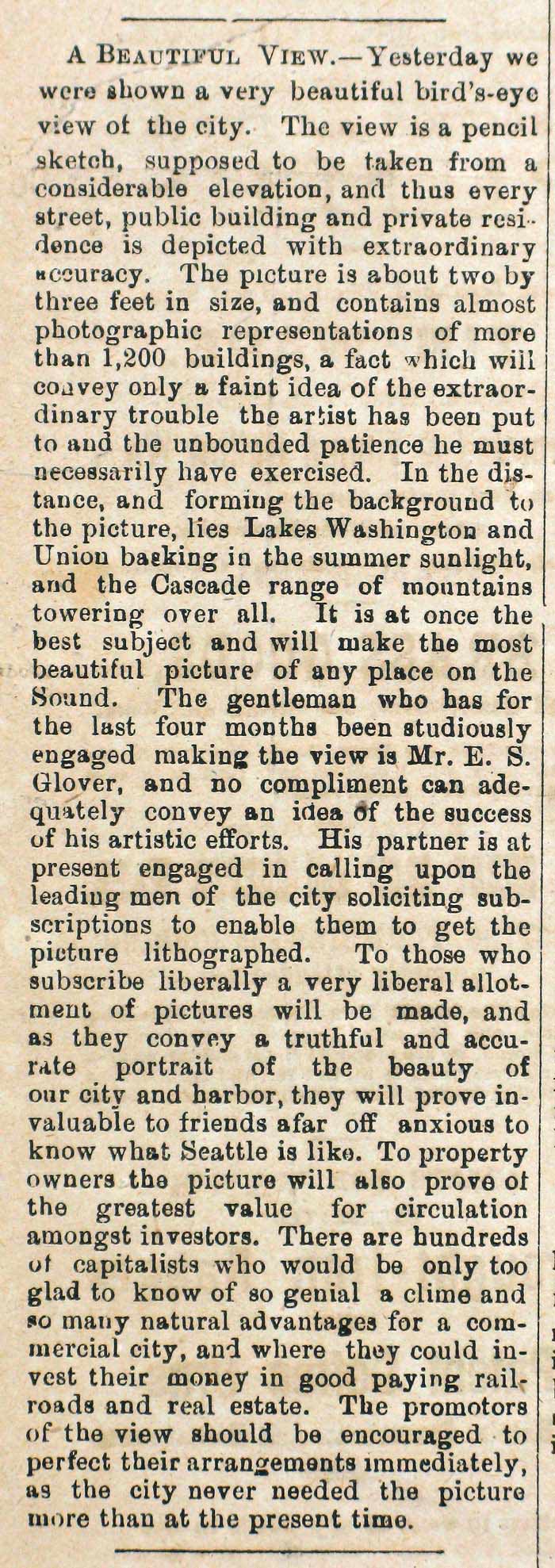
This 1878 Birds Eye was the first such for Seattle. Others would follow in 1884, 1889, and 1891. The one from 1891 is most understandably the most lavish and the artist, like Glover in 1878, attempts to be impossibly faithful to what in 1891 was a city as jumpy as fruit flies in August. In 1891 the population here was over 50 thousand. In 1878 is was under three thousand. Glover and his partner could reasonably expect that nearly all of them would be eager to search into this birds eye for their home and/or business. Lots of the lithos were sold and a few of these examples of tender ephemera survive, some are for sale at a dear price.
E.S. Glover and his unnamed salesman partner did not spend all of 1878 in Seattle sketching and soliciting. That year they did much the same for Victoria, Port Townsend, and Olympia. (Those who wish to ask the roadshow appraiser “And what might this be worth?” can search the web for examples. For instance, a local dealer is asking more than $3,000. for the Olympia litho.) In 1879 the partners move on to Portland. Ten years later they had sketched and printed their way as far as Anniston, Alabama. In the three years before arriving in Seattle in ’87, these artful dodgers made and sold birds eyes in Ogden, Helena, San Diego, Anaheim, Santa Barbara and Salem.

Taking a slice from the’78 litho it is easy to appreciate the opportunity for “identity” available to those who owned and studied their own copy. This slice extends from the King Street Coal Wharf on the far right to the Pike Street Wharf and coal bunkers on the far left. In the full litho one can find a train heading up from Lake Union to drop its coal at the end of the Pike Street wharf. Actually, this year the King Street wharf – seen here far right with coal trains heading both to and from the pier – took over the business of coal transhipment on the Seattle waterfront and operations on the two piers – at King and Pike Streets – never overlapped. The Seattle and Walla Walla Railroad was the name of the citizen-promoted line that brought coal to King Street from Newcastle on the east side of Lake Washington and through Renton. It never made it close to Walla Walla, which was its heartfelt intent, as a gesture of independence from the Northern Pacific Railroad that had put its hip to Seattle while embracing Tacoma. (There is much more about all this in my Pictorial History of the Seattle Waterfront that is so far seen only in part on this blog. It and I wait for more time to bring along the rest of that book.)
Below is a 1879 adver for the S.W.W. that appeared in the city’s 1879 directory. It is followed by a related Edge Clipping from Jan 31, 1878, about the work done in driving piles for the tideflats trestle to the King Street wharf.


Some of the sharpest work of the Peterson and Bros photographers makes wonderful illustration of the 1878 Birdseye. The brothers’ studio was at the waterfront foot of Cherry Street. First, below we print a page from the city’s 1879 directory that advances their competence. And following that we include one of Ron’s recent acquisitions. It is easily one of the real classics of Seattle historical photography – a wide view of the waterfront taken by the Petersons from the elbowed end of Yesler’s wharf in 1878. We invite you to compare this pan in detail with the slice of the birdseye from the same year printed above. You will be rewarded with many correspondences. To help, Yesler’s Wharf at the foot of Mill Street (Yesler Way) is the largest assembly of off-shore construction showing to the left of the King Street Wharf in the birdseye. [Making it easy, Yesler’s Wharf is at the center of the scene.] In 1878 it was still the hot spot of Seattle’s transhipment, with hardly any thing else needed in the way of wharfs and waterfront warehouses – except those for coal.


Next Edge takes a small section from the above classic and enlarges it as a witness to the sharpness of the Peterson Bros work. The subject looks through the future location of the Pike Place Market to the western slope of the front hump of Denny Hill, which in 1878 was a mere quarter-century from the beginning of its “humiliation” with the Denny Regrade. The home on the far right is Orion Denny’s at the northeast corner of Front Street (First Avenue) and Union Street.

Just below is another Peterson look towards Denny Hill, also from 1878. It shows a smooth Front Street two years after its own regrade. Again, on the horizon is Denny Hill. The photo was taken from the front of the Peterson studio at the foot of Cherry Street. The Elephant Store on the right is at the southeast corner of First (Front) and Columbia Street.

Next descending from the studio onto Front Street and turning to the south, the Petersons show the line of storefronts along the west side of Front Street in the long double-block between Columbia Street and Pioneer Place (Square). Their studio to the rear of one those retailers. According to Ron Edge this stereo is “something I forgot I had.” Considering in what good order is the Edge collection this forgetfulness is uncharacteristic. We print it in stereo so that those among our readers who have a talent for creating three dimensions with these old stereos with out the little hand-held optics most of us need can be about the business of relaxing their eyes into whatever crossing is needed to pull out that always sensational 3-D effect.

Next we visit the Petersons – some of them – at home, most likely at the steep northwest corner of 8th Avenue and University Street. This family portrait is most appealing, and the people in it are as well. On the far wall is a certificate from a musical academy, and above the door in the same wall is an embroidered sign reading “Home Sweet Home.” The portrait of Lincoln on the right suggests that the Petersons were Republican, the progressives of that day. The many women of this family – some looking like sisters – are separated from the but two men beyond. They – the men – may be in the kitchen. One of the brothers may be behind the camera. It is a liberated family decorated with much of the stuff that was a demonstration of Victorian good culture, and with provincial touches too, like the painting of the mountain, lake and dugout canoe on the left wall.

Ron has also pull up P-I clips describing the gathering of information for the city’s 1879 directory. Directory-making was a task considerably more involved than drawing a birds eye, however fine its verisimilitude. This Edge Clipping concludes then with the first page from the 1879 directory.


Below the following seven illustratons with shortish captions, is a “reprint” of this weeks now-then from Pacific Magazine, and a fine description by Jean of his visit with 90-year-old (and looking 77) Mercedes wonder-salesman Phil Smart on Capitol Hill’s Auto Row.

It was, as the above advert understands, one’s “itch to grasp a steering wheel” that turned Capitol Hill in to Seattle’s Auto row, and primarily on Pike Street and Broadway Avenue.

Still in 1909, the year of the primary now-then scene printed a few photos below, the best and cheapest way to grasp a steering wheel was to take your turn for a photo opportunity at the Alaska Yukon Pacific Expo that year.

Here is more evidence of auto-heat on Pike Street, the Mills Motor’s used car lot between Summit and Crawford Pl. Street car tracks are still showing on Pike and that’s the Covenant Church on the left.

A glimpse into early 20th-Century Capitol Hill. Here a Frasch photo titled Lincoln Park – but known better as Broadway Playfield – looks south towards Second Hill. Construction of the Providence Hospital tower is dimly evident on the horizon near the center. The new hospital was officially opened in 1912.

The joys of dependable motoring were for many never more reliable than with the Dodge Dart. Dart was low priced and it kept on running. This promotional game was staged for long-time Seattle commercial photographer Roger Dudley. Thanks to Danny Eskenazi for sharing it.

Not on Capitol Hill – or even about cars – but in the state’s capitol. Here is one view of the rotunda-dome repeated 16 times – the Joys of Photoshop. The photograph from which this montage was constructed was recorded during our – Jean and my – visit to Olympia during Christmas season 2007 to help promote our book of state repeats, “Washington Then and Now.” The picture included directly below, and the last of the seven that prelude this week’s now-and-then on Pike Street’s Auto Row, is a 1926 construction scene of that same rotunda. This view and its repeat are included in the book just noted, which you can see in great detail on our webpage that is pretty much devoted to it: washingtonthenandnow.


In helpful response to the “stubbed toe” picaresque printed yesterday (and just below) Ron Edge – more often known here for his “Edge Clippings” – sends along the above with this note. “This 1937 aerial has a few of the landmarks you mention on your blog posting, including a good view of the golf course.” Surely. Where once little white balls were hit about now gallbladders are removed. The new addition to University Hospital was snapped by me over the hedge on monday last at the lower-right corner. 15th Avenue is far left and the next avenue to the right of it is what was in 1937 still an open section of the campus’ Stevens Way. It passes under a Seattle Lake Shore and Easter RR (Northern Pacific) viaduct (Burke Gilman Trail) that is still there. 100 years ago that extended avenue was the promenade for the 1909 Alaska Yukon and Pacific Exposition’s carnival side, The Pay Streak. (The Sunday after next we will feature here a lot of AYP pictures in a “wrap-up” – a film term I think – of the summer-long centennial.) The big and long south campus buildings that I did not name in “stubbed toe” are the Stronghold and William H. Foege Genome Sciences buildings – if I have read the U.W. Map I have now consulted correctly. These new health sciences buildings are east of a 15th Avenue that was freshly redirected to the southwest to make room for them. Only a wee bit of the old residential neighborhood west of 15th shows in the aerial, but one can find that northwest corner of 41st and 15th shown in “stubbed toe”, and discover a five story apartment there in 1937. Again, I don’t remember it. And notice how in 1937 forty-first ave. continued directly on to the campus. One block north the big and white Wesley student center is easily spotted at the northwest corner of 15th and 42rd, with the Methodist church just beyond it at 43th. Two blocks more (there is no 44th St. in this section) is the old Presby church, the brick block at the southeast corner of 47th and 15th. (It is hard to make out but it is there.) The new red brick Gothic structure that took its place and more dates from the early 50s. Turning west on 47th and continuing on to Wallingford there is no Baptist church to be seen. It is hidden behind the Meany Hotel and General Insurance Co. (Safeco) buildings. The aerial looks as far north as the reservoirs around 75th. The green belt of the Ravenna and Cowen Parks ravine intercedes. Calvary Cemetery is upper right and below it are the nursery fields in the rich soil of what is now the concrete spread of University Village. Below that at the curve where Montlake Blvd NE turns into NE 45th Street one can glimpse a tiny (very) early example of the fill work on the old Lake bottom (dropped 9 feet in 1916 for the opening of the ship canal) that will eventually turn those acres to driving more golf balls, parking, and playing games of many kinds. Thanks Ron.
In our “Seattle Now and Then” feature in Pacific Northwest, Jean ordinarily takes the “repeat” or “now” photographs for historical views I find and we discuss, but this week was different. Because of a stubbed toe Jean was lying flat with his foot elevated for relief. I took the opportunity of Jean’s suffering toe to go off on my own and see if I still remembered how to “repeat.” The subject is the Arboretum viaduct. In about a month that feature will be printed in The Times and here as well. I have driven under this bridge many times in the last 45 years but never have I stopped to either study it from below or walk over this brick adorned reinforced concrete span of six arches. Listed on the National Register of Historic Place, it is appreciated. W. R. B. Willcock, a Seattle architect who later led the University of Oregon’s department of architecture, designed the viaduct. His task was to build a picturesque span that would complement the park and be used for both pedestrians and sewerage. The former walk on top of the latter. Below the paving runs a pipeline, a connector in the North Trunk Sewer line, which was built early in the 20th Century to move wastewater from the western shore of Lake Washington to Puget Sound where it could be released into, it was still thought, the eternal flushing of the tides.

The viaduct crosses the Lake Washington Boulevard east-west in line with Lynn Street, and on Lynn is how I approached it from the West. After completing my contemplative stroll across the 180-foot long span, I turned around and took the above view looking back at it to the West. Then I did another about face to look east again and into the arboretum for the forest view below where two paths lead away, but I took neither. You may remember that Monday Oct. 6 was an exhilarating example of an Indian Summer day. Depending upon whether you stood in the sun or shade, the temperature swayed between warm and crisp, and out of a cloudless sky sunlight scattered through the first leaves of fall.


I next found the proper place to make a faithful repeat of the historical view of the viaduct I carried with me and, as noted above, both the “then and now” will appear here in about one month. While standing beside the boulevard I photographed this charming detail of the span’s lighting standard and the moss that is a rustic cosmetic for its decorative brickwork. Such make-up takes time and is hard to convincingly copy or fabricate in a factory. By now enjoying my little camera I continued snapping through the open driver’s window at mostly familiar subjects as I drove home from the arboretum to Wallingford. I will next print a few of them here with brief comments.

I first visited Seattle from Spokane in the early 1950s to attend my oldest brother Ted’s graduation from the University’s then nearly new Medical School. The health sciences campus was then routinely modern but dull. Here over a hedge on the north approach to the Montlake Bridge I glimpsed a recent addition to the hospital, one that plays “boxes and balls” with its masses.

Most of the University’s “south campus” that is east of 15th Avenue has been in the caring hands of the health sciences so long that it is difficult to remember what was or might have been there earlier. I know, although I don’t remember it, that before WW2 much of it, including the original hospital location, was a golf course where the school’s faculty could escape students, except those with clubs. But west of 15th, along the north shore of Portage Bay and extending from there north into the commercial heart of “Univercity” – once a proposed name for the University District – was a neighborhood of small homes and maritime enterprises of many sorts. The latter, of course, kept close to the bay. Some readers may remember how the movement to save this community from University expansion began in the late 1960s but was soon overwhelmed by a University District version of “manifest destiny.” The growing university overwhelmed all protests for it had no growth alternatives so attractive as this “Lower Ave” neighborhood, and the U.W. was our gorilla. The buildings snapped above are examples of the sometimes tasteful and oversize constructions that now dapple the blocks that were once nicely stuffed with modest homes, often vine-covered and sometimes rotting.

The gorilla, we know, also moved west across 15th Avenue and into the University District when opportunities allowed. I no longer remember what was once on the northwest corner of 41st Street and 15th Avenue, but the school-related structure that now holds that corner is, like the latest additions to the hospital, another example of recent architectural style. Here the mixing of angles and curves is for me at least both satisfying and comical. The structure appears something like an allusion to a cathedral – in miniature – but also a homage to Katzenjamer Kastle where masses of different shapes and materials are hinged together.

My next going home snap was a block north at 42nd and 15th – again the northwest corner. For nearly 35 years – up until this past spring – this point of view looked across a parking lot to the Café Allegro in the alley north of 42nd. The Allegro considers itself the oldest surviving espresso bar in Seattle. Sitting inside or on the benches that line the alley or even on the traffic dividers of the parking lot has been the habit of many regulars – myself included in the 80s. (Here I get out of the car to print a snapshot at the Allegro counter from 1987 of barista Mary Anne Schroeder on the right, and I. H. F. Hername on the left. Well Hername really has her name, but I Have Forgotten it.)

For 34 years of espresso ingestion when one lifted their eyes above the asphalt lot, the view across 15th to the tall trees on campus was a calming antidote for caffeine and the stresses of study and/or the discomforts of carping roommates. About 1969 (The actual date is in old notes somewhere.) the parking lot, which was built mostly for overflow University Book Store use, took the place of the stately white frame Wesley House, the big student center for the adjoining Methodist Church. The church tower is seen two photographs above on the right. Then followed the parking and the Allegro’s 35 years of anxiety about loosing to some other big thing the mostly clear view to the green campus. And now they have it. The 6-story George F. Russell Jr. Hall is another Wesley Foundation production, so that in some part the renters of the new halls will be help the church’s student ministry. Seen here and “now leasing” the new hall includes near the top of its promotions some unintended ironies. “You’ll love the views and abundant light from the large office windows . . . You can see downtown Seattle, Lake Union, Portage Bay, University Campus, and the U. District.” Nathaniel Jackson, an old friend and Café Allegro’s owner, has learned to put the best construction on this construction. “The Turner Company made a huge effort and I respect them for reaching out to us and doing everything that they could to make the pill go down with a little sugar. I even got a hard hat out of it with ‘honorary superintendent’ written on it. Allow me to wax eloquent through my tears of joy. This is a new beginning for Cafe Allegro. And think of it. (And her Nathanial cannot help laughing.) They have cut down the trees!” Well not all the trees but noticeably three or four on what was known for a while as “Hippy Hill,” the just on campus safe retreat for both town and gown to avoid the local constabulary and indulge in their own tears of joy and calming antidotes. Nathanial adds, “They did a fine job on the alley. Because of the fight we made, they made an effort to improve it.” The two imperfectly merged snapshots below of the Allegro interior shows through the plate glass some of the alley work when it was still a work in progress earlier this year.


Less then two blocks north of corner mates Café Allegro and George Russell Jr. is University Presbyterian. On the east side of 15th I photographed it through the windshield while on the move. This century-old congregation is easily the biggest congregation in the University District, and more. It is one of the largest on the West Coast. With several ministers, scores of staff, a big organ, a professional choir, and a power list of political parishioners, University Presbyterian is always being tested by the biblical epigram, “He that is last shall be first.”

Only three blocks west of the Presbyterians and yet polar to it is a kind of tentative “last” – the latest District church to publicly wonder how to keep going, here in its now 70 year old sanctuary on the southeast corner of 47th Street and 12th Avenue N.E. Again I have snapped it from the driver’s window. Some will remember this congregation from the 1980s when it was the second church in the U.S.A. to declare “sanctuary” for Central Americans in flight from the American supplied violence there. Since then it has also become a “sanctuary” for gays who still cherish the church. Here’s a quote from the church’s description of itself. “Sanctuary has echoed in many commitments here: welcome to lesbian, gay, bisexual, and transgender people; support for conscientious objectors; a kitchen for hungry folks; a haven for women in transition from shelters to permanent housing; and safe and affordable childcare for children from a diversity of families and ethnicities. It all sounds like ‘sanctuary’ after awhile. Sanctuary is, in that sense, a place – this whole place – filled with a commitment to welcome and witness. Don’t be surprised if you are confused by the word when it is used here. It reverberates all over the place.”

Midway between the triumphant Presbyterians and the humble Baptists is University Seafood and Poultry at 1317 NE 47th Street. This wonderfully gleaming specialty retailer is like an import from a Paris sidewalk except that University Seafood may have fresher salmon than any Parisian fishmonger. Perhaps. The truth is the only thing I know about fish sales is Ivar’s antics of long ago. University Seafood is a survivor and must have a long list of customers that cherish the place. It has been around the corner from The Ave as long as I can remember.

Two blocks west on 47th from the Baptists, a left turn on Roosevelt Way and a long half block south, on the right is the entrance to Trader Joe’s parking lot. It is a wonder of the collective driving skills of its mostly liberal clientele. It may be that college graduates also drive better. Here they need to. The slots for cars in this lot are absurdly tight, the corners sharp, and the place is almost always packed. Although the deepest parts of this covered garage are dark indeed, muggers are not a threat for they prefer the large open parking lots surrounding suburban malls. Also if someone yells “Help!” in this lot it is likely that a dozen heroes will appear in an instant. At Northgate they may run for the mall. The above photo was snapped at the entrance. It is a both a fine example of how creeping ivy and a few low bushes can soften a concrete wall and a contrast to the hard responsibilities of parking at Trader Joe’s that will soon follow.

Back home in time to walk about the neighborhood I snapped first this natural demonstration of the “solitary effect,” a principle of aesthetics that I remember from the 1940 Magnus opus “The Arts and the Art of Criticism” by Theodore Meyer Greene. Greene might have written his chapter on the “solitary effect” about that red flower. His big book had staying power. It was still read in the late 50s when I was in college and I have my copy yet. But what would Greene make of the below, an example of what I refer to as my UFOs, or unidentified flattened objects. This UFO was photographed again on Monday last, off the curb and lying in the street at the southwest corner of Sunnyside Avenue and 42nd Street. Fallen needles decorate I don’t know what, except that the traffic has flattened it. And yet it still has “depth.” I checked in passing. It was still there today. For identification of the location only, on the lawn behind this UFO is the red maple at the bottom of this post.


 We are pleased now to introduce Seattle 1900-1920: From Boomtown, Urban Turbulence to Restoration, the first of Richard C. Berner’s three books named together Seattle in the 20th Century. When the details, stories, and insights are explored with a close reading, Berner’s accomplishment is by far our widest opening into Seattle’s twentieth century, the first half of it, from the 1900 to 1950.
Those fifty years were also the second half of Seattle’s first hundred years, if we begin our counting with the footsteps of mid-western farmers settling here in the early 1850s.

Volume one was first published in 1991 by Charles Press, and the publisher – “Rich” Berner himself – made a modest list of its contents on the back cover. We will repeat it. “Politics of Seattle’s urbanization: dynamics of reform, public ownership movement, turbulent industrial relations, effects of wartime hysteria upon newfound civil liberties – all responding to the huge influx of aspiring recruits to the middle class & organized labor as they confronted the established elite. Includes outlines of the economy, cultural scene, public education, population characteristics & ethnic history.” …
(Read Paul’s complete introduction)


The well-windowed Fremont factory surviving here is located on Bowdoin Place a few blocks west of “The Center of the Universe,” the other name for Fremont’s business district at the south end of its namesake bascule bridge.
Here Bulgarian immigrant Peter Ivanoff compared himself with Newton and Edison. (See Ivanoff’s obit at the bottom.) With floors polished smooth enough for ballet and potted plants decorating every lathe, Ivanoff built in his bright factory what he called his Co-Motional Motion Power Engine. His invention, he claimed, could run anything from a wristwatch to an ocean liner. After a minimal assisted start-up, his CMMPE would be forever on its own producing more power than it used. That is, it kept itself running and much more.
Here enters the Outlook, the long-lived newspaper the Stapp family ran out of their Wallingford home. Son Arthur, the paper’s reporter, learned from The Fremont Times, a rival weekly, about Ivanoff’s upcoming April 1, 1931 factory presentation of his machine. An enthusiast for both science and technology, Art attended the opening acting as a potential investor, and in the following day’s Outlook gave Ivanoff’s machine the name the inventor himself was, perhaps, careful not to use. The CMMPE was that impossibility, another “perpetual motion machine.” Stapp warned readers that investors were “april fools.”
But was Ivanoff also the “fake” that Art Stapp called his machine? The Seattle Times picked up the Stapp story; Ivanoff was investigated by the state and audited too. He lost investors and returned to unextraordinary machine work including making parts for Boeing during World War Two. When he died in1946 he left a trust for research into “co-motional power.” Peter Ivanoff, it would seem, was both industrious and a self-deceived true believer.


Darius Kinsey took the photographs used here of Ivanoff’s Fremont factory in 1940. The now-then factory interior repeat above is an “approximation.” You can see the beams in both and the camera’s are aimed in the same direction. That’s it.
Ivanoff died in 1946 and his Seattle Times obituary follows. It gently touches on the perpetual motion episode. It is followed by a short clip on the direction of his estate, in part, to continue his research. Although we have no idea what became of it, $200,000 to continue research in “co-motional power” could be given desk space for quite a long time, although not perpetually.


Le Bouillon Chartier by Berangere Lomont
In populist – perhaps – sympathy with the Dog House and Igloo here from Berangere in Paris is a contemporary cafe interior and the menu too from . . . she explains.
Mes Chéris,
Here is a menu from one of my favourite restaurants : “Le bouillon Chartier ” 7 rue du Faubourg Montmartre Paris 9th, it is an institution for every good Parisian, the restaurant has been opened since 1896 , served 50 millions meals, and was classified a Historical Monument in 1989. It is very cheap, simple food , ” bouillon” was meaning in the 19th century a mix of meat and vegetables for workers. I like the ambiance where everyone feels comfortable.
Let’s go !!! Big bisous et bon appétit. BB
[Now Berangere has added the wine list, shown below the menu proper, and notes . . . “The wine list presents simple traditional wines, and modest prices compared to any other restaurant, just to see kir royal at 4,90 euros seems a miracle… Appellation d’Origine Controlée is a french label , which means the geographic origin of food and/or wine is garenteed.]


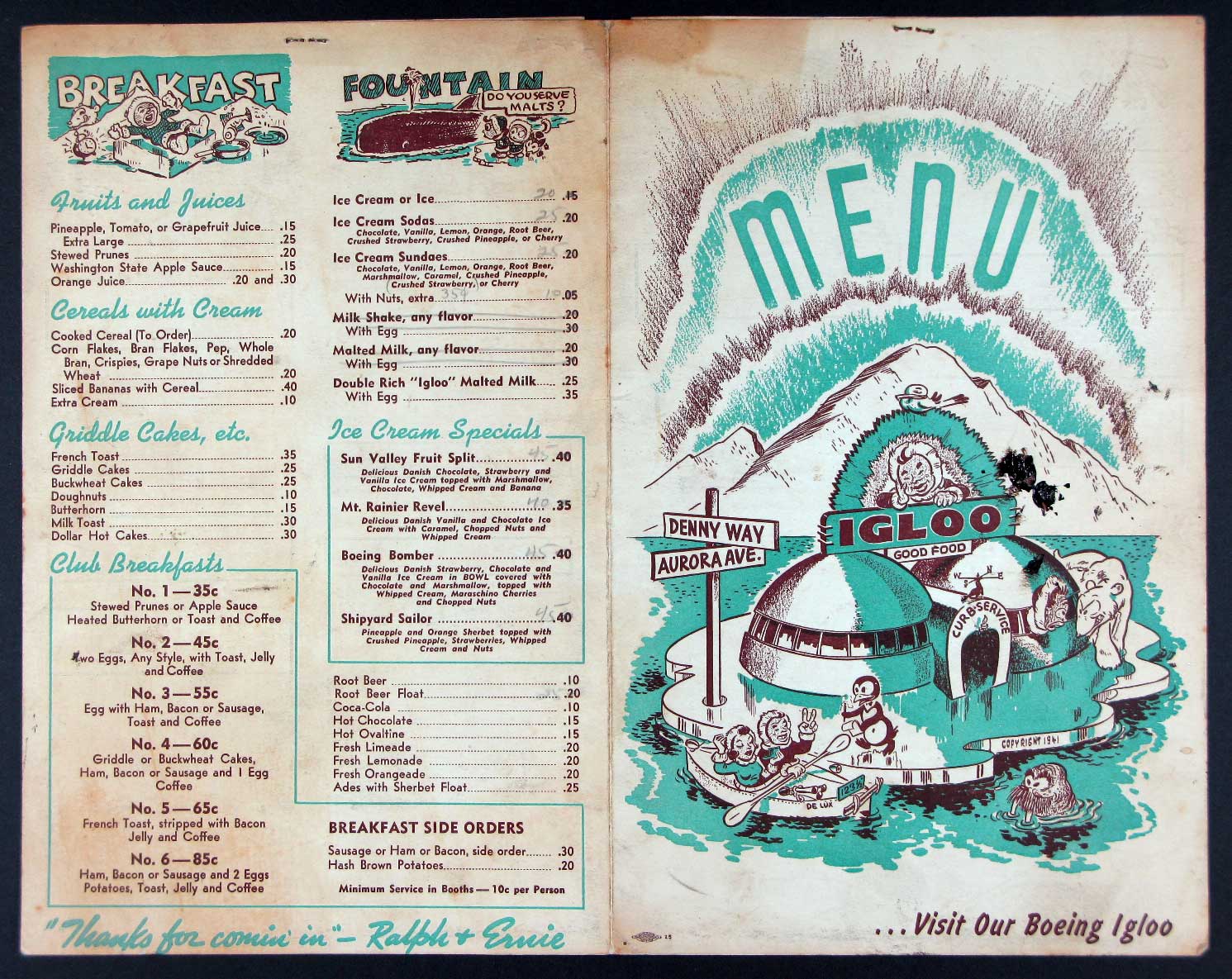
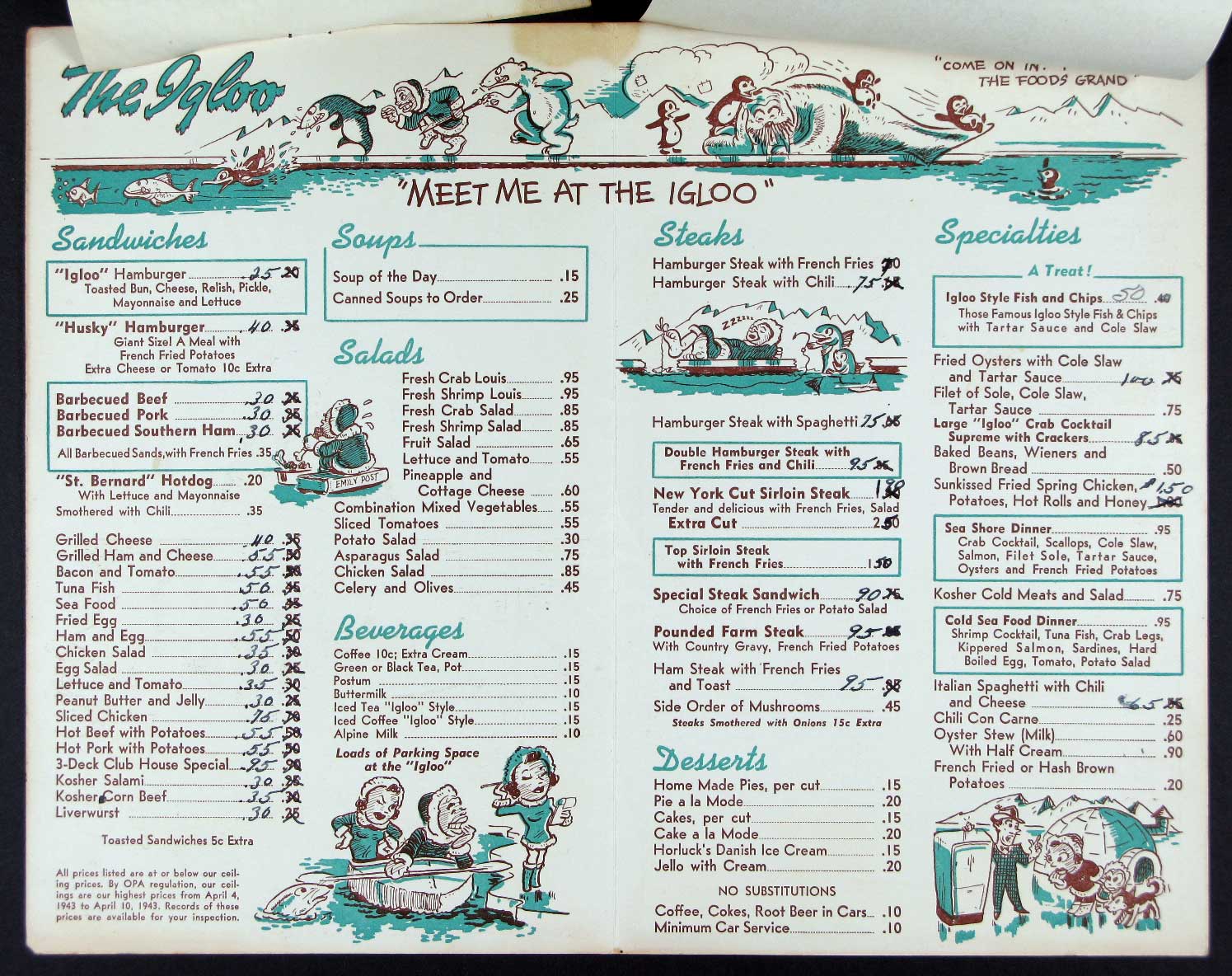
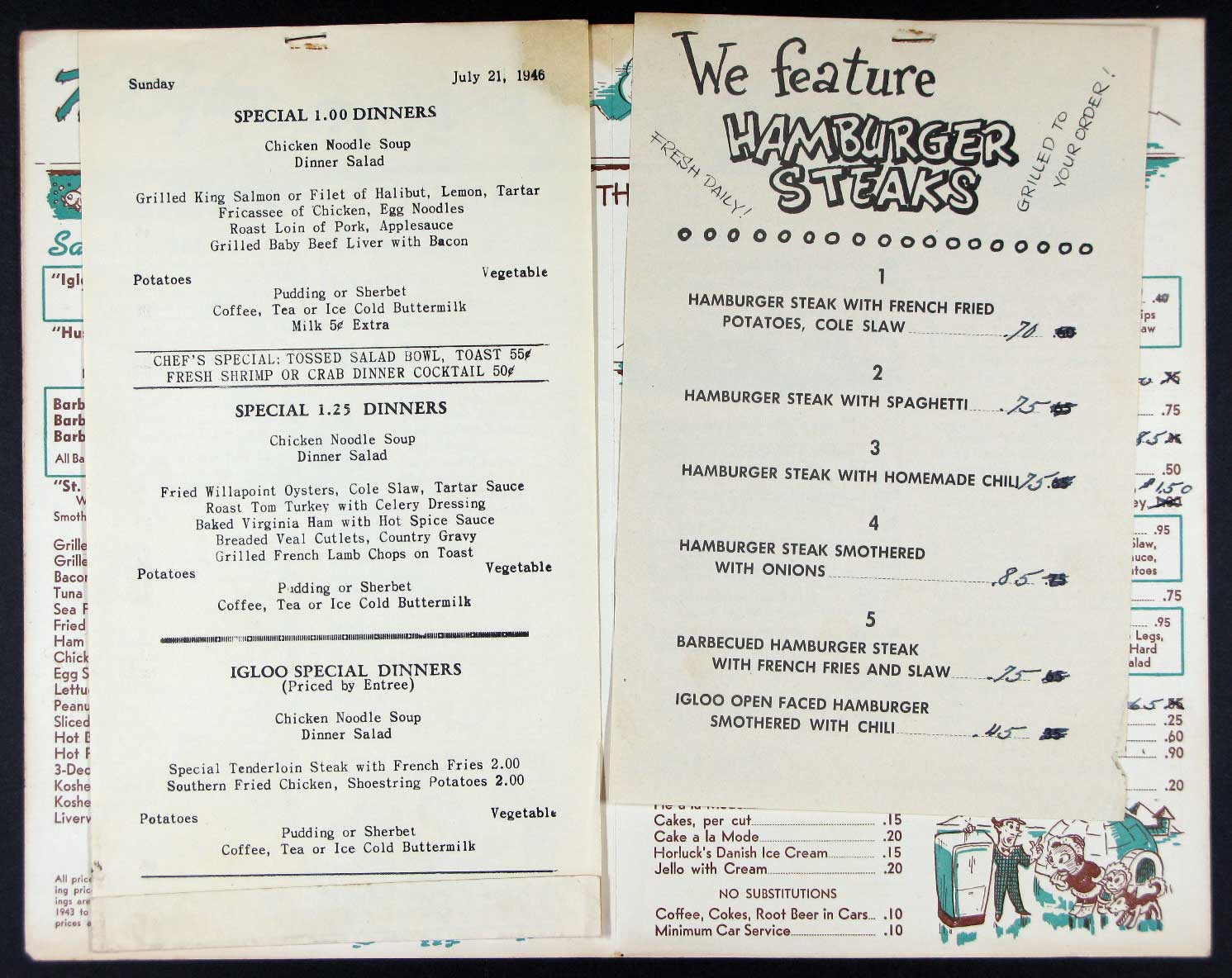
Appropriate to the features recently inserted here regarding the Igloo and Dog House, two cafes positioned at the south entrance to the Aurora Speedway, we draw on collector-researcher Ron Edge’s archive for menus that reveal what both were serving and for how much. First the Igloo covers and inside. The main menu is copyrighted 1941, and the “special” insert is for July 21, 1946. For economy new post-war prices have been hand-written next to the old ones. The several cartoons may be enjoyed as examples of humor that was probably introduced by the cafe before Pearl Harbor rather than after. The war had its own preoccupations and humor. One of the drawings uses the popular theme of an out-of-control husband flirting with a waitress in the presence of his peeved wife. Another honors the old joke of a refrigerator salesman making a pitch to Eskimos outside their igloo. How appropriate. There is also a rendering of another popular cartoon subject: the predator food chain.
The Dog House menu below does not reveal its age, although it is about the same as the Igloo’s. The prices may be compared. The illustration of the adorable puppy was used probably to good effect many times through the years of the Cafe’s fairly long life. In dog years it was biblical.


One more Dog House from Edge’s collection – this one in Everett, and considering the prices on the menu it was probably printed during the Great Depression. Imagine! an oyster sandwich with salad for twenty cents, or a Denver or Hickey sandwich for five cents more. But what is a Hickey sandwich?

This is placed to elaborate our essay of Aug. 15, 2009 titled “First Hill Exceptions.” The view looks northwest from the upper level of the “intersection” of University Street and 9th Avenue, ca. 1912, to the Normandie Apartments when the ivy that covers the south facade (on the left) has reached the band between the first and second floors, went counted up from 9th Avenue. In the principal photograph used last Aug. 15, that south wall is covered with that creeper, and probably the east wall too. Here we may note the planters on the roof and on the far left the canvas shelter open for studying the skyline in any weather without high winds.

The view below – the right half only – was first presented in Pacific Magazine on Sunday July 29, 1984. That was early in my figuring with the Times: the third year now of twenty-seven. I also included it in Seattle Now and Then, Volume Two, the second of three collections of the Times features that I self-published under Tartu Publications. (All are out of print now, although I have a few in “private” preserve.) I’ll use now most of the text from ’84, but I’ll also add some points, especially about the added left half of the pan.
First, as a bit of a tease, I challenge the reader through the course of this little essay to locate the future site of the by now long-gone Roosevelt Theatre (later the Town) on the south side of Pike Street mid-block between 5th and 6th. Of course, you can cheat and jump to the bottom of all this and find it in a detail pulled from the panorama.
[Please Click Twice to Enlarge.]

The pan was photographed in 1885 by I do not know whom from the southern slope of the southern summit of Denny Hill. (Roughly, Virginia Street ran between the hill’s two humps.) This is residential and academic Seattle. It includes the UW campus on Denny Knoll, left-of-center. The commercial district around Pioneer Place (or Square if you prefer) is to the photograph’s distant right and just this side of the tideflats. The tide is in and laps against the western side of Beacon Hill, the long ridge on the horizon.
It was in 1885 that Arthur Denny began referring to this prospect – his hill – not by his own name but by what he hoped for it. He called it Capitol Hill. Denny schemed to kidnap the territorial capitol from Olympia and build the state’s new political campus on his hill.
The extended rear of Arthur and Mary Denny’s home at the southeast corner of Union Street and First Avenue (then still named Front Street) appears on the far right of the pan. The lawn – the family cow’s pasture – behind their long home separates it from the family barn that sits here at the southwest corner of Second Avenue and Union Street. Continue one block north on Second (towards the hill) and you come to Pike Street. There at the northeast corner sits the barn – with the shining roof – for the city’s horse trolley. The “bobtail cars” began running in 1884. The line of the tracks can be seen extending down Second Avenue. At Pike the rails turned one block west to First and then turned north again for the final leg through Belltown and eventually as far north as lower Queen Anne. Continuing now north on Second Ave. from Pike Street, its intersection with Pine is just missed off the page to the right. Third Avenue ascends from the scene’s center.
In this neighborhood humbler homes were mixed with a few mansions. The Italianate style was popular in the 1880s and a few examples can be found in the pan. Many of the lots were large ones with room enough for a generous garden, a few fruit trees and a lawn. Many properties were separated from their neighbors and the city’s often elevated wood plank sidewalks by picturesque picket fences. Second Avenue was graded (smoothed) in 1883, in plenty of time to lay the trolley tracks.
Of the seven churches that can be seen here, the only obvious one is the Swedish Lutheran Evangelical Gethsemane Congregation on the east side of Third and just north of Pike Street. That puts it near the center-bottom of the pan. The Lutherans are very new here. The church was dedicated on February 22, 1885 – this year. It was Seattle’s first Scandinavian and also Lutheran church and its pastor, Dr. G. A. Anderson, spent alternative Sundays here and in Seattle’s material/spiritual rival, Tacoma. (Which town would be blessed and if Dr. Anderson knew would he also tell?)
I must confess that in this panorama the church – the sanctuary – is itself split. When I merged the overlapping sides, left and right, the buildings all fit as I expected that they would. I chose to make the cut near the center of the church. But then looking above the church roof to the greenbelt on the south side of Union Street where it holds the northern border of the U.W. campus on Denny Knoll, I learned that although the two parts of the pan were photographed from same place on Denny Hill they were not taken at the same time – not even the same season. To elaborate we need to first identify the territorial campus’ main building.
It is, of course, the white box on the knoll with classic columns presented at its front door on the west façade that faces both the community and Puget Sound. On the other or east side of the school is the large leafy Maple that still had another twenty years before it was cut down. And here is a surprise. In the left half of the panorama the leaves on the maple have dropped but not on the right half. The line or border between the part of the tree with leaves and the same tree without leaves is obvious. What’s more there are lots of leafy trees on the right half of the pan and none that I can find on the left side of it. Also the left hand side of the pan is exposed to a sun that can still light the northern sides of the buildings before its flight south, while the light on the right half of the pan is flat or flatter. These differences border on the mysterious, for how does one join a northern light with a leafless neighborhood? But we must allow it and remember that this neighborhood is not on the “true compass.” That may account for it. I will speculate that the mysterious photographer took the right hand or western panel first and later in the year returned to take the left half, thinking that a pan that included the city growing up First Hill was more marketable than one merely of the “old” city.
The university’s main structure for classes and offices was built on Denny’s Knoll in 1861 near the northeast corner of 4th Avenue and Seneca Street. Fourth Avenue then stopped at Seneca and did not proceed north through the campus. It resumed its path north of Union Street – as it does still in the panorama. (And returning to the tease, that is a telling clue for finding the mid-block on Pike between 5th and 6th Avenues.) Behind and to the left of the university, is Providence Hospital, which was enlarged throughout the 1880s, as the Catholic sisters care was much the most popular in town. Here it has but one tower. Soon it will have three. The hospital faced Fifth Avenue between Madison and Spring Streets, where stands since the early 40s the federal courthouse. The grand white box to its left is Central School. It nearly fills the block bordered by Madison, Marion, 6th and 7th Avenues. It opened on May 7, 1883 and burned to the ground in the spring of 1888. Coming again to the photographer’s side of the university’s main building, another white box is snug in the green belt. This is the three-story home for the Young Naturalists Club. This society of scientifically curious specimen collectors was the beginning of the Washington State Museum, which in 1985 celebrated its centennial in its present modern home, the Burke Museum, on the U.W. Campus.
On the First Hill horizon of the left-hand panel are a few landmarks that in 1885 were nearly new. Coppins water tower (and works) pokes up about one-third of the way into the scene from its left border. To its left is Col. Haller’s mansion Castlemount with its own tower at the northeast corner of James and Minor.
On the far left is the green belt covered in last week’s offering, that of the steepest part of First Hill where University Street climbs – or attempts to – between 8th and 9th Avenues. This generous document is, of course, filled with many other identifiable landmarks but we will take mercy and exit this tour here – except to add what follows.
For all the familiar charm that entwines this mid-1880s scene, the year 1885 was remembered by pioneer historian-journalist Thomas Prosch, then the Post-Intelligencer’s editor, as characterized by “a great deal of ugly feeling . . .the times were hard and the hands of all seemed to be raised against others. Grievances were common and relief measures took violent shape.” The economic depression that followed the economic crash of 1883 kept the times dull in spite of the flood of immigration that followed the completion also that year of the Northern Pacific’s transcontinental. The new railroad brought west a hopeful flood of single men looking for work, but what they found were opportunities that required not labor but cash. Those who had the where-with-all to buy land in 1885 had golden futures – at least until the next crash in 1893. The result was a volatile split between labor and capital that erupted into race riots in both Tacoma and Seattle, which must have tested Pastor Anderson. The scapegoats of working class resentment were the Chinese and the capitalists who exploited their relatively cheap but effective labor.
[Both the panorama and its detail below, which shows the mid-block on Pike between 5th and 6th Avenues, are used courtesy of the University of Washington, Special Collections. They are in the basement of the Allen Library.]

Having printed this week’s Pacific Northwest feature on Cowen Park already last week (the third and fourth features below), we offer here a page from developer Charles Cowen’s promotional booklet with the title we have used above – with Keats and the rest. And we have also included here his map of both the park he had then freshly donated to the city and his addition, which he hoped to sell to its citizens lot by lot – and did.
We chose the page titled, “Some of the Reasons Why Cowen’s University Park is Such Desirable Property” for its sometimes amusing “reasons.” The proposal that Seattle would reach a census population of 500,000 by 1910 was about two times too ambitious. Still Cowen sold his lots.

And the map. In the booklet it is folded and attached to the back inside cover of the booklet. The path of the stream may be a bit fanciful in its drawing, but it is probably close to the correct course the Green Lake outlet took on its way to Lake Washington’s Union Bay. (We have “printed” this somewhat large so it may take a bit longer for some computers to load/show it.)
[click to enlarge]

(click to enlarge)


In 1941 several hundred women attended the Home of Good Shepherd’s annual open house for tea and a tour at the “summit” of Wallingford. Among the attractions visited were the “well-stocked fruit rooms.” Much of that fruit, of course, came from the institution’s own orchard, which here, with its gnarled trunks and matted grass, resembles a painting by Vincent Van Gough except that these trees – some of them – still bear apples in Wallingford and not olives in Saint-Remy.
The date for this wild portrait of a temporarily abandoned orchard falls between 1973, when the Home of the Good Shepherd closed and both its sisters and resident girls moved out, and 1981 when the Seattle Park Department turned the orchard into a playfield and park while saving some of the fruit trees.
It might have been used for retail. After closure the first inviting proposal for purchase came quickly to the sisters from a Los Angeles developer who wanted to rework the Good Shepherd campus into a shopping mall. Concerned Wallingfordians – notably the Wallingford Community Council – just as quickly organized against this offer. For a mall, zoning would have needed to be changed, and the citizens made sure it was not.
The community council next successfully persuaded the city to use 1975 Forward Thrust funds to purchase the 11-acre campus. A little more than half of it went to the Park Department. Most of the rest became home for arts and culture non-profits with the non-park properties they used managed by Historic Seattle, the advocate of historic preservation. Urban agriculture – with Tilth and the Wallingford P-Patch – also continues to be part of the nourishing mix at home on the old Good Shepherd Campus.


Rustic constructions were common features in Seattle’s first parks. The rough-hewed twists and textures of the region’s own materials gave these generally fanciful creations — pergolas, bandstands, benches, bridges, fences, portals — a feeling of having grown with the landscape. The original gateway to Cowen Park was a sizable example.
Cowen Park was given to the city by an English immigrant who stipulated that in return for the 12 acres a marker be placed commemorating his gift. Actually, Charles Cowen’s family name was Cohen not Cowen and their wealth was made largely from the diamond mines of South Africa. Coming to America on business for the family mines Charles decided to stay and soon changed his name.
The 41-year-old Cohen-Cowen arrived in Seattle in 1900 and purchased 40 acres of cleared but not yet platted land north of the University District. It was the part of these acres that bordered Ravenna Park, which he gave to the city with his namesake provision. The remaining flatter acres he platted and sold, generally prospering from them and his other Seattle investments.
Cowen also paid for the construction of the rustic gateway at the park’s southeast corner where University Way crosses Ravenna Boulevard. Within two years of his gift the city had cleared the park of its underbrush, built a shelter house and groomed the brook which ran from Green Lake through both Cowen and Ravenna parks on its often babbling way to Lake Washington’s Union Bay. When Green Lake was lowered seven feet in 1911 the creek’s primary source was cut off and its volume restricted to park springs and runoff alone. The creek’s old meandering way between Green Lake and the Cowen-Ravenna ravine was graded over and straightened as Ravenna Boulevard.
Most likely this photograph from the Asahel Curtis studio was recorded late in 1909. The number on the original negative falls near the end of the roughly 4556 studio numbers allotted that year. For Curtis it was a record year for picture taking, in part because the summer-long Alaska Yukon Pacific Exposition was held in 1909 in a Seattle made photogenic for it. Although Curtis was not the fair’s official photographer, he and many other studios were able to exploit the fair thanks to both citizens and the exceptional surge of visitors who gathered their souvenirs while consuming Seattle.
Most of the greater University District was retouched for AYP including Cowen Park although obviously the hard surface paving on University Way did not make it as far north as the entrance to the park here at Ravenna Boulevard.

Looking here beyond the woman standing with the child and through the original rustic gate it is clear that neither shall man leave the land alone. On the north side of the gate the park drops away into what in 1909 would for only two more years be a babbling ravine. Since the early 1960s it has been a more-or-less level playfield made from one hundred thousand yards of “free fill” scooped away during the creation nearby of the 1-5 Freeway. At the time, to quote from Don Sherwood’s hand-written history of Seattle parks, “Many residents and the Mountaineers Club were appalled.”
Still the fill has had its uses. The hip community’s first Human Be-in was held at Cowen Park in the spring of 1967. Later in August 1971 the Second Annual Frisbee for Peace Intergalactic Memorial Thermogleep U.F.O. Frisbee Festival was held on the settled playfield. However, a proposal from the event’s sponsors, the University District Center to make it an official Seafair event was rejected. At the time future historylink founder, Walt Crowley, directed the Center.


Here on a sunny winter day a young family, most likely from the neighborhood, visits the swings of Cowen Park. Judging from the long shadows and the direction of the flow in the vigorous Ravenna Creek it is an afternoon outing. While several photographs of the creek’s passage through Ravenna Park survive, this is only the second example I can recall of it flowing through Cowen Park.
Its namesake developer Charles Cowen donated the park to the city in 1906 in part to help sell lots in his University Park addition. All but three of its 14 blocks border the park to the north.
Among the “desirable” reason’s Cowen named for buying a lot were “pure atmosphere, moral environment, proximity to the University – the literary atmosphere will be the best in the world – and no objectionable noises or sights to contend with.” Except for the overhead flight path to SeaTac, the trucks on 12th and 15th Avenues Northeast, and television in every home, this is still largely true.
Like all the scenes in the family album from which this one was copied, the date is sometime between 1908 and 191l, but not deep into 1911 for that spring the level of Green Lake, the source of Ravenna Creek, was dropped seven feet. The loss of both the lake’s original shoreline and the natural outflow of its creek to Lake Washington’s Union Bay were controversial at that time and are still annoying at this time. After the 1911 lowering the only babbling in the Cowen-Ravenna ravine was from a few springs and run-off.

The Red Tomato
so much depends
upon
a red to
mato
shining in a
soap dish
beside the white
window
I picked my first tomato this past week and thought – not necessarily and yet not unreasonably – of William Carlos Williams, the physician-poet from New Jersey whom I was introduced to in college in the late 1950s. Now I wonder if Williams is still read regularly in school, or if there are a few writers who are still “getting” his instruction that there be “no ideas but in things” as were poets Ginsburg, Olson, Levertov, and others. That, we were taught, was the lesson of his most anthologized poem, the poem I have lovingly parodied with my tomato.
The Red Wheelbarrow
so much depends
upon
a red wheel
barrow
glazed with rain
water
beside the white
chickens.
It is estimated that Williams delivered 2000 babies from the mothers of New Jersey in his more than forty years as a practicing pediatrician.

Tonight, July 31, 2009, Jean and I drove over to West Seattle’s Kenyon Hall to be part of – a small part – of Jack Hansen’s wake – a mix of music, reminiscences and food. It will not be the last send off for Jack, who played on every Puget Sound shore (and a few on the eastern seaboard as well) and was cherished by many communities as one of this region’s sharing virtuosos. Another wake is planned for Bellingham, where Jack is remembered for his talents already as a teenager. I first heard him there in 1969 and then got to know Jack through the Fairhaven community on Bellingham’s south side. (It is still there.) Friend Marc Cutler, then of the band Uncle Henry, introduced us. And Marc is still in Bellingham, or near it, and making music. We suspect he will be at the Bellingham send off with his guitar.
[please click to enlarge]

[As always, click and click again to enlarge the pictures.]
The Turn at Broad Street
From his prospect above Main Street a few yards west of the pioneer Commercial Street (First Avenue South) the Denny Hill greenbelt at its north end seemed to George Robinson, the Victoria photographer visiting in 1869, to conclude with a profile made from trees leaning slightly towards Elliott Bay. [See illustration #51 in Chapter 6] At Broad Street the shoreline turns just far enough to the east (or to the map-north) that from old town there seems to be a formidable peninsula protruding there. But the waterfront really makes only a slight turn north of Broad. The “peninsular effect” is heightened by Magnolia, which in the distant haze is a lighter shade. The combined conditions of a slight turn and atmospheric perspective give this modest point near the future foot of Broad Street more prominence than it actually owns. If Robinson had recorded the parts of his panorama from the deck of the Hunt, that point near Broad would have been missed or not noticed and, of course, with the slapping of the paddles his photograph would have also been out of focus. For from the Hunt – where we see that Canadian side wheeler in Robinson’s pan – the shoreline beyond the point would have been revealed and joined in one continuous greenbelt with the green western slope of Denny Hill and with no Magnolia haze to confuse it or encourage a mistaken point. [Using a straight edge and a map of Seattle one can easily warrant this observation about the deceptive point at Broad Street as seen from Piner’s Point, aka the Pioneer Square Historic District. Near one end place the straight edge half way between First Ave. S. and Alaskan Way on Main Street – Robinson’s prospect. Keeping this point fixed or stationary, pivot the same side of the straight edge or ruler so that it touches the intersection of Alaskan Way and Broad Street. You will note that the waterfront north of Broad Street runs nearly parallel with the straight edge. Consequently from Robinson’s second floor prospect it is only barely lost to view.]
The first U.S. topographical map of Seattle from the mid 1870s (already noted several times in previous chapters) shows this slight turn in the waterfront to be near Eagle and Bay Streets or just north of the foot of Broad Street. In Robinson’s 1869 photograph where the waterfront reaches Broad Street, the bank or bluff has petered out and the darker vegetation that reaches the beach is – to reiterate – marked by the leaning tree at Broad Street or very near it. [Again, see illustration No.51 in Chapter 6.] By the mid-1870s the lean in the tree at Broad managed to bend so close to the water that it was chosen as a defining landmark by the cartographer. It is noted on a printing of the map.
1870: Census
Before we follow Robinson to near the northern edge of Yesler’s dogleg wharf to study his other view of the Seattle waterfront, we will first admit that for the moment the Robinson attribution is, perhaps, a sober hunch. (The splendid informality of the blog means I can change or confirm it all later.)
Next we may also speculate on how many locals made it to the wharf on the 21st of July 1869 to survey emissary Seward during his brief visit to Seattle on his way to “proving” Alaska. Most likely a telegram-ignited grapevine prepped all locals that he was on his way. And what sort of population did he have to draw from? In the 1870 federal census Washington territory had 23,955 residents, and of these King County counted 2164 persons, or less than half the population of Seattle’s Leschi neighborhood now. Of the few hundred only 243 were counted as Indians. (Some of them may have been living on or above the beach on Bell’s then inactive Belltown claim.) In Seattle there were 1142 inhabitants including blacks, whites, Chinese and Indians. Walla Walla with 1394 inhabitants was the largest town in the Territory and its namesake county was the most populated as well. (Walla Walla kept this distinction throughout the 1870s and was again slightly more populated in 1880 than Seattle when figured by the Federal census that year. However, it was a distinction lost to Seattle – by estimates – the following year.) It is left to the reader to approximate how many of Seattle’s 1100-plus citizens made it down to the dock to listen to Seward. Without a news report or reminiscence of a nose-counter, my hunch is that at least half of those hundreds pulled themselves away from their home entertainments, responsibilities, or brooding introversion to attend.

1869: Robinson’s View of the Central Waterfront from Yesler’s Wharf
George Robinson’s second view of Seattle (if our attribution is correct) was photographed from near the end of Yesler’s dog-legged Wharf and on its north side. [52] It looks across Yesler’s millpond to Front Street (First Avenue) between Columbia Street on the far right and Madison Street on the far left. Although Front still generally follows the contours of the native land, it has been graded for wagons, and the scrapings from the street can be clearly seen between it and the waterfront. What is perhaps most startling about this earliest view of the central waterfront is how the bay nearly reaches Front Street. At a not very high tide it would have flooded the narrow Post Alley that following the city’s 1889 fire was developed a half block west of Front Street on fill and pilings.

The white classical symmetry of the Territorial University sits left of center on the horizon. To the left and below it is Rev. Daniel Bagley’s “Brown Church” at the northwest corner of Second Avenue and Madison Street. The paint job on the lower rear wall of the church – the attached one story western section – is darker than it appears in Robinson’s panorama where it seems to be a second and lighter tone than that used for the west façade of the main section of the church.

If these differences hold and are not simply the result of photographic effects, then Robinson would have recorded this scene and the merged panorama on different visits. A study of the trees on the horizon (like fingerprints their branches don’t lie) shows that the panorama from Commercial and Main was photographed later than the view from Yesler’s Wharf. One sizeable tree that appears in the view from the wharf is missing in the panorama from Plummer’s Hall. But is this imagined what with trees overlapping and swaying this way and that? There is, however, a clincher to dissipate these doubts. A residence appears in the panorama that is not included in the view from Yesler’s Wharf.

[7-Ronbinson-Comerc-det WEB]
The missing house can be found in Chapter 6 in the printing there of the full Robinson pan. For searching it is best to use the layered rendering of the pan, the one which includes the left half on top and the right half – the one of interest in this matter – on the bottom of the diptych. Or the house can be seen here [above] in the detail extracted from yet another photograph Robinson recorded during the visit that included the panorama. This one looks north up the middle of Commercial Street with Robinson’s back to King Street. The “new” home appears on the right and the university on the left. Judging from the home’s position in reference to the Territorial University’s main building at the northeast corner of Seneca and 4th Avenue, that freshly appearing home would be near what is now the intersection of 5th and Spring.

Granted that the Robinson detail is not so detailed itself, we can, I think, still find the home in question near the center of a view [above] taken from the Territorial University in 1887. It looks southeast towards First Hill. What appears like an attached shed to the rear, or north, in the Robinson view, has been upgraded with an Italianate bay window along the home’s west façade. And in 1887 King County Treasurer George D. Hill lives there. Most likely he had a family, although the 1885 directory that lists him residing at the northwest corner of Fifth and Spring does not make note of it. Hill is not the old home’s first resident for he arrived in Seattle in 1879, or ten years after Robinson made his panorama that showed this home when it was alone and new.
Another view – or stitched views – from an upper floor of the University was recorded in the early 1870s. George Moore, the city’s principal resident photographer then, may be responsible. It looks [below] down 4th Avenue on the left (the Baptist church appears in the distance on 4th near Cherry) and over the tower of the first and here new Central School at the northeast corner of 3rd and Madison, and beyond that to Yesler’s Wharf. Elliott Bay then was still its aboriginal size with tidelands – on the left washing against Beacon Hill – that had not yet been reclaimed and developed.

Returning to Robinson’s 1869 recordings from the end of Yesler’s Wharf we will make note of something that cannot – yet – be noted in the photograph itself. A beachside stone-covered tomb, mentioned by historian David Buerge, which was uncovered beneath a burial mound near Front Street and a little ways north of Marion Street was for Robinson and everyone still covered and undetected in the photograph from Yesler’s Wharf. From Buerge’s description, in this 1869 view the mound is most likely somewhere near the shed on the left that is built in part over the beach. [52]
Marion Street ends at Front Street on the rise just left of center. [52] In 1872 the town’s first “pleasure garden”, a landscaped bower with hanging lanterns and beer, was developed on the hillside a little ways north of Madison Street and east of 2nd, which would put it directly to the far side of Bagley’s Brown Church as seen here. [I have not as yet come upon a photograph of this attraction and may never. Photographs of Seattle in the 1870s are rare.] Sited then between and in line with the Methodists and the University, the beer garden would thereby fulfill the trinity of basic human needs – understanding, redemption, and refreshments.
If taxes and fees are reliable signs of a community’s priorities and grudges, in 1869, the first year of its new status as a chartered municipality, Seattle considered the requirements of its streets more fundable than its dogs, but the dogs, at least, were dearer than the town’s deceased. General taxes collected amounted to $494.23. However more than three times that amount was got from a designated “road tax”: $1601. Dog licenses yielded $119.50, an impressive sum when it is considered that only $47 was gained from cemetery lots. The figure contributed from theatricals, only $20, is a dour sign of the part played by the professional performing arts in the still teenage community.

The ALIDA
The scene above is nearly as old as Robinson’s record of Seattle’s waterfront. This view was also made from the end of Henry Yesler’s wharf, and looks across his millpond to the side-wheeler Alida. Above and behind the steamship’s paddle is the dirt intersection we are by now familiar with, that at Marion St. and Front St. (now First Ave). That puts the side-wheeler in the parking lot now bordered by Post and Western avenues and Columbia and Marion streets or just behind the Colman Building. The occasion is either in the summer of 1870 or 1871. The by now familiar steeple-topped Methodist Protestant Church, the “Brown Church,” on the left was built in 1864. In the summer of 1872 its’ builder and pastor, Rev. Daniel Bagley, added a second story with a mansard roof, which can be studied in the Peterson study of the same waterfront also recorded from Yesler’s wharf and included soon below in this chapter. Bagley was also the main force behind the construction of the University of Washington, which shows off quite well in this view with its dome-shaped cupola at the center horizon. The photograph’s third tower, on the right, tops Seattle’s first public school. Central School, which we just inspected from the campus, was built in 1870 back from the northwest corner of Third and Madison. If the bell in its bell tower were still calling classes, it would be clanging near the main banking lobby of the SeaFirst tower. [Actually, I no longer know how the “old” 1968 SeaFirst tower is used or if there is still an upscale restaurant on the top floor. Last I was there may have been in 1982 – before the bank crashed – or was unloaded – because of bad oil-related securities, I believe. It was in the restaurant that I coincidentally was introduced to the banker who, it was later revealed, was principally responsible for the bank’s failure to stay a locally-owned institution: Seattle’s first bank, started by the honest old pioneer, Dexter Horton and, at first, named after him. Some readers will remember the bank’s advertisements that purred with Horton heritage.]
The Alida’s 115-foot keel was laid in Olympia in 1869, but its upper structure was completed in Seattle, in June of the following year, at Hammond’s boat yard near the foot of Columbia Street, and so just to the right of this scene. Perhaps, the occasion for this photograph has to do with her inaugural launching. Ellliott Bay first tested the full Alida on June 29, 1870. Captain E. A. Starr invited Seattle’s establishment on the roundtrip trial run to Port Townsend. The July 4 edition of the Weekly Intelligencer reported that “During the passage down, the beautiful weather, the delightful scenery, the rapid and easy progress made, and last though not least, the excellent instrumental and vocal music which was furnished by the ladies, all contributed to the enjoyment of the occasion.” The steam to Port Townsend took four hours and eight minutes, and a little more on the return. Then or now, who could complain what with the summer scenery and the music?
The Alida’s 20-year career on Puget Sound began with a few months of glory. She was the first steamship to successfully intrude on the monopoly that another side-wheeler, the Eliza Anderson, had established on the Sound. [The Eliza Anderson is seen – twice – and described in chapter three.] The satisfactions (customers) that the Alida’s owners, the Starr brothers, had taken from the older vessel were, however, short-lived. The Alida proved herself too slow and too light for the open waters of the straits. In 1871 the Starr brothers introduced a second and stronger side-wheeler, the North Pacific. For ten years it controlled the Victoria run, while the Alida was restricted to steaming between Olympia and Port Townsend and way points, including Seattle.
The Alida came to her somewhat bizarre end in 1890. While anchored just off shore in Gig Harbor, a brush fire swept down to her mooring and burned her to the water. As we shall note (perhaps too often below in this waterfront history,) a year earlier the Seattle waterfront was also swept by fire. When it was rebuilt after the Great Fire of 1889, all of what is water in this historical scene was planked over and eventually filled in to the sea wall 500 feet out from First Ave.

Another early and therefore rare 1870s view [above] of the central waterfront from Yesler’s wharf includes several new structures, like the three-story “box” built nearly off-shore at the foot of Marion Street. Many of the structures familiar from Robinson’s recording and the Alida photograph appear here as well, ready for the reader to find. This view also includes a few of Henry Yesler’s (or whomever was then running his mill) logs floating in the “pond” on the north side of his wharf and mill, here on the right. And this record also extends north as far as Spring Street and a glimpse at the home built there by another lumberman, Amos Brown. [We noted Brown in an earlier chapter as the neighbor who was principally responsible for helping rebuild Princess Angeline’s home near the waterfront at the foot of Pike Street in the early 1890s. We shall visit that site again in a later chapter. ]

1878: Peterson Bros. View from Yesler’s Wharf
In 1878 the north end of Yesler’s Wharf was chosen again as a prospect from which to look back at the central waterfront. This time it yielded the next grand panorama of Seattle, although it was probably not intended for that role. [53] Rather our rendering of the Peterson Bros panorama was stitched from three roughly overlapping negatives. In the blow-up included here, [above and below], the seams between them have been partially exposed along the bottom of the photograph by the irregularity of the logs in Denny’s millpond. Although clearly photographed from the same location – within inches – they may not have been recorded even on the same day. The middle of the three images fills most of the right half of the photograph, and the tide appears in this section to be about a foot higher than in the image on the left and perhaps two feet higher than in the smallest part on the far right.

Much has changed and some of it implied like the photographer’s perch at the end of Yesler’s Wharf. The dogleg to the north has been lengthened. From this extended platform the Territorial University is left of the Brown Church, not to the right as in Robinson’s view. The Methodists have also added a second floor to their sanctuary for a Knights of Pythius meeting hall whose rituals had a southern exposure through the Mansard windows in the new roof. The photographers for this and many of the best surviving early photographs of Seattle was, as noted, the Peterson Bros, whose studio was at the foot of Cherry Street. The larger Peterson detail printed here, [54] roughly repeats the section of waterfront between Columbia and Madison streets recorded by Robinson nine or more years earlier.

The 1878 Peterson view can be compared with Robinson’s 1869 record in every part, for instance, the homes that have survived the decade. Mary and Arthur Denny’s distinguished home at the southeast corner of Front and Union is there, although it may be hard to decipher without an enlargement of its detail. [55] (It is about 1/5 of the way into the panorama from the left and near the clump of fir trees to the right of the summit of Denny Hill on the horizon. It is also directly above the larger warehouse on the new wharf that extends into the bay from a shore insertion that is left of the center of Peterson’s panorama. A 1890s close-up of the Denny home is also attached. [56] Closer by, a study of the intersection of Front Street and Marion Street – near the center of the Robinson view from Yesler’s wharf and to the right of the church in both views – shows structures that are still in place in 1878, although with changes. [57] [58] Some of the homes have been improved and at least the small residence at the southeast corner of Marion and Front has also been lowered to fit the new grade on Front Street.
1876: Front Street Regrade
Peterson photographs are the best evidence of what a marked effect the 1876 regrade of Front Street (between Yesler and Pike) had on the waterfront. [There will be more on this regrade in the next chapter.]The smoothing of the street behind the timber bulkhead introduced some inhibitions. One could no longer scramble onto the waterfront from Front Street. The few exceptions were at street ends. One of these “holes” was at the foot of Marion. [57 again] As the detail reveals, the cribbing of the timber retaining wall has there been turned out like a gate. Perhaps this exception is meant to allow the dumping of fill for an eventual extension of the street into the bay. Whether intended or not, in effect, this is what happened. It is repeated one block north at Madison Street where a similar break is evident to the left of the four story structure on the water side of Front Street and at its southwest corner with Madison. [53, just left of center.] (It was at this corner that the city’s Great Fire of 1889 was ignited.) It also appears that the bulkhead is open at the foot of Columbia Street, far right, [53] although the roofs of the sheds that have been built on the beach block an inspection of most of the street end. (It may be remembered from the introduction to this history that it was at the wet foot of Columbia that pioneers described the smell of the waterfront as turning sulfuric to the south. If the Petersons had continued their panorama with another frame to the right in the direction of the wharf on which they were standing, we might have seen the discoloration that was described of beachside constructions south of Columbia.)
Seneca to Union Streets Revisited
The Peterson pan includes a hint of another of the waterfront’s natural remnants, one noted earlier: the ravine at Seneca street, or more correctly here the bridge over it and the bulkhead hiding it. The large deciduous tree that breaks the horizon about one fourth of the way from the left border of the pan [53] is its marker – nearly. Below the tree and a short distance to the right the bulkhead reveals a darkened section. [59] This is Seneca Street – today where the off ramp from the viaduct to the central business district meets First Avenue. In this view the bulkhead is two years old, time enough apparently for the springs that irrigated the ravine and continue to seep through the fill to nourish whatever growth has attached itself to the bulkhead between the street and the waterfront. There is a possibility that the wall itself is constructed differently here. Seen in detail it seems (the effect is perhaps too subtle) to take a corner and turn towards the ravine (to the east) on the left side of the darkened section. A railing for the bridge is evident a short ways to the right of the darkened area on the bulkhead. This railing is on the east side of Front and is easily detected because it contrasts with the dark north bank of the ravine that appears behind it. (A white arrow is also pointing at it.) A railing on the west or bay side of Front is more difficult to decipher, and yet when seen in detail is at least suggested by other but softer lines. Or may not be. The east side of Front was developed for pedestrians, and not the west. Along the west side all that would be needed was a low “fence” of logs running end-to-end between the openings at the end of the streets noted above.
Both University and Union Streets are also distinguished in the Peterson pan in ways noted earlier. One short block north of Seneca the bulkhead is broken by what appears to be a negotiable incline of dumped earth. [60] It may also be, in part, the natural contour of the native bluff. The trees directly to the north of this break are much older than the bulkhead and spring from ground that is not very far below Front Street. This is also where the shoreline below begins its turn to the northwest. Consequently, University Street between Front Street and the waterfront has at least since the 1880s been outfitted either with steps (as now) or ramps to the waterfront. As noted above, and will be shown in a later chapter, soon after the city’s “Great Fire” of 1889 the stairway that had been built there earlier was replaced by a bridge for wagons that passed over both Post Alley and Western Avenue and reached Railroad Avenue directly. This bridge allowed the movement of freight between this north section of the waterfront and the growing north section of the Central Business District.
One long block further north on Front (between University and Union the blocks get longer), Union Street continues only a little ways west of Front Street before it runs out of the picture. In a panorama of the waterfront taken from the King Street Coal wharf about nine years later, Union Street seems to continue to the beach. [61] After the fire of 1889, the newspapers made considerable note of the wagon road on Union Street and what a hard but necessary haul it was for moving building materials up from Schwabacher’s Dock at the foot of Union Street (the only wharf of size on the central waterfront to escape the ’89 fire) to the many building sites in the city. As we shall repeat below this was a temporary hardship. Following the fire Western Avenue between Union and Belltown was soon improved, and the waterfront itself was speedily rebuilt into a wider Railroad Avenue with several accesses to the business district on Madison, Marion, Columbia and Yesler.
We insert here (above) what might be a “sidebar” in any coffee-table book for visiting guests. Still the comparison below does include a revelation. The etching is from a 1870 Harper’s Monthly article on Puget Sound, titled “The Mediterranian of the Pacific.” Before comparing them to earlier Robinson view from Yesler Wharf, the structures in the oft-reproduced etching puzzled me. Now when compared to Robinson there places, at least, become obvious. When time allows we intend on reprinting the entire Harper’s article with commentary and added illustrations as another of our – and Ron Edge’s – “Edge Clippings.”


On the West Coast the 1870s were generally years of growth most of it fed by the new transcontinental to California. Seattle grew too, and this was in spite of the community’s dashed hopes for Puget Sound’s transcontinental terminus. Instead, the Northern Pacific publicly chose Tacoma, or rather its own New Tacoma, in 1873. By fits and starts the NPRR reached Tacoma in 1883, and with ironic effects for Seattle. In spite of at first no rail service and then poor service from Tacoma, Seattle grew right beside Tacoma – even a neck again – with such vigor that its extended boom years really begin with the ’83 completion to Tacoma of the Northern Pacific. But unlike Tacoma, Seattle’s growth would continue to quicken until the First World War. At a little more than 3000, Seattle’s population in 1880 was deceptively small because the city was also the cultural, transportation, and financial center for what went on all around the Sound and in the woods. This depth to its culture and economy is what gave Seattle the substance to survive periodic nation-wide hard times like those ten-year panics of 1873, 1883 and 1893. This last, the Panic of 1893 and years following, was especially hard on Tacoma.

We close this chapter with a panorama of the Seattle skyline taken from Colman Dock – the northwest corner of it where the pedestrians walk directly from the ferries to a level one floor above the exiting vehicles. This pan was taken for Jean’s and my book Washington Then and Now but not used. So we revive it. The date is 2004. The position is not really a repeat of the outer end of the Yesler’s wharf. That would be on the other side, the south side, of Colman Dock and a few feet closer to the seawall.


Werner Lenggenhager, Seattle’s splendidly active post-war photographer of streets and landmarks, whom I have used in this feature several times, recorded the historical Seattle Center scene during the ‘little snow” of November 19, 1978. I took the “now” while wandering through the generally happy press of humanity at Folklife this past Sunday May 24. It felt like the first nearly hot day of 2009.
I had just left helping MC a Folklife tribute to a friend, the Seattle folk artist Stan James, who died last October. Since Stan’s survivors both loved him and like to sing together, it was the third wake or tribute for Stan many of us had attended. Soon after gently pushing through the press of “folkies’ I learned that only hours earlier another old friend and musician had died. The day before at Folklife Jack Hansen led another sing along as a member of The Seatles, “Seattle’s Premier Fab-4 Sing-Along Band.” It was the last “gig” of a creative life that I remember well already in the mid-60s when Jack played lead guitar in the blues and psychedelic band Fat Jack, a name Jack later shed.
Jack Hansen could play and teach anything: blues, jazz, folk, Hawaiian, strait rock, and again psychedelic. Stan James kept to singing folk music with his wonderful baritone (or second tenor, for he had range) and creating “folk opportunities,” beginning in the early 60s with the Corroboree, one of the area’s first espresso cafes with live music – folk music. He performed at Century 21 in 1962 and after that his contributions go on and on.
Both Jack and Stan were also known for their humor and story telling. Although neither died young, they still passed too early. They played for the forces of happiness.
Will someone please respond with a review of “Forever Amber,” the film listed on the old Colonial Marquee. (Click to enlarge.) This holiday recording was done by Seattle Camera Club member Horace Sykes on Dec. 22, 1949. For the freshest among you, it looks north on 4th Avenue from Pike Street when passenger railroad service was still profitable for the old trans-continentals. Note the illuminated signs. Does anyone remember Gasco? Some happy day we will put up a few score of Sykes recordings taken from his many camera adventures in the west, which prove that this orchid enthusiast was a master of the picturesque and knew how to compose a picture.

Migrant Fill and Bones -2
Now picking up those bones left hanging at the end of Part 5, historian-educator David Buerge suggests that with the 1865 expulsion and restricted access to their traditional cemetery at Seneca Street, the native people “are likely to have attempted to establish another cemetery further north. Traditionally, native funeral grounds were situated north or west of house sites.” Since Elliott Bay is west of Baq’baqwab, Buerge’s burial ground may have been somewhere north of Bell Street. As noted earlier, in public works like the walling off of the Belltown Ravine for the Elliott Avenue extension in 1912-14 the fill that comes from nearby is obviously favored over dirt got from more remote locations. Consequently the bones found in the 1912-14 fill may have come from a native gravesite associated with the Baq’baqwab camp but not directly at it. This explanation would make the earlier placing of the bones with the fill an ironic instance of the “return of the native” – this native – to his or her home. By about the late 1880s, Buerge notes, “burials would have been carried out in reservation cemeteries or in more isolate, outlying spots.”
[Remember: CLICK – often twice – to Enlarge.]

Trail to Lake Union
The Belltown Ravine was apparently spring fed in season and allowed an easier access to the hill above the waterfront. Or did it? The bluff was not so high at the south entrance to the Ravine. In the detail attached above a path can be seen, top-center, ascending the bank at that point in the ca.1902 photograph recorded from the off-shore RR trestle. The whole scene from which this detail was pulled will be included as scene number 211 in a latter and as yet unnumbered part of this history. Yes it did. A trail that followed the easier grade up the verdant ravine would have had its own appeal even when not especially needed, except by the old or infirm. Buerge notes that a feature of the north camp was “a trail that left the beach and connected with the southwestern end of Lake Union.” Such a trail has been marked on the federal topographical map surveyed in the mid-1870s – the map described above in chapter four. Perhaps even more than the spring of fresh water the path would seem to center the Baq’baqwab site. Buerge points out that “informants in this century remembered when parties left their canoes on Lake Union’s shore and walked the trail over to the bay.” In this line (or path) the pioneer William N. Bell, Belltown namesake, concluded his 1878 interview with a H.H. Bancroft researcher from California with a suggestive recollection about the trail to Lake Union. “Boren and I, I suppose, were the two first white men that were ever at Lake Union. Shortly after we had agreed to take our claims here (early in 1852) Boren and I came here and happened to land at the end of the trail that went to the lake, and we just went over. The Indians told us there was a little lake there, and also a big lake.” The “big lake,” you may have figured, the locals would name Lake Washington.

1880s Belltown Beach Community
After the Battle of Seattle in 1856 the Bell family fled to California and left their land in the stewardship of those who stayed in spite of the fearful uncertainties and regional loathing that followed. When William Bell returned for good to his claim in the mid-1870s, he was soon acting the landlord as he promoted his “North Seattle” or “Belltown.” The proprietor back on his hill may have hastened another native diaspora, this one at the north camp, Baq’baqwab. Buerge again: “One group appears to have resettled at the south eastern shore of Lake Union until burned out in 1875, while another moved north to the lighthouse at West Point. The houses of Baq’baqwab appear to have been moved off the bluff and down onto the beach.” For that period of the late 1870s and early 1880s there is little photographic evidence of Baq’baqwab beach, aside from panoramas recorded from the King Street Coal Wharf.

One from the early 1880s shows two beach huts to the north of the entrance to the Belltown Ravine. [42-43] Another detail from the late 1880s includes the “cubist” or architectural shapes of beach shacks (mostly their roofs) above the interrupting Seattle Lake Shore and Eastern Trestle that in 1887 was built just off shore along the waterfront. [44] As already observed, the trestle generally obscures the beach. A few photographs of a beach community there survive from the late 1880s and after. They show mostly tents and draped lean-tos. [45]

Another scene with beach, bluff and assembled natives is included directly below for some scholarly reader to research the “fingerprint” of the bluff. Since the names of those posing are most likely lost to us by now, it is only the clinging landscape on the cliff that might identify this as a Seattle waterfront scene, and if so then most likely below Belltown. This record was included in a small collection of photographs depicting only Seattle scenes.

By the time that seasonal migrations of native workers to the hop fields of the White River (Green River) Valley began in the 1880s, as Buerge notes, the beachside “remnant of Baq’baqwab became the focus of large seasonal encampments when native agricultural workers congregated there and to the south at Ballast Island.” (As will be described and illustrated below in yet another unnumbered chapter, this was the island made from ships ballast, which during its few years of supplying a campground for the migrant Indians was also a parody of their former winter camp on what, as noted in chapter four, U.S. Navy Lieu. Charles Wilkes named Piners Point. In the late 1880s, when Ballast Island was formed and first used by the itinerates, their former winter camp of Jijila’lec with its long houses and ceremonies would have still been easily remembered and vividly recalled for those too young or too new to remember it.) With the failure of hop agriculture in the White and Snoqualmie River valleys in the early 1890s, the native encampments at and near Baq’baqwab also dispersed. In their place, especially after the economic panic of 1893 extended into a depression, the new community of squatter’s shacks described earlier was built along the beach below Denny Hill. This community was a polyglot of natives and down-and-out immigrants – mostly the latter.


Above are two views of hop harvest time in the Snoqualmie Valley with Mt. Si on the horizon recorded by pioneer Seattle photographer Theodore Peiser. He arrived in Seattle in the early 1880s and stayed for more than twenty years. Much of his early work was destroyed in the city’s “Great Fire” of 1889.
Baqbaqwab Suburbs & the Seattle Center Swale
We may note that the Baq’baqwab community, the north camp, developed (or was followed by) what may be considered its own northern suburbs. The 1899 view recorded by Anders Wilse looks at a summer camp in the small bay north of Broad Street. [46]

But the north camp once extended at least as far as Harrison Street, where nets were set up to catch fowl that flying between the Bay and Lake Union, passed low over the swale that once dipped between Queen Anne and Denny Hills. (This future site of Seattle Center is also described in tribal memory as a potlatch grounds.) As late as 1961, on the eve of the 1962 Century 21 Worlds Fair, Seattle Times reporter Charlotte Widrig interviewed William Criddle, a relatively late settler, about life on the beach below Seattle Center. “William was two in 1889 when his father Frederick J. Criddle, a shipwright, brought his wife and six children here from Cornwall, England and settled on the bay at the foot of Mercer Street (below Kinnear Park) One of the early day sights Criddle recalled was a row of Indian tents stretched for a mile along the beach near his home, where Indians from Bellingham and other northerly regions camped while en route to harvest the hop crops in the White River Valley. ‘My brother and I liked to visit the camp and sometimes did a little trading. One of the items we acquired was a dugout canoe. Elliott Bay was alive with salmon in the fall. When I was about 9 years old, my brother frequently took me fishing in the dugout.’ ”


1869: The Robinson Panorama
The earliest photographic record of the beach and bluff of the Baq’baqwab site is included in the 1869 panorama (often alluded to above and now considered in some detail) of the community and its central waterfront. The beach below Bell Street is some distance from Robinson’s prospect and so not the sharpest of subjects in the panorama. We will return to a consideration of this part after first examining the photograph for other revelations – especially those involving the waterfront.

The photographer George Robinson, a 44 year-old “Victorian” from British Columbia, was a multi-talented (photography, dentistry, and the managing of mines) enthusiast who purchased his photographic equipment in an auction five years before his Seattle visit (it turned out that his gear had previously been stolen by the consignor) and opened a photographic gallery in Victoria. In the spring of 1869 Robinson announced that he was leaving his gallery to concentrate on dentistry (the man knew how to use his hands) but several photographs of his date from 1869 or later, including his four Seattle views that when knit together become the single most revealing photograph of pioneer Seattle extant. [47]
[The two-floor presentation of Robinson’s pan printed just below, is the best doorway to its details. Remember to CLICK TWICE.]

William H. Seward’s Visit on the Wilson G. Hunt, July 21, 1869
Robinson dated his Seattle panorama 1869. We may want to narrow it to July 21st or 22nd. “Big Night on the Waterfront” is how the local Gazette described the visit of U.S. Secretary of the Interior William H. Seward to Seattle on July 21, 1869. It was the Seward whose grandest “folly”, some of his contemporaries claimed, was to acquire Alaska from the Russians. While en route to inspect this chilled and sprawling purchase Seward stopped off at Seattle and made a speech for the citizenry that assembled at Yesler’s Wharf to get a good look at Lincoln’s appointee and savor his compliments. And Seward did boom for and about them, advising the community that Washington Territory’s was a “glorious future.” Seward came and went on the sturdy steamer Wilson G. Hunt. It had been freshly delivered to Victoria from the Columbia River in part as an attempt to break the transportation and freight monopoly on Puget Sound of the Eliza Anderson, and its runners were probably pleased to get the Seward assignment because their Hunt was not doing so well against the Anderson. Almost certainly that is the Hunt pulling away from Yesler Dock. Although her name cannot be read, that is the shape of her. Clearly if Robinson arrived in Seattle from Victoria with Seward he did not leave with him.
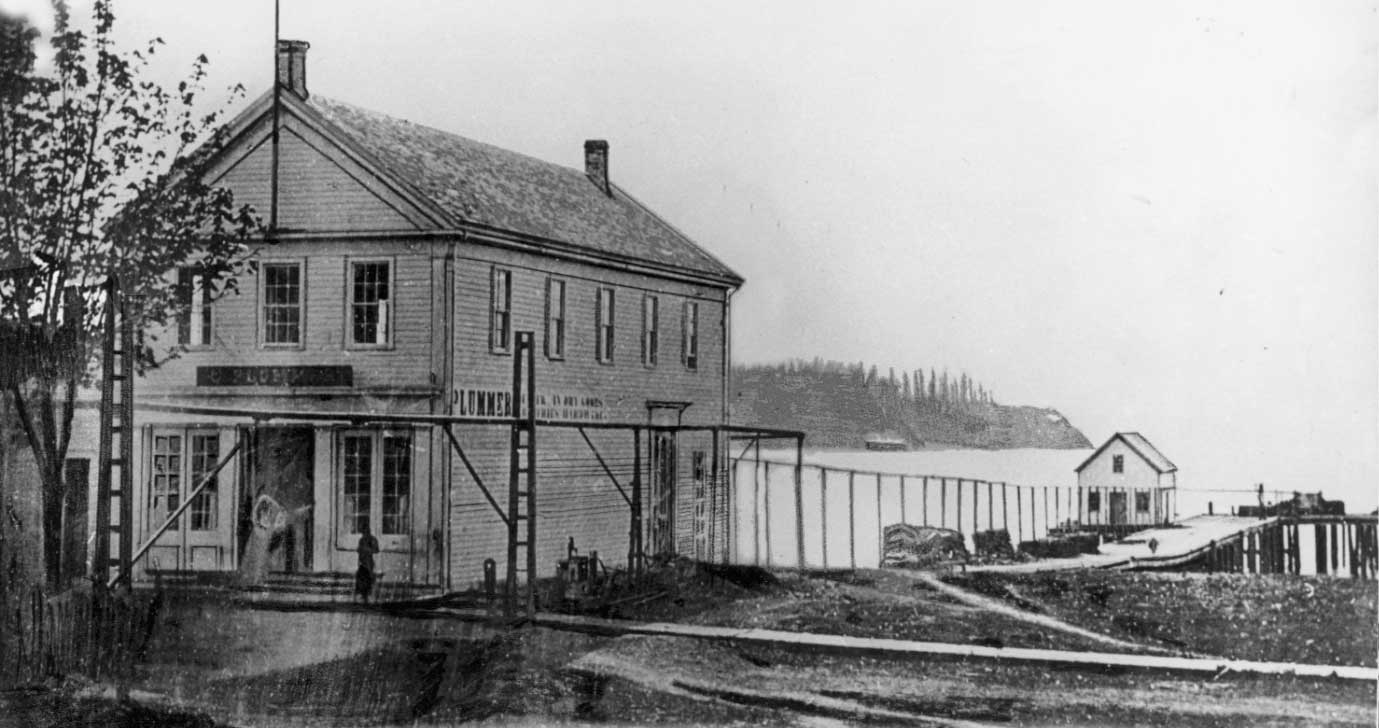
In – or about – 1858 Charles Plummer built a second story hall above the store he opened in 1853 at the southwest corner of Commercial Street (First Ave. S.) and Main Street. It was a needed venue for performances, dances, and early meetings for groups like the Masonic Lodge and the Good Templars. It was also the chosen prospect for both Sammis’ ca 1865 panorama of Seattle and Robinson’s 1869 recording. Sammis view was taken from the crest of the roof, which could be reached by a ladder permanently attached to the roof on its south side and directly over the sidewalk. Robinson went only to the second floor hall, where from a window some distance from the street he recorded the four parts for his panorama. The flume-delivered fresh water wharf that extends into the bay off of Main Street never made much on an impression, largely because of the growing success of its neighbor to the north, Henry Yesler’s wharf, which through the pioneer years was all that the community needed. Charles Plummer’s time in Seattle was too often tragic. Ellender, his wife, died in 1859 giving birth to twin sons, and Charles lived on only until 1866.
As just noted in the caption above, Robinson took his photograph from a second floor window of the Snoqualmie Hall (AKA Plummer’s Hall) at the southwest corner of Commercial (First Avenue S.) and Main streets. We may imagine – or expect? – that he waited until the moment his hometown steamer left Seattle without him. (If Robinson timed the opening of his shutter with the Hunt’s departure, then of the four negatives the one on the far left – or west – with the ship underway may well have been struck first.) Two additional Seattle subjects survive from Robinson’s visit. One, printed directly below, is of Commercial Street from the street and shows the ladder that Sammis climbed four or five years earlier to record his panorama. The other a view to the central waterfront from the end of Yesler’s dock. We will consider both again below in a later chapter.

 Yesler’s Wharf
Because of Robinson’s timing we know that this – or nearly this – is what Seward saw on his Seattle whistle stop. Excepting the wharf on which he delivered his pep talk, the structures in the village and the few cleared acres that were still crowded by the virgin forest, most of what he examined — the waterfront especially – had not been tampered with much since the visits of Wilkes in 1841, the settlers in 1852, the Coast Surveyors in 1854, and in 1856 that self-style heroic defender of Seattle, Lieu. Phelps, U.S. Navy. However, Seattle would change considerably in 1869, after Seward was gone. The biggest changes were Yesler’s. He replaced his old steam sawmill of ’53 with a new and improved one, and this time much of it was built on the wharf. This second of Yesler’s mills burned down in 1879 but was replaced with a mill that lasted until another fire took it in 1887. (We will include views of these mills in other contexts and chapters below.)
Although Yesler’s was the first steam sawmill on Puget Sound in 1853, by 1855 there were twenty of them operating on the “Mediterranean of the Pacific”, and some were many times bigger than Yesler’s. Also as noted above, especially after he extended its length in 1859 to 200 feet, Yesler’s wharf became the hub of much Puget Sound commerce. A year later he opened a gristmill to produce flour and by 1867 was getting 24 barrels of it a day. Yesler’s wharf helped Seattle get its jump on the “old wealth” that would sustain the city during the economic crashes that were arranged down the years with depressing rhythm in 1873, 1883, and 1893 – especially 1893. Then, as noted earlier, the singular and so more vulnerable wealth of the company town Tacoma was not so resilient. (That the next big recession came in 1907 – not 1903 – added some syncopation to this blues calendar.) According to Seattle’s principal pioneer historian Clarence Bagley, for many of the earliest years of settlement “Yesler’s wharf was all that was needed. Plummer’s at Main fell into disuse and decay.” As is revealed in the surviving photograph of Plummer’s Snoqualmie Hall (above) the flume, like the one showing in the 1859 photograph of the Yesler Home noted above in chapter three, carried water to supply ships at a wharf that resembles more a dock than a pier. [48]

Sammis Panorama ca. 1865
Besides its extraordinary sharpness – one can count the trees on Denny Hill – as noted Robinson’s is the first photographic record of Yesler’s wharf. His panorama also includes the first picture of any vessel on Elliott Bay (again, the Hunt), and most of the central waterfront as far north as Broad Street. The closest features on the waterfront are the Indian dugouts at the foot of Washington, far left, beside the then still future site of Ballast Island. The businesses, far right, on Commercial Street appear in the other and earlier panorama of pioneer Seattle by E. M. Sammis (note above) that is conventionally dated 1865 but may be from 1864. [12] Sammis also exposed his smaller view from Snoqualmie Hall, although he climbed the ladder on its south roof to the crest of the building. (During Robinsons 1869 visit he also made a street level record of Commercial Street that was photographed looking north with his back to Jackson Street. [49] It shows the ladder that Sammis climbed up the south side of the roof of Plummer’s Hall.) When Commercial Street is compared between the two panoramic views – Sammis most likely from 1865 and Robinson from 1869 — it is clear that little has changed in the generally dull first years following the Civil War. But, as noted, the last months of 1869 made it Seattle’s first boom year.
1869: First Boom Year for Seattle
A review of the “local joy” of 1869 includes Seattle’s second but first successful incorporation and the considerable rise in real estate values attendant with the Northern Pacific’s survey of Snoqualmie Pass. At the time this work strongly hinted that at last Washington Territory’s first governor Isaac Stevens’ 1855 recommendation would be heeded — that Seattle be selected for the western terminus of any transcontinental railroad that took the northern route on the basis of its relatively low Snoqualmie Pass to the east and its harbor. (Of course that railroad would also get much of the territory along the way with huge land grants on the promise to reach the shores of Puget Sound.) Stevens called Elliott Bay Puget Sound’s “unequalled harbor.” (However, Tacoma might make a good defense of Commencement Bay as “more unequalled.”) The most immediately influential change region-wide in 1869 was the completion of the Union & Central Pacific railroads to California. The rush of immigrants – including many traumatized Civil War vets carrying land privileges with them – inevitably pushed in all directions, including north, along the coast. Also, we know, the California railroad would became a great consumer of Seattle coal beginning in 1872 as we will describe in another chapter below.
Denny Home at First & Union & Beach Below
Robinson’s view also includes one landmark in the middle distance – Arthur and Mary Denny’s Carpenter Gothic home. It sat at the southeast corner of First and Union and is a handy reference to the waterfront. [50] Below the Denny home, the 1869 panorama shows a rare structure on the beach at the approximate waterfront foot of Union Street. As yet, I have not identified its owner or use.

The glass-faced skyscraper shared by the Seattle Art Museum is the fourth structure to hold the southeast corner of First Avenue and Union Steet. The 1926 Rhodes Department store building was razed for it. Rhodes had replaced the Arcade Annex, which took over the corner only after the Denny’s landmark residence was destroyed in 1907. Theodore Peiser probably recorded this view of the Denny home soon after he arrived in Seattle about 1883. Six years later Peiser lost nearly everything – including, most likely, the negative for this print – to Seattle’s “Great Fire” of 1889. When it was built in 1866 this then showy home crafted for the “father and mother of Seattle” was a fancy farmhouse quite detached from its neighbors and remote from Seattle’s business district.

Seattle architectural historian Dennis Andersen uncovered the following quote in the Puget Sound Semi-Weekly. It appears in the July 9 1866 edition, and so three years before Robinson took his panorama. “Yesterday we were shown through the new residence of Hon. A.A. Denny, our delegate in Congress. It is an irregular, Gothic cottage, the plan of which was executed by Mr. S. B. Abbott, who has superintended the work throughout.” Anderson notes that Abbot, the architect, “likely used any one of a number of pattern book resources for his design . . . He may be the same Abbott who was accused of absconding with railroad construction payroll receipts a few years later. All must have been forgiven or at least forgotten, because he visited the city in 1901 and was interviewed in the PI as a ‘wealthy banker and oil man’.” The Peiser view is used courtesy of Sue Champness.

Looking further up the waterfront in Robinson’s 1869 panorama, the beach does not seem to be sited with the structures of any settlement or shore. Still, small tents and lean-tos on that distant beach may be too small to record with definition. What appears to be driftwood may in some instances be shelters. Although relatively detailed for its size and age, as noted the panorama is still constructed from small negatives.

North End Mystery
The Robinson pan includes a north end mystery: two light-colored architectural forms on the bank above the beach. [51] If I have figured it correctly they are near Battery Street and so also very near the site of the Bell family’s first cabin. (The Bell cabin was destroyed by Indians in the 1856 “Battle of Seattle.”) During the fighting it was visible from the Decatur and the sailors regretfully watched its destruction. When they were ready to shell the house the captain of the ship gave an order to stop all firing. As Bell later recalled, “The men were awfully displeased about the order, because they would have bursted (sic) some of them if they had put a shell in.”) While the forms are too simple and distant to identify they look more artificial than natural. Whatever they are, they are unique – the only light and horizontal forms north of the beach structures just noted near the foot of Union Street. (If the reader has trouble detecting them in the full pan, the forms begin in the foreground with the little steamer that is moored to the south side of Yesler Wharf. From its wheelhouse, lift the eye directly up to the distant beach. There the forms are set in darker vegetation just above the exposed bank that rises from the beach. A little ways to the right of the mysterious forms the darkened landscape dips to the beach. Again, if I have done my figuring correctly, this is the entrance to the Belltown Ravine discussed above – and sometime soon again below.
The mid-1870s topographical map (noted above) also shows what appear to be two structures on the lip of the bluff near the future foot of Battery Street – although about one city block separates the rectangular marks in the map, which is more than the photograph suggests. Again David Buerge offers an interpretation for the photograph and perhaps for the map as well. “I would suggest that the double structure in the Robinson panorama may be the two standing long walls of a longhouse, minus its roof planks and side walls, part of whose length may be hidden by vegetation. The evidence is that the picture was taken during the summer, which was when the people were off at various camps. It was not uncommon for them to remove planks from their house to use in constructing a deck joining two canoes to help haul gear and for temporary lodging at these camps.” So by Buerge’s figuring it is then at least a possibility that these gray-white forms that contrast so strikingly with their dark setting, are the reflective sides of aging and silvered cedar slabs and/or posts associated with the construction of long houses. (Another less distinguished form in this neighborhood at least hints at the angles of construction. It appears north of the stepping forms and is also a lighter color than the surrounding bank, although not lighter than the beach.)

This hand-tinted lantern slide shows the use of mats as a ready material for draping a residence.

D. E. Frederick and Nels Nelson opened a second-hand store in Seattle in 1890. Soon they found it easier to buy unused merchandise than ferret out the old. So they discarded the nearly new trade, and in time their store became the largest and finest department store west of the Mississippi and north of San Francisco. In 1897, in the first flush of the Klondike gold rush, the store was moved into the two center storefronts of the new Rialto building at Second Avenue and Madison streets. In 1906 the partners bought out the block, and Frederick & Nelson stretched their name the length of an entire city block, from Madison to Spring Streets, along the west side of Second.
This week’s historical scene shows Seattle’s first grand emporium during, or some time after, 1906. [Truthfully, this is NOT the photograph that was used in the Times 23 years ago, but it is similar.] Ordinarily, shopping at Frederick & Nelson was not like joining rampaging consumers at a big store’s big sale. At Frederick’s, you were invited to take classes, visit an art gallery, chat with friends over tea or just ride the wonderful hydraulic elevator. A big center room with a high ceiling for hanging tapestries and Persian rugs was a kind of sanctuary for consumption. Years later, you might not remember what was bought but you would recall the “aura” of the experience of having really purchased something. This touch of class also was found in the elaborately decorated show windows along Second Avenue, and even in the street itself. Every morning, Frederick and Nelson’s 16 heavy teams of horses paraded from their stables down the length of Second Avenue.
Nelson died in 1906, but Frederick continued to make the right moves, including the one in 1918 that took him “out of town” north to the main store’s modern location at Sixth Avenue and Pine Street. In 1929, Frederick retired to his home in the Highlands and sold his grand emporium to Marshall Field & Co. of Chicago. After his death 20 years later, his old golfing crony, the then 95-year-old Seattle Times columnist C.T. Conover, recalled Frederick as a kind of heroic capitalist saint who “left a record of straight shooting, fair play, honorable dealing, enlightened vision, common sense, civic enterprise, noble spirit and generous support of every worthy cause.”
[In searching my “lists” I discover that I have returned to Frederick and Nelson more than six times over the past 23 years, and will try to insert the others soon and in line. This first instance was first published in Pacific on Sept. 28, 1986 and used the photograph insert directly below. It was then still long before the big store folded for want of a suburban parking lot around it and competition from “warehouse wholesalers.”]

[Click – twice – to enlarge]

Denny Hill (with two summits) from the King St. Coal Wharf, ca. 1881. Virginia Street was platted and eventually graded in the depression between the hill’s two summits. The still forested Queen Anne Hill marks the horizon. Courtesy U.W. Library
Denny Hill & The Waterfront
Of all Seattle hills, it is the missing one, Denny Hill, that most shaped the waterfront because through much of the hill’s length – roughly from Wall to Union Streets – it fell directly to the waterfront. The lowest of Seattle’s central hills, Denny Hill crested like a ripple cast south from the much higher Queen Anne Hill. David and Louisa Denny’s claim – Seattle Center – was in the trough between them. Below Denny Hill the waterfront is the deepest, and there also the width of the made (or reclaimed) land is narrower than that section of the waterfront that is south of Union Street. (Some of Denny Hill wound up on the waterfront but not nearly as much as some wanted. Most of the hill was dumped just off of the waterfront creating a reconstituted Denny Hill in Elliott Bay that for the safety of shipping required dredging.) Although the two summits of Denny Hill were razed between 1906 and 1911, the hill’s skirt, its lowest parts, the bluff and/or bank, is still hinted behind our applications and in a few places even exposed. [31]

Bank & Bluff
We will for the moment neglect the old harbor south and east of King Street, the part that once rinsed the salt marsh behind Gas Cove and splashed against the sometimes steep sides of Beacon Hill, and concentrate on the central waterfront north of King Street as far as Broad Street (where a slight prominence distinguished it in both the 1841 and 1854 maps.) The native embankment along this line varied in both height – from a couple of feet to about one hundred – and pitch – from precipitous to something one could easily scramble. As we will see below the little bluff at King Street seems even lower in the photographs than its depiction in Phelps drawing. Just north of Washington Street, where at high tide the bay could intrude east to the salt marsh, the native ridge was so low that it might have been used as a bench for sitting. Just north of Yesler’s wharf a knoll rose at the foot of Cherry Street, an obvious close-by prominence upon which to build the blockhouse. This Cherry hump was later lowered with the 1876 regrade of Front Street (First Avenue) between Mill Street (Yesler May) and Pike. North of the knoll the waterfront bank stayed low – something the athletic shellfish grubber could easily jump from – until near Madison. North from there it climbed as part of what was really the southern slope of Denny Hill – or its cross-section as carved by the tides and storms on Elliott Bay. This growing bluff was broken with a gulch at Seneca Street (the contents of which we will describe below). Its elevation at University Street was such that steps were built there between Front Street and the waterfront even before the 1889 fire. Following the fire the steps were quickly replaced but then soon usurped by a timber bridge that let wagons move directly from Railroad Avenue to Front Street without having to first travel south along the frequently congested waterfront to Madison Street. Although Front Street was still higher above the waterfront at Union Street than at University, it was also further from the waterfront because it is between University and Union that the shoreline turns to the northwest. A rather steep wagon road was in use here for a few years from the 1880s into the 20th Century. Now, while standing at the waterfront foot of Union it is hard to imagine it. [32] [33]
North of Union Street
North of Union the bank became briefly a cliff. (In the panoramic photograph ca. 1881 [31] this section is darkened by its greenbelt. Although steep it can still support trees. In a detail from 1887 the cliff north of Union is exposed. [34]) A short distance north at Pike, the hillside was again not so steep, and beginning with the Coal Railroad’s incline in 1871 there have been a number of different hill climbs built at Pike. North of Pike near Virginia Street the bluff began to again define itself, and north from there it grew and reached a somewhat dangerous height approaching seventy feet at Lenora Street. [35] This was both railroad land and a squatter’s milieu – as we will again note in detail below. Two or three steep stairways that resembled ladders climbed the bank in this section, making it possible for the agile to pass between the beachcomber’s community on the shore and the shantytown on the ledge above them. It was a both challenging and engaging place to live – and cheap too. North from between Lenora and Blanchard the elevation of the bank descended and again petered out before it reached Broad Street. Just north of Broad there was a small cove (the site of the Olympic Sculpture Garden). It was bordered by a new but modest bluff that continued with a few small dips north to Queen Anne Hill. There the terrain suddenly ascended to the forest that was dedicated in 1887 as Seattle’s second public park, Kinnear Park.
Seneca Street Ravine
As already hinted two ravines – one small and one big – cut through this central waterfront bank, and both played special parts in Indian life before and after the settlers arrived to both name and claim them. These ravines are now lost – filled-in and covered. The smaller one was at Seneca Street. In This City of Ours, a book of historical Seattle trivia written in the 1930s for the Seattle School District, J. Willis Sayers, the author, advised students that while out on a walking tour of First Avenue they should “stop a moment at Seneca Street. This crossing, in early days, was a bridge; under it was a ravine through which passed all the travel from this section of the beach to Second Avenue.” It is curious that the aging Sayers, who was himself nearly a pioneer, did not note that just above the waterfront at Seneca there was also an Indian burial ground.
Indian Cemetery
Years earlier another pioneer, A. Denny-Lindsey, included Seneca in her observations regarding early Seattle waterfront life for the June 22, 1906 issue of the Post-Intelligencer. “The Indian cemetery that was on a bluff at what is now the foot of Seneca Street was a spot of great interest to us children. The graves all had more or less of the personal belongings of the deceased on them. The graves were shallow and we saw many ‘good Indians’ who were mummified. A number of graves had roofs built over them of cedar slabs with posts driven at the four corners. These were hung with clothing, tin ware, beads etc. Some of the bodies had been laid to rest wrapped in rush mats and canoes turned over them. Others were in the hollow trunks of large cedar trees. Infants were almost invariably entombed in this manner. When the banks would cave away during a thaw after a hard freeze it would expose bones and many stone implements and quantities of blue Hudson Bay beads. Some of these beads were the size of a robin’s egg. They are very rare at the present day.” The Denny daughter’s description of the mortified Seneca is something of a rhetorical jumble as she concludes her description of the burial ground with a digression into pungency. “The Indian camps were not as sweet as clover beds, for the hundreds of drying salmon that were hung on poles over small fires and inside the mat houses, also the strings of clams, were very loud in odor.”
It should be noted that while A. Denny-Lindsey does not mention the ravine, she does put a rather elaborate burial grounds both at the “foot of Seneca” and “on the bluff”, not that there is a contradiction in her description, only some confusion. It is easiest to think of her graveyard as “on the bluff” and so really above the waterfront foot of Seneca. And yet the ravine would have considerably increased the footage available for anything including graves. And she does also make note that “the banks would cave away” from the gravesite. But when this sizeable funerary ground is mixed with Sayer’s pioneer throughway, a bridge, and the spring that another source describes as sometimes irrigating the ravine (and surely through time forming it), it is difficult to know where to put it all. Certainly a mix of exposed graves, overturned canoes, spring freshets and tramping pedestrians would be messy in the extreme. When the “hollow trunks of large cedar trees” is figured in it seems likely that the daughter of David and Louisa Denny is making something of an inventory of gravesites scattered along the ridge. There certainly were other graves on the ridge besides those beside the Seneca ravine. For instance, during an early grading of First Avenue in 1876 a little ways north of Marion Street, according to David Buerge, an expert on the region’s native culture, “a half-mummified body in a stone cyst tomb beneath a five-foot high grave mound” was uncovered. Native American bones were also uncovered during the Port of Seattle work on the Bell Street Harbor in the late 1990s although, as we will explain below, it is more likely that they were not buried there but rather carried there during an earlier development.
Front & Seneca
In 1876, when Seattle first got resolute about grading streets, it turned the natural ups and downs of Front Street (First Avenue north of Yesler) into one smooth and wide avenue between Yesler Way and Pike Street. For this the Seneca Avenue Ravine was partially filled and capped with the timber cribbing that was a feature of most of the new street work on First. (If there is a record of what became of the graveyard at Seneca during this work I have not stumbled upon it.) Thirteen years later the city’s “Great Fire” of 1889 burned through both the timber retaining wall and planking at Seneca Street exposing the ravine, or what remained of it, for as just noted most but not all of it had been filled for the 1876 regrade. (This scene will be visited and illustrated below at least twice more.) Because the Front Street Cable Railway used its namesake avenue it received speedy attention after the June 6 fire. The Times for June 10 reported, “A large force of men are at work on the Front St. cable, near the crossing of Seneca. It was at this point that the fire crossed over from the electric light building and burned the beer saloon on the northeast corner of Front and Seneca. The burned space in the road is about 50 feet.” Also on the 10th the Seattle Daily Press noted, “Repairs on the Front St. cable road commenced yesterday. The bridge destroyed by the fire at Seneca Street was rebuilt, and in a few days new rails will arrive to replace those destroyed. It is thought in the course of a week the Front Street Cable cars will be running.” In 1922, part of the bulkhead at Seneca Street was replaced. Much later, during work on the foundation for the Harbor Steps development between Seneca and University Street, parts of both the original 1876 bulkhead and its repairs following the ’89 fire were once more exposed, to the considerable surprise and delight of the engineers involved. The general pioneer sweetness of this part of the waterfront – north of Columbia Street – was so corrupted following the 1889 fire that it became a cause of the Council. David Kellogg moved his tanning and hide depot onto the ruins and built a new waterfront warehouse between Seneca and University streets. On June 6, 1891, or two years to the day following the fire, the Post-Intelligencer reported Kellogg’s depot had “caused many hot debates in the city council by its offensive odors.” (Considering the graveyard at the ravine, followed by Kellogg and his rendering, any future archeological probing near the foot of Seneca may test the popular sense that the smell of a place is often the last thing to abandon it. That is, be prepared for both the macabre and the noisome.)

Belltown Ravine
The second ravine that once interrupted the bank on the central waterfront was much the larger. Since it survived into the early 20th Century there are a number of photographs that hint of it, although none so far uncovered look directly into it from its mouth. The Belltown Ravine (the name I used while studying it for evidences of the source for the human bones uncovered during the construction of the Port of Seattle’s Belltown Harbor in the late 1990s) was between Blanchard and Bell streets, somewhat closer to Bell. Topographic maps show the ravine extending as far east as First Avenue, a considerable distance from the Bay. [36] A photograph from the mid-1880s looks down from First Avenue over the inland end of the ravine into some fill dirt, which has been dumped perhaps from the 1882-83 regrading of First Avenue north of Pike Street. [37] An early description that appeared in the Post-Intelligencer for June 26, 1891 gives some indication of the depth of the ravine, or gulch as the reporter calls it, near Western Avenue, a block or more east of its opening. Under the title “A Boy’s Great Fall”, the report continues, “Yesterday afternoon about 3 o’clock the little 8-year-old son of Andre Mikulicich, fishmonger at 115 Bell Street, fell from the encased sewer pipe which extends across the gulch between Bell and Blanchard and Front and West Streets. The distance of the fall was nearly twenty-five feet. The casing is only eight inches wide, and the temptation to small boys to try to cross over the gulch on it is almost irresistible. It is about seventy-five feet long. It was thought for a time that the little fellow was killed, but he eventually regained consciousness and gives promise of living to a ripe old age yet.”

Belltown Ravine partially filled at Front Street (First Avenue) in the mid-1880s. Courtesy MOHAI
Belltown Waterfront Community
Two partial views of the entrance to the Belltown Ravine were recorded from the offshore railroad trestle. Both show the community of squatters shacks nestled between a jerry-rigged seawall and the opening. (We will show the earlier view here and attach the later view, no. 212, in the “image stream” below.) [38] The earliest view dates from the late 1890s and includes part of the bank that runs south from the ravine. The beginning of the south side of the ravine – the corner where the bank turns east into the ravine – shows on the far left of the photograph by the Norwegian photographer Andres Wilse. The second intimate view dates from about 1902 or 3 and looks over the same community of shacks, but in the opposite direction. Other photographs from the water and also from West Seattle are obscured at the ravine’s lowest elevation where it meets the bay behind the railroad trestle. The ingenious cluster of squatters’ shacks at the entrance was moved in 1903 with the beginning construction on the north portal to the railroad tunnel. At first, this did not change life deeper within the ravine. But soon during the various stages of the Denny Regrade the ravine was filled until it was closed off at its entrance with the 1912-14 extension of Elliott Avenue between Bell and Lenora Streets. The human remains that were found during excavations for the Port of Seattle’s Bell Street project in 1998 were probably carried there in the fill that was used to extend Elliott Avenue across the opening of the ravine.
Native Bones
The bones were discovered near the south entrance to the ravine. Although there is considerable correspondence between the city and F. McLellan, the contractor who placed the 1912 fill, there is no record of where he got it. McLellan was required to find his own dirt and carry it to the site. Obviously, the shorter the move the less the expense. By 1912 the Denny Regrade had reach 5th Avenue and stopped. With the cutting, a temporary bluff was left along the east side of Fifth Avenue. The freshly graded land between First and Fifth Avenues was in many sections still in rough state. It is possible that McLellan got his fill from the “rough edges” of the momentarily stalled Denny Hill regrade. The use of fill dirt from the Denny School site at Fifth and Battery for the 1914 construction of the Port of Seattle’s off-shore headquarters at the foot of Bell Street indicated that it was still possible to take fill material from the regrade. A 1912 correspondence, between city engineer Dimock and a neighborhood property owner named Oldfield, is also suggestive. It regards the latter’s willingness to sell cheap to the city fill which was conveniently near at hand for the Elliott Ave. project – some six or seven hundred yards of it. Oldfield writes, “If this should interest the contractor because of its nearness to where the arterial is required he can have the same at a very low figure.” Dimock’s answer is evidence of how little the city knew or recorded from where the fill in their improvement might come. “McLellan is required to supply all earth needed for fills on the same and it will be necessary for you to arrange with him. I will, however, transmit your letter to him for such action as he may think necessary.”

Beach community at foot of Belltown Ravine, by Andres Wilse, ca. 1898 Courtesy, MOHAI
BAHK-bah-kwhb-Muck-muck-wum
Soon after the bones were found and identified as most likely native remains it was speculated that they might be connected with Baq’baqwab (BAHK-bah-kwahb), the other Native American community on the central waterfront that was long in use before the mid-western farmers arrived. (We will refer to this as the “North Camp” to distinguish it from the larger south camp on Piners point already described.) The Lushootseed place name Baq’baqwab is the plural form of ba’qwab, ‘meadow’ and was associated with the meadows between Queen Anne Hill and the now-vanished Denny Hill that stretched from the bay to the southern end of Lake Union.” As local historian David Buerge notes, “The site was probably chosen because of its proximity to potable, fresh-water springs, draining from a nearby area know as boloc (bo-LOTS). That part of these meadows nearest Baq’baqwab was distinguished for its salal berries. This suggests that the beach site camp named for the meadows was not necessarily identified with the meadows broadly conceived (including the present site of Seattle Center) but rather an entree to them with the advantages of being near both the bay and springs. With this interpretation the beachside borders of Baq’baqwab were flexible, inflating and shrinking with whatever operations or ceremonies were current, like the acts of medicine men and bird-netters. (The first settlers on Puget Sound – by a few millenniums – had apparently no tradition or use for arbitrary borders – legal and proprietary – that would at once rationalize and alienate the “given” topography and yet were of such great interest and fenced security to the latecomers from Illinois and New York. In that sense Baq’baqwab had no borders.)
Two daughters of the pioneers recalled the site. In Pigtail Days in Old Seattle, one of the little classics of pioneer reminiscences written by members of the Denny family, the author, Arthur and Mary Denny’s granddaughter Sophie Frye Bass, recalls, “Bell Street ran from Depot Street, now known as Denny Way, to salt chuck (water) where the beach was fine and sandy, and there were springs of good water. It was one of the camping grounds of the Indians while they hunted and fished. They called it Muck-muck-wum but we call it Bell Street Dock.” By Abbie Denny-Lindsey’s recollections, “In Muck-muckum (Belltown) there was a permanent camp where the medicine man lived.” Buerge advises that Bass and Lindsey-Denny’s names — Muck-muck-wum and Muck-muckum, respectively – were tongue-tortured variations on Baq-baqwab created by occidentals “struggling with the native language.”
The structures that the Denny descendents remembered were not the long houses that were most likely built above the beach somewhere near the lip of the low bank but later beach structures. Native accounts put two medium-sized (50 to 100 feet) longhouses at this the northern of two native camps on the central waterfront. David Buerge continues, “While visitors increased the population at the site periodically, the longhouse inhabitants were permanent residents who, at death, were interred in an extensive local cemetery.” However, Buerge also admonishes, “we know little about the actual history or size of Baq’baqwab even during the early years of pioneer settlement. The native census made in 1856 by Indian Agent George Paige identifies Cultus Curley’s band encamped about one mile north of Seattle numbering 30.” Buerge figures that “thirty inhabitants would have fit comfortably in the two longhouses described. However, these numbers probably swelled after the citizens of Seattle first incorporated themselves in 1865 and wrote laws that prevented the camping of Indians on any ‘street, highway, lane or alley or any vacant lot in the town of Seattle.’ With this exclusion by statute some of Duwamish Indians still living at Jijilalec, the southern camp, would have moved north to Baq’baqwab. It is believe that among the exiles was Chief Seattle who apparently had houses erected there to stay with his retinue when he was not at Fort Kitsap. However, since the Chief died in 1866 in the old man house at Suquamish it would not have been a long stay beside Bell Street. At some point Angeline, his daughter, moved into a shack near the waterfront foot of Pike Street and remained there until her death in 1896.”

Princes Angeline by F. J. Haynes, 1890. [The 1891 date listed for this Haynes photo in the montage above is wrong and one year later.] Courtesy Tacoma Public Library
Princess Angeline’s Cabin
Some historical references to Angeline’s beach shack put it near Pine Street but most describe it as closer to Pike than Pine. Most likely it was between them but closer to Pike or some little ways north of the lowest steps in the stairway that now reaches the market. As noted earlier, this slope was a little ways south of the point where the bluff near Virginia Street began to form extending north as far as Vine Street (with the Belltown Ravine interruption.) And as also treated above – and will be noted again below – this natural separation also began the division of the beachcombers below from the higher – in elevation and income – residents of Shantytown above. But without a bluff Shantytown extended to the beach on Pike Street. In 1890 the Northern Pacific photographer F. J. Haynes visited Angeline and her hut and its proximity to the beach (far left) is revealed in the photograph he recorded of the scene. [39] In 1891, her prosperous neighbor on First Avenue, the lumberman Amos Brown, built her a better hut that was likely very near the spot of the old one. [40] (Determining the precise location for the Angeline home is as yet an unsolved puzzle. And, again, was the second home built on the site of the first? Before his sudden death in 2001Seattle historian Michael Cirelli was on the trail of Angeline’s home. He was not able to show me a photograph he’d found of her second residence that he claimed included the stump that appears on the right of the Haynes view. Up close a stump could be as convincing as a fingerprint, but this was a neighborhood of shacks and stumps. A recent discovery may have located Angeline’s last home but cannot be shared with Cirelli. Angeline’s “Brown home” may appear in a view recorded from the Schwabacher’s Dock at the foot of Union Street after her death. The two finished sheds look alike and the place is within feet of the conventional descriptions just noted. [41] This image was struck during the historic docking of the “gold ship” Portland in 1897. Although Angeline died the previous year someone else, perhaps her grandson Joe Foster who had lived with her may have still resided there. That may be Foster on the far right of the 1890 Haynes view.)
[When there is time to “groom” it for this site, Chapter Six, of this pictorial will begin with more speculations about the bones found at the foot of Bell Street, followed by contemporary descriptions of the cosmopolitan community of shacks that developed there following the 1893 economic crash, and the years also of booming growth of the city. The next chapter will then move south to Yesler’s Wharf for a revealing study of both the Sammis (1865) and Robinson (1869) panoramas of pioneer Seattle and a broad sketch of the community’s first boom year, 1869.]

This is an addition to a feature that appears six stories below this one, the “Seattle Now and Then” about the 1911 visit of the steamer Suveric at Pier 56 (Or Pier 5 before the renumbering during WW2. For more on this renaming check out Part One of the Waterfront History posted on this blog-web.) That posting also recalled the Seattle Marine Aquarium that opened on the pier for Century 21 in 1962 and carried on into the ’70s. The walking photographer Frank Shaw is also responsbile for this slide taken on the sidewalk beside the pier in 1970. There are two causes getting broadside attention here. Behind the woman with the poodle someone is protesting the aquarium whale show at the other end of the pier. The woman in blue inspecting the photographer is demanding the release of the Seattle Seven, most of whom were University of Washington students (and one professor) whose protests over the Vietnam War put them in court and ultimately in or on a prison farm for a few months for contempt of court. The students that is. The professor never served any time. You can read Walt Crowley’s summary of this on historylink. For even more, Google Seattle Seven, but don’t be mislead by that other “Seattle Seven” – some group of businesses that would never have been cast into or onto a prison farm.

[Please CLICK to ENLARGE]
This aerial of the First Hill neighborhood around a nearly new Harborview Hospital is included here because it also shows the Seattle Day Nursery at the northeast corner of Broadway and Boren and Alder. This Sunday’s “now-and-then” features Childhaven and is printed here directly below this short description of the aerial photograph. The nursery appears far into the upper-left corner. I confess that so far I do not know the year the aerial was taken. I am, however, confident that there is enough “information” in it to determine the year. Hopefully a reader will figure it out before I do. I will note a few of things only.
Harborview was dedicated in February 1931; one month after the King County Courthouse was razed with the help of 200 sticks of dynamite. The courthouse held the brink of First Hill facing Seventh Avenue between Terrace and Alder Streets. That is the cleared and seemingly groomed block just right of center. Now covered with a helicopter pad, one of Harborview’s lidded parking lots hides in much of that block. (Perhaps this aerial is from as early as the late spring of 1931. The Hospital and the ground certainly seem new – hardly disturbed. The sun is far to the north, judging from those shadows.)
Trinity Episcopal Church shows at the bottom left corner – at the northwest corner of James Street and Eighth Avenue. On the far right is the fanciful architecture of Seattle City Light’s first substation, located near what would have been the northwest corner of Yesler Way and Seventh Avenue, had Seventh been graded through that steep portion of First Hill. City Light’s competitor, Puget Power, appears bottom center with the big dark roof and “forest” of power poles. The Seattle Freeway runs over it now.
The steepest part of the hill appears as a white scar between Trinity Church and Harborview. This was a cliff. The aerial’s upper-right corner includes a short stretch of Jackson Street around Ninth Avenue. Between 1907 and 1909 this section and much else endured the Jackson Street Regrade, which both lowered and raised parts of the neighborhood now variously called Chinatown and the International District.
Of course, this aerial – looking to the southeast – includes many surviving structures that I have not pointed out. But, again, neither have I conclusively dated it. The first 700 units of Yesler Terrace were funded in 1939. A repeat aerial – a “now” – would show their pattern covering much of the right side of this aerial, which is here still variously crowded with Carpenter Gothic classics and a few cheaply built homes that during the Great Depression turned to shacks.
Most often we choose to retrieve these older now-then features when they dove tale by theme or location with a story that appears now – on a contemporary Sunday – in Pacific Northwest Magazine. In the past two weeks – or so – we have included three features that relate to the main intersection of First Hill, which is where Boren Avenue and Madison Avenue cross. We have given touchstone descriptions of the Perry Hotel, the Carkeek Mansion, the Seattle Tennis Club and we also included with the last a second glimpse of the Stacy Mansion and the University Club. We will visit those again, but later. Nearby is a high-rise neighbor to these big First Hill homes, the elegant Gainsborough.

Built for class the high-rise apartment at 1017 Minor Avenue on First Hill was named after the English King George III’s favorite painter, Thomas Gainsborough. As a witness to the place’s status, Colin Radford, president of the Gainsborough Investment Co. that built it, was also the new apartments’ first live-in manager. And the apartments were large, four to a floor, fifty in all including Radford’s (if I have counted correctly). What the developer-manager could not see coming when his distinguished apartment house was being built and taking applications was the “Great Depression.”
The Gainsborough was completed in 1930 a few months after the economic crash of late 1929. This timing was almost commonplace for the building boom of the late 1920s continued well into the early 1930s. The quality of these apartments meant that the Gainsborough’s affluent residents were not going to wind up in any 1930s “alternative housing” like the shacks of “Hooverville” although the “up and in” residents in the new apartment’s highest floors could probably see some of those improvised homes “down and out” on the tideflats south of King Street. (We intend to soon post some of our features on Hooverville, in celebration of these apparently, by comparison for most, more mildly deprived times.)
Through its first 78 years the Gainsborough has been home to members of Seattle families whom might well have lived earlier in one of the many mansions on First Hill. Two examples: Ethel Hoge moved from Sunnycrest, her home in the Highlands, to the Gainsborough after her husband, the banker James Doster Hoge, died in 1929. Before their marriage in 1894 Ethel lived with her parents on the hill near Terry and Marion. Eleven years ago (in 1998 if memory serves) the philanthropist-activist Patsy Collins summoned Walt Crowley and I to the Gainsborough. After explaining to her our hopes for historylink.org she gave us the seed money to launch the site that year. Earlier Patsy was instrumental in preserving the Stimson-Green mansion, also on Minor Avenue, a home that her grandparents, the C.D. Stimsons, built in 1900. (Most likely – according to our nurtured habit – we will soon post our feature from a few years past on the Stimson-Green mansion.)

Then Caption: The Gainsborough at 1017 Minor Avenue was one of large handful of distinguished apartment buildings built or planned in the late 1920s. The picture was given courtesy of Michael Maslan. Well preserved, the elegant Gainsborough continues to distinguish the First Hill neighborhood. (The now photo was taken by Jean of this blog-webpage.)
John Cooper, our friend and often source for historical imagery for one project or another, on reading the recent posting here on the Perry Hotel sent along a few hand-colored postcards, mostly of its sumptuous interior. (click twice – not once – to enlarge.)

The next three postcards from John are concluded with a general exterior view that was most likely rendered before the building was completed and available to be photographed. Note the caption at the top of the last postcard. It reads, in part, “Only families and children admitted.” Well beyond childhood, the then barely nascent airplane manufacturer, William Boeing, was one of the Perry’s early residents. We learned this from historian Paul Spitzer, one of whose keen interests is Boeing History having been years past the company’s historian-archivist.

Finally – for now – John Cooper also brought by a snapshot he took perhaps ten years ago of a sign promoting the Missionary Sisters of the Sacred Heart’s first plans for developing their razed Perry Hotel/Columbia Hospital plant. I remember this well. The promotional company hired to market these “Luxury Apartment Homes” enlisted me to help them do some neighborhood selling by scheduling me to give a lecture on First Hill history to prospective luxury buyers and thereby also to help me pay the mortgage on my non-luxury but comfortable Forsaken Art House in Wallingford. It never happened, for the project fell through for want, it would seem, of luxury buyers. The sisters second plans – now in place – involved a much greater component of non-luxury living.

John Cooper has sent along yet another view of the Perry Hotel, this time as the Columbus Hospital. John is almost certainly the greatest collector hereabouts of the thousands of postcards produced by Ellis, an Arlington based photographer who criss-crossed the state many times over several decades recording landmarks of every sort. This view – judging from the motorcars in it – dates from about 1950. I was then 12 years old and knew every model and how they differed from the year before, but by the time I was sixteen I lost interest in car designs and bodies by Fisher or whomever and I have long since forgotten these distinctions. So perhaps some reader who has retained a senstivity for all this will come up with a date. John Cooper has learned the Ellis is not reliable, using the same number more than once and in different years.


[As ever, CLICK to ENLARGE – and then click again.]
Every summer the Olympic Tennis Club on First Hill would stage a grand tennis tournament between its men members. But on the contest’s opening day in July 1895, the net crowd was able for the first time to watch women in a skilled volley.
An article in the Seattle Post-Intelligencer predicted, “What is likely to prove the most successful, as it certainly is the largest, tennis tournament ever held in the Northwest began yesterday noon on the grounds of the Olympic Tennis Club at the corner of 12th Avenue (now Minor Avenue) and Madison Street . . . The crowd was of the right sort and the number of pretty girls in summer costume did much to stimulate the spirit with which the matches were played.” [Does any reader have any clear understanding of what is meant by this “stimulate the spirit with which the matches were played?”] This was the club’s fifth year of tournament play on its clay courts behind the Martin and Elizabeth Van Buren Stacy Mansion on Madison. But 1895 was the first time “pretty girls” took to the courts themselves in singles and doubles matches.

The historical photo of a women’s doubles play is one of two 1895 tournament scenes recently uncovered by the local collector Michael Maslan in a First Hill family album. (Well not so recently. This was first printed in the Times nearly a quarter-century ago on August 18, 1985.) We include them both here: the women’s doubles above and the men’s singles below. (That’s the Carkeek mansion on the left with the tower at the southeast corner of Madison and Boren.)

If this is the women’s doubles championship match, then the winners, Miss Anderson and Miss Known of Tacoma, will defeat Miss Riley and Miss Gazzam of Seattle and win a pair of silver scissors with a thimble in a case as well as a cut-glass silver-mounted ink stand. (Are they now more likely to get something crass, like cash?)
The clubs courts were located behind the Stacy mansion and on what has more recently been developed for super-sizing and French frying. This is the parking lot for First Hill food that is never cracked crab. I have taken slides of this McDonalds lot three times, I think, but I have failed to mark the date on this one. I believe that Jean has also visited this place and not to eat, and if I am correct in this he’ll soon date his recording and post it beside this undated shot. Perhaps some reader with a special sensitivity to motorcar models will by studying the several examples in this lot be able to determine the year. Unfortunately, the photograph is not sharp enough to read the date on a license plate. [Remember, click to enlarge.]

The following year, 1896, the Olympic Tennis Cub changed its name to the Seattle Tennis Club. In 1903 the crowded club built additional courts up Madison Street at Summit Avenue, and in 1919 it migrated far up Madison to its new and present home on the shores of Lake Washington.

The Stacy Mansion – seen here looking kitty-corner across Madison and Boren and to the northeast – is preserved at the northeast corner of Madison and Boren. It is one of the few remaining remnants of the old and often elegant wealth that was once First Hill society. For more than a century it has been the home of the University Club for men. The members all have some association to the University of Washington or its several boards or extra-academic enterprises. Many years ago I was invited into this sanctum as the evening’s speaker for an annual membership banquet. Every table was crowded for a crab feast and the members and their wives were all fitted with billowing bibs of such size that a stranger entering that dining room and not knowing what was being served might have wondered for a moment if they had stumbled by mistake into a maternity ward. This was not likely to happen for it would be hard for a stranger to get into that club. At the “speakers table” and directly across from me sat Charles E. Odegaard – someone certainly related to the University. Odegaard crack crab with the rest of us. After the comforting and filling dinner the lights were lowered, I began my slide-illustrated talk on First Hill history and the former president of the University of Washington promptly went to sleep. I have had this effect on other occasions; still I take strength in the confidence that most stay awake, and a few even ask questions. (Of course my “now” view of the University Club was a “while” ago. It is also unmarked, and for the moment I cannot date it.)

(click to enlarge photos)

June 1962
The five photographs included here were taken from several sides of Pier 56 (excepting the north side) and on the sidewalk there, between 1962 when Ted Griffin opened his aquarium at the end of the pier and 1970 when he was getting regularly advised at the sidewalk to free his mammals. The copy that follows is part of a considerably longer piece I have written on the history of Seattle aquariums. It is still rough and so not yet published. Actually it never will be “normally” published. Instead it will be part of the longer Ivar biography I’m writing – the one that will be both read and heard on DVD to avoid the cost of pulp and waste of paper while sharing the longer story of Seattle greatest self-promoter with those who enjoy having someone read to them on and on about tricksters.
Ted Griffin must be counted among the handful of exalted characters to have worked Seattle’s waterfront. His stage was at the end of Pier 56, and he was candid about its shortcomings. That is, Griffin’s visionary interest in his aquarium came with modesty. ‘Someday Seattle is going to have its own Marineland. This we hope is just a prelude.” At the start “this” was 6,000 square feet of covered space, an impressive cadre of skin-diver friends and other volunteers. But most saliently “this” was, in the figure of Griffin, then still in his twenties, a kind of energized ego whose want of subtlety was made up for with physical courage combined with a heroic sentimentality that the ironic Ivar, who closed his aquarium nearby on Pier 54 in 1956, could only wonder at – and did.
Griffin’s Seattle Marine Aquarium opened on June 22, 1962 or in the ninth week of Century 21 and adjacent to the fair’s waterfront helicopter pad at the end of Pier 56. The chopper noise had to have irritated the dolphins. At 20,000 gallons Griffin’s main tank alone was much larger than all of Ivar’s combined, but most of his specimens and claims for them were the same. Griffin noted, “Puget Sound has more beautiful marine life than anywhere else in the world – even Key West, Florida.” But, as most locals old enough to remember the city’s Namu enthusiasm will know, what Griffin really wanted was a whale – a killer whale. In 1962 Ted Griffin was not yet publicly association with whales, although privately he pursued them both in his dreams and in speedboats. At the opening of his aquarium the Times columnist and nostalgic humorist John Reddin noted, “Thus far the only whale is the figure on their outdoor sign.” But Griffin and his curator Eric Friese would harvest other excitements like Homer, an octopus captured on Puget Sound, which at 88 pounds was a record-breaker for captured octopi.

July 19, 1962 (Courtesy, Seattle Public Library)
Early in 1964 when things were getting desperate his publicist learned that that there were big sharks prowling the bottom of Puget Sound. He asked if they had teeth, and when assured that they did the press agent convinced Griffin that he should go after them. This was a deep pursuit or not a superficial one. The six-gill sharks were hooked with a very sturdy line that was longer than Queen Anne Hill is high. The line was tied to a buoy and dressed with ham, raw beef, and lingcod. For the aquarium the sharks were cash cows. The lines were long. (The revelation of what lurks in the basement of Elliott Bay was made, unfortunately, ten years too soon to further benefit from the release of Steven Spielberg’s film Jaws, otherwise – to use an example — even those seasoned and burly members of the West Seattle Polar Bear Club might have reconsidered their annual New Years Day plunge at Alki Beach and visited the aquarium instead. Such fears, however, would have been highly irrational for to be in any danger of these sharks – and they still patrol the Sound – the Polar Bears, or any swimmers for that matter, would have to dive to at least 500 feet — the level at which Griffin caught his. The beach at Alki is thankfully shallow.
Keeping the sharks alive was measurably more difficult than catching them, that is, it was impossible. In captivity – and in daylight – the Elliot Bay leviathans lost their appetite and most importantly their motivation. Entering the pool and the unknown armed only with his wet suit Griffith would prod and push at them to move. He also force-fed them with mackerel. In spite of it the sharks all soon expired and hopes of maintaining the impressive draw their exhibition engendered were lost. Still during this brief but sensational excitement the aquarium prospered and was able to stay open after the sharks’ last roundup.

July 7, 1964 Courtesy, Seattle Public Library
But at noted it is killer whales not six-gill mud sharks with which Ted Griffin will be linked as long as men like to chase and capture things. Rodeo style, Griffin first tried to lasso a whale by jumping on its back and throwing a net around it. In the summer of 1965 Griffin’s whale mania was no longer a private matter. A fisherman in whose nets a young male killer whale became entangled somehow learned of the aquarist’s quest. Griffin rushed north to Namu, British Columbia to negotiate. All the bidders except Griffin retreated when they reflected on what it might take to move the whale. When, as Griffin retells it, “I was the only one left. They cut me a deal. They quoted me $50,000. I agreed to pay them $8,000, which was approximately the price of the nets.” He flew back to Seattle and collected the eight thousand from friends and businesses on the waterfront. When he returned to Namu he carried a gunnysack filled with small donated bills amounting to the eight Gs. Griffin named the whale for the place, and the fame of Namu began the moment it set off on its 19-day and 450-mile odyssey to Seattle accompanied by a strange flotilla of advertising subsidized Argonauts, featuring celebrities and representatives of the competing media like Robert Hardwick of KVI-AM radio and Emmett Watson then of the Post-Intelligencer. The floating pen that Griffin and his new partner Don Goldsberry fashioned from oil drums and steel lines became a kind of bandwagon as Griffin’s list of volunteers – including, in absentia, Ivar — swelled. Griffin asked Ivar to pay for bringing the whale back. Ivar countered with an offer to feed the often soaked swashbucklers and their hounds as well as send Claude Sedenquist, his head chef, along to do the cooking. The reluctant chef’s recollections of the trip are worth introducing.

Namu in his tank was the water end of Pier 56.
“Ivar told me ‘Pack up a bag, you’ve got to go pick up a whale. You’re going north with Watson to bring back Namu.’ I objected. ‘Ivar we have got the Captain’s Table to open.’ Ivar answered, ‘No you have got to go. After all when you return you can learn from someone else’s mistakes at the Table.’ So I obeyed and Ivar paid for all the food and fuel.” But not the nets.
We will probably continue this story here later on. As noted it is part of a work-long-in-progress on an Ivar biography called “Keep Clam.” Other roughs from that work have been give rough premiers here and can be found in our earliest archives -whenever we manage to rescue them from what we are told is a temporary digital disappearance.

Whale sidewalk protest in front of Pier 56 on June 33, 1970. Photo by Frank Shaw.
[First we interrupt this history to share some current events, compliments of one of our correspondents, film historian David Jeffers. Please note.]
“The 35th Annual Seattle International Film Festival will host a week of films at West Seattle’s historic Admiral Theater, June 5-11 as part of their 2009 program. Details regarding tickets and showtimes for the 25 scheduled films are available at http://www.siff.net. My previews for some of the Admiral shows, as well as other SIFF films, are available at http://www.SIFFblog.com.”

When our good friend Clay Eals decided that with a little help from some other friends – well folk – Seattle’s part in Pete Seeger’s nation-wide 90th birthday party could be celebrated at West Seattle’s Admiral Theatre he had reasons to feel confident. First his acclaimed big biography Facing the Music (now into its second printing) of folksinger Steve Goodman was issued in 2007 and ever since Clay has been traveling the county sharing the stories he gathered and polished accompanied by musicians in the cities he has visited who also loved celebrating and singing Goodman’s songs. That then is reason one – Clay has been doing concerts steadily. Second – and here we will with some shame use for the first time a by now tired but still woefully current expression and also pledge to then abandon it – Clay is truly a West Seattle icon. More to the point of the Portola and Admiral Theatres, it was as president of the Seattle Historical Society in 1989 that Clay led the successful citizen action to save the Admiral. And before that as editor of the West Seattle Herald, Clay edited and published in 1986-87 West Side Story, the oversized history of his extended neighborhood. Again, he did it with the help of many folks and friends, because he knows them and has many. Clay is one of the easiest persons to work with and/or just be around. But it was during these fateful years – 86-87 – that something bad happened in the editor’s office. Clay made a mistake.
How did we uncover this all-to-human quality in Mr. Eals? Years ago in celebration of Clay’s efforts in saving the Admiral, I wrote a “now-and-then” about it for Pacific Northwest Magazine. With Clay’s Pete Seeger party we revived it on this blog, and also put in additional pictures that never made it into the paper. (Pulp is costly.) We posted all that here on May 5th last. Soon after the Seeger concert and that blog-work I remembered a photo the West Seattle Historical Society had shared with me earlier. It was of a theatre that, it claimed, was the predecessor of the Admiral, and even more. It was still there – in the Admiral. The old Portola had been transformed into the Admiral’s lobby. Since once can add anything relevant to one’s blog whenever, I thought to join the Portola picture to our story. But to make certain that it was what is claimed, I also thought it wise to ask some questions, especially of local theatre historian David Jeffers who is often helpful with these puzzles. Next, David joined Jean, and Clay and me in an e-mail conversation.
Now we may with compassion describe Clay’s not-so-fateful error. The Portola-Admiral story (and mistake) is told on pages 213-214 in West Side Story. We have attached the relevant parts here.


The older of the two pictures identified as the Portola appears first above, on page 213.
Clay begins, “Thanks for the prod to follow through with what I know about the Portola. I’m sorry I’ve been mostly absent the past week. I’ve been (ungrammatically) laying low the past week in recovery from the Seeger event. It may not have seemed like much to undertake, but it was a month of full-bore organization and promotion, and with a full-time-and-then-some day job to maintain, I left a lot of other life on the cutting-room floor. I’ve been picking up the pieces, but rather slowly.” Next, Clay goes to the question at hand. “Our source for the photo was Lucille’s Photographic Salon, which was located in the mid-1980s a couple blocks north of the Junction . . . [I – that is this editor, Paul – remember the electric Lucille well. I met her at a West Seattle Historical Society function long ago.] . . . Lucille (and husband Lincoln) Mason had saved quite a few iconic [Clay uses it too!] West Seattle images from the past, having come across them in the course of their work, and they were a credible source, which is why we trusted the identification of this photo, but can we be absolutely sure? As with many photos, I recall that this one merely had a handwritten label on the back. One way to document it is to get the original and enlarge the reader boards straddling the ticket booth and the poster beneath to see if the word ‘Portola’ appears there. Short of that, one could identify the movie(s) being shown, find the year of release (on imdb.com,) then go to corresponding microfilm of the Times and P-I to nail down a movie ad or listing for the Portola.” Clay also notes, “If you have ‘West Side Story’ handy, [we nearly always do] you will see that the Portola photo you are considering posting is the one on page 213 [see above], which is pretty undistinguished, but if you flip forward one page, you will see on 214 a photo of the Portola from the 1930s that is instantly recognizable as the front of the Admiral — at least the left front, into which you now enter the lobby but then entered the theater itself. The clue is the two “portholes” in what would be the second-floor level and what today is the second floor. There is a little room off the second floor where the Admiral stores old dusty stuff, and those same two portholes shine light into that room.”
However, Clay goes on to suffer doubt. “The building in the older photo (page 213) doesn’t look a whole lot like the building in the newer 1930 photo (page 214), which suggests that it was rebuilt significantly at some point between the two years the photos were taken but retained its name of Portola. Just put the two photos side by side, and you can see they are hardly the same building. When precisely did the rebuild occur? I do not have a clue.”

David Jeffers visits with the editor following a Seattle Public Library lecture in 2007.
Come now David Jeffers describing how he demystified the impaired caption on the backside of what we will call the “Lucille print.” He did it by establishing that Portola #2 and the questioned Lucille’s Portola #1 were two buildings and far apart. The editor will make only the tinyest of changes to David’s often philosophical description. It is a revealing testament to an inquiring mind.
“Much of our history is forgotten, not lost, and only awaits re-discovery. Seattle reads more books and sees more movies than average America, and this is not a recent development. Just as every neighborhood has a branch of the Public Library, in the years before television they all had a movie house, typically within easy walking distance. One of these forgotten theaters stood on the Northwest corner of Queen Anne Avenue North and West Boston Street. The Queen Anne Theatre opened for business in 1912 and closed, as did many, with the advent of sound. City directories and insurance maps confirm this information. Tax records list a build date of 1911 for the structure located at 2201 Queen Anne Avenue North; they also include a WPA (Works Progress Administration) era photo (post-theater) from the nineteen-thirties and indicate the brick and mortar structure survives today, an example of adaptive reuse. [The editor suggests a visit to Google Earth to fine what holds that Queen Anne corner now.] As with many of Seattle’s neighborhood theaters from the silent era, this is all the documentation my research has found. I have surveyed the site, but had never seen a photograph of The Queen Anne Theatre as such, until recently.

Tax cards like this one can be had for most structures in King County built before 1937. With tax number or legal description in hand, contact Greg Lange (another sometime contributor to this page) at the Washington State Archive in Bellevue at 425-564-3942 to order photographic prints of structures of interest and/or their tax cards – like this one. The prices are not gouging, and once you have your print in hand or on platen it is permitted to Photoshop away the white writing.

Another insertion of the shamed Portola above and the tax photo for 2201 Queen Anne Avenue, top.
As a devoted reader of Now and Then, I look forward to my weekly dose of urban archeology on the back page of Pacific Northwest Magazine. More recently, I’ve also become a follower of this web site, in part an interesting and informative elaboration of Paul’s column. Whenever the subject strays anywhere near silent era movies, my particular area of interest, like a dog chasing a fire truck, I’m compelled to throw in my two cents. Paul, West Seattle’s Log House Museum, Clay and (bless his heart) Pete Seeger, all deserve credit for this new discovery.
The oldest photograph of West Seattle’s Portola Theater I know comes from UW Digital Collections and is dated 1930. [Again, see page 214 above.] I provided a link to that online image, posted with my comment to Paul’s Admiral Theater piece from May 5, “A Bonus Seattle Now & Then: We Shall Overcome…” Later that week, Paul sent me the image of a theater with no marquee, purported to be The Admiral’s predecessor, The Portola (ca.1919). I had previously seen a tiny example of this photo on The Puget Sound Theater Organ Society web site and have since learned it was published in West Side Story, a history of West Seattle, in 1987. Significant differences in the 1919 and 1930 images immediately drew my attention.
The older photo offers a host of clues, including movie posters and an adjacent business. Anne of Green Gables (1919) starring Mary Miles Minter is clearly identified in the largest poster. The American Film Institute online Silent Film Catalog lists the release date for Anne of Green Gables as November 23, 1919.
The business name ” C. P. Martinez” appears to the right of the theater entrance. Polk’s City of Seattle Directory shows listings for C. P. Martinez, ” Real Estate, Rentals, Insurance and Mortgage Loans, Notary Public 2203 Queen Anne Av” from 1915 through 1944. This was Martinez’ only directory listing found in those editions and his street address is clearly visible in the original 1919 photo. [Seen in detail near the bottom of this post.] The Queen Anne, or Queen Anne and Boston Theatre at 2201 Queen Anne Avenue North were listed in Polk’s from 1912 to 1927. The first listing for West Seattle’s Portola Theatre located at 2343 California Avenue was in 1920.

A recent survey of The Admiral Theater revealed a rear wall [above], which appears to be reinforced concrete with pour lines showing an older form construction using wooden planks. Tax records show a build date for The Admiral of 1942, which seems to indicate The Portola was demolished entirely. No written record should be taken as gospel however, and certainly there are folks living in the neighborhood that witnessed the construction/remodel in 1941. Local theater owner John Danz purchased the theater, added the present-day auditorium and reopened in 1942. Based on my research I believe the shell of The Portola survives today as the lobby and entrance of The Admiral. A comparison of these images, the 1930 Portola, The Admiral today, the 1919 photo and the 1937 tax photo of 2201 Queen Avenue North reveal similarities in placement, construction and dimensions, confirming their identity.

Admiral Theatre from 1942 Tax Photo.

photo by David Jeffers
Finally, how was this 1919 photo misidentified? A series of well-intended assumptions, ownership of the 1919 photo, a lack of architectural familiarity and supporting research are easy answers. Portholes were a commonly used element in theater architecture of the day. Numerous Seattle theaters included them as second story mezzanine, office or projection room windows in their design. They are clearly seen in the photo. While their etymology is unrelated, porthole and Portola (a proper noun) sound quite similar. A list of suburban theater advertisements including Anne of Green Gables at The Portola was published on March 11, 1920 in the Seattle Daily Times. This indicates the film was shown on that date in that theater. The Queen Anne likely screened the same print before or after and did not advertise. Neighborhood theaters drew most of their business from moviegoers who passed by daily or saw “coming attraction” announcements at earlier shows. Someone undoubtedly found the same advertisement, which led to a persuasive misidentification of the photo.
“I See Dead Theaters.” A part of our cultural history, neighborhood theaters have come and gone. Many survive in anonymity today, waiting to be rediscovered. A favorite example is 615-617 South Jackson Street. Volume 1 of the 1916 Sanborn Digital Atlas, available through ProQuest on the Seattle Public Library web site, identifies the northwest corner of the Bush Hotel, built in 1915 as ” Moving Pictures “. Located in the International District, this theater may have existed only briefly and may not have advertised in English language newspapers.
Another is The Mission Theater, located at 1412-1414 4th Avenue, from 1914 to 1920. Who would suspect a stand-alone theater with a facade designed to resemble an Old Spanish mission ever existed on the east side of 4th Avenue between Pike and Union? The Mission advertised heavily and a single head-on photo was published when the theater opened, but I’ve never come across any image showing this theater in context with the neighborhood.
Still another is West Seattle’s Alki Theater, whose address is given only as ” Alki Av btw 59th and 61st Ave SW” from 1914 to 1917 in Polk’s City Directories for those years. The Alki does not appear on any map or advertisement I have seen. There are many other Seattle movie theaters I am able to identify by only a single unsubstantiated reference. The search continues… “

Finally, but hardly sounding contrite, Clay Eals also gets a look at the blow-up of the questioned Lucille photo and seems to be happy that he is on top of Queen Anne Hill. “Paul, David, Jean: What a difference a good, high-resolution scan makes. Yes, this photo can’t be from the Portola/Admiral site, for no other reason than the address number, 2203, doesn’t match today’s 2343 for the Admiral. Other cool stuff: 1. The reflection in the ticket-booth window of letters on a business across the street. Can’t fully make them out, but they appear to be LEIBLY NALL and then, below, in curved letters (and a clearer clue), STANDARD GROCERY. 2. Another feature that night, besides “Anne of Green Gables,” is “The Hall Room Boys” (with subtitles: “Nothing but Nerve,” “Ham’s Gills” and “Flanagan and Edwards.” Interesting that imdb.com says “The Hall Room Boys” was made in 1910, while “Northing but Nerve” was made in 1918. Nothing in imdb about “Ham’s Gills” or “Flanagan and Edwards.” 3. There’s a behatted guy standing inside C.P.’s office, eerily looking at the photo. Could it be C.P.? Lots of fun!”
Yes, Clay is swell to be around.

Clay Eals on the right with an open copy of the West Side Story. He shares the stage with three commonplaces of Seattle heritage.
[We repeat]
The 35th Annual Seattle International Film Festival will host a week of films at West Seattle’s historic Admiral Theater, June 5-11 as part of their 2009 program. Details regarding tickets and showtimes for the 25 scheduled films are available at http://www.siff.net. My previews for some of the Admiral shows, as well as other SIFF films, are available at http://www.SIFFblog.com. ?<05:30:09.doc>
[This combines two from Pacific Northwest Magazine: features for July 10, 1988 and May 7, 1995 mixed with parts of a work-in-progress on the general subject of the uses of Seattle heritage.]
Remember, in all cases CLICK TWICE to Enlarge.


At least five years ago when I photographed the colored snapshot directly above, Bartell Drugs was the most recent tenant to hold the southeast corner of Madison Street and Boren Avenue where the Carkeeks built one of the first big homes (top) on First Hill in 1884. (Courtesy, Dennis Andersen)
The Carkeek mansion at the southeast corner of Boren Avenue and Madison Street survived 50 years, half a century less than its last resident, Guendolen Carkeek Plestcheeff. Her father, Englishman Morgan Carkeek, became one of the community’s principal contractors soon after his arrival in 1870 at age 23. His credits included Seattle’s first brick structure, the Dexter Horton Bank (later SeaFirst) and the downtown Carnegie Library. Morgan returned to England in the late 1870s to court and marry Emily Gaskill, a confident Londoner, whom he brought back to Seattle. She landed on First Hill as an immigrant but developed rapidly into an “old settler,” although a rather plush one. And she soon became the leader of First Hill culture. Their first child, Vivian Morgan, was born in 1879. In 1884, the couple built the family home, using a pattern design by New York architects Palliser and Palliser. One of the original big homes on First Hill, it included fireplaces in all the principal rooms, 14-foot ceilings, abundant stained glass, and mahogany and redwood woodwork throughout.

Most like taken during the 1911 costume party at the Carkeek home. Looking younger than in any of the other photographs feature here, Emily Carkeek sits on her plush rug, second from the right. Courtesy, Seattle Public Library
Emily Carkeek took to the study of Seattle-area history, and she organized her women friends, mostly, to take it on as a steadfast responsibility and a club concern. On Nov. 13, 191l, the 60th anniversary of the landing of the Denny Party at Alki Point, Emily and Morgan, by then a pioneer contractor of great account, stood side-by-side at the wide front door of their First Hill mansion. They were only a few feet from the public sidewalk at the southeast corner of the major First Hill intersection of Boren Avenue and Madison Street. When they built their big home a quarter-century earlier much of First Hill was their yard. By 1911 this natural sweep had given way to a crowded cityscape. The Carkeeks welcomed guests to a costume ball where the prescribed attire was pioneer – something their forebears wore, often from the attic and redolent of mothballs. For refreshment the guests were appropriately served clam chowder made with Puget Sound butter clams. This clam-sustained masquerade became a nearly annual event that was sufficiently governed by pedigree, economics, and creed that it was by invitation only. For large group portraits the Carkeek’s guests were sometimes squeezed onto the porch and front steps.
Many of those called to the earlier balls walked there, for they still lived on First Hill, which in 1911 remained exclusive in pockets. Others traveled from the grander parts of other hills: Queen Anne, Capitol, and the ridge above Lake Washington. Some had earlier fled the raucous encroachments of the spreading boomtown “lowlands” for the gracious privacy of the gated and guarded Highlands. For these it was not a short haul to First Hill, even in a chauffeur-driven motorcar, and the streets were often bumpy. But visiting First Hill was like coming home, for many of the Highlanders had lived there earlier before the apartment buildings, large and small, begin to fill the lots between big homes. On the Carkeek’s guest list we might not expect to find anyone from Alki Point, Ballard, Denny Hill (what remained of it), Beacon Hill, Columbia City or Georgetown. And nearly all those invited were of Northern European pedigree. Most would have preferred churches without Stations of the Cross or scrolls. Most likely they were worth enough to at least consider building a brick block in the business district with their family name attached. Their wealth would have been preferably old, although new money was also appreciated.

The only natives attending would have been whoever came costumed as one. Chief Seattle’s daughter, Princess Angeline, was a popular masquerading choice. Later it was claimed that some of Angeline’s original duds had been recovered, cleaned and made available for impersonations. They apparently became part of the new historical society’s collection and so worn with great privilege by a deserving or collared member in sartorial service of the princess’ memory.

Looking some years older than in the 1911 posing from the living room carpet, here Emily, second from the right, is seen in a detail pulled from a 1914 portait taken by the Webster Stevens Studio of the historical society costume ball shown whole below. (Courtesy, Museum of History and Industry)
Ideally, the Carkeek’s heritage balls were a theatre of community concern in which the players were asked to show interest for something greater or more extended than family history while also including it. History was something deeper than ancestral links or comforting nostalgia, as wonderfully centering as those can be for anyone while reflecting beside one’s own hearth with a family crest or resting with one’s embroidered pillow. Bundled in bonnets and layers of mid-Victorian fancy work, the guest were also encouraged to carry to the ball the works and widgets of history besides those they wore: the documents, artifacts, photographs that collecting societies and their museums are as a habit after. And these First Hill balls did the trick, they led directly to the building of the Seattle Historical Society at the Carkeek home, which for the many years that Emily held sway might as well have been called the “Carkeek Cultural Center.”
Three years more and in the nip of winter, the Carkeeks played hosts again for heritage, and the formal founding of the Society. Typically, five of the six trustees were men assigned for the formality of signing the charter. The exception was the steadfast and affluent Margaret Lenora Denny, who in 1905 had donated the Founder’s Pylon at Alki Point, a kind of white man’s totem with none of those animal faces that might and often did offend tastes refined on European classics. Later that Thursday afternoon of January 8, 1914 when the charter was safely put away in its envelope, the articles of incorporation were signed, and for this it was women only holding the fountain pens. At the lead, of course, was the English born and raised Emily, the pillar of gumption who, as far as I can determine, was somehow completely neglected by Clarence Bagley everywhere in his big History of Seattle, including his chapter twenty-seven titled “Women’s Work,” even though caring for community history, like caring for orphans, was then still largely the work of women. Excepting the higher paying jobs of directorships and such where the old prejudices regarding women and employment held sway much more then than now, community heritage and culture generally have been promoted and nurtured by women more than men. The more poignant and witty of pioneer reminiscences were, it seems to my review, more often written by women like Sophie Bass, Roberta Watts and Inez Denny. Their books share the kind of generous community concern for heritage that Clarence Bagley might have also called “Women’s Work” but did not. Bagley included sketches of women’s vital activism for the vote, their roles as teachers, librarians, prohibitionists, and spirited philanthropists with concerns for public health, children in need, and much else, but there is no mention of history or heritage.
Published in 1916, Bagley’s grand history failed to make note of the heritage activism on First Hill. Aside from chapter twenty-seven, women as actual subjects in Bagley’s history seem to be under veil. Men dominate as content and most of them are boss/leaders of one sort or another. In the July 1913 issue of The Washington Historical Quarterly, Miss Bessie Winsor of Seattle, the Secretary of the State Federation of Women’s Clubs, notes that in the more than 200 women’s clubs then in the state, embracing about five thousand members, two-thirds of them would be studying history during the coming year. Also in 1913 Clarence Bagley was the President of the Washington State Historical Society, and U.W. History Prof. Edmund Meany, whose steady championing of the Denny Party helped raise the Alki Point founders pylon in 1905 with men’s names only, was the Managing Editor of the Quarterly. We may wonder what were they thinking, and yet both omissions are signs of the half-wittedness of that time regarding gender. If I have counted them correctly, of the more than 900 biographies included in Bagley’s volume three – entirely a “vanity volume” – only six are directly about women. Consequently, they are the very few described as more than helpmates and mothers, although they were ordinarily expected to be those as well. As aptly noted by an anonymous wit, “With marriage a wife loses more than her maidenhead; she loses her maiden name, and later she herself will be hard to find.” One of the greatest challenges in doing public history is finding the women, and the irony is that it is women who have most often cared for it. Of course, it is also true that the women who nurture the study of history are often enough supported by men who may do little more than work and attend to their own manly things.

Dressed in mother’s fancy work and spilling from porch to lawn for a Founders Day, November 13, 1914 pose of the new Seattle Historical Society’s membership. (Courtesy, MOHAI)
On the next available Founders Day, November 13, 1914, it was practically only women who stepped across the Carkeek threshold and all of them were again dressed in their mother’s and grandmothers fancy work, posing several times on both the porch and inside to show it. Emily Carkeek appears third from the right, and looking somewhat older than she does in the living room pose shared above. The only exceptions to pioneer dress, again, were the women who took the parts of Indians. Out of costume, it was women who attended the Historical Society’s early meetings, took on research projects, collected artifacts from their pioneer families, and still found occasions to put on old clothes. It was once the practice for almost any group interested in culture – the arts, heritage, and philanthropy – to have been founded, attended, and run by women.

Possibly the 1915 Founder’s Day costume ball. Looking older, Emily appears all in black just above the scene’s center. (Courtesy, Lawton Gowey)
In another costume tableau of the Seattle Historical Society (included below) – perhaps from 1915 – one man is included. He is upper-right and may have snuck into the scene. A few of these period costumes may be included in the Society’s collection at the Museum of History and Industry. In the condition I found this group portrait the posers in it were not identified. The only face familiar to me here is that of Emily Carkeek herself. She looks straight into the camera at the center of the fourth row down from the top. Two rows behind her and also at the center, the woman with the large while plume in her hat resembles the artist Harriet Foster Beecher, but it is almost certainly not she. On March 30, 1915, Harriet Beecher along with the historian-journalist Thomas W. Prosch, his wife Virginia McCarver Prosch and pioneer Margaret Lenora (Lenora Street) Denny all drowned when the Carkeek’s Pierce-Arrow touring car crashed off the Riverton Bridge into the Duwamish River. (A thorough essay on this tragedy can be found on historylink.) Only the chauffeur and Emily Carkeek survived. Both Virginia Prosch and Margaret Denny were involved either as officers or trustees of the historical society and neither of them appears in this cheerful group portrait.


Fifteen years or less separates these two looks toward Madison Avenue. The comparison is a good example or evidence of Seattle’s boom years following its “Great Fire” of 1889. The older scene dates fro the early 1890s, and was taken from the southeast corner of 9th Avenue and Columbia Street where from the prospect of the tower of Coppin’s water works, the principal source of fresh water on the hill then, the photorapher looks north to the Carkeek home, left of center, at the southeast corner of Boren and Madison. The bottom view (directly above) was photographed one block to the north from the southeast corner of Marion and 9th, the construction site for St. James Cathedral, which was dedicated in 1907. A likely date for this view, which shows the Carkeek home on the far right, is 1906. (Courtesy, Lawton Gowey.)
Between the crash and Emily’s own death in 1926 First Hill society had increasingly dispersed as apartment buildings and institutions filled in the hill. The once comfortable and club-like center for heritage declined, and the society’s oldest members continued to die off. The only “benefit” that accrued with the steady loss of “originals” was the obituaries. Both the University of Washington’s Northwest Collection and the Seattle Public Libraries “Seattle Room” are well stocked with them. Often as elegiac as Seattle historians Frederick James Grant’s and Clarence Bagley’s biographies were elegiac, these death notices are often stocked with good stories and on occasion even revelations.
Morgan Carkeek’s obituary of April 1931, and the other stories of his passing that soon followed, included more evidence of the Carkeek family’s keenness for history. His will included a $5,000 trust fund for the Seattle Historical Society. When the couple was still alive, a donation of land was made to the city for the building of a Carkeek Park in which they envisioned a museum dedicated to local history. The grandest of Morgan’s bequeathals, $250,000, went to Guendolen, who was listed in the obituary as living in Paris, although at the time was a patient at Seattle’s Swedish Hospital. In the spring of 1934 and in the depths of the Great Depression she and her husband Theodore Plesthtcheeff, a decorated Russian soldier from World War One, opened the Carkeek home for its last costume ball. The party was covered by The Seattle Times, whose reporter described the company dancing to Victorian hits such as “Under The Shade of an Old Apple Tree,” and Guendolen as “a brunette and possesses a striking individuality.” As a reminder of the home’s roots in the 1880s when it first took on the role of the smartest destination on First Hill, Guendolen, the paper reported, wore an “exquisite yellow satin evening gown of the period of 1885.” The couple, however, made it easier on their guests, instructing them to wear Gay ‘90s attire.
The Carkeek’s boy Vivian was for a time president of the Seattle Historical Society, but took probably more interest in old world legend than in Northwest history. He grew up enchanted by Celtic mythology, and became the keeper of the family’s Anglo-Saxon flame. When Vivian graduated with the fire class from the University of Washington’s Law School in 1901, Guendolen was but ten years old. Soon she was packed off to England as a teenager for an English education, while Vivian stayed in Seattle, practicing law and studying old tales. More than a student of the King Arthur legend, the lawyer was a true believer and for years the national president of the Knights of the Round Table. The stained glass in the Carkeek mansion featured depictions of these tales – not ones from Seattle history.
In 1938 the daughter assumed the mother’s roll as president of the Seattle Historical Society and held that position until the society’s Museum of History and Industry (MOHAI) was dedicated at Montlake in 1952. During the dedication she first stepped forward to honor her parents dream of a museum, and then handed the keys to a representative of municipal government. The city already owned the Montlake neighborhood property on which the museum was constructed.

I recorded this view of the Chevron pumps standing in what was the front room of the Carkeek home. The date is about 1986.
Soon after its last costume party in 1934, the Carkeek home was razed for a Standard Oil gas station. It was the best – or worst – sign for how this “heritage crossroads” at Boren Avenue and Madison Street in the once exclusive neighborhood had become a common place. The symbolism continued in the 1990s when the pumps were covered with a new wing of the, it seemed, ever-expanding Swedish Hospital. A portion of the ornate wrought-iron fence that surrounded the mansion’s grounds survives, moved across Madison Street to the University Club.

Is it or is it not Guendalen peeking upper left in the detail from the 1914 Costume party?
A permanent exhibit on First Hill history can be found in the lobby of the hospital’s new wing. (At least it could be the last time I visited the place in 1995.) Webster and Stevens Studio’s 1914 recording of the costumed posing on the Carkeek porch was included in the exhibit along with many other photographs, artifacts and ephemera of the Carkeeks and their hilltop community. A cut out figure of Guendolen as an older child takes her place in the exhibit. But does she also appear in the 1914 porch recording peeking far left over the last or top row of the society’s costumed founders while, we imagine, standing on her toes. To me, at least, the young woman there looks sufficiently like Guendolen Carkeek for me to be kind to my own whimsy and imagine it is she. However, when I put this proposition to her she replied. “Never. I would not be caught dead with those old fogies.” Her answer was another amusing example of this original’s “striking individuality.” She may have been winking when she denied it. In 1988, the year I interview her, Guendolen Carkeek Plestcheeff was 95 years old. Here mold was broken at 101.
Below: Part of the First Hill history permanent display in the Swedish Hospital addition that took the place of the gas station that took the place of the Carkeek Mansion.

Our history of Seattle’s waterfront continues with Part Four. Subjects include pioneer settlement, the first “discoverers,” names – native and European – and maps.
Port of Entry
Another event, although scarcely remembered, is an important marker to this “Seattle Comedy”– when we end the happy story in 1911 with the opening of the “Harriman Depot.” It has more to do with steam than with sail. That year the Federal Treasury Department transferred the Puget Sound Port of Entry to Seattle, leaving Port Townsend a sub-port. As recently as 1889 a New York newspaper described Port Townsend as ranking “only second to New York in the number of marine craft reported and cleared, in the whole U.S.” The same Panic of 1893 that exposed Tacoma’s economy as too narrowly built around railroads deflated Port Townsend. Its boom time population of 7,000 crashed to 2,000 and its harbor filled with idle ships. More importantly the maritime winds were changing because wind – except the ferocious kind – was becoming irrelevant. By 1911 Port Townsend’s positioning as the “Key City” to Puget Sound was no longer of any advantage. Steamships had practically replaced the brigs and barkentines. In 1854, when Isaac Ebey first moved the Territory’s federal customs collection from Olympia to Port Townsend, he was deaf to the complains of the territorial capitol’s residents because he knew that sailing ships had a good chance of making it on their own down the Straits of Juan De Fuca as far as Port Townsend. After that they often needed either patience or the help of a tug. Steel-hulled ocean-going steamships did not need the breeze and preferred joining their customs work while unloading and/or loading their cargos and that was most likely to happen in Seattle. And here we have the moral of this comedy. All along – even during the setbacks of its struggles with Tacoma and the Northern Pacific Railroad – Seattle’s early development as Puget Sound’s primary port and thereby much more than a company town made it ultimately the metropolis. With this cosmopolitan knack Seattle – and as we will see below, for a time also its City Council – married the Great Northern.
[Click to ENLARGE – slightly]

1841: Lieu. Wilkes & Piners Point
There is no record of what the U.S. Navy Lieu. Charles Wilkes thought of the metropolitan potential of Elliot bay when in the course of exploring Puget Sound and naming many of its features he – or his cartographer – made the first map of the shoreline between Alki Point and West Point. [20] (West Point is Wilkes’ name but his Pt. Roberts was ten years later revised by locals to Alki.) For the future central business district the Wilkes’ map features a beach stylized as a series of protruding bluffs. But the main features of the central waterfront can be deciphered, like the turn at Union Street and the bump at Broad. Most obviously there is the small peninsula that Wilkes named Piners Point after Thomas Piner a quartermaster on the expedition. This rendering of Piners Point is the first map-name given to the historic center of Seattle, what is now the Pioneer Square Historic District.
Piners Point extended from a low point somewhere between Yesler and Washington Streets (probably closer to Washington, although descriptions vary) almost as far as King Street. The native name for it was Djidjila’letch, which translates “little crossing over place.” This may refer to the isthmus – the “low point” just noted – that connected the relatively flat peninsula to the south from the hill side to the north that later became Seattle’s Central Business District. On the occasion of high tides or storms this low connector would flood and turn Piners Point into an Island. One short-lived pioneer name for this neighborhood south of Yesler Way was Denny’s Island but it was really Doc Maynard who is most associated with it. The point was part of his claim and he sold property there at prices meant to encourage development. The name Djidjila’leetch may, however, refer to the fact that the village was at the Elliott Bay trailhead for “crossing over” to Lake Washington. The trail took much the same route graded later as Yesler Way and beginning in 1888 rumbled over by its cable cars. The expedition sketch of Piners point is perhaps too small to include what was very probably native structures that stood above the low bluff on the Point’s west side. To the east the point sloped into a salt marsh that also shows in the 1841 sketch. Crowding against the low bluff on the beach and closer to Washington Street than to King temporary sweat lodges were probably built.

1854 Coast Survey
The Coast Survey made the next map of Elliott Bay – its shoreline and hydrography – in 1854. [21] Seattle was then two years old and for an appropriate name Wilkes quartermaster Piner has been dropped for the Chief. Mostly likely after Wilkes sailed away no one ever referred to the point again as Piners except perhaps Piner himself. (Although Piner will still be remembered by Point Piner on Vashon Island, also named for him.) It is unlikely that the first settlers who came over from Alki Point in 1852 knew they were landing at Piners Point. They first proposed to call their fledgling community Duwamps (which was something like the pronunciation of the name for the local indigenes). One who stoon joined them, Doc. Maynard, persuaded the others, the Denny, Boren and Bell families, to trade the name of the tribe for that of its headman. Since it was never easy for Euro-Americans to wrap their embouchure around Lushootseed pronunciations (similar in difficulty to learning French as an adult) early on Seattle received a variety of spellings and pronunciations, and there is still an earnest but perhaps too sincere minority that thinks the city’s name should be changed to Sealth.
In the 1854 map, a sandbar that extends roughly in line with Main Street convincingly traps the salt marsh behind the peninsula. The opening was near where the Second Avenue Extension now crosses Main Street – perhaps a few yards south of Main. As noted above, in 1873 the city’s first gas works were built both on land at Jackson Street between 4th and 5th Avenues (Then 5th and 6th respectively) and over the salt water “Gas Cove” on a short pier that extended south from the shoreline. By its real estate designation the gas plant cut through the north end of the Maynard Addition’s block 27. Probably assuming too much about the U.S. Land Office’s interest in the shallow tidelands, much of Maynard’s town plat was drawn across the tideflats south of King Street. [22] (A dappling of structures is also featured on the Coast Survey map although the cartographers have restrained themselves from marking the streets and it is difficult to know how accurate a representation it is of the structures that made up the young village, although there does seem to be some correlation to the Phelps map made four years later.) For comparison a detail of the ca. 1875 topographical map is included. [23]
A comparison of the soundings in the 1841 and 1854 maps shows similar depths and we may imagine that Bell and Denny would have liked to have had Wilkes’ map in hand when they explored this shore in the winter of 1852, taking their own readings with a weighted clothesline. They found, we know, relatively deep water close to shore that at high tide would allow boats with even the lesser ocean-going draughts to bump up close to a short dock or a removable off-shore gangplank or float and do their business without having to first transfer every item to a smaller vessel. The deepest soundings were between the future Union and Lenora Streets – as we might expect below Denny Hill. As noted above this is part of the waterfront along which the Port of Seattle, following the Second World War, proposed to build long parallel docks to handle the bigger ships because the water was too deep near to shore to construct longer finger piers than the ones then already in place. The position of Yesler’s wharf was a compromise between the deep and the shallow. With his mill operation, Yesler was also able to extend and protect his wharf with his own manufactured waste.
1874-75 Federal Survey Introduced
When the federal surveyors returned again in the mid 1870s they were considerably more ambitious. With their hydrographic soundings they continued on shore to survey elevations and charted topographic lines that reached a few blocks into the city. They also included in their map the grid of Seattle streets although they chose to hesitantly delineate only with dashes the streets that ran through the tide marsh. And the map also details the city’s few docks; most notably Yesler’s and the Seattle Coal and Transportation Company coal wharf off of Pike Street. The full map reveals much more, including the route of the narrow gauged coal railway as it moves east on Pike Street to take a turn towards the south end of Lake Union along what must be either directly on the future line (after 1906) of Westlake Avenue or within a few feet of it. The nearly new Gas Works (a direct predecessor to the one on Lake Union) is also shown in the map. [24] [7]

1856 Phelps Map & Sketch
A fourth map of pioneer Seattle – with its accompanying sketch – is the best known of all and the first to locate streets, mark structures and number named landmarks. [25] [26] Its creator Navy Lieutenant T.S. Phelps was part of the crew aboard the war sloop Decatur that defended the raw community during the Battle of Seattle on January 26, 1856. Fortunately, Phelps could also draw, although in one important point his map is far off. The location Phelps gives for the blockhouse or fort from which the locals fired upon the natives, who were generally safe hiding behind trees, is about two blocks too far north. Phelps puts it close to Marion Street when the actual location was on the knoll at the foot of Cherry Street, overlooking Yesler’s mill and wharf. But the Lieutenant (a commodore by the time he polished his notes) also drew the oldest surviving sketch of Seattle and it is meant to give the third dimension to his map. Curiously Phelps gets the correct position of the blockhouse in his sketch. (This presents a puzzle. Does the discrepancy in the blockhouse location suggest that he drew the sketch first and only later poorly interpreted – or neglected – it while refining his map?)
The sand spit that appears in the 1854 map is still in place two years later, and the salt marsh too, for Yesler’s waste has not yet reclaimed it. Given Phelps’ greater detail most likely it is he who has refined the shape of Piners Point – if not the location of the blockhouse. The 1856 map has regularized, beside a few marked streets, the informal dapple of buildings that the Coast Survey of 1854 roughly features as the fledgling village. In the accompanying printing of the map, the dotted lines of the eventual Seattle grid have been superimposed over it. The streets as drawn are at least close to being properly set. Lines have also been introduced that show the limits of the original pioneer claims. The claims are named (except for Maynard’s on the south) and are also distinguished by shadings of different contrast. The offshore yellow (added by this author) marks the new section of waterfront that was reclaimed behind seawalls in the 20th Century.
The Felker House
The First Methodist Church at the southeast corner of Second Avenue and Columbia Street appears on the far left of the sketch although it is not lettered in the map. One ready cross-reference between the map and the sketch is the Felker House, although Phelps has given it the knick name of its proprietress Madame Damnable. In the map it is lettered “I” and appears at the far southwest corner (lower left) of the peninsula facing Jackson Street midway between Commercial Street (First Avenue S.) and the low bluff that falls to the waterfront. In the sketch Madame Damnable’s hotel – the first substantial structure in town that was built of finished lumber – is far right with its back to the end of the point at King Street. The Felker house was destroyed in the 1889 fire, and consequently can be located in many of the views of the city recorded from the King Street Coal Wharf after its construction in the late 1870s. One of the community’s earliest (and yet undated) extant photographs looks directly across Jackson Street at the hotel. [27] One may imagine a man remembered only by the name of Wilson watching the Battle of Seattle from the hotel’s verandah long enough to be hit and killed by a bullet fired from the forest. Wilson was one of the only two mortal casualties inflicted on the settlers during the battle. The other was also an imprudent spectator who looked out from the temporarily opened door of the blockhouse. Whilte not counted the number of casualties suffered by the natives was certainly much greater.
The peninsular shape of Seattle is depicted in an Indian-eye’s view of the battle that was imagined in the late 19th century. [28] A detail of the sketch shows the cannons booming from the sloop Decatur and from the blockhouse as well. Another painting of the blockhouse shows the locals running for it and was painted by Eliza Denny, who as a child fled with her parents David and Eliza to the blockhouse where her younger sister Decatur was born. In appreciation she was named for both the ship and the fort. [29]
(A map superimposing donation claims with drawn streets is superimposed over Phelps map of the city.) [30])
Djidjila’leetch
In the map by Phelps the phrase “Hills and Woods Thronged With Indians” is written a little ways below the name D.C. Boren. The map also shows an “Indian Camp” at the southern end of Piners Point and directly east of Damnable’s. This including the Felker House footprint is a traditional native site, although Phelps’ “tee-pees” were not the style of construction used by Indians on the Northwest Coast. As noted earlier, located both near the trail to Lake Washington and the Duwamish estuary the native “winter camp” on Piners Point was one of the largest villages of the Duwamish. Tribal informants indicated that at one time Djidjila’letch (or Jijilalec) included eight large longhouses and at about the time that the English Captain George Vancouver sailed into Puget Sound in 1792 may have been home for as many as two hundred members of the tribe. When Denny, Bell and Boren explored the site early in 1852 its was deserted and they stumbled upon the remains of only one longhouse. This is puzzling because only two years previous the pioneer Isaac Ebey visited the future Seattle site and was given a rare invitation into a longhouse there by Chief Seattle. Ebey witnessed the Indians’ celebration welcoming the Salmon’s return to the mouth of the river, where in appreciation the natives waited to snag them with tripod weirs built across the river.


Robert Monroe, ca. 1978. Posed at the U.W. Northwest Collection.
Native Land
Robert Monroe, for many years the director of the University of Washington Northwest Collection, at least once received a request for photographs of the 1851 Denny Party landing at Alki Point. It is not so absurd to think that there might have been such, for photographic apparatus could have been packed by any of the setters. Seattle is younger than photography. When a few midwestern farmers first picked this place to settle down and farm and/or build a city, photography through the Daguerreotype process had already been with rapidly circulating worldwide for a dozen years. The earliest surviving photograph of San Francisco dates from 1850 and for Portland from 1853. Both are Daguerreotypes. Portland, of course, was base camp for all the first Seattle settlers in their exploration of Puget Sound. As already noted the earliest revealing photographs of the central waterfront in Seattle date from 1869 — two images that we will explore soon below. From these and other early photographs and recollections we can build a convincing description of the native land that David Denny, Lee Terry and John Low first looked across to from Duwamish head in September 1851.

Waterfront sketch, ca.1875. Denny Hill is far left. [Click to Enlarge.]
The Railroad tunnel beneath the city was completed in 1905. During excavation a prehistoric Seattle was uncovered that included an ancient streambed with water-worn pebbles, and cobblestones between Cherry and Marion Streets. Beside this stream, directly below the Rainier Club at 4th and Marion, the remains of a forest were uncovered. Distributed above this really underground Seattle is the blue clay, gravel and hardpan of the last Ice Age. These not so scintillating contributions have been exposed time and again with the cuts made during Seattle’s many regrades of the early 20th Century and later with its skyscraper pits. It is, of course, the forests on top of the ice age droppings more than the forest discovered beneath them that excite – the green cover nurtured through the millennia following the big thaw.

Port of Seattle centerfold shows aerial of city in 1971 and description of Seattle’s waterfront “options.” Click to Enlarge.
Now when one repeats the settler’s naive approach to the eastern shore of Elliott Bay – most likely aboard a Washington State Ferry – the somewhat generic modern skyline of Seattle effectively screens the land that Bell and Denny saw. But in their prepossessions the pioneers could see only wild land in the native land. And yet, for thousands of years before it was first admired by visiting Europeans like Vancouver and then annexed by courageous and cussed pioneers like Denny and Bell, these green mounds left by the ice age were marked. They had culture – the hills and the streams that ran from their sides were used. The native land was managed. Now, in this “city of hills,” the tallest artifact reaches an elevation nearly twice that of the highest hill. (But really, we are more a city of ridges. Three hills – Capitol, First and Beacon – were originally part of one long ridge that extended with only a few minor dips and bumps from Portage Bay to Renton. Between 1907 and 1912 the Jackson and Dearborn Street regrades severed the ridge.)

Seattle skyline from Pike Pier, 2003.
I have patched together – crudely – four snaps taken at yesterday’s Folklife presentation ceremony for historylink’s pretty big book on the ALASKA YUKON PACIFIC EXPOSITION. Co-author Alan Stein is front forward in profile and with a hat, and co-author Paula Becker is behind me sitting with her parents, charming Texans who now live in or near Seattle. On the far right is ‘link Director Marie McCaffrey heading the ceremony – and leading the non-profit encyclopedia of Washington State History, which produced the book and much else. And on the far far left in profile is Lutheran Pastor Dennis Andersen who in a former life and when we were both studying the U.W. Archives in the mid-70s was the care giver for the historical photos at the U.W. Library – Northwest Collection, we called it then. Now he dresses often all in black – except for the collar – and so is in need of some special light like that streaming over and above his shoulders. It was a happy event, it seemed at least, all around, and the book is in – nearly. Only the first 150 copies arrived and the rest are due by steamers in early June. They did a very good job at it too.
[Click and then Click again to enlarge.]

The AYP is upon us – its Centennial. “As time allows” Jean and I will use moments early in its next 100 years to fill its very own “button” on this site with images and stories collected and written over the past 30 years – many of them from Pacific Northwest Magazine, but not all. Perhaps Berangere may also contributed something – architecturally or ceremonially similar – from Paris, the “City of Fairs.” Here we begin with the Expo’s charming litho-birdseye, which because it was painted and published while the AYP was still under construction is not always faithful to what was actually fabricated (although it usually is) for what is rightfully called “Seattle’s First Worlds Fair.” Much more to come. Note the artist’s creative rendering of Capitol Hill below the expo’s popular airship, and the Latona Bridge, far right, that carried most visitors from the city to the expo. And that is the surviving Denny Hall bottom right. Except for a very few other structures everything else in this “white city” was temporary – like an oversized model train set made from enchanted wood and plaster.
[As nearly always CLICK to ENLARGE]

[much thanks, again, to RON EDGE, for sharing the AYP BIRDSEYE]

(Remember to practically always CLICK to enlarge – and then click again.)
An easy pleasure it is again to devotionally brag about “The Mountain That Was God.” The biggest volcano in the Cascade Mountains was sometimes wrapped in theology, a divine sublimation to escape the merely mundane controversy over what to call it. The naming battle was waged for many years between the Seattle forces who favored retaining Capt. Vancouver’s name for the mountain, Mt. Rainier (Rainier was an admiral in the English Navy and fought briefly against the colonoists during the Revolutionary War), and the Tacoma forces whose name for it was considered by some to be the name or more like the name which the local natives used for it, which is Mt. Tacoma or Mt. Tahoma or something in that range. Readers of this page from a few months past may recall that this was the point of view (from Wallingford’s northwest corner of First Ave. NE and NE. 45th Street) we took of the mountain every day for a month last summer. The camera that took this view of it, however, has a bit more pixel zip – 10mg worth – and a strong optical zoom as well. Consequently, here the Holy Names Academy dome on Capitol Hill is almost crisp. The cross atop it breaks the horizon between the big mountain (Rainier/Tacoma on the right) and the little one (Little Tahoma on the left). The picture was taken in the early evening today, 5/15/2009, so the sun was from the northwest and set the north face glowing with pink smudges that may remind some of the early 20th Century landscapes of Eustace Paul Ziegler (1881 – 1969), an artist who was once very popular hereabouts and in Alaska. [By a crow’s and Google Earth’s yardsticks it is 62 miles from the Wallingford corner described above to the summit of the mountain.]

Two more clips from Ron Edge’s collection. These are from the Daily Intelligencer in 1878, and are meant to be read (and explained) in the context of the history of the Seattle Waterfront and a Chapter 3 posting of that, which will soon follow this posting. The subject of Chapter Three is early railroad history as it related to Seattle’s efforts to compete with Tacoma and build its own line to the East, or at first to Walla Walla. That Whitman County center for agriculture and mining was then the largest city in the territory (and would stay so until 1881 when Seattle slightly surpassed it.) Seattle named its railroad the Seattle and Walla Walla.

Click to enlarge!!!


When going out
Beware the snout.
First open the curtain
And be certain
No cloven hoof
Waits on the roof
Or tail that screws
Hides like the Sioux.
Beware that the fog
Brings no hog,
And flee all grunts
When out on hunts.
If you must plow
Avoid the sow
And little squealers
With your four-wheelers.
If offered pork
Put down your fork.
And keep all lard
From off your yard.
In place of ham
Pull cans of spam.
From friends with bacon
Be you forsaken!
So you are fine
And own no swine.
Still keep your digs
Locked to loose pigs.
Gourmand and glutton
Now gnaw on mutton.
As with birds before
So now eschew the boar.
pd

This – if memory serves – is the second insertion of “EDGE CLIPPINGS.” For the most part what falls below this logo “Puget Sound Alki” – meaning “Puget Sound Eventually” or “Puget Sound Coming” or bye and bye – will be clippings pulled from old Puget Sound based newspapers. For instance, No. 2 is taken from The Washington Gazette (out of Olympia) for August 15, 1863. It is an announcement of the nearly-new territorial university’s program and its new president W.C. Barnard, out of Dartmouth College by way of La Creole Academy in The Dalles , Oregon and then Willamette University at Salem, Oregon. A reading of the entire clip will soon reveal that Barnard not only knows his subjects but also how to discipline. And the clip makes clear that church and state were then still in a devotional embrace. So thanks again to collector Ron Edge for pulling this clipping from his collection and sharing it. Be assured dear reader that we will try – always try – to pick clippings that are both entertaining and instructive. And we confess that we enjoy sharing these in part because it is so easy to do. They are ready-made delights, revealing narratives and pithy trivia.
CLICK TO ENLARGE – click TWICE to Enlarge the Enlargement!


[Click to Enlarge]
Here’s another revealing addition from Ron Edge’s collection. It may be compared to the ca. World War Two aerial of Union Bay we published on the 20th of this month. This is also a photo from the sky, but one recorded to read like a map. In the almost illegible box lower-right it is identified as recorded in June of 1939 for the U.W.’s building department. Note that the war time housing that would be upper-right is not yet developed, and neither has the future site of the golf driving range (top-center) been spread with sanitary fill. These are changes that both appear in the aerial published April 20.
A few things to Look for
* Old Meany Hall (1909) on campus
* The campus lawn between Meany and Suzzallo Library is still not bricked and yes there is no garage beneath it.
* AYP circle on Stevens Way south of Architecture Hall, which was built for the fair to show art.
* Stevens way still continues south under the railroad overpass and into Pacific Street. This is the line of the old Pay Streak or carnival part of the Alaska Yukon Pacific Exposition (AYP).
* Showboat Theatre, foot of 15th Ave.
* No University Hospital / Yes golf course.
* No parking on Campus, upper-left and no new Burke Museum. (Although old Burke does show to the right of the Suzzallo Library.)
* Construction work on the 45th Street overpass, top-center.
* No new development “of note” along the eastern edge of the Main Campus above the railroad bed and behind Lewis and Clark halls.
* No upper (north) end of Stevens Way loop to Memorial Way.
* Smith Hall construction on the U.W.’s Quad.
* Southeast access to campus from Montlake Bridge
* Baseball diamond still – no Intramural Bldg.
* No HUB – Student Union Building
* Some fill work (or dumping) leads into wetland above the baseball diamond and further north where Montlake Blvd begins its turn to join with 45th Street.
* and much more . . . (Remember to CLICK and enlarge.)
I have two requests of you blog users or visitors.
First the Camellia.

I am researching the Camellia, a flower we see in abundance hereabouts at this time of year. I would like you to share with me any attitudes or impressions or old stories about this flower.
Second the Cat.

Please help me with a caption for this photograph of a cat on a porch.

Not World War Two but May 2, 1958 – The Montlake Dump with Husky Stadium behind.
(click to enlarge)
After rising this Sunday spring morning, pouring some cereal, and checking the paper for any new investigative reporting that is not merely preaching or sensational, I went to dear Pacific Northwest Magazine – descendant of The Sunday Seattle Times old rotogravure section – wondering what I had written this week. (I have a month’s lead time with those features and so will more often forget them as I move on to other stories.) This week I was nudged instead by a brave new environment of wasted and piled cell phones and many other splendid demonstrations of consumers and their forsaken stuff. (My stuff, your stuff, everybody’s stuff stuff.)
Then I remembered what my dear editor had told me. After a quarter-century of appearing every week in Pacific I would be, so to speak, dumped for a special issue devoted to human waste. In this sense, I was still part of the issue that would not include me. At least for the moment I too was some of that stuff caste aside by the only species with the combination of a gift for language, an opposable forethumb, an erect posture, and the unique capacity for self-deception alongside a similarly unique understanding of its own mortality. And it is worth recalling that in the end then we are all stuff.
Wanting to give the readers of this blog something in the way of then-and-now and also stay in sympathy with the Footstep theme of this special week at Pacific I searched for something appropriate to take the place here in the blog of yet another now-then article that might have appeared in the paper were there only more affordable newsprint or pulp and ink in the world. And since I have gathered plenty of historical pictures of waste and human discharge it was not difficult to find something appropriate.
From that horde I have chosen an aerial of north end Seattle that includes some of Montlake, most of the University of Washington Campus, the southern skirt of Ravenna and the western edge of Laurelhurst. Since Jean and I have neither wings nor the budget to fly we hope for some local pilot to repeat it and send the results to us free of charge.
The most fitting “Footstep” part of this photograph, the part that has to do with managed waste, is showing right-of-center. It is the site now and long since of the UW’s commitment to the higher and longer education available with a golf driving range. It is also the beginning spread of the Montlake Dump or “sanitary fill” that here brightens the Union Bay wetland of Lake Washington with a mix of garbage and dirt. For a few decades it was the favorite home of seagulls and a great stinker of methane, “odorless” as advertised.
I declaim any exact knowledge of this aerial, like the year it was photographed, or who held the camera. But the photo certainly owns great “internal evidences” and with study the date could be arrived at within a season – at least. (But neither here nor yet.) We will make note below of a few landmarks and when we know their date-of-origin we will put it with them. In those instances when some thing starts more than once, we will choose the most obvious “first.”
(click to enlarge)

Now imagine that same old clock and we will start at noon.
* At “noon” part of the extended Roanoke/Eastlake neighborhood at the north end of Capitol Hill appears at the top.
* To the right of it is the University Bridge (1919) to the University District (Founded as a platted neighborhood in 1890 but still known then as Brooklyn).
* Next, descending the right side through the University District and the north end of the U.W. Campus (1895) we come upon the 45th Street viaduct (1940-41). To the far right there is as yet no sign of the University Village (1956). This is the most southerly part of what was once a large acreage of truck gardens and commercial nurseries that grew up in the pocket drawn by the long curve (1887-88) of the Seattle Lake Shore and Eastern Railway around the north end of the original Union Bay. The railroad’s first “crop” was logs.
* Both those garden acres and most what shows center-right in this aerial was exposed with the lowering of Lake Washington in 1916 for the official opening of the Lake Washington Ship Canal in 1917.
* And next at the five-star intersection of NE 45th Street, NE 45th Place, Union Bay Place NE and Mary Gates Memorial Drive NE (around 3:30 on our clock) we may look in all directions – first to the south (left) and into the regimented sprawl of housing units built during the Second World War.
* Next looking northeast (to the right and down) from the same intersection up NE 45th Place to where the trestle of the Seattle Lake Shore and Eastern Railroad crosses it. The curving grade of the railroad, and that of NE Blakeley Street that parallels it, are easily figured. The railroad bed has been long since developed as the Burke Gilman Recreation Trail. (1978)
* Below the government housing are some of the oldest homes of what was developed in the late 1880s and 1890s as the town of Yesler – a mill town named for Seattle’s pioneer industrialist who moved his saws here in 1887 after his last mill on Yesler Wharf burned down. The move was made possible by, as noted, the construction that year of the Seattle Lake Shore and Eastern Railroad, which had a spur extend to the mill on Union Bay when the water was at its original level. The mill was near the contemporary location of the U.W. Fire Arts building off of Mary Gates Memorial Drive.
* Two blocks east of where NE 41st originates out of Mary Gates Drive what seems to be a large wartime P-Patch is thriving. I had first imagined this as the lumberyard for the Yesler Mill, but the mill closed for good in the early 1920s. (But then I still may be wrong. If not a WW2 P-Patch what is it do you know – or speculate?)
* The Union Bay that remained after the 1916 nine-foot lowering of Lake Washington was, in places, deceptively shallow. In the early 1950s while heading with my brother Ted for the Montlake Cut in a small motor boat we turned aside to investigate an sailboat overturned in Union Bay. Although it was yet well off shore we discovered that the sailors who were busy trying to right it were both standing on the bottom with the water still well below their shoulders. Thinking of our outboard motor, we thought it best to get out of there.
* Upper left are the sports palaces of the University including Hec Edmundson pavilion (1927) and Husky Stadium (1920). The Montlake Bridge (1925) is there too.
* The University’s golf course has not yet been lost to the University Medical School 1949) or stadium parking.
* Above the bridge on the south shore of Portage Bay is the (barely visible) Montlake Field House (1934) and to the right of that the shoreline routes of Boyer and Fuhrman Avenues East leading back to the University Bridge.
* Finally (near 11:30 on the clock) the four-masted schooner yacht Fantome waits out the war anchored in Portage Bay. But then it stayed put after the war until 1952 while in litigation. The owner, A. A. Guiness, the British maltliquor manufacturer, refused to pay personal property taxes on it to King County. Eventually, Aristotle Onassis purchased it as a wedding gift for Grace Kelly and Prince Rainier of Monaco. When the Greek shipper was not invited to the wedding, he kept the ship. Ultimately, the Fantome wound up running luxury cruises in the Caribbean, where it was lost in 1999 to Hurricane Mitch.
The Fantome resting in Portage Bay, 1946 – with the Showboat Theatre on the far north shore “anchored” (actually locked with pilings) at the foot of 15th Avenue. (click to enlarge)

Today was the first of the few days when petals rain from this Wallingford Landmark: the two rows of cherry trees that meet at the southeast corner of 46th Street and Corliss Avenue North. At least when compared to 2007, this year the budding, blooming, and sprouting is about a dozen days later than it was then. The top photo was recorded today – April 17, 2009 around 6pm. The bottom one was also recorded on April 17, although two years ago. In about five days the petals will have all fallen from these trees. On this day in 2007 the trees were already well along in showing their leaves. (click to enlarge)


One of the guaranteed delights of “doing history” is the opportunity it gives to read old newspapers, searching both for stories relevant to some subject at hand, but even more for just browsing, a fishing expedition of hope that is fulfilled so easily it is like trolling for trout in the bay of a lake with a spouting fisheries tanker on shore. (That is an experienced analogy. When I was eight or nine my dad and I caught our limit just so, with the help of a tanker releasing trout in the bay where we waited in a rented row boat. We took about 100 trout in less than hour from Newman Lake a few miles east of Spokane.) In the interest of this browsing we introduced now a new feature of this blog, which we will call “Edge Clippings.” The name is chosen in reference to our friend Ron Edge, whose growing collection of scanned old newspapers will be our primary, but not only, horde for finding and extracting stories like the one used here from Ron Edge’s collection. Although somewhat obscured by a bleeding pentimento – the stains and graphics showing through from the other side of the original lightweight newsprint – it can still be read. And the reader must really read to the end of this “sad” story to wonder at the non sequitur of its twisted moral. The clip is “grabbed” from the Courier, an Olympia paper, for Jan 2, 1874. The Courier got it from a Chicago source. Note the editor’s name upper-left. Clarence Bagley would later return to Seattle and become the community’s most prolific pioneer historian. Historylink.org will have a good bio of him.
RON EDGE’S REPLY
I thought it prudent or sympathetic to contact Ron about this feature that uses, in part, his collections and scans from them as well as a pun on his last name. His reply: “Feel free to use anything I send you, including my name. One of the main reasons I am digitizing my stuff is to share with anyone who is interested.” Ron closed his reply with a clip of his own choice. He remarks, “I did notice the tuitions were a bit lower back then at the U.” The then he refers to was 1873.


(Click photo to enlarge)
The long longed for Grand Union Depot (Great Northern RR) opened May 9, 1906. In place of pomp and circumstance, there was debris on the floor of the waiting room and the driveways and walks were not paved. And the first train was hours late. But still the depot was grand. The St. Paul architects, Reed and Stem, may have been practicing. Eight years later they designed New York’s Grand Central Station. The Seattle station was built with bricks from Renton and granite from Index. The Marble from Vermont was late in arriving – through the tunnel. The depot tower, a tribute to the campanile in Venice’s San Marco Square, was also a wonderful new prospect from which to look in all directions. Although the tower was not opened to the public it was to a few photographers and among the records returned is the stitched three-part panorama featured here that looks north (and west and east) to the Central Business District. To the right of the owl cigar sign and near the southwest corner of 4th Avenue and Washington Street is the south portal to the railroad tunnel. On the far right, the dark mass of the gas standpipe at the northwest corner of Fifth Avenue and Jackson Street is fast approaching the end of the company’s more than thirty years facing a Gas Cove that by 1906 was lost in the litter of fill dropped beside it. The standpipes and manufacturing plant across Jackson were razed in 1907 for the Union Pacific and the contributions of the Jackson Street Regrade. At its bottom right corner, the uncredited panorama includes a revealing disorder at the intersection of Jackson Street and 4th Avenue. To the north of Jackson the freshly regraded avenue is held behind the high retaining wall built for separating the grade between it and the approach to the tunnel. Both Jackson Street and 4th Avenue south of it are still built on trestles.
The dating for this panorama is helped on the distant horizon where the Washington Hotel is still standing on Denny Hill. It appears just left of center. The hotel’s central tower breaks the horizon. (Did you remember to click the image to enlarge it?) The hotel stood on the front or south summit of Denny Hill and straddled the future continuation of Third Avenue north from Pine Street once the hill was lowered. The hotel was razed late in 1906, the year the Union Depot tower was completed. The Denny Regrade north of Pine Street and as far east as 5th Avenue was completed by 1911.
This is a test, of sorts. Below is the first of about 175 photographic montages constructed for an Illustrated History of the Seattle Waterfront that I wrote first in 2005 on request from the Seattle City Council. It took about 5 months to complete, and I forsook Ivar (except for including him and his in the history – even this introduction!) and much else – except the weekly Times features – in order to get it done. When figured by the hour, I was paid considerably less than the minimum wage, a progressive anticipation of the recession-depression we are rolling into. Yes, I was on the cutting edge of cut backs. Still it was a great delight to write this history – or to assemble it from many years of writing on Waterfront subjects and to also use other resources I had not yet studied.
The question – or test – is this. Can this graphic be “read” by you? (The original is a Word document treated to the MacIntosh desktop GRAB gizmo.) And – I add a second test – will Jean Sherrard allow it – I mean the size of it? Jean’s the blog master here. Please let me know if you will take the time. I’ll also attach below the montage the first of the text – the part that goes roughly with it. (Click the Pic to Enlarge)
[Note of correction: In the rush to produce this 500 page history in five months I made a few mistakes of fact and bloopers too. I’ll try to catch them now and as I go forward putting this Waterfront History on our blog. The first correction is directly below in the caption of photo #1 in the montage. Pier #2 was renumbered Pier 50 and not, again, Pier #2 during WW2.]

INTRODUCTION
In the spring of 1944 the military changed the name (or letter or number, for all were variously used) of every pier on Elliott Bay. Although a new system was first studied by a committee of all concerned — the shippers, the Port of Seattle, and the military — it was the warriors who at last took charge and decided that from then on it would be numbers only.
This “act of war” was disappointing to the mix of wharfingers and traditionalists who championed what they considered a sensible extension of the old system that lettered the piers south of Yesler Way and numbered those north of it. This scheme was also based on a pioneer appreciation for how the Seattle waterfront historically pivoted at the point where Henry Yesler first built his steam sawmill in 1853 and the town’s first wharf a year later. The old way of naming had been in use since practically the entire waterfront was rebuilt following its destruction during the city’s “Great Fire” of June 6, 1889. First south of Yesler, the Pacific Coast Company rebuilt its piers and continued to letter them A, B, C, and D. Next to the north of Yesler during the gold rush years of the late 1890s the irregular scatter of generally short piers were soon either numbered or named or both under the urging of Reginald Thomson, the City Engineer. With the completion of the Grand Trunk Pacific dock at the foot of Madison Street in 1910 and the Port of Seattle headquarters at the foot of Bell Street in 1915, Seattle would be set – with once sizeable exception, a change of wharves at Lenora Street — with the waterfront it would hold through the first half of the 20th Century. The Port’s pier would be both named for Bell Street and numbered first 11 and after the army’s revision Pier 66. When it opened, the Grand Trunk Pier at 640 feet was the largest timber pier in the country. With its 108-foot tower it loomed – to the north was Fire Station No. 5 and Pier 3 and to the south, Colman Dock and the Alaskan Piers 1 and 2. The Grand Trunk would be distinguished only by its name until the army insisted in 1944 that it had to have a number too – Pier 53. (All of these structures will be considered in greater detail below as we begin to make daily excerpts from this history. This, again, is the introduction.)
Appreciably the principal resistance to the military’s new unified scheme came from the Alaska Steamship Company at Piers 1 and 2 (in the old system). [1] The distinguished shipper explained that it had been advertising its cherished numbers “all over the country for many years,” and that losing them would be a hardship. While the generals were not impressed and cited many examples of how the old system was both confounding and potentially dangerous, the greatest confusion had been of the army’s own making. When it first took charge of the Port of Seattle’s tideland docks south of Dearborn Street for its Port of Embarkation the army lettered the piers there A, B, and C. As just noted, these were the same letters then already used for 40 years at the Pacific Coast Co. piers directly south of Yesler Way. In one week during the war someone in security counted 24 trucks and 27 individuals calling at a private dock when they intended to visit a military one of the same letter. They might have known better, for the truth was, as the generals explained, during the war practically all of the activity on the waterfront was military. There was, it seemed, “no private shipping.” It may well have been this “A, B, and C” confusion that inspired the military to rationalize the entire “pierage” on Elliott Bay into numbers only.
It was probably the military’s Seattle Port Security Force that turned the truckers from their blunders. After a three-week course at the University of Washington the volunteers served 12 hours weekly – without pay. Their duty? “To patrol the waterfront, board vessels, check for subversive activities, watch for fires and aid in keeping the waterfront safe, clean and presentable.” At the time this meant “clean of fascists.” In 1950 it would mean “clean of communists” as the Coast Guard reinstated the requirement for security passes. Rear Admiral R. T McElligott was resolute. To the fifteen Pacific Northwest unions who objected to the new security regime he explained that anyone without a card would be kept off the waterfront, and that identification cards issued during the Second World War were no longer valid. Most importantly, perhaps, this new cold war cardboard was devised as a badge of loyalty.
During both the hot and cold wars there was plenty to be anxious about anywhere including the waterfront. But immediately following World War Two, there was little concern for security and loyalty but plenty of puzzlement over what to do. While the Port of Seattle maneuvered to get its piers back from the military it also lobbied for certification of a World Trade Center on the East Waterway. And it wanted big changes on the central waterfront. The Port publicly pictured for maritime reporters (when there was still a regular waterfront beat in the local dailies) a waterfront whose protruding finger wharves were traded for a long quay that paralleled Alaskan Way. The new ships were expected to be much too long for the old piers that could not at any rate be extended far enough off shore to service them because the water was too deep there to sink piles.
Still, much of the traditional break-bulk cargo that came across the public and private wharves on Seattle’s waterfront after the war was delivered in the smaller Liberty Ships built during the war – many of them in Seattle and Tacoma. While the Liberties were not the shipping behemoths the Port was pondering, they were efficiently built like floating bathtubs. From Puget Sound they would typically be sent out crammed piece by piece with lumber and ponderously return with steel, cotton and liquor. This was then moved the old way – piece by piece across the piers, except, of course, for the pieces that were pilfered — especially the liquor. Ralph Staehli, a retired employee for a shipper at Pier 48 recalled, “We used to bring in an awful lot of liquor – cases of it. We hired Pinkerton guards. But the longshoremen soon learned the trick of cutting the corner of a case on one side and taking a bottle while the guard was on the other side. We hired more guards but soon fired them. When Pope and Talbot (another post-war tenant at Pier 48) discovered that the company’s attempts to police this activity cost considerably more than the insurance to cover losses due to theft they got rid of the extraordinary security and simply paid the premiums.”
As late as 1949 the military’s Seattle Port of Embarkation, which the Port and the Army partnered to build during the war, was still the largest ship operator on the waterfront. Otherwise the old waterfront was rusting and splintering, although the tax-supported Port of Seattle watched and waited to purchase large pieces of it at good prices. It was also in these post-war years that the vanguards of the central waterfront’s future in play and recreation – notably Ivar Haglund – first enlivened it with antics like clam eating contests. [2] In 1950 they also illuminated it. On the sixteenth of March, 1950 at 6:15 P.M. between Bay Street and Yesler Way the new mercury vapor lights were turned on, giving the waterfront what Ivar described as a properly “romantic green tinge” for St. Partick’s Day.
Here we may briefly stand below the Alaskan Way Viaduct and note that its construction was made easier by the relative torpor and uncertainties (if not the petty theft) on the waterfront during the post-war period. [3] Since the mid-1920s when local motor traffic first started to periodically lock up Seattle streets – or rather its avenues, for the problem then as now was primarily one of moving north and south through the wasp-waist city – the waterfront was coveted as potentially the great detour – the best way to go around the business district. (As first built, the Alaska Way Viaduct completely avoided downtown. The access ramps at Seneca and Columbia to and from the business district were not added until the early 1960s.) A double-decked elevated roadway was imagined from the beginning. During the Second World War buildings along the way were condemned and purchased and, with the general maritime depression that followed the war, the waterfront had really no one to defend it against this vision of it as a convenient detour. While the elevated had nothing to do with water and so with the waterfront, it was by then soaring with advocates.
While it was being lifted above the relatively new and loose land that had been packed between the seawall and the “native land” (South of University Street the old waterfront meander line generally runs a few yards west of First Avenue, between it and Post Alley), the monumental Viaduct seemed to many an encouraging sign for the neighborhood of wharves and commission houses. Something was being done. Consequently, although Pier owners and patrons were inconvenienced, they generally put their own best construction on the building of the “great gray way” and smelled in the curing concrete a sweet new waterfront bouquet.
Before the viaduct was opened to traffic three days following April Fools Day, 1953, a few pedestrians with connections and cameras were allowed to use it as a prospect for studying the city. [4] They came 101 years after Arthur Denny and William Bell first tested it from off shore as a proper site for building a port community. Unlike the Port of Seattle planners who were proposing parallel piers in 1946, the founders were encouraged by the deep water and marked their upland claims beside it. But the viaduct explorers of 1953 would have been burdened with more than their cameras to find any evidence of the native waterfront from the viaduct without getting off of it and digging or drilling for it through the strata of a century of city building. Like the motorists that soon followed them onto the viaduct, the camera bugs favored facing the city. The few surviving photographs that turn from the tall buildings to look down on the piers are Kodachrome confessions of the waterfront as worn and worried, its common condition in 1953. Still, there were prophetic exceptions, most notably at Pier 54 where Ivar’s Acres of Clams was already a popular destination.
Walking through the Good Shepherd P-Patch last Saturday [April 4, 2009. I give the full date for future generations.] I came upon Blackie and Blondie. Their three protector-handlers told me that these were not flying ducks but running ducks. And certainly after a quick study it appeared that these elegant ducks with their long legs and long necks and generally lean compositions were not burdened by any thing – like big wings – that might inhibit running. Although made for it, Blackie and Blondie still did not run around the P-Patch that Saturday afternoon, but neither did they waddle. They kept near their tenders and were very graceful without exception – another quality of running ducks, I learned. They stayed in the P-Patch watching for snails and worms but more often settling for grass as their tenders pulled up parsnips nearby. Asking If I might take a portrait of their happy family in this peaceable kingdom, they allowed. Asking further if they might write more revealing captions for these portraits, they agreed – that they might. I have named the group of five portraits, “How To Carry Two Running Ducks Home” because that is where they were soon heading after our meeting. They live near by the P-Patch. I learned that running ducks are best carried backward. But there is more to know about all this, like insights into a running duck’s intelligence – they are not as smart as chickens – which hopefully will be explained and the tenders named and so admired for their duck nurturing and handling.

With the sun watching I walked Wallingford for about three hours, again repeating the about 400 subjects I have chosen for eventual animation but also recording discoveries like these.


While walking the neighborhood this afternoon
I passed below the first bulletin of Spring
Blooming higher than the crocuses at my ankles.
They have been bowing to the sun for a week.

Now I remember the row of warm
And sometimes hot late Februaries
We thrived on in the early 1970s –
The first Fat Tuesday parade in our prime
From Pike Place Market to Pioneer Square
On a winter day at room temperature.
Walking further I came upon
Some withered leftovers of October
Protected in the green cemetery of a bush
Like a Coast Salish sarcophagus in a tree.


About 9pm I walked to the corner of 42nd and Eastern and supporting my hand against a power pole took this streaked view of tonight’s wet snow, which I am told will be gone when I rise in the morning. Kit-korner are two American Elms, which are listed as Seattle landmarks.
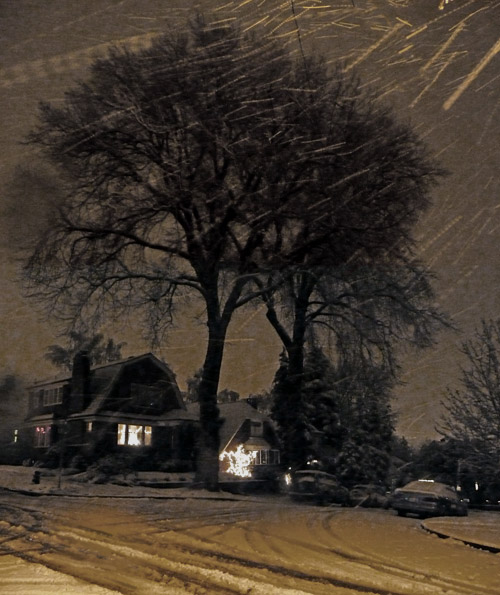
About fifteen hours later I revisited the corner and took the view below.

Another 15 hour lapse – one block west at 42nd Street and Sunnyside Avenue.
(Click to enlarge)


Spot is a good dog
But too warm hearted
For his own good.
See Spot run.

(Click to enlarge)
I have wondered. How may I respond in variation to Jean’s grand accumulation, shown just below, of a year’s recording on one section of the Yakima River Canyon? This leaf, lovely in color and form, I found near the intersection of 44th Street and Eastern Avenue on Dec. 13, 2008. With little thought, I photographed it centered on twenty settings found between where I lifted the leaf from the gutter and where I live. The naturalists among you – and there are several in Jean’s family – may be able to identify many of these settings by type(s). You may also determine a fondness for one setting over the others, but why would you?
Here is a small collection of more Jean Green Lake Challenges. I think they all date from the 1916 Big Snow and freeze, which froze a few lakes, including Green Lake, and collapsed a few roofs, including the distinguished cupola above the transcenpt at St. James Cathedral. (They did not rebuild it.)
The ice-site where the fashionable couple pose, one heroic and the other demure, will be hard to find and even more difficult to get to. Then an action hockey shot, which comes from the same collection as the couple, and like it may also be hard to both figure and reach. Best, perhaps, to stay with and seek the classic postcard view, if you want to walk around the lake in our fresh snow.
It is the wide angle shot of Green Lake crowded with skaters and is copied from an oft-printed postcard. This copy is postmarked Feb. 12, 1916, and addressed to Mr Gunnar Ingman at P.O.Box 476 Juneau, Alaska. The message reads, “This give you some idea of the crowed that enjoyed the skating on Greek Lake.” It is signed by Jack, Jill, or Joel. Can’t tell which.
Here is a negative clue. The tower on the ridge horizon, center-left, is no longer there. It was used for drying hoses.


Jean was quick to find the answer to the first Green Lake challenge sent to him here on his own blog. He found the “repeat” for the 1943 Green Lake snow scene on its north shore as easily, it seems, as tracing the scent of a wet wool sweater drying on a steam radiator. Jean needs a greater challenge, and so we move our new mystery from the Green Lake in his Seattle neighborhood to the Green Pastures, most likely, of Eastern Washington. And like the Kodachrome ’43 snow scene this dilapidated farm dates from the 1940s or 1950s at the latest.
Unlike the Green Lake image we know that this farm scene was photographed by Horace Sykes, member of the post-war Seattle Camera Club and an amateur who by the size and quality of his surviving work, we know obviously loved to travel the northwest looking for picturesque landscapes. Some of them he identified and dated on his slides, but not this one.
There is very little that is tense or newsworthy in the Sykes collection, but lots that are gorgeous examples of what we once with radical edge referred to as bourgeois taste. But by now I love Sykes’s tender exploring and obvious affection for his subjects. He never tired of flowers either – especially orchids.
Can Jean meet this new challenge? While it is almost nothing for Jean to jump in his Nissan and search the state for historical sites to repeat, with this one he will surely need lots of help. In fact, he might as well stay home. Almost certainly this old farm site is no more, razed in 60 some years of wind and rot. But it may well be remembered still and identified. The trick here is to use this blog’s viewers, especially the ones who have family and friends living on the dry side of the state. Jean’s Green (Pastures) Challenge No. 2, is, then, a genial plea for help. Where is it, or was it, this green scene? We will be patient.
Look for Jean’s Challenge No. 3, soon to come and closer to Green Lake.
While searching, typically, for something else I came upon this heartening piece of Kodachrome from the winter of 1943. The original 35mm slide has a caption written the flip side from the “Kodachrome” stamp. It reads, in toto, “Jan. 43 Our favorite spot to rest in summer under trees on shore E. Green Lake Way. Beautiful in Winter as well!!!”

For the moment I do not know where this slide came from, although I think it was mostly likely picked (by me) from one of two large collections of slides. One I purchased in a basement sale from a home near the east shore of Green Lake. The other I got from Lawton Gowey, a since deceased friend, who shared with me many images, stories and enthusiasm for regional history. Earlier he was given the collected slides of Horace Sykes, a long-time member of the Seattle Camera Club, and Lawton passed the collection on to me.
Sykes’ work is often wonderful and we should show more of it in this blog and will. But for the moment the image reminded me of Jean’s frequent early morning visits with his camera to this shore of Green Lake, which is also near his home, and the results that he has published here. So this is my first “Jean Challenge.”
Can he – or rather, you Jean – repeat this shot with a “now.” A warning through. It may be more difficult than we think. There have been some changes on the east shore since 1943.
JEAN GRABS THE GAUNTLET:
Here’s my best effort, slightly wider than the orginal, but pretty close I think.
I emailed the Sykes original to Kathy Whitman, Aquatics Manager for Seattle Parks and Recreation and she replied:
I can’t be certain but I think it is the northern shore of Green Lake looking across the west. West Green Lake Beach would be located just outside the area of vision to the left side the distant shore… the wading pool located to right side outside the area of vision. It is on the shore about 2/3’s of the way toward the wading pool when leaving Evans Pool.
That had been my best guess as well, as this spot has always been a favorite of Green Lake strollers. As I recall, the trees in the ’43 photo were cut down and replaced by smaller trees, to general opprobrium, but I can’t recall why. As can be seen, they’ve grown up a bit.


Jean and I have made a change. We are now calling it UP THE DOWN CHIMNEY (although actually it’s not a chimney but the Grotto on the Good Shepherd campus. We take the place of Mary, although neither of us qualifies).
And it is an even BIGGER SHOW celebrating Mumbles Wales, Very Long Hair & Vest Pocket Watches, Red Ryder BB-Guns, Down of a Thistle, and composer David Mahler.
It is THIS COMING Monday, the 22nd at 7:30 in the restored Chapel at the Good Shepherd Center in Wallingford. (pictured below)
It has fine acoustics too and can be easily reached by stairs or elevator.
(The Good Shepherd campus has a big and lovingly landscaped parking lot off of Sunnyside Street, between 46th and 50th Streets.)
We will be reading 4 CLASSICS.
* GIFT of the Magi – O.Henry
* A CHILD’S CHRISTMAS in WALES – Dylan Thomas
* Twas the Night Before Christmas
* RED RYDER NAILS the CLEVELAND STREET KID – Jean Shepherd.
 (Here’s a way to remember all this. Jean Sherrard reads Jean Shepherd in the Good Shepherd.)
Mixed with the readings we will all sing together – songs that include but are not limited to…
* Jukebox Christmas Eve (Mahler, David)
* Christmas Island (The Andrews Sisters)
* Hanukkah Candles (Grossman and Goldfarb) Hanukkah begins Sunday at sundown.
* The Pathetic Birdy Song – (The Dorpat Bros) may become a classic. Click the link and hear for yourself.
… and other Holiday selections from composer David Mahler’s beloved Christmas Red and Green Books!
The Chapel at Good Shepherd photographed by Jean during the “Ashes to Ashes” exhibit. Imagine yourself singing and listening to a good story in place of those 21 biodegradable caskets hanging from the ceiling. (For more on this now-closed show read Sally Anderson’s review of it in our archives.)

First, the last of these five recordings of the fall of fall looks up into some of the trees that border the Meridian Playfield in Seattle’s Wallingford neighborhood. The park was once an orchard for the Roman Catholic Good Shepherd Home for Girls, and a favored few of the old fruit trees survive. The panorama merges four images photographed on Saturday the 6th of December, 2008, around 3:30 in the afternoon The center of the scene is to the northwest. (Click the image to enlarge it.)

One month and four days earlier (Nov. 2, 2008) I recorded the several parts for this about 260 degree panorama that includes part of the P-Patch (far left) and most of the Tilth garden. At the center this pan looks northeast from a Tilth prospect that is near the southern border of the Good Shepherd Campus. The home seen in part on the right is off-campus and faces Corliss Avenue at its campus dead end north of 46th Street. The pan is a stitching of eight photos.

The trees that break the horizon above Tilth’s A-Frame greenhouse, left-of-center in the above panorama, appear again in the next recording which looks east towards the Good Shepherd Center and on the same second day of November, 2008. My back is to the Meridian playfield. The popular Pergola on the left supports and shelters several concerts during the warmer months, and below the tapping feet of the musicians several families of Rabbits have used the pergola as a hutch. It is thought that these opportunists made their way to the campus from Woodland Park.

Wet leaves and the bouquets they make can be found throughout the campus resting in and beside the bushes. This arrangement, however, was discovered a block off campus near the intersection of 46th and Corliss on November 11, 2008.

The last signs of fall included here are the reflections of an autumnal sunset off the west facades of the glass-curtain University District Building at the southeast corner of 11th Avenue and 45th Street – for many years the District’s unofficial mayor, Cal McCune, had his office there – and behind and above it the old corporate Safeco Building recently purchased by the University of Washington. It is the school’s first true high-rise and a symbol of sorts for many developments in the culture of higher education including grade inflation in the school’s undergraduate classes. B’s continue to rise to A’s at a pace more relentless than global warming. They are compassionately engineered by human forces in the interests of both comforting and complimenting the often anxious students and also avoiding their sometimes impetuous wrath. The school recently replaced the insurance company’s banner sign with its own across the top of their new skyscraper. The photograph was snapped while leaving Trader Joe’s with some pre-cooked brown rice and 73% dark chocolate in the purple wrapper on Dec. 6, 2008.

Jean’s Nissan parks almost alone on Raymond, Washington’s quiet First Street in 2005. Once this was the main street of a smoking mill town that often went swimming when the Willapa River flooded the street to its knees. Here on a rare hot day for the coast the pavement is dry as cured fire wood and hot too. Jean recorded this scene looking south on First as I was either stepping into or out of my side of his gallant carrier. We were chasing contemporary “repeats” for historical photographs that were then candidates for our book “Washington Then and Now.” While Raymond’s First Street made it through the final cut and into the book, the repeat we used looks down the center of the street. It misses the helpful signpost on the left but it is a more accurate “now” for the historical photos used – three of them. (For Raymond see page 83 – in the book, not this blog.)

Traveling with Jean – the Sherrard of this blog – would be like riding with an ironic* Captain America except that he really has impressive upper body strength from frequent exercise. He rows while watching the East Enders, the nearly 30 year old BBC1 soap. And yet Jean is still more pumped-up for ideas of all sorts and for questions of taste and temperament too. And he can drive like no body’s business, including his own for in truth he hardly makes anything from all his driving zest, including 10 thousand miles across this state pursuing historical sites in order to repeat them for our book Washington Then and Now. (Visitors to this blog will know how often he flies to that curvaceous canyon on the veriform Yakima River.)
Jean also travels the world, loving the arroyos and scablands of eastern Washington and Ethiopia, equally. I have seen him travel great distances. For two weeks in the summer of 2005 I was his dependent as we flew first to London and then rolled by chunnel to Paris. And there at the train station Jean first met Berangere AKA BB, the Lomont of this blog and I first saw her again since 1977. I met Berangere that summer now more than thirty years ago! The adventurous Parisian teenager was visiting my friend Bill Burden, whom she had met the summer before while picking grapes in southern France. And here, right to left, are Jean, Bill and I posing for Berangere with a familiar landmark behind.

Next, another Parisian scene by Berangere – this one of Jean and I preparing – with BB – to “repeat” with a contemporary recording the print I hold in my hand. It is of Concorde Square, and I took it in the summer of 1955 when I spent two weeks in Paris. I was sixteen and also still more sweet than sour. Below it is Berangere’s repeat from 2005. I was hovering over her shoulder.


Back in Washington while touring the state for our book and jobbing about for the book’s promotion, Jean has done all the driving. I sit beside him in the passenger seat (As I do in the Good Shepherd’s stone grotto portraits also recently posted here.) of his all white Nissan, ready to yield whatever travel advice I have and, more important, listen to his stories. My Captain is an insistent rapper about this wonder and that injustice and such a good storyteller that unless there is an emergency one will not mind hearing some of them twice because they are his classics. And one should expect and accept cell phone interruptions from one or another of his many dependents. Jean is admirably “up-front,” except for those instances when he will suddenly stop, jump from the car and exit around a corner for no announced reason. Rarely gone for long, he still always takes the keys and a heavy Nikon (digital) about the size of a large chocolate croissant.
Here follow a few recent snapshots of travels with Jean – most of them my own through the Jeanmobile’s heroic windshield. Jean is just to the left of these recordings, except when he is in them.

First, for the above picture choose one. We catch Jean (1) looking for a phone booth (2) running around the corner and up the stairs of the Washington State Museum of History in Tacoma looking for proofs of our Washington Then and Now show that opens there in January next. I take the moment to also leave the car and record this snapshot of the “leaning tower of Tacoma” – another Tacoma museum, for glass not history.

Rather than glass it is Tacoma’s old bricks that both Jean and I find most stimulating. Here is a splendid example on Pacific Avenue, long ago Tacoma’s “boulevard of dreams.” The pentimento of the pink cream and green sign exhibited on the east façade of this brick block is one of the West Coast’s finest examples of worn mural art. (While I have never visited a large sample of West Coast revealed murals nor know of any book about them, I still am confident that this is true or may be. I’ll say that this is another Tacoma museum, one of one work and one wall. A “drive-in or drive-by” museum you can enjoy, as Jean and I did, through the windshield.

A day after our appointment in Tacoma we were traveling again to responsibilities in Kirkland and Issaquah. When we reached the Evergreen Point Floating Bridge Jean was feeling good – having a fine time. Once on the bridge he pointed to “The Mountain That Was God” aka Mt. Tacoma, but officially named Mt. Rainier. Two years earlier he had sat for most of an afternoon near Paradise Lodge, waiting for The Mountain to reveal itself for the repeat of a historical photograph of it he carried with him. Now those two views – his and the historical – appear side-by-side in our book. Here from the bridge and in the late morning light The Mountain was stroked by dry-brushed clouds. [Can some reader more familiar with the sky and its tricks explain first that slender but not lenticular, it seems to me, cloud that either points to The Mountain or springs from it, and still more mysteriously the shadow that in part repeats the banner-cloud to the left?]

Stopping for a light on East Lake Sammamish Parkway I used all 10X of the optical zoom advertised even on the body of my little Lumix. (I purchased it on Ken Levine’s advice.) Jean pointed to the houses hugging the edge of the hill. He explained that they are the front line of oversized and yet crowded residences built on the plateau east and above the lake. Some of them he indication would qualify as McMansions. Depending upon the film you remember, they resemble either a line of U.S. Cavalry or a line of bareback mounted Sioux, waiting to descend into the valley and stick it to a few persons without horses. I have a different analogy for them born of my study of Classical Greek long ago. For me they appear to be a phalanx of barbarian invaders. These homes – Jean tells me for I have never given much time to real estate except the historical sort – continue for miles to the east from that edge of the bluff. Jean explains that some of this work-in-progress is now stuck.

Ambitious plans on the Issaquah Plateau were popped along with the housing bubble. But then many of them were created together like raindrops on a windshield, or cookie crumbs on a counter, or McMuffins on a grill. What, I wonder, difference will their mass production matter in a century – if they survive and gain some charm from time and the weather. Depending upon one’s class sensitivities they now seem to either inspire resentment, remorse, weltschmerz, petty glee or indifference. Not certain about how I feel, I can at least identify with that comely crow perched on the light standard upper right. I may be smart about some things, but not about most, including this at once awesome, ominous and curious row on the ridge. The crow soon flew away from its meditations to search for more scraps in the valley, and once the light had changed Jean continued to the Issaquah Costco where we were scheduled to sign books, which we were fond of telling those who purchased them increased the book’s value by twenty cents, or ten cents a signature.
Late in the afternoon we returned to Wallingford and Green Lake, where the next day I crossed paths with Seattle City Councilman Nick Licata. I asked Nick if he had seen the young trio singing Bach’s a capella motet Jesu Meine Freude at the front door to the Wallingford QFC. He had not. I explained, “With three-parts of a four part Baroque motet they were promoting the social engineer Lyndon LaRouche’s political literature and asking for donations.” I gave them a dollar for the 3/4ths of Bach. I might have given 75 cents. The photograph included here of an unidentified arm shows part of the Wallingford QFC sign beyond.

I told Nick about our trip the day before to the Issaquah and Kirkland Costcos and together we lamented how in the last quarter-century much of “book culture” – both the making and marketing – had been captured by a few heavy weight publishers and retailers – or in Costco’s prosperous formula, semi-retailers. The Issaquah plateau also entered our little conversation about books and Bach, and the other Lyndon. Nick confirmed what I had only incidentally heard about Chip Marshall. The once famous 60’s activist at the U.W., Marshall later became one of the principal developers on the plateau east of Issaquah. Something like Ken Kesey and Abbie Hoffman, Marshall had made his own theatrical run several times from the law, which he offended with some brash objections to the war in Vietnam. What was so entertaining is that he would sometimes appear unannounced to speak in public, but then ditch away again before he could be nabbed. It was the behavior of legends, and it helped that he was Errol Flynn dashing. But now his story is a mixed report. Unlike Kesey and Hoffman, and more like Jerry Rubin, Chip later joined “the man.” And now, Nick revealed – and this from Chip himself – his old friend longs to open a night club in Seattle.

Returning to the windshield snapshot, Jean told me that the forested horizon behind the crow is Tiger Mountain. I believe him, for he has been intimate with these “Issaquah Alps” almost since he was a child returning from Germany with his parents to live in Bellevue and eventually, in the early 1980s, to open Hillside School on Cougar Mountain, the little “alp” closest to Lake Washington. Jean teaches drama, writing and video at Hillside. His wife, Karen, teaches French and history. Their oldest son, Ethan, teaches mathematics. Just above is a photo showing Jean preparing his students for that night’s performance of Brecht’s play “The Caucasian Chalk Circle” staged last year at Hillside.

While on our way from Kirkland to Issaquah we stopped along the east shore of Lake Sammamish where, again from the comfort of the passenger seat, I photographed Jean preparing to take a photograph along the old Seattle Lake Shore and Eastern Railroad right-of-way (1889), which is now a recreation path – a controversial one, although not for those who use it. Rather some of those who live to the sides of the trail imagine it as a conduit for urban thugs and liberal ideologists (for some, one and the same) who are carried to the east shore on light weight ten-gear bicycles from Seattle thereby interrupting the formerly fretless piety of the lake shore community and more recently the highlands behind it. Jean is here visiting the now lost mill town of Monohon. And that is spelled correctly with three O’s. (Look it up on historylink for a thumbnail narrative of its substantial history.)

And here still at the abandoned depot site of Monohon, Jean shows the power in those shoulders and long arms as he lifts his heavy camera far above the path and over the heads of a cycling family perhaps returning to smoke-filled rooms in Seattle. Jean has attached his heavy Nikon to his big ten footer and thereby brings its prospect to about knee-level on the third story of a typical office block.

Continuing on to Issaquah and moments before we stop for the crow on the lamppost (discussed above) I snapped this screen of trees along the east shore of the lake. I figure that this may be an example of the kind of landscape that we are wired in our genes to enjoy and even long for. On this possibility I included this scene’s easy pleasures for you to study in reverie. This tentative insight of evolutionary psychology also adds to my hope that some of the garage sale art that I have purchased over the years is resalable. Let this also be a fair caveat lector to this blog’s visitors for there are plans for using examples from my “Forsaken Art” collection on this site.

Issaquah is also the corporate headquarters of Costco whose employees seem to express universal gratitude for how well they are treated. Here we take our place before a special black backdrop raised behind our signing table like an altar and pose with Angela who is our Costco hostess. We ask her how she likes her employer and get that same response. While I am happy for Angela and Costco I still feel ambivalent and think of Jean’s and my good friend Clay Eals, the author/historian who is such a champion of small stores and neighborhood culture. We sympathize with Clay’s ideals but can we also afford them. In Paris it is still possible, if one wishes, to visit a dozen different stores for a day’s needs and all within walking distance – like Wallingford.
Jean is taking French lessons at the Alliance Française. He is justly proud of his pronunciation, although, as he describes it, learning the ways of French verbs requires the discipline, flexibility, sobriety and elegance of a ballet dancer in the Ecole Française. A point that is perhaps mean to make, an instance of protecting my own interests, is this. After studying his French for however much time he can give it, will he ever be able to tell a story as well in the language of Balzac as he can in the language of Dickens? (In the accompanying photo directly below, two French-looking visitors admire some of the garden bedding on the Good Shepherd campus. The Alliance Francaise is in the brick building to the rear.)

Come hear Jean read in English Jean Shepherd’s “Red Ryder and the Cleveland Street Kid” and “A Child’s Christmas in Wales” this coming Dec 22 in the fourth floor Chapel of the Good Shepherd Center in Wallingford. I will be backing him up as the amateur part of the program reading O’Henry’s “Gift of the Magi”, along with a poem that has profoundly shaped the culture of Christmas, yes “The Night before Christmas.” We rented this fine performance hall – which you can study below in this blog in the many pictures included with Sally Anderson’s Ashes to Ashes review – so there will be a requested or suggested gate of $10.00. Elsewhere in this blog is an announcement for this reading – and another at the Haller Lake Community Club – accompanied by a photograph of Jean and I sitting in the Good Shepherd Center’s Grotto. I am, again, on Jean’s right – left to you. Here we also include at the bottom another example of a grotto – this one in the pavement near 42nd Street and 1st Ave. N.E. – and just below an abandoned Christmas nativity scene, or part of one, discovered half buried by untended ground cover and neighbor to other incongruous artifacts in a hidden Wallingford side lawn.

* As yet, we can’t quite expect a sincerely ecstatic post-ironic America with the new administration, although satire will now have to search harder for targets. What we need is rather a post-iconic America, which is a nation dedicated to patrolling for dead metaphors in public speech and hysterically driven clichés like “iconic.” This “iconic” is used much too often now as a substitute for thinking. So stop it!

This Friday, Dec. 5, 2008, at 9:30 Jean picked me up in Wallingford and we scooted to Olympia to sign some books in the Legislative Building’s little gift shop. We “worked” at this over lunch time, from eleven in the morning to one in the afternoon. On our return to Seattle I took several photographs of Mt. Rainier from the car window as it showed a most spectacular variation on the cloud cover that it often creates, it seems, for its own and our amusement . Sometimes this cover hovers like a beret. But the beret can swell into a hard hat and/or stretch into a sombrero. And on rare days, like this one, the clouds above the mountain and around it are as fanciful as the hatter’s examples sold at a theatre wardrobe sale.

The first look was taken from the 1-5 bridge over the Puyallup River at about 1:45pm. This is The Mountain that the citizens of the “City of Destiny” ought to insist on lovingly calling Mt. Tacoma.

The next recording looks south and a little east, again from I-5, and over Tukwilla’s Southcenter Mall – or near it around 2:10. Now the atmosphere about the mountain is dancing, and it has temporarily created a new cap.

Around 3:00 I propped my Lummix against a signpost at the Wallingford Intersection of 42nd Street and 1st Avenue N.E.. The high hat above the mountain has moved further east. Earlier Jean noted that it seemed as massive as the mountain itself, although the reverse of it, like a wrapped Rainier standing on its head.

Next the setting sun gives its typical rose glow to the mountain behind a dead tree given new life with blue bottles lovingly hung from its branches by sensitive neighbors.

Moments later, with the sun below the Olympics, but not yet submerged in the Pacific, and with the camera wide open, the sky misses vespers for a riot.
This panoramic look into Wallingford’s Meridian Playfield is one of the sites/subjects I chose to repeat practically every day since I started my “Wallingford Walk” now 28 months ago. The number of tended locations is now more than 400. By now I rarely add new ones. The complete walk takes about four hours, but this includes visits with friends I come upon and stops at a few health spas like Julia’s bakery and Al’s Tavern.
At the top of this “Fall of Fall” there is a hint of autumn – or many hints with the first fallen leaves — in a three-part pan that was photographed on Oct/12 of this year. In all seven choices or examples the themselves wide-angle parts have been merged and the seams mostly hidden. In the scene below it, which was taken Oct/27 some of the trees are well into the fall season, and thirteen days later, on Nov/2 in the third-from-top pan, a good part of their colorful show has dropped to the floor of the Good Shepherd campus. Four pans down, the gold has turned brown and is hardly noticed in the shadows. The trees are almost bare. This fall show, then, lasted about six weeks. The winter doldrums will endure until early march. We may hope that they will be interrupted by snow, as in five-down on the fifteen of January 2008. The sixth pan from the top gives us a hint of what to expect. Touches of spring are evident from my repeated prospect. For all of these pans I’m propped against a tree at the southeast corner of the playfield. This No. 6 spring scene was taken still in the first full year of my walking – on March 14, 2007. (I began walking my irregular circle – from my front porch and back – in July 2006.) Here the wettest part of the playfield is protected from athletes with a plastic orange net. Finally, in the bottom pan the park is in full summer on July/28 of this year, 2008. The fence has been removed and the field is dry and a bit beaten.
For my own satisfaction I refer to this as Hyde Park, for the big trees remind me of London’s big park, especially when recorded as it is here with 90 degrees of the playfield showing. From these seven views you may get a mistaken notion that this playfield is little used. Soccer players, fetching dogs, and sometimes mordant teens who smoke behind and beneath the distant trees along Meridian Avenue are almost regulars. The dogs surely are regulars. So far I have at least 700 pans from this location leaning against a big tree. From these I will select and “polish” with Photoshop, and any other program that will help, about two hundred of them (I speculate) for a variety of animation that will involve rapid dissolves between the chosen scenes.
[CLICK TWICE to ENLARGE]

Chris and Mary Troth’s “plantation manse” in Wallingford (at the southeast corner of 44th and Meridian) has a pompon or citrouille or potiron coloring (all French terms that have something to do with Pumpkins and used in celebration of this blog’s recent turn to bi-linguil – or more often bi-focul – with the contributions of Parisian Berangere Lomont) and has been recently and wonderfully appointed with the attached row of pumpkins for Obama. As far as I can determine there are only Democrat signs in Walllingford, and if America follows this neighborhood in the upcoming election it will surly be an Obama Landslide followed by an Obama landfill of signs and such, but not of these pumpkins. The Troths are also avid gardners and almost surely have their own compost for this endearing political marker. Mary explains that the colors of their Wallingford landmark are a golden-orange named “jubilation” (and may we so hope) by its manufacturer, white, and a dark read, which she explains acts like the home’s “eye-liner.”
(In celebration of the season I’ll add other pumpkins to this contribution – perhaps later in the day. A suggestion: why not keep your Obama sign – not the pumpkins – as both a reminder and a part of Sustainable Wallingford?)

Attached here is the cover to the second issue – from April 1969 – of the Northwest Passage, the splendid and long-lived (although no longer) tabloid that was Bellingham’s contribution to the “underground press” of the late 1960s and after. Many of those connected at one time or another with the paper – and there were through its life many hundreds – meet irregularly as members of the Old Fools Society or Old Fools Salon or Old Fools Forces or some other Old Fools. Now this far-flung membership is using the web to ween about a 40th anniversary of the NWP founding and, perhaps, to “repeat” the historical group pose that appears below. This is an extended call for help in naming those captured here in the Spring of 1969 on some enchanted old porch in Bellingham or near it. (Mouse it to enlarge it.)

Four snaps from today, Friday the tenth of October. The fly and the monkeys are from a porch on Bagley Avenue. The flower from the Good Shepherd campus P-Patch. And The Mountain from the corner of 42nd Street and 1st Avenue N.E. – all in Wallingford. (All – or nearly all – may be “moused” for enlargement.)


Like most of the other subjects posted here since we changed our blog-programmer, these four panoramas of Good Shepherd can be enlarged with a tap of the mouse. They were all recorded this Tuesday afternoon of October 7, 2008. And they are presented in the order that I visited them as part of my regular walk through the Good Shepherd grounds or campus. I was cheerfully told by two pedestrians that today was supposed to have been overcast and wet. One used the word “dismal” and the other “nasty”. Instead we were spared the rain and got instead performing clouds with sunshine between them. I entered the campus at the Bagley Avenue entrance at about four in the afternoon and left it about thirty minutes later.
The top pan is of the Meridian Play Field, the most westerly part of the campus. It is managed by the park department more directly than the rest of the campus.
The next pan is of Tilth’s workhouse/greenhouse, which has also a green or planted roof.
The third pan looks northwest from Tilth’s teaching garden to the same structure and part of the P-Patch attended to by Wallingford neighbors. On the far side of the screen of trees is the Meridian Play Field.
The last pan shows the Good Shepherd Center against today’s playful sky. Once a Catholic school for girls – many of them from troubled homes – the structure and campus celebrated its centennial last year. The restored chapel on the top floor has become a popular concert venue with admired acoustics.


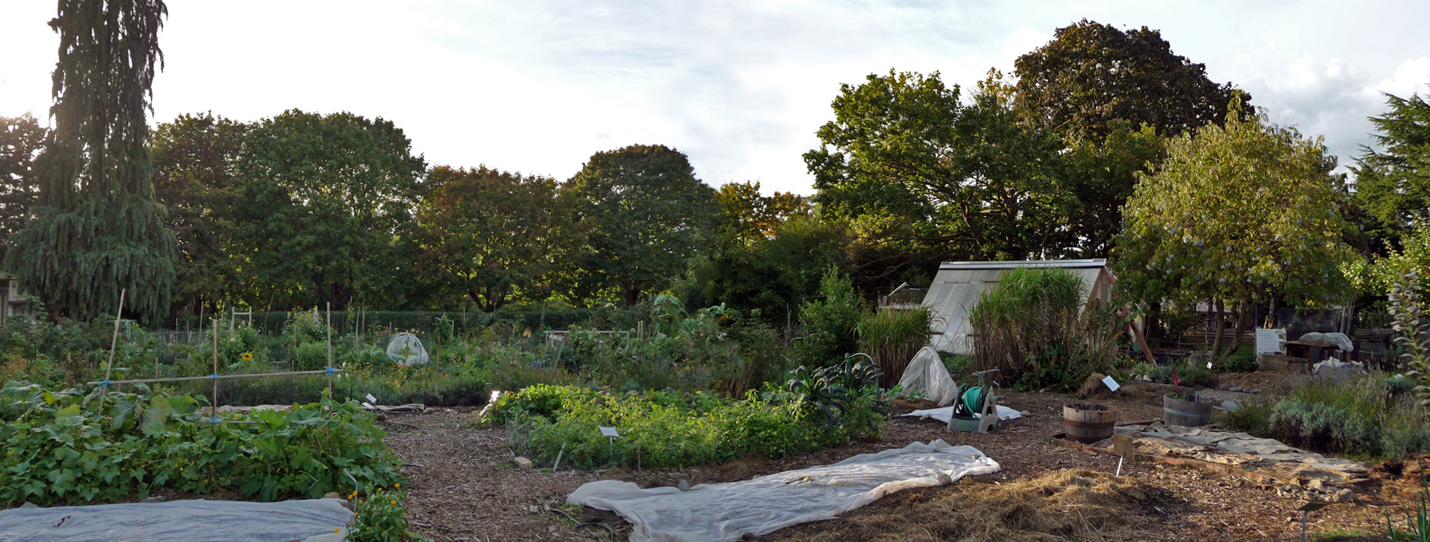

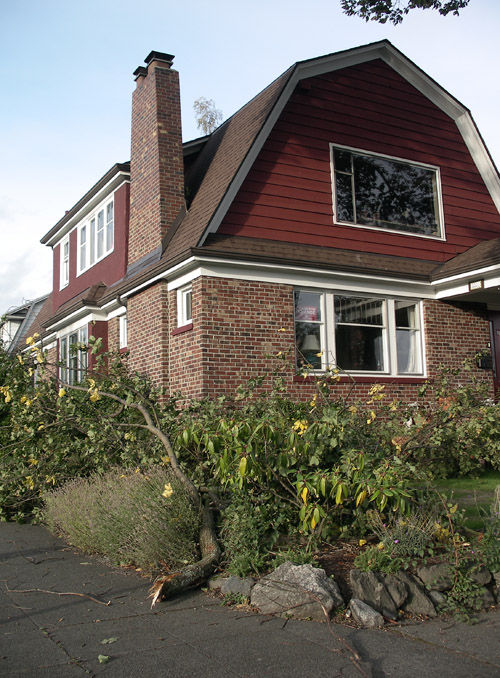
At the Wallingford corner of Eastern Avenue and 42nd Street stand two of the tallest American Elms in Seattle. There are no witnesses to their age and neighbors hope that the rings may never be counted. The trees can be seen prominently from the Ship Canal Bridge on I-5. Together these twins are the largest green mass around. A few years ago the twin to the east began to crack between its two high branches. The owners then of the corner house had a cable run between them. The sudden molesting wind that blew through the north end (at least) on the afternoon of Saturday Oct. 4, did not break the cable, but it did snap a limb from the east landmark and dropped it to the front lawn. About one hundred feet away and heading for the trees to take my several daily photographs of them, I heard the snap and saw the limb fall. If it had held on for a minute more I’d have been standing beneath as I do with the three photographs attached here in a row, looking up the north side of the west elm watching the limb approach me — and just miss me. Find the hole or identify the missing limb when it was still in place in two of the three views. The limb is missing, far right, on the afternoon of Oct. 4 2008. It is in tact, at the center, in the afternoon of Feburary 28, 2007, and also intact, far left, on the afternoon of Oct. 1, 2008. In a fourth photograph at the top the limb is lying on the front lawn of the home at the northeast corner of 42nd Street and Eastern Avenue.
(Mouse the triptych to enlarge it.)
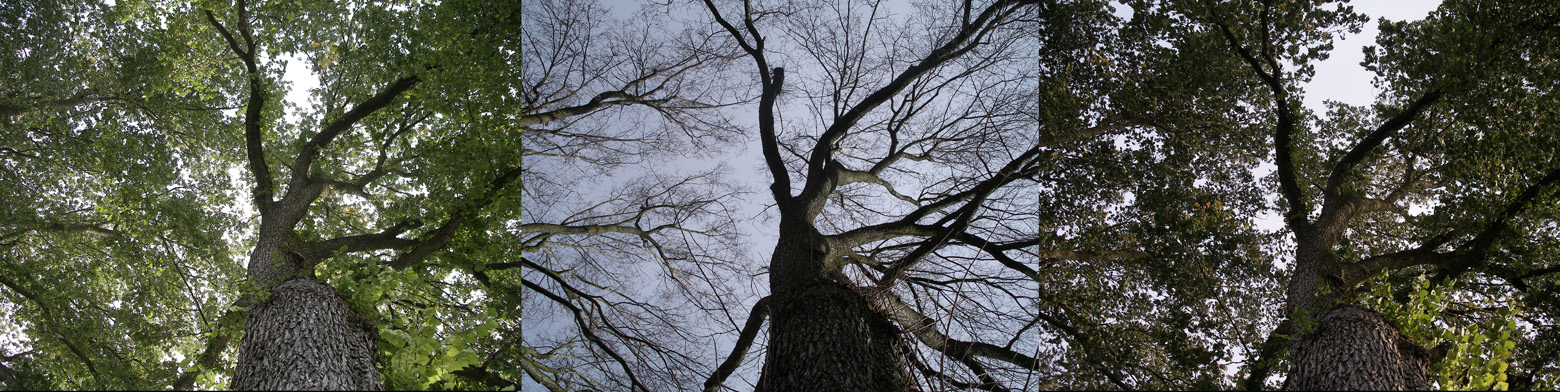
With the last posting (directly below this one) I promised a return with evidence that like this year’s spring, so this fall is late by a few days. The comparison below of the blossomed cherry trees at the southeast corner of 46th and Corliss were taken one year apart. The top of the two on March 27, 2008 and the bottom of the two one year earlier, where the budding is further along and the petals are dropping. This flowering comparison is followed by another from Sept 27, 2008 (on the top of the bottom two) and at the bottom, one year earlier. The difference here is subtler than with the blossoms, but real enough in the reds of the turning leaves. I will not name the types of several trees that appear there at the northeast corner of 46th and Burke in hopes that a reader will respond with their names. Another reason is that I don’t myself known the names. So, if you can, please help both nature and me.
(Tapping these pairs with a mouse will make them bigger.)


One day more and I returned to the northeast corner of 44th Street and Wallingford Avenue to repeat a tree I first notice many years ago for its brilliant fall color. I tagged it the “Flame Tree.” However, today, Monday Sept. 29, 2008, it was still in the summer greens seen here direclty below. Below it and two years ago, on Sept. 27, 2006, the Flame Tree was far into its fire.

I found this tender sign of fall at my feet late this afternoon while shuffling from my car seat to the slabs of granite that pave our front walkway off the street. Folks, this year’s fall is late. And I can prove it – but not tonight. Tomorrow perhaps. Since I have been walking that same Walllingford Walk for more than two years I can bring in last years pixs from this day – or tomorrow – and show examples of a landscape that has knitted for itself an autumn dress about a week more developed in 2007 than now. This was true of Spring as well. Our cherry trees were a about a week late with their blossoms this year, when compared with 2007. I may have proved that one earlier with this blog. For now I do not remember if I did, but will check it out soon for you casual readers. If I did not put the blossoms of spring – 2007 and 2008 – in earlier I will include them as well – with the “fall” preview – probably tomorrow.
(To enlarge the photo tap it with your mouse.)
 .
.
A good number of Walt Crowley’s friends formed a circle around his memorial headstone – a flat and yet risible plaque lying on the grass – this afternoon (9/21/8) to share memories of Walt and scatter a few of his ashes in the vicinity of the plaque. Some of Walt probably drifted near the Thomas Prosch plaque, which rests so close to Walt’s that they are bedfellows now for eternity. This was meant to be, and it was historylink historian Paula Becker who first envisioned it so last year and then suggested to Marie McCaffrey, Walt’s widow and now his successor as head of Historylink, that it would be most appropraite to put the two of them near one another. Since Prosch could not be readily moved this meant putting Walt – his plaque – near to Thomas. And so it was done. Thomas Prosch was another historian/journalist whose typed 1901 manuscript “A Chronological History of Seattle” was a most important source for the construction of historylink – its many earliest essays on subjects of Seattle history. Jean (of this blog) took photographs of all those who said something and he has included some of these directly above.
After the memorial while returning to the car, I noticed Jean’s shadow on a headstone and so recorded it, and then also turned the camera left for a few more shots that fit into this panorama. It includes a few degrees more than one-fourth of Lakeview Cemetery. The center of the pan looks to the northeast. The cedar tree, in the shadows on the far left, is at the cemetery’s summit. Pioneer Doc. Maynard is buried at its base. I might have investigated the name on the far side of the big stone on which Jean’s working shadow was caste, but I did not think to do it. By late afternoon this Sunday, Lakeview was showing the beauty that lured Victorians to cemeteries for their weekend leisure and reflections on mortality. The site of Walt’s and Prosch’s plaques is about fifty or sixty yards directly behind me.
Walt and Marie’s plaque reads brilliantly, “Walt Crowley 1947 – 2007 Husband of Marie McCaffrey Co-Founder of Historylink Citizen of Seattle To learn More Visit, http://www.historylink.org ECV Marie McCaffrey 1951” A close-up of the plaque is included with Jean’s photographs printed above.


(Note to reader: What follows is a response to Berangere Lomont’s photos of the Pope’s visit to Paris, especially the one (reduced above) that shows the Pope looking towards her through the green glass of the Popemobile. You can now find this view and her other photographs of the Pope’s visit full sized below, or later in this site’s archive. )
Dear Berangere,
Like Celeste of the Women’s Century Club, here in Seattle, I also love your Pope and your Paris. While the German Pope is relentlessly strict in his orthodoxy, it is claimed that he writes a good dogma. And this Pope is a little less forbidding under the City of Lights, although his walking guards throw some shadow on that. They seem to be worrying like stooges working their way through purgatory. But that can’t be helped, for the world is not so perfect as the Popemobile. And the Pope certainly looks fit in his Popemobile. With the fold-out curbside video screen in your photograph one can see the Pope coming and going — omnipresent. How many of these devices did they use in the 5th Arrondissement alone? It may help us wonder what compensating attractions they used in medieval processions, not having these curbside Deus Ex Machines? And it occurs to me that anytime the Pope does a mass in an outdoor stadium they may be useful – fourteen of them – as Stations of the Cross. Whether ex cathedra or inside the cathedra, I think what distinguishes any Pope from the rest of us is something more clinging. They dress the best. How long do you suppose the Vatican has been filling its pope closets with the nonesuch of outfits made from surpassing fabrics by the ruling class of seamstresses and tailors? For centuries. Take off any Pope’s clothes and there is probably not much to prefer. But without the evidence of a Pope with no clothes who can know? Writing now about myself only, as humble as my wardrobe is, every part of it is clean, machine washable and stamped with a free pass to paradise, which I’ll use only if I cannot make it back to Paris.
Paul

Yesterday in broad sunlight I came upon this long-legged beauty sunning on a big leaf. Something, perhaps the sound of my simulated shutter, sent it – yes – flying.

Emily Nuchols, our champion for the Snake River sockeye salmon that, she notes, “travels further and climbs higher than any other salmon in the world,” has sent two glimpses of the conditions at Camp Muir, at 10,000 feet, which is the jumping-off place for most early morning attempts on Mt. Rainier. Throughout August we posted photographs from Wallingford that looked in the direction, at least, of Mt. Rainier from a corner that was a few houses from Emily’s – at the beginning of the month. We did it in support and anticipation of her climb scheduled for August 25-26. During the month she moved to Portland, perhaps to be nearer those wild sockeye, for Emily is the communications manager for “Save Our Wild Salmon.” (You can find and/or review that daily Mt. Rainier watch in the archive of this blog, as well as other pictures of Emily and some of her supporters.)
The two snapshots included here show, above, Emily with her climbing team – she is behind the red section of their banner – and, below, Emily alone with the wind and the Cowlitz Glacier. Emily explains. “When we left Camp Muir at 2 a.m. and started our first traverse across the Cowlitz Glacier the wind was blowing so hard we had to brace ourselves with our ice axes at each step.” In the dark the Salmon team made it over that ridge behind them – Cathedral Rocks – and beyond that over Ingraham Glazier as well and then onto the rock cleaver so appropriately named “Dissapointment” for so many. There, still in the night with flashlights (on their heads I assume) and 60 mph winds pushing against them, the guides put a stop to it, and turned the team around. Still their effort raised $20,000 for Save Our Wild Salmon. Our congratulations to the Salmon for having friends like Emily and her team. And our apologies to the Salmon, for they are still for eating.

It is understandable that the many attractions of The Great Wallingford Wurst Festival cannot be fathomed from any one perspective, even a panoramic one like this. Far beyond this playground is the music stage and the food court (with emphasis on bratwurst and sauerkraut) and inside St. Benedict School (on the right) much more, like craft booths, a book sale, a good old Catholic raffle, and something else you will not find at the Presbyterian Party – if they have one – a Biergarten. This year the school celebrates its centennial, and the 26th Annual Wurst Festival was a good way to gather the alums and neighbors, especially the one’s with children. It is a two day affair, Sept. 12-13, on the school grounds at 48th Street and Wallingford Avenue. You may have missed it.
I ordered a tasty salmon sandwich at $4.50, and sat next to an about ten-year-old boy with a Pink Floyd t-shirt printed with a 1972 tour date. I took the opportunity to brag to the boy and his father that I had interviewed Pink Floyd in 1969 (or it might have been 1968) when their first American tour brought them to the Helix office as friendly artists looking for a local plug. I can tell you they really were “delightful lads.” At the time the band was not yet well known. In the office was a boy about the age of the boy I told this story to, and I invited him to interview the band with me, which he did. And he got the bi-line.
(Mouse the pan to make it wider.)

Last weekend – Labor Day weekend – while thousands (for forty dollars a day) were reflecting on the condition of the arts in our contemporary failing democracy at the three day gated seminar named Bumbershoot, some of us may have paused to recall what happened in the mud 40 years earlier on a strawberry farm – Betty Nelson’s Strawberry Farm – a few miles south of Sultan, Washington, off of HIghway 2, on the way to Stevens Pass. (The Sky River Rock Festival and Lighter Than Air Fair was the reason – it will be argued, with conditions, in the forthcoming video “Sky River Rock Fire” – Bumbershoot was founded.) Sky River, for short, was the first three-day outdoor rock/jazz festival staged where nothing had been staged before – in this case an about 40-acre farm.
It rained most of that Labor Day weekend, although it was not a cold rain and the estimated 40 thousand who showed up made the most of it by dancing in the mud and periodically chanting for the sun in circle dances which to the Christians, who from a small plane were dropping pamphlets reading “Christ Is Coming,” must have seemed like a pagan ritual. The music was pretty much non-stop. The “lighter than air fair” part of it was an inflated balloon of about eight feet in diameter that could get about as far off the ground as it was wide — but with a running jump by an athletic person. (I may be wrong in this for I did not ride the thing.)
The cost of admittance was $6 for the three days or $4 for a single day, but a large minority paid nothing, for aside from the flimsy farm fence there was no security. Still the bands appeared for next to nothing and the reputation of the event, even while it was underway, was sufficient to inspire the Grateful Dead, for instance, to fly up from San Francisco on their own and appear late on Monday, the last day. I remember that County Joe and the Fish, then a very popular Berkeley band, flew in from a concert in New Orleans. Joe was wearing a rather nifty white suit that, I believe, he purchased there. I also remember setting the microphone for a relatively unknown comedian, Richard Pryor. Santana was resounding across the Skykomish valley at 3 a.m., and although we must have slept, I do not remember it.
I was interviewed about SKY RIVER a few days before the 40th Anniversary by Everett Herald columnist Julie Muhlstein for their Aug. 31 offering of Heraldnet. Here is the Everett Herald link.
One of the two photos included here was also printed with the August 31, Heraldnet piece with caption included. Fred Bauer (long since moved to the wild California coastline west of Garberville) took the camp life detail from the festival. The other is a record of both covers from a Helix published the following spring. It was not unusual to use the covers to promote an event, in this case a benefit concert (although that is too puny a description for those Eagles Auditorium all-day events) for Helix and KRAB radio.


From left to right: Bob Connell, B. Bhartik and partner, Jun Akutsu, Cathy Tuttle, Kathleenn Cromp, Michael Kucher, Treb Connell, Christina O’Leary, Michael Courtney
This coming Saturday, Sept 13, from 10 to noon the “ring of illuminated concern” called Sustainable Wallingford – and I’m a member – will meet almost at the Mosaic Community Coffeehouse at 4401 2nd Ave. NE. That is the landmark. The meeting itself will be just around the corner in the First Church of the Nazarene fellowship hall. You enter on 2nd.
Early last month, August 9th, an afternoon squall ran through Seattle scattering picnics to the nearest shelters. The picnics that Saturday included one for Sustainable Wallingford at the Good Shepherd campus. The attached group portrait shows a few members illuminated in the reflected glow of an afternoon sun that followed the storm. They are perched, of course, in the park’s pergola.
Why investigate this circle of concerned Wallingford citizens? One reason is that they are also meeting in Wallingford United Kingdom. Here follows parts of Sustainable Wallingford leader Cathy Tuttle’s latest correspondence to members. It begins with a request you may wish to take time to examine and respond to.
Please take a survey, What Do You Really Think About Climate Change? We will only be collecting survey data until October 25th, so please try to answer soon! Our friends in Sustainable Wallingford UK contacted us last month at Sustainable Wallingford US, to see if we could ask our townspeople the same questions at the same time. We want to see if we have similar interests, knowledge, and concerns in both countries. Wallingford, UK is a small town of about 10,000 people, located 47 miles (75 km) west of London. Wallingford, USA is a neighborhood of around 20,000 people, located 4 miles (6 km) north of Seattle. Please pass along this survey to your friends! We will publish survey results on our website, and in local newspapers. Thank you!
The remainder of Cathy’s bulleted correspondence includes other clues on why one might want to show up this coming weekend or visit the group’s site.
* CoolMom Wallingford meets at Mosaic 4401 2nd Ave NE this Tuesday, Sept 9 at 7 pm with Kerri Cechovic from Washington Environmental Council. More info about CoolMom Wallingford from Anne Marie 206-522-5034
* Active Sustainable Wallingford member Mike Ruby received $15,000 from the Dept of Neighborhoods Matching Fund to help plan a Wallingford Community Center He invites folks interested in the project to the Good Shepherd Center room 122 this Wednesday, Sept 10 at 7 pm.
* If you haven’t seen the Sustainable Wallingford wheelbarrow drill team, click.
* The great Sustainable Ballard Festival on Sept 27-28 has a variety of must-see events including two Wallingford-based Spokespeople rides at noon to sustainable sites — so ride your bikes to the festival!
* Spokespeople will also link houses on the Wallingford home tour on Oct 5.
* Click for more info about Sustainable Wallingford or call Cathy at 206-547-9569
My one-of-a-kind Sustainable Wallingford button


While walking Wallingford this week I’ve come upon two examples of what will most likely soon become a great commonplace of public giving. As we approach the grand opening or first day of the new federal requirement for high definiton TV and this new age of entertainment and education becomes the right and responsibility of every citizen in their pursuit of happiness and verrisimilitude, more non-complying televisions will be given up by citizens who ask no thanks. The single set shown here (below) was found gently resting on its face in a driveway on Meridian Avenue near the Tully’s parking lot off 45th Street – Wallingford’s “Highway to Ballard.” The two sets (above) were neatly set at the edge of another parking lot, appropriately that behind the Hollywood Video, also on 45th. Look for much more of this curbside philanthropy in the weeks ahead. While one may check set labels for expiration dates, there are none. Sometimes the once warm boxes do include their year of origin. The attached label from the Meridian Ave. set – a Sharp Model 19np58 – reveals that it is barely twenty years old and so probably eager to turn on for someone these last few weeks.


This is not a revival of the Wild Salmon countdown run earlier through the month of August (see the archive), but an instance of an insistent Mt. Rainier. The reflected sunset this evening (Sept. 2) around 7 pm gave this command performance above Seattle’s Capitol Hill. Again this representation, like the others below, was snapped with the support of the street sign at the northwest corner of 42nd Street and 1st Ave. N.E. in Wallingford. (It is one of the about 400 scenes I have repeated most days for the last two years for art and exercise.) The expression “The Mountain That Would Be God” got considerable play during the long early-20th Century contest between Seattle and Tacoma promoters over how to name Mt. Rainier/Mt. Tacoma. For some “The God Mountain” was a glorious compromise, although ordinarily this almighty allusion was expressed differently, using instead the rhetorical banner just noted in sentences like “Dear, do you suppose uncle Knud from Bismark would like a drive up to The Mountain That Would Be God?” And the answer, “Dear, I believe that the proper name is ‘The Mountain That Was God.’ not ‘would be God’. You may have thinking of the The Man Who Would Be King a short story by Rudyard Kipling. Have you read it?” “No, but I did get started with his novella, The Man Who Would Be Kind.”

Here I have captured for the moment Seattle’s admired torch singer Julie Cascioppo on a construction site in Wallingford. SOON Julie is giving her last performance in Seattle before flying away to BALI. Here are the facts.
On Sept 11 – a Thursday – from 7 to 8:30 PM she will be performing at EGAN’S BALLARD HAM HOUSE, at 1707 Market St. in Ballard, of course. Telephone reservations can be made. Call 206-789-4624.
Julie will be singing ORIGINAL SONGS from her recent JACK STRAW PROJECT, as well as some of her HITS.
Here’s some boiler on Julie.
“In a world of boy toys and riot girls, Julie! Stands alone. And she also stands tall in the tradition of ‘red hot’ mamas like Sophie Tucker and Mae West. When not on one of her globe-trotting itineraries, Julie holds court variously at the Sorrento Hotel, the Pink Door and Eagans.
“From the sultry jazz singer of her recent CD, ‘SOMETHING COOL’ to the hilarious monologist of her one-woman show, I ENJOY BEING ABROAD (Performing so far in Paris, Istanbul, Hong Kong, Bangkok, and New Delhi.) Julie! Is always unpredictable.
“She can be soft as a cello or brassy as a French horn.”

Recently, Seattle resident Sally Anderson’s sister Sharon, also known as Deedo, who lives in the highlands of Utah, was visited by a moose. Sally, who describes Deedo as a “moose lover,” had already worried about her sister’s expressed urge to meet face-to-face with a moose in peace.
The attached moose portrait, which said sister recorded through her bedroom window, while standing on the bed, suggests that her wish has nearly come true.
Sharon’s snapshot alarmed the prudent Sally, and with a few words of caution she admonished her sister that as cute and kindly as any moose may seem, it can also run faster than she. “Sharon” Sally said, “be careful or you may get what you ask for!”
This moose episode, we know, is not a first for Deedo. Two years past, while she was resting in her bathtub, a (presumably) different Utah moose stuck its nose through the open bathroom window. While Sharon was non-plussed, not so Sally, who has since worried that the next time the moose may try the front door.
Readers who are familiar with similar episodes in other parts of Utah are asked to contact the Utah Department of Parks and Wildlife and share their experiences through the UDPW’s official webpage, under the category “Moose Meetings.” (This new category “Moose Meetings” takes the place of “Moose Sightings.”)

Recently I snapped this photo of the Green Lake Budget Bread and Breakfast, or half of it. The bed, I believe, is in the truck.


