



Sheep may safely graze
where a good shepherd watches.
Where rulers govern well
we may feel peace and rest
and what makes countries happy.


When I first visited the Neely Mansion with my friend Inger Anne Hage it was a mere 71 years old – my age now. But now at 116 it looks considerably better than I. This improvement is the work of the many volunteers who have gathered around it for the restoration and maintenance of this national landmark.
Aaron and Sarah Neely completed the ornate farmhouse east of Kent in 1894. Aaron was seven when he crossed the Oregon Trail with his parents David and Irene Neely in 1853. The family came directly to the future White/Green River valley and was thereby among its earliest settlers.
One of the Neely Mansion volunteers, Karen Meador, introduced me to the historical photograph of the mansion and also took the “repeat” during a visit by Neely descendants. And this would be the proper place to name them.
First the visitors in the “now” photo, left to right. Left to right, Ken Beckman, Aaron Beckman, Grant Beckman, Howard Elliot Neely, and Jane Neely Beckman. Howard is the 93-year-old grandson of the Aaron Neely who built it. Understanding the difficulty of “reading” the faces of the six figures posing in the “then” we will note two with reserved confidence. The young boy, third from the left, is – or seems to be -Howard Elliot Neely’s father Aaron Neely Jr., and the woman, far right, his mother Sarah Graham Neely, Aaron Senior’s wife.
The photograph is almost as old as the house, for by 1900 the family missed the social excitements of town life and moved to nearby Auburn. According to Meador “Through the next several decades the mansion and its 200 fertile acres were leased variously to Swiss, Japanese and Filipino tenant farmers.” Sometime in the 1960’s it made a transition to disrepair. That is how we found it while on our way to the Black Diamond bakery. We peeked in a front window and found a mess. Now thanks to the Neely Mansion Association this classic Victorian is open and operating.
WEB EXTRA


With the evidences of the “real photo post card” printed just above we have found the location for the previously unidentified Daily Sykes #10, which was published here last April 22. The photographer, Philip Wischmeyer, we are familiar with having used his ca. 1910 panorama of Neah Bay in our book “Washington Then & Now.” We are, in fact, making quite a few discoveries as we scan through by now decades old 35mm black-and-white copy negatives (technical pan) of images from diverse sources, thanks to our own Edge Clippings Ron Edge’s loan of another of his picker’s findings, a sizable and fine scanner that will handle 24 negatives at one sitting. Thanks again to Ron.


We have learned that our friend Nathaniel, the steadfast host of the by now nearly ancient Allegro Coffee Bar in the University District (see our blog post from last Wednesday and only four posts down), has “pulled” through his operation and is now “up and walking around and feeling fine.” That would be still in the hospital, but we are confident that he will soon move from those halls to home and then back again to the Allegro when his family permits it.
(The Allegro is either the oldest or the “next to” oldest espresso bar in Seattle, but the coffee is fresh and the pastries too. Yes we at dorpatsherrardlomont can highly recommend the Allegro, a harbor of repast for both town and gown literati for decades. You will easily find it’s now cozy and very European entrance in the alley 2nd door north of 42nd Street between University Way and 15th Avenue n.e., at the western border of the U.W. Campus. Test their teas and study their bulletin and notices board.)
And this afternoon, a short e-missive arrived from the man himself:
Well, the deed is done. I’m home now licking my wounds, as it were. It has been quite a ride and I am so impressed with the folks in attendance. Now, onward and upward!
We also recommend, for greater acquaintance with Nathaniel and the Allegro, this video portrait.


Soap Lake’s historian/filmmaker Kathy Kiefer confirms what we only suspected. This is indeed Horace Sykes’ look over Soap Lake from its southwest corner. Kathy writes, “I concur that not only is that Soap Lake, I venture to say that it is one of the enclaves used by nude bathers on that southwest corner of the lake. Male sunbathers created the stone circles to alert others that they were nestled within. The women often made tent like structures – much more private. I am sure we talked at some point about the nude beach and the thriving naturist community on the southwest side of the lake?”


When Jean visited Soap Lake in 2005 Kathy was his guide and his “repeat model” as well. Below you see Kathy standing in for the angel of mercy included in the historical photo below it, which dates from about 1922. In many printings of this popular postcard, the promise “It Will Cure You” has been written over the rocks by the card’s publisher. The white-robed angel of therapy is leading a lame and bandaged victim to the alkaline-rich waters of Soap Lake, named for the froth skimmed by the wind and deposited on the beaches. When the lake’s popularity as a mineral-rich panacea gained momentum in the early 20th century, this southern shore was quickly stocked with hotels and all the attractions of a fetching health resort, including massage, mud baths, mineral soaks, and, of course, swimming in Soap Lake and drinking from it. The Siloam Sanitarium, seen on the horizon just below the angel’s gesturing hand, was one of the town’s grander retreats for treating both nervous afflictions and hypochondria.


Kathy Kiefer wound up in Soap Lake in August 1980 and stayed. “I rode from Kirkland over Stevens Pass right to the steps of Soap Lake’s Thorson’s Hotel where Roxie Thorson was sipping port and rocking in her steel chair. I had followed the ashen path. It was the year St. Helens blew.” Kathy’s admired film/video history of Soap Lake can be purchased through filmbaby.com. She also has a Soap Lake website: www.soaplakewa.com and a Soap Lake Facebook Fan page featuring lots of historic photos – among other things. Thanks for the help and stewardship Kathy.


We received a request from Brian who helped us identify Horace Sykes pictographs. Brian wants more and here are a few, although there may well me more in corners of the Sykes collection I have not yet searched, and those are quite a few corners. I will number these in case Brian or anyone recognizes their location. (Click to Enlarge)


The Horace Sykes below was most likely photographed during the same trip as the Bryce Canyon view from Sunrise Point printed above. There are hoodoo pinnacles in the second view but they are lower in the frame and perhaps this second scene was also taken from a slightly higher elevation and closer to the clouds – even above them. The elevation is somewhere near 8000 feet and perhaps a little over it. This we note in order to compare this Western scene with another – the one printed below it. It is a view of the Brothers in the Olympic Range photographed by Sykes from the east side of Hood Canal somewhere between, I believe, Oak Head and Tsukutsko Point on the Toandos Penninsula. The “lesson” here is in elevation. The Brothers’ summit is a few feet under 7000 feet, and so a good 1000 feet lower than the position Sykes comfortably took from an as yet unidentified point or prospect and most likely from a spot not too distance from his car. Or we may imagine in the bottom photo Sykes in his post-war Chevrolet reaching for the clouds above The Brothers.


An understanding of what created the Dry Falls in the Grand Coulee Canyon was first revealed about 13000 years after the event. And it was not yet known when tourists first started to visit the site in the early 20th Century. The 1890 completion of the Northern Pacific branch line between Spokane and Coulee City made visits to both the Dry Falls and Soap Lake possible for persons willing to trek or take a wagon the last few miles to those destinations from the rail head. The opening of the trans-state highway over Stevens Pass in 1925 substantially increased the volume of puzzled visitors. Many by them brought cameras and the fenced prospect constructed by the Civilian Conservation Corps (CCC) during the Great Depression has been the platform from which most of the snapshots have been made depicting the effects the late ice age’s great floods as ice dams broke releasing walls of water sometimes 1,000 feet high. Believe it or not.
Now we will nudge Jean to put up at least one more historic shot of the Dry Falls – the one (or perhaps two) we used in our book “Washington Then and Now” – and examples of his own repeats in 2006. (Readers may want to visit our website to see more of Jean’s state-wide repeats pulled from the book.)
(click to enlarge photos)

Jean writes: the following photos are from two visits to Dry Falls. I’ll begin with the Then & Now photos we featured in our book. A couple from Seattle graciously posed for me to help repeat the original. The boy in the red shirt darted into the photo at the last second, giving it a little impromptu oomph.


More shots from different perspectives.


Two poplars but where? Horace Sykes does not tell us. To me one looks Okanogan and the other Palouse, or vice versa. Are they poplars? My best evidence is based only on “family resemblance.” Anyone in our family would have called these stately trees poplars.


The rich farmland of the Palouse is covered with such deep silt loam that it may be a rare day when the Palouse River does not run at least mildly muddy. The top of two Horace Sykes recordings of these falling waters may be extraordinarily rich with silt even for the state ranger who watches over Palouse Falls. The other Sykes catches a rainbow, which is common in that corner of the state with the most sun and the spray generated by the lower falls. Depending upon water levels, it is an about 180 foot drop. Wet side Washingtonians may have memorized the 270 foot drop at Snoqualmie Falls. Greater differences between these east-west cataracts are the volume of water that is suddenly and for a few second exposed and the yearly number of visitors. The official Snoqualmie Falls website claims 1.5 million – believe it or not. Jean (our Sherrard) was among the somewhat fewer visitor to the Palouse Falls in 2006. We thought to include the plummeting Palouse in our book “Washington Then and Now” but the frugal publisher dropped a few pages and so for us stopped the river. Now we expect that Jean will let it flow and post his nows to Sykes thens. He has promised. The publisher did, however, keep Snoqualmie Falls in the book, most likely calculating the number of book buyers that were in its neighborhood. [Click TWICE to Enlarge]


Jean responds:
Here, Paul, is the photo we never used. You’ll note the Falls on that day was mostly covered by shadow from the surrounding hills. I believe we reckoned that it would emerge seasonally from the darkness.


![Such Zen but no idea where. [Click to Enlarge please]](https://i0.wp.com/pauldorpat.com/wp-content/uploads/2010/04/mount-lake-mist-4-web1.jpg "Mount-Lake-Mist-4-WEB")
We found the location of Sykes first pictograph included below with a little browsing on Google Earth. At some point in our highly speculative “Sykes Kodachrome Period” – ca. 1945-53 – Horace Sykes visited this central Utah panel, an example of what the experts call a Barrier Canyon Style of rock art. The name for this site is Buckhorn Draw. It is a tributary to the San Rafael River if you wish to go exploring for it. It will not take long. We have called the top panel “How the West Was Won” – an obvious, we hope, reference to the graffiti that marks the easier to reach lower parts of the rock art. Take some time to read the contributions. Some are dated and proudly note the homes of the scribblers. I found on line another rendering of this Sykes panel, which is included below it. There much of the defacing has been retouched in a 1996 effort at restoration – but not all of it. The remaining pattern may be in same group. Can’t say for I’ve not found it as of yet. With its rock face it is certainly a joy forever, and perhaps it is also harder to reach. [Click twice – sometimes – to Enlarge]


Driving through or along the edge of summer storms Horace Sykes caught many rainbows ordinarily from his car window or the side of the road. Typically we do not know where any of these were recorded, only that like most of the hundreds of his surviving Kodachrome slides, they were photographed somewhere in the American West in the 1940s and early 1950s. Here the rainbow with the pine tree seems to be reaching for paradise and we might too if we could find a way across the water. The one with the highway I’d chance as somewhere in Eastern Washington. The “psychedelic” one is pushed from an underexposed slide, again we do not know where. [Click – sometimes twice – to Enlarge]


[Click TWICE to Enlarge] Horace Sykes’ visits to the southwest are mostly inscrutable to me. Aside for one trip through the national parks of Utah, Arizona, New Mexico and California with the family when I was thirteen I am not familiar with it. That trip and the magazine Arizona Highways, to which my dad had a subscription are my sources. At least some of Sykes’ southwest looks like it is out of that highly saturated and sunset-prone publication. And so and again we will be most pleased if someone recognizes these unidentified Horace Sykes landscapes or asks someone whom they think may have insight. Would that Horace had penciled the name places on the cardboard of his slides, and yet that would have surely spoiled most of the hide-and-seek of it all. 

Even more familiar than yesterday’s Steptoe Butte, today’s Crater Lake is an exception to the Sykes “rule” of unidentified subjects. Of course, all of his landscapes are familiar to someone and this is one of the anticipated or hoped-for pleasures of showing them, that persons will come forward and locate the ones for which we are nearly clueless. This Crater Lake subject is also unique for Sykes in that it includes people. Most of his landscapes are without them. We would not mind it if someone could also name names for these few tourists. Their tableau is so perfect that we might wonder if they have been posed – but probably not. [Click to Enlarge]

Two of these Sykes’ Steptoes were taken from the top of the Butte, where the road that winds about the Butte reaches it. Horace Sykes visited Steptoe several times. Getting to the top was easier after the coiling road was completed in 1946 – if memory serves. Before that it was switchbacks all the way. In our book Washington Then and Now Jean and I include one of these Sykes shots from the top and also describe the part Cashup Davis played both below Steptoe were he and his large family serviced stage coaches and on top where he built a Hotel. It was a Quixotic labor for all water had to be carted to the top and there were not a lot of tourists in the Palouse in the 1890s. The shaped stones that show in both views from the top are remnants of the hotel’s foundation. It was also in the late 1940s that my dad drove me up that road. I was so thrilled that I still own a childish (or childlike) enthusiasm for Steptoe Butte. [Click the images to enlarge them.]


The barn of this ruined farm seems to have held up so well that we might imagine restoring the grand old home – except that this is another unidentified Sykes view from the 1940s. But where? Such architecture in such a setting must be remembered by someone. [To enlarge click and then click again, if you like.]

We know that these are the wheat fields of the Palouse and that Steptoe Butte, its topographical oddity, rises above it all on the distant horizon. But what horizon? Given the profile of the Butte, and the helpful guide of Google Earth, we think it most likely that Horace Sykes took this surreal view of it from the east – in the direction of Idaho, or rather away from Idaho with that state behind his back. From the evidence of his collection Sykes visited the Palouse often and drove to the top of the Butte at least three times. We shall follow him there with an upcoming “Daily Sykes” but not tomorrow, not yet. [Click to enlarge and then click again.]

Under Berangere’s instruction I have been taking my daily French lessons on the chance that I might some day go ex-patriot. A late life in the French provinces is appealing, but also life in Paris for an old man might be exciting. So I study my French. Soon after we began these lessons both Jean – who is far ahead of me in this business of learning French – and Berangere encouraged me to post these lessons every day. I am not sure why, but I liked their recognition. They have either given up on that or thought the worse for it and I’ve not heard a thing from either of them about publishing these daily lessons on this blog for some time. Among the handicaps of growing old are losing one’s powers and loneliness. In partial relief from both I’ll now introduce today’s French Lesson in hopes that either Jean or Berangere will bring the matter up again, or that any of you will find it helpful and make some comment that is kind and encouraging. Today’s French Lesson includes some prudent advise for anyone considering the ball and chain. And it is illustrated to make the point better.
FRENCH LESSON for APRIL 13, 2010 (The French lesson is followed by its English translation. The point is, in part, that I get the translation correct. How have I done?)
Le caméraman-councelor: une tradition française. “Le mariage n’est pas quelque chose à prendre à la légère. Pour le moment, de prendre une pause dans la cérémonie. Pensez-y.”
The cameraperson-counselor: a French tradition. “Marriage is not something to enter into lightly. For the moment take a pause in the ceremony. Think about it.”


Here we see – above – what The Seattle Times for Sept. 5, 1909 headlined the “Unique and Attractive ‘Seattle Day’ Decoration of Standard Furniture Company’s Store.” Follows the Times reporter’s often thrilled description of “the most unique and attractive store decoration ever seen in Seattle.” We quote.
“The idea typifies the ‘Spirit of Seattle’ with a full life-sized figure of Chief Seattle in his ‘glory paint and trappings’ in the foreground surrounded by a forest of real evergreen trees, his Indian tepee . . . and tripod from which actual red fire is produced.” Behind this “real Indian camp” is a “scenic background of Mount Rainier, over which appears to be the real rays of the shimmering moon. The entire effect is spectacular and realistic . . . Surrounding the immense glass canopy over the store’s entrance are eight large cast ivory figures representing ‘Seattle’ with outstretched arms, from which a magnificent series of hundreds of colored electric lights and floral festooning is hung.”
The following day, Sept 6, was “Seattle Day” at the Alaska Yukon and Pacific Exposition (AYP) on the University of Washington campus. Above the front door of this furniture emporium is hung the slogan of the day, “We’ll be There!”
The Schoenfelds were often “there” for Seattle celebrations. During a long career of sales at Second and Pine they used the front door and Second Avenue side of their skyscraper for many dazzling effects. For instance, after “Seattle Day” the chief was replaced with what the Times reported on Oct. 3, as “an immense oil painting of President Taft (for his visit to AYP) surrounded with hundred of yards of national colored bunting mounted with an immense gold eagle and a large electric flag which when lighted gave a brilliant ‘wave effect’.”
Then and now Captions Together: Raised up in 1905-07 while Denny Hill was being cut down behind it the Schoenfeld’s family new company furniture store was a fine example of what architectural historian Rev. Dennis Andersen – minister to both landmarks and souls — describes as architect Augustus Warren Gould’s, “restrained sense of ornament, favoring instead to accent the splendor of site arrangement and visibility of the structure.” Much later the building was stripped of what ornament it had – including its terra-cotta tiling – in what must have been another of those fleeting anxieties about what is in or out of style.


(This feature first appeared in Pacific Magazine on January 1, 2006. The text below has not been changed. Of course, The Wing Luke Asian Museum was successful in raising the last third of the 23 million needed for moving two blocks from their old location to this new old one.)
The Wing Luke Asian Museum has raised more than two-thirds of the 23 million it needs to restore and arrange the 60,000 feet within these brick walls into a new home for what is the only pan-Asian Pacific American museum in the U.S.
The opportunity to move less than two blocks from its now old home on 7th South near Jackson (in a converted car repair garage) into the East Kong Yick Building on King Street is motive enough to sustain an ambitious capital campaign. But this opportunity for the museum to expand its role in the community required the cooperation of an earthquake and the 95 year-old building’s many shareholders – some of whom had lived or worked in the building or even descended from those who had built it.
As the old story goes, in 1910 — soon after the extensive Jackson Street regrade had lowered this intersection at 8th s. and King Street about as many feet as the four story building is high – 170 Chinese-American shareholders joined to finance the building of the East Kong Yick and its neighbor across Canton Alley (here far right) the West Kong Yick building. And many of them also joined their hands in the construction.
In 2001, the hotel’s ninety-first year, the Nisqualli Earthquake shook up both the building and the hotel’s by then venerable routines. The Kong Yick had been home not only for single workingmen – Chinese, Japanese and Filipino – but also families and the extended family associations that were the sustainers for a vulnerable community of minorities. This social net was also a social center where basic needs and services were charmed with entertainments: the many traditional games and shows that the immigrants had brought with them and loved. After the quake the building’s shareholders turned to the museum for help.
The Wing Luke Asian Museum plans to move over to East Kong Yick in 2007. Part of its designs include preservation of the building’s Wa Young Company storefront (third from the alley, near the center) and the hotel manager’s office. One of the buildings typical rooms will also be restored and appointed with traditional fixtures and furniture.


Between 1907 and 1909 while the destruction of Denny Hill was daily attracting its own unpaid force of sidewalk inspectors (otherwise idle), Seattle’s other big earth-moving project, the Jackson Street Regrade, was underway. By comparison to the Denny Hill excitements this “second place regrade” was underwhelming to the curious public – until they started lifting the neighborhood.
The Jackson Street Regrade was named for its “Main Street” and northern border. On Jackson dirt was mostly removed — lowered nearly 90 feet at 9th avenue. But here at 5th and Lane, three blocks south of Jackson, the blocks were lifted with dirt borrowed from the burrowing and sluicing along Jackson and King Street and also from the low ridge to the east.
About fifty-six city blocks were reshaped by the Jackson Street regrade, twenty-nine of them excavated and twenty-seven – including these – raised. In particular, these blocks just east of 5th Avenue straddle both the old waterfront meander line and the trestle of the Seattle and Walla Walla railroad after it was redirected in 1879 to the shoreline south of King Street. The wood-boring Teredo worms had quickly devoured the original trestle that headed directly across the tidelands from the Seattle Waterfront.
In these raised blocks the city was responsible for lifting the streets to the new grade. The property owners, however, were required to both first lift their structures and then also to either fill in below them or construct what amounted to super-basements. Many chose the latter.
Later this subterranean region would build its own urban legends of sunken chambers reached by labyrinthine tunnels and appointed for gambling, opium and other popular and paying pastimes. The contemporary use for this particular underground at the corner of 5th Avenue and Lane Street is as a parking lot for the International District’s by now historic Uwajimaya Village.


Sally and Ron and Jean did you know that your crows are members of the same family with the Steller Blue Jay? As are the ravens, rooks, jackdaws, jays magpies and nutcrackers. This afternoon, and very near to my own front door, I heard this Steller jumping from branch to branch, breaking dried twigs it seemed, and sometimes rattling, which dear Wikipedia indicates is the “sex-specific” vocalization for the female Steller. See how close – ten feet perhaps – she allowed me to approach her.


“I have been feeding a crippled crow for about a month now. He has a broken ankle and has learned to walk with his foot bent under. We have worked out a routine to distract the rest of the crows, giving him time to swoop down and grab the food I throw to the garage roof. They are really bright birds.”
Ron Edge joins the site to give us two for the crow – a crow on his garage roof, and then a sensible reflection on crows, which he has pulled from the Monday July 15, 1878 issue of the Daily Intelligencer, a precursor of the recently demised Post-Intelligencer. It is titled, “Feeding Instead of Killing Crows.”
Ron notes that if you take some time to browse YouTube you will find pet crows, playful crows, and problem-solving crows, for instance, crows that build tools to fetch food from crannies. For the toolmaker you can use Ron’s links.
http://www.edutube.org/en/video/intelligent-crow-bends-wire-get-food-out-jar
http://users.ox.ac.uk/~kgroup/tools/crow_photos.shtml
[In order to READ WHAT IS BELOW you will need to CLICK it TWICE!!]


Crow knows a good low perch :
between public footpath and still waters
a pocket of privacy
open too
where self can also look back
Might even be something to taste here –
Never know!
In any case
Give it a couple tries




(click to enlarge photo)

The first Downtown Seattle Spring Festival of Fun was promoted mid-march in 1964. It was another try at adding some zing to a city who felt deprived of it since its Century 21 left it a Seattle Center in the fall of 1962 but not yet much to use it for. As the southern terminus of the Worlds Fair’s Marvelous Monorail, the Westlake Mall was also developing into another and smaller Seattle center. The Ides of March – the next day, March the 15th – was designated the festival’s Waterfront Day. Joe James manager of Ye Old Curiosity Shop was the chairman. Ted Griffin, the manager of the marine Aquarium at Pier 56, which had done well during Century 21, two years later was struggling to draw visitors. Days before the March fun Griffin announced his plans to stage an octopus wrestling match at his aquarium. Every Old Settler understood that Griffin’s promotion was inspired by the “Great Rassel of 1947” when Ivar Haglund brought out from the east the pugilist Two Ton Tony to take on Oscar, the star octopus at Ivar’s Pier 54 Aquarium. Griffin’s bout did not make such a splash, but his great celebrity was less than a year away when he captured and put on show at his far end of the pier the killer whale Namu. For Ivar’s part in the ’64 Festival he arranged the musical accompaniment for the Ide’s Waterfront Day with Pep Perry’s Fire House Five Plus Two playing for the open house at the new fire station, which still stands at the foot of Madison Street, and next door to Ivar’s Acres of Clams.
We include below four displays of the same southeast corner of 46th Avenue and Corliss Street, for the years 2007 through this year, 2010, all of them photographed during the afternoon of the 8th day of March. It is radiant evidence of our early spring after the warmest January in Seattle’s history and then a mild February following it. One neighbor notes that his budding dogwood does not ordinarily show itself so until the time of his daughter’s birthday in early April. These are not his dogwood but another neighbor’s cherries. All four images involve a merging of left and right halves. The joining is not always perfect, but close enough for these cross-references. After three-plus years of walking the neighborhood almost every day I have many hundreds of impressions of this corner and a few hundred more. Without a computer and digital photography this would have cost a fortune. With them it was just a few thousand snaps and a lot of walking.
[click to enlarge and then click again]


Below are a handful of the thousands of photographs taken from the Smith Tower through its now 96 years. The most popular prospects were north to the central business district and west to the harbor, but if Mt. Rainier was showing this southern view might be captured too. One could look above and beyond the industrial “park” to the the national park. (Actually, Mt. Rainier can be seen in only one of the views included here.) The Frye Packing site can be found in all of them, although not always the same plant. It is above the Great Northern tower – somewhere above it. The most recent view is from 1982, and the only one I photographed. Perhaps we can stir Jean to return to the observation tower for a “now” recording that will display the recent glories of SODO, and the enduring ones of “The Mountain That Was God.” Watch for “Jean’s Turn in the Tower” coming to this blog soon.


Here – at last – we can compare two “big snows” on the Queen Anne Counterbalance, that unique stretch of hill climb that reaches from Lower Queen Anne to Upper. For a few decades these blocks were fitted with an underground trolley counterbalance. It featured a tunnel running beneath and in line with Queen Anne Avenue – but only here where it climbs the hill. Running on tracks within the tunnels was a peculiar “box car” made of concrete, which when hooked by cable to the bottom of the trolley helped pull it to the top of the hill – while the box car descended in the tunnel – and also helped brake it by climbing the hill when the trolley came back down it. And none were left on top. This unique device would not have been bothered by snow, unless it was a really big snow. The 1916 Snow was such a pile that even the counterbalance cars here on Queen Anne Hill were stopped – like the one we see stalled in the middle of the Avenue between Mercer Street (behind the photographer) and Roy Street, behind the car. Perhaps the motorcar is also stuck – but not the horses.
Jean is away to Chicago this weekend to see his son perform in a play. When he returns he will link this little blogaddendum directly to the blog’s history of Seattle snows. [Jean’s note: it can be done, Paul; yea, even from the city of big shoulders – or thereabouts]


WE INTERRUPT WITH THIS BLOGADDENDUM


HOLY NAMES on the HILL
So wholly do the names of spring
Now run like sap through everything
Oh fresh the flowers blooming
And all our being is becoming

Ron Edge is sorting through his collections and finding forgotten things. One of these we print below as an “Edge Clipping”. (Whenever you see the ALKI logo above you can depend that there will be an Edge Cllipping below it.) We use the term “Edge Clipping” for Ron’s offerings as wide as they range, and here it is an old photo postcard he has lifted from his really well-ordered horde. And it is yet another early 20th local subject by Oakes, who has appeared “in these pages” many times past. The text below Ron’s “clipping” is from a Times “Now and Then” feature I wrote for Pacific, and it appeared on August 15, 1989. The “now” photo printed beside a different photograph of the fire station #8 (I mean, not this one) shows that a tennis court replaced the station – or was in its place in 1989. Perhaps Jean will return to the site again and find out what is there now – if it is something other than the grand new Queen Anne standpipe that we featured here last January 3, when Pacific also ran a sidebar explaining my tongue-in-cheek part in a local hoax. Happy reading and Keep Clam and My oh My.

(Click to Enlarge)
A QUEEN ANNE MISSION – is the title The Times gave to the story below.
Of the fanciful fire stations built in Seattle in the 20 years or so following the city’s Great Fire of 1889, Queen Anne Hill’s Engine House No. 8 was a unique creation – although it had its double. The Mission-style building featured curvilinear gables on the front-center wall over a small balcony (with flower pots), and to either side (of the gables) there were low-pitch roofs with wide eaves and exposed supporting rafters. The bell tower with its arched windows also fits the style, although this tower is for hanging hoses, not bells. It stands next to another “imposter”, the Queen Anne water tower, which is decorated with battlements at its top. The standpipe was built in 1900 as part of the city’s then-new Cedar River gravity system. The bleaker steel “beaker” (without pouring spout) was soon added by a water department that in between No. 1 and No.2 lost its urge for elegance.
Engine House No. 8 was not alone. It had is doppelganger at Minor Avenue and Virginia Street. Engine House No. 15 was its mirror image, with a reverse floor plan and the hose-drying tower on the opposite side of its otherwise symmetrical presentation. No. 15 was destroyed in 1951. Built in 1908, Engine House No. 8 survived a dozen years more until it was razed in 1963 and replaced by a tennis court. Engine Company No. 8 then moved into its simple and modern station a few yards south of this its old “Mission.”
On Monday, Feb. 8th (Boy Scout’s Day) Jean and I visited Steve Sampson in Belltown as he fidgeted with his office-studio. I took the first view below of the two of them. The place is a-funk because Steve was at the time closing it down before returning this coming Sunday to his new home in Paris with Cynthia Rose, another good friend.
Next we came upon the stables or livery door in the alley that Jean put up on this blog a ways below this contribution. We were on the way to the Pike Market where we shared lunch at the Pan Africa. Jean used his “Ethiopian utensils” for the Ethiopian dish prepared. I have often enjoyed Jean’s many good stories of his trips to Ethiopia and he will include below some highlights and illustrate a few of them too.
This evening we met with Steve again – for the last time during this visit to Seattle – in Fremont at Brad’s Swingside Cafe. Next time Jean will see him in Paris this summer. There we found Brad revived from a long and risky stay in hospital (last fall) but now back again behind the stove where he is famous for his delicious concoctions. The carved angel on the front porch of the Swingside was placed there in a vigil for Brad’s recovery. The gracious guardian did well, enjoyed the stay and has decided to abide a while longer.


Jean writes:
As Paul suggested above, I’ll revisit a few highlights of my last trip to Ethiopia, which was, Paul neglects to mention, a number of years ago. The photos I took are pre-digital – a compact Canon point-and-shoot – scanned much later.
I last went to Ethiopia in Nov 1999, missing the Battle in Seattle, the progress of which I watched on a flickering hotel TV in Lalibela, (arguably an eighth wonder of the world – which begs the question, is there a single eighth wonder or is that a category?).

It was a little shocking after a month of travel to see images of Seattle on CNN Asia, which was the only channel available. Of course, it being CNN, the images were stock – a ferry approaching the docks with the space needle in the background. But I’d gone to Ethiopia on a bit of a lark, hardly imagining the serendipities that would grace my trip.

On the plane from Rome, I sat in front of, and carried on a long sore-necked conversation with, Hussein Feyissa, who’d studied engineering in the midwest and ran his family’s burgeoning tannery in Addis. Amazing man of industry who sent me to friends and associates all over the country.
Within my first couple of days, I booked an in-country series of flights on Ethiopian airlines, and standing at the counter, met Firew Bulbula who, it turned out, was returning to Ethiopia for the first time since 1974 when Mengistu overthrew Haile Selassie and became an Ethiopian Stalin. We were flying the same routes and became traveling companions. Amazingly, in 1974, Firew was a freshman at the University of Washington, ended up studying economics and teaching it at Seattle Community College by the early 80s. We actually had friends in common, in particular, Gassim, an Oromo prince and PhD, with whom I’d spent long hours chewing the fat at the Last Exit.

Firew and I toured the north together, visiting Bahir Dar and Lake Tana,

Gondar, and Lalibela. Each one deserves a short novella. In Bahir Dar, accompanying Firew to a tej bar, where country men came of an evening to drink honey beer and sing improvised poems to the lyre. The old man who sang of his fallen friends on the battlefield (translated in whispers by Firew) and overcome with emotion had to step outside to recover.

In Gondar, meeting a Japanese woman traveling alone across Ethiopia by bus, staying in roadside hotel/brothels to save money, her arms and neck covered with bites from bed bugs. Brave beyond measure, but she was the nail who refused to be pounded down.

The hyena man of Harar, who made a show each evening of feeding a pack of hyenas outside the walls of this medieval town (once host to the greatest of Victorian travelers and linguist/translators Richard Burton,

as well as Arthur Rimbaud, whose putative house is labeled ‘Rambo’s house’ and was built long decades after his death).

Heart pounding after feeding the hyenas and being plunged into unexpected darkness, I tipped him a month’s rather than a day’s wages and an Ethiopian friend told me that the hyena man said he would pray for me and my family as long as he had the good fortune of surviving the hyenas.

Near the stone meeting bell of an island monastery,

I stumbled over an unusually heavy and seemingly once-molten stone, unlike any other in the area. After returning to the states, I sent a picture and a description of it to a geologist at Harvard, who also thought it likely to be a meteorite.

Or the 4 hour trip crossing Lake Tana to reach another island monastery where the mummified remains of Ethiopian emperors are enshrined, and where the monks, pissed off at my belligerent young guide, threatened to beat us up. One of the monks had an infected ulcer on his shin and I gave him a tube of antibiotic cream as a gift, which mollified him and the others.

The night before I flew home, Hussein Feyissa brought me a bucket filled with fresh honeycombs as a parting gift. I was sure that raw honey would certainly be impounded by customs and insisted that he take the bulk of it home to his wife, who loved honey, he said. But the two of us slurped through several handful of golden brown comb before Hussein took it away. In the middle of the night, I felt my stomach begin to roil in protest. By the time I boarded the plane the next morning, I was munching on fistfuls of anti-diarrheal pills, just to allow me to stay seated through take off. A month wandering Ethiopia, eating virtually everything that came my way, and it was honeycomb that leveled me.


A FORWARD to what FOLLOWS
On PRESIDENTS DAY, February, 15, 2010 we at Dorpatsherrardlomont are distressed at how poorly Americans – generally – know the chronology of their so-far FORTY-FOUR PRESIDENTS. To do our modest something to correct this puzzling withdrawal from the history of our nation’s leaders we mean below to teach with rhymes for children. Certainly, many readers will find it easier to memorize verse than mere lists, and that is what you get below: honest poetry for honest ends and not as difficult as many poems used in accelerated reading programs to help primary school children’s chances for entering one or more of the best universities. When possible the rhymes have also been chosen for added patriotic meanings, which are also suitable for children. (Anyone who has picked up a book of rhyming words knows that there certainly are plenty of competing choices that are also proper ones.)
One final precaution: the poem begins with Warren G. Harding rather than George Washington. As you will soon discover, we needed a rhyme for “spouse’s bidding”.
44 IMPERFECT PATRIOTIC RHYMES for 44 ALMOST PERFECT PRESIDENTS
Set in Chronological Order for Easier Instruction for Minors & Their Parents in the History of the American Presidency.
In the name of Warren G. Harding
Give us this day to play
And do our spouse’s bidding.
First we fetch a key to the pantheon
From the owner George Washington.
Now all together we will holler at the Talibans
From behind the shoulders of John Adams,
And then fix some things in the Constitution.
(All the changes will be signed by Thomas Jefferson.)
We may arouse the distracted James Madison
With a Stereopticon and a little canon,
And then play “Friend or Foe”
With the doctrinal James Monroe.
Let us laugh again at the Talibans
With the son, John Quincy Adams.
Now let us put some steaks on
For Andrew Jackson and Martin Van Buren?
Invest in a panopticon and another little canon
With William Henry Harrison,
Who died of a cold
When but 32 days old.
Let’s Run a quarter-miler
With John Tyler,
Do a somersault
With James K Polk
Whose manifest destiny
Lassoed Oregon territory,
Followed by a nap in the trailer
With Zachary Taylor.
May we please eat some more
With Millard Fillmore
And dip the chin and eyes lower
For Franklin Pierce
Who died of cirrhosis.
We will play hide and seek in the White House
With bachelor James Buchanan dressed as a mouse,
And perhaps little bo peep – such fun!
Then turn the vacuum on and run
To excite Abraham Lincoln.
Now put a chop on,
For the impeached Andrew Johnson.
Let us now dance ‘till we pant
With Ulysses S. Grant
And then press his pants.
Take in two or three costume plays
With the unpopular Rutherford B. Hayes,
But now stand far-a-field
From James Garfield,
Discuss ding an sich and things obscure
With No. 21 Chester A Arthur,
Show our pictures of Disneyland
To Grover Cleveland,
And count again the budget and the bison
With “Billion Dollar” Benjamin Harrison.
Now Cleveland more –
He get’s his encore,
Which we break with a litany
For William McKinley.
Next get up and run about
With Theodore Roosevelt,
And this time ignore the fat
Of William Howard Taft.
Share some pheromones
With a Parisian Freudian
And Woodrow Wilson,
And pray for the pardoning
Of William G. Harding.
We open the fridge
For a thin Calvin Coolidge.
We may visit the Louvre
With Herbert Hoover,
And then fish in the West for smelt
With Franklin D. Roosevelt,
Or with Eleanor and him
And Harry S. Truman.
Yes, we do feel the military-industrial power
Of Dwight D. Eisenhower.
Yet another litany
This for John F. Kennedy.
Now that’s no fun
So stuffed bears for everyone!
We’ll Visit Saigon
With Lyndon B. Johnson
And put a fix on
With Richard M. Nixon.
Next we may either continue
With west wing bourbon & shuffleboard
Or share a cheeseboard
With Betty and Gerald R. Ford.
Let us also share Coke and his brother
With James Carter.
And then entertain a gregarious vegan,
While White House guests of Ronald Reagan.
We are pleased to sit on our tooshies
Between the two Bushies
(George on the left, George on the right))
And in between them
Carve a soapstone billikin
With the handy Bill Clinton?
At last we will sit in our pajamas
With the Barack Obamas?

[ Click Everything TWICE to ENLARGE]
Jonathan Swift, 1667 to 1745, was one of the greatest of English satirist. Some think him the greatest. He is best known for Gulliver’s Travels, A Modest Proposal, And Argument Against Abolishing Christianity, A Tale of a Tub, but not so much for THE LADY’S DRESSING ROOM as such. This wonderful description of a woman’s boudoir is widely known as the Celia Shits Poem for its most memorable line. I remember it from Dr.Clarence Simpson’s class in Enlightenment English Literature at Whitworth College in 1960. Jean also “had” Clem nearly 20 years later when he attended Whitworth for fewer years than I. Jean finished at the U.W..
When the opportunity of dedicating our book Washington Then and Now came up, we agreed that Clem would be a wise choice for he was often wise and we both liked him for it and his unfailing kindness.
I have learned that the Swift poem is new to Jean. He remembers Clem for teaching medieval literature not Swift. Not so long after our dedicatory lecture to Dr. Simpson and some other residents at the Des Moines retirement home where he then lived with his wife, Clem died, and she not long after he. We print these valentines, the Swift poem and a much lesser verse by myself written a moment ago, all in honor of Professor Clem and his teaching, and also in thanks for the Irish-English satirist Swift and his exuberant example – the thoughtful or prudent use of a few naughty and/or bad words.
Reading the entire Swift poem is a delight – so go to it! And please read it aloud. Or will you instead surrender to the continuing decline of the West and return to the comforts of your home entertainment center, perhaps a Television choice that you agree is half-witted but sensationally so?
How so satire?! What follows is a poem done in parody of those many verses that glory in the beauty of their own Celias – safely out of . . .
THE LADY’S DRESSING ROOM
By Johnathan Swift
Five hours, (and who can do it less in?)
By haughty Celia spent in dressing;
The goddess from her chamber issues,
Arrayed in lace, brocades, and tissues.
Strephon, who found the room was void
And Betty otherwise employed,
Stole in and took a strict survey
Of all the litter as it lay;
Whereof, to make the matter clear,
An inventory follows here.
And first a dirty smock appeared,
Beneath the arm-pits well besmeared.
Strephon, the rogue, displayed it wide
And turned it round on every side.
On such a point few words are best,
And Strephon bids us guess the rest;
And swears how damnably the men lie
In calling Celia sweet and cleanly.
Now listen while he next produces
The various combs for various uses,
Filled up with dirt so closely fixt,
No brush could force a way betwixt.
A paste of composition rare,
Sweat, dandruff, powder, lead and hair;
A forehead cloth with oil upon’t
To smooth the wrinkles on her front.
Here alum flower to stop the steams
Exhaled from sour unsavory streams;
There night-gloves made of Tripsy’s hide,
Bequeath’d by Tripsy when she died,
With puppy water, beauty’s help,
Distilled from Tripsy’s darling whelp;
Here gallypots and vials placed,
Some filled with washes, some with paste,
Some with pomatum, paints and slops,
And ointments good for scabby chops.
Hard by a filthy basin stands,
Fouled with the scouring of her hands;
The basin takes whatever comes,
The scrapings of her teeth and gums,
A nasty compound of all hues,
For here she spits, and here she spews.
But oh! it turned poor Strephon’s bowels,
When he beheld and smelt the towels,
Begummed, besmattered, and beslimed
With dirt, and sweat, and ear-wax grimed.
No object Strephon’s eye escapes:
Here petticoats in frowzy heaps;
Nor be the handkerchiefs forgot
All varnished o’er with snuff and snot.
The stockings, why should I expose,
Stained with the marks of stinking toes;
Or greasy coifs and pinners reeking,
Which Celia slept at least a week in?
A pair of tweezers next he found
To pluck her brows in arches round,
Or hairs that sink the forehead low,
Or on her chin like bristles grow.
The virtues we must not let pass,
Of Celia’s magnifying glass.
When frighted Strephon cast his eye on’t
It shewed the visage of a giant.
A glass that can to sight disclose
The smallest worm in Celia’s nose,
And faithfully direct her nail
To squeeze it out from head to tail;
(For catch it nicely by the head,
It must come out alive or dead.)
Why Strephon will you tell the rest?
And must you needs describe the chest?
That careless wench! no creature warn her
To move it out from yonder corner;
But leave it standing full in sight
For you to exercise your spite.
In vain, the workman shewed his wit
With rings and hinges counterfeit
To make it seem in this disguise
A cabinet to vulgar eyes;
For Strephon ventured to look in,
Resolved to go through thick and thin;
He lifts the lid, there needs no more:
He smelt it all the time before.
As from within Pandora’s box,
When Epimetheus oped the locks,
A sudden universal crew
Of humane evils upwards flew,
He still was comforted to find
That Hope at last remained behind;
So Strephon lifting up the lid
To view what in the chest was hid,
The vapours flew from out the vent.
But Strephon cautious never meant
The bottom of the pan to grope
And foul his hands in search of Hope.
O never may such vile machine
Be once in Celia’s chamber seen!
O may she better learn to keep
“Those secrets of the hoary deep”!
As mutton cutlets, prime of meat,
Which, though with art you salt and beat
As laws of cookery require
And toast them at the clearest fire,
If from adown the hopeful chops
The fat upon the cinder drops,
To stinking smoke it turns the flame
Poisoning the flesh from whence it came;
And up exhales a greasy stench
For which you curse the careless wench;
So things which must not be exprest,
When plumpt into the reeking chest,
Send up an excremental smell
To taint the parts from whence they fell,
The petticoats and gown perfume,
Which waft a stink round every room.
Thus finishing his grand survey,
Disgusted Strephon stole away
Repeating in his amorous fits,
Oh! Celia, Celia, Celia shits!
But vengeance, Goddess never sleeping,
Soon punished Strephon for his peeping:
His foul Imagination links
Each dame he see with all her stinks;
And, if unsavory odors fly,
Conceives a lady standing by.
All women his description fits,
And both ideas jump like wits
By vicious fancy coupled fast,
And still appearing in contrast.
I pity wretched Strephon blind
To all the charms of female kind.
Should I the Queen of Love refuse
Because she rose from stinking ooze?
To him that looks behind the scene
Satira’s but some pocky queen.
When Celia in her glory shows,
If Strephon would but stop his nose
(Who now so impiously blasphemes
Her ointments, daubs, and paints and creams,
Her washes, slops, and every clout
With which he makes so foul a rout),
He soon would learn to think like me
And bless his ravished sight to see
Such order from confusion sprung,
Such gaudy tulips raised from dung.


(What follows was composed in nearly effortless admiration of Jonathan Swift and his Lady’s Dressing Room, but then it much shorter.)
I CANNOT READ YOUR HEART
I cannot read your heart
And that is just the start.
I cannot read your books at all
Your taste is so abominable.
I cannot read your eyes
As if my own had styes.
I cannot read your fashions
Your clothes should be on ration.
I cannot read your lips
Nor can I read your hips
(A horse seen from a cart)
I cannot read your knees
But my how you do sneeze!
Well!! And now I hear your fart!!!
Yet I cannot read your heart.

[Click TWICE to Enlarge Everything – especially the thumbnails that follow.]


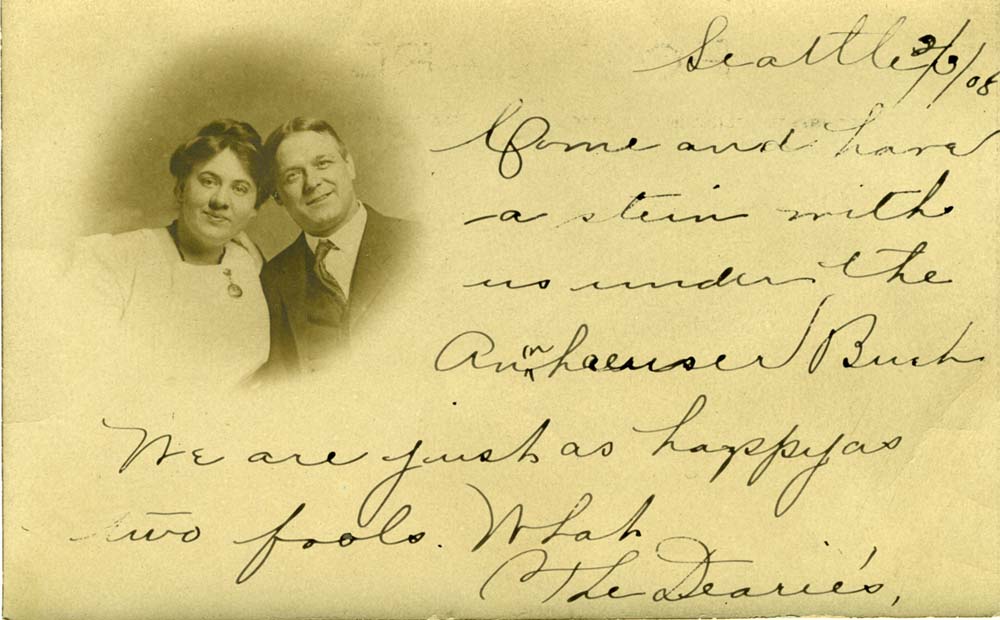
![[If we have read it correctly . . .] Hello Ednah Dear 7/28/14 Nothin like what is on the other side of this card in Albany for I have not seen any one here that would have the nerve to do such. Well dear we made our 11500 test [?] and no one hurt but I was just a little timid in making some of the moved but all over now. Gee I wish you were here no for this AM was trying on your family and everyone is so strang [sic] to me but my (W) B.B. [Top of card] Dear this is one lonesome day for me. How I wish I could see you to talk to you. Your's forever B.B."](https://i0.wp.com/pauldorpat.com/wp-content/uploads/2010/02/valentines-message-web11.jpg "Valentines-message-WEB")


An EDGE CLIPPING as BLOGADDENDUM – a Belated Valentine sans hearts but with fit sentiment and fit timing from February, 1908.


[Click to Enlarge]


Top-to-Bottom, Left-to-Right: (Click to Enlarge)
Blue Angels, Blue Flower, Blue Grass, Blue Leaf, Blue Hair, Blue Madonna, Blue Moon, Blue Jays, Blue Boy (paint-by-numbers), Blues Stage, Blue Mountains, Blue Bottles
Below are several winter colors photographed this day, the 25th of January, 2010, on a short walk of five blocks here in Wallingford. I have named none of them, for the reason, I confess, that I know the names of very few of them. Perhaps you will help with a comment. But how can we indicate them? If I can number them below I will. [Carolyn Honke has sent a few names this way from the Azores, where she lives, and we wil include them.]
[Click to Enlarge]


This found fragment may be a reminder that February has typically been our cruelest month, and it is yet a week away, and looked to now from the warm days that have some camellias opening their red blooms early. A reading of the preserved part of the story above reveals that Olympia had 19 inches, Lake Union had a sheet of ice on it although nothing one could walk upon, Portland was stuck in every way, the farmers in the vicinity of Spokane continued to be isolated from supplies and markets, that Seattle’s birds needed some food thrown their way in such a way that it is not buried by the snow, and that – showing at the bottom of the left column – something has happened to 53-year-old W.M. Littleton. But what? Perhaps some reader will get to the U.W. Library or the Seattle Public Library and search through microfilm for the Feb. 1 1937 issues for The Seattle Star, the Seattle Post-Intelligencer and The Seattle Times and share with us Littleton’s predicament or fate. It might be wise to start with The Seattle Times, then still an afternoon paper.
(We will insert this into our History of Seattle Snows, Part 6.)


[Click Once and Often Twice to Enlarge]
Below is the “base.” It is a detail from a neighbor’s bush that was planted as a screen between the sidewalk and the small house, which is one of the few in Wallingford that has gone vacant because of the burst bubble.
The bubbles – on the leaves – where photographed on an afternoon in the first week of January 2010. Above is a detail from the same plant – or long young hedge – which was chosen because of its “scar.” I use it as a detail in the montage that follows in order to break the regularity of it all. (I see now that I appear hugging my camera in the biggest bubble.) When I learn the more sophisticated powers of “Photoshop Layers” there will be more and less regular opportunities for introducing asymmetry into these montages.
Over the past three years I have done scores of these. Much more than snowflakes they are all very different. And they are all in process – often waiting for irregular and pleasantly confusing layers. In four years of walking the neighborhood almost everyday I have “collected” a large library of subjects that were “captured” for these purposes. Most of the bases are natural and photographed as found, like this one, but a few others I have prepared by arranging sticks and flowers and such with an eye to how they will multiply. But this multiplication is so transforming that really anything will bring forth modest and always, I think, stimulating revelations. As you will note below the more you multiply through successive flip-flops these designs the more they head march towards texture. With one more generation below we have a fabric suitable for a men’s sports coat (at 16,276) and with two more (as yet not rendered) perhaps a formal suit for wearing in tolerant society (65,104). All of them from rain-splattered leaves on an unidentified bush.
Below the scar are the multiplications. The first is a quartet. From there we flip and flop and jump to 4, 16, 64, 256, 1,024, 4096 and 16,384. All have been layered with an asymmetrical piece copied and itself multiplied or flipped (or perhaps flopped) from the detailed “scar” at the top. No. 256, especially, may be imagined as a quilt or a ceiling. Some of this shares the pleasure of making quilts and even knitting – although it is much quicker. Perhaps 65,104 will follow in a moment more idle than this. If it is brought up it will seem to be nearly pure texture in which the parts cannot be seen clearly and are imagined to be in a chaotic distribution rather than arranged. I think. “All will be revealed.”


1024

4096 / This 4096 montage may serve as an hour glass for me – a “Time Remaining” calendar that encourages me to not waste time. Now 71 I could treat the above as a check-off list for time left – if I live as long as my two oldest brothers Ted and Norm and my father Theodore. All three lived to within months of 80. If I count everyone of the gray “hour glasses” in the montage above as representing three days, then I may there both purview and preview the sum I have remaining for abiding here in this often enough happy veil of tears, but only if I am as fortunate as the others and do not stumble into some misery that I would rather escape than abide.

16,384

Here’s a happy story now increasingly told throughout Seattle. The names and places vary but the story is the same, and restoration is always in the title.
In this instance Claudia Levi purchased the Wallingford home seen in the second photograph (below), with a mind to restoring it. She looked no further than the 1937-8 tax photo, printed on top, to determine what her home almost certainly looked like in 1909 when it was built. Some of the original details were hidden under a cedar cladding that had been added in an effort to “modernize.” Other parts had gone missing, but after three summers of work Claudia Levi had her new old home.

Certainly it helped that as a member of the Business Faculty at Edmonds Community College, Ms Levi had economic savvy. And in compliment to her restoration project she also taught a class in using salvage material to rebuild houses.
Claudia Levi’s 1937 evidence (top) comes from the Washington State Archive’s WPA survey of taxable structures from the late 1930s. There is a good chance that Pacific readers living in good old homes that have been altered will find their home “as built” in that collection. Contact archivist Greg Lange at 425 564 3942, and have your home’s tax number or legal description (addition, block, lot) ready. Prepare to restore.


Now the owner-restorer, Claudia Levi, (second from the right, below) adds her own testimony to the joy and work of restoration.
I bought 4719 Thackeray Place NE in 1996. Well, it was really ugly! All of the beautiful exterior trim and detail was removed or boarded over and it endured so for about 50 years, from the 1940s to 2000 when I had it restored to its original facade.
This was a beautiful house when it was built in 1909 and it was pretty much as built still in 1937. After 1940 it lost a lot of its original charm in order to “modernize” for a “cleaner” look. The family that had the house from 1940 to 1992, was the longest consistent resident in the home, and they made a lot of the changes to the house.
One can see in the 1996 photo that the top half of the house was boarded over with dark cedar boards, and all of the original street-side windows were modernized. They put a big picture window downstairs and made the upstairs window smaller to accommodate a big bed under the window. The two oval windows on the sides of the second floor were simply boarded over. Well just about everything was boarded over. I am sure this was done for a heat savings. It was considered “progress.” All of the beautiful trim on the inside was also removed. To restore its original charm the entire home needed work.
As part of the “young-over-zealous homeowner movement” of the 90’s and early 00’s, I brought the house back to its original charm removing its cedar mask. Through multiple visits to ReStore (1440 NW 52nd St Seattle 206-297-9119) and Second Use Building Materials (7953 Second Ave. S. Seattle 206-763-6929) the house regained its original exterior look, similar to 1909. This included replacing both large windows, a new stucco job on the second floor exterior, and a four-color paint job. There was an extensive interior restoration completed as well during this time. The house will surely live another century to outlive me – and well you too!
Happy Birthday, 4719 Thackeray Place! Wishing you another 100 years and more!


(Please Click once and then CLICK AGAIN to enlarge.)
The most likely near-beer toast to Cedar River Water shown and described above is one joyful moment in the history of Seattle’s efforts to have clean water beyond fetching it with a bucket from streams and/or the springs that once flowed from First Hill and have since been redirected into the city’s sewerage system. The limiting date here – ca 1996 – is “confessed” because what follows, with a few small exceptions, is copied from the Building Washington, A History of Public Works that Genny McCoy and I wrote and published in the 1990s. We worked on it for about eight years, and were rewarded with The Governor’s Writers Award for 1999. (Imgaine, the governor hugged us before about 100 admiring book lovers.) Of course, much has happened with Seattle’s waterworks since 1996 (or so) but you will not find that below. Ron Edge – of Edge Clippings – has been speculating or murmuring that perhaps we should make a PDR file out of the entire book. If so we could then try some updates for the subjects – like this one. (One can also check historylink.org and see how they have developed this story.) Some of the photos included here were scanned from the book, others from negatives. It should be obvious which are which. We will begin with Seattle’s first two photographs, which are also waterworks related. This is explained in their captions copies here directly from the book.

HISTORY of the SEATTLE WATER DEPARTMENT to ca.1996.
Seattle’s first Euro-American settlers picked Alki Point for its proximity to salt water, not fresh. From the Point they could see in all directions and there was also a security in being easily seen -especially by other Midwesterners searching for homesteads. But the spit was dry. Within a half year, most of Seattle’s original pioneers fled across Elliott Bay to a hill sprouting with springs. The generous hydraulics of their second choice came from the aquifer that flowed below glacial hills and was replenished by the region’s reliable rain. This easy water helped convince Henry Yesler to set up Puget Sound’s first steam sawmill on Elliott Bay in 1853. (See Waterways Chapter – but for that you will need the book “Building Washington” for now.)
John Leary, a sometime partner of Yesler, was one of a group of local movers who first attempted in 1881 to build and organize an integrated distribution system. The Spring Hill Water Company diverted spring water into a dozen or so wooden tanks along the ridge between First and Beacon hills and laid some sizable water mains beneath the business district’s principle streets. However, the most auspicious moment for the future of community water that year was the September 25 arrival of Reginald H. Thomson. At daybreak the young teacher stepped from the steamer Dakota onto Yesler’s Wharf and was greeted by Yesler himself. Besides his baggage, Thomson carried ashore a predisposition to public service and a fervent belief in the importance of fresh water. “Clean water and sufficient water is the life blood of a city,” he liked to say. “My father drilled that into me.”
In the year Thomson came to Seattle his cousin and host, city engineer F. H. Whitworth, advised the city council that the Cedar River was the best potential source for an abundant supply of pure community water. However, in 1881 the council’s interest in building a water utility was as remote as the recommended river, which flowed from Cedar Lake some thirty-five miles southeast of the city. The council chose to rely on the bubbling wells of Spring Hill instead. With the boom in Seattle’s population throughout the 1880s (and well beyond them) the company’s wells were not enough so it built a pumping plant on the west shore of Lake Washington (now the site of Colman Park), and began pumping lake water to its new Beacon Hill reservoirs in 1886. Still the company could not keep up with the city’s requirements. When its delivery was much less than heroic on June 6, 1889, the day thirty-plus blocks of the business district burned to the ground city leaders responded.

For the price of $352,265.67 the city purchased Spring Hill’s system and the responsibility of supplying its 12,000 customers. The remainder of Seattle’s 42,000 citizens (in 1890) were serviced either from their own wells or by smaller water companies which the city utility eventually subsumed. Shortly after the fire destroyed most of downtown in 1889, Seattle Mayor Robert Moran hired Chicago waterworks engineer Benezette Williams to devise a plan for increasing the city’s water supply. Williams warned against relying on merely adding more pumps at Lake Washington. The lake was already showing signs of pollution. The new municipal utility installed another pump at Lake Washington anyway. R. H. Thomson became city engineer, on June 1, 1892. He forbade expansion of the Lake Washington plant and put his formidable will to the task of bringing Cedar River water to the city.

During the summers of 1893 and 1894 Thomson and an assistant made several trips on the night train to Maple Valley. There they unrolled their beds in the woods and rose with the light to tramp along the line of Benezette Williams’s proposed gravity line. Persuaded that Williams’s plan for an open V-shaped flume was “very bad engineering” as well as unsafe and unsanitary, they rough-sketched a route for a buried pipeline. However, Thomson’s plans were soon buried below the hard times of the Panic of 1893. Two years later relief came from an unexpected source. Funding problems were resolved after the state Supreme Court approved the city of Spokane’ s proposal to rebuild its water system with revenue bonds redeemed solely through water utility receipts and not from the city general fund. Using the Spokane model, Thomson and his assistant, George Cotterill, wrote an ordinance for a Cedar River system to be paid for by revenue bonds. The new bonds, however, required voter approval. A contemporary characterized the election that followed as “waged with a fury scarcely equaled in any other campaign that the city has experienced. ”
Support for Thomson’s plan came from a combination of Progressives and Populists. The opposition was led by eastern capitalist Edward Ammidown. Allied with several prominent Seattle businessmen Ammidown incorporated the Seattle Power Company and proposed to build a Cedar River system that would then sell its water to the city. The well-funded privatizing forces hired bands and speakers and hurled accusations of socialism at the public utility advocates. Federal judge J.J. McGilvra, a Lincoln appointee and respected Seattle civic leader, published a letter in the Post-Intelligencer supporting Ammidown’ s plan and urging a nay vote on city ownership. This apparent setback set the stage for Thomson’s strategy. Pioneer Seattle historian Clarence Bagley noted Thomson’s “masterful fighting” qualities, and the engineer’s assistants said he hunted “with a rifle, not a shotgun.”

Thomson set his sights on McGilvra. After several meetings with the city engineer, the judge ten days before the election wrote a second letter to the P-I, calling for approval of the bond issue. McGilvra then paid for the bands and speakers supporting public water. The combination of populism and respectability won the day with 2,656 votes for the measure to 1,665 against. As Thomson’s assistant George Cotterill later noted, “What we accomplished here in 1895 …within a few years every state did the same. Hundreds of millions of utility bonds were issued, interest rates were lowered, and utility bond investment was among the safest and most desirable.”
When Thomson and Cotterill emerged from the Cedar River watershed with their completed surveys in 1897, the city was alive with the stimulating effects of the Klondike Gold Rush. The following year the city acquired Landsburg for the site of its supply intake. (Shown above with Thomson’s portrait.) The timber-crib dam there was constructed on concrete piers set at an elevation of 536.4 feet, a head high enough to carry water by gravity twenty-eight miles to the city reservoirs at Volunteer and Lincoln (Broadway Playfield, Carl Anderson Park) parks on Capitol Hill. From the headworks the water was delivered a few hundred feet downstream through a 54-inch pipe to a settling basin where the flow passed through screens, initially operated manually, to remove coarser materials like sticks and leaves. Over twenty-two miles of the pipeline were constructed of wood staves bound with threaded steel bands of the latest design.

On the first of May 1900 the Seattle City Council made an all-day inspection tour of the system’s facilities. The paused in Volunteer park for lunch on tables, inspected the work underway there on the high reservoir, and then proceeded to Queen Anne Hill for a look at the standpipe there. As we know from the top, two of them also at least pretended to test the Cedar River water while visiting the standpipe. They then went on to Kinnear Park to study its rustic mushroom and rest on the grass.


On Christmas Eve, 1900, the system tested so satisfactorily that on ]anuary, 10, 1901, the waters of the Cedar River were let loose into the Volunteer Park reservoir. After a decade of riotous development, during which Seattle’s population grew from 80,000 in 1900 to nearly 240,000 in 1910, a second pipeline, which paralleled the first, was added in 1909. With the two mains the Cedar system capacity increased to 67,269,000 gallons a day. Two additional city reservoirs with a 110 million-gallon combined capacity were also built atop Beacon Hill.

In 1928 the Seattle utility began diverting Cedar River water to the 500-acre Lake Youngs (formerly called Swan Lake and named for Water Superintendent L. B. Youngs), seven miles west of Landsburg, for settling and storage. The following July Seattleites complained about the taste when the heavy summer draw lowered the lake level and raised its temperature. Eventually, a pipeline was added, which allowed the utility to bypass the lake when the river waters were cool and clear and did not need settling. From Lake Youngs, water was sent through the system control works where it was screened and chlorinated before being delivered to its users.
In 1923 the city completed a third Cedar River pipeline that ran parallel to the first two. A fourth line was dedicated in 1954. Its path was entirely separated from the first three lines, in part as a precaution against any disasters that might sever the triad of pipes that ran through Renton and up and along the ridge of Beacon Hill to the city reservoirs. The fourth Cedar River line, or the Bow Lake Pipeline as it was originally called, entered the city from the southwest after running west from the control works to near Bow Lake in the neighborhood of Sea-Tac Airport.

Getting water to Alki Point and the rest of West Seattle was still a problem sixty years after most of the first settlers left. West Seattle was annexed in 1907, following proclamations that the two communities were “plainly designated by nature to form one community.” However, the Duwamish River, which at the time was being developed into the Duwamish Waterway, inhibited the transport of Cedar River water to the annexed neighborhoods. The swing bridge over the Duwamish, built for wagons and trolleys in 1910, also carried the city’s main water lines to West Seattle. The effects on West Seattle plumbing were easily calculated. Whenever the bridge swung open for a boat or barge, the taps of West Seattle went dry. This intermittent service continued until the bridge was scrapped in 1918 and the mains submerged beneath the river’s traffic. The underwater solution was improved in 1924 when an 8-foot, concrete-lined tunnel was dug beneath the river and a steel main with walls three inches thick was laid within it. The desire for Cedar River water also figured prominently in Ballard’s annexation in 1907. In the “Shingle Capital of the World,” the campaign for “pure and sufficient water” was helped considerably when a dead horse was found floating in the Ballard reservoir on the eve of the election.
More water had to be crossed in the city’s extension of service to neighborhoods on the north shore of Lake Union. A pipeline from the Volunteer Park reservoir was run across the old Latona Bridge, which spanned the lake’s narrow neck to Portage Bay in line with the future 1-5 Ship Canal Bridge. Beginning in 1911 an extension of Cedar River Pipeline #2 was carried parallel to the Latona bridge on its own timber-pile span until 1916, when nearly 2,000 feet of 42-inch steel pipe were laid through a concrete tunnel built beneath the lake at the same passage.

In 1906 the City of Seattle made a widely unpopular decision to allow the Milwaukee Railroad to run its electric line to Snoqualmie Pass twelve miles through the lower Cedar River watershed. Five years later on the Sunday morning of November 19, 1911, the church bells of Renton called not for worship but for escape, sending its citizens scurrying for the hills. A warm Chinook wind released a downpour which swelled the river and undermined the bridge that carried the two Cedar River pipelines just downstream from the Landsburg intake. The railroad construction along the river was determined partly responsible for making the pipeline’s own supports vulnerable. The collapsing bridge broke open both pipes, adding their volume to the already overflowing river and flooding the valley.


A water famine in Seattle followed. Citizens were encouraged to fill their bathtubs with lake and rainwater and the health commissioner’s precaution “BOIL YOUR WATER” blazoned across the front pages of the dailies. Since the limited supply in the city reservoirs was released only to the business district, entire families from more affluent neighborhoods fled their homes for downtown hotels. Schools closed for want of steam heat, and on Wednesday 2,000 bundles of Seattle’s dirty laundry were shipped to Tacoma. By week’s end water department crews had restored the pipelines.
In 1936 city officials applied for the water rights to build two reservoirs on the Tolt River. But it was almost twenty years later that the utility actually prepared to tap the river. In 1955, 650,000 people were being served by the Seattle Water Department. Water Superintendent Roy Morse-calculated that the Cedar River would be pushed to its capacity by 1970, and by 1980 about 900,000 people would be using the system. A second major source besides the Cedar would have to be used. Once the city council was convinced, it went ahead with development of the Tolt. In 1963 the river’s waters began flowing through the 25-mile Tolt River pipeline. As it turned out, Morse’s predictions were about right. In 1989 the Tolt and Cedar rivers together served over one million residents in an area whose size had grown to nearly 450 square miles. As parts of an integrated system, the two sources, plus a small amount pumped from the Highline Well Fields, could deliver up to 350 million gallons a day in 1990.

Seattle’s water system includes Bellevue, Kirkland, and Redmond, together with a number of other cities and water districts. Each community acts as a separate purveyor purchasing water from Seattle, the wholesaler, and reselling it within its service area. Although Seattle aggressively pursued water customers to the north, the city had to be wooed for nearly thirty years to supply the Eastside. In 1937 Eastside residents petitioned the city council to allow them to connect into either the Tolt River or Cedar River lines. The construction ofa pipeline from the Cedar would have involved no insurmountable engineering obstacles. (The’Tolt waters were still a quarter century from being tapped.) But the Seattle City Council didn’t think there was enough population to support the service, and not even the prospect of $900,000 in federal employment grants persuaded them to build the connection.
Eastside residents themselves were ambivalent about requesting the gravity system to supplant their wells. In a 1939 election a new water district, which included Bellevue, voted 891 in favor and 899 against requesting Cedar River water. Seattle’s relaxed water department superintendent, W. Chester Morse, remarked, “Take as much time as you want. Every month’s delay saves this department over $15,000 dollars. We certainly are in no hurry.” Ultimately, the utility would change its mind as postwar growth brought increased water needs to the Eastside. Three years after he succeeded his father as superintendent in 1949, Roy Morse advised the city to speed its development of the Tolt River, in part to supply the Bellevue area. In 1963 that community came on line with the Seattle system’s new Tolt pipeline. Eventually, the Tolt Eastside supply line was connected with a new Eastside line laid from the Cedar River at the pump station in Bellevue’s Lake Hills district. In 1998 construction began at a 25-acre site overlooking the South Fork of the Tolt River on a filtration plant capable of filtering 120 million gallons of water a day when it opens in late 2000.
With the considerable population growth that occurred in King County by the 1980s, Seattle water department officials quickened their search for new sources of supply and their investigations into conservation methods. In 1985-86 the water department tapped its Highline Well Fields for a ready daily supply of 10 million gallons. Typically this new source was used only during the dry summer season when the average daily demand of 170 million gallons could rapidly inflate up to 300 million gallons. Restraining the public’s wasteful over-watering of residential lawns became the key to the utility’s development of a conservation program.
During the drought of 1987, the utility was forced to innovate when the level of Chester Morse Lake (Cedar Lake) dropped below the elevation of 1,532 feet – the minimum level for moving lake water by gravity. Department officials outfitted a barge with a pumping plant capable of moving nearly 120 million gallons a day from the lake into the lower-elevation pool behind City Light’s masonry dam from which it flowed into the system. The experience resulted in plans for installing a permanent on-shore version of the barge-mounted pumps. The Cedar Watershed is capable of supplying a volume considerably greater than that which it now delivers through the four Cedar pipelines. However, fish using the stream to spawn could be adversely affected, and new transmission lines would be needed if a permanent deep-water pump at Chester Morse Lake were to be useful year round. Two other possibilities for increasing supply are to add a filtration plant to the Tolt River system, making it usable during periods when heavy runoff makes the water turbid, and building a second intake on the river’s north fork.
However, even during the more severe drought of 1992, department spokesmen admitted that any such expansions were at least ten years away. In the meantime, Seattle and other Puget Sound area water departments and districts hurried work on their conservation plans as they implemented drastic conservation measures, such as a total ban on lawn watering. The reuse of treated waste water and the distribution of low flow shower heads were just two of the measures Seattle officials promoted as a way to save the 47 million gallons a day the department needed to conserve through the end of the decade.
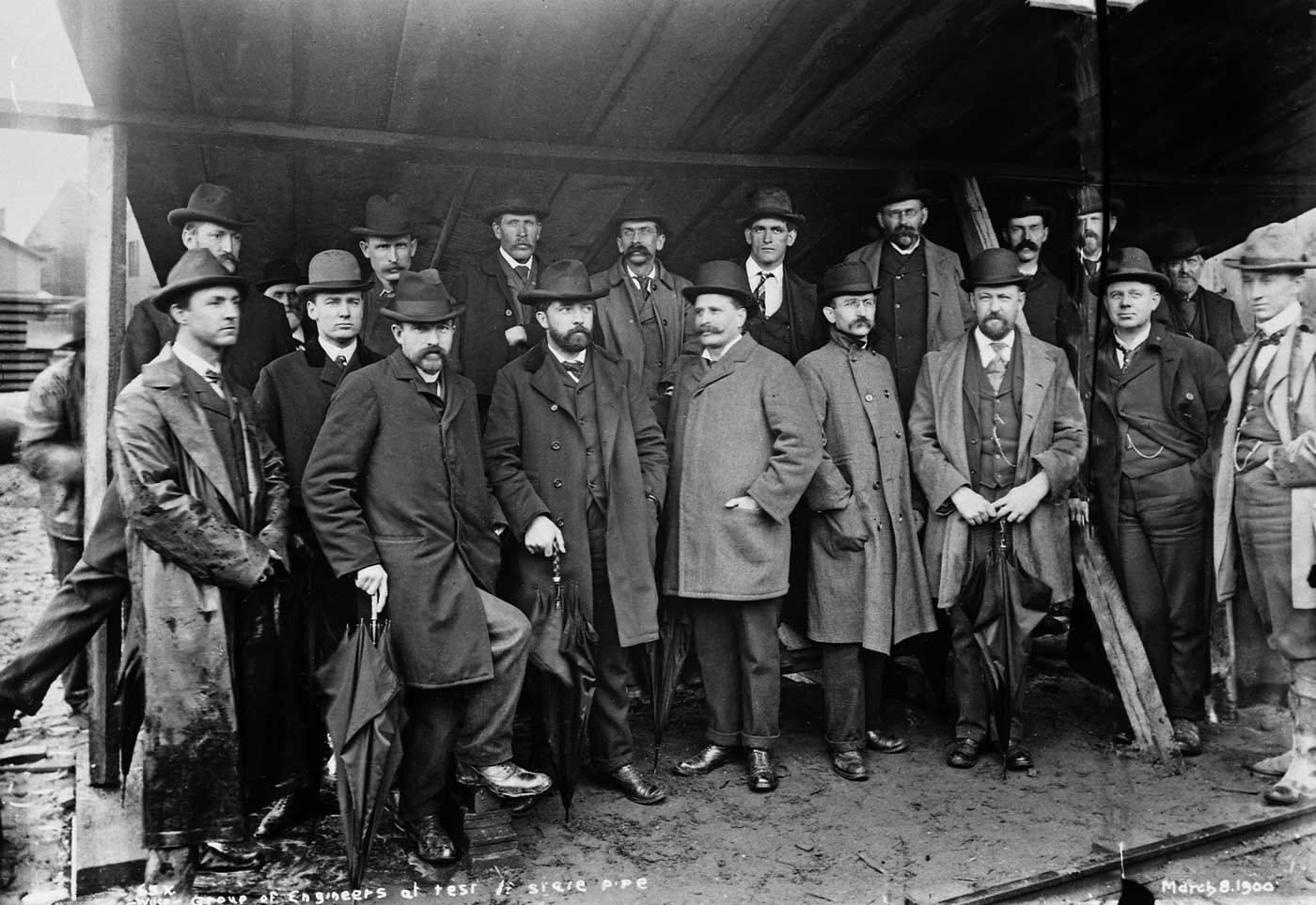
The following photo and its repeat directly below are one of the many comparisons Jean and I make in our book “Washington Then and Now.” It is described in greater detail on its own webpage and also appears in the “store” we have buttoned on this blog


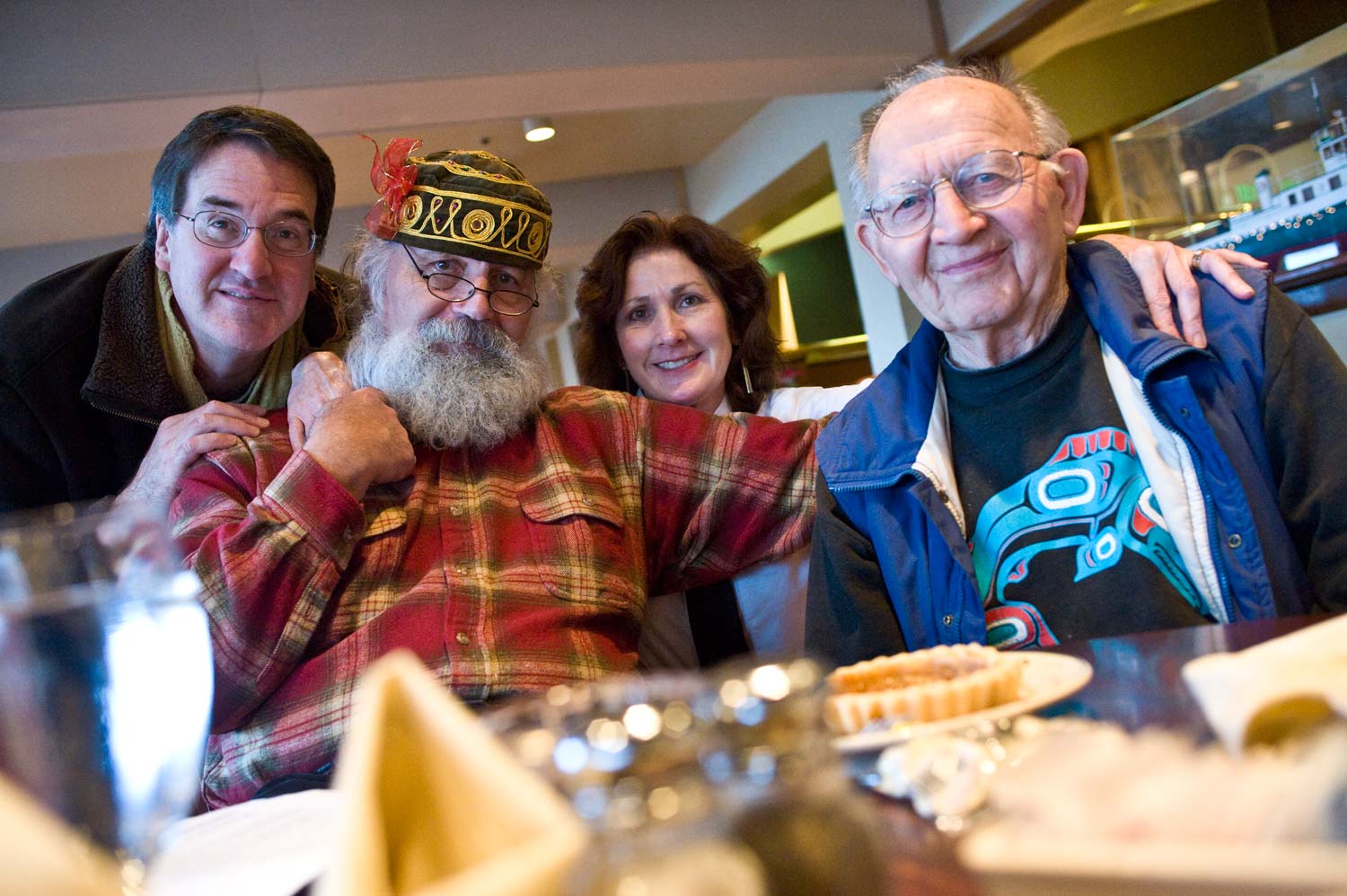

(Click these cards once or sometimes twice to ENLARGE.)


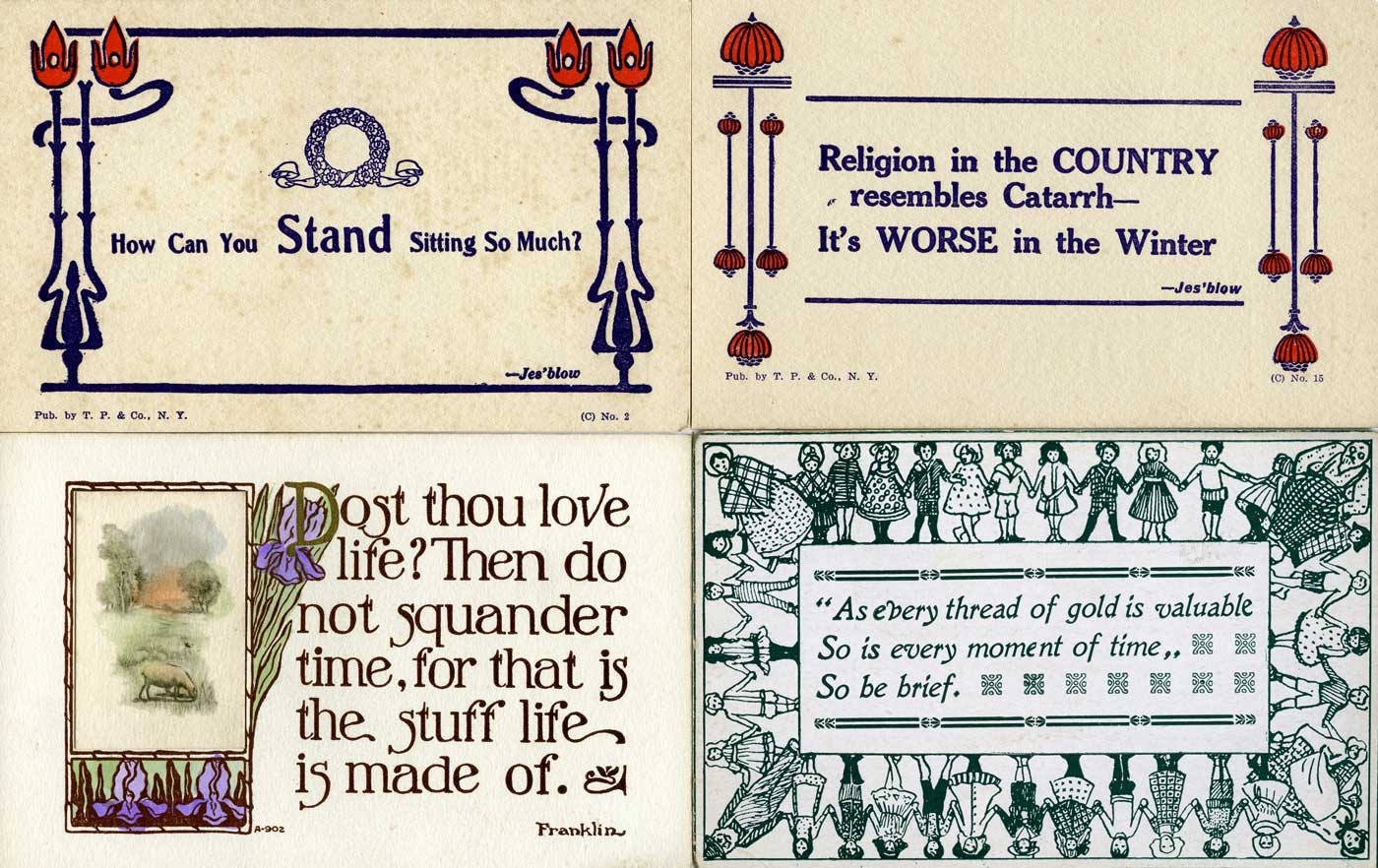


Here’s a double rarity for this media. The attached is not from Ron Edge’s “clipping service” but from a microfilm reader at the U.W. Library. The reason for sharing this page from the Jan 10, 1902 Daily Bulletin (a Seattle tabloid “devoted to Courts, Finance, Real Estate, Building and All Industrial Improvements”) is its clue to contemporary politics, which can be read directly below the part marked with a translucent red marker. It expresses a sentiment that comes out of the joy of war got for Hearst and Roosevelt (representative citizens – pars pro toto – then for the nation) by beating up on Spain and the Philippines and so exhilarated the nation and brought such confidence that it was ready and eager for more broad-shouldered foreign jarring – or “big stick” jousting – in the name of “20th century progress.” This was the first bloom and blush in the courtship of government and industry that soon gave birth to what we now call the “military industrial complex.” Those that recall their world history will remember that 1902 was in the thick of the Age of Imperialism. We never left it.
(Double click to Enlarge)


For the occasion of this Christmas 2009 Ron Edge has pulled out the full four pages of Seattle’s Evening Dispatch for the Monday Evening of Dec. 24, 1877. For those with the steady temperament to insert themselves into a small community of well under 4000 citizens – and yet still with five churches and many more bars – a close reading of these pages will take them away.
The Dispatch was not the first newspaper in Seattle, but it was an early one. Clarence Bagley, the pioneer Seattle historian described its editor, Beriah Brown, as “one of the old school of newspaper men, a writer of editorials worthy of the great papers of the United States. He was a friend of Horace Greeley . . . His custom was to go to the case and put his articles in type as he composed them. It is hard to comprehend the difficulty occasioned by the dual processes of thought this brought into play.”
We will include now all four pages of this Dec. 24, 1877 issue, and separate them by short notices of some of what we found on each page. The reader may, of course, skip our comments and go directly to Brown’s Dispatch.
First – the first page.
In 1877, Christmas fell on a Tuesday. This made the call for profound messages especially taxing on the small community’s several preachers. They could not very well avoid the Christ Child with their Sunday the 23rd sermon, but they then would also be expected to come up with new materials, and roughly on the same subject, for Christmas Day services. Rarely, of course, did they have “new material” but were skilled for the great part in the twisting or adjusting of the old stories – most of them from the Bible. Still if you read the Page One Evening Dispatch accounts of some of Seattle’s Sunday services, you will find differences of tone or emphasis in how, for instance, Rev. D. Bagley of the “Brown Church” and Rev. I. Dillon of the “White Church” and visiting Congregationalist Rev. W. Steward handle their subjects. J. Ellis, the local Congregationalist, also took to the pulpit, Sunday evening. (The Baptists, Catholics and Episcopal churches were noted in other reports.)
Of these four, it was Steward, the visitor from the north, who after warming up gave the best example of a fire and brimstone sermon noting that “commonsense, sound philosophy and our home experience unite, in tones of thunder, ‘that heaven is no place for the ungodly. The very thought of the atheist, the Deist, the liar, the murderer or blasphemer going to heaven is absurd. There is nothing so much out of place and unfit, that would be justified for a moment by any respectable tribunal on earth, much less in the court of heaven, where nothing that defileth or maketh a lie can enter, and where ‘Holiness if the Lord’ is the imprint on every commodity.” Commodity!? Jumping forward to page three, we learn that Steward when relaxing with a cup of tea in the living room is a kindly “84 years of age. He is visiting with Dr. Weed, Mrs. Weed being his niece. Mr. Stewart has been an extraordinarily temperate (non-drinking) man all his life, and consequently is now in the enjoyment of a serene, healthful and happy old age.” (You will find an advertisement for Dr. Weed, Steward’s host, on page three below.)
It was Ellis, the other and younger Congregationalist, who was kinder to mankind – and progress too – with his sermon. Ellis told his congregation “Well, one thing is assured: (The coming of the Christ Child) is not a bolt from far aloft shot athwart the pathway of the race to smite it and cut if off from its onward march. Christ is not a force antagonistic to man – He is Man Himself. He gets the momentum of humanity, casts himself into a stream of life and comes to the surface a Babe!”
Also on page one and nearly directly to the right side of Dillon’s sober description of mankind is Fred Gasch’s announcement that he will open his “New Beer Hall” on Front Street (First Avenue) next to the North Pacific Brewery, and so also near the waterfront foot of Columbia Street. And for joyful encouragement Gasch includes in his advertisement his own sermon, of sorts, a rhyming one in song. It goes . . .
Come to the Fountain to-night, boys, / And fill with foaming beer. / What if your heads get light, boys, / The pleasure of life is here. / Eat, drink and be merry today, boys, / The old-time philosopher said, / Then go to the Fountain and stay, boys, / Till the shadows of the night have fled.
Compared to Gasch’s New Beer Hall, William Lawrence’s Office Saloon and Billiard Room might seem a bit swanky. It was on the south side of Mill Street (Yesler Way) opposite Yesler’s Mill. “It is the place to get genuine J.H. Cutter, Old Golden and Gaines’, Old Hermitage Rye Whiskies, Three Star, Hennesy, and Martell Brandies, and the Best Wines and Cigars; also to have a game of Billiards on a first-class table. We have a number of private Club Rooms for accommodation of guests.”
One more mention for Page one. The Seattle and Walla Walla Railroad is listed with a charming little graphic for the train, and a schedule for its Seattle-to-Renton runs. Of course, not once did it make it as far as Walla Walla.
(Please DOUBLE-CLICK to enlarge to a readable size.)

Page Two
At the top of page two the Evening Dispatch’s editor, the crusading moralist Beriah Brown, with an editorial on “Political Fault-Finders” makes an analysis of Pres. Hayes administration’s failure, in spite of promises, to replace the spoils system with an apolitical civil service administration. Page two is also stuffed with advertisements including one for the watchmaker, jeweler and engraver Charles Naher, who is also selling the “largest and best selection of Musical Instruments in the Territory and will be sold at reduced prices. The public are invited to call and convince themselves.” The editor appears again on this page with “news” that he is the proprietor of patents of California, Oregon and Washington Territory for the “Great Invention. Lockwood’s Portable Steam Oven. The Best Cooking Utensil Ever Invented. Burning or Scorching of Food Impossible.” As witness to the still small size of Seattle, L. Reinig, a well-known pioneer baker, promised groceries, provisions, fruit and vegetables, bread, cake, crackers and goods delivered to all parts of the city free of charge.”

Page Three
So much of page three is simply a “good read.” This begins with the far left column under the heading “The City, A Merry Christmas” and its spirited report on what to expect with Christmas, 1877. The page includes a number of shorter reports including one about a tunnel being built below Washington Street near Third Avenue in order to re-route spring water from First Hill directly to the tideflats rather than to the basements of the the homes and establishments in that often sodden part of town south of Mill Street (Yesler Way). Page three shows a number of notices – e.g. T. Couter asks that “all persons are hereby requested to call and pay up, as I need the money to pay my bills by the First of January. ” It includes a complete – we assume – list of “Hotel Arrivals.” There are also more church announcements and one report of a street corner religious service with an assembly of doubtful believers. When the service was interrupted by a “bunch of fire-crackers” the paper concluded that this “mischief was probably the work of a hoodlum as there were a number of them in the congregation at the time.” And page three also shows more small advertisements, although not as many as page two.

Page Four
Page Four features more small ads – always enlightening of the times to read. The biggest among them is for Steel’s Pain Eradicator, which is described as “The Most Wonderful Discovery of the Age.” The jumbled lesson of this medicine is “The World moves, and unless we Progress we must go Backward. Nothing remains Stationary.” The producers claim no intention “to deceive the people” that their medicine is “a cure for every complaint on earth; but a really scientific article of the greatest merit, which will prove a boon to suffering humanity – both on account of its adaptability to both man and beast, [this part an appeal to farmers] its readiness of application, and the price being within the reach of all.” The list of “aches and pains” for which their solution is a great eradicator is wonderful – from “lameness” to gout and “soar throats.” (Persons who believe that such grandiose advertising is no longer possible are invited to listed to Seattle’s own KING FM through a few ad breaks.) For those Dispatch readers whose pains were not eradicated by this or any of the other promising solutions from bottled beer to Dr. Goulard’s “celebrated foot powders,” another ad on page four for John Keenen’s Seattle Stone Yard offers headstones and tombs.


We follow Shaw’s Christmas afternoon snap of Violet with three more scenes he photographed in December 1979. None of them are descernibly cheery.


One more Frank Shaw contribution, and this from 1976.


Ron Edge comes forward with a few Christmas related “clippings” from his collection. They start boldly with three front covers for the once popular and studied Argus Christmas Issues, these from 1903, 1904 and 1907. At 25 cents a copy it was not cheap, and note that by 1907 it had doubled to four bits i.e. 50 cents. The weekly Argus began publishing in the 1890s and continued on as a respected and influential journal of local politics and culture. The last I remember of it is from the 1970s when the then adolescent weekly – The Weekly – made it hard for the old and stiffened Argus to keep up.
(Remember: CLICK to Enlarge.)


Next Ron Edge shares a few clips from the Bon Marche as Santa sanctuary early in the 20th Century.


Every new “big thing” like Northgate needs “the biggest” of something, and the northend mall found it’s.

Most of the postcards shared here – and often with their messages – were published in the first years of the 20th Century. With few exceptions they are of the “divided back” variety, meaning that the side for writing was flip to the art side, and that the writing side was divided between a message portion – usually on the left – and a portion for addressing the card and attaching the stamp. These divided cards were first allowed in England in 1902, followed by France in 1904, Germany 1905, and the U.S. in 1907. It will be possible to search out the postmarked date on many of the cards below. Many perhaps most of the better cards – like these – were published in Europe, and German cards were generally thought to be the best. I have a few hundred cards stacked in boxes and it was a delight to pull a few out for this little exhibit. After stamps and coins, postcards are the most popular of collectibles. The formal name for this – sometimes mania – collecting is deltiology, a name derived from Greek word for “writing tablet.”
(Please CLICK to enlarge)


About 105 years of Christmas trees divide the two living-room scenes above. The top Brown Home “set” – Brown was a skilled amateur photographer and almost surely designed his subject for his shot – can be compared to Bruce’s tree above, although in the latter the gifts have not yet been opened to spill their toys and such. It will be worth your while to double click the Brown living room to examine the surely typical gifts, like a drum for the son (or daughter), an elaborate doll table with tea serving and sumptuous doll bed besides, a carving set for mom (or dad) and much else. And also note the family photos on the wall, the variety of ornate framing then popular, and the painting of Snoqualmie Falls, upper left. Hereabouts it was then a popular sign of the sublime.
Next. When visiting my “just down the block” neighbor Bruce yesterday late afternoon and his family tree I was struck by the surreal qualities of its lights and compliment him on them. Remembering the Brown set (above) I asked Bruce – known for his wit – to recount whatever decisions may have been involved in purchasing that tree and those lights. Here is his response. Enjoy with good will.
Hi Paul-
Sorry I didn’t get this to you last night… I fell asleep while putting my daughter down. A common problem for me.
First something about the tree. One of my favorite holiday traditions is the annual series of Christmas tree debates that ensues between my wife and I. Most families simply have the traditions of procuring their tree, and trimming them in some sort of familial, time honored fashion. But in my family’s Christmas traditions, there are three pillars that are the foundation for our holidays. 1. What we did last year, or on any other year in the past, will have no bearing on actions taken this year. 2. There will be much discussion, aka debate. 3. And most importantly, I will purchase more, new and different Christmas lights each year.
As for the tree itself, my wife grew up in the South Pacific and as such always had a fake tree. Please note the use of the word “fake” verses the manipulative term, “artificial” which my wife likes to use. It was a necessary tradition born from the complete lack of any pine or fir being indigenous to the island where she lived. Needless to say, my wife regularly advocates for a fake tree, stating unverified environmental benefits and ease of installation. Of course I, born a Protestant Norwegian, need to remind her, born an Agnostic Swede, that if you don’t work hard and suffer for something, it is not worth doing. As such, fake trees have less value because they are so easy to “pop up”.
Now because we have yet to settle this little matter and because we must return to the topic each year, the tree itself changes each season. Do we cut from the forest, do we cut from a farm, do we go to a tree lot and if we go to a lot, which one, benefiting what organization?
In case you are curious, this year is a 7.5 foot Noble Fir from Hunters tree lot in Wedgwood. No charity benefits from Hunters but they have really nice trees.
Similar, but more robust is the great Christmas tree light debate. I grew up in a home in which the Christmas tree bore the warm glow of all red lights. As a child I recall thinking it was like the glow of the fireplace fire illuminating our entire tree. My wife… My wife… I actually don’t know what type of lights she had on her tree. I only know that she is of the opinion that all red lights on a tree cast a brothel inspiring, red light district effect. So the debate that ensues is simple but endless. I would like to continue the traditions of old with a tree all in red and she…. Would prefer not.
The bi-product of this debate is my annual pilgrimage to the hardware stores looking for some new or better string of lights that I can hang in the hole left in my soul, from where the red lights used to glow. My garage is a graveyard of old lights from Christmas past, large and small, ceramic and glass. I have flame tip, berry, and gum drop. Spanning from all white, to specific sequences to completely random color combinations.
This year I boldly grabbed the latest and greatest, the newest light technology, the L.E.D. (Light Emitting Diode). They were billed as “jewel” tones that are safer, last 5X as long and use 1/12 the electricity. They were also 3X more expensive and remind me of the neon colors, so popular in 80s fashion. Interestingly, I’ve been advised by multiple people they simply have too many of the wrong color. The problem is that if I were to add the colors that everyone has advised, I could simply buy another string of random bulbs. So far it has been suggested I simply need, more green, yellow, white, blue, orange and yes of course, red.
Suffice it to say, while Christmas may yet be 4 days away, next years debate has already begun with my wife’s traditional first voile, “I want to talk about a budget for your Christmas tree lights”. To which my traditional return sortie comes, “Don’t the red lights have an especially nice warm glow?”

(click to Enlarge)
This “Edge Extra” was supplied – again – by Ron Edge. It is surely one of the earliest views of the completed Chittenden Locks. The grounds are still being prepared for the lavish garden that would follow. It was taken from the then new Great Northern Railway’s bascule bridge. Beyond the locks the Ballard waterfront clutters the north shore of Salmon Bay, with the “Ballard skyscrapers” at the Seattle Cedar Mill top-center. The long north-south line of the Ballard Bridge on 15th Ave. N.W. extends to the right of Seattle Cedar’s stacks. The bridge was completed in time for the formal opening of the Lake Washington Ship Canal on July 4, 1917, so it is here still a work-in-progress.
Near the center of this “real photo postcard” are all the buildings noted or “implied” in the historical scene included directy below this one, which is dated “1916.” That view looks in the opposite direction as this and includes a glimpse of the GN Bridge from which this scene was recorded. Fresh water is falling from the spillway far right, consequently this view was photographed sometime after July 25th 1916. The gates were closed to the locks on July 12 and it took thirteen days for the water level of Salmon Bay behind them to reach that of Lake Union. It required another three months to lower Lake Washington about 9 feet to the level of Lake Union. The big lake was slowly released through a temporary lock at the east end of the Montlake Cut.
This view to the east was photographed earlier than the one directly below, the one that looks to the west. Here the little grove of evergreens planted on the grounds mid-way between the Lock’s principal structures and the chief engineer’s home is not yet in place. A different grove, one of pioneer farmer Ole Shillestad’s apple trees, can be seen far right on the south shore. It is directly below the largest of the structures on that shore. The trunks of some of these trees are submerged in the rising waters, and you can see their shadows on the water. The last apple crop – the one of 1916 – was picked from a rowboat.
(Someday, perhaps, Jean, who has no fear of heights, will venture out on to the Great Northern bascule bridge to repeat the historic postcard scene above. It will be tricky. Ordinarily the bridge is up to allow ships first right-of-way. The bridge is closed for trains only when needed. Consequently, with the bridge down, Jean will need to watch for trains. He may feel differently about those, I mean differently than his attitude to heights.)

This small collection of seasonal kodachromes were photographed by Robert D. Bradley, who at least for part of his working life performed as a professional photographer. In the 1930 census he is listed as such, and in the 1938 Seattle City Directory (by Polk) he is listed living with his wife Hortense in the lower Queen Anne neighborhood and working at the Hart Studio, which is described as his. It was located on Second Avenue, near University Street, the site now of Benaroya Hall. In the mid 1960s the couple moved to the then nearly new Lamplighter Apartments on Belmont Avenue just south of Mercer Street. Their home was on the 9th floor with a balcony view that swept from the north end of Lake Union to the central business district. Bradlely took many slides off that balcony – lots of them sunsets. The view above is an exception. The subjects are the lights of his neighbor’s, the Millers, Christmas tree (we assume) as they are refracted through the glass giving transluscent privacy to the two balconies.


Robert Bradley was generally good about naming and dating his subjects. With both views above he has put his camera against the glass front door of Frederick Nelson Department Store to give us after hours “architectural views” (sans people) of the department store’s Christmas decors for 1957, top, and 1966, above.
On December 22, 1948 Bradley visited the intersection of Meridian Avenue and 45th Street in Wallingford. He stood on the south side of 45th and looked west across Meridian. Both streets – and so also the intersection – were “ordained” long before they were developed. They were meridian lines for the first federal surveyors who dragged their “Gunther Chains” through the forests hereabouts in the 1850s. Late this afternoon of Dec. 10, 2009 I repeated Bradley, and include that “now” directly below his scene. The obvious change is at the northwest corner where Murphy’s Pub now takes what more than one retailer ago was Davison’s Appliances. (It was there that Ron Edge – of our
“Edge Clippings” – discovered that the Zenith model 12s265 – the radio that started his now impressive collection of antique radios – was repaired. It still has a Davison sticker attached.) Not so obvious but still remarkable are the street Christmas decorations. They were quite elaborate in the earlier view, but 61 years later hard to find.


Bradley also visited the University District on the 22nd and took the view directly below. It looks west, again on 45th and this time through its intersection with 12th Avenue. As with the Wallingford repeat above, my “now” was photographed this afternoon of 12/10/09 – moments ago. (I live nearby.) Respecting the traffic, I stayed on the sidewalk.


For the remainder of the Bradley Christmas tour we will follow closely to his own captions and attach them to their “picture frames” as he did to his cardboard slide holders. Actually, he also indicated often the time of day, the camera he used, and both its shutter speed and F-stop. With one exception below we will avoid those. For the most part these are slides are submitted randomly, which means however the program that ordered them slip them to us.


We conclude our exhibit of Robert Bradley’s seasonal slides with two, above, of the Bon Marche’s well-loved stories-high illuminated hanging at the northwest corner of 4th Avenue and Pine Street. The first of these two was taken on Dec. 19, 1956 when the “star tradition” was still a star-topped pagoda-style Christmas Tree tradition. By Dec. 18, 1967, the date of the subject directly above, the full tree had given way to the star alone. This more distant view also includes a peek into a Frederick and Nelson Window on the right, which may be compared to the interior F&N decorations included near the top.
THE HUMAN BRIAN: the great organ of perception. It’s brains this way and brains that way. Everywhere there are brains. Not every reader of this weblog will want to go further into the reflections of noted Morphologist-Professor John Sundsten. As with any text in neurology this is not ordinarily easy reading. However, for this blog only, the good professor has included revealing illustrations and most of them, thank god, are merely analogies. Our fine anatomical explorer offers heartfelt alternatives for both new age readers and others who hope that modern brain science might offer some relief from both mankind’s anxieties of concern and its frequent stupidity. (I for one will be studying this for any clues on how to prevent cats from peeing on the furniture.) This compassionate lecturer also respects the early efforts of Phrenologists and their detailed study of cranial bumps, and again notes several correlations in characteristic faculties between the findings of modern neurology and those bone topographists. Our steadfast professor makes note of some other charming coincidences. You will, we feel certain, be surprised to learn that there are many fine correspondences between the overall shape of Green Lake and a cross-section of a human brain. In appreciation for this gift we will also include a few more Sundsten Snapshots from his walks around the lake. And we will conclude with a revealing exposition of the morphologist as bird watcher titled “Fourteen Ways of Looking at a Blue Crane.”
For the neurology lessons that follow you may wish to draw a cup of tea – mint perhaps – and find a comfortable chair for you, your laptop and your cat, if you have one. What follows is mostly Sundsten, unless it obviously is not. John Sundsten’s own exposed head has been used for this illustration.
[Remember – CLICK to ENLARGE.]

A recent study of the effect of whole brain Transcranial Magnetic Stimulation (TMS) with laser guided stimulating technology (GST)* has been proposed. It was suggested that by tracing a laser-guided stimulating magnetic beam around the Chakra patterns affixed to the head, results on behavior and or the relief of medical symptoms might be achieved. One part of the study intends to determine whether laser-guided TMS to the whole brain through the crown Chakra pattern (Skrt … Sahasrara), the round symbol at the top of the head, could expand consciousness, possibly opening awareness into a more spiritual global sense. On the other hand, TMS through the head-placed symbol of the root Chakra (Muladhara), the symbol at the top left, was proposed to test its effect on lower back pain and sciatica. One Yoga instructor suggested that perhaps the brain itself houses the energies, initially proposed by practitioners to flow through the traditional Chakra sites at various body levels; eg, crown chakra at top of head, and root chakra at base of spine. Thus the investigators would be activating, or releasing such energies directly at deep brain sites, instead of by traditional meditative techniques. (*It will not be necessary to warn readers against trying this guided stimulating technology (GST) at home for it is not yet available – anywhere really.)
Included next for closer inspection are enlargements of examples drawn from the Accordance of Analogous Brain Faculties Matrixes (AABFM).
[Always CLICK to ENLARGE and sometimes CLICK TWICE.]


Dumb Luck or Fate? Believe it or Not! Many “Faculties of the Brain” as described by the “pseudo-science” Phrenology correlate in temperament and position with brain physiology and anatomy as described by modern science!

Phrenology Chart … Real Brain Sites
combatitiveness … amygdala
amativeness … pyriform cortex
alimentiveness … hypothalamus
calculation … parietal lobe
language … superior temporal gyri
conscientiousness … prefrontal lobe
conjugal love … cingulate gyrus
friendship (pleasure)… septal nuclei
GREEN LAKE SIMILITUDES
Look carefully and you will see both the Thalamus and Hypothalamus on a midline view of a human brain at the left, and also on the Olmsted’s 1910 Green Lake planning map at the right. You can also see intimations of the pineal (pine cone) gland at the left of the brain’s Thalamus in the bulge at the left on the map. Comes to mind something like the Sherlock Holmes case of the “purloined letters” that were not seen because they were exposed on the table for all to see, so here to the right in the center of the Thalamus sits the shining Massa Intermedia. Imagine the wonderful coincidence. On the map it is Duck Island! Quack Quack!!! It seems to shout. There are other comparisons – certainly more subtle – but we leave those to learned readers who will know that the Hypothalamus is functionally involved with what we call the “Four F’s”: Feeding, Fighting, Fleeing and Sex.
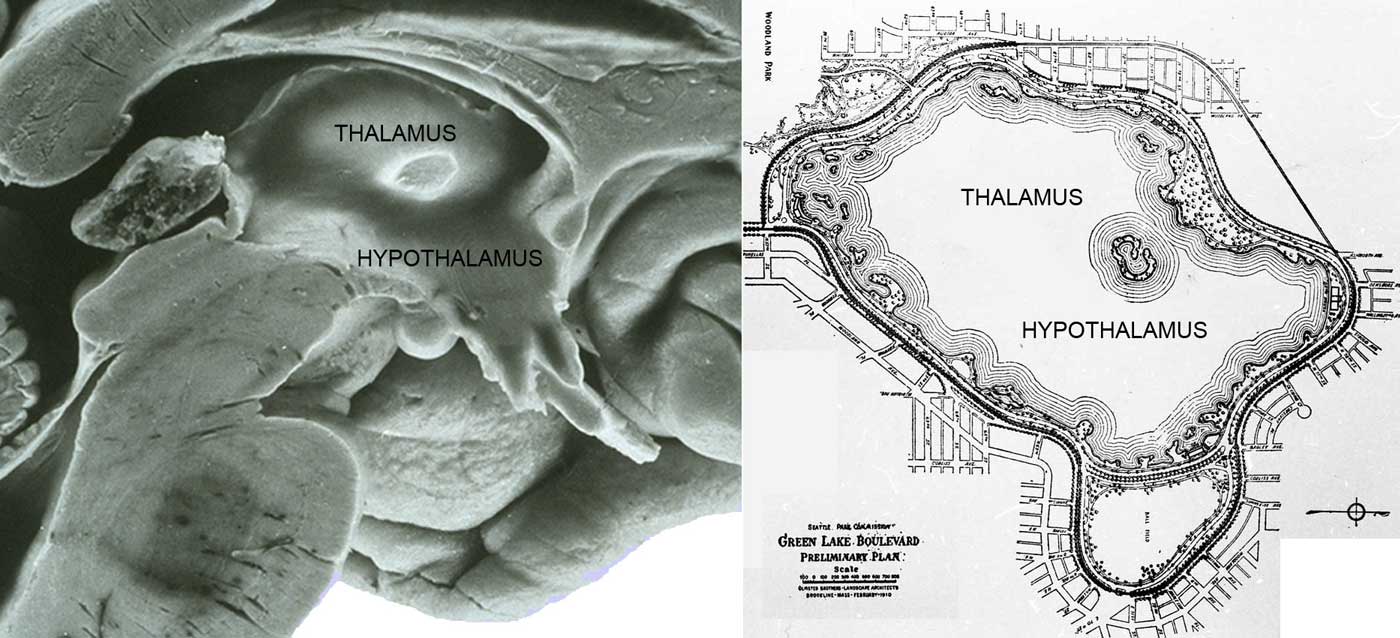
GREEN LAKE on the MIND
Recent details from John Sundsten’s walks around Green Lake.


BIRD WATCHING, BLUE CRANE & GREEN LAKE BE HERE NOW
With modern digital recreations – also known as “photoshop polishing” – the anatomist bird watcher has crossed the country from corner to corner and transported a Floridian cousin’s Blue Crane (and not a Heron as some might perceive) to the shores of our Green Lake. The testing required for this operation is sampled at the bottom with “Fourteen Ways of Looking at a Blue Crane.” As a vestige or glimmer of the Crane’s southern origins Sunsten has made no fussy effort to conform the lighting on the tall bird’s plumage with that on the Green Lake shore. A good four hours of day light had passed between them. The gregarious professor was mostly pleased that the bird fit so well in the hole he’d reserved for it.


MASSA INTERMEDIA REVISITED
The agile professor concludes with another analogy for the Massa Intermedia – the familiar inverted psychotropic mushroom: L’Enfant Magnifique ou Terrible. Also known here as Duck Island.


We enter again now into the archival world of Ron Edge’s clippings. While scanning the complete opera of Helix (ultimately for this blog-web site and my own planned “Helix Redux” project) Ron came upon two illustrated features printed in the spring of 1969 and so in the seed-patch of saving the Pike Place Market from ruin by the bulldozing-financial means of the ironically named “Urban Renewal.” We know, of course, that the Market was saved. Here, first, is Victor Steinbrueck describing that salvation while still stirring the faithful. Here, second, is then Helix photographer Paul Temple’s “Faces of the Market” centerfold (and more) pictorial, published two weeks following Steinbrueck’s rallying April essay. Framed between the two Helix features is a reflection on them by Paul Dunn, who – he explains at the bottom – recently retired from his 13-years as President of Friends of the Market. Paul is also quoted in the “now-then” feature that follows this Helix business.
[ remember – click TWICE to enlarge]

Two Helix features are printed here: above and below. Both are from the spring of 1969. The last paragraphs of the first feature (above) disclose that Victor Steinbrueck wrote this summary of the campaign to save the Pike Place Public Market when it was still a work-in-progress. There, besides Victor, are also noted Ibsen Nelson, and Fred Bassetti, the remaining two of the three principle, prominent Friends of the Market – the “Founders.” All three were noted architects and each had respect and standing in both the business and academic communities. Bassetti was (and still is) an eloquent wordsmith. Steinbrueck first and then Nelson too have passed.
<!–[if !supportEmptyParas]–> <!–[endif]–>
Of note on how little some things change, is the reference in the article to a comparison of money to be spent (wisely) on the Pike Place Market and not on “ball teams and domed stadiums”. The article reveals some Friends’ advance thinking as they refer to citizen legal action and a “referendum”. In fact, in December of 1970 an injunctive writ of mandamus was filed, which legally stopped the bulldozers giving Friends time to mount the Initiative campaign, which did save the Market.
<!–[if !supportEmptyParas]–> <!–[endif]–>
Victor Steinbrueck’s op-ed article lays out a preferred course of action, a planning team, virtually free to the city, which was a reasonable request. It was a version of the petition signed by 53,000 citizens (almost 25% of the registered voters in Seattle), which the City Council rejected by a 9 – 0 vote. This piece, published by the then two-year old Helix, Seattle’s own “Underground Press” weekly tabloid, is an indication that Friends of the Market and other preservation advocates were moving from civil and decorous petitioning (such a daffodil marches through the streets) to action in the courts and on the ballot.
<!–[if !supportEmptyParas]–> <!–[endif]–>
To “repeat” the historical view featured at the top of that first Helix article, I will attach the one picture I took before the batteries died in my camera. It is about as good as it will get. Ed Newbold’s shop and the Newsstand sit astride the exact space, but no windows can be seen so I avoided it. I mean my shot is NOT quite an exact repeat of the “Then.” I’ll explain that in the caption below.
<!–[if !supportEmptyParas]–> <!–[endif]–>
The second Helix feature, a pictorial on the Market, attached below with its shorter essay adds more props to the stage for those important days. Big things were happening in the Queen City. First another review of those times. March and April 1969 were critical months for the Market and its Friends. I repeat, and think about it! Petitions with 53,000 citizen signatures had been presented to the City Council, which rejected the request to NOT approve urban renewal scheme 23 – unanimously. (The political arrogance of those nine council members. The city had 500,000, plus souls, at the most only 200,000 were old enough or willing to vote. That was over 30% of the electorate telling this city body what to do. And it would not!)
<!–[if !supportEmptyParas]–> <!–[endif]–>
Public hearings before the City Council were scheduled between March 19 and April 25 (the latter date is when the first of these two Helix articles came out. The pictorial was published two week later.) Victor Steinbrueck organized supporters and rallied others to pack the Council Chambers and sign to speak. This is how Market historian Alice Shorett described the scene: “Twelve sessions were held on ten separate days, thirty three hours and thirty minutes of testimony were recorded (By the way, the City Clerk, Municipal Records staff have dug up those hearing tapes and they can be listened to in City Hall.) Eighty documents were submitted. Phalanges of partisans – pro-renewal people mostly in business suits and pro-Market forces a motley crew carrying banners (“Beware of Plastic Markets”) and daffodils – applauded their champions.
<!–[if !supportEmptyParas]–> <!–[endif]–>
A lot of good it did. The City Council passed the resolution for final approval of the $2 million first year HUD urban renewal money on August 11, 1969. Victor refers to “litigation” and “referendum” in the first Helix piece from April 25. Both came to pass: the litigation to stop the bulldozers while Friends could write the Initiative and gain the signatures for the ballot approval.
The rest is, as they say, history. Heady times in the old town then.
<!–[if !supportEmptyParas]–> <!–[endif]–>
Now to conclude, I’ll return to that first Helix feature and how I chose my prospect for repeating the photograph from the spring of 1969. First I’ll identify the general location. The unattributed photo (Helix photographer Paul Temple probably snapped it as he did those in the second pictorial feature.) of a farmer selling vegetables from a day table is most likely what we now call Economy Row. The support column is not from the Main Arcade. Rather it is the area between First Avenue and the Market sign, which has been open to the weather since the sidewalk was covered (and coveted) by the Goodwins in the 1920’s. The first protection was with awnings and later a full glazed wall was added. It is seen here. The vacant stall I recorded on Economy Row is not the exact spot our 1969 farmer is selling from. The reason is that Ed Newbold’s Wildlife Picture shop and the First and Pike Newsstand block all the windows, columns and other identifying details. The day stalls lasted on Economy Row through much of the 1970’s, but finally gave way to more regular merchants in divided spaces with some permanence. The farmers were never fond of the space because it was open to winds and shoppers didn’t seem to care to linger. The glazed wall of sixteen square windows, plus swinging four panels, made the area more comfortable, but management could never keep enough farmers to make the space pay. For a time, before the newsstand expanded into the row, Dickie Yokoyama ran a high stall on weekends selling produce. That didn’t work out either.
<!–[if !supportEmptyParas]–> <!–[endif]–>
My picture is of the vacated Bedalia Bakery. The post on the right is the same kind as in the “Then” picture, so are the light fixtures and all the windows. What is gone are the low farmer tables.
<!–[if !supportEmptyParas]–> <!–[endif]–>
Sorry this is so long. I didn’t, as Mark Twain used to say, have time to write a short caption.
<!–[if !supportEmptyParas]–> <!–[endif]–>
Paul Dunn,
<!–[if !supportEmptyParas]–> <!–[endif]–>
I asked Paul Dunn to follow his mark with a brief description of his place now as retiring archon for Friends of the Market, and also about what is next up with his pithy-witty column Post Ally Passages.
<!–[if !supportEmptyParas]–> <!–[endif]–>
I have been replaced by Ed Singler as President of Friends of the Market after a 13 year run. On my departure the Friends gave me a fine-bronzed plaque and gift certificates to Maximillien, Champagne, Pink Door and Matt’s in the Market. The plaque is not edible. I have been writing a column, Post Alley Passages, in the Pike Place Market News (www/pikeplacemarketnews.com), first begun in 1989, and picked up again in 2003. December’s subject is Market bookstores – a place to find perfect gifts, titled, The Pike Place Book Market. The Market News Archives carry all past columns and can be read online.
<!–[if !supportEmptyParas]–> <!–[endif]–>
Happy Thanksgiving.
<!–[if !supportEmptyParas]–> <!–[endif]–>
Paul Dunn,
P.S. Click TWICE to Enlarge.


<!–[if !supportEmptyParas]–> <!–[endif]–>

Happily we return now with more landscapes by our friend the distinguished morphologist John Sundsten. This time he mixes Green Lake scenes with an example or two from his midbrain research as an Emeritus Assoc. Prof in the Department of Biological Structure at the University of Washington (We write it out for those reading this in Wisconsin.) As he explains in his brief and poetic introduction, John frequently walks the circle around Green Lake here in Seattle. Although he is older than I, he is Finnish and so both in fine shape and generally better looking than the rest of us over seventy. Ask any Italian and they will tell you that the Finno-Ugrics are generally the handsomest people on the globe, and the Fins return those sentiments with a strong attraction to Italians. At the bottom of this montage of John’s photographs, we have included one of his cross-sections of the midbrain, for which John offers a helpful analogy, that Jean has illustrated this lovely fall Sunday afternoon from the 45th Street I-5 Overpass.
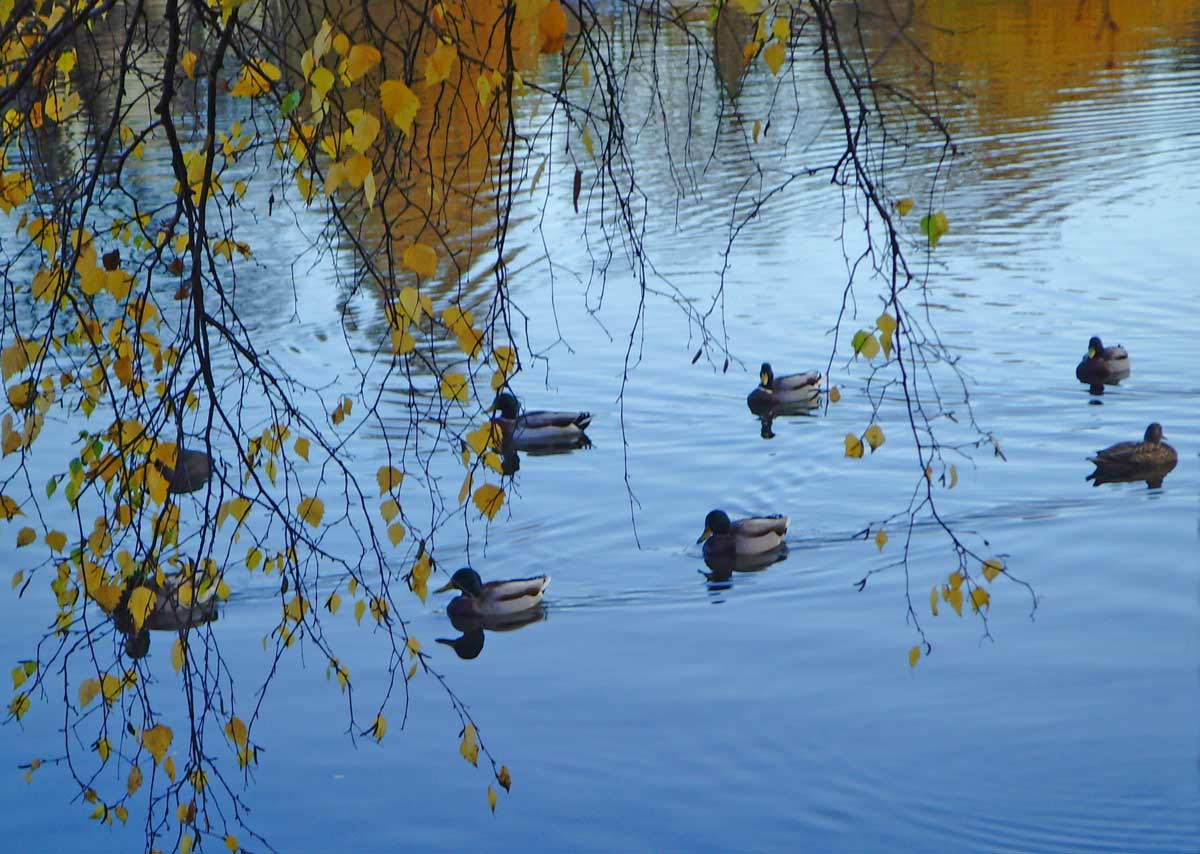
Here follows John’s introduction, followed by more examples from his Green Lake walks and concluded with a slice of his research.
These views around Green Lake were made in the last couple of months or so (August-November). In my more or less daily walks around Green Lake there are always new things appearing to me, whether clusters or mounds of landscaped trees, or loner trees angled in strange ways, or unusual unnamed trees, or treetops against an endless sky, or tree branches arching into space, or tree bark crackling or peeling or canyoned, or stones left as solid reminders, or changing foliage moving in slow time, or long views of the other side mirrored in the water, or lazy-sometimes-busy birds eating or claiming rights, or lakeside details of ferns and other growing things crowding each other. And every day it is different in color and tone, with unknown expectations like the initial wonder in a love affair.
[Remember – CLICK to enlarge.]


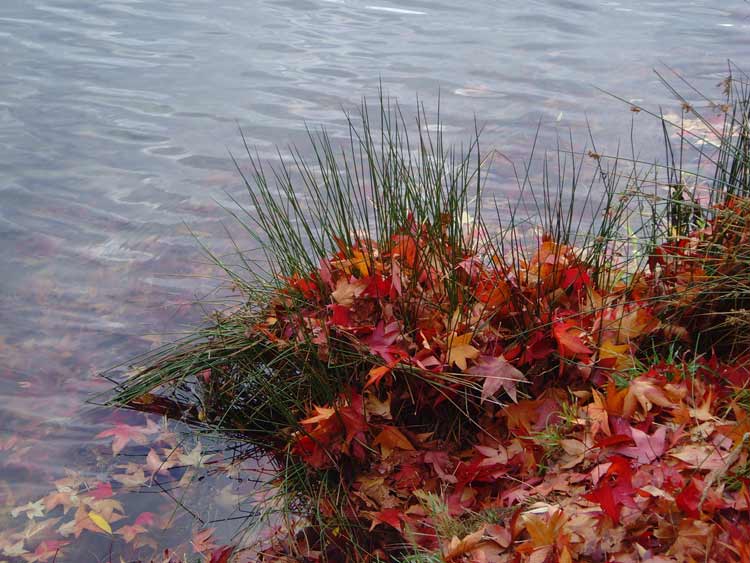


The above is a transverse cross section (imagine one of a stack of poker chips) through a part of the human brain called the midbrain. The neuron cell bodies are stained a cresyl violet color. Unstained (more or less) zones are where the nerve fibers (axons) are packed together. The polygons encircle various neuron components found at this level. The midbrain does many things but perhaps most important is that it is essential for the maintenance of consciousness. One of the other things it does is to regulate movement (along with many other structures). Note the very dense accumulation of stained neurons at the bottom of the figure. Some of these form the Substantia Nigra, which cells project to basal ganglia in the forebrain. When no longer functioning properly (a loss of a neurotransmitter, dopamine), Parkinson’s disease results. Most of the non-staining regions are axons packed together, traveling through to other destinations. Imagine you are on the overpass at 45th and I-5, and you are looking through this section of the brain. The nerve tracts are like the freeway traffic; a lot of it is going to Everett (the forebrain) and a lot is going to Tacoma (the pons, medulla and spinal cord).
Below and by way of analogy only is 1-5 looking south from the 45th Street overpass on Sunday Nov. 15, 2009. (by Jean Sherrard)


[As always, CLICK the photos to enlarge them.]
Not long after the Aurora Bridge was completed in 1932 its dismal second use was fulfilled and soon described. “If you build a bridge like that people will jump from it.” Similarly, although less tragically, it may be said of the viaduct showing here, “If you build a bridge like that people will run into it.”
Built in 1911 to the plans of architect Walter Ross Baumes Willcox, the Arboretum Aqueduct, also known as the Arboretum Sewer Trestle, was designed to carry the then new North Trunk Sewer over the nearly new Lake Washington Boulevard. A walkway was also laid atop the sewer pipe for the few pedestrians that might find this 180 foot-long viaduct with six equally arched bays more to their liking that the ground route (in line with Lynn Street) through Washington Park. On the viaduct passengers were also safe from the traffic on Lake Washington Boulevard. It passed beneath them, except the part that did not.
For instance, in the Spring of 2008 Garfield High’s girls softball team was returning home on a chartered bus after a 10 to 1 loss to Lake Washington High in Kirkland. The driver explained that he was following GPS instructions when the top of his bus, which was nearly three feet taller than the about 9-foot hole prescribed by Willcox for the motor traffic of 1911, was sheered away.
While the bus lost its roof and several students were sent by ambulance to Harborview Hospital, the reinforced concrete trestle was barely chipped, and the “picturesque qualities” of the trestle’s honored ornamental brick patterning has never effected its strength. Among the several landmark lists that have embraced this artful but sturdy bridge is the National Register of Historic Places.
( For more photographs of the contemporary bridge – and more – click here to link to an earlier photo essay that includes them.)


[Click all these pictures to ENLARGE them.]
Here on the Sunday morning after all the Halloween commotion in front of his home the night before, Phil Wells – known as Flip to his friends and sometimes mistakenly as Pflip in print – reflects on the 21st oversize Halloween production on Wallingford’s 42nd Street – at 2506 – just east of Eastern Avenue. In the late 1980s Marilyn and Flip moved into 2506, raised two children, a girl first and then a boy. Perfect, and while they were growing up both of them were regulars on the hurried crews for these big fall productions. Sometimes it was raining, sometimes very cold, but it always happened. Last night was teased with rain only. It too was ideal – like having a girl and then a boy.
Below is a portrait of this year’s crew without the children. (The Wells’ daughter Greta is away in college, and their son Peter was off to a party in the family car with instructions to return by 1 a.m.) I asked Flip to caption the group shot and elaborate on the evening. As you will read, this year I, who am normally merely the “recorder” of the events, was also part of the creative crew, helping with the “Forsaken Art Exhibit”. (I will return to this at the bottom.) Here is Flip’s crew followed by his own caption. After that we will include pictures of many of the night’s spectacles that he names.

Left to right – Marilyn, Ann Yoder, Rick Yoder, Jeff Bronson, Flip Wells Jan Standaert with Paul Dorpat’s “Forsaken Art” behind. Halloween on 42nd St 2009 detoured from our traditional theme based productions with the contribution of fifteen priceless paintings from Mr. Dorpat’s Forsaken Art collection of hundreds. The paintings were prominently displayed on a 12 ft wall lined with thirty 3-D Archie McFee place mats. Comments on the display ranged from “does this have something to do with a murder in the Louvre” to “I really must buy that rabbit picture”. Alas none of the treasures were for resale having already been forsaken by their original owners. Other displays this year included a vomiting Al Gore, 4 ft diameter Spider on a zip line, 10 ft long worm with rope light intestines, a plain face with trunk like nose, gory campsite scene, and blacklit cave of phosphorescent creatures all highlighted by sometime functioning smoke machines. Thanks in part to agreeable weather a good time was had by our 350 or neighbors roughly half of which were young trick or treaters.

With neighbor Doug Wilson – sometimes referred to as Wallingford’s mayor by his nearby neighbors – holding a bottle of root beer, Marilyn waves from the front steps. Below her momentarily rests the basket filled with candy. This year these steps were easily sighted from the sidewalk. Some years they have been hidden behind labyrinthine passages that trick and treaters were required to negotiate – most often with the help of their parents – to reach the steps and the candy.

Before the rest of the crew arrived Phil started constructing the basic forms for this year’s sensations.
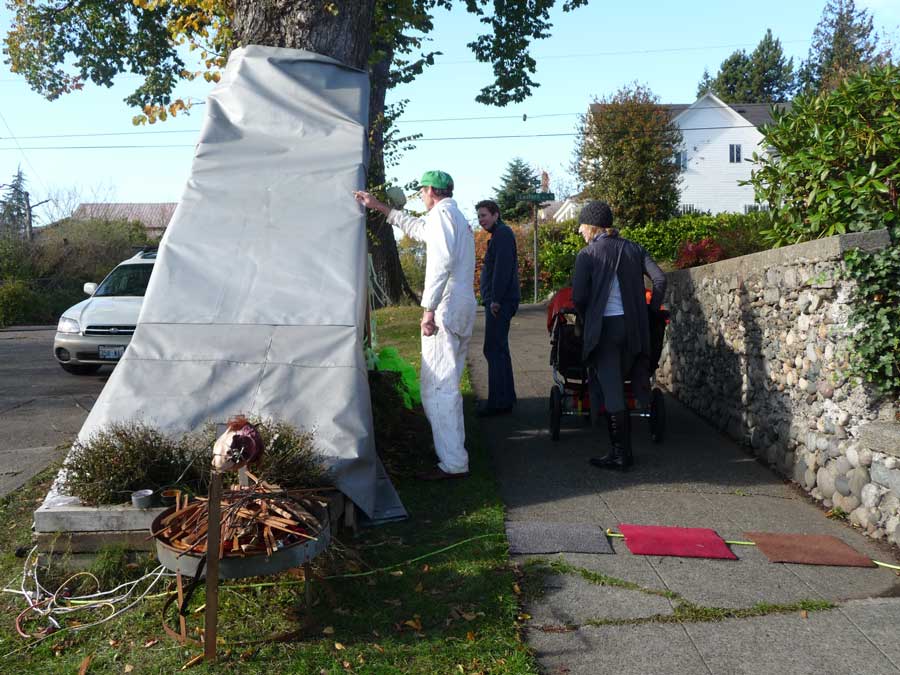

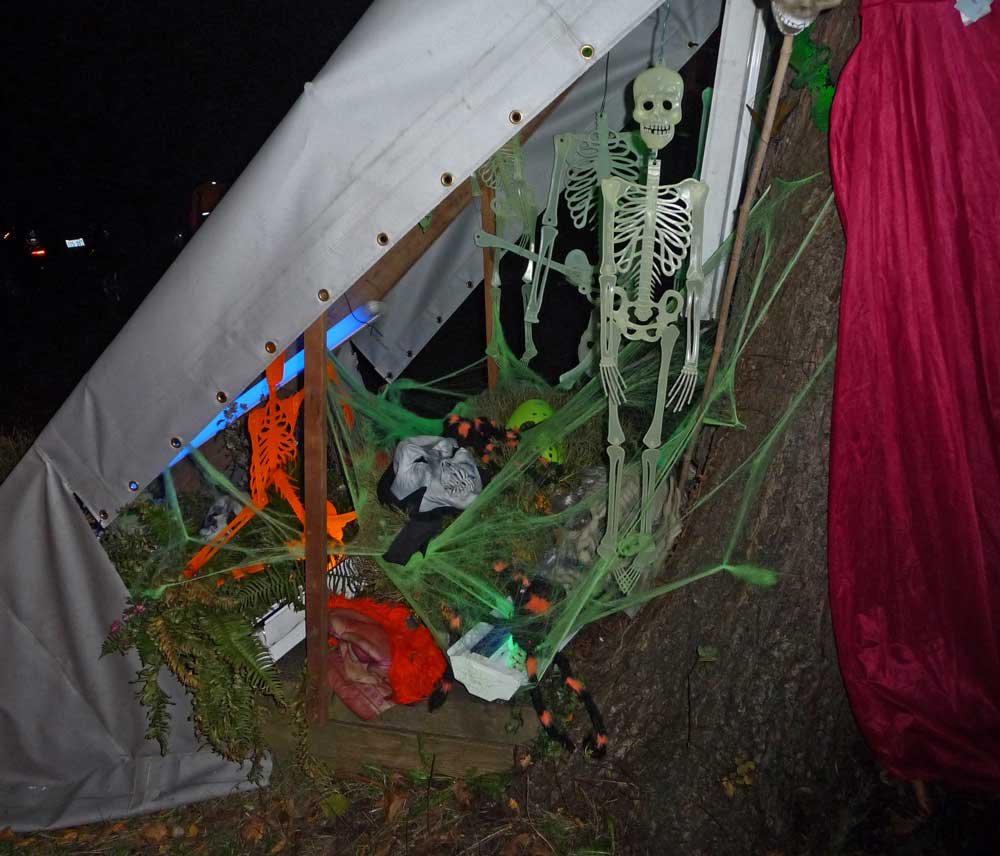
The American Elm supporting the Lean-2 is also used as a post for this year’s “headline” of masks.


A brief introduction to the FORSAKEN ART EXPOSITION
As noted in Flip’s caption to his crew’s portrait near the top, this year we hauled forth part of my Forsaken Art Collection, as one of the last ditch additions to Production #21. Many things were still needed. This was needed – sort of. Flip was away on business and unable to return until the day before. So I answered the all-points plea with Forsaken Art.
Over the past dozen years or more I have collected a few hundred examples of it, and most of these objects have video interviews “attached” to them. That is, I have bought them all in yard sales and video-interviewed the persons who sold them to me, usually for nothing more than 4 dollars, my limit – unless it is stretched. This small Exhibit on 42nd Street in Wallingford is a prelude for what will be a large covered exhibition with the video production that matches the art to the interviews along with reviews by local critics – critics who may owe me something, and so will give this art some intelligent, sensitive, creative, and above all encouraging review and thereby perhaps rescue these canvases and many others from their forsaken situation.
All my video interviews conclude with this question. “Before we complete this transaction would you like to change your mind and hold on to this art, which you are about to forsake?” Only one of many hundreds has agreed to turn back the sale and keep the painting, and it was much the greater job for me to get her to change her mind again and let me have it. I had the interview and needed the painting to support it.


Note the spirit of his exhibition is indicated by its sign above, which reads, in part . . .”BEWARE Look Aside Look Askance The Critics Knows Forsaken Art Danger to Taste . . .”

The shown art included “Harvey and Friend” the only painting requested for sale. Something about the would-be buyer’s husband wearing a rabbit outfit for some Halloween and handing out carrots to the kids. Unfortunately, we had to explain to her about the video interview and our need to hold onto the painting for the greater show and production. She was sympathetic. Perhaps her interest in the painting was influenced by the bottle of wine she was carrying, and we were acting prudent for her.

Of all the art exposed this was perhaps the most appropriate. Jan hung a sign from it reading “Available to Qualified Buyers Only.” The original yard sale price remains fixed to a small tab stuck to the painting (in the black door to the bleachers). It reads “50 cents”.


If you were raised on Spokane’s South Hill in the 1940s, as was I, you would have been taught that Gainsborough’s “Blue Boy” was one of the greatest of masterpieces. But like me you may have known nothing of his “Pinky.” Below are paint-by-numbers versions (or variations) of both accompanied by smaller copies of the original – for comparison. Somewhere there will be a kind critic who will find the paint-by-numbers examples the better, just what the originals needed, more robust and to the essential points of their subjects, the lovely Blue Boy and the lovely Pinky.


We conclude by noting, again, that there are hundreds more where Pinky came from, and she and the rest of these were merely taken from one accessible side of this collection – with very little selection. As they lay. Might it be that this little Halloween exposition at Flip and Marilyns will someday be remembered like the French Impressionist’s Armory Show, as the start of another great movement in the history of Western Art, the Forsaken Art Movement, supported and even promoted by a new CWC: Critics With Compassion. And finally for this trick or treat of Halloween 21, does anyone recall what was the old CWC?


[The feature that follows first appeared in Pacific Northwest Mag. for Nov. 1, 2009.]
Normal
0
0
1
341
1949
16
3
2393
11.1282
0
0
0
Normal
0
0
1
51
292
2
1
358
11.1282
0
0
0
The hand-written caption “Prof Conn family” can be imperfectly read at the base of this week’s historical subject. I know Conn not for his professing but for his photographs. His views around Green Lake and Ravenna are probably the best record of those neighborhoods in the 1890s. Through the years of this feature I have used three or four of them.
Conn has here joined his wife Margaret and son Neil to pose on the front law of their home, I assumed. So I was surprised that none of the few addresses listed for George E. Conn could be stretched to approximate this view, which includes a patch of Green Lake in it. My solution was a turn to Rob Ketcherside and his zest for then-and-now hide-and-seek, supported by his spatial relations intelligence and gift for modern on-line research. Rob soon determined that my assumption about the “family home” was wrong. The Conns are here posing on the front lawn of East Green Lake’s biggest realtor then, W. D. Wood, who was also briefly – about the time this photograph was recorded – Seattle’s Mayor for parts of 1896-7. Wood took, as it turned out, a permanent leave of absence from politics to follow the gold rush.
While “Professor” Conn, shown here posing with his familynear the east shore of Green Lake, is listed in city directories as a school teacher at both nearby Latona and Green Lake schools his name does not appear in the Seattle School District’s archives. Eventually, the Conns moved to Thurston County where the “professor’s” teaching at a “common school” is traceable in the 1920 census.
In the “now” view Ketcherside, on the left, joins author and Green Lake historian Louis Fiset on the north side of Northeast 72nd Street and near where the Conn’s pose in Wood’s lawn overgrown with flowers. Years ago Fiset introduced me to the Woods, who in 1887 purchased these east Green Lake acres, which included the cabins still standing here on the right. He bought it all from Green Lake pioneer Erhard Seifried, AKA “Green Lake John.” Both Rob and Louis (and Ron Edge too) have helped me with the details of this story. Readers can find many of Ketcherside’s own “now-and-thens” on Flickr or search Flickr for his name under “people.”


[What follows first appeared in Pacifric Northwest Mag. 8/28/05.] Thanks to Paul G. Pearson who sent along this week’s revelation of how a new shoreline was constructed for Green Lake, and with it the gift of a new city park. This view of a pile driver constructing its own throughway across the East Green Lake Bay was photographed in 1912. One year earlier the lake was lowered seven feet with mixed results. It robbed the lake of its natural circulation by drying up the stream that ran between the Lake and Union Bay on Lake Washington. (Decades of “Green Lake Itch” would follow.) But it also exposed a shoreline that was the first ground for the new park that was extended with fill.
The pile driver is following the curves of the Olmsted Bros. 1908 design for Green Lake Park. Following the driver a narrow gauge railroad track was laid atop the trestle and by this efficient means dirt was dumped to all sides eventually covering the trestle itself. (Unless contradicted, it is likely that the trestle seen here in the “then” survives beneath the park visitors walking the Green Lake recreational path in the “now.”)
In all about two miles of trestle was built off shore from which more than 250,000 cubic yards of earth was dumped to form the dike. After another 900,000-plus cubic yards of lake bottom was dredged and distributed between the dike and the shoreline it was discovered that when dry the dredgings were too “fluffy” to support the park’s new landscape. More substantial fill from the usual sources – like street regarding, construction sites and garbage then still rich with coal ashes, AKA “clinkers”– was added.
The historical photograph was recorded by the Maple Leaf Studio whose offices were one block from the new Green Lake Library seen here on the far right of their photograph. The exposed shoreline is also revealed there. Next week we will take a close-up look at this same section of E. Green Lake Way North in 1910 when the library was new and Green Lake seven feet higher.


[What follows appeared first in Pacific Northwest Magazine, Sept. 4,2005] Now we return to Green Lake as promised last week. For its obvious changes this comparison hardly needs a caption – but we will still offer one. In the 1910 photograph the lake still rests against it northern shore. That was the year that the Green Lake Library opened and while we can see it on the far right we cannot, of course, tell if all the tables and books are yet in place. As noted last week, after the lake was lowered 7 feet in 1911 this shore, like all others, was exposed. The Seattle Park Department did not simply drop a few grass seeds and plant a few exotics on the exposed beach but rather prepared and extended the new park land with considerable fill. The results – 94 years later – are spectacularly revealed in the “now.”
Most of the homes showing in the historical view were built in the first years of the 20th Century — Green Lake’s boom years. It is a double block extending between Latona and Sunnyside Streets. With three exceptions these homes survive, although most have had lots of changes. For instance, the big house on the left at 7438 E. Green Lake Way North is here nearly new. Built in 1908 it has by now lost its tower, but gained much else. (But you’ll have to visit the sidewalk beyond the park trees to inspect these additions for yourself.) The missing homes have been replaced with a row of three non-descript multi-unit boxes. At least from this perspective, for these the park landscape is an effective screen.
One of Green Lake’s principal early developers, W.D. Wood, proposed to the city in the early 1890s that they acquire the lake’s waterfront for a surrounding park. Had the city followed Wood’s advice there would have been no need to lower the lake and so dry up the stream that ran from its east side to Lake Washington. Nor of course would the homes we see here have been built on park land. Wood, a man of ideas and initiative, was later elected Mayor of Seattle in time to resign and join the Yukon gold rush n 1897.

We have pulled some more morphology from John Sundsten, the anatomist collector. John confesses that he does not know the names – neither scientific nor popular – for many of the trees whose barks he has recorded here. We admire his candor. “I am a good anatomist and a lousy naturalist. Some of them have names indicated with a brass plaque, but most do not. I just like bark. I like bark texture and bark color. You may write that barks are my friends. I shot them with my little camera last month while strolling around the lake counterclockwise in the early morning.” The U.W. scientist wonders, “There seem to be a lot of ladies with dogs and old couples at that time of day. Are there then two kinds of people? Clockwise and anticlockwise people, and what does their choice of walking around Green Lake say about right and left brain function, or no brain function, which is probably true for me. The barks go into folders, and I have a lot of other folders, ones with trees and animals and masks (mine) and oysters and such. It is like getting in the stuff for the long winter to come. And I presume some day it will.” John adds, “It occurs to me that I have a folder with about twenty Green Lake Park benches.” We may be seeing some Sunsten seats here soon.
John concludes, “I’ve included a long shot. It came out well, I think.” And we agree.

We welcome John Sundsten and his eye for fine lines. The emeritus associate professor in the U.W. Department of Biological Structure took the “snaps” below while on a walk around Green Lake on Monday last – Oct. 26, 2009 – after dropping his daughter off at Garfield High School. John is a neuroanatomist who’s interests extend well beyond grey matter. He is also a carver, an oyster harvester (on Hood Canal shoreline that has long been in the Sundsten family) and a contrabass flute player. He lives in Wallingford and we sometimes walk the ‘hood together. It occurs to me now that John’s Green Lake recordings may also serve as a challenge to Jean Sherrard, of this blog, to again go down to the lake with his Nikon, and for you readers an encouragement to walk the lake this fall.
[Click to Enlarge]


[Click to Enlarge]
