

All posts by pdorpat
Our Daily Sykes # 122 – Earth Works With A Big Sky

More Dutch Pastries – For Ben Lukoff

I used this contribution from the Muni Archive for a now-then feature in the Times back in 1998. (Well it would not be forward in 1998, I know, but the more needless words one uses the more time there is to think and even relax in between the meaningful ones.) The date is hand written below the clipping that follows. Remember please, don’t stop with one click, CLICK TWICE ENLARGE. This is in response to Ben Lukoff’s question about the possible existence of other Van de Kamp’s windmills. He also found one in the Roosevelt district and includes a link to it. It too no longer turns in the wind. I remember small Van de Camp’s sections in some supermarkets but no more big windmills when I arrived here in the mid-1960s. Read on for some description of what happened to this windmill near the north end of the University Bridge.

Our Daily Sykes #121 – The Pendleton Roundup
Horace Sykes’ slides include few urban scenes with the exception of celebrations like these of the Pendleton (Oregon) Roundup. The spectacle of horse logging (top) and bareback riding (bottom) are paraded here. I don’t know the year, although there is enough information here to easily determine it if we had ready access to the local library’s Pendleton Room. There’s an imperfect hint on the marquee of the Rivoli. Besides the local “Indian Vaudeville,” which would have been a stage presentation, the theater is showing the who-done-it mystery “Charlie Chan at Treasure Island” (in San Francisco.) The film was released in Sept. 1939. Although this year’s roundup (2010) is also held mid-September, I think it more likely that the Rivoli is showing the Chan film later than 1939. Chan films had legs.
(CLICK TO ENLARGE)
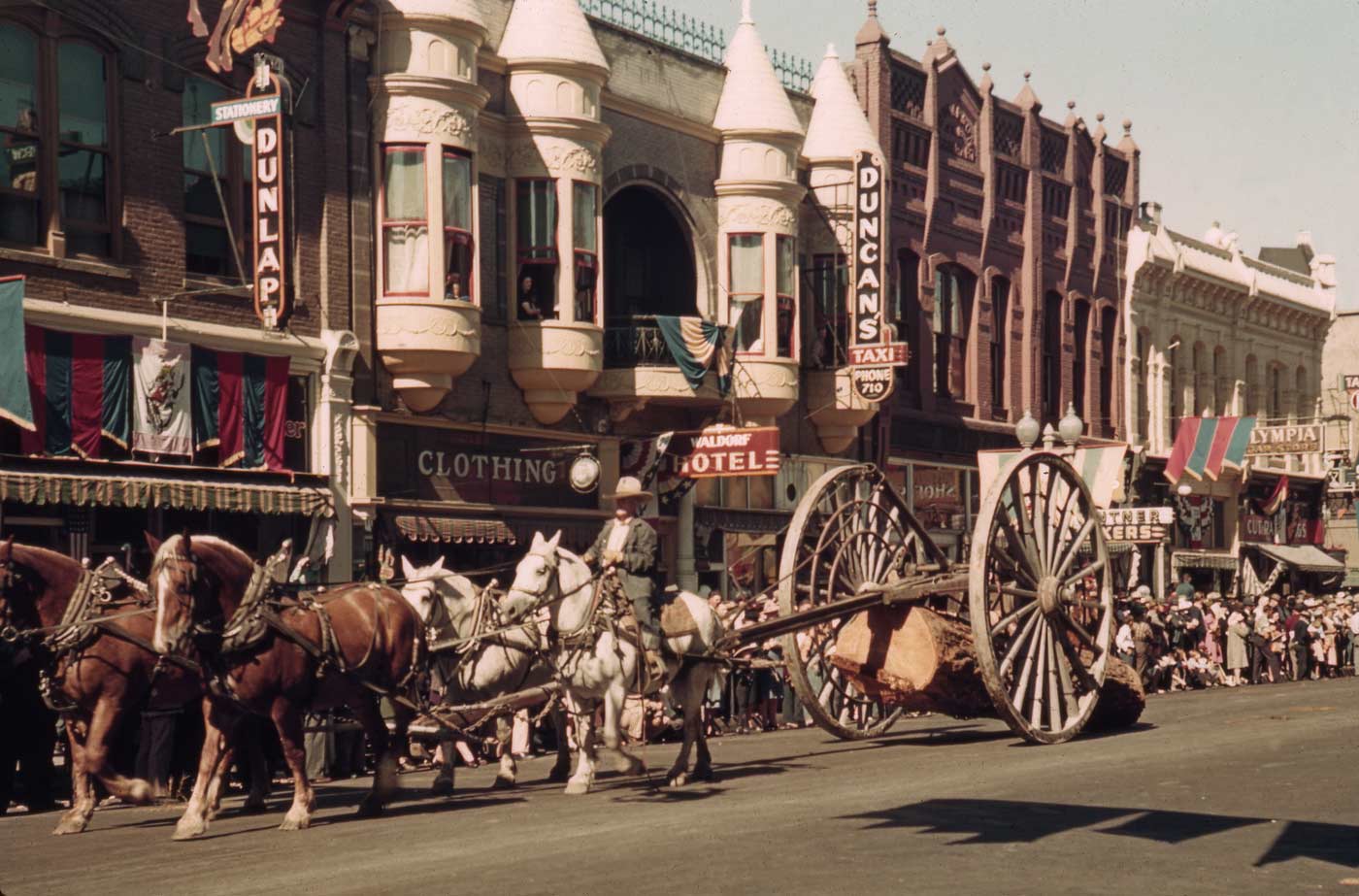

Sykes took these two Kodachromes from the same position on Main Street between Emigrant and Dorion Avenues. Unfortunately, the row of ornate Victorian structures showing in the top view has been lost with the exception of the two story white structure far right, the one with a sign reading, in part, Olympia.
Van De Kamp's at Mercer and Queen Anne Ave.

Our Daily Sykes #120 – Flower and Frog


(CLICK to ENLARGE)
Both the flower and the frog have protection. Horace Sykes photographed flowers of all sorts, but he loved orchids and succulents. This, however, is the only frog portrait that I have found – so far – in the Sykes collection of 35mm Kodachrome slides recorded from the late 1930s into the early 1950s.
Our Daily Sykes #119 – The Mighty . . .

Edge Clipping #15 – August Crime Wave 1878


Please Click the Clip that Follows TWICE to REALLY ENLARGE it.

Click the above TWICE to Make is Much Larger!

Sykesaddendum #118 Willamette Falls ca. 1915

Our Daily Sykes #118 – Willamette Falls Sunset

Our Daily Sykes #117 – Bus Stop

Our Daily Sykes #116 – Terra Incognita

Our Daily Sykes #115 – Chelan Butte


Seattle Now & Then: The Eaton Apartments


I know nothing about the provenance of this photograph, except that it showed up on my front porch among a small bundle of negatives. Still with the help of a tax card, a few city directories, and a scattering of other sources we can make some notes.
With his or her back to Sacred Heart Catholic Church, an unknown photographer looked northeast through the intersection of Second Avenue North and Thomas Street. The Eaton Apartment House across the way was built in 1909 – in time perhaps for the city’s first world’s fair. (It is at least an irony that is was torn down for the second.) It held 19 of everything: tubs, sinks, basins, through its 52 plastered rooms. In the 1938 tax assessment it is described as in “fair condition” with a “future life” of about 13 years. In fact, it held the corner for a full half century until it and much else in the neighborhood was cleared for construction of Century 21.
The Eaton and its nearby neighbor, the Warren Avenue School, were two of the larger structures razed for Century 21. However, the neighborhood’s biggest – the Civic Auditorium, Ice Arena, and the 146th Field Artillery Armory – were given makeovers and saved for the fair. Built in 1939, the old Armory shows on the far right. (Another view of it is included below.) Although not so easy to find it is also in the “now” having served in its 71 years first as the Armory, then the ’62 fair’s Food Circus, and long since the Center House.
This is part of David and Louisa Denny’s pioneer land claim, which Salish history explains served for centuries as a favorite place to snag low-flying ducks and hold potlatches. The oldest user of the Eaton Apt. site was even more ancient. The Seattle Art Museum (SAM) brought King Tut, or at least parts of his tomb, to the Flag Pavilion in 1978. It was about then that Andy Warhol also showed up to party with SAM in the old pavilion, which in 2002 was replaced and greatly improved with the Fisher Pavilion.
Readers who have old photographs of this neighborhood from before the 1962 fair (they are rare) or of the fair itself might like to share them with historylink. That non-profit encyclopedia of regional history is preparing a book on the fair, one that will resemble, we expect, its impressive publication on the recent Alaska Yukon Pacific Centennial. As with the AYP book, the now hard-at-work authors are Paula Becker and Alan Stein. You can reach them by phone at 206-447-8140 or on line at Admin@historylink.org.


Our Daily Sykes #114 – Chelan River Canyon
For Horace Sykes who consistently pursued the picturesque this scene may have seemed its parody. The sublime is slipping here towards the grotesque. The river looks nearly stagnant, the trees are hanging on. This canyon needs a drink, and the hill on the other side is having trouble with its rocky parts. It seems deflated: a rocky expression of depression. This canyon has colitis or maybe tortured bowel syndrome. It can be imagined groaning. There are none of Horace’s flowers in the foreground.

For this view Horace stopped above the last big curve in the serpentine Chelan River Canyon where it drops 500 feet from Lake Chelan to the Columbia River in about 4 miles. Horace took the old road on the south (or west) side of the river. A piece of the Columbia can be seen on the far right. The town of Chelan Falls is on the Columbia, and the town of Chelan (only) is on the lake. The trip between them is a rough climb – initiation – into the charmed land of Lake Chelan, all 50-plus miles of it.
Addendum for Our Daily Sykes #17 – Below Dry Falls

Our Daily Sykes #103 – From Bertona Street
The Sykes home in Magnolia was wonderfully set near the water end of Bertona Street off Perkins Lane. From there Horace Sykes took several slides of this gesturing cloud as it moved across Puget Sound at sunset. He looks to the southwest. At its far end the cloud turns or curls slightly to “point” towards the two young mountains named Ellinor and Washington by the federal surveyor George Davidson. They are about 40 miles from Horace. Ellinor was the name of the surveyor’s boss’ younger daughter and Constance – a grander peak north and west of Washington and not showing here – was an older daughter. The sisters had two Brothers who have also skipped out on this recording. If the weather is fair and warm and one is fit, then Ellinor is a mountain to climb without much danger of falling off it, although the route is steep and one may expect to be greeted near the top by mountain goats. There’s a path – of sorts. (Click to Enlarge)

John Sundsten’s log cabin on Hood Canal – near Alderbrook Resort – looks northwest to Ellinor and Washington, which are about 15 miles away. John shot the view below from his porch – or near it. Ellinor is on the left and Washington on the right. You have seen them many times – the last of the craggy peaks, at the southern end of the Olympic screen (or curtain) as seen from Seattle. The face of Ellinor seen here, the eastern side, is the route for reaching the top if it is clear of snow. John says this is from the winter of 2008.

In Sykes view are three nubs or hillocks to the left of Ellinor-Washington. They are much closer to Horace – about 15 miles. The one on the right is Green Mountain, and the one in the middle, Gold Mountain. Both have addresses in Bremerton. Gold is also home for two radio towers – KCPQ and KTMW – Fox and Trinity respectively – where free speech is being radiated and tested around the clock.
Our Daily Sykes #102 – "Autumn Pool Okanogan"

Our Daily Sykes #101 – Buddha-Nature

BellAddendum: Matts' TWO PIGEONS
This addition to the most recent Seattle Now and Then is sent by frequent commentator and sometimes contributor, Matt Fleagle. Thanks Matt. Your sometimes shunning of optics during your walks of exploration is a kind of soft-focus Zen I think. Two points about your caption. I agree that your photograph does make an elegant composition, and the box cars – or flat cars with freight – carry it too. And the pigeons two. You mention the look down from the bluff at the building of Pier 66. I did a story on this maybe 20 years ago, and for the “now” I remember being a few yards north of the Lenora Street overpass and also turned a bit more to the west. They were preparing to tear down Pier 66 at the time. Perhaps it was more like 15 years ago, but I’m not looking it up for now. (left)
Here follows Matt’s snap and his explanation.

Our Daily Sykes #100 – The Twin Sisters of Wallula Gap
When the Rev. Theodore Erdman Dorpat (T.E.D.) approached Pasco from Spokane on his way to ministerial meetings in Portland he prepared to choose between driving his Plymouth (until a rocket-nosed Studebaker replaced it in 1951) to Portland through the Wallula Gap or take a short-cut – and he loved them – directly over the dwindling Horse Heaven hills south of Pasco. With his shortcut he – and sometimes we – would reach the Columbia River on the Washington side at Umatilla, and at the site of the McNary Dam. It was not much of a short cut. Only a few miles were “saved” by not following the Columbia River where it takes its big bend to the west. Dad left it up to the family, which way to go. We picked the Gap.
Here Horace Sykes has climbed about 100 feet above the highway to look southwest through the Wallula Gap. He chose his prospect in order to include the “Twin Sisters,” basalt pillars that stand side-by-side. There own slender day-lighted gap between them cannot be seen from Horace’s position nor in the “general delivery” of Google Earth. (While it is too slender for Google’s topo-computer, those “blue-dot” real photos contributed by many sensitive users show it several times. One of these dots is set on the Washington side of the Gap but it looks across the river to show the Twin Sisters in their unique position. You might wish to go looking for it and the rest of them.)
At least once the Dorpats stopped by the side of Highway 730 to study the Twins, although we thought of them then as captains: the Two Captains. The Lewis and Clark expedition camped about two miles downstream from these basalt pillars on Oct. 18, 1805. They camped on an island near Spring Gulch, and their island may well be the island showing in the river behind the intruding ground cover in Sykes’ Kodachrome. (Including a plant as a close-up in a landscape is very typical of Horace, and like most of his this composition is almost certainly “studied” from top-to-bottom and side-to-side.) Remember to CLICK TO ENLARGE.

Horace certainly recorded this look over the shoulders of the twins before McNary Dam was completed in 1953 when its big locks began lifting ships – mostly tugs pulling or pushing barges carrying wheat – 340 feet above tidewater into the 68 miles of slack water named Lake Wallula. Horace’s recording, then, shows the last of the unimpeded primeval river moving through a gap (between the Horse Heaven Hills and the Blue Mountains) begun millions of years earlier and then suddenly “improved” with the series of floods that followed the sudden release of sea-sized lakes – most of them in Montana – filled with the melting contributions of the most recent ice age.
By different accounts there were between 40 and 100 of these floods crashing through here with about thirty years between them, with the last one scouring the gap and the gorge beyond it a mere 13,000 years ago. (The top of the Twin Sisters is about 660 feet above sea level and so about 320 feet above Lake Wallula, which is an easy way of visualize how much of a drop it is from the maintained lake to the ocean. McNary Dam lifted the river about 90 feet above the Columbia’s old altitude at the dam site, which is about twenty miles down stream from Horace and the Twins.)
Horace’s, my, and perhaps your attraction to the sisters was anticipated by Coyote’s. Three sisters – not two – worked hard here at building a trap on the river for salmon, and at night the often too playful trickster did what he probably considered a prank or tease and destroyed their work. But when Coyote saw the sisters crying for want of food, he was touched and proposed to them that he would build a trap for them if they consented to marry him. They agreed and lived happily together for a very long time, but not forever. Eventually Coyote grew tired of his three wives. He then changed two of them into these pillars, and made a cave of the third wife on the opposite side of the river. From there he kept an eye on them all, until he too turned to stone.
Our Daily Sykes #99 – Big Cloud (Gros Nuage)

Seattle Now & Then: The Bell Street Overpass
Of all the trestles constructed to cross Alaskan Way the longest-lived is the overpass that reaches Colman Dock, the ferry terminal, on Marion Street. The second oldest is this one on Bell Street. The bridge on Marion was always only for pedestrians. The bridge on Bell was for many years used also by trucks, cars, and in the beginning wagons as well.
Actually, there have been many other overpasses on our waterfront. Those at King and Madison were both used for moving coal to ships. The trestle on Pike was used first for coal and later rebuilt for pedestrians. Bridges at Virginia, Clay and Lenora streets complete the list, but all these are now long gone.
The Bell Street overpass was completed in 1915 soon after the young Port of Seattle’s big Bell Street Terminal opened. The Port was proud of its grand new pier and the bridge helped to safely show it off. Here was an easy way for produce sellers to move between the Pike Place Market and the Port’s dock with the cold storage it offered. And the bridge – its sidewalk – encouraged families shopping nearby at the Pike market to also visit the recreation park the Port built on the roof of the Bell Street pier.
There is one concluding note to pull from the “top” of this subject: the Broadway – Empire Laundry. The name is signed large on the west façade of the four-story red brick power laundry at Bell and Western. It opened in 1914, a year before the Port got settled one block and one bridge away. As with other power laundries it was women who did most of the hard work and at measly wages. Consequently, the women in local laundries went on strike – first in 1917. Eighteen years later, the organized women of this laundry won the strike of 1935 and the union they formed was for two decades Seattle’s largest organized coalition of women workers. See www.66bellstreet.com for the full story.
[Please Remember to Click the images below to ENLARGE them.)


Our Daily Sykes #98 – "Winter Color in Wyoming"

OVER THERE – Hillside School Students Visit Paris (& London)


Our Daily Sykes #97 – Oregon Coast Seal Caves

Our Daily Sykes #96 – Grand Coulee Dam from the Rear


Our Daily Sykes #95 – The Sykesmobile

Blogaddendum res DAILY SYKES #26 Mt. Hood
Here’s some help from Robert Cross of Camas, WA. Robert was alerted to our confusion by a mutual friend, Angela Roark. Thanks Angela. Cross has used Google Earth better than we did, perhaps because he was willing to cross the Columbia River with it. We didn’t. Here’s his description of what he discovered.
“OK. I checked it out on Google Earth, and pinpointed it exactly, by going down to birdseye level/angle, matching up the view of the mountain, and then flying backwards until the landmarks in the foreground were in view. This photo was def…(tharr be more)initely taken from the hills above Lyle, WA, looking across to Rowena and then down towards the mountain from the NE. I would say that it’s either Alder Springs Rd/Oliver Point Rd or a little further up on the hill at Oda Knight Rd. Looks too far from the river to be Riverview Rd. Is that good enough?”
It surely is good enough Robert, and thanks much.

Our Daily Sykes #94 – Smokey Stover

Unintended Effects No. 3 – Rainier, Adjacent, Upon

WRECK No.3 "The Horrors of Travel"

(click to enlarge)
THE HORRORS OF TRAVEL
(Harpers Weekly Sept. 23, 1865)
“All aboard” a train
Riding into another train
Or over a cliff because someone
Or something broke a rail!
Whether intentionally or innocently
It is equally horrible for you and the conductor.
That’s it, that’s all, your life is over!
So long, so short
Now no difference.
Think of playing an accordion so blithe
Aboard a side-wheeler, enjoying the cruise.
The steamer blows up – in two.
You, the squeezebox, the purser go three ways.
There is no help – no big sand pail
No caustic for a ship breaking up
Or glue for its passengers and crew.
In spite of all the jolly talk
About comfort and progress,
Or gainful commerce taught
About investments in transshipments,
“Where Rail Meets Sail”
Was once also a horrific thought,
Immigrants jostled in schooners in a storm,
Tourists steaming aboard a Blue Funnel
Travelers riding west on a Mountain Goat
Most expected that those machines were well wrought
With handiwork fit tight and crews well taught
But still climbing up the riders’ throats
Were the old horrors of travel.
Boarding a train or schooner
You don’t have to any longer.
But there are modern ways
To find perdition sooner.
Take your own motorcar
Or ride a motorbike
Into a slippery night.

Dailysykesaddendum Res No. 90 – Stonehenge


Our Daily Sykes #93 – A Stock Cactus* (See Correction Below)

WRECK NO. 2 &/or Unintended Effects No.2 &/or Seattle Confidential No.6
It is sometimes difficult for an associate editor to decide on what page to put a story. Instead, we give this wrecked Oakland three chances for broader meaning. It is clearly a WRECK, but it is also an Unintended Effect, and not knowing on whose lawn we have found it, this embarrassment is also somehow confidential, although exposed. Ron Edge contributed this scene, but Ron, for now, is not able to place it, except to note that it comes from a collection of Seattle-based negatives, which are big glass ones. Perhaps some reader can figure the location and make it all less confidential. It seems to me most likely that it is somewhere on the first ridge east of downtown, which is First Hill and Capitol Hill. It is also Ron who calls this unintended wreck an Oakland. He explains that because the original is from a large glass negative he could read the name in a detail of the wheel.

Our Daily Sykes #92 – Road Up Steptoe Butte

WRECK NO.1
With WRECK we add another numbered feature to this blog, and we do it for several reasons. First, people like them. Next, WRECK will remind all of us to be careful. Really we give this advice especially to those we love, and not to everyone. We will be honest about this. If everyone were careful there would be fewer auto wrecks to choose from for these object lessons in safety. And if everyone were very careful, there would be no driving at all, and so no wrecks and also no feature. We would need to return to runaway horses. So we are prepared to encourage those we neither know nor love to go ahead and keep on driving. In spite of how hard it is to face our own meanness in this, we know that our position on this will make no difference. People need to get places fast. And with WRECK we need wrecks for those who like to look at them, which is just about everybody. Like the Romans watching gladiators, driving is a blood sport, although it does not seem fair to have passengers involved, even ones we neither know nor care for. (Consequently, we will avoid showing bodies.) WRECK will be this blog’s embrace of journalist sensation, when we can find them. In this line, please share your wrecks with us, and we will show them in all their mangled spectacle and twisted art. Yes, we might have included practically any wreck as another example of an “Unintended Effect” – the name for another of our newer features – but we chose to give WRECK its own place. Be sure sure to CLICK TWICE not just once to see the spectacle in great detail.

Seattle Now & Then: The Evelyn May in the Belltown Ravine


It was Ron Edge, a friend and collector and guide for our sometimes feature here of “Edge Clippings,” who gently pulled this week’s subject from a short stack of historical prints and asked, “Do you know where this is?” I did and my heart leaped because of it. The sheds were easily referenced to two other surviving glimpses into parts of the Belltown Ravine. (See below for one of them.) Ron’s third view is the most recent and the most direct.
The ravine was unique for there were only two breaks in the embankment or bluff that once rose abruptly from the beach to varying heights for the mile between Columbia and Broad Streets. A small ravine near Seneca Street was used for a tribal graveyard. This much larger ravine between Bell and Blanchard Streets cut nearly three blocks into the northwest slope of Denny Hill before reaching grade near Bell, between First and Second Avenues.
The sheds, some of them built for squatting, were removed when the Great Northern cut into the bank to dig its tunnel beneath the business district. The ravine was filled by fits between the 1880s and 1920s and then forgotten. I found its topography on a map when asked to figure out the source of human bones that were found in what I soon determined to be landfill brought from another place. Since the lost ravine had no name, I took the “explorer’s right” and named it the “Belltown Ravine” for the neighborhood it penetrates.
It was another old friend, the yachtsman, wit and author Scott Rohrer who’s heart also leapt when first shown this photograph. But Scott’s stir was more for the 32’ sloop Evelyn May here held steady in her cradle at the mouth to the ravine. Scott identifies Seattle Yacht Club Commodore C.D. Stimson as the one who ordered the Evelyn May and naval architect Leigh Coolidge as the sloop’s designer. In an essay he wrote on this subject for the Binnacle, fittingly the Yacht club’s periodical, Scott notes, “We have no record of her builder who may have made his home in this little pocket and worked for a larger yard.” And the maritime historian adds, “She won a number of races, some in heavy weather.”


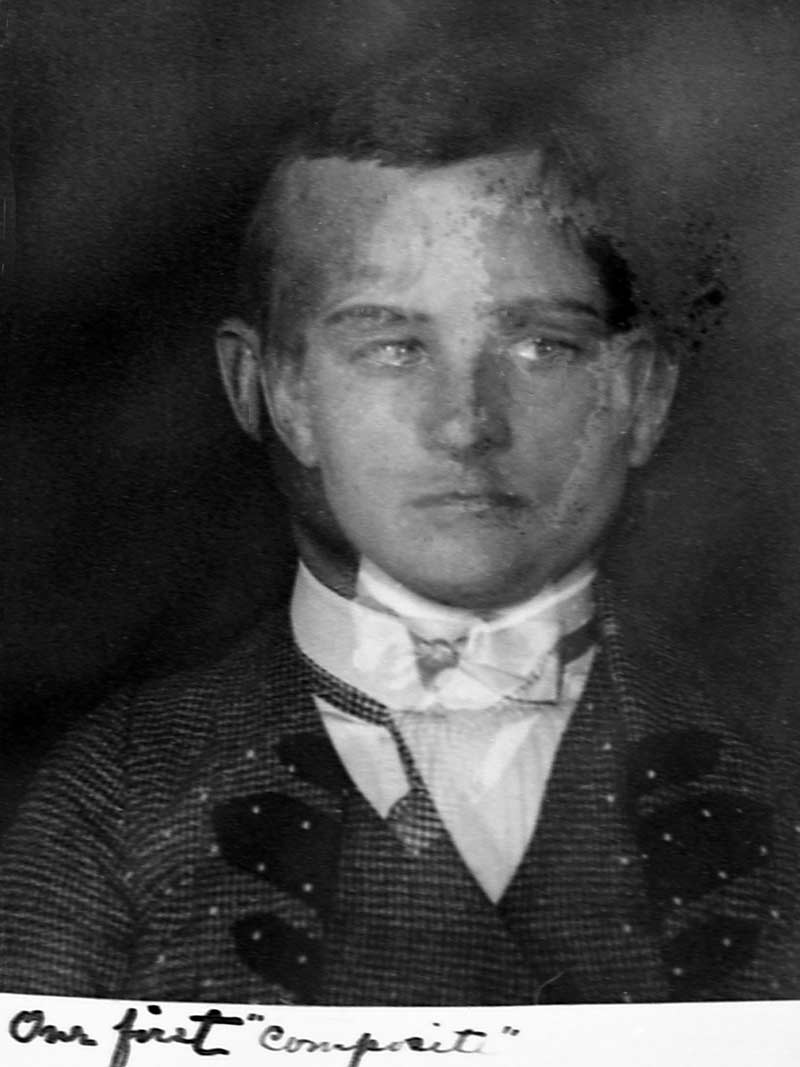
Unintended Effects No. 1 – Double Exposures
Here begins another category of interest, which we have named “Unintended Effects.” In this case it is three double-exposures, and all came from Victorian era photo albums assembled in the Northwest. Two have their own captions. (Click Twice to Enlarge)


Our Daily Sykes #91 – Harts Pass


Our Daily Sykes #90 – Sam Hill's Maryhill Stonehenge

Our Daily Sykes #90 – Log Cabin Sans Roof

Edge Clipping Oct. 25, 1925, Seattle Times

AN ANTIQUES ROAD SHOW 85 YEARS AGO
(click TWICE to enlarge)

1925 REAL ESTATE BOOMING HEADING FOR BUBBLING
(CLICK twice to Enlarge)

- Also from the Seattle Times Oct.25, 1925 issue, a real estate editor’s montage of progress in local construction. The Skinner Building gets its own essay on the left. Otherwise its No.2, the new Paul H. Lattner residence at Lake Park Drive (no address given), No.3, “group of new residences near the intersection of 14th Ave. Northeast and Victory Way (which, I think, is Lake City Way, aka Bothell Way, aka Red Brick Sunset Highway around north end of the Lake Washington long before the bridge), No. 4, “residence at 914 Epler Place built by F. J. Davidson and sold to Charles Cohen.” The Skinner building, on 5th, east side between University and Union Streets, took the site of the former Hippodrome, a great hall for conventions and dances. (We’ve featured it on this blog, so you can key-word it.) The Skinner Building was designed for its sumptuous 3000 seat theatre, and the first Seattle branch for the uppity San Francisco women’s apparel merchant, I Magnin. The local architect was Robert C. Reamer, who – to show his consistency – was also responsible for the 1411 Fourth Ave. Bldg, on Union, The Seattle Times bldge on Fairview, the Deca Hotel – origianlly the Meany -, the Old Faithful Inn at Yellowstone, which the Pastor Dorpat family could only wonder at while sleeping in a tent, the Quinault Lodge, where I had my most tastey meal ever after one week of hiking the Olympics with dehydrated veggies, and the grand Fox Theatre in Spokane (still standing) where I saw the wonderfully pathetic movie Broken Arrow three times in 1950. My dad knew the manager. (Thanks, again, to RON EDGE for our EDGE CLIPPINGS)

SEATTLE CONFIDENTIAL No. 5

Our Daily Sykes No. 90 – Zion Perhaps

- This I suspect – only – is path in Zion National Park, Utah.

CONFIDENTIAL NO. 3 EXPOSED


SEATTLE CONFIDENTIAL No. 4 – First Hill Tenaments

Our Daily Sykes #89 – Storming Oregon Coast

Our Daily Sykes #88 – I Am Clueless Blue

SEATTLE CONFIDENTIAL No.3

Our Daily Sykes #87 – The Grand Coulee Dam Spillway


Seattle Now & Then: Pike Pier
In the gaggle of vessels hugging the sides of the Pike Street pier it is the 1200-ton wooden steamship Santa Ana that shows a full profile. She may be backing out of the slip between the Pike Street and Schwabacher’s piers. However, there is a chop on Elliot bay and the black smoke from her stack may be pushed east by a breeze off of Elliott Bay. Perhaps the Santa Ana is coming home from Alaska to her Northwestern Steamship Company (the name is written on the pier) terminus.
The Pike Pier is a triumph of preservation for us, as are the other “Gold Rush Piers” that still line up behind the photographer of this scene – and so behind Jean too. Both the “now and then” were snapped from the water end of Pier 57, the old Milwaukee Railroad pier. All of the old piers follow the angle into the bay prescribed for them in 1897, although all were built in the early 20th Century. The wealth got from warehousing and wharf rates during the gold rush of the late 1890s allowed the dock owners to build these conforming and bigger piers after the greatest excitement of the rush settled down – although some gold fever continued with the rush to Nome during their construction.
The Pike Pier was planned in 1903 and completed a year later by Ainsworth and Dunn. They also rented space to both the steamship line and the Mt. Vernon farmer Willis Wilbur Robinson, whose name is writ large along all sides of the Pike Pier. Robinson stuffed Skagit River sternwheelers with hay for delivery to the Pike Pier, until railroads did the hauling cheaper. About 1911 Robinson’s block letters were replaced by ones for a steamship agent named Dodwell.
Ainsworth and Dunn sold fish primarily. They started the move of fish merchants to the north end of the central waterfront in the mid 1890s. Before their lead most fish commerce was handled south of Yesler’s Wharf. In 1916 Dodwell was replaced by Pacific Net and Twine Company, and from then until after World War Two, Pike Pier was home for fishermen and the professionals who serve and represent them.
[CLICK TO ENLARGE]


SEATTLE CONFIDENTIAL No. 2
You may find some clues in this mysterious party portrait – or you may not – but when all is described the mystery abides. Who are these people once so confident in their pleasure and now passed or worried perhaps and withdrawn in the past? I may recognize the back of one head – that in the middle background with a hand on its shoulder. However, not wishing to influence your speculations I will not name mine.

Our Daily Sykes #86 – Orchids
Horace Sykes loved orchids especially and there are nearly as many slides of flowers in his collection as there are landscapes.


SEATTLE CONFIDENTIAL NO. 1
Scenes from Seattle – or near it – so confidential we don’t know what they are. Some, we imagine, are erased forever. Others you may know, but we do not.

Our Daily Sykes #85 – Surreal Day at the Dam

Our Daily Sykes #84 – "Near Waitsburg"

Our Daily Sykes #83 – Alkali Lake, Lower Grand Coulee

Our Daily Sykes #82 – Rainbow Lake

READERADDENDUM – DAILY SYKES #81

Our Daily Sykes #81 – A Splendid Waterfall, but Where?

Our Daily Sykes #80 – Snake River, Lower Granite Lake
In searching for this site I skimmed the surface of the Snake River from the mouth at the Columbia through the roughly 130 miles upstream to it’s Clearwater contributions at Lewiston/Clarkston on the Idaho-Washington border. About 20 miles down stream from Clarkston I found the site, or believed I had.
In the slack Lower Granite Lake, behind the dam of the same name, the orchard seen here far right has been submerged, and many others that once thrived along the banks of the Snake. (Horace Sykes took his photo ca. 1950 when the river was still running free, and the fish were not confused.) Ladders that were included with the four dams built in this stretch of the Snake between 1948, when the site was chosen for the first one, Ice Harbor ten miles above the Columbia, and 1975 when the last three – Lower Monumental, Little Goose, Lower Granite – were dedicated.
With the opening of the locks, Lewiston and Clarkston became ocean seaports. In the first full three-year period after this “Inland Passage” was completed, barge traffic increased through Lower Granite from 559,000 to 1,422,000 tons – by now a nearly ancient statistic, and one for which I have no recent update. Most of this was wheat that the railroads had formerly hauled, some of it to Puget Sound ports, although the commerce of southeast Washington was almost always more tied to Portland than to Seattle/Tacoma.
The Canyon drop here is on an average about 2000 feet from the wheat fields of the Palouse above to the lake/river. Garfield Country is south of the river and Whitman County to the north.
When I returned to Google Earth to hunt a name for the contributing gully on the right I became confused and could not find my way. Perhaps some reader would like to try and find this place again, starting with my suggestion (only) that it is about 20 miles down stream from Clarkston, and about 12 miles south of Pullman.
The road along the north bank of the river is called the Wawawai River Road. Wawhy we can imagine. (Click to Enlarge.)

Our Daily Sykes #79 – Utah Today, Perhaps Arizona Tomorrow

Our Daily Sykes #78 – Lk. Chelan from Grouse Mountain
[Click to Enlarge] When first I looked upon this Sykes slide I thought that it was most likely somewhere above Lake Chelan, and now after using – again – Googlecopter, it is confirmed.
That Horace Sykes also drove his Chevrolet up the Shady Pass Road from the Entiat River valley means that he reached the lake from behind. Or did he? It is also possible to reach these heights from the other end of Shady Pass Road at the 25 Mile Creek on Lake Chelan, this means that it is roughly 2/5th of the way up the lake from Chelan to Stehekin. I doubt that it standard to ferry anybody’s Chevy up the lake to 25 Miles Creek, so I conclude – as introduced – that it is more likely that Horace got to this prospect from the south – from the Entiat side. I name the prospect Grouse Mountain because there’s a blue dot photo there that is captioned so. The highest point on Shady Pass Road is a few miles northwest of this prospect and it is considerably higher. This elevation is about 4,500 feet. The Pass and its campground around 6,600 feet. Lake Chelan is 1,102 feet above Puget Sound.
If I have figured correctly the mountain seen far up the lake is Goods Mountain, the highest point in the North Cascades National Park, “the fourth highest non-volcanic peak in Washington, and the twelfth highest summit overall.” Quoting there from Wikipedia.
Mt. Goods has this added mystery. In spite of it height, Goods cannot be seen from any highway. It rests in a sublime boudoir surrounded by attendant (or at least watchful) peaks that reach heights nearly its own. Together they are not a massif – like the Wallowas in northeast Oregon – because this range continues on to all sides far beyond park boundaries .

Our Daily Sykes #77 – Palouse Picturesque

Our Daily Sykes #76 – The Okanogan Valley Above Riverside


Jean-&-Paul's Independence Day Album
Independent of our wives, Jean and I were busy Americans yesterday – Independence Day – between Noon and 6pm. First we visited the “This Place Matter’s” demonstration in front of Alki’s closed and ribboned Homestead Restaurant. (Ribbons and not bunting. They were yellow and not red-white-&-blue.) The sun came out for the moment of Jean’s recording and then retreated as we scampered off to Gasworks Park and the Celebrity Chef Fourth of July Salvation there. We arrived in the rain.
Below are an unattributed mix of snapshots (without fireworks) we took when we were not eating from the potluck at the Alki Lob Cabin Museum or the buffet table in the sponsors and noble seniors gated corral, which was fenced at the extreme most pointed and southern part of the Walllingford Peninsula, the best place to sit in the rain for five hours waiting for the show. We didn’t so sit, but the trio in the top-most photograph did – or told us they would. We left much too early to catch the show but none too early to get dry. (I, at least, am getting old and easily dampened in my enthusiasm.)


Our Daily Sykes #75 – Wallowa Lake

A scene taken in the same direction and from nearly the same prospect as Sykes appears as a volunteered “blue-dot” photograph in Google Earth. It includes what I imagine is an ironic caption. “The east moraine before the houses go in.” I doubt that this slope has since been dappled with houses, although the uses of Lake Wallowa have been sometimes exploitive. This is Nez Perce land and by treaty it remained theirs until gold was discovered nearby and the lake and land around it was taken back by the feds for settlement – and the rest – in 1877.
The Nez Perce war with U.S. Regulars that followed was one of the last battles between “manifest destiny” and Native Americans, and led to the 1000 mile near escape of Chief Joseph and the tribe for Canada – but not quite to it. It was the occasion of the Chief’s famous “From where the sun now stands, I will fight no more, forever” speech. Now, in a mix of admiration and white guilt, Mt. Chief Joseph rises to the west of the lake as part of the massif known as the Wallowa Mountains, and the town of Joseph sits near the north end of the lake, in the direction Horace points his 35mm slide camera here.
To his left but out of frame, the south end of the lake is well stocked for tourists with lodges, cabins, marinas, and prepared food. Both Hells and Imnaha canyons (and several more) are off to the east, and not so far away. The several canyons that drain the Wallowas to the north are to the west and northwest of Wallowa Lake where one will also find the town of Minam.
Our Daily Sykes #74 – Yaquina Match

Since Horace Sykes did not caption his subject, I needed some help. With good effect I asked coastwise historian Gene Woodwick, and she helped track these jetties down.
Since Sykes lived in Washington I thought first of the Washington coast, but what ports are there along our coast with jetties that resemble these? None. Gene suggested I move to Oregon, which is where Sykes came from when he moved to Seattle in the late 1920s to take up a new job as an adjuster with Northern Life Insurance. With Gene’s advice I started near the south end of the Oregon coast at Gold Beach, where the jetties are about 900 feet apart. But they did not match. Next I backtracked south to Chetco River – about 250 ft. wide at the mouth – but without success. Then I Googlecoptered up the entire Oregon coast and found six more pairs of jetties – and so eight in all. They appear in this order, south to north: Chetco, Gold Beach, Coos Bay (1700 feet), Glenada/Florence (750 feet), Yaquina Bay / Agate Beach / Newport (1100 feet), Tillamook Bay (1200 feet), Nedonna Beach (650 feet), and Rockaway Beach (600 feet). All those widths are approximate measures using Google’s yardstick.
It was not difficult to match the Yaquina Bay jetties, as looking west from the north end of the Newport Bay Bridge’s great arch, as the correct choice. We cannot tell, however, if Horace Sykes shot from a moving car or stopped for a moment on the bridge. You may note the lone boat heading into port.
Our Daily Sykes #73 – "Minam Canyon" Not

Considering only the similar sky and the convenience of being nearby, Horace Sykes might well have taken this canyon-scape on the same trip that deadended for him at Hat Point where he recorded the scene shown yesterday as Sykes #72. Not typical for him, Sykes captioned both. That one yesterday “Hat” and this one “Minam.” We, however, are going to willfully suspend judgment on his “Minam” identification. We feel an intuition.
For those unfamiliar with Minam, it is a small town spectacularly sited at the north border of a braiding of canyons that resemble the curly regularities in the beards of Abyssinian war lords and/or dandies. We are familiar with those from ancient bas-relief sculpture and now here south of Minam we imagine them as seen from space, as on Google Earth, which is our authority in hirsute and other hairdressing matters as in much else, including topography. These canyons drain the north side of the Wallowa Mountains, which are Oregon’s more than match in size and elevation for Idaho’s Devils, noted yesterday. (And from the summit of Idaho’s He Devil to that of the Wallowa’s Matterhorn is a mere 40 miles. Both are a few stories under 10,000 feet tall.)
Now we will once more ride that devil crow, this time from Minam to Hat Point, which is about 50 miles to the east and a little to the south too of Minam. By highways and forest roads it took Horace 75 miles or more to reach Hat Point from Minam, but what a trip it was and still is – we imagine! Along the way – if you are driving – you, Horace and anyone will have to cross through the Imnaha Canyon, which to greatly simplify it is one canyon west of Hells Canyon, and for many in its scenery a more sublime spectacle than Hell’s. (Of course, we have not made any poll in this, but check it out and decide for yourself.)
Returning now to my intuition. I was stirred or agitated that the Sykes subject printed here might be a look into the Imnaha Canyon, rather than one of the several Minams, but, again, I know very little and speculate much. Still going back and forth between them, the melody to “Let’s Put the Whole Thing Off” sustained me. “You like Imnahas and I like Minams . . .” I did study via Google “helicopter” the Minam canyons “flooding” north from the Wallowas and twice came close to rising with a rousing Eureka from my adjustable desk chair! But with both canyons an irregular feature upset my discovery and I did recant. Still I was faithful to Horace’s lead – his caption – until I wasn’t.
So I returned to the Imnaha with a mildly guilty hope and to my surprise soon found a Google blue square (that is, a donated “click me” path to photographs) of the same subject and taken from nearly the same prospect as Syke’s own. However, to place it on the back of that now feverish crow, the blue dot is located 25 miles southwest of Hat Point and 7.5 miles southeast of the south end of Lake Wallowa, and that seemed to me to be way out of place. (Still there are not many other blue dots in its neighborhood and with those directions you should be able to find it.) Add to its seeming askew that the errant blue dot also has its own errant title – alas. It is named “Hells Canyon Oregon, 1986.”
Certainly, Sykes canyon and the blue dot’s own are NOT Hell’s Canyon. Perhaps the Google Earth blue dot photo was donated by a tourist from California or the Netherlands: generous but confused although generally in the correct corner of Oregon State. And for a while at least that is where we will leave Horace Sykes’ “Minam Canyon” as well, somewhere in that fanciful topographical mare’s nest* that is the northeast corner of Oregon State.
* Seen in toto (altogether) from space the northwest corner of Oregon IS a mare’s nest – except for those several canyons the run north from the Wallowa Mountains to Minam. Those are an Abyssinian’s groomed beard.
Pleas Continue with AN IMPORTANT IMNAHADENDUM
Now I have returned to my desk about three hours later and found it! My “intuition” or hunch about it being a look into Imnaha Canyon and not one of the Minams was right. Below, I have grabbed Sykes view with Google Earths – for a pair. The foreground will need some adjusting (Horace was a little lower than Google) but the more distance side of the valley – its west side as it is – lines up well between Google and Sykes. It is also a good witness to the “gloss” of the landscape that we get with Google, which with all its polishing and burnishing is a wonderfully revelatory tool.
The trick to finding this was turning the map upside down – looking south – and giving Imnaha a chance while abandoning Horace’s caption. Here he has recorded both a stream and road at the floor of his canyon – good clues of course. I soon determined that the road is the Upper Imnaha Road and the river, of course, the Imnaha too. It joins the Snake about 20 miles downstream from the turns in the river we see on the right. That confluence is about three miles above another where the Salmon River joins the Snake.
To get to his prospect Horace drove the sometimes precipitous one-lane gravel road up the east wall of the Imnaha Canyon – up from the Imnaha Store and Tavern and Motel and Roadhouse. Google includes an undated blue-dot photo of the clapboard establishment and it is blazoned with a banner celebrating its centennial. Horace took his photo looking south from an elevation of about 4200 feet. The river is 2000 feet below him.
Horace was standing on the exhilirating Monument Ridge, it is called, that carries what Google names the “Hat Point Road” for several miles above yet another valley – one between the Imnaha and Hells canyons. (Hidden here behind Horace.) Where this unnamed (we don’t know it) valley reaches grade with Monument Ridge is where Horace turned east towards Hat Point for the Hat Point Road’s last run up to its nearly 7000 feet high namesake. The distance between the sweet spot where Horace took this look south into the Imnaha is – as our crow flies – about ten miles from Hat Point across the “Interstitial Canyon,” we are now calling it.

Our Daily Sykes #72 – Hells Canyon from Hat Point

“What is the deepest canyon in North America?” was one of the cherished questions from the geography quiz my brother Dave and I would plead for when traveling long distances with our parents. The answer is (and still is, I hope) Hells Canyon, the about sixty miles of it that cuts the border between Oregon and Idaho.
What mysteries we Spokane Lutherans imagined lurked in Hells Canyon. My dad promised to take us there too. Although only a day’s drive – a rugged one – from our home it was still “out of the way.” We understand that such a promise is really the most heartfelt expression of a hope that one can make. We all wondered at Hells Canyon and wanted to see it, dad included, but could never find the time to go just that way. Not so its principal competitor the Grand Canyon of the Colorado.
The Grand Canyon was but one National Park we visited on our summer trip of 1950. We headed first for Yellowstone, and then onward to Jackson Hole, Zion, Bryce, Grand Canyon, Big Bend, those caves in New Mexico, Sequoia, King Canyon, Yosemite, and Crater Lake. Although Grand Canyon is surely grand it is – again – still not as deep as Hell. But it is more often precipitous and also strapped or banded in many variations of red, a better color for Hell and Hell’s own. And, again, it was “on the way.” While barging through eleven national parks heading to and returning from Texas we did it in a brand new torpedo-nosed Studebaker. I can still recall the prestigious smell of it.
Dad was a delegate to a church convention in Houston. He also had a sister in Arizona we visited. She fed us squab. Our parents assured us it was a delicacy but we suspected that it was an economy. Another of dad’s ten sisters lived in Wichita Falls, Texas, and we found her in a tideflat shack with a TV set stuck on wrestling. Her son repaired TVs in a small shop downtown. In that house a clear line ran from the front door to the back, and those were the only doors in the place. The rest was hanging sheets. I concluded that my dad had come from a family of struggling Wisconsin farmers whose biggest crop, their own children, had scattered to the winds.
There are only a few prospects above Hells Canyon from which you can see the Snake River. This is one of them. The river can be seen reflecting the bright but still confounded sky. If I have figured it right, the drop here between Horace Sykes camera and the river is over 5000 feet. If Sykes had turned his camera to the horizon on the right he would have included the summits of the Seven Devils, the most precipitous mountains in Idaho. The fall from the 9300 foot summit of He Devil to the Snake is nearly 8000 feet – a fall of biblical dimensions, perhaps, a continuous descent into Hell. Some of the landmarks on that Idaho-side horizon continue the demonic motif. There’s the She Devil (second in height to the He Devil), the Gobblin, the Ogre, Purgatory Lake, Mt Belial, the Twin Imps, and the Tower of Babel – a very spiritual ridge. All of these mountains are strangely gnawed near their summits and the rock itself, because of it, looks like anti-matter might look.
On the other (east) side of the Devils is Highway 95 running north-south along the Little Salmon River. I rode it in a post-war art-deco bus north out of Boise in 1964, a most enchanting ride. Over the rolling hills part of the trip the two-lane but paved highway with grass shoulders (not gravel!) dipped with the topography like a roller-coaster. There was hardly any deep grading through the hillocks. And I took this trip early enough to experience the splendid collection of hairpin curves on White Bird Pass. It was subsequently straightened in the 1970s. Just north of the pass is the in the high-plateau of Nez Perce farmland is the Idaho agri-town of Grangeville. I first visited Grangeville when I was 13, a guest of my brother Dave when he drove down from Spokane on a summer weekend. For me it was a revelation of teen lust. The youths of Grangeville spent their weekend evenings slowing cruising up and down Main Street, a libidinous promenade of souped machines, hidden beer, pop music and carefully chosen clothes.
If you look to the far left horizon of Horace Sykes view from the nearly 7000 foot high Hat Point you see clouds. Beyond them on a clear day you would see instead some of the farms around Grangeville. Dave and I were then on Grangeville’s Main Street only 43 miles northeast of Hat Point (and perhaps even Horace Sykes for the timing was within range) as the devil crow flies over the deepest canyon in North America. But at that time I gave it no mind attending as Dave was to other matters, and following after him.
Our Daily Sykes #71 – Mt. Index at Google Road Marker 45522

Totemaddendum For June 12 Insertion on the Totems of Belvedere Viewpoint

Our Daily Sykes #70 – A Short and Winding Road

A Soap Manufacturer's Log Mansion on Alki Point

The Alki Homestead
Except for its listing in the Seattle Tour Map, the Homestead Restaurant doesn’t advertise. It doesn’t need to. The menu is traditional American, with basic entrees such as steak and pan-fried chicken, biscuits, vegetables, potatoes – usually mashed – and apple pie. What brings customers in is as much the place as the plate. The Homestead and its carriage house are two of the last three surviving log structures on Alki Point. (In the 15 or so years since this was first published two others have been found. Neither is on Alki Point but rather up the hill. When the addresses are available we will share them – here.)
This view of the Homestead was photographed in 1905 when it was the new home of W. J. Bernard, a Seattle soap manufacturer. Its builders soon gave it up, however; missionary work interested Mrs. Bernard more than the duties of managing the social calendar of a capitalist’s mansion.
In 1907 Seattle’s New Auto Club bought the log mansion and its adjoining carriage house. Getting from Seattle to West Seattle by motorcar was then still an adventure and most members made it a two-day excursion. The clubhouse gave them a night’s lodging and a large kitchen for preparing club meals.
Driving to West Seattle soon became both easy and passé’ and the motorists abandoned their log clubhouse to common uses – a boarding house, family home and since 1950, a restaurant. Doris Nelson, its present owner, has been with the Homestead since 1960
One of Seattle’s most vital and effective heritage organizations, the Southwest Seattle Historical Society, is working to acquire the Homestead’s sizable log carriage house for a museum. Considering that Alki Point is (at least one of) the birthplace(s) of Seattle and that the settler’s first structures were rough-hewed, using this log survivor for a museum is a most well-chosen and promising act of preservation.
(Doris Nelson died of pneumonia on Nov. 18, 2004. Following her death it was hoped, as noted above, that the West Seattle Historical Society might manage to acquire the Homestead and use in, in part, for an expansion from its Log Cabin Museum, which was originally the carriage house for the Bernard family. Instead, property developers Patrick Henly and Thomas Lin purchased the Homestead and also kept it going as a restaurant of the same style and menu that Doris had developed. Then the fire of Jan. 16, 2009 made its interruption.)


Finally – we think – how to get to West Seattle before the trolley arrived in 1907. Ferry City of Seattle takes on passengers at the West Seattle dock on Harbor Avenue. Actually, the ferry continued to run long after the streetcar arrived.

Sea View Hall

Sea View Hall
If there is truth in this naming, then the prospect of Puget Sound from Sea View Hall was most likely unobstructed when the hall was built early in the 1900s. Now that view is somewhat obscured by beachside homes and the hall’s own front-yard landscape.
Sea View Hall is one of the three log-cabin survivor in the Alki Point neighborhood. (The others are the Log Cabin Museum and the Homestead Restaurant. Recently – in 2010 – John Kelly, West Seattle explorer, revealed to me that he or his had found another, although one somewhat obscures by its size and landscaping. Perhaps, I learn again the address from John, which was a thrill – a modest one – finding on Google Earth.) Like the better known still now long-gone Stockade Hotel, his hall was constructed in good part of wood salvaged from the beach, its logs set vertically like a fort. And “Sea View Hall” was eventually spelled out in “logoglyph” style; letters shaped with big sticks and hung from the roof, or here the upper veranda. In this early view, the sign has not yet been shaped or placed.
John and Ella Maurer are probably among the at least 23 persons posing here. In 1954, the hall’s 50th anniversary, John was identified as its builder by his daughter-in-law. After returning from the Alaska Gold Rush, he had taken up construction and painting, and built this nostalgic summer cabin for his family’s recreational retreat from Seattle. The rustic theme was continued inside with, for instance, a staircase handrail constructed form a peeled log with banister supports fashioned from the same log’s twisted branches.
The Maurers moved on in the 1910s. In the 1930s, probably, a room made of beach rocks was added to the Hall’s north (left) side. According to neighborhood lore it was used as a playground for the children living there, and the next name I can associate with the hall after the Maurers seems perfect: Rochfort Percy, listed at 4004 Chilberg Ave. in 1939. He soon moved on and Alma Kastner followed, converting Sea View Hall into a World War II boarding house. She kept the sign. Kastner stayed for about 20 years before passing on this fanciful construction to Allvin and Margaret Ross. This is still Ross Hall. (It was when this was first published in Jan 23, 2000. Perhaps five years hence efforts were made to sell it – and most likely to purchase it too. What became of that I do not, for this moment know, but will probably be informed by the Log Cabin Museum on the present fate of Sea View Hall. By then, perhaps, I will also find some of the “now” photos I have taken of it.)
99 YEARS of MOCLIPS MYSTERIES

If you do not care for demure introductions to sensational stories then just jump past what follows to the sanguine meat of the feature itself. It begins directly below the photograph of the Moclips Weather Service ca. 1909
Today – and in the interests of posterity we will make a recorded note of it – this day, Saturday June 25, 2010, this Blog’s own Jean Sherrard heads out to the Pacific Coast to meet, dine and share more Moclips stories with members of the Museum of the North Beach and their heritage leader Kelly Calhoun. Jean is also making this visit to describe the joys and trials of making our book “Washington Now and Then.” And he is driving that scenic highway to thank Kelly and the citizens of and near Moclips for the records they set in distributing the book. Moclips, of course, was one the subjects that we featured in our book.

We add what follows as evidence of our continued fascination with Moclips history. Recent and disturbing news from Kelly had Jean and I putting our heads together – feeling concerned. His letter about ghost busters visiting the museum and their, it seems, success in finding a few spirits to bust, helped us to recall some Moclips news reports, oddly out of an old London newspaper, that surfaced while we were – now long ago – assembling our book. While there was no place to make note of them in “Washington Then and Now” we do now. Although we could not recover the clips themselves, we remembered, between us, their particulars and, with the support of Grays Harbor historian Gene Woodwick, have confidently assembled the story below, which is actually three short stories concerning Moclips fated nights, first that of its biggest storm – its “One Hundred Year Storm” of Feb. 12 1911.

How soon we have forgotten. Even long ago, in the respected depression-time 1941 publication “Washington, A Guide to Washington State,” no mention was made either of the 1911 storm or the weird events we will soon reconstruct below. Instead, Moclips is described briefly as “a busy little settlement, supported largely by its shingle mill. The Moclips High School serves the oceanside region north of Grays Harbor, and its gymnasium is used for community gatherings. On the northern outskirts is the Moclips Fire Observatory (open), atop a 175-foot fir tree.” We think it unlikely that such an observatory would have survived the events of 1911.

MOCLIPS EXSANGUINATIONS 1911
In Moclips, and now nearly a century ago, between the great Pacific Coast poundings of 1911 and 1913, storms whose damage is recorded in spectacular photos at the time, “Moclips Mysteries” occurred which remain uncanny to this day.
The most alarming of these took place on a small dairy farm. The family name is barely remembered for they changed it and moved away soon after the events described below. But in 1911 they were known as the Van Hooverens. (This is confirmed by Grays Harbor historian Gene Woodwick who rarely makes things up. Readers who have combed her most recent book Ocean Shores will, we wager, not have found a single mistake in it. We have attached her addendum, near the bottom.)

The Van Hooverens brief stay near Moclips may have as much to do with their eldest daughter Arabella’s best chances as with milk and cheese. She was an enthused student of the Moclips Finishing School that rented several rooms on the top or third floor of the north wing of the Moclips Beach Hotel. After only six weeks of study she gave her first “Famous Adagios” recital, which was appreciated for its steadfast sincerity and the length of the program. The destructive storm put an end to the school, and immediate hopes for the Van Hooveran’s daughter of moving on to the Portland Music Conservatory. We know, of course, that it also put an end to much else in Moclips.

The Van Hooverens were a first generation Dutch family. They are also believed to have produced the first Edam cheeses in the Pacific Northwest, although aside from one small fragment of ephemera this evidence is anecdotal, which is to say that it is a story also told by the admired historian Woodwick. No actual cheese or cheeses survive, just part of a cheese wrapper that reads in fragment “Eat’em Eda,” which surely would be completed as “Eat’em Edam Cheeses.” Their mysterious story follows.

On the fateful Sunday of Moclips’ biggest storm day, February 12, 1911, two of their finest milk cows disappeared from their stalls. The next morning, Jan (probably for Jandon or Jandor) Van Hooveren, finding the barn door open and the cows, Marjolin and Mijn, missing, raised a cry. Jan, his wife (Annika or Anneke), two daughters, and three sons scoured the farm and surrounding fields for these valuable animals. The melk boer (milk farmer) began to lose hope that neither hide nor hair would be found of either, but then before sundown on Monday the 13th the cows were stumbled upon by a young couple who had hurried to the coast from Wenatchee. Having heard of the storm’s fury, particularly visited upon Moclips, they rushed to the site aboard the Great Northern Railroad and were already exploring wreckage and the brusied landscape when along the beachfront they came upon the two cows, side by side, and partially buried in the sand. Further examination determined that both animals had died, not from any visible trauma, but most unusually from loss of blood. While neither showed obvious injuries, each carried two small wounds on the neck, located proximate to major arteries. It was surmised that the complete exsanguinations of the cows was accomplished through these wounds alone.

Jean and I both remembered that the clipping on this extraordinary event was headlined either “Two Cows Give Blood Up” or “Two Cows Give Up Blood.” Jean came upon it first while researching for the book “Washington Then and Now” but that is long ago and our memories of all this may be twisted in some points. At that time we, again, made note of it to Northwest historian Gene Woodwick who had also heard of the “exsanguinations sensations”, as she put it and expressed it with an ease that was way beyond either of us. But then the regional historian still knew little more about what was done with the cows or why the Van Hooverens were also swept so thoroughly from the community. (Persons doubting the above or wanting more information may contact Gene – if they can find her.) We remember that the story was not clipped from any regional paper but rather appeared in a London daily. Most likely that first story went over the wire and got little more than that one London chance for being published. That was but the first mysterious event.

A second and uncannily related event also involves a death by loss of blood – this time human blood, and again nearby Moclips. After Bjorn Sandberg was violently struck on his skull and knocked from his wagon by a tree limb during the 1913 storm, his son ran home to alert his mother Inge. When they returned less than an hour later they were startled to find the father-husband bleached as white as the foam pushed ashore by the storm. The discovery sent mother and child into shock. They clutched each other throughout the night and into the following day and could not be pried apart even by other loving hands. Without the ability to express their wishes or give instructions, the body was left lying in the road where the father had first been knocked from his wagon. As with the bovines Marjolin and Mijn, Van Hooverens’ drained livestock, Bjorn was also left bloodless.

The third and again resonant event involved Martha Connelly, a young Sunday school teacher visiting from Aberdeen two years later in 1915. While visiting her married sister Dorothy (whose last name may have been Perkins) in Moclips, Miss Connelly agreed to mount a Christmas pageant with the primary school children. Late one evening, after a long and exhausting rehearsal, Martha was alone at the schoolhouse, putting up streamers and “festoons for the faithful” of all sorts. Out of the corner of her eye, she caught a glimpse of a figure passing by the window and assumed it was her brother-in-law Vernon, come to escort her home. In an account written up in a family “vanity history” (i.e. genealogy), Martha described putting out the lamps and stepping outside onto the schoolhouse porch. As she fumbled for her keys, footsteps approached. She glanced about, expecting to see Vernon, but in an instant, a dark figure (“all claws and teeth,” she claimed) leapt atop her forcing her to the ground. Powerful fingers held down one of her arms. Expecting the worst, the devout Martha closed her eyes and prayed while making the sign of the cross with her free hand. To her surprise, after feeling a sudden piercing but not unpleasant pain in her neck, as if two sharp knitting needles had been skillfully slipped into the side of her neck, the “thing” fled.
Vernon Perkins had indeed been sent by Martha’s sister to bring her home for a late supper. Save for her saving from prayer and cross-marking, Martha, too, may have ended her life sucked dry of blood. Vernon saw the thing but barely, for it was already in flight when he arrived and disappeared quickly from his lantern light. It was “rat like” in appearance, though it would have been the largest rat ever seen in the northwest coast being, Vern guessed, some six feet long. It was dressed elegantly too – “dressed to kill.” Martha bore those two little scars for the rest of her life. She felt most fortunate at having survived the attack and proud as well. Following the attack she did not continue with the Christmas pageant, but later learned to enjoy telling the story of her night with what she insisted was a vampire.

Although, it seems, long forgotten – or perhaps repressed – by the community there survives another belief, which may be related. During the great storm of Feb 12, 1911 that destroyed most of his great Moclips Beach Hotel, Dr. Edward Lycan fell into a panic, or rather a trance and through the duration of the storm he seemed to be without pain or anguish. Those who cared for him those few hours when he was incongruously serene but witless were puzzled then by his repeated and kind advice: “They want our blood, you know. It’s the blood they want.” When told of this later the Aberdeen doctor had neither memory of his temporary madness nor any explanation for the message he insisted on repeating. Several Moclips citizens, however, put their own interpretation on the doctor’s brief lapse. They had heard – and independently – the gale-force winds of that winter storm howling “cud, cud, chew on cud!” or alternatively, “stud, put them out to stud!” One of them, a bartender heard a different refrain. He insisted that it was “We want blood sausage?” that was being shouted and the bartender felt pretty certain it was a group of Spanish sailors, stranded by the gale and pining for their native chorizo. Yet another heard the storm cry aloud “blood blood, we want blood” so plaintively and with such compassion that she only wished that she might that night have given to the winds some of her own blood.
Although Jean and I agreed to put our “heads together” to recreate the above – and without the original sources – we are still confident of the Connelly, Sandberg and Dr. Lycan stories, however, we cannot speak with such certainty for the grotesquely-sized exsanguinations of the Hooverens’ poor Marjolin and Mijn. For those milk cows historian Woodwick’s addendum, which now follows is most helpful.

Van Hooveren’s Cow (from Gene Woodwick)
As you know I am adequately equipped to relate this historical information regarding the Van Hooveren’s cow shown in the attached image. You can see by the photo the farm was located on a meander channel near the Moclips River. The family was famed – although briefly – for its dairy cattle and their products which they supplied to the Moclips Hotel.
As is well known, farmers of that era fertilized their fields with the abundance of spawning salmon from the rivers. Van Hooveran’s were no exception. The purity of the Quinault blueback salmon oil not only produced a rich milk from which the family made excellent cheese, but it also produced pigs with a moist fat content that made the hams and pork sought after. The Hotel featured the Van Houvern’s bacon on the dining room breakfast menu.
The Moclips Madness cheese was easily broken down into salmon balls that accompanied the fine bakery products from the Moclips Bakery. Although some thought the pure milk a little too fishy for their taste, others touted the health benefit of the milk so rich in vitamin D. Further south of Moclips where Dr. Chase operated the Iron Springs Health Spa, his clientele was enamored by the Van Houvern’s milk products and would have no other. After all, old iron bed springs, well hidden upstream from the health facility, provided a wealth of minerals enabling guests to go home full of vim and vigor.
I do hope this historical information is of great value to you and Jean. Especially the fine photograph that illustrates so well the life of farm animals along the Grays Harbor coast.
Happy for Moclips,
Gene


Our Daily Sykes #69 – Yakima River Canyon

Hi Paul, while I didn’t get a chance to shoot this spot yesterday, here’s a few from previous trips:


Our Daily Sykes #68 – Rest Stop

Our Daily Sykes #67 – "Walla Walla County Farms"

Our Daily Sykes #66 – "Pea Harvest in Washington"

Our Daily Sykes #65 – Purple Mountain's Majesty
There is something “purple” about the phrase “purple mountain’s majesty” and purple hegemony from sea to shining sea runs through the poem “America” by Katharine Lee Bates, a Wellesley College English teacher who found the poem’s landscape on a summer train trip to Colorado Springs in 1895. The first lines came to her at the top of Pikes Peak. She was not looking west then into the endless ridges of the Rockies but east from whence she and Manifest Destiny had come. She looked to the fruited plains that were taking shape like a checkerboard with farms keeping to section lines set down by federal surveyors years earlier. The poem’s clean-and-gleam urban visions came from recollections of the teacher’s visit to the “white city” of the Columbia Exposition in Chicago two years earlier. “Thine alabaster cities gleam / Undimmed by human tears! / America! America!” (Obese on hogs and steers.) A century ago, this year, after many composing contenders her poem met the by now accepted music for it, and it is still preferred by many to the official national anthem about bombs exploding and rockets flaring. Samuel A. Ward, a choirmaster-organist did the composing, and with sheet music soon published – and 78 rpm recordings available too – America the Beautiful became a patriotic hit, concluding with lines that had forgotten the then still fresh slaughter of the “Americans” who had lived here for a few thousand years before it was possible to take a train to Pikes Peak and more easily shoot at them, the buffalo and later the Burma Shave signs. “America! America! God shed his grace on three / And crown they good with brotherhood / From sea to shining sea!” I loved singing about “purple mountains majesty” as a child, and always thought that it was much the better song – over the “Oh Say Can You See” anthem. We also played lots of Cowboys and Indians, admired the Lone Ranger’s Tonto and the special skill required to ride bare-back, and knew nothing about the Native American genocide at the hands of both uniformed regulars and settlers.

Our Daily Sykes #64 – Walking the Dog
One summer in the 1940s Horace Sykes paused for this parade in the town of Okanogan. It is, we know, customary for military groups – active, reserves, veterans – to take their parts in community parades. Here a local in overalls joins a parade with his dog (we assume it is his) and a sign tied to the dog, which is a pleasing pun on “post,” as in army post or veterans of foreign wars post, and any post for his dog to pee on. It is a rugged example of country irreverence. The next dog parading is going north on Seattle’s 4th Avenue and just passed over the center slot of the Madison Street Cable Railway. The building beyond the happy parade witnesses is the old Carnegie Library – it’s southwest corner. May we take a cue from the New Yorker Magazine’s cartoon editors. (Continued below the two photographs. Remember to Click to Enlarge.)


That publication posts cartoons without captions and offers prizes for what it considers the best ones sent in by readers. Not big prizes – but still prizes. Consider this, then, a challenge: a contest. What an honor to win. Prizes will be announced – if we get any captions.
Our Daily Sykes #63 – Two Looks West from Magnolia Blvd.
When I received the Horace Sykes slides from the Gowey family in the mid-1980s I did not know its complexity, which these two slides will illustrate. The top is one of those rare instances when Horace stamped his slide “Horace Sykes Seattle, Wash.” This time he also identified the subject, although for that we needed little help. He named it “From Magnolia Bluff, Seattle.” The second slide was also labeled, and similarily. It reads “From Magnolia Blvd. Nov. 17, 1958 – 1:p.m.” It is not, however, signed. The mounting for this second slide is also more sturdy. We subsequently discovered that it is not by Sykes, but rather by Robert Bradley, a professional photographer with a competing interest in rare stones. Horace and Robert were probably friends, and may have met through the local camera club, or church, or insurance (Sykes profession), or through Lawton Gowey. When I learned that Horace had died in 1954, I needed to find another photographer for all those sturdy sides that were dated after the year of Sykes’ passing. The slides themselves included many scenes taken from the Lamplighter Apartments on Capitol Hill, and with a little investigating I found a photographer living there – Robert Bradley. Subsequently, I also found a slide among them with his name included in the caption. The Bradley collection is not as large as the Sykes and his sensitivities are more urban and not so picturesque as Sykes. But here they are standing in nearly the same place and looking in the same direction.


Our Daily Sykes #62 – Not As Dry As It Seems

Our Daily Sykes #61 – A Professional Visit: 4-5-44

Our Daily Sykes #60 – Grand Coulee Twice From Behind
Horace Sykes visited Grand Coulee Dam a few times, both during and following its construction. Here we have both. The top view looks from the west (or southwest side of the pool) to the back of the dam when the top of its spillway was still not complete including the long and thrilling bridge that would cross it. In the sunset view below Sykes looks to the northwest from the east (or northeast) side. There the dam is complete. Its principal structure was ready ahead of schedule in the spring of 1941, conveniently or strategically ready to supply power for the munitions factories during the Second World War. Irrigation, one of the principal reasons Grand Coulee was built, was not a factor until well after the war when the big pumps, pipes, and canals were installed for irrigating large parts of the Columbia Basin. (Click to Enlarge)


Our Daily Sykes #59 – The Road to Mt. Constitution


Our Daily Sykes #58 – Wheat Highway

Our Daily Sykes #57 – Maryhill Museum of Art


Our Daily Sykes #56 – Pictorialist Color

Our Daily Sykes #55 – Utah (Perhaps)

Our Daily Sykes #54b -Yakima Valley Sunset

Our Daily Sykes #54 – St. Helens Beyond Spirit Lake

Paul, I’ve added in the photo from the book and the accompanying text.
You are mistaken in your description of the play we are currently rehearsing at Hillside. While I have cast the twins in lead roles, they do not play twins but mother and daughter in the Kauffman/Hart classic ‘You Can’t Take It With You’. It was in their first play when they were sixth graders that they portrayed siblings, Viola and Sebastian in ‘Twelfth Night’ – which you, as always, faithfully recorded on video.


OUR DAILY SYKES #53 – A Framed Sunrise

THIS DAY – actually yesterday – IN HISTORY: Some Notable Events from the Sixth Day of the Sixth Month!


HERE FOLLOWS the 2-page limited edition of the Next Day’s Post-Intelligencer for June 7, 1889. So that you might more easily read them these are big files and will take a bit longer to download. Once they appear please – as with all else – CLICK TWICE TO ENLARGE and read the next days reports. Thanks one again to RON EDGE for providing these.


NOW WE INSERT a BLOGADDENDUM – another EDGE CLIPPING. In a caption to the Post-Intelligencer’s own description of its efforts to get out their two-page paper, Ron Edge points out its heroic qualities.


Our Daily Sykes #52 – Roadside Grade

Our Daily Sykes #51 – Robin Red Breast

Our Daily Sykes #50 – Palouse Sky

Our Daily Sykes #49 – Zabriskie Point Confirmed (Thanks to Ron Edge)
