'Up the Down Chimney' news flash!

mahler-at-piano-lowres

Composer/musician David Mahler has kindly sent us copies of our holiday music faves. What follows is a capsule history of his seasonal sings:

“David Mahler’s holiday sings first fluttered wings in December, 1982. Old songs remembered lined up side by side with new songs discovered.

Perhaps a dozen warblers raised voices at the initial three sings that year, held at 906 E. Highland Drive. The flock grew, and followed the music five years later to 2616 E. Ward, and the following two years to 89 Yesler Way. In 1989 the sings hit the road, with two sessions guest hosted. The red book discovered its green cousin. From that year onward, through floating bridges that sank, presidential elections, and Sundays that stretched into January, the song books grew and the swell voices swelled, until David’s departure to Pittsburgh in 2005. Twenty-four consecutive years of December sings nested into memories.”

stu-dempsterIn other news, Stu Dempster is bringing along his legendary trombone! Be prepared for a real treat as we raise voices against the darkness on the darkest day of the year. Death shall have no dominion at “Up the Down Chimney“!

GREEN LAKE "JEAN CHALLENGE"

While searching, typically, for something else I came upon this heartening piece of Kodachrome from the winter of 1943.  The original 35mm slide has a caption written the flip side from the “Kodachrome”  stamp.  It reads, in toto,  “Jan. 43  Our favorite spot to rest in summer under trees on shore E. Green Lake Way. Beautiful in Winter as well!!!”

green-lk-eshore-jan43-sykes

For the moment I do not know where this slide came from, although I think it was mostly likely picked (by me) from one of two large collections of slides.  One I purchased in a basement sale from a home near the east shore of Green Lake.  The other I got from Lawton Gowey, a since deceased friend, who shared with me many images, stories and enthusiasm for regional history.  Earlier he was given the collected slides of Horace Sykes, a long-time member of the Seattle Camera Club,  and Lawton passed the collection on to me.

Sykes’ work is often wonderful and we should show more of it in this blog and will.  But for the moment the image reminded me of Jean’s frequent early morning visits with his camera to this shore of Green Lake, which is also near his home, and the results that he has published here.  So this is my first “Jean Challenge.”

Can he – or rather, you Jean – repeat this shot with a “now.”  A warning through.  It may be more difficult than we think.  There have been some changes on the east shore since 1943.

JEAN GRABS THE GAUNTLET:

Here’s my best effort, slightly wider than the orginal, but pretty close I think.

I emailed the Sykes original to Kathy Whitman, Aquatics Manager for Seattle Parks and Recreation and she replied:

I can’t be certain but I think it is the northern shore of Green Lake looking across the west. West Green Lake Beach would be located just outside the area of vision to the left side the distant shore… the wading pool located to right side outside the area of vision.  It is on the shore about 2/3’s of the way toward the wading pool when leaving Evans Pool.

That had been my best guess as well, as this spot has always been a favorite of Green Lake strollers. As I recall, the trees in the ’43 photo were cut down and replaced by smaller trees, to general opprobrium, but I can’t recall why.  As can be seen, they’ve grown up a bit.

sykes-repeat

UP the DOWN CHIMNEY

up-the-chimney-lr1

Jean and I have made a change.  We are now calling it UP THE DOWN CHIMNEY (although actually it’s not a chimney but the Grotto on the Good Shepherd campus. We take the place of Mary, although neither of us qualifies).

And it is an even BIGGER SHOW celebrating Mumbles Wales, Very Long Hair & Vest Pocket Watches, Red Ryder BB-Guns, Down of a Thistle, and composer David Mahler.

It is THIS COMING Monday, the 22nd at 7:30 in the restored Chapel at the Good Shepherd Center in Wallingford.  (pictured below)

It has fine acoustics too and can be easily reached by stairs or elevator.

(The Good Shepherd campus has a big and lovingly landscaped parking lot off of Sunnyside Street, between 46th and 50th Streets.)

We will be reading 4 CLASSICS.

* GIFT of the Magi  –  O.Henry

* A CHILD’S CHRISTMAS in WALES  –  Dylan Thomas

* Twas the Night Before Christmas

* RED RYDER NAILS the CLEVELAND STREET KID  –  Jean Shepherd.

up-the-down-chimney(Here’s a way to remember all this.  Jean Sherrard reads Jean Shepherd in the Good Shepherd.)

Mixed with the readings we will all sing together – songs that include but are not limited to…

* Jukebox Christmas Eve (Mahler, David)

* Christmas Island (The Andrews Sisters)

* Hanukkah Candles (Grossman and Goldfarb) Hanukkah begins Sunday at sundown.

* The Pathetic Birdy Song  – (The Dorpat Bros) may become a classic.  Click the link and hear for yourself.

… and other Holiday selections from composer David Mahler’s beloved Christmas Red and Green Books!

The Chapel at Good Shepherd photographed by Jean during the “Ashes to Ashes” exhibit.  Imagine yourself singing and listening to a good story in place of those 21 biodegradable caskets hanging from the ceiling.  (For more on this now-closed show read Sally Anderson’s review of it in our archives.)
chapel-panorama2

Versailles in Winter

It was holidays  for three days, and we have been very good tourists with my Uncle Claude and my Aunt Yanick who came from Périgord. Their  dream was to go to Versailles, but we didn’t foresaw the icy wind, so we missed the poetry of the garden in winter with its wrapped sculptures, its empty pools and a fatal good cold … We enjoyed the empty castle.  It seems the more I am going there and the more I am discovering the place.

(click to enlarge)

lomont_001-lrlomont_016-lrlomont_032-lr

MORE FALL of FALL

Back a few insertions or entries in this blog we put up seven, if memory serves, panoramas of Meridian Park from the same prospect as the one attached  here, and recorded this afternoon, 12/14/8.  In the now 28 months I have been walking through the Good Shepherd campus, sticking snow has been rare indeed.  This is the third time.  Another of the three is included in the mentioned group below.

(Please click to enlarge)

hyde-park-snow

A Dorpat Brothers Singalong

Paul writes:

In March of 2005, my oldest brother Ted celebrated his 80th birthday with a banquet for kith and kin at Ivar’s Acres of Clams.  It was a family custom that whenever the Dorpat boys returned home for a reunion or whatever, they would join with their father, a robust bass, in another singing of the song “What Will the Poor Birdies Do Then.”

We never knew the actual title for the song, but that may well be it for the line appears in all four verses, which follow and may be named for the four seasons. Ordinarily we began with the Winter stanza.

There are two important tips for the performance of this pathetic song.  First, whenever possible, Norwegian pronunciations are substituted for English – e.g. “Vinter” for “Winter”.  Second, with the singing of the same last line in all four verses, “…and put their heads under their wings”, the singers are obliged to do just that: bend or dip their head and crook their arm over it, as if protecting themselves from something falling from the sky.

So here, left to right, are Ted, David, Norm and Paul, the four sons of Rev. Theo Dorpat and Eda Gerina Christiansen Dorpat, singing in a kind of unison “What Will the Poor Birdies Do Then.”  It was the last time, for before they could meet and sing and raise their arms again Ted and Norm passed.  Actually, Ted never confessed to singing, and if you listen closely, at the beginning of this clip you will hear him announce, “I can’t sing.”

(For those planning to attend ‘Up the Down Chimney’ with Paul and Jean at the Good Shepherd Center on Monday the 22nd, please use the preceding video as a rehearsal tape.)

FAREWELL to FALL

First, the last of these five recordings of the fall of fall looks up into some of the trees that border the Meridian Playfield in Seattle’s Wallingford neighborhood.  The park was once an orchard for the Roman Catholic Good Shepherd Home for Girls, and a favored few of the old fruit trees survive.   The panorama merges four images photographed on Saturday the 6th of December, 2008, around 3:30 in the afternoon  The center of the scene is to the northwest.  (Click the image to enlarge it.)

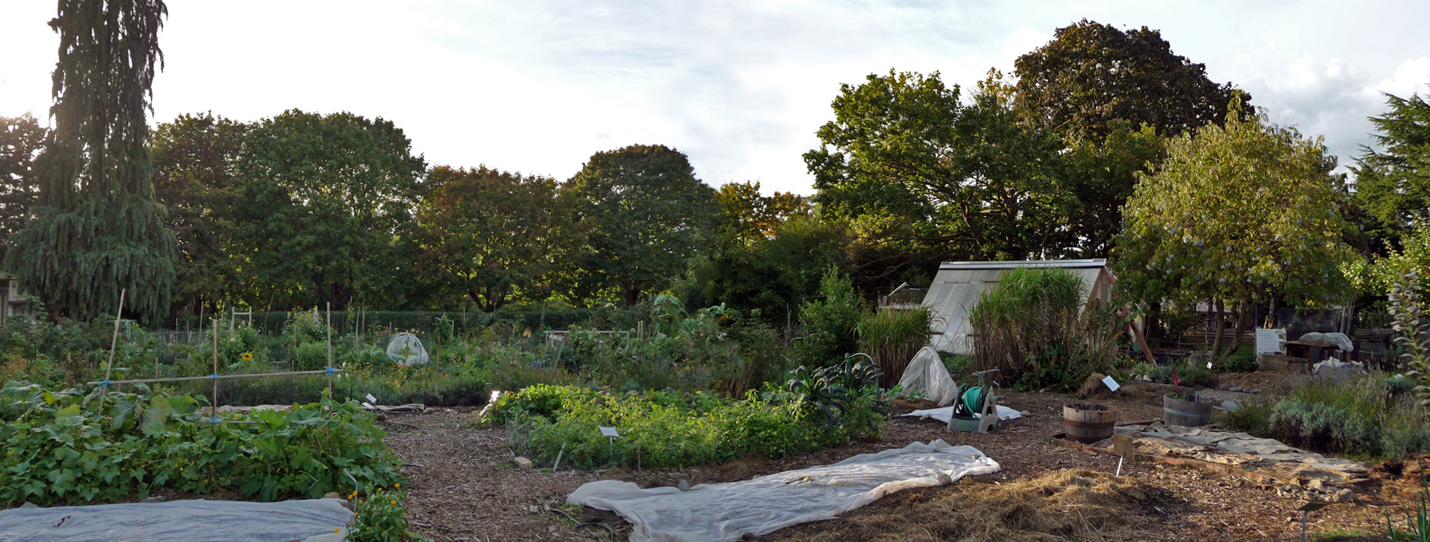
One month and four days earlier (Nov. 2, 2008) I recorded the several parts for this about 260 degree panorama that includes part of the P-Patch (far left)  and most of the Tilth garden.  At the center this pan looks northeast from a Tilth prospect that is near the southern border of the Good Shepherd Campus.  The home seen in part on the right is off-campus and faces Corliss Avenue at its campus dead end north of 46th Street.  The pan is a stitching of eight photos.

The trees that break the horizon above Tilth’s A-Frame greenhouse, left-of-center in the above panorama, appear again in the next recording which looks east towards the Good Shepherd Center and on the same second day of November, 2008.  My back is to the Meridian playfield.  The popular Pergola on the left supports and shelters several concerts during the warmer months, and below the tapping feet of the musicians several families of Rabbits have used the pergola as a hutch.   It is thought that these opportunists made their way to the campus from Woodland Park.

Wet leaves and the bouquets they make can be found throughout the campus resting in and beside the bushes.  This arrangement, however, was discovered a block off campus near the intersection of 46th and Corliss on November 11, 2008.

The last signs of fall included here are the reflections of an autumnal sunset off the west facades of the glass-curtain University District Building at the southeast corner of 11th Avenue and 45th Street – for many years the District’s unofficial mayor, Cal McCune, had his office there – and behind and above it the old corporate Safeco Building recently purchased by the University of Washington. It is the school’s first true high-rise and a symbol of sorts for many developments in the culture of higher education including grade inflation in the school’s undergraduate classes.  B’s continue to rise to A’s at a pace more relentless than global warming.  They are compassionately engineered by human forces in the interests of both comforting and complimenting the often anxious students and also avoiding their sometimes impetuous wrath.   The school recently replaced the insurance company’s banner sign with its own across the top of their new skyscraper.  The photograph was snapped while leaving Trader Joe’s with some pre-cooked brown rice and 73% dark chocolate in the purple wrapper on Dec. 6, 2008.

TRAVELS with JEAN

Jean’s Nissan parks almost alone on Raymond, Washington’s quiet First Street in 2005.  Once this was the main street of a smoking mill town that often went swimming when the Willapa River flooded the street to its knees.  Here on a rare hot day for the coast the pavement is dry as cured fire wood and hot too.  Jean recorded this scene looking south on First as I was either stepping into or out of my side of his gallant carrier.   We were chasing contemporary “repeats” for historical photographs that were then candidates for our book “Washington Then and Now.”  While Raymond’s First Street made it through the final cut and into the book, the repeat we used looks down the center of the street.  It misses the helpful signpost on the left but it is a more accurate “now” for the historical photos used – three of them.  (For Raymond see page 83 – in the book, not this blog.)

Traveling with Jean – the Sherrard of this blog – would be like riding with an ironic* Captain America except that he really has impressive upper body strength from frequent exercise.  He rows while watching the East Enders, the nearly 30 year old BBC1 soap.  And yet Jean is still more pumped-up for ideas of all sorts and for questions of taste and temperament too.   And he can drive like no body’s business, including his own for in truth he hardly makes anything from all his driving zest, including 10 thousand miles across this state pursuing historical sites in order to repeat them for our book Washington Then and Now.   (Visitors to this blog will know how often he flies to that curvaceous canyon on the veriform Yakima River.)

Jean also travels the world, loving the arroyos and scablands of eastern Washington and Ethiopia, equally.  I have seen him travel great distances.  For two weeks in the summer of 2005 I was his dependent as we flew first to London and then rolled by chunnel to Paris.  And there at the train station Jean first met Berangere AKA BB, the Lomont of this blog and I first saw her again since 1977.   I met Berangere that summer now more than thirty years ago!   The adventurous Parisian teenager was visiting my friend Bill Burden, whom she had met the summer before while picking grapes in southern France.  And here, right to left, are Jean, Bill and I posing for Berangere with a familiar landmark behind.

Next, another Parisian scene by Berangere – this one of Jean and I preparing  – with BB – to “repeat” with a contemporary recording the print I hold in my hand.  It is of Concorde Square, and I took it in the summer of 1955 when I spent two weeks in Paris.  I was sixteen and also still more sweet than sour.  Below it is Berangere’s repeat from 2005.  I was hovering over her shoulder.

Back in Washington while touring the state for our book and jobbing about for the book’s promotion, Jean has done all the driving.  I sit beside him in the passenger seat (As I do in the Good Shepherd’s stone grotto portraits also recently posted here.) of his all white Nissan, ready to yield whatever travel advice I have and, more important, listen to his stories.    My Captain is an insistent rapper about this wonder and that injustice and such a good storyteller that unless there is an emergency one will not mind hearing some of them twice because they are his classics.   And one should expect and accept cell phone interruptions from one or another of his many dependents.  Jean is admirably “up-front,” except for those instances when he will suddenly stop, jump from the car and exit around a corner for no announced reason.  Rarely gone for long, he still always takes the keys and a heavy Nikon (digital) about the size of a large chocolate croissant.

Here follow a few recent snapshots of travels with Jean – most of them my own through the Jeanmobile’s heroic windshield.   Jean is just to the left of these recordings, except when he is in them.

First, for the above picture choose one.  We catch Jean (1) looking for a phone booth (2) running around the corner and up the stairs of the Washington State Museum of History in Tacoma looking for proofs of our Washington Then and Now show that opens there in January next.  I take the moment to also leave the car and record this snapshot of the “leaning tower of Tacoma” – another Tacoma museum, for glass not history.

Rather than glass it is Tacoma’s old bricks that both Jean and I find most stimulating. Here is a splendid example on Pacific Avenue, long ago Tacoma’s “boulevard of dreams.”  The pentimento of the pink cream and green sign exhibited on the east façade of this brick block is one of the West Coast’s finest examples of worn mural art.  (While I have never visited a large sample of West Coast revealed murals nor know of any book about them, I still am confident that this is true or may be.   I’ll say that this is another Tacoma museum, one of one work and one wall.   A “drive-in or drive-by” museum you can enjoy, as Jean and I did, through the windshield.

A day after our appointment in Tacoma we were traveling again to responsibilities in Kirkland and Issaquah.  When we reached the Evergreen Point Floating Bridge Jean was feeling good – having a fine time.  Once on the bridge he pointed to “The Mountain That Was God” aka Mt. Tacoma, but officially named Mt. Rainier.  Two years earlier he had sat for most of an afternoon near Paradise Lodge, waiting for The Mountain to reveal itself for the repeat of a historical photograph of it he carried with him.  Now those two views – his and the historical  – appear side-by-side in our book.  Here from the bridge and in the late morning light The Mountain was stroked by dry-brushed clouds.  [Can some reader more familiar with the sky and its tricks explain first that slender but not lenticular, it seems to me, cloud that either points to The Mountain or springs from it, and still more mysteriously the shadow that in part repeats the banner-cloud to the left?]

Stopping for a light on East Lake Sammamish Parkway I used all 10X of the optical zoom advertised even on the body of my little Lumix.  (I purchased it on Ken Levine’s advice.) Jean pointed to the houses hugging the edge of the hill.  He explained that they are the front line of oversized and yet crowded residences built on the plateau east and above the lake.  Some of them he indication would qualify as McMansions.   Depending upon the film you remember, they resemble either a line of U.S. Cavalry or a line of bareback mounted Sioux, waiting to descend into the valley and stick it to a few persons without horses.  I have a different analogy for them born of my study of Classical Greek long ago.  For me they appear to be a phalanx of barbarian invaders.  These homes – Jean tells me for I have never given much time to real estate except the historical sort – continue for miles to the east from that edge of the bluff.  Jean explains that some of this work-in-progress is now stuck.

Ambitious plans on the Issaquah Plateau were popped along with the housing bubble. But then many of them were created together like raindrops on a windshield, or cookie crumbs on a counter, or McMuffins on a grill.  What, I wonder, difference will their mass production matter in a century – if they survive and gain some charm from time and the weather.  Depending upon one’s class sensitivities they now seem to either inspire resentment, remorse, weltschmerz, petty glee or indifference.  Not certain about how I feel, I can at least identify with that comely crow perched on the light standard upper right.  I may be smart about some things, but not about most, including this at once awesome, ominous and curious row on the ridge.  The crow soon flew away from its meditations to search for more scraps in the valley, and once the light had changed Jean continued to the Issaquah Costco where we were scheduled to sign books, which we were fond of telling those who purchased them increased the book’s value by twenty cents, or ten cents a signature.

Late in the afternoon we returned to Wallingford and Green Lake, where the next day I crossed paths with Seattle City Councilman Nick Licata.  I asked Nick if he had seen the young trio singing Bach’s a capella motet Jesu Meine Freude at the front door to the Wallingford QFC.  He had not.  I explained, “With three-parts of a four part Baroque motet they were promoting the social engineer Lyndon LaRouche’s political literature and asking for donations.”  I gave them a dollar for the 3/4ths of Bach.  I might have given 75 cents.   The photograph included here of an unidentified arm shows part of the Wallingford QFC sign beyond.

I told Nick about our trip the day before to the Issaquah and Kirkland Costcos and together we lamented how in the last quarter-century much of “book culture” – both the making and marketing – had been captured by a few heavy weight publishers and retailers – or in Costco’s prosperous formula, semi-retailers.  The Issaquah plateau also entered our little conversation about books and Bach, and the other Lyndon.   Nick confirmed what I had only incidentally heard about Chip Marshall.  The once famous 60’s activist at the U.W., Marshall later became one of the principal developers on the plateau east of Issaquah. Something like Ken Kesey and Abbie Hoffman, Marshall had made his own theatrical run several times from the law, which he offended with some brash objections to the war in Vietnam. What was so entertaining is that he would sometimes appear unannounced to speak in public, but then ditch away again before he could be nabbed.  It was the behavior of legends, and it helped that he was Errol Flynn dashing.  But now his story is a mixed report.  Unlike Kesey and Hoffman, and more like Jerry Rubin, Chip later joined “the man.”  And now, Nick revealed – and this from Chip himself – his old friend longs to open a night club in Seattle.

Returning to the windshield snapshot, Jean told me that the forested horizon behind the crow is Tiger Mountain.  I believe him, for he has been intimate with these “Issaquah Alps” almost since he was a child returning from Germany with his parents to live in Bellevue and eventually, in the early 1980s, to open Hillside School on Cougar Mountain, the little “alp” closest to Lake Washington.  Jean teaches drama, writing and video at Hillside.  His wife, Karen, teaches French and history.  Their oldest son, Ethan, teaches mathematics.   Just above is a photo showing Jean preparing his students for that night’s performance of Brecht’s play “The Caucasian Chalk Circle” staged last year at Hillside.

While on our way from Kirkland to Issaquah we stopped along the east shore of Lake Sammamish where, again from the comfort of the passenger seat, I photographed Jean preparing to take a photograph along the old Seattle Lake Shore and Eastern Railroad right-of-way (1889), which is now a recreation path – a controversial one, although not for those who use it.  Rather some of those who live to the sides of the trail imagine it as a conduit for urban thugs and liberal ideologists (for some, one and the same) who are carried to the east shore on light weight ten-gear bicycles from Seattle thereby interrupting the formerly fretless piety of the lake shore community and more recently the highlands behind it.   Jean is here visiting the now lost mill town of Monohon.  And that is spelled correctly with three O’s.  (Look it up on historylink for a thumbnail narrative of its substantial history.)

And here still at the abandoned depot site of Monohon, Jean shows the power in those shoulders and long arms as he lifts his heavy camera far above the path and over the heads of a cycling family perhaps returning to smoke-filled rooms in Seattle.  Jean has attached his heavy Nikon to his big ten footer and thereby brings its prospect to about knee-level on the third story of a typical office block.

Continuing on to Issaquah and moments before we stop for the crow on the lamppost (discussed above) I snapped this screen of trees along the east shore of the lake.   I figure that this may be an example of the kind of landscape that we are wired in our genes to enjoy and even long for.  On this possibility I included this scene’s easy pleasures for you to study in reverie.  This tentative insight of evolutionary psychology also adds to my hope that some of the garage sale art that I have purchased over the years is resalable.  Let this also be a fair caveat lector to this blog’s visitors for there are plans for using examples from my “Forsaken Art” collection on this site.

Issaquah is also the corporate headquarters of Costco whose employees seem to express universal gratitude for how well they are treated.  Here we take our place before a special black backdrop raised behind our signing table like an altar and pose with Angela who is our Costco hostess.   We ask her how she likes her employer and get that same response.  While I am happy for Angela and Costco I still feel ambivalent and think of Jean’s and my good friend Clay Eals, the author/historian who is such a champion of small stores and neighborhood culture.  We sympathize with Clay’s ideals but can we also afford them.   In Paris it is still possible, if one wishes, to visit a dozen different stores for a day’s needs and all within walking distance – like Wallingford.

Jean is taking French lessons at the Alliance Française.  He is justly proud of his pronunciation, although, as he describes it, learning the ways of French verbs requires the discipline, flexibility, sobriety and elegance of a ballet dancer in the Ecole Française.   A point that is perhaps mean to make, an instance of protecting my own interests, is this.  After studying his French for however much time he can give it, will he ever be able to tell a story as well in the language of Balzac as he can in the language of Dickens?  (In the accompanying photo directly below, two French-looking visitors admire some of the garden bedding on the Good Shepherd campus.  The Alliance Francaise is in the brick building to the rear.)

Come hear Jean read in English Jean Shepherd’s “Red Ryder and the Cleveland Street Kid” and “A Child’s Christmas in Wales” this coming Dec 22 in the fourth floor Chapel of the Good Shepherd Center in Wallingford.  I will be backing him up as the amateur part of the program reading O’Henry’s “Gift of the Magi”, along with a poem that has profoundly shaped the culture of Christmas, yes “The Night before Christmas.” We rented this fine performance hall  – which you can study below in this blog in the many pictures included with Sally Anderson’s Ashes to Ashes review – so there will be a requested or suggested gate of $10.00.   Elsewhere in this blog is an announcement for this reading – and another at the Haller Lake Community Club –  accompanied by a photograph of Jean and I sitting in the Good Shepherd Center’s Grotto.  I am, again, on Jean’s right – left to you.  Here we also include at the bottom another example of a grotto – this one in the pavement near 42nd Street and 1st Ave. N.E. – and just below an abandoned Christmas nativity scene, or part of one, discovered half buried by untended ground cover and neighbor to other incongruous artifacts in a hidden Wallingford side lawn.

* As yet, we can’t quite expect a sincerely ecstatic post-ironic America with the new administration, although satire will now have to search harder for targets.   What we need is rather a post-iconic America, which is a nation dedicated to patrolling for dead metaphors in public speech and hysterically driven clichés like “iconic.”   This “iconic” is used much too often now as a substitute for thinking.   So stop it!

MT. RAINIER – FIVE TIMES: 12/5/8

This Friday, Dec. 5, 2008, at 9:30 Jean picked me up in Wallingford and we scooted to Olympia to sign some books in the Legislative Building’s little gift shop.  We “worked” at this over lunch time, from eleven in the morning to one in the afternoon.  On our return to Seattle I took several photographs of Mt. Rainier from the car window as it showed a most spectacular variation on the cloud cover that it often creates, it seems, for its own and our amusement .   Sometimes this cover hovers like a beret. But the beret can swell into a hard hat and/or stretch into a sombrero.  And on rare days, like this one,  the clouds above the mountain and around it are as fanciful as the hatter’s examples sold at a theatre wardrobe sale.

The first look was taken from the 1-5 bridge over the Puyallup River at about 1:45pm.  This is The Mountain that the citizens of the “City of Destiny”  ought to insist on lovingly  calling Mt. Tacoma.

The next recording looks south and a little east, again from I-5, and over Tukwilla’s Southcenter Mall – or near it around 2:10.  Now the atmosphere about the mountain is dancing, and it has temporarily created a new cap.

Around 3:00 I propped my Lummix against a signpost at the Wallingford Intersection of 42nd Street and 1st Avenue N.E..   The high hat above the mountain has moved further east. Earlier Jean noted that it seemed as massive as the mountain itself, although the reverse of it, like a wrapped Rainier standing on its head.

Next the setting sun gives its typical rose glow to the mountain behind a dead tree given new life with blue bottles lovingly hung from its branches by sensitive neighbors.

Moments later, with the sun below the Olympics, but not yet submerged in the Pacific, and with the camera wide open, the sky misses vespers for a riot.

A Capitol Christmas…

Friday morning, Paul and I, at the urging of a well-meaning friend, descended on our state’s Capitol for what was meant to be a book signing in the legislative gift shop.  It was a slow day for book sales, I fear, though we watched dozens of Washington State calendars selling hotter than hotcakes, and were mildly dispirited by the disinterested yawns (“Washington Then and Now?” the handful of power brokers who wandered past seemed to exclaim, “Been there, done that.”).

There were, as always, pearls of conversation and gentle conversators, but for the most part, we stared blankly at each other and wrestled over a single New York Times.  Much amusement was provided when I found a life-sized ad for HBO’s “Saddam, BMOC” and we took turns shooting pix of each other.

Then we each in turns wandered up into the Rotunda, where we discovered an unfolding scandal.  While Christmas had reached its merry tendrils into nearly every nook and cranny….

(as always, click to enlarge photos)

…there were serpents in that Yuletide tree (note the state patrolman patrolling with care).  But first, let’s visit the capitol’s own creche, a simple stable amongst the marble columns.

Not 30 feet to the left, ATHEISTS had insisted upon their 1st Amendment rights (damn them), and placed a sign reading, in part, “Religion is but myth and superstition that hardens hearts and enslaves minds.”

FOX news, namely Bill O’Reilly, had taken up the cause a few days ago, encouraging his viewers to express their outrage to the Guv. Hundreds of calls and emails poured in hourly.  Christmas under siege, Santa held for ransom, myrrh stolen from Christ child.  Protesting churchgoers were up in arms.  Some added their own signs (see more state patrolmen patrolling beyond the tree).

Then, between 7 and 7:30 in the morning, someone stole the atheists’ sign. Dan Barker, co-founder of the Freedom From Religion Foundation proclaimed the act, “unfriendly.”  Later in the day, someone turned the sign in to Country KMPS’s Ichabod Caine.  The State Patrol is investigating.

Below, see the brightly colored placard on the left; also in place of the original anti-religious sign is a terse gold-colored reminder from the Foundation: “Church/State – Keep them separate”.  George Washington – not a foe of religion, although perhaps of religious partisanship – has positioned his enormous head between opposing sides (his bust here was, Paul informs me, given to the Capitol Building by the Daughters of the American Revolution).

Meanwhile, downstairs in the basement gift shop, Paul and I thanked the staff for putting up with us and left the marble corridors of power, heading once again for our own cluttered basements, which make up in padding what they lack in grandeur.  Outside, Paul paused once more to glance at the Times.

In wearing this mask, Paul wrote me earlier this evening, we were doubly posturing, acting the part of an actor acting the part of Saddam, who spent decades rehearsing his own execution by practising it on others.

Is there some significance here? A cradle of hypocracy liberally perfumed with Frankincense?  Heavens to Murgatroyd, I’m reluctant to bring up old lessons, but aren’t we all, to some extent, reaping those whirlwinds?

Up the Chimney with Dorpat/Sherrard

It’s a Christmas cracker!  Paul and I will be reading tales of the season in a couple venues around town. The first is on Saturday the 13th at the Haller Lake Community Center at 7 PM. The second is at the Good Shepherd Center Chapel performance space on Monday the 22nd, starting at 7:30.

We’ll be reading classics – Paul’s soulful version of ‘Gift of the Magi’, plus, donning Santa cap and bells, his sonorous and heartfelt ‘Night before Christmas’.  Jean will finish off with the hilarious Jean Shepherd saga ‘Red Ryder meets the Cleveland Street Kid’, from which the movie ‘A Christmas Story’ was adapted.

We can’t decide whether to call these evenings Up the Chimney or Down the Chimney with Jean & Paul.  Votes?

Join us!

A FALL QUARTET plus THREE

This panoramic look into Wallingford’s Meridian Playfield is one of the sites/subjects I chose to repeat practically every day since I started my “Wallingford Walk” now 28 months ago.  The number of tended locations is now more than 400.  By now I rarely add new ones.  The complete walk takes about four hours, but this includes visits with friends I come upon and stops at a few health spas like Julia’s bakery and Al’s Tavern.

At the top of this “Fall of Fall” there is a hint of autumn – or many hints with the first fallen leaves — in a three-part pan that was photographed on Oct/12 of this year.  In all seven choices or examples the themselves wide-angle parts have been merged and the seams mostly hidden.   In the scene below it, which was taken Oct/27 some of the trees are well into the fall season, and thirteen days later, on Nov/2 in the third-from-top pan, a good part of their colorful show has dropped to the floor of the Good Shepherd campus.  Four pans down, the gold has turned brown and is hardly noticed in the shadows.  The trees are almost bare.  This fall show, then, lasted about six weeks.  The winter doldrums will endure until early march.   We may hope that they will be interrupted by snow, as in five-down on the fifteen of January 2008.  The sixth pan from the top gives us a hint of what to expect.  Touches of spring are evident from my repeated prospect.  For all of these pans I’m propped against a tree at the southeast corner of the playfield.  This No. 6 spring scene was taken still in the first full year of my walking – on March 14, 2007.  (I began walking my irregular circle – from my front porch and back –  in July 2006.)  Here the wettest part of the playfield is protected from athletes with a plastic orange net.  Finally, in the bottom pan the park is in full summer on July/28 of this year, 2008.  The fence has been removed and the field is dry and a bit beaten.

For my own satisfaction I refer to this as Hyde Park, for the big trees remind me of London’s big park, especially when recorded  as it is here with 90 degrees of the playfield showing.  From these seven views you may get a mistaken notion that this playfield is little used.  Soccer players, fetching dogs, and sometimes mordant teens who smoke behind and beneath the distant trees along Meridian Avenue are almost regulars.  The dogs surely are regulars.  So far I have at least 700 pans from this location leaning against a big tree.   From these I will select and “polish” with Photoshop, and any other program that will help, about two hundred of them (I speculate) for a variety of animation that will involve rapid dissolves between the chosen scenes.

[CLICK TWICE to ENLARGE]

More of 'Ashes to Ashes'

My apologies for not having gotten these up sooner. They should have accompanied Sally Anderson’s fine review, but better late than never, I always say (in fact, I never say that, but it seemed appropriate for this remarkable show).

(click twice on thumbnails to see full size)

(Incidentally, the mysterious final photo of the series was taken peering through the newspaper coffin to obtain a view, not of eyes, but of the negative-corpse-space’s leg holes.)

Photos we won't be using

Yesterday, I made a few stops around town picking up Now and Then shots for Paul’s column. Those below are extras.

First, I stopped at the 41st and Aurora pedestrian overpass and met historian/preservationist Heather McAuliffe and her daughter’s grade school class and teachers from BF Day for a repeat of a 1936 photo. The original was taken below the overpass looking up.

Then I headed downtown to meet Ron Edge, a photo collector and history sleuth, who’s been helping Paul unravel mysteries. We were trying to repeat a pic of an old tin shop at the corner of what is now 1st and Yesler. Here’s Ron, braving traffic:

Later that afternoon, I met baseball historian Dave Eskenazi and we climbed up on top of a vast rooftop (a windowless storage building for King County Elections) looking for signs of Dugdale Park, an ancient baseball field.  This eerie white expanse, which covers the footprint of the old park, is just around the corner from Washington Hall at 14th and Fir.

As always, click on the pix to see them full size.

The fair of Varaignes

For the first time of my life I went to the annual fair of cocks or turkeys in Varaignes in Périgord which is every 11th of November.

This little village of Périgord is in fact the capital of cocks. Every farmer brings  the most beautiful animals which are lead to the village with guards in traditional suits, members of the “confrérie du dindon”, who meet some others members  of the “confrérie of volailles” ( poultry) in  Licques North of France, they go though the market like stars ( a little festival of Cannes). This fair is very popular, it is true  we forget famine, here begins a giant banquet dressed for at least 700 persons.

The atmosphere was  marvelous, out of time !  I noticed they were selling original clogs, berets and charentaises, some traditional food like kilometers of boudins,  well a little bit trash for Paul.

I thought of my grand-father who was used to go to these fairs and was bringing back food, presents, cloths he could find before we invented the supermarket.

ASHES TO ASHES Reviewed by Sally Anderson

DSL welcomes guest blogger/reviewer Sally Anderson, who lives within two vigorous stone throws of the Chapel at Good Shepherd Center.  Here she reviews the remains – it is up only until this coming Saturday, Nov. 15, through 9 pm – of 21 biodegradable coffins hanging from the chapel’s high ceiling.

“Ashes to Ashes”

Chapel, 4th Floor, Good Shepherd Center (climb or find elevator), Wallingford USA
Open noon to 9 pm through Sat 11/15
Wayward Girls Productions (“Lift up your skirts and fly”™)

Artists include (but not limited to):

Maisoui Barham
Alex Branch
Johnny Chalapatas
Catherine Cross
Ben Darby
Jeff Hansel
Christiana Hedlund
Robert Howells
Wendy Lawrence
Matthiu Mendieta
Joshua P. Waddell
Mary Welch
Good Shepherd caretaker Mark Willson

“Now that my ladder’s gone,
I must lie down where all the ladders start,
In the foul rag-and-bone shop of the heart.”

– From “The Circus of Animals,” W.B. Yeats

There are some ladder-gones, and some ladder-beginnings, in this varied take on “the first comfort after death,” to borrow a sentiment from Paul, who joined me a couple of nights ago with “Nancy Appleseed” – Nancy Merrill – perhaps Seattle’s greatest proponent of the planting of trees… for an evening romp among biodegradable caskets.

21 friends and acquaintances accepted curator/resident Mary Welch’s invitation to create coffins for the (suitably) fleeting exhibit titled “Ashes to Ashes” that ends this weekend – Saturday at roughly 9pm – at the Chapel in Wallingford’s Good Shepherd Center.

The exhibit commemorates other endings as well: it’s the last in Welch’s Chapel Trilogy (preceded by “Closet” and “Seven Chairs: Interpreting the Chakras”), the last exhibit under the name Wayward Girls, and also signals the end of visual art exhibits in this intimate space, as the Chapel is better suited acoustically and architecturally as a venue for music, which will continue under the label Wayward Music.

Criteria for showing: the coffins had to be easily biodegradable, weigh 30 pounds or less, and “not stink” for at least 3 weeks. The artists had to both “justify” their materials and be able to themselves fit within, “whether curled up, laid flat, squished out, or the knees stretched out,” per Mary.

All of which left room for the use of beeswax, bamboo, burlap, and bubblegum; newspaper, grouse feet, rice paper, feathers, metal repousse, 16 loaves of Franz whole-grain white bread, silk, antlers, porcupine quills, ink, aluminum foil, leaves, stuffed toys, sugar, and postcards… and words. Lots of words. Some are incorporated into, or inside, the coffins. One submission appears to be a hanging series of newspapers; closer observation reveals, through a tiny cut-out square, that the newspapers are in fact hollowed-out in their centers in the shape of a body.

Each is paired with a paragraph or so of the artist’s imagined obituary. Mary’s humor tends toward the dry side, her caption reflecting her disdain for euphemisms about death:

Maisoui Barham’s, whose interpretation stands out as one of the most organic and complex, begins “They fed me – Now I feed them.” Materials include bones, feathers, fur, and “lightning-struck wood,” to name a few of many.

Johnny Chalapatas also wove elements of nature, using bamboo, burlap, jute, and seeks from friends’ gardens, stating that “Energy doesn’t end; It just leaves its container.” The soft, thready fuzz and whispy fibers of his piece create an oddly crisp shadow that is alone reason enough to visit the exhibit.

The coffins float ethereally from fishing line hung from the high arched Chapel ceiling. This lends a (fittingly) subtle extra dimension of fragility, and rewards with a remarkable play of shadows throughout, on the simple wooden floor and on the waxen flower petals, folded papers, spiky metals, and other fine details atop the coffins. In a happy accident of juxtaposition, the severe shape of the “Chinese Take-Out” coffin (“Thank You / Come Again”) seemingly throws a shadow with arms and feet, which turns out to be cast by its neighbor, “Bread Woman.”

The exhibit overall has a reverential air, from the gracefully muted lighting to the “sound experiment” by Steve Peters (CDs available at the pearly gate) which emanates continuously from a mysterious source.

While several of the coffins reflect the somber mystery of death, the group marvelously avoids a sense of morbidity. A couple are notably lighthearted. The obituary accompanying Matthiu Mendieta’s “cigarette” coffin reads, in part, “Always ready for the next drink and defiantly always on the go. Creative with a very dark sense of humor. May he rest in peace.”

The legend for Catherine Cross’ “Phoenix A-Z” reads: “Instructions for Disposal: 1. Insert dead artist. 2. Keep flat until after burning. 3. Burn / Cremate and Collect / Save ashes (carbon offset investment prepaid to US Department of Education). 4. Mix ash with at least ten yards of rich, well aged compost containing at least thirty percent horse manure. 5. Depending on seasonal and regional availability, Fill manure spreader or heavy duty chalk field liner with the ash and compost mixture. 6.  In a large gently sloping meadow facing the sea and bordered by woods, write the words “I Love You” in a smooth thick cursive font as large as the site allows. Add more compost as needed.”

On Wednesday, the exhibit was visited by a group of seniors. Curator Mary, who also does duty as gatekeeper, couldn’t predict their reactions. The next sound she heard was waves of raucous laughter.

Go see and listen. Ends Saturday night.


(Below: Good Shepherd on the night, Nov. 11, 2008, Sally Anderson visited its chapel for this review)

From Périgord (southwest France)

Bérangère writes:

Here are three  photos in Périgord in the neighbourhood of Maison Rouge where my Uncle Claude and Aunt Yanick are living, it has been raining so much all the 4 days long, and we spent so much time around the divine table to eat so many splendorous meals that I decided the last  morning to wake up early and walk at the beginning of the day on my own, smell the wet morning country  !!!

Joe Max Emminger!

A remarkable show from Joe, one of our especial favorites around DorpatSherrardLomont. His luminous paintings, at once raucous and restrained, deliriously primitive and utterly civilized, really knock our socks off.  Joe’s work is the stuff of dreams, found on cave walls and along alleys, quaysides and memory palaces; signposts for the soulful.

In French, window shopping is leche-vitrines (literally, licking windows). Passing Joe’s bright canvases, I had the nearly irresistible urge to leche-tableaux.

A view from the galleries into the gallery.

Joe with his program writer and designer.

Admirers and fellow leche-tableauxists:

After, outside in the damp, the world seemed refreshed. I found Paul with Renko and Stu Dempster standing in the middle of the street like amazed children.

Don’t miss this show! At Grover/Thurston Gallery, 309 Occidental Ave. S., through December 13th.

STAN JAMES in practice in 2004 and now In Memoriam

You will discover if you are half fortunate that one of the curses of old age is that many of your friends pop off before you do. It is then a bittersweet duty to recall some of their admired qualities.

Stan James died in his shoes and in his Granite Falls cabin last week. The moment is not known. I talked with him by phone on Saturday Oct. 25th to confirm that he was coming to Seattle the next day to lead with his strong baritone and button accordion a singing of Ivar’s theme song The Old Settler, for a 70th birthday party “thrown” my way by Jean and other friends at the Acres of Clams (it is also Ivar’s – not Ivar Haglund’s – 70th year).

Stan and I had a good long talk on the phone, as I sort of drilled him on his folk arts related history. I wanted to give a good recounting of it to those who came to the party. Stan did not make it to the party, nor did he call to explain why. He was 72 – I think.

Stan was alone when he died probably suddenly from his heart problems. He was first seen through a window by a neighbor who was asked to seek him out. The visitor thought that Stan was perhaps sleeping. As yet, no one knows how long he sat there waiting to be discovered.

Stan James was one of the most important figures in the history of regional folk music. He had a wonderful baritone voice, with great power or energy and an often times thrilling timbre. The zest and variety of his life can now be studied and wondered at through the discussion thread found at mudcat.

I met Stan in 1970 while filming “theatrical additions” for Sky River Rock Fire. That film and now video is still a work-in-progress nearly 40 years later – a documentary on the “counter-culture” of the late 60s and especially its music festivals, like the Sky River festivals.
Stan was part of a group who put on leather rags or remainders lent by a leather worker and ran through a forest with a fisheye camera. (That film is around already digitized and when I find it Jean has promised that he will add it to the posting of the Halibut rehearsal footage he had included here.) Stan was a delight that first day “in leather” and every day thereafter that I had contact with him.
Sharing Easter morning breakfasts with Stan, his family and circle of friends at his pioneer farmhouse in Wallingford was enchanting. Stan was the first artist to appear in Jean and my video history of Bumbershoot. He performed at the first Bumbershoot and probably most of the Folklife festivals.
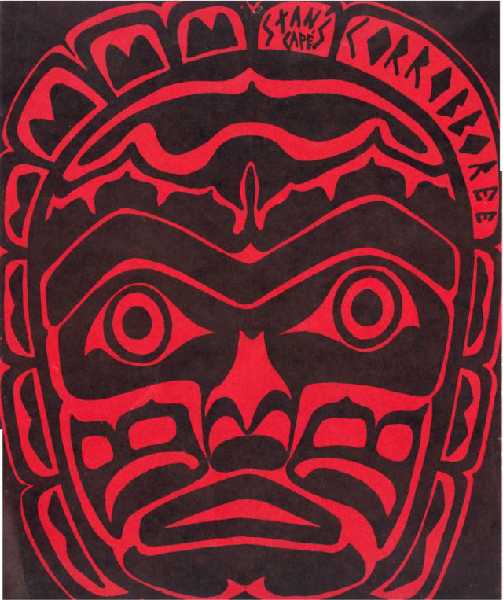
In the early 60s, Stan opened one of the first coffeehouses – the Corroboree – that joined a rich menu of caffeine and pastries with folk singing. You can study the menu at his friend Bob Nelson’s Historical Archives on line. (For more on the Corroboree and the Guild 45th Theatre next door, click here.)
Stan was one of the movers in booking those first Hootenanny concerts at the Mural Amphitheatre at Seattle Center following the 1962 Century 21. He was a master marine carpenter and did some of the earliest work on restoring the Wawona, the venerable but forlorn schooner that has been the needy child of Northwest Seaport. Many are the concerts of Sea Chanteys that Stan has led both on the Wawona and at the Center for Wooden Boats next door at the south end of Lake Union.
The clips of Stan practicing here are taken from footage of the Halibuts, a short-lived group assembled to revive the charming fish songs that Seattle aquarium proprietor and restaurateur Ivar Haglund wrote mostly in the 1930s. The rehearsals took place here in Seattle, on Stan’s front porch, my Wallingford study, and folksinger Alan Hirsch’s home at Interbay. Alan was another of the Halibuts along with John Pfaf. Stan was 68 at the time and still strong of voice. To hear earlier clips of his singing, visit that thread on mudcat.
A memorial is being planned, of course, although at this writing the date and place are not yet set. There’s a problem with having it at the Center for Wooden Boats. It may not be big enough to hold his friends. But such an overflow would be another memorial to and reckoning of Stan James.
Paul Dorpat 11/6/08

Vote

Right through these doors…

…in Washington State, for the last time in person. Henceforth, all ballots will be mail-in. Which saddens me to no small degree. For many years, I’ve voted alongside my neighbors in a small but significant gesture of civilization and community. But there was something precious in the walk of several blocks to St. Andrews Church. Something comforting in the (mostly) retirees who manned the precinct tables. Here then is a snap of a few of them, volunteering one more time in King County to help oversee this final bout of neighborhood voting. The good folks from 47-1313.

And immediately upon my return home, I saw an email (“Le moment est venu”) from BB containing the following image from Paris.

Along with her best wishes:

Mes chéris,
All our best french thoughts for you and the elections… We have good hope !
Je vous embrasse très fort. BB

Tiger Mountain picked clean…

…of chantrelles. I know this has been happening across the NW, but it’s alarming to wander a favorite mushroom haunt and find only two (that’s right, TWO) chantrelles where a few years back we could be assured of finding several baskets worth. Commercial pickers have taken all.

A lovely spot, though, dense with second growth.

Young Alyce, ever hopeful, helped us search with her parents, my cousin Kristin Sherrard and husband Ed Munro, both biologists. Alas, the forest floor was scoured of edible fungi.

Paul in Wonderland (from Bill Burden)

(For those who missed my reading of it, here’s Bill Burden’s eloquent and wise contribution)

For Paul, at the Biblical three-score-ten —

Kind of in the manner of a eulogy for someone who has claimed the infirmities of age for at least the 40 years I’ve known him, but still seems to be hanging on.

In any discussion of “what’s next for Paul,” I think we have to get a handle on what Paul is going to “do” in his next incarnation.

First and foremost, Paul Dorpat is the least idle person I know. I sincerely doubt that he is looking to put his harness down and kick back in some senior paradise. He’s too busy.

As I observed during the years we shared a house in the ‘70s (including the time of the famous 40thbirthday bash) everything Paul did — everything — was purposeful. Not useful, as activities that add to our Gross National Product perhaps, but always with some specific end in mind.

How else could we have had the Helix, the Northwest Film Collective, the famous Sky-River-Rock-Fire movie and the ever-green and ever-satisfying Then and Now oeuvre?

And how else would we have the massive Wallingford Photo Walk project (I don’t think I’ve heard Paul attach a formal name or even description of what he is doing, but that term is how I think of it)?

As some of you probably know, Paul has been documenting, in digital photos, an area of Wallingford. He walks (an excellent exercise for our budding septuagenarian) and takes his photos, about 600 per day. Every day.

I have no idea how he catalogues all these photos (and if you know Paul’s movie-recording history you’ll know why I am mystified) but I pretty regularly get shots that have some story to share from his walk that day.

His goal cannot be just to capture the topography and the structures. 600 shots a day for more than a year-and-a-half would be way beyond overkill, or even compulsiveness (I think). I think he has in mind a specific, if daunting objective: to capture, in exaggerated hand-held, time-lapse photography how fleeting and insubstantial the “solid world” really is.

I think the goal is to get deeper into that physical presence, down to what’s really going on in there, out there, in this burning house.

So a picture of a tree isn’t enough. You have to see the tree with leaves, snow covered, dripping rain, spring-budded — not as an image in itself, but as critical piece of a composite yet to be completed.

So I think of Paul as one of the visionary mapmakers who can’t really describe the coastline until he sees all the tides, all the waves. Does it matter how many maps like that ever get made? And that the ones that do are pretty much the same scale as the world?

Key to his walks are the chance encounters with people on the street. Some know him from his walks and pick up in the middle of continuing conversations. Others may become the subject of a photo, a way to add variety to one of his “set” shots.” (In this setting I also think of Paul as “the king of Wallingford, on his progress around the shire, checking with the citizens).

He also takes shots of people, strangers, who interest him. Some of these have stories connected to them, but in others we are compelled to build a narrative, an explanation, based only on the cues inside the frame — a subatomic particle caught in the shutter flash between two entirely unknowable states.

Like this one, that Paul labeled “Out from wonderland, or To the Hole,” which I think proves that sometimes one picture can be “enough”:

Tonight’s theme may be “Paul in Wonderland,” but at least until he finishes his project, Paul seems to be in his wonderland right here.

Of course, the project that Paul was so committed to more that 30 years ago (Sky-River…), and worked purposefully on for many years, is yet to reach its final form. Actually that’s his NEXT project — he’s planning a video edit in the new year … but he will “need some help.”

Ultimately, perhaps Paul’s real job, from which he has never wavered, is to remain busy enough that old man Death can find no idle entrance.

Don’t stop now!

Paul's 70th birthday bash

Two days before the actual event, we threw Paul a party.

Planning began only two weeks ago, initially with the thought that this might bring together a couple dozen of Paul’s nearest and dearest. Of course, that was naive thinking on my part. There are so many that Paul considers his nearest and dearest that the list of invitees kept growing until the day itself. We had well over a hundred for cake and bubbly, and for those that missed it, blame it on Jean. I didn’t have access to all of Paul’s lists and time was too too short.

Here, however, are a few images from the event itself. If I missed folks, my bad; I was juggling. Jef Jaisun was also snapping; perhaps we’ll see a few of his to fill in the gaps.

Thanks to all for making this such a marvelous event. Paul was, as is his wont and most appropriately, happy as a clam!

(click once to enlarge thumbnails, then again for full size)

Wallingford Pumpkins for OBAMA

Chris and Mary Troth’s “plantation manse” in Wallingford (at the southeast corner of 44th and Meridian) has a pompon or citrouille or potiron coloring (all French terms that have something to do with Pumpkins and used in celebration of this blog’s recent turn to bi-linguil – or more often bi-focul – with the contributions of Parisian Berangere Lomont) and has been recently and wonderfully appointed with the attached row of pumpkins for Obama.  As far as I can determine there are only Democrat signs in Walllingford, and if America follows this neighborhood in the upcoming election it will surly be an Obama Landslide followed by an Obama landfill of signs and such, but not of these pumpkins.  The Troths are also avid gardners and almost surely have their own compost for this endearing political marker.  Mary explains that the colors of their Wallingford landmark are a golden-orange named “jubilation” (and may we so hope) by its manufacturer, white, and a dark read, which she explains acts like the home’s “eye-liner.”

(In celebration of the season I’ll add other pumpkins to this contribution – perhaps later in the day.  A suggestion: why not keep your Obama sign – not the pumpkins – as both a reminder and a part of Sustainable Wallingford?)

Hillside jumps

Hillside Student Community, the lovely small school where Karen and I teach, is a pretty remarkable place. Student teacher ratio of about 4/1; super academics; amazing group of kids from grades 5-12.

For the first time in its history, we’re seriously concentrating on development and PR. Here’s a photo I took on Friday of our kids at the end of the school day. I’m thinking of making it into a banner for school promo events.

Koons at Versailles by Lomont

For the first time in Europe, Jeff Koons has a big exhibition of his sculptures; he is invited to show them in Chateau de Versailles. A big debate has started between those who find this show cool and funny and the others who shout it is a pure scandal. What do you think ?

(click twice on photos to fully enlarge)


Old Fools Explore NORTHWEST PASSAGE

Attached here is the cover to the second issue – from April 1969 – of the Northwest Passage, the splendid and long-lived (although no longer) tabloid that was Bellingham’s contribution to the “underground press” of the late 1960s and after.  Many of those connected at one time or another with the paper – and there were through its life many hundreds – meet irregularly as members of the Old Fools Society or Old Fools Salon or Old Fools Forces or some other Old Fools.  Now this far-flung membership is using the web to ween about a 40th anniversary of the NWP founding and, perhaps, to “repeat” the historical group pose that appears below.  This is an extended call for help in naming those captured here in the Spring of 1969 on some enchanted old porch in Bellingham or near it. (Mouse it to enlarge it.)

Wallingford Four – 10/10/8

Four snaps from today, Friday the tenth of October.   The fly and the monkeys are from a porch on Bagley Avenue.  The flower from the Good Shepherd campus P-Patch.   And The Mountain from the corner of 42nd Street and 1st Avenue N.E. – all in Wallingford.  (All – or nearly all – may be “moused” for enlargement.)

Good Shepherd Quartet: 10/7/8

Like most of the other subjects posted here since we changed our blog-programmer, these four panoramas of Good Shepherd can be enlarged with a tap of the mouse.  They were all recorded this Tuesday afternoon of October 7, 2008.  And they are presented in the order that I visited them as part of my regular walk through the Good Shepherd grounds or campus.  I was cheerfully told by two pedestrians that today was supposed to have been overcast and wet.  One used the word “dismal” and the other “nasty”.  Instead we were spared the rain and got instead performing clouds with sunshine between them.  I entered the campus at the Bagley Avenue entrance at about four in the afternoon and left it about thirty minutes later.

The top pan is of the Meridian Play Field, the most westerly part of the campus.  It is managed by the park department more directly than the rest of the campus.

The next pan is of Tilth’s workhouse/greenhouse, which has also a green or planted roof.

The third pan looks northwest from Tilth’s teaching garden to the same structure and part of the P-Patch attended to by Wallingford neighbors.  On the far side of the screen of trees is the Meridian Play Field.

The last pan shows the Good Shepherd Center against today’s playful sky.  Once a Catholic school for girls – many of them from troubled homes – the structure and campus celebrated its centennial last year.  The restored chapel on the top floor has become a popular concert venue with admired acoustics.

Injured Landmark

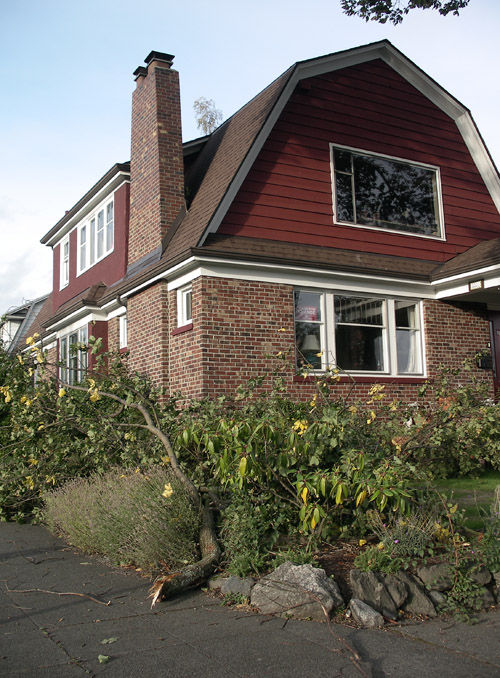
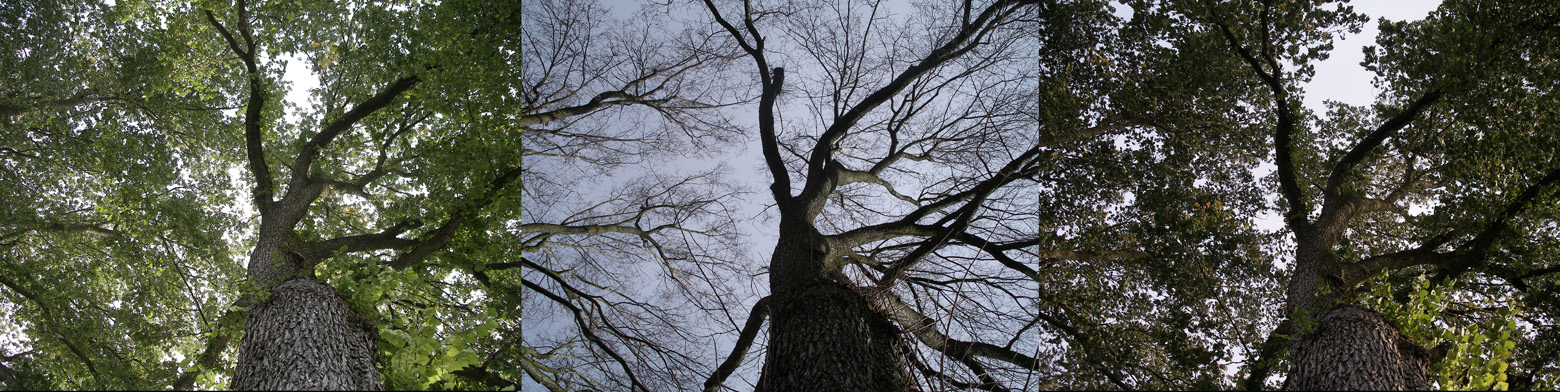
At the Wallingford corner of Eastern Avenue and 42nd Street stand two of the tallest American Elms in Seattle.  There are no witnesses to their age and neighbors hope that the rings may never be counted.  The trees can be seen prominently from the Ship Canal Bridge on I-5.  Together these twins are the largest green mass around.  A few years ago the twin to the east began to crack between its two high branches.  The owners then of the corner house had a cable run between them.  The sudden molesting wind that blew through the north end (at least) on the afternoon of Saturday Oct. 4, did not break the cable, but it did snap a limb from the east landmark and dropped it to the front lawn.  About one hundred feet away and heading for the trees to take my several daily photographs of them, I heard the snap and saw the limb fall.   If it had held on for a minute more I’d have been standing beneath as I do with the three photographs attached here in a row, looking up the north side of the west elm watching the limb approach me — and just miss me.  Find the hole or identify the missing limb when it was still in place in two of the three views.   The limb is missing, far right, on the afternoon of Oct. 4 2008.  It is in tact, at the center, in the afternoon of Feburary 28, 2007, and also intact, far left, on the afternoon of Oct. 1, 2008.  In a fourth photograph at the top the limb is lying on the front lawn of the  home at the northeast corner of 42nd Street and Eastern Avenue.

(Mouse the triptych to enlarge it.)

Gary Stonemetz and his Pink Ladies

Last week, we paid a surprise visit to Gary in his orchard late in the day. He had just finished spraying and we found him cleaning his tanks on a cloudy evening.

This time of year, his days are long. Production manager at Johnson Foods in Sunnyside by day, Gary makes a bee line to his orchard in the afternoon and works into the night. His pink ladies are the best I’ve eaten and true connoisseur that he is, Gary’s never gotten tired of them himself.

He pointed out hail damage from a couple weeks ago. A direct hit and a sideswipe left its marks.

The weather’s been especially wild this year, with a late cold spring shouldering well into summer and a very late freak frost; another week or two of heat wouldn’t hurt to sweeten things up. Gary holds off picking as late as he can, hoping to harvest by the beginning of November. But when the first big freeze threatens, he calls in the pickers and it’s a race to the finish.

Howard is a big fan and unabashedly grabs an armful of these beauties whenever he drops by.

The two of us head to Seattle with a load of goathorn peppers and a couple dozen apples, and Gary’s back on his tractor.

Tardy Spring / Tardy Fall – Revealed

With the last posting (directly below this one) I promised a return with evidence that like this year’s spring, so this fall is late by a few days.  The comparison below of the blossomed cherry trees at the southeast corner of 46th and Corliss were taken one year apart.  The top of the two on March 27, 2008 and the bottom of the two one year earlier, where the budding is further along and the petals are dropping.   This flowering comparison is followed by another from Sept 27, 2008 (on the top of the bottom two) and at the bottom, one year earlier.   The difference here is subtler than with the blossoms, but real enough in the reds of the turning leaves.  I will not name the types of several trees that appear there at the northeast corner of 46th  and Burke in hopes that a reader will respond with their names.  Another reason is that I don’t myself known the names.  So, if you can, please help both nature and me.

(Tapping these pairs with a mouse will make them bigger.)

One day more and I returned to the northeast corner of 44th Street and Wallingford Avenue to repeat a tree I first notice many years ago for its brilliant fall color.  I tagged it the “Flame Tree.”  However, today, Monday Sept. 29, 2008, it was still in the summer greens seen here direclty below.  Below it and two years ago, on Sept. 27, 2006, the Flame Tree was far into its fire.

Folks This Fall Is Tardy

I found this tender sign of fall at my feet late this afternoon while shuffling from my car seat to the slabs of granite that pave our front walkway off the street.   Folks, this year’s fall is late.  And I can prove it – but not tonight.  Tomorrow perhaps.  Since I have been walking that same Walllingford Walk for more than two years I can bring in last years pixs from this day – or tomorrow – and show examples of a landscape that has knitted for itself an autumn dress about a week more developed in 2007 than now.   This was true of Spring as well.  Our cherry trees were a about a week late with their blossoms this year, when compared with 2007.  I may have proved that one earlier with this blog.  For now I do not remember if I did, but will check it out soon for you casual readers.  If I did not put the blossoms of spring – 2007 and 2008 – in earlier I will include them as well – with the “fall” preview – probably tomorrow.

(To enlarge the photo tap it with your mouse.)

.

Lakeview Cemetery with Jean Sherrard & His Shadow

A good number of Walt Crowley’s friends formed a circle around his memorial headstone – a flat and yet risible plaque lying on the grass –  this afternoon (9/21/8) to share memories of Walt and scatter a few of his ashes in the vicinity of the plaque.  Some of Walt probably drifted near the Thomas Prosch plaque, which rests so close to Walt’s that they are bedfellows now for eternity.   This was meant to be, and it was historylink historian Paula Becker who first envisioned it so last year and then suggested to Marie McCaffrey, Walt’s widow and now his successor as head of Historylink, that it would be most appropraite to put the two of them near one another.  Since Prosch could not be readily moved this meant putting Walt – his plaque – near to Thomas. And so it was done.  Thomas Prosch was another historian/journalist whose typed 1901 manuscript “A Chronological History of Seattle” was a most important source for the construction of historylink – its many earliest essays on subjects of Seattle history.  Jean (of this blog) took photographs of all those who said something and he has included some of these directly above.

After the memorial while returning to the car, I noticed Jean’s shadow on a headstone and so recorded it, and then also turned the camera left for a few more shots that fit into this panorama.  It includes a few degrees more than one-fourth of Lakeview Cemetery.  The center of the pan looks to the northeast.  The cedar tree, in the shadows on the far left, is at the cemetery’s summit.  Pioneer Doc. Maynard is buried at its base.  I might have investigated the name on the far side of the big stone on which Jean’s working shadow was caste, but I did not think to do it.  By late afternoon this Sunday, Lakeview was showing the beauty that lured Victorians to cemeteries for their weekend leisure and reflections on mortality.  The site of Walt’s and Prosch’s plaques is about fifty or sixty yards directly behind me.

Walt and Marie’s plaque reads brilliantly, “Walt Crowley 1947 – 2007 Husband of Marie McCaffrey  Co-Founder of Historylink Citizen of Seattle To learn More Visit, http://www.historylink.org ECV  Marie McCaffrey 1951”  A close-up of the plaque is included with Jean’s photographs printed above.

The Pope, Paris & Paradise

(Note to reader:  What follows is a response to Berangere Lomont’s photos of the Pope’s visit to Paris, especially the one (reduced above) that shows the Pope looking towards her through the green glass of the Popemobile. You can now find this view and her other photographs of the Pope’s visit full sized below, or later in this site’s archive. )

Dear Berangere,
Like Celeste of the Women’s Century Club, here in Seattle, I also love your Pope and your Paris.  While the German Pope is relentlessly strict in his orthodoxy, it is claimed that he writes a good dogma. And this Pope is a little less forbidding under the City of Lights, although his walking guards throw some shadow on that. They seem to be worrying like stooges working their way through purgatory. But that can’t be helped, for the world is not so perfect as the Popemobile.   And the Pope certainly looks fit in his Popemobile.  With the fold-out curbside video screen in your photograph one can see the Pope coming and going — omnipresent.  How many of these devices did they use in the 5th Arrondissement alone? It may help us wonder what compensating attractions they used in medieval processions, not having these curbside Deus Ex Machines? And it occurs to me that anytime the Pope does a mass in an outdoor stadium they may be useful – fourteen of them – as Stations of the Cross.  Whether ex cathedra or inside the cathedra, I think what distinguishes any Pope from the rest of us is something more clinging.  They dress the best.  How long do you suppose the Vatican has been filling its pope closets with the nonesuch of outfits made from surpassing fabrics by the ruling class of seamstresses and tailors?  For centuries.  Take off any Pope’s clothes and there is probably not much to prefer. But without the evidence of a Pope with no clothes who can know? Writing now about myself only, as humble as my wardrobe is, every part of it is clean, machine washable and stamped with a free pass to paradise, which I’ll use only if I cannot make it back to Paris.
Paul

WILD SALMON – WILD WIND

Emily Nuchols, our champion for the Snake River sockeye salmon that, she notes, “travels further and climbs higher than any other salmon in the world,” has sent two glimpses of the conditions at Camp Muir, at 10,000 feet, which is the jumping-off place for most early morning attempts on Mt. Rainier.  Throughout August we posted photographs from Wallingford that looked in the direction, at least, of Mt. Rainier from a corner that was a few houses from Emily’s – at the beginning of the month. We did it in support and anticipation of her climb scheduled for August 25-26.  During the month she moved to Portland, perhaps to be nearer those wild sockeye, for Emily is the communications manager for “Save Our Wild Salmon.”   (You can find and/or review that daily Mt. Rainier watch in the archive of this blog, as well as other pictures of Emily and some of her supporters.)

The two snapshots included here show, above, Emily with her climbing team – she is behind the red section of their banner – and, below, Emily alone with the wind and the Cowlitz Glacier.  Emily explains. “When we left Camp Muir at 2 a.m. and started our first traverse across the Cowlitz Glacier the wind was blowing so hard we had to brace ourselves with our ice axes at each step.”   In the dark the Salmon team made it over that ridge behind them – Cathedral Rocks – and beyond that over Ingraham Glazier as well and then onto the rock cleaver so appropriately named  “Dissapointment” for so many.  There, still in the night with flashlights (on their heads I assume) and 60 mph winds pushing against them, the guides put a stop to it, and turned the team around.  Still their effort raised $20,000 for Save Our Wild Salmon.  Our congratulations to the Salmon for having friends like Emily and her team.  And our apologies to the Salmon, for they are still for eating.

BRATWURST & PINK FLOYD

It is understandable that the many attractions of The Great Wallingford Wurst Festival cannot be fathomed from any one perspective, even a panoramic one like this.  Far beyond this playground is the music stage and the food court (with emphasis on bratwurst and sauerkraut) and inside St. Benedict School (on the right) much more, like craft booths, a book sale, a good old Catholic raffle, and something else you will not find at the Presbyterian Party – if they have one – a Biergarten.  This year the school celebrates its centennial, and the 26th Annual Wurst Festival was a good way to gather the alums and neighbors, especially the one’s with children.  It is a two day affair, Sept. 12-13, on the school grounds at 48th Street and Wallingford Avenue.  You may have missed it.

I ordered a tasty salmon sandwich at $4.50, and sat next to an about ten-year-old boy with a Pink Floyd t-shirt printed with a 1972 tour date.  I took the opportunity to brag to the boy and his father that I had interviewed Pink Floyd in 1969 (or it might have been 1968) when their first American tour brought them to the Helix office as friendly artists looking for a local plug.  I can tell you they really were “delightful lads.”  At the time the band was not yet well known.  In the office was a boy about the age of the boy I told this story to, and I invited him to interview the band with me, which he did.  And he got the bi-line.

(Mouse the pan to make it wider.)

SKY RIVER – 40th ANNIVERSARY (plus one week)

Last weekend – Labor Day weekend – while thousands (for forty dollars a day) were reflecting on the condition of the arts in our contemporary failing democracy at the three day gated seminar named Bumbershoot, some of us may have paused to recall what happened in the mud 40 years earlier on a strawberry farm – Betty  Nelson’s Strawberry Farm – a few miles south of Sultan, Washington, off of HIghway 2, on the way to Stevens Pass.   (The Sky River Rock Festival and Lighter Than Air Fair was the reason – it will be argued, with conditions, in the forthcoming video “Sky River Rock Fire” – Bumbershoot was founded.)  Sky River, for short, was the first three-day outdoor rock/jazz festival staged where nothing had been staged before – in this case an about 40-acre farm.

It rained most of that Labor Day weekend, although it was not a cold rain and the estimated 40 thousand who showed up made the most of it by dancing in the mud and periodically chanting for the sun in circle dances which to the Christians, who from a small plane were dropping pamphlets reading “Christ Is Coming,” must have seemed like a pagan ritual.   The music was pretty much non-stop.  The “lighter than air fair” part of it was an inflated balloon of about eight feet in diameter that could get about as far off the ground as it was wide — but with a running jump by an athletic person.  (I may be wrong in this for I did not ride the thing.)

The cost of admittance was $6 for the three  days or $4 for a single day, but a large minority paid nothing, for aside from the flimsy farm fence there was no security.  Still the bands appeared for next to nothing and the reputation of the event, even while it was underway, was sufficient to inspire the Grateful Dead, for instance, to fly up from San Francisco on their own and appear late on Monday, the last day.   I remember that County Joe and the Fish, then a very popular Berkeley band, flew in from a concert in New Orleans.  Joe was wearing a rather nifty white suit that, I believe, he purchased there.  I also remember setting the microphone for a relatively unknown comedian, Richard Pryor.  Santana was resounding across the Skykomish valley at 3 a.m., and although we must have slept, I do not remember it.

I was interviewed about SKY RIVER a few days before the 40th Anniversary by Everett Herald columnist Julie Muhlstein for their Aug. 31 offering of Heraldnet. Here is the Everett Herald link.

One of the two photos included here was also printed with the August 31, Heraldnet piece with caption included.  Fred Bauer (long since moved to the wild California coastline west of Garberville) took the camp life detail from the festival.  The other is a record of both covers from a Helix published the following spring.  It was not unusual to use the covers to promote an event, in this case a benefit concert (although that is too puny a description for those Eagles Auditorium all-day events) for Helix and KRAB radio.

The Pope in Paris

Sent today, another hot scoop and visual feast from our intrepid and inspired Parisienne:

We were waiting for the Pope for two days, no cars parked in the street, so many cops around, no shops opened around rue de Poissy …

And suddenly this morning, after canceling an appointment with a printer, and explaining to him that he could never make it to me because of traffic jams and the metro stations being closed, I decided just to live the event : “the pope’s visit”.

I paid a visit to my friends who own the hotel Familia rue des Ecoles just in front of the rue de Poissy. They feel so fine since the grand opening of the College des bernardins; the musicians playing there are staying at the hotel along with many visitors too. They invited me to come to room 53 and photograph.

(click on photos to enlarge)

In the adjoining rooms, my neighbors were also interested in the pope:

Marvelous Sylvie who, with her husband, owns the Familia and Minerva hotels:

The pope arrives but he is so far away. We feel so disappointed.

I went down to street level. If I could just find a little place along the Quai from the college des bernardins to Notre Dame, I imagined it might be my only chance to see the pope.

What a thrill!

Of course, I was new in the crowd and was surprised when everyone began screaming in rhythm “Benedetto…Benedetto!” as they call Benoit XVI. It was a very happy time anyway.

Pope to visit the Collège des Bernardins in Paris

(received yesterday from BB:)

Another great day in the 5th arrondissement. Benoit XVI is going to visit the brand new and restored Collège des Bernardins which just reopened last Thursday on the rue des Bernardins.  The Cistercian college was built in 1245, was a famous place of research, diverted during  the revolution,   became a fire station in the 19è century, and now is returned to research, lectures …

All the cars had to move off the surrounding streets and the shops will be closed. The poor Pope couldn’t bring back “little souvenirs” to his family from the dead 5th arrondissement.

Here are a few photos of the opening, many priests, sponsors and a few catholic ladies, impressive and cold.

(click to see full photos)

Cousins from Aveyron

A little hello from cousin goats from Aveyron; sweet, curious, they answer to their name and come to say hello, cut the grass, give delicious milk for cheese, and also if they are curly like the white angora one on the left, they give wool.  
Do you know the story of “La chèvre de Monsieur Seguin”? Monsieur Seguin’s goat behaves courageously and fights a wolf all night long because she wants to live free.
For this story and more, read “Les lettres de mon moulin” (“Letters from my Mill”) by Alphonse Daudet – delicious tales from Provence.

Rent-a-ruminant

Howard Lev called me last week after having driven past a patch of downtown greenery filled with goats. I ran down and snapped a few shots of these delightful creatures. 

Chatted with Tammy of Rent-A-Ruminant, who asserted this was a cutting edge example of green business sense. The goats gently munch away brush, then poop, and leave.

Mostly, they’re just sweet and pettable and the opposite of camera-shy.

These bright curious animals approached me eagerly, virtually nuzzling my lens. More ham than goat, it seemed to me.

SUSTAINABLE WALLINGFORD ILLUMINATED

From left to right: Bob Connell, B. Bhartik and partner, Jun Akutsu, Cathy Tuttle, Kathleenn Cromp, Michael Kucher, Treb Connell, Christina O’Leary, Michael Courtney

This coming Saturday, Sept 13, from 10 to noon the “ring of illuminated concern” called Sustainable Wallingford – and I’m a member – will meet almost at the Mosaic Community Coffeehouse at 4401 2nd Ave. NE.  That is the landmark.  The meeting itself will be just around the corner in the First Church of the Nazarene fellowship hall.  You enter on 2nd.

Early last month, August 9th, an afternoon squall ran through Seattle scattering picnics to the nearest shelters.  The picnics that Saturday included one for Sustainable Wallingford at the Good Shepherd campus.  The attached group portrait shows a few members illuminated in the reflected glow of an afternoon sun that followed the storm.  They are perched, of course, in the park’s pergola.

Why investigate this circle of concerned Wallingford citizens?  One reason is that they are also meeting in Wallingford United Kingdom.   Here follows parts of Sustainable Wallingford leader Cathy Tuttle’s latest correspondence to members.  It begins with a request you may wish to take time to examine and respond to.

Please take a survey, What Do You Really Think About Climate Change? We will only be collecting survey data until October 25th, so please try to answer soon! Our friends in Sustainable Wallingford UK contacted us last month at Sustainable Wallingford US, to see if we could ask our townspeople the same questions at the same time. We want to see if we have similar interests, knowledge, and concerns in both countries. Wallingford, UK is a small town of about 10,000 people, located 47 miles (75 km) west of London. Wallingford, USA is a neighborhood of around 20,000 people, located 4 miles (6 km) north of Seattle. Please pass along this survey to your friends! We will publish survey results on our website, and in local newspapers. Thank you!

The remainder of Cathy’s bulleted correspondence includes other clues on why one might want to show up this coming weekend or visit the group’s site.

*   CoolMom Wallingford meets at Mosaic 4401 2nd Ave NE this Tuesday, Sept 9 at 7 pm with Kerri Cechovic from Washington Environmental Council. More info about CoolMom Wallingford from Anne Marie 206-522-5034

*   Active Sustainable Wallingford member Mike Ruby received $15,000 from the Dept of Neighborhoods Matching Fund to help plan a Wallingford Community Center He invites folks interested in the project to the Good Shepherd Center room 122 this Wednesday, Sept 10 at 7 pm.

*   If you haven’t seen the Sustainable Wallingford wheelbarrow drill team, click.

*   The great Sustainable Ballard Festival on Sept 27-28 has a variety of must-see events including two Wallingford-based Spokespeople rides at noon to sustainable sites — so ride your bikes to the festival!

*   Spokespeople will also link houses on the Wallingford home tour on Oct 5.

*   Click for more info about Sustainable Wallingford or call Cathy at 206-547-9569

My one-of-a-kind Sustainable Wallingford button

In Wallingford

Noel writes:

I’ve made a dancing thing with no arms but two beautiful legs.
It lives inside of me, but I wear it like a coat, keeping me in darkness.
Formless, faceless, stacked and grown over years like so much manure,
A throbbing clot in the arteries of my head and my heart.
It stage whispers that I’m both what matters and unworthy.
I gave it legs to run.

Generous Contributions

While walking Wallingford this week I’ve come upon two examples of what will most likely soon become a great commonplace of public giving.  As we approach the grand opening or first day of the new federal requirement for high definiton TV and this new age of entertainment and education becomes the right and responsibility of every citizen in their pursuit of happiness and verrisimilitude, more non-complying televisions will be given up by citizens who ask no thanks.  The single set shown here (below) was found gently resting on its face in a driveway on Meridian Avenue near the Tully’s parking lot off 45th Street – Wallingford’s “Highway to Ballard.”  The two sets (above) were neatly set at the edge of another parking lot, appropriately that behind the Hollywood Video, also on 45th.  Look for much more of this curbside philanthropy in the weeks ahead.  While one may check set labels for expiration dates, there are none.  Sometimes the once warm boxes do include their year of origin.  The attached label from the Meridian Ave. set – a Sharp Model 19np58 – reveals that it is barely twenty years old and so probably eager to turn on for someone these last few weeks.

Fenêtres de ma cuisine (my kitchen window)

Le théâtre de la vie des Génovéfains a repris depuis le 1er Septembre. On s’ennuyait, les immeubles étaient tristes, et les rideaux des fenêtres étaient immobiles.

(The theatre of the inhabitants of Montagne Sainte Geneviève resumed on the 1st of September.  We had been bored; even the buildings were sad, with motionless window curtains) 

Photo du 4 Août
 

Hier soir, les fenêtres s’éclairent et j’attends le scoop, (modérément).

(Yesterday evening, the windows lit up, and I waited for the scoop (in moderation)) 

(photo du 1er Septembre)

Depuis trois jours, 4 policiers gardent discrètement l’entrée du 26 rue de la Montagne Sainte Geneviève, et tout le quartier a repéré le manège, la rumeur laisse entendre que c’est un bandit corse qui est recherché et chacun de fantasmer s’il est meurtrier, voleur, pire…

(For three days, four cops staked out the entrance to 26 rue de la Montagne Sainte Geneviève, but the entire district spotted them. It’s rumored that they’re on the trail of a Corsican villain and everyone imagines he’s a thief, a murderer, or worse.)

Moi, j’ai demandé à l’épicière de me prévenir en cas de “grabuge”, car je ne veux pas rater mon premier scoop.

(As for me, I asked the grocer to alert me if there’s any action, because I didn’t want to miss the scoop.)

La plus frondeuse des voisine s’est adressée à l’un des policiers , car elle avait peur pour ses enfants, et voulait connaître l’ampleur du danger.
La réponse du policier, bien que rassurante, nous a tous déçu : en fait ils s’agirait de deux trafiquants de cartes bleues, ” ceux qui louent au premier étage et ne payent pas leur loyer depuis 6 mois”.

(The most rebellious of my neighbors, concerned for her kids’ safety, spoke with one of the cops, demanding to know if there was real danger. The cop’s response, although comforting, disappointed us all. Evidently, it’s just two ATM card traffickers: “they rented the first floor but haven’t paid for the last six months”.)

Et personne, n’était capable de se souvenir des visages, ni de la silhouettede ces deux petits bandits.

(And no one was able to remember the faces of these two little thieves, nor their allure.)

Aujourd’hui, les policiers sont partis, et moi, j’ai une photo de ma fenêtre de plus.

(Today, the police have gone, and I’ve taken one more photo from my kitchen window.)

– see, “Welcome, Bérangère” below….also, visit BB’s site listed in our blogroll –Jean

"The Mountain That Would Be God" or at least Given Some Almighty Attention

This is not a revival of the Wild Salmon countdown run earlier through the month of August (see the archive), but an instance of an insistent Mt. Rainier.  The reflected sunset this evening (Sept. 2) around 7 pm gave this command performance above Seattle’s Capitol Hill.   Again this representation, like the others below, was snapped with the support of the street sign at the northwest corner of 42nd Street and 1st Ave. N.E. in Wallingford.  (It is one of the about 400 scenes I have repeated most days for the last two years for art and exercise.)  The expression “The Mountain That Would Be God” got considerable play during the long early-20th Century contest between Seattle and Tacoma promoters over how to name Mt. Rainier/Mt. Tacoma.   For some “The God Mountain” was a glorious compromise, although ordinarily this almighty allusion was expressed differently, using instead the rhetorical banner just noted in sentences like “Dear, do you suppose uncle Knud from Bismark would like a drive up to The Mountain That Would Be God?”  And the answer, “Dear, I believe that the  proper name is ‘The Mountain That Was God.’ not ‘would be God’.  You may have thinking of the The Man Who Would Be King a short story by Rudyard Kipling.  Have you read it?”  “No, but I did get started with his novella, The Man Who Would Be Kind.”

Welcome, Bérangère!

Bérangère Lomont, our dear friend from Paris, will join us here whenever she has the time and the inclination, and share her stunning images, visions, passing fancies, and deepest thoughts. We are thrilled to have her onboard and blogging with us.

BB will post in both French and English for all her friends and soon-to-be admirers.

BB with apple tart and yankee apron
 

HERE TODAY, GONE TO BALI!

Here I have captured for the moment Seattle’s admired torch singer Julie Cascioppo on a construction site in Wallingford.  SOON Julie is giving her last performance in Seattle before flying away to BALI.  Here are the facts.

On Sept 11 – a Thursday – from 7 to 8:30 PM she will be performing at EGAN’S BALLARD HAM HOUSE, at 1707 Market St. in Ballard, of course.   Telephone reservations can be made.   Call 206-789-4624.

Julie will be singing ORIGINAL SONGS from her recent JACK STRAW PROJECT, as well as some of her HITS.

Here’s some boiler on Julie.

“In a world of boy toys and riot girls, Julie! Stands alone.  And she also stands tall in the tradition of ‘red hot’ mamas like Sophie Tucker and Mae West.   When not on one of her globe-trotting itineraries, Julie holds court variously at the Sorrento Hotel, the Pink Door and Eagans.

“From the sultry jazz singer of her recent CD, ‘SOMETHING COOL’ to the hilarious monologist of her one-woman show, I ENJOY BEING ABROAD (Performing so far in Paris, Istanbul, Hong Kong, Bangkok, and New Delhi.)  Julie! Is always unpredictable.

“She can be soft as a cello or brassy as a French horn.”

MORE MOOSE MEETINGS – Be Careful Or You May Get What You Ask For.

Recently, Seattle resident Sally Anderson’s sister Sharon, also known as Deedo, who lives in the highlands of Utah, was visited by a moose. Sally, who describes Deedo as a “moose lover,” had already worried about her sister’s expressed urge to meet face-to-face with a moose in peace.

The attached moose portrait, which said sister recorded through her bedroom window, while standing on the bed, suggests that her wish has nearly come true.

Sharon’s snapshot alarmed the prudent Sally, and with a few words of caution she admonished her sister that as cute and kindly as any moose may seem, it can also run faster than she.  “Sharon” Sally said, “be careful or you may get what you ask for!”

This moose episode, we know, is not a first for Deedo. Two years past, while she was resting in her bathtub, a (presumably) different Utah moose stuck its nose through the open bathroom window.  While Sharon was non-plussed, not so Sally, who has since worried that the next time the moose may try the front door.

Readers who are familiar with similar episodes in other parts of Utah are asked to contact the Utah Department of Parks and Wildlife and share their experiences through the UDPW’s official webpage, under the category “Moose Meetings.”  (This new category “Moose Meetings” takes the place of “Moose Sightings.”)

SUMMIT for WILD SALMON

From left: Sarah Kuck, Emily Nuchols. Sitting: Natalie Brandon.

Emily Nuchols is a near-by Wallingford neighbor – about a half block leap from the back deck. On a recent weekend while on my daily walk of the neighborhood I was lured by bunting and balloons at her front door to make a donation at the back door. There hovering above the salads and corn on the cob on her own deck were a few of Emily’s friends who are supporting her part in the fifth annual “Summit For Salmon.” It is a group climb of Mt. Rainier scheduled this year for August 25. I gave the suggested donation of $20, and thereby joined in the “fight to save our wild salmon.”

Emily is the Save Our Wild Salmon’s Communications Manager, but she has done considerably more than “mediate.” For instance, she has kayaked through Lower Granite Dam on the Snake River, and been “swimming” about Seafair and other events in a well-tailored costume as Buster the Wild Salmon.Our linked sponsorships behave like a kind of pyramid scheme with a wild salmon on the top. This means having been reached I am now expected to find at least five other sponsors and so on until together we raise $5,000 – her goal – for supporting Save Our Wild Salmon by sponsoring her early morning trek up the 14,410 feet of Rainier, the hardest endurance climb in the lower 48 states.

Emily can be seen jogging around the neighborhood, seemingly with little effort. However, by the testimony of practically everyone who has tried it, climbing Mt. Rainier, even on the most fortunate of summer days, is extremely tough.

For my soft part I will stay below in Wallingford keeping a daily posting of what Mt. Rainier looks like – or does not look like – a few feet from Emily’s front door. I have practice, for it is a subject I have been photographing for more than a year, steadying my camera against a power pole at 42nd Street and First Avenue Northeast.

I’ve included here two examples, which I have dated. As every local knows, in any year there are only a few days “The Mountain” can be seen. But what — from Wallingford — will be revealed in the coming three-weeks plus for Emily? These daily postings of the “Mountain That Was God” begin on the first day of August and continue through the 25th, the day of the climb, and perhaps through the month.

When she returns we will ask for an interview.If you would like to help save the wild salmon by helping sponsor Emily’s climb you can contact her at Emily@wildsalmon.org or visit http://wildsalmon.org/donate/. Click “donate now” and then scroll down to “Summit for Salmon” and pick “Emily Nuchols” from the list of climbers.

August 1, 2008: Blue Angels approximate the line of Emily Nuchols upcoming ascent of Mt. Rainier. Photo taken in the early afternoon from the Wallingford corner of 42nd St. and 1st Ave. N.E.. (The dome on the horizon tops Holy Names Academy on Capitol Hill.)

Included as evidence that The Mountain is there. This Rainier was recorded on January 1, 08 and from the same Wallingford intersection (a few doors from Emily’s front door) as those that will be snapped through this month in a watchful accounting or count down to Emily’s ascent…

Looking at Mt. Rainier as if it were there on August 2.

Mt. Rainier twice on August 3. The top was taken around mid-afternoon with a few angels performing for Seafair. The above was snapped about 4:45 pm with the mountain revealed, in part.

Sunset – around 8pm – August 4. The Mountain reflects the color of wild salmon.

Around 7:30 pm – August 5.

Around 6:30 pm – August 6, a Wednesday.

7:30 pm – August 7 – Mountain lost behind miles of haze at the end of a clear but hot day.

6-ish and still beyond the purple haze on 8/8/8.
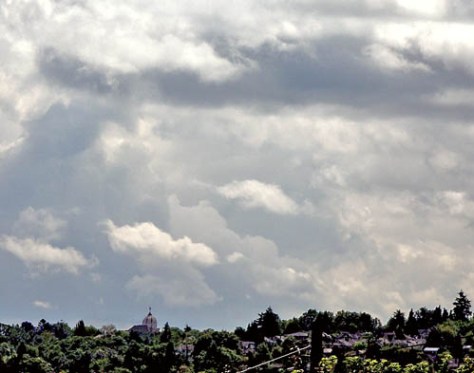
About one in the afternoon of 8/9/8, a Saturday, with The Mountain relaxing in the bleachers at a cloud rally.

Six or seven hours later after an afternoon squall brushed the north end a rainbow formed a complete semi-circle across the western horizon. As seen from Emily’s avenue in Wallingford its southern end did not quite reach the summit of The Mountain, which was, of course, still hidden behind the remainders of Saturday, 8/9/8.

Sunday, 8/10/8 around 4pm.

Monday, 8/11/8 around 7pm. Had Emily climbed this morning and lingered at the top of The Mountain she could have looked down at Wallingford in the late afternoon.

8/12/8 around 6pm on a generally dismal Tuesday that may have tested the good will of every dear reader.

8/13/8 – a Wednesday – around 5:30 and as clear as The Mountain snapped through the Interstate-5 atmosphere can get.

About 7pm on Thursday the fourteenth after the loitering contributions of this hot day.

A hot Friday afternoon, 8/15/8 – with The Mountain barely detectable on a “clear” day.

rainier-fm-1-42-8-16-8bblog.jpg

A hotter Saturday, 8/16/8, around 6:30 pm, with only the speck of a single crow heading east to the arboretum for the night.

Another clear day and yet impenetrable. 8/17/8


Gray Monday, the 18 of August, about 5:30.

Tuesday the 19th with clouds failing to shape themselves like The Mountain. About 5 pm.

Wednesday the 20th – suggestive of entropy about 6:30 pm.

Thursday the 21st – clouds acting like mountains but no The Mountain about 7:30 pm.

The Mountain shows herself on the afternoon – around 3:30 – of Friday the 22nd, 2008.
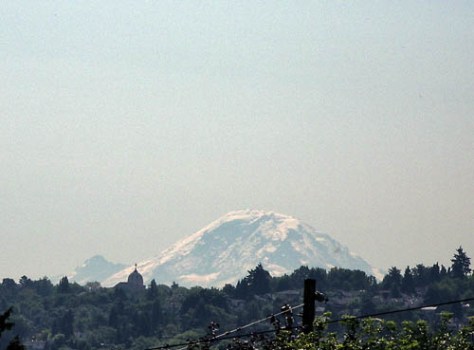
August 23, 2008 about 11:30 AM and so some part of two days short of Emily’s ascent of The Mountain. Living now in Portland – and so nearer the Wild Salmon of the Columbia – she will be approaching Mt Rainier from the south side, the side from which she will begin her ascent. We will be watching, sort of.

The day before: Sunday August 24, 2008 about 6:30 pm, and the day before Emily’s scheduled climb for Wild Salmon.  Today it rained and tomorrow is looking at least somewhat wet.  What will become of the climb in such stuff may be revealed tomorrow.

A moment after  the above photo was taken around 3:10 on the afternoon of Aug. 25, 2008 – the day that Emily was scheduled to climb and we assume reach the summit of Mt. Rainier – had The Mountain been in Wallingford, the Seattle neighborhood in which Emily lived when this count down began on the first day of August, it would have been pelted by an impressively heavy rain that flooded the gutters and drove cats to waiting beneath parked cars.  Tomorrow we will attempt to recount Emily and the Wild Salmon’s fate on what we hope was a climb that reached above these piling clouds.

The Mountain show her head around 3:30 pm on August 26, 2008,  the day after the Wild Salmon team was scheduled to reach the summit of Mt. Rainier.  However, no news as yet from Emily nor on the http://www.wildsalmon.org website concerning the success or, we may imagine from yesterday’s weather, gray rain away.  Of course, we hope for pictures soon as evidence either way.  For our part we will continue to watch The Mountain from Wallingford.

Looking towards The Mountain hidden from Wallingford on Wednesday, Sept. 27, around 4pm — and we have news from Emily.

“Thanks Paul.  We ended up getting stormed out. 60 mph winds and avalanche danger turned us around about halfway up Disappointment Cleaver (aptly named :). We were all bummed, but our guides were spectacular and we all had a great time . . . I’ll send you some choice pix tomorrow.  Cheers, Emily”

A Google for Disappointment Cleaver will bring up a great variety of slide shows taken by climbers that follow the route that Emily took, until her group was turned back by those winds.  If you compare some of these illustrated narratives you will soon get a confident impression of the route to the top that goes by way of Camp Muir, Cathedral Rocks, three glaciers and Disapointment Cleaver.  After the rock cleaver one reaches the last part of the climb, up the “big snowy top” of the mountain.

Towards The Mountain from 1st ne and ne 42nd around 4 pm August 28, 08.

August 29, 08 around 7pm with the day’s evidently getting shorter.

Saturday, August 30 about 4 pm.  The Mountain is hidden behind sympathetic clouds.

Last day of August 2008, the 31st, a Sunday and around 2pm.  When Emily Nuchols returns to her Wild Salmon office (now in Portland) and sends us a scene or two of her group’s attempt to climb The Mountain by the Paradise, Camp Muir, Cowlitz Glacier, Cathedral Rocks, Ingraham flats, Disappointment Cleaver, more Ingraham Glacier (I think), Emmons Glacier to the top route, only to run into 60 mph winds while on Disappointment Cleaver, and there be turned back by their guides, we will print them.  Otherwise, this concludes the August record of Mt. Rainier as seen – and not seen – from the northwest corner of the Wallingford intersection of 1st Ave. Northeast and E. 42nd Street, with the camera steadied about seven feet up on the street sign post.  And may more wild salmon make it to Idaho.

Sponsors at the back deck benefit – July 12, 2008. From left: Rachel Kuck, Leigh Newman-Bell, Sarah Kuck, Sherry, Emily Nuchols, Mike Cooksey, Rachel Cooksey, Val Heer. Sitting: Natalie Brandon, Dan Ritzman.

Now & then here and now…