The weekly now-then feature in Pacific began nearly 30 years ago, on the Sunday of Jan 17, 1982. One of the pleasant surprises that followed having a place in the big pulp was – and still is – the people who want to share or show old photographs with me. Grace McAdam was one of the first readers to make contact with me – I think it was through the help of John Hanawalt at Old Seattle Paperworks in the Pike Place Market (which, is still imbedded there in the lower level next to the Big Shoe Museum.) Grace brought two albums and several loose snapshots that her brother Max had recorded in the first years of the 20th Century. At the time I met Grace her old brother was no longer living – except through her memories and his pictures and a few letters. All of it revealed a man of considerable zest that included what seems, at least, to have had a passionate commitment to the life of a single in his prime. Grace noted that her brother Max was quite popular with her girlfriends.
The bachelor life of Max Loudon is revealed in the albums he carefully filled with snapshots he took of his many adventures. Included are records of joyful events: the spontaneous November 1918 Armistice Day celebrations on the streets of downtown, the arrival of the circus to the lower Queen Anne fields (now Seattle Center), and skating on Green Lake during the long freeze of 1916.
Spontaneous parade celebrating the end of World War One. The view looks north on 2nd Ave. from Madison Street.
We’ll include here mostly group shots, and most of these of women. Truth is he took many more pictures of women he worked and sported with then of men. Directly below is a snapshot of Max on the right with his brother Earl standing in their swimsuits at some public beach where they are warned to wash away the sand before they use the pool. It may well be the pool at Luna Park or another on Alki Beach. Below it Grace McAdams romps on Alki beach with two friends. Grace is on the right and Luna Park behind her.
And another of Grace this time “whipped” by her other bother, Earl, as Max snaps.
One of Loudon's favorites subjects, and also at Luna Park.
Born in Nebraska in 1881, Loudon dropped out of Omaha High School at the age of 15 and headed west to Seattle. Here his personable intelligence (aka charm) carried him through an assortment of vocational adventures: manager of a semi-professional baseball team, traveling superintendent for a grocery wholesaler in Montana, manager of the general store for a logging company in Yacolt, Wash., and a trip north to Nome, Alaska, seeking gold – what else? As revealed in his letters home, this last adventure soon turned hellishly cold when his steamer stuck in the ice for two weeks.
Yacold sawyers by Max Loudon
Nisqualli Glacier, perhaps. There is in the same album a group shot - face forward - of hikers with their staffs posing by the lodge.
Here in Seattle, the young Loudon cut his commercial teeth working nine years for Schwabacher Bros. Wholesale Grocers. He became warehouse superintendent for the Grocetaria Stores, in charge of all departments. His salary -whopping for the time -was $150 a month. I was enough, most likely, to support his sporting life as an amateur boxer for the Seattle Athletic Club, an expert fencer, a medalist marksman and – at least from the evidence of his albums – a man confident in the company of women.
A few of the Loudon’s subjects included here feature Stewart and Holmes Drugstore employees. Some he posed on the alley trestle that runs above the railroad tracks entering the southern end of the city’s railroad tunnel, below Fourth Avenue and Washington Street.
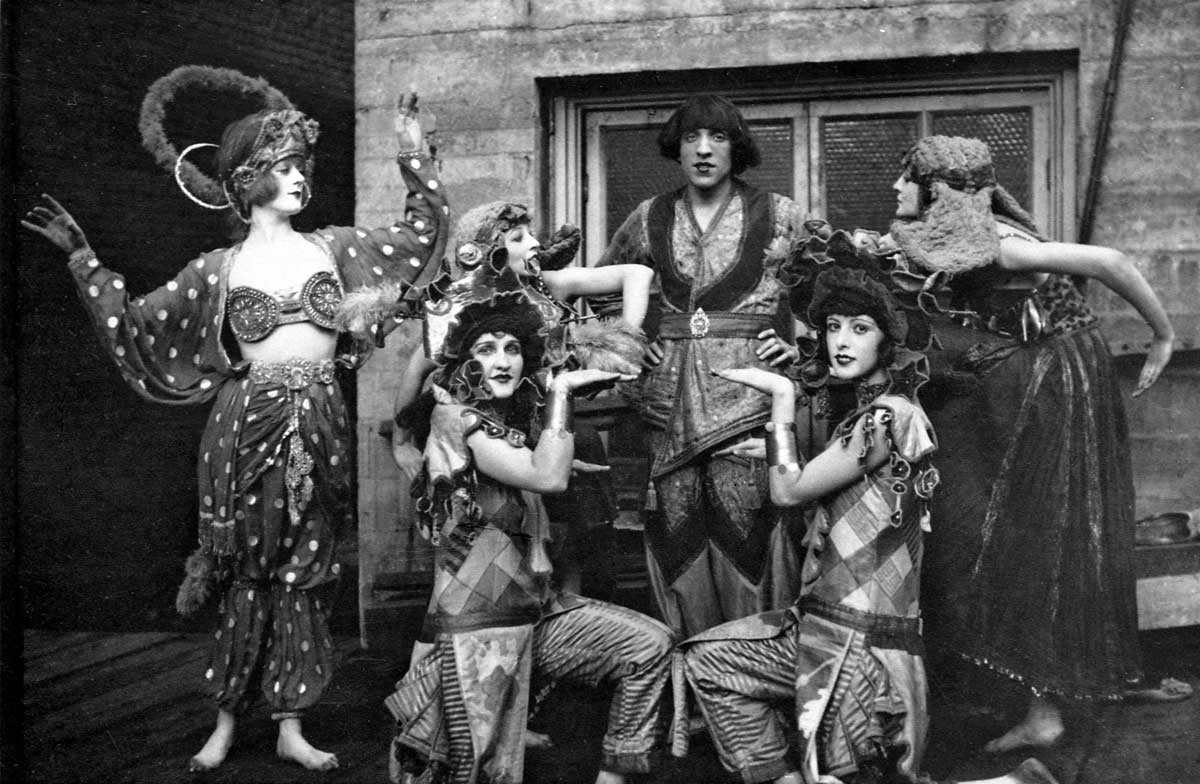
Both Grace and Max followed local theatre on stage and back, and Grace also played some parts.
The Good and the Bad - depending.The Good - ordinarily. Cabrini Sisters on First Hill.
In conclusion, but not finally, we return Max to the family, although not his, but his sister's Grace, on the right, and her best friend Elliott, on the left. These two managed to have babies together too, or nearly. Somewhere I have pictures of the two of them in Grace's Denny Regrade condo, ca. 1982. These too will be posted later.
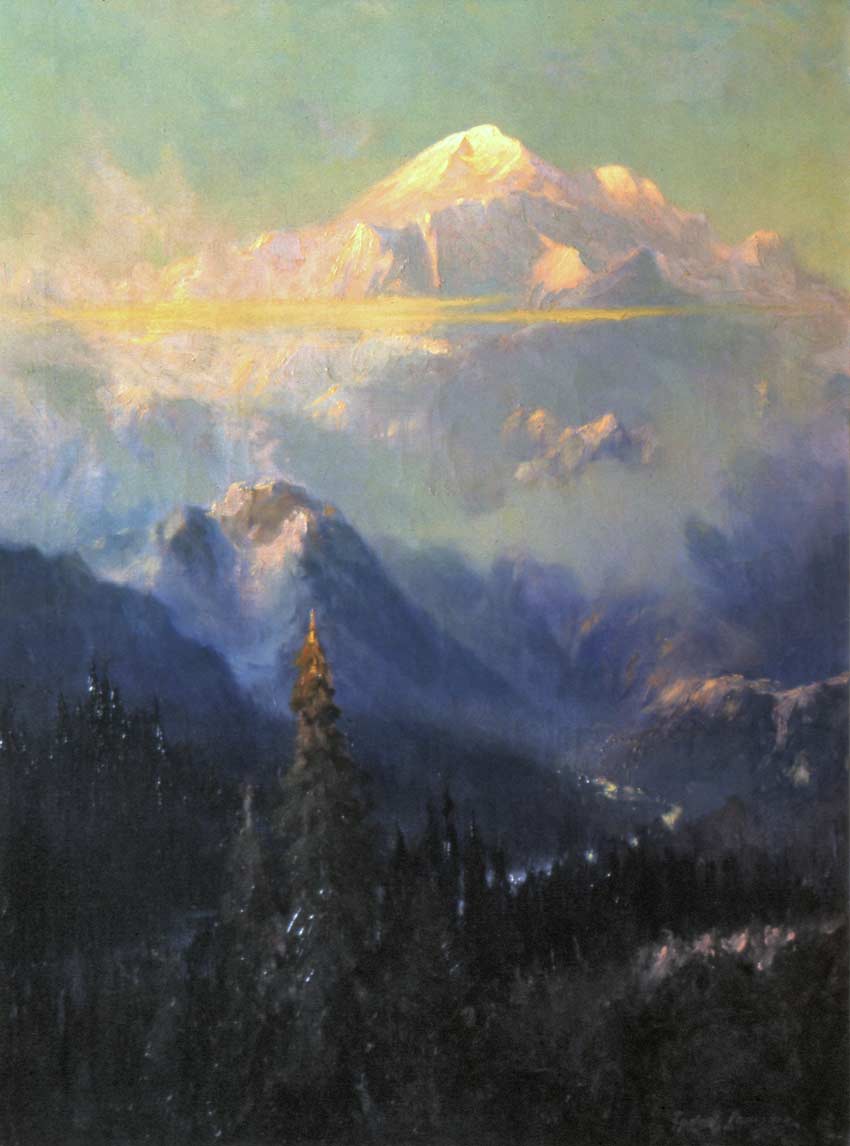
Horace Sykes made many Kodachrome copies of paintings, and he especially liked genre and regional art. Included are a few examples, like this, of Alaskan artist Sydney Lawrence. Actually, Lawrence was born in Brooklyn in 1865, and spent most of the 1890s painting in England, a member of an artist's colony in Cornwall. He exhibited widely then and even won a prize at the Paris Salon of 1894. But in 1904 me made the very big change of moving to Alaska. Eventually he wound up in Anchorage, when it was still a small town, and for a quarter-century until his death in 1940 kept painting and building the reputation as Alaska's primary painter of, of course, Alaskan subjects, like this one. It is certainly possible to see some of same big sky urges that also moved Sykes with his own picturesque slides. (Click to Enalarge)
THEN: The ornate Colonial Building, aka the Chapin Block, held the northeast corner of Second Avenue, on the left, and Columbia Street, on the right, from 1888 to 1906. (Courtesy Lawton Gowey)The now century-old bank building is still looking elegant, and also fit. As a home for an exercise gym, its has turned from building annuities to building abs.
A liberal arts graduate from Harvard, the not yet thirty Herman Chapin came to Seattle to invest eastern money – most of it not his own – in Seattle real estate and also stay alert to other opportunities. Arriving in 1886 Chapin purchased for his Boston backers the northeast and southeast corners of Columbia Street and Second Avenue. On the latter he raised the four-story brick Boston Block and on the former what is seen here: the Colonial Building, aka the Chapin Block.
For Chapin the city’s “Great Fire” of June 6, 1889 was a most favorable real estate turn. The heat popped the windows of both buildings, but the flames did not cross Second Avenue, making the New Englander’s two properties buzzing landmarks in Seattle’s rebuilding. Even before the glaziers replaced all the windows, the Boston and Colonial blocks transformed to hives of enterprise, stuffed with merchants and professionals displaced by the fire.
Following the fire the city’s post office moved around the corner from the Boston building to its own classical and comely structure attached to the Colonial Building (here far-right) and facing Columbia at the alley. The P.O. stayed there until 1899. In this ca. 1900 view James Justice’s stationary store is signed there above the sidewalk. Included next door among the Colonial’s tenants are Masajiro Furuya’s Japanese Bazaar (with a storefront on Second); cycling enthusiast and vegetarian Victor Hugo Smith’s office in rooms 8 and 9 for selling tideland lots, and “mail order tailors” Irving and Cannon.
In 1905 the St. Louis brewer, Adolph Busch, tried to buy the Colonial corner to raise there “the largest hotel in Seattle.” The sale developed a “hitch.” At $365,000, it cost too much. Instead the Bostonians kept to this 120-foot square corner, replacing it with the two-story ornament still standing, new home then for the Seattle National Bank for which Herman Chapin was for many years a director. Thru a prosperous life in his adopted city, the New Englander “built a dozen buildings and belonged to a dozen clubs.” Pioneer Clarence Bagley’s History of Seattle described him in 1916 as an example of that “finest type of American citizen – the man who is born and reared in the east but seeks the West with its opportunities, in which to give scope to his dominant qualities.” And New England cash.
Based on the photographer Asahel Curtis' number for this subject it was taken late in 1907. The view looks north on Second towards its intersection with Columbia. The new Seattle National Bank is on the right, a fresh replacement for the Chapin Block.
WEB EXTRAS
Anything to add, Paul?
Yes Jean by the morning – Sunday morning. I’m scrambling up the rugged slopes of past research at the moment. And yet we could start with a quiz – a visual one but with no prizes. The pan below was photographed from the roof of the steam plant between Western and Post and south of – well south of where? I have, as a sort of studied habit, dated it 1901. I might be a few months later, but certainly with disciplined study could be dated to within a few weeks because of the rich detail and the fact that Seattle was then booming, that is, changing rapidly. Last thing I do this evening before climbing the stairs to join the bears is extract the detail from this pan that shows the Chapin block at the northeast corner of 2nd and Columbia – or part of it. It is really pretty easy to find. Most likely I’ll put off the proof reading until late morning. Please be compassionate. (Click and click to enlarge)
(CLICK TO ENLARGE – probably twice.)
====
Herman Chapin as depicted in "The Cartoon, A Reference Book of Seattle's Successful Mean - with decorations by the Seattle Cartoonists' Club" Mistakenly the text has Chapin building the Boston Block after the 1889 fire. He raised it before June 6, 1889.
SEATTLE TIMES “KEY WORD SEARCH”
We will add now a Seattle Times clipping from 1901 that makes note of Chapin’s part in the build-up of Second Ave.. It is a fragment clipped from a longer article, but it shows off this most wonderful gift of the internet and The Seattle Public Library and The Seattle Times. It is now possible to do key-word searches from the Times for the years 1900 to 1984. All you need is a library card and some instructions from SPL on how to proceed with this service. Why it stops in 1984 I don’t know, but it may have something to do with the fact – as I remember it – that 1984 was the year that The Times went to computers for processing their old news. I remember when I started doing my weekly feature for Pacific in 1982 that persons in the library were still clipping past issues for research files, which I can tell you were and still are a wonderful resource. But now everyone has access to everything in the paper and for so many years. It is really wonderful. Would that somehow the Post-Intelligencer and The Star and the Flag and the Argos the Union Record and many other publications out of Seattle’s past also get this treatment. My work on Ivar Haglund for the book “Keep Clam” is suddenly enriched by this new opening, for although I had already used the Times Library in this Ivar research, the key word search is considerably more thorough and I am finding many things I never knew about. I urge you, if you have a subject – any subject – of interest, try it out. Call the library. It is also a fine hide-and-seek.
=============
POST OFFICE on COLUMBIA
(First appeared in Pacific, Sept. 21, 1997)
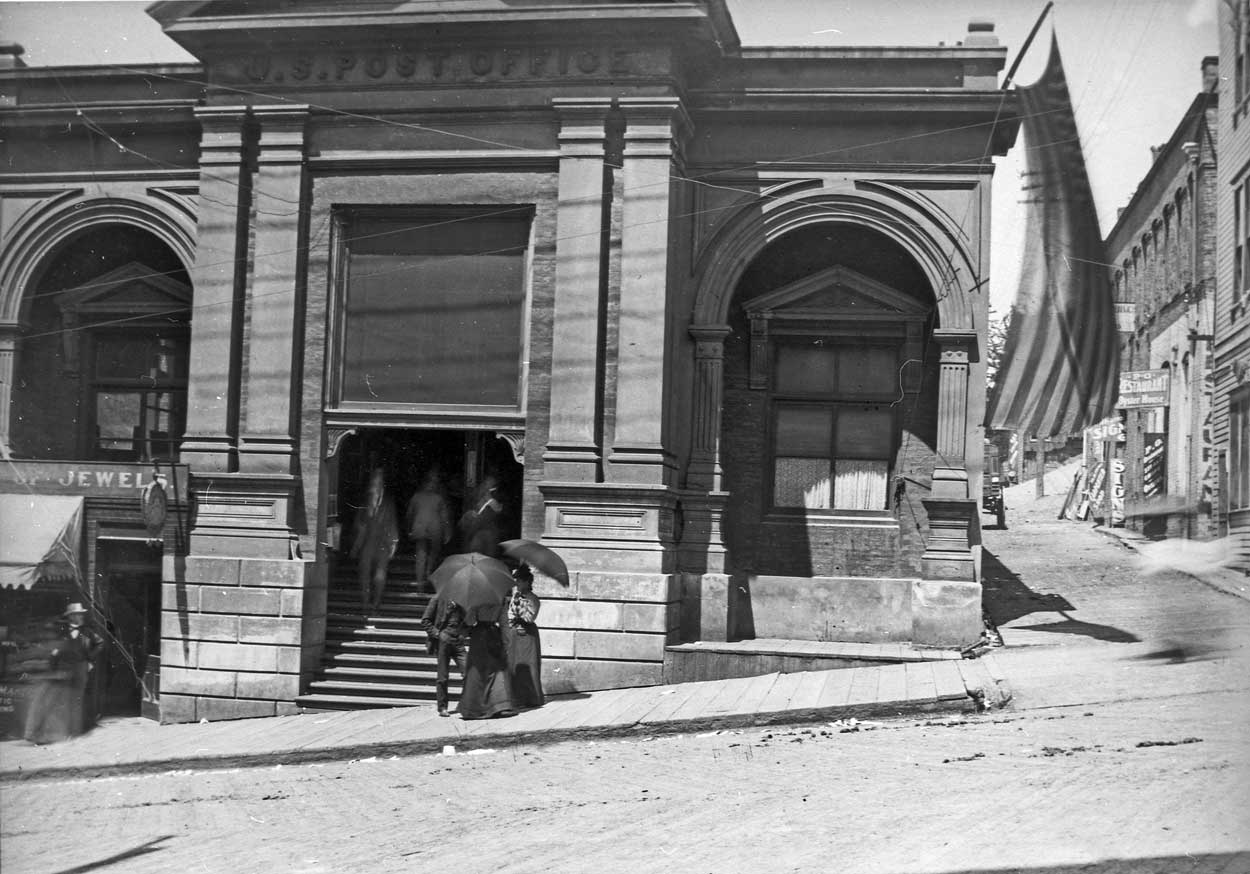
Through most of the 1890s, Seattle’s U.S. Post Office was sited on the north side of Columbia Street, just west of the alley between Second and Third avenues. In this rare mid-decade view, the reliefed letters of “U.S. Post Office” at the top of the scene are half-hidden in the shadow of the building’s overhanging cornice; on the right the flag is flying. Before Sept. 11, 1887, when free mail delivery was introduced, locals had to fetch their mail from the post office at the comer of Yesler Way and Post Street, then the commercial heart of the city. But soon after the first four carriers began their daily rounds, the post office was moved to the Boston Block at Second and Columbia, only a half-block west of this location. The new site was described in the local press as remote, and the move was decried. But the new post office survived the Great Fire of 1889: Second Avenue stopped the fire’s eastward advance, although the heat popped the building’s windows. Soon after the post office was moved to these quarters.
In 1890 the postmaster’s count of pieces handled reached more than 7 million, two-thirds delivered by carrier. The next year total receipts were $96,643, six-fold those of 1887, when home delivery began. Business dropped suddenly with the economic crash of 1893 but, as with most of the community, the post office’s revival was quickened and romanced by the late-’90s gold rush to the Yukon and Alaska.
In 1898, six substations were added, as well as trolley deliveries to Green Lake, the University District, South Park and Rainier Valley. In 1899 the post office left these cramped quarters on Columbia for a larger space at First Avenue and University Street. This temporary leap north was criticized as “like moving to Ballard.” Nine years later, the post office would pack again to its current location at Third and Union.
====
HOME GUARD ca. 1886 SECOND & COLUMBIA
(First appeared in Pacific Jan 17, 1999)
This little classic of Seattle’s historical photographic record has been published many times before. And deservedly. Very few pioneer photographs survive of Second Avenue, and it seems this is the only extant view of a territorial era parade on that street. My copy was lifted from a print in the collection of the Seattle Public Library. Marked “#15040,” its caption describes the house, upper right, at the northeast corner of Second Avenue and Columbia Street as built by Seattle’s second mayor, J.T. Jordon. In this scene, however, if the library’s 1886 date is correct, the home is occupied by Martin Van Buren Stacy and his wife, Elizabeth. By this time M.V.B. Stacy – listed as a “capitalist” in the 1879 city directory – had built a mansion only two blocks away. (Some older readers may well have had dinner in it. It was later used as the Maison Blanc restaurant.) Yet the couple would not move from Jordon’s modest house into one of the community’s few truly lavish and oversize homes until 1887. Martin Van Buren Stacy is also often listed as living in one local hotel or another. The couple, it was rumored, did not get along when together. After building a second mansion on First Hill (now the University Club at Boren and Madison), they built a third and lived apart.
In the late 1950s, local historian Jim Warren used this in his Changing Scene column for The Seattle Times. Warren’s regular feature was a precursor to this; it too compared a historical scene with a contemporary repeat. In his caption, Warren speculates that this is a parade of Seattle’s new Home Guard, organized in 1886. He also speculates that the Home Guard Band in the foreground is led by Seattle’s most popular pioneer musician, coronet player and conductor T.H. “Dad” Wagner. (We learn from Kurt Armbruster in his new book about Seattle’s musical history, title “Before Seattle Rocked” that Theo H. Wagner arrived in Seattle on June 7, 1889, a day after its “Great Fire.” Kurt writes, “He arrived in Seattle with his wife and baby. Sitting in with the First Regiment Band of the Washington National Guard, Wagner demonstrated his natural leadership ability and was handed the baton. The twenty-man ensemble made a modest public debut in Denny’s cow pasture, but better venues soon followed.”)
Farther up Second Avenue two pioneer landmark towers should be noted. The first tops the Stetson Post residential arcade at Marion Street. It was Seattle’s original upscale apartments. Finally – and dimly – breaking the horizon, upper left, is the spire atop Plymouth Congregational church north of Spring Street.
A section of one of the several parades featured during the city's 1911 Golden Potlatch celebration. Like the pioneer view above it, this one looks north on Second to Columbia and beyond.
============
Above: Looking west down a planked Columbia Street to the waterfront from Third Avenue, circa 1900. [Photo courtesy Larry Hamilton] Below: The Colman Building is the only survivor from the “then” but it can barely be detected, right-of-center, with added stories at the northwest corner of First Ave. and Columbia Street. It is directly across First from the Norton Building, in 1959 one of Seattle’s first glass curtain wall skyscrapers. [Now by Jean Sherrard]
COLUMBIA STREET Ca. 1900
(Appeared in Pacific early in 2008.)
Looking west on Columbia St. from Third Ave. to Elliot Bay. In the foreground worn planking gives a texture to Columbia but at Second Avenue it runs into brick.Behind the pole on the right, stands the stately little classic that was Seattle’s post office for most of the 1890s. When it moved to new quarters in 1899, the sidewalk news depot and stationary store survived. A few of the periodicals offered are hung in display beneath the large sidewalk awning.
At the corner with 2nd Avenue, the ornate two story Colonial Building was built by Harvard graduate Herman Chapin who also raised the plain four-story brick Boston Block directly across Columbia at its southeast corner with Second. Constructed in 1887-88, their timing and locations were most fortunate for both buildings just escaped the city’s Great Fire of 1889 (although it cracked their windows) and following the fire they were temporarily stuffed with businesses displaced by it.
The broad-shoulder Haller Building holds the northwest corner of Second and Columbia, right of center. Built directly after the fire from a design by the prolific architect Elmer Fisher, its principal tenant here is the Seattle National Bank, one of whose directors was the “capitalist” Theodore Haller.
Just by the signs evident here in this first block on Columbia one can buy a sewing machine, photograph supplies, a haircut, a Turkish bath, a newspaper, and a meal at the Alley Restaurant, sensibly in the alley north of Columbia. At the waterfront it is still a tall ship with two masts that rests in the slip between the Yesler and Colman docks.
============
Above: In the shadow of the Haller Building at Columbia Street an unnamed photographer looks south on Second into what was then still the city’s primary financial district. (Courtesy Michael Cirelli.) Below: Second Avenue has been elaborately altered in the century between this now and then. Still the Alaska building can be detected in both. (Pix by Jean Sherrard)
FINANCIAL DISTRICT CA. 1906
(Appeared in Pacific, Spring of 2008)
Looking south on Second to its intersection with Columbia, this is another look at Seattle’s financial district during its greatest boom years, the two decades following the “Great Fire” of 1889 when the City grew from about 40 thousand to almost that many more than 200 thousand.
In the feature that precedes this one (above), Columbia Street was the subject, looking west from Third to Second, ca. 1900. And here about another six years later an unnamed photographer records Second Avenue, again, looking south from mid-block between Marion and Columbia, which is being crossed by a lonely motorcar and an electric trolley on the Lake Union line.
What stands out and up in this view is at is center: the Alaska Building (1904) at the southeast corner of Cherry, Seattle’s first skyscraper.
The banner strung across Second Avenue mid-block above the trolley reads, in part, “Old Time 4th at Pleasant Beach (on Bainbridge Island), Boats Leave on the Hour, 50 cents. Including Dancing and Sports.” So the photograph was recorded early in the summer. We choose 1906 as a likely date. It is the last “full year” for the Chapin building on the left.
The Hinkley Block, far right, dates from 1892 and here it is filled with lawyers, dentists, and even some artists. The brick paving on Second is about 10 years old. The oldest structures in this scene are the two on the left: the Colonial or Chapin Block on the northeast corner of Columbia and the Boston Block south across Columbia. As noted in the feature directly above this one, both were built before the fire of 1889 and provided great service to businesses following it. Post-fire photographs from 1889 show these two buildings standing along above the burned-out business district. (We will include one soon below.)
=============
SOARING SECOND
(First appeared in Pacific, May 24, 1998)
The photographer’s intentions for this mid-1920s view of Seattle’s urban canyon are, I think, transparent. The view looks south on Second Avenue across its intersection with Columbia Street. The camera’s architectural lens has straightened the skyscrapers that would otherwise, from the street, seem to lean toward infinity. And the soaring dignity of these subjects is increased by the silence of the street and sidewalk. There is nothing to distract us from the mass.
When it was dedicated in 1914, the Smith Tower, far right at Yesler Way, was trumpeted by its builders as the “largest building west of New York.” Also by a somewhat impressionist counting, it was figured to reach 42 stories at the skylight ball that balanced on its pyramidal tower.
At Cherry Street, two blocks north of the Smith Tower, Seattle’s first steel-frame skyscraper, the Alaska Building, was topped off in 1904 at 14 stories. From its penthouse the members of the building’s namesake dub enjoyed an unsurpassed prospect of the city.
The Smith Tower is covered with a skin of white terra-cotta tiles – “it shined like a beacon” to mariners. The brick-clad Alaska Building limited its tile work to ornamental bands and its bricks do not gleam. Nestled here between its neighbors, the Alaska Building is noticeably darker.
The real “shiner” is the Dexter Horton Bank Building, named for Seattle’s first banker. From this view (primarily of its plain backside) we can measure the structure’s mass. However, only one of the 15 terra-cotta sides that complete the building’s four great wings facing the Alaska Building across Cherry Street is evident. The revealed Second Avenue facade does feature, rising from the sidewalk, the building’s great three-story columns. Perhaps they intimate this institution’s monumental future as Seafirst Bank – for those who remember it.
==========
With ashes still smoking but having escaped the destruction of the 1889 Fire, the Boston Block (center) and the Colonial Block (left of the Boston and behind the chimney ruins) are filling up as temporary post-fire quarters for merchants and professionals of every sort who have lost their addresses if not their businesses.
Above: Looking south from the south facade of the Boston Block. The Wycoff residence at the southeast corner of Second and Cherry is at the bottom of the scene. The new neighborhood of temporary tents is spreading thru the burned district. Below: Looking north and back at the Boston Block, upper-right, with the roof of the Wycoff home in the foreground and Second Avenue and more tents beyond it.
More ruins as seen from an upper floor in the Boston Block. Columbia Street is on the right. The standing ruins were part of Front Street's (First Ave.) showstrip of elegant and well-ornamented brick business blocks. It extended from Pioneer Square to Columbia Street without break on the west side of the avenue.
====
MEYDENBAUER HOME – 3rd and Columbia Northeast Corner
(First appear in Pacific, Feb. 1, 1987)
Before the 1907 regrading of Third Avenue, the neighborhood was graced with old homes and churches. One home belonged to William Meydenbauer, the town confectioner. Meydenbauer was 18 when he headed for the United States after an apprenticeship with a candy maker in Prussia. That was in 1850. He made his way to San Francisco in 1854. After a ruinous try at gold mining, and a short experiment with teamstering, he returned to the small but sweet rewards of confections.
The Meydenbauers moved to the Northwest in 1868 when Seattle had less than 1,000 cash-poor residents waiting for something big to happen in the 16-year-old village. Those post-civil-war years were still sour, so the confectioner was welcome. The candy man built a home on Third Avenue at Columbia Street around 1880. Before that there may have been a crude shack on the property but little else. At the time, Seattle’s idea of refreshments for fancy public receptions was sliced apples and gingerbread. Meydenbauer bought the Eureka Bakery on Commercial Street (now First Avenue South) and soon made a significant addition to the town’s sweet offerings with a selection of well-dressed candies and sweets, including their celebrated Yule cakes.
He and the town prospered and in the mid-1880s, Meydenbauer moved his business into the new and bigger bakery he had built behind the family home. The rear of that plant is pictured above behind the tree and to the left of the family home, and below prominently on the north side of Columbia between Third and Fourth Avenues near the center of the subject.
The Meydenbauder home peeks from the northeast corner of 3rd and Columbia around the Eureka Bakery, which faces Columbia. The Rainier Hotel is on the center horizon and Central School to the left of it. The roof of the Boston Block fill's the bottom right corner and more. The subject was recorded from the Hinkley Block at the southwest corner of Second and Columbia.
By employing several helping hands and running two delivery wagons, Meydenbauer was efficient enough to sell wholesale. Meydenbauer and his wife, Thelka, raised eight children. A son, Albert, continued in his father’s profession after the latter’s death in 1906. After the 1907 regrading of Third Avenue, the Meydenbauer home was replaced by the Central Building, which survives.
Central Building on the left; a scene from the sizeable 1968 snow. (See, if you will, the History of Seattle Snows included with the blog.)
Not so oddly, this family is not remembered for its perishable sweets but for sustaining real estate. In 1868 Meydenbauer rowed across Lake Washington and set a claim beside the Bellevue bay which still is called by the family name.
The Bellevue-Seattle ferry at Meydenbauer Bay, May 30, 1914. This docking subject as well as the neighborhood subject shown in the body of the feature, above, are both included with essays in Seattle Now and Then, Vol. 1, which you can explore on this blog thru the history books section or button or tab or icon. (There! We have been dragged to it by a current cultural necessity. We have used it! "Icon") The chapters there in are 19 & 80.
======
The Haller Building at the northwest corner of 2nd and Columbia in 1908. On the right is the corner of the northeast corner and part of the brand new Seattle National Bank building, which replaced the Colonial Block.
BUILDINGS IN BUNTING
(First appeared in Pacific, 2-10-1985)
Seattle was aroar with excitement in May of 1908. Fags were hung everywhere and the city dripped with red, white and blue. All the pomp and fuss was over the arrival of 13 battleships from Theodore Roosevelt’s Great White Fleet. During the morning hours of May 26, 1908, a three-mile-long military parade was the last big hurrah of a four-day event celebrating the show of force in Elliott Bay.
According to a local newspaper, “Seattle never before in its history appeared in such gay attire.” The old Haller Building (see here), at Second Avenue and Columbia Street, was “decorated in a tasteful and artistic manner,” The Post-Intelligencer reported. But it was a modest adornment compared to some of the garnishing done by businesses along the parade route. “Vying with one another, the mercantile firms have created a veritable spasm of color on First, Second and Third avenues . . . the eye almost wearies of the view.”
Frederick and Nelson facing Second at Madison Street, adorned with bunting for the 1908 fleet visit.
The Alaska Building – the city’s first skyscraper – was adorn with more than 500 flags. The 14-story building was a block south of the Haller Building at Cherry Street, and at night it was a target for the barrage of spotlights shot from the 13 fighting machines in Elliott Bay.
Some of the many flags attached to the Second Ave. facade of the Alaska Building ascend along the right border of this view that looks north on Second on parade day but during a parade of trolleys only. A scene from Fleet Week looking south on First Avenue from near Madison Street. (Courtesy Lawton Gowey)The fleet approaches Elliott Bay.
Throughout the four days, Seattle was hit by a wave of humanity as an estimated 200,000 visitors took the city by storm. “Night and day the streets are full, alive with a rushing time of humanity restless as the-sea,” the P-I reported. The next day, Wednesday, May 27, Roosevelt’s big show moved on to Tacoma for four more days of boat races, parades, barbecues, dress balls and more buildings dressed in patriotic colors.
==========
Columbia Street, looking east from the waterfront during the 1884 snow. (A story that accompanies this snow scene was included earlier on this blog and can be found by searching for "1884" or "Columbia Street."Pioneer photographer LaRouche's look east on Columbia, ca. 1891, from Post Alley. A glimpse of the Chapin corner can be had near the scene's center - above the Front Street (First Ave.) cable car.
====
The brand new Seattle National Bank - at the northeast corner of Columbia and 2nd. The photo has been dated March 9, 1907. (Courtesy, Michael Maslan)
====
Returning now to the roof of the power plant on Post Alley.
You will find the Chapin Block - part of it with sidewalk awnings - very near the center of this section pulled from the panorama printed again below.
This panorama extends about 180 degrees from the Colman Dock on the far left to the King County Courthouse on the First Hill horizon, far right. (Courtesy Lawton Gowey)
Here's another slide from a handful of them merely titled "Urban Renewal," and from internal evidences dating, so far, from the 1950s. The pile of shoes on the floor is a touching example of anxious hording - I imagine. (At least on my MAC, one needs to Click TWICE to Enlarge.)
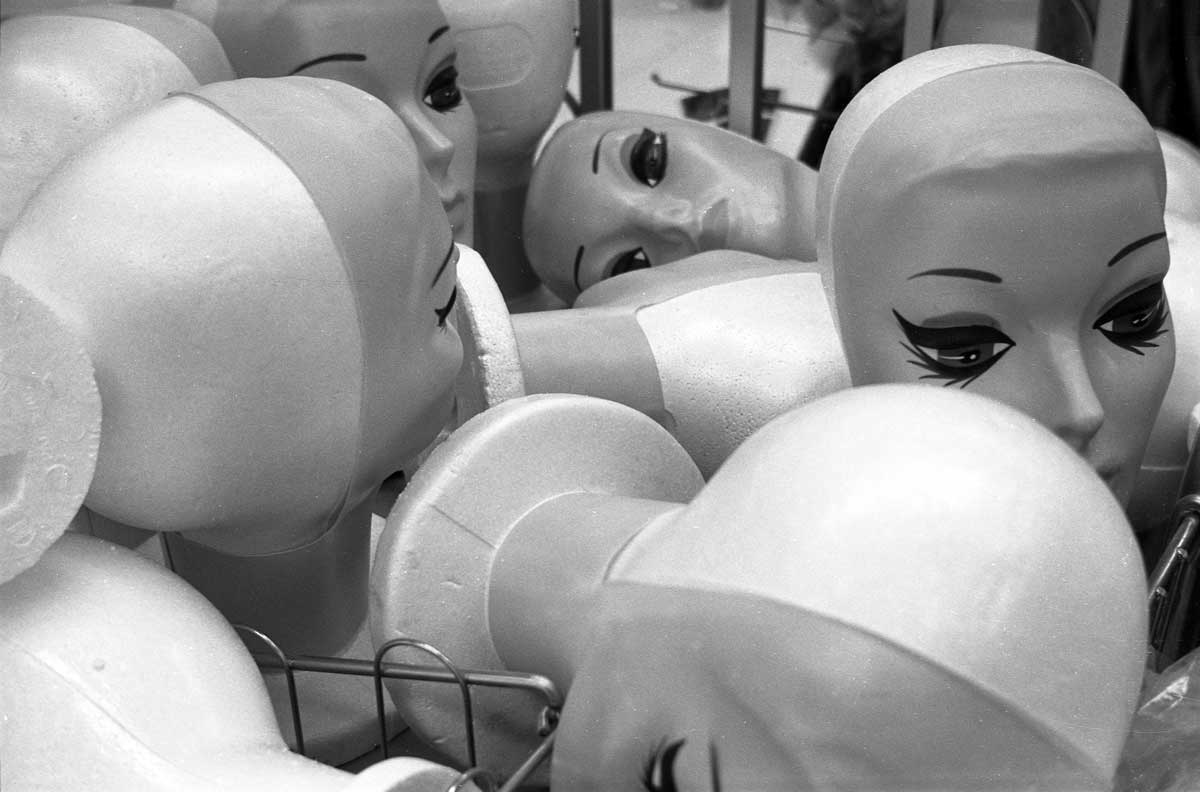
This I snapped during a visit to White Front sometime in the 70s. I no longer remember if the name was joined as one – Whitefront. I remember being startled by the sign promoting Santa before Thanksgiving and the Sat. Nov. 25th date is a clue at least to possible years that the day that the day that is still two days after Thanksgiving came on a Saturday. I remember the Niagara Cyclo massagers but neither Ira Blue nor KGO radio. Here a carboard Ira gives a personal touch to the vibrator. And last, why there would be a table filled with heads for my inspection, that I don’t remember either. Now looking back to the second (middle) subject, I wonder if the blonde on the left might have borrowed her big hair from one of these heads. The White Front building on Aurora near 135th may be a K-Mart now, if it has survived the latest falling. (Click to Enlarge)
I cannot confirm it, but I think that is Horace Sykes on the winding dirt road acting on his frequent delight in studying roads, both paved and not, heading off into picturesque landscapes. Here was have both. This subject, again, is not named by Horace, but it is almost certainly somewhere in the Palouse. We have shown among the other 494 Daily (nearly) Sykes shown here since early in 2010 photographs that included Horace looking at the camera or posing for it, at least once with his camera. This subject also carries a 35mm camera over his shoulder, and it is those shoulders - and the posture - that make me think they are Horace's broad ones. His athletic daughter Jeannette had them too.. Here she is below posing with the family dog on one of her visits to Seattle. Sometimes she was accompanied by her husband, the navy man, and sometimes not. (Click to Enlarge)
The focus is soft and the color askew but the wit of Horace Sykes caption is enjoyed. “Here’s How Martha Got George.” He penned it on the border of the slide. His daughter Jeannette peeks at her father and he at her through the gate to their home with mother Elizabeth at the Puget Sound end of Bertona Lane in Magnolia. They moved from Capitol Hill to their new Magnolia home in 1932. Jeanette was then twenty-two and still in school – either the U.W. or perhaps by then Cornish. This is many years later – most likely on one of her visits to her folks in the late 1940s. Jeannette was a ballet dancer and distinguished by her formidable frame. Some of her dancing was done at Cornish. The Times description of her on her wedding day to Navy Lieutenant Henry Clay DeLong (of Bath Maine) reads, in part, “The bride who is a tall, stately blond, was given in marriage by her father . . . She carried a handkerchief made from the lace of her great-great grandmother’s wedding gown.” The wedding was at St. Marks on August 16, 1935. Earlier that year Jeannette was crowned Carnival Queen at Mt. Rainier, for the 4th annual Spring Ski Carnival at Paradise Valley. It was also the site of Jeannette’s triumph in 1922 when the 12-year old beat her father to the top of Mt. Rainier, and became, the Times reported, “the youngest person ever to reach the summit.” Three years more and the Times “added” that the teen Jeannette was doing radio skits with her father Horace on the subject of fire safety. She “took the part of ‘Mrs. Smith,’ the woman with the house full of fire hazards.” (Click to Enlarge)
In Paris, musicians have to be very inventive to do rehearsal, because the neighbours of the apartment next door don’t always like music.
I was crossing the Tuileries Garden when I heard the wonderful sound of a saxophone. I approached and photographed the artist playing “in the woods”, who is also an engineer some other times …
A Paris, les musiciens doivent être très inventifs pour répéter, car les voisins de l’appartement d’à côté n’aiment pas toujours la musique.
Alors que je traversais rapidement le jardin des Tuileries, j’entendis le son merveilleux d’un saxophone, je me suis approchée et j’ai photographié cet artiste “au milieu des bois”, qui se révélait être aussi ingénieur à d’autres moments.…
THEN: A page copies from one of pioneer historian Thomas Prosch’s two albums of early Seattle scenes. Prosch’s own captions add both directions and personal tone to his albums. (Courtesy University of Washington Libraries, Special Collections)NOW: Another good service from Jean Sherrard’s extension pole. Like the historical scene, Jean’s looks northeast above the intersection of First Ave. S. and Washington Street.
We’ll begin with the complete and descriptive title of Lorraine McConaghy’s newest book: “New Land, North of the Columbia, Historic Documents That Tell the Story of Washington State from Territory to Today.” In the book’s introduction she calls it our “paper trail from the territory’s very founding with President Franklin Pierce’s appointment of his political cronies to the patronage jobs of the new territory.”
The historian’s own paper trail began first with letters and notes made from phone calls and then with bus and train tickets and rides with friends. McConaghy doesn’t drive, so she spent an adventurous year crisscrossing the state by other means, visiting archives, museums and libraries with her digital scanner and making copies to share from the state’s “magnificent common treasury of file folders . . .” The book’s many pages are elegantly arranged with Washington ephemera like “housing treaties and patent drawings, political cartoons and FBI files, personal correspondence and business records.”
With her abiding métier as the Museum of History and Industry’s resident historian, Dr. McConaghy had been impressively productive as a teacher, curator and author. This time, she explains, “My intent is to turn peoples attention to the archive.” She wants us to not only “be proud of our shared archival heritage” but also to be “grateful to the archivists.” When she made her earliest contacts with the same, she asked, “Show me cool things that you have that tell great stories.” They and she have succeeded. Surely, “New Land, North of the Columbia” is a merry journey of discovery.
Early in the book (page 15) McConaghy features a full page from one of pioneer historian-chronicler Thomas Prosch’s two photo albums filled with early recordings of Seattle street scenes and other settings. Like McConaghy, Prosch was prolific. With his own caption he dates and locates the subject at First Ave. S. and Washington Street (looking northeast) in 1873, and then in his 1901 two-volume manuscript, “A Chronological History of Seattle,” Prosch shares eight well-packed pages on touchstone Seattle events in 1873. Prosch’s albums and chronology are both kept in the archives of the University of Washington library. Should you choose to visit the library for a closer look, you may want to also thank the archivist.
WEB EXTRAS
Anything to add, Paul?
Yes Jean, more old news from the neighborhood.
But first some links provided by Ron Edge that will take our readers into PDF displays of both Prosch Seattle albums, a Washington State Album, which includes lots of Seattle subjects as well, and then (wonder of wonders!) Prosch’s type-written chronological history of Seattle – EVERY PAGE! Then for desert Ron adds a couple of examples of newspapers that Prosch edited in 1872 and 1875. (This, of course, is all in the spirit of Lorraine’s new book – as well.)
Back on Commercial Street, our opportunities run over and on and one for of all the subjects covered over the past thirty years (shy about 8 weeks) of weekly features in Pacific no part of Seattle has got more attention from this rocker than the pioneer three blocks extending south from Yesler Way on what was first called, I know you know, Commercial Street. We will show a mere ten of them – unless I bring it to a dozen or so – and we’ll start with Yesler’s Cookhouse, which is one of the oldest surviving photos of any part of Seattle.
Next to Henry Yesler’s sawmill his cookhouse was the most legendary of pioneer Seattle structures. Built during the inordinately cold winter of 1852-53 it was razed in mid-July1866. Photo courtesy of MSCUA, UW Libraries.
YESLER’S COOKHOUSE
Before first operating his steam sawmill early in 1853 – the first on Puget Sound – Henry Yesler quickly constructed his cookhouse. While for years the mill supplied Seattle with it principal payroll, the rough-hewed cookhouse gave it much more than hot meals served beside a broad fireplace. This was a 25-foot square stage for sermons, trails, political caucuses, parties, hotel accommodations, military headquarters (during the 1856 Indian War), elections, the county auditor’s office and civic meetings of all sorts. And until his wife Sara joined him in 1859 it was also Henry’s bunkhouse.
But where was it? Seattle historian Greg Lange has recently converted me from my mistaken belief that it rested at what is now the northwest corner of Yesler Way and First Avenue. Although others and I have liked it there Lange has confirmed Cornelius Hanford’s 1924 directory of 1854 structures. Hanford puts the cookhouse on the west side of Commercial Street (First Ave. S.) on the second lot south of Mill Street (Yesler Way.)
Lange’s evidence supporting the pioneer historian’s claim is impressive. First Lang uncovered a notice in the Dec. 17, 1866 issue of the Puget Sound Weekly stating that “a new building . . . on Commercial Street . . . has arisen on the spot where the famous old log cookhouse stood.” Next Lange found the site confirmed again in 1889 affidavits connected with a court case between Yesler and “city father” Arthur Denny. Although this is enough for any contrite conversion Lange also discovered that the cookhouse was first located on Commercial street (before the street was there) and later moved to where we see it retouched but still smoke-stained. Here it faces the street beside the home of Seattle’s first photographer E.A. Clark, and it is a good guess that Clark took the picture sometime before the 32-year-old photographer died on April 27, 1860.
This, the only photograph of the cookhouse, appears in “More Voice, New Stories” where it is used as an illustration for Coll-Peter Thrush’s* essay “Creation Stories, Rethinking the Founding of Seattle.” The attentive eye will notice that most of the group posing here are Native Americans. Perhaps all worked for Yesler in the mill. The new sesquicentennial book’s twelve essays on “King Count, Washington’s First 150 Years” were written by members of the Pacific Northwest Historians Guild and published by the King County Landmarks & Heritage Commission. You may purchase a copy directly from the guild. Call Guild President Chuck S. Richards at (206) 783-9245for details.
=========
SAMMIS PAN From SNOQUALMIE HALL
First appeared in Pacific, Feb. 7, 1982
The Gazette, Seattle’s first newspaper, reported in 1865 that E.M Sammis, the town’s first resident professional photographer (however briefly), had just returned from a stay in Olympia and would “be ready in a few days to take pictures of everybody at his splendid new gallery over Kellogg’s Drug Store.” Although not “everybody” responded, the number of citizens who did was probably more than the seven or eight whose portraits have survived.
The University of Washington’s Historical Photography Collection preserved traces of Sammis’ work also include cartes de viste (small view cards) of the young town’s two architectural showpieces, the Territorial University and the Occidental Hotel, and a card of Sammis’ “splendid new gallery,” which was where the Merchant’s Cafe is now on Yesler Way. Surely the most extraordinary image in these few remains is one lovingly described by Dennis Anderson, formerly in charge of the collection, as “a bent, torn, soiled, little rag of a photograph but the earliest surviving original panoramic view of the city.” The original measures 2.5 x 4 inches.
This was copied from a book with a stapeled gutter, and so part of the text is lost on the right. I believe - merely - that these identifications were gathered by Clarence Bagley, Seattle's most prolific pioneer historian. Plummers store with Snoqualmie Hall above it at the southwest corner of Main Street and Commercial (First Ave. South.) Duwamish Head is across the bay. (click to enlarge)
Sammis took his panorama from Snoqualmie Hall, above the southwest comer of Commercial (now First Avenue S.) and Main Street. The view is to the north extending from the still-forested eastern slopes of Denny Hill on the left to the residence and barn of settler Charles Terry, on the right, on the block that until recently held the Public Safety Building. On the horizon at center left, the Territorial University looks down from Denny’s Knoll at the northeast comer of Fourth Avenue and Seneca Street. (Denny’s Knoll is not Denny Hill. Again, the southeastern forest slope of the latter can be seen on the far left.) The little “White Church” in the center of the photograph was Seattle’s first, and directly below it is the Masonic Hall near the southeast comer of Front (now First Avenue) and Cherry. A bit less than a block farther south and across James Street is the white Occidental Hotel. (A flagpole reaches another thirty feet or so up from its roof.)
The normally busy Commercial Street seems void of human activity not because Sammis requested everyone to stay inside. Rather, the fIlm in his camera required such a long exposure that busy persons on the streets would not hold still long enough to be recorded. Therefore, loggers heading for McDonald’s Saloon, in the lower right comer of the photograph, riders moving up the street to Wyckoff’s Livery Stable, the only two-story structure on the east side of Commercial, and even the idlers that commonly hung out around the flagpole where Commercial ran into Yesler’s mill, they are all invisible.
Because of cash-poor times, paying customers were usually invisible to Sammis. A year earlier, in 1864, Sammis was in Olympia advertising his photographs at “six dollars a dozen or fifty cents each.”
With his return to Seattle in the spring of 1865 he carried with him into his new studio a hope that business would improve. However, the editor’s announcement in the August 12 issue of the Gazette reveals that by mid-summer Sammis was relaxing his cash-only policy: “E.M. Sammis, photographer, wishes to say to the farmers and country people in the vicinity of Seattle that he will take all kinds of country produce in exchange for pictures. He says, “There is no excuse now. Come one come all.”
Within a year Sammis would be gone, but he left his panorama and those few other dog-eared traces of his photographic art that survive.
Sammis' portrait of Chief Seattle, the chief's only sitting portrait. Seattle may appear in a group shots taken in Olympia, although the identification in that case is not certain.
Sammis’ “drug store” portraits do not include his recordings of both Doc Maynard and Chief Seattle. Some may consider the latter especially, as his most important contribution to our memory. He did those portraits at another and earlier studio, one at the southeast corner of Main Street and First Ave. South, which was still the home of the Elliott Bay Book Store when this feature was first published in 1982.
A photographer from Victoria B.C. named G. Robinson visited Seattle in 1869 and recorded this look north up Commercial Street with his back near Jackson. On the left is Plummer’s Snoqualmie Hall, revealing the roof’s ladder, directly over the sidewalk, that Sammis climbed to record his panorama. Robinson also went into the hall to make a pan of the city in 1869, although he did not climb to the crest of the roof. Instead, he used a second story window and one further back – or west – in the hall. (We include it directly below.) The Illustrated History of the Seattle Waterfront, which we feature as a pdf file found on this blog’s front page, discusses both the Sammis and Robinson pans, and in considerable context.
The Robinson 1869 pan recorded from the second floor of Plummer's Snoqualmie Hall at the southwest corner of Main St. and Commercial St. (First Ave. South.) Courtesy Washington State Museum in Tacoma. (Click to Enlarge)
=========
North on Commercial Street towards the intersection with Main Street, circa 1874.Looking north on Commercial from mid-block between Main & Washington Streets. The Dextor Horton Bank, a one story brick structure on the northwest corner of Commercial and Washington, appears on the left. Its ruins from the 1889 fire is featured near the bottom of this list. North on Commercial with the photographers prospect near Main Street. Both Central School, and the University of Washington appear on the center horizon. An Oct. 28, 1878 clipping describing grading work on Commercial Street. Below it another on its progress from a few days later. (Thanks to Ron Edge and his newspaper collection.)
==========
Another Prosch album artifact, with some of his text included for “proof’ only.
COMMERCIAL STREET North From MAIN STREET
(First appeared in Pacific, Jan. 1, 1984)
Resembling, perhaps, a set for a Hollywood Western, the empty street and the waiting “extras” scattered down the sidewalks seem suspended just before the director’s command releases a gang of hooligans or a stampeding herd of longhorns from behind either the camera or the distant corner onto the two busiest blocks in the gas-lighted commercial heart of Washington Territory’s largest town. This was Seattle’s Commercial Street (now First Avenue S.).
In these two blocks between Main and Mill (now Yesler Way) streets, most businesses opened at six in the morning and stayed that way until nine or ten at night. Laboring here were two jewelers, four hardware merchants, a tailor, a sign painter, a fish merchant, five tobacconists, a bill collector and a ship chandler; there was also a combination gun and toy shop (See how it starts?), a hotel, four bars, an opera house, two barber shops, two banks, two restaurants, and four clothing stores, And, as the newspaper ads then often exclaimed, there was “much more than there is room here to tell.”
The year is probably 1881. That’s the dating ascribed by Thomas Prosch in his pioneer photo album of Seattle. And Prosch would likely know, for in 1881 he was just around the corner on Mill Street editing either the Intelligencer or the Post-Intelligencer. On October 1, 1881 the Daily Post consolidated with Prosch’s Intelligencer, and he came along as editor and part owner.
Unlike the first, our second and somewhat earlier view of Commercial Street is not deceptively still. Rather, the “Big Snow” of 1880 has silenced it. The storm began on January 6 and within a week was piled in six foot drifts. On January 8 John Singerman, unwilling to wait for a total meltdown, dug a channel across Commercial and, as the Intelligencer reported, “began removing the extensive stock of the San Francisco store into its new rooms in the Opera House building.”
The two across-the-street locations of the capacious and elegant quarters in the Opera House were the largest in the city. With this move the San Francisco Store became the city’s first department store, keeping its boots, shoes, and clothes in one room, with dry goods, fancy goods, and general merchandise in another.
Squire’s Opera House (on the right) was put up in 1879 by the future governor and senator Watson C. Squire. Its biggest night came in 1880 when Rutherford B. Hayes, the first president to visit the West Coast, shook 2,000 hands in a reception there. The highlight of 1881 was the five night stand of Gounod’s Faust by the Inez Fabbri Opera Company. To save voices this touring company carried a “double cast of star performers” who sang on alternate nights.
The full Peterson & Bros Stereo. (Courtesy Michael Maslan)
Across the street (on the left) the New England House, as an 1881 Seattle Chronicle ad claimed, was “eligibly located and its accommodations for families unsurpassed.” Actually, the city directory of 1882 reveals that it was mostly single men like George Elwes, music teacher; J.H. Morris, stonemason; J. Jasques, shoemaker; William Downing, speculator, and J.D. Leake, compositor at the Chronicle who lived there and boarded on the European plan.
The Miners Supplies down the street was most likely one of the few businesses on this commercial pay streak whose 1881 profits were petering. The Skagit River gold rush of the previous year was by now a disappointing bust, and there was not much call for outfits, although there was for beer next door.
Throughout the 1880’s Commercial Street was the stage for many parades and one riot. The”Anti-Chinese Riot” of 1886 flared at this Main Street intersection in the scene’s foreground. Three years later the great fire of 1889 scattered Commercial Street with the remains of its flattened commerce. Within three years it was rebuilt wider, higher, sturdier, and into the neighborhood of brick we now have the wise urge to preserve and enjoy.
The Brunswick Hotel and Squire Opera House, left of center. The two story structure on the right is the same as that appearing directly below in a 1883 recording from the intersection of Main and Commerce, taken during the visit of Villard and his entourage of notables who were carried to the American Far Northwest on the first transcontinental of the Northern Pacific Railroad. Villard brought it to completion. For this 1883 look north thru the intersection of Commercial and Main we will quote from Kurt E. Armbruster's newest book (page 29) BEFORE SEATTLE ROCKED - A City and Its Music. "Henry Villard drove the last spike on the Northern Pacific Railroad in September 1883, then rode his private car to Puget Sound, prompting the biggest bash yet seen on Elliott Bay. The Pacific Cornet Band, the Queen City Band, and the Carbonado Cornet Band vied to out blow each other on 'Garry Owen,' and even after the party ended, the festive mood lingered. The tinny wail of the cornet was nearly as pervasive as the steamboat whistles, and any excuse at all - a wedding, a funeral, a store opening, a new fire engine - was good enough for a parade and a band." Which band is this? I don't know. We'll see if Kurt knows - I hope.
============
I did, of course, record a "now" for this. I took it from Jim Faber's office in the second floor of the Globe Building at the southeast corner of First S. and Main Street. On the day I get organized - or soon after - I'll find and insert it. Meanwhile with fond memories of this old friend, now gone for nearly a quarter-century, I'll include two of him.Jim was the first publicity director for Century 21. Here he is in 1959 studying a rendering of the fair grounds that bears little similarity to what was built. He gave up his role as deputy director to answer the call to the other Washington, as the press secretary for the Department of the Interior during the Kennedy Administration.Here's Jim, on the right, after crowing Ivar "King of the Waterfront" with a crown improvised from a Captain's Table napkin and a toothpick (for structure).
COMMERCIAL ST. Ca, JULY 4, 1887 LOOKING No. From MAIN STREET
(First appeared in PACIFIC, May 11, 1986)
What are they waiting on? One user of this scene has described it as part of the 1881 reception for President Rutherford B. Hayes. Another agrees about the “greeting” but not about for whom. The second caption has the crowd waiting on the 1883 visit of Henry Villard and his entourage, celebrating the completion that year of the transcontinental Northern Pacific. Both appear to be wrong
There no telephone or power poles lining Commercial Street for Hayes’ visit and in 1883 the three-story brick building on the scene’s far upper right was not yet constructed. Most likely the crowd is saluting Uncle Sam on an Independence Day in the late 1880s. July 4, 1887 is my almost confident guess.
Electric lights were first in limited use on Seattle streets in 1886. Here at the intersection of Commercial (now First Avenue South) and Main streets, there is a bulb hanging left of the pole that stands before the packed balcony of the New England House hotel. Also, records show the weather was cloudy on the Fourth of July in 1886, but the sun shone on the 1887 festivities. Further, there were evergreen branches lining the parade route. Both appear to be the case in the disputed photo.
Seattle’s Fourth-of-July celebrations tended to keep to form. They began with a late morning parade of dignitaries and military units through the city streets and ended at an open-air meeting on the University of Washington campus (still, downtown then). Several speakers gave somewhat long-winded and loud (there was as yet no amplification) testimony to their patriotism. A reading of the Declaration of Independence was always included and, of course, there was plenty of patriotic music.
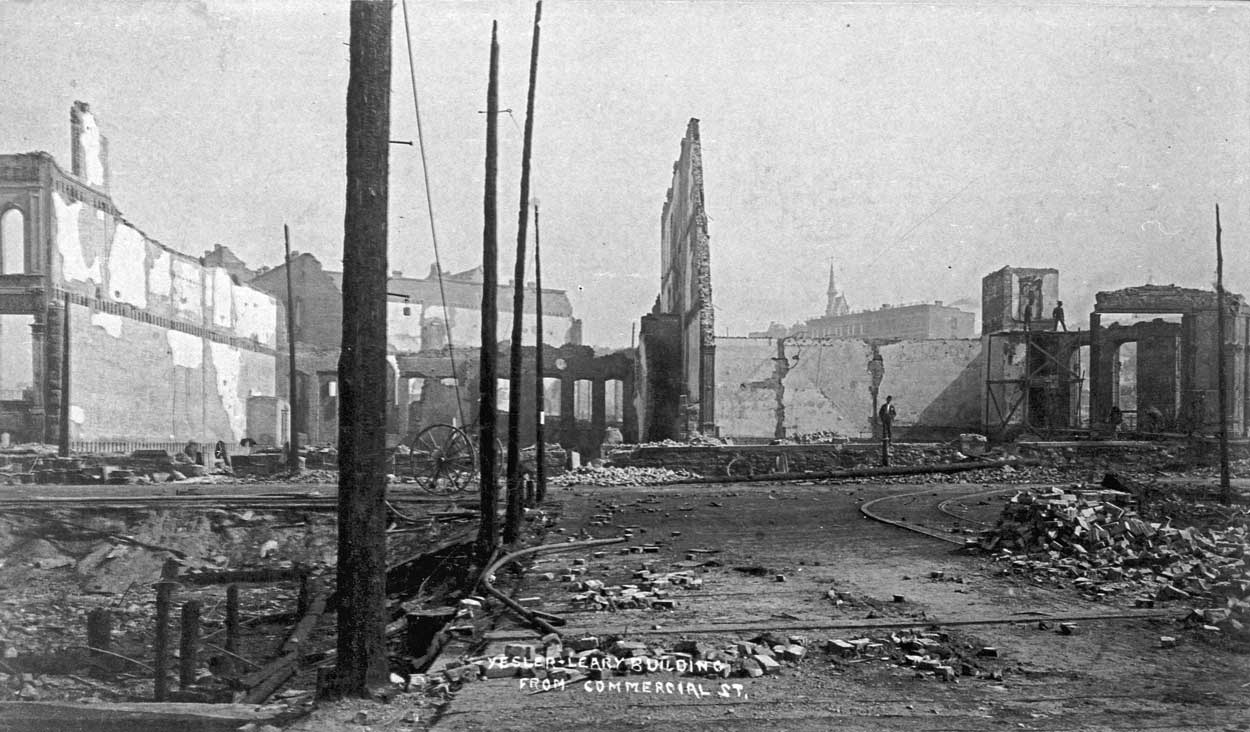
(Follows another parade on Commercial, that one as seen looking south from the rear of Yesler-Leary building.)
======
Above and below: Seattle was first developed along the four blocks of Commercial Street decorated here with small fir trees for a parade in 1888. Following the city’s “great” 1889 fire, Pioneer Seattle’s two principal commercial streets, Commercial and Front (First Avenue) were joined directly here at Yesler Way and run through the site of the old Yesler-Leary building. Consequently, Jean Sherrard needed his ten-foot extension pole to approach – but not reach – the prospect of the unnamed historical photographer.
COMMERCIAL STREET, 1888, South Over MILL STREET (Yesler Way)
(This first appeared in Pacific recently enough that it probably has also appeared previously in this blog. But, as my own mother advised me, “Repetition is the mother of all learning.”)
For looking south through the full four blocks of Seattle’s pioneer Commercial Street (First Ave. south from Yesler to King) an unnamed photographer carried his camera to the top floor of the Yesler-Leary Building. The occasion was a parade heading north towards the photographer and considering the array of small American Flags strung across Commercial this rare view was most likely recorded on the morning of July 4, 1888.
There was then both a physical and cultural jog here at ‘Yesler’s Corner” (later Pioneer Square). It required all traffic, (including marching bands), to go around the Yesler-Leary building in order to continue north on Front Street (First Avenue). Yesler Way was also the border or line between the grander, newer, and often brick-clad Seattle facing Front Street (behind the photographer) and the old pioneer Seattle seen here “below the line.” Generally Yesler was a gender divider too, for only women with business there ventured “below the line.”
An 1888 Commercial Street sampler includes seven of the city’s dozen hotels, three of its four pawnbrokers, and three of its four employment agencies, nine of its forty-one restaurants, four of seven wholesale liquor merchants. The tightest quarters were in the block on the left where fourteen storefronts crowded the east side of Commercial between Yesler and Washington Streets. Among those quartered were a cigar store, a barber, a hardware store (note the “Stoves and Tinware” sign), a “pork packer”, two “chop houses”, two saloons and the Druggist M.A. Kelly whose large and flamboyant sign shows bottom-left.
By contrast Front Street featured more of the finer values and “fancy goods”, like books & stationary, dry goods, confections, jewelers, photographers, physicians, tailors and an opera house. Of the thirty-seven grocers listed in the 1888 city directory, eighteen have Front Street addresses, while on Commercial there was apparently nowhere to buy an apple or a bucket of lard.
In another eleven months and two days everything on Commercial Street and most of Front Street would be destroyed by the city’s “Great Fire” of June 6, 1889.
====================
The Front Street Trolley tracks had been sprung and curled by the heat of the June 6, 1889 “Great Fire” here on Commercial Street (First Ave. South) looking south from Mill Street (Yesler Way.) Although scorched the thick street planks survived the fire. The “now” below was scanned from a processed print because, again, I cannot readily find this “repeat.”
FIRST AVE. South From YESLER WAY June, 1889
(First appeared in Pacific, Dec. 2, 1984)
Although today’s photos both look south from Yesler Way, they were taken from different elevations, for first Avenue was raised above its old level after the Great Fire of 1889. (How much it was raised continues to be a clouded figure.) Before the fire, this portion of First Avenue was Seattle’s retail shopping district and, appropriately, was called Commercial Street. It was a four-block-long strip where shoppers strolled, horse races (before they were outlawed) were staged and at least one riot broke out. It then ran only as far south as King Street where it fell over a low bluff to either slip or submerge into the tideflats, depending on the tide.
The historical photo was taken only a few days after the fire. It shows only part of the more than 35 city blocks that were consumed that day and night of June 6 and 7, 1889. Most of the shops and hotels that lined the street, many of them clapboard structures, burned to ashes. One exception was Seattle’s (and Dexter Horton’s) first bank. It is the surviving stone shell on the scene’s far right.
The Dexter Horton Bank ruins at the northwest corner of Commercial and Washington.
Built in 1875 as one of the city’s first ceramic structures, the bank also was razed in 1889, finished off not by flames but by city ordinance of that same year. The ordinance called for widening Commercial Street nine feet on both sides. It was also then renamed First Avenue. The post-fire alterations and lifting have helped create the popular Seattle Underground tourist attraction.
Looking northeast over the ruins of the '89 fire, including the Dexter Horton bank at the northwest corner of Washington and Commerce, and beyond the ashes and rubble to part of Seattle that survived to the east of Second Avenue and up the First Hill slope.Ruins from the 1889 fire looking north on Commercial Street from Washington Street. The standing wall at the scene's center is the west facade of the otherwise razed Yesler-Leary Building at the northwest corner of Front (First Ave.) and Mill (Yesler way).
Maynard Building that replaced the Dexter Horton Bank at the northwest corner of Commercial and Washington. The "now" below dates from sometime in the late 1990s - if memory serves.
The Maynard Building is caught here with a snapshot by Max Loudon of a parade turning the corner onto Washington ca. 1914. A ciipping of another fire on First Ave. S.
====
The Langston’s Livery Stable was a busy waterfront enterprise through most of the 1880s, Seattle’s first booming decade. After it was destroyed during the Seattle fire of 1889, the St. Charles Hotel, seen in the “now,” was quickly erected in its place facing Washington Street, and was one of the first “fireproof” brick buildings built after the “Great Fire.” (Historical photo courtesy Museum of History and Industry.)
LANGSTON’S LIVERY
Helen and John Langston moved to Seattle from Kent in 1882 and soon opened their namesake livery stables on the waterfront at Washington Street. Like all else in the neighborhood it was, of course, destroyed in the city’s Great Fire of 1889. Sometime in the few years it served those who wished to park or rent a horse or buggy downtown a photographer recorded this portrait of a busy Langston’s Livery from the back of the roof of the Dexter Horton Bank at the northwest corner of Washington and Commercial Street (First Ave. S.).
In Helen’s 1937 obituary we learn from her daughter Nellie that Helen was “known for her pen and ink sketches of horses and other animals and scenic views.” Perhaps the livery stable sign, far right, showing the dashing horse with buggy and rider is also her work. It was Helen who saved the family’s business records from the fire and was for this heroic effort, again as recalled by her daughters, “severely burned before she left the livery stable.” After the fire the couple quickly put up the St. Charles hotel, seen in the “now.”
Helen married the 38-year-old John in 1870, the same year he began providing ferry service across the White River at Kent and three years after he is credited with opening also in Kent “the first store in King County outside Seattle.” During these pre-livery years in the valley the Langstons also managed to carve a model farm out of the “deep forest.” Before they sold it in 1882 their farm was known county-wide for dairy products produced by its “75 excellent milch cows.”
After the fire the Langston’s soon opened another Livery Stable uptown beside their home at 8th and Union. In the 1903 collection of biographies titled “Representative Citizens of Seattle and King County” John Langston is described both as “now living practically retired” and also busy “in the operation of his magnificent funeral coach, which is one of the finest in the northwest and which is drawn by a team of the best horses.” Three local undertakers kept him busy. For the moment we may wonder – only – if when he died in 1910 the then 68-year-old pioneer took his last ride in his own coach.
=========
The above photograph was recorded shortly before the elevated line was completed on September 4, 1919. Both the special car and the tracks have workmen on them, and the motorman seems to be posing. On the left, some of the men lined up under the old J & M Cafe’s Washington Street entrance may be idle ship-workers seeking work through the C.M. & St. P . Employment Agency in the little Collins Building just left of street car No. 103. Now both the Milwaukee Road and its employment agency are long gone. Directly below is a later look directly west on Washington and up the elevated ramp.
ELEVATED TROLLEY
(First appeared in Pacific, April 30, 1995)
On September 4, 1919 the Seattle Municipal Street Railway completed the building of its elevated line above Railroad Avenue. The event was remarkably subdued. There were no brass bands, no speeches amplified by public spirit, and no ceremonial first rides. Only a short bit buried on an inside page of the Times noted “Cars on Elevated.” The reporter speculated that once the somewhat wobbly operation proved safe, the streetcars would be running up to speed and that then the trip to Alki and Lake Burien would be cut by as much as 15 minutes.
When the line was first proposed in 1917, it was not designed to get West Seattle residents home from work a quarter hour sooner. It was promoted to beat the Kaiser.
When the U.S. entered the First World War in April 1917, Seattle’s southern harbor was already mobilized and setting speed records in shipbuilding. But while the workers were fast on their jobs, they were slow getting to their war work. The then privately owned street railway system was dilapidated, and its service to South Seattle inadequate.
Encouraged by the federal government’s Emergency Fleet Corporation, Mayor Hiram Gill proposed that the city build its own elevated service to the shipyards. In 1918 he put the plan to a vote. The voters chose the elevated but not Hi Gill who lost his reelection bid to a gregarious politico named Ole Hanson.
The ambitious Hanson took up the task of forwarding both the trestle’s elevation and his own. The new mayor boarded the civic bandwagon for municipal ownership of the entire street railway system. This was put to a vote and the enthused citizens agreed to the purchase price of 15 million, or three times the deteriorated system’s appraised worth. Armistice Day came only one week after the November 5th election, and when the international hostilities subsided, the local ones heated up. Without war orders the once frantic south bay shipbuilding took a dive. Layoffs and wage cuts followed. The trestle, which was still under construction, began to stand as a white elephant. It, like the shipbuilders it was built to transport, was not so needed.
The waterfront strike, which followed in January of 1919, soon spread city-wide to a four-day general strike. Mayor Hanson characterized this “revolution” as a “treasonable Bolshevist uprising.” His “heroic struggle” against these “red forces” got him a lot of world press, and the mayor was briefly catapulted into the national limelight. It also deflected local criticism against him as the highest-placed early proponent of the debt-ridden and still dilapidated Seattle Municipal Street Railway.
His honor liked both the publicity and the protection from public criticism so much that he resigned, took off on a national lecture tour, and in a moment of gracious megalomania made himself available for the Republican presidential nomination. In a no-contest, the almost equally anonymous Warren Harding beat him out of it.
On October 12, 1929, or only ten years and eight days after it was completed, the Railroad Avenue Elevated was condemned and sold for salvage for $8,200. By then Ole Hanson had long since moved to southern California and founded a new town, which would many years later put his name in touch again with the presidency. He named his seaside community San Clemente.
Two looks at the abandoned elevation on May 12, 1930. Above, looking east on Washington Street and, below, looking south on Railroad Avenue from the curve above Washington Street.
========
FIRST AVE. South ca. 1900
(First appeared in Pacific, March 22, 1987)
Whichever turn-of-the-century photographer got up early to make this record of First Avenue S. did us a favor. In this view, which looks north from Main Street, a morning light bathes both the nearly new masonry of this harmonious street and the energy of its users. Although not crowded, the street is busy. However, considering the pace and hypnotic patter of its horse traffic, this business is somewhat less rushed than our own. The clunking trolleys helped. And like the First South of today, we can tell from the historical photo that then too this was a fine avenue for idle sidewalk talk.
This is also the oldest street in town and its first face was, of course, the funky frontier strip that was quick fuel to the 1889 Fire that flattened it and much more. Almost instantly this distinguished Romanesque neighborhood was put up in its place. It was built to last and we still have it, and with few alterations. But from its status as the city’s first commercial center, First Avenue South is even here beginning to slip. A closer look at the signage in this foreground block between Main and Washington streets reveals a format of bars on the sidewalk and hotels upstairs. Only a decade after it was designed for mixed commercial use, this architecture is beginning to specialize in servicing the basic needs of mostly single men. Where are the women? Not on this sidewalk but north of Skid Road (YeslerWay) on Second Avenue where the city’s new respectable center was building.
Ironically, this neglect of First Avenue South, which began already in the early century, had its benign side. For the architectural character of this abandoned pioneer center was too formidable to be rashly destroyed in a hasty act of urban renewal. Preserving itself, Seattle’s first historical district waited to be rediscovered in the early 1960’s and thereafter, lavishly restored and most often enjoyed.
Bluegrass DJ and oversized (giant) political candidate, Tiny Freeman poses at the front door to the Central Tavern a popular historical district dive on the west side of First Ave. S. south of Washington Street and the J.& M. Tavern, another frequent watering hole on the old Commercial Street, but one now failed and gone.
Above: The J&M in a 1937 tax photo. Below: Inside the J&M’s “newspaper room.” Nancy Keith is on the left and Sheila Farr on the right. Nancy was once a manager of KRAB radio, and later of the Mountains to Sound non-profit that labors to preserve a greenbelt from Snoqualmie Pass to Puget Sound. She was also among those who helped start the weekly tabloid Helix in 1966-67. She is presently off working as a volunteer in Ghana. Sheila – “from Juanita” – worked for several years as the art critic for The Seattle Times and before that for The Weekly. She is presently writing a book on the history of modern dance, and was once a dancer herself. (Well, perhaps she still dances on occasion.) I snapped this most likely sometime in the mid-1970s – or late.
========
To conclude with a smooth transition back to Ivar – as I labor to finish the book “Keep Clam” sooner than later – here more of the neighborhood, this time looking west on Washington Street from Second Avenue.
(Above and Below) Besides the street trees and the historic three-ball light standard on the right the obvious difference in the “now” is the parking lot that in 1969 replaced the storefronts that held the northeast corner of Occidental Avenue and Washington Street when, toting his camera, Werner Langenhager visited the block fifty years ago. (Historical photo courtesy of Seattle Public Library.)
WASHINGTON STREET West From SECOND AVENUE
We may celebrate the photographer Werner Langenhager’s sizeable and sensitive record of Seattle with this “golden anniversary” example of his work. With his back to Second Avenue Langenhager looks west on Washington Street to its intersection with Occidental Avenue where, most obviously, the big block letters for Ivar’s fish bar hold the northwest corner.
Ivar was sentimental about these pioneer haunts. During his college years in the 1920s he wrote a paper on the Skid Road for his class in sociology. To get it right Ivar spend a week living in a neighborhood hotel, visiting the missions, and betting in the Chinese lotteries.
For his first try at returning to the neighborhood as a restaurateur Ivar bought the old popcorn wagon in Pioneer Place (then the more popular name than Pioneer Square) in the early 1950s. He planned to convert it into a chowder dispensary. And he proposed building a replica of Seattle’s original log cabin also, of course, for selling chowder. For different reasons both plots plopped and instead in 1954 he opened this corner fish house. He called it his “chowder corner.”
Consulting the Polk City Directory for 1956 we can easily build a statistical profile for Ivar’s neighbors through the four “running blocks” of Occidental between Yesler Way and Main and Washington between First and Second. Fifteen taverns are listed including the Lucky, the Loggers, the Oasis and the Silver Star. But there were also ten cafes (including Ivar’s), six hotels, four each of barbers and cobblers, three second-hand shops, two drug stores, one loan shop, one “Loggers Labor Agency” and five charities, including the Light House.
The 1956 statistic for these four blocks that best hints at how this historic neighborhood was then in peril of being razed for parking is the vacancies. There were twelve of them.
Another Langenhager recording kept by the Seattle Public Library. This one looks north on Occidental and thru its intersection with Washington Street. The date was typically noted by the retired Boeing engineer. It is April 5, 1958.
In conclusion we return below to Jim Faber. Here he is the dining room of Ivar’s Salmon House. Jim often helped Ivar with his promotions and hoaxes.
Or nearly, to wish even those among us who no longer deck the halls, a Merry memory of a Merry Christmas, perhaps long ago with snow on snow. I remember now the four foot drifts of it in Grand Forks, North Dakota, and the toboggan run my brothers made from the back of the parsonage on Reeves Drive to the banks of the Red River, and asking my dad when I was five or six "Is there a Santa Clause?" and being told "No." Well that was that then wasn't it? My older neighbor, Jane - about nine or ten - was right then. Neither did Jane believe in a "virgin birth," which to me was simply a fact - I did not yet understand. (Click twice to Enlarge)
Perhaps the last image we will share of Horace Syke's Southwest Highways - almost all of them dirt in the late 1940s. We have given it the second number "Nine" to indicate our countdown to suspending Horace's driving license. We have then eight more from Sykes - or rather presentations, for we may show a few Sykes family photos at the end. (Click to Enlarge)
This slide and a few more of similar subjects were salvaged for me by a friend. They are all parts of a collection of rhetorical evidences of squalor from the 1950s (most likely), indicating a need for renewal - "urban renewal" when there was federal money behind it. Here probably a single man makes his home perhaps in a one room hut that is heated by the small wood burning stove and insulated with prints of mostly sentimental nature art plus a few snapshots and the colorful waxed paper used to wrap Holsum Bread, once a popular brand in Seattle. There's a radio on the table to the right and it seems to be plugged in. There certainly is power, and probably - if true to what we expect - a naked bulb hanging from the ceiling, screwed into a connector that also allows the radio to get its power. (If we turn the radio on we may hear "Some Enchanted Evening" but rarely "Brother Can You Spare A Dime." And there are other lines crossing this space, perhaps for hanging wet clothes over the fire. The floor while soiled still shows its floral star pattern. Warming to the right of the stove is the luxury of a second pair of shoes. (Click TWICE to Enlarge)
The young hero of Woody Allen’s latest film “Midnight in Paris” walks through Paris in search of inspiration, and it is at this precise spot rue de la Montagne Sainte Geneviève, when the bell of church Saint Etienne du Mont rings at midnight that an antique car stops. He is invited to ride, passengers seem to belong to another time and take him in a journey in the twenties…
Le jeune héros du dernier film de Woody Allen « Midnight in Paris » traverse Paris en quête d’inspiration, et c’est à cet endroit précis rue de la Montagne Sainte Geneviève , lorsque les 12 coups de cloche sonnent minuit à l’église Saint-Etienne du Mont que s’arrête une calèche. Il est invité à monter, les passagers semblent appartenir à une autre époque et l’entrainent dans un voyage dans les année 20…
THEN: Tacoma’s Public Library, was the 85th Carnegie library built in the United States, but the first in Washington State. Here the tower of the Pierce County Court House backs the library on the right and the old wood frame Central School appears on the left. (Courtesy Tacoma Public Library)NOW: Jean used his long pole to approach but not reach the upper floor or rooftop prospect of the unnamed historical photographer. The building was locked and vacant. Both views look thru the intersection of Tacoma Ave. S., in the right, and S. 12th Street, on the left.
Jean and I still agree with the “City of Destiny’s” now century-old promotion, “You’ll Like Tacoma.” We do. Much of its restored downtown deserves devotional study. We visited Tacoma on the recent Sunday when flags were at half-mast for the tenth anniversary of the 9-11 attacks. That day was also one of the hottest (almost) of the summer, and it felt like the Tacoma business district was held in a long moment of stately silence.
We drove to Tacoma to visit the oldest Carnegie Library in the state, and now also the home of the Murray and Rosa Morgan Room. The library was dedicated on June 4, 1903 – the Morgan Room on 9/11. A grand staircase of White Vermont Marble climbs to the room on the second floor and beneath the dome that surmounts the roof in the “then” photo – or did. The dome was damaged in the 1949 earthquake and removed. The Morgan Room is wonderfully appointed with the Morgan’s research library and literary estate (research papers, manuscripts, recordings, correspondence and newspaper columns.)
In Seattle, Murray Morgan is best remembered for his never out of print history, Skid Road. Murray wrote this Seattle classic while tending Tacoma’s 11th Avenue bridge, which was later admiringly renamed the Murray Morgan Bridge. During our September visit we found the lift bridge wrapped in white plastic for the work of restoration. (The two towers held a shape that looked uncannily as if it were perhaps hiding London’s Tower Bridge.)
The Murray Morgan Bridge - wrapped
I first “read” Murray Morgan long before I met him. In 1980 Murray asked that I help prepare the pictorial history of Seattle he was then preparing with his daughter Lane. Thru a life of writing it was the kind of help that the librarian Rosa Morgan was best at, especially for the couple’s set of books about Tacoma and the South Sound. The Morgan’s friendship was cherished, and sharing in the repartee at their table was always a delight. When his students and admirers asked Murray for help he would sometimes reply that he needed to first “go to the attic.” Now his attic – the heritage it held – is on the shelves of his and Rosa’s namesake room at the Tacoma Public Library. Although both are now passed, they will continue to help.
WEB EXTRAS
I’ll toss in a few photos from the event itself – the first taken at the dedication of the Morgan Room. Paul, perhaps you can insert the ‘Then’ photo to accompany it.
Certainly, Jean. First the ‘then’ for your interior “now” view below it. I will note the book end standing out at the top of your photograph. The reader may know that Jean had to removed a shelf of books in order to get the right position for the now, taking it from the next isle in the room’s stacks. Following your collection, I’ll attach a feature I did of the bridge for Pacific in 1994 and another of the Tacoma City Hall, that was published in The Times in 1995.
The Murray and Rosa Morgan room is in the background, extended from the main dome room on the second floor of the old Carnegie library. Courtesy, Tacoma Public LibraryLane Morgan (center) with Dorpat (far right profile). And there is also Mary Randlett between Paul and the pillar and looking at the camera.Lane Morgan receiving commemorative plaque from librarian Brian Kamens. Murray and PaulPaul and Brian admire Morgan artifacts
And now a few from our book, Washington Then & Now:
THE TACOMA WATERFRONT
Waterfront THENWaterfront NOW, also shot from the Northern Pacific building
The Northern Pacific Railroad decided in 1873 to head for Tacoma rather than Seattle in part because the former had Commencement Bay, a harbor the railroad considered more promising. The railroad also liked it that there were only considerably fewer citizens in Tacoma – about 200. Consequently the waterfront a mile south of what became Old Tacoma was free for the railroad’s confident speculations with a New Tacoma. Like the scene on the facing page Thomas Rutter also recorded this view in 1888 from the site of the new railroad headquarters, but in the opposite direction. In the distance is the Northern Pacific wharf below today’s Stadium Way and also very near Old Tacoma. Early proposals to build a road between them were blocked by the railroad.
Above and below, the Northern Pacific headquarters when nearly new.
“CITY OF DESTINY”
"You'll like Tacoma"Tacoma: better than kissing your sister!
Probably the most popular and repeated view of Tacoma is this one through “The Gateway to the City of Destiny.” On the left is “The Mountain” and on the right City Hall. While Mt. Rainer — AKA Mt. Tacoma — is more often hidden than revealed it is still obligatory in any cityscape meant to catch the character of Tacoma. Consequently, the mountain is often retouched and enlarged as it is in the postcard bottom-right. Tacoma City Hall, however, does not require any fixes. Built in 1893 with walls eight feet thick at the base the Italianate bell tower is slightly tapered to accentuate its height. The NPRR headquarters is directly across Pacific Ave. from the tower. This black-and-white photograph is by Tacoman Paul Richards and by Tacoma Public Librarian Bob Schuler’s assessment probably dates from 1910.
Three hand-colorings of the same postcard, which was recorded from the same perspective as the featured view above and all of them also featuring the obligator Mt. Rainier, or rather Mt. Tacoma, the still preferred name for the some that remain of what were once the many.
ST. PETERS in old Tacoma
In 1873 when the first few Anglicans of Tacoma learned along with the Lutherans, Baptists, Catholics, etc. (the list is long) that the Northern Pacific Railroad had picked their little mill town on Commencement Bay for its Puget Sound terminal they built the town’s first church in three weeks. In this construction they got obvious help from nature when they topped all but 40 feet from a Douglas Fir standing at hand and installed at the top of the stump a bronze bell donated by the Sunday School of another St. Peter’s in Philadelphia. It was certainly the “oldest bell tower in America.” While the small sanctuary survives, with some changes, the original rustic tower does not. Toppled by a windstorm in 1934, St. Peter’s was given a new and this time Western redcedar stump to replace it by yet another saint, the Saint Paul and Tacoma Lumber Company.
Anything to add, Paul?
First that bridge story I mentioned above.
The original 11th bridge. (Courtesy Fairlook Antiques)
The 11th AVE. BRIDGE now renamed the MURRAY MORGAN BRIDGE
(First appeared in Pacific, Christmas Day, 1994)
With a topography somewhat less marked by many hills, ridges and waterways than Seattle’s, Tacoma requires fewer bridges of size. Two of these are city icons: the world-famous suspension span that crosses the Tacoma Narrows and the landmark 11th Avenue bridge, which connects the City of Destiny’s business district with its . . . well, its destiny, which is the industrial district on its reclaimed tidelands at the mouth of the Puyallup River.
There have been two Tacoma Narrows bridges (“Galloping Gertie” and its replacement) and two City Waterway bridges. This historical photograph is a rare record of the first of the latter. It dates from the late 1890s and looks from the Tacoma Hotel (or near it) to the “Boot”: a sabot-shaped island of silt, sand, gravel and muck upon which the St. Paul and Tacoma Lumber Mill was set in the late 1880s. It was the mill that persuaded the citizens of Tacoma to borrow the money to build the bridge. By the time it was accepting lumber wagons at the swing-span’s’ eastern terminus, the “Boot” had been joined with the mainland by diverting the Puyallup River’s west channel into its east and transforming the former into the city waterway shown here.
The swing bridge lasted barely 20 years, although its timber approach – more than 1,000 feet long – from the tidelands was used initially for the eastern ramp to the new lift bridge. The replacement was dedicated Feb. 15, 1913. Its pilings were driven 160 feet to bedrock, and when lifted, it was 135 feet above high tide.
Construction work on the new lift bridge while still using the swing bridge with a temporary crookedness.
(The rest of this was written before the landmark bridge was both saved from demolition and renamed for Tacoma’s “favorite son,” the history Murray Morgan. And now, as evidenced with Jean’s recent photograph of the Murray Morgan Bridge, it is being restored.)
This Tacoma symbol, now scheduled for demolition, has a well-wrought link to Seattle. Author Murray Morgan completed “Skid Road,” the Seattle history book, while working as the night bridge tender there in 1949-’50 – and not once in that time did he have to raise the bridge. (Although I recall Murray telling me that this was so – that in all the time he worked on the bridge writing Skid Road, he never had to lift it – now I have been told at the dedication of the Murray Morgan Room by one of the day’s speakers that on Murray’s last day at the job he did indeed raise the bridge – but also flubbed it. It was his last day because he was fired for his mistake. It is a delightful story, whether true or not. I am inclined to believe it, for it makes the renaming of the bridge for the “dean of Northwest historians” even more poignant and ironic.)
The bridge in profile. A few Tacoma landmarks as seen from the 11th Ave. Bridge. Far right the Tacoma City Hall tower is cut down the middle. Next to it another tower, that for the fire station, breaks the horizon. At the center is the distinguished Tacoma Hotel, and below it the city's Municipal Dock, terminus for the Puget Sound "Mosquito Fleet." That's the speedy steamer Flyer, which took so many runs between Seattle and Tacoma in its long life that it was estimated that it could have steamed to the moon and back if given the water. The hotel from the bridge and etched before the Municipal Dock intruded.
======
Tacoma Clerk's letterhead.
Click this next one TWICE = please
Note the penciled date for when the feature appeared in Pacific. I have through the now two months short of thirty years writing the weekly feature always made a point of keeping a clipping for each story and writing the date on it too. The clippings have been helpful, for sure.
=====
And finally for some Tacoma things completely different.
What became of it, for that matter, what became of the Kalakala and the Harmony Girls Orchestra?
In conclusion, another look at the mighty Pierce County Court House.
This unidentified tunnel with a brook babbling from it is part of that small collection of Horace Sykes slides for which the color has been drained by time. Many of them have to do with Lake Chelan subjects. Perhaps this is part of Railroad Creek on the way to the Holden Mine in the late 1940s. Tunnels are often remembered. Here's hoping that some reader recognizes this one. (Click TWICE to Enlarge) Postscript: We are going to finish with Sykes - as a more-or-less daily feature - at that nice and round number 500. We have a few other collections that we can treat with daily offerings, but we have not, as yet, decided which to use next.
If you knew that Jean (our Sherrard) is wearing an early Bumbershoot T-Shirt, and thought that you also located over his (own) left shoulder (on the right) the pyramid top to Seattle's venerable Smith Tower, you might think that Jean is here visiting with perhaps a touring soccer club, although these uniforms are not so sporting. But you would be wrong. This is from one of Jean's trips to Africa, and this a scene from the time he drove a Land Rover far into its center. (I scanned this slide among many others for possible use in last month's memorial service for Jean's mother.) Bumbershoot and Jean are even more familiar than its early shirt on his back. In 2000 Jean, Cathy Wadley and I scrambled to produce a video history of the festival. It still gets aired around Labor Day. And so in the mid-1970s - I am speculating on the date - Jean Sherrard was one Bumbershoot plenipotentiary with plenty of potential.
In late 2005, Paul and Jean traveled to Paris to visit our dear friend and colleague Berangere Lomont. Our joint exhibition of repeat photography from Seattle and Paris, now on display at MOHAI, is the fruit of that trip.
One serendipitous incident, documented in the photograph above by Berangere, is when Paul met his doppelgaenger, his twin, his semblable in a Paris cafe. Actually, Paul never met him, he merely sat down next to him and let the shot be taken. Jean grabbed a video camera to record that moment. Most of the event is clear enough, although Jean began shaking with laughter, ruining the shot a bit.
This looks north on the west side of First South a little ways north of Holgate Street - I believe. I shared a studio nearby in the Cork Insulation Wharehouse, top floor, in the late 1970s to 1981. (Click to Enlarge)
The only time I visited Timberline was in the late 1940s with my parents. It was about the time that Horace took this Kodachrome of the famous lodge. Both the dress and blue slacks look like things out of my mothers closet - at least I assume that is where she kept them. I know from pictures that during wet winters it is hard to find a lodge below the snow. (Click to Enlarge)
I don't know this bridge but imagine that it is somewhere in the Palouse of southeast Washington. Above it are two motorcars (of the 1940s) near a curve that will turn the road they travel down to pass beneath the bridge, which, I imagine only, is for trains. And yet it is wide enough, it seems, to accommodate two lanes of traffic. (Click to Enlarge)
Ron Edge sends along a link to a slick piece of promotion for the Battersea Station’s duty as centerpiece for a proposed new London neighborhood. Perhaps it – the link and these ambitious plans – will work. Warning: while animation included in the link is satisfying the tone of the production is, for my taste, much too pushy-confident. Here’s the link: http://www.battersea-powerstation.com/ I see it shares no color, and so probably will not link. However, you can enter it by key and most-likely find it.
From Vauxhall bridge, the four chimneys of Battersea Power Station sculpt the skyline of the south bank of the Thames. Built in 1939, with two chimneys, it takes its legendary shape in 1955 when a second station is added to the original structure with two more chimneys, and became the largest building in bricks in Europe.
In 1977, the image of the station is used for the iconic Pink Floyd’s album cover: Animals.
The station activity stopped in 1983, the brick cathedral was listed building in London and since all the Pink Floyd’s fans are waiting for its new redeveloppement .
Du pont de Vauxhall, les quatre cheminées de la centrale électrique de Battersea sculptent la skyline de la rive sud de la Tamise. Construite en 1939, avec deux cheminées la centrale prend sa forme légendaire en 1955, lorsqu’une seconde station est ajoutée à la structure d’origine avec deux cheminées de plus, elle devient ainsi le plus grand batiment en brique d’Europe.
En 1977, l’image de l’usine est utilisée pour la couverture iconique de l’album des Pink Floyd : Animals.
La centrale ferme en 1983, elle devient monument historique londonien et depuis les fans des Pink Floyd attendent toujours son réaménagement.
Earlier today, Sunday, Jean and his family drove in a circles over Stevens, Blewett and Snoqualmie passes. It was not the first time for what is a growing autumnal tradition for the family. They out were looking for golden-yellow larches in higher elevations on the east side of the Cascades, and they, of course, found them. They took a dirt road off of Blewett pass and climbed until they reached snow, which they tested but soon thought worse for it and pulled back when the tires began to spin. Out of the car, they carefully climbed higher thru the snow and Jean, of course, too several photographs. But his is not one of them - although there are larches here. Rather this is, of course, another Horace Sykes slide, and also almost of course we know not where. Perhaps Jean will attach a few of his own larches on Monday morning. (Click to Enlarge and expect an impressionist effect. Horace was apparently focusing on the foreground. Jean's larches will be in focus - if and when he meets the "challenge.")
All righty then, Paul – here’s proof of our larch adventure – a 180 degree pan on the snowy dirt road above Blewett (my son Noel is on the left):
(click to enlarge photos – and often CLICK TWICE for the full enlargement.)
THEN: After the city’s “great fire” of 1889 First Avenue south of King Street was extended far and wide into the tideflats. An exception to the city’s post-fire “brick rule” the first structures here were made of wood, and so replaced by masonry early in the 20th Century. (Courtesy Museum of History and Industry.)NOW: Jean’s cityscape of First Ave. south of King Street glows with a mixed lighting of sunset and Seattle City Light. With a combination of his long frame and a 10-foot extension pole he approached the lofty prospect of the railroad trestle used by the Webster and Stevens studio to record one of its earliest images, most likely in 1903.
Between 1877 and 1903 a King Street trestle crossed First Avenue here. It was built for a narrow-gauged railroad that carried mostly coal from the east side of Lake Washington to the bunkers on the King Street Coal Wharf. The trestle offered this prospect south in line with First Avenue through a strip of small hotels, bars, cafes, laundries and storefront businesses for sharpening saws, supplying sheet metal and other light manufacture needs.
Especially in these first blocks south of King it was a short-lived street scene built of wood in the decade following the city’s “great fire” of 1889. The post-fire building codes that required brick construction did not apply to these blocks, which in 1889 were still tidelands south of King Street and so ordinarily under water.
1903 is the likely year for this scene. Many of the small business here, like the Chicago Bar on the left, appear in the 1903 Polk City Directory, but then move on or fall away. It is also the first year that the photographers Webster and Stevens are listed.
The Seattle Everett Interurban began operation thru these blocks in the fall of 1902, the year Chamber of Commerce’s Tidelands Improvement Company began promoting public works improvements south of King Street. Here the Interurban tracks are temporarily blocked as First Ave. South is being prepared for a pavement of vitrified brick. Contractor bids for this work were accepted by the Board of Public Works “up to 11 o’clock a.m. Monday July 6, 1903.”
Enlargements of both this and last week’s “then,” also on King Street, are new additions to “Repeat Photography,” the exhibit that Jean and I, along with our Parisian ally, Berangere Lomont, prepared for the Museum of History of Industry. The Seattle Times is one of the sponsors of the show, which will be up until June 3, 1912. Contact MOHAI for details.
WEB EXTRAS
Anything to add, Paul?
A few more from the neighborhood around First and King. Again, most of this is grabbed from now-then’s done down the years (since 1982). And here I’ll have the same blog failing – I wont always be above to find (easily) the “now” for some historical image for which I still have the text. Perhaps organizing past “nows” will be something to get to next year – post Keeping Clam with Ivar.
First we will go out to the far west end of the King Street Coal Wharf and look to the east-southeast. The wharf began its service of accepting coal from Renton and Newcastle in 1878. The first of these is from the early 80s, and the snow scene was taken, I believe, during a 1884 snow, and so not the bigger 1880 one. Beacon Hill is in the horizon (note the first homes built there), and the tides still push against it. The lumber mill is Stetson-Post.
The railroad trestle connecting the King St.wharf with the worm-free slope of Beacon Hill was used until 1903 (or thereabouts) when the coal wharf was moved south to Dearborn Street and a new trestle connected with it. King Street was then developed for the Great Northern’s Union Depot, which could not be bothered with a narrow-gauged coal road cutting through it. The next image looks west on the King Street trestle in the 1890s. All of this replaced what was burned to the bay during the “great” 1889 fire. Note the height of this trestle. It was also from this scaffolding that the historical photograph was taken looking south on First Avenue. Here the pier that is about one-fourth of the way into the frame from its right border – one of the two pier sheds with a curved roof – would thru the years be rebuilt into what is now Pier 48, that part of the historical waterfront’s sold survivor from the 1890s. It is near the foot of Main Street.
The coals of Renton were often delivered to the bunkers on the King Street Wharf. (As always, Click to Enlarge)
Next we will copy the Pacific clipping of a tideland story first publish there on July 22, 1990. The contemporary photo was taken from within the old Kingdome.
This is used courtesy of the University of Washington Libraries - its Special Collections.
Best to CLICK TWICE for what follows.
There was a filling of the tideflats from the beginning of settlement, but the systemic work of dredging Elliot Bay for vast amounts of the muddy sands needed to reclaim the flats to an elevation high enough above high tide to be safe began in 1895.
DREDGING the TIDE FLATS – MAY 1896
(First appears in Pacific, May 16, 1993)
The empty foreground of this scene is its subject. “Tide flats” is written on the original negative. What’s being dumped upon these tidelands is of greatest interest – mud. The mud-spurting pipe is included just left of center (in the left panel of an imperfect merge of two parts).
The date is May 1896, 10 months since work began to make new land on the tidelands south of King Street. The first dredging, July 29, 1895, was accompanied by speeches, band music and cheers, especially when the first waters propelled by the pumps of the dredge Anaconda erupted from the half-mile-long pipe. “Soon the stream became slightly discolored, and the dash of black announcing the sand called for a redoubled cheer,” the Post-Intelligencer reported the next day. “Then the stream became black and blacker until it seemed to burst out of the vent in great blotches of liquid mud.” These dredgings would drain and dry as they rose above the tides protected behind bulkheads of pilings and brush.
It required much more than the mud from the bottom of Elliott Bay to fill in the more than 2,000 acres of sandy tidelands between Beacon Hill and West Seattle. Other sources included gravel from the city’s bigger regrades, including those at Jackson and Dearborn streets and the Denny Regrade. The fill used to finally reclaim these acres in the 1930s was construction junk, yard waste and all manner of disposed stuff that was once regularly dropped into the old city dumps or sanitary landfills.
Three landmarks ascending the horizon in the historical view help approximate its contemporary repeat (when I find it): South School at 12th near Dearborn, far right; the spire of Holy Names Academy at Seventh near Jackson, right of center; and the King County Courthouse, far left. At Seventh and Alder the courthouse filled a block that is now part of the relatively new addition to the west side of Harborview Hospital. The top of the hospital’s central tower is a minutia on the far left of the “now” scene. (Most of the “now” view as printed in Pacific is filled with the west side bulk of the old Kingdome – R.I.P.)
Now follows something about the Centennial Mill, one of the first industries to build on the reclaimed tidelands. (Click to Enlarge)
Best to CLICK TWICE for what follows.
We discovered another feature that was the first milling of much of the grist included in the top story here. What follows first appeared in Pacific on Aug. 18, 1991.
(Best to still CLICK TWICE for what follows.)
Another First South feature from pretty much the same time, although inserted in Pacific long ago - on Aug. 18, 1991. So - again - the our top story is, in part, a regrinding of this grist. Here we look south thru Pioneer Square to the tidelands and nearly in line with First Ave. South, ca. 1906-7. This - I'm speculating - was taken from back of the Empire Building, and so above the alley between Madison, Marion, Second and Third. Note what was then the commonplace polution streaming from the steam plant stack on Post Alley.
For the map below CLICK TWICE.
Mapping the tidelands - and more - in 1905. Note how First Avenue confidently extends south into the new and often undeveloped reclaimed neighborhood we sometimes refer to as our first "industrial" park, and now also, in part, as SODO.
Now we ascend again to the top of the King Street viaduct in its last days and look north with help from a Webster and Stevens photographer.
Courtesy: Museum of History and Industry aka MOHAI
FIRST AVE, LOOKING NORTH from the KING STREET OVERPASS
(First appeared in Pacific on NOV. 24, 1985)
Photographers are opportunists, and sometime (probably) in 1903 one grabbed the chance to climb high above the center of First Ave. S., point a lens north and shoot this historical scene from the last of the coal railroad King Street overpass, which carried coal cars to the King Street Coal Wharf and Bunkers. The view, then, looking north from King St. is wonderfully revealing. We will start at the bottom.
The tracks that cut diagonally across the scene are part of what was then still the main railroad line through town. The Great Northern did not begin cutting its tunnel beneath the city until May of 1903, and it took two years more to complete it. That tunnel was bored to ease the congestion of boxcars on the waterfront and the frequent interruptions of traffic here on First Ave. S. The year 1903 is a good guess for dating this scene. Here’s the evidence. In the hole on the right at the southeast corner of First S. and Jackson St., foundation work is beginning on a building that was completed in 1904. Now it’s called the Heritage Building after the Heritage Group that recently (in 1985) renovated it. However, we remember it best as the recent home of Standard Brands and before that of Wax & Rain, another paint supplier.
Beyond the pit is another clue for this date-of-choice, the electric trolley on Jackson St. Although its markings are too small to decipher in this printing, a magnified inspection of the original photo reveals the number “324” on the trolley’s side. Car 324 was built in St. Louis in 1902 for the Seattle Electric Co., but was soon sold to the Puget Sound Electric Railway for service on its then new Seattle Tacoma Interurban line. Here, en-route to Tacoma, it will turn off Jackson onto First S. and soon pass on the tracks, right of center, just beneath the photographer’s perch. Behind Car 324 is the Capitol Brewing Co. building. Built in 1900 it was the Seattle office for Olympia Beer and home of the Tumwater Tavern. The familiar brewery symbol of the horseshoe-framed waterfall is stuck to the stone just left of the trolley. This pleasing three-story combination of brick and stone is still standing and renamed the Jackson Building.
Years later, a Seattle-Tacoma Interurban car waits at its station on Occidental Avenue. The Interurban Building is behind it to the right (at the southeast corner of the Yesler and Occidental), and the old Seattle Hotel, behind it to the left.
The old Olympia sign is gone and in its place there should be (but was not in 1985) a plaque telling how the architect Ralph Anderson boldly bought this modest neoclassical structure in 1963 and, with help from a lot of preservationist friends, began the fight to save this entire neighborhood. Bill Speidel soon joined him with the above ground offices for his Underground Tours, and Richard White, who now owns the building, opened his first gallery here. Their long battle was largely won with the institution of the Pioneer Square Historical District.
But the fight continues. A recent victory (in 1985) is on the photo’s left. Just across First Ave. S. from the Jackson Building, the elegant Smith Building was also built in 1900. For half a century it was the home of Steinberg Clothing. In 1982 it was lavishly renovated into 24 large loft studio apartments where photographers and graphic designers have enough undivided room beneath l6-ft. ceilings to both live and work.
In 1903 there were so few motorcars around that if one sputtered by, you might run out to see it. In this scene, aside from the trolleys, everything is still, to quote the contemporary master saddle-maker Jack Duncan, “Horse, Horse and Horse.” That’s Jack Duncan at the bottom of the “now” photograph and above him is Seattle’s last horse. Jack Duncan helped me out. I was not so lucky as the historical photographer to find a temporary platform above the center of First S. at King St., and so I moved one block south for Duncan’s horse, hospitality, and loan of a ladder. There I took the contemporary shot leaning against the family business that has been making “Everything For The Horse Since 1898.” (Apologies for the ink-smudge that is the “now” repeat. When the original negative surfaces I’ll make a redemption.)
Next we stay at the same intersection, and not long after. The trestle is gone but the Schwabacher warehouse is in ruins.
Best to CLICK TWICE for what follows.
. . . and staying at the corner.
THEN & NOW CAPTIONS together. Both views look north of First Avenue South from King Street. All the buildings that appear in the ca. 1908 view survive, although now their architectural pleasures flirt with pedestrians through the trees that line the center of First Avenue. They were planted in the 1970s as part this oldest neighborhoods’ dedication as a historic district.
The GAMBLING HERD
(First appeared in Pacific Jan. 22, 2006)
For the few years that the photographer Otto T Frasch explored the streets of Seattle he managed to publish postcards of many – perhaps most – of the city’s landmarks. The results are often the best records of early 20th-century boomtown Seattle that survive, and local postcard enthusiasts are pleased to now show each other their Frasch collections.
This view is unique for Frasch. It is less a landmark than an event – or the beginning of one. Sometime after the 1902 opening of the Meadows Racetrack, the Seattle Electric Company devised this cheap way of transporting betting men to the Georgetown track in a style accustomed to cattle. The passengers that are busy boarding this odd train do not require plush seats or even closed cars to enjoy their journey to the excitement of racing and the snickering promise of its riches. These men are universally covered with hats and the husbands among them carry more cash in their pockets than homemaking wives would ordinarily condone.
The Meadows in Georgetown
With its covered grandstand, and stables, the one-mile Meadows track was built in the embrace of one of the many serpentine curves that were the Duwamish River before it was straightened into the Duwamish Waterway. The 1907 incorporation into Seattle of the regulatory-lax Georgetown put a muzzle to the medley of vices sometimes associated with gambling (and more recently smoking cigarettes) and with the 1909 state ban on gambling the track’s chargers moved to other pastures. The Meadows site, once on a meandering floodplain, is now one small part of an industrial gerrymander: the cheap-tax “Boeing Bulge” that pushes well into the city’s southern border.
Frasch photographed these traveling men sometime after the mid-block construction of the Seller Building in 1906. The here (far left) vacant lot at the northwest corner of King and First Ave South was filled in 1913 with the surviving Hambrack Building, a name hardly remembered as it, the Seller and the Pacific Marine Schwabacher Building at Jackson Street are since the mid-1980s all parts of the flashy “high-tech office campus” called Merrill Place.
If you happen to have one of Otto Frasch’s cards you probably know that it is a “real photo postcard” continuously toned with real grays. Most printings of images – postcards included – show illusory grays made from fields of little black dots of diverse thickness. Mixing with white spaces between them these black dots produce the illusion of gray to the unaided eye. (For a look into this trickster’s universe of black-as-gray the reader may wish to search at the accompanying photographs with magnification all the while searching hard for some gray.)
Follows three survey’s of the tide flats, all recorded from Beacon Hill. The oldest dates from the 1890s, the next from 1914, and the last from 1968. This last is a combo of two slides taken by Lawton Gowey.
The 1914 view above includes the Centennial Mill on the left, Luna Park at the Duwamish Head, the Moran ship-building yard at the center, the coal wharves (now two of them) relocated from King Street to Dearborn Street, on the right, and the north-south avenues heading across the tide flats still on trestles in anticipation that they will always need to pass above the trains. These elevated fly-overs were later forsaken for streets, parking lots and loading docks all at the same level as the trains that use them (or merely pass by on their way to the nearby stations at King Street.)
And now come three examples of real estate ads, invisible hands marking and extolling the attractions and prosperous here-afters of these acres made from mud. One is copies from a bound two pages and so the center of the message is hidden in the fold – but still can be easily inferred. Another refers to “Papa Hill.” That is James Hill the builder of the Great Northern Railroad, the tunnel to the tidelands, the depot on them and much of the reclaimed neighborhood south of King Street. Hill used several agents to buy them up “secretly,” that is, without coordinating among themselves and without knowing for whom they were ultimately purchasing the freshly made land. By these means he meant to keep the prices lower – and did. (click – sometimes twice – to enlarge)
Ca. 1902 is my best date (at now and perhaps forever) for this look north into the city across the developing parts of its tidelands. A portion of this is used in the adver. directly below. (Click TWICE to Enlarge)
The 1913 relocation of Sears onto the tide flats was a considerable boost for both, although much of the immediate land to the sides of the new distribution center for catalog sales was often still under water.
(Best to CLICK TWICE for what follows.)
Reaching now to conclude, in the late 1970s I was part of an artist’s collective that rented and divided the top floor of the Cork Insulation Building – a long block north of Sears between First S. and Utah Street – into studios. I distributed my first two “Glimpses” books on local history from a studio space that looked down on First Avenue and east to Beacon Hill. Especially on vacant Sundays I liked walking through the neighborhood, perhaps to visit St. Vinnies or Good Will, both almost nearby. I sometimes carried a camera with me and the stepping sawtooth roof (for vertical skylights) of the weathered warehouse below was taken then. I do not, however, remember where in the district it is – or perhaps was. Here it will represent that part of the flammable construction that can still be found on the flats. The brick higher rise below it is an example of how First Ave. S. was respected sufficiently to get some spirited brickwork even on the tide flats. That one is a tax photo from the late 1930s W.P.A. inventory of all taxable structures in King County. Like all the others the legal description is written on the print (actually the negative) and sometimes the address too. [If you have a pre-1938 property you wish to research and wonder if this WPA archive has a picture of it, it probably does. With legal description in hand – Addition-Block-Lot or tax number – call Greg Lange at 425 634 2719. Greg is the Washington State Archivist who has the most to do with the collection, and he can let you know the costs – modest – and whatever else.]
There is, I'm confident, a term borrowed from the French - who rarely see them - for the kind of mountains that group together on a high plateau and take relatively little space. These appear often in the high country of Utah, Colorado, Wyoming, New Mexico, Arizona and Nevada, but rarely in the coastal states and never in Kansas. A good example is Mt. San Francisco north of the Grand Canyon in Arizona. You can drive around that "grouping" - perhaps "le Groupe Massif" - in an hour or nearly. But it is a bad example too, for included in that clump is the highest peak in Arizona, although because it rests on country that is already high you can walk to the top if you are anywhere near your prime and/or fit. On this horizon is another example, one I have tried to identify but so far failed. Perhaps it will be familiar to a reader with greater topographic talents than my own. (Click to Enlarge)
Recently in London someone asked me about my origins, I answered my mother’s family was living in Périgord, and that’s when the lady became very excited because she knew very well that part of the Southwest of France, its towns, castles, and especially its winding roads “as in the 19th century.”
It is true that the situation of the city of Nontron on its rocky promontory in the heart of the Périgord Limousin regional park, did not promote industrial expansion, but activities such as art crafts like its famous knife. Its surrounding landscape is a stunning beauty, and, finally, these small roads comparable to the ones of 19th century have become a way of taking time to contemplate the blazing forest in autum.
Périgord Vert en automne
Dernièrement à Londres, on m’a demandé quelles étaient mes origines ; j’ai répondu que ma famille maternelle habitait dans le Périgord, et c’est alors que mon interlocutrice devint très enthousiaste car elle connaissait très bien cette région du Sud-Ouest, ses villes, ses châteaux, et surtout ses routes sinueuses « comme au 19ème siècle ».
Il est vrai que la situation de la ville de Nontron sur son promontoire rocheux, au cœur du parc régional du Périgord Limousin, n’a pas favorisé une expansion industrielle, mais des activités d’artisanat d’art telles que sa célèbre coutellerie. Son paysage environnant est d’une stupéfiante beauté, et, finalement, ces petites routes comparables à celle du 19ème siècle sont devenues un moyen de prendre le temps de contempler la forêt flamboyante en automne.
Horace has left us a clue. A possible year for this "Cream of Chelan Still Life Behind Glass" is 1947. The poster lying on the stage behind the plate glass window schedules a week for apples beginning on Oct. 26. 1947 is the most likely year for Horace Sykes during which Oct. 26 comes on a Sunday. I know or have felt first hand the Washington State apple propaganda of the late 1940s. It was a time when any doubts that this state - especially the part of it with Wenatchee - was the best grower of Apples anywhere, would have been repelled as a threat to one's provincial principles.