Our Daily Sykes #397 – Singular and Backlit




This Double Arch – its descriptive name – is one of the more popular of the 1000-plus arches that span southwest skies – most of them in southern Utah. It is conveniently close to its own Double Arch parking area – a half mile hike round trip. Google Earth notes, “There are no guardrails or fences to prevent visitors from exploring directly beneath and through the arches. The area was used as a backdrop for the opening scene of Indiana Jones and the Last Crusade.” On its visit to Utah ca. 1950 the vacationing Dorpats made it to Bryce and Zion but not the Arches. This failure continued with Indiana Jones. I saw none of the sequels, and so missed the Hollywood premier of Syke’s Double Arch.


I remember this from my only visit to Grand Canyon. It was ca. 1950 with my parents and next oldest brother David. This is the North Rim, which is easily determined with a Google Earth visit to the North Rim dead end on Highway 67. Actually, the end of the road is quite alive with a big lodge – which I do not remember – and many other structures. The elevation is about 8100 feet, one thousand feet – or so – above the south rim at Grand Canyon Village, which as the condor flies is about ten miles to the left. Driving between the two rims is a long trip. Most visitors choose the lower south rim only. My dad wanted to see them both. The “head” showing here is about one-and-one-half miles distant and about 100 feet lower than the lodge and, we presume, Horace Sykes prospect. (Click to Enlarge)

In the grand watershed that feeds the Grand Canyon of the Colorado River there is a Little Colorado River that reaches the big canyon thru a canyon of its own with sheer sides and a narrow width that one might imagine flying over in an aerodynamic motorcycle. There are signs warning responsible adults to keep impetuous children and pets away as one approaches this gash in the Arizona desert, for without the signs there is often no sense that there is a canyon until you reach the very edge of it. Persons suffering from Vertigo will want to stay in some Flagstaff Motel. The Little Colorado River comes out of that part of New Mexico that does not resemble Mars, which is the western part at its belt-line. There are forests, lakes and mountains and this Little Colorado comes to life in them and flows northwest thru serpentine wiggles until it approaches the Arizona border, where it starts to move more earnestly in the direction of the Grand Canyon. I found the Little Colorado while using Google Earth to look down from space upon artist James Turrell’s Roden Crater, which over decades he had been arranging with tunnels and other reclamations into a natural light show. Jean, who is one of the rare ones who have visited it on the ground, gave me the directions. It was during my own inspection from space that I noticed that Roden Crater was but a few stones throws from the Little Colorado, and what is more only three miles due west from its Grand Falls. Here I request that the reader open Google Earth and find the place. It is 30 miles northeast of Flagstaff New Mexico. The falls are represented-pictured with several citizen snapshots. And it is easy to find Roden Crater as well although it is not named it is the only crater in a small field of them that shows a path leading into it and a man-made earth-work in it as well. It a downright surreal with a 2001 uncanny caste. The Grand Falls of the Little Colorado River are grand, or can be when the river is swelling, which in this arid landscape is not often. The occasional flash flood makes them spectacular. The falls are roughly 150 feet high and 500 feet wide, and there is one big step included that is about 70 feet wide. By comparison Niagara Falls is about 170 feet high and it falls without a step. Through its sections Niagara is about 3000 feet wide. It is also much wetter and whiter. The Arizona landscape thereabouts often has a red caste to it, and when these Grand Falls on the Little Colorado get splashing the coloring resembles a shake made from a mix of Pepto-bismol and coffee, a tint familiar to persons with caffeine addictions who are also plagued with bad digestion. I only recently came upon the attached waterfall in the collection of Sykes Kodachrome slides. In my urge to find locations for his subjects I hoped that this might be a detail from the Grand Falls of the Little Colorado River. Now I confess after comparing this look at this waterfall with those on Google Earth of the Grand Falls, well, I think that it is not. Once again we are left clueless by a Sykes’ subject, although not hopelessly so. (Click to Enlarge)

Like a nascent Nile temple or a sprouting Mt. Rushmore for Supreme Court Justices in sepia, or near it. (Click TWICE to Enlarge)
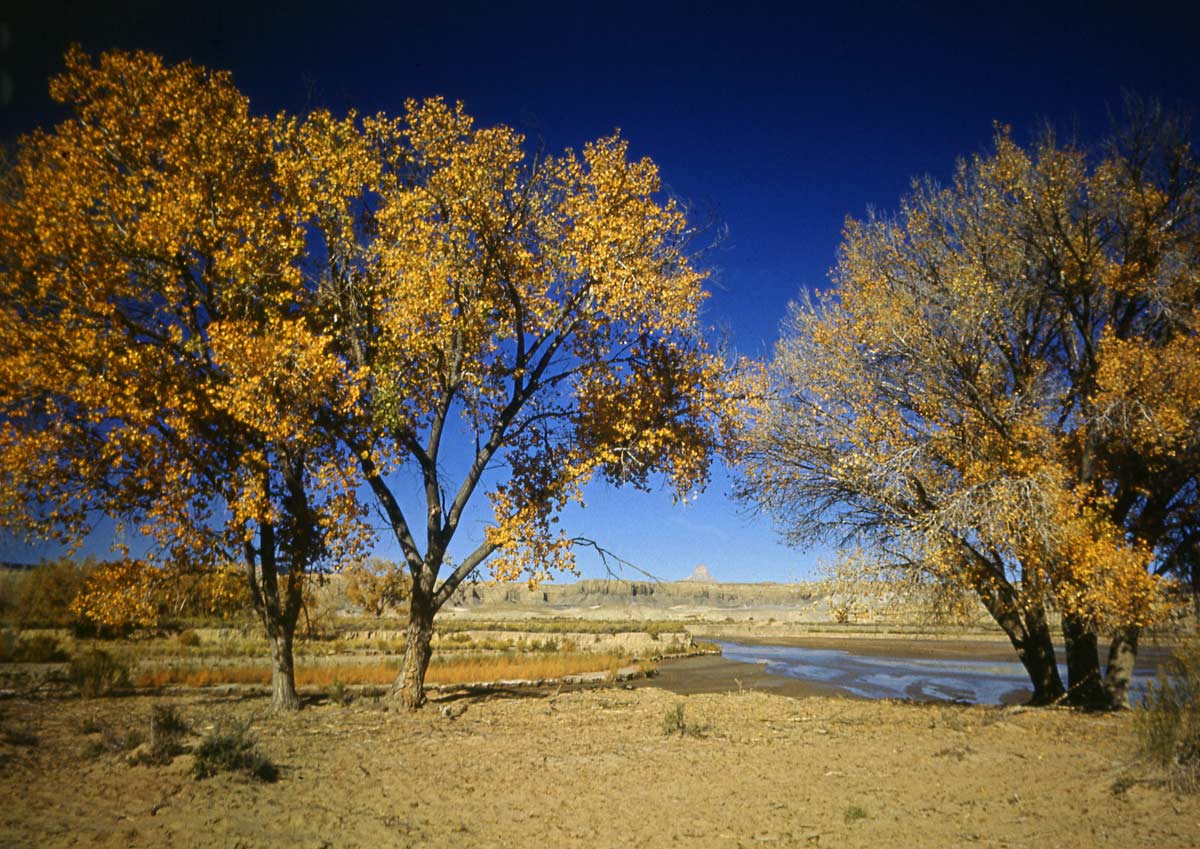
Some of Syke’s slide, like this one, came to a surreal condition by reason of some chemistry along the way. The blue is too blue, and the focus soft. What to say about the rusting landscape? But note the monolith centered on the far horizon. Did Horace mean to stage it all around that isolate effect? When grabbed in detail, like below, some of these rougher slides appear like gouache canvases. (Click to Enlarge)


These two subjects fit at the top by coincidence. Still they seem to be related in other ways – or yearn to. I found them in the same Sykes box, but there were many other slides as well that did not share whatever it is that these two show together. The odd colors, for one: the blue. How much of that is Kodachrome? The upper corners of both slides show what we are used to with many cameras: an inefficiency of the lens to expose the sky consistently. It gets considerably darker in the corners. Comparing the two slides may invoke feelings of the uncanny, which is that something that is dead is acting alive. Or better that something that is steadfast is about to come unglued. It is a puzzle. How close were Syke’s prospects for these two? Is there, for instance, a missing slide that might create a merging panorama? Typical for Horace, the location is not revealed. Perhaps in some distant blog exploration someone will stumble on these rocks and recognize them in an instant. That may be as likely as finding another Tut in another desert. (Click TWICE to Enlarge)

I like the composition of this Sykes. Here’s a band of natural parts layered like lasagna high from another Horace Golden Tree at the bottom. The massing is democratic with the four banded and imbricating parts taking nearly equal shares of the composition. This is merely descriptive, and not meant to offend either royalists or tyrants. The parts could be unbalanced in another composition to effects and pleasures of their own. I am reminded of Prof. Yates and a college class in aesthetics. Yates was very angular, a thin man and tall enough to regularly bump his head into a lamp hanging from the ceiling of his classroom near a window he liked to open wide for deep breathing. He was made in central casting for the part of absent minded professor and wore his tweed well. For the course he chose a prescriptive history in a thin volume that after considering a variety of historical approaches to “art and beauty” came to its own conclusion, that both had to do with “perceptual relations,” the play between the parts of what we perceive. It was not a very emotive approach, this “perceptual relations.” Or I might have also titled this composition “sturm und drang,” which is, many readers will know, a romantic period in German cultural history that I learned first down the hall from Yates room in Dr.Simpson’s class in world literature. Really it was a class in Western – not World – literature. (Click Twice to Enlarge)


We will search for or suggest a musical analogy for this landscape. It is not a sonata, nor a concerto. There are many parts played and sections too. But it does not seem a symphony either. The clouds are a good sized section on their own. The small river running through it may be the basso continuo, and the green brush in the foreground a section for percussion, but subtle – almost mute. I’ll imagine it as a concerto grosso, perhaps one by Corelli. Still its not I Musici or St. Martins in the Field that is playing. A highway curves into it and out – a child crying in the balcony. (Click to Enlarge – probably twice)


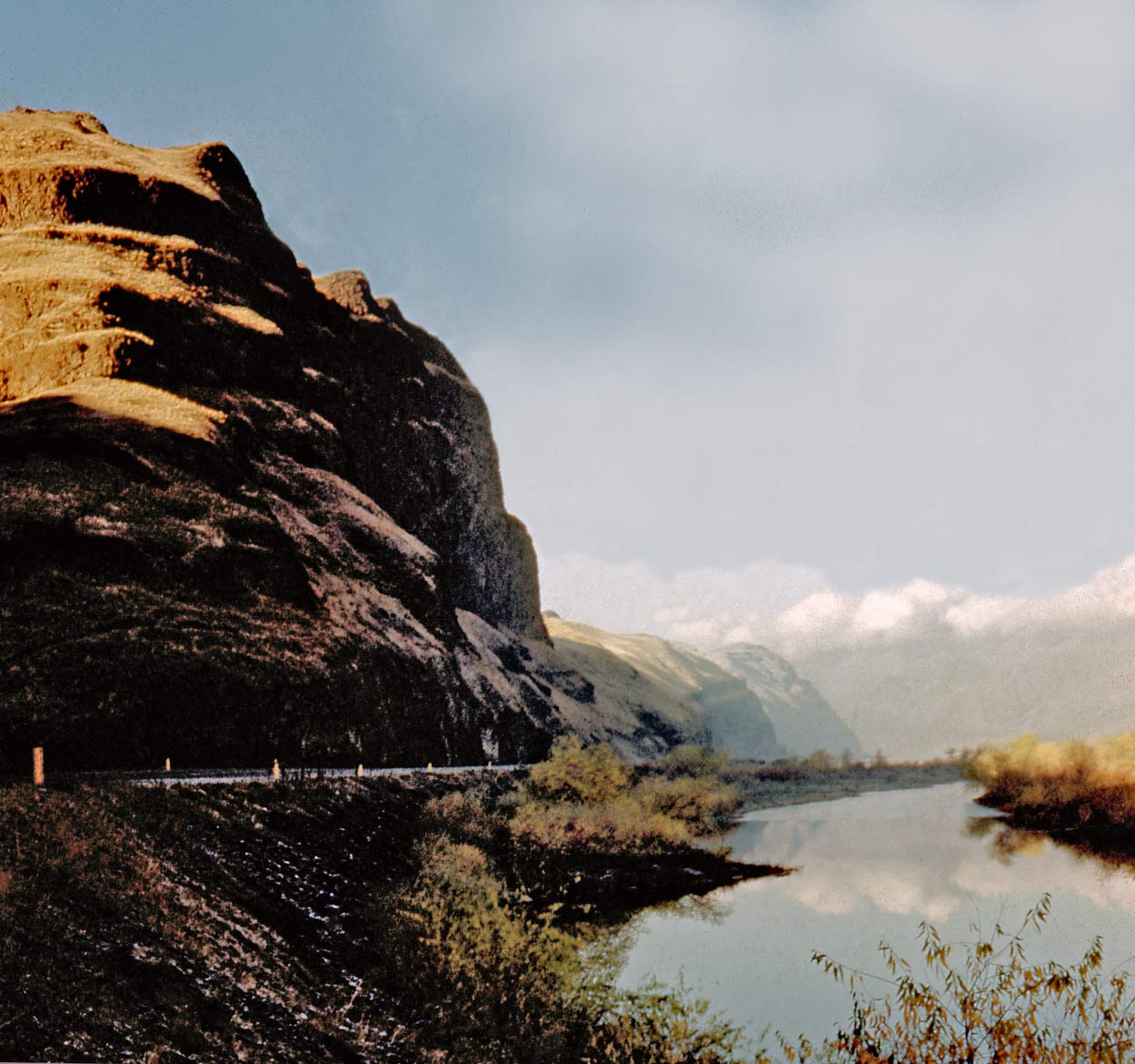

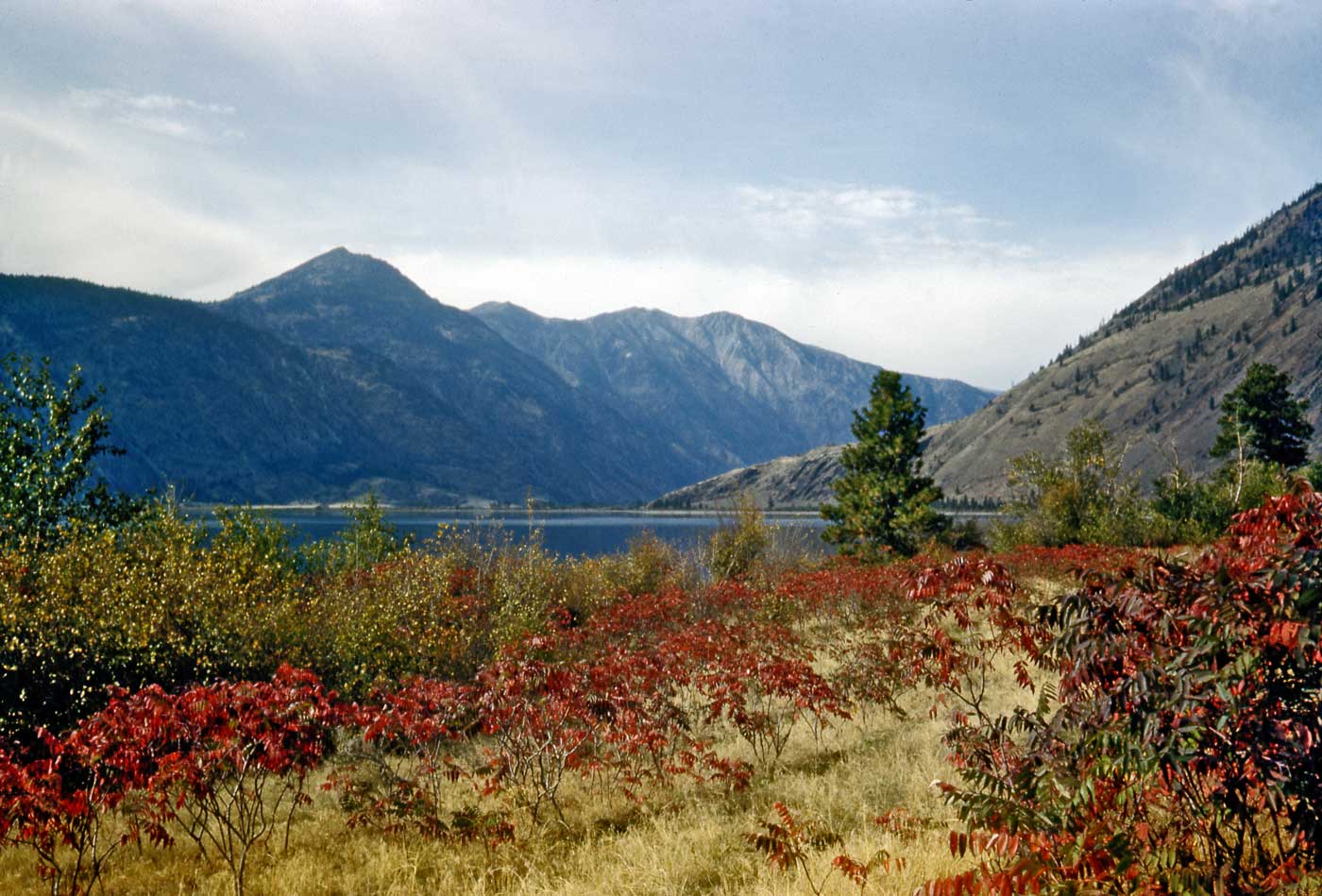

I have changed my mind, which will be obvious to those who read of my intentions in the caption to #364. I am not stopping the daily showing of Horace Sykes here with 365 and Sykes family pictures, but will go on a ways further down this “last road” as I have titled it. I am so pleased with this landscape that I gave in to it. Unlike some of the colorful southwest subjects this study of a subject that I suspect is somewhere north of southern Utah – if I knew where I would surely reveal it – has a subdued pallet and everything here shares in its tranquil effects. Horace – not a young man in the late 1940s – has climbed the loose bank to reveal again the curves in his subject. [Click TWICE to Enlarge]

Among the hundreds of landscape subjects recorded by Horace Sykes on Kodachrome film there are a dozen that were poorly saved on an emulsion with an earlier – I think – color process that in time did not endure so well. This is a summer afternoon on Lake Chelan and the passengers here on the upper deck of the Lady of the Lake are approaching Steheken and the northwest end of the lake. They have about six miles to go. The mountains on the horizon separate this valley from that drained by the Entiat River. The highest am0ng them reaches about 8000 feet. Lake Chelan is a little over 1100 ft elevation. Behind the foothill, left of center, is Domke Lake, and Domke Falls drains it to Lake Chelan from its far side. It is one of the scenic attractions on this run. The port and dock of Lucern is near the center of the scene. This being #364 we have but one day to go before we reach the daily number needed to complete a year – although we have been at it already for more than a year. Many Sunday’s were missed because of the labors of now-and-then. For number #365 we will pick some Sykes family pictures, and then adjourn Horace from his daily duties, although we will surely not abandon him.

The cool blue of the sky and rock might overwhelm the brush and slender trees were it not for the man in a red coat. Perhaps he is another member of the Yakima Camera Club, ca. 1947.
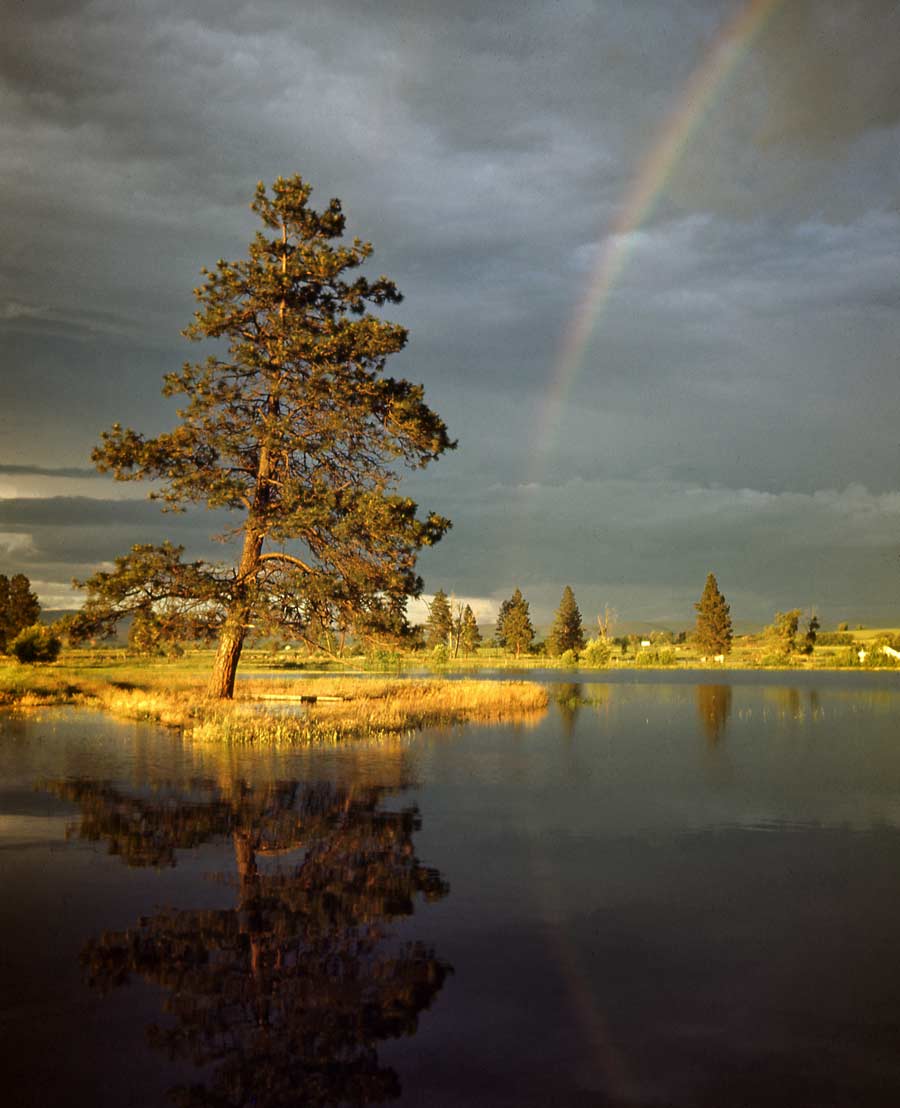


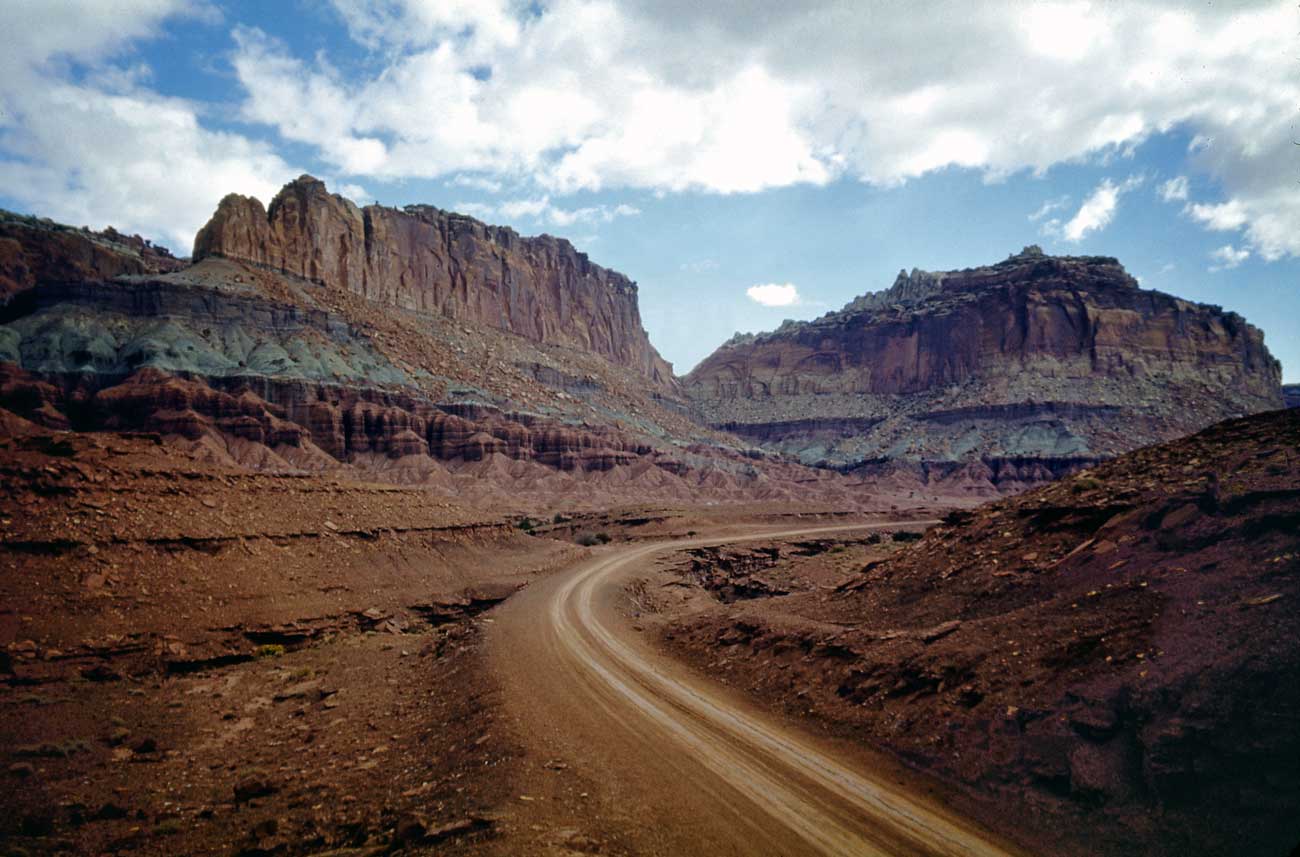


I assume this is Crater Lake although while taking a Google trip around the rim I was unable to find a horizon like that small portion showing above. I did find examples of a rock guard that resembled – at least – the one Sykes chose to include here. His use of the rocks on the right is analogous to his attraction to trees and bushes that one sees so often in his landscapes standing nearby. Don’t they?


Like fingerprints, the little headlands are, or so it would for now only seem readily findable. I have piloted Google Earth ‘Copter north from the California Line along the coast and not found anything that resembles this landscape. Because it is the Oregonian Sykes I assumed – and still do – that this is most likely along that coast. The Washington coast has fewer places where a road follows the shore so closely and also wetter, or seems so, and so I think it most likely Oregon or possibly California, and surely not Utah.


A slide without horizon is rare for Horace Sykes. Still the little corner – upper-left – of one is enjoyed. The red bush on the right is Horace’s primary subject, and he has carefully not put it directly in the center of the frame. This also a recording of what we have called the “Rocks of Theology” although they do not convert or inspire me. Painted in black letters with white borders are, left and right, two Christian prosaisms, “Christ Died for the Ungodly” and “To Heaven Or Hell Which.” Another less careful slogan appears top center although it is cut-off and all that I can make out is “sin.” And it surely is. [Click TWICE to Enlarge, for the sermons especially.]
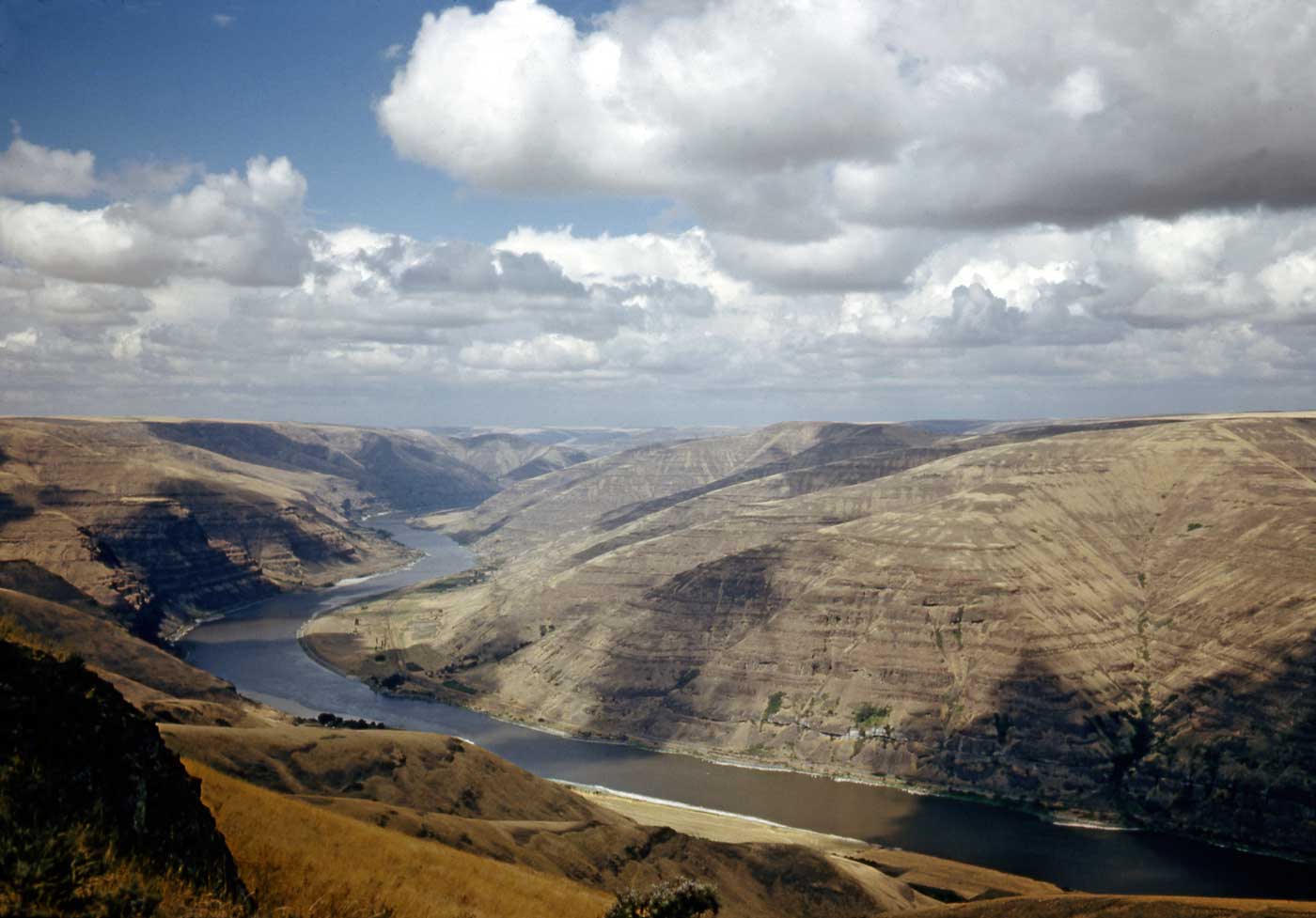
I imagine that this is the Snake River for I can not conjure any alternative, and yet with a Google Earth skimming of its winding way between Hell’s Canyon and the Columbia River I did not quickly find any part of that river that has these curves with a railroad track running beside the far shore. But then I only I only traveled from east to west assuming that the scene is exposed from a sun that is off to the left and so more likely in the west on an afternoon in the late 1940s, which is before any of the three dams were along the last part of the river. With time – tomorrow perhaps – I will return and try again heading then from the west. (Click TWICE to enlarge.)

Here are resting bovines
behaving predictably,
stock acting stock
in the shade
while around them
a field of blue flowers
acting like please forget-me-nots
cares little for so much sun
and yet cannot peaceably
join the cattle
in the pasture they share
beneath the covered
bumbershoot of a tree.

Here, just found, is another Sykes snap of the Whitman Monument (just west of Walla Walla) that shows, perhaps, his classical intentions. Here he has managed to almost juxtapose the needle on the moon with a care for symmetry.

Horace Sykes visited the memorial for Marcus and Narcissa Whitman and nine others about a century after the eleven were massacred by a band of Cayuse whom they had lived among or near since they first blazed the Oregon Trail in 1836. The massacre occurred in 1847 and so did the decimation of half of the Cayuse people in a measles epidemic for which the indigene believed the Whitman Mission was the source. Horace looks up at the “shaft on a hill” backlighted by the moon. Even in daylight it was difficult then to frame a 35mm camera for it did not allow the photographer to look through the lens but rather through optics set to the side of the lens. So we may ponder how he chose to imbricate the obelisk with the moon, but most likely the wag or wobble of chance was involved too. (Click to Enlarge)

While it looks familiar like many peaks in the Cascades and is surely near some passable bi-way for Horace and his Sykesmobile in the late 1940s and is now surely less than a day’s drive from the local Montaineer’s Bookstore, I cannot say where it is only where it is not. It is not in Utah. (Do Click to enlarge)

The name for this, Rural Electrification, is, of course, not Horace Sykes’ but our own. It may point to the barely detectable power or telephone line cutting across the center of this scene or to the stimulating effect the composition of this subject may switch on in you as it does in me. Here we have a “Sykes” road leading, this time, directly into the center of the arrangement. This is unusual for Sykes and his roads. And then we are given to all sides these wonderfully various masses and colors and our own purple mountains majesty on the horizon. [Please CLICK to enlarge]

A small clique of monoliths –
One, two, three and four –
Stand above the desert floor.
Bored, number four turns and sniffs
The forehead of number three.
Glum number two stands free while
Number one anxiously watches for the sheriff.

About ten miles north of Moab, Utah is a cluster of arches in the Arches National Park that when listed suggest what defines them – usually an analogous shape. Totems they are. For instance there is the Elephant Walk about two/tenths of a mile from the parking lot in the approaching paved highway that makes a loop along these arches like a lion circling an – elephant. The tops of these arches reach from about 150 to 300 feet above the paths that approach them from the parking lot. Other names include the Little Duck Arch (easy to see), the Ribbon Arch, Cove Arch, Seagull Arch (hard – for me – to see the bird), the Double Arch (very impressive in its cats cradle) and the Turret Arch, which is very close to the North and South Windows arches, and it is the North Window that is seen here posing like a Timbuktu Palace. What is also impressive about this group, which we have just sampled, is how they pose like sculpture that is intended to be seen in the round, and of course their aspects change considerably as you move among them. There are thousands of arches to all sides of Moab. Some south of the town – beside the Colorado River – are very big, like the Hall Arch. The Balcony Arch is near the Picture Frame Arch (quite rectangular it is too), the Penny Slot Arch (quite easy to see how it got the name) and Prostitute Butte for which the name is neither obvious nor explained. By then you are on your way, and only a little ways it is, to the seemingly out-of-place LaSal Mountains. Dark, somewhat forested and high enough (over 12,000 feet), it gets blanketed with snow for striking contrasts to the red rocks below the peaks of this small range, which is only about 30 miles long – if that. (Click TWICE to enlarge)

Aside from a few slides featuring his Magnolia home or a Coliseum flower show, I cannot think of any other Seattle subjects among the many hundreds of Sykes slides that have made their home for about thirty years on my shelves. Cityscapes are rare for him. The few rural or small town structures he has recorded are most often churches and schools. I think it more likely that this is the latter but I certainly do not know which. Again Sykes left no caption. Judging from the few motorcars and one pickup appearing in the street far right, this scene dates from the mid-1940s. In the more than half-century since this subject was recorded does its centerpiece survive? The place is not in good shape, circa 1947. The exterior plaster or stucco is blistering at the base and the rear chimney is broken. And yet Horace Sykes records it. Perhaps it is evidence less for his zest then for a small habit or sense of obligation to sometimes – perhaps for a remembered mentor or parent or teacher or priest – take a break from his recurring affection for picturesque landscapes. [Click Twice to Enlarge]

[Click TWICE to Enlarge.] This is Our Daily Sykes’ second visit to the Grand Canyon of the Yellowstone River in Yellowstone National Park. The first visit was our #34 from May 19 of last year, which confesses that we have not been what we claim: a daily Sykes. Indeed, we have missed most sundays while rushing to put up support or “extras” for whatever “now and then” appears on the weekend. Now reaching #342 we can see that we are likely to make it to 365 insertions even if the day we make it is not this feature’s first birthday. That would have been sometime in April. And should we continue on with more Sykes into another year or take on instead another photographer for a daily dose?
The differences between #34 and #342 are in the Sykes cosmology perhaps revealing. Number 34 was photographed a few feet to the left of #342, and it features none of the Sykes extras, like a second subject in the foreground, usually a tree or a rock. With #342 we get both, parts of a composition that is in rough thirds with the center third truly the center of attention. Was Horace then attracted to #342 to make a second subject of the canyon because #34 was too stark for him – too singular? The shadows may know. If we could find a difference between them it could tell us which was shot first and so give us some evidence into the motives of Horace the composer. But finding shadow forms in this farrago of jagged rocks even on this bright day with the soft lens that Horace used will be difficult. For myself, I’ll put it off until later.

I believe that with some former early Daily Sykes I mentioned my father’s subscription to the glossy color-saturated monthly clay-paper periodical “Arizona Highways.” There might just as well be a “Utah Highways” but there is not. This subject is almost certainly recorded during an early Sykes visit to one or the other state. I describe it as “early” because of the car included a ways up the road. We have seen it before, and it is manufactured earlier than Sykes swept fender Chevy, which we see more often. Here Horace has had to walk back to repeat the composition he probably first noticed through his windshield. The curve in the road is important to the total effect – it repeats the curves in the sculpted rocks across the highway, rocks that are nearly as designed as the highway. [Click to Enlarge]

This old eastern approach to the Vantage Bridge was considerably more exposed. I remember the anticipation that started to build outside of Moses Lake as the Dorpat family from Spokane made its way to Seattle for one purpose or another. The bridge was built in 1927 – the seventh to cross the Columbia – with two cantilevers supported on caissons imbedded seventy feet under the river bed. It was dangerous work and even with a limit of two hours many workers got the bends badly. The raising of the river behind the Wanapum Dam required that the old bridge be replaced in 1962 with the one shown below with the red wind sock. I snapped that from the passenger’s seat of Bill Burden’s pick-up as we headed home after two weeks in Idaho. The old bridge was saved by a railroad siding down stream at Beverly and then assembled again in 1968 over the Snake River at Lions Gate. It took the place there of the oldest ferry on the river – running for 108 years. [Click to Enlarge]


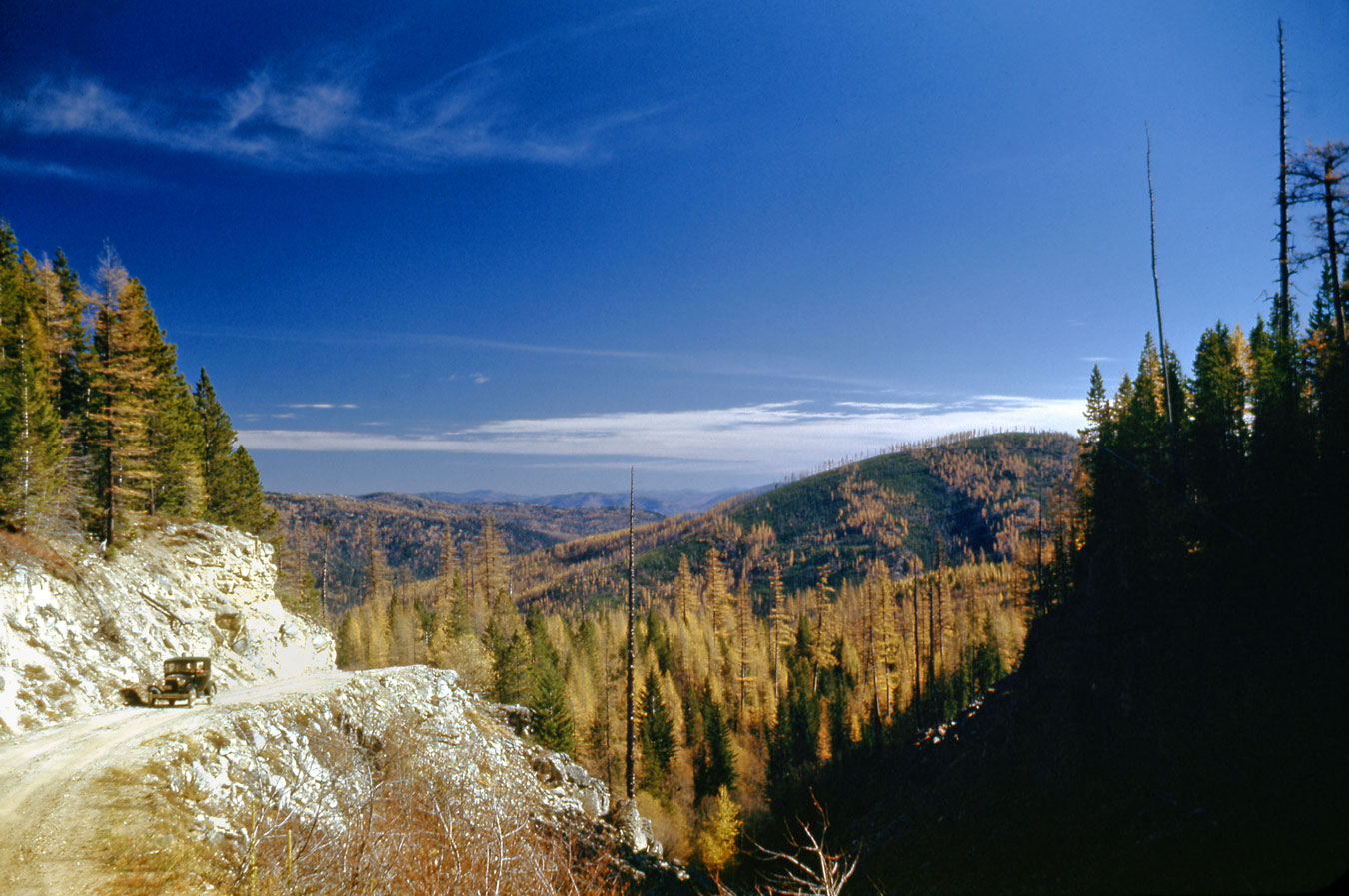
[Click TWICE to Enlarge] What model of motorcar is heading for Horace?

Where the shadow caste by the green and gold trees on the beach reaches its end a shepherd, perhaps, sits in the shade while a small distance to his left side a flock rests. Above the trees one sheep is drinking from the river for which Horace Sykes leaves no name. It is so rare for Sykes to include figures or their things in his landscapes that we may wonder how he felt here about this lonely man. [Click to Enlarge]

Here Horace is on top of Orcas Island’s Mt. Constitution and looking east over Rosario Strait to Bellingham Bay beyond the long interrupting strand of Lummi Island. When I first scanned this slide I imagined that it was somewhere in the Inside Passage between Vancouver Island and British Columbia. The revelation of what it is came with only a little reflection, for I spent four months looking back across these waters from the west shore of Lummi Island in the winter-spring of 1971. I rented a fishermen’s shack above the beach, far right, and from the window made several film time-lapses of the weather coming over Orcas Island towards me or rushing back and forth through Rosario Strait. The little islands nearer the east shore of Orcas do not look so small from Syke’s prospect. They are, first at the bottom, Barnes Island and above it Clarke Island. In the months that I lived on Lummi Island I worked on a film script with a working title Sky River Rock Fire. It is now, at last, the next “big project” I want to return to and hopefully complete – once I am finished with “Keep Clam,” the Ivar biography. Sky River, many will know, was the name we gave the first three-day outdoor festival produced and played in a natural setting and not a prepared venue. The first Sky River – in 1968 – was held on Betty Nelson’s Strawberry Farm near the town of Sultan, on Highway 2 to Stevens Pass. It will surely be a great recreation to return to the footage shot at that festival and several more and at last complete a film about it all. However, the film I took looking toward Orcas from my island home will not be useful. The laboratory had an accident with it and it came back to me very splotchy like seaweed seen through clouded water.

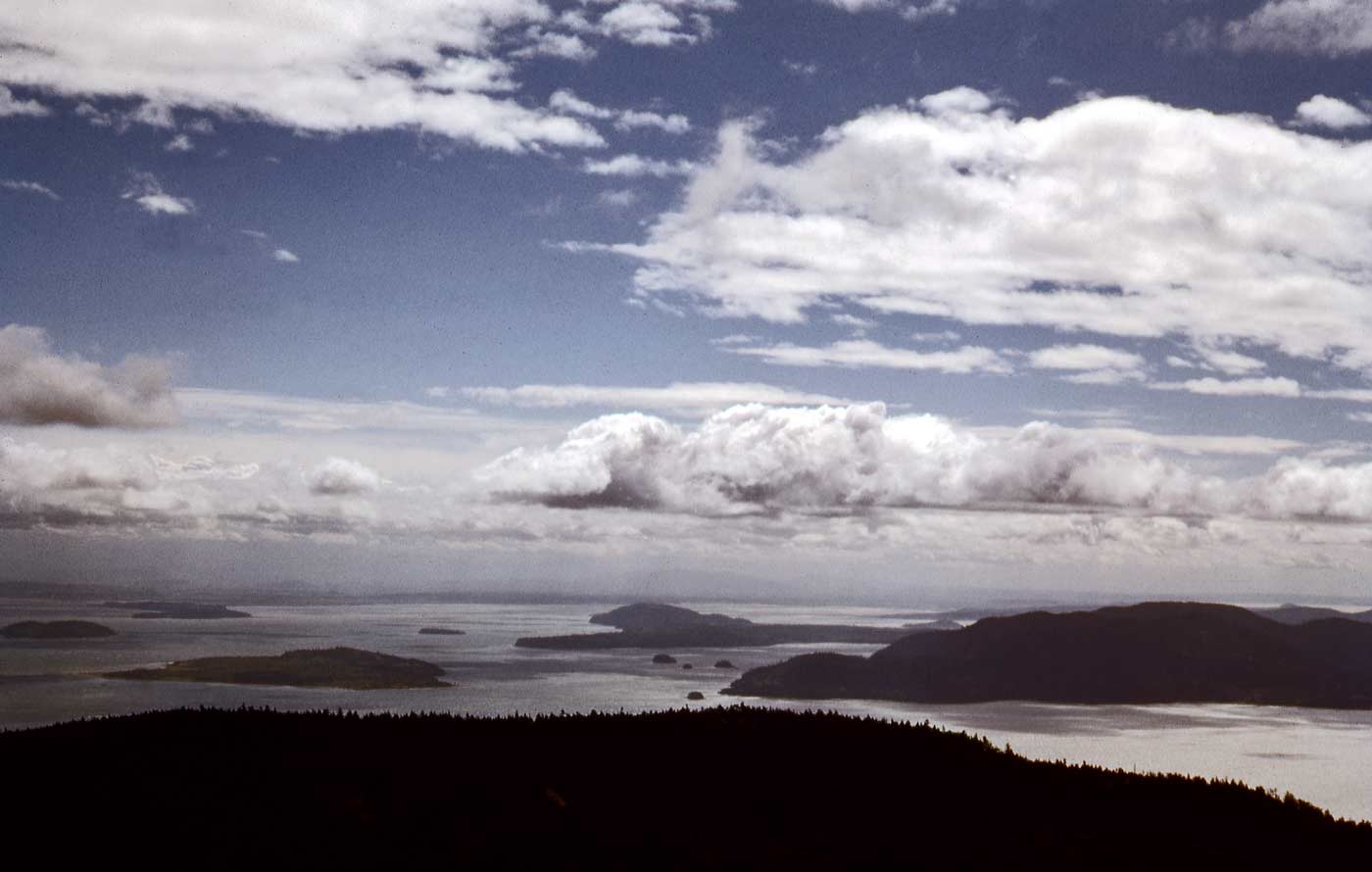
Here’s a familiar landscape in which the parts, the dark islands and roiling clouds, suggest a musical notation, a picturesque analogy for staffs of notes written across a page, with bass and treble clefs building a counterpoint of answering sounds like a Bruckner symphony – any of the eleven. Today I listened to all in order and continuous. So much hearing may also encourage seeing so. Look there, right of center, its the opening to the fourth and final movement, Bewegt, feurig, of Bruckner’s Symphony No. 1 in C minor, the 1877 Linz version, as played by the Bavarian Radio Symphony in concert, 1999, Lorin Maazel conducting.
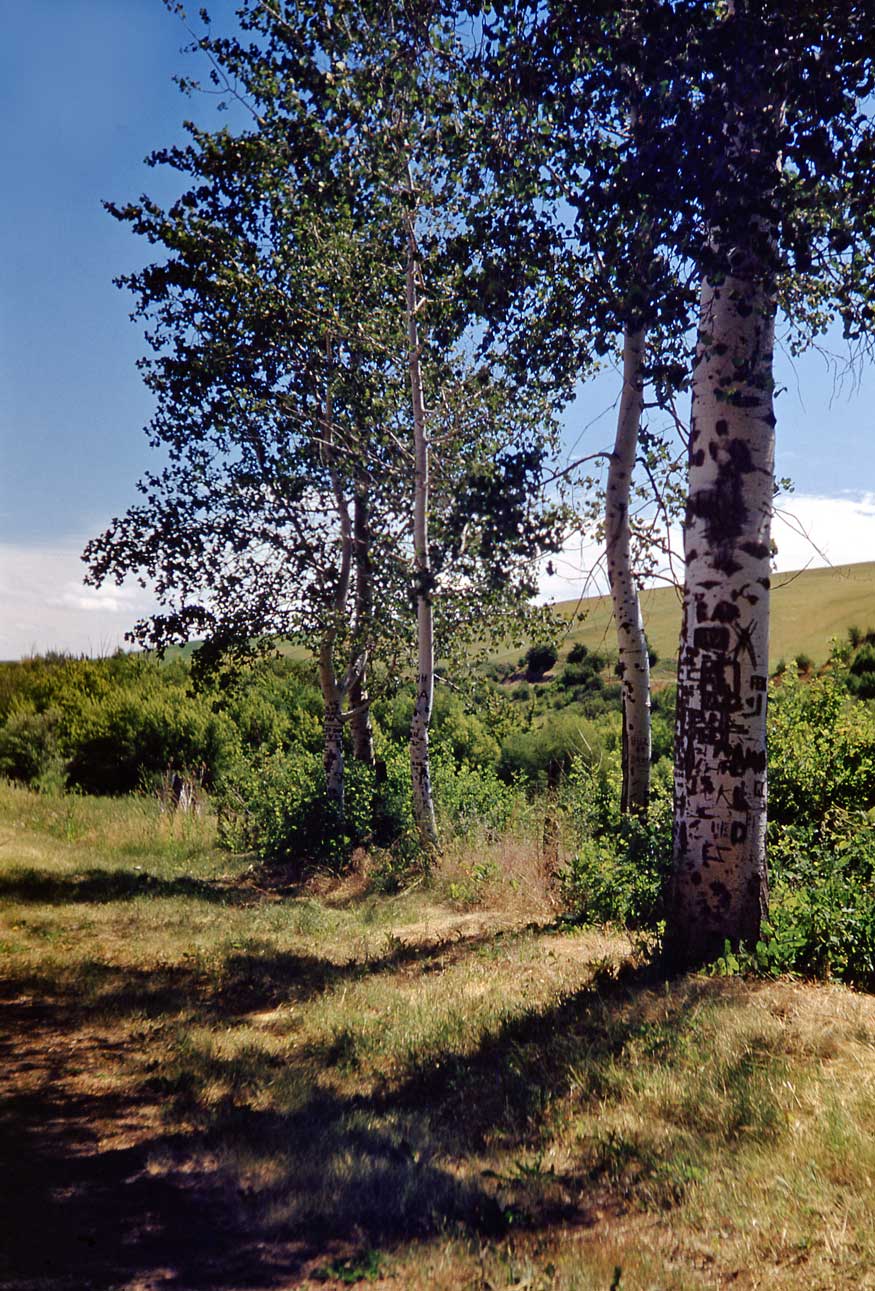

Here is another coincidence of Horace Sykes and Theo E. Dorpat’s ways in the late 1940s. I also visited Bonneville Dam and its fish ladder in the late 1940s while the family was on a trip to Portland from Spokane. And more than once. Now I wonder why have I seen no Celilo Falls – inundated by The Dalles dam in 1957 – among Sykes slides. Perhaps because I have not yet seen them all. [Click TWICE to enlarge]
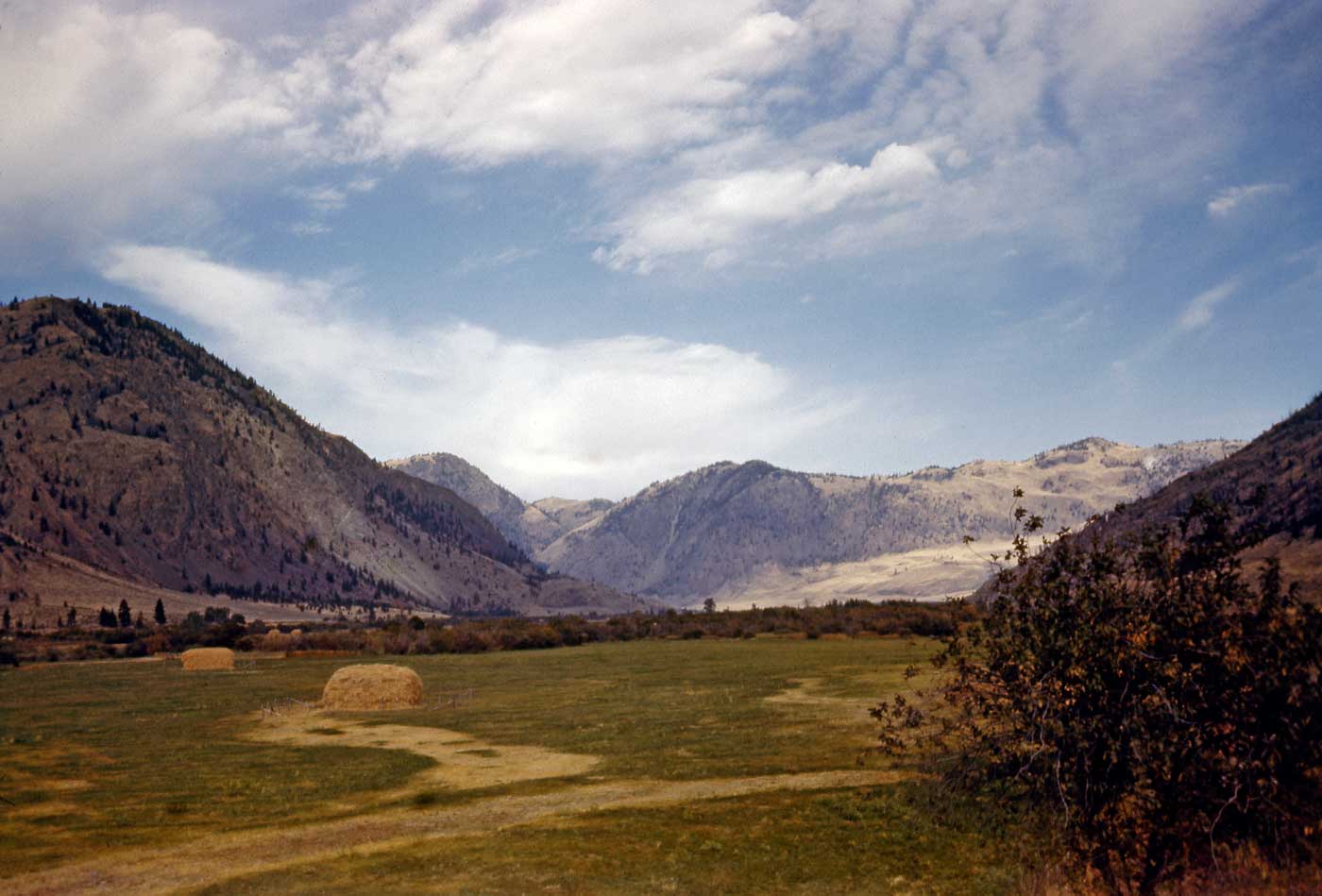
(Click to Enlarge) Would that my father, T.E.Dorpat, had seen this illustration for a story he told about a shoestring relative, a midwestern farmer, who was not so impressed with Western scenery when visiting us from Wisconsin. When dad asked him what he thought of our mountains, this cousin answered, “When I feel the urge to look up at something, I have my haystack. Mountains? I don’t need them.” Here, again, Horace Sykes does not reveal for us what mountains and haystacks these are.

[Click Twice to Enlarge]
I have learned – once – and believed that the winding road to the top of Steptoe Butte in Washington State’s Palouse farmland was graded soon after World War 2. Previously one reached the top on switchbacks. Here the coloring of the road directly above the bottom of the photograph looks fresh, and Horace did visit Steptoe several times in the late 1940s. I did once – with my dad – and also in the late 40s.
This view looks northwest. The little “pyramid” on the horizon at the center reaches an elevation of a few feet more than 4130, and on the otherside is Plummer, the mysterious Chatcolet Lake and the larger lake, Coeur d’Alene, it shares its bath with. I was raised nearby in Spokane and once I got my drivers license at the age of 16 the far northern end of Coeur d’Alene was a favorite destination in the summer, for swimming, of course, and also diving off a rock on Tubb’s Hill, a pine landscaped peninsula attached to the town of Coeur d’Alene but not bothered by it. Although living near it and visiting it often my inability – or lack of interest or discipline – to remember the correct spelling for “Coeur d’Alene” is the best evidence for my place name illiteracy.
The distant ridge on the left is the ridge just northwest of the town of Tekoa, which is about 17 miles from the Steptoe Summit. At a few feet more than 4000 the ridge above Tekoa is about 400 feet higher than Steptoe Butte, but not as high as the little pyramid above Plummer, which tops at about 4130 feet. And now we know.

Here’s a subject that Jean and I had hoped to include in our book “Washington Then and Now,” and if Jean can find the “now” – several of them – that he took of the Grays River Covered Bridge he may follow this with a two or three or more repeats. The covered bridge did make it into the book Genevieve McCoy and I wrote and which you can peruse on this blog through the “history books” button on the front page. “Building Washington” is its name and page 107 is where the subject of covered bridges in state history is included. The Grays River Covered Bridge, called the “Sorenson’s Covered Bridge,” by locals, was built in 1905 by Wahkiakum County to help dairy farmers get to market. The span is 188 feet and the roadway 14 feet wide.
Hey Paul, here are a few photos of the bridge. My guide, incidentally, was Tim Appelo’s uncle (whose first name I’ve forgotten – do you remember?), who had a remarkable collection of historical photos and documents and, if I remember correctly, owned and operated a telephone exchange in the area.


(Click TWICE to Enlarge)

With this subject we do not long for a Sykes caption because we know it from many sources including coffee table books and service station place mats. Mesa Verde in southwest Colorado still “abuses” me, for as a child my parents never took me there although I longed for such a visit. I felt its hole in my just post-toddler travels. Still do. Thanks Horace. (Click to Enlarge)

I imagine that this is somewhere upstream from Grand Canyon on the Colorado River – but I have not found it. (Click TWICE to Enlarge)


Somewhere on a moonlit Oregon coast, perhaps. Or the back-wash glimpsed from the stern of an arriving ferry. (Click TWICE to Enlarge.)

Click to Enlarge

(Double Click to Enlarge Somewhere in the Southwest.)

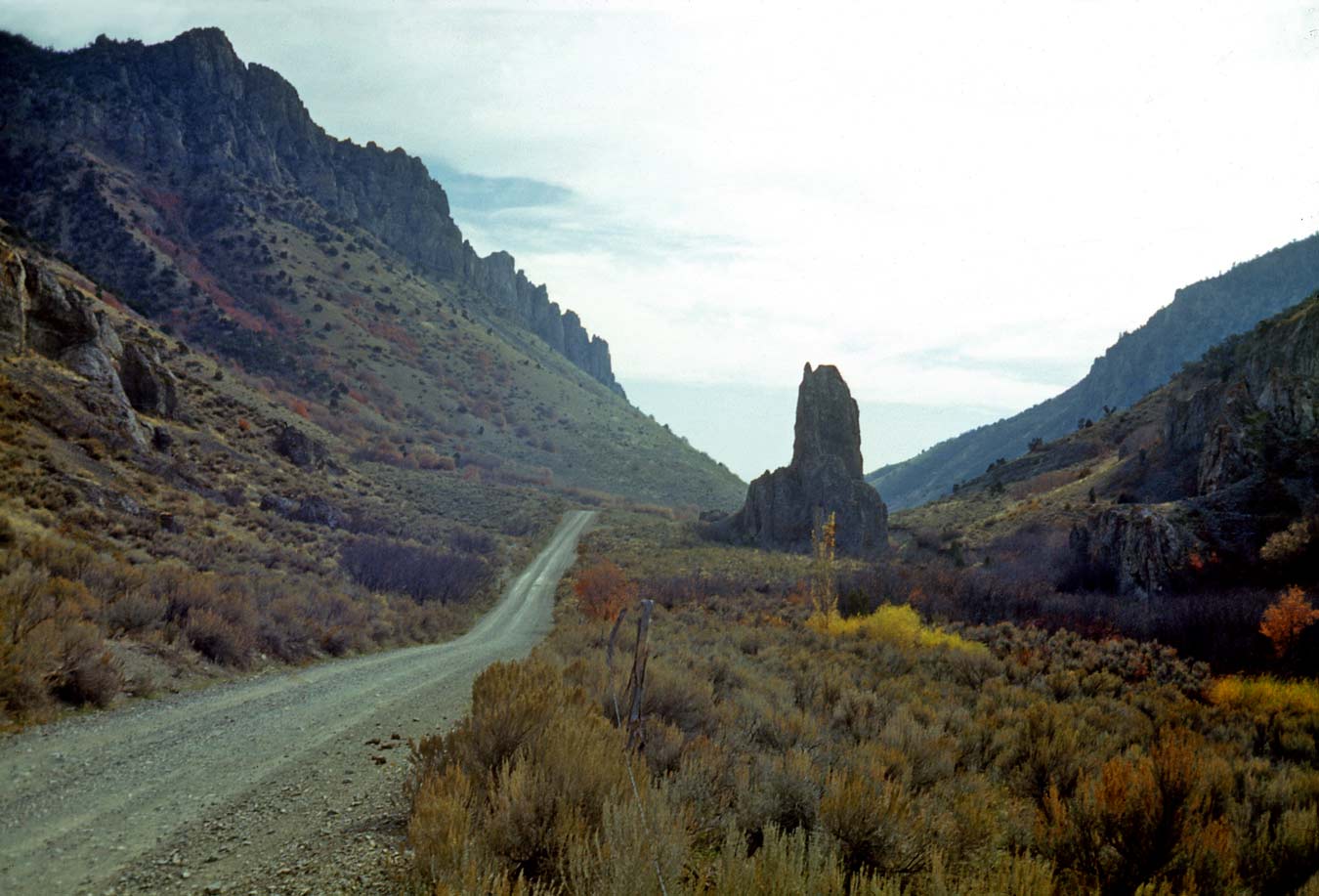
(Click TWICE to Enlarge) There are – we know – many examples of Sykes’ landscapes in which he includes a road among his subjects. We could, by now, make a calendar of these road recordings. In many of them the road is cast as the primary subject extending through a landscape that is more or less cleared of other landmarks. Here a nearly red bi-way cuts between low swells in a green farmland while heading for a lone tree that stands most satisfyingly on the horizon. The delicacy of that tree is repeated in the clouds. That, again, we don’t know where we are is not upsetting.
[NOTICE: We changed our “server” to a speedier one today and seem in the process to have lost the picture for this “Farm Life” Sykes #314. My attempts to load it again failed under an “error” message. Until this can be solved there will be no more Daily Sykes’ Palliatives.]

(Click TWICE to Approach the Horns) Horace Sykes’ rare witness to the ups and downs of farm life.

Typically split from Cedar logs (or Chestnut until the blight decimated them) the zig-zagg split-rail fence is a sign of both abundant timber and land. Except for the tools needed in the splitting, these fences do not require much else. The pattern supports itself without fasteners like nails or bolts or wire – although when available these may be used for reinforcement. I remember when country hikes might come upon such comely barriers. Zig-zag fences may also be easily moved, and in a fuel emergency cut up for firewood.

“Beacon in Storm” is Horace Sykes’ title for this successful example of Light House photography, a genre that is about as popular for the maritime as sad clowns are for big tops. Sykes made several tries at posing the Cape Disappointment Light before he came away with this Kodachrome. Cape Disappointment, 192 feet above mean tide, was first lit in the fall of 1856. Its neighbor 2 miles to the northwest, North Head light was commissioned in 1898 during the military boon period connected with the Spanish-American War. The building of the “security state” never stopped but continued thereafter as the USA assumed the role of policemen of the world. But the two lights are most peaceful and inviting friends for those sailing in these peculiarly treacherous waters between the Columbia River Bar and (for those off-shore) the nearly hidden Long Beach peninsula. Together, the bar and the peninsula make the “Graveyard of the Pacific.” (Click your Mouse to Enlarge Sykes Slide)


This reminds me of a Sahara scene where the advancing dunes creeping south towards Timbuktu cannot be resisted, rolling over mosques and oasisses alike. This looming hill, however, is topped with fertile loam, which both catches what rain falls while also letting it move through the elephantine hill’s share of the gritty nutritious mix of clay, sand, and silt that covers much of the Palouse wheat land. While Horace, again, gives no peep on where we will find this setting, we may thank him for recording it. Perhaps the single grazing horse near the horizon and to the right of the well-rutted road climbing the hill and the center of the subject also got his attention. (Click to Enlarge)

Horace Sykes took at least three slides of this river boat by moonlight, and he titled two of them. One rambles “The River Boat. Yakima River. Yakima Camera Club, L9-5.” The code at the end may have related to its place in a club exhibit. References to the Yakima Club come up in the Sykes collection a few times, but so far none to the Seattle Camera Club. One of the three impressions has no caption, and the other has it, “Nine Bells All Is Well.” Tomorrow as time allows I’ll attempt to name the boat. (Click TWICE to Enlarge)

Running low on Sykes I explored another box of his slides, one I’d not searched before. Inside were a few slides grouped by subjects and captioned – minimally. For these subjects we have already seen slides “without words” in Our Daily Sykes. There was a grouping for “Snake River,” another with many close-ups of flowers and a third of sunsets, of which the above was one. It is that rare photograph of a sunset that breaks the commonplace of the sinking sun sensations with a very satisfying composition and what editors and ad-agents like to call “human interest” too. But where is it? Again, Horace does not tell us. However, after “reading” the horizon I remembered it from a Washington State real photo postcard we used in our book “Washington Then and Now.” With the help of Google Earth I think I figured out within a few feet from where Horace took this sunset sometime in the 1940s. However, I’m not telling. Rather I’ll include a good clue below – another display of the same horizon and in full daylight. So where is it? (Click TWICE to Enlarge)


[Click to Enlarge] This may be our fourth or fifth visit with Horace Sykes to the top of Steptoe Butte. The view is to the south and, I believe, a little to the east too. Sykes’ decision to include a horizon of the hill as well as the quilt of Palouse wheat fields below it is typical of his often displayed urge to when shooting something far off to also include something nearby. And here the lift of that upstanding cloud plays parallel to the rise in the butte’s horizon. All is right with the world and heaven above.


[Click to Enlarge] Completed in 1922 the “Yellowstone Trail” bridge between Pasco and Kennewick was the first of four cantilever trusses to be erected across the Columbia River during the 1920s. The ferry it replaced could not handle more than six cars a trip, a paucity that kept the twin cities distant. (There was no Richland as yet to make it the Tri-Cities.) A public subscription drive subsidized the construction, and on the day of its dedication people were as likely to break into song as to breath. The bridge became a symbol of that rarity in Washington, a statewide cooperation. The Seattle Times called the subscription effort the “greatest community undertaking in the history of the Northwest.” Soon about 200 motorists a day were paying the steep, for the times, 75-cent toll. Here I have fallen into quoting myself. This bridge’s story and many others across the state can be read for free by you on this blog in the issuing here of the book “Building Washington” that Genevieve McCoy and I wrote in the late 1980s. Go to the front page books button and find the cover of the book upper left. Click and wait about five minutes for the big book to download. If you are looking for this bridge you’ll find it on pages 112 and 113. “Building Washington” is well illustrated.

Most likely this is another of Horace Sykes looks into the Palouse with the Blue Mountains of southeast Washington or those of Idaho on the horizon. Some strange light is working here. A bolt of sunlight has streaked those distant hills, and not the mountains above them. Or perhaps only a band of snow has dropped onto these hills. We may expect that of rain – but of snow? (Click to Enlarge)

Included in the Sykes collection are a number of slides of paintings. Most were photographed from the originals. This one may be a copy of a copy. If I have read the signature correctly, the artist was Alice C. Holland, and the date 1949. I had no luck finding her on the net but I did only the most basic of searches, which is by now often enough. The painting shows considerable skill. I also searched for portraits of Franz Schubert but did not find this one. Still it seems like this likeness was adapted from one of the most oft reproduce portraits of Schubert. Busts for many admired composers were often purchased for setting on the family’s piano. I have one of Bach on mine. I am pleased with Horace that he would care so for this composer who although he died young was still prolific and the most lyric of the romantics. Both his songs and sonatas will reward a lifetime of listening, and his symphonies are at once inventive and restrained. Some of his arranging for brass has riffs that sounded like jazz – sort of. We may now imagine Horace Sykes listening to Schubert serenades in his sun room with his orchids


Long ago while behaving like a student at the Claremont Graduate School east of Los angeles, but not yet out of the smog, I lived with four other students in a modern shack in the type of subdivision that was known then in L.A. as a Slurb: a combination of slum and suburb. The homes were new, poorly built and very much alike. I got a job from the slurblord to clean up homes that had been abandoned or foreclosed on. I was paid $75 a home, which was a happy sum in 1964.
The five of us liked our little shack because the rent was cheap split between us, and our dinner conversations were vigorous. We were all graduate students on the exercise machines of seminars and our meals together. Our home was up against a open concrete box drain that was there to carry any flood that Mt. Baldy might send out of its hills onto Claremont and Montclaire, its neighbor across the tracks and our “community.” It is fitting that the names of the two towns share the same letters but in a different order. Claremont was one of L.A.’s oldest suburbs with a grown landscape and large old homes, some of them Victorian. Montclaire was nearly new and made with no apparent or felt soul.
My room had a door to the side lawn nestled beside the canal that was guarded by a sturdy wire fence, which was hardly noticed. Lying on bed and looking west into the smog of Los angeles the sun set very much like Horace Sykes’ sun above, except that my setting sun was also seen through a screen of Eucalyptus trees on the far side of the canal. That combination was most serene and sponsored both day dreams and meditation. It was the sun of Tao during those sunsets, and the filter of smog was so effective that you could continue to look directly into the sun without harm. Depending on its layering the smog made its mark on the sun, and I sometimes squinted at it and imagined the globe resolving itself the balance of the yin and yang that was once best known as the Northern Pacific Railroad symbol.
I remember rain in that canal only once, our first week in L.A.. It rained seven inches in seven days, and set some record.


My first hunch was that this was photographed from Guys Peak, that cross between a pyramid and a pile of sugar (during the winter) that rises abruptly over Snoqualmie Pass. But now I figure this view looks south and a little east from the southern slopes of Denny Mountain (and the then still future Alpental ski runs and lifts) over the Pass to Lake Keechelus.