
This is another of Horace Sykes looks into the city and the waterfront during his and others pre-vehicular access to the viaduct in the spring of 1953. This one looks east on Yesler Way.

This is another of Horace Sykes looks into the city and the waterfront during his and others pre-vehicular access to the viaduct in the spring of 1953. This one looks east on Yesler Way.

We return with Horace to the Grant Tetons to make a by now didactic point. This naturalist photographer could not leave it like we saw it with Our Daily Sykes #290 (printed again just below) with nothing growing in the foreground but also felt a pull no doubt to this beach flora and used it, like we have shown many times through now 296 of Sykes subjects, in a foreground given to those smaller – or small by comparison – growing things that were his other enduring interest or devotion. It is still morning in the Tetons but the mountains are not reflecting now on Jackson Lake. Hold on! It is silly if predictable that I gave a narrative to these two recordings, that I put the first one shown here first for Horace too. He might have just as well taken the top photo first and then chased the mountain reflections in the lake.


We will pause now for Horace Sykes orchids. Besides his talents for picturesque landscape Sykes loved the orchid and gave a lot of attention to growing, exhibiting and photographing them. We imagine that when he was off on his trips for adjusting insurance claims and shutter speeds that some part of him missed his happy times at home with his family and his orchids.

I confess to a small worry that this may be out of place; that is that it may not be a Sykes, although it is pulled from his collection. First, the photo is of a Seattle landmark, the Seattle Art Museum in Volunteer Park. Seattle subjects are rare for Sykes. But he did love art and so may have cherished its hometown temple. The slide is also dated August 17, 1943. Captioning for Sykes is rare, and dating almost never. Still the slide does show Syke’s sensitivity for framing his subject, and it even has its small singular oddity, which Sykes often finds in small plants and rocks. Here it is the orange trash container. Certainly Sykes did not pose it, but I think he would have liked it, whether he recorded it or not. It is that trash can that “makes” the picture. Everything springs to it and from it. Now try not to give it your attention.


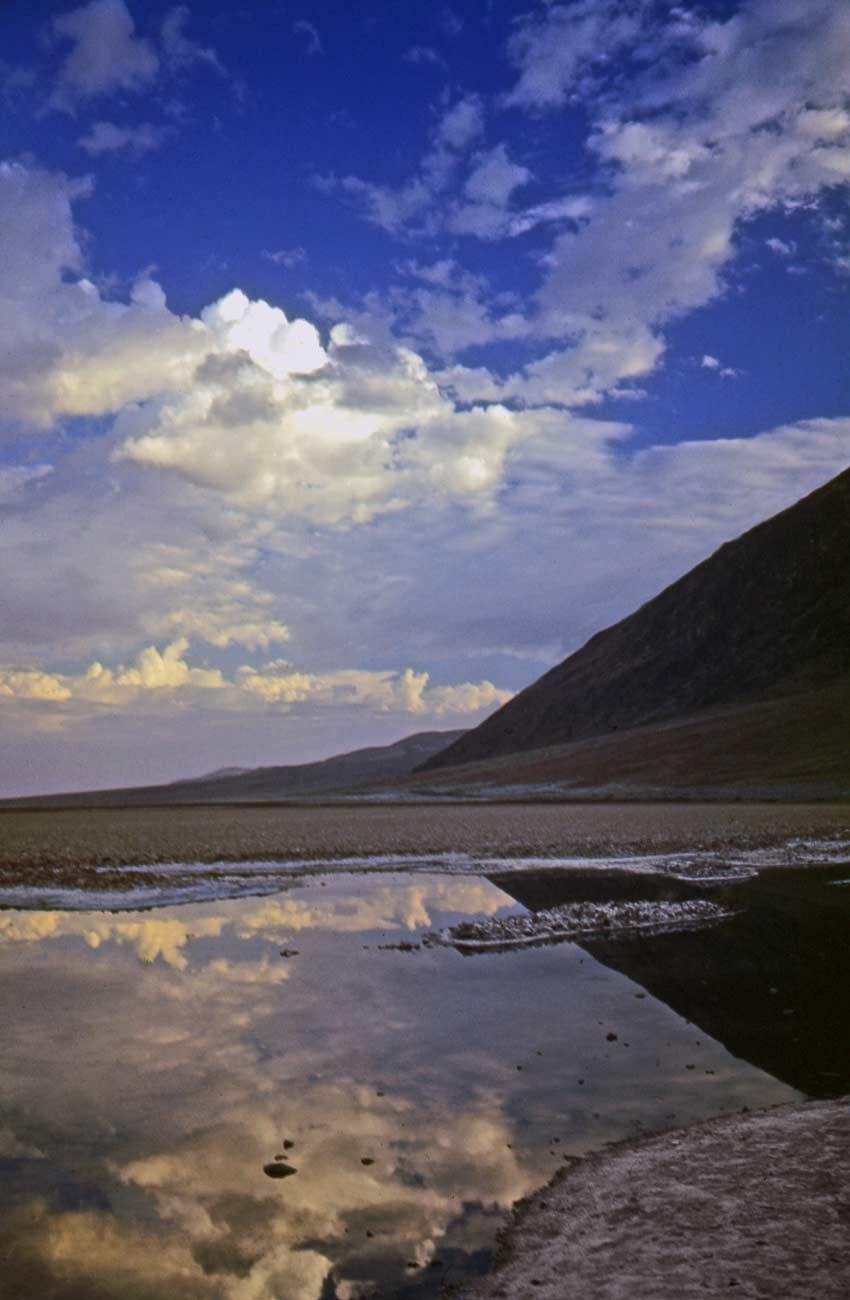
“A Pond Reflection.” This will be as close as we may come to a pun on “Upon Reflection.” And it certainly is meditative. (Click TWICE to reflect.) This may be part of the shoreline of the Great Salt Lake and no pond.

Ordinarily one looks at the wonders of Bryce Canyon from the edge of it. Here Horace has noticed the line of characters watching him approach on a path. They stand like stock characters in a Commedia dell’arte. There, perhaps, are the boasting solider, the cuckolded husband, the disobedient servant, the jester, the helpless damsel, the scheming Turk, and the hunchback Punchinello. Add your own stock character. Its up to you to decide which is which. Take your time. They are in no hurry. And click to enlarge.

The sun-lighted cut through the rolling mid-ground, the delicate and distance thread of blue mountains, and great curving gravel road in the foreground are all painterly matches for the surreal Kodacolor of this Sykes landscape.

Here it occurs to me – again – how a digital camera might have freed Horace Sykes to shoot whatever he wanted to record and many times over if he was so inclined. With such freedom he might have “mapped” this farm with shots left and right as well. As it stands or lingers in this picturesque setting, some days protected from strong winds by the screen of tall poplars, Horace again – and again – gives us few clues.


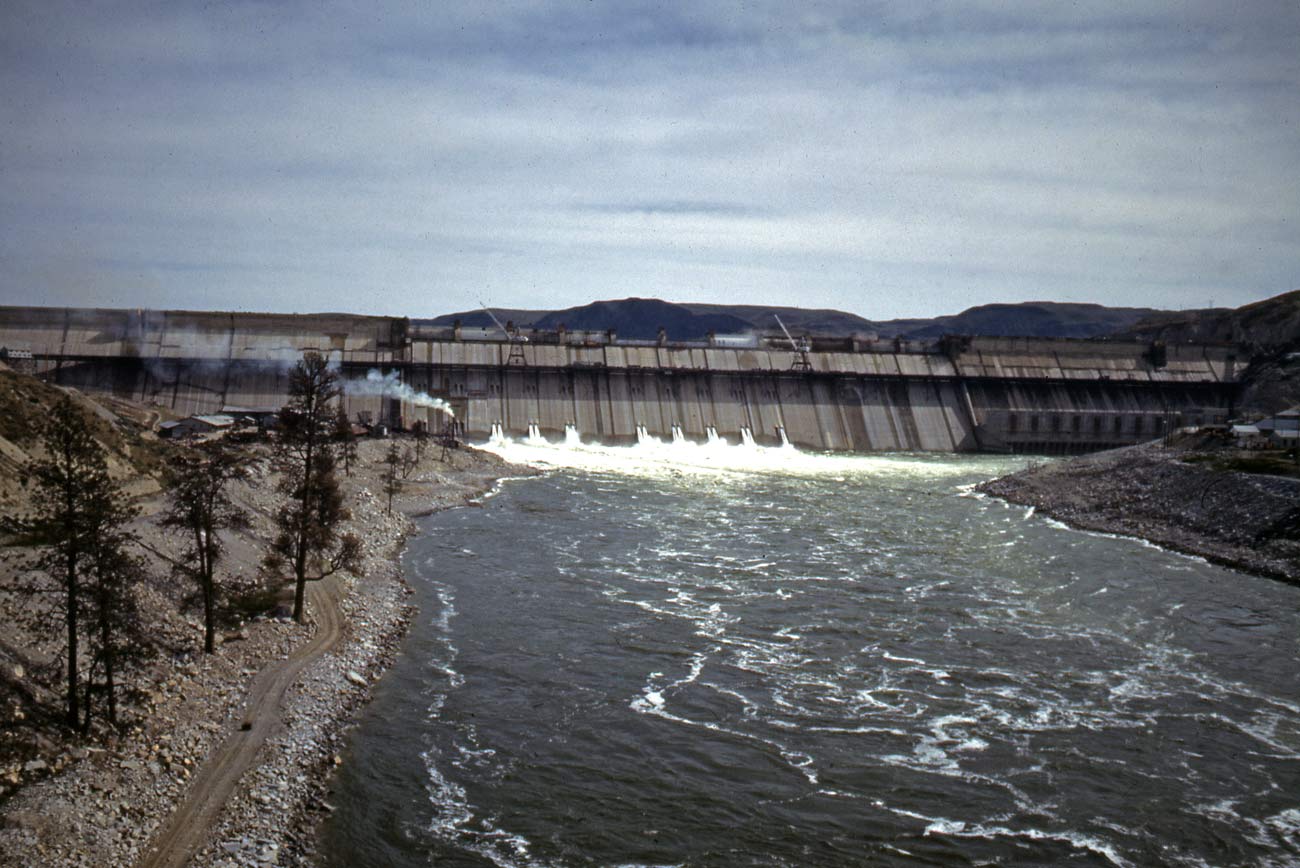


(Click TWICE to Enlarge.) It is fairly easy to at least imagine Horace’s motivation for pulling over on this country road to record the line of gravel as a repeat of the line streaming above him. The curve of the dirt road follows that of the vapor. In the post-war years Spokane had two military airports west of town, Geiger Field and Fairchild Air Force Base. The latter was soon sending hybrid B-36s droning over the city. Extremely ponderous these over-sized flying tanks were retired early, made obsolete by the B-52, a serious cold war bomber. I no longer remember what sort of marks these jets were leaving in the sky in the 1940s, so this vapor trail does not lead me to its maker. I remember the fascination of them though. In the summer it was something to lie in the grass and watch their creation. The tail gave a substance to the airplane it did not have without it.
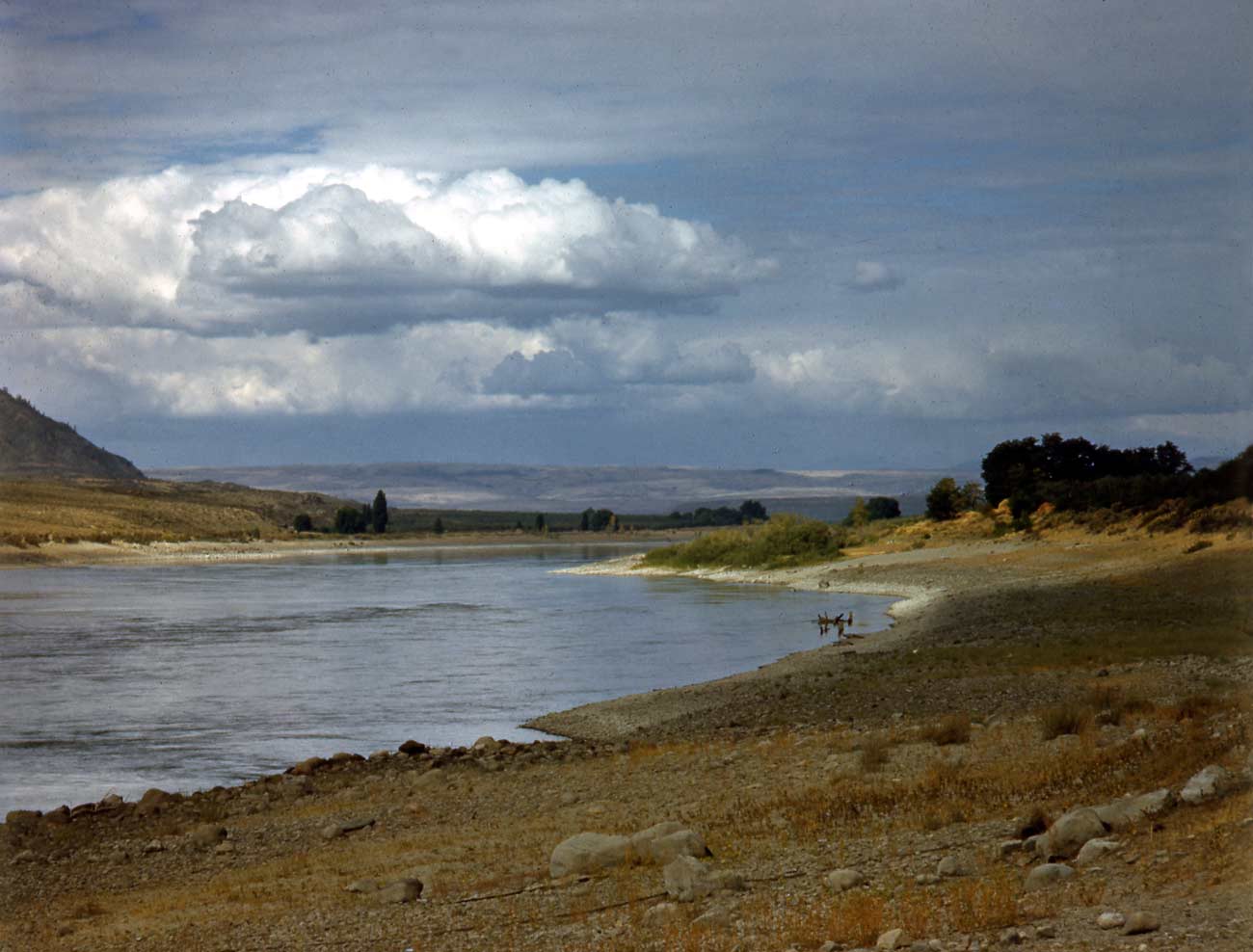


About one mile south on Washington State Highway 28 from where Horace Sykes might have taken a Kodachrome of Rock Island Dam head on at its face he instead found this perch above the Columbia where across the river the dam peeks around a curve and stage left – on the right – cliffs rise like stage curtains. And Sykes also found a poseur for the foreground too. Here a rock stands above the river like a pulpit.


Imagine a topographer who could tell us the location of these clouds by the “fingerprint” of the shadowed horizon.


The new box of old Horace Sykes slides from the 1940s includes a number of subjects that are of locations included so far in Our Daily Sykes. Here are a quartet of them.


Another unpaved road into the picturesque unknown. Of might Horace Sykes have decided to omit all descriptions so that his universals would not be reduced to the mundane anxieties and/or pleasures of mere identification?
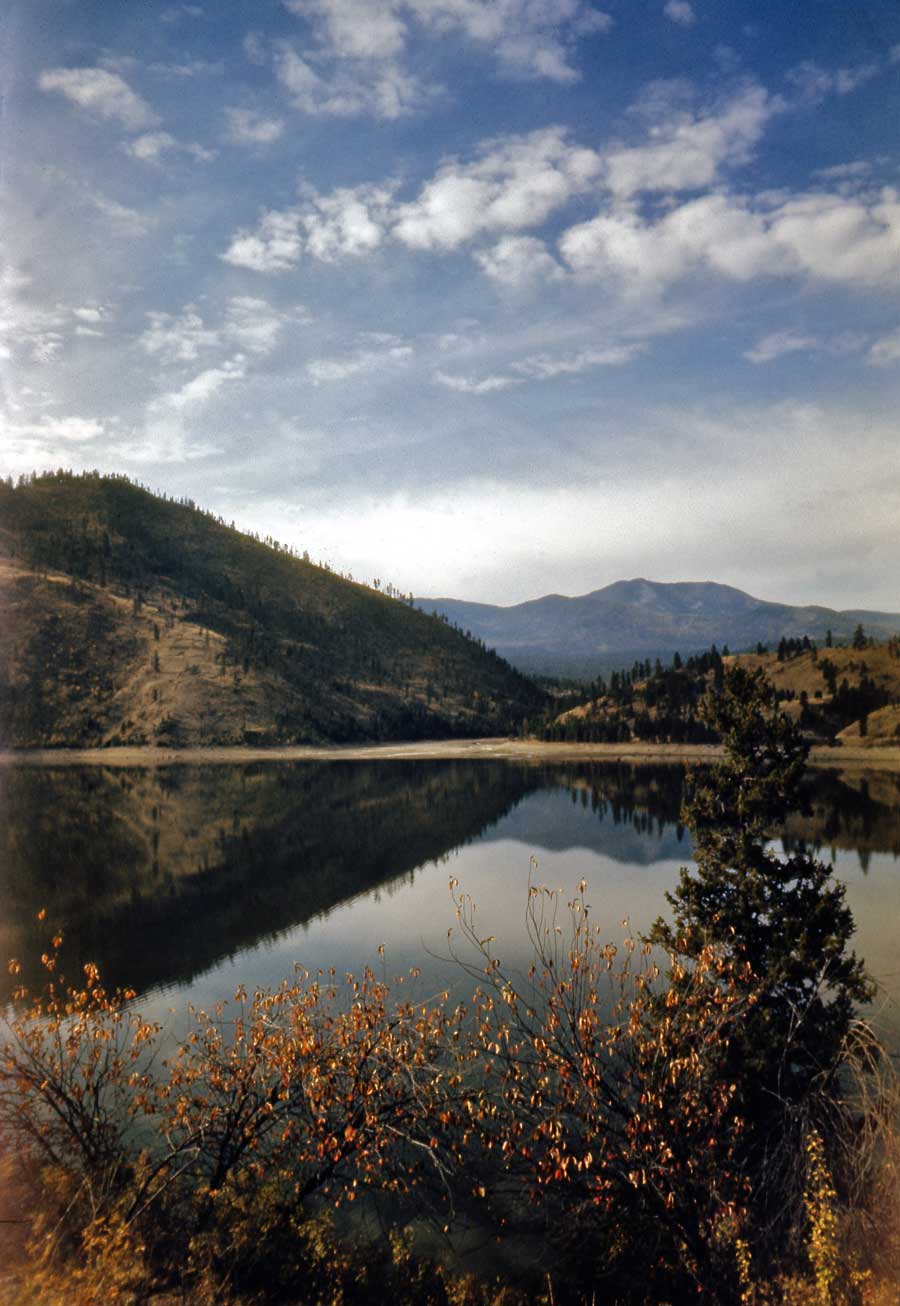


Here is another rare example of a slide that Horace captioned. Horace writes, “Coulee Dam during flood. 36 million gallons per minute.” This is surely the flood of 1948, May-June. The torrent damaged the dams underwater flip bucket at its base. The spillway was designed like a ski jump. Water falling down the face of the dam was turned up at the base, dispersing its energy in the process. In 1948, however, the water was too much for the bucket and also river banks downstream all the way to the Pacific. Near Portland, the flood wiped out the town of Vanport. The flood of ’48 indicated the need to work with Canada in flood control of the river upstream from Grand Coulee Dam. The Columbia River Treaty followed in 1960, and Canadian dams too.

(Click Mouse to Enlarge – please)
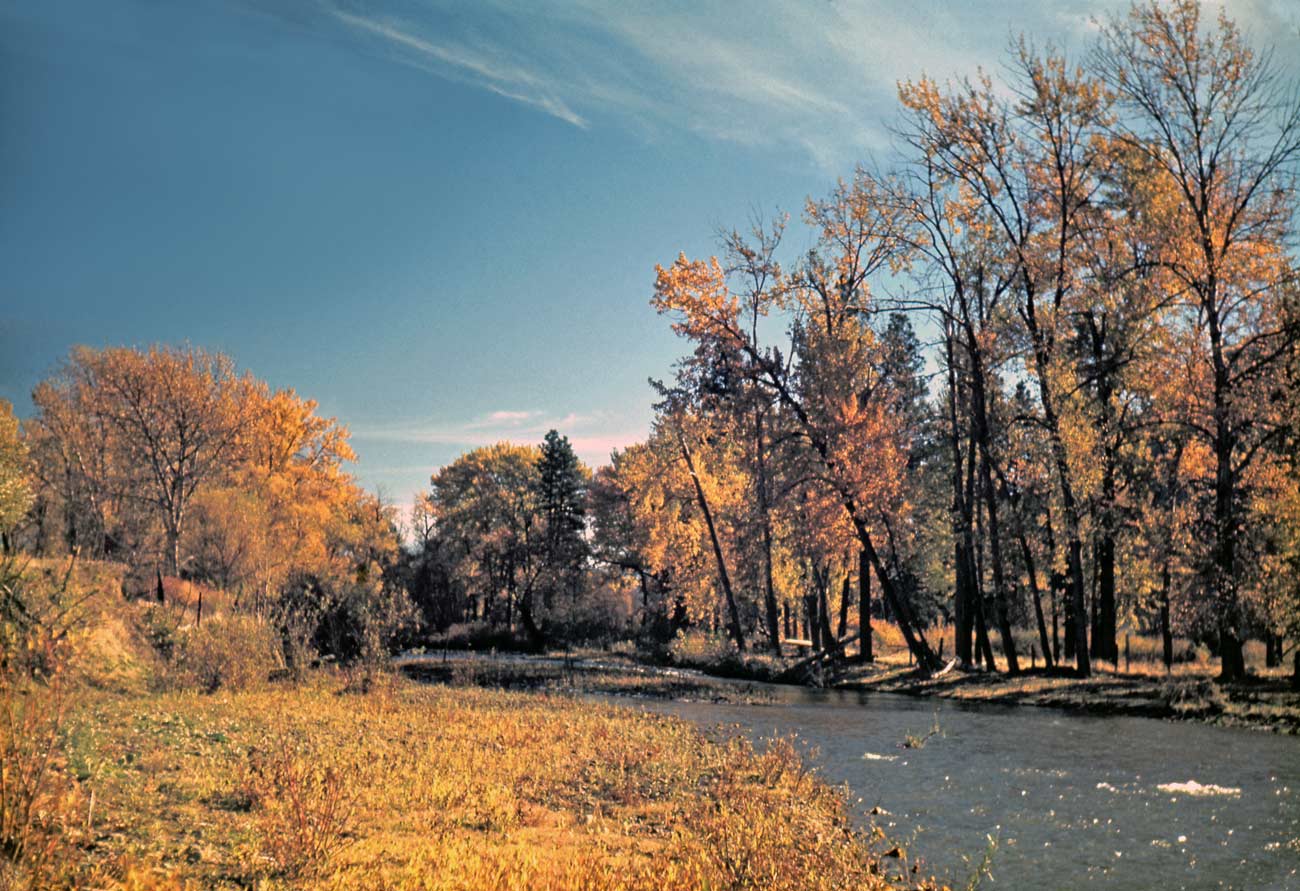
The bed for a small river – or better creek – has the nourishment to grow a strand of leafy trees that put on this autumnal show. Heading for the barn, follow the winding road along the sides of the creek, between it and the hills, rationalized with fences.

(Mouse the Image to Enlarge it.)
Down in this valley is a farm with charm. A vivid red barn and a bright farm house beside it, and a white fence too. A meandering stream runs by and rural electrification has reached it on the wires strung between the poles seen on the right. Since most of this land appears to be not developed for farming, except that on the mesa above and that down in this valley near the farm, what is the farmer doing in this landscape, which for most of us is also without name?

Well, what do you think? What canyon and what river . . . Does the Colorado spread out that wide through its lesser cranny before it reaches the Grand Canyon? Does the Columbia have a section like this with grandeur to both sides below a flat top – like its old route through Grand Coulee south of the dam? After so much Sykes I’m insecure and now in the early morning too tired to explore. Will someone else do it for the canyon – what canyon?

Included here is an out-of-sorts feature that we are much more likely to associate with the southwest. This is almost certainly somewhere in the Northwest or near it. The natural oddity here would make this place at least as popular as Lincoln’s profile on the Columbia, north of Wenatchee, which we featured here last Nov. 23 as Our Daily Sykes #201. If any reader knows where Horace found this please share it with the rest of us. [Click TWICE to Enlarge]
This morning – the morning after posting the above – I sent the above to Jim Weatherly of Tekoa, Washington. Jim flies and explores and has lived in the north Palouse for a long time. He suggested that I look along Rock Creek that flows south from Bonnie Lake to Rock Lake – the same Rock Lake that was featured recently with Our Daily Sykes #223 . It did not take long to discover that Jim’s instinct – or experience – was right on in this matter. The natural arch – the Bonnie Lake Arch (there may be more than one) is above Rock Creek and a shot distance south of the south end of Bonnie Lake. Google Earth also includes a photograph of the arch from the other – valley – side. Thanks Jim.
Here’s a juxtaposition of the Sykes photo with detail from Google Earth. The blue square is the clicker for getting to the picture of the arch noted above. Of course, it will not work for you here because this is a “grab” of the site and the picture from my computer desktop.

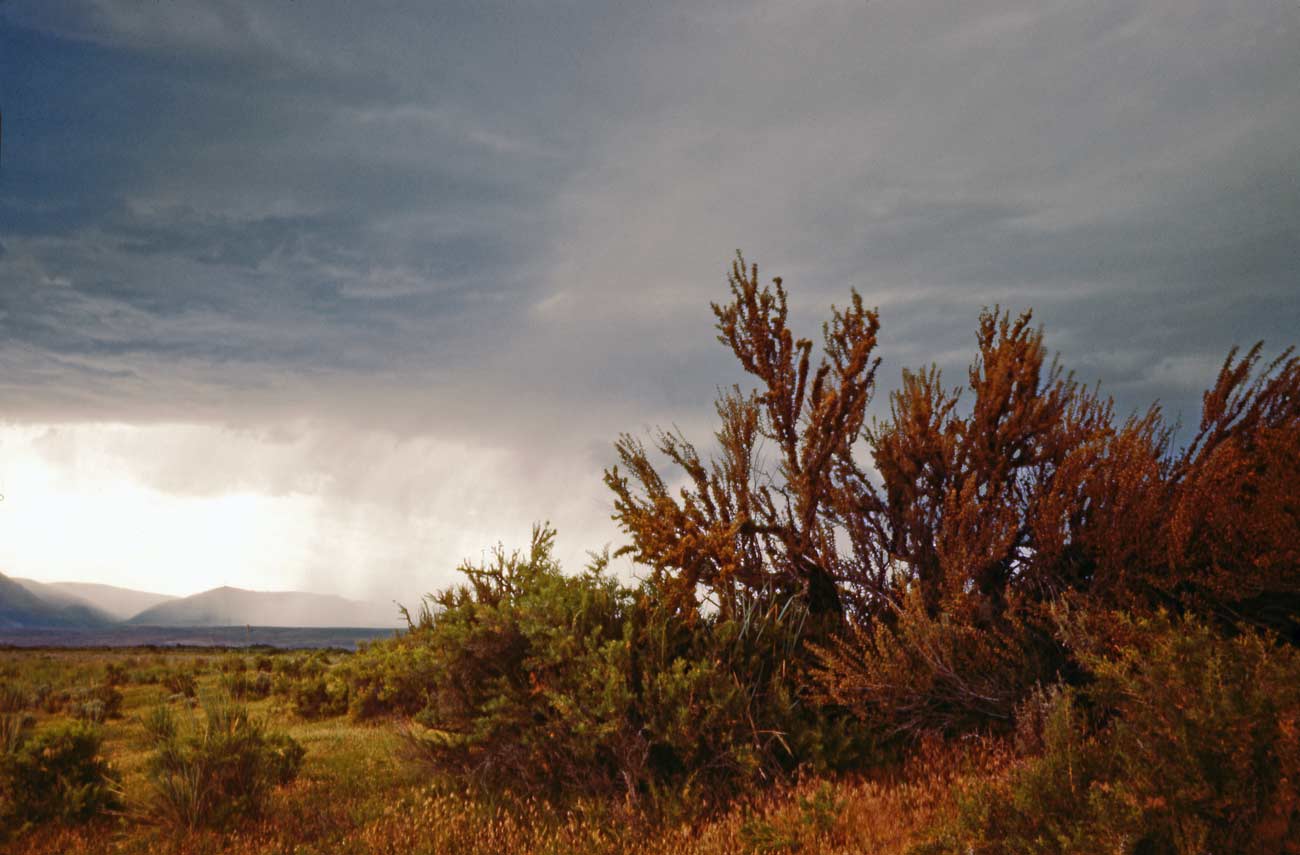
Here again Horace’s soft lens conspires with Kodachrome chemistry and the soft light of a distant storm to turn his slide into a painting. (Click to Enlarge)
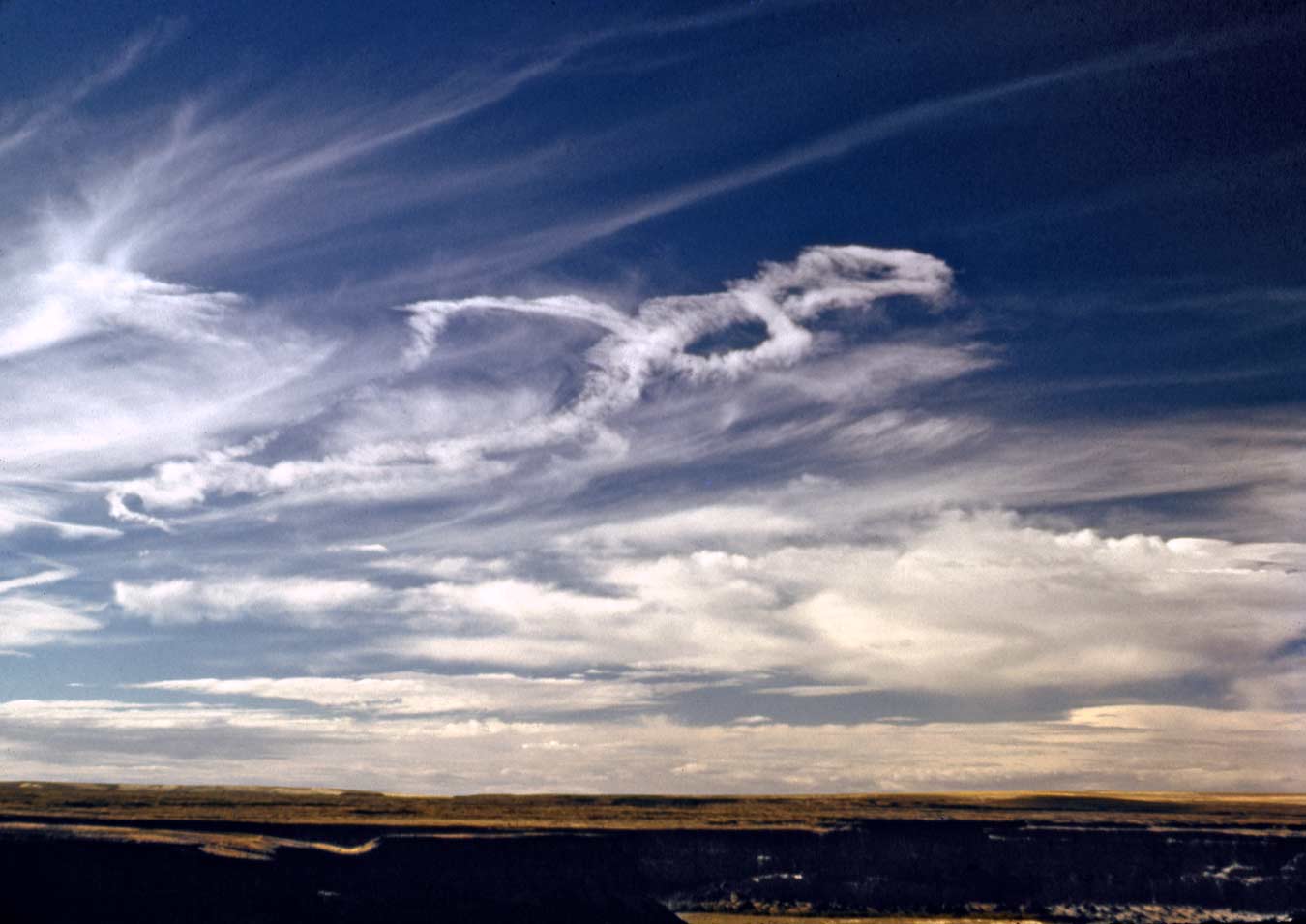
Look up in the Sky! It’s a bird! It’s a plane! It’s a meshuggah capping to a dark flat landscape. The land here seems desolate, a parched thing of patches, like four or five swipes of a dry brush – first with an undercoat brown, a mix of everything on the pallet and then with yellow. While up in the sky is a dollar sign for both the rich and the poor hoping for rain, a sign of the beast for sportsmen in leather, the sign for infinity for those who actively love nothing, the treble cleft for the music of the spheres, a hydra of several heads and tails for the sportsmen to bag.
Living in the lowlands in want of hills and such, Dutch artists, when they turned to landscape, made the most of trees, steeples, windmills and sails. But when judged by how much canvas was given to it then their greatest subject was often the sky. They were the masters of clouds, and their skills in rendering and playing with clouds is honored and enjoyed. We may imagine that paintings without subjects – abstract paintings – were in part inspired or encouraged by what lowland artists did with their skies.
One of the delightful adolescent rites of summer in the Inland Empire was to visit what was perhaps for teens the most libidinous place in the Spokane River Valley, the public beach at Liberty Lake. But there my friends and I lay in the sand and looked to the clouds. We talked to the clouds, sang for them, honored them with poems that we introduced with the same lines, “Look up in the sky! It’s a bird! It’s a plane! It’s a cloud! . . .” And from there added our inventions.

I think this landscape a charming one, perhaps because the parts are more fathomable than formidable. The golden incline in the foreground is not a dangerous pitch. The blue lake I could imagine swimming across without wings. The mountains are not so big either. A few trees hold to the top and there seem to be ways to make it up there without too much worry. Without Horacian clouds the blue sky is antiphonal to the golden slope with bushes that may be drying racks for formal red handkerchiefs. Click the scene if you want to questions it. A charming out-of-the-way place for Horace or anyone in 1945, our circa date. But how will we find it? Our touring fire insurance adjuster leaves no instructions.



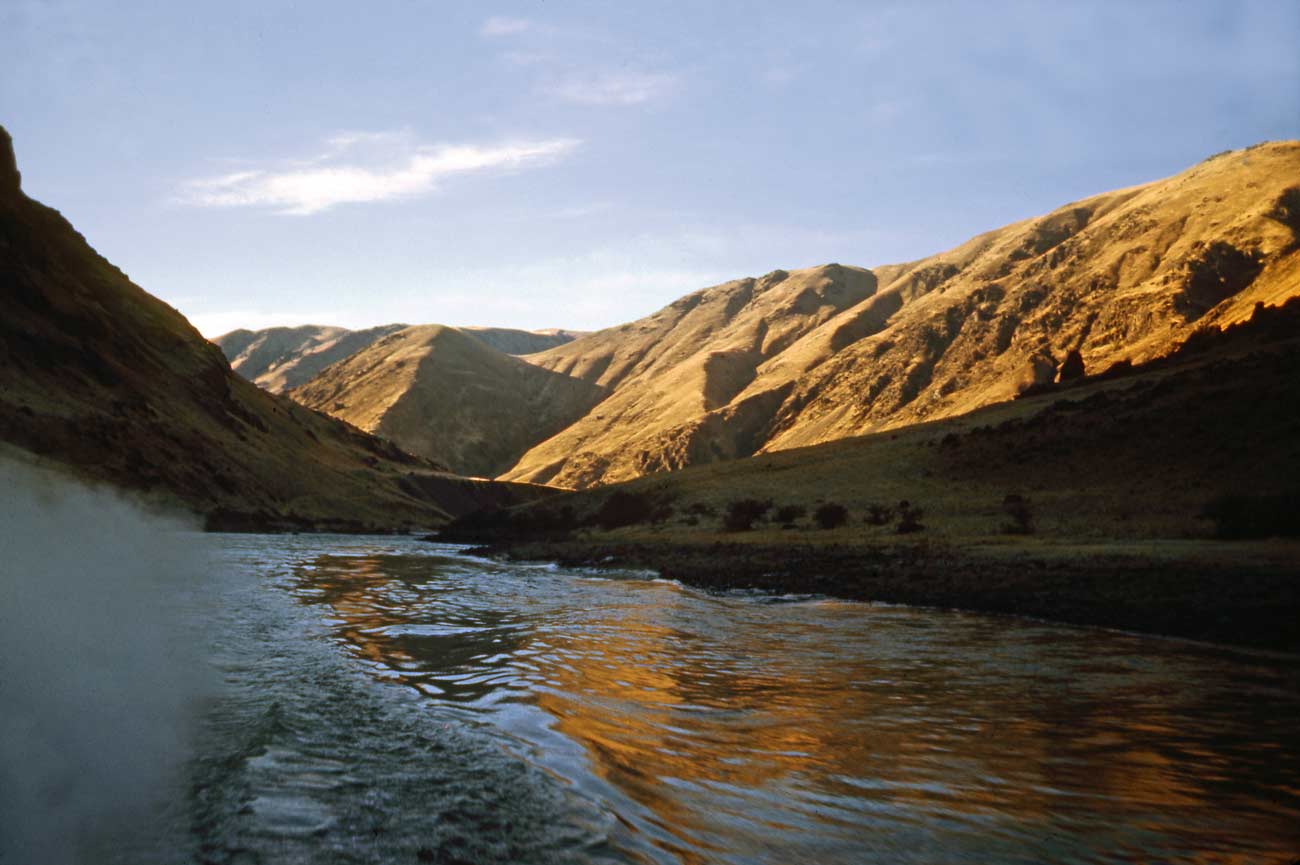


(Click your MOUSE to Enlarge) This landscape with the serpentine river and hills stepped to either side like artifacts reveals a nature so obedient to forces as predictable as a French Curve or as obedient as a bible college geologist that it seems painted. Whether idealized or recorded, where is it? I first went for the Grand Ronde River in the northeast corner of Oregon. It has scores of curves to explore looking for one that matches these. But that river is not this big, and its sides are ordinarily steeper and its habitat kinder to evergreens. The Grande Ronde is, of course, a tributary to the Snake River, and about thirty crow-flies miles northwest of where the Grande Ronde joins the Snake River south of Asotin, Washington, the by then slack water Snake reaches the Lower Granite Dam, the last of four dams built between the Columbia and Lewiston-Clarkston – all of them with locks. If the crow flies over the dam and continues towards the northwest in about another four miles the bird may wish to stop and rest here on this hill, which Horace took for his prospect. It looks southeast through the curves that are now still evident in the river although without the sand bars. Again, the Snake is now one long lake – or four lakes between Ice Harbor Dam, about ten miles up stream from the Columbia, and the twin cities of Lewiston and Clarkston, which because of the dams are now acting like ocean ports – small ones. From this prospect today Horace would see the dam upstream and also directly below him the primarily wheat shipping port of Almota. And about half way between the dam and the port he could not help but notice Boyer Park and Marina on the left bank, a sturdy development with lots of room for power boats and camping too. Now below Horace’s hill three paved roads meet. Washington Hi-w’y 194 comes through that cut bottom-left and meets the Almota Docks Road and the Lower Granite Road on the north (or here northeast) side of the Snake. In all it took millions of years to create this spectacle but only an afternoon or two to parcel it with a fence.


Rock Lake is one of the larger finger lakes that run through the canyons of Washington State’s Scablands south and west of Spokane. It is about 7&1/2 miles, long enough to breed a legend about its own monster. And deep enough in places – 375 feet – to hide one. Because of its depth it is a cold lake and rarely freezes over in the winter, although it is also not so comfortable for swimming in the summer. With the agricultural run off during most of the year it is also cloudy enough to make fishing for its big trout and browns not so rewarding except in the spring. In Whitman County, Rock Lake is 9 miles northwest of St. John, 16 miles southeast of Sprague, 15 miles west of Rosalia, and 33 miles south of Spokane. We found it with luck and the help of Google Earth. This view looks south from near its north end. Rock Lake, it is said, is stirred by Native American ghosts that haunt its south end, that a derailed train lies at its bottom and that one can still hear the wail of its whistle breaking free of the cold lake. (Click to Enlarge)


(Click TWICE to enlarge.)
The EVERGREEN’S LESSON
Each fall when the tall and slender evergreen
leans forward over the stream to speak,
the members of the choir listen from the other side.
Every year it is the same speech,
and while wishing it might be different
like children they are prepared to go to bed.
The Evergreen says,
“You have been a sparkling choir since spring.
Your singing has lifted the ponderous pine
and loosened the spruce.
(They laugh.)
The forest thanks you.
No one has complained.
And the stream too,
always the same and never the same
continues on its way
and makes no complaints.
We know that in all its babbling
there is some thanks as well.
I said as much last year
and many years before
but now I must say it once more.
Keep from your bed throughout
the coming suspended season
any dreams of envy
toward the evergreens
for staying awake while you sleep.
It cannot be helped.
We are each made our own way.
I remind you once more, imagine
what you would sound like
with needles restraining your leaves.
You will be bare for a while –
bare but not ruined.
When you wake again
sprouting new instruments
and soon singing
it will be with a range and rustle
the equal and more
of what you had this past season.
Go to bed now and rest well.
We who are awake will miss you,
watching and waiting in the snow
for another season of your lovely singing.”


(Please remember to click your mouse on these images – sometimes twice – to enlarge them.) How many waterways are there this size in the American West? A highway – far right – runs to Horace’s side. What seems like a huge sandbar with piles of itself directs the flow around itself, it seems, and against the steep incline beyond it, which is dappled with dark evergreens as are some Okanogan Mountains. For instance, there is a hillside vaguely like this directly across the confluence of the Okanogan and Columbia Rivers from Brewster – see the now-then below – that has a scattered forest clinging to its side. The comparison below is lifted from Jean’s and my book Washington Then and Now.


The principal difference between the original and its repeat in the above comparison is the Wells Dam, which flooded the Columbia with a slack-water Lake Pateros behind it that reaches upstream beyond Brewster. The new dam started producing electricity in the summer of 1967, aka, in some places, as “the summer of love.”
And now taking my own Okanogan clue I have found it with thrills and the help of Google Earth. Horace is looking west-southwest from the north bank of the Columbia about five miles downstream from Brewster. He is looking at the point – at the eastern end of the town of Pateros – where the “Big Bend” in the Columbia begins its crooked flow to the south for 100 miles (as the crow covers the distance) to the Priest Rapid dams where the river heads roughly east to take on the contributions of the Snake River before making its next big bend and heading west to the Pacific. (For that part of the river search here – or almost anywhere – for Wallula Gap.) Here that badly called (by me) “sandbar” is not pushing the river to the right because the Columbia turns left before reaching it – or where it reaches it. The “incline” dappled with evergreens is Goat Mount, which at 5,300 feet rises an impressive 4,500 feet above the river. It is but five miles from Pateros to the summit of what is – if I have read the elevations correctly – the highest mountain to rise from the Columbia at least through these 100 miles but probably many more. Directly below I have grabbed the Google Earth look with Horace’s side-by-side. The scale is different (and the yellow grid lines are an embarrassment I am momentarily stuck with) but the repeat of the features – including the “sandbar” – are obvious. (Now I wonder if that “sandy” part where the river turns was desposited there during the great ice age floods that carved the Grand Coulee. Here I imagine that pile of “sand” was left as a filtered sediment where the river turned suddenly because it could not push through Goat Mountain. It is to be hoped that among our readers there is a Pateros geologist.) That is US Highway 97 on the right of the Daily Sykes at the top.


Another scene it seems from Sykes Palouse, and this again distinguished by the foreground as much or more than by the greater sets of dipping and swelling patches. I am tempted to crop it all away except for the wildflowers. It is something you may want to test with a mask like a book or piece of toast. Also Horace set his focus for the flowers. Stagecraft – the rest is backdrop.

Horace stands somewhere near Mirror Lake at the south-southwest “corner” of Oregon’s Mt. Hood. If he had a cable strung to the summit it would be an eight mile ride, and an elevation change of about seven thousand feet plus. The mountain is listed at various heights – all within a dozen feet of each other around 11245 feet. The slide’s composition shows signs of Sykes like the flowers in the foreground. We may add that the summer snow and glacier markings near the summit resemble – or are sympathetic with – the sky. Like most of Syke’s Kodachromes this dates most likely from the late 1940s. (Click to Enlarge)

Directly below the most recent Sykes “Entering Big Bottom . . . ” post for Syke, with Our Daily Sykes #213 on Lyons Ferry please note that Jean has surprised us all by adding the photos he took on his visit to Lyons Ferry for our book Washington Then and Now. Look closely at the reflection of the clouds in his splendid and spectacular panorama. Next notice also in the pan how the rock formation on the far bank, to the left of the copse of trees in Lyons Ferry State Park, resembles a ruin of St. Sophia in Istanbul. (It was Constantinople.) It even includes a corner minaret – incipient or in ruins. Below is a mock-up (still with typos any my dimwitted naming of it for the other Lyons bridge, the one with a “gate” in Vancouver B.C.) for the subjects used in the book, although it was printed without the third photograph showing the Vantage Bridge under construction at its original site – Vantage – recorded in the 1920s from the old road on the east side of the Columbia River.


(click to enlarge photos)

This I recognize. It is Lyons Ferry on the Snake River when there was still a ferry – the longest-lived and last of the four principal Snake River Ferries in Washington. The salvaged Vantage Bridge replaced the Lyons Ferry – a cable ferry – in 1969 as waters backed-up behind the then new Lower Monumental Dam. I am allowed a mark on my Washington Belt for having as a child crossed the snake on this Lyons Ferry., (You can study these changes in Building Washington, a book that is included on this blog as a pdg file. Go to the History Books button, open it, and then click on “Building Washington.” It is a big book so on this supe’d-up MAC it required about four minutes to open. It may take less time. My computer is supered but it is also four years old. That’s a minute a year.) This view looks north. Now much of the mid-ground is flooded with the joined waters of the Snake and Palouse Rivers and the old Vantage Bridge spans the river heading for a landing on the north or far bank about a quarter of a mile to the east (right) of the famous railroad bridge seen here on the left.
Jean here. Paul, on my trip across the state for our book Washington Then and Now, I visited the old Vantage bridge. I took a few photos from above as well as those we used in the book. The shapes of the hills quite obviously reflect those in Horace’s photo. Interestingly, in the first Now photo, the railway bridge seems to be in the same location as before the waters rose, although completely rebuilt.


One more image – a panorama stitched together from three photos looking across at the state park and beyond:


(Click to Enlarge)
I think that when Sykes southwest scenes started appearing in these “dailies” I first noted that my father, a Lutheran preacher in the cool gray and green state of Washington, had a subscription to the slick and warm color-saturated vehicle for tourism named “Arizona Highways.” I liked to eat my cheerios while studying Arizona Highways. It was a monthly, I believe. This “Arizona Waterway” might have been a number in that periodical. But is this Arizona or are we back in Utah? Or both? Only an arbitrary border – a straight line – divides them. In the color chart of theology, this is as papist a river as the waterway in Daily Sykes #209 belongs to the Archbishop of Canterbury. Again, Horace makes no confession.


I know neither the type of tree nor the place – white birch bordering a stream in the semi-arid west? Horace does not say. (Click to Enlarge)


Horace Sykes had captioned this “A Promise of Spring.” We have signs too – optimistic ones for we prefer the warm mornings to the cold. Yesterday we – the Queen and I – saw a Robin hopping the limbs of the neighbor’s holly tree. We agreed that it was out of season, but there it was with red breast jumping about the red berries. Today I read of snow perhaps for Monday. And so following the omens of Sykes rare caption, we have it all – the “promise of spring” here in November. The Robin and the snow.
