
Our Daily Sykes #197 – Either Anne or Elizabeth



Horace Sykes is back from his five day vacation. We were also occupied with both Highway #2 and choosing which repeats to use or pursue for our upcoming show next April at the Museum of History and Industry here in Seattle. [Click to Enlarge]


Yes, Paul, I have something to add. It does not, I fear, provide proof for Horace Sykes’s photo being taken in the Yakima Canyon between E’burg and Selah. But it’s the closest rock/hill/river structure on “my” stretch of river.
This rock painting of Pacman graces a popular fishing/swimming spot several miles from the E’burg end of the canyon. The landscape is similar to Horace’s but I don’t think it’s the same.
Paul here: But a lovely coincidence made nearly uncanny with those obscuring trees.


And here’s a photo I found in searching my archives – taken when the sun was setting from a cliff overlooking the river about midway through the canyon. No connection to Sykes, but Paradis shot this paradise which we include in our book.


Are those swathes of yellow autumnal larch below a fresh snow line? Horace does not say.

So much depends upon the driver of a gray truck glazed with dust above a deep canyon.

So much depends upon the driver of a red truck glazed with dust above a deep canyon.


A blue sky is out of place
It is autumn – put blue to rest
Hang it golden like a harvest
Or red to save fall’s face


 This may remind us of the Yakima canyon but for now we are clueless in the face of this forward redhead!


Horace Sykes’ look west from the Yakima Valley to Mount Adams reminds Jean and I of a similar view (below) that we had hoped to include in our book “Washington Then and Now” but did not. We could not find the place. The Yakima Valley is fairly wide and long and the system of canals that run through it complicated. We could find no “informer” for the below view, which is several decades older than Horace’s but still – for us – equally afloat.


Follows two photos of an auto show that were pulled from an old album that also had no explanations, except those of context. All the identifiable scenes were from Seattle. These, I think, are also from the Civic Auditorium that was built for our amusements just in time for the Great Depression of the 1930s. Please compare these with the flower show for similar features – not of what is being shown but of the place. Is it the same auditorium?


In identifying this scene by what is “typical” about it, a student of western geology might choose the Snake River of Idaho-Washington over the Green of Utah-Arizona, or vice-versa – or neither. I, however, do not know how to use the geological fingerprint on the rock on the left or the grass there or the bush across the road to guide me. I do see, however, another typical Sykes with both distant and near-at-hand subjects. That a nearly furtive road winding most likely like the stream is also here lends to the subjects Sykes qualities. How Sykes has turned this scene or placed himself behind it is a fine example of his sensitivity for the picturesque.

(Click to Enlarge)
Turning clockwise about 200 degrees from his position on top of Steptoe Butte in yesterday’s Our Daily Sykes #154, Horace Sykes looks southwest over the town of Steptoe, which is about 3 miles away. This is a different visit to the top for Horace. Practically all is green. Like yesterday a telescopic lens was used here too.

Click Twice to Enlarge
As the attentive visitor must by now know Horace Sykes liked to take the looping road to the top of Steptoe Butte. He left many Kodachromes of the patchwork fields below, and we know he often returned, for the light and sky varies so between his visits. This butte is a quartzite survivor. It is more than 400 million years old, while the basalt flows in the Columbia River Basin are in the “neighborhood” of a dozen million years old. Here Horace used a telescopic lens to look north (and a wee bit east) to the Selkirk Mountains: the dark horizon. Growing up in Spokane we thought of the Selkirks as foothills to the Rockies. Mica Peak, the highest point showing here at only 5243 feet, is but a few miles east from Spokane, but 40 miles from Horace and his prospect, the 3612 ft top of Steptoe Butte. One summer during graduate school I worked on a grass farm about 7 miles to the other side (north) of Mica Peak. My home, a tine shack in the middle of the grass field I irrigated throughout the day, was close to Post Falls, Idaho, the small town we passed on our way from sober and demure Spokane to the many pleasures of Lake Coeur D’Alene and its namesake Idaho town. Much closer to Horace than the footills are the rooftops of Oaksdale’s grain silo. They are about 7 miles from the top of the butte.


But


Two of the same stone structure in a canyon that resembles the Snake River either way out of the twin cities, Clarkston and Lewiston, for a few miles (although I have not found it.)


(CLICK TWICE TO ENLARGE)
Seven pop, jazz, and/or swing performers covered “The Old Master Painter” in 1950. In the order of their versions as rated on Your Hit Parade, they were: Richard Hayes, Dick Haymes, Peggly Lee & Mel Torme, Phil Harris, Snooky Lanson and Frank Sinatra. It is surprising that Sinatra was the last of these. Now if you Google the song it is Sinatra that dominates. I think it was the Hayes version, the most popular at the time, that excited me sufficiently that I was able to persuade my dad, a Lutheran preacher, to drive me downtown to the record store – next to the Spokane Chronicle building – and buy me a copy. A generous man, he was not, however, enthused with the song’s pantheistic sentimentality. Still he was happy to help his spoiled youngest son of four feed his enthusiasm. Bless you my father.
The lyrics go . . .
THE OLD MASTER PAINTER
That old master painter from the faraway hills
painted the violets and the daff-o-dills
He put the purple in the twilight haze
then did a rainbow for the rainy days
Dreamed up the murals on the blue summer skies
painted the devil in my darlin’s eyes
Captured the dreamer with a thousand thrills
The old master painter from the faraway hills
Then came his masterpiece and when he was through
He smiled down from heaven and he gave me you
What a beautiful job on that wonderful day
That old master painter from the hills far away.
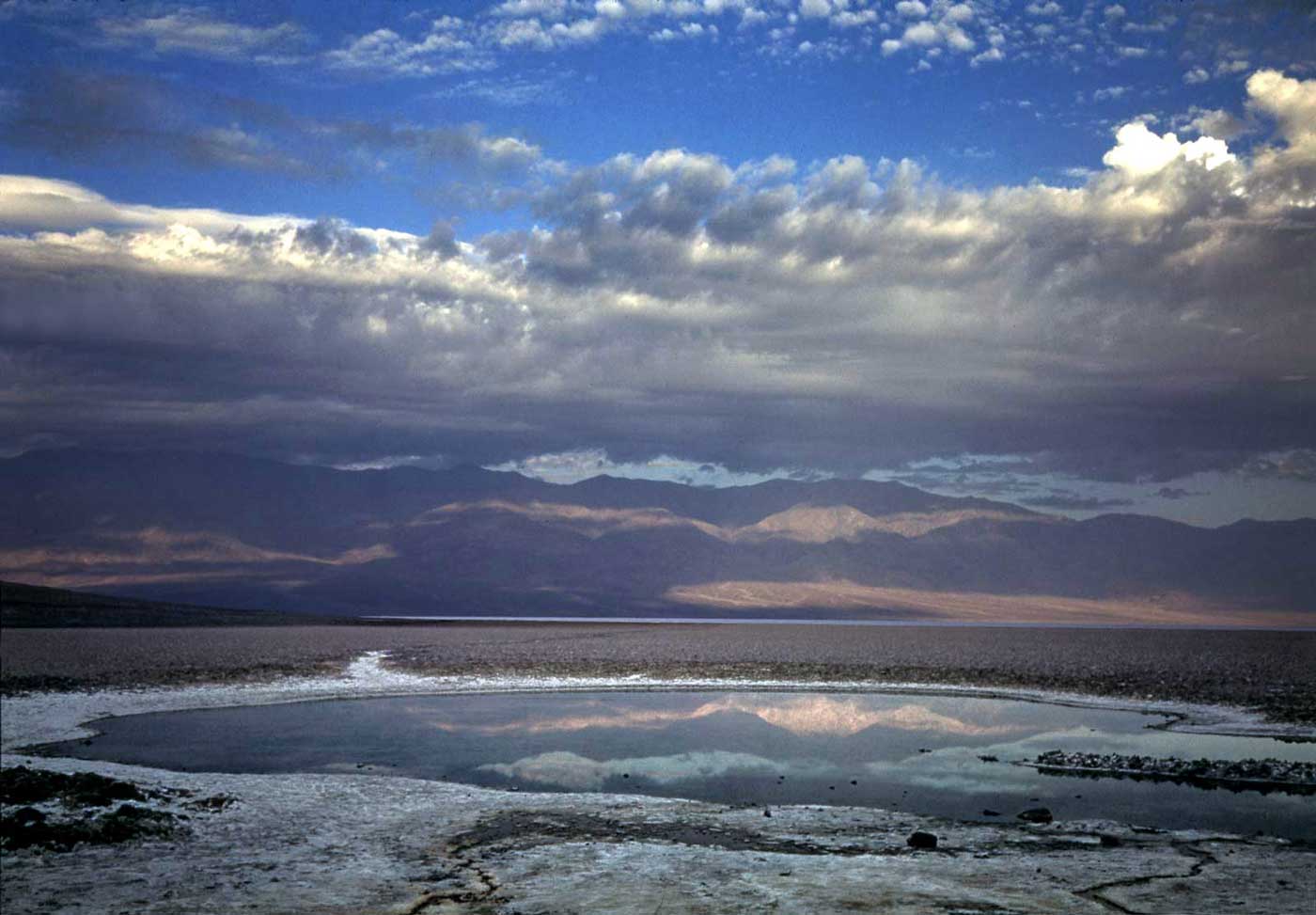
That song and the Haynes happy singing of it is something that still bubbles up for me, and perhaps too often. It is one of my dependable interruptions. An obsessive parody. And it is Sykes slides like these two – the one from the Palouse, most likely, and the other from Utah or perhaps southeast California – that trigger the Old Master in me. (Google Richard Hayes and Old Master Painter and you can hear a fragment of his version. But be kind, I was 12 at the time.)

(Click to Enlarge)
The amazed child in me finds it difficult to give up the expectation that there are at most three or four natural arches anywhere and that the same goes for balancing rocks. The Sykes landscape on the top has its arch but typically no caption on the slide holder leading us to it. Still I thought I might have a chance of finding it and I went exploring. It is likely, I thought, that this arch is somewhere in Utah’s Arches National Park. Once I reached the park, again riding the Googlecopter, I determined that there may be three or four hundred arches there. It also seemed that most of the rocks are balancing or at least on the edge of it.
There are hundreds of blue-dot volunteered photographs of this park on Google Earth. I lucked out. The fourth one I clicked showed this same landscape . It’s position on the satellite recording was, however, on a wide plain and not near any elephantine rocks such as these. It was misplaced. So I started the long but exciting journey through the park’s blue buttons. It was very distracting. Arches NP is scattered with arches and monoliths that resemble some of their names: The Tower of Babel, Park Avenue, Mother and Child, The Organ, Ham Rock, Sheep Rock, Finger Rock, Lion King, and Stone Face. And this last, Stone Face, is what we apparently have here, although the second snapshot of it I found with Google shows the profiled face of the rock on the right better than does Horace’s. (Take a few steps this way or that and these IDs can dissolve.)
Stone Face is the name given it with the volunteer Google photo. It is, if I have read this correctly and the photo is not totally misplace (which happens), part of Elephant Butte, which also includes the Parade of Elephants, Cave of Coves, North Window and South Window, Turret Arch and the Double Arch, which Horace also photographed. His view is included below. Like Stone Face, Double Arch is very near the road. It is hard to judge the size without someone standing below it, but it is huge. Unlike most of the arches in the park it was eroded from the top and not from the side.

The Elephant “ridge’ is about six “crow miles” north of the Park Headquarters, which is on the road to Moab, a town one might want to live in for a year or two just to explore its surrounds. The Elephant is at the southern end of a triangle I have drawn with sides that are about 4 miles long. To the northeast is the very popular Delicate Arch – not big but rather fine and standing exposed like an innocent ingenue on a wide stage – and to the northwest is Fiery Furnace, a clump or farrago of twisting small canyons with yet sides that reach as high as the nave of Notre Dame. Seen from every angle, including space, the Fiery Furnace is, to quote a chorus of adolescents at any junior high, “Awesome.”
Finally, to name a few more arches and other features just for the simile of it all. The park includes Ribbon Arch, Ghost Arch, the Garden of Eden (to cool that Fiery Furnace), Skull Arch, Surprise Arch, Inner Sanctum Bridge, The Spectacles, Biceps Arch, Seagull Arch, Landscape Arch, Walk Through Bridge, The Court House, Petrified Sand Dunes, The Three Gossips (which resemble a grouping of statues by Rodin). Twenty miles to the southeast – on one’s way to park headquarters – the LaSal Mountains, especially when snow-capped, give a cool backdrop to the warmth of Arches National Park.
And now we learn after visiting Park Headquarters that the number of arches in Arches N.P. is not 200 but 2000 – more than – and all have names or suggest them.


(Click to Enlarge) Two or three weekends ago at the annual Meridian Avenue (north of 80th) summer block party, Jean Sherrard (of this blog) took the stage as he does every year to urge those sitting in lawn chairs and/or lingering beside the potluck tables to join in the cakewalk. On Meridian this is a variation of Musical Chairs, the popular church and school social game where when the music stops the players who have survived all interruptions to that point – say four are left – fight for the remaining three chairs. There is always one less chair that players, consequently one might easily land on another players lap rather than a chair and thereby join the losers without chairs – unless the lap is preferred.
On Meridian numbers from one to 100 are chalked on the pavement in a winding circle. When the music stops a number is pulled from a basket by a child – for assured innocence – and you can figure it out. If it is the number you are standing on when the music last stopped you win a cupcake. There are about two dozen cakes to win, and you can be a repeat winner. And this leads to Tipsoo Lake.

This year while urging the reluctant among us to join in the walk Jean used his father Don Sherrard as an example of cakewalk valor. Don has bad knees, got originally from playing center in both Highline High School basketball and football. For the latter, Jean notes proudly, “He was all-league.” With a great bravado of voice and a sweeping hand Jean advise the block party “If my father with his bad knees can dance then surely you can dance with him.” And Don did dance, although I do not remember if he won a cake this year. Afterwords Don told me that the day before he and Jean’s brother Kael – director of Hillside School in Bellevue where Jean and his wife Karen teach – had taken the short hike from Chinook Pass to Tipsoo Lake and that he used his hiking canes (or poles) to ease the way. Don, a semi-retired doctor-professor at the U.W. Medical School, is in his mid-70s, and thereby visited Tipsoo at a later age than Horace Sykes could have. Horace died in his early 70s. Horace returned with his picturesque slides and Don with his still startled eyes. He found Tipsoo’s setting – below the Mountain The Was God – most enchanting.


Only the tornado-rainbow points to the pot of gold and scatters it too.

Soon after the Dorpat family got “the call” in 1946 to move from Grand Forks, North Dakota to Spokane, Washington, we were visited by Annie Crabtree, a “spinster lady” who was a member of Immanuel Lutheran Church in Grand Forks and was attached to my parents and lonely for them. So she was invited west for a visit.
Annie Crabtree was as skinny as a barber’s pole, wore thick glasses over a handsome nose, had a big mouth with big teeth, wore dark dresses printed with patterns of tiny white flowers and adorned with fancywork at the neck and wrists. The only flesh anyone ever saw of Annie Crabtree was her face and hands. She never called my parents by their first names, but always Pastor Dorpat and Mrs. Dorpat and yet she was older than both of them. She was less a friend than a votary. She had spent some time in some institution, and my parents had helped get her out.
For some reason Annie Crabtree was taken from the safety of our Spokane parsonage for a trip in the family’s 1946 Plymouth sedan to this prospect overlooking Lewiston Idaho. Like Horace – and at about the same time – we stopped here at the edge. This interruption was for Annie, and not the view. She was getting carsick and we were about to drop more than 2000 feet through a score of switchbacks.
I remember this vividly for it was at that moment looking south over the Snake River valley that I got my first inkling of the “horrors of travel,” that someone could get sick from merely riding in a car. With lots of talk we made it down those curves with Annie and back up them. For me, the child, it was thrilling but also troubling. Now I am more like Annie Crabtree and wonder at and sometimes sicken from all the exposed swerving.

Sykes photographed this nearer to Government Camp on the Mt. Hood Highway then to Timberline Lodge. The Camp is about three flying-crow miles southwest of the Lodge, and about 2000 feet lower. (These statistics and locations are brought to you with the friendly and timely help of Google Earth.)


This Sykes subject surprises me with its preparation. In order to record this view of The Great White Throne in Utah’s Zion National Park, Horace had to climb about 1400 feet from the canyon floor. In many places the route is steep and exposed with switchbacks and rock scrambles beside which heavy chains are strung for a grip. At some point it becomes the West Rim Trail that also connects with the Angels Landing Trail. You can see the Angel’s Landing in Horace’s shot. It is the dark pinnacle on the right, and it is deceiving. The landing is exceptionally slender, about as wide as a high school cafeteria. I found all this with the help of Google Earth. In its ‘copter I came within feet of the prospect from which Sykes recorded this look to what is probably the best known rock in the park: The Great White Throne. And in a later light of the day than this light the upper half of it really is quite white. The majestic monolith is probably the parks’ principal symbol. Using the Google Earth ruler I measured the distance from Sykes to the top of the Throne. It is about 1.25 miles. Not far. And the throne rises straight up more than 2000 feet from the canyon floor.

The Throne was named in 1916 by a Methodist preacher named Frederick Fisher. It was one of those rare moments in Utah where a Methodist beat a Mormon. He also named the Angel’s Landing, and the Three Patriarchs, which I have not found as yet. With a weekly assignment to come up with something new for Sunday, preachers are bound to think up such names. Watching a late afternoon light bounce of the white Navajo sandstone was for Fisher a new revelation, at once sublime and patriotic. He recalled remarking to those with him, “Never have I seen such a sight before. It is by all odds America’s masterpiece. Boys, I have looked for this mountain all my life but I never expected to find it in this world. This mountain is the Great White Throne.” Now let us open our bibles to Revelations Chapter 20 where we will learn – I think – that it is from the “Great White Throne” that God will deliver his final judgment of the dead, who I think will first wake up to hear it. The faithful will then fly to heaven singing carols they will not recall learning, and all others will fall to hell with great gnashing of teeth. I would fish a quote from Chapter 20 but I have lost my bible in one move or another like I have also lost all my early disk recordings of the Fugs.
Now I remember that there are other similar Sykes Zion slides in his collection and almost certainly one or more was taken from this intrepid trail. I’ll hunt for them and attach one or more.


At 3,612 feet Steptoe Butte is the unique observatory from which to delight in the real art of the Palouse: how prosperous farms mark its rolling hills. Cashup Davis was the Steptoe farmer-promoter most identified with the quartzite butte. Cashup always gave cash for the goods he needed to stock his popular stagecoach stop on the eastern slope of the butte. The English immigrant wed Mary Shoemaker of Columbus Ohio, and before they moved west in 1871 the couple raised eleven children in Wisconsin. Once settled into serving stagecoaches in the Palouse the family became known for its hospitality and the dance floor above the store. When the railroads arrived nearby in 1883 the stages stopped running and Cashup looked to Steptoe Butte to further his conviviality. After building a switchback road to the top he raised the two-story hotel shown here in 1888. The glass observatory on top held a powerful telescope that could look into four states.


As spectacular as it surely was, the hotel was also hard for man and beast to reach and its early popularity soon fell off. And the rolling Palouse was crowded with wheat not people. Mary Ann died in 1894 and, alone in his hotel, Cashup two years later. His instruction that he be buried in a hole he’d dug for himself beside the hotel was not followed. However, his internment in the Steptoe Cemetery was a grand affair and the procession following an ornate hearse brought south from Oaksdale was also impressive. Cashup’s hotel can be seen at the top although not so vividly as on the night of March 15, 1908, when it was destroyed by fire.


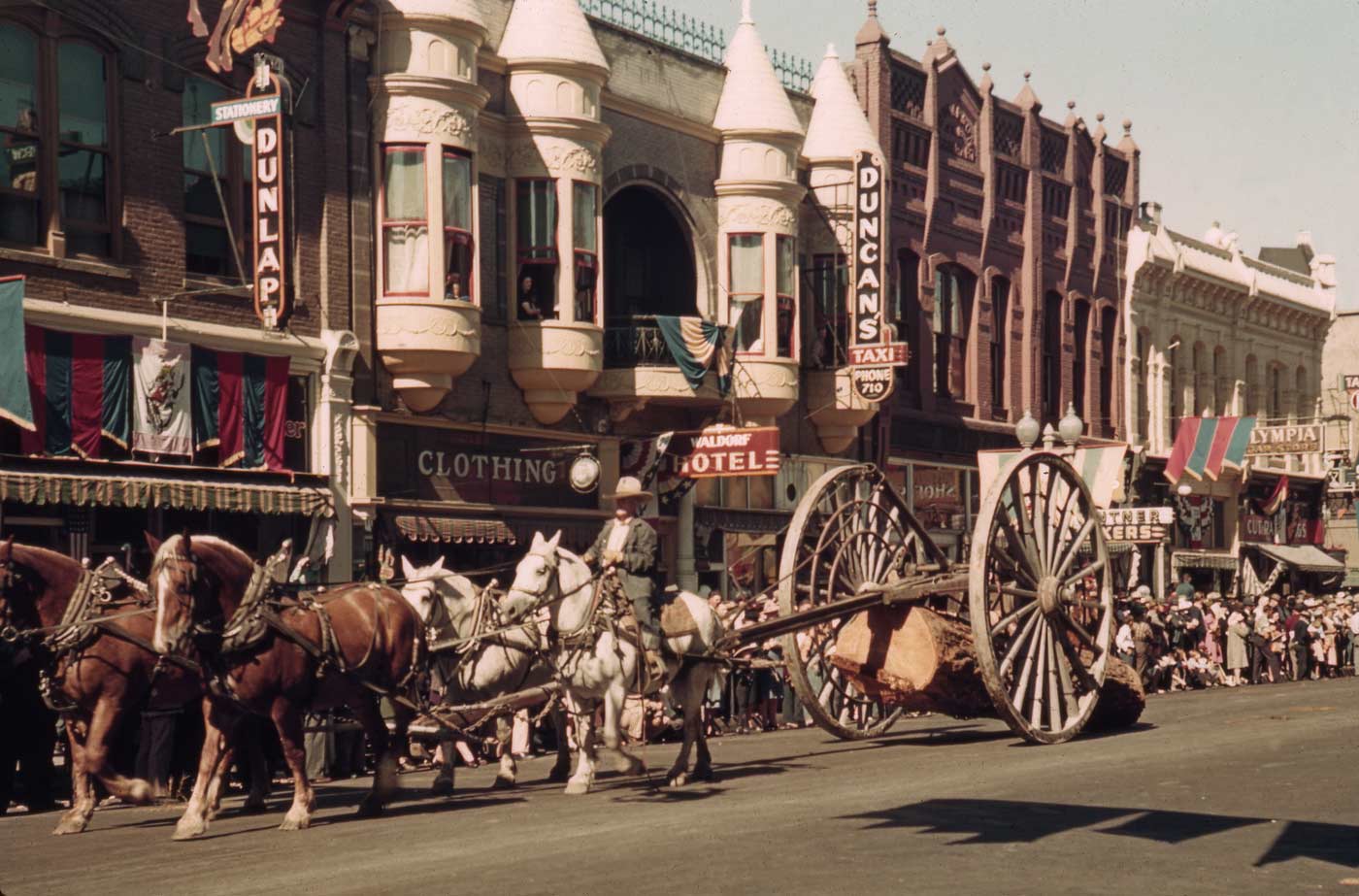
Horace Sykes’ slides include few urban scenes with the exception of celebrations like these of the Pendleton (Oregon) Roundup. The spectacle of horse logging (top) and bareback riding (bottom) are paraded here. I don’t know the year, although there is enough information here to easily determine it if we had ready access to the local library’s Pendleton Room. There’s an imperfect hint on the marquee of the Rivoli. Besides the local “Indian Vaudeville,” which would have been a stage presentation, the theater is showing the who-done-it mystery “Charlie Chan at Treasure Island” (in San Francisco.) The film was released in Sept. 1939. Although this year’s roundup (2010) is also held mid-September, I think it more likely that the Rivoli is showing the Chan film later than 1939. Chan films had legs.
(CLICK TO ENLARGE)

Sykes took these two Kodachromes from the same position on Main Street between Emigrant and Dorion Avenues. Unfortunately, the row of ornate Victorian structures showing in the top view has been lost with the exception of the two story white structure far right, the one with a sign reading, in part, Olympia.


(CLICK to ENLARGE)
Both the flower and the frog have protection. Horace Sykes photographed flowers of all sorts, but he loved orchids and succulents. This, however, is the only frog portrait that I have found – so far – in the Sykes collection of 35mm Kodachrome slides recorded from the late 1930s into the early 1950s.


For Horace Sykes who consistently pursued the picturesque this scene may have seemed its parody. The sublime is slipping here towards the grotesque. The river looks nearly stagnant, the trees are hanging on. This canyon needs a drink, and the hill on the other side is having trouble with its rocky parts. It seems deflated: a rocky expression of depression. This canyon has colitis or maybe tortured bowel syndrome. It can be imagined groaning. There are none of Horace’s flowers in the foreground.

For this view Horace stopped above the last big curve in the serpentine Chelan River Canyon where it drops 500 feet from Lake Chelan to the Columbia River in about 4 miles. Horace took the old road on the south (or west) side of the river. A piece of the Columbia can be seen on the far right. The town of Chelan Falls is on the Columbia, and the town of Chelan (only) is on the lake. The trip between them is a rough climb – initiation – into the charmed land of Lake Chelan, all 50-plus miles of it.

The Sykes home in Magnolia was wonderfully set near the water end of Bertona Street off Perkins Lane. From there Horace Sykes took several slides of this gesturing cloud as it moved across Puget Sound at sunset. He looks to the southwest. At its far end the cloud turns or curls slightly to “point” towards the two young mountains named Ellinor and Washington by the federal surveyor George Davidson. They are about 40 miles from Horace. Ellinor was the name of the surveyor’s boss’ younger daughter and Constance – a grander peak north and west of Washington and not showing here – was an older daughter. The sisters had two Brothers who have also skipped out on this recording. If the weather is fair and warm and one is fit, then Ellinor is a mountain to climb without much danger of falling off it, although the route is steep and one may expect to be greeted near the top by mountain goats. There’s a path – of sorts. (Click to Enlarge)

John Sundsten’s log cabin on Hood Canal – near Alderbrook Resort – looks northwest to Ellinor and Washington, which are about 15 miles away. John shot the view below from his porch – or near it. Ellinor is on the left and Washington on the right. You have seen them many times – the last of the craggy peaks, at the southern end of the Olympic screen (or curtain) as seen from Seattle. The face of Ellinor seen here, the eastern side, is the route for reaching the top if it is clear of snow. John says this is from the winter of 2008.

In Sykes view are three nubs or hillocks to the left of Ellinor-Washington. They are much closer to Horace – about 15 miles. The one on the right is Green Mountain, and the one in the middle, Gold Mountain. Both have addresses in Bremerton. Gold is also home for two radio towers – KCPQ and KTMW – Fox and Trinity respectively – where free speech is being radiated and tested around the clock.


When the Rev. Theodore Erdman Dorpat (T.E.D.) approached Pasco from Spokane on his way to ministerial meetings in Portland he prepared to choose between driving his Plymouth (until a rocket-nosed Studebaker replaced it in 1951) to Portland through the Wallula Gap or take a short-cut – and he loved them – directly over the dwindling Horse Heaven hills south of Pasco. With his shortcut he – and sometimes we – would reach the Columbia River on the Washington side at Umatilla, and at the site of the McNary Dam. It was not much of a short cut. Only a few miles were “saved” by not following the Columbia River where it takes its big bend to the west. Dad left it up to the family, which way to go. We picked the Gap.
Here Horace Sykes has climbed about 100 feet above the highway to look southwest through the Wallula Gap. He chose his prospect in order to include the “Twin Sisters,” basalt pillars that stand side-by-side. There own slender day-lighted gap between them cannot be seen from Horace’s position nor in the “general delivery” of Google Earth. (While it is too slender for Google’s topo-computer, those “blue-dot” real photos contributed by many sensitive users show it several times. One of these dots is set on the Washington side of the Gap but it looks across the river to show the Twin Sisters in their unique position. You might wish to go looking for it and the rest of them.)
At least once the Dorpats stopped by the side of Highway 730 to study the Twins, although we thought of them then as captains: the Two Captains. The Lewis and Clark expedition camped about two miles downstream from these basalt pillars on Oct. 18, 1805. They camped on an island near Spring Gulch, and their island may well be the island showing in the river behind the intruding ground cover in Sykes’ Kodachrome. (Including a plant as a close-up in a landscape is very typical of Horace, and like most of his this composition is almost certainly “studied” from top-to-bottom and side-to-side.) Remember to CLICK TO ENLARGE.

Horace certainly recorded this look over the shoulders of the twins before McNary Dam was completed in 1953 when its big locks began lifting ships – mostly tugs pulling or pushing barges carrying wheat – 340 feet above tidewater into the 68 miles of slack water named Lake Wallula. Horace’s recording, then, shows the last of the unimpeded primeval river moving through a gap (between the Horse Heaven Hills and the Blue Mountains) begun millions of years earlier and then suddenly “improved” with the series of floods that followed the sudden release of sea-sized lakes – most of them in Montana – filled with the melting contributions of the most recent ice age.
By different accounts there were between 40 and 100 of these floods crashing through here with about thirty years between them, with the last one scouring the gap and the gorge beyond it a mere 13,000 years ago. (The top of the Twin Sisters is about 660 feet above sea level and so about 320 feet above Lake Wallula, which is an easy way of visualize how much of a drop it is from the maintained lake to the ocean. McNary Dam lifted the river about 90 feet above the Columbia’s old altitude at the dam site, which is about twenty miles down stream from Horace and the Twins.)
Horace’s, my, and perhaps your attraction to the sisters was anticipated by Coyote’s. Three sisters – not two – worked hard here at building a trap on the river for salmon, and at night the often too playful trickster did what he probably considered a prank or tease and destroyed their work. But when Coyote saw the sisters crying for want of food, he was touched and proposed to them that he would build a trap for them if they consented to marry him. They agreed and lived happily together for a very long time, but not forever. Eventually Coyote grew tired of his three wives. He then changed two of them into these pillars, and made a cave of the third wife on the opposite side of the river. From there he kept an eye on them all, until he too turned to stone.


Here’s some help from Robert Cross of Camas, WA. Robert was alerted to our confusion by a mutual friend, Angela Roark. Thanks Angela. Cross has used Google Earth better than we did, perhaps because he was willing to cross the Columbia River with it. We didn’t. Here’s his description of what he discovered.
“OK. I checked it out on Google Earth, and pinpointed it exactly, by going down to birdseye level/angle, matching up the view of the mountain, and then flying backwards until the landmarks in the foreground were in view. This photo was def…(tharr be more)initely taken from the hills above Lyle, WA, looking across to Rowena and then down towards the mountain from the NE. I would say that it’s either Alder Springs Rd/Oliver Point Rd or a little further up on the hill at Oda Knight Rd. Looks too far from the river to be Riverview Rd. Is that good enough?”
It surely is good enough Robert, and thanks much.


