

All posts by pdorpat
Our Daily Sykes #285 – "Lovely Light"

Our Daily Sykes *284 – Pier 49, 1953

Our Daily Sykes #283 – . . . Down This Road Before . . .

Our Daily Sykes #282 – "Safety Pays"

Our Daily Sykes #281 – A Snake River Snapshot

Our Daily Sykes #280 – Colman Dock & Kalakala 1953

Our Daily Sykes #279 – An Early Viaduct View

Our Daily Sykes #278 – Grand Coulee in the Thirties
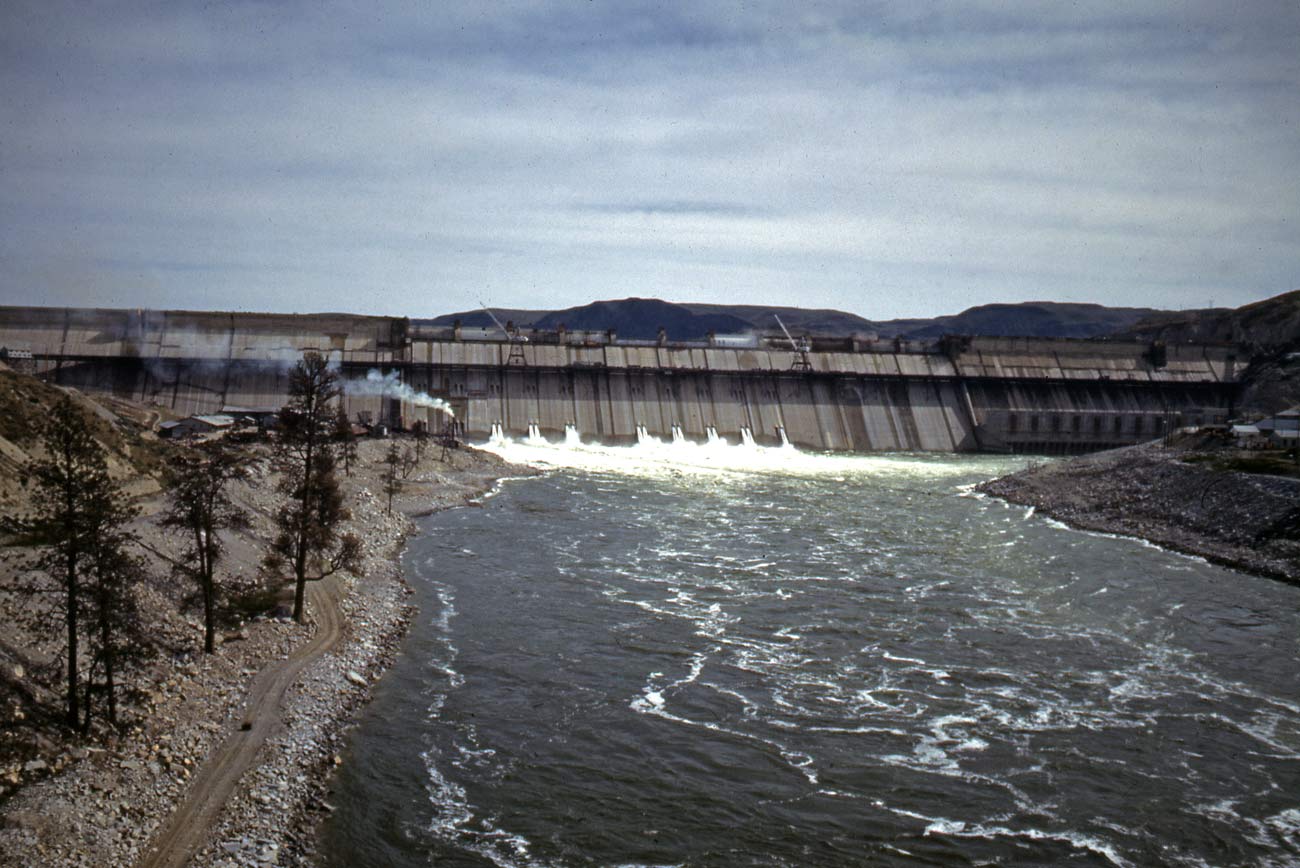
- Construction began on “the greatest concrete structure in the world” on Sept. 1933 when Washington’s governor Clarence Martin dumped the first bucket of what would be 21 millions tons of concrete. He was paid 75-cent for one hour’s work. Eight years later in the spring of 1941 the Grand Coulee Dam began distributing the electricity that made it possible for the Pacific Northwest to host so many aluminum plants for building armanents during the Second World War. Horace Sykes obviously visited the dam site sometime before the war – sometime in the late 1930s. Of course there are pictorial histories of this construction that would help us choose the year, but none of them are at hand. Horace photographed the dam from the Grand Coulee Bridge, a steel creation made extra-strong for handling the heavy equipment and materials used during the dam’s construction. (Click to Enlarge)

Our Daily Sykes #277 – Perhaps on Perkins Lane

Our Daily Sykes #276 – Paint By Numbers

Our Daily Sykes #275 – SUBLIMATION

Our Daily Sykes #274 – Portrait of a Girl

Our Daily Sykes #273 – Motor Motif

Our Daily Sykes #272 – Purple Mountains

Our Daily Sykes #271 – Above Asotin & The Snake

Our Daily Sykes #270 – Cashup's Sunset

Our Daily Sykes #269 – Beautiful Prisoners

Our Daily Sykes #268 – Made to Suit Shelter, Oven, Crypt, Tourists

Seattle Explorer Quiz #1 – In 1907 On What Avenue was the 3rd Avenue Theatre?

Our Daily Sykes #267 – Performance Art in Volunteer Park

Our Daily Sykes #266 – As Above So Below

(Click TWICE to Enlarge.) It is fairly easy to at least imagine Horace’s motivation for pulling over on this country road to record the line of gravel as a repeat of the line streaming above him. The curve of the dirt road follows that of the vapor. In the post-war years Spokane had two military airports west of town, Geiger Field and Fairchild Air Force Base. The latter was soon sending hybrid B-36s droning over the city. Extremely ponderous these over-sized flying tanks were retired early, made obsolete by the B-52, a serious cold war bomber. I no longer remember what sort of marks these jets were leaving in the sky in the 1940s, so this vapor trail does not lead me to its maker. I remember the fascination of them though. In the summer it was something to lie in the grass and watch their creation. The tail gave a substance to the airplane it did not have without it.
Our Daily Sykes #265 – Somewhere In The West
Our Daily Sykes #264 – Graveyard on the Coast

Our Daily Sykes #263 – St. Francis of the Plain

Our Daily Sykes #262 – Somewhere Beside the Pacific

Our Daily Sykes #261 – Rock Island Dam

About one mile south on Washington State Highway 28 from where Horace Sykes might have taken a Kodachrome of Rock Island Dam head on at its face he instead found this perch above the Columbia where across the river the dam peeks around a curve and stage left – on the right – cliffs rise like stage curtains. And Sykes also found a poseur for the foreground too. Here a rock stands above the river like a pulpit.
Our Daily Sykes #260 – Embraced & Forsaken

Our Daily Sykes #259 – Chapel by A Cliff

Our Daily Sykes #258 – The Oregon Coast

Our Daily Sykes #257 – Chelan Gorge Bridge & Chelan Butte Above it.

Our Daily Sykes #256 – A Confident SOAP LAKE

Our Daily Sykes #255 – Tanker Sunset on Puget Sound

Our Daily Sykes #254 – Forest Deity

Our Daily Sykes #253 – The Minimalist Sykes

Our Daily Sykes #252 – BIG SKY COUNTRY but not . . .

Our Daily Sykes #251 – Clouds Incognito

Imagine a topographer who could tell us the location of these clouds by the “fingerprint” of the shadowed horizon.
Our Daily Sykes #250 – Wallowa Lake

Our Daily Sykes #249 – The Deciduous Conifer

Our Daily Sykes #248 – Four Returns

The new box of old Horace Sykes slides from the 1940s includes a number of subjects that are of locations included so far in Our Daily Sykes. Here are a quartet of them.


Our Daily Sykes #247 – Have We Walked This Road Before?

Our Daily Sykes #246 – Questioning Horace's Motives

Another unpaved road into the picturesque unknown. Of might Horace Sykes have decided to omit all descriptions so that his universals would not be reduced to the mundane anxieties and/or pleasures of mere identification?
Our Daily Sykes #245 – Upon Reflection
Our Daily Sykes #244 – Wonders of the West

Our Daily Sykes #243 – The Flood of 1948

Here is another rare example of a slide that Horace captioned. Horace writes, “Coulee Dam during flood. 36 million gallons per minute.” This is surely the flood of 1948, May-June. The torrent damaged the dams underwater flip bucket at its base. The spillway was designed like a ski jump. Water falling down the face of the dam was turned up at the base, dispersing its energy in the process. In 1948, however, the water was too much for the bucket and also river banks downstream all the way to the Pacific. Near Portland, the flood wiped out the town of Vanport. The flood of ’48 indicated the need to work with Canada in flood control of the river upstream from Grand Coulee Dam. The Columbia River Treaty followed in 1960, and Canadian dams too.
Our Daily Sykes #242 – Leading to a Barn

(Click Mouse to Enlarge – please)
The bed for a small river – or better creek – has the nourishment to grow a strand of leafy trees that put on this autumnal show. Heading for the barn, follow the winding road along the sides of the creek, between it and the hills, rationalized with fences.
Our Daily Sykes #241 – Down In This Valley

(Mouse the Image to Enlarge it.)
Down in this valley is a farm with charm. A vivid red barn and a bright farm house beside it, and a white fence too. A meandering stream runs by and rural electrification has reached it on the wires strung between the poles seen on the right. Since most of this land appears to be not developed for farming, except that on the mesa above and that down in this valley near the farm, what is the farmer doing in this landscape, which for most of us is also without name?
Our Daily Sykes #240 – A Conflicted Canyon

Well, what do you think? What canyon and what river . . . Does the Colorado spread out that wide through its lesser cranny before it reaches the Grand Canyon? Does the Columbia have a section like this with grandeur to both sides below a flat top – like its old route through Grand Coulee south of the dam? After so much Sykes I’m insecure and now in the early morning too tired to explore. Will someone else do it for the canyon – what canyon?
Our Daily Sykes #239 – Someone Will Know

Included here is an out-of-sorts feature that we are much more likely to associate with the southwest. This is almost certainly somewhere in the Northwest or near it. The natural oddity here would make this place at least as popular as Lincoln’s profile on the Columbia, north of Wenatchee, which we featured here last Nov. 23 as Our Daily Sykes #201. If any reader knows where Horace found this please share it with the rest of us. [Click TWICE to Enlarge]
This morning – the morning after posting the above – I sent the above to Jim Weatherly of Tekoa, Washington. Jim flies and explores and has lived in the north Palouse for a long time. He suggested that I look along Rock Creek that flows south from Bonnie Lake to Rock Lake – the same Rock Lake that was featured recently with Our Daily Sykes #223 . It did not take long to discover that Jim’s instinct – or experience – was right on in this matter. The natural arch – the Bonnie Lake Arch (there may be more than one) is above Rock Creek and a shot distance south of the south end of Bonnie Lake. Google Earth also includes a photograph of the arch from the other – valley – side. Thanks Jim.
Here’s a juxtaposition of the Sykes photo with detail from Google Earth. The blue square is the clicker for getting to the picture of the arch noted above. Of course, it will not work for you here because this is a “grab” of the site and the picture from my computer desktop.

Our Daily Sykes #238 – A Painterly Conspiring
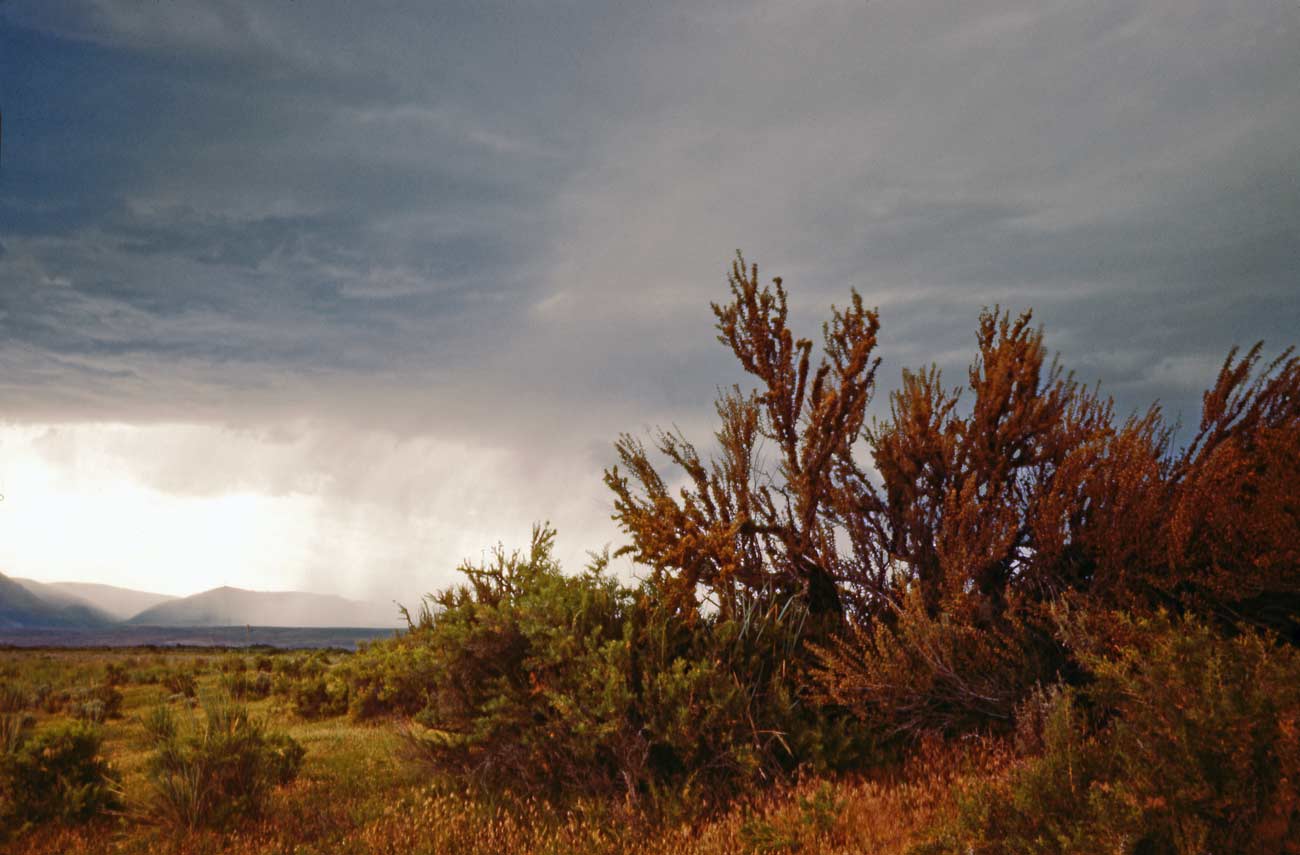
Here again Horace’s soft lens conspires with Kodachrome chemistry and the soft light of a distant storm to turn his slide into a painting. (Click to Enlarge)
Our Daily Sykes #237 – Look Up in the Sky
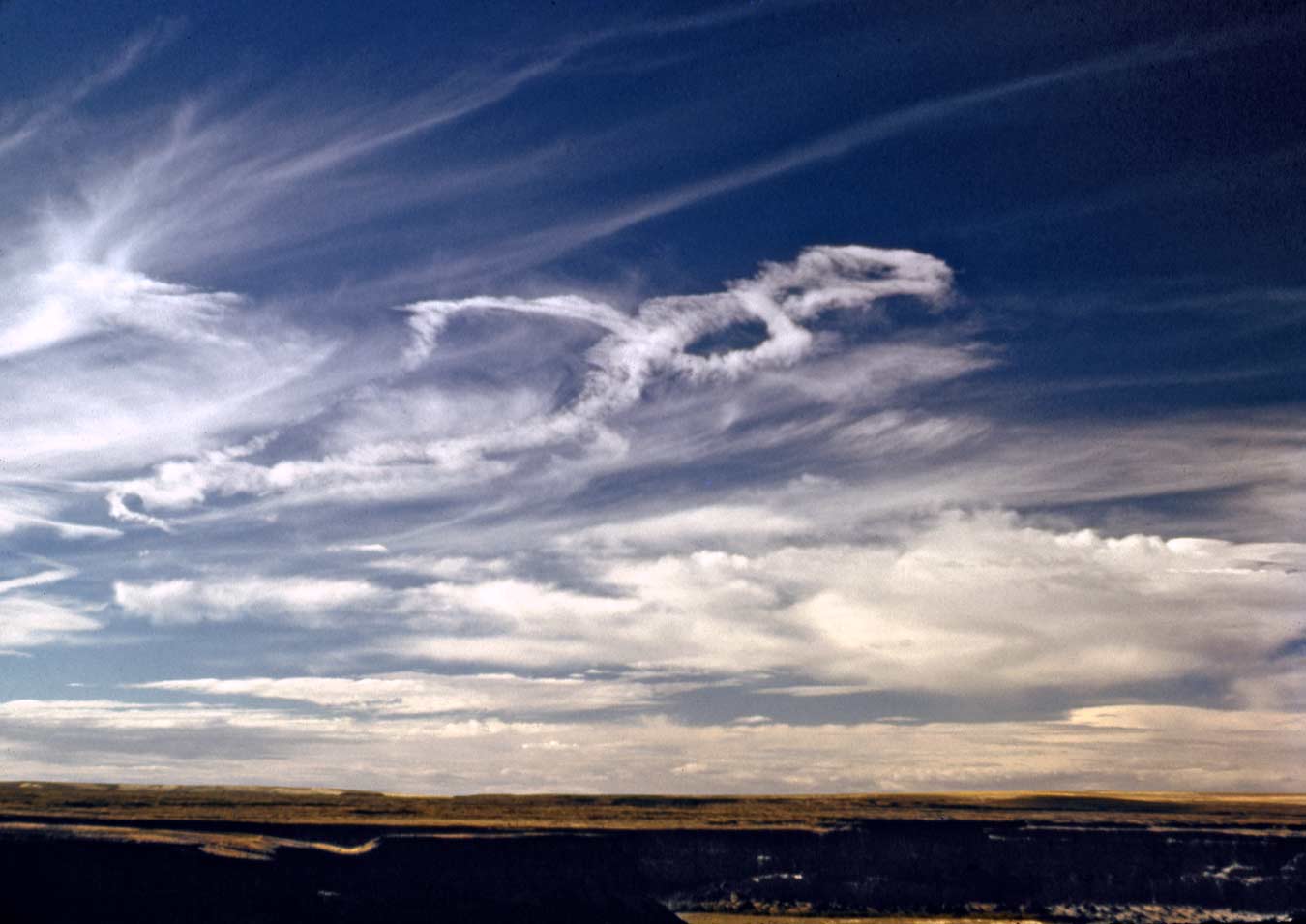
Look up in the Sky! It’s a bird! It’s a plane! It’s a meshuggah capping to a dark flat landscape. The land here seems desolate, a parched thing of patches, like four or five swipes of a dry brush – first with an undercoat brown, a mix of everything on the pallet and then with yellow. While up in the sky is a dollar sign for both the rich and the poor hoping for rain, a sign of the beast for sportsmen in leather, the sign for infinity for those who actively love nothing, the treble cleft for the music of the spheres, a hydra of several heads and tails for the sportsmen to bag.
Living in the lowlands in want of hills and such, Dutch artists, when they turned to landscape, made the most of trees, steeples, windmills and sails. But when judged by how much canvas was given to it then their greatest subject was often the sky. They were the masters of clouds, and their skills in rendering and playing with clouds is honored and enjoyed. We may imagine that paintings without subjects – abstract paintings – were in part inspired or encouraged by what lowland artists did with their skies.
One of the delightful adolescent rites of summer in the Inland Empire was to visit what was perhaps for teens the most libidinous place in the Spokane River Valley, the public beach at Liberty Lake. But there my friends and I lay in the sand and looked to the clouds. We talked to the clouds, sang for them, honored them with poems that we introduced with the same lines, “Look up in the sky! It’s a bird! It’s a plane! It’s a cloud! . . .” And from there added our inventions.
Our Daily Sykes #236 – A Fathomable Landscape

I think this landscape a charming one, perhaps because the parts are more fathomable than formidable. The golden incline in the foreground is not a dangerous pitch. The blue lake I could imagine swimming across without wings. The mountains are not so big either. A few trees hold to the top and there seem to be ways to make it up there without too much worry. Without Horacian clouds the blue sky is antiphonal to the golden slope with bushes that may be drying racks for formal red handkerchiefs. Click the scene if you want to questions it. A charming out-of-the-way place for Horace or anyone in 1945, our circa date. But how will we find it? Our touring fire insurance adjuster leaves no instructions.
Our Daily Sykes #235 – What Snow is This?

Our Daily Sykes #234 – Still In Kansas?

Our Daily Sykes #233 – Another of Willamette Falls

Our Daily Sykes #232 – Eda Christiansen
Our Daily Sykes #231 – Log Bridge

Our Daily Sykes #230 – More of Hell's Canyon – I Assume
Our Daily Sykes #229 – Painterly Landscape

Our Daily Sykes #228 – Christmas Bush

Our Daily Sykes #227 – Snake River at but before Port Almota

(Click your MOUSE to Enlarge) This landscape with the serpentine river and hills stepped to either side like artifacts reveals a nature so obedient to forces as predictable as a French Curve or as obedient as a bible college geologist that it seems painted. Whether idealized or recorded, where is it? I first went for the Grand Ronde River in the northeast corner of Oregon. It has scores of curves to explore looking for one that matches these. But that river is not this big, and its sides are ordinarily steeper and its habitat kinder to evergreens. The Grande Ronde is, of course, a tributary to the Snake River, and about thirty crow-flies miles northwest of where the Grande Ronde joins the Snake River south of Asotin, Washington, the by then slack water Snake reaches the Lower Granite Dam, the last of four dams built between the Columbia and Lewiston-Clarkston – all of them with locks. If the crow flies over the dam and continues towards the northwest in about another four miles the bird may wish to stop and rest here on this hill, which Horace took for his prospect. It looks southeast through the curves that are now still evident in the river although without the sand bars. Again, the Snake is now one long lake – or four lakes between Ice Harbor Dam, about ten miles up stream from the Columbia, and the twin cities of Lewiston and Clarkston, which because of the dams are now acting like ocean ports – small ones. From this prospect today Horace would see the dam upstream and also directly below him the primarily wheat shipping port of Almota. And about half way between the dam and the port he could not help but notice Boyer Park and Marina on the left bank, a sturdy development with lots of room for power boats and camping too. Now below Horace’s hill three paved roads meet. Washington Hi-w’y 194 comes through that cut bottom-left and meets the Almota Docks Road and the Lower Granite Road on the north (or here northeast) side of the Snake. In all it took millions of years to create this spectacle but only an afternoon or two to parcel it with a fence.
Our Daily Sykes #226 – More Hell, I Imagine

Our Daily Sykes #225 – Looking Back into Hells Canyon

Our Daily Sykes #224 – One of Two Hundred & Twenty Four

Our Daily Sykes #223 – Rock Lake, Whitman County

Rock Lake is one of the larger finger lakes that run through the canyons of Washington State’s Scablands south and west of Spokane. It is about 7&1/2 miles, long enough to breed a legend about its own monster. And deep enough in places – 375 feet – to hide one. Because of its depth it is a cold lake and rarely freezes over in the winter, although it is also not so comfortable for swimming in the summer. With the agricultural run off during most of the year it is also cloudy enough to make fishing for its big trout and browns not so rewarding except in the spring. In Whitman County, Rock Lake is 9 miles northwest of St. John, 16 miles southeast of Sprague, 15 miles west of Rosalia, and 33 miles south of Spokane. We found it with luck and the help of Google Earth. This view looks south from near its north end. Rock Lake, it is said, is stirred by Native American ghosts that haunt its south end, that a derailed train lies at its bottom and that one can still hear the wail of its whistle breaking free of the cold lake. (Click to Enlarge)
A Blogaddendum on Street Photography
November 27th last we published a photo essay – or several – that gathered around the subject of candid street photography. We began with pictures of our friend Clay Eals’ mother Virginia Slate Eals snapped on Seattle streets during the Second World War. Now Clay has found a few more examples from out of town and we happily add them with his captions. The top two have come from Donna Crowe, his co-worker at Encompass in North Bend. Donna is pictured as a child in the second image. From Clay’s many years as editor of the West Seattle Herald we know that they will be spelled and punctuated correctly.


We’ll finish the quartet with another of Clay’s mom, but this time not in Seattle.

Our Daily Sykes #222 – Some Canyon That is GRAND

Our Daily Sykes #221 – The Evergreen's Lesson

(Click TWICE to enlarge.)
The EVERGREEN’S LESSON
Each fall when the tall and slender evergreen
leans forward over the stream to speak,
the members of the choir listen from the other side.
Every year it is the same speech,
and while wishing it might be different
like children they are prepared to go to bed.
The Evergreen says,
“You have been a sparkling choir since spring.
Your singing has lifted the ponderous pine
and loosened the spruce.
(They laugh.)
The forest thanks you.
No one has complained.
And the stream too,
always the same and never the same
continues on its way
and makes no complaints.
We know that in all its babbling
there is some thanks as well.
I said as much last year
and many years before
but now I must say it once more.
Keep from your bed throughout
the coming suspended season
any dreams of envy
toward the evergreens
for staying awake while you sleep.
It cannot be helped.
We are each made our own way.
I remind you once more, imagine
what you would sound like
with needles restraining your leaves.
You will be bare for a while –
bare but not ruined.
When you wake again
sprouting new instruments
and soon singing
it will be with a range and rustle
the equal and more
of what you had this past season.
Go to bed now and rest well.
We who are awake will miss you,
watching and waiting in the snow
for another season of your lovely singing.”
Our Daily Sykes #220 – The Oregon Coast
We assume this coast is in Oregon. Horace Sykes was raised in Western Oregon and made frequent trips to the coast, even later when he made his living in Seattle and lived comfortably beside its “coast” at the western edge of the city, in Magnolia a few feet above the tides. The driftwood is almost obligatory for a subject such as this one. (But could this bleached fragment have drifted so high above the tides? Perhaps the Oregon Department of Tourism moves them there.) For Sykes it also takes the place or role of a flowering bush and sculptured rock. Except in postcards and Kodachrome slides we do not get a blue like that in this Pacific.”]

Our Daily Sykes #219 – Another Winding Waterway

(Please remember to click your mouse on these images – sometimes twice – to enlarge them.) How many waterways are there this size in the American West? A highway – far right – runs to Horace’s side. What seems like a huge sandbar with piles of itself directs the flow around itself, it seems, and against the steep incline beyond it, which is dappled with dark evergreens as are some Okanogan Mountains. For instance, there is a hillside vaguely like this directly across the confluence of the Okanogan and Columbia Rivers from Brewster – see the now-then below – that has a scattered forest clinging to its side. The comparison below is lifted from Jean’s and my book Washington Then and Now.


The principal difference between the original and its repeat in the above comparison is the Wells Dam, which flooded the Columbia with a slack-water Lake Pateros behind it that reaches upstream beyond Brewster. The new dam started producing electricity in the summer of 1967, aka, in some places, as “the summer of love.”
And now taking my own Okanogan clue I have found it with thrills and the help of Google Earth. Horace is looking west-southwest from the north bank of the Columbia about five miles downstream from Brewster. He is looking at the point – at the eastern end of the town of Pateros – where the “Big Bend” in the Columbia begins its crooked flow to the south for 100 miles (as the crow covers the distance) to the Priest Rapid dams where the river heads roughly east to take on the contributions of the Snake River before making its next big bend and heading west to the Pacific. (For that part of the river search here – or almost anywhere – for Wallula Gap.) Here that badly called (by me) “sandbar” is not pushing the river to the right because the Columbia turns left before reaching it – or where it reaches it. The “incline” dappled with evergreens is Goat Mount, which at 5,300 feet rises an impressive 4,500 feet above the river. It is but five miles from Pateros to the summit of what is – if I have read the elevations correctly – the highest mountain to rise from the Columbia at least through these 100 miles but probably many more. Directly below I have grabbed the Google Earth look with Horace’s side-by-side. The scale is different (and the yellow grid lines are an embarrassment I am momentarily stuck with) but the repeat of the features – including the “sandbar” – are obvious. (Now I wonder if that “sandy” part where the river turns was desposited there during the great ice age floods that carved the Grand Coulee. Here I imagine that pile of “sand” was left as a filtered sediment where the river turned suddenly because it could not push through Goat Mountain. It is to be hoped that among our readers there is a Pateros geologist.) That is US Highway 97 on the right of the Daily Sykes at the top.

Our Daily Sykes #218 – Harvest Questions

Our Daily Sykes #217 – Here's the Church . . .

Our Daily Sykes #216 – Wildflowers in the Palouse

Another scene it seems from Sykes Palouse, and this again distinguished by the foreground as much or more than by the greater sets of dipping and swelling patches. I am tempted to crop it all away except for the wildflowers. It is something you may want to test with a mask like a book or piece of toast. Also Horace set his focus for the flowers. Stagecraft – the rest is backdrop.
Our Daily Sykes # 215- Mt. Hood from Near Mirror Lake

Horace stands somewhere near Mirror Lake at the south-southwest “corner” of Oregon’s Mt. Hood. If he had a cable strung to the summit it would be an eight mile ride, and an elevation change of about seven thousand feet plus. The mountain is listed at various heights – all within a dozen feet of each other around 11245 feet. The slide’s composition shows signs of Sykes like the flowers in the foreground. We may add that the summer snow and glacier markings near the summit resemble – or are sympathetic with – the sky. Like most of Syke’s Kodachromes this dates most likely from the late 1940s. (Click to Enlarge)
LYONS FERRY – ADDENDUM

Directly below the most recent Sykes “Entering Big Bottom . . . ” post for Syke, with Our Daily Sykes #213 on Lyons Ferry please note that Jean has surprised us all by adding the photos he took on his visit to Lyons Ferry for our book Washington Then and Now. Look closely at the reflection of the clouds in his splendid and spectacular panorama. Next notice also in the pan how the rock formation on the far bank, to the left of the copse of trees in Lyons Ferry State Park, resembles a ruin of St. Sophia in Istanbul. (It was Constantinople.) It even includes a corner minaret – incipient or in ruins. Below is a mock-up (still with typos any my dimwitted naming of it for the other Lyons bridge, the one with a “gate” in Vancouver B.C.) for the subjects used in the book, although it was printed without the third photograph showing the Vantage Bridge under construction at its original site – Vantage – recorded in the 1920s from the old road on the east side of the Columbia River.

Our Daily Sykes #214 – Big Bottom

Our Daily Sykes #213 – Lyons Ferry on the Snake River
(click to enlarge photos)

This I recognize. It is Lyons Ferry on the Snake River when there was still a ferry – the longest-lived and last of the four principal Snake River Ferries in Washington. The salvaged Vantage Bridge replaced the Lyons Ferry – a cable ferry – in 1969 as waters backed-up behind the then new Lower Monumental Dam. I am allowed a mark on my Washington Belt for having as a child crossed the snake on this Lyons Ferry., (You can study these changes in Building Washington, a book that is included on this blog as a pdg file. Go to the History Books button, open it, and then click on “Building Washington.” It is a big book so on this supe’d-up MAC it required about four minutes to open. It may take less time. My computer is supered but it is also four years old. That’s a minute a year.) This view looks north. Now much of the mid-ground is flooded with the joined waters of the Snake and Palouse Rivers and the old Vantage Bridge spans the river heading for a landing on the north or far bank about a quarter of a mile to the east (right) of the famous railroad bridge seen here on the left.
Jean here. Paul, on my trip across the state for our book Washington Then and Now, I visited the old Vantage bridge. I took a few photos from above as well as those we used in the book. The shapes of the hills quite obviously reflect those in Horace’s photo. Interestingly, in the first Now photo, the railway bridge seems to be in the same location as before the waters rose, although completely rebuilt.


One more image – a panorama stitched together from three photos looking across at the state park and beyond:

OUR DAILY SYKES #212 – Horace's Kodachrome and Camera are Tested by the Heat and Sands of North Africa

Our Daily Sykes #211 – A Spiritual Matter

(Click to Enlarge)
I think that when Sykes southwest scenes started appearing in these “dailies” I first noted that my father, a Lutheran preacher in the cool gray and green state of Washington, had a subscription to the slick and warm color-saturated vehicle for tourism named “Arizona Highways.” I liked to eat my cheerios while studying Arizona Highways. It was a monthly, I believe. This “Arizona Waterway” might have been a number in that periodical. But is this Arizona or are we back in Utah? Or both? Only an arbitrary border – a straight line – divides them. In the color chart of theology, this is as papist a river as the waterway in Daily Sykes #209 belongs to the Archbishop of Canterbury. Again, Horace makes no confession.
Our Daily Sykes #210 – Pictorialist This

Our Daily Sykes #209 – We Feel Like We Know This Place

Our Daily Sykes #208 – Multicultural Pictograph

Our Daily Sykes #207 – Let Horace Be The First . . .

OUR DAILY SYKES #206 – On the Lip of Grand Canyon

Our Daily Sykes #205 – Rock Farm

Our Daily Sykes #204 – A Sky Runs Over It

Our Daily Sykes #203 – An Early Snow

Our Daily Sykes #202 – White Trunks

I know neither the type of tree nor the place – white birch bordering a stream in the semi-arid west? Horace does not say. (Click to Enlarge)
Our Daily Sykes #201 – Lincoln

Bill Cumming, Maggie and Ivar, Ted Abrams, and others . . .
(What follows is lifted from “Keep Clam” a work-in-progress on the life of Ivar and Ivar’s. This is part of the longer of two books, and will appear somewhat polished only on the net. The smaller book will be published between covers and available early in 2012. The longer book will begin to appear on its own webpage sometime early next year and “with many extreas” including recordings, video bits, and a reading of the serial installments by the author for those who like to be read to.)
MEETING TED ABRAMS & GUY WILLIAMS
In her revealing memoir “Wash Your Hearts with Laughter”, following her description of meeting Ivar at a Theosophy meeting, Maggie introduces Ted Abrams, the brilliant craftsman, cook, collector and raconteur. “We became friends with the most interesting man two young and green people could associate with.” Raised in a southern Jewish family, Abrams came to Seattle a short time before World War One. He escaped the war years living in Japan, working as a buyer for Seattle’s Frederick and Nelson Department store. Otherwise Ted Abrams lived in Seattle until his death in 1942. In a recorded conversation with Emmett Watson and Guy Williams, Ivar begins to describe Abrams, until Williams interrupts him. “Allow me to interpolate. Abrams! I’ll swear he knew everything.” Ivar continues, “He was a genius.” Guy Williams, Ivar’s college friend and sometimes his press agent as well, was encyclopedic on his own. As a young boy he was already an accomplished auto-dictate. Growing up in the gypo lumber camps that his dad managed, Williams read a multi-volume encyclopedia from A to Z and it would seem he remembered much of it.

Ivar and Maggie met Abrams at his Club Mauve on First Hill. Abrams was both the chef and the entertainer with a gift for rendering blues and gospel music he learned growing up in Savanna, Georgia. Maggie credits Abrams with inspiring Ivar to a more earnest life as a folklorist and songwriter. Club Mauve was designed around Abrams own collection of antiques and exotic art. The young couple was so taken with him that when Abram’s club fell victim of the wrecking ball they invited him to join them in West Seattle. After first distinguishing the old Haglund home on 59th Ave. SW with decorative brick work, Abrams built his own home from salvaged materials on a lot that Ivar donated across a Horton Street that was more an alleyway than a street. A visit to Abrams charmed construction became a kind of pilgrimage for members of Seattle’s Bohemian community in the 1930s. Artist William Cummings recalled the interior of Abrams home in his published, Sketchbook – A Memoir of the 30s of the Northwest School. “The house was crammed with paintings, drawings, sculpture, etchings and first-edition volumes signed by names famous and infamous. Ted managed to live just above the alleged level of poverty with an aristocratic grace that seldom showed the strained and stressed crevices of daily life.”


MEETING IVAR & THE BEES
Another visit to Ted Abrams home is recounted in Bill Cumming’s memoir. It is titled for our subject, “Ivar Haglund.” He might have titled it “Meeting Ivar Haglund” for nearly a half-century later he notes that their bumping “remains vivid” and a bit creepy.
On a spring Sunday afternoon Cumming accompanied Ken and Margaret Callahan aboard their Model A for a visit to Abrams little salvaged manse next door to Ivar’s and Maggie’s place. Abrams’ “tiny astonishingly fragile and graceful elderly nymph” of a sister had moved from Georgia to help take care of her fading brother, (Anguished, Cumming could not remember her name.) and the pair accompanied the Callahans for a visit to the nearby Alki Point. Cumming stayed behind, to explore Abrams’ library and watch his cat Mike “who dozed in a corner while I curled up in a big chair engrossed in a book.” The stage was set for meeting Ivar. Cumming continues.
“I was raised from the chair by a thunderous knocking on a fragile door, which threatened to collapse under the attack. Before I could open it, the door sprang open and on the threshold stood another short stocky figure in ample flesh, pale eyes set over drooping lower lids. At the moment the whole apparition gave off an air of general hysteria. ‘I’m sorry to bother you. My name’s Ivar Haglund and I live next door. I’m a friend of Ted’s and the Callahans’.” Cummings replied, “Yes. They speak of you a lot.” However, before he could complete his observation, Ivar “blurted out, ‘Listen! You wouldn’t know how to get rid of a room full of bees, would you? I mean an entire room full, my bedroom!’ . . . Driven by a Spartan sense of duty I walked back with him to his yard. Creeping through the long grass for all the world like marauding Indians in a B Western, we gained the relative safety of the wall of his house directly beneath the bedroom window, which gaped slightly open. From within floated the ominous hum of multitudinous wings, a hum of anger and threat. Rising up until our eyes just cleared the sill, we gazed into the room, then froze in terror and abject fear. The room was indeed filled with bees, flying, standing on edges and ledges, crawling over bed covers, crawling into and out an hollow containers, into lampshades, out of pillowcases . . . In front of our eyes, barely out of striking distance, the sill was three deep in black and yellow malcontents who glared balefully into our eyes, not yet collected enough to launch themselves across the scant inches between us. Hurriedly we ducked back down and retreated on all fours through the grass, praying that we would not be hit by a sudden raid from the rear.
“Regaining the safety of Ted’s porch, I slumped in a chair, while Ivar wandered off in search of someone who might be of practical help. My only suggestion was to burn the house down. I never met Ivar again. In fact, I never really found out if it actually was Ivar or not. If it’s of any significance to scholars, he wasn’t carrying a guitar.”
(The above was written – often copied – during a blizzard sent early from Canada this Monday evening, November 22, 2010. This morning the 93 year old Bill Cummings died, and the community lost thereby one of its great raconteurs. He had hosted his last painting class in his home a week earlier. Last Friday our mutual friend the pianist-producer Margaret Margason serenaded Bill. She brought with her to Bill’s home some romantic Robert Schumann and some Beatles, and he requested the latter, which she both played and sang. At the time he was reading again the Jeeves novels by the English humorist P. G. Wodehouse. About one month ago Bill celebrated his last birthday with the Margasons at their Wallingford home. A few days earlier I had found in a collection of negatives recorded by the artist Victor Lygdman a series of “artist at work” portraits of Bill that Victor took in the earlier 1960s. Six of these are included below.)

Bill Cumming, Artist 1917-2010

Bill Cumming, age 93, died this morning of congestive heart failure. He held his last painting class at his home last Monday. On Thursday his friend Margaret Margason serenaded Bill. She brought with her high romantic music for Soprano by Robert Schumann and a Beatles songbook. This time Bill chose the Beatles – for a sing-along. The six portraits of the artist “in process” were photographed in the mid-60s by Victor Lygdman, who died earlier this year of the relatively “mere” age of 83. Victor was born ten years after Bill.
Our Daily Sykes #200

Our Daily Sykes #199 – "A Promise of Spring"

Horace Sykes had captioned this “A Promise of Spring.” We have signs too – optimistic ones for we prefer the warm mornings to the cold. Yesterday we – the Queen and I – saw a Robin hopping the limbs of the neighbor’s holly tree. We agreed that it was out of season, but there it was with red breast jumping about the red berries. Today I read of snow perhaps for Monday. And so following the omens of Sykes rare caption, we have it all – the “promise of spring” here in November. The Robin and the snow.
INTRODUCTION TO THE GIFT 1912 BAIST MAP

Fifteen years ago or so I was invited to give a lecture at a rod and gun club on Whidbey Island. Since I always liked to fish I was at least half in sympathy with the club’s program and so agreed to attend. It also helped that the manager was a relative.One of the islanders who attended the show was a retired real estate salesman who had worked most of his selling life in Seattle. He brought me the gift of this 1912 Baist Real Estate Map, and it was surely one of the finest gifts I have ever received and most useful too.
Although clearly used and sometimes improvised with penciled additions, the 1912 Baist is at this writing (in 2010) nearly a century old and still in good shape – except for the index. That was curled and creased and even torn in places – not that it matters much. The index is an overall map of the city on which 34 sections are given marked boundaries and numbered within. It is those 34 sections that are treated individually with their own maps. Those are still clear, and that is what matters.
All 34 plates are wonderfully hand-colored and detailed with information like additions that are distinguished by contrasting colors, numbered blocks and within those blocks numbered lots (and often that is all you need to get going with your research). The maps also show footprints of structures, color-coding for types of construction, lines for utilities, and more.
Many of us are simply in love with maps. For us the cheap thrills of hand-wrought cartography can keep us insensitive to the neighbor’s poodle barking at 3 A.M. Also with this gift of a Baist at your side it may no longer be necessary to drive to the library. Although that is not ordinarily an unpleasant journey it does take time. And parking “tokens” that fold or require signatures add up.
Ron Edge is in charge of this all. Ron is the techno-wit who took the big and heavy Baist map from my basement and made it the very readable resource you get here. Eventually and increasingly as time allows we will populate each map with symbols – contrasting dots or squares – that you can click for pop up illustrations of the places marked. (Somewhat like those blue squares on Google Earth, although, we hope, consistently accurate.)
And here we note and make a plea. If you should like to share a photo of your house or some other part of historical Seattle that can be included then send your scans to Ron at edge_clippings@comcast.net. With few exceptions he will use them on one of the 34 Baist plates – the proper one and in the proper place. So please be pointed about what plate and where on it. It is Ron who will also first field and interpret your recommendations and complaints.
How can one complain about a century old map? Turn or click to Plate #4. There from top to bottom – between Yesler Way and Union Street and about two blocks west of Broadway Ave. – the plate has been frayed or torn. But for all the blocks this mutilation touches only one of them ruinously. Block 61 of Terry’s 2nd Addition, between 7th and 8th Avenues and Spruce and Alder Streets, cannot be read. The information in the remaining torn blocks can generally be inferred. On two plates users have attempted to sketch in the curves of new city streets that were cut through the printed grid of those plates. One for E. Olive Way is on Plate 7, and the other, a real impressionistic whopper, is for the long and curving western end of West Seattle Bridge where it climbs the West Seattle ridge. You will find that scribble on Plate 28. All the rest of these 34 maps is left to search and enjoy – like the original serpentine course of the Duwamish River (plate 29), the tidelands of Interbay (plate 21), and the place of Foster Island before Union Bay, as part of Lake Washington, was lowered about nine feet for the ship canal in 1916, or four years after these plates were first published.
(Ron Edge is also responsible here for “Edge Clippings,” a blog feature created from historical clippings taken largely from periodicals he has collected.)
Next Ron explains – with illustrations – the “technical story” behind this Baist unfolding.
~~~~~~~~~~~~~~~~~~~~~~~~~~~~~~~~~~~~~~~~~~~~~~~~~~~~~~~~~~~~~~~~~~~~~
The first major decision in digitizing Paul’s 1912 Baist’s Real Estate Atlas was to remove all the 24” by 34” Plates from the bound hardcover book that held them. This allowed complete access to each of the maps.

After experimenting with camera settings, lighting and image overlap, I settled on taking 42 digital pictures of each map in sections 4.25″ by 5″. I built a target frame and laid out a grid so I could record 7 pictures across the length in 6 passes of each map. I used my Canon G10 camera controlled remotely from my computer.


In order to provide good detail and readability the size of the PDF files for each map are rather large and may require some time to open based on your cpmputer and internet access speed. Once opened these maps can be saved to your computer.
To get the latest Adobe Reader click link: http://get.adobe.com/reader/
As pictures and information are linked to each of the maps as Paul described above they will be updated on the web.
Our Daily Sykes #198 – Tis The Season Somewhere

Our Daily Sykes #197 – Either Anne or Elizabeth

Seattle Confidential #7


Seattle Unintended Effects #4 – The Shadow Knows

This street snapshot by Victor Lydgman (1927 to 2010) looks north on Second Avenue from its intersection with Pike Street, the southwest corner. Undated, the negative is yet part of a packet of consecutively numbered negatives, some of them dated 1962, the likely date for this too. The sun is to the northwest and so later in the afternoon and throwing long shadows. One of these shadows lends us “Unintended Effects #4” and waits on a reader to unravel its mysteries. The right leg (here on the left) of the tall and/or slender woman, left of center, seen here in profile, is planted on the pavement and throws an appropriate shadow to the east-southeast – like all other shadows at this time and in this place. The left leg is beginning its lifting motion that puts the toe – only – in touch with the sidewalk. It too castes a shadow – but an uncanny one. The shadow appears to originate to the left of the toe, and so on the sun’s side of the foot. Since this is not possible – that that part of the shadow be cast by the left leg or foot – what then is casting that shadow – or that part of it in front of the shoe? In all respects it looks like the darkness in front (to the left and west) of the shoe is continuous with the shadow behind the foot. There is also no blending of the shadows thrown by the left and right legs. Although they come close to touching or closing off the light between them, they do not. The darkness in front of the left foot does not look like a stain or something inserted into the pavement for, for instance, a utility. What and how is it? (Click to Enlarge)
Our Daily Sykes #196 – Pendelton Roundup

SEATTLE NOW & THEN – Associated Poultry on Fried Chicken Way


ASSOCIATED POULTRY (Click Photos to Enlarge)
With its eccentric sawed-log shell, and the neon chicken perched on a big hanging sign that could be easily read by drivers coming in both directions on Victory Way, (AKA Bothell Way and Lake City Way), the Associated Poultry Company was an almost charming place to “buy direct,” as other sign boards declare, fryers and eggs cheap.
The eggs were gathered from the nesting boxes in the long log box to the rear and there the hens were also knifed, plucked, and trimmed before being brought out to the A-frame show room. There the fryers were hung above a sawdust floor from steel racks screwed to a knotty pine ceiling.
The Associated Poultry was constructed in 1930 primarily, as another sings reads, to “supply the Coon Chicken Inn,” a road house with live music, and chicken dinners served from its own semi-log quarters nearby on Lake City Way. It survived for twenty years on Associated Poultry’s fryers; a menu it claimed was homage to southern cooking. Older readers may remember the front door to this chicken dinner house. One entered through the open mouth of a black face. It was a grotesque but skilled caricature of a minstrel player more than a West African male.
The Inn closed in the 1949, when America’s “Jim Crow” years of post-civil war race relations were on the eve of being rolled over with civil rights. A G.I. Joe’s New Country Store moved into the building. Associated poultry was torn down earlier in 1950-51, and replaced ten years later with a Shell station.
Artifacts from the “Coon Chicken” culture on Bothell Way are exhibited and interpreted at the Jim Crow Museum of Racist Memorabilia on the campus of Michigan’s Ferris State University. The museum’s candid mission is “to promote racial tolerance by helping people understand the historical and contemporary expressions of intolerance.”