THEN: Sixty women and three children, dressed in finery to greet Queen Marie of Romania, pose Nov. 4, 1926, along the west side of the then-six-year-old clubhouse of the Seattle Yacht Club. The hunch of our auto informant, Bob Carney, is that at left, the touring car in front is a 1924 or 1925 Cadillac, and the car behind it is a 1925 or 1926 Lincoln. For more info on the clubhouse and its centennial, visit the website of Seattle Yacht Club. (Museum of History & Industry, courtesy Seattle Yacht Club)NOW: The Seattle Yacht Club high-school sailing team, representing the club of the future (and backed by staff who keep the club humming), approximate the pose of their 1926 predecessors. Major changes since 1920 to the clubhouse and grounds, officially landmarked by the city in 2006, include enlarged windows (1946) and an expanded dining room (1967) at right. The photo looks more directly east than the “Then” image because the tree at left would obscure a more accurate repeat. Here’s who is in the photo: The high-school sailing team (front, from left): Matteo Horvat, Alex Shemwell, Ryan Milne, Anna Lindberg, Blake Weld, Taylor Burck, Aurora Kreyche, Isabel Souza, Caroline Schmale, Andy Roedel, Filippa Cable, Alvaro De Lucas and Alden Arnold. Staff (back, from left): Jose Cadena, Devon Cannon, sailing coach Cameron Hoard, Lynn Lawrence, Jorge Vallejo, Annee King, Carlos Sagastume, Jody Tapsak, Chef Alex Garcia, Mason Pollock, Natalia Ruiz-Jiminez, Kevin Martinez-Jara, Coner Hannum, Jenne Lawrence, Alicia Kern, Geoffrey Moore, Quang-Ngoc Tran, Shyheem Mitchell, Ellen Beardsley, Anthony Navarro, Juan Abrego-Hernandez, D’Andre Miller, Tiffiney Jones, Benjamin St. Clair, Jade Lennstrom, Jeremy Witham, general manager Amy Shaftel, Josie Weiss, Mike Young and Penny Slade.
(Published in the Seattle Times online on April 23, 2020
and in the PacificNW Magazine print edition on April 26, 2020)
Yacht club’s 1926 Montlake reception had a crowning touch
By Clay Eals
Royalty fueled the roar of the 1920s in Seattle on Nov. 4, 1926. That day, the city welcomed a woman whom The Seattle Times called the “most beautiful and gracious of all Europe’s feminine monarchs,” Queen Marie.
For the 51-year-old regal representative of Romania (then spelled Rumania), Seattle was but one destination on a cross-country tour. Accompanied in an open touring car by our first female mayor, Bertha Landes, the queen zipped through an afternoon of stops initially intended for a full day.
Queen Marie in 1926. (British Pathe)
She drew record crowds, and the city delighted her: “In all the towns I have visited, I have found none so beautiful as your Seattle. In each corner today, I have found a place where I should like to live.”
The fitting finale was the home of the Seattle Yacht Club. Its clubhouse, perched on Portage Bay, south of the University of Washington and north of today’s Highway 520, had opened six years earlier, on May 1, 1920. For a reception put on by “club women of the city” to honor the queen, the building burst with autumn blooms, its veranda rails draped in dahlias.
Only 200 of the 1,500 assembled women could greet Marie, however, because what was to be a one-hour stay lasted “scarcely more than 15 minutes.” This did not prevent 60 women – bonneted, like the queen – from posing outside with three youngsters, as our “Then” photo shows.
It’s no accident that a lighthouse-shaped cupola topped the clubhouse, which The Times called “the finest on the Coast and one of the finest in the United States.” Famed architect John Graham, Sr., certainly intended for the Colonial Revival/Shingle Style structure to complement the recently opened Lake Washington Ship Canal, including nearby Montlake Cut, which connected Portage Bay to the lake.
The parcel, formerly marshland and a landfill for the 1909 Alaska-Yukon-Pacific Exposition at the UW campus, became available for the club’s purchase after a casino proposed for the site fizzled. The club deemed the calm, freshwater setting a buoyant change from the rough weather, railroad noise, oil dumping and swells of passing steamboats that its boaters and craft had endured at saltwater bases on Elliott Bay and along the West Seattle shore since its founding in 1892.
Today, with 2,800 member families and myriad programs for all ages, Seattle Yacht Club is the oldest and largest such local organization.
The coronavirus scuttled its traditionally sponsored early-May merriment for Opening Day, but the club optimistically has rescheduled an elaborate celebration of its clubhouse centennial for Sept. 26. Sailing and motor vessels from the 1920s are to be on display, including one that participated on Opening Day in 1920.
One might envision the pending party as fit for a queen.
WEB EXTRAS
To see Jean Sherrard‘s 360-degree video of the “Now” prospect and compare it with the “Then” photo, and to hear this column read aloud by Clay Eals, check out our Seattle Now & Then 360 version of the column, when it is posted!
Below are a “Now” identifier photo and two other photos as well as 11 clippings from The Seattle Times online archive (available via Seattle Public Library) that, among others, were helpful in the preparation of this column.
And at the bottom, see a book excerpt relating to Queen Marie’s visit to the Seattle Yacht Club clubhouse on Nov. 4, 1926, plus a 1954 club menu!
Here is an identifier photo for the “Now” photo above.Early clubhouse of Seattle Yacht Club at Duwamish Head in West Seattle, built in 1892. (Courtesy Seattle Yacht Club)Early clubhouse of Seattle Yacht Club and Elliott Bay Yacht Club in West Seattle, 1909. (Courtesy Seattle Yacht Club)April 25, 1920, Seattle Times, page 62May 3, 1920, Seattle Times, page 13Oct. 12, 1926, Seattle Times, page 13Nov. 2, 1926, Seattle Times, page 1Nov. 2, 1926, Seattle Times, page 7Nov. 4, 1926, Seattle Times, page 1Nov. 5, 1926, Seattle Times, page 11Nov. 5, 1926, Seattle Times, page 12, mainbar excerptNov. 5, 1926, Seattle Times, page 12, sidebarNov. 5, 1926, Seattle Times, page 12Nov. 5, 1926, Seattle Times, page 13Nov. 6, 1926, Seattle Times, page 5Excerpt from “On Tour with Queen Marie” (Robert M. McBride & Co, New York, March 1927), by Constance Lily Rothschild Morris, who accompanied Queen Marie on her tour of the United States and Canada in 1926. It is not known if the tree referenced here is the tree shown at left in our “Now” photo above. (Courtesy Mike Young)1954 Seattle Yacht Club menu
THEN: In this view looking northwest in Fujitaro Kubota’s garden in the 1930s, Kubota stands at far left as four visitors are reflected in a pond while posing at the Heart Bridge. This is one of 175 vintage and contemporary images in the new book “Spirited Stone,” sponsored by the Kubota Garden Foundation. (Courtesy Kubota Garden Foundation)NOW: Assembling on the Heart Bridge of Kubota Garden, for 33 years a city park, are (from left) Aubrey Unemori, book publisher Bruce Rutledge, Anna Carragee, Marjorie Lamarre and Jason Wirth, all representing the Kubota Garden Foundation, along with Renton’s Michelle Risinger and children Mari, Rylan and Charleston. To stay current on book and film events, visit the website of the Kubota Garden Foundation. (Jean Sherrard)
Discovering a healing heart for nature at Kubota Garden
By Clay Eals
With Earth Day now seemingly every day, symbolism abounds in Kubota Garden. This 20-acre park near Seattle’s southern city limits showcases a calming mix of greenery, stone and water, all buoyed by an early enhancement, the Heart Bridge. And in this uncertain era, more than ever we need heart.
Soon after officials invoked social distancing to slow the coronavirus, I wandered the garden’s vast and meandering paths. Beckoning with bright red railings was the diminutive bridge.
The garden’s founder, Fujitaro Kubota (1880-1973), who left Japan for America in 1907, installed the span a few years after acquiring the tract’s first five acres in 1927. It bolsters the entire park’s role as a refuge for contemplation, healing and renewal.
Its range of trees, pools and meadows is complemented by a bronze entry gate, ornamental wall, hanging bell, stone lantern and interlaced waterfalls, blending Japanese and American styles of landscaping. One can instantly internalize the careful combination of art and nature.
The peace it engenders was no effortless ethos to create, given that Kubota, with thousands of other stateside Japanese during World War II, was shunted into three years of incarceration at Minidoka, Idaho. There, the headstrong horticulturalist coped by leading the camp’s beautification. Post-war, he wept for hours when encountering his overgrown Seattle garden and struggled with back taxes, but he pushed on.
Naturalized in 1955, Kubota shaped public spaces of the Rainier Club, Seattle University and Bainbridge Island’s Bloedel Preserve as well as the grounds of countless residences.
The garden in South Seattle, however, was Kubota’s magnum opus. He didn’t live to see its splendor triumph over a 480-unit condo development scheme to become an official city landmark (1980) and city park (1987). But he maintained vision and a desire to share.
“Every rock and every key plant have a meaning,” he told The Seattle Times in imperfect English at age 82 in 1962. “I wish to leave in this ‘beautiful’ and ‘artistic.’ ”
That’s evident in a new, 230-page coffee-table book, “Spirited Stone: Lessons from Kubota’s Garden,” with evocative essays and photos from 20 contributors. Infused with earthly humanity, the book is a stirring backgrounder for experienced visitors. For the uninitiated, it’s a lavish entree to Kubota’s story.
As expressed by Linda Kubota Byrd in a companion documentary, her grandfather embodied “an overarching spirit and a testament to the power of holding an intention.” In the same film, Bellevue landscape architect Don Shimono says Kubota devoted himself to working with nature, not against it.
“It seems like this whole planet is man trying to conquer nature,” Shimono adds, “and there’s no way nature is going to be conquered. Nature is going to have the last word.”
WEB EXTRAS
Seattle’s Jim Rupp, of the Pacific Northwest Historians Guild, observes that in our “Then” photo, “The fellow standing next to the seated woman (presumably his wife) is Dr. Henry Gowen, longtime UW professor for whom Gowen Hall is named.” That this is Gowen is bolstered by a photo of Gowen from the Museum of History and Industry, Rupp says.
To see Jean Sherrard‘s 360-degree video of the “Now” prospect and compare it with the “Then” photo, and to hear this column read aloud by Clay Eals, check out our Seattle Now & Then 360 version of the column!
Below are the cover of “Spirited Stone,” a map of Kubota Garden and 18 clippings from The Seattle Times online archive (available via Seattle Public Library) that, among others, were helpful in the preparation of this column.
THEN: With the northern end of West Seattle and just a hint of downtown as a backdrop on a cloudy day, workers busily construct the High Point Defense Housing Project in March 1942. Visible at upper left are the Holy Rosary Church bell tower and Charlestown Street water tank. Be sure to double-click this photo to reveal a constellation of details. And see below for the makes and years of 15 vehicles depicted. (Museum of History and Industry)NOW: From a vantage about a block north of our “Then” photo, the downtown skyline shines as the colorful dwellings of redeveloped High Point anchor this panorama. The fine details of both images can be best appreciated when enlarged online at seattletimes.com. For info on Tom Phillips’ book, click here. And same as with the “Then” photo, double-clicking this one will reveal incredible details. (Jean Sherrard)
(Published in the Seattle Times online on April 9, 2020
and in the PacificNW Magazine print edition on April 12, 2020)
Creating a new neighborhood with an old name: High Point
By Clay Eals
Seattle’s most elevated vista is not well-known Queen Anne, Magnolia or Capitol Hill. At 512 feet, it’s West Seattle’s High Point. The name bespeaks lofty aspirations.
It surfaced in the April 11, 1926, Seattle Times: “High Point, so named because of the commanding position it occupies, will be the next fine residence addition to go on the market here … and will be one of the most sightly subdivisions in that part of West Seattle.”
Indeed, the potential was high for the mid-peninsula plats just north of the “summit.” But ravages of the Great Depression soon intervened.
Prompted by late-1930s New Deal money, the state created the Seattle Housing Authority, which snapped up big parcels, including High Point, to aid the downtrodden. It wasn’t easy, as the agency’s charge drew flak from those viewing public housing and integration as “socialism.”
With war looming, however, the feds redirected funds to bolster defense, so the barracks-style housing built in 1942 at High Point became home to a surge of Boeing and shipyard workers.
High Point reverted to the original mission in 1953 and for the next 50 years served 15,000 racially diverse low-income families.
By the 1990s, wracked by civic inattention and growing crime, the deteriorated units merited federal help aimed at “severely distressed” areas, and in 2004 razing began on the High Point of old.
Rising in its place over the last 15 years has been a novel neighborhood. Its kaleidoscope of green features includes an unusual park, a bee garden and a large pond to go with a new library branch, health clinic, senior complex and community center. Moreover, the project intersperses 854 market-rate dwellings with 675 low-income rentals.
Tom Phillips, author of “High Point: The Inside Story of Seattle’s First Green Mixed-Income Neighborhood” To reach Tom, you can email him at tomjphillips@msn.com. (Clay Eals)
The transformation was so profound that Tom Phillips wrote a book. Phillips, who spent his childhood in Mount Baker, shepherded the redevelopment for the housing authority – a “dream job” after Peace Corps and VISTA stints and work in urban planning and community organizing,
“I was given 120 acres – to plan it and build it,” he says. “It’s a lifetime opportunity that nobody ever gets, and it’s not out in the suburbs. It’s in the city I grew up in.”
His book, “High Point: The Inside Story of Seattle’s First Green, Mixed-Income Neighborhood,” reveals the project’s sometimes bumpy ride to fruition, including missteps that cost the “food desert” of nearby 35th Avenue a supermarket. But it also celebrates renewed life and an invigorated reputation for a district whose name has proclaimed optimism for the past century.
WEB EXTRAS
Our automotive informant Bob Carney identifies 15 of the 21 vehicles in our “Then” photo: (from left) 1940 GMC panel truck, 1933-34 Plymouth, 1930-31 Ford Model A, 1937 Ford sedan, unknown, 1939 Chevrolet; in cluster of five: in back on right 1928-29 Ford Model A, in foreground 1941 Dodge sedan, the other three unknown; 1938-39 Ford pickup, 1936 Hudson, 1941 light-colored Ford coupe, 1928 Chevrolet, 1939 light-colored Plymouth sedan, the next three unknown, in foreground 1936-37 Hudson sedan.
Below are a book cover, an additional photo and two vintage maps, all relating to this week’s column.
Also, you will find 18 clippings from The Seattle Times online archive (available via Seattle Public Library) that, among others, were helpful in the preparation of this column.
The cover of Tom Phillips’ new book. Click here for more info.Another view of High Point shortly after 1942. (Courtesy Tom Phillips)A plat of the High Point housing development on Feb. 29, 1928, before it became a federally funded housing project. (Courtesy Ron Edge)A fire-alarm plan for the High Point project from June 28, 1944. (Courtesy Ron Edge)April 11, 1926, Seattle Times, page 77Oct. 16, 1941, Seattle Times, page 37Dec. 23, 1941, Seattle Times, page 16Jan. 18, 1942, Seattle Times, page 9Jan. 18, 1942, Seattle Times, page 20March 20, 1942, Seattle Times, page 32April 9, 1942, Seattle Times, page 2May 28, 1942, Seattle Times, page 8July 19, 1942, Seattle Times, page 10Nov. 24, 1942, Seattle Times, page 4May 11, 1943, Seattle Times, page 9May 11, 1943, Seattle Times, page 16Aug. 17, 1943, Seattle Times, page 4Nov. 24, 1943, Seattle Times, page 7Jan. 2, 1944, Seattle Times, page 9Jan. 2, 1944, Seattle Times, page 10June 14, 1944, Seattle Times, page 13May 11, 1950, Seattle Times, page 15March 25, 1979, Seattle Times, page 155May 4, 1982, Seattle Times, page 56
THEN: Seattle bon vivant and amateur photographer Max Loudon took this photo featuring his beloved Indian Motorcycle during the 1918 pandemic. His sister Grace Loudon McAdams, second from the right, perches side saddle amidst masked friends on a Third Avenue sidewalk half a block south of Washington Street. (Paul Dorpat collection)NOW: A lone Seattleite walks her dog along a nearly-deserted Third Avenue. (Jean Sherrard)
(Published in the Seattle Times online on April 2, 2020
and in the PacificNW Magazine print edition on April 5, 2020)
A deadly flu kept Seattle indoors and in masks in 1918
By Jean Sherrard
“I had a little bird and its name was Enza.
I opened the window and in-flew-Enza.”
In the fall of 1918, this was not just a nursery rhyme. The worldwide influenza pandemic was quite real – and lethal.
It blew into Washington state on a perfect storm. Percolating in the wet, filthy trenches of World War 1, this mutated H1N1 strain infected weary soldiers, and in the war’s waning months, it circled the globe. At U.S. military bases, deaths from pneumonia multiplied, alarmingly within days, even hours, of the onset of symptoms. Unlike past flus, the most vulnerable were young and healthy.
In mid-September, Camp (now Fort) Lewis and Bremerton’s naval facilities reported their first cases of flu. So on Oct. 5, Seattle’s mayor, Ole Hanson, and commissioner of health, Dr. J. S. McBride, ordered the immediate closure of schools, churches, theaters, dance halls and “every place of indoor public assemblage … to check the spread of disease.”
Frank Cooper, school superintendent, pronounced the closures “hysterical” and “senseless,” while children applauded the unexpected vacation. Outside City Hall, a young boy demanded of Hanson, “Are you the guy that closed the schools?” Hanson admitted that he was. “Well,” said the lad, “I’m for you!”
To many, the closures seemed draconian. Deprived of entertainment, recreation and indoor religion (although St. James Cathedral and First Presbyterian Church held open-air services throughout rainy October), Seattleites derided the closures. “An awful day for husbands and wives,” the Post-Intelligencer huffed. “Both had to either remain at home or walk the streets.”
Druggists peddled a plethora of snake-oil cures, from Coronoleum and Septol Spray to Bark-la’s Gargle and Gude’s Pepto-Mangan (“the Red Blood Builder”).
The Red Cross distributed 250,000 six-ply linen masks, and public transit became off-limits to the open-faced. (“Wear the mask or walk,” proclaimed Hanson.) Taking advantage of the anonymity, a few masked crooks staged stickups and burglaries.
As contagion swelled, public complaints evaporated as newspapers listed sobering daily death tolls of men and women in their 20s, 30s and 40s.
On Nov. 11, Armistice Day, “perfectly sunny weather” was forecast. After five weeks of gloom and isolation, Seattle was primed for a celebration. “In [an] ecstasy of joy at ending the world’s worst war,” reported The Seattle Times, “it grew from nothing into cheering thousands.” Masks were shucked and “instead of handkerchiefs … waved from windows and doorways by cheering spectators.”
The next day, the closures were revoked. “All places of public assembly” reopened, though masks were still de rigueur.
Before the virus ran its course in 1919, a third of the world’s population had been infected, resulting in 50-100 million deaths, including nearly 5,000 Washingtonians.
By springtime, it could be said, out flew Enza.
WEB EXTRAS
To see Jean Sherrard‘s 360-degree video of the “Now” prospect and compare it with the “Then” photo, and to hear this column read aloud by Jean, check out our Seattle Now & Then 360 version of the column!
And there’s more!
THEN: Max Loudon’s 2nd photo of his motorcycle posers unmasked!
Also below is an alternate “Now & Then” photo pair on the same topic. Enjoy!
THEN: On Oct 29, 1918, the noon shift of Police Chief J.F. Warren’s “Influenza Squad” emerges from police headquarters in the Public Safety Building (now the Yesler Building), in this easterly view up Terrace Street. The force was charged with cracking down on public spitting (a $5 fine), enforcing the wearing of masks and dispersing crowds. Warren himself was infected early on but recovered. (Paul Dorpat collection)NOW: Two mask-free Seattleites bravely cross the intersection of Terrace Street and Yesler Way. (Jean Sherrard)
March 25, 2007, Seattle Times, Paul Dorpat’s “Now & Then” column about the 1918 flu.
UPDATE: Click here or on the screen grab above to see a 25-minute live interview of “The Boys in the Boat” author Daniel James Brown, along with Nicole Klein, ASUW Shell House capital campaign manager, on Jan. 29, 2021, as part of the all-online 2021 Seattle Boat Show. Start with time code 1:21:40. It ends at 1:47:00.
= = = = = = = = = =
(click and click again to enlarge photos)
THEN: Posing in front of the Shell House doors are “The Boys in the Boat” (from left): Don Hume, Joe Rantz, George “Shorty” Hunt, Jim “Stub” McMillin, John White, Gordy Adam, Chuck Day and Roger Morris, with (front) coxswain Bobby Moch. This image may become more iconic if, as forecast by MGM, a Hollywood film directed by George Clooney commemorates the “Boys” story. (University of Washington Libraries Special Collections, UW2234)NOW: (Also see identifier photo below.) Family of “The Boys in the Boat” and of famed shell-maker George Pocock and coach Al Ulbrickson pose Feb. 25, 2020, outside the ASUW Shell House. The ramp from the Shell House to Lake Washington extends only a handful of yards, so with the hardiness of an oarsman, Jean Sherrard shed his socks and shoes, rolled his pants to his knees and waded into near-freezing water to secure this wide shot depicting the full girth of the building. Descendants posing between the oars, approximating the positions of their ancestors in the “Then” photo, are (from left) Jennifer Huffman, Judy Willman and Fred Rantz, granddaughter, daughter and son, respectively, of rower Joe Rantz; Nicci Burrell, granddaughter of rower George Hunt; Colby White, John White, Loren White and Colby White Jr., son, great-grandson, great-grandson and grandson, respectively, of rower John White; Jeff Day, Kris Day, John Day, children of rower Chuck Day; Joseph and Susan Hanshaw, son-in-law and daughter of rower Roger Morris; (front, from left) Marilynn Moch, Maya Sackett and BJ Cummings, daughter, great-grandchild and granddaughter, respectively, of coxswain Bobby Moch. Other descendants are (far left) Lindsay and A.K. Ulbrickson, great-grandchildren of coach Al Ulbrickson; (right rear, from left) Alvin Ulbrickson III and Rinda Ulbrickson, grandchildren of coach Al Ulbrickson; Ray Willman, son-in-law of rower Joe Rantz; (right front, from left) Nathan Pocock, Jim and Beth Pocock, Sue Pocock-Saul, Dave and Katie Kusske, great-grand nephew, grand nephew and grand niece-in-law, granddaughter, grandson-in-law and granddaughter, respectively, of famed shell-builder George Pocock; and Chris Eckmann, grandson of athletic director Ray Eckmann. (Jean Sherrard)
(Published in the Seattle Times online on March 26, 2020
and in the PacificNW Magazine print edition on March 29, 2020)
The rowing ‘home’ that launched a repudiation of pre-war Hitler
By Clay Eals
Imposing outside, cavernous inside, yet somehow out of sight – that’s the ASUW Shell House.
Tucked behind tall trees near Husky Stadium at the end of a secluded hairpin lane, it anchors a bucolic scene that faces Lake Washington’s shore. Bordering State Route 520, pell-mell traffic and frequent construction near the intersection of Montlake and Pacific, the Shell House is mainly hidden. The most likely way to notice it has been from the water.
That’s changing, given the publishing phenomenon of “The Boys in the Boat.” Since Daniel James Brown’s bestselling book burst on the national scene in 2013, the now-102-year-old barn-shaped structure, named for the University of Washington student government, has garnered acclaim for having launched a breathtakingly implausible feat.
From this ex-World War I naval seaplane hangar, an unassuming nine-member UW men’s crew from then-backwoods Seattle trained in 1936 on Montlake Cut, won a berth in the Summer Olympics in Berlin, overcame illness and intimidation and snared a gold medal, embarrassing an overconfident Adolf Hitler and uplifting a Depression-saddled, pre-war America.
In an era when speedy, synchronized rowers roused wide fascination, this true-life David and Goliath story became a race against the concept of a master race, providing potent symbolism for the ages.
Today, the Shell House is redolent with a legacy as intense as the swelter of its famous “Boys.” They’re all gone, but the senses of their descendants swell as they enter this local and national landmark.
Jeff Day, son of oarsman Chuck Day (in position #2 on the 1936 team), gets wide-eyed as he surveys the rafters: “I imagine these guys yelling and shouting and carrying the boats out with all the energy that they had. This building was hearing all of that energy. This is the building.”
Likewise, the Shell House makes the hair on Judy Willman’s neck stand on end. For her father, Joe Rantz (#7 in 1936), “this was a home, a place to come to, a place he could be, a place to be safe and a place where he could trust again.” Abandoned as a child in Sequim, her father found crew at the UW “and got the trust back.”
UW rowers now toil from newer headquarters to the north, so the Shell House is largely empty. But the university, represented by buoyant Nicole Klein, is mounting a drive to preserve and restore it as an inspiring waterfront venue to last, as the slogan goes, “the next 100 years.” The campaign is $2 million toward its $13 million goal.
Because of the descendants’ passion, not to mention Seattle’s affection for all things connected to the water, the Shell House soon may, so to speak, come out of its shell.
WEB EXTRAS
To see Jean Sherrard‘s 360-degree video of the “Now” prospect and compare it with the “Then” photo, and to hear this column read aloud by Clay Eals, check out our Seattle Now & Then 360 version of the column!
Below are several clippings from The Seattle Times online archive (available via Seattle Public Library) that, among others, were helpful in the preparation of this column.
Also below is an identifier photo for our “Now” image plus other “Then” images, some with “Now” counterparts. There also is a trio of bonuses at the bottom — a photo of barefoot Jean Sherrard taking the “Now” photo, a 2002 Paul Dorpat column featuring the Shell House, and a link to a recent story indicating that George Clooney will direct a film version of “The Boys in the Boat” for MGM.
(10:30 p.m. Thursday, March 26, 2020: I’ve added one more “extra,” a photo collage courtesy of a good friend from my Mercer Island High School class of 1969, Bob Ewing, plus a related clipping mentioning Bob’s dad’s name. They’re at the very bottom. Enjoy! –Clay)
April 5, 1936, Seattle Times, page 20July 26, 1936, Seattle Times, page 12Aug. 13, 1936, Seattle Times, page 8Aug. 14, 1936, Seattle Times, page 1Aug. 14, 1936, Seattle Times, page 14Identifier photo for the “Now” image at the top of the column. (Jean Sherrard)Early planes are parked in late 1918 or early 1919 in the Shell House during the short time it served as a hangar. (Courtesy University of Washington)Female rowers at the University of Washington pose with oars in the 1920s. (Courtesy of University of Washington)Legendary shell maker George Pocock works in 1922 or 1923 in his upstairs shop in the Shell House. (Courtesy of University of Washington)An unfinished shell rests in upstairs shop at the Shell House in 1924. (Courtesy University of Washington)Shell maker George Pocock works on May 15, 1938, in his upstairs shop at the Shell House. (Seattle Times archives, courtesy of University of Washington)Family of George Pocock pose Feb. 25, 2020, inside the Shell House (from left): Katie Kusske, grandaughter; Dave Kusske, grandson-in-law; Sue Pocock-Saul, granddaughter; Nathan Pocock, great-grandnephew; Beth Pocock, grandniece-in-law; and Jim Pocock, grandnephew. (Jean Sherrard)Family of George Pocock pose Feb. 25, 2020, in Pocock’s upstairs shop at the Shell House (from left): Dave Kusske, grandson-in-law; Katie Kusske, grandaughter; Nathan Pocock, great-grandnephew; Beth Pocock, grandniece-in-law; and Jim Pocock, grandnephew. (Jean Sherrard)Children of rower Chuck Day — (from left) Jeff Day, Kris Day and John Day — pose before a standee that shows 1936 rowers Chuck Day (left) and Roger Morris. (Jean Sherrard)Sportswriter George Varnell walks the ribbed apron of the Shell House in the 1920s. (Courtesy University of Washington)Katherine Varnell Dunn, great-granddaughter of George Varnell, approximates the pose and position of her sportswriter ancestor. (Jean Sherrard)Aug. 20, 1936, Seattle Times, page 22The Montlake Cut in 1936, the year the University of Washington crew won a gold medal at the Summer Olympic Games. (Seattle Municipal Archives, courtesy University of Washington)Future coach Al Ulbrickson as a University of Washington student rower, 1924. Notice his name, “Al,” on the oar handle.(Courtesy University of Washington)A.K. Ulbrickson, great-grandson of coach Al Ulbrickson, repeats his ancestor’s pose on Feb. 25, 2020. (Jean Sherrard)A.K. Ulbrickson adds a smile to his pose. (Jean Sherrard)Coach Al Ulbrickson on Feb. 19, 1941. (Courtesy University of Washington)Lindsay Ulbrickson, great-granddaughter of coach Al Ulbrickson approximates the pose of her ancestor outside the Shell House on Montlake Cut on Feb. 25, 2020. (Jean Sherrard)Lindsay Ulbrickson speaks into the megaphone toward Montlake Cut on Feb. 25, 2020. (Jean Sherrard)Card commemorating the football career of Ray Eckmann, later University of Washington athletic director. (Courtesy University of Washington)Plaque at ASUW Shell House (Clay Eals)Shell House campaign poster. For more info, contact Nicole Klein. (Courtesy University of Washington)Aug. 15, 1971, Seattle Times, when the Shell House was endangered.Standing in near-freezing water on the ramp of the Shell House, barefoot Jean Sherrard photographs family of rowers and associates on Feb. 25, 2020. (Clay Eals)July 7, 2002, “Now & Then” column by Paul Dorpat features the Shell House.Click the photo of George Clooney to read about his plan to direct a film version of “The Boys in the Boat” for MGM.
THEN: In a photo likely snapped by manager James B. Pond, Mark Twain pauses in August 1895 on the deck of the Flyer, a 170-foot steamboat making daily trips between Seattle and Tacoma. It sported a full restaurant that served, among other delicacies, mock turtle soup — a pottage of calf brains and organ meat with onions. With a cruising speed of 16 knots, the trim steamer could outrun almost anything else on the Sound. In service between 1891 and 1929, she finally was displaced by car ferries. (Ron Edge collection)NOW: Two-time Pulitzer Prize-winning editorial cartoonist David Horsey approximates Twain’s waterfront location in a visit to a Colman Dock construction site. “I dressed to catch echoes of that not-so-distant age of horse-drawn wagons, steamships and Klondike gold,” Horsey says. “My great-grandparents already lived in Seattle then. Who knows? They might have been in the audience when Mark Twain took the stage to share his wit.” (Jean Sherrard)
(Published in the Seattle Times online on March 19, 2020
and in the PacificNW Magazine print edition on March 22, 2020)
Roughing It on the waterfront with Mark Twain, 1895
By Jean Sherrard
In the hot, dry summer of 1895, virgin timber burned throughout the Pacific Northwest. For locals who only seven years before had witnessed the Great Seattle Fire that reduced 30 downtown blocks into piles of ash, the suffocating, brown pall must have evoked unpleasant memories.
On Aug. 13, when a 59-year old Mark Twain (given name: Samuel Clemens) stepped onto Colman Dock, his eyes and throat were irritated by not only the smoke but also the ill effects of a rare cold.
Earlier, the chair of a reception committee had tendered profuse apologies: “I’m sorry the smoke is so dense that you cannot see our mountains and our forests.”
“I regret that your magnificent forests are being destroyed by fire,” replied Twain. “As for the smoke … I am accustomed to that. I am a perpetual smoker myself.”
Nevertheless, he may have considered delaying or canceling his sold-out performance that evening at the Seattle Theater, Third and Cherry — a 90-minute comedic lecture with an unlikely subject: “Morals” — were it not for his recent bankruptcy and pressing need for cash.
Internationally celebrated for “The Adventures of Tom Sawyer” and its sequel “The Adventures of Huckleberry Finn” (widely considered the greatest American novel) as well as humorous short stories and travelogues such as “Roughing It,” Twain was less fortunate when it came to money. An ill-advised publishing venture, compounded by the crash of 1893, had left him more than $80,000 in debt, which he felt honor-bound to repay.
“I do not enjoy the hard travel and broken rest inseparable from lecturing,” he said, “but writing is too slow for the demands that I have to meet. Therefore I have begun to lecture my way around the world.”
Entreated by Australian promoter Carlyle Smythe, who long had sought his participation in a tour abroad, Twain committed to a packed set of performances across the northern United States, then to Australia, New Zealand, South Africa and India.
His friend and manager, Major James B. Pond, who accompanied him on the U.S. portion of the tour, described Twain’s reception here: “A great audience in Seattle … The sign ‘Standing Room Only’ was out again. He was hoarse, but the hoarseness seemed to augment the volume of his voice.”
Critics concurred. “A great literary improvisation,” gushed the Seattle Post-Intelligencer. “To tell the story of such a lecture is like trying to narrate a laugh.”
In Victoria 10 days later, accompanied by beloved wife Olivia and daughter Clara, Twain boarded the Warimoo, bound for Australia. Before departure, Pond recalled, the perpetual smoker bought 3,000 “Manila cheroots” (cigars) and four pounds of Durham tobacco, calculated to be just enough for the month-long voyage.
WEB EXTRAS
A special thanks to David Horsey and Colleen Chartier for the assist. For Jean’s narrated 360 degree video, click here.
The helpful line up. Washington State Dept. of Transportation helped us with access to the dock construction site. From left, Alan Johnson, Sharon Gavin (Communications Manager), David Horsey, and Colleen Chartier.
GREAT news update, April 8, 2021, the “happy coda” that Peter Jackson hoped for below: The federal government has decided not to sell the NARA building after all. For more, from Feliks Banel, the man who broke the story in early 2020, visit here.
= = = = =
(click and click again to enlarge photos)
THEN: Behind chain-link fence and west of Sand Point Way from an undeveloped bluff at Northeast 61st Street stands the National Archives and Records Administration (NARA) building circa 1960, three years before its dedication. It was built in 1946 as an airplane-parts hangar for nearby Sand Point Naval Air Station. Rising above the structure is the Hawthorne Hills neighborhood. (Courtesy National Archives and Records Administration)NOW: Standing on a deck across Sand Point Way from NARA Seattle are Peter Jackson (left), son of the late U.S. Sen. Henry Jackson, and KIRO Radio journalist and Columbia magazine editor Feliks Banel, who broke the news about the proposed property sale on Jan. 15. Jackson says, “Let’s hope there’s a happy coda to this story.” (Jean Sherrard)
(Published in the Seattle Times online on March 12, 2020
and in the PacificNW Magazine print edition on March 15, 2020)
If our historical records aren’t here anymore, do they still exist?
“Public access to government records strengthens democracy by allowing Americans to claim their rights of citizenship, hold their government accountable and understand their history.” – from the mission statement of the National Archives and Records Administration (NARA)
By Clay Eals
If we can’t readily put our hands on something, does it have a purpose?
The question fits the proposed demise of the 1946 federal warehouse that for 57 years has had a sole and distinguished use, as the NARA repository for the Northwest states of Washington, Oregon, Idaho, Hawaii and (starting in 2014) Alaska. Our revered former U.S. senators, Warren “Maggie” Magnuson and Henry “Scoop” Jackson, helped dedicate it in 1963.
With a rectangular footprint on 10 acres, the former airplane-parts hangar stands on the farmland of Japanese who were relocated and incarcerated during World War II. It’s tucked along abandoned rail track, now Burke-Gilman Trail, west of Sand Point Way, north of Children’s Hospital and south of the ex-naval air station that is Magnuson Park.
Executing a 2016 law enabling speedy land disposal, the Public Buildings Reform Board last fall targeted the Seattle archive (which is operated by the National Archives and Records Administration) and 11 other sites nationwide to sell off. Why? The parcels are high-value and “underutilized.” Nearly 1,000 people visited NARA Seattle to dig up info last year, which might belie such jargon.
The building is hardly charming, and its deferred maintenance is estimated in the millions of dollars.
What counts is inside – some 800,000 cubic feet of boxed records, 17% of which are permanent and stored in secured, climate-controlled chambers. More significant is what public and agency access to the records would look like if, as proposed, these boxes are shipped at no small expense to federal records centers in Kansas City or Riverside, California (near Los Angeles).
No wonder many historians, news outlets, genealogists, plus eight U.S. senators from four Northwest states, eight of our state’s House members and our state’s attorney general are aghast. Particularly egregious would be the effect on 272 native tribes as well as other non-white groups whose stories are captured in Bureau of Indian Affairs documents and immigration interrogation and photo files.
Notice of the plan was scant at best. It came to light nine days before a supposedly final decision on Jan. 24, but opposition is intensifying. Tellingly, none of the other 11 targeted sale sites is a NARA archive, and none, says Adam Bodner of the Public Buildings Reform Board, is generating dissent.
The situation triggers questions both practical and rhetorical: How many could travel 1,200 or 1,900 miles from Seattle to research their past? Would the NARA sale have gained traction in the days of Scoop and Maggie? Will protests alter the outcome? Is there a question that history cannot answer?
WEB EXTRAS
To see Jean Sherrard‘s 360-degree video of the “Now” prospect and compare it with the “Then” photo, and to hear this column read aloud by Clay Eals, check out our Seattle Now & Then 360 version of the column!
Our automotive informant Bob Carney provides us with the years and makes of the cars in our “Then” photo: In the foreground is a 1956 Ford Fairlane. In the background are (from left) a 1956 Chevrolet, a 1949-1952 Chevrolet sedan delivery, a 1959 Ford station wagon and a 1948-1953 Chevrolet pickup.
Below are 10 links to related articles, an additional photo plus seven clippings from The Seattle Times online archive (available via Seattle Public Library) that, among others, were helpful in the preparation of this column. There’s also a bonus as the bottom. Enjoy!
Here’s an alternate “Now”: Peter Jackson (left), son of the late U.S. Sen. Henry Jackson, and KIRO Radio journalist and Columbia magazine editor Feliks Banel, stand at the entrance to NARA Seattle. (Jean Sherrard)Protesters at a Feb. 11, 2020, demonstration at NARA Seattle sought retention of Native American records at the Sand Point facility. (Jean Sherrard)Protesters at a Feb. 11, 2020, demonstration at NARA Seattle sought retention of Native American records at the Sand Point facility. (Jean Sherrard)Covering the Feb. 11, 2020, demonstration at NARA Seattle was Feliks Banel (extending microphone) of KIRO Radio, who broke the story about the proposed sale of the facility. (Jean Sherrard)Also covering the Feb. 11, 2020, demonstration at NARA Seattle was (right) historian Knute Berger of Crosscut. (Jean Sherrard)Aug. 26, 1945, Seattle Times, page 8May 25, 1958, Seattle Times, page 137Aug. 24, 1958, Seattle Times, page 78Sept. 1, 1963, Seattle Times, page 72Nov. 17, 1963, Seattle Times, page 17Aug. 31, 1969, Seattle Times, page 89Aug. 31, 1969, Seattle Times, page 90Feb. 26, 1980, Seattle Times, page 1A quote from former President Thomas Jefferson that hangs inside NARA Seattle. (Clay Eals)
THEN: With Bailey Peninsula (later Seward Park) behind them, a trio looks west from the dock of the summer cottage of Tekla Nelson, widow of Nels Nelson (co-founder of downtown’s Frederick & Nelson department store, now Nordstrom), circa 1903, some 13 years before the water level dropped nine feet with the opening of the Lake Washington Ship Canal. On the far side of the dock and house, the water sometimes rose high enough to make the peninsula an island. (Courtesy Marilyn DeWitte and Rainier Valley Historical Society)NOW: A cyclist skirts two leaders of the Wild Isle in the City project, author-researcher Paul Talbert (book in hand), president of Friends of Seward Park; and photographer-archivist Karen O’Brien (with dog, Buddy, hidden), president of the Rainier Valley Historical Society, as they pose on South Orcas Street near the park entrance. They will present an illustrated talk at 7 p.m. March 10 at Third Place Books, 5041 Wilson Ave. S. (Jean Sherrard)
(Published in the Seattle Times online on Feb. 27, 2020
and in the PacificNW Magazine print edition on March 1, 2020)
The future of a pristine peninsula through the eyes of the city
By Clay Eals
Playing outlaw Butch Cassidy in 1969, Paul Newman nonchalantly expressed one of my favorite movie maxims: “Boy, I got vision, and the rest of the world wears bifocals.”
Of course, vision pertains as we struggle with today’s urban development maelstrom. But go back more than a century to when much of Seattle’s destiny was uncertain. Take South Seattle’s Bailey Peninsula, not yet known as city-owned Seward Park.
Many, indeed, wanted to take it – city government picturing it as a park in 1892, as did the famed Olmsted Brothers landscape consultants a decade later. Other interests touted it as a golf course, a stockade and a scout camp. It even was pronounced by a nearby land agent to be the “logical” site for our first world’s fair, the 1909 Alaska-Yukon-Pacific Exposition. “The majority of the people of Seattle would like this location,” Columbia Realty claimed June 17, 1906, in an ad in The Seattle Times.
The fledgling fair quickly opted for the University of Washington, rejecting “beautiful” Bailey Peninsula as “badly isolated, and there is no positive assurance that the grounds can be had from the private owners.” The Pennsylvania-based Bailey family and owners of other smaller portions of the peninsula held out for a high price, and in 1911, four years after the land was annexed to Seattle, the city stuck to its vision. Leveraging condemnation and court proceedings, the city bought the parcel for a whopping $322,000.
Crucial to the pristine peninsula’s appeal was its size, nearly 200 acres. Instantly it became the city’s largest park. Boosters called it “a wonder of the West.” No surprise, then, that the city named it for statesman William H. Seward.
In 1867, as President Andrew Johnson’s secretary of state, Seward had purchased for the United States (from Russia) the enormous Alaska territory. A white expansionist, Seward drew native criticism near Ketchikan, but his endearment to Seattle grew after the late 1890s when the city exploded as the jumping-off point for the Gold Rush, which lured 100,000 prospectors through Alaskan ports.
Like a thumb penetrating Lake Washington, Seward Park always has embodied unusual geography. In early days during spring runoff, water covered its isthmus, and the peninsula became an island. But when the new Lake Washington Ship Canal dropped the lake level by nine feet in 1916, any future island status evaporated.
From planning to politics, from geology to greenery, emphasizing the beloved park’s diversity of uses and users, its story is told precisely and pictorially in the 336-page coffee-table book Wild Isle in the City: Tales from Seward Park’s First 100 Years, published last fall by Friends of Seward Park. Even read with bifocals, it’s clearly a validation of vision.
WEB EXTRAS
To see Jean Sherrard‘s 360-degree video of the “Now” prospect and compare it with the “Then” photo, and to hear this column read aloud by Clay Eals, check out our Seattle Now & Then 360 version of the column.
Below are three additional photos plus 27 clippings from The Seattle Times online archive (available via Seattle Public Library) that, among others, were helpful in the preparation of this column. There’s also a bonus at the end. Enjoy!
The cover of Wild Isle in the City, which will be the subject of an illustrated talk at 7 p.m. Tuesday, March 10, at Third Place Books Seward Park, 5041 Wilson Ave. S.A 1913 south-facing view of the Nelson cottage, far in the distance. (Seattle Municipal Archives)A portion of the 1908 Baist Map of Seattle showing then-privately owned Bailey Peninsula. (Courtesy Karen O’Brien)Sept. 24, 1905, Seattle Times, page 20May 27, 1906, Seattle Times, page 28June 5, 1906, Seattle Times, page 4June 17, 1906, Seattle Times, page 29June 23, 1906, Seattle Times, page 2Sept. 28, 1906, Seattle Times, page 10Feb. 10, 1907, Seattle Times, page 8April 8, 1909, Seattle Times, page 8May 2, 1909, Seattle Times, page 14May 15, 1910, Seattle Times, page 28June 3, 1911, Seattle Times, page 16June 4, 1911, Seattle Times, page 6June 11, 1911, Seattle Times, page 6Feb. 10, 1912, Seattle Times, page 5March 3, 1912, Seattle Times, page 72April 6, 1912, Seattle Times, page 3Nov. 5, 1912, Seattle Times, page 7July 13, 1913, Seattle Times, page 11Aug. 12, 1913, Seattle Times, page 6Aug. 15, 1915, Seattle Times, page 4Aug. 22, 1915, Seattle Times, page 4Sept. 23, 1915, Seattle Times, page 5Jan. 14, 1917, Seattle Times, page 30Jan. 28, 1917, Seattle Times, page 32Oct. 27, 1917, Seattle Times, page 2Jan. 5, 1919, Seattle Times, page 16Jan. 5, 1919, Seattle Times, page 21
=====
Nels and Tekla Nelson’s residence was in the Capitol Hill neighborhood best known by its “granite pile,” Broadway High School, seen here behind and to the right of the Nelson home. Most of the residences in this part of Capitol Hill have been replaced by apartments, and Broadway High (most of it) was razed for Seattle Community College.
(This column first appeared in Pacific magazine
of The Seattle Times on March 15, 1992.)
Nelson home on Boylston
By Paul Dorpat
Standing on his front lawn, Charles Whittelsey aimed his camera across Boylston Avenue toward Nels and Tekla Nelson’s home at the northeast comer of Olive and Boylston. The Nelsons’ was the most lavish residence on the block. Nels was C.D. Frederick’s partner in what was one of the Northwest’s largest mercantile establishments: Frederick and Nelson. Whittelsey, an accountant for the city’s water department, photographed this view in 1906.
The city directory lists the Nelsons at their new home at 1704 Boylston in 1901, the year construction began on Seattle High School (Broadway High). Whittelsey’s snapshot includes, behind and right of the Nelson home, a good glimpse of Broadway High’s western stone facade.
Born in Sweden in 1856, Nels Nelson crossed the Atlantic as a teenager. In the years before his arrival in Seattle, he farmed in Illinois, mined for gold and raised livestock in Colorado, and there met C.D. Frederick. In 1891 Nelson visited Frederick in Seattle and stayed as his partner. The following year Nelson helped found the local Swedish Club and in 1895 he married Tekla, another Swedish immigrant.
Nelson was C.D. Frederick’s second partner. J.G. Mecham, his first, left their then still-mostly-used-furniture store soon after Nelson arrived with his $5,000 raised in Colorado on cattle. The three, however, remained friends. After Nelson died in 1907 on the Atlantic while returning from an unsuccessful attempt to renew his health at a Bavarian spa, Mecham remembered him as “truly one of God’s noblemen. With his passing I lost a valued friend.”
The Nelsons had three sons, but no grandchildren by them. In 1913 Tekla married Daniel Johanson, another Swedish immigrant, a mining engineer, fish wholesaler and ship builder. They lived in the Boylston home until Daniel died in 1919. Daniel and Tekla had two children of their own, Sylvia and Tekla Linnea, and ultimately one grandchild, Marilyn DeWitte, a Kirkland resident.
THEN: This 1880 scene, recorded by the Peterson Brothers from their photography studio at the foot of Cherry Street, looks east across Front Street (now First Avenue). Henry Yesler’s Hall, having narrowly avoided collapse, stands at right. Up the hill, on Fourth Avenue, stands First Baptist Church. The 64 inches of snow that fell is still a local record. (Paul Dorpat collection)NOW: In a view up Cherry Street through swirling snow on recent January afternoon, Jean’s red umbrella caps the scene, protecting his camera. As typical for modern times, the snow did not stick around. (Jean Sherrard)
(Published in the Seattle Times online on Feb. 20, 2020
and in the PacificNW Magazine print edition on Feb. 23, 2020)
Seattle’s Deepest Snow, at First & Cherry, 1880
By Jean Sherrard
Since 2005, when I began contributing photos to this column, whenever flakes of snow begin to fall, I pack a camera bag and hit the slippery Seattle streets, clutching a sheaf of old photos to repeat. However, in those 15 years I’ve repeatedly failed to capture snow blanketing First and Cherry, as shown in this week’s classic “Then” photo from 1880. The Captain Ahab in me calls it my “white whale.”
Longtime Seattleites may recall wistfully the rare blizzards of 2018, 1996, 1969 and 1950 (whose 20-inch blitz set the latter-day record for greatest one-day snowfall).
Their effects were dwarfed by Seattle’s second biggest snow, beginning Feb. 1, 1916, when 21.5 inches nearly KO’d the young city. On Groundhog Day afternoon at 3:13, the dome of St. James Cathedral collapsed under the extra load, only hours after a morning Mass attended by a group of schoolgirls from Holy Names Academy.
The dome of St. James Cathedral litters the sanctuary floor on Feb. 2, 1916
My grandmother Dorothy later recalled that as a girl of 10 she joined thousands of skaters on frozen Green Lake in the cold snap preceding the snow.
The immensely popular Green Lake Ice Rink of late January, 1916
But the king of snows in the Queen City was crowned the same year that Seattle, its population having grown to 3,500, overtook Walla Walla as the region’s largest town.
In a “state of the territory” address published Sunday, Jan. 4, 1880, in the Seattle Intelligencer, territorial Gov. Elisha P. Ferry warmly promoted our region’s temperate, near-Mediterranean climate. “Ice and snow,” he wrote, “are of rare occurrence and almost unknown in Western Washington.”
That same evening, the weather gods replied with a vengeance. Bitterly cold winds invaded homes “through cracks not before known to exist,” the paper reported. The next day, snow began to fall and continued through the week, collapsing awnings and threatening buildings across town.
Yesler’s Hall, used for dances, concerts and theatricals, was “in danger of wrecking; the walls cracking and opening from the enormous weight upon [its] roof.” Only the quick action of men paid an exorbitant $1 an hour to shovel off the snow averted disaster.
At week’s end, the Intelligencer projected the snow “would average a depth of six feet on the townsite of Seattle.” In a petulant potshot (take cover, Elisha), it continued, “If any one has anything to say of our Italian skies and climate, shoot him on the spot.”
On Jan. 12, the Seattle Fin-Back, a free weekly rag, polled elderly natives on “the snow question.” Chief Seattle’s daughter Kikisoblu, known as Princess Angeline, said she “had never seen so much snow at any one time.” Old Ned, however, who lived at the foot of Battery Street, was less impressed. He boasted that he had “seen snow 50 years ago over seven feet deep” when Angeline was a mere child.
A studio portrait of Kikisoblu, Chief Seattle’s daughter
WEB EXTRAS
Check out Jean’s visit to First and Cherry in our delightful 360 video.
THEN1: About to cross the Snoqualmie River and cruising northbound on U.S. Highway 10 past the Riverside Tavern is a 1934 Ford Model 40 Deluxe Tudor Sedan, according to our auto informant, Bob Carney. An eye-catching corner sign advertises Alpine Ice Cream, produced by Alpine Dairy, formerly Northwestern Milk Condensing Co. and Issaquah Creamery and later part of the Darigold Cooperative. (Fall City Historical Society)THEN2: A multi-pointed sign depicts mileage to various locales from Fall City, adjacent to the two-floor Riverside Inn, in this photo published July 23, 1950, in The Seattle Times. Room prices at the Riverside started at $1.25, and meals at 50 cents.NOW: Braving the snowy chill of mid-January are (from left) Donna Driver-Kummen and Sheryl Gibler of the Fall City Historical Society, with Cynthia Heyamoto and John Manning, owners of The Roadhouse Restaurant and Inn. The two worked there a half-dozen years before partnering to buy the business. Says John: “We’re passionate about food, we’re people persons, it’s a historic building, and out here you’re really not that far from anything. It was a no-brainer.” (Clay Eals)
(Published in the Seattle Times online on Feb. 13, 2020
and in the PacificNW Magazine print edition on Feb. 16, 2020)
In riverside Fall City, all roads lead to The Roadhouse
By Clay Eals
What comes to mind with the word “roadhouse”? For me, the answer is cinematic – the scenes of Madonna and others in the 1992 film “A League of Their Own” dancing raucously to a big band in a World War II-era saloon called the Suds Bucket. For others, the term may summon the 1990-1991 and 2017 episodes of TV’s mystery/horror series “Twin Peaks,” set partly at a seedy rural outpost known as The Roadhouse.
In either incarnation, a roadhouse bore a smear of the unsavory, given that an isolated establishment along a country highway could produce experiences as fleeting as the travelers it served.
Such may have been true at times for the business depicted in our 1930s “Then,” the Riverside Tavern, built between 1916 and 1920 (accounts vary). It perched in Fall City along the Snoqualmie River and U.S. Highway 10, better known as the cross-state Sunset Highway in the decades before Interstate 90 bypassed the burg 2 miles south.
But as ownerships changed and the Riverside gained a second floor (mid-1930s), morphed to the Colonial Inn (1966) and evolved with an extensive renovation (2008) to the name it bears today, The Roadhouse Restaurant and Inn, it became a community hub. Known for fine food and likeable lodging, it primarily serves locals and the surrounding, increasingly suburban cities fueled by our region’s tech boom. (It doesn’t hurt that the “Twin Peaks” producers filmed exteriors at this very spot.)
It stands near a unique crossroads, what might be called a double-Y intersection that straddles the river and leads motorists to nearby Preston, Redmond, Carnation and Snoqualmie. A 1950 Seattle Times photo depicts a multi-pointed sign outside the building denoting mileage to those Eastside destinations as well as to Seattle (25), Ellensburg (87) and Spokane (270).
Fall City itself possesses a curious nomenclature. The hamlet of 2,000 never formally incorporated, and while it sits less than 3 miles downstream from Snoqualmie Falls, its name may have nothing to do with that spectacular cascade. Robert Hitchman, writing for the Washington State Historical Society in 1985, asserts that the name derived from a fellow named Fall who started a ferry nearby in the 1870s.
Ruth Pickering
The 14-year-old Fall City Historical Society, led by the indefatigable Ruth Pickering, keeps track of this ambiguity while shepherding a searchable online collection and producing a stuffed slate of events and projects, including 520-page and 350-page history books and an annual calendar.
Though the historical society operates from the second floor of Fall City United Methodist Church, fittingly its most prominent display of photos and artifacts can be found inside – you guessed it – The Roadhouse.
WEB EXTRAS
To see Jean Sherrard‘s 360-degree video of the “Now” prospect and compare it with the “Then” photo, and to hear this column read aloud by Clay Eals, check out our Seattle Now & Then 360 version of the column.
VIDEO: John Manning and (briefly) Cynthia Heyamoto, co-owners of The Roadhouse Restaurant and Inn in Fall City, tell the story of their business. (8:32)
Below are two additional photos plus two clippings from The Seattle Times online archive (available via Seattle Public Library) that, among others, were helpful in the preparation of this column. Enjoy!
Riverside Tavern, circa 1930. (Fall City Historical Society)Colonial Inn, post-1966. (Fall City Historical Society)Feb. 11, 1950, Seattle Times, page 2July 23, 1950, Seattle Times, page 77
THEN: This 1927 vantage looks northwest along Third Avenue toward the full block between Wall and Fir streets, where, the just-completed Trianon Ballroom would prove an anchor in the emerging Denny Regrade business district, attracting thousands of dancers each night. (Museum of History and Industry)THEN 2: The Trianon’s opening night booklet, recently tracked down by collector Ron Edge. For a link to the pdf, please see below.NOW: The Trianon interior was entirely remodeled in 1985, with stores on the ground floor and offices on the second floor. Preserved was the original, Moorish-style brick façade with arched windows. Lining a Third Avenue crosswalk, a group of accommodating couples celebrates this upcoming Valentine’s Day with waltzes and Lindy Hop. The dancers are (from left): Monique and Charlie Catino, Jamie with daughter Frances Alls, Maria Mackay and Joe Breskin, Casey Engstrom, Leslie Howells, Liz Wentzien, Ethan Sherrard, Gary Sandberg (hidden), Anne Kiemle, Kael Sherrard, Lynn McGlocklin (face hidden, with raised arm), Solika O’Neill and Riley Miller
(Published in the Seattle Times online on Feb. 6, 2020
and in the PacificNW Magazine print edition on Feb. 9, 2020)
Tripping the light fantastic at Seattle’s Trianon Ballroom, ‘Cupid’s Headquarters’
By Jean Sherrard
Advertising that patrons would “trip the light fantastic,” the legendary Trianon Ballroom, designed by architect Warren H. Milner, opened its doors on May 20th, 1927, at Third Avenue and Wall Street. With its springy, white-maple floors, overseen by a giant, silver, clam-shaped bandshell, the Trianon quickly became Seattle’s premier dance palace.
Held the same day Charles Lindbergh flew solo across the Atlantic, the Trianon’s inaugural drew the city council, chamber of commerce and Bertha Landes, Seattle’s first female mayor. Four-thousand dancers foxtrotted to the sounds of Herb Wiedoft and his Brunswick Recording Orchestra. Between sets, dancers were entertained by vaudeville acts and a dancing exhibition by Priscilla Pharis and George Blanford, a couple who had triumphed at a recent dance marathon in Los Angeles.
The Mediterranean-style dance palace showcased the nation’s biggest of big bands, including Benny Goodman, Duke Ellington, Guy Lombardo and Louis Armstrong, along with the local Max Pilar and Vic Meyers bands. (In 1932, Meyers, swapping bandstand for grandstand, would be elected Washington state’s lieutenant governor, serving 20 years.)
The Trianon became “Cupid’s headquarters,” contended Ted Harris, its longtime manager, in a 1975 Seattle Times interview, “because so many guys and gals met their future mates there.” Couples, he said, gathered on the long, open balcony, with its 17 arched windows facing Third Avenue, for “a little romantic action.” For late-night swing shifts and visiting servicemen during World War II, the Trianon remained open till 5 a.m.
Despite condemnation from some Seattle pulpits, couples continued dancing cheek to cheek at the Trianon until its closing in 1956. By then, ballroom dancing was declining in popularity as youths of America fell under the spell of the less formal dance moves of rock ’n’ roll.
Here we must sound a particularly sour note.
Through much of its tenure, the Trianon’s owner, John E. Savage, insisted upon a segregated dance floor, claiming repeatedly (and falsely) that a city ordinance prohibited “mixed [race] dancing.” The result: hugely popular African American musicians were welcome to perform, while African American dancers were turned away. For Seattle’s growing black community, this irony was painfully bitter, scarcely remedied by management’s “compromise” of selected Monday night shows set aside for “Colored Folks.”
After the ballroom’s closure, the building was converted for use as a Gov-Mart department store, then into an exhibition warehouse for a business selling pool tables, shuffleboards and jukeboxes.
Before partitioned office spaces took over the vast Trianon interior, the maple floor was cleared one last time. On May 18, 1985, two days shy of the 58th anniversary of its original opening, the Trianon held its last dance in the ballroom. All were welcome.
THEN: In this photo, likely taken between 1918 and 1922, August Engel’s Grocery operates at 110 W. Republican St. (now 503 First Ave. W.). In the foreground is track originally built for the West Street & North End Railway Co. streetcar running from downtown to Ballard. To learn more about Queen Anne mom-and-pops, visit the Queen Anne Historical Society website and search for “grocery.” (Courtesy Hugh Engelhoff)NOW: A cyclist rides where a streetcar used to run, as the all-brick Grex Apartments, built in 1930 according to the property record card held by the Puget Sound Regional Branch of Washington State Archives, take the place of August Engel’s Grocery. (Clay Eals)
(Published in the Seattle Times online on Jan. 30, 2020
and in the PacificNW Magazine print edition on Feb. 2, 2020)
Every Seattle mom-and-pop store stocked its own story
By Clay Eals
Do you recall a mom-and-pop grocery from your younger years, perhaps a favorite where you actually shopped?
For my grade-school friends and me on Mercer Island, that store was Bill Muncey’s Roostertail, owned by the hydroplane hero and nestled in the Shorewood apartments. The store provided no sustenance for our family dinner table. Rather, it was a measure of our maturity when our moms let us ride our bikes that far from home. Our bounty was five-cent packs of baseball cards. (I threw away the cardboard-tasting gum.)
The point is that a mom-and-pop evokes stories, and such stores – and stories – once dotted our cityscape. At the dawn of the Roaring Twenties, when our “Then” image was taken, Polk directories indicate that Seattle had nearly 1,000 identifiable grocers – one for every 315 residents.
This store, August Engel’s Grocery, specializing in dry goods, fronted on a private streetcar line running from downtown to Ballard, at the northwest corner of First Avenue West and West Republican Street in Lower Queen Anne.
Bellingham paralegal Hugh Engelhoff is Engel’s great-great grandson. When he submitted this photo for “Now & Then” consideration, a century-old story came along for the ride.
As family lore has it, August, a German immigrant who operated the store until his death in 1921 at age 73, also ran a grocery “down the street.”
“Whenever he had dissatisfied customers,” Hugh says, “he would tell them, ‘If you don’t like it, you can take your business elsewhere,’ and would direct them to his other store down the street.”
The photo hints at other aspects of the enterprise. A sign facing Republican promotes Olympic flour, cereal and feed from Northwest mills. Window lettering (“MJB Coffee WHY?”) reflects the coffeemaker’s intriguing national slogan. Sears & Roebuck Co. touts itself on the front bench, while banners announce a temporary move to precede a building project.
Keen insights on mom-and-pops fill detailed articles written by archivist Alicia Arter and Jan Hadley, board members of the Queen Anne Historical Society. Their interviews with store-owner families and ex-delivery boys affirm that neighbors patronized a store because of its mix of products, gossip and the grocer’s personality. Also popular were stores that offered credit and were near a butcher or bakery.
Mom-and-pops began to dissipate in the 1930s. The culprits? Depression-induced business failures, plus the onset of electric refrigeration, which brought larger stores with lower prices and longer open hours. Another factor – no surprise – was society’s deepening love affair with the convenience of cars, diminishing proximity as a top reason for where to shop.
Scattered mom-and-pop grocery stores still survive in Seattle. But reflecting our bigger-is-better modern mentality, across the street from the former Engel’s Grocery now stands a mega-Safeway.
WEB EXTRAS
To see Jean Sherrard‘s 360-degree video of the “Now” prospect and compare it with the “Then” photo, and to hear this column read aloud by Clay Eals, check out our Seattle Now & Then 360 version of the column.
The car in our “Then” is from 1915 or 1916, according to automotive informant Bob Carney. Our thanks to other helpers Mike Bergman and Rob Ketcherside.
Below are two additional photos plus nine clippings from The Seattle Times online archive (available via Seattle Public Library) and other newspapers that, among others, were helpful in the preparation of this column. Enjoy!
An undated photo of August Engel (Courtesy Hugh Engelhoff)Here is an alternate, wider “Now,” which takes in the Safeway at right. (Clay Eals)Sept. 21, 1886, Evening TelegraphJuly 17, 1897, Pullman HeraldJune 25, 1903, Evening StatesmanApril 7, 1904, Evening StatesmanMay 7, 1921, Seattle Times, page 3May 11, 1921, Spokane Spokesman-ReviewJuly 18, 1922, Seattle TimesSept. 28, 1958, Seattle TimesSept. 6, 1971, Seattle Times
THEN: Between Maple Valley and Renton, the Seattle Water Department’s Lake Youngs Supply Lines No. 4 and No. 5 gleam on May 27, 1930. The parallel, wooden stave pipes carrying Cedar River water reach their intersection with steel-riveted bypasses and connectors. A system-control works had just been built next to the 500-acre lake to screen debris and chlorinate water before delivery. The lake is directly behind the photographer, who points his camera east toward Robertson’s Pond, which, for a time, was connected to the lake. Since drained, it has been returned to its original wetland status.NOW: The last of the 78-inch wooden stave pipes were replaced with rerouted steel pipes in the early 1990s, says Dave Muto, manager of water system operations, standing atop an obsolete connector (“I don’t know why they never removed that last little stub,” he says). The Cedar River continues to supply most Seattle water, traveling as far north as the Maple Leaf reservoir. For more photos of the Lake Youngs facilities, check out our Web Extras below.
(Published in the Seattle Times online on Jan. 23, 2020
and in the PacificNW Magazine print edition on Jan. 26, 2020)
Connecting thirsty Seattleites with the life blood of water
By Jean Sherrard
Begin with a taste test. Fill a glass with water straight from the tap. Take a sip. Before swallowing, swish it between your teeth and over your tongue. If you’re in or around Seattle, the water you’re savoring likely flows directly from the Cascades, filtered from snowpack down through mountain streams and rivers that have supplied the city and environs for more than a century.
This week’s photos reveal obscure vestiges of the infrastructure that has made it all possible.
Arguably, our earliest water-supply system began with Henry Yesler, who in 1854 ran a suspended V-flume from a spring near Eighth Avenue and Madison Street just past his original homestead (near the heart of today’s Pioneer Square) to his waterfront sawmill.
Other settlers followed suit, tapping the abundant streams and springs of First Hill, then still crowded with virgin timber, improvising a creaky patchwork of wooden pipes and flumes.
As the young city grew, need for a less Balkanized water supply became apparent. The privately owned Spring Hill Water Company, incorporated in 1881, initially fit the bill, integrating sources and expanding to meet the needs of a thirsty population. In a substantial upgrade, the company studded First Hill with large wooden tanks, and a newly built, steam-powered pumping station on Lake Washington kept a 4-million-gallon reservoir on Beacon Hill brim full.
But on June 6, 1889, nearly 30 blocks of downtown Seattle burned to the ground, largely due to the failure of the Spring Hill water supply system. Tanks and reservoirs alike ran dry before the fire could be doused. Out of those flames a public utility was born.
Within months of the fire, the City of Seattle purchased Spring Hill Water Company and planned for expansion. All eyes
turned to the Cedar River, long recognized as a potential source of abundant, pure water, flowing from Cedar (now Chester Morse) Lake, some 35 miles southeast. The proposed gravity-fed water-supply system would be the one of the largest engineering projects yet undertaken by the rapidly rebuilding city.
Politics and economics might have shelved the project were it not for the vision and leadership of a newly appointed city engineer, Reginald H. Thomson, known for a formidable drive and intelligence.
Throughout the 1890s, Thomson lobbied tirelessly for Cedar River water, identifying the liquid as “the life blood of a city.” At last, on Jan. 10, 1900, from the Landsburg timber-crib dam (elevation: 536.4 feet), water coursed through 28 miles of wooden stave pipes around the south end of Lake Washington and north to two city reservoirs on Capitol Hill.
The expansion was just in the nick of time. Over the next decade, Seattle’s population exploded to nearly 240,000 from 80,000, tripling its thirst for pure mountain water.
WEB EXTRAS
First, a huge thanks to Dave Muto of the Seattle Public Utilities, a veritable fount of information and my generous tour guide at Lake Youngs.
I’ll add in a few photos of the water works at Lake Youngs. Dave kindly provided several of the captions.
The water department’s Dave Muto examines a section of the old 78″ wooden pipe.Pipes like this one remained in service until the early 1990s.From Dave Muto: “The pipes out of the ground are known as the doglegs. They are the inlet pipes to Lake Youngs. The building in the background is called the Cascade Valve House, and it allows us to bypass the lake.”Another shot of the doglegs emerging from Lake Youngs“The interior of the Cascade Valve House.”“The raw water pump station and discharge pipes. Water is pumped out of the lake here and into the start of the treatment process.”
Two tykes on foot at left eye the unusual gathering on Oct. 10, 1908, of 17 open-air autos loaded with 99 students and others in front of just-opened Holy Names Academy and Normal (teaching) School. In the distance at upper left is the fledgling Aloha Street. (Romans Photographic Company, Courtesy Holy Names Academy)Holy Names students and staff pose before the building’s landscaped entry, where in 1908 cars had assembled in the dust. Tom Heuser, president of the Capitol Hill Historical Society, stands at right, and Christie Sheehan Spielman, the school’s archivist, peeks out atop the stairs. (Jean Sherrard)
(Published in the Seattle Times online on Jan. 16, 2020
and in the PacificNW Magazine print edition on Jan. 19, 2020)
Driving to the future – with a box of candy – from Holy Names
By Clay Eals
Even amid today’s existential climate change, like others I often find the need to hop in my car to drive across town. But on Oct. 10, 1908, when our “Then” was taken, only eight years had elapsed since a car first traveled Seattle streets.
The unpaved street at left is 21st Avenue East, near the eastern edge of Capitol Hill. The setting is majestic, brand-new Holy Names Academy and Normal School, whose first classes for its female Catholic students had begun just one month prior.
There, a rare sight awaited a photographer from William Romans’ studio, possibly the famed Asahel Curtis, who worked for Romans from 1907 to 1911. Facing the elevated lens were 17 buggies ready to escort senior students and chaperones on a Saturday afternoon ride. The Seattle Times reported the next day, “The most interesting parts of the city were visited.”
Organizing the two-hour trek was Dr. Harry Shaw, a Seattle physician and surgeon who, according to the Holy Names Chronicles, provided “a box of candy for the occupants of each machine.”
The outing fit the outgoing personality of Shaw, a courtroom testifier who was hardly shy. When a Chicago professor, Albert P. Matthews, claimed in 1905 that a diet serving “the exact chemical needs of the body” could produce everlasting life, Shaw delivered a blistering indictment to The Times.
“The term ‘chemical need’ is meaningless,” Shaw said. “We understand the chemical construction of the human organism, but the chemical needs differ in each individual and are formed largely by climatic conditions, altitude and a hundred other conditions of environment. … No person is entirely well.”
Shaw’s automotive contingent of 99 people might have looked at things more spiritually, though many are adorned with the earthly attire of fancy hats and other finery. Some wear mortarboards with tassels. One carries a 1910 pennant, perhaps a hoped-for graduation year.
This engaging image is among 100 photos appearing in the definitive book by Jackie Williams, “The Hill With a Future: Seattle’s Capitol Hill 1900-1946,” recently reprinted by the Capitol Hill Historical Society.
It also is among thousands of items carefully catalogued by archivist and former student Christie Sheehan Spielman at Holy Names Academy’s Heritage Center. Opened last June, the center’s spacious exhibit is open to the public by request.
The Baroque Revival entry of Holy Names, designed by Breitung & Buchinger, remains intact, though missing its northern tower, earthquake-damaged in 1965. More than 10,000 female students have walked its halls since 1880, including at two earlier edifices: downtown and in the Chinatown-International District (the latter razed for the Jackson Street Regrade).
And unlike 1908, we might say that many of today’s Holy Names girls are in the driver’s seat.
WEB EXTRAS
To see Jean Sherrard’s 360-degree video of the “Now” prospect and compare it with the “Then” photo, and to hear this column read aloud by Clay Eals, check out our Seattle Now & Then 360 version of the column!
Here, from our automotive informant Bob Carney, is an annotation of the vehicles in our “Then” photo:
As a reference point, we will use the car in the foreground (unidentified).
Behind and to the left of it are 2 1907 or 1908 Pierce Great Arrows.
To the left of the Pierces is a 1909 Packard (must have been available early).
In the center, in the middle of the pack is a barrel hooded air-cooled 1907 or 1908 Franklin (you can read the name if you enlarge it enough).
To the immediate right of the foreground car is a 1908 Pope-Hartford, and there is another one straight down the middle all the way in back by the corner of the building.
That was all I was able to identify — and I am only 100 percent sure about the Franklin and the Packard.
Below are two additional photos and 11 clippings from The Seattle Times online archive (available via Seattle Public Library) that, among others, were helpful in the preparation of this column. Enjoy!
Construction workers pose at Holy Names in 1908 or shortly before. They include bricklayer Andrew Schwarz, great uncle of Karen O’Brien, president of the Rainier Valley Historical Society. Dressed in overalls, he stands at lower right with his arm on the scaffolding. The brick contractor, not pictured, was O’Brien’s great-grandfather Joseph Wittman of Austria. O’Brien is a graduate of Holy Names, as was her mother, Mary O’Brien, class of 1942. (Karen O’Brien)Holy Names archivist Christie Sheehan Spielman and Tom Heuser, president of the Capitol Hill Historical Society, pose inside the Holy Names Academy Heritage Center, which opened in June 2019. (Clay Eals)July 2, 1905, Seattle Times, page 10Feb. 10, 1907, Seattle Times, page 93Feb. 23, 1907, Seattle Times, page 2Feb. 24, 1907, Seattle Times, page 56May 12, 1907, Seattle Times, page 41May 19, 1907, Seattle Times, page 2May 20, 1907, Seattle Times, page 7July 5, 1908, Seattle Times, page 22Sept. 6, 1908, Seattle Times, page 29Oct. 11, 1908, Seattle Times, page 15Nov. 7, 1908, Seattle Times, page 4
THEN: In 2009, this 50-foot tall sea stack stood just south of Hole-in-the-Wall at the northern end of Rialto Beach – originally, and accurately, called “Cold Water” by the Quileute people. The aptly named Cake Rock crests the waves at far right. (JEAN SHERRARD)NOW: During a hike to monitor the outer coastline, physical scientist Bill Baccus snapped this photo. James Island peeks out just left of the fallen sea stack, sheltering the tribal town of La Push. For those who wish to witness the Pacific spectacle for themselves, the Quileute tribe-owned Oceanside Resort offers dramatic ocean views in every season. (BILL BACCUS)
(Published in the Seattle Times online on Jan. 9, 2020
and in the PacificNW Magazine print edition on Jan. 12, 2020)
Just as Seattle’s viaduct tumbled, so did a coastal sea stack
By Jean Sherrard
In our rapidly changing cityscape – where viaducts may crumble, buildings may tumble and residents surely grumble – we depend on increasingly fewer fixed points to ground us (the Pike Place Market is here to stay). Out on the coast, however, even the points of reference that we perceive as immutable can give way in our lifetimes.
Today’s example is one of the tough rock spires whittled from coastal bluffs and headlands, surely noted by sea captains Cook, Bodega y Quadra, Gray and Vancouver and other meticulous 18th century mapmakers who sought an elusive Northwest passage and maritime shortcut between Europe and China.
The spires are known as sea stacks. In a landscape slashed and walloped by wind and tide, they generally stand as unyielding sentinels of things past.
Our “Then” photo is one of many I’ve taken at Rialto Beach north of the mouth of the Quillayute River near La Push. It features an intact sea stack, one of many that my extended family have appreciated as we combed the coasts of the Olympic Peninsula for more than 50 years.
Late last summer, however, we initially were oblivious as we passed the jumbled slabs of rock captured in our “Now” photo. Negative space, we discovered, can be hard to comprehend – in particular, the loss of structures of such seeming permanence.
But after a momentary loss of bearings and a literal double take, we noted that one of our reference points – a singular pillar emerging from eroded, softer soils over hundreds of years – had toppled into rubble. Just when did this happen? And was it a rare event?
For answers, I turned to Bill Baccus, the Olympic National Park’s physical scientist. After nearly 35 years, he works in the “vital signs” program, which monitors the parks’ ecosystems over time. His patrols range from remote mountain lakes and glaciers (nearly half of which were lost to global warming during his tenure) to the outer coast’s intertidal zones.
“The coast is a constantly changing landscape, especially in terms of morphology,” he said. “One month, the beach will be totally scoured. You’ll see exposed rocks you haven’t seen for months or years. The next thing you know, the sand or gravel has returned. In contrast, the sea stacks are some of the few static features that don’t really change over time. This is the first time I’ve ever seen one entirely collapse.”
Baccus first noted this stack’s demise in June 2016. He surmises that it must have occurred during an especially violent series of storms the previous winter. The precise date, however, is unknown. We invite readers who regularly visit Rialto Beach to submit an earlier photo of our tumbled spire.
WEB EXTRAS
As promised, here are a few photos snapped over the years, summer and winter, at LaPush.
Another perspective of the fallen stack, with humans. My nephew Kalan is in the foreground, taking a cell phone photo.Looking north towards Hole-in-the-Wall, seen here peeking through sea stacks.On First Beach, looking north to James Island on a bright winter dayThe mouth of the Quillayute RiverSecond Beach in February, 2019Second Beach looking north – First Beach (and LaPush) are beyond the headlandA northerly view at low tide from an temporarily-accessible island off of 2nd Beach. James Island rides the waves top-center.A detail of a crowded rock at low tideDriftwood on First Beach just after a stormSame storm, a few minutes laterWinter calm on First BeachFirst Beach wave actionThe Sherrards on First Beach, 2013Sunset on First BeachOur sea stack in black and white
THEN: Taken during — or not long after — the 1962 Seattle World’s Fair, this postcard view depicts a calmer waterfront and a downtown skyline of mostly midrise buildings. (Union Pacific Railroad, Clay Eals Collection)NOW: Afternoon “magic light” illuminates the Seattle skyline, shown from Ursula Judkins Viewpoint Park near the top of the Magnolia Bridge. Dominating the foreground are the Port of Seattle’s Terminal 86 Grain Facility, completed in 1970, and the northern waterfront greenery of Centennial and Myrtle Edwards parks. The new Expedia headquarters peeks out at left, below the Space Needle. (Jean Sherrard)
(Published in the Seattle Times online on Jan. 2, 2020
and in the PacificNW Magazine print edition on Jan. 5, 2020)
What shines and what’s hidden? It’s all in the game
By Clay Eals
It’s a game I play with others while on a Bainbridge or Bremerton ferry or at West Seattle’s Hamilton Viewpoint Park down the street from my home: “Do you have a favorite building in the downtown skyline?”
I have my own answer at the ready. “It’s easy,” I say with a smile. “It’s the building without which I would not be possible.”
And it figures near the center of our “Then,” a pastel-tinged postcard image that looks southeast from Magnolia on a bright afternoon during the 1962 Seattle World’s Fair or shortly thereafter.
It’s the Terminal Sales Building, the stately, large-windowed, 11-floor Seattle landmark at First and Virginia, seen here mostly from its north side, left of the shaded Seattle Tower.
Designed by Henry Bittman and built in 1923, the Terminal Sales Building is where my dad, Henry Eals, arrived in 1947, from Kentucky by way of Los Angeles, to work as a clothing salesman. His office was on the 10th floor. Soon he met Virginia Slate, a West Seattle lass who worked in a dishware shop on the first floor. The two married in 1950, and a year later I was … made possible.
Also possible is a different game essential to “Now & Then” that Paul Dorpat, originator of this column, likens to “hide and seek.” It’s to discern what in the “Then” appears in the “Now” and what is hidden.
Still in full salute are both skylines’ famous bookends – the Space Needle, in original colors, and the Smith Tower, the pointed sentinel that stood as the tallest building on the West Coast from its completion in 1914 until erection of the Needle in 1962.
Among many hidden edifices in our “Now” are the Terminal Sales Building and Seattle Tower, plus most of the snow-bare Cascade Range. Scores of skyscrapers take their place.
Of course, the angle of a photo and the lens with which it is taken can affect what is visible. For example, in our “Now,” with a slightly different vantage and focal length from our “Then,” the brown Pacific Medical Center (Amazon’s early home) at the northern tip of Beacon Hill at far right is tucked closer to the Smith Tower. Yet it’s also a tad south in relation to its Cascade backdrop.
The top edge of our “Now” is a little higher to accommodate – what else, these days? – a crane atop the under-construction Rainier Square Tower, now Seattle’s second tallest building, fewer than 100 feet shy of the crowning, 937-foot Columbia Center to its right.
Providing solace for our game is a “Then” seaplane cruising north for an eventual landing at Lake Union – a charming reminder that a few things never seem to change.
WEB EXTRAS
P.S. We are grateful that Seattle Times reader Charles Gundersen identifies the ship in the foreground of this “Then” image, thus providing a clue that the photo was taken in 1965 or shortly thereafter:
“The ship looks like a C4-S-1sa Mariner Class cargo ship. It could be either SS Canada Mail or SS Oregon Mail. These ships were laid down in 1963 and delivered to the American Mail Line in 1965. So the ‘Then’ picture was probably taken in or shortly after 1965. You can clearly see the American Mail Line stack insignia. My father shipped out on SS Canada Mail as Second Mate (the ship’s navigator) in 1965 and 1966. I have several photos (taken off the
internet) of SS Canada Mail that show the superstructure, stack and upper mast works that look very similar to those features shown in your ‘Now & Then’ picture.”
Below are four recent photos related to the Terminal Sales Building and the Seattle Tower.
The majestic entry of the Terminal Sales Building, Sept. 16, 2018. (Clay Eals)Clay Eals poses below the Terminal Sales Building (upper left) on Feb. 2, 2019, when the public was allowed to walk on the closed (and later demolished) Alaskan Way Viaduct. (Jean Sherrard)
An added note from Clay on the Terminal Sales Building:
“As a child, I accompanied my dad on weekends to the Terminal Sales Building when he had moved his office to the sixth floor, then to a larger one on the fourth floor. I had the run of the building (racing him downstairs, he riding the elevator and I running the stairs) and of downtown (favorite spots included the Security Market, the basement bookstore next to the Town movie theater and the Trick & Puzzle shop on First Avenue).”
Clay Eals and daughter Karey Bacon, visiting from Philadelphia, in front of Terminal Sales Building at First and Virginia, Nov. 22, 2019. (Meg Eals)The majestic entry of the Seattle Tower, Sept. 13, 2018. (Clay Eals)BONUS: Inspired by the panorama above, Harold Musolf Jr. of Bothell contacted us to share a colorized panorama postcard created by famed Alaska-Yukon-Pacific Exposition photographer Frank Nowell shortly after the 1914 completion of construction of the Smith Tower. (Harold Musolf Jr.)
Note: While this installment, as printed in PacificNW magazine of The Seattle Times, is labeled as a farewell, this blog will continue to house Paul’s vast contributions to local history, from his columns to his many books. We hope and trust that he will continue making contributions to the blog whenever he has the time and inclination.
———
(click and click again to enlarge photos)
NOW: After 38 years, Paul Dorpat returns to the corner of Pike Street and Fourth Avenue, where “Now & Then” began. Dorpat is stepping away to pursue other interests, but “Now & Then” will carry on. (Jean Sherrard)THEN: Paul Dorpat’s first “Now” photo has become his final “Then” photo, taken at the southeast corner of Pike Street and Fourth Avenue in late fall 1981. A coffee server at far right holds a “Then” print of the intersection. (Paul Dorpat collection)
(Published in the Seattle Times online on Dec. 20, 2019
and in the PacificNW Magazine print edition on Dec. 22, 2019)
Farewell: Looking back on nearly 38 years of Now & Then
By Paul Dorpat
What a fortunate fellow.
Beginning in the winter of 1982, my byline here was first delivered with the Sunday Seattle Times to the breakfast tables of the city. Now here comes the handle to turn this faucet off with my valedictory feature, the last one for me. (Don’t worry, though. “Now & Then” isn’t going away.)
Frankly, at the age of 81, I am tired, but only somewhat. Increasingly, my head is turning. I yearn again to paint and make music, pleasures I had more time for a half-century ago.
Certainly, my best fortune has been the frequent one of meeting many readers and being introduced by them to subjects often pulled from their own collections. Thanks largely to them, I have gathered a sizable archive, which I am now beginning to file and interpret for transfer to two scholarly institutions that I have used repeatedly.
My negatives and slides are headed for the Seattle Public Library, the voice of the people (or vox populi). My film and video (shot and collected) will get an appropriate new home in the University of Washington Library’s Northwest Collection. I once lived in their halls and am now returning with a plethora of cared-for subjects, often attached with carefully devised captions. I’ll continue to encourage others to place their archives with mine in the hands of skilled librarians for sharing with the community.
For this week’s “Then” photo, Jean Sherrard has chosen what was this Sunday feature’s first “Now.” I snapped this shot at the southeast corner of Pike Street and Fourth Avenue on what I remember as an unseasonably warm late fall day in 1981.
It appeared in the Seattle Times’ Pacific magazine (a predecessor of today’s PacificNW magazine) the following January, the first of about 1,800 “Now” photos, most of which made it onto the inside of the magazine’s back cover. It is still a cherished location. I learned the name of this coffee server who posed for me, although I doubt that I then knew anything as yet about the name of her profession: barista.
As late as 1984, I was still delivering my features to the Times by car, not the internet, and I was still writing them on a typewriter that sounded already nostalgic. Within three years, I was no longer delivering my stories in person, which meant I had practically no contact with other Times writers.
I was a freelancer and sometimes lonely. I occasionally hung around The Times’ wonderfully stuffed library in its old building at Fairview and John.
I’m now heading for the piano. Now I ask you, my dear old (at least potential) friends, to imagine your own sounds and send them to me. And please also imagine me motioning in your direction with this, my valedictory wave. Many thanks for your years of help.
And let us all thank this newspaper for continuing the “Now & Then” feature with the vigorous contributions of Jean Sherrard, clearly as fine a writer as he is a photographer, and Clay Eals, a master editor and superb storyteller who has helped me since this weekly feature began in 1982. Many thanks to all old friends and new.
WEB EXTRAS
Check out Jean Sherrard’s 360-degree video of the “Now” prospect with this column read aloud by Paul Dorpat.
Meanwhile, below, in chronological order, are 17 photos of Paul Dorpat and six clippings from The Seattle Times online archive (available via Seattle Public Library) that provide a look back on Paul’s life and “Now & Then” career. Enjoy!
A young Paul (left) with his three brothers, mother Cherry and father Theodore. (courtesy Paul Dorpat)Paul, 37, poses with his father, the Rev. Theodore E. Dorpat, in about 1975. At right is his mother, Cherry Dorpat. (courtesy Paul Dorpat)Jan. 5, 1969, Seattle Times, page 45July 15, 1972, Seattle Times, page 10April 29, 1977, Seattle Times, page 10Sept. 17, 1977, Seattle Times, page 13Paul after a public shave at his 40th birthday party in 1978. (courtesy Paul Dorpat)Sept. 24, 1981, Seattle Times, Erik Lacitis columnOct. 1, 1981, Seattle Times, Erik Lacitis columnPaul (left) poses with Seattle’s Murray Morgan, author of “Skid Road,” mid-1980s. (courtesy Paul Dorpat)Paul makes a self-portrait, mid-1980s. (courtesy Paul Dorpat)Footprints newsletter, Southwest Seattle Historical Society, 1992.The Aug. 26, 2001, cover of the Seattle Times’ Sunday magazine, “Pacific Northwest.”Paul speaks in December 2004 at the Alki Homestead restaurant in West Seattle. (Joey Allman)Paul pitches July 26, 2009, at the annual Eals Eskenazi Extravaganza birthday softball game at Alki Playfield. (Jean Sherrard)Paul and Jean Sherrard flank Berangere Lamont, their Paris-based photographer and partner in PaulDorpat.com, 2011.Paul in Ivar’s baseball hat, Jan. 6, 2016. (screen grab, Jean Sherrard)Paul presents a talk Feb. 7, 2016, at West Seattle Library on the Alki roots of Ivar Haglund, subject of a future biography by Paul. (screen grab, Clay Eals)Paul speaks at a history presentation May 31, 2018, at Pike Place Market. (Clay Eals)Paul speaks at a history presentation May 31, 2018, at Pike Place Market. (Clay Eals)(From left) Clay Eals, Paul and Jean Sherrard pose before a history presentation Sept. 23, 2018, at Salty’s on Alki restaurant. (Patrick Sand, West Seattle Blog)Paul displays the 2018 “best of” book he co-authored with Jean Sherrard, Oct. 14, 2018. (Clay Eals)With the Pioneer Square Pergola as a backdrop, Paul poses May 31, 2018. (Clay Eals)
Here are two of what The Seattle Times calls “postscripts” — items that follow up stories (including “Now & Then” columns) printed in 2019 in its PacificNW magazine.
———
(click and click again to enlarge photos)
THEN: Seattle Mariners star outfielders Ken Griffey Jr. (center) and Jay Buhner hoist 5-year-old Joey Hutchinson, grandson of Fred Hutchinson, after Joey’s rounding of the bases before the first M’s game at brand new Safeco Field on July 15, 1999. Watching proudly at left is Joey’s dad and Fred’s son Joe Hutchinson of Anna Maria Island, Florida. (Clay Eals, courtesy Fred Hutchinson Cancer Research Center)NOW1: Joey Hutchinson, 25, and girlfriend, Sandra Ordonez, pose in commemorative T-shirts prior to the celebration of the 100th anniversary of the birth of Joey’s grandfather, Fred Hutchinson, on July 7, 2019, at T-Mobile Park, formerly Safeco Field. At rear, Seattle baseball historian Dave Eskenazi (left) chats with Joey’s dad and Fred’s son, Joe Hutchinson. (Clay Eals)
(Published in the Seattle Times online on Dec. 20, 2019
and in the PacificNW Magazine print edition on Dec. 22, 2019)
Grown-up Joey Hutchinson’s fire is ‘all part of the legacy’
By Clay Eals
Joey Hutchinson, it turns out, is a chip off the old Fred.
Last June 30, we at “Now & Then” previewed a tribute to Fred Hutchinson held July 7 at T-Mobile Park, home of the Seattle Mariners. The occasion was the 100th anniversary of Fred’s Aug. 12, 1919, birth. We saluted his baseball acclaim and namesake role for the world-renowned Fred Hutchinson Cancer Research Center.
Fred Hutchinson in 1955 Rainiers uniform. (Josef Scaylea, courtesy Dave Eskenazi))
Fred’s grandson Joey, a real-estate agent from Anna Maria Island, Florida, flew to Seattle with his dad, Joe (Fred’s son), for the tribute. Because of their presence, the tribute also was a 20th anniversary.
On July 15, 1999, when the ballpark (then named Safeco Field) opened, the pre-game ceremony featured Joey, then just 5. His tiny body nearly swimming inside a replica uniform and hat of the 1955 Seattle Rainiers, whom his gramps piloted to the Pacific Coast League title, Joey ran the bases to be greeted at home by his dad and M’s stars Ken Griffey Jr. and Jay Buhner. I was fortunate to be on the field to capture this emotional moment for the Hutch center.
Last July, I reconnected with now-25-year-old Joey, who sported long, curly locks in contrast to the closely shorn, mid-20th century Fred. Joey disclosed later that while he likes baseball, “soccer is my go-to sport.” But the differences end there. Fred’s famed fiery spirit has taken root in Joey’s heart.
“My whole family has a strong athletic background, and we play to win,” he says. “Even playing Monopoly when I was 12 or 13, once I had most of the board filled up with properties, I would take advantage of people, not cutting them any slack. … It can translate to a lot of things in life. It’s good to have that competitive nature.”
What about Fred’s well-known wall-busting at a loss? Joey allows for some Fred-like downsides. “For me, there’s been a few broken benches, a few drywall holes, car doors and doors slammed in the house,” he says. “It’s a little bit more than we want, but that’s all a part of the legacy, good or bad.”
A rock-star moment bolstered the legacy at this year’s Hutch Award luncheon July 18, which raised $575,000 for cancer research. The keynote speaker, retired one-handed pitcher Jim Abbott, asked for a “kid” in the audience to help him display his patented mitt transfer. The “kid” became West Seattle’s Eddie Vedder, of Pearl Jam. (Next year’s Hutch Award luncheon will take place Wednesday, May 6, 2020.)
Joey’s appraisal of the year’s tributes reflects his grandfather’s gentlemanly side and civic stature that offset the fire. “We’re just thankful for the tradition that the Mariners and Fred Hutch keep alive,” he says. “It’s a great thing for us to come back to.”
WEB EXTRAS
Here is an additional “Now” photo.
NOW2: Against a T-Mobile Park backdrop of retired Mariners star Ichiro Suzuki, 25 Hutchinson family members wear commemorative T-shirts while posing for a group photo prior to the celebration of the 100th anniversary of the birth of Seattle-born baseball great Fred Hutchinson. In the front row, Fred’s son, Joe, in 1955 Seattle Rainiers replica jersey, is second from left. Grandson Joey is third from left. (Clay Eals)
And here is a link to video of the July 7, 2019, opening ceremony at T-Mobile Park.
Video: The opening ceremony of Hutch 100 Day on July 7, 2019, at T-Mobile Park, including a bio of Fred Hutchinson, a field gathering of Hutch supporters and a first-pitch ceremony. 4:35.
———
(click and click again to enlarge photos)
THEN: Looking north on Railroad Avenue in 1920 from a new municipal trolley trestle at Washington Street — some 30 years before the Alaskan Way Viaduct was constructed in this corridor. (Courtesy Museum of History and Industry)NOW1: Photographed one week after the Jan. 11 closing of the Alaska Way Viaduct, the pie-shaped 1 Yesler Way is visible at right. (Jean Sherrard)NOW2: The three-story former Bedford Hotel shines in afternoon sun that never made its way to the building in viaduct days. (Jean Sherrard)
(Published in the Seattle Times online on Dec. 20, 2019
and in the PacificNW Magazine print edition on Dec. 22, 2019)
The Alaskan Way Viaduct – gone with a golden legacy
By Jean Sherrard
In 2019, Seattle underwent a public facelift as startling and momentous as any in recent memory.
With the demolition of the Alaskan Way Viaduct, the waterfront, after 66 years, is no longer unhitched from the city’s downtown. After a long (and noisy) separation, there are high hopes for the new marriage.
Four of our columns this year commemorated this extended event. At the end of this creative destruction, we revisit two of them (and reference the third and fourth in our Web extras below).
In our Feb. 24 installment, we looked north on Railroad Avenue (now Alaskan Way), wide and busy in 1920. Our “Now,” taken one week after the viaduct closed permanently, was dominated by the grey, elevated structure.
The new “Now” seen here, taken in late November, has the same vantage. Looking north up Alaskan Way from Washington Street, my camera atop a 21-foot extension pole, I drew the admiration of an onlooker leaning from a second-story window in the Washington Park Building (far right, built in 1890, mere months after the Seattle Fire).
I asked him what he felt was the most dramatic effect of removing the viaduct.
“Silence and sunlight,” he crisply replied. “This conversation wouldn’t be possible because of the roar of traffic. And no more concrete shade.”
Further north, we see the three-story, pie-shaped building at 1 Yesler Way (originally the 1911 Bedford Hotel) emerging in golden sunlight from nearly seven decades in the shadows.
The entire waterfront is celebrating the same destiny, says Greg Nickels, Seattle’s mayor from 2002 to 2010, who offers sage advice: “For 66 years, the viaduct served as a placeholder, giving us a unique chance to re-imagine our city’s waterfront. Let’s not waste it.”
Part of that advice applies to chunks of the viaduct itself.
THEN: In 1953, some 180 idling vehicles simulate the worst possible traffic in the northbound Battery Street Tunnel in a successful test of the ventilation system (courtesy Ron Edge).NOW1: Crowds pass southbound through the tunnel, pausing to view Vanishing Seattle’s video projection, collected and assembled by artist/activists Cynthia Brothers, Jill Freidberg and Rachel Kessler. (Jean Sherrard)NOW2: Jimmy Vukelich of Kiewit, onsite tunnel superintendent, stands upon gravel-topped fill, just a few feet shy of the ceiling of the Battery Street Tunnel. (Jean Sherrard)
In our March 17 installment, we showcased a 1953 interior view of the Battery Street Tunnel, which served as the northern entry to the viaduct. Our “Now” was taken Feb. 2, when we joined tens of thousands of pedestrians walking through the tunnel while visiting the viaduct for the last time.
Today the tunnel, brimful with viaduct debris in the new “Now” seen here, offers a final view before being sealed forever. Bits of the rubble were offered to the public gratis in late November, allowing viaduct supporters one last concrete chance to preserve their nostalgia.
“Nothing about this job was easy,” concludes Secretary of Transportation Roger Millar. “The viaduct stood perilously close to buildings and utilities and a critical rail corridor. We appreciate our contractor, Kiewit Infrastructure West, which finished the job with no injuries and no significant damage. And we’re proud to have cleared the way for Seattle’s new waterfront.”
THEN: Probable members of the Seattle Photography Club, most likely taken by fellow member Horace Sykes in 1953, although we don’t know for sure. (courtesy, Lawton Gowey)NOW1: Denizens of the waterfront on the final day of public access to the Viaduct, Feb. 2, 2019: (from left) Kevin Clark, owner of Argosy Cruises and Tillicum Excursions; Ryan Smith, third generation manager of Martin Smith, Inc., who own 15 historic buildings throughout downtown Seattle, including Piers 55 and 56; and the ubiquitous Bob Donegan, who helps manage Ivar’s from Pier 54. (Jean Sherrard)NOW2: Firmly planted on the ground where the Viaduct formerly stood are (from left) Kevin Clark, Ryan Smith and Bob Donegan. (Jean Sherrard)
THEN: Soon after this photo was taken in 1962, a section of the Seattle Armory’s western wall collapsed onto the Alaskan Way Viaduct, punching two holes in the northbound lanes and cracking a support beam. Repairs took several days. (Larry Dion, Seattle Times)NOW1: Immediately north of the view in this March 2019 photo, the viaduct has been completely demolished. (Jean Sherrard)NOW2: The Murray family enjoys the newly clear view. On Nov. 21, 2019, at the foot of Lenora, a stone’s throw north of the Great Northern Tunnel, the last remaining columns of the viaduct were removed, for good reason. To accommodate the dozens of trains passing through each day, the current owner, BNSF Railway, mandated that demolition near the tunnel be limited to only six hours per week beginning at 11 PM each Saturday, concluding early Sunday morning. (Jean Sherrard)
[A reminder from Paul, Jean and Clay: Signed and personally inscribed copies of our award-winning book, Seattle Now & Then: The Historic Hundred, are available for immediate delivery. Order now to receive your copy in time for the holidays!]
(click and click again to enlarge photos)
THEN 1: Of the dozens of photos of Chief Seattle’s daughter, few are as candid as this one. It was taken probably around 1890, by an unknown photographer, on the boardwalk beside Pike Street and a half block west of Front Street, now First Avenue. The Pike Place Market would not be established for another 17 years. (courtesy Paul Dorpat)THEN 2: A studio portrait of an elderly Chief Seattle, taken in 1864 by pioneer photographer E.L. Sammis. Thirty years earlier, William Fraser Tolmie, a young Hudson’s Bay Company doctor, wrote in his journals that Seattle was “a brawny Soquamish with a roman countenance & black curley hair, the handsomest Indian I have seen.” (Paul Dorpat)NOW: Chief Seattle descendants Mary Lou Slaughter and Ken Workman pose in today’s Post Alley at Pike Place Market, just west of First Avenue, sporting Mary Lou’s woven cedar garments. Her exquisite design work can also be found in the intricate, inlaid cedar floor of the Duwamish Longhouse in West Seattle. (Jean Sherrard)
(Published in the Seattle Times online on Dec. 12, 2019 and in the PacificNW Magazine print edition on Dec. 15, 2019)
From 12,000 years ago comes the nudge of native history
By Jean Sherrard
“For at least 12,000 years, the Duwamish people have been living here. They are buried under the streets and the sidewalks and houses of Seattle. Their DNA rises from the roots of the trees and when the wind blows through the leaves, those are the sounds of our ancestors.” – Ken Workman, descendant of Chief Seattle
For our recently published book, “Seattle Now & Then: The Historic Hundred,” we chose 100 subjects from more than 1,800 columns that Paul Dorpat has contributed since he began in 1982. This week’s subject is one of our favorites. Originally appearing in March 2005, we present it afresh and updated with an amended cast of characters.
It features Kikisoblu (c. 1820-1896), eldest daughter of Chief Seattle, leader of the Duwamish and Suquamish tribes. Catherine Maynard, the second wife of Doc Maynard, renamed her Angeline, and in time she became known as Princess Angeline because of her father’s status and her inherent dignity.
Refusing to be transported across Puget Sound to the Suquamish reservation, she lived for many years in a shack on Seattle’s waterfront. To survive, she worked hard, taking in laundry and selling her handmade baskets to settlers who displaced her people.
She lived in destitution but had her protectors. Late in her life, the Board of King County Commissioners instructed a grocer to give her whatever she needed and to send bills to the county.
For our “Now” photo, we enlisted the aid of two direct descendants of Chief Seattle. Mary Lou Slaughter, the great-great-great-granddaughter of Kikisoblu, is a master cedar weaver whose baskets and traditional clothing are prized for their artistry. Ken Workman, whose great-great-great-great-grandmother was Seattle’s second wife, is a Duwamish tribal council member and eloquent spokesman for his people – in both English and Coast Salish Lushootseed.
Mary Lou brought along several of her creations, including a cape for herself and a vest for Ken. During the 10 minutes we spent shooting the photo, both Clay Eals (column partner and our book’s editor) and I noted that Ken seemed uncomfortable, glancing over his shoulder several times.
Ken recalls: “I felt a couple little pushes on my elbow, as if someone was urging me to get out of the way – I said to myself, ‘Jean, take the picture’ — but when I looked around there was no one there.”
Skeptics may be wary, but Ken regards this insistent prod on his arm as yet another reminder of ancestors present, even in the oxygen we breathe. The nudge of history, I would accede (after pursuing many hundreds of photo repetitions), is strong in these parts and now and then gently urges that we step aside and pause to remember what came before.
WEB EXTRAS
To see Jean Sherrard’s 360-degree video of the “Now” prospect and compare it with the “Then” photo, and to hear this column read aloud by Jean, check out our Seattle Now & Then 360 version of the column!
Below is a link to a video interview of Ken Workman.
VIDEO: Ken Workman is interviewed by Clay Eals on Aug. 21, 2016, for the SouthWest Stories series of the Southwest Seattle Historical Society. 1:15:39.
VIDEO: Mary Lou Slaughter speaks of her life and work at her South Kitsap home in November 2019 to students of Hillside School Community. 14:17. (screen shot, Jean Sherrard)
THEN: In addition to a windmill in the distance, this weathered photograph of the rather solitary Allan house at 1421 E. Valley St., taken not long after it was built in 1902, shows cows lounging in the next-door vacant lot, according to Jackie Williams’ book “The Hill With a Future: Seattle’s Capitol Hill 1900-1946,” originally published in 2001 and out of print until this month. (Courtesy Jackie Williams and Capitol Hill Historical Society)NOW: Standing before the Allan house are (from left) author Jackie Williams, Tom Heuser and Marissa Hiller of the Capitol Hill Historical Society, which has reprinted Williams’ book, and homeowners Jennifer and Andrew Ting. The book, the first and only one focused solely on Capitol Hill history, gets a (re)launch party at 5 p.m. Sunday, Dec. 8, 2019, at Vermillion Art Gallery and Bar, 1508 11th Ave. The event is free, with no cover charge. (Jean Sherrard)
(Published in the Seattle Times online on Dec. 5, 2019
and in the PacificNW Magazine print edition on Dec. 8, 2019)
From parties to puns to pies, a Capitol Hill home’s story emerges
By Clay Eals
When I broke into professional newspapering in 1973, the time had long passed when dailies printed details of every party, dance and wedding submitted by high society. Such notices were deemed a frivolous use of precious space needed to cover serious issues.
However, digging today into The Seattle Times’ online archive, I find that social squibs often help reveal the story of a vintage edifice. Case in point: the three-story 1902 Queen Anne that stands at 1421 E. Valley St., one of hundreds of houses anchoring what many consider residential nirvana on the north end of Seattle’s Capitol Hill neighborhood.
It’s clear the abode of Harding and Emma Allan hosted grand gatherings for family and friends. “Miss Mabel Allen entertained at bridge yesterday afternoon,” intoned one item on July 6, 1911. “Six tables were arranged in rooms decorated with a profusion of summer flowers.” The affair was “complimentary to” Mrs. Joseph Hamilton Hillsman, visiting from Atlanta. Eight years later, 40 attended a dance there to honor Miss Ruth Dovell of Berkeley.
From the same address, the Allans made news for other reasons, consequential and otherwise. They lost a son, age 10, in 1909. Helen Allan won 25 cents in 1911 by sending the Times a “Daffydill” pun: “If Lem-on Friday beet tomato’s head lettuce squash his cocoanut.” Five years later, Robert Allan joined 59 others on a grand jury, “the first sitting of an inquisitorial body” since Seattle’s passage of liquor prohibition.
Harding Allan, a contractor for 26 years, died at age 70 in 1928 while erecting the Exeter Apartments at Eighth and Seneca. His widow, Emma, who won third prize in the Times’ 1931 one-crust pie contest, died in 1948 at age 87.
Meanwhile, grandson John Fenton, a naval aviation cadet, merited six blurbs during World War II, including taking “a course in England designed to bridge the gap between training in the States and soldiering in an active theatre of war.” Later residents of the house were involved in a motorcycle wreck in 1952 and a car-bicycle crash in 1956.
These pieces depict a puzzle that is far from complete, but they summon a time when physical addresses were part of public identity. Many such episodes surface in the present day only on Facebook, sans addresses.
Today, the Allan home remains largely the same, which relieves Jackie Williams, author of The Hill With a Future: Seattle’s Capitol Hill 1900-1946. Her engaging book includes our “Then” image among its 100 photos and keen insights.
“Capitol Hill has not torn down these lovely old houses and built new, modern buildings,” she says. “It’s retained the integrity. It looks just like it would have looked 50 years ago.”
WEB EXTRAS
Besides the Dec. 8, 2019, (re)launch party for Jackie Williams’ book (see “Now” caption above), the Capitol Hill Historical Society also invites the public to its third annual Holiday Party at 7 p.m. Saturday, Dec. 14, 2019, at Monique Lofts, 1505 11th Ave. The event is free with $10 suggested donation. To RSVP and learn more details, visit here.
At this event, Tom Heuser and Rob Ketcherside, the organization’s president and vice-president, respectively, will present “Wind of Change: A Photo at the Edge and Beginning of Capitol Hill,” featuring the history of the Allan house at 1421 E. Valley St. with a focus on the structures in the background, particularly the windmill and water tower.
To see Jean Sherrard’s 360-degree video of the “Now” prospect and compare it with the “Then” photo, and to hear this column read aloud by Clay Eals, check out our Seattle Now & Then 360 version of the column!
Below are three photos of the Allan family from the Capitol Hill Historical Society, two videos and 43 clippings from The Seattle Times online archive (available via Seattle Public Library) that, among others, were helpful in the preparation of this column. Enjoy!
THEN: Eyed by office workers in upper windows, Washington National Guardsmen fitfully use tear gas to ease lumber strikers and spectators back across Pacific Avenue and up the streetcar-tracked 11th Street hill in the late afternoon of July 12, 1935, in downtown Tacoma. The People’s (foreground) and Fisher’s (background) department stores stand prominently on the south (left) side of 11th. (Washington National Guard State Historical Society)NOW: Backed by banks instead of department stores and posing in the footsteps of their guard predecessors are (from left) Rick Patterson of Dupont, Andy Leneweaver of Tacoma and Bill Woodward of Seattle, authors of “Washington National Guard.” The public can hear their free book presentation to the Pacific Northwest Historians Guild at 7 p.m. Thursday, Dec. 5, at the Seattle Pacific University library. For more info, visit here, (Clay Eals)
(Published in the Seattle Times online on Nov. 28, 2019
and in the PacificNW Magazine print edition on Dec. 1, 2019)
Keeping their (National) Guard up in downtown Tacoma
By Clay Eals
Those who, like me, are charmed by the hillsides of downtown Tacoma may easily place the setting of our “Then” photo. But the activity bespeaks chaos, not charm.
The image looks west up 11th Street across Pacific Avenue in the late afternoon of Friday, July 12, 1935. Non-union men, desperate for Depression-era work and returning from tideflat lumber mills across the 11th Street Bridge, were confronted by angry hundreds who fueled the famed, summer-long Great Lumber Strike of 1935, a fractious, voluminously documented chapter in state labor history.
To preserve order, Gov. Clarence Martin called in part-time citizen soldiers of the Washington National Guard, who traveled 13 miles north from their Camp Murray headquarters, outfitted with rifles and bayonets and wearing World War I uniforms. Strikers jeered them as “tin hats.”
The photo captures guardsmen deploying tear gas. As thousands watched, a few from behind upper windows, some strikers hurled smoking canisters back at the guardsmen, who wore no masks and faced a stiff easterly wind that blew the acrid chemicals into their eyes. Despite the turmoil, the four-hour uproar produced only a few injuries. No shots were fired. No one died.
The 1935 scene evokes memories of my own – and, I suspect, many others – of a vastly different time and circumstance, when an ill-trained and ill-led Ohio National Guard used tear gas and opened fire during a 1970 anti-war protest at Kent State University, killing four students.
Such infamy, however, does not reside in the track record of this state’s guard, one of 54 such organizations in U.S. states and territories, say authors of a new book. The three – Andy Leneweaver, Rick Patterson and Bill Woodward — embody a combined 96 years of local guard service.
In their plain-titled Washington National Guard, the trio uses 200 photos to spin stories spanning a century and a half. They cover a wide swath of guard service, from protecting Chinese citizens during Seattle’s anti-Chinese riots in 1886 to providing police backup – without using tear gas – during the 1999 World Trade Organization protests, again in Seattle. The photos also depict deeply appreciated disaster relief, such when the fabled 1980 Mount St. Helens eruption enfolded guard soldiers in air and road patrols, search-and-rescue and ash cleanup.
The book does not overlook the guard’s many international military missions, and the authors and their 8,000 peers around the state remain fighters. Their slogan – “always ready, always there” – fits.
“We’re trained to go to war and support the national emergencies,” Patterson says, “but we’re also Washingtonians who care real deeply about our communities. When there’s floods and fires and quakes and volcanoes, we’re ready to jump on board, and we really feel proud about that.”
WEB EXTRAS
To see Jean Sherrard’s 360-degree video of the NOW prospect and compare it with the THEN photo, and to hear this column read aloud by Clay Eals, check out our Seattle Now & Then 360 version of the column!
For hundreds of Seattle, Tacoma and labor newspaper stories about the Great Lumber Strike of 1935, including the incident described above, visit this page of the University of Washington site: “Strikes! Labor History Encyclopedia for the Pacific Northwest.”
Also, below are a 1976 column about the incident, a promotional postcard for the Washington National Guard book and a link to a 27-minute video interview of the book’s authors.
1976 “Labor Pains” columnPromotional postcard for “Washington National Guard” bookVideo: Authors (from left) Rick Patterson, Andy Leneweaver and Bill Woodward discuss their new book “Washington National Guard.” (Clay Eals)
THEN: More than 100 workers pose for an Oct. 2, 1929, company portrait on the tracks south of the King Street Station. Casey McNerthney’s great-grandfather, Matt McAlerney, stands just left of center, arms folded, directly above the “S” of “ST.” Emil Martin’s dad, Petar Martincevic, with mustache and suspenders, stands above the “2” in “Oct. 2.” Women posing in the observation cars were cleaners, says Emil, but their “most disagreeable” job was emptying the oft overflowing spittoons. (Courtesy, Casey McNerthney & Emil Martin)NOW: Most of Matt and Lily’s descendants remain in Seattle, and more than two dozen assemble on the Edgar Martinez overpass looking south above the old coach yards. Casey stands center rear in a blue shirt surrounded by14 grandchildren, three great-grandchildren, and two great-great-grandchildren, as well as spouses and cousins. In an Irish family, he asserts, “You can always count on four things in no particular order: singing, dancing, crying and drinking.” Plus, he adds, “always great stories.” (Jean Sherrard)
(Published in the Seattle Times online on Nov. 21, 2019
and in the PacificNW Magazine print edition on Nov. 24, 2019)
What are the odds? Descendants of 2 Seattle immigrants find family members in the same 1929 photo
By Jean Sherrard
More than 30 years ago, my wife and I disastrously hosted our first Thanksgiving feast meant to introduce Vietnamese neighbors to an American immigrant ritual and roasted our first turkey. Benjamin Franklin’s favored bird, bane of chefs and home cooks alike, often emerges from the oven raw or overdone, but our perfectly basted 14-pounder seemed to achieve a happy medium. As I transferred it from pan to platter, however, a previously unnoticed bag of giblets exploded from the neck cavity. We assured our slightly unnerved friends that this was not part of the traditional fare.
In this week’s “Then” portrait of King Street Station coach yard workers and trains, taken 22 days before the Oct. 24, 1929, stock-market crash that launched the Great Depression, we encounter another particularly American story of arrival, immigration and citizenship. Ninety years later and by coincidence, two Seattle descendants of men portrayed here separately presented us with this rare image.
It began when Casey McNerthney, visiting a postcard and photo exhibition in Portland in April, spotted a panoramic print in a dealer’s booth. Its inscription tallied with his great-grandfather Matt McAlerney’s time at the coach yard. Leaning in to examine the photo more closely, Casey delighted in finding Matt’s face in the crowd. “No way,” he thought. “What are the odds of that?” Casey purchased it on the spot.
Having immigrated to Seattle from County Down in Northern Ireland in 1911, Matt McAlerney soon found work with the Great Northern Railroad. In October 1916, he met Lily Kempson, a young fugitive who had fled Dublin after playing a significant role in the failed Easter Uprising. After a whirlwind courtship, the couple married and had seven children. Matt continued his rail work through two world wars, retiring in the mid-1950s.
Our second serendipitous contributor, 96-year old Emil Martin (originally Martincevic), at an October book event in West Seattle, presented us with the identical photo and pointed out his father, Petar Martincevic. Petar arrived in Seattle in 1910 from Yugoslavia and began work as an air-brake mechanic in the coach yards. He died in 1964 at age 86.
As a boy, Emil came to know his father’s co-workers well. He says they were of “many nationalities including Irish, Yugoslavian, Scandinavian, Italian, Belgian” along with “an unusually large number of White Russians” who fled across Siberia following the 1917 Russian Revolution.
In the proud faces of these immigrant men (and a handful of women), many who left behind strife, political oppression and poverty, this Thanksgiving we salute their hope for better lives in a new world.
WEB EXTRAS
For our 360-degree video of the “Now” photo shoot with Jean’s narration, click here!
Also, head over to Casey’s fascinating biography of his great-grandmother Lily Kempson (and a bit about Matt, as well).
Casey thoughtfully sent along photo ID’s of each and every participant:
1. Will Murray 2. Tim McAlerney, grandson 3. Mike McCullough, grandson 4. Connor Bronkema, great-great-grandson 5. Pat McCullough, grandson 6. Alicia Hartnett, great-granddaughter 7. Libby McCullough, grandaughter 8. Shawn Bennett, granddaughter 9. Martin McAlerney, grandson 10. Helen McCullough, granddaughter 11. Sheila Linggi, granddaughter 12. Al Linggi 13. Nicole Russeff 14. Shannon Russeff 15. Casey McNerthney, great-grandson 16. Wendy McNerthney 17. Laird Nelson 18. Pat McNerthney, grandson 19. Adam McAlerney, great-grandson 20. Jennie Bruner, great-granddaughter 21. Trish Edenfield, granddaughter 22. Jacob Bruner, great-great-grandson 23. Jim McAlerney Jr., grandson 24. Reiko McCullough 25. Jim McCullough, grandson 26. Margaret McCullough, granddaughter 27. Joe McNerthney, grandson 28. Vince Murray
Clay Eals visited Emil Martin, the serendipitous provider of the second copy of our “Then” photo, and snapped this portrait:
Emil Martin, holding his own copy of our panoramic photo. (Clay Eals)
To read Emil Martin’s short memoir of his own work at the King Street Station coach yards, click on the embedded page just below. For a much more detailed and fascinating handwritten account of Emil’s life and times, check out this remarkable document he provided. Thanks, Emil!
Emil adds on Nov. 25, 2019: “I would like to make one correction in my reminiscence article. I said the 5 and 10-cent stores were Kress and Rhodes. Rhodes had a department store at the SW corner of 2nd Ave and Pike St. It should have been Kress and Woolworth. Kress was on the SE corner of 3rd and Pike. Woolworth was on the SW corner of 3rd and Pike and was the one with the soda counter, piano music and live birds.”
THEN: Missing its lower left corner, this undated photo looks west at the Alki-Manchester ferry dock. As determined by Southwest Seattle Historical Society volunteer researchers Phil Hoffman and Bob Carney, it likely was taken in the late 1930s, after ferry service at the dock ended. (Courtesy Southwest Seattle Historical Society)NOW: Phil Hoffman stands just east of the site of the former Alki-Manchester ferry dock, whose pilings peek out of the low-tide surf behind him to his right. You can see Hoffman’s prolific research articles on all topics Alki, including the Alki-to-Manchester ferry, online at Alki History Project. (Clay Eals)
(Published in the Seattle Times online on Nov. 14, 2019
and in the PacificNW Magazine print edition on Nov. 17, 2019)
A ferry tale with a happy ending for Alki
By Clay Eals
To the dogged and detailed volunteer researcher Phil Hoffman, the idyllic calm of our sunset scene, which looks west from Alki Beach, may be deceptive. Waves ready to roil in the foreground could be a more potent symbol. This, he says, is because while history usually records what happened, “Sometimes what didn’t happen is more important.”
Our “Then” depicts a ferry dock extending into Puget Sound from Alki Avenue north of 64th Avenue Southwest in West Seattle. From there, entrepreneur Harry Crosby’s Direct Line Ferries opened 65-car service to tiny Manchester, east of Port Orchard in south Kitsap County, on April 20, 1925. Thirteen months later, Crosby sold it to Puget Sound Navigation Company, parent of the famed Black Ball Line, whose network represented the last vestiges of the Sound’s fabled “Mosquito Fleet” before it gave way in 1951 to our state ferry system.
Alki to Manchester was the shortest distance between Seattle and the Kitsap mainland, so the new terminal in 1925 exploited the soaring popularity of automobiles by launching countless excursions (85 cents one way for cars) to the tantalizing Olympic Peninsula.
Ads featured exotic illustrations and cartoon maps that likened the waterborne route to a suspension bridge. One even invoked an irresistible pun. “There’s a fairy-land across the blue waters of Puget Sound,” it proclaimed in the May 23, 1930, Seattle Times. “A vacation land unrivaled anywhere in the world. Unspoiled – primitive yet livable and very accessible.”
It was no accident that the Alki-Manchester route, inaugurated in the Roaring Twenties, died amid the Great Depression, on Jan. 13, 1936. The cause was not just a national economic collapse. The line also fell victim to ongoing disputes with marine unions, as well as initiation by the consolidation-minded Black Ball of a new ferry between downtown Seattle and Manchester the previous July.
The West Seattle Commercial Club scurried to promulgate a scheme to convert to a state highway the arterial that circumnavigated Duwamish Head to the closed ferry dock, to no avail. The dock operated as a boathouse for several years and briefly hosted an eatery, Sea Foods First Mate Grill, in 1941. But by 1946, all that remained was its pilings.
Which is fine with Hoffman, who lives 500 feet from the dock site. Though flooded with partyers in the summer, present-day Alki is sleepy, even bucolic most of the year.
“It would be a very different place if that ferry had continued through today,” Hoffman says. “It would be a parking lot. The car would have consumed the land, the natural resources of the beach and the desirable residential aspects of the area.”
Today’s waves of Alki might be murmuring a sigh of relief.
WEB EXTRAS
To see Jean Sherrard’s (waterborne) 360-degree video of the NOW prospect and compare it with the THEN photo, and to hear this column read aloud by Clay Eals, check out our Seattle Now & Then 360 version of the column!
Also we provide news clippings (scroll down) and present four photos courtesy of Phil Hoffman, who provides this addendum to go with the next three photos:
“Elta and Ernest Weiss operated the First Mate Seafood Grill on the Alki-Manchester ferry dock beginning in 1941. They married in 1940. Elta frequently purchased seafood, at Alki dockside, from local fishers. It is unknown when the restaurant closed, but it is suspected to have closed before 1943.
“Ernest was originally from Michigan and was a machinist. He retired from the machinist position he held at Ederer Engineering Company. Ernest had a reputation as an avid hunter and fisherman.
“Elta was the daughter of a Baptist minister and originally hailed from Gas City, Kansas. She was a member of her high-school championship basketball team. In the years following the Seafood Grill venture, she was a cook for the Seattle School District at Magnolia’s Briarcliff Elementary School. Following her retirement from the School District she took employment, in a similar capacity, with Seattle’s Ballard Hospital.
“The couple was childless and lived in Seattle’s Interbay neighborhood. Ernest died in 1981, at age 76, followed by Elta, a year later, at age 73.
“After the above column was published, I was contacted by David Rubbelke with information about Elta and Ernest Weiss. David Rubbelke is the Weisses’ nephew. I deeply appreciate David providing the information and photos that appear here.”
Ernest and Elta Weiss, April 5, 1942, possibly taken at the Sea Foods First Mate Grill at the former Alki-Manchester ferry dock. Elta and Ernest owned the restaurant. (Photo courtesy of Dave Rubbelke, nephew of Ernest and Elta, forwarded via Phil Hoffman)(From left) Elta Weiss’ father, Elta Weiss and Ernest Weiss, April 5, 1942, possibly taken at the Sea Foods First Mate Grill at the former Alki-Manchester ferry dock. Elta and Ernest owned the restaurant. (Photo courtesy of Dave Rubbelke, nephew of Ernest and Elta, forwarded via Phil Hoffman)(From left) Elta Weiss’ father, Vince Rubbelke, Jent Dennis (Elta Weiss’ mother), 10-year-old Don Rubbelke, Ernest Weiss and Elta’s sister, April 5, 1942, possibly taken at the Sea Foods First Mate Grill at the former Alki-Manchester ferry dock. Elta and Ernest owned the restaurant. (Photo courtesy of Dave Rubbelke, nephew of Ernest and Elta, forwarded via Phil Hoffman)
Phil also provides this photo of Harry Crosby:
Harry W. Crosby, 1916, in his mid- to late 30s (Phil Hoffman)
Below, in chronological order, are 56 clippings from The Seattle Times online archive (available via Seattle Public Library) and West Seattle Herald that, among others, were helpful in the preparation of this column.
THEN: Here the square jaw of labor activist Terry Pettus holds steady like a confident variation of Smith Tower rising behind him. Our best guess on the year the photo was taken is 1952. (Paul Dorpat Collection)NOW: For his “repeat,” Jean reached what was once Seattle’s speakers’ corner before a recent Seahawks game, where a well-plumed bird offered assurance that it was not a demonstrator but rather a dedicated fan. Indeed. (Jean Sherrard)
(Published in the Seattle Times online on Nov. 7, 2019
and in the PacificNW Magazine print edition on Nov. 10, 2019)
Terry Pettus faces second Red Scare at Seattle’s speakers’ corner
By Paul Dorpat
Here — perhaps on a soapbox — stands Terry Pettus.
For a time, after moving to Seattle from Indiana in 1927, Pettus lived in the home of artist Kenneth Callahan. (A Callahan drawing hangs above my desk.)
Pettus was a reporter at newspapers around the state and was Washington’s first member of The Newspaper Guild. He was a member of the Washington Commonwealth Federation, a more “leftist” faction of the Democratic Party energized to end poverty. He joined the Communist Party, but after World War II, such idealism increasingly succumbed to the paranoid preaching of McCarthyism during the nation’s second Red Scare (the first followed World War I).
In our “Then” photo, Pettus and other party members promote a “six-hour day and 30-hour week” (a nice job, if you can get it). Another sign protests the “frame-up [of] Communist Party Leaders.”
This is one of a half-dozen photos snapped of this organized protest held in what for decades served as Seattle’s own speakers’ corner, at Occidental Avenue and Washington Street. I was given these small prints about 40 years ago. One has been dated, perhaps by me, “1952.” The year might be correct. But who took the photos, and who gave the gift?
This photo, and the rest of its cadre, might soon await identification in its new home at Seattle Public Library. The photos will be joined by a few hundred thousand other images I accumulated through a half-century of collecting and studying. (My original Callahan also will find a new home among the ephemera.)
Seattle Mayor Charles Royer declared March 7, 1982, Terry Pettus Day, and in 1985, a year after Pettus died, a small park was named for him on the east side of Lake Union. (There, in the late 1980s, I sometimes wrote outlines for this series of Sunday features.)
WEB EXTRAS
Below, in chronological order, are 13 clippings from The Seattle Times online archive (available via Seattle Public Library) that, among others, relate to this column. Enjoy!
THEN: Our auto informant Bob Carney identifies a 1942 Nash awaiting a fill-up in this photo looking southeast from Northeast 88th Street and Roosevelt Way. Likely taken shortly after 1949, the image features the recently erected Maple Leaf water tank and, to its right, a sliver of the open-air reservoir. (Courtesy the Maple Pub and Seattle Municipal Archives)NOW: Standing next to popular Cloud City Coffee and in front of the yellowing deciduous leaves of early fall is Donna Hartmann-Miller, who led input of the Maple Leaf Community Council for the design of Maple Leaf Reservoir Park. Pointing to the park’s icon – its illustrated and now-empty water tank – she says, “I like getting the community involved in things. That’s what it’s all about, isn’t it?” (Jean Sherrard)
(Published in the Seattle Times online on Oct. 31, 2019
and in the PacificNW Magazine print edition on Nov. 3, 2019)
Empty tank holds a reservoir of affection in Maple Leaf
By Clay Eals
Who doesn’t love a maple tree?
One stood tall and lush in our front yard when I was a child. Its leaves grew to be enormous and green, then yellow and brilliant autumn orange, their sturdy stems becoming curled handles to pick up and twirl. Combing the woods across the street for trees to climb, we kids gravitated to maples. Big branches. No sticky pitch.
Such notably Northwest nuances underlie the fondness bred in residents of Seattle’s Maple Leaf neighborhood, especially for its sizeable symbol: the water tower and now-empty (!) tank at the southeast corner of Northeast 88th Street and Roosevelt Way.
Erected in 1949 to replace two smaller ones built in about 1915, the tank was painted by the city in 1986 with a pleasing pattern of interlocking white maple leaves on a sky-blue background. The adornment followed a national distinction secured by then-Mayor Charles Royer, the naming of Maple Leaf as Neighborhood of the Year over 2,000 other contestants by Nashville-based Neighborhoods USA.
The Seattle Times editorially saluted the honor, appropriating the melody of “Seattle,” the Perry Como hit, with substitute lyrics that included “full of houses, full of trees / full of homespun families / and an absence of yuppies …”
Certainly “yuppies,” a term emerging in the 1980s, were scarce when our “Then” photo was taken, not long after 1949 and looking southeast toward the tank as it presided over an enormous, open-air, ground-level reservoir completed in 1910. The image evinces a nearly rural air, with scattered structures and byway businesses offering garden supplies and gasoline, supplemented by a low billboard for General Tire downtown.
In fact, one could – and still can – stand near the foot of the tank and see downtown, for Maple Leaf, at 446 feet above sea level, is essentially tied with Queen Anne as the third highest hill in Seattle.
The neighborhood’s boundaries, distinct on the sides (Interstate 5 and Lake City Way), are fuzzier south to north (roughly from Northeast 80th to Northgate). But its soul is singular, says Donna Hartmann-Miller, who worked at legendarily friendly Maple Leaf Hardware and for 10 years led the local community council’s shaping of the modern, 16-acre Maple Leaf Reservoir Park, a $55 million project dedicated in 2013 that included covering the reservoir.
Meanwhile, worried that the tank – which held eight million pounds of water 100 feet aloft – would falter in an earthquake, Seattle drained it in 2009. Today, a nearby antenna tower generates city revenue.
Anything but empty is the tank’s imposing civic appeal. “It’s balanced and symmetrical – it’s Americana,” Hartmann-Miller says. “Everybody talks about it with affection.”
Just like, perhaps, a maple leaf.
WEB EXTRAS
The $55 million figure above is a correction. In the column printed in the Nov. 3, 2019, Seattle Times, the incorrect figure of $6 million was used. The park development itself cost $6 million, but the entire project, including covering of the reservoir, cost $55 million.
To see Jean Sherrard’s 360-degree video of the NOW prospect and compare it with the THEN photo, and to hear this column read aloud by Clay Eals, check out our Seattle Now & Then 360 version of the column!
Below are two photos of Maple Leaf Reservoir Park and two clippings from The Seattle Times online archive (available via Seattle Public Library) that, among others, were helpful in the preparation of this column. Enjoy!
The sculpture at Maple Leaf Reservoir Park, symbolizing the use of water from both the Cedar River and Tolt River watersheds. (Clay Eals)The title and credits for the sculpture at Maple Leaf Reservoir Park, symbolizing the use of water from both the Cedar River and Tolt River watersheds. (Clay Eals)Jan. 11, 1949, Seattle Times, page 4Nov. 6, 1964, Seattle Times, page 9
THEN: The Seattle World’s Fair’s Flight to Mars, in a photo taken from the Skyride terminal ramp in 1962. After its deconstruction in 1996, versions of the ride could be found at the Burning Man festival in Black Rock City, Nevada, in the early 2000s and, most recently, in Dallas in 2009.NOW: We return to “the scene of the crime” with Neal Kosaly-Meyer, who works in visitor services for the Museum of Pop Culture. As a 10-year old, he was an eager repeat rider of the Flight to Mars. “It was absolutely terrifying,” he recalls with relish.
(Published in the Seattle Times online on Oct. 24, 2019
and in the PacificNW Magazine print edition on Oct. 27, 2019)
At Fun Forest, we rode the chill-filled Flight to Mars
By Jean Sherrard
“From ghoulies and ghosties And long-leggedy beasties And things that go bump in the night, Good Lord, deliver us!”
Inspired last summer by that traditional Scottish poem, I asked archivist Ron Edge to send me his scariest photo for a Halloween column. What he forwarded triggered a small avalanche of memories.
In the late 1960s, I and thousands of other student volunteer crossing guards were bused to Seattle Center’s Fun Forest, the then-flourishing amusement park, for a day of unlimited free rides as a reward for our service to local school districts. Arriving on a typically gray morning, my friends and I made a beeline for what we agreed was the best — and most chill-filled — ride: the Flight to Mars.
Leering, gaptoothed gargoyles from space covered the exterior walls, portending further spine tingles and terrors within. As 11-year olds, we were in the Goldilocks zone: too old for trauma, too young to scoff. The beetle-shaped cars were two-seaters — my best friend Alan and I could scarcely conceive of their future romantic uses — and we clutched the restraining bar as the car lurched forward and clattered through swinging doors into darkness visible.
Lit by black light, sudden, lurid tableaux flared up. Enacted by jerkily primitive animatronics, scenes of murder and mayhem scattered retinal imprints ’round every twist and turn in the tracks. Echoing along the dark corridors, the delighted shouts and screams of otherwise-sober members of the junior safety patrol were punctuated with expletives that would have appalled our elders in broad daylight. Mere minutes later, we emerged, pulses still pounding with adrenal fizz.
The Flight to Mars that we experienced was a second installment of the ride in this week’s “Then” photo, from the Seattle World’s Fair in 1962. When the fair ended, the ride was put into storage for several years, until it was rebuilt on the same spot, where it remained a Fun Forest staple for nearly three decades.
Today, the campus of Paul Allen’s Museum of Pop Culture (originally the EMP Museum, designed by Frank Gehry and completed in 2000) encompasses the entire footprint of the Flight to Mars.
In spooky synchronicity, the spirit of the ride might be said to haunt the lower levels of MoPOP. Its current dungeonesque exhibition, “Scared to Death: The Thrill of Horror Film,” sports a labyrinth of scenes that echo and amplify the anxieties of the season.
Happy Halloween!
WEB EXTRAS
A few photos snapped in the dungeon. Neal Kosaly-Meyer kindly volunteered to pose amidst the horrifying tableaux. For our narrated 360-degree video of the occasion, click here.
THEN: Roger Dudley Jr. photographed the Norton Building in 1959 looking northwest from the Dexter Horton Building roof. Built in 1924 at Second Avenue and Cherry Street, the Dexter Horton’s 15 stories were not so alluring to panoramists as the Smith Tower, dedicated in 1914, a block-and-a-half south on Second Avenue at Jefferson Street and about 40 spectacular stories high. (Photo by Roger Dudley, courtesy Dan Eskenazi)NOW: The Norton Building peeks out today from the same vantage. (Photo by Jean Sherrard)
(Published in Seattle Times online on Oct. 17, 2019,
and in print in PacificNW magazine
of the Seattle Times on Oct. 20, 2019)
Seattle’s first tall curtain wall conveys egalitarian modernity
By Paul Dorpat
Seattle’s first “glass box” of size, the Norton Building, opened on Oct. 30, 1959, at Second Avenue and Columbia Street, with its principal tenant, Canadian Bank of Commerce, holding the ground floor. Named for pioneer lumberman Matthew G. Norton, the edifice was then easily Seattle’s grandest display of modernity.
I was there – nearly. Living and studying in Spokane, I made yearly trips to visit Ted, my psychiatrist oldest brother in Seattle, not for therapy but for brotherly love, lunch on the waterfront and, in 1959, an inspection of the Norton and its glass curtains.
Not counting the four-story stone base, the Norton’s unadorned sides climb 17 stories wrapped in tempered grey glass and anodized aluminum. Ballard-based Fentron Industries proudly pointed out in the opening hoopla that Fentron “had been given Total Responsibility for detailing, extruding, fabricating, alumiliting and erecting the curtain walls of the Norton Building.”
The skin’s aluminum bound the Norton so tightly that its floors were mostly free of interrupting posts. This interior decorating freedom is anticipated and exposed in photographer Roger A. Dudley Jr.’s portrait of construction in 1959. The west end of the building, on the left, is aglow in the afternoon sun.
I knew Dudley, a past president of the Photographers Association of Washington, and benefited from his generous sharing of historical photographs – not, however, this one. Another friend and vintage collector, Dan Eskenazi, introduced me to a collection of Dudley’s 1950s work that Dan acquired long after Dudley’s death in 2003. Included is his Norton coverage, 4-by-5-inch negatives of the building’s attended parking off First Avenue, its cornerstone dedication with members of the Norton family, the building’s long escalators, examples of its big open floors and the sculpture plaza at its Second Avenue entrance.
Seattle architect Susan Boyle, with her encyclopedic sensitivity to modern architecture, provides more insight. Another old friend, she belongs to Docomomo WEWA, short for the International Committee for Documentation and Conservation of Buildings, Sites and Neighborhoods of the Modern Movement. (WEWA is for Western Washington). The organization provides tours of the Norton.
“The Norton Building,” Boyle writes, “embodies all that was progressive in mid-century post-war architectural design: functionality combined with beauty, a faith in technology and new materials, use of efficient construction systems and an optimism about the future of Seattle as an urbane urban place.
“The escalator from the First Avenue-level parking garage was a modern way to arrive to work. The original building provided a publicly accessible sculpture garden on a west terrace off the main lobby, and open-plan upper floors that allowed office tenants maximum flexibility. The resulting space was consistent throughout, with ample daylight from perimeter windows, and it offered an egalitarian work environment.”
WEB EXTRAS
Below are seven clippings from The Seattle Times online archive (available via Seattle Public Library) that, among others, were helpful in the preparation of this column. Enjoy!
Jean Sherrard and Paul Dorpat hold forth at Oct. 7, 2019, event for “Seattle Now & Then: The Historic Hundred” at Redmond Library, sponsored by the Redmond Historical Society.
The next event is 3:30 PM this Saturday, Oct. 19, 2019, at a brand new bookstore, Paper Boat Booksellers, 6040 California Ave SW in West Seattle. The presentation will showcase a slide show of “then” and “now” images from the book.
If you haven’t had a chance to pick up a personally inscribed copy of the book ($49.95 plus $5 sales tax), or just want to see authors Paul Dorpat and Jean Sherrard in action again, this is your chance!
Books on display. (Photo by Gavin MacDougall)
You can re-live an event or experience it anew! Videos of 29 of the book’s 33 events are posted on the events page of our website.
Clay Eals, the editor of Seattle Now & Then: The Historic Hundred, who also wrote the book’s introduction, will be the guest of former Seattle City Council members Jean Godden and Sue Donaldson on “The Bridge” radio show at 3-4 p.m. this Thursday, Oct. 17, 2019, on SPACE 101.1 FM.
Want to place an order for Seattle Now & Then: The Historic Hundred? It’s easy. Just visit our “How to order” page. You can specify how you want Paul and Jean to personalize your copy. Mailed orders will reach mailboxes in about a week.
As Jean looks on, Paul signs a book for Nancy Guppy of The Seattle Channel’s “Art Zone.”
Big thanks to everyone who has helped make this book a successful tribute to the public historian who has popularized Seattle history via more than 1,800 columns for more than 37 years, Paul Dorpat!
THEN: This May 29, 1913, print, looking west along Main Street and damaged as if run over by one of the parading flivvers, comes from the scrapbook of Bothell pioneer Carlton Ericksen. The three most prominent cars are likely (from left) a 1908 or 1909 International Harvester Auto Buggy, a 1911 Stoddard-Dayton and a 1912 Studebaker Everitt-Metzger-Flanders, as identified by West Seattle’s Robert Carney. The 1908 Hannan Building, Bothell’s first brick structure, to the left of the white banner, is the only depicted edifice that still survives. The closest building later became the site of Meredith’s 5 & 10, managed by Dave Johns, father of U.S. Sen. Patty Murray. For more on Bothell’s Main Street, see the photo-filled book “Bothell Washington Then & Now” (2008, Bothell Landmark Preservation Board). BOTHELL HISTORICAL MUSEUMNOW: Redeveloped after a massive 2016 fire, Bothell’s Main Street features an expansive crosswalk and recessed parking. With Alexa’s Café (red umbrellas, formerly Meredith’s 5 & 10) behind them and a booming Bothell in the distance, (from left) passersby Alistair and Hopi Shull of Kettle Falls and Renewal Israel of Bothell join Pat Pierce and Jim and Margaret Turcott of the Bothell Historical Museum and King County librarian Kirstie Cameron to echo the 1913 scene. In its 50th year, the museum will host a free, illustrated talk on local roads and cars at 7 p.m. Thursday, Oct. 17, at the Bothell Library. JEAN SHERRARD
(Published in Seattle Times online on Oct. 10, 2019,
and in print in PacificNW magazine
of the Seattle Times on Oct. 13, 2019)
The Good Roads cause cruises through Bothell’s Main Street
By Clay Eals
We all imagine Main Street as a hospitable hub for shopping and schmoozing. But sometimes it is a thoroughfare as much as a destination.
This applies to a burg like Bothell, which – perched along the Sammamish River near the northern tip of Lake Washington – served for most of a century not as somewhere to go but mostly as “on the way to.”
In the late 1880s, a railroad carried coal circuitously from Issaquah north around the lake and through Bothell to Seattle. Likewise, the nearby Sammamish River (before its water level plummeted with the 1917 opening of the Lake Washington Ship Canal) carried logs and passenger steamers along a similar route. In little time, newfangled automobiles followed suit.
Thus, in concert with the statewide Good Roads movement, led by Seattle’s Sam Hill (later known for building the U.S./Canada Peace Arch and Stonehenge replica at Maryhill), this coterie of cars bustles east on Bothell’s Main Street on May 29, 1913.
Gov. Ernest Lister joined locals to salute the completion of a four-mile highway between Bothell and Lake Forest Park to the west, which helped connect Bothell with Seattle (today’s Highway 522) and Everett (Highway 527).
The celebrated segment, left in the dust by our “Then” motorists, was made of red brick, an upgrade from muddy, rutted terrain. The brick soon proved slippery, so eventually it was repaved – all but a 1,000-foot stretch that survives in a landmark park southwest of downtown Bothell.
Bothell Mayor Sidney F. Woody, from Dec. 5, 1915, Seattle Times
Boosting Bothell’s roads in that decade was a colorful land agent-turned-mayor, Sidney F. Woody, who pushed for a 10-mph speed limit through town and in 1912 became the first to be cited for breaking it. The Bothell Sentinel said Woody, a “high-class, single-minded talker,” prevailed in court by challenging four eyewitnesses, including one who insisted the errant speed was at least 12 mph “but had no instrument by which he could prove it beyond a peradventure of a doubt.”
Perhaps Woody’s constituents acquitted him two years later when he created the Chuckhole Club. His scheme, which the Seattle Times termed “clever,” asked motorists to carry spades and interrupt their automotive errands to fill in one rut every month, aiming to eradicate 12,000 craters a year.
Participants were to swear to a Woody-written pledge, vowing that non-compliance would mean “no less a penalty than that of having my axles broken in twain, my springs smashed to smithereens, my wheels torn off at the hubs, my tires blown out, my carburetor filled with water and my gasoline tank emptied 10 miles from a station, so help me Sam Hill and keep me busy.”
Spoken like a politician on – where else? – Main Street.
WEB EXTRAS
To see Jean Sherrard’s 360-degree video of the NOW prospect and compare it with the THEN photo, and to hear this column read aloud by Clay Eals, check out our Seattle Now & Then 360 version of the column!
Below are (1) 13 photos of Bothell’s Red Brick Road Park and in chronological order, (2) two additional photos from the Bothell Historical Museum, (3) two additional photos from the Museum of History & Industry, (4) a four-minute video about the park and (5) eight clippings from The Seattle Times online archive (available via Seattle Public Library) and two from the Bothell Sentinel that, among others, were helpful in the preparation of this column. Enjoy!
Red Brick Road Park. CLAY EALSRed Brick Road Park. CLAY EALSRed Brick Road Park. CLAY EALSRed Brick Road Park. CLAY EALSRed Brick Road Park. CLAY EALSRed Brick Road Park. CLAY EALSRed Brick Road Park. CLAY EALSRed Brick Road Park. CLAY EALSRed Brick Road Park. CLAY EALSRed Brick Road Park. CLAY EALSRed Brick Road Park. CLAY EALSRed Brick Road Park. CLAY EALSRed Brick Road Park. CLAY EALSBothell Mayor Sidney F. Woody (center left) presents Gov. Ernest Lister a key to the city during May 29, 1913, ceremony feting completion of Bothell’s red brick highway. BOTHELL HISTORICAL MUSEUMThis northbound view of Bothell’s Second Street Bridge indicates the 10 mph speed limit, which Mayor Sidney F. Woody, who promulgated it, was the first to break in 1912. BOTHELL HISTORICAL MUSEUMA car traveling eastbound, “Seattle to Bothell” on Feb. 9, 1915. MUSEUM OF HISTORY & INDUSTRYA car stuck in the mud on the way to Bothell, Feb. 9, 1915. MUSEUM OF HISTORY & INDUSTRYVIDEO: “Bothell History … The Red Brick Road.” (3:47) CITY OF BOTHELLMay 12, 1912, Bothell Sentinel, page 9, BOTHELL HISTORICAL MUSEUMMay 13, 1913, Seattle Times, page 2May 15, 1913, Seattle Times editorial, page 6May 24, 1913, Seattle Times, page 8Dec. 28, 1913, Seattle Times, page 16June 21, 1914, Seattle Times, page 4Oct. 18, 1914, Seattle Times, page 45Oct. 29, 1912, Seattle Times editorial, page 6Dec. 5, 1915, Seattle Times, page 24Sept. 12, 1931, Bothell Sentinel, page 8, BOTHELL HISTORICAL MUSEUM
THEN: This photo first appeared in The Seattle Times on Aug. 6, 1916. A workman perched outside the second-floor window adds finishing touches to the newly completed building. At sidewalk level, a makeshift sign importunes passersby with an offer of “Free Wood.” (Ron Edge collection)NOW: Snapped on a balmy Saturday evening during the 2019 Seattle International Film Festival, our “Now” photo features an eager crowd lining up at SIFF Cinema Egyptian. This year, SIFF marked its 45th anniversary in a 44- year history. Triskaidekaphobic staffers banished year 13, skipping directly from the 12th to the 14th anniversary. (Jean Sherrard)
(Published in Seattle Times online on Oct. 3rd, 2019,
and in print on Oct. 6th, 2019)
A ‘monument to Masonry’ — and the movies
By Jean Sherrard
Inspiration always has bolstered the brickwork at the southeast corner of Harvard and Pine.
From its construction in 1916 as a Masonic Temple, the brick-and-terra-cotta building was the collaborative effort of 18 Masonic lodges. Designed by legendary Seattle architect Charles W. Saunders (whose many credits include the Alaska Building, the Terry-Denny Building in Pioneer Square and the University of Washington’s Denny Hall), the 63,000- square-foot structure was built for $250,000.
“When the last touch is finished,” claimed lodge president Frederick Johnstone, in an August 1916 Seattle Times interview, “it will be one of the finest temples west of Chicago.”
Marking the occasion, a week-long “housewarming and carnival” was planned for early October, during which the 8,000 members of Seattle Masonic lodges, their families and friends and the general public would be invited to visit this “monument to Masonry.” Festivities would include “all sorts of ‘dignified stunts’ and dancing, accompanied by splendid music.” The addition of the celebrated “Captain, the horse with the human brain,” who could answer “with nods and hoof beats a great variety of questions,” would cap the week of celebration.
Indeed, the crowds were wowed by the Masonic masonry. The temple boasted a full stage with dressing rooms and the latest in “indirect lighting and … independent ventilation,” plus an 1,800-seat auditorium, not to mention “one of the finest dance floors on the Pacific Coast.”
Flash-forward several decades. Long after Captain’s hoof beats had faded away, the temple accommodated local Masonic lodges, besides serving as a venue for community ceremonies, celebrations and performances, ranging from cellist Pablo Casals to our own Paul Dorpat, who recalls attending a summer rock concert in 1967, “when this then-inhibited 30-year-old Lutheran first unzipped his knees with hours of free-form hippie-dancing.”
By the late 1970s, big changes loomed. “Capitol Hill was becoming a tough neighborhood,” says Jim Russell, current secretary of St. John’s Lodge in Greenwood. “It was hard just finding a safe place to park. The temple also needed extensive restoration, and our membership numbers were declining.” In 1992, nearby Seattle Central College purchased the building to expand its growing campus.
Down the hill, a young but burgeoning Seattle International Film Festival had lost its primary venue, the Moore Egyptian, and was seeking a suitable replacement. Visionary founders Dan Ireland and Darryl MacDonald leased the temple’s massive auditorium, remodeling and rechristening it the Egyptian Theatre.
Since those early days, SIFF has grown exponentially. With more than a dozen venues, this year’s festival showcased 400-plus films from nearly 90 countries for some 140,000 attendees. Known since 2014 as SIFF Cinema Egyptian, the theater also screens films year-round and is celebrated as Seattle’s premiere single-screen historic theater, even without an educated horse.
WEB EXTRAS
Check out Jean’s narrated 360-degree video, shot on the penultimate weekend of this year’s Seattle International Film Festival.
THEN: This rare historical exterior image of Bikur Cholim synagogue, undated but likely from the mid-20th century, conveys its commanding, theatrical presence, evident since the building’s dedication in 1915. Details can be found in the 2013 book “Family of Strangers: Building a Jewish Community in Washington State” and the digital Washington Jewish Museum at wsjhs.org. (University of Washington Special Collections, negative #40180, Sam Prottas photograph collection, PH Coll 883.7, courtesy Washington State Jewish Historical Society)NOW: The Jewish Star of David no longer tops today’s Langston Hughes Performing Arts Institute. Here it showcases 60 teenage stars (and staff) during a rehearsal for August productions of “Uncle Willy’s Chocolate Factory.” They are joined on the sidewalk by two-dozen Jewish family members, including several whose bar mitzvahs were held inside when the building was Bikur Cholim synagogue. (Jean Sherrard)
(Published in Seattle Times online on Sept. 26, 2019,
and in print on Sept. 29, 2019)
A Central District landmark with a legacy of cultivating community
By Clay Eals
Given the theatrical aspect of religious rituals, I was not surprised to learn that the primary architect of one of Seattle’s more stately spiritual edifices – originally the home for the Bikur Cholim orthodox Jewish congregation – was America’s foremost theater designer, Bernard Marcus Priteca.
The architect of the famed West Coast playhouses built for Alexander Pantages, along with Seattle’s long-gone Orpheum and long-closed Coliseum theaters and still-surviving Admiral Theatre, Priteca was Scotland-born into a family of eastern European Jewish heritage. He arrived in Seattle in 1909, and his architectural contributions to the Bikur Cholim synagogue came, astonishingly, when he was not yet 24. Most of his theater work lay soon ahead.
Bikur Cholim (bee-KURR hole-EEM, with a rough “h”) means to visit and aid the sick, with a focus on providing burial care. Organizing in the 1890s, Seattle’s Bikur Cholim congregation alighted at several sites before purchasing land at the southeast corner of 17th Avenue South and Yesler Way, the location of our “Then” image. After a lower floor took shape in 1910, Priteca designed the rest, and the structure was dedicated in 1915. The Seattle Times termed it “the largest and most magnificent temple of worship of the Jewish faith in the West.”
Steeped in Byzantine architectural style, with tan brick and white terra-cotta details, this commanding visual landmark still looks westward from Seattle’s Central District, illustrating the power of community and how it can change.
In its initial incarnation, it hosted Bikur Cholim for some 55 years until congregants migrated south to Seward Park. For decades, it was a key destination along Seattle’s “kosher canyon” during the “Shabbat stroll” undertaken Saturdays by Jewish families, says Lisa Kranseler, director of the Washington State Jewish Historical Society.
“Everything stemmed from here,” adds Mel Genauer, who recalls first walking to the synagogue as an 8-year-old in 1950. “It was great unity here. We always stuck by each other.” (See video below.)
For the past nearly 50 years, however, the building has been under city ownership, providing a largely African American constituency with a variety of programs, including theater. Known briefly as Yesler-Atlantic Community Center, it took on a succession of names (most recently Langston Hughes Performing Arts Institute), all of which have saluted the prolific New York writer and activist Langston Hughes (1902-1967).
The print date for this “Now & Then” installment coincides with the onset of Rosh Hashanah, the celebration of the Jewish New Year. The hope and introspection of the holiday may be reinforced by lyrics from an opera by Hughes that he shared during a 1946 lecture in Seattle:
I dream a world where men No other man will scorn. Where love will bless the earth And peace its paths adorn.
WEB EXTRAS
To see Jean Sherrard’s 360-degree video of the NOW prospect and compare it with the THEN photo, and to hear this column read aloud by Clay Eals, check out our Seattle Now & Then 360 version of the column!
Below are (1) two photos of a wedding inside Bikur Cholim synagogue (2) a video reflection by Mel Genauer and (3) in chronological order, 13 clippings from The Seattle Times online archive (available via Seattle Public Library) that, among others, were helpful in the preparation of this column. Enjoy!
A mid-20th century wedding at Bikur Cholim synagogue (Courtesy Washington State Jewish Historical Society)A mid-20th century wedding at Bikur Cholim synagogue (Courtesy Washington State Jewish Historical Society)VIDEO: Mel Genauer, longtime member of Bikur Cholim synagogue in Seattle, reflects Aug. 15, 2019, on the role of the building in his lifetime. It is now Langston Hughes Performing Arts Institute. (Clay Eals)April 19, 1905, Seattle Times, page 7Sept. 20, 1906, Seattle Times, page 4Jan. 18, 1914, Seattle Times, page 15June 7, 1916, Seattle Times, page 16Sept. 7, 1919, Seattle Times, page 15Sept. 28, 1924, Seattle Times, page 5Oct. 17, 1945, Seattle Times, page 15Feb. 11, 1969, Seattle Times, page 29July 15, 1970, Seattle Times, page 19March 23, 1972, Seattle Times, page 59June 18, 1972, Seattle Times, page 14July 9, 1972, Seattle Times, page 184July 14, 1972, Seattle Times, page 16
THEN: Looking west from the top of the tramway under construction, an unknown photographer snapped our “Then” photo in the summer of 1874. In October of that year, trams loaded with coal began their round trips to the Seattle waterfront. An almost invisible ghost of Mercer Island hovers in the upper distance. (courtesy, Eastside Heritage Center)THEN2: Shot on the same day as our primary “then,” this east-facing prospect looks up the tramway toward the mines of Newcastle. (courtesy, Eastside Heritage Center)NOW: These historical detectives, mostly members of the Newcastle Historical Society, line up across the gully they discovered, just above the midpoint of the “then” photo. Mercer Island still hovers through the trees behind them while I-405 roars directly below. Before this “now” photo was taken, the group spent a day clearing out brush and bear scat. From left: Kent Sullivan; Matt McCauley; Russ Segner, NHS president; Cameron McCauley; Kathleen Voelbel, property owner; Gary Dutt; Harry Dursh; Ryan Kauzlarich; and Mike Intlekofer, NHS collections manager. (Jean Sherrard)
(Published in Seattle Times online on Sept. 19, 2019,
and in print on Sept. 22, 2019)
A suburban Eastside gully emerges as elusive 1874 coal tramway
By Jean Sherrard
Let’s begin with dispelling some myths. X rarely marks the spot. Most “Eureka!” moments occur after long and exacting endeavor. And there is no free lunch. Actually solving a mystery demands insight; hard work; and, occasionally, dumb luck.
Our intrepid crew of historical treasure hunters did just that, combining resources to defy odds and, with two extraordinary images pointing the way (one is this week’s “Then” photo), rediscover a slice of a forgotten world.
Inour July 21 column, we featured Kurt E. Armbruster’s book, “Pacific Coast: Seattle’s Own Railroad,” which relates a blockbuster story of trains and coal. Here’s the prequel.
Four years before the first steam engine rounded the southern bend of Lake Washington, the Seattle Coal and Transportation Company built a 1,200-foot tramway descending precipitously from a collection point in the Newcastle hills to docks on the lake.
For 39 months, between October 1874 and January 1878, the counterbalanced trams — each hauling three tons of coal — made more than 85,000 trips. In 1874, 9,027 tons of coal were delivered by Seattle Coal and Transportation to Seattle docks. In 1875, the first full year after the tramway’s completion, the company delivered 70,157 tons.
Muscling the trams onto barges docked at the tramway’s foot was only the first stage of a complicated, gargantuan journey. Towed 10 miles north, the trams were offloaded onto tracks crossing the quarter-mile-wide Montlake Portage and rolled onto barges traversing Lake Union. More tracks led to bunkers at the foot of Pike Street, whence waiting freighters delivered coal to energy-hungry San Francisco.
Although this history was thoroughly documented, one nagging question persisted: Exactly where was that first inclined tramway? The missing link emerged when a unique pair of 145-year-old photos arrived out of the blue at theEastside Heritage Center. Tantalizing clues beckoned.
Rising to the occasion was a crack team of investigators, from railroad and maritime buffs to Newcastle coal-mine authorities — even a scuba diver. For several years, armed with metal detectors, diving equipment and hiking boots, they combed possible locations. Our “Then” photo supplied talismanic authority, but could its unique view ever be rediscovered amid a clutter of suburban roads and houses?
Their final answer: a resounding yes. Months of toil culminated in their discovery of an untouched, ivy-choked gully, originally carved out by the tramway, between Lake Washington Boulevard and Interstate 405. Celebrating this “Eureka” moment, they marked the spot with an enthusiastic (but figurative) X.
Eastside historian Kent Sullivan offers the following coda: “We’re just people who are willing to pick at threads. We pull on them without a clue as to whether they lead to an end. And what’s even more exciting,” he confesses, “is if there isn’t any end.”
Please join theNewcastle Historical Societyat 7 p.m. Sept. 26, at Bellevue Library’s Room 1, for a presentation on this discovery and other rare images.
WEB EXTRAS
You can also check out our narrated 360-degree video, shot on location below Newcastle.
(Click and click again on any image to enlarge it.)
THEN: This 1908 postcard, a gift to the Fremont Historical Society from Susan Connole of Friends of the Ballard Locks, shows logs of the Bryant Lumber and Shingle Mill beneath the card’s printed inscription. The all-volunteer Fremont organization recently launched its improved website, fremonthistory.org, in part to better display its photo collection. (Judie Clarridge)NOW: Through the security cords of the Aurora Bridge, glimpses of the 1908 landscape can be found, along with high-rises of the downtown skyline. This vantage is at least three blocks south of – and higher than – M.L. Oakes’ photographic position. (Jean Sherrard)
(Published in Seattle Times online on Sept. 12, 2019,
and in print on Sept. 15, 2019)
Postcard news: landing in a ‘great city’ poised for change
By Clay Eals
In leading local history tours, I often say that all of us, akin to the Alki settlers in 1851, have a “landing story” to tell. More than a century ago, in the days of penny postage, clues to such stories often emerged in handwritten news on the backs of postcards.
A gent with the initials F.T.S. mailed such a story to Chas. R. Fitch of San Francisco. On the back of a round-cornered card postmarked Aug. 20, 1908, the buoyant F.T.S. voiced a voyage of destiny:
“Dear Cousin: This is a great city, my home from now on. Best opportunity for young man. Am assured of position and will go to work Monday. Very warm here. Rough and foggy coming up, was not in the least seasick, and never missed a meal at mess.”
F.T.S. also noted how to reach him: “Address me #700 Oriental Block, Seattle, Wash.” This was the 1903 Corona building, still standing today in Pioneer Square.
But the impressive M.L. Oakes postcard view that F.T.S. shared with his relative was far from downtown. Its label proclaimed “Seattle and Mt. Rainier from Fremont Hill.” While the cityscape was photographic, the faint but enormous image of the peak amounted to overblown fantasy, a skillful cut-and-paste trick common long before Photoshop.
Below the mythic mountain lies a tidy mix of touchstones from three Seattle neighborhoods. We look southeast from Fremont, across the Lake Washington Canal (not yet built through to Puget Sound) to northeast Queen Anne, Lake Union and, in the distance, a swath of Capitol Hill. So many landmarks of later years are missing as to boggle the mind.
To orient ourselves, we can survey the upper left, below faux Rainier, to find massive Seattle High School, built in 1902 and in short order renamed Broadway High, as rapid growth soon prompted construction of two new high schools, Franklin and Lincoln. Today, most of Broadway High is gone, replaced by the slick brick of Seattle Central College, but its auditorium remains at the corner of Broadway and Pine.
To the far right, we can peek at months-old St. James Cathedral, with one spire barely visible along the edge. In the middle ground are Seattle Electric Railway streetcar tracks along what today is Westlake Avenue North.
In the foreground, with no hint of the Aurora Bridge (1932), and with a low trestle precursor to the Fremont Bridge (1917) out of frame at right, we can locate, at lower left, part of the 1901 wooden version of what became the brick Fremont Baptist Church (1924).
To F.T.S., Seattle already may have seemed a “great city” in 1908, but assuming he remained a few decades, just imagine the changes he witnessed. Shades of today.
To see Jean Sherrard’s 360-degree video of the NOW prospect and compare it with the THEN photo, and to hear this column read aloud by Clay Eals, check out our Seattle Now & Then 360 version of the column!
Below are (1) the back of the “Then” postcard, (2) an alternate “Now” view, (3) in chronological order, nine clippings from The Seattle Times online archive (available via Seattle Public Library) that, among others, were helpful in the preparation of this column, and (4) eight links to previous columns related to the Fremont neighborhood. Enjoy!
The back of the 1908 postcard shows the handwritten message of F.T.S. (Judie Clarridge)Finding a location today to accurately repeat our “Then” photo is a challenge, owing to the natural growth of trees and rampant construction. This “Now” image, atop the Data1 Building in downtown Fremont, is at least three blocks south of the original vantage and dominated by the 1932 Aurora Bridge. (Jean Sherrard)Sept. 7, 1903, Seattle Times, page 7Dec. 23, 1903, Seattle Times, page 12March 31, 1907, Seattle Times, p42Sept. 1, 1907, Seattle Times, page 11May 11, 1908, Seattle Times, page 7April 6, 1909, Seattle Times, page 3April 9, 1909, Seattle Times, page 1Dec. 2, 1924, Seattle Times, page 13Dec. 6, 1924, Seattle Times, page 8
RELATED COLUMNS
Here are links to “Now & Then” columns focusing on Fremont (dates are publication dates in the Seattle Times):
(Click and click again on any image to enlarge it.)
THEN: Flanking the then-new wooden West Seattle Chamber of Commerce welcome sign in September 1986 are officers (from left) Don Olson, Aurlo Bonney (executive vice president), Earl Cruzen, Carl Hossman Jr., King County Council member R.R. “Bob” Greive, Victor Lebel and Dr. Stuart Stevenson. The sign was designed by Elizabeth Kincaid. (Brad Garrison, West Seattle Herald, courtesy Robinson Newspapers)NOW: Enjoying the unveiling of the new steel sign on May 8 is Adah Cruzen, whose major gifts to several nonprofits on behalf of her late husband, Earl Cruzen, earned her the 2019 Orville Rummel Community Service Award. Behind her are chamber officers (from left) Lauren Burgon, Hamilton Gardiner, Pete Spalding, Lynn Dennis (orange jacket, former CEO), Julia Jordan (CEO), Paul Prentice (sign designer) and Gary Potter. (Clay Eals)
(Published in Seattle Times online on Aug. 29, 2019,
and in print on Sept. 1, 2019)
A West Seattle sign that won’t wear out its welcome
By Clay Eals
Long ago I learned a simple yet profound way to help newcomers grasp the mystique of West Seattle, where I live. You can practice it as you read this text.
Raise your right hand, palm out, as if waving to a friend. The bulk of your hand is the rest of Seattle. Your partly extended thumb is the West Seattle peninsula. (Some call this the “reverse Michigan.”) Arguably, the story of West Seattle is about getting from the thumb to the hand, and vice versa.
This maxim ran deep in the hearts of local business leaders who in 1986 celebrated, in our “then” photo, the installation of a wooden welcome sign to be seen by westbound traffic on the Fauntleroy Expressway where it curves toward the peninsula’s business hub, the Junction.
The West Seattle Chamber of Commerce worked with the city for three years on the sign project before its fruition, and the context was potent. The high-level West Seattle Bridge had just opened — eastbound in November 1983 and westbound in July 1984 — and even appeared on the sign.
For decades, motorists had suffered delays caused by frequent openings of two low bridges (similar to the Ballard, Fremont, University and Montlake spans) built in 1924 and 1930 over the busy industrial Duwamish Waterway. Relief followed the fabled 1978 ramming of the northern span by the freighter Chavez, which rendered the span inoperable, triggered a flow of federal funds to build an elevated bridge and snuffed a bridge-related secession campaign. During construction, drivers braved four years of dizzying detours. All of this reinforced a citywide sense that West Seattle was a hassle to visit.
Of course, the new high bridge made it easier to get to West Seattle, but the reverse also was true. The bridge aided locals’ trips to suburban malls.
For the Junction core, 1986 generated other rumblings:
The pullout of JCPenney after 60 years as an anchor.
Declining public-school enrollment, due in part to desegregation busing, which led to the razing of a nearby elementary school to make way for a competing retail center.
An impending tax on merchants to support a Business Improvement Area.
A prolonged zoning debate over maximum building height (85 feet bested 65 feet, in a 5-4 city council vote).
In this milieu, the welcome sign was more than … welcome.
It stood sentinel for nearly 33 years, but the elements took their toll. In 2018, Adah Cruzen, widow of local business pioneer Earl Cruzen, contributed to the chamber some of the “extra zeroes” he’d bequeathed her for a steel replacement, installed last spring.
To some, West Seattle still may seem remote, but the new sign’s greeting promises to endure.
WEB EXTRAS
To see Jean Sherrard’s 360-degree video of the “Now” prospect and compare it with the “Then” photo, and to hear this column read aloud by Clay Eals, check out our Seattle Now & Then 360 version of the column!
Below are a video of the May 8, 2019, unveiling of the new sign, an extra image from 1948, plus, in chronological order, two clippings from The Seattle Times online archive (available via Seattle Public Library) and one from the West Seattle Herald that, among others, were helpful in the preparation of this column.
Link to video of May 8, 2019, unveiling of new “Welcome to West Seattle” sign (Clay Eals)An intriguing “Welcome to West Seattle” sign from 1948, depicting where the sign stood on the peninsula! (West Side Story)July 8, 1984, Seattle Times, page B1July 22, 1984, Seattle Times, page D1Sept. 10, 1986, West Seattle Herald front page, announcing installation of the sign
(Click and click again on any image to enlarge it)
THEN: The spiny, orange, gazebo-like terminus of the Union 76 Sky Ride now can be found at the Washington State Fair in Puyallup, where it was moved in 1980. Today’s Sky Ride trip runs $5, 10 times the 1962 fare. By comparison, a ride to the top of the Space Needle, $1 in 1962, today starts at $32.50. The Monorail offers the best deal of all, a mere $2.50 per ride, only five times the 1962 rate.NOW: A scene from the crowded 2019 Northwest Folklife Festival features the graduated colors of the Rep’s mainstage 842-seat Bagley Wright Theatre (peeping through trees, right-center) and its 282-seat Leo Kreielsheimer Theatre (the “Leo K”, left-center, added in 1996). The unusual green and maroon facade is said to refer to Granny Smith apples and the bark of our indigenous madrona trees.
(Published in Seattle Times online on Aug. 22, 2019,
and in print on Aug. 25,, 2019)
A willing suspension – from sky-high to high drama
By Jean Sherrard
Since 1972, Seattle summers have opened and closed with multiday festivals: Northwest Folklife on Memorial Day weekend, and Bumbershoot on Labor Day weekend. Hosted at Seattle Center, both events signal a change of seasons. They also inherit the legacies of the Century 21 Exposition (aka the 1962 Seattle World’s Fair), whose revitalizing alterations “Now & Then” has oft explored.
Our “Then” photo, looking northwest during the fair, features one station of the Union 76 Skyride, located at the former corner of Second Avenue and Republican Street. Traversing 1,400 feet and reaching the height of a six-floor building, its bucket-shaped orange and blue cars provided a bird’s-eye view as their overhead wheels rolled above the grounds. When I experienced the still-operating ride two years later, the three-passenger limit meant my father stayed behind while my mom, little brother and I floated and gloated.
Built by Von Roll Iron Works of Switzerland, then the world’s largest producer of aerial tramways, the Skyride became one of the fair’s most popular and — for only 50 cents — affordable excursions. (Union 76 gas stations offered buy-two/get-one-free tickets with every fill-up, recalls historian Alan Stein.) The Skyride’s southern station also stood only steps from the Monorail.
THEN: A Kodachrome slide of the Skyride’s southern station, just steps from the Monorail. (Courtesy Tony Case)
Visible from the Skyride, the Seattle Playhouse — built for the fair in only 34 days — beckoned from Mercer Street. The venue showcased national and international acts, from the Julliard String Quartet and Japan’s Bunraku Theatre to the Pacific Ballet and Hal Holbrook’s one-man show “Mark Twain Tonight!” Reportedly, Holbrook suggested it as the perfect location for a repertory theater.
The newly formed Seattle Repertory Theatre took up Holbrook’s challenge in November 1963, fronting inaugural productions of “King Lear” and Max Frisch’s “The Firebugs.” Original troupe members included Marjorie Nelson and a young John Gilbert, later stalwarts of the local acting community. (Nelson married prominent architect and preservationist Victor Steinbrueck, neatly squaring the circle.)
In the early 1980s, the Skyride’s northern station bowed to what we might call a theatrical suspension of disbelief, when the Rep departed the aging Playhouse to create state-of-the-art digs on a nearby corner lot. As an aspiring actor, I witnessed this vision beginning to assume reality when I was fortunate to be cast in two plays in the inaugural season.
The result has, like the World’s Fair, become a gift to Seattle. Through the decades, by showcasing a steady diet of star-studded, groundbreaking and world-class theater, the Rep has, like the Skyride, become a high-wire act.
To hear a snippet of our Globe Radio Repertory adaptation of “Don Quixote”, featuring Marjorie Nelson and John Gilbert, click here. Marjorie delivers a lovely performance as Quixote’s concerned housekeeper Maria and John portrays Father Pero Perez, a long-time friend, with all the mastery you might expect. In this introductory scene, Maria approaches Father Perez to inform him that her master has returned from another delusional adventure and plead for his help. Both actors knock it out of the park.
The back story here might also be of some interest. In 1984, after being injured (a torn hamstring) at the Rep while playing Charles the Wrestler in “As You Like It”, I decided to move into radio production.
With partner John Siscoe (owner/operator of the Globe Bookstore in Pioneer Square), I wrote an adaptation of “Don Quixote” and together we pitched it to NPR Playhouse. Our subsequent productions appeared through the early 1990s, and were largely funded by the National Endowment for the Humanities and the National Endowment for the Arts. We were fortunate to work with some of the finest actors in the country, most of whom were based in Seattle.
(Click and click again on any image to enlarge it.)
THEN: The Kingdome crown tops a crowd of 71,000, including Dow Constantine (near left, in close-cropped hair, mustache, striped shirt, looking to his left) during the Oct. 14, 1981, Rolling Stones show at the Kingdome. (Mike Siegel, The Seattle Times)NOW: Dow Constantine stands in roughly the same position among 50,000 people at the Stones show Aug. 14, 2019, at CenturyLink Field. Partly obscured at his left is his wife, Shirley Carlson, whom he first met when she was music director at KCMU. Constantine had no qualms asking a nearby fan to snap the photo. The photo credit he supplied reflects his drollery. (“Some guy”)
(Published in Seattle Times online on Aug. 16, 2019,
and in print on Sept. 8, 2019)
Stones roll from the covered Kingdome to the open air
By Clay Eals
So much was it a city symbol and massive gathering place for sports and spectacle that it is difficult to believe we are going on 20 years since the Kingdome departed — in a planned implosion, no less. Even harder to fathom may be that relative newcomers are unaware of the shortcomings (and, yes, charms) of what resembled, from afar, a giant, concrete hamburger.
Memorialized on a pin. (Clay Eals)
Long before retractable roofs came into fashion, the Kingdome satisfied our drenched desire for a commoners’ cathedral we could swarm to and revel in, comforted that our “Seattle sunshine” could not cancel or interfere with our fun. In other words, there were no rainouts.
Dow Constantine remembers it well. Our King County executive was a 19-year-old University of Washington sophomore when he saw the Rolling Stones’ sixth show in Seattle, on Oct. 14, 1981, the first night of back-to-back concerts. Among 71,000 packing the Kingdome, he was down front in what was crudely called “the pit.” The Greg Kihn Band opened, followed by the J. Geils Band. The Stones took the stage at 10:55 p.m. and finished about 1 a.m.
This milieu radiates from our atmospheric “Then” image, captured by Mike Siegel, in one of his first photos for The Seattle Times. Constantine stands near left, eying the wilder youths to his side. His subdued expression speaks volumes.
“Near the stage, the crowd was pretty aggressive,” he recalls. “You had to stand your ground against the force of thousands pushing to get closer.” He adds, with no little irony, “We thought it was the last time we would get a chance to see the Stones because they were so old.”
The Oct. 14 and 15, 1981, shows also hosted scores of overdose cases, along with a deeper tragedy. A 16-year-old girl died when she lost her balance and fell backward 50 feet from the outside 200-level ramp onto a landing. Most fans, and probably the Stones, didn’t learn of the death until after the Oct. 15 show. It was the first fatality in the Kingdome’s then-five-year history.
While no one inside felt moisture from the sky, as always there was — beyond the haze and the substitution of rumbling echo for sound — the disquieting feeling, in spite of the stadium’s enormity, of being trapped by the absence of sky.
That was no deterrent for Constantine, a lifelong music fanatic who graduated from grade-school trombonist to arts and music champion as an adult. He nurtured his obsession by volunteering in 1981 at the campus radio station, KCMU (now KEXP), eventually snagging plum DJ shifts.
Fast-forward nearly 38 years, and we find Constantine once more in the front row at a Stones show, their 12th in Seattle, this time on the Kingdome’s footprint at open-air CenturyLink Field. “No pushing and shoving,” he says. “Very much an all-ages, good-vibe, bring-the-grandkids crowd.”
The Kingdome may have lasted only 24 years, but the Stones — and Constantine —roll on.
WEB EXTRAS
Here is a bonus, extended interview with Dow Constantine, conducted Aug. 15, 2019, one day after the Stones’ Aug. 14, 2019, show he attended at CenturyLink Field.
=====
You seemed to be in the front row last night. Were you on the left (west) side of the center runway or the right (east) side?
If I’m going to take the time to go to a show, I’m going to do my best to be in the front. Yesterday I was down front, on the left (so, stage right). In 1981, I was down front, on the right (so, stage left.)
What were the similarities and differences between the 1981 show and last night’s show?
The 1981 tour was in support of the album “Tattoo You,” and the singles “Start Me Up,” “Waiting on a Friend” and, I think, “Hang Fire” were receiving heavy airplay on MTV. They ran through those and a lot of the all-time hits, but also a bunch of less familiar songs from that new album.
The crowd near the stage was tightly packed and pretty aggressive, and you had to set your feet and stand your ground against the force of thousands on the floor pushing to get closer to the band. And we thought it was the last time we would get a chance to see them, because they were so old.
Last night, there was no new album to promote. They just played the hits, plus a couple of deeper cuts from the early 1970s albums, and the crowd loved it. And no pushing and shoving. Very much an all-ages, good vibe, bring-the-grandkids crowd.
How many times have you seen the Stones in Seattle, and which shows?
Not many. I really respect the remarkable accomplishments of the Stones, including their longevity, influence and astonishing number of hit songs they’ve recorded. But my first love among the behemoths of old-time arena rock is The Who.
In music, all of us have our church. And often it just comes down to which band you fell for first. Compared to all those hardcore fans I heard talking about traveling the world with the Stones, seeing them in the 1960s and 1970s, seeing them dozens or hundreds of times, I’m just a tourist, a guest in their sanctuary.
In your King County Council days, you displayed a guitar in your office. Do you still? Was it yours? If not, whose was it?
That was an autographed Cat Power guitar! And I never played it, at least not well enough for public consumption. It came from a Vera Project auction, and after many years I donated it to charity.
Do you play guitar? If so, how long have you done so? Do you play any Rolling Stones songs?
Nope. Hacked my way through the chords (and vocals) of a few songs (Kinks, Clash, Neil Young, etc.) over the years, but there is no earthly way I could be called a guitarist. I’m a fan.
What Rolling Stones song or songs are your favorite, and why?
I love the melancholy charts like “Angie,” “Wild Horses” or “You Can’t Always Get What You Want.” But it is hard to argue with “soundtrack of a generation” rockers like “Sympathy for the Devil,” “Jumpin’ Jack Flash” or “Satisfaction.” If you wrote any one of those, you’d do best to set down your pen for good and declare victory.
=====
Below is an alternate “Now” image, plus a fanciful one from the summer of 2018, plus links to a one-hour Dow podcast and a Dow summer playlist, plus, in chronological order, five clippings from The Seattle Times online archive (available via Seattle Public Library) that, among others, were helpful in the preparation of this column.
Showered by reddish light from the stage, a more dour Dow Constantine stands among 50,000 people at the Stones show Aug. 15, 2019, at CenturyLink Field. This the alternate photo to our official “Now” image, taken at Constantine’s request by the same anonymous fan. (“Some guy”)In a reflection of his music mania, on Aug. 11, 2018 (almost exactly one year before the Aug. 15, 2019 Stones show), Dow Constantine kiddingly prepares to thrash a custom SupPop guitar in the grass of Alki Playfield during the one-day, free SPF30 festival celebrating the 30th anniversary of the record company. The guitar was auctioned by the Southwest Seattle Historical Society for a winning bid of $2,225. (Clay Eals)Click the above image to hear a one-hour “My Ten Songs” podcast, hosted by Megan Hanna, in which Dow Constantine provides the backstory for his top-10 favorite songs.Click on the above image to see and hear Dow Constantine’s 2019 summer playlist.Oct. 15, 1981, Seattle Times, full-page coverage of the Oct. 14, 1981, Stones show, including a cropped version of our “Then” image.Oct. 16, 1981, Seattle Times editorialOct. 16, 1981, Seattle Times, page oneOct. 16, 1981, Seattle Times, page C5Oct. 16, 1981, Seattle Times, page C1
THEN: This undated view of Fourth Church of Christ, Scientist, looks southwest from the corner of Eighth and Seneca, sometime prior to the 1968 demolition and reconstruction of neighboring First Presbyterian Church, whose own dome peeks out at left. (Paul Dorpat collection)Walking toward the “now” camera at Eighth and Seneca, poised for a green “go” light for Town Hall’s post-renovation festival in September are (from left) Candace Wilkinson-Davis, event manager; Anthony Canape, development coordinator; Dana Feder, production director; Jini Palmer, digital media producer; Grant Barber, individual giving manager; Jonathan Shipley, associate director of communications; Kate Weiland, AIA, project architect, BuildingWork; Matt Aalfs, AIA, design principal, BuildingWork; Wier Harman, executive director; Zac Eckstein, digital marketing manager; Megan Castillo, community engagement manager; Shane Unger, event manager; Shirley Bossier, rental and booking director; Missy Miller, communications and marketing director; Alexander Eby, staff writer; Renate Child, bookkeeper; Mary Cutler, general manager; Kate Nagle-Caraluzzo, development director; and Haley Fenton, donor relations and membership manager. (Not pictured: Amanda Winterhalter, institutional giving manager; Ashley Toia, director of programming; Bruno L’Ecuyer, technical lead; Edward Wolcher, curator of lectures; Laurel Taylor, senior database administrator; plus event staff and sound engineers.) Visible at top are stalwarts of our skyline: the Seattle Municipal Tower (1990, left), the Columbia Center (1985, center), Safeco Plaza, “the box the Space Needle came in” (1969, right) and, yes, a construction crane. (Jean Sherrard)
(Published in Seattle Times online on Aug. 15, 2019,
and in print on Aug. 18, 2019)
Encircling the quest to share ‘music and the music of ideas’
By Clay Eals
It bears a square shape, but to me Town Hall Seattle has always felt round. This derives from its dome, but also from the sensation of sitting in its Great Hall. Scores of pews angled in a giant half-circle envelop the stage, bringing performer and audience together as one.
Coming to mind are people I’ve enjoyed there, both nationally known (folk legend U. Utah Phillips and a non-singing Linda Ronstadt) and home-grown (speakers at a memorial for newspaperman Emmett Watson, as well as this column’s own Paul Dorpat and Jean Sherrard in their annual “A Rogue’s Christmas” show).
A focus on people bolstered the vision of Town Hall’s founder, David Brewster, when it opened in 1999. In cultivating investors, the civic and journalistic entrepreneur conceptualized it as a gathering place for citizens to share “music and the music of ideas.”
To house his idea, Brewster chose the three-floor Roman Revival edifice at Eighth and Seneca, the former Fourth Church of Christ, Scientist. Built in two stages, in 1916 and 1922, more than 40 years before Interstate 5 sliced the site away from downtown proper, it offered an auditorium with room for 1,000, befitting a faith that once drew crowds to its message that prayer can triumph over sickness. It also was among several local Christian Science churches yielding to new owners and uses as congregations declined.
Initially, Brewster wanted to rename the building Landmark Hall, but it was not yet an official city landmark (that happened in 2012). Having grown up near New York City and familiar with its Town Hall, he decided to adapt the more down-to-earth moniker for Seattle.
His vision took flight. In the ensuing two decades, Town Hall lured more than 1.5 million attendees to nearly 7,000 events featuring artists and scholars, musicians and presidential candidates — as the saying goes, “thinkers and doers.”
To remain viable and withstand earthquakes for decades to come, Town Hall just finished a two-year, $35.5 million interior renovation, improving its underpinnings in ways that are largely and intentionally invisible while also enhancing sound and upgrading ancillary rooms. Matt Aalfs, principal architect, sums up: “We wanted to keep the building’s soul.”
That soul returns to full bloom this September during a 40-event Homecoming Festival. Wier Harmon, executive director since 2005, says it exemplifies an ongoing mission to provide low- or no-cost tickets to a kaleidoscope of events dreamed up by hundreds of local producers and organizations. It’s a quest that touches him personally.
“Town Hall truly speaks to the highest aspirations of this community because it inspires creativity, activism and civic engagement,” he says. “The chance to help a place that’s founded on preserving and celebrating those values has been irresistible.”
WEB EXTRAS
To see Jean Sherrard’s 360-degree video of the NOW prospect and compare it with the THEN photo, and to hear this column read aloud by Clay Eals, check out our Seattle Now & Then 360 version of the column!
Below, in chronological order, are 11 clippings from The Seattle Times online archive (available via Seattle Public Library) that, among others, were helpful in the preparation of this column.
THEN: We invite readers to search for the legendary suffragists among the delegates depicted on May 2, 1916. These include Lucy Burns, Harriot Stanton Blatch, Florence Bayard Hilles and Elizabeth Selden Rogers. The keen-eyed might discover University of Washington president Henry Suzzallo in the crowd. We will post photos of these notables below in our Web Extras.NOW: The sidewalk directly across Stewart Street from our “Then” photo (a spot with better visibility today) teems with celebrants of suffrage. Along with a sizable contingent representing the League of Women Voters, we were joined by luminaries including U.S. Rep. Pramila Jayapal; Seattle mayor Jenny Durkan; Seattle City Council members Sally Bagshaw, M. Lorena González, Lisa Herbold, Debora Juarez, Teresa Mosqueda and Kshama Sawant; former Gov. Christine Gregoire; Port of Seattle Commissioner Courtney Gregoire; King County sheriff Mitzi Johanknecht; Seattle Central College president Sheila Edwards Lange; Northwest African American Museum executive director LaNesha DeBardelaben; Marie McCaffrey, founder/director of HistoryLink; and activist and civic volunteer Constance Rice. For a more complete list of participants, see below.
(Published in the Seattle Times online on Aug. 8, 2020
and in PacificNW Magazine of the print Times on Aug. 11, 2019)
Suffragists provide ‘proof of life’ for the good fight
By Jean Sherrard
In real life and in the movies, “proof of life” is an oft-used trope in which kidnappers pose a hostage grimly holding up a newspaper’s front page. This week’s astonishing panorama of suffragists, unearthed by researcher Ron Edge, uses a publication to provide proof of a different sort: the life of a movement.
Nearly 70 women and a handful of men lined up a century ago, with mostly stern faces that might reflect not merely the conventions of unsmiling portraiture, but also their years of struggle to secure a fundamental right of democracy. In a note on the back of the photo, they are identified only as “Women suffragists circa 1915.” Two clues, however, provide more precision.
At far right, a partially obscured sign for Wilson’s Modern Business College places us at Second Avenue and Stewart Street (the terra-cotta-clad two-story building from 1914 is being replaced this year by a high-rise). The other pointer is that women are holding up four copies of the March 18, 1916, edition of “The Suffragist,” the weekly newspaper of the Congressional Union for Women’s Suffrage, founded in 1913 by activist Alice Paul and published in Washington, D.C.
The paper’s cover depicts the suffrage opera “Melinda and her Sisters,” staged as a benefit for Paul’s Union at New York’s Waldorf Astoria Hotel. None other than Broadway headliner and movie actress Marie Dressler — who, 17 years later, played the title role in “Tugboat Annie,” a film made in Seattle and loosely based on the life of Thea Foss, founder of Foss Maritime — played the operatic lead.
The long campaign for women’s suffrage, however, had not been merely an Eastern affair. By 1896, four Western states — Wyoming, Utah, Colorado and Idaho — had voted to authorize the franchise. Efforts in Washington languished until Nov. 8, 1910, when the state’s male voters overwhelmingly approved an amendment to our state constitution, giving women the right to vote here, and reinvigorating the national debate.
California followed suit in 1911, with Arizona, Kansas, the Alaskan Territory, Nevada and Montana soon to follow. But hidebound Eastern and Southern states proved resistant, so Paul rallied her members to travel the pro-suffrage West for six weeks and whip up enthusiasm.
Luminaries of the tour included Harriot Stanton Blatch (daughter of Elizabeth Cady Stanton), Florence Bayard Hilles and Elizabeth Selden Rogers, “speakers known throughout the country for their personality and power.”
In Seattle, the “Suffrage Special” tour took flight. “Visiting Suffragist Joyrides in Aeroplane … Scatters Tracts,” bubbled a front-page Seattle Times headline. The story explained: “The doctrine of ‘Votes for Women’ reached its apex 1,400 feet above Seattle when Miss Lucy Burns … flew over [the city] in [Terah] Maroney’s beautiful flying yacht … and scattered handbills.”
(A prescient side note: One year earlier, Mahoney had taken William Boeing on his first flight, after which Boeing told his partner George Westervelt: “There isn’t much to that machine of Maroney’s. I think we could build a better one.”)
The women’s Seattle tour stop did not disappoint. A crowd of 1,500 packed the Moore Theatre on May 1 for rousing female oratory. Proclaimed Selden Rogers, “The force of women is needed in the land for peace, strength and righteousness.”
The next morning, the envoys gathered for a boisterous pep rally at the University of Washington, where they were welcomed to Meany Hall by Henry Suzzallo, UW president. (Today, the microform collection of the UW library named for him houses the entire seven-year run of “The Suffragist.”)
In the afternoon, a downtown luncheon took place at the New Washington Hotel, now the Josephinum Apartments. Our “Now” group photo was staged just around the corner.
By 1920, requisite states had ratified the 19th Amendment, granting women the right to vote (though many women of color remained disenfranchised even after the passage, legally or because of discriminatory practices). In 1923, Alice Paul became the first drafter of the Equal Rights Amendment. The fate of the latter might well lie in the wisdom and spirit embodied in our “Now” photo.
WEB EXTRAS
To see Jean Sherrard’s 360-degree video of the “now” prospect and compare it with the “then” photo, and to hear this column read aloud by Jean, check out our Seattle Now & Then 360 version of the column!
Thanks to Clay Eals for painstaking identification of the participants in our “now” photo (from left). We have included only the names we know. Please help us fill in the gaps!
Allison Feher; Alyssa Weed; Leah Litwak; Assunta Ng, founder, Northwest Asian Weekly; Michelle Merriweather, president and CEO, Urban League of Metropolitan Seattle; Sheila Edwards Lange, president, Seattle Central College; Sadiqa Sakin; Marie McCaffrey, co-founder and executive director, HistoryLink; Jessica Forsythe; Lily Wilson-Codega, director, Seattle Office of Intergovernmental Relations; Lisa Herbold, Seattle City Council member; Teresa Mosqueda, Seattle City Council member; Lorena González, Seattle City Council member; Courtney Gregoire, Port of Seattle commissioner; Sally Bagshaw, Seattle City Council member; Debora Juarez, Seattle City Council member; Jenny Durkan, Seattle mayor; Pramila Jayapal, U.S. representative, Seventh District; Debra Smith, CEO, Seattle City Light; Christine Gregoire, former Washington governor; Michelle Gregoire; Mitzi Johanknecht, King County sheriff; Kshama Sawant, Seattle City Council member; Claudia Balducci, King County Council member; Constance Rice, former vice chancellor and senior chancellor, the Seattle Colleges; Emily Pinckney; Karishama Vahora; Maqsud Nur; McKenna Lux; Nura Abdi; Jessica Finn-Coven, director, Seattle Office of Sustainability and Environment; Pat Griffith; Kathryn Tyson; LaNesha DeBardelaben, executive director, Northwest African American Museum; Mariko Lockhart, director, Seattle Office for Civil Rights; Ann Murphy; Linnea Hirst; Kiku Hayashi; Julie Sarkissian; Dianne Ramsey; Amy Peloff; Connie Hellyer; Dave Griffith; Joanna Cullen.
We continue this week’s Extras with a slight mea culpa. Two photos were taken on July 2nd – the first just prior to some delayed arrivals. We reassembled for a second portrait, but lost a few participants in the process. Here’s a version of that earlier photo:
THEN1: In 1925, more than 60 students at then-11-year-old East Seattle School, some in dresses, ties or knickerbockers, take their exercise outside the school’s east-facing backside. (See THEN2 below to see the building outside its west-facing entry.) For a complete history of the school and its environs, see the 2013 book “Mercer Island: From Haunted Wilderness to Coveted Community” by Jane Meyer Brahm. (Webster & Stevens, Museum of History and Industry, 1983.10.3016)NOW1: Organized by East Seattle School graduate Kit Malmfeldt (lower left), 80 grads and supporters emulate their predecessors on June 8, 2019. Margaret Vik, who attended East Seattle from 1933 to 1941, poses in a wheelchair, front center. See NOW2 below to see the group posing (Jean Sherrard)
Days may be numbered for piece of ‘heaven’ in East Seattle
By Clay Eals
Quick quiz: Where is East Seattle? If you’re thinking Madison Park, Leschi or other places east of Broadway where the street names begin with “East,” you may be forgiven.
The correct answer is that, unlike the directional designations of North, South and West Seattle, East Seattle isn’t in Seattle at all. You have to head one mile east on Interstate 90 and across Lake Washington to find it at the northwestern edge of Mercer Island.
Nestled just south of where I-90 begins tunneling beneath the Mercer Island lid, the neighborhood of East Seattle is the island’s oldest, serving as the then-unincorporated community’s business and residential hub for decades before the floating bridge opened in 1940. It boasted a hotel, store, church, post office and the only civic vestige still standing from that era – 105-year-old East Seattle School.
The school may not stand much longer.
Built in 1914, operating as a public school (and sporting views of the lake and the majestic Olympics) until 1982 and as a Boys & Girls Club until 2008, the two-floor, Mission-style concrete structure has sat vacant in recent years and looks rather bedraggled. Its owner, auto magnate Michael O’Brien, who lives nearby, is seeking city permits to demolish it and fill its 2.9-acre trapezoidal parcel with 14 single-family homes.
This fate troubles some longtime islanders and graduates of the school. For Margaret Vik, 92, who attended East Seattle in the 1930s when Seattleites reached the island by boat, the school summons memories of simpler times – from echoing ferry foghorns to a steady corps of teachers, led by longtime principal Ethel Johnson, “who just required you to do your best,” she says. “I learned how to accept things the way they were. We were real country kids and lived country-style. Everybody knew everybody. Now you don’t. To me, it was heaven.”
The school’s demise, however, would be no surprise to those who have witnessed the island’s boom-bust school-age population cycles and relentless development pressure. No viable proposal to retain East Seattle School is surfacing, and, depending on how island city officials rule this fall, all that may survive its razing is an entrance archway or an interpretive plaque. But hope remains.
“There needs to be a creative reuse of this building,” says Jane Meyer Brahm, co-president of the local historical society and former city council member and newspaper editor, speaking in a video for the Washington Trust for Historic Preservation, which listed East Seattle School on its Most Endangered Places list.
“This is the oldest public building on the island. For a community like Mercer Island with such a short history, we need to do a better job of preserving those historic buildings we do have.”
THEN2: This undated photo, likely from the early or mid-20th century, certainly prior to 1965, shows East Seattle School’s original, west-facing entry. (Mercer Island Historical Society)NOW2: Organized by East Seattle School graduate Kit Malmfeldt (front row, sixth from left), 80 grads and supporters gather in front of East Seattle School’s west face on June 8, 2019. Margaret Vik, who attended East Seattle from 1933 to 1941, poses in a wheelchair (front row, seventh from right).
WEB EXTRAS
To see Jean Sherrard’s 360-degree video of the NOW1 prospect and compare it with the THEN1 photo, and to hear this column read aloud by Clay Eals, check out our Seattle Now & Then 360 version of the column!
This 2018 video produced by the Washington Trust for Historic Preservation explains why the organization placed East Seattle School on its Most Endangered Places list.
Below are three photos from Grant Spearman, East Seattle School graduate, along with, in chronological order, 16 clippings from The Seattle Times online archive (available via Seattle Public Library) and the Mercer Island Reporter (available at Mercer Island Library) that, among many others, were helpful in the preparation of this column.
Grant Spearman, a graduate of East Seattle School, displays a vintage crossing-guard sign during a tour of the school in 2014. (Grant Spearman)This stairway leads to what was the principal’s office at East Seattle School. The photo was taken during a 2014 tour of the school (Grant Spearman)The late Phil Flash (left), who headed the Mercer Island Historical Society, poses with Grant Spearman, East Seattle School graduate, in 2014. (Grant Spearman)April 18, 1914, Seattle Times, page 8May 30, 1914, Seattle Times, page 3June 9, 1915, Seattle Times, page 11April 2, 1921, Seattle Times, page 4May 29, 1939, Seattle Times, page 8May 2, 1940, Seattle Times, page 40Sept. 6, 1946, Seattle Times, page 17Sept. 23, 1954, Seattle Times, page 25Feb. 21, 1960, Seattle Times, page 1April 27, 1960, Seattle Times, page 29February 11, 1965, Mercer Island Reporter, part oneFeb. 11, 1965, Mercer Island Reporter, part twoFeb. 21, 1965, Seattle Times, page 84Sept. 7, 1965, Seattle Times, page 35Nov. 21, 1968, Mercer Island ReporterJan. 28, 1981, Seattle Times, page 77
THEN: A Seattle-bound train boards passengers at the Black Diamond depot in 1910. While these rails were mainly dedicated to transporting coal, in its heyday, three passenger trains a day made the trip to the big city. (Courtesy, Black Diamond Historical Society)NOW: Kurt E. Armbruster, at center with his new book, “Pacific Coast: Seattle’s Own Railroad,” poses with rail fans following his lecture at the remarkable Black Diamond Museum, opened in 1982 after years of loving restoration. Many in the audience were the descendants of coal miners.
By Jean Sherrard
My great-grandfather, Arthur Manvel Dailey, arriving in Seattle in 1888, soon found work in the coal mines northeast of Renton. His sweetie (my future great-grandmother Agnes Johnson) was a schoolteacher in distant Ballard. Family lore tells of the arduous round trip from Newcastle to Ballard each Sunday, but for an ardent young suitor a few hours of travel were fair exchange for the weekly allotment of kisses.
And yet, were it not for a 40-mile stretch of “small, grimy, seemingly insignificant” pioneer railway, asserts historian Kurt E. Armbruster in his colorful latest book, “Pacific Coast: Seattle’s Own Railroad”, my ancestors’ romance – not to mention a growing young city’s fortunes – may have been much dampened.
Kurt E. Armbruster on the platform of the former Black Diamond depot, with a copy of his latest book.
From their arrival in 1851, early settlers knew that hopes for a profitable future rode an iron horse. Arthur Denny said he located on Puget Sound believing “that a railroad would be built across the continent to some point on the northern coast within … 15 or 20 years.”
Over the next two decades, however, those expectations were dashed by a number of obstacles, including conflict with native peoples, slumps of the economy, and the U.S. Civil War. In 1873 came more bad news. To Seattle’s dismay, the Northern Pacific Railroad sited the terminus of its cross-country line in Tacoma, leaving the Queen City isolated on her Elliott Bay throne.
But as railroads languished in King County, another economic engine built up steam. Immense seams of coal, pushed up by the Seattle Fault, had been discovered by the mid-1850s, and the foothills east of Lake Washington soon became teeming hives of activity. “In the nineteenth century,” says Armbruster, “coal was king … and Seattle had coal” – indeed, one of the largest coalfields on the west coast.
Coal miners proudly mark Labor Day, 1907, with a group portrait spread across Railroad Avenue. The old depot stands on the right. (courtesy, Black Diamond Historical Society)
Vast shipments of “black gold” were readily snapped up by energy-hungry San Francisco to support its industry and transportation. But the convoluted, Herculean transport from coalface to waiting sailing ships in Elliott Bay took long days and cut deeply into profits.
Seattle’s citizens, stung by the rebuff of big rail, conjured an ingenious solution: build a railway that incidentally provided King Coal with a profitable route to market. And on May 1, 1874, thousands of eager Seattleites assembled to do just that. On that single day, a mile-long stretch of rail bed was cleared along the base of Beacon Hill for the somewhat presumptuously named Seattle & Walla Walla Railroad, eventually renamed the Pacific Coast Railroad.
In the end? Rails that, although never extending much further east than Black Diamond, shortened the mine-to-dock transport from days to mere hours. As a result, Seattle – and Grandpa Dailey – realized benefits that endured for decades to come.
WEB EXTRAS
Click through for a narrated 360-degree video of our Black Diamond ‘then’ photo, shot from the ‘now’ location.
THEN1: Held by his mom, Patricia, and eyed by his masked dad, Dallas, the hours-old Neil Armstrong Dial poses July 20, 1969, in a Northwest Hospital room. Décor included a model lunar module made from an inverted Styrofoam cup, with Q-tips for legs. (Bruce McKim, Seattle Times)THEN2: Nearly 18, Neil Dial visits the Kennedy Space Center in Florida, 1988. (Courtesy Neil Dial)THEN3: Dial (left) meets his namesake at the Washington Athletic Club, 2007. (Courtesy Neil Dahl)NOW1: Neil Dial stands beside the Apollo 11 command module Columbia at the “Destination Moon” exhibit on display through Sept. 2, 2019, at Seattle’s Museum of Flight. (Jean Sherrard)NOW2: Neal Dial stands in front of a “Destination Moon” display at Seattle’s Museum of Flight. (Jean Sherrard)NOW3: Neil Dial stands at the entrance of Northwest Hospital & Medical Center, now operated by University of Washington Medicine. (Jean Sherrard)
‘Living with honor’ in the shadow of his hero
By Clay Eals
Where were you and what were you doing when Neil Armstrong set foot on the moon?
For many, the moment is etched deeply in memory.
My own recollection of July 20, 1969, is indelible. On the eve of my 18th birthday, my girlfriend took us to see “Oliver!” at the Magnolia Theater (now razed), but the auditorium was empty. Instead, we all crowded together in the lobby, craning our necks to peer at Armstrong’s “giant leap,” broadcast on a tiny black-and-white TV set perched on a chair next to the popcorn counter.
An Auburn attorney also knows where he was that day but has no memory of it. The very minute the lunar module Eagle touched the moon, he emerged on Earth, feet first, from his mother’s womb.
His birth, at Northwest Hospital near Northgate, became a media sensation because of his given name. Among many options, his parents considered Buzz, for Armstrong’s fellow astronaut Aldrin, and Apollo, for the space program. What stuck was the ultimate personal salute: Neil Armstrong Dial.
Turning 50 this month, Dial enjoys pondering how a quirk of timing gave him a guiding shadow he has always embraced.
While growing up in Richmond Beach, in seventh grade he gravitated to wrestling, which, he reflects, “taught me a lot about discipline and hard work.” Inspired by his namesake, he became an Eagle Scout and toyed with entering flight school to become an astronaut. Instead, he was drawn to the law. A husband and father of three, he works in the Tacoma firm founded by Ed Eisenhower, older brother of former president Dwight.
Wrestling remains a touchstone. He is head coach for about 20 wrestlers at Thomas Jefferson High School in Federal Way, where he advises against “showboating or doing things in a way that would make you more important than the team. That’s kind of how I am. Doing things right and living with honor have been important to me.”
A dozen years ago, Dial encountered those qualities first-hand when Armstrong, passing through Seattle, met with him for 15 minutes at the Washington Athletic Club. Dial found him humble, unassuming. “He really didn’t want to talk about himself. He wanted to know about me.”
Five years later, Armstrong died. Today, Dial, with gentle lawyerly humor, perceives in his hero some universality amid the uniqueness:
“He had an opportunity that came to him. It could have been many people in the program, and it fell that way for him. In some respects, that’s how it’s worked out for me. Anybody could have been born at that moment. It’s nothing I did. I don’t even remember the event, so everything I could tell you is hearsay.”
WEB EXTRAS
To see Jean Sherrard’s 360-degree video of the “now” prospect and compare it with the “then” photos, and to hear this column read aloud by Clay Eals, check out our Seattle Now & Then 360 version of the column!
Below is a 14-minute interview of Neal Armstrong Dial from July 9, 2019, in which he reflects on how he was given his name, meeting his famous namesake and how the Neil Armstrong legacy has affected his life. To see the video, click the photo or here.
Video, July 9, 2019, Neil Armstrong Dial interview
Below are two photos and, in chronological order, four clippings from The Seattle Times online archive (available via Seattle Public Library) that among many others were helpful in the preparation of this column.
Seattle Post-Intelligencer front page, July 21, 1969Seattle Times front page, July 21, 1969This is the July 20, 1969, Seattle Times article that documented the birth of Neil Armstrong Dial.Magnolia Theatre ad, July 20, 1969, Seattle TimesNov. 7, 1974, Seattle TimesJuly 17, 1977, Seattle Times
THEN: This view, probably looking southeast at five streetcars heading north, dates from 1890, 17 years before Ballard annexed to Seattle. (Boyd and Brass photo, Ron Edge Collection)NOW1: In this southeast-looking view, Ron Edge stands in Belltown near the intersection of Cedar and Western Avenue, one of two possible locations of our “then.” (Jean Sherrard)NOW2: Also looking southeast, this view shows Ron warily dodging traffic in Interbay near the busy intersection of West Boston Street and 15th Avenue West, the other possible location of our “then.” (Jean Sherrard)
(Published in Seattle Times online on July 4, 2019,
and in print on July 7, 2019)
Somewhere on the line between Ballard and Seattle
By Paul Dorpat
We begin our installment with indecision – is it Interbay, or is it Belltown? – and hope that one or more of Seattle’s rail fans eventually will expose which of our two “now” images comes closer to repeating this week’s featured historical photograph.
Ron Edge appears in both of our “nows” because he first introduced the “then” to us. He acquired this slumbering classic of five early Seattle streetcars from an internet dealer in Austin, Texas. It would be interesting to know the travels of this cabinet card over the last 129 years and how many hands it passed through before returning home.
You may know by now that Ron frequently contributes to this weekly feature. An impassioned collector-cartographer, he has become familiar with Seattle’s history through clues found in its artifacts and ephemera. These may include artists’ panoramas and the calculations, sketches and maps held in private hands throughout the world – all of them awaiting researchers.
Such efforts often are revealed to us with the uncovering of an old photograph like this one. Although this is clearly a Seattle classic, after a half-century of looking I had never seen it. Surely many more unknown historic images of Seattle have been distributed to the four winds and are slowly reappearing for sale on the internet.
For our two “now” images, Ron put his safety in the clicking hands of Jean Sherrard, who posed him near the centerlines of two Seattle arterials, Western Avenue in Belltown and 15th Avenue West in Interbay.
In 1890, the likely year for our “then,” both streets were sections of then-new West Street and served by North End Electric Railway Company’s fresh franchise between its suburban terminus in the new and burgeoning Ballard and the Seattle waterfront near West (now Western Avenue) and Madison Street. For evidence of the line’s Ballard origin, note the “Salmon Bay” sign painted on the front car.
A MILDLY ANXIOUS CALL FOR READERS’ REPORTS
So which “now” is it, dear reader? Eventually, Ron persuaded Jean and me that these trolleys, along with two-dozen hatted motormen and gentleman passengers, are posing on Western Avenue, somewhere near Cedar Street in Belltown. To make this claim, Ron compared the relative inclines of Denny Hill (then still standing) above Western Avenue and the still-steep Queen Anne Hill ridge above 15th Avenue West.
There are, however, other “considerations.” For the curious among you, we might have elaborated them in our blog, listed below. But we shall not. The last word here (in the printed feature) is the liberal suggestion from Ron. He advises, “Perhaps we are all wrong.” Riding this reluctance, we will wait on your our readers’ calculation. It this Western Avenue or 15th Avenue West? Jean assures Clay and me that you readers know how to respond, and so we will expect your selections — Western or 15th — and in a week or three share the accounting with our first “readers’ report.”
WEB EXTRAS
To see Jean Sherrard’s 360-degree video of the “now” prospect and compare it with the “then,” and to hear this column read aloud by Paul Dorpat, check out our Seattle Now & Then 360 version of the column!
Anything to add, fellas? Sure, and easy, too — a few past links that touch on Ballard or approach it.
THEN1: Mayor Allan Pomeroy is at the microphone, and Seafair Queen Carol Christensen stands center stage at this April 18, 1955, rally. Left of center, behind team owner Emil Sick and his trademark bowler, Fred Hutchinson peeks out. For IDs of others onstage, see “extra” photo below. (David Eskenazi collection)THEN2: Fred poses in the 1955 Seattle Rainiers uniform, from the cover of the April 17, 1955, edition of the Seattle Times Pictorial magazine. To salute the 100th anniversary of Fred’s Aug. 12, 1919, birth, the Seattle Mariners will present Hutch bobble heads to the first 10,000 fans on Sunday, July 7, at T-Mobile Park. For the bobblehead itself, see “extra” photo below. (Josef Scaylea, Seattle Times)NOW: Family and fans of “Hutch” –- (from left) Clay Eals, Jason Barber, David Eskenazi, Fred’s grand-nephew Brock Reed, Connor O’Shaughnessy, George La Torre, Fred’s niece Charlee Hutchinson Reed, Josh Belzman, Charlee’s husband Paul Reed, Jill Christensen, Tom Kim, Tara Palumbo-Egan, Dan Kerlee, Dave Kolk and Olin Gutierrez –- cross University Street between Fourth and Fifth avenues at the Metropolitan Theatre rally site, now the drive-through entrance of the Fairmount Olympic Hotel. (Jean Sherrard)
(Published in Seattle Times online on June 27, 2019,
and in print on June 30, 2019)
Where’s Fred? 100th anniversary for birth of baseball hero ‘Hutch’
By Clay Eals
Time was, the name Fred Hutchinson stood for baseball excellence. You couldn’t grow up here and escape the “Hutch” legend. Often as a child, long pre-Mariners, I stood in the cavernous foyer of Sicks’ Seattle Stadium (now a Lowe’s Home Improvement store in the south end), looked up and admired Fred’s photographic portrait high on the wall in the Seattle Rainiers Roll of Honor.
Today, “Hutch” signifies cancer research and the pioneering Seattle center, founded by his surgeon brother Bill, that has borne Fred’s name for 44 years. Employing 2,700 scientists and staff, “the Hutch” memorializes Seattle’s first baseball star of national stature. If he were alive, this hometown hero would turn 100 on Aug. 12.
In late 1999, the Seattle Post-Intelligencer named him Seattle’s Athlete of the 20th Century. The Seattle Times rated him second only to a recent phenom, Ken Griffey Jr.
Fred’s deep local significance is disproportionate to his short stints here in professional uniform, and minor league at that. One year was as a pitcher (his Cinderella season of 1938, post-Franklin High, when he went 25-7 for the new Rainiers), and one year plus half of another as a manager (again for the Rainiers, in 1955 and early 1959).
Still, he was the classic local boy made good. His big-league success (notching 95 wins as a pitcher, managing Cincinnati to the 1961 World Series), plus the respect accorded his alternately gentlemanly and fiery persona, gave him a lasting impression. The perseverant Fred also could turn a phrase. “Sweat is your only salvation,” he once told columnist Emmett Watson.
After his lung-cancer death in 1964, sportswriters created the Hutch Award. It didn’t hurt that the namesake’s nickname felt both informal and virile. (One original criterion for recipients, long ago discarded, was “manliness.”) The award grew into one of the Seattle center’s biggest fundraisers.
Our first “then” captures Fred at a peak of popularity, the day before the Rainiers’ 1955 home opener. This 1:30 p.m. rally at World War II-themed Victory Square – in front of soon-to-be-razed Metropolitan Theatre (circa 1911) on University Street – celebrated Fred’s return after 11 years in Detroit. Even the most hopeful fans could not have forecast his craftiness in shepherding a team with no .300 hitter in the regular lineup for the full season or 20-game-winning pitcher to the 1955 Pacific Coast League crown.
In this photo, before a sea of adoring fans (mostly male, mostly fedoraed) and on a stage crowded with business-suited players, the Barclay Girls can-can troupe and the Jackie Souders Orchestra, Fred is a “Where’s Waldo” figure. Try to find him. If you give up, we’ll help you in the first “then” caption and in the “extra” photos below.
WEB EXTRAS
To see Jean Sherrard’s 360-degree video of the “now” prospect and compare it with the “then,” and to hear this column read aloud by Clay Eals, check out our Seattle Now & Then 360 version of the column!
Below are three additional photos, plus, in chronological order, seven clippings from The Seattle Times online archive (available via Seattle Public Library) that among many others were helpful in the preparation of this column.
In the interest of public disclosure, I should note that I worked at Fred Hutchinson Cancer Research Center as a curriculum writer and publications editor from 1990 to 2003. From 1999 to 2001, I conducted more than 100 interviews with family, friends and professional baseball figures, with the intent of writing a biography of Fred Hutchinson. I still nurture that intention. –Clay
This photo is a crop of the first “then” above, with a more complete accounting of those who are onstage (names are in maroon). The IDs are courtesy of David Eskenazi, from whose collection the photo originates. Double-click on the photo to make the names legible.Here is a closer-in photo of the same scene depicted in our first “then.” Fred Hutchinson (center right) is waving. Looking on are (from left) pitcher Elmer Singleton, catcher Bob Swift, infielder Gene Verble, catcher Joe Ginsberg, coach Alan Strange, owner Emil Sick, pitcher Bill Kennedy and one of the Barclay Girls. (David Eskenazi collection)This is the Fred Hutchinson bobblehead that will be given to the first 10,000 fans attending the Seattle Mariners game on Sunday, July 7, 2019, at T-Mobile Park. It depicts Fred in 1938, when he went 25-7 in his only season as a pitcher for the Seattle Rainiers. Note that the photographer, Ben VanHouten, positioned the oval on the stanchion to create the illusion that the ball that Fred has just thrown is heading toward you. As the photo depicts, Fred also appears in mid-pitch on the end of each 100-level seat stanchion at the ballpark. (Ben VanHouten)Feb. 23, 1911, Seattle Times, page 19Nov. 7, 1911, Seattle Times, page 22Dec. 26, 1915, Seattle Times, page 18April 28, 1942, Seattle Times, page 26Dec. 6, 1954, Seattle Times, page 25Dec. 7, 1954, Seattle Times, page 25April 10, 1955, Seattle Times, page 55April 17, 1955, Seattle Times, page 36
Count the flags, big and small, strewn throughout this glimmering 1909 “then.” We calculate at least 75. For detailed maps, engaging narrative and stunning photos on the A-Y-P, check out a centennial book by Alan J. Stein, Paula Becker and the staff of HistoryLink. (MOHAI Panorama Collection)This vantage, slightly higher than the A-Y-P Ferris wheel, looks north from atop the Unversity of Washington Physics-Astronomy Building. Rising in the foreground is the new UW Population Health Facility, set to open in late 2020. Peeking to its right is a portion of the UW Architecture Building, formerly Fine Arts Building. It, along with the UW Cunningham Building – formerly the Washington Woman’s Building, which was moved north in 2009 to a spot just left of the construction crane in this view – are the only remaining public structures on the A-Y-P fairgrounds. (Jean Sherrard)
(Published in Seattle Times online on June 20, 2019,
and in print on June 23, 2019)
A fairly wide view of the A-Y-P from 110 years ago
By Clay Eals
Back in 1962, the glitz of the Seattle World’s Fair filled my 11-year-old eyes with wonder. I still treasure its curios, including a souvenir tabloid with a custom banner headline, printed on the spot, employing the six-month show’s crowning landmark to convey whimsy: “Clay Eals Jumps Off Space Needle.”
At no time, in visits that summer, did my child’s mind grasp that this was the city’s second world’s fair. But a nod to its precursor lay in the final word of its alternate name: the Century 21 Exposition.
Fifty-three years before, in 1909, Seattle’s –- indeed, Washington state’s –- first world’s fair embraced the sprawling title of Alaska-Yukon-Pacific Exposition to salute the 1897 Gold Rush and what today we call the Pacific Rim. The A-Y-P opened 110 years ago this month at the University of Washington, which had relocated from downtown 14 years prior, in 1895.
The fair transformed the campus. With attractions from fine art to lowbrow amusements, it also instigated neoclassical (if largely temporary) architecture, Olmsted Brothers gardens, a new statue of the UW’s namesake and a stately promenade and fountain pointing to Mount Rainier.
The sweep was as wide as our “then,” taken atop the A-Y-P Ferris wheel by official photographer F.H. Nowell. It looks north and east, the western border of 15th Avenue slicing by at far left. But this panorama holds irony. While it conveys the fair’s grandeur, it covers only a fraction of its grounds.
Visible are the main entrance at 40th Street, off 15th. A short walk east reveals the George Washington statue (today one block north) and an array of gleaming structures: the Fine Arts Building (center-left), the domed U.S. Government Building, the Alaska Building (center), the smaller Washington Woman’s Building, the Klondike Circle, the Agriculture Building (behind a foreground spire of the Swedish Building) and an unintended presage of World War I, the Battle of Gettysburg cyclorama (“War! War! War! Replete with the Rush, Roar and Rumble of Battle”).
“It’s the greatest cultural event that has ever taken place in the city’s history,” asserts Magnolia’s Dan Kerlee, A-Y-P researcher and collector who runs aype.com, an educational website. He says the 3,740,551 people who attended over 138 days enjoyed a uniquely inspiring, even elegant experience. “If people could walk the A-Y-P today, they would be beside themselves.”
World’s fairs, a prolific phenomenon of the late 19th and early-to-mid 20th centuries, have fallen out of fashion here, the most recent U.S. fairs being 45 years ago in Spokane (Expo ’74) and in Knoxville and New Orleans in the early 1980s. A few hours north, Vancouver, B.C., put on Expo ’86, the last world’s fair in North America. Still, we can smile that Seattle hosted a spectacular pair.
WEB EXTRAS
To see Jean Sherrard’s 360-degree video of the “now” prospect and compare it with the “then,” and to hear this column read aloud by Clay Eals, check out our Seattle Now & Then 360 version of the column!
Below, in chronological order, are clippings from The Seattle Times online archive (available via Seattle Public Library) that among many others were helpful in the preparation of this column.
These are just five of the 54 stories in the Seattle Times that mentioned the A-Y-P during the six-month 1962 fair. Of course, I wish I had paid more attention to these stories back then! Click on any clipping to enlarge it. –Clay
Careful readers may spot clothes hanging on two backyard lines at lower center of this 1885 or 1886 cityscape. This could narrow the time of year Judkins made his recording, but I remember my mother hanging clothes in the backyard during the winter in Spokane. (Paul Dorpat collection)This prospect looks south from above the entrance to the alley on the south side of Stewart Street between Second and Third Avenues. (Jean Sherrard)
(Published in Seattle Times online on June 13, 2019,
and in print on June 16, 2019)
Stacking up evidence of Seattle’s growth in the 1880s
By Paul Dorpat
This week’s “then” photo looks south toward early downtown Seattle from halfway up the southern slope of then-Denny Hill. With his extension pole, Jean Sherrard lifted his “now” camera to approximate the prospect used by pioneer photographer David Judkins for his panorama – close but, Jean and I agree, still a few feet below Judkins’ roost.
After studying the crowd of clues showing in Judkins’ prospect, Ron Edge, our feature’s frequent sleuth, agrees that Judkins’ photo was recorded in 1885 or 1886. That was three or four years before the Great Seattle Fire of June 6, 1889, destroyed about 30 city blocks, including almost everything shrouded here behind the industrial smoke ascending from the right (west).
In early photographic cityscapes, stacks were frequently embraced as the most obvious signs of a community’s industrial success. They stood as booming pillars of pride, and a study of Seattle’s demographics from that time – city directories, tax records and such – confirms it.
In his typewritten “Chronological History of Seattle from 1850 to 1897,” Thomas Prosch, the owner/editor of the Seattle Post-Intelligencer and the city’s busiest booster, included a panegyric to the growth of his city, which since the 1880 national census was the largest town in Washington Territory, surpassing Walla Walla by a few hundred citizens.
“The boom that began in 1886 and grew in volume and force in 1887 continued with unabated activity and vigor in 1888,” Prosch wrote. “It was manifested in a thousand ways, but particularly with real estate speculation, in the platting of additions to the city, hundreds of new buildings, scores of graded streets, the new railways, banks, hotels, stores, factories, shops and people.
“The inhabitants of Seattle, who numbered 3,533 in 1880 and 9,786 in 1885, increased in number to 12,167 in 1887 and to 19,116 in 1888. Much as this great increase signified, it was dwarfed by that of the next two years, for the census of 1889 showed Seattle to have 26,740 inhabitants and that of 1890, 42,837.”
(Such rapid growth some 130 years ago should excite a “Wow!” from some of our readers. Want more? Our blog features a complete copy of Prosch’s thick chronology from the mid-1890s.)
The most striking aspect of this “then” photo may be the two hand-drawn Mount Rainiers, the result of merging the panorama’s two halves, each of which sported a peak. Did Judkins believe anyone would fall for his manufactured substitutes? In 1885, it was still difficult to photographically record bright, snow-covered icons such as “The Mountain That Was God” (title of a 1910 guidebook self-published by John H. Williams).
WEB EXTRAS
To see Jean Sherrard’s 360-degree video of the “now” prospect and compare it with the “then,” and to hear this column read aloud by Paul Dorpat, check out our Seattle Now & Then 360 version of the column!
Anything to add, fellas?
This morning Jean it will be alas and good night, aka nighty-bears (copy write: Bill Burden). That is we will soon again climb the stairs to our small bed resting beside a full-wall reflection – a ballet practice mirror. (The sometimes frightening effect some early mornings is to awaken with sunrise and face myself. At eighty it is not a flattering confrontation.) Now Jean reminds me that this week we promised something more about the Thomas Prosch’s sustained contribution to recording Seattle history. That will need to wait for later this week. Now, I’ll be climbing the stairs, again to nighty-bears. At eighty I use two canes. Below, as a consoling custom we will again attach some relevant clips.
THEN: Built in 1883, the luxurious Occidental Hotel covered the flatiron block bounded by Second, Yesler and James. In our “then,” its three-story stone monolith looms over a crew of weary firemen. Locals rated the Occidental “the largest and best equipped house north of San Francisco.” Destroyed in the Great Fire, it was succeeded by the Seattle Hotel, which held court for 70 years.NOW: Erected in 1961, the “sinking ship” garage proves a dismal replacement. Dismay at the loss of the Seattle Hotel incited a passionate preservationist movement in Seattle. It might be said that it was the “sinking ship” that launched a thousand faces.
(Published in Seattle Times online on June 6, 2019,
and in print on June 9, 2019)
From ‘the hideous remains’ of the Great Fire, a new and improved Seattle rises
By Jean Sherrard
Thirty eight years after its founding, Seattle catapulted to worldwide attention via reports of catastrophic destruction.
The June 6, 1889, fire that incinerated more than 120 acres and nearly 30 blocks of downtown occurred on what might be called a slow news day. Only one week earlier, a burst dam in Johnstown, Pennsylvania, had swept away more than 2,200 lives, shocking the nation (in response, generous Seattleites pledged $576 for flood relief). The fire that leveled the wooden business district of our pioneer town – although it caused no fatalities aside from a Panglossian “million rats” – was also featured in newspapers across the country.
Within days, a New York Times headline read: ‘The Great Seattle Fire … It May Be a Blessing in Disguise.” Seattle land tycoon Henry Dearborn, visiting the East Coast, predicted: “The fire has cleaned out all these [tinder boxes] which were a constant menace to the city” but soon would be replaced “by fine, fire-proof structures.” Seattle residents enthusiastically agreed.
At first, however, hometown papers adopted a gloomier tone. The morning after the fire, the Seattle Daily Press succumbed to purple prose: “Besides the smoking, tomblike ruins of a few standing walls … people are left living to endure with sheer despair … blackness, gloom, bereavement, suffering, poverty, the hideous remains of a feast of fire.”
A spectacular Ron Edge find and stitch. The brick foundations on the right are the remains of the Frye Opera House, pictured in last week’s ‘Then’ photo just before it burned to the ground.
Yet the same morning, 600 citizens gathered at the surviving Armory on Union Street between Third and Fourth avenues in a display of civic gratitude and confidence. The crowd cheered the news that arch-rival Tacoma had offered aid and succor, as had San Francisco and other cities and towns. When some suggested that aid pledged to the Johnstown homeless be diverted for Seattle use, the crowd shouted, “To Johnstown! Let it go to Johnstown!”
Echoing through the Armory was a commitment to “pull all together” and “rise like a phoenix” while constructing a new city of brick and stone. Streets would be widened and leveled, while a fervent appeal was made to “Seattle Spirit.” On Saturday, June 8, Post-Intelligencer headlines affirmed: “A New Seattle Will Arise … Sweet are the Uses of Adversity.”
Another Ron Edge special. In this panoramic view, Front Street (1st Avenue) is being rebuilt. The Pioneer Building foundation is being lain on the left. The corner of the same building appears on the left in our ‘Now’ photo above.
Operating from tents, local businesses prepared to rebuild. Impresario John Cort, having reopened his burned-out Standard Theater under a canvas big top, featured a joke that brought down the house: “How’s business?” asked the straight man. The comic replied, “Intense!”
The pun proved prophetic. In less than two years, Seattle’s population nearly doubled to almost 45,000, and 3,500 new buildings arose, mostly in the devastated core. Voters authorized a more dependable city water system, and a municipal fire department formed. Thus, just in time for the 1897 Gold Rush, a small pioneer town reintroduced itself as an ambitious young city.
THEN: Only a handful of images exists of the actual fire — taken by professional photographer William Boyd, whose studio was lost to the flames. Shot from the corner of Spring and Front streets, our “Then” photo looks south to smoke billowing up from Madison Street, where the fire began. The grand pioneer landmark Frye’s Opera House looms large (upper left), just after catching fire. None of the visible structures survived. (courtesy, Wayne Pazina)NOW: Every building in our current prospect manifests Seattle’s postfire (and oft-voiced) cri de coeur: “We want a city of brick and stone!”
(Published in Seattle Times online on May 30,, 2019,
and in print on June 2, 2019)
130 years ago, poor planning added fuel to Seattle’s Great Fire
By Jean Sherrard
Great cities often have burned to the ground, some over and over again until they got it right. New York, Boston, Chicago and London were reduced to cinders yet repeatedly rebuilt. The cruel lesson: Invest in incombustible masonry and stone, or pay the fiery piper.
One of the few shots of the fire in progress (courtesy, MOHAI)
Young, aspiring Seattle learned that lesson at 2:30 p.m. June 6, 1889, when Swedish immigrant John Back, 24, overheated a glue pot in a cabinet shop in the basement of the wooden Pontius building at Front Street (now First Avenue) and Madison Street.
From the Post-Intelligencer: “I was about 40 feet away,” said Mr. Kittermaster, a fellow employee, “and I saw Back seize a pail of water to throw upon it. I shouted for him not to do it, but [he] seemed excited and danced about with the pail before he dashed the water.” The hapless Back recounted, “I run and took the pot of water … and poured it over the pot of glue, which was blazing up high. When I throw the water on, the glue flew all over the shop into the shavings, and everything take fire.”
Firefighters battle on with rapidly diminishing resources! (courtesy, MOHAI)
In minutes, Seattle’s first steam fire engine arrived but had trouble finding the source of the flames through the billowing smoke. In a miscalculation of planning, downtown hydrants had been planted at two-block intervals, with hoses a block too short. Led by Mayor Robert Moran, crews fought a valiant but losing battle. Overburdened city water mains lost pressure. Streams from the abbreviated hoses eased to a trickle.
At First and Marion, in the basement of the Dietz and Mayer Liquor Store, whiskey barrels exploded, fueling the flames, which spread quickly to nearby saloons. By late afternoon on this hot, blustery day, the entire Denny block was a raging inferno.
Against a cacophony of steam whistles and pealing church and fire bells, homeowners and business owners raced frantically to save possessions, loading up wagons and retreating up to First Hill, south to the tidelands and even out onto the doomed docks.
Post-Intelligencer editor Thomas Prosch wrote, “For a couple of hours after the fire crossed Yesler, the spectacle was a magnificent one, the flames rising high in the air … while the noise of falling walls, the crackling, the occasional explosions, the shouts, added to the flare and heat in making the scene a memorable one.”
Seattleites watched that scene with horror and fascination as their firetrap of a city burned. In 12 hours, the downtown business district — 29 blocks and nearly a square mile — had gone up in smoke.
Amazingly, no one died, though it’s estimated the fire did $20 million worth of damage, in 1889 dollars.
Next week: the aftermath, and the phoenix arising from its ashes — a Seattle that rapidly learned the lessons of brick, sandstone and an abundant water supply.
WEB EXTRAS
Please click on through to our 360 video of the current location plus a spoken word version of the column.
Anything to add, les pompiers?
As usual dear captain – a jumble or a farrago of fire – a few more repeats from the time and/or the event.
======
======
======
======
======
======
======
======
======
======
======
======
======
======
WE RETURN NEXT WEEL WITH MORE FIRES (scattered) & RUINS
CENTENNIAL UPDATE: The Rainier Chapter House will celebrate its 100th anniversary from 3 to 5 p.m. Saturday, March 29, 2025. It will include a short program on the history of the house and the chapter’s impact on the community as well as “gilded tours.” For more information, email regent.rainier@gmail.com.
UPDATE: Here is an invitation to the online 125th anniversary of the Rainier Chapter of the National Society of the Daughters of the American Revolution. The celebration begins at noon Tuesday, Dec. 8, 2020, and the public is invited. To join the Zoom call, visit here.
===============THEN: Five years after the Rainier Chapter House was built, nearly 90 women pose on its portico, illustrating the age-old photographer’s challenge of getting everyone to face the same direction. In the middle, can you also spot a costumed George Washington? (Rainier Chapter House)NOW: Beneath the cupola (unfortunately sliced from the top of our “then”), 34 chapter members attending their annual spring brunch emulate the pose of their ancestors. (Jean Sherrard)
(Published in Seattle Times online on May 23, 2019,
and in print on May 26, 2019)
Registering a replica in honor of George and Martha
By Clay Eals
If you have flown to America’s Other Washington and taken the popular tourist trip 10 miles south to Mount Vernon, your mind’s eye can see the mansion of our first president and first lady, George and Martha Washington. Though its construction and expansion coincided with the beginnings of our egalitarian democracy, the manor overlooking the Potomac River was, and remains, majestic – 10 times the size of the average home in mid-1700s colonial Virginia.
We needn’t trek 2,800 miles to get an in-person approximation of the experience. Here we have what the Seattle Times once called “Seattle’s Own Mount Vernon,” embodied in the 94-year-old Rainier Chapter House of the Daughters of the American Revolution. A faithful reproduction of George and Martha’s famed residence, it simultaneously salutes its eastern counterpart and our state’s namesake.
When this replica was dedicated on April 11, 1925, in a ceremony attended by Gov. Roland Hartley, the Seattle Times favorably compared it to the original, “lacking only its water border and great expanse of grounds.” Today it retains a striking stature while surrounded by a city streetscape bearing three other treasures: the Loveless Building, the Cornish School and the Women’s Century Club (site of the former Harvard Exit moviehouse), all part of the Harvard-Belmont Landmark District atop Capitol Hill.
It also recently scored a coveted countrywide standing. On March 20, the Rainier Chapter House became listed on the National Register of Historic Places. This is not merely a promotable honor. It also paves the way for valuable tax credits and grants. To celebrate, the 167 chapter members are inviting the public to a plaque unveiling on Sunday afternoon, June 2.
These women, all descendants of Revolutionary warriors who struggled for independence from Britain, embrace an inspiring legacy. Their ancestors formed the chapter in 1895 and raised money after World War I to build their elegant local headquarters. They even scoured attics to find items to sell at Pike Place Market. As a result, Seattle’s DAR chapter was the only one in the nation, at the time, to own the ground for its building.
Daniel Huntington, coming off nine years as Seattle’s municipal architect, infused a classical design, with wood siding grooved to resemble stonework. The edifice was erected in just four months, after which chapter members filled it with period furniture, dishes, art and historical objects. They also began an enduring tradition – renting the facility, including its second-floor ballroom, to groups that seek immersion in a sumptuous past.
If George and Martha themselves were to appear on its doorstep today, they might momentarily mistake Rainier Chapter House for their home. Their clue otherwise would be our urban milieu.
WEB EXTRAS
For even more great history, check out our Seattle Now & Then 360 version of the column!
Here, in chronological order, are a flier for the June 2, 2019, public celebration, plus three clippings from The Seattle Times online archive (available via Seattle Public Library) that were helpful in the preparation of this column. Click on any clipping to enlarge it. –Clay
Flier for June 2, 2019, public celebration of National Register of Historic Places recognitionApril 5, 1925, Seattle Times, page 52April 12, 1925, Seattle Times, page 19April 12, 1925, Seattle Times, page 48
In this 1893 image showcasing Seattle Transfer Company, a few steeds are blurry, oblivious to the need to stand still for the exposure. (Ron Edge collection)South of the Chinatown International District, cars replace horses in this westerly view along South Charles Street from Seventh Avenue South. Rising from where tideflats used to wash are the tan Inscape building (formerly U.S. immigration) and, behind it, CenturyLink Field. (Jean Sherrard)
(Published in Seattle Times online on May 16, 2019,
and in print on May 19, 2019)
How to haul goods in the 1800s? By horse, of course
By Clay Eals
Today, we think nothing of hauling boxes, baggage and all manner of business and household goods with motor vehicles. But 130 years ago, a mere blink of an eye in the world’s history, vehicle power was of the four-legged variety.
One firm providing equine infrastructure, founded in 1888, was the Seattle Transfer Company. Its barn and warehouse stood at the edge of southern tideflats that soon would be filled by the city’s massive regrades and dredging, a process that took decades.
To burnish its reputation, Seattle Transfer probably could have fared no better than to pose its fleet, staff and stock for the camera of Frank La Roche. In 1893, the year of our “then,” the city was four years on either side of arguably the two most momentous events of its early days – the Great Seattle Fire of 1889 and the 1897 onset of the northern Gold Rush, for which Seattle served as the jumping-off point. La Roche, arriving in Seattle after the fire, would earn fame by traveling more than 100 times to Alaska and the Yukon to capture 3,000 images of Klondike fever.
Here, in La Roche’s warm sepia, we look west to find 57 gents (and five tykes) with an equal number of top hats, bowlers and other chapeaux, even a straw skimmer. Most of the men sit on 27 lanterned rigs pulled by at least 33 horses.
By 1900 and fueled by the Gold Rush, Seattle Transfer employed 79 men and 85 horses. In Seattle and the Orient/Souvenir Edition, a 184-page book published by The Seattle Times and sold for 25 cents, the firm elicited praise: “The company has the right – in fact, are the only people in Seattle who have it – of boarding all incoming vessels and trains and soliciting baggage.” With no intended distaste, the book also noted how the firm dispatched the waste of its charges: “All the refuse is carried to the rear of the building and from there dumped into the Sound, the waters of which rise with each succeeding tide.”
Seattle Transfer did garner attention for more savory, constructive deeds. In 1898, when New York Evening Telegram readers balloted with nearly 300,000 coupons to proclaim firefighter F.A. Louis and rail conductor R.C. Dodge “the most popular men in the American metropolis,” their prize was a celebrated trip through Seattle to the Klondike. Seattle Transfer handled their 16 pieces of excess baggage.
One year later, in what The Seattle Times termed “a most peculiar accident,” two horses fell into and were imprisoned for nearly 10 hours inside a sewer excavation at Pike Street and Broadway. Who rode to the rescue with a block and tackle to extricate the steeds? Hi ho, Seattle Transfer!
WEB EXTRAS
For even more great history, check out our Seattle Now & Then 360 version of the column!
Here, in chronological order, are eight clippings from The Seattle Times online archive (available via Seattle Public Library) and Seattle and the Orient/Souvenir Edition that were helpful in the preparation of this column. Click on any clipping to enlarge it. –Clay
Here’s a few more from the general neighborhood. Oh have so many more to pull and share – after we complete our first vacation in 38 years. It is a vacation we hope to survive.
THEN: What may appear to be a mast atop the foreground boat is actually a sort of crane, says Jim Wheat, president of Ballard-based Captain’s Nautical Supplies. Our thanks also go to Ron Edge for finding this panorama and pinpointing key buildings. (Museum of History and Industry)NOW: In our rooftop repeat, the 1962 Space Needle, downtown skyline, Port of Seattle cranes and Spokane Street Viaduct add present-day context. Even CenturyLink Field and T-Mobile Park peek out beneath the Smith Tower. In the foreground, instead of bereft docks and scattered pools is the warehouse work of Compton Lumber and Rainier Cold Storage.
(Published in Seattle Times online on May 9, 2019,
and in print on May 12, 2019)
Bolstering a booming city by transforming its landscape
By Clay Eals
For those who may doubt the potential for documentary photography to enter the realm of art, we submit this stunning panorama, looking north toward downtown Seattle in 1916.
Elements of this are expressive, ephemeral, even ethereal. This is in part because two beloved and glowing touchstones of our past – the Smith Tower (far right, completed in 1914 and for decades fondly known as the tallest building west of the Mississippi) and Sears Roebuck Tower (second from right, completed in 1915, becoming the Starbucks Center in 1997) – take a backseat to Seattle’s rapidly evolving industrial backbone on the splayed flats of the lower Duwamish River. It’s a plain that we now call SoDo.
We see no people, but evidence of their existence abounds. The chief subject, barely afloat in the foreground, is a small, sturdy freight boat, which the Webster & Stevens photographer may have showcased to symbolize an even earlier time when seafaring was the primary mode of commerce and connection for a city defined by its water.
Today maritime remains a robust force, competing and collaborating with cars and trucks, trains and planes. But here the lonely vessel stands nearly marooned by the ebbing of the tides and the flow of profiteering that sought to bolster the booming city by transforming its landscape.
What was once a mass of muddy marsh from West Seattle to Beacon Hill was being relentlessly filled in, starting 20 years prior, with the remains of the downtown regrades as well as from the straightening, widening and deepening of Seattle’s only river (named for its native Duwamish tribe) and the creation of Harbor Island. Thus was the city’s typical cloud cover increasingly mixed with plumes of pollution.
Affirmation of this industrial bustle is embodied here by Northern Pacific tracks – one full of cars, the other full of weeds – entering from the southeast, with some tracks curving right (north) to the Stetson & Post lumber mill, marked by sprays of white smoke. The mill had its beginnings in 1874 and relocated from Dearborn Street in 1915 to its East Waterway site. Moving left (west), we also see two massive freight-storage terminals at Hanford and Lander streets.
Moving farther west in this spectacular vista, we see the busy Barton & Company, packer and distributor of “Circle W” mutton, lamb, ham, bacon and byproducts (slogan: “Eat Less, but Eat the Best”).
So why is this ex-swamp called SoDo? The contentious origin, hilariously detailed in Dan Raley’s fine 2010 history book “Tideflats to Tomorrow,” boiled down to geography. It means South of the Dome. What dome? The short-lived Kingdome (1976-2000), on the site of today’s CenturyLink Field. Did we say ephemeral?
WEB EXTRAS
For even more great history, check out our Seattle Now & Then 360 version of the column!
Anything to add, salty dogs?
Absolutely! Here, in chronological order, are seven clippings from the Seattle Times online archive (available via Seattle Public Library) that were helpful in the preparation of this column. Click on any clipping to enlarge it. –Clay
THEN: Looking north on Fourth Avenue from its intersection with Union Street in 1942. Our thanks to Bob Carney, automobile historian, who indicates that the second car on the right is a 1942 Chrysler, and to Ron Edge, our resident photo maven, for confirming the year. (Paul Dorpat collection)NOW: Remarkably, most of the generally elegant structures from 1940 survive on both sides of Fourth Avenue between Union and Pike streets in 2019.
In the year 2000, Kodak announced that consumers around the world had shot more than 80 billion photos, setting a record. Yet that record has been exponentially broken. Last year alone, nearly 1.5 trillion photos were taken (some 4 billion per day), mostly on smartphones to share on social media. Our yearly total comprises more than all of the photos taken in the 150 years before this millennium.
As a result, entire categories of photography are disappearing. Itinerant street photographers no longer offer portraits for pennies, wedding shoots are in steep decline, and postcard photographers are few and far between.
Among the photographers featured in this column over the years, J. Boyd Ellis looms large. A former high school principal in Marysville, he bought the Photo Art Studio in 1921 in Arlington, his hometown. For more than 50 years, he and his son Clifford traveled the state, capturing photos of stunning vistas and local curiosities (such as hollowed-out stumps large enough to squeeze through in a Model T) to sell as postcards to tourists and locals. Prolific collector John Cooper, with a stock of more than 5,000 Ellis cards, explains, “No one covered the state like Ellis, because he was no specialist. He went everywhere.”
This week’s “Then” photo, taken in 1942, soon after the United States entered World War II, boasts some of Seattle’s finest mid- to high-rise commercial structures from the city’s boom years of the 1920s. The four-story Great Northern Railway Building (right foreground) and its across-the-street neighbor, the 15-story 1411 Fourth Avenue Building, are Art Deco masterpieces, completed in 1929. Designed by brilliant, eclectic architect Robert Reamer (who also created Lake Quinault Lodge and Yellowstone National Park’s Old Faithful Inn), they gracefully anchor the Central Business District. The often-glazed terra-cotta-clad buildings include the 10-story Gothic Revival Fourth and Pike Building (1927) at the far end of the block, and the landmarked Joshua Green Building (1913), peeping out just opposite. Keen-eyed readers also will note the “US 99” sign affixed to the lamppost at lower right, evidence that before the Alaskan Way Viaduct, Highway 99 poked along Fourth Avenue.
Standing recently at this vantage, I happily rediscovered this Seattle treasure: a downtown block that had hardly changed over the past 80 years, increasingly rare in our rapidly morphing city. Emphasizing the point, just over my right shoulder (and out-of-frame), at the southeast corner of Fourth and Union, the uniquely “sloping” 58-story Rainier Square Tower is under construction. Upon completion in 2020, it will be the second-tallest building in Seattle. No doubt its visage will be shared many thousands of times in the coming months — and perhaps in a postcard!
WEB EXTRAS
To explore our 360 video view of the same location, click here!
Anything to add, compadres?
Jean, your’s is a splendid essay revealing this elegant block on Fourth Avenue, and Clays’ attentions to last Sunday’s Eastside landmark was sweet as well. Add to these expository lessons in fine journalism your arching optics at the corners we feature and who can resist? I confess that the Eals and Sherrard additions to these weekly explorations are welcomed by this ancient mariner who is now more often resting at the dock by the bay. Thanks for this new vigor. There is still so much to cover and uncover and our citizens are everadding to it. Thank-goodness for the two of you. May you continue your explorations for at least another 37 years. Sincerely, Paul Lewis Charles Dorpat
THEN: In the shadow of likely fire-damaged Rattlesnake Ridge stands the McGrath Café in 1948, in a postcard image likely taken by roving Canadian photographer Tom Johnston. Forty-one years later, Twede’s Café, at the far right (west) end of this block, became one of several local filming sites for the cult TV show “Twin Peaks.” (Paul Dorpat collection)NOW: Sans neon sign but retaining its Spanish Eclectic design, the McGrath building underwent several ownership changes in recent years, including a notable stint as Boxley’s jazz club. It operates today as the Iron Duck Public House. The Snoqualmie Valley Historical Museum has extensive files on the McGrath building and 16 others that make up the North Bend Historic Commercial District, registered by King County in 2000. (Clay Eals)
(Published in Seattle Times online on April 25, 2019,
and in print on April 28, 2019)
‘North Bend’s Famous McGrath’s Cafe’ stopped traffic — or maybe that was the stoplight
By Clay Eals
One way to make yourself famous is to declare yourself to be. That’s not merely a modern maxim. A case in point is this 1948 view looking west toward “North Bend’s Famous McGrath’s Café” along what used to be U.S. Highway 10 through downtown North Bend, 30 miles east of Seattle. This 20-foot-tall neon sign was so massive that it required a rooftop superstructure to keep it in place.
Jack McGrath, an entrepreneur from the Southwest, built his eponymous eatery in 1922, expanding it in 1926 to a second floor with a 45-room hotel that was conceived by the same architects, Bertram Stuart and Arthur Wheatley, who designed the Bergonian (later Mayflower Park) Hotel and Marlborough and Exeter House apartments in Seattle.
McGrath sought both to enthrall locals and captivate the curious who passed through the upper Snoqualmie Valley lumber berg on their way to and from the Cascades.
The canny promoter used ads in the North Bend Post to reassure parents: “Proud to say we have 16 feet of soda fountain with lots of hot water for glass washing … If your daughter or son is dancing at McGrath’s in the evening, we want to assure you that they are in as good environment as when at home.” To reach motorists reading the more regional Seattle Times, McGrath touted delights east of the mountains (“It’s apple blossom time in Wenatchee … Nature puts on its annual show!”) as well as his town (“The Gateway to the Winter Playgrounds”).
The lure of cross-state travel took off, of course, with the early-century advent of the motorcar and the development of an automotive route over Snoqualmie Pass, which had been graded and graveled by 1915, straightened and widened in the 1920s and 1930s and, by 1942, following the 1940 opening of the Mercer Island floating bridge, paved and opened as a four-lane highway.
At the behest of locals insisting on a safe way to cross what became Interstate 90 to get from one side of the town to the other, a traffic signal was installed on July 1, 1965, just to the right of our “then” image, one of only a handful of such vehicle-stoppers along the length of I-90 from Seattle to Boston. Cars regularly jammed up at the light (on one Memorial Day, they stretched 13 miles east of North Bend and endured a two-hour delay) until a bypass opened in 1978 one-half mile southwest of this scene.
The thought of such bottlenecks likely doesn’t occur to most of the tens of thousands of motorists and truck drivers zipping along Interstate 90 and bypassing North Bend today. But it might have put a smile on the face of Jack McGrath.
WEB EXTRAS
Anything to add, boys?
Sure. Below are some of the source materials for this column. It’s fun to see what newspaper ads looked like so long ago. –Clay
Ad from June 29, 1923, North Bend PostAd from Sept. 7, 1923, North Bend Post
Ad from Dec. 8, 1935, Seattle TimesAd from April 17, 1941, Seattle Times
Ad from Dec. 22, 1943, Seattle Times
=======
The illustrations we looked for are among the thousands that as yet have not made it over from the old Mac to the NEW. Instead, and with some confessed regrets, we will have to restrain our extras to a few clips that did make it over, ones that brush the sides of the east side on the old Yellowstone Highway that could lead you to Key West and Trinidad and even Moscow.
=====
=====
=====
=====
=====
WE INTERUIPT to feature some of MOFA’S Forsaken Art. These are also samples from our Wallingford Carpets Collection. All our looms are home made.
Tuesday, April 30, 2019
AKCHO Virginia Marie Folkins Award
The Association of King County Historical Associations (AKCHO) has awarded Seattle Now & Then: The Historic Hundred its Virginia Marie Folkins Award for 2019. The award is presented to authors and/or sponsoring organizations of an outstanding historical publication.
The award is to be presented from 6:30 to 8 p.m. Tuesday, April 30, 2019, at the annual AKCHO awards ceremony at the Northwest African American Museum, 2300 S Massachusetts St, Seattle. Doors open at 5 p.m. and galleries will be open for viewing. Light refreshments will be served from 5:15 to 6:30 p.m.
Please RSVP to jromeo@cwb.org or call Judie at 206-465-1798 by Wednesday, April 24, 2019, to attend this free event. See event details, including driving instructions, at our Awards page. We hope to see you there!
Wednesday, April 10, 2019
Independent Publisher Book Awards
Bronze for West-Pacific / Best Regional Non-Fiction
The Independent Publisher Book Awards (known as the IPPYs) has announced that Seattle Now & Then: The Historic Hundred won a 2019 bronze award for the West-Pacific region in the category of Best Regional Non-Fiction. The award was announced at the annual awards ceremony in Chicago.
———
Events
So far, as you can see from our Events page, we have completed 30 events since the book’s launch last October, including one on March 27, 2019, at the Washington Athletic Club:
Paul Dorpat chats with Washington Athletic Club members at March 27, 2019, presentation.
All but four of the presentations were videotaped, so if you want to see or re-live any of them, just go to the Events page and click away.
Please know that more events are forthcoming. Presentations are set for Tuesday, May 7, and Tuesday, May 14. For details, see the Events page!
———
Thanks!
Thanks to everyone who has helped make Seattle Now & Then: The Historic Hundred such a successful tribute to the public historian who has popularized Seattle history via more than 1,800 columns over 37 years, Paul Dorpat!
THEN: Soon after this photo was taken in 1962, a section of the Seattle Armory’s western wall collapsed onto the Alaskan Way Viaduct, punching two holes in the northbound lanes and cracking a support beam. Repairs took several days.NOW: Immediately north of the view in this photo, the viaduct has been completely demolished.
The Seattle Armory was built in 1908-09 at the north end of the then-nearly new Pike Place Public Market. It was designed to resemble a fort, but like most of America’s community armories after 1900, it battled nothing but the ghosts of the Spanish-American War and the costs of maintaining its many routine community services with meeting halls, public concerts, grand expositions (such as for new cars) and indoor marching drills.
THEN: The Seattle Armory, just after its completion in 1909.
Here, however, the Seattle Armory was in a war for its very survival, partnered with the Alaskan Way Viaduct where the arterial passed a few feet from the armory’s west wall. The faux-fort caught on fire during the early morning of Jan. 7, 1962, when the viaduct was just a child of nine years. The emergency was signaled with an alarm that likely was triggered by a concerned citizen or an excited firebug. (Two months earlier, in similar circumstances, another northwest Market building mysteriously caught fire. Predictably, the neighborhood’s truck farmers and merchants were thinking arson.)
For this week’s 1962 “Then” photo, brave Seattle Times staff photographer Larry Dion looks to the southeast from the then still-admired viaduct. Obviously shaken by the fire and its falling debris, the armory would not recover. It was eventually demolished in 1968, after attempts to preserve it failed. The bricks were sold for salvage to a company that fenced the ruins for their picking. After the fence was removed, an old friend, John Cooper, a local banker who also was a spare-time collector of abandoned or forsaken items such as salvaged bottles, discovered that several rows of dirt-covered bricks had been missed along the building’s south wall. Cooper rescued and employed them for a rustic facade on a home he owned in Shoreline.
Demolition of the Old Armory at Western Avenue and Lenora Street was begun yesterday. The structure has been one of the city’s eyesores since in was damaged heavily by fire January 7, 1962. The cit plans to purchase the site for $206,000 and later sell it for inclusion in the Pike Plaza project. (Courtesy, The Seattle Times)
Jean Sherrard reveals his tactful tactics for finding the prospect of the fire photographer in 1962: “In late March of this year, the Alaskan Way Viaduct was torn down almost to Lenora Street, and the crash and roar of demolition raged behind barriers and chain-link fences. Trying to repeat the ‘Then’ photo of the burning armory, taken from a now-disappearing section of the viaduct, sent me to the waterfront, looking for a comparable vantage point. A colorful lineup of five-story condos and hotels begins at Pine Street and continues north until Bell.
“Perhaps understandably, building managers are reluctant to allow access to their rooftops, but after some shimmy and jive and an appeal to history, I was allowed to clamber freely and snap away. The ‘Now’ photo approximates the same prospect as the ‘Then’ (back 100 feet), with a view of the soon-to-be demolished viaduct just below Market Place One and Two, the commercial structures that stand on the footprint of the old armory. The original steep hillside that confronted Seattle’s earliest settlers still looms above the waterfront.”
WEB EXTRAS
This week, we’re inaugurating a spanking new feature: Seattle Now & Then 360, which includes a 360 degree video of the ‘now’ location, along with a reading of the pertinent column. Enjoy!
Anything to add, lads? Nahh just a little. You have already added so much JEAN. I hope the readers are thrilled by your new – sort of – Deux Ex Machine. I am.
=====
The Viaduct behind an Acres of Clams Clam Eating Bowl (contest)
THEN: The hillside of the International District looking northeast from Fourth Avenue and Washington Street. (MOHAI)NOW: Jean Sherrard and I both like exploring spatial relations that mark the modern intersection to its sides. The colors and masses distributed in Fire Station No. 10 are gratifying.
Many of the landmarks included in our “Now & Then” stories have appeared in these pages more than once, with instructive changes. This feature is a fine example.
Looking West on Washington from near 4th Avenue. Some of the constructions included here have been featured earlier, often approached from different prospects.
This week’s “Then” photo, which looks northeast from the intersection of Fourth Avenue and Washington Street, is a fine example of themes with variations. In our decades of recording “performances” here, the stage of this intersection has brought along five such encores. There are six repeaters, if we include the Yesler Way viaduct over Fourth Avenue in the count. And we should.
Above: Looking west on Yesler Way from the fifth Avenue overpass.Here the Prefontaine building is interrupted by the last of the Yesler Way cable cars . The view looks east from Prefontaine’s intersection with Yesler Way. (Courtesy, Lawton Gowey)
Seen here on the far left of the featured photo at the top, Yesler Way is a landmark that keeps on giving. The first pioneers soon discovered and followed it as a native path between Lake Washington (near and before the big lake’s Leschi Beach was named) and Elliott Bay (near Pioneer Square or, if you prefer, Pioneer Place).
Frank Shaw’s capture of the Cannon & McCinnley Building at 4th and Yesler on March 7 1965.
Many of us have long memories of this feature’s centerpiece, the Grand Union Hotel. We noticed it first with our young eyes as a dilapidated and then-deserted landmark built across Yesler Way from Seattle City Hall at 400 Yesler Way. Mayor Wes Ullman was the municipal hall’s savior around 1970. Here (in the week’s featured photo) it is mostly hidden behind the old hotel, although parts of the hall’s ornate corners reach above the hotel. Staying with the featured photo, that’s the top-heavy tower of the old King County Courthouse, upper right.
Looking south on Fourth Avenue from above Yesler Way.
WEB EXTRAS
Anything to add, Jimmy? Yes Jean, we have Jimmy yet to add, but cannot find him. Ron and I will be none too pleased if we discover that you have again been hiding Jimmy with another of your practical jokes. And this prank of your’s is much too practical for it is Jimmys parents whom we have to pay off with no-charge Jimmy-sitting sessions every time you sequester Jimmy who by now loves this hide and seek far too much. Remember his parents want him home by 5pm. But now we give up and prepare to climb the stairs to Nighty-Bears (copyright: Bill Burden. Bill was last seen living near the hip Nevada City, California and running a small business there leaning on one of Bill’s long loves, Coffee. Ask him sometime about its history.) . We hope to return later today with more relevant clips for this week’s blog, but now, again, we walk the stairs.
Not Jimmy and his friends but five poster children used by Seattle Housing to promote its mixed-race housing plan with the opening of Yesler Terrace. EXTRAS RESUMED
Pergola and Pioneer Building by Lawton Gowey, Feb. 20, 1967. “”The Winter of Love.”
=====
=====
=====
Prefontaine Fountain, Third and Jefferson, 1926
=====
Prefontaine Park, Feb. 1993
=====
Yesler Cable concrete safety island, 3rd Ave. and Yesler Way, 1928,
=====
Yesler Cable climbing in front of electrical transformers on Yesler Way between Sixth and Seventh Avenues.
=====
=====
=====
5thi Ave. south from Yesler Way, ca. 1953.
=====
=====
1953, Smith stower taken from new and not ye opened Alaskan Way Viaduct, photographed by either Bradley or his friend Gowey, not sure which. Some of their collections got mixed-up long ago.
THEN: Looking north on Second Avenue thru its intersection with James Street in circa 1911, the year the Hoge Building’s steel frame at the northwest corner of James Street and Second Avenue was completed.NOW: The Butler hotel, far left, at the southwest corner of James and Second Avenue was for several years in the 20th century treated at the city’s best hostelry. It is now a comely and large parking garage. Jean’s look up Second Ave. looks north thru its intersection with James Street.
In 1909, Seattle’s first World’s Fair, the Alaska-Yukon-Pacific Exposition, attracted to the University of Washington campus (home to the exposition) many of the citizen types for which local pioneers had long yearned.
The eastern investor-developers – if they would just listen to the siren about ‘manifest destiny’ – were constantly coaxed to the far Northwest with deals such as cheap land and natural resources waiting to be dug. The selling worked. Increasingly, the eastern bankers — and their suburban officers in San Francisco — gained a developing appreciation of the proven Northwest advantages. If they could be persuaded, the well-heeled visitors would lay down big cash. With Seattle’s booming population, it was not merely lumber, fish and minerals that locals hoped to sell, but the land itself, and the human touches that adorn it — including, eventually and inevitably, skyscrapers.
Looking aourtheast from the top – or near it – of the Hoge Building. The The Smith Tower (1914) is on the right and the Alaska Building, (1904) Seattle’s first steel frame scraper, is on the left at the southeast corner of Cherry Street and Second Avenue. The King County Court House stands on the First Hill horizon.
This old story of high-rise vanity, often repeated, features armaments and typewriter manufacturer Lyman Cornelius Smith and banker-developer James Hoge. The two paused to chat and interrogate each other while visiting the fair. Both had acquired a good amount of Seattle real estate, and each was coyly itching to raise a namesake cap to his credit: Seattle’s tallest tower.
In preparation for their private excesses, the happy hucksters wondered what might be a proper height limit for such a building. Both agreed that Seattle’s first tower, the 1904 Alaska Building, was perhaps for something like eternity a passionate-enough expression of raw loft, an example set above its own corner at Second Avenue and James Street that did not need to be exceeded.
Looking north up Second from the Hoge Buildingv, with the Thomas Burke’s back pile, bottom-left, at the Northwest corner of Marion and Second, and one block north of the Burke at the southeast corner of Second and Madison stands he Empire Building, which many years later was distinguished by it destruction – the city’s first imploded high-rise.
Of course, we now know who won this trickster’s vanity game for fat wallets. Because the two landmarks ascended only two blocks apart, we still can count the sum of their floors from the corner of James Street and Second Avenue. It wasn’t the banker named Hoge who did the excessive reaching. Rather, it was Smith, with our gleaming terra-cotta-tiled Smith Tower, professed when it opened in 1914 to be 42 stories high. To this count, we prudently will add: “more or less.”
Hoge started the competitive lifting first, and he built fast. The Hoge building’s steel frame, shown in our “Then” photo, was completed to its top 18th story in 1911. It took a mere 30 days to raise the frame, which at the time was claimed a record. This speed gave Smith plenty of time to assemble his own frame, to “something like” 42 floors. (It has always been a local question: “How do you count the floors in the Smith Tower’s pyramid top?”)
Work on the Hoge’s steel frame appears here far right and far down Second Ave. in this pan from the New Washington Hotel’s roof at the northeast corner (still, as the Josephenum) ot Stewart and Second. in this 1911 panorama of the city from an elevation that approximated that of the front (south) summit of the then recently razed Denny Hill.. Beacon Hill stretches across the distant horizon,First Hill from the roof of the Hoge. The Central Building, bottom-left, is one of the survivors.The look west on Cherry in 1932.An earlier now-then treatment of the Hoge and also it’s competitive nativity.Slunnyside, banker Hoge’s home in the Highlands Seattle’s early gated neighborhood for its “one percent”.
WEB EXTRAS
Anything to add, lads? Not quite. I’m going nighty-bears (copywrite Bill Burden) first. Perhaps some clips later today. Ron’s already long asleep. Or is he up and giving the bears a bath?
THEN: In mid-1904 or shortly thereafter, the Lumber Exchange stands at the southwest corner of Second Avenue and Seneca Street. It was demolished in 1990. (Webster & Stevens photo courtesy the Museum of History and Industry)NOW: At the same site rises the 22-floor Second and Seneca Building, which upon its opening in September 1991 was one of four towers within a year’s time to provide a total of 4 million square feet of new, high-rise office space downtown.
(Published in Seattle Times online on March 25, 2019,
and in print on March 28, 2019)
Signs of commerce in an earlier Seattle boom
By Clay Eals
When the Lumber Exchange building appeared here last September, it stood as a mere backdrop as we focused on a panoply of political signs hoisted by labor protesters parading on Second Avenue.
In today’s view (at the top) looking southwest at the intersection of Second and Seneca Street, and taken in mid-1904 or soon thereafter, one year after its completion, the appeal is different. Instead of the street, we are drawn to the collection of commercial signs above storefronts and in the windows of this stately, seven-floor sentinel.
Each name evidences the bustle of business in the midst of a population boom in the first decade of the century that solidified Seattle’s status as the Northwest’s dominant city. Enterprises inside included lumber sales, reflecting the name of the edifice, and ranged from the trades of apparel, insurance and steel to the practices of law, dentistry and government.
=====
=====
Builder J.A. Moore took pride that inside the alluring entry arch could be found a vestibule and hallways finished in white onyx and marble quarried in northeastern Washington. This stonework, the Seattle Daily Times reported, “is not excelled in beauty by the marbles from the most famous quarries in the Old World.”
Two ground-floor shops competed by contrasting cut-rate with couture. From its coveted corner spot, Singerman & Sons – descended from venerable Toklas, Singerman & Sons, later morphing into MacDougall’s department store – promoted the high life. In advertising “top-notch” men’s spring and summer suits for $15 to $25, the firm proclaimed, “The fabrics are of the purest wool, in grays, browns, stylish plaids and fancy mixtures. The tailoring is of the highest class, insuring faultless fit.”
=====
South of the arch, under awnings, and accompanied in our “then” by a horse-drawn wagon and newfangled motorcar, The Leader dry-goods store promoted periodic “fire sales” of damaged goods as low as 10 cents on the dollar. Its slogan: “Seattle’s Great Price Fighter / The Great Cheap for Cash Store.”
Sauntering down Seneca to the building’s below-grade floor, we find the prow-shaped sign of Max Kuner, “Nautical Optician,” a beguiling name for an esteemed watch and chronometer maker who dealt in items and services related to the sea. Five years later, in 1909, Kuner joined a covey of experts accusing explorer Frederick Cook of fabricating that he had reached the North Pole. As Kuner told the Times, “I think it’s a fake.”
A further allusion to today’s headlines came on Nov. 13, 1903, when the Timesreported that federal inspectors, based in the Lumber Exchange, had intercepted a train to take into custody 30 people from Japan who had “surreptitiously” bypassed immigration law to enter the country from British Columbia. The inspectors interrogated their captives in a two-room office on the building’s second floor. The Times ended its story: “It is not yet been determined what will be done with the Japanese.”
======
=====
WEB EXTRAS
Anything to add, lumberjacks? Mostly more lumber Jean.
THEN: A pair of Seattle’s municipal trollies brave the drifts of the city’s 1937 snow.NOW: For his repeat the patient Jean Sherrard waited for his contemporary flurries and was rewarded with big flakes on the ‘Upper Ave.’ of University Way.
Our February snow, like the October 1937 deposit photographed here on University Way, was something greater than one of our more-typical winter teases that rush to mush. In these two years — 1937 and 2019 — a white blanket packed a few inches above our chilled cityscape and stuck around.
Portland, 170 scenic miles to the south, received its heaviest snowstorm in 31 years in 1937. Hundreds of autos were stalled, truck farmers were unable to reach Portland’s markets, and all the city’s schools were closed. It was called a “child memory event.” Here in Seattle that year, at the northwest corner of University Way and 55th Street, University Heights School (built in 1903) also was closed, but only for one day.
The photographer’s preferred subject here is surely the two husky trolleys busting north through the half-foot-deep drifts on “The Ave.” These municipal carriers had a mere three years left for rolling on rails before being scrapped when the city’s street railways were replaced with buses and trackless trolleys, most of them in 1940.
Portland’s greater 1937 storm taught its transit team an unrequested lesson: It was neither streetcars nor gas-powered buses that worked best in the 1.-foot drifts that fell there. It was the trackless trolleys and rolling rubber.
Many of our readers, I suspect and hope, can identify the high-rise immediately to the right of the charging trolleys at the Seattle scene’s center. The modern 15 stories (some sources claim 16) of Art Deco design were dedicated in 1931. The hotel was built and financed with a community bond drive during the early years of the Great Depression.
There was then plenty of time for Edmond Meany, the hotel’s namesake professor, to prepare one of his speeches for the dedication. Meany’s sententious offerings were typically well-stocked with school and neighborhood history.
Meany lived with his wife near the north end of the University Bridge and so also near the hotel. He died in 1935 in his campus office while getting ready for a class. Eventually, and perhaps inevitably, his name was removed from the front door of the hotel. It is now called the Hotel Deca — not for Meany and his stories, but for the landmark’s modern design. Meany also had a campus hall named for him.
THEN: Some 180 idling vehicles simulate the worst possible traffic in the northbound Battery Street Tunnel in a successful test of the ventilation system (courtesy Ron Edge).NOW: Crowds pass southbound through the tunnel, pausing to view Vanishing Seattle’s video projection, collected and assembled by artist/activists Cynthia Brothers, Jill Freidberg, and Rachel Kessler. Several times throughout the day, Brothers recounts, the vestigial ventilation fans powered up, flushing cold, clean air over the nostalgic walkers.
This week we conclude our final walkabout on the Alaskan Way Viaduct with a stroll through the Battery Street Tunnel, which was completed in July, 1954, a little more than a year after the viaduct’s opening ceremony. The tunnel connected the Viaduct to Aurora Avenue, fulfilling the promise of an efficient, new Highway 99 to divert and reduce the snarl of downtown traffic.
Our historical photo records a City Engineering Department test of the tunnel’s ventilation system. Lined up in two northbound lanes are 180 cars and trucks of city and state employees, simulating the worst of traffic jams, idling their motors for 30 minutes. (Modern eyes might also note the pipes and cigarettes adding to the haze.) Within minutes, 36 big fans were blowing enough fresh air into the tunnel that “the amount of carbon monoxide in the air … would not be dangerous to a person after eight hours of exposure,” claimed city engineers.
THEN 2: Battery Street tunnel under construction in 1953, looking west. The Hull Building, upper right, still guards the northwest corner of First and Battery. (courtesy, Ron Edge)
This past Feb. 2, 2019, I joined a line of ticket holders stretching round the block to enter the Viaduct via the Seneca Street off-ramp. Tens of thousands paid their last respects and bid a fond farewell – for some, a hearty good riddance – to the double-decked edifice admired for its spectacular, egalitarian views of Seattle and its waterfront. Gray skies clearing, the Hello/Goodbye Viaduct Arts Festival lined the upper deck with art exhibits, performers and food trucks.
Over the next few months, the half-mile of the Battery Street Tunnel will be filled to about seven feet from its ceiling with rubble from the Viaduct, then topped with low-density cellular concrete poured in through surface vents along Battery Street.
For our modern repeat, we look north along the southbound lanes of the tunnel, on whose walls the group Vanishing Seattle projected an evocative 15-minute video of collected photos, movie clips, and written memories of the viaduct. For more, visit www.vanishingseattle.org or #vanishingseattle on Instagram or Facebook. To experience the last commute on the viaduct in 360-degree video, click on through.
WEB EXTRAS
Just a quick shout out to Clay Eals, the editor of our new book Seattle Now & Then: The Historic Hundred. (Incidentally, good news about the book. Out of an initial 5,000 copies, we are down to several hundred. And most of those sales were made, due to the book’s tardy arrival from China, in the month before Christmas!)
Together, Clay and I took that final commute along the Viaduct and recorded it for posterity; we also walked the Viaduct on its last pedestrian weekend, and among the photos I shot was this special portrait of Clay. Above his left shoulder (riding a Market pig) is the Terminal Sales Building on the corner of First and Virginia where his parents first met and courted. According to Clay, were it not for that structure, he would not exist!
Clay Eals poses below his parent’s “meet cute” building.
And below, a few more Viaduct snaps to round things out….
At the tunnel’s entranceThis view many will recall as the Needle appeared as if by magic just before entering the tunnelA kinetic sculpture, installed for this final weekendThe band played on….
Chalk art perspective
Long shadows at sunset along the Pike Street hillclimbAnother lost perspective…Ivar’s with ferryLast view up Western from the Seneca ramp
Anything to add, spelunkers?
Alas my old MAC has at last failed me. Ron has gone to bed long ago, as is his steadfast habit of health, and so we have no Mac-machine to take Old Mac’s place. Perhaps next week we will get MAC going again, or more likely replaced with the new MAC purchased for me and given to me at my 80th birthday last Oct. 28, 2018. And so meanwhile Ron and I are not in this run. — Paul
THEN: Probable members of the Seattle Photography Club, most likely taken by fellow member Horace Sykes in 1953, although we don’t know for sure. (courtesy, Lawton Gowey)NOW: Denizens of the waterfront: from left, Kevin Clark, owner of Argosy Cruises and Tillicum Excursions; Ryan Smith, 3rd generation manager of Martin Smith, Inc., who own 15 historic buildings throughout downtown Seattle, including Piers 55 and 56; and the ubiquitous Bob Donegan, who helps manage Ivar’s from Pier 54.
Dear Pacific readers, both this week and next Jean Sherrard, our ‘repeater’ will also serve as our writer-researcher. Jean has been both climbing and covering the last days of our Alaskan Way Viaduct with his reaching pole and, as you will discover, his ready prose. Me? Because of something I ate, at my fresh age of eighty I’ll be ‘busy’ on the couch exploring my first vacation at The Times since I began this weekly service in the winter of 1982. Appropriately, perhaps, it is snowing. Paul.
Jean here, fresh from wandering an Alaskan Way Viaduct making its final curtain call, equal parts Irish wake and a celebration of new beginnings. A couple of minor mishaps at two major ribbon cutting ceremonies, separated by nearly 66 years, provide wry bookends to examine the nearly 66-year-long lifespan of the Alaskan Way Viaduct. The first, on April 4th, 1953, marked its triumphal opening. Built for $8,000,000 (yes, you read that right!), the new double-decker highway was expected to funnel 25,000 vehicles daily above the confused tangle of downtown city streets, alleviating Seattle’s increasingly snarled traffic, and providing ample room for an expanding population.
On a lovely afternoon in April, one day before Easter Sunday, Seafair Queen Iris Adams handed a Paul Bunyan-sized four-foot long pair of silver scissors to Mayor Allan Pomeroy, who attempted to cut the ribbon. It creased but would not cut. “Aw, come on!” the mayor exclaimed. D.K. MacDonald, the director of the Automobile Club whipped out his pen knife and adroitly sliced the ribbon in half to the cheers of the crowd.
This February 2nd, dignitaries gathered again to celebrate the opening of the viaduct’s replacement, the double-decker Highway 99 tunnel bored out beneath the waterfront – a huge project of civil and civic engineering, dividing residents into conjectural camps: of views lost and gained, congestion abated or increased, a cityscape invigorated. Celebrants included past mayors, city and county council members, and Governor Jay Inslee, reputedly running for president. When the governor stood to address the crowd, however, his mic cut out. He improvised gamely, shouting at the top of his lungs, but his unamplified speech could scarcely be heard; nevertheless, minutes later, his smaller, sharper scissors separated the ceremonial green ribbon quite handily.
Ribbon cutting at the tunnel’s south entrance
This week’s “then” photo was taken a day or two before the opening ceremonies in 1953. Amongst the three photographers pictured here, comparing their gear, are unidentified enthusiasts, snapping shots from an exciting new vantage. Behind them stands Smith Tower, then 40 years old, and still the tallest building on the West Coast (unsurpassed until the Space Needle in ‘62). At its base, the gleaming flat-iron Seattle Hotel, built after the Seattle fire of 1889 (70-plus years will pass before it is replaced by the infamous “sinking ship” garage in the early 1960s). And on the left, the Mutual Life Building, whose signage remains intact, still anchors a corner of Pioneer Square.
Next week, we spelunk into the Battery Street tunnel, soon to be filled with viaduct rubble.
WEB EXTRAS
Just for fun, I’m including several photos below from that last crowded walk along the Viaduct.
Historylink staff gather on the viaductPointing the way into an uncertain future?Hello, Waterfront!Splitting the difference…Bob Donegan of Ivar’s (3rd from left) with fellow movers and shakers, illustrating the escape routes…Last shadows at sunset (attention, Cynthia and Steve!)…A final stroll and goodbye
Anything to add, lads? Here’s some modest relevances to your splendid captures on our esemplastic (momentarily) arterials.
postscript
Now at 4am on the Sunday (March 10) that your paper is delivered and so also our blog that dances with it, something is sprained. The company from which we rent the software and the platform for the blog has made some changes since last I used it a week ago. I missed the warnings and instructions in changes, which they, no doubt, consider improvements and most likely are. I, however, abide in my pre-digital fog and will need to take some instructions for an oxtogenarian’s (spelling? – please correct the spelling on your own.) fumbling. And while you are at it look up the latest definition of esemplastic.) I suppose it is a fortunate coincidence that next week’s feature is a continuation of our viaduct reflections. And so we’ll move what we have missed and messed this weekend to a long and playful time of it all next weekend.
THEN: Dated Jan. 17, 1905, this photo looks south from the southern slope of Denny Hill. (courtesy, Ron Edge)NOW: Brickwork of the landmark Colonnade Hotel building, far right, and the delicate ornamentation of the J.S. Graham Building, at the southwest corner of Second Avenue and Pine Street, survive.
Here, side-by-side in one photograph, stands a three-part lesson in the changes at the southern slope of Denny Hill between about 1890 and Jan. 17, 1905 — the date consistently inscribed on this and a dozen other photographs uncovered by persistent explorer Ron Edge.
Most were recorded within two blocks of this unidentified photographer’s prospect on the north side of Pine Street between First and Second avenues. Many of the subjects are readily identified, especially the Denny Hotel, standing at the top of the hill’s north summit. Both grand and picturesque, the hotel is the centered landmark in six of the 13 photographs, self-evident even in the midst of the smoking regrade’s unfiltered commotion.
===
Closed to the featured photo’s prospect – about a half-block to the east – the corner of Second Avenue and Pine Street in 1884. Beacon Hill is on the horizon. (click to enlarge)
Many more intimate subjects — like polluting steam shovels and spraying water cannons — are also readily found in several of the photographs. In our “Then” photo, there is a wagon on the left and a cadre of regrade watchers gathered far left at the southwest corner of Second and Pine.
You would, of course, be correct to treat the Ice Age remnant standing like a wedge of chocolate cake at the center of the scene as its oldest part. This monolith is part of the pioneer claim marked by Arthur Denny, one of the city’s first founders, as his Third Addition to Seattle. During its regrading years, standing remnants of the hill were sometimes described as “spite mounds” that were kept free of development — including cutting — by owners objecting to the special taxes levied for the regrade’s public works improvements.
We are left with the bookends of our “trinity” on Pine Street. The Griffith Hotel, far left, was an early and impressive addition to what would become the city’s retail district. It is depicted lifting its four stories at the southern base of Denny Hill in the 1891 bird’s-eye view of Seattle. The four floors of the landmark brick Colonnade Hotel, showing far right, were first built in 1900. They survive, reaching west of Jean Sherrard’s “Now” photo to the corner of Pine Street and First Avenue.
Should you care to play hide and seek with all 13 of Edge’s Denny Regrade prints dated Jan. 17, 1905, you will find them below, along with additional captions and other photos from the same “corner” of the Denny Regrade that have reached us through other collections.
WEB EXTRAS
Anything to add, lads? JEAN this Ron Edge and I now hope – still hope – late in the morning. Check back – perhaps.
======
=====
=====
=====
=====
=====
=====
=====
=====
=====
(A reminder from above.) 1884 SECOND AVE. LOOKIN SOUTH from Pine Street, and so a few feet (half-a-block) east of the featured photographer’s prospect.
=====
=====
=====
=====
=====
Parade looking north from Fourth and Pine on May 30, 1953.
=====
=====
LOOKING SOUTH on Second Ave. OVER THE HILL from Bell Street.
=====
below; PARISIAN DOPPERLGANGER by B. LOMONT (please indicated number and size and what you are willing to pay.)
THEN: Looking north on Railroad Avenue in 1920 from a new municipal trolley trestle at Washington Street. (Courtesy Museum of History and Industry)NOW: Photographed one week after the January 11th closing of the Alaska Way Viaduct.
Here we agree, again, with the caption composers for the Museum of History & Industry’s archive. Using a variety of sources, including city directories, tax records, and company signs, the MOHAI investigative staff dates this waterfront “Then” print to 1920 and so nearly a century ago.
As I remember it, the Museum’s need for skilled interpreters of the mostly donated holdings in their photographic archives was multiplied a few thousand times in the early 1980s (1983) when Pemco Insurance purchased the Webster and Stevens Studio (WS) negatives – most of them glass – for a philanthropic gift to the museum. Its nearly 44,000 images are a fine record of Seattle’s growth, primarily thru the first half of the 20th Century. This week’s “Then” feature is included among those thousands.
From Washington Street the studio photographer looks north on Railroad Avenue — even above it. To his or her advantage the sensitive recorder reached this elevated position by climbing the city’s then nearly-new trestle for carrying municipal trollies south along the waterfront. The riders were mostly headed to the many wartime manufacturers built above the tideflats and beside the man-made Harbor Island and its waterways. Or like many of those who were using the Alaska Way Viaduct until it closed for good on January 11, they were heading for their West Seattle homes. A reminder: here we cannot see the 1919 trestle because the camera is looking north thru the widest part of Railroad Avenue, which was north of Yesler Way. The viaduct was already closed for a week when Jean Sherrard snapped this “Now” photo with his 21-foot monopod on January 18. Clay Eals, the West Seattle resident-activist who served as the driver for Jean’s repeating was in mourning. Clay remains a faithful promoter of the viaduct’s elevated views, but now only in nostalgia and shared pictures and stories. (You can follow Jean and Clay’s last day trip along the trestle on YouTube and on our blog listed below. They used a 360-degree video camera.) I am especially fond of the triangular three story red brick building that stands out upper-right in Jean’s repeat as a Pioneer Square survivor. In 1920, it was the home for the Truck Tire Company. The sign shows far-right in the shadows of the building’s east façade. This odd and curving cut was first drawn in the 1880s for a right-of-way along what was then still a mostly imagined waterfront litigated by competing railroads. It was then cutely called the “Ram’s Horn.”
WEB EXTRAS
Anything to add, lads? Yes Jean an explanation or even perhaps an apology for not being able to fully ‘assemble’ the extra helpful photos for this exploration of an earlier viaduct than the one we are tearing down now. Like the latter-day viaduct, THIS dear old MAC is exhausted and so we are about to replace it not with a tunnel or tube but with a new MAC that was paid for in part by donations of friends celebrating and ‘in service” at my 80th birthday party held on October 28 last (truly my birthday, indeed) at Pioneer Hall on the shore of Lake Washington. We hope to return to this feature and stock it with what we planned for it, unless we have moved on to another preoccupation. That is typical, perhaps, for you dear reader as well.
Ron Edge, on his super-machine (not a mac) will here put up a few relevant past features as it his helpful custom.
======
Below: looking east on Washington Street from the curve on the Railroad Ave. elevated (for trollies) from which the featured photo at the top was recorded looking north.
======
Here we say good bye to MAXINE my mac who did well for the last decade, but now, it seems no more, or too little to carry on. We hope to be back back NEXT weekend with MAXINE’S youngest brother MAX.
======
The YESLER HOTEL from the west. I seen in both the featured photos from the south.
THEN: The Pink House at 2130 Alki Avenue is the tiny West Seattle landmark deemed to be the oldest surviving beach house on Alki Avenue S.W. that has not been radically modified.NOW: Set about halfway between Duwamish Head and Alki Point the “small is beautiful” Pink House is most adventurously found by Seattle’s neighborhood explorers by approaching the west end of Massachusetts Street and dropping from there down Duwamish Head on the steep and narrow Bonair Place S.W. to the Alki waterfront. Take a right turn on to Alki Avenue S.W.. The Pink House is the fifth structure beyond the turn. It can be identified by its color.
Here is the “Pink House” beach landmark for which Alki Beach locals – especially those near the sand – feel protective. In our “then” photo the Pink House is only nearly pink. Our “then” is another “tax photo” from the Depression-era’s WPA (Works Progress Administration) photographic inventory of every taxable structure in King County. Many properties were exposed as tax-dodgers by the preliminary 1936 aerial survey of King County.
This dappled construction site could not escape attention in 1938, the date inscribed on the tax photo. (The scribble, center-left, reads like May 6 “1936”, however, from other evidences, it is certainly 1938.) The cottage is getting its conversion from a beachside Cash and Carry store into a wind-shakened residence. In 1927 it was called “The People’s Grocery.” Somewhat mysteriously “GRO,” the first three letters of “grocery,” have been cut in half and separated for the home’s new six window exposure to the northwest on Alki Beach. The sign’s shipboard remnants have been, it seems, salvaged by the carpenters for the new façade. Clay Eals, West Seattle neighborhood activist wonders if the shuffled letters survive under the home’s namesake pink paint? (Its pop name was vox populi – inevitable.)
King County tax card dated May 6, 1938. CLICK to ENLARGEPINK (perhaps) HOUSE in tax photo from Oct. 15, 1944.
Who painted it pink? Most likely Susan B. Griffin, a lead gardener at the University of Washington arboretum who lived in The Pink House at 2130 Alki Avenue for nearly 40 years. Her niece Katy Griffin remembers that the master gardener “kept a beautifully maintained home and garden. It has been painted pink ever since I can remember. . . It was decorated with carefully chosen antiques, with beautiful glassware on the window sills that trembled every time the metro bus would go by. My aunt delighted in entertaining, and hosted many gatherings.” Griffen was also an exceptional landlord for her other properties in the Alki area and “treated her tenants like family…She kept a vegetable garden for all of her neighbors to plant and harvest.” It was an inspiration for the community’s P-Patch Program.
Grace McAdams, far right, with two friends on Alki Beach in the Teens, running southwest from Luna Park, which was built in 1907 below Duwamish Head.
Luna Park below Duwamish Head by early 20th Century postcard photogerapher Otto Frasch.Luna Park from Duwamish Heaad. The two summits of Queen Anne Hill hold the horizon..LUNA PARK looking northwest towards Bainbridge Island.Another Frasch postcard of Luna Park.Luna Park and Duwamish Head from Elliott Bay.
The Pink House’s tax card (far above) dates its construction in 1909. According to West Seattle’s committed community of historians this waterfront bungalow was built for Granville and Henrietta Haller’s family, pioneers who in 1883 completed Seattle’s first and largest mansion, Castlemount, on First Hill’s summit near James Street and Broadway. In ironic hindsight, the footprints for both Castlemount and what became the Pink house were chosen in part for their proximity to the sporting life (fishing and hunting) of Seattle’s pioneer “Indian-fighter” Granville and Henrietta Haller’s family.
Castlemount, the Haller Family home at James Street and Summit Avenue on Seattle’s Capitol Hill.
Thanks to West Seattle researchers Greg Lange, Clay Eals and Matt Vaughan for their help in following the history of the Pink House. Vaughan the long-time proprietor of West Seattle’s Easy Street Records was also the Pink House owner for a dozen years until 2010.
WEB EXTRAS
Anything to add, fellas? For you and your’s we shall try.
THEN:Two English elms stand at the corner of 42nd Street and Eastern Avenue in good health on Aug. 15, 2007.NOW: Dutch elm disease and subsequent chain saws brought down these natural Wallingford landmarks two years ago.
Carrying a camera during the summer of 2006, I started my daily Wallingford Walks, two to three hour circle treks thru the neighborhood from our front door on Eastern Avenue. I carried with me both tested intentions and temptations to lose some weight while walking within intimate odiferous range of Dick’s Drive-In on NE 45th Street. After four years of walking in the increasingly familiar circle I’d chosen I lost only a few pounds but gained hundreds of thousands of digital snapshots. With studied care I repeated –over and over – about 300 of my subjects, animating them through four years, 2006 to 2010, of their four seasons.
This is the map we used to chart the Wallingford Stop taken during my afternoon walks. The map was made for the MUSEUM of HISTORY & INDUSTRY’S show “Repeat Photography” work at he Museum’s last exhibit before its move to the naval armory at the south end of Lake Union. (Jean will know the date and may add it here.)
Here from several prospects near Eastern Avenue and 42nd Street, we share one of our Wallingford Walks subjects: two landmark English Elms recently lost to the voracious Dutch Elm disease that first reached North America aboard a timber-hauling steamer in the 1920s. (They are named “Dutch” for the nationality of the scientist who first described them.). Here in King County the elm bark beetles which spread the disease apparently first arrived in Seattle by wing from the east shore of Lake Washington– they can fly over 15 miles between rests. The root-hungry cousins that consumed Seattle’s elms came it is figured from Clyde Hill .
Seattle’s first public sponsored aerial swept back-and-forth across the city resulting a record of the city’s taxable objects as well as its landscaping. In this Wallingford detail 42nd streets makes it surviving curve at the bottom of the photo between Eastern Ave. n. on the left and First Ave. n.e. on the right, about one-third of the way above the photo’s right border.. The Elms at the northeast corner of 42nd Street and Eastern Avenue are not be be found on the parking strip bordering 42nd Street. The were plant sometime around 1950, The three houses facing the sidewalk at this south end of the block all survive. The rarely considered or visited Museum of Forsaken Art (MOFA) is on the east side of First Ave. N.E., about a third of the way up the right side of the print. They all appear in the featured NOW photo included here near the top,. The home of Wallingford’s Honorary Mayor his honor Douglas Wilson is the second structure on the east side First Av.e N.E.. It rests above the end of the block at 42nd Avenue.
The elms were long prized far and wide for their service as street trees. Tall and tough, if given care in resisting the beetles, elms can endure. We used several aerial photo-surveys in figuring the approximate age of these two at their demise two years ago. The earliest Seattle aerial from 1929 shows no trees on this parking strip. Six years later they appear but then by surprise disappear sometime between the 1946 and 1952 aerials. Not knowing the age of these two when first planted, we accept the early 1950s.
Neighbor Philip Wells counted that the hard-to-calculate exposed rings in the felled trunk reach into the seventies. Wells notes that we do not know how long their first years were cared for in a nursery. For comparison, it is estimated by expert arborists that of the 15,000 elms still standing in England’s Brighton, and Hove and East Sussex several are over 400 years old.
Looking north on Eastern Avenue from 42nd Street.
A memorial was made with a slab cut from the trunk of the most easterly of the two elms. It rests on the parking strip with a print attached of the tree streaked by the blizzard of January 4, 2009.
This picture was taken by me at night during the brief blizzard of January 4, 2009, ten winters ago.
BELOW: THREE GLIMPSES OF THE LOST ELMS
The crown of the elm closest to the corner reaches above the Japanese Maple om Eastern Avenue.Leaves of the corner Elms, far-right, touch the corner’s full rainbow of August 9, 2008.Autumnal colors embrace the elm, above, and an apple tree below.
WEB EXTRAS
Just for fun, I’m including a few snowy shots of Green Lake from this evening. Enjoy the snow!
Anything to add, tree lovers? I feel I can promote Ron’s love of healthy trees. He was a student of landscaping at the U.W. I am a liberal tree hugger who once but briefly lived in a carefully joined treehouse where doughnuts were regularly enjoyed with green tea.
IN CONCLUSION
RON EDGE and I bring forward again more evidence of the Wallingford Walks I took most days from 2006 into 2010 when my lower knees – I call them my shins – were getting increasingly sore as my rich diet meanwhile advanced arthrightous in my knees. (I am thankful for my knees. It is something we seniors talk over with sympathy and tea.. One of the goals of all my walking was animation. I carried no tripod but still managed to repeatedly record certain favored subjects – about 200 of them – during my years of nearly daily walks. A few years back for the MOHAI’S LAST SHOW at their Union Bay location, Ron Edge helped me with making the first animations of about 25 of them. Twenty-two are featured directly below. And they include two sequences that concentrated on the neighborhood’s elms that then still stood at the southeast corner of Eastern Avenue and 42nd Street. (If you want to skip to the elms they begin on numbers 25:09 and 28:00. It is a not so long animation of about 40 mins so they appear beyond the half-way mark.) Trust me the jiggle in these animations can be improved later with the application of new aps meant to stabilize chosen subjects without correcting the animator’s spelling.
Example: Seven of several undred pans taken of the Meritian play field, which I referred to a Hyde Park, I studying London History at the time..Nine examples of using photoshop to play with subjects found on my Wallingford Walks.lt was this front lawn wonderfully filled with dandylions that persuaded me walk for five years repeating digitally several hundred neighborhood subjects.
Yesterday was a day of mourning and celebration, often both at the same time. Thanks to Clay Eals and Buddy Foley – who strolled along with me as the light just got better and better….
Amid the media covering the opening ceremony, Jean steadies his camera atop his 21-foot pole, allowing him to capture an overhead view that no one else did. (Photo by Clay Eals)
For terrific coverage of this spectacular day, click these images to see two KING-TV stories, the latter featuring Jean Sherrard:
KING-TV story: “Thousands walk Alaskan Way Viaduct to say goodbye”KING-TV’s story: “Hundreds celebrate Seattle tunnel opening with weekend festivities”
THEN: Looking north on Second Avenue, ca. 1940The same view in 2019THEN #2: Looking south through the same intersection, ca 1902 – this photograph first appeared in ‘Seattle Now & Then’ in 1984, and is now featured in our just-published book
For this week’s “repeat” Jean and I are including for somewhat sentimental reasons a third visit to the same Belltown (or North Seattle) intersection of Second Avenue and Bell Street. The oldest of these three looks south thru the intersection when the neighborhood was shaped by Denny Hill.
(BELOW: As this feature first appeared as the 52nd Chapter of Seattle Now and Then, Volume One, first published in 1984.)
This is WAS the northwest “corner” of the hill since razed: Denny Hill. The difference in the elevations recorded here sometime in 1902 or 1903 and now was a mere one foot. This part of the Denny Hill regrade along Second Avenue began in 1903. It is a rare look into the neighborhood when it was still a hill.
A detail of the “North Seattle Neighborhood pulled from Seattle’s 1891 birdseye evocation. The red arrow we inserted to-right points at the Wayne Row Apartments, southeast corner of Second Avenue and Bell Street.
John Hannawalt of Old Seattle Paperworks (still in the Pike Place Market) first showed it to me in the late 1970s. I was quickened. While I knew nothing about it I wanted it to be at least part of Denny Hill, the Seattle hill had been episodically removed between 1876 and 1931. And it was. These two-plus blocks between Bell and Lenora streets were razed to their present elevations between 1903 and 1908. With the photo in hand, finding the intersection came
The southeast corner of Second Ave. and Bell Street ca 1980.
quickly, largely because I liked the bowls of beans, rice and cheese served at Mama’s Mexican Kitchen, still here at the southeast corner of this intersection. Of course Mama was not in the Webster and Stevens Studio photo ca. 1902, but it was on my diet in 1978.
The southeast corner of the intersection copped to help one find the street sign nailed to the power pole.
With the help of a jeweler’s hand-held magnifying glass I soon found the street name “Bell” on the telephone pole at the corner. Standing above the corner, both in the photo and on my visits to Mama’s, were the three gables of the Wayne Apartments, a row built in 1890 and wonderfully still standing. I first published my “findings” in the Seattle Sun and it was on the evidence of that discovery that this newspaper first engaged me to write this feature in 1982.
A typical tax-card from the late 1930s, this one concentrating on the row-house that is still standing at the southeast corner of Bell and Second.. CLICK TO ENLARGE
The “then” in this week’s “repeat” pair probably dates from the late 1930s or even 1940, the year that, city-wide, many of the street cars were replaced with buses or trackless trollies.
WEB EXTRAS
Anything to add, boys? Some visits with a few friends from the neighborhood – extended.
Paul flings a baseball hat as the prize for a history question during his Jan. 24 event with Jean at Aegis Living of West Seattle. Click the photo to see video!
Already this month, we have had two book events (including one at Aegis Living of West Seattle, seen above), and five more are scheduled from now through May. The next one is 7 PM this Thursday evening, Jan. 31, at Lake Burien Presbyterian Church, sponsored by the Rotary Club of Burien/White Center. Stay tuned on the events page of our website!
Books on display December 14, 2018, in Ballard. Photo by Gavin MacDougall
You can re-live an event or experience it anew! Videos of 21 of the book’s 25 events from November and December 2018 are posted on the events page of our website.
Peggy Sturdivant and the photo she took to accompany her column. (From left) Ken Workman (great great great great grandson of Chief Seattle), Paul Dorpat, Jean Sherrard and Clay Eals. Click it to see the column.
This month, longtime Westside Seattle columnist Peggy Sturdivant provides a unique look at one of our recent events in Ballard. To see links to all the print and broadcast media coverage of the book so far, click here.
Longtime readers of “Seattle Now and Then” will love perusing these 100 greatest hits for their favorites.
New readers will be entertained not only by the fascinating corners of Seattle’s history but also by Dorpat’s sense of humor and Sherrard’s sharp eye.
Anne Frantilla,
Seattle city archivist
———
Kji Kelly
Seattle Now & Then: The Historic Hundred inspires Seattleites to utter the all-too-familiar statement, “I remember when…”
We can hope that this work inspires more of us to put down our phones, raise our heads, look at the ever-changing urban landscape and ask a more substantive, less sentimental question: ”What can we do to ensure that Seattle does not destroy its own soul?”
Kji Kelly,
executive director, Historic Seattle
———
For the rest of the blurbs, check out our blurbs page.
You already are subscribed to this blog (better known to all of us as PaulDorpat.com), but have you considered signing up someone else or offering him or her the opportunity?
Now it’s easier than ever. Just go to the home page, and in the upper left corner enter an email address and click the green “Subscribe” button (as shown in the black box here). That’s all it takes.
As you know, each subscriber receives regular updates with links that lead to scores of photos that supplement each week’s “Now and Then” column in The Seattle Times!
Want to order a book online? It’s easy. Just visit our “How to order” page. You can even specify how you want Paul and Jean to personalize your copy. Books will reach your mailbox about a week after you order them.
As Jean looks on, Paul signs a book for Nancy Guppy of The Seattle Channel’s “Art Zone.”
Big thanks to everyone who has helped make this book a successful tribute to the public historian who has popularized Seattle history via more than 1,800 columns for nearly 37 years, Paul Dorpat!
THEN: The energetic northeast corner of Spring Street and Second Avenue, circa 1902. (Courtesy Paul Dorpat)NOW: This terra-cotta building at the corner was completed and dedicated in 1908 as the Baillargeon Building, named for the pioneer merchant who built it but then soon sold it. It survives today as the Security Pacific building, a name that does not suggest the street urchins that Jean Sherrard caught crossing the intersection in the foreground, perhaps after making a deposit.A look south thru the same block on Second Avenue between University Street (on the left) and Seneca Street offers another look (far right) at the Congregationalists..
We are giving this wonderfully cluttered northeast corner of Second Avenue and Spring Street a confident photography date of 1902. A look at the corner from 1901 does not include the two-story brick building with its five basket-handle windows irregularly arranged on the second floor. Both photos, though — from 1901 and 1902 — show the Singer Sewing Machine building, seen here at far left.
Isaac Merritt Singer patented his foot-pedaled sewing machine in
Plymouth Congregawtional’s second home, at the northeast corner of Third Avenue and University Street.
1851, the year that Seattle’s pioneer party landed at Alki Point, unfortunately with neither a sewing machine nor a camera. I remember well from my mom’s home the Singer brand’s red “S” trademark. (It is seen here printed several times on the storefront.)
Now I am wondering whether the Gothic ornamental parts topping those second-floor windows might have been chosen by the building’s owner or architect to act as variations on the stained-glass window standing tall in the facade of Olympic Hall, behind the Singer building.
The Hall’s stock name is printed above the window. Without color, it is almost impossible to decipher from the sun and rain-bleached sanctuary first dedicated on Aug. 24, 1873, by Plymouth Congregational Church.
1899 S. Times large classified for Olympic Hall event.
Like many other Seattle churches, the crowded Plymouth Congregational moved after the city’s Great Fire of 1889. It was a mere three-block move to a new and monumental redbrick sanctuary at the northeast corner of University Street and Third Avenue. After its abandonment, the clapboard church here at Spring and Second soon lost its tall spire. However, the old church was not neglected. Rather, it was well-used through its remaining 15 years as Olympic Hall by a variety of rent-paying educators and entertainers: both secularists and spiritualists.
The new Baillargeon Bldg’s steel frame recorded in The Seattle Times for June 20, 1907.
We will conclude by noting which post-pioneer human needs were met in these storefronts in the early 1900s, before they were flattened in 1907 for the first four stories of the Baillargeon Building. (On June 9, 1907, its owners tooted in The Seattle Times: “We are asserting a claim to having completed a structure in the retail business section of Seattle, the superior of which cannot be found on the North Pacific Coast.”) To the right of the sewing machines, the row continues with a hat blocker and cleaner; a tailor; a watch maker with an optician; and, at the corner, what is probably a cafe.
The corner renewed with a skin of terra-cotta tiles.
WEB EXTRAS
Anything to add, lads?
Selections from the blog that are now fitting touches on some of the subjects above.
THEN: Looking north on First Hill’s 9th Avenue on a snowbound day in early February 1916. (Courtesy, Nancy Johnson)NOW: Both our “now” and “then” include the south and west walls of German House the two-story brick landmark left-of- center. Constructed in 1886 by Seattle editor-historian Thomas Prosch as Prosch Hall, it serve as the Seattle Assay Office during the Yukon Gold Rush.
This winter week we share another snap from The Big Snow of February 1916. Except for Puget Sound’s prolonged pioneer blizzard in 1880, the 1916 snow bounding was the deepest in our city’s history. For any media, including the thousands of box Kodak’s in the hands of Seattle citizens, the four-day blizzard of 1916 was a sensational although slippery subject. Like motorcars at the curb, cameras were by then nearly commonplace on Seattle mantles. The absence of cars here on First Hill’s Ninth Avenue is best understood as related to the drifts and the absence of any snowplowing in these blocks by the understandably unprepared municipal streets department. A team of horses pulling a covered wagon can be found at the scene’s center heading west on Columbia Street from its intersection with Ninth Avenue. For snow like this teams were favored.
For this snap an unaccredited photographer looks north on 9th Avenue with her or his back to James Street. This First Hill prospect may have been reached from Pioneer Square aboard a James Street Cable car – assuming that the Puget Sound Traction, Light & Power Co. cable cars were then still plowing through the drifts. Or the photographer might have lived nearby. First Hill was Seattle’s first neighborhood of accumulated wealth, which by 1907 would have often included cameras in the libraries.
Since 1907 the grandest interruption of Seattle’s skyline has been the Roman Catholic St. James Cathedral at Marion Street and 9th Avenue. Before February 3, 1916, St. James had three landmark elevations including the two Renaissance Towers and the cathedral’s centered dome. On February 2nd, it lost the dome. The architects who examined the crashed dome lying on the chancel floor concluded that the sanctuary’s roof was five times stronger than needed to hold even the heavy wet snow left by the blizzard. The engineering culprit was a weakness in one of the dome’ steel supports.
St. James before February, 1916, dome intact.
For comparison we have also included a print of the Cathedral dome before its collapse and crash. The damaged roof showing with the featured photo can be compared with the intact one, which although splendid in its soaring outline was, we learn from Maria Laughlin, the current director of stewardship and development for the cathedral, a handicap to the cathedral’s acoustics. What the crash took from the church’s eye it gave back – miraculously? – to its ear. After the crash of its sound-swallowing dome, St. James has become a revealing space for concerts and much kinder to its organ and choir.
THEN: Most of the Gatzert home and its many towering gables are hidden here behind the corner’s bower of maples, which we learn from Seattle Times writer Peg Strachan were popular for romantic trysts. The twelve-story Alaska Building, Seattle’s first iron strengthened skyscrsaper (1904) rises above it.NOW: The Lyon Hotel replaced Gatzert’s corner in 1911.
During the last year of World War Two, Margaret Pitcairn Strachan, a Seattle Times contributor, made a wise choice for a weekly serial subject. She named it “Seattle’s Pioneer Mansions and some of the events they saw.” It was an illustrated weekly feature with copy inches about five times longer than this one. The author interviewed many of the surviving pioneers – most often their children – and the families often held cherishes photographs, which they shared with Strachan.
One of my earliest mentors; Lawton Gowey, the Seattle organist, historian, and collector of Seattle historical ephemera, first introduced me to Strachan’s series letting me take his perfectly preserved collection home to my copy stand. Thru my now 37 years of writing this feature for PacificNW Magazine, I have used many of the 52 features Strachan researched, wrote, and illustrated for The Times. The series began on September 3, 1944. The Times’ front-page headline that Sunday was encouraging. It reads “Germans In Disorderly Retreat as 2 Yank Forces Enter Belgium.”
Strachan’s last feature on mansions appeared on August 26, 1945. By her study of the then surviving array of Seattle’s historic homes – and their stories – Margaret Pitcairn Strachan (“Peg”) has made a profound and lasting contribution to our understanding of Seattle History. Our readers would be correct to conclude that both Jean and I strongly urge them to seek-out the Strachan originals (all 52 of them) with the help of the Seattle Public Library’s copy of The Seattle Times Archives. (If you have a library card, a Seattle Public Librarian can lead you in its use both on line and over the phone. If you have no card now is a good time to get one.)
The small mansion nestled here in a copse of its own maples was built in the early 1870s at the northwest corner of James Street and Third Avenue by one of Seattle’s truly powerful pioneer couples: Bailey and Barbetta Gatzert. The couple’s plan to follow the move of Seattle’s more affluent citizens up First Hill to newer and larger mansions was abandoned. By the year this photograph was taken shortly before the Third Avenue regrade in 1906 Bailey had died in1893. Babetta then built a retreat on the east shore of Lake Washington and called it Lucerne after the Swiss lake that she and Bailey admired (In this Alpine line they also raised Seattle’s first Saint Bernard). At the turn of the century the Gatzert home was converted into shops. A row of them running north on Third Avenue from the corner with James Street is easily seen here. (The print has a metropolitan French name “Bloc de Lyon,” lower-left corner, because the major investors in the Gatzert block were French citizens.)
The accomplishments, businesses and charities, of the Gatzerts were so extensive that we will list a share of them here over the next day or so.
Greetings, travelers! As no doubt most of you are aware, the Alaskan Way Viaduct closed to traffic forever this past Friday at 10PM. We at DorpatSherrardLomont were determined to mark the occasion. While the city remains divided – and perhaps always will be – over the fate of the viaduct and its replacement by the tunnel, there is no disputing the spectacular views it has provided over the past 65 years.
On its final day of operation, we hoisted a 3D camera above our moonroof and took a 360 degree video of the commute. Enjoy!
MYNorthwest, the logo for KIRO, ESPN and KTTH radio.
Experience the fantasy of the flakes, as historian Feliks Banel interviews Paul for KIRO radio about the Big Snow of 1880, which is featured in Seattle Now & Then: The Historic Hundred. If you click here, you can read the Jan. 2, 2019, story, or you can listen to it as a five-minute audio piece.
You already are subscribed to this blog (better known to all of us as PaulDorpat.com), but have you considered signing up someone else or offering him or her the opportunity?
Now it’s easier than ever. Just go to the home page, and in the upper left corner enter an email address and click the green “Subscribe” button (as shown in the black box here). That’s all it takes.
As you know, each subscriber receives regular updates with links that lead to scores of photos that supplement each week’s “Now and Then” column in The Seattle Times!
Already we have scheduled four book events in 2019, from West Seattle to Burien to the Rainier Valley. The dates will be here before we know it — Jan. 24, Jan. 31, March 14 and March 23. Stay tuned on the events page of our website!
Books on display December 14, 2018, in Ballard. Photo by Gavin MacDougall
You can re-live an event or experience it anew! Videos of 19 of the book’s 23 events from November and December 2018 are posted on the events page of our website.
Seattle Now and Then: The Historic Hundred is a true treasure, an instant classic. This gorgeous volume expertly captures the singularity of Seattle past and present. Page after page after page thrill the senses with interesting and evocative images, accompanied by Paul Dorpat’s inimitable text. This book is an absolute must-have for anyone interested in Seattle, past and present. The dream team of Paul Dorpat, Jean Sherrard and Clay Eals has given us a beautiful and indispensable gift.
Dave Eskenazi,
Seattle baseball historian
———
Sheila Farr
Paul is the guru of Seattle history. He brings a formidable intellect to his research and an artist’s sensibility to its presentation. This is history told with charm and lightness — and, thanks to steadfast help from Jean — spiced with amazing photos, past and present.
Sheila Farr,
arts writer and former Seattle Times art critic
———
For the rest of the blurbs, check out our blurbs page.
Want to order a book online? It’s easy. Just visit our “How to order” page. You can even specify how you want Paul and Jean to personalize your copy. Books will reach your mailbox about a week after you order them.
As Jean looks on, Paul signs a book for Nancy Guppy of The Seattle Channel’s “Art Zone.”
Big thanks to everyone who has helped make this book a successful tribute to the public historian who has popularized Seattle history via more than 1,800 columns for nearly 37 years, Paul Dorpat!
THEN: Pioneer Photographer Theodore Peiser’s look south-south-east from the Occidental Hotel probably in 1884 to the tidelands south of King Street and the still forested Beacon Hill horizon. (Courtesy, Seattle Public Library)NOW: For his repeat, Jean Sherrard used his dependable extension pole to lift his Nikon about 21 feet above the Sinking Ship Garage’s (a popular name) top and exposed parking lot. The ever-stuck ship was built in 1961-2 after the destruction of the landmark Seattle Hotel.
When Ron Edge, one of Seattle’s busy and insatiable heritage explorers, first shared this panorama with me I was both excited and thankful. I have remained so. Ron found it among about a dozen other pioneer Theodore Peiser photos from the 1880s that were recently added to the Seattle Public Library’s growing collection of free on-line photographs. This is a nearly panoramic glimpse into the Seattle neighborhood that was then a mix of our Chinatown and Skid Road.
Ron corrected my first hunch that this was photographed from the southwest corner of Occidental Avenue (when it was still named Second Avenue) and Mill Street in the mid-1880s – probably late 1884. However, while my date was at least close to being correct, my place was too low. Rather, this Peiser contribution was recorded from the top floor, or perhaps roof, of the showpiece Occidental Hotel, which by the time it was enlarged to fill the flatiron block between Second Avenue, James Street and Yesler Way in 1887-8, was only months short of being reduced to rubble during the city’s Great Fire of June 6, 1889. All else showing here (this side of the bay) was also destroyed. For more temporal confidence another clue rides on Seattle’s street railway, which started running its horse-drawn cars on Occidental Avenue north from Washington Street in 1888. We can see neither the rails here nor their horse power.
As might be expected, there is an abundance of surviving stories that were “written” to the sides of these streets, including the 1885 expulsion of the Chinese living here. They were pushed out of town by that day’s anti-immigrant populists (we might call them). The intersection of Second Avenue (Occidental) and Washington Street, seen here on the right, was the well-sauced center of Seattle’s Skid Road. In the 1884-85 city directory I counted nine saloons busy above the tidelands between Yesler Way (Mill Street) and Commercial Street (First Ave. S.). A few names include the Arion Beer hall, the Elite, the Flynn, the Idaho, the Sazare, and the United States – all of them wetting their appetites beside Washington Street. (Please note, Murray Morgan’s engaging classic, Skid Road, An Informal Portrait of Seattle, is again in print, and now with an introduction by The Seattle Times’ own and also historic book critic, Mary Ann Guinn.)
We will begin another short story with a question. Does the two-story structure, right-of-center, at the southeast corner of Occidental and Washington (and also the next structure standing beyond it to the south), seem to be leaning to the right (west)? We think so. This was the soggiest part of the pioneer peninsula named Piner’s Point after Thomas Piner, a quartermaster on the U.S. Navy’s exploring and surveying Wilke’s expedition of 1841. Mrs. Frances Guye’s a-kilter (if we are straight) boarding house was photographed in 1872 when it sat about two feet higher than it does here ca. 1884.
Paul Dorpat inscribes a book for Marcie Sillman, longtime KUOW-FM host, after their interview on Wednesday, Dec. 26, 2018. See links below!
The events are over for 2018, but you can still purchase the new book by Paul Dorpat and Jean Sherrard, Seattle Now & Then: The Historic Hundred. To order online, see below. Remember, you can specify a personal inscription by Paul and Jean — for a gift or for you!
Books on display December 14, 2018, in Ballard. Photo by Gavin MacDougall
The latest media appearance for the book came at 12:45 PM yesterday, when an interview aired of Paul and Jean by Marcie Sillman of “The Record” on KUOW-FM. See links to the 15-minute edited version and to video of the full, half-hour interview here:
Paul Dorpat (left) and Jean Sherrard are interviewed for “The Record” on KUOW-FM by host Marcie Sillman (with producer Amina Al-Sadi in the background).
Here are samples from the interview, addressed to Seattle’s recent newcomers:
Referencing Paul’s more than 1,800 photo-history columns, Marcie asked Paul, “Do you contemplate the impact that this work has done on what direction the city might take?” Paul’s reply: “It occurs to me quite a bit. I think, ‘My gosh, this thing has been here consistently for nearly 40 years, and it has a lot of readers, and I know it’s had a lot of effect.’ So yes, I’m kind of proud of that.”
Marcie followed up: “So what would you say to the new employee who works in South Lake Union at that big behemoth of a company who’s just arrived in town, what should they know?” Paul replied, “That’s easy. I’d say buy the book. Buy several copies, not only for yourself but for your relatives in Peoria, Illinois.”
Jean added, “Buy the book, then walk around the city, because I think that there’s an awful lot of people who arrive, find a little space that they can call their own, and stop. But this is a city’s that’s walkable. You can stroll around many of these important historic places, and there’s a resonance that comes through. There’s enough that we can explore and discover. So … start walking.”
To see links to all the print and broadcast media coverage of the book so far, click here.
Did you miss one of our book events this fall and would like to see it from the convenience of your computer? Or perhaps you attended an event and would like to re-live it? Or share it with a friend?
We have posted videos of 19 of the book’s 23 events on the events page of our website. The videos include this one from December 22, 2018, at the University Book Store (with Paul in Santa garb):
Paul and Jean speak Dec. 22, 2018, at University Book Store.
Paul Dorpat is a Seattle treasure, and now he has fashioned a graphical and textual delight that will grab you and not let go. It guides deeply into the city’s untidy past and emerges into its lustrous present. But beware! Once you pick up this book, don’t even pretend you will sleep until you turn the last page – and even then, you will be tempted to start over again.
Scott Cline,
former Seattle city archivist
———
Tom Douglas
As someone who likes to put new restaurants into old buildings, I appreciate the way every urban ziggurat has a unique story to tell. Naturally, this means I’m also a longtime fan of Paul Dorpat’s photo-history column in the Seattle Times magazine. Seattle is morphing with dizzying speed into a future self, our streets blocked by cranes and our sidewalks teeming with tech workers. What we all need is to take a breath and pick up a copy of this remarkable book. Pour a drink, settle into your favorite chair, and let Seattle Now & Then: The Historic Hundred build you a bridge, photo by photo, to the shared past of who we are and where we come from.
Tom Douglas,
Seattle restaurateur
———
For the rest of the blurbs, check out our blurbs page.
Want to order a book online? It’s easy. Just visit our “How to order” page. You can even specify how you want Paul and Jean to personalize your copy. Books will reach your mailbox about a week after you order them.
As Jean looks on, Paul signs a book for Nancy Guppy of The Seattle Channel’s “Art Zone.”
Big thanks to everyone who has helped make this book a successful tribute to the public historian who has popularized Seattle history via more than 1,800 columns for nearly 37 years, Paul Dorpat!
THEN: When University Street was first cut through the original University of Washington Campus in 1907-8 it was graded wider between Fourth and Fifth Avenues with the intention of giving that block greater potential as a public place. This it received especially well during World War Two when the street’s plaza temporarily became Victory Square. (Courtesy, the Museum of History and Industry.)NOW: The elegant brick and tile faces of the several Metropolitan landmarks that once covered the four corners of Fourth Avenue and University Street have been modernized by half in the half-century plus since the Webster and Stevens Studio “then” was recorded in 1959. Jean Sherrard, this feature’s “repeater,” is especially pleased with how the construction crane on the right in his “then” may remind one of the surviving skyscraper that resembles a golf-T but is here out-of-frame.
PERHAPS the same exhibit Thor but not the same place. Does anyone recognize the location of this Alamy Stock photo – from the Fifties?Another mysterious Thor visit. Surely some encyclopedia reader will know this ?capitol? building.
On September 24, 1959, City Hall’s busy Board of Public Works easily approved a temporary display of Thor, the Air Force’s Intermediate Range Ballistic missile named for a Nordic deity with a not always righteous reputation and a rather ignitable temper. The faithful to scale public relations copy of the Air Force’s Intermediate Range Ballistic missile was lifted above University Plaza, still one of the central business district’s rare public places.
About two stories of stairs led a line of curious visitors up one side of the shiny Thor to an open door and on to a platform that eight feet later reached another open door leading to the stairway designated “down.” It was a command that some of the visitors were no doubt pleased to obey, And yet while walking that plank the explorers were, of course, safe, and kept free of the BM’s liquid fuel (aka gas), stabilizing gyros, and “pay package” of merely one nuclear bomb.
A Seattle Times clip from August 31, 1957.
By the fall of 1959 Thor had been running through nearly three years of flight tests that included several crashes. Meanwhile both the Navy and Army were working with their own Cold War responses to Russia’s surprising success two years earlier with the three weeks of world circling by Sputnik, a shining metal sphere with antennas. I recall the “Sputnik Surprise” of October 1957 very well and I suspect that many readers will also remember that the satellite that began the space age was about the diameter of the two basketballs that were famously dribbled side-by-side by one member of the Globe Trotters.
Boeing’s briefd embrace of an Atomic Plane. Seattle Times clip from March 13, 1952
More than for its citizens, the Seattle appearance of Thor was engineered for the about one thousand delegates to the 14th Annual Convention of the National Defense Transportation Association, a happy group of munitions dealers and military brass that represented well what former President – and general – Dwight D. Eisenhower named “the military industrial complex.” Unfortunately the primary show-time for Thor before the three-day convention was foiled by a forgetful air force sergeant who had the keys to the missile’s two doors, but was off-duty. Besides the disappointed military brass, among those invited to walk the eight foot plank thru the full width of the Missile that special day was Donald Douglas, of Douglas Aircraft, the builder of the Thor.
A Times clip on Victory Square “reopening”, April 16,1944.A late mention of Victory Square pulled from a post-war Times published on April 16, 1944.
WEB EXTRAS
Anything to add, compatriots! Welcome home to Green Lake Jean following your applauded performance on the morning KING TV show.
=====
=====
=====
=====
=====
=====
=====
=====
=====
=====
Victory Square during WW2, looking east from Fourth Avenue.
The Seattle Municipal Railway streetcar #511 passes the University Book Store in this 1939 “then” view from the book.
Can you find the University Book Store in this 1939 “then” view from the book?
Come find the University Book Store from 3 to 6 PM tomorrow (Saturday, December 22, 2018), when you will find Paul Dorpat and Jean Sherrard for their final book event before Christmas.
The event, at 4326 University Way NE, will be have a drop-in format with two brief presentations sprinkled between the inscription duties for their new book, Seattle Now & Then: The Historic Hundred.
The event is free, and you have the opportunity to purchase the book and have it personally inscribed by Paul and Jean. It’s a sure way to obtain the book in time for gift-giving, as the time has passed when a book ordered by mail will arrive before December 25.
Books on display December 14, 2018, in Ballard. Photo by Gavin MacDougall
Did you miss one of our book events this fall and would like to see it from the convenience of your computer? Or perhaps you attended an event and would like to re-live it? Or share it with a friend?
We have posted videos of 18 of the book’s 22 events on the events page of our website. The videos include this one from December 16, 2018, at the Bothell Library, co-sponsored by the Bothell Historical Museum:
The latest media appearance came at 11 a.m. Monday, December 17, 2018, when Jean appeared on a six-minute segment on KING-TV’s New Day Northwest, hosted by Margaret Larson:
Jean is interviewed by Margaret Larson on KING-TV’s New Day Northwest on Dec. 17, 2018.
To see links to all the print and broadcast media coverage of the book so far, click here.
Historian Paul Dorpat has been a Seattle treasure for decades, and his latest book, Seattle Now & Then: The Historic Hundred, presents highlights from his rich and revealing career, peeling back the layers of Seattle’s myriad existences. In his warm and engaging style, Dorpat offers rare glimpses into the city’s soul and tells its ever-intriguing story with new and often unexpected detail. A crowning achievement and a must-have for all who live in and love the Queen City of Puget Sound.
Kurt Armbruster, author, Before Seattle Rocked
———
David Brewster
They say there are two kinds of cities: anywhere cities and somewhere cities. This splendid book poses the question, paired historic photo after ingeniously paired modern photo, of whether Seattle has traded in somewhere-ness – a rooted, distinctive, peculiar place – for anywhere-ness. It coyly avoids an answer, but there is plenty of material for enriching the debate, and maybe some suggestions for reversing a tidal wave of blandness. More than that, Dorpat sneaks in a huge amount of Seattle history, sweetened with wit and his eye for the offbeat. No Seattle history book ever went down more easily. But watch out: It also sticks to your ribs!
David Brewster, founder of Seattle Weekly,
Town Hall, Crosscut and Folio: The Seattle Athenaeum
———
For the rest of the blurbs, check out our blurbs page.
Want to order a book online? It’s easy. Just visit our “How to order” page. You can even specify how you want Paul and Jean to personalize your copy. Books will reach your mailbox about a week after you order them.
Want a book in time for Christmas? Come to tomorrow’s event at University Book Store! (See above.)
As Jean looks on, Paul signs a book for Nancy Guppy of The Seattle Channel’s “Art Zone.”
Big thanks to everyone who has helped make this book a successful tribute to the public historian who has popularized Seattle history via more than 1,800 columns for nearly 37 years, Paul Dorpat!
THEN: A 1917 pan towards First Hill looking northeast from the roof of the King County Courthouse. Courtesy: Museum of History and IndustryNOW: Because of the 1929-1931 topping of the Courthouse with eight added floors, Jean Sherrard had to use his long pole instead above southwest corner of Fourth Avenue and James Street.
This roof-top prospect taken by a Webster and Steven Studio photographer is rare. Never have I come upon another First Hill portrait recorded from the King County Court House roof, with the exception of a few snapshots that look south over Jefferson Street and onto the public building’s adjoining Court House Park. The original roof of the King County Courthouse was a mere Five stories although its footprint filled the block bordered by James and Jefferson Streets and Third and Fourth Avenues, and still does.
We may treat this as a panorama of First Hill’s mid-section extending from James Street, with its slots for the street’s namesake cable railway on the far right, to the surviving dome of the Methodist-Protestant church at the southwest corner of Fifth Avenue and Marion Street, on the far left. A missing dome or cupola is St James. The Cathedral’s twin-towers at Marion Street and 9th Avenue are on the far right horizon. The dome crashed to the floor from the weight of the snow collected on the church’s roof in during the Big Snow of 1916. Central School with its own two towers breaking the First hill horizon above Sixth Avenue and Madison Street was removed for the building of the Interstate-5 Freeway in the mid-1960s.
The first five floors of the Court House took five years to complete, between 1914 and 1917. By 1917 here were plenty of high-rise structures in the neighborhood including the then still highest building west of the Mississippi River: the Smith Tower holding 42 stories above the northeast corner of Jefferson Street and Yesler Way. Other surviving towers include the Alaska Building at the southeast corner of Second Ave. and Cherry Street and kitty-corner to it the 18-story Hoge building. There are others.
We found a year for the pan in the Ringling Bros Barnum and Bailey billboard advertising facing James Street. It is second-from-the-right in the broken line-up of Foster and Kleiser signs seen here directly above the crown molding of the Court House.. We found the year, 1917, on-line, and it fits. The circus was in town on Monday, August 20, time enough after the Big Snow of 1916 to patch the roof.
Photographer Frank Shaw -sometimes a regular here- on the freeway bridge on a day in 1984 when the speed lanes were open to pedestrians and bikers only.
The clutter of clapboard flats on the right of the featured photo is the gift of the relatively cheap lumber sold to the city’s many developers and the booms in its population and so also its housing in the late 1890s and after. The rough edges cut by assorted street regrades leave some scars around the center of the pan, which is also well-lined with parked cars. By 1917 family cars were nearly affordable.
WEB EXTRAS
Anything to add, paisans? More of the same Jean, meaning pixs that fit to some extent the who-what-where-when and even the why (sometimes) of the featured photograph.
Besides the big October 28, 2018, launch on Paul’s 80th birthday, we have put on 20 events all over King County. It’s hard to believe, but only two more are left before Christmas:
Paul speaks during our December 11, 2018, event in Magnolia. Photo by Greg Shaw
This gorgeous volume showcases Seattle’s vibrant present and insistent past, offering proof that what our city is remains a product of what it was. Paul Dorpat’s multi-decade take on Seattle’s history continues to beguile, and Jean Sherrard’s thoughtful repeat photography enacts a powerful alchemy.
Paula Becker,
Seattle author and HistoryLink historian
———
John Bennett
I am always amazed at the original photographs that Paul comes up with. Jean’s spot-on “now” pictures are shot so precisely, making you appreciate the history and the change. I can hardly wait for my Historic Hundred!
John Bennett, West Seattle and
Georgetown preservationist
———
For the rest of the blurbs, check out our blurbs page.
Eager to place your order? It’s easy. Just visit our “How to order” page. You can even specify how you want Paul and Jean to personalize your copy. Mailed orders will reach mailboxes in about a week. Want a book for holiday gift giving? Order today for it to reach you in time.
As Jean looks on, Paul signs a book for Nancy Guppy of The Seattle Channel’s “Art Zone.”
Big thanks to everyone who has helped make this book a successful tribute to the public historian who has popularized Seattle history via more than 1,800 columns for nearly 37 years, Paul Dorpat!
The cover of “Seattle Now & Then: The Historic Hundred.”
Jean here. It’s been a bit of a wild ride getting our books in from China – not to mention the nearly two weeks they spent languishing in US Customs! But they have arrived and we’ve just filled all our standing pre-orders (nearly 200!).
If you’d like us to pop a signed, inscribed copy in the mail tomorrow morning – or early next week – please order now. Media mail seems to be fairly efficient in and around King County, but I’d be worried about sending anything through the mail after this coming Tuesday. So if you’ve been waiting for the right time to order, and want a signed book to arrive before Christmas, here’s your chance.
THEN: From the Hotel Rainbow at the northwest corner of Steward Street and Fifth Avenue, a Times photographer records a crowd of Husky fans following their team on The Times Automatic Football Player during the team’s visit – most likely in 1925 – to Berkeley, California for a game with the league-leading Bears. (Courtesy, Museum of History and Industry)NOW: The Times Building, far right, and the Times Square Garage, far left, survive, as does the landmark Medical Dental Building, right-of-center, and its contiguous neighbor to the south, the five floor northwest corner of what was built in 1916-1919 as the Frederick and Nelson Department Store.
With a longing for television, a medium they did not yet know, or a train ticket to California, the thousands of Husky fans squeezed here within the limits of Seattle’s Times Square, settled instead for the The Times Automatic Football Player. Displayed to the masses from a hut attached to the northeast corner of the Times Building, the Player was a creation of this newspaper’s Sports Section. It showed the vital statistics of a game on a gridiron – somehow. Variations of the player were also used for baseball, prizefights and elections.
This photo is dated 1927. ;Note that construction on he Orpheum Theatre on the right is nearly completed. The Automatic Football Player is holding to the Times building on the left.
On the far-right of this week’s featured Webster and Stevens Studio photograph (at the top), you can see a cross-section of the Player’s “projection booth” (we will call it) attached to the elegant terra-cotta tiles of The Times Building, The year is either1923 or 1925. We are not yet sure. Both the candidate games were with the California Bears, and played on the University of California’s Berkeley campus. The Seattle Times for November 16, 1923 promised with a banner headline across the paper’s front page that witnessing the “big game reproduced play by play on the Times Automatic Football Player” would be “the next best thing to going to Berkeley.”
For the November 14, 1925 game with the Bears, The Times estimated that “an estimated 80,000 Seattle fans crowded to listen as the key plays were shouted from an upper window of the Seattle Times Building.” With this report the newspaper also provided a photograph of “a young woman using a megaphone to describe the game to the Seattle fans.” That doesn’t seem so “automatic.” The detail of a panorama of Times Square under the crush of Husky fans seems similar enough to the pan featured here that we will now choose 1925 with something resembling confidence. (Just now in media res our dancing diplomatic advisor Gavin MacDougal advises us, “Further evidence that today’s ‘then’ is from 1925, not 1923, would be in this column: Nov. 20, 2010. There the first line says that the Medical Dental Building (which dominates the “then”) was completed in 1925.)
Cliff Harrison, the Sports Page Editor, did not see the game from a newspaper window, but rather from the Bear’s stadium. When the Huskies won Harrison was more than excited. He concluded his report, “Tears roll down my check, but I can’t help it.” In the next day Sunday Times Harrison rejoiced, “The Golden Bear is no longer the champion of the West, the uncrowned king of football. On top of the world tonight sits a silver-tipped husky, the grandest of all dog kind, the symbol of a football leadership for the University of Washington, which today defeated California 7 to 0.” The editor played with the purple part of the team’s colors. “They are supreme in the West, great, big-hearted strong-muscled men of the Northwest, men who broke the heart of what was once the champion, men who knew no defeat, who knew no fear as a great hostile crowd booed them for deeds they never did.” The Times recommended that it would soon be time for Eastern Teams – like Dartmouth and Harvard – to “BOW DOWN TO WASHINGTON.”
… and Paul and Jean provide personal inscriptions.
Click here to see all nine remaining events through mid-December. The events are free, and you have the opportunity to purchase the book and have it personally inscribed by Paul and Jean.
Thanks to the generosity of veteran Seattle cinematographer and editor Tom Speer, we can see a five-minute segment aired on KCTS-TV in 1982, the same year Paul embarked on his “Now and Then” column for The Seattle Times:
Here is a five-minute segment aired on KCTS-TV in 1982. It was unearthed by veteran cinematographer and editor Tom Speer. Thanks, Tom!
Paul Dorpat’s and Jean Sherrard’s Seattle Now & Then: The Historic Hundred is a brilliant, time-traveling, stereoscopic view of Seattle. It is no work of simple nostalgia — it contrasts past and present through historic images and deep research that put you in Seattle of old alongside Sherrard’s superb new photography rooted in the colorful present. It shows the city as a continuum, provides context and records change. It should thrill Seattle-loving NIMBYs and YIMBYs alike, no mean achievement!
Knute Berger, Seattle author, Pugetopolis: A Mossback Takes on Growth Addicts, Weather Wimps and the Myth of Seattle Nice
———
Fran Bigelow
Paul and Jean have created a real treasure for all of us who love Seattle. Much more than a beautiful art book, this is a fascinating history of how Seattle has changed, and it arrives at the perfect moment when Seattleites are focused on that subject. This book entertains and answers questions, but it also makes us think about the future of our precious city.
Fran Bigelow,
Seattle chocolatier
———
For the rest of the blurbs, check out our blurbs page.
Eager to place your order? It’s easy. Just visit our “How to order” page. You can even specify how you want Paul and Jean to personalize your copy. Mailed orders will reach mailboxes in about a week, in time for holiday gift giving.
As Jean looks on, Paul signs a book for Nancy Guppy of The Seattle Channel’s “Art Zone.”
Big thanks to everyone who has helped make this book a successful tribute to the public historian who has popularized Seattle history via more than 1,800 columns for nearly 37 years, Paul Dorpat!
THEN: Looking north on Northgate’s “Miracle Mile” in 1950 the year the Mall first opened. Courtesy: Museum of History and IndustryNOW: The open avenue between Northgate’s first retailers was partially covered with “skyshields” in 1962, and fully enclosed in the 1970s.
Perhaps the date, May 16, 1950, scribbled on the unsigned note accompanying this early portrait of Northgate’s “Miracle Mile”, may be slightly off. The view looks north from the center of Seattle’s first shopping mall during its, it seems. late work-in-progress. On the far left a temporary footprint map of the center is propped up to face east across the center’s ‘Main Street’ to the Bon Marche, largest and most polished of the malls structures. Built for three million dollars, the Bon was the new shopping center’s ‘anchor’ retailer. Most of the Mall’s lesser, but still large, parts kept to Quonsets, one of World War 2’s architectural preferences. Pre-fabricated Quonsets that could be easily assembled as pre-fabricated huts or expanded to the size of warehouses like the future Nordstrom Shoes, here on the left. Northgate’s superlative Bon was never a Quonset.
Historylink, Washington State’s non-profit webpage encyclopedia of our state’s history, has the retail magnet opening on April 21, nearly a month before the photograph’s date claim. “Designed by John Graham Jr., Northgate was the country’s first regional shopping center to be defined as a mall.” The opening was shown on KING TV, then on the air for less than a year. A Cadillac was given as a prize. Some of the stores startled their shoppers with electric-eye doors. A Christmas tree of world’s record size – it was claimed – was raised above this Bon-fronting part of the mall. It’s 212 feet were featured in Life Magazine. The tree was captured with both day and night recordings for the Ellis studio’s state-wide distribution of “real photo” postcards. Ellis’s other Northgate Christmas card was captioned “World Largest Santa Claus – North Gate Shopping Center – Seattle Washington.” This Santa’s glorification does not seem to have been so truthful as that of the tree. Ron Edge, a frequent aid to this feature’s repeating, remembers, “Kids are still probably having nightmares from Northgate’s oversized Santa. With its menacing eyes it looked like a maniac.”
The Seattle Times for February 22, 1948 first reported that the “curtain of secrecy which has enveloped the mammoth project was pulled aside” revealing “the biggest suburban development of its type in the U.S.” The term “mall” was most often used for the north-and-south center-line of the development. In the early 1980s when I first began delivering freshly published now-then books to Seattle bookstores, I was thrilled to learn that running below the mall – the north-south center line of the by then lavish development – was an austere tunnel designed for speedy deliveries to Northgate’s many retailers, which then still included both chain and independent book stores.
From its start in 1950 Northgate showed an often wild popularity that stuffed its surrounding parking lots with thousands of visitors. It was a retail flood that would soon pain the established shops in the University District, Northgate’s competing retail neighborhood to the south. Northgate’s many remodels created a covered and heated expanse of attractions. Besides the shoppers its comforts were used by seniors for winter walks, and exploring groups of teenagers practicing consumer – and human – development.
Jean cracks up at an observation by Paul on Nov. 25, 2018, at a book event at the Fremont Library, sponsored by the Fremont and Queen Anne historical societies
Saturday, December 8, 2018: 1 PM, Tukwila Historical Society Heritage and Cultural Center, 14475 59th Ave S
Paul points out an audience member who attended the 1968 Sky River Rock Festival and Lighter Than Air Fair, which Paul organized, during a book event on Nov. 27, 2018, at Horizon House. Jean (standing) and Clay Eals, the book’s editor, look on.
Click here to see all nine remaining events through mid-December. The events are free, and you have the opportunity to purchase the book and have it personally inscribed by Paul and Jean.
Paul Dorpat and Jean Sherrard have published a selection of the best of their “Now and Then” columns from The Seattle Times written over several decades. These columns reveal, explore and share Seattle local history by paralleling vintage photographs from previous years with photographs and commentary on these same spaces and places today. In so doing, Dorpat and Sherrard are able to focus on recurring issues and complex ideas that have shaped our city. Their creation of a People’s History of the region has made our past and how we look at the present and design the future much more accessible to scholars, historians and people interested in Seattle “Now and Then.”
Marcellus Turner, Seattle city librarian
———
Lane Morgan
The best thing about writing Seattle: A Pictorial Historywith my dad back in 1982 was meeting Paul Dorpat. He and Murray were kindred spirits, delighting in the oddities and ironies of the city’s past and present and, in their overlapping ways, telling its story. Paul is a treasure, and this book is a fitting sampling and tribute to his work.
Lane Morgan, Seattle author, Greetings from Washington,
co-author, Seattle: A Pictorial History,
editor, The Northwest Experience anthologies
———
For the rest of the blurbs, check out our blurbs page.
Eager to place your order? It’s easy. Just visit our “How to order” page. You can even specify how you want Paul and Jean to personalize your copy. Orders will be mailed starting next Monday and will reach mailboxes about a week later, well in time for holiday gift giving.
As Jean looks on, Paul signs a book for Nancy Guppy of The Seattle Channel’s “Art Zone.”
Big thanks to everyone who has helped make this book a successful tribute to the public historian who has popularized Seattle history via more than 1,800 columns for nearly 37 years, Paul Dorpat!
THEN: From mid-block between Washington Street and Yesler Way, looking north on Occidental Avenue to the south façade of the Seattle Hotel. Courtesy, The Museum of History and IndustryNOW: Jean Sherrard and I have embraced this opportunity to also feature Parisian photographer Berangere Lomont in the contemporary repeat. I have known “BB” since the 1970s when she first visited Seattle. Jean used Berangere’s contributions both inside and on the back cover or our new book, Seattle Now and Then, The Historic Hundred. Many thanks to and for BB.
There’s some arterial tension in this “then.” Is the open and yet covered pick-up van on Occidental Avenue pausing with a full stop or advancing toward Yesler Way? Is the driver trying to encourage the clutter of pedestrians to “move it” onto the Seattle Tacoma Interurban cars parked at their Seattle terminus?
LOOKING south thru the same block on Occidental between Yesler Way (behind the photographer) and Washington Street.
This is nearly the center of Seattle’s skid road district. It was a manly neighborhood and here in the fetured photo at the top it seems that it is all men who are boarding the parked common carriers about to head for Tacoma or some suburban stop on the way.
A Skid Road labor protest on Octobert 6, 1930. The view looks northwest thru the intersection of Wasington Streete and Occidental Avenue.Later – “Sixty’s” demo in Occidental Park.
Skid Road was originally named for the greased logs that were laid to shoot timber off First Hill to Seattle’s waterfront mills. There survives remarkably – or distressingly – little pioneer evidence on where Seattle’s first skid road was constructed. A convivial scholars’ debate endures between those choosing Washington Street and the more popular Mill Street, aka Yesler Way. Whichever, the sliding log delivery most likely came close to crossing over this part of Occidental, a popular name for European immigrants who immigrated west to America from somewhere between Moscow and
Hand-colored and in repose, here’s an early catch of Occidental – from the late 70s or so – looking north from near King Street.
Galway. Originating at Yesler Way, Occidental Street ran south into the then not yet reclaimed tidelands beyond King Street. By the time this busy street scene was shot, the neighborhood was long free of its slippery salmon oil and log deliveries. (Again, we confess to not knowing the date for the featured snapshot from the circa 1920s,)
Members of the Communist Party demonstrate for a Six-Hour Day. The view looks northwest from Occidental.
Many Asian merchants serviced the Skid Road district. Seattle’s first Chinatown was just around the corner, east on Washington Street. There were loan shops, barbers, oyster bars, and plenty of bar-bars where a free lunch might come with whatever drink one ordered – usually beer – and many of them. Here professional bar bands competed for audio space and “keep the faith” souls with parading ensembles of Salvation Army brass players and drummers. Adding to the percussion, the corner to the left rear (southwest) of the photographer was Seattle’s “Hyde Park” platform for protest, polemics and the occasional police riot.
Besides the Interurban cars, this cityscape is limited to two pioneer landmarks. The one that obviously survived on the right side of Jean Sherrard’s repeat, is the Interurban Building, the 1892 creation of the English-born architect John Parkinson who arrived fortuitously in Seattle six months before its Great Fire of June 6, 1889. This red brick and sandstone Romanesque landmark was built for the Seattle National Bank, but after the Interurban’s completion from Tacoma to Seattle in 1901-02 it became the ticket office and waiting room for the Puget Sound Interurban Railway.
The Seattle Hotel facing south on Occidental from the north side of Yesler Way on February 7, 1961, recorded by Lawton Gowey. (Whom we hope to ever remember and thank.) Gowey returns on February 20, 1967.
The wide façade facing south to Occidental Ave. from across Yesler Way is, of course, the still-mourned Seattle Hotel. Like Parkinson’s bank it too was built soon after the city’s great fire of 1889. Seventy years later it was lost to the modern urges that preluded the Seattle Century 21 World’s Fair. By comparison the strikingly puny “Sinking Ship Garage”, that replaced, it survives.
In the Good Shepherd Center Chapel on Nov. 18, 2018, Paul and Jean discuss a photo of the 1932 opening of the Aurora Bridge, an image from “Seattle Now & Then: The Historic Hundred.” The event, sponsored by Historic Seattle and Historic Wallingford, drew 150 people.
So far, besides the big October 28 launch on Paul’s 80th birthday, 10 events have taken place, and three more are coming up this post-Thanksgiving week:
Paul and Jean (left) sign books November 18, 2018, at Good Shepherd Center in Wallingford.
Click here to see all 11 remaining events through mid-December. The events are free, and you have the opportunity for one-on-one conversation afterward with Paul and Jean.
Paul and Jean have created a real treasure for all of us who love Seattle. Much more than a beautiful art book, this is a fascinating history of how Seattle has changed, and it arrives at the perfect moment when Seattleites are focused on that subject. This book entertains and answers questions, but it also makes us think about the future of our precious city.
Fran Bigelow,
Seattle chocolatier
———
Norm Rice
The beauty, depth and rhythm of Seattle are found in the hearts, minds and souls of those who built, lived, worked and played in it.
I am thankful for this walk through memory lane and the reinforcement of our dynamic city. It gives us life and legacy.
Norm Rice,
former Seattle mayor
For the rest of the blurbs, check out our blurbs page.
Eager to place your order? It’s easy. Just visit our “How to order” page. You can even specify how you want Paul and Jean to personalize your copy. We expect orders to be mailed by the end of November and reach mailboxes the first week of December.
As Jean looks on, Paul signs a book for Nancy Guppy of The Seattle Channel’s “Art Zone.”
Big thanks to everyone who has helped make this book a successful tribute to the public historian who has popularized Seattle history via more than 1,800 columns for nearly 37 years, Paul Dorpat!
THEN: The Metropolitan Theatre was among the many structures designed by Howells and Stokes, the New York architectural firm for the Metropolitan Tract.NOW: For his repeat Jean needed to move to the sidewalk on the north side of University Street.
For forty-three years – 1911 into 1954 – this elegant box of bricks and tiles, the Metropolitan Theatre, was among Seattle’s favorite attractions, a venue for many sorts of shows. It was named for the Metropolitan Building Company, which held the lease on the University of Washington’s original campus. Pioneers first referred to the property as “Denny’s Knoll” for Arthur Denny, their founder-merchant-politician, that helped organize the giving of the knoll to Washington Territory for its first campus, and the state still owns its ten-plus acres.
Denny Knoll with Territorial University, looking southeast from Denny Hill ca. 1878.Denny Knoll topped by the Territorial University, photo taken from Denny Hill (looking south) ca. 1885. Beacon Hill is on the right horizon.
Many of you are familiar, by photographs, with another ‘box’, the university’s first school building built in 1861 on this site. It was adorned with a bell-fitted cupola for the waking of students and calling of classes. The façade was fronted with four classical ionic columns that looked west to Elliott Bay from its elevated knoll. You can still visit the original columns, which are preserved in the present UW campus’ outdoor Sylvan Theatre. (Some may also wish to carry a flute, light incense and dance around them.)
After the University moved to its new and present Interlake Campus in 1895, the knoll waited another decade for the state to begin sharing its old campus with the expansion of the business district – for rents. Many activist students joined nostalgic alums then pushing to save the school’s first multifarious hall, aka, the box. The schoolhouse might have been saved with a move to the new campus or preserved at its original place on the old campus, If the latter, it would have hindered Stone and Webster’s 1911 construction of the Metropolitan Theatre. The northeast corner of the school’s first “box” overlapped the plans southwest corner of the Metropolitan Theater. The fact is that in 1909, with a little moving of the theater’s footprint by its New York architects, Howells and Stokes, there was still enough room on the campus for both the elegant brick box and the cherished clapboard one.
Members of a troupe playing at the Met. pose for Max Loudon in the alley at the rear of the theater before what Olympic Hotel was built round it in 1924.
This Webster and Stevens Studio portrait of the theatre at the top of this week’s feature is easy to date – within four days. The clues, of course, are the posters pasted to the front of the theatre for promoting “Spring Maid,” a Viennese-inspired operetta on its west coast tour. Of course, It first stopped in San Francisco. While it was a light opera, the “Maid” was not a light haul, with a company of 94 and an orchestra of 35. Tickets ran from 50 cents to $2.00. The “Spring Maid” opened its four-day Metropolitan run on October 19, 1911. While it was the largest early performance to touch the Met stage, it was not the first event held there. On October 12, a Columbus Day show was staged by the local Knights of Columbus, and aided by history professor Edmond S. Meany, surely the most prolific public speaker in the history of the UW.
History Prof. Edmund Meany poses for a most appropriate portrait As yet the artist is not identified.Swedish film, The Girl and the Devil.
Any sample of the international talents that took to the Met’s stage would include many plays and foreign films. The Swedish movie “The Girl and the Devil” was projected at the Met in 1946. Tennessee Williams’ play “Summer and Smoke” was produced in 1950. Also that year, the Society for the Preservation and Encouragement of Barber Shop Quartet Singing in America performed at the Metropolitan. Many members ate and slumbered at the Olympic Hotel that since its construction in 1924 had a grip on the theater (as shown in last week’s “Now and Then.”) Byron Fish, the Times screwball humorist and reviewer, instructed the newspaper’s readers that “The S.P.E.B.S.Q.S.” was founded thirteen years before the bomb. Its members are “pioneers in the nostalgic wish to return to pre-atom bomb days.”
Humorist Byron Fish when still a Ballard Boy.
The Met was torn down in the fall of 1955 to enlarge the Olympic Hotel’s ballroom and build a better front entrance on the hotel’s University Street side. After its demise, the Metropolitan began receiving a long line of nostalgic citizen press coverage.
Victory Square on University Way, between 4th and 5th Avenue. The pylon lifted behind the small temple lists the local losses during WW2.Byron Fish’s signature used during his years as a columnist for The Seettle Times and also when he was Ivar Haglund’s first companion huckster. Between them, they originated “Keep Clam” Ivar’s identifying command.
WEB EXTRAS
Anything to add, lads? Sure Jean. While we are on the edge of exhaustion we know – at least by your reports – that you work even harder. And here’s more of the same. (We may proof-read later.)
Paul greets crowd at Oct. 28, 2018, launch at Seattle Central Library.Paul pontificates during the Oct. 28, 2018, book launch at Seattle Central Library.
So far, besides the big October 28 launch on Paul’s 80th birthday, six events have taken place, and three more are coming up this weekend prior to Thanksgiving:
Friday, November 16, 2018: 6:30 PM, Eastside Heritage Center, McDowell House, 11660 Main St in Bellevue
With the book’s back cover as a backdrop, Jean speaks at the Oct. 28, 2018, launch at Seattle Central Library.
And the events just keep on comin’, resuming on the Sunday after Thanksgiving in Fremont, followed by 11 more through mid-December.
Join us! The events are free, books are available for purchase and personalizing, and you have the opportunity for one-on-one conversation afterward with Paul and Jean.
Big thanks to everyone who has helped make this book a successful tribute to the public historian who has popularized Seattle history via more than 1,800 columns for nearly 37 years, Paul Dorpat!
THEN: An instance in the 1924 construction of the Olympia Hotel recorded from the roof of the Cobb Building. Included, upper-left, among the First Hill landmarks are, on the horizon at Madison St. and Terry Ave., the Sorrento Hotel, and, far left, the brilliant terra-cotta clad Fourth Christian Science Church, now Town Hall, at 8th and Seneca. (Courtesy Museum of History and Industry)NOW: Jean Sherrard advises “I couldn’t move closer to the original prospect because the southeast portion of the roof is now the Cobb Building’s penthouse garden.”
Here is another offering from the Webster and Stevens collection, held in the library of the Museum of History and Industry. Early in the twentieth century Webster and Stevens moved their studio into the Seattle Times Building and handled the newspaper’s editorial photography. Consequently, I had some hope that I’d be able to date this contribution by finding it printed in The Times. (As I have noted before, The Times can be searched online through the Seattle Public Library.) Nevertheless, while enjoying the pleasures of looking, I failed to find this photograph. Perhaps Webster and Sevens recorded it for the Community Hotel Corporation, which successfully hustled the Olympic’s 1924 construction with bonds
invested by more than 3,000 citizens. This local enthusiasm reminded some genuine old-timers of the ‘Seattle Spirit’ they had known in the late 1870s that supported Seattle’s struggles with what locals considered the neglect of the Northern Pacific Railroad and the competition with its company town, Tacoma.
The Olympic Hotel photographed by Lawton Gowey from the front lawn of the Federal Courthouse on 6th Avenue, March 13, 1963.
Once the bonds started selling, the Italian Renaissance landmark went up with remarkable speed on acres that had been the first home for the University of Washington. The Times enjoyed its coverage on what it called “the hotel of Seattle’s dreams.” The construction began in earnest on April 1, 1923, on the 450-guest-room “hotel of its dreams.” The Olympic Hotel was built around the city’s by then cherished theatre The Metropolitan, seen at the top in the featured photograph.
Clearing the old university grounds around the Metropolitan Theatre for the construction of the hotel. First Hill is on the right horizon. On right Sprint Street is momentarily blocked by a sizeable building moved off of the impending hotel’s footprint, the part of it at the northwest corner of Spring Street and Fifth Avenue.The Olympic Hotel’s wing along 5th Avenue was completed in 1929. It shows here on the left with the hotel-surrounded Metropolitan Theatre on the right, and the new Northwest Insurance tower upper-right, Now renamed the Seattle Tower, it was completed in 1928..
The theatre was constructed in 1911 and closed in 1954 for the Olympic’s enlargement between its two wings. With its hurried construction, the hotel took on the elegant “dress of terra cotta tiles” near the end of February 1924, and by December 6, 1924, a dinner dance celebrated the opening of the Olympic, the city’s ‘grand hotel.’
The Olympic Hotel’s lobby – when new.The Olympic’s spiral staircase inside the hotel’s Fourth Avenue entrance.
I ordinarily travel with a sleeping bag and frankly know little of hotels. For an informed opinion on the now Fairmont Olympic Hotel’s status among local hostelries, I asked Tamara Anne Wilson, a friend who is also widely experienced in the professional virtues of local hospitality. From 1997 to 2003 Tamara kept several offices of her PR firm on the hotel’s twelfth floor. After naming and complimenting several other Seattle hotels, she concluded “there will never be anything like Seattle’s Olympic Hotel again. Valet, doormen and concierge that understand discretion, perfect classic martinis, comfortable seating areas that aren’t ‘trying too hard to be hip’.”
The Olympic Hotel’s Georgian Dining Room (when new).
Finally, in the interest of ‘full disclosure,’ Tamara continues and concludes that in January 1960 when her father Lieutenant William Critch was preparing to ship to Okinawa with his bride of three months, Marlene Prosser, they got the order to leave instead for a preferred station in Hawaii. The couple celebrated with dinner at Rosellini Four-10 and a night at “the” hotel. The appropriate months later Tamara was born in Honolulu. “The Olympic was conceived for the carriage trade. I’m grateful I was conceived there.”
The Olympic’s Venetian Room used here for classes in the preparation of meats.
WEB EXTRAS
The creation of this column was documented by KOMO-TV’s Eric Johnson in an installment of his long running series, Eric’s Heroes. Thanks, Eric!
Anything to add, compadres? Yes heroic Jean for you and your admiring platoon of fellow recorders (aka shutterbugs) we will pull free from the archive a few more features from the neighborhood often on the key subjects (hotels and theaters.)
A note to readers: just a reminder that our new book, Seattle Now & Then: The Historic Hundred, is available for pre-order now. Just click here, or tap the pre-order button on the right! Now back to our scheduled program…
(click to enlarge photos)
THEN: The prolific Seattle pioneer photographer Frank LaRoche recorded this panorama of Lake Union from near the summit of Denny Hill in the early 1890s. LaRoche looks north across Fourth Avenue mid-block between Stewart and Virginia Streets. (Courtesy: University of Washington Libraries, Special Collections)NOW: The south summit of Denny Hill, which was less than a block behind LaRoche’s prospect in the “then” photograph, was lowered by nearly 100 feet during the Denny Regrade of the early twentieth century.
The first photograph of Lake Union recorded from Denny Hill was one of the many shots the famous itinerant Californian photographer Carlton Watkins made during his visit to Puget Sound in 1882. In spite of building an elevated platform on top of the hill to help him see and shoot the lake, only a glimpse of it is seen through a forest both selectively cut for the best lumber but also ravaged by a wind storm that flattened many of the trees on Denny Hill in 1879.
The better known Watkins pan from his 1882 visit was recorded from Beacon Hill.
This Sunday’s feature (at the top) , was photographed in the early 1890s, looks north from Denny Hill to a Lake Union landscape dappled by a mix of virgin timber and pioneer construction. The Western Lumber Mill, the lake’s largest development, can be seen smoking at the south end of the lake. Built in the early 1880s, the mill escaped Seattle’s Great Fire of 1889 and overnight became the city’s principal supplier of the lumber that rebuilt what was already the largest town in Washington Territory.
In his caption on top at lower-left, photographer Frank LaRoche includes the name of his intended subject where he positioned his camera, and the address of his studio. With the help of other photographs, maps, and directories, it is possible to determine within a shout where LaRoche set up. The best clue to LaRoche’s location is the Gothic one, right-of-center: the Norwegian Danish Baptist Church
Looking east on Virginia from near 5th Avenue, before the regrade. The Gothic Norwegian Baptist sanctuary at the northeast corner of Virginia Street and Sixth Avenue is on the left.
at the northeast corner of Virginia Street and 6th Ave. The city’s Sanborn Real Estate Map for 1893 gives footprints for the city’s structures, including the church and the homes to this side of the Baptists. From these footprints we may deduce that LaRoche was overlooking Fourth Avenue to the east. While behind him, gleaned from other sources, early construction proceeds on the 400-room grand Victorian hotel, The Denny named for the city’s principle pioneer founder Arthur Denny.
On the evidence of another photograph, taken about 1904 by Asahel Curtis from nearly the same spot, but higher, possibly from a ledge or window in the Denny Hotel looking east over Fourth Avenue, the considerably more developed neighborhood sits in a late afternoon shadow cast by the hotel. In three years the hotel
On the right the Westlake Ave. regrade looking north from Pike St. and 4th Avenue, 1906. Fourth Avenue, on the left, still climbs Denny Hill. Some of the structures up the hill can also be found in the A.Curtis photo above this one. Taken from the Denny Hotel it shows its shadow.
would be razed, along with much of Denny Hill. By the result of another regrade that straightened Westlake Avenue between the intersection of Fourth Avenue and Pike Street as far as Denny Way in 1906-7, the Baptist’s tidy sanctuary, threatened by public works pruning, was sold to George J. Hodge, a developer who razed the Gothic landmark. Hodge paid the congregation more than $7,000 for their exposed corner. Some of the largesse was used to build a new sanctuary near Denny Way and Yale Avenue, which I remember from the 1960s, in its last incarnation, as the BFD a pop music palace that sometimes featured psychedelic rock and roll.
The home of the Baptist Norwegian Danish Church with its red roof and white walls shows below and to the left of the panorama’s center. The photo was most likely taken by Robert Bradley from Capitol Hill. Denny Way is lower-right.
THEN: Harlan Thomas, architect for the Rhodes Building, is remembered with his surviving local landmarks including the Sorrento Hotel, with its own grand entrance, the Chelsea Hotel, the Corner Market Building, Harborview Hospital and the Chamber of Commerce building. Thomas we also head of the U.W.’s Department of Architecture from 1926 to 1940. (Museum of History and Industry)NOW: Now the high-rise Century Square fills the northwest corner of Pike St. and Fourth Avenue.
Surely among those who take time to shape their opinions on architecture this façade of the Rhodes Store will excite some and alienate others. For the latter, the building’s five-floor front may be too congested with ornaments. I like them and have felt an enduring affection –- for a long as I’ve had a copy of the photograph — for the playful front of this 10 Cent Store. From 1924 to 1931 it faced east from the west side of Fourth Avenue where it sat two lots north of Pike Street. The store was named for four Rhodes brothers: Albert, Henry, William and Charles, mid-western farmers who moved to Puget Sound around 1890 to quickly become sibling-entrepreneurs in both Tacoma and Seattle. By 1900 they were flaunted as Seattle’s “leading tea and coffee house,” a success which should feature the Rhodes family in any history of Seattle’s preferred tastes.
The brothers’ first little Seattle storefront at 1325 Second Avenue, took a small part of the block-big Arcade Building. William was the manager of its bargain department although he was quick to explain, “We brothers have always worked together, pulled together financially and in business managements. Of course, we all look upon (up to) the big store Seattle knows as ‘Albert’s Store.’” The oldest brother Albert and his wife Harriet managed the “big store” which with its organ in the lobby will certainly still be remembered by many locals. The big department store was built in the late 1920s with an enlargement of the Arcade Buildings’ north half, the part facing Union Street, between First and Second Avenue
Earlier while dreaming of dimes, and preparing to open the family’s economy bazaar, William promised “We will even sell a good brand of tea and coffee for ten cents a pound on our opening day.” The door on Second Avenue first opened to the store’s10 cent assortment of dry goods, notions, furnishings, confectionary, china, glasses, kitchen needs and thousands of knickknacks on the morning of June 6, 1903. Twenty-one years later the second Rhodes 10 Cent Store, pictured here, opened on the fifteenth of December, 1924. The Times liked it, reporting “The building presents some new ideas in the design of Seattle retail establishments . . . The exterior of the building is of Italian Renaissance Style, and is faced in glazed terra cotta. One of the most striking features is the 24-foot arch recessed above the Fourth Avenue entrance, for scenic displays.”
The fair-weather mural framed here is one of only two photographs I’ve found of this ironically sumptuous 10 Cent store. The other appears in this newspaper and shows the arch fitted not with a beach scene but a Christmas tree. The Rhodes brothers second 10-cent store was short-lived perhaps from a combination of changing retail tastes, the sudden slam of the Great Depression in 1929 and an offer the brothers could not refuse. In the late fall of 1931 the Seattle Gas Company signed a one million dollar twenty year lease to turn this ornate show box into the Gasco Building. The ensuing remodel stripped the Rhodes building of its ornamental pleasures (for some) to become the gas company’s center for billing and exhibiting modern appliances. It first opened to the public in the spring of 1932. The official housewarming party started at noon with KOL radio’s Kiddies’ Hour and the then “well-known Negro entertainers, the Deacon Jones Quartet.”
We hope you are planning to attend the launch for Paul and Jean’s new book, Seattle Now & Then: The Historic Hundred. It starts at 1 p.m. this Sunday, Oct. 28, 2018 (Paul’s 80th birthday!), at the Seattle Central Library auditorium, and it’s free. Enjoy an illustrated talk by Paul and Jean who will be signing copies of the book for purchasers. Get there early to snag a seat. The auditorium doors open at noon.
This week’s media coverage
We are so fortunate to have received great media coverage in advance of the launch, and you can see and hear it all by visiting our media page. It includes:
A stellar 8-1/2-minute video segment by Nancy Guppy on her “Art Zone” program for The Seattle Channel, complete with pre-birthday cake and song.
Video and audio of a 55-minute radio interview of Jean and Paul by former Seattle City Council members Jean Godden and Sue Donaldson on their program “The Bridge,” KMGP 101.1 FM.
Raw video footage of a five-minute interview on Q13-TV by morning anchor Bill Wixey.
And a 10-page cover story in last Sunday’s Pacific NW magazine of The Seattle Times, featuring many photos and the book’s introduction.
And beyond …
Eric Johnson of KOMO-TV plans to air an “Eric’s Heroes” segment on the book at 6 p.m. next Wednesday, Oct. 31. This will be posted our media page soon after it airs.
22 — count ’em, 22 — events!
If you can’t make this Sunday’s big launch, we have scheduled 22 additional book events in November and December throughout Seattle and King County. Check out our events page.
Thanks to everyone who has helped make this such a successful launch and tribute to the public historian who has popularized Seattle history via more than 1,800 columns over 37 years, Paul Dorpat!
Much of this Sunday’s Seattle Times Pacific magazine is devoted to our new book. You may notice our pre-order button just to the right, upon which all readers are welcome to click! Or our many events, to which all are, of course, invited! Also, check out our many illustrious blurbers, who seem to like us very much!
Paul and Jean discuss Seattle’s past, present, and future at the old MOHAI (Photo: Berangere Lomont)
To celebrate its upcoming launch – next Sunday, October 28th, which is also Paul’s 80th birthday! – we’re reprinting our senior editor Clay Eals’ lovely introduction and, as always, click to enlarge photos:
Photo by Berangere Lomont
The Seattle Now & Then story:
from simple pleasures to the truth
By Clay Eals
The late Seattle newspaper pundit and historian Emmett Watson once said it is fitting for a flourishing city to have a “sense of itself.”
“I’m not even sure what I mean,” he wrote in 1984, “but it has something to do with a feeling for its past, a curiosity about its origins, a pride in its present.”
Emmett’s sage advisory resounds today amid our city’s tangle of construction cranes, pricey digs and teeming tech jobs — a veritable frenzy of future-focused development.
So, what is Seattle’s “sense of itself”? People of all stripes likely would agree that it derives from the city’s unique lay of the land — the lyrical, physical contours that created a natural stage for urban beauty and demanded ingenuity for the shaping of a prosperous port.
A 2018 view from Smith Tower
In the bustling “now” days of our city, hordes of newcomers may give these enduring qualities only fleeting thought. But longtimers, with visions of “then” dancing through their experience, have a more deep-seated grasp.
They summon formative years when the post-World War II maxim was the glory of growth. A prominent case in point: the 1962 Seattle World’s Fair — drawing nearly 10 million to a gleaming Jetsons view of the future — trumpeted the trend. “Take a way-ahead look at tomorrow, just as if you were there,” crooned its catchy theme song.
“We Come In Peace”
But it didn’t take long, as baby boomers reached their 30s and 40s, for a generation clamoring for peace, equality and the environment to reach back in time to embrace and protect local icons and characteristics targeted by the business bulldozer.
Evidence in the 1970s and 1980s was undeniable. Seattle voters saved the Pike Place Market. The city council crafted a tough landmarks law. Grassroots heritage groups sprouted like spawning salmon. The past was becoming palpable.
Enter Paul Dorpat.
Paul after a public shave at his 40th birthday party in 1978
Today he is known as the indefatigable purveyor of what has become, over the past nearly 37 years, a beloved citywide optical institution entitled “Seattle Now and Then.”
Back in 1966, however, the 28-year-old was a newcomer to our city. Raised in Spokane by a father who commanded a preacher’s pulpit and a mother who devoted herself to public service, Paul was anything but resolute about his future.
Paul, 37, poses with his father, the Rev. Theodore E. Dorpat, in about 1975Paul’s mother, Cherry Dorpat
He had considered the cloth while bouncing around Northwest colleges, but once here he applied his insistent conscience to the counterculture, founding the Helix underground newspaper near the University of Washington and launching the (pre-Woodstock) Sky River Rock Festival and Lighter Than Air Fair in rural Sultan.
Paul, 30, talks with Seattle author Tom Robbins in 1968 at the Sky River Rock Festival and Lighter Than Air Fair in Sultan
A freelancer throughout the 1970s, he was gravitating toward a life of painting and film when, as he puts it, a “serendipitous spin” gave him an immersive entrée into local history. As is typical in the tracing of Paul’s trajectory, this biographical juncture owed to the bidding and support of a friend.
College buddy Dick Moultrie was seeking to reopen the Merchants Café, reputed to be Seattle’s oldest bar, in downtown’s oldest and most fabled district, Pioneer Square. He asked Paul to investigate the backstory of the business. Unwittingly, a die was cast.
Paul found himself diving into classic Seattle history tomes by Murray Morgan, Bill Speidel and others. Soon, projects that pointed to the past and piqued his native intelligence and inquisitiveness began to spiral.
Paul poses with Seattle’s Murray Morgan, author of Skid Road, mid-80s
While assisting the groundwork of a sculptor, Paul became intrigued by the lowered hills of the Belltown district north of downtown, and he prepared a detailed article for the alternative weekly Seattle Sun on the city’s massive, early 20th-century regrades.
After learning of the thesis of a UW graduate student in architecture who was digging into Seattle projects that were never pulled off, Paul assembled a “Then, Now and Maybe” exhibit of photos and visionary sketches for a June 1980 event called CityFair at the Seattle Center Exhibition Hall.
The true turning point, however, came in fall 1981. Drawing from his budding collection of old images, Paul produced for the Mayor’s Small Business Task Force a sepia-toned booklet that displayed photographic collages of Seattle’s past. The charmingly titled publication, 294 Glimpses of Historic Seattle, sold for a clever $2.94, one penny per “glimpse.”
The response in that pre-internet era was phenomenal. Spotlighted in a column by the Seattle Times’ Erik Lacitis, the initial printing of 3,000 copies sold out in a flash. Eventually, 40,000 were snapped up, with proceeds going to charity.
It was the tangible beginning of an endearing pattern for Paul: He was simultaneously fueling and riding the wave of local interest in heritage.
There was no secret to his strategy. It was the photos — the city’s visual “sense of itself” coming alive.
“Each of these images is in some way quite precious, precious because of what it tells about the city,” Paul told Erik in 1981. “When I show this little book … to people who’ve never experienced the pictorial history of Seattle, … they are completely amazed. There is a sense of wonder that creeps across their faces. It spurs their imaginations, and they smile. … There are always new discoveries. Sometimes you see values that have been lost. But, happily, you see examples of things improved. It makes you respect the human effort that went into this city.”
With Erik’s help, Paul pitched a continuation of this concept to the Seattle Times. The paper’s Sunday magazine editor, Kathy Andrisevic, agreed, and the inaugural “Seattle Now and Then” appeared on Jan. 17, 1982.
A screenshot of Paul’s first column – updated for the book
That first weekly column showcased a formula that persevered through more than 1,800 installments and continues to this day:
Find a long-ago, well-composed “then” photo taken in the Seattle area.
Juxtapose it with a “now” image taken from an angle close to the original — a venerable art form known as repeat photography.
Add a brief, well-researched essay telling a story about the visual pair.
A key word in this recipe, a journalistic one, is “story.” In Paul’s lexicography, the story invariably centers on the common man and everyday life — and, not insignificantly, is leavened with gentle humor and layered with irony.
Presentation of the weekly feature has waxed and waned over the decades. Several dozen times, the magazine deferred the column for other priorities. In early years, “Seattle Now and Then” covered a generous two full pages but later shrank to one page and occasionally to two-thirds of a page. Thankfully, in recent years it has rebounded to a full page, sometimes more,. It consistently graces the magazine’s inside back cover, and all of the “nows” appear in brilliant color.
Through all the variations, the heartening constant is that those reading the 300,000 copies of the Sunday Seattle Times count “Seattle Now and Then” among its most popular features.
The column also maintains a fortified online presence transcending the Seattle Timessite to Paul’s own blog, pauldorpat.com, which allows magnified views of the “nows,” “thens” and countless other related images.
The launch of the blog 10 years ago also marked the full bloom of Paul’s partnership with Seattle teacher, actor and photographer Jean Sherrard, who has taken nearly all of Paul’s recent “now” photos and is the “now” photographer (and editor and production manager) for this commemorative tome.
Jean and Paul pose in 2011 at the entrance to a Now and Then compilation of their work, the final exhibit of the Museum of History & Industry at its former location in Montlake. (photo: Berangere Lomont)
Jean’s formidable skills, imagination, artistry, tenacity and equipment (not to mention a tall frame) have let him create captivating present-tense pictures. But his greatest asset may be the dedication and joie de vivre that he brings to his friendship with Paul. Recognizing this, Paul altered the voice of many of his later columns from “I” to “we.”
Jean atop the Space Needle (photo: Berangere Lomont)
The dynamic of the Paul/Jean relationship is noteworthy yet typical. Though Paul jokes that his friends are few and “long suffering,” his basso-voiced personality is nothing if not mesmerizing and magnetic. This results in ties with many that reflect uncommon loyalty and affection.
Jean takes a “now” photo of native descendants Mary Lou Slaughter and Ken Workman in May 2018 atop Post Alley. (Clay Eals)
Such bonds contributed to the persistence and appeal of “Seattle Now and Then.” Paul’s resulting stature led him into myriad offshoots, including countless regional talks and installations, three book-length column compilations (1984, 1986 and 1989) and other publications both slim (on First Avenue and the University Bookstore) and behemoth (the public-works epic Building Washington, 1998, with his wife, Genny McCoy, and Washington Then and Now, 2007, with Jean). He also produced a panoramic, two-hour video tour of 90 years of city history (“Seattle Chronicle,” 1992) and a one-hour KCTS-9 documentary on the first 30 years of the Bumbershoot Festival (“Bumberchronicles,” 2001, with Catherine Wadley and Jean).
Paul with his Building Washington collaborator, Genny McCoy, in 2011 on their porch in the Wallingford neighborhood.
At the core of Paul’s persona, however, is “Seattle Now and Then.” The “best of” volume that you hold in your hands is a culmination — a subjective selection and updating of the most compelling and essential of the 1,800 columns. By definition, it celebrates Paul’s lifetime contribution to inspiring all of us to both enjoy and champion the history of our city.
The occasion of this anthology is also personally momentous. It salutes a prolific track record that has required of Paul considerable initiative and fortitude.
Yet today, well into his 80th year, he doesn’t see it all as profound. He describes himself as merely “a sentimental guy” who long ago stumbled upon a vehicle to provide the “simple pleasure” of allowing people to imagine a visit to the past.
“It’s like hide and seek,” he says. “That’s a really deep motive in all of us, to figure out how things are hidden, where things have changed, what things are revealed.”
Next to Pioneer Square’s Pergola in May 2018, Paul ponders downtown Seattle’s oldest neighborhood. (Photo: Clay Eals)
Of course, Paul is grateful for the popularity of “Seattle Now and Then” and the many doors it has opened for him. He also comprehends and revels in the societally therapeutic virtues of comparative history. How could he not?
“History is delightful,” he says. “It’s understanding. It’s actually the truth if you do it right, and the truth is progressive. It always is.” To that end, he cautions that elevating an old scene does not always make it more treasured than its more recent counterpart: “I don’t mind some things being knocked down.”
But lifting up the city’s heritage, Paul allows, is inherently altruistic. It also feeds his “pretty radical” personal politics, which he knows he can’t tout every week to a mainstream readership. “To some extent, I toe the line,” he says. “I don’t express what I really feel about the usury and avarice and stinginess of the 1 percent.”
Paul keeps other avocations in his sights, including his younger pursuits of painting and film editing. A hope he holds dear is to complete a mammoth online biography of the beloved Seattle folksinger, restaurateur and self-promoter Ivar Haglund.
His most substantial aim, however, is to secure the professional storage and cataloging of his enormous archive, so that citizens one day will be able to access everything in it, including all of the “Seattle Now and Then” columns, free of charge.
Underlying this archival quest is Paul’s yearning to inspire others throughout the region to likewise share their own local photos, films and ephemera — his version of vox populi (the voice of the people).
Through it all, “Seattle Now and Then” abides. Though Paul laments his flagging energy (“It doesn’t cook as quickly — my cuisine is always resting on simmer”), he has no plan to pull back from his weekly dispatch.
That’s fortunate for all of us navigating the seemingly relentless change of the city’s latest boomtown ethos, a time when each “now” threatens to become a “then.” We need Paul “now” for as long as humanly possible.
“I love Seattle,” he says. “It’s the multifarious topography, it’s all my friends I’ve made over the decades, it’s my knowledge of it — they’re the kinds of reasons we do all these things. This is my home.”
What better guide could we have to discover, and rediscover, Seattle’s “sense of itself”?
West Seattle journalist and author Clay Eals has been active with the Southwest Seattle Historical Society in West Seattle since its founding in the mid-1980s, when he was fortunate to begin his own collaborations and friendship with Paul Dorpat.
THEN: Looking east across Front Street (renamed First Avenue) at its northeast corner with Cherry Street, most likely in the early 1880s. (Courtesy: Wayne Pazina)NOW: Standing beside the First Avenue façade of the Scheuereman Building, Laurie Mycon Pazina and Wayne Pazina repeat the ca. 1884 pose of hardware store owners Frederick Wald and James Campbell.
Standing side-by-side in the “now” for Jean Sherrard’s Nikon “repeater” are Laurie and Wayne Pazina, a couple that has been married and working together for nearly forty years. Laurie and Wayne met on a blind date arranged and given vision by a friend with good judgment. Wayne Pazina is a graduate of the UW’s School of Dentistry, the class of 1977. The couple renders its dentistry in a North Seattle clinic.
As anyone who has needed a dentist will know or suspect the DDS profession is fraught with stress. Understandably dentists may be affected by the trembling nerves in the chair beside them. But Docter Pazina has developed a unique assuaging way that helps him settle himself while also soothing the patients’ anxious hand-wringing ways. He tells them stories. Not always, of course, but when it seems called for. By now some of his returning patients make requests.
The frequent subject in the Doctor’s repertoire is Northwest history, the early part of it that runs from 1853 the year that Washington Territory was founded to the declaration of Washington’s statehood in 1889. An avid reader of northwest history, Dr. Pazina also pulls many of his narratives from the territorial ephemera that he collects: the newspapers, correspondences, photographs and art. With the art, for instance, he has a collection of paintings by Mark Richard Meyers, a Californian whose skilled paintings of Puget Sound pioneer schooners and maritime events are collected world-wide. Meyers long ago moved to England to help build a replica of Francis Drake’s Golden Hinde and stayed. He married a consulting historian’s daughter and became president of the Royal Society of Marine Artists. Appropriately, Prince Philip has one of Meyers paintings while our dentist from King County has several. That in brief is one of Pazina’s shared stories.
This week’s territorial “then” is another. It was scanned by Ron Edge from the collection that Dr. Pazina has been assembling – and narrating – nearly as long as he has been tending to teeth. He explains that Seattle’s first hardware store had several owners before it was razed in the city’s Great Fire of 1889. Most likely this vested pair posing alt the front door were owners, but which ones? Pazina found his answer signed on the board propped on the sidewalk to the right of the front door. With magnification the
Sitting on the boardwalk, a revealing detail.
observant doctor discovered that the hardware store’s initials, “W & C” for the owners Wald and Campbell, were written there. Pazina concluded that the photo was most likely taken between 1880 and 1886, the years that Frederick Wald and James Campbell owned and ran the store together.
WEB EXTRAS
Anything to add, blokes? The blokes, neither of whom either smokes or uses snuff, did poke about their stuff and found some things that are old and not sold and yet could have a price.
Then: Looking north from Pioneer Place (square) into the uptown of what was easily the largest town in Washington Territory. This is judged by the 3218 votes cast in the November election of 1884, about one fourth of them by the newly but temporarily enfranchised women.Tacoma, in spite of being then into its second year as the terminus for the transcontinental Northern Pacific Railroad, cast 1663 votes, which took third place behind Walla Walla’s 1950 registered votes.THEN:In late 1855 the citizens of Seattle with help from the crew of the Navy sloop-of-war Decatur built a blockhouse on the knoll that was then still at the waterfront foot of Cherry Street. The sloop’s physician John Y. Taylor drew this earliest rendering of the log construction. (Courtesy, Yale University, Beinecke Library)
=====
=====
A FEW OTHER HARDWARES
Early Seattle Hardware at the northeast corner of Second Avenue and Pike Street.Show window for Seattle Hardware in the Colman Building at the southwest corner of First Avenue and Marion Street, with the post-fire landmarks at the facing corners reflecting in the plate glass window. (Can you identify the reflections. None are yet standing.)
=====
=====
=====
Woodlawn Hardware in East Green Lake.
=====
=====
=====
=====
=====
=====
=====
=====
=====
=====
=====
=====
=====
=====
=====
Here is hardware man Campbell’s home at the southeast corner of James Street and Boren Avenue. The photograph was given to me in the early 1980s by Carrie Campbell Coe the girl sitting on the far right and, perhaps, recoiling from the family dog Lee Hung Chang. I visited with Lucy several times in her Washington Park home in the early 1980s. Below is a photo of this couple sitting for tea in her home.
THEN: Either starting or about to start at the Pike Place Market’s 1975 Soap-box derby. Photo by Frank ShawNOW: Hillside students in Jean’s video editing class pose here at the Pike Place Market.
Especially on weekends, Frank Shaw, a retired Boeing employee with a Hasselblad camera, would often be pulled from his Lower Queen Anne apartment to the attractions of Seattle’s waterfront and its neighbor the Pike Place Market. Other popular subjects for Shaw were high school soccer matches at Seattle Center, public art works-in-progress, and community festivals, both in Seattle and its suburbs.
Here on May 25th or 26th Shaw found a place along the crowded railing above the landmark block where Pike Alley reaches its intersection with First Avenue, Pike Street and Pike place. In 1975, Shaw was not yet attracted by the colorful lava-looking montage of posters and the Alley’s gum-splattered sides some of which Jean shows in his “now”. A weekend earlier Shaw recorded a bongo jam at the University District Street Fair. Mid-week he snapped the sternwheeler W.T. Preston Leaving Colman Dock, and Shaw also visited Westlake Mall where sculptor Rita Kepner was busy chipping away at her 3600 pound objet d’art commissioned by the city for its “The Artist in The City” program.
Having temporarily lost the UDistSt.Fair bongos I’ve substitute another mix of Shaw and drums wit this Pike Market jam.Meanwhile the leader, we presume, in another heat, The sign attached to the “box” names its sponsor the Duchess Tavern, we assume.
In the mid-1970s, Kepner and many fortunate others – myself included – were supported by the Seattle Arts Commission in the making of public art. I consider it one of the nicest things to ever happen to me. Much of the art survives delicately scattered about the city. Ultimately the art was funded by the Nixon Administration, in the year following Watergate and his 1974 resignation. Those of us who were funded continue to enjoy the irony of Nixon’s part in making the daily stresses of life easier for us. Now nearly a half-century later I can still confess that “Nixon was very very good to me.”
Unidentified contestant No. 69 after the race and perhaps injured. But never mind there’s a can of refreshing Rainier Beer resting beside him on the hood of the car he uses for support.
1975 was year – or one of them – for bell bottom pants. How many pairs can you count in the horse show of race spectators standing near the starting line? I figure about nine. One or more of them may have been purchased at Block’s Menswear, signed here “Block’s Bell Bottoms” on the north side of Pike Street mid-block between First and Second Avenues. I had three pairs which I bought not from Block but at the Wise Penny, the Junior League’s thrift store on Capitol Hill’s Broadway Avenue.
Market Mayor Billy King gets a grooming from artist Gertrude Pacific on Pike Place. (P. Dorpat sometime in the early 80s, perhaps)
On the authority of the artist/promoter Bill King, the Pike Place Market Mayor into the 1980s, the Markets soap box races began with perhaps two boxes in the 1970s, but it rapidly expanded. Billy got the idea for a derby from Doug Payson, an architect who lived near the market in the basement of the Bay Building. Next King carried the idea to the owners of the Market’s taverns – three of them. With their support began thus a bacchanalian affair but with good manners protected by the prudent friends of the market and also somewhat by a complicit police department. For his role as mayor master of ceremonies, Billy wore a tuxedo and a PA system. The race needed a caller at its single dangerous corner, a short block west of First Avenue. Distinguished in his tux, King stood on a chair at the corner describing the progress of the several races to their two collections of spectators, those east of the corner and those south of the corner, on the longer part between the corner and Union Street. (We share a map on the dorpatsherrardlomont blog.)
This Seattle Times clip from May 27, 1976 makes note of the upcoming “fifth annual Pike Place Market Street Fair, and the running again of the “annual soapbox derby.”
When I asked Bill King if he could identify either of the two racers about to let gravity have its way, or, for that matter, anyone in the crowd, he answered, “Nope, all the regulars were in the taverns!” Billy had been elected by the regulars sitting on Victrola Tavern stools.
WEB EXTRAS
Anything to add, lads? Features galore instructor Sherrard.
THEN: The surviving home at 1306 N. 48th Street was constructed in 1911 by an Austrian immigrant named John Perko, who, with the help of his wife ran the Seattle Cabinet Works. The couple had two daughters. (Courtesy Renee and Jeff Lindstrom.)THEN: In 2014 Renee and Jeff Lindstrom purchased the property, which has been reconfigured through the years into three units. Rhonda Bush, president of Historic Wallingford, notes that “the reconstruction of this home is a fine example of good stewardship in regards to a historic building, while teaching their daughters (posing here on the sidewalk) how to live simply in a small space, and providing affordable housing for others.”
Beginning with its first Sunday in the winter of 1982, this weekly feature has always been written in Wallingford – in the basement of a vintage Wallingford bungalow. Surely there are bungalows on every Seattle hill, but hereabouts this often modest architecture with shingle sidings, broad gables, tapered porch posts, wide windows, exterior chimneys, sun porches and more are surely associated with the neighborhood that was – after clear cutting and the persuasion of stretching it some for real estate sales – first called Wallingford Hill.
A prize for the first reader who can identify the Wallingford location of this snapshot. Clue – I do not know the answer. Jean? Ron? Most likely these bungalows survive.
Since Jean Sherrard took on the often enough joyful responsibility of repeating the historical photographs with his own artful “nows” for this feature, we have needed to identify our productive platform as “Greater Wallingford,” for Jean lives in what we will now risk calling “Upper Wallingford.” PacificNW students of Seattle history should know that there is a long and vigorous struggle over the names and boundaries of several of our city’s – what shall we call them? – “parts.” The Sherrard home where Jean and Karen raised their two tall boys, Ethan at 6’4” and Noel at 6’3”, the shorter and younger, who is now 30 years old – is only a brisk three minute walk from the northeast corner of Green Lake.
Noel and I long ago selling books on The Ave at a University District Street Fair.The closed gas works, with Wallingford and Green Lake in the background, as they appeared before construction of the Gas Works Park in 1971. Follow the light reflecting from Green Lake as far to the right as it reaches and you will be close to Jean and Karen’s home. This is our defense for claiming an “Upper Wallingford” status to his neighborhood. In this innocent regard we follow below the above aerial with a rabbit carried and protected by a Wallingford child about ten years ago. It was one of the thousands – yea – of neighborhood snaps I took during my Wallingford Walks between 2006 and 2010.A Wallingford rabbit dated May 13, 2008.At the southeast corner of Meridian and 44th Avenue another comely Wallingford box fitted here for a plantation
The generous Jean also understands that from its beginning Wallingford’s north border has always been shaky. It was named for John N. Wallingford, who, like Jean, also lived and plotted his productions at a home near the northeast corner of Green Lake. And now, I confess that I feel quite at home beside the lake. Many of my earliest now-and-then features were outlined first in my head while walking briskly around the lake. In 1982 that took me about 45 minutes, the time now often needed to get out of bed.
Two shows of cherry blossoms at the southeast corner of 46th Street and Corliss Avenue.Wallingford’s Meridian Playfield through its seasons. CLICK TO ENLARGEMembers of Sustainable Wallingford posing in the neighborhood’s pergola on August 9, 2008. Writing now ten years later we can confidently note that Wallingford has been on the whole sustained. Sustainable Wallingford may be thought of as prefiguring Historic Wallingford.
Today, and most likely forever, we can leave questions regarding Wallingford’s borders to the new core of enthused historiographers who have appropriately named themselves Historic Wallingford. And this coming Saturday morning, October 6th, they will be calling out from their sun porches primarily to home-owners – and renters – to gather together at the Good Shepherd Center on Sunnyside Avenue from 9:30am to 4pm for Wallingford’s Historic Homes Fair. The Fair features exhibitors with tips, experts sharing information about the styles of vintage residential architecture (there are more than bungalows in Wallingford), a showing of the film “Bungalow Heaven,” which is about an honored part of Pasadena, California, that may be uncannily compared to Wallingford, without the intrusion of film stars. The Fair’s Historic Preservation Discussion starts at 10am.
before the Swanson family began fixing shoes at 2305 N. 45th St., Peanuts By Heck were to be had there. Thie is another tax photo from the 1930s. Below: I interrupted the shoe leather from the sidewalk on one of my Wallingford Walks. This one is dated September27, 2006.
The older montage dates from a Seattle Times feature on the neighborhood published on October 25, 1925. The repeat is not so recent. You might want to Google a date for the movie Singles. You may remember that it featured Seattle’s Grunge scene. (click to enlarge)
WEB EXTRAS
Anything to add, mes frères? JEAN – WATCH THE BOOKS, WATCH THE BOOKS.
THEN: Looking south on Second Avenue through its intersection with Seneca Street, ca. 1945. (Courtesy, Museum of History and Industry)NOW: Built in 1902-3 the Lumber Exchange Building on the southwest corner, was replaced by the Second & Seneca Building in 1991.
While the lead sign at the center exhorts one to follow it to the Civic Field, I have not, I confess, as yet figured out when these spry workers were marching. The carefully dressed cadre of men – and they are all men it seems – are heading north on Second Avenue. It is mostly women watching from the curb. In the historical photo you can see the street signs for the intersecting Seneca Street holding to the comely light standards on the far left. A Seneca sign is also gripped to the less ornate pole in the now.
Civic Field under construction beside Civic Auditorium and Ice Arena. ca. 1930 (click to enlarge)Lake Union Dry Dock (an example)
It is the other parading signs that give us some clues to the year they were shown here. Somewhat hiding behind the “follow the parade” sign is another to “Increase Dry Dock Facilities For Seattle.” This was a popular call following WW2. The combination of ships injured in battle and the thousand of military men returning jobless in 1945-46 to the states made labor’s promotion of dry docks beside the famously calm inland sea of Puget Sound both an easy and sensible call.
Hooverville (Click to Enlarge)
The next professionally inscribed sign reads “No More Hoovervilles!” As many readers will know Hoovervilles were the ordinarily waterfront communities of rigged shacks politically named for the reflective Republican Herbert Hoover, the first president born west of the Mississippi (in Iowa). The life-long Quaker was inclined to peace but ineffective in battling the first months of the Great Depression that fell during his first year in office, 1929. His successor Franklin Roosevelt’s New Deal programs for public works and employment were followed by the employment opportunities connected with WW2 and the Puget Sound’s ship building revival. The grandest of the Seattle Hoovervilles sat beside East Marginal Way West of Seattle’s current sports palaces. It was intentionally burned to the ground in 1941.
Progressive Seattle City Councilman Hugh De Lacy with Henry Wallace
Above the “No More Hoovervilles” poster is an illustrated sign showing uniformed men carrying a war-time coffin captioned with the popular war-time truism that soldiers had died “for our right to vote.” For labor that referred to Vice President Henry Wallace’s “full employment” proposal that Roosevelt took to and promoted before his sudden death while on vacation in the spring of 1945. The bill was meant to “link management, labor and government into an effort to guarantee as many jobs as necessary for full employment following the war. The new president Harry Truman’s tag along was ineffective, sand a long menu of post-war progressive bills, including national health and minimum wage rules were not to be.
On his own after the sudden death of F.D.R., Harry Truman campaigns in Seattle, riding an open Cadillac north on Fourth Avenue.
Our last time clue for this photograph falls from the fate of the Civic Field itself. Built in the late 1920s with the city’s new Civic Auditorium and Ice Arena, by 1946 the field’s roof and timber bleachers were failing. On Jan 13, 1946 the city and its school agreed to cooperated in building a new covered concrete stadium on the same site. Ground breaking for the Memorial High School Stadium began in late June, 1946. It seems possible (perhaps likely) that our photograph was taken sometime in 1945 after Roosevelt’s death when labor was still invigorated with the hopeful heat of the Full Employment Bill.
One of many routine Memorial Day patriotic events held beside the names of the WW2 casualties displayed in the Seattle High School Memorial Stadium Plaza. Here the speaker Gen. Joseph Murray , R., Army Reserve, explains to representatives form 14 public high schools that “war has always been hellish, but we must be willing to stand up and be counted and to take the hard road if necessary.” Taken from another Seattle Times clip.
THEN: In 1937 the Silver Inn stood alone on the dirt left by the Denny Hill regrade.NOW: The Denny Building’s parking garage now holds the corner.
The address “S.E. Cor. 6th & Bell St.” scrawled on the driveway might alert the reader that this is yet another King County tax photo, one of the few-thousand rescued by Stan Unger from the assessor’s office trash nearly a half-century ago. When Jean and I are through scanning and using a selection among them, usually for this column, we will put them in an archival box tied with blue ribbons and guide them to the Washington State Archives, a more responsible home for the greater Works Progresses Administration (WPA) collection.
[ABOVE, 1938 & BELOW, 1946 – The rectangular roof of the SILVER INN at the southeast corner of Bell Street and Sixth Avenue can be found near the center of both the 1938 detail above and the 1946 detail, below. The nearly vacant blocks to the north of Blanchard Street – it starts in the upper-right corners – is the result of the Great Depression and the little development that followed the market’s bust in late 1929, the years in which the last of the Denny Regrades proceeded east of Fifth Avenue. The Silver Inn was an exception, although not without its owners struggle. The developed neighborhood west of Fifth Avenue, which crosses the lower-left corner, was built up after the Denny Regrade of 1908-1911.]
The likely date for the steady snapshot of the Silver Inn is 1937, the year that the federally funded WPA began its photo inventory of, it was hoped, all taxable structures in King County. These first tax photos generally showed acuity and sometimes, as here, great acuity. That sharpness is the better to read the Silver Inn’s greasy spoon credits: chicken, steaks, and hamburger at depression-time prices that were themselves delicious: “Lunch 35 cents” and “Dinner 50 cents.”
The Twin-T-P’s were not in the Silver Inn’s South Lake Union neighborhood but rather at the northwest corner of Green Lake. The T-P’s also pushed steaks above their front door – eccentric front door. And they shurely sold hamburgers, lots of them., here in 1937, the year claimed by this photograph.
If a reader wishes, he or she will find in the Archive’s tax photos hundreds of hamburger signs hanging high, on or above, the windows of many of Seattle’s more than 800 restaurants listed in the 1938 Polk City Directory. One may visit the Archives on the Bellevue Community College campus. Plan for at least a week of afternoons looking through the many thousands of prints. (We will continue to hope that some happy day they will all be online.)
A clipping from The Seattle Times dated March 13, 1943.
Born in 1938, I was quickly indoctrinated into hamburger hysteria. With the need for cheap food the “National Hamburger Diet” got off the grill during the Depression, and it kept frying during World War II when many families used their food coupons almost entirely for hamburger. Standing in the kitchen before our mother, my older brother David and I were a devoted duet pleading for hamburgers, but not for their weak substitute mere ground beef. We very much also wanted the sandwich with the buns.
A Seattle Times clipping for December 23, 1938. Although I was not yet two months old, I could smell the hamburger popping and frying in the parsonage kitchen in Grand Forks, North Dakota. Surely.
When the Silver Inn was built and first opened by Joe and Minnie Barmon in the early 1930sl, the neighborhood was freshly scraped free of what remained of Denny Hill – eighteen years after its regrade had stalled in 1911 at Fifth Avenue. The new digging in 1929 was inadvertently synchronized with the Great Depression. The Barmon’s nifty box-like cafe was one of the few structures built above the many blocks of graded dirt left by the regrade. Soon after opening the Silver Inn was shaken by an unclaimed bomb that exploded on Bell Street. Thereafter the couple endured several overnight robberies, and then gave up in the spring of 1939 when a beer and wine violation moved the state liquor board to cancel their license.
===============
Another clip from The Times, this one from March 8, 1928. The public works photographer looks north from the “Old Quarter” cliff that lifted above the east of Fifth Avenue from 1911 to 1929.Yet another Times Clip, this first appears on June 25, 2000.
=======
The Times clipping from June 14, 1942.A Times adver. from October 22, 1944.Barracks news in The Times from March 13, 1943
During most of World War II, the Silver Inn was rented by the dancer Mary Ann Wells, who was for decades Seattle’s most celebrated dance producer. Converted for dance classes, Wells described the transformed Silver Inn to the public and her hundreds of pupils as her “beautiful new school.” Wells was not thrilled when in 1943 the Army Corps of Engineers surrounded the school with barracks for homeless workers, newly arrived in Seattle from the Midwest. All were looking for work, expecting it, and finding it at Boeing and in the shipyards. My second oldest brother Norman was among them. Ted, the eldest, was far away aboard a destroyer in the Pacific.
A Times clip from May 15, 1943.Compliments of the Municipal Archive, here’s a Wells’ letter asking for some relief. With the war freshly over It dates from Oct. 19, 1945. Well’s got no relief, it seems, from the military.
[A REMINDER: Comparing the two aerial details above – nearer the top of this feature – will reveal the character of the Silver Inn’s immediate neighborhood before and after the building of military housing. Ron Edge distinguishes between the narrow men’s dorms immediately behind the Silver Inn, and the larger women’s housing above the men.]
WEB EXTRAS
On a personal note, I took the ‘now’ for this column on a day when Seattle’s air was rated worst in the world. While shooting the corner, I witnessed one asthma sufferer, bent over, trying to recover his breath before shakily crossing the street. Within a day or so of that photo, I shot another at Lapush’s First Beach, probably one of the most discombobulating sunsets I’ve ever witnessed.
Smoke-darkened sunset at Lapush
In contrast, let me add in a Lapush sunset from a previous year, smoke free:
Lapush sunset, August 2011
Anything to add, lads? Alas, nothing to compare with you stirring filtered sunsets Jean. Gosh, we do have more stuff on the neighborhood, beginning first below with with the Dog House and its Hamburgers on Denny Way near Dexter and Aurora and so not far from the Silver Inn at 6th and Bell.
======
======
======
======
======
======
======
======
======
======
======
======
MORE TO COME LATE SUNDAY
[Now once again, we climb the stairway to the kind of Nighty-Bears we commemorate to Bill Burden, who we have heard is about to open a coffee shop in Nevada City, California and so closer to Reno than to Oakland.]
CLICK TO ENLARGE A. Curtis’s panorama looking east-north-east from the Denny Hotel in the very early 20th century. Denny looks over the hotel’s gorunds to the housing stock on east side of Fourth Avenue. Olive is far ;;right and Stewart joins it (or vice-versa) out-of-frame at the pan’s bottom-right corner. There’s part of Wallingford upper-left on the distant north side of Lake Union.
THEN: In 1936 the brickwork on 15th Ave. NW still looked intact from curb to curb, both to the side of its two trolley tracks and between them. (Courtesy of Paula Zanter-Stout)NOW: The newest Ballard High School is evident here on the center-horizon. Since its construction from 1997 to 1999 and return to the neighborhood, the enlarged school has filled the northeast corner of NW 65th Street and 15th Avenue Northwest.
We hope that it obvious to readers familiar with this weekly feature that this Sunday we offer another scene pulled from a collection of billboard subjects recorded between the late 1920s and the early 1940s. The snapping by Foster and Kleiser of its Seattle-based billboards began near the start of the Great Depression and ended when everyone’s preoccupation with World War II was both fresh and alarming.
Another FK billboard shot of the same corner but years later. It is dated at the bottom with its own caption: September 1, 1942. By then the U.S.A> is frantically involved in fighting WW2 on two fronts. Here looking north from from the west side of 15h Avenue near 64th Street we can see some changes and revelations. The largest of the latter if Ballard High School on the right. The northeast corner of 15th and 65th is still plastered with billboards standing next to a Safeway Store.
In the featured photo at the top, the company’s photographer has included three billboards in her or his negative taken from the east curb of 15th Avenue NW and about twenty yards south of NW 64th Street. The billboard at the center on the north side of the arterial NW 65th Street tempts every motorist heading north on 15th Ave. NW with a dream of conspicuous consumption. In spite of the
A detail from the featured photo at the top. Tire War anyone?
Depression, the billboard flaunts a luxurious Lincoln Zephyr V-12. That 1937 Lincoln reminds me how as a youngster, I was puzzled that car companies were permitted to sell automobiles, which were newer than new. (The cars they sold were often dated for the coming year.) Now I also wonder if it is possible that Seattle’s Lincoln dealers did some “spot advertising” and paid extra for this head-on location since a good fraction of Seattle’s most wealthy one percent commuted via 15th Avenue NW to their homes in the gated Highlands.
The Hoge garden, part of the family’s Highlands estate. We now keep the name with the Hoge Building at the northwest corner of Second Avenue and Cherry Street. For about two years it was the tallest structure in Seattle. In 1913 its neighbor the Smith Tower surmounted it.
The featured (at the top) billboard negative was exposed on November 1, 1936. The Seattle Times noted, “Thousands of hunters are swarming into Eastern Washington for the opening of the deer season.” Even more affecting, it was two days before the country would extend Franklin Delano Roosevelt into his second term as president. He won 60.8 percent of the popular vote and 98.49 percent of the electoral votes, the highest percentage of any candidate since 1820 when James Monroe, the last candidate of the Revolutionary generation, had no major opponent.
The Roosevelt Family gathered together by the fireplace of their Hyde Park retreat. We will assume that this is fireplace next to which FDR gave his regular fireside radio broadcasts – but we could be wrong.
During the 1936 campaign Roosevelt sometimes exuded the populist economics embraced by Bernie Sanders. At Madison Square Garden, on this first of November night, Roosevelt gave his last broadcasted speech before the votes were cast. Responding to the oft-repeated theme of his Republican opponent, he “welcomed the hatred of ‘organized money’.” Roosevelt promised that in his second administration “those forces would meet their master.”
With the “kink” at the center, this 1936 aerial shows the intersection of 65 Ave. N.E. and N.E. 15th Street. Ballard High School is upper-right from the odd furn in the arterial. (Click to Enlarge)
Returning to the pavement – the odd kink in the grid at 15th Ave. NW and NW 65th street was the gift of Ballard’s early development with different additions. I remember while visiting friends in Ballard during the early 1980s, that the city’s Department of Transportation, after tabulating the crashes, promoted this intersection as Seattle’s “most dangerous intersection.” Slow down and take care.
Days before the market crash of 1929 the Seattle City Council agreed with the Whittier Heights Improvement Club that NE 15th Avenue was destined to developed into a major arterial, and decided to change “the new paving project on 15th Avenue Northwest between West 65lkth and West 85th Streets and holds that the present offers the best opportunity for building the pavement to the full width [106 feet] which will ultimately be needed.”
WEB EXTRAS
Anything to add, pardners? Jean I think it likely that Ron went to bed early his evening but when he does that he also gets up early in the morning, and so we expect that he will add several more old and relevant features below. However, he will do it after feeding the wild pets that are well accustomed to his nutritious gifts offered on his deck.
Novelist Tom Robbins, left, and Paul Dorpat, in 1968 sartorial splendor, hang out at the first Sky River Rock Festival in a field near Sultan. Says Dorpat: “I must ask: Does any reader know who took this photo and/or where I might recover the saffron robe to more carefully stash it? One matter more. That is Inger Anne Hage, her Scandinavian physiognomy barely contained, in the bottom-right corner of the photo. At that time, she and I, with her two young children, were housemates on Boston Street in the Eastlake neighborhood. We met at the Blue Moon.”Inger in the Helixhaul also in 1968.
Without a crashing piano, there would have been no Sky River Rock Festival over Labor Day weekend 1968 on Betty Nelson’s raspberry farm. Or was it strawberries? Certainly, there were no oranges.
Fruit farmer Betty Nelson confers with Smokey on how to turn her acres into an inviting grounds for a rock festival without burning it down.Weighing about 500 lbs the dropped piano’s harp crashed through the instrument’s frame and furniture and except for the loss of its bass strings survived the drop. It is imagined and planned to invite local composers to study the remains and write music for this historic instrument. The Jack Straw Foundation, being both involved in the founding of KRAB RADIO – with Helix the original sponsor of the Piano Drop in the Spring of 1968 – and regularly serving as a venue for new music (and some old) wo;uld be a most fitting place to make this music. (Thanks to Ron Edge for both keeping and moving – in his truck – the dropped piano when needed.
Four months before that weekend, about 2,000 people paid to enjoy the surreal thrill of watching an old, tightly strung piano fall from a rented helicopter scarcely powerful enough to lift it. The exceedingly hip Berkeley, Calif., band, Country Joe and the Fish, provided the music. They had played at the Eagles Auditorium the two nights before, and donated their services for The Drop.
About twenty years ago or so I gifted Paul Heald’s poster for the Piano Drop to Joe McDonald during his visit to Seattle for a performance and but also to Wallingford for the poster. Joe survives. I corresponded with him last week. Paul Heald does not. He passed about three years ago. Paul stands far right in the photograph below this one. Tom Robbins holds the center, and sculptor Larry Beck is far left. Larry died about twenty years ago. His wake at Golden Gardens was a spectacle. (Note that Paul has marked with an arrow the spot in the sky where he expected the piano to be released.)
By our request, the pilot aimed to release the 500-pound, swaying instrument from an altitude of more than 100 feet above a large woodpile. A mix of antsy and artsy celebrants had packed into a grand horseshoe around the pile. Using Country Joe’s microphone, I pleaded with them (but with little faith) to step back.
More than any of the Sky River Rock Festival’s rain-spattered performers, this recording of its mud players was the most-often-printed photograph taken during the festival’s three days. During the afternoon of the last day, the sun made a brief visit, confirming, as Tom Robbins recalls, that everyone was already happy.Here the mud dancers were used on a Helix cover to promote yet another benefit. We survived with the sales of record album ads, on the street sales of the paper, and benefits.
As the piano fell, my heart took hold of my stomach, and both leapt to my throat. Fortunately, the renta-pilot missed. The piano plopped onto mud that pop doctrine ever-after believed was earlier divinely tamped between the woodpile and the half-built Duvall home of our host and fellow conspirator, Larry Van Over. All flesh was saved from woodpile shrapnel, and only a few piano strings were broken with the crash.
Country Joe and the Fish play for both the Piano Drop and the MEDIA BASH that preceeded it – by one day. It was another benefit, this time for KRAB too.
A half-century later, the salvaged piano was given to me by the wife of the recently passed strong man who, on the afternoon of The Piano Drop, had lifted the piano into his pickup and driven away. Now, the still-sturdy relic is silently and secretly kept in a locked garage.
A glimpse of the stage at the 1969 Sky River. The sun has here made one of its rare appearances that Labor Day Weekend. The Seattle Times captioned this “Bedraggled Hippies took shelter in tents and under plastic near Sultan. The grounds of the Sky River Rock Festival and Lighter Than Air Fair were hazy with smoke from stubborn camp fires.
The resounding but mud-muted success of The Piano Drop inspired us to do something bigger, longer and sometimes louder. A notice in the weekly tabloid Helix (we were the editors) searched for a farm or field on which to stage a three-day music festival.
This is a centerfold spread in The Helix, Seattle’s underground newspaper (founded and edited by Dorpat), advertising the first Sky River event. Dorpat and a few friends created the festival, inspired by another event they hosted: the dropping of a piano from a helicopter four months earlier.John Chambless relaxing at his desk in the Helix Office, where much of the festival work was also handled. John joined the production after finishing his directing of the Berkeley Folk Festival. I first met John in 1965 when he was teaching philosophy at the University of Washington and I was using the philosophy library as a quiet station for writing a thesis. I dropped out of these to manage the Free University and then start the Helix.
Betty Nelson promptly answered with an invitation to use her fruit farm. We thought that appropriate. Betty’s available acres were suitably inclined on a sloping open grade next to the Skykomish River, about 3 miles south of Sultan. That summer on Betty’s farm, we rapidly squeezed out a campground facing a grand stage with light towers. Skilled volunteers prepared lighted rows for porta-potties, a food circus, space for arts and crafts, and a light-show projection booth.
For a moment on first finding this snapshot in a stack of other prints we wondered if Stormy Daniels might have made it to the festival but then thought better of it for while our profession has somehow endured without much trouble thru the half century since the festival was put forward thru that time Stormy’s labors would have certainly required more flex. (Search top-center)
We gathered four months later with about two dozen bands, including Country Joe and the Fish; Santana; The Cleanliness and Godliness Skiffle Band; and, for the last act, the Grateful Dead. The benefactors — aka ticket-buyers — gave “for American Indians and Black People.”
Attendance reached many thousands more than for The Piano Drop. However, we have no ticket count, for the long farm fence between the festival and the highway soon gave way to freeloaders who, no doubt, thought they were entitled to hear “their music” while also helping us lift the sky at the Sky River Rock Festival and Lighter Than Air Fair.
A Sky River ticket, 1968
The price was $6 for three days of round-the-clock music, theater and comedy. (My stage contribution included setting the microphone for comedian Richard Pryor, about whom I then knew nothing.)
The Sultan-based Sky River Festival, the first of three annual events, all on different pastures, has often been extolled as the first multiday outdoor music festival on a rural site, ordinarily on a converted farm, that was prepared for it.
The first Sky River was staged and played a year before Woodstock. Within three years, there were about a dozen more multiday rock-jazz-folk festivals in the Northwest alone. Worldwide, wherever hippies hitchhiked, there were probably hundreds more.
I remember well the evening meeting in a Wallingford home when we easily chose the nearly self-evident name, “Sky River Rock,” for the historical festival. The Lighter Than Air part was a kind of a payoff to Van Over, The Piano Drop host, who hoped to fill the sky with tethered balloons lifting riders above the festival. As one of the larger riders in his hopeful balloon, I easily demonstrated its failings. I was too heavy to lift.
The photographs collected here are all from that first festival, the first Sky River. In the shot with the two fashion plates, the uncombed fellow in the saffron Buddhist robe is me. I remember thinking that the first Sky River would be an appropriate opportunity to abdicate my ordinarily nondescript dress for something eccentric. By the end of the day I had somehow lost the robe — probably intentionally.
An early contribution to the Helix motivated in response to the city’s attempts to stop our light-show dances at Eagles Auditorium. It was a struggle we won.
Standing with me is my friend — now for more than half a century — novelist Tom Robbins. In 1968, we were both in our prime, already beginning our slide into somatic decline. I first met Tom in 1966, five years before the publication of his first novel, “Another Roadside Attraction.” (I suspect and/or hope that most of our readers have followed its whimsical search of the historical Jesus.)
We first met during a Free University course in experimental drama for which Tom staged a “happening” with the help of George, a nearly retired high school art instructor, who carefully covered a spotlighted dining table with a white tablecloth pressed flat for an elaborate setting of dinnerware for six. The happening’s climax came with Tom’s attempt to pull the tablecloth free from the table without upsetting the china. Of course, he failed. However, with Tom’s North Carolinian splash, it was an elegant crash. Above the scattered glass on the floor there stood a comic genius.
CLICK TO ENLARGE – Here’ Seattle in 1968 shot from Beacon Hill. The SeaFirst tower, far right, is under construction but will soon be topped-off. Not so, however the idle freeway parts.
Tom remembers the morning this portrait of the two of us was recorded. After spending most of that summer night writing at the Post-Intelligencer, he visited the Dog House, then the newspaper neighborhood’s most popular all-night greasy spoon, before driving to the Sky River encampment for its second day.
While wearing my saffron Buddhist smock, it was easy to be both found and avoided. Obviously, Tom found me, although I do not know whether he was looking for me.
A Times photo taken after the deconstruction of the site had commenced. I cannot decide if the bus stop poster is thorough farce or if it has been moved from a sensible spot beside the highway which bordered Betty’s farm.
WEB EXTRAS
Anything to add, Paul?
Yes Jean. Here’s another of Tom, and Inger and I and several other friends taken by the same (now a half-century later) forgotten photographer. May he or she will come forward – if they can still walk. Gary Eagle, far lefdt, was one of the most productive and gifted on the artists that helped illustrated Helix. Far right is Stretch. We lived together first during my Artist in Residency at Fairhaven College in 1969 and then in a fisherman’s cottage on the west shore of Lummi Island. I am embarrassed that I no longer remember the name of the woman sitting to Randy’s right, although I SAW her as recently as my 70th Birthday party. As you can see I am still in my buddhist robe in the photo below, but I am also reaching for what might be a shirt or light coat. The person standing to my left was Randy’s “girl friend” at the time. She later moved to Colorado to study Buddhism and changed her name because of it. (And so I have not named her here.) Only now It occurs to me that she may have taken my robe for which she will have long ago asked forgiveness of the Buddha and I grant it as well.
.
Finally, I think, here’s Mt. Baring, only a few miles up the Skykomish Valley, east of Sultan.





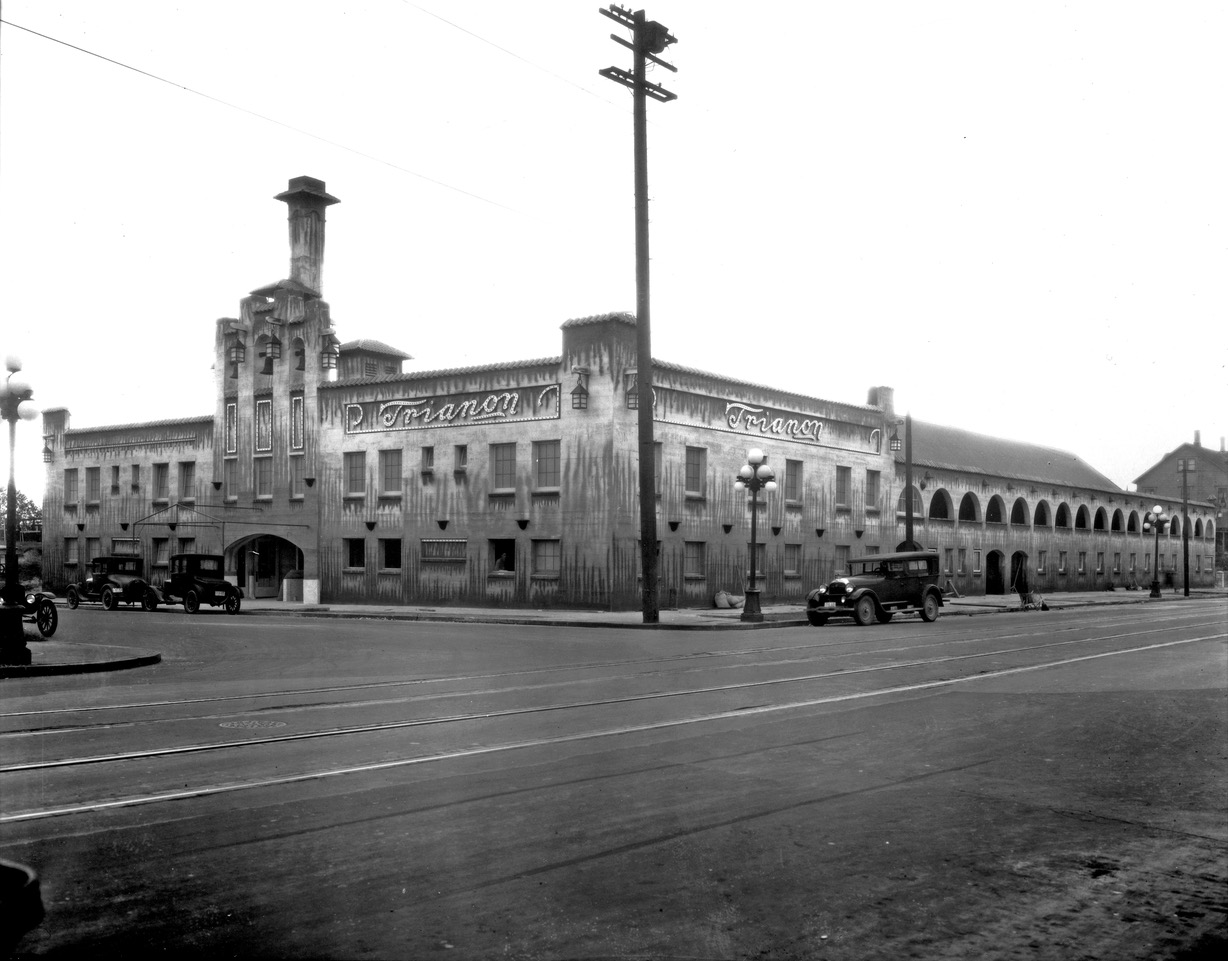


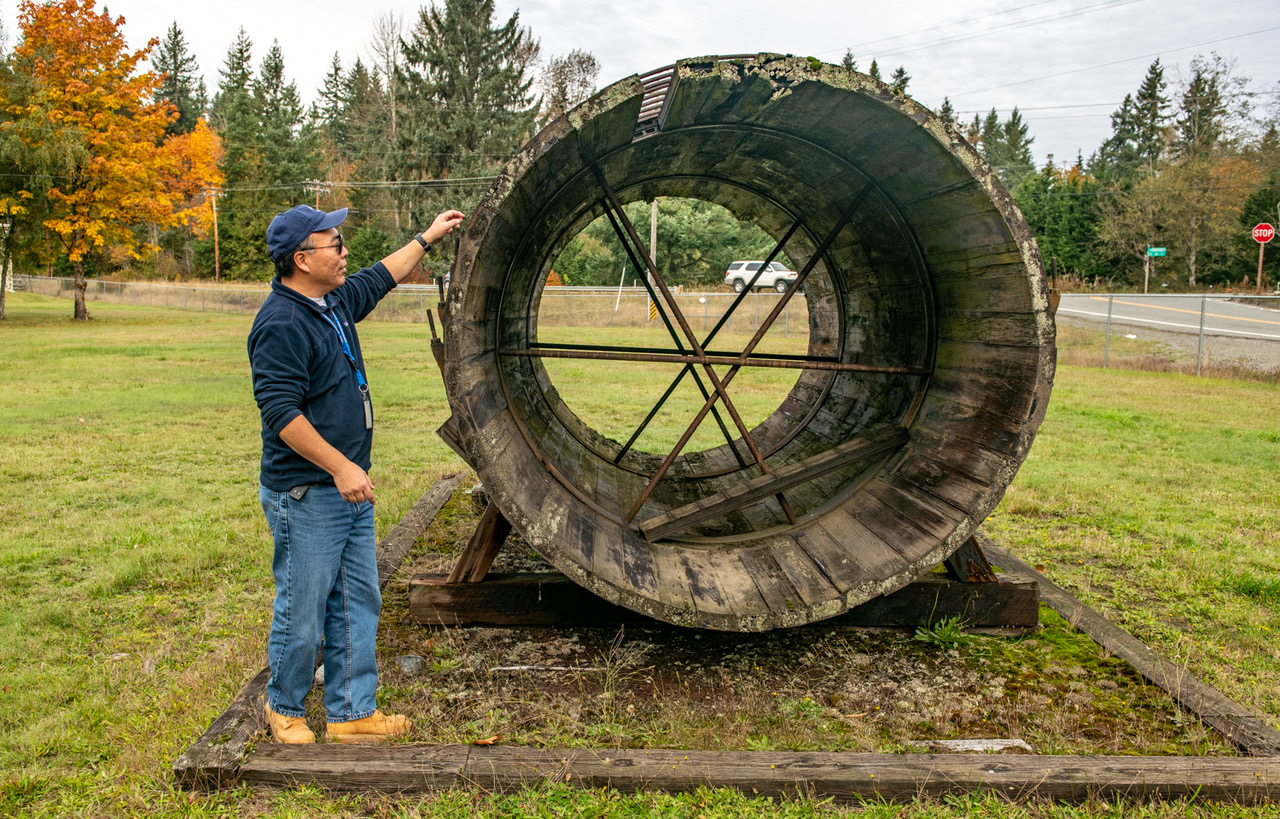
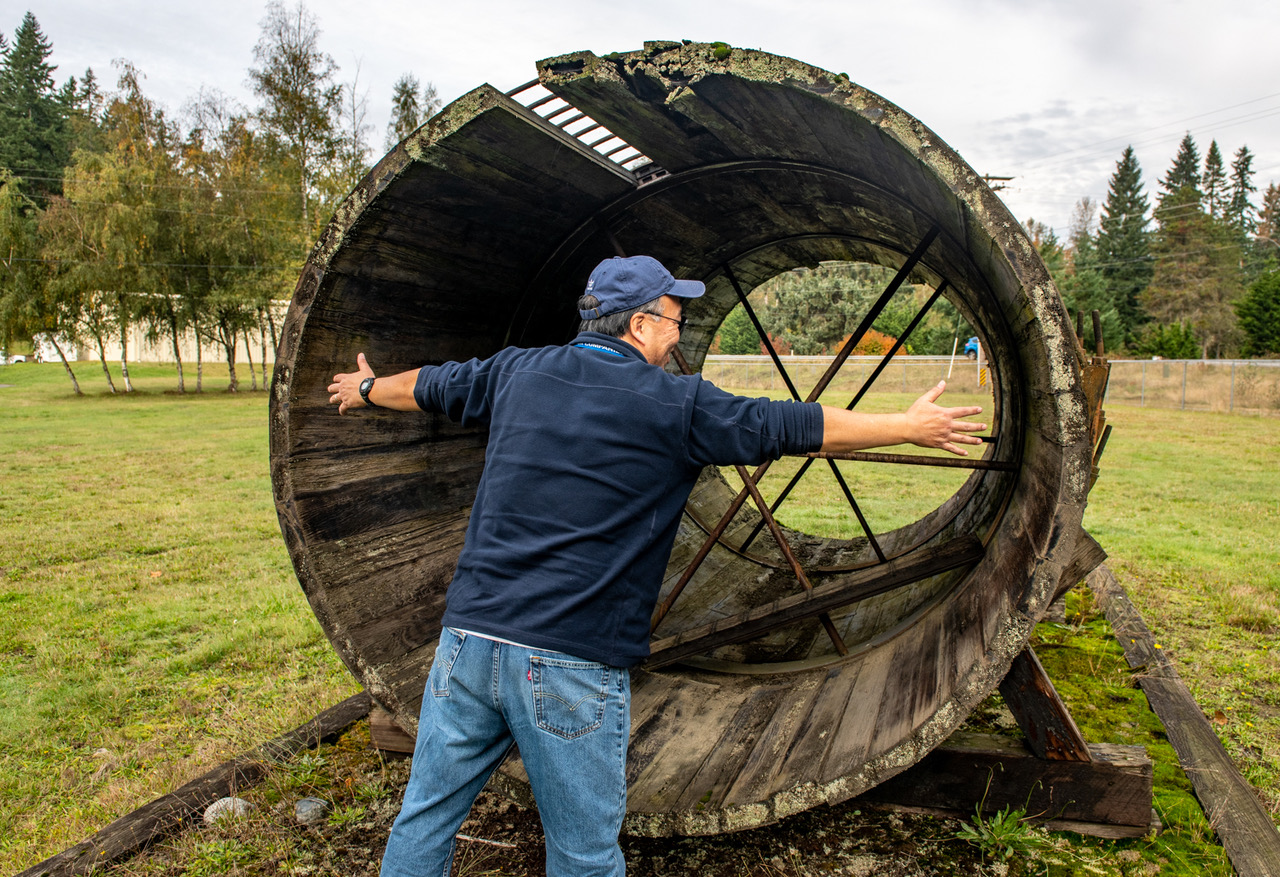
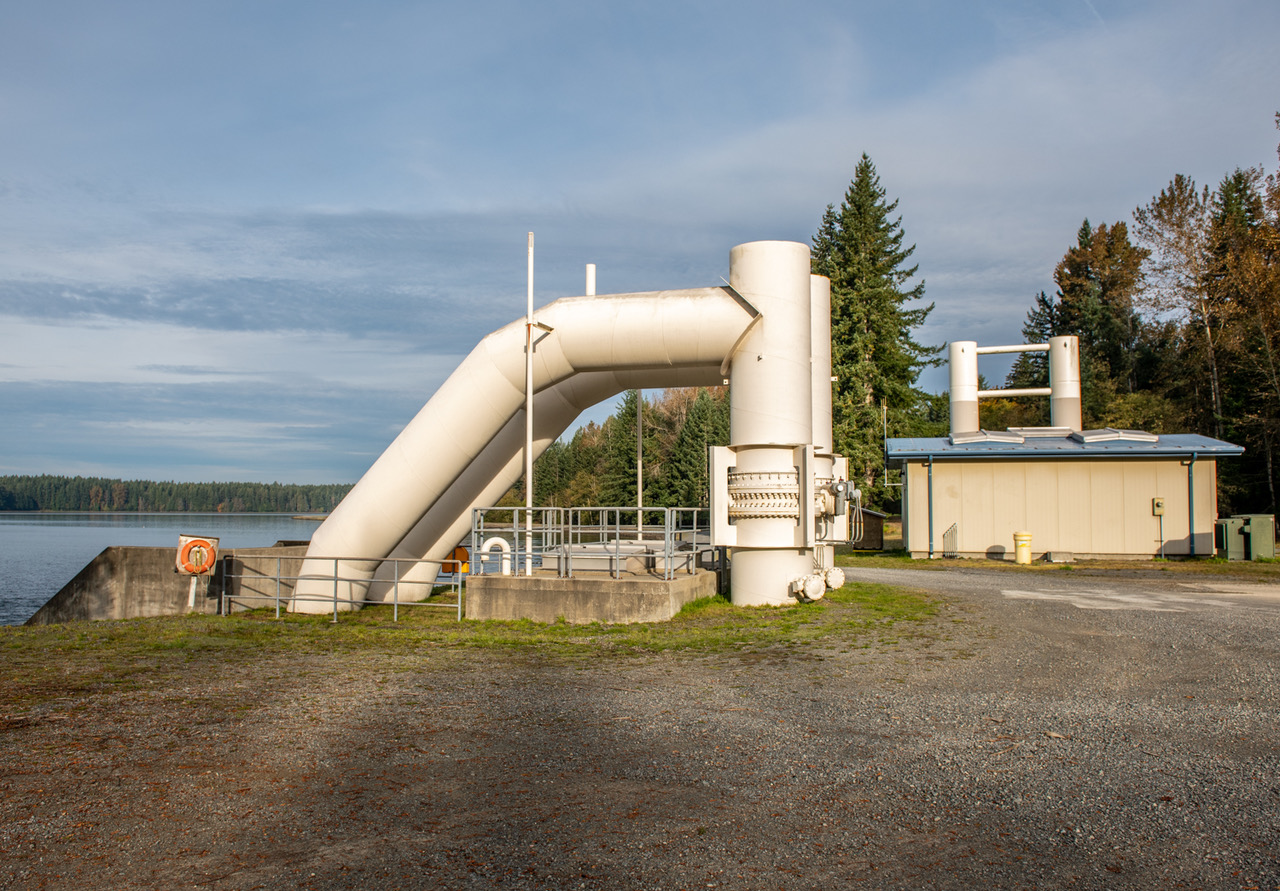

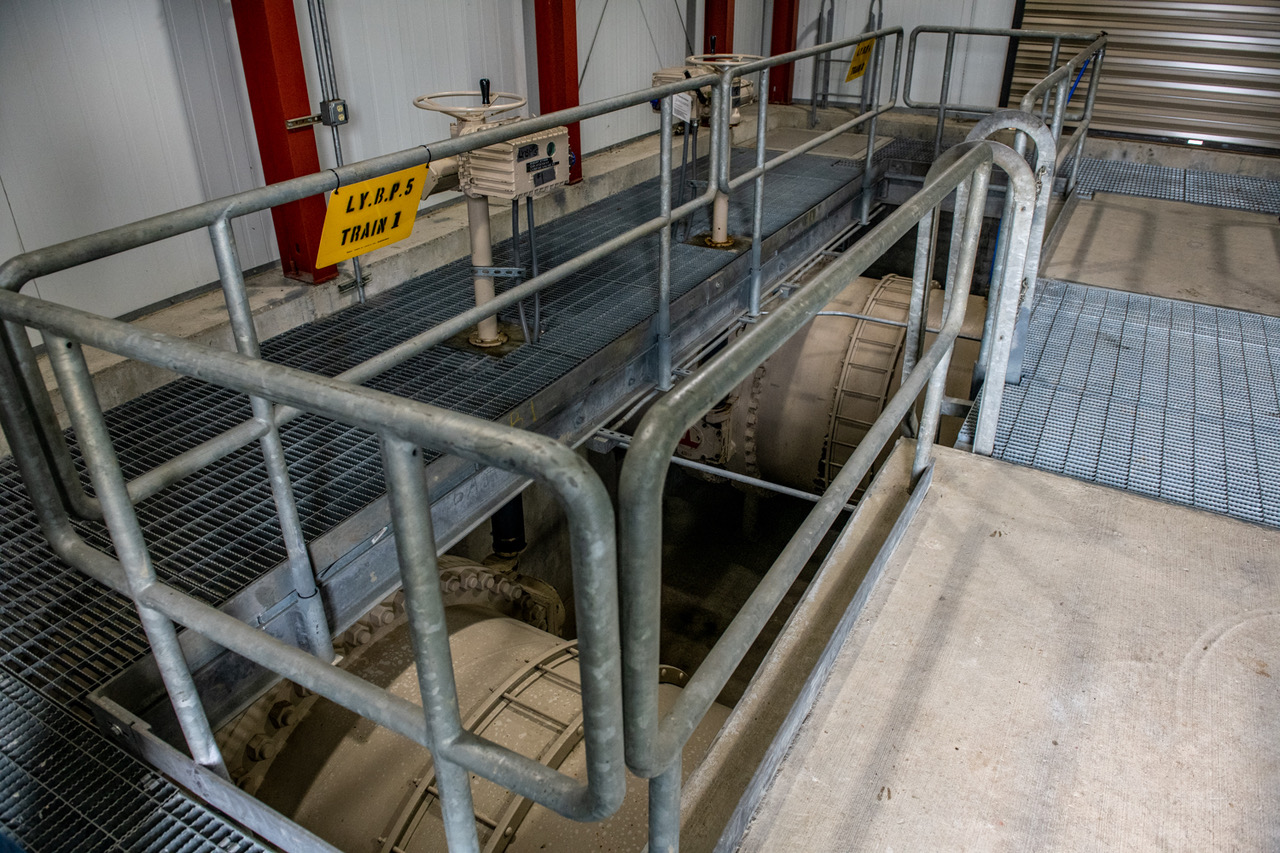
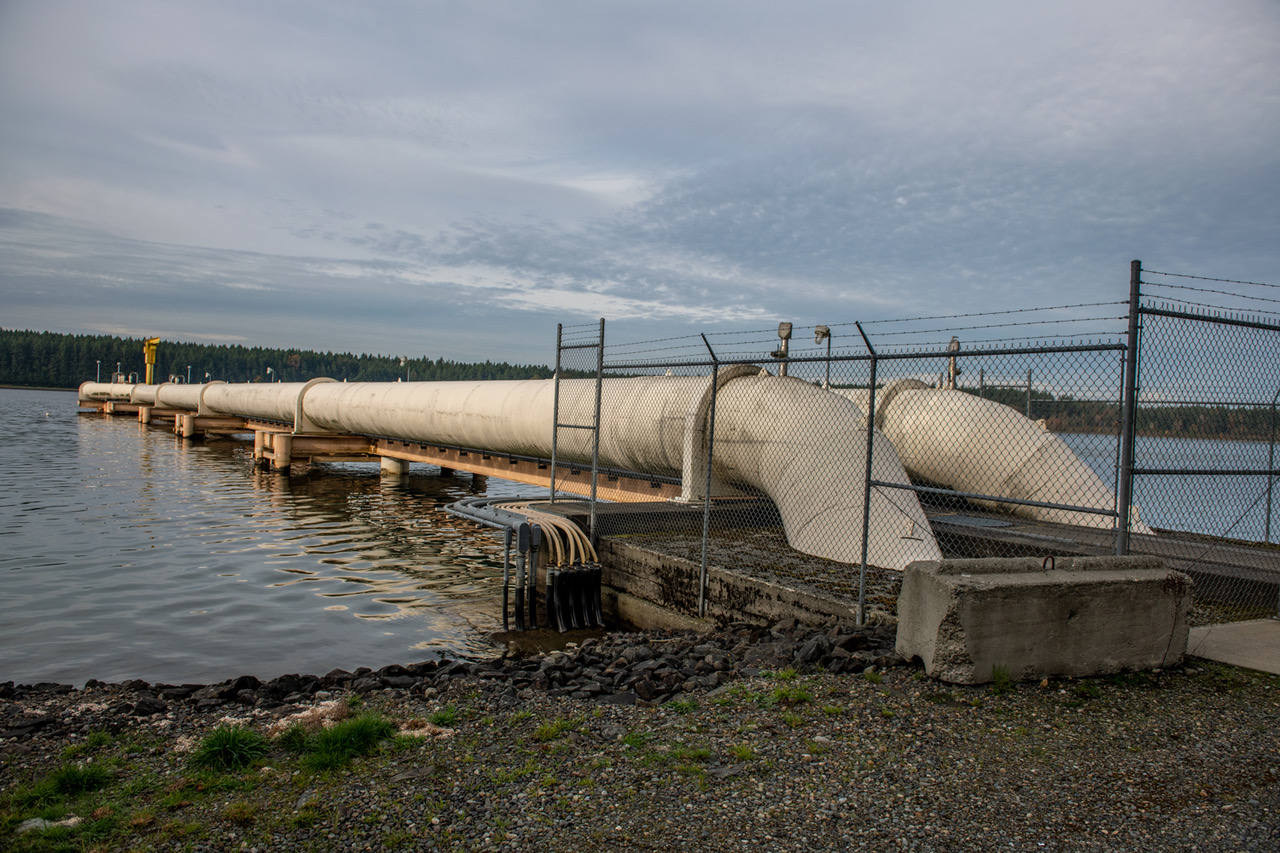


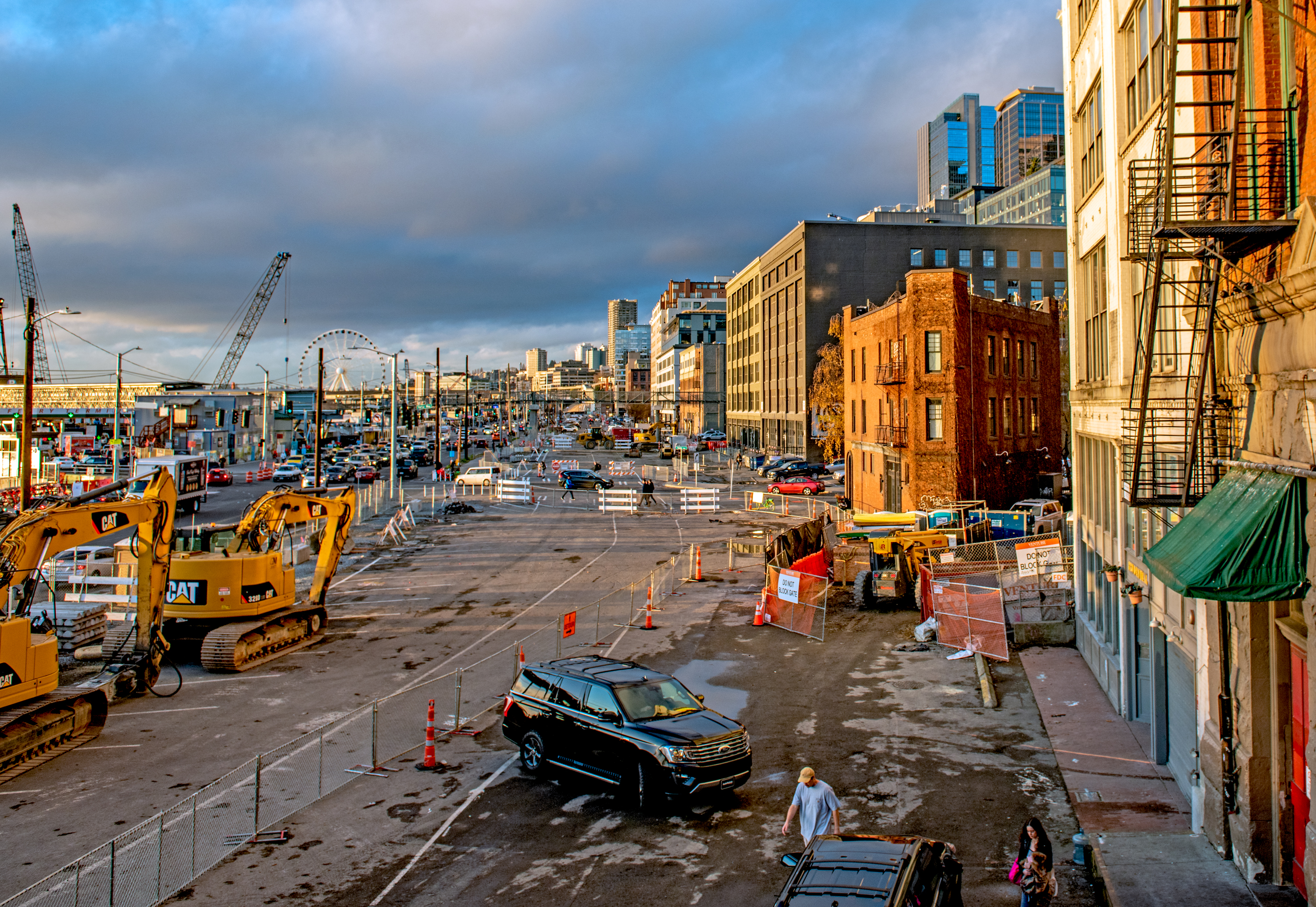


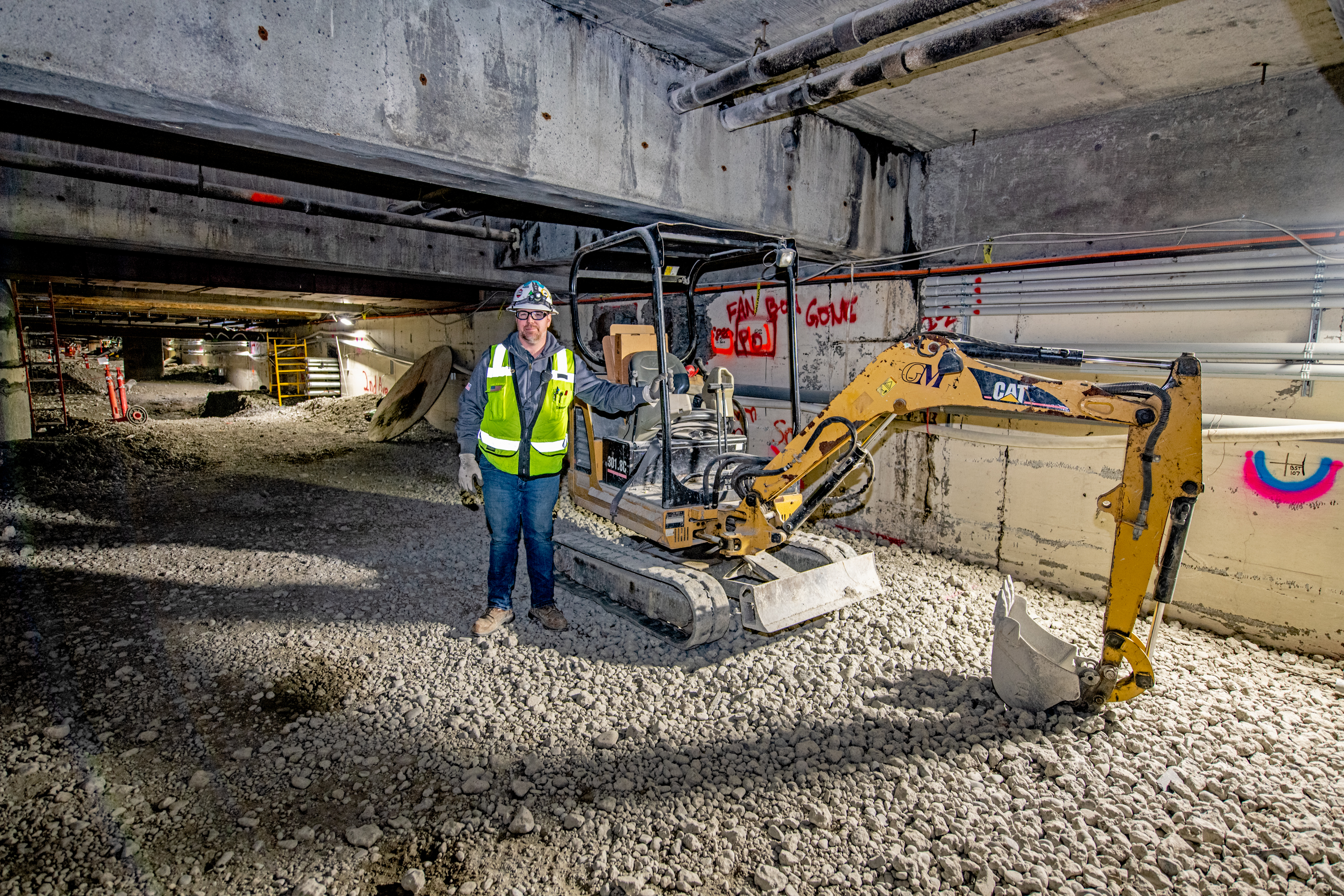




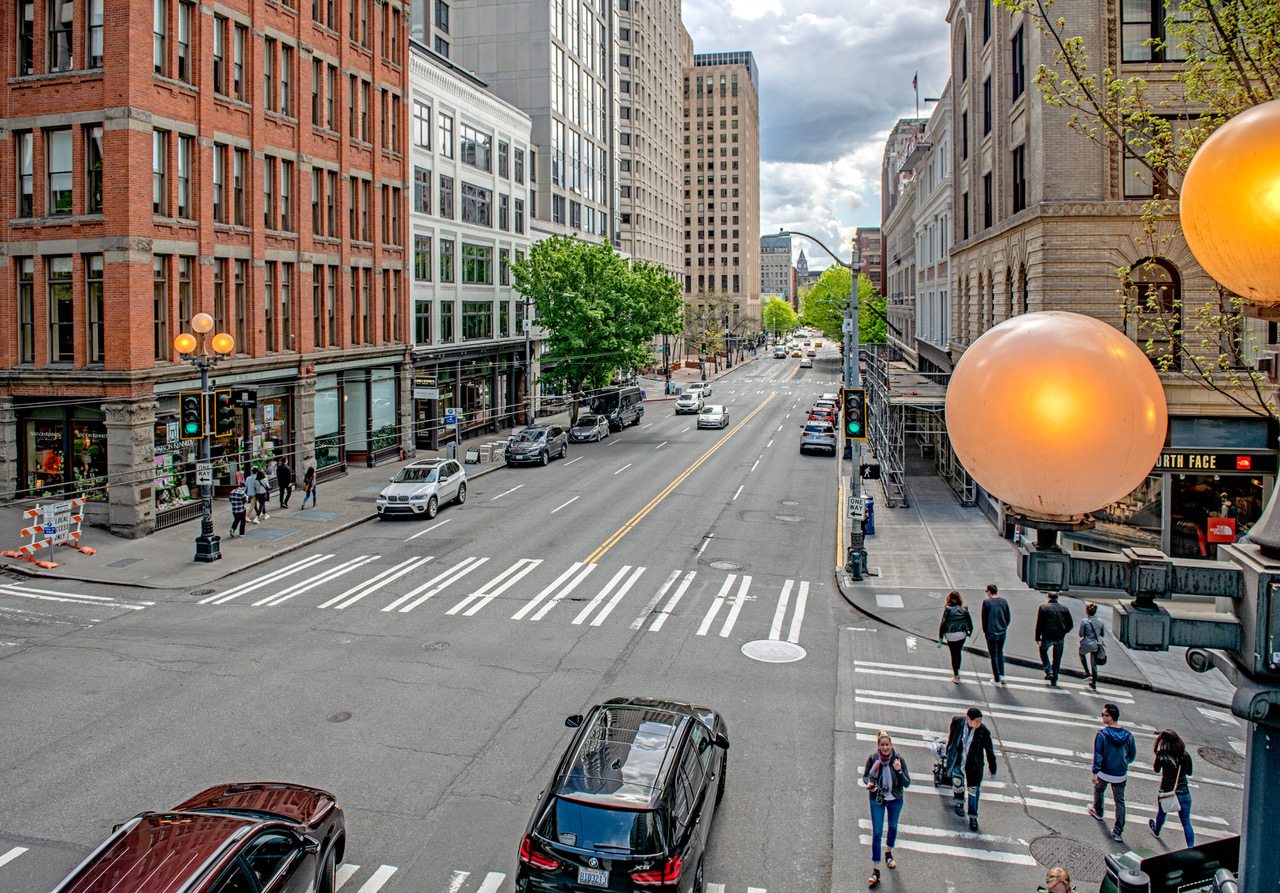


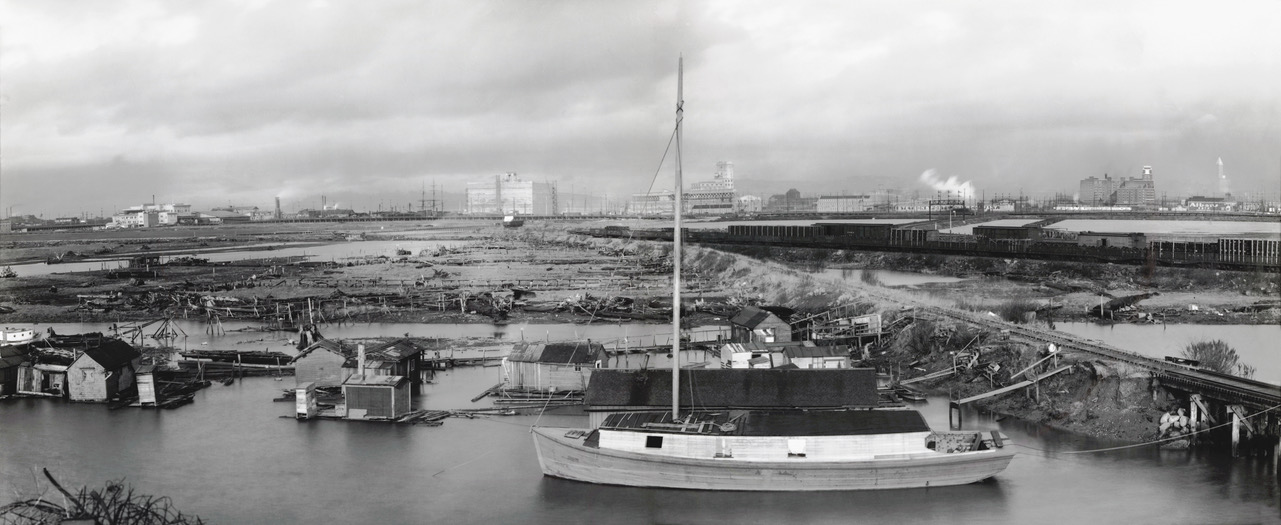


 =====
=====


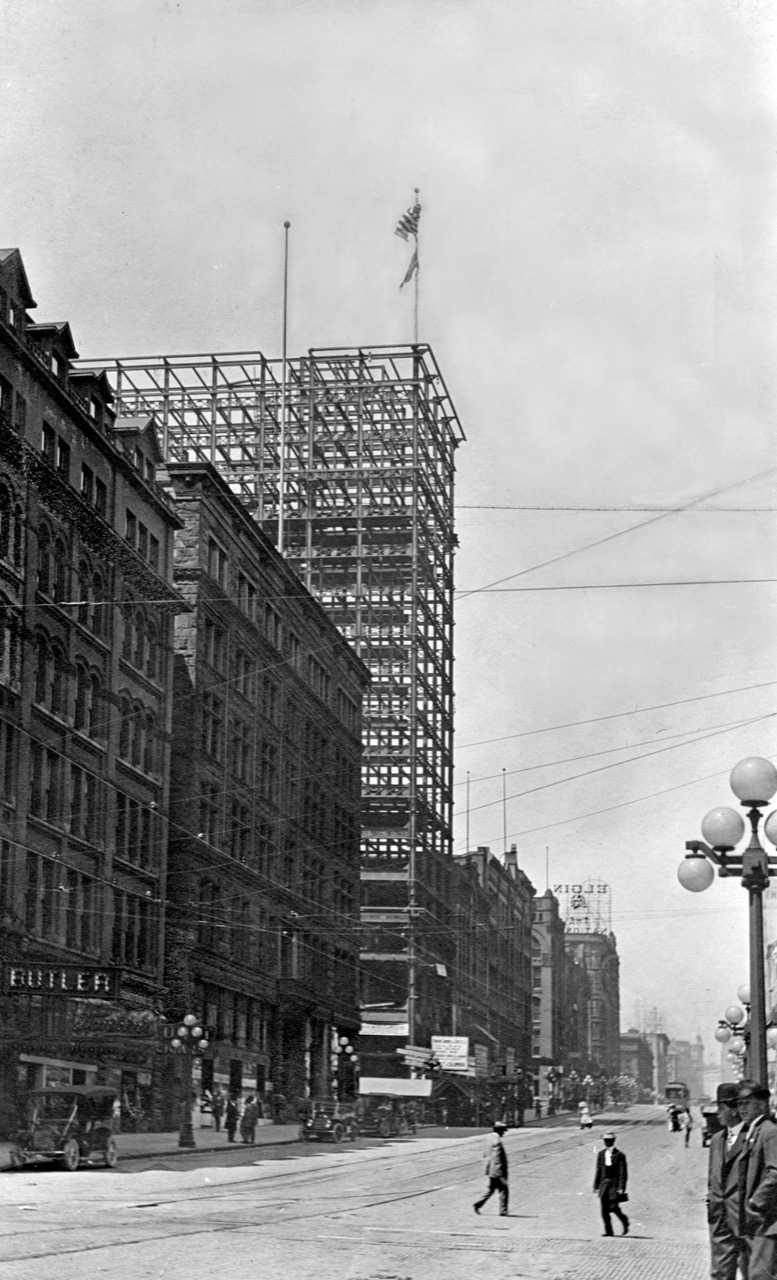
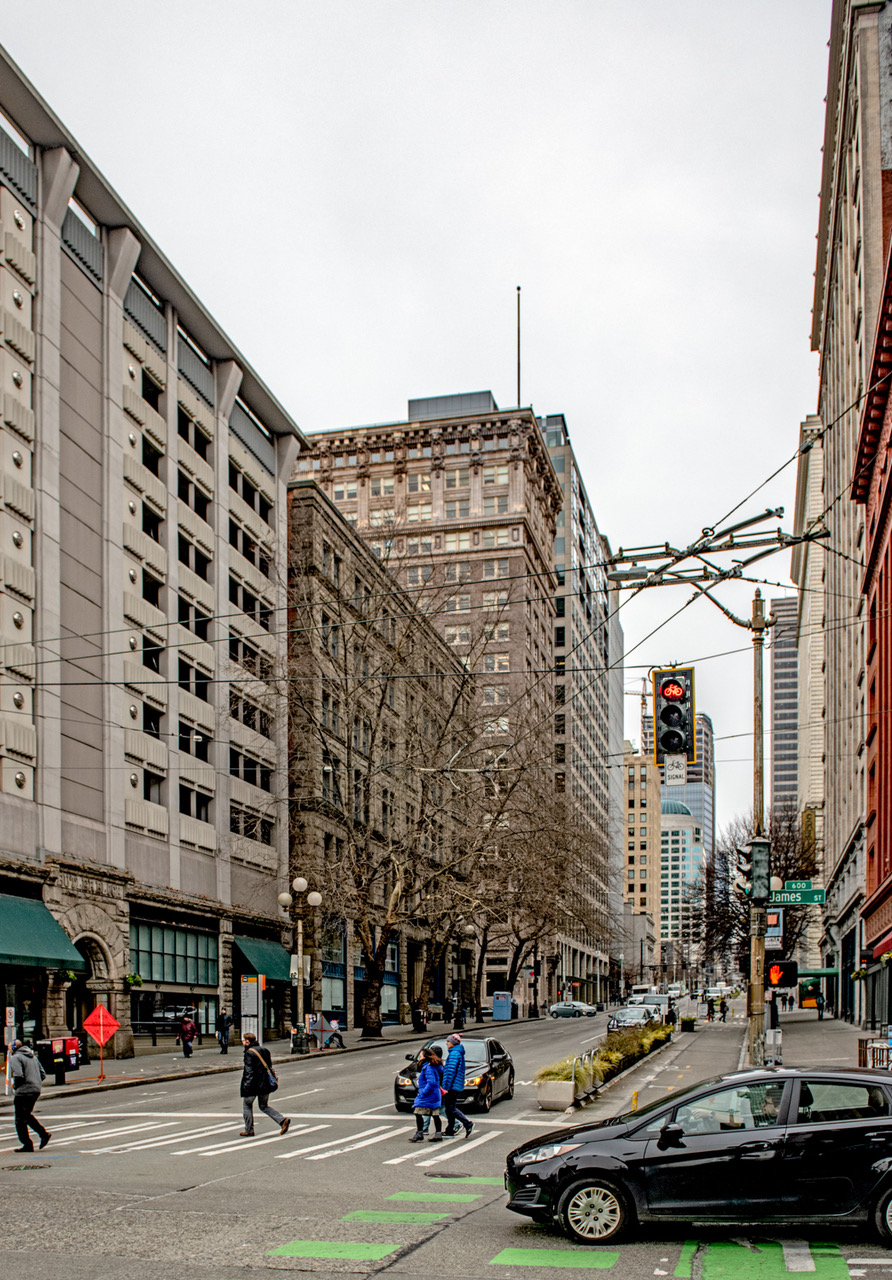


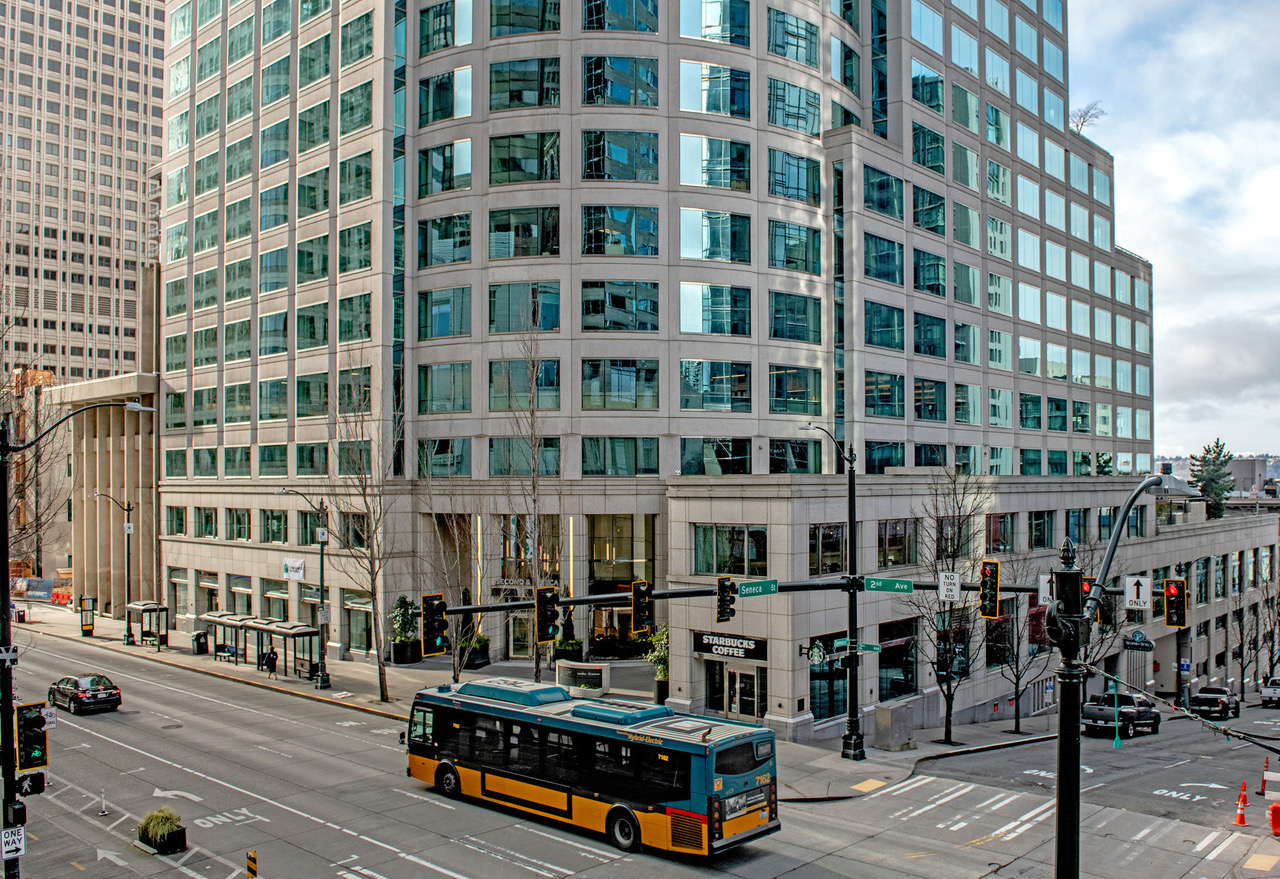


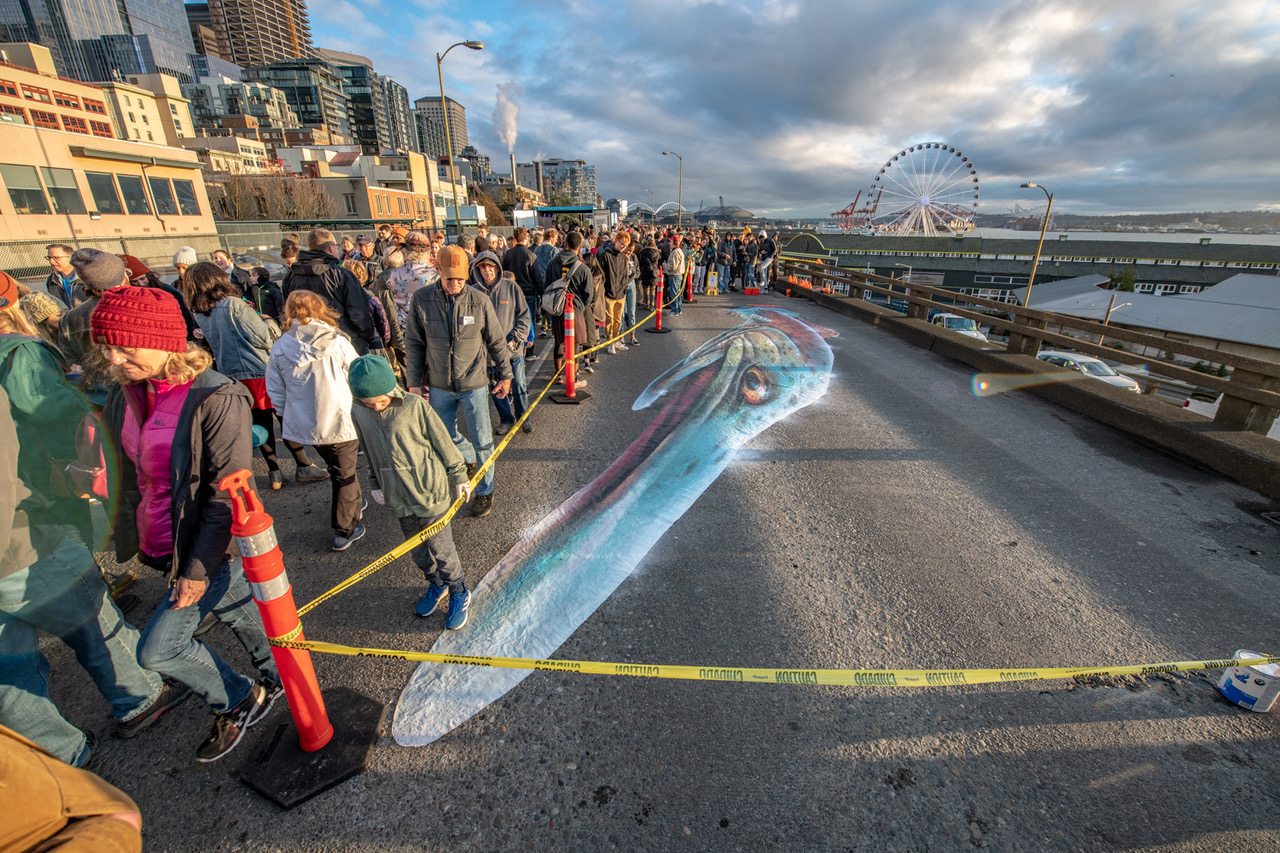


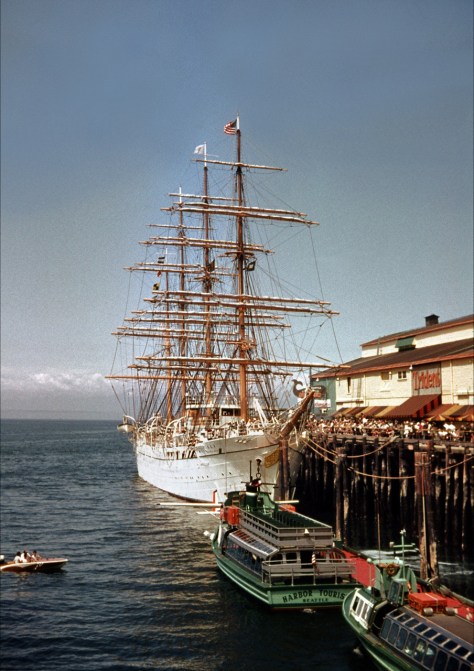

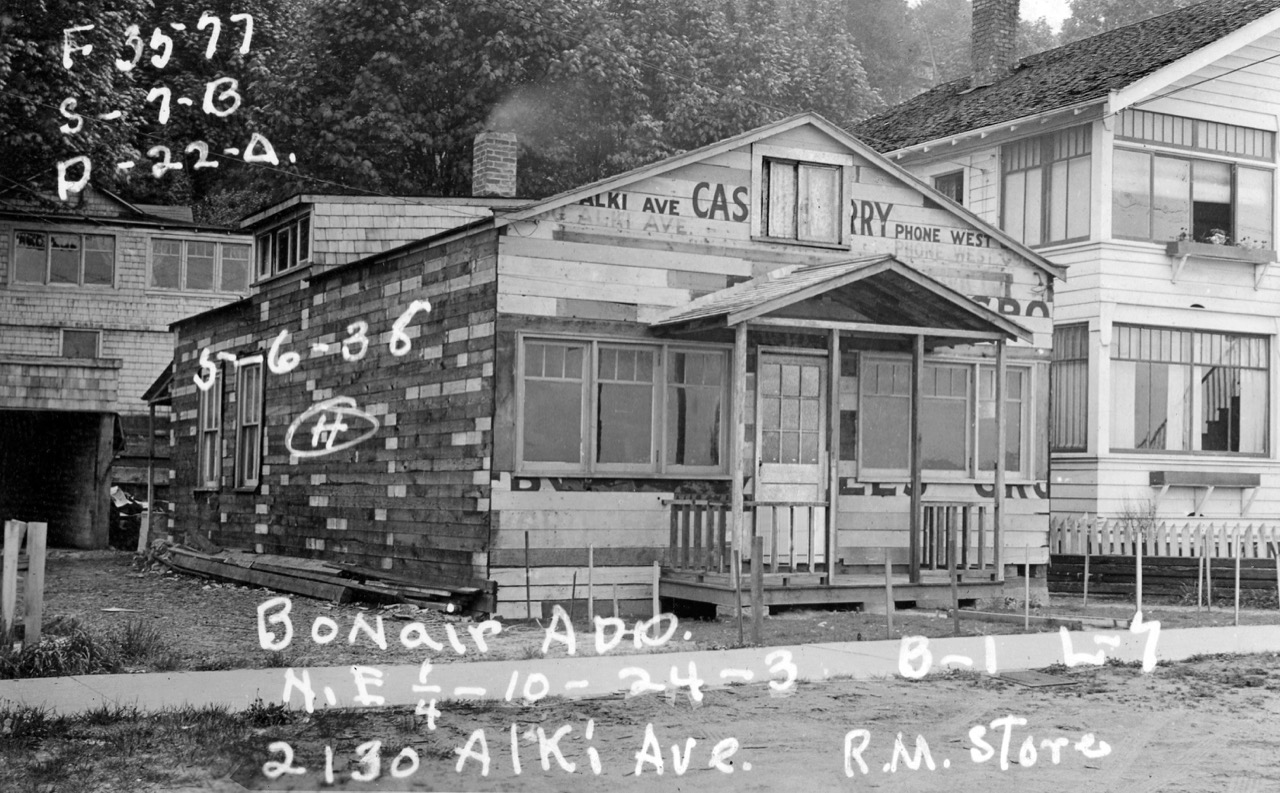


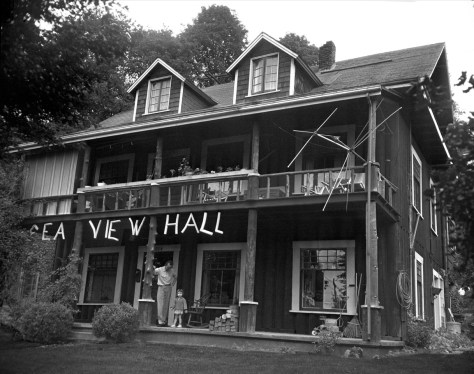


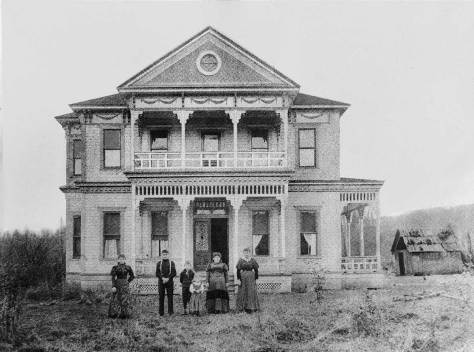


 ======


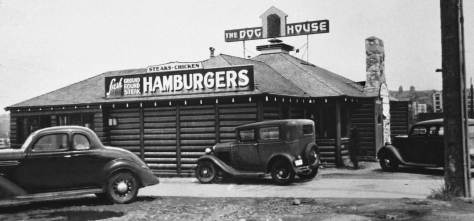


![THEN: From boxcars and rooftops to the planks of Railroad Avenue, excitement builds for the ceremonial re-enactment of the S.S.Portland’s 1897 landing with its “ton of gold” on the Seattle waterfront, the city’s first Golden Potlatch Celebration. [Courtesy, Michael Maslan]](https://i1.wp.com/pauldorpat.com/wp-content/uploads/2015/07/potlatch-watch-above-railroad-ave-now-mr.jpg?resize=474%2C365&ssl=1)


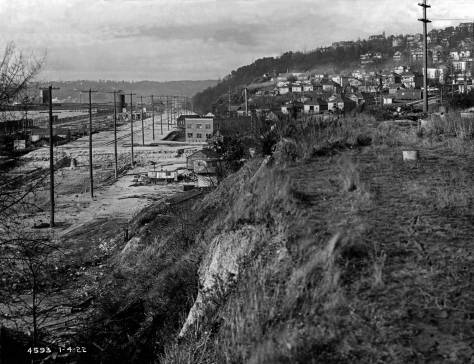


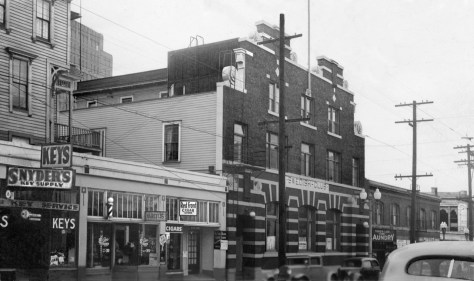








![THEN: Looking north-northeast from a low knoll at the southwest corner of Seneca Street and Seventh Avenue, circa 1916. By 1925, a commercial automobile garage filled the vacant lot in the foreground. [Courtesy, Ron Edge]](https://i2.wp.com/pauldorpat.com/wp-content/uploads/2014/11/seneca-7th-mr-then.jpg?resize=474%2C353&ssl=1)