(Click TWICE to Enlarge) There are – we know – many examples of Sykes’ landscapes in which he includes a road among his subjects. We could, by now, make a calendar of these road recordings. In many of them the road is cast as the primary subject extending through a landscape that is more or less cleared of other landmarks. Here a nearly red bi-way cuts between low swells in a green farmland while heading for a lone tree that stands most satisfyingly on the horizon. The delicacy of that tree is repeated in the clouds. That, again, we don’t know where we are is not upsetting.
[NOTICE: We changed our “server” to a speedier one today and seem in the process to have lost the picture for this “Farm Life” Sykes #314. My attempts to load it again failed under an “error” message. Until this can be solved there will be no more Daily Sykes’ Palliatives.]
Goats above and goats below is back. But perhaps only temporarily. Time for a small rant. We "upgraded" our server for greater speed and memory. Thereafter, the blog was promptly shut down by the new server, as too busy. The source of this volume was described as our own "line" (I don't know the technical name), which we know was not even in use during the "offending" or taxing time. The new server, we should add, is actually the same old server we started with three years ago or so and managed to work with fine until surprises - shutdowns - started about three months ago. These shutdowns remain mystified. The company cannot explain them. But they can suggest solutions to problems that did not exist earlier. Pay more. So we did, and to the result just noted: a total shut down accompanied by a suggestion that we pay still more. This is rather like a protection racket - it seems. "It seems" because no one on the "serving" end of this drama can explain it. We know the useful role of mystification in politics. Given the fumbling of the servers representatives (except for the sales persons) we find it hard to imagine that this is a strategy. Nevertheless it works as one. We are paying more. And are now asked to still pay more. This ends this rant - without satisfaction. Still we are thankful for small pleasures. We have goats above and goats below.
(Click TWICE to Approach the Horns) Horace Sykes’ rare witness to the ups and downs of farm life.
(As readers may have noted, our blog is undergoing significant technical difficulties. This old post from 2011 is showing up without identifiable cause.
Until we figure out what’s wrong, please click on the category Seattle Now & Then. That should forward you to the latest blog post.
Thanks so much for your patience and understanding.)
Paul Dorpat, Bérangère Lomont, Jean Sherrard
This Friday, readers of this blog are invited to join Paul, Jean, and Bérangère for the preview party at their Mohai exhibit: ‘Now & Then‘. This exhibit explores the history of repeat photography through dozens of repeats of Paris (including the very first photographic image of a human being, taken by Daguerre), Seattle, and Washington state. Wallingford is also featured with 30 time lapse examples (45 minutes running time) constructed from Paul’s 3-plus years of daily walks through the neighborhood in which he resides. This is raw stuff but often enough thrilling – to Paul and also to Ron who helped so much in assembling it. Please do come if you can.
Join us at the Museum of History and Industry this coming Friday between 5 and 7 PM. Wine and treats in abundance.
Typically split from Cedar logs (or Chestnut until the blight decimated them) the zig-zagg split-rail fence is a sign of both abundant timber and land. Except for the tools needed in the splitting, these fences do not require much else. The pattern supports itself without fasteners like nails or bolts or wire – although when available these may be used for reinforcement. I remember when country hikes might come upon such comely barriers. Zig-zag fences may also be easily moved, and in a fuel emergency cut up for firewood.
“Beacon in Storm” is Horace Sykes’ title for this successful example of Light House photography, a genre that is about as popular for the maritime as sad clowns are for big tops. Sykes made several tries at posing the Cape Disappointment Light before he came away with this Kodachrome. Cape Disappointment, 192 feet above mean tide, was first lit in the fall of 1856. Its neighbor 2 miles to the northwest, North Head light was commissioned in 1898 during the military boon period connected with the Spanish-American War. The building of the “security state” never stopped but continued thereafter as the USA assumed the role of policemen of the world. But the two lights are most peaceful and inviting friends for those sailing in these peculiarly treacherous waters between the Columbia River Bar and (for those off-shore) the nearly hidden Long Beach peninsula. Together, the bar and the peninsula make the “Graveyard of the Pacific.” (Click your Mouse to Enlarge Sykes Slide)
Jean took this pan of the North Head light when we preparing “Washington Then and Now.”
This reminds me of a Sahara scene where the advancing dunes creeping south towards Timbuktu cannot be resisted, rolling over mosques and oasisses alike. This looming hill, however, is topped with fertile loam, which both catches what rain falls while also letting it move through the elephantine hill’s share of the gritty nutritious mix of clay, sand, and silt that covers much of the Palouse wheat land. While Horace, again, gives no peep on where we will find this setting, we may thank him for recording it. Perhaps the single grazing horse near the horizon and to the right of the well-rutted road climbing the hill and the center of the subject also got his attention. (Click to Enlarge)
THEN: Ambrose Kiehl, the engineer who first surveyed and laid out Fort Lawton, survey’s the fort from the helpful prospect of a tall cedar stump. Behind him is the inlet between Shilshole and Salmon bays, circa 1898. (Photo courtesy University of Washington Libraries, Special Collections.)NOW: Jean Sherrard photographed his repeat from the second floor of Monty West’s home on West Commodore Way. Before it was hauled away Monty’s stump was behind Jean in the back yard, up the hill and near the family swimming pool.
This Sunday afternoon, March 10, the Magnolia Historical Society celebrates its tenth anniversary with what it expects to be an “entertaining and informative” open meeting. Those who attend will reflect together on Magnolia’s history, sharing a heritage that includes this tall landmark stump.
Monica Wooton, the society’s engaging leader, professes that this record of engineer Ambrose Kiehl surveying Ft. Lawton from this unique prospect is her “favorite photograph” among the large collection of Kiehl’s negatives,
Society member Monty Holmes is confident that Kiehl’s sawyer-made platform was once his. The alert 82-year old Magnolian was born and raised on the Magnolia side of the Chittenden Locks. During the Great Depression, for ten cents a bottle young Monty sold fresh milk got from the family’s cows to the WPA (Works Progress Administration) workers who with shovels and wheelbarrows made a graded West Commodore Way out of what the locals still often chose to call West Cow Manure Way.
In 1984 Holmes moved to his new home on West Commodore and the tall charred cedar stump that came with it. Seeing this scene published last fall in the historical society’s quarterly gave Holmes his eureka! moment. “Here I am overlooking the Shilshole Bay inlet and that stump struck me as the same!” Holmes explained that in the end his stump was a mere “thread of itself held together by the net of Oregon Grape that covered it.”
Come if you can between 2 and 4 this afternoon to Our Lady of Fatima Parish at 3218 w. Barrett Street. It is in Magnolia’s verdant Pleasant Valley, which was once a green pasture for the neighborhood’s dairy farms. Monica will be there, of course, Monty will be there too, and Jean and I as well. Among other subjects we will be reviewing Monty’s stump story. He is quite confident about it all, but we still cannot resist the fun of a silly pun. We are, we confess, for the moment stumped by the stump.
Horace Sykes took at least three slides of this river boat by moonlight, and he titled two of them. One rambles “The River Boat. Yakima River. Yakima Camera Club, L9-5.” The code at the end may have related to its place in a club exhibit. References to the Yakima Club come up in the Sykes collection a few times, but so far none to the Seattle Camera Club. One of the three impressions has no caption, and the other has it, “Nine Bells All Is Well.” Tomorrow as time allows I’ll attempt to name the boat. (Click TWICE to Enlarge)
Running low on Sykes I explored another box of his slides, one I’d not searched before. Inside were a few slides grouped by subjects and captioned – minimally. For these subjects we have already seen slides “without words” in Our Daily Sykes. There was a grouping for “Snake River,” another with many close-ups of flowers and a third of sunsets, of which the above was one. It is that rare photograph of a sunset that breaks the commonplace of the sinking sun sensations with a very satisfying composition and what editors and ad-agents like to call “human interest” too. But where is it? Again, Horace does not tell us. However, after “reading” the horizon I remembered it from a Washington State real photo postcard we used in our book “Washington Then and Now.” With the help of Google Earth I think I figured out within a few feet from where Horace took this sunset sometime in the 1940s. However, I’m not telling. Rather I’ll include a good clue below – another display of the same horizon and in full daylight. So where is it? (Click TWICE to Enlarge)
We know that Horace Sykes was not always sizing up the picturesque in nature, but sometimes taking grotesque breaks too. This sturdy little tree in the mid-ground holds its own against the river and our habit of consuming Sykes either for the picturesque or the sensational parts of his Kodachrome slides. Here it seem Horace takes hold of this subject for its irony and brave good humor.
One more of those rare Sykes subjects that are titled in Syke's hand on the cardboard cover of his Kodachrome. It reads in a lower corner "Clouds at Sunrise H. Sykes #4." A different number written in a higher corner has been blotted out. The slide is also accompanied by another sunset subject that is also given a low number, which suggest that Horace Sykes was creating a collection of such. (Click to Enlarge)
The garden lover Horace turns his lens to a gilded Venus attended by her two sons Eros and Enteros. The original may be caste or it may be painted plaster. When I was still visiting garage sales looking for forsaken art I would often come upon such stuff, although never this size.
Syke's original slide of this subject was underexposed. A scan of it pumped with Photoshop steroids has it looking like a black and white soft focus photograph hand colored with Marshall Oil paints - the kind we purchased legally over the counter in art stores without written notes from either our parents or teachers. I never had the knack for it neither did I compensate by learning the hang of it all. Especially the trees in the foreground look painted. The mountains seem asleep in dreams of mountains. There may be snow there but it has all gone light blue squeezed from a Marshall tube, or so it seems. The colors and the subject also remind me of the paper place mats given in the 1950s to those who filled their tanks at Chevron service stations. My dad - and many others - collected them.
THEN: After twenty years of debate about whether to build it and where and how, the first bridge across Lake Washington took 18 months and a few days from ground breaking to accepting its first tolls from drivers happy for the short cut. (Photo courtesy Washington State Archive.)NOW: For his repeat, Jean Sherrard got within a few feet of the original prospect (now hidden behind bushes) taken by a Port of Seattle photographer at the bridge’s dedication.
Three thousand men got depression-time jobs building the Lacey V. Murrow Bridge – aka the Lake Washington Floating Bridge. Forty-five percent was paid with a federal public works grant and the rest by revenue bonds secured by the 25-cent tolls. The bridge was formally dedicated and opened in the early afternoon – judging by the shadows – of a sunlit July 2, 1940.
About 2000 people watched from the tunnel plaza area here on the bridge’s Seattle side and hundreds more gathered around the toll booths at the bridge’s Mercer Island end. Broadcast by radio nation-wide, the floating bridge was christened like a ship. After cutting the red ribbon, Kate Stevens Bates, daughter of Washington Territory’s first governor, Isaac Stevens, let swing and crash against the concrete bridge a yellow urn in which were mixed the waters of fifty-eight of the state’s waterways: lakes, bays and rivers.
With a smile about as wide, turned up and fixed as the grill work of his inaugural chariot, an open 1940 Lincoln Convertible, the state’s Governor Clarence Martin rode twice across the new bridge. At half way Martin was the first to pay a toll.
We could compare the public effort required to build “the largest floating structure in the world” with our recent struggle to replace the feeble Alaska Way Viaduct with a deep bore tunnel, except that it would take too long. Instead, we suggest that readers consult Genevieve McCoy’s fine chapter on the state’s bridges that is part our book “Building Washington.” You can read it for free on the blog noted here below.
One more toot – an announcement. This “now-then” comparison is one of about 100 such selected for an exhibit of “repeat photography” opening Saturday, April 9th, at the Museum of History and Industry. Most of the exhibit’s Seattle examples were first published here in Pacific. But the exhibit – most likely the last one for MOHAI in its old Montlake quarters – also includes examples from Washington State and even from Paris, the birthplace of photography.
Let me coyly answer my own question. I know Paul has some treats hidden away; including one of my favorites: a delightful photo of grinning then-governor Clarence Martin, as described above. For that and much more, click on ‘Web Extras’….
[Click to Enlarge] This may be our fourth or fifth visit with Horace Sykes to the top of Steptoe Butte. The view is to the south and, I believe, a little to the east too. Sykes’ decision to include a horizon of the hill as well as the quilt of Palouse wheat fields below it is typical of his often displayed urge to when shooting something far off to also include something nearby. And here the lift of that upstanding cloud plays parallel to the rise in the butte’s horizon. All is right with the world and heaven above.
[Click to Enlarge] Completed in 1922 the “Yellowstone Trail” bridge between Pasco and Kennewick was the first of four cantilever trusses to be erected across the Columbia River during the 1920s. The ferry it replaced could not handle more than six cars a trip, a paucity that kept the twin cities distant. (There was no Richland as yet to make it the Tri-Cities.) A public subscription drive subsidized the construction, and on the day of its dedication people were as likely to break into song as to breath. The bridge became a symbol of that rarity in Washington, a statewide cooperation. The Seattle Times called the subscription effort the “greatest community undertaking in the history of the Northwest.” Soon about 200 motorists a day were paying the steep, for the times, 75-cent toll. Here I have fallen into quoting myself. This bridge’s story and many others across the state can be read for free by you on this blog in the issuing here of the book “Building Washington” that Genevieve McCoy and I wrote in the late 1980s. Go to the front page books button and find the cover of the book upper left. Click and wait about five minutes for the big book to download. If you are looking for this bridge you’ll find it on pages 112 and 113. “Building Washington” is well illustrated.
Most likely this is another of Horace Sykes looks into the Palouse with the Blue Mountains of southeast Washington or those of Idaho on the horizon. Some strange light is working here. A bolt of sunlight has streaked those distant hills, and not the mountains above them. Or perhaps only a band of snow has dropped onto these hills. We may expect that of rain – but of snow? (Click to Enlarge)
Included in the Sykes collection are a number of slides of paintings. Most were photographed from the originals. This one may be a copy of a copy. If I have read the signature correctly, the artist was Alice C. Holland, and the date 1949. I had no luck finding her on the net but I did only the most basic of searches, which is by now often enough. The painting shows considerable skill. I also searched for portraits of Franz Schubert but did not find this one. Still it seems like this likeness was adapted from one of the most oft reproduce portraits of Schubert. Busts for many admired composers were often purchased for setting on the family’s piano. I have one of Bach on mine. I am pleased with Horace that he would care so for this composer who although he died young was still prolific and the most lyric of the romantics. Both his songs and sonatas will reward a lifetime of listening, and his symphonies are at once inventive and restrained. Some of his arranging for brass has riffs that sounded like jazz – sort of. We may now imagine Horace Sykes listening to Schubert serenades in his sun room with his orchids
This is another certainly Sykesian set. As such - and at 300 and climbing - I wonder if perhaps we included this earlier in our series of Daily Sykes. We have seen a few other vacant roads, mostly not paved, climbing directly to a horizon. (Click to Enlarge)
THEN: For more than half a century Lowman and Hanford was an active printing business in the Pioneer Square neighborhood. This view looks southeast through the intersection of First Avenue and Cherry Street, on the left, to the building row still standing along the eastern edge of Pioneer Place – or Square. (Courtesy Michael Cerelli)NOW: The Lowman Building at the southeast corner of Cherry and First was completed in 1906. It was recently remodeled inside for low and middle-income housing offering, the ads say, “all the charm of years gone by, updated with amenities for today.”
Aside from the pyramid tower that originally topped the Pioneer Building (Far right, it was pioneer Henry Yesler’s last contribution to Pioneer Place or Square), everything has survived between this “then” and this “now.” (As a precaution the tower was removed following the city’s 1949 earthquake.) The historical photo was recorded sometime between 1902 when the top three floors of the slender Lowman and Hanford Building – here covered with signs at the scene’s center – were added to it’s seventh story, and 1905 when the temporary wood structures at the southeast corner of First Ave. and Cherry Street were razed for the construction of the Lowman Building, the dominant structure in Jean’s Sherrard’s repeat. Here we will insert a front-on photograph also recorded sometime between 1902 and 1905.
The sensational part of the first of these two scenes is surely that signage, all of it promoting the principal commercial interests of James Lowman and Clarence Hanford. The former arrived at his older cousin Henry Yesler’s invitation in 1877 and was directly made the assistance manager of Yesler’s Wharf. Within the decade he was managing Yesler’s affairs while also in business with pioneer Clarence Hanford running a joined job printing shop and stationary store that also sold books, pianos and such.
Plastering or painting the side of a brick building with signs is, of course, easier when there are no – or few – windows. Clearly, when he added floors to his and his partner’s business address next door, James Lowman had his taller namesake building envisioned for the corner. The signs would be short-lived and windows not needed.
(If you CLICK the “web extras” immediately below you will have opened to you four or five more historical features clustered around Cherry Street and supported with many more illustrations.)
Long ago while behaving like a student at the Claremont Graduate School east of Los angeles, but not yet out of the smog, I lived with four other students in a modern shack in the type of subdivision that was known then in L.A. as a Slurb: a combination of slum and suburb. The homes were new, poorly built and very much alike. I got a job from the slurblord to clean up homes that had been abandoned or foreclosed on. I was paid $75 a home, which was a happy sum in 1964.
The five of us liked our little shack because the rent was cheap split between us, and our dinner conversations were vigorous. We were all graduate students on the exercise machines of seminars and our meals together. Our home was up against a open concrete box drain that was there to carry any flood that Mt. Baldy might send out of its hills onto Claremont and Montclaire, its neighbor across the tracks and our “community.” It is fitting that the names of the two towns share the same letters but in a different order. Claremont was one of L.A.’s oldest suburbs with a grown landscape and large old homes, some of them Victorian. Montclaire was nearly new and made with no apparent or felt soul.
My room had a door to the side lawn nestled beside the canal that was guarded by a sturdy wire fence, which was hardly noticed. Lying on bed and looking west into the smog of Los angeles the sun set very much like Horace Sykes’ sun above, except that my setting sun was also seen through a screen of Eucalyptus trees on the far side of the canal. That combination was most serene and sponsored both day dreams and meditation. It was the sun of Tao during those sunsets, and the filter of smog was so effective that you could continue to look directly into the sun without harm. Depending on its layering the smog made its mark on the sun, and I sometimes squinted at it and imagined the globe resolving itself the balance of the yin and yang that was once best known as the Northern Pacific Railroad symbol.
I remember rain in that canal only once, our first week in L.A.. It rained seven inches in seven days, and set some record.
An old friend experienced with the lifts, downhills and mountains around Snoqualmie Pass called me and suggested that my description of Guys peak as resembling a “pile of sugar” in the winter was a poor analogy for Guys peak is in places – like those facing motorists and skiers at the lodge beside the highway – too steep to hold snow. In the worst and coldest of snowfalls it might resemble a sculpted scoop of Rocky Road Ice Cream but never a pile of pure sugar. We accept this admonishment and print below several looks at Guys Peak, all of them by the “postcard artist” Ellis and none of them showing Guys behaving like any shape of sugar. Guys, if you don’t already know, is the forward peak that resembles a pile of sugar, or would if it could hold on to it. (Thanks to Ellis collector John Cooper for sharing these scenes.) I will conclude the list with one by Jean, taken while we were working on the book Washington Then and Now. CLICK TWICE TO ENLARGE
My first hunch was that this was photographed from Guys Peak, that cross between a pyramid and a pile of sugar (during the winter) that rises abruptly over Snoqualmie Pass. But now I figure this view looks south and a little east from the southern slopes of Denny Mountain (and the then still future Alpental ski runs and lifts) over the Pass to Lake Keechelus.
This is another of Horace Sykes looks into the city and the waterfront during his and others pre-vehicular access to the viaduct in the spring of 1953. This one looks east on Yesler Way.
We return with Horace to the Grant Tetons to make a by now didactic point. This naturalist photographer could not leave it like we saw it with Our Daily Sykes #290 (printed again just below) with nothing growing in the foreground but also felt a pull no doubt to this beach flora and used it, like we have shown many times through now 296 of Sykes subjects, in a foreground given to those smaller – or small by comparison – growing things that were his other enduring interest or devotion. It is still morning in the Tetons but the mountains are not reflecting now on Jackson Lake. Hold on! It is silly if predictable that I gave a narrative to these two recordings, that I put the first one shown here first for Horace too. He might have just as well taken the top photo first and then chased the mountain reflections in the lake.
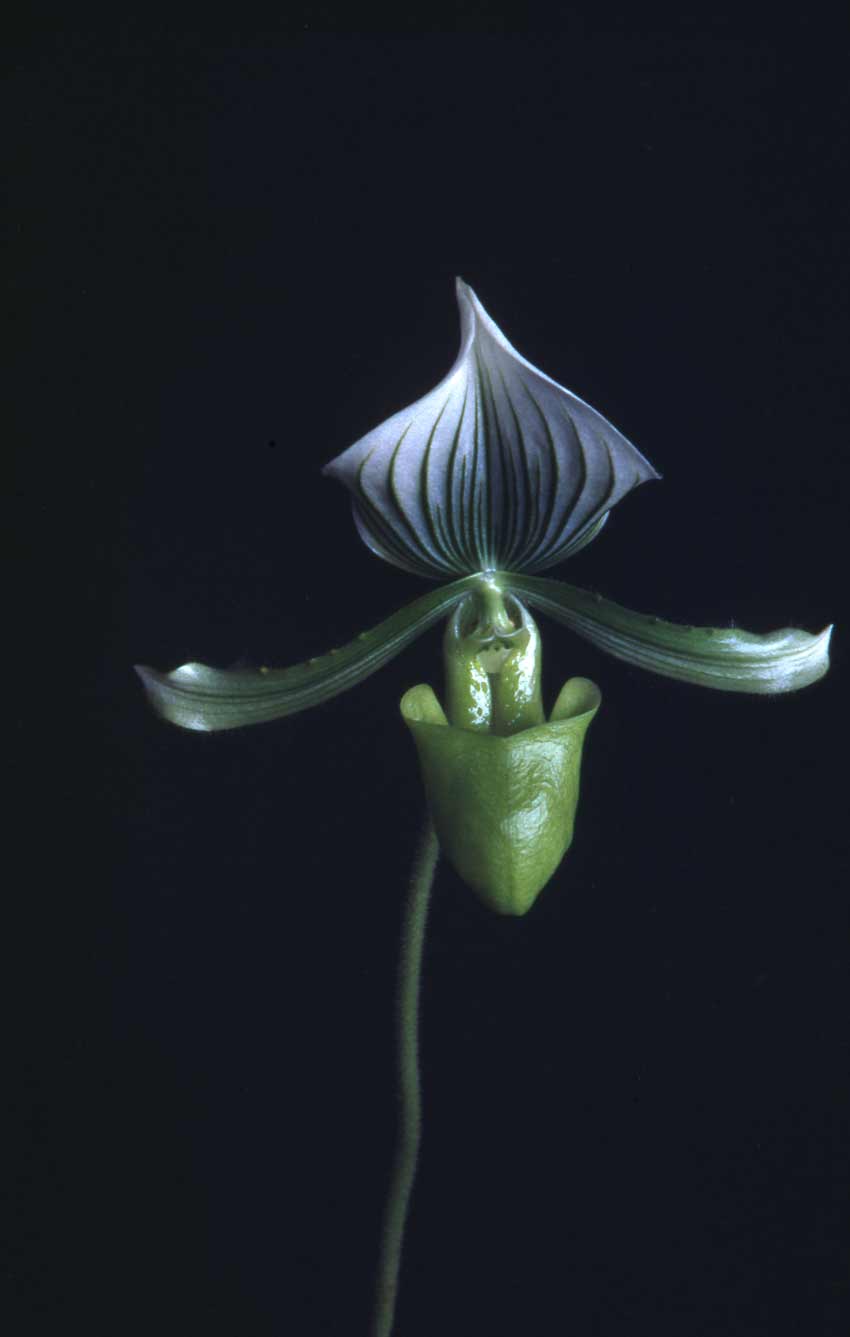
We will pause now for Horace Sykes orchids. Besides his talents for picturesque landscape Sykes loved the orchid and gave a lot of attention to growing, exhibiting and photographing them. We imagine that when he was off on his trips for adjusting insurance claims and shutter speeds that some part of him missed his happy times at home with his family and his orchids.
I confess to a small worry that this may be out of place; that is that it may not be a Sykes, although it is pulled from his collection. First, the photo is of a Seattle landmark, the Seattle Art Museum in Volunteer Park. Seattle subjects are rare for Sykes. But he did love art and so may have cherished its hometown temple. The slide is also dated August 17, 1943. Captioning for Sykes is rare, and dating almost never. Still the slide does show Syke’s sensitivity for framing his subject, and it even has its small singular oddity, which Sykes often finds in small plants and rocks. Here it is the orange trash container. Certainly Sykes did not pose it, but I think he would have liked it, whether he recorded it or not. It is that trash can that “makes” the picture. Everything springs to it and from it. Now try not to give it your attention.
THEN: Thankfully, the original photo for this early view of Madrona Park has its date, December 18, 1892 written on the back. (Photo Courtesy, Ron Edge)NOW: After the city took possession on Madrona Park in 1908 it removed the hotel shown in the historical photograph and later built the bathhouse showing here nearly on the same footprint as the bath house turned dance studio in the “now.” (Photo by Jean Sherrard)
The city’s “great fire” of 1889 excited its already boom town qualities with the great labor of rebuilding more than 30 city blocks from scratch and real estate loans.
The technology for running electric trolleys came to Seattle only months before the fire and following the destruction, trolley systems – in addition to cable cars – began to send out their trunk lines in most directions from the city’s core. Many in the immigrant tide needed cheaper land to build their homes – sites not in old Seattle but also not far from it. The new common carriers to Ballard, the University District (still named Brooklyn then), Beacon Hill and those on the east shore of Lake Washington obliged.
Three lines reached the lake – at Leschi, Madison, and Madrona. There all of them featured parks and other attractions like promenades, canoes for hire and nature trails. The line to Madrona was the last of the three and the final part of it, where the trolley cars descended to the lake, was in the embrace of a picturesque forest. On reaching the lake riders found bathhouses, a dance pavilion, and rustic benches disturbed along paths that led back into the forest. The hotel shown here greeted them at lake’s edge.
The Madrona hotel was built in 1892 and that’s the date penciled on the flip side of the original photo card produced by A. J. McDonald, a photographer responsible for a few of the best suburban scenes hereabouts in the early 1890s. On the left a trolley car stands at the end of its line. Perhaps McDonald road that car to the park to make this impression, while the conductor waited for him to return for the ride back to Pioneer Square, with a First Hill transfer on Broadway Avenue to a James Street cable car. The fare from waterfront to waterfront – Elliott Bay to Lake Washington – was five cents.
WEB EXTRAS
For the complete MADRONA PARK STORY with some extras too, please click here.
We wonder. Is this a bird at hand in a cage - did Horace "capture" this predator in a zoo? Or did he stumble upon it on his Kodak trail? This is, I think, a member of your common Golden Eagle lodge. A friend's pet? (Click to Enlarge)
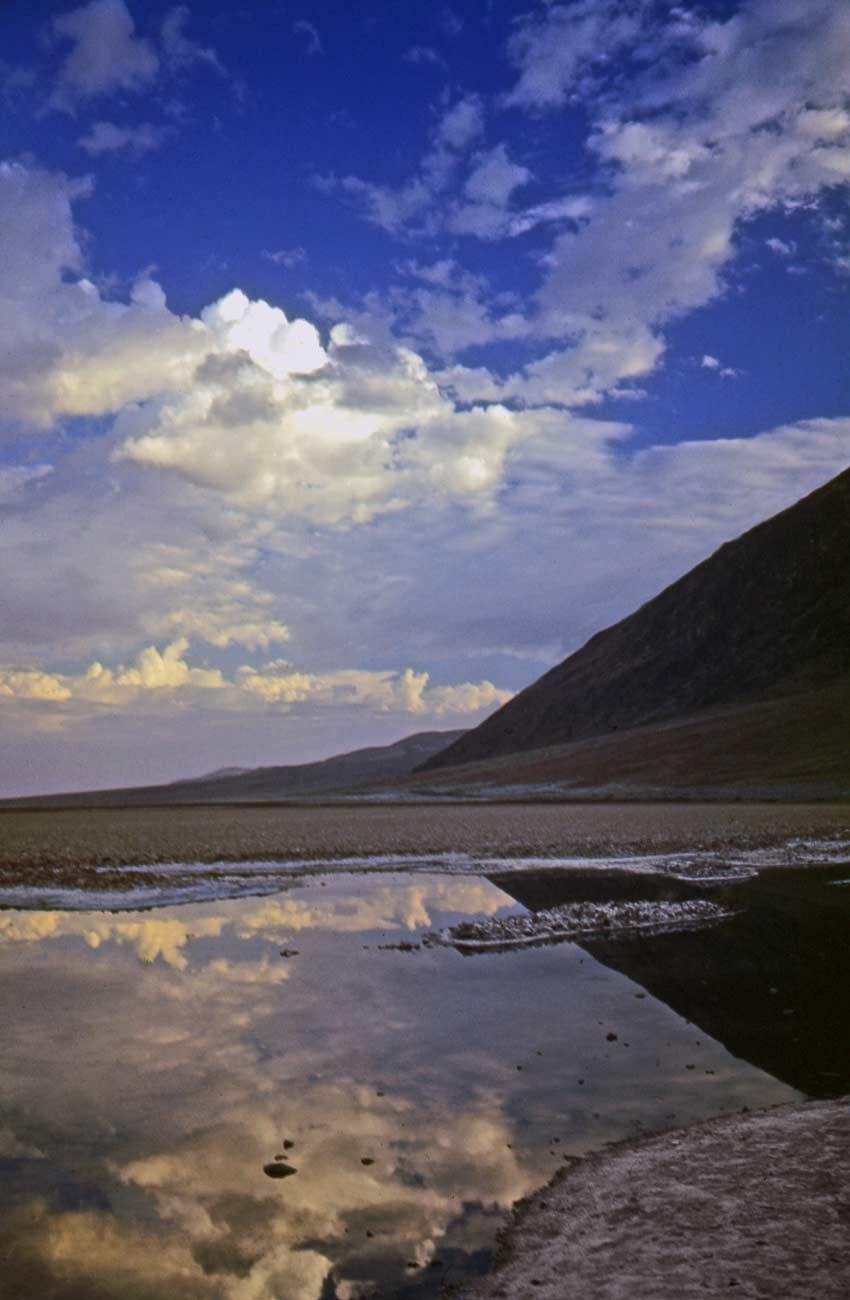
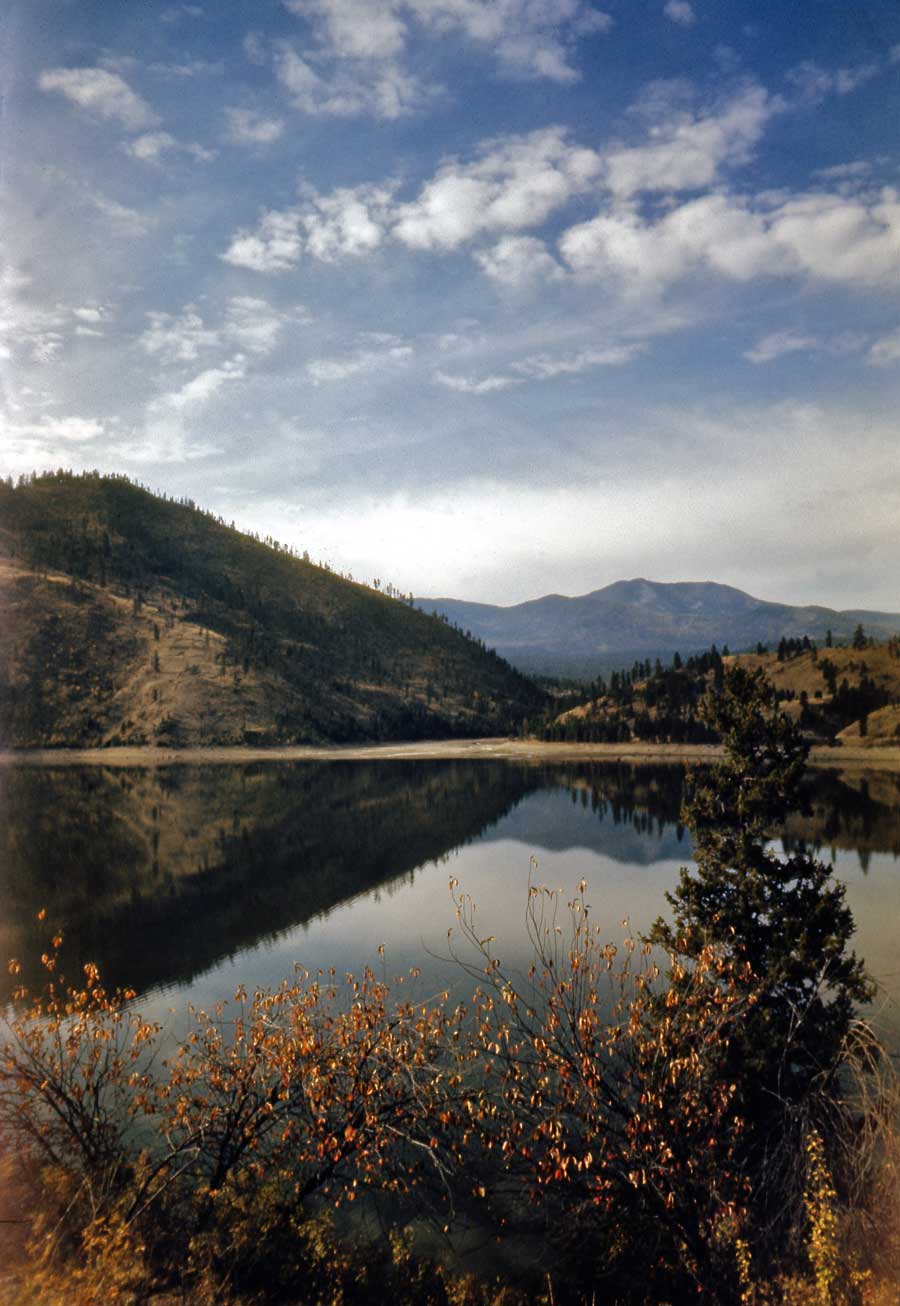
“A Pond Reflection.” This will be as close as we may come to a pun on “Upon Reflection.” And it certainly is meditative. (Click TWICE to reflect.) This may be part of the shoreline of the Great Salt Lake and no pond.
Many have learned thru caldendars, post cards, and such that this is what a mountain range should look like. And it is telling, perhaps, that Horace Sykes did not take any “liberties” with the Teton Range, but instead simply stood on the eastern shore of Jackson Lake and took his obligatory and obedient recording of it. Mt Moran is on the rigiht, and the Cathedral Group with the Grand Teton above it all is on the left. Horace looks to the southwest. (Click to Enlarge)
Ordinarily one looks at the wonders of Bryce Canyon from the edge of it. Here Horace has noticed the line of characters watching him approach on a path. They stand like stock characters in a Commedia dell’arte. There, perhaps, are the boasting solider, the cuckolded husband, the disobedient servant, the jester, the helpless damsel, the scheming Turk, and the hunchback Punchinello. Add your own stock character. Its up to you to decide which is which. Take your time. They are in no hurry. And click to enlarge.
The sun-lighted cut through the rolling mid-ground, the delicate and distance thread of blue mountains, and great curving gravel road in the foreground are all painterly matches for the surreal Kodacolor of this Sykes landscape.
THEN: Stan Stapp, publisher of the North Central Outlook, recorded this fistfight in the spring of 1952. In this instance the story came to him. The fists were thrown for the half-witted amusement of other boys soon after Lincoln High recessed for the day. The scene is on North 42nd Street just east of Ashworth Avenue North.
NOW: As John Sundsten posed where the witness in the letterman's jacket stood in 1952, a neighbor walked by and happily agreed to play the part of an anonymous angry fighter. John first thought that the lad in the jacket might be himself. He had one and the timing was right - or close to right he discovered - for the 1950 Lincoln grad. But he could not remember the fight only the street dances and so gave up on the jacket correspondence even before he found the date for this generally grinning blood lust.
I first saw this snapshot of high-school fisticuffs years ago. The venerable North End journalist Stan Stapp shared it with me for possible use in The Seattle Times or an exhibit. It was one part of a thick handful of mostly Wallingford glossies he used as editor, columnist, reporter and photographer for his family’s neighborhood newspaper, The North Central Outlook.
I don’t remember Stapp explaining the circumstances of the scene — whose fist, whose chin, when and where. But Stapp was a 1936 graduate of Wallingford’s Lincoln High School; the family home and newspaper office were two blocks from Lincoln, and the bungalow behind the impetuous teens is also very Wallingfordian. Stapp passed in 2006.
Recently I stumbled upon my copy and showed it to John Sundsten, a 1950 graduate of Lincoln. On first glance, the retired University of Washington neuroanatomist thought, “The boys are dancing. Isn’t that odd.”
After quickly surrendering to the idea that this was a fight not a dance, the peace-loving musician-scientist carried the print to the Fremont Public Library where back issues of the Outlook are stored. Sundsten started with the issues in 1950, the year he graduated. Thumbing forward he soon found the picture and its story on page 3 of Stapp’s weekly tabloid, published May 2, 1952.
It was, not surprisingly, Stapp who took the picture and wrote the copy. He gave no names except that of Wallingford’s juvenile officer, Walter J. Hauan, who took the two pugilists to a Wallingford precinct room. Stapp leaves his story with a happy ending, we assume. He concludes, “Hauan’s fatherly manner of approach has helped clear things up for thousands of local youths in the past.”
WEB EXTRAS
Anything to add, Paul?…..(for the rest of the story, click here)
Here it occurs to me – again – how a digital camera might have freed Horace Sykes to shoot whatever he wanted to record and many times over if he was so inclined. With such freedom he might have “mapped” this farm with shots left and right as well. As it stands or lingers in this picturesque setting, some days protected from strong winds by the screen of tall poplars, Horace again – and again – gives us few clues.
La rue Soufflot which links the Panthéon ( dedicated to the memory of illustrious Men ) to the garden of Luxembourg is definitely the student street . Located in the heart of Quartier latin , where are gathered the universities ( la Sorbonne), the lycées ( Louis Le Grand , Henri IV ), the libraries (Bibliothèque Sainte Geneviève, the bookstores, the copying stores, and the cafés Institution where students were used to speak latin.
La rue Soufflot qui relie le Panthéon (consacré à la mémoire des Hommes illustres) au jardin du Luxembourg est assurément la rue des étudiants. Elle est située au cœur du Quartier latin, où sont regroupés les universités (la Sorbonne), les lycées Louis le Grand, Henri IV et la Bibliothèque Sainte Geneviève, les libraires, les magasins de photocopie et les cafés intitution là, où l’on parlait latin.
This six day week we have made an exception to the "daily" part of Sykes. Our blog was again suddenly cut off by its server for reasons none of the server's servers could explain - it seems. It was switched off and may well be again. Returning it to service was like dealing with the old Ma Bell of many years ago. We revive with Bryce Canyon, we think. Horace Sykes does not say. But his light speaks. (Click TWICE to Enlarge)
Another of Horace Sykes looks from the Alaskan Way Viaduct when it was open to pedestrians - a few of them - before vehicles took over in early April, 1953. This looks west to what remains of Pier 49, a mere stub of its former self. Following the development of the waterfront following the city's "Great Fire of 1889" piers A and B (their tags then) were of similar size. Peir B (48) grew and Pier A (49) shrank. The ships got larger and required wider slips, and bigger ships also meant more stuff to both carry and warehouse. The Alaska Piers (1 and 2) on the right were on either side of Yesler Way and so framed the location of the pioneer Yesler Wharf. Before the big Alaska docks were built the fill on which Yesler's dock was built was scooped away for another wide and deep slip usefull for big ships.
THEN: When completed in 1907 St. James Cathedral sparkled atop First Hill. This view of it was photographed early in its life from the tower of the Great Northern Depot (Courtesy Fairlook Antiques, Pioneer Square)NOW: Recently Jean Sherrard scaled the Great Northern tower and photographed in every direction, including this one northeast towards the “former” location of St. James Cathedral. Of course it is still there although when searched for from the depot’s tower it is now hiding behind the recently raised Skyline Retirement Community, one block south of the cathedral, also on 9th Avenue.
Call it the spiritual urge to approach heaven or public relations; the Roman Catholic Church has had a historic knack for putting their parish footprints on tops of hills or on horizons. St. James Cathedral is Seattle’s best example of a landmark sanctuary. Dedicated late in 1907, it’s twin towers, cupola and reflecting skin lent a plush interruption to the First Hill skyline and for years St. James watched over the city, and the city look up at its good shepherd.
Most likely within the first year after the cathedral was topped-off the commercial photographer William Romans left his studio on the sixth floor of the Colman Building and headed for the nearly new Great Northern Depot on King Street. The depot with its Venetian tower first opened in the spring of 1906. Perhaps Romans noted the dynamic sky beginning to brew over the city and decided its chiaroscuro delights would make an exquisite backdrop for the gleaming St. James, and it does.
One cannot reach the top of the depots’ tall campanile by elevator but rather, as both William Romans and Jean Sherrard discovered, by an exposed stairway. Given the effort it is perhaps not surprising that so few photographs taken from the vertiginous tower survive.
Two other cross-topped churches appear here. Directly below St. James near the base of Roman’s real photo postcard stands the cathedral’s predecessor, Our Lady of Good Help at the southeast corner of Fifth Avenue & Jefferson Street. To the right of St. James but lower on the hill stands Trinity Episcopal Church at the northwest corner of 8th and James. It was built after the congregation’s first sanctuary at 3rd and Jefferson was destroyed during the city’s “great fire” of 1889. It is the rare survivor of First Hill history that can be also found in Jean Sherrard’s “now.”
This side of St. James, very little survives from the hill-climbing field of mostly flats for workers – many of them single women – who once walked to their jobs in the Central Business District. We will note one abiding five story brick: the Madison Apartments facing its namesake street one block north of the Cathedral on 9th. Its rougher alleyway façade appears on the left horizon to the right of a First Hill grove of leafy street trees.
WEB EXTRAS
First, Paul, a confession (perhaps appropriate considering this week’s subject). Our ‘Now’ photo was cropped from a much larger shot, which I include below:
The complete picture from the King Street Station tower
"Safty Pays" reads a sign on the far bank, which is no doubt huge but from this side hard to see. This is either the same visit to Grand Coulee that Sykes made with Our Daily Sykes #278, or near it.
The framing and focus of this snapshot suggest Sykes' spontaniety. This was before the Snake River jet boats, which now take tourists far up the canyon on a bumpy ride through many rapids, protected by a covering of optical plastic. You can take or find one of these trips, of course, on Youtube. Perhaps that is Horace's boat and he recorded it from the shore. The jerk of it all suggests that he had little time to catch it. Perhaps he took this from another boat. Horace doesn't say.
This look down on Colman Dock and the "silver slug" bobbing at its water end is another of the several looks all ways that Horace took during his 1953 pedestrian visit to the Alaskan Way Viaduct before it was opened to traffic. And here I notice directly below on Alaskan Way my first car, a Ford (in the deep shadow of Pier 51), and one of those lower-powered Nash models that resembled an inverted bathtub. But then for some so did the Kalakala. We may have printed this Sykes Kodachrome earlier on this blog in another context, and now I have thought of it. This scene is also included in the attached Pictorial History of the Seattle Waterfront. (Click to Enlarge)
Those who wanted to restore the Alaska Way Viaduct made frequent call upon its spiritual qualities; which is that it gave views, especially of the city. Here's another snap from Horace Syke's visit to the viaduct in early 1953 before they opened it for motorcars. The view looks east up Madison Street.
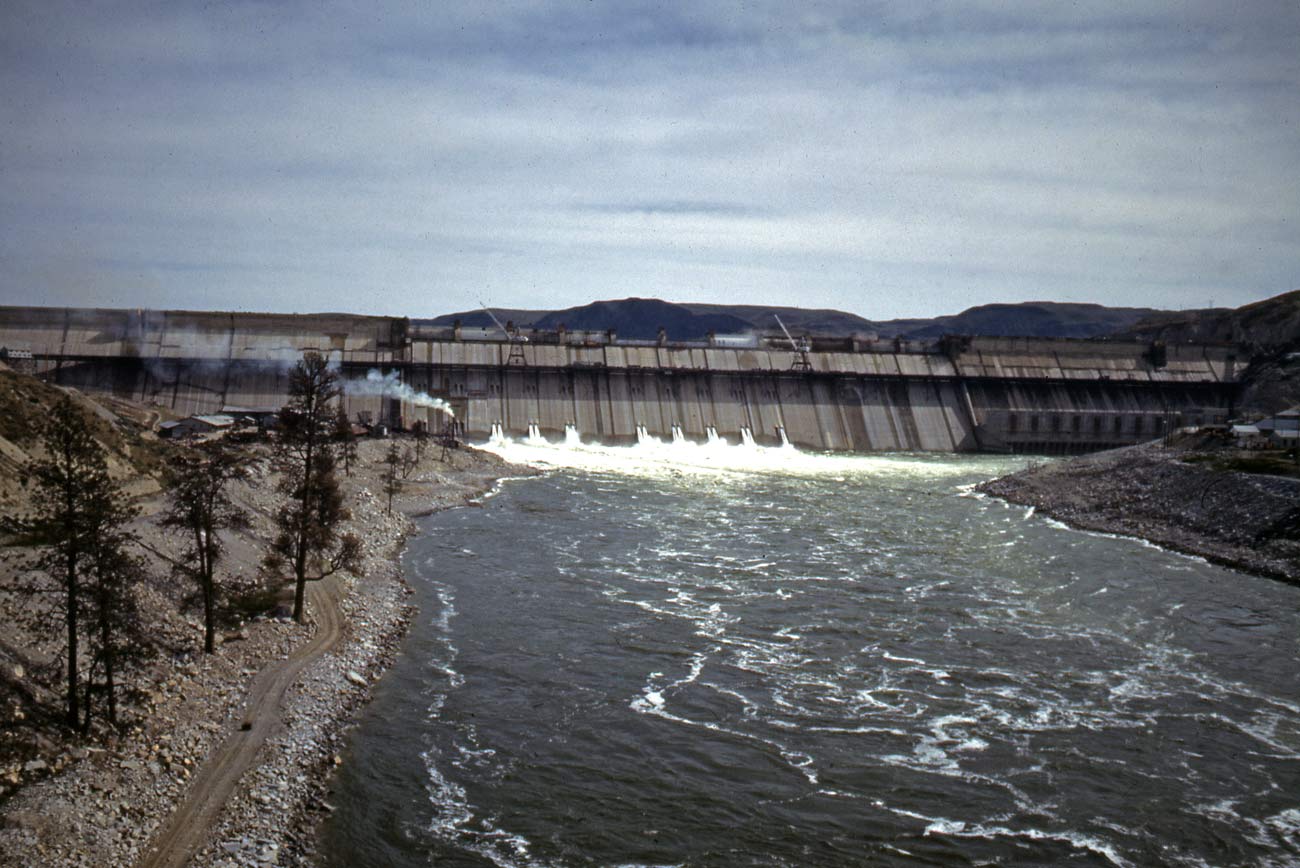
Construction began on “the greatest concrete structure in the world” on Sept. 1933 when Washington’s governor Clarence Martin dumped the first bucket of what would be 21 millions tons of concrete. He was paid 75-cent for one hour’s work. Eight years later in the spring of 1941 the Grand Coulee Dam began distributing the electricity that made it possible for the Pacific Northwest to host so many aluminum plants for building armanents during the Second World War. Horace Sykes obviously visited the dam site sometime before the war – sometime in the late 1930s. Of course there are pictorial histories of this construction that would help us choose the year, but none of them are at hand. Horace photographed the dam from the Grand Coulee Bridge, a steel creation made extra-strong for handling the heavy equipment and materials used during the dam’s construction. (Click to Enlarge)
Jean writes: We at DorpatSherrardLomont occasionally come across miracles, marvels and gold nuggets which, of course, we pass along to the co-conspirators who visit this blog.
Might we suggest, the following jewel of a video by Vaun Raymond, celebrating the 100th anniversary of the Port of Seattle.
Paul adds: It was a pleasure to be framed by Vaun’s camera. He has the knack.
The road is narrow and yet paved. And so it has occurred to me - but without checking - that this might be Perkins Lane, the charming road that winds above the waterfront and well below the bluff on Magnolia's western face. The roof of a home can be seen behind the bushes at bottom center. The Sykes lived on Bertona Street, one of the short streets that branch from Perkins, sometimes to small clusters of homes.
THEN: James FitzGerald's Waterfront Fountain was Helen Harrington Schiff's gift to the city in memory of her parents, Edward M. and Margaret J. Harrington. At 16-1/2 feet high and 21 feet long, the bronze fountain puts on a good show.NOW: Sherrard's repeat of Shaw's recording shows the fountain doing the fulfilling work of entertaining children.
Certainly, many Pacific Northwest readers recall the construction in the mid-1970s of Waterfront Park and to the north of it the municipal aquarium. To help us remember, Frank Shaw photographed the entire process with his prized Hasselblad camera. Because Shaw was good about dating his subjects, we know that this work on the Waterfront Fountain by Seattle sculptor James FitzGerald was nearing completion by Sept. 27, 1974. We also know that the man on the ladder applying finishing touches to that sculpture could not be FitzGerald, who died nearly a year earlier.
This waterworks was the last of five fountains that FitzGerald designed for public places in Seattle. His wife, Margaret Tomkins, also an artist, and his assistant, Terry Copple, completed it. Of course, I wondered if that was Copple on the ladder. An old friend, filmmaker Ken Levine, attended the fountain’s installation and was confident that FitzGerald’s daughter, Miro, was there as well. I had not seen Miro in a quarter century but Levine had her address, so I wrote, asked and she answered that it definitely is Terry Copple in the photo. He helped complete the casting and final finishing during a difficult time of grieving for her family, she said, adding that she had worked in a restaurant with Copple and introduced him to her dad.
“Terry was a caring, dear person who worked from his heart in all he did,” she wrote. “Sadly, he passed away a few years ago in Vacaville, Calif.”
Miro, also an artist, lives in Sedona, Ariz., where for several years she was assistant director of its Arts Center. Recently retired, Miro can now give more of her time to painting — trying, she explains, to “capture the incredible Southwest landscapes.”
WEB EXTRAS
Anything to add, Paul?
Jean, the tasks remaining in preparation for our – with Berangere – early April opening at MOHAI of the “Repeat Photography” show (the last exhibit, they say, in the museum’s old Montlake location) weighs heavy on my head and I must give my time to it. And yet there are some things to pull from some of the same past writing that was used to created the Pictorial History of the Seattle Waterfront, which is now up on this site as a pdf file. Until “nighty bear” time (we thank Bill Burden for that good night signal) we will slip a few things in that relate to the Pike wharf site. We’ll begin with a splendid slide that Frank Shaw took of the performing Fitzgerald fountain on November 26, 1974.
Another of James Fitzgerald fountains in included in Shaw’s collection of colored slides and black-white negatives, most of them shot with his Hasselblad. The sculptor’s Fountain of the Northwest was created for the city’s new playhouse in 1961, and was one of the artistic attractions of the 1962 Century 21 held there. Fitzgerald – and others – like this one so much that he made two of them. The other is on the Princeton University Campus, a kind of fountain of the northeast.
We’ll follow now with more of Shaw’s recordings of the Waterfront Park, during its construction with 1968 “forward thrust” funds – belatedly – and after its completion. We will not include his many photographs of the building of the waterfront aquarium. We’ll save those for another time when we are less taxed.
In anticipation looking thru the open water between Piers 57 and 59 on May 1, 1973. This "hole" in the waterfront was once held by the prosperous Schwabacher Wharf. Note that the Federal Building on the right is still exposed with its skeleton, knowing perhaps, that it will not receive the brick skin that its architect intended for it. The SeaFirst tower is on the left. In the beginning, 1968, a symbol of its bank's ambition. But it is now surrounded and surmounted and the bank long since merged - or submerged - into a larger bank from beyond.Pile driving for the northern part of the park, where it nestles against the Pike Street Pier. For many years this was a harbor for the fishing fleet - part of it.Part of the fishing fleet moored in the slip on the south side of the Pike Pier. This is not a Shaw shot, but one much earlier.The pile driving continues to the south. November, 8, 1973.. . . and further still. Jan. 2, 1974.and continuing . . . Feb. 7, 1974.March 11, 1974The earliest concrete forms, March 29, 1974. The Federal Building's substitute skin is also in place.A choppy Elliott Bay slaps against the forming park on April 11, 1974Another Frank Shaw recording from April 11, 1974. The by now familiar curving forms of the park are taking shape.The lighting along the Pier 57 southern side of the park - Nov. 15, 1974. Although it may seem so the reading child is not sitting on the fountain but on a concrete form behind the fountain. May 7, 1975Looking south thru the park on Nov. 1, 1981.By March 3, 1984, ten years after the construction began, Waterfront Park had settled into its familiar uses.
We will turn now to older subjects, but ones that are still linked to the waterfront neighborhood near the foot of Pike Street. First a look at the first structure built by the first settlers with California money to exploit the rich coal deposits on the east side of Lake Washington. When it was new in 1871, the Pike Street Pier and Coal Wharf competed with Yesler’s Wharf as the biggest structure in town. First we see it from the back of the Peterson & Bros photography studio at the waterfront foot of Cherry Street.
The Pike Street Wharf and coal bunkers above the roof crest of a small warehouse build on pilings near the foot of Columbia Street. The wreck of a schooner is the Winward, which is famous for being still there, buried beneath Western Avenue near Columbia. This view dates from 1876. In two years more the Pike Pier was abandoned for a new coal wharf off of King Street. It's connection to the coal fields of Renton, and Newcastle was more direct around the south end of Lake Washington.Detail from the above of the Pike Coal Pier and its hillclimb to the location now of the Pike Place Market.The Pike Pier as it appears in Seattle's 1878 Birdseye.Here the ruins of the Pike Wharf are recorded from the King Street Wharf that replaced it. This detail is part of a sweeping panorama of the waterfront recorded, most likely, in 1881. Denny Hill is in the foreground, and Queen Anne Hill on the horizon.From the bluff above the waterfront Anders Wilse recorded this wide look at the waterfront in the late 1890s. The old Schwabacher Pier on the right figured in the two most celebrated visits to Seattle in the 1890s: first the inaugural service of a Japanese shipping line, and second the 1897 return of the Portland from Alaska with its now long since legendary "ton of gold."
MIIKE MARU Aug 31, 1896.
After a sustained recession of three years following the economic crash of 1893, locals were alive to anything that might indicate a return to the three years of prosperity that followed the city’s Great Fire of 1889. Nothing before the arrival of the gold rush ship Portland the following year seemed so promising as the appearance of the Japanese liner Miike Maru at Schwabacher wharf on Aug, 31, 1896. It marked the beginning of a direct and regular service to Japan that since this beginning has only been interrupted by war.
The steamer arrived at 3 o’clock in the afternoon amid a welcoming uproar of factory whistles. The Schwabacher Dock served as the terminal of this new service until it was moved at the turn of the century two piers south to Frank Waterhouse’s Arlington Dock or Pier 5 and still later to “Empire Builder” James J. Hill’s Great Northern docks at Smith Cove.
This view looks north from near the foot of Seneca Street. The fanciful construction of the Clark and Bartette boathouse is evident on the far right. The Schwabacher pier shed that shows to the far side of the Miike Maru is a transitional structure between post-89fire sheds and the 1899 warehouse, long familiar on the waterfront. The top-most roofline (with two small vents) of the Ainsworth and Dunn’s Seattle Fish Company dock at the foot of Pike Street shows just above the Schwabacher roofline.
Looking north thru the open water made with the razing of the last Schwabacher Warf and the 1974-74 raising of the Waterfront Park.Schwabacher Pier from the surviving Seattle Lake Shore and Eastern Railway (left) and "Ram's Horn Railway" (right) tracks after the city's "great fire" of 1889. The view looks north with the fire's ruins to the rear of the photographer.
SCHWABACHERS WHARF FOLLOWING THE 1889 FIRE
With University Street and the ruins behind the photographer the above view looks north to Schwabacher’s wharf not long after the June 6, 1889 fire. The photographer stands on the Rams Horn trestle – the Seattle Lake Shore and Eastern trestle is on the left. A box car is used as a wall on the Rams Horn. It is nailed in place.
The June 19, 1889 issue of the Post-Intelligencer can be read as a caption. “Most of the shipping in the harbor now lies between the wharf at the foot of Union Street and the wharf at the foot of University Street. This is now the shipping center, it being all that was left outside the fire, except Mannings wharf in north Seattle [at Wall and Vine]. The Seattle Times description of June 22 continues this description. “One cannot have a correct conception of the pressing needs of wharfage and more warehouse facilities at the present time without seeing the crowded condition of affairs on Schwabacher Wharf. At this wharf the wholesale grocer business of the Schwabacher firm is carried on, and besides it is the docks for all the O.R. & N. Company’s steamers. The warehouse facilities are also inadequate, as goods are dumped onto the wharf and have to remain there without shelter until called for. The ocean steamer Mexico on her last trip from S.F. had a large cargo of merchandise freight, all of which was discharged on the wharf, and left exposed to the elements until called for by the merchants. In addition to this the company have to keep a special policeman to guard those goods by day and night . . .”
The ‘TON OF GOLD” Ship PORTLAND, JULY 17-18, 1897
No arrival on the Seattle waterfront created such a sustained stir as the sixty-eight passengers who disembarked from the steamer Portland carrying bags of gold dust onto the Schwabacher Wharf. (above) The crowd that gathered on the wharf at six in the morning knew they were coming because a Post-Intelligencer reporter earlier chartered a tug to meet the Portland as she entered Puget Sound. Returning quickly with the story the P-I’s “Ton of Gold” issue came out about the time the Portland came in. Within ten days 1,500 locals had fled the city for the Yukon. The best sign of the Seattle hysteria came from its mayor, W. D. Wood. Visiting in San Francisco he wired home his resignation and headed much further north than his home on Green Lake.
It is probably impossible to determine at what point in the Portland’s short stay that this view of it resting in a low tide between the Schwabacher and Seattle Fish Co. wharves was photographed. A portion of the Schwabacher pier shed appears on the far right. There is plenty of room on the apron to build a bigger warehouse, and here for the curious to visit a scene they sensed was historic even at the time.
On July 22 the Seattle Times reported that preparing to return north the ship had “cleared at the customs office this morning. The crowd of people at the wharf occupies every square foot of space and this morning and afternoon a constant steam of people, men, women, boys and girls were down to see the Portland off. It is a sight to witness the departure and a tedious delay for those who must wait. Many are the pathetic scenes of wives and mothers bidding farewell to husbands and sons who are off for the fields of gold.”
The “color” of the waterfront in the post-Portland months – and years – is captured in the somewhat gaudy prose of a 25th anniversary commemorative article in The Seattle Times from July 16, 1922.
“Arrival of the gold ship Portland in July 1897 launched Seattle on one of the most thrilling and picturesque epochs in her shipping history . . . in a few months transformed Elliott Bay from a moderately active harbor into a strenuous and crowded shipping center . . . In a comparatively few months Seattle was able to boast that she could handle 15,000 men to Alaska every thirty days and she made good the boast with characteristic decisiveness . . . Up to Feb 1898 the first class fare to Skagway and Dyoea was $40. It was then raised to $50 and the second class fare was increased from $25 to $35. In announcing the increase in rates, Seattle newspapers used the headline, ‘Rates Go Sky High.’ In April, however, the fares dropped to $10. The following Sept brought another drop, the first class fare falling to $25.
The stampeders who poured into Seattle the first winter 1897-98 had an inspiring war cry, ‘Klondike or bust, march the fust.’ By Feb 1898 the movement had grown to gigantic proportions and Seattle steamships were shooting back and forth as fast as their engines could drive them. There were thirty-two scheduled sailings from Elliott Bay in Feb., l39 in March and 36 in April or 107 sailings in 99 days. Thousands of Argonauts poured into the city from all over the world each week and other thousands departed at the same time for the Golden North.
As the Klondike rush subsided in 1900 the Nome rush began calling more thousands to the North. In the spring of 1900 no less than 45 steamships were coming and going between Seattle and northern ports. As many as five vessels arrived or left here in a single day. In 1901 eighty ships went from her to Nome alone.”
WILLIAM HESTER AND HIS MARITIME CAMERA AT PIKE STREET
Although the ship is unidentified the two posing women are probably the photographer’s friends and not shipmates. Women friends often accompanied the marine photographer William Hester while he solicited work on ships visiting the harbor. His normal bread-and-butter subjects were the ship’s crews and captain. And they, of course, were likely to welcome Hester’s companions as much as the photographer himself. This turn-of-the-century scene looks at the Seattle skyline from the slip between the Pike Place pier, out of the picture on the left, and the Schwabacher Wharf on the right. We repeat, the latter pier was later replaced by the open water of Waterfront Park.”
A typical William Hester portrait of a ship's crew - and a typical crew too.
The S.S.OHIO ENROUTE TO TROUBLE
Written across the base of the subject above is it’s own helpful caption. It reads, “S.S. Ohio Leaving Seattle for Nome Alaska, June 1st 1907.” A broadside or poster tacked to the slab fence between the crowd and the ship promises “Fast and Improved Steam Ships between Seattle and Nome, Frequent and Regular Sailings.” A year later the White Star Steamship’s Ohio left Seattle for Nome also on the first of June. So it was regular.
It was also unlucky. In the 1907 sailing the Ohio struck an iceberg in the Bering Sea and 75 panicked passengers jumped overboard to the ice. Four perished before they could be returned to the ship that was not sinking. In 1908 the Ohio’s captain was careful to the extreme, infuriating many of its passengers who missed what they imaged were their best Nome chances while the ship waited for the ice to melt. In one year more the Ohio hit an uncharted rock in Swanson’s Bay, B.C. but the captain managed to make a run to shore and all but four of the 214 on board survived before the 360 foot-long steamship slipped away. When it was new in 1873, the Ohio was the largest vessel built in the U.S.
We may wonder at the size of the crowd here – far too many than can fit on the Ohio. Obviously the embarking of a vessel to Alaska even towards the end of the Yukon-Alaska gold rush era was enough excitement to bring out spectators in pants. Judging by their hats, caps and bonnets practically everyone of these figures – excepting the women in the light-colored frock, center-bottom – are men in the uniform of the day: dark suits.
The truth is that going to Nome in 1907 – or ten years after the local excitement connected with the Yukon-Alaska gold rush era began with the 1897 arrival of the S.S. Portland and its “ton of gold” – was still ordinarily a “manly affair”, meaning that many and perhaps most of those on board were still hoping to get rich quick on or near the beaches of Nome by some combination of sweat and luck.
Piers 56 and 57, left and right, are two of the more than century-old railroad wharves that have helped in the post-world-war–two transformation of our central waterfront from a working waterfront to a playing one. (Historical photograph courtesy Museum of History and Industry)
There remain a few more subject to put in line here and, no doubt, many mistakes to proof. I’ll return to them after a late breakfast. Now I’m away – I repeat – to Nighty Bears, that wonderfully silly cave of sweet dreams. I’m back, kind of, at 12:30 Sunday afternoon. First here is another look at the Ohio, a close-up from the southeast corner of the Schwabacher Wharf.
A "now" that is by now several years old. I joined two landscape digital records - top and bottom - imperfectly. The sky, at least, is intact. The next subject looks back at this prospect, or in line with it.Looking back from Railroad Avenue to the end of the Pike Pier with the steamer Eihu Thomson in between. She must have stories to tell. But we will neglect them for this moment.
TWO A. WILSE LOOKS SOUTHEAST from the PIKE PIER
As the gold rush stirred in the Schwabacher slip it also climbed to the pier. Encouraged by the wealth got in part from warehousing and wharf rates the already venerable firm built a much larger warehouse on its wharf. Two photographs by Norwegian photographer Anders Wilse from the same position on the roof of the Seattle Fish Company Wharf (Pier 8/59) record the big changes on the neighboring Schwabacher pier.
Both views look southeast over Railroad Avenue to the varied rooflines of the Diamond Ice plant and the hotels on First Avenue. The conical tower of the Arlington Hotel (the old Gilmore block) surmounts the intersection of First and University Street from its southwest corner.
In the above view a small structure appears lower-left at the northeast corner of the Schwabacher Wharf. Above it is the rear (west) wall of the Vendome Hotel on First Avenue. A portion of the same small structure appears on the far left of the later Wilse view, below. Although it holds the same position (one point in a triangulation when the photographer’s prospect is considered) with the structures across Railroad Avenue, it has been separated from the Schwabacher wharf which has been reconfigured about ten yards to the south. The north wall of the much larger pier shed (it fills most of left half of the frame) stands about ten feet south of the crest of the roof in the old shed that appears on the right of the earlier photograph.
Another and later Wilse view (below) looks back at both the Schwabacher Wharf and the Seattle Fish Wharf from the back of the First Avenue hotel row between Seneca and University Streets. The view reveals the considerable size of the penultimate but short-lived Ainsworth and Dunn’s Seattle Fish Co. pier (8/59), as well the first photographic evidence for wharf structures (8&1/2 — 60-61) built north of it between Pike and Pine streets on the site of the future municipal aquarium.
Turn of the century (from 19th to 20th) ephemera from Schwabacher on top, and "chemically pure" Diamond Ice, above.
W. W. ROBINSON
An early look down from the bluff upon the new Pike Street Wharf as home for its first primary tenant, the hay and grain dealer W. W. Robinson. Willis Wilbur Robinson was born in Kansas in 1871 and came to Mount Vernon in 1890 where he had success as a farmer and learned the wholesale trade in hay and feed. He is first listed as operating at the Pike Street Wharf in the 1905 city directory. His stay at the foot of Pike Street last until about 1909 when he moved his operations to the new reclaimed industrial area south of Pioneer Square. Before the railroads took charge of moving commodities like Robinson’s hay, stern-wheeler steamers capable of reaching up the Puget Sound tributaries like the Skagit River, on which Robinson’s farm was located, handled most of it.
We have dated this aerial ca. 1934, because the 1934-36 seawall construction between Madison and Bay streets is "at hand." Part of pier 57 shows upper-right. First below it is a dock (of sorts) for the Wellington Coal Co. This is followed by the Schwabacher Pier and it by the Pike St. Pier. At the center are two small "fish piers" (now the site of the aquarium), followed by the Gaffney Pier, which is huddled with its partner the Virginia Street pier that gave most of its life transshipping newsprint for the local papers and and other printers. The Pike Street trestle descends from the Market to the slip just north of the Pike Street Pier. We will follow this scene with several photographs taken from the viaduct, a few to the north and a few to the south. First to the north.Railroad Avenue north from the Pike Street Overpass, ca. 1912. On the left, the combination of a small café and the Reliable Oyster & Fish Company hold what was earlier the San Juan Fish Company pier. Just north are the familiar Gaffney and Virginia Street docks and the latter’s viaduct across Railroad Avenue. A later look north from the Pike Street Trestle. At this time public workers are preparing to build the Alaska Way Viaduct, which we are now preparing to tear down. Jean's recent repeat, using his extension pole the high reach of his 6''7" frame.Looking north from the viaduct in the late teens - I figure. The Pike Street Pier is on the right.Moments before the first 1934 work on the Railroad Avenue seawall north from Madison to Bay Street. The Pike Street wharf is on the right, here home to volunteer and professional organizations - and businesses - having to do, for the most part, with fishing. The gaping hole in Railroad Avenue reveals the tideflat below the trestle. These were called, by some, "man traps" for a few did fall or drive into them. Seawall construction between Pier 57, (a sliver of it far left) and both the Schwabacher and Pike Street Piers - the future siting for Seattle's Waterfront Park. (Courtesy Municipal Archive.)Another of the Post-WW2 waterfront survey photos. This one looks south from the Pike Street Viaduct in line with the future Alaska Way Viaduct, which the photographer, we imagine, was imagining.Jean's look south with his pole from the line of the old Pike Street Waterfront Trestle.The Pike Street Watefront Trestle seen looking west from Western Avenue below it. Here the trestle is in its last days before being torn town for the construction of the Alaska Way Viaduct. Courtesy, Museum of History and Industry.The CATALA in her slip beside the last remaining part of the Schwabacher dock. It served as a boatel during the 1962 Century 21.
The CATALA [Canadian Queen] (This feature was first printed in Pacific ten years ago.)
As the “Queen” of the Union Steamship Fleet the Catala was a tramp steamer dressed in a formal. For nearly 35 years her pointed bow was eagerly greeted at the logging camps, canneries and isolated villages between Vancouver and Prince Rupert, British Columbia. Here she rests on the Seattle Waterfront waving the Stars and Strips as a sign of a new service that was also a rescue.
Headed for scrap in 1959 the Catala was instead gussied-up to perform as a “boatel” on Seattle’s waterfront during 1962 Century 21. Along with the 682-foot-long Dominion Monarch and the 537-foot-long Acapulco the 253-foot Catala was the smallest of three liners outfitted to serve as hotel ships during the worlds fair. According to Gene Woodwick, the vessels sympathetic chronicler, the Catala was also the only one to make a profit and stay for the duration of the fair. The steamer was already familiar to Canadians and many of the guests that enjoyed her plush quarters during the fair were the loggers, fishers and shore-huggers who had once ridden her.
Built in 1925 in Montrose, Scotland her last stop in 1963 was at Ocean Shores where she was set up again as a “boatel” with 52 staterooms, a restaurant and lounge, but this time for fishers. During the night of New Years Eve, 1965, the Catala was driven ashore by 70 mph winds. Picked by scavengers and salvagers she remained a picturesque wreck until bulldozed over.
Gene Woodwick (She is also the director of the Ocean Shores Interpretative Center.) is pleased to note that on New Years Eve 2001 – thirty-five years after blown ashore – another storm exposed the keel and remaining ribbing of the Catala, which then resumed her very last service as a maritime relic.
If you have a Catala story (or photograph) to share, Gene Woodwick would love to hear from you. You can contact her thru this blog with a reply.
THE END OF THIS FEATURE – for now (and then).
Frank Shaw's mid-70s recording of the colorful west end of the Pike Pier, the face it showed to fishing boats for many years.
As noted perhaps more than necessary, Horace Sykes moved to Seattle from Salem, Oregon in 1923, where he had been a Deputy State Fire Marshal. In Seattle he joined Northwest Mutual Insurance as an adjuster. Although I have yet to find any paper that proves it, I think it likely that some of his slides from the 1940s were taken while on trips connected with his job settling claims. Horace was born in 1886 in a Pennsylvania town named for his family: Sykesville. When he was still a lad the family moved to Salem, and it was in Oregon that he was educated and grew up. He graduated in law from Willamette University. Horace wrote well and explained things well. He wrote at least two learned essays in periodicals that covered photography. (You can Google him and fine at least one of these.) Some of his earliest pictures, like this one, were studied portraits. Of course, we know neither the date nor name of the girl posing. The slide is not protected in the standard Kodachrome cardboard holder. The sepia coloring is almost certainly pre-Kodachome.
How many times in these now 273 Sykes subjects has he pulled to the side of a road or highway and used its "floor" in his composition? And how many times has a singular bush or tree been posed to one side or the other? And how often has he ordered the sky so?
Our struggles seem to have paid off. For the time being, we’re no longer receiving threatening emails from our provider. Thus, until further notice, the Baist map and our selection of books are back on-line. Enjoy!
As a little bon-bon, I’m including two images shot on Sunday from the Smith Tower. The downtown pan will be featured in our MOHAI show this April, the other is a unique view into the elevator door gap at the observation deck.
(click, of course, to enlarge photos)
A view of downtown from the Observation Deck (around 500k)Mind the gap, looking down the shaft from the Observation Deck
There are places in northeast Oregon, southern Utah and northern Arizona where the canyons stack up like bowling pins. Of course, once more we do not know where Horace Sykes has taken us and we arrived blind folded. Once seen over the reptilian ridge the distant mountains might move a patriot with their purple majesty. We re lost in America.
Horace looks north over the Snake where it escapes its canyon and makes a last bend before it joins the Clearwater at Lewiston/Clarkston and there turns west for the Columbia. When I was much younger the hills beyond were famous for the many hairpins in the highway as it dropped from the Palouse farms into this valley. Now a new highway makes a less curvaceous climb. Swallow Rock on the west shore of the Snake can be found left of center. We have shown it twice before - at least once.
THEN: An unnamed photograph here looks down from Beacon Hill to the flooded mudflats south of Seattle’s Pioneer Place neighborhood either very late in December 1883 or, more likely, early in 1884. The pilings in the bay that are not useful trestles are land speculators freelance markings meant to set precedents of ownership to the tideflats. (Courtesy Museum of History and Industry)NOW: We have added some sky and city to Jean Sherrard’s repeat to help orient the reader.
Seattle’s first commercial center was built on a small peninsula south of Yesler Way, which the exploring Navy Lieutenant Wilkes called Piner’s Point in 1841, a decade before the first settlers arrived. The commercial buildings, upper-right, are on Piner’s Point. To the south the peninsula ended with a small bluff at King Street. Beyond that were the mudflats seen here, and to the east a salty marsh that was flooded at high tide. This little inlet east of Piner’s Point was called Plummer’s Bay for a pioneer that lived beside it.
This view was – I think – recorded from a knoll that once topped Beacon Hill like a hood ornament. If Charles Street had climbed the hill it would have reached the knoll. Charles is one block south of Dearborn, and if I have calculated it correctly that wide pathway extending from the bottom of the photograph to the bay is Dearborn – or very near it. This is a quarter-century before there was any Dearborn Cut through the ridge that previous to the cutting merely slumped between First and Beacon Hills.
Jackson Street is on a timber quay far right, and King Street is the narrow-gauge railroad trestle curving quickly to dry land to be free of the wood boring Teredo worms. Here pioneer Joe Surber built the trestle with piles 65-feet long because of the mud. It took only two poundings of his pile driver’s hammer to push the piles through 35 feet of mud to hardpan. The King Street rails can be followed west to the King Street wharf, where the coal brought from mines near Renton was delivered to ships. This wharf, here with a coal collier tied to its north side, was the biggest thing in town and coal Seattle’s biggest “cash crop.”
In “Orphan Road,” Kurt Armbruster’s helpful sorting of the often snarled history of railroading hereabouts, the author names the wide trestle extending out of frame to the left the “broad gauged strip” because regular gauge track was laid on it. Armbruster has it completed in Sept. 1883, which most likely means it was then “connected” with the Point. The laying of tracks followed. The date for this scene may be as late as early 1884. If you can see it, the little cupola or fog bell tower built atop the south end of the Ocean Dock, right of center, was completed in mid-December of 1883.
(Greetings, Paul and friends. As we are trying to run a leaner, meaner operation here at DorpatSherrardLomont, we are reducing the size of our front page. For those interested in more content supplementing and expanding upon this week’s ‘Seattle Now & Then’, please click on WEB EXTRAS.)
We at DorpatSherrardLomont have received a number of unhappy messages from our server complaining about this blog’s excessive usage of server resources. We’ve done our best to streamline the blog in a variety of ways, hoping to reduce our usage stats, but evidently not enough.
To that end, over the next couple of days, we’re pulling our largest files available for download – the Dorpat and Berner books & the Baist map – temporarily off line. This is an attempt to avoid having our plug peremptorily pulled.
Please bear with us as we determine new and more efficient methods to continue to provide quality free content.
Near here Cashup Davis dug his own grave and instructed his children to put him in it when he was no more for this veil of tears interrupted by all-night dance parties up here nearly in the clouds. His children, however, did not obey and Cashup was instead given a big funeral and then rolled to the town's cemetery in the most elegant hearse that could be found within thirty miles . . . of where? We mean to have more quizzes.
Although kept in Horace Syke's collection this 35mm slide does not have the typical red cardboard. It is also an unusual subject of Horace. This may be a scene shared with him by another photographer - perhaps one in his camera club. (Click to Enlarge)
The few of Horace Syke's subjects that feature animals with fore thumbs who ordinarily stand on two legs, use language and have a special knack for self-deception are included in family pictures. There are a few parades as well - very few. The rest is landscapes and flowers. Here is an exception: a man in a dark blue suit performing for a smiling woman in a light blue suit. They are, I think, somewhere in Seattle's Volunteer park. If this hunch is correct then, it seems, that for some period at least in the 1940s one big part of the Seattle Art Museum's Fuller collection of Eastern Art was left outside. From memory the lay of the land here resembles that to the north of the band stand where a park road descends to the southwest. Click TWICE to enlarge
(Click TWICE to Enlarge.) It is fairly easy to at least imagine Horace’s motivation for pulling over on this country road to record the line of gravel as a repeat of the line streaming above him. The curve of the dirt road follows that of the vapor. In the post-war years Spokane had two military airports west of town, Geiger Field and Fairchild Air Force Base. The latter was soon sending hybrid B-36s droning over the city. Extremely ponderous these over-sized flying tanks were retired early, made obsolete by the B-52, a serious cold war bomber. I no longer remember what sort of marks these jets were leaving in the sky in the 1940s, so this vapor trail does not lead me to its maker. I remember the fascination of them though. In the summer it was something to lie in the grass and watch their creation. The tail gave a substance to the airplane it did not have without it.
THEN: With remarkable haste the first distinguished buildings of the Metropolitan Tract we constructed between 1908 and 1910 on what had been the original campus for the University of Washington. Pix courtesy Lawton Gowey.NOW: 100 years later the cityscape throws bigger shadows.
How many Pacific readers can name the make, model and year for the motorcar at the lower-left corner of this look down Fourth Avenue and through its intersection with University Street? I cannot, although I nervously propose that it at least resembles a 1909 Pierce-Arrow. Perhaps a modern urge led the unnamed photographer to include the car in the composition. It is in fine contrast to the two horse express wagon heading south on 4th at a pace that is not a gallop. A century ago there were still many more horses on Seattle streets than automobiles.
Above the car is the brand new Cobb Building with terracotta Indian heads banding the façade at its 9th floor. The Cobb took its first occupants early in the summer of 1910, and most of them were dentists and doctors. The Metropolitan Building Company designed it for them – the first building on the Pacific Coast predisposed for the efficient handling of tooth extractions and the mysterious request, “cough please.”
Right of center are the White and Henry Buildings. Both were completed in 1909, the White first at Union Street. Hip to hip they were the first two-thirds of what by 1915 was the block-long White Henry Stuart Building, an elegant show strip for this make-over of the old Territorial University campus into “a city within a city.” The majority of the residents there had connections with lumbering. The trio and all else on that block were razed in 1977 while the Rainier Bank tower with a pedestal boldly resembling a golfing accessory was completed.
To me the Cobb seems to still be preparing to open, so I choose a warm spring day of 1910 for this recording. Three years earlier this part of 4th was about 30 feet higher and covered with campus grass. Fourth neither climbed nor crossed Denny Knoll. It stopped at Seneca Street on the south and Union on the north. The 1907 lowering of the campus and the regarding of Fourth was completed during the first weeks of construction on the White Building in 1908.
WEB EXTRAS
Anything to add, Paul? Yes Jean, a few things and some of them more than once. There will be some repetition of points or observations in the three stories I have brought along. They appeared in Pacific years distant from each other, and all have something like thumbnail writing in them, mentioning the basics. And these basics overlap.
Advertising the Cobb when new. A nearly new Cobb with the Tuberculosis center on the left, across University Street from the Cobb. The "City Within A City" from the southwest.
DENNY’S KNOLL
The Fourth Ave. Regrade, 1907-8, looking south from University Street.
DENNY’S KNOLL
In January of 1979 the Olympic Hotel was nominated for the National Register of Historic places. We might have hoped that years earlier the same had happened for the old Territorial University which once stood in its place. The old school was surrounded with living memories as profoundly loving as those offered the Olympic Hotel by citizens successful in their efforts to save it from demolition. However, in 1907, the year of the university’s removal, a booming spirit of progress was simply too insistent to be forestalled by cherished memories of school days. (Actually, 1907 developed into a crashing year economically nation-wide. The local regrade projects on Denny Hill and Fourth avenue then became acts of faith conceived in good times but underway in hard times. The 1907 recession inspired anxious memories of the 1893 crash. Digging into hills and streets was a good way to relieve these flagging recollections.)
This photographic image, clouded with exhaust fumes of steam shovels and the dust of cave-ins, is of Fourth Avenue being cut through the site of that old school. The photographer is above University Street and his or her camera sights south across Fourth towards Seneca. There in the center of the picture the gathering cloud half obscures what was the location of the old university. The building was 20 to 30 feet higher as the exposed cliff on the left reveals.
The Territorial University at the northeast corner of 4th Avenue and Seneca Street seen from the northwest.
Atop the cliff is a sign reading “Metropolitan Building Co., Lessee of University Tract.” That name “Metropolitan” was chosen to help attract eastern capitol to finance a project its local boosters advertised as showing a “business boldness amounting almost to romance . . . it will probably be the largest commercial development of its kind undertaken in any part of the world.” And the signing of that lease in the late winter of 1907 turned into a very big deal indeed. Within five years the entire grass-covered tract of the old campus was congested with buildings returning rents to Metropolitan and lease monies to the university.
The photographed of the regrade was taken during the winter of 1907-08. For many years before, the only thing growing on this knoll – beside young minds – was the deep grass, maples and first that girdled the western slopes of Denny Knoll’s greenbelt of inviting calm. From 1861, the year it was built, through the many decades of its dominance as the young community’s most imposing landmark, the clapboards, cupola and fluted columns of the old university shone with a hard white enamel.
The Territorial University on the forehead of Denny's Knoll seen here from Denny Hill. Third Ave. is on the right, and Beacon Hill on the forested horizon.
When in the mid-1890s the regents moved the university to its present Interlaken location, their images of the old acreage switched from one of academic sanctuary to the pragmatic stage of real estate. Successfully resisting a city plan to turn the knoll into a park, they dickered for a decade while the city doubled in size and commerce began to press in on the picked fence. Still in 1907, when the deal with Metropolitan went through, the old university building was not destroyed.
Moved, turned 90 degrees clockwise and stripped of it columns.
It was moved 100 years or more to the northeast, near Fifth and Union, where it waited while its alumni, under the charismatic urgings of Professor Edmond Meany, tried to gather support to have the building either relocated to the new university site or somehow saved. They failed and had to settle for those fluted columns alone, which now stand at the present site of the “University of a Thousand Years.”
Above: The columns in their present on-campus home in late November, 1993. This tree encircled park is call the Sylvan Theatre and on some moonlit nights you may find ecstatic dancers there.
YWCA (The feature that follows looks through the same block on 4th Avenue, south of University Street, as that watched during the 1907-8 regrade, above. This was copied from Seattle Now and Then Volume One, which can be seen in-toto on the blog, by approaching it through the “History Books” button on the blog’s front page. But please be patient with the download time. Read something else while you wait . . . perhaps.)
(Here especially click TWICE to enlarge the text.)
FOUR SUBJECTS on UNIVERSITY STREET BETWEEN 4TH & 5TH AVENUES.
Street work on the nearly new block with the Cobb Building beyond. The caption writer makes note of the man on the pole but could he really be painting it?Looking down at University Street from the Cobb Building. The Metropolitan Theatre faced the street mid-block on its south side between 4th and 5th Avenues. Later the Olympic Hotel was built around it. The gas station was an early resident here on University Street.The wide street was graced with a pylon during World War Two. Many bond rallies and other war-related public events were staged there. This view by Lawton Gowey.The Metropolitan Theatre continued to book shows for decades after the hotel was wrapped around it to all sides but the one facing University Street. Here's an undated promotional event connected with the opening of perhaps the musical Show Boat (?) (We don't know.)Another look at the Cobb Building, this time over the shoulder of Plymouth Congregational Church when it still held the northeast corner of University Street and Third Avenue. The colored card is a retouch over an Asahel Curtis photograph from ca. 1911.
THE YOSEMITE
Look closely and you will find the Cobb Building in the off-shore view below.
Probably 96 years separates these two off-shore records of Pier 57 at the foot of University Street. In the older view the dark dock is mostly hidden behind the sleek side-wheeler Yosemite. In the "more contemporary" view, the Pier shows the remodeled lines it received during its makeover in the mid-1970s for Waterfront Park. (Historical view courtesy Lawton Gowey)
THE PIER & THE SIDE WHEELER
We will consider two contrasting profiles here. One is white – all 282 feet and 3 inches of the Yosemite — and the other dark – the west end of Pier 57. Both are over water but only the former is afloat, and yet not for long.
The crowed skyline here is filled will clues so this view is relatively easy to date. On the far left horizon the White Building at 4th and Union is completed (in 1908) and to the right of it the structural steel for its adjoining neighbor, the Henry Building, is about to receive its terra-cotta skin. This is either late 1908 or 1909. Also in 1909 the 46-year-old Yosemite while on excursion with about 1000 passengers broke her back on rocks near shore in the Port Orchard Narrows. This may be her last formal profile.
Backing out of her waterfront slip.
At the foot of University Street Pier 57 was long associated with the Chicago Milwaukee and St. Paul Railroad (CMSPRR), and was often referred to as the “Milwaukee Dock” in part because that name still has such a euphonious ring to it — “The Milwaukee Dock.” Of course it had other tenants as well and in 1902 (seven years before the CMSPRR arrived in Seattle) the ends of the Pier were blazoned “The Agen Dock.”
It was named for John B. Agen who founded the Alaska Butter and Cream Company in time to feed at least some of Alaska when gold was discovered first in the Yukon in 1897 and soon after on the beaches of Nome. Consequently Pier 57 had two rooms for cold storage. Here, however, Agen’s sign is gone, the Milwaukee sign is not yet up, and the Arlington Dock Company is – for the moment – obviously in charge.
Two things more about the Yosemite. Built for the Sacramento River in 1863 it was sent north twenty years later. In 1895 the maritime encyclopedia of the time, Lewis and Dryden’s Marine History, described it as “the handsomest as well as the fastest steamer which had yet appeared in Northwestern waters.” It was long rumored that the side-wheeler was purposely driven to the rocky shore for the insurance money. No one was hurt and apparently the owner collected.
THE METROPOLITAN TRACT again
When the University of Washington moved to its new campus in 1895, it left behind a 10-acre campus on Denny’s Knoll – roughly between Third and Sixth avenues, and Seneca and Union streets. The popular proposal to make a park of the site might have proceeded quickly and cheaply except for the UW regents’ prudent aversion to mere recreation. Still, the old campus was a sort of Central Park for the 12 more years before it became a “city within a city.”
In 1907 the Metropolitan Building Co. assumed a 50-year lease on the old campus and raised its first two show “skyscrapers,” the White and Henry buildings south from Union Street along the east side of Fourth Avenue. Chester White was the new company’s president and, like Horace Henry, he was also a stockholder in the venture and a lumberman. Most of the office space was quickly taken over by the regional lumber firms. The success of this development played an important part in the voters’ rejection in 1912 of the comprehensive metropolitan Bogue Plan, which would have included another grand style civic center on the freshly cleared and subdued Denny Regrade.
In 1915 the Stuart Building was added at the corner of University Street, completing the coherent façade along Fourth Avenue. In this view, which dates from the late 1920s, the developer’s metropolitan vision has been nearly completed with the 1925 addition of the Olympic Hotel (far right) and, one year later, the Skinner Building, (far left).
The White-Henry-Stuart Building and the block it sat on were razed in the mid 1970s for the construction of the Rainier Tower on what continues to be University of Washington property.
Not a tract but a taxi. This Metropolitan Cab was caught waiting for a fare - perhaps - on Corliss Avenue during the summer of 2008.
Here Horace does not center the church but gives it a composition by putting it to the left - even backing the rear of his unidentified church out of frame. A bird soars or holds above the abandoned church's spire and so we have named it for the saint of fowl. (Somewhere I have a book of abandoned country churches in the northwest. Perhaps this one is featured there. I will look for it and offer an addendum if I find it.) Click TWICE to Enlarge.
The island off shore with the light I thought was Destruction Island off Ruby Beach on the Washington Coast. But the profile of Destruction Island from highway 101 is not so long and low as this island, and nowhere it seems does the highway come so close and low to the ocean along that stretch. I am, however, insecure about this last observation. Perhaps this prospect is higher above the beach then it seems to be - to me, at least. The highway rarely dips below an elevation of 90 feet along this stretch.
About one mile south on Washington State Highway 28 from where Horace Sykes might have taken a Kodachrome of Rock Island Dam head on at its face he instead found this perch above the Columbia where across the river the dam peeks around a curve and stage left – on the right – cliffs rise like stage curtains. And Sykes also found a poseur for the foreground too. Here a rock stands above the river like a pulpit.
The romantic wreck of an abandoned dock is a version of classical ruin, and here in a setting so picturesque. Here there are stories to tell, and make up. Perhaps there is a universal interest in snow-capped mountains half hiding behind moving clouds above a choppy sea. Evolutionary psychologists believe this appeal is by now living in our genes. This is the stuff that will stir a weekend painter repeatedly. And it is often also the art forsaken in yard sales. (Click TWICE to enlarge)
Having no name for this from Sykes I have called it "Chapel by A Cliff." For what is that brown "wall" on the far right behind the tree? A cliff - a stack of bound hay? (Click TWICE to Enlarge)
Since 2008, we can see some padlocks marked with initials and little hearts, fixed to the railings of the very romantic « Pont des Arts.
As we could notice around the world, Sweethearts mark their name on a padlock which symbolize their eternal love called « love lock », attach it generally on the fence of a bridge et throw away the key in the flood.
In front of the inflow of love locks on all parisian bridges, the Mairie de Paris planned to take them off to preserve the patrimoine, was going to work on a solution of replacement, and imagine to create metallic trees which could be stands for love locks.
This morning on Pont de L’Archevêché, as I was looking at the love locks shining in the sun, some russian tourists ask me the reason of the ritual of these padlocks, I explained them, and then asked me « and after ? Did they throw themselves in the Seine »?
Depuis 2008, on peut voir des cadenas marqués de petits cœurs et d’initiales, attachés aux grilles du très romantique Pont des Arts.
Comme on a pu le remarquer aux quatre coins du monde, les amoureux inscrivent leurs noms sur un cadenas symbolisant leur amour éternel appelés « love lock » ou « cadenas d’amour », l’attachent sur des grilles généralement sur les ponts et jettent la clef dans le fleuve.
Devant l’afflux des cadenas sur tous les ponts environnants, la Mairie de Paris envisageait d’enlever ces cadenas pour préserver le patrimoine et travaillait à une solution de remplacement c’est-à-dire imaginait de créer des arbres métalliques qui pourraient être des supports pour les cadenas.
Ce matin alors que je regardais briller les cadenas au soleil sur le Pont de l’Archevêché, des touristes russes me demandaient la raison de ce rituel, je leur expliquai donc et ils me demandèrent « et après ? Ils se sont jetés dans la Seine » ?
THEN: The historical look north from the Smith Tower towards Lake Union was most likely photographed by Albert Price, a name that survives with the Price Photo Digital Service in the Roosevelt neighborhood. (Courtesy Lawton Gowey)NOW: This is one of several views recently photographed by Jean Sherrard from the observation deck of the Smith Tower.
This week we continue what we began last week, comparing early views from the Smith Tower with those Jean Sherrard “captured” on a recent visit to the tower’s observation platform. Last Sunday we looked east to First Hill, and now north over much of the business district to Lake Union.
In all directions we have cropped the “now” view considerably wider, especially on top in order to include the full height of the Columbia Center, still the tallest thing in Seattle. When nearly complete in 1985, the community’s best-known preservationist, U.W. Architect Victor Steinbrueck, described the Columbia Tower (as it was then called) as “a flat-out symbol of greed and egoism.” Take it or leave it, at 932 feet it makes the rest of Seattle’s high-rises look like middle management forever waiting for promotions.
There are scores of structures in this historical scene that survive, although, like Lake Union, you can no longer see them from the Smith Tower. We’ll point out the Central Building at 4th and Marion, bottom-center in the “then.” In the “now” it half hides behind the cream-white “milk carton” of the 23 story Pacific Building. More exposed are the Rainier Club and the recently saved First Methodist Church, both in part on the south side of Marion Street between 4th and 5th Avenues. They appear here between the Pacific Bldg. and the Columbia Center.
For a close-enough dating of the historical panorama I depended upon two missing structures. The sizeable Lincoln Hotel at the northwest corner of 4th and Madison (across 4th from the Carnegie Library, which can be seen at the center of the “then”) burned down on April 7, 1920. The tidied ruins of part of its foundation can be glimpsed left of center above the Central Building. The 4th Church Christ Scientist – now Town Hall at 8th and Seneca – was completed in 1922. Its splendid dome could be seen from the Smith Tower, but not here. This is too early – perhaps the summer of 1920 or 1921.
WEB EXTRAS
From the Tower’s observation deck, I shot a much wider angle of the Now. Here it is:
Now: wider, deeper
Anything to add, Paul? Oh Jean just a few photographs, mostly – ones looking north from the tower like those above. I’ll also attach an early Pacific feature – one from 1982, the year I started writing that weekly feature for The Times. We lean on an old friend who is now long passed, Lawton Gowey, for many of the pictures below. There are more, but these are what I could find this evening. (If you are timing this, it is now fifteen minutes after midnight, and I intend on being in bed by 2 a.m..)
The Smith Tower sometime in 1913 when they have reached the tower part of the tower with the structure's terracotta tile sky.Rod Edge found this one of the complete tower and a fulfillment to the image above it. Ron attaches the detail below that reveals two hanging men working on the pyramid at, we hope, a good hourly wage. This is last detail work. Note that below them the protective cage on the observation platform is not yet installed.
More Smith Tower from Albert Price. This is followed by the annoted negative sleeve that held these two prints and the negatives that made them. He dates it April 2, 1916.Price has jotted down all the grand statistics and features for the new landmark that locals embraced.More from Price looking north through the blocks bordered by Second and Third Avenues, left and right respectively. These were taken on the same visit to the observation platform that produced the look north to Lake Union, at the top, and will help us date them all within a quarter- year (say) - when we take the time "later.".This is not a Price photo. Without study the construction beam on the right (at least I think that's what it is) suggests that this view was taken early in 1912 or even late in 1911. The view above this one may be compared to this one. And although similar to the one at the top it is not the same.
THE SMITH TOWER
This feature first appeared in Pacific Magazine on June 20, 1982.
Click TWICE to Enlarge.
Before the mid-I960s, when the Seattle skyline began to sprout the modern American silhouette of glass, steel, and polymers, the city’s front face looked much as it did on the Fourth of July, 1914, the day the Smith Tower opened to its admiring public. At least for a while Seattle had distinguished itself with the tallest building outside of New York – or Chicago – or this side of the Mississippi. The building’s promoters boasted that one could tour its 42 stories and 600 offices, pass through any of its 1,432 steel doors to gaze at the unparalleled view through a few of its 2,314 bronze encased windows and still feel secure that the 500 foot high edifice stood secure on 1,276 concrete piles reaching 50 feet below to the bedrock.
After the skeleton of structural steel was topped off in February 1913, the terra-cotta skin began to steadily ascend its sides. The completed frame of the “monster structure acts as a guiding beacon to vessels in and out of Elliott Bay . . . The Queen City’s noblest monument of steel is declared by seasoned skippers to be by far the finest aid to navigation ever placed on Puget Sound . . .now Seattle would be better advertised than any place outside of New York,” wrote the Seattle Times.
The recurring comparison to New York extended to the building’s namesake Lyman C. Smith, a New Yorker but from upstate Syracuse. In the early 1890s Smith made what was then the largest purchase of Seattle property in the city’s history. It included the Second Avenue and Yesler Way site. By 1909 the armaments entrepreneur had beat his firearms into a typewriter fortune big enough to finance skyscrapers. During a 1909 visit, Smith unexpectedly met another eastern capitalist with similar ambitions. John Hoge was also in town scrutinizing his site at Second Avenue and Cherry Street, catty-corner to Seattle’s first skyscraper, the Alaska Building. Both Smith and Hoge had monumental plans for enhancing what was already being called the “Second Avenue Canyon.” Since each wished to build a little higher than the other, they coyly agreed that the Alaska’s 14 stories was “about the proper height.”
The dramatically different consequences of their will to build are apparent in the 1913 panorama of the Seattle skyline. The 18 stories of the Hoge are just left of center and left of the Alaska Building. Hoge began his construction in March 1911 and set a world record for speed of steel framing. The skeleton was up in 30 days. Later that year Smith started his tower. By the time the photographer from the firm of Webster and Stevens climbed the coal bunkers near the foot of King Street and sighted the tower’s newly completed frame, it was already a “beacon to the world.”
For all the Smith Tower’s steady grandeur there are plenty of ironies and oddities connected with its history. The darkest irony is the first. Smith decided to build a tower so high that there would be no danger of anyone, including Hoge, approaching it in his lifetime. Smith died before it was completed.
The building project was announced in 1910, only after Smith received the assurances of the city council that they would not move City Hall from its site at Third and Jefferson Street, a half-block from the proposed tower. Both Smith and Hoge were anxious to stabilize land values in the southern business district. They were ultimately unsuccessful. Already in 1910 it was the commercial fashion to move north and away from the “old city center.”
The building’s first superintendent, William Jackson, gave the tower its final topping in 1914 with an unplanned 20-foot flagpole from which the Stars and Stripes were waving for the Fourth of July opening. This is the same pole that years later flew another symbol for reasons more piscatorial than patriotic. Ivar Haglund, in 1976 the first local owner of the tower, insisted that the carp he was flying from the top of his tower was not a publicity stunt but an innocent public service for indicating the wet direction of Seattle’s weather. ‘
Top - 1982. Above - 1984.
The city’s skyline, as it appeared above in the spring of 1982, was photographed from the Port of Seattle’s Pier 46, once the location of the old coal docks and now of containers. Orville Elden, a mechanic then for the American President Lines, the pier’s lessee, stands beside one of the cooling units that are regularly spaced between two rows of refrigerated containers. The composition like runway lights forms a line-of-sight that ends in the city’s new corporate center. The Hoge and Alaska Buildings, although dwarfed, are still visible to the left of the light pole. The lights pin point the spot where the Columbia Center’s 76 stories will eventually top off in 1984. The paired photographs above from 1982 and 1984 were scanned from Seattle Now and Then, Volume One, where this story was reprinted after first appearing in Pacific Magazine long ago.
Compared to Price's photo at the top, here the Lincoln Hotel, far left across 4th from the Carnegie Library at the northwest corner of 4th and Madison, is still standing.The cars below look like those I remember as a child of seven in 1945 when car models were a matter of great importance. June 21, 1961. A Lawton Gowey slide.The big black box usurper in 1971. Another Gowey slide.Gowey's the "ides of April, 1976."A Webters and Stevens studio look into the CBD. Seek and Ye Shall Find the Lincoln Hotel.Lawton Gowey looks north on Second Ave., June 21, 1961.Again over 2nd, Gowey on August 27, 1971.April 15, 1976 - again by Lawton. Photographed looking down from the roof of the Frye Hotel, the Tower's tower has been traded for some Lilliputians on the sidewalk below.
We have named this "Oregon Coast" because it looks like Oregon more than Washington, and judging from his Kodachrome responses it was the coast of his home state, Oregon, that Horace Sykes visited most often. Slim evidence, surely. But headlands like the one pointing to China are as unique as fingerprints and easier to read. Someone, we hope, will know it. Or take the time to try a Googlecopter trip from the Columbia River to Crescent City, California. They cannot miss it.
Our Daily Sykes #115 includes a view of the Chelan River gorge and bridge photographed from very near where Horace Sykes stood to record this view across the bridge and up a crease in Chelan Butte nearly to its 3000 foot-plus summit. That black-and-white photoraph was taken by Hugh Paradise, a traveling photographer and feature-writer who appeared often in Sunset Magazine. Besides the color Horace Sykes' view is distinguished by a Sykesian element: the rock at the foreground-left. To me is resembles the head of a surveying cobra. This like his foreground flowers and bushes is so very typical of Sykes.
Here either earlier or later Horace Sykes has taken a snap at the same lake appearing in Our Daily Sykes #253, and by now we are confident that this is, indeed, SOAP LAKE. Again, both views look south from the lake's northeast corner. Both show some of the "froth" produced by these waters, and now we see curved below Washington Highway 17, about two miles north of the community of Soap Lake, home of the zestful producer Kathy Kiefer. the artist who when Mt. St. Helens was acting out road a bike over the Cascades to Soap Lake and stayed.
“In truth I don't know if that is a tanker or if that is Puget Sound with a fleet completed with one fishing boat and one tug with its barge. I also think it likely that Horace took this slide from his Magnolia home off Perkins Lane. - Click to Enlarge
Forest Deity is what sculptor Dudley Carter named it, and here we see it in its original native place – somewhere. Born in New Westminster, Canada in 1891 Carter spent much of the first half of his life as a forest engineer and a timber cruiser too. He learned the art of wood carving first as an adolescent by watching the Tlingit and Kwaquit Indians at it. The second half of his century (1891-1992) was spent sculpting. He was the first artist-in-residence with the King County Parks and Recreation Dept. He was then 96 years old. Somehow this rather large example of his work was moved for exhibition to an early Bellevue Arts and Crafts fair. I found it there thru historylink’s essay 2888. It shows a woman in a late 1940s dress standing beside it, and thereby helps one estimate its size, which you will see – if you look – will be bigger than it seems here – it seems to me. Where, I wonder, has it wandered to by now?”]CLICK TWICE to Enlarge
It is very rare to find a flat horizon in Sykes. Here a fissure or natural trench in the rock takes the place of a flowering bush. I will risk a hunch. This may be near or at the northeast corner of Soap Lake looking south.
THEN: Sighting east from the Smith Tower in 1930 to the part of First Hill called Profanity Hill. (Courtesy Municipal Archives)NOW: This past fall Jean Sherrard visited the Smith Tower’s observation deck and shot in all directions, including here east to the full Harborview Medical Center on 9th Avenue.
Last Sunday’s “now-and-then” looked northwest from the roof of the brand new Harborview Hospital into the retail section of the business district. That photo was recorded near the time that the hospital was dedicated in February 1931.
Now we look back at Harborview when it was still under construction. Here the photographer stands on the observation deck of the Smith Tower on May 30, 1930. Harborview reaches to its 5th and 6th floors, or about half way to its ultimate height, not counting the about three-story cap of its central tower. There’s another hospital here as well. The tower and top floors of Providence (now part of Swedish Hospital) straddling James Street on 17th Ave. E. are not yet obscured by a full Harborview.
The old King County Courthouse on the right is but seven months and 9 days from being dynamited to its foundation. A belfry at the top has already been decapitated from this ponderous and painful tower. Here through its 41 years some King County prisoners were executed. Here in 1930 the building is a danger to enter, and yet it is still home to the county’s prisoners who were still months away from being marched to their new quarters at the top of the King County Courthouse facing City Hall Park.
The drying tower for the Fire Department’s Engine House No. 3 rises above the courthouse roof and just to the right of Harborview. The station survives, although not its tower.
All the structures in the bottom half of the scene have been long since razed, and the Interstate 5 Freeway now makes its concrete swatch between 6th and 7th Avenues. Bottom-center sits the Pleasanton Hotel with three-story bays, balconies and an arched front door. The Pleasanton faced Elliott Bay from the east side of 6th Avenue and on the north side of a Terrace Street so steep that it was only climbed by steps – you can see them to the right of the hotel.
WEB EXTRAS
Anything to add, Paul? Yes Jean, a few related features from the past imperfectly presented. For two of them I could not – again – find the negatives, and so have substituted scans of clips. We have done it before and will again. We start with another and earlier look to First Hill from the top of the Smith Tower.
This is central portion (aka middle) of a panorama taken most likely in 1913 before the Smith Tower's dedication (of July 4, 1914). The full panorama is included after the featured text, which was first printed in Pacific on Jan. 29, 1989. (Somewhere deep in the horde of old "now" negatives rests the repeat I took then.) With rare exceptions all of this handiwork was completed within the previous quarter-century since the city's "great fire" of 1889.)
FIRST HILL PANORAMA from the SMITH TOWER, ca. 1913
The prospect east from the observation disk of the Smith Tower looks at about eye-level with the horizon of the part of First Hill, which has been variously called Yesler’s Hill, Profanity Hill and Pill Hill.
The name Yesler derived from Henry Yesler’s first reserve of timber, which he harvested here after the easy logging along the shore was used up. The name Profanity comes from the habit of lawyers and litigants acquired after an exhausting climb to the King County Courthouse, the dominant landmark, right of center, included in the detail, which was taken from the pan exhibited below it. Pill Hill is a reference to the collection of hospitals that have more recently taken the place of First Hill’s mansions.
The older view – photographed most likely in 1913 – and current view (at least on January 29, 1929 when this was first printed in Pacific) share only two landmarks. Easiest to located is the Trinity Parish Episcopal Church at 8th and James, the northwest corner. If you follow the line of the old James Street cable up three blocks you will find the three stained-glass windows on the rear chancel wall of what is the sanctuary for the oldest Episcopalian congregation in Seattle. The twin towers of the second surviving landmark, Immaculate Conception Church, just escape the horizon near the middle of the 1913 view. The original neighborhood of homes and apartments between 4th and 7th avenues has been replaced by government buildings and the I-5 Freeway.
The complete Webster and Stevens (WS) studio panorama, although this printing of it is small. (Courtesy of the Museum of History and Industry. MOHAI holds the WS collection on a grant, now years ago, from Pemco.)The feature printed directly below was first pubished in Pacific early enough to be included in Seattle Now and Then Vol. One, which was printed in 1984. All three collection, Vols. 1,2,3, can be read and "watched" on this blog. The are found under the "history books" button. Of course, they take a while to download! They are big.
COURTHOUSES AND KASTLES
The two most evident structures in the photograph above, taken about 1906, were both once King County Courthouses, and each was called a “castle.” Their somewhat eccentric histories, though quite different, both border on the grotesque.
The frame construction in the center was built in 1882 at the southeast comer of Third Avenue and Jefferson Street, the present site of City Hall Park. It had two careers, the first as the modest home for the county’s courts. But soon after the county moved out in 1890 and up to its new imperious courts overlooking the city (the dome on the horizon), the city moved in.
In the eighteen years municipal government was managed from that comer, Seattle’s population swelled from 40,000 to more than 200,000. City Hall swelled as well into an odd collection of clapboard additions aptly renamed the “Katzenjammer Kastle.” When, in 1890, King County gave in to the monumental urge to recommend itself with a castle-on-a-hill, it also set off a chorus of complaints. From the start it was called the “Gray Pile,” the “Tower of Despair,” and the “Cruel Castle.” This poetic invective often fell to expletives less literary when lawyers in a hurry were forced to sprint the long and steep steps on Terrace Street to reach their litigation and pant out the abuses that gave the hill its popular name, “Profanity.”
In 1914 a local landmark of both mass and scale was completed with no despair: the Smith Tower. Less than one relatively level block away, ground was ceremonially broken, beginning construction of a new courthouse: the one still with us. The Town Crier, a local tabloid, announced: “In a city and county possessing such structures as the Smith, Hoge, and Alaska buildings and the Washington, Savoy, and other fIne hotels, the old Court House has long stood as a silent and dingy bit of sarcasm… . Fifteen years of effort by county commissioners to reduce profanity in King County to a minimum is now triumphantly consummated!”
Although lawyers and judges no longer needed to climb the hill, that did not end the profane career of the castle on the hill. The Times of January 17, 1926 reported that after 35 top-heavy years “King County’s old Courthouse, rearing its imposing bulk atop steep, slippery Profanity Hill, is in danger of collapse. Beneath its 200-foot tower of tons of crumbling brick . . . are more than 200 human beings, prisoners locked behind bars. The jail is a relic of barbarism. The danger of collapse is no mere fancy.”
The Times writer added to this grave description a dark and ironic revelation: “In the west wing, under the statue of Justice who has lost her scales, is the execution chamber, where records show at least two condemned prisoners have been hanged.”
Six years later on January 8, 1931 36 holes were bored into the crumbling brick pillars then still tentatively supporting the old Courthouse cupola. They shared 200 sticks of dynamite. In the moment it might take an exhausted barrister to mouth a monosyllabic indecency, the old embarrassment was leveled. And now fully revealed behind it and braced against a modem sky, the new King County Hospital appeared ready and waiting for its February dedication. 2 In 1931, the prisoners were moved into their own “penthouse” in the top floors of the new addition to the King County Courthouse looking down on City Hall Park.
Another look at the part of First Hill called Profanity Hill, this time from the second floor of the old Territorial University at 4th and Seneca in 1887. There are no institutions as yet on the hill. Note the distant cliff showing to the right of Providence Hospital. That precipice was between James and Jefferson Streets and stopped 8th Avenue from continuing to the south, without first leaping, (which, of course, it could not do then and still not.)
LOOKING SOUTH FROM THE TERRITORIAL UNIVERSITY in 1887
(correction: The clip below asserts that the view looks southwest from the territorial university. It is actually southeast.)
The new Providence Hospital in the Squire Park Neighborhood on Second Hill (behind First Hill) on 17th Avenue was first printed in Pacific on June 10, 1990. (That seems far too long ago.) Here folows another clip substituting for a lost (temporarily) negative. It should be noted that the new Providence follows the old with a central tower facing the setting sun. And this is the Providence that can be seen looking over the construction of Harborview Hospital in the photograph at the top.
You will find the substation, here looming down from 7th and Jefferson, in the First Hill pans, above – those taken from the Smith Tower.
THE SEATTLE CATARACT COMPANY
Among the pack of turn-of-the-century power companies vying for Seattle consumers, the Seattle Cataract Company headquarters was cited to show-off. Built against the steepest grade of First Hill this temple for power generated at Snoqualmie Falls flashed upon the customers and competitors below two electric signs. The higher sign is evident here in whole, and the lower, in part.
At the southwest corner of the fourth floor the electric letters signing “Snoqualmie Light” illuminate a space the same size as the six windows at the structure’s northwest corner. The effect makes the symmetry of substation’s west façade more dynamic. Lower, between the second and third floors, the second sign, “Seattle Cataract Company,” is extended two-thirds of the width of the building. Much of this second sign is hidden behind power poles.
This view dates from 1900 or 1901 when these looming headquarters were nearly new. In 1898-99 the civil engineer Charles H. Baker slacked the grandeur of Snoqualmie Falls by diverting the river’s water behind the falls through a rock tunnel. With a head of 270 feet the borrowed water suddenly turned 90 degree into a chiseled chamber fitted with four water wheels for the state’s first large hydroelectric plant. The 6,000 kilowatts of power generated there was transmitted to customers from Everett to Tacoma.
When the Cataract company headquarters was built at the southwest corner of 7th Avenue and Jefferson Street – now the northbound lane for Interstate Five – its joined a neighborhood of mostly modest clapboard lodgings like those shown here. First Hill mansions were at the top of the hill. The Seattle Photo Company photographer recorded this scene from a back window or porch of the pioneer Kalmar Hotel at the southeast corner of 6th Avenue and James Street. The old landmark Kalmar was lost to the Freeway in the early 1960s – in spite of efforts by local preservationists, led by architect Victor Steinbrueck, to save it.
The roofline of the First Hill landmark recorded here appears more ornate then it was. The smaller cupola to the right is not its own, but rather tops the King County Courthouse otherwise hidden behind this the Snoqualmie Power headquarters and substation. (Courtesy, Museum of History and Industry)
Another clipping for want of the "real thing", the wandering negative. It has been sleep walking for twenty years. The feature originally appeared in Pacific on August 5,1990.
EUROPEAN ADVICE
We shall wind this Sunday up with some Edge Clippings – two pages from an 1889 Seattle Post-Intelligencer. It is a curious collection of proverbs translated from European sources. Like “Our time runs on like a stream; first fall the leaves and then the tree.” Some are by now cliches. Others offer strange advice. A few are by now inscrutable. Several are examples of what we like to excuse with a . . . “Well you know that is the way they thought back then. They can’t be blamed for that.” And often they cannot.
CLICK THESE not once but TWICE and they will be easily read.
What then have we learned?
“Don’t throw away your old shoes until you have got new ones.” Still “Everyone must wear out one pair of fool’s shoes, if he wear no more.” But “an ass does not stumble twice over the same stone.” It is said that “A rich man is never ugly in the eyes of a girl” and yet “fair, good, rich and wise is a woman four stories high.” Remember then that “a melon and a woman are hard to know (or chose).”
Big Sky country but probably not Montana. This big canyon makes me pause to wonder, how can someone alert to western topography not know where this is? Increasingly Sykes explorations help me understand how little I understand about the geography of the West.
“Horace Sykes visited Lake Wallowa in northeast Oregon more than once, as have we with Our Daily Sykes. With Sykes' back to the Wallowa Mountains, ODS #75 looks through most of the lake from the other end. (Click to Enlarge)
The Larch. East of the mountains, in the passes like Blewett, the autumnal swipes of yellow that the genus Larix gives are a stimulating syncopation with the forest green.
The new box of old Horace Sykes slides from the 1940s includes a number of subjects that are of locations included so far in Our Daily Sykes. Here are a quartet of them.
THEN: The photographer of this fresh look into the business district’s north end was most likely from the Post-Intelligencer. The style of grease pencil marking left near the edge of the original negative was typical of the P-I. (Courtesy Museum of History and Industry)NOW: After gaining permission to visit the roof of Harborview (directly below and south of its central tower) it was, so to speak, an obvious snap for Jean Sherrard to find the exact position of the historical photographer.
A likely year for this look into the Central Business district is the year, or even month*, the photographer’s “platform” – Harborview Hospital – was dedicated. That was in February 1931. (*I must have been concentrating on the towers and missed the trees. How painfully silly of me to write “even month” when the trees are all bulked up with leaves. This cannot be February.)
Of course a sincerely excited photographer might have got early access for a wonderfully elevated recording of this part of the business district northwest of the hospital. Directly one block west, however, it may have been still hidden behind the grotesque old King County Court house. On Jan 8, 1931, it was then razed to rubble by dynamite, a reduction that was also an unveiling of the hospital behind it. In a few seconds Harborview was the best elevation from which to look at the city in all directions.
This view to the northwest displays what were then most of the city’s new landmarks. Left of center is the highest among them, the still gorgeous Northern Life Tower (Seattle Tower) completed in 1929 at Third and University. Right-of-center, the other and “whiter” tower is also nearly new, the 1930 Washington Athletic Club at Sixth and Union. Directly to the right of WAC is the Medical Dental Building (1924) and behind it, both left and right, are parts of the featureless and flattened blocks left by the last of the Denny Hill Regrades (1929-1931).
The Olympic Hotel (1924) is at the view’s center, and far left is the new YMCA (1929-1931) with its small arched windows high above 4th Avenue and north of Marion Street. The familiar and saved domed of First Methodist Episcopal Church (1910) is just right of the “Y.” Far right and far off at the base of Queen Anne Hill is the Civic Auditorium (1928). And for a keen eye the thin white line of the reinforced concrete bridge on Garfield Street can be followed through the distant haze, top-center, in its climb to Magnolia. The bridge was dedicated early December 1930, mere weeks before the hospital.
WEB EXTRAS
This ‘Now’ was accomplished with the aid of a number of helpful Harborview personnel, particularly Orlando Galves, who escorted me through every door that would open. I snapped a shot of Orlando on the spot, which I include below.
Orlando Galves, Harborview security
Views from the top of Harborview will surely be included in future columns, as well as in our upcoming exhibition at MOHAI opening in April.
Anything to add, Paul?
Yes Jean. (First a reminder to the readers that sometimes you – at least I on this MAC – will want to click twice on a picture in order to enlarge it to full glory.)
Searching the brand new prospect from Harborview featured above I understandably found quite a few structures that I have visited over the last now 29 years of writing weekly features for Pacific Mag, the inheritor of The Seattle Times’ old Sunday rotogravure section tradition. I have picked a few of them and will now pour them forth, but I will make a bit of a puzzle. I will not identify the same structures in the 1931 view from the hospital – except those that appear in the text above proper. We’ll start with Trinity Episcopal Church which was hit badly by the earthquake now a few years ago. But the church has bound its wounds and bounded back to do its inner-city service.
TRINITY EPISCOPAL
Looking west on James Street from 9th Avenue. Trinity at 8th is on the right. Note the billboards on the hill to the left. They were controversial at the time.
On the Sunday afternoon of Jan. 20, 1902, Edmond Butler gave his first recital on Trinity Episcopal Parish’s new organ. Since the instrument was declared to be the finest north of San Francisco, the church’s pews were crowded long before Butler took his place behind the console. There, he played a program which a local reviewer reported as “carefully selected with a view to contrast and to show off the capabilities of the instrument.” Later that night, when Butler and his appreciative audience were fast asleep, the organ performed an encore of its own.
Two days later, after sifting through the ashes, the fire department concluded that it was the organ that had burned down the church. A short circuit in the wiring ignited the chancel and then spread to the nave. There, hidden behind stone walls and dark glass and fueled by Christmas decorations still hanging for Epiphany, the heat built up under the high roof until the windows exploded and the roof fell in with the organ’s last crescendo. Only the rock walls remained. And they remain today as the granite shell for the rebuilt Trinity which we see in both our then and now photos. (My now was taken long ago. This first appeared in Pacific on July 31, 1983.) The view is west down James Street and past the parish at Eighth Avenue.
This was not the first time that fire had figured in the building plans of Seattle’s original Episcopal congregation. Trinity’s first church was built by its parishioners in 1870 at Third Avenue and Jefferson Street. That cozy Gothic clapboard covered a floor of only 24-by-48 feet and was not adorned with a tower until 1880. However, it then made music with the largest bell in Washington Territory. In 1889 the rector, George Watson, bought property on First Hill where many in his congregation were building lavish homes. The motivation to move followed the destruction of the wooden church during the Great Fire of 1889. It was the only structure destroyed on Third Avenue north of Yesler Way.
In its new home on First Hill Trinity continued to grow into a family church serving the often upper-crust residents. However, by the early years of this century, this distinguished society was moving out of its mansions as the apartment houses moved in. Trinity was then faced with the difficult decision of whether to follow the flight or stay and serve the central city. It stayed.
Look west on James during the 1916 Big Snow. Billboards are still on the hill and now the Smith Tower (dedicated in 1914) is over it.
CENTRAL SCHOOL
Looking north with his or her back nearly against Mill (Yesler Way) Street, Central School holds the horizon facing Madison Street on its south side between Sixth and Seventh Avenues. On the left is Providence Hospital with its tower. Most of this is now part of the Interstate-5 Freeway ditch.
CENTRAL SCHOOL ca. 1887
Throughout the 1860s and ’70s, the Territorial University on Denny’s Knoll, the present site of the Olympic Hotel, was the crowning landmark on the city’s horizon.
During the winter of 1882-83 eyes for skyline landmarks shifted two blocks east and two blocks south. Grabbing attention was the great white wooden hulk of the new Central School at the southeast comer of Sixth Avenue and Madison Street. With six rooms on each of its two floors and another two stories of tower above, it was the largest school in Washington Territory. It could seat 800 students.
The new crowning glory was short-lived. In the spring of 1888 the Central School burned to the ground. The five years the school was around covered a time of radical change for Seattle. The school was started amid the small town flavor where everything and everyone was familiar. On Jan. 14, 1882 citizens gathered in Yesler Hall to vote for the speedy construction of the new schoolhouse. Three days later many of these same grassroots, civic-minded agitators pulled from the city jail two prisoners accused of murdering a local businessman named Reynolds. After “encouraging” a confession, the crowd lynched them on two maples along Yesler Way.
During the next few years strangers crowded out the familiar faces. By 1889 outsiders were coming in on the-transcontinental Northern Pacific at a rate of 1,000 a month. From 1880 to 1890 a city anxious to attract immigrants, yet still fearful of strangers, had grown from 4,000 to 40,000. The 1880s in Seattle was soiled with violent racial resentment in the anti-Chinese riots of 1886. The ‘80s also brought technological innovations like the telephone, public transportation and a general electric lighting system, and physical devastation like the city’s “Great Fire” of 1889.
The brick Central School with a grand was built on the same footprint - nearly - on the southside of Madison. This recording of it looks south on 6th Avenue towards Madison.The School sans tower. You might try to date it from the vintage of the cars.
LAROUCHE’S PAN 1890.
Photographed only a year after the fire, the two-part panorama above by LaRouche, looks north of most of the blocks razed by the late spring informer of June 6, 1889. The dirt street in the foreground is Seventh Avenue. The pan was photographed from the front lawn of the then new King County Courthouse.
Most of the landmarks shown here had short lives. The spire at the center, topping the First Methodist Church at Third Avenue and Marion Street, was destroyed in 1907 during the Third Avenue regrade. The building with the square profile on the background horizon, right of the spire, was the York Hotel at the northwest comer of First Avenue and Pike Street. At that point new, it was razed 14 years later because when rattled during the construction of the railroad tunnel beneath the city and directly below it. The Rainier Hotel, the huge and barnlike building left of the power pole on 7th, was built quickly after the fire. Later it became a boarding house for working women. The Denny Hotel, atop Denny Hill and above the Rainier’s roof line, closed in 1906 closed to the Denny regrade and was soon razed for it.
The longest-lived landmark was the red brick Central School, right of the power pole, at Sixth Avenue and Madison Street. It lasted till 1953, nine years before the 1-5 ditch sliced through its block.
NORTHERN LIFE TOWER
The Northern Life Tower, th enew skyscraper in the view above from Harborview, is seen her from the opposite direction looking south on 3rd Avenue. The Pantages/Palomar theatre is on the left.
The RAINIER CLUB
The RAINIER CLUB
(The following feature on the Rainier Club appeared in Pacific April17, 1988 – the club’s centennial.]
This year the Rainier Club celebrates its own centennial, one year before the state’s. Appropriately, it is writing its own history. In a draft of the book, author Walter Crowley concludes, “as the wheel turns and future generations regard this curious mansion nestled at the feet of skyscrapers, the Rainier Club will still serve as a reminder of the remarkable individuals who shaped Seattle out of forests and mudflats.”
It was only in 1986 that the club was recognized for what it has been since it was first constructed in 1904: a historical landmark. Wishing to keep its options, the club itself for a time resisted the description because the landmark designation restricts a structure’s future to those that preserve its historical integrity. However, Seattle’s central business district would surely be more severe than it already is were it not for the gracious relief of this well-wrought clubhouse.
Modeled after the English example, Seattle’s men’s club held its first meeting on Feb. 23, 1888. The next day’s Seattle Press reported, “the object of the club is like that of a hundred other kindred bands scattered over the face of the civilized world, the pursuit of pleasure among congenial conductors,” Of course, the club is no longer exclusively a men’s club. In 1977 its bylaws were amended to admit women. As of now (In 1988) forty women are numbered among the 1,200 members.
Walt Crowley and Marie McCaffrey at a Rainier Club signing of their new book on the Club's history.
The early view of the club (its third home) looks across Fourth Avenue and dates from about 1909 or soon after the 1908 regrading of Fourth. Of the club’s Jacobean style, the work of Spokane-based architect Kirtland K. Cutter, Crowley notes: “However antiquated the club was designed to appear on the outside, the trustees spared no expense for modem luxuries on the inside, including telephones in every room.” The club’s style was preserved when its size nearly doubled in 1929 with the south extension. That was the work of Seattle architects Charles Bebb and Carl Gould. Within the walls of this chummy setting many landmark projects were planned, including Metro, Forward Thrust and both of Seattle’s world’s fairs.
The enlarged Rainier Club looking north across Columbia Street in 1958. The photo was mostly likely taken by Robert Bradley.
The ELKS LODGE
Elks home at the southwest corner of Spring Street and 4th Avenue, across the street from the Central Library and next to the Lincoln Hotel, here in part on the left.
ELKS LODGE
(First appeared in Pacific August 27,1995)
Seattle’s Elks took three days in 1914 to dedicate their lodge at the southwest corner of Fourth and Spring. There was plenty to do. The basement and sub-basement had a Turkish bath, bowling alleys and a big swimming pool. The Lodge Room on the top floor had a pipe organ and this hall was also used for social events. Three floors were reserved for members’ living quarters and, aside from rented shops on the street, the rest of this nine-story landmark was used for lodge activities.
The Seattle lodge was the third largest in the order and, when counted with the Ballard Elks, made Seattle the only community outside of New York with two lodges. Within two years of taking possession of their new lodge, membership swelled to more than 2,000, four times the number that met 10 years earlier in temporary quarters on the top floors of the Alaska Building.
The Ballard Elks on Leary Way
Seattle Lodge 92 of the Benevolent and Protective Order of Elks was instituted in 1888 with eight members. Its records were destroyed in the city’s “Great Fire” of June 6, 1889. The Frye Opera House, the Lodge’s home, was one of the first structures consumed.
Lodge 92 sold its Fourth Avenue quarters in 1958. Nine years later, in preparation for the building’s razing for the construction of the Seafirst Bank tower, bank publicist Jim Faber staged one of great conceptual arts moments in Seattle history. In monumental block-cartoon letters he wrote “POW” on the brick south wall of the old lodge, a target for the wrecker’s ball.
Since leaving Fourth and Spring the Seattle Elks have had two homes: first on the west shore of Lake Union and now in lower Queen Anne. Lodge members have been at Queen Anne Avenue and Thomas Street for a year and half (in 1995) but withheld the dedication until tomorrow’s visit of Grand Exalted Ruler Edward Mahan.
Built later the Yakima Elks exhibits some sympathy for the Seattle Lodge. Jean photographed this in 2005 - most likely - when we were working on our book "Washington Then and Now."
SEATTLE PUBLIC LIBRARY – CENTRAL
Jean's look across 4th Avenue at the Kristalkoolhaus - the latest of three Seattle Central libraries to hold the block between Madison and Spring, nicely contrasts or compares the curves of sculptor Henry Moore's Vertebrae with the elegantly angled glass curtains of the Rem Koolhaas library. This comparison - above and below - will be one of those included in the exhibit that is now in production for an early April opening at MOHAI, the Museum of History and Industry. Jean and I and Berangere are doing it together, and many repeats from Paris, Washington State and Seattle will be featured, along with some examples of animations from my Wallingford Walks, 2006-2009. Please visit it and us at the opening. Check MOHAI's schedule. We will continue to toot this horn. The text below was written to this look at the McNaught mansion across 4th Avenue. Courtesy, Seattle Public LibraryThe "Library in between" the "second library" on the same site. This one photographed by Bradley on May 17, 1963. To his left was no Henry Moore sculpture then, but still a gas station and parking lot.
SEATTLE’S CENTRAL LIBRARY
(This feature first appeared in Pacific long ago – on July 25, 1982.)
When local booklovers met at Yesler’s Hall in August 1868 to organize Seattle’s first library association, they appointed Sara Yesler librarian. On the executive board’s list of classic titles for acquisition were Ralph Waldo Emerson’s “Essays,” William Cullen Bryant’s “Thanatopsis” and Percy Shelley’s “Collected Poems.” But one board member objected to the latter selection, calling the poet a “freethinker.” Fortunately for freethinking this objection was overruled.
A board member who was probably an advocate of Shelly was the association’s first president, James McNaught, an erudite young lawyer with bad eyes and thick lenses. Whatever McNaught read, including romantic poets, he held it four inches from his face.
Looking northeast through the intersection of Madison Street and 4th Avenue. Notice the cable car tracks on Madison.
When McNaught arrived in town only one year earlier he created a sensation with his exceedingly high silk hat and long frock coat. But McNaught’s cosmopolitan costume fit neither his new hometown of rough-palmed stump pullers nor his own financial condition. The dapper young McNaught had only enough cash to pay for one week’s board, and no prospects. However, he kept wearing that hat and coat, and 22 years later McNaught was working in New York City as Northern Pacific Railroad’s chief solicitor and commuting to his high fashion home on the Hudson River near WestPoint. When he left his Seattle home on Fourth Avenue, he had a high status among the legal fraternity of Washington Territory.
The home James and Agnes McNaught and their two children left behind in Seattle is the mansion prominent in the historical photograph that is two above. Built at the southeast comer of Fourth Avenue and Spring Street in 1883 for $50,000 it was a monument to the entrepreneur who designed and built it to be conspicuously included in all the local tour books. A home like this one required servants, and there were three or four rooms for everyone. The sumptuous display of furnishings cost nearly as much as the many wings, gables and towers that sheltered them.
About the same time McNaught left town his old friends and associates started a new social organization they called the Rainier Club. Their purpose was to further nurture the success of their “Seattle Spirit” by promoting their social and business connections. The club’s first home was the McNaught mansion, where it stayed until 1893 when the grand still young home was converted into a boarding house.
By 1904 the city had bought the entire block of the mansion site to put up the local library’s first permanent home. The photograph looking across Fourth Avenue from the present location of the Seafirst Building (it’s name in 1982) was most likely taken some short time before the big house was moved across Spring Street to the northeast corner of its intersection with Fourth Avenue. A small portion of the mansion’s southern side is revealed at the far left of the second historical photograph. It focuses on the new Carnegie Library, taken shortly after it was completed in 1907.
The new Carnegie Library before the 4th Ave. regrade.The library with steps and across Spring Street from the McNaught Mansion -on the far left - that was saved and moved there.The McNaught mansion, to repeat, was moved from its original footprint to its new home at the northeast corner of Spring and 4th, as it is seen here, in part, on the right high above with a story added during the 4th Ave. regrade.
The Carnegie Library was built with a $220,000 donation from its namesake, Andrew Carnegie, steel magnate and philanthropist. At the time, it was considered the most elegant structure in town. Fifty years later it was described by Kenneth Colman, chairman of the citizens for the library bond issue as “A community eyesore, not fit for a progressive and forward looking city like Seattle.” The bond issue passed and by 1957 the same forces of local modernism that gave us a city hall and Public Safety Building that look like airport hotels were at work on the new library, the one that preceded the one seen over the Moore sculpture in Jean’s contemporary photograph.
The Carnegie's mendary-bindery at the back of the Library - on the 5th Ave. side.1959 construction on the new Central Library, looking east on Spring and across 4th Avenue.
In our oldest image (by now far above), behind the McNaught mansion we can see the center tower and southern half of Providence Hospital at the present location of the Federal Courthouse at Fifth Avenue and Madison Street. To the right of the hospital and one block east at Sixth Avenue rise the brick towers of the Central School that was completed in 1889.
The buildings in these historical scenes are long gone. Providence Hospital moved to its present location at 17th Avenue and East Jefferson Street in 1911. Central School was leveled in August 1953. The McNaught residence was replaced by the Hotel Hungerford, and the Carnegie Library was leveled in 1956. There is, however, still some continuity with those first library association meetings where McNaught presided in 1868. Shelley’s poetry has still been neither expunged nor outmoded.
LIBRARY LOBBIES
(This little feature appears first in The Seattle Times Sunday magazine Pacific on April 28, 1991.)
This month (April, 1991) the Seattle Public Library celebrates its centennial. On April 8, 1891, a reading room opened on the fifth floor of the Occidental Building (later the Seattle Hotel), which filled Pioneer Place’s pie-shaped block west of Second Avenue and between James Street and Yesler Way.
The Collins Bldg, home of Occidental Hotel and Seattle Public Library. This is a very early LaRouche look at it, and soon after its construction following the 1889 fire.
The library moved many times between then and the 1906 dedication of its Carnegie-endowed permanent on Fourth Ave. This view of the main branch’s vaulting lobby was photographed about 1912 and shows the talents of its architect, P.J.Weber of Chicago.
Although formidable the Carnegie gifted structure was not so safe. Shakes from the region’s 1949 earthquake revealed what Weber no doubt once knew that neither steel nor reinforced concrete had been used to strengthen the classic structure’s masonry. Officials (one’s with degrees in engineering) decided the structure might collapse in another quake.
Consequently it was with some prudent justice that the library board’s 1955 campaign for a new plant repeatedly denounced the old beau arts beauty as a “death trap.” It was demolished in 1957 and replaced what has since been replaced. The lobby of the current library has its own sublimity.
In or near the lobby of the modern structure that served for the 45-plus years before the post-modern (or is that post-post-modern or neither?) replaced it a few years ago. Here it appears to be an exhibit of regional art that is on show. (Courtesy Seattle Public Library)The familiar - to many - art screen in the central library that preceeded the library as art screen that we have now.
The WASHINGTON ATHLETIC CLUB
WASHINGTON ATHLETIC CLUB
(First appeared in Pacific on August 22, 1999.)
Is it the example of organizations such as the Washington Athletic Club (WAC) that makes America’s rhapsodies about its can-do qualities seem like science. The WAC’s “myth of origin,” as revealed in its own chronology, begins most practically. In 1928, “California real estate developer Noel B. Clark came to Seattle to develop residential subdivisions and couldn’t find a place to play handball, so decided to start a club.”
America’s self-advertised speed was fulfilled by the initial WAC membership drive. In 90 days, 2,600 physical culturists were persuaded to pony up $100 each. Matters then sped along. Architect Sherwood D. Ford, an English immigrant, quickly shaped the many longings of a large volunteer building committee, and just over two years from the moment Clark felt deprived of handball, a new 22-story clubhouse was in place.
The ground at the southwest corner of Sixth Avenue and Union Street was broken on Dec. 16, 1929, and one year later to the day the new sanctuary – with super-sun rooms, swimming pool, pining room, baths living quarters (for members) and much else, including handball – was dedicated.
The dedication was two months after the market crash of ’29. But the WAC was well stocked with optimism that prosperity was just around the comer. It wasn’t, and membership soon took a big hit. Nearly 500 resigned or had their memberships canceled. The club, of course, survived the Great Depression. A 1932 joining with the Arctic Club was neither needed nor consummated. When the Arctic Club at last disbanded in the early 1970s, WAC grew yet again welcoming many of its members. WAC added $3 million in new facilities, including a larger gymnasium, a women’s conditioning department, a beauty salon and boutique, and – surely in the spirit of Noel Clark – three more handball courts.
.
MADISON STREET Looking East from 6th AVENUE
(Printed first in Pacific on February 2, 1985.)
In 1910, Madison Street, where it climbs First Hill, was a fashionable strip bordered by better brick apartments and hotels. This stretch of Madison was also lined by what Sophie Frye Bass described in her book Pigtail Day in Old Seattle, as “the pride of Madison Street – the stately poplar trees made it the most attractive place in town.”
The strip was not only popular but also populated. Madison was evolving into a vital city link. The two cable cars pictured in the early 20th century view up Madison from Sixth Avenue started running there in 1890 when the Madison Street Cable Railway first opened service up First Hill and Second Hill and through the forest to Madison Park on Lake Washington.
The white sign hanging from the front of the closest car reads, “White City, Madison Park, Cool Place, Refreshments, Amusements.” White City was a short-lived promotion designed by the cable railway’s owners to attract riders onto the cars and out to the lake. White City failed in 1912, but by then the top attraction at the lake end of the line was not the park but the ferry slip and the ferry named after the 16th president of the United States: Lincoln.
Madison’s popular poplars did not survive into the 1930s, according to author Bass. The granddaughter of pioneer Arthur Denny lamented in her book that by then the endearing trees “had given way protestingly to business.”
In 1940, Madison lamented another loss when its cable cars gave way to gasoline-powered buses. Then, 20 years later, the entire block pictured in the foreground of the historical scene gave way to the interstate freeway built in the early I 960s.
Madison Street was named for the county’s fifth president. Arthur Denny, while platting Seattle’s streets in alliterative pairs, named the street one block south of Madison “Marion” after a young brother, James Marion Denny. Arthur needed another “M.”
East on Madison from 6th Avenue, June 19, 1961 when its days were numberedMadison Street, still looking east over 6th Avenue, this time on April 3, 1965. The old First Presbyterian sanctuary is seen on the left, bordering 7th Ave. between Madison and Spring Streets.Less than a year later, March 21, 1966December 18, 1975 with a new Presby sanctuary. This sequence of photos were taken by Lawton Gowey, who was also an organist - for his neighborhood Presbyterian church on Queen Anne Hill. Finally - perhaps, for Jean recently did a repeat of this for the MOHAI show in April and when I find him I'll urge that it be included here - a repeat I took in May of 1995.Here's that same location, Paul, taken this winter...
Another unpaved road into the picturesque unknown. Of might Horace Sykes have decided to omit all descriptions so that his universals would not be reduced to the mundane anxieties and/or pleasures of mere identification?
By some nearly unsearchable aesthetic rule of composition - the satisfying playfulness of perceptual relations - this would seem to be (to me) a perfect picture. We may imagine one who could move mountains (like a painter) choosing to put all of this together just as it is. The horizon, the reflecting "pool," the colorful shrubs in the foreground (almost a natural obligation for Horace), the balancing tree on the right, the delicate sky, the mystery of the creamy light on the distance shore - all of that too. We know from familiarity with 245 of Horace's slides that his gift for the picturesque had a lot to do with picking this subject. It may have been upset even ten yards to the left or right. While perfect this view is not sensational. That requires the stuff of spectacle, like a Matterhorn hanging high above it all, or a row of albino Cayugas flying north for the winter flying through it. Still we - or at least I - don't know where it is. (Click the Mouse TWICE to enlarge)
Perhaps Horace Sykes reached this prospect on the dirt road to the left. It's another Wonder of the West, which we known not where. (Click TWICE to Enlarge)
Here is another rare example of a slide that Horace captioned. Horace writes, “Coulee Dam during flood. 36 million gallons per minute.” This is surely the flood of 1948, May-June. The torrent damaged the dams underwater flip bucket at its base. The spillway was designed like a ski jump. Water falling down the face of the dam was turned up at the base, dispersing its energy in the process. In 1948, however, the water was too much for the bucket and also river banks downstream all the way to the Pacific. Near Portland, the flood wiped out the town of Vanport. The flood of ’48 indicated the need to work with Canada in flood control of the river upstream from Grand Coulee Dam. The Columbia River Treaty followed in 1960, and Canadian dams too.
The bed for a small river – or better creek – has the nourishment to grow a strand of leafy trees that put on this autumnal show. Heading for the barn, follow the winding road along the sides of the creek, between it and the hills, rationalized with fences.
Down in this valley is a farm with charm. A vivid red barn and a bright farm house beside it, and a white fence too. A meandering stream runs by and rural electrification has reached it on the wires strung between the poles seen on the right. Since most of this land appears to be not developed for farming, except that on the mesa above and that down in this valley near the farm, what is the farmer doing in this landscape, which for most of us is also without name?
Located in an old storehouse of Gare d’Austerlitz since 1981, the little theater resists in the district in full rebuilding of the National Library of France. Essentially dedicated to musical shows and dance, it presents some exhibitions in its hall, and it success doesn’t dry up although the cut of state credits. It will be destroyed in 2012.
Le théâtre du Lierre
Installé depuis 1981 dans un ancien entrepôt de la gare d’Austerlitz, le petit théâtre résiste dans le quartier en pleine reconstruction de la Bibliothèque Nationale de France. Essentiellement consacré aux spectacles musicaux et à la danse, il présente des expositions dans son hall d’accueil, et son succès ne tarit pas malgré la coupe des subventions. Il sera démoli en 2012.
On the right of the theater, begins the mythic rue Watt, filmed in many french thrillers of the sixties, like « The Doulos », directed by Jean-Pierre Melville, but its recent renovation took away a lot of its soul.
A la droite du théâtre commence la mythique rue Watt qui constituait le décor de la plupart des films policiers français des années 1960, tels « Le Doulos » de Jean-Pierre Melville, car la partie de la rue recouverte par les voies ferrées ne manquait pas d’ambiance ; sa récente rénovation lui a enlevé beaucoup de son âme.
Just nearby, La Cité du Refuge built in 1933 by Le Corbusier, conceived as a public building of foster care, of living, and work with a charitable vocation, represented an utopia in a building.
Its 1000 m2 of glass façade entirely hermetic has influenced much contempory architecture.
Juste à côté, la Cité du Refuge, construite en 1933 par Le Corbusier, conçue comme bâtiment public d’accueil, de logement, de repas et de travail, à vocation charitable représentait une utopie dans un immeuble.
Sa surface vitrée de 1000 m2, totalement hermétique, a influencé l’architecture contemporaine.
The National Library of France opened in 1996 , the four towers represent four big opened books : the tower of laws, the tower of letters, the tower of numbers, the tower of times.
La Bibliothèque Nationale de France a ouvert en 1996, les quatre tours représentent quatre grands livres ouverts : la tour des lois, la tour des lettres, la tour des nombres, la tour des temps.
THEN: Considerably smaller than hoped for, City Light’s headquarters at Third and Madison were dedicated in 1935 with an electric appliance showroom on the main floor and a 240 seat auditorium for promotions and lectures on “the better uses of electricity.” (Courtesy, Mark Ambler)NOW: Although “proper bidding procedures were followed” the city’s sale of its old City Light Building in April of 1996 for $2.6 million became an embarrassment. In less than a year the buyers resold it for $5.7 million. The newest owners gave it the new skin seen in Jean’s “now.”
On Sept 16, 1935 City Light moved into this its new building at 3rd Avenue and Madison Street – or Spring Street for it stretched the entire block. The agency’s 1935 Annual Report claimed that it was “the most modern building in Seattle.” It was also 24 stories shorter than hoped for and about four years late.
City Light purchased this half block in the 1920s primarily to locate its central distributing station for the business district. Above the basement substation two floors would be reserved for sales and agency offices. The additional 24 stories would be rented making City Light a landlord – a big one. From these ambitions the agency, upon reflection, soon withdrew. It did not want to compete with some of its customers as a landlord. Instead the project and its skyscraper were leased to a private building company. The deal was signed in February 1930, only three months after the economy crashed. And so soon did these grand plans in private hands.
Green and glowing, the modern City Light Building with its glass curtain. Photo by Robert Bradley
For sixty years it kept to this corner, and along the way added nine stories more of green class above these two. In 1995 the agency moved into the Seattle Municipal Tower.
There are, of course, many more stories in the history of City Light than in even its dropped skyscraper of 1930, and now Historylink, the web encyclopedia of Washington State history, reveals and sometimes exposes them in their new book ‘Power for the People.” It is well illustrated and on the cover David W. Wilma, Walt Crowley and The HistoryLink Staff are credited. David reminded me that when it was planning the 24 story tower “City Light paid for all its operations out of rates, not taxes, and the rates were dirt cheap.” You can find “Power for the People” in most surviving bookstores.
YESLER WAY SUBSTATION ca. 1910
(The below first appear in Pacific, March 15,1987)
When City Light built its first installation on the southwest slope of First Hill it assumed a symbolic shape. First, it was a signed symbol distinctive on the horizon. At night rows of incandescent bulbs outlined the square, fort-like building and radiated the then still relatively fresh romance of electricity. It was saying brilliantly that “the city has plenty of power and it’s all yours.”
In 1902 the citizens of Seattle voted 7 to 1 to pay for the timber dam that city engineers proposed to build on the Cedar River. Power from the dam was planned to light the city’s streets. When the first generator started to hum in 1904 they voted again to extend his public power into their homes. They would do it competition with private power that was wiring the city as well.
At the rear of the Yesler Way substation.An early City Light line crew.
By 1911 the likely year this’ view of the substation was shot across the intersection of Seventh Avenue and Yesler Way, City Light was earning twice as much as it was spending. Consequently, it lowered its rates every year, and thereby drove down private power’s charges as well.
The year before, 1910, the installation of the five-ball cluster street lights was completed, inspiring Seattle’s pioneer historian Clarence Bagley to later brag in his 1916 history of Seattle, “This makes the Seattle municipal light and power plant America’s greatest publicly owned system and also makes Seattle America’s best lighted city.”
Looking north from Main Street on Occidental with an example of the city's new 5-globe cluster lights.City Light's first dam on the Cedar River, ca. 1910Substation on Spokane Street
THE SPOKANE STREET SUBSTATION – 1926
Seattle City Light opened its South End service center on Spokane Street in 1926 – the year this photograph was recorded – on land then recently reclaimed from the tides. Seattle architect J.L. McCauley’s public building was not only functional but attractive. As the historical scene reveals, the restrained ornament used in the service center’s concrete forms has been enhanced with a wrapping of the building in a skin of stucco and off-white plaster.
Signs for the structure’s principal roles – warehouse and shops – adorn its major division, to the sides of a slightly off-center tower where “City Light” is tastefully embossed on the arch just beneath its flag pole. The name is promoted twice on the roof, with block letters about nine feet high illuminated at night with about 400 bulbs for each spelling of CITY LIGHT.
The building survives, although its north wall facing Spokane Street was hidden in the 1960s by the textured concrete panels. In the spring of 1997 when this text was first written, a new north wall was in the works that would how to visitors and Spokane Street traffic a curvilinear facade ornamented with public art made from recycled glass. Inside, a two-story skylit atrium was planned to repeat the roof forms incorporated in the building’s original design. (I suspect that these changes were completed for in ’97 there was no worrying recession.) The sawtooth roof, which runs nearly the length of the center’s west (right) wall above the shops, is to these eyes the historical plant’s strongest architectural feature.
The twenties were a decade of endless tests for City Light, as it developed the first of the Skagit River’s generators, Gorge Dam, and fought a service war with Puget Power when lines for the public and private utilities were still duplicated throughout the city’s streets.
A short report in the Seattle Star for May 12, 1919, about Seattle council members intentions to visit and study the Skagit as a source of hydropower.
(Later this morning Ron Edge – of Edge Clipping and other services to this blog) will, upon rising, will insert here a link that will speedily take the reader to the four pages in BUILDING WASHINGTON, A HISTORY of WASHINGTON STATE PUBLIC WORKS that treat on the founding and growth of Seattle City Light. The entire book may be read on this blog, although as a big book it takes awhile to load it. It is found within our front page button titled “History Book.”)
The Diablo canyon on the Skagit River where City LIght's Diablo Dam was constructed, and began to supply power in the mid 1930s.Diablo Dam with Ruby Mountain beyond.Face of DiabloSteel plate Y for Diablo. R.H. Thomson stands third from right and J.D. Ross fourth from the left.PenstockJ. D. RossSeattle City Light float in the 1969 SeaFair parade.
EDGE CLIPPINGS
Below are a few examples of covers to City Light Annual Reports, that Ron Edge has pulled from his collections. It begins, however, with the competition – a link to Stone and Webster’s small 1909 booklet in pdf format. It was published by the city’s private power competition, the Seattle Electric Company, the local holding of the Boston firm.