Well, what do you think? What canyon and what river . . . Does the Colorado spread out that wide through its lesser cranny before it reaches the Grand Canyon? Does the Columbia have a section like this with grandeur to both sides below a flat top – like its old route through Grand Coulee south of the dam? After so much Sykes I’m insecure and now in the early morning too tired to explore. Will someone else do it for the canyon – what canyon?
Included here is an out-of-sorts feature that we are much more likely to associate with the southwest. This is almost certainly somewhere in the Northwest or near it. The natural oddity here would make this place at least as popular as Lincoln’s profile on the Columbia, north of Wenatchee, which we featured here last Nov. 23 as Our Daily Sykes #201. If any reader knows where Horace found this please share it with the rest of us. [Click TWICE to Enlarge]
This morning – the morning after posting the above – I sent the above to Jim Weatherly of Tekoa, Washington. Jim flies and explores and has lived in the north Palouse for a long time. He suggested that I look along Rock Creek that flows south from Bonnie Lake to Rock Lake – the same Rock Lake that was featured recently with Our Daily Sykes #223 . It did not take long to discover that Jim’s instinct – or experience – was right on in this matter. The natural arch – the Bonnie Lake Arch (there may be more than one) is above Rock Creek and a shot distance south of the south end of Bonnie Lake. Google Earth also includes a photograph of the arch from the other – valley – side. Thanks Jim.
Here’s a juxtaposition of the Sykes photo with detail from Google Earth. The blue square is the clicker for getting to the picture of the arch noted above. Of course, it will not work for you here because this is a “grab” of the site and the picture from my computer desktop.
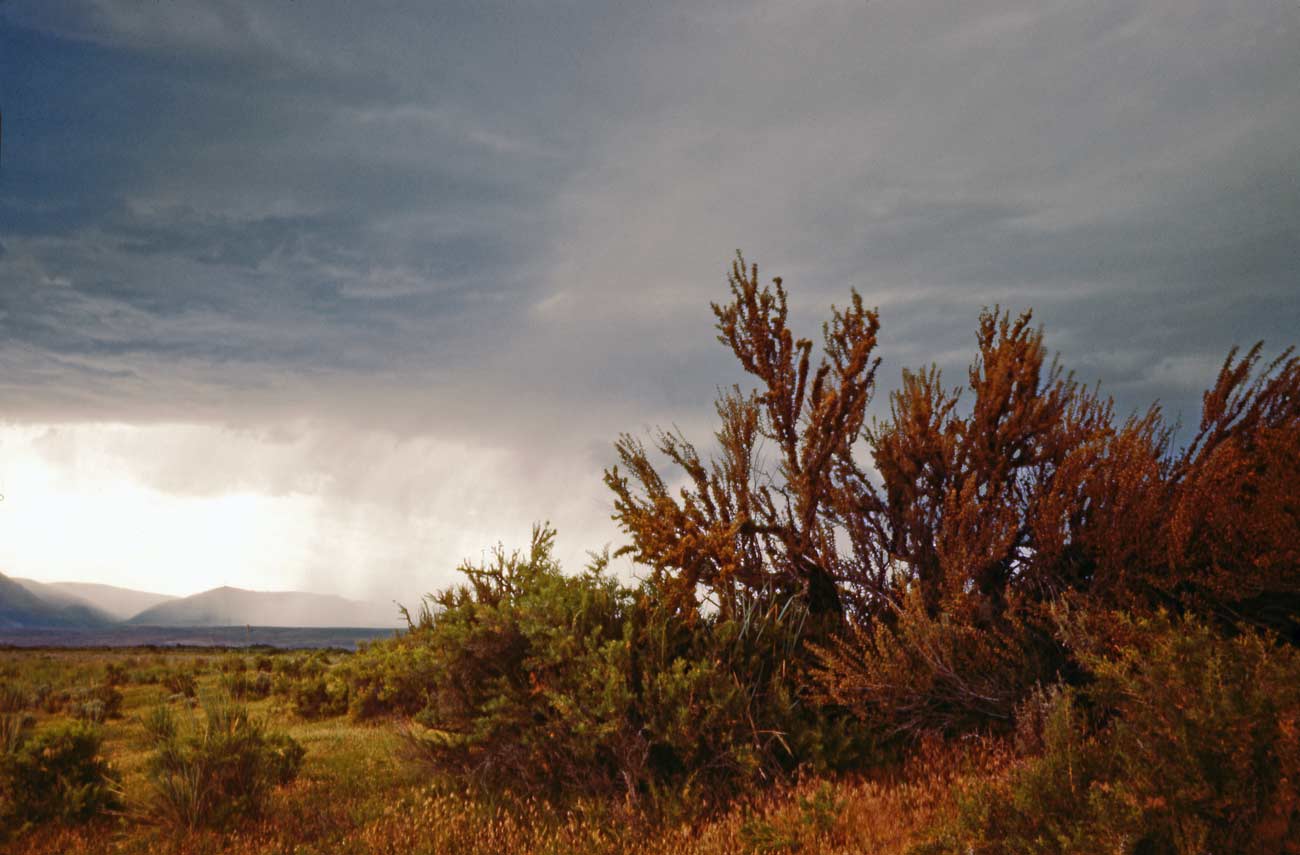
Here again Horace’s soft lens conspires with Kodachrome chemistry and the soft light of a distant storm to turn his slide into a painting. (Click to Enlarge)
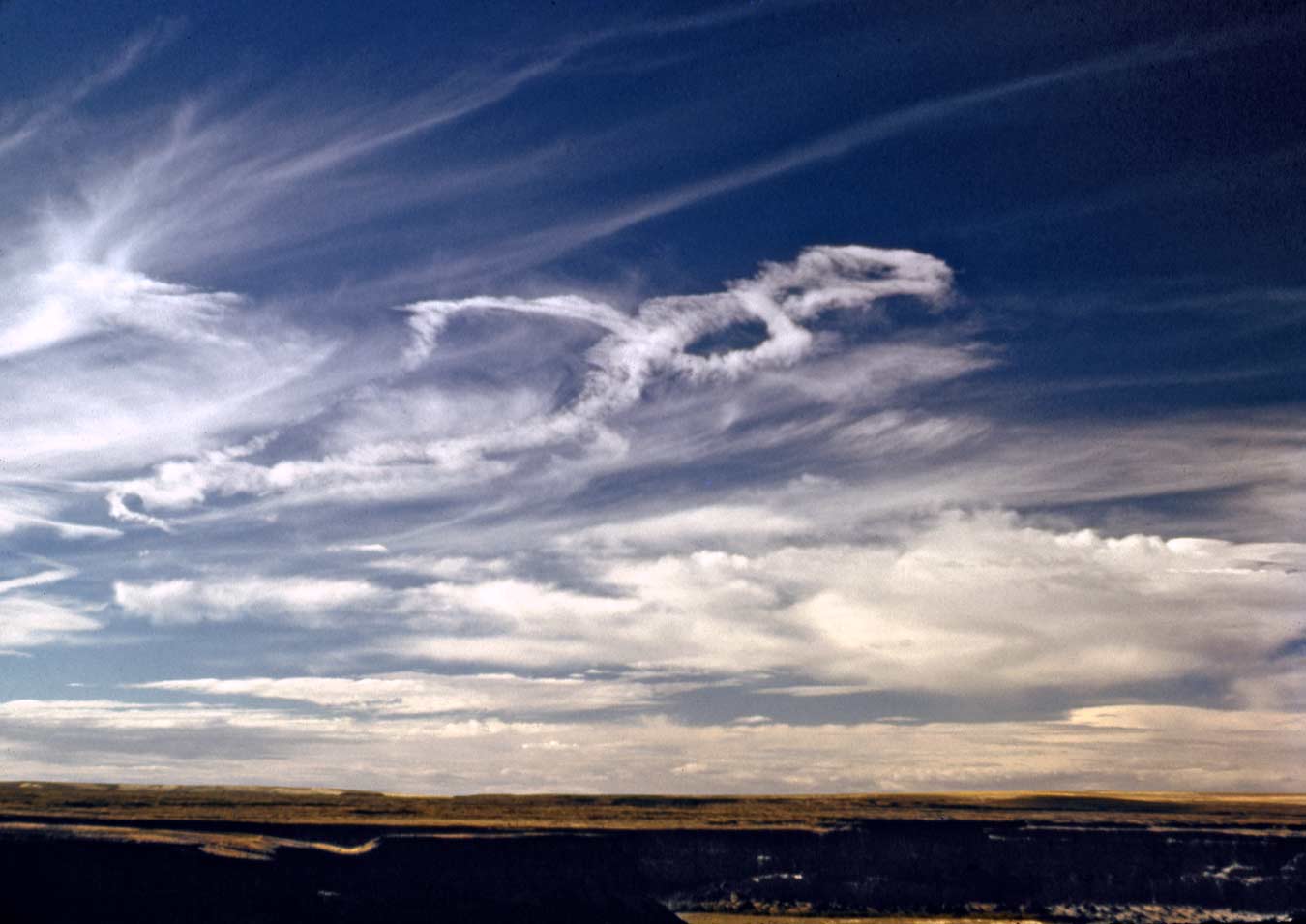
Look up in the Sky! It’s a bird! It’s a plane! It’s a meshuggah capping to a dark flat landscape. The land here seems desolate, a parched thing of patches, like four or five swipes of a dry brush – first with an undercoat brown, a mix of everything on the pallet and then with yellow. While up in the sky is a dollar sign for both the rich and the poor hoping for rain, a sign of the beast for sportsmen in leather, the sign for infinity for those who actively love nothing, the treble cleft for the music of the spheres, a hydra of several heads and tails for the sportsmen to bag.
Living in the lowlands in want of hills and such, Dutch artists, when they turned to landscape, made the most of trees, steeples, windmills and sails. But when judged by how much canvas was given to it then their greatest subject was often the sky. They were the masters of clouds, and their skills in rendering and playing with clouds is honored and enjoyed. We may imagine that paintings without subjects – abstract paintings – were in part inspired or encouraged by what lowland artists did with their skies.
One of the delightful adolescent rites of summer in the Inland Empire was to visit what was perhaps for teens the most libidinous place in the Spokane River Valley, the public beach at Liberty Lake. But there my friends and I lay in the sand and looked to the clouds. We talked to the clouds, sang for them, honored them with poems that we introduced with the same lines, “Look up in the sky! It’s a bird! It’s a plane! It’s a cloud! . . .” And from there added our inventions.
I think this landscape a charming one, perhaps because the parts are more fathomable than formidable. The golden incline in the foreground is not a dangerous pitch. The blue lake I could imagine swimming across without wings. The mountains are not so big either. A few trees hold to the top and there seem to be ways to make it up there without too much worry. Without Horacian clouds the blue sky is antiphonal to the golden slope with bushes that may be drying racks for formal red handkerchiefs. Click the scene if you want to questions it. A charming out-of-the-way place for Horace or anyone in 1945, our circa date. But how will we find it? Our touring fire insurance adjuster leaves no instructions.
What I have learned about snow was got from stamping through it delivering the Spokane Spokesman Review on the dark winter mornings of the Inland Empire. But I do not know this snow with serpentine twists and scales and such. Might this be how a snow slide settles when it melts?
THEN: Mid-block on the east side of Second Avenue between Seneca and University Streets, The Savoy, in seems, had its windows arranged to allow its name to be stamped with big block letters on its north and south facades. (Courtesy Museum of History and Industry)NOW: The “Just Wondering” blogger Matt the Journeyman, stands in the “now” at the northwest corner of Seneca and Second. One block north on Second the charming four stories of the Brooklyn Building at the southeast corner with University survive from the “then” into the “now” although they are were hidden behind the street trees when Jean visited the site last fall.
The lifting of the Savoy Hotel in 1905-06 helped advance Second Avenue as Seattle’s urban canyon of steel-framed high rises.
The Alaska Building at Cherry Street was first in 1904. The Empire Building went up at the southeast corner of Madison Street only a few days behind the construction schedule of the Savoy. (In the late 1970s the Empire was the first of Seattle’s skyscrapers to be spectacularly razed by implosion.) Together the Standard Furniture Building (Broadacres) in 1907 at Pine, and one year later and one block north at Stewart the New Washington Hotel (Josephinum) gave the canyon its northern pole.
The completion of the Hoge Building in 1911 at 17 floors gave a momentary crown to the canyon at Cherry. But three years later the Smith Tower at Yesler was dedicated with a mysterious 42 stories. still disagree on what counts as a “story.” All Second’s “scrapers” except for the Empire and the Savoy survive.
The Savoy’s planners could not have known in 1904 that its position mid-block between Seneca and University Streets would eventually strand it between the new retail district around Pike and Pine and the old Financial district closer to Pioneer Square. But they did soon determine that the height of their slender Savoy was by comparison to the others a mediocre high rise.
Here I introduce the bright blogger Journeyman Matt and his blog “Just Wondering.” Mat advised me of the Savoy’s height “anxieties” when he revealed that the hotel was first built to a mere eight stories but then quickly cranked up to “Twelve Stories of Solid Comfort.” Next, working together we illustrated the brief history of its growth, which you can follow on his blog.
WEB EXTRAS
Anything to add, Paul?
A few somethings Jean. I searched through the list of now nearly 29 years of doing now-then for Pacific and found a half dozen stories that related to the close neighborhood of the Savoy. However, for the moment, I found the illustrations for only four of them, and I’m including here three of those. Two of them feature parades: one for bikes and another for elephants. I’ll put them down now as time allows before I put myself down tonight. I’ll proof them in the morning.
Looking south on Second towards its intersection with Spring Street. Courtesy Lawton Gowey.
THE BIG BIKE PARADE
On February 18, 1901 a local bicycle merchant, Fred Merrill, staged a media event.. He aroused the community and startled his competitors with a peculiar parade up Second Avenue, then Seattle’s Bicycle Row.
The occasion is recounted in Frank Cameron’s recently published “Bicycling in Seattle, 1879 to 1904.” (This feature was first published in 1982 when Cameron’s bike history was new.) Cameron writes, “Most merchants announced well in advance when a shipment of bicycles would arrive; it was cause for some excitement. Few could match Merrill. .A shipment of 400 Rambler bicycles was loaded onto all the express wagons available, and hauled to his store in a parade led by a brass band and two carriages, one for Mr. and Mrs. Merrill, the other for company officers.'”
Cameron is pictured here in the contemporary photograph. (When we can find the negative we will replace this screened rendering grabbed from the book “Seattle Now and Then” that you can visit in toto on this blog.) The location of the “now” image is the . same as the “then” – one half block north of Spring Street on Second Avenue. Cameron poses as part of a different sort of bicycle delivery: 15 bikes and riders from Bucky’s Messenger Service. The deliverers pedal a total of 500 miles a day, courageously darting through traffic that’s not always willing to share the road with bicycles. Cameron is Bucky’s repairman. He is a complete cyclist: rides them, repairs them and researches them.
Bucky's Bikers on Second Ave. in 1982. Cameron is closest to the camera.
The historical photograph shows a part of the parade, and that may be Merrill in the lead carriage at the far left. The carriage pauses beside his storefront with the sign for “Ideal Bicycles” to pose with a few of those hired wagons for an unidentified photographer.
In 1901 there were more than it dozen bicycle shops on Second Avenue between Marion and Pike Streets. No doubt in February they were all preparing for the spring rush on two wheelers, but none with the showy delivery of the man in the rented carriage. The city’s first bicycle was brought from San Francisco in 1879 by the book merchant W.H . Pumphrey, for the son of a local bookkeeper named Lipsky. Little Lipsky’s toy required the resilience of youth because the ride was very bumpy. The tires were hard, there were no brakes and, of course, no paved streets. The flexible pneumatic tire, and a softer ride, first arrived in 1893; in time to test the city’s first paved surface, an experimental block of bricks on First Avenue South between Washington Street and Yesler Way.
By 1896 there was still only one mile of paved streets in Seattle, including these (above) Second Avenue bricks supporting Merrill’s parade. Cameron estimates that in 1896 there were only about 300 cyclists in Seattle. One year later there were 3,000. In 1897 your first desire was to strike it rich in the Klondike, but you might settle for a bicycle.
And all those cyclists formed an effective lobby. The Queen City Cycle Club was founded in the Argus (a long-lived weekly tabloid) offices in 1896 and a year later it became the Queen City Good Roads Club. The Argus ran a regular bicycle column, which promoted the “wheeling” scene. With funds from licenses, benefit races and pledges, bicycle paths were built first around Lake Union and then through a scenic 10 miles to Lake Washington, a portion of that path is today’s Interlaken Boulevard at the north end of Capitol Hill. By 1901, the year of Merrill’s parade, there were more than 10,000 local cyclists. Many wore bloomers, named for “the rational riding costume” for women.
Bicycle racing for men and women was a popular sport, and the city’s planked and cindered tracks were busy with both local contestants and touring professionals. Club retreats took off on weekends for West Seattle, Edmonds, Snoqualmie Falls – even Tacoma. Some bicycles were manufactured locally. This city was also an exporter and a few of Merrill’s 400 Ramblers were bound for China, Japan and even the gold fields of unpaved Alaska where the buyers expected to cycle to their nuggets and perhaps even over them..
The bicycle bust followed the boom. By 1907 what Cameron calls the “decade of the bicycle” was over. Of the 23 merchants that sold cycles during the boom only two remained in 1907. Many dealers went on to automobiles. The sales were less seasonal and the buyers, though often out-of-shape, were usually well-heeled for putting their leather to different pedals.
Looking north on Second towards University Street and the Brooklyn Hotel at its southeast corner. The Denny AKA Washington Hotel is on the left horizon of Denny Hill.
ELEPHANTS ON PARADE
(This feature first appeared in Pacific Magazine on Dec. 11, 1994.)
The circus parade was a great spectacle and promotion, an anticipated annual ritual in many city’s and towns across the county, and often it would also serve to move the circus from the railroad depot to the performance site. That may be what’s happening with this Ringling Bros. procession on Second Avenue, looking north from Seneca Street around noon on a sunny summer day.
Local circus enthusiast Michael Sporrer describes this as “one of the few Seattle photographs that is really good on elephants.” (I count a dozen – elephants, not photos with them.) In Sporrer’s cataloging of Northwest circus appearances (a decades-old unpublished work in progress) he has Ringling Bros. here for two-day stands in late August 1902, ’03 and ’04. Since the most popular early-century Seattle venue for circuses was the old ballpark on Fifth Avenue North at Republican Street (now the High School Memorial Stadium) these elephants may be en-route from the waterfront train depot to the fields of Lower Queen Anne.
Both First and Second avenues were then preferred routes to Queen Anne and North Seattle. Third Avenue stopped at Pine Street, one block and 100 feet below the front portico to the Victorian Denny Hotel atop Denny Hill. Here, this looming landmark interrupts the left -horizon. To the far left Second Avenue still climbs the western slope of Denny Hill, so this view probably dates from 1902 or even 1903, when the Second Avenue regrading began, which in two years lowered it to its present grade. By 1910 the regarding would raze Denny Hill (including the hotel) as far east as Fifth Avenue.
George Bartholomew’s Great Western Circus was, according to Sporrer, the first real circus to visit Seattle. It came overland from Virginia City, Mont. in 1867-by wagon. By Sporrer’s accounting, the last real full-blown circus parade to trek through downtown Seattle probably was the Cole Bros. Circus procession in 1937. The last big tent show hereabouts was Circus Vargas’ 1988 performance in Renton.
Looking northeast through the intersection of Seneca Street and Second Avenue.
PANTAGES VAUDEVILLE
Alexander Pantages built his namesake vaudeville house at the northeast corner of Second Avenue and Seneca Street in 1904. It was “the little Greek’s” second theater. The first, “The Crystal,” also on Second Avenue, was a converted storefront that Pantages opened when he landed in Seattle with a small fortune finagled in the Alaska gold rush.
In his Seattle history “Skid Road,” Murray Morgan describes Pantages’ gold-field strategy: “He abandoned his dream of finding gold in the creek beds and concentrated on removing it from the men who had already found it.” Pantages sold the sourdoughs vaudeville, at $25 a seat in his Orpheum theater in Nome. The price of admission to his first Seattle shows was a dime for a mixture of stage acts and short films. Pantages was illiterate, but having roamed the world before landing here he could converse in several languages. His English, it was said, was as bad as any, but he knew what the public wanted.
Pantages built a vaudeville empire that ultimately surpassed all others. Somewhat like royalty, his daughter Carmen married John Considine Jr., son of his chief competitor. At its peak the Pantages circuit included 30 playhouses he owned outright and 42 others he controlled. To an act he liked he could offer more than a year of steady employment. Pantages sold his kingdom for $24 million in 1929 – before the crash.
For Pantages the best act he ever booked was the violinist he married. Lois Pantages always played the first act whenever her husband opened a new house. The first of these was across Seneca Street from the Pantages. He named it after his wife, and until it was destroyed by fire in 1911, the Lois was a successful theater. Also ih 1911 Pantages purchased the Plymouth Congregational Sanctuary at the northeast corner of Third Avenue and University Street, and built his New Pantages Theatre there. It was designed by architect B. Marcus Priteca, and completed in 1918. Later renamed the Palomar, it was a showplace many locals will remember. (Search this blog for Pantages and you will find stories about the new Pantages/Palomar at Third and University.)
Two looks down at the 1913 Golden Potlatch parade on 2nd Ave. The Savoy - part of it - appears in the scene on the left. The year was chosen because the Smith Tower, far right in the right scene, is topped off but not yet entirely clad. The tower was dedicated July 4,1914, Part of the New Washington Hotel (now the Josephinum) appears on the far left of the left panel, at the northeast corner of 2nd and Stewart. Except for the half block north of Seneca Street, together these two views includes the east side of the "urban canyon," Second Ave. from the Pioneer Square neighborhood on the south (right) to the new Denny Regrade neighborhood on the north (left). Both the Savoy and Pantages Lois Theatre - named for his wife - can be found in this look of Second through its intersection with Spring Street. Far right, the Smith Tower at 2nd and Jefferson was completed and dedicated in the summer of 1914. The first run of Potlatches last three years, 1911 to 1913. The photos above were dated 1913 on the evidence of the tower. It is topped-off but not yet entirely clad. The Savoy rises above the drifts of Seattle's second greatest blizzard, that of 1916.
How much might a smart dog like Toto know of Kansas topography? With a good push (like from the hill that Horace Sykes recorded this view) and a few pulls along the way one could coast from Mt. Sunflower, near the Colorado border, to the Verdigris River at the Oklahoma border, and drop 3,360 feet by doing it. By no description is this Mt. Sunflower or Mt. Sunflower a mountain, but it is the highest point in Kansas at 4.039 feet, and the Verigris point the lowest at 679 feet. Here, however, Horace is probably not in Kansas, but - again - somewhere in Washington State's rolling Palouse.
One of the Sykes pleasures of holding his slides is that they have as yet not all been seen, and as time allows we continue to sort through the boxes. This view of Willamette Falls was found yesterday. Last August 12 we showed another look at the falls that Horace photographed from nearly the same place on the Willamette's east bank, but with a different tree and more flow over the falls - and at sunset. The following day we put up yet another look at the falls, one from an earlier black and white negative by an unknown photographer. It too came with no caption. I have only seen Willamette Falls from the train on trips between Seattle and California, most of them in the mid-1960s. I remember having plenty of time to study the falls. Perhaps the train pokes along here. And perhaps the smoke drifting in the sky above the falls here comes from a diesel engine, and Horace is snapping from the window of a coach on the Southern Pacific RR. Horace was raised in the Willamette Valley and after his move to Seattle in the late 1920s still had family attractions in Oregon. Maybe for this trip he put aside the Sykesmobile and took to the rails. (Click to Enlarge)
Searching for a title for another subject that Horace Sykes does not identify, a subject that might be found in a calender publisher's file for "autumnal scenes," I have named it for my maiden mother, Eda Christiansen, who prefered scenes like this one surely even long before she met dad. It reminds me of a landscape that hung in the hallway between the kitchen and the living room at 828 Jefferson St. during my own "maiden years" on Spokane's South Hill.
It was tonight , seen from Boulevard Henri IV, ” le Génie de la Bastille” or Genius of Liberty standing on the top of the column of Juillet was looking very mysterious…
C’était ce soir , vu du boulevard Henri IV , le Génie de la Bastille ou le Génie de la Liberté au sommet de la colonne de Juillet semblait très mystérieux…
After skimming the Snake both ways for many miles out of Asotin, Washington, I could not find this setting in or approaching Hells Canyon and yet still believe that in my speed, bumping against the cliffs and through the corners like steel balls in a pinball machine, I somehow missed it. Still, I'm holding to the Snake.
By some accounts modern art was, in part, a reaction to the camera and it powers of verisimilitude. Art would show it how to squint the eyes or look through impressionist's glasses to points of light. In this Sykes landscape we have a photograph nearly responding or acting like a painting, and it begins with the focus. It is soft. When the subject is examined up-close (closer than you will see it here, even with two clicks of your mouse) it seems to loosen and sometimes shake itself into dabs of paint. Such a photograph might be a way to teach impressions - with a brush. "Step one: Blow up., Step two: Find the points of light. Step three: Copy them with a plastic medium - oil pigments for instance - using a semi-stiff brush and be faithful to their order." And it is also appropriate and typical that we know neither when nor where this is. We do, however, given time, the size of that river, the habitat and Google Earth feel that we could find it. Perhaps you will find it first.
THEN: “In what was then a neighborhood of hotels and apartments Seattle’s Labor Temple opened in 1905 at the northeast corner of 6th Avenue and University Street. (Pic courtesy Lawton Gowey)NOW: “The 36 floors of One Union Square were completed in 1981. What distinguished the structure at that time was it’s aluminum skin, which is still stormtight and shining.”
Throughout the first anxious year of World War Two, the local Federation of Labor Unions completed the construction of their new Labor Temple at the northeast corner of First Avenue and Clay Street, and in the fall of 1942 the member unions – nearly 50 of them – moved to it from their old quarters here at 6th Avenue and University Street.
Reporting on the move, the Post-Intelligencer noted that the old temple would continue to be used for some union meetings until the return of peace permitted an auditorium to be fitted into the new Belltown building. The P-I also reflected “most of the important meetings and outstanding decisions made by Seattle labor leaders since 1905 have taken place in the old temple. The general strike in February of 1919 was planned in the building . . . The streetcar motorman’s strike during the last war was also called from the building.”
The Labor Temple, left of center, seen from First Hill. This view of it was used in "Seattle 1900 to 1920," Rich Berner's first of three books on Seattle in the first half of the 20th Century. See below.
The 1905 dedication at 6th and University was two blocks south and four years late. At the conclusion of the 1901 Labor Day parade a few thousand celebrants gathered at 6th and Pike (not University) to lay the cornerstone for the Western Central Labor Union’s new temple. William H. Middleton, its optimistic president told the crowd, “In the name of the organized labor, in the name of the great trades union movement and in the name of the Western Central Labor Union, I dedicate this temple for the use of organized labor. May peace be within its walls and good will always extend to mankind.”
Several strikes and considerable strife between industrial and trade-based labor followed and probably confused the first attempts at building a temple. Retired U.W. archivist Rich Berner’s first of three books on 20th Century Seattle is the best source for following the labor fireworks of those years. Now a new illustrated edition of Berner’s “Seattle 1900-1920” can be read free on-line on this blog (click here to download – Rich’s complete book approaches 28 MB, which takes 20 seconds to download with cable, but possibly more time with slower connections) or purchased in hard copy at the University of Washington Book Store. All proceeds after expenses go to the non-profit encyclopedia of Washington State history, historylink.org.
Here’s a larger rendering of the book’s cover.
WEB EXTRAS
Well, Paul, on this day after Christmas, I thought it appropriate to drag out a production we did together several years ago. It is, of course, our audio dramatization of O’Henry’s THE GIFT OF THE MAGI, which you narrated and I produced for Feliks Banel’s Holiday Express show on KBCS-FM, hearkening back to my days as a radio theatre impresario for NPR. For those who long for yet one more tidbit of Christmas, enjoy. The rest of you can just cool your heels till next year.
Now, your turn, Paul. Anything to add?
Jean, mostly another encouragement for readers to check out the book Seattle 1900 – 1920. It is stuffed with illustrations that are almost always shown on or very near the pages to which they are most relevant.
As you know Jean, Rich begins his 10th decade this coming New Years Eve, Dec. 31. He will be 90 years old. Since they cannot find anything wrong with him he may be around until 112. Here’s the picture you took last year at Ivar’s Acres of Clams. We took him for lunch.
Rich Berner at the Acres of Clams Dec. 31, 2009, his birthday, with one candle "holding the candle" for 88 more. The 1942 clipping from which much of the Labor Temple story above was borrowed.A "buy a bond" float from WW1, which adds the alternative "or fight." The role of the weighty man at the rear is puzzling. Is he preparing to fight or pay out. Or is he there to hold up Uncle Sam? The photo also includes what is probably an "optical allusion." The curtains blowing vigorousy from the open window on the left, are probably not curtains but mutilated photographic print paper. And there on the flatbed is that Horrible Hun, followed below by a Dicks Drive-In (Wallingford) revolving bun and burger notice for a patriotic meal on Labor Day, 2008.
We know neither where nor when Horace Sykes recorded this landscape, but we have chosen it for this Christmas Eve as our "Christmas Bush" or bushes. And the lighting at least intimates the miraculous. How, with the background of dark rocks mostly back-lighted, did Horace's band of bushes get lighted so? Now we simply turn on the fill-in flash in circumstances like this, if we wish. But Horace - as far as the evidence goes from hundreds of slides - did not use a flash outdoors.
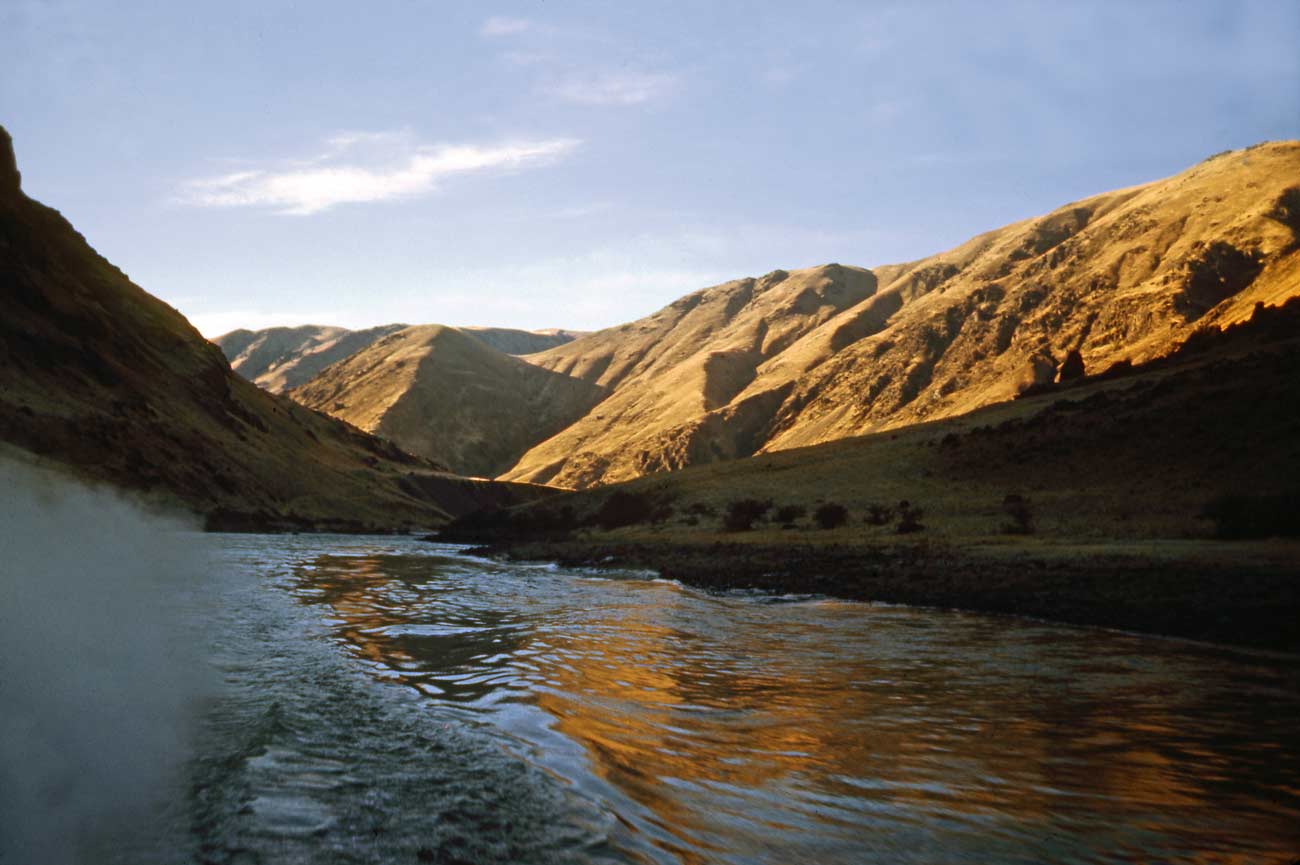
(Click your MOUSE to Enlarge) This landscape with the serpentine river and hills stepped to either side like artifacts reveals a nature so obedient to forces as predictable as a French Curve or as obedient as a bible college geologist that it seems painted. Whether idealized or recorded, where is it? I first went for the Grand Ronde River in the northeast corner of Oregon. It has scores of curves to explore looking for one that matches these. But that river is not this big, and its sides are ordinarily steeper and its habitat kinder to evergreens. The Grande Ronde is, of course, a tributary to the Snake River, and about thirty crow-flies miles northwest of where the Grande Ronde joins the Snake River south of Asotin, Washington, the by then slack water Snake reaches the Lower Granite Dam, the last of four dams built between the Columbia and Lewiston-Clarkston – all of them with locks. If the crow flies over the dam and continues towards the northwest in about another four miles the bird may wish to stop and rest here on this hill, which Horace took for his prospect. It looks southeast through the curves that are now still evident in the river although without the sand bars. Again, the Snake is now one long lake – or four lakes between Ice Harbor Dam, about ten miles up stream from the Columbia, and the twin cities of Lewiston and Clarkston, which because of the dams are now acting like ocean ports – small ones. From this prospect today Horace would see the dam upstream and also directly below him the primarily wheat shipping port of Almota. And about half way between the dam and the port he could not help but notice Boyer Park and Marina on the left bank, a sturdy development with lots of room for power boats and camping too. Now below Horace’s hill three paved roads meet. Washington Hi-w’y 194 comes through that cut bottom-left and meets the Almota Docks Road and the Lower Granite Road on the north (or here northeast) side of the Snake. In all it took millions of years to create this spectacle but only an afternoon or two to parcel it with a fence.
I have never been on the Snake for the rented excursions one can take south into the canyon, but I imagine that this, like the Sykes from yesterday, is another scene along the way, one deeper in Hells Canyon.
With no time left tonight for research - i.e. Google flights - I'm still only two twitches short of confident that this is the north entrance to the Snake River's Hells Canyon. So this view looks south.
Why this cliff and where? Here, perhaps, Sykes' picturesque urges surrender to a subject that is built upon a more abstract interest in composition. The cliff is impressive but one of many. The sky too. The "bed" at the base of the road seems like an invitation to build a road, except that we do not know how it all moves - falls perhaps - to the right or where the road might take one. The rock and sky as parts - almost halves - are seen in a simple composition energized by the slant of it all - or most of it - and the curve in the "road." The side of the cliff is almost a texture with its aggregate parts acting egalitarian. And the sky is painterly, in a modernist way. No billowing picturesque romance in that white on blue.
Rock Lake is one of the larger finger lakes that run through the canyons of Washington State’s Scablands south and west of Spokane. It is about 7&1/2 miles, long enough to breed a legend about its own monster. And deep enough in places – 375 feet – to hide one. Because of its depth it is a cold lake and rarely freezes over in the winter, although it is also not so comfortable for swimming in the summer. With the agricultural run off during most of the year it is also cloudy enough to make fishing for its big trout and browns not so rewarding except in the spring. In Whitman County, Rock Lake is 9 miles northwest of St. John, 16 miles southeast of Sprague, 15 miles west of Rosalia, and 33 miles south of Spokane. We found it with luck and the help of Google Earth. This view looks south from near its north end. Rock Lake, it is said, is stirred by Native American ghosts that haunt its south end, that a derailed train lies at its bottom and that one can still hear the wail of its whistle breaking free of the cold lake. (Click to Enlarge)
THEN: After considering Shilsholia, which sounds similar to the native name for this waterway and means “threading the bead,” Lawtonwood got its name by vote of its residents in 1925. (Courtesy Museum of History and Industry)NOW: In order to see over the well-packed “East Lawtonwood” Jean Sherrard took his “now” from near the north end of 42nd Ave. Northwest, about 100 feet above the waterway. Behind him in “West Lawtonwood” the homes are often much larger and the lawns too.
Carolyn Marr, the librarian at the Museum of History and Industry (MOHAI) and an authority of the photographer Anders Wilse’s years in Seattle, thinks that this his look east through the entrance to Salmon Bay – from Shilshole Bay – was probably taken in 1900. That was Wilse’s last busy year in Seattle before he returned to Norway. During his few years here Wilse received many commissions from businesses and the City of Seattle to do photographic surveys. But why did he record this bucolic view over a Lawtonwood pasture with seven cows?
It was not long after Wilse recorded this view of the channel that the Army Corps started dredging it in preparation for the ship canal. Throughout the 1890s smaller “lightening ships” hauled cut lumber from the many Ballard mills on Salmon Bay to the schooners anchored in deep water off of Shilshole Bay. No vessels here, however. The channel is near low tide. You can make out the sand bars.
The home of Salmon Bay Charlie, a half-century resident here, can be found to the far right. With irregular roof boards it may be mistaken for part of the shoreline. Charley was one of the principal suppliers of salmon and clams to the resident pioneers on both sides of this channel. Wilse gives us a good look across the tidewaters into a west Ballard that while clear-cut is still sparsely developed. The Bryggers settled and developed that part of Ballard, and the few structures seen there may belong to them.
Librarian Marr finds two other related views in MOHAI’s Wilse collection. One looks in the opposite direction across the channel from Ballard, and the other is a close-up of Salmon Bay Charlie’s cedar-plank home. Marr adds, “Wilse was interested in boats and waterways, as well as Indians.”
One last note: those may be Scheuerman cows. The German immigrant Christian Scheuerman and his native wife Rebecca were Lawtonwood pioneers. Settling here in 1870 they multiplied with 10 children.
WEB EXTRAS
Once again guided through the back streets and secret passages of Magnolia, the inestimable Jon Wooton led me to the spot near where Wilse’s ‘Then’ photo had been taken. The following closer shots of the railroad bridge were taken on return trips over the next couple of days.
The rail bridge through treesThe bridge from the water
Anything to add, Paul? A few things now and a few more later in the week with a Salmon Bay Addendum. Here, by near coincidence, is a view of the Great Northern bridge when it was nearly new. Both views look from the north side of the bay. This “then” was photographed by James Turner – unless I am corrected. (Click to enlarge – twice.)
Another Wilse view, like the one at the top. This is from the north side of the bay and so looking southwest past the Lawtonwood head in the direction of West Point. The two sandbars beyond what may be a dugout canoe were two of the remembered features that were dredged away with the building of the Lake Washington Ship Canal.Hopefully we remember Ambrose Kiehl, the engineer organist, who laid out Fort Lawton, and prepared it for the forces. Here - circa 1899 - he has taken to a stump to do some of his early surveying for the fort. Beyond him is the entrance into the waterway that at some point along the way is a blending of Shilshole and Salmon Bays. (The Locks took care of that ambiguity.)This, it seems, is the oldest photograph of any part of Salmon Bay - but what part? It was copied from a Lowman Family album, and the date scrawled at the bottom is most likely 1887 and not 1889. Three or four other views of the "north end" appear in the album and they are dated 1887. In 1887 is was first possible to reach Salmon bay from the downtown waterfront aboard the Seattle Lake Shore and Eastern Railroad (SLSER). Of course this group must have come around West Point in their sailboat. The West Coast Improvement Company founded Gilman Park - the first name for Ballard - in 1887, taking advantage of the new SLSER connections. By some calculations it was the most successful of all pioneer developments - suburban ones - hereabouts. Until its 1907 incorporation into Seattle, Ballard was known as "The Shingle Capitol of the World." (Courtesy Mike Maslan)
Next – if we may – we will reflect on what changes along this way must have transpired in the mere 60 years between the above the photograph and the one that now follows.
The KALAKALA
Before there was the Space Needle there was the Kalakala – serving as the principal symbol of Seattle and Puget Sound. The ferry was introduced in 1935 to help locals take their minds of the Great Depression. The Black Ball Line named her after the native Indians’ mythical “flying bird” and advertised her as the “world’s first streamlined ferry.” The publicity worked. Puget Sound’s first streamlined symbol was known from Peoria to Peking.
The Kalakala’s function, however, did not follow its form. It vibrated badly, and was not particularly fast. Its daily wartime work of transporting nearly 5,000 ship workers between Seattle and Bremerton earned it the proletarian title “Workhorse of the Sound.”
The tear-shaped vessel was first sketched by the avant-garde industrial designer Norman Bell Geddes, and so apparently not by a Boeing engineer as is widely believed. Bell Geddes managed to design an auto ferry that did not resemble a steam-powered garage. The Kalakala’s aluminum skin was stretched over the burned-out hull of the San Francisco Bay ferry Peralta, towed north in 1934 for its transmutation.
Here, the Kalakala is on an excursion through the Chittenden Locks on April 24, 1947. Twenty years later, her wings were clipped and she was towed to Kodiak, Alaska, where she was landlocked as a crab-processing plant. (This feature first appeared in Pacific on Nov. 3, 1991, when the magazine was still credited to both the big local pulps then, “The Seattle Times/Seattle Post-Intelligencer.” This explains the timing and hopeful fancy of the remaining copy.)
Ever since, persons of energy and imagination have labored to bring the “flying bird” back to Puget Sound, the waterway for which she was once an international symbol. Most recently this effort has been organized by the Kalakala Foundation.
Salmon Bay Charlie's cedar plank lodgings appear in the featured photo at the top. Here is a close up, and judging from the number "75" it is a very early Webster and Stevens negative - perhaps 1901, and so recorded soon after Wilse had returned to Norway. This was first published in Pacific on January 29, 1984 - a quarter-century ago! - and for the now U.W. Architect and Discovery Park preservationist Frederich Mann led me to it. I asked him to be part of the "now" scene and he is part of it - but not here. As with so many other repeats from the years of doing this weekly business I have secreted it away from myself in one or another of scores of binders. I hope to find it. Fred was a wonderful mensch. The 1984 article follows.
SALMON BAY CHARLIE
Salmon Bay Charlie and his wife lived in their cedar plank home on the south shore of Magnolia’s Salmon Bay. For half a century Charlie, also known as Siwash Charlie, sold salmon, clams and berries to the first settlers and later to the soldiers at Fort Lawton. Today’s historical view shows Charlie’s house at the turn of the century, taken by the photography firm, Webster and Stevens.
Charlie’s native name was HWelch’teed, and he probably was the last of the Sheel-shol-ashbsh (hence Shilshole) group that centered on this once narrow Shilshole-Salmon Bay inlet to the fresh water interior. (“Sheel-shol-ashbsh” translates to “threading the bead,” which was descriptive of the canoe trip to lakes Union and Washington.) The Shilshole Indians were one of the eight or nine principal tribes who lived in what we now call Greater Seattle. LocaI historian David Buerge has determined that this Salmon Bay site was once the center of a large community whose area extended from Mukilteo to Smith Cove. Here, long before Charlie’s shack was built, three long houses dominated the area. The largest house was big enough for potlatches, the gift-giving ritual ceremony.
The Shilsholes went into a sudden decline a half century before ‘white settlers grabbed their land. Once about 1800 of their numbers were ravished by “a great catastrophe,” most likely an attack by one of the slave-taking, booty-hunting and beheading North Coast tribes. By the time pioneer Henry Smith settled Smith Cove in 1853, the tribe had dwindled to a dozen families at most. By the late 1880s there were only two families left.
Steady white settlement, started in the 1875 when German immigrant Christian Scheurman moved to the area, cleared the timber and married a native woman who had ten children before she died in 1884.
In 1895 Seattle boosters organized to attract a military post to the area and gathered the acreage that is now Fort Lawton-Discovery Park. The part of it that is now Lawton Wood, shown in our contemporary photo, is not part of the military holding because Scheurman withheld it.
Soon after the military moved in next door, this protected enclave was improved with mansions of a few of Seattle’s elite. In 1952 these neighbors – about 30 houses sparingly distributed about a generous 30 acres – organized the Lawton Wood Improvement Club waving the motto “To Beautify and Develop Lawton Wood.” By the time that the last of the Scheurmans, Ruby, moved out in the late 1970s the beautifying had turned more to developing, and the lots got smaller.
Any attempt to, recreate the perspective used in the photo of Charlie’s shack would have put in the bay. During the early part of the 20th century, deep-water dredging by the Army erased the old Indian’s promontory. The excavation revealed the many layers of discarded clam shells that piled up over the centuries of native settlement.
In 2003 I returned to the site to deliver a slide show lecture on Salmon Bay to members of the Magnolia Historical Society. We met in a member’s home that overlapped Charlie’s “property” broadly foot-printed. The new print of Charlie’s above – and his dog – had surfaced from a collection kept by one of the Society members, Russ Langstaff. Here first is the picture, followed by the feature on it that appeared in Pacific, also in 2003.
SALMON BAY CHARLIE’S VISITORS(With some of the news form above used again.)
Later this day – after I have finished writing this – I am attending a benefit for the Magnolia Historical Society (MHS) as they prepare to write and produce a second volume of “Magnolia: Memories & Milestones.” We will be meeting at the home of Betty and Tink Phelps and within whispering (that is, not shouting) distance of where the historical photographer stood who took this week’s “then” photo of three black suits visiting Charlie (or Hwehlchtid) the last of the Duwamish Indians to live on Shilshole Bay. Of course, while I am at the benefit I will photograph the contemporary scene (including some society members) printed here as a “repeat” of the historical photograph.
Magnolian Russ Langstaff found this newest addition to the small store of Salmon (or Shilshole) Bay Charlie photographs while thumbing through the stock of images taken by both his father and uncle early in the 20th Century. However, it took two-time society president Monica Wooton, while searching for photographs to illustrate the MHS’s first book, to identify this scene as one of Charlie, his dog and his home.
While the towering trio are not identified it has occurred to more than one “reader” of the photograph that perhaps these are the agents from the Office of Indian Affairs who removed Charlie from his home to the reservation soon after his wife Madelline died. That was at the time the Ballard (Chittenden) Locks were under construction. One source says 1915 and another 1916 for Charlie’s removal.
Although, of all the historical maps of Shilshole Bay that have been found none mark the site of Charlie and Madelline’s home (city maps were generally made to sell property and not to identify and so perhaps help preserve native homes like Charlie’s), the several surviving photographs of this historical home lead us confidently to the Phelps back yard or at least very near it.
Now and Then Captions together: Until about 1916 when it was burned Salmon Bay Charlie’s home was a landmark fixture on the southwest shore or the Magnolian side of Shilshole Bay. Like the contemporary deck of the Phelps home, this sturdy shack of the last of the Shilshole band of the Duwamish Tribe sat on a promontory or knoll near the foot of what was later developed as Sheridan Street in the Bay Terrace Addition of the Lawtonwood neighborhood. The site was also dredged for a widening of the waterway into the locks.
(Historical view courtesy of Russ Langstaff. I took the “now,” below, myself. Jean’s contributions began in 2004. Will we make a decade together Jean?)
Two views of the home looking to the southeast.
In some now lost time of the 1990s I mounted a large exhibit of Salmon Bay neighborhood pictures in Hirams Restaurant, which overlooked the locks and the bay. I think the name has been changed twice since, and the pictures were removed during a subsequent remodel, and also apparently destroyed – or lost – by the owner. This portrait of Salmon Bay Charlies standing with his goods was included in the exhibit and captioned so . . . “ From his home on Salmon Bay, Salmon Bay Charlie gathered clams and netted salmon for sale or barter with Ballard residents. After the death of Chief Seattle’s daughter Princess Angeline in 1896, Charlie was the community’s best known native. He was especially popular among children to whom he would tell stories of his own youth. This studio portrait was probably marketed as a souvenir. Soon after his wife Madeline died in 1914 or 1915, the elderly Charlie was sent to a reservation by the Office of Indian Affairs. Bill Phillips, Charlie and Madeline’s neighbor and probably a relative as well, soon afterward burned down their home. It was the native’s practice to burn the homes of the dead in order to ritually separate them from earth.”
Before showing the homes of two of Charlies neighbors – those on the south and north sides of Chittenden Locks – we will pause to show a few more salmon.
In Charlie's marketing years if a local settler had the time to do it catching one's own salmon was commonplace and often quick.Included among the 1909 Alaska Yukon and Pacific Exposition's many plaster-paris figures was this heroic one of a commanding female securing a salmon with her left hand while holding high an electric wire with her right hand. The fish and the wire represented some balance of the past and the future, we imagine. A subjectd loaned to us from the Ballard Historical Society with a caption that describes it as a scene of salmon processing in Ballard. The year must be guessed at from the uniforms. The labor boss, perhaps, seems to float - or lurk - in the shadows at the rear.One of the favorite tourist destinations in Seattle, the fish ladder at the locks includes a viewing room where the lucky salmon who have made it past all obstacles - including the seals in the bay - have almost returned home. We use them also as a reminder that we mean to return to this site with another blog addendum, this time to show several scenes from the construction of the locks.
Follows now two past Pacific features about Salmon Bay Charlie’s neighbors, the Shillestads on the Magnolia side of the locks, first, the the Bryggers on the Ballard side following.
BEFORE the LOCKS, the SHILLESTADS
Ole and Regina Shillestad knew each other in Norway. As students, then married here in Seattle. They raised their four children on the south shore of Salmon Bay beside the site of the future Chittenden Locks. The couple acquired this land in 1876. Four years later they built their home here and planted an orchard of about 30 trees: plum, pear and apple. A sliver of the orchard is evident on the left just behind the fence built above the high-side line.
A skilled Norwegian carpenter, Ole built the home himself as well as that of his neighbors, John and Anna Brygger, who lived just across Salmon Bay. (The Brygger home, which survives as part of the Lock Spot Tavern.) Both homes were ornaments with Shillestad’s hand-cut details.
In 1898 King County bought a portion of the Shillestad property in its campaign to lure the federal government to build locks at the site. The family home was moved a short distance during the canal’s construction, and when the waters were at last raised in 1916 behind the Lock’s new spillway, the Shillestads picked the fruit of their orchard from a rowboat (perhaps the one seen here.)
After the family moved to lower Queen Anne, the old home was rented often to caretakers of what remained of the old Shillestad family property. Commercial development of the south shore began shortly after World War II, and for a time June Shillestad and her brother operated the Sealth Souvenir Store and Lunch Counter alongside the spillway dam. The family home survived until the mid-1970s, when it was replaced by the apartments that now look down on Chittenden Locks.
Another look across the Salmon Bay waterway before the Locks and to the Shillestad's home framed by snow.
The Brygger home as Lock Spot - part of it - in 1991.
THE BRYGGERS of BALLARD by Salmon Bay
Anna and John Brygger moved from their log cabin in 1887 into this, their first finished home. The lumber for it was logged from their homestead on the north bank of Salmon Bay, towed to Seattle for milling and then rafted back for construction. John died the following year, but the much younger Anna lived until 1940.
Before his death at age 65, Brygger had his successes. He was one of the first to try commercial fishing and canning on Puget Sound. In the summer of 1876, the Intelligencer (a predecessor of the Post-Intelligencer) reported that “Mr. John Brygger, a Norwegian capitalist and fisherman, has purchased a site on Salmon Bay about six miles north of the city, where he has already commenced the business of catching and canning salmon.” His skill was such that he was able to open a bank in his native Norway with earnings. This banking confidence he passed on to his son, Albert, who later became president of Seattle’s Peoples National Bank.
The "official" Helix delivery van was a wood sided station wagon like the one above parked between the two wings of the Lock Spot. (Again, the one on the right is the old Brygger home.) But those Helix deliveries began in 1967. This view is what year? 1951? I was then in my last year at Spokane Lutheran Primary School.This is now added by Ron Edge of this blog. This is that part of the Lock Spot that is not the Bryggers home. Depending on the width of the lens it may be the earliest of the three Lock Spot photos shown here, and taken from the future site/lot of the Bryggers home before its move ca. 1948.
The Brygger home was built on a knoll a short distance north of Salmon Bay – and the future Chittenden Locks – near the present intersection of Market Street and 30th Avenue Northwest. In 1948 the site was condemned to allow the extension of Market Street west from 29th Avenue Northwest. Frank Canovi, Lock Spot Tavern owner, bought the Brygger home and moved the oldest part of it less than 100 yards south of the original site to his popular beer parlor.
[We hope later this week to put up another blogaddendum, this one of the buildings of the Chittenden locks – if time is kind, this week. And sometimes between then and now, we also hope to proof the above. Now it is time for another visit to the kingdom of slumber that Bill Burden has so honestly named the “nightybears” or “nighty bears.”]
November 27th last we published a photo essay – or several – that gathered around the subject of candid street photography. We began with pictures of our friend Clay Eals’ mother Virginia Slate Eals snapped on Seattle streets during the Second World War. Now Clay has found a few more examples from out of town and we happily add them with his captions. The top two have come from Donna Crowe, his co-worker at Encompass in North Bend. Donna is pictured as a child in the second image. From Clay’s many years as editor of the West Seattle Herald we know that they will be spelled and punctuated correctly.
William and Mary Lamont, residents of Saltair (east coast of Vancouver Island), B.C., stroll arm in arm along Yates St in Victoria, B.C., Canada, sometime in the 1940s.Della Rooney tries to keep up with daughters Diane (older, left) and Donna as they walk along Columbia Street in New Westminster, B.C., Canada, in 1950. Florence Slate, my grandmother, walking in downtown Nashville, Tennessee, on Dec. 8, 1946. (Clay explains that this probably was during a visit that Florence and her husband, Joe, Clay's grandfather, made to Joe's hometown of Red Boiling Springs, Tennessee.)
We’ll finish the quartet with another of Clay’s mom, but this time not in Seattle.
On the right my mom, Virginia Slate, and her friend, Joan Sampson, walking in downtown Victoria, B.C. in 1945. (We edited Editor Clay's description of his mother's sunglasses in this photograph as "kind of odd and off-putting." Au contraire, we think those glasses add to her confident-looking allure.)
As you can readily see this is some canyon that is grand. After looking for Sykes subjects all over southern Utah and Arizona I am, however, no longer confident that there are no canyons in Canyonland that do not make a pretty good mime of the Grand Canyon of the Colorado in Arizona. There are as many unique headlands and bluffs and cuts and Pantheist Temples of Stone in all that to exceed in articulations all the fingerprints taken on any day following a mass arrest in Moscow or Washington D.C. or Paris. So I will not name this canyon, but wait again for someone else to identify this detail. Horace, we know, is silent on this matter.
We assume this coast is in Oregon. Horace Sykes was raised in Western Oregon and made frequent trips to the coast, even later when he made his living in Seattle and lived comfortably beside its “coast” at the western edge of the city, in Magnolia a few feet above the tides. The driftwood is almost obligatory for a subject such as this one. (But could this bleached fragment have drifted so high above the tides? Perhaps the Oregon Department of Tourism moves them there.) For Sykes it also takes the place or role of a flowering bush and sculptured rock. Except in postcards and Kodachrome slides we do not get a blue like that in this Pacific.”]
On ten A.M this morning, at the 46th floor, I was taking portraits pictures, and I couldn’t take my eyes off this magnificent view…
Looking at the west , you can see first the Eiffel Tower and the Champs de Mars, just behind the business district of ” La Défense “, on the right the other tower is the ” Hôtel Concorde Lafayette Porte Maillot “, on the right the golden Dôme of the Invalides.
De la Tour Montparnasse
A 10 heures ce matin , au 46 ème étage de la Tour Montparnasse , je devais réaliser des portraits , et je ne pouvais détacher mon regard de cette divine vue.
En regardant à l’Ouest, la Tour Eiffel et le Champ de Mars, juste derrière le quartier des affaires de la Défense, sur la droite la tour de l’hôtel Concorde Lafayette Porte Maillot, et le dôme doré des Invalides.
(Please remember to click your mouse on these images – sometimes twice – to enlarge them.) How many waterways are there this size in the American West? A highway – far right – runs to Horace’s side. What seems like a huge sandbar with piles of itself directs the flow around itself, it seems, and against the steep incline beyond it, which is dappled with dark evergreens as are some Okanogan Mountains. For instance, there is a hillside vaguely like this directly across the confluence of the Okanogan and Columbia Rivers from Brewster – see the now-then below – that has a scattered forest clinging to its side. The comparison below is lifted from Jean’s and my book Washington Then and Now.
The principal difference between the original and its repeat in the above comparison is the Wells Dam, which flooded the Columbia with a slack-water Lake Pateros behind it that reaches upstream beyond Brewster. The new dam started producing electricity in the summer of 1967, aka, in some places, as “the summer of love.”
And now taking my own Okanogan clue I have found it with thrills and the help of Google Earth. Horace is looking west-southwest from the north bank of the Columbia about five miles downstream from Brewster. He is looking at the point – at the eastern end of the town of Pateros – where the “Big Bend” in the Columbia begins its crooked flow to the south for 100 miles (as the crow covers the distance) to the Priest Rapid dams where the river heads roughly east to take on the contributions of the Snake River before making its next big bend and heading west to the Pacific. (For that part of the river search here – or almost anywhere – for Wallula Gap.) Here that badly called (by me) “sandbar” is not pushing the river to the right because the Columbia turns left before reaching it – or where it reaches it. The “incline” dappled with evergreens is Goat Mount, which at 5,300 feet rises an impressive 4,500 feet above the river. It is but five miles from Pateros to the summit of what is – if I have read the elevations correctly – the highest mountain to rise from the Columbia at least through these 100 miles but probably many more. Directly below I have grabbed the Google Earth look with Horace’s side-by-side. The scale is different (and the yellow grid lines are an embarrassment I am momentarily stuck with) but the repeat of the features – including the “sandbar” – are obvious. (Now I wonder if that “sandy” part where the river turns was desposited there during the great ice age floods that carved the Grand Coulee. Here I imagine that pile of “sand” was left as a filtered sediment where the river turned suddenly because it could not push through Goat Mountain. It is to be hoped that among our readers there is a Pateros geologist.) That is US Highway 97 on the right of the Daily Sykes at the top.
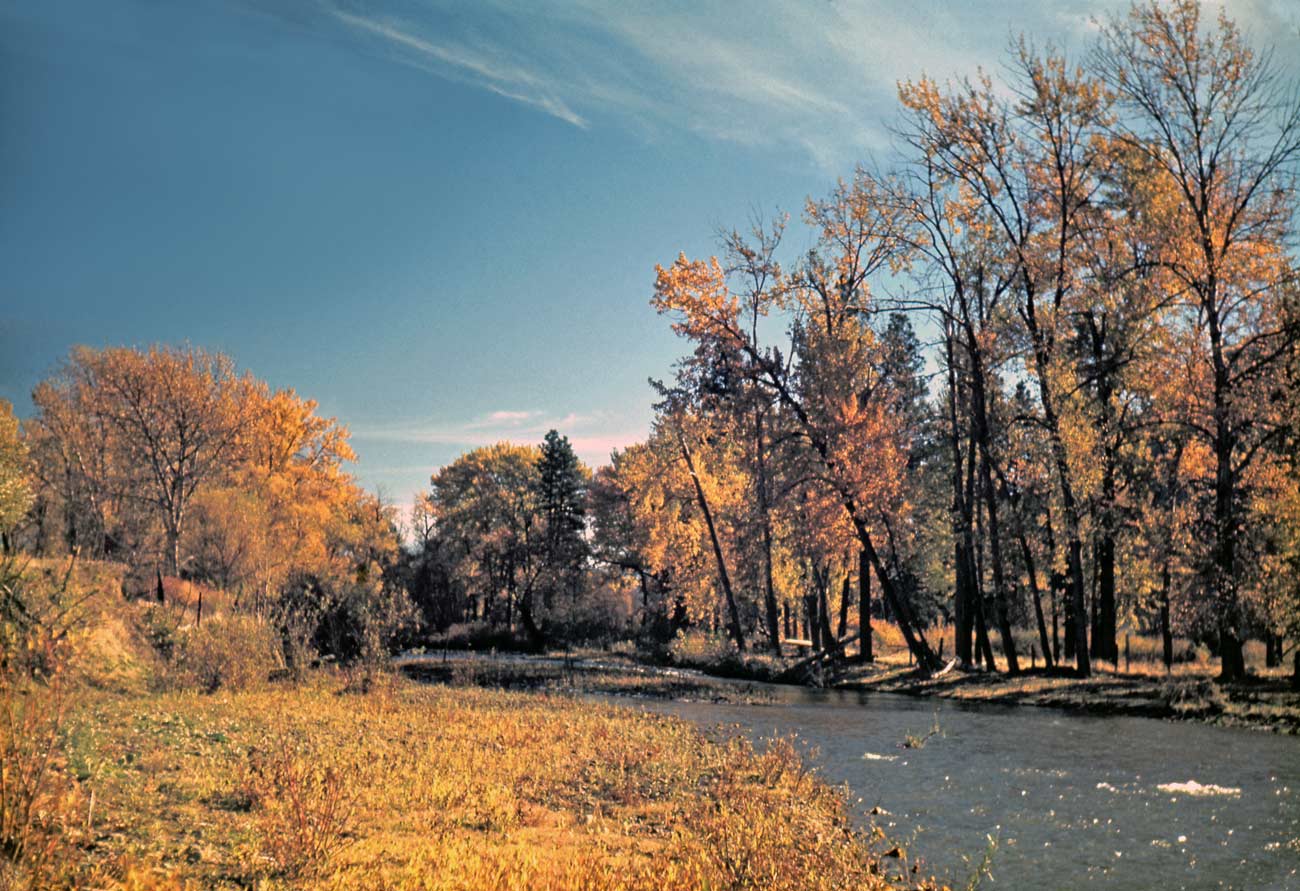
What may we call a collection of trees like these standing to the sides of a gently meandering stream. Not a grove for there is too much underbrush for that and some of it is flowering on the opposite bank. Horace Sykes will find the flowers. It is not a copse for the trees here are too tall for a copse. A woodlet then or grouping or clump? Someone knows, but Horace does not let on. Did he hear the harvester on the hill over the stream? The wheat fields above are, it seems, fenced from the grazing land below them. Why do the steeper parts of these rolling hills descend in ripples or steps? See them on the hill between the trees on the left. As a child I thought that these were all cattle trails.
THEN: The prolific postcard producer Ellis probably recorded this view of Ft. Lawton’s new barracks soon after they were constructed in 1942. This was four years after the Army offered to sell its fort back to the city for one dollar, but the city refused for want of depression-time funds to maintain it. (Courtesy John Cooper)NOW: Jean Sherrard’s repeat of the barracks’ site hints at landscape architect Charles Anderson’s intentions, that the new forest at first conform to the footprints of the old barracks.
There is an artful connection between the barracks in the historical photograph and the trees and bushes in the contemporary repeat. The connection is subtle enough that Jean Sherrard needed a guide, Jon Wooton of the Magnolia Historical Society, to record his “now” scene. As they approached the site Jon explained, “It would be obvious if you knew what you were looking for.” What follows is a paraphrase of his revelation.
These “Area 500” standard army issue barracks were built in 1942 for the military to billet and process troops during World War Two. Almost sixty years later they were given over to the city to become part of the Discovery Park that already surrounded them. The Army intended to relinquish the nine-plus acres to the Seattle Park Department “in a condition that resembles the immediate surrounding environment,” which is the “urban forest and sanctuary for wildlife” that makes up Seattle’s largest park.
Once the barracks were torn down and the pavement removed the Army was ready to pay for planting whatever appropriate ground cover the Dept. of Parks prescribed. And here enters that most clever continuity between barracks and bushes hinted above.
Once selected to design and start the transformation from fort to forest, landscape architect Charles Anderson decided to “hold the memory of the barracks for a while” by filling their old footprints with native plants that would also “escape and colonize the rest of the project.” In time all intimations of the barracks rectangles will blend into the new native forest of birch trees, alders (about 1000 of them at the start), Oregon-grape, sword ferns, salal, strawberries, roses and more. The few fir trees seen in the “then” that the military planted to break the monotony of their regulation barracks – some of those were kept.
WEB EXTRAS
Anything to add, Paul?
Yes Jean, and of course. I’ll not surprise you and say no. We’ll start with a story first used in Pacific Mag in 1988, and its about Officers’ Row, which survives just west of the World War Two barracks site. I’ll up the “then” followed by the text, and the add the “now” shot of Officers’ Row that you so presciently took when you visited Discovery Park for the barracks shoot.
OFFICERS QUARTERS WITH THE FIRST RESIDENTS, THE KIEHL FAMILY
In 1901 the Kiehl family, with father Ambrose at the reins, climbed aboard the family buggy and posed in front of the first-lieutenant quarters at Fort Lawton. The camera was Kiehl’s and so was the officers’ quarters, for as yet there were no lieutenants at Fort Lawton.
The engineer Kiehl was in charge of preparing the site for a fort. The family’s first home on the grounds was a board-and-batten shack (shown in another feature, below), but soon after this the first duplex on officers’ row was completed in 1899 and the family was given permission to move in. They stayed until 1905.
Ambrose Kiehl’s large glass negative for this view was cared for by his daughter Laura (here in the back seat) and given by her to architect and preservationist Frederick Mann. Mann’s consultations in the development of Discovery Park and now the Navy’s preservation of officers’ row make him the respected custodian of the site’s architectural history. (Fred has passed since this feature was first published on Dec. 4, 1988.)
Fred Mann discovered a caption for this scene in Ambrose Kiehl’s catalog to his lavish photographic record of family and fort. It reads, simply, “Billy, Doctor and Wagon. Ft. Lawton, 1901.” Billy and Doctor are the horses. Laura Kiehl recounted for Mann how the Army mule was sometimes substituted when either of the horses was not feeling well enough to cart her the long trek to school. Laura already was a teenager when the lieutenants moved in and the Kiehl family moved out to Queen Anne Hill.
The 12 sturdy Georgian Revival homes along Fort Lawton’s officers’ row (all of them duplexes excepting the captain’s quarters) are on the National Register.
Here’s Jean’s look at the row during his recent visit to Discovery Park to repeat the World War 2 barracks site.
The FIRST CONSTRUCTION at FORT LAWTON – The KIEHL’S HOME and OFFICE
In 1896, Ambrose Kiehl. a civil engineer, photographer, musician and family man from Port Townsend, was hired by the Army to survey and clear the new Fort Lawton site and supervise construction of its buildings. The first structure was the two-story board-and-batten shack shown here. The design is Spartan even by military standards, but it was meant to be only a temporary residence/office for Kiehl’s early work on the fort.
Here the family, Isabella and Ambrose (left and right, flanking their daughters Laura and Lorena), pose for a photographer who was probably Ambrose himself, running into the scene after setting a time-delayed shutter on one of his many cameras. Behind Isabella and supporting the bicycle is the building’s one oddity, the squat, windowless addition extending from the west side. Kiehl prepared his blueprints and then exposed them to the sun by opening the trap door. Solar energy was required because the fort lacked electricity (although it did have a telephone, as indicated by the pole on the right).
The date is probably 1899. The summer before, 97 of Magnolia’s 700 acres donated by citizens for the fort had been cleared. The first seven buildings were completed in 1900.
Eventually, 25 main post buildings were set about an oval parade ground. One of the first constructed was the camp’s hospital. (It is far left in the 1936 aerial included below.) After 1910, the Army lost interest in the fort and, in 1938, as noted above, the military offered it to the city for $l. The city declined. In any case the military might soon have taken it back. During World War II, 450 new buildings were speedily erected to make Fort Lawton the sixth-largest point of embarcation for troops in the U.S.
The Team Grader used in the early construction of Fort Lawton. The Kiehl "shack" appears to the rear.
THE TROLLEY To The FORT
[Much thanks to Jon and Monica Wooton of the Magnolia Historical Society for helping supply some of the illustrations used here. And Ron Edge – not of Magnolia but of North Seattle – helped as well.]
More than ten years after local boosters began to lobby for a military post, Brig. Gen. Elwell S. Otis noted in 1894 that the rolling plateau on the western head of the Magnolia peninsula ‘might be a suitable place to house soldiers. He advised the War Department that they might be needed to keep the peace in boomtown Seattle. Many and perhaps most Americans were then hurting from the economic depression that had crashed upon them the year before, and Otis noted that in Seattle “now dwell 100,000 people, a part of whom are restless, demonstrative and often time turbulent upon fancied provocation.”
Four years later, clearing began on the acres coaxed from Magnolia pioneers for free or cheap by the local Chamber of Commerce for an as-yet-unnamed fort. In 1899, when construction began, the fort got its namesake hero and added mission from the same source: the Philippines. Maj. Gen. Henry Ware Lawton was killed in action there in 1899 and, as fanciful as it would later seem, the Spanish-American war painted the Pacific Coast with a fear of invasion.
The scene of the guard and waiting station at the Fort Lawton terminus was most likely taken soon after the branch of the Ballard trolley line was completed in the summer of 1905. During the 1909 Alaska Yukon Pacific Exposition, Fort Lawton and every other Seattle destination reached by electric trolleys and cable cars were promoted by the Seattle Electric Co. as tourist destinations. The military obliged with regular dress parades and concerts.
You should be able to click the address directly or map above which will then take you to plate 34 of the 1912 Real Estate Map for a very detailed examination of it. Note that the trolley line curves into the fort and reaches its terminus between the map’s “T” and “O” in “Lawton.”
Magnolia peninsula was included in the city's late 1890s system of bike paths. Like the one that follows it, this was photographed by Anders Wilse, who after a few years accomplishing a lot with his camera in Seattle returned home to Sweden in 1900.Another Wilse record of the bike trail in Magnolia.
Click your mouse TWICE and get good enough detail to study Seattle’s ambitious bike path system in 1900 – and more. Magnolia’s part is, of course, on the left. Note that it enters the then still largely proposed Ford Lawton. The maps shows the path crossing Interbay on a bridge at Interurban, which is still a bridge on Dravus Street. The wagon bridge to Ballard follows 14th Ave. NW and not the later bascule bridge on 15th. The Great Northern enters Ballard from Interbay on a curving trestle that comes close to snuggling with the wagon road. It then ran along the Ballard waterfront, and was only rerouted to its new Bascule bridge at Shilshole when committed construction on the Chittenden locks began in 1910-11. Far right, the canal showing at Montlake is for logs and not vessels. The ship canal was dedicated 17 years later. Find the trestle on Westlake at the southwest corner of Lake Union, and what a strange eastern shoreline the lake shows before most of the public works tampering. Imagine much of the bike path mileage passed then still through wooden copses thick enough to feel like forests.
A rustic bridge built somewhere on the Fort grounds during the depression as a "make work" project of the E.R.A.. (Courtesy, Municipal Archive)Another 1934 visit to the Fort's "campus" with a portion of the trolley tracks showing on the left. (Courtesy, Municipal Archive)Without much to do that was bellicose the Fort was opened to parades and military-style play. Here groups of lads have been lined up to act manly at something in the parade grounds in 1925. (Courtesy Municipal Archives)Men would be boys and boys would be men, trading heavy backpacks for swagger sticks. Fort Lawton, 1925. (Courtesy Municipal Archives.)Fort Lawton Hostess House. (Courtesy John Cooper)
Looking east over the Fort in 1936. (The date was carefully determined with internal evidences by the Magnolia-Ballard wit, Hal Will – since deceased. The aerial was interpreted for me by Jon Wooton, one of Hal’s many surviving friends. Click TWICE to enlarge.) Between the shoreline on the bottom right and Salmon Bay on the top, much of the fort is revealed. (At the very top is the line – left/right – of the Ballard bridge on 15th Ave. nw before the new concrete piers replaced the wood pilings on its long approaches.) Officers Row is this side of the water tower, which is this side of the small forest where the barracks would be built during the Second World War. The original barracks are the two large u-shaped structures seen from the rear and near the center of the aerial. The next building to the left was the Fort’s entertainment venue where many bands performed. (The next photo shown features one of them.) The building to its left near the end of the “block” is the Fort’s stockade. The long slender buildings on the left are stables for a fort that was designed for the cavalry and not the infantry. Part of the non-commission officers homes are in a row – with trees – above the stables. And the hospital is above that, between two roads and two rows of trees.
Elks Band performs at Fort Lawton, Oct. 15, 1948.
Another and much later aerial shows the WW2 barracks on the right, with the Nike Missile Center interrupting Officers Row. Ballard is beyond.Real photo postcard purveyor Boyd Ellis' record of the east entrance of Fort Lawton during World War Two when one had to stop at the gate. The trolleys have stopped running to the park by then.Standing guard at the South Gate. Another Ellis 'card from WW2, or near it.Still standing guard aboard the Fort's Float at the 1957 Seafair Parade - the lesser part of it that followed down "The Ave" aka University Way in the District, 1957. Students might enlist with plenty of time for range practice before Viet Nam. (Courtesy Calmar McKune)
The NEW MAGNOLIA BRIDGE in 1930
When it was completed in 1930, the sweep of the Magnolia Bridge as it ascends west of Pier 91 was considered a modern engineering wonder. At nearly 4,000 feet, it was the largest of only three reinforced concrete spans built anywhere. The big bridge was first proposed six years earlier when the West Wheeler Street Bridge was set on fire by a spark from a Great Northern locomotive passing beneath it.
West Wheeler Street Bridge before the fire. The view is from Magnolia looking east to Queen Anne. (Courtesy Magnolia Historical Society)Wheeler Street Bridge on fire. (Courtesy, Magnolia Historical Society)Magnolia (Garfield Street) Bridge when new but, it seems, not yet open. The A. Curtis view was taken from Queen Anne Hill looking west towards Magnolia. (Courtesy, Washington State Historical Society, Tacoma)
At first, the Seattle city council refused to build a high bridge to the bluff, since only 4,000 people lived west of Interbay and south of Ballard. The city chose a humble alternative by extending the West Garfield Street Bridge with a timber trestle that reached Magnolia at an elevation just a few feet above high tide.
The unappreciated Garfield Bridge that the city built in hopes of pacifying Magnolia boomer's activism for a high bridge. The date, May 15, 1929, is written on the negative, bottom left. Note here how the old timber bridge takes a sharp turn north for its last leg to Magnolia. (Courtesy Municipal Archive)
Magnolians, however, organized the Garfield Bridge Club and persuaded the city to replace the trestle with the soaring trusses shown here. The strewn timbers of the temporary low bridge, cluttering the base of the new span, are also evident.
This view was photographed Dec. 22, 1930, two weeks after the high bridge was dedicated with band music, the usual speeches and a procession of motorists and pedestrians. Then the tidelands of Interbay still reached far north of Garfield Street, requiring the bridge to be built above piles driven 20 to 40 feet into the ground. Now the tide basin has been reclaimed and blacktopped as a parking lot most often for Japanese imports. (This last about imported cars was true in the spring of 1991 when the above was first written.)
Dedication - the line of cars follows a crowd of pedestrians beyond the curve.The Auckland Dairy Farm in Magnolia's Pleasant Valley
PLEASANT VALLEY & TWO BOOKS
Magnolia: Memories and Milestones answer the question those of us who do not live in Magnolia have sometimes asked, “Why go to Magnolia?” (beyond Discovery Park and the garage sales.) This book is surely the most elegant neighborhood history yet produced hereabouts. More than a dozen contributors have managed to fill it with charm and wit. Hall Will’s chapter “Dumb Stunts and Grade School Memories” is worth the price of the cover.”
Among the chapters are expositions on the pioneers, Fort Lawton and Discovery Park, Interbay and Fisherman’s Terminal, the Village, the farms, West Point and most of the trestles and bridges.
No Seattle neighborhood resembles an island community as much as Magnolia. During the melting of the last ice age it most likely was an island. Well into the 20th century it was almost an island until the Port of Seattle, the railroads and the city began filling in the once extensive Interbay tidelands. Still one must take a bridge to reach Magnolia.
Magnolia is two hills divided by a naturally cleared vale so hidden that Seattle pioneer Arthur Denny, when seeking grazing land for his livestock and following an Indian’s directions, could not find it. Later when the bucolic valley was dappled with small farms, it was called Pleasant Valley.
The early 20th-century view of a part of Pleasant Valley printed above looks to the north and a little east through a portion of the Marymount Dairy farm. The historical photographer – probably a member of the Hanson family that purchased the dairy farm in 1905 – stands either on or near what is now part of the West Magnolia Playground. One of the Hanson children holds a future milker.
To get a copy of “Magnolia Memories and Milestones” call almost any business or organization with “Magnolia” in its name and get directions on how to find one. (Sorry. The above was written a decade ago, and Volume One, I believe, is sold out. It was so appreciated that the Magnolia Historical Society went forward with a second volume, which is still available through the society.)
Delivering Pleasant Valley mile to a Queen Anne Address.Pages 64 and 65 of the Magnolia Historical Society's first of two hardbound histories of their neighborhood. The text here covers in part the dairy story. For a larger view visit their web page. The book is active as a pdf file there.
THE KIEHL WOMEN at WEST POINT
“Long ago” in December of 1981, historian Murray Morgan, U.W. architect Fred Mann and I drove up to Port Townsend to collect and record some oral history with Laura Kiehl. At the time, Laura was 89 years old and I was carrying a stack of photos printed from negatives taken by her father, Ambrose Kiehl. This week’s historical scene is one of them, and Laura remembered it well.
Laura was born in Port Townsend in 1892. At the age of 4, she moved with her younger sister and parents to Seattle. Her father, a civil engineer, had been hired by the Army to survey the forest wilderness that is now Magnolia Bluffs Discovery Park. He also helped build the fort that local politicians hoped would pad the city’s purse with military money and also help defend Seattle against the rowdy radicals then milling about the city’s economically distressed streets.
Ambrose, who paid his way through college by playing a pipe organ, did his work well in helping design and build Fort Lawton. It breaks the rules of dull rectilinear military-post design and imaginatively nestles the buildings in their striking setting. He used this artistic eye in his photography as well.
In this week’s historical photo, Laura is pictured, second from the left, between her mother, Louisa, and her sister, Lorena. Laura explained that the other three women in the costume of the day were guests, not relatives. The six are wading in the tide flats off the southern shore of West Point. That is the then-still-forested Magnolia Bluff on the left. On the right, West Seattle is barely visible through the haze across Elliott Bay.
In this scene, Laura is a teen-ager. She was always tall for her age, she said. The picture was taken around 1908, the last year of major construction at Fort Lawton, until World War II, when it flourished briefly as the second-largest point of departure on the West ‘ Coast.
Except for the latter day brief activity during World War Two, it became clear soon after the fort was completed that it would never be a big installation, and the locals started musing over what a wonderful park it would make. The Kiehl family had been treating it as a park right along, Laura said. For years they used this beach below the fort to entertain family and friends with clam and salmon bakes and, of course, wading and beachcombing.
Getting to the beach then required a long hike on a path bordered by salmon berries, devil’s club and nettles, and patrolled by giant mosquitoes. Today the nettles are gone, but the beach is still protected from the summer swarms that fill Golden Gardens and Alki Beach. To enjoy the sun-warmed tide pools, you must hike to get there.
Once an adult, Laura pursued more serious outings than beach walking. She graduated from the University of Washington in 1916. Later she became the first woman in the state to be issued a brokerage license. Since no brokerage house would hire her because of her sex, she successfully operated her own office for years in the Smith Tower. Laura died in January 1982, less than two months after our visit.
The above was printed in Pacific in the fall of 1985. For the now Bill Burden, who took the repeat photos, and I got help from Carson F. who was a good friend of Bill’s daughter Caroline. Carson persuaded a few of her friends to take the several poses of the Kiehl “wading party” at West Point, and then to improvise with a pyramid on the sands with the, perhaps, inevitable results. I sat on a log and watched. (Carson is on the far right Imagine! She and the rest are now in their forties. In order at least for the first orderly repeat are Liesel Murray, Erin McCaffery, Terri Sullivan, Sabina Steffens, Leslie Steward and Carson F.)
Long before the fort and the neighborhood an early off-shore view of the West Point Lighthouse.One on-shore and . . . . . . Frank Shaw's recording of the light's north side ca. 1970. Fort Lawton: from cavalry to abandoned motor pool, Feb. 28, 1979. Photo by Frank Shaw.
Another scene it seems from Sykes Palouse, and this again distinguished by the foreground as much or more than by the greater sets of dipping and swelling patches. I am tempted to crop it all away except for the wildflowers. It is something you may want to test with a mask like a book or piece of toast. Also Horace set his focus for the flowers. Stagecraft – the rest is backdrop.
Horace stands somewhere near Mirror Lake at the south-southwest “corner” of Oregon’s Mt. Hood. If he had a cable strung to the summit it would be an eight mile ride, and an elevation change of about seven thousand feet plus. The mountain is listed at various heights – all within a dozen feet of each other around 11245 feet. The slide’s composition shows signs of Sykes like the flowers in the foreground. We may add that the summer snow and glacier markings near the summit resemble – or are sympathetic with – the sky. Like most of Syke’s Kodachromes this dates most likely from the late 1940s. (Click to Enlarge)
Directly below the most recent Sykes “Entering Big Bottom . . . ” post for Syke, with Our Daily Sykes #213 on Lyons Ferry please note that Jean has surprised us all by adding the photos he took on his visit to Lyons Ferry for our book Washington Then and Now. Look closely at the reflection of the clouds in his splendid and spectacular panorama. Next notice also in the pan how the rock formation on the far bank, to the left of the copse of trees in Lyons Ferry State Park, resembles a ruin of St. Sophia in Istanbul. (It was Constantinople.) It even includes a corner minaret – incipient or in ruins. Below is a mock-up (still with typos any my dimwitted naming of it for the other Lyons bridge, the one with a “gate” in Vancouver B.C.) for the subjects used in the book, although it was printed without the third photograph showing the Vantage Bridge under construction at its original site – Vantage – recorded in the 1920s from the old road on the east side of the Columbia River.
There is a Big Bottom in Washington State and it is south of Mt. Rainier, but if you follow the Google Earth signs to it nothing like this is revealed. Perhaps some reader knows better, knows how to fine and, as the sign promises, enter Big Bottom.
This I recognize. It is Lyons Ferry on the Snake River when there was still a ferry – the longest-lived and last of the four principal Snake River Ferries in Washington. The salvaged Vantage Bridge replaced the Lyons Ferry – a cable ferry – in 1969 as waters backed-up behind the then new Lower Monumental Dam. I am allowed a mark on my Washington Belt for having as a child crossed the snake on this Lyons Ferry., (You can study these changes in Building Washington, a book that is included on this blog as a pdg file. Go to the History Books button, open it, and then click on “Building Washington.” It is a big book so on this supe’d-up MAC it required about four minutes to open. It may take less time. My computer is supered but it is also four years old. That’s a minute a year.) This view looks north. Now much of the mid-ground is flooded with the joined waters of the Snake and Palouse Rivers and the old Vantage Bridge spans the river heading for a landing on the north or far bank about a quarter of a mile to the east (right) of the famous railroad bridge seen here on the left.
Jean here. Paul, on my trip across the state for our book Washington Then and Now, I visited the old Vantage bridge. I took a few photos from above as well as those we used in the book. The shapes of the hills quite obviously reflect those in Horace’s photo. Interestingly, in the first Now photo, the railway bridge seems to be in the same location as before the waters rose, although completely rebuilt.
The rail bridge at center left - the old Vantage bridge on the rightThe Vantage bridge now crossing the SnakeAt center left, Lyon's Ferry State Park
One more image – a panorama stitched together from three photos looking across at the state park and beyond:
Panorama - the old bridge is above and to the left
THEN: This row of Victorian homes on Western Avenue did not make it to the 1937 inventory of King County's taxable structures. They were, for some unrecorded reason, destroyed earlier.NOW: The Battery Street subway extension of the Alaskan Way Viaduct opened July 24, 1954, a little more than one year after the viaduct above the waterfront first accepted traffic in the spring of 1953. Here, the access to the tunnel cuts through the block that once held the Belltown Victorians.
Victorian row houses like these were once wonderfully commonplace in San Francisco, but not so much here. Our few examples have nearly all been destroyed, even the beauties among them like these.
I know practically nothing about this Belltown row, but I would venture that it was constructed either in the early or late 1890s, prosperous years for a booming town that was being steadily enlarged by new residents. (Since writing the above Ron Edge has reminded me to search the 1891 birdseye. I did and the row is shown. In place of the line “constructed either in the early or late 1890s,” imagine that I had done my research and written “constructed around 1890.” A relevant detail from the ’91 birdseye in included in the “extras” below, as well as other maps.)
The print I copied has “Western” penciled on the back, and an early-20th-century pan of Belltown shows this row sitting snugly just downhill and west of its principal business block — on First Avenue between Bell and Battery streets — facing Western Avenue. (I have momentarily lost track of the pan just noted or I would have put it up. Later.)
Who lived in any of these six ornate flats, beneath their blooming finials, and with their scrolling corbels, box bays, carved panels and playful latticework? I don’t know. (See the comment from Cathy Wickwire who found by searching the newly released Seattle Times database several sitations for the address nailed to this row.) I have a 1903 City Directory and considered running my finger down its pages through about 30,000 home listings looking for any of them between 2306 and 2316 Western Avenue. I have done searching like that in the past and find it relaxing — like knitting, I imagine — but this time I declined.
Those big bay windows with splendid views of Elliott Bay were needed because there were, of course, no windows along the sides of at least four of these flats. Families living here were steps away from many services. They were conveniently close to Denny School at Fifth Avenue and Battery Street, and only two blocks from the waterfront.
Finally, we will give thanks for the resident dog that seems to welcome us at the bottom of the photograph.
WEB EXTRAS
Jean here. In a Viaduct-covered triangle between Western Avenue and the Battery Street tunnel access road just north of the Market, one may find these familiar if now-deserted concrete protuberances, now enclosed in chain link fencing.
Sculptures across WesternCloser, through the chain links
I couldn’t find any signs indicating the sculptor or the name of the sculptures, although I recall some years ago encountering both.
Anything to add, Paul?
Yes Jean, something on row houses, although not all of it tonight. First let me note that I have never turned my head for those waves of concrete cool whip beside Western Avenue. Do you remember another under-a-bridge moment with modern art, with the “Wall of Death” below the north end of the University Bridge? You cannot forget the name for it is written on the art. For years it seemed uncannily free of grafitti markings. I imagined that the can artists were frightened by it.
I’ll add a Row House Addendum during the week, I hope. Here I will show a few maps and birdseyes that do and/or don’t include our Gothrow on Western. As noted above I remember one image of it that looks from the bay and has the porch crests peaking over some rooftops below them – but I cannot for the moment find it. Perhaps I will before the night is over. (I failed in this, but will keep looking a predict victory in this search.)
Victorian row houses in Seattle are neither so prolific nor resplendent as in San Francisco. A row of these charmers climbing a San Francisco hill – often steep – is one fulfilled vision of street life for the American cityscape, which more often is a “mixed bag” or dull scatter. In 1968 during the Helix tabloid’s grass and salad days I visited a few friends in Berkeley and San Francisco. A Seattle “ex-patriot” Carmella S. was one of them, and she lived in a San Francisco row. The ceiling of her living room was higher than the room was wide, and she had the walls covered with framed art like in a salon or academy show of the 18th Century (or Seattle’s first Frye Museum when it was still in an annex attached to the Frye home at 9th and Columbia.)
Except for a few churches and the Academic Gothic buildings on the U.W. Campus, Gothic is hard to find around Seattle. It was thought too playful or naive or ornamental or irrelevant or charming by modern sensitivities and standards and its revival was almost over before it began in Seattle. “Gothrow” houses date from the later 1890s and early 1890s for the most part. In this Seattle neighborhood – Wallingford – there are a few Gothic touches and a few rows. On Meridian Avenue near the Guild 45 Theatre on 45th Street they join. John Sundsten, a semi-retired U.W. Med. School lecturer on Anatomy and sometime learned contributor on similar subjects to this blog, lives in one of them when he is not
on Hood Canal watching the Olympics and his oysters. Nearby is, by our standards, an old home, and one with Victorian touches. For years it sat empty and tilting until someone purchased it, leveled it, added a floor and had a good time retouching it. It is on Sunnyside mid-block north of 43rd Street.
Still abiding in Wallingford is a home on Corliss Avenue mid-block north of 45th Avenue and Al’s Tavern. The builder (or more likely later the remodel artist) attached over the front door an intimation of a Gothic ornament. It is a distinguishing gesture. This home is one of the 400-plus subjects I tried to photograph every day – and nearly did – over three-years-plus with the intention of animating them. (Jean, as you know we intend to include some of these in our MOHAI show with Berangere – of this blog – when it opens next April.) Here are four of perhaps 800 recordings of what I call “Gothic 2.” (Here just below Gothic 2 is Goth 1 where with its restrained garage it is watched from the side.)
A new and almost churchly Wallingford row at 46th and Meridian (northwest corner) has been oddly overwrought with its own pasties of faux stone and fish-scale siding to add some distinction that warrants the high price of its condos for this neighborhood. They were mid-way with putting on the roof when I started walking in July of 2006. Three years later they had still not sold their four opportunities for living within walking distance of the QFC, Al’s Tavern, the Good Shepherd P-Patch and the Guild 45 Theatre.
One of the disturbing distractions perhaps from the sublime intentions of this well-gabled row was the abandoned APEX dry cleaners across 46th where one tenant has labored in the night to write his or her own complaint for our times with spelling impassioned enough to miss the “d” in landlord. Here the housing bubble has met the soap (or cleaning) bubble and both have fallen.
We return now to Belltown with a Gothrow that long ago momentarily made my heart leap – the three gables above Mama’s at the southeast corner of Second Avenue and Bell Street. When I started studying the illustrative side of local history in the mid-1970s I did a search for early evidences of the old Denny Hill razed by its namesake regrade. When I first saw these gables in a historical print that was part of a pack of Webster and Stevens studio glossies shared with me by John Hannawalt of Old Seattle Paperworks (lower level Pike Place Market) I had the stirring and uncanny feeling that I have seen these “in person.” I thought this is a “lost place” – there was no intersection in Seattle that quite felt like this one – in the then existing Seattle. Soon enough with the help of a street sign on the telephone pole in the print I found the place and so my first evidence of what the hill – in this part looking south on Second Avenue through its intersection with Bell Street – looked like before it was razed. I wrote a longish piece on this discovery for the old Seattle Sun and later used that writing as evidence for my weekly freelance assignment with the Times Pacific Mag 29 years ago this coming January.
Next we will search maps and/or birdseye views from 1878, 1884, ca.1890, 1912, and 1917 for the row on Western, and when included the row at the Belltown corner of Second Ave. and Bell Street.
Their places are marked but as yet – in 1878 – no Gothrows. A portion of the Pike Street coal wharf and bunkers appears far right. 1878 was it’s last year, supplanted by new bunkers off King Street. This birdseye artist is either unaware of or neglected the Belltown Ravine between Blanchard and Bell Streets.
Here another artist has made a kind of mark for the Belltown Ravine – bottom-center – but it is one block too far south. The still future location for the Belltown Gothrow is marked. The 2nd and Bell site is not, but you can find it – by now.
Both row sites are marked, and the rows are also in place in this ca.1890-91 birdseye.
Both sites are marked in the above detail from the 1912 Baist Real Estate Map, which we will remind readers has been recently made available in all its 34 plates (in every detail) on this site and can be button-clicked to by visiting the front page. If we move north through the Baist Map (and you can) we can derive a sense of how many row houses survived then in the neighborhood. (Or any Seattle neighborhood) Near the top of the detail included below at the southwest corner of 2nd Ave. and Clay street is a long row across Clay from the marked Seattle Floral Company. I don’t remember seeing any illustration or photo of this and so don’t know how Gothic it was. Nearby at the southeast corner of 3rd and Clay is another row, and across Third is another. Both share the block on 3rd with the Temple Baptist Church at the northeast corner of 3rd and Cedar. On 2nd Ave. between Cedar and Clay is a small row of three – Gothic or no we do not know. And finally for this detail at the southeast corner of 1st and Cedar is another threesome. (With the gift of this 1912 Baist Map on this blog if one had time and a touch of the compulsive-obsessive disorder they could do this for the entire city in 1912.)
And, indeed, having a coloration – or touch – of this condition, I’ll continue north of Denny Way with some more of the 1912 Baist, and minimal comment. You count the rows. One rowless comment: the red-marked First Station on the far right is the site since 1960 of the Space Needle’s foundation. And that would put the Pacific Science Center where?
Below is a Belltown detail from a much larger 1917 sketch that looks west by northwest over the Denny Regrade – the part completed by then west of Fifth. The full sketch promotes the new land’s opportunities in the year the Frederick and Nelson Department Sore was getting established as its southeast anchor. Here we have marked with a red X not the Gothrow on Western but the brick building at the northwest corner of Bell and First that hides them – or does not. We don’t know if they were still around in 1917, but I suspect that they were. In the upper-left corner of the detail is the bridge across Railroad Avenue that leads to the Port of Seattle’s Bell Street pier. Bottom-right is the back of the Austin Bell building, only the facade of which facing First was kept in a recent remodel.
When the Denny Hotel, AKA Washington Hotel, looked like “the scenic hotel of the west” as it advertised itself, sitting on the south summit of Denny Hill, straddling the future path of 3rd Ave. between Steward and Virginia Avenues, there were below it. left and right,two distinguished rows “falling down” the hill with the connotation of San Francisco. The one to the east of Second Avenue was built first and is seen here far left in a pan of Denny Hill taken from First Hill probably in 1903, the year that the hotel at last opened. Note that the cable railway that climbed to the hotel entrance the one long block from Pine Street and in line with Third Avenue is showing with its car in service above the trestle that crossed Stewart Street. Also note that there is as yet no row on Fourth Avenue, the first street this side of the cable railway.
The row on 4th shown directly below was surely short-lived. Styled the same as the row facing Second Ave, it was built after the view above and destroyed in 1906-7 with the razing of the front hump – or south summit – of Denny Hill. Again, the trestle over Stewart with the posing trolley is seen on the left above the row on Fourth and at the front door to the hotel.
Standing at a prospect near or at the hotel and looking back and southeast at the neighborhood from which a photographer held to make the above prospect of the hotel looking northwest, we will search what is now much of the city’s retail neighborhood for rows of any sorts ca. 1902.
So much to point out so CLICK TWICE TO ENLARGE. Getting settled, the single Goth spire of the Norwegian-Danish Lutheran Church climbs towards the center of the scene. It held the northeast corner of 4th and Pine, now the Westlake Mall’s primary structure – the one with an arcade. Note that to the right of the church on the east side of Fourth Avenue are three variations on “row.” First at the southeast corner of Pine and 4th are two box-shaped residential structures, each home for perhaps more than one family. It is now home to the Westlake Mall fountain. Next to the right of the boxes are three attached uniform bays – very stately. And to the right of that and the intruding tree is another row of two, with gables and boxed bays, and bigger. It is mid-block on the east side of 4th between Pike and Pine, and so within the spray pattern of the fountain, but pre-regrade and so really several feet above it.
The grid-cutting of Westlake Avenue is still about four years ahead. The brick Ranke Building is to the right of the Lutheran spire at the northwest corner of 5th and Pike. In size and materials it was a distinguished building when constructed around the time of Seattle’s “Great Fire” of 1889, a pacesetter into the new retail neighborhood. (Ivar “Keep Clam” Haglund’s father, a baker, was living in the Ranke at the time of the fire. I have yet to determine if it was Ranke’s clapboard structure that preceded this brick one.) To the left of the brick Ranke is the tenement-looking rear wall of the clapboard Idaho Building at the northeast corner of 5th and Pike. There is a good chance that there were rats in the attic. On the far left are a few of the trolley bays or service garages of the Seattle Electric Company’s facilities at the northeast corner of 5th and Pine, not yet razed for Frederick and Nelson.
The bare patch left-of-center and below the horizon is the steep intersection of 9th and University Streets. It is still steep. Much of of this is now part of Freeway Park. Below the patch is the Unitarian Church two or three lots north of the northeast corner of 7th and Union, now part of Act Theatre’s remake of the old Eagles Auditorium (which takes me back again to the grass and salad days of the Helix.) To the right of the patch and almost reaching the horizon is the back of Congregation Ohaveth Sholum, the first synagogue in Seattle. It opened one lot west of the northwest corner of 8th and Seneca on Sept. 18, 1892. Six hundred and eighty persons attended the dedication. Now the site is filled with the Exeter House Retirement Community, which is across Seneca from Town Hall. Directly above the Synagogue and on the horizon is the smokestack of the Union Trunk Line (cable and electric) at James and Broadway and to the left of it the tower of Castlemont, the Haller mansion at the northeast corner of James and Minor. Both the stack and the tower are now replaced by First Hill Pill Hill services.
Three more details to point out. Far right is the northeast corner of the old Territorial University campus south of Union Street. Far left and just above the trolley car barn described above is a “row-like” structure at the southwest corner of Sixth and Pine, which we will visit in close-up below. And left of center is another row – one of three box houses facing Pike on the northeast corner with 6th. Soon after its construction this row took on the nickname “Bridal Row.” Here follows a take from Seattle Now and Then Volume One (which can be seen in-toto on this blog.) It was first published in Pacific on Feb. 20, 1983. (Click TWICE to Enlarge)
With storefronts along Pine and apartments above them, this row held the southwest corner of 6th and Pine. (We noted it too in the pan above.) The back of Bridal Row shows left of center, still at the northeast corner of Pike and Sixth. The recently doomed Waldorf Hotel is on the far left at the northeast corner of 7th and Pike.
Below is another section grabbed from the 1912 Baist Map. Just above and right of center is the row shown above. Across Pine street is the Westlake Market which took over much of the sprawling Seattle Electric block. The look down at the row may have been taken from the trolley company’s multi-story brick administration building which faced 5th from about the third lot north of Pine. I’ve not dated the view so there is a chance that it was taken from Frederick and Nelson, perhaps during its construction. On the map below someone has added “Frederick” over the Westlake Market property at the northeast corner of 5th and Pine. The intersection of 4th and Pike is at the bottom-left corner of this detail.
Hoping to return with a mid-week Addendum with more rows, we will conclude with two pans, first another from Denny Hill, this time looking south and southeast in the mid 1880s. (Click TWICE to enlarge.)
Without dwelling on the parts, here the Territorial University Camps and its lawns and landscape still hold Denny Knoll a decade before moving north to the Interlaken campus, where it remains. The first Lutheran church in Seattle is directly above the bottom-center of the pan near the northeast corner of Third and Pike. Second Ave., then, is on the right and both Fourth and Fifth still originate here left-of-center out of Union Street at the northern border of the Campus. Beacon Hill is on the right horizon and First Hill on the left. Haller’s mansion can be found there, and Coppins Water tower at 9th and Columbia too. For those who hold or have learned the pleasures of row-hunting, there are several to be found here. We conclude with another row – or several. Rows of sheep grazing somewhere on a northwest range and photographed without any identification by Horace Sykes, most likely in the 1940s. We used it previously for an early Our Daily Sykes. (Courtesy, University of Washington Special Collections)
I think that when Sykes southwest scenes started appearing in these “dailies” I first noted that my father, a Lutheran preacher in the cool gray and green state of Washington, had a subscription to the slick and warm color-saturated vehicle for tourism named “Arizona Highways.” I liked to eat my cheerios while studying Arizona Highways. It was a monthly, I believe. This “Arizona Waterway” might have been a number in that periodical. But is this Arizona or are we back in Utah? Or both? Only an arbitrary border – a straight line – divides them. In the color chart of theology, this is as papist a river as the waterway in Daily Sykes #209 belongs to the Archbishop of Canterbury. Again, Horace makes no confession.
(Click to Enlarge) I imagine that this is salt water with a Madrona, aka Madrone, I think, rooted in a small head on the right. Someone or thing has determined that Washington State has 2,337 miles of marine shoreline and most of that is inside the Strait of Juan de Fuca, here in our "Mediterranean of the West." (I read it in "Building Washington" and so can you. The entire book - excepting the sponsor's "vanity" section in the rear of the published five pound version - may be read on this blog. It is one of the five books accessed through the blog's front page button on "History Books.") Or is this one of those long lakes in the Canadian West or perhaps even in Patagonia? At least we can be confident that this grand place, unlike so many of Horace Sykes' other surprises, is not in Utah. The light is dimming and so is the efficiency of Sykes' lens. The focus is soft - almost intentionally like an early-century pictorialist landscape. Horace admired the pictoralist aesthetes when he was first learning photography late in the 19th century. It is possible for anyone with endurance to search the net and find at least one of Horace's early writings on photography - from 1914, I believe. It is a learned essay on how to make a pinhole camera that will give one pictorialist effects for portraiture and other subjects. Horace wrote well. Would that he had later also written captions for his "daily sykes" Kodachromes. We have often requested this for Sykes' unidentified subjects. Does anyone recognize this one - this pictorialist - but not surreal - dreamscape somewhere in the Americas?
Late last April (2010) we put up other pictographs quite like this one and identified them as examples of Barrier Canyon Style art. We even found their location with the help of Google. These may also be in Buckhorn Draw, a tributary to the San Rafael River. Among the tourist overlays are many initials, a few names, the state "Utah" spelled out lower-left and a big "ARM" in white that took some work to block, frame with a darker line and extend with its own arms. Those invite interpretation. They may have been thought to be in sympathy with the art they mutilated or perhaps quite the contrary. Were they in their length a criticism of the aboriginal short arms? As if the artist was answering the original art, "Here are some REAL arms." It seems that this arm art is later that many of the names which, if I am reading it correctly, are covered by it.
The Grand Canyon of the Colorado certainly but where above or at it? Perhaps a reader knows the canyon better than the back of his or her front yard and will tell the rest of us. This may be compared to the Sykes view of the Snake River Canyon from Hat Point in Oregon, which - it is claimed by steadfast measurements - is deeper than this place. You'll find it from June 30 of this year, Daily Sykes #72 "The Snake River from Hat Point."
THEN: With a cacophony of marquees and merchant come-ons behind them, West Seattleite Virginia Slate (right), 22, and nephew Jerry Johnson, 8, are caught by a candid street photographer strolling north along the west sidewalk of Seattle's Fourth Avenue between Pike and Pine streets in mid-1945. (Courtesy Clay Eals)NOW: Retracing the steps of their elders on a crisp October Sunday morning 65 years later before a more subdued swath of regimented storefront signs are Virginia's grandson, Chris Eals (right), 29, and his son, Connor, 11, both of Bremerton.
This past spring, Jean Sherrard and I attended the memorial service for Virginia Lee Slate Eals, mother of our friend, the writer Clay Eals. The oldest of three sons, Clay was the principal eulogist, and his memories of his mother were stirring.
The memorial was held at Park West Care Center, where Virginia spent the last six years of a buoyant life that began 87 years earlier, only seven West Seattle blocks away. The big room was filled with flowers, family, friends and photographs. The candid sidewalk snapshot shown here was among them.
From the 1930s into the 1950s, coming upon sidewalk photographers with the pitch of a candid portrait for a low price was commonplace. Virginia Slate had four of them in her album, all taken in her prime, before and during World War II. Clay explains, “She had many jobs downtown, and several of them were copy-girl type positions, delivering printed material from one place to another, so it’s no surprise that person-on-the-street photographers snapped her multiple times.”
With the then-popular Manning’s coffee house and the Colonial Theatre marquee behind her, both the place and time are easy to identify. The view looks north on the west side of Fourth Avenue between Pike and Pine streets in 1945, the year the films “Castle of Crime” and “Hotel Berlin,” on the marquees, upper-left, were making their American runs.
In 1970, Virginia went back to work, in part to help pay for her sons’ education. Clay notes that her job with the Bellevue Traffic Violations Bureau “was both tough and enlightening.” In a letter to Clay during her 18 years there, Virginia reflected, “It’s amazing how many people are repeaters on traffic violations. I’ve been cussed at and told off, which I was expecting, and also lied to. You can never tell by just looking at people what they are like. … I saw a part of life I’ve not been exposed to before, and it’s fascinating and depressing. It makes you appreciate good friends and family all the more.”
WEB EXTRAS
Hey Paul, this time round, I just know you’ve got a treasure trove to share with us – but let’s begin with Clay’s extraordinary and moving eulogy for his mom Virginia. What’s more, we’ve illustrated it with a sampler of family photographs supplied by Clay.
1948: Virginia Eals, 25, Bon Marche portrait
And now, on to your mini-survey of street photography now and then from around the planet. And of course I’ll prompt this outpouring with my usual query:
Anything to add, Paul?
YES Jean.
First something more about Clay Eals and 4th Avenue north of Pike. This part of 4th first – here in 1947 with the old Colonial.
On October 18, 2009 we put up on this blog a look at this from about the same year – about. It was – do you remember Jean? – a night shots with all the lovely neon aglow and you repeating it in the evening too. I came with you. That now-then also featured an excerpt from film reviewer Bill White’s work-in-progress, “Cinema Penitentiary.” If might be something to visit again for those who know how to use the search machinery. Ask to see anything with “Colonial.”
Next, Clay also figured in another 2009 insertion – the one for June 5th. This was an article putting the Portola Theatre in its proper place – a long move from West Seattle to Queen Anne Hill. Ask to see anything with “Portola” or ask for “Eals.” He comes up in some other stories although he is not identified. He hides more than lurks. You can also – you know Jean because you put him there – find him in the “now” repeat shot for this candid photo of his mother in this – and back to it – block.
Now as time allows (bedtime) I’ll lay in three stories that include street candor, followed by examples of another photographer’s (Victor Lydgman) candid shots on Pike Street (mostly) from the early 1960s, and a samples of my own Broadway Bus Stop project of 1976-77. (About this last I have an uncanny feeling that I showed a lot of these earlier on this blog but I could only find one, and so I will go ahead with it.) I might mix in some other grace notes if they make themselves heard before another nights “nightybears,” which you know is our mutual friend Bill Burden’s (of the button on our front page) customary salutation for metabolic closure, that is, which is his “good night.”
MILLER’S CANDOR
This "caught" couple appeared in Pacific on April 18, 1993. The photographer Miller looks north on First, ca. 1902, through its intersection with Union Street. My "now" for Miller's then was shot - my negative holder tells me - in February, 1993.
The Seattle News-Letter, a turn-of-the-century weekly, published candid photographs of locals on the city’s sidewalks to accompany a gossipy front-page column, “Stories of the Streets and of the Town.” The couple “posing” here was photographed for the series, although it seems that this shot never made it to print. Perhaps the photographer could not pry any stories from them.
The photographer was a young Walter P. Miller. Pieces of his estate, including these negatives for the tabloid – about 100 of them – survived in their original wraps. Roger Dudley Jr.s’ father worked for Walter Miller and in the mid-1930s bought out the business. The 3-inch-square flexible negatives were part of the deal. Roger Dudley Jr. took over his father’s studio 20 years later, and after a quarter-century more of commercial photography he retire and gave the negatives – these candid ones – to me. Miller lightly penciled the names of most of his subjects on his negative holders. This couple was one of the exceptions.
According to Lois Bark, costume curator for the Museum of History and Industry [in 1993 when this story first appeared in Pacific – on April 12] the woman is dressed conservatively but still modishly. Her hat, held in place with a long pin, is most likely straw-trimmed with tulle (a fine net) and artificial flowers. Her S-shaped figure is a creation of corsets, whale bones, petticoats, hip pads and hooks, and below all that maybe an S-shaped anatomy. Her two-piece walking dress was certainly black, the common dress color of the time, and most likely wool. It required help to get on and off and could not be cleaned, only brushed and spotted.
The man is distinguished by his gold chain. His double-vested waistline is another projection of his affluence or, at least, self-importance.
The couple stands on the southeast corner of First Ave. and Union Street. The pioneer Arthur and Mary Denny home is directly behind them and over their shoulders at the northeast corner is their son Orion Denny’s home. In 1852 he became the first boy born to white settlers in the village of Seattle. He died in 1916.
TWO MORE FROM MILLERS CANDID ONE HUNDRED
Walter Millers example of candid street photography are rare – for Seattle. Perhaps for anywhere, for the practice of “catching” subjects that were not confused by their own movement was dependent on still subjects and/or fast equipment.
Somewhere near Pioneer Square. I write this indefinite but with confidence for I once knew - figured it out.Walter Miller also visited Alki Beach with his camera. From this visit he produced a sizeable report for his Seattle Mail and Herald.
MORE CANDOR ON FOURTH AVENUE NEAR (OR AT) PIKE STREET
Although the date for this Fourth and Pike scene is recorded on neither the original negative nor its protective envelop, uncovering it was not difficult. The newsstand at the center of this view includes copies of both The Seattle Times and the Seattle Post-Intelligencer. A 15-power magnifying glass reveals the date. It is Monday, July 25, 1938.
The Post-Intelligencer, just above the dealer’s head, announced “A New Forest Fire Rages at Sol Duc.” A week and a half of record heat had not only encouraged fires around Puget Sound, but also filled its beaches.
On this Monday, Seattle was even hotter with anticipation of a Tuesday-night fight. Jack Dempsey’s photograph is on the front page of the P-I. The “Mighty Manassa Mauler” was in town to referee what those who sport so consider one of the great sporting events in the city’s history: the Freddie Steele-Al Hostak fight for the middleweight title.
About 30 yours after this photograph was recorded, hometown-tough Hostak, in front of 35,000 sweating fans at Civic Field (now the Seattle Center Stadium) made quick work of the champion Steele. The P.I.’s purple-penned sports reporter, Royal Brougham, reported “Four times the twenty-two-year-old Seattle boy’s steel-tempered knuckles sent the champion reeling into the rosin.” Hostak brought the belt to Seattle by a knockout in the first minute of the first round.
The day’s fevered condition was also encouraged at the Colonial Theatre (a half-block up Fourth) where, the Time’s reported, “an eternal triangle in the heart of the African jungle brings added thrills in Tarzan’s Revenge.” The apeman’s affection for a young lady on safari with her father fires the resentment of her jealous fiancé. We will not reveal the ending of this hot affair, although by Wednesday the 27th, Seattle had cooled off.
[HERE we remind the reader that another visit to the Colonial was offered on this blog on Oct. 18, 2009 with an excerpt from film critic Bill White’s work-in-progress, “Cinema Penitentiary.” It is illustrated with a neon-lighted night view of Fourth from this corner in 1945. Search for “Colonial.”]
CANDOR (OR FEVERED PRODUCE EXHIBITION) AT THE PIKE PLACE MARKET ca. 1907
FARMERS AND FAMILIES
(This was first published in Pacific on August 6, 2006. The Pike Place Market and the city were preparing for the former’s100th Anniversary.)
A century ago Seattle, although barely over fifty, was already a metropolis with a population surging towards 200,000. Consequently, now our community’s centennials are multiplying. This view of boxes, sacks and rows of wagons and customers is offered as an early marker for the coming100th birthday of one of Seattle’s greatest institutions, the Pike Place Public Market.
Both the “then” and “now” look east from the inside angle of this L-shaped landmark. The contemporary view also looks over the rump of Rachel, (bottom-left) the Market’s famous brass piggy bank, which when empty is 200 pounds lighter than her namesake 750 pound Rachel, the 1985 winner of the Island County Fair. Since she was introduced to the Market in 1986 Rachel has contributed about $8,000 a year to its supporting Market Foundation. Most of this largess has been dropped through the slot in her back as small coins. It has amounted to heavy heaps of them.
Next year – the Centennial Year – the Market Foundation, and the Friends of the Market, and many other vital players in the closely-packed universe that is the Market will be helping and coaxing us to celebrate what local architect Fred Bassetti famously describe in the mid-1960s as “An honest place in a phony time.” And while it may be argued that the times have gotten even phonier the market has held onto much of its candor.
The historical view may well date from the Market’s first year, 1907. If not, then the postcard photographer Otto Frasch recorded it soon after. It is a scene revealing the original purpose of the Public Market: “farmers and families” meeting directly and with no “middleman” between them.
Then and Now Captions together: The Pike Place Market started out in the summer of 1907 as a city-supported place where farmers could sell their produce directly to homemakers. Since then the Market culture has developed many more attractions including crafts, performers, restaurants, and the human delights that are only delivered by milling and moving crowds.
BELOW THE PIG ON PIKE PLACE
The revered poster wall where Post Alley descends from First Avenue is interrupted by a stairway that leads to the alley from the Pig above it - or near the pig. This "radical juxtaposition" of a young woman in pause and a fireman advancing for the alley I was "given" about two years ago by being there.
ONE BLOCK SOUTH OF THE PIG THE FIREMAN AND THE YOUNG WOMAN SITS THE BED
Without explanation Frank Shaw recorded this bed at the southeast corner of Second Avenue and Pike Street on Sept. 27, 1983, a mere 28 years ago. Is the man handing out fliers on the subject of street living and the homeless? The bed has since been removed.
FOUR FROM JEAN AND FOUR FROM BERANGERE
This morning I suggested to both our Jean and our Berangere that they apply some candor to this and they have with the following examples pulled from their profound larders or happy hordes or profound multitudes. Four for each – with Jean first.
Pier MusicEMP MazePink Gorilla & Dog - SpectacleQueen Anne JumpSome Are Students - All Wear ShoesAssisted Passion on the QuayParisians Walk More Than We Do (Dorpat's caption)Here is Christophe the sweet owner standing in the doorway of his little bar where the best teachers from Collège de France have been accustomed to come. And inside! Perhaps Claude Levy Strauss with Jacques Lacan and Michel Foucault. The tabac du college de France is located 21 rue Jean de Beauvais 75005 Paris, and so the nearest bar to the College de France.
FOUR FROM VICTOR LYDGMAN – CA. 1962
This quartet hangs around Pike Street too.
First looking south across Pike with the famous doughnut shop on the southeast corner.Second and Pike Southwest CornerAt the Elbow where Pike Place Originates - the ElbowSecond Ave. south from Pike
BROADWAY BUS STOP – 1976-77
For the two years I lived above Peter’s on Broadway in the grand-box apartment with two floors handed on from Cornish students and faculty to Cornish faculty and students through many years, I took the opportunity to photograph the bus stop across Broadway. It was laid beside the east facade of Marketime, a big place with food and sundries. The light was wonderfully mellow as it bounced off our side of Broadway in the afternoons. In the mornings it slanted from the south – left – directly into the architecture of the bus stop shed and those who were protected by it. I recorded a few thousand shots, both black and white and color. The Friends of Rag also put on a fashion show at the bus stop for the project. I asked many friends to sit for portraits with my zoom lens poking out below the open kitchen window on the second floor above the kindly Peter’s front door. Peter, I think, was the first gay clothier in Seattle, and he was also one of the first oulets for the Helix weekly in the late 60s. Here are a few examples taken from the thousands. A few of these – or others – were exhibited on city buses at the time. (Not all the buses.)
Asked to "take" a portrait and sit in the shelter Art Bernstein (with Jim Osteen one of the two founders of the Harvard Exit Theatre) brings a broom and tidies up.Dowager, perhaps, shares a bench with Sleeping DudeA few Friends of the Rag in a summer showA few more - with bus full up and leaving without themJudy "Sabika" - of the popular cafe on Pine Street - in jeansFriendships made if fleetingTake noticeTurn or RespondAhhhWait and WatchRemember - You Promised to BehaveRememberA Regular - and more to comeAsk and . . .GrabA Regular in BlackTimeless Flower Pattern. It may be noted that in none of these, of course, is anyone holding anything to their ear - it seems.Friends of the Rag with BagCrowd with SmokerYou Cannot TellNot their first dateSanta and The Regular in Street Light. The "Regular" hung out at the bus stop but never, as far as I could determine, took the bus. She probably was not homeless, but certainly some combination of curious and lonely. And here is Santa for her. She is amused. Merry Christmas Regular. 1976A Lesson in Brushing from the Pro, a Metro Attendant.Graduates waiting for workYou Can Never Tell - Part 2Morning ShadowsLeaping Girl with Socialist to the SideYou Will Know Them By Their BagsI Could Teach You to ActDude DudetteCapitol Hil Colossus, 1976
AT LAST MORE SIDEWALK CANDOR
Back on Fourth at ManningsNot Far Away Beside the Embassy
TWO STREET SNAPS OF DELIA & LEWIS WHITTELSEY
Delia and Lewis, like may others, had a custom of doing much of their shopping downtown, and often the Pike Place Market was among their stops. As with Clay Eals’ mother Virginia this frequency meant that they had more than one chance to purchase a candid snapshot of them having their ways on a downtown street. Lewis Whittelsey “contribued” to his blog with his photography on another Sunday. You can search for him.
The famous and favorite Ben Paris restaurant is behind.
Located between the Luxembourg gardens, Saint-Germain-des-Pres neighborhood and Necker, Montparnasse is an area where Parisians have often come to party – even before the installation of the famous cemetery. Montparmasse was known for its famous cabarets since the seventeenth century when this neighborhood was then still Iocated in the outskirts of Paris.
Originally, Latin Quarter students were accustomed to recite poems on the Boulevard Edgar Quinet and rue du Montparnasse artificial hill, using poetic allusions to Mount Parnassus in central Greece, the wooded summit which inspired the muses.
For Parisians, the neighborhood evokes the presence of celebrated artists from the Universal Exhibition of 1889, artists such as Apollinaire, Gauguin, and Matisse, the famous “ Montparnos ”, which dates from the piquant years between the two world wars as Modigliani, Picasso , as well as other cinemas, theaters, and restaurants. Although now surrounded by Paris, Montparmasse keeps its mythical connection for links to western France. It is a crossroads. The neighborhood is also famous for the tower built there in 1972. It offers the best view of Paris – one that includes the Eiffel Tower but excludes itself.
Situé entre le jardin du Luxembourg, Saint-Germain-des-Prés et le quartier Necker, Montparnasse est un quartier où l’on est toujours venu faire la fête, et avant même l’installation du célèbre cimetière, il était connu pour ses célèbres cabarets installés en bordure de Paris depuis le XVII ème siècle .
A l’origine, les étudiants du Quartier latin avaient l’habitude de déclamer des poèmes sur la colline artificielle du boulevard Edgard Quinet et de l’actuelle rue du Montparnasse limitant Paris et l’avait surnommé ainsi en référence au Mont Parnasse au centre de la Grèce qui inspirait les muses.
Pour les Parisiens, ce quartier évoque le rendez-vous d’artistes bien connus depuis l’exposition universelle de 1889 tels Apollinaire, Gauguin, Matisse…et les célèbres Monparnos de l’entre-deux guerre, mais aussi des cinémas, de théâtres, de restaurants mythiques, le carrefour dû à la gare déservant tout l’Ouest de la France, et bien sûr la célèbre tour construite en 1972 célèbre pour offrir la meilleure de la vue de Paris , parce que n’étant pas dans la perspective…
Place du 18Juin 1940Rue de la Gaité with all its theatersThe famous building of artist's studios rue Campagne Première where Man Ray livedRue de Rennes
We known neither where nor when - nothing except that it is an early snow with some leaves still holding to their trees. (Click TWICE to enlarge - - - please.)
When first I saw this rock I was prepared for it by my father. We were driving home to Spokane north of Wenatchee on HIghway 2 before it heads west for the coulees, Moses and Grand, and beyond them the scablands that sprawl like hazzards for havesters and section roads. How many Lincoln Rocks can there be? Certainly not as many as there are Lincoln Bridges or Lincoln Banks. And can the rocks be graded for their verisimilitude? At ten I thought that this must surely be one of the most important natural formations in the American West. But on growing up I have heard little about it and not seen much either. We looked west across the Columbia River at it. Perhaps this is a different Lincoln. Sykes does not say.
(What follows is lifted from “Keep Clam” a work-in-progress on the life of Ivar and Ivar’s. This is part of the longer of two books, and will appear somewhat polished only on the net. The smaller book will be published between covers and available early in 2012. The longer book will begin to appear on its own webpage sometime early next year and “with many extreas” including recordings, video bits, and a reading of the serial installments by the author for those who like to be read to.)
MEETING TED ABRAMS & GUY WILLIAMS
In her revealing memoir “Wash Your Hearts with Laughter”, following her description of meeting Ivar at a Theosophy meeting, Maggie introduces Ted Abrams, the brilliant craftsman, cook, collector and raconteur. “We became friends with the most interesting man two young and green people could associate with.” Raised in a southern Jewish family, Abrams came to Seattle a short time before World War One. He escaped the war years living in Japan, working as a buyer for Seattle’s Frederick and Nelson Department store. Otherwise Ted Abrams lived in Seattle until his death in 1942. In a recorded conversation with Emmett Watson and Guy Williams, Ivar begins to describe Abrams, until Williams interrupts him. “Allow me to interpolate. Abrams! I’ll swear he knew everything.” Ivar continues, “He was a genius.” Guy Williams, Ivar’s college friend and sometimes his press agent as well, was encyclopedic on his own. As a young boy he was already an accomplished auto-dictate. Growing up in the gypo lumber camps that his dad managed, Williams read a multi-volume encyclopedia from A to Z and it would seem he remembered much of it.
Ivar and Maggie Haglund with Ted Abrams, rolling his tobacco. 1938
Ivar and Maggie met Abrams at his Club Mauve on First Hill. Abrams was both the chef and the entertainer with a gift for rendering blues and gospel music he learned growing up in Savanna, Georgia. Maggie credits Abrams with inspiring Ivar to a more earnest life as a folklorist and songwriter. Club Mauve was designed around Abrams own collection of antiques and exotic art. The young couple was so taken with him that when Abram’s club fell victim of the wrecking ball they invited him to join them in West Seattle. After first distinguishing the old Haglund home on 59th Ave. SW with decorative brick work, Abrams built his own home from salvaged materials on a lot that Ivar donated across a Horton Street that was more an alleyway than a street. A visit to Abrams charmed construction became a kind of pilgrimage for members of Seattle’s Bohemian community in the 1930s. Artist William Cummings recalled the interior of Abrams home in his published, Sketchbook – A Memoir of the 30s of the Northwest School. “The house was crammed with paintings, drawings, sculpture, etchings and first-edition volumes signed by names famous and infamous. Ted managed to live just above the alleged level of poverty with an aristocratic grace that seldom showed the strained and stressed crevices of daily life.”
Ted Abrams rustic but tight home across Horton "alley" from Ivar and Maggie's West Seattle home. The photograph was lifted from the 1937 tax inventory of King County structures.I took this photograph of Ivar's and Maggies home on 59th in 2003, my last visit. It was torn down last year for something "greater and taller" - or what is the developer's cliche for this? The ornamental brick work that can be seen behind the bushes and in some decay. It was the work of Ted Abrams.
MEETING IVAR & THE BEES
Another visit to Ted Abrams home is recounted in Bill Cumming’s memoir. It is titled for our subject, “Ivar Haglund.” He might have titled it “Meeting Ivar Haglund” for nearly a half-century later he notes that their bumping “remains vivid” and a bit creepy.
On a spring Sunday afternoon Cumming accompanied Ken and Margaret Callahan aboard their Model A for a visit to Abrams little salvaged manse next door to Ivar’s and Maggie’s place. Abrams’ “tiny astonishingly fragile and graceful elderly nymph” of a sister had moved from Georgia to help take care of her fading brother, (Anguished, Cumming could not remember her name.) and the pair accompanied the Callahans for a visit to the nearby Alki Point. Cumming stayed behind, to explore Abrams’ library and watch his cat Mike “who dozed in a corner while I curled up in a big chair engrossed in a book.” The stage was set for meeting Ivar. Cumming continues.
“I was raised from the chair by a thunderous knocking on a fragile door, which threatened to collapse under the attack. Before I could open it, the door sprang open and on the threshold stood another short stocky figure in ample flesh, pale eyes set over drooping lower lids. At the moment the whole apparition gave off an air of general hysteria. ‘I’m sorry to bother you. My name’s Ivar Haglund and I live next door. I’m a friend of Ted’s and the Callahans’.” Cummings replied, “Yes. They speak of you a lot.” However, before he could complete his observation, Ivar “blurted out, ‘Listen! You wouldn’t know how to get rid of a room full of bees, would you? I mean an entire room full, my bedroom!’ . . . Driven by a Spartan sense of duty I walked back with him to his yard. Creeping through the long grass for all the world like marauding Indians in a B Western, we gained the relative safety of the wall of his house directly beneath the bedroom window, which gaped slightly open. From within floated the ominous hum of multitudinous wings, a hum of anger and threat. Rising up until our eyes just cleared the sill, we gazed into the room, then froze in terror and abject fear. The room was indeed filled with bees, flying, standing on edges and ledges, crawling over bed covers, crawling into and out an hollow containers, into lampshades, out of pillowcases . . . In front of our eyes, barely out of striking distance, the sill was three deep in black and yellow malcontents who glared balefully into our eyes, not yet collected enough to launch themselves across the scant inches between us. Hurriedly we ducked back down and retreated on all fours through the grass, praying that we would not be hit by a sudden raid from the rear.
“Regaining the safety of Ted’s porch, I slumped in a chair, while Ivar wandered off in search of someone who might be of practical help. My only suggestion was to burn the house down. I never met Ivar again. In fact, I never really found out if it actually was Ivar or not. If it’s of any significance to scholars, he wasn’t carrying a guitar.”
(The above was written – often copied – during a blizzard sent early from Canada this Monday evening, November 22, 2010. This morning the 93 year old Bill Cummings died, and the community lost thereby one of its great raconteurs. He had hosted his last painting class in his home a week earlier. Last Friday our mutual friend the pianist-producer Margaret Margason serenaded Bill. She brought with her to Bill’s home some romantic Robert Schumann and some Beatles, and he requested the latter, which she both played and sang. At the time he was reading again the Jeeves novels by the English humorist P. G. Wodehouse. About one month ago Bill celebrated his last birthday with the Margasons at their Wallingford home. A few days earlier I had found in a collection of negatives recorded by the artist Victor Lygdman a series of “artist at work” portraits of Bill that Victor took in the earlier 1960s. Six of these are included below.)
The dustjacket for Bill Cumming's 1984 memoir, published by the Univesity of Washington Press. Although most likely "out of print" it may be checked out of libraries and probably found on line as a used book. (Click to ENLARGE)
Bill Cumming, age 93, died this morning of congestive heart failure. He held his last painting class at his home last Monday. On Thursday his friend Margaret Margason serenaded Bill. She brought with her high romantic music for Soprano by Robert Schumann and a Beatles songbook. This time Bill chose the Beatles – for a sing-along. The six portraits of the artist “in process” were photographed in the mid-60s by Victor Lygdman, who died earlier this year of the relatively “mere” age of 83. Victor was born ten years after Bill.
THEN: Looking south from Virginia Street on 5th Avenue to the new Medical Dental Building, ca. 1925. (Courtesy, Mark Ambler)NOW: Jean Sherrard climbed to the roof of the Griffin Building at 5th and Virginia for his look south on Fifth.
Soon after the Medical Dental Building at 509 Olive Way was completed in 1925 a photographer climbed to the roof of the Wilson Business College, one long block north at 5th and Virginia, and recorded this view looking back at the grand new health center’s soaring irregularities. The new skyscraper was a brilliant standout for the business district’s north end. Built on five-star Times Square corner of 5th, Olive, Stewart, and Westlake it gained the charms of asymmetry, a commitment that crowns the top with a small stepping tower.
That the Medical Dental Building it not easily mistaken for any other Seattle structure is because of its odd and soaring shape as much as for its gleaming tiles, which at the time were the preferred skin used in construction projects throughout the business district – if the tiles could be afforded. The new building continued the clean reflecting glow of the brilliant Frederick and Nelson Department Store (1918), seen here behind it at 5th and pine. It also complimented the brilliance of architects Bebb and Gould’s home for The Seattle Times. The Times Square Building is both cut like a piece of cake and decorated like one with a terra-cotta egg shell “frosting.”
Apart from these buoyant structures practically all else in this view is dark and made of wood and warm brick. For instance, the top three stories of the Times home, showing here on the right, rise above the dark Hotel Rainbow. Although here only in its “teens,” the big wooden box with small towers and simple bays was a Victorian hangover constructed soon after the Denny Regrade had completed lowering Denny Hill west of 5th Avenue to its present grades in 1910-11.
The Rainbow sat at the northwest corner of 5th and Stewart and survived into the 1930s when it was replaced with a small service station. That it is now a mere parking lot puzzles this writer about how such an important site can be so modestly employed.
We will conclude with a readers’ quiz followed by the answer. What two distinguished landmarks – not surviving in either our “then” or “now” – filled the block showing here on the left or east side of 5th Ave.? The answer: the Orpheum Theatre (1927-1967) and the Benjamin Franklin Hotel (1928-1967). Remember them?
WEB EXTRAS
Jean writes: I occasionally find myself wandering Seattle rooftops when searching for ‘Then’ footprints. Here are a few alternate views from the Griffin building:
Looking southeast from the middle of the Griffin Building roof's south sideFacing east. The 'then' photographer stood in the center right cornerOn the Fifth Avenue side, looking south. The extremely wide angle captures the nearby and looming Westin towers.
Anything to add, Paul?
Yup Jean, and as time allows and seems prudent I’ll go looking for past features that hang around the neighborhood. Again, I am more likely to find the “then’s” than the “nows” for over nearly 25 pre-digital years I had a careless habit of not looking back at my own “now” negatives, and they are rather a jumble now, although they are safe in binders and with time they could all be put in order and dated. But not now. I will grab what we can before retiring. Tomorrow – Sunday – I’ll find some more. Meanwhile please forgive my typos and dyslexic flips. I’ll hope to discover and correct or flip them tomorrow. Now we will start with another story that is at the same intersection of 5th and Virginia although much earlier – ca. 1886. But you know this, because you took the “now” for it recently. We agree that these two views from Virginia south on 5th will be a pair to use in our show with Berangere at the Museum of History and Industry next April and thereafter for a few months.
THE WAGON ROAD TO QUEEN ANNE
In the mid-l880s there was no suburbia separating the city from the country. This week’s historical scene is evidence of that. It was photographed looking south across downtown Seattle’s northern border. The foreground is bucolic.
The view was photographed from the eastern slope of now-regraded Denny Hill. The evidence for this claim is the shaft of light that streaks across the scene’s foreground and bathes the fence posts in a late-afternoon glow. That beam cuts through the hill in line with Virginia Street, which was a valley between the two humps of Denny Hill.
After a little homework, I determined that the boxy white building just right of the scene’s center and above the break in the fence sits on the north side of Pike Street in the second lot west of Fifth Avenue. The clear break running diagonally between the buildings across the scene’s center is Fifth Avenue. The view shows Fifth ending at the Territorial University’s greenbelt.
The three principal landmarks – with towers – on the horizon left to right are Coppins Watertower at 9th and Columbia, Central School at 6th and Madison, and the Territorial University at 4th and Seneca. No structures survive from the old scene to the new. And Denny Hill and Denny Knoll have long since been graded away. In place of the wagon ruts are monorail struts. The level of the pre-regrade intersection is about 40 feet higher than Jean’s recent “now.” So the wagon road was in places close to the level of the monorail. Believe it or not.
FRANK SHAW – 2 TRANSPARENCIES LOOKING SO. on 5th TOWARD STEWART: 1962
Both this Frank Shaw slide and the one direclty below it were photographed on March 17,1962. The monorail is nearly new and no doubt seems the very sign of future transportation. The Medical Dental building is evident to the right of the Monorail and the red brick facade of the Ben Franklin Hotel gives to this recording a warmth when compared to the other, which was taken closer to Stewart. Perhaps Shaw used different film stock for the two shots.Cooler and closer to Steward and the Medical Dental building too. A sliver of the Times Square Building holds to the border on the right, and the west facade of the Frederick and Nelson Department Store fill the 5th Avenue corridor between them. The drivers and pedestrians below the rolling Monorail surely compared it to the city buses on the street, like those appearing here. The swept-back Chevy heading south on 4th is already about a dozen years old. It may remind us of the Horace Sykes mobile.
TIMES SQUARE
The photograph above of Times Square includes three prominent Seattle fixtures. One is moving, one is long gone and the third survives. The survivor, of course, is the Times Square Building, home of The Seattle Times from 1916 to 1931 at the irregular intersection of Westlake and Fifth avenues with Olive and Stewart streets. The moving subject is Car 51, one of the six Niles cars that the Pacific Northwest Traction Co. bought from Niles, Ohio, for the Seattle-Everett Interurban. Car 51 continued to serve until the Interurban’s last day, Feb. 20,1939. The missing landmark is the noble little structure in the foreground, built in 1917 for a bus stop and underground rest rooms. It has been replaced by a simple bus shelter.
The same shelter looking east from Westlake on Sept. 18, 1917. Stewart Street is on the right. (Courtesy Municipal Archive)
Times Square borrowed its name from New York City’s Times Square and, like its East Coast namesake, was highlighted by a newspaper. The building, embellished with granite and terra cotta, is perhaps the city’s best memorial to the art of Carl Gould, Seattle’s most celebrated turn-of-the-century architect. He designed it in a Beaux Arts style and this flatiron confection is still widely admired.
Looking down on the Times Square Building from the Tower Building at 7th and Stewart during the summer of 1959.East on Olive from 4th Avenue with the Times Square Building on the left and the Mayflower Hotel on the right. The Medical Dental Building fills much of the scene's center on the 4th of May, 1956. The brilliant white structure left of center is the parking garage at the northeast corner of 6th and Olive. We featured in this place a few months back. It was named the Fox Garage in the early photograph we used, and you can search for it if you wish to review the significance of this early business district parking facility enclosed and built with many floors.
A LITTER OF TRIANGLES
The 1906 construction of Westlake Avenue left a litter of triangular-shaped blocks on either side of the swath cut by the new street. Ten years later, the wedge at Sixth Avenue and Virginia Street, photographed March 23, 1915, was still a hole surrounded by billboards, as was most of the complementing block across Westlake. Owner T.J. Nestor's small For Sale sign sits atop the Wrigley's Doublemint mural just left of the telephone pole closest to the photographer. Nestor did not have to wait much longer to make a deal. In 1916 the gaudy block was replaced by a two-story commercial building. Through the years its occupants were a sampling of businesses one might expect to find at the northern border of the city's retail core. The list includes a B.F. Goodrich tire store, the Seattle Home Show, the Triangle Hat Shop, Preservative Paint Company, Pacific Lighting Fixtures and Otto's Hamburgers. In 1979, McDonald's, a hamburger vendor with a grill bigger than Otto's, renewed the odd-shaped site with a new brick structure and hopes of servicing the corporation's trillionth customer. The historical view was photographed from the last bit of Denny Hill that survived the early-century regrade. In 1919 this final bit of elevation was also steam-shoveled to the district's present grade. Looking north down Westlake to Lake Union from the nearly new Medical Dental Building. Much of the "Old Quarter" shows left of center. It was the popular name for the part of the Denny Regrade left untouched when the first lone effort at razing the hill reached the east side of 5th Avenue and stopped in 1911. Left of center is the triangular block at 6th and Virginia seen with billboards in the scene above. Stewart street is on the right. The darkest part of this scene is the "urban forest" of Denny Park at the corner of 9th Avenue and Denny Way, seen here towards the photograph's upper-left corner. The shadows or hazed-over silhouettes of some of the remnants of World War One's unused wooden fleet can be seen anchored in Lake Union, upper right.
HOMES FOR THE SEATTLE TIMES
In “RAISE HELL and Sell Newspapers,” Sharon Boswell and Lorraine McConagy’s 1996 history of Col. Alden J. Blethen marking the centennial of the founding of The Seattle Times, the 69-year-old editor-publisher is shown in shirtsleeves vigorously scooping the first shovel for the 1914 groundbreaking of his new Times Square plant. As the authors explain, this was a momentary vigor, for Blethen’s health was in steep decline. Actual construction was put off until after his death in July 1915, and resumed by his sons as a monument to their father’s uncommon life.
Boyd Ellis' postcard from the 1930s looking east to 4th where Olive Street on the right make its break with Stewart Street on the left.
The building of Times Square began in September 1915 and proceeded with such speed that one year later, on Sept. 25, 1916, The Times could devote an entire edition to its move north from Second Avenue and Union Street to its new terra cotta-tile palace at Fifth and Olive.
The architects, Carl F. Gould and Charles Herbert Bebb, created a monument as much to Renaissance Revival style as to the Colonel. The new partners repeated the division of labor employed so effectively by Bebb’s former Chicago employers, the famous “prophet of modern architecture,” Louis Sullivan, and his partner, Dankmar Adler. Here the practical Bebb, like Adler in Chicago, handled the business and engineering while the Harvard-educated aesthete Gould, like Sullivan, created the designs. Gould took the Gothic plans Bebb had drawn earlier with another partner and transformed them into this gleaming Beaux Arts landmark.
The rare view (at the top of this feature) of the full northern facade was photographed before much of it was hidden between its neighbors. The flatiron block was Blethen’s direct and proud allusion to the similarly styled New York Times Building, which also faced a Times Square in Gotham.
The newspaper continued to publish here until 1930, when it moved north again, this time to its current offices on Fairview Avenue North.
The home at the northeast corner of Union and Second Avenue, which is left in 1916 for the new Beau Arts beauty.The Times left its flatiron creation facing Times Square for this bigger plant at John and Fairview.A 1925 Seattle Times clip that makes note of construction on its new neighbor, the Medical Dental Building.Front Page for The Times on Oct. 27, 1925. Although the fine print may be hard to read the headlines are suggestive enough of contemporary stories that one could change a few names while keeping the disasters, controversies, tragedies, city politics conspiracies, scandals, accidental shootings, French radicals and the rest. Give it a try. Make your substitutions.
THE WESTLAKE BEAT
I confess to having featured this intersection four times – that I remember – in the now 28-year life of this feature. Here’s the fifth (first put up five years ago), and I wondered then what took me so long. There are so many delightful photographs taken from this five-star corner looking north on Westlake from Fourth Avenue and Pike Street, and we have shown a few already on this blog acting like a webpage. But this scene with the officer probably counts as a “classic” because it has been published a number of times and has not grown tired.
It is only recently that I looked closely at the policeman, and I think I have figured out what he is doing. He is scratching his head. I suggest that the officer may be marveling at the great changes that had occurred in the three years before he was sent to help with traffic on the day this photo was taken. (I’m figuring that this is 1909 or near it.) Heading north for Fremont, trolley car No. 578 to the left of the officer, is only 2 years old, and so is the Hotel Plaza to the left of it. If the officer returns to this beat in a few years, he’ll probably know that there is a speakeasy running in the hotel basement.
Out of the half-studied clutter of my old negative sheets I figure that this was taken in 1992.
Westlake Avenue was cut through the neighborhood in 1906 along what its planners described as “a low-lying valley, fairly level, with just enough pitch to give it satisfactory drainage.” The plan was to connect it with “a magnificent driveway around the lake. Readers may remember that there have been many magnificent plans for this part of Westlake. Beginning in 1960 with the opening of the Westlake Summer Mall, which quickly changed to Seafair Mall, the blocks between Pike and Stewart streets were dreamed over for a quarter century as the best available site for developing a civic center for a central business district that somehow wound up without one. One key to this dream was stopping the traffic on Pine Street between 4th and 5th Avenues, a dream accomplished but for only a while. The big retailers didn’t like it, thinking that any inhibition on the motorcar would make it harder for citizens to reach them.
Westlake is pretty new year. Fourth Avenue on the left still climbs Denny Hill. By 1911 the ascending Fourth would be grade to it present humiliation.
Two colored postcards looking over the Westlake, 4th, Pine Street triangle follow. For may years grand lighted signs for railroads and coke were displayed at this odd corner. You are asked to date the cards. The last has got the name wrong. Times Square is down the ways at 5th, Stewart, Westlake & Olive.
WAR BOND DRIVE at FREDERICK & NELSON DEPT STORE
The corner of Pine and 5th during the Sixth War Loan Drive.The same corner, Christmas 1966 (photo by Lawton Gowey)
DURING WORLD WAR II, the local effort and ingenuity applied to the sale of war bonds reached the monumental when for the nation’s Sixth War Loan Drive the “two largest flags on the Pacific Coast” were draped across the Pine Street and Fifth Avenue facades of the Frederick & Nelson department store. In addition to rolling Red Cross bandages and selling bonds and stamps at the main-floor Victory Post, more than 90 percent of Frederick & Nelson’s employees invested at least 10 percent of their income in war bonds. During the Fifth War Loan Drive this was added to management’s investment, pushing Frederick & Nelson’s total purchases past $1.5 million, a prize-winning performance worthy of the Treasury Department’s T-flag award.
With decorative sandbags at the door and sensational battlefield comics on its roof, the Pine Street entrance to F&N continued the you-are-there impressions of the bonds drive.
Billboard-size murals promoting bonds were commonplace outside and inside the store. Facing the bank of main-floor elevators, the names of former employees who were off to the war were displayed on a plaque that read, “Staff members who served you here . . . now serve our country.” To the sides were military uniforms draped on store mannequins.
F&N at Boeing Plant #2
Frederick & Nelson also opened a branch in a white cottage at Boeing Plant No.2, where civilian staples (toilet articles, bras, street suits, work clothing) were available. This convenience also was another way of saving the gas and rubber required to shop downtown. The war revived the flow of cash around Seattle, where nearly 50,000 people were employed making airplanes and twice that number making ships. But necessities were commonly rationed and luxuries postponed. War bonds, the nation’s price administrator explained, were a good way not only to aid the forces abroad but also to help ease inflation on the home front by taking extra cash out of circulation.
The Frederick and Nelson Christmas appointments photographed by either Gowey or Bradley through the door (see the street reflections?) on Nov. 28, 1957.Another look at F&N north through the intersection of 5th Ave. and Pine Street. This was recorded in the spring of 1996, during the building's long hiatus, after the department store folded in 1992 and Norstrom too possession in 1998.
The few times Horace Sykes chooses to do a portrait he does well by his subjects, but he ordinarily makes no note on his slides or anything left with them who these friend or family members are - as here.
Horace Sykes had captioned this “A Promise of Spring.” We have signs too – optimistic ones for we prefer the warm mornings to the cold. Yesterday we – the Queen and I – saw a Robin hopping the limbs of the neighbor’s holly tree. We agreed that it was out of season, but there it was with red breast jumping about the red berries. Today I read of snow perhaps for Monday. And so following the omens of Sykes rare caption, we have it all – the “promise of spring” here in November. The Robin and the snow.
Fifteen years ago or so I was invited to give a lecture at a rod and gun club on Whidbey Island. Since I always liked to fish I was at least half in sympathy with the club’s program and so agreed to attend. It also helped that the manager was a relative.One of the islanders who attended the show was a retired real estate salesman who had worked most of his selling life in Seattle. He brought me the gift of this 1912 Baist Real Estate Map, and it was surely one of the finest gifts I have ever received and most useful too.
Although clearly used and sometimes improvised with penciled additions, the 1912 Baist is at this writing (in 2010) nearly a century old andstill in good shape – except for the index. That was curled and creased and even torn in places – not that it matters much. The index is an overall map of the city on which 34 sections are given marked boundaries and numbered within. It is those 34 sections that are treated individually with their own maps. Those are still clear, and that is what matters.
All 34 plates are wonderfully hand-colored and detailed with information like additions that are distinguished by contrasting colors, numbered blocks and within those blocks numbered lots (and often that is all you need to get going with your research). The maps also show footprints of structures, color-coding for types of construction, lines for utilities, and more.
Many of us are simply in love with maps. For us the cheap thrills of hand-wrought cartography can keep us insensitive to the neighbor’s poodle barking at 3 A.M. Also with this gift of a Baist at your side it may no longer be necessary to drive to the library. Although that is not ordinarily an unpleasant journey it does take time. And parking “tokens” that fold or require signatures add up.
Ron Edge is in charge of this all. Ron is the techno-wit who took the big and heavy Baist map from my basement and made it the very readable resource you get here. Eventually and increasingly as time allows we will populate each map with symbols – contrasting dots or squares – that you can click for pop up illustrations of the places marked. (Somewhat like those blue squares on Google Earth, although, we hope, consistently accurate.)
And here we note and make a plea. If you should like to share a photo of your house or some other part of historical Seattle that can be included then send your scans to Ron at edge_clippings@comcast.net. With few exceptions he will use them on one of the 34 Baist plates – the proper one and in the proper place. So please be pointed about what plate and where on it. It is Ron who will also first field and interpret your recommendations and complaints.
How can one complain about a century old map? Turn or click to Plate #4. There from top to bottom – between Yesler Way and Union Street and about two blocks west of Broadway Ave. – the plate has been frayed or torn. But for all the blocks this mutilation touches only one of them ruinously. Block 61 of Terry’s 2nd Addition, between 7th and 8th Avenues and Spruce and Alder Streets, cannot be read. The information in the remaining torn blocks can generally be inferred. On two plates users have attempted to sketch in the curves of new city streets that were cut through the printed grid of those plates. One for E. Olive Way is on Plate 7, and the other, a real impressionistic whopper, is for the long and curving western end of West Seattle Bridge where it climbs the West Seattle ridge. You will find that scribble on Plate 28. All the rest of these 34 maps is left to search and enjoy – like the original serpentine course of the Duwamish River (plate 29), the tidelands of Interbay (plate 21), and the place of Foster Island before Union Bay, as part of Lake Washington, was lowered about nine feet for the ship canal in 1916, or four years after these plates were first published.
(Ron Edge is also responsible here for “Edge Clippings,” a blog feature created from historical clippings taken largely from periodicals he has collected.)
Next Ron explains – with illustrations – the “technical story” behind this Baist unfolding.
The first major decision in digitizing Paul’s 1912 Baist’s Real Estate Atlas was to remove all the 24” by 34” Plates from the bound hardcover book that held them. This allowed complete access to each of the maps.
The copy station design and photographic process evolved over a 2 or 3 month period. In the final process I used a large flat board made from Pergo flooring material to attach the index map and each of Baist’s 34 linen plates. The hard flat surface allowed me to stretch and aligned each map using double stick tape.
After experimenting with camera settings, lighting and image overlap, I settled on taking 42 digital pictures of each map in sections 4.25″ by 5″. I built a target frame and laid out a grid so I could record 7 pictures across the length in 6 passes of each map. I used my Canon G10 camera controlled remotely from my computer.
The 42 images were hand cropped and loaded into Photoshop where they were merged into one image.The full map images were then aligned, color adjusted and then converted into PDF format for the web viewer’s pleasure.
In order to provide good detail and readability the size of the PDF files for each map are rather large and may require some time to open based on your cpmputer and internet access speed. Once opened these maps can be saved to your computer.
When I was given the Sykes collection long long ago mixed in with Horace's work were a few slides that were not typical of his Kodachrome patina, his passive register, his lens. Later I detemined that some of these were by a Seattle photographer named Bradley. This unnamed Christmas interior may be a Bradley, and yet it may be a Sykes. The emptiness of direct human presense is Sykean. But is the stuff sold here too late for Sykes. Almost certainly this is either the Bon or Frederick and Nelsons. But in the 50s or 60s? (Click to Enlarge)
(click TWICE to enlarge) After studying the steamer's three stocky stacks and their distance from the bow I have guardedly concluded that this is either S.S. Princess Joan or her sister ship the S.S.Princess Elizabeth, on the daily cruise between Vancouver and Victoria British Columbia. However, this does not explain the light. At 17 knots only, it was a slow night cruise these vessels took between the two Canadian cities with most passengers bedded down in state rooms while their cars slumbered in the ships' garage. The ships went into service in 1930 and out of it in 1959, and so well within the range of Horace Sykes snapping. Sometimes they were used on the Victoria, Vancouver, Seattle triangle run where Horace is most likely to have found one or the other of them in the light. The system of British Columbia ferries replaced them. After 1960 they gave their leisurely service in the Mediterranean.
Another sidewalk capture by Victor Lygdman, and most likely from 1962. Now separated by nearly a half-century from these costumes it is easier to imagine them all as studied and chosen with care. Lygdman is pointing northwest from the southeast corner of 3rd Ave. and Pine Street, where briefly from 1903 to 1906 a block-long counterbalance trolley climbed north to the front door of the Denny/Washington Hotel, which straddled 3rd Avenue between Stewart and Virginia Streets, almost 100 feet higher than this grade.The block-long trolley can be seen here in profile near the middle of the scene. The view looks west on Pine from 4th Avenue during the regrade of Pine in preparation for taking away the southern hump or summit of Denny Hill, north from here to Virginia Street. The trolley's southern "insertion" or anchor at Pine has been disassembled. The Fire Station, on the right, sits at the northeast corner of 3rd and Pine. The likely date for this is 1906 after the hotel was closed that spring. The caption at the bottom of the print may be misleading. The photograph is more about the Pine Street regrade than the 3rd Avenue regrade. The Fire Station, now on the far left, has survived the razing of most of Denny Hill's front hump, although some of the hill survives at the center of the scene where 4th Avenue still climbs the southeast flank - but not for long. That too will soon be lowered (eroded with water jets actually) down to the present grade, then as far east as 5th Avenue only, where the regrading stopped until 1929. This scene is from ca.1908. It looks north into the regrade from the south side of Pine, closer to 3rd avenue than to 4th and so quite close to the corner taken by the women in the top photograph, only some 54 years later.The trolley appears here on the left above the roofline of the big hotels neighbors - a row of houses that face 4th Avenue at the southwest corner of Stewart.
This street snapshot by Victor Lydgman (1927 to 2010) looks north on Second Avenue from its intersection with Pike Street, the southwest corner. Undated, the negative is yet part of a packet of consecutively numbered negatives, some of them dated 1962, the likely date for this too. The sun is to the northwest and so later in the afternoon and throwing long shadows. One of these shadows lends us “Unintended Effects #4” and waits on a reader to unravel its mysteries. The right leg (here on the left) of the tall and/or slender woman, left of center, seen here in profile, is planted on the pavement and throws an appropriate shadow to the east-southeast – like all other shadows at this time and in this place. The left leg is beginning its lifting motion that puts the toe – only – in touch with the sidewalk. It too castes a shadow – but an uncanny one. The shadow appears to originate to the left of the toe, and so on the sun’s side of the foot. Since this is not possible – that that part of the shadow be cast by the left leg or foot – what then is casting that shadow – or that part of it in front of the shoe? In all respects it looks like the darkness in front (to the left and west) of the shoe is continuous with the shadow behind the foot. There is also no blending of the shadows thrown by the left and right legs. Although they come close to touching or closing off the light between them, they do not. The darkness in front of the left foot does not look like a stain or something inserted into the pavement for, for instance, a utility. What and how is it? (Click to Enlarge)
Cannot say when Horace visited the Pendelton Roundup for this view but it may well be when he took the two downtown parade slides we printed a few weeks ago. Not that we were secure about the parade dates either. But here - and with those two - the color is unlike what we ordinarily get with Sykes. This in particular is like almonds and mint. It seems almost like a diorama rather than the thing itself. Or a painterly Pendelton vision. (Click to Enlarge)
Associated Poultry at 90th and Bothell Way (Lake City Way) allowed one to purchase “direct” the same tasty fryers served at the nearby Coon Chicken Inn. (Courtesy of M.L.Graham Collection) A few years following the razing of the fryer factory in 1950-51, a Shell Station was built at this northwest corner of NE 90th St. and Lake City Way. That too has been replaced by what Jean Sherrard found there, a retirement community. (Jean Sherrard)
ASSOCIATED POULTRY (Click Photos to Enlarge)
With its eccentric sawed-log shell, and the neon chicken perched on a big hanging sign that could be easily read by drivers coming in both directions on Victory Way, (AKA Bothell Way and Lake City Way), the Associated Poultry Company was an almost charming place to “buy direct,” as other sign boards declare, fryers and eggs cheap.
The eggs were gathered from the nesting boxes in the long log box to the rear and there the hens were also knifed, plucked, and trimmed before being brought out to the A-frame show room. There the fryers were hung above a sawdust floor from steel racks screwed to a knotty pine ceiling.
The Associated Poultry was constructed in 1930 primarily, as another sings reads, to “supply the Coon Chicken Inn,” a road house with live music, and chicken dinners served from its own semi-log quarters nearby on Lake City Way. It survived for twenty years on Associated Poultry’s fryers; a menu it claimed was homage to southern cooking. Older readers may remember the front door to this chicken dinner house. One entered through the open mouth of a black face. It was a grotesque but skilled caricature of a minstrel player more than a West African male.
The Inn closed in the 1949, when America’s “Jim Crow” years of post-civil war race relations were on the eve of being rolled over with civil rights. A G.I. Joe’s New Country Store moved into the building. Associated poultry was torn down earlier in 1950-51, and replaced ten years later with a Shell station.
Artifacts from the “Coon Chicken” culture on Bothell Way are exhibited and interpreted at the Jim Crow Museum of Racist Memorabilia on the campus of Michigan’s Ferris State University. The museum’s candid mission is “to promote racial tolerance by helping people understand the historical and contemporary expressions of intolerance.”
As mentioned in the text of this weekends pull from Pacific Magazine, its subject, Associated Poultry, roosts on the shoulders of what for a number of years was a popular fried chicken house on Victory Highway, AKA Bothell Way, AKA Lake City Way. It’s name, Coon Chicken Inn, and its decor, or parts of it, were the products of a Jim Crow culture that started to break up only in the 1960s with the civil rights movement. As the “Epicurean’s Guile” map below shows, in the 1930s Bothell Way was strung with southern associations: Henry the Watermelon King, Lem’s Corner (at least I imagine Lem as a good ol’ boy), Dixie Inn and Mammy’s shack. Now it all seems a naive combination of silly and half-witted offensive. Below Ron Edge has curated illustrations and clippings from a Coon Chicken collection loaned to him for copying. Read and study. And now Ron explains.
In the 1930s chicken dinners were the main attraction and Bothell Way their stage. The star arrived in the summer of 1930 in the form of the Coon Chicken Inn, owned by M.L.Graham and located at 8500 Bothell Way. Mr. Graham relocated to Seattle in the late 20’s and opened the second link in his chain of “Nationally Famous Coast to Coast” restaurants. His first was opened in Salt Lake City in1924 and his third and last in Portland in 1931. He decided to expand his chain just as the Great Depression started and with his dedication to quality and his unique marketing skills he succeeded where many others failed.
Seattle CCI Opening August 1930
Seattle interior early
I was fortunate enough to meet M.L. Graham’s grandson, Scott Farrar, in 1999 when researching the history of the CCI. Scott generously allowed me to photograph and scan his grandfather’s scrapbooks. Mr. Graham had pasted his life into these two large volumes in the form of ephemera and photos. Many of the pages contained things relating to the Coon Chicken Inn and its history. I think the story of the early Seattle CCI is best told from selected pages from a couple of the trade publications of the time. I have inserted several photos scanned from these scrapbooks to augment the articles.
Western Restaurant May 1933 p6
Seattle kitchenSeattle exteriorGas ad December 1933Seattle exteriorWestern Restaurant April 1934 p6Club CottonClub CottonClub CottonAfter Club Cotton additionSoda Fountain Dec 1936 p10Soda Fountain Dec 1936 p11Soda Fountain Dec 1936 p12Seattle barSoda Fountain Dec 1936 p13Hoover Co. December 1936CCI Post CardSeattle CCI from the air
One of several slides Sykes recorded of the city and the waterfront from the two levels of the viaduct a few days before its opening to traffic in the spring of 1953.
In autumn, new restaurants open their doors. One of these, “Saturne,” located near the Bourse, represents “la nouvelle vague.” In a contemporary decor, Swen Chartier cooks with seasonal products from small farmers. His library of wines is filled with the most incredible names like “the sea to drink” or “wine of my one horse town Mount” (wine of my village ?).
A l’automne, les nouveaux restaurants ouvrent leur portes. L’un d’entre eux, « Saturne », situé à coté de la Bourse, représente la nouvelle vague. Dans un décor contemporain, Swen Chartier cuisine rigoureusement des produits de saison de petits producteurs, sa bibliothèque de vins contient les noms les plus improbables tels que : « la mer à boire » ou «Vin d’Montbled »
Looking over and along the Columbia River to a sunset behind Rattlesnake Mountain, the high hill that guards the southwest flank of what is easily called "The Hanford Site." But where on the river - up or down stream from the bridges between Pasco and Kennewick?
Horace Sykes is back from his five day vacation. We were also occupied with both Highway #2 and choosing which repeats to use or pursue for our upcoming show next April at the Museum of History and Industry here in Seattle. [Click to Enlarge]
Last summer we followed Horace Sykes up the switchbacks of Walter's Wiggles in the Refrigerator Canyon from the floor of Zion National Park's main canyon to this ledge -I believe. Here he made the decision - apparently - not to proceed over the precipitously exposed - although chained too - trek to Angels Landing. Here he looked down - if I am right - on the floor of the valley he had left below. As the name suggests the narrow Refrigerator Canyon was consistently cooler. Is the name also a reference to the blood of those natural cowards - like myself - who prefer the safety of flat heat. From this prospect to continue to Angels Landing would have meant turning right. So far I've found no slides of Horace heading in that direction. But note the little flowers in the foreground. A Sykes signature.
As Paul mentioned, I’ve been out shooting photos for our upcoming MOHAI exhibit opening in April 2010. Before we begin, allow me to proffer two delicious views of the interior of the King Street Station clock tower, where I reshot a panorama of the city (for that pan, you’ll have to wait for the exhibit!). My intrepid guide, pictured below, was Brian Henry.
The interior of the clock room - each exterior face is connected to an actual clock mounted inside the wooden box. The spiral staircase leads up to the pyramidal top of the tower.The door leads out onto the exterior walkway, from where I'm about to take panoramas of the city. Note the extraordinary glass tiles, lit up now by hanging fluorescent bulbs. The face of Smith Tower can be glimpsed through the window.
And now on to our Startup addendum #2, which may be interrupted at any time if the weather gets nice today (Monday). In fact, let me hasten to add, between rainfalls, I’ll be updating this very post throughout the next couple of days between photo expeditions.
DISOBEDIENT INTERRUPT
We will insert now first a post-war postcard of Seattle’s “railroad center” when it still competed with the airlines. It includes a good look at both stations from the south, and the GN’s tower. Then – disobeying Jean’s reluctance to share the central business district pan of the city from the tower when it was new – we will post a detail of a pan from the tower – the part showing the south portal to the railway tunnel under the city and the intersection of Main Street with 4th Ave. S.
The intersection of Main St. and 4th Ave S. seen from the Great Northern Tower ca. 1905-6.
Also visit Startup Addendum #1 for more illustrations (84 more) of some of the sites along Highway 2 between Everett and Wenatchee.
The following photos and accompanying text are taken in large part from our book Washington Then and Now.
(PLEASE KEEP CLICKING TO ENLARGE. We take care to put up high resolution images but you have to click to see them so.)
Our journey along Highway 2 begins in Everett.
In celebration of his wedding and successful real estate speculations, Bethel Rucker built his namesake mansion in 1904 as a present for his bride.
Jean climbs the porch of the Rucker Mansion
He also hired Asahel Curtis to photograph a sweeping panorama of Everett harbor from the porch.
Everett from Rucker's porch by Asahel CurtisIn Jean's repeat from 2004 the bay is screened by a pleasing screen of trees.
So Jean also used the deck of a neighbor to gain an unobstructed shot.
Everett Harbor now
Another photographer, George W. Kirk, nicknamed Everett ‘The Pittsburgh of the West.’
Everett: Pittsburgh?
Pittsburgh, indeed—except this town was built of lumber not steel.
Next up on our Highway 2 journey: Snohomish! Which photos will include the one shot taken from a helicopter in the book.
Flooded Snohomish, 1909Snohomish River now, sans flood
If the reader takes a moment to study the 1909 Snohomish River flood scene, she or he will find the Snohomish Condensery water tower from which the following panorama of Snohomish was recorder, perhaps the same year. Its dark rectangle is to the left of the tall silo burner near the center of the flood scene.
Snohomish watertower panoramaAn elevated repeat of the watertower pan, taken from a helicopter as the watertower no longer exists
The condensery was built on the south side of the river in 1908 so an opportunistic photographer may have soon climbed its tower for this grand record of Emory Ferguson’s town a half century after the founder unloaded a portable cabin here from a steamer and set up a store in the path of the planned military road. This government thruway never amount to much more than a horse path but Ferguson held on and ultimately his riverside town prospered in service of lumber and agriculture. It was an opportunism typical of many communities in the forested and fertile valleys along the east side of Puget Sound. Advertised as “the longest swing bridge in the world” the bridge to Snohomish was nearly 20 years old when the panorama was recorded.
The flood photo was taken from the first bridge to Snhomish, the Seattle Lake Shore and Eastern’s 1888 timber trestle. Most likely the earlier river view printed above was also recorded from the railroad bridge that when it was completed put the town of Snohomish suddenly a mere two hours from Seattle. Jean’s repeat also looks down river from the Burlington Northern railroad trestle. While open to photographers with the will to walk it this steel replacement has long been closed to trains.
*****
(Courtesy, Sultan Historical Society)That is Ethan, Jean's oldest of two boys - by now a man nearly as tall as Jean - adding "human content."
SULTAN – The bridges of Sultan
This photograph from 1890 looking east across the Sultan River down Main Street was provided by archivist/ historian David Damkaer of the Sky Valley Historical Society. Where the swinging bridge once hung, busy Highway 2 hums and chatters with traffic headed towards Steven’s Pass and beyond. A 1920s photo (below) also looks east down Main Street from the old Wagon Bridge torn down in 1940. Fire frequently visited Sultan, leaving few wooden structures untouched for posterity. What does remain (though concealed in the “now” photo) is the dogleg Main Street takes at Third Street. In the 1890 shot, two barely visible sheds block the road. Damkaer imagines the recalcitrant owner of those sheds saying, “‘Go around or beside,’ which is why to this day, Main Street takes a turn there.”
*****
Index birdseye and another Lee Pickett recording, here looking down at his hometown.
INDEX BIRDSEYE
In 1888, Persis and Amos Guy homesteaded here, opening a hotel and a tavern to serve miners, loggers, and railroad workers carving the Great Northern line through the Cascades. The town, platted in 1893, was named after nearby Mt. Index and, although dramatically ringed by mountains like an alpine village, is a mere 500 feet above sea level. Its distinctive granite was used in the capitol steps in Olympia. Notably, photographer Lee Pickett made his home here and for nearly forty years documented the life and work around him. His photograph of Index was taken from the bluff on which the old schoolhouse stood. Pat Sample, of Paradise Sound Recording, kindly allowed me on his roof to retake the shot.
*****
EAGLE FALLS
The above photo and its repeat demonstrate not the power of natural erosion, but the explosive charges placed by the Great Northern to smooth the bed of its railway, increasing Lee Pickett’s “easy jump” by several feet. Generations of young cliff jumpers have dived into the pool visible beyond the boulders. Two of them posed for the “now” photo. Al Faussett, a local lumberjack, took up a $1500 challenge from Fox Pictures in the spring of 1926 to go over nearby Sunset Falls in a canoe. Although Fox reneged on the deal, Faussett gave up logging and became a professional daredevil. On Labor Day, an enormous crowd gathered on the banks of the Skykomish to watch him shoot Eagle Falls. In a performance less impressive than his debut, Faussett’s canoe became wedged in a narrow channel halfway down until a friend pried it loose with a pike. Faussett went on to greater heights and broken bones, gaining renown as the Evel Knievel of his day. Pickett’s photo of the top of Eagle Falls (below) illustrates the dangers of the high water river earlier in the season. JS
* Primary waterfall photo, Courtesy U.W. Libraries, Special Collections. Photographer: Lee Pickett * Smaller photo of falls in flow, Courtesy Drew Miller
*****
Courtesy Pickett Collection, University of Washington Libraries, Special Collections. There are more views of the Skykomish Hotel included in the Startup Addendum No. One.Jean's repeat from 2005.
SKYKOMISH HOTEL
The published photographs of this imposing roadhouse-hotel could paper its walls. Built in 1905 to accommodate the men working on the Great Northern Railroad, with the depot and roundhouse it helped make Skykomish a railroad center for over sixty years. While the population of more than 8000 in the 1920s has dropped now to under 300, the town is still well invested with landmarks, including the Skykomish hotel – some months open and some not. In 2005, the year the Jean photographed it, the big hotel celebrated its centennial in silence, and empty.
*****
STEVENS PASS
The highway over Stevens Pass opened officially on July 11, 1925. At an elevation of 4061 feet it was 1039 feet higher and ten years later than the Snoqualmie Pass highway. Index photographer Lee Pickett reveals how civilized the pass was in 1926 by posing Cowboy Mountain as backdrop for a gas station and a highway sign that reads “This is God’s Country. Don’t set it on fire and Make it Look Like Hell.”
Skiing at Stevens Pass began in earnest in the winter of 1937-38 with a rope tow powered by a Ford V-8 engine. Cowboy Mountain was first approached with a mile-long T-Bar lift in 1947. And in 1960 a chairlift nearly reached the Cowboy summit. It was impressively named Seventh Heaven. Stevens Pass Properties purchased the ski area in the mid 1970s and its additions include many new lodges, new lifts, lights for night skiing and a Ski School Center.
* Contemporary photo by Chet Marler
* Historical photo: Courtesy of U.W. Libraries, Special Collections, photo by Lee Pickett
*****
Leavenworth's Front Street, Photo by Oakes. Courtesy, John CooperPhoto by Ellis, Courtesy of John CooperLeavenworth's Christmas Lights photographed by Peggy Daczewitz-Hamlin. Jean's repeat of Front Street in 2005.
LEAVENWORTH
When local lumber mills closed in the mid-1960s, Leavenworth neared extinction. Four views, beginning in 1910, document the conversion from typical western town to alpine village. A controversial idea at first, more than a million tourists a year silenced the skeptics. The popular Christmas Lighting Ceremony draws crowds from across the state.
*****
WENATCHEE SADDLE from STEVENS SCHOOL
The Wenatchee Valley, providing nearly half the nation’s apple crop, sent its children to Wenatchee’s Stevens School. M.L. Oakes climbed atop the school roof for his 1909 photo of Saddle Rock. A few houses remain, but the John Gellatly mansion, converted into the first Deaconess Hospital in 1915, is long gone. A parking lot replaces the school, so I climbed onto the nearby Federal building for an approximate repeat.
* Credit Oakes Postcard to Wenatchee Valley Museum and Cultural Center, Wenatchee
This recording of the nearly new Wenatchee Bridge over the Columbia was copied from an early Washington Department of Transportation photo album.Jean's 2005 repeat, also from the Wenatchee side and looking east.
WENATCHEE SPAN
W.T. Clark, more interested in piping irrigation water to East Wenatchee than in retiring the ferry, first spanned the “Mighty Columbia” at Wenatchee. When Clark’s water fees did not cover expenses and he proposed collecting tolls locals persuaded the state to buy Clark’s 1,060 ft. cantilever, in spite of what the state inspector described as its “ugliness.” When a second span was added upstream in 1950 this first one was given to pedestrians and water. To get his view of it Jean was required to moved considerably closer to the bridge.
*****
Courtesy Federal ArchivesJean's 2005 repeat looking north on the Columbia, upsteam towards Wenatchee.
Next, on to SPOKANE as time allows and when asked to come.
Waking fresh from the long night of repeal for daylight savings 2010 Jean awakened to a sky with promise, and when it fulfilled he set out to take more repeats or “nows” for our upcoming show next spring at the Museum of History and Industry. He will return to put here our Highway #2 parts of Washington Then & Now later with Startup Addendum #2. Meanwhile I’ll search my collections for Stevens Pass (and routes) related illustrations, most of them what is called by their dealers and consumers, “Real Photo Postcards.” Depending upon how rare, some of these can be precious, indeed! My scans are mostly taken from loaned prints or from internegatives I have made from loaned prints. I learned early on to take nearly every precaution making my internegs – cleaned prints, polarized lights and lens, tech-pan high resolution 35mm black and white film. Consequently, what you see will be quite close to what I saw when I recorded or scanned the original. In some instances if the original was faded or cluttered with wear I have attempted to fix it with a little “photoshop polish.”
Showing now a slew of odd pictures identified by location, we will “startup” at Everett and stop at Wenatchee. Some of these will relate directly to what Jean will put up with the Startup Addendum #2. We will keep the captions short – mostly This is a sample only.
Read all about boomstown Everett's amazing growth in 1892 - until the panic of 1893. A street scene with distant parade identified as Everett on the back of the postcard, and if there are any doubts with a handsome sign on the left.Elks home in Everett
The Snohomish River Bridge in 1926, courtesy Dept of Highways, (Click to Enlarge)Marysville then, ca. 1913.Marysville now, 2005
Marysville Old & New
Thanks to the popularity of “real photo postcards” we have faithful and often detailed historical views of most communities nation-wide. The first years of the 20th century was the time of greatest enthusiasm for this sharing and collecting and the date 1913 is postmarked on the rear of this record of the old Marysville business district on First Avenue looking west from State Street.
The three-story Marysville Hotel on the right is impressively fronted with an open veranda. If the three women standing at its second floor were not preoccupied for the moment with the unnamed “postcard artist” they might have looked a little ways south across First Avenue to the Marysville waterfront on Ebey Slough or two blocks west to the railroad tracks that first brought trains to town in 1889.
That was the old Marysville. Walt Taubeneck’s mother recalled for him how when the Pacific Highway first entered Marysville in the 1920s from the east on Third Avenue, “First Avenue wasn’t cutting it. It was built for boats and the railroads not automobiles. One by one the businesses moved north.”
Taubeneck, an expert on the history of Snohomish County logging, is one of the stalwarts of the Marysville Historical Society. His friend Arthur Duborko is another. In 1922 the Duborko family was living temporarily in the Marysville Hotel when it burned down. The seven-year-old Arthur was playing a quick game of marbles on the rug with a cousin before the two planned to take off for school. After someone started yelling “fire upstairs!” the boys dropped their marbles and started throwing furniture out the window. The quick thinking second grader went on to become Marysville’s mayor.
Marysville was founded in the 1870s as a trading post for the Tulalip Reservation. Now its citizens regularly shop at the Tulalip Mall. An alternative is the Marysville Mall, whose unadorned rear wall, seen here on the right of the “now” view, fronts First Avenue west of State Street. (The above first appeared in The Seattle Times Pacific Mag in late Sept. 2005.)
This claims to be an earliy Snohomish street scene with a glimpse of the river. Courtesy University of Washington Libraries, Special Collections.The flat-bottomed riverboat the Skagit Queen visiting Snohomish.This pan of Snohomish will appear again - with explanation - in Startup Addendum #2. It will there be accompanied by Jean's helicopter shot that successfully got above the trees that have since lined the banks of the Snohomish River here. (Click to Enlarge)Snohomish's once famous swing bridge.AgainSnohomish First Street, its "Main Street."I remember "Snohomish's Famous Bicycle Tree" when it was a rag of its former gothic glory. As I recall the tree was somewhere near the southeast corner of Harvey Field (an airport) where Airport Way takes its turn to the west. Or it may have been south of there on 99th Ave. S.E.. Surely a reader will confirm or correct me.
The Bike Tree and it rarely revealed neighbor. By Price (of Price photo on Roosevelt Ave. in Seattle.)The Snohomish County Farm at Monroe.Here I have juxtaposed two Monroe, WA cards that have to do generally with "education" there. They came from the same collection as well. The bottom card shows the plans for a proposed enlargement, I assume, of the state's school for "bad boys" at Monroe, that dreaded reformatory that all teenage boys have hoped to avoid and/or escape. The "modern" institutional part of these plans are in contrast to the clapboad residentail-like structures to the front and back of them. The postcard on top shows similar clapboard structures and also captions marked both on the negative, "Public School Buildings, Monroe, Washington," and by the user of the product-postcard itself, which has left generous roof for a scrawled commentary or description. The handwritten "This is where I don't go to school." suggests, perhaps, that the author either knows something about these buildings that it's innocent caption does not reveal - that is, that this is that reformatory itself - or he is using the association with the town Monroe and education to make a joke, thinking that the reader will understand that he means this to be the notorious reformatory in Monroe, for purposes of his dark humor, even if it is not.A Sultan streetAnother and later street in Sultan and another real photo postcard by Washington's prolific Ellis.The swing bridge to pioneer SultanA Goldbar hotel"Old Index Road" Where in relationship to Index, I don't know."Index Dirt Road" somewhere near the town.A bridge at Index with Mt. Persis beyond, by Index resident, Pickett. Road to Index with Mt. Persis beyond, by PickettIndex Mercantile by PickettIndex by Anders Wilse who accompanied the Great Norther Railway survey of Stevens Pass in the early 1890s.. Persis is, again, on the horizon. Jean's repeat of Wilse's then.Mt. Index by EllisAn Index subject with Mt Persis again.Mt. Index and Persis, left and right, by PickettMt. Persis might look familiar by now.And the lodge too. Note two sections of the tumbling Bridal falls above the lodge's roof sign that reads "Modern Cabins." The postcard artist Ellis took no chances and offered two mountain toppers for the lodge - one for the partisans of Mt.Persis and the other for the enthusiasts of Mt.Index. Bridal falls, the "middle falls," I believe. These hydraulics come from the north face of Mt. Index & surrounds.Another of the "middle falls," and this one with hikers by PickettThe powerful chute of Sunset Falls is less than one mile upstream on the Skykomish from where the stream that makes Bridal Falls joins the river. By line Sunset Fall is about one mile south the town of Index. Take the road, its about two miles. This is another photo by Index professional Lee Pickett.Less than a mile up stream from Sunset Falls the river's channel narrows for Canyon Falls. Directly below Sunset Falls the Skykomish is at an elevation of 525 feet, while above Canyon Falls it is close to 645 feet above sea level. Eagle falls, which we features in Washington Then and Now, is about a mile-and-a-half upstream from Canyon Falls. Lee Pickett's record of his neighbor Gunns Peak, which is due north of the little town of Baring. To my taste for the spectacular joined to the singular Mt. Baring is one of the great peaks of the Cascades and you can see it from HIghway-2, the west and south sides of it. It rises in a most alluring swoop more than 5000 feet above the highway at Baring. And then on the north and east side it falls so suddenly that from certain angles, like from the top of Gunn's Peak, Mt. Baring seems to be undercut on its north side. It might be a good fall for free-fall parachutists. This year, 2010, one (at least) attempted the same and was snagged on his way down, and not far from the summit. The successful rescue operation - which he called for on is cel phone - would have been harrowing. If one visits Gunn's Peak on Google Earth and starts mousing the blue dots near it up will come one of Baring from Gunn's that makes the point. Others will too. There's about a two mile walk from road's end (out of the town of Baring) to Barclay lake, which lies in the canyon directly below the Baring summit. This, you see with its own caption, is yet another Pickett photo.Looking east over the Skykomish Valley with the gentle swoop of Mt. Baring rising to its three tops on the left. Its steep north side is glimpsed upper-left. The pyramid-shaped peak on the horizon left of center is Mt. Stuart. Pickett's record of Mt. Baring from its less spectacular west and Highway 2 side. The top of Baring has three facets. Two of them stand here on the left.It is roughly seven fairly direct miles from Baring to Skykomish, once an important railroad town, and once a favorite stop at its big hotel for skiers breakfasts. This is - evidently - another Pickett recording.
Looking west at the big hotel.
A busy Skykomish with the passenger Great Northern stopping on the right and a swept-fin Cadillac parked on the left.
The Skykomish public school, 1909 (Courtesy U.W. Libraries Special Collections.)Climbing to the pass (or dropping from it) with postcard purveyor Ellis. (courtesy John Cooper)Scenes along the wintery wayMany years earlier the Great Northern Railroad being laid along this way in the early 1890s. Railroad Switchbacks near Stevens PassWest side of the Great Northern tunnel beneath Stevens Pass.A few of the 96 victims of the March 1, 1910 avalanche on Windy Mountain on the Great Northern Railroad's route over and under Stevens Pass. Two trains waited days for a storm to pass and the tracks to be dug out so that they could proceed to Everett. They waited near Wellington, a railroad town outside the west side of the tunnel. A turn to war weather brought rain and the avalanches the took the waiting cars into the canyon below Wellington. Many of the dead - once dug out - were dragged on toboggans along the same tracks they expected to travel in the comfort of sleepers and passenger cars - although most of the casualties and deaths were among raliroad employees.
Early at the top with Good Roads supporters in June 1925. Stevens Pass was officially opened on July 11, 1925. Another by Pickett.Another look at this service station will be shown with Startup Addendum #2, the scene taken from the book "Washington Then and Now."The Tumwater Canyon on the Wenatchee River is just upstream from Leavenworth. I do not know why these cars are lined up - perhaps for the passes 1925 dedication procession. Photo by Simmer, a photographer who did a lot of work for the Washington State Dept of Highways. Leavenworth's Front street looking northeast through its curve before the Tyrolian "adjustments" that turned a depressed western town into a tourist destination with the fun for locals of many celebrations and bell-ringing cash registers. Startup Addendum #2 will include views of the changes wrought on Front looking southwest from the far end of it.Deep drifts on Leavenworth's Front Street. Note the warm and inviting "The Palm." An early Tyrolian side-by-side with vernaculars somewhere on Leavenworth's Front Street.The Hotel Edelweiss, a more ambitious Tyrolian (Tyrolean) on Front Street.Wentathee's "Old Town" on Miller Street - then. (A rough print pulled from an old book.)Old Town's Miller Street "now" (in 2005). Wenatchee Ave., Wenatchee
Red Delicious Upon a Green SkyEspecially after the Great Northern Railroad reached Wenatchee - and created a boomtown with it - river traffic with paddlewheels to the navigable river north of town and into the Okanagon River was lucrative. This river bounty was eventually superceded when the railroad ran competing rails north to the same communities and farms along both rivers.The first bridge across the Columbia for more than railroads was opened at Wenatchee in 1908. More on this with Startup Addendum #2.The state's first highway north from Wenatchee, named Highway 10 then (ca.1912) and long since U.S. 97.
THEN: In 1911 the street in Startup was still years away from development as part of Highway 2 to Stevens Pass. The view looks due east from 364th Avenue Southeast to Mount Nina and Zeke's Peak, which contribute some of the "water power" for the spectacular Wallace Falls, which can be seen from the highway.NOW: Since 1990, Startup's German Baptist Church on the left has been home to the Parallax Gallery.
Five years ago when Jean and I were gathering images for our book “Washington Then and Now,” he headed out on Highway 2 for Stevens Pass carrying a handful of historical views of towns – like Sultan, Startup, Gold Bar and Skykomish – along the way. He intended to repeat them for the book; this “now” of Startup is among them. We have been instructed by no less an authority than Snohomish County historian Louise Lindgren that “the blue paint on the steps to the century-old German Baptist church has faded but otherwise not much has changed since then.”
It was Louise who also introduced us to this fine Lee Pickett photo, most likely taken in 1911. It was Louise who help organized Pickett’s photographs and direct them into the University of Washington’s Northwest Collection, where many more examples of his Skykomish River valley work can be enjoyed on the library’s website.
In 1990 the Startup Baptists moved three miles down the highway to Sultan and sold their old sanctuary to arts and crafts professionals Toni Makinaw and Bill Schlicker, who then ran a gallery in the sanctuary while raising several children in the living quarters arranged in the rear. I was introduced to Toni through the regional historian and publisher, Buddie Williams. Williams has known the couple at least from the day they moved into the church twenty years past, and were then promptly sprayed with mace by a local sheriff who mistook them for invading foreigners, perhaps from Canada or Seattle.
Don Keck lives across 364th Ave. SE (on the left) from Toni and Bill. A long-time Baptist and church member, Keck tells us that this sanctuary was built in 1903-4, and typically it was church members who held the saws and hammers.
The climb to Stevens Pass can be said to start up at Startup, but it was not named so for that reason. Rather a local lumberman, George G. Startup, was given the honor. The town was first platted as Wallace in 1894 but the federal postal authorities soon nixed the name. Mail to Wallace, Idaho too often wound up in the valley of the Skykomish. It might have been renamed Sparling, for it was Francis Sparling who first settled here. The lonely bachelor soon got a wife. Ohioan Eva Helmic answered his advertisement in Heart and Hand Magazine with an energetic yes. My Startup advisor Buddie Williams says that Eva was escaping from a spouse intended for her by devout parents. Eva and Francis lived happily ever after.
WEB EXTRAS
Hey Paul, I’ve got a slew of Now and Then photos from Highway 2 starting in Everett and ending up in Wenatchee. Shall I post them?
Hey Jean, I’d say yes but it is a getting late and we both know what a week you have had. It is now a better time perhaps for you to retire knowing that another hour of rest will surely be given to you thru-the-night as we stop saving daylight. Tomorrow you will be refreshed and ready to return to or repeat your tour across Stevens Past and along Highway #2 five years past for our book “Washington Then and Now,” the “slew” you refer to.
Meanwhile I’ll look through my things and pull out a few more photos along the Stevens Pass way, most of them real photo postcards by the likes of Pickett and Ellis. I’ll be ready to interject them tomorrow following you like the truck with rock salt follows the plow. The reader, then, is asked to visit the site again Sunday evening before their own “nightybears” to see what we have come up with. And in preparation, I’ll now put up two photographs that prepare the way.
One is a state map from 1855 with markings that are sometimes accurate – taking into consideration the work of the earliest surveyors – and other times wildly off the mark. This I’ll follow with a photograph of a van outfitted to install highway signs. Putting up signs was then not so much the work of the state’s department of highways as of the Washington Chapter of the AAA or American Auto Association. This “signage photo” comes with a challenge to the readers. Where it is? There surely are plenty of clues: all those signs pointing to Snohomish County communities and the number of highway miles required to get to them.
(CLICK TO ENLARGE)
You can find the future route of Highway-2 on this 1855 map of the territory. Look for the Scarhamish (I think it is) River flowing into Puget Sound from the east and the We nat shaw-pam river reaching the Columbia River from the west. There is no Tacoma, Everett, or Wenatchee as yet in this map. Bellingham is Whatcom. The North Cascades National Park is a terra pie-shaped ingonita sitting between two arms of the Cascades. There is neither a Spokane Falls nor a Spokane but most of the dry side of the state - the Big Bend Country - is named the Great Plateau of Spokane. The Grand Coulee is marked and given steep sides but only one of the many lakes that string its length. Port Angeles on the strait has not been founded yet to rival Port Townsend for federal patronage. There is a Port Townsend and Port Ludlow too. Fort Walla Walla is in place but as yet no Walla Walla. Monticello but no Longview. Alki is spelled "Aki" and across an unnamed bay there is Seattle.
WIN A VALUABLE PRIZE!!!
Win a free weekend with all the drug-free services available at the Relax Home In Everett - if it is current. If not win a copy of "Building Washington, A History of Washington State Public Works" - a big 5lb book - if you are the first one to answer correctly the correct location of the photograph that follows - the one with the signs. Part of being the first is convincing us. We don't know where it is, but we are confident that you can figure it out, and win that big book that is filled with highways, and court houses, and irrigation canals, and airports, and bridges, and works of art, and much much more our of Washington. Name the place and start relaxing - or failing that start reading. So where is it? All those Snohomish County addresses with direction arrows and miles distant should be enough clues to float a blissful patient in the Relax Home Pond. Hint: Marysville is 7 miles one way and Snohomish is 6 miles the other way.
Readers who read comments will find Arthur Allen’s hunch (resting on evidence) that the above photo was taken at Cavalero Corner. It is there that one can follow the sign both ways and get to Lake Stevens in about the same amount of time. (It is a big lake, but I’d suggest taking the way to the left if you want to get around it’s north end while on our way to the Stillaquamish River with innertubes – our frequent intentions years ago.) Below I have crudely merged three Google Earth street views to show – and Arthur will correct me if I am wrong – Cavalero Corner “today.” The last time I approached it at the east end of the roughly 2&1/2 miles trestle across the flood plain from Interstate-5 there were no flyovers like those you see in the pan. (Click to Enlarge the Pan Below.)
I had the mission to photograph the professions of Patrimoine for a book.
The best place to meet all these professions now is at the Opéra Garnier where a huge restoration has began on its lateral west façade.
At the eleventh floor of the scaffold, I discovered this sculptor modeling a new hand to this immense creature…
Un après-midi à l’Opéra
J’ai reçu la mission de photographier les métiers du Patrimoine pour un livre.
Le plus bel endroit où l’on peut rencontrer tous les métiers en ce moment est l’Opéra Garnier où une une gigantesque restauration a commencé sur sa façade latérale Ouest.
C’est alors que j’ai découvert au 11 éme étage de l’échaffaudage ce sculpteur modelant la main de cette immense créature…
While this resembles a scene along the Yakima River Canyon between Ellensburg and Selah, is it? Or is the hill to high and its cuts too deep and the river too - too deep and wide? Is it the canyon that so excites Jean - of this blog - that he often accompanies Howard Lev to the valley for day trips while his friend checks in with the farmers around Sunnyside on the progress of his pickles for his hot condiment Mama Lil's Pickles. Together they also stop along the canyon and Jean photographs it from several sites. And if you search this blog for Yakima you will see them. How about it Jean. Is this the Yakima? (Click to Enlarge)
Yes, Paul, I have something to add. It does not, I fear, provide proof for Horace Sykes’s photo being taken in the Yakima Canyon between E’burg and Selah. But it’s the closest rock/hill/river structure on “my” stretch of river.
This rock painting of Pacman graces a popular fishing/swimming spot several miles from the E’burg end of the canyon. The landscape is similar to Horace’s but I don’t think it’s the same.
Paul here: But a lovely coincidence made nearly uncanny with those obscuring trees.
Pacman through treesPacman up close
And here’s a photo I found in searching my archives – taken when the sun was setting from a cliff overlooking the river about midway through the canyon. No connection to Sykes, but Paradis shot this paradise which we include in our book.
Sunlight and shadowsNot perfect, but close and found. Horace Syke's position was, crudely put, about half way through the Yakima River Canyon. In a straight line from high above - with an elevated crow - the distance to both ends of the canyon is about 7&1/2 miles. When you are traveling south and come to a farm where the canyon wall, on the east or highway side, dips for a much smaller joining canyon you are almost there. There's a fine place for Horace or you Jean to pull out. (Click to Enlarge)
Not knowing again where this is what shall we call it? The Adam & Eve Inn. (Pause) And now a reader recalls the place from summer travels. Lesley writes, "This is a photo of the Bicknell Mill near Bicknell Utah. It was a wheat mill in the late 1800s . . ." Lesley captioning is what we hoped for when we started putting up these daily Sykes - reader identifications, for Horace Sykes rarely captioned his slides. And we have got our share. Read her complete description in comments.
What to call this for Sykes' sake? Another of his gravel or dirt roads winding into an exceptional landscape. Perhaps not so exceptional, I have learned. But what are those disturbing white nobs or eruptions rising from the distant hill? Please klick to Enlarge.
"Storm on Chelan" is written in my notes - but is it also on Horace's slide. I am no longer sure, and cannot easily find the slide. Did I speculate that this was an immoderate moment on that long lake or did Sykes name it so? Normally I would use quote marks only when I am quoting someone else. But there is also that convention of putting quotables between those marks even when we make them up. Don't know for the moment which it is. I did check Google Earth for these features, but I am not convinced.
The first of the several fire station #5's at the foot of Madison Street. This one was built after the Great Fire of 1889 to service the then also new fireboat, Snoqualmie. The photograph was taken by the Norwegian Anders Wilse who spent most of the 1890s in the area, and was often hired by this municipality to photograph its public works.
FIREBOAT DUWAMISH & The INLAND FLYER
The fireboat Duwamish is warming up at the end of Fire Station No. 5’s short pier. Built in 1909 at Richmond Beach for the Seattle Fire Department, it was 113 feet long and weighed a relatively heavy 309 tons. This photo probably was taken a year later.
The smoke escaping the fireboat’s twin stacks partly obscures the tower of the Grand Trunk Pacific Dock, on the left. The Grand Trunk Pacific was Canada’s second transcontinental railroad. After reaching its terminus Prince Rupert in 1910, it took up the steamship business as well, running a coastal feeder service from Seattle, Victoria and Vancouver to Prince Rupert.
In its time, the Grand Trunk pier was the largest wood structure of its kind on the West Coast; but its time was brief. On July 29, 1914, it was gutted by the second-largest fire in the city’s history. (The largest was the Great Fire of 1889.) Its location next door to the fire station did not save it, although the fireboats Duwamish and Snoqualmie did help contain the fire.
To the right of the Duwamish, moored at Pier 3, is the Puget Sound steamer Inland Flyer. After 11 years of running on what was called the “Navy Yard Route” to Port Orchard, Inland Flyer was sold to a Capt. R.G. Reeve, who changed its name to Mohawk. This little 106-foot wooden steamer was only 7 feet shorter than the fireboat, but at 151 tons, it was less than half the weight. In 1916, Captain Reeve stripped it of its engine and converted it into a fish barge at Neah Bay.
With the fireboat Duwamish at ease, the steamer Reliance here takes the place of the Inland Flyer beside Pier 3. The small vessel to the right is not identified. This view like the one above it was directed to the University of Washington Libraries Special Collections with a grant from Ivar Haglund. Most of the one hundred or so prints involved were like these of the Seattle waterfront.
Pier 3 – long since renumbered Pier 54 – was constructed in 1900. For 72 years, first as an aquarium and then as a cafe, it has been the platform for the late Ivar Haglund’s prescriptions in the “culture of clams” on how to “keep clam.” Although Ivar just missed seeing his remodeled Acres of Clams reopen, he did help choose the scores of historical waterfront photographs that now cover the restaurant’s walls. One of Ivar’s favorites was an enlargement of the historical photo discussed here. It is one of a collection of Seattle images uncovered in northern Idaho. One of Ivar’s last philanthropic acts was to help purchase the collection for the University of Washington Library’s Special Collections.
ELEGANT ENDS (above)
Prolific cityscape photographer O.T. Frasch recorded this trinity of venerable ship sterns for a postcard. The view looks toward the city from either the end of Colman Dock or near to it.
The white terra-cotta skin of the Empire Building at the southeast corner of Second Avenue and Madison Street is the dominant structure in the backdrop. Just to its right, the twin towers of Saint James Cathedral peek above the black stack of the steamer Flyer.
Next to the streamlined ferry the Kalakala, the Flyer is probably the most celebrated vessel to have regularly plied the waters of Puget Sound, and not nearly as abused as the poor Kalakala. She consumed 24 cords of wood a day in her four round trips between Seattle and Tacoma. In 1918, after more than a quarter-century on the Sound and nearly 2 million miles, she was rebuilt as the Washington for the Puget Sound Navigation Company.
The City of Seattle – blowing steam to the right of the Flyer – was the first ferry on the Sound, beginning her service on New Year’s Eve, 1888. A tool of the West Seattle Land and Improvement Co., it moved prospective buyers between this slip and the company’s real estate above its ferry dock on West Seattle’s Harbor Avenue. The fare was five cents, and the two-mile run took about 8 minutes.
The ferry City of Seattle was a fixture on Elliott Bay through the 1890s and until 1907, the year of West Seattle’s incorporation into Seattle when the new trolley along Spokane Street as well as a bigger ferry, the West Seattle, took over. Eventually sold to a ferry company on San Francisco Bay, City of Seattle is now a houseboat for an artist living off-shore of Sausalito, California.
The Tourist, far right, was the first vessel to regularly carry cars on Puget Sound. Beginning in 1915, it carried six autos at a time between Seattle and Bremerton.
Another look at the Flyer, and on Elliott Bay as well. Note the gray hint of Duwamish Head in the upper left corner. This comes courtesy of Jim Westall. Below is another Edgle Clipping - this one with a Flyer Christmas Menu - courtesy, of course, of Ron Edge.
CIRCA 1886 LANDMARKS (above)
Several artful landmarks formed Seattle’s early skyline above. The effect presented the city’s new urban confidence of the mid-l880s to those arriving at the largest city in Washington Territory by Elliott Bay, and most did.
The most formidable structure in this view, center-left, is the mansard roof line of the Frye Opera House. When it was completed in 1885, George Frye’s opera house was the grandest stage north of San Francisco. It was modeled after the Bay City’s famed Baldwin Theater, and dominated the northeast corner of First Avenue and Marion Street.
Kitty-corner from the opera house and above a grocery store, the YMCA’s functional quarters are marked by what appears to be a banner. They moved into this spot in 1882 and out of it in October 1886. That information helps us date this scene at sometime in 1885 or ’86.
Across the street from the Y, with its own high-minded sign, is the Golden Rule Bazaar. Just above the bazaar and behind the opera house is the ornate Stetson Post Building at Second Avenue and Marion Street. When the Post building was built in 1882 it was the most fashionable address in Seattle.
The mansion with tower and cupola to the right of the Stetson Post is the Stacy Mansion at Third Avenue and Marion Street. This lavish pile of Second Empire architecture lasted much longer than anything else in this scene. In the 1920s, having escaped the fire of 1889, it was pivoted 90 degrees to face Marion Street and became Maison Blanc, one of Seattle’s legendary restaurants. Unfortunately, it was injured in a lesser fire in 1960 and razed soon after.
For all its landmarks, what really sets this scene apart are the two sailboats in profile in front of Budlong’s Boathouse. They were rentals from the popular boathouse. In 1886 the Puget Sound Yacht Club was established here.
The Great Fire in 1889, which started near the corner of First and Madison in the far left of this scene, destroyed Frye’s Opera House and practically everything else showing west of Second Avenue. The boathouse, however, survived because it could be floated from harm’s way.
POTLATCH “PORTLAND” LANDING – 1912 (above)
Across the bottom of the negative for this waterfront scene, the photographer has written, “Arrival of Sourdoughs on the Portland.” The allusion is to that legendary moment when the first ensemble of gold rushers returned from the Klondike not only with news of the big strike but with the dust itself – $700,000 of it.
This, however, is not that spontaneous moment, but a staged re-enactment of it, 15 years later to the day, for the Golden Potlatch of 1912, Seattle’s second running of its first summer festival. This waterfront assemblage of hacks and motorcars is awaiting what The Seattle Times described later that day as “a triumph of symbolism” – the Potlatch’s peculiar mix of Native American and gold rush motifs. It is just after noon on July 17.
For this ritual arrival, the Portland is” carrying the Potlatch’s big chief or Hyas Tyee, dressed, the Post-Intelligencer reported, in his “barbaric headdress and gorgeous blanket,” leading his hybrid court of shamans (medicine men in togas) and “flannel-shirted high-booted sourdoughs” sweating under the weight of their obese gold pokes.
The photographer sights north from near Marion Street and is most likely perched atop a boxcar, a favorite prospect for watching waterfront events when Alaskan Way was still Railroad Avenue. This scene does not wait for the chief and his ersatz band of natives and miners but catches instead the waiting crowd – or part of it. The local pulp’s boast of 100,000 witnesses was, perhaps, not so inflated when we remember that the obstructing Alaskan Way Viaduct was not yet intruding on the view of the many thousands who leaned from the windows and crowded the roofs of the buildings in the business district.
Once on shore, the chief relaxed his “haughty mien and stony gaze” with a most happy decree. “All is as it should be. There is no thought but to find joy, to give and receive happiness and that is Potlatch.”
Most likely a bay-side view of the same celebrated Potlatch 1912 reinactment with the draped Fire Station #5 at the center.
The BLACK BOX (above)
From Elliott Bay and looking up Madison Street – as we do here – it is still possible to see the “Big Black Box” that on its own in 1968 lifted the first shaft for a new Seattle super-skyline. From most other prospects the thicket of often-taller skyscrapers that have given Seattle its own version of the modern and generally typical cityscape has long since obscured what was originally the headquarters for Seattle First National Bank, R.I.P.
Lawton Gowey photographed the older view of it from a ferry on March 1, 1970. The long-time accountant for the Seattle Water Department was good about recording the dates for the many thousands of pictures he took of his hometown and lifetime study.
A sense of the untoward size of the “Big Ugly” – another unkind name for it – can be easily had by comparing it to the Seattle Tower, the gracefully stepped dark scraper on the left. In the “now” it is more than hidden behind the 770 foot Washington Mutual Tower (1988). After its lift to 318 feet above 3rd and University in 1928 this Art Deco landmark was the second highest structure in Seattle – following the 1914 Smith Tower. The 1961 lifting of the “splendid” 600-plus foot tall Space Needle moved both down a notch, and inspired the now old joke that we happily repeat. Soon after the SeaFirst tower reached its routine shape in 1968 it was described to visitors as “the box the Space Needle came in.” And at 630 feet it was just big and square enough.
Many of Seattle’s nostalgic old timers (50 years old or older) consider the SeaFirst Tower as the beginning of the end for their cherished “old Seattle.” For the more resentful among them the Central Business District is now congested with oversized boxes that have obscured the articulated charms of smaller and older landmarks like the Smith and Seattle Towers. Some find solace in the waterfront where a few of the railroad finger piers survive – like Ivar’s Pier 54 seen on the far left in both views.
But Ivar’s has grown too. In 1970 Ivar Haglund employed about 260 for his then three restaurants including the “flagship” Acres of Clams here at Pier 54. Now in its 68th year Ivar’s Inc serves in 63 locations. (This first appears in Pacific early in 2005.) This summer it will employ more than 1000 persons to handle the busy season’s share of an expected 7 million customers in 2006. Every one of them – not considering tourists for the moment — will be an “Old Settler” with refined and yet unpretentious good taste – and so says Ivar’s CEO Bob Donegan.
An Acres of Clams clip. The Duwamish in her slip beside the Acres of Clams. Photo by Werner Lenggenhager, courtesy Seattle Public Library.Four years ago or five I snapped the Acre's Duwamish Room with its Christmas decore. In his last full year Ivar considered opening the Fireboat Duwamish as a maritime museum in the same slip where it had worked beside Pier 3 (54). His sudden death early in 1985 prevented it.From the Lenora Street overpass on the bottom to part of Pier 2 at Yesler Way just beyond Colman Dock at the top. Surely there are enough details in this aerial to date it to the year. The Alaskan Way Viaduct opened to traffic in 1953. The International Style glass box Norton Building at the northwest corner of Second Ave. and Columbia Street appeared in 1959 - but not here. These are your limits, now may we ask that you date it?
THEN: The nearly new fireboat Duwamish holds to her Firehouse No. 5 at the foot of Madison Street, circa 1912. (courtesy Lawton Gowey)NOW: Not as powerful as the Duwamish, the fireboat Chief Seattle, on the right, is yet faster and so better able to serve also as a rescue boat. (Jean Sherrard)
Seattle’s second fireboat, the Duwamish, is now a century old and although no longer chasing waterfront or waterborne fires she apparently could be with a 100-year tune up. Instead its iron-clad 120 feet floats in her slip beside the lightship Swiftsure at the South Lake Union Park accepting visitors and hoping for enthused volunteers.
The Duwamish was built nearby in Richmond Beach, and her designer, the naval architect Eugene L. McAllaster, made her strong enough to ram and sink burning wooden vessels (if needs be) and flat enough (with a low draft) to chase fires bordering shallow tideflats. And he equipped her to break records in shooting water at her targets – eventually 1.6 tons of it a second. However, it was a power used more often for water shows during city celebrations or spectacular welcomes for visiting ships or dignitaries when they were still arriving here by sea.
Launched on July 3, 1909, it was then polished, appointed and delivered to waterfront Station No. 5, here at the foot of Madison Street. Soon after the Duwamish took to her slip, the largest wooden dock on the Pacific Coast was built directly south of her. The short-lived Grand Trunk Pacific dock is seen here sometime before July 30, 1914, when it was consumed in what was then the city’s most spectacular fire since the “great” one of 1889 razed the business district and most of the waterfront. While the combined barrage from the water canons of the Duwamish and the Snoqualmie, her smaller sister vessel, could not save the Grand Trunk, they are credited with keeping its neighbors, including Fire Station No. 5, from igniting.
The Grant Trunk Dock fire of 1914, with the Duwamish on the left flooding its north side and protecting both Pier 3/54 and Fire Station #5. Far right stands the Colman Dock tower.A few hours separate the above view from the earlier scene above it. Here the Grand Trunk has been razed to its pilings and one big pier to the south part of the scorched Colman Dock tower has also been removed.
During World War 2, the Duwamish worked for the Coast Guard as a patrol boat. After returning to her original service she was converted in 1949 to diesel-electric power and thereby became “the most powerful fireboat in the world.” In 1986, one year after her retirement, the Duwamish was added to the list of Seattle Landmarks, and three years later she was made a National Historic Landmark as well.
WEB EXTRAS
The ‘Now’ photo was taken from the far end of the open air seating alongside Ivar’s. Here’s the Chief Seattle from the other direction, now a backdrop for the feeding of seagulls.
Mother, child, and gulls meet for fish'n'chips
Anything to add, Paul? Yes Jean, as time allows and before nightybears I’ll add a few past features and other things that gather around the slip to the south side of Pier 3/54. I’ll start off with a compliment to your mother-child fish-bar dining photo above and then go forward with a feature on the Puget Sound steamer Alida, an early story as our “now-and-thens” go. It appeared first in the Seattle Times Pacific Mag on August 12, 1984.
These Acres of Clams Fish Stand customers were watching the birds 50 years ago. It is dated Aug. 6, 1960 by its photographer, Robert Bradley.
THE ALIDA
The scene above is the second oldest surviving photographic record of Seattle’s waterfront. The view was made from the end of Henry Yesler’s wharf, and looks across his mill pond to the sidewheeler Alida. Above and behind the steamship’s paddle is the dirt intersection of Marion St. and Front St. (now First Ave). That puts the Alida in the parking lot now bordered by Post and Western avenues and Columbia and Marion streets – or just behind the Colman Building.
The occasion is either in the summer of 1870 or 1871. The steeple-topped Methodist Protestant Church on the left was built in 1864, as we see it here. In the summer of 1872 its’ builder and pastor, Rev. Daniel Bagley, added a second story with a mansard roof. Bagley was also the main force behind the construction of the University of Washington, the classic white structure with the dome-shaped cupola at the center horizon.
The photograph’s third tower, on the right, tops Seattle’s first public school. Central School was built in 1870 back away from the northwest comer of Third and Madison. If the bell in its bell tower were still calling classes, it would be clanging near the main banking lobby of the Seafirst tower. (This was first printed in Pacific, Aug. 12, 1984. SeaFirst is by now long-gone.)
The Alida’s 115-foot keel was laid in Olympia in 1869. but its upper structure was completed in Seattle, in June of the following year, at Hammond’s boat yard near the foot of Columbia St., or just to the right of this scene. Perhaps, the occasion for this photograph is shortly after her inaugural launching.
The Alida first tested the water on June 29, 1870. Captain E. A. Starr invited Seattle’s establishment on the roundtrip trial run to Port Townsend. The July 4 edition of the Weekly Intelligencer reported that “During the passage down, the beautiful weather, the delightful scenery, the rapid and easy progress made, and last though not least, the excellent instrumental and vocal music which was furnished by the ladies, all contributed to the enjoyment of the occasion.” The steam to Port Townsend took four hours and eight minutes, and a little more on the return.
The Alida’s 20-year career on Puget Sound began with a few months of glory. She was the first steamship to successfully intrude on the monopoly which another sidewheeler, the Eliza Anderson, had on the Sound. What the Alida’s owners, the Starr brothers, won from the Alida’s triumph was shortlived. She was too slow and too light face the open waters of the straits.
In 1871 the Starr brothers introduced a second and stronger sidewheeler, the North Pacific. For ten years it controlled the Victoria run, while the Alida was restricted to steaming between Olympia and Port Townsend and way points, including Seattle.
The Alida came to her somewhat bizarre end in 1890. While anchored just offshore in Gig Harbor a brush fire swept down to her mooring and burned her to the water.
A year earlier the Seattle waterfront was also swept by fire. When it was rebuilt after the Great Fire of 1889, all of what is water in this historical scene was planked over and eventually filled in to the sea wall that is 500 feet out from First Ave.
THE FIREBOAT SNOQUALMIE
Seattle’s Great Fire of 1889 burned 130 acres of the central business district and left the city’s fire ‘ department red-faced. There wasn’t enough pressure to conjure a flood against the flames, and there wasn’t a hose strong or long enough to reach the fire with salt water pumped from Elliott Bay. When the smoke cleared the message was obvious. The then mayor, the ship builder Robert Moran, told the enflamed citizens assembled in the armory at Union Street and Fourth Avenue that rebuilding a city should also include a fire department that could safeguard the new quarters. Within a year the city had five new firehouses, an electric alarm system with 31 boxes and the first fireboat on the West Coast: the Snoqualmie.
The Snoqualmie posing ca. 1901. Pier 3 (54) is behind her.The Chief Seattle with Pier 54 "parked" behind her in 1997.
The Snoqualmie was designed by William Cowles, a New York naval architect as a 91-foot, coal burning, tug-shaped ship that would do 11 knots and shoot 6,000 gallons of saltwater per minute. The fireboat’s trial run was a celebrated affair. On deck for a closer look was T.J. Conway, assistant manager of the Pacific Insurance Association. He later announced to the press, “She did very well, splendidly in fact, and l shall feel justified in recommending a liberal reduction in insurance rates here.”
For the businessmen on the waterfront this we delightful news. More than 60 wharves and warehouses with frontage of more than two miles had been put up since the fire flattened everything there south of Union Street.
The end of the coal bunkers that held the foot of Madison Street for most of the 1890s before the construction of Pier 3 (54).
The Snoqualmie made its home in a slip next to Fire Station No.5 at the foot of Madison Street. For 37 years the fireboat wandered up and down the waterfront looking for small fires to put out or big ones to contain. The new fireboat was also used to rescue ships in Puget Sound and even salvage them, using its strong pumps to raise sunken vessels. ‘
The Snoqualmie fought its last fire on Elliott Bay in 1927, the year it gave up its slip to the new fireboat in town, the Alki. For the next 47 years the Snoqualmie helped lower insurance rates on Lake Union and then served as a small freighter between here and Alaska.
The last fire the Snoqualmie attended was its own. Only eight years ago (first published in 1984 that might mean 1976) it burned for 36 hours off shore of the fuel dock at Kodiak, Alaska.
Looking south from Pier 3(54) to the profile of most of Colman Dock with Firestation #5 on the far left, and center-left the fireboat Snoqualmie moored to this side of the "mosquito fleet' steamer Burton. In 1911 the wide waterfront slip between the fire station and Colman Dock was filled with the then largest wooden wharf on the Pacific Coast, the Grand Trunk Pacific Dock.
THE NORTHERN PACIFIC RAILROAD PIERS, 3(54) to 5(56)
In their basic shape, it is easy to compare the past and present of these three piers along the Seattle waterfront. (This would be especially true if we could find the “now” photographed for this story when it first appeared on May 25, 1986, now nearly a quarter-century ago. For the moment the reader is asked to imagine it, or to proceed to the “Keep Clam” waterfront trolley island and inspect it. And, of course, don’t expect the trolley.)
The timber quay against which these railroad piers were constructed at the very beginning of the 20th-century were built over the tides. The holes or "death traps" evident on the left look down on the bay.
Where they differ dramatically is in their uses. The historical photographer took his shot about 1902, soon after the Northern Pacific Railroad built the piers that were then numbered 3 through 5. (During World War II, in an official “act of war,” they were re-numbered 54 through 56).
The railroad’s first tenants at Pier 3 were James Galbraith and Cecil Bacon who had already been selling hay and feed on the waterfront in the 1890s, before their first step into the 20th century and Pier 54. When the partners moved on to the new pier, they widened their commercial cast to include building materials.
The Kitsap fleet in the slip between Pier 3/54 and the Grand Trunk Dock from which the photograph was recorded.
The early wharf was mostly known for being the home port for many of the vessels in the famous “Mosquito Fleet.” The Kitsap Transportation company’s busiest packet was for the little steamers that plied Puget Sound waters carrying passengers to the Kitsap mainland and Bainbridge Island.
The next pier north, Pier 4(55), became port for ocean-going steamers that sailed to Antwerp, London, Mexico and San Francisco. But in 1902 the gilded romance of Alaska was the larger allure with the Alaska Commercial Company’s coast steamers named Portland, St. Paul and Bertha carrying gold seekers north to Nome.
The last pier, No. 5/56 was taken over by the English stenographer turned shipping magnate Frank Waterhouse and his steamship line, which was the first to regularly reach the European Mediterranean from Puget Sound by way of Hawaii, the Philippines, Australia and the Suez Canal. Trade with Russia through Vladivostok was also one of Waterhouse’s commercial coups until the 1917 revolution put a stop to it.
Today this section of the old working waterfront is mostly for playing. And one of the very first players was Ivar Haglund who in 1938 opened his little aquarium on Pier 3 and, of course, at the same spot opened his famous “Acres of Clams” during the buoyant clam-happy post-war summer of 1946. In its abiding dedication to hoaxes, Ivar’s is presently celebrating it’s 100th anniversary on the pier – 30 years early.
Another study of the pier's water end taken from the Grand Trunk Dock. The date for this is about 1911. (Used courtesy of Jim Westall) When new, Pier 3/54 had as yet no enclosed shed attached to its north side - now the home of Ivar's Acres of Clams. In 1900-01 Railroad Avenue was still not completed to the width it has kept since about 1902. Here the open bay continues on its sun lighted flow further to the east. The right side of this comparison - of two looks down on the waterfront at the foot of Madison Street taken from the roof (or back window) of the old Burke Building - was recorded on the Spring day in 1903 when Theodore Roosevelt first visited Seattle. The waterfront and business district roofs are jammed with spectators. In the right recording, the north shed to Pier 3/54 has been added. In the photograph to the left it has not. Both were taken by Army Corps officer Major John Millis during his early-century stationing to Ft. Lawton. assignment in Seattle. (Courtesy of Walter and Robert Millis.)The Alki and behind it the Duwamish sharing the slip between Ivar's Pier 54 and Fire Station #5's dock.The Alki and Chief Seattle sharing the slip with Ivar's beyond.The Alki Alone on July 25, 1997.
THE KITSAP
The Kitsap was both trim and dauntless. In 20 years of rate wars, races, collisions and switching routes, the steamer energetically participated in the wildlife of Puget Sound waterways. At 127&1/2 feet and 195 tons, the Kitsap was an average-sized steamer about 12 feet longer than the Virginia V, which most readers will be familiar with as the last survivor of Puget Sound’s “Mosquito Fleet.”
The Kitsap was built in Portland for the Kitsap Transportation Co., one of the two strong arms of Puget Sound navigation. For a quarter century, the KTC competed with the Puget Sound Navigation Company. Oddly, at the Kitsap’s 1906 launching, the presidents for both companies, KTC’s W.L. Gazzam and PSNC’s Joshua Green, were on board. Four years later Gazzam and Green traded abusive language when the Kitsap was sent to compete with Green’s much plusher and larger but significantly slower Chippewa on the Bellingham run. Green complained to Gazzam that the fleet Kitsap represented a general threat to business because it taught patrons to expect speed.
The comely Kitsap resting at the south side of Pier 3/54/circa 1910.
Green also responded by scheduling a steamer on Gazzam’s Bainbridge Island route. This route war featured at least two bumps between vessels, safety hearings, suspended captains and ruinous effects on Green’s Seattle-Vancouver route. In the rate war that ensued, both companies lowered the fare to Bellingham to a quarter. Smart customers would take either cheap trip to Bellingham and catch the train from there to Canada.
In this ca.1911 view of the Kitsap, the banner strapped to her starboard side reads, “Bellingham-Anacortes-Seattle 25 Cents.”
On Dec 14, 1910, Green inadvertently got even when three days after the Kitsap punched and sank the launch Columbia, the PSNC’s Great Lakes steamer Indianapolis rammed the Kitsap about 400 yards off Pier 3, and sent it to the bottom of Elliott Bay. The Kitsap was raised and towed to West Seattle where it was patched up and ready to compete by the following May.
In its remaining 15 years of service, the Kitsap steamed a variety of courses – her owners acting like coaches looking for winning match-ups with the opposition. Its packets included Poulsbo and Port Blakely, and a longer round trip from Seattle through Harper, Colby, Port Madison and back to the company’s depot at Pier 3 – now, as most readers will know, Ivar’s Acres of Clams.
In the 1920s, cars became a factor. In 1925, 40 minutes were cut from the car ferry Washington’s run between downtown Seattle and Vashon Island when the then-new Fauntleroy ferry dock allowed it to make the crossing in 17 minutes.
The Washington’s old route from the foot of Marion Street was picked up by the Kitsap, by then renamed the Bremerton. (This, its last passenger-only route, is being considered for revival or was when this feature first appeared Sept. 10, 1989.) A year later, in November 1926, the Kitsap-Bellingham caught fire while laid up at the Houghton shipyards on Lake Washington, and was destroyed along with two other vessels.
THE CAPITOL CITY
What makes this steamer shot instructive in the methods of transportation safety is its revelation of the passengers’ random arrangement at the stern-wheeler’s bow. Many of these passengers are probably sightseers out for a weekend excursion to the Capitol City’s regular ports of call, Tacoma and Olympia.
For sightseers and commuters, the Mosquito Fleet of small steamers was still the way to get around Puget Sound in the early part of this century. Most of the areas with the smaller ports had no rail connection and only very rough roads reaching them – if any. And although the Northern Pacific could get you to Olympia quicker than the Capitol City, the ride was neither as smooth nor as exhilarating.
There was at least one occasion when the Capitol City was in a greater hurry. Late October 1902, off Dash Point near Tacoma, a Canadian freighter struck the steamer and put a large hole in its port side. It started to go down. The steamer’s engineer answered Capt. James Edward’s call for full steam ahead and dashed for shore, arriving out of steam but safely beached.
The glass negative for this rare view was discovered by a carpenter while remodeling a Capitol Hill home. The amateur photographer, Lewis Whittelsey, was a bookkeeper for the Seattle Water Department. His identity was traced through the coincidental discovery of two more sources of Whittelsey’s work. A friend, Harold Smith, belonged to the same church, Plymouth Congregational, as Whittelsey and had been given two albums of his photographs. Another friend – and one often credited here – Lawton Gowey, a latter-day accountant at the city’s Water Department, was introduced to three more albums of Whittelsey’s work uncovered in City Hall years after his death in 1941.
The second look (below) at the Capitol City comes from MOHAI and its collection of glass negatives from the professional Webster and Steven Studio.
It's home port Pier 3 looks over the Capitol City on its approach. The old King County Court House stands on First Hill, upper-right. Pier 3 in the summer of 1989.
THE “WORLD’S FIRST AIR FERRY”
In the summer of 1929 the south skirt to Pier 3 (now Ivars Pier 54) was cut into for a gangway which passengers could walk to Verne Gorst’s new Air Ferry to Bremerton. The historical view was photographed by Asahel Curtis from the long since destroyed Grand Trunk Pacific Dock. (Courtesy, Washington State Historical Society, Tacoma, WA.)
Verne Gorst got started transporting mail by dog team in Alaska, and he kept his memories of that adventure alive by staying a Sourdough Association member in good standing until his death in 1953. After the dogs Gorst gave a half-century to hauling freight — including the U.S. Mail — and passengers by bus, truck and plane to various destinations between Los Angeles and the Aleutians. Here he was, perhaps, best know for, he claimed, “the first air ferry in world” running hourly trips between Seattle and the “navy yard city” Bremerton.
Gorst’s June 14, 1929 advertisement in The Times announced that the new line’s eight-passenger closed-cabin Loening Amphibian would leave its berth at the foot of Madison Street the following morning at 9 A.M. for its first service. If he kept to schedule than this view of the Loening at the foot of the old Gailbraith Dock, Pier 3 (now Ivars Acres of Clams Pier 54) and the line of sportily dressed witnesses on the Pier’s skirt above it have not come together for the inaugural ceremonies. The sun is nearly overhead so its closer to noontime.
Still this is surely a record of some moment in the first year of Gorst’s air taxi enterprise, for by its first anniversary the air ferry was operating not from this improvised float but from a covered hangar tied to the end of Pier 3 (54). (see below) That floating depot was, the Times reported, big enough to house “five planes, a passenger waiting room, two repair shops, a stock room and a five-room modern apartment.”
The careful eye will find the Gorst air ferry's floating terminal at the water end of Pier 3/54 showing above the bow of the passenger steamer heading out to the straits.
Even though his first year ran into the Great Depression Gorst could afford his floating depot for from June to June he had carried more than 25,000 passengers on 2,700 round trips across the Sound. The one-way hops ran an average of 51 minutes less than the water ferries hour-long ride and if the winds were right the flight could be done in seven minutes. The Navy Yard was then one of the region’s great tourist lures and, of course, most of those flying there had never flown before. Gorst assured them of the line’s safety with the comforting point that the amphibians could land anywhere along the route.
In 1929 the fare was $2.50 one way. But in June of 1933, beginning his fifth year, Gorst dropped his round-trip depression-time charge to $1.50. And in 1934 after a fall storm battered his Elliott Bay Depot he towed it to new quarters at the south end of Lake Union. There Verne Gorst’s Bremerton taxi service petered out as the Great Depression dragged on.
[Time now to climb the steps to the comforts of slumber, but will continue with an addendum tomorrow including other features and subjects that relate to this busy spot on the waterfront.)
One of the rare slides that Sykes has captioned - he has written on the card, "near Wayne Utah, on Highway 24." A little exploration of Google Earth reveals that several contributors name this Factory Butte. It could just as well have been named Cathedral Butte with its crest, massive front tower and flying buttresses. It sits about 20 miles east-northeast of the Capitol Reef National Park visitors center.
This looked familiar, or rather "self-reflective." Long ago - as Kodachrome serials go - for Daily Sykes #44, May 28 last, we left Sykes and his Chevy resting here in these Channeled Scablands - Lincoln County perhaps - but closer to the car. Here we follow him back up the road for a wider angle. (Click to Enlarge)
THEN: On June 8, 1939 a photographer from the city’s public works department looked east over the work-in-progress on the 45th Street viaduct and the nurtured wet lands of Union Bay to Laurelhurst. What since the mid 1950s has been the University Village was then still acreage given for the most part to nurseries. (Municipal Archive.)NOW: Jean visited the viaduct a few days before the “tools” of its reconstruction were removed for an opening to traffic. (Jean Sherrard)
When the bright voters of Seattle agreed to the $365 million “Bridging The Gap” levy in 2006 some of them would have known that the nearly 500 foot long west approach of the 45th Street Viaduct, which also marked the north border of the University of Washington Campus, was a gap in dire straits. It was made of wood. Twenty thousand vehicles gave it and the rest of this steep link between the University District and the neighborhoods to the east a daily pounding.
Construction on the viaduct began in 1938 and it opened Sept 28, of the following year. In his “now” repeat Jean Sherrard chose a prospect several yards west of the historic photographer’s position in order to show the work-in-progress a few days before the viaduct was reopened on Sept. 10 last. For this the city hosted a street party on the viaduct. As every paper and street department spokesperson made sure to make note, the opening was in time for the Huskies game against Syracuse, which the Huskies won handily, no doubt in celebration of the department’s finishing on time.
While the University District merchants of 1939 were happy with their new bridge to neighbors in the east, they were yet anxious that another bridge then still under construction, the Mercer Island floating bridge, would divert from their University Way, AKA “The Ave,” much of the traffic and business that came to it around the north end of Lake Washington. The greater surprises to U. District culture came in 1950 and 1956 when, respectively the shopping malls at Northgate and University Village opened. Because of the latter the 45th St. Viaduct began siphoning perhaps more business off “the Ave” than to it. Village parking was so easy and at least seemed free.
The location of 45th Street – and so also both its viaduct and campus border – is an accident of the Willamette Meridian: the marked stone near Portland from which Federal surveyors began charting Washington and Oregon in 1851. When with their solar compasses and Gunter chains the surveyors at last reached Seattle and its hinterlands in the mid-1850s, the future 45th Street became a major section line. And as topographical fate would have it, 45th also marked how far north Lake Washington’s Union Bay reached before it was lowered 9 feet in 1916 for the ship canal. Once securely high and dry, 45th Street could be developed as an arterial for the three-plus miles from Stone Way to Laurelhurst. The viaduct completed that.
WEB EXTRAS
It was an early September evening, just a few days before the viaduct re-opened, that I paid the work site a visit. Here are a few more shots using a longer lens:
Sand Point WayCalvary Cemetery - dedicated in 1889 - floats above U VillageFinishing touches
Anything to add, Paul? As the late hours allow – I’ll restrain myself to a few additions.
First we are all invited to a behind-the-scenes tour of the Seattle Municipal Archives and a workshop on basic research tools for using the Archives. Both events are on Tuesday October 26 in celebration of Archives Month. There will be two tours, at 11 and 3; the workshop is at 1:30. Please RSVP to archives@seattle.gov if you are interested! We will note that the principal historical photos shown above and below were obtained through the Municipal Archive. This visit is also a fine chance to see – if you have not as yet – the inside of the relatively new City Hall.
NEXT some more from the MUNICIPAL ARCHIVES on 45th Street Viaduct history interspersed with the city’s own history of the viaduct’s several public works between 1939 and now.
It is a helpful habit for Municipal photographers to date their negatives. Here's a view looking east from the original trestle extending from the University District into the farmland that would in time become the University Village.
A HISTORY OF 45TH STREET VIADUCT CONSTRUCTION
Seattle’s topography has always been a challenge to transportation, especially along west to east routes. A concerted effort in the 1930s to ease automobile traffic led to a series of bridge projects including construction of the NE 45th St Viaduct that would provide a direct route from Sand Point Way and Laurelhurst to Highway 99. At that time, the land at the base was mostly farmland. The project was approved in 1935 by Ordinance 65629 with major community support from the University Commercial Club. Construction did not begin until 1938. (The street designation was E 45th Street until 1961 when the directional designation was changed to NE.)
The viaduct was funded with a combination of federal Public Works Administration (PWA) dollars ($103,550), state gasoline tax revenue ($200,000), and a small appropriation in 1939 from the City Street Fund ($8,000). Other PWA-funded projects in 1938 included the Montlake Boulevard pedestrian overcrossing, 24th Avenue Southwest paving, East Madison Street repaving, and the Ballard Bridge.
The project was completed in September 1939 with great fanfare. A celebration luncheon was held at the Edmond Meany Hotel on September 28, followed by a parade that included the Husky Marching Band. The procession made its way from the Meany to the dedication ceremonies where Mayor Langlie cut the ribbon in front of several thousand spectators.
In 1955, funds were approved to widen the viaduct from two to three lanes; construction took place in 1956-1957. The construction was estimated to cost $192,000 and the funds were approved as part of a $10 million traffic improvement bond issue approved by Seattle voters in 1954. Additional funds for this project were approved in 1956, increasing the appropriation from $218,000 to $248,000. A 1956 scale of wages shows that carpenters earned $2.80 per hour in that year. The additional funds in 1956 were for a bus stop and for approaches to University Village. During the construction, traffic was limited to one lane eastbound. Westbound traffic was asked to detour to Blakely Avenue and Ravenna Place. Once the construction was finished, two lanes were designated for westbound traffic and one for eastbound. By the mid-1950s, the farmland was gone, but a Carnation plant and Shell station could be seen on NE 45th.
The protected Seafair Queen - or princess - awaits the moment of ribbon cutting. Does any reader know this queen - or princess?The ribbon has been severed. Does anyone know the names of these Queen's helpers - or princess?
During a 1972 Engineering Department survey of bridge needs, it became evident that the wooden trestles on the east end of the viaduct were compromised by a 1966 fire and needed to be replaced. After two public hearings, it was determined that there would be no big changes to the viaduct. Work began in January 1976. Federal funds were used to help fund the project, and additional funds were approved in 1976 for rail replacement. In 1976, carpenters earned $8.90 per hour. For various reasons, mostly related to the pilings used and the noise of the pile-driving machine, the work took longer than expected. Neighborhood groups and businesses, as well as the University of Washington, made their concerns about the delay known to the City. The viaduct was closed from January to October 17th, 1976.
In 1983, City funds were approved for deck rehabilitation on the viaduct. Adverse weather and an initial unavailability of specialized equipment needed for the project required the completion date to be postponed until the spring of 1984. A temporary asphalt overlay was installed to enable the viaduct to be used during the time construction was stopped and restarted.
After a fire in January 1996, the viaduct was briefly closed so an inspection could be made of the supports on the west end.
In 2010, the viaduct was closed again for several months for a major project to replace the west approach. Portions of the approach dated back to 1938 and needed to be replaced for safety reasons. The project was budgeted at $30 million and was expected to last about six months.
An aerial from June 1939 showing work in progress on the viaduct - running here across the top.World War Two aerial looking southwest to the University of Washington across Union Bay. Part of the new viaduct enters (and leaves) the scene on the right. Well-ordered and temporary wartime housing is the photo's centerpiece. 45th Street is blocked off just east of University Way with a stage meant to resemble a war ship for this WW2 Bond Rally. Note that the nifty band is - at least it seems to be - a segregated ensemble of Afro-Americans. And the comely bond-pushers (or sales persons) are a contrast. World War 2 eventually wrought a great break in military segregation. Meanwhile on this day there will be no direct route on 45th - from Brooklyn, for instance - east to the relatively new viaduct."Ave" traffic was sufficiently congested by this post-war summer of 1946 to spur a district-wide survey of parking and delays. The view looks south on University Way from a second floor window in the University Book Store.
RAVENNA
(Click to Enlarge)
Looking north-northeast over the Seattle Lake Shore and Eastern Railroad tracts to the town of Ravenna, ca. 1895. The Burke Gilman recreation trail now follows this curve.
Soon after the Burke-Gilman Trail leaves the University of Washington campus it passes north below the ’45th Street viaduct, it begins a gentle but steady curving to the east between the Ravenna neighborhood on the north and University Village on the south. Although this trail for cyclists and joggers can be vaguely seen in the center of the contemporary photograph (It is not so contemporary, for it dates from 1982), its curving original ‘line of use” is very evident in the historical panorama. Both views look northeast from Ravenna Avenue near Northeast 50th Street.
The Seattle Lake Shore & Easterb Railroad (SLSER) was begun in 1885 by Judge Thomas Burke and entrepreneur Daniel Gilman (hence the trail) and a few eastern capitalists (hence the rails). It was intended to go north around Lake Washington and east over Snoqualmie Pass to Spokane and a probable hook-up with the transcontinental railroads that paused there or promised to. By 1887 it got as far as Union Bay.
One of the SLSER’s most pleased passengers was the Rev. William W. Beck, who besides his spiritual offerings, advertised himself as a “wholesale dealer in gold, silver, iron, coal, timber, and granites.” But it was with other of his enterprising interests, “parks and townsites,” that the energetic Presbyterian pastor was thinking in 1887 when he stepped off at the railroad’s Union Bay Station, the white structure just right of center.
William Beck bought 300 acres. He would clear much of it to stumps for his townsite, but sixty lush acres he would keep and protect as a park. Both were named Ravenna. Beck’s lightly settled Ravenna town runs through the center of the old panorama. The southeastern end of his park is evident on the far left. The photograph was taken sometime in the mid 1890s. The park still had a virgin forest of giant cedars and firs, and would remain so until 1911 when Beck sold it to the city.
By Thanksgiving 1887 the railroad reached Bothell, 20 miles out. All along the line the road’s construction brought with it logging camps, mills, mines and towns. It fed mill workers and their families in the new towns of Ballard, Ross, Fremont, Edgemont, Latona, Brooklyn (now the University District) and a milltown on Union Bay named Yesler after the Seattle pioneer. It is now-part of Laurelhurst.
In 1888 Gilman’s railroad reached the coal miles of Gilman (now Issaquah), and on July 4, 1889, the first of many packed and popular excursion trains left the Seattle waterfront for Snoqualmie Falls.
Preacher Beck had the right stuff: start a town by the railroad only a short ride from the city’s center, promote an industry like the flour mill on the right of our panorama, preserve a park for communing with nature and start a finishing school for Girls. The Seattle Female College is the churchy structure upper center in the panorama.
Seattle Female College in an 1890s snow. Photo by Conn. Courtesy University of Washington Libraries, Special Collections.
But the school closed in 1895, a lingering effect of the 1893 economic crash, the arrival that year of the University of Washington at its new campus nearby and the failure of Beck’s township to develop anything like Ballard, Fremont or Latona. The Park, however, did well.
On April 1, 1902, .Leon Burley, 10, and his family left their farm near Fullerton, Nebraska, and headed west in a wagon. They reached Ravenna in the fall and rented the then vacant Female College for a temporary winter home. Now (in 1982 still) this Ravenna panorama is filled with loving memories for Leon Burley. He played in the abandoned flour mill, fished for suckers and trout in Ravenna Creek, which transects this view, delivered supplies by wheelbarrow to Roper’s Grocery on 24th Street, the storefront just left of the tree trunk, and with the Beck boys explored their parent’s park.
Burley also remembers attending, in 1912 or 13, a youth Christian Endeavor meeting at the old Female College and hearing his future fiancee, Marie Phillips and her friend Fay Bayley, sing in duet “Saved by Grace.” The meeting was interrupted by fire, and that night Beck’s old school burned down. All were saved by getting out of there.
Marie Phillips lived in the home which can be faintly seen halfway between the college and the left border of the photograph. It is still there, and is the home of Marie’s sister, Constance Palmerlee, who is writing a history of the Ravenna neighborhood. (Or was in 1982)
Actually, those trees, that old house and much else in the contemporary view of the Ravenna neighborhood might have been filled with the R.H. Thomson Expressway had not Constance Palmerlee and many other activists in the Ravenna Community Association victoriously fight and beat the freeway.
Ravenna Park ca. 1911. Courtesy Jim WestallRavenna Park falls, ca. 1910
RAVENNA PARK
(First appeared in Pacific Oct 9, 1988)
In 1888, the Rev. William Beck and his wife bought a wooded ravine just north of town. A creek flowed through it from Green Lake to Lake Washington. Beck fashioned the area into a retreat where the busy citizens of boomtown Seattle could escape for some communion with nature. Through its first 20 years, thousands paid a quarter to mingle “among the giant firs and beside the laughing brook.”
Some of Beck’s park artifice is evident here, for instance, the ground cover has been moderately cleared. Beck also added benches, a bandstand and fountains.
The man leaning against the red alder is surrounded by western hemlock, vine maple, bitter cherry, lady fern, Indian plum, Douglas fir -parts of the ravine’s wild ecology. Whatever trampling those early hordes might have given the ravine, it did not compare to the changes that came after the city bought Ravenna Park from Beck in 1910. The next year the city diverted the warm phosphorus water of Green Lake from the ravine into the North Trunk Sewer line. This left a smaller and cooler creek fed by Ravenna Park’s many small springs.
Now, 77 years later (in 1988), the ravine is more passive than when the ‘Becks charged admission. The Park Department’s economizing neglect has been benign. Nature and the ravine’s volunteer neighbors have conspired to make Ravenna Park an almost wild retreat. How long it will remain so is uncertain. One of Metro’s alternative plans for separating the North End’s storm drainage from its sewers proposes burying a pipe the length of the Ravenna ravine. It would drain the runoff from the North End’s streets and parking lots into Union Bay. At the same time, the city’s parks department, in trying to clear the waters of Green Lake, wants to bury a second pipe in the ravine that would allow the exchange of water between Green Lake and Lake Washington. The proposal to lay the pipes is not popular with those who like the park the way it is: a wild retreat for urban hikes, botany classes, composers and courtiers. Many of these park users have formed the Save Ravenna Park committee. (A good reporter would follow all this up 22 years later. I haven’t. Perhaps a reader can bring this history up to date.)
A Ravenna Park promotional flier from 1909.Perhaps the names that match these numbers are on the flip side of the original print - somewhere.An early park scene, which if memory serves we have posted on the blog once before.The Seattle Mail and Herald was a popular weekly tabloid hereabouts in the early 20th Century.A path in the park.A look north over the campus, 1937. There is as yet no 45th Street Viaduct climbing to the District from the nursery gardens, upper-right, at the north of Union Bay.Looking northwest across the nearly new University Village. A touch or bit of the Blakeley Psychiatric Clinic appears at the top-middle. My first job in Seattle was tending its gardens in 1965. A large copy of this scene hangs in the clinic's lunch room - or at least did. I gave it to my brother who for decades up until his death three years ago did analysis in his office (with its big plate glass window looking out at its own little garden - like all the rest) at Blakeley. So my gardening was an inside job. Or inside and outside.
A REMINDER: RSVP the Archive and tell them you and yours are coming.
We may imagine the commotion in Horace's heart when the lover of flowers and the lover of picturesque landscapes came upon this big show of both. (Click to Enlarge)
Built in the Haussmanian style in 1862, the café de la Paix was one of the trendiest places to be seen in the Second Empire, and it became even more successful when the Opéra Garnier opens its doors in 1875. The district is a favorite promenade place for Parisians.
With modern traffic, taking pictures in the middle of the Place de l’Opéra is a lot riskier than it was in the 19th century…
Since a few days the parisian rythm is disrupted by the strike and demonstrations. The protest against the reform of retirement in France has spread to social conflict, students have joined the movement. The oil depot are blocked, and oil begins to miss. By the force, the government tries to release barricades. The traffic has become difficult , and Parisians don’t get out, even Lady Gaga has cancelled her Paris tour…
Le café de la Paix, Place de l’Opéra
Construit dans un immeuble de style haussmanien en 1862, le café de la Paix est l’endroit à la mode du Second Empire, son succès devient phénoménal lorsque l’Opéra Garnier ouvre ses portes en 1875, le quartier représente alors la promenade la plus prisée des parisiens.
Reconduire des prises de vues au milieu de la place comme au XIXème siècle est un exercice difficile…
Cependant, depuis quelques jours le rythme parisien est perturbé par la grève et les manifestations. La contestation de la réforme de la retraite s’est généralisée en conflit social et les étudiants ont rejoint le mouvement. Les dépôts pétroliers sont bloqués et l’essence commence à manquer. Le gouvernement tente un coup de force en débloquant les barrages.
La circulation est freinée, les Français sortent moins et Lady Gaga vient d’annuler sa tournée à Paris…
Here’s a correction sent by Fleet encyclopedist Rex Lee Carlaw who has been studying the Puget Sound fleet since he was a child.
Dear Paul,
Thanks for “The Fleet.”
Note: KEHLOKEN, not Kehlokin
Tahlequah, not Tahlequa
(But I don’t know if it can be edited.)
KALAKALA ran Port Angeles – Victoria until 1959, and TILLIKUM came on line in 1959, so that dates this. It does have errors though. SAN MATEO is missing; she ran Edmonds-Kingston. KLAHANIE ran Edmonds-Kingston and Fauntleroy-Vashon-Southworth, not Mukilteo-Columbia Beach. KEHLOKEN ran Seattle-Winslow, not Edmonds-Kingston.
This was the year I started riding the Edmonds-Kingston route regularly (I was 7). My parents bought a beach house (now at the foot of Lindvog Rd.) on 01 July that summer.
Rex
This appeared here first last Setp 27 under "Mixed Addendum for the . . ."And to set the rudder straight or straighter here's another fleet montage shown earlier here - on Sept 27 under "Mixed Addendums . . . "
Two features or insertions ago under the title "Queen Anne Addendum #3 - Faux France . . . The Overland Westerners" we introduced a variety of state capitol buildings a century ago while touching on the dogged ride of four horsemen for three years and 20,000 miles. Now we will continue this story with some more portraits of the horsemen posing with capitols and - when they could rouse them - their governors. Arizona became the 48th contiguous state three months before the horsemen left Bainbridge Island for Olympia, their first stop. I think it unlikely that they carried a camera, and so were dependent upon photographers connected with the local press, contacts they tried to make all along their 20,000 mile way. About 30 photographs of state houses survive and but two of these have professional imprints. None of the recorded state houses are directly named. With two of them you may be able to figure out from evidence on or to the sides - those imprints. Of course, none of the governors are named either. (With a few hours - or less - on Goggle most of the state houses, at least, could be identified. Please go ahead.) We will also include a variety of ephemera produced for and during this strange adventure. (This collection came my way for copying many years ago through the help of Old Seattle Paperworks in the lower level of the Pike Place Market, and now the net furnishes a nifty way to share it. Thanks John.) CLICK TO ENLARGE
First page draft for a 1964 recounting of the story.
A Providence R.I. excerpt from a trek diary.How they survived - card sales and charity from some livery stables.
This letter from one governor to another was one of the tricks use by the quartet to smooth their often rough journey.Another first page for 1964 retelling of the horse-haul story.
Boston Diary Sept. 22, 1913. Rain, a busy governor, and more charity from the livery.
This portrait includes a clue to the state.This shares a clue too.That the four horsemen made it through their three year self and horse promotion was because of lucky health, occasional compassion on the road, and a confidence - unfounded as it turned out - regarding the consequences. The glory and rewards they expect to greet them at the 1915 worlds fair in San Francisco did not materialize. Heroic riders out of the once commonplace but in 1915 rapidly receding horse culture - and their droppings - were neither warmly greeted nor rewarded at the grand front door to the Panama Pacific International Exposition. There would be no horse show. A short summary of the trip and some of its hardships and touchstones can be had at http://www.thelongridersguild.com/Overland.htm
Where the Yakima River makes a loop north nearly reaching the Hanford Reservation before returning south to join the Columbia River, Horace Sykes took this soft focus look west to Rattlesnake Mountain. The ridge runs between 3400 and 3550 feet, or about 3000 feet above the Yakima River here on the outskirts of Richland. The coloring of all this reminds me of the table mats that Standard Oil, I think it was, gave away to "fill it up" customers in the late 40s and 50s. They were all picturesque scenes of Western America - as I remember them. My dad collected them, and so I always thought they were valuable. When I found a fist full of these in a Wallingford garage sale a few years back I felt i had found something precious although I knew that I had not. If Horace visit this place in the early 1940s he would not have known what was going on only a few miles to the north - the development of the first Atomic Bomb.