


SEVEN more CAPITOLS from the HORSE RIDE – ALL UNIDENTIFIED & THE GOVERNORS TOO!



SEVEN more CAPITOLS from the HORSE RIDE – ALL UNIDENTIFIED & THE GOVERNORS TOO!

(click to enlarge photos)


This week’s “now and then” looks across 4th Avenue, east on Pine Street, ca. 1918. A glimpse of the new Frederick and Nelson’s terra-cotta façade gleams at the northeast corner of Pine and 5th Avenue (left of the power pole). I speculate with oft-humbled confidence that here Frederick and Nelson is still being furnished. The neighborhood’s grand new retailer opened on Sept 3rd, 1918. In 1950 four new floors were added to the then 60 year old department store’s first five.
With 4% promised from the sign on its roof, upper-left, the directly named Bank for Savings in Seattle is on the left. Across Pine the north façade of the Hotel Georgian leaves no clue here that it is a flatiron building built in 1906 at the Hotel Plaza to fill the pie-shaped block created when Westlake was cut through from 4th and Pike to Denny Way.
David Jeffers, our frequent silent film era authority, instructs us on the Wilkes sign, right-of-center. “This 3-floor structure at the southeast corner of Pine and Westlake opened in 1909 as a Vaudeville house named the Alhambra Theatre, and then jumped the cinema bandwagon in 1911. The Floorwalker, starring Charlie Chaplin opened on Thursday, May 18 1916 for a three day run . . . The Alhambra included the annoying slogan in all its ads, ‘When it’s a good Chaplin comedy we buy it.’ Unfortunately, it is too late to inquire about the bad ones. In 1917 the theatre was renamed for Seattle’s well-known dramatic company, the Wilkes. It featured live theatre, stock and movies.”
Finally, Fred Cruger, our equally frequent motorcar authority, writes about the cars speeding west on Pine, “Well, I’d bet the one in the background is a Ford, the one closest I believe to be a REO (I was torn between REO and Overland), and the one on the right is a real mystery. Maybe it’s a trick of the lighting that makes the radiator shell look unusually-shaped, but I don’t recognize it. If I absolutely had to take a guess, I’d say ‘Metz’.” Here’s a chance for some Pacific reader to surprise Fred.
Anything to add, Paul?
A few pictures and one story about dragons. Most of the relevant stories written heretofore are napping on old floppy disks or waiting for a volunteer to revive them with a character recognition program. Most of the pictures touch on Pine Street. But touch only. The stories must come later with other opportunities. After they are awakened and/or are rescued. [Click to Enlarge – with the single exception of the pix that follows. Click it and it will shrink.]


DRAGON ON FIFTH AVENUE (First appeared Jan 9, 1983 in Pacific.)

In the Western World slaying a dragon is a crowning achievement for any hero, and champions have been rescuing damsels from the fiery embrace of these beasts and also carrying away treasures from their fierce protection for a very long time.
But in the East, the dragon is a different beast, a persistent sign of vital power, fertility and well being. And a vegetarian. In our historical photo of the Chinese dragon dance, we see the lead bearer carrying a staff tipped with a symbolic fruit. The dragon wants it, and will dance through many city blocks to get it. Here it is on Fifth Avenue, with its tail still crossing Pine Street. This is a long way from the International District where the great dragon is released on Chinese New Year to dance amid fireworks and the persistent beat of drums and cymbals through the streets south of Jackson. It still is. (I think. This first appeared in Pacific’s Jan 9, 1983 edition.)
The event pictured here is part of another celebration: the city’s 1909 Alaska Yukon Pacific Exposition. This may be China Day. There is no crowd, and the question occurs, what is this herbivore doing on Fifth Avenue? In 1909, Second Avenue and not Fifth was Seattle’s parade street. Second was was not planked but bricked, and “canyoned” by skyscrapers like the still-standing Alaska Building, the by now razed Savoy Hotel and the New Washington Hotel (today’s Josephinum.)
We will ask what the man in the Caucasian costume at right is thinking. Could he be confusing this happy procession of the Asian monster with a fire-breathing history of its European cousin? Or could he be carrying beneath that derby another kind of demon – that old stereotype of the Chinese “coolie boy?”
The crude image of the opium-eating heathen, who worked more for less and then gambled it away, was the stock response to these Asian immigrants. By 1909, it had resulted in more than half a century of terrible treatment. First these “celestials” were used as cheap labor to mine the gold and coal, build the railroads and do domestic service. Then when the work was scarce they were peculiarly taxed and prevented from owning property, gaining citizenship and sending for relatives and wives. Often they were shipped or railroaded out of town – both Seattle and Tacoma in the mid-1880s – on the very rails they had helped lay.
Here, on Fifth Avenue, some of them are back. Both their costumes and cutback hairlines are from the Ching Dynasty, which in 1909 was in its 265th year. It would have two years to go. In 1911 demonstrators in the International District would replace the dynasty’s dragon flags with the new republic’s single white star floating on a field of blue and red. This was a design inspired by the Stars and Strips.

The contemporary scene is changed in every detail but one. The Westlake Public Market behind the dragon’s head has been replaced by Frederick & Nelsons. (In 1983, yes, but not now in 2010. No no now it is Nordstrom.) Across Pine the Olympic Stables and behind it the Methodist Church have both and long ago also left this corner on 5th Avenue to Jay Jacobs. (But now Jay Jacobs has left it too for Gap.) The survivor: the four-story brick building a half-block south on 5th that is signed the Hotel Shirley in the historical view is now a southern extension of the Banana Republic – I believe.
The dragon still dances every Chinese New Year, but not on this part of Fifth Avenue.
THE DRAGONS of CHINATOWN
This dragon was captured by Frank Shaw in the International District, or Chinatown, depending. The slides date from April 19, 1966.


THE JOHNSON HOME at 169 ERTURIA
Like any mill town “Greater Fremont” was once scattered with modest residences. Of the many that survive, a few have been mercifully spared the trauma of remodeling and appear today much as they did in the 1890s.
One example is the Johnson home at 169 Etruria near the south end of the Fremont Bridge. This is the smaller section of Fremont that climbs the north slope of Queen Anne Hill and somewhere along the way leaves the mill town for the hill town. (Since I last visited the site the home in 1991 it has been effectively walled away from the sidewalk and street, as testified with Jean’s recent return to Etruria.)


Ion Johnson married Ellen Maud O’Grady in 1893. They had a son, Ralph Waldo, who purchased a camera and built a darkroom in the backyard shed. The first of Ralph Johnson’s pictures above is of the family home. As noted it was scanned from a photo album that survives with the home. The darkroom-shed is also still standing – or rather was when last I visited 19 years ago.
Johnson’s album is packed with rare glimpses into the life of his neighborhood during the construction years of the ship canal and the bascule Fremont Bridge. The album is also a confession of one young adult male’s interests in boats, women, and motorcycles. The album’s last pages are filled with snapshots Johnson made as an infantryman in France, or on his way to France. Badly gassed in the trenches, he was predisposed to respiratory illnesses the rest of his life. He died of pneumonia in 1980 at age 87.


By his friends’ descriptions, Ralph Waldo was a natty man who loved opera, the theater and dining out. Good-humored and generous, he was active in the Puget Sound Maritime Historical Society and sometimes wrote for its publication, the Sea Chest.

As an adolescent Ralph briefly worked as a candy boy on the celebrated Puget Sound steamer Yosemite until his mother overheard some of the language used on deck. Waldo’s father, lon, died in the early 1920s, but his mother continued to live in the family home until her death in the mid-1940s. Thereafter Waldo’s only sibling, his younger sister Beryl, lived there until her death left the little home to Waldo alone. Heirless, Ralph Waldo Johnson willed his family home to Margaret Wilhelmi, the daughter of a close friend. She has protected (still in 1991) both the little residence’s architectural integrity and Waldo’s revealing photo album.
(Next we visit the home of Ralph’s neighbor Annie Craig, and conclude with a sample of other scenes pulled from Johnson’s surviving album of youthful snapshots.)
[PLEASE CLICK to ENLARGE]
ANNIE CRAIG’S HOME on FLORENTIA
Ralph Waldo captions this recording of his neighbor, “Mrs Craig, 1915.” However terse, this is a good lead. The Polk Directory for 1915 reveals that an Annie Craig, widow of Charles, lived at 200 Florentia at the north end of Queen Anne Hill near the Fremont bridge. The woman standing here with her birds is surely that Annie Craig. She lived across the alley from Ralph Waldo’s home on Etruria, and her young neighbor took this snapshot and printed it in his darkroom shed on the alley.


Searching back and forth from 1915 through other Polk directories reveals that Anna and Charles Craig moved to Florentia in the late 1890s from a home on the other side of Queen Anne Hill, at 232 First Ave. W., about three blocks north of Denny Way. Charles is first listed there in 1890. His 1899 registry is more elaborate; he is tabbed as a tallyman for the Stetson and Post Lumber Company. That 1899 recording is ‘Charles Craig’s last. Following directories list Anna (or Annie) Craig as his widow.
In the 1909 Polk Directory, Anna is identified as vice president for the Flatow Laundry Company on First Avenue in Belltown. The directory also reveals that Isador Flatow, the president, lived at 69 Etruria, or just up the alley from Annie.
After that listing, there is nothing to quickly learn about Annie Craig except that she nurtured a most inviting flower garden and had more than one parrot to adorn it.
“Annie Craig (widow Chas) 200 Florentia” is last listed in the 1921 city directory.


 This may remind us of the Yakima canyon but for now we are clueless in the face of this forward redhead!
On the 13th of October


(A version of the text that follows the “now” below first appeared in Pacific Mag – Sunday Times – for Oct. 12 1997. You will know from your own experience that 13 years are kept within the envelope named “The Passage of Strange Time” or in the drawer marked “The Strange Passage of Time.” It seems to me now like I was on this corner taking the “now” much much more recently than that. But still I have lost – temporarily – the negative. Jean’s from last week end will do better, and in color.)

Queen Anne High
While the classical brick-and-tile pile of Queen Anne High School was being raised on the summit of Queen Anne Hill in 1908-09, the major part of Denny Hill was being lowered beneath it. The school board’s decision to build a new high school here at the then still relatively remote intersection of Galer Street and Second Avenue N. rather than wait a few months for a school site in the Denny Regrade was controversial, although perhaps not for the 650 students and 33 teachers who entered the new school in September 1909.
Otto Luther, a 28-year-old history teacher at Broadway High School, was brought over as principal. At the school’s dedication ceremony, Luther made the point that “the high school is the people’s college.”
And it was the proud understanding of that progressive era in local education that the teaching done at Seattle’s high schools was very good. Luther presided here for 42 years – something that can happen when you are made the “boss” at twenty-eight. He retired in 1951. This was three years less than the 45-year service of the school’s physical-education instructor, Mable Furry.
The above view of Queen Anne High dates from the late teens, and the bricks and terra-cotta ornaments – including those clusters of scrolls and wreaths hanging from the cornice – are still like fresh. In this late autumnal scene, the landscaping is barely adolescent and does not interfere with what is a good architectural record of a city landmark.
But in its yearly years – or perhaps anytime before the TV towers were erected nearby – Queen Anne High School could best be seen from the bottom of Queen Anne Hill or from the Denny Regrade. From there, its looming classical pile made it Seattle’s acropolis. Other photographs included here – far below – show that it can also be seen from Fremont (upper Fremont) and, of course, Capitol Hill.


Here, below, we have lifted a profile of Queen Anne High’s long-time principal Otto Luther (Here he stands) from the popular Seattle blog name VINTAGE SEATTLE. It describes itself as a “High-resolution blog visualizing the Emerald City’s Past.” It is always a favorite destination and often much fun. We might have, however, as local Troglodytes written “the Queen City’s Past” given that “Emerald City” was a replacement for “Queen City.” The green stone was thought more descriptive than royalty and it gave the modern media agents of the Central Business Association or the Chamber of Commerce or the Visitors Bureau (I no longer remember) another chance for a promotion. That was about 35 years ago only. But then to be fair “Queen City” was first applied by a Portland-based real estate agent in Pioneer times and not following the discovery here of any royalty. Rather the bigger city Oregonians wanted to sell lots of lots in the still fledgling Seattle on the chance that the buyers might expect to find a stump here marking a kings ransom or wearing a diadem. And they did.


The Louvre, a historical view.
It is during my photographic locations “Paris Now and Then” in correspondance with Paul and Jean, that I realize the transformation of Paris , town where I have ever lived.
The first photo of that historical perspective has been taken in 1855 by the photographer Baldus , in charge to photograph the building work of the New Louvre. The origin of that historical main road dates back from 1667, when Colbert and Le Nôtre (creator of the garden of Versailles) decide to go on the the alley of Tuileries until the Chaillot hill (Etoile) and create the Grand-Cours called later Champs Elysées. The main road will start from Louis XIV ‘s statue located in Cour Napoléon.
Since Baldus’s photo, some great transformations took places :
– in 1889, the Eiffel Tower is raised for the Exposition Universelle, and definitevely will be set up in the panorama;
– from 1958, some towers are built in the new business district of the Défense;
– in 1989, the perspective is closed by the building of ” la grande Arche de la Défense”; – at the same time , the building of Peï ‘s pyramide in cour Napoléon provokes a huge polemique, because of its modernity in the heart of an historical monument.
Today, who would contest now this magical vision of enlightened pyramide, with Eiffel Tower twinkling during five minutes at the beginning of every hour at night ?
La perspective historique du Louvre.
C’est lors de mes repérages photographiques “Paris Avant et Après” en correspondance avec Paul Dorpat et Jean Sherrard que je réalise la transformation de Paris, ville dans laquelle j’ai toujours habité.
La première photo de cette perspective historique a été prise en 1855 par le photographe Baldus chargé de photographier les travaux du Nouveau Louvre. L’origine de cet axe historique remonte à 1667, lorsque Colbert et Le Nôtre (créateur des jardins de Versailles) décident du prolongement de l’allée des Tuileries jusqu’à la colline de Chaillot ( à l’Etoile) et créent ainsi le Grand-Cours appelé plus tard les Champs Elysées. L’axe débutera de la statue équestre de Louis XIV situé dans la cour Napoléon.
Depuis la photo prise par Baldus, des transformations majeures sont intervenues :
– en 1889, la Tour Eiffel est érigée pour l’Exposition Universelle et s’installera définitivement dans le panorama ;
– dès 1958, des tours sont construites dans le nouveau quartier d’affaire de la Défense ;
– en 1989, la perpective est close par la Grande Arche de la Défense ;
– à la même époque, la construction de la Pyramide de Peï dans la cour Napoléon provoque une énorme polémique du fait de sa modernité au coeur d’un monument historique.
Qui contesterait aujourd’hui cette vision magique de la pyramide illuminée, accompagnée du scintillement de la tour Eiffel pendant cinq minutes au début de chaque heure le soir ?


(Click photos to enlarge)


Through forty years now of looking at old photos of where we live – widely conceived – this is surely one of the best finds – except that I did not find it. Rather Margo Ritter sent me a copy thinking that I might be interested. And how!
Still I will compliment my intuitions. Margo advised me that this subject was somewhere on top of Queen Anne Hill, and on studying the photo I soon imagined that the topography worked best when looking northeast from near Queen Anne Avenue and Howe Street. With sleuthing help from Kim Turner* of the Queen Anne Historical Society, and historians Ron Edge and Greg Lange, that, as it developed, is where we posed Margo with her two sisters for the repeat. Margo is on the right, Rhonde Rouleau, in the middle and Dorretta Prussing, on the left.
Dorretta is also a “repeat” from the “then” – although she and her sisters’ four or five year old grandmother is not easy to see. Wearing the speck of a brilliant white skirt, right of center, is great-grandmother Julia Zauner, and sitting on the fence beside her in a white pinafore is her daughter Dorretta Reynolds. Dorretta’s stepfather Sebastian Zauner, a sashmaker by trade, is with them, in black, and to the left of Julia.
Following Albert and Ed King (other specs in the photo) the Zauners were pathfinders to the top of Queen Anne Hill. The grouping of these same homes can be found in the 1891 birdseye of Seattle. There, like here, they are all alone at the end of the road to the summit of the hill. This surely is the excitement of this photograph. Here a mere 110 years ago is the first residential development near what would become the commercial heart of the unique “village” on top of Queen Anne Hill.
* A slide of Kim Turner leading a Mt. Pleasant Cemetery tour is included below with the feature on the I.W.W. graves there.


What a lovely story, full of serendipities. Anything to add to it, Paul?
Yes Jean much to add, and time to do it, at least until I lay me down to what we now call our “Nighty Bears” after the leadership of William Burden, known here for other thoughts with his own linked blog Will’s Convivium, for which he recently revealed he is about to write again. Some of what follows you know from your trek through this balmy sodden Saturday taking a variety of “repeats’ or “nows” for other Queen Anne subjects. Some of this will land here this evening. Some through the week. For the most part we will stick to the hill, up its sides and to the top like what is on top. First a confession. For all our prideful intuitions mentioned in the copy above, and for all the help we got from the local experts, we were told later by Margo (see above) that the photograph had a caption on the back of it – a revealing one. Here it is, and you will note that it names names, gives a date, and even an address! All our playful research was confirmed long ago by someone in the family scribbling on the back of the photograph.

There were at least three other photographs taken that day by an unnamed photographer. They follow.


JOHN HAY SCHOOL: The feature that follows was first published in Pacific on August 14, 1988. By now it features a few anachronisms.)


In 1905, U.S. diplomat and statesman John Hay died. In Seattle, Rueben Jones, secretary of the school board, suggested Seattle name its new school on Queen Anne Hill after Hay. His widow agreed and sent along a portrait of her husband. John Hay School opened in 1905, and for decades the portrait of the school’s namesake diplomat welcomed the grade school students of east Queen Anne. Now 83 years later, the twin-towered landmark whose back window’s looked across Bigelow Avenue North and down to Lake Union is closed, its fate uncertain. (This feature first appeared in Pacific on Aug.14, 1988.)
School closures on Queen Anne Hill have become a common thing of late, first West Queen Anne in 1981 followed soon after by Queen Anne High. Now John Hay is closing – or rather moving. John Hay’s faculty and students are relocating five blocks south to Luther Field, across Galer Street from the old Queen Anne High, where a brand new John Hay is being built. This move is not the fault of the old timbered school, which apparent1y is still sturdy, but rather of its 1922 brick addition along Boston Street. The school board has determined that the brick plant might not withstand a serious earthquake. This is ironic because the addition was originally constructed as far north as possible on the school’s lot because, it was thought, the wooden structure’s years were numbered. Now it appears the brick addition may be dragging down the old flexible frame landmark with it.
However, there may be a brief reprise. The new John Hay, which is scheduled to open this fall (1988), may not be ready. Consequently, the old John Hay, which held its last open house for students and alumni this spring, may have to open again. When the students do at last take their five-block walk, the portrait of John Hay will lead them.


THE BAGLEY HOME Now leaving the top of the hill for its distinquished southern side and a look down and across at the first mansion there: the towering home of Alice and Clarence Bagley. (First published in Pacific Mag, 9/27/1998)

Clarence and Alice Bagley were the first family to build a big home on the south slope of Queen Anne hill. This view looks over the rooftop of the Bagley mansion, and the tower where Clarence loved to study. The residence was built in 1885 at the northeast comer of Second Avenue North and Aloha Street on a lot given them by Alice’s widowed father, Tom Mercer. Mercer School appears just beyond the home. Capitol Hill is on the horizon and the southern end of Lake Union is barely visible on the left.
Clarence Bagley is perhaps the name most important to the historiography of Seattle and King County. He was only 9 in 1852 when the Bagleys, Hortons, Mercers (including Alice) and Shoudys came west by wagons over the Oregon Trail. When his family moved on from Salem, Ore., to Seattle in 1860, they were the first settlers to arrive here in a wagon. Clarence walked ahead of the horse. Already scholarly, he was about to begin a life of study on Puget Sound that more than a half-century later would yield six big volumes of history in our pioneer canon.
Bagley learned the skills of journalist and job printer until he settled in as a public works bureaucrat. In 1900, he was appointed secretary to the Seattle Board of Public Works. All the while he was collecting. He did it so well that when The Seattle Times lost a large portion of its back issues in a 1913 fire, he helped replace them. The University of Washington’s Northwest Collection is also well stocked with Bagley’s clips and other revealing ephemera.
All the Bagley children – four daughters and one son – were married in the family mansion. They regularly returned with their own children, especially for Thanksgiving and Christmas dinners. Alice died there May 10, 1926, and Clarence followed Feb. 26, 1932. He was 88. During most of the Depression the big house sat empty. It was tom down in 1944.


MERCER SCHOOL (First published in Pacific Mag. Aug. 28, 1988.)
 }
}
In 1890, Seattle was a community in which most residents were newcomers. Approaching 50,000 citizens, the city had grown ten fold in 10 years, and the shock that this immigrant flood had on public works and city services required some drastic solutions – especially in education. Four new schools were opened in Seattle in 1890:
T.T. Minor, named after a former mayor who died in a hunting accident the year before; Rainier, named after an English admiral who fought against the colonies in the War for Independence; Columbia, a name derived from the Italian explorer whose search for India led to discovery of a new continent; and Mercer School, shown here at the foot of Queen Anne Hill and named after Thomas Mercer, a respected elderly settler who lived nearby.
Perhaps the best indication of the community’s affection for Mercer was that after he sold the city the site for the school, they named it after him. Thomas Mercer was also an early director of the school district. Given his overall prominence, we might assume the man standing beside the cow in the foreground is Thomas Mercer himself: There is nothing about the figure that would contradict this speculation. (Included here – nearby – is a short feature on the Mercer home.)
Mercer School was packed its opening year with nine teachers and 456 students in seven grades in seven classrooms. At its peak the school enrolled 649 students. Relief came in 1902 when Warren School was opened at the present site-of the Seattle Coliseum and Mercer’s enrollment was almost halved to 361. Mercer School closed in 1933, but occasionally was used after that as a training center for public school custodians. The building was razed and replaced with the Seattle Public Schools Administration Building in 1948. More recently the northwest corner of 4th and Valley has been filled with Merrill Gardens, another upscale retirement community.


QUEEN ANNE’S SOUTH FACE (First published Nov. 26, 1989 in Pacific Mag.)
CLICK to ENLARGE and sometimes CLICK AGAIN

This mid-1890s view looking north from lower Queen Anne to the Queen Anne Hill horizon was copied from an old album in the Museum of History and Industry library. The scene was recorded from David and Louisa Denny’s home site, between Queen Anne Avenue on the left and the right-of-way for the as-yet ungraded First Avenue North on the right. Mercer Street is screened behind the Dennys’ fence, which transects the scene. The prominent duplex just right of center sits at the contemporary site of Easy Street Records, formerly the home of Tower Books.
Most evident is the swampy condition of the land at the foot of Queen Anne Hill. In the foreground the Dennys have done some clearing, grading and landscaping for a few fruit trees, but across Mercer Street the thicket between the duplex and Queen Anne Avenue is still dense and rooted in a bog. Now the hill’s clear-cut horizon has been replanted with a deciduous forest, which shades a neighborhood of generally low-profile homes and apartments.

BOBTAILS to LOWER QUEEN ANNE (This first appeared in the May 3, 1992 Seattle Times Pacific Magazine.)

This recording of Seattle horse trolley nears its lower Queen Anne terminus was shared with my by Lawton Gowey. Lawton knew the history of Seattle transportation as well as anyone and his photo collection on the subject was most impressive.
Lawton was life-long Queen Anne resident and for years finance director for the Seattle Water Department. He began his study of Seattle’s trolleys as a teenager. Gowey wrote on the back of the photo: “View apparently taken on what was later 1st Ave. West, between Mercer & Roy Streets. Shows a horse car still in service although overhead had been installed for electric operation.”
Frank Osgood’s Seattle Street Railway began running up Second Avenue Sept.
23, 1884. By the end of the year the system included three miles of track, four cars and 20 horses. Because of Seattle’s steep grades, Osgood was forced to use teams of horses. By the end of the following year the company’s service was extended to Lower Queen Anne, where we “apparently” see it here.
On March 30, 1889, the Seattle Electric Railway began service on the old horse-drawn tramline. A few horse cars continued to operate until April 5. This indicates that this view was likely photographed on a sunny spring day in 1889.


ST. ANNE’S (First appeared in Pacific Mag on Nov. 26, 1995)
Click to Enlarge

The Spanish Mission that Queen Anne Catholics chose for their first parish atop the hill was an exotic landmark among the neighborhood’s clapboards. The rains that swept across the face of the hill soon penetrated its stucco skin. Even in this view, photographed within a few years of the church’s 1908 dedication, the weather’s marks are taking shape on the facade.
The dedication in 1923 of a school behind the church was an addition expected of most prospering parishes. Of course, the new school required a convent for the sisters who taught there. During the school’s construction there arrived from Limerick County what the church’s thumbnail history described as “the handsome Irish priest.” This event was especially fortunate for the new school, for it quickly became the young Father Thomas Quain’s primary interest. Marcelli Hickman, a St. Anne’s parishioner since the mid 1930s, remembers the persuasive Quain’s promotions.
Once the priest announced from his pulpit that he was about to descend to take up a collection for new baseball uniforms and did not want to hear any jingling, only rustling, as he passed the plate.
By the time of Father Quain’s arrival the church was practically a ruin. In 1926 it was rebuilt inside and out and the crumbling stucco was covered with shingles. The congregation grew so that in 1946 the parish converted the basement hall into a second chapel and two 11 o’clock morning Masses were run concurrently, upstairs and down.
When he died in 1959, Father Quain had been at St. Anne’s’ for 37 years. On Dec. 24, he was laid in state in the church’s chancel, surrounded by candles and hundreds of parishioners; many baptized, confirmed and married by this priest. Within four years the congregation moved into its new sanctuary across Lee Street, and the old parish site was cleared to expand the school playground.

THE WOBBLIES in MOUNT PLEASANT CEMETERY (First published in Pacific for June 22, 1997)


This portrait of Industrial Workers of The World members – Wobblies – is either of mourners or celebrants. John Looney, Felix Baran and Hugo Gerlot were among five IWW members killed aboard the “mosquito fleet” steamer Verona as it met a hail of bullets fired by members of the Everett Improvement Club in an event known since as “the Everett Massacre.”
We might expect this to be a scene at the interment of the three at Mount Pleasant Cemetery on Seattle’s Queen Anne Hill after the Nov. 5, 1916, mayhem on the Everett waterfront. However, this may rather be a moment in the 1917 May Day parade when, after several thousand Wobblies and supporters marched from union headquarters in the Pioneer Square district north on Second Avenue and up Queen Anne Hill to the grave site, they marched back again to the county jail. Surrounding it they sang, with the IWW prisoners inside, the songs of Joe Hill, another Wobblies martyr.
Four days later all 74 accused “Verona men” were released after their acquittal in the deaths of two Everett “improvers” the previous fall.
Among the hundreds buried at Mount Pleasant are pioneers William and Sarah Bell, Mayor George Cotterill, Elisabeth Cooper~Levi, founder of the Jewish Benevolent Society; Bertha PittsCampbell, founder of the nation’s first black sorority; Sam Smith, longtime Seattle city councilman; and the unclaimed bodies from the 1910 Wellington train disaster on Stevens Pass.
The McClure Middle School students posing in the “now” photo beside the three IWW members’ single gravestone were taking part in the Queen Anne Historical Society’s May 8 (1997) tour of the cemetery, which included the reading by students of a poem by Filipino-American poet Carlos Bulosan, who is also buried there. Eighty years and seven days earlier, as part of that May Day parade, a portion of the ashes of another poet, Joe Hill, was also interred at Mount Pleasant while union members sang his songs.


CLICK TO ENLARGE the 1912 Baist Real Estate Map detail of the Mt. Pleasant Cemetery.

WEST QUEEN ANNE PRIMARY SCHOOL (First printed in Pacific, 6/5/1988)

It is gratifying that no distressing differences exist between this week’s “now” and “then” photos of West Queen Anne School. The survival of this Romanesque landmark is one of Seattle’s better preservation victories. (This appeared first in Pacific’s June 5, 1988 issue. Since then the “now” negative has been filed in a keeping so safe I cannot find it, Jean’s more timely “now” – taken yesterday Oct. 9, 2010 – proves the preservation point just as well – or better.)
After construction in 1896, the school’s dark red brick made it more of a silhouette than a reflecting surface. This solidity was emphasized first in 1900, when the larger and contrasting light brick high school was built on Queen Anne’s eastern summit, and again in 1916 when West Queen Anne’s wide southern wing was added. The school’s southern wing is the one big difference in this comparison.
The older photo was shot sometime after 1902, when a four-room addition gave the structure its symmetrical appeal. Although the 1916 addition upsets this U-shaped balance, its design and brick and stone detailing are faithful to the original. It was a prudent addition, for by 1918 West Queen Anne enrolled 643 students. This was the height of the neighborhood’s fecundity. A slow decline in the birth rate followed, and enrollment steadily declined until, in 1981, the doors were closed for good. Happily, they were opened again in 1984 to 49 living units.
The conversion from classrooms to condominiums was the consequence of cooperation between the Seattle School District, the Historic Seattle Preservation and Development Authority and a private developing group known as West Queen Anne Associates.


(DOUBLE-CLICK all that follows to find the Old Scratches in the DETAILS)


The McGRAW STREET BRIDGE Under the 1916 SNOW (This first appeared in Pacific on March 11, 2001.)

Early in February 1916, Elizabeth Utke Jorgensen climbed the stairs to the second floor of her and her husband Carl’s home on Nob Hill Avenue and took this photograph of the McGraw Street Bridge. The timber trestle crossing the Third Avenue North ravine was a temporary link in the Queen Anne Boulevard that hill residents promoted and helped pay for during its construction between 1911 and this, the year of the “Big Snow” of 1916.
More than 60 feet deep, the ravine is a unique feature on the hill, and the Queen Anne Historical Society’s published history “Queen Anne Community on the Hill” includes a good description of both its ice-age geology and public-works history.
One of the first women to graduate from the University of Copenhagen, Elizabeth Utke immigrated in the early 1890s to the United States, where she found her degrees in logic and mathematics useless. Pursuing two of the few occupations open to her, she attended secretary school while earning her way as a seamstress with a knack for “fancy work.” She married Carl Jorgensen, a Norwegian sea captain, and the couple toured the West Coast before winding up in Nome, Alaska, during the gold rush in the early 20th century.
In Alaska Elizabeth designed and built shallow draft landing craft that she and her husband operated in a prosperous lighterage (barge) business, moving miners and supplies between the ships they arrived on and the shallow shoreline of Nome. After returning to Seattle and constructing their home overlooking the ravine, the couple raised a family while Elizabeth continued to practice her skills in photography, sewing and watercolors. Margaret DeLacy has cherished examples -including this snow scene -of her grandmother’s work in all three media.
The contemporary photograph, (missing for the moment), was recorded from the rear window of the Queen Anne Hill home where 75 years earlier Elizabeth Jorgensen photographed a timber-trestle McGraw Street Bridge, above. The 1936 concrete arched bridge that replaced it is now barely visible (indeed) through the branches of the trees that more than fill the Third Avenue North ravine below the bridge.
NOTE: More Queen Anne Hill related features will appear as Queen Anne Addendums through the coming week. (We still have to uncover some of the imagery.)


Horace Sykes’ look west from the Yakima Valley to Mount Adams reminds Jean and I of a similar view (below) that we had hoped to include in our book “Washington Then and Now” but did not. We could not find the place. The Yakima Valley is fairly wide and long and the system of canals that run through it complicated. We could find no “informer” for the below view, which is several decades older than Horace’s but still – for us – equally afloat.


We will say that there are three subjects here: the steel one, floating at the center, and to either side of it two dark structures, both made of wood: the Oriental Pier on the right and the Bell Street trestle on the left.
The date for this look north on the waterfront from the Virginia Street Pier is probably 1910. That was the last year for the temporary Bell St. trestle, which was extended into the bay to carry thru a flume most of Denny Hill. By aiming powerful water canons at the hill it was transformed into flowing mud and carried far off shore.
The almost two-block long Orient Pier was built parallel to Railroad Avenue because Elliott Bay was too deep here to sink piles for finger piers. It was replaced in the 1920s with the also wide-bodied Lenora Street pier, which in the 1990s gave way to the Bell Harbor Marina in the “now.”
The U.S. Army Transport Burnside was war-happy America’s first big booty from the Spanish American war. Built in 1882 at Newcastle on the Tyne, it was sold in 1891 to a Spanish company that named it the Rita. With its capture off the coast of Cuba in 1898 it was renamed the Burnside and outfitted by the army for laying cable communications, first in the Philippines and then Alaska. For instance, in 1903 it strung underwater cable between Sitka and Juneau and the following year continued laying it to Seattle. With a breath of 36.7 feet the Burnside was about one-third the width of the cruise ship taking its place and much more in the “now.”

STRANGE ENCOUNTERS OF THE WATSON
On the morning of Sept. 29, 1915 the steam schooner Paraiso lost in fog tore an 18-foot long hole in the starboard side of the 253-foot long Admiral Watson along the south side of the Port of Seattle’s original Bell Street terminal. The Watson’s master Capt. M.M. Jensen saved the ship from slipping into the unusually deep water there by quickly ordering its stern lines cast off and its bowlines winched to pull the ship closer to shore. Jensen was the hero of the day that saw hundreds of locals catch trolleys and jitneys to visit the sunken Admiral – or at least the top of the steamship so recently refurbished that it was known at the “yacht of the Admiral Line.”
Launched in the east in 1901 the Watson was brought around in 1905 and worked the West Coast on various packets between Puget Sound and San Francisco and also to Alaska until it was sold to Japanese shipbreakers in 1934. Except for this 1915 accident and a temporary stranding in 1910 on Waada Island off Neah Bay the Admiral Watson with its 135 first-class accommodations, six deluxe suites, and 150 beds in steerage was a very safe and serviceable passenger steamer.
Its greatest encounter was with the legendary “giant seagull” off Willapa Bay. The famous bird landed on the Watson’s wireless antenna when the ship was transmitting the latest ball scores. Instantly electrocuted, the profound gull fell to the deck. The sailors quickly measured its wingspan at “six feet three inches tip to tip” and the bird weighed 28 pounds. For twenty years sailors had reported on the tinkling bell sound the giant made as it circled their ships, and the source for this mysterious music was revealed with the birds demise. Attached to one of its legs was a silver band and to the band a swinging metal tag. (For those who wish to learn more, this story is told in detail on p. 156 of the McCurdy Marine History of the Pac. Northwest.)


Another view of the Watson above, not to be confused with Emmett Watson, below left, conversing with Murray Morgan, the “dean of Northwest historians,” at the re-opening of the Ivar’s Acres of Clams on Pier 54 “at the foot of Madison” in 1987 – I believe. I snapped the bottom shot.

COSMOPOLITAN BEACH TOWN BELOW BELLTOWN

In the 1890s the waterfront from Pike Street north to Broad Street was developed into a community of shacks made from scrounged materials, including those deposited by the tides. There was only one break in the bluff separating this squatter’s strip from their Denny Hill & Belltown neighbors above them. The north entrance to this “Belltown ravine” shows on the far left of a scene recorded from the Great Northern RR trestle in 1898 or 99 by the Norwegian photographer, Anders Wilse. North of Bell Street a lower bluff resumed and petered away by Broad Street. Here the entrance to the ravine is crowded with the waterfront’s most ambitious grouping of shacks, appointed with their own seawall and flagpole.
A Post-Intelligencer reporter who visited this “strange beachcombers village” in 1891 noted, “you can hear a dozen languages and dialects. Heavy-faced Indians, black-eyed Greeks, swarthy-Italians, red-haired Irishmen and Danes, Swedes and Norwegians with flaxen locks are mingled in this cosmopolitan settlement. The men fish, do longshore jobs, pick up driftwood and lounge in the sun; while the women stand at their doors and gossip, and the children, too young to know social or race distinctions, dig holes in the cliff and the beach, make houses of pebbles and launch boats in the waves.”
Beginning in 1903, however, construction of the north approach to the Great Northern tunnel beneath the city uprooted this beach community, replacing it with more tracks and fill. Soon the ravine was also filled with Denny Hill dirt that included at least one native skeleton that was discovered at this site during foundation work on the Port of Seattle’s World Trade Center.


FISH DOCKS
Following the extended commotion surrounding the gold rush of the late 1890s the Seattle waterfront settled into vocational routines that located much of the fish-processing north from and including the Pike Street. South of the Pike Street dock as far as King Street the central waterfront was used generally for transportation and shipping of all sorts. Not surprisingly many of the longer finger piers there – between piers 46 and 58 – were owned by railroads.
Both these “now & then” look north from the second floor of Pier 59 (at the foot of Pike Street). In the early 20th century scene Pier 62 – the Gaffney Dock – blocks the view beyond Pine Street. The short pier of the San Juan Fish Company is on the far right and berthed beside it are the company halibut steamers the Grant, at the center of the photograph, and the San Juan. The name was borrowed from the islands where James E. Davis, one of the company’s partners, was born in 1871, the first child born to any settler on Lopez Island it was claimed.
One of the venerable old plows on Puget Sound is on the left – the 154-ft. side-wheeler Geo. E. Starr. When launched near the foot of Cherry Street in 1879 she was the largest vessel built on Puget Sound. When she retired in 1911 the Starr was tied off shore to a buoy in Elliott Bay to store dynamite.
Following World War 2, Port Commissioner E. H. Savage described the central waterfront as “absolutely obsolete. It belongs to the Gold Rush period.” As a corrective the Port proposed to build long piers paralleling the waterfront to berth freighters of lengths that would dwarf the Starr. And in December 1945 the Port started in on this plan by buying up Piers 60 and 61, the home then of two fish companies called Whiz and Palace. Savage explained, “This property is too expensive for birthing fishing craft.”
When the “container revolution” revised the Port’s post-war vision the old working central waterfront turned increasingly to play. In 1975 Pier 60 was demolished for construction of the Seattle Aquarium. In the 1980s the pier sheds on the Gaffney dock and its neighbor the Virginia Street pier were razed to make room eventually for summer concerts. And in the 1990s a long quay was at last built. North – not south — of Lenora Street it was designed primarily for tour ships.


From this prospect on the bluff below its battlements the military lines and slotted towers of the old National Guard Armory on the slope of Denny Hill stood out like the bastion it was not. The architectural style was strictly high military kitsch. It stood on the west side of Western Avenue and filled most of the block between Virginia and Lenora Streets. Now (top-right) from directly below, the site is hidden behind the Alaskan Way Viaduct and the railroad’s retaining wall that leads to the RR Tunnel’s north portal. Through the Armory’s 59 years the honeycomb of about 150 rooms within its 3-foot thick brick – about one million of them – walls saw more auto shows, conventions, athletics (in its own pool), and community services than it did military drills and standing guard in defense of Seattle.
Built just north of the Pike Place Market on Western Avenue the armory was dedicated on April 1, 1909 or two years after the market opened. Hence, our 1908 view, bottom-left does not show it, while our 1910 view, bottom-middle, does. A month later during an indoor Seattle Athletic Club meet an overcrowded gallery collapsed maiming many and killing a few.
The armory was outfitted with showers and free food services during the Great Depression of the 1930s, and during the ensuing Second World War it was used by both the Greater Seattle Defense Chest as a hospitality center for servicemen and by the Seattle General Depot as a warehouse. Earlier, in 1939, most of the military uses were transferred to the then new steam lined armory that survives as the Seattle Center Centerhouse.
Following WW2 the state’s unemployment compensation offices were housed within these red walls. In April 1947 a fire that began in the basement furnace room swept through the state offices postponing the payment of nearly 2000 checks to the unemployed and veterans. With only two exits the building had already in 1927 been tagged as a firetrap, still it was repaired following the ’47 fire, but not following the larger fire of 1962 after which it was merely shored up. In the January 7, ’62 blaze much of the west wall fell on the northbound lanes of the Alaskan Way Viaduct knocking holes in its deck and cracking its supports.
While asking to purchase the armory from the National Guard the Seattle City Council described its 1959 vision of the armory site that featured some combination of lookout park and garage but without the brick battlements. Nine years later when demolition expert John McFarland began tearing it down local preservationists, including architects Victor Steinbreuck, Fred Bassetti and Laurie Olin, put a temporary stop to it. The proposals that quickly followed featured either restoring what was left of the Armory for small shops or saving its “symbolic parts” including a surviving south wall turret for a lookout tower connected with the proposed park. Revealing a preservationist stripe of his own the contractor McFarland offered to save the armory’s grand arched entrance at his own expense. In this instance, however, the City Council turned a cold cheek to preservation from all quarters and instructed the wrecker to resume his wrecking.
(Principal historical photo, upper-left, used courtesy of Chris Jacobsen)


ABOVE: Three looks south on Railroad Avenue (Alaskan Way), before, during and after the mid 1930s construction of the seawall between Madison and Bay Streets. The top “before” view dates from June 22, 1934. The bottom “after” scene from 1936. Note the Lenora Street Pier on the right, and the Virginia Street Dock, right-of-center. The three were taken from the Lenora Street Viaduct or overpass. (Courtesy Municipal Archive)


Follows two photos of an auto show that were pulled from an old album that also had no explanations, except those of context. All the identifiable scenes were from Seattle. These, I think, are also from the Civic Auditorium that was built for our amusements just in time for the Great Depression of the 1930s. Please compare these with the flower show for similar features – not of what is being shown but of the place. Is it the same auditorium?


Jean and Ron and all the schleps that see, here is something to ponder: the celebrated Bellingham recorder, J. Wilbur Sandison’s version of that same stretch on Chuckanut Drive that we published together directly below this addendum. I think it is Sandison who stood on the rock that Jean climbed and bushwhacked to the top and not Jukes, another productive Bellingham photographer who recorded the version that we used in “Washington Then and Now.” (Or does the rock sprawl?) Study the limbs and power poles, count the fence posts, consider the near-by curve in the highway. What do you think?


Jean have you anything to add to this – perhaps the now-then of this same scene (sans the trestle) that we included in our book Washington Then and Now?
Of course, Paul. Give me just a moment to track them down……


This location was a puzzle on my first pass down Chuckanut. The first real clue was provided by the elevation of the original photographer. A large boulder, now surrounded by trees, provided an obvious potential perch. But the tree cover obscured the bay below. Proof positive was the pull-out, center-left in all three photos, just before the road curves away.
I include, for curious viewers, the original perspective atop the boulder (I used a ladder and pole to replicate the view without the trees in front):


[This Clipping has now returned – but not yet Warren posing with the repeat. Here, at least, is the text, and surprisingly it named the man holding the bundle of newspapers in the pix above.]
THE SEATTLE-EVERETT INTERURBAN
When the Seattle-Everett Interurban stopped running 50 years ago (Correction: it has now been 70 years, nearly.) it wasn’t with a whimper. Car No. 53 pulled into the Seattle depot on the evening of Feb. 20, 1939, loaded with passengers feeling peeved over the trolley line’s demise.
The Interurban ran on its own tracks south of Everett until it reached Seattle’s Northwest 85th Street where it crossed onto city tracks for its final run to the terminal here at Eighth and Steward. When the city started to pull up its trolley lines in 1939, the Interurban – its patronage increasingly depleted by new auto owners – had little choice but to call it quits.
Now on the golden anniversary (in 1989) of that forced retirement, the 30 years of the Seattle-Interurban’s service are recalled by Northwest rail enthusiast Warren Wing in his book, “To Seattle by Trolley.” In the contemporary photo (yet to be uncovered for this printing) Wing poses, book in hand, beside a Greyhound bound for Bellingham. The North Coast Line’s Interurban also reached Bellingham, although a bus was required between Everett and Mount Vernon, where the passengers transferred again to rail for the last leg to Bellingham some of it over a thrilling trestle below Chuckanut Drive. (We have n0w put up a pix of that “thrilling trestle” and you will find it “above” under “Chuckanut Drive & The Everett Interurban Trestle Below It.”)
Wing stands a few steps from the spot where in the historical scene dispatcher Delisle Manning prepares to hand over a bundle of Seattle Post-Intelligencers to Car No. 53’s motorman. Behind Manning, the North Coast Line’s Limited Seattle is cooling after a five-hour run form Portland on old Highway 99. Both scenes were photographed at what in 1939 was called the Central Stage Terminal and since the 40s the Greyhound Depot. The terminal was built in 1927.


TWO ADDS FOR COLMAN DOCK & THE FERRY FLEET


[With the illustrations above and below you should generally click you mouse TWICE – 2-times – on them to best enlarge the image to a size most easily read.]
When the photo postcard purveyor M. L. Oakes selected this houseboat for his 667th subject in 1907 (or possibly 1908) there were many more floating homes on Seattle’s waterways than the tightly regulated 400 or so that now survive mostly on Lake Union. This charmer is one of a small community that was moored below the University of Washington on Lake Washington’s Union Bay, then still nine feet higher than Lake Union. Nearby was the student body boathouse with a dance hall and canoes to use.
This happy shoreline of youth soon became a neverland when Lake Washington was lowered those 9 feet in 1916 and this floating retreat and many others around the lake had to either hope the new beach they were dropped to was as accommodating as the old one or find new moorage. At Madison Park some of the houseboats – a larger community of them than this – were pulled ashore and survive today as small homes.
I do not know what became of this floating home, but I can imagine it being towed through the then new Montlake Cut and delivered to a new moorage in the large Lake Union community of houseboats. Perhaps some Pacific reader lives in it now or another reader will find it uncannily familiar and let the rest of us know of it with a letter to the editor.
It is now 10 years since the Times wine expert (since 1967) and Pacific Northwest contributor Tom Stockley and his wife Peggy died in a plane crash. They had been floating homers. In 1995 Tom wrote . . .
“Moving onto a houseboat was something of an experiment for my wife, Peggy, and I. We had a year’s lease on a vivid blue Lake Union floating home (with an option to buy), rented our land home and accepted the fact that possessions had to be pared down by half. Spring was in the air as we carried our belongings down the long dock. Greenery was popping up from window boxes, the ducks and geese were already into their mating rituals and it didn’t take long to notice that the water made reflective ripples on the ceiling. Wow. About two weeks later, as we sat dangling our feet in the water, Peggy turned to me and said, ‘Do you think you could live here for long?’ ‘Only the rest of my life,’ I laughed, but I wasn’t kidding.”

Jean – of this blog – was off in Europe when this feature first appeared in Pacific Northwest Mag. Consequently he has no chance here to ask “Anything to add Paul?” But I do – have things to add. They are what I could more easily find of the many features – relevant to Union Bay or houseboats – I have pulled together over the last 28 years of doing now-then in the big pulp Times. A few will be pulled from features that were part of the books “Seattle Now and Then,Vol 1” and “Seattle Now and Then Vol. 2.” Those will be obvious. They are lifted directly as designed from the books with the help of Ron Edge – of our “Edge Clippings.” Some wonderfully apt stories will be missing, but their time will come. Indeed, perhaps for the 30th anniversary of this feature in January 2012 we may have all 1500 or so features up, and all of them with “extras” and some with many.
UNION BAY’S ALASKA YUKON PACIFIC EXCURSION FLEET

Before the nine-foot lowering of Lake Washington in 1916 for the opening of the Lake Washington Ship Canal, the west shore of Union Bay and its U.W. boat house, was a popular recreation center for students. (Courtesy Pemco Webster and Stevens Collection, Museum of History and Industry)
This splendid record of life on Union Bay before its bottom was exposed with the 1916 lowering of the Lake for the ship canal was probably photographed from the old Seattle Lake Shore and Eastern Railroad right-of-way, now the Burke Gilman Recreational Trail.
The boat house in the foreground was built by the school’s associated students in 1906. It included a dance hall, dresser rooms, lockers, canoe racks and quarters for the keeper and his family. For the ten years it was moored here the ASUW Boat House was easily one of the most popular campus destinations. “Canoeing wooing” was then still a commonplace of Seattle dating and courtship.
The occasion for the unusual congestion of Lake Washington “Mosquito Fleet” steamers shown here probably has to do the commuting of visitors to the summer-long 1909 Alaska Yukon and Pacific Exposition on the University of Washington campus. There are five lake steamers in the scene, but only four are readily seen. And, if I have identified them correctly, they are, naming them counter-clockwise from the boat house, the Wildwood, the Fortuna, the Cyrene and the Triton. All but the Wildwood belong to Capt. John L. Anderson who until his death in 1940 ran steamers and ferries on the lake for fifty years.
During the fair Capt. Anderson and his competitors ran 15 minutes commutes between the fair’s landings on Union Bay and Leschi, Madrona, and Madison Park. An estimated 1,500,000 passengers were handled for these quick hops and for the longer excursion around Mercer Island.
Except for the Fortuna that is seen coming towards shore behind the Wildwood’s stack, all these vessels are empty. Perhaps, then in this morning scene, the Triton, farthest left beneath Laurelhurst, is returning to Leschi empty to take on more fair goers. The smaller Cyrene, at the scene’s center, is waiting for her chance to load up for an excursion, and the Wildwood has just left off passengers walking here towards shore along the north (left) apron of the boat house. Perhaps.
Union Bay is now dedicated to student parking and recreation. Much of these park and play acres was reclaimed from bottom land by the Montlake Dump. The dump closed in 1964.
(The photo below comes from the Municipal Archive.)

HUSKY STADIUM
A mix of student and alumni enthusiasm that bordered on happy hysteria campaigned for Husky Stadium in the joyful return to spectator sports following World War One.
The site was first aligned by University astronomers to set the axis of the stadium so that the sun would not shine in the eyes of the players – although almost everyone expected it to rain. Using the same sluicing methods employed to hose gold from the hills behind Nome, Alaska and Denny Hill into Elliott Bay the stadium took only a little more than six months to complete. The work was finished 12 hours before the inaugural game against Dartmouth College on Nov. 27, 1920.
The Tacoma photographer Chapin Bowen recorded this sweeping impression of that dark day when the University eleven lost to Dartmouth 28 to 7. The place, of course, was packed and many of the 30,000 seats were warmed by bodies that had earlier paid for the right to sit in them by subscribing into the building fund. The campaign copy read “Buy a Seat and Build the Stadium.” Name plaques were also offered for fifty and one hundred dollars.
Since that first lost the Huskies have won about 75 percent of their games here, and the seats have multiplied to 75,000. In 1968 the grass was replaced by Astro-Turf – a first for a major college. Visiting teams then both stepped onto ersatz grass and into strange shoes. The school had to stock an extra 200 fitting pairs for their opponents.
For those who are counting, first in 1923 and thirteen times since the Huskies have made it from here into the Rose Bowl. Perhaps most impressively the schools’ athletic department claims that Husky Stadium is consistently voted “the most scenic football structure in the nation.” That probably means more the view from the stadium than of it.

The historical photographer Chapin Bowen carried a heavy tripod and cumbersome panoramic camera to record the inaugural game at Husky Stadium, above. Jean Sherrard, the contemporary photographer, carried a digital camera small enough to fit in his shirt pocket – and no tripod. The steady Sherrard took four photographs of the Sept 28, 2002 UW-Idaho game, left at half-time and spliced them together on his computer before the home team hung on in the second half to win 41 to 27. [A mural-size printing of this Husky Stadium then-now can be seen on the north was of the Whale Maker Room in Ivar’s Salmon House on the north shore of Lake Union. Exhibited there are many other historical photos of the neighborhoods nearby and the lake too. ]

(Given that some of the stories featured below have been lifted from my three Seattle Now and Then books they will include some repetitions of facts and points. The stories were all written “alone” for the weekly feature with often years between them and so not intended for a book’s continuous narrative or design, although not adverse to it either as long as such a note as this explains the clumsy redundancies that crop up like too many tomatos.)
PLEASE CLICK YOUR MOUSE twice OVER THESE STORIES. They will then appear big enough to read with comfort.


RUSTIC BRIDGE TO UNION BAY

When the University of Washington moved north in 1895 from downtown, the new site was commonly referred to as the Interlaken Campus. Views such as the one above confirm the name. Most likely this scene was photographed during or soon after the makeover of the campus for the 1909 Alaska Yukon Pacific Exposition. The unnamed photographer looks southeast across Union Bay. Madison Park is right of center, and Webster Point, the southern extremity of Laurelhurst, shows on the left just above the stairway that descends from the pedestrian trestle. Between them we look across Lake Washington to an eastside waterfront softly filtered by a morning haze that hangs over the lake on what is otherwise a bright winter day. This is Medina — or will be. In 1909 no palatial beach homes or bunkers attract our modern flotilla of gawkers.
Lake Washington is here at its old level before it was slowly dropped 9 feet in 1916 for the opening of the Lake Washington Ship Canal. At the old lake level the unnamed island right of center was still separated from Foster Island, behind the screen of trees on the far right. Now joined, they can be explored on the Arboretum Waterfront Self-Guided Trail.
We might have wished that the photographer had shown more of the trestle. It was most likely constructed for access to the shore, groomed as a picturesque retreat for visitors to the exposition. Its construction of both peeled and unhewed logs repeats one of AYP’S lesser architectural themes — the rustic one. The trestle spans the old Seattle Lake Shore and Eastern, the railroad that opened the hinterland of King County in the late 1880s. It first reached this point beside Union Bay in the fall of 1887.
(WHAT FOLLOW is from the book SEATTLE NOW & THEN VOLUME 3. Remember to CLICK TWICE to see them at a size that is comfortable to read. Within weeks we will have the entire book – along with Volumes One and Two – up to search and read on dorpatsherrardlomont.)


The above is an example of a “clip” cut from the Pacific Northwest Mag. for – my handwritten scrawl has it – Feb. 18, 2001. (Note that the ASUM BOATHOUSE appears on the left of the above view, just right of the couple on the bench and obscured by a haze holding over the bay.) The features that follow were lifted from Seattle Now and Then Vol. Three.


THE FLOODING OF MONTLAKE CUT for the SHIP CANAL
“Roaring like a cataract, hundreds of tons of water from Lake Union, unharnessed by a cut in the cofferdam, plunged through the crumbling barrier of earth into the portage channel at 2 o’clock yesterday afternoon marking the formal opening of the eastern end of the Lake Washington canal . . . A cheer went up from the several hundred persons who had gathered to witness the breaking down of the barriers that have separated Seattle’s two great lakes for unnumbered years.” So reads The Seattle Times for Saturday, August 26, 1916.
The crowd had hoped for dynamite but got laborers with picks and shovels instead. A shallow trench was all that was needed to release the waters for the cofferdam’s erosion. The moment recorded here is also described by the Times. “A score or more of spectators had assembled on a large breakwater just inside the cut and were compelled to scamper to safer ground when the water reached the volume of a torrent.”
This view looks west towards the north end of Capitol Hill and above that some of the Wallingford Neighorhood. The concrete lined Montlake Cut is behind the photographer including the temporary gates at its eastern end. There from the following Monday August 28th forward into October the waters of Lake Washington were slowly released lowering the big lake nine feet to the level of Lake Union.
The work of dredging the two ends of the cut progressed speedily and on May 9, 1917 the navigable channel between Lake Union and Lake Washington was opened. The formal dedication of the entire Lake Washington Ship Canal followed two months later on Independence Day.


The federal land survey reached the Seattle area in the 1850s. This map from that survey shows the first more-or-less accurate shoreline of Portage Bay and the Montalke Isthmus that separates it from Union Bay. Note that Fosters Island, lower right, already has its name. The lower of two Indian trails across the isthmus runs roughly along the path of the future log canal. The longer trail above it cuts through the future University of Washington Campus, reaching Union Bay near the athletic department’s offices just north of Hec Ed Pavilion. A bit of the future Laurelhurst neighborhood shows upper right. The width of the map is a little more than 2 miles.


In identifying this scene by what is “typical” about it, a student of western geology might choose the Snake River of Idaho-Washington over the Green of Utah-Arizona, or vice-versa – or neither. I, however, do not know how to use the geological fingerprint on the rock on the left or the grass there or the bush across the road to guide me. I do see, however, another typical Sykes with both distant and near-at-hand subjects. That a nearly furtive road winding most likely like the stream is also here lends to the subjects Sykes qualities. How Sykes has turned this scene or placed himself behind it is a fine example of his sensitivity for the picturesque.

This year I visited a friend of many years, Gerry Murray, who lives near Glasgow, Scotland. Gerry and I spent a couple days at the Edinburgh Fringe (which I’ll write more about soon) and one evening, heading back to catch a train, I turned and snapped the following photo of the city emerging from a cloud bank:

It’s a part of a larger panorama, which you can examine in greater detail by clicking on twice:

Today was the general strike against changing the age of retirement in France.
The government hopes to extend it to 62 years from the 60 years it is now.
Three million marched according to labor, but less than 1 million according the police…
Aujourd’hui, c’est la grève généralecontre la réforme de la retraite en France.
L’âge de la retraite serait porté à 62 ans au lieu de 60 aujourd’hui.
3 millions de manifestants ont défilé dans la rue selon les syndicats et moins d’un million selon la police…

(Click to Enlarge)
Turning clockwise about 200 degrees from his position on top of Steptoe Butte in yesterday’s Our Daily Sykes #154, Horace Sykes looks southwest over the town of Steptoe, which is about 3 miles away. This is a different visit to the top for Horace. Practically all is green. Like yesterday a telescopic lens was used here too.

Click Twice to Enlarge
As the attentive visitor must by now know Horace Sykes liked to take the looping road to the top of Steptoe Butte. He left many Kodachromes of the patchwork fields below, and we know he often returned, for the light and sky varies so between his visits. This butte is a quartzite survivor. It is more than 400 million years old, while the basalt flows in the Columbia River Basin are in the “neighborhood” of a dozen million years old. Here Horace used a telescopic lens to look north (and a wee bit east) to the Selkirk Mountains: the dark horizon. Growing up in Spokane we thought of the Selkirks as foothills to the Rockies. Mica Peak, the highest point showing here at only 5243 feet, is but a few miles east from Spokane, but 40 miles from Horace and his prospect, the 3612 ft top of Steptoe Butte. One summer during graduate school I worked on a grass farm about 7 miles to the other side (north) of Mica Peak. My home, a tine shack in the middle of the grass field I irrigated throughout the day, was close to Post Falls, Idaho, the small town we passed on our way from sober and demure Spokane to the many pleasures of Lake Coeur D’Alene and its namesake Idaho town. Much closer to Horace than the footills are the rooftops of Oaksdale’s grain silo. They are about 7 miles from the top of the butte.

MORE on Those FERRY NAMES
Mistakes can be exciting. In the original Colman Dock feature on this blog for which this is the 5th Addendum, I put it that the San Mateo was the only ferry transplanted or shipped from California that kept its Golden State Name. The rest were traded, I explained, for Evergreen State Names. I did not add at the time that the first ferry that Washington State Dept of Transportation built was named The Evergreen State, and you can find it above in that photographically crude montage pulled from a DOT stapled pamphlet. Now we get a letter from Rex, who helpfully joins in on this business of ferry names. The letter follows . . .
Dear Paul,
I loved your Sunday, 05 September 2010, Now & Then in the Times. I think the Black Ball look at Colman Dock is way better than the modern version! It always seems to be a struggle to get the state to just call it Colman Dock. Now they are back to “Seattle Ferry Terminal” but at least they added “at Colman Dock.”
As far as your guess about the SAN MATEO being the only ferry that kept its name, her sister ship, the SHASTA, also ran with her original name. The NAPA VALLEY used her original name for a while. She had a fire and was rebuilt. At some point she became the MALAHAT. The CITY OF SACRAMENTO ran with her original name or sometimes was referred to simply as the SACRAMENTO. But eventually she was completely rebuilt for the Horseshoe Bay – Departure Bay (West Vancouver – Nanaimo) run and renamed KAHLOKE. The steamers apparently were not expected to serve very long and so no effort was expended on changing their names. SHASTA ran until 1958 and SAN MATEO until 1969. KAHLOKE came out in about 1951 and ran a quarter century more and the MALAHAT was retired in about 1953. So actually some of the steamers or their reincarnations lasted a long time.
Yours, Rex
And thank you Rex. You have also moved us to attach the few pages on steamers and ferries that appear in the book “Building Washington.” We will attach them below. We mean to put this entire history of Washington State public works up on this blog soon. So the eight pages that follow are a kind of Public Works Titillation. They first were printed in the Waterways Chapter, the first chapter in the 400-plus page book. This is also a kind of test. We hope you can read it! By all means please CLICK IT TWICE to ENLARGE IT. The book was published in 1999 (and – we toot – won one of that year’s Governor’s Writers Awards). At the end of this excerpt we let it run on into the chapter’s description of the Port of Seattle – but we do not continue on with that. It is just a fragment.
& Now would be a Good Time to CLICK TWICE!


. . . FOLLOWS A SMALL SAMPLE OF PIONEER WASHINGTON STATE BANKS


But


(click to enlarge photos)


Sixty-three safes were counted in the ruins south of Yesler Way after the city’s Great Fire of June 6, 1889; 63 plus one.
The Dexter Horton Bank, Seattle’s first bank, at the northwest corner of Commercial Street (First Avenue South) and Washington Street, was still standing, although without a roof and stripped of its lacquered appointments such as tellers cages, furniture and window casements. But in the back was the vault, the bank’s own safe, seen here over the shoulder of a guard standing at the missing front door. There the valuables survived, and the room and its locks were kept working and guarded for a few weeks after the fire.
Dexter Horton arrived in Seattle penniless but fortunate: He came early in 1853. By working hard in Yesler’s sawmill, and saving his pay, Horton managed to start a store and then, in 1870, a real bank at this corner with a real safe, one he brought back from an extended visit to San Francisco to study banking. Five years later, in 1875, he replaced his timber quarters with this brick and stone creation, one of the first in Seattle.
Before he was a banker, Horton got a reputation for honesty by taking care of working men’s savings as they were off exploring. He secreted their wealth about his store in crannies and most famously at the bottom of a barrel filled with coffee beans.
A few days after the 1889 fire, The Seattle Times suggested that it had, “perhaps, been more beneficial to that portion of the city around Washington Street so long inhabited by prostitutes . . . It may be well to notify the painted element here now that cribs will no longer be tolerated.” In this case, the paper was, of course, half wrong. Both the prostitutes and the bankers returned.
Not many extra photos on my end this time, Paul. Just this one, as per your request, with a slightly wider angle, revealing the ‘For Lease’ sign on the second floor:

What about you? Anything to add, Paul?
Yes Jean, and no. As you know, and now the reader will too, you have at your place the opera of the nearly 1500 now-thens done over the past 29 years as you study them to make choices for the Repeat Photography book we intend to do in concert with a show/exhibit on the same subject at MOHAI. It opens next April and my! we have lots to do. You will need to take more than a hundred “nows” (repeats) for the book and exhibit, as well as some more “nows” for new stories in Pacific Magazine through the coming year. But first you must winnow the horde of now-then stories for the few you prefer, and since you have them all – the clippings – I don’t. And this returns us to Dexter Horton. There are three or four apt early stories – from the 1980s – for which I have not digital files Jean (as you know), just the clippings. So, for the moment, those relevant additional features will not be added. Instead we might have one story – a more recent one – and a few photographs with captions.
[CLICK to ENLARGE]


THE DEXTER HORTON HOME
Sometime in the 1870s, Dexter Horton moved with his second wife, Caroline Parsons, (his first wife had died) into their new home at the northeast corner of Third Avenue and Seneca Street. From their back porch they could look up at the classical cupola of Territorial University’s main building less than a block away. Except for the low fence that enclosed the campus, the landscape was continuous because Fourth Avenue was then still undeveloped between Seneca and Union streets.
Horton arrived in Seattle in 1853 with little more than the clothes he wore. Like most others, he eventually worked in Henry Yesler’s sawmill. His first wife, Hannah, worked for Yesler as well, managing the cookhouse attached to the mill. With their combined incomes, the couple opened a general store near the mill and even ventured to San Francisco to try their hand in the brokerage business. When they returned to Seattle in 1869 or ’70 (sources disagree), they brought with them a big steel safe and the official papers to start Seattle’s first bank.
The popular story that Horton’s first safe had no back was discounted much later by his daughter, Caroline, who told off Seattle Times reporter Margaret Pitcairn Strachan: “You don’t think my father was that stupid do you?” The daughter speculated that the backless safe was one of her father’s jokes, since he was well known “for telling stories and laughing heartily at them.”
For all its loft and ornament, the banker’s distinguished home was the scene of a constant battle to stay warm in the colder months. Three fireplaces were the entire source of heat. The home’s many high windows admitted drafts at all hours.
But when Dexter Horton died in 1904, a few months short of 80, he was still living here.
=-=-=-=-


THE LATIMERS OF FIRST HILL
[This feature first appeared in Pacific in 2006.]
There are certainly two artifacts that have survived the 99 years since the historical view was recorded of the Latimer family – or part of it – posing in the family car and in front of the family home on First Hill.
We are confident that the scene was recorded in 1907 because a slightly wider version of the same photograph shows construction scaffolding still attached to the north side of St. James Cathedral’s south tower, far right. The Cathedral is the most obvious survivor. By the time of the church’s dedication on Dec. 22, 1907 the scaffolding was removed. The second artifact is the stonewall that once restrained the Latimer lawn and now separates the Blood Bank parking lot from the sidewalks that meet at the southwest corner of Terry and Columbia.
In the “now” Margaret Latimer Callahan stands about two feet into Terry Street and near where her banker father Norval sits behind the wheel in the family Locomobile. Born on July 22, 1906, Margaret is the youngest of Norval and Margaret Latimer’s children.
For a while, Margaret, it was thought, might be a third visible link between the then and now — although certainly no artifact. The evidentiary question is this. Who is sitting on papa Norval’s lap? Is it his only daughter or his youngest son Vernon? After polling about – yes – 100 discerning friends and Latimer descendents the great consensus is that this is Vernon under the white bonnet. And Margaret agrees. “I was probably inside with a nurse while three of my brothers posed with my parents.”
Margaret also notes that her father is truly a poser behind the wheel, for he was never a driver. Sitting next to him is Gus the family’s chauffeur with whom he has traded seats for the moment.
The clever reader has already concluded that Margaret Latimer Callahan will be celebrating her centennial in a few days. Happy 100th Margaret.
=-=-
LANGSTON’S LIVERY STABLE – DEXTER HORTON NEIGHBOR in the 1880s.


LANGSTON’S LIVERY
Helen and John Langston moved to Seattle from Kent in 1882 and soon opened their namesake livery stables on the waterfront at Washington Street. Like all else in the neighborhood it was, of course, destroyed in the city’s Great Fire of 1889. Sometime in the few years it served those who wished to park or rent a horse or buggy downtown a photographer recorded this portrait of a busy Langston’s Livery from the back of the roof of the Dexter Horton Bank at the northwest corner of Washington and Commercial Street (First Ave. S.).
In Helen’s 1937 obituary we learn from her daughter Nellie that Helen was “known for her pen and ink sketches of horses and other animals and scenic views.” Perhaps the livery stable sign, far right, showing the dashing horse with buggy and rider is also her work. It was Helen who saved the family’s business records from the fire and was for this heroic effort, again as recalled by her daughters, “severely burned before she left the livery stable.” After the fire the couple quickly put up the St. Charles hotel, seen in the “now.”
Helen married the 38-year-old John in 1870, the same year he began providing ferry service across the White River at Kent and three years after he is credited with opening also in Kent “the first store in King County outside Seattle.” During these pre-livery years in the valley the Langstons also managed to carve a model farm out of the “deep forest.” Before they sold it in 1882 their farm was known county-wide for dairy products produced by its “75 excellent milch cows.”
After the fire the Langston’s soon opened another Livery Stable uptown beside their home at 8th and Union. In the 1903 collection of biographies titled “Representative Citizens of Seattle and King County” John Langston is described both as “now living practically retired” and also busy “in the operation of his magnificent funeral coach, which is one of the finest in the northwest and which is drawn by a team of the best horses.” Three local undertakers kept him busy. For the moment we may wonder – only – if when he died in 1910 the then 68-year-old pioneer took his last ride in his own coach.
=-=-=-=-=-=-
A CLIPPING OF ANOTHER FIRE NEAR PIONEER SQUARE
[And when we find the real photos that illustrate this story, we will plug them into it.]


(We Do Not Advise Clicking to Enlarge) Things have gone awry for Horace with this Kodachrome. The focus is soft, the color is shifted so that is seems as rendered from expressionist brush strokes as from emulsion. The river is running to purple. And what river? Perhaps the Styx, border to Hades. It is the river in which you will drown for eternity if you have been very bad. Sucking desperately for air but getting only oily water. Or perhaps this mutilation is somewhere on the Grande Ronde River as it snakes its way across northeast Oregon heading for the Snake River Canyon. Or another rare but ancient carving stream in arid Utah. Sykes does not say, but what a possibility: Styx by Sykes.

Two of the same stone structure in a canyon that resembles the Snake River either way out of the twin cities, Clarkston and Lewiston, for a few miles (although I have not found it.)

 While members of the Japanese-American families from Bainbridge Island are led across Railroad Avenue to the internment trains waiting to carry them to their California Camp, others looking down from the Marion Street overpass await their turn. Courtesy: P-I Collection, MUSEUM OF HISTORY AND INDUSTRY.
JAPANESE EVACUATION at COLMAN DOCK – MARCH 30, 1942
(This Pacific Mag. feature appeared first in 1999.)
On 10 December 1941 the Associate Press released a story headlined “Arrows of Fires Point to Seattle.” By latter reports, either buried or not printed, it was noted that white farmers clearing land near Port Angeles started the fires. The result of this and many other hysterical news stories that followed the bombing of Pearl Harbor was an incendiary to the imaginations of West Coast locals many of whom fully expected Japanese planes to appear suddenly over Duwamish Head.
The bombs were dropped instead on the families of Japanese Americans, Issei and Nisei alike, respectively, aliens living here (often for decades) and their children born into American citizenship.
In “Seattle Transformed” Richard Berner’s recently published history of Seattle in the 1940s, the author’s unadorned telling of these routinely tragic stories reveals their exceptionally personal dimension. Berner also details the “administrative” side of this moral collapse — the general abdication of democratic courage by public leaders in the name of “military necessity.” He retraces the tracks of the political juggernaut that carried Japanese-Americans from their homes, businesses, and farms into the deserts of Idaho and California and the tarpaper concentration camps quickly assembled there to enclose them.
Because, it was explained, of their proximity to the Bremerton Naval Yard, the fifty-four Japanese American families farming on Bainbridge Island were the first local group uprooted. Here on March 30, 1942 their guarded line is led across Railroad Avenue (Alaskan Way) to the train waiting to carry them to the arid isolation of Manzanar, California. Camp Minidoka in southern Idaho – the eventual destination for the majority of the interned families from the Seattle area – was not yet ready. Of course, neither the Italian nor German populations living along the Atlantic Seaboard were similarly evacuated en masse to whatever deserts might have been prepared for them in Ohio or Indiana. The West Coast action was the sad and supremely stupid fulfillment of a by then decades old anti-Asian attitude on the Pacific Coast.
“Seattle Transformed” is the third and last volume in Richard Berner’s series on Seattle in the first half of the 20th Century. On this subject, readers may also wish to investigate “Paper Trail to Internment,” a facsimile of Nisei Yuriko Watanabe Sasaki’s scrapbook of press clippings compiled in the months following Pearl Harbor. “Paper Trail” benefits the Seattle Keiro Nursing Home, tel. (206) 323-7100.

Related Northwest Green Lake Neighborhood images and text may be found below, inserted on May 22/2010. Or search for “Maust.”
(Click to Enlarge)
 Charles Maust built his clapboard Maust Block at the corner of 73rd S. and Winona Avenue in 1906. It lasted until the late 1960s when it was replaced by a four-story apartment house distinguished by its rough exterior siding made of Marblecrete. Historical photo courtesy of Maust Corporation
MAUST MOVERS
From a life of raising chickens and saving souls, Charles Maust, a Baptist minister who ran a poultry farm on the shores of Green Lake in 1902 took to also hauling coal that year. Maust trucks are still hauling as the company climbs the driveway to its centennial.
Maust built his namesake block at the flatiron corner of 73rd and Winona in 1906. He rented the upstairs corner office to the physician Herman Greiner and the center storefront to a cobbler, and he attached a gaudy second structure at the north end on which he marketed the range of his service. Coal, wood, sand, gravel, flour, spuds, brick, lime, cement, plaster: those are the stables of 1906.
Although the company home and stables were beside the lake they did much of their hauling on the central waterfront. One of the earliest contracts was with Black Diamond coal. Loaded at the pier Maust wagons carried the coal to both commercial and residential customers all over town. Eventually, Maust rolling stock was active from Blaine to Olympia. From canteens to chicken feed Maust trucks helped built Fort Lewis and also service a route of chicken farmers around Tacoma.
The company was also handling fish, and it was as a mover of fish – canned, fresh and frozen – that Maust ultimately got its reputation. For years it was headquartered at Pier 54, sharing it with Ivar’s Acres of Clams and the Washington Fish and Oyster Company. Maust however never gave up the claim, “We Haul Just About Everything.”
Three Maust generations — Charles, Harold and Norman — ran the company until 1996 when long-time company employee — and Norm Maust’s friend — Gary Dennis took over. Included in the company lore is a recollection by Charles’ son Harold how during the Great Depression his dad laid him off in favor of a married man who had a family. As Harold noted, “My dad was a fair man – took care of everybody and was well liked.” Evidently, the Baptist preacher turned trucker kept his interest in souls.

Living close to Seattle’s Green Lake Jean will sometimes visit it and at any hour. And sometimes he will send me pictures. Here are three beauties grabbed or gained from a recent walk to the lake. (Click to Enlarge)


(click photos to enlarge)


By the summer of 1943 it became clear that German chances for a 1,000-year reign were dismal. Increasingly, war news encouraged thoughts of what might follow an Allied victory. For its part, the Greyhound Bus Lines began making plans for a postwar Helicopter Bus Line that would use the roofs of company bus terminals to also land helicopters. In Seattle it was soon after the war that Greyhound started paying the tax fees for the Central Terminal at Eighth Avenue and Stewart Street — with its big roof.
Those who have sometimes traveled cheap into the hinterlands associate the city’s central bus terminal with Greyhound — the buses, not the ‘copters that never flew. I answered the Greyhound call here to board for Spokane or Portland or most often Bellingham many times from the late 1950s into the early ’80s.
When this station opened in 1928, it was home for a new fleet of buzzing buses, and the Puget Sound Traction Light & Power company’s Seattle-Everett interurban rail line as well. The new, brick-clad, three-story station with a tiled roof was, in part, the company’s expression of confidence in the future of its interurban. For 11 years more, this was a bus-rail depot, and a glimpse can be had of an Everett Interurban car on the far right of this depot scene. They stopped running in 1939.
The Central Terminal got a remodel in 1947 (for Greyhound) and another in 1962, probably to complement the “forward look” of that year’s Century 21 world’s fair. Most of the textured bricks were hidden beneath a smooth, tiled surface, and more space was given to gaudy signs, increasingly plastic ones.
I snapped a couple of shots in and around the terminal, Paul, but time has not been kind to this place. Bus stations, train stations, airports – in their ideal forms they should represent arrival and departure, joy and sorrow in equal measure. The interior here looks more like an enormous rest room, a constipated limbo of shit-brown floor tiles, fluorescent lights, and barbed wire benches. Here’s the photo:

Tell me it wasn’t always so, Paul. Are there gorgeous coves and domes hidden behind those ceiling panels? Terra cotta gargoyles and cupids lurking above? Or was it always thus? Jean lets imagine a high center waiting room ringed with murals on the history of wheeled transportation on all four walls with wonderfully cut windows shaping the ceiling to shed light on them. The top two floors in this fancy would feature a mix of offices and arts-crafts retailers and teachers with windows to the streets and balconies to the terminal waiting room. The pipe-in music would play traveling songs by Woody Guthrie and Schubert. But it was not so. The last time I used the terminal it had, I think, brightly colored plastic bucket seats. They were not designed for sleeping like the long wooded pews in the railroad depot. There was a sign on the wall, I remember, that advised, “Persons waiting for buses will kindly limit their reading to True Crime.” That said Jean, I still think your were a little hard on the floor.
What follows are a few wheel-related subjects – local ones for the most part. First a look at another intersection that had a busy time once with transportation – the Seattle terminal for its interurban to Tacoma.

In the scene above that is an early look at a Yesler Cable Railway Car and not a Seattle-Tacoma Interurban car.

NOW-THEN CAPTIONS TOGETHER: After the Seattle National Bank Building at the southeast corner of Occidental Avenue and Yesler Way became the depot for the Seattle-Tacoma Interurban railway in 1903 it became popularly known as the Interurban Building. It is the name that is now preferred, although it has also been called both the Pacific block and the Smith Tower Annex.
THE SCARLET CORNER
Not yet 30 the English-born architect John Parkinson moved to Seattle with fateful good timing. He arrived in January 1889, a little less than a half-year before the business district was kindling for the “Great Fire” of June 6, 1889. In the post-fire reconstruction Parkinson’s talent for design was soon patronized and his surviving Seattle National Bank Building displays, to quote the modern expert Jeffrey Karl Ochsner, “a remarkable level of coherence and repose in contrast to the agitated work of so many of his contemporaries.”
The most striking feature of this Romanesque landmark is either the Lyon over the bank’s corner front door or the building’s color: a coherent red from sidewalk to cornice. At its base Parkinson used red sandstone shipped from Colorado rather than the commonplace gray stone quarried in the Northwest and used by most of the bank’s neighbors.
While Ochsner has the bank completed in 1892, that might have been the year for finishing touches. This view may date from the spring of 1891 when the Pioneer Place (Square) neighborhood was decorated with fir trees – like those on the right — for the May 6 visit of Benjamin Harrison. (The President rode a Yesler Way Cable Car – like Car #13 on the left – out to Leschi, boarded the lake steamer “Kirkland” to Madison Park, and returned to town on the Madison Cable Railway.)
In this view a book and stationary store, Union Hardware, and the Wilcox Grocery all face Occidental Ave. The Queen City Business College is on the second floor, while the Washington Temperance Magazine, and several lawyers have offices upstairs.
After a stint as the first official architect for Seattle schools, Parkinson left for Los Angeles where he had more than considerable success. Through his L.A. career the young architect grew old and counted both the city’s famed coliseum and city hall among his accomplishments.
THE SEATTLE-TACOMA INTERURBAN


Inside the first class interurban 58 pillowed seats comforted riders who paid an extra quarter over the regular 60-cent fair. Although these parlor cars were the same dark green color as the rest of the Puget Sound Electric Railway’s rolling stock, they were obviously something special, complete with an enclosed view from the observation deck.
Using its corporate initials, the PSEF advertised a ride resplendent with “Pleasure, Safety, Economy and Reliability.” The electrically propelled trip was free of cinders and smoke, smooth and fast. The trip included the thrill of “going like sixty.”

When the Interurban started service in 1902, the automobile was still a sporting novelty for the well-to-do. The practical and preferred way of getting to and from Tacoma was via the Mosquito Fleet steamers that buzzed about Puget Sound. The second choice was via rail. Heading either south or north, Interurban passengers could glimpse the mountain Tacoma passengers called “Tacoma” and Seattle riders called “Rainier.” The route passed, through hop fields, dairy farms, truck gardens, coal fields, orchards, forests, one tunnel and an Indian reservation. It took an hour and 40 minutes to cover the line’s 32.2 miles. Some stops like Burts, Fioraville and Mortimer are now as defunct as the rail itself. Others like Georgetown, Allentown, Renton, Kent and Auburn are still familiar.

Within the city limits the Interurban ran over municipal rails and attached its trolley poles to electric lines overhead. But as soon as it crossed the city limits, a motorman would lower his pole and hook up with the mysterious third rail, or contact rail, that ran parallel to the other two. This third rail was alive with electricity. School children were regularly warned not to touch it. Chickens, however, were sometimes encouraged to peck at grain strategically sprinkled along its side. Interurban electrocution was a new way of preparing a fowl for plucking.

The Interurban hit its heyday in 1919 when more than 3 million passengers used the line. But within nine years the line’s haul dropped to less than a million. By 1917 Highway 99 was passable and the Model-T was commonplace. Service along the third rail was threatened.

At 11:30 Sunday evening on Dec. 30, 1928, the last Interurban cars pulled out from Tacoma and Seattle. The Tacoma bound car left from the intersection of Occidental Avenue and Yesler Way (shown above), for 26 years the location of the Interurban Depot.


JEFFERSON STREET CAR BARNS


Then and Now Captions together: What is now the southeast corner of Seattle University – it’s Championship Field – was for many years a transportation center for the south end where first the Seattle Electric Company’s street trolleys were sheltered and later the Seattle Transit System’s trackless trolleys. Both views look northwest from 14th Avenue and E. Jefferson Street. Historical photo courtesy Warren Wing
The TRACKLESS FLEET
Around noon on the 15th of December 1940 when the winter sun cast long shadows over the Seattle Transit System’s new fleet of trackless trolleys the by then veteran commercial photographer Frank Jacobs took this and a second view of the Jefferson Street car barn and its new residents. Here Jacob looks northwest from the corner of 14th Avenue and Jefferson Street. (The second view looks northeast over the fleet from 13th Avenue.)
By a rough count – using the second photograph to look around the far corner of the barn – there are 114 carriers parked here outside for this fleet portrait. That is about half of the 235 Westinghouse trackless trolleys that were purchased by the city with a loan from the federal government. The first of them were delivered earlier in March of 1940, and only three years after Seattle voters by a large majority rejected them in favor of keeping the municipal railway’s old orange streetcars. But the transportation milieu of the late 1930s was even more volatile than it is now and the forces of both rubber and internal combustion – for the city also purchased a fleet of buses – won over rails and even sacrificed the cherished but impoverished cable cars.
When the Jefferson Car Barn was constructed in 1910 it was the last of the sprawling new garages built for the trolleys in the first and booming years of the 20th Century. The Seattle Electric Company also built barns in Fremont, lower Queen Anne, and Georgetown to augment its crowded facility at 6th and Pine. The Georgetown plant was also the company’s garage for repairing trolleys and, when it came time in 1940-41, also for scrapping them.
The finality of that conversion from tracks to rubber is written here in the yard of the car barn with black on black. Fresh asphalt has erased the once intricate tracery of the yard’s many shining rails.

WAITING FOR THE INTERURBAN


(This one is about six years old, so don’t try to take the tour described below.)
This week’s historical scene, a 1923 tableau of municipal workers refurbishing a portion of the “grand union” of trolley tracks at 34th Street and Fremont Avenue, allows us to reflect on the histories of both transportation and art in Fremont, the playful neighborhood that signs itself “The Center of the Universe.”
First the transportation. When a sawmill was built at the outflow of Lake Union in 1888 it was already possible to conveniently get to the new mill town from downtown Seattle aboard the Seattle Lake Shore and Eastern Railroad, which was laid along the north shore of the lake in 1887. After a trolley above a Westlake trestle was added in 1890 the bridge at Fremont increasingly became the way to get north to the suburbs and remained so until the Aurora Bridge was opened in 1932.
Next the art. According to Roger Wheeler, Fremont artist and historian, public art as a Fremont fixation began with the formation in the late 1970s of the Fremont Arts Council. Appropriately its first installation has a transportation theme with some built-in Fremont fun. The figures in sculptor Rich Beyer’s popular Waiting for the Interurban, will have to wait into eternity for they are pointed the wrong way – north. The interurban to Everett never turned east on 34th Street and so would have missed them.
Confused or curious? Readers have two opportunities for direct clarification. First join Roger Wheeler for his annual guided art tour of Fremont this coming Thursday, July 26. The tour starts at 7 PM from Beyer’s landmark sculpture. Next, three weeks later on Thursday August 16, the Fremont Historical Society sponsors another neighborhood stroll. This time tour leaders Heather McAuliffe and Erik Pihl begin their instructive Streetcar Walking Tour at 7 PM beside the old Fremont Car Barn at N. 34th Street and Phinney Avenue North.
SEEING SEATTLE


Not so long after the turn-of-the-century consolidation of Seattle’s previously diverse trolley lines the new and more efficient monopoly, the Seattle Electric Company, purchased four “special” cars from the John Stephenson Company of New Jersey. At 46-feet-long, bumper-to-bumper, they were then the biggest of Seattle’s electric cars, and the trolley company’s special plans for them were clearly signed on their sides. The four double-ender trolleys — numbered 362 to 365 — carried both visitors and locals on rail explorations of our then manicly expanding metropolis.
Since motorcars were still a rarity in 1903, aside from walking, there were few ready ways to sample Seattle that were not by rail. From Pioneer Square the trolley lines reached to Lake Washington, Ballard, Green Lake, the University District, Rainier Valley, all destinations with attractions. So for the purchase of a single ticket a customer could explore almost every corner of the city, including, beginning in 1907, West Seattle. Since there was no competing cacophony of motorcars, to be heard by their passengers the conductor-tour-leaders had only to bark above the creaking of the long cars themselves as they rumbled along the rails.
By 1907 these “Special Seeing Seattle Cars” were not the only tour in town. There were then enough paved streets and even boulevards in Seattle to allow open busses to go anywhere hard tires and spring seats could comfortably carry their customers. These sightseers were also regularly photographed as a group and many among them would purchase a print of their adventure either for a memento or message. The group portraits were ordinarily printed on postcard stock and of the many sold some carry handwritten flip-side expressions of the joys of seeing Seattle.


THE ART OF BUSES (text for Pine Street scene printed directly above.)
While the subject here is evidently the two new White Motor Company (WMC) buses in the foreground we also catch above them, center left, a glimpse of Cornish School. Below the eaves the sign “Cornish School of the Arts” is blazoned and to either side of it are printed in block letters the skills that one can expect to learn in its studios: “Art, Dancing Expression, Language.” From its beginning in 1914 Cornish meant to teach all the arts and the whole artist.
The official Curtis number (38871) for this image indicates that it was probably photographed late in 1919, or two years before Cornish moved from the Booth Building here at the southeast corner of Broadway Avenue and Pine Street north a few blocks on Capitol Hill to another Spanish-styled structure, the school’s then new and still used home at Roy Street and Harvard Avenue.
When the city took public control of all the streetcars in the spring of 1919 they purchased a dangerously dilapidated system at a price so dear it precluded most improvements. The few exceptions included these buses that were purchased to reach parts of the city that the old private trolley system did not service. These buses are signed for Magnolia where most of the developing neighborhoods were not reached by the street railway line that ran to the front gate of Fort Lawton.
Thomas White began making sewing machines in Massachusetts in 1859. He was still around in 1901 when his company made its first steam-powered automobile in Cleveland. Gas powered trucks were added in 1910; buses followed. Vancouver B.C. also purchased WMC buses to service the Grandview area to the east of that city. The best-known and longest-lived White buses were the red ones used for narrated tours at Glacier National Park. They were a park fixture (moving ones) until retired with “metal fatigue” in 1999 after 64 years of continuous service.
The WRECK EPIDEMIC of 1919-1920

(Above) The Green Lake trolley failed to negotiate an odd curve while on it way downtown on the early winter morning of January 5,1920. The trolley came to rest wrapped around a telephone pole a few yards south of where the line on Woodland Park Avenue curved through its intersection with 39th Street. (Historical photo courtesy of Lawton Gowey.)
After the private trolley system was made public in 1919 what Leslie Blanchard in his helpful history “The Street Railway Era in Seattle” calls a “wreck epidemic” followed. Blanchard described the crash of January 5, 1920 as its “climax . . . one of the most appalling accidents in the history of public transportation in Seattle.”
Heading downtown early in the morning with a full load of workers and shoppers car 721 jumped the track where Woodland Park Avenue still curves through its intersection with 39th Street. The speeding car fell from its tracks into a sturdy telephone pole (left of center) that opened the car roof like a can of cheap pop. Of the more than seventy passengers injured seven were seriously so and one of these died the following day. The wreck was “appalling” because it was an accident made inevitable by the circumstances surrounding the sale of the system.
The Seattle Electric Company sold the dilapidated line to a Seattle mayor, Ole Hanson, who purchased it at such an inflated price that no funds remained for repairs. At the time Mayor Hanson was more interested in whatever bold moves might make him an attractive candidate for the American presidency.
The Seattle Times’ same day front-page story on the wreck leads off with an ironic listing of conflicting voices. Councilman Oliver Erickson described the brakes and rails of the system as in “rotten condition.” Thomas Murphine, superintendent of public utilities, described them as “in perfect shape” but that the driver was “new and inexperienced.” For his part Motorman M.R. Fullerton claimed that the brakes would not work and that “I used everything I had to try to stop the car before reaching the curve.” Fortunately for Fullerton it was the bad brakes excuse that – unlike his car 721 – ultimately held sway.


THE BUS STOP @ BROADWAY & REPUBLICAN 1976-77
Here follow three of several thousand photographs I took from the kitchen of a “pad” atop Peters at the southeast corner of Broadway and Republican, on Capitol Hill. Some of these were posted in the city’s buses. The project was fun, easy, and relatively inexpensive. I bought roll film, spooled it and did my own darkroom work. For color I purchase 35mm motion picture negative film, spooled it, and then rejoined the rolls to be developed very inexpensively (for color) as motion picture film.


(CLICK TWICE TO ENLARGE)
Seven pop, jazz, and/or swing performers covered “The Old Master Painter” in 1950. In the order of their versions as rated on Your Hit Parade, they were: Richard Hayes, Dick Haymes, Peggly Lee & Mel Torme, Phil Harris, Snooky Lanson and Frank Sinatra. It is surprising that Sinatra was the last of these. Now if you Google the song it is Sinatra that dominates. I think it was the Hayes version, the most popular at the time, that excited me sufficiently that I was able to persuade my dad, a Lutheran preacher, to drive me downtown to the record store – next to the Spokane Chronicle building – and buy me a copy. A generous man, he was not, however, enthused with the song’s pantheistic sentimentality. Still he was happy to help his spoiled youngest son of four feed his enthusiasm. Bless you my father.
The lyrics go . . .
THE OLD MASTER PAINTER
That old master painter from the faraway hills
painted the violets and the daff-o-dills
He put the purple in the twilight haze
then did a rainbow for the rainy days
Dreamed up the murals on the blue summer skies
painted the devil in my darlin’s eyes
Captured the dreamer with a thousand thrills
The old master painter from the faraway hills
Then came his masterpiece and when he was through
He smiled down from heaven and he gave me you
What a beautiful job on that wonderful day
That old master painter from the hills far away.
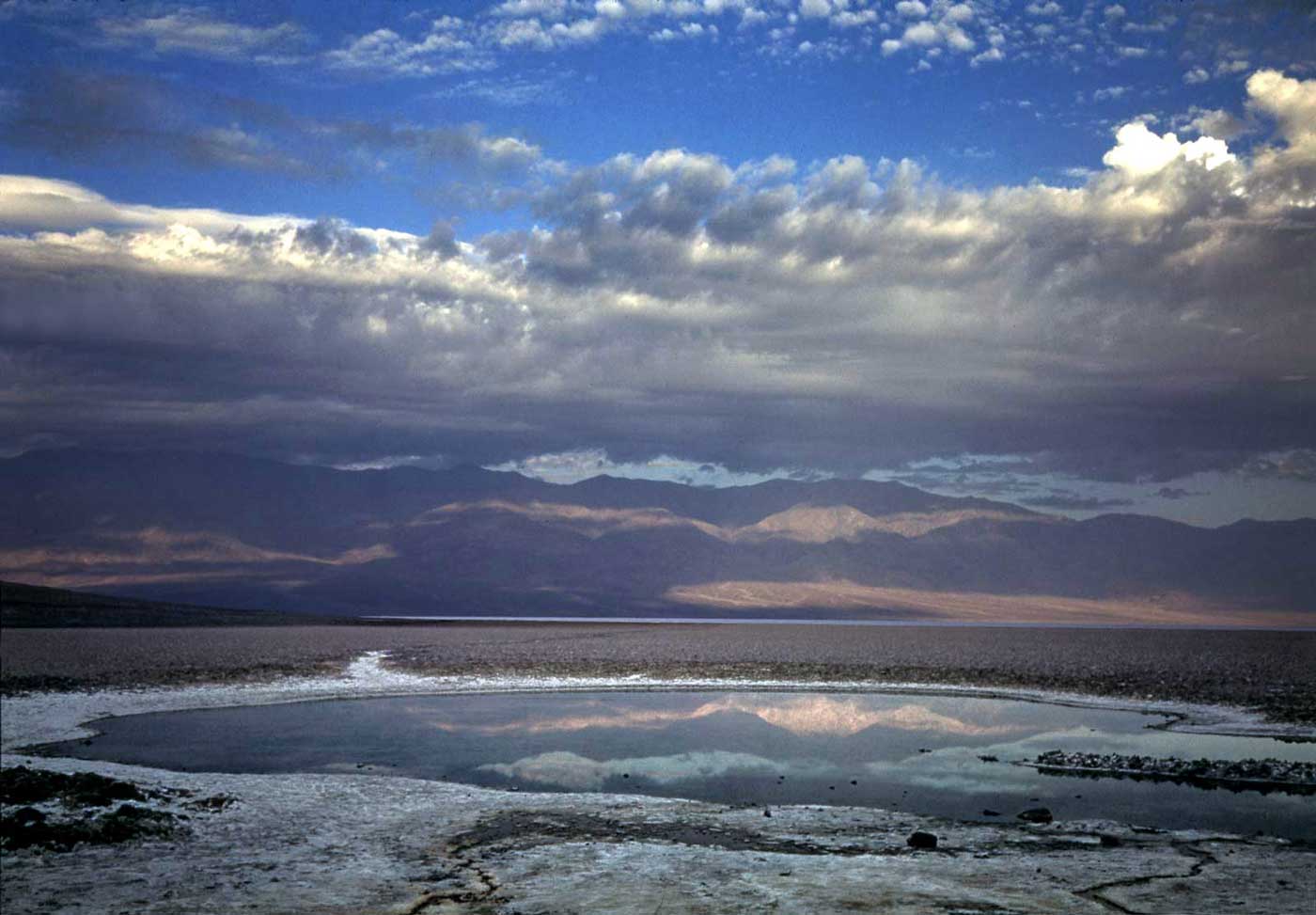
That song and the Haynes happy singing of it is something that still bubbles up for me, and perhaps too often. It is one of my dependable interruptions. An obsessive parody. And it is Sykes slides like these two – the one from the Palouse, most likely, and the other from Utah or perhaps southeast California – that trigger the Old Master in me. (Google Richard Hayes and Old Master Painter and you can hear a fragment of his version. But be kind, I was 12 at the time.)

(Click to Enlarge)
The amazed child in me finds it difficult to give up the expectation that there are at most three or four natural arches anywhere and that the same goes for balancing rocks. The Sykes landscape on the top has its arch but typically no caption on the slide holder leading us to it. Still I thought I might have a chance of finding it and I went exploring. It is likely, I thought, that this arch is somewhere in Utah’s Arches National Park. Once I reached the park, again riding the Googlecopter, I determined that there may be three or four hundred arches there. It also seemed that most of the rocks are balancing or at least on the edge of it.
There are hundreds of blue-dot volunteered photographs of this park on Google Earth. I lucked out. The fourth one I clicked showed this same landscape . It’s position on the satellite recording was, however, on a wide plain and not near any elephantine rocks such as these. It was misplaced. So I started the long but exciting journey through the park’s blue buttons. It was very distracting. Arches NP is scattered with arches and monoliths that resemble some of their names: The Tower of Babel, Park Avenue, Mother and Child, The Organ, Ham Rock, Sheep Rock, Finger Rock, Lion King, and Stone Face. And this last, Stone Face, is what we apparently have here, although the second snapshot of it I found with Google shows the profiled face of the rock on the right better than does Horace’s. (Take a few steps this way or that and these IDs can dissolve.)
Stone Face is the name given it with the volunteer Google photo. It is, if I have read this correctly and the photo is not totally misplace (which happens), part of Elephant Butte, which also includes the Parade of Elephants, Cave of Coves, North Window and South Window, Turret Arch and the Double Arch, which Horace also photographed. His view is included below. Like Stone Face, Double Arch is very near the road. It is hard to judge the size without someone standing below it, but it is huge. Unlike most of the arches in the park it was eroded from the top and not from the side.

The Elephant “ridge’ is about six “crow miles” north of the Park Headquarters, which is on the road to Moab, a town one might want to live in for a year or two just to explore its surrounds. The Elephant is at the southern end of a triangle I have drawn with sides that are about 4 miles long. To the northeast is the very popular Delicate Arch – not big but rather fine and standing exposed like an innocent ingenue on a wide stage – and to the northwest is Fiery Furnace, a clump or farrago of twisting small canyons with yet sides that reach as high as the nave of Notre Dame. Seen from every angle, including space, the Fiery Furnace is, to quote a chorus of adolescents at any junior high, “Awesome.”
Finally, to name a few more arches and other features just for the simile of it all. The park includes Ribbon Arch, Ghost Arch, the Garden of Eden (to cool that Fiery Furnace), Skull Arch, Surprise Arch, Inner Sanctum Bridge, The Spectacles, Biceps Arch, Seagull Arch, Landscape Arch, Walk Through Bridge, The Court House, Petrified Sand Dunes, The Three Gossips (which resemble a grouping of statues by Rodin). Twenty miles to the southeast – on one’s way to park headquarters – the LaSal Mountains, especially when snow-capped, give a cool backdrop to the warmth of Arches National Park.
And now we learn after visiting Park Headquarters that the number of arches in Arches N.P. is not 200 but 2000 – more than – and all have names or suggest them.


May I be the first to offer some mild corrective details on your fascinating waterfront then/now of this weekend. I happen to be working on that area already.
You caused a few hours of pleasant book searching on my shelves.
I suspect the Art Deco Colman Dock photo is 1938, based on the fashion wear esp of the hot fox in the fur and slit to the thigh sheath silk dress coming off the morning boat from Bremerton. She’s a story in herself. The white straw fedoras indicate spring wear for gents as well.
I note you rightly did hedge on the names of the boats. You could have asked me, I got all the books and besides I checked with Captains Bob and Oscar, my fathers who art in heaven but still standing watch, who were there so I got the straight poop on the deck here.
There were two others that kept their names:
The second batch of boats that Peabody bought in the Bay and brought north were those he didn’t completely rename, something about war priorities trumping Public relations, etc, Those without name changes included the San Mateo’s sister ship, the steamer Shasta which later joined the WSF fleet until 1959 retirement to the Portland waterfront; also in 1943/44 the single ended fast steamer City of Sacramento, nee the steamer Asbury Park, another high speed veteran of the Golden Gate fleet, which retained that name until going North with Peabody to BC where it became the Kahloke, later Langdale Queen. The other single ender converted boat, the Napa Valley, became the Malahat once arrived, and after a mysterious arson fire was rebuilt in Winslow in mere weeks. See my WW2 espionage novel for more details on all this jazz.
The Deco Terminal photo was published in Kline & Bayless Ferryboats a legend on Puget Sound, but no credit to source. Looks like a candid, or Times shot. Not sure when the passenger ramp was built, even the pre-deco terminal had that upper level deck and access. An earlier shot of the same over the rails viaduct is in Steamer’s Wake, but earlier 1930s (notwithstanding Faber’s caption alleging post-mosquito fleet). I’d love to get to an original.
Did I ever tell you the nutty idea that was proposed to remove the pedestrian overpass to “enhance the streetscape experience?” Seriously, at a WSF design meeting I crashed several years ago (they had a nice spread of free salmon and oysters, at Ivars, when WASHDOT had money to waste and I was on the Viaduct Consultancy Version I). Myself and a Bremerton councilwoman told them how utterly stupid that idea was. It got dropped (as did the entire Colman Dock rebuild project).

See attached (above) for Miss Thelma Murphy, the hootchy kootchy gal in the red silk dress. Nice figger! 9:35 in the morning?
No I don’t think that’s her mother walking next to her. Her madame, perhaps.
Unless she’s an admiral’s daughter. Now there’s a plot idea – pillow talk to my spy straight from Daddy’s top deck.
Regards, Capt Eddie


(Click to Enlarge) Two or three weekends ago at the annual Meridian Avenue (north of 80th) summer block party, Jean Sherrard (of this blog) took the stage as he does every year to urge those sitting in lawn chairs and/or lingering beside the potluck tables to join in the cakewalk. On Meridian this is a variation of Musical Chairs, the popular church and school social game where when the music stops the players who have survived all interruptions to that point – say four are left – fight for the remaining three chairs. There is always one less chair that players, consequently one might easily land on another players lap rather than a chair and thereby join the losers without chairs – unless the lap is preferred.
On Meridian numbers from one to 100 are chalked on the pavement in a winding circle. When the music stops a number is pulled from a basket by a child – for assured innocence – and you can figure it out. If it is the number you are standing on when the music last stopped you win a cupcake. There are about two dozen cakes to win, and you can be a repeat winner. And this leads to Tipsoo Lake.

This year while urging the reluctant among us to join in the walk Jean used his father Don Sherrard as an example of cakewalk valor. Don has bad knees, got originally from playing center in both Highline High School basketball and football. For the latter, Jean notes proudly, “He was all-league.” With a great bravado of voice and a sweeping hand Jean advise the block party “If my father with his bad knees can dance then surely you can dance with him.” And Don did dance, although I do not remember if he won a cake this year. Afterwords Don told me that the day before he and Jean’s brother Kael – director of Hillside School in Bellevue where Jean and his wife Karen teach – had taken the short hike from Chinook Pass to Tipsoo Lake and that he used his hiking canes (or poles) to ease the way. Don, a semi-retired doctor-professor at the U.W. Medical School, is in his mid-70s, and thereby visited Tipsoo at a later age than Horace Sykes could have. Horace died in his early 70s. Horace returned with his picturesque slides and Don with his still startled eyes. He found Tipsoo’s setting – below the Mountain The Was God – most enchanting.


THE CITY OF SACRAMENTO
Two readers of last Sunday’s “now-and-then” on Colman Dock have written to correct us (me) on this matter of California ferries losing their Golden names for Green ones when they were moved north to Puget Sound. I wrote that I thought that the San Mateo was the only one to keep its San Francisco Bay tag. Or perhaps I just claimed it and had no reservations. Whatever, I fumbled. There were others. Not many, but others. And The City of Sacramento, above, was one of them.
Here follows the more recent letter on this dropped pass. (I’m keeping to seasonable analogies, although I don’t give a knee injury and shortened life span for football.) Ron Miller is it’s author, and he mentions the first name, Bob, of the first writer in his first line. We quote.
“Paul,
I see on your blog that “Bob” already mentioned the City of Sacramento along with a couple other ferries from California. I didn’t know about the others, but I certainly remember the C-of-S from summer days in the 1940s on Alki Beach, where we kids would eagerly watch for it to pass because it made big waves. It served here between 1941 and 1952, when it moved on to BC and was rebuilt and renamed Kahloke. Also, there is the preposterous but also rather touching song “On the Black Ball Ferry Line up in Seattle” by Bing Crosby and the Andrews Sisters that immortalized some of the fleet, with special mention of the C-of-S. I’ve attached the relevant part of the lyrics—it’s worth the trouble (and it was some, at least for me) to track it down on line and listen to it.”
Now we interrupt to note that Ron Miller is an Emeritus Professor of Regional Science connected to the University of Pennsylvania, and that he is now back living in West Seattle on Beach Drive S.W with a view of both the Olympics and shipping, although without, of course, any chance of seeing the City of Sacramento since 1952. Here’s Bing and the Andrew Sisters – the relevant part.
Get aboard get aboard when the weather’s fine
Take your pick of the ferries on the Black Ball Line
There’s the Illahee and Chippewa
And the Quillayute…the Kalakala…
You’ll find all these on the Black Ball Line…
The Klahanie, the Nisqually, there’s the Malahat
(we’ll think of that!)
The Klickitat
(there goes my hat!)
The S! S! City of Sacramento!
(What are we doing down in California?)

RETURN TO THE SAN MATEO (TWICE)


Just received from Ron Edge, the cover for “The Mountain That Was God” – a resonating attachment to the Daily Sykes #140 directly below it.


(click to enlarge photos)


When the brilliantly industrious Seattle pioneer James Colman started to build his namesake dock on the waterfront in the early 1880s, it was hindered by another namesake, Yesler’s Wharf.
Except for specialties like coal and lumber, there was not much need for more docks on the pioneer waterfront because Yesler’s was huge and made an elbow turn north, half-blocking access to Colman’s new endeavor.
Colman took Yesler to court, but Seattle’s Great Fire of 1889 did more to resolve the problem than any judge. It destroyed the waterfront south of Seneca Street, and Yesler’s wharf was rebuilt without the elbow. Colman rebuilt his dock, too, with an impressive facade on Railroad Avenue, which, however, hid two stubby piers behind it. The big change came in 1908 when, in part preparing for the coming summer volumes expected with the 1909 Alaska-Yukon-Pacific Expo, Colman Dock was extended 705 feet into the bay and fitted with a handsome tower and domed waiting room.
Colman Dock quickly became the center of intra-Puget Sound transportation and remains so today.
The 1908 pier shed was replaced in 1937 with the Art Deco expression seen here. It complemented the Black Ball Line’s new streamlined flagship, the Kalakala. After the opening of the Oakland Bay and Golden Gate bridges, also in the mid-1930s, a flotilla of bargain-priced ferries came north to work on Puget Sound. All but one (I believe), the San Mateo, were given local names.
After 15 years of rate hikes, strikes and withdrawals of service, the Black Ball Line was sold to the state in 1951. Ten years later, the Deco dock was replaced with the towerless one still in use and expanding.
Walking a few steps north, I took another photo of the ferry line:

Anything to add, Paul? YES Jean. I have reached into the files and pulled out five previously published features – and they sometimes repeat each other because they all involve Colman Dock – and a few other related photos.


THE WATERFRONT WAIT
Most likely a motorcar historian who knows the models of most brands (as ancient even as the Stanley Steamer which is generally believed to be the first auto ferried across Puget Sound — in 1906) can quickly peg the year this photograph was recorded at Colman Dock. With little interest in cars since high school I have only two “outside dates” to offer. In 1937 a new Arts Deco ferry terminal replaced the 1908 vintage wharf shown on the right. The older view also dimly reveals part of the west façade of The Exchange Building – at First Avenue and Marion Street – in its upper left corner. It was completed in 1930.
When constructed in ‘08 with a landmark Romanesque tower at the water end, at 700-plus feet long Colman Dock was fitted to its sides with fourteen slips that could be raised and lowered with the tides. It was by far the busiest “Mosquito Fleet” landing on Puget Sound. Six of the dock’s births snuggled against its north side, directly where the cars are here parked in the early or mid 1930s.
This extended stage for parking was constructed in the mid-1920s when many of the sleek Puget Sound “Mosquito Fleet” passenger steamers were being humbled with conversion to ferries. Their pointed bows were cut open and their slim decks fattened over sponsons for cars. By 1923 the dock’s tenant, the Puget Sound Navigation Company – AKA the “Black Ball” line – figured that it had already handled 28,000 “machines” on the “Navy Yard Route” between Seattle and Bremerton.
In 1935 the streamlined “Kalakala” began landing here. Built on the burned-out hull of a California ferry, the Black Ball flagship was soon followed by seventeen more Golden Gate ferries, moved to Puget Sound after the opening of the suspension bridges on San Francisco Bay made them obsolete there and cheap here as salvaged goods. (The San Francisco-Oakland Bay Bridge, opened in late 1936, and the Golden Gate Bridge, the following summer.)
IRON INTO WOOD

I was recently reminded by Scott Morris who sometimes helps crew the Virginia V, the last of Puget Sound’s “Mosquito Fleet”, that the reason so many of the ports of call around the Sound were called “landings” is because bringing an unwieldy steamer along side them was a kind of “controlled crash.”
Here is evidence of an uncontrolled crash at Colman Dock on the night of April 25, 1912. It ranks high on the waterfront’s list of remarkable blunders. The culprit was not a small Puget Sound steamer but human communication aboard the Alameda, the Alaska Steamship Company’s ocean-going liner. With the Alameda resting about 250 yards west southwest of the pier head Capt. John (Dynamite) O’Brien acting as port pilot gave a “full astern” order to Third Assistant Engineer Guy Van Winter who in turn relayed it verbally to Second Assistant Robert Bunton. Bunton, who was at the throttle, either heard or understood the order as “full ahead” and quickly jerked the Alameda into action with these results.
Coming at it from an angle the iron-hulled ship crunched through the end of Colman Dock dropping its tower into the bay and exposing the passenger waiting room beneath the dock’s dome. Slowed but not stalled the ship continued slicing, sinking the stern-wheel steamer Telegraph that was berthed on the north or opposite side of the pier. The Alameda might have gone up the waterfront smashing into other piers but for the quick thinking of O’Brien. When the ship surged forward the captain shouted for the anchors to be dropped and after 125 fathoms of chain were out, the starboard anchor caught and the next pier north – the Grant Trunk Pacific Dock, then the largest wooden pier on the coast – was momentarily saved. It burned down two years later.
No one was killed although a few were injured and/or dumped into the bay. The hardy Alameda was merely inconvenienced, continuing its scheduled run to Alaska only a few hours late. When the Colman tower was found at sunrise floating in the bay the hands on its big clock read 10:23.
THE TELEGRAPH

This slender representative of the Puget Sound “Mosquito Fleet” was constructed in Everett in 1903 for the Seattle-Tacoma run. The Telegraph was one of the last sternwheelers built beside these waters. She drew only 8 feet of water, was 25.7 seven feet wide and 153.7 feet long – more than twice as long as the 72 foot Colman Dock tower seen here behind. On the evening of April 25, 1912 the tower and the sternwheeler shared the same fate. This photograph was taken a few days or weeks earlier.
Here the clock in the tower reads 12 straight up. The Telegraph is churning the bay with her paddles perhaps beginning its noon departure for Bremerton, its regular destination since 1910 when its Portland builder Capt. U.B. Scott sold her to the Puget Sound Navigation Company. When the Colman Tower was fished from the bay after sunrise on April 26, 1912 the clock read 10:15. It was the very minute of the collision the night before.
On the evening of the 25th while Captain John “Dynamite” O’Brien was preparing to land his ocean-going steamer Alameda to the south side of the Alaska Steamship Company’s Pier 2, one wharf south of the Colman Dock, he was waved off to the north side. Instructing his assistant Robert Bunton to go “full speed astern” Bunton went full speed ahead instead. Like a hot knife through butter and with hardly a scratch to its steel hull the Alameda drove through the outer end of Colman dock. Before it was stopped by its own anchor she dropped the tower into the bay and drove the Telegraph — parked then, as here, along the pier’s north side — as far as the Grand Pacific Dock before it sank the sternwheeler.
Remarkably no one was killed. And aside from a few scratches and brief dunkings no one was hurt. Without tragedy this collision soon became a cartoon in the retelling. An expensive cartoon. After the owners of Telegraph instructed the owners of the Alameda to pay them $55,000 in damages a federal court made them settle for $25,000 on the grounds that sternwheelers were no longer popular. Still the Telegraph was raised and repaired and the tower replaced.


THE VENERABLE VICTORIA
With “clues” from the tower, upper-right, and a scribbled negative number, lower-left, it is possible to, at least, compose a general description of this crowded scene. The clock turret, here partially shrouded in the exhaust of the disembarking steamer S. S. Victoria, replaced the Colman Dock’s original tower in late 1912. That spring the first tower was knocked into Elliott Bay by the steel-hulled steamship Alameda during a very bad landing. The second clue, the number “30339” penned on the original negative by the Curtis and Miller studio, dates the scene – still roughly – from 1914 or 1915.
In 1908 the by then already venerable Victoria was put to work on the Alaska Steamship Company’s San Francisco-Seattle-Nome route. Considering how packed are both the ship and the north apron of the Northern Pacific’s Pier 2 (at the foot of Yesler way) it is more likely that the Victoria is heading out for the golden shores of Nome rather than the Golden Gate.
The 360-foot-long Victoria was built in England as the Parthia in 1870 and made her maiden voyage that year to New York as the finest ship of the British Cunnard Line, for many years the dominant North Atlantic shipper. With compound engines she required half the coal of her sister ships, and with the gained room was the first Cunnard ship to have, among other niceties, bathrooms. Eighty-six years later the Victoria (She was renamed with a 1892 overhaul, again in England.) was sold to Japanese shipbreakers and in 1956 her still sturdy hand-wrought iron hull was salvaged for scrap in Osaka, Japan.
Most likely a few Pacific readers will still remember the Victoria from the depression years of 1936 to 1939 when she was laid up in Lake Union unable to meet the cost of U.S. fire and safety regulations. A least a few eastside readers will recall the steamer from the summer of 1952 and following. On Aug. 23rd of that year the then oldest steamer in the U.S.A. was tied to the old shipyard dock at Houghton (Kirkland) on Lake Washington where she waited first for an ignoble 1955 conversion into a log-carrying barge, and briefly renamed the Straits, before taking the last of her many trans-Pacific trips. That most fateful of journeys was her first trip under tow.


COLMAN DOCK, Ca. 1903


Here – three photos up – is Railroad Avenue circa 1903. With this extended outer-part there are no tracks and so it is relatively safe for the few suited men shown here to be heading in every direction. This new section for wagons and pedestrians was built after a tidelands replat reordered the waterfront in the late 1890s. Dock owners like the pioneer engineer and millwright James M. Colman were given the time they needed to conform their property to the replat. Because of the prosperity that came also in the late 1890s with the Yukon-Alaskan gold rush, by the time this photograph was recorded practically the entire waterfront between King and Pike Streets was made over with new piers and a wider trestle.
The first floor businesses on Colman Dock begin on the left with what appears to be a produce stand beneath a striped awning that reads across its hem “parcels checked.” Next door is the Sunde and Erland Sail Makers and Ship Chandlers, one of the long-lived residents of this dock. The “electric contractor” Frank H. Folsom is next. Besides dynamos Folsom offers poles and piles, tug boat services, and “monthly sailing vessels to all California Coast Points.” At the far end is the Loggers Supply Company and to this side of it the furrier Charles Wernecke. In 1904 Ye Olde Curiosity Shop began its long hold on Wernecke’s storefront, decorating it with whale bones, totems and other Indian artifacts.
In 1903 the roughness of Railroad Avenue itself inspired a muckraking campaign by the upscale businessman’s “Commonwealth Magazine. ” Quoting, in part, “Few know its dizzy danger . . . [which] has been doubled at night by the lack of light . . . Strangers arriving in the city for the first time grope around in the darkness and splash into the pools of slimy water or slip through the muddy ditches, as they go up and down to avoid climbing over or under the freight cars . . and wonder if they have gotten off at some small country town by mistake.” Add the Commonwealth’s exploration into the rotting rubbish beneath this wide trestle (not included here) and it makes for some retching reading.

FIREMAN SAVE THAT TOWER!

The destruction of the Grand Trunk Dock at the foot of Madison Street on July 30, 1914 was the most spectacular single fire in the history of the Seattle waterfront. The “single” condition is important, for the city’s “Great Fire” of June 6, 1889 consumed the entire waterfront south of University Street – about 15 blocks worth. That inferno did not discriminate. (Lest someone complain, I have not included the 1910 fire on Wall Street in this ranking because a stiff wind off Elliott Bay kept its impressive incineration to the east side of Railroad Avenue.)
On the far left – nearly out of the picture – is the 108-foot blazing skeleton of the Grand Trunk tower. This view of its destruction is unique, for the unnamed photographer has turned to shoot what then may have seemed to be the imminent destruction of Colman Dock. And the fireboats Snoqualmie and Duwamish have joined the photographer to also shoot the dock that is not yet doomed. It seems two of their three visible streams are aimed at Colman Dock, one of them reaching the clock tower that is as yet merely smoldering.
When its namesake Canadian railroad completed the Grand Trunk Pacific Dock in 1910 it was the largest wooden finger pier on the West Coast. Four years later its charred piles were recapped and topped with another long and ornate terminal of the same footprint but without the tower. (This somewhat less distinguished replacement survived until 1964 when it was cleared away for an expanded loading lot north of Colman Dock.)
With the fireboats help Colman Dock escaped its neighbor’s fate. Badly scorched, the top of the tower was rebuilt and survived until this Spanish-style home of the Black Ball fleet was replaced in the mid-1930s with an art-deco terminal in the style of the fleet’s then new flagship, the Kalakala.


ABOVE: The Colman Dock with its second tower and in its last year before conversion to the Deco-Modern version. The date: July 16, 1936. It’s written along the bottom. On the far right is Pier 3 later renamed Pier 54. Since 1946 the home of Ivar’s Acres of Clams. In between Pier 3 and Colman Dock is the Grand Trunk Pacific dock as rebuilt after the grander Canadian dock was razed by the fire of 1914.


Only the tornado-rainbow points to the pot of gold and scatters it too.

Soon after the Dorpat family got “the call” in 1946 to move from Grand Forks, North Dakota to Spokane, Washington, we were visited by Annie Crabtree, a “spinster lady” who was a member of Immanuel Lutheran Church in Grand Forks and was attached to my parents and lonely for them. So she was invited west for a visit.
Annie Crabtree was as skinny as a barber’s pole, wore thick glasses over a handsome nose, had a big mouth with big teeth, wore dark dresses printed with patterns of tiny white flowers and adorned with fancywork at the neck and wrists. The only flesh anyone ever saw of Annie Crabtree was her face and hands. She never called my parents by their first names, but always Pastor Dorpat and Mrs. Dorpat and yet she was older than both of them. She was less a friend than a votary. She had spent some time in some institution, and my parents had helped get her out.
For some reason Annie Crabtree was taken from the safety of our Spokane parsonage for a trip in the family’s 1946 Plymouth sedan to this prospect overlooking Lewiston Idaho. Like Horace – and at about the same time – we stopped here at the edge. This interruption was for Annie, and not the view. She was getting carsick and we were about to drop more than 2000 feet through a score of switchbacks.
I remember this vividly for it was at that moment looking south over the Snake River valley that I got my first inkling of the “horrors of travel,” that someone could get sick from merely riding in a car. With lots of talk we made it down those curves with Annie and back up them. For me, the child, it was thrilling but also troubling. Now I am more like Annie Crabtree and wonder at and sometimes sicken from all the exposed swerving.

Sykes photographed this nearer to Government Camp on the Mt. Hood Highway then to Timberline Lodge. The Camp is about three flying-crow miles southwest of the Lodge, and about 2000 feet lower. (These statistics and locations are brought to you with the friendly and timely help of Google Earth.)
(please click TWICE to enlarge photos)


In the “now” recording, Ron Edge raises his arms in surprised thanks to the highway department. All buildings from this corner of Mercer Street and Boren Avenue have been cleared. In their place Edge stands on a field of stretched plastic, an ironic repeat of the Raber family’s garden. Ron and I agree that the sandbags represent potatoes. To us, the sacks standing behind the quartet of farmers in the “then” photo resemble gunnies stuffed with potatoes.
The historian-collector Edge purchased this farm scene out of admiration for the work of its photographer, the studio of Peterson and Bros. For about a decade after their 1876 arrival in Seattle, Henry and Louis Peterson’s recordings of our city are on the whole the best. This portrait of the Raber farm — now near the Mercer Street exit off Interstate 5 — is rare for its subject and how remote it is from the Peterson studio at the western waterfront foot of Cherry Street. The photographers may well have been friends with the Rabers and even traded this recording for produce. Bartering was then commonplace – and may become so again.
“Joseph Raber farm near Lake Union 1882” is written on the back of the original print. Next to the print’s own caption, the leaning tree on the south shore of Lake Union was very helpful in locating both the place and point of view, which is looking northeast. The tree shows up in several other photographs of the neighborhood (see below). Those clues, joined with property records from the state archives and city directories, made it possible for Jean Sherrard and Ron Edge to return to the garden of sandbags and stand within a few feet of where Raber and the others posed with their crops.
Anything to add, Paul? – YES JEAN a few pictures and three illustrated “stories” or features that appeared in former years as “now and thens” in Pacific Northwest mag. First four images relevant to the Raber farm story above. (Remember please to Click Twice to Enlarge.)


We may have a mere glimpse of part of the Raber farm house in the panorama of the south end of the Lake Union that looks south sometime in the mid-late-1880s from near Boren and John – a bit northwest of Boren and John probably. Note that the leaning fir tree – our clue from Ron Edge’s Peterson pix of the Raber farm – appears in the pan. In the detail below the pan I have outlined in yellow what I think-believe-trust-hope is the Raber home, or the parts of it that show above and around another structure that sits between it and the photographer. Otherwise other recordings of the Raber farmhouse – or parts of it – have so far escaped us.

Click to Enlarge this one – surely. Another pan looking north to Lake Union from a prospect near Fairview and Thomas. The leaning lone fir is again helpfully apparent against the lake. The mill’s position is obvious, left of center, and Queen Anne Hill is on the distant left. This also dates from the mid-late 1880s. The Raber farmhouse, if it survived, is hidden behind the frame house that holds the mid-ground, right-of-center.

This look east across the southern end of Lake Union is a puzzle, although surely one that can be unraveled with time. This is a very early view of the Western Mill – it is still quite primitive – and yet there is no Raber farm to be found here. It seems most likely that the farm and the lone fir are just out of frame to the left, although this still troubles me. I expected the farmhouse to be apparent on the left side of this view by the pioneer photographer Peiser. The date is mid-1880s. The next panorama from Queen Anne Hill – like this one – has considerable text following it, and is one of three features that now follow, which were originally in the only surviving big pulp in town – the Times.

THE BIG FUNNEL
In the interests of promoting the south end of Lake Union as the strategic route for boomtown Seattle’s rapid spread north, an early 20th-Century real estate company called it “The Big Funnel.” In 1906 Westlake Avenue was cut through the city grid thereby linking the business district directly with the lake. Here the way for the funnel is still being prepared by the Western Mill built, in part, over the lake and seen at the center of Arthur Churchill Warner’s ca. 1892 photograph.
When Western Mill was first built in 1882 it was surrounded by tall stands of virgin Douglas fir and cedar. The mill worked around the clock to turn it all into timber and here only a decade later the neighborhood is practically void of trees. A few stragglers survive on the Capitol Hill horizon. Most likely many of the homes that dapple this landscape were conveniently built of lumber cut from the trees that once stood here.
The street in the foreground is Dexter. Beyond it is the trolley trestle bound for Fremont that was built over the lake north from the mill in 1890. Its name, Rollins, was changed to Westlake not long after Warner photographed it. This side of Westlake — the Lake’s extreme southwest corner — was a popular summer swimming hole until it was turned into one of the city’s many dumps and filled in with garbage and construction waste in the late teens. Once landlocked, Westlake was soon widened and paved.
Beyond the Westlake trestle is a millpond littered with logs. There more recently a distinguished line of vessels has been moored. These include ships stationed here after the Naval Armory was completed in 1941. There the ferry San Mateo rested here until she was towed to Canada. (When this text was first composed in 1997 the San Mateo’s younger sister ferry the Kalakala was expected to find refuge in this harbor. She was moored instead on the north shore of the lake.
Now the last of our “Mosquito Fleet” steamers, the restored Virginia V, bobs in these waters as one of the main attractions of the new Marine Center that is rejuvenating the old armory that will soon become the new home for the Museum of History and Industry (MOHAI). Locals with a taste for irony may recall that another Puget Sound steamer, the City of Everett, gave her last days here as the converted Surfside 9 Restaurant. She sank in the 60s after City Light turned off her bilge pumps for failure to pay the electric bill.

THE COAL ROAD – 1872 to 1878
This raw little photograph (above) is probably what it is often described as being: a record of the day when the Seattle Coal and Transportation Company gave locals free rides on its new railway between Lake Union and the ridge above Elliott Bay – where the Pike Place Market now holds. Immediately left of center stands a woman in a cape and flamboyantly banded dress. She may be holding an inaugural flag in her left hand – the bright triangular form. Another flag stands to the right of center and against the sky.
The familiar stack of the little locomotive Ant rises above a somewhat scattered crowd in which every head appears to be posing for the photographer, whose camera looks north in approximate line with present-day Westlake Avenue toward Lake Union. (The scene may actually be closer to mid-block between Westlake and Terry.) The distant ridge still dark with old-growth forest is the future Wallingford.
The Ant arrived from San Francisco on Nov. 21, 1871. It took 16 horses to drag it from the waterfront up to Pike Street, where it was set to work building a narrow-gauge track along Pike and down the future Westlake (or near it) to the lake. There, eight locally made coal cars were routinely transferred form barges and hooked to the Ant.
On March 22, 1872, every citizen was given a free ride; benches were installed for the occasion in the system’s first eight gondolas. Accompanied by a brass band – for at least the first trip – the train ran back and forth from sunrise to sunset.
The entire route was 17-plus miles long. It started in the coalmines on the east side of Lake Washington – those around Coal Creek and Newcastle – on another narrow gauge railroad. The cars were transferred to barges on Lake Washington and then towed by a small steamer to the Montlake portage. There they were pulled along another railroad track by cattle driven by members of the Brownsfield family that first settled the University District. The cars were next transferred to barges again for another steam through the length of Portage Bay and Lake Union to transfer at the place shown here for another haul by rail to the over-sized Pike Street Wharf and coal bunkers. It was an expensive and complex haul in all, but still it paid well, making coal Seattle’s biggest export during the late 1870s.
The last coals from Newcastle traveled this route on Jan. 29, 1878. By then the Ant had been transferred to the new Seattle and Walla Walla line, which ran directly around the south end of Lake Washington from the company’s new coal wharf off King Street to its Eastside coal fields. In the detail from the 1878 birdseye of Seattle, there is no Lake Union to be seen. The coal railroad however is there chugging out of the forest, far right, and heading to the Pike Street Coal Wharf, far left. Lake Washington is in the distance with a lone steamer heading for a stage connection with Seattle by way of a wagon road on or near Madison.

THE TWO HOMES OF VIRTUOSO CLARINETIST NICHOLAS OECONOMACOS

The splendidly eccentric square-jawed figure of Nicholas Oeconomacos holding his cane, kid gloves and wide-rimmed fedora posed for Arthur “Link” Lingenbrink sometime in the 1920s. Oeconomacos in his black cape stands above the spring tulips in his front yard at the southeast corner of John St. and Boren Ave. Link had his own specialties, including storytelling, celebrity chasing and sign painting.
To those who merely saw him with his oversize flat black hat shading his big head, a studded cane, a black cape and the practice of carrying his caged canary on walks downtown, the Greek clarinetist was a valued eccentric. Those who also heard him enjoyed what Homer Hadley, who conducted the Seattle Symphony when Oeconomacos first joined it as principal clarinetist about 1910, described as “the softest clarinet in the world.” John Philip Sousa claimed to Seattle art patron Henry Broderick that Oeconomacos was the best clarinet player ever to appear in his band. Oeconomacos made two world tours with Sousa before settling in Seattle.

Despite his celebrity, Oeconomacos played in the streets during the Great Depression, collecting change in a failed attempt to pay his mortgage. Kicked out of his home on Boren at John (behind the photographer Lingenbrink who took the two views above) he somehow managed to stay in the Cascade neighborhood, moving to 625 Minor Ave. and Roy. (This home on Minor was about 500 feet due east of the Raber farm – where it had been in the 1880. The clarinetist’s second home sat in what would be part of the westbound lanes of the Mercer Street exit from Interstate-5.)

(Note the tower atop the Ford Assembly plant, which is still in place but for other uses – perhaps storage units. It was for much of its life home for Craftsman Press.) Oeconomacos called his new home the House of the Terrestrial Globe. (Hence the simple circle ornament top center and another one on the west façade – see below.) The little sidewalk sign at the bottom right-hand corner that reads “Enjoy Living Music” is surely Arthur Lingenbrink’s. I became very familiar with Link in the early 1980s when he was in his early 90s. With his brother Paul he was a professional sign painter and a very good storyteller – including stories about his friend Oeconomacos. I recognize his style.


On the far west side of his home, the virtuoso appointed his Garden of Memories with fluted columns and other classical ornaments that reminded him and his audience that he first practiced in the shadow of the Parthenon. He managed to scrounge the pieces for his sets and applications from thrift and junk stores and the back lots of second-hand building suppliers. It was there, seated in his Greek garden, that Oeconomacos played his last solo concerts of “living music” as the sign reads. The clarinetist was not fond of radio.


Late summer 2005 Jean and I visited Berangere in Paris, but first we stopped in London for a week and walked about. I started collecting London books fifteen or twenty years earlier and by the time we arrived I was more familiar with the city than probably most tourists. It was my second time in London. It had been a half-century since my first visit with about 35 other 16- year-olds, “boys and girls.” We were also heading for Paris and a convention to which we were all delegates, although not very good ones. Most of us spent the 10 days of the conference walking about Paris, and missing the convention’s schedule. (CLICK to ENLARGE)
This look at the Abbey’s west facade – part of it – was managed by setting the camera on a mail box and holding still. It is a merging of two parts and the sum has been flattened to turn it into a proper architectural photograph.
I enter this in part to encourage Jean to share some of the photographs he took while on his visit to London, Paris and Berangere this past July.


This Sykes subject surprises me with its preparation. In order to record this view of The Great White Throne in Utah’s Zion National Park, Horace had to climb about 1400 feet from the canyon floor. In many places the route is steep and exposed with switchbacks and rock scrambles beside which heavy chains are strung for a grip. At some point it becomes the West Rim Trail that also connects with the Angels Landing Trail. You can see the Angel’s Landing in Horace’s shot. It is the dark pinnacle on the right, and it is deceiving. The landing is exceptionally slender, about as wide as a high school cafeteria. I found all this with the help of Google Earth. In its ‘copter I came within feet of the prospect from which Sykes recorded this look to what is probably the best known rock in the park: The Great White Throne. And in a later light of the day than this light the upper half of it really is quite white. The majestic monolith is probably the parks’ principal symbol. Using the Google Earth ruler I measured the distance from Sykes to the top of the Throne. It is about 1.25 miles. Not far. And the throne rises straight up more than 2000 feet from the canyon floor.

The Throne was named in 1916 by a Methodist preacher named Frederick Fisher. It was one of those rare moments in Utah where a Methodist beat a Mormon. He also named the Angel’s Landing, and the Three Patriarchs, which I have not found as yet. With a weekly assignment to come up with something new for Sunday, preachers are bound to think up such names. Watching a late afternoon light bounce of the white Navajo sandstone was for Fisher a new revelation, at once sublime and patriotic. He recalled remarking to those with him, “Never have I seen such a sight before. It is by all odds America’s masterpiece. Boys, I have looked for this mountain all my life but I never expected to find it in this world. This mountain is the Great White Throne.” Now let us open our bibles to Revelations Chapter 20 where we will learn – I think – that it is from the “Great White Throne” that God will deliver his final judgment of the dead, who I think will first wake up to hear it. The faithful will then fly to heaven singing carols they will not recall learning, and all others will fall to hell with great gnashing of teeth. I would fish a quote from Chapter 20 but I have lost my bible in one move or another like I have also lost all my early disk recordings of the Fugs.
Now I remember that there are other similar Sykes Zion slides in his collection and almost certainly one or more was taken from this intrepid trail. I’ll hunt for them and attach one or more.


After the high bridge over Fremont was dedicated in 1932, Aurora Avenue became the centerline for a wide and long swath of car culture with auto dealers, parts stores, drive-ins for burgers, drive-ins for movies, and more than one race track. By the figuring of both collector Ron Edge, who lent us this subject, and the by now legendary racer Mel Anthony, this is the first day of racing at the Seattle Speed Bowl. It opened in 1936 and that’s the date penned on the print.
Anthony, posing in the “now” at the uncannily fit age of 87, first raced here as an adolescent on his big tire bicycle. He snuck onto the track – the gate was open – and boldly pumped passed a slow-moving grader only to be swallowed and upset in one of the tracks steep turns by sticky bunker oil applied moments earlier. The operators of both the grader & the oiler enjoyed his fall and laughed.
Through the years Anthony’s wit has made him many friends, and gained him a unique “Sportsman Trophy” in 1950, while his dare-do both won races and put him in hospitals. Mel always healed and, for our considerable delight, proved to be a very good narrator. His book “Smoke Sand and Rubber” is packed with stories about racing and pictures too. The book can be sampled and/or ordered here.
Before this track closed with the Second World War, Anthony competed on its oval in a 1939 Seattle Star Jalopy Race. He explains “I was 16 and in the lead and then everything fell off.”
After returning from the war in 1946, Anthony raced the regional circuit until 1955. I remember reading about his midget class exploits while I, an adolescent, was delivering Spokane’s morning paper, the Spokesman Review in the early 50s. Anthony notes “In Spokane they gave us a lot of INK.”
Recently “Methanol Mel” returned to the track, and so far has remarkably won every midget race he has entered. Jean Sherrard, who posed Mel in the “now,” describes him as a “wonder of nature and great testimony for genes, very good ones.” Mel explains, “Ten or fifteen laps for me now and my tongue is hanging out. No fool like an old fool. I have to be very careful.”
WEB EXTRAS


Paul, there are some remarkable additions to this week’s Now & Then. Ron Edge has sent us some chunky PDFs of materials he scanned from the early days of midget racing in the northwest. I’m posting only one of several items here today: The Midget Auto Racing Annual from 1946, the cover of which appears below.
More of Ron’s amazing scans to come, when I figure out how to override the 2 mb limit on our blog server.
The 2 meg limit has been cracked. Please see below for Ron’s classic PDFs of midget racing history. (Cautionary note: a couple are pretty large files, and may take time to download if you have a slow server.)


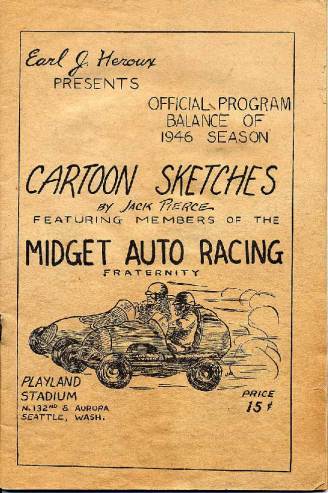
Anything to add, Paul?
Just a wee thing Jean – a now-&-then of a few years past. You may remember that the above story was begun with a mention of how the George Washington Bridge – AKA Aurora Bridge – opened up Aurora to its car and speed culture. Here follows the story from opening day, a picture of the same, and another photo of the bridge from its south end taken early in its life.
GEORGE WASHINGTON MEMORIAL BRIDGE 1932 DEDICATION

One of the great spectacles to have ever been staged here occurred on the six-lanes of the George Washington Memorial Bridge for its dedication on the sunlit winter afternoon of February 22, 1932. On that day, the 200 anniversary of the “father of the nation’s” birthday, no one called it the Aurora Bridge. The bridge dedication is still remembered by many locals (I’ve talked with at least five of them.) What is still vividly recalled is what shows here: a throng of 20,000 crowding the pavement of what one of the scheduled speakers described as “another link in the Pacific Coast Highway, the concrete chain between Canada and Mexico.”
A dedication program that included a few surprises preceded this ecstatic finale. There were, of course, appropriate times for when bands played, choruses sang, cannons boomed, speakers spoke, and as if on cue the crowd roared. That the day’s final speaker was the state’s Governor Roland H. Hartley was doubly ironic. First, Hartley had never been an advocate of the bridge and had once even described paved highways generally as “hard surfaced joy rides.”
The second Hartley irony played like retribution. The long-winded governor was interrupted mid-sentence by the President of the United State Herbert Hoover. Since Hartley was then heralding George Washington’s “avoidance of foreign entanglements” he was better interrupted considering that the new George Washington Memorial Bridge was designed in part to promote a better “entanglement” of Canada, Mexico and the U.S.A. It was, however, not any political nicety that motivated Hoover but rather strict observances of the ceremony schedule that had the president dedicating the bridge at 2:57 P.M. and it was exactly at 2: 57 that he pressed the golden telegraph key from his White House office.
Almost instantly the field artillery on Queen Anne Hill roared, a dozen trumpets blasted their fanfare, the fireboat Alki in the canal directly below the bridge shot water high into the arch made by the bridge, an oversized American flag, upper right, unfurled above the speaker’s platform at the south end of the bridge, and the state governor regrouped to shout into his microphone “The President has just pressed the key!”
What followed was the rush of thousands from both ends of the bridge to its center. The next day’s Seattle Times reported that “youngsters galloping ahead, were the first to meet across the great span, and a few minutes later the bridge was a black mass of citizens . . . The bridge was dedicated.”


At 3,612 feet Steptoe Butte is the unique observatory from which to delight in the real art of the Palouse: how prosperous farms mark its rolling hills. Cashup Davis was the Steptoe farmer-promoter most identified with the quartzite butte. Cashup always gave cash for the goods he needed to stock his popular stagecoach stop on the eastern slope of the butte. The English immigrant wed Mary Shoemaker of Columbus Ohio, and before they moved west in 1871 the couple raised eleven children in Wisconsin. Once settled into serving stagecoaches in the Palouse the family became known for its hospitality and the dance floor above the store. When the railroads arrived nearby in 1883 the stages stopped running and Cashup looked to Steptoe Butte to further his conviviality. After building a switchback road to the top he raised the two-story hotel shown here in 1888. The glass observatory on top held a powerful telescope that could look into four states.


As spectacular as it surely was, the hotel was also hard for man and beast to reach and its early popularity soon fell off. And the rolling Palouse was crowded with wheat not people. Mary Ann died in 1894 and, alone in his hotel, Cashup two years later. His instruction that he be buried in a hole he’d dug for himself beside the hotel was not followed. However, his internment in the Steptoe Cemetery was a grand affair and the procession following an ornate hearse brought south from Oaksdale was also impressive. Cashup’s hotel can be seen at the top although not so vividly as on the night of March 15, 1908, when it was destroyed by fire.


I used this contribution from the Muni Archive for a now-then feature in the Times back in 1998. (Well it would not be forward in 1998, I know, but the more needless words one uses the more time there is to think and even relax in between the meaningful ones.) The date is hand written below the clipping that follows. Remember please, don’t stop with one click, CLICK TWICE ENLARGE. This is in response to Ben Lukoff’s question about the possible existence of other Van de Kamp’s windmills. He also found one in the Roosevelt district and includes a link to it. It too no longer turns in the wind. I remember small Van de Camp’s sections in some supermarkets but no more big windmills when I arrived here in the mid-1960s. Read on for some description of what happened to this windmill near the north end of the University Bridge.

Horace Sykes’ slides include few urban scenes with the exception of celebrations like these of the Pendleton (Oregon) Roundup. The spectacle of horse logging (top) and bareback riding (bottom) are paraded here. I don’t know the year, although there is enough information here to easily determine it if we had ready access to the local library’s Pendleton Room. There’s an imperfect hint on the marquee of the Rivoli. Besides the local “Indian Vaudeville,” which would have been a stage presentation, the theater is showing the who-done-it mystery “Charlie Chan at Treasure Island” (in San Francisco.) The film was released in Sept. 1939. Although this year’s roundup (2010) is also held mid-September, I think it more likely that the Rivoli is showing the Chan film later than 1939. Chan films had legs.
(CLICK TO ENLARGE)
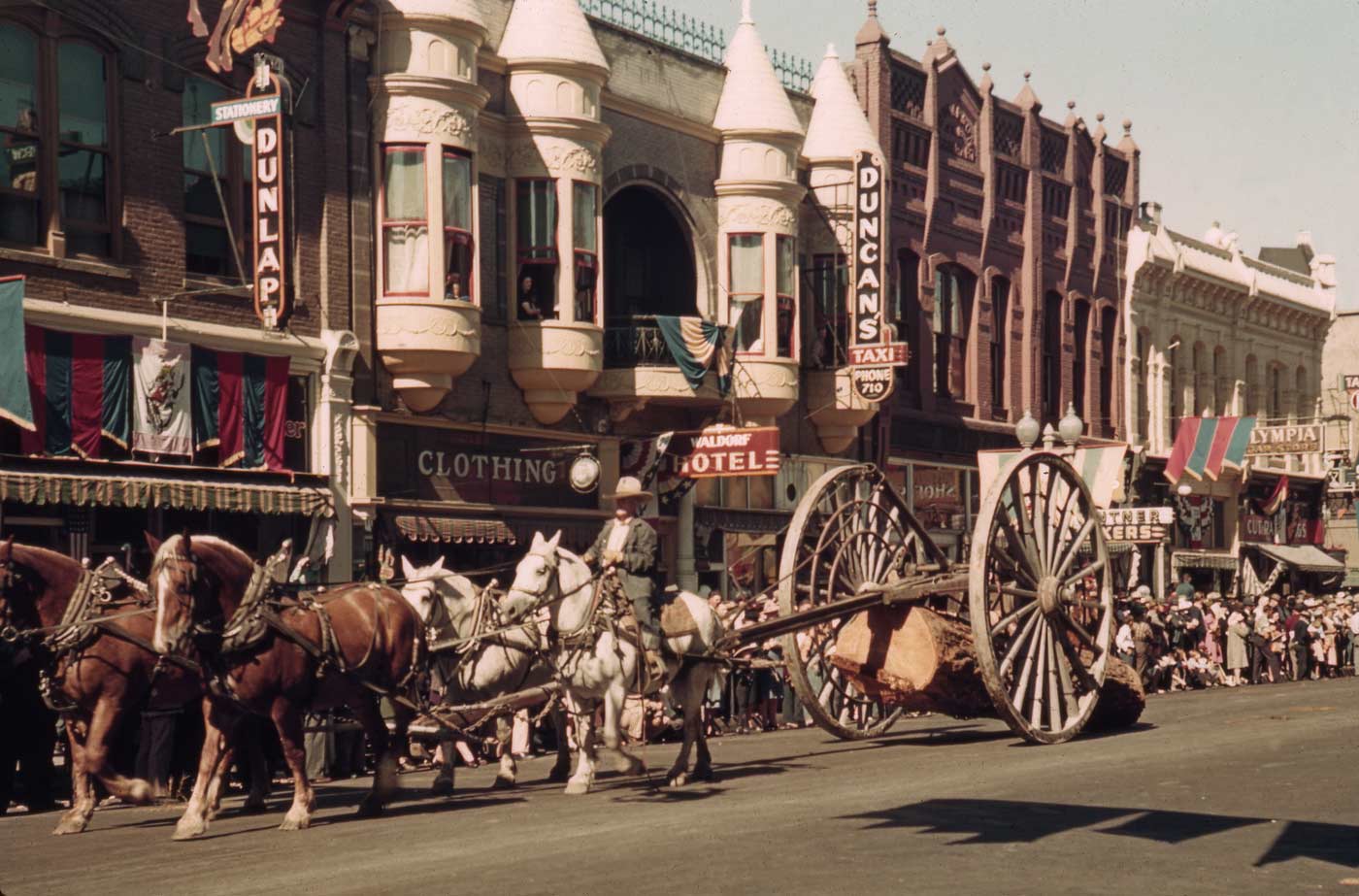

Sykes took these two Kodachromes from the same position on Main Street between Emigrant and Dorion Avenues. Unfortunately, the row of ornate Victorian structures showing in the top view has been lost with the exception of the two story white structure far right, the one with a sign reading, in part, Olympia.


A few weeks ago we featured the Green Lake Theater, photographed by Lennard LaVanway in 1947. Here is LaVanway’s Ridgemont Theater, and also from ’47.
I suspect that many readers will remember the Ridgemont as Seattle’s primary “art house” in the 1960s and ’70s. Jim Selvidge, the manager through most of those experimental years, “modestly” describes his theater “as the trigger that led to Seattle’s current reputation in Hollywood for the hippest audiences, the place to go if you want to test a film.”
Many of my best early film experiences in big, dark rooms were had from its seats or from Selvidge’s other repertoire venue, the Edgemont in Edmonds. I thank him. Since most of these were foreign films with subtitles, the Ridgemont was considered by some a “communist front” and the lights of its marquee were at risk — pelted often with rocks, eggs and even excrement.
Likely, though, the dangers were small when the Phinney Ridge theater was showing films like those showing here: “Easy to Wed,” a romantic comedy with Van Johnson, Esther Williams and Lucille Ball, and “Terror by Night,” a Sherlock Holmes thriller in which Basil Rathbone has to solve a Rhodesian diamond theft and find a murderer among the passengers of a train running from London to Edinburgh. Easy to do for Sherlock.
Rapping it now, thanks to local film historian David Jeffers for this tight summary of the Ridgemont’s long life. “It was a big-box neighborhood theater with 452 seats. Opened as Houghton’s 78th Theatre in 1919, Ridgemont in 1922, Bruen’s Ridgemont in 1928, remodeled twice, in 1938 and 1967.” After 70 often adventurous years, it closed in 1989.
Anything to add, Paul?
Yes and Welcome back from your European adventures, with your students from Hillside and then also with Berangere (of this blog). The Blog has missed you and your mastering. Now I’ll add a few more photographs, and with little comment.


Next up the block to 77th, the northeast corner with Greenwood Ave., and two more by LaVanway. It is a clapboard that has been now for many years familiar to us as the home of Moon Photo. (And yes they still do a color run for slide film.)


(CLICK to ENLARGE)
Both the flower and the frog have protection. Horace Sykes photographed flowers of all sorts, but he loved orchids and succulents. This, however, is the only frog portrait that I have found – so far – in the Sykes collection of 35mm Kodachrome slides recorded from the late 1930s into the early 1950s.


Please Click the Clip that Follows TWICE to REALLY ENLARGE it.

Click the above TWICE to Make is Much Larger!


