Seattle Waterfront History, Chapter 5

[Click – twice – to enlarge]

pike-wharf-ruins-c81-web1

Denny Hill (with two summits) from the King St. Coal Wharf, ca. 1881.  Virginia Street was platted and eventually graded in the depression between the hill’s two summits.  The still forested Queen Anne Hill marks the horizon.   Courtesy U.W. Library

Denny Hill & The Waterfront
Of all Seattle hills, it is the missing one, Denny Hill, that most shaped the waterfront because through much of the hill’s length – roughly from Wall to Union Streets – it fell directly to the waterfront.  The lowest of Seattle’s central hills, Denny Hill crested like a ripple cast south from the much higher Queen Anne Hill.  David and Louisa Denny’s claim – Seattle Center – was in the trough between them.  Below Denny Hill the waterfront is the deepest, and there also the width of the made (or reclaimed) land is narrower than that section of the waterfront that is south of Union Street.  (Some of Denny Hill wound up on the waterfront but not nearly as much as some wanted.  Most of the hill was dumped just off of the waterfront creating a reconstituted Denny Hill in Elliott Bay that for the safety of shipping required dredging.)  Although the two summits of Denny Hill were razed between 1906 and 1911, the hill’s skirt, its lowest parts, the bluff and/or bank, is still hinted behind our applications and in a few places even exposed. [31]

wa-9-for-blogweb1

Bank & Bluff

We will for the moment neglect the old harbor south and east of King Street, the part that once rinsed the salt marsh behind Gas Cove and splashed against the sometimes steep sides of Beacon Hill, and concentrate on the central waterfront north of King Street as far as Broad Street (where a slight prominence distinguished it in both the 1841 and 1854 maps.)  The native embankment along this line varied in both height – from a couple of feet to about one hundred – and pitch – from precipitous to something one could easily scramble.  As we will see below the little bluff at King Street seems even lower in the photographs than its depiction in Phelps drawing.  Just north of Washington Street, where at high tide the bay could intrude east to the salt marsh, the native ridge was so low that it might have been used as a bench for sitting.  Just north of Yesler’s wharf a knoll rose at the foot of Cherry Street, an obvious close-by prominence upon which to build the blockhouse.  This Cherry hump was later lowered with the 1876 regrade of Front Street (First Avenue) between Mill Street (Yesler May) and Pike.  North of the knoll the waterfront bank stayed low – something the athletic shellfish grubber could easily jump from – until near Madison.  North from there it climbed as part of what was really the southern slope of Denny Hill – or its cross-section as carved by the tides and storms on Elliott Bay.  This growing bluff was broken with a gulch at Seneca Street (the contents of which we will describe below).  Its elevation at University Street was such that steps were built there between Front Street and the waterfront even before the 1889 fire.  Following the fire the steps were quickly replaced but then soon usurped by a timber bridge that let wagons move directly from Railroad Avenue to Front Street without having to first travel south along the frequently congested waterfront to Madison Street.  Although Front Street was still higher above the waterfront at Union Street than at University, it was also further from the waterfront because it is between University and Union that the shoreline turns to the northwest.  A rather steep wagon road was in use here for a few years from the 1880s into the 20th Century.  Now, while standing at the waterfront foot of Union it is hard to imagine it. [32] [33]

North of Union Street

North of Union the bank became briefly a cliff.  (In the panoramic photograph ca. 1881 [31] this section is darkened by its greenbelt.  Although steep it can still support trees.  In a detail from 1887 the cliff north of Union is exposed. [34])  A short distance north at Pike, the hillside was again not so steep, and beginning with the Coal Railroad’s incline in 1871 there have been a number of different hill climbs built at Pike.  North of Pike near Virginia Street the bluff began to again define itself, and north from there it grew and reached a somewhat dangerous height approaching seventy feet at Lenora Street. [35] This was both railroad land and a squatter’s milieu – as we will again note in detail below.  Two or three steep stairways that resembled ladders climbed the bank in this section, making it possible for the agile to pass between the beachcomber’s community on the shore and the shantytown on the ledge above them.  It was a both challenging and engaging place to live – and cheap too.  North from between Lenora and Blanchard the elevation of the bank descended and again petered out before it reached Broad Street.  Just north of Broad there was a small cove (the site of the Olympic Sculpture Garden). It was bordered by a new but modest bluff that continued with a few small dips north to Queen Anne Hill.  There the terrain suddenly ascended to the forest that was dedicated in 1887 as Seattle’s second public park, Kinnear Park.

Seneca Street Ravine

As already hinted two ravines – one small and one big – cut through this central waterfront bank, and both played special parts in Indian life before and after the settlers arrived to both name and claim them.  These ravines are now lost – filled-in and covered.  The smaller one was at Seneca Street.  In This City of Ours, a book of historical Seattle trivia written in the 1930s for the Seattle School District, J. Willis Sayers, the author, advised students that while out on a walking tour of First Avenue they should “stop a moment at Seneca Street.  This crossing, in early days, was a bridge; under it was a ravine through which passed all the travel from this section of the beach to Second Avenue.”   It is curious that the aging Sayers, who was himself nearly a pioneer, did not note that just above the waterfront at Seneca there was also an Indian burial ground.

Indian Cemetery

Years earlier another pioneer, A. Denny-Lindsey, included Seneca in her observations regarding early Seattle waterfront life for the June 22, 1906 issue of the Post-Intelligencer.  “The Indian cemetery that was on a bluff at what is now the foot of Seneca Street was a spot of great interest to us children.  The graves all had more or less of the personal belongings of the deceased on them.  The graves were shallow and we saw many ‘good Indians’ who were mummified.  A number of graves had roofs built over them of cedar slabs with posts driven at the four corners.  These were hung with clothing, tin ware, beads etc.  Some of the bodies had been laid to rest wrapped in rush mats and canoes turned over them.  Others were in the hollow trunks of large cedar trees.  Infants were almost invariably entombed in this manner.  When the banks would cave away during a thaw after a hard freeze it would expose bones and many stone implements and quantities of blue Hudson Bay beads.  Some of these beads were the size of a robin’s egg.  They are very rare at the present day.”  The Denny daughter’s description of the mortified Seneca is something of a rhetorical jumble as she concludes her description of the burial ground with a digression into pungency.  “The Indian camps were not as sweet as clover beds, for the hundreds of drying salmon that were hung on poles over small fires and inside the mat houses, also the strings of clams, were very loud in odor.”

It should be noted that while A. Denny-Lindsey does not mention the ravine, she does put a rather elaborate burial grounds both at the “foot of Seneca” and “on the bluff”, not that there is a contradiction in her description, only some confusion.  It is easiest to think of her graveyard as “on the bluff” and so really above the waterfront foot of Seneca.  And yet the ravine would have considerably increased the footage available for anything including graves.  And she does also make note that “the banks would cave away” from the gravesite. But when this sizeable funerary ground is mixed with Sayer’s pioneer throughway, a bridge, and the spring that another source describes as sometimes irrigating the ravine (and surely through time forming it), it is difficult to know where to put it all.  Certainly a mix of exposed graves, overturned canoes, spring freshets and tramping pedestrians would be messy in the extreme.  When the “hollow trunks of large cedar trees” is figured in it seems likely that the daughter of David and Louisa Denny is making something of an inventory of gravesites scattered along the ridge.  There certainly were other graves on the ridge besides those beside the Seneca ravine.  For instance, during an early grading of First Avenue in 1876 a little ways north of Marion Street, according to David Buerge, an expert on the region’s native culture, “a half-mummified body in a stone cyst tomb beneath a five-foot high grave mound” was uncovered.  Native American bones were also uncovered during the Port of Seattle work on the Bell Street Harbor in the late 1990s although, as we will explain below, it is more likely that they were not buried there but rather carried there during an earlier development.

Front & Seneca

In 1876, when Seattle first got resolute about grading streets, it turned the natural ups and downs of Front Street (First Avenue north of Yesler) into one smooth and wide avenue between Yesler Way and Pike Street.  For this the Seneca Avenue Ravine was partially filled and capped with the timber cribbing that was a feature of most of the new street work on First.  (If there is a record of what became of the graveyard at Seneca during this work I have not stumbled upon it.)  Thirteen years later the city’s “Great Fire” of 1889 burned through both the timber retaining wall and planking at Seneca Street exposing the ravine, or what remained of it, for as just noted most but not all of it had been filled for the 1876 regrade. (This scene will be visited and illustrated below at least twice more.)  Because the Front Street Cable Railway used its namesake avenue it received speedy attention after the June 6 fire. The Times for June 10 reported, “A large force of men are at work on the Front St. cable, near the crossing of Seneca.  It was at this point that the fire crossed over from the electric light building and burned the beer saloon on the northeast corner of Front and Seneca.  The burned space in the road is about 50 feet.”  Also on the 10th the Seattle Daily Press noted, “Repairs on the Front St. cable road commenced yesterday.  The bridge destroyed by the fire at Seneca Street was rebuilt, and in a few days new rails will arrive to replace those destroyed.  It is thought in the course of a week the Front Street Cable cars will be running.”   In 1922, part of the bulkhead at Seneca Street was replaced.  Much later, during work on the foundation for the Harbor Steps development between Seneca and University Street, parts of both the original 1876 bulkhead and its repairs following the ’89 fire were once more exposed, to the considerable surprise and delight of the engineers involved.  The general pioneer sweetness of this part of the waterfront – north of Columbia Street – was so corrupted following the 1889 fire that it became a cause of the Council.  David Kellogg moved his tanning and hide depot onto the ruins and built a new waterfront warehouse between Seneca and University streets.  On June 6, 1891, or two years to the day following the fire, the Post-Intelligencer reported Kellogg’s depot had “caused many hot debates in the city council by its offensive odors.”  (Considering the graveyard at the ravine, followed by Kellogg and his rendering, any future archeological probing near the foot of Seneca may test the popular sense that the smell of a place is often the last thing to abandon it.  That is, be prepared for both the macabre and the noisome.)

wa-mont-10-blogweb

Belltown Ravine

The second ravine that once interrupted the bank on the central waterfront was much the larger.  Since it survived into the early 20th Century there are a number of photographs that hint of it, although none so far uncovered look directly into it from its mouth.   The Belltown Ravine (the name I used while studying it for evidences of the source for the human bones uncovered during the construction of the Port of Seattle’s Belltown Harbor in the late 1990s) was between Blanchard and Bell streets, somewhat closer to Bell.  Topographic maps show the ravine extending as far east as First Avenue, a considerable distance from the Bay. [36] A photograph from the mid-1880s looks down from First Avenue over the inland end of the ravine into some fill dirt, which has been dumped perhaps from the 1882-83 regrading of First Avenue north of Pike Street. [37]  An early description that appeared in the Post-Intelligencer for June 26, 1891 gives some indication of the depth of the ravine, or gulch as the reporter calls it, near Western Avenue, a block or more east of its opening.  Under the title “A Boy’s Great Fall”, the report continues, “Yesterday afternoon about 3 o’clock the little 8-year-old son of Andre Mikulicich, fishmonger at 115 Bell Street, fell from the encased sewer pipe which extends across the gulch between Bell and Blanchard and Front and West Streets.  The distance of the fall was nearly twenty-five feet.  The casing is only eight inches wide, and the temptation to small boys to try to cross over the gulch on it is almost irresistible.  It is about seventy-five feet long.  It was thought for a time that the little fellow was killed, but he eventually regained consciousness and gives promise of living to a ripe old age yet.”

belltown-rav-1st-c84-web

Belltown Ravine partially filled at Front Street (First Avenue) in the mid-1880s.  Courtesy MOHAI

Belltown Waterfront Community

Two partial views of the entrance to the Belltown Ravine were recorded from the offshore railroad trestle.  Both show the community of squatters shacks nestled between a jerry-rigged seawall and the opening.  (We will show the earlier view here and attach the later view, no. 212, in the “image stream” below.) [38]  The earliest view dates from the late 1890s and includes part of the bank that runs south from the ravine.  The beginning of the south side of the ravine – the corner where the bank turns east into the ravine – shows on the far left of the photograph by the Norwegian photographer Andres Wilse.  The second intimate view dates from about 1902 or 3 and looks over the same community of shacks, but in the opposite direction.  Other photographs from the water and also from West Seattle are obscured at the ravine’s lowest elevation where it meets the bay behind the railroad trestle.  The ingenious cluster of squatters’ shacks at the entrance was moved in 1903 with the beginning construction on the north portal to the railroad tunnel.  At first, this did not change life deeper within the ravine.  But soon during the various stages of the Denny Regrade the ravine was filled until it was closed off at its entrance with the 1912-14 extension of Elliott Avenue between Bell and Lenora Streets.  The human remains that were found during excavations for the Port of Seattle’s Bell Street project in 1998 were probably carried there in the fill that was used to extend Elliott Avenue across the opening of the ravine.
Native Bones

The bones were discovered near the south entrance to the ravine.  Although there is considerable correspondence between the city and F. McLellan, the contractor who placed the 1912 fill, there is no record of where he got it.  McLellan was required to find his own dirt and carry it to the site.  Obviously, the shorter the move the less the expense.  By 1912 the Denny Regrade had reach 5th Avenue and stopped.  With the cutting, a temporary bluff was left along the east side of Fifth Avenue.  The freshly graded land between First and Fifth Avenues was in many sections still in rough state.  It is possible that McLellan got his fill from the “rough edges” of the momentarily stalled Denny Hill regrade.  The use of fill dirt from the Denny School site at Fifth and Battery for the 1914 construction of the Port of Seattle’s off-shore headquarters at the foot of Bell Street indicated that it was still possible to take fill material from the regrade.  A 1912 correspondence, between city engineer Dimock and a neighborhood property owner named Oldfield, is also suggestive.  It regards the latter’s willingness to sell cheap to the city fill which was conveniently near at hand for the Elliott Ave. project – some six or seven hundred yards of it.  Oldfield writes, “If this should interest the contractor because of its nearness to where the arterial is required he can have the same at a very low figure.”  Dimock’s answer is evidence of how little the city knew or recorded from where the fill in their improvement might come.  “McLellan is required to supply all earth needed for fills on the same and it will be necessary for you to arrange with him. I will, however, transmit your letter to him for such action as he may think necessary.”

belltown-ravine-wilseweb

Beach community at foot of Belltown Ravine, by Andres Wilse, ca. 1898  Courtesy, MOHAI

BAHK-bah-kwhb-Muck-muck-wum

Soon after the bones were found and identified as most likely native remains it was speculated that they might be connected with Baq’baqwab (BAHK-bah-kwahb), the other Native American community on the central waterfront that was long in use before the mid-western farmers arrived.  (We will refer to this as the “North Camp” to distinguish it from the larger south camp on Piners point already described.) The Lushootseed place name Baq’baqwab is the plural form of ba’qwab, ‘meadow’ and was associated with the meadows between Queen Anne Hill and the now-vanished Denny Hill that stretched from the bay to the southern end of Lake Union.”  As local historian David Buerge notes, “The site was probably chosen because of its proximity to potable, fresh-water springs, draining from a nearby area know as boloc (bo-LOTS). That part of these meadows nearest Baq’baqwab was distinguished for its salal berries.  This suggests that the beach site camp named for the meadows was not necessarily identified with the meadows broadly conceived (including the present site of Seattle Center) but rather an entree to them with the advantages of being near both the bay and springs.  With this interpretation the beachside borders of Baq’baqwab were flexible, inflating and shrinking with whatever operations or ceremonies were current, like the acts of medicine men and bird-netters.  (The first settlers on Puget Sound – by a few millenniums – had apparently no tradition or use for arbitrary borders – legal and proprietary – that would at once rationalize and alienate the “given” topography and yet were of such great interest and fenced security to the latecomers from Illinois and New York.  In that sense Baq’baqwab had no borders.)

Two daughters of the pioneers recalled the site.  In Pigtail Days in Old Seattle, one of the little classics of pioneer reminiscences written by members of the Denny family, the author, Arthur and Mary Denny’s granddaughter Sophie Frye Bass, recalls, “Bell Street ran from Depot Street, now known as Denny Way, to salt chuck (water) where the beach was fine and sandy, and there were springs of good water.  It was one of the camping grounds of the Indians while they hunted and fished.  They called it Muck-muck-wum but we call it Bell Street Dock.”  By Abbie Denny-Lindsey’s recollections, “In Muck-muckum (Belltown) there was a permanent camp where the medicine man lived.”  Buerge advises that Bass and Lindsey-Denny’s names — Muck-muck-wum and Muck-muckum, respectively – were tongue-tortured variations on Baq-baqwab created by occidentals “struggling with the native language.”

The structures that the Denny descendents remembered were not the long houses that were most likely built above the beach somewhere near the lip of the low bank but later beach structures.  Native accounts put two medium-sized (50 to 100 feet) longhouses at this the northern of two native camps on the central waterfront.  David Buerge continues, “While visitors increased the population at the site periodically, the longhouse inhabitants were permanent residents who, at death, were interred in an extensive local cemetery.”  However, Buerge also admonishes, “we know little about the actual history or size of Baq’baqwab even during the early years of pioneer settlement.  The native census made in 1856 by Indian Agent George Paige identifies Cultus Curley’s band encamped about one mile north of Seattle numbering 30.”  Buerge figures that “thirty inhabitants would have fit comfortably in the two longhouses described.  However, these numbers probably swelled after the citizens of Seattle first incorporated themselves in 1865 and wrote laws that prevented the camping of Indians on any ‘street, highway, lane or alley or any vacant lot in the town of Seattle.’  With this exclusion by statute some of Duwamish Indians still living at Jijilalec, the southern camp, would have moved north to Baq’baqwab.  It is believe that among the exiles was Chief Seattle who apparently had houses erected there to stay with his retinue when he was not at Fort Kitsap.  However, since the Chief died in 1866 in the old man house at Suquamish it would not have been a long stay beside Bell Street.  At some point Angeline, his daughter, moved into a shack near the waterfront foot of Pike Street and remained there until her death in 1896.”

angeline-by-haynes-web

Princes Angeline by F. J. Haynes, 1890. [The 1891 date listed for this Haynes photo in the montage above is wrong and one year later.] Courtesy Tacoma Public Library

Princess Angeline’s Cabin

Some historical references to Angeline’s beach shack put it near Pine Street but most describe it as closer to Pike than Pine.  Most likely it was between them but closer to Pike or some little ways north of the lowest steps in the stairway that now reaches the market.  As noted earlier, this slope was a little ways south of the point where the bluff near Virginia Street began to form extending north as far as Vine Street (with the Belltown Ravine interruption.)  And as also treated above – and will be noted again below – this natural separation also began the division of the beachcombers below from the higher – in elevation and income – residents of Shantytown above.  But without a bluff Shantytown extended to the beach on Pike Street.  In 1890 the Northern Pacific photographer F. J. Haynes visited Angeline and her hut and its proximity to the beach (far left) is revealed in the photograph he recorded of the scene. [39] In 1891, her prosperous neighbor on First Avenue, the lumberman Amos Brown, built her a better hut that was likely very near the spot of the old one. [40]  (Determining the precise location for the Angeline home is as yet an unsolved puzzle.  And, again, was the second home built on the site of the first?  Before his sudden death in 2001Seattle historian Michael Cirelli was on the trail of Angeline’s home.  He was not able to show me a photograph he’d found of her second residence that he claimed included the stump that appears on the right of the Haynes view.  Up close a stump could be as convincing as a fingerprint, but this was a neighborhood of shacks and stumps.  A recent discovery may have located Angeline’s last home but cannot be shared with Cirelli.  Angeline’s “Brown home” may appear in a view recorded from the Schwabacher’s Dock at the foot of Union Street after her death.  The two finished sheds look alike and the place is within feet of the conventional descriptions just noted. [41]  This image was struck during the historic docking of the “gold ship” Portland in 1897.  Although Angeline died the previous year someone else, perhaps her grandson Joe Foster who had lived with her may have still resided there.  That may be Foster on the far right of the 1890 Haynes view.)

[When there is time to “groom” it for this site, Chapter Six, of this pictorial will begin with more speculations about the bones found at the foot of Bell Street, followed by contemporary descriptions of the cosmopolitan community of shacks that developed there following the 1893 economic crash, and the years also of booming growth of the city.  The next chapter will then move south to Yesler’s Wharf for a revealing study of both the Sammis (1865) and Robinson (1869) panoramas of pioneer Seattle and a broad sketch of the community’s first boom year, 1869.]

PROTESTS – Two in One, Summer of 1970

whaleseattle7protest-web

This is an addition to a feature that appears six stories below this one, the “Seattle Now and Then” about the 1911 visit of the steamer Suveric at Pier 56 (Or Pier 5 before the renumbering during WW2.  For more on this renaming  check out Part One of the Waterfront History posted on this blog-web.)  That posting also recalled the Seattle Marine Aquarium that opened on the pier for Century 21 in 1962 and carried on into the ’70s.   The walking photographer Frank Shaw is also responsbile for this slide taken on the sidewalk beside the pier in 1970.  There are two causes getting broadside attention here.  Behind the woman with the poodle someone is protesting the aquarium whale show at the other end of the pier.  The woman in blue inspecting the photographer is demanding the release of the Seattle Seven, most of whom were University of Washington students (and one professor) whose protests over the Vietnam War put them in court and ultimately in or on a prison farm for a few months for contempt of court.  The students that is.  The professor never served any time.  You can read Walt Crowley’s summary of this on historylink.  For even more, Google Seattle Seven, but don’t be mislead by that other “Seattle Seven” – some group of businesses that would never have been cast into or onto a prison farm.

Harborview Hospital with a Glimpse of Childhaven from the Sky

harborview-aerial-ca39-web

[Please CLICK to ENLARGE]

This aerial of the First Hill neighborhood around a nearly new Harborview Hospital is included here because it also shows the Seattle Day Nursery at the northeast corner of Broadway and Boren and Alder.   This Sunday’s “now-and-then” features Childhaven and is printed here directly below this short description of the aerial photograph. The nursery appears far into the upper-left corner.  I confess that so far I do not know the year the aerial was taken.  I am, however, confident that there is enough “information” in it to determine the year.  Hopefully a reader will figure it out before I do.  I will note a few of things only.

Harborview was dedicated in February 1931; one month after the King County Courthouse was razed with the help of 200 sticks of dynamite.  The courthouse held the brink of First Hill facing Seventh Avenue between Terrace and Alder Streets.  That is the cleared and seemingly groomed block just right of center.  Now covered with a helicopter pad, one of Harborview’s lidded parking lots hides in much of that block.  (Perhaps this aerial is from as early as the late spring of 1931.  The Hospital and the ground certainly seem new – hardly disturbed.  The sun is far to the north, judging from those shadows.)

Trinity Episcopal Church shows at the bottom left corner – at the northwest corner of James Street and Eighth Avenue.  On the far right is the fanciful architecture of Seattle City Light’s first substation, located near what would have been the northwest corner of Yesler Way and Seventh Avenue, had Seventh been graded through that steep portion of First Hill.  City Light’s competitor, Puget Power, appears bottom center with the big dark roof and “forest” of power poles.  The Seattle Freeway runs over it now.

The steepest part of the hill appears as a white scar between Trinity Church and Harborview.  This was a cliff.  The aerial’s upper-right corner includes a short stretch of Jackson Street around Ninth Avenue.  Between 1907 and 1909 this section and much else endured the Jackson Street Regrade, which both lowered and raised parts of the neighborhood now variously called Chinatown and the International District.

Of course, this aerial – looking to the southeast – includes many surviving structures that I have not pointed out.  But, again, neither have I conclusively dated it.  The first 700 units of Yesler Terrace were funded in 1939.  A repeat aerial – a “now” – would show their pattern covering much of the right side of this aerial, which is here still variously crowded with Carpenter Gothic classics and a few cheaply built homes that during the Great Depression turned to shacks.

Seattle Now & Then: Childhaven

(Please click to enlarge)

childhaven-then-lr
THEN: “Users” of Seattle Day Nursery’s recreation patio tip their cups together in 1942. (Historical photo courtesy Museum of History and Industry)
NOW: Still located at the First Hill corner of Boren and Alder, but in new quarters since 2004, staff members of the renamed Childhaven gathered their own children to pose for Jean Sherrard’s centennial year repeat.

In 1942 a Post-Intelligencer photographer visited what were the three centers for a charitable institution then still called Seattle Day Nursery.  The two branches opened in 1925 in West Seattle and in the Cascade Neighborhood, the latter on a lot later razed for the Seattle Freeway.  The main branch was housed in a pleasing brick home built for it in 1921 here at the six star corner of Boren, Broadway and Alder on Capitol Hill.

The children tipping their cups in the historical view are all “clients,” some – maybe most – of them from homes where father is off to war and mother working on the home front, perhaps at Boeing.  In ’42 Seattle Day Nursery was 33 years old and still run by volunteers until 1959 when a professional staff was hired.  All the children in Jean’s “repeat” belong to staff members of Childhaven, the name for the day nursery since 1985.

This is the institution’s Centennial year.  It began in 1909 in the basement of the First Presbyterian Church as a way of helping mostly single mothers who needed to do paying work during the day.  It developed into an activist advocate for the youngest among us who were born to abusive parents who themselves were often repeating a cycle of abuse put on them by their parents.

The philosophical, inventive, persuasive, and dogged Patrick L. Gogerty became the institution’s director in 1973, and used his own abused childhood as a source of both wisdom and compassion in guiding Childhaven into its new mission of “breaking the cycle of abuse and neglect.”  For Childhaven’s next one hundred years Goberty advices “Support it. Nurture it. Love it. Just like you do with kids.”

WEB EXTRAS

childhaven-bricknew-web
The Seattle Day Nursery nearing completion in 1921

Brand new in 1921, landscaping for the Seattle Day Nursery is far from finished.  And yet the nursery is in use.  Children appear to be looking back at the photographer across Broadway Avenue from behind the metal fence on the front porch.  Among the signs leaning against the classy brick home on the right is one for Harry Bittman who is described as both architect and engineer for the new building.   This charity began in 1909 and so is celebrating its centennial and still at this First Hill intersection of Boren and Broadway and Alder, but as Childhaven, the nursery’s “modern” name.  

cascade-neighb-playfield-we
Recess at the Nursery

Another of the Post-Intelligencer’s 1942 records of the nursery, although here of exercising children recessed from its branch in the Cascade neighborhood to show their simian skills for the photographer.  The view looks east from the Cascade playfield.  Cascade school is on the right facing Pontius Avenue and Harrison Street is on the left to the far side of the high steel fence.  The fence and a playfield are still in service, but the nursery and school are both gone from the Cascade neighborhood, which began it steady loss of “residential stock” and families following the Second World War, as it became increasingly a neighborhood of warehouses and light manufacturing.

The Gainsborough

Most often we choose to retrieve these older now-then features when they dove tale by theme or location with a story that appears now – on a contemporary Sunday – in Pacific Northwest Magazine.  In the past two weeks – or so – we have included three features that relate to the main intersection of First Hill, which is where Boren Avenue and Madison Avenue cross.  We have given touchstone descriptions of the Perry Hotel, the Carkeek Mansion, the Seattle Tennis Club and we also included with the last a second glimpse of the Stacy Mansion and the University Club.  We will visit those again, but later.  Nearby is a high-rise neighbor to these big First Hill homes, the elegant Gainsborough.

gainsborough-then-web22

Built for class the high-rise apartment at 1017 Minor Avenue on First Hill was named after the English King George III’s favorite painter, Thomas Gainsborough.  As a witness to the place’s status, Colin Radford, president of the Gainsborough Investment Co. that built it, was also the new apartments’ first live-in manager.  And the apartments were large, four to a floor, fifty in all including Radford’s (if I have counted correctly).  What the developer-manager could not see coming when his distinguished apartment house was being built and taking applications was the “Great Depression.”

The Gainsborough was completed in 1930 a few months after the economic crash of late 1929.   This timing was almost commonplace for the building boom of the late 1920s continued well into the early 1930s.   The quality of these apartments meant that the Gainsborough’s affluent residents were not going to wind up in any 1930s  “alternative housing” like the shacks of “Hooverville” although the “up and in” residents in the new apartment’s highest floors could probably see some of those improvised homes “down and out” on the tideflats south of King Street. (We intend to soon post some of our features on Hooverville, in celebration of these apparently, by comparison for most, more mildly deprived times.)

Through its first 78 years the Gainsborough has been home to members of Seattle families whom might well have lived earlier in one of the many mansions on First Hill. Two examples: Ethel Hoge moved from Sunnycrest, her home in the Highlands, to the Gainsborough after her husband, the banker James Doster Hoge, died in 1929.  Before their marriage in 1894 Ethel lived with her parents on the hill near Terry and Marion.  Eleven years ago (in 1998 if memory serves) the philanthropist-activist Patsy Collins summoned Walt Crowley and I to the Gainsborough.  After explaining to her our hopes for historylink.org she gave us the seed money to launch the site that year.  Earlier Patsy was instrumental in preserving the Stimson-Green mansion, also on Minor Avenue, a home that her grandparents, the C.D. Stimsons, built in 1900. (Most likely – according to our nurtured habit – we will soon post our feature from a few years past on the Stimson-Green mansion.)

gainsborough-now-web

Then Caption:  The Gainsborough at 1017 Minor Avenue was one of large   handful of distinguished apartment buildings built or planned in the late 1920s.  The picture was given courtesy of Michael Maslan.  Well preserved, the elegant Gainsborough continues to distinguish the First Hill neighborhood. (The now photo was taken by Jean of this blog-webpage.)

Perry Hotel Postcards from John Cooper

John Cooper, our friend and often source for historical imagery for one project or another, on reading the recent posting here on the Perry Hotel sent along a few hand-colored postcards, mostly of its sumptuous interior.  (click twice – not once – to enlarge.)

perry-hot-details-1_2_3web

The next three postcards from John are concluded with a general  exterior view that was most likely rendered before the building was completed and available to be photographed.   Note the caption at the top of the last postcard.  It reads, in part, “Only families and children admitted.”   Well beyond childhood, the then barely nascent airplane manufacturer, William Boeing, was one of the Perry’s early residents.  We learned this from historian Paul Spitzer, one of whose keen interests is Boeing History having been years past the company’s historian-archivist.

perry-postcards-4to6-web

Finally – for now – John Cooper also brought by a snapshot he took perhaps ten years ago of a sign promoting the Missionary Sisters of the Sacred Heart’s first plans for developing their razed Perry Hotel/Columbia Hospital plant.  I remember this well.  The promotional company hired to market these “Luxury Apartment Homes” enlisted me to help them do some neighborhood selling by scheduling me to give a lecture on First Hill history to prospective luxury buyers and thereby also to help me pay the mortgage on my non-luxury but comfortable Forsaken Art House in Wallingford.  It never happened, for the project fell through for want, it would seem, of luxury buyers.  The sisters second plans – now in place – involved a much greater component of non-luxury living.

perry-luxury-apts-web

John Cooper has sent along yet another view of the Perry Hotel, this time as the Columbus Hospital.  John is almost certainly the greatest collector hereabouts of the thousands of postcards produced by Ellis, an Arlington based photographer who criss-crossed the state many times over several decades recording landmarks of every sort.   This view – judging from the motorcars in it – dates from about 1950.  I was then 12 years old and knew every model and how they differed from the year before, but by the time I was sixteen I lost interest in car designs and bodies by Fisher or whomever and  I have long since forgotten these distinctions.  So perhaps some reader who has retained a senstivity for all this will come up with a date.  John Cooper has learned the Ellis is not reliable, using the same number more than once and in different years.

columbushosp-c49-ellis-web

First Hill Tennis & Cracked Crab

tennismatch-spectaters-web

[As ever, CLICK to ENLARGE – and then click again.]

Every summer the Olympic Tennis Club on First Hill would stage a grand tennis tournament between its men members. But on the contest’s opening day in July 1895, the net crowd was able for the first time to watch women in a skilled volley.

An article in the Seattle Post-Intelligencer predicted, “What is likely to prove the most successful, as it certainly is the largest, tennis tournament ever held in the Northwest began yesterday noon on the grounds of the Olympic Tennis Club at the corner of 12th Avenue (now Minor Avenue) and Madison Street . . . The crowd was of the right sort and the number of pretty girls in summer costume did much to stimulate the spirit with which the matches were played.” [Does any reader have any clear understanding of what is meant by this “stimulate the spirit with which the matches were played?”] This was the club’s fifth year of tournament play on its clay courts behind the Martin and Elizabeth Van Buren Stacy Mansion on Madison. But 1895 was the first time “pretty girls” took to the courts themselves in singles and doubles matches.

women-doubles-tennis-web

The historical photo of a women’s doubles play is one of two 1895 tournament scenes recently uncovered by the local collector Michael Maslan in a First Hill family album.  (Well not so recently.  This was first printed in the Times nearly a quarter-century ago on August 18, 1985.)  We include them both here: the women’s doubles above and the men’s singles below.  (That’s the Carkeek mansion on the left with the tower at the southeast corner of Madison and Boren.)

tennis-mens-singles-97-web

If this is the women’s doubles championship match, then the winners, Miss Anderson and Miss Known of Tacoma, will defeat Miss Riley and Miss Gazzam of Seattle and win a pair of silver scissors with a thimble in a case as well as a cut-glass silver-mounted ink stand.  (Are they now more likely to get something crass, like cash?)

The clubs courts were located behind the Stacy mansion and on what has more recently been developed for super-sizing and French frying.  This is the parking lot for First Hill food that is never cracked crab.  I have taken slides of this McDonalds lot three times, I think, but I have failed to mark the date on this one.  I believe that Jean has also visited this place and not to eat, and if I am correct in this he’ll soon date his recording and post it beside this undated shot.  Perhaps some reader with a special sensitivity to motorcar models will by studying the several examples in this lot be able to determine the year. Unfortunately, the photograph is not sharp enough to read the date on a license plate.  [Remember, click to enlarge.]

mcdonalds-parkg-99-web2

The following year, 1896, the Olympic Tennis Cub changed its name to the Seattle Tennis Club. In 1903 the crowded club built additional courts up Madison Street at Summit Avenue, and in 1919 it migrated far up Madison to its new and present home on the shores of Lake Washington.

university-club-web

The Stacy Mansion – seen here looking kitty-corner across Madison and Boren and to the northeast – is preserved at the northeast corner of Madison and Boren. It is one of the few remaining remnants of the old and often elegant wealth that was once First Hill society. For more than a century it has been the home of the University Club for men. The members all have some association to the University of Washington or its several boards or extra-academic enterprises.  Many years ago I was invited into this sanctum as the evening’s speaker for an annual membership banquet.  Every table was crowded for a crab feast and the members and their wives were all fitted with billowing bibs of such size that a stranger entering that dining room and not knowing what was being served might have wondered for a moment if they had stumbled by mistake into a maternity ward. This was not likely to happen for it would be hard for a stranger to get into that club. At the “speakers table” and directly across from me sat Charles E. Odegaard – someone certainly related to the University.  Odegaard crack crab with the rest of us. After the comforting and filling dinner the lights were lowered, I began my slide-illustrated talk on First Hill history and the former president of the University of Washington promptly went to sleep.  I have had this effect on other occasions; still I take strength in the confidence that most stay awake, and a few even ask questions.   (Of course my “now” view of the University Club was a “while” ago.  It is also unmarked, and for the moment I cannot date it.)

university-club-now-web

Seattle Now & Then: Pier 56 Visitor, 1911

(Please click to enlarge)

THEN: The S. S. Suveric makes a rare visit to Seattle in 1911.  (Historical photo courtesy of Jim Westall)
THEN: The S. S. Suveric makes a rare visit to Seattle in 1911. (Historical photo courtesy of Jim Westall)
NOW: When most maritime work moved south of King Street to the reclaimed tidelands Seattle’s Central Waterfront turned to play and tourism.  At the foot of Seneca Street this features at one time or another Bob Campbell’s Harbor Tours, the Seattle Marine Aquarium briefly with NAMU, Trident Imports and now the flotilla of Good Time Waterfront Tour boats.
NOW: When most maritime work moved south of King Street to the reclaimed tidelands Seattle’s Central Waterfront turned to play and tourism. At the foot of Seneca Street this featured at one time or another Bob Campbell’s Harbor Tours, the Seattle Marine Aquarium briefly with NAMU, Trident Imports and now the flotilla of Good Time Waterfront Tour boats.

Judging from the posters tacked to the railing, the S. S. Suveric visited the Seattle waterfront sometime in the late spring of 1911. The broadsides for several popular Seattle venues: the Pantages Theatre, Dreamland, the Majestic Theatre, the Grand Opera House, the Orpheum, Luna Park (at Duwamish Head), and the Lois Theatre all promote programs that date sometime between June 10 and July 1 of that year.

Its unique “fingerprint” also easily identifies the place.  The windows atop the pier peeking around the bow of the Suveric are five panes wide and three high.  It is Pier 56, also long known as the Arlington Dock.  From the time of the Alaska gold rush in the 1890s to the First World War, Frank Waterhouse, an English stenographer turned shipping magnate, ran steamships in every direction from this slip for himself and also for the United Sates Shipping Board.

The seemingly aimless “waterfront watchers” standing near the rail – especially on the far right – may wish to “go down to the sea again.”  They are held above the tides on a wooden trestle.  The concrete and steel seawall was not constructed here for another 24 years.

Probably the S.S. Suveric’s most famous journey came soon after it was launched at Glasgow in 1906.  For 52 days the 460-foot steamship carried 1328 Portuguese immigrants – 459 men, 283 women and 582 children – from Madeira to Honolulu.  Thirteen children died at sea and eight more were born.  F.P. Sargent, the U.S. Immigration Inspector at Honolulu, noted, “They are a good, strong, clean and fine looking lot of people. I have seen many, many shiploads of immigrants, but must say these are the brightest and best appearing lot I have every helped inspect.”  And many of the immigrants carried violins.

Pier 56 Aquarium in the 1960s – Very Big Sharks and NAMU

(click to enlarge photos)
aquarium-6-62mr-web

June 1962

The five photographs included here were taken from several sides of Pier 56 (excepting the north side) and on the sidewalk there, between 1962 when Ted Griffin opened his aquarium at the end of the pier and 1970 when he was getting regularly advised at the sidewalk to free his mammals.   The copy that follows is part of a considerably longer piece I have written on the history of Seattle aquariums.  It is still rough and so not yet published.  Actually it never will be “normally” published.  Instead it will be part of the longer Ivar biography I’m writing – the one that will be both read and heard on DVD to avoid the cost of pulp and waste of paper while sharing the longer story of Seattle greatest self-promoter with those who enjoy having someone read to them on and on about tricksters.

Ted Griffin must be counted among the handful of exalted characters to have worked Seattle’s waterfront.  His stage was at the end of Pier 56, and he was candid about its shortcomings. That is, Griffin’s visionary interest in his aquarium came with modesty.  ‘Someday Seattle is going to have its own Marineland.  This we hope is just a prelude.” At the start “this” was 6,000 square feet of covered space, an impressive cadre of skin-diver friends and other volunteers.  But most saliently “this” was, in the figure of Griffin, then still in his twenties, a kind of energized ego whose want of subtlety was made up for with physical courage combined with a heroic sentimentality that the ironic Ivar, who closed his aquarium nearby on Pier 54 in 1956, could only wonder at – and did.

Griffin’s Seattle Marine Aquarium opened on June 22, 1962 or in the ninth week of Century 21 and adjacent to the fair’s waterfront helicopter pad at the end of Pier 56.  The chopper noise had to have irritated the dolphins.  At 20,000 gallons Griffin’s main tank alone was much larger than all of Ivar’s combined, but most of his specimens and claims for them were the same.  Griffin noted, “Puget Sound has more beautiful marine life than anywhere else in the world – even Key West, Florida.”  But, as most locals old enough to remember the city’s Namu enthusiasm will know, what Griffin really wanted was a whale – a killer whale. In 1962 Ted Griffin was not yet publicly association with whales, although privately he pursued them both in his dreams and in speedboats.  At the opening of his aquarium the Times columnist and nostalgic humorist John Reddin noted, “Thus far the only whale is the figure on their outdoor sign.”  But Griffin and his curator Eric Friese would harvest other excitements like Homer, an octopus captured on Puget Sound, which at 88 pounds was a record-breaker for captured octopi.

pier-56-7-19-62web

July 19, 1962 (Courtesy, Seattle Public Library)

Early in 1964 when things were getting desperate his publicist learned that that there were big sharks prowling the bottom of Puget Sound.  He asked if they had teeth, and when assured that they did the press agent convinced Griffin that he should go after them.  This was a deep pursuit or not a superficial one.  The six-gill sharks were hooked with a very sturdy line that was longer than Queen Anne Hill is high.  The line was tied to a buoy and dressed with ham, raw beef, and lingcod.  For the aquarium the sharks were cash cows.  The lines were long.  (The revelation of what lurks in the basement of Elliott Bay was made, unfortunately, ten years too soon to further benefit from the release of Steven Spielberg’s film Jaws, otherwise – to use an example — even those seasoned and burly members of the West Seattle Polar Bear Club might have reconsidered their annual New Years Day plunge at Alki Beach and visited the aquarium instead.  Such fears, however, would have been highly irrational for to be in any danger of these sharks – and they still patrol the Sound – the Polar Bears, or any swimmers for that matter, would have to dive to at least 500 feet — the level at which Griffin caught his.  The beach at Alki is thankfully shallow.

Keeping the sharks alive was measurably more difficult than catching them, that is, it was impossible.  In captivity – and in daylight – the Elliot Bay leviathans lost their appetite and most importantly their motivation.  Entering the pool and the unknown armed only with his wet suit Griffith would prod and push at them to move.  He also force-fed them with mackerel.  In spite of it the sharks all soon expired and hopes of maintaining the impressive draw their exhibition engendered were lost.  Still during this brief but sensational excitement the aquarium prospered and was able to stay open after the sharks’ last roundup.

trader-cove-p56-7764-web2

July 7, 1964  Courtesy, Seattle Public Library

But at noted it is killer whales not six-gill mud sharks with which Ted Griffin will be linked as long as men like to chase and capture things.  Rodeo style, Griffin first tried to lasso a whale by jumping on its back and throwing a net around it.  In the summer of 1965 Griffin’s whale mania was no longer a private matter.  A fisherman in whose nets a young male killer whale became entangled somehow learned of the aquarist’s quest.  Griffin rushed north to Namu, British Columbia to negotiate.  All the bidders except Griffin retreated when they reflected on what it might take to move the whale.  When, as Griffin retells it, “I was the only one left.  They cut me a deal.  They quoted me $50,000.  I agreed to pay them $8,000, which was approximately the price of the nets.”  He flew back to Seattle and collected the eight thousand from friends and businesses on the waterfront.  When he returned to Namu he carried a gunnysack filled with small donated bills amounting to the eight Gs.  Griffin named the whale for the place, and the fame of Namu began the moment it set off on its 19-day and 450-mile odyssey to Seattle accompanied by a strange flotilla of advertising subsidized Argonauts, featuring celebrities and representatives of the competing media like Robert Hardwick of KVI-AM radio and Emmett Watson then of the Post-Intelligencer.  The floating pen that Griffin and his new partner Don Goldsberry fashioned from oil drums and steel lines became a kind of bandwagon as Griffin’s list of volunteers – including, in absentia, Ivar — swelled.  Griffin asked Ivar to pay for bringing the whale back.  Ivar countered with an offer to feed the often soaked swashbucklers and their hounds as well as send Claude Sedenquist, his head chef, along to do the cooking.  The reluctant chef’s recollections of the trip are worth introducing.

namu-and-ferry-web

Namu in his tank was the water end of Pier 56.

“Ivar told me ‘Pack up a bag, you’ve got to go pick up a whale.  You’re going north with Watson to bring back Namu.’ I objected.  ‘Ivar we have got the Captain’s Table to open.’  Ivar answered, ‘No you have got to go.  After all when you return you can learn from someone else’s mistakes at the Table.’  So I obeyed and Ivar paid for all the food and fuel.”  But not the nets.

We will probably continue this story here later on.  As noted it is part of a work-long-in-progress on an Ivar biography called “Keep Clam.”  Other roughs from that work have been give rough premiers here and can be found in our earliest archives -whenever we manage to rescue them from what we are told is a temporary digital disappearance.

whaleprotest-62270-web

Whale sidewalk protest in front of Pier 56 on June 33, 1970.  Photo by Frank Shaw.

Putting PORTOLA in its Place – A Case of Mistaken West Seattle

[First we interrupt this history to share some current events, compliments of one of our correspondents, film historian David Jeffers.  Please note.]
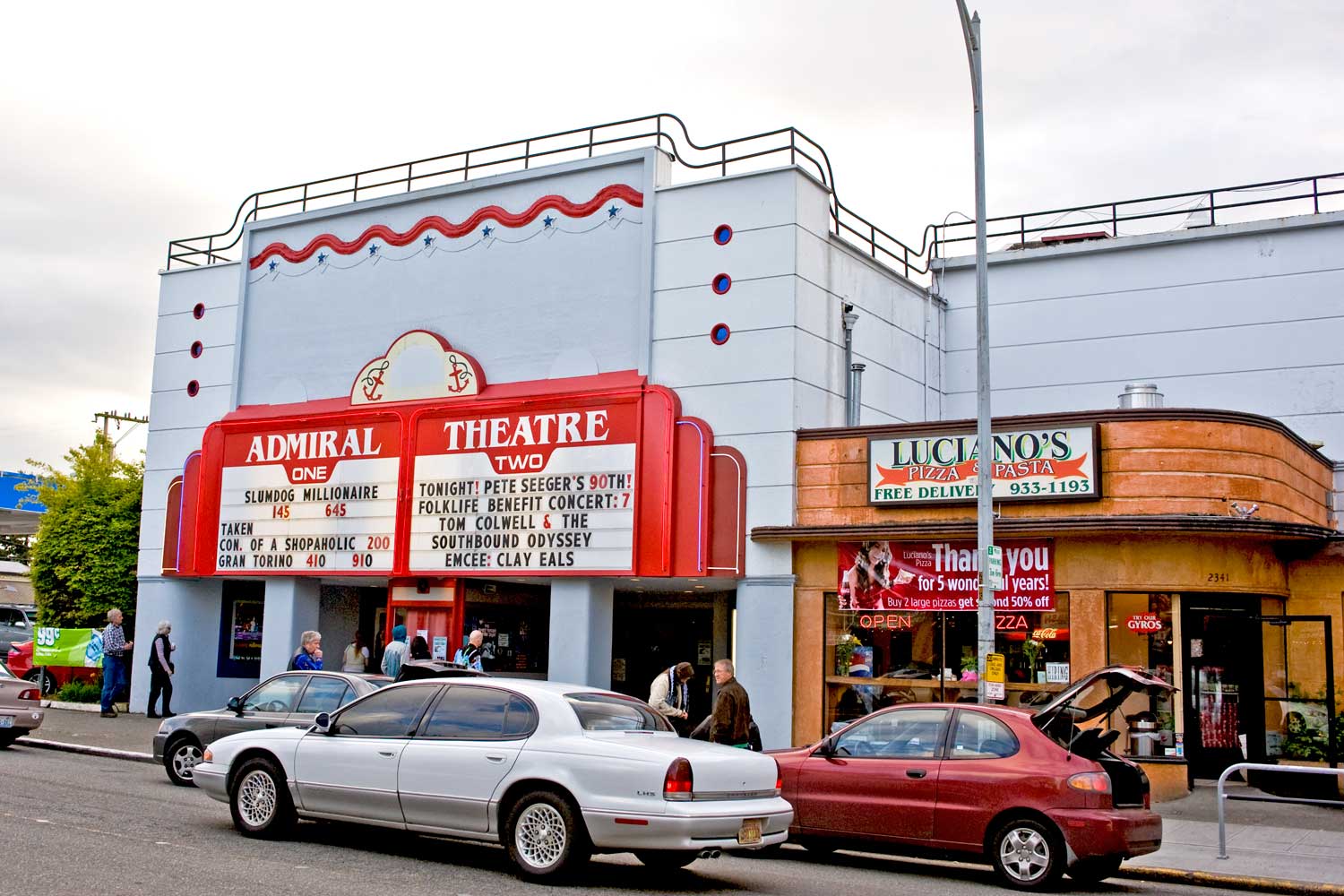
“The 35th Annual Seattle International Film Festival will host a week of films at West Seattle’s historic Admiral Theater, June 5-11 as part of their 2009 program.   Details regarding tickets and showtimes for the 25 scheduled films are available at http://www.siff.net.  My previews for some of the Admiral shows, as well as other SIFF films, are available at http://www.SIFFblog.com.”
portala-queen-annegrab-web

When our good friend Clay Eals decided that with a little help from some other friends – well folk – Seattle’s part in Pete Seeger’s nation-wide 90th birthday party could be celebrated at West Seattle’s Admiral Theatre he had reasons to feel confident.  First his acclaimed big biography Facing the Music (now into its second printing) of folksinger Steve Goodman was issued in 2007 and ever since Clay has been traveling the county sharing the stories he gathered and polished accompanied by musicians in the cities he has visited who also loved celebrating and singing Goodman’s songs.  That then is reason one – Clay has been doing concerts steadily.  Second – and here we will with some shame use for the first time a by now tired but still woefully current expression and also pledge to then abandon it – Clay is truly a West Seattle icon.  More to the point of the Portola and Admiral Theatres, it was as president of the Seattle Historical Society in 1989 that Clay led the successful citizen action to save the Admiral.  And before that as editor of the West Seattle Herald, Clay edited and published in 1986-87 West Side Story, the oversized history of his extended neighborhood.   Again, he did it with the help of many folks and friends, because he knows them and has many.  Clay is one of the easiest persons to work with and/or just be around.  But it was during these fateful years – 86-87 – that something bad happened in the editor’s office.  Clay made a mistake.

How did we uncover this all-to-human quality in Mr. Eals?  Years ago in celebration of Clay’s efforts in saving the Admiral, I wrote a “now-and-then” about it for Pacific Northwest Magazine. With Clay’s Pete Seeger party we revived it on this blog, and also put in additional pictures that never made it into the paper.  (Pulp is costly.)   We posted all that here on May 5th last.  Soon after the Seeger concert and that blog-work I remembered a photo the West Seattle Historical Society had shared with me earlier.  It was of a theatre that, it claimed, was the predecessor of the Admiral, and even more.  It was still there – in the Admiral.  The old Portola had been transformed into the Admiral’s lobby.  Since once can add anything relevant to one’s blog whenever, I thought to join the Portola picture to our story.  But to make certain that it was what is claimed, I also thought it wise to ask some questions, especially of local theatre historian David Jeffers who is often helpful with these puzzles.  Next, David joined Jean, and Clay and me in an e-mail conversation.

Now we may with compassion describe Clay’s not-so-fateful error.  The Portola-Admiral story (and mistake) is told on pages 213-214 in West Side Story.  We have attached the relevant parts here.

westsidestory-p213-web

westsidestory-p214web

The older of the two pictures identified as the Portola appears first above, on page 213.

Clay begins, “Thanks for the prod to follow through with what I know about the Portola. I’m sorry I’ve been mostly absent the past week. I’ve been (ungrammatically) laying low the past week in recovery from the Seeger event. It may not have seemed like much to undertake, but it was a month of full-bore organization and promotion, and with a full-time-and-then-some day job to maintain, I left a lot of other life on the cutting-room floor. I’ve been picking up the pieces, but rather slowly.”  Next, Clay goes to the question at hand.  “Our source for the photo was Lucille’s Photographic Salon, which was located in the mid-1980s a couple blocks north of the Junction . . . [I – that is this editor, Paul – remember the electric Lucille well. I met her at a West Seattle Historical Society function long ago.]   . . . Lucille (and husband Lincoln) Mason had saved quite a few iconic [Clay uses it too!] West Seattle images from the past, having come across them in the course of their work, and they were a credible source, which is why we trusted the identification of this photo, but can we be absolutely sure? As with many photos, I recall that this one merely had a handwritten label on the back. One way to document it is to get the original and enlarge the reader boards straddling the ticket booth and the poster beneath to see if the word ‘Portola’ appears there.  Short of that, one could identify the movie(s) being shown, find the year of release (on imdb.com,) then go to corresponding microfilm of the Times and P-I to nail down a movie ad or listing for the Portola.”  Clay also notes, “If you have ‘West Side Story’ handy, [we nearly always do] you will see that the Portola photo you are considering posting is the one on page 213 [see above], which is pretty undistinguished, but if you flip forward one page, you will see on 214 a photo of the Portola from the 1930s that is instantly recognizable as the front of the Admiral — at least the left front, into which you now enter the lobby but then entered the theater itself. The clue is the two “portholes” in what would be the second-floor level and what today is the second floor. There is a little room off the second floor where the Admiral stores old dusty stuff, and those same two portholes shine light into that room.”

However, Clay goes on to suffer doubt.  “The building in the older photo (page 213) doesn’t look a whole lot like the building in the newer 1930 photo (page 214), which suggests that it was rebuilt significantly at some point between the two years the photos were taken but retained its name of Portola. Just put the two photos side by side, and you can see they are hardly the same building. When precisely did the rebuild occur? I do not have a clue.”

jeffersdorpat-spl-10237web

David Jeffers visits with the editor following a Seattle Public Library lecture in 2007.

Come now David Jeffers describing how he demystified the impaired caption on the backside of what we will call the “Lucille print.”  He did it by establishing that Portola #2 and the questioned Lucille’s Portola #1 were two buildings and far apart.  The editor will make only the tinyest of changes to David’s often philosophical description.  It is a revealing testament to an inquiring mind.

“Much of our history is forgotten, not lost, and only awaits re-discovery.  Seattle reads more books and sees more movies than average America, and this is not a recent development.  Just as every neighborhood has a branch of the Public Library, in the years before television they all had a movie house, typically within easy walking distance.  One of these forgotten theaters stood on the Northwest corner of Queen Anne Avenue North and West Boston Street.  The Queen Anne Theatre opened for business in 1912 and closed, as did many, with the advent of sound.  City directories and insurance maps confirm this information.  Tax records list a build date of 1911 for the structure located at 2201 Queen Anne Avenue North; they also include a WPA (Works Progress Administration) era photo (post-theater) from the nineteen-thirties and indicate the brick and mortar structure survives today, an example of adaptive reuse.  [The editor suggests a visit to Google Earth to fine what holds that Queen Anne corner now.] As with many of Seattle’s neighborhood theaters from the silent era, this is all the documentation my research has found.  I have surveyed the site, but had never seen a photograph of The Queen Anne Theatre as such, until recently.

2201-qa-tax-car-web

Tax cards like this one can be had for most structures in King County built before 1937.   With tax number or legal description in hand, contact Greg Lange (another sometime contributor to this page) at the Washington State Archive in Bellevue at 425-564-3942 to order photographic prints of structures of interest and/or their tax cards – like this one.  The prices are not gouging, and once you have your print in hand or on platen it is permitted to Photoshop away the white writing.

portala-queen-annegrab-web1

Another insertion of the shamed Portola above and the tax photo for 2201 Queen Anne Avenue, top.

As a devoted reader of Now and Then, I look forward to my weekly dose of urban archeology on the back page of Pacific Northwest Magazine. More recently, I’ve also become a follower of this web site, in part an interesting and informative elaboration of Paul’s column.  Whenever the subject strays anywhere near silent era movies, my particular area of interest, like a dog chasing a fire truck, I’m compelled to throw in my two cents. Paul, West Seattle’s Log House Museum, Clay and (bless his heart) Pete Seeger, all deserve credit for this new discovery.

The oldest photograph of West Seattle’s Portola Theater I know comes from UW Digital Collections and is dated 1930. [Again, see page 214 above.] I provided a link to that online image, posted with my comment to Paul’s Admiral Theater piece from May 5, “A Bonus Seattle Now & Then: We Shall Overcome…”  Later that week, Paul sent me the image of a theater with no marquee, purported to be The Admiral’s predecessor, The Portola (ca.1919).  I had previously seen a tiny example of this photo on The Puget Sound Theater Organ Society web site and have since learned it was published in West Side Story, a history of West Seattle, in 1987.  Significant differences in the 1919 and 1930 images immediately drew my attention.

The older photo offers a host of clues, including movie posters and an adjacent business.  Anne of Green Gables (1919) starring Mary Miles Minter is clearly identified in the largest poster. The American Film Institute online Silent Film Catalog lists the release date for Anne of Green Gables as November 23, 1919.

The business name ” C. P. Martinez” appears to the right of the theater entrance.  Polk’s City of Seattle Directory shows listings for C. P. Martinez, ” Real Estate, Rentals, Insurance and Mortgage Loans, Notary Public 2203 Queen Anne Av” from 1915 through 1944. This was Martinez’ only directory listing found in those editions and his street address is clearly visible in the original 1919 photo.  [Seen in detail near the bottom of this post.]  The Queen Anne, or Queen Anne and Boston Theatre at 2201 Queen Anne Avenue North were listed in Polk’s from 1912 to 1927.  The first listing for West Seattle’s Portola Theatre located at 2343 California Avenue was in 1920.

admiral-5129-rear-web

A recent survey of The Admiral Theater revealed a rear wall [above], which appears to be reinforced concrete with pour lines showing an older form construction using wooden planks.  Tax records show a build date for The Admiral of 1942, which seems to indicate The Portola was demolished entirely.  No written record should be taken as gospel however, and certainly there are folks living in the neighborhood that witnessed the construction/remodel in 1941.  Local theater owner John Danz purchased the theater, added the present-day auditorium and reopened in 1942.  Based on my research I believe the shell of The Portola survives today as the lobby and entrance of The Admiral.  A comparison of these images, the 1930 Portola, The Admiral today, the 1919 photo and the 1937 tax photo of 2201 Queen Avenue North reveal similarities in placement, construction and dimensions, confirming their identity.

admiral-theat-7742-web

Admiral Theatre from 1942 Tax Photo.

admiral-by-jeffers-web

photo by David Jeffers

Finally, how was this 1919 photo misidentified?  A series of well-intended assumptions, ownership of the 1919 photo, a lack of architectural familiarity and supporting research are easy answers. Portholes were a commonly used element in theater architecture of the day.  Numerous Seattle theaters included them as second story mezzanine, office or projection room windows in their design. They are clearly seen in the photo. While their etymology is unrelated, porthole and Portola (a proper noun) sound quite similar. A list of suburban theater advertisements including Anne of Green Gables at The Portola was published on March 11, 1920 in the Seattle Daily Times. This indicates the film was shown on that date in that theater.  The Queen Anne likely screened the same print before or after and did not advertise. Neighborhood theaters drew most of their business from moviegoers who passed by daily or saw “coming attraction” announcements at earlier shows.  Someone undoubtedly found the same advertisement, which led to a persuasive misidentification of the photo.

“I See Dead Theaters.”  A part of our cultural history, neighborhood theaters have come and gone.  Many survive in anonymity today, waiting to be rediscovered.  A favorite example is 615-617 South Jackson Street.  Volume 1 of the 1916 Sanborn Digital Atlas, available through ProQuest on the Seattle Public Library web site, identifies the northwest corner of the Bush Hotel, built in 1915 as ” Moving Pictures “.  Located in the International District, this theater may have existed only briefly and may not have advertised in English language newspapers.

Another is The Mission Theater, located at 1412-1414 4th Avenue, from 1914 to 1920.  Who would suspect a stand-alone theater with a facade designed to resemble an Old Spanish mission ever existed on the east side of 4th Avenue between Pike and Union?  The Mission advertised heavily and a single head-on photo was published when the theater opened, but I’ve never come across any image showing this theater in context with the neighborhood.

Still another is West Seattle’s Alki Theater, whose address is given only as ” Alki Av btw 59th and 61st Ave SW” from 1914 to 1917 in Polk’s City Directories for those years.  The Alki does not appear on any map or advertisement I have seen.  There are many other Seattle movie theaters I am able to identify by only a single unsubstantiated reference.  The search continues… “

2203-queena-detail-web

Finally, but hardly sounding contrite, Clay Eals also gets a look at the blow-up of the questioned Lucille photo and seems to be happy that he is on top of Queen Anne Hill. “Paul, David, Jean: What a difference a good, high-resolution scan makes. Yes, this photo can’t be from the Portola/Admiral site, for no other reason than the address number, 2203, doesn’t match today’s 2343 for the Admiral. Other cool stuff: 1. The reflection in the ticket-booth window of letters on a business across the street. Can’t fully make them out, but they appear to be LEIBLY NALL and then, below, in curved letters (and a clearer clue), STANDARD GROCERY. 2. Another feature that night, besides “Anne of Green Gables,” is “The Hall Room Boys” (with subtitles: “Nothing but Nerve,” “Ham’s Gills” and “Flanagan and Edwards.” Interesting that imdb.com says “The Hall Room Boys” was made in 1910, while “Northing but Nerve” was made in 1918. Nothing in imdb about “Ham’s Gills” or “Flanagan and Edwards.” 3. There’s a behatted guy standing inside C.P.’s office, eerily looking at the photo. Could it be C.P.? Lots of fun!”

Yes, Clay is swell to be around.

larry-paul-bob-clay-web

Clay Eals on the right with an open copy of the West Side Story.  He shares the stage with three commonplaces of Seattle heritage.

[We repeat]
The 35th Annual Seattle International Film Festival will host a week of films at West Seattle’s historic Admiral Theater, June 5-11 as part of their 2009 program.   Details regarding tickets and showtimes for the 25 scheduled films are available at http://www.siff.net.  My previews for some of the Admiral shows, as well as other SIFF films, are available at http://www.SIFFblog.com. ?<05:30:09.doc>

The "Carkeek Cultural Center"

[This combines two from Pacific Northwest Magazine: features for July 10, 1988 and May 7, 1995 mixed with parts of a work-in-progress on the general subject of  the  uses of Seattle heritage.]

Remember, in all cases CLICK TWICE to Enlarge.

1-carkeek-mansion-web
1aa-carkeek-color-now-web

At least five years ago when I photographed the colored snapshot directly above, Bartell Drugs was the most recent tenant to hold the southeast corner of Madison Street and Boren Avenue where the Carkeeks built one of the first big homes (top) on First Hill in 1884. (Courtesy, Dennis Andersen)

The Carkeek mansion at the southeast corner of Boren Avenue and Madison Street survived 50 years, half a century less than its last resident, Guendolen Carkeek Plestcheeff.  Her father, Englishman Morgan Carkeek, became one of the community’s principal contractors soon after his arrival in 1870 at age 23. His credits included Seattle’s first brick structure, the Dexter Horton Bank (later SeaFirst) and the downtown Carnegie Library.  Morgan returned to England in the late 1870s to court and marry Emily Gaskill, a confident Londoner, whom he brought back to Seattle. She landed on First Hill as an immigrant but developed rapidly into an “old settler,” although a rather plush one.  And she soon became the leader of First Hill culture.  Their first child, Vivian Morgan, was born in 1879.  In 1884, the couple built the family home, using a pattern design by New York architects Palliser and Palliser. One of the original big homes on First Hill, it included fireplaces in all the principal rooms, 14-foot ceilings, abundant stained glass, and mahogany and redwood woodwork throughout.

1c-ca-1911-founder-costum

Most like taken during the 1911 costume party at the Carkeek home.  Looking younger than in any of the other photographs feature here, Emily Carkeek sits on her plush rug, second from the right.  Courtesy, Seattle Public Library

Emily Carkeek took to the study of Seattle-area history, and she organized her women friends, mostly, to take it on as a steadfast responsibility and a club concern.  On Nov. 13, 191l, the 60th anniversary of the landing of the Denny Party at Alki Point, Emily and Morgan, by then a pioneer contractor of great account, stood side-by-side at the wide front door of their First Hill mansion.  They were only a few feet from the public sidewalk at the southeast corner of the major First Hill intersection of Boren Avenue and Madison Street.  When they built their big home a quarter-century earlier much of First Hill was their yard.  By 1911 this natural sweep had given way to a crowded cityscape. The Carkeeks welcomed guests to a costume ball where the prescribed attire was pioneer – something their forebears wore, often from the attic and redolent of mothballs.  For refreshment the guests were appropriately served clam chowder made with Puget Sound butter clams.  This clam-sustained masquerade became a nearly annual event that was sufficiently governed by pedigree, economics, and creed that it was by invitation only.   For large group portraits the Carkeek’s guests were sometimes squeezed onto the porch and front steps.

Many of those called to the earlier balls walked there, for they still lived on First Hill, which in 1911 remained exclusive in pockets.  Others traveled from the grander parts of other hills: Queen Anne, Capitol, and the ridge above Lake Washington.  Some had earlier fled the raucous encroachments of the spreading boomtown “lowlands” for the gracious privacy of the gated and guarded Highlands.   For these it was not a short haul to First Hill, even in a chauffeur-driven motorcar, and the streets were often bumpy.  But visiting First Hill was like coming home, for many of the Highlanders had lived there earlier before the apartment buildings, large and small, begin to fill the lots between big homes.  On the Carkeek’s guest list we might not expect to find anyone from Alki Point, Ballard, Denny Hill (what remained of it), Beacon Hill, Columbia City or Georgetown.  And nearly all those invited were of Northern European pedigree.  Most would have preferred churches without Stations of the Cross or scrolls.  Most likely they were worth enough to at least consider building a brick block in the business district with their family name attached.  Their wealth would have been preferably old, although new money was also appreciated.

1d-angeline-costume-web

The only natives attending would have been whoever came costumed as one.  Chief Seattle’s daughter, Princess Angeline, was a popular masquerading choice.  Later it was claimed that some of Angeline’s original duds had been recovered, cleaned and made available for impersonations.  They apparently became part of the new historical society’s collection and so worn with great privilege by a deserving or collared member in sartorial service of the princess’ memory.

1b-emily-carkeek-1914-web

Looking some years older than in the 1911 posing from the living room carpet, here Emily, second from the right, is seen in a detail pulled from a 1914 portait taken by the Webster Stevens Studio of the historical society costume ball shown whole below.  (Courtesy, Museum of History and Industry)

Ideally, the Carkeek’s heritage balls were a theatre of community concern in which the players were asked to show interest for something greater or more extended than family history while also including it.   History was something deeper than ancestral links or comforting nostalgia, as wonderfully centering as those can be for anyone while reflecting beside one’s own hearth with a family crest or resting with one’s embroidered pillow.  Bundled in bonnets and layers of mid-Victorian fancy work, the guest were also encouraged to carry to the ball the works and widgets of history besides those they wore: the documents, artifacts, photographs that collecting societies and their museums are as a habit after.  And these First Hill balls did the trick, they led directly to the building of the Seattle Historical Society at the Carkeek home, which for the many years that Emily held sway might as well have been called the “Carkeek Cultural Center.”

Three years more and in the nip of winter, the Carkeeks played hosts again for heritage, and the formal founding of the Society.  Typically, five of the six trustees were men assigned for the formality of signing the charter.  The exception was the steadfast and affluent Margaret Lenora Denny, who in 1905 had donated the Founder’s Pylon at Alki Point, a kind of white man’s totem with none of those animal faces that might and often did offend tastes refined on European classics.  Later that Thursday afternoon of January 8, 1914 when the charter was safely put away in its envelope, the articles of incorporation were signed, and for this it was women only holding the fountain pens.   At the lead, of course, was the English born and raised Emily, the pillar of gumption who, as far as I can determine, was somehow completely neglected by Clarence Bagley everywhere in his big History of Seattle, including his chapter twenty-seven titled “Women’s Work,” even though caring for community history, like caring for orphans, was then still largely the work of women. Excepting the higher paying jobs of directorships and such where the old prejudices regarding women and employment held sway much more then than now, community heritage and culture generally have been promoted and nurtured by women more than men.  The more poignant and witty of pioneer reminiscences were, it seems to my review, more often written by women like Sophie Bass, Roberta Watts and Inez Denny. Their books share the kind of generous community concern for heritage that Clarence Bagley might have also called “Women’s Work” but did not.   Bagley included sketches of women’s vital activism for the vote, their roles as teachers, librarians, prohibitionists, and spirited philanthropists with concerns for public health, children in need, and much else, but there is no mention of history or heritage.

Published in 1916, Bagley’s grand history failed to make note of the heritage activism on First Hill.  Aside from chapter twenty-seven, women as actual subjects in Bagley’s history seem to be under veil. Men dominate as content and most of them are boss/leaders of one sort or another. In the July 1913 issue of The Washington Historical Quarterly, Miss Bessie Winsor of Seattle, the Secretary of the State Federation of Women’s Clubs, notes that in the more than 200 women’s clubs then in the state, embracing about five thousand members, two-thirds of them would be studying history during the coming year.  Also in 1913 Clarence Bagley was the President of the Washington State Historical Society, and U.W. History Prof. Edmund Meany, whose steady championing of the Denny Party helped raise the Alki Point founders pylon in 1905 with men’s names only, was the Managing Editor of the Quarterly.  We may wonder what were they thinking, and yet both omissions are signs of the half-wittedness of that time regarding gender.  If I have counted them correctly, of the more than 900 biographies included in Bagley’s volume three – entirely a “vanity volume” – only six are directly about women. Consequently, they are the very few described as more than helpmates and mothers, although they were ordinarily expected to be those as well.  As aptly noted by an anonymous wit, “With marriage a wife loses more than her maidenhead; she loses her maiden name, and later she herself will be hard to find.”  One of the greatest challenges in doing public history is finding the women, and the irony is that it is women who have most often cared for it.   Of course, it is also true that the women who nurture the study of history are often enough supported by men who may do little more than work and attend to their own manly things.

3-carkeek-14costume-web

Dressed in mother’s fancy work and spilling from porch to lawn for a Founders Day,  November 13, 1914 pose of the new Seattle Historical Society’s membership.  (Courtesy, MOHAI)

On the next available Founders Day, November 13, 1914, it was practically only women who stepped across the Carkeek threshold and all of them were again dressed in their mother’s and grandmothers fancy work, posing several times on both the porch and inside to show it.  Emily Carkeek appears third from the right, and looking somewhat older than she does in the living room pose shared above. The only exceptions to pioneer dress, again, were the women who took the parts of Indians.  Out of costume, it was women who attended the Historical Society’s early meetings, took on research projects, collected artifacts from their pioneer families, and still found occasions to put on old clothes.  It was once the practice for almost any group interested in culture – the arts, heritage, and philanthropy – to have been founded, attended, and run by women.

15-carkeek-costume-web

Possibly the 1915 Founder’s Day costume ball.  Looking older, Emily appears all in black just above the scene’s center.  (Courtesy, Lawton Gowey)

In another costume tableau of the Seattle Historical Society (included below) – perhaps from 1915 – one man is included.  He is upper-right and may have snuck into the scene. A few of these period costumes may be included in the Society’s collection at the Museum of History and Industry. In the condition I found this group portrait the posers in it were not identified. The only face familiar to me here is that of Emily Carkeek herself.  She looks straight into the camera at the center of the fourth row down from the top.  Two rows behind her and also at the center, the woman with the large while plume in her hat resembles the artist Harriet Foster Beecher, but it is almost certainly not she.  On March 30, 1915, Harriet Beecher along with the historian-journalist Thomas W. Prosch, his wife Virginia McCarver Prosch and pioneer Margaret Lenora (Lenora Street) Denny all drowned when the Carkeek’s Pierce-Arrow touring car crashed off the Riverton Bridge into the Duwamish River.  (A thorough essay on this tragedy can be found on historylink.)  Only the chauffeur and Emily Carkeek survived.  Both Virginia Prosch and Margaret Denny were involved either as officers or trustees of the historical society and neither of them appears in this cheerful group portrait.

16-carkeekstacy-ec-fmcopweb

17-ranke-stacy-cark-c05-we

Fifteen years or less separates these two looks toward Madison Avenue.   The comparison is a good example or evidence of Seattle’s boom years following its “Great Fire” of 1889.   The older scene dates fro the early 1890s, and was taken from the southeast corner of 9th Avenue and Columbia Street where from the prospect of the tower of Coppin’s water works, the principal source of fresh water on the hill then, the photorapher looks north to the Carkeek home, left of center, at the southeast corner of Boren and Madison.  The bottom view (directly above) was photographed one block to the north from the southeast corner of Marion and 9th, the construction site for St. James Cathedral, which was dedicated in 1907.  A likely date for this view, which shows the Carkeek home on the far right, is 1906.  (Courtesy, Lawton Gowey.)

Between the crash and Emily’s own death in 1926 First Hill society had increasingly dispersed as apartment buildings and institutions filled in the hill.  The once comfortable and club-like center for heritage declined, and the society’s oldest members continued to die off.  The only “benefit” that accrued with the steady loss of “originals” was the obituaries.  Both the University of Washington’s Northwest Collection and the Seattle Public Libraries “Seattle Room” are well stocked with them.  Often as elegiac as Seattle historians Frederick James Grant’s and Clarence Bagley’s biographies were elegiac, these death notices are often stocked with good stories and on occasion even revelations.

Morgan Carkeek’s obituary of April 1931, and the other stories of his passing that soon followed, included more evidence of the Carkeek family’s keenness for history. His will included a $5,000 trust fund for the Seattle Historical Society. When the couple was still alive, a donation of land was made to the city for the building of a Carkeek Park in which they envisioned a museum dedicated to local history.  The grandest of Morgan’s bequeathals, $250,000, went to Guendolen, who was listed in the obituary as living in Paris, although at the time was a patient at Seattle’s Swedish Hospital. In the spring of 1934 and in the depths of the Great Depression she and her husband Theodore Plesthtcheeff, a decorated Russian soldier from World War One, opened the Carkeek home for its last costume ball.  The party was covered by The Seattle Times, whose reporter described the company dancing to Victorian hits such as “Under The Shade of an Old Apple Tree,” and Guendolen as “a brunette and possesses a striking individuality.”  As a reminder of the home’s roots in the 1880s when it first took on the role of the smartest destination on First Hill, Guendolen, the paper reported, wore an “exquisite yellow satin evening gown of the period of 1885.” The couple, however, made it easier on their guests, instructing them to wear Gay ‘90s attire.

The Carkeek’s boy Vivian was for a time president of the Seattle Historical Society, but took probably more interest in old world legend than in Northwest history.  He grew up enchanted by Celtic mythology, and became the keeper of the family’s Anglo-Saxon flame. When Vivian graduated with the fire class from the University of Washington’s Law School in 1901, Guendolen was but ten years old.  Soon she was packed off to England as a teenager for an English education, while Vivian stayed in Seattle, practicing law and studying old tales. More than a student of the King Arthur legend, the lawyer was a true believer and for years the national president of the Knights of the Round Table.  The stained glass in the Carkeek mansion featured depictions of these tales – not ones from Seattle history.

In 1938 the daughter assumed the mother’s roll as president of the Seattle Historical Society and held that position until the society’s Museum of History and Industry (MOHAI) was dedicated at Montlake in 1952.  During the dedication she first stepped forward to honor her parents dream of a museum, and then handed the keys to a representative of municipal government.  The city already owned the Montlake neighborhood property on which the museum was constructed.

19-gas-c1986

I recorded this view of the Chevron pumps standing in what was the front room of the Carkeek home. The date is about 1986.

Soon after its last costume party in 1934, the Carkeek home was razed for a Standard Oil gas station.  It was the best – or worst – sign for how this “heritage crossroads” at Boren Avenue and Madison Street in the once exclusive neighborhood had become a common place.  The symbolism continued in the 1990s when the pumps were covered with a new wing of the, it seemed, ever-expanding Swedish Hospital. A portion of the ornate wrought-iron fence that surrounded the mansion’s grounds survives, moved across Madison Street to the University Club.

20-guendalen-peek-14web

Is it or is it not Guendalen peeking upper left in the detail from the 1914 Costume party?

A permanent exhibit on First Hill history can be found in the lobby of the hospital’s new wing.  (At least it could be the last time I visited the place in 1995.)  Webster and Stevens Studio’s 1914 recording of the costumed posing on the Carkeek porch was included in the exhibit along with many other photographs, artifacts and ephemera of the Carkeeks and their hilltop community.  A cut out figure of Guendolen as an older child takes her place in the exhibit.  But does she also appear in the 1914 porch recording peeking far left over the last or top row of the society’s costumed founders while, we imagine, standing on her toes.  To me, at least, the young woman there looks sufficiently like Guendolen Carkeek for me to be kind to my own whimsy and imagine it is she.  However, when I put this proposition to her she replied.  “Never.  I would not be caught dead with those old fogies.”  Her answer was another amusing example of this original’s “striking individuality.”  She may have been winking when she denied it.   In 1988, the year I interview her, Guendolen Carkeek Plestcheeff was 95 years old.  Here mold was broken at 101.

Below: Part of the First Hill history permanent display in the Swedish Hospital addition that took the place of the gas station that took the place of the Carkeek Mansion.


21-carkeek-group-health-web

Seattle Now & Then: The Perry Apartments

(click photos to enlarge)

THEN: The Perry Apartments is nearly new in “postcard artist” M. L. Oakes look at them south on Boren to where it intersects with Madison Street. (Courtesy John Cooper)
NOW: In a humble irony, the southeast corner of Madison Street and Boren Avenue which was first developed as a lordly home site for Federal Judge Cornelius Hanford, his wife Clara and their eight children is since 2006 home for 50 units of affordable senior housing developed by the Cabrini Sisters.  The Perry/Cabini structure was torn down in 1996.
NOW: In a humble irony, the southeast corner of Madison Street and Boren Avenue which was first developed as a lordly home site for Federal Judge Cornelius Hanford, his wife Clara and their eight children is since 2006 home for 50 units of affordable senior housing developed by the Cabrini Sisters. The Perry/Cabini structure was torn down in 1996.

While supervising the construction of the prestigious St. James Cathedral, architects Marbury Somervell and Joseph S. Cote, both new to Seattle, became inevitably known to new clients.  Their two largest “spin-off” commissions were for Providence Hospital and these Perry Apartments.  The Perry was built on the old Judge Hanford family home site while the Cathedral was still a work-in-progress two blocks away.  St. James was dedicated in 1907 and the ornate seven-story apartment was also completed that year for its “first life” at the southwest corner of Madison and Boren.

What the partners could not have known was that they were actually building two hospitals. The Perry was purchased in 1916/17 by Sister Frances Xavier Cabrini – not then yet a saint – and converted into the Columbus Sanatorium and later the Cabrini Hospital, and thereby became the Catholic contributor to the make-over of First Hill – or much of it – into Seattle’s preferred “Pill Hill.”

In this view the new Perry is still eight floors of distinguished flats for high-end renters who expect to be part of the more-or-less exclusive neighborhood. Neighbors close enough to ask for a cup of sugar include many second generation Dennys, the Lowmans, Hallers, Minors, Dearborns, Burkes, Stimsons, Rankes, and many more of Seattle’s nabobs.

Most importantly class-wise were the Carkeeks.  In the mid 1880s the English couple, Morgan and Emily Carkeek, built their mansion directly across Boren Avenue from the future Perry when the neighborhood was still fresh stumps and a few paths winding between them.   The Carkeek home became the clubhouse for First Hill culture and no doubt a few Perry residents were welcomed to its card and masquerade parties.

WEB-ONLY EXTRAS

Aside from the trolleys that ran between a waterfront turntable on Western Avenue and Madison Park, Madison Street was ordinarily quiet.  Most citizens either walked or used the trolley.  The motorcar, far right, is a rarity in this ca. 1909 scene.  The view looks west towards the Perry Hotel on the far side of  Boren Avenue.

perryhotlkw-postcrd-web
Looking west on Boren, 1909

The next postcard scene looks in the opposite direction from the hotel’s corner, east on Madison Street.  The Stacy Mansion – later the University Club – is on the far left.  The wrought iron fence on the right closes the grounds of Morgan and Emily Carkeek’s Mansion from the sidewalk.

boren-mad-postcard-web

The Stacy mansion today from Boren
Perry Hotel, ca. 1912.  View looks west on Madison Street across Boren Avenue.
Perry Hotel, ca. 1912. View looks west on Madison Street across Boren Avenue.

With the Perry’s sale to the Catholic order the hotel became first the Columbus Sanatorium and later the Cabrini Hospital.  Below are six posing Cabrini nurses and below them is a late 1930’s tax photo of the hospital, used compliments of the Washington State Archive.

Merciful Sisters
Merciful Sisters
Cabrini Hospital tax photo from the 30s
Work-in-progress on razing the nearly 90 year-old hotel-hospital.  The original slide is date May, 1995.
Work-in-progress on razing the nearly 90 year-old hotel-hospital. The original slide is dated May, 1995.

The Seattle Waterfront: An Illustrated History, Chapter Four

Our history of Seattle’s waterfront continues with Part Four.  Subjects include pioneer settlement, the first “discoverers,” names – native and European – and maps.

Port of Entry

Another event, although scarcely remembered, is an important marker to this “Seattle Comedy”– when we end the happy story in 1911 with the opening of the “Harriman Depot.”  It has more to do with steam than with sail.  That year the Federal Treasury Department transferred the Puget Sound Port of Entry to Seattle, leaving Port Townsend a sub-port.  As recently as 1889 a New York newspaper described Port Townsend as ranking “only second to New York in the number of marine craft reported and cleared, in the whole U.S.”   The same Panic of 1893 that exposed Tacoma’s economy as too narrowly built around railroads deflated Port Townsend.  Its boom time population of 7,000 crashed to 2,000 and its harbor filled with idle ships.  More importantly the maritime winds were changing because wind – except the ferocious kind – was becoming irrelevant.  By 1911 Port Townsend’s positioning as the “Key City” to Puget Sound was no longer of any advantage.  Steamships had practically replaced the brigs and barkentines.  In 1854, when Isaac Ebey first moved the Territory’s federal customs collection from Olympia to Port Townsend, he was deaf to the complains of the territorial capitol’s residents because he knew that sailing ships had a good chance of making it on their own down the Straits of Juan De Fuca as far as Port Townsend.  After that they often needed either patience or the help of a tug.  Steel-hulled ocean-going steamships did not need the breeze and preferred joining their customs work while unloading and/or loading their cargos and that was most likely to happen in Seattle.  And here we have the moral of this comedy.  All along – even during the setbacks of its struggles with Tacoma and the Northern Pacific Railroad – Seattle’s early development as Puget Sound’s primary port and thereby much more than a company town made it ultimately the metropolis.  With this cosmopolitan knack Seattle – and as we will see below, for a time also its City Council – married the Great Northern.

[Click to ENLARGE – slightly]

wa-montage5-blog

1841: Lieu. Wilkes & Piners Point

There is no record of what the U.S. Navy Lieu. Charles Wilkes thought of the metropolitan potential of Elliot bay when in the course of exploring Puget Sound and naming many of its features he – or his cartographer – made the first map of the shoreline between Alki Point and West Point. [20]  (West Point is Wilkes’ name but his Pt. Roberts was ten years later revised by locals to Alki.)  For the future central business district the Wilkes’ map features a beach stylized as a series of protruding bluffs.  But the main features of the central waterfront can be deciphered, like the turn at Union Street and the bump at Broad.  Most obviously there is the small peninsula that Wilkes named Piners Point after Thomas Piner a quartermaster on the expedition.  This rendering of Piners Point is the first map-name given to the historic center of Seattle, what is now the Pioneer Square Historic District.

Piners Point extended from a low point somewhere between Yesler and Washington Streets (probably closer to Washington, although descriptions vary) almost as far as King Street.  The native name for it was Djidjila’letch, which translates “little crossing over place.”   This may refer to the isthmus – the “low point” just noted – that connected the relatively flat peninsula to the south from the hill side to the north that later became Seattle’s Central Business District.  On the occasion of high tides or storms this low connector would flood and turn Piners Point into an Island.  One short-lived pioneer name for this neighborhood south of Yesler Way was Denny’s Island but it was really Doc Maynard who is most associated with it.  The point was part of his claim and he sold property there at prices meant to encourage development.  The name Djidjila’leetch may, however, refer to the fact that the village was at the Elliott Bay trailhead for “crossing over” to Lake Washington.  The trail took much the same route graded later as Yesler Way and beginning in 1888 rumbled over by its cable cars. The expedition sketch of Piners point is perhaps too small to include what was very probably native structures that stood above the low bluff on the Point’s west side.  To the east the point sloped into a salt marsh that also shows in the 1841 sketch.   Crowding against the low bluff on the beach and closer to Washington Street than to King temporary sweat lodges were probably built.

wa-mont6-blogweb

1854 Coast Survey

The Coast Survey made the next map of Elliott Bay – its shoreline and hydrography – in 1854. [21]  Seattle was then two years old and for an appropriate name Wilkes quartermaster Piner has been dropped for the Chief.  Mostly likely after Wilkes sailed away no one ever referred to the point again as Piners except perhaps Piner himself.  (Although Piner will still be remembered by Point Piner on Vashon Island, also named for him.)  It is unlikely that the first settlers who came over from Alki Point in 1852 knew they were landing at Piners Point.  They first proposed to call their fledgling community Duwamps (which was something like the pronunciation of the name for the local indigenes).  One who stoon joined them, Doc. Maynard, persuaded the others, the Denny, Boren and Bell families, to trade the name of the tribe for that of its headman.  Since it was never easy for Euro-Americans to wrap their embouchure around Lushootseed pronunciations (similar in difficulty to learning French as an adult) early on Seattle received a variety of spellings and pronunciations, and there is still an earnest but perhaps too sincere minority that thinks the city’s name should be changed to Sealth.

In the 1854 map, a sandbar that extends roughly in line with Main Street convincingly traps the salt marsh behind the peninsula.  The opening was near where the Second Avenue Extension now crosses Main Street – perhaps a few yards south of Main.  As noted above, in 1873 the city’s first gas works were built both on land at Jackson Street between 4th and 5th Avenues (Then 5th and 6th respectively) and over the salt water “Gas Cove” on a short pier that extended south from the shoreline.  By its real estate designation the gas plant cut through the north end of the Maynard Addition’s block 27.  Probably assuming too much about the U.S. Land Office’s interest in the shallow tidelands, much of Maynard’s town plat was drawn across the tideflats south of King Street. [22]  (A dappling of structures is also featured on the Coast Survey map although the cartographers have restrained themselves from marking the streets and it is difficult to know how accurate a representation it is of the structures that made up the young village, although there does seem to be some correlation to the Phelps map made four years later.) For comparison a detail of the ca. 1875 topographical map is included. [23]

A comparison of the soundings in the 1841 and 1854 maps shows similar depths and we may imagine that Bell and Denny would have liked to have had Wilkes’ map in hand when they explored this shore in the winter of 1852, taking their own readings with a weighted clothesline.  They found, we know, relatively deep water close to shore that at high tide would allow boats with even the lesser ocean-going draughts to bump up close to a short dock or a removable off-shore gangplank or float and do their business without having to first transfer every item to a smaller vessel.  The deepest soundings were between the future Union and Lenora Streets – as we might expect below Denny Hill.  As noted above this is part of the waterfront along which the Port of Seattle, following the Second World War, proposed to build long parallel docks to handle the bigger ships because the water was too deep near to shore to construct longer finger piers than the ones then already in place.  The position of Yesler’s wharf was a compromise between the deep and the shallow.  With his mill operation, Yesler was also able to extend and protect his wharf with his own manufactured waste.

1874-75 Federal Survey Introduced

When the federal surveyors returned again in the mid 1870s they were considerably more ambitious.  With their hydrographic soundings they continued on shore to survey elevations and charted topographic lines that reached a few blocks into the city.  They also included in their map the grid of Seattle streets although they chose to hesitantly delineate only with dashes the streets that ran through the tide marsh.  And the map also details the city’s few docks; most notably Yesler’s and the Seattle Coal and Transportation Company coal wharf off of Pike Street.  The full map reveals much more, including the route of the narrow gauged coal railway as it moves east on Pike Street to take a turn towards the south end of Lake Union along what must be either directly on the future line (after 1906) of Westlake Avenue or within a few feet of it.  The nearly new Gas Works (a direct predecessor to the one on Lake Union) is also shown in the map. [24]    [7]

wa-mont7-blogweb

1856 Phelps Map & Sketch

A fourth map of pioneer Seattle – with its accompanying sketch – is the best known of all and the first to locate streets, mark structures and number named landmarks. [25] [26] Its creator Navy Lieutenant T.S. Phelps was part of the crew aboard the war sloop Decatur that defended the raw community during the Battle of Seattle on January 26, 1856.  Fortunately, Phelps could also draw, although in one important point his map is far off.  The location Phelps gives for the blockhouse or fort from which the locals fired upon the natives, who were generally safe hiding behind trees, is about two blocks too far north.  Phelps puts it close to Marion Street when the actual location was on the knoll at the foot of Cherry Street, overlooking Yesler’s mill and wharf.  But the Lieutenant (a commodore by the time he polished his notes) also drew the oldest surviving sketch of Seattle and it is meant to give the third dimension to his map.  Curiously Phelps gets the correct position of the blockhouse in his sketch.  (This presents a puzzle.  Does the discrepancy in the blockhouse location suggest that he drew the sketch first and only later poorly interpreted – or neglected – it while refining his map?)

The sand spit that appears in the 1854 map is still in place two years later, and the salt marsh too, for Yesler’s waste has not yet reclaimed it.  Given Phelps’ greater detail most likely it is he who has refined the shape of Piners Point – if not the location of the blockhouse.  The 1856 map has regularized, beside a few marked streets, the informal dapple of buildings that the Coast Survey of 1854 roughly features as the fledgling village.  In the accompanying printing of the map, the dotted lines of the eventual Seattle grid have been superimposed over it.  The streets as drawn are at least close to being properly set.  Lines have also been introduced that show the limits of the original pioneer claims.  The claims are named (except for Maynard’s on the south) and are also distinguished by shadings of different contrast.  The offshore yellow (added by this author) marks the new section of waterfront that was reclaimed behind seawalls in the 20th Century.

The Felker House

The First Methodist Church at the southeast corner of Second Avenue and Columbia Street appears on the far left of the sketch although it is not lettered in the map.  One ready cross-reference between the map and the sketch is the Felker House, although Phelps has given it the knick name of its proprietress Madame Damnable.  In the map it is lettered “I” and appears at the far southwest corner (lower left) of the peninsula facing Jackson Street midway between Commercial Street (First Avenue S.) and the low bluff that falls to the waterfront.  In the sketch Madame Damnable’s hotel – the first substantial structure in town that was built of finished lumber – is far right with its back to the end of the point at King Street.  The Felker house was destroyed in the 1889 fire, and consequently can be located in many of the views of the city recorded from the King Street Coal Wharf after its construction in the late 1870s.  One of the community’s earliest (and yet undated) extant photographs looks directly across Jackson Street at the hotel. [27]  One may imagine a man remembered only by the name of Wilson watching the Battle of Seattle from the hotel’s verandah long enough to be hit and killed by a bullet fired from the forest.  Wilson was one of the only two mortal casualties inflicted on the settlers during the battle. The other was also an imprudent spectator who looked out from the temporarily opened door of the blockhouse.  Whilte not counted the number of casualties suffered by the natives was certainly much greater.

The peninsular shape of Seattle is depicted in an Indian-eye’s view of the battle that was imagined in the late 19th century. [28]  A detail of the sketch shows the cannons booming from the sloop Decatur and from the blockhouse as well.  Another painting of the blockhouse shows the locals running for it and was painted by Eliza Denny, who as a child fled with her parents David and Eliza to the blockhouse where her younger sister Decatur was born.  In appreciation she was named for both the ship and the fort. [29]
(A map superimposing donation claims with drawn streets is superimposed over Phelps map of the city.) [30])

Djidjila’leetch

In the map by Phelps the phrase “Hills and Woods Thronged With Indians” is written a little ways below the name D.C. Boren.  The map also shows an “Indian Camp” at the southern end of Piners Point and directly east of Damnable’s.  This including the Felker House footprint is a traditional native site, although Phelps’ “tee-pees” were not the style of construction used by Indians on the Northwest Coast.  As noted earlier, located both near the trail to Lake Washington and the Duwamish estuary the native “winter camp” on Piners Point was one of the largest villages of the Duwamish.  Tribal informants indicated that at one time Djidjila’letch (or Jijilalec) included eight large longhouses and at about the time that the English Captain George Vancouver sailed into Puget Sound in 1792 may have been home for as many as two hundred members of the tribe.  When Denny, Bell and Boren explored the site early in 1852 its was deserted and they stumbled upon the remains of only one longhouse.  This is puzzling because only two years previous the pioneer Isaac Ebey visited the future Seattle site and was given a rare invitation into a longhouse there by Chief Seattle.  Ebey witnessed the Indians’ celebration welcoming the Salmon’s return to the mouth of the river, where in appreciation the natives waited to snag them with tripod weirs built across the river.

wa-mont8-blogweb
bob-monroe-portrait-blogweb

Robert Monroe, ca. 1978.  Posed at the U.W. Northwest Collection.

Native Land

Robert Monroe, for many years the director of the University of Washington Northwest Collection, at least once received a request for photographs of the 1851 Denny Party landing at Alki Point.  It is not so absurd to think that there might have been such, for photographic apparatus could have been packed by any of the setters.  Seattle is younger than photography.  When a few midwestern farmers first picked this place to settle down and farm and/or build a city, photography through the Daguerreotype process had already been with rapidly circulating worldwide for a dozen years.  The earliest surviving photograph of San Francisco dates from 1850 and for Portland from 1853.  Both are Daguerreotypes.  Portland, of course, was base camp for all the first Seattle settlers in their exploration of Puget Sound.  As already noted the earliest revealing photographs of the central waterfront in Seattle date from 1869 — two images that we will explore soon below.  From these and other early photographs and recollections we can build a convincing description of the native land that David Denny, Lee Terry and John Low first looked across to from Duwamish head in September 1851.

waterfront-sketch-c1875-web

Waterfront sketch, ca.1875.  Denny Hill is far left.  [Click to Enlarge.]

The Railroad tunnel beneath the city was completed in 1905.  During excavation a prehistoric Seattle was uncovered that included an ancient streambed with water-worn pebbles, and cobblestones between Cherry and Marion Streets.  Beside this stream, directly below the Rainier Club at 4th and Marion, the remains of a forest were uncovered.  Distributed above this really underground Seattle is the blue clay, gravel and hardpan of the last Ice Age.  These not so scintillating contributions have been exposed time and again with the cuts made during Seattle’s many regrades of the early 20th Century and later with its skyscraper pits.  It is, of course, the forests on top of the ice age droppings more than the forest discovered beneath them that excite – the green cover nurtured through the millennia following the big thaw.

skyline-71-port-of-s-blog

Port of Seattle centerfold shows aerial of city in 1971 and description of Seattle’s waterfront “options.”  Click to Enlarge.

Now when one repeats the settler’s naive approach to the eastern shore of Elliott Bay – most likely aboard a Washington State Ferry – the somewhat generic modern skyline of Seattle effectively screens the land that Bell and Denny saw.   But in their prepossessions the pioneers could see only wild land in the native land.  And yet, for thousands of years before it was first admired by visiting Europeans like Vancouver and then annexed by courageous and cussed pioneers like Denny and Bell, these green mounds left by the ice age were marked.  They had culture – the hills and the streams that ran from their sides were used.  The native land was managed.  Now, in this “city of hills,” the tallest artifact reaches an elevation nearly twice that of the highest hill.  (But really, we are more a city of ridges.  Three hills – Capitol, First and Beacon – were originally part of one long ridge that extended with only a few minor dips and bumps from Portage Bay to Renton.  Between 1907 and 1912 the Jackson and Dearborn Street regrades severed the ridge.)

cbd-fm-pikewarf-nov03-net

Seattle skyline from Pike Pier, 2003.

Seattle Now & Then: Entering the A-Y-P

(Please click to enlarge photos)

THEN: For the four-plus months of the 1909 Alaska-Yukon-Pacific Exposition, the center of commerce and pedestrian energy on University Way moved two blocks south from University Station on Northeast 42nd Street to here, Northeast 40th Street, at left.
ayp-entrance-now
NOW: The College Inn, on the far left, opened in time for the 1909 A-Y-P and so this year celebrates its own centennial.

To make our historical photo, Frank Harwood took a position on Northeast 40th Street and looked across 14th Avenue (University Way) to the grand entrance of the Alaska-Yukon-Pacific Exhibition (A-Y-P), on the University of Washington campus. The photograph was taken sometime during the world’s fair’s long run from June 1 to Oct. 16, 1909.

On the evening of the first day of the A-Y-P, June 1, a rain squall immersed the fairgrounds, shorted off the lights and sent opening-day crowds stampeding for the trolleys on University Way, knocking over several refreshment stands here on 40th in the rush. The Post-Intelligencer reported that “women fainted, children cried and some passengers paid several fares in an attempt to get on board the cars.”

Since the newspapers and other sources were filled with descriptions of every event, exhibit and feature of the fair, it can be wonderfully replayed in this, its centennial year. And that is what historian-authors Paula Becker and Alan Stein have done, with a lot of help from the historylink.org staff, in producing The “Alaska-Yukon-Pacific Exposition: Washington’s First World’s Fair,” a book packed with photographs and engaging trivia of all sorts: anecdotes, ironies, pithy quotes, sensational and joyful turns, and tragic ones, too. The authors visit the expo day-after-day like “kids at a fair” — bright kids.

This, you may know, is the “launch week” for the city’s centennial celebrations. The book, which is a most impressive expression of our community’s interest in that elaborate spectacular of 100 years ago, is now available in stores.

A NOTE FROM PAUL:

As indicated a few days past, we intend to plant a few Alaska Yukon and Pacific stories in this site through the coming weeks.  We know of more than thirty direct AYP features, or related stories, that I have written for Pacific Northwest Magazine over that past 27 years and we intend to include them all.  We will also pull a few more AYP strings attached to parts of our collections, including some of Ron Edge’s clippings from local 1909 newspapers.  Through the years I have made copies of photographs in many odd collections and it will be a pleasure reviewing and sharing many of them.

We start with this most recent feature – the one that appears in Pacific on May 24, 2009.  Appropriately, this views looks from outside AYP towards the main gate and so beyond it to what we will be visiting in the weeks ahead.

The story to follow that look-in will be the feature on the AYP’s official “lookers,” the fair’s photographers: the one’s allowed to use professional gear and to market the results with a percentage going to the Expo’s management.  There were, of course, also scores of unofficial photographers for by 1909 cameras were almost commonplace.  Many of these also managed to sell some of their unofficial impressions.

Finally we will repeat the story that first appeared in Pacific on March, 26, 2006 of Dan Kerlee, our representative master collector of AYP stuff and student of what it all meant.  We show Dan standing with an AYP pennant near where Otto Frasch, the unofficial but prolific postcard photographer, stood to take his exhilarating recording of a crowd outside the Expos’ loudest gesture to military history, the Battle of Gettysburg.  You had to pay extra to see it.  We refer you there to Dan’s webpage on the AYP, which he has forthrightly named AYPE.COM.  Again, there will be much more to come through the spring and summer – for as long as the AYP lasts, only a century later.

The A-Y-P's Official Photographers

official-photos-studio-web
As the Alaska Yukon Pacific Exposition’s “official photographer” Frank Nowell and his sizeable crew got their own headquarters at the 1909 world’s fair. Behind the University of Washington’s Guthrie Hall, the site – or at least part of it – is now taken by Guthrie Annex 1, seen below on the right. Built in 1934 by the Washington Emergency Relief Association, the frame annex is now home of the Psychology Department’s clinic.

ayp-photogs-now-blog

[What follows appeared first in Pacific Magazine on February 12, 2006.]

Sometime after the 30-year-old Frank Nowell married Elizabeth Davis in 1894 the couple moved to California where Frank became an agent for his father Thomas Nowell’s Alaskan mining interests.  More fatefully Frank then took a hobbyist’s interest in photography.   When he joined his father in 1900, Elizabeth soon followed, bringing Frank’s camera with her.  In the next few years Nowell created a photographic record of Alaska that he is still famous for.

In the Northwest Nowell’s admirable record gets a second boost when after being named the “Official Photographer” of the Alaska Yukon Pacific Exposition he began his meticulous work of recording first the AYP’s construction and then in 1909 the six month world’s fair itself as it was sumptuously outfitted on a University of Washington campus picturesquely re-shaped for it.   The size of Nowell’s official endeavor can be grasped from the accompanying photograph of his AYP headquarters and the crew of sixteen photographers fronting it with their tripods and by any standard – especially digital — oversized cameras.

About 660 of Nowell’s AYP images “returned” to campus about forty years ago and most of them can now be enjoyed on the University Libraries webpage.   But Nowell and his crew made many thousand of images at AYP and so the nosey mystery recurs: what became of them and the negatives?  With mild complaint, AYP collector and student Dan Kerlee notes, “The complexity of the AYP is stunning, and we get just glimpses of it.”

Increasingly, in the next three years Seattle citizens will be getting many more glimpses, and not just Nowell’s.  Walt Crowley, director of historylink.org and Leonard Garfield, director of the Museum of History and Industry, as co-chairs of the Mayor’s AYP task force hope by next year to have conceived and scheduled, as Garfield explains it,  “the events and activities that commemorate Seattle’s first grand civic celebration, distinguished by its spirit of innovation and internationalism.”

Besides the library link noted above hinstorylink.org is already a fine introduction to the AYP.   Dan Kerlee’s now nascent site aype.com already delivers a unique visit to the 1909 expo as shared by an enthused collector.  For instance, Kerlee includes a copy of the permit that visitors with cameras were required to purchase and hang on their gear.  Howell’s commercial exclusivity was protected by the rule displayed on the permit that visitor’s were restricted to cameras “not exceeding in size 4×5 inches.”

The A-Y-P's 'Battle of Gettysburg'

ayp-gettysburg-2-web

gettysburg-then-web

dan-gettysburg-web
AYP collector-interpreter Dan Kerlee holds an AYP flannel pennant on the University of Washington location where 97 years earlier a crowd awaits the unveiling of the James Hill statue in front of the Battle of Gettysburg attraction. On Stevens Way part of the Chemistry Library – once the Communications Building – shows on the far left of the “now” scene.

[What follows appeared first in Pacific Magazine on March 26, 2006.]

As noted a few weeks past in these pages we are entering a time of exploration into a lavish event that happened now 97 years ago – the Alaska-Yukon-Pacific Exposition or AYP for short.

In the contemporary photo Dan Kerlee holds a typical memento pennant from the 1909 exposition: “Seattle’s First Worlds Fair.”   These were sold at least by the hundreds along what was then called the Pay Streak.  It was the carnival strip of amusements and concessions that ran along what is now Stevens Way and beyond it to Portage Bay.

Consulting an AYP map that Kerlee has superimposed with a contemporary map of the UW campus he stands beside Stevens Way and within a few feet of where in the historical photograph the man in the “boater” straw hat looks south towards the Pay Streak.   With its own caption the historical photo by Otto Frasch reveals what this impressive crowd awaits — the unveiling of the James Hill monument. (Hill, the Empire Builder behind the Great Northern Railroad, also visited the AYP in the flesh.).

Much more than the draped Hill bust the Frasch photo shows the Battle of Gettysburg, a cyclorama where inside one could watch the “reenactment” of the turning point in the Civil War – for a fee.  As it’s exterior sign promises, “War War War Replete With the Rush, Roar and Rumble of Battle.”

For more AYP insights from Dan Kerlee, readers are advised to visit his AYPE.COM where this Frasch “wonder” and many more photographs and examples of expo ephemera and artifacts can be found pithily described by Dan.   Generally, as he puts it, “The complexity of the AYP is stunning, and we get just glimpses of it.”  And now as we approach the fair’s centennial he and other Expo enthusiasts will be revealing old glimpses and certainly finding many new ones.

Meanwhile the James Hill bust is still on campus, although it has been moved.  The reader is also invited to go look for it.

AYP TIMELINE AVAILABLE – NEARLY

I have patched together – crudely – four snaps taken at yesterday’s Folklife presentation ceremony for historylink’s pretty big book on the ALASKA YUKON PACIFIC EXPOSITION.  Co-author Alan Stein is front forward in profile and with a hat, and co-author Paula Becker is behind me sitting with her parents, charming Texans who now live in or near Seattle.  On the far right is ‘link Director Marie McCaffrey heading the ceremony – and leading the non-profit encyclopedia of Washington State History, which produced the book and much else.  And on the far far left in profile is Lutheran Pastor Dennis Andersen who in a former life and when we were both studying the U.W. Archives in the mid-70s was the care giver for the historical photos at the U.W. Library – Northwest Collection, we called it then.  Now he dresses often all in black – except for the collar – and so is in need of some special light like that streaming over and above his shoulders.   It was a happy event, it seemed at least, all around, and the book is in – nearly.  Only the first 150 copies arrived and the rest are due by steamers in early June.  They did a very good job at it too.

[Click and then Click again to enlarge.]

ayp-book-present-web

ALASKA YUKON PACIFIC EXPOSITION (AYP)

The AYP is upon us – its Centennial.  “As time allows” Jean and I will use moments early in its next 100 years to fill its very own “button” on this site with images and stories collected and written over the past 30 years – many of them from Pacific Northwest Magazine, but not all.   Perhaps Berangere may also contributed something  – architecturally or ceremonially similar – from Paris, the “City of Fairs.”  Here we begin with the Expo’s charming litho-birdseye, which because it was painted and published while the AYP was still under construction is not always faithful to what was actually fabricated (although it usually is) for what is rightfully called “Seattle’s First Worlds Fair.”    Much more to come.  Note the artist’s creative rendering of Capitol Hill below the expo’s popular airship, and the Latona Bridge, far right, that carried most visitors from the city to the expo.  And that is the surviving Denny Hall bottom right.  Except for a very few other structures everything else in this “white city” was temporary – like an oversized model train set made from enchanted wood and plaster.

[As nearly always CLICK to ENLARGE]

ayp-birdseye-web

[much thanks, again, to RON EDGE, for sharing the AYP BIRDSEYE]

Mt. Rainier May 15, 2009

rainer-fm-142-5159-web

(Remember to practically always CLICK to enlarge – and then click again.)

An easy pleasure it is again to devotionally brag about  “The Mountain That Was God.”   The biggest volcano in the Cascade Mountains was sometimes wrapped in theology, a divine sublimation to escape the merely mundane controversy over what to call it.  The naming battle was waged for many years between the Seattle forces who favored retaining Capt. Vancouver’s name for the mountain, Mt. Rainier (Rainier was an admiral in the English Navy and fought briefly against the colonoists during the Revolutionary War), and the Tacoma forces whose name for it was considered by some to be the name or more like the name which the local natives used for it, which is Mt. Tacoma or Mt. Tahoma or something in that range.   Readers of this page from a few months past may recall that this was the point of view (from Wallingford’s northwest corner of First Ave. NE  and NE. 45th Street) we took of the mountain every day for a month last summer.  The camera that took this view of it, however, has a bit more pixel zip – 10mg worth – and a strong optical zoom as well.  Consequently, here the Holy Names Academy dome on Capitol Hill is almost crisp.  The cross atop it breaks the horizon between the big mountain (Rainier/Tacoma on the right) and the little one (Little Tahoma on the left).    The picture was taken in the early evening today, 5/15/2009, so the sun was from the northwest and set the north face glowing with pink smudges that may remind some of the early 20th Century landscapes of Eustace Paul Ziegler (1881 – 1969), an artist who was once very popular hereabouts and in Alaska.  [By a crow’s and Google Earth’s yardsticks it is 62 miles from the Wallingford corner described above to the summit of the mountain.]

Seattle Now & Then: The Fremont Bridge [archival]

[A version of this feature first appeared in Pacific Northwest Magazine for August 13, 2006.  I suggested two titles: “First Day Open” and/or  “Be Prepared to Wait” for this story on the original opening of the Fremont Bascule Bridge.  The latter title referred to the upcoming – in 2006 – scheduled repairs on the bridge .  The article ends with a web-link to a Seattle.Gov site dedicated to the repair.  We have left it in as an artifact from that summer.  When it appeared in The Times, the title chosen was “Drawing A Crowd,” which used a clever pun on “draw bridge” and a reference to some of the crowded events connected with the first year of the bridge – like its dedication – and the thousands of times it has opened to yaughts while sometimes hundreds of cars wait, and finally to the frequent delays that were part of the many months of bridge repairs.  This time the mysterious Times’ Title Writer’s creation was better than either of mine.]

(as always, click to enlarge)

17web
THEN: The Fremont Draw Bridge – or bascule bridge – opened 92 years ago, and this “then” scene is from its first day, June 15, 1917. (Historic photo courtesy Municipal Archive)
fremond-bridgenoweb
NOW: The cozy traffic in the “now” is exceptional. Although with about 35 openings each day the Fremont Bridge is one of the busiest bascules in the world it was also under repair when the “now” was taken in 2006 - the lanes reduced from four to two. Both views look north toward Fremont.

Judging from the lean shadows it was about lunchtime when a photographer from the city’s department of streets recorded this look north towards Fremont and thru the new Fremont Bridge.  It may be the by now venerable draw bridge’s first portrait – formal or informal – for the beautiful bascule opened that day, June 15, 1917, at a little after midnight.

At first it was only the “Owl Cars” or last street cars of the night that were permitted to cross the span, and City Engineer A.H.  Dimock stayed up to catch the excitement in the wee morning hours of June 15.  But later at five in the morning of its first day, a little after sunrise, the bridge was opened also to pedestrians and vehicles of all sorts.  No doubt the drivers and riders of all those shown here  – including the Seattle-Everett Interurban car – understood the significance of this day’s passage.  Mayor Hi Gill also showed up in the afternoon for a little ceremony.

The truth is that the bridge inaugural – like practically anything else that did not have something to do with the First World War – got less attention than it would have had there been no war fever.   Woodrow Wilson – formerly the president who “kept us out of war” – spent much of the first half of 1917 promoting entering it.  At last on May 6th Wilson declared war against the “Huns” and suddenly Americans of German decent were either suspicious or downright suspect.  In the days to either side of the bridge’s opening the Red Cross drive to raise 300 thousand dollars in Seattle was given several front pages in the local dailies while the Fremont Bridge got only a few inches of copy.  [We follow this story with a Post-Intelligencer clip that features side-by-side both the illustrated Red Cross drive and the bridge opening – barren of our picture or any other.]

fremont-bridge-clip-blogweb

At a construction price of about $400,000 the bridge cost only a hundred thousand more than the Red Cross kitty, which was promoted as needed for “ministering” to the potential frontline needs of Seattle recruits.

(If I have followed the inflation charts correctly the bridge’s cost would be about $5 million today.  Curiously that is only about one-eighth of the projected $41.9 million that it will be expended to complete the current bridge repair.  Go ye and figure.)

Readers interested in the bridge repair may learn more about it and the Fremont Bridge on-line here.

Seattle Now & Then: The Musical Baptists of Fremont

(click to enlarge)

THEN: If I have counted correctly this ca. 1930 Fremont Baptist Orchestra is appointed with three cellos, eleven violins and violas, two saxophones, two clarinets, one coronet, one oboe, one flute and two members who seem to be hiding their instruments. (courtesy Fremont Baptist Church)
Members of the congregation mingle with Palm Sunday’s musicians at the front of the church on April 5, last.  Judy Gay, the church’s pastor, stands in her pulpit robe in the front line, left of center.
NOW: Members of the congregation mingle with Palm Sunday’s musicians at the front of the church on April 5, last. Judy Gay, the church’s pastor, stands in her pulpit robe in the front line, left of center.

Many Seattle churches got started in the 1890s in what were then Seattle’s suburbs with help from their “mother churches.”  For Fremont Baptist that was Seattle First Baptist. These Baptists of Fremont also got help from a railroad car.

The Evangel, a Baptist “Chapel Car,” arrived in the late winter of 1892 and was switched onto a spur near the Bryant Lumber Mill, Fremont’s big employer then. With 26 northend Baptists meeting on board, the church was organized on March 20.

The congregation’s first frame sanctuary overlooked Fremont from 36th Street, and its replacement, the brick church did too. It was built in 1924 – in eight months – and was distinguished by two big signs.  First, in large block letters “Fremont Baptist” was painted on its exposed south façade facing Seattle, and in 1950 the roof began to glow with what the church history describes as a “large, dignified neon sign.”

Fremont Baptist was also distinguished by its music.  Still neither the date nor most of the members of the church orchestra shown here are identified.  An exception is the postman-cellist Jesse Willits, posing far right and three seats to his right (your left) his violinist wife Rowena, in white.  In the “now” photo far right, Jesse and Rowena’s granddaughter Mary Allen holds in the place of her forebear’s cello a photo blow-up of the historical scene.

Next Sunday, May 17, from 2 to 5 p.m. Fremont Baptist and the Fremont Historical Society are co-sponsoring an Open House of the church at 717 N. 36th St. Tours and an exhibit of church and neighborhood photographs will be musically accompanied by the church’s Estey pipe organ, which started life as a theater organ in Bremerton.

fremont-photo-detail
Mary Allen, a 3rd generation Fremont Baptist, points out her grandmother Rowena Willits.
fremont-baptist-wood-web
Dedicated on March 24, 1901 the wooden sanctuary was 44x66 feet and built at a cost of $3,200. Especially important for a Baptist congregation it had a baptistery, but Fremont Baptist had no basement. That was added later.
fremont-baptist-1blog2web
Between 1919 and 1924 more contiguous lots were bought on the site and on April 7, 1924 ground was broken for the new sanctuary, which was dedicated only a few months later on December 7. This picture is most likely a record of the ground breaking for the congregation’s new home, which was started first beside its old home.

Seattle Waterfront History, Chapter 3

[In the original hard-copy printing of this book (or report) the webpage’s already inserted chapters 1 & 2 constituted an introduction to what now follows – or begins to follow.   In the book it had the grander title “Part One – The Pre-1889 Fire Waterfront.”]

First Photographs

The community’s oldest extant photo – a daguerreotype of the Yesler Home struck ten years earlier in 1859 – does “imply” the waterfront.  In it we can find the flume that carried spring water from First Hill to Yesler’s wharf running down and above the center of James Street. [9] It was also a fateful year for Seattle’s future as a port city. The sidewheeler Eliza Anderson was sent north from the Columbia River to Puget Sound and thereby, to quote an old but now long gone friend Jim Faber from his book Steamers Wake, “in 1859 did the Age of Steam solidify on Puget Sound.” (In a second Pioneer Square photograph taken a year later in 1860 from roughly the same position, the flume is gone and water to the mill and a few homes near it is carried through bored logs buried beneath the street.) [10]

Five years later E. M. Sammis, the town’s first but brief resident photographer, returned from a stint in Olympia to resume making portraits of locals and sometimes when they lacked cash trading his art for vegetables. Thankfully Sammis also photographed Chief Seattle – for this privilege he may have paid the chief – and the young town’s first panorama. [11] [12] The 1865 view from Snoqualmie Hall at the southwest corner of Commercial (First Ave. S.) and Main Street is not very revealing of the waterfront, showing only a small section of it on the far left.  However (as we will show later), four years later, this same prospect would be used by the visiting Victoria-based photographer G. Robinson and, as already noted above, his wider and sharper panorama is very revealing.

[Please CLICK to Enlarge.]

wat-3-montage-blog

For the rest of Chapter Three, click here

Edge Clippings – Seattle & Walla Walla Railroad Defended Against Tacoma Dirty Tricks! March 13, 1878, Daily Intelligencer

ps-alki-logo-blog-500-wi

Two more clips from Ron Edge’s collection.  These are from the Daily Intelligencer in 1878, and are meant to be read (and explained) in the context of the history of the Seattle Waterfront and a Chapter 3 posting of that, which  will soon follow this posting. The subject of Chapter Three is early railroad history as it related to Seattle’s efforts to compete with Tacoma and build its own line to the East, or at first to Walla Walla.   That Whitman County center for agriculture and mining was then the largest city in the territory (and would stay so until 1881 when Seattle slightly surpassed it.)  Seattle named its railroad the Seattle and Walla Walla.

sww-dcourier-127-blogx

Click to enlarge!!!

seattlewallaw-editoral-web1

A Bonus Seattle Now & Then: We Shall Overcome…

…and…

“Don’t Sink the Admiral!”

(click to enlarge photos)

admiral-ext-133-screen
THEN: The January, 1941 opening night of West Seattle’s Admiral Theatre, at – or near – SW Admiral Way and California Ave. SW, attracted an inaugural crowd of 1000 to a program that included a tour of the theatre. (Pix Courtesy Museum of History and Industry, the Seattle Post-Intelligencer Collection)
admiral-now
Today's Admiral Theatre on a special night last Sunday

With a little effort we may imagine – an exertion ordinarily expected inside a theatre – that the exterior of West Seattle’s Admiral looks something like a ship; at least, that is how its architect B. Marcus Priteca intended it.  So in this scene of its grand opening on January 22, 1942, the marquee with its neon anchors break over the sidewalk like a ship’s bow.  Above it portholes, guardrails, nautical flags, and a mast (the crow’s nest is out of the frame) playfully elaborate the nautical fantasy

admiral-exterior-early-500
Another exterior view from the early 1940s, this time with the crows nest.

Priteca, famed architect of the fantastic, launched his movie palace career in Seattle with the theatre impresario Alexander Pantages. Designing theatres nation-wide for the Pantages chain or circuit, his Seattle creations included the Pantages (later renamed the Palomar), the Orpheum, and his lone downtown survivor, the Coliseum – “survivor of sorts” for it is long since home for a clothing store named for a fruit.  For a neighborhood theatre, Priteca’s Admiral, a name its owner John Danz let West Seattleites choose by contest, was sumptuous. . . (Planned months before the start of the Second World War and opened a month after Pearl Harbor, the Admiral name, although tied to Admiral Way, was also a nice fit for wartime enthusiasms.)

admiral-interior-web
Before cut in two for a duplex, the Admiral’s interior was both lush and grand.

In anticipation of its inaugural night, the West Seattle Herald exclaimed, “It transcends every preconceived idea of motion picture theatres, and will amaze everyone with its new beauties, its new revelations in comfort, sight and sound.”  The nautical excitements continued inside with fluorescent murals of underwater scenes, a grand mural of Captain George Vancouver’s 1792 landing on Puget Sound, a ceiling sparkling with lantern projection of the signs of the zodiac, and usherettes ship-shape in naval uniforms.

Forty-seven years later the Admiral struck the bottom-line when, without warning or comment, the expansive Toronto-based theatre chain Cineplex Odeon closed it.  And eleventh-hour leak of their intent brought out the pickets in a protest for the preservation of West Seattle’s unique example of the art of motion picture theatre design.  Cineplex Odeon bought the Admiral in 1986, raised the prices, cut the staff, and let the place run down.  Then, intending to build a multiplex theatre in a new mall planned near the West Seattle side of the new high bridge to West Seattle, the corporation put the Admiral on the block.  Understandably, the preservationists found the last night’s bill “Dirty Rotten Scoundrels” appropriate.

On another January night 47 years later, West Seattle citizens protest the sudden closing of the admiral. Appropriately, or ironically, the film that was playing when the theatre went dark was “Dirty Rotten Scoundrels.
On another January night 47 years after its opening, West Seattle citizens protest the sudden closing of the admiral. Appropriately, or ironically, the film that was playing when the theatre went dark was “Dirty Rotten Scoundrels.

Clay Eals, then the recently departed editor of the Herald and the just-installed president of the Southwest Seattle Historical Society, and editor of “West Side Story,” the Herald’s 1987 oversized history of the Duwamish peninsula, was one of the preservationists struggling to save the Admiral. In six months of energetic organizing, the historical society secured city landmark status for the movie house.

This past Sunday, May 3, 2009, Clay returned to the stage of the Admiral as master of ceremonies for Seattle’s part in the nationwide celebration of folksinger Pete Seeger’s 90th birthday. The lesson was – and the song was sung, too – “We Shall Overcome.” In 1989, the people, Clay Eals and Priteca’s creation also overcame. The Admiral, after a three-year closure followed by the theater’s purchase by the preservation-minded Gartin family, reopened in 1992 and shows films and hosts live shows to this very day.

Pete Seeger’s 90th Birthday Hootenanny

seeger-44
Musicians onstage play along with video of Pete

Sunday evening, an exuberant crowd packed West Seattle’s historic Admiral Theatre for a celebration of Seeger and his amazing life.

The inimitable Clay Eals (whose name must be followed by “Amen!”), writer of a monumental bio of Steve Goodman, journalist, historian, preservationist, hosted the event with his usual infectious joy and enthusiasm – think Garrison Keillor as a tenor – and led us on a musical tour of Pete’s life. His partner in this tower of song was Tom Colwell and his band The Southbound Odyssey, joined by the Clallam County band, the Seattle Labor Chorus, and many others.

Photos from an enchanted evening:

Seattle Now & Then: Look Down into Belltown

(click photos to enlarge)

belltown-moran-then
THEN: Crowding the bluff above Second Avenue to his left (west) ex-mayor Robert Moran looked northwest into the heart of Belltown from near his home site on top of Denny Hill. (Courtesy of Hal Will)
belltown-now
NOW: In his attempt to reach Moran’s altitude on the north side of Lenora Street, Jean Sherrard had to leave his prospect and visit instead a rooftop on the south side of Lenora. That he was still some feet lower than Moran can be determined by the relative location of the distant Magnolia Peninsula in the two views.

On a windy summer afternoon (can you see the bush shaking?) Robert Moran loaded his camera with a glass negative and exposed this look down – way down – from the summit of Denny Hill into the heart of Belltown.  The 37-year old ship builder and former mayor was one of Seattle’s best expressions of the post civil war Horatio Alger ideal of a guileless young man who by dint of energy and ambition turns a dime into a fortune.  Moran steadied himself against the wind in the back yard of his neighbor to the west, hardware dealer Percy Polson, whose home like Moran’s also looked south over Lenora Street between Second and Third Avenues.

This is one of the rare intimate views of the old “North Seattle” neighborhood before it was razed for the commercial convenience of flatter land. The Denny Regrade was completed just in time for the automotive age when it was no longer needed.

Most of the many surviving photographs of the neighborhood are of that dramatic regrading which began on First Avenue in 1899 and, after a pause, resumed here along Second Avenue in 1903. A small portion of the pre-regrade Second Avenue directly north of Blanchard Street is evident bottom-left.  By 1906 the not-so-old house, shown here in 1895 with the distinguished bay window looking west to Elliot Bay, was either moved or destroyed – most likely the later – as a steep bluff along the east side of Second Avenue was formed with the lowering of Second Avenue to its existing grade.

For the contemporary repeat of Moran’s recording Jean Sherrard and I underestimated Denny Hill.  Returning to the prospect of Polson’s back yard was not possible without a hook and ladder.  But across Lenora the roof of the new six-story apartment building awaited Jean.  From there he could look directly across or thru Moran’s point-of-view – or nearly.  That rooftop is also lower than the hill by about twenty feet.

(And from this point on, Paul’s web-only additions:)

moran-216-lenora-95-blog
Mayor Moran's home - another view (Courtesy Hal Will)

THE MORAN HOME

Sharing new evidence of the old Denny Hill neighborhood is always a treat.  That his home at 216 Lenora Street was also the domestic retreat for the industrious Moran clan lets us imagine what magnitude of zest must have been regularly played out here.
As its own caption indicates this photograph was taken in 1895.  That was five years after Robert Moran concluded his second term as Seattle Mayor and only twenty years since with one dime in his pocket he was on a dark November morning – in his own words – “dumped on Yesler’s wharf at the foot of Yesler way at the age of seventeen, without a friend or relative nearer than New York.”

The hungry teenager’s nose led him to the café run on the wharf by Bill Gross, whom he remembered as a “fine five hundred weight colored man who operated what he named ‘Our House.’ Well, it certainly proved to be my house. I got my breakfast on credit. Bill was a fine cook.”

Moran at his desk
Moran at his desk

After seven years of working on steamboats, Robert Moran opened his own marine repair shop on Yesler’s wharf in 1882 and sent for his mother and four younger siblings to join him from New York.  Five years later he was elected to the city council and in two years more mayor.  The city’s Great Fire of 1889 came on his watch and the talented machinist helped engineer the rebuilding of Seattle.

In the year Robert Moran shot the above photograph of his Denny Hill home, he added steel-hulled shipbuilding to his ever-growing business.  In nine years more he launched the Battleship Nebraska from his shipyard south of Pioneer Square.  Also in 1904 he retired with his wife and five children to Rosaria, the lavish country estate he was then building on Orcas Island.

In the 1960s another industrialist, John Fluke, discovered this view and many more glass negatives tucked in the Rosaria attic.  Fluke Foreman Hal Will printed them up and it is Will — founder and long-time editor of the Puget Sound Maritime Historical Society publication SeaChest — who shares with us this new glimpse into the lost neighborhood of Denny Hill.

willards219-lenora7-22-9-bl
The Willard home (courtesy Hal Will)

AN EXPRESSIVE DUPLEX

Homes with ornaments, especially ones like this Victorian number, are described by architects as having “expressive vocabularies.”   This duplex could talk to itself.  The porches are like portraits with perfectly round eyes, large arching noses and steps for lips.   The chitchat between them would be well stocked with puns, playful arguments by analogy, florid and yet controlled digressions and the occasional spontaneous rhyme.

During the late 1880s and throughout the 1890s the hills of booming Seattle were quickly developed with many fanciful residences like these.   Working variations on the Victorian home style then popular, Seattle builders were well stocked with relatively cheap lumber and an army of Scandinavian carpenters who knew how to use a scroll saw, read a pattern book with imagination, and paint these ladies with three, four, or five sympathetic hues.

Between its skirt and the combed cresting and finial points on its roof this duplex is plenty expressive.  With bands of fish scale shingles and patterned trim, paneled doors, spindle work and sunburst gables above those expressive front porches, this is the type of architecture that would soon repel modernity. Consequently, very few homes like this one survive.

The likely date for this view of 217 Lenora Street is 1895, the year given a photograph of Mayor Robert Moran’s home across the street at 216 Lenora Street.  That scene – like this one also from the Moran collection of large glass negatives — appeared here about three months ago.   “The Willard’s home” is written on the negative holder.

In 1890 Lot Sabin Willard moved into this duplex.   Soon after this photograph was recorded and captioned, Willard left this duplex on Denny Hill for a home on First Hill.  Willard was a deputy county clerk and Miss May Willard – most likely his daughter – who also lived here, was a teacher at Central School.  (Since first writing this piece in 2001 we have discovered with help from our “clip master” Ron Edge, that the “Musical Institute” with Mrs. Willard, principal, was soliciting students to this address in the classified advertisements for the Seattle Press for the first of December, 1890.  We include, then, another edge clipping.)

willard-musical-blog

If and when I find the “now” photographs I took years ago for the historical photo of the Willard’s ornate duplex, and also of the Moran home across the street (Lenora) the difference between them would be, as I wrote in 2001, a little more than 100 years and a little less than 100 feet.  Now it is, of course, a few years more than a century, but the change in elevation is still roughly 100 feet.  The Moran Home and the duplex at 217 Lenora Street were parts of the Denny Hill neighborhood and so razed with the hill in the early 20th Century.  To repeat, perhaps for your slack-jaw amazement, the Denny Regrade block on Lenora between Second and Third Avenues sits now nearly 100 feet below the old street grade.  Jean has some views of Lenora between Second and Third Avenues that will do the trick of showing it off “now.”

east-on-lenora
Looking toward Lenora & 3rd
looking-down-lenora
Looking west on Lenora
2nd-lenora-wide
Looking north up 2nd from Lenora - a wider view

Friendly Precautions Against Loose Pigs

hogfrontpage2x

When going out
Beware the snout.
First open the curtain
And be certain
No cloven hoof
Waits on the roof
Or tail that screws
Hides like the Sioux.

Beware that the fog
Brings no hog,
And flee all grunts
When out on hunts.
If you must plow
Avoid the sow
And little squealers
With your four-wheelers.

If offered pork
Put down your fork.
And keep all lard
From off your yard.
In place of ham
Pull cans of spam.
From friends with bacon
Be you forsaken!

So you are fine
And own no swine.
Still keep your digs
Locked to loose pigs.
Gourmand and glutton
Now gnaw on mutton.
As with birds before
So now eschew the boar.

pd

Bérangère in Istanbul

(click to enlarge photos)
lomont_174

BB shares luminous photos with us from her five days in Istanbul with spouse Denis and son Jean-Baptiste. She writes:

… Istanbul was such a marvel, a revelation, that I am still wondering why I didn’t go there before…  The art is so rich, so impressive…  We can feel the influence  in our own art and architecture, in the roman churchs,  the “Orientalists” painters love, I feel amazed for life!

Let’s begin with a brightly-colored sampling of life on the street.

lomont_132

lomont_096 lomont_125 lomont_172

lomont_494 lomont_498 lomont_467

(Those in the know may recognize Jean-Baptiste in the last thumbnail.)

Now a few marvels of architecture, beginning with Santa Sophia, the astonishing Byzantine cathedral, later mosque, and current museum.

lomont_129

lomont_426

And of course, BB’s view of the coupole, about which she writes:

It has been under restoration for the last sixteen years, just enough time to learn and practise Turkish…

lomont_049

Below, thumbnails of the Blue Mosque throughout the day and evening.

lomont_168 lomont_218 lomont_237

…and at night:

lomont_456

Click on the thumbnail below for a view of the Blue Mosque’s coupole:

lomont_015

And what visit to Istanbul would be complete without dervishes?

lomont_593 lomont_629

But the last image is reserved for Haïdar, the owner of the lovely Hôtel Ararat where BB and her family stayed, directly across from the Blue Mosque, pictured here with his son.

lomont_160

EDGE CLIPPINGS – UW Program 1863

puget-sound-alki-web2

This – if memory serves – is the second insertion of “EDGE CLIPPINGS.”  For the most part what falls below this logo “Puget Sound Alki” – meaning “Puget Sound Eventually” or “Puget Sound Coming” or bye and bye – will be clippings pulled from old Puget Sound based newspapers.  For instance, No. 2 is taken from The Washington  Gazette (out of Olympia) for August 15, 1863.  It is an announcement of the nearly-new territorial university’s program and its new president W.C. Barnard, out of Dartmouth College by way of La Creole Academy in The Dalles , Oregon and then Willamette University at Salem, Oregon.   A reading of the entire clip will soon reveal that Barnard not only knows his subjects but also how to discipline.  And the clip makes clear that church and state were then still in a devotional embrace.   So thanks again to collector Ron Edge for pulling this clipping from his collection and sharing it.  Be assured dear reader that we will try – always try – to pick clippings that are both entertaining and instructive.  And we confess that we enjoy sharing these in part because it is so easy to do.  They are ready-made delights, revealing narratives and pithy trivia.

CLICK TO ENLARGE – click TWICE to Enlarge the Enlargement!

uw-wagazette-aug-15-1863

Procession of the Species IV

(click to enlarge)

procession-day-21
Creator/Director Eli Sterling dons the rhino

The clouds parted.

Many thousands lined the parade route, cheering every float, every costume, every performer.  Quoting from the Procession website:

…on Procession day, residents don their creative expressions and proceed through the streets of Olympia in masks and costumes. Carrying banners, windsocks, and giant puppets, they participate in a cultural exchange honoring the awe and splendor of the natural world.

Congratulations to all involved in this glorious event!

Procession III: Preparation

procession-day-5
Dove of Peace waits under glowering skies

On Saturday, hundreds of participants – dancers, musicians, artists, and celebrants – gathered on side streets to prepare for the late afternoon parade.

The streets were filled with chalk drawings, made with chalk freely provided, turning downtown Olympia into a vast tapestry of community art.

The clouds threatened rain.

Procession of the Species, II: Luminarios

luminario-7
Everyone joins the parade

Some may recall my visit to Eli Sterling’s workshop last week.

Friday night, I returned to Olympia for the Procession of the Species luminarios, during which the luminous creations of months of collaborative art are hoisted along downtown streets, culminating at the lake below the capital, enchanting young and old.  Here are a small sample of pix from that evening.

Soon, we’ll have a look at the main event on Saturday.

Seattle Now & Then: 45 Years of Freeway

(please click to enlarge)

THEN: With great clouds overhead and a landscape 45 years shorter than now, one vehicle – a pickup heading east – gets this part of State Route 520 to itself on a weekday afternoon. (courtesy Lawton Gowey)
520-now
NOW: For his repeat Jean Sherrard moved further south on the Delmar Drive overpass to get around the screen of trees that now shoulders the freeway.

Both Jean and I confess to some disappointment that this week’s repeat did not quite give what we thought it would.

These views look east from the Delmar Drive E. overpass above Highway 520 where it makes its approach or withdrawal from the Evergreen Floating Bridge.  An enthusiastic amateur named Horace Sykes photographed the historical scene on the Monday afternoon of February 24, 1964, which was only a half-year after “the longest floating bridge in the world” first opened on August 28, 1963.  Jean repeated it 45 years later to the day – on a Tuesday.

For estimating when in the afternoon Sykes recorded his Kodachrome slide, Jean and I studied the shadows cast on the pavement from the sturdy post, far right, supporting the sign. Agreeing on an estimate – sometime between 4 and 4:30 pm – we smiled and rubbed our hands with satisfaction.  We expected that the solitary pickup heading west in Sykes photo would by now be joined by a commuter pack hurrying home like bumper cars in a carnival.

Jean arrived at four and waited – and waited.  He recounts, “After standing at the railing for about twenty minutes I got a call from Susan Rohrer, of the State Capitol Museum in Olympia.  I told her of my surprise that the traffic was so light and not as I expected it.  She told me that her husband, who commutes to Seattle about three times a week, thinks the traffic has thinned as well, and wonders if the recession may be the cause of it all.  Feeling consoled I snapped what was given and soon left the overpass a moment short of 4:30pm.”

(We continue with a fascinating and related column about the Montlake Isthmus from August 8th, 1982.  From Paul’s first year at the Times, when he was just a kid with a crazy dream.)

montlake-f-roanoke
This early century panorama of the Montlake isthmus shows a developing Laurelhurst beyond and Portage Bay used as a mill pond in the foreground. (Courtesy of Seattle Public Library)

Perhaps, no strip of regional real estate has engineered more dreams of empire than the isthmus that used to separate Lake Union from Lake Washington. From the beginning of white settlement it inspired local boosters to imagine the cornucopia of raw materials that would come spilling out of Lake Washington right to the back door of Seattle, once the cut could be made through that little ribbon of land.

The line of the first cut can be faintly see in in our turn-of-the-century panorama. (It was recorded from near where the photographs were taken for the linked story about the freeway in 1964 when it was nearly new.) The first cut diagonally passes through the isthmus at the center of the photograph. The Lake Washington side ingress is just right of the four small and two tall trees. Built in 1883 by Chinese labor under the pay of local promoters David Denny, Thomas Burke and others, it was designed for scooting logs from the big lake into the millpond on Portage Bay, and eventually on to the mills of Lake Union, David Denny’s Western Mill at the south end of the lake included.

Our view continues east across that dividing land, part of today’s Montlake neighborhood, to Lake Washington’s Union Bay, which was then considerably larger than today and would stay so until the big lake was dropped 9 feet in 1916. Just beyond rises the largely denuded Laurelhurst peninsula, and in the distance, Kirkland can be seen across the lake.

Although this setting has its pastoral touches, the signs of development are almost everywhere. Not seen, but to the left of the photograph, is the town of Yesler. There, in the late 1880s, near the present site of the University’s horticulture center, pioneer Henry Yesler put up a namesake mill. Most of Laurelhurst was possibly first clear-cut by Yesler’s saws, then milled and finally shipped to market on the Seattle Lake Shore and Eastern Railroad. (That railroad’s bed was later transformed into the Burke Gilman Recreational Path.) By 1887, Thomas Burke’s railroad had reached both Ravenna and Yesler at the north end of Union Bay.

The lakes were first joined by name only on July 4, 1854. Most of Seattle gathered then to celebrate Independence Day on Thomas Mercer’s claim near the southern end of a lake the Indians called “little water.” Mercer proposed that the “big water” to the east be named “Washington,” and that the little water on whose refreshing shores they were gathered be called “union.” Someday, Mercer proclaimed, it would surely be the connection for an even greater union between that big lake and Puget Sound. The locals agreed, and from that moment on there was a recurrent agitation to consummate that union.

The first person to actually try it was Harvey Pike. He followed his father John Henry Pike to town in 1861. The elder Pike was employed to help design and build the then new Territorial University at the northeast corner of Fourth Avenue and Seneca Street. His son was given the job of painting the new school and his wage was a deed to part of this isthmus in present-day Montlake.

Harvey Pike actually tried to split his land in two with a simple pick, shovel and wheelbarrow. This, in the way of tools, was only a little more than Moses used to divide the Red Sea. But Harvey Pike had none of the divine aid, or in his case, federal subsidy, and so he had to give it up. The subsidy wouldn’t come in large amounts until 1910 when a Rivers and Harbors Act passed by Congress included $2,750,000 for the construction of locks down at Shilshole, so long as King County agreed to finance and build the canal that would run from the locks to the “big lake,” and the county consented.

When the channel between the two lakes was opened in 1916 the greatest change was not the opening of the hinterland to the opportunity and exploitation of military and industrial steamers, but rather the lowering of the lake and thereby exposing thousands of acres of fresh bottomland. When the contemporary canal from salt water to fresh was completed in 1917 its Montlake Cut was a few hundred feet north of Harvey Pike’s strip of opportunity. And its primary traffic was, and still is, not ocean-going steamers but pleasure craft.

Union Bay & The U.W. June 1939 – Vertical (Map) Aerial

uwunion-bay-june39-blogbw

[Click to Enlarge]
Here’s another revealing addition from Ron Edge’s collection.  It may be compared to the ca. World War Two aerial of Union Bay we published on the 20th of this month.  This is also a photo from the sky, but one recorded to read like a map.  In the almost illegible box lower-right it is identified as recorded in June of 1939 for the U.W.’s building department.  Note that the war time housing that would be upper-right  is not yet developed, and neither has the future site of the golf driving range (top-center) been spread with sanitary fill.  These are changes that both appear in the aerial published April 20.

A few things to Look for
* Old Meany Hall (1909) on campus
* The campus lawn between Meany and Suzzallo Library is still not bricked and yes there is no garage beneath it.
* AYP circle on Stevens Way south of Architecture Hall, which was built for the fair to show art.
* Stevens way still continues south under the railroad overpass and into Pacific Street.  This is the line of the old Pay Streak or carnival part of the Alaska Yukon Pacific Exposition (AYP).
* Showboat Theatre, foot of 15th Ave.
* No University Hospital / Yes golf course.
* No parking on Campus, upper-left and no new Burke Museum. (Although old Burke does show to the right of the Suzzallo Library.)
* Construction work on the 45th Street overpass, top-center.
* No new development “of note” along the eastern edge of the Main Campus above the railroad bed and behind Lewis and Clark halls.
* No upper (north) end of Stevens Way loop to Memorial Way.
* Smith Hall construction on the U.W.’s Quad.
* Southeast access to campus  from Montlake Bridge
* Baseball diamond still – no Intramural Bldg.
* No HUB – Student Union Building
* Some fill work (or dumping) leads into wetland above the baseball diamond and further north where Montlake Blvd begins its turn to join with 45th Street.
* and much more . . .
(Remember to CLICK and enlarge.)

The Seattle Waterfront: An Illustrated History

In 2005, Paul wrote an Illustrated History of the Seattle Waterfront on request from the Seattle City Council.  He comments:

waterfront-stampIt took about 5 months to complete, and I forsook Ivar (except for including him and his in the history – even this introduction!) and much else – except the weekly Times features – in order to get it done.  Still it was a great delight to write – or to assemble it from many years of writing on Waterfront subjects and to also use other resources I had not yet studied.

The posting of chunks of this monumental history (heretofore called chapters) will occur when Paul has the time and inclination. Dorpat also affirms that there will be as many as 174 chapters by the time he’s posted them all. (Jean says, Whew!)

Please click here or on the button marked The Seattle Waterfront: An Illustrated History to begin.

Procession of the Species

Consider visiting Olympia this Saturday for the 15th annual Procession of the Species – a delirious and remarkable community arts event (cum parade) with the stated goal of “[elevating] the dignity of the human spirit…through a process of imagination, creation and sharing.”  And it looks like they might just pull it off!

Eli Sterling, founder/director of the Procession

Here are some photos taken during a visit with Procession supremo Eli Sterling in his busy and overflowing Olympia workshop last Thursday.

Paul's 'SEATTLE CHRONICLE' reissued on DVD

sc-stampFirst released on VHS in 1992, ‘SEATTLE CHRONICLE,’ Paul’s acclaimed video tour through the first 90 years of Seattle history has been re-released with a new introduction on DVD.

A real bargain (we think) – originally $29.95, now $20 + $3.50 S&H (lovingly handled by Paul himself).

HIMSELF INTRUDES

"himself"
"himself"

Here “himself” recounts the curious history of this production. Under the cover art included just below we have also inserted a scan of the formerly two sided flier that was folded in with the VHS tape. (You can still detect the fold creases.)   This was introduced with the second “printing” or run of the tape, and includes some corrections  – errata – that a few sensitive friends suggested.  If I remember correctly those mistakes were the efficient or practical cause for including also an index.  And I do enjoy making indexes because they are so bountiful.  The introduction in the flier below also suggests that after many itinerate years of giving slide shows hither-thither it was time to gather my stones and build a presentable and secure fort: an illustated history of Seattle.   Actually, the “time” was a telephone call from a teacher who taught teachers.  The instructor at Seattle Pacific University wanted a teaching aid – other than a book – on local history and asked “Do you have one.”  I anwsered, “No but I could make one quick enough.”   The result was this two-hour production, which I can thankfully note was very popular for a time – before YouTube and cell phones and digital cameras and many other recreations.

sc-index
Double click to see full size

Seattle Chronicle also helped put veggies on the table for quite a while.  Seventeen years ago the tape sold for $29.95 – it was a conventional price then, and the margin of profit was more than ever imagined by a free-lance community historian without the monthly support that comes with some portfolio and/or hardwood chair in a faculty lounge. (Imagine, inflation has been nearly 100% since then.)  With the help of the KCTS videographer Tom Speer, my next door neighbor then, I videotaped a specially assembled slide show run on two projectors with a dissolve “unit’ between them.  I purchased these machines used from another road show artist who was then on Jacob’s Ladder to some new technology for showing his happy Christian shows around the state.  (In this I distinguish his shows from the less happy Christian shows we assocate with historical figures like Cotton Mather and Billy Sunday – all long before our time.  Yes, I am imagining all this simply from the smiling exchange between us on my front porch – my cash for his projectors and dissolver.  I have never seen his show.)  Next, I added music (most of my own composition) and some contemporary footage (that “now-then” effect) shot with what was just good enough at the time: a Hi-8 video camera borrowed from another friend.  By contemporary high-definition standards, then, this is not as slick in either technique or special effects as even your average endowed private school media production.  But it is a pretty good story-telling and once you have taken the two hours – or however long you need to watch it all – you will have a pretty good feel for Seattle History and be better ready to read books (some of which we will also soon !!!SELL!!! here) and explore historylink.  Finally, remember times are tough and don’t spend your money needlessly – unless you have lots of it, and then buy buy buy  as if you were a digit on the providential invisiable hand that is suppose to keep this for the most part free economy in line or on track or out of the hole.

Click the art below to enlarge it – and disregard the VHS graphic at the top of the cover art.  That is merely an artifact of the old video tape.  You are getting a DVD not a tape.

seattle-chronicle-cover
Click to enlarge the original cover art

To purchase, either send check for $25.30 (includes tax and S&H) to Tartu Publications, PO Box 85208, Seattle, WA 98145 or use our handy-dandy Paypal button:

Street Poet Vladimir Augustin

[Editor’s note: The following post was put up in Spring of 2009. For a more recent post about Vladimir, from late December ’09, click here]

(as always, click to enlarge)

Street Poet Vladimir Augustin
Vladimir Augustin presenting my poem

This evening, stopping by John Siscoe’s Globe Bookstore in Pioneer Square, I’d just paid for parking in the half-deserted streets, when the fellow above suggested an exchange – poetry for a meal.

“What’s your name?” he asked, “I’ll write you a poem using your name.”

“Deal,” I replied, “but you have to guess my name.”

“Interesting,” said the poet, and I went into the Globe to chat with John.  Ten minutes later, my poem was finished, hand-printed on the backside of a borrowed business card.

To
Understand the
Roads that
Belong to us
Under a sky of dreams in the
Light from the garden in an
Embrace that
Never ceases to leave from a
Tender touch of winter.

“Very nice, but where’s my name?” I asked.

The poet pointed.  “Turbulent,” he said, “Your name is Turbulent.”

(For more poetry by Vladimir, click here)

Union Bay – ca. World War Two

montlakedump-webblog

Not World War Two but May 2, 1958 – The Montlake Dump with Husky Stadium behind.

(click to enlarge)

After rising this Sunday spring morning, pouring some cereal, and checking the paper for any new investigative reporting that is not merely preaching or sensational, I went to dear Pacific Northwest Magazine – descendant of The Sunday Seattle Times old rotogravure section – wondering what I had written this week.  (I have a month’s lead time with those features and so will more often forget them as I move on to other stories.)  This week I was nudged instead by a brave new environment of wasted and piled cell phones and many other splendid demonstrations of consumers and their forsaken stuff.  (My stuff, your stuff, everybody’s stuff stuff.)

Then I remembered what my dear editor had told me.  After a quarter-century of appearing every week in Pacific I would be, so to speak, dumped for a special issue devoted to human waste.  In this sense, I was still part of the issue that would not include me.  At least for the moment I too was some of that stuff caste aside by the only species with the combination of a gift for language, an opposable forethumb, an erect posture, and the unique capacity for self-deception alongside a similarly unique understanding of its own mortality.  And it is worth recalling that in the end then we are all stuff.

Wanting to give the readers of this blog something in the way of then-and-now and also stay in sympathy with the Footstep theme of this special week at Pacific I searched for something appropriate to take the place here in the blog of yet another now-then article that might have appeared in the paper were there only more affordable newsprint or pulp and ink in the world.  And since I have gathered plenty of historical pictures of waste and human discharge it was not difficult to find something appropriate.

From that horde I have chosen an aerial of north end Seattle that includes some of Montlake, most of the University of Washington Campus, the southern skirt of Ravenna and the western edge of Laurelhurst.  Since Jean and I have neither wings nor the budget to fly we hope for some local pilot to repeat it and send the results to us free of charge.

The most fitting “Footstep” part of this photograph, the part that has to do with managed waste, is showing right-of-center.  It is the site now and long since of the UW’s commitment to the higher and longer education available with a golf driving range.  It is also the beginning spread of the Montlake Dump or “sanitary fill” that here brightens the Union Bay wetland of Lake Washington with a mix of garbage and dirt.  For a few decades it was the favorite home of seagulls and a great stinker of methane, “odorless” as advertised.

I declaim any exact knowledge of this aerial, like the year it was photographed, or who held the camera.  But the photo certainly owns great “internal evidences” and with study the date could be arrived at within a season – at least.  (But neither here nor yet.) We will make note below of a few landmarks and when we know their date-of-origin we will put it with them.  In those instances when some thing starts more than once, we will choose the most obvious “first.”

(click to enlarge)

montlake-aerial-ww2-weblog2

Now imagine that same old clock and we will start at noon.
* At “noon” part of the extended Roanoke/Eastlake neighborhood at the north end of Capitol Hill appears at the top.
* To the right of it is the University Bridge (1919) to the University District (Founded as a platted neighborhood in 1890 but still known then as Brooklyn).
* Next, descending the right side through the University District and the north end of the U.W. Campus (1895) we come upon the 45th Street viaduct (1940-41).  To the far right there is as yet no sign of the University Village (1956).  This is the most southerly part of what was once a large acreage of truck gardens and commercial nurseries that grew up in the pocket drawn by the long curve (1887-88) of the Seattle Lake Shore and Eastern Railway around the north end of the original Union Bay.  The railroad’s first “crop” was logs.
* Both those garden acres and most what shows center-right in this aerial was exposed with the lowering of Lake Washington in 1916 for the official opening of the Lake Washington Ship Canal in 1917.
* And next at the five-star intersection of NE 45th Street, NE 45th Place, Union Bay Place NE and Mary Gates Memorial Drive NE (around 3:30 on our clock) we may look in all directions – first to the south (left) and into the regimented sprawl of housing units built during the Second World War.
* Next looking northeast (to the right and down) from the same intersection up NE 45th Place to where the trestle of the Seattle Lake Shore and Eastern Railroad crosses it.  The curving grade of the railroad, and that of NE Blakeley Street that parallels it, are easily figured.   The railroad bed has been long since developed as the Burke Gilman Recreation Trail. (1978)
* Below the government housing are some of the oldest homes of what was developed in the late 1880s and 1890s as the town of Yesler – a mill town named for Seattle’s pioneer industrialist who moved his saws here in 1887 after his last mill on Yesler Wharf burned down.  The move was made possible by, as noted, the construction that year of the Seattle Lake Shore and Eastern Railroad, which had a spur extend to the mill on Union Bay when the water was at its original level.  The mill was near the contemporary location of the U.W. Fire Arts building off of Mary Gates Memorial Drive.
* Two blocks east of where NE 41st originates out of Mary Gates Drive what seems to be a large wartime P-Patch is thriving.  I had first imagined this as the lumberyard for the Yesler Mill, but the mill closed for good in the early 1920s.  (But then I still may be wrong.  If not a WW2 P-Patch what is it do you know – or speculate?)
* The Union Bay that remained after the 1916 nine-foot lowering of Lake Washington was, in places, deceptively shallow.  In the early 1950s while heading with my brother Ted for the Montlake Cut in a small motor boat we turned aside to investigate an sailboat overturned in Union Bay.  Although it was yet well off shore we discovered that the sailors who were busy trying to right it were both standing on the bottom with the water still well below their shoulders.  Thinking of our outboard motor, we thought it best to get out of there.
* Upper left are the sports palaces of the University including Hec Edmundson pavilion (1927) and Husky Stadium (1920).  The Montlake Bridge (1925) is there too.
* The University’s golf course has not yet been lost to the University Medical School 1949) or stadium parking.
* Above the bridge on the south shore of Portage Bay is the (barely visible) Montlake Field House (1934) and to the right of that the shoreline routes of Boyer and Fuhrman Avenues East leading back to the University Bridge.

* Finally (near 11:30 on the clock) the four-masted schooner yacht Fantome waits out the war anchored in Portage Bay.  But then it stayed put after the war until 1952 while in litigation.  The owner, A. A. Guiness, the British maltliquor manufacturer, refused to pay personal property taxes on it to King County. Eventually, Aristotle Onassis purchased it as a wedding gift for Grace Kelly and Prince Rainier of Monaco.  When the Greek shipper was not invited to the wedding, he kept the ship.  Ultimately, the Fantome wound up running luxury cruises in the Caribbean, where it was lost in 1999 to Hurricane Mitch.

The Fantome resting in Portage Bay, 1946 – with the Showboat Theatre on the far north shore “anchored” (actually locked with pilings) at the foot of 15th Avenue.   (click to enlarge)

fantome-showboat-1946blog

A Seattle Now & Then first

Paul’s column has run, somewhat remarkably, without pause in the Sunday magazine since he began it in 1982. This Sunday’s paper, however, gave itself over entirely to a worthy celebration of Earth Day.  But no worries.  We will return to The Times, hopefully, next week.

Last Thursday, Paul and I headed to Tacoma to give a talk in the Washington State History Museum, which is currently hosting our ‘Washington Then and Now’ exhibit through June. Paul saw the show for the first time and called it good.

A supplicant at the altar of history

Our Late Puget Sound Spring of 2009

Today was the first of the few days when petals rain from this Wallingford Landmark: the two rows of cherry trees that meet at the southeast corner of 46th Street and Corliss Avenue North.  At least when compared to 2007, this year the budding, blooming, and sprouting is about a dozen days later than it was then.   The top photo was recorded today – April 17, 2009  around 6pm.   The bottom one was also recorded on April 17, although two years ago.   In about five days the petals will have all fallen from these trees.  On this day in 2007 the trees were already well along in showing their leaves. (click to enlarge)

46cor-4170709-blog

EDGE CLIPPINGS

a-sad-ending-1-2-74blog

One of the guaranteed delights of “doing history” is the opportunity it gives to read old newspapers, searching both for stories relevant to some subject at hand, but even more for just browsing, a fishing expedition of hope that is fulfilled so easily it is like trolling for trout in the bay of a lake with a spouting fisheries tanker on shore.  (That is an experienced analogy.  When I was eight or nine my dad and I caught our limit just so, with the help of a tanker releasing trout in the bay where we waited in a rented row boat.   We took about 100 trout in less than hour from Newman Lake a few miles east of Spokane.) In the interest of this browsing we introduced now a new feature of this blog, which  we will call “Edge Clippings.”  The name is chosen in reference to our friend Ron Edge, whose growing collection of scanned old newspapers will be our primary, but not only, horde for finding and extracting stories like the one used here from Ron Edge’s collection.  Although somewhat obscured by a bleeding pentimento – the stains and graphics showing through from the other side of the original lightweight newsprint – it can still be read.  And the reader must really read to the end of this “sad” story to wonder at the non sequitur of its twisted moral.   The clip is “grabbed” from the Courier, an Olympia paper, for Jan 2, 1874.  The Courier got it from a Chicago source.  Note the editor’s name upper-left.  Clarence Bagley would later return to Seattle and become the community’s most prolific pioneer historian.  Historylink.org will have a good bio of him.

RON EDGE’S REPLY
I thought it prudent or sympathetic to contact Ron about this feature that uses, in part, his collections and scans from them as well as a pun on his last name.  His reply: “Feel free to use anything I send you, including my name.  One of the main reasons I am digitizing my stuff is to share with anyone who is interested.”   Ron closed his reply with a clip of his own choice.  He remarks, “I did notice the tuitions were a bit lower back then at the U.”  The then he refers to was 1873.

territorial-u-1873

Yesterday's Yak

Drove over the mountains with Mr Mama Lil and found some new perspectives. Howard and I traversed a path above Roza Dam and around the other side. Few clouds but what a view.

Howard Lev on the cliff

Later, drove back through the canyon as the sun went down.

sunset above the tracks
Sunset above the oxbow
Sunset over whale
Sunset over whale

Paris’s Hôtel de Sully Restoration – An Update

lomont_292
The Hôtel de Sully under restoration

(A few weeks ago, photographer Bérangère Lomont sent us a remarkable photo essay from Paris detailing the first steps in bringing this architectural and artistic treasure back to life.  Now she returns to chart the progress of the ongoing restoration in the Marais. Her update, first in English, then in French:)

I really love this phase of the restoration – the following photos illustrate its progress.

J’aime beaucoup ce moment de la restauration, ces photos montrent vraiment  son évolution.

arcoa_sullylomont_030

In this picture, you may notice the varnish has been removed, the colors are fresher, it is marvelous to discover the painting!

Sur la première image, on peut remarquer , que le vernis a été enlevé , et les couleurs  sont fraiches, c’est merveilleux de découvrir la peinture !

arcoasully1lomont1

We recover the original painting. Below, see the marvelous restorers in action.

On retrouve la peinture originale. Voici les restaurateurs en action, magnifiques aussi.

arcoa_sully1lomont41arcoa_sully1lomont19

The Central Business District, ca.1906

cbd-fm-gn-tower-blog1

(Click photo to enlarge)

The long longed for Grand Union Depot (Great Northern RR)  opened May 9, 1906.  In place of pomp and circumstance, there was debris on the floor of the waiting room and the driveways and walks were not paved.  And the first train was hours late.  But still the depot was grand.  The St. Paul architects, Reed and Stem, may have been practicing.  Eight years later they designed New York’s Grand Central Station.  The Seattle station was built with bricks from Renton and granite from Index.  The Marble from Vermont was late in arriving – through the tunnel.  The depot tower, a tribute to the campanile in Venice’s San Marco Square, was also a wonderful new prospect from which to look in all directions.  Although the tower was not opened to the public it was to a few photographers and among the records returned is the stitched three-part panorama featured here that looks north (and west and east) to the Central Business District. To the right of the owl cigar sign and near the southwest corner of 4th Avenue and Washington Street is the south portal to the railroad tunnel.  On the far right, the dark mass of the gas standpipe at the northwest corner of Fifth Avenue and Jackson Street is fast approaching the end of the company’s more than thirty years facing a Gas Cove that by 1906 was lost in the litter of fill dropped beside it. The standpipes and manufacturing plant across Jackson were razed in 1907 for the Union Pacific and the contributions of the Jackson Street Regrade.  At its bottom right corner, the uncredited panorama includes a revealing disorder at the intersection of Jackson Street and 4th Avenue.  To the north of Jackson the freshly regraded avenue is held behind the high retaining wall built for separating the grade between it and the approach to the tunnel.  Both Jackson Street and 4th Avenue south of it are still built on trestles.

The dating for this panorama is helped on the distant horizon where the Washington Hotel is still standing on Denny Hill.  It appears just left of center. The hotel’s central tower breaks the horizon. (Did you remember to click the image to enlarge it?)  The hotel stood on the front or south summit of Denny Hill and straddled the future continuation of Third Avenue north from Pine Street once the hill was lowered.   The hotel was razed late in 1906, the year the Union Depot tower was completed.   The Denny Regrade north of Pine Street and as far east as 5th Avenue was completed by 1911.

Seattle Now & Then: Mea Culpa

(click on photos to enlarge)

THEN: Looking northwest from the 4th Avenue trestle towards the Great Northern Depot during its early 20th Century construction. (Courtesy, Museum of History and Industry)
NOW: We have not cropped Jean Sherrard’s repeat because, wide as it is by comparison, it is pleasing.

Attentive readers with a memory that holds at least one month may have turned to this week’s now-then comparison feeling a twinge of the uncanny.  Yes, you have seen it before – the older part.  Now because of a very attentive citizen-reader who signs her or his name “all the best, L. Vine,” you get to see it once again sitting side by side with a fresh “now” by Jean Sherrard.  This time, Jean looks northwest from 4th Avenue S. and King Street and not as I earlier mistakenly requested from 5th Avenue S. and King Street.

Jean’s first response to my mistake was most apt. “Perhaps you should move to Tacoma and take the train, but can you be trusted to find the right station?”  And I answer, “mea culpa,” which every altar boy knows is the Latin phrase for, “I am guilty of false pride, self-deception, inured eyes, free-lancer’s indolence, and much else.”

After 27 years plus of assembling these weekly sketches on local history, I had with much good luck made no big mistakes on the subjects themselves only those smaller “dyslexic” slip-ups of direction: north for south, left for right and all the others.  That run was upset on the Sunday morning of March 15th last.

I knew after reading two sentences of Vine’s email letter that the author was correct.  This was not the Union Pacific station under construction in 1910 but rather the Great Northern Depot in 1904.  Vine then went on to make her or his many points about shadow lines, and supporting trusses, and window ornaments.  It was – all of it – for me absorbing if embarrassing reading.  (Readers can study Vine’s full critique and a few of my excuses here.)

After 1425 weeks of this feature, I have missed only one Sunday, and that was an all wine issue arranged by my friend and then Pacific wine columnist, Tom Stockley.  Now I, or some part of me, has been away twice. Again, mea culpa.

(For more about the history of Seattle’s Great Northern Depot, please see this archived column from June 5th, 1994)

The Seattle Waterfront – An Illustrated History, Chapter 1

This is a test, of sorts.  Below is the first of about 175 photographic montages constructed for an Illustrated History of the Seattle Waterfront that I wrote first in 2005 on request from the Seattle City Council.  It took about 5 months to complete, and I forsook Ivar (except for including him and his in the history – even this introduction!) and much else – except the weekly Times features – in order to get it done.  When figured by the hour, I was paid considerably less than the minimum wage, a progressive anticipation of the recession-depression we are rolling into.  Yes, I was on the cutting edge of cut backs.  Still it was a great delight to write this history – or to assemble it from many years of writing on Waterfront subjects and to also use other resources I had not yet studied.

The question – or test – is this.  Can this graphic be “read” by you?  (The original is a Word document treated to the MacIntosh desktop GRAB gizmo.) And – I add a second test – will Jean Sherrard allow it – I mean the size of it?  Jean’s the blog master here.   Please let me know if you will take the time.   I’ll also attach below the montage the first of the text – the part that goes roughly with it.  (Click the Pic to Enlarge)

[Note of correction:  In the rush to produce this 500 page history in five months I made a few mistakes of fact and bloopers too.  I’ll try to catch them now and as I go forward putting this Waterfront History on our blog.  The first correction is directly below in the caption of photo #1 in the montage.  Pier #2 was renumbered Pier 50 and not, again, Pier #2 during WW2.]

wa-hist-montage-12

INTRODUCTION

In the spring of 1944 the military changed the name (or letter or number, for all were variously used) of every pier on Elliott Bay.  Although a new system was first studied by a committee of all concerned — the shippers, the Port of Seattle, and the military — it was the warriors who at last took charge and decided that from then on it would be numbers only.

This “act of war” was disappointing to the mix of wharfingers and traditionalists who championed what they considered a sensible extension of the old system that lettered the piers south of Yesler Way and numbered those north of it.  This scheme was also based on a pioneer appreciation for how the Seattle waterfront historically pivoted at the point where Henry Yesler first built his steam sawmill in 1853 and the town’s first wharf a year later.  The old way of naming had been in use since practically the entire waterfront was rebuilt following its destruction during the city’s “Great Fire” of June 6, 1889.  First south of Yesler, the Pacific Coast Company rebuilt its piers and continued to letter them A, B, C, and D.  Next to the north of Yesler during the gold rush years of the late 1890s the irregular scatter of generally short piers were soon either numbered or named or both under the urging of Reginald Thomson, the City Engineer.  With the completion of the Grand Trunk Pacific dock at the foot of Madison Street in 1910 and the Port of Seattle headquarters at the foot of Bell Street in 1915, Seattle would be set – with once sizeable exception, a change of wharves at Lenora Street — with the waterfront it would hold through the first half of the 20th Century.  The Port’s pier would be both named for Bell Street and numbered first 11 and after the army’s revision Pier 66.  When it opened, the Grand Trunk Pier at 640 feet was the largest timber pier in the country.  With its 108-foot tower it loomed – to the north was Fire Station No. 5 and Pier 3 and to the south, Colman Dock and the Alaskan Piers 1 and 2.  The Grand Trunk would be distinguished only by its name until the army insisted in 1944 that it had to have a number too – Pier 53.  (All of these structures will be considered in greater detail below as we begin to make daily excerpts from this history.  This, again, is the introduction.)

Appreciably the principal resistance to the military’s new unified scheme came from the Alaska Steamship Company at Piers 1 and 2 (in the old system). [1] The distinguished shipper explained that it had been advertising its cherished numbers “all over the country for many years,” and that losing them would be a hardship.  While the generals were not impressed and cited many examples of how the old system was both confounding and potentially dangerous, the greatest confusion had been of the army’s own making.  When it first took charge of the Port of Seattle’s tideland docks south of Dearborn Street for its Port of Embarkation the army lettered the piers there A, B, and C.  As just noted, these were the same letters then already used for 40 years at the Pacific Coast Co. piers directly south of Yesler Way.  In one week during the war someone in security counted 24 trucks and 27 individuals calling at a private dock when they intended to visit a military one of the same letter.  They might have known better, for the truth was, as the generals explained, during the war practically all of the activity on the waterfront was military.  There was, it seemed, “no private shipping.”   It may well have been this “A, B, and C” confusion that inspired the military to rationalize the entire “pierage” on Elliott Bay into numbers only.

It was probably the military’s Seattle Port Security Force that turned the truckers from their blunders.  After a three-week course at the University of Washington the volunteers served 12 hours weekly – without pay.  Their duty?  “To patrol the waterfront, board vessels, check for subversive activities, watch for fires and aid in keeping the waterfront safe, clean and presentable.”  At the time this meant “clean of fascists.”  In 1950 it would mean “clean of communists” as the Coast Guard reinstated the requirement for security passes.  Rear Admiral R. T McElligott was resolute.  To the fifteen Pacific Northwest unions who objected to the new security regime he explained that anyone without a card would be kept off the waterfront, and that identification cards issued during the Second World War were no longer valid.  Most importantly, perhaps, this new cold war cardboard was devised as a badge of loyalty.

During both the hot and cold wars there was plenty to be anxious about anywhere including the waterfront.  But immediately following World War Two, there was little concern for security and loyalty but plenty of puzzlement over what to do.  While the Port of Seattle maneuvered to get its piers back from the military it also lobbied for certification of a World Trade Center on the East Waterway.  And it wanted big changes on the central waterfront.  The Port publicly pictured for maritime reporters (when there was still a regular waterfront beat in the local dailies) a waterfront whose protruding finger wharves were traded for a long quay that paralleled Alaskan Way.  The new ships were expected to be much too long for the old piers that could not at any rate be extended far enough off shore to service them because the water was too deep there to sink piles.

Still, much of the traditional break-bulk cargo that came across the public and private wharves on Seattle’s waterfront after the war was delivered in the smaller Liberty Ships built during the war – many of them in Seattle and Tacoma.  While the Liberties were not the shipping behemoths the Port was pondering, they were efficiently built like floating bathtubs.  From Puget Sound they would typically be sent out crammed piece by piece with lumber and ponderously return with steel, cotton and liquor.  This was then moved the old way – piece by piece across the piers, except, of course, for the pieces that were pilfered — especially the liquor.  Ralph Staehli, a retired employee for a shipper at Pier 48 recalled, “We used to bring in an awful lot of liquor  – cases of it.  We hired Pinkerton guards.  But the longshoremen soon learned the trick of cutting the corner of a case on one side and taking a bottle while the guard was on the other side. We hired more guards but soon fired them.  When Pope and Talbot (another post-war tenant at Pier 48) discovered that the company’s attempts to police this activity cost considerably more than the insurance to cover losses due to theft they got rid of the extraordinary security and simply paid the premiums.”

As late as 1949 the military’s Seattle Port of Embarkation, which the Port and the Army partnered to build during the war, was still the largest ship operator on the waterfront.  Otherwise the old waterfront was rusting and splintering, although the tax-supported Port of Seattle watched and waited to purchase large pieces of it at good prices.  It was also in these post-war years that the vanguards of the central waterfront’s future in play and recreation – notably Ivar Haglund – first enlivened it with antics like clam eating contests. [2] In 1950 they also illuminated it.  On the sixteenth of March, 1950 at 6:15 P.M. between Bay Street and Yesler Way the new mercury vapor lights were turned on, giving the waterfront what Ivar described as a properly “romantic green tinge” for St. Partick’s Day.

Here we may briefly stand below the Alaskan Way Viaduct and note that its construction was made easier by the relative torpor and uncertainties (if not the petty theft) on the waterfront during the post-war period. [3] Since the mid-1920s when local motor traffic first started to periodically lock up Seattle streets – or rather its avenues, for the problem then as now was primarily one of moving north and south through the wasp-waist city – the waterfront was coveted as potentially the great detour – the best way to go around the business district.  (As first built, the Alaska Way Viaduct completely avoided downtown.  The access ramps at Seneca and Columbia to and from the business district were not added until the early 1960s.)  A double-decked elevated roadway was imagined from the beginning.  During the Second World War buildings along the way were condemned and purchased and, with the general maritime depression that followed the war, the waterfront had really no one to defend it against this vision of it as a convenient detour.  While the elevated had nothing to do with water and so with the waterfront, it was by then soaring with advocates.

While it was being lifted above the relatively new and loose land that had been packed between the seawall and the “native land” (South of University Street the old waterfront meander line generally runs a few yards west of First Avenue, between it and Post Alley), the monumental Viaduct seemed to many an encouraging sign for the neighborhood of wharves and commission houses.  Something was being done.  Consequently, although Pier owners and patrons were inconvenienced, they generally put their own best construction on the building of the “great gray way” and smelled in the curing concrete a sweet new waterfront bouquet.

Before the viaduct was opened to traffic three days following April Fools Day, 1953, a few pedestrians with connections and cameras were allowed to use it as a prospect for studying the city. [4] They came 101 years after Arthur Denny and William Bell first tested it from off shore as a proper site for building a port community.  Unlike the Port of Seattle planners who were proposing parallel piers in 1946, the founders were encouraged by the deep water and marked their upland claims beside it.  But the viaduct explorers of 1953 would have been burdened with more than their cameras to find any evidence of the native waterfront from the viaduct without getting off of it and digging or drilling for it through the strata of a century of city building.  Like the motorists that soon followed them onto the viaduct, the camera bugs favored facing the city.  The few surviving photographs that turn from the tall buildings to look down on the piers are Kodachrome confessions of the waterfront as worn and worried, its common condition in 1953.  Still, there were prophetic exceptions, most notably at Pier 54 where Ivar’s Acres of Clams was already a popular destination.

HOW TO CARRY TWO RUNNING DUCKS HOME

Walking through the Good Shepherd P-Patch last Saturday [April 4, 2009. I give the full date for future generations.] I came upon Blackie and Blondie.   Their three protector-handlers told me that these were not flying ducks but running ducks.  And certainly after a quick study it appeared that these elegant ducks with their long legs and long necks and generally lean compositions were not burdened by any thing – like big wings – that might inhibit running.  Although made for it, Blackie and Blondie still did not run around the P-Patch that Saturday afternoon, but neither did they waddle.  They kept near their tenders and were very graceful without exception – another quality of running ducks, I learned.  They stayed in the P-Patch watching for snails and worms but more often settling for grass as their tenders pulled up parsnips nearby.   Asking If I might take a portrait of their happy family in this peaceable kingdom, they allowed.  Asking further if they might write more revealing captions for these portraits, they agreed – that they might.  I have named the group of five portraits, “How To Carry Two Running Ducks Home” because that is where they were soon heading after our meeting.  They live near by the P-Patch.  I learned that running ducks are best carried backward.   But there is more to know about all this, like insights into a running duck’s intelligence – they are not as smart as chickens – which hopefully will be explained and the tenders named and so admired for their duck nurturing and handling.

how-to-carry-duck-52

how-to-carry-duck-42

how-to-carry-duck-32

how-to-carry-duck-22

how-to-carry-duck-12

Seattle Now & Then: Auburn Sweet Auburn (revised!)

(click photos to enlarge)

THEN: Auburn’s Main Street decorated for its Aug. 14, 1909,  “Good Old Days” celebration.  Photo courtesy of the White River Valley Museum.
THEN: Auburn’s Main Street decorated for its Aug. 14, 1909, “Good Old Days” celebration. Photo courtesy of the White River Valley Museum.
NOW: Two Main Street landmarks, on the right the Tourist Hotel (now without its original tower,) and the Jones Block  (behind the letters ELC in “welcome”) have survived the century.
NOW: Two Main Street landmarks, on the right the Tourist Hotel (now without its original tower) and the Jones Block (behind the letters ELC in “welcome”) have survived the century.

Auburn was platted in 1886 and incorporated five years later, but not as Auburn.  Rather, the town was named in honor of a Lt. W.A. Slaughter, who in 1855 was slain near here in a battle with Indians during the war then between the settlers and some of the Puget Sound indigene.  For obvious reasons the name would be hard to keep.  For instance, local wits might meet visitors arriving by train with the greeting “This way to the Slaughter House.”  The proprietors of the city’s hotel, the Ohio House, turned queasy imagining the uncomfortable and unprofitable future they seemed guaranteed as Slaughterians.

The community’s arbiters of taste soon proposed a new name taken from the opening line of Oliver Goldsmith’s poem “The Deserted Village.”  It goes, “Sweet Auburn, loveliest village of the plain.” When a few old-timers objected to the change, the contraction “Slauburn” was suggested.  It was a failure in the art of compromise.  So in 1893, Auburn it was and remains.  (It may be noted that Kitsap County was also originally named for Lt. Slaughter.)

Here is Auburn’s Main Street looking east from the Northern Pacific Railroad tracks in 1909.  Patricia Cosgrove, director of The White River Valley Museum, explains that the historical photo was probably taken from a boxcar.  For the centennial repeat Jean Sherrard used both a stepladder and his trusty ten-foot extension pole.  [Below this extended caption for the 1909 view we have attached another look down Main Street from some time later.  How much later, you can estimate by the cars and other clues – like the signs.  Consider it a research challenge.  A third photo from this intersection will also be included – once we can find it.  Although temporarily misplaced it was, we are confident, photographed on May 22, 1901.]

Cosgrove explains that the date on the banner – “Welcome Aug. 14” – refers to that year’s Auburn Good Old Days.  The director of “the best local history museum in the state” (at least as ranked in 2007 by the Washington State Visitor Guide) adds, “Isn’t it nice that it is an even 100 years ago.  Note how the flags still have only 46 stars.  They don’t show the addition of Arizona and New Mexico to the union in 1912. The photograph also shows Main Street with a packed earth surface.  It was paved in 1912.”

This photograph and many others are part of a community canon of images taken by Auburn pioneer Arthur Ballard – a collection that has recently come into the hands of White River Valley Museum, which is now showing them.  The exhibit title lists the three historic names for Auburn: “Ilalko, then Slaughter, now Auburn: Historic Photographs of Place by Pioneer Arthur Ballard.”  Be aware or, if you prefer, concerned.  This exhibit runs only through this coming Sunday April 12, 2009.

Jean Sherrard took his photograph recently while on a museum tour with his family that stopped at Auburn but wound up in Tacoma at the Washington State Historic Museum.  There he saw for the first time that museum’s standing exhibit of his own work with “Washington Then and Now.” It was drawn from the book of the same name that Jean and I completed in 2007.

Of all the farming towns in the White/Green River Valley, Auburn was chosen by the Northern Pacific in 1913 to be its “boxcar terminus” where freight trains were “broken down” and rejoined over the 50 miles of track laid there for that purpose.  With the 24-stall Roundhouse, or locomotive repair shop, the previously quiet farm town became an often-boisterous division point for the Northern Pacific.  Stockyards were added in 1942 and one year later the Army installed a Depot in Auburn as well.  Boeing arrived in 1965.

The same prospect, almost, a few years later...
The same prospect (almost) ca. 1920s
An elevated shot taken May 22, 1901
Same day, taken from street level
Our earliest view east from the N.P. tracks - or above them - down Main Street.  We give it a circa date with wild speculation - ca.1895
Our earliest view east from the N.P. tracks - or above them - down Main Street. We give it a circa date with wild speculation - ca.1895
In 1909 the Seattle photographer Edwin Pierson was commissioned to photograph the schools of King County, and in many examples their student bodies posing or playing before them.  Here is Pierson's 1909 capture of Auburn's Primary School.
In 1909 the Seattle photographer Edwin Pierson was commissioned to photograph the schools of King County, and in many examples their student bodies posing or playing before them. Here is Pierson's 1909 capture of Auburn's Primary School.

Seattle Now & Then: Major Millis' Capitol Hill Treasures

(As always, click on photos to enlarge)

THEN: Both the grading on Belmont Avenue and the homes beside it are new in this “gift” to Capitol Hill taken from the family album of  Major John Millis. (Courtesy of the Major’s grandchild Walter Millis and his son, a Seattle musician, Robert Millis.)
THEN: Both the grading on Belmont Avenue and the homes beside it are new in this “gift” to Capitol Hill taken from the family album of Major John Millis. (Courtesy of the Major’s grandchild Walter Millis and his son, a Seattle musician, Robert Millis.)
NOW: Although it took much longer than in many other blocks on Capitol Hill, the old homes here were eventually replaced with two of the largest apartment houses in the neighborhood.

There is really no danger that the dog crossing Belmont Avenue here will be hit by anything.  When Major John Millis recorded this photograph one could have put all the motorcars in Seattle on the front lawns of these homes with room to spare. Cars were very rare and carriages only a little less so.  One walked or took the trolley.

Another photo from Major John Millis’ album shows the same pile of construction timbers (on the left) resting on the same freshly graded but as yet unpaved Belmont Avenue. It is dated May 1901.  This view looks south from Mercer Street.  The concrete street curb on the far left is still being built.  Although all these stately homes are new,  they are also already threatened by a neighborhood trend.  In less than twenty years much of this part of Capitol Hill will be rebuilt with apartment houses.

Millis, an engineer officer with the Army Corps, lived in Seattle about five years while he directed construction on Puget Sound’s military fortifications.  But forts are not given the loving attention in his album that his home neighborhood receives.  This is most fortunate for the hill, for this work of his folding Kodak is early.  For instance, in one view looking northwest from the back of his home, probably during its construction, one block away the intersection of Summit Avenue and Mercer Street is still only a crossing of narrow paths.  (Jean and I have included that example and several more from Major Millis’ album below.)

By his grandson Walter Millis’ account, the Major graduated from West Point in 1880 at the “top of his class.” By the time he reached Seattle mid-career, he had electrified the Statue of Liberty and “devised a plan that saved New Orleans from a hurricane disaster.”

The Millis home in 1901

Here’s looking at the Millis home directly west across Belmont and over the same timbers  – we suspect – that show in the primary photo used in the now-then repeat. Most likely the two photographs were taken on the same outing.  And note the bonus of all the  army corps officer’s notes in the margins.   The scribbled “Hotel” in the sky on the far left is pointing in the direction of the grand Denny Hotel (aka Washington Hotel) that then still stood on top of Denny Hill, which would have still been on the southwest horizon in the “fall of 1901.”

A rare photo of a carriage, taken from Major Millis' front porch

It is rare indeed to find photographs of working Carriages on Capitol Hill or any hill.  Almost certainly this view was snapped by Major John Millis from his front porch or near it.   Walter Millis, of Long Island – the very eastern end of it – gives a caption:

The trio at the carriage are almost certainly my grandmother, Mary Raoul Millis in the center, my Uncle Ralph at the right and the darling little tyke with the long blond ringlets is almost certainly my father, Walter Millis.”

Earlier, the family’s “informant” explained,

Major John Millis (as he then was) was a distinguished officer in the United States Army Corps of Engineers (what some of us around the water on the East Coast shorten to “the Army Corps”). He graduated from West Point in 1880 at the top of his class and was commissioned into the Engineers. (Apparently it was the custom at that time for cadets who did well academically to go into the Engineers.) The Engineers are, of course, responsible for military fortifications and the like but they are also responsible for lakes, rivers, harbors and ports.  An early task, when he was still only a Lieutenant was to electrify the Statue of Liberty, which, oddly enough, was quite a big deal. He commanded levees and port facilities; and was responsible for devising a plan that saved New Orleans from a hurricane disaster. At about the midpoint of his career, he was assigned to Seattle to work on military fortifications in the Puget Sound area. For some of the five years he was there, he was accompanied by his wife and two sons, one of them my father. I assume that’s why he wanted the house.”

A panorama by Millis

A MOST UNIQUE STUDY

It would be difficult to overestimate the uniqueness of this panorama snapped into two parts by Major John Millis either from the back of his Capitol Hill home at 523 Belmont or from the back of his homesite before the residence was ready for his family (I’m inclined to think it is the former).  The paths that lead out of the bottom of the image have “something to do” with Mercer Street.  Mercer between Belmont and Summit has at this point not yet been graded.  A good circa date for this is 1900, however, a thorough study of its parts – later – will make a confident date – to the year –  almost certainly possible.  And, again, it may well be 1900.

That is a Queen Anne Hill horizon, and along its shoreline with Lake Union the timber architecture of the old Westlake Trestle for trolleys, wagons, and pedestrians is evident.  Some of the Fremont neighborhood shows far right on the distant north shore of Lake Union.  Some of the details in this panorama may be detected in another photograph by Millis that he took later, also from the back of his property or home.  We shall include that view next.  (On some distant weekend I will try to convince the Pacific Northwest Editors – bless them – to let us run this comparison in the Times Sunday magazine, and with a “now” photo by Jean.  One of those will do.)

Millis' then & now
Millis' then & now

As promised, on the left, part of the Millis panorama shown directly above, and on the right, the neighborhood grown some and Queen Anne Hill too.  In the foreground several more homes are evident.  Summit Avenue is graded, although not yet paved, and graced with its own sidewalks.

The house that shows in part on the far left of the older view (also on the left) was – we can now see by consulting the later view on the right – at the northwest corner of Mercer and Summit.  You won’t find it there now, however.  A few of the structures that show up in the about a dozen Capitol Hill snapshots in the Major Millis picture album do survive.  (We will include at the bottom a challenge for one of these we have not yet identified.)

Note how Taylor Avenue has been recently graded up the east side of Queen Anne Hill in the later view on the right.  Between 1900 and 1910 the population of Seattle grew from about 90 thousand to about 230 thousand, and the differences here are evidence for that growth.  Millis, of course, had to record both these views during his about five years in Seattle at the beginning of the 20th Century.

Finally, thanks again to Rob Millis and his father Walter Millis for sharing these scenes, which we copied from a family album.

ANOTHER MYSTERY PHOTO CHALLENGE

Who loves a mystery?
"I can do that."

But we haven’t tried.  So your turn first.  This is one of the dozen or so Capitol Hill (almost certainly) views that are included in Major John Millis’ photo album – a subject from his about five years in Seattle at the very beginning of the 20th Century.  But this one is dated by Millis himself.  At the bottom he has penciled, “May 1901.”  But where is it?  Tell us and Jean will shoot a “now” and repeat it here compliments of you.   This may be easier than we think.

Here’s another mystery shot from the Major.

Another Millis mystery

UPDATE

Reader Ken comments:

Spectacular rare photos of old Capitol Hill. What a find. I have lived in this block for several years. There used to be 6 houses total on the west side of Belmont. This scene only shows 4 (the large white house 2nd from the left is actually on the south side of Republican. Two more are to be built at each end of the block. Note in the second photo of the Millis house, the north house (corner of Mercer and Belmont) has been built. I don’t think the timbers in the street are the same ones, as these two photos must have been taken months apart.
A couple more observations: In the first photo the dark house on the far left I believe is still standing. Could the small trees newly planted in the west parking strip be the same giant sycamores that are still there? Also, note how back in those days paving the sidewalk was a priority over paving the street. Now it is just the opposite. The curbs are still original I am sure.

Paul responds:

I’m holding onto my timbers. I have another photo by Millis that looks north on Belmont towards the Millis family home site but for that moment sans his home. However, the two homes to either side of the future Millis home are in the picture. This includes to the south that handsome structure with the steep roof and to the north – whopee! – the home on the corner. So although that home does not show up in the primary then-now photos we put down, it is there and so, no doubt, just off the frame/format to the right. Odd thing is – and here my perception agrees with yours – that in the photo that looks west across the timbers in the street and to the Millis home and that also shows the home on the corner, it does not seem possible that given the relatively little space between the two homes – the Millis and the corner home – that it should not also show up in the principal photo. And hence you may have concluded that those timbers could not be the same otherwise they would have rested there through the entire construction of the corner home. This was also my conclusion when I was fumbling through the album – until – until I came upon the other photo that I have just described above (and it now printed just below this ramble.) Pity I cannot [but now I can] show it to you but I do not feel confident in trying to insert it, and Jean who is away producing a play at Hillside School will need to do it this evening when he returns to his Green Lake home. So for this moment please trust me [Or better now look for yourself], but not for longer than one day [or rather only as long as it takes to dip your head.]  Jean should get that evidence up tonight. [And he has.]  I’ll also send him a semi-crude snapshot I took of a detail of that block from a 1912 real estate map. In that detail I have saturated (made more dense and brilliant too) the color (yellow) of the six houses on the block as well as the one across Republican on the southwest corner of Republican and Belmont so that they will stand out. In the footprints of those homes the one on the southwest corner of Belmont and Mercer – again the neighbor of the Millis home to the north – does not reach as close to the sidewalk on Belmont, and there is another reason why it has a chance of escaping direct inclusion in the photo we primarily wrote about. By the way we will want to repeat that ca.1900 pan from the Millis site west to the Queen Anne horizon and will need to get into an apartment in the northerly most of those two big ones. I don’t think it is the Lamplighter. That is the southerly one. Do you know the manager? Or the name? … of the apartment house.

Jean adds the photos mentioned above:

500-blk-belmont-s-web

1912 map
1912 map

Seattle Now & Then: Broadening Broadway

THEN:  Looking across Capitol Hill’s Broadway Avenue during its 1931adjustments. (Courtesy Seattle Municipal Archive)
THEN: Looking across Capitol Hill’s Broadway Avenue during its 1931 adjustments. (Courtesy Seattle Municipal Archive)
NOW: Jean Sherrard had to stoop some to repeat the rooflines of the historical photo – good evidence that he is taller than the unnamed historical photographer.  But then Jean is also 6’7” tall.
NOW: Jean Sherrard had to stoop some to repeat the rooflines of the historical photo – good evidence that he is taller than the unnamed historical photographer. But then Jean is also 6’7” tall.

In 1931 the city decided to put things straight – sort of – on Capitol Hill by not only “broadening Broadway” but by pivoting it too.  Broadway Ave. got narrow north of Thomas Street and for most of the four blocks between Thomas and Roy Street it also turned a degree or two to the east.

The four-block straightening was a fussy bow to neatness.  You can still study it in the irregular widths of the sidewalks that face those buildings on the west side of Broadway that were not pivoted with the avenue.  However, the widening of the neighborhood’s principal commercial street made some sense, although many buildings on the east side of Broadway, like the brick store fronts shown here, had to be moved several feet east.  But not Pilgrim Congregational Church.

Pilgrim Church
Pilgrim Church

The sanctuary, shown here at the northeast corner of Broadway and Republican, was built in 1906 on a narrow swamp long appreciated for its vocal ensemble of frogs before its chorus of Christians.  The front yard was called the church’s “sunken garden.”  It still sinks although since the avenue’s 1931 widening the garden is smaller. (Later the top of the church’s tower was removed after it was twisted by the 1949 earthquake.)

In 1906 the neighborhood around the church was filling at first with mostly single-family residences.  Pilgrim got started in the 1880s as a Sunday school. By 1931 the broadening Broadway was faced by shops and the neighborhood was known for its apartment buildings, homes for couples that were often childless and/or secular.

A Rev. Dr. Edward Lincoln Smith was hired to help develop Pilgrim into the 20th Century as a place of worship. Perhaps it was not fair for a doctor of theology to then also enter a contest meant to extol the sublime qualities of the neighborhood where he was building a congregation.  But that is was Smith did, and he won.  Mixing church and real state his victory was announced in an Oct, 1901 advertisement by super-developer and contest originator James Moore who was rapidly opening his Capitol Hill additions south and east of Volunteer Park and thereby naming the entire neighborhood.

Smith wrote in part, “The charms of no other district are so abundant with riches.  From this eminence, what is left in view to be desired?”  The clergyman was more likely writing from the tower than from the garden.

pilgrims-church1
Pilgrim Congregational Church on Broadway

(For more on the broadening of Broadway, see one of Paul’s earliest columns from March 11, 1984. Just click here)

Restoration in the heart of Paris: the Hôtel de Sully

(Click on photos to enlarge)

lomont_292
The Hôtel de Sully under restoration

Bérangère Lomont, our eyes and ears in Paris, has been documenting the restoration of the Hôtel de Sully in the Marais. By way of introduction, she writes:

Without a doubt, the Hôtel de Sully is one of the most beautiful buildings in the Marais. Located on the old Gallo-Roman way which leads from Lutèce to Melun (and later became rue Saint Antoine) it was built during the reign of King Henri IV, first urbanist of Paris, on today’s Place des Vosges in the heart of Marais.

lomont_307
Looking down on the Place des Vosges

In 1625, Mesme Gallet, superintendent of finance and bon vivant, began to build a private mansion with a garden and an orangery, but sold it unfinished.  For nine years, it languished until its third owner, 74 year old Maximilien de Béthune, first Duke  of Sully, completed its interior decor.

The organization of the rooms is very typical of an apartment of the 17th century; the painted decors by Antoine Paillet with their large simulated perspectives give the illusion of space, which was in the mood in the Marais because of the tiny houses and the narrow streets.

Springtime
Springtime in the Place des Vosges

The Hôtel kept the name of Sully, although it became an investment property with little shops in the 19th century.  In 1944 it was bought by the State and entirely renovated. Since 2000, it has become the head office of Centre des Monuments Nationaux. In 2009, the restoration began of the façades and of the Duchess ‘s Apartment (added to the original structure in 1660) under the direction of Atelier Arcoa manager Jean-Sylvain Fourquet.

sully_arcoa_lomont1
UV reveals
sully_arcoa_lomont2
Tungsten conceals

In the spirit of “Now and Then” I offer the following record of restoration…

(to read the rest of BB’s remarkable behind-the-scenes photo essay, please click here)

A Correction from reader L. Vine and Paul's response

[We are grateful to L. Vine, who just posted the comment that follows. The results of this reader’s close reading and careful analysis are detailed below. We thought it significant enough to post immediately. –Jean]

As I reviewed the photos posted with the Now and Then article at the Seattle Times website this morning I noticed discrepancies between the architectural character of the Union Station of the present and the historic photograph.

Suspicious of the accuracy of the article, I came to this blog from the Seattle Times website, and found the larger versions of the photos I could more closely exam. After doing so, I believe the Webster and Stevens photo from the MOHAI collection is in fact a photograph of the construction of King Street Station, not Union Station. I believe this for the following reasons:

(1) Differing Architectural Details. Looking at the historic photo side-by-side with the contemporary photo of Union Station taken from the plaza above International District/Chinatown transit tunnel station, a casual viewer might not be cognizant that the ground level of Union Station is indeed hidden below the level of the plaza. But if we examine the contemporary photo with the emerging details of the second floor of the building under construction in the historic photo, you’ll see differing details–details that indicate that we’re looking at two different buildings. First, if we look at the corner of Union Station nearest the viewer in the contemporary photo (the southeast corner), you can see a brick reveal that creates a repeating horizontal shadow line that extends up to the frieze and cornice band. Now looking at the historic photograph we do not see this same repeating horizontal detail, instead we see a blind window being gradually surrounded by concrete or stone jambs (see it there in the historic photo–its that light colored material) at the corner of the building as the building is built. Second, examine the south elevation of both buildings. The contemporary photo of Union Station shows a gable with a large arched window which hints at the magnificent barrel vault inside. These two features are on a form that “bumps” out from the main mass of the building further south than the rest of the building. Now look at the historic photo–there is no such form evident.

(2) Structural Clues in the Historical Photograph. I believe some clues in the original photo have been overlooked or misinterpreted. First, I believe it is erroneous when Mr. Dorpat’s writes that the skeletal steel trusses in the photograph are being erected to support the great hall. What is portrayed in the photo are roof trusses that are not designed for a clear span. Look closely, you can see vertical columns supporting the trusses at mid span. But there are clues that indicate this is a historical photo of King Street Station under construction. Looking just above and beyond the corner with blind windows (the southeast corner) you can see some rather beefy looking steel–that’s the rising King Street Station clock tower. Also, rising above the partially complete south elevation you see six columns which will shortly support the trusses and ceiling of King Street Station’s waiting room. If these were for Union Station, they would be positioned on the east and west sides.

These things I can see in short order by comparing the two photographs. But the mistake is truly revealed by,

(3) The Metadata of Original Photograph. The entry for the photograph in MOHAI collection explicitly says that the historical photograph is King Street Station. There you can read the caption on the back of the photograph where it says “King St. Station being built”.

I think somewhere along the way, a mistake was made. If you agree with my assessment, please provide a correction here and in the Times in the service of historic accuracy.

All the best,

L. Vine

[Paul’s response:]

Mea Culpa. And stupid too.

Greetings dear L. We are working at rectitude. Jean thinks he also took a view from 4th (not 5th) of the Great Northern Depot. If not he will snap it late Monday. I will rewrite the description of this now-then – with something about the King Street Station – and preface that with a “true confession” and a suggestion that the readers also look at your detailed analysis. For that we will also keep a copy of Jean’s photo from 5th near it and near the new pair. Thanks for your interest and thoughtful care in this. It makes good hide-and-seek reading and should be appreciated for that too. My best excuses are that I first thought it was the King Station, that I might have better used the landmark fire station on the old not yet extended 2nd Ave. and beyond it the Stewart and Holmes drugs signs as clues. All are in the photo. There must be other excuses too. Unfortuntely, I don’t think that I am sick, nor was I instructed by any politician, preacher or other authority to make this mistake. I did it on my own. But I have not made another such blooper in 27 years – or about 1400 stories – and that may be taken into consideration during the sentencing. Here’s the other excuse. I am at this time preoccupied. I need to get this Ivar biography “Keep Clam” out by the end of the year or I’ll be ostracized by my friends, but if I make any more mistakes like this one, perhaps also ostracized by the community. I’ll need to move to Tacoma. Yes I WILL move to Tacoma. Meanwhile I shall try to Keep Clam.

More than the best for you L. Thanks much.

Paul

[While taking the pix for this Sunday’s Now and Then, I walked across the street and snapped King Street Station from the road above.  While it’s not an exact repeat, it must suffice for a day or so.  And as he promised – but can we trust him? – Paul will also write a new brief essay  – or extended caption – for the new comparison before he takes a train to Tacoma.  Let’s hope he is not confused about the station.–Jean]

The correct NOW - King Street Station

2009-03-15 Union Station on Gas Cove

union-pac-station-fm-5th-then-mr
THEN: 1910 construction of the Union Pacific Railroad’s grand depot. (Courtesy Museum of History and Industry)
NOW: Jean Sherrard has moved a few feet north of the historical photographer’s prospect on 5th Avenue South in order to see the landmark station around the corner an International District Station artifact, on the left.

For the historical construction scene a staff photographer from Webster and Stevens (the studio that the Seattle Times contracted early in the 20th Century to do much of the paper’s photography) stands on a then Fifth Avenue S. trestle a few feet south of King Street to record this work-in-progress on the Union Station, the second of the big “palace stations” built facing Jackson Street and the business district.

The steel supports for the vaulted roof are being set.  The waiting lobby below it  – what is now called the “Great Hall” – gave Union Pacific and Milwaukee road riders a sublime welcome and/or good bye.  At its peak, the Washington-Oregon Station (its other name) employed more than 100 men in the baggage room providing for the almost 40 daily train arrivals and departures.

The station was built in 1910-11 at the corner of the reclaimed tideflats close to what would become the International District, or Chinatown.  Because of this location the site was a tidal collector and one of the most polluted parts of the waterfront. Had the photographer stood here three years earlier she or he would have look into the sprawling gas manufacturing plant that then still filled this pit, which was sometimes called Gas Cove.  (In 1907 the gas makers moved to Wallingford – Gas Works Park – and lower Queen Anne – the “Blue Flame Building” – to open the cove for the coming railroad.)

Standing on the same spot 29 years earlier anyone would have felt the commotion of the trains loaded with coal charging directly through this scene over a trestle and under full steam to carry them up and on to the oversized King Street wharf where California colliers lined up waiting for the coals of Newcastle and Renton.

Now much of the old cleaned-up cove between 5th Avenue and Union Station is covered with a patio, which itself only partly covers the open-air International District Station.  This is the southern terminus for the Downtown Transit Tunnel, and soon Sound Transit Central Link light rail trains will be stopping here as well.  A century ago the Union Pacific Railroad still had plans to continue north from here with their own tunnel beneath the city.

A closer view from the plaza
Inside Union Station
Union Station's "Great Hall"

For more on Seattle’s Union Station, please see the following related Seattle Now & Thens: “The King Street Gas Yard” (originally from 1993) and “High on Labor” (from 2002)

Seattle Now & Then: Seattle AKA Paramount Theatre Opening Night

(click on photos to enlarge)

THEN: As explained in the accompanying story the cut corner in this search-lighted photo of the “first-nighters” lined up for the March 1, 1928 opening of the Seattle Theatre at 9th and Pine was intended. Courtesy Ron Phillips
THEN: As explained in the accompanying story, the cut corner in this search-lighted photo of the “first-nighters” lined up for the March 1, 1928 opening of the Seattle Theatre at 9th and Pine was intended. Courtesy Ron Phillips
THEN: Again, Jean Sherrard used whatever was available – a ladder and an extension pole - to approach the prospect taken by the Seattle Times photographer in 1928. The theatre’s name was changed to Paramount in 1930.
NOW: Again, Jean Sherrard used whatever was available – a ladder and an extension pole - to approach the prospect taken by the Seattle Times photographer in 1928. The theatre’s name was changed to Paramount in 1930.

Some of the changes here – by no means all – in the 27 years I have now scribbled this weekly feature have made me nostalgic for lost places and – well – pleasures.   But much is also the better for it – much better.  Ida Coles restoration of the Paramount Theatre is a fine example.

Another improvement is the community of scholars that has grown up in the interval to often write about heritage.  The creative – but not closed – circle at the by now familiar web encyclopedia called historylink is the most obvious example.  But there are many others, and I’ll use the apparent mutilation of this photograph of the Seattle Theatre on its opening night in 1928 as a way to introduce one of them: David Jeffers.  Jeffers is an impassioned and by now very knowledgeable student of local theatre history.  His interest in the era of silent films is such that he helps in the exhibition of them, sometimes here at what has long since been renamed the Paramount Theatre.

Ron Phillips, Seattle Symphony’s now deceased legend of the clarinet, first shared with me this fragment of a photograph.  He had both played and lived at the Paramount. (David Jeffers also once lived there.)  With a lamentation about its torn condition attached, I sent a copy of the photograph to Jeffers.

Jeffers soon answered that the “tear” was really a “designer cut.”  The photo was used in The Seattle Times’ review of the joyful grand opening.  There the “black hole,” upper-left, is artfully filled with a news photograph of uncomfortable mayoral contestants Mayor Bertha Landes and her challenger Frank B. Edwards purchasing the first tickets to the grand opening.  Almost certainly they did not sit together.

For a delightful description of the Seattle/Paramount Theatre history – including details on this opening night – you might start by reading theatre historian Eric L. Flom’s historylink essay.  Postscript: Edwards beat Landes out of a second term.  Three years later he was impeached.

An alternate view of that night's Garrison Keillor concert.
Another view from around the corner.

Now & Then Tidbit: When the Paramount was the Seattle Theatre, Wallingford’s Guild 45th was the Paramount.

An early incarnation: The Paramount on 45th

For the story behind that name change, please visit this Seattle Now & Then column from January 31, 1993.

Welcome to Lake Union St. Vinnie’s

By Paul Dorpat. Edited by Sally Anderson.

1-st-vinnie-doors-ca-1966-blo

While certainly welcoming, perhaps broader meanings for this sign come from within. It reads: “DOORS Take a Look! Prices to Please!” and hangs beside a ceramic grouping of John the Baptist baptizing Jesus. I was of a habit to silently continue: “Please remember, I am the way, the truth, and the light.” Or: “Please knock and it shall be open unto you.” Or both.

The friendly if surreal tableau was a fixture at St. Vincent De Paul on Fairview Avenue along the southeast shore of Lake Union. It was propped overhead on beams and set about halfway down the “Grand Boulevard” on the left side. If you ignored the arrow and took a sharp left instead, eventually, if you watched your head and kept going, you might reach a curtained inner sanctum in which were kept the damaged statues. (The pictured group of busts on pedestals printed here is a simulation only.)

2b-bust-classic-2bw-cropx
Roman busts on pedestals

I have recently recovered – stumbled upon – Kodachrome slides of the sign with John and Jesus, as well as four other St. Vinnie’s details from a 1967 visit. I’ll use them now to reflect on the pleasures and past uses of one fondly remembered thrift store.

It may also be well-timed. Some of us – but not all – are now more likely to need a discount and ready to also “use the used,” which is to recycle other people’s stuff. Sadly, this fountain of surplus value – Our St. Vinnie’s by the Lake, which was one of the best – is long gone, replaced by yet another bistro…..(click to continue)

2009-03-01 Seattle Now & Then: A View from the Water Tower

THEN: The Volunteer Park water tower was completed in 1907 on Capitol Hill’s highest point in aid the water pressure of its service to the often grand homes of its many nearly new neighbors.  The jogging corner of E. Prospect Street and 15th Avenue E. is near the bottom of the Oakes postcard.  (Historical Photo courtesy Mike Fairley)
THEN: The Volunteer Park water tower was completed in 1907 on Capitol Hill’s highest point in aid of the water pressure of its service to the often grand homes of its many nearly new neighbors. The jogging corner of E. Prospect Street and 15th Avenue E. is near the bottom of the Oakes postcard. (Historical Photo courtesy Mike Fairley)
NOW: In the century since Oakes looked east toward Lake Washington most of the elaborate neighborhood pattern of rooftops has been hidden behind the park’s landscape.
NOW: In the century since Oakes looked east toward Lake Washington most of the elaborate neighborhood pattern of rooftops has been hidden behind the park’s landscape. The slight shadow on the left side is from a portion of the protective iron grill set into the window.

            (click on photos and thumbnails for full size)

In 1908, some weeks before Holy Names Academy was completed on Capitol Hill, M. L. Oakes, then one of Seattle’s more prolific “real photo” postcard photographers took this distant view of the school from the water department’s nearly new Volunteer Park tower or standpipe.  wt-itself-lrThe Academy’s dome tower is still without its topping cross, and scaffolding for the stone work on part of the front (west) façade is also in place, although difficult to make out at this size.

Practically all these architecturally diverse homes between the park and the school are new or nearly new.  Most of them also survive as landmarks homes of English Cottage, Bungalow, Tudor Revival, Classic Box and other styles.  Parts of three of the six Capitol Hill Additions that Seattle’s then super-builder James Moore first developed in 1901 – when he also named the hill – are included in Oakes’ postcard,

Through the mesh
Through the grill

Oakes scaled the standpipe to its observatory by the protected stairway that winds between the tower’s steel tank and its clinker brick skin, as did Jean Sherrard for his repeat 101 years later.

Jean notes, “It had been several years since I’d climbed the water tower.  After completing its 106 clanging steel steps one is rewarded with enchanting views through the sixteen windows that encircle the observatory.  They attract locals and visitors alike.

South to Rainier
South to Rainier

On a chilly sunny Sunday, I competed for prime spots in front of the arched iron-grills, which both interrupt suicides and make wide-angle photography a challenge. The lush trees that surround the tower, I imagine, have been sensitively pruned to reveal the horizon.

West to Needle
West to Needle

Another reward for following Oakes and Sherrard is the Olmsted Interpretive Exhibit that adorns the red brick interior walls of the tower’s observatory.

It provides an illustrated “overview” of Seattle parks’ Olmstead Bros legacy.

(Below,  a close-up of Holy Names Academy then and now)

Holy Names THEN
Holy Names THEN
Holy Names NOW
Holy Names NOW

Please visit our Now & Then archives for the full story on Holy Names

2009-02-22 Seattle Now & Then: Occidental's Tourist Hotel

THEN: The Lebanon aka Jesse George building at Occidental and Main opened with the Occidental Hotel in 1891.  Subsequently the hotel’s name was changed first to the Touraine and then to the Tourist.  The tower could be seen easily from the railroad stations.   It kept the name Tourist until replaced in 1960 with a parking lot.  (Courtesy Lawton Gowey)
THEN: The Lebanon aka Jesse George building at Occidental and Main opened with the Occidental Hotel in 1891. Subsequently the hotel’s name was changed first to the Touraine and then to the Tourist. The tower could be seen easily from the railroad stations. It kept the name Tourist until replaced in 1960 with a parking lot. (Courtesy Lawton Gowey)
NOW: Jean Sherrard moved in a few feet closer to the northeast corner of Main and Occidental to better show the cars parked where once the landmark hotel sat and also the stylish posts that have closed Occidental between Main and Washington since neighborhood architects Jones and Jones developed Occidental Park for the city in the early 1970s.

With six red brick stories and a corner tower to lend it some picturesque power, architect Elmer Fisher’s creation at the northeast corner of Occidental Avenue and Main Street was but one of the some fifty buildings he designed and built in 1889 and 1890.   More than any other architect, Fisher determined what Seattle would look like after its “Great Fire” of 1889, in part because he was already in Seattle getting work before the business district was destroyed.  And that – any honest professional will whisper – was great “architect’s luck.”

Now I ask readers to think or look back to last week’s presentation of one of the best examples of the old pre-fire Seattle: the Pacific Block ca. 1886.  It was kitty-corner to this Occidental Hotel – at the southwest corner here at Main and Occidental. A likely date for this Frank LaRoche study of the Occidental Hotel, AKA Lebanon Building, is only five years later.  The hotel was built on the fire’s ashes and completed in 1891.  Here its namesake bar at the corner is as not yet marked with its own sign.  It also seems that windows are still being installed on the Main Street façade, far right.

When new, the Lebanon Building was also named for Jesse George, a German-American investment banker who was one of its owners.  Much earlier Jesse met his wife Cassandra at Santiam Academy in Lebanon, Oregon, and hence the name.  The couple had five children and a home at 4th and Cherry on a lot that is now part of city hall.  With Jesse’s death in 1895, Cassandra moved temporarily back to Oregon where she became superintendent of the Portland Women’s Union.  Then in 1902 she returned to Seattle and opened a rooming house for working girls in her old home at 411 Cherry.

The 13-year-old Cassandra came west on the Oregon Trail in 1853 and arrived in the Willamette Valley with one sister, one horse, one cow and two teenage boys. The sisters’ mother died before they left and their father along the way.

Now and Then Challenge winner: Alan Stein!

Remember this photo from a couple of weeks ago?

capitol-hill-st-romans-mr
14th and E Roy!

Well, for those paying attention, historylink’s Alan Stein found the exact spot using GoogleEarth. As promised, we joined Alan for a photo session on site. Here’s a shot of Alan taking his own repeat:

alan-shoots
The house in the upper center left is the same as in the old photo.

Watch this space for more Now and Then Challenges – soon to be a regular feature at DorpatSherrardLomont.

FEBRUARY 16, 2009

While walking the neighborhood this afternoon
I passed below the first bulletin of Spring
Blooming higher than the crocuses at my ankles.
They have been bowing to the sun for a week.

spring-1st-bloom-mr

Now I remember the row of warm
And sometimes hot late Februaries
We thrived on in the early 1970s –
The first Fat Tuesday parade in our prime
From Pike Place Market to Pioneer Square
On a winter day at room temperature.

Walking further I came upon
Some withered leftovers of October
Protected in the green cemetery of a bush
Like a Coast Salish sarcophagus  in a tree.

withered-memory-of-fall-mr-copy

Secret Paris: Bérangère's hidden rooftops

Here’s a real treat, an extraordinary photo essay from photographer Bérangère Lomont, our French connection.

A gargoyle watches over Paris from its perch on Notre Dame.

BB (as her friends call her) takes to the rooftops of Paris to capture stunning and utterly unique views of Paris.

Rue Chevert Paris 7th is southwest of Hotel Die Invalides, a  side street.  Looking northeast with morning light.
Rue Chevert, Paris 7th, is a side street southwest of Hotel des Invalides. Looking northeast with morning light.

Joining Paris’ roofers with special permission from roofer’s union boss Francis Arsene, she clambers above the arrondissements to capture some remarkable never-before-seen aspects of her beloved city.

Three roofers, Francis, Frank, & Manuel (L to R), atop the little dome at 63-65 rue des Archives in the 4th arrondissment.

Don’t miss the whole story right here!

Today's Seattle Now & Then: 'Militia at Main Street'

When these soldiers were photographed, the distinguished Pacific House behind them was nearly new.  Listed as a “commercial block,” it appears in the city’s 1884 birds-eye drawing, although those artist’s renderings were smart to include structures that were only in the planning stage.

The scene looks southwest through the intersection of Main Street and what then was still named Second Avenue (Occidental). The guard may be one of the several militia groups formed in 1884-85 by locals anxious about their boom town filling up with strangers, especially after the transcontinental Northern Pacific was completed late in 1883 and made it much easier to reach Puget Sound.

Or these may be regular soldiers from Fort Vancouver sent here twice: first briefly in November 1885 to prevent action against the about 400 Chinese living for the most part in this neighborhood, and then again in February 1886 to secure the town under martial law.  In between these visits an organized mob – variously rowdy, racist, and resentful – with the help of the city’s chief of police, rounded up the “Celestials” and pushed 197 of them on board one steamship while waiting for another to take away the remainder.

When the courts and local militias intervened, a riot followed one block west of this intersection at First and Main.  One of the mob’s leaders was shot to death. The Governor who again packed the regulars and their rifles north from Vancouver quickly locked the town down.  Some part of them was kept here into August.

A brief reminder: this revelatory story is told beautifully in Murray Morgan’s classic Skid Road, the Seattle history he left with us.

(click to enlarge)

Then: The Pacific House, behind the line-up of white-gloved soldiers, might have survived well into the 20th Century were it not destroyed during Seattle’s Great Fire of 1889. Courtesy, Museum of History and Industry
THEN: The Pacific House, behind the line-up of white-gloved soldiers, might have survived well into the 20th Century were it not destroyed during Seattle’s Great Fire of 1889. Courtesy, MOHAI.
NOW: Completed in 1893, the extremely robust Union Trust Building was one of the first buildings in our most historic neighborhood to be restored by the architect-preservationist Ralph Anderson.  Photo by Jean Sherrard
NOW: Completed in 1893, the extremely robust Union Trust Building was one of the first buildings in our most historic neighborhood to be restored by the architect-preservationist Ralph Anderson. Photo by Jean Sherrard

For a complementary story, looking east on Main from 1st Avenue, please visit this Now & Then from early 2005.

Big Game Dinner with Pirates!

Last Saturday evening, we attended the deliriously outre Big Game Dinner, hosted annually by the West Seattle Sportsmen’s Club.

Hungry diners await the dinner bell

Groaning tables and moaning diners alike were loaded up with vast quantities of meat and fish. Jerry Mascio, head honcho, and wife Roz, pulled it off with vigor and aplomb.

Jerry guards the teriyaki venison

Surprise guests arrive!

Seafair pirates prepare to sing

The dinner bell sounds and the ravenous follow their noses.

feast-18
Big game eaters

For more pix of meaty fun and frolic, click right here! ….

TODAY'S Seattle Now & Then: 'FOODLAND' (2009-02-08)

Scrambling to the classical roof of Interlake School (now the Wallingford Center), a photographer from the old North Central Outlook recorded the intersection where Wallingford Ave. crosses 45th Street with a jog.  Besides a fine depiction of the game circles painted onto the blacktop of the school’s playfield, bottom-right, the photo shows above that across 45th the brand new grocery with a mighty ambitious name: Foodland.

Foodland’s grand opening – a sign is in the window – began on Nov. 17th 1950, with a spotlight and a great orchid give-away: 500 of them. However, not everything was ready including the neon sign on the roof – seen here – and Van de Kamps bakery, which took a few days to move in.   Although still medium-sized, Foodland acted like a super store.  The shelves gleamed with products.  There were 14 feet of self-defrosting food cases and 34 feet of self-service clear-wrapped meat.  You could pick it up, squeeze it, and examine it.   And most fascinating, the doors opened to electric eyes.

By the end of its first prosperous decade the shining new grocery was razed for a parking lot to service a truly “super market” directly behind it with the wonderfully silly name Food Giant.  For 40 years the big red neon block letters spelling FOOD GIANT extended nearly the length of the roof.  It and the Grandma’s Cookies sign on Wallingford’s part of 34th Street were the neighborhood’s principal pop symbols.

When QFC bought the store in the late 1990s and tried to ditch the symbol for its own, a protest from the store’s neighbors brought the compromise we see in Jean Sherrard’s “now.”  By recycling seven of the old signs big letters, a new and blue sign of equal grandeur and iconic appeal took its place.  It named the neighborhood.

(as always, click on the photos to see full size)

foodland-from-school-then-mr
THEN: A look down on Wallingford’s principal business corner in the fall of 1950 (Courtesy Stan Stapp)
NOW: Using his pole Jean reaches lifts his camera higher than Ron Petty’s 18’foot bronze “Animal Storm”, the dark “totem” right-of-center.  It is the sculptor’s celebration of the 28 varieties of animals that can be found in Wallingford.  Across 45th Street is QFC’s landmark Wallingford sign.
NOW: Using his pole, Jean lifts his camera higher than Ron Petty’s 18-foot bronze “Animal Storm”, the dark “totem” just right-of-center. It is the sculptor’s celebration of the 28 varieties of animals that can be found in Wallingford. Across 45th Street is QFC’s landmark Wallingford sign.

More from Jean:
Whenever I use the extension pole to attempt a repeat, I start with a wide angle lens. This allows for a bit more leeway in framing the shot – later, I can adjust and crop to match the ‘Then’ photo in Photoshop. Below is an example of the wider angle image I start with.

Jean's uncropped wide angle of the same scene
Jean's uncropped wide angle view of the same scene. It includes the red walls of the Wallingford Center, far right, now filled with shops & restaurants. The upper floor is now divided into apartments.

Paul goes into great detail:

‘FIRST THERE WAS WALD’S MARKET’

It is now – at this writing early in February 2009 – a decade and a few months (for those doing the calculations, that is a little more than ten years) since Wallingford’s commercial landmark, the supermarket named FOOD GIANT, was sold to QFC not only for a name change but also a polished make over. FOOD GIANT was more “funk and getting on” than polish. For a few – myself not included – it remains hard to imagine Wallingford without its ambitious FOOD GIANT.

Even now it would not be proper to print FOOD GIANT without using all caps. This is in lingering respect for the independent supermarket’s oversized neon sign, with letters that hollered “cornucopia.” Indeed the letters were so large that they are exactly the same size as those in the “Wallingford” sign put up by QFC in its place. As the reader already knows from the story at the top, QFC recycled many of the old letters while, without missing a patriotic step, changing the color of the neon gas from red to blue. To do so was something of a citizen-pressured compromise by the food corporation – surrendering its principal blandishment, the roof top sign, to the neighborhood rather than to itself. But then it is best to get along with even the most willful of those who will buy your meat.

As you also know, before there was the FOOD GIANT there was, briefly, a Foodland. But first there was Wald’s Market.

walds-market-ca-1949-mr
Wald's Market, ca 1949

Frank Wald learned to cut his meat in North Dakota. A nasty fall there with a side of beef kept him out of World War II and landed him in Seattle, where he hauled stove oil to gun-emplacement camps at South Park, Sandpoint and Fort Lewis.  It was important to keep the guns warm. But after the war Wald returned to meat and in 1948 opened his market here at the northeast corner of 45th Street and Wallingford Avenue. His sign was about as big as his market, which he stuffed inside a converted residence. In merely two years, he moved the house off the lot and built Foodland.

In this expansion Wald partnered with a Safeway dropout named Leo Haskins and together they quickly opened three more Foodlands, which they soon divided between them. Haskin’s got Wald’s old home site here at the center of Wallingford and in the Jan 26, 1956 issue of the North Central Outlook announced his name change to Food Giant. The rest is pop-art history.

b-food-giant-lk-ne
A neighborhood classic. FOOD GIANT!

Soon Haskins was knocking on the doors of his neighbors. He offered them prices they declined to refuse. The grocer purchased more than half the block in order to expand yet again, and this time into a plant that at least approached the sized of its name. But really the stock inside the beloved GIANT was not nearly so extended as that which would later be shelved by the “invaders” from Quality Foods. Since its take over, QFC has also been sold and perhaps even resold. We stopped counting.

walds-market-now-mr
QFC now with 'WALLINGFORD' sign

The accompanying photos are approximately dated. The view of Wald’s Market must be from the two years, 1948 to 1950, when it was open. The grainy snapshot of the Food Giant I took sometime in the 1980s with Tri-X film. For some reasons we liked the grain.

The first reader who knows car models and can convincingly date this photograph within 16 months wins a free portrait of themselves with the Wallingford Signs behind them, which we see in the third photograph. We will publish it in this blog – with permission, of course.

The one with the Wallingford sign I snapped this afternoon of Feb. 7, 2009.

We will also attach the free portrait prize to anyone – we mean the first dozen persons – who can identify any of those posing in the free groceries promotion near the Food Giant checking stands. We cannot date this one either, although it comes originally from Stan Stapp, the long-time editor of the North Central Outlook. If any of those in the picture step forward we will publish here in our blog a now-then of them standing at the QFC checkout stand and being handed from us a free copy of the weekly tabloid The Wallingford Journal, which we must disclose is free anyway – more the reason to enjoy the ceremony.

d-food-giant-grocery-winn
Supermarket sweepstakes: shopper wins free bag of groceries

Finally, we include a portrait of someone who may well be Frank Wald. It accompanied the picture of the market when Stan first loaned them to us. The practice of enclosing the face in a white field was once commonplace for newspapers. Of course, the rest of the photograph was then normally clipped away. Keeping the total photo intact makes the one enclosed in the mask resemble a sinful peasant or puritan being punished in the stocks. We print this to share another side of newspaper production, which all of us know is experiencing its own restrictions.

e-wald-in-box-b
Possibly Frank Wald, cropped for the newspaper

A Now & Then Challenge!

Yes, YOU can help us solve a mystery, and be featured in Paul’s column as a Now & Then Maven!

The photo below was taken, Paul guesses, of a Capitol Hill street probably to the east and south of Volunteer Park. He suggests any search begin on 16th & 17th Avenues.

capitol-hill-st-romans-mr If you think you know the spot, drop Jean a line and he’ll come out and snap the repeat with you in the picture.

Visit our SEATTLE NOW & THEN Archive

paul-dorpat
Paul Dorpat, Historian Without Portfolio

Since 1982, Paul has written his popular column for the Seattle Times Sunday magazine.

We will be archiving them here, starting with a handful of more recent contributions and continuing to add more as time and effort permit.  Several elements ensure this will be an intriguing feature of our blog.

First, clicking on the photos will provide viewers with a much larger size than the Times can accommodate.  Delight can be found in the details. Second, we will post our ‘Now’ photos in living color.  Lastly, it allows us to swing the camera around and show wider and alternative shots from different perspectives.

So click onward and enjoy!

Another rare treat from 1916

Here’s a contribution from reader Nancy Johnson: a gorgeous photo of the 1916 Big Skate at Greenlake.

Nancy writes:

This [photo] was taken  on Jan 16th 1916 at Greenlake by my great grandfather Theodore Ramm; they lived on Greenwood Ave near 60th.  I think it was taken near the area that is now the rowing center.

Fascinating shot, filled with action and relationships. Note the threesome at lower left, also, the exuberant skaters lower center and right, narrowly avoiding the parents and child on a sled. A small mystery…just what elevated structure was the photo taken from? Nancy’s guess: a lifeguard tower. The elongated shadows suggest the photo was snapped late in the afternoon. Thank you, Nancy, for sharing this marvel with us!

(please click on photo to enlarge)

greenlake-1916-by-theo-ramm
Photo by Theodore Ramm, Green Lake 1916

A HISTORY OF SEATTLE SNOWS EXPOSED

[This updated and expanded history was written by Paul Dorpat & edited by Sally Anderson]

Can We Really Believe What We Read About Snowfall?

1880 Big Snow, looking east on Cherry Street from Front Street (First Ave.
1880 Big Snow, looking east on Cherry Street from Front Street (First Ave.)

Some of us do not trust snow reporting.  Many of us do not trust snow.  When even a merciful snow is dropped upon us, persons and performances we looked forward to meeting or attending are missed.  But a snowfall that stays put brings opportunities.  For instance, while missing events, especially those we were not particularly keen for or even dreaded, we can clean our room or attend to other neglected projects, like relationships at home. Most often we feel fortunate to live beside our comfortable Puget Sound.  But the unexpected — a brimming snow like this Big Snow of 2008 — may enliven us.

Here at DorpatSherrardLomont we are are pepped up to write a history of all our big snows.  Frankly, there have not been that many.  So we will also add some other oddities that have appeared out of the sky or merely rolled in and then out again since that “night of shock” when Seattle founder Arthur Denny discovered that the barrel of pork he purchased and stored high on the waterfront disappeared into the freezing dark of the settlers’ first really “big weather” – the winter of 1852-53….

(For more of this fascinating story, click here)

SEATTLE NOW & THEN – Gliding on Green Lake

Each week we will post images from the current Times’ ‘Seattle Now and Then’ article.

Just mouseclick on the photos below to see them in larger format with greater detail.

green-lake-jan-1916-skatersmr
The Freeze of 1916
greenlake-from-below-kirkwoodlr
Taken on a sloppy Christmas day in 2008, just before melting began in earnest

Below, here are a few more from that same snow taken on the other side of the lake. And while it didn’t freeze over this time round, it certainly provided an unusual playground.

(repeat click on photos to see full size)

green-lake-snow-2 green-lake-snow-3 green-lake-snow-4 green-lake-snow-5 green-lake-snow-7 green-lake-snow-6

Winter light

Great for portraits! I had lunch with Leslie at the Green Lake Bar & Grill yesterday, and the slanting occluded sunlight made everything magic. Here’s Les and a baby girl who happened to be sitting behind us with her parents and twin brother. See how they glow.

leslie-at-lunch-lr baby-1-lr

Frost and mist

In the Hillside forest yesterday, about 700 feet above sea level, the morning mist deposited frozen crystals. I thought at first that someone had sprayed threads of silly string around the trees, but it was strands of spiderweb, previously invisible.

(repeat click to see the crystals)

frost-5

frost-7 frost-2 frost-6 frost-1 frost-4

Une Passion Périgourdine (A Tale of Truffles)

The Tuber  Melanosporum divinely ornaments all that it accompanies. Finely sliced in an omelette,  slipped under the skin of poultry, or melted in cheese, its perfume is so powerful and unforgettable that it is recognized as the jewel of Périgord and called “black diamond”.

Although other regions are producing some bigger quantities, the truffles from Sorges and Sarlat remain the stars of the appellation.

The harvest of this  little underground mushroom is from December to January; the two fairs in Sarlat and Sorges crown the season.

La Tuber Mélanosporum ou truffe noire du Périgord agrémente divinement tout ce qu’elle accompagne, émincée dans une omelette, glissée sous la peau d’une poularde, ou fondue dans un fromage, son  parfum est si puissant et inoubliable , qu’elle est unanimement reconnue comme le joyau du Périgord et à ce titre  est surnommée “diamant noir”…

Bien que d’autres régions en produisent de plus grandes quantités, les truffes de Sorges et de Sarlat demeurent les stars de l’appellation.

Ce petit champignon souterrain se récolte l’hiver de Décembre à janvier, et les deux foires de Sarlat et de Sorges couronnent la saison.

lomont_247

Hunting truffles is a Perigourdian tradition and also a passion. In 1870 truffles were really abundant:  6 tonnes in Sorges against 32 kilogs prized in the market today; but the change of climate, the over harvesting of the truffiers during  the two wars provoked its disappearance. Now finding a truffle is always a gift.

La recherche de la truffe est une vraie tradition et aussi une passion périgourdine, en 1870 la truffe était très abondante : 6 tonnes à Sorges, contre 32 kilogs primés  au marché cette année , mais le changement de climat, l’abandon des truffières pendant les guerres ont provoqué sa disparition , maintenant  c ‘est toujours un don du ciel, lorsque l’on en découvre une.

lomont_197

To find the truffles, Pierre’s little dog Tess is extraordinary.  Pierre encourages her and says : “Cherche Tess, cherche” and she runs happily and shows the spot with her front  leg.

Pour chercher les dons du ciel, la petite chienne de Pierre est extraordinaire, elle parcourt la truffière joyeusement  pendant que Pierre l’encourage: “cherche Tess, cherche” , elle s’arrête et montre d’un trait avec la patte avant , l’endroit où se trouve la truffe.

lomont_149 lomont_155 lomont_161 lomont_205 lomont_206 lomont_215

And here are a few snapshots of the markets in Sarlat and Sorge:

truffes_sarlat144

truffes_sarlat146

Of course, before buying truffles, you must smell them.

lomont_110

And the weighing of the truffles is serious business.
Le moment de la pesée de la truffe  est très sérieux.

lomont_138

Only 21 grammes.
Seulement 21 grammes…

lomont_099

lomont_106

And here are the members of the confrérie in Sorges who give the prize for the best truffle:

lomont_224

Also while we were coming back home, I couldn’t help to admire every castle at every curve of the road, thinking of the richness of this country and dreaming of all the diamonds buried in the woods…

Dans le sillage des truffes, au retour, comme toujours nous découvrions un chateau à chaque tournant, et je ne pouvais m’empêcher de m’extasier sur ce Périgord magnifique et imaginer des diamants noirs enfouis dans les sous-bois.

monfort_lomont_072-copie33

John Siscoe at GLOBE BOOKS

siscoe-in-front-of-globe

John Siscoe – with wife Carolyn – has owned and operated the Globe in Seattle for 30 years. One of our region’s finest small bookstores, it specializes in history and literature. A hundred feet north of Elliott Bay Books in Pioneer Square, this little gem and its astonishingly knowledgeable proprietor merit a visit.

In the interests of full disclosure, John and I founded the Globe Radio Repertory in the mid-80s and spent nearly 10 years making radio drama for NPR (see the Jean’s Radio Theatre link in our blogroll).

When you drop by, ask John about his doing the first unauthorized English translation of a late Samuel Beckett novel – and Beckett’s stunning response.

FIRE FESTIVAL!

At Seattle Center on Monday evening, the Winter Solstice Fire Festival lit up the grounds. Delayed for several weeks due to weather, the flames warmed the winter night.  Are these the fires that were denied Bumbershoot? (Ah, that now-forbidden closing ceremony! with Durkee and dancers and legerdemain! sigh…)

A little photo tour follows. First, ‘Fire Pod’ created by Mark “Buphalo” Tomkiewicz. The steel sculpture stands eleven feet high and is twenty feet in diameter. The flames are controlled through a midi interface. Eerie percussive sounds synch with bursts of flame.  Next, the fire-dance troupe Pyrosutra performs around the base of the fountain.

Flame on!

And afterwards, walking back to my car, a forlorn conjunction. We howl and dance against the dying of the light, but some just go gentle in the night.

after-fire

Snow in Paris!

The snow is always very shy in Paris, it lasted only one day, here is Notre Dame and two sisters…

(click to enlarge)

lomont_notredame78lr

At the first grain of snow, parisians spread salt to avoid ice, so the streets become very muddy, the parcs are closed, and only a few places are white like the surroundings of notre-Dame.  Do you salt the snow?

New Snow – 1/4/09

About 9pm I walked to the corner of 42nd and Eastern and supporting my hand against a power pole took this streaked view of tonight’s wet snow, which I am told will be gone when I rise in the morning.  Kit-korner are two American Elms, which are listed as Seattle landmarks.

8

About fifteen hours later I revisited the corner and took the view below.

lankmark-trees-kitkorn-grab-1-5-9-mr

Another 15 hour lapse – one block west at 42nd Street and Sunnyside Avenue.

(Click to enlarge)

blog-42-sun-1-45-9-grab-snow

20 Presentations (in one block) of the Same Leaf

blog-20leafsetsb-grab-12-13-8

(Click to enlarge)

I have wondered.  How may I respond in variation to Jean’s grand accumulation, shown just below, of a year’s recording on one section of the Yakima River Canyon?   This leaf, lovely in color and form, I found near the intersection of 44th Street and Eastern Avenue on Dec. 13, 2008.   With little thought, I photographed it centered on twenty settings found between where I lifted the leaf from the gutter and where I live.   The naturalists among you – and there are several in Jean’s family – may be able to identify many of these settings by type(s).  You may also determine a fondness for one setting over the others, but why would you?

The show went on!

For several dozen hearty souls who made their way to the 4th Floor Chapel of the Good Shepherd Center, UP THE DOWN CHIMNEY went forward as planned!

A special thanks to Stu Dempster, who brung the trombone and supplied us with his usual joy and genius.

Here’s a photo taken from above by our sound/light mastermind David Verkade (that’s Paul pontificating in his now-famous Santa suit):

(repeat click on photos to enlarge)

xmas-show-from-above

And before the show, I cracked the windows looking west and, a bit later, east across Wallingford.

good-shepherd-looking-w

good-shepherd-e-pan

Jean's Green Lake Challenges No. 2 thru 4

Here is a small collection of more Jean Green Lake Challenges.  I think  they all date from the 1916 Big Snow and freeze, which froze a few lakes, including Green Lake, and collapsed a few roofs, including the distinguished cupola above the transcenpt at St. James Cathedral.  (They did not rebuild it.)

The ice-site where the fashionable couple pose, one heroic and the other demure, will be hard to find and even more difficult to get to.   Then an action hockey shot, which comes from the same collection as the couple, and like it  may also be hard to both figure and reach.  Best, perhaps,  to stay with and seek the classic postcard view, if you want to walk around the lake in our fresh snow.

It is the  wide angle shot of Green Lake crowded with skaters and is copied from an oft-printed postcard.  This copy is postmarked Feb. 12, 1916, and addressed to Mr Gunnar Ingman at P.O.Box 476 Juneau, Alaska.  The message reads, “This  give you some idea of the crowed that enjoyed the skating on Greek Lake.”  It is signed by Jack, Jill, or Joel.  Can’t tell which.

Here is a negative clue.  The tower on the ridge horizon, center-left, is no longer there.  It was used for drying hoses.

x-green-lake-frozen-couple-mr

x-green-lk-hockey-action-mrxx-green-lake-jan-1916-skatersmr

Jean's Challenge No. 2 – GREEN PASTURES

sykes-farm-ruins-low-res

Jean was quick to find the answer to the first Green Lake challenge sent to him here on his own blog.  He found the “repeat” for the 1943 Green Lake snow scene on its north shore as easily, it seems, as tracing the scent of a wet wool sweater drying on a steam radiator.   Jean needs a greater challenge, and so we move our new mystery from the Green Lake in his Seattle neighborhood to the Green Pastures, most likely, of Eastern Washington.  And like the Kodachrome ’43 snow scene this dilapidated farm dates from the 1940s or 1950s at the latest.
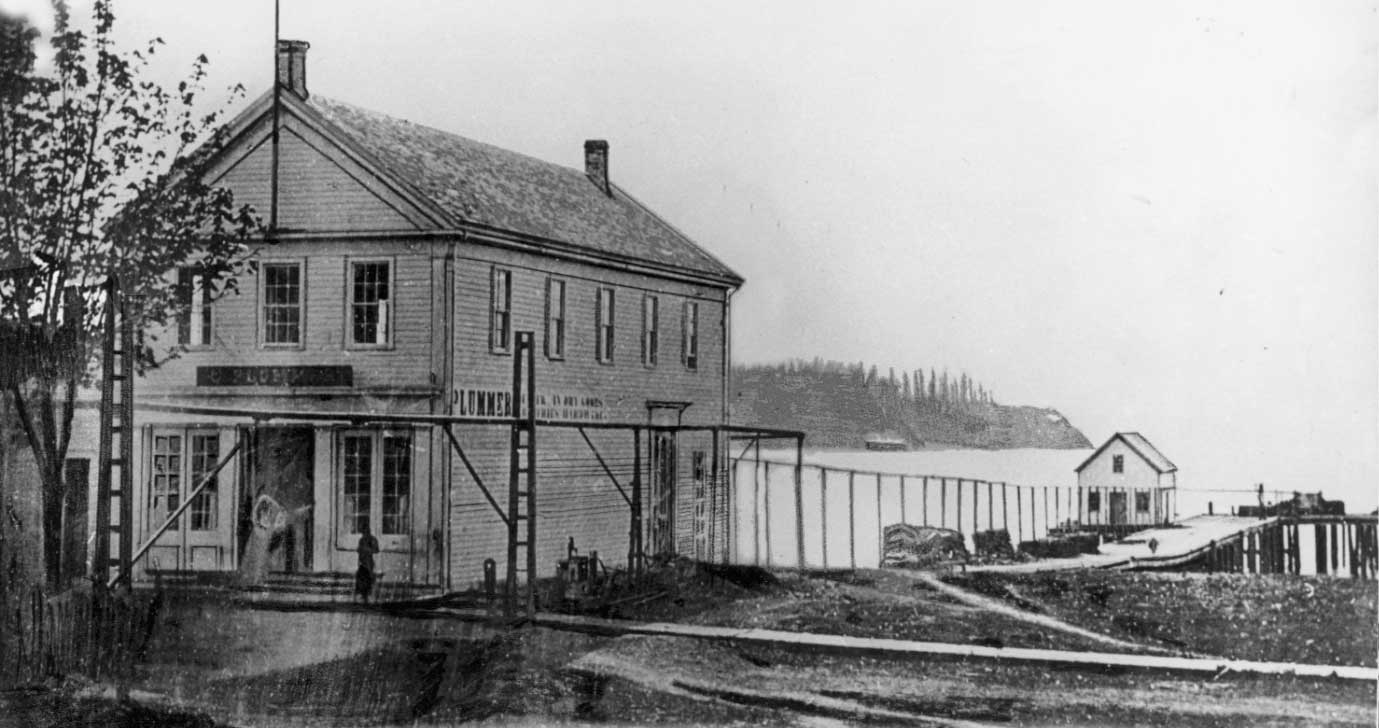
Unlike the Green Lake image we know that this farm scene was photographed by Horace Sykes, member of the post-war Seattle Camera Club and an amateur who by the size and quality of his surviving work, we know obviously loved to travel the northwest looking for picturesque landscapes.  Some of them he identified and dated on his slides, but not this one.

There is very little that is tense or newsworthy in the Sykes collection, but lots that are gorgeous examples of what we once with radical edge referred to as bourgeois taste.   But by now I love Sykes’s tender exploring and obvious affection for his subjects.  He never tired of flowers either – especially orchids.

Can Jean meet this new challenge?  While it is almost nothing for Jean to jump in his Nissan and search the state for historical sites to repeat, with this one he will surely need lots of help.   In fact, he might as well stay home.  Almost certainly this old farm site is no more, razed in 60 some years of wind and rot.  But it may well be remembered still and identified.  The trick here is to use this blog’s viewers, especially the ones who have family and friends living on the dry side of the state.  Jean’s Green (Pastures) Challenge No. 2, is, then, a genial plea for help.  Where is it, or was it, this green scene?  We will be patient.

Look for Jean’s Challenge No. 3, soon to come and closer to Green Lake.

'Up the Down Chimney' news flash!

mahler-at-piano-lowres

Composer/musician David Mahler has kindly sent us copies of our holiday music faves. What follows is a capsule history of his seasonal sings:

“David Mahler’s holiday sings first fluttered wings in December, 1982. Old songs remembered lined up side by side with new songs discovered.

Perhaps a dozen warblers raised voices at the initial three sings that year, held at 906 E. Highland Drive. The flock grew, and followed the music five years later to 2616 E. Ward, and the following two years to 89 Yesler Way. In 1989 the sings hit the road, with two sessions guest hosted. The red book discovered its green cousin. From that year onward, through floating bridges that sank, presidential elections, and Sundays that stretched into January, the song books grew and the swell voices swelled, until David’s departure to Pittsburgh in 2005. Twenty-four consecutive years of December sings nested into memories.”

stu-dempsterIn other news, Stu Dempster is bringing along his legendary trombone! Be prepared for a real treat as we raise voices against the darkness on the darkest day of the year. Death shall have no dominion at “Up the Down Chimney“!

GREEN LAKE "JEAN CHALLENGE"

While searching, typically, for something else I came upon this heartening piece of Kodachrome from the winter of 1943.  The original 35mm slide has a caption written the flip side from the “Kodachrome”  stamp.  It reads, in toto,  “Jan. 43  Our favorite spot to rest in summer under trees on shore E. Green Lake Way. Beautiful in Winter as well!!!”

green-lk-eshore-jan43-sykes

For the moment I do not know where this slide came from, although I think it was mostly likely picked (by me) from one of two large collections of slides.  One I purchased in a basement sale from a home near the east shore of Green Lake.  The other I got from Lawton Gowey, a since deceased friend, who shared with me many images, stories and enthusiasm for regional history.  Earlier he was given the collected slides of Horace Sykes, a long-time member of the Seattle Camera Club,  and Lawton passed the collection on to me.

Sykes’ work is often wonderful and we should show more of it in this blog and will.  But for the moment the image reminded me of Jean’s frequent early morning visits with his camera to this shore of Green Lake, which is also near his home, and the results that he has published here.  So this is my first “Jean Challenge.”

Can he – or rather, you Jean – repeat this shot with a “now.”  A warning through.  It may be more difficult than we think.  There have been some changes on the east shore since 1943.

JEAN GRABS THE GAUNTLET:

Here’s my best effort, slightly wider than the orginal, but pretty close I think.

I emailed the Sykes original to Kathy Whitman, Aquatics Manager for Seattle Parks and Recreation and she replied:

I can’t be certain but I think it is the northern shore of Green Lake looking across the west. West Green Lake Beach would be located just outside the area of vision to the left side the distant shore… the wading pool located to right side outside the area of vision.  It is on the shore about 2/3’s of the way toward the wading pool when leaving Evans Pool.

That had been my best guess as well, as this spot has always been a favorite of Green Lake strollers. As I recall, the trees in the ’43 photo were cut down and replaced by smaller trees, to general opprobrium, but I can’t recall why.  As can be seen, they’ve grown up a bit.

sykes-repeat

Now & then here and now…