The “now-then” recent feature about the “row house” at the southeast corner of 5th Avenue and Madison Street (now the home of the College Club) triggered this response from Mary and Leslie Norton, descendents of the Reinig family that built it. Read on . . .
As explained in the letter printed below, when this row of Reinig Apartments at the southeast corner of Madison Street and Fifth Avenue was built by the Reinig family ca. 1889 the family home that had taken the corner was moved one lot east up Madison Street, where it can also be seen in its new position here on the far left.
THE LETTER
Hi, Paul,
My sister and I were pleased to see the photo of the houses at 5th and Madison in this week’s Times magazine section.
The Reinig Apartments were built by our great-grandparents, Margarethe and Leonard Reinig; we believe the 1889 date is accurate.
Leonard Reinig came to America in his 20’s from Diedesfeld, Germany, and learned the bakery business in St Louis, and The Dalles, Oregon, where he also learned Chinook. He came to Seattle in 1869 to start his own Seattle Bakery, in a building rented from Henry Yesler on Mill Street (now Yesler Way). This included a delicatessen and he would deliver baked beans and brown bread to customers on Saturday mornings. It is said he produced Seattle’s first bakery cookies, and in 1872, made and sold the city’s first ice cream. Later he and a partner built a two story brick building at 1st and Marion, the Reinig-Voss building, where he ran a grocery in front, a bakery in the rear, and upstairs had a large hall for meetings, concerts and performances.
Our great-grandmother, Margarethe Schafer Reinig, was the daughter of German immigrants from Witterschlicht, Germany, who settled first in Wisconsin, then took up a large farm on the Satsop River, in Grays Harbor county. She met Leonard Reinig when she came to Seattle as a young woman, to work for family friends, the Bailey Gatzert family. After their marriage, they built a home at 5th and Madison, where they raised their three sons, Otto, Dionis (Dio) and Eddie. The family owned this property until surviving sons Dio and Otto sold the land to the College Club in the 1960’s.
In the photo in the paper, the family home (house on the left) has been moved uphill from it’s original site at 5th and Madison, facing Madison, and turned to face 5th Avenue. At this time, the family had already purchased their new home farm in Snoqualmie, and were preparing for a move there in 1890. We are told that in the photo, sons Dio and Eddie are in the buggy, and Otto is on the porch. The horse is Nellie, a fine driving horse that they shipped to Snoqualmie by rail when they moved.
The property where the house was moved was an extra lot that Leonard purchased so that Margarethe could have a small garden and raspberries close at hand. The family also owned land at 12th and Spring, where they had a large garden and kept pasture for the horses. My grandfather (Dio) told us that from the house, they could see the ships coming into the docks; if their father was expecting an order, they could run down to the store to tell him, then up the hill to get the horses, and have the wagon at the pier by the time the ship was docked.
In Snoqualmie, Leonard Reinig opened a grocery store, and ran a farm, while the family kept up business and social interests in Seattle. Later Otto took over the Snoqualmie grocery store, Dio managed the farm, and Eddie, an electrical engineer trained at the California School of Mechanical Arts, worked for Seattle City Light until his tragic death.
Several years ago, our late mother, Leslie Reinig Norton, gave the original plan drawings of the apartment building, and the Reinig-Voss building to the Seattle archives at the University of Washington.
Sue Schafer, our “cousin”, has written an interesting book, “Voices of the Past”, an annotated collection of early letters of Margarethe Schafer Reinig’s family, including correspondence between Margarethe and Leonard and from them to her parents on the farm in Satsop. We are also fortunate to have some written recollections from our grandfather, Dio Reinig.
Thank you for your interest in this photo.
Mary Norton
Leslie J. Norton
The 1884 Sanborn Real Estate Map identifying the building at the southwest corner of Marion and Front (First Ave.) as the Reinig-Voss block with it primary occupant then the Odd Fellows Hall (upstairs)The Reinig-Voss block with its principal tenant, the Golden Rule Bazaar ca. 1887. Note the Odd Fellows symbol - the linked chain - decorating the building's facade, centered above the second floor.A detail pulled from the 1884 Seattle Birdseye with red arrows marking the Reinig home at the southeast corner of Fifth and Madison, upper-right, and their nearly new brick building with a corner tower at the southeast corner of Front (First Ave.) and Marion Street, lower-left.A detail of the detail showing the Reinig-Voss building at the center and across Marion Street the Fry Opera House. Courtesy Ron EdgePre-'89 fire etching of the Fry Opera House at the northeast corner of Marion and Front (First Ave.).The Reinig-Voss building here identified after its primary tenant before the "Great Fire of June 6, 1889," the Golden Rule Bazaar.
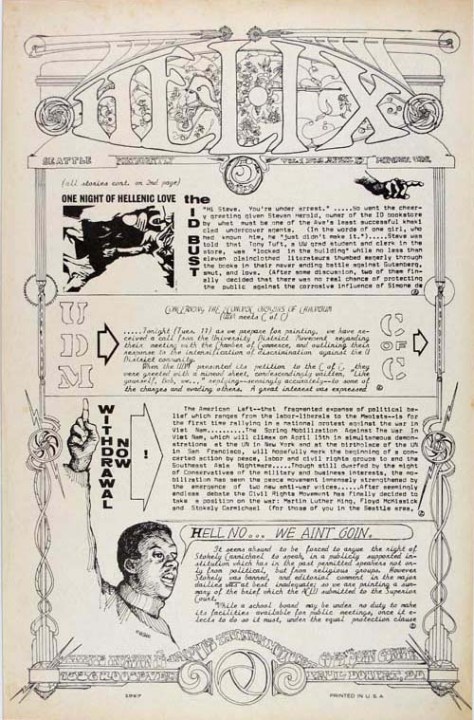
This is mildly complicated. Above is Don Edge’s coloring of Jacques Thornton Moitoret’s logo for Helix Vol. 1 No. 2 – or part of it: the top part of it. All of Jacques first contribution to Helix is directly below where it wraps page one of that April 13 issue of the then still bi-weekly tabloid. We put up the first issue last week and we will continue to reveal them here for as many weeks as it takes to run through them all. Sometime in late 2014 this will end – or perhaps early 2015. (I have not done the math, nor do I need to until at least late in 2013. I am keeping clam.)
Thanks to Ron Edge for doing all the scanning of the 120-some Helixes, and thanks to both of the Edge’s for their playful recommendation for coloring Jacques’ logo. Somewhere near here a not-yet-colored version will be included that you may wish to color and return to us for posting. This is very much in the tradition of Helix. Not as coloring book, but as parody. Think of it as a loving parody of the Google logo, which changes so splendidly from day to day.
Like this week and last, through the weeks ahead I intend to read each issue from cover-to-cover and record a rough – rather – commentary of first impressions after having not seen any of them – except to glimpse – for forty-five years. (The button for playing this commentary is just below.) I hope that other readers will take moments to respond to what they also may – or may not – find in Helix after so many years. All this may result in some publishing effort near the end – m0re likely after it.
This Friday afternoon (April 6, 2012) while visiting the MOHAI library with Ron Edge to process illustrations for the second volume of Rich Berner’s “Seattle in the 20th Century” series, I took a break and revisited the “Repeat Photography” exhibit that Jean, Berangere and I curated. The exhibit opened last April, and so it is now up nearly a year. For it and much else at MOHAI we recommend visiting the museum before the doors are closed mid-June next. I took from the hip snapshots of all the exhibit’s parts and include a very few here to make the point.
Our exhibit is made from four parts: the world (represented by Paris, France), Washington State, Seattle and its Wallingford neighborhood.
The Paris part of the show begins inside the front door. It includes the oldest example of cityscape, a 1838 look down on Boulevard du Temple from Daguerre's Diorama Magic Theatre. Louis Daguerre, the photographer, is considered the parent of photography, sharing his techniques with the French Academy for the honor and a worthy stipend. Click this twice, and you should be able to read the exhibit's own caption on the right. Jean's repeat of the historical view that looks west on the Columbia to Mt Hood from Maryhill shows the same curving grades for the experimental paved road that climbed from the river to the farm plateau above it. Again, the caption - with a few clicks - can be read.The southwest corner of Lake Union before it was filled early in the 20th Century.The map above indicates the route I walked most days for three years beginning in the summer of 2006. In the process I took photographs of about 450 subjects with the same camera and, as best I could, the same composition and position. Some day - I hope - this magnus opus will result in an elaborate presentation of its time photography. At MOHAI about 25 of the subjects are sampled. This sidewalk patch at the southeast corner of Corliss Avenue and 46th Street is one of the 450-plus subjects. A neighbor decorated the patch with small ceramic tiles. The warm lights on top are reflections on the video screen from the exhibit lighting.
Today I also visited many of the museum’s regular exhibits including the “Great Fire of June 6, 1889” mural and a revealing (of age) cross-section of a fallen Douglas Fir.
While Ron continued to do his research in the MOHAI library I took a walk across the MOHAI parking lot to the trail that leads to Foster Island. Below are the bridge to the island and two details taken from very near its west, or MOHAI, end.
At least from the parking lot the best sign that MOHAI is moving is the impressive red van that is parked there. It is marked or signed by the Hansen Bros. movers that started in the University District long ago.
While searching The Seattle Times for something completely different, we came upon this revealing link between the principal cities we often blog about. This appeared first in the Times for Oct. 26, 1930. It can be read if you click it – probably twice. The sculpted illuminations of the page include a novelty that suggest that the art for it may have been arranged far away. Seattle’s skyline is flipped.
HELIX VOL. 1, NO. 1 – Introduction to Posting on April 2, 2012
As I croakingly describe it in the accompanying audio (linked above) my best plans to comment on the entire first issue of Helix were upset by the time I reached page three of twelve. (It was a small first issue.) Still I did browse the entire tabloid, and was charmed with pleasant and often vivid memories. But the audio commentary is keyed entirely to subjects on those first two pages.
A similar restraint will follow next Monday with the second issue. And so on and on for nearly three years more with a new old issue appearing each week on Wash Day. For this first issue, and the rest of them too, I’ll choose only a few ripe subjects to comment on. (The alternative would resemble biblical commentary piled on by medieval scholastics, a volume many times greater than scripture itself.)
Perhaps I will get to comment later on pages three to twelve, especially if asked about its parts by readers. And it may be that at some point I will return to add something to any page in any of the issues, thereby compiling a Summa Helixa – although not so systematic as Doctor Universalis’ Summa.
Besides the recorded but ragged weekly commentaries, I might also attach more captioned photographs – relevant but not necessarily directly to that week’s issue. I’ll include a few examples at the bottom.
While preparing this first issue I noticed a little hoax on the front cover. It was given the page number 35. It was new to me, but Ron Edge, who is scanning (Blessings to the Scanner) all the issues, was aware of the wild number and thought it was a prankish gift of first issue enthusiasm. Surely that is so, and I suspect Meryl Clemens, one of the paper’s founders and also one of the artists who contributed to the front cover. Ron scanned his own copy, which is better than mine, but still his ink has also faded in 45 years.
Entering the first Helix office at 4526 Roosevelt Way, one was met by an oversize American flag draped along the north wall. Here we see Tim Harvey, the tall short-haired figure with his back to the door. Tim was with the paper from the start. Scott White - facing the camera - and others at the layout table. Geneticist Henry Erlich's "Making the Revolution" board game.
As it developed Henry was certainly the most distinguished among us – a brilliant man of great kindness and charm. With the freedom of blogging I have found his fairliy recent vita and print it here.
AMERICAN MOLECULAR BIOLOGIST
Since the early 1980s, Henry A. Erlich has been well-known in the forensic and medical communities for helping to pioneer the research and development of a polymerase chain reaction (PCR) technique that ultimately lead to a number of important forensic and clinical applications. As a result of the pioneering efforts of Erlich and his team of scientists, the first commercial PCR typing kit was developed specifically for forensic use. Currently, Erlich is the director of the Department of Human Genetics and vice-president of Discovery Research, both for Roche Molecular Systems, Inc.; and the co-director (and co-founder) of the HLA Laboratory at the Children’s Hospital Oakland Research Institutell three located in the San Francisco Bay Area of California.
Erlich grew up in Seattle, Washington. He began his bachelor’s of art degree in 1961 at Harvard University in Cambridge, Massachusetts, where he completed his degree in 1965 with a major in biochemical sciences. That same year, Erlich was a research assistant at Yale University in New Haven, Connecticut. Erlich then began his advanced degree, completing his doctor’s of philosophy (Ph.D.) degree in 1972 from the University of Washington (Seattle) with a genetics concentration. While working on his degree in 1967, Erlich also worked with street gangs as a Vista volunteer in New Mexico. Erlich did his postdoctoral work in microbial genetics (1972975) at Princeton University in New Jersey, where he was employed as a postdoctoral fellow at Princeton’s Department of Biology. Erlich did further postdoctoral work in immunogenetics (1975979) at Stanford University (California), where he was employed as a postdoctoral fellow at Stanford’s Department of Medicine, Division of Immunology.
After completing his postdoctoral studies, Erlich became a scientist at Cetus Corporation, an Oakland-area biopharmaceutical/biotechnology company located in Emeryville, California, where he held various teaching positions and served on the editorial boards of such industry publications as Human Immunology, PCR Methods and Applications, and Technique. Erlich was later promoted to senior scientist and director of the Human Genetics Department, both positions that he held until 1991.
During his early-1980s work with Cetus, Erlich led the human genetics group in the research of PCR techniques. He was especially interested in developing technology for the study of human genetic variation, and with it the applications in forensics and clinical medicine. In 1986, Erlich’s research resulted in development of a PCR technique that ultimately produced a number of clinical and forensic applications. Also in 1986, in what is generally considered the first use of PCR-based forensic DNA (deoxyribonucleic acid) analysis in a U.S. court case, Erlich carried out the confirmation that two autopsy samples came from the same person in the case Pennsylvania v. Pestinikas. About two years later, Erlich and his scientific team saw the development of a commercial PCR typing kit as the first forensic application within the United States of DNA typing of HLA-DQA (human leukocyte antigen with a DQ alpha PCR test) locus.
Erlich transferred to Roche Molecular Systems, Inc., located in Alameda, California, in 1991 when the company acquired the rights of PCR technology from Cetus. Today, Erlich holds three important positions with Roche: director of Roche’s Human Genetics Department, since 1992; co-director of the HLA Laboratory at the Children’s Hospital Oakland Research Institute (CHORI), in Oakland, California, since 1996; and vice president of Roche’s Discovery Research, since 2000. Erich’s work at CHORI puts into clinical practice the technologies that he had developed for PCR-based HLA typing.
The primary research performed by Erlich in concert with Roche involves the analysis of molecular evolution and population genetics of HLA genes along with human genetic variation and genetic susceptibility to diseases, especially on autoimmune diseases such as type 1 diabetes. He also researches the analysis of polymorphism in HLA genes and the development of HLA typing for class I and class II loci within tissue typing and transplantation, anthropological genetics, and individual identification.
Erlich maintains an academic affiliation with the Stanford School of Medicines, where he is an adjunct professor of medical microbiology and immunology. In addition, he also sits on several editorial boards (such as Human Mutation and Tissue Antigens); participates on numerous human genetics committees (such as the International Histocompatibility Council and the National Commission on the Future of DNA Evidence-Research and Development Working Group); and is a member of the American Society for Histocompatibility and Immunogenetics and the American Society for Human Genetics. Erlich has authored several books, with one of the latest titled PCR Technology: Principles and Applications for DNA Amplification.
Erlich has also been bestowed with many honors within genetic research and writing including such awards as the Gideon Goldstein Award (Walter and Eliza Institutes, 1989), the Biochemical Analysis Award (German Society of Clinical Chemistry, 1990), the Brown-Hazen Award (Wadsworth Center for Laboratories and Research, 1990), The Rose Payne Award (American Society of Histocompatibility Immunogenetics, 1990), the Advanced Technology in Biotechnology Milano Award (International Federation of Clinical Chemistry, 1991), the Award for Excellence (Association for Molecular Pathology, 2000), the Profiles in DNA Courage Award (National Institute of Justice, 2000), and the Colonel Harland Sanders Award (March of Dimes Clinical Genetics Conference, 2000).
Phew!
Following geneticist E. Henry (above) we appropriately pick a page from Double Helix, a one-time tabloid published ca. 1972 by Michael Wiater and myself.
The HELIX cover printed just below appeared first on the 1st of December, 1967, which was still in the first year of the tabloid’s three year – and a few weeks – run. The cover was one of artist Jacques Moitoret’s many contributions to Helix. With age the pulp it was printed on has nurtured its color. Starting tomorrow, Monday April 2, 2012, we will feature it again on the front page of this blog as the front door – or button – to eventually all issues of Helix. We mean to put them up in the order they first appeared. Directly below Jacques’ butterfly is another and longer introduction to this project. You can read it and/or listen to it. The audio, which I recorded at my desk in one take!, runs about eight minutes. (When, in the context of revealing how Helix was conceived, I mention looking “down on 42nd Avenue,” please hear instead, “42nd Street.” It is correct in the copy, but wrong in the audio.)
By those who remember it, Helix may be described as “Seattle’s First Underground” newspaper. This, I think, is too romantic or glamorous. Rather, it was Helix candor – above ground – that was apt. It could be either disturbing or compelling – of course, depending.
Helix was conceived in a conversation with Paul Sawyer, a friend and Unitarian preacher, now deceased. I can recall the moment in color. We were alone in the Free University office (beige walls and gray ceiling), on the second floor above the Coffee Corral on University Way, aka “The Ave.” Under a blue winter sky and from the window I followed a couple walking hand in hand below me on 42nd St., when over my left shoulder Paul suggested, “What we need here is something like the Berkeley Barb.”
Paul Sawyer standing on the beach beside the park on the north shore of Lake Union, just west of Ivar's Salmon House. The photo is dated April 25, 2010. I took it during Paul's last visit to Seattle, a wind up, because he knew that he would not live out the year. He brought with him two boxes of his then new book "Untold Story," the cover's of which we will insert directly below this subject. Below the covers we include a page from Helix that features a poem of Paul's from the paper's first year, 1967.The covers of Paul Sawyers "Untold Story," 2010.
The Barb was one of the many weekly tabloids associated with the 1960s “counter culture” that were blooming then from Boston to L.A. and soon from Atlanta to – with Helix – Seattle. Most of these were loosely connected with university communities and the talents they offered. Here, for instance, Helix bundled Seattle’s University District and the University of Washington as part of a town and gown experiment. That was in the winter of 1966-67.
An early contribution of Walt Crowley's, an allegorical illustration of our struggle with City Council to hold light show dances. We won. Bitter Harvest, another example of the many covers Walt Crowley did for Helix.
Now thru the next nearly three years we will hang from this blog all manner of HELIX, which is every issue from Vol.1 No.1 to Vol. 11 No. 21. By posting one a week, and in the order they first appeared on the street, we expect, or hope, that the paper’s often illuminated pages will stimulate some responses and recollections – some current alternatives for drop out, turn on and tune in. Perhaps remember, reflect and rejoin.
A cover by Alaskan artist, Mary Hendrickson
The first issue of Helix is dated March 23, 1967, although it “hit the streets” a few days later. And then it popped! Pastor Paul was right – it was what we needed. It was our own news and opinion, often otherwise not reported. And it also yielded the small economics of street sales, which helped many get by. At 20-cents a copy our little pulp was enthusiastically consumed, sold by vendors whose enterprise was only limited by the number of copies they could carry and the charms at their corner. (The seller kept half the cover price.)
(Cartoons by Skagit Valley artist Larry Heald above, and below. All three of the artistic Heald brothers, Maury, Paul and Larry, were part of Helix.)
The first issue was late because Grange Press, the scheduled printer, on seeing the flats we delivered to their high-speed photo-offset webs, found the content somehow offensive. At the time this rejection mystified us, but if you choose to browse that same first issue – and it appears here first tomorrow – you may find something in it that hollers for more than editing, perhaps for censorship on the grounds of decency or national security. (And please point it out with a blog response.)
A back cover designed - and layout - by Paul Heald.
With help from some civil libertarians we found another printer, Ken Munson, a union man. Ken pulled good fortunes from the combination of our Grange rejection, and his Heidelberg flatbed press. This meant higher quality pressings and split-font color for the covers and centerfold on an array of colored newsprint. On the day of publication the flatbed also obliged a ritual for the staff that was at once bonding and blabbering. Every issue printed on Ken’s flatbed required hand folding and collating on the big tables in the Helix office.
Helping in the folding and collating line, Scott White turns to the camera. Scott was one of the younger staff members, and with the paper throughout. He was the first person I met in the University District, when we arrived at the same moment at the front door of the then still proposed Free University. He was then still in high school - a brilliant teen. The younger folder this side of Scott I recognize, although I cannot recall his name.Helix was part of the Underground Press Syndicate. We shared each others papers and could reprint content from them. This brought desirable contributions from great sources like cartoonist Art Crumb.
For the first few months Helix was published only every two weeks, but here from the start we intend to bring it back every week, ordinarily on those Mondays that aren’t busy with washing. We may treat Sunday’s Seattle Now & Then as a civic service, and Monday’s Helix as a humanist’s hippodrome. On the distinction of having first heard the voice of Pastor Paul over my shoulder in 1966, and having edited the paper for most of its life, I will introduced each issue with a commentary. Much of it will be new to me too, for although I was the editor through most of its life, I did not read it all. Editing the Helix was sometimes like being a coach, making certain that there were enough players were on the field.
Helix took part in the struggle to save the Pike Place Public Market. Here one of the paper's contributing photographers, Paul Temple, took the cover and centerfold for his study of "market faces."
For much of the staff, myself included, preparing and publishing a paper was like attending school, and many of us stayed involved in community life – even journalism – beyond owning a home and paying taxes. Throughout the weekly routine of publishing a newspaper we were more reporters than hippies, and much of the super sincerity often associated with those we primarily served – “the hips and the rads” – was wrapped by us in irony and the rules of evidence. Ours was a sort of liberal conspiracy of both self-taught and schooled intellectuals who might join a demonstration but when the nightsticks came out we might also think “My how ironic!” while running away.
The 1968 Sky River mud dance before being treated with color and the split-font feature of Ken Monson's flatbed Heidelberg press.The newspaper was the source or center for a variety of efforts off its pages, including be-ins in the parks, concerts at Eagles Auditorium, the Piano Drop and the multi-day music festivals that dropping a piano from the sky inspired - the Sky River Rock Festival in the late summer of 1968 and two more following. It rained that late summer weekend in '68 except for this moment when the sun splattered with the rain. From the stage, Sky River NO. 3, outside of Washougal, Washington.The paper's barely readable report on the Piano Drop, for which the Berkeley band County Joe and the Fish volunteered to play.Years later Country Joe admiring Paul Heald's poster for the Piano Drop. I remember Paul laying it out in the office, and I remember Joe taking it from me for his concert collection. For all the help he gave, Joe deserved a hundred posters.
After the next nearly three years of weekly postings, if we are then still able – I mean standing – with the readers’ help a book might be fashioned from all these reflections and reprints. Then certainly we would also have to edit. Thankfully, already one of our staff, Walt Crowley, wrote his book Rites of Passage which treats on the Helix and the events of that time and it can still be easily found in public libraries and perhaps your own. Add two years more to these about three of weekly offerings and we will be spot on for the paper’s Golden Anniversary. And then surely a few from the original staff will be lingering to lift a toast at the Blue Moon.
An example of an "illuminated page" in the paper. This one with part of a poem by Tom Parsons and a rapidiographed frame by Zac Reisner, another regular. The early romantic artist William Blake was an inspiration for such pages.
Above and below, two political cartoons by artist Mike Lawson.
Springtime is a good time to reminisce about our youthful enthusiasms, while also reflecting on some of our abiding concerns. We hope you respond. We will check for posts for one thousand days, should we survive them what with springtime allergies and day-in and day-out mortality.
Another illumination - this one with poet Gary Snyder and novelist Tom Robbins.The Great Clock was one of the "hoax reports" I created for the paper. It was believable enough to influence friend Tom Robbins' characters in his second novel, "Even Cowgirls Get the Blues." Another Larry Heald sketch, bottom-right, fits the story well. The cover - by Walt Crowley - for our issue closest to the 1969 moon landing.
*There was little that was “underground” about Helix. When the Yakima Eagle printed that they were determined to find out who was printing our paper and lead a boycott against them and us we published the details for them in Helix. Our only underground certainty we discovered after the paper passed away when we surveyed our stripped quarters on Harvard Ave. East. We found that our phone had been elaborately tapped, but then again almost certainly in the interests of decency and national security.
For may years after the paper folded in 1970, the front of our office on Harvard Ave. - just around the corner from what was then still a funky Red Robin Tavern - was plastered with concert fliers. Not so long ago - in 2008 - while driving by the old Helix office site, Jean Sherrard pulled over and posed me in its now tagged ruins for a panorama. The wire tap was far right.Renaissance Blues Man and Photographer Jeff Jaisun's capture of the eight who made it to the sidewalk from the party inside the Blue Moon Tavern celebrating the silver anniversary of the founding of Helix. Left to right are myself (Paul Dorpat), Maury Heald (with the great white beard), Paul Heald (with the lesser white beard), Alan Lande (shaved), Walt Crowley (having a good time), Tom Robbins (shaded), Jacques Moitoret (maybe stunned) and "Not So Straight" John Bixler, looking sort of straight. Except for Maury and Walt, we survive and hope to see each other and you as late as 2017.
“Looking north from a railroad grade on Washington Street to Simmer's named subject, the corner of Third Ave. and Washington in Vancouver Washington on July 20, 1942. This apparently is Vancouver's auto row during the busy war years when that city was crowded with home front manufacturing, mostly of ships. Through his career Simmer did a lot of shooting for the Washington State Department of Highways. This is one of the subjects that Jean and I chose for our book "Washington Then and Now." We did not, however, use it. - Click TWICE to EnlargeOn a hot day in the summer of 2005 Jean lifted his camera with his 10-foot pole to a grade that approximated that of Simmer's shot from the elevated railroad grade. Jean, however, has moved directly into the once busy corner of 3rd and Washington to show its moribund condition in '05. The 1955 completion of the I-5 freeway thru Vancouver used these blocks for interchanges. They are hidden behind the screen of trees on the right.While visiting Portland to perform in a music and stage production there, Jean stopped by 3rd and Washington in Vancouver on March 16 to study the changes - whatever - that had come down in the nearly seven years since his first visit. The trees have been busy.
Ron Edge visited Sand Point Magnuson Park Sunday last and returned with this panorama of the largest Dog Off-Leash area in the city – nine acres of “let dogs run free” (within in the fence) with its own dog-leg to Lake Washington where the happy canines can take a swim too. The far-flung view is framed by the parking lot which, I suspect, runs continuous and without the 90 degree bend it seems to get in this panorama merged from several snaps. It seems to be a peaceable kingdom on this sunny Sunday.
These two aerials from June 14, 1939 spot a Boeing Clipper resting at dock in the residential cove between what is now Matthews Beach Park and Discovery Park. They are copied from a collection owned by the courteous Dan Eskenazi thru the help of citizen Ron Edge. [Click TWICE to enlarge]
I enjoyed your article on the Jolly Roger restaurant and remember it well. I read your column every weekend on your web site. In fact I prefer it over the much shorter version in the Times. The Item that really caught my attention was the one about the Boeing Flying Boat.
I came to Seattle in January of 1938 at the age of 6 weeks old. My father had been transferred here by the J.C.Penny C.. He was the head of the advertising and display department of the downtown Penny’s store. In early 1940 we moved into a new house in the NE part of Seattle, just North of the city limits, on 48 Ave NE just off NE 97th. It was just 3 blocks north of “old man” Mathews lake front home (which was later to become the start of Mathews Beach Park). I lived all of my life until 2005 in Seattle and found it a wonderful place to grow up and live. I now live in Snohomish.
My folks told stories about the Jolly Roger and of the Boeing Flying boats taking off from Lake Washington. At the South end of what is now Mathews Beach Park was the staging area for the Boeing Flying boats. It contained work sheds, a reception facility, parking lot, and a very substantial dock running out into the lake past the shoreline sand bar. The dock was so substantial that trucks could be driven out to the plane tied up there. The reception facility had a fireplace, a full kitchen and large open spaces. I don’t know who actually owned the property but after the war it was turned into a water ski club with lots of activities, Bar-B Q’s, beer drinking, and parties on the weekends. We had neighbors that would take us kids down there to water ski and watch the boats.
During the fifties it was turned into community supported swimming and social club. There were no public beaches for swimming and lots of new post war homes in this area at that time. Teenage dances, potlucks, and adult square dancing were the mainstay activates. The area around the facility at that time was mainly small family homes and “old Man” Mathews farm, barn, out buildings, and home. Diagonally across from the entrance to the social club was the home of the Edson’s ( not sure of the spelling). Oren Edson and his brother spent much of their time at the water ski and social club and would later put there boating interest to work. They became the founders of the Bayliner boat company. They honed their entrepreneurial skills by buying mail order fireworks and then retailing them to the neighborhood kids at highly inflated prices. They were the only game in the neighborhood.
This entire neighborhood would eventually be bought up piece by piece, by the city of Seattle, to become what is now Mathews Beach and its parking lots.
I hope I haven’t bored you with my remembrances. Cheers Fred Rowe
Cheers in Return Fred. I read – and published – the whole thing with kind regards.
On Minor Ave. beside Cascade Playfield and CETA Mural, ca.1978Unidentified Wreck circa dated 1912, by evidence of its photo album.Unidentified, 1916Unidentified, 1938Unidentified, 1940
Hugh and Anne Paradise did a lot of blue highway exploring – most of it in the Northwest. They lived in West Seattle at 1920 SW Graham Street beside a green and shallow dip that runs in line and near the center of the north-south ridge that begins at its north end with Pigeon Point. For many years Paradise wrote what his editor described to me years ago as “poetic descriptions of the places he and Anne visited.” Many of these were printed in Sunset magazine with photos also by Hugh. I’ve not looked in the boxes of negatives for many years – and thank Byron Coney for sharing them now long ago – but, if memory serves and I remember the Paradise cars correctly, their adventures began after World War Two with a Chevrolet and years later they moved to a VW bus. Some of the negatives are accompanied by contact prints and some of these have identifications written on the flip side, but ordinarily they are not dated. These three are identified simply as, top to bottom, “Moses Coulee,” “Moses Coulee school,” and “Moses Coulee Farm.” The farm looks quite lively and the school is apparently one for ghosts. [Click TWICE to Enlarge]
I have a vivid memory of dropping into Moses Coulee with my dad in the family Plymouth in the late 1940s. After crossing the Grand Coulee and heading west, it was unexpected and so more exciting and memorable. It was wonderfully lonely – like the top photo above. I saw no farms. The W.P.A. 1941 state guide “The New Washington, A Guide to the Evergreen State” described Highway 2 there so . . . “MOSES COULEE – Named for Chief Moses, like Grand Coulee it was also formed by glacial floods. Going west, the highway at first descends gently along the coulee’s eroded upper walls, serpentines along a man-made shelf blasted from solid cliffs then levels off across the coulee floor. Nearly every color in the spectrum appears with the change in seasons and the play of light. Leaving the coulee, the highway dips up and down through waving fields of wheat to the Waterville plateau.”
Don Scott on the dish line at the Copacabana, Pike Place Market. Behind Don, Celeste (aka Estelle) Franklin waiting tables. ca. 1980King County Administration Building, detail ca.1980One Way, ca. 1979, near the waterfront foot of Seneca Street. HEADLINES: Gusts up to 89 mph Two-year Sentence Bombing Suspect Obscenity Ban wins Stolen Jewels Found A Night of Terror 3-Missing Halt Porn Ban U.S.Russ set talks to Curb Arms Sales Tough Exercise is Good for the Heart State Population Rebound Arrive from Mexican Jails Mondale Seattle to Desegregate Metro Drivers Reject Offer Promised Land Framed Window as Frame, Tacoma ca. 19801550 - Street address, SeattleClick to Enlarge
“We add this in response to a letter from Sandy* I'd forgotten. It seems to be an antique dealer's loading platform but mixed with sales. *By Sandy's Demand - CLICK to ENLARGE
DON SCOTT IS or was one of the Seattle artists, with Rolon Bert Garner and Ken Leback, responsible for EQUALITY, a piece – or several pieces – of sculpture dedicated in 1996 in Sturgus Park at the north end of Beacon Hill in the early afternoon shadow of the Art Deco Marine Hospital, more recently home to an internet distribution company. I photographed this detail from the piece sometime soon after the ceremony.
By a photo editor's decision the unidentified man on the right is to be given one-half of a column for some news story. The photograph is used compliments from Seafair, and was copied from their archives long ago. Like the Bob Hope snaps printed earlier this one dates from 1962 . . . I assume. Does the queen look the same? For what may be most readers born since 1960, say, the man in the middle is the Tacoma-Spokane baritone, Bing Crosby. "If I could be like Bing forever I would sing, ba-ba-ba-boom . . .ba-ba-ba-boom."
Driving to Tacoma on old 99 you may miss Secoma, except for the signs, and of the two showing here the bowling alley survives although with mix reviews. (They may have a new sign.) In 1982, the approximate date, there was no exposing media like YELP to broadcast the range of criticisms about almost anything that amounts to another roadside attraction. The complimentary ones seem written to form. The critical reviews make the reviewers seem insulted by the place – their foolishness for paying six dollars for a beer in a place that takes only cash. You wonder if either or both were written by the lane’s owners or its competitors. The winter day we drove to Tacoma was too cold for the feeble heater in the VW Karmen Ghia. Secoma was new to me and the signs big enough to read from a distance that allowed a quick stop. If it is the motel that is having the grand opening then it may be new owners that are celebrating, for the big sign is weathered, although still somewhat grand. There survives a listing for a pubic phone in Secoma, which I imagine is the one set here near the base of the motel sign. It must take enough calls for the tel. company to keep it around. I remember trying the alternative, “Tattle” or perhaps Taatle.” (Click to Enlarge)
From July 9 thru 15 Bob Hope delivered his $100,000 show at the Aqua Theatre on Green Lake before near capacity crowds – first night 5,478 seats of the 5600 capacity. The Crosby brothers had to cancel (we can imagine the skit) but the show moved along fine (the reviewers noted) with the dancer Juliet Prowse doing “Legs” a dance of hers only through holes in a curtain, folk singer Jimmy Rodgers and the Fairmont Singers, and more than an hour of monologue by Hope. Almost as popular were the monkeys – the Marquis Chimpanzees, which “could do anything except recite poetry.” For one song Hope took to a row boat oared by Carol Christensen Hall, a former Seafair Queen. Earlier, of course, he received the obligatory queen kiss from Linda Juel, Seafair Queen for 1962, the year of Century 21. And next year Hope was back again for another encounter with the local queen, who in 1963 was Arelene Hinderlie. Both Juel and Hinderlie are pictured next. All the images, excepting that from 1963, which comes from the Post-Intelligencer, are used compliments of Seafair.
1962 Seafair Queen, Linda Juel, missing the famous ski-nose.1963 Seafair Queen, Arelene HinderlieSeafair Pirates, the 1962 installmentHope browsing The Seattle Times Century 21 Special Edition
We are, you see, back with the blog. A brief history of our collapse: it began about two weeks ago soon after the Riverside feature got posted Jan 22. After that it sputtered and then died. It complaints might have reminded you of an original VW bug engine wanting more power. And without understanding why – except for relief – we gave it . . . more power. So now we are up and running more expensively.
It has been explained to us that for blogs dorpatsherrardlomont is an unusually “rich” example. Blogs are ordinarily terse and modestly illustrated. That has always been Jean’s instruction, and Ron thinks that we should still start linking a lot of what we offer into folders that are kept in other places and accessed with other programs, but without much loss of speed. So we will probably do that – eventually. But for now it seems like with new speed and capacities we will make it up our seven hills (in Seattle) sans sputter. We will start again making more memories.
The trailer packed with deer and moose parts has a license dated 1942 and is parked on Terrace Street (between 4th and 5th) beside the side door to the old Public Safety Building, which since its restoration in the 1970s has been known as the 400 Yesler Building. We don’t know that the animal parts are collected as evidence but we assume it given the location. A different trailer below holds its own gruesome parts and is surrounded by a pack of curious mostly young men. This trailer is parked on Jackson Street east of 5th Avenue and across the street from the Orpheum Cafe, which was then in the building at the northeast corner of 5th and Jackson. That lot is now for parking. Looming in the haze is the 9-story Richmond Hotel at the southeast corner of 4th Avenue and Main Street.
Jean has enlightened me concerning the fate of items added to any of our posts. Depending upon the timing, some readers will never see them. The reason is that the original contents of a posting – and this part is mysterious still to me – are copied by entities, which then share them with others who ask for them. The mysterious but still mighty servers are only interested in “beginnings” and do not write over or add the additions to their original copies of the page. They resemble teachers who will not take late changes – including additions – to a term paper. And so you see the problem of adding information – mostly illustrations – later on. Consequently, we here add addenda (or addendums, if you prefer) fresh and at the blog’s top as late additions to the Riverside story that appears in its greater part below Jean’s restaurant review of Green Lake’s Trattoria Cioppino, which is just below.
Hotel West, but not dated. To the rear, I believe, of Hotel West where something is smoking, right-of-center, April 12, 1923.Hotel West with pile driver from bridge work - not dated - and the profile of Pigeon Point.Map of Pigeon Point from 1895. (Not so long ago)Pigeon Point - and more - from a 1931 Sanborn real estate map. Looking west from Pigeon Point over W. Spokane Street - and the Youngstown Viaduct for trolleys - to West Seattle - July 6, 1931. (Courtesy Municipal Archive)Looking West on W. Spokane Street below Pigeon Point. On top the regraded Pigeon Point appears at the top left corner in a 1930 look from the Youngstown Viaduct, which also includes the Shanghai's alluring promise of dancing to live music. Bottom, the Shanghai has become Marty's Tavern (see the next same day pix below) recorded from the Spokane Street grade in 1962. (Courtesy of the Southwest Seattle Historical Society.)
(Click to Enlarge) – If anyone would like to suggest a caption for any of these three, please do. They are all about thirty years old, and I shot them. The top one, I don’t know where. The middle one is at the south side of the Fremont Bridge waiting for the Anchor Excursion boat to pass. The bottom one is on Eastlake Ave. climbing the hill south of the Steam Plant. pd
NOTE: We have added a few more Wawona parts to the feature below since first it was posted, in part because our first efforts were interrupted with a closing or crash of this blog. This happens often, and we wonder if we might not be involved in some lukewarm version of a protection racket. Our server tells us that they cannot figure out why it stops, but for a such-and-such more they will keep a close eye on it. They have, it seems, a category of service where one’s site is always on a cusp of working or not working. Or perhaps we are simply special and almost no one dances to the same crash and come back beat. We are welcome to any suggestions or references that will lead us to a reliable server; that is, one with no such special categories.
The ARTFUL WAWONA – JUNE 24, 1964
The primary photo for this feature – printed just below – somehow got removed (probably by me: pd), but we have brought it home again.
(CLICK TWICE to ENLARGE)
In 1964 Ivar Haglund joined Kay Bullitt and Seattle City Councilman Wing Luke in founding Save Our Ships (S.O.S.) and donating 27 thousand dollars towards purchasing the Wawona from a Montana rancher whose urge to haul cattle on it had passed. On the way to its final moorage at the south end of Lake Union beside the Center for Wooden Boats, the Wawona visited many Seattle slips, saltwater and fresh. In the summer of ’64, Fire Chief Gordon Vickery agreed to switch the berths for his two fire boats at the foot of Madison Street so that the larger one, the Duwamish, would not prevent the schooner Wawona from resting beside pier 54, and so directly below the plate glass windows of Ivar’s Acres. Several local artists came aboard and turned their artful hands on the vessel. We can see several of them at work above in Frank Shaw’s photo. The results were sold on board in an art auction with the funds going to the schooner’s preservation fund.
In 1970 the Wawona became the first vessel to be listed on the National Register of Historical Places. Through these years the “museum ship” was embraced and improved by many local carpenters but they ultimately could not keep pace with the rough handling of nature. Always hoping for more pocket help the schooner went bad faster than it got better.
After his first contribution in 1964 Ivar returned to the schooner in 1980. The Seattle Times writer Walter Evans, on his man-about-town beat, made note of Ivar’s new oblation in the issue for Jan 17, ’80. “Ivar went to the bar and came up with a concoction called the ‘Sail Away’ created by Carlos Botera of the Captains Table. It contains guava nectar, papaya nectar, strawberry preserves, orange syrup, light rum and 151 proof rum. You get to keep the cup and the hangover when you order it, and the cash you pay for it, $2.50, goes toward restoration of the historic sailing schooner, Wawona.” This call for aid from the city’s stiffer drinkers could, of course, not revive a campaign to save the schooner. Like perhaps some of those who tried to help out by ordering many rounds of Sail Away, it too fell flat. During the spring of 2009 the Wawona was towed from the Center of Wooden Boats at the south end of Lake Union to its destruction somewhere out of sight.
Resting in the slip between American Can on the right (the future Port of Seattle pier) and Pier 70, on the left, it was from here, most likely, that the Wawona was towed to Pier 54 for its weeks of raising funds for itself. Frank Shaw dates this June 14, 1964. The Wawona when still a working schooner in the slip south of the Port of Seattle's Bell Street Terminal, seen here in background haze. I do not know the date.This look up Yesler Way past the stern of the Wawona is also dated 1964, and so adds some small uncertainty to the claim two captions above that the Wawona most likely was towed from the Pier 70 slip to the south side of Pier 54 that year. It may have come from here between Piers 50 and 51, or perhaps first moved from here to Pier 70. There are other possibilities, of course. On the left is the post-Century 21 location of Ye Olde Curiosity Shop. Since these piers, covering the former pioneer sprawl of Yesler's Wharf (especially Pier 51 on the left), were eliminated for the construction of better vehicle approaches to Colman Dock, the Curiosity Shop has taken the northeast corner - at the sidewalk - of Ivar's Pier 54, in the space where he opened his aquarium first in 1938. (I know this stuff by heart, although not always the spelling.)This profile of the Wawona at the Gas Works - before the park - is neither dated nor attributed. It comes from a mixed collection of slides recorded by Lawton Gowey and Robert Bradley. Slowly I am sorting them out - but not this one yet. I see that the green paint is in poor shape, but I also note that it was green at the end. There are enough Wallingford landmarks or features in this to most likely date is close - after some reference work. Nice sky. I seem to remember the Wawona being here ca. 1970 when Stan James was doing some carpentry on its Captain's quarters. This one I photographed and dated 1997 - not so long ago. Many remember that this was its last roost behind the Center for Wooden Boats. Even such a charmed location did not in the end save it. The S.O.S. that went out in the mid-1960's returned no more echos. (PD)
In the last Seattle Now and Then contribution – Jan. 15, this year – we included a feature titled “Dear Old Seattle.” It was a quote taken from one of the many letters sent by Fred Stanley Auerbach, the young man pictured above, to his parents in the east. As explained, Auerbach was visiting here looking for the best investment chances for family money. Archivist-historian Greg Lange uncovered the letters several years ago and we copied them. Auerbach stayed in the Seattle Hotel, using its stationary. He liked the hotel but in one letter he considers moving to less expensive quarters. We have pulled a few pages – only – from the many that are collected in a bound album. Auerbach was here in 1906, still the time of Seattle’s greatest booming. His handwriting is negotiable and his descriptions often lively. “This is the damnedest town I ever saw . . . I never was in a city in my life where I felt such a stranger and I think the reason is that nobody has been here long enough to feel at home . . . It is all business. You couldn’t imagine anyone saying ‘dear old Seattle.’ If you ask anyone on the street where such and such a street is, one out of every three will say ‘I don’t know I am a stranger myself.’ ” (The letters, as I pulled them, are not always in the order he wrote them.)
CLICK TO ENLARGE
Auerbach came west on the Canadian Pacific Railroad and crashed with it. The top of the two remaining selections describes, in part, that adventure. The last letter witnesses to another crash – a “remarkable accident” – at a Seattle intersection.
A few years back we published this early "found" map of Africa on this blog - or rather the first run of this blog, all of which was lost in one of those ineffable digital snafu's that tests one's virtual composure. Although we lost the insertions we still have the raw materials - when we remember what they were - including this map of what was once commonly referred to as the "dark continent" and actually seemed darker on the window-shade map of the world that was attached at the top of the blackboard in primary school. Now we pull on a few more maps - early ones - beginning with a really primitive map of Washington State, (also found while picking) followed by another state map, also an early one: the map prepared by Washington Territory's first governor, Isaac Stevens in 1855. It is survey map - his assignment from the other Washington.
The mountains - Cascades and Olympics - are mere impressions in this 1855 map, but the waterways are almost faithful. The pioneers, of course kept close to the waterways. Most importantly, Stevens map shows the first efforts of surveying the land into claimable and taxable real estate. That work extends here north out of Oregon and thru what is now the 1-5 north-south corridor of Washington's denser populations.
Above, are three of the earliest maps of Seattle, and at the bottom is its first real estate map, showing the sectioned fruit of the towns 1853 survey, its first additions on which Arthur Denny, Carson Boren and David “Doc.” Maynard expected to sell lots – and did. The above maps all put east at the top. The top one dates from the 1841 navy survey of Puget Sound, and includes a peninsula, Piner’s point, which when the tides were high and the wind strong out of the west could become an island. It covers an area that now extends from about one-half block south of Yesler Way to King Street, and from the Alaskan Way Viaduct (for a while yet) to some little ways east of Occidental Ave. The tides then also splashed against Beacon Hill. The middle map above dates from 1854, and is the fruit of another federal survey. It includes a few marks for buildings, but none yet for blockhouses. Those troubles came a year later. The bottom of the three maps dates from the mid-1870s and shows as yet no King Street coal wharf. That was built in 1877. The 1870s map also features topo lines. This last map (of the three) marks Mill Street – later renamed Yesler Way – and that line can help one get oriented with the two earlier maps above it.
Finally, and again, the map below is a rationalization of land as marketable. And they didn’t even own it.
I have become attracted to messages on the flip side of postcards. Many are better than the offerings of professional greeting card authors, and all – even the most banal – can be revealing . . . of something. A few, like this one, are confessions. If the sample is large enough one could pull a narrative from them.
The aptly named Pulpit Rock looks down about 1000 feet to the Tennessee River valley near Chattanooga, in the southeast corner of the state. Here Mr. and Mrs Scofield (it seems) and their daughter take to the rock. Beside them, on the right, is a robust plaque interpreting the Battle of Waunatchie, named for a suburb of Chattanooga. According to Wikipedia, this battle of Oct. 28-29 1863 was one of the rare night fights during the Civil War, and the fighting was confused on both sides. Lookout Mountain served as a, well, lookout for two confederate officers who were surprised to see, by daylight, a large union force marching along the river. When night well things went to hell. About 1000 – very roughly – were lost or wounded, with the Union army prevailing in part by luck and low light in its attempts to control a supply line to Chattanooga across the river on Brown’s Ferry. If you visit Lookout Mountain – a long ridge – on Google you will discover that it is now covered along its long summit with upscale homes. Perhaps you will also find Pulpit Rock. I did not.
First, Ron Edge – of our Edge Clippings – comments that Frank Shaw’s unidentified shoreline Gazebo (somewhere on Puget Sound) is prefigured with the Madrona Park gazebo. Following that comparison, we include four panoramas of work-in-progress on the Jackson Street Regrade. One of the four is a completion of the half-pan shown here with the Dec. 24 feature on the regrade, which looked northwest into it from near the southeast corner of 7th and Weller. Taken as a cluster the four pans are very revealing and exquisite for study. (They are used courtesy of the Seattle Public Library.)
For comparison one of Frank Shaw's two recordings of the just off-shore Gazebo.The Madrona Park gazebo reached by a steep trail from the park's Lake Washington shoreline. The park was outfitted early in the 1890s to lure riders on the Union Trunk Line's service from Pioneer Square to the park and its attractions. This view by Otto Frasch was photographed ca. 1908. In the intervening years the rustic shelter has grown ragged at the roof. (Courtesy Ron Edge)The bandstands nearby at Madison Park were also examples of park gazebos built by commercial developers - in this case the Madison Street Cable Railway - to attract customers on to the trollies, to the park's attractions, and the surrounding real estate. Lake Washington excursions were also part of the lure, and Madison Park was for many years the easiest way to get by launch to Laurelhurst.
The JACKSON STREET REGRADE ADDENDUM (for Dec. 24, 2011)
CLICK TWICE TO ENLARGE
This printing completes with its left half the full panorama included in the Dec. 24 feature. The photo was taken on Oct. 30, 1908 from the roof of the then new New Central Hotel at the southeast corner of Weller Street and Maynard Avenue. It looks east up Weller from above the alley between Maynard and 7th Ave..Like the pan above it this one was photographed on Oct. 30, 1908. Both were commissioned by Lewis and Wiley Inc, the contractors for the regrade. This view looks south from near Jackson and 7th, and so through the site once held by Holy Names Academy on the east side of 7th between Jackson and King. Note the Beacon Hill horizon. The New Central Hotel shows on the far right. It was the prospect for the first pan, the one shown above this pan. Note also that tidewater still reaches a shoreline at the foot of Beacon Hill. South School is far left, but not for long. Weller street was used temporarily as a route for trolleys to the Rainier Valley, and a trolley or perhaps two can be found in this pan.In this, the earliest pan, Holy Names Academy is still intact, far left. The pipe line close to Weller street runs below the bluff, which will soon be reduced by means of the pipe's cannonade of water blasts. This may be compared to the primary photo used in the Dec. 24 now-then feature, which shows the Academy in ruins. The pans own caption (bottom-right) is in one part blurred, however, most likely it reads, "April 9, 1909 Looking west from 12th between King and Weller." If this is so then here the regreaders have reached the "summit" of the ridge and it has been subdued. Note the Great Northern Depot tower on the center horizon.
We are adding a new subject category for our blog contributions, and we name it, of course, for the photographer who recorded them: Frank Shaw. I wanted to insert this as an unidentified “Seattle Confidential,” but now instead I do something long intended, sharing images from the Shaw collection that was put in our hands about 15 years ago. We have used and credited Shaw subjects many times already, but now we will also sometimes choose them, so to speak, for themselves. Frank Shaw has most likely identified this scene in his notes, but I’ve not found such as yet. The dock has its own caption, of sorts. The hanging sign reads, “Park Closes at 10 pm.” (Click to Enlarge – sometimes Twice)
(First appeared in Pacific Feb. 28, 1984, and then was included in Seattle Now and ThenVol. 1, which was published later that year. It can be read – all of it – on this blog. Look for the History Books button on the front page.)
The Alaska Yukon and Pacific Exposition officially opened at noon on the first day of June 1909 when President William Howard Taft, pressing a golden key, sent a telegraphic signal from Washington D.C. Soon after the doors of the Forestry Building swung open. Then while the popular Pop Wagner’s band played the Stars and Stripes Forever from the bandstand outside, “the crowds surged through the great structure admiring its massive architecture and its varied assortment of exhibits.” Actually, this building overwhelmed the exhibits inside it.
There were two ways (at least) to describe this outsized “temple to timber”: with poetry and with statistics. The favorite numbers recited were of its 320-foot length — “as long as a city block” – and the 124 logs that supported its roof and two towers. The 80 on the outside were an average 5&1/2 feet thick, 50 feet high, and “left in their natural clothing of bark.” Those inside were stripped of theirs; but all 124, “selected for their symmetry and soundness,” were unhewed and weighed about 50,000 pounds each.
The poetic response to this building saw it as a “taming of the wild forest where the forest is yet seen.” It was likened to an artistic arrangement of wild flowers into a bouquet. The more popular poetry repeated over and over again on postcards and from park benches was that here was “the largest log cabin in the world!”
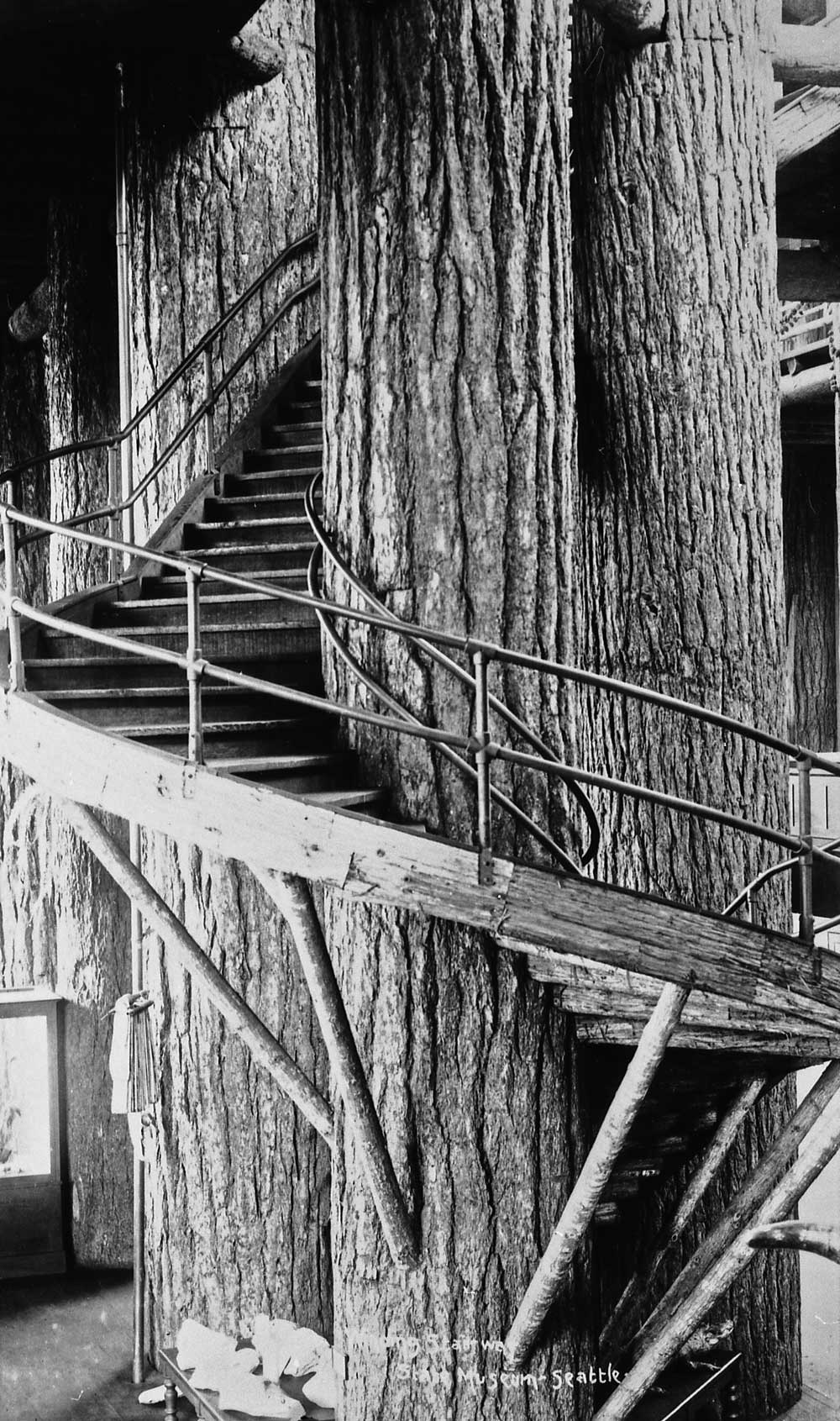
The building’s architects, Saunders and Lawton, had with substantial grace shaped Washington State forest products into the AYP’s classic revival architectural style. From the outside the Forestry Building looked “like a Greek temple done in rustic.” However, on the inside it was a lumber sideshow, filled with the freaks of forestry-like a pair of giant dice six feet thick, cut from a single block and captioned “the kind of dice we roll in Washington.” Also on show was the “Big Stick” which, at 156&1/2 feet long, was “one immense piece of milled timber,” and the 19-foot thick stump with a winding staircase to a cabin built on its top.
With this kind of preparation it was expected that when the fair was finished its Forestry Building would become the woodsy quarters for the University’s Department of Forestry. Instead, it became home of the Washington State Museum and a growing family of hungry wood-chewing beetles. The latter ultimately pushed out the former, and by 1931 this “temple of timber” was razed to sticks. Now in its place is the brick HUB, or Husky Union Building.
CLICK to ENLARGE - CLICK TWICE TO ENLARGE the ENLARGEMENT
This artfully arranged group is drinking something to violin music. All the posing is wonderfully worked out varied. The subjects circle three in masks, and behind them near the back is another masked character, at the table. A few of them are holding or smoking something. Some are pensive – those in the foreground – others seem to raise their glasses in unison and in a toast to something. What are the couple on the left up to – I wonder. Again – or typically – I know nothing about this odd stereo. Perhaps it is not so rare – a kind of oft printed oddity. Don’t know. Hope you do. Mummers comes to mind but that be only because the big cheeks of the masked trio are mumps-like.
It may be one of the banalities of passing time that moments that are remembered vividly seem more recent than they actually are. I suspect that these three Pike Place snaps of artists Gertrude Pacific, on the left, and Billy King may be a twenty years past or more, although, again, they seem more recent. If it were not for the familiarity of the market and the pick-up truck we might imagine this as somewhere in Rome. I have seen Billy as recently as last summer, for a mutual friend’s memorial, increasingly the kind of event that will put old friends in contact however briefly. It used to be parties or trips to the ocean or openings. Thankfully, it still is for many. By now Billy King is more than a tile in market history. For more than forty years he has sometimes lived there, had studios there, worked there (in a fruit stand, I remember), and recently painted a mural with market subjects near the top of the Pike Street Hill Climb. It is a painting made by command, or popular subscriptions. I confess that I have not yet visited it, although I have seen it on a poster. I have not been to the market for many months. The last time may have been more than a year ago when Jean and I took Steve Sampson to lunch there for his goodbye to join Cynthia Rose in their new home in Paris. Gertrude I last saw a quarter-century ago – or perhaps this is a record of the last time. It is time to go to market again – and Paris. And may I have the good fortune to come upon Gertrude with big hair barely restrained by her knit cap.
I have recently taken a liking to reading the messages on the flip sides of postcards. Here’s a revealing example.
OAK HARBOR on Whidbey Island was named, of course, for trees like the one above, which the settlers discovered surrounding the town site. The trading center was known for its Dutch influences and at least when the W.P.A. Guide to Washington State was first published in 1941, the Dutch language was still commonly heard on Barrington Avenue. The message written on the back of the Ellis real photo card #3454 trumpets that Ralph, the card sender, is “having a wonderful time, working seven days a week.” Not certainly, but most likely, Ralph is helping build the naval air bases – both on water and on land – that were first picked for Oak Harbor in January 1941. Construction work began on the land-based Ault Field, about three miles north of the town, in March 1942. Ralph’s postcard to his sister and Homer is postmarked from Oak Harbor on April 29, 1942. He does not describe his work, and it may have been hush hush. Below the flip side message are three military records copied at the National Archives branch here in Seattle when Greg Lange and I were scrounging for illustrations for the book Building Washington (It is included on this blog as a pdf file.). The first one shows a rudimentary map of the seaplane base in relationship to the town, as proposed most likely in 1941. It is followed by two aerials, both from Nov. 15, 1944 and so during the war.
Reflecting on the size of both the Seaplane Base, above, and the land-based Ault Field, below, there was plenty of work for Ralph to keep busy seven days a week. Still we hope that he managed to get away to visit his sis and her Homer in Puyallup.
The 1941 W.P.A. Writer’s Guild to the Evergreen State notes that Oak Harbor got a shipyard in 1854, its first industry. “The schooner Growler, named for its complaining builders, was launched here in 1859 and became one of the best-known boats on Puget Sound in pioneer days.” The guide continues, “Hollanders began to arrive towards the close of the century, and the extremely fertile countryside was developed with characteristic thoroughness by the Dutch farmers who were attracted here. Today [in 1941] the outstanding annual event is the Holland Days Festival; Dutch costumes are worn, old-country games are played; there are prize contests and a livestock show.”
Barrington Avenue is Oak Harbor’s “Main Street.” Follows three looks into Barrington including the “now” that Jean recorded for our book, Washington Then and Now.
We conclude this visit to Whidbey Island with another real photo postcard from Ellis, the Arlington photographer who drove the state for four decades supplying its gift shops and drug stores with real photographs of state landmarks. Judging from the numbers Ellis used, this card was photograph on the same visit to Oak Harbor as the one at the top. Both Ellis cards are used courtesy of John Cooper.
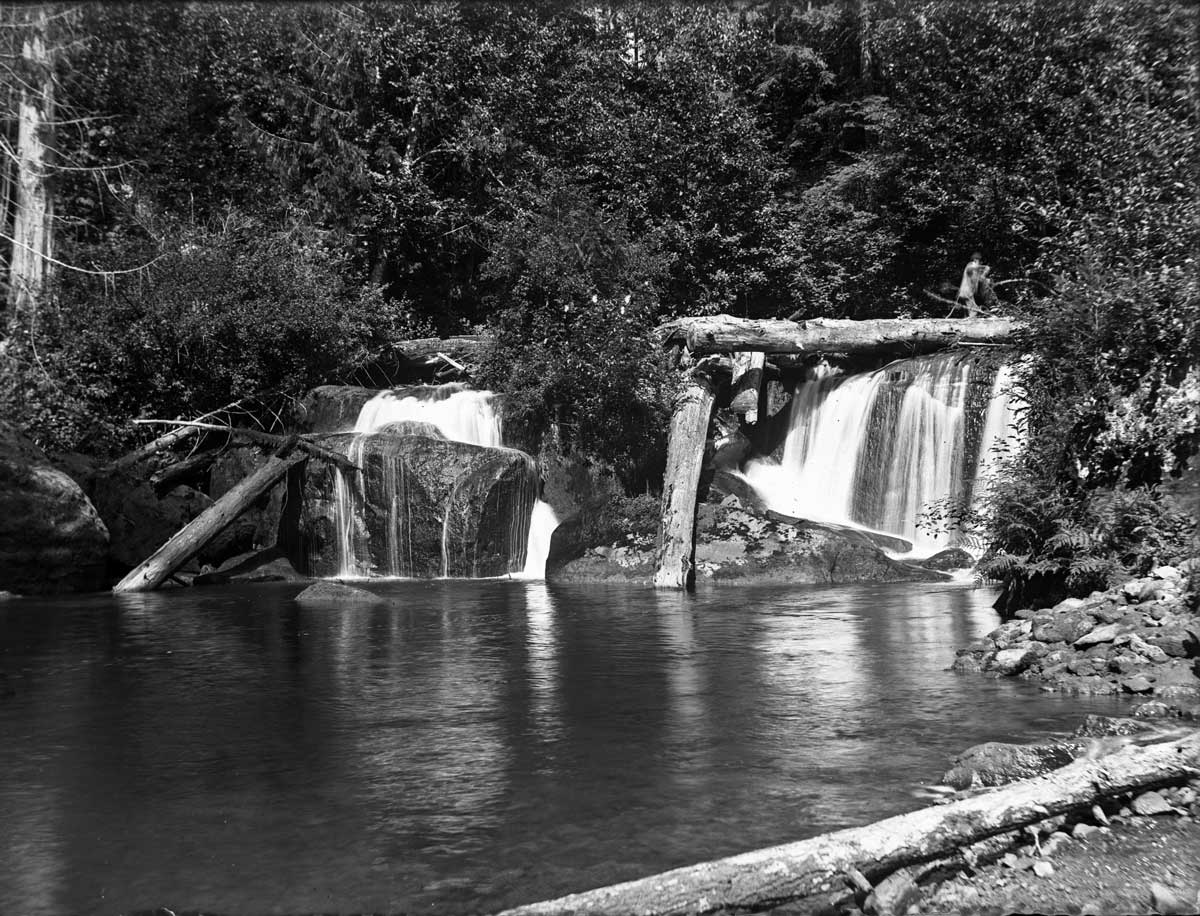
It is now about 40 years since Bill Burden and I last visited Cherry Falls on Cherry Creek in the Cascade foothills northeast of Duvall. It was Larry “Jug” Vanover who first led me to the falls. Bill, I think, was not along on the first visit. Without a guide it would have been hard to find even with good written instructions. There were many splits and turns in the road that wound up at a gate that was sometimes closed and sometimes not. The last leg required a hike down the overgrown bed of a long abandoned logging railroad to the falls which splashed in a pool that was so shaded that even on the hottest visits the water was bracing. It was, however, a splendid place for Diana and her stags. I did some filming there for the Sky River Rock Fire film, which is now also a 40-year work-in-progress. We visited the pool perhaps a half dozen times after Vancouver’s first help in the summer of 1968. He guided us to the falls following that Spring’s Piano Drop, which was staged on Larry’s perfect (for dropping a piano from the sky) property. Of the piano drop I have both film and stills, but of the falls only film. The subject attached here is unidentified. Although it resembles Cherry Falls – as I remember it – I doubt that it is Cherry Falls. Estimating the height of the man standing on top of the falls to the right, (in this circa 1912 glass negative) these falls might be sixteen or so feet high. I think Cherry Creek falls is somewhat higher. In the late 70s Bill Burden and I with an entourage of innocents in two cars tried to find the falls without Larry’s help. We failed. Perhaps next summer we will try again, but first call Larry.
ADDENDUM
Ron Edge – of our “Edge Clippings” – has found a visit to Cherry Falls by a mountaineer who signs his work “Hikin Coug.” Ron ventures, “I assume a graduate of WAZZU.” Hikin Coug dates his photo from this year – or rather last year, 2011. So thanks to Ron and the Hikin Coug, and all the rest on Cherry Falls that is now up and showing on line. Last time I searched, about six years ago, there were no pictures. While close in qualities the older photo is clearly not of Cherry Falls. Given the characteristics of the collection it came from it is almost certainly from somewhere nearby.
Ron Edge – of this blog’s “Edge Clippings” – reminded me that The Seattle Times “key word search” service through the Seattle Public Library website, can also read telephone numbers. He quickly determined that the “782 – 2442” painted by some semi-pro free hand on the somewhat seedy door in the photograph above was the tel. number for John George’s Studio of Performing Arts at 5412 Ballard Ave. N. W. (A parking lot now, I believe.) I have a habit of dating old negatives from my wandering prime as “circa 1970s.” The sidewalk weed at the front door suggests that the door behind it was not often used. However, John George was active here from the 1960s into the 1980s. It is, again, the key-word opportunity that gives us at least a minimal sense of what he was about in this studio. Predictably, there were many other John Georges, the most prolific made from one/half of the Beatles. Beyond the Liverpool connection, a racehorse named John George did pretty well at Longacres in the 1970s, and John George Jr. after him in the 1980s. I also pulled two instructive references to a Salish tribal leader in Vancouver. B.C. named John George. Read on – if you will, and CLICK TWICE to enlarge.
This early reference to John George makes special note of his "free dance instruction for underprivileged children." And Oscar Peterson is in town. The date is at the top.
What appears to be the first self-promotion for our dancer John George puts him in the S.Times Pictorail's montage of ads for Performing Arts services, Sunday, Sept. 8 1968. He credits his studio with the work (his work) of the "award-winning Seattle SeaFair Starlighters." John George subscribes again to the Pictorial montage for Sept. 7, 1969.For many years Robert Heilman was The Seattle Times natty "Man About Town" dressed like sent from Central Casting. In this June 10, 1973 feature, Heilman compliments George's students for their performance in a variety show at the Seattle Center Playhouse. George subscribed for a smaller ad in the Pictorials performing arts montage for Sept. 10, 1978, which has also shrunk to half-a-page. John George has a hand in a benefit for the performing arts in Lynwood. Jan. 28, 1981. This, it seems, is the last citation in The Seattle Times for John George, the dancer/teacher from Radio Music Hall and Ballard. One example of many - most of them post listings - for the horse John George that raced at Longacres in the 1970s. Here John George, a Salish tribal leader from Vancouver B.C., interprets a spooked three year old's communications in his bedroom at night with a man that he describes - thru his mother's interpretation - as looking like Daniel Boone. John George is confident that the boy is mistaken. The speaker is not a white mountain man but one of George's ancestors complaining about the desecration of his burial ground by the laughing child and his sometimes messy bedroom. Dec. 23, 1976, dateline Vancouver B.C..John George (again) greets John Paul with a talking stick during the pope's 1984 visit to Vancouver. With the stick the Prince of the Vatican can safely and with authority speak ex cathedra even on public occasions.
Another John George holds our last clipping. This time George speaks with the authority of Ore-Idaho Foods Inc, as their head of international export sales. We learn that the average European eats more potatoes than the average American (although, it occurs to us, that the average American looks more like a potato than the average European.) America in the fall of 1976 – its bi-centennial – had too many potatoes and was ready to ship and share them with Europe.
Silently set with a lustre so fitting for some of the dancing days we played within it’s walls, the Oddfellows Ballroom (and like the Eagles Auditorium with an encircling balcony) was wonderfully fit for staging light show dances – and our’s were.
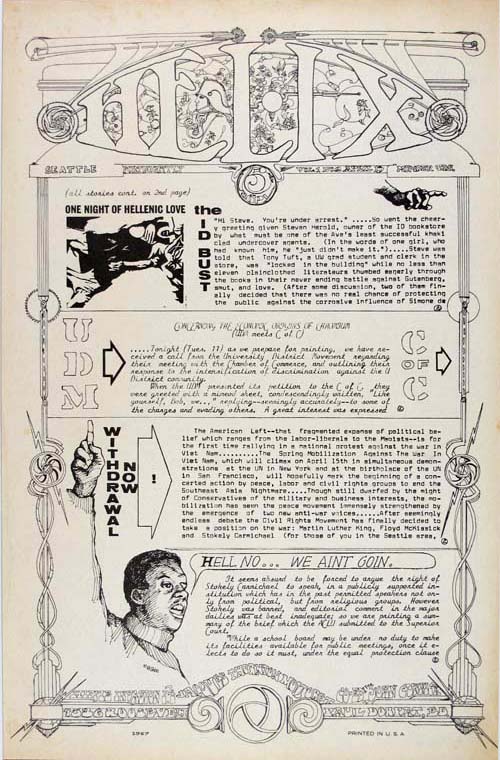
As the poster below elaborately confesses, in 1976 the remnants of 1967 had a big dancing party (we might have called it an A’GOGO-BEIN, except that the connotations of “gogo” were too commercial) here, in this Oddfellows Temple on Seattle’s Capitol Hill, celebrating the 10th Anniversary of the founding of the Helix, the first “alternative tabloid” hereabouts and the local member then of the nation-wide UPS, or Underground Press Syndicate. The Helix was first imagined in the University District, in the upstairs office of the Free University of Seattle (FUS) in the fall of 1966. It sprang of “necessity” from a conversation I had with Paul Sawyer, a Universalist Preacher then, and recently deceased – last year. Paul said, “We need a newspaper – something like the Berkeley Barb.”
The weekly tabloid began publishing in the Spring of 1967. With lots of help from Ron Edge – of this blog’s “Edge Clippings” and more – we hope to put up the entire Helix opera sometime this year. (Ironically, we may have to take on advertising to pay for the added memory required to post it and other over-sized resources. We hope not. Jean especially is committed to a blog free of ads – except, of course, for our own.)
Click Twice to Enlarge. With the exception of Steve's Schafer's cartoon of captured eggs, which was drawn for this poster, all the art here by different Helix hands appeared originally in - HELIX.
One of my many little ways of negotiating survival during the 70’s was receiving two CETA grants through the Seattle Arts Commission. One was for arranging benefits for local non-profits in the arts and the other for studying local history with a mind to making a film about it. I used this hall for more than one of the big benefit shows, and it was in the AND/OR gallery on the ground floor of Oddfellows where I made my first presentation on work-in-progress on the Seattle Film, which I was then calling “Seattle’s Second History.” Recently, Jean’s youngest son Noel was helping feed the 99%, which was temporarily camped nearby on the Seattle Community College campus. Jean and I met him at the Oddfellows cafe and bar. (They ordinarily promote this space singularly with “Oddfellows” and with neither cafe nor bar. I makes it seem more club like.) The cafe is housed in the same big room that was once home to the principal avante garde-plus exhibit and performance space of the 1970s: the And/Or. In the interests of – or curiosity for – the timeline of this hallowed space on 10th Ave., I asked three persons connected with the busy cafe if they knew anything of its past. Alas, they were all clueless. It seems my prime looks forward from the past, while theirs does the same from the present.
It is often a mixed delight to come upon negatives – like the ones on top and below, both of the Oddfellows – I photographed long ago, for ordinarily I did not date them. While I’m confident that from context – several contexts – I’d eventually be able to date this scene, it would require days for sorting and reflecting through thousands of plastic sheets of negatives. For now I put it sometime in the 1970s. Since I also developed the film It would have been so prudent to have simply marked the negative holders – seven strips deep and five 35mm negs wide – with the date and the place, although ordinarily I still remember the latter.
Now that Christmas is Christmas Past, and all the presents are delivered and opened, it is, we hope you will agree, time for us to think again about our pets, and learn now of the wonderful nutritional opportunity that comes but one time a year – this time. Feed your best friend White Rover Dog Food, the only diet for dogs made from reindeer meat. It’s the well-balanced food that both Huskies and Wolves – like White Rover – prefer.
This first local ad (below) for White Rover Dog Food included an offer hard to resist: 3 cans for 23 cents. The Bartell’s ad appeared in the Jan. 21, 1932 Seattle Times.
For the young, White Rover borrowed on the long-lived popularity of the Hollywood star, Rin Tin Tin. For the older dog food consumers, White Rover recalled the heroics of another Alaskan, the dog Buck, in novelist Jack London’s most popular work, Call of the Wild. (1903) Buck was a combination of Saint Bernard and Scotch Shepherd. White Rover, who walked on his own paws, was a mix of 3/4th Yukon Wolf and 1/4th Husky. (These details and more about White Rover are shared in some of the newspaper clips that follow.) In February, 1932, White Rover promotions found their home in the Bon Marche. The big dog appeared regularly on stage in the department store’s auditorium.
The grandest day of White Rover promotions was bundled on Feb. 19, 1932, when the big dog was given his own car for reasons that are sort of explained in the clipping below. [DOUBLE CLICK this one, please.]
Advertisements continued to appear throughout 1932. The one below dates from Nov. 21 and still pushes the reindeer meat attraction in spite of Santa’s imminent needs.
The last WHITE ROVER DOG FOOD ad I could find with the S.Times (thru the Seattle Public Library) key-word search is for Oct. 15th, 1942. It is one of the few products featured in a (back to) Bartell’s ad that compliments “Mrs. War Wife” for shopping where “bargains are really bargains.” And White Rover Dog Food has pretty much held its price through the Great Depression and into the next Great War: three cans for a quarter. The ad does not mention the reindeer. By then whatever Hollywood associations had helped shine the white coat of White Rover, were dimmed by “the most famous dog in the world.” – Lassie. Eric Knight’s short story “Lassie Come-Home” appeared first in the Saturday Evening Post in 1938, and was then stretched into a novel in 1940 and followed by the first of many films in 1943. It had me crying then.
“WILSON’S HAMBURGERS Ill health forces original owner retirement 265′ frontage Grossing over $4,000 month. Sell business with or without property. Carry contract Mr. Wilson, EM 4521 after 8.” The Seattle Times Classifieds, Dec 8, 1952. [Click to Enlarge]
Jean here: I would conjecture that he may be a very small, well-dressed man. That “boulder”, I’m guessing, is only about three feet high. His sprawled pose on the shore suggests that Gregory Peck saw that photo, and replicated the pose exactly for his love scene with Ava Gardner in “On the Beach”.
I snapped this home subject while waiting for the traffic light at 23rd Ave. e. and E. John Street on Capitol Hill. I was heading south on 23rd. I have done a poor job of dating the photograph “protest 80s.” Reagan’s terms ran from 1980 to 1988 and Royer’s further, from 1978 to 1990. But John Spellman’s time, as the state’s governor, was limited to one term, from 1980 to 1984. This scene, then, was recorded in the early 1980s. I recall that the signs, toilets and dummies held the corner for a fairly long term, although I don’t think for four years. It seems like someone lives upstairs. Both windows have curtains and the one on the left also shows, it seems, a candle-holder or a bottle with a long neck – wine perhaps.
Can you (or please try to) make something of this protest by reading the signs – the ones that are more or less legible? Here is what I have deciphered.
Far left beneath the windows with bars and above a hanging toilet seat draped (With what?) the sign reads, in part, “Hang in There.”
Above and between the doors: “Toilet Bowl Strut” (I’m not sure of the “strut”) above musical notation with lyrics, we assume, below the notes, “Rock & Roll in Old Toilet Bowl.”
On the same sign “Section 8 / Reagan? /Spellman? / Royer? / Come Look.”
[I cannot make out the sign above the toilet sitting on the porch between the two doors.]
The signs above and below the toilet seat hanging on the post to the right of the doors are deciphered with some doubts. The top one uses letters with odd serifs and what seem to be chopped words. And the sign is bent. Still, it reads, I think, “Toilet bowl Str(?) Reagan” again. The sign below the open toilet seat reads, in part, “Free apartment . . .” but then concludes with “You” including a strange concluding “U” and a last word that seems to read “haul.” So “Free Apartment You Haul.” What can it mean? And is that a minstrel face painted in the frame of the toilet seat above it?
The large sign, top right, reads “Stop Reagan Now??? / Regan condemns / 8 Units. Cheap Rent 25 cents & 50 cents per hour / Let the public look welcome / Can Gov. Spellman / Can Mayor Royer STOP REAGAN”
Of the three signs resting on the window sill, the one on the left may read “Make (or take) free toilet bowl strut [?] lawyers.” The middle sign cannot be read, but the small commercial sign on the right can be. It reads “House for Sale.” It may be an important point.
The big sign below and right of the window reads “Three bedroom apt. / 50 cents per hour / Reagan says no / more welfare / no subsidized”
The next and smaller sign below seems to read “Captain of the heads.” If so it is a pun on both the toilet seats and the politicians.
Finally, the small sign above the toiled seat, upper-right, seems to stutter, “Let it all all hang out”
What can it mean? So scatological with condemned rooms for rent and by the hour.
Victory Lygdman has put himself in what at least seems to be an exposed prospect to look south towards Lake Union from a concrete pier, perhaps, part of the construcdtion of the Lake Washington Ship Canal Bridge on what was then still being called The Seattle Freeway. There is as yet no Space Needle on the horizon. The retinue of small boats seem to be all heading from Portage Bay into the lake proper. It does not seem like a large enough flotilla to count as the opening day parade. The Wayland mill is to the right (west) of the bridge - with the silo burner. The boxish building to the left of it, and partly hidden behind one of the bridge's concrete piers, is now the studio space for the glass artist Dale Chihuli. The mill site and its bed of cedar sawdust is now the home of Ivar's Indian Salmon House, and has been since 1969. The other box - a long two story apartment house - and the homes below are now gone, replaced by the popular restaurant's parking lot. A circa date for this is 1961. ( Click TWICE to Enlarge)The I-5 expressway ramp that "inserts" at 42nd Street and 7th Avenue. It passes above Pasadena Place once part of the Latona Neighborhood's business district - in the 1890s. The unfinished ramp is most likely the path Victor Lygdman took to take the view below this one - the shot that looks east towards the campus. (Click TWICE to enlarge)We have printed this large enough to explore. So CLICK TWICE. Below is 40th Street where it splits both to the east (for routes both to and under the University Bridge, and to the west, where 42nd runs as two two lane avenues, one the high road and the other the low. Note the Campus Parkway, which leads then as now to the campus and there with the semi-sturdy bulk of the old Meany Hall still in its place. A spur off of the old Lake Shore and Eastern Railway (the Burke Gilman Recreation Trail) is on the far right. It led to a fuel bunker. There is much else to discover in this generous recording. These three photos by Victor Lygdman are also appropriate for what follows tomorrow with the weekly now-then feature spawned out of Pacific Magazine in The Sunday Seattle Times. The subject will be the early 1960s folkmusic venue, the Pamir House on the "Ave." (CLICK TWICE TO ENLARGE)The bridge, and about the same time at Victor's "ramp" shot. You can see the unfinish express lane ramp in this aerial as well. And the Space Needle too. (Not by Lygdman)
Looking south on 2nd Ave. towards Union Street, 1961. (click to enlarge)Looking north on First Ave. towards Pike Street, 1961 (Click to Enlarge)On Thomas Street looking west towards Minor Avenue, 1961. (Click to Enlarge)
The street scene below were all recorded by Victor Lygdman during the summer of 1961. Born in Seattle in 1927, Victor live in the Wallingford neighborhood of Seattle for most of his life, and was an activist there with one of the early food banks. He was also one of a handful of locals who were sometimes refered to as the "Mayor of Wallingford." He explained that he gave the name to himself. "Actually, I went out on 45th and Wallingford one morning at 6:00 a.m. and I said, 'I am the mayor.' I didn't hear a voice of dissent so I declared myself official Mayor of Wallingford." He was a fixture - a moving one. Victor may have got his first camera in his twenties. He also liked to paint and write. Having known him I suspect he may have also once done some acting. Victor had a long and creative life. He died on Feb. 13, 2010. We'll sometimes put up his photographs under the Seattle Confidential tag, although he was pretty good about at least dating his negatives. The above looks to me like a formal high school portrait, which would date it from the mid-40s. (Click Them TWICE to Enlarge Them)
To me the above gent holding a paper looks something like the old Capitol Hill Times Editor of the 40th thru the 70s, Louis Magrini.
The one looks east on Pine toward its intersection with 3rd Ave. The facades of both the Bon and Frederick and Nelson show on the left.
This gent at least resembles Louis Magrini, the long-time editor of the Capitol Hill Times. More likely that it is the newsman tending the sales box for the daily pulps.
Some of these required, it would seem, some snapping with quick withdrawal. When I first attempted to include this, my computer denied me, explaining that the image was withheld for “security reasons.” In the tone or temper of the times, “National Security?” I thought – seeing the sailor. Then checking the file I discovered that the “jpeg” ID had not yet been affixed.
This is, we think or confess, more Seattle exposed than confidential. From the early 60's well into the 1980's Frank Shaw explored the waterfront, the Central Business District, and the mountains hereabouts - he was a member of the Mountaineers - with his Hasselblad and results like this. Frank lived near Seattle Center and also recorded the building of the Seattle Center campus for Century 21. However, the examples that follow are not Frank's but Victor's - Victor Lygdman. (Click TWICE to Enlarge)Hammering in Century 21 with grace and Forward Thrust. by Victor LygdmanBreaking for lunch with the Coliseum to the rear. By Victor LygdmanAfter work. by Victor Lygdman
Steptoe Butte is a proper choice now to recall Horace Sykes' love for the Butte and its views and his frequent return to it. This is the third to the last of the 500 Sykes Kodachromes. Certainly our numbering is flawed for we have sometimes included more than one example of his photography on a given day. But for the sake of ceremony we will stand by 500 as the number of days we have given place to Sykes and his pictures. This view, I think, looks west toward the cascades which are not seen because of clouds. Steptoe Davis had a powerful telescope in an observatory on the roof of his hotel at the top of the Butte, and looking at Mt. Rainier and some other peaks was one of the thrills of climbing the butte to visit the hotel. Visitors from the Palouse might also have a chance to see their own farm, if it was not lost behind a fold in the rolling Palouse terrain.
When a collective of artists prepared to lessen with sweat investments the costs of converting a vacant hotel in Seattle's Belltown neighborhood - the APEX at the southwest corner of First Ave. and Bell Street - into studios and living space, we first enjoyed exposing the layers of wallpaper that had through the years given periodic new beginnings to this cheap working man's hotel. I snapped this, I think, in 1983. I was an APEX member-resident for only a few months (before moving on to Wallingford) but did use my studio there to layout the first "Seattle Now and Then" book in 1984. In a large manila envelope I have kept some wallpaper samples pulled and scraped from APEX walls. (Click to Enlarge)
The weekly now-then feature in Pacific began nearly 30 years ago, on the Sunday of Jan 17, 1982. One of the pleasant surprises that followed having a place in the big pulp was – and still is – the people who want to share or show old photographs with me. Grace McAdam was one of the first readers to make contact with me – I think it was through the help of John Hanawalt at Old Seattle Paperworks in the Pike Place Market (which, is still imbedded there in the lower level next to the Big Shoe Museum.) Grace brought two albums and several loose snapshots that her brother Max had recorded in the first years of the 20th Century. At the time I met Grace her old brother was no longer living – except through her memories and his pictures and a few letters. All of it revealed a man of considerable zest that included what seems, at least, to have had a passionate commitment to the life of a single in his prime. Grace noted that her brother Max was quite popular with her girlfriends.
The bachelor life of Max Loudon is revealed in the albums he carefully filled with snapshots he took of his many adventures. Included are records of joyful events: the spontaneous November 1918 Armistice Day celebrations on the streets of downtown, the arrival of the circus to the lower Queen Anne fields (now Seattle Center), and skating on Green Lake during the long freeze of 1916.
Spontaneous parade celebrating the end of World War One. The view looks north on 2nd Ave. from Madison Street.
We’ll include here mostly group shots, and most of these of women. Truth is he took many more pictures of women he worked and sported with then of men. Directly below is a snapshot of Max on the right with his brother Earl standing in their swimsuits at some public beach where they are warned to wash away the sand before they use the pool. It may well be the pool at Luna Park or another on Alki Beach. Below it Grace McAdams romps on Alki beach with two friends. Grace is on the right and Luna Park behind her.
And another of Grace this time “whipped” by her other bother, Earl, as Max snaps.
One of Loudon's favorites subjects, and also at Luna Park.
Born in Nebraska in 1881, Loudon dropped out of Omaha High School at the age of 15 and headed west to Seattle. Here his personable intelligence (aka charm) carried him through an assortment of vocational adventures: manager of a semi-professional baseball team, traveling superintendent for a grocery wholesaler in Montana, manager of the general store for a logging company in Yacolt, Wash., and a trip north to Nome, Alaska, seeking gold – what else? As revealed in his letters home, this last adventure soon turned hellishly cold when his steamer stuck in the ice for two weeks.
Yacold sawyers by Max Loudon
Nisqualli Glacier, perhaps. There is in the same album a group shot - face forward - of hikers with their staffs posing by the lodge.
Here in Seattle, the young Loudon cut his commercial teeth working nine years for Schwabacher Bros. Wholesale Grocers. He became warehouse superintendent for the Grocetaria Stores, in charge of all departments. His salary -whopping for the time -was $150 a month. I was enough, most likely, to support his sporting life as an amateur boxer for the Seattle Athletic Club, an expert fencer, a medalist marksman and – at least from the evidence of his albums – a man confident in the company of women.
A few of the Loudon’s subjects included here feature Stewart and Holmes Drugstore employees. Some he posed on the alley trestle that runs above the railroad tracks entering the southern end of the city’s railroad tunnel, below Fourth Avenue and Washington Street.
Both Grace and Max followed local theatre on stage and back, and Grace also played some parts.
The Good and the Bad - depending.The Good - ordinarily. Cabrini Sisters on First Hill.
In conclusion, but not finally, we return Max to the family, although not his, but his sister's Grace, on the right, and her best friend Elliott, on the left. These two managed to have babies together too, or nearly. Somewhere I have pictures of the two of them in Grace's Denny Regrade condo, ca. 1982. These too will be posted later.
Horace Sykes made many Kodachrome copies of paintings, and he especially liked genre and regional art. Included are a few examples, like this, of Alaskan artist Sydney Lawrence. Actually, Lawrence was born in Brooklyn in 1865, and spent most of the 1890s painting in England, a member of an artist's colony in Cornwall. He exhibited widely then and even won a prize at the Paris Salon of 1894. But in 1904 me made the very big change of moving to Alaska. Eventually he wound up in Anchorage, when it was still a small town, and for a quarter-century until his death in 1940 kept painting and building the reputation as Alaska's primary painter of, of course, Alaskan subjects, like this one. It is certainly possible to see some of same big sky urges that also moved Sykes with his own picturesque slides. (Click to Enalarge)
Here's another slide from a handful of them merely titled "Urban Renewal," and from internal evidences dating, so far, from the 1950s. The pile of shoes on the floor is a touching example of anxious hording - I imagine. (At least on my MAC, one needs to Click TWICE to Enlarge.)
This I snapped during a visit to White Front sometime in the 70s. I no longer remember if the name was joined as one – Whitefront. I remember being startled by the sign promoting Santa before Thanksgiving and the Sat. Nov. 25th date is a clue at least to possible years that the day that the day that is still two days after Thanksgiving came on a Saturday. I remember the Niagara Cyclo massagers but neither Ira Blue nor KGO radio. Here a carboard Ira gives a personal touch to the vibrator. And last, why there would be a table filled with heads for my inspection, that I don’t remember either. Now looking back to the second (middle) subject, I wonder if the blonde on the left might have borrowed her big hair from one of these heads. The White Front building on Aurora near 135th may be a K-Mart now, if it has survived the latest falling. (Click to Enlarge)
I cannot confirm it, but I think that is Horace Sykes on the winding dirt road acting on his frequent delight in studying roads, both paved and not, heading off into picturesque landscapes. Here was have both. This subject, again, is not named by Horace, but it is almost certainly somewhere in the Palouse. We have shown among the other 494 Daily (nearly) Sykes shown here since early in 2010 photographs that included Horace looking at the camera or posing for it, at least once with his camera. This subject also carries a 35mm camera over his shoulder, and it is those shoulders - and the posture - that make me think they are Horace's broad ones. His athletic daughter Jeannette had them too.. Here she is below posing with the family dog on one of her visits to Seattle. Sometimes she was accompanied by her husband, the navy man, and sometimes not. (Click to Enlarge)
The focus is soft and the color askew but the wit of Horace Sykes caption is enjoyed. “Here’s How Martha Got George.” He penned it on the border of the slide. His daughter Jeannette peeks at her father and he at her through the gate to their home with mother Elizabeth at the Puget Sound end of Bertona Lane in Magnolia. They moved from Capitol Hill to their new Magnolia home in 1932. Jeanette was then twenty-two and still in school – either the U.W. or perhaps by then Cornish. This is many years later – most likely on one of her visits to her folks in the late 1940s. Jeannette was a ballet dancer and distinguished by her formidable frame. Some of her dancing was done at Cornish. The Times description of her on her wedding day to Navy Lieutenant Henry Clay DeLong (of Bath Maine) reads, in part, “The bride who is a tall, stately blond, was given in marriage by her father . . . She carried a handkerchief made from the lace of her great-great grandmother’s wedding gown.” The wedding was at St. Marks on August 16, 1935. Earlier that year Jeannette was crowned Carnival Queen at Mt. Rainier, for the 4th annual Spring Ski Carnival at Paradise Valley. It was also the site of Jeannette’s triumph in 1922 when the 12-year old beat her father to the top of Mt. Rainier, and became, the Times reported, “the youngest person ever to reach the summit.” Three years more and the Times “added” that the teen Jeannette was doing radio skits with her father Horace on the subject of fire safety. She “took the part of ‘Mrs. Smith,’ the woman with the house full of fire hazards.” (Click to Enlarge)
Or nearly, to wish even those among us who no longer deck the halls, a Merry memory of a Merry Christmas, perhaps long ago with snow on snow. I remember now the four foot drifts of it in Grand Forks, North Dakota, and the toboggan run my brothers made from the back of the parsonage on Reeves Drive to the banks of the Red River, and asking my dad when I was five or six "Is there a Santa Clause?" and being told "No." Well that was that then wasn't it? My older neighbor, Jane - about nine or ten - was right then. Neither did Jane believe in a "virgin birth," which to me was simply a fact - I did not yet understand. (Click twice to Enlarge)
Perhaps the last image we will share of Horace Syke's Southwest Highways - almost all of them dirt in the late 1940s. We have given it the second number "Nine" to indicate our countdown to suspending Horace's driving license. We have then eight more from Sykes - or rather presentations, for we may show a few Sykes family photos at the end. (Click to Enlarge)
This slide and a few more of similar subjects were salvaged for me by a friend. They are all parts of a collection of rhetorical evidences of squalor from the 1950s (most likely), indicating a need for renewal - "urban renewal" when there was federal money behind it. Here probably a single man makes his home perhaps in a one room hut that is heated by the small wood burning stove and insulated with prints of mostly sentimental nature art plus a few snapshots and the colorful waxed paper used to wrap Holsum Bread, once a popular brand in Seattle. There's a radio on the table to the right and it seems to be plugged in. There certainly is power, and probably - if true to what we expect - a naked bulb hanging from the ceiling, screwed into a connector that also allows the radio to get its power. (If we turn the radio on we may hear "Some Enchanted Evening" but rarely "Brother Can You Spare A Dime." And there are other lines crossing this space, perhaps for hanging wet clothes over the fire. The floor while soiled still shows its floral star pattern. Warming to the right of the stove is the luxury of a second pair of shoes. (Click TWICE to Enlarge)
This unidentified tunnel with a brook babbling from it is part of that small collection of Horace Sykes slides for which the color has been drained by time. Many of them have to do with Lake Chelan subjects. Perhaps this is part of Railroad Creek on the way to the Holden Mine in the late 1940s. Tunnels are often remembered. Here's hoping that some reader recognizes this one. (Click TWICE to Enlarge) Postscript: We are going to finish with Sykes - as a more-or-less daily feature - at that nice and round number 500. We have a few other collections that we can treat with daily offerings, but we have not, as yet, decided which to use next.
If you knew that Jean (our Sherrard) is wearing an early Bumbershoot T-Shirt, and thought that you also located over his (own) left shoulder (on the right) the pyramid top to Seattle's venerable Smith Tower, you might think that Jean is here visiting with perhaps a touring soccer club, although these uniforms are not so sporting. But you would be wrong. This is from one of Jean's trips to Africa, and this a scene from the time he drove a Land Rover far into its center. (I scanned this slide among many others for possible use in last month's memorial service for Jean's mother.) Bumbershoot and Jean are even more familiar than its early shirt on his back. In 2000 Jean, Cathy Wadley and I scrambled to produce a video history of the festival. It still gets aired around Labor Day. And so in the mid-1970s - I am speculating on the date - Jean Sherrard was one Bumbershoot plenipotentiary with plenty of potential.
This looks north on the west side of First South a little ways north of Holgate Street - I believe. I shared a studio nearby in the Cork Insulation Wharehouse, top floor, in the late 1970s to 1981. (Click to Enlarge)
The only time I visited Timberline was in the late 1940s with my parents. It was about the time that Horace took this Kodachrome of the famous lodge. Both the dress and blue slacks look like things out of my mothers closet - at least I assume that is where she kept them. I know from pictures that during wet winters it is hard to find a lodge below the snow. (Click to Enlarge)
I don't know this bridge but imagine that it is somewhere in the Palouse of southeast Washington. Above it are two motorcars (of the 1940s) near a curve that will turn the road they travel down to pass beneath the bridge, which, I imagine only, is for trains. And yet it is wide enough, it seems, to accommodate two lanes of traffic. (Click to Enlarge)
Ron Edge sends along a link to a slick piece of promotion for the Battersea Station’s duty as centerpiece for a proposed new London neighborhood. Perhaps it – the link and these ambitious plans – will work. Warning: while animation included in the link is satisfying the tone of the production is, for my taste, much too pushy-confident. Here’s the link: http://www.battersea-powerstation.com/ I see it shares no color, and so probably will not link. However, you can enter it by key and most-likely find it.
Earlier today, Sunday, Jean and his family drove in a circles over Stevens, Blewett and Snoqualmie passes. It was not the first time for what is a growing autumnal tradition for the family. They out were looking for golden-yellow larches in higher elevations on the east side of the Cascades, and they, of course, found them. They took a dirt road off of Blewett pass and climbed until they reached snow, which they tested but soon thought worse for it and pulled back when the tires began to spin. Out of the car, they carefully climbed higher thru the snow and Jean, of course, too several photographs. But his is not one of them - although there are larches here. Rather this is, of course, another Horace Sykes slide, and also almost of course we know not where. Perhaps Jean will attach a few of his own larches on Monday morning. (Click to Enlarge and expect an impressionist effect. Horace was apparently focusing on the foreground. Jean's larches will be in focus - if and when he meets the "challenge.")
All righty then, Paul – here’s proof of our larch adventure – a 180 degree pan on the snowy dirt road above Blewett (my son Noel is on the left):
There is, I'm confident, a term borrowed from the French - who rarely see them - for the kind of mountains that group together on a high plateau and take relatively little space. These appear often in the high country of Utah, Colorado, Wyoming, New Mexico, Arizona and Nevada, but rarely in the coastal states and never in Kansas. A good example is Mt. San Francisco north of the Grand Canyon in Arizona. You can drive around that "grouping" - perhaps "le Groupe Massif" - in an hour or nearly. But it is a bad example too, for included in that clump is the highest peak in Arizona, although because it rests on country that is already high you can walk to the top if you are anywhere near your prime and/or fit. On this horizon is another example, one I have tried to identify but so far failed. Perhaps it will be familiar to a reader with greater topographic talents than my own. (Click to Enlarge)
Horace has left us a clue. A possible year for this "Cream of Chelan Still Life Behind Glass" is 1947. The poster lying on the stage behind the plate glass window schedules a week for apples beginning on Oct. 26. 1947 is the most likely year for Horace Sykes during which Oct. 26 comes on a Sunday. I know or have felt first hand the Washington State apple propaganda of the late 1940s. It was a time when any doubts that this state - especially the part of it with Wenatchee - was the best grower of Apples anywhere, would have been repelled as a threat to one's provincial principles.
I remember the great excitement for hydros in the early 1950s, and perhaps earlier. But now I have forgotten where many of the races were held - aside from those on Lake Washington and on the Columbia River at Kennewick. This, I think, is neither of those. In this light the inefficiency or distortions of Horace's lens - or one of them - is evident.
This Horace Sykes has either underexposed or set for the tempestuous sky. The lack of exposure in the landscape still hints of the lakes in the Grand Coulee, or perhaps of the river itself. (Click to Enlarge)
One of America's expressions of its fruitfulness and prosperity is the kiddie's parade, often a cue of kids and their wheels, as here. I remember well outfitting my Spitfire (bike) with bunting in its spikes and attaching playing cards that flapped against the swath of spokes kept free of ribbons in order to make a noise that, at least, resembled internal combustion. Again, Horace does not caption his slide and the focus is soft enough that we cannot find clues signed on the storefronts up the street. The counterpoint of kids, cars and trees is pleasing too. (Click to Enlarge)
My father, T. E. Dorpat (Ted to other preachers but pastor to the flock), was sublimely smitten by the Grand Tetons after he first visited it as a young clergyman in Miles City, Montana. He was of the conviction that these were at least the most beautiful mountain range in the county, and perhaps in the world. Jackson Lake and it reflections surely had something to do with his commitment. My dad returned to Jackson Hole in 1948 with the family while on our way from Spokane to Houston for the bi-annual church convention. I can still recall the splendid new car smell of our brand new Studebacker - the one with the pointed nose. Earlier we shared another of Horace Syke's slides of the Tetons as seen from this shore. He took several, but it is this one I now prefer for its screen of nearly leafless trees. (Click to Enlarge)
Aberrations in Horace Sykes' lens and a possible shift in Kodachrome chemistry over the last 60 years creates a fevered grove of birches - somewhere. Big Bird bowing on stilts. (CLICK to ENLARGE)
One more unidentified landscape from Utah or Arizona. There is here hope, however. A paved highway is a rare item in Sykes desert subjects. One could encourage someone else to undergo a routine of disciplined Google Earth touring along the principal highways, staring in Southern Utah and Northern Arizona - perhaps. (Click to Enlarge)
The solitary stack or tower or grain hopper on this horizon reminds me of an artist named Cooper – John Cooper, I think, although I now know a local collector by that name and so may be confused, however the Heald brothers, Paul and Larry/Charles, both artists themselves, would know, for at least Paul taught art in or attended Indiana (or Illinois) University in the mid-1960s when Cooper or Coop’ was there, if that was his name – who in 1968 or ’69 was driving around the United States in an older Cadillac painting grain hoppers (not on them) with whatever media and on whatever surface was available. Coop’s hoppers, I repeat, resembled that landmark left of center in this, of course, unnamed – by Sykes – place. These oversize farming artifacts had, as I remember it, taken on some symbolic role for the often manic Coop who once had exhibited – or assembled – a show of several of them on the campus where he taught. He was a persuasive fellow and traveled – I think I’m correct in this – without funds. I traded him a beer in the Kulshan Tavern – in the Fairhaven part of Bellingham – for a portrait of myself, which he painted on an easel and surrounded with symbols of many sorts like the ying yang and his hoppers. He did the painting in an open field – or vacant lot – near the tavern and the sun was setting over Lummi Island. For me it was a most joyful event. (Click to Enlarge)
Horace Sykes variation on that most popular Mt. Rainier theme - its set with Lake Washington - gives nearly as much attention to the sunset-reflecting lake as to the mountain. Was it the ducks that made him do it? (Click to Enlarge)
Here Horace has lined up two open doors: the distant one to is Chevy, and the near at hand one to a throne room. We may wonder at his interest, and we may scold any reader who thinks that the inclusion of this subject in Our Daily Sykes series is a sign that we are nearing its end. (Click TWICE to Enlarge)