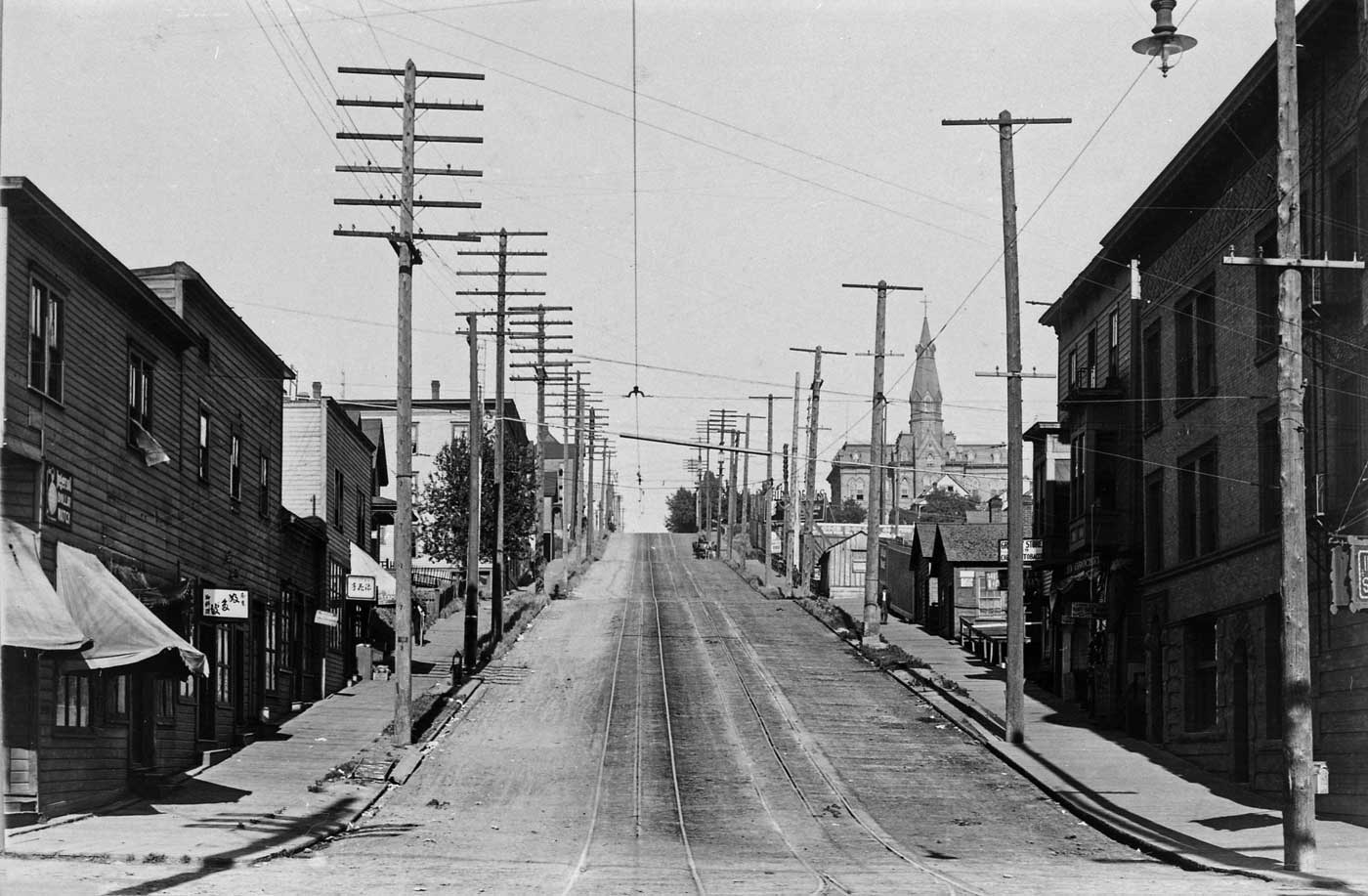
Jean has enlightened me concerning the fate of items added to any of our posts. Depending upon the timing, some readers will never see them. The reason is that the original contents of a posting – and this part is mysterious still to me – are copied by entities, which then share them with others who ask for them. The mysterious but still mighty servers are only interested in “beginnings” and do not write over or add the additions to their original copies of the page. They resemble teachers who will not take late changes – including additions – to a term paper. And so you see the problem of adding information – mostly illustrations – later on. Consequently, we here add addenda (or addendums, if you prefer) fresh and at the blog’s top as late additions to the Riverside story that appears in its greater part below Jean’s restaurant review of Green Lake’s Trattoria Cioppino, which is just below.
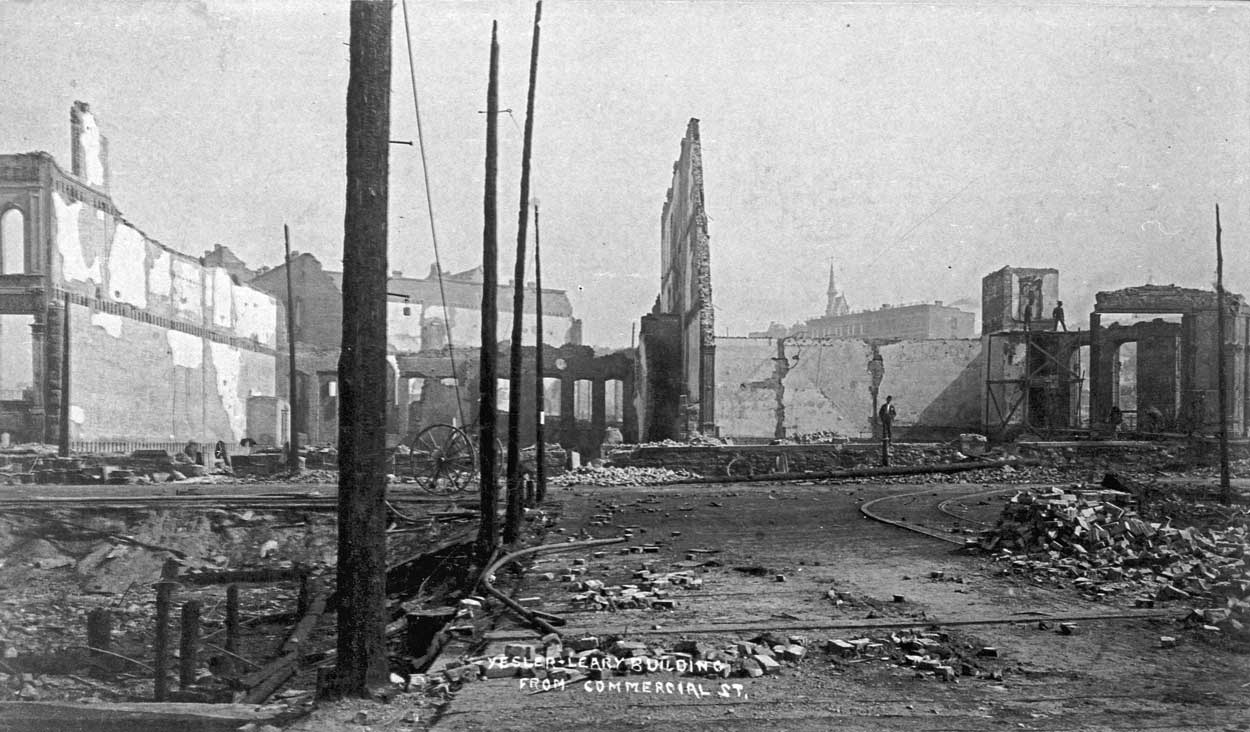
Hotel West, but not dated. To the rear, I believe, of Hotel West where something is smoking, right-of-center, April 12, 1923.Hotel West with pile driver from bridge work - not dated - and the profile of Pigeon Point.Map of Pigeon Point from 1895. (Not so long ago)Pigeon Point - and more - from a 1931 Sanborn real estate map. Looking west from Pigeon Point over W. Spokane Street - and the Youngstown Viaduct for trolleys - to West Seattle - July 6, 1931. (Courtesy Municipal Archive)Looking West on W. Spokane Street below Pigeon Point. On top the regraded Pigeon Point appears at the top left corner in a 1930 look from the Youngstown Viaduct, which also includes the Shanghai's alluring promise of dancing to live music. Bottom, the Shanghai has become Marty's Tavern (see the next same day pix below) recorded from the Spokane Street grade in 1962. (Courtesy of the Southwest Seattle Historical Society.)
We interrupt our regular Sunday post of ‘Seattle Now & Then’ (found just below) to introduce a restaurant we’ve come to adore.
Owner/Chef Riccardo Simeone with his eponymous - and swooningly delicious - cioppino
Occasionally, at DorpatSherrardLomont, we come across treasures we feel compelled to share with our readers – often photographic, historical, or quirky – but this is our first culinary treasure: Trattoria Cioppino, opened since late last spring, is the real deal; an Italian jewel on Green Lake’s north end (just across Green Lake Way from the wading pool).
Trattoria Cioppino on a recent snowy evening
This lovely, welcoming little eatery boasts a mouth-watering menu with dishes that are eyes-rolled-back-in-the-head delicious. Jean has, in short order, become a regular, and finds an excuse to return for more as often as possible. To excerpt his Yelp review, the food is delicious in a way that “reaches down to some well-spring of deliciousness” combined with “gorgeous, no-nonsense preparation.”
From the spectacular calamari appetizer – tender, crisp, with a knock-out aoli for dipping (only $8 for a generous serving that satisfies four) – to mains including melt in the mouth gnocchi with succulent and tender boneless short ribs ($14); perfectly seared and savory duck breast with figs; delicate spectacular veal marsala ($17); and a cioppino that blows the roof off, mussels, clams, baby octopuses, and scallops flawlessly cooked and artfully arranged around a slab of buttery moist salmon (enough to feed two, $23).
Not to mention the desserts, all made in-house by Chef Riccardo, ranging from a mouth-watering chocolate vesuvius, to glorious cheesecake with figs, an amazing tiramisu, and a stunning creme brulee. Give me strength! In four visits so far, Jean hasn’t had a dish anything less than delightful. This is truly Italian soul food.
If it isn’t clear by now, this is a place we can recommend without reservation – although it’s wise to call ahead to make your own!
(For more about Trattoria Cioppino and Chef Simeone, click here)
THEN: Propping the game’s head on the erect barrel of his rifle, Riverside resident John Edgar Vincent poses with his fall quarry, circa 1946. (Courtesy of Hazel Vincent)NOW: Reared in the Riverside neighborhood, Jerry Vandenberg, returns to the Vincent driveway to repeat the Vincent family snapshot about 65 years later. The top of the closed railroad bascule bridge on the Duwamish Waterway is evident on the left of both scenes.
As Barbara Vincent Johnson remembers it, her older sister Hazel Vincent Munro excitedly snapped this askew picture of their father John Edgar Vincent soon after he returned from a hunting trip to the Okanogan around 1946. Her machinist dad and her younger brother “drove at night to keep the meat cool. The catch was butchered on the oak table in the family dining room, wrapped and then sped to a cold storage on the waterfront below the Pike Place Market.” For the Vincent family, deer was the “meat of necessity,” along with backyard chickens that were no longer laying eggs. Okanogan venison was especially sweet, their dad explained, because the deer there dined on apples and grain.
The Vincent family lived in Riverside, one of the Seattle neighborhoods uniquely shaped by the city’s hills and waterways. Riverside is nestled – or squeezed – between the Duwamish River, at its mouth, on the east and Pigeon Point on the west. It is small and depending on how you wrap them shaped something like a bouquet of long-stemmed flowers. It comes to a point at its north end, where since 1983 it is hidden below the high bridge to West Seattle.
Next Saturday, January 28, at noon, representatives of the Vincent family and about 60 other historical Riverside families will be “Coming Home to Riverside.” It is a memorial celebration about five years in the making, thanks in large measure to Frank Zuvela, the Budinich family that donated the triangular lot (like the neighborhood), brothers Jerry and Ron Vandenberg, who built there the Riverside Plaza, a monument to the neighborhood and its families.
Jerry Vandenberg standing amongst the pavers, engraved with family names
Frank Zuvela is now 89 but vigorous enough to lead yearly walking tours of the neighborhood. His family arrived at the mouth of the Duwamish in 1904. Like the majority of Riverside’s fishermen families, his forebears came from Croatia. Many owned fishing boats, moored them on the river, and hired Croatian crews from, yes, Riverside. It was a very organic and helping neighborhood even for those like the Vandenberg brothers whose family was Dutch.
With multi-colored commemorative tiles for both families and home sites that are faithfully arranged to repeat the patterns of the neighborhood, this Riverside creation is better visited than described. You may find it at next Saturday’s dedication – co-sponsored by the Southwest Seattle Historical Society – where Marginal Pl. Southwest meets West Marginal Way Southwest.
WEB EXTRAS
Here’s another shot of Jerry, posed above the Vandenberg paving stone.
Jerry's childhood home was on the side of the hill above his right shoulder
Anything to add, Paul? Sure Jean, and we will begin with the “other” photo from the same driveway, or very near it, where John Edgar Vincent stands with his catch propped by the barrel of the rifle that felled it. Here’s John Edge Vincent’s daughter Barbara Vincent Johnson, who has told us that she was standing near the spot her dad stood, although not on it, and on a different day. You noted that when Jerry Vandenberg visited the site with you for the “now” he pointed out that the same house appears in the shots of both the “dears” as you so cleverly punned it. So here is Barbara with whom I had a long and delightful telephone conversation when researching this story.
=====
The feature that follows is “about” the photograph shown above, which I copied from a print. In 1978 or thereabouts I went through all the Engineering Department’s (city of) nitrate negatives, pulling the bad ones. I found among them the negative for the 1918 Riverside scene above. It had gone the way of all nitrate – eventually. It is sort of explosive too. Indeed there is a law against having nitrate film in the city. On that prohibition I once spent a week in the basement of the Whatcom Museum in Bellingham going through thousands of feet of nitrate film of the northwest filmed by Pathe Newsreel Photographer Will Hudson. I could not do the work in Seattle – by law. My selections were transferred to safety film.
We will grab a page from "Seattle Now and Then, Volume One" to show that we used a different title there, and also to share the "now" that appeared first in Pacific.Photographed the same Feb.27, 1918 as the view above it, here the business heart of Riverside is not obscured by the trolley. (Courtesy Municipal Archives)
SIX BRIDGES to RIVERSIDE
(First appeared in Pacific, Dec. 18, 1983)
The contemporary photograph was shot at 11:30 in the morning of November 10, 1983. At that moment 140 feet overhead, the inaugural ribbon was being cut atop the new high bridge to West Seattle. And through the opening rushed the storm-tossed music of the Sealth High School Band, the wind-lifted cheers of West Seattle boosters in their red and white Hi-Yu uniforms, and the “ultimate solution” to 132 years (less about 68 hours) of the often frustrating task of getting to and from West Seattle. (This problem could be said to have begun in the early morning of November 13, 1851 with the landing of the Denny, Boren, and Low families at Alki Point.
This high bridge (the western approach cuts across the top of the “now” scene) is the most recent of six bridges that have crossed the Duwamish here at Spokane Street. The historical scene was photographed from near the western end of the second bridge (and the “now” takes the same line of site). Designed in 1910 and built shortly thereafter, it was given no name but “temporary” in the engineering department’s original plans. All of the first five bridges were, obviously, temporary, and it’s both an engineering and philosophical certainty that the sixth will also be.
This detail from the 1918 Kroll Map shows the swingbridge turning Spokane Street to make a shorter span across the West Waterway. We put the red arrow beside it not to suggest that it was a one-way bridge.
The first bridge was simply a swinging gate in the long viaduct built about 1900 along the future line of Spokane Street from Beacon Hill to Pigeon Point. It crossed above the tideflats and shifting sand islands that irregularly formed the Duwamish River’s estuary into Elliott Bay. (The Spokane Street trestle as seen from Beacon Hill is included in another feature included here below.) Grand plans to build the “world’s largest man-made Island, Harbor Island” and dredge a wider, deeper, and straighter Duwamish resulted in Temporary Bridge No.2 – the one pictured.
Bridge 2 was a swinging bridge. It opened to commerce on the West Waterway by pivoting on a central turntable. But in doing so it also shut off the water supply to West Seattle. The pipes are evident to either side of the roadway. Thus, bathing West Seattle citizens understood that when the bridge was closed, they would temporarily suffer for the long good of Duwamish Valley commerce.
A public works department sketch from Jan. 1, 1917 shows the line of what we call "Bridge #2" on the top and below and paralleling it the plans for "Bridge #3." The next photo below shows Bridge #3 next to Bridge #4, the first of the two Bascules. (Again the red additions are our own. "3." refers to the line of Spokane Street.)
Partly hidden behind streetcar 689 is the sometimes-rowdy barroom business district of Riverside. The ridge behind it is Pigeon Point. Knowing the date of this scene, February 27, 1918, we also know that its rural qualities are deceptive. Directly behind the engineering department photographer, things are quite frantic. There on Harbor Island the largest government contracts in the region’s history were financing the construction of thousands of WWI steel-hulled ships.
After "bridge No. 3" on the right was replace for motor traffic with the first bascule bridge, on the left, No. 3 continued to be used for trolleys. That stor is told below with the feature titled "Shoe Fly."Swing Bridge #3 seen from the Riverside side of Bridge #2 on Feb. 1, 1918.
Looking west to Riverside and in line with "temporary" Bridge #3 on April 12, 1923.The third bridge was much like the second only a little higher and longer. It too swiveled for ships (but no longer carried West Seattle water) and was also labeled on its 1917 plans “temporary” as well.
Looking east from Pigeon Point towards construction work on the second or south bascule bridge (our "Bridge #5) on Spokane Street and over the West Waterway. The date is July 11, 1929. The railroad bridge, on the far right, still stands. Jean's up-close look at it is printed near the bottom of this contribution.
On November 30, 1924, a Miss Sylvia Tell led a group of interpretive dancers from Cornish Arts School to the top of the then brand new steel bascule bridge for some christening choreography. The crowd expected for the official December 21st dedication was more than the bridge could handle, so the entire show was first broadcast the night before on Radio KFOA. The ceremony, both in the studio and on the bridge, was a mix of inspirational music, including a rousing rendition of “Ole South” by the West Seattle Community Orchestra and, of course, speeches. That was bridge number four, although it was named Bridge No. 1 to indicate its hoped-for permanence. Its other name, ” North Bridge” declared that it was only half the story. Within five years Bridge No.2, the South Bridge, was alongside it.
Side by side for the next 48 years, they acted permanent until that lucky morning of June 11, 1978 when local hero-scapegoat, Captain Rolf Neslund, ploughed his gypsum ship, Chavez, into Bridge No. 1 and made it temporary too. Now a ride to West Seattle atop Bridge 6 has the high altitude ease of Cloud Nine. This is the kind of trip that is next to eternity.
=====
Lawton Gowey, who shared this image with us, captions it "W. Spokane Street from Riverside." We are using it for itself but also as a substitute for the image used in Pacific to cover the text below. When we find it, we will attach it. Tis looks west with Pigeon Point behind Hotel West. Lawton Gowey's recording of the West Hotel in Riverside with the flyover on May 30, 1968.Jean's record of what now covers Riverside's old commercial strip at the west end of the bridge.
=====
On April 12, 1923, with his or her back to the West Waterway a municipal photographer recorded this look west into the West Hotel anchored business district at the north end of Riverside.
RIVERSIDE JUNCTION
(First appeared in Pacific, July 28, 1991)
Squeezed between the west bank of the Duwamish River and the steep eastern side of Pigeon Point, the business heart of the Riverside community was once the junction for the streetcar lines that branched to Alki Point, California Avenue, Fauntleroy and Lake Burien. The “then” photographer stood on or near the timber approach to a temporary bridge that once crossed the Duwamish at Spokane Street. Dated April 12, 1923, the scene was recorded more than a year before the first of West Seattle’s two bridges was dedicated.
This subject looks back from west to east thru the Riverside businesses greeting the traffic off the bridges. The bridges showing here, left of center, are the railroad bridge and what we are calling "Bridge #3." Courtesy, Lawton Gowey
Riverside had a collection of storefronts and the Riverside Restaurant. Next to the trolley transfer station was a soda fountain and adjoining waiting room for riders. The Hotel West, the strip’s dominant structure, was used mostly by single men who worked in the sawmills and canneries nearby. The Duwamish was first spanned at Spokane Street in 1902, and the bridges that followed were all necks to an urban hourglass through which traffic moved between Seattle and West Seattle. When the first streetcar lines crossed the bridge in 1907, Riverside was enlivened, and the neighborhood’s vitality was given an old-world charm by its large community of immigrants, many of them Yugoslavians. Riverside’s business fortunes were largely dependent on its role as a junction – a function that was first seriously eroded by the cessation of the city’s trolleys in 1939 and later by the steady conversion of Spokane Street into an elevated speedway. The 1965 opening of the Fauntleroy Expressway, which moved traffic above and by Riverside, was protested by the community for its combined effects on their businesses, their access to the city’s transit and their view of the city across Harbor Island. In the early 1980s most of the site of Riverside’s old business strip was finally surrendered to the high-level West Seattle Bridge.
Hotel West and part of the north end of the Riverside business district appears on the left of this look across the West Waterway during the construction of the first bascule bridge. The Municipal Archive photo is dated April 12, 1923. Again, the West Seattle ridge is on the right horizon and Pigeon Point on the left.
=====
SPOKANE STREET TRESTLE from BEACON HILL
(First appeared in Pacific, April 19, 1987)
One might call this scene “crossing the T’s.” In the historical view, taken circa 1906, two timber-trestle streets intersect. Looking west from Beacon Hill, we see the trestle built above the tide flats south of Pioneer Square on Grant Street, now called Airport Way, running parallel to the tideland shore. If you follow the second trestle, Spokane Street, it leads to the dark peninsula in West Seattle called Pigeon Point.
The first West Seattle bridge across the Duwamish River’s main channel is half hidden behind the screen of steam escaping the engine on the distant track that runs parallel to Spokane Street.
The original negative is part of the Webster & Steven Collection at the Museum of History and Industry. Perhaps the commercial W&S studios photographed this scene for Emmett Nist. That’s his Seattle Tacoma Box Co. sitting on pilings in the center of the photo. The Nist company moved to 401 Spokane Street from its Lake Union plant around 1900 and stayed until 1975, when its Seattle and Tacoma divisions joined in Kent. The old tidelands site at Fourth Ave. South and Spokane Street is now a City Light lot.
Another trestle on Spokane Street although a later one. This subject looks east from the bridge toward Beacon Hill. (Courtesy Lawton Gowey)
=====
WEST SEATTLE FERRY
(First appeared in Pacific, June 16, 1996)
On June 27, 1907 the new and larger ferry West Seattle took the place of Puget Sound’s first ferry, the City of Seattle, for the short hauls across Elliott Bay between the Seattle and West Seattle waterfronts. This was one of several developments that summer that drew these neighborhoods together. Two days later, in a weekend election, the citizens of West Seattle voted for annexation to Seattle. Then came the opening of Luna Park, a gaudy illuminated pier at Duwamish Head, with sideshows, exhilarating rides, an indoor natatorium and “the longest bar in the West.” Yet it was the opening of trolley service to West Seattle over the Spokane Street Bridge that would steal away the new ferry’s passengers and dissipate the commercial joy of its first summer. Purchased by the Port of Seattle in 1913, the West Seattle ferry continued to lose money. Eventually it was given to King County, which leased it to the Kitsap County Transportation Company as a relief ferry on its Vashon Heights run.
This scene is part of a stereograph photographed by Capitol Hill resident Frank Harwood in 1908 or ’09. Its other endearing quality is the confrontation between the prop wash of the ferry as it leaves its slip at Marion Street and the audacious rowboat heading into it.
The West Seattle Ferry dock on Harbor Ave. during the 1916 snow. From bottom to top: Harbor Avenue, the West Seattle ferry terminal with the West Seattle Ferry in its slip; the Seattle Yacht Club; Novelty Mill (some of the pilings are still used for Salty's); Pigeon Point (upper right) and, it seems, the earliest of West Seattle Bridges on Spokane Street, circa 1907. Approaching the its Seattle waterfront slip at the foot of Marion Street and hand-colored by Robert Bradley.
At 328 feet, the modern-day ferry Chelan is more than twice the length of the 145-foot West Seattle. One of the “Issaquah class” ferries constructed for the state in the early 1980s, the Chelan and its five sisters were plagued by glitches in their innovative computer controls. Since their overhaul in the late ’80s, however, the Chelan and the rest have been the reliable mainstays of the system. Smaller than either the jumbo or super ferries, they are able, with the help of variable-pitch props, to quickly pull in, unload, reload and pull out.
=====
FUJII’S BRIDGES
(First appeared in Pacific, Dec. 4, 1994)
Side by side for nearly a half-century, the bascule bridges across the west waterway of the Duwamish River opened for shipping and closed for West Seattle commuters. The steel-and-concrete twins were favorite subjects for photographers and the occasional painter, though they were rarely depicted from between them, as shown here. The painting by Takiuchi Fujii dates from the 1930s. The bridge’s monumental forms are made intimate by the artist’s rendering, which is at once tender and confident. The Seattle Public Works photograph is dated Feb. 8, 1933.
Fujii’s canvas is one of 40 paintings and photographs included in the exhibit “They Painted From Their Hearts: Pioneer Asian-American Artists” showing at Wing Luke Museum through Jan. 15. [A reminder that this dates from 1994.] Many of the 18 artists included, such as sculptor George Tsutakawa, painter Paul Horiuchi and photographer Johsel Namkung, are widely known and collected. But not Takiuchi Fujii.
In the early 1930s Fujii and his wife operated a flower stand near Providence Hospital. They had two daughters. In his prime, Fujii was well-known among local artists and was a member of the Group of Twelve, artists who met, exhibited and published together. He was especially close to Kamekichi Tokita, another member of the group, and the two would trek about the city sketching and painting. They were almost certainly painting together when Fujii made this rendering of the bridges. A canvas of this subject from this perspective was painted by Tokita and is part of the Wing Luke Museum’s permanent collection.
Mayumi Tsutakawa, the show’s curator and the sculptor’s daughter, says Fujii appears to have taken his internment at Minidoka Relocation Camp in Hunt, Idaho, very hard. Allowed to take only what he could carry, the 50-year-old artist may well have left his easel and oils behind, and certainly his paintings. Fujii was later described by friends to have fallen into a deep depression, and at war’s end he moved to Chicago. After the war Fujii wrote a few letters to his friend George Tsutakawa, but nothing since is apparently known of his fate.
Fujii’s canvas – and six others, including a self-portrait – survive by the good fortune of being discovered recently, lying bound beneath a dealer’s table at a local swap meet, by Seattle artist – and a sensitive collector too – Dan Eskenazi, who learned that the seller had purchased them at another flea market.
The two bascules side-by-side spied from the Pigeon Point greenbelt. (Courtesy, Ron Edge)
=====
ELEVATED on MARGINAL WAY
(First appeared in Pacific on Aug. 7, 2005)
The modern squabbling over monorails and other rapid-transit fixes is prefigured by the politics that built the wooden trestle shown here. Three mayors – Gill, Hanson, and Fitzgerald – suffered from it, and the Whatcom Avenue Elevated ran for just 10 years.
After the U.S. entered World War I in 1917 and Seattle’s shipyards began getting big orders, the Emergency Fleet Corp. let Mayor Hi Gill understand that Seattle had better figure out its woeful transportation problems or it would get no more munitions money. Gill agreed to this “Whatcom Avenue Elevated” (Whatcom was later renamed East Marginal Way) to speed the workers to the yards south of Pioneer Square.
Looking north on the elevated with his or her back to the curve at Spokane Street on Oct. 1, 1919, less than a month since the line first opened on the 4th of September.
The problem was that when the line opened on Sept. 4, 1919, the armistice was nearly 10 months past and the shipyards were ghost yards. Seattle was then burdened with another responsibility: the vastly overpriced trolley system that the city purchased from its private owners. The sellers had gotten Gill’s successor, the gregarious Ole Hanson, to pay $15 million for a system worth $5 million. Hanson held on for a year, then resigned and left town. His successor, C.B. Fitzgerald, proposed a subway system and was soon voted away.
The viaduct in its last weeks in 1929 where it took is exciting turn from Marginal Way to Spokane Street.Looking west on Spokane Street from First Ave. S. Feb. 20, 1929. The curving trestle where it turns from W.Marginal Way to Spokane Street can be seen in the distance. (Courtesy Lawton Gowey)W. Spokane Street looking west from First Ave. s., like the subject next above it, but from a few months later, Sept. 7, 1929, time enough to begin construction of a timber trestle on Spokane Street, at the scene's center.
=====
For nearly three years, West Seattle-bound trolleys were routed over the first of the West Seattle bascule bridges: the “North Bridge. ” The “Shoe Fly” (the curving contraption on the right) carried the streetcars to the level of the bridge. The contemporary photos were taken from the 1991 swing bridge that replaced the north bascule after the old bridge was knocked from service when a freighter rammed it in 1978. The “High Bridge” on the right was completed in 1984.
The “SHOE FLY”
(First appeared in Pacific, Sept. 19, 2004)
They call it the “Shoe Fly,” and for the nearly three years that it routed streetcars onto the first of the West Seattle bascule bridges (the north one) it was famous for its cheap thrills and intimations of disaster. When the temporary wooden trestle opened in the winter of 1928, West Seattle resident Aura May Mitchell described the thrills in a poem published in her neighborhood newspaper, the Herald: “It twists, and it turns, and it groans, and it cracks,” the poem said. “The strain is most awful! A climbing those tracks.”
The rough exposure of this image is the result of the again in or on its nitrate emulsion.
Many years later, in his book Digressions of a Native Son, Emmett Watson recalled the Shoe Fly and the rest of the trestle. “The way you got to First Avenue from West Seattle was by thumb or streetcar, those rattling old orange things. They clanked and swayed over an incredible old wooden trestle, high above Spokane Street, weaving and shaking until you had to close your eyes to keep from getting a headache.”
An orange trolley somewhere in West Seattle or on its way to or from it, probably from the late 1930s before they were scrapped.
When it was completed in 1924 the bascule bridge was for auto traffic only. The municipal streetcars continued to use a swing bridge that crossed the West Waterway a few hundred feet south of the new steel teeter-totter bridge. However, after it was determined that the pilings for the swing bridge were honeycombed with bore holes compliments of teredo worms, Mayor Bertha Landes closed it down, and the trolley service to West Seattle was cut off. For the few weeks needed to build the Shoe Fly, trolley riders were required to walk across the bascule bridge to board streetcars on the opposite side.
Chilly bridge work on the West Waterfront dated December 1922. Beyond is the swing bridge, (our Bridge #3) which was used exclusively for trolleys once the first bascule was completed.
The Shoe Fly arrangement lasted until the twin West Seattle Bascule Bridge opened Sept. 30, 1930. Thereafter, westbound trolleys used one bridge, eastbound trolleys, the other. And the thrill was gone.
=====
TROLLY WRECK on SPOKANE STREET, Jan. 8, 1937
(First appeared in Pacific, Oct. 2, 1994)
One of the most common recollections of Seattle’s “old timers” – anyone active here before the Second World War [I may need to adjust this qualification since 18 years have passed since this first published.] – is the elevated trolley ride along the Spokane Street viaduct and its old bascule bridges to West Seattle.
That the experience of riding the rumbling and swaying electric cars along the exposed wooden trestle could be more than thrilling is proved in this view of the worst street-car wreck in Seattle history. At about 7:30 on the Friday morning of Jan. 8, 1937, with its air-brakes frozen open, car 671 inbound on the Fauntleroy line lost control as it descended 30th Avenue Southwest and flipped to its side where the track curved sharply onto Spokane ‘Street. Derailments on this old system were not that uncommon and flips not unprecedented. Upended, car 671 did not skid to a grinding stop, however, but collided suddenly with a concrete pillar.
The afternoon Seattle Times listed the dead – Lee Bow, a 50-year-old city fireman, and William Court, a 39-year-old-mechanic – and the 60 West Seattle commuters who were injured with breaks, bruises and lacerations. Of these, one died the next day.
The derailment might have been even more deadly. The pillar that injured some might have saved others when it· prevented the car from falling to the railroad tracks below, the lowest level of this three-tier grade separation at the western end of Spokane Street.
This catastrophe became an anxious symbol for the entire municipally owned trolley system that was in physical, fiscal and political tatters. The coincidence of this tragedy with the campaign to tear up city-wide the system’s rails aroused the hysterical rumor that this wreck and others were planned by those who favored gas engines and rubber tires over electric motors and trolley tracks.
[We will show next a few looks at this tragic intersection through it’s life – with little comment or captioning.]
Looking in line with Spokane Street east to Pigeon Point. Seattle Steel at Youngstown is far right.Dated, June 13, 1929June 26, 1929Circa 1930, the corner begins to take the shape it held for the 1937 crash.
On his May 30, 1968 tour of West Seattle sites for "repeats" of historical views he had collected, Lawton Gowey included the intersection of Avalon Ave. and S.W. Spokane St.
=====
The STAR FOUNDRY
(First appeared in Pacific, 2-15-1998)
The architectural footprint of the Star Foundry, according to the 1912 Baist Real Estate Atlas, faced what were still the tidelands north of Spokane Street. The actual address is 2111 W. Spokane St., a site now part of what may be Seattle’s most confounding intersection: where industrial traffic from Harbor Island, Delridge Way, Admiral Way and Terminal 5 converge beneath the high bridge to West Seattle.
In the older view, the greenbelt of Pigeon Point ascends behind the foundry through property owned, the Baist map says, by Timmerman and Westerman. At what was then still a bulge in Spokane Street, the Star Foundry was on the cusp between two historical neighborhoods, Riverside to the southeast and Youngstown to the southwest. Timmerman and Westerman were foundry men but not at the Star Foundry in 1912. Clyde Dodds, the Star’s proprietor in 1911, was probably also around a year later, offering – as the sign reveals -an impressive array of services in phosphor, aluminum, brass, bronze and, no doubt, iron. The boxes piled in front and the side were used in forming molds.
In 1918 the Star was purchased by German immigrant and foundry molder Wilhelm Jensen. His son, William Frank Jensen, ran the foundry, as did his son, William F. jr., and grandson, Frank Wayne Jensen, who worked for metallurgist Bill Gibbs. Gibbs leased the Star from the Jensens in 1972 and then purchased and renamed it the North Star. At its present south Seattle location (3901 Ninth Ave. S.W.), the North Star works in steel, casting specialized trailer hitches, railroad switches and other railroad crossing parts. Gibbs, with others, is gathering stories and materials for a history of Seattle’s foundries; he can be reached at 206-622-0068. [A reminder that this story was first printed 14 years ago. I think that the Foundry book was either recently published of hoped to be.]
=====
PIGEON POINT FIRE STATION #36
(Feature first appeared in Pacific, August 29, 1993)
When City Architect Daniel Huntington’s Fire Station 36 was opened Jan. 15, 1919, it was the smallest facility in the department, but a Spanish jewel. The view of it here with the engine was probably photographed in the summer of its first year. The station’s staff of five poses with their brand new American La France pumper, engine 10.
Station 36 was only the city’s second built exclusively for motor apparatus. This view of it looks east from 23rd Avenue Southwest toward the north end of Pigeon Point, the ridge, that divides West Marginal Way from Delridge Way Southwest.
Station 36 covered Harbor Island and West Seattle’s burgeoning industrial district south of Spokane Street, now the site of Salmon Bay Steel. The station was built on fill above the tideflats that once made Pigeon Point a peninsula beside the Duwamish River’s estuary. {In the “now” when we find it, the Kenworth wagon at Station 36 barely fit its tiny quarters and crews often found it more comfortable to walk the rig’s tailboard to move from the watch office (here on the left) to the officer’s room at the rear of the station’s garage.
West Seattle fireman John Buckley came to this station in 1947 and stayed until retirement in 1971, the year the landmark was razed. Buckley remembers that one of the last big fires it fought was first sighted from the station itself. “The whole neighborhood was red” when the West Waterway Mill across Spokane Street caught fire and burned to the ground.
The new Station 36 is larger, but undistinguished. Even its size was cut back in 1984, when the station lost its wings to ramps for the new West Seattle bridge. One local example of Huntington’s Mediterranean motifs does survive: his library in Fremont, which opened in 1921.
Here we have found the "now" that appeared originally with the feature on Station #36 when it first appeared years ago.
Here follows three photographs shared by Lawton Gowey, who also took the two Kodachromes in 1968.
Fire Station #36 with the Youngstown Viaduct on Nov. 5, 1930. Lawton Gowey's repeat of the 1930 subject with his own on May 30, 1968.Lawton Gowey looks around the corner "n.e. at 23rd. S.W. to W.Spokane toward Chelan Ave. May 30, 1968" is how Lawton captioned it.
=====
SPOKANE STREET SUBSTATION – 1926
(First appeared in Pacific, March 30, 1997)
Seattle’s municipal power utility opened its South End service center on Spokane Street in 1926 – the year of this photograph – on land recently reclaimed from the tides. Seattle architect J.L. McCauley’s public building was not only functional but attractive. As the historical scene reveals, the restrained ornament used in the service center’s concrete forms has been enhanced with a skillful wrapping of the building in a skin of stucco and off-white plaster.
Signs for the structure’s principal roles -warehouse and shops – adorn its major division, to the sides of a slightly off-center tower where “City Light” is tastefully embossed on the arch just beneath its flag pole. The name is promoted twice on the roof, with block letters about nine feet high illuminated at night with about 400 bulbs for each spelling of CITY LIGHT.
The building survives, although its north wall facing Spokane Street was hidden in the 1960s by the textured concrete panels evident in the “now” scene. [When we find it.] A new north wall is in the works. It will show off to visitors and Spokane Street traffic a curvilinear facade ornamented with public art made from recycled glass. Inside, a two-story skylit atrium will repeat the roof forms incorporated in the building’s original design. This sawtooth roof, which runs nearly the length of the center’s west (right) wall above the shops, is to these eyes the historical plant’s strongest architectural feature.
The electrically roaring twenties were a decade of endless tests for City Light, as it developed the first of the Skagit River’s generators, Gorge Dam, and fought a service war with Puget Power when competing lines for the public and private utilities were still duplicated throughout the city’s streets.
=====
WEST SEATTLE HIGH SCHOOL
(First appeared in Pacific, June 1, 2003)
Here is a Seattle sesquicentennial puzzle for “Now & Then” readers: What do the initials “SWSHSBSLHM” mean? The answer will be revealed for those who continue (or jump) to the end of this feature on what – its graduates claim – is the high school with the largest alumni association in the country. There are about 18,000 with confirmed addresses, and many will be attending the All School Reunion on Friday. A record turnout is expected because this is the first reunion since the school was reopened. [A reminder – this was first published in 2003.]
This week’s comparison reveals that the two-year renovation of West Seattle High School under the supervision of architect Marilyn Brockman was also a restoration. Besides the landscaping, little has changed between the 1937 scene and the “now” view that West Seattle historian Clay Eals photographed. The observant reader might notice that the cupola is different. A 1983 fire burned a hole in the roof, and the original cupola went with it. The new cupola was built to the full size – 6 feet taller – described in the original architect Edgar Blair’s blueprints but not followed in the first construction.
West Seattle High School opened in 1917 to about 400 students, most of whom were girls because many of the boys were either enlistees or working in the mobilization for America’s entry into World War I.
The stories of the West Seattle Indians (this past April renamed the Wildcats) will continue to be told after Friday’s reunion with cherished artifacts, ephemera and photographs in the new exhibit “Rich Traditions” just mounted at the Southwest Seattle Historical Society’s Birthplace of Seattle Log House Museum. And that is SWSHSBSLHM for short. The address is 3003 61st Ave. S.W. Call 206-938-5293 for times.
This is but one of a few hundred negatives I acquired in a garage sale all of whose subjects were of student life at West Seattle High, sometime in the 1970s, if memory serves. I remember scanning at least a dozen of them, but this is the only one that came forward with my first search. There are no captions for them. We may wonder is this table in a lab, home room, or school kitchen?
=====
CLICK TWICE to ENLARGE - We pulled this detail from an aerial taken looking northwest into Seattle from somewhere above Tukwila. The surviving greenbelts of Pigeon Point and West Seattle can be found. The I-5 Freeway is under construction.
(CLICK TWICE to enlarge) This two part pan looks northeast into the city from a place on Pigeon Point that is a few blocks south of the point itself. The two bascules over the West Waterway appear on the left. The Seattle horizon included the Seattle Tower at 3rd and University so this dates from sometime after its completion in 1928. Given time we will figure it out. Or you may.
The birdseye view artists who signed their work Kennedy were mildly prolific hereabouts during the early part of the 20th Century. They were the last of such and most of their work was limited to smaller creations that this one, which was paid for by persons interested in developing the Duwamish Waterway. Not how the river and practicalliy every shore space on Elliott Bay is stuffed with piers and crowded by factories behind them. Here Pigeon Point is on the left.For the better part of the 20th Century the Argus was Seattle's best read weekly journal of news and opinion. It expired under the pressure of the several weekly tabloids - most notably The Weekly - that proliferated later in the century. This fantasy of a West Seattle "high bridge" - airplanes and luxury steamers too - appeared in an early issue of the Argus from the 1890s when the difficulties of reaching West Seattle by any means other than water became a common concern and frequent complaint.
=====
While Jean was busy with his “repeat” of the hunter he took a moment to approach the west approach of the railroad’s old bascule, a surviving feature of the neighborhood, and record both ways – into the bridge and into the industrial side of Riverside with Pigeon Point on the horizon.
(Click to Enlarge) – If anyone would like to suggest a caption for any of these three, please do. They are all about thirty years old, and I shot them. The top one, I don’t know where. The middle one is at the south side of the Fremont Bridge waiting for the Anchor Excursion boat to pass. The bottom one is on Eastlake Ave. climbing the hill south of the Steam Plant. pd
NOTE: We have added a few more Wawona parts to the feature below since first it was posted, in part because our first efforts were interrupted with a closing or crash of this blog. This happens often, and we wonder if we might not be involved in some lukewarm version of a protection racket. Our server tells us that they cannot figure out why it stops, but for a such-and-such more they will keep a close eye on it. They have, it seems, a category of service where one’s site is always on a cusp of working or not working. Or perhaps we are simply special and almost no one dances to the same crash and come back beat. We are welcome to any suggestions or references that will lead us to a reliable server; that is, one with no such special categories.
The ARTFUL WAWONA – JUNE 24, 1964
The primary photo for this feature – printed just below – somehow got removed (probably by me: pd), but we have brought it home again.
(CLICK TWICE to ENLARGE)
In 1964 Ivar Haglund joined Kay Bullitt and Seattle City Councilman Wing Luke in founding Save Our Ships (S.O.S.) and donating 27 thousand dollars towards purchasing the Wawona from a Montana rancher whose urge to haul cattle on it had passed. On the way to its final moorage at the south end of Lake Union beside the Center for Wooden Boats, the Wawona visited many Seattle slips, saltwater and fresh. In the summer of ’64, Fire Chief Gordon Vickery agreed to switch the berths for his two fire boats at the foot of Madison Street so that the larger one, the Duwamish, would not prevent the schooner Wawona from resting beside pier 54, and so directly below the plate glass windows of Ivar’s Acres. Several local artists came aboard and turned their artful hands on the vessel. We can see several of them at work above in Frank Shaw’s photo. The results were sold on board in an art auction with the funds going to the schooner’s preservation fund.
In 1970 the Wawona became the first vessel to be listed on the National Register of Historical Places. Through these years the “museum ship” was embraced and improved by many local carpenters but they ultimately could not keep pace with the rough handling of nature. Always hoping for more pocket help the schooner went bad faster than it got better.
After his first contribution in 1964 Ivar returned to the schooner in 1980. The Seattle Times writer Walter Evans, on his man-about-town beat, made note of Ivar’s new oblation in the issue for Jan 17, ’80. “Ivar went to the bar and came up with a concoction called the ‘Sail Away’ created by Carlos Botera of the Captains Table. It contains guava nectar, papaya nectar, strawberry preserves, orange syrup, light rum and 151 proof rum. You get to keep the cup and the hangover when you order it, and the cash you pay for it, $2.50, goes toward restoration of the historic sailing schooner, Wawona.” This call for aid from the city’s stiffer drinkers could, of course, not revive a campaign to save the schooner. Like perhaps some of those who tried to help out by ordering many rounds of Sail Away, it too fell flat. During the spring of 2009 the Wawona was towed from the Center of Wooden Boats at the south end of Lake Union to its destruction somewhere out of sight.
Resting in the slip between American Can on the right (the future Port of Seattle pier) and Pier 70, on the left, it was from here, most likely, that the Wawona was towed to Pier 54 for its weeks of raising funds for itself. Frank Shaw dates this June 14, 1964. The Wawona when still a working schooner in the slip south of the Port of Seattle's Bell Street Terminal, seen here in background haze. I do not know the date.This look up Yesler Way past the stern of the Wawona is also dated 1964, and so adds some small uncertainty to the claim two captions above that the Wawona most likely was towed from the Pier 70 slip to the south side of Pier 54 that year. It may have come from here between Piers 50 and 51, or perhaps first moved from here to Pier 70. There are other possibilities, of course. On the left is the post-Century 21 location of Ye Olde Curiosity Shop. Since these piers, covering the former pioneer sprawl of Yesler's Wharf (especially Pier 51 on the left), were eliminated for the construction of better vehicle approaches to Colman Dock, the Curiosity Shop has taken the northeast corner - at the sidewalk - of Ivar's Pier 54, in the space where he opened his aquarium first in 1938. (I know this stuff by heart, although not always the spelling.)This profile of the Wawona at the Gas Works - before the park - is neither dated nor attributed. It comes from a mixed collection of slides recorded by Lawton Gowey and Robert Bradley. Slowly I am sorting them out - but not this one yet. I see that the green paint is in poor shape, but I also note that it was green at the end. There are enough Wallingford landmarks or features in this to most likely date is close - after some reference work. Nice sky. I seem to remember the Wawona being here ca. 1970 when Stan James was doing some carpentry on its Captain's quarters. This one I photographed and dated 1997 - not so long ago. Many remember that this was its last roost behind the Center for Wooden Boats. Even such a charmed location did not in the end save it. The S.O.S. that went out in the mid-1960's returned no more echos. (PD)
In the last Seattle Now and Then contribution – Jan. 15, this year – we included a feature titled “Dear Old Seattle.” It was a quote taken from one of the many letters sent by Fred Stanley Auerbach, the young man pictured above, to his parents in the east. As explained, Auerbach was visiting here looking for the best investment chances for family money. Archivist-historian Greg Lange uncovered the letters several years ago and we copied them. Auerbach stayed in the Seattle Hotel, using its stationary. He liked the hotel but in one letter he considers moving to less expensive quarters. We have pulled a few pages – only – from the many that are collected in a bound album. Auerbach was here in 1906, still the time of Seattle’s greatest booming. His handwriting is negotiable and his descriptions often lively. “This is the damnedest town I ever saw . . . I never was in a city in my life where I felt such a stranger and I think the reason is that nobody has been here long enough to feel at home . . . It is all business. You couldn’t imagine anyone saying ‘dear old Seattle.’ If you ask anyone on the street where such and such a street is, one out of every three will say ‘I don’t know I am a stranger myself.’ ” (The letters, as I pulled them, are not always in the order he wrote them.)
CLICK TO ENLARGE
Auerbach came west on the Canadian Pacific Railroad and crashed with it. The top of the two remaining selections describes, in part, that adventure. The last letter witnesses to another crash – a “remarkable accident” – at a Seattle intersection.
THEN: The tarnished recording of Sara and Henry Yesler’s home in Pioneer Square is the oldest surviving photographic evidence of any part of Seattle. It is conventionally dated 1859, or seven years after the first settlers on the eastern shores of Elliott Bay moved there from Alki Point. (Courtesy, Seattle Pubic Library)NOW: Jean Sherrard stands close to the prospect of the historical photographer. James Street is still on the right, and Henry Yesler’s Pioneer Building is behind Jean’s other subjects, left to right, Rich Berner, and this writer.
A few Pacific Northwest veterans among you with keen memories may recognize this “now” as a repeat of itself. That is, this subject first appeared in this feature 30 years ago, minus nine days. Pioneer Sara Yesler stands on the front porch of her and her husband Henry’s home at the northeast corner of First Ave and James Street.
This is the oldest surviving photograph of any part of Seattle, and E.A. Clark, the pioneer photographer who recorded it, was also a sometime school teacher, justice of the peace and King County auditor. Several copies – and copies of copies – have been made, but it seems that the original Daguerreotype or Ambrotype (it is not certain which) did not survive the bumps of pioneer life.
I chose this “oldest photo” as a marker for thirty years of what has been a weekly responsibility that brought with it for me a life of guaranteed zest. What wonderful people and subjects I have met! And, if they will allow it, I thank my editors, Kathy Triesch Saul and Kathy Andrisevic. It was the latter of “the two Kathies” who decided to give this “now-and-then” idea a try in late 1981. I also thank Times writer Erik Lacitis who acted as my go-between then. Those of you who read bi-lines and/or credits know that they are all still at work.
Finally, I thank my friend Jean Sherrard who started helping with the “repeats” and suggested subjects in 2004. I am standing in the “now” at Jean’s recommendation (honestly) and posing with my mentor Rich Berner. When I started studying regional history in 1971, Rich, the founder and head of the University of Washington Archives, was welcoming. Rich is now a lesson in productive longevity. Born in Seattle in 1920, this graduate of Garfield High wrote and published his trilogy on community history titled “Seattle in the 20th Century,” following his retirement from the archives in 1984. Rich and I are now at work assembling illustrated versions of all three volumes – with one down and two to go.
WEB EXTRAS
Happy 30th Anniversary, Paul! For your enjoyment, I’m adding a shot I took of you and Rich at Ivars only minutes after we took the ‘Now’ that appears with this Sunday’s column.
Rich Berner and Paul Dorpat celebrating 30 years of 'Seattle Now & Then'
Anything to add, Paul?
A few more features – four or five of what may be more than thirty features I’ve included in the past thirty years that concentrate on Pioneer Place (or Square) subjects. My hopes to also make a numbered list of the total opera so far – about 1548 features – got a start early this week but soon sputtered when I realized that it would take most of the week to edit, and number even that small horde. At least I now have a start on it.
First I will reprint that “First Photo” story from 30 years ago, and it will include a full confession of my errors at the time. Please be kind.
This clipping clarifies the differences between the first and second photos. A full - I believe - version of the First Photo (and not the second) by E.A. Clark
FIRST PHOTO (and SECOND)
(First appeared in Pacific, Jan. 24, 1982)
Henry and Sara Yesler pose on their front porch for King County’s first photographer, E. A. Clark. Their home sat on the northeast comer of Front Street (now First Avenue) and James Street, since 1889 the site of the Pioneer Building. Behind them two and a half blocks of stump-strewn clear-cut land extend to the line of virgin forest beyond Third Avenue.
The year was 1859 and, although this is most likely not the first photograph Clark took of his community, it is’ the earliest to survive.
(This claim, we now know, is wrong. Rather Mia Culpa. An earlier view of the Yesler home recorded by Clark survives and is also published here. Conventionally the earliest is dated 1859 and the other, one year later, sometime in 1860. How I missed this in 1982 when I first submitted this to Pacific mystifies me now. In 1982 I had been studying local history for eight years, concentrating on its photographic evidences. That I could miss and mess-up this important distinction between the first and the second surviving photographs of any part of Seattle is now, I repeat, stumping me. I may have half-wittedly took another’s authority on No.2, describing it as the “first.” But both of Clark’s Yesler home subjects were printed in Pacific for that Jan. 24, 1982 edition. It was my second (not first) contribution of now nearly 1550 features. I might have blamed my editor for mixing up the two Clark photos, but she did not. My text refers to Henry and Sara Yesler standing on the front porch. They appear together only in the ca. 1860, or second, photo. Sara is alone is the first photo recorded in 1859. I have no “out” – no relief. This miss also suggests that my readers were generally no more experienced on this subject than I, nor more attentive to the problems actually evident in this second contribution to Pacific. I got no letters.)
This is Clark's Second Photo and NOT the First Photo as indicated in the 1982 feature.
E.A.Clark left Pennsylvania in 1850 and went to California – probably for gold. When he moved to Seattle in 1852, he came as a typical pioneer: poor of cash but rich in labor. He also might have come – uncommonly – with a camera. At least, he eventually got one.
E.A. Clark, perhaps a self-portrait
Clark set an early claim on the shores of Lake Washington, but later moved into a Seattle home he either built or bought. He named it his. “What-Cheer-House.” Almost immediately Clark got into school, as a teacher, and into trouble, as the leader of a vigilante gang intent on hanging a native accused of murdering a white man. Luckily for both Clark and the Indian, Sheriff Carson Boren arrived in time to stop the lynching. The schoolteacher eventually became a justice of the peace.
As far as is known, only one other photograph of Clark’s still exists. It also is of Yesler’s residence and was taken less than a year after the first one. Both the scene and perspective are similar, except the town’s first water system has been added. Its flumes extended down James from a spring in the side of First Hill. [Again, that’s photo number 2 printed here directly above Clark’s portrait.]
Now most of those “numerous traces” of his photographic art are lost. But rather than mourn, we are amazed with what survived: those two rough images of Yesler’s home, and the first of Seattle.
(This is getting more embarrassing. The “other photograph” referred to is, of course, not the second photo from about “less than a year after the first one” but the first one itself. And there is so much to prove it. First in the actual second photo the Yesler Home has got an addition to the north (left), and then, as the text notes, the elevated flumes that run down James in 1859 have been cleared away, and water is now delivered to the Yesler Home and the Yesler Mill, and probably the neighbors too, by a bored-log pipeline laid underground. Now, if I were my own child I’d be tempted to slap my knuckles with a ruler, instead I’ll wring them.)
On April 27, 1860, some few weeks or months after taking his second photo of the Yesler home, the still young county auditor died. Clark’s obituary printed in The Pioneer and Democrat read in part: “He has been engaged in the Daguerrean [sic] Business for several years and leaves numerous traces of his skill in that art. He was about 32 years of age and leaves numerous friends to mourn his loss.”
Foundation work for the Pioneer Building began before the Great Fire of June 6, 1889 destroyed the business district. This is an early view of it when nearly new.Pioneer Place and the Pioneer Building in their down-and-out years. Lawton Gowey's slide dates from April 4, 1961.
=====
HENRY & SARAH YESLER, 1883
(First appeared in Pacific, July 23, 1995)
In 1859 Seattle’s first photographer took its first (surviving) picture. The subject was the home of the city’s first capitalist, Henry Yesler. His wife Sarah – only – was standing on the front porch. Here 24 years later are Sarah and Henry back at the same northeast corner of Front (First Ave.) and James Street, beside their home but not on its porch.
Henry is whittling. The mill owner was famous for it. The firs behind the couple and to the left were common pioneer decorations, as were the garlands above their front porch and the Japanese lanterns strung across Front Street (First Avenue). The occasion is probably Independence Day 1883.
While the Yeslers posed, construction was beginning on their mansion in an orchard three blocks behind them. Although fond of Sarah’s apple pie, Henry professed that his “finest fruit” came from the maple trees along his old home’s parking strip (behind the gas light, right). He was referring to the three accused murderers lynched from these “hanging maples” a year earlier. Reported nationally, the lynching and Yesler’s applause supported Seattle’s reputation as a center for the Wild West. In the published cartoon of the lynching, Henry is again depicted whittling. A.W. Piper, the artist, was the community’s favorite confectioner. His Piper’s Dream Cakes were especially popular. Piper was also known for his socialism and his sense of humor. At once costume ball he dressed so convincingly as Henry Yesler that the real Yesler returned home to make a sign reading “The Real Henry Yesler” to wear on returning to the ball.
The whittling Henry appears at the bottom, right-of-center. The view looks north over James Street to the hanging trees.
The Pioneer Building built on this Yesler home site after the “Great Fire” of 1889 was Yesler’s last creation. It was constructed at a slightly higher grade than the Yesler home, and in its basement is Underground Seattle’s museum and gift shop. This Romanesque fancy in brick and stone was at least in part saved by the preservation humor of Bill Speidel’s Underground Tours. I remember that Bill also loved his pies.
Another couple on First Avenue and in front of the Pioneer Building. Sarah and Yesler would have been at the end of the block, and a little to the west or right because the street was widened following the 1889 fire. It was also raised a few feet - just a few. We have yet to figure out actually how many here on the old Yesler home site.The Yesler's mansion facing Third Avenue, north of Jefferson Street. They built is on the site of their orchard and kept many of the trees. Lawton Gowey captioned this slide "new lights" and dated it Nov. 14, 1972. Some of the park's cobblestones are in place, the Pioneer Building, however, is still waiting for its restoration. Considering the widening of First Ave. after the Great Fire of 1889, Gowey is standing near the positions taken by Sarah and Henry Yesler, eight-nine years earlier.Looking south across Pioneer Square, Frank Shaw records a pile of cobblestones, a draped pergola, and a ruined Olympic block across Yesler Way. Shaw dates his slide, Jan. 14, 1973. In styles fitting, we assume, for 1974, four men march across James Street in Lawton Gowey's slide from Feb. 14, 1974. (I remember in the early 70's we had a spell of balmy Februaries.) In the still unkempt Pioneer Building the House of Bargains still holds the corner.Also on Feb. 14, 1974 Lawton Gowey photographed the still painted stone at the Pioneer Building entrance. He returned, below, on Aug. 8, that year to record the effects of sandblasting in removeing the "bad" paint.
========
I have temporarily hidden the photos I took of the downed Pergola, which would have fit better the opening text of the feature below. For the moment, in the place of ruins we will use the above recording of the Pergola when it was nearly new. It is a Webster Stevens negative and along with Jean’s “now” below, is part of the Repeat Photography Exhibit we put up at MOHAI with Berangere Lomont, who contributed its Paris introduction. A reminder that the exhibit is up until or into June of this year. Best to call first because although big it is mounted in a room that is sometimes used for banquets and large meetings, and in those events the exhibit is not open to regular museum visitors.
“DEAR OLD SEATTLE”
(First published in Pacific, Feb. 25, 2001)
It was the ill-rigged morning of Jan. 15 that teamster Pete Bernard turned his big 18-wheel truck into an urban-renewal juggernaut and just clipped – like a minor soccer violation – the Pergola. Promptly the filigreed arcade folded and collapsed to the cobblestones of Pioneer Place (or Square, if you prefer). Stepping down from his big truck, Bernard was some combination of confused, embarrassed and lost. Now, only weeks later [in early 2001], we are beginning to thank Bernard and compare him to other ironic iconoclasts whose momentary clumsiness led to local revivals. Former Seattle Times reporter David Schaefer likens him to Capt. Rolf Neslund, who drove his ship into the old bascule bridge over the East Duwamish Waterway and thereby gave us the high bridge to West Seattle.
I’ll compare Bernard to John Back, the carpenter who burned down the city. When Back dropped a pot of boiling glu onto a floor littered with shavings, he started a conflagration that in about three hours reached the same corner where 112 years later Bernard’s 18th wheel went out of bounds. The fire of June 6, 1889, flattened more than 30 fire-trap blocks; it also left opportunity for the architecturally distinguished, fire-resistant neighborhood that since 1970 has been officially protected as historic.
Looking directly north on First Avenue from Yesler Way and so through the future location of the Pioneer Square Pergola.
Just so, Bernard’s single strike did in an instant what it would have required the city’s fathers and mothers years of soul-searching anguish to attend to and pay for. The Pergola, Bernard demonstrated, was held together by paint and primer. And the trucker was insured.
Given the public concern, Bernard has also reminded us of what a spiritual place is Pioneer Square, with the collection of historical artifacts that stand or have stood there. Certainly, no other Seattle site is such a ritual space, and it is unlikely even the most dogged researcher could list all the special structures – arches, platforms, poles and imaginative constructions – that have been erected at or near this five-corner intersection.
Perhaps the first of these was the flagpole that flew the Stars and Stripes above the intersection during the Civil War. It showed the locals’ strong preference for the Union side. John Denny, father of the town’s own “father,” Arthur Denny, was an old friend of Abraham Lincoln.
The first special ceremonial structure of which a photograph survives is the welcoming arch put across Mill Street (Yesler Way) for receiving guests – most from Olympia – to Seattle’s Independence Day celebrations for 1868.
The Yesler home is on the left and the Occidental Hotel on the right. The arch welcomes celebrants from Olympia and Whatcom to Seattle's 1868 Independence Day festivities.
Grand but temporary arches were raised again in 1883 for the brief-visit of Henry Villard, builder of the transcontinental Northern Pacific railroad, completed that year to Tacoma, and in 1891 for the arrival of Benjamin Harrison, the second president to visit Puget Sound.
This week [Feb. 25, 2001] we feature constructions that were put up in the triangle between 1893 and 1902 and, perhaps with one exception, soon taken down.
The earliest of these is the grandest. Raised in 1893, the “Mineral Palace” was constructed to celebrate the June arrival of the transcontinental Great Northern Railroad. The palace was well stocked with elegantly arranged examples of Northwest products. Our view of it looks down across Yesler Way from an upper floor in the building that still holds the Merchants Cafe.
The next scene also looks down from an upper floor of the Merchant’s Cafe at the foot of First Avenue onto the Fourth of July parade for 1898. It would be hard to overestimate the excitement and noise of this celebration. Seattle was then already enlivened by the Yukon Gold Rush. And more than Independence Day, the crowds are celebrating the great U.S. Navy victory over the Spanish fleet at Santiago harbor in Cuba.
A day earlier the morning paper described the Pioneer ·Square preparations. “The Mutual Life building (here on the left) is one of the most elaborately decorated fronts in the city and makes a fine background for the waving riot of flags and lanterns and bunting that hangs in midair above the triangle.”
The third photo also has to do with the Spanish-American war or a “spin-off” from it. Sixteen months later, locals again bedecked the triangle with arches, a speaker’s stand, heroic portraits and bunting to celebrate the return of Washington’s own volunteers from Companies Band D returning from the Philippines on Nov. 6, 1899.
The observant may notice to the left and just behind the illuminated flags the gleaming back of the Alaskan totem pole stolen earlier that year from a Tlingit village on Tongass Island by a “goodwill committee” sent north to report on Seattle’s role in the great Alaskan gold rush. The old but freshly painted totem was dedicated in Seattle on Oct. 18.
In the most recent historical scene included here, a ball covered with a cluster of electric lights temporarily tops the totem pole. The bandstand below is certainly one of the most beautiful structures to have ever occupied the triangle. How long, I do not know. There is an 1895 reference to Wagner’s First Regimental Band performing in a bandstand in the place, but there is no bandstand in either the 1898 or 1899 photographs.
What we have is a 1902 scene showing Wagner’s First Regimental Band marching north on First Avenue in front of the again-decorated Mutual life building on the right. The occasion is the Elks Seattle Fair and Carnival and the event most likely the Aug. 18 Seattle Day parade. The drapery attached to the Mutual Life Building is the work of Morrison and Eshelman, a real~ estate agency with offices in the basement. A full-page advertisement for the firm in the 1903 City Directory includes these forward-looking observations: “You can’t miss it by putting your money in Seattle. Forces are at work that will surely make her one of the great cities of the world.”
In that boom time there was very little looking back in Seattle. The city was only 50 years old, and most residents were raw. In 1906, Fred Stanley Auerbach, a young visitor scouting real estate opportunities for his parents, wrote home (in a correspondence uncovered by local historian Greg Lange): “This is the damnedest town I ever saw . . . I never was in a city in my life where I felt such a stranger and I think the reason is that nobody has been here long enough to feel at home . . . It is all business. You couldn’t imagine anyone saying ‘dear old Seattle’ . . . If you ask anyone on the street where such and such a street is, one out of every three will say ‘I don’t know I am a stranger myself.’ ”
The building of the Pergola three years after the young Auerbach’s visit may represent the beginning of a “dear old Seattle.” In the late 1960s architect Victor Steinbrueck shared his delight in the half-century-old Pergola. “A bit of architecture which I regard with particular affection is the old iron loggia or pavilion at Pioneer Place. This most historic spot has sentimental value to me as a Seattleite and as an architect . . . Pioneer Place is one of our very few open pedestrian spaces and the only one which retains the character of early times – perhaps not so early, but still the earliest remaining . . . The dark blue-green all-metal loggia has achieved the patina of age with the help of Seattle weather and many pigeons . . . Derived freely from the Renaissance, the cast-iron columns and elaborate wrought-iron ornamentation symbolize the change from past to present technology and ideology. The loggia also serves to remind us that architecture is really for people – to enhance their lives – and it to be measured by what it does to people.”
Soon the Pergola will be back in its place. It will look the same, only brightened. Its formerly hollow and corroding cast-iron posts will be filled with stainless-steel cores so that when that big earthquake rolls through the historic heart of Seattle, the Pergola will stand up to it. Perhaps then we will put an embossed plaque beside the Pergola with its history, an appropriate epigram in a classical language like Latin or Coast Salish, and our sincerest thanks to Pete Bernard.
A Pioneer Place Teepee raised during one of the early summer Potlatch Festivals, 1911-1913.
=====
PIONEER SQUARE & HISTORYLINK
(First appeared in Pacific, July 19, 1998)
My first approach to Pioneer Square for the contemporary or “repeat” side of a now-and-then feature was a wet but not terribly cold mid-January afternoon in 1982.* Through the intervening 16 years [in 1998] I’ve returned to this intersection at First Avenue, James Street and Yesler Way surely more than a dozen times. Pioneer Square is, after all, the center of Seattle and King County’s historical compass, and the landmark district that surrounds it is almost everyone’s second and, for a few, still first -neighborhood.
The elegant four-story landmark in the older view is the Occidental Hotel. Designed in 1882 by Portland architect Donald MacKay in the popular Second Empire style and completed early in 1884, it survived only five years. On the evening of June 6, 1889, heat from the city’s “Great Fire” that day burst its windows before jumping James Street (here on the left) to set the hotel ablaze.
The Occidental Hotel ruins following the June 6, 1889 fire. (Courtey U.W. Library, Special Collections)
The pre-fire view probably dates from the summer of 1888, the year the Occidental was enlarged at its rear, east to Second Avenue. Some of the scaffolding of that work appears just right of the man with the white shirt and vest standing in the bed of the open two-wheel delivery wagon.
Pioneer Square 1909 during that summer's A.Y.P. celebration. The Occidental Hotel was replaced by the Seattle Hotel, center. The Pioneer Bldg is on the left. This image was used in Jean and my book Washington State Then and Now, as was the "now" view that follows and repeats it.
The history of this flatiron block is told in more detail on a new [in 1998] Web site called History Link [historylink]. The hope of this nonprofit project is to use the Internet to write our historical diary. The first step is to list Seattle and King County’s historical canon – our oldest historical texts, photographs and artifacts – as the groundwork for sharing personal, institutional and neighborhood history. For a demonstration, go to http://www.historylink.org. To move quickly to this historical corner, click on “Magic Lantern.” [I’m not certain that the “Magic Lantern” direction will still work, but historylink certainly is working. It is a great addition to local heritage, its delights and lessons, and has long since expanded to cover Washington State as well.]
Lawton Gowey dates his slide June 8, 1961. The destruction of the Seattle Hotel is widely considered the cracked act that led to the saving of much of the neighborhood and the establishment of the city’s preservation offices and rules. A slice of Pioneer Square framed by a Pergola with green Corinthian columns (only). Frank Shaw recorded the scene, but I"m not sure when. The tree planters suggest sometime early in the park's renovation. First Avenue still enters or intrudes thru what will be park land on the right. I remember very well the gaudy Wax and Raine signage. Robert Bradley's mid-afternoon look through Pioneer Place on Aug. 9, 1958.Roughly a conincidental repeat for the Robert Bagley slide above it. I recorded this in Aug. 1996.
* Below and copied from a clipping is that first Pioneer Square “now.”
Copied from a clipping, this was the first "Now" I recorded of Pioneer Square, and the second repeat for this feature. It was meant to repeat one or the other of the Yesler home photos by E.A. Clark seen at the top of this Sunday's blog. It was a raining Dec. 1981 afternoon, but not so cold, as I remember it.
A few years back we published this early "found" map of Africa on this blog - or rather the first run of this blog, all of which was lost in one of those ineffable digital snafu's that tests one's virtual composure. Although we lost the insertions we still have the raw materials - when we remember what they were - including this map of what was once commonly referred to as the "dark continent" and actually seemed darker on the window-shade map of the world that was attached at the top of the blackboard in primary school. Now we pull on a few more maps - early ones - beginning with a really primitive map of Washington State, (also found while picking) followed by another state map, also an early one: the map prepared by Washington Territory's first governor, Isaac Stevens in 1855. It is survey map - his assignment from the other Washington.
The mountains - Cascades and Olympics - are mere impressions in this 1855 map, but the waterways are almost faithful. The pioneers, of course kept close to the waterways. Most importantly, Stevens map shows the first efforts of surveying the land into claimable and taxable real estate. That work extends here north out of Oregon and thru what is now the 1-5 north-south corridor of Washington's denser populations.
Above, are three of the earliest maps of Seattle, and at the bottom is its first real estate map, showing the sectioned fruit of the towns 1853 survey, its first additions on which Arthur Denny, Carson Boren and David “Doc.” Maynard expected to sell lots – and did. The above maps all put east at the top. The top one dates from the 1841 navy survey of Puget Sound, and includes a peninsula, Piner’s point, which when the tides were high and the wind strong out of the west could become an island. It covers an area that now extends from about one-half block south of Yesler Way to King Street, and from the Alaskan Way Viaduct (for a while yet) to some little ways east of Occidental Ave. The tides then also splashed against Beacon Hill. The middle map above dates from 1854, and is the fruit of another federal survey. It includes a few marks for buildings, but none yet for blockhouses. Those troubles came a year later. The bottom of the three maps dates from the mid-1870s and shows as yet no King Street coal wharf. That was built in 1877. The 1870s map also features topo lines. This last map (of the three) marks Mill Street – later renamed Yesler Way – and that line can help one get oriented with the two earlier maps above it.
Finally, and again, the map below is a rationalization of land as marketable. And they didn’t even own it.
Place of meeting between the beautiful gardens of the beginning of the Champs – Elysées avenue and the second part going to the Arc de Triomphe, this round place connects also the Avenue Montaigne and the Avenue Franklin Roosevelt.
In front of the Hôtel Dassault, I remembered that I had admired this building since childhood, because my Mother was working nearby, the hotel was then the main office of the magazine « Jour de France ».
I remembered also a question of Paul a few years ago about the word « Hôtel », in fact complex because it covers three meanings.
– The hôtel where travelers stay,
– the Hotel which is a national institution such as the Hotel Dieu the oldest hospital in Paris, or the City Hall, mayor of Paris,
– and the Hôtel Particulier or mansion, we can describe as luxurious house of lords, noble people, rich or powerful built in Paris since the Middle Ages, like the Hôtel Dassault.
Here, this mansion, built in 1845 for the Marquise de Hon in a neo-renaissance was then called the Hotel de Hon, revised in 1874 in neo-Louis XV, enlarged in 1970 by the owner Marcel Dassault, and finally was bought by Artcurial agency auction. The Hotel and the place took the name of Marcel Dassault, aircraft manufacturer, politician and press manager.
And also you can enjoy the lights installed for Christmas on the Champs-Elysées this year.
Lieu de rendez-vous magnifique en bordure des jardins des Champs – Elysées et du prolongement de la célèbre avenue, le rond-point est une place ronde qui relie aussi l’avenue Montaigne et l’avenue Franklin Roosevelt.
En face de l’Hôtel Dassault, je me rappelai que j’avais admiré cet immeuble depuis l’enfance, puisque c’était le point de rendez-vous où j’attendais ma mère qui travaillait à côté, cet hôtel était alors le siège du magazine Jour de France.
Me revenait à l’esprit aussi une interrogation de Paul il y a quelques années au sujet du mot Hôtel, en fait ambigu puisqu’il recouvre trois sens.
– L’Hôtel où séjournent les voyageurs,
– l’Hôtel : institution nationale comme l’Hôtel-Dieu le plus ancien hôpital de Paris , ou l’Hôtel de Ville qui est la mairie de Paris,
enfin l’Hôtel particulier, demeure luxueuse des seigneurs, des personnes nobles, riches ou de pouvoir construites dès le Moyen-âge à Paris.
Ici cet hôtel particulier construit en 1845 pour la marquise de Hon dans un style néo-renaissance s’appelait alors l’Hôtel de Hon, remanié en 1874 en style néo-Louis XV, a été agrandi en 1970 par Marcel Dassault alors propriétaire, et finalement a été racheté par Artcurial organisme de vente aux enchères, l’Hôtel et le rond point ont pris le nom de Marcel Dassault constructeur d’avion, homme politique et de presse.
Et aussi vous pouvez apprécier les éclairages installés pour les fêtes de Noêl sur les Champs -Elysées cette année.
I have become attracted to messages on the flip side of postcards. Many are better than the offerings of professional greeting card authors, and all – even the most banal – can be revealing . . . of something. A few, like this one, are confessions. If the sample is large enough one could pull a narrative from them.
The aptly named Pulpit Rock looks down about 1000 feet to the Tennessee River valley near Chattanooga, in the southeast corner of the state. Here Mr. and Mrs Scofield (it seems) and their daughter take to the rock. Beside them, on the right, is a robust plaque interpreting the Battle of Waunatchie, named for a suburb of Chattanooga. According to Wikipedia, this battle of Oct. 28-29 1863 was one of the rare night fights during the Civil War, and the fighting was confused on both sides. Lookout Mountain served as a, well, lookout for two confederate officers who were surprised to see, by daylight, a large union force marching along the river. When night well things went to hell. About 1000 – very roughly – were lost or wounded, with the Union army prevailing in part by luck and low light in its attempts to control a supply line to Chattanooga across the river on Brown’s Ferry. If you visit Lookout Mountain – a long ridge – on Google you will discover that it is now covered along its long summit with upscale homes. Perhaps you will also find Pulpit Rock. I did not.
First, Ron Edge – of our Edge Clippings – comments that Frank Shaw’s unidentified shoreline Gazebo (somewhere on Puget Sound) is prefigured with the Madrona Park gazebo. Following that comparison, we include four panoramas of work-in-progress on the Jackson Street Regrade. One of the four is a completion of the half-pan shown here with the Dec. 24 feature on the regrade, which looked northwest into it from near the southeast corner of 7th and Weller. Taken as a cluster the four pans are very revealing and exquisite for study. (They are used courtesy of the Seattle Public Library.)
For comparison one of Frank Shaw's two recordings of the just off-shore Gazebo.The Madrona Park gazebo reached by a steep trail from the park's Lake Washington shoreline. The park was outfitted early in the 1890s to lure riders on the Union Trunk Line's service from Pioneer Square to the park and its attractions. This view by Otto Frasch was photographed ca. 1908. In the intervening years the rustic shelter has grown ragged at the roof. (Courtesy Ron Edge)The bandstands nearby at Madison Park were also examples of park gazebos built by commercial developers - in this case the Madison Street Cable Railway - to attract customers on to the trollies, to the park's attractions, and the surrounding real estate. Lake Washington excursions were also part of the lure, and Madison Park was for many years the easiest way to get by launch to Laurelhurst.
The JACKSON STREET REGRADE ADDENDUM (for Dec. 24, 2011)
CLICK TWICE TO ENLARGE
This printing completes with its left half the full panorama included in the Dec. 24 feature. The photo was taken on Oct. 30, 1908 from the roof of the then new New Central Hotel at the southeast corner of Weller Street and Maynard Avenue. It looks east up Weller from above the alley between Maynard and 7th Ave..Like the pan above it this one was photographed on Oct. 30, 1908. Both were commissioned by Lewis and Wiley Inc, the contractors for the regrade. This view looks south from near Jackson and 7th, and so through the site once held by Holy Names Academy on the east side of 7th between Jackson and King. Note the Beacon Hill horizon. The New Central Hotel shows on the far right. It was the prospect for the first pan, the one shown above this pan. Note also that tidewater still reaches a shoreline at the foot of Beacon Hill. South School is far left, but not for long. Weller street was used temporarily as a route for trolleys to the Rainier Valley, and a trolley or perhaps two can be found in this pan.In this, the earliest pan, Holy Names Academy is still intact, far left. The pipe line close to Weller street runs below the bluff, which will soon be reduced by means of the pipe's cannonade of water blasts. This may be compared to the primary photo used in the Dec. 24 now-then feature, which shows the Academy in ruins. The pans own caption (bottom-right) is in one part blurred, however, most likely it reads, "April 9, 1909 Looking west from 12th between King and Weller." If this is so then here the regreaders have reached the "summit" of the ridge and it has been subdued. Note the Great Northern Depot tower on the center horizon.
THEN: This well-marked block on the south side of Jackson Street includes the Bush Hotel, still a Chinatown landmark. (Courtesy, Museum of History & Industry)NOW: A bank has long since replaced the resourceful clutter of storefronts. Further east on Jackson, the Bush Hotel, restored and in good health, lets it be known that it is now both fireproof and modern.
In the mix of storefront and walk-up businesses in this first half-block on the south side of Jackson Street (north of 6th Avenue,) one could, buy a dress, a watch, rent a Packard, get a bath and/or a haircut, have one’s clothes washed and suit pressed, rent a room with a bed, play pool at the alley, and, no doubt, much more. A likely date for this Webster and Stevens Studio print is 1922 or ’23.
Beyond the alley, the Busch Hotel and its services (including a Chop Suey Noodles café,) fill the half-block to Maynard Avenue. The big hotel was built by William Chappell and lovingly dedicated and signed in 1915 for his wife Margaret’s maiden name, Busch. Like most other hotels in the neighborhood, the Busch Hotel hoped to thrive by bedding passengers arriving at the two nearby railroad depots, also facing Jackson Street.
After William Chappell’s death in 1921, his estate endured a good deal of “legal squabbling” among his heirs. One result was that the hotel’s name was changed from Busch to Bush, a moniker it still holds with its latest “make-over” into affordable housing for senior citizens of the International District. Purchased in 1978 by the Chinatown International District Preservation and Development Authority, the hotel was badly shaken by the Nisqually earthquake of 2001. Tightened and polished it reopened in the fall of 2006.
Among the forty-plus thousand Webster and Stevens negatives preserved at the Museum of History and Industry, understandably this one is often used. Jean and I have also used it in the exhibit of “Repeat Photography” at the Museum, (sponsored, in part, by The Times), which we have mounted with our Parisian friend Berangere Lomont. (The show also features now-and-then pictures of Paris.) The exhibit is up until MOHAI’s planned move from the west shore of Union Bay in Montlake to its new quarters at the south end of Lake Union next June. See it before the move if you can and will. There is plenty of bus service nearby and lots of parking too and the first Thursday of every month you can get in free. Otherwise, if you can, pay and support the place. The telephone number there is 206 324-1126.
WEB EXTRAS
Ooh, I know you’ve much to add this time round, Paul.
Nah – not so much. Time has run from me or I from it. I’m not certain who is responsible. I’ll need to drop some features for later, and there may be other opportunities. How pleased I am to see two familiar Sherrards in your “now” repeat of the 1922 or so look east on Jackson. The family is part of it perhaps, I suspect, because it took the shoot as a chance to visit the International District for its cuisine, a lunch perhaps. Now let’s let the reader decide who or which is yours – those whose sox you bend to mend and to whom you prepare the tenderest roast turkey imaginable. You may not do the mending but you surely do the finest roasting. I know you took a picture of the New Years Eve Turkey you prepared, although you took no pictures of any of the guests. Such is the temperament or concentration of a great chef. How about putting the turkey portrait up below this text? For the hungrier readers the taste of your succulent turkey may then, at least, be imagined.
Paul, I’ll drop in a photo of the turkey here, but I must also mention and display the truffle – a precious gift from Berangere – that was both cut into slices and slipped under the skin of the bird, and grated on top after the last basting of Calvados, squeezed orange juice, and honey. (click to enlarge both the bird and the ‘room)
The turkeyTruffle!
=====
Here's a later look at the same block, although not much later - about 1925. The photo was taken by Yoshiro Okawa, whose Aiko Photographic Studio is upstairs there in the corner building, kitty-korner across 6th Ave. and Jackson. For years Okawa's fine photography "at reasonable prices" was a neighborhood given - until 1942 when the Okawa family, and all Japanese persons in the district were shipped off to internment. Since they could take with them only what they could carry, Yoshiro Okawa's years of work were destroyed, except for prints that were in other hands. This and about 20 other neighborhood recordings made for the Rainier Power Company that financed the building of the Bush Hotel - and much else - were among the saved Okawa images. (Courtesy, Tomio Moriguchi)Another Aiko studio print. This one also about 1925 and after the Busch Hotel dropped its "c."
Follow now two clips from The Seattle Times. The first one an ad for the opening of the new Busch Hotel, published on Oct. 9, 1915. The second, the graphic part of a long description of the new hotel, and most likely a paid for ad as well. It made it in the Times one day later, Oct. 10.
Here’s another neighborhood photo by Okawa.
Above and Below: The above mid-1920s portrait of The Waste Laundry at the northeast corner of Weller Street and 5th Avenue was one of a collection of prints by International District photographer Yoshiro Okawa that were loaned to me a quarter-century ago by Tomio Moriguchi of the neighborhood supermarket Uwajimaya. Thanks again, Tomio. Since 2000 the corner has been part of the expanded Uwajimaya.
THE WASTE LAUNDRY
(First appeared in Pacific, Sept. 6, 2009)
What may we make of the name of this place: The Waste Laundry? The building itself is unique enough, for it is both more and less than it appears.
“More” because it was built on stilts high above the tideflats that once flooded this corner of 5th Ave. S. and Weller Street. Below it there are nearly three stories of fill and/or basements. The building is “less” than it seems because it is really pie-shaped. It was built not to disturb the old coal railroad that ran directly behind it at a slant already a quarter-century before the building was constructed as part of a power plant for generating electricity and heat – not laundering – with steam.
But what of the name? Scott Edward Harrison, of the Wing Luke Museum, determined through city directories that a C.R. Anderson operated an Overall Laundry at this address in 1919, and changed its name to The Waste Laundry sometime between 1923 and 24. That was not long before Yoshiro Okawa, whose studio was nearby on Jackson Street, photographed it. By 1933 both Anderson and the laundry were gone.
Neighborhood tour leader, Lon Elmer, recalls that “waste rags” were once collected and cleaned for the manufacture of high quality paper, although not necessarily thru this laundry.
Seattle writer-reviewer Bill White notes that “waste girls” was a common name used for the women who worked in commercial laundries. White sites Cynthia Rose’s research and reflections on the often-exploitive practices of Seattle’s power laundries in connection with her and others attempts a few years back to landmark the Empire Laundry in Belltown.
We will take Bill White’s lead, and encourage readers to explore Rose’s excellent website www.66bellstreet.com where the culture of waste girls, waste bundles, and waste linens may be delved. The sense of a laundry named for “waste” may be understood then as nearly commonplace.
=====
JACKSON STREET REGRADE, 1883
(First appeared in Pacific, Oct. 17, 1999)
Regardless of the blotches and spots acquired by this photograph as public works chroniclers we cherish it, for photos of early street work in Seattle are extremely rare.
Photographer Theodore Peiser came to Seattle from San Francisco in the early 1880s and set up a studio featuring what he claimed on the back of most prints were “the largest and finest backgrounds and accessories in Seattle.” He learned the handicaps of his new home, promising “First-class Work Guaranteed, No Matter How Bad the Weather.” Soon he said he had “the largest and finest assortment of views of Seattle for sale at reasonable prices.” How many we will never know, for Peiser lost most of his stock in the city’s “Great Fire” of 1889. .
Peiser promised to number and preserve indefinitely all his negatives; this view (lower left) has a high one, 65491. (Since there was not way that Peiser could have taken by then that many saved negatives, the number indicates perhaps a promotional vanity or a code privy to the photographer.) Thankfully, this construction scene also shares a hand-written caption, bottom center: “Jackson Street.” Directly above the street name an uncredited free hand has inscribed the date, 1883, and to the right a refinement of the location, between 10th andJ2th Streets. All very helpful and the hand-written locator may even be accurate. Jackson Street was regraded in 1883.
In late November of that year developer Guy Phinney (of the ridge) paid for a folksy “conversation between two old friends” In a local newspaper. It goes, in part “First: Well old pard I hear you bought a couple of lots on Jackson street today . . . Second: Great Caesar’s ghost, haven’t you heard the news? Don’t you know that street is being graded to Lake Washington as fast as men and money can do it . . . that it will be the great manufacturing street of the city? Why my friend, lots on Jackson street will be worth $10,000 apiece in five years.”
Peiser also claimed “all manner of outsIde photographic work executed on the shortest notice; in a superior style.” Perhaps Guy Phinney paid for negative 65491.
This "now" for the 1883 regrade record by Peiser was scanned from the newspaper clipping, never the best way to get a satisfying image. The truth is the same old one. I could not find the "now" negative although it is surely somewhere within 20 feet of me in this studio.
=====
As with the above 1883 repeat, this one was also copied from the clipping.
JAPANESE BAPTIST SUNDAY SCHOOL
(First published in Pacific, May 24, 1992.)
The Wing Luke Museum, 25 years old this year [In 1992] has mounted its most ambitious exhibit ever. Named for the decree that interned 120,000 mostly West Coast Japanese and Japanese Americans during World War II, Executive Order 9066 is an eloquent survey of a century of Japanese settlement on Puget Sound.
The view printed here of the Japanese Baptist Sunday School appears near the beginning of the museum’s fluently ordered space. Most of these children are Nisei (second-generation Japanese), U.S. citizens born here to immigrants. Many, perhaps most, of them will have had their own families when they were forced into internment 32 years after this scene was photographed.
This is the Sunday school class of 1910, or so speculates Lulu Kashiwagi, historian for the Japanese Baptist Church. Lulu’s mother, Misa Sakura, sits at far left. The baby propped on her lap is most likely Lulu – born that year. Lulu’s older sister Ruth is behind her, held in the arms of a family friend, Mrs. Mimbu. Three of Lulu’s brothers are also in the scene.
Seattle’s Japanese Baptists trace their origins to a night school conducted by their first pastor, Fukumatsu Okazaki, in the community’s first Japanese lodging house, and then in the basement of its first restaurant. This industry soon developed into a Japanese YMCA and in 1899 incorporated as a church. The Rev. Okazaki is pictured here, top center, holding the “J” card.
Churches were the most effective hosts for Japanese workers fresh off the boats. They helped the understandably anxious sojourners find lodging, steered them to suitable employment, conducted English-language classes and offered the security of a caring group for immigrants who had left their traditionally strong family support behind them.
Here the Baptist’s Sunday School is posed on Maynard Street. The tower of the King County Courthouse on First Hill tops the scene. In 1908 the Baptists were forced from their sanctuary at Jackson and Maynard Avenue by the Jackson Street regrade. Within two years they moved into a second home, again off Maynard at 661 Washington St. This part of the International District is still predominantly Japanese.
With the construction of Interstate 5, Maynard Avenue north of Main Street was abandoned. Kobe Terrace Park, named for Seattle’s Japanese sister city, and the Danny Woo Community Garden have since been developed on the site. In the contemporary photo, the athletic 82-year-old Lulu Kashiwagi has climbed upon the park’s gazebo or observation tower, which looks down the center of Maynard Street into the International District.
The Wing Luke Museum’s exhibit, “EO 9066 1892-1992, 50 Years Before, 50 Years After,” will be shown through August. [Again, like the feature, this exhibit dates from 1992. The museum was then still on Seventh Avenue, just south of Jackson Street.
=====
JACKSON STREET EAST of 5TH AVENUE – NARROW & STEEP
(First appeared in Pacific, July 28, 1985)
Of all the Seattle streets regraded early in the century, Jackson received the most extensive work. By 1909, about three years after today’s historical picture was taken, more than 3 million cubic yards of soil was flushed from the slope’s flanks and into the tideflats (now the site of the Kingdome). Its grade was reduced from 15 to 5 percent and the top, at Ninth Avenue, wound up 85 feet lower.
Both the historical photo and its “repeat” (if we could find it) were photographed from Fifth Avenue looking east into a neighborhood that is still ethically diverse. In the older photo there are Asian hand laundries on both sides of the street. Also on the right (in the shadows) are the Idaho Grocery and Ceasare Galleti’s Boot & Shoe Repair. Adding to the mix is the landmark Holy Names Academy. It’s pictured at right center, up on the hill at Seventh Avenue. Built in 1884, it was called the “handsomest building in Washington Territory.”
Another nod for Jackson’s diversification comes from Oennosuke Shoji, founder of the Seattle Japanese Christian Youth Organization on Jackson Street. He remembered the street as being “a hangout for prostitution where about 300 white, yellow and black prostitutes lived.” Most of them came to town in the late 1890s with the gold rush. They were the fleshy side of Seattle’s gilded age.
Looking west down Jackson ca. 1888 from near 9th Avenue and so near the highest point on the ridge before it was cut away 85 to 90 feet with the 1907-1909 regrade. That, of course, is Holy Names Academy on the left and West Seattle far off. Note how the tidewater still fills the bay directly south of Jackson and King Streets where the sports stadiums now rest on their own pilings. This view came courtesy of the British Columbia Provincial Archives in Victoria.
=====
Another rough "now" scanned from the newspaper clipping.
JACKSON STREET, East From near FOURTH AVENUE, 1906
(First appeared in Pacific, March 14, 1999)
More than most, Jackson has been a street in transition. The first Jackson roughed out from Doc Maynard’s 1853 plat was about two blocks long. It ran between the waterfront and the salt marsh. Those were the west and east sides, respectively, of a peninsula first named Piners Point in 1841 by the U.S. Navy. The third side was the tide flats that extended from King Street south to the estuary of the Duwamish River (near the present Spokane Street) and southeast to the foot of Beacon Hill.
Beginning in 1883, Jackson Street was graded primitively between Lake Washington and tidewater. Five years later the cable railway that ran east on Yesler Way to Leschi at the lake returned westbound on Jackson. With the rush of development after Seattle’s “Great Fire” of 1889, Jackson Street was improved with a new timber trestle built over the drained salt marsh. In this 1906 view, a Webster and Steven photographer looks east along that trestle from about Fourth Avenue.
Just out of frame, left and right, are the tanks and processing plants of the Seattle Gas Company. Within a year the company would move to its new Wallingford works (now Gas Works Park) on the north shore of Lake Union. Also within the year began the hydraulics of lowering the ridge – barely seen here on the horizon – that ran between First and Beacon hills. Jets of saltwater shot from cannons did the job. Jackson was lowered 85-90 feet at the first summit of the street near Ninth Avenue.
After Denny Hill, this Jackson Street regrade was Seattle’s largest. Among the institutions forced to relocate was Holy Names Academy at Seventh and Jackson. The gray silhouette of its central spire is visible just right of center and above the roofline of the building with its own tower at the southeast comer of Fifth and Jackson.
=====
And still more clipping compromises . . . Since Jean started taking the repeats they are kept in better order.
WORK in PROGRESS of JACKSON
(First printed in Pacific, April 2, 2000)
Except for the temporary bridge that carries the middle of the historical scene, the neighborhood revealed in this “then” photo seems much the same as that in this “now” photo. The likely year of the older photo is 1911, since the grandest of the surviving landmarks (the New Richmond Hotel, far left, and Union Depot, far right), though seen only in part, are still clearly works-in-progress. Both were completed in 1911.
The photographer looks east and a little south from Fourth Avenue across the temporary timber bridge to Fifth Avenue. In this block, Jackson Street proper, right, has been closed for construction of a concrete bridge paralleling the grand front facade of the combined Puget Sound terminus for two railroads: the Union Pacific and the electric Chicago, Milwaukee and St. Paul.
The neighborhood beyond the bridge and east of Fifth Avenue is nearly new, although the structures facing Fifth – including the three-story Idaho Hotel on the southeast corner – are a little older than those behind them. This is the western border of the Jackson Street regrade, which, when completed in the fall of 1909, opened up Rainier Valley to the Central Business District at grades of 5 percent on Jackson Street, rather than the previous 15 percent. The new neighborhood that developed quickly became Seattle’s International District. (The part of it south of Jackson is, perhaps, more often referred to as Chinatown.)
For most “readers” of this photograph, the rolling stock is no doubt the most fetching subject. Four electric trolleys – three of them westbound – test the strength of the temporary trestle. Together the crowded streetcars, trestle and construction work make a tableau of urban enterprise. It is, however, the streaking team and loaded wagon in the foreground that bring it to life. The driver holds the reins a bit firmer in his left hand than in his right, suggesting that the wagon is completing a tum off Jackson. I will take suggestions as to what is in the bags.
=====
Six of the surviving seven of Tameno Habu Kobata’s children revisited the site of the family’s flower shop, now spanned by the Interstate 5 freeway. They are, from left, Kimi Ishii, Louise Sakuma, Mary Shinbo, Rose Harrell, Jack Habu and John Habu. Two of Tameno’s 22 grandchildren are also Included – Linda Ishii, far left, and Nancy Ishii, kneeling. Nancy Ishii Is responsible for researching the elaborate family history.
CHERRY LAND on JACKSON
(First appeared in Pacific, Feb. 2, 1992)
In the 1930s, the decade of the Great Depression, Cherry Land Florists grew from a small grocery store into one of the largest retail flower shops in the International District. These views were photographed in 1941.
Ten years earlier Tameno Kobata, her husband John, and their eight children – six from her first and deceased husband, Teiji Habu – moved into the storefront at 905 Jackson St. The flowers, which at first were kept behind the fruits and vegetables, eventually took over, and the Kobatas’ little food store became their Cherry Land.
The business was mostly the mother’s doing – the father helped support the enterprise by working a second job as a waiter at the Seattle Tennis Club. The family lived in cramped and often chaotic quarters behind a partition in the rear of the store. A barrel with water heated on a wood stove by fuel scrounged from the neighborhood was the family bath, and the living quarters’ few beds were shared with privacy provided only by blankets hung for partitions.
The oldest girls, Kako and Mary, soon became skilled flower arrangers, and the younger children helped de-thorn roses, fold corsage boxes and prepare ferns for wreaths – after they had completed their homework.
In the sidewalk scene Tameno Habu Kobata and her second son, John Habu, pose between the flower boxes. John, who left home in 1935 at the age of 14 to make his own way in Chicago, returned “amazed” in 1940 to find his family’s flower shop flourishing. Within a year, with his help knocking away walls, Cherry Land expanded to the entire building.
After Pearl Harbor, the business instantly withered. The fear and hysteria of the early days of World War II brought internment for the Habu-Kobata family; and 125,000 other Japanese Ameicans.
At war’s end most of the family was back in Seattle. When their industrious mother, Tameno, died unexpectedly in 1948, sons John and Jack returned to Seattle for her funeral and stayed. In the years after her death Tameno’s many children started a variety of local businesses, including three flower shops – among them Cherry Land Two.
=====
MT. BAKER LINE on JACKSON
(First appears in Pacific, July 2, 1989)
Harold Hill was a trolley fan extraordinare, and one of his devoted efforts was to photograph, line by line, the last days of the Seattle Municipal Railway’s electric trolleys. The Mount Baker half of the Capitol Hill-Mt. Baker line No.14 was abandoned on July 6th, 1940. This is Hill’s record of the old Car 278’s last work, perhaps even its last trip down Jackson Street.
The photo also reveals a sample of the commercial culture on Jackson Street a half-century ago. The shops shown here on the south side of Jackson and east of 23rd Avenue include a Chinese hand laundry, Sun Hing; a shoe repairman, Robert Jorgensen; Ernest Stutz’s Radio Service (he lived upstairs), and Samuel Treiger’s Thrifty Cute Rate Store.
Jackson’s diversity was both ethnic and economic. In the three blocks between 21st and 24th there were Scandanavian, Italians, Jews and Asians running 22 businesses including a mattress company, service station, bakery, drug store, beauty shop, dentist, beer hall, furniture store and Safeway grocery.
The Capitol Hill half of line No. 4 was shut down weeks after this photo was taken. And within a year the rest of the old system was derailed. Most of the cars, including No. 278, were scrapped.
=====
LIGHTER THAN AIR on JACKSON, 1889
(First appeared in Pacific, Aug. 4, 1991)
PROFESSOR PA VAN TASSELL’S first attempt to lift himself and his oiled silk balloon above Seattle failed for want of gas. However, the following day, Jan. 2, 1889, the “aeronaut professor” reached lighter-than-air condition and took off at 1 p.m. with his parachute lightly tied to the side of his balloon. In this view, which looks north across Jackson Street to the Seattle Gas Company’s plant near Fifth Avenue, Van Tassell’s balloon is about to lift off. The top of the daredevil’s white parachute is draped to the side of the balloon, which is connected by a 2-inch pipe to the gas company’s storage tank, far right. The ascent did not disappoint the throng that was perched on every available promontory and along the waterfront. Van Tassell cast off his sandbags, waved goodbye to the crowd, and, the Post-Intelligencer reported, “shot off.” At about 2,000 feet the craft turned to the northwest and the waterfront, where a flotilla of tugs, steamers and rowboats took up the pursuit, encouraged by the pilot’s offer of $10 and a silk hat to the first one to pluck him from the bay.
His craft rising rapidly, the professor strapped one wrist to a ring attached to his parachute, grabbed hold of the ring with both hands and jumped. The next day’s P-I reported that “Van Tassell’s … descent was indescribably thrilling.” When the parachute at last opened the jolt loosened his grip, and the professor was held only by the strap tied to his wrist. After a descent of about two minutes Van Tassell landed in about two feet of water a short way offshore near the foot of Denny Way. The balloon landed in a tree at Smith Cove.
Van Tassell’s act meant a good bit of publicity for himself and the gas company, which was then in a contest with electricity to light the city and would soon originate the effective slogan, “If you love your wife, buy her a gas stove.”
We are adding a new subject category for our blog contributions, and we name it, of course, for the photographer who recorded them: Frank Shaw. I wanted to insert this as an unidentified “Seattle Confidential,” but now instead I do something long intended, sharing images from the Shaw collection that was put in our hands about 15 years ago. We have used and credited Shaw subjects many times already, but now we will also sometimes choose them, so to speak, for themselves. Frank Shaw has most likely identified this scene in his notes, but I’ve not found such as yet. The dock has its own caption, of sorts. The hanging sign reads, “Park Closes at 10 pm.” (Click to Enlarge – sometimes Twice)
(First appeared in Pacific Feb. 28, 1984, and then was included in Seattle Now and ThenVol. 1, which was published later that year. It can be read – all of it – on this blog. Look for the History Books button on the front page.)
The Alaska Yukon and Pacific Exposition officially opened at noon on the first day of June 1909 when President William Howard Taft, pressing a golden key, sent a telegraphic signal from Washington D.C. Soon after the doors of the Forestry Building swung open. Then while the popular Pop Wagner’s band played the Stars and Stripes Forever from the bandstand outside, “the crowds surged through the great structure admiring its massive architecture and its varied assortment of exhibits.” Actually, this building overwhelmed the exhibits inside it.
There were two ways (at least) to describe this outsized “temple to timber”: with poetry and with statistics. The favorite numbers recited were of its 320-foot length — “as long as a city block” – and the 124 logs that supported its roof and two towers. The 80 on the outside were an average 5&1/2 feet thick, 50 feet high, and “left in their natural clothing of bark.” Those inside were stripped of theirs; but all 124, “selected for their symmetry and soundness,” were unhewed and weighed about 50,000 pounds each.
The poetic response to this building saw it as a “taming of the wild forest where the forest is yet seen.” It was likened to an artistic arrangement of wild flowers into a bouquet. The more popular poetry repeated over and over again on postcards and from park benches was that here was “the largest log cabin in the world!”
The building’s architects, Saunders and Lawton, had with substantial grace shaped Washington State forest products into the AYP’s classic revival architectural style. From the outside the Forestry Building looked “like a Greek temple done in rustic.” However, on the inside it was a lumber sideshow, filled with the freaks of forestry-like a pair of giant dice six feet thick, cut from a single block and captioned “the kind of dice we roll in Washington.” Also on show was the “Big Stick” which, at 156&1/2 feet long, was “one immense piece of milled timber,” and the 19-foot thick stump with a winding staircase to a cabin built on its top.
With this kind of preparation it was expected that when the fair was finished its Forestry Building would become the woodsy quarters for the University’s Department of Forestry. Instead, it became home of the Washington State Museum and a growing family of hungry wood-chewing beetles. The latter ultimately pushed out the former, and by 1931 this “temple of timber” was razed to sticks. Now in its place is the brick HUB, or Husky Union Building.
CLICK to ENLARGE - CLICK TWICE TO ENLARGE the ENLARGEMENT
This artfully arranged group is drinking something to violin music. All the posing is wonderfully worked out varied. The subjects circle three in masks, and behind them near the back is another masked character, at the table. A few of them are holding or smoking something. Some are pensive – those in the foreground – others seem to raise their glasses in unison and in a toast to something. What are the couple on the left up to – I wonder. Again – or typically – I know nothing about this odd stereo. Perhaps it is not so rare – a kind of oft printed oddity. Don’t know. Hope you do. Mummers comes to mind but that be only because the big cheeks of the masked trio are mumps-like.
It may be one of the banalities of passing time that moments that are remembered vividly seem more recent than they actually are. I suspect that these three Pike Place snaps of artists Gertrude Pacific, on the left, and Billy King may be a twenty years past or more, although, again, they seem more recent. If it were not for the familiarity of the market and the pick-up truck we might imagine this as somewhere in Rome. I have seen Billy as recently as last summer, for a mutual friend’s memorial, increasingly the kind of event that will put old friends in contact however briefly. It used to be parties or trips to the ocean or openings. Thankfully, it still is for many. By now Billy King is more than a tile in market history. For more than forty years he has sometimes lived there, had studios there, worked there (in a fruit stand, I remember), and recently painted a mural with market subjects near the top of the Pike Street Hill Climb. It is a painting made by command, or popular subscriptions. I confess that I have not yet visited it, although I have seen it on a poster. I have not been to the market for many months. The last time may have been more than a year ago when Jean and I took Steve Sampson to lunch there for his goodbye to join Cynthia Rose in their new home in Paris. Gertrude I last saw a quarter-century ago – or perhaps this is a record of the last time. It is time to go to market again – and Paris. And may I have the good fortune to come upon Gertrude with big hair barely restrained by her knit cap.
I have recently taken a liking to reading the messages on the flip sides of postcards. Here’s a revealing example.
OAK HARBOR on Whidbey Island was named, of course, for trees like the one above, which the settlers discovered surrounding the town site. The trading center was known for its Dutch influences and at least when the W.P.A. Guide to Washington State was first published in 1941, the Dutch language was still commonly heard on Barrington Avenue. The message written on the back of the Ellis real photo card #3454 trumpets that Ralph, the card sender, is “having a wonderful time, working seven days a week.” Not certainly, but most likely, Ralph is helping build the naval air bases – both on water and on land – that were first picked for Oak Harbor in January 1941. Construction work began on the land-based Ault Field, about three miles north of the town, in March 1942. Ralph’s postcard to his sister and Homer is postmarked from Oak Harbor on April 29, 1942. He does not describe his work, and it may have been hush hush. Below the flip side message are three military records copied at the National Archives branch here in Seattle when Greg Lange and I were scrounging for illustrations for the book Building Washington (It is included on this blog as a pdf file.). The first one shows a rudimentary map of the seaplane base in relationship to the town, as proposed most likely in 1941. It is followed by two aerials, both from Nov. 15, 1944 and so during the war.
Reflecting on the size of both the Seaplane Base, above, and the land-based Ault Field, below, there was plenty of work for Ralph to keep busy seven days a week. Still we hope that he managed to get away to visit his sis and her Homer in Puyallup.
The 1941 W.P.A. Writer’s Guild to the Evergreen State notes that Oak Harbor got a shipyard in 1854, its first industry. “The schooner Growler, named for its complaining builders, was launched here in 1859 and became one of the best-known boats on Puget Sound in pioneer days.” The guide continues, “Hollanders began to arrive towards the close of the century, and the extremely fertile countryside was developed with characteristic thoroughness by the Dutch farmers who were attracted here. Today [in 1941] the outstanding annual event is the Holland Days Festival; Dutch costumes are worn, old-country games are played; there are prize contests and a livestock show.”
Barrington Avenue is Oak Harbor’s “Main Street.” Follows three looks into Barrington including the “now” that Jean recorded for our book, Washington Then and Now.
We conclude this visit to Whidbey Island with another real photo postcard from Ellis, the Arlington photographer who drove the state for four decades supplying its gift shops and drug stores with real photographs of state landmarks. Judging from the numbers Ellis used, this card was photograph on the same visit to Oak Harbor as the one at the top. Both Ellis cards are used courtesy of John Cooper.
It is now about 40 years since Bill Burden and I last visited Cherry Falls on Cherry Creek in the Cascade foothills northeast of Duvall. It was Larry “Jug” Vanover who first led me to the falls. Bill, I think, was not along on the first visit. Without a guide it would have been hard to find even with good written instructions. There were many splits and turns in the road that wound up at a gate that was sometimes closed and sometimes not. The last leg required a hike down the overgrown bed of a long abandoned logging railroad to the falls which splashed in a pool that was so shaded that even on the hottest visits the water was bracing. It was, however, a splendid place for Diana and her stags. I did some filming there for the Sky River Rock Fire film, which is now also a 40-year work-in-progress. We visited the pool perhaps a half dozen times after Vancouver’s first help in the summer of 1968. He guided us to the falls following that Spring’s Piano Drop, which was staged on Larry’s perfect (for dropping a piano from the sky) property. Of the piano drop I have both film and stills, but of the falls only film. The subject attached here is unidentified. Although it resembles Cherry Falls – as I remember it – I doubt that it is Cherry Falls. Estimating the height of the man standing on top of the falls to the right, (in this circa 1912 glass negative) these falls might be sixteen or so feet high. I think Cherry Creek falls is somewhat higher. In the late 70s Bill Burden and I with an entourage of innocents in two cars tried to find the falls without Larry’s help. We failed. Perhaps next summer we will try again, but first call Larry.
ADDENDUM
Ron Edge – of our “Edge Clippings” – has found a visit to Cherry Falls by a mountaineer who signs his work “Hikin Coug.” Ron ventures, “I assume a graduate of WAZZU.” Hikin Coug dates his photo from this year – or rather last year, 2011. So thanks to Ron and the Hikin Coug, and all the rest on Cherry Falls that is now up and showing on line. Last time I searched, about six years ago, there were no pictures. While close in qualities the older photo is clearly not of Cherry Falls. Given the characteristics of the collection it came from it is almost certainly from somewhere nearby.
THEN: Genealogist Darlene Hamilton, on the left, no longer remembers what particular research tome she and her predecessor Carol Lind held together for this ca. 1971 portrait in the genealogy alcove of central library. The photographer was, most likely, Lind’s friend Joseph W. Marshall. (Courtesy, Seattle Public Library)NOW: Darlene Hamilton, again on the left, and her successor John LaMont chose to hold together a history of Montgomery County, Indiana, where, they determined, both have forebears.
At some moment in the walkabout of life it occurs to more than a few of us to look back to where we came from. This interest in personal history will sometimes be an entrance also to community history and more. But it typically starts with genealogy; finding out about one’s parents and their parents and so on and on. As almost anyone who has taken this hide-and-seek path will confirm, saddling our basic human urges for chasing the fox or the facts can be a most exhilarating ride.
Thankfully for this search we can get some practiced and typically kind help from genealogists, and The Seattle Public Library, the Seattle Genealogical Society, and the Fiske Genealogical Library all have them. For many of us the face on the left of both our “now and then” is a familiar one. For forty years Darlene Hamilton was The Seattle Public Library’s genealogy librarian.
In the contemporary scene Hamilton poses with her successor John LaMont in the genealogy section of the History Department in the still new Koolhaus-designed central library. In the older view, and at her predecessor’s request, Hamilton has joined Carol Lind in the “genealogy alcove” of the central library’s Bindon and Wright designed building (1960), which held to the same block facing Fourth Ave. between Madison and Spring Streets. When Lind started with the library in 1949 it was still housed in the classically styled stone pile built with funds from the Carnegie Foundation more than a century ago, and also on the same block. Carol Lind retired in 1971.
John LaMont notes that many of the requests made at the central library’s history desk are genealogical. And the electronic tools that LaMont and Mahina Oshie, a second genealogy librarian added this year, have in 2011 are what Carol Lind, perhaps, could have scarcely imagined a mere half-century ago. But LaMont notes, “There are many things that remain the same in terms of assisting people with their research. We suggest they look at family sources, learn about doing research, fill out a family chart, and we make recommendations on where to look based on what they know already.”
WEB EXTRAS
Happy New Year! Anything to add, Paul?
Thanks Jean and the same in return. Yes we will take a break from partying (which we started at your place for dinner with the most succulent turkey any of the about fifteen persons squeezed into your dining room can remember having ever been served before and all because you soaked the bird for hours in some salty solution and then stuffed it also with exotic spices and mushrooms) and put up some old Seattle Public Library photos. We may have inserted one or more of these earlier, but this is new “context” so we will not be prevented. Still the readers are reminded to use the search window for finding out more about any subject that comes up. We have been putting up enough features by now that you might well find something – or you may also come upon the same thing, in which case please be happy with the new surrounds.
We’ll start with a something from SPL genealogist John LaMont and add now our thanks that he took our invitation to write about his personal history as subject and as research. And we asked John to help illustrate it, so we have a few pictures of the SPL’s genealogist growing up and into his expertise. John did not title his offering, but we have. So first an “invitation” from John – and thanks to him too.
John LaMont and Darlene Hamilton at Darlene's retirement party, July 5, 2011.
AN INVITATION to THE NINTH FLOOR
By JOHN LAMONT
With genealogy and family history, everything fits together in a timeline and events are marked by when and where they occurred. But it’s typically not until we’re looking back that we can see the patterns and connections, causes and effects, and points where our personal histories intersect with others. When I began working as a genealogy librarian at The Seattle Public Library [SPL], my path intersected with that of Darlene Hamilton, the senior genealogy librarian, for seven years.
In 1966 after graduating from library school in Minnesota, Darlene landed a librarian job in Bellingham, hopped on a Great Northern train, and headed out west. While working in Bellingham, Darlene made several genealogy research trips to SPL and at about the same time, my folks moved from Missouri to Minnesota and then to Montana, which is where I come in. A few years later in 1971, Darlene was hired by SPL and started her career as a genealogy librarian—a career that spanned 40 years and included the Bicentennial, Alex Haley’s Roots, the public releases of the 1900, 1910, 1920, & 1930 U.S. Census, and helping countless people research their family’s history.
John, age 3, in Northern Virginia, Dec. 1971, which is shortly after Darlene Hamilton started her new job at Seattle Public Library.
Meanwhile, my folks moved to Northern Virginia when I was a toddler, and it would only take me 17 years to become interested in genealogy, another 6 to learn of Darlene (I moved to Seattle in 1993, discovered the large genealogy collection at SPL and microfilm available at the National Archives Regional Branch and truly became hooked), and another 10 beyond that before I landed a job working with Darlene at SPL in 2004.
John in Washington D.C.. He writes, "This was taken about the time I first became interested in family history - about 1988/9."
For me the draw is mostly about research and discovery, and being able to piece together the lives of ancestors based on information they left behind. My dad’s family has lived in Washington since the 1880s, and my aunts’ and cousins’ homes in Chewelah are treasure troves of photographs, diaries, family bibles, etc. Putting those pieces together with other genealogical sources such as censuses, land records, probates, wills, vital records, military records, court records, passenger lists, newspapers, and the like, you can learn quite a bit. And with much of this information now available online via free web sites or subscription databases, you can make substantial progress in one sitting. In other cases, even with access to all these records at your fingertips, there are certain roadblocks to progress. Some of these you may find were put up by your ancestors.
Nellie (Rusk) LaMont at Laura (Rusk) LaMont's grave - Riverside Memorial Park Cemetery - Spokane, WA. John writes, "This is sometime before 1963 when Nellie died and likely earlier based on her appearance." Most likely the car in the background also makes it considerably earlier than 1960.John LaMont at Laura (Rusk) LaMont's grave - Riverside Memorial Park Cemetery - Spokane, WA.
There are two family secrets that I discovered when researching my family history. The first I discovered early on and it was that my great-grandfather Clarence LaMont had been married twice, first to Laura Rusk who died in 1907 at age 24 and secondly in 1909 to my great-grandmother Nellie Rusk, Laura’s younger sister. There were two clues: A photo of Nellie standing next to her sister’s grave in Spokane – the stone simply reads Laura with no last name; and an obituary of Laura and Nellie’s mother from December 1906 listing one of the survivor’s as Mrs. LaMont of Harrison, Idaho. Adding these to the Washington Death Index, a newspaper obituary from Spokane, and the funeral home records, I had my smoking gun. Although someone marrying a deceased spouse’s siblings was not in itself a scandal—then or now—the fact that no one in my family had known about it made it quite interesting.
Shirley LaMont (Clarence & Nellie's son) in West Seattle with his guitar. Circa 1927.John LaMont in West Seattle at the same house, but with his wife Jamie's guitar. Circa 1995.
The second secret, which I just discovered a couple of years ago, is also related to Clarence. After years of searching for his roots with no success, I was left with a handful of family facts – youngest of four, born January 13, 1879 in Patoka or Vandalia, IL, mother died when he was two, shuffled around from one Uncle to the next until he was 12 or 13, headed out west to make his fortune as a cook, two sisters, one named Ida married a man named Ritter and had son Cliff, a brother, and so on. I knew his parents’ names, based on a Social Security application, to be William Henry LaMont and Elizabeth Andrews. But Clarence never appears in the Census until 1910 and his earliest known whereabouts were in 1906 — Harrison, Idaho. Turns out Clarence was born and raised as Thomas H. Sharp, and changed his name when heading out west. I was able to connect with distant cousins and we compared our pictures of Clarence and Thomas and found him to be one in the same. As to why Clarence changed his identity, that is another, as-yet-unsolved, mystery. And so the fun continues.
If you need help with your genealogy, drop us a line via the Ask-A-Librarian service at www.spl.org, come by during our genealogy desk hours, or make a one-on-one appointment. Mahina Oshie, our newest genealogy librarian, and I are happy to help you with your research.
You’ll find us at the 9th floor reference desk at the Central Library during the following times:
Appointments are available Tuesday through Saturday at 3 p.m. & 4 p.m.
John with his parents, Kathy and Wayne LaMont, in Northern Virginia, 1971.
======
Next we will run on with a few photographs. Most of the first selections show the library block seen from near 4th Ave. and Madison Street, looking to the north and east. The sequence begins with a look at the block when the McNaught mansion still held it, circa 1902.
The McNaught Mansion on the east side of 4th Ave. seen across Madison Street. Note the cable railway's slot running between its tracks, and Providence Hospital on 5th Avenue, on the right.The Carnegie Library, ca. 1907, when new and before the 4th Ave. regrade required adding a grand stairway to the library.The library with its grand stairway following the 1908 4th Avenue Regrade.The library lobby (Courtesy Seattle Public Library)Carnegie Library reading room with card catalog. (Courtesy SPL)Children's reading room in the basement.Carnegie fine arts room. (Courtesy SPL)A bake sale for the library in the library. Looking west on Madison Street from 5th Avenue with the Carnegie Library on the right.Front on Fourth during the Big Snow of 1916.Looking north on Fourth Avenue from the library's front door, ca. 1940. (Courtesy SPL)Razing the Carnegie - looking south on Fourth Ave. and across Spring Street. (Courtesy Lawton Gowey)
Above and below, construction on the modern library, ca. 1959
Seattle Public Library, central branch, nearly new. (Courtesy SPL)
TO ALL the dear visitors of this blog, Jean and Berangere and I wish, hope and imagine – we’re concentrating – a fine coming 2012 for you and all that matters, which includes us.
Ron Edge – of this blog’s “Edge Clippings” – reminded me that The Seattle Times “key word search” service through the Seattle Public Library website, can also read telephone numbers. He quickly determined that the “782 – 2442” painted by some semi-pro free hand on the somewhat seedy door in the photograph above was the tel. number for John George’s Studio of Performing Arts at 5412 Ballard Ave. N. W. (A parking lot now, I believe.) I have a habit of dating old negatives from my wandering prime as “circa 1970s.” The sidewalk weed at the front door suggests that the door behind it was not often used. However, John George was active here from the 1960s into the 1980s. It is, again, the key-word opportunity that gives us at least a minimal sense of what he was about in this studio. Predictably, there were many other John Georges, the most prolific made from one/half of the Beatles. Beyond the Liverpool connection, a racehorse named John George did pretty well at Longacres in the 1970s, and John George Jr. after him in the 1980s. I also pulled two instructive references to a Salish tribal leader in Vancouver. B.C. named John George. Read on – if you will, and CLICK TWICE to enlarge.
This early reference to John George makes special note of his "free dance instruction for underprivileged children." And Oscar Peterson is in town. The date is at the top.
What appears to be the first self-promotion for our dancer John George puts him in the S.Times Pictorail's montage of ads for Performing Arts services, Sunday, Sept. 8 1968. He credits his studio with the work (his work) of the "award-winning Seattle SeaFair Starlighters." John George subscribes again to the Pictorial montage for Sept. 7, 1969.For many years Robert Heilman was The Seattle Times natty "Man About Town" dressed like sent from Central Casting. In this June 10, 1973 feature, Heilman compliments George's students for their performance in a variety show at the Seattle Center Playhouse. George subscribed for a smaller ad in the Pictorials performing arts montage for Sept. 10, 1978, which has also shrunk to half-a-page. John George has a hand in a benefit for the performing arts in Lynwood. Jan. 28, 1981. This, it seems, is the last citation in The Seattle Times for John George, the dancer/teacher from Radio Music Hall and Ballard. One example of many - most of them post listings - for the horse John George that raced at Longacres in the 1970s. Here John George, a Salish tribal leader from Vancouver B.C., interprets a spooked three year old's communications in his bedroom at night with a man that he describes - thru his mother's interpretation - as looking like Daniel Boone. John George is confident that the boy is mistaken. The speaker is not a white mountain man but one of George's ancestors complaining about the desecration of his burial ground by the laughing child and his sometimes messy bedroom. Dec. 23, 1976, dateline Vancouver B.C..John George (again) greets John Paul with a talking stick during the pope's 1984 visit to Vancouver. With the stick the Prince of the Vatican can safely and with authority speak ex cathedra even on public occasions.
Another John George holds our last clipping. This time George speaks with the authority of Ore-Idaho Foods Inc, as their head of international export sales. We learn that the average European eats more potatoes than the average American (although, it occurs to us, that the average American looks more like a potato than the average European.) America in the fall of 1976 – its bi-centennial – had too many potatoes and was ready to ship and share them with Europe.
Silently set with a lustre so fitting for some of the dancing days we played within it’s walls, the Oddfellows Ballroom (and like the Eagles Auditorium with an encircling balcony) was wonderfully fit for staging light show dances – and our’s were.
As the poster below elaborately confesses, in 1976 the remnants of 1967 had a big dancing party (we might have called it an A’GOGO-BEIN, except that the connotations of “gogo” were too commercial) here, in this Oddfellows Temple on Seattle’s Capitol Hill, celebrating the 10th Anniversary of the founding of the Helix, the first “alternative tabloid” hereabouts and the local member then of the nation-wide UPS, or Underground Press Syndicate. The Helix was first imagined in the University District, in the upstairs office of the Free University of Seattle (FUS) in the fall of 1966. It sprang of “necessity” from a conversation I had with Paul Sawyer, a Universalist Preacher then, and recently deceased – last year. Paul said, “We need a newspaper – something like the Berkeley Barb.”
The weekly tabloid began publishing in the Spring of 1967. With lots of help from Ron Edge – of this blog’s “Edge Clippings” and more – we hope to put up the entire Helix opera sometime this year. (Ironically, we may have to take on advertising to pay for the added memory required to post it and other over-sized resources. We hope not. Jean especially is committed to a blog free of ads – except, of course, for our own.)
Click Twice to Enlarge. With the exception of Steve's Schafer's cartoon of captured eggs, which was drawn for this poster, all the art here by different Helix hands appeared originally in - HELIX.
One of my many little ways of negotiating survival during the 70’s was receiving two CETA grants through the Seattle Arts Commission. One was for arranging benefits for local non-profits in the arts and the other for studying local history with a mind to making a film about it. I used this hall for more than one of the big benefit shows, and it was in the AND/OR gallery on the ground floor of Oddfellows where I made my first presentation on work-in-progress on the Seattle Film, which I was then calling “Seattle’s Second History.” Recently, Jean’s youngest son Noel was helping feed the 99%, which was temporarily camped nearby on the Seattle Community College campus. Jean and I met him at the Oddfellows cafe and bar. (They ordinarily promote this space singularly with “Oddfellows” and with neither cafe nor bar. I makes it seem more club like.) The cafe is housed in the same big room that was once home to the principal avante garde-plus exhibit and performance space of the 1970s: the And/Or. In the interests of – or curiosity for – the timeline of this hallowed space on 10th Ave., I asked three persons connected with the busy cafe if they knew anything of its past. Alas, they were all clueless. It seems my prime looks forward from the past, while theirs does the same from the present.
It is often a mixed delight to come upon negatives – like the ones on top and below, both of the Oddfellows – I photographed long ago, for ordinarily I did not date them. While I’m confident that from context – several contexts – I’d eventually be able to date this scene, it would require days for sorting and reflecting through thousands of plastic sheets of negatives. For now I put it sometime in the 1970s. Since I also developed the film It would have been so prudent to have simply marked the negative holders – seven strips deep and five 35mm negs wide – with the date and the place, although ordinarily I still remember the latter.
In the mood of the Hautes-Alpes, an igloo and an ice rink have been set at the Trocadéro for Christmas holidays. So you can take your skates, visit the craftsmen in their log cabin, drink some warm wine, as if you were in mountains, and see at the same time the Eiffel Tower…
En l’honneur des Hautes-Alpes, un igloo et une patinoire ont été installés au Trocadéro pour les vacances de Noël. Alors, vous pouvez prendre vos patins , visiter les artisans dans leur chalet, boire du vin chaud comme si vous étiez en haute montagne et voir en même temps la Tour Eiffel…
Now that Christmas is Christmas Past, and all the presents are delivered and opened, it is, we hope you will agree, time for us to think again about our pets, and learn now of the wonderful nutritional opportunity that comes but one time a year – this time. Feed your best friend White Rover Dog Food, the only diet for dogs made from reindeer meat. It’s the well-balanced food that both Huskies and Wolves – like White Rover – prefer.
This first local ad (below) for White Rover Dog Food included an offer hard to resist: 3 cans for 23 cents. The Bartell’s ad appeared in the Jan. 21, 1932 Seattle Times.
For the young, White Rover borrowed on the long-lived popularity of the Hollywood star, Rin Tin Tin. For the older dog food consumers, White Rover recalled the heroics of another Alaskan, the dog Buck, in novelist Jack London’s most popular work, Call of the Wild. (1903) Buck was a combination of Saint Bernard and Scotch Shepherd. White Rover, who walked on his own paws, was a mix of 3/4th Yukon Wolf and 1/4th Husky. (These details and more about White Rover are shared in some of the newspaper clips that follow.) In February, 1932, White Rover promotions found their home in the Bon Marche. The big dog appeared regularly on stage in the department store’s auditorium.
The grandest day of White Rover promotions was bundled on Feb. 19, 1932, when the big dog was given his own car for reasons that are sort of explained in the clipping below. [DOUBLE CLICK this one, please.]
Advertisements continued to appear throughout 1932. The one below dates from Nov. 21 and still pushes the reindeer meat attraction in spite of Santa’s imminent needs.
The last WHITE ROVER DOG FOOD ad I could find with the S.Times (thru the Seattle Public Library) key-word search is for Oct. 15th, 1942. It is one of the few products featured in a (back to) Bartell’s ad that compliments “Mrs. War Wife” for shopping where “bargains are really bargains.” And White Rover Dog Food has pretty much held its price through the Great Depression and into the next Great War: three cans for a quarter. The ad does not mention the reindeer. By then whatever Hollywood associations had helped shine the white coat of White Rover, were dimmed by “the most famous dog in the world.” – Lassie. Eric Knight’s short story “Lassie Come-Home” appeared first in the Saturday Evening Post in 1938, and was then stretched into a novel in 1940 and followed by the first of many films in 1943. It had me crying then.
THEN: Lowering the grade of Weller Street with eroding blasts of salt water was one of the early goals of the Jackson Street Regrade. Much the resulting mud was directed west to the tide flats, helping to raise and reclaim them for saleable real estate. The construction scaffolding for the Frye Hotel at 3rd and Yelser is seen on the left. Courtesy: John Cooper NOW: Jean’s repeat was taken from the second floor balcony of the Kinon Community Health Care center in the Eng Suey Sun Plaza at the southeast corner of Eighth Ave. and Weller Street.
Although named for Jackson Street, the city’s second most ambitious regrade (First, was the razing of Denny Hill.) extended blocks south of what is still the neighborhood’s principal thruway: Jackson Street. Nearly six miles of streets and about fifty-six city blocks were involved – twenty-nine of them excavated and twenty-seven filled in a “balance” of eroding and collecting.
This look into the reducing work of what the press liked to call “giants” – the cannons blasting salt water sucked from Elliott Bay – was taken from the south side of Weller Street, one of the early targets of the regraders. The historical photographer looks northwest from near the southeast corner of Eight Avenue and Weller Street. The canons seen here are moving east – the blast at the bottom – and north – the shooter nearer the scene’s center. They are carving their way to lower grades at 12th Ave and Jackson Streets, respectively. Ultimately, with 85 feet cut from the ridge at 12th Avenue the grade of Jackson Street was reduced from fifteen percent to five. The Weller Street statistics are similar.
The June 7, 1908 Post-Intelligencer described two “giants working on Eight Ave in the rear of the Catholic school property.” The school is Holy Names Academy, originally a formidable landmark with a high central spire that opened on the east side of 7th Avenue, mid-block between Jackson and King streets, in 1884. On June 8, ‘08 the school’s newest graduates, eleven of them, drew a large audience of parents and alums for their baccalaureate. Everyone understood that within a few days the water canons would be turned directly at their campus and memories.
The same issue of the P-I revealed that school administrators had not yet decided what to do with what the paper agreed was “one of the most valuable buildings in the district.” Three alternatives were described and all involved moving the school to a new lot. However, it was an easier backup that was picked. The building was razed, and parts of it salvaged, or so it would seem from the neatness of it’s dismantling as recorded here.
WEB EXTRAS
Hey Paul, happy holidays! Anything to add?
Some few things more about Weller Street, different points-of-view on Holy Names, a jump to the academy’s new home on Capitol Hill, followed by three of for Christmas related features concluding with a seasonal sampler.
Looking north into the city from Beacon Hill, ca. 1885. Holy Names appears about one-fourth of the way into the frame from its right border. The horizon is drawn by Queen Anne Hill thru the center and Magnolia left-of-center. First Hill is closer, and on the right.Beacon Hill from First Hill with Holy Names at the right. For "timing" this photo may be compared to the one above it. They are close. South school is on the far left.Holy Names seen across Jackson Street.Looking west on Jackson from near 9th Avenue ca. 1888. This part of the ridge was lowered nearly 90 feet during the regrade 1907-09. West Seattle is in the distance.Photographed from at least near Frasch's photo, on top, the view looks west on Weller Street, ca. 1908. Some of the structures included here appear also in the view next in line. Photographed (or dated) on Oct. 30, 1908 for Lewis and Wiley, the primary contractors for the Jackson Street Regrade. Weller Street is far right - or nearly. This subject looks east from near 5th Avenue, and includes some of the same structures as those in the photo above it. South School still holds on the horizon. (The left half of this pan has - tempoarily - gone missing.)
=====
Holy Names from the Volunteer Park standpipe.
HOLY NAMES on CAPITOL HILL
(First appeared in Pacific, Jan. 14, 2007)
A century of greening on the Holy Names Academy campus has half-draped the full figure of this Capitol Hill landmark by architects Breitung & Buchinger. If the landscape were stripped away we would discover a Baroque Revival plant that has changed very little since the “real photo postcard” photographer Otto Frasch recorded it almost certainly in 1908. The big exception is the tower at the north end of the school, on the left. While a 1965 earthquake did not collapse the tower, it did weaken the structure so much it had to be removed.
The Sisters of Holy Names arrived in Seattle in 1880 and opened their school for girls in a home downtown. In 1884 the school moved to its own stately structure on Seventh Avenue near Jackson Street and remained there until the Jackson Street Regrade (1907-1909) made kindling of the school. Construction on this third campus began in 1906, the cornerstone was laid in 1907, and in the fall of 1908 the school was dedicated. Of the 282 students then attending, 127 of them boarded there. Many came from Alaska, some from “off the farm,” others from distant rural communities, and a few from nearby and yet still-hard-to-reach areas such as Mercer Island.
In 1908 Holy Names served all 12 grades plus a “Normal School” for training teachers. By 1930 the Normal School was closed. The grade school was shut down in 1963, and by 1967, the school also quit boarding students.
Classes may already have begun when Frasch took this photo, but certainly the structure’s north wing (the one closest to the photographer) with the chapel was not finished, and wouldn’t be until 1925. The chapel was included in restoration that began in 1990.
=====
SEATTLE HARDWARE CHRISTMAS
(First appeared in Pacific, Dec.25, 2005)
Considering the mix of reflections and fancy stuff in this elegant window, the reader may miss the “Merry Christmas” that is written with fur sprigs. The letters are attached to a wide, white ribbon that arches from two posts of presents. In the center is a third pile of gifts, including dolls and a cluster of oil lanterns just below the banner bearing the company name, Seattle Hardware Co.
Once a stalwart of home improvements, Seattle Hardware tempted shoppers through these plate-glass windows at First Avenue and Marion Street beginning in 1890 when the Colman Building was new. Like the clapboard structure John Colman lost here to the Great Fire of 1889, this brick replacement was kept at two stories until it proved itself. Eventually, with both Seattle Hardware and the popular grocer Louch and Augustine (predecessor to Augustine and Kyer) at street level, this was one of the busiest sidewalks in town.
When Colman was preparing to add four more floors to his building, Seattle Hardware moved to its own brick pile at King Street and First Avenue South in the fall of 1905. The elegant post-fire neighborhood you see reflected in these windows, of course, stayed put. The Burke Building at Second and Marion, and the Stevens Hotel – seen here back-to-back on the right – were razed in the early 1970s to make way for the Henry M. Jackson Federal Office Building.
In the century since the hardware building grew to six floors, this storefront has been home to a parade of purveyors beginning with Wells Fargo. More recently Bartell Drugs and B. Dalton Books held the corner, and now Starbucks. In the “now” photograph [from 2005], a man holds a sign that reads, “Disabled. Will Work. Navy Vet 78/82 Thanks.”
=====
WARREN WING R.I.P.
Earlier this now failing year an old and fine friend Warren Wing died. Warren was an extraordinary rail fan who both collected and shared his evidences of railroads, trolleys, with a good measure of “Mosquito Fleet” steamers as well. He was a pleasure to be with, and a fine story teller. During part of WW2 Warren worked as a chef – aka cook – on an army train that moved around the states carrying soldiers from one camp to another. After the war he kept moving, working as a postman here in Seattle. While walking his route in the Green Lake neighborhood Warren happened upon a “customer” playing with a model train in his basement. It was not the beginning of Warren’s interest in rolling stock but it quickened it. He started collecting negatives and then published several books from the images in his own collection. Sometimes we lectured together. It was a delight. Three times I featured Warren and examples of his work, while helping spread the word about one of his books. The last time was in 1998: a copy of his Christmas card that year. The Pacific clip that came from it is printed next and below it is another Seattle Christmas car, one from 1935. That too I learned of from the helpful Mr. Wing. Finally, at the bottom of this, is another look at Warren from an earlier feature, that one on the border of Georgetown. He was a good and sharing friend.
Warren Wing dated this Seattle Santa Car, December 12, 1935.
=====
CHRISTMAS at the BROWN HOME on DEXTER AVENUE
(First appeared in Pacific, Dec. 23, 1984.)
When the wife of a pioneer clergyman was asked what she did on her first Christmas Day in Seattle, she replied, “Why it came on a Monday, so I did the wash.”
The first Christmases in Seattle were subdued celebrations that only momentarily interrupted the normal regimen of survival. And there was not much call for gathering around Christmas trees since the trees surrounded the pioneer settlement. Once the forest had been safely pruned away, however, the settlers began embracing the symbol of Christmas time. The first big community Christmas tree was set up in Yesler’s Hall on Pioneer Square in 1864. It was like a family affair, with almost the entire community (nearly 300 persons) attending the party. People sang carols and retold yuletide stories, and Santa Claus was there with a sack full of presents.
As the town grew, the Christmas celebrations multiplied and moved to the churches. Then Christmas was the most ecumenical day of the year as townspeople paraded from church to church, enjoying the decorations, fellowship and potluck dinners.
By the turn of the century, Seattle had grown too big for citywide ceremonies, and a tree in every home became the tradition. They were decorated with strings of popcorn, ornaments of colored cardboard and tinfoil and covered with candles. Homes were filled with the region’s own vast assortment of yuletide trappings, including mistletoe, and native holly.
The historical Christmas subjects include here are from 1900 or near it. The first scene, above, shows a brother and sister sitting by a tree decorated with cut-out paper figures, tinsel stars and strings of cranberries. It is lit by candles and topped by an angel. With one hand, the daughter presses a toy’ trumpet to her lips and, with the other, hangs on to a stuffed black sheep. Beside her is a tower of blocks decorated with sentimental scenes from childhood. Behind the tree is a painting of Snoqualmie Falls, and on the far left of the photograph are the folded hands of the children’s mother resting on her knees.
Most likely, the photo of the Siblings was taken by George Brown, their father. Brown was a plumber by trade and also played the clarinet in Wagner’s Band. These are a few of many Brown negatives discovered by Bill Greer, which we have for now a quarter century of use shared with many.
The Brown children have grown some between the top photo, of three, and the bottom one. The “now” that follows is not of the Brown kids grown up on Dexter Ave., but of Anne and George Luther MacClaren in 1952, who lived on Latona Street, near Green Lake. Anne especially was an enthused photographer, although her focus was, as here, often on the soft side.
The Sykes family tree ca. 1953. Such an ice-cycle laden tree is what I remember, from the same time, as a proper tree.A Sykes pet at the door, from a slide captioned, "Mary Xmas to Sable from Alicia."Northgate Model Train - 1958 (Photo by Lawton Gowey)
A young Father Christmas in Pioneer Square, 1976. Photo by Frank Shaw.Bus Stop Tree, Capitol Hill, 1976-77, southwest corner of Broadway and Republican, as snapped from my kitchen window above Peters on Broadway.Lights on at the Arthur Dunn home in Laurelhurst, 1954. Another Ron Edge clipping, or more accurately one of the Christmas cards from his collection. This one, ca. 1900, features a photograph-painting of Mt. Rainier, that appears to be hand-colored, although faded too. The setting is typical of paintings of the mountain that were set as if seen from the Seattle neighborhoods of Madronna, Leschi and Mt. Baker. Seward Park has been set adrift in order to make an inviting chanel for boats and the eye.
====
Ivar taking Patsy to see Santa, ca. 1938
[An excerpt from “Keep Clam,” a work-in-progress – still.]
. . . As The Seattle Star’s Jamie Jamison recalled the Santa episode, “That first Christmas he had Patsy, he dressed her up in a pinafore, put a baby’s lace cap on her head, placed her in a baby buggy and wheeled her up to Seattle’s leading department store (Frederick and Nelson) to see Santa.” It was, of course, Ivar who alerted the press and whom we may thank for the surviving photographs of the performance. Much later he would bluster, “Of course, a lot of people thought I was nuts, but the newspapers and news wire services gobbled up the story and soon Patsy and I were celebrities of a sort, and customers started flocking down to the waterfront to see the only baby seal in the world who had visited with Santa Claus.” On his way the “aquarist” wheeled Patsy through the Pike Place Market repeating in reverse the path of reverie he frequently took as a college student on his way to the waterfront after school as he dreamed of one day working on the docks.
“WILSON’S HAMBURGERS Ill health forces original owner retirement 265′ frontage Grossing over $4,000 month. Sell business with or without property. Carry contract Mr. Wilson, EM 4521 after 8.” The Seattle Times Classifieds, Dec 8, 1952. [Click to Enlarge]
Jean here: I would conjecture that he may be a very small, well-dressed man. That “boulder”, I’m guessing, is only about three feet high. His sprawled pose on the shore suggests that Gregory Peck saw that photo, and replicated the pose exactly for his love scene with Ava Gardner in “On the Beach”.
Traveled part way across the state yesterday and found some lovely micro-climates, particularly the results of fog and hoarfrost.
Enjoy! (and of course, click to enlarge)
Near the Ellensberg end of the canyon. At center, fishermen catch white fish - or so they told me.On the bluff above Roza DamRoza Dam is just to the right of the round hillockYakima end of the canyon. Selah in the distance.Past Union Gap, fog covered everything, including this frosted spectacleA close up
THEN: The original Cyrene resting, most likely, somewhere on Lake Washington before it was enlarged in 1903. (Courtesy, Museum of History and Industry) Jean’s “now” was taken in Lake Union’s Portage Bay where, with both the Seattle and Queen City Yacht clubs, there are plenty of sleek vessels. We could not figure who recorded the “then” nor where.
I first enjoyed this vessel’s profile in an old clipping long ago. Pioneer Sophie Frye Bass recounted, that the “handsome Lake Union steamer” Latona so pleased Seattle developer James Moore (of the theatre) that he named his new addition on the northeast “corner” of the lake also for the Roman goddess – and the boat.
Recently Carolyn Marr, MOHAI’s librarian, surprised me with the original print. It is about the size of a cel phone. Fortunately there is a hand-written caption on the flip side of the photo’s card stock, which is signed by the pioneer dentist-developer E.K. Kilbourne. Librarian Marr assured me that it was his hand that wrote it all. Kilbourne describes how (in late 1888) he bought the Latona on Elliott Bay from James Colman (of the dock) and brought it first up the Duwamish and Black Rivers to Lake Washington, and then carefully thru “David Denny’s ditch” (the Montlake log canal) towed it to Lake Union. Like Moore, Kilbourne had his own addition on the north shore of the lake, and the Latona was splendid for carrying buyers and commuters the length of the lake.
Discovering that the patch inscribed “Latona,” (again in Kilbourne’s hand) and pasted above the caption had a loose end, I, of course, lifted it. Below it the letters “ene” are written on the photo card itself but in a different hand. This fragment was “fulfilled” with a magnified look at the vessel itself. This is not the Latona but the Cyrene, and “Cyrene” is signed on the bow. The Cyrene was also built for Colman on the Seattle Waterfront and brought up the rivers to the big lake. There it stayed and worked for many years running excursions and routine trips between Leschi and Madison Park. Unlike the Latona, it never went on to Lake Union.
Flip side of the Cyrene/Latona print.
Marine historian Ron Burke reminds me that once again we are left with no known photograph of the Latona. Burke also reminded me that old age and confusion might explain Kilbourne’s gaff. He lived to be 103; Burke, as a child, met him. Also, the lake steamers Cyrene, and Xanthus, were both built to nearly the same plans by the same shipwright, Mat Anderson, for James Colman, from whom, again, Kilbourne bought his Latona. It may be that if and when we find one, a photo (or sketch) of the Latona will reveal that it looked very much like the Cyrene.
WEB EXTRAS
Anything to add, Paul?
Yup Jean, and again more subjects from the neighborhood. First a couple of Seattle Times clips about the Cyrene, followed by some maps that include Portage Bay and often more.
News on June 17, 1901 that the Cyrene beat the Gazelle in a race between Leschi and Madison Park.An early use of screen photography show the Cyrene being enlarged in this Dec. 23, 1903 clip from The Seattle Times.An Edge Clipping (from Ron Edge's collection) that makes a terse but enthusiastic note of the development of both Latona and Brooklyn, ca. 1890. (If Ron can find the date he will probabaly insert it.)A detail taken from the federal survey of the mid-1850s. Portage Bay is on the left and Union Bay on the right with the Montlake Isthmus between them. Note the Indian trails that pass between the two lakes. Since 1961 the Freeway Bridge would be on the fare left. An 1889 real estate map that represent the hopes of developers. Note the Latona Addition and, upper right, that the Brooklyn Addition (University District) with an earlier addition name, Kensington, and a grid that offers blocks that stretch east-west rather than north-south, which the Brooklyn addition established later that year. Note Fremont and Edgewater and much else. And compare this speculation with what follows: a 1894 map that attempts to show "real roads" and even small squares marking the development of structures - real ones. Some of what was "real" about the north end of Seattle in 1894.Probably the earliest photo of the Latona Bridge seen from the Latona side. Portage Bay is on the left. Ivar's Salmon House would - since 1969 - be just out of frame to the right.
=====
UNION BAY FLEET – 1909
This splendid record of life on Union Bay before its bottom was exposed with the 1916 lowering of the Lake for the ship canal was probably photographed from the old Seattle Lake Shore and Eastern Railroad right-of-way, now the Burke Gilman Recreational Trail. The boat house in the foreground was built by the school’s associated students in 1906. It included a dance hall, dresser rooms, lockers, canoe racks and quarters for the keeper and his family. For the ten years it was moored here the ASUW Boat House was easily one of the most popular campus destinations. “Canoeing wooing” was then still a commonplace of Seattle dating and courtship.
The occasion for the unusual congestion of Lake Washington “Mosquito Fleet” steamers shown here probably has to do with the commuting of visitors to the summer-long 1909 Alaska Yukon and Pacific Exposition on the University of Washington campus. There are five lake steamers in the scene, but only four are readily seen. And, if I have identified them correctly, they are, naming them counter-clockwise from the boat house, the Wildwood, the Fortuna, the Cyrene and the Triton. All but the Wildwood belong to Capt. John L. Anderson who until his death in 1940 ran steamers and ferries on the lake for fifty years.
During the fair Capt. Anderson and his competitors ran 15 minutes commutes between the fair’s landings on Union Bay and Leschi, Madrona, and Madison parks. An estimated 1,500,000 passengers were handled for these quick hops and for the longer excursion around Mercer Island.
Except for the Fortuna that is seen coming towards shore behind the Wildwood’s stack, all these vessels are empty. Perhaps, then in this morning scene, the Triton, farthest left beneath Laurelhurst, is returning to Leschi empty to take on more fair goers. The smaller Cyrene, at the scene’s center, is waiting for her chance to load up for an excursion, and the Wildwood has just left off passengers walking here towards shore along the north (left) apron of the boathouse. Perhaps.
Union Bay is now dedicated to student parking and recreation. Much of these park and play acres were reclaimed from bottom land by the Montlake Dump. The dump closed in 1964.
The Montlake Sanitary Fill, aka Dump, with Husky Stadium on the horizon
(Historical photo from 1909 courtesy Pemco Webster and Stevens Collection, Museum of History and Industry. Dump photo courtesy of the Municipal Archive.)
======
Another look at the ASUW boat house from shore.
ASUW BOATHOUSE on UNION BAY
(First appeared in Pacific, May 15, 1988)
Some of the hours they now give to motorcars and music television*, University students used to devote to canoeing. Early-century canoeing was such a popular diversion that in 1906 the University of Washington’s students built their own boathouse. This view of it looks to the northwest from a wetland peninsula that extended into Lake Washington’s Union Bay shallows. Comparing then and now maps of the bay we can be confident that the contemporary view (above) was shot from very near the historical photographer’s wetland roost. Where now racquets are swung and cars parked, paddles were pulled and canoes glided. It’s a difference made from a nine foot (1916) lowering of Lake Washington and years of sanitary filling at the Montlake dump.
The Interlaken, a North End tabloid of the time, in its February 23, 1907, issue touted the Associated Students’ boat house as “an elegant structure … the best boat house on Lake Washington.” The article also details its functions. “The downstairs contains dresser rooms, locker rooms and a large canoe room where canoe racks are rented to students at a much lower rate than they can obtain elsewhere. The upstairs contains the best dancing floor for small parties in Seattle, also dressing rooms and rooms for keeper and family.”
The smaller boat house to this side of the ASUW’s is for the University crews. Built in 1900, again by students, it survived nine years before larger crew quarters were built on Lake Union’s Portage Bay. We may conclude, then, that this historical photograph was most likely shot sometime between 1907 and 1909. And already in the cold of February 1907, The Interlaken noted that “this boat house constitutes a center for University aquatics,” which, “during the spring will be the center of a great deal of the social life of the University.” The newspaper added that soon electric lights would be strung where before the boathouse had “been compelled to remain dark or be lit with candles and lanterns.” We may imagine the reflecting glow of those lanterns across Union Bay.
======
The ATLANTA & The HANGAR
Here the distinguished lake steamer Atlanta marks the waters of the Montlake Cut as she ploughs into Lake Washington and before the surviving landmark A.S.U.W. Shell House. The Atlanta was the first ship built by Lake Legend Capt. John Anderson at the Lake Washington Shipyards after he purchased that fledgling marine ways at Houghton (now the site of Kirkland’s Carillon Point) in 1908. At 90 feet and 87 tons the Atlanta joined the growing fleet of small and sleek steamers named for Greek deities; e.g. the Fortuna, Triton, Aquilo, Xanthus and Cyrene.
In his 52 years on these waterways following his arrival in Seattle in 1888, the Swedish immigrant Anderson rose from polishing deck brass to running Lake Washington transportation both in competition with and for King County. His death in 1941 followed quickly after the 1940 opening of the Lacey Murrow Floating Bridge (AKA, the Mercer Island Bridge) the overture to the requiem of regularly floating transportation on Lake Washington. Long before the bridge disrupted waterborne commuting it was the excursion trade that kept Anderson afloat.
The Atlanta was built to handle the rush of sightseers expected for the 1909 Alaska Yukon and Pacific Exposition on the U.W. campus. Anderson ran 12 excursion steamers on the big lake throughout the summer-long AYP. It was however the 1916 opening of the Lake Washington Ship Canal that regularly filled the Atlanta with sightseers enjoying – as the banner on the bow promotes – the “Daily Excursions (through) Sound-Canal-Lakes.” In 1935 Capt. Anderson replaced the Atlanta with the bigger Sightseer, a sturdy vessel that many Pacific readers will have boarded for it was kept in the Sound-Canal-Lake excursion service until 1962.
As revealed by Paul G. Spitzer, past Boeing historian, this scene’s landmark, the old student Shell House, was designed for neither canoes nor racing sculls but rather for seaplanes. The Navy built it in 1918 while in control of most of the University’s waterfront during World War One. The sloping walls and oversize hanger doors are enduring signs of its original purpose although, as Spitzer points out “in its eight-four years it has probably never housed an airplane.”
(Historical photo courtesy of Michael Maslan.)
=====
RETOUCHING LESCHI
(First appeared in Pacific, Sept. 22, 1985)
A few years back while thumbing through some photos at the Oregon Historical Society, I first discovered this “ideal” scene. This photograph has been made downright sweet by an artist’s creation of some cumulus clouds that resemble cotton candy. At the bottom of the photo the retouch-artist continued his work enveloping the heads of two women in the fog that surrounds the picture’s caption, “1061 Boat Landing, Leschi Park …” While on my visit, I made a copy of the artist-photographer’s work, laying it on a tilting table next to a window. Using a steady tripod, I got a good negative.
The next time I stumbled upon this scene was in Wade Vaughn’s book Seattle Leschi Diary. Wade copied his view from a postcard. There are no confectionary clouds and the women have their heads. Instead, it is the postcard’s caption has been decapitated. Vaughn explains below his use of this view, that once a caption did exist, and that it dated the scene 1911. It also added this stock postcardish description: “Leschi Park is a small picturesque Park bordering Lake Washington at Yesler Way, and is a favorite starting point for excursionists over the beautiful lake.” (Since writing this I have also “witnessed” a hand-colored version.)
Actually, the old Leschi was much more than picturesque. As the dappled light in this photo suggests, in its day Leschi was a resort of fair weather pleasures where the differences between indoors and out, sun and shade, and land and lake were creatively confused by long verandas, arboreal promenades, gazebos, bandstands, ornamental gables and arches.
The Leschi boathouse was a wonderful harbor built beneath eight gables and a decorated tower that covered, but did not hide, rows of wood canoes when they, not motorcars, were the principal means of transport for romance. Here you see only the boathouse sign, far right, on the dock which leads out to the covered canoes.
Nor do you see here the Leschi Pavilion, although the photo was taken from its veranda. (See is directly below.) The pavilion was immense, extending far out over the water, to the right, and far into the park, to the left. The scene of many dances, romances, and stage shows, its single most famous attraction was the 1906 performance by the “divine” Sarah Bernhardt.
What is in this (top) picture is Captain John Anderson’s landing for his lake excursion launches. Just beyond his depot, and poking its second story above the Anderson sign, is the Lake Washington Hotel and Restaurant. It was built in 1890, or less than two years after a development that turned “Fleaburg” (this spot’s popular name in the 1880s) into Leschi.
An early look at Leschi with the sidewheeler Kirkland at the dock.
The Lake Washington Cable Railway’s formal opening was on September 28, 1888. It took 16 minutes for its open cars to run the three-plus roller coaster miles out Yesler Way from Pioneer Square – a fact that encouraged many businessmen to build homes on the hill behind the park. The cable railway’s powerhouse is half-hidden behind the trees on the (top) photo’s left. We can see the smokestacks.
Another early look down to Leschi from the ridge behind it. The cable railway's trestle appears here on the left. That part is a spur or extension off the passenger part of the railway, and allows freight to be lowered to powerhouse and the lakes shore. Note the Pavilion on the far right.
In 1913, or only two years after this (top) scene was shot, the Leschi auto ferry began its 27 years of steaming between here and the east side of the lake. The July 2, 1940 opening of the Lake Washington Floating Bridge put a sudden end to that. Only five weeks later on August 10, the last cable car to run out Yesler completed 52 years of a service many now wish was still running.
Actually, the end of this old Leschi scene was over many years earlier. Directly below, I chose a symbolic 1925 when an oiled-gravel surface of Lakeside Ave. was cut down through the center of our historical photo. After that it was perhaps less likely that any artist-photographer of this view would be inspired to add edible clouds.
=====
THE LOST RIVER
(First appeared in Pacific, March 10, 1985)
I first uncovered this romantic river scene in a Post-Intelligencer photo feature titled “Canoeing From Lake To Sound.” Originally published on Sunday, September 9, 1906, it featured 12 illustrations of a relaxed flotilla making its way down the old river route from Lake Washington to Puget Sound. The original story was confined to one page, and so the pictures were both small and grainy. Although I wished to see this scene more clearly – a common desire with old news photos – knew that my chances of ever finding an original print, or even negative, were very slim. Recently (now more than a quarter-century ago), those odds were suddenly “fattened” when a friend, John Hanawalt of the Old Seattle Paperworks in the Pike Place Market, showed me a stack of old photographs he had uncovered, and flipped to an original print of this Black River scene. This is a truly lost place. The Black River used to run out of the southern end of Lake Washington en-route to its union with the Union River to form together the Duwamish River, which made its serpentine journey of a few miles, concluding in the Elliott Bay estuary of sand islands and tideflats. But before it coursed a mile south from Lake Washington, it was joined by the Cedar River at a confluence which was just a few yards north of what is now the Renton intersection of Rainier Ave. and Airport Way. The contemporary photograph shows the view north through that intersection.
The old Post Intelligencer’s caption for this photograph reads, “Black River, near Cedar River.” If the boaters were “near” to the south of the Cedar River, then they were close to the McDonald’s parking lot printed directly below. If, however, they were “near” to the north of that confluence, then they would be paddling in what is what is now the middle of the main runway of the Renton Airport.
As ever - Click to Enlarge
In 1912 the Cedar River was diverted into Lake Washington and four years later the Black River dried up when its source, the lake, was dropped nine feet with the opening of the Lake Washington Ship Canal. But before all that, this was the way “From Lake To Sound” and it was best done this way, in a canoe or shallow-bottomed rowboat.
And it took all day. As the text to the old photo feature explains, this group started after 11 a.m. and never made it. At 9 p.m., in the dark and exhausted, they stepped ashore at Georgetown, a few miles short of their goal, the Seattle waterfront. In 1906 the Duwamish River was not yet straightened into a waterway, and so ‘ still snaked its way through Georgetown, which it now misses by a mile.
Although the Black River is now lost for good, there is still satisfaction in having found this inviting photograph of it. (And the two that follow.)
Another scene along the Black River. Photo by Boyd ca. 1890, earlier than the ca. 1911 also unidentified Black River scene printed directly below.
=====
1931 CREW ON LAKE UNION
(First appeared in Pacific, 6/21/1987)
Any life-long local over the age of 60 [a quarter-century ago] will know that this is Lake Union. It’s not the shrouded horizon of Queen Anne Hill that gives this scene away, but the three rows of vessels silhouetted by the light scattering through an afternoon haze. Each of these classes of vessels evokes its own well-remembered historical romance.
First are the laid-up sailing ships on the right, the five-and six-masted lumber schooners and barkentines that after the 1917 opening of the Lake Washington Ship Canal regularly slipped into the fresh water Lake Union for a winter’s rest and cleansing. Sailing ships continued to use the lake far into the 1930s, although the 1932 completion of the Aurora Bridge limited passage to those whose masts could slip beneath the bridge’s steel trusses. Anchored side by side, these vessels inspired an annual poetics in the Seattle press. They were a “forest of masts,” “veterans of the seas,” “Seattle’s idle fleet of windjammers,” and towards the end, Seattle’s “warehouse of obsolete sailing ships awaiting refurbishing or destruction.” Usually the latter, they were burned for the little scrap metal they contained.
A second class of disposable ships that crowded the lake were the surplus wood freighters built on Puget Sound during and for the First World War, but never used. Tied side-to-side and bow-to-stem they were known locally as “Wilson’s Wood Row.”
In the foreground, forming this photograph’s third line of recollection, are the muscle-motivated, George Peacock-designed sculls from the University of Washington. The man in the hat standing, grading, and following in the powerboat is probably Coach Ulbrickson. This view is used courtesy of Jim Day, boat-builder and competitive sailor, whose father Herb Day, now deceased, is pulling in one of those crews. Annis Day, Jim’s mother, is confident that this scene was shot before the Aurora Bridge opened in 1932. Since the freshman Herb Day began his UW rowing in 1931, that must be the year of this view. And a very good year it was for the freshmen. Day’s crew started by beating the varsity crew, thereby winning the Seattle Times Trophy and ended it by winning the national championship in their class.
In 1932 Herb Day and a few other sophomores joined the varsity crew but, unfortunately, not the Olympics of that year, losing to the University of California in the trials. However, in 1933 they rebounded, first defeating California by an “almost unbelievable 10-length margin” in the West Coast Regatta, and then Yale by eight feet, thereby winning the national championship. The returning champions were given a mid-day victory parade aboard flower-decorated floats through downtown.
On the last day of 1933, Ulbrickson lamented to the press, “We lose Polly Parrott, Herb Day and Herb Mjorud. They rowed in the waist of the shell. They were a combination a coach gets only once or twice in ten years.” Ulbrickson’s second such combination came soon enough and included Herb Day’s brother James as part of the 1936 Varsity Crew that won the 1936 Berlin Olympics.
=====
1887 LAKE UNION REPOSE
This photograph – it seems as much a painting – of two women relaxing in a forest of cedars and firs was found in a nearly century-old album of grainy and often faded prints. Luckily, this scene is captioned, “West Side, Lake Union.” The album includes another Lake Union view, and that second record is also dated 1887. Both prints were exposed on photographic paper of the same size, texture and weight, we may almost assume that the scene of the two women was and other were photographed during the same visit to the lake, which in 1887 would have been an adventure.. These may be the earliest close-up records of the lake, which the Indians and settlers, using the Chinook trade-talk, called Tenas Chuck, or Little Water, to distinguish is from the Big Water: Lake Washington.
Lake Union may be said to have two west sides – the greater and the lesser. The lesser is the shore that runs to the northeast from Gasworks Park along the channel that leads to the University District bridge and Portage Bay. I think it unlikely that the caption writer was referring to this short west side. It would normally be considered part of the lake’s north side. The longer west side of the Lake extends from its southern end north below Queen Anne Hill to the Fremont Bridge, where, before the ship canal widened and straightened it, a stream joined the lake to Salmon Bay on Puget Sound. It seems likely that the photographer recorded this scene of lakeside repose close to that outlet. There, like in the photograph, the distance across the lake narrows. Lake Union also narrows some at its southern end, but by 1887 the Western Lumber Mill had already been manufacturing there for four years. The mill is not in the picture.
If these deductions are correct, then the two women are posing beside an old cedar near the point where Westlake A venue North now begins its long approach to the Fremont Bridge. Across the water is a district near the present Stone Way North that developed its own community called Edgewater. If we are right in that description then we can also come closer to dating the scene. If it had been photographed in the fall of 1887, the wooden trestle of the Seattle Lake Shore and Easter Railroad would be visible across the lake on its northern shore. The trestle was constructed during the summer of that year. With the railroad came the platting and settlement of Fremont, but the trestle is not there and neither is Fremont. Also, judging from the leafless twigs and the women’s wraps, the photo was taken either early or late in the year, which in this instance means, given the rest of the evidence, early in the year.
One can also see from the photo that the north shore has been cleared some of its timber, which was most likely directed towards the lake in its felling and then floated to the Western Mill at the lake’s southern end. It was a typical practice of most pioneer lumbering to take the easier shoreline timber first. By 1890 most of the forest on the far side would be cleared. But even with the clear-cutting an occasional tree would be left standing because it was irregular and difficult to mill. So the leaning, rough and, perhaps, crooked old cedar may have survived for a few more years – a hope we hold also for the two women.
=====
FOREST FRIEND
We may expect that the sides of these two five-mast barkentines are painted some shade of forest green. These and a third sister were raised together at Grays Harbor in 1919-1920. Built for the offshore and coastal trade of the Forest Line, their names were Forest Pride, Forest Dream and Forest Friend. The ship on the right is either the Pride or the Dream, for the other is surely the Friend; when magnified, the name appears on the starboard side. Designed to carry lumber, they were 242 feet long and 44 feet wide. In 1923- about the time this view of it was photographed – the Forest Friend was the first ocean vessel to reach the south end of Lake Washington when it loaded cargo at Taylor’s Mill near Renton. This scene was photographed from the end of the Lake Union Cargo Co. dock where Westlake Ave. begins its last long section before reaching the Fremont Bridge (hidden here behind the barkentines); the Aurora Bridge is not yet in place. When it was completed in 1932, ships as tall as these were not able to pass beneath it.
=====
MONONGAHELA’S ESCAPE
(First appeared in Pacific, July 15, 1992)
On March 25, 1931, after standing idle in Lake Union for three years, the Monongahela was towed to Eagle Harbor, its four masts slipping between the closing cantilevers of the Aurora Bridge. Built in Glasgow in 1892, it was named Balasore for the town beside the Bay of Bengal where British imperialism was introduced to India in the 17th century. The steel-hulled vessel was later sold to a German company and renamed the Dalbek. In 1914 the Dalbek was sent on a journey from which she did not return. Arriving on the Columbia River on Aug. 2, she was stranded there by the opening of World War I. In 1917, when the United States entered the war, she was seized for the U.S. Shipping Board, which ran her between San Francisco and Manila as the Monongahela.
When the Charles Nelson Company bought her in 1922, she was used at least once on the shipping firm’s intercoastal trade. It towed West Coast lumber to Florida and returned to San Francisco through the Panama Canal with sulfur from Galveston, Texas.
After ending a trip with lumber to Australia in 1928, the Monongahela was anchored in the southeast comer of Lake Union. It stayed there, in the early doldrums of the Great Depression, until it was forced out by the mounting obstruction of the Aurora Bridge. Eventually sold in bankruptcy to a Seattle company for $8,600, the Monongahela was towed from Eagle Harbor to Smith Cove. There it was converted to a barge and sold to the Kelly Logging Co. of Vancouver, B.C., where it survived for a few more years hauling logs before it was scrapped.
=====
UNION BAY ca. 1909
When the University of Washington moved north in 1895 from downtown, the new site was commonly referred to as the Interlaken Campus. Views such as this confirm the name. Most likely this scene was photographed during or soon after the makeover of the campus for the 1909 Alaska Yukon Pacific Exposition (AYP).
With the campus to his or her back, the unnamed photographer looks southeast across Union Bay. Madison Park is right-of-center, and Webster Point, the southern extremity of Laurelhurst, shows itself on the left just above the stairway that descends from the pedestrian trestle. Between them we look across the main body of Lake Washington to an eastside waterfront softly filtered by a morning haze that hangs over the lake on what is otherwise a bright winter day. This is Medina – or will be. In 1909 there are as yet no palatial beach homes and/or bunkers to attract our modern flotilla of waterborne life-style hunters.
Lake Washington is here at its old level before it was slowly dropped nine feet between late August and mid-October 1916 for the opening of the Lake Washington Ship Canal. At the old lake level the small unnamed island, right of center, was still separated from Foster Island, behind the screen of trees on the far right. Now joined, they can be explored on the Arboretum Waterfront Self-guided Trail.
We might have wished that the photographer had shown more of the trestle. It was mostly likely constructed for access to the shore groomed as a picturesque retreat for visitors to the AYP. The construction of both peeled and unhewed logs repeats one of the Expo’s lesser architectural themes – the rustic one. The trestle, of course, spans the old Seattle Lake Shore and Eastern – the railroad that opened up the hinterland of King County in the late 1880s. It first reached this point beside Union Bay in the fall of 1887.
In 1916 Lake Washington was dropped nine feet and the campus waterfront on Union Bay has since been extended with fills and the construction of oversized sports facilities like the 1927 Hec Edmundson Pavilion and the 1920 Husky Stadium. The timber trestle has also been replaced with a concrete one that passes over both the old Seattle Lake Shore and Eastern Railroad right-of-way (now a portion of the Burke-Gilman Recreation Trail) and Montlake Blvd. N.E. (Historical pix. courtesy Michael Cirelli.)
=====
LOG CANAL & LOCKS at MONTLAKE
(First appeared in Pacific, June 2, 2002)
This is surely the most intimate record of the locks on the old Montlake Log Canal that has ever been shared with me. It is one part of a stereo recorded by Frank Harwood around 1907. When properly spied through stereoscope optics, the floating logs in the foreground of the original actually seem to be wonderfully in the foreground. With this third dimension, the logger near the locks’ guillotine gate needs considerably more skill to ride his log.
Like the Indians before him, Harvey Pike first saw the importance of this isthmus as a low and short portage between Lake Union’s Portage Bay and Union Bay on Lake Washington. He was paid with this land for painting the original University of Washington building in 1861. Pike platted and named his prize Union City, and soon he also began excavating a ditch for moving logs. The big lake was then ordinarily around 9 feet higher than the small. Predictably, Pike soon gave up this digging. Still, he kept an eye open for opportunities, and in 1871 transferred his deed to Californians with deeper pockets. They laid a narrow-gauge railroad tracks across the isthmus. Between 1872 and ’78, these rails carried cars filled with the black gold of Newcastle. In those years coal, not lumber, was Seattle’s principal export. For pulling the coal cars across the isthmus the coal company employed the cattle of the Brownfield family, and their sons to guide them. The Brownfields were the first farmers to homestead the future University District.
IN 1878, the coal company abandoned this Lake Union route for a more direct route around the south end of Lake Washington to the Seattle waterfront. Next, the Montlake Isthmus was at last channeled for logs in 1883 by Chinese laborers. This guillotine lock was built near the Portage Bay end of the cut, within a frog jump of the University of Washington’s row of odd-shaped fish hatcheries set today beside Highway 520. (And when we can find our picture of the hatcheries we will put it up.)
An early recording of the log canal with Webster Point left of center on the Laurelhurst horizon, and some of Foster Island (I believe), taken perhaps from a small bridge that spanned the ditch. Compare this "original size" log canal with the same but greatly enlarge ditch featured next with the canoes. The bridge is bigger too - and swinging. (Courtesy, Museum of History and Industry)
=====
The Latona Boat House photogaphed from the Latona Bridge, ca. 1911. Since 1961 the I-5 Lake Washington Ship Canal Bridge passes directly overhead.
LATONA BOATHOUSE
(First appeared in Pacific, Oct. 6, 1996)
This view is a one-of-a-kind record of the Latona waterfront, circa 1911, or at least that part of it east of the Latona Bridge, from which it was photographed.
This captioned commercial view was included in a packet of snapshots, postmarked 1911, which depicted a summer day of canoeing and courting – judging from the messages written on their flip side – on Lake Union, Portage Bay and through the old Montlake log canal. The speculation is that the couple’s canoe was rented from the Latona Boat House.
In 1911 Orick and Florence Huntosh were proprietors there. The listing from the city directory that year reads in part, “Fishing boats and tackle in season, storage and boats to let, Latona Station, 651 Northlake Ave, Phone No. 148.”
Other landmarks include the faded roof line of the University of Washington’s Parrington Hall (upper right), and the Cascade Coal Company’s bunkers and spur (upper left) off the Seattle Lake Shore and Eastern Railroad (Burke-Gilman Trail) right-of-way. Cutting through most of the view, the black line of the city water department’s 32-inch wood-stave pipeline completes its bridging of Portage Bay and goes underground again at Seventh Avenue Northeast. We will insert here another look at the pipeline and also from the Latona Bridge.
By 1911 it was known that both the trolley and pipeline bridges would need to be removed for the Lake Washington Ship Canal. In 1912 water superintendent L.B. Youngs recommended that a tunnel replace the pipeline bridge – one big enough to also carry streetcar lines and other traffic. Young’s ambitious solution to cross-canal traffic would have precluded the need for countless motorists to wait on the University Bridge, since it replaced the Latona Bridge in 1919. Three years earlier, the water department’s tunnel carrying a 42-inch steel pipe replaced the old timber trestle seen, in part, here as well.
Struggling with the canoe on the widened Montlake cut. The new water gate to Lake Washington is evident below the suspension bridge.
"Daring Kids" still struggling with the canoe. This looks west into Portage Bay. Back in Latona and looking east along the north shore of Lake Union, past the Wayland Mill (now the site of Ivar's Salmon House) to the University Birdge. The date is circa 1925. On the right horizon the steel frame for the Suzzallo Library on the U.W. Campus is up. The steel tower the escapes the frame at the top carries power to Seattle from City Lights then new Gorge Dam on the Skagit River. The power was turned on - by wire and Calvin Coolidge from Washington D.C. - in September, 1924. Still in Latona but not with the missing steamer Latona - rather the missing Kalakala.
Welcome to one of the legendary Montparnasse artists’ studios where Etienne Leroux in 1879 – 1880 had sculpted the statue of Jeanne d’Arc which is now set in Montmartre, Elisabeth Tournon-Branly artist , painter, humorist 1889 – 1970, and Gerard Singer sculptor lived and worked.
Frédérique Westphal invited Czapska Beata the sculptor and her artist friends to Open Artist Studios in the 6th arrondissement . Our exhibition started on 1 December, it was a time to get together, of exchange and passion …
Bienvenue dans l’un des ateliers d’artiste du Montparnasse mythique où Etienne Leroux en 1879- 1880 avait sculpté la statue de Jeanne d’Arc est installée maintenant à Montmartre, Elisabeth Tournon- Branly artiste peintre et humoriste 1889- 1970 , et Gérard Singer scuplteur vécurent et travaillèrent.
Frédérique Westphal avait invité Beata Czapska et ses amis artistes pour les Portes ouvertes du 6ème arrondissement. Notre exposition a commencé le 1er décembre, c’était un moment de rencontre, d’échange et de passion…
From the left you can see Julien Signolet’s sculpture in wood, he is inspired by Yi King,, my photos, in the middle
Beata Czapska’s sculptures of animals, some sculptures more abstract by Jacquie Martin on the right.
Kyo embracing Beata, and Jacquie Martin with turquoise scarf
The writer Mathilde Tixier reading her texts
Automne Lageat (violoncelle), Matthias Durand, Kaï and Michel Seul playing while Mathilde was readingThe diva, Ksenia Skacan sopranoThe public, in the middle the sculptor dressed in black Julien Signolet
Our friends from Seattle : Cynthia Rose and Steve Sampson
I snapped this home subject while waiting for the traffic light at 23rd Ave. e. and E. John Street on Capitol Hill. I was heading south on 23rd. I have done a poor job of dating the photograph “protest 80s.” Reagan’s terms ran from 1980 to 1988 and Royer’s further, from 1978 to 1990. But John Spellman’s time, as the state’s governor, was limited to one term, from 1980 to 1984. This scene, then, was recorded in the early 1980s. I recall that the signs, toilets and dummies held the corner for a fairly long term, although I don’t think for four years. It seems like someone lives upstairs. Both windows have curtains and the one on the left also shows, it seems, a candle-holder or a bottle with a long neck – wine perhaps.
Can you (or please try to) make something of this protest by reading the signs – the ones that are more or less legible? Here is what I have deciphered.
Far left beneath the windows with bars and above a hanging toilet seat draped (With what?) the sign reads, in part, “Hang in There.”
Above and between the doors: “Toilet Bowl Strut” (I’m not sure of the “strut”) above musical notation with lyrics, we assume, below the notes, “Rock & Roll in Old Toilet Bowl.”
On the same sign “Section 8 / Reagan? /Spellman? / Royer? / Come Look.”
[I cannot make out the sign above the toilet sitting on the porch between the two doors.]
The signs above and below the toilet seat hanging on the post to the right of the doors are deciphered with some doubts. The top one uses letters with odd serifs and what seem to be chopped words. And the sign is bent. Still, it reads, I think, “Toilet bowl Str(?) Reagan” again. The sign below the open toilet seat reads, in part, “Free apartment . . .” but then concludes with “You” including a strange concluding “U” and a last word that seems to read “haul.” So “Free Apartment You Haul.” What can it mean? And is that a minstrel face painted in the frame of the toilet seat above it?
The large sign, top right, reads “Stop Reagan Now??? / Regan condemns / 8 Units. Cheap Rent 25 cents & 50 cents per hour / Let the public look welcome / Can Gov. Spellman / Can Mayor Royer STOP REAGAN”
Of the three signs resting on the window sill, the one on the left may read “Make (or take) free toilet bowl strut [?] lawyers.” The middle sign cannot be read, but the small commercial sign on the right can be. It reads “House for Sale.” It may be an important point.
The big sign below and right of the window reads “Three bedroom apt. / 50 cents per hour / Reagan says no / more welfare / no subsidized”
The next and smaller sign below seems to read “Captain of the heads.” If so it is a pun on both the toilet seats and the politicians.
Finally, the small sign above the toiled seat, upper-right, seems to stutter, “Let it all all hang out”
What can it mean? So scatological with condemned rooms for rent and by the hour.
THEN: Left to right, Alice Stuart, Bill Sheldon and Dallas Williams at the Pamir Folksingers cabaret on “the Ave” in 1962. (Courtesy Alice Stuart)NOW: Forty-nine years later Alice is still singing professionally, sometimes with the same Martin D-18 guitar she carried with her into the coffee houses of Seattle in the early 1960s. Beside her is Kurt Einar Armbruster holding a copy of his latest book, “Before Seattle Rocked.”
Jean and I recently met Alice Stuart and Kurt Einar Armbruster on the University District’s “Ave.” in front where the Pamir House – featuring “variety coffees” and folk singing – might have been had it not been replaced by a parking lot more than forty years ago.
Two lots north of 41st Street, Alice led us from the sidewalk thru the parked cars to the eloquent spot where she sang and played her resonant Martin D-18 guitar one year short of a half-century earlier. It was near the beginning of a remarkable singing career for the then 20-year old folk artist from Lake Chelan and blessed with a beautiful voice. She still uses it regularly. (This past year Stuart was on stage “gigging” an average of nearly three times a week – often with her band named Alice Stuart & The Formerlys.)
Alice Stuart is one of the many Seattle musicians that author-musician Kurt E. Armbruster splendidly treats in his new book “Before Seattle Rocked.” The index of this University of Washington Press publication runs 25 pages and covers most imaginable music-related subjects in our community’s past from Bach thru Be-bop to the Wang Doodle Orchestra. This author has a gift for interviewing his subjects. Stuart expressed amazement at his elegant edit of what she thought of as her “rambling on” about her long career.
Armbruster’s first book, “Whistle Down the Valley” (1991) was built on interviews with railroad workers in the Green River valley. His second book “The Orphan Road” took a difficult subject, Washington’s first railroads, and unraveled its tangles with wisdom and good wit. The “Orphan” is easily one of our classics. Now with “Before Seattle Rocked” Armbruster’s place is insured among those who chose important regional subjects that waited years for their devoted revelators.
Armbruster is a “proud member of Seattle Musicians’ Association, AFM Local 76-493.” Among other instruments, Kurt plays the bass for music of many kinds including rock and pop. The book’s dedication reads, “To Ed ‘Tuba Man’ McMichael (1955-2008), a working musician.”
WEB EXTRAS
A couple more shots of Alice Stuart and her guitar:
Alice with her Martin D18One of a kind
Anything to add, Paul?
Yes Jean. Directly below Ron Edge has added a cluster of relevant extras with a link to a blog contribution that appeared here first on July 9, 1911. (Just click on the photo of the WW2 war bonds rally at the corner of 45th and University Way.) It features several items touching on University District history, many of them also on “The Ave.” Following the Edge link, I’ll insert a few other related features and photos from diverse sources.
(Remember, if you wish, to CLICK to ENLARGE)
===
The Pamir House as captured with a tax photo on May 11, 1960. (Courtesy Washington State Archive, Bellevue branch)Ads appearing in the Seattle Times that include minimal one column displays for the Pamir House. The ads on the left date from July 8, 1960 and those on the right from February 4, 1961.
=======
And now for something completely different. Seattle developer James Moore's adver in The Seattle Press for Dec. 1, 1890 promoting his new BROOKLYN ADDITION, the first name that survived for the years before the University of Washington became Brooklyn's neighbor and ultimately changed the neighborhood's name.
=====
Above: The University District’s “main street” 14th Avenue was renamed University Way by contest in 1918, or about nine years after this record of the street and its then principal intersection at 42nd Street was photographed. (Courtesy Dan Kerlee) Below: A few of the structures in the historical view do survive in the “now’ although most of these have been “modernized” with new facades like the buildings on the far right at the southeast corner of University Way and 42nd Street.
“THE UNIVERSITY STATION”
Now often called simply “The Ave”, University Way was first platted in 1890 as Columbus Avenue. Two years later an electric trolley was laid along its centerline to help sell lots in the new neighborhood (then still known as Brooklyn) but also to prepare for the daily delivery of students when the University of Washington fulfilled its plans to relocate there in 1895.
This postcard view looks north on the Ave to its intersection with 42nd Street, which the students soon learned to call “University Station” for the waiting shed built at its northeast corner, and also for the familiar bark of the trolley conductor. “The Station”, for short, quickly become the center of neighborhood activity, and with the transfer of the old Latona Post Office to the northwest corner of the intersection in 1902, Columbus and 42nd had a second direct reason to be so called.
A dozen businesses crowded to all sides of the intersection in 1905. Three more, including the district’s first bank, opened in 1906. By then the Station was also the off-campus stage for fraternity initiation rites. Freshman were directed to sweep the street in front of any woman crossing it, and perform as sidewalk mimes acting out the business being done inside the storefronts. Also in the summer of 1906 the intersection had its own musical accompaniment when the University Station Band played from a pavilion built beside it.
In preparation for the summer-long1909 Alaska Yukon and Pacific Expo (AYP) on the university campus, a second trolley track was added to Columbus, AKA 14th Avenue, and the street itself was paved with asphalt in the early fall of 1908. During the AYP the Station’s commercial dominance was temporarily deflected one and two blocks south on 14th, closer to the Expo’s main gate on 40th Street. And after the AYP the center of the district’s business life jumped north to 45th Street and 14th Avenue. When the post office joined in this move, businesses near 42nd first complained but then pleaded for at least a sidewalk letterbox on the Station corner.
=====
Looking north on University Way from 45th Street before the long block was developed for business, and still an avenue for often palatial fraternity houses like the Beta House showing right-of-center.The BETA HOUSE ca. 1910The same "Ave" block north of 45th street after its development with storefronts. Linkletter, the photographer, was the district's principal professional photographer for many years.Still at the northeast corner of 45th and the Ave, the University National Bank was built in 1913 on the site of the S.A.E. Fraternity. From the Merry mid-1920s - if memory serves . . .The tide of pedestrians visiting a University District Street Fair is released momentarily across 45th Street. The bank on the corner is here still an Interstate, but is now and long since a Wells Fargo. (Unless I have missed any recent financial crisis changes.) Both banks have covered or hidden the bank's original terra-cotta tile ornaments at the corner, in part, with flashing electric signs. (Unless and again I have missed any recent financial crisis changes.)In the 1990s - early - I had it in mind to write a history of the Ave. It developed into an unpublished narrative for which I handled the years through World War Two and Walt Crowley took it from there. He was then working on his personal memoire of the 1960s - published by the U.W. Press - and so was primed to write a modern Ave. short history. The little book, however, was never published. The forces behind it either expired and/or fled. Here Laura V. helps with both soliciting "informants" and selling books and videos. That is the old VHS version of Seattle Chronicle on the table next to Seattle Now and Then Vol. 2. For quite a few years we were part of that fair - and the one in Fremont too.
AVE RIP UP
On the twelfth of May, 1940 gas-powered busses replaced the then 48-year-old trolley service to the University District. Here two months later in July, we look north on the Ave through its intersection with 45th Street. After the trolley tracks were removed the rough center of the street was exploited as a temporary parking strip while the curb lanes were reserved for moving traffic the busses included. On August 11, trolleys returned to the Ave but they were maneuverable trackless ones. In this scene their overhead wires are not yet installed.
The Ave got its cosmopolitan advantage in 1895 when the University arrived beside it. In 1940 U.W. English Professor Frederick Padelford described University Way as “the silver chord” or “vital connecting link between the life of the campus and the life in the community . . . where town and gown mingle to their mutual advantage.” And by Seattle standards life on the Ave has always been extraordinary.
In the nearly 63 years that separates then above from now (in 2003) all the same structures on the west side of University Way north of its main intersection at 45th Street have survived. (And continue to in 2011.) However all the 56 listed tenants (including the apartments) on this west side of the street have changed and most of the uses have changed as well. By example, gone from 1940 are G.O. Guy Drugs, Buster Brown Shoes, the Diamond 5 Cents and $1.00 Store, Brehm’s Delicatessen, VandeKamp’s Dutch Bakery, Mode O’Day Women’s shop, Mannings Coffee Shop and the Egyptian Theater. Gone but still remembered.
Looking south on the Ave. from 45th soon after the tracks have been removed and motorists are still using the rough centerstrip for parking.Six years later and looking north through the same block as above, the block between 43rd and 45th Streets. The snapshot is part of the evidence accumulated by a special Commercial Club committee formed to study the district's parking problems.
Above and Below: Two more July 1946 Parking Conditions survey snapshots taken from a U.Book Store upper floor.
NEXT: Looking south thru the same block from 45th. First in 1908 when the 4300 block of 14th Avenue, (University Way) was still as much residential as commercial, followed by another Merry 20’s look south through the intersection with 45th Street.
Again, south on the Ave, this time from the front door of the bank and showing the band new trackless trolley that replaced the streetcars. The date is Aug. 11, 1940. The University Book Store has not yet made its 1925 move from Meany Hall to the east side of the Ave. in this block (on the right, or not on it). The book store shows up in the next scene taken from nearly the same prospect. (Courtesy, MOHAI)The University Book Store can be found on the right in this merry scene, ca. 1925. (Courtesy MOHAI)
=====
The Main Gate to the 1909 Alaska Yukon Pacific Exposition (AYP) on the University of Washington campus was sumptuously set looking west on 40th Street from the east side of 15th Avenue. E. After the Exposition the entrance on 40th was developed for driving onto the UW campus. (Historical photo by A. Price)
At the main gate, 1909
AYP MAIN GATE
Here is where most visitors to the 1909 Alaska Yukon Pacific Exposition got their first inkling for what awaited them within in the way of edifying instruction or cheap thrills. And these ordinarily conflicting emotions may have been enjoyed together when crossing the threshold beneath a gateway that could have been erected for Caesar’s return.
The photograph looks west across Puget Plaza and over the shoulders of sculptor Loredo Taft’s bronze statue of the American Caesar, George Washington, left-of-center. (Washington was later moved one block north and now looks west on Campus Parkway.) To the sides of the gate and through its three arches can be glimpsed the confusion of commercial signs and small shops on 15th Avenue hoping to pick up a few dimes from the fair visitors. Included are the AYP Laundry, a KODAK store, and a big billboard (far right) promoting Charles Cowen’s University Park Addition. This is mildly ironic for Cowen was one the boomers for beautifying the University District in preparation for the exposition.
The bandstand on the far left is busy with musicians – perhaps AYP regular, Wagner’s Band. AYP expert-enthusiast and bassoonist Dan Kerlee notes that the exposition campus was generally alive with music – live music.
The date may be Sept 18, for a banner stretched above 15th Avenue on the far side of the gate has that date printed large at both its ends. September18th was Exhibitor’s Day with lots of prizes promised.
Early hysterical rumors that the fair was too expensive for families was answered with a Seattle Times editorial, which claimed that for two dollars a workingman could take a family of four under this gateway and still have fifty cents left “for ice cream, soda water, peanuts or whatever they may desire.” For comparison the Times also noted “There are many men in Seattle and every other city who live on 20 cents a day – ten cents for trolley car fare and ten cents for lunch.”
The main gate to AYP seen from University Way with part of the College Inn on the left. The College Inn was built at the northeast corner of University Way and 40th Street in time for the 1909 APY Expo, although this view dates from a few years following the fair.College Inn on the right and looking north on the Ave circa 1924.
=====
AYP TROLLEY STATION on BROOKLYN AVE. 1909
(First appeared in Pacific, March 28, 1999)
This symmetrical structure that, it seems, is still under construction was a temporary feature of the 1909 Alaska Yukon and Pacific Exposition. The summer-long fair temporarily remade the University of Washington campus and also stirred the University District. This looks north along the centerline of Brooklyn Avenue from near what, since 1950 has been its intersection with Campus Parkway. The temporary trolley station was designed to handle the throngs expected to visit the fair. This terminus was only three blocks from the main entrance to the fair at 15th Avenue Northeast and Northeast 40thStreet.
The full message of the signs emblazoned on the south walls of the waiting sheds is revealed in another photograph recorded on the same occasion. The sign on the left reads “TO CITY Via Eastlake Ave. & Broadway – Save Exact Change Ready, No Change Given At Turnstile.” The sign concludes “Get Change Here.” “Here” is the little window showing at the far left. The sign on the right offers an alternate route to the city by way of Wallingford and Fremont avenues.
One landmark survives. The church steeple rising at the middle of the “then” scene tops the University Methodist Sanctuary, at the southeast corner of Brooklyn and 42nd Street. Later the steeple was removed and replaced by a neon-lit cross, which the University Methodists used in advertising themselves as the “church of the revolving cross.” Eventually the congregation removed its cross, and moved to its present home nearby on 15th Avenue Northeast. The old church, however, has survived as a mixed commercial-spiritual property.
=====
SHOWBOAT THEATRE
(First appeared in Pacific, May 4, 1986)
The old Showboat Theater on the University of Washington campus was recently called “a distant derivation of a derivation of a derivation of the riverboat.” That description was offered by Ellen Miller-Wolfe, coordinator of the local Landmarks Preservation Board [in 1986]. It may be that lack of architectural purity which will eventually doom the sagging Showboat. It is scheduled to be demolished soon.
When or if it bows out, the Showboat will leave a legacy of fine theater and personal stories. (It is said to be haunted by the ghost of its founder Glenn Hughes, a man once known on the English-speaking stage west of Broadway as “Mr. Theater. “)
The theater’s opening night, Sept. 22, 1938, was a banner-draped, lantern-lighted, elegant black-tie setting for the old farce, “Charlie’s Aunt.” One of the showboat’s best remembered offerings was the 1949 production of “Mrs. Carlyle, ” written by Hughes and starring Lillian Gish, the silent screen star and stage actress.
Opening night with Lillian Gish on the right.
The theatrical variety and often professional quality performances that six nights a week moved upon the Showboat’s stage were a far cry from the fare of the old ”’mellerdrammers” that played the real showboats of the Mississippi River days. Chekhov, Thurber, Sophocles and, of course, Shakespeare all made it onto Seattle’s revolving proscenium stage. And some of its players were Frances Farmer, Robert Culp and Chet Huntley (who later switched careers to the theater of national news).
The original design for the Works Progress Administration-built “boat” came from another member of the UW’s drama faculty, John Ashby Conway, who envisioned it being occasionally tugged about Lakes Washington and Union for off-shore performances. Instead, for its nearly 50 years [by 1986] it has been in permanent port on Portage Bay, supported, for the sake of illusion, a short ways off shore on concrete piling.
The Showboat seen across Portage Bay on the right ca, 1946. The fated Fantome on the left. (We'll attach some of the Fantome's story later - once we find it.)
[In 1the mid-1980s the destruction of the then unused but not sinking showboat was forestalled for a time by a group called SOS (Save Our Showboat). Many of its members once acted on its stage and have left their sentimental shadows there. As I recall it was long after an SOS denouement that, as if in the night, the Showboat was razed to below its waterline.]
The Showboat mid-1980s.
===
Meany Hall, for years the U.W.’s primary auditorium, was built for the Alaska Yukon and Pacific Exposition held on campus in 1909. After the regional earthquake of April 29, 1965 twisted its foundation and loosened its cornice the old hall was torn down. It was replaced by a new Meany Hall with the 1968-69 makeover with red tiles (hence its nick name “Red Square”) replacing the green sward that once faced the old hall.
MEANY HALL
Meany Hall on the University of Washington campus was – and still is – named for a red headed history professor who arrived in Seattle as a tall and slender 15 year old. Edmond Meany’s elaborate and legendary connections with the University begin ceremonially with his graduation from it in 1885. Six years later as a member of the Washington State Legislature he was the primary political mover behind the University leaving its downtown site on Denny’s Knoll in 1895 for its new “Interlaken” campus.
In 1906when a committee of Seattle’s most prominent boomers visited the school with a request to make it over for the 1909 Alaska Yukon Exposition (AYP) it was the by then Professor Meany who welcomed and promoted them. The campus was given over to the Expo in part to get some funds out of the ordinarily reluctant state legislature for new permanent buildings. The largest of these was the auditorium seen here. A mere five years after the AYP the school’s regents broke tradition and reluctantly renamed the auditorium for the still very alive Edmond Meany after the students refused to call it anything else.
The long front steps of Meany Hall were the school’s ceremonial stage. Here class pictures were recorded and it was here also on an October night each year that the venerable “keeper of traditions” lighted only by torches led freshman in a ceremony that from the year 2003 may seem fabulous: the recitation of the Ephebie Oath. With upraised hands the new students led by Meany dedicated the education they were about to receive from the people of the state to the service of the state and of society.
A 72-year-old Edmond Meany died quickly in this campus office from a stroke in 1935. By then he also had a hotel and a mountain named for him.
====
TWO FAVORED RESTAURANTS on the AVE in their time.
The European Pastry Shop, nearly across the Ave. from the Pamir House, below in 1994 and above with a tax photo from 1955. Many intense conversations have passed across its tables or been digested with its pastries. (Top pix courtesy of Washington State Archives, Bellevue Branch.)
The LUN TING RESTAURANT, long a cherished destination on the Ave. and very near the University Book Store. Both are tax photos with the dates scribbled on them.
Just north of the Lun Ting and beside the old Academic Goth facade of the University Book Store in 1950. It was soon after given a modern glass curtain face and expanded south through these shops. Late 30's tax photo of the Ben Franklin Thrift Market that was converted into and for the 1940 opening of Varsity Theatre on the Ave. and still across it from the University Book Store.
Follows the storefront directly north of the Varsity Theatre, first in the late 1930s and then in 1996, showing a typical modernizing that followed for many of the original ornate facades on Ave addresses.
===
[Here we will return Victor Lygdman’s look east from the Freeway Bridge construction zone toward the University District and campus during the winter of 1961-62. We do so that the reader (aka you) might search within for the back west facade of Mean Hall on campus. This photograph, with a caption, appeared first on Friday last as part of the most recent posting for Seattle Confidential. Best to CLICK THIS ONE TWICE!]
Victory Lygdman has put himself in what at least seems to be an exposed prospect to look south towards Lake Union from a concrete pier, perhaps, part of the construcdtion of the Lake Washington Ship Canal Bridge on what was then still being called The Seattle Freeway. There is as yet no Space Needle on the horizon. The retinue of small boats seem to be all heading from Portage Bay into the lake proper. It does not seem like a large enough flotilla to count as the opening day parade. The Wayland mill is to the right (west) of the bridge - with the silo burner. The boxish building to the left of it, and partly hidden behind one of the bridge's concrete piers, is now the studio space for the glass artist Dale Chihuli. The mill site and its bed of cedar sawdust is now the home of Ivar's Indian Salmon House, and has been since 1969. The other box - a long two story apartment house - and the homes below are now gone, replaced by the popular restaurant's parking lot. A circa date for this is 1961. ( Click TWICE to Enlarge)The I-5 expressway ramp that "inserts" at 42nd Street and 7th Avenue. It passes above Pasadena Place once part of the Latona Neighborhood's business district - in the 1890s. The unfinished ramp is most likely the path Victor Lygdman took to take the view below this one - the shot that looks east towards the campus. (Click TWICE to enlarge)We have printed this large enough to explore. So CLICK TWICE. Below is 40th Street where it splits both to the east (for routes both to and under the University Bridge, and to the west, where 42nd runs as two two lane avenues, one the high road and the other the low. Note the Campus Parkway, which leads then as now to the campus and there with the semi-sturdy bulk of the old Meany Hall still in its place. A spur off of the old Lake Shore and Eastern Railway (the Burke Gilman Recreation Trail) is on the far right. It led to a fuel bunker. There is much else to discover in this generous recording. These three photos by Victor Lygdman are also appropriate for what follows tomorrow with the weekly now-then feature spawned out of Pacific Magazine in The Sunday Seattle Times. The subject will be the early 1960s folkmusic venue, the Pamir House on the "Ave." (CLICK TWICE TO ENLARGE)The bridge, and about the same time at Victor's "ramp" shot. You can see the unfinish express lane ramp in this aerial as well. And the Space Needle too. (Not by Lygdman)
Looking south on 2nd Ave. towards Union Street, 1961. (click to enlarge)Looking north on First Ave. towards Pike Street, 1961 (Click to Enlarge)On Thomas Street looking west towards Minor Avenue, 1961. (Click to Enlarge)
The street scene below were all recorded by Victor Lygdman during the summer of 1961. Born in Seattle in 1927, Victor live in the Wallingford neighborhood of Seattle for most of his life, and was an activist there with one of the early food banks. He was also one of a handful of locals who were sometimes refered to as the "Mayor of Wallingford." He explained that he gave the name to himself. "Actually, I went out on 45th and Wallingford one morning at 6:00 a.m. and I said, 'I am the mayor.' I didn't hear a voice of dissent so I declared myself official Mayor of Wallingford." He was a fixture - a moving one. Victor may have got his first camera in his twenties. He also liked to paint and write. Having known him I suspect he may have also once done some acting. Victor had a long and creative life. He died on Feb. 13, 2010. We'll sometimes put up his photographs under the Seattle Confidential tag, although he was pretty good about at least dating his negatives. The above looks to me like a formal high school portrait, which would date it from the mid-40s. (Click Them TWICE to Enlarge Them)
To me the above gent holding a paper looks something like the old Capitol Hill Times Editor of the 40th thru the 70s, Louis Magrini.
The one looks east on Pine toward its intersection with 3rd Ave. The facades of both the Bon and Frederick and Nelson show on the left.
This gent at least resembles Louis Magrini, the long-time editor of the Capitol Hill Times. More likely that it is the newsman tending the sales box for the daily pulps.
Some of these required, it would seem, some snapping with quick withdrawal. When I first attempted to include this, my computer denied me, explaining that the image was withheld for “security reasons.” In the tone or temper of the times, “National Security?” I thought – seeing the sailor. Then checking the file I discovered that the “jpeg” ID had not yet been affixed.
This is, we think or confess, more Seattle exposed than confidential. From the early 60's well into the 1980's Frank Shaw explored the waterfront, the Central Business District, and the mountains hereabouts - he was a member of the Mountaineers - with his Hasselblad and results like this. Frank lived near Seattle Center and also recorded the building of the Seattle Center campus for Century 21. However, the examples that follow are not Frank's but Victor's - Victor Lygdman. (Click TWICE to Enlarge)Hammering in Century 21 with grace and Forward Thrust. by Victor LygdmanBreaking for lunch with the Coliseum to the rear. By Victor LygdmanAfter work. by Victor Lygdman
THEN: Looking northeast across Second Avenue to an Independence Day float – most likely in 1887 or 1888. It is appointed with bunting and examples of the Lake Union Furniture company’s work as well as demonstrations of the company’s skilled carpenters at work. (Courtesy Lawton Gowey)NOW: With one exception at the southwest corner of James Street and Third Avenue, nothing at this or any other central business district corner survives that dates from before the city’s “Great Fire” of 1889.
Waiting on the front lawn of his studio at 817 Second Avenue, we imagine that pioneer photographer Theo. Peiser arranged with Andrew Charleston, Herman Norden and/or Martin Gunderson, all officers of the Lake Union Furniture Manufacturing Company, to pause and pose with their float here two lots south of Marion Street. The San Franciscan Peiser reached Seattle in 1883 and soon set up his studio on Second. Most of his sign appears on the left.
In booming Seattle there was then plenty of work for a photographer with Peiser’s hustle. Of his four local competitors David Judkins was also on Second and so close by that Peiser advised the readers of his full page advertisement in the 1887 Polk City Directory, “Be sure to read the sign before you enter, so as not to make any mistake and get into another gallery. Peiser’s is the only one with the title ‘Art Studio.’ Please bear this in mind.” Peiser’s ad is so “arty” that is features a fourteen-verse poem extolling Seattle, its surrounds and his studio. The last verse reads, “Eight hundred and seventeen, Second Street, Theo E. Peiser’s Art Studio neat. His work, view and portrait, can’t be beat – On the continent.” (Click the poem directly below to enlarge it.)
Lake Union Furniture ran its own full-page ad in 1888, the first one in that year’s city directory. As on their float, the partners promoted themselves as “a deserving home industry” with furniture “for furnishing the cottage as well as the palace.” While the manufacturer’s plant was on the south shore of Lake Union, their primary saleroom was at Second and Yesler (Mill Street), which put it in the way of the city’s “Great Fire” of June 6, 1889. Peiser and all of his competitors’ studios were also consumed. Before the fire he had proudly noted, “every negative was preserved.” No longer; all his glass plates with local scenes and paid portraits were broken and scorched. Distraught, he moved to Hood Canal.
WEB EXTRAS
Anything to add, Paul?
Yea Jean, a few things relating to Peiser and/or the neighborhood near Marion and 2nd. I’ll put it up, but probably wait with corrections until Sunday morning – late.
Peiser's studio and tent second lot south of Marion on the west side of Second Avenue. Most likely Peiser took this photo of his business in order to promote it. Someone - probably Peiser - has masked, in the darkroom, the sign of the store next door
PEISER’S ART STUDIO
(First appeared in Pacific, August 9, 1987)
When Theodore Peiser came to Seattle in 1883, the San Francisco native set up his studio one lot south of Marion Street on the west side of Second Avenue. But, like most other local photographers, Peiser did not always stay in town. Peiser advertised “A large stock of Washington Territory views” on his street-facing facade of is rough studio building on Second Avenue. The accompanying photo also shows his “Traveling Studio” – a tent – next “door” to the south. Apparently the photographer rolled up part of the tent roof, to use the sun as the light source for exposing contact prints when working in the “field” or even, as here, three lots south of Marion.
Typical of photographers of his day, Peiser liked to consider himself an artist. Photography was then still young and promoted itself as a kind of “painting with light.” They were eager to borrow some of the romantic distinction residing in the fine arts. It was a grab for the glamour that did not attach directly to the job of merely making images with the aid of optics and chemicals. In the smaller type between his main sign and the montage of selective views he fixed to the front of his studio, Peiser promised “First class work guaranteed in any weather.”
Peiser could handle the weather, but not Seattle’s Great Fire of 1889. Of the roughly 33 city blocks destroyed, his was included, and it nearly wiped him out. It was a loss for both Peiser and the photographic memory of Seattle, for what survives of his work from the 1880s is still one of the more significant records of the city’s growth in that explosive decade. Here are a few examples, concluding with a self-portrait that recently surfaced through the good services of Dan Kerlee and Ron Edge.
Seattle from Denny Hill ca. 1885. That's 3rd Avenue on the left, and Second Ave. on the right. The Territorial University is propped on Denny Knoll, upper-left. Bottom-left is the Swedish Lutheran Church, two lots north of Pike Street. "There is stands" as the first Lutheran Church in town and the parent of Gethsemane Lutheran Church, which is still downtown and near the bus depot. Beacon hill is on the horizon. (You do need to CLICK this to enlarge it. On my MAC I click it twice to get the full width of the scan.)Here's Peiser looks north to Lake Union and the community attached to David Denny's Western Lumber Mill there. I fondly remember the moment I first came upon this image in what we called then the "Northwest Collection" of the University of Washington Library. For me it was my first glimpse into the north end, and although it is not quite the oldest look at the lake from Denny Hill it is certainly the clearest of the early ones. The north shore of the lake is quite "readable" if trees are your alphabet. The Seattle Lake Shore and Eastern Railroad ran along that far north bank first in 1887, although some clearing of the timber closest to the lake occurred first. That was nearly the time that Peiser took this photograph and perhaps the pan of the city above it on the same trip up the hill. Perhaps. The Pontius family lived in what we now refer to as the Cascade Neighborhood. It is that plateau between Capitol Hill - 1-5 really - and the steep block between Boren and Terry. The family set a claim there, and their acres also ran up the west slope of Capitol Hill. You can see the hill cutting its horizon. I confess to having failed so far to find the block-lot for this home, although it may be the same lot as the mansion, below, that replaced it facing Denny Way near Pontius Ave. The Pontius mansion in the Queen Anne style, and probabliy not photographed by Peiser, who after the 1889 fire was off to the serene Hood Canal. Another Peiser bread-and-butter production that is not explained. I don't know where or who it is, but most likely it is arranged by the photographer. The family is posing, and paying for it too. It is not that easy to find Seattle perspectives without intruding or looming hills. Perhaps this is another one from the Cascade neighborhood, and looking north this time towards the lake. For an example of Peiser's portrait photography we choose this one of "The People's Man," Lyman Wood. You can read more about this King County Auditor and much else. Wood was the People's Party candidate for secretary of state in 1892, and also their candidate for mayor of Seattle. Peiser's self-portrait, courtesy of Dan Kerlee
It the exceedingly useful Seattle Times on-line archive that is wonderfully word-searchable (get out your library cards) for all subjects that appeared in the Times between 1900 and 1984, Peiser first appears with the first clip attached below, a snipped – and snippy – classified ad directed to a target in far off Seattle. Peiser makes his post from San Francisco. We do not, however, learn if Peiser determined if Lewis Ericckson was an “honest man” after his return to Seattle. If he was, would Ericckson then insist that Peiser run a second classified in The Times indicating that “Honestly Ericckson you are an honest man, and I never expected any other.”
Late in 1904 Peiser advertizes for a cheap room to rent and in that context also indicates a desire to sell his photography equipment. Next in 1906 (below) he looks for a farm, still has his photo gear and still wants to sell it. And he is addressed in the Eitel Building at the northwest corner of Second and Pike. It is still there.
On the tenth of March, 1907 the Seattle Times reports on the photographer’s poor health.
Less than three weeks later The Times reports again on Peiser’s health, and this time his complaints as well. Peiser is living in the East Green Lake neighborhood at this time.
Later that year, 1907, or the next Theo. Peiser does make it back to California. Born in 1853, he dies in 1922 – 69 years and before antibiotics or asthma sprays. Finally (for us), Peiser and his studio are remembered in 1922 with The Seattle Times then popular – and probably first – series on local historical photography, called . . .
=====
What follows first appeared in Pacific on January 24, 2004. In the first photo above – at the top of this day’s blog – part of the south facade of the Stetson Post Building facing Marion Street appears in the upper-left corner. That apartment house survived the 1889 fire and much else. Here, below, we see it still holding its place at the northeast corner of Second Ave. and Marion Street. (Historical photo courtesy of Lawton Gowey)
One century – plus a year or two – separates these views looking north on Second Avenue through its intersection with Marion Street.
MARION STREET REMINDERS
(First appeared in Pacific, January 2004)
Only one feature survives between this “then and now” and it has been truncated. On the right of the contemporary view five of the original seven floors of the Marion Building have been lopped away at the southeast corner of Marion Street and Second Avenue. But while humbled on top, at the sidewalk the building now boasts a stone façade with monumental pillars. Somewhat early in its now more than century-long life the first floor was altered for a bank, the long since merged and folded National City Bank.
The Marion Bldg at the southeast corner of Second and Marion on July 26, 1981. Lawton Gowey took this photo.
The Webster and Stevens negative number for this (two pixs above) look north up Second Avenue is 665. That’s an early number for the studio that was the principal supplier of photographs for The Seattle Times during the first quarter of the 20th Century.
Besides the red brick gloss of Second Avenue, the illustrative intention of the photograph may be to contrast the two showy structures that look at one another from the north corners with Marion Street. On the right is the Victorian clapboard Stetson-Post Building with the central tower. It was built in 1883, curiously only six years before the ornate brick and stone Burke Building on the left was raised above the ashes of the city’s “Great Fire” of 1889.
The Burke Building, northwest corner of Marion and Second.Same northwest corner of Marion and Second, but here the early construction on the Federal Bldg (the Jackson) on Sept. 9, 1971. Lawton Gowey recorded this. HIs office was nearby in the Seattle City Light building.
When new, locals considered the Burke Block our best example of the latest design in business blocks. When old, the Burke Building was mourned by many as it was replaced in 1974 with the Henry M. Jackson Federal Office Building. In the 1880s Thomas Burke, its namesake, had been a resident in the Stetson Post Building that was saved from the fire by the generous width of Second Avenue and the vigorous reapplication of wet blankets to its steaming skin.
The Stetsons-Post Building with the Empire Building underway beyond and to the north of it, ca. 1907.
While it appears to be an antique, the Stetson-Post has only reached its mid-life here (Six photos up). On August 10, 1919 The Seattle Times noted its passing, describing it as “Second Avenue’s last pioneer landmark.” By then it was an outstanding anomaly on Seattle’s most modern street. Lined with skyscrapers like the Smith Tower (1914), the Hoge Building (1911) and the New Washington Hotel (1908) Second Avenue was our first “urban canyon.”
A modest Pacific National Bank took the Stetson-Post corner. The terra-cotta clad structure is captured here in its last days. Lawton Gowey, again, took this slide on July 20, 1981, and the work in progress on the banks destruction that follows, on Feb. 5, 1892.
=======
AYPE WELCOME ARCH, 2nd & MARION, 1909
(First appeared in Pacific, May 18, 1997)
Four days before the Alaska Yukon Pacific Exposition’s opening on June 1, 1909, on the University of Washington campus, locals were excited by a published sketch of a commemorative arch that Vancouver, B.C., planned to erect at Third and Marion. Seattle Mayor John Miller announced that he “regretted in view of Vancouver’s enterprise that Seattle had not seen fit to build an arch.”
The Canadian city of Vancouver's contribution to Seattle's downtown celebration of the 1909 A.Y.P.E. The view looks east on Marion toward the arch just short of Third Avenue. The unnamed photographer's back is to Seattle's commemorative arch, which straddled Second Avenue.
City superintendent of buildings Francis W. Grant quickly plucked an arch design from architect W.M. Somervell for the mayor to wave at the City Council. One councilman, future Mayor Hiram Gill, declined; the 17 others agreed, including T.P. Revel, who appealed to the powerful political motive of shame – or its avoidance. Revel noted that he did “not favor the expenditure of funds for gilt and tinsel as a rule, but I will vote for this bill since it is apparent that Seattle must maintain its own reputation.” Grant lamented that the proposed $4,000 would put Seattle at a disadvantage in what he said should be a race with Vancouver to complete the monuments. The council raised the investment to $6,900 but declined to treat the building as a contest.
The Vancouver arch looking west on Marion through its intersection with Third Avenue.
Seattle’s completed arch over Second Avenue at Marion was “unveiled” July 21, one day after state Superior Court Judge J.T. Ronald denied an injunction by local labor unions to stop construction on the grounds it was contracted without bids and built with non-union labor. Ronald, a former Seattle mayor, reasoned that the city could build whatever street ornaments it wanted so long as they were not as ephemeral as fireworks or flags.
What Seattle got was, at least, flag-like: a welcome banner strung between two 85-foot-tall columns. After dark the two braziers at the top emitted smoke-like steam illuminated by fire-red lights. These burning pots were copper green, and the columns were an old~ivory tint.
The enthusiastic mayor joyfully announced, “I’d like to see Seattle smothered in bunting.”
=======
DAD’S DAY
(First appeared in Pacific, June 15, 1986)
The banner being marched down the middle of Second Avenue in the parade scene above reads: “Every Dad That Don’t Tum Out Is a Coward.” And what might that dad be afraid of? Mom, of course!
The official Dad's Day car has its Dads all in chains symbolizing their capture by male roles or, by some interpretations, their wives.
So, on Thursday, July 17,1913, near the start of the Golden Potlatch, Seattle’s third annual summer festival, mayor and “dad”, George F. Cotterill pleaded with the city’s mothers through a mayoral proclamation “calling upon the bosses of the dads to give ‘them a holiday’,” and to encourage them to promenade on Saturday afternoon in the Dad’s Day Parade.
Some of the city’s mothers responded by putting down their rolling pins and handing their aprons and brooms to the dads: In the foreground of the photo are fathers dressed in kitchen drag and wearing signs that say “I’m a Dad.” This is just the start of the procession. Behind them are floats, which depicted “Dad doing the family washing, dad on ironing day, dad washing the dinner dishes, dad hooking up mother who was about to go out to a theater party . . . and dad in every other form of servitude, which the downtrodden declared had been suffered too long.” according to a Seattle Times article.
This look is also north on Second Avenue to its intersection with Marion Street, with the old Stetson-Post row on the right and the Empire Building beyond it. (These images came long ago courtesy of Schoenfeld Furniture - "Your Credit is Good" - in Tacoma.)After the parade, looking south on Second Ave. to its intersection with Stewart Street. The New Washington Hotel is on the left, and the north facade of Schoenfeld's Standard Furniture on the right. Nearly windowless, it is the store's best opportunity to sign its slogan known throughout Puget Sound, "Your Credit is Good."
The dads’ floats were donated by dad-owned local businesses (It was the only 1913 Potlatch event that didn’t cost the city an extra cent.), with the omnipresent “Your Credit is Always Good” Standard Furniture float the best among them. Herbert ‘Schoenfeld, the founder of Standard Furniture [In 1896, at least, still the Schoenfeld Furniture in Tacoma], was the originator and chairman of Seattle’s first “Dad’s Day.”
But the dads didn’t entirely take over the summer event. Waving above this parades scenes, on the right, is the Potlatch Bug. The Potlatch name was taken from a Northwest native ritual during which fortunes were given away in exchange for prestige. Ed Brotze was The Seattle Times artist who designed the Potlatch bug as a somewhat primitive amalgam of a totem-pole figure and a native mask. And the most popular Golden Potlatch costumes were not aprons and bonnets, but traditional dress of old sourdoughs and Indians – with variations.
Two ways, north on the left and south on the right, to see the parade from an upper floor mid-block between Spring and Seneca streets.
========
PARADE of ALL NATIONS
(First appeared in Pacific, Oct. 21, 1984)
William the Duke of Proclamations pronounced six of them (proclamations) for Seattle’s first summer festival, the 1911 Golden Potlatch. The first was: “Forget dull care and remember that this is the time for INNOCENT AMUSEMENT.”
Recently [in 1984], two albums stuffed with photographs of these amusements have surfaced from the other Seattle underground of lost or forgotten images. This view of the Afro-American float in the Potlatch’s Parade of All Nations is one of them. On July 21 , 1911, The Post Intelligencer’s review of this spectacle was headlined, “PARADE OF ALL NATIONS IS SEEN BY GREAT CROWDS . . . Cooler Day Brings Out Throng For Racial And Industrial Pageant.” The article below the headline listed the “races.”
Above and above it, two looks at the Japanese Lantern Float. (Courtesy, Old Seattle Paperworks in the Pike Place Market, lower level, next to the BIG SHOE MUSEUM.)
“After the Japanese Lantern Float, the Cle Elum band led the Italian section. Prominent Italian citizens and their families rode in gaily-decorated automobiles. Then followed the Chinese in automobiles and after them an Afro-American float, which won much applause. The Indians followed . . . ” Or Europeans dressed like them – it was not very difficult to tell them apart.
The Golden Potlatch was a local creation hybridized from Seattle’s enduring fixation with the 1897 Alaska Gold Rush (hence, the “97 Seattle” pennants on the float), and the white man’s fascination with the Indian’s ritual of gift-giving called the potlatch. In this spirit, another fair spokesperson, a Reverend Major, advised all citizens to give the gift of “good cheer because it tears down the walls built between us.” The clergyman advised that the Parade of All Nations would show how “Every citizen of Seattle is interested in every other citizen . . . We are a big family.”
Wisely, Seattle’s Black community arranged their float with girls – the human representatives with the best chance of escaping the grown-up anxieties of racial prejudice. Of course, the reality that awaited them at the end of the parade was the double discrimination held for both black and female. They could return to the love of their own families, but the “big family” would return to making it very hard for them to become anything other than housemaids, nursemaids, cooks, charwomen, or mothers.
Esther Mumford, in her excellent history, Seattle’s Black Victorians, notes that “Most of the women never realized their importance . . . Regardless of their marital status, they were at the bottom of society, often poor and ignorant, but it was from that position that women served to undergird the black community by maintaining its basic unit, the family.”
Racial discrimination in Seattle was more pernicious in 1911 than it is today. But it’s here, and there is still “bad cheer” to dispel if we are at last to respond to William the Duke’s sixth and final proclamation: “Apply the Golden Rule to the Golden Potlatch and you will do wrong to no man.” Or woman.
===========
(Some of this must be familiar by now.) The Marion Building on the right. On the left and behind the Knight Templars arch, the Burke Building. And the Empire Building rising above and behind the arch on the left.
KNIGHT TEMPLARS ARCH, 2nd & MARION, 1925
(First appeared in Pacific, March 18, 1984)
The last week of July in 1925 was outstanding for Second Avenue. To hail a parade of 30,000 marching Knight Templars, Second Avenue wore hundreds of illuminated banners and wreaths, some 700 flaming torch globes and the smile of a welcome arch six stories high.
At night and copied from the book history of the 1925 convention or confab.
The Knight Templars, a masonic order modeled after Medieval Christian Crusaders, were attending their 36th triennial conclave. And since their principal symbol is the Christian cross, for this one summer week in 1925, Seattle, the host, was filled with crosses. The Knights’ committee, with help from a contracted General Electric Company, put a four-story illuminated and bejeweled cross atop, the then brand new Olympic Hotel, lined the streets with another 155 illuminated passion crosses and “crossed” the sky with 12 searchlights. The Grand Welcome Arch at Marion Street was topped at 95 feet with its own flood-lit cross. It was an sensational and for some enchanting light show.
Another capture from the event's history published in 1926. In this look north from the Smith Tower, the arch at Second and Marion appears left of center, and the cross-adorned Olympia Hotel, upper right.
But it was also Second Avenue’s last hurrah.
Second Avenue was distinguished from other downtown streets when Seattle’s first steel-girder skyscraper, the Alaska Building, was erected in 1904 at the southeast comer of Second and Cherry Street. The avenue was on its way to becoming the city’s center-stripe of grand-style urbanity, its main canyon of glass, terra cotta and granite. In 1908 the New Washington Hotel (now the Josephinum) was completed and stood as the northern pole for this 12-block belt of hotels, banks and department stores. After 1913, the 42-story Smith Tower was Second Avenue’s southern summit.
By 1926, the year following the Templar visit, Second Avenue’s reputation as a bustling strip was beginning to be ecliopsed by major development plans for higher avenues. Henry Broderick, the long-lived real estate hustler, prepared for the press a map locating the 37 downtown buildings that were either underway or projected for early construction that year. They represented an investment of $25 million – a Seattle record. Ten were slated for Third Avenue, four for Fifth Avenue and five on Sixth, and most were closer to Westlake and the new retail north end than to the pioneer south end and Yesler Way. Only one of the buildings was listed for Second Avenue.
A temporary Knight's castle "draped" City Hall Park.Raising the colors at the castle door. What with trumpets and swords and more, this is as much fun as Dad's Day! (From the conference history)Every day, nearly, someone was marching under the arch.The reviewing stand on 5th Avenue in the Denny Regrade."Crosses everywhere" like here on First Avenue too, looking north through its intersection with Madison Street.One more crusading ubiquity: the Grand Prelate - and pastor of First Presbyterian - Mark Matthews.
Steptoe Butte is a proper choice now to recall Horace Sykes' love for the Butte and its views and his frequent return to it. This is the third to the last of the 500 Sykes Kodachromes. Certainly our numbering is flawed for we have sometimes included more than one example of his photography on a given day. But for the sake of ceremony we will stand by 500 as the number of days we have given place to Sykes and his pictures. This view, I think, looks west toward the cascades which are not seen because of clouds. Steptoe Davis had a powerful telescope in an observatory on the roof of his hotel at the top of the Butte, and looking at Mt. Rainier and some other peaks was one of the thrills of climbing the butte to visit the hotel. Visitors from the Palouse might also have a chance to see their own farm, if it was not lost behind a fold in the rolling Palouse terrain.
When a collective of artists prepared to lessen with sweat investments the costs of converting a vacant hotel in Seattle's Belltown neighborhood - the APEX at the southwest corner of First Ave. and Bell Street - into studios and living space, we first enjoyed exposing the layers of wallpaper that had through the years given periodic new beginnings to this cheap working man's hotel. I snapped this, I think, in 1983. I was an APEX member-resident for only a few months (before moving on to Wallingford) but did use my studio there to layout the first "Seattle Now and Then" book in 1984. In a large manila envelope I have kept some wallpaper samples pulled and scraped from APEX walls. (Click to Enlarge)
The weekly now-then feature in Pacific began nearly 30 years ago, on the Sunday of Jan 17, 1982. One of the pleasant surprises that followed having a place in the big pulp was – and still is – the people who want to share or show old photographs with me. Grace McAdam was one of the first readers to make contact with me – I think it was through the help of John Hanawalt at Old Seattle Paperworks in the Pike Place Market (which, is still imbedded there in the lower level next to the Big Shoe Museum.) Grace brought two albums and several loose snapshots that her brother Max had recorded in the first years of the 20th Century. At the time I met Grace her old brother was no longer living – except through her memories and his pictures and a few letters. All of it revealed a man of considerable zest that included what seems, at least, to have had a passionate commitment to the life of a single in his prime. Grace noted that her brother Max was quite popular with her girlfriends.
The bachelor life of Max Loudon is revealed in the albums he carefully filled with snapshots he took of his many adventures. Included are records of joyful events: the spontaneous November 1918 Armistice Day celebrations on the streets of downtown, the arrival of the circus to the lower Queen Anne fields (now Seattle Center), and skating on Green Lake during the long freeze of 1916.
Spontaneous parade celebrating the end of World War One. The view looks north on 2nd Ave. from Madison Street.
We’ll include here mostly group shots, and most of these of women. Truth is he took many more pictures of women he worked and sported with then of men. Directly below is a snapshot of Max on the right with his brother Earl standing in their swimsuits at some public beach where they are warned to wash away the sand before they use the pool. It may well be the pool at Luna Park or another on Alki Beach. Below it Grace McAdams romps on Alki beach with two friends. Grace is on the right and Luna Park behind her.
And another of Grace this time “whipped” by her other bother, Earl, as Max snaps.
One of Loudon's favorites subjects, and also at Luna Park.
Born in Nebraska in 1881, Loudon dropped out of Omaha High School at the age of 15 and headed west to Seattle. Here his personable intelligence (aka charm) carried him through an assortment of vocational adventures: manager of a semi-professional baseball team, traveling superintendent for a grocery wholesaler in Montana, manager of the general store for a logging company in Yacolt, Wash., and a trip north to Nome, Alaska, seeking gold – what else? As revealed in his letters home, this last adventure soon turned hellishly cold when his steamer stuck in the ice for two weeks.
Yacold sawyers by Max Loudon
Nisqualli Glacier, perhaps. There is in the same album a group shot - face forward - of hikers with their staffs posing by the lodge.
Here in Seattle, the young Loudon cut his commercial teeth working nine years for Schwabacher Bros. Wholesale Grocers. He became warehouse superintendent for the Grocetaria Stores, in charge of all departments. His salary -whopping for the time -was $150 a month. I was enough, most likely, to support his sporting life as an amateur boxer for the Seattle Athletic Club, an expert fencer, a medalist marksman and – at least from the evidence of his albums – a man confident in the company of women.
A few of the Loudon’s subjects included here feature Stewart and Holmes Drugstore employees. Some he posed on the alley trestle that runs above the railroad tracks entering the southern end of the city’s railroad tunnel, below Fourth Avenue and Washington Street.
Both Grace and Max followed local theatre on stage and back, and Grace also played some parts.
The Good and the Bad - depending.The Good - ordinarily. Cabrini Sisters on First Hill.
In conclusion, but not finally, we return Max to the family, although not his, but his sister's Grace, on the right, and her best friend Elliott, on the left. These two managed to have babies together too, or nearly. Somewhere I have pictures of the two of them in Grace's Denny Regrade condo, ca. 1982. These too will be posted later.
Horace Sykes made many Kodachrome copies of paintings, and he especially liked genre and regional art. Included are a few examples, like this, of Alaskan artist Sydney Lawrence. Actually, Lawrence was born in Brooklyn in 1865, and spent most of the 1890s painting in England, a member of an artist's colony in Cornwall. He exhibited widely then and even won a prize at the Paris Salon of 1894. But in 1904 me made the very big change of moving to Alaska. Eventually he wound up in Anchorage, when it was still a small town, and for a quarter-century until his death in 1940 kept painting and building the reputation as Alaska's primary painter of, of course, Alaskan subjects, like this one. It is certainly possible to see some of same big sky urges that also moved Sykes with his own picturesque slides. (Click to Enalarge)
THEN: The ornate Colonial Building, aka the Chapin Block, held the northeast corner of Second Avenue, on the left, and Columbia Street, on the right, from 1888 to 1906. (Courtesy Lawton Gowey)The now century-old bank building is still looking elegant, and also fit. As a home for an exercise gym, its has turned from building annuities to building abs.
A liberal arts graduate from Harvard, the not yet thirty Herman Chapin came to Seattle to invest eastern money – most of it not his own – in Seattle real estate and also stay alert to other opportunities. Arriving in 1886 Chapin purchased for his Boston backers the northeast and southeast corners of Columbia Street and Second Avenue. On the latter he raised the four-story brick Boston Block and on the former what is seen here: the Colonial Building, aka the Chapin Block.
For Chapin the city’s “Great Fire” of June 6, 1889 was a most favorable real estate turn. The heat popped the windows of both buildings, but the flames did not cross Second Avenue, making the New Englander’s two properties buzzing landmarks in Seattle’s rebuilding. Even before the glaziers replaced all the windows, the Boston and Colonial blocks transformed to hives of enterprise, stuffed with merchants and professionals displaced by the fire.
Following the fire the city’s post office moved around the corner from the Boston building to its own classical and comely structure attached to the Colonial Building (here far-right) and facing Columbia at the alley. The P.O. stayed there until 1899. In this ca. 1900 view James Justice’s stationary store is signed there above the sidewalk. Included next door among the Colonial’s tenants are Masajiro Furuya’s Japanese Bazaar (with a storefront on Second); cycling enthusiast and vegetarian Victor Hugo Smith’s office in rooms 8 and 9 for selling tideland lots, and “mail order tailors” Irving and Cannon.
In 1905 the St. Louis brewer, Adolph Busch, tried to buy the Colonial corner to raise there “the largest hotel in Seattle.” The sale developed a “hitch.” At $365,000, it cost too much. Instead the Bostonians kept to this 120-foot square corner, replacing it with the two-story ornament still standing, new home then for the Seattle National Bank for which Herman Chapin was for many years a director. Thru a prosperous life in his adopted city, the New Englander “built a dozen buildings and belonged to a dozen clubs.” Pioneer Clarence Bagley’s History of Seattle described him in 1916 as an example of that “finest type of American citizen – the man who is born and reared in the east but seeks the West with its opportunities, in which to give scope to his dominant qualities.” And New England cash.
Based on the photographer Asahel Curtis' number for this subject it was taken late in 1907. The view looks north on Second towards its intersection with Columbia. The new Seattle National Bank is on the right, a fresh replacement for the Chapin Block.
WEB EXTRAS
Anything to add, Paul?
Yes Jean by the morning – Sunday morning. I’m scrambling up the rugged slopes of past research at the moment. And yet we could start with a quiz – a visual one but with no prizes. The pan below was photographed from the roof of the steam plant between Western and Post and south of – well south of where? I have, as a sort of studied habit, dated it 1901. I might be a few months later, but certainly with disciplined study could be dated to within a few weeks because of the rich detail and the fact that Seattle was then booming, that is, changing rapidly. Last thing I do this evening before climbing the stairs to join the bears is extract the detail from this pan that shows the Chapin block at the northeast corner of 2nd and Columbia – or part of it. It is really pretty easy to find. Most likely I’ll put off the proof reading until late morning. Please be compassionate. (Click and click to enlarge)
(CLICK TO ENLARGE – probably twice.)
====
Herman Chapin as depicted in "The Cartoon, A Reference Book of Seattle's Successful Mean - with decorations by the Seattle Cartoonists' Club" Mistakenly the text has Chapin building the Boston Block after the 1889 fire. He raised it before June 6, 1889.
SEATTLE TIMES “KEY WORD SEARCH”
We will add now a Seattle Times clipping from 1901 that makes note of Chapin’s part in the build-up of Second Ave.. It is a fragment clipped from a longer article, but it shows off this most wonderful gift of the internet and The Seattle Public Library and The Seattle Times. It is now possible to do key-word searches from the Times for the years 1900 to 1984. All you need is a library card and some instructions from SPL on how to proceed with this service. Why it stops in 1984 I don’t know, but it may have something to do with the fact – as I remember it – that 1984 was the year that The Times went to computers for processing their old news. I remember when I started doing my weekly feature for Pacific in 1982 that persons in the library were still clipping past issues for research files, which I can tell you were and still are a wonderful resource. But now everyone has access to everything in the paper and for so many years. It is really wonderful. Would that somehow the Post-Intelligencer and The Star and the Flag and the Argos the Union Record and many other publications out of Seattle’s past also get this treatment. My work on Ivar Haglund for the book “Keep Clam” is suddenly enriched by this new opening, for although I had already used the Times Library in this Ivar research, the key word search is considerably more thorough and I am finding many things I never knew about. I urge you, if you have a subject – any subject – of interest, try it out. Call the library. It is also a fine hide-and-seek.
=============
POST OFFICE on COLUMBIA
(First appeared in Pacific, Sept. 21, 1997)
Through most of the 1890s, Seattle’s U.S. Post Office was sited on the north side of Columbia Street, just west of the alley between Second and Third avenues. In this rare mid-decade view, the reliefed letters of “U.S. Post Office” at the top of the scene are half-hidden in the shadow of the building’s overhanging cornice; on the right the flag is flying. Before Sept. 11, 1887, when free mail delivery was introduced, locals had to fetch their mail from the post office at the comer of Yesler Way and Post Street, then the commercial heart of the city. But soon after the first four carriers began their daily rounds, the post office was moved to the Boston Block at Second and Columbia, only a half-block west of this location. The new site was described in the local press as remote, and the move was decried. But the new post office survived the Great Fire of 1889: Second Avenue stopped the fire’s eastward advance, although the heat popped the building’s windows. Soon after the post office was moved to these quarters.
In 1890 the postmaster’s count of pieces handled reached more than 7 million, two-thirds delivered by carrier. The next year total receipts were $96,643, six-fold those of 1887, when home delivery began. Business dropped suddenly with the economic crash of 1893 but, as with most of the community, the post office’s revival was quickened and romanced by the late-’90s gold rush to the Yukon and Alaska.
In 1898, six substations were added, as well as trolley deliveries to Green Lake, the University District, South Park and Rainier Valley. In 1899 the post office left these cramped quarters on Columbia for a larger space at First Avenue and University Street. This temporary leap north was criticized as “like moving to Ballard.” Nine years later, the post office would pack again to its current location at Third and Union.
====
HOME GUARD ca. 1886 SECOND & COLUMBIA
(First appeared in Pacific Jan 17, 1999)
This little classic of Seattle’s historical photographic record has been published many times before. And deservedly. Very few pioneer photographs survive of Second Avenue, and it seems this is the only extant view of a territorial era parade on that street. My copy was lifted from a print in the collection of the Seattle Public Library. Marked “#15040,” its caption describes the house, upper right, at the northeast corner of Second Avenue and Columbia Street as built by Seattle’s second mayor, J.T. Jordon. In this scene, however, if the library’s 1886 date is correct, the home is occupied by Martin Van Buren Stacy and his wife, Elizabeth. By this time M.V.B. Stacy – listed as a “capitalist” in the 1879 city directory – had built a mansion only two blocks away. (Some older readers may well have had dinner in it. It was later used as the Maison Blanc restaurant.) Yet the couple would not move from Jordon’s modest house into one of the community’s few truly lavish and oversize homes until 1887. Martin Van Buren Stacy is also often listed as living in one local hotel or another. The couple, it was rumored, did not get along when together. After building a second mansion on First Hill (now the University Club at Boren and Madison), they built a third and lived apart.
In the late 1950s, local historian Jim Warren used this in his Changing Scene column for The Seattle Times. Warren’s regular feature was a precursor to this; it too compared a historical scene with a contemporary repeat. In his caption, Warren speculates that this is a parade of Seattle’s new Home Guard, organized in 1886. He also speculates that the Home Guard Band in the foreground is led by Seattle’s most popular pioneer musician, coronet player and conductor T.H. “Dad” Wagner. (We learn from Kurt Armbruster in his new book about Seattle’s musical history, title “Before Seattle Rocked” that Theo H. Wagner arrived in Seattle on June 7, 1889, a day after its “Great Fire.” Kurt writes, “He arrived in Seattle with his wife and baby. Sitting in with the First Regiment Band of the Washington National Guard, Wagner demonstrated his natural leadership ability and was handed the baton. The twenty-man ensemble made a modest public debut in Denny’s cow pasture, but better venues soon followed.”)
Farther up Second Avenue two pioneer landmark towers should be noted. The first tops the Stetson Post residential arcade at Marion Street. It was Seattle’s original upscale apartments. Finally – and dimly – breaking the horizon, upper left, is the spire atop Plymouth Congregational church north of Spring Street.
A section of one of the several parades featured during the city's 1911 Golden Potlatch celebration. Like the pioneer view above it, this one looks north on Second to Columbia and beyond.
============
Above: Looking west down a planked Columbia Street to the waterfront from Third Avenue, circa 1900. [Photo courtesy Larry Hamilton] Below: The Colman Building is the only survivor from the “then” but it can barely be detected, right-of-center, with added stories at the northwest corner of First Ave. and Columbia Street. It is directly across First from the Norton Building, in 1959 one of Seattle’s first glass curtain wall skyscrapers. [Now by Jean Sherrard]
COLUMBIA STREET Ca. 1900
(Appeared in Pacific early in 2008.)
Looking west on Columbia St. from Third Ave. to Elliot Bay. In the foreground worn planking gives a texture to Columbia but at Second Avenue it runs into brick.Behind the pole on the right, stands the stately little classic that was Seattle’s post office for most of the 1890s. When it moved to new quarters in 1899, the sidewalk news depot and stationary store survived. A few of the periodicals offered are hung in display beneath the large sidewalk awning.
At the corner with 2nd Avenue, the ornate two story Colonial Building was built by Harvard graduate Herman Chapin who also raised the plain four-story brick Boston Block directly across Columbia at its southeast corner with Second. Constructed in 1887-88, their timing and locations were most fortunate for both buildings just escaped the city’s Great Fire of 1889 (although it cracked their windows) and following the fire they were temporarily stuffed with businesses displaced by it.
The broad-shoulder Haller Building holds the northwest corner of Second and Columbia, right of center. Built directly after the fire from a design by the prolific architect Elmer Fisher, its principal tenant here is the Seattle National Bank, one of whose directors was the “capitalist” Theodore Haller.
Just by the signs evident here in this first block on Columbia one can buy a sewing machine, photograph supplies, a haircut, a Turkish bath, a newspaper, and a meal at the Alley Restaurant, sensibly in the alley north of Columbia. At the waterfront it is still a tall ship with two masts that rests in the slip between the Yesler and Colman docks.
============
Above: In the shadow of the Haller Building at Columbia Street an unnamed photographer looks south on Second into what was then still the city’s primary financial district. (Courtesy Michael Cirelli.) Below: Second Avenue has been elaborately altered in the century between this now and then. Still the Alaska building can be detected in both. (Pix by Jean Sherrard)
FINANCIAL DISTRICT CA. 1906
(Appeared in Pacific, Spring of 2008)
Looking south on Second to its intersection with Columbia, this is another look at Seattle’s financial district during its greatest boom years, the two decades following the “Great Fire” of 1889 when the City grew from about 40 thousand to almost that many more than 200 thousand.
In the feature that precedes this one (above), Columbia Street was the subject, looking west from Third to Second, ca. 1900. And here about another six years later an unnamed photographer records Second Avenue, again, looking south from mid-block between Marion and Columbia, which is being crossed by a lonely motorcar and an electric trolley on the Lake Union line.
What stands out and up in this view is at is center: the Alaska Building (1904) at the southeast corner of Cherry, Seattle’s first skyscraper.
The banner strung across Second Avenue mid-block above the trolley reads, in part, “Old Time 4th at Pleasant Beach (on Bainbridge Island), Boats Leave on the Hour, 50 cents. Including Dancing and Sports.” So the photograph was recorded early in the summer. We choose 1906 as a likely date. It is the last “full year” for the Chapin building on the left.
The Hinkley Block, far right, dates from 1892 and here it is filled with lawyers, dentists, and even some artists. The brick paving on Second is about 10 years old. The oldest structures in this scene are the two on the left: the Colonial or Chapin Block on the northeast corner of Columbia and the Boston Block south across Columbia. As noted in the feature directly above this one, both were built before the fire of 1889 and provided great service to businesses following it. Post-fire photographs from 1889 show these two buildings standing along above the burned-out business district. (We will include one soon below.)
=============
SOARING SECOND
(First appeared in Pacific, May 24, 1998)
The photographer’s intentions for this mid-1920s view of Seattle’s urban canyon are, I think, transparent. The view looks south on Second Avenue across its intersection with Columbia Street. The camera’s architectural lens has straightened the skyscrapers that would otherwise, from the street, seem to lean toward infinity. And the soaring dignity of these subjects is increased by the silence of the street and sidewalk. There is nothing to distract us from the mass.
When it was dedicated in 1914, the Smith Tower, far right at Yesler Way, was trumpeted by its builders as the “largest building west of New York.” Also by a somewhat impressionist counting, it was figured to reach 42 stories at the skylight ball that balanced on its pyramidal tower.
At Cherry Street, two blocks north of the Smith Tower, Seattle’s first steel-frame skyscraper, the Alaska Building, was topped off in 1904 at 14 stories. From its penthouse the members of the building’s namesake dub enjoyed an unsurpassed prospect of the city.
The Smith Tower is covered with a skin of white terra-cotta tiles – “it shined like a beacon” to mariners. The brick-clad Alaska Building limited its tile work to ornamental bands and its bricks do not gleam. Nestled here between its neighbors, the Alaska Building is noticeably darker.
The real “shiner” is the Dexter Horton Bank Building, named for Seattle’s first banker. From this view (primarily of its plain backside) we can measure the structure’s mass. However, only one of the 15 terra-cotta sides that complete the building’s four great wings facing the Alaska Building across Cherry Street is evident. The revealed Second Avenue facade does feature, rising from the sidewalk, the building’s great three-story columns. Perhaps they intimate this institution’s monumental future as Seafirst Bank – for those who remember it.
==========
With ashes still smoking but having escaped the destruction of the 1889 Fire, the Boston Block (center) and the Colonial Block (left of the Boston and behind the chimney ruins) are filling up as temporary post-fire quarters for merchants and professionals of every sort who have lost their addresses if not their businesses.
Above: Looking south from the south facade of the Boston Block. The Wycoff residence at the southeast corner of Second and Cherry is at the bottom of the scene. The new neighborhood of temporary tents is spreading thru the burned district. Below: Looking north and back at the Boston Block, upper-right, with the roof of the Wycoff home in the foreground and Second Avenue and more tents beyond it.
More ruins as seen from an upper floor in the Boston Block. Columbia Street is on the right. The standing ruins were part of Front Street's (First Ave.) showstrip of elegant and well-ornamented brick business blocks. It extended from Pioneer Square to Columbia Street without break on the west side of the avenue.
====
MEYDENBAUER HOME – 3rd and Columbia Northeast Corner
(First appear in Pacific, Feb. 1, 1987)
Before the 1907 regrading of Third Avenue, the neighborhood was graced with old homes and churches. One home belonged to William Meydenbauer, the town confectioner. Meydenbauer was 18 when he headed for the United States after an apprenticeship with a candy maker in Prussia. That was in 1850. He made his way to San Francisco in 1854. After a ruinous try at gold mining, and a short experiment with teamstering, he returned to the small but sweet rewards of confections.
The Meydenbauers moved to the Northwest in 1868 when Seattle had less than 1,000 cash-poor residents waiting for something big to happen in the 16-year-old village. Those post-civil-war years were still sour, so the confectioner was welcome. The candy man built a home on Third Avenue at Columbia Street around 1880. Before that there may have been a crude shack on the property but little else. At the time, Seattle’s idea of refreshments for fancy public receptions was sliced apples and gingerbread. Meydenbauer bought the Eureka Bakery on Commercial Street (now First Avenue South) and soon made a significant addition to the town’s sweet offerings with a selection of well-dressed candies and sweets, including their celebrated Yule cakes.
He and the town prospered and in the mid-1880s, Meydenbauer moved his business into the new and bigger bakery he had built behind the family home. The rear of that plant is pictured above behind the tree and to the left of the family home, and below prominently on the north side of Columbia between Third and Fourth Avenues near the center of the subject.
The Meydenbauder home peeks from the northeast corner of 3rd and Columbia around the Eureka Bakery, which faces Columbia. The Rainier Hotel is on the center horizon and Central School to the left of it. The roof of the Boston Block fill's the bottom right corner and more. The subject was recorded from the Hinkley Block at the southwest corner of Second and Columbia.
By employing several helping hands and running two delivery wagons, Meydenbauer was efficient enough to sell wholesale. Meydenbauer and his wife, Thelka, raised eight children. A son, Albert, continued in his father’s profession after the latter’s death in 1906. After the 1907 regrading of Third Avenue, the Meydenbauer home was replaced by the Central Building, which survives.
Central Building on the left; a scene from the sizeable 1968 snow. (See, if you will, the History of Seattle Snows included with the blog.)
Not so oddly, this family is not remembered for its perishable sweets but for sustaining real estate. In 1868 Meydenbauer rowed across Lake Washington and set a claim beside the Bellevue bay which still is called by the family name.
The Bellevue-Seattle ferry at Meydenbauer Bay, May 30, 1914. This docking subject as well as the neighborhood subject shown in the body of the feature, above, are both included with essays in Seattle Now and Then, Vol. 1, which you can explore on this blog thru the history books section or button or tab or icon. (There! We have been dragged to it by a current cultural necessity. We have used it! "Icon") The chapters there in are 19 & 80.
======
The Haller Building at the northwest corner of 2nd and Columbia in 1908. On the right is the corner of the northeast corner and part of the brand new Seattle National Bank building, which replaced the Colonial Block.
BUILDINGS IN BUNTING
(First appeared in Pacific, 2-10-1985)
Seattle was aroar with excitement in May of 1908. Fags were hung everywhere and the city dripped with red, white and blue. All the pomp and fuss was over the arrival of 13 battleships from Theodore Roosevelt’s Great White Fleet. During the morning hours of May 26, 1908, a three-mile-long military parade was the last big hurrah of a four-day event celebrating the show of force in Elliott Bay.
According to a local newspaper, “Seattle never before in its history appeared in such gay attire.” The old Haller Building (see here), at Second Avenue and Columbia Street, was “decorated in a tasteful and artistic manner,” The Post-Intelligencer reported. But it was a modest adornment compared to some of the garnishing done by businesses along the parade route. “Vying with one another, the mercantile firms have created a veritable spasm of color on First, Second and Third avenues . . . the eye almost wearies of the view.”
Frederick and Nelson facing Second at Madison Street, adorned with bunting for the 1908 fleet visit.
The Alaska Building – the city’s first skyscraper – was adorn with more than 500 flags. The 14-story building was a block south of the Haller Building at Cherry Street, and at night it was a target for the barrage of spotlights shot from the 13 fighting machines in Elliott Bay.
Some of the many flags attached to the Second Ave. facade of the Alaska Building ascend along the right border of this view that looks north on Second on parade day but during a parade of trolleys only. A scene from Fleet Week looking south on First Avenue from near Madison Street. (Courtesy Lawton Gowey)The fleet approaches Elliott Bay.
Throughout the four days, Seattle was hit by a wave of humanity as an estimated 200,000 visitors took the city by storm. “Night and day the streets are full, alive with a rushing time of humanity restless as the-sea,” the P-I reported. The next day, Wednesday, May 27, Roosevelt’s big show moved on to Tacoma for four more days of boat races, parades, barbecues, dress balls and more buildings dressed in patriotic colors.
==========
Columbia Street, looking east from the waterfront during the 1884 snow. (A story that accompanies this snow scene was included earlier on this blog and can be found by searching for "1884" or "Columbia Street."Pioneer photographer LaRouche's look east on Columbia, ca. 1891, from Post Alley. A glimpse of the Chapin corner can be had near the scene's center - above the Front Street (First Ave.) cable car.
====
The brand new Seattle National Bank - at the northeast corner of Columbia and 2nd. The photo has been dated March 9, 1907. (Courtesy, Michael Maslan)
====
Returning now to the roof of the power plant on Post Alley.
You will find the Chapin Block - part of it with sidewalk awnings - very near the center of this section pulled from the panorama printed again below.
This panorama extends about 180 degrees from the Colman Dock on the far left to the King County Courthouse on the First Hill horizon, far right. (Courtesy Lawton Gowey)
Here's another slide from a handful of them merely titled "Urban Renewal," and from internal evidences dating, so far, from the 1950s. The pile of shoes on the floor is a touching example of anxious hording - I imagine. (At least on my MAC, one needs to Click TWICE to Enlarge.)
This I snapped during a visit to White Front sometime in the 70s. I no longer remember if the name was joined as one – Whitefront. I remember being startled by the sign promoting Santa before Thanksgiving and the Sat. Nov. 25th date is a clue at least to possible years that the day that the day that is still two days after Thanksgiving came on a Saturday. I remember the Niagara Cyclo massagers but neither Ira Blue nor KGO radio. Here a carboard Ira gives a personal touch to the vibrator. And last, why there would be a table filled with heads for my inspection, that I don’t remember either. Now looking back to the second (middle) subject, I wonder if the blonde on the left might have borrowed her big hair from one of these heads. The White Front building on Aurora near 135th may be a K-Mart now, if it has survived the latest falling. (Click to Enlarge)
I cannot confirm it, but I think that is Horace Sykes on the winding dirt road acting on his frequent delight in studying roads, both paved and not, heading off into picturesque landscapes. Here was have both. This subject, again, is not named by Horace, but it is almost certainly somewhere in the Palouse. We have shown among the other 494 Daily (nearly) Sykes shown here since early in 2010 photographs that included Horace looking at the camera or posing for it, at least once with his camera. This subject also carries a 35mm camera over his shoulder, and it is those shoulders - and the posture - that make me think they are Horace's broad ones. His athletic daughter Jeannette had them too.. Here she is below posing with the family dog on one of her visits to Seattle. Sometimes she was accompanied by her husband, the navy man, and sometimes not. (Click to Enlarge)
The focus is soft and the color askew but the wit of Horace Sykes caption is enjoyed. “Here’s How Martha Got George.” He penned it on the border of the slide. His daughter Jeannette peeks at her father and he at her through the gate to their home with mother Elizabeth at the Puget Sound end of Bertona Lane in Magnolia. They moved from Capitol Hill to their new Magnolia home in 1932. Jeanette was then twenty-two and still in school – either the U.W. or perhaps by then Cornish. This is many years later – most likely on one of her visits to her folks in the late 1940s. Jeannette was a ballet dancer and distinguished by her formidable frame. Some of her dancing was done at Cornish. The Times description of her on her wedding day to Navy Lieutenant Henry Clay DeLong (of Bath Maine) reads, in part, “The bride who is a tall, stately blond, was given in marriage by her father . . . She carried a handkerchief made from the lace of her great-great grandmother’s wedding gown.” The wedding was at St. Marks on August 16, 1935. Earlier that year Jeannette was crowned Carnival Queen at Mt. Rainier, for the 4th annual Spring Ski Carnival at Paradise Valley. It was also the site of Jeannette’s triumph in 1922 when the 12-year old beat her father to the top of Mt. Rainier, and became, the Times reported, “the youngest person ever to reach the summit.” Three years more and the Times “added” that the teen Jeannette was doing radio skits with her father Horace on the subject of fire safety. She “took the part of ‘Mrs. Smith,’ the woman with the house full of fire hazards.” (Click to Enlarge)
In Paris, musicians have to be very inventive to do rehearsal, because the neighbours of the apartment next door don’t always like music.
I was crossing the Tuileries Garden when I heard the wonderful sound of a saxophone. I approached and photographed the artist playing “in the woods”, who is also an engineer some other times …
A Paris, les musiciens doivent être très inventifs pour répéter, car les voisins de l’appartement d’à côté n’aiment pas toujours la musique.
Alors que je traversais rapidement le jardin des Tuileries, j’entendis le son merveilleux d’un saxophone, je me suis approchée et j’ai photographié cet artiste “au milieu des bois”, qui se révélait être aussi ingénieur à d’autres moments.…
THEN: A page copies from one of pioneer historian Thomas Prosch’s two albums of early Seattle scenes. Prosch’s own captions add both directions and personal tone to his albums. (Courtesy University of Washington Libraries, Special Collections)NOW: Another good service from Jean Sherrard’s extension pole. Like the historical scene, Jean’s looks northeast above the intersection of First Ave. S. and Washington Street.
We’ll begin with the complete and descriptive title of Lorraine McConaghy’s newest book: “New Land, North of the Columbia, Historic Documents That Tell the Story of Washington State from Territory to Today.” In the book’s introduction she calls it our “paper trail from the territory’s very founding with President Franklin Pierce’s appointment of his political cronies to the patronage jobs of the new territory.”
The historian’s own paper trail began first with letters and notes made from phone calls and then with bus and train tickets and rides with friends. McConaghy doesn’t drive, so she spent an adventurous year crisscrossing the state by other means, visiting archives, museums and libraries with her digital scanner and making copies to share from the state’s “magnificent common treasury of file folders . . .” The book’s many pages are elegantly arranged with Washington ephemera like “housing treaties and patent drawings, political cartoons and FBI files, personal correspondence and business records.”
With her abiding métier as the Museum of History and Industry’s resident historian, Dr. McConaghy had been impressively productive as a teacher, curator and author. This time, she explains, “My intent is to turn peoples attention to the archive.” She wants us to not only “be proud of our shared archival heritage” but also to be “grateful to the archivists.” When she made her earliest contacts with the same, she asked, “Show me cool things that you have that tell great stories.” They and she have succeeded. Surely, “New Land, North of the Columbia” is a merry journey of discovery.
Early in the book (page 15) McConaghy features a full page from one of pioneer historian-chronicler Thomas Prosch’s two photo albums filled with early recordings of Seattle street scenes and other settings. Like McConaghy, Prosch was prolific. With his own caption he dates and locates the subject at First Ave. S. and Washington Street (looking northeast) in 1873, and then in his 1901 two-volume manuscript, “A Chronological History of Seattle,” Prosch shares eight well-packed pages on touchstone Seattle events in 1873. Prosch’s albums and chronology are both kept in the archives of the University of Washington library. Should you choose to visit the library for a closer look, you may want to also thank the archivist.
WEB EXTRAS
Anything to add, Paul?
Yes Jean, more old news from the neighborhood.
But first some links provided by Ron Edge that will take our readers into PDF displays of both Prosch Seattle albums, a Washington State Album, which includes lots of Seattle subjects as well, and then (wonder of wonders!) Prosch’s type-written chronological history of Seattle – EVERY PAGE! Then for desert Ron adds a couple of examples of newspapers that Prosch edited in 1872 and 1875. (This, of course, is all in the spirit of Lorraine’s new book – as well.)
Back on Commercial Street, our opportunities run over and on and one for of all the subjects covered over the past thirty years (shy about 8 weeks) of weekly features in Pacific no part of Seattle has got more attention from this rocker than the pioneer three blocks extending south from Yesler Way on what was first called, I know you know, Commercial Street. We will show a mere ten of them – unless I bring it to a dozen or so – and we’ll start with Yesler’s Cookhouse, which is one of the oldest surviving photos of any part of Seattle.
Next to Henry Yesler’s sawmill his cookhouse was the most legendary of pioneer Seattle structures. Built during the inordinately cold winter of 1852-53 it was razed in mid-July1866. Photo courtesy of MSCUA, UW Libraries.
YESLER’S COOKHOUSE
Before first operating his steam sawmill early in 1853 – the first on Puget Sound – Henry Yesler quickly constructed his cookhouse. While for years the mill supplied Seattle with it principal payroll, the rough-hewed cookhouse gave it much more than hot meals served beside a broad fireplace. This was a 25-foot square stage for sermons, trails, political caucuses, parties, hotel accommodations, military headquarters (during the 1856 Indian War), elections, the county auditor’s office and civic meetings of all sorts. And until his wife Sara joined him in 1859 it was also Henry’s bunkhouse.
But where was it? Seattle historian Greg Lange has recently converted me from my mistaken belief that it rested at what is now the northwest corner of Yesler Way and First Avenue. Although others and I have liked it there Lange has confirmed Cornelius Hanford’s 1924 directory of 1854 structures. Hanford puts the cookhouse on the west side of Commercial Street (First Ave. S.) on the second lot south of Mill Street (Yesler Way.)
Lange’s evidence supporting the pioneer historian’s claim is impressive. First Lang uncovered a notice in the Dec. 17, 1866 issue of the Puget Sound Weekly stating that “a new building . . . on Commercial Street . . . has arisen on the spot where the famous old log cookhouse stood.” Next Lange found the site confirmed again in 1889 affidavits connected with a court case between Yesler and “city father” Arthur Denny. Although this is enough for any contrite conversion Lange also discovered that the cookhouse was first located on Commercial street (before the street was there) and later moved to where we see it retouched but still smoke-stained. Here it faces the street beside the home of Seattle’s first photographer E.A. Clark, and it is a good guess that Clark took the picture sometime before the 32-year-old photographer died on April 27, 1860.
This, the only photograph of the cookhouse, appears in “More Voice, New Stories” where it is used as an illustration for Coll-Peter Thrush’s* essay “Creation Stories, Rethinking the Founding of Seattle.” The attentive eye will notice that most of the group posing here are Native Americans. Perhaps all worked for Yesler in the mill. The new sesquicentennial book’s twelve essays on “King Count, Washington’s First 150 Years” were written by members of the Pacific Northwest Historians Guild and published by the King County Landmarks & Heritage Commission. You may purchase a copy directly from the guild. Call Guild President Chuck S. Richards at (206) 783-9245for details.
=========
SAMMIS PAN From SNOQUALMIE HALL
First appeared in Pacific, Feb. 7, 1982
The Gazette, Seattle’s first newspaper, reported in 1865 that E.M Sammis, the town’s first resident professional photographer (however briefly), had just returned from a stay in Olympia and would “be ready in a few days to take pictures of everybody at his splendid new gallery over Kellogg’s Drug Store.” Although not “everybody” responded, the number of citizens who did was probably more than the seven or eight whose portraits have survived.
The University of Washington’s Historical Photography Collection preserved traces of Sammis’ work also include cartes de viste (small view cards) of the young town’s two architectural showpieces, the Territorial University and the Occidental Hotel, and a card of Sammis’ “splendid new gallery,” which was where the Merchant’s Cafe is now on Yesler Way. Surely the most extraordinary image in these few remains is one lovingly described by Dennis Anderson, formerly in charge of the collection, as “a bent, torn, soiled, little rag of a photograph but the earliest surviving original panoramic view of the city.” The original measures 2.5 x 4 inches.
This was copied from a book with a stapeled gutter, and so part of the text is lost on the right. I believe - merely - that these identifications were gathered by Clarence Bagley, Seattle's most prolific pioneer historian. Plummers store with Snoqualmie Hall above it at the southwest corner of Main Street and Commercial (First Ave. South.) Duwamish Head is across the bay. (click to enlarge)
Sammis took his panorama from Snoqualmie Hall, above the southwest comer of Commercial (now First Avenue S.) and Main Street. The view is to the north extending from the still-forested eastern slopes of Denny Hill on the left to the residence and barn of settler Charles Terry, on the right, on the block that until recently held the Public Safety Building. On the horizon at center left, the Territorial University looks down from Denny’s Knoll at the northeast comer of Fourth Avenue and Seneca Street. (Denny’s Knoll is not Denny Hill. Again, the southeastern forest slope of the latter can be seen on the far left.) The little “White Church” in the center of the photograph was Seattle’s first, and directly below it is the Masonic Hall near the southeast comer of Front (now First Avenue) and Cherry. A bit less than a block farther south and across James Street is the white Occidental Hotel. (A flagpole reaches another thirty feet or so up from its roof.)
The normally busy Commercial Street seems void of human activity not because Sammis requested everyone to stay inside. Rather, the fIlm in his camera required such a long exposure that busy persons on the streets would not hold still long enough to be recorded. Therefore, loggers heading for McDonald’s Saloon, in the lower right comer of the photograph, riders moving up the street to Wyckoff’s Livery Stable, the only two-story structure on the east side of Commercial, and even the idlers that commonly hung out around the flagpole where Commercial ran into Yesler’s mill, they are all invisible.
Because of cash-poor times, paying customers were usually invisible to Sammis. A year earlier, in 1864, Sammis was in Olympia advertising his photographs at “six dollars a dozen or fifty cents each.”
With his return to Seattle in the spring of 1865 he carried with him into his new studio a hope that business would improve. However, the editor’s announcement in the August 12 issue of the Gazette reveals that by mid-summer Sammis was relaxing his cash-only policy: “E.M. Sammis, photographer, wishes to say to the farmers and country people in the vicinity of Seattle that he will take all kinds of country produce in exchange for pictures. He says, “There is no excuse now. Come one come all.”
Within a year Sammis would be gone, but he left his panorama and those few other dog-eared traces of his photographic art that survive.
Sammis' portrait of Chief Seattle, the chief's only sitting portrait. Seattle may appear in a group shots taken in Olympia, although the identification in that case is not certain.
Sammis’ “drug store” portraits do not include his recordings of both Doc Maynard and Chief Seattle. Some may consider the latter especially, as his most important contribution to our memory. He did those portraits at another and earlier studio, one at the southeast corner of Main Street and First Ave. South, which was still the home of the Elliott Bay Book Store when this feature was first published in 1982.
A photographer from Victoria B.C. named G. Robinson visited Seattle in 1869 and recorded this look north up Commercial Street with his back near Jackson. On the left is Plummer’s Snoqualmie Hall, revealing the roof’s ladder, directly over the sidewalk, that Sammis climbed to record his panorama. Robinson also went into the hall to make a pan of the city in 1869, although he did not climb to the crest of the roof. Instead, he used a second story window and one further back – or west – in the hall. (We include it directly below.) The Illustrated History of the Seattle Waterfront, which we feature as a pdf file found on this blog’s front page, discusses both the Sammis and Robinson pans, and in considerable context.
The Robinson 1869 pan recorded from the second floor of Plummer's Snoqualmie Hall at the southwest corner of Main St. and Commercial St. (First Ave. South.) Courtesy Washington State Museum in Tacoma. (Click to Enlarge)
=========
North on Commercial Street towards the intersection with Main Street, circa 1874.Looking north on Commercial from mid-block between Main & Washington Streets. The Dextor Horton Bank, a one story brick structure on the northwest corner of Commercial and Washington, appears on the left. Its ruins from the 1889 fire is featured near the bottom of this list. North on Commercial with the photographers prospect near Main Street. Both Central School, and the University of Washington appear on the center horizon. An Oct. 28, 1878 clipping describing grading work on Commercial Street. Below it another on its progress from a few days later. (Thanks to Ron Edge and his newspaper collection.)
==========
Another Prosch album artifact, with some of his text included for “proof’ only.
COMMERCIAL STREET North From MAIN STREET
(First appeared in Pacific, Jan. 1, 1984)
Resembling, perhaps, a set for a Hollywood Western, the empty street and the waiting “extras” scattered down the sidewalks seem suspended just before the director’s command releases a gang of hooligans or a stampeding herd of longhorns from behind either the camera or the distant corner onto the two busiest blocks in the gas-lighted commercial heart of Washington Territory’s largest town. This was Seattle’s Commercial Street (now First Avenue S.).
In these two blocks between Main and Mill (now Yesler Way) streets, most businesses opened at six in the morning and stayed that way until nine or ten at night. Laboring here were two jewelers, four hardware merchants, a tailor, a sign painter, a fish merchant, five tobacconists, a bill collector and a ship chandler; there was also a combination gun and toy shop (See how it starts?), a hotel, four bars, an opera house, two barber shops, two banks, two restaurants, and four clothing stores, And, as the newspaper ads then often exclaimed, there was “much more than there is room here to tell.”
The year is probably 1881. That’s the dating ascribed by Thomas Prosch in his pioneer photo album of Seattle. And Prosch would likely know, for in 1881 he was just around the corner on Mill Street editing either the Intelligencer or the Post-Intelligencer. On October 1, 1881 the Daily Post consolidated with Prosch’s Intelligencer, and he came along as editor and part owner.
Unlike the first, our second and somewhat earlier view of Commercial Street is not deceptively still. Rather, the “Big Snow” of 1880 has silenced it. The storm began on January 6 and within a week was piled in six foot drifts. On January 8 John Singerman, unwilling to wait for a total meltdown, dug a channel across Commercial and, as the Intelligencer reported, “began removing the extensive stock of the San Francisco store into its new rooms in the Opera House building.”
The two across-the-street locations of the capacious and elegant quarters in the Opera House were the largest in the city. With this move the San Francisco Store became the city’s first department store, keeping its boots, shoes, and clothes in one room, with dry goods, fancy goods, and general merchandise in another.
Squire’s Opera House (on the right) was put up in 1879 by the future governor and senator Watson C. Squire. Its biggest night came in 1880 when Rutherford B. Hayes, the first president to visit the West Coast, shook 2,000 hands in a reception there. The highlight of 1881 was the five night stand of Gounod’s Faust by the Inez Fabbri Opera Company. To save voices this touring company carried a “double cast of star performers” who sang on alternate nights.
The full Peterson & Bros Stereo. (Courtesy Michael Maslan)
Across the street (on the left) the New England House, as an 1881 Seattle Chronicle ad claimed, was “eligibly located and its accommodations for families unsurpassed.” Actually, the city directory of 1882 reveals that it was mostly single men like George Elwes, music teacher; J.H. Morris, stonemason; J. Jasques, shoemaker; William Downing, speculator, and J.D. Leake, compositor at the Chronicle who lived there and boarded on the European plan.
The Miners Supplies down the street was most likely one of the few businesses on this commercial pay streak whose 1881 profits were petering. The Skagit River gold rush of the previous year was by now a disappointing bust, and there was not much call for outfits, although there was for beer next door.
Throughout the 1880’s Commercial Street was the stage for many parades and one riot. The”Anti-Chinese Riot” of 1886 flared at this Main Street intersection in the scene’s foreground. Three years later the great fire of 1889 scattered Commercial Street with the remains of its flattened commerce. Within three years it was rebuilt wider, higher, sturdier, and into the neighborhood of brick we now have the wise urge to preserve and enjoy.
The Brunswick Hotel and Squire Opera House, left of center. The two story structure on the right is the same as that appearing directly below in a 1883 recording from the intersection of Main and Commerce, taken during the visit of Villard and his entourage of notables who were carried to the American Far Northwest on the first transcontinental of the Northern Pacific Railroad. Villard brought it to completion. For this 1883 look north thru the intersection of Commercial and Main we will quote from Kurt E. Armbruster's newest book (page 29) BEFORE SEATTLE ROCKED - A City and Its Music. "Henry Villard drove the last spike on the Northern Pacific Railroad in September 1883, then rode his private car to Puget Sound, prompting the biggest bash yet seen on Elliott Bay. The Pacific Cornet Band, the Queen City Band, and the Carbonado Cornet Band vied to out blow each other on 'Garry Owen,' and even after the party ended, the festive mood lingered. The tinny wail of the cornet was nearly as pervasive as the steamboat whistles, and any excuse at all - a wedding, a funeral, a store opening, a new fire engine - was good enough for a parade and a band." Which band is this? I don't know. We'll see if Kurt knows - I hope.
============
I did, of course, record a "now" for this. I took it from Jim Faber's office in the second floor of the Globe Building at the southeast corner of First S. and Main Street. On the day I get organized - or soon after - I'll find and insert it. Meanwhile with fond memories of this old friend, now gone for nearly a quarter-century, I'll include two of him.Jim was the first publicity director for Century 21. Here he is in 1959 studying a rendering of the fair grounds that bears little similarity to what was built. He gave up his role as deputy director to answer the call to the other Washington, as the press secretary for the Department of the Interior during the Kennedy Administration.Here's Jim, on the right, after crowing Ivar "King of the Waterfront" with a crown improvised from a Captain's Table napkin and a toothpick (for structure).
COMMERCIAL ST. Ca, JULY 4, 1887 LOOKING No. From MAIN STREET
(First appeared in PACIFIC, May 11, 1986)
What are they waiting on? One user of this scene has described it as part of the 1881 reception for President Rutherford B. Hayes. Another agrees about the “greeting” but not about for whom. The second caption has the crowd waiting on the 1883 visit of Henry Villard and his entourage, celebrating the completion that year of the transcontinental Northern Pacific. Both appear to be wrong
There no telephone or power poles lining Commercial Street for Hayes’ visit and in 1883 the three-story brick building on the scene’s far upper right was not yet constructed. Most likely the crowd is saluting Uncle Sam on an Independence Day in the late 1880s. July 4, 1887 is my almost confident guess.
Electric lights were first in limited use on Seattle streets in 1886. Here at the intersection of Commercial (now First Avenue South) and Main streets, there is a bulb hanging left of the pole that stands before the packed balcony of the New England House hotel. Also, records show the weather was cloudy on the Fourth of July in 1886, but the sun shone on the 1887 festivities. Further, there were evergreen branches lining the parade route. Both appear to be the case in the disputed photo.
Seattle’s Fourth-of-July celebrations tended to keep to form. They began with a late morning parade of dignitaries and military units through the city streets and ended at an open-air meeting on the University of Washington campus (still, downtown then). Several speakers gave somewhat long-winded and loud (there was as yet no amplification) testimony to their patriotism. A reading of the Declaration of Independence was always included and, of course, there was plenty of patriotic music.
(Follows another parade on Commercial, that one as seen looking south from the rear of Yesler-Leary building.)
======
Above and below: Seattle was first developed along the four blocks of Commercial Street decorated here with small fir trees for a parade in 1888. Following the city’s “great” 1889 fire, Pioneer Seattle’s two principal commercial streets, Commercial and Front (First Avenue) were joined directly here at Yesler Way and run through the site of the old Yesler-Leary building. Consequently, Jean Sherrard needed his ten-foot extension pole to approach – but not reach – the prospect of the unnamed historical photographer.
COMMERCIAL STREET, 1888, South Over MILL STREET (Yesler Way)
(This first appeared in Pacific recently enough that it probably has also appeared previously in this blog. But, as my own mother advised me, “Repetition is the mother of all learning.”)
For looking south through the full four blocks of Seattle’s pioneer Commercial Street (First Ave. south from Yesler to King) an unnamed photographer carried his camera to the top floor of the Yesler-Leary Building. The occasion was a parade heading north towards the photographer and considering the array of small American Flags strung across Commercial this rare view was most likely recorded on the morning of July 4, 1888.
There was then both a physical and cultural jog here at ‘Yesler’s Corner” (later Pioneer Square). It required all traffic, (including marching bands), to go around the Yesler-Leary building in order to continue north on Front Street (First Avenue). Yesler Way was also the border or line between the grander, newer, and often brick-clad Seattle facing Front Street (behind the photographer) and the old pioneer Seattle seen here “below the line.” Generally Yesler was a gender divider too, for only women with business there ventured “below the line.”
An 1888 Commercial Street sampler includes seven of the city’s dozen hotels, three of its four pawnbrokers, and three of its four employment agencies, nine of its forty-one restaurants, four of seven wholesale liquor merchants. The tightest quarters were in the block on the left where fourteen storefronts crowded the east side of Commercial between Yesler and Washington Streets. Among those quartered were a cigar store, a barber, a hardware store (note the “Stoves and Tinware” sign), a “pork packer”, two “chop houses”, two saloons and the Druggist M.A. Kelly whose large and flamboyant sign shows bottom-left.
By contrast Front Street featured more of the finer values and “fancy goods”, like books & stationary, dry goods, confections, jewelers, photographers, physicians, tailors and an opera house. Of the thirty-seven grocers listed in the 1888 city directory, eighteen have Front Street addresses, while on Commercial there was apparently nowhere to buy an apple or a bucket of lard.
In another eleven months and two days everything on Commercial Street and most of Front Street would be destroyed by the city’s “Great Fire” of June 6, 1889.
====================
The Front Street Trolley tracks had been sprung and curled by the heat of the June 6, 1889 “Great Fire” here on Commercial Street (First Ave. South) looking south from Mill Street (Yesler Way.) Although scorched the thick street planks survived the fire. The “now” below was scanned from a processed print because, again, I cannot readily find this “repeat.”
FIRST AVE. South From YESLER WAY June, 1889
(First appeared in Pacific, Dec. 2, 1984)
Although today’s photos both look south from Yesler Way, they were taken from different elevations, for first Avenue was raised above its old level after the Great Fire of 1889. (How much it was raised continues to be a clouded figure.) Before the fire, this portion of First Avenue was Seattle’s retail shopping district and, appropriately, was called Commercial Street. It was a four-block-long strip where shoppers strolled, horse races (before they were outlawed) were staged and at least one riot broke out. It then ran only as far south as King Street where it fell over a low bluff to either slip or submerge into the tideflats, depending on the tide.
The historical photo was taken only a few days after the fire. It shows only part of the more than 35 city blocks that were consumed that day and night of June 6 and 7, 1889. Most of the shops and hotels that lined the street, many of them clapboard structures, burned to ashes. One exception was Seattle’s (and Dexter Horton’s) first bank. It is the surviving stone shell on the scene’s far right.
The Dexter Horton Bank ruins at the northwest corner of Commercial and Washington.
Built in 1875 as one of the city’s first ceramic structures, the bank also was razed in 1889, finished off not by flames but by city ordinance of that same year. The ordinance called for widening Commercial Street nine feet on both sides. It was also then renamed First Avenue. The post-fire alterations and lifting have helped create the popular Seattle Underground tourist attraction.
Looking northeast over the ruins of the '89 fire, including the Dexter Horton bank at the northwest corner of Washington and Commerce, and beyond the ashes and rubble to part of Seattle that survived to the east of Second Avenue and up the First Hill slope.Ruins from the 1889 fire looking north on Commercial Street from Washington Street. The standing wall at the scene's center is the west facade of the otherwise razed Yesler-Leary Building at the northwest corner of Front (First Ave.) and Mill (Yesler way).
Maynard Building that replaced the Dexter Horton Bank at the northwest corner of Commercial and Washington. The "now" below dates from sometime in the late 1990s - if memory serves.
The Maynard Building is caught here with a snapshot by Max Loudon of a parade turning the corner onto Washington ca. 1914. A ciipping of another fire on First Ave. S.
====
The Langston’s Livery Stable was a busy waterfront enterprise through most of the 1880s, Seattle’s first booming decade. After it was destroyed during the Seattle fire of 1889, the St. Charles Hotel, seen in the “now,” was quickly erected in its place facing Washington Street, and was one of the first “fireproof” brick buildings built after the “Great Fire.” (Historical photo courtesy Museum of History and Industry.)
LANGSTON’S LIVERY
Helen and John Langston moved to Seattle from Kent in 1882 and soon opened their namesake livery stables on the waterfront at Washington Street. Like all else in the neighborhood it was, of course, destroyed in the city’s Great Fire of 1889. Sometime in the few years it served those who wished to park or rent a horse or buggy downtown a photographer recorded this portrait of a busy Langston’s Livery from the back of the roof of the Dexter Horton Bank at the northwest corner of Washington and Commercial Street (First Ave. S.).
In Helen’s 1937 obituary we learn from her daughter Nellie that Helen was “known for her pen and ink sketches of horses and other animals and scenic views.” Perhaps the livery stable sign, far right, showing the dashing horse with buggy and rider is also her work. It was Helen who saved the family’s business records from the fire and was for this heroic effort, again as recalled by her daughters, “severely burned before she left the livery stable.” After the fire the couple quickly put up the St. Charles hotel, seen in the “now.”
Helen married the 38-year-old John in 1870, the same year he began providing ferry service across the White River at Kent and three years after he is credited with opening also in Kent “the first store in King County outside Seattle.” During these pre-livery years in the valley the Langstons also managed to carve a model farm out of the “deep forest.” Before they sold it in 1882 their farm was known county-wide for dairy products produced by its “75 excellent milch cows.”
After the fire the Langston’s soon opened another Livery Stable uptown beside their home at 8th and Union. In the 1903 collection of biographies titled “Representative Citizens of Seattle and King County” John Langston is described both as “now living practically retired” and also busy “in the operation of his magnificent funeral coach, which is one of the finest in the northwest and which is drawn by a team of the best horses.” Three local undertakers kept him busy. For the moment we may wonder – only – if when he died in 1910 the then 68-year-old pioneer took his last ride in his own coach.
=========
The above photograph was recorded shortly before the elevated line was completed on September 4, 1919. Both the special car and the tracks have workmen on them, and the motorman seems to be posing. On the left, some of the men lined up under the old J & M Cafe’s Washington Street entrance may be idle ship-workers seeking work through the C.M. & St. P . Employment Agency in the little Collins Building just left of street car No. 103. Now both the Milwaukee Road and its employment agency are long gone. Directly below is a later look directly west on Washington and up the elevated ramp.
ELEVATED TROLLEY
(First appeared in Pacific, April 30, 1995)
On September 4, 1919 the Seattle Municipal Street Railway completed the building of its elevated line above Railroad Avenue. The event was remarkably subdued. There were no brass bands, no speeches amplified by public spirit, and no ceremonial first rides. Only a short bit buried on an inside page of the Times noted “Cars on Elevated.” The reporter speculated that once the somewhat wobbly operation proved safe, the streetcars would be running up to speed and that then the trip to Alki and Lake Burien would be cut by as much as 15 minutes.
When the line was first proposed in 1917, it was not designed to get West Seattle residents home from work a quarter hour sooner. It was promoted to beat the Kaiser.
When the U.S. entered the First World War in April 1917, Seattle’s southern harbor was already mobilized and setting speed records in shipbuilding. But while the workers were fast on their jobs, they were slow getting to their war work. The then privately owned street railway system was dilapidated, and its service to South Seattle inadequate.
Encouraged by the federal government’s Emergency Fleet Corporation, Mayor Hiram Gill proposed that the city build its own elevated service to the shipyards. In 1918 he put the plan to a vote. The voters chose the elevated but not Hi Gill who lost his reelection bid to a gregarious politico named Ole Hanson.
The ambitious Hanson took up the task of forwarding both the trestle’s elevation and his own. The new mayor boarded the civic bandwagon for municipal ownership of the entire street railway system. This was put to a vote and the enthused citizens agreed to the purchase price of 15 million, or three times the deteriorated system’s appraised worth. Armistice Day came only one week after the November 5th election, and when the international hostilities subsided, the local ones heated up. Without war orders the once frantic south bay shipbuilding took a dive. Layoffs and wage cuts followed. The trestle, which was still under construction, began to stand as a white elephant. It, like the shipbuilders it was built to transport, was not so needed.
The waterfront strike, which followed in January of 1919, soon spread city-wide to a four-day general strike. Mayor Hanson characterized this “revolution” as a “treasonable Bolshevist uprising.” His “heroic struggle” against these “red forces” got him a lot of world press, and the mayor was briefly catapulted into the national limelight. It also deflected local criticism against him as the highest-placed early proponent of the debt-ridden and still dilapidated Seattle Municipal Street Railway.
His honor liked both the publicity and the protection from public criticism so much that he resigned, took off on a national lecture tour, and in a moment of gracious megalomania made himself available for the Republican presidential nomination. In a no-contest, the almost equally anonymous Warren Harding beat him out of it.
On October 12, 1929, or only ten years and eight days after it was completed, the Railroad Avenue Elevated was condemned and sold for salvage for $8,200. By then Ole Hanson had long since moved to southern California and founded a new town, which would many years later put his name in touch again with the presidency. He named his seaside community San Clemente.
Two looks at the abandoned elevation on May 12, 1930. Above, looking east on Washington Street and, below, looking south on Railroad Avenue from the curve above Washington Street.
========
FIRST AVE. South ca. 1900
(First appeared in Pacific, March 22, 1987)
Whichever turn-of-the-century photographer got up early to make this record of First Avenue S. did us a favor. In this view, which looks north from Main Street, a morning light bathes both the nearly new masonry of this harmonious street and the energy of its users. Although not crowded, the street is busy. However, considering the pace and hypnotic patter of its horse traffic, this business is somewhat less rushed than our own. The clunking trolleys helped. And like the First South of today, we can tell from the historical photo that then too this was a fine avenue for idle sidewalk talk.
This is also the oldest street in town and its first face was, of course, the funky frontier strip that was quick fuel to the 1889 Fire that flattened it and much more. Almost instantly this distinguished Romanesque neighborhood was put up in its place. It was built to last and we still have it, and with few alterations. But from its status as the city’s first commercial center, First Avenue South is even here beginning to slip. A closer look at the signage in this foreground block between Main and Washington streets reveals a format of bars on the sidewalk and hotels upstairs. Only a decade after it was designed for mixed commercial use, this architecture is beginning to specialize in servicing the basic needs of mostly single men. Where are the women? Not on this sidewalk but north of Skid Road (YeslerWay) on Second Avenue where the city’s new respectable center was building.
Ironically, this neglect of First Avenue South, which began already in the early century, had its benign side. For the architectural character of this abandoned pioneer center was too formidable to be rashly destroyed in a hasty act of urban renewal. Preserving itself, Seattle’s first historical district waited to be rediscovered in the early 1960’s and thereafter, lavishly restored and most often enjoyed.
Bluegrass DJ and oversized (giant) political candidate, Tiny Freeman poses at the front door to the Central Tavern a popular historical district dive on the west side of First Ave. S. south of Washington Street and the J.& M. Tavern, another frequent watering hole on the old Commercial Street, but one now failed and gone.
Above: The J&M in a 1937 tax photo. Below: Inside the J&M’s “newspaper room.” Nancy Keith is on the left and Sheila Farr on the right. Nancy was once a manager of KRAB radio, and later of the Mountains to Sound non-profit that labors to preserve a greenbelt from Snoqualmie Pass to Puget Sound. She was also among those who helped start the weekly tabloid Helix in 1966-67. She is presently off working as a volunteer in Ghana. Sheila – “from Juanita” – worked for several years as the art critic for The Seattle Times and before that for The Weekly. She is presently writing a book on the history of modern dance, and was once a dancer herself. (Well, perhaps she still dances on occasion.) I snapped this most likely sometime in the mid-1970s – or late.
========
To conclude with a smooth transition back to Ivar – as I labor to finish the book “Keep Clam” sooner than later – here more of the neighborhood, this time looking west on Washington Street from Second Avenue.
(Above and Below) Besides the street trees and the historic three-ball light standard on the right the obvious difference in the “now” is the parking lot that in 1969 replaced the storefronts that held the northeast corner of Occidental Avenue and Washington Street when, toting his camera, Werner Langenhager visited the block fifty years ago. (Historical photo courtesy of Seattle Public Library.)
WASHINGTON STREET West From SECOND AVENUE
We may celebrate the photographer Werner Langenhager’s sizeable and sensitive record of Seattle with this “golden anniversary” example of his work. With his back to Second Avenue Langenhager looks west on Washington Street to its intersection with Occidental Avenue where, most obviously, the big block letters for Ivar’s fish bar hold the northwest corner.
Ivar was sentimental about these pioneer haunts. During his college years in the 1920s he wrote a paper on the Skid Road for his class in sociology. To get it right Ivar spend a week living in a neighborhood hotel, visiting the missions, and betting in the Chinese lotteries.
For his first try at returning to the neighborhood as a restaurateur Ivar bought the old popcorn wagon in Pioneer Place (then the more popular name than Pioneer Square) in the early 1950s. He planned to convert it into a chowder dispensary. And he proposed building a replica of Seattle’s original log cabin also, of course, for selling chowder. For different reasons both plots plopped and instead in 1954 he opened this corner fish house. He called it his “chowder corner.”
Consulting the Polk City Directory for 1956 we can easily build a statistical profile for Ivar’s neighbors through the four “running blocks” of Occidental between Yesler Way and Main and Washington between First and Second. Fifteen taverns are listed including the Lucky, the Loggers, the Oasis and the Silver Star. But there were also ten cafes (including Ivar’s), six hotels, four each of barbers and cobblers, three second-hand shops, two drug stores, one loan shop, one “Loggers Labor Agency” and five charities, including the Light House.
The 1956 statistic for these four blocks that best hints at how this historic neighborhood was then in peril of being razed for parking is the vacancies. There were twelve of them.
Another Langenhager recording kept by the Seattle Public Library. This one looks north on Occidental and thru its intersection with Washington Street. The date was typically noted by the retired Boeing engineer. It is April 5, 1958.
In conclusion we return below to Jim Faber. Here he is the dining room of Ivar’s Salmon House. Jim often helped Ivar with his promotions and hoaxes.
Or nearly, to wish even those among us who no longer deck the halls, a Merry memory of a Merry Christmas, perhaps long ago with snow on snow. I remember now the four foot drifts of it in Grand Forks, North Dakota, and the toboggan run my brothers made from the back of the parsonage on Reeves Drive to the banks of the Red River, and asking my dad when I was five or six "Is there a Santa Clause?" and being told "No." Well that was that then wasn't it? My older neighbor, Jane - about nine or ten - was right then. Neither did Jane believe in a "virgin birth," which to me was simply a fact - I did not yet understand. (Click twice to Enlarge)
Perhaps the last image we will share of Horace Syke's Southwest Highways - almost all of them dirt in the late 1940s. We have given it the second number "Nine" to indicate our countdown to suspending Horace's driving license. We have then eight more from Sykes - or rather presentations, for we may show a few Sykes family photos at the end. (Click to Enlarge)
This slide and a few more of similar subjects were salvaged for me by a friend. They are all parts of a collection of rhetorical evidences of squalor from the 1950s (most likely), indicating a need for renewal - "urban renewal" when there was federal money behind it. Here probably a single man makes his home perhaps in a one room hut that is heated by the small wood burning stove and insulated with prints of mostly sentimental nature art plus a few snapshots and the colorful waxed paper used to wrap Holsum Bread, once a popular brand in Seattle. There's a radio on the table to the right and it seems to be plugged in. There certainly is power, and probably - if true to what we expect - a naked bulb hanging from the ceiling, screwed into a connector that also allows the radio to get its power. (If we turn the radio on we may hear "Some Enchanted Evening" but rarely "Brother Can You Spare A Dime." And there are other lines crossing this space, perhaps for hanging wet clothes over the fire. The floor while soiled still shows its floral star pattern. Warming to the right of the stove is the luxury of a second pair of shoes. (Click TWICE to Enlarge)
The young hero of Woody Allen’s latest film “Midnight in Paris” walks through Paris in search of inspiration, and it is at this precise spot rue de la Montagne Sainte Geneviève, when the bell of church Saint Etienne du Mont rings at midnight that an antique car stops. He is invited to ride, passengers seem to belong to another time and take him in a journey in the twenties…
Le jeune héros du dernier film de Woody Allen « Midnight in Paris » traverse Paris en quête d’inspiration, et c’est à cet endroit précis rue de la Montagne Sainte Geneviève , lorsque les 12 coups de cloche sonnent minuit à l’église Saint-Etienne du Mont que s’arrête une calèche. Il est invité à monter, les passagers semblent appartenir à une autre époque et l’entrainent dans un voyage dans les année 20…
THEN: Tacoma’s Public Library, was the 85th Carnegie library built in the United States, but the first in Washington State. Here the tower of the Pierce County Court House backs the library on the right and the old wood frame Central School appears on the left. (Courtesy Tacoma Public Library)NOW: Jean used his long pole to approach but not reach the upper floor or rooftop prospect of the unnamed historical photographer. The building was locked and vacant. Both views look thru the intersection of Tacoma Ave. S., in the right, and S. 12th Street, on the left.
Jean and I still agree with the “City of Destiny’s” now century-old promotion, “You’ll Like Tacoma.” We do. Much of its restored downtown deserves devotional study. We visited Tacoma on the recent Sunday when flags were at half-mast for the tenth anniversary of the 9-11 attacks. That day was also one of the hottest (almost) of the summer, and it felt like the Tacoma business district was held in a long moment of stately silence.
We drove to Tacoma to visit the oldest Carnegie Library in the state, and now also the home of the Murray and Rosa Morgan Room. The library was dedicated on June 4, 1903 – the Morgan Room on 9/11. A grand staircase of White Vermont Marble climbs to the room on the second floor and beneath the dome that surmounts the roof in the “then” photo – or did. The dome was damaged in the 1949 earthquake and removed. The Morgan Room is wonderfully appointed with the Morgan’s research library and literary estate (research papers, manuscripts, recordings, correspondence and newspaper columns.)
In Seattle, Murray Morgan is best remembered for his never out of print history, Skid Road. Murray wrote this Seattle classic while tending Tacoma’s 11th Avenue bridge, which was later admiringly renamed the Murray Morgan Bridge. During our September visit we found the lift bridge wrapped in white plastic for the work of restoration. (The two towers held a shape that looked uncannily as if it were perhaps hiding London’s Tower Bridge.)
The Murray Morgan Bridge - wrapped
I first “read” Murray Morgan long before I met him. In 1980 Murray asked that I help prepare the pictorial history of Seattle he was then preparing with his daughter Lane. Thru a life of writing it was the kind of help that the librarian Rosa Morgan was best at, especially for the couple’s set of books about Tacoma and the South Sound. The Morgan’s friendship was cherished, and sharing in the repartee at their table was always a delight. When his students and admirers asked Murray for help he would sometimes reply that he needed to first “go to the attic.” Now his attic – the heritage it held – is on the shelves of his and Rosa’s namesake room at the Tacoma Public Library. Although both are now passed, they will continue to help.
WEB EXTRAS
I’ll toss in a few photos from the event itself – the first taken at the dedication of the Morgan Room. Paul, perhaps you can insert the ‘Then’ photo to accompany it.
Certainly, Jean. First the ‘then’ for your interior “now” view below it. I will note the book end standing out at the top of your photograph. The reader may know that Jean had to removed a shelf of books in order to get the right position for the now, taking it from the next isle in the room’s stacks. Following your collection, I’ll attach a feature I did of the bridge for Pacific in 1994 and another of the Tacoma City Hall, that was published in The Times in 1995.
The Murray and Rosa Morgan room is in the background, extended from the main dome room on the second floor of the old Carnegie library. Courtesy, Tacoma Public LibraryLane Morgan (center) with Dorpat (far right profile). And there is also Mary Randlett between Paul and the pillar and looking at the camera.Lane Morgan receiving commemorative plaque from librarian Brian Kamens. Murray and PaulPaul and Brian admire Morgan artifacts
And now a few from our book, Washington Then & Now:
THE TACOMA WATERFRONT
Waterfront THENWaterfront NOW, also shot from the Northern Pacific building
The Northern Pacific Railroad decided in 1873 to head for Tacoma rather than Seattle in part because the former had Commencement Bay, a harbor the railroad considered more promising. The railroad also liked it that there were only considerably fewer citizens in Tacoma – about 200. Consequently the waterfront a mile south of what became Old Tacoma was free for the railroad’s confident speculations with a New Tacoma. Like the scene on the facing page Thomas Rutter also recorded this view in 1888 from the site of the new railroad headquarters, but in the opposite direction. In the distance is the Northern Pacific wharf below today’s Stadium Way and also very near Old Tacoma. Early proposals to build a road between them were blocked by the railroad.
Above and below, the Northern Pacific headquarters when nearly new.
“CITY OF DESTINY”
"You'll like Tacoma"Tacoma: better than kissing your sister!
Probably the most popular and repeated view of Tacoma is this one through “The Gateway to the City of Destiny.” On the left is “The Mountain” and on the right City Hall. While Mt. Rainer — AKA Mt. Tacoma — is more often hidden than revealed it is still obligatory in any cityscape meant to catch the character of Tacoma. Consequently, the mountain is often retouched and enlarged as it is in the postcard bottom-right. Tacoma City Hall, however, does not require any fixes. Built in 1893 with walls eight feet thick at the base the Italianate bell tower is slightly tapered to accentuate its height. The NPRR headquarters is directly across Pacific Ave. from the tower. This black-and-white photograph is by Tacoman Paul Richards and by Tacoma Public Librarian Bob Schuler’s assessment probably dates from 1910.
Three hand-colorings of the same postcard, which was recorded from the same perspective as the featured view above and all of them also featuring the obligator Mt. Rainier, or rather Mt. Tacoma, the still preferred name for the some that remain of what were once the many.
ST. PETERS in old Tacoma
In 1873 when the first few Anglicans of Tacoma learned along with the Lutherans, Baptists, Catholics, etc. (the list is long) that the Northern Pacific Railroad had picked their little mill town on Commencement Bay for its Puget Sound terminal they built the town’s first church in three weeks. In this construction they got obvious help from nature when they topped all but 40 feet from a Douglas Fir standing at hand and installed at the top of the stump a bronze bell donated by the Sunday School of another St. Peter’s in Philadelphia. It was certainly the “oldest bell tower in America.” While the small sanctuary survives, with some changes, the original rustic tower does not. Toppled by a windstorm in 1934, St. Peter’s was given a new and this time Western redcedar stump to replace it by yet another saint, the Saint Paul and Tacoma Lumber Company.
Anything to add, Paul?
First that bridge story I mentioned above.
The original 11th bridge. (Courtesy Fairlook Antiques)
The 11th AVE. BRIDGE now renamed the MURRAY MORGAN BRIDGE
(First appeared in Pacific, Christmas Day, 1994)
With a topography somewhat less marked by many hills, ridges and waterways than Seattle’s, Tacoma requires fewer bridges of size. Two of these are city icons: the world-famous suspension span that crosses the Tacoma Narrows and the landmark 11th Avenue bridge, which connects the City of Destiny’s business district with its . . . well, its destiny, which is the industrial district on its reclaimed tidelands at the mouth of the Puyallup River.
There have been two Tacoma Narrows bridges (“Galloping Gertie” and its replacement) and two City Waterway bridges. This historical photograph is a rare record of the first of the latter. It dates from the late 1890s and looks from the Tacoma Hotel (or near it) to the “Boot”: a sabot-shaped island of silt, sand, gravel and muck upon which the St. Paul and Tacoma Lumber Mill was set in the late 1880s. It was the mill that persuaded the citizens of Tacoma to borrow the money to build the bridge. By the time it was accepting lumber wagons at the swing-span’s’ eastern terminus, the “Boot” had been joined with the mainland by diverting the Puyallup River’s west channel into its east and transforming the former into the city waterway shown here.
The swing bridge lasted barely 20 years, although its timber approach – more than 1,000 feet long – from the tidelands was used initially for the eastern ramp to the new lift bridge. The replacement was dedicated Feb. 15, 1913. Its pilings were driven 160 feet to bedrock, and when lifted, it was 135 feet above high tide.
Construction work on the new lift bridge while still using the swing bridge with a temporary crookedness.
(The rest of this was written before the landmark bridge was both saved from demolition and renamed for Tacoma’s “favorite son,” the history Murray Morgan. And now, as evidenced with Jean’s recent photograph of the Murray Morgan Bridge, it is being restored.)
This Tacoma symbol, now scheduled for demolition, has a well-wrought link to Seattle. Author Murray Morgan completed “Skid Road,” the Seattle history book, while working as the night bridge tender there in 1949-’50 – and not once in that time did he have to raise the bridge. (Although I recall Murray telling me that this was so – that in all the time he worked on the bridge writing Skid Road, he never had to lift it – now I have been told at the dedication of the Murray Morgan Room by one of the day’s speakers that on Murray’s last day at the job he did indeed raise the bridge – but also flubbed it. It was his last day because he was fired for his mistake. It is a delightful story, whether true or not. I am inclined to believe it, for it makes the renaming of the bridge for the “dean of Northwest historians” even more poignant and ironic.)
The bridge in profile. A few Tacoma landmarks as seen from the 11th Ave. Bridge. Far right the Tacoma City Hall tower is cut down the middle. Next to it another tower, that for the fire station, breaks the horizon. At the center is the distinguished Tacoma Hotel, and below it the city's Municipal Dock, terminus for the Puget Sound "Mosquito Fleet." That's the speedy steamer Flyer, which took so many runs between Seattle and Tacoma in its long life that it was estimated that it could have steamed to the moon and back if given the water. The hotel from the bridge and etched before the Municipal Dock intruded.
======
Tacoma Clerk's letterhead.
Click this next one TWICE = please
Note the penciled date for when the feature appeared in Pacific. I have through the now two months short of thirty years writing the weekly feature always made a point of keeping a clipping for each story and writing the date on it too. The clippings have been helpful, for sure.
=====
And finally for some Tacoma things completely different.
What became of it, for that matter, what became of the Kalakala and the Harmony Girls Orchestra?
In conclusion, another look at the mighty Pierce County Court House.
This unidentified tunnel with a brook babbling from it is part of that small collection of Horace Sykes slides for which the color has been drained by time. Many of them have to do with Lake Chelan subjects. Perhaps this is part of Railroad Creek on the way to the Holden Mine in the late 1940s. Tunnels are often remembered. Here's hoping that some reader recognizes this one. (Click TWICE to Enlarge) Postscript: We are going to finish with Sykes - as a more-or-less daily feature - at that nice and round number 500. We have a few other collections that we can treat with daily offerings, but we have not, as yet, decided which to use next.
If you knew that Jean (our Sherrard) is wearing an early Bumbershoot T-Shirt, and thought that you also located over his (own) left shoulder (on the right) the pyramid top to Seattle's venerable Smith Tower, you might think that Jean is here visiting with perhaps a touring soccer club, although these uniforms are not so sporting. But you would be wrong. This is from one of Jean's trips to Africa, and this a scene from the time he drove a Land Rover far into its center. (I scanned this slide among many others for possible use in last month's memorial service for Jean's mother.) Bumbershoot and Jean are even more familiar than its early shirt on his back. In 2000 Jean, Cathy Wadley and I scrambled to produce a video history of the festival. It still gets aired around Labor Day. And so in the mid-1970s - I am speculating on the date - Jean Sherrard was one Bumbershoot plenipotentiary with plenty of potential.
In late 2005, Paul and Jean traveled to Paris to visit our dear friend and colleague Berangere Lomont. Our joint exhibition of repeat photography from Seattle and Paris, now on display at MOHAI, is the fruit of that trip.
One serendipitous incident, documented in the photograph above by Berangere, is when Paul met his doppelgaenger, his twin, his semblable in a Paris cafe. Actually, Paul never met him, he merely sat down next to him and let the shot be taken. Jean grabbed a video camera to record that moment. Most of the event is clear enough, although Jean began shaking with laughter, ruining the shot a bit.
This looks north on the west side of First South a little ways north of Holgate Street - I believe. I shared a studio nearby in the Cork Insulation Wharehouse, top floor, in the late 1970s to 1981. (Click to Enlarge)
The only time I visited Timberline was in the late 1940s with my parents. It was about the time that Horace took this Kodachrome of the famous lodge. Both the dress and blue slacks look like things out of my mothers closet - at least I assume that is where she kept them. I know from pictures that during wet winters it is hard to find a lodge below the snow. (Click to Enlarge)
I don't know this bridge but imagine that it is somewhere in the Palouse of southeast Washington. Above it are two motorcars (of the 1940s) near a curve that will turn the road they travel down to pass beneath the bridge, which, I imagine only, is for trains. And yet it is wide enough, it seems, to accommodate two lanes of traffic. (Click to Enlarge)
Ron Edge sends along a link to a slick piece of promotion for the Battersea Station’s duty as centerpiece for a proposed new London neighborhood. Perhaps it – the link and these ambitious plans – will work. Warning: while animation included in the link is satisfying the tone of the production is, for my taste, much too pushy-confident. Here’s the link: http://www.battersea-powerstation.com/ I see it shares no color, and so probably will not link. However, you can enter it by key and most-likely find it.
From Vauxhall bridge, the four chimneys of Battersea Power Station sculpt the skyline of the south bank of the Thames. Built in 1939, with two chimneys, it takes its legendary shape in 1955 when a second station is added to the original structure with two more chimneys, and became the largest building in bricks in Europe.
In 1977, the image of the station is used for the iconic Pink Floyd’s album cover: Animals.
The station activity stopped in 1983, the brick cathedral was listed building in London and since all the Pink Floyd’s fans are waiting for its new redeveloppement .
Du pont de Vauxhall, les quatre cheminées de la centrale électrique de Battersea sculptent la skyline de la rive sud de la Tamise. Construite en 1939, avec deux cheminées la centrale prend sa forme légendaire en 1955, lorsqu’une seconde station est ajoutée à la structure d’origine avec deux cheminées de plus, elle devient ainsi le plus grand batiment en brique d’Europe.
En 1977, l’image de l’usine est utilisée pour la couverture iconique de l’album des Pink Floyd : Animals.
La centrale ferme en 1983, elle devient monument historique londonien et depuis les fans des Pink Floyd attendent toujours son réaménagement.
Earlier today, Sunday, Jean and his family drove in a circles over Stevens, Blewett and Snoqualmie passes. It was not the first time for what is a growing autumnal tradition for the family. They out were looking for golden-yellow larches in higher elevations on the east side of the Cascades, and they, of course, found them. They took a dirt road off of Blewett pass and climbed until they reached snow, which they tested but soon thought worse for it and pulled back when the tires began to spin. Out of the car, they carefully climbed higher thru the snow and Jean, of course, too several photographs. But his is not one of them - although there are larches here. Rather this is, of course, another Horace Sykes slide, and also almost of course we know not where. Perhaps Jean will attach a few of his own larches on Monday morning. (Click to Enlarge and expect an impressionist effect. Horace was apparently focusing on the foreground. Jean's larches will be in focus - if and when he meets the "challenge.")
All righty then, Paul – here’s proof of our larch adventure – a 180 degree pan on the snowy dirt road above Blewett (my son Noel is on the left):
(click to enlarge photos – and often CLICK TWICE for the full enlargement.)
THEN: After the city’s “great fire” of 1889 First Avenue south of King Street was extended far and wide into the tideflats. An exception to the city’s post-fire “brick rule” the first structures here were made of wood, and so replaced by masonry early in the 20th Century. (Courtesy Museum of History and Industry.)NOW: Jean’s cityscape of First Ave. south of King Street glows with a mixed lighting of sunset and Seattle City Light. With a combination of his long frame and a 10-foot extension pole he approached the lofty prospect of the railroad trestle used by the Webster and Stevens studio to record one of its earliest images, most likely in 1903.
Between 1877 and 1903 a King Street trestle crossed First Avenue here. It was built for a narrow-gauged railroad that carried mostly coal from the east side of Lake Washington to the bunkers on the King Street Coal Wharf. The trestle offered this prospect south in line with First Avenue through a strip of small hotels, bars, cafes, laundries and storefront businesses for sharpening saws, supplying sheet metal and other light manufacture needs.
Especially in these first blocks south of King it was a short-lived street scene built of wood in the decade following the city’s “great fire” of 1889. The post-fire building codes that required brick construction did not apply to these blocks, which in 1889 were still tidelands south of King Street and so ordinarily under water.
1903 is the likely year for this scene. Many of the small business here, like the Chicago Bar on the left, appear in the 1903 Polk City Directory, but then move on or fall away. It is also the first year that the photographers Webster and Stevens are listed.
The Seattle Everett Interurban began operation thru these blocks in the fall of 1902, the year Chamber of Commerce’s Tidelands Improvement Company began promoting public works improvements south of King Street. Here the Interurban tracks are temporarily blocked as First Ave. South is being prepared for a pavement of vitrified brick. Contractor bids for this work were accepted by the Board of Public Works “up to 11 o’clock a.m. Monday July 6, 1903.”
Enlargements of both this and last week’s “then,” also on King Street, are new additions to “Repeat Photography,” the exhibit that Jean and I, along with our Parisian ally, Berangere Lomont, prepared for the Museum of History of Industry. The Seattle Times is one of the sponsors of the show, which will be up until June 3, 1912. Contact MOHAI for details.
WEB EXTRAS
Anything to add, Paul?
A few more from the neighborhood around First and King. Again, most of this is grabbed from now-then’s done down the years (since 1982). And here I’ll have the same blog failing – I wont always be above to find (easily) the “now” for some historical image for which I still have the text. Perhaps organizing past “nows” will be something to get to next year – post Keeping Clam with Ivar.
First we will go out to the far west end of the King Street Coal Wharf and look to the east-southeast. The wharf began its service of accepting coal from Renton and Newcastle in 1878. The first of these is from the early 80s, and the snow scene was taken, I believe, during a 1884 snow, and so not the bigger 1880 one. Beacon Hill is in the horizon (note the first homes built there), and the tides still push against it. The lumber mill is Stetson-Post.
The railroad trestle connecting the King St.wharf with the worm-free slope of Beacon Hill was used until 1903 (or thereabouts) when the coal wharf was moved south to Dearborn Street and a new trestle connected with it. King Street was then developed for the Great Northern’s Union Depot, which could not be bothered with a narrow-gauged coal road cutting through it. The next image looks west on the King Street trestle in the 1890s. All of this replaced what was burned to the bay during the “great” 1889 fire. Note the height of this trestle. It was also from this scaffolding that the historical photograph was taken looking south on First Avenue. Here the pier that is about one-fourth of the way into the frame from its right border – one of the two pier sheds with a curved roof – would thru the years be rebuilt into what is now Pier 48, that part of the historical waterfront’s sold survivor from the 1890s. It is near the foot of Main Street.
The coals of Renton were often delivered to the bunkers on the King Street Wharf. (As always, Click to Enlarge)
Next we will copy the Pacific clipping of a tideland story first publish there on July 22, 1990. The contemporary photo was taken from within the old Kingdome.
This is used courtesy of the University of Washington Libraries - its Special Collections.
Best to CLICK TWICE for what follows.
There was a filling of the tideflats from the beginning of settlement, but the systemic work of dredging Elliot Bay for vast amounts of the muddy sands needed to reclaim the flats to an elevation high enough above high tide to be safe began in 1895.
DREDGING the TIDE FLATS – MAY 1896
(First appears in Pacific, May 16, 1993)
The empty foreground of this scene is its subject. “Tide flats” is written on the original negative. What’s being dumped upon these tidelands is of greatest interest – mud. The mud-spurting pipe is included just left of center (in the left panel of an imperfect merge of two parts).
The date is May 1896, 10 months since work began to make new land on the tidelands south of King Street. The first dredging, July 29, 1895, was accompanied by speeches, band music and cheers, especially when the first waters propelled by the pumps of the dredge Anaconda erupted from the half-mile-long pipe. “Soon the stream became slightly discolored, and the dash of black announcing the sand called for a redoubled cheer,” the Post-Intelligencer reported the next day. “Then the stream became black and blacker until it seemed to burst out of the vent in great blotches of liquid mud.” These dredgings would drain and dry as they rose above the tides protected behind bulkheads of pilings and brush.
It required much more than the mud from the bottom of Elliott Bay to fill in the more than 2,000 acres of sandy tidelands between Beacon Hill and West Seattle. Other sources included gravel from the city’s bigger regrades, including those at Jackson and Dearborn streets and the Denny Regrade. The fill used to finally reclaim these acres in the 1930s was construction junk, yard waste and all manner of disposed stuff that was once regularly dropped into the old city dumps or sanitary landfills.
Three landmarks ascending the horizon in the historical view help approximate its contemporary repeat (when I find it): South School at 12th near Dearborn, far right; the spire of Holy Names Academy at Seventh near Jackson, right of center; and the King County Courthouse, far left. At Seventh and Alder the courthouse filled a block that is now part of the relatively new addition to the west side of Harborview Hospital. The top of the hospital’s central tower is a minutia on the far left of the “now” scene. (Most of the “now” view as printed in Pacific is filled with the west side bulk of the old Kingdome – R.I.P.)
Now follows something about the Centennial Mill, one of the first industries to build on the reclaimed tidelands. (Click to Enlarge)
Best to CLICK TWICE for what follows.
We discovered another feature that was the first milling of much of the grist included in the top story here. What follows first appeared in Pacific on Aug. 18, 1991.
(Best to still CLICK TWICE for what follows.)
Another First South feature from pretty much the same time, although inserted in Pacific long ago - on Aug. 18, 1991. So - again - the our top story is, in part, a regrinding of this grist. Here we look south thru Pioneer Square to the tidelands and nearly in line with First Ave. South, ca. 1906-7. This - I'm speculating - was taken from back of the Empire Building, and so above the alley between Madison, Marion, Second and Third. Note what was then the commonplace polution streaming from the steam plant stack on Post Alley.
For the map below CLICK TWICE.
Mapping the tidelands - and more - in 1905. Note how First Avenue confidently extends south into the new and often undeveloped reclaimed neighborhood we sometimes refer to as our first "industrial" park, and now also, in part, as SODO.
Now we ascend again to the top of the King Street viaduct in its last days and look north with help from a Webster and Stevens photographer.
Courtesy: Museum of History and Industry aka MOHAI
FIRST AVE, LOOKING NORTH from the KING STREET OVERPASS
(First appeared in Pacific on NOV. 24, 1985)
Photographers are opportunists, and sometime (probably) in 1903 one grabbed the chance to climb high above the center of First Ave. S., point a lens north and shoot this historical scene from the last of the coal railroad King Street overpass, which carried coal cars to the King Street Coal Wharf and Bunkers. The view, then, looking north from King St. is wonderfully revealing. We will start at the bottom.
The tracks that cut diagonally across the scene are part of what was then still the main railroad line through town. The Great Northern did not begin cutting its tunnel beneath the city until May of 1903, and it took two years more to complete it. That tunnel was bored to ease the congestion of boxcars on the waterfront and the frequent interruptions of traffic here on First Ave. S. The year 1903 is a good guess for dating this scene. Here’s the evidence. In the hole on the right at the southeast corner of First S. and Jackson St., foundation work is beginning on a building that was completed in 1904. Now it’s called the Heritage Building after the Heritage Group that recently (in 1985) renovated it. However, we remember it best as the recent home of Standard Brands and before that of Wax & Rain, another paint supplier.
Beyond the pit is another clue for this date-of-choice, the electric trolley on Jackson St. Although its markings are too small to decipher in this printing, a magnified inspection of the original photo reveals the number “324” on the trolley’s side. Car 324 was built in St. Louis in 1902 for the Seattle Electric Co., but was soon sold to the Puget Sound Electric Railway for service on its then new Seattle Tacoma Interurban line. Here, en-route to Tacoma, it will turn off Jackson onto First S. and soon pass on the tracks, right of center, just beneath the photographer’s perch. Behind Car 324 is the Capitol Brewing Co. building. Built in 1900 it was the Seattle office for Olympia Beer and home of the Tumwater Tavern. The familiar brewery symbol of the horseshoe-framed waterfall is stuck to the stone just left of the trolley. This pleasing three-story combination of brick and stone is still standing and renamed the Jackson Building.
Years later, a Seattle-Tacoma Interurban car waits at its station on Occidental Avenue. The Interurban Building is behind it to the right (at the southeast corner of the Yesler and Occidental), and the old Seattle Hotel, behind it to the left.
The old Olympia sign is gone and in its place there should be (but was not in 1985) a plaque telling how the architect Ralph Anderson boldly bought this modest neoclassical structure in 1963 and, with help from a lot of preservationist friends, began the fight to save this entire neighborhood. Bill Speidel soon joined him with the above ground offices for his Underground Tours, and Richard White, who now owns the building, opened his first gallery here. Their long battle was largely won with the institution of the Pioneer Square Historical District.
But the fight continues. A recent victory (in 1985) is on the photo’s left. Just across First Ave. S. from the Jackson Building, the elegant Smith Building was also built in 1900. For half a century it was the home of Steinberg Clothing. In 1982 it was lavishly renovated into 24 large loft studio apartments where photographers and graphic designers have enough undivided room beneath l6-ft. ceilings to both live and work.
In 1903 there were so few motorcars around that if one sputtered by, you might run out to see it. In this scene, aside from the trolleys, everything is still, to quote the contemporary master saddle-maker Jack Duncan, “Horse, Horse and Horse.” That’s Jack Duncan at the bottom of the “now” photograph and above him is Seattle’s last horse. Jack Duncan helped me out. I was not so lucky as the historical photographer to find a temporary platform above the center of First S. at King St., and so I moved one block south for Duncan’s horse, hospitality, and loan of a ladder. There I took the contemporary shot leaning against the family business that has been making “Everything For The Horse Since 1898.” (Apologies for the ink-smudge that is the “now” repeat. When the original negative surfaces I’ll make a redemption.)
Next we stay at the same intersection, and not long after. The trestle is gone but the Schwabacher warehouse is in ruins.
Best to CLICK TWICE for what follows.
. . . and staying at the corner.
THEN & NOW CAPTIONS together. Both views look north of First Avenue South from King Street. All the buildings that appear in the ca. 1908 view survive, although now their architectural pleasures flirt with pedestrians through the trees that line the center of First Avenue. They were planted in the 1970s as part this oldest neighborhoods’ dedication as a historic district.
The GAMBLING HERD
(First appeared in Pacific Jan. 22, 2006)
For the few years that the photographer Otto T Frasch explored the streets of Seattle he managed to publish postcards of many – perhaps most – of the city’s landmarks. The results are often the best records of early 20th-century boomtown Seattle that survive, and local postcard enthusiasts are pleased to now show each other their Frasch collections.
This view is unique for Frasch. It is less a landmark than an event – or the beginning of one. Sometime after the 1902 opening of the Meadows Racetrack, the Seattle Electric Company devised this cheap way of transporting betting men to the Georgetown track in a style accustomed to cattle. The passengers that are busy boarding this odd train do not require plush seats or even closed cars to enjoy their journey to the excitement of racing and the snickering promise of its riches. These men are universally covered with hats and the husbands among them carry more cash in their pockets than homemaking wives would ordinarily condone.
The Meadows in Georgetown
With its covered grandstand, and stables, the one-mile Meadows track was built in the embrace of one of the many serpentine curves that were the Duwamish River before it was straightened into the Duwamish Waterway. The 1907 incorporation into Seattle of the regulatory-lax Georgetown put a muzzle to the medley of vices sometimes associated with gambling (and more recently smoking cigarettes) and with the 1909 state ban on gambling the track’s chargers moved to other pastures. The Meadows site, once on a meandering floodplain, is now one small part of an industrial gerrymander: the cheap-tax “Boeing Bulge” that pushes well into the city’s southern border.
Frasch photographed these traveling men sometime after the mid-block construction of the Seller Building in 1906. The here (far left) vacant lot at the northwest corner of King and First Ave South was filled in 1913 with the surviving Hambrack Building, a name hardly remembered as it, the Seller and the Pacific Marine Schwabacher Building at Jackson Street are since the mid-1980s all parts of the flashy “high-tech office campus” called Merrill Place.
If you happen to have one of Otto Frasch’s cards you probably know that it is a “real photo postcard” continuously toned with real grays. Most printings of images – postcards included – show illusory grays made from fields of little black dots of diverse thickness. Mixing with white spaces between them these black dots produce the illusion of gray to the unaided eye. (For a look into this trickster’s universe of black-as-gray the reader may wish to search at the accompanying photographs with magnification all the while searching hard for some gray.)
Follows three survey’s of the tide flats, all recorded from Beacon Hill. The oldest dates from the 1890s, the next from 1914, and the last from 1968. This last is a combo of two slides taken by Lawton Gowey.
The 1914 view above includes the Centennial Mill on the left, Luna Park at the Duwamish Head, the Moran ship-building yard at the center, the coal wharves (now two of them) relocated from King Street to Dearborn Street, on the right, and the north-south avenues heading across the tide flats still on trestles in anticipation that they will always need to pass above the trains. These elevated fly-overs were later forsaken for streets, parking lots and loading docks all at the same level as the trains that use them (or merely pass by on their way to the nearby stations at King Street.)
And now come three examples of real estate ads, invisible hands marking and extolling the attractions and prosperous here-afters of these acres made from mud. One is copies from a bound two pages and so the center of the message is hidden in the fold – but still can be easily inferred. Another refers to “Papa Hill.” That is James Hill the builder of the Great Northern Railroad, the tunnel to the tidelands, the depot on them and much of the reclaimed neighborhood south of King Street. Hill used several agents to buy them up “secretly,” that is, without coordinating among themselves and without knowing for whom they were ultimately purchasing the freshly made land. By these means he meant to keep the prices lower – and did. (click – sometimes twice – to enlarge)
Ca. 1902 is my best date (at now and perhaps forever) for this look north into the city across the developing parts of its tidelands. A portion of this is used in the adver. directly below. (Click TWICE to Enlarge)
The 1913 relocation of Sears onto the tide flats was a considerable boost for both, although much of the immediate land to the sides of the new distribution center for catalog sales was often still under water.
(Best to CLICK TWICE for what follows.)
Reaching now to conclude, in the late 1970s I was part of an artist’s collective that rented and divided the top floor of the Cork Insulation Building – a long block north of Sears between First S. and Utah Street – into studios. I distributed my first two “Glimpses” books on local history from a studio space that looked down on First Avenue and east to Beacon Hill. Especially on vacant Sundays I liked walking through the neighborhood, perhaps to visit St. Vinnies or Good Will, both almost nearby. I sometimes carried a camera with me and the stepping sawtooth roof (for vertical skylights) of the weathered warehouse below was taken then. I do not, however, remember where in the district it is – or perhaps was. Here it will represent that part of the flammable construction that can still be found on the flats. The brick higher rise below it is an example of how First Ave. S. was respected sufficiently to get some spirited brickwork even on the tide flats. That one is a tax photo from the late 1930s W.P.A. inventory of all taxable structures in King County. Like all the others the legal description is written on the print (actually the negative) and sometimes the address too. [If you have a pre-1938 property you wish to research and wonder if this WPA archive has a picture of it, it probably does. With legal description in hand – Addition-Block-Lot or tax number – call Greg Lange at 425 634 2719. Greg is the Washington State Archivist who has the most to do with the collection, and he can let you know the costs – modest – and whatever else.]
There is, I'm confident, a term borrowed from the French - who rarely see them - for the kind of mountains that group together on a high plateau and take relatively little space. These appear often in the high country of Utah, Colorado, Wyoming, New Mexico, Arizona and Nevada, but rarely in the coastal states and never in Kansas. A good example is Mt. San Francisco north of the Grand Canyon in Arizona. You can drive around that "grouping" - perhaps "le Groupe Massif" - in an hour or nearly. But it is a bad example too, for included in that clump is the highest peak in Arizona, although because it rests on country that is already high you can walk to the top if you are anywhere near your prime and/or fit. On this horizon is another example, one I have tried to identify but so far failed. Perhaps it will be familiar to a reader with greater topographic talents than my own. (Click to Enlarge)
Recently in London someone asked me about my origins, I answered my mother’s family was living in Périgord, and that’s when the lady became very excited because she knew very well that part of the Southwest of France, its towns, castles, and especially its winding roads “as in the 19th century.”
It is true that the situation of the city of Nontron on its rocky promontory in the heart of the Périgord Limousin regional park, did not promote industrial expansion, but activities such as art crafts like its famous knife. Its surrounding landscape is a stunning beauty, and, finally, these small roads comparable to the ones of 19th century have become a way of taking time to contemplate the blazing forest in autum.
Périgord Vert en automne
Dernièrement à Londres, on m’a demandé quelles étaient mes origines ; j’ai répondu que ma famille maternelle habitait dans le Périgord, et c’est alors que mon interlocutrice devint très enthousiaste car elle connaissait très bien cette région du Sud-Ouest, ses villes, ses châteaux, et surtout ses routes sinueuses « comme au 19ème siècle ».
Il est vrai que la situation de la ville de Nontron sur son promontoire rocheux, au cœur du parc régional du Périgord Limousin, n’a pas favorisé une expansion industrielle, mais des activités d’artisanat d’art telles que sa célèbre coutellerie. Son paysage environnant est d’une stupéfiante beauté, et, finalement, ces petites routes comparables à celle du 19ème siècle sont devenues un moyen de prendre le temps de contempler la forêt flamboyante en automne.
Horace has left us a clue. A possible year for this "Cream of Chelan Still Life Behind Glass" is 1947. The poster lying on the stage behind the plate glass window schedules a week for apples beginning on Oct. 26. 1947 is the most likely year for Horace Sykes during which Oct. 26 comes on a Sunday. I know or have felt first hand the Washington State apple propaganda of the late 1940s. It was a time when any doubts that this state - especially the part of it with Wenatchee - was the best grower of Apples anywhere, would have been repelled as a threat to one's provincial principles.
I remember the great excitement for hydros in the early 1950s, and perhaps earlier. But now I have forgotten where many of the races were held - aside from those on Lake Washington and on the Columbia River at Kennewick. This, I think, is neither of those. In this light the inefficiency or distortions of Horace's lens - or one of them - is evident.
(click to enlarge photos. click TWICE for the full size of many)
THEN: Some of the young men posing here on King Street with their backs to 7th Avenue may be members of the Chinese Students Club at the University of Washington. During its May 1921 coverage of the six-day Go-Hing carnival, The Seattle Times identified the club as “the organization which is backing . . . the native celebration in Chinatown this week.” (Courtesy Museum of History and Industry)NOW: Sifu John Leong, for nearly a half-century the leader of the Seattle Kung Fu Society, stands here left of the lion and, as it were, on Jean’s long sunset shadow.
In the ninety years that separate Jean Sherrard’s portrait of the Seattle Kung Fu Society, and the Webster and Stevens Studio’s 1921 record of posing players in Chinatown’s week-long Go-Hing celebration that May, this part of King Street looking east through its intersection with 7th Avenue has hardly changed. Both views also show a lion.
“Go-Hing,” – if I have used my Chinese phrase book correctly – in Cantonese means something close to “pleased to meet you.” Surely civic conviviality was one result of the six day carnival, but its concentrated purpose was to raise relief funds for the famine that had already killed millions in northern China, and encouraged the formation in Shanghai of the Chinese Communist Party in July, two months after the last day parade of Go-Hing, a procession in which this lion played its part.
Go-Hing was also a kind of belated civic atonement for the atrocious treatment of the town’s Chinese residents during the 1886 Anti-Chinese riots. For the carnival, Chinatown was elaborately decorated on the street and off it too in the alley shops and upstairs in the tongs, which were opened to visitors that week. The neighborhoods arts were also put on show and its many talents proven on a stage set up in the intersection of 8th Ave. and King Street. There was dancing in the streets.
Here’s Jean’s description on how he arranged his repeat of the May 1921 photo. “I stopped by the Wing Luke Museum, just up the street in the photos. Bob Fisher, the museum’s Collections Manager, confirmed that the mask in the old photo was that of a lion – not of a dragon as Paul and I had first assumed – which meant we were on the hunt for lion dancers. The museum’s Vivian Chan recommended we visit the Seattle Kung Fu Society, serendipitously located just two doors down from the Milwaukee Hotel. (The hotel is on the left of both views.)
I was heartily welcomed by society founder Sifu John Leong who, in his mid-70s could easily pass for twenty years younger, a testament to the benefits of his life-long discipline. Next year will mark his fiftieth anniversary in the International District. Sifu Leong unpacked his spectacular multi-colored collection of lion heads, and we chose the gold lion featured in our ‘now’ photo, planning to assemble the next day before sunset to repeat the ‘then’.”
Early development on regraded King Street between 6th and 7th Avenues seen from 6th and Jackson Street. These are, of course, in part the buildings that appear in the featured views at the top.
WEB EXTRAS
Anything to add, Paul?
Yup Jean. But first here’s hoping that this year’s Tale of Hillside Horror (for your Students at Hillside and their annual Halloween Party) went as well as you hoped and even expect when you were putting the story’s last lines to your tablet (for scribbling while you soaked in the tub this afternoon). The combination of horror and bathtub reminds me of the French class, Diabolique. A very scary movie, indeed. Hope to be frightened by your creation.
First, there are several links from past blog efforts that will take one to stories that have something to do, as well, with King Street. The relevance may not be at the top but it is there in every case. Please click them and search them.
Then I’ll put up five more features with a scattering of supporting illustrations. They will concern, in order, the coal trade that came down King Street on a trestle from the late 1870s to the first years of the 20th Century. Next, a few items on gas and the gas plant between 4th and 5th, Main and King – during pretty much the same years as the coal road. Follows the Felker House, Seattle’s first structure built from milled planks and not logs or split cedar. Then a photograph of a Salvation Army parade preparing, perhaps, to serenade a bar on Jackson Street. We will finish up with the “Flower of Italy” on 5th south of Jackson.
Comments: First the links to click – seven of them. Be patient please. It may take moments for a link to materialize.
=======
(Click to Enlarge these Illustrations – often CLICK TWICE to call forth their full size.)
Half of a stereo look at the King Street wharf. This is an early record of it - from sometime soon after its 1878 completion.Jan. 31, 1878 clipping about the last work on the King Street Wharf. (An "Edge Clipping" courtesy of Ron Edge)An March 1, 1864 article on the east side coal fields published soon after their discovery. Captioned Oct. 15, 1880 and taken from the water tower seen in the image included directly below. This is still the narrow gauged railroad that began as the Seattle and Walla Walla and its King Street trestle. Courtesy, Ron Edge. Looking east in line with the King Street Coal Wharf to a Beacon Hill horizon circa 1880-81. Notice the water tower - please.
The KING STREET COAL WHARF
(First appeared in Pacific, June 10, 1984)
The biggest thing in Seattle in 1881 was the King Street coal wharf. The Lilliputian pair in the foreground gives the pier its scale. It was both a favorite perch from which to photograph the city and a popular subject itself for photographers throughout the 1880s and 1890s.
In this view the camera looks east towards Beacon Hill, or what is really the ridge that once ran continuously – if with a slight slump – from Beacon Hill to First Hill. The two were not separated until 1909 when work began on the Dearborn cut just a little left of the hump that appears at the photographer’s center horizon. To the right of the railroad’s right-of-way is the beginning of Seattle’s first industrial neighborhood. Most of these manufacturer’s sheds are on pilings driven into the sand. The systematic filling of the tidelands began later, in 1896.
The sheds just behind the water tower are parts of a planning mill for the manufacture of sash and blinds. Behind that is a box and furniture factory, and, further on, the long sheds that cross the center of the scene are the repair shops for the Columbia and Puget Sound Railroad.
The C.&P. S. was originally the Seattle and Walla Walla Railroad, the narrow-gauged line completed in 1878 to the coal deposits east of Lake Washington. The first coal-filled gondolas pulled out of Newcastle on February 5 of that year, and for another half-century delivered much of it the this “south side” of Seattle central waterfront.
Another pioneer landmark, the Felker House, is on the scene’s left. This glossy white clapboard with the dark shutters and second floor veranda was built in 1853 when it shined like a temple amidst the rough log cabins of the then year-old settlement. It was Seattle’s first hotel and often called Mother Damnable’s after its quick-tempered manager, the profane Mary Conklin, who was as salty as her patrons.
(The above dates from the mid-1880s. The Holy Names Academy – with the spire left-of-center, was completed in 1884,)
There were 54 marriages in King County in 1881. Seattle got its first foreign language churches (the German Reformed and the Scandinavian Baptist), a city-wide water company, and a telephone franchise, even though there were no telephones. Other 1881 highlights included the first local demonstration of electric lamps aboard the Willamette, which was one of the 42 steamers licensed that year for business on Puget Sound.
Most of Seattle stitched from four images taken, again, from the end of the King Street Coal Wharf - circa 1882. (Courtesy, U.W. Library, Special Collections.)
It was also in 1881 that the two newspapers the Post and the Intelligencer came together as something you can still hold in your hands 103 years later. (Or could. As noted above this was first composed a quarter-century ago.)
Peterson & Bros pan of the waterfront taken - again - probably from the Stetson and Post Lumber Mill water tower indicated in an above photo. Yesler Wharf is evident far left, and above it are horizons with first Denny Hill and then Queen Anne Hill, circa 1881. The Arlington hotel at the southeast corner of First Ave. S. (Commercial Street then) and Main Street is the large box on the right. The box just beyond it is the Squire Opera House, also on Commercial and north of Main Street. Right of center is the Felker House, a hotel facing Jackson Street that gets its own treatment below. The territorial university just breaks the horizon at the pan's center. A pan of the city and the King St. Wharf taken from its outer end by Boyd and Braas, a partnership that lasted a short while following the city's Great Fire of 1889. The south side of the King Street Wharf with the steamer Portland resting beside it.
=======
GAS YARD on KING STREET
(First appeared in Pacific, April 25, 1993)
This view looks east on King Street from Fourth Avenue. The date, March 24, 1907, is scribbled at the bottom of the original print, one of many Seattle Gas Company scenes pasted to the black pages of a photo album shared with me now long ago by my friend Michael Maslan.
The first gas lights illuminated a few intersections and 42 residences on New Year’s Eve 1873. The gas was delivered through bored fir logs imported from Olympia; the plant where the gas was manufactured from coal and stored in a wooden tank was on Jackson Street between Fifth and Sixth avenues, just off-camera to the left.
The photographer’s back is to the King Street Station. The station and the railroad tunnel beneath the city made these reclaimed tidelands just south of Jackson too valuable for mere manufacturing. The album from which this view was copied includes many more on the 1906-07 construction of the alternative gas works in Wallingford – now Gas Works Park.
Soon after this view was recorded, the gas plant on Jackson was razed for construction of the Union Pacific Station, whose rear shows in the contemporary view – when I find it.
Everything in the background of this scene was radically altered in 1909 with the Jackson Street regrade. Among the structures razed was Holy Names Academy on Seventh Avenue, which had opened to girl students in 1884. Its domed spire dominates the skyline, top left.
Most of the dirt scraped away during the regrade was used to reclaim more of the tidelands south of King Street. The wagon, the barrels and the stacks of pipes in the foreground are supported by a timber scaffolding, over which a thin layer of dirt has been spread. With the beginning of the regrade in 1909 this construction was torn away, dropping what we see here (or will later) to roughly its contemporary level as an abandoned railroad yard.
The pit where once stood and sprawled the gas plant on wooden pilings. Fifth Ave. crosses the top of the frame with King Street's line near the scene's center. The date is 1908 and the Jackson Street Regrade is a work-in-progress. This is a detail of a full view that can be found in one of those links put near the beginning of all this.Looking east across the parking lot at the front of the Great Northern "Union Depot" (out of frame to the right). Two pits are show here beyond the lot. The first is west of Fourth Avenue, which is the trestle that runs from Jackson Street on the left to off-frame on the right. Next is the pit to the east of 4th, which is the same hole as that shown in its rawer condition in the image above this one. This subject dates from 1910. Notice that Holy Names, and its tower, are gone, razed by the Jackson Street Regrade. The south side of the entertaining block on King Street between 5th and 6th avenues. The gas plant in its "Gas Cove" seen lower-left from Beacon Hill. The Pioneer Square historic district stacks itself along the landscape that spreads beyond the gas plant. The Magnolia Peninsual is at the top-right. The trestle running left from the gas plant is Jackson Street, circa 1883.The gas company's tanks were north of Jackson Street, between 4th and 5th avenues. This view looks thru the block to the intersection of Main and 5th Ave, above. The subject is copied from the album of views that feature the gas plant in its last days (1907) and also the building also of the new plant on the "Wallingford Peninsula" at the north end of Lake Union. The tower of the King Count Court house tops the scene top-right.
=======
The Felker House facing north across Jackson Street between Commercial Street (First Ave. S.) and the waterfront.
FELKER HOUSE
(First appeared in Pacific, June 18, 1989.)
When Captain Leonard Felker built his hotel at the southern end of town in 1853, he out did the prescriptions of his friend and sometime partner Doc Maynard. Maynard, one of city’s founders, sold the captain the block south of Jackson Street and west of First Avenue South for $350 on the growth-promoting condition that a “substantial building be constructed on the premises within three months.” The captain complied very substantially.
Felker’s two-story frame Felker House was the first hard-finished construction on Elliott Bay with milled clapboard sides, an imported southern pine floor, and lath-and-plaster walls and ceilings. The rest of the less than two-year old village was built from rough planks, split cedar, and logs. The brilliant white hotel was so prominently set atop a low bluff at Maynard’s Point that navigators aimed for it. What else they aimed for at Felker’s hostelry is a natter of controversy.
According to Roberta Frye Watt, a pioneer’s daughter and the author of “The Story of Seattle,” it was clean sheets and Mary Conklin’s cuisine. Conklin, Felker’s proprietor, was “noted for her good cooking, nasty temper and rough tongue.” She was the wife of an old sea captain whom “she could out swear any day.” So, by Frye’s description, it was from a fearful respect that she earned her nickname, Madame Damnable. But according to Bill Speidel, the recently deceased historian and sometimes creator of Seattle’s sinful past, Conklin was called Madame because she ran a whorehouse in the back of the hotel. Whatever the case, uncommon sensation followed this “stout, coarse Irish woman” to her grave where, it was nearly universally believed by Seattle’s pioneers, her body turned to stone – a claim made when her hefty casket was later moved to a new cemetery.
The woman posing between the men on the hotel’s veranda may or may not be Mary Conklin. If we had a portrait of her we would probably still not know, for this surviving view, which is one of the city’s oldest and most valued photographic records, is, no doubt, a few generations removed from the lost and sharper original.
This Peterson Bros recording of the south facade of the Felker House was also printed above as part of a pan of the city taken in 1880-81.Detail of the Felker House pulled from a sketch of the city taken from Phelp's 1856 sketch (and map) of the city from the gunship Decatur, during the "Battle of Seattle."
===
The ARMY on JACKSON ST.
(First appeared in Pacific, March 30, 1986)
In 1865, William Booth founded his first mission in the slums of London’s East End. Twenty-two years later, General Booth’s “soldiers without swords” opened fire on Seattle when the young newlyweds, Captains Duke and Harris, held service in a rented room beneath a bar at First Avenue and Washington Street. The sounds of their praying and hymn-singing did antiphonal battle with the honky-tonk piano and laughter above them.
The Salvation Army in its war with the devil developed an elaborate military metaphor. General Booth led a world-wide force of uniformed batteries fighting from Fort Salvations with the battle cry of “Blood [of Christ] and Fire [of the Holy Spirit].”
What distinguished this army, and still does, was its willingness to fight in the meanest streets where the down-and-out often did not hunger after righteousness so much as for a meal. The Salvation Army’s confident compassion is still appealing.
The Army’s most effective form of street fighting used swords that were beat not into plow shares but cornets, trombones and flugelhorns. As General Booth explained, the end of salvation justified any means including brass bands – often accompanied by a formation of Hallelujah Lassies beating their tambourines.
Here we see a battery – with brass band and tambourines – in the mud on Jackson Street sometime in the 1890s – a decade that was peculiarly sinful, especially on Jackson. Writing of Seattle in 1900, Salvation Army adjutant Earnest Hawkes (a fine fighting name) charged that “its hundreds of saloons and scores of gambling dens, concert halls, and dives of various description were filled with a surging, seething mass of people and crime and outlawry that seemed to defy every attempt to suppress it.”
But here they are trying on Jackson Street where this entire line of false front businesses was put up after the fire of 1889 and many were designed for the business of sin. The Palace Theatre (behind the band) was probably a box house or combination saloon-theatre-whore house (it is not listed in any city directory). There a tired and drunken workingman could recline in a half-hidden, box-like loge while he looked upon some stage show and/or participated in his own where half the talent pays the other half.
These theatres were often the targets for the musical ammunition shot from the Salvation Army’s comets and bass drums – the drums were said to beat repentance. Sometimes the theatre’s own band would set up on an outside balcony and fight back. To the avant-garde among them, the cacophony was, no doubt, often quite appealing.
Not a Salvation band but still one with plenty of percussion and so real potential for exorcizing the devil, interrupting the sleep of procrastinators and fornicators and also making a joyful noise. The lads are potential Army recruits. Their band came to us unidentified.
And the Army’s bands could also play popular tunes. Founder Booth agreed with another Protestant composer, Martin Luther, that the devil should not have all the good tunes. But these songs-of-the-day were always accompanied with sanctified lyrics.
Here, however, the cornets are quiet and whatever sin is on Jackson Street is seething behind the clapboards. The Army is at ease and posing for what is probably a scheduled portrait. The occasion might be the beginning of an early morning parade through skid road to wake up the sinners, or perhaps a parade to celebrate the visit of an out-of-town officer.
Perhaps this is the parade for Lieutenant Colonel Brewer who visited Seattle in March of 1900 – a celebration which a Salvation Army reporter remembered this way. “Walking three abreast with the concertina playing, [they] marched up the center of the street. It caused quite a stir, and greatly increased the attendance at the meeting attracting many who otherwise would have been indifferent. The Colonel sprang a surprise upon us by playing a comet solo in the open-air meeting, which was greatly appreciated by the great crowd who stood around us.”
A Salvation Army Thrift Store in the Public Market neighborhood - a tax photo from the late 1930s. A Salvation Army bug found at Dick's Drive-In in the Wallingford neighborhood, in 2007. Has the Army's fighting taken on fast food?Something else red and musical in Wallingford. A few members of the Ballard Sedentary Marching Band after performing at the Meridian Park band stand beside the Good Shepherd Center and the Tilth Community Garden. The Ballard Sedentary Marching Band's leader, whose name we will recall later. This too was photographed in July 2007 - plenty of time to forget.A logger's band somewhere near Gray's Harbor. By living and working and making music in the woods these players are not, perhaps, so much in need of earnest redemption. (Courtesy, John Cooper)(Follows below a caption: an excerpt from "Keep Clam," a work-in-progress and yet coming to its conclusion soon.)
These too make music and see the light. Ivar’s good works on the waterfront were most appreciated by his neighbors. His knack for putting the best construction on anything — including the jokes directed at his singing – shown in the late winter of 1950 when he linked the bright new but glaucous-green light on the waterfront with a traditional celebration. On the sixteenth of March, 1950 at 6:15 P.M. between Bay Street and Yesler Way the new mercury vapor lights were turned on giving the waterfront what Ivar described as a properly “romantic green tinge” for St. Partick’s Day. (Certainly brighter, the green light still seemed to many to be also frightening. They cast a cadaverous tone on human flesh.)
Members of the Seattle Chowder and Marching Society and the Ale and Quail Society, diverted for the moment from their Seafair business, joined with Ivar in parading along Alaskan Way to the music of Jackie Sounder’s Chowder and Marching Band. And as host of the lighting ceremony, Ivar fed them all. It was, the restaurateur mused, “A day to make the Swedish sailors and the Norwegian navigators glad. For the first time since 1852 when the settlers moved from Alki Point to Elliott Bay, there is adequate light on Seattle’s waterfront. In fact, not since Chief Seattle held his big tribal meetings around giant beach fires has the Seattle waterfront been so well lit up.” Dressed in green, the combined memberships posed in front of the Acres of Clams in time to watch the new mercury vapor lights turn on, and some enterprising press photographer climbed above the sidewalk festivities and recorded the moment. Looking like one of the “little people” Ivar gazes up admiringly at the new light from his place between the lamppost and his nearly new Fish Bar.
=======
This "now" for the "then" above it was scanned from the Pacific clipping for May 18, 1986. I have the negative - somewhere.
The FLOWER OF ITALY
(First appeared in Pacific, May 18, 1986)
In 1924 or ’25, Giacomo and Maria Traverso opened their Fiore d’Italia at 414 Fifth Ave. S., between Jackson and King St. South. These Genoese cooks had the knack for fixing delicious traditional dishes, and soon their cafe was favored for serving the best Italian cooking in the city. Naturally, many of their regulars came from the Italian community, most of whom, the Traversos included, lived in or near Rainier Valley.
The aromas that wafted within this flower of Italy were also for many years the favorite lunchtime relief of the city’s garbage collectors, many of whom were, like the Traversos and Christopher Columbus, Genoese. Favorite dishes included: a codfish concoction called Baccala, a generously seasoned cornmeal mush named Polenta, and a meat-and-potatoes mix called Stufato. And every Wednesday Maria Traverso would prepare the week’s noodles for the pasta of the the day.
The Fiore d’ Italia was Traverso’s third and most successful attempt at Italian cooking. In 1917 and 18 the city directories list him at the Pentema Restaurant at 116 2nd Ave. S. But in 1919, with the Pentema closed, the Polk Directory canvassers recorded Giacomo not as a cook but as a wartime shipbuilder. (Traverso, may have taken part in the 1919 general strike which started in the shipyards.) However, as the Traverso’s daughter, Jenny Cella, recalls, her father could not be kept out of the kitchen. Soon he was cooking at another skid road cafe, the Columbus Cabaret at 167 Washington St. South.
The mid-20s opening of the Fiore d’Italia at 414 5th Ave. was not the Traverso’s last move. By 1928 they shifted their cafe a few doors north to 404 5th Ave. South in a storefront below the St. Paul Hotel. Still, the Fiore d’ Italia was the fixture on a block that saw many alterations.
Appearing in this scene to either side of the cafe are the N. P. Restaurant and the Midget Lunch. Neither can be found in any city directory. The Dreamland Cabaret was a short-lived dive in the St. Paul’s basement. It should not be confused with the notorious Dreamland Hotel, a crib house for prostitution that was located but a block-and-a-half away at 6th Ave. and King St. (See accompanying photo.)
Fifth Ave., south of Jackson Street, could be described as the Mediterranean western border of the International District. There were other Italian establishments on the street including a grocery at the comer of Jackson. Here Fifth Ave. is half a street, for it is bordered on the west by the big pit of the railroad yards and grand stations. And to the east is the East, the international community, which is still largely Asian and more often named Chinatown.
This scene (the primary or featured one – four photos up) was photographed by one of the Traverso’s Asian neighbors, Yoshiro Okawa, whose Aiko Photographic Studio was located at 6th Ave. and Jackson Street. For years Okawa’s fine commercial photography “at reasonable prices” was a neighborhood given – until 1942 when the Okawa family, and all Japanese persons in the district were shipped off to internment. Since they could take with them only what they could carry, Yoshiro Okawa’s years of work were destroyed, including the original negative for this record of the Traverso’s cafe. Luckily the print survived. And so did Okawa to open another studio in Chicago after the war. Later he retired to Seattle where he died in 1976 at the age of 85.
====
Far from King Street, a dragon and its handlers at the 1909 Alaska Yukon and Pacific Exposition, held on the University of Washington campus.
This Horace Sykes has either underexposed or set for the tempestuous sky. The lack of exposure in the landscape still hints of the lakes in the Grand Coulee, or perhaps of the river itself. (Click to Enlarge)
One of America's expressions of its fruitfulness and prosperity is the kiddie's parade, often a cue of kids and their wheels, as here. I remember well outfitting my Spitfire (bike) with bunting in its spikes and attaching playing cards that flapped against the swath of spokes kept free of ribbons in order to make a noise that, at least, resembled internal combustion. Again, Horace does not caption his slide and the focus is soft enough that we cannot find clues signed on the storefronts up the street. The counterpoint of kids, cars and trees is pleasing too. (Click to Enlarge)
My father, T. E. Dorpat (Ted to other preachers but pastor to the flock), was sublimely smitten by the Grand Tetons after he first visited it as a young clergyman in Miles City, Montana. He was of the conviction that these were at least the most beautiful mountain range in the county, and perhaps in the world. Jackson Lake and it reflections surely had something to do with his commitment. My dad returned to Jackson Hole in 1948 with the family while on our way from Spokane to Houston for the bi-annual church convention. I can still recall the splendid new car smell of our brand new Studebacker - the one with the pointed nose. Earlier we shared another of Horace Syke's slides of the Tetons as seen from this shore. He took several, but it is this one I now prefer for its screen of nearly leafless trees. (Click to Enlarge)
Aberrations in Horace Sykes' lens and a possible shift in Kodachrome chemistry over the last 60 years creates a fevered grove of birches - somewhere. Big Bird bowing on stilts. (CLICK to ENLARGE)
One more unidentified landscape from Utah or Arizona. There is here hope, however. A paved highway is a rare item in Sykes desert subjects. One could encourage someone else to undergo a routine of disciplined Google Earth touring along the principal highways, staring in Southern Utah and Northern Arizona - perhaps. (Click to Enlarge)
There are so many events in the streets of London now ! here in Trafalgar Square, that we can feel already in 2012
: Nelson is standing on his column of course, his ship (the largest model )in a bottle on the right created by Yinka Shonibare attracts so many passers-by, there is a concert, and free hugs…
Il y a tant d’évènements dans les rues de Londres actuellement ! Ici à Trafalgar Square on se croirait déjà en 2012 : Nelson se tient en haut de sa colonne bien sûr, son navire( la plus grande maquette ) dans une bouteille sur la droite crée par Yinka Shonibare attire beaucoup de monde, il y a aussi un concert et des embrassades gratuites…
THEN: Lawton Gowey’s afternoon look south on the east side of First Avenue from Madison Street during the “spring of love” in 1967. All three structures – notably the Rivoli Theatre at Madison St. on the left and the Stevens Hotel at Marion – were then slated for destruction. NOW: Architect Fred Bassetti’s first elegant plans for the Federal Office Building, (the Henry M. Jackson bldg.) featuring patterned masonry was abandoned because of the cost.
I first showed this Kodachrome slide of the Rivoli Follies, Seattle’s last house of burlesque, to the Daughters of the American Revolution in the mid-1980s. I was asked to do an illustrated lecture (we then still called them “slide shows”) on local history by the DAR’s program director, then also in her mid-eighties, but still wonderfully spry and good-humored. I confess now to including the Rivoli in that lecture in order to ask the members – whom I imagined as more prudent than impetuous — if any of them had gone there to see a show.
The response was startling, and it came first and fast from my “sponsor.” She exclaimed, “Oh I danced there!” This clamors for some explanation.
Lawton Gowey date-stamped his slide April 11, 1967. Knowing Lawton, I think it most likely that he photographed this east side of the block on First Avenue between Madison Street – where he stood – and Marion, because it would soon be razed for architect Fred Bassetti’s Federal Office Building. The Times theatre ad on that spring day for the Rivoli promised “Blonde, Beautiful and Buxom Maria Christy in person! Plus extra added Zsa Zsa Cortez Mexican Spitfire – plus a stage full of beauties” in “4 shows daily.” *
Of course, the DAR’s program manager appeared on stage here much earlier than Ms. Christy and Cortez – perhaps already in the teens, for she was part of a small local class of amateur dancers performing for a mixed audience – often including their parents – at a weekend matinee.
On Oct. 27, 1939 the State Movie Theatre changed its name to Rivoli and its programing to a “vaudeville policy.” Actually, stage acts had been all or part of the entertainment here since 1905 when vaudeville impresario John Considine bought and booked the corner as the Star Theatre. Years later during the Second World War the more loving and/or libidinous urges of young soldiers moved the Rivoli to “refine” its vaudeville policy into programs that mixed B Movies with the refined arts of removing clothes.
* One browsing and perhaps blue reader has found this attachment: a web page dedicated to campy erotica including a moving duet by the Rivoli stars for April 11, 1967. Here’s a desktop “grab” of the Ms. Christy and Ms. Cortez. In the interest of you the reader I turned it on and discovered that about ten second and two winks into the show it stops and asks one to subscribe. At that point I left and returned to this sober and demure blog.
WEB EXTRAS
Anything to add, Paul? A few other past Pacific features from the neighborhood, starting with something more on the Star Theatre. Correction – we will start with a few recordings of the Rivoli’s destruction and then of the Burke Block as well in early 1971. This may be the second insertion in this blog for some of these subjects, but who is keep track? We will act as if they bear repeating with this new “cross-reference.”
Jan 20, 1971. Photo by Lawton Gowey.Another Jan. 20, 1971 look thru the block from Madison with the Burke Block's wreckage on the left and the Exchange Building standing above it all.Wreckage seen looking southwest through the interesection of Second Ave. and Madison Street, again on Jan. 20, 1971. By Lawton Gowey.
=–=-=-
The Burke Building by Anders Wilse, late 1890s.
The BURKE BUILDING
(First appeared in Pacific, March 3, 1996)
Elmer Fisher was the most prolific of the batch of mostly imported architects who rebuilt Seattle after its Great Fire of 1889. He designed this well-lit red brick pile of Chicago design – modern at the time – for the city’s biggest post-fire shaker: Thomas Burke. Appropriately, Fisher dressed Burke’s namesake building in a uniform of affluence and influence, with hand-carved pilasters, molded corners and tons of marble and granite effects.
At the northwest corner of Second Avenue and Marion Street, in the heart of the city’s financial district, the Burke Building survived in its Victorian raiment well into the 20th century. Its eight stories were transcended by more modern neighbors, first across Marion Street by the 278-foot-high Art Deco Exchange Building in 1929, followed 30 years later by the modern glass-curtain Norton Building, one block south at Columbia Street.
In the mid-1960s the federal government bought the Burke Building – and everything else on its block – after studying more than 40 proposed sites for its new “branch home” in Seattle. If the Henry M. Jackson Federal Office Building had been clad in red brick, as its architect, Fred Bassetti, intended, the Burke Building’s usurper would have, at least, repeated the warmth of its skin. But the office building, late in construction largely because of its price tag, was finally raised without its expensive masonry.
Still, Bassetti and Richard Haag, the site’s landscape architect, did manage to preserve parts of the Burke Building’s ornamental handiwork, along the Federal Building’s Second Avenue Plaza and down the long red-brick stairway to First Avenue along the Marion Street sid
=-=-=-=-
The STAR THEATRE
(First appeared in Pacific, Feb. 10, 1991)
The sign on the Madison Street side of the Star Theatre reads “Continuous Vaudeville.” The general-admission price of one dime bought a seat for eight acts, featuring performers such as ragtime pianists and jazz singers – AI Jolson appeared at the Star in 1907 – and lantern-slide shows illustrating ballads sung by nasal tenors.
The acts were frequently changed. When Seattle’s John Considine, who bought the Star in 1905, signed an act he liked, he could keep the artists at work for more than a year, packing costumes and instruments from coast to coast into scores of theaters he owned or booked.
In 1911, the Star was eclipsed when Considine opened the Orpheum, a grander vaudeville stage two blocks up Madison Street at Third Avenue. This, however, was not the end of theater on the east side of First Avenue between Marion and Madison streets; the Star’s space was converted for motion pictures, first as the Owl Theatre and then as the State Theatre.
In 1885, George Frye had opened his namesake opera house in this same block. It was the best stage north of San Francisco. The last performers to strut this site were strippers. During World War II the New Rivoli Garden Theatre was popular with servicemen. The closure of the Rivoli in the late 1950s marked the end of burlesque in Seattle, and the end of theater on this block. In its place – and all others on the block – the Henry M. Jackson Office Building opened in 1974. (Historical photo courtesy U.W. Libraries, Special Collections.)
Northern Pacific Railroad photograph F. Haynes in 1890 looks east up Madison Street from a Railroad Ave. overpass that was connected to a coal bunker that was built following the 1889 fire at the water end of Madison. The view looks over the roof, on the left, of the Seattle Lake Shore and Eastern Railroad's freight office. At the center the first post-fire structure built at the southeast corner of First and Madison is home to a hardware store. Across Madison Street on the left is the brick building that would later be home to Warshall's Sporting Goods. Central School is on the horizon at 6th Ave., left-of-center. On the horizon at center is the over-sized Rainier Hotel, which was built quickly after the fire to find guests among the thousands who came here to help rebuild the city and often to settle here too.
=========
Looking south on Front Street (First Ave.) from its intersection with Madison Street, taken by Peterson & Bros. studio in the late 1870s.
The PIPERS on FRONT STREET
(First appeared in Pacific, Oct. 28, 1984)
Front Street couldn’t have been a more appropriate name for First Avenue before the tum of the century. The historic scene, taken in 1878 or ’79, shows Elliott Bay at high tide lapping up against the timber retaining wall that held the street high and dry above the waterfront. This, was Seattle’s first major public work – the regrading of Front Street from a stump-strewn, ravine-ridden path to a filled-in, smooth road with guardrails and a sidewalk promenade.
The photo was taken from a balcony above Maddock’s drugstore at the northeast comer of Front’s intersection with Madison Street. The ” now” shot was taken from the second floor of a brick building which replaced the drugstore after the 1889 fire. (Something we will prove only when we recover it.)
In the far right of the older photo is the balcony of the Pontius Building. The great fire began in the basement. It and the Woodward Grain House (the building that holds the photo’s center-right) were both built on piling. In between them is a gIimpse of a Section of Henry Yesler’s wharf and mill.
Posing in the photograph’s lower left corner are A.W. Piper; his son, Wallis; and their dog, Jack. As the proprietor of the Puget Sound Candy Manufactory, Piper was very popular. He lived in Seattle making candy and friends for 30 years. When Piper died in 1904, his obituary was an unusually good-natured one. He was remembered not only for his great candy and bakery goods, but for his artistic abilities and pranks. “He could draw true to life,” said his obituary, “could mold in clay, cut stone . . . His Christmas display was noted for its Originality, humor and beauty.”
The candy-maker also was unconventional. A religious Unitarian, he also was a socialist member of the Seattle City Council. Many remembered him for being a successful practical joker as well. Once, he mimicked Henry Yesler so convincingly at a public dance that the real Yesler ran home to construct a sign which read, “This is the only original Yesler.” The same could have been said for Piper.
Another Peterson & Bros recording, this one looking back at the central waterfront from the dogleg end of Yesler's Wharf in 1878. The structures on the left can be easily found in the Peterson subject shown above this one.
=====
The central waterfront from the dogleg end of Yesler's Wharf, ca. 1886.
GRANDEST STAGE NORTH of SAN FANCISCO
(First appeared in Pacific, May 5, 1987.)
Several landmarks formed Seattle’s early skyline, the effect advertising the city’s new urban confidence of the mid-I880s. The most formidable in this view is the mansard roof line of the Frye Opera House. When it was completed in 1885, George Frye’s opera house was the grandest stage north of San Francisco. It was modeled after the Bay City’s famed Baldwin Theater, and dominated the northeast corner of First Avenue and Marion Street.
Kitty-corner from the opera house and above a grocery store, the YMCA quarters are marked by what appears to be a banner. The Y moved into this spot in 1882 and out in October 1886, and so this scene dates from sometime in 1885 or ’86. Across the street from the Y, with its own high-minded sign, is the Golden Rule Bazaar. Just above the bazaar and behind the opera house is the Stetson Post Building at Second Avenue and Marion Street. When the Post building was built in 1882 it was the most fashionable address in Seattle.
The mansion with tower and cupola to the right of the Stetson Post is the Stacy Mansion at Third Avenue and Marion Street. This lavish pile of Second Empire architecture lasted much longer than anything else in this scene. In the 1920s, having escaped the fire of 1889, it was pivoted 90 degrees to face Marion Street and became Maison Blanc, one of Seattle’s legendary restaurants. Unfortunately, it was damaged in a lesser fire in 1960.
With its landmarks, what also sets this scene apart are the two sailboats in profile in front of Budlong’s Boathquse. They were rentals from the popular boathouse. In 1886 the Puget Sound Yacht Club was established here.
The Great Fire in 1889, which started at the southwest corner of First and Madison in the far left of this scene, destroyed Frye’s Opera House and practically everything else showing west of Second Avenue.
=-=-=-=-=-
FIRE STATION No. 1
(First appeared in Pacific, Jan 5, 1992)
The ornate brick façade of Seattle’s first dedicated engine house faced Columbia Street west of Second Avenue. It was built in 1883 to house the fire department’s Washington No. 1 – most likely the steam fire engine posed here with its crew.
Earlier, the department’s other engine, the smaller man-powered Washington No.2, was also housed here in a barn. In the summer of 1882, when No.2 attempted to answer an alarm on the waterfront – sans horses – the weight of the rig dragged the men holding its pole down Columbia street and into the bay. Fortunately, both the firemen and the fire engine were pulled from the water with little injury.
By the time of the city’s fire of 1889, the Seattle Fire Department had a half~ dozen pieces of apparatus, but only one, No. 1 on Columbia Street, was horse-drawn. The ornate brick station that No. 1 left on the afternoon of June 6 to fight the “Great Fire” would not welcome it home. Of the 30-some city blocks destroyed that night, all those south of Spring Street and west of Second Avenue, including this one, were razed.
The PROSPECT From the FRYE OPERA HOUSE
(First printed in Pacific, July 16, 2000.)
What this scene lacks in photographic qualities it makes up with architectural highlights. Landmark gables, towers and steeples surmount the blotches, thumb prints and dark recesses of the photographic print. The view looks south-southeast from an upper story of the Frye Opera House at the northeast comer of Front Street (First Avenue) and Marion Street.
Included here is much of Seattle’s first residential neighborhood – the area east and northeast of Pioneer Place (Square). At this time, in the late 1880s, business was still centered at the square. It also ran through the four blocks of Commercial Street (First Avenue South) that extended south from Yesler Way as far as King Street. There, until the mid-1890s, development was stopped by tideflats.
The largest landmark showing here is the Occidental Hotel on the far right. Built in 1883 in the flatiron block (now home of the “Sinking Ship Garage”) facing Pioneer Square, it was expanded east to Second Avenue in 1887 as we see it here. One of the oldest structures – perhaps the oldest – is far left: the Methodist Episcopal Church built in 1855 near the southeast comer of Second and Columbia. In 1887, the congregation moved two blocks to a new sanctuary at Third and Marion and sold its “White Church” -Seattle’s first – to a new proprietor who moved the building two blocks to Third and Cherry and reopened it as a saloon and gambling house.
The centerpiece here (near the center) is the fire station with the bell tower and ornate brick facade facing Columbia Street between First and Second avenues. This was the home of the horses, apparatuses, and firemen who for want of water pressure proved so ineffective during the city’s Great Fire of June 6, 1889. Everything west of Second Avenue in this scene was destroyed, including the fire station.
Frye Opera House 1889 fire ruins looking towards and thru Marion Street. Front Street (First Ave.) post-1889 fire ruins looking north from near Cherry Street. The tents service burned-out retailers on the west side of Second Avenue. Another pre-fire record of the Frye Opera House - and drugs - at the northeast corner of Marion St. and Front St. (First Ave.)The Stevens Hotel that took the place of the Frye Opera House following the '89 fire. The Burke Building is behind it, and the Palace Hotel to the left or north of it. The Star Theatre is also evident at the southeast corner of Marion and First. Looking north on First Ave. ca. 1905 from the roof of an enlarged Colman Building. The Stevens Hotel is on the right, and the Denny Hotel - AKA the Washington Hotel - is on the Denny Hill horizon.
=-=-==-=-=-
Above: Most of the structures in this view up Front Street (First Ave.) north of Madison St. in 1886 would be consumed in the city’s Great Fire of 1889. The fire started at the Southwest corner of First and Madison. Below: The Alexis Hotel, on the left, and the 20-story Waterfront Tower, on the right, are landmarks in the six-block Waterfront Place, first developed in the early 1980s.
FRONT STREET, 1886
(First appeared in Pacific July 26, 1992.)
The landmark in this scene – the “finest theater north of San Francisco” – is implied. From its fourth-floor roof, the Frye Opera House was an obvious perch from which to look down on Front Street (First Avenue).
The opera house was opened in 1885; this view northwest across the intersection of First and Madison to the waterfront was photographed probably in the summer of 1886. This was the 10th anniversary of the city’s first major public work, which regraded Front Street north of Yesler Way.
Also in 1886, the U.S. Post Office Department reprimanded the Northern Pacific Railroad for regularly holding up (for 22 hours) Seattle mail in Tacoma, the railroad’s company town. The department awarded Seattle the southern terminus for mail collected from communities to the north of the city – a role previously Tacoma’s. Despite the Northern Pacific’s best efforts to neglect or outright inhibit use of the “orphan road” railroad line that ran between the two cities, commerce across it was increasing rapidly.
The northern end of that Seattle spur appears here. This is a rare view of the “Ram’s Horn” track that snaked along the waterfront north of King Street about as far as Pike. It was the trigger for sustained bellicosity between waterfront land owners, shippers and public officials who wanted to get around or under it.
The following year it would be surpassed by a straighter trestle of the Seattle Lake Shore and Eastern Railroad (SLSE), which ran north from the waterfront to Interbay and, eventually, to Canada on what is now part of the Burke-Gilman Recreation Trail. Together the “Ram’s Hom” and the SLSE were the beginning of Railroad Avenue, the wide swath of timber trestles that is now our waterfront.
One of several hand-colored slides with subjects of Seattle history found in the collection of photographer Robert Bradley. The coloring is all done directly on the 35mm slide.
========
FIRST AVE. North Thru MADISON STREET
(First appeared in Pacific, June 22, 1986)
Although several decades separate our “now” and “then,” not much has changed. Indeed, this First Avenue block between Madison Street (in the foreground) and Spring Street is one of the best-preserved in the city. This lucky situation is the result of some unlucky happenings.
The first of these was the Great Fire of 1889, which razed to a rubble this intersection. Then, before the elaborate post-fire rebuilding could make its way up First Avenue from Pioneer Square, the street (and the nation) suffered another setback: the economic crash of 1893.
In 1897, First Avenue finally enjoyed some fortunate attention when thousands of travelers came crashing through Seattle en route to the lavish hardships of the gold fields in the north. First Avenue was built up from the wealth of the gold rush, and it shows. The three elegant buildings on left, historically the Globe and Beebe buildings and the Hotel Cecil, are all the satisfying 1901 creations of architect Max Umbrecht. In this photo they are brand new, showplaces along what was for a bief time one of the busiest blocks in Seattle. But this elegant energy was short-lived. For all the terra cotta tiles, fluted pilasters and arched bays lavished on these facades, behind them it was primarily a strip of workingmen’s hotels serving the rougher businesses of the waterfront.
The economic crash of 1907, although not as bad as 1893’s, hit this avenue particularly hard. It never really rebounded – never, that is, until now. And the irony of First Avenue’s years of neglect is that it was thereby preserved. (A reminder: this was written a quarter-century ago.)
It was because the Globe Building, on the left, was for years the home of a penny arcade that its savior, Cornerstone Development Co., could renovate it as the centerpiece of its six-block Waterfront Place project.
Here, between Madison and Seneca streets, Cornerstone has saved five architectural delights, including the Globe which is now the European-styled Alexis Hotel. Cornerstone’s one exception on First is its 20-story Watermark Tower at Spring Street. And this is but half an exception since the sculptured tower with its art deco touches and cream-colored tile skin emerges from within the preserved terra cotta facade of the 1915 Colman Building.
A real exception to this ornate First Avenue story is the simple two-story brick structure on the right of this week’s historical scene. Although it is one of the oldest buildings in Seattle, put up soon after the fire of 1889, its longest continuous occupant is still there. This year (1986), Warshal’s Sporting Goods celebrates its golden anniversary at First and Madison. (In that quarter-century since, Warshal’s has gone missing and the corner has been developed to greater heights.)
Same setting, this from July 1925 during the visit of the Knights Templar and the proliferaiton of crosses hanging above Seattle Streets.West on Madison from Second Ave. ca. 1906. (Courtesy Mike Maslan.)
=-=-=-=
The Exchange Building, on the left, and the Burke Buildling, right-of-center, photographed from the Central Building, at 3rd and Marion. (Courtesy, MOHAI)Copy from Pacific Mag. clipping for Jan. 10, 1999. I have "temporarily" misplaced both prints and negatives for these two.
The EXCHANGE BUILDING
(First appeared in Pacific, Jan 10, 1999)
Architect John Graham Sr.’s Exchange Building is one of the graces of local architecture – a modest grace. Facing Marion Street, its great front facade is not shown off as it might have been fronting Second Avenue or looking out to Elliott Bay across First Avenue. Since the opening of the Federal Office Building in 1974 it looks demurely across Marion Street into the fed’s greater but less alluring north façade.
In his contribution on Graham for the U.W. Press book “Shaping Seattle Architecture,” Grant Hildebrand, a professor in the School of Architecture, comes to the mildly restrained conclusion that the Exchange Building is perhaps Graham’s finest work. Hildebrand finds it “an engaging play of Art Deco motifs” and delights in its “all-over massing, but especially in its street-level treatment and its lobby.”
The jewel-like arches at the entrance to the main lobby off Second Avenue are evident in this view. (What follows was written for the clipping included directly above, and not the photograph exhibited above it.) The American flags adorning City Light’s street fixtures are grouped with signs, which read – certainly – “Exchange Building,” but also seem to read “Grand Opening.” Most likely this dates from 1931, when the landmark was new. More evidence: Most of the windows are still without shades, and many of the rooms seem empty.
Graham was born in Liverpool, England, in 1873 and came to Seattle in 1901. A few of his other works are the Frederick and Nelson Building, The Bon Marche, the Dexter Horton Building and, immediately south of the Exchange Building on Second Avenue, the Bank of California. A small portion of its classical front shows here. To quote Hildebrand once more, Graham’s “work was significant . . . because in playing a major role in the making of downtown Seattle, it was invariably executed with a sure and sensitive hand.”
Construction work on the Exchange Building with most of the Stevens Hotel showing on the left. View looks southeast over First Avenue.
=-=-=-=-=-=
Applause at the Garden of Allah.Part of a clipping copied from the Feb. 1, 1998 issue of Pacific. The now-then feature concerns this image, which is used courtesy of Skippy LaRue.
The GARDEN OF ALLAH
(Appeared in Pacific first on Feb. 1, 1998)
Although these two scenes (if we had the “now” in hand, which we don’t for now) were not figured with a surveyor’s chain, a bet that they were photographed from within a few feet of one another is as good as the likelihood that this organist could accompany Jackie Starr, right, in her dosing number. The sheet music, with the title “Oh! What It Seemed To Be,” shows between organist Jimmy Baker and drummer Earl Steves.
The historical scene was photographed a half-century ago on – to use the full title of the book from which the photo was taken – “An Evening At The Garden of Allah, A Gay Cabaret in Seattle.” So, as her closing number perhaps suggests, the elegantly dressed and coifed Starr is not a she but a he.
The Garden began as a Prohibition speakeasy in the basement of the old Arlington Hotel. In 1946 it reopened primarily for the postwar, high-camp performances of mostly female impersonators who, like Starr, learned their art in vaudeville. Resembling Gypsy Rose Lee, Starr once filled in for her so convincingly in a Music Hall performance that the sophisticated New York audience was fooled.
The Garden, which lasted 10 years, was also a sanctuary for Seattle’s gay population. First Amendment rights to comedy, love songs and bawdy routines (tame by today’s standards) were “guaranteed” by police payoffs.
The contemporary scene was shot in the library of Harbor Steps’ new high-rise apartments on First Avenue. Skippy LaRue was a friend to whom Jackie Starr left the photographs used throughout Don Paulson’s remarkable book. With University of Washington associate professor Roger Simpson’s creative help, Paulson shaped his hundred-plus interviews with Garden performers and regulars – including LaRue – into a Columbia University Press publication, which won the Governor’s Writers Award for 1997.
Talents at the Garden of Allah. Completed soon after the "Great Fire" of 1889, the Arlington Hotel featured a tower at its southwest corner with First Ave. and University Street. The tower was later removed. When the building was destroyed in the 1970s (if memory serves) it was known as the Bay Building.