Looking kitty-corner across Thomas Street and Second Ave. North to the Eaton Apartments, ca. 1940. It is a rare recording of Seattle Center acres before their make-over for the 1962 Century 21. (Please Click to Enlarge All the Illustrations)Jean Sherrard visited the intersection during the recent playing of the Folklife Festival, and caught folk-jazz artist Eric Apoe, with his guitar, leaving the festival after his performance. (Photo by Jean Sherrard)
I know nothing about the provenance of this photograph, except that it showed up on my front porch among a small bundle of negatives. Still with the help of a tax card, a few city directories, and a scattering of other sources we can make some notes.
With his or her back to Sacred Heart Catholic Church, an unknown photographer looked northeast through the intersection of Second Avenue North and Thomas Street. The Eaton Apartment House across the way was built in 1909 – in time perhaps for the city’s first world’s fair. (It is at least an irony that is was torn down for the second.) It held 19 of everything: tubs, sinks, basins, through its 52 plastered rooms. In the 1938 tax assessment it is described as in “fair condition” with a “future life” of about 13 years. In fact, it held the corner for a full half century until it and much else in the neighborhood was cleared for construction of Century 21.
The Eaton and its nearby neighbor, the Warren Avenue School, were two of the larger structures razed for Century 21. However, the neighborhood’s biggest – the Civic Auditorium, Ice Arena, and the 146th Field Artillery Armory – were given makeovers and saved for the fair. Built in 1939, the old Armory shows on the far right. (Another view of it is included below.) Although not so easy to find it is also in the “now” having served in its 71 years first as the Armory, then the ’62 fair’s Food Circus, and long since the Center House.
This is part of David and Louisa Denny’s pioneer land claim, which Salish history explains served for centuries as a favorite place to snag low-flying ducks and hold potlatches. The oldest user of the Eaton Apt. site was even more ancient. The Seattle Art Museum (SAM) brought King Tut, or at least parts of his tomb, to the Flag Pavilion in 1978. It was about then that Andy Warhol also showed up to party with SAM in the old pavilion, which in 2002 was replaced and greatly improved with the Fisher Pavilion.
Readers who have old photographs of this neighborhood from before the 1962 fair (they are rare) or of the fair itself might like to share them with historylink. That non-profit encyclopedia of regional history is preparing a book on the fair, one that will resemble, we expect, its impressive publication on the recent Alaska Yukon Pacific Centennial. As with the AYP book, the now hard-at-work authors are Paula Becker and Alan Stein. You can reach them by phone at 206-447-8140 or on line at Admin@historylink.org.
North and west facades of the Eaton Apartments, right of center, seen looking south from the intersection of Second Ave. and Harrison Street, ca. 1959. The photographer, Frank Shaw, snapped this from a prospect that is now under the roof of the Coliseum - near its east entrance.Like the photograph directly above it, this too is by Frank Shaw. It looks through some of the same Seattle Center acreage as the one above, although in the opposite direction. Here construction work has started on Century 21, and the prospect is from somewhere near the center of what would become the Pacific Science Center. Sacred Heart Catholic Parish sits at the center of this scene and the long and leaning yellow roof supports for the Coliseum are easily picked out. The primary now-then photos printed at the top were taken within feet of the church's northeast corner, the one here furthest to the right. Evidently there was no prohibitions against burning the wreckage and rubbish of the these blocks in preparation for the 21st Century. Photo by Frank ShawPage 356 from King County Plat Book No. 1 dated July 13th (or possibly 18th) 1869, featuring a plat map for David Denny's addition called North Seattle. Gardiner Kellogg, the country auditor, has attempted to give the map some gravitas by rendering depth to some of the letters in "Plat." Kellog's hand writing is difficult for me, at least, to read. We can make out that the streets are 66 ft wide, the alleys 16 feet wide and the lots to be sold are 60 by 120 feet - a typical lot size for that time. This is scanned from a hand-held slide I took from this book with available "bunker" light a quarter-century ago or so at the county archive. The copy is consequently soft in its focus. (Still click the image TWICE to enlarge it TWICE.) The page on the right does not, I think, relate to the North Seattle plat, but it too is hard to read - for me. Is Kellogg's writing "explained" when we understand that he was also a druggist for most of his many years in Seattle, and the first Fire Chief, and the City's Postmaster from 1864 to 1872? It was this year, 1869, that Seattle was at last incorporated, although the north city limit was set at Howell Street. In 1883 it was pushed north to the top of Queen Anne Hill at McGraw Street and so then also included Denny's North Seattle additions. Note the street names on the map - they are legible. Some are familiar, like Mercer, Republican, Harrison, Thomas, and John. Some are not. Temperance, a favorite Denny preoccupation, was later changed to Queen Anne Ave., and Depot Street, which expressed Denny's hope that a railroad depot would be built as its waterfront end, never got its depot. The name was changed to Denny to honor the plat's namesake.Armory, later named the Food Circus for Century 21. Following the fair's development into Seattle Center, it was renamed again: the Center House. The view looks west on Thomas St. from near 4th Avenue.WE COME IN PEACE (Victor Lydgman)
For Horace Sykes who consistently pursued the picturesque this scene may have seemed its parody. The sublime is slipping here towards the grotesque. The river looks nearly stagnant, the trees are hanging on. This canyon needs a drink, and the hill on the other side is having trouble with its rocky parts. It seems deflated: a rocky expression of depression. This canyon has colitis or maybe tortured bowel syndrome. It can be imagined groaning. There are none of Horace’s flowers in the foreground.
For this view Horace stopped above the last big curve in the serpentine Chelan River Canyon where it drops 500 feet from Lake Chelan to the Columbia River in about 4 miles. Horace took the old road on the south (or west) side of the river. A piece of the Columbia can be seen on the far right. The town of Chelan Falls is on the Columbia, and the town of Chelan (only) is on the lake. The trip between them is a rough climb – initiation – into the charmed land of Lake Chelan, all 50-plus miles of it.
This recent discovery in the Sykes slides may be added to Our Daily Sykes #17, which was a record of the Dry Falls taken from its popular lookout. This view looks in the same direction from the floor below. The same rock profile can be found in both. Again, we do not know the year, except that it is most likely sometime in the 1940s. (Click to Enlarge)
The Sykes home in Magnolia was wonderfully set near the water end of Bertona Street off Perkins Lane. From there Horace Sykes took several slides of this gesturing cloud as it moved across Puget Sound at sunset. He looks to the southwest. At its far end the cloud turns or curls slightly to “point” towards the two young mountains named Ellinor and Washington by the federal surveyor George Davidson. They are about 40 miles from Horace. Ellinor was the name of the surveyor’s boss’ younger daughter and Constance – a grander peak north and west of Washington and not showing here – was an older daughter. The sisters had two Brothers who have also skipped out on this recording. If the weather is fair and warm and one is fit, then Ellinor is a mountain to climb without much danger of falling off it, although the route is steep and one may expect to be greeted near the top by mountain goats. There’s a path – of sorts. (Click to Enlarge)
John Sundsten’s log cabin on Hood Canal – near Alderbrook Resort – looks northwest to Ellinor and Washington, which are about 15 miles away. John shot the view below from his porch – or near it. Ellinor is on the left and Washington on the right. You have seen them many times – the last of the craggy peaks, at the southern end of the Olympic screen (or curtain) as seen from Seattle. The face of Ellinor seen here, the eastern side, is the route for reaching the top if it is clear of snow. John says this is from the winter of 2008.
In Sykes view are three nubs or hillocks to the left of Ellinor-Washington. They are much closer to Horace – about 15 miles. The one on the right is Green Mountain, and the one in the middle, Gold Mountain. Both have addresses in Bremerton. Gold is also home for two radio towers – KCPQ and KTMW – Fox and Trinity respectively – where free speech is being radiated and tested around the clock.
“By his own caption "Autumn Pool Okanogan" Horace Sykes has taken us again to north central Washington but also wondering again where exactly was he standing. The pool is but one of - I count - eight layers moving from the vigorous ground cover in the forground to the last and highest rolling hill. There are also in this drawing subject an orchard, a small farm shed, some fencing and the screen of willows (Journeyman Matt corrects me. Those are Lombardy Poplars.) on the left horizon protecting , perhaps, a farm. (Click = Enlarge)
Here, perhaps, is an expression of Horace Sykes' '"Buddha-nature" with three cranes standing in a tideland raked by waves into a Zen garden, watching the horizon for a flower lesson and some liberation from suffering by meditating on the suffering of all sentient beings, cranes included. Could it be the practice to keep the smartest but yet wackiest sentient beings from destroying themselves and all others including cranes and distracted gulls? (Click to Enlarge the Tableau)
This addition to the most recent Seattle Now and Then is sent by frequent commentator and sometimes contributor, Matt Fleagle. Thanks Matt. Your sometimes shunning of optics during your walks of exploration is a kind of soft-focus Zen I think. Two points about your caption. I agree that your photograph does make an elegant composition, and the box cars – or flat cars with freight – carry it too. And the pigeons two. You mention the look down from the bluff at the building of Pier 66. I did a story on this maybe 20 years ago, and for the “now” I remember being a few yards north of the Lenora Street overpass and also turned a bit more to the west. They were preparing to tear down Pier 66 at the time. Perhaps it was more like 15 years ago, but I’m not looking it up for now. (left)
Here follows Matt’s snap and his explanation.
Paul, I read and commented on your post about the Bell Street overpass. Most interesting to me is the shot dated 5-10-30, which shows not only the "holes" in Railroad Avenue that drop into the tides underneath, but also appears to show the Lenora overpass being built. Fascinating! Looks like you posted all the photos that the piece can hold, but here's one more just for your own amusement. I took this in February from what's left of that Lenora overpass, which as you noted no longer crosses Alaska, but still crosses the tracks. I call this photo "Two Pigeons". I was doing an experiment that I enjoy periodically -- walking around town with my glasses doff'd, which makes me blind to details and makes me more conscious of contours and shapes. Later I laughed when I saw the pigeons in the photo for the first time. The photo roughly coincides with your 1914 shot showing construction of the Bell Street Terminal. Cheers! Matt
When the Rev. Theodore Erdman Dorpat (T.E.D.) approached Pasco from Spokane on his way to ministerial meetings in Portland he prepared to choose between driving his Plymouth (until a rocket-nosed Studebaker replaced it in 1951) to Portland through the Wallula Gap or take a short-cut – and he loved them – directly over the dwindling Horse Heaven hills south of Pasco. With his shortcut he – and sometimes we – would reach the Columbia River on the Washington side at Umatilla, and at the site of the McNary Dam. It was not much of a short cut. Only a few miles were “saved” by not following the Columbia River where it takes its big bend to the west. Dad left it up to the family, which way to go. We picked the Gap.
Here Horace Sykes has climbed about 100 feet above the highway to look southwest through the Wallula Gap. He chose his prospect in order to include the “Twin Sisters,” basalt pillars that stand side-by-side. There own slender day-lighted gap between them cannot be seen from Horace’s position nor in the “general delivery” of Google Earth. (While it is too slender for Google’s topo-computer, those “blue-dot” real photos contributed by many sensitive users show it several times. One of these dots is set on the Washington side of the Gap but it looks across the river to show the Twin Sisters in their unique position. You might wish to go looking for it and the rest of them.)
At least once the Dorpats stopped by the side of Highway 730 to study the Twins, although we thought of them then as captains: the Two Captains. The Lewis and Clark expedition camped about two miles downstream from these basalt pillars on Oct. 18, 1805. They camped on an island near Spring Gulch, and their island may well be the island showing in the river behind the intruding ground cover in Sykes’ Kodachrome. (Including a plant as a close-up in a landscape is very typical of Horace, and like most of his this composition is almost certainly “studied” from top-to-bottom and side-to-side.) Remember to CLICK TO ENLARGE.
Horace certainly recorded this look over the shoulders of the twins before McNary Dam was completed in 1953 when its big locks began lifting ships – mostly tugs pulling or pushing barges carrying wheat – 340 feet above tidewater into the 68 miles of slack water named Lake Wallula. Horace’s recording, then, shows the last of the unimpeded primeval river moving through a gap (between the Horse Heaven Hills and the Blue Mountains) begun millions of years earlier and then suddenly “improved” with the series of floods that followed the sudden release of sea-sized lakes – most of them in Montana – filled with the melting contributions of the most recent ice age.
By different accounts there were between 40 and 100 of these floods crashing through here with about thirty years between them, with the last one scouring the gap and the gorge beyond it a mere 13,000 years ago. (The top of the Twin Sisters is about 660 feet above sea level and so about 320 feet above Lake Wallula, which is an easy way of visualize how much of a drop it is from the maintained lake to the ocean. McNary Dam lifted the river about 90 feet above the Columbia’s old altitude at the dam site, which is about twenty miles down stream from Horace and the Twins.)
Horace’s, my, and perhaps your attraction to the sisters was anticipated by Coyote’s. Three sisters – not two – worked hard here at building a trap on the river for salmon, and at night the often too playful trickster did what he probably considered a prank or tease and destroyed their work. But when Coyote saw the sisters crying for want of food, he was touched and proposed to them that he would build a trap for them if they consented to marry him. They agreed and lived happily together for a very long time, but not forever. Eventually Coyote grew tired of his three wives. He then changed two of them into these pillars, and made a cave of the third wife on the opposite side of the river. From there he kept an eye on them all, until he too turned to stone.
Horace Sykes was captivated by this big cumulus. He leaves little room for the landscape below. Or is it just so? There are many lowland landscapes - oils - that are for the most part of clouds piled high above the flat Flemish, for instance, landscape. The landscape here is delicate - tender even. Perhaps in part because of clouds, larger than itself, piling on it. {Click to Enlarge both the Cloud and the Landscape)
Of all the trestles constructed to cross Alaskan Way the longest-lived is the overpass that reaches Colman Dock, the ferry terminal, on Marion Street. The second oldest is this one on Bell Street. The bridge on Marion was always only for pedestrians. The bridge on Bell was for many years used also by trucks, cars, and in the beginning wagons as well.
Actually, there have been many other overpasses on our waterfront. Those at King and Madison were both used for moving coal to ships. The trestle on Pike was used first for coal and later rebuilt for pedestrians. Bridges at Virginia, Clay and Lenora streets complete the list, but all these are now long gone.
The Bell Street overpass was completed in 1915 soon after the young Port of Seattle’s big Bell Street Terminal opened. The Port was proud of its grand new pier and the bridge helped to safely show it off. Here was an easy way for produce sellers to move between the Pike Place Market and the Port’s dock with the cold storage it offered. And the bridge – its sidewalk – encouraged families shopping nearby at the Pike market to also visit the recreation park the Port built on the roof of the Bell Street pier.
There is one concluding note to pull from the “top” of this subject: the Broadway – Empire Laundry. The name is signed large on the west façade of the four-story red brick power laundry at Bell and Western. It opened in 1914, a year before the Port got settled one block and one bridge away. As with other power laundries it was women who did most of the hard work and at measly wages. Consequently, the women in local laundries went on strike – first in 1917. Eighteen years later, the organized women of this laundry won the strike of 1935 and the union they formed was for two decades Seattle’s largest organized coalition of women workers. See www.66bellstreet.com for the full story.
[Please Remember to Click the images below to ENLARGE them.)
The bridge reaching Bell Street from the Port of Seattle’s Pier 66 headquarters was a convenient way to move between the pier and the city without facing the railroad and motor traffic on Alaskan Way (Courtesy Lawton Gowey)With the destruction of the Port’s Bell Street terminal for the development of its Bell Harbor center for conferences, cruise ships and waterfront curiosities, a new overpass was built, which to these eyes is comely from every angle and, at least on one map, is named the WTO Walk. (Now photo by Jean Sherrard) The beach below Denny Hill was an ancient campground for Native Americans. This view looks north sometime after the Seattle Lake Shore and Eastern Railroad trestle, on the left, was completed in 1887, and before the beach was developed with squatters' sheds, especially following the 1893 depression. (courtesy University of Washington Special Collections)Looking into the Belltown neighborhood across Elliott Bay. The Elliott Avenue regrade, which joined it to Western Ave. two blocks south of Bell Street, is easily marked or noticed with its fresh fill. The Port of Seattle Bell Street Pier will soon be construction to the left of this scene, which dates from ca. 1913. (Courtesy Museum of History and Industry Library)Construction on the Port of Seattle's Bell Street Terminla, ca. 1914.When completed the Port's new headquarters showed an impressively long waterside facade to Elliott Bay. Looking southeast from the roof of the port to the Bell Street Overpass and the Elliott Ave, regrade or connector of Elliott to Western at Lenora. The regrade fill is now secured with a ground cover of low shrubs and grasses to the south of Bell Street. Elliott to the north of Bell is, however, still unprotected. (Courtesy Museum of History and Industry)Part of a Post-Intelligencer report on a Port sponsored dance on its roof garden, 7/13/1915.The Port's promotion flier for a 1923 Exposition that emphasized its uses to waterfront manufacturers and retailers and also what a good neighbor the Bell Street Pier was for the Pike Place Farmers Market. (Courtesy Port of Seattle)May 10, 1930, looking south on Railroad Avenue from the Bell Street overpass. This section of Railroad Ave. is still a few years from being filled and guarded by a seawall. Note the gaps, or holes down the way. The track on the left leads to the north portal of the RR tunnel that runs beneath the Central Business District.(Courtesy Municipal Archive)Railroad Avenue looking south from the Bell Street Terminal, 9/22/31. The Armory at Western and Lenora is on the left, and the nearly new Northern Life Tower (1928) now renamed the Seattle Tower, escapes the horizon at the scene's center. The since dismantled Lenora Street Overpass crosses through the scene. (Courtesy Municipal Archive)A Nov. 32, 2003 repeat of the view above.Looking south on Railroad Avenue ca. 1937 from the Bell Street Overpass, following the 1934-36 seawall construction and fill (behind it) from Madison Avenue north to Bay Street.Same uncertain date, ca. 1937, as the above shot only here looking north on the freshly reclaimed Railroad Avenue, also from the Bell Street overpass.An early aerial showing part of the Bell Street Pier, at the bottom, the Bell Street bridge, the Elliott Avenue fill and the railroad spur to the north portal of the tunnel. The Empire Laundry is upper-left.Another aerial of the Port headquarters, the overpass and the Elliott fill, c. 1960. The former Empire Laundry, upper-left, is here home to the Arctic Fur Company.
Another of the few captioned slides left by Horace Sykes. He wrote on the cardboard frame of this Kodachrome slide "Winter color in Wyoming." The least populated state in the U.S. is yet big - the 10th biggest. And so it has the lowest density of any state - excepting Alaska. Wyoming has lots of landscape. (Click to Enlarge)
No Hillside School students here, and not this summer. Persons with skills for timing French vehicles may date this and share their expertise with a comment. This, of course, is the Arc de Triomphe. (Click to Enlarge - all the pictures)The collected grime on this record of the Arc can be compared to that on the above postcard. It looks similar. This I photographed in the summer of 1955 with a borrowed Leica. I was visiting Paris for two weeks as an "Older Boy Delegate" to a centennial having something to do with the YMCA. I no longer remember the conference well at all but Paris quite well. Like may other of the 35 older boys and girls (yes girls too) from the U.S. Northwest, I skipped most of the conference meetings and toured Paris by foot. And I have the pictures. Last year Berangere Lomont (of this blog) returned to the corner of my above snap and recorded this repeat. She comments "As we can notice, the Arc de Triomphe is whiter and the flag bigger. The population has changed too!"Another look of mine from 1955. I do not know what patriotic event is being celebrated here. Apparently the Arc is used so often enough. Berangere's clean "repeat" last September, 2009 of my 1955 recording. The flag is still bigger.Another cleaned Arc, this one from the side, 2009. Here too the people are different.Valiantly Jean and at least some of this students climbed the spiral stairway to the top of the Arc de Triomphe.Jean's July 28, 2010 view from the top. He looks east-southeast down the Champs Elysees. By comparison we "step" back and up into an Allied military plane in 1944 as it flies low over Paris at or just after the time of its August liberation. Note that the "traffic" is pedestrian and a few military vehicles on the Avenue de la Grande Armee. This view also looks east-southeast, and in line with the view just above. Here the west face of the Arc shows, and a bit cleaner, it seems to me, than in the postcard at the top, which shows its opposite face.Returning to the summer of 1955 and an older boy's recording of the Champs Elysees with his back to the Arc de Triomphe, taken from the same corner as those views of the Arc, shown above near the top.Berangere's later repeat, Sept. 2009. . . and Berangere's repeat of Jean and I at the same corner in the summer of 2005. (Opening this coming April 2011 at King County's MOHAI, - Museum of History and Industry - will be an exhibit of REPEAT PHOTOGRAPHY produced by Berangere, Jean and I. It will include subjects from Paris, Washington State, and Seattle. Please come for the opening, although we don't have the hour as yet, but you may not have a 2011 calendar as yet as well.)Left to right, Jean, Berangere and Jean's brother Kael, the director of Hillside School. Kael and his wife Anne helped Jean with the trip. This is late on the evening of their first day in Paris. Anne may be making sure that the students are asleep in their hotel. Nearly their last event on their last day in Paris, typically another visit to a Cafe, itself a landmark, the Brasserie Gallopin. Kael is on the right. The Paris hosts, Berangere and her husband Denis, are at the center. Denis in the blue shirt with his back turned to Jean's camera, and Berangere is half hidden behind him. Denis! Denis! Almost certainly Jean asked everyone to look at the camera. Postscript: Before their week in Paris the Hillside Students had a week in London. Here they pose at Trafalgar Square. What fun for the brass lion too.
On no trip along the Oregon Coast have I ever stopped to see the famous Seal Caves. Once upon a time placards and bumper stickers were as commonplace for this roadside attraction as for California's "Trees of Mystery" which the Dorpat family did stop to see for enchantment or perhaps to demystify. Here's Horace's commonplace look into the cave from the viewing platform that it still reached by elevator. You can google this and find more than one YouTube with crashing waves and brave seals. (Click to Enlarge)
Jean also took a photo of the rear of Grand Coullee, repeating an Asahel Curtis view of the canyon before the dam. We will go looking for that "then-now" soon for another Sykesaddendum. (Click to Enlarge)This look at the Grand Coulee Dam also from the rear shows work-in-progress. The bridge across, or along and above, the spillway is not completed. This scene may also show the remnants of an orange peel lying in two curling parts on the dirt at the bottom. Perhaps. Skype's look to the unfinished front, and showing the ten portals or gates that let the river run through the dam before it began generating power in March of 1941, ahead of schedule. An earlier - somewhat - construction view recorded from the bridge.Not by Sykes but not long after his several visits during construction.Too earlly, perhaps, for Sykes. Not by him and not attributed. Note the "Safety Pays" sign on the far side. But first CLICK TO ENLARGE.
Why, we wonder, did Horace Sykes stop and back his post-war Chevy with the swept tail nearly into an axle-high ditch at the side of a ploughed Palouse (probably) hill to make this portrait of a pea soup afternoon. (Click to Enlarge)
Here’s some help from Robert Cross of Camas, WA. Robert was alerted to our confusion by a mutual friend, Angela Roark. Thanks Angela. Cross has used Google Earth better than we did, perhaps because he was willing to cross the Columbia River with it. We didn’t. Here’s his description of what he discovered.
“OK. I checked it out on Google Earth, and pinpointed it exactly, by going down to birdseye level/angle, matching up the view of the mountain, and then flying backwards until the landmarks in the foreground were in view. This photo was def…(tharr be more)initely taken from the hills above Lyle, WA, looking across to Rowena and then down towards the mountain from the NE. I would say that it’s either Alder Springs Rd/Oliver Point Rd or a little further up on the hill at Oda Knight Rd. Looks too far from the river to be Riverview Rd. Is that good enough?”
It surely is good enough Robert, and thanks much.
This appeared first here as "Our Daily Sykes #26" for May 10, 2010.
This cartoon sat up among Horace Syke's kodachrome slides. Bill Holman was the complete artist for the Smokey Stover strip that ran from 1935 until his retirement in 1973. He both wrote it and drew it. It was a model for a variety of screwball comics, and Holman's capacity for puns is by now legendary. Here's some of Wikipedia's summary of Holman's accomplishment. "Although most of the stories in the strip (and the occasional comic book) centered around Smokey's escapades with his chief, the plots were mainly a framework to display an endless parade of wild humor, sight gags, puns, mirthful mishaps, nonsensical dialogue and fourth wall references. An 'anything for a laugh' atmosphere pervaded the panels, and Holman's continuing inventiveness managed to keep Smokey Stover going for nearly 40 years. Holman often reached moments of surreality that did for comic strips what Tex Avery's wacky cartoons offered in animation." For myself it is gratifying that the only cartoon to show up among Horace's stuff is an example of Holman's fireman. (Click to Enlarge)
Another Frank Shaw subject, this one in Myrtle Edwards Park, 1980. Certainly Shaw intended the effect, but not the homeless sleeper. This scene may be also entered as an instance of "Seattle Confidential."
This arrived recently. Three of Jean's Hillside School (in Bellevue) students packaging Stonehenge on a day's excursion from their class tour to London and Paris.For comparison: interior of Stonehenge at Maryhill, 2005. (CLICK to ENLARGE)
Unidentified cactus - perhaps Sonoran. / *CORRECTION! My old friend the scientist-musician John Ullman, who knows the southwest better than many, corrects me. John writes, "There is a small cholla cactus in the pic today, but the main image is a yucca, not a cactus Possibly it is the species commonly called a Joshua Tree. I am now at the very edge of my botany chops."
It is sometimes difficult for an associate editor to decide on what page to put a story. Instead, we give this wrecked Oakland three chances for broader meaning. It is clearly a WRECK, but it is also an Unintended Effect, and not knowing on whose lawn we have found it, this embarrassment is also somehow confidential, although exposed. Ron Edge contributed this scene, but Ron, for now, is not able to place it, except to note that it comes from a collection of Seattle-based negatives, which are big glass ones. Perhaps some reader can figure the location and make it all less confidential. It seems to me most likely that it is somewhere on the first ridge east of downtown, which is First Hill and Capitol Hill. It is also Ron who calls this unintended wreck an Oakland. He explains that because the original is from a large glass negative he could read the name in a detail of the wheel.
There is something strange about this crash scene. The car's frame has been broken near the rear of the engine. Much else is roughed up. And yet the car appears to have skidded to this resting place. Did the car also flip and/or roll before arriving here upright?
While there are no doubt other well-packed and graded gravel roads up other sloping hills, I'll stick with this being a scene from the post WW2 road that circles Steptoe Butte nearly three times on its ascent to the top. Horace visited Steptoe several times and on at least one occasion the sky was acting Wagnerian like this one.
With WRECK we add another numbered feature to this blog, and we do it for several reasons. First, people like them. Next, WRECK will remind all of us to be careful. Really we give this advice especially to those we love, and not to everyone. We will be honest about this. If everyone were careful there would be fewer auto wrecks to choose from for these object lessons in safety. And if everyone were very careful, there would be no driving at all, and so no wrecks and also no feature. We would need to return to runaway horses. So we are prepared to encourage those we neither know nor love to go ahead and keep on driving. In spite of how hard it is to face our own meanness in this, we know that our position on this will make no difference. People need to get places fast. And with WRECK we need wrecks for those who like to look at them, which is just about everybody. Like the Romans watching gladiators, driving is a blood sport, although it does not seem fair to have passengers involved, even ones we neither know nor care for. (Consequently, we will avoid showing bodies.) WRECK will be this blog’s embrace of journalist sensation, when we can find them. In this line, please share your wrecks with us, and we will show them in all their mangled spectacle and twisted art. Yes, we might have included practically any wreck as another example of an “Unintended Effect” – the name for another of our newer features – but we chose to give WRECK its own place. Be sure sure to CLICK TWICE not just once to see the spectacle in great detail.
(DOUBLE CLICK to ENLARGE) A rare look into the "Belltown Ravine" circa 1900. The scene, which also shows the sloop Evelyn May cradled on shore, was photographed from an offshore railroad trestle. (Coutesy, Ron Edge)The ravine was filled long ago, and the rough but often charmed neighborhood of squatters' sheds is now spread with a campus of condos and other attractions protected behind glass walls. (Now photo by Jean Sherrard)
It was Ron Edge, a friend and collector and guide for our sometimes feature here of “Edge Clippings,” who gently pulled this week’s subject from a short stack of historical prints and asked, “Do you know where this is?” I did and my heart leaped because of it. The sheds were easily referenced to two other surviving glimpses into parts of the Belltown Ravine. (See below for one of them.) Ron’s third view is the most recent and the most direct.
The ravine was unique for there were only two breaks in the embankment or bluff that once rose abruptly from the beach to varying heights for the mile between Columbia and Broad Streets. A small ravine near Seneca Street was used for a tribal graveyard. This much larger ravine between Bell and Blanchard Streets cut nearly three blocks into the northwest slope of Denny Hill before reaching grade near Bell, between First and Second Avenues.
The sheds, some of them built for squatting, were removed when the Great Northern cut into the bank to dig its tunnel beneath the business district. The ravine was filled by fits between the 1880s and 1920s and then forgotten. I found its topography on a map when asked to figure out the source of human bones that were found in what I soon determined to be landfill brought from another place. Since the lost ravine had no name, I took the “explorer’s right” and named it the “Belltown Ravine” for the neighborhood it penetrates.
It was another old friend, the yachtsman, wit and author Scott Rohrer who’s heart also leapt when first shown this photograph. But Scott’s stir was more for the 32’ sloop Evelyn May here held steady in her cradle at the mouth to the ravine. Scott identifies Seattle Yacht Club Commodore C.D. Stimson as the one who ordered the Evelyn May and naval architect Leigh Coolidge as the sloop’s designer. In an essay he wrote on this subject for the Binnacle, fittingly the Yacht club’s periodical, Scott notes, “We have no record of her builder who may have made his home in this little pocket and worked for a larger yard.” And the maritime historian adds, “She won a number of races, some in heavy weather.”
This topographical map of the waterfront at Bell Street shows the feature of the "Belltown Ravine" intruding into the hillside and neighborhood from the waterfront. Although dated 1893 some of the features - footprints - are the same (or nearly) as in ca. 1900. With this map north is to the left. West is Western. Water is merely a platted street not an "improved" one. Here is runs along the steep incline - sometimes cliff - that connected the beach with the hill above it. Note the steep stairway drawn in between the beach and the west end of Blanchard Street. It - or a variation on it - also appears in the photograph directly below. It climbs the bluff about one-third of the way left of the photograph's right border.A. Wilse's late 1890s wide view of the entrance to the ravine, or peek at the south side of it, may be compared to the uncredited view at the top. Some of the same structures appear here. Part of Wilse's platform, the viaduct, shows bottom-right. Although Wilse seems a bit high. Perhaps he was in a railroad car. In this look across Elliott Bay from Duwamish Head the Denny Hill Regrade is well underway with grand effects for the Belltown Ravine. It is mostly filled in. Here the fill dirt can be detected to the right of the trestle-flume that is spouting the hill-as-mud into the bay. You can see the spouting. What you cannot tell is that this trestle extended far off shore, and it was continuously extended as new trestle members - pilings - were driven into the fill when it piled high enough on the floor of the bay to allow for the extending. Ultimately, this created a submerged Denny Hill off shore, which required some dredging for the safety of bigger ships. The principal structures of Belltown, including the brick Austin Bell Building and the Belltown AKA Bell Hotel, a large frame structure, can be found to the left. The sat on the east side of First Avenue between Bell and Battery Streets. (That's the then new Volunteer Park Standpipe on the horizon.) The principal regrading scar that reaches across most of this scene is the moving cliff that marks the eastern border of the regrade work. The cliff was steadily moved or cut to the east until it reach the east side of 5th Avenue where it held until 1929 when the regrading resumed and the razing of Denny Hill was completed by 1931. This scene is but one part of a panorama, which can be seen with three other pans from West Seattle on our web page Washington Then and Now. Please visit it and explore a hundred year comparison of the entire bay (the east side of it). (Keep Clicking to Enlarge - multiple clicks please.)(CLICK TWICE! to enlarge.) This look into Belltown from Denny Hill is, I believe, by the itinerant Watkins and he took it either in 1880 or 81. (Somewhere, someone knows.) There's the Bell home at the northeast corner of First and Bell Street, right-of-center. No brick building here yet. That's Magnolia upper-right. But the point most fitting here is on the far left. What is it? A fence? That structure with the regular features is too low and roofless to be a building. Note how the landscape is smooth to this side of the structure (a garden in preparation?) and rough to the north or far side of it. I believe that the east end of the Belltown Ravine, just where it approaches First Avenue and peters out, is on the other side of that structure. At this point it is more like a ditch than a ravine. I remain clueless regarding the character/identity of the structure. It seems too substantial for a fence. A low chicken coop?
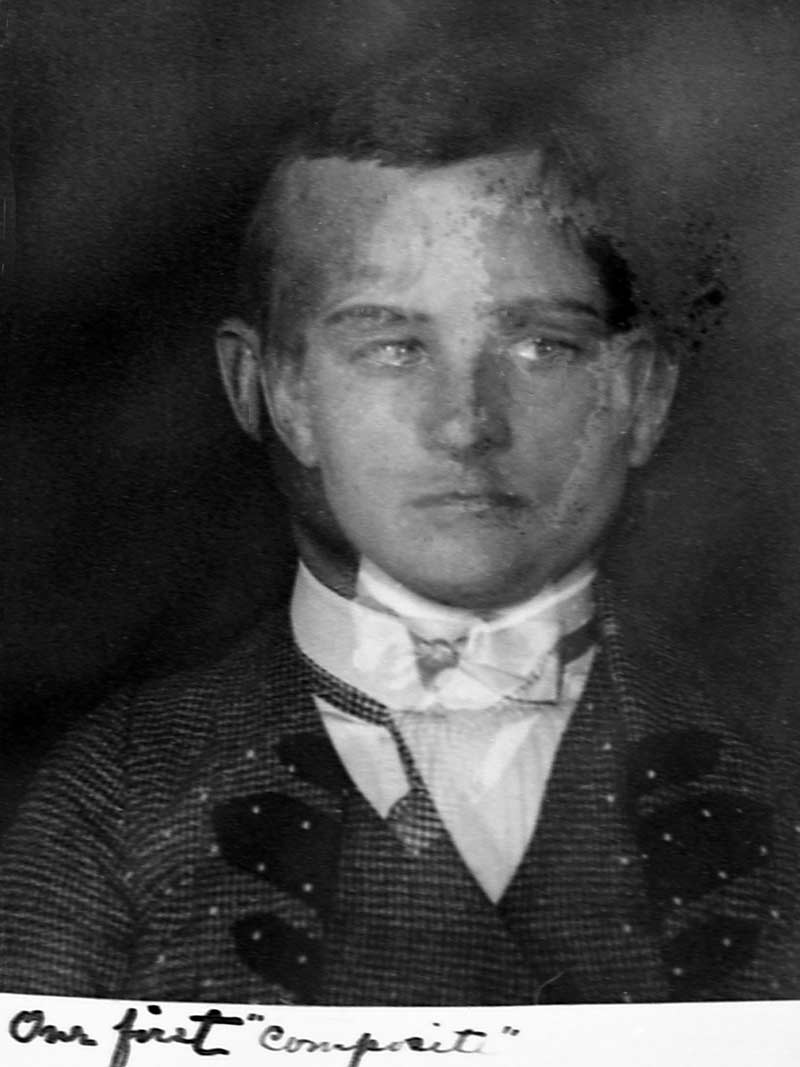
Here begins another category of interest, which we have named “Unintended Effects.” In this case it is three double-exposures, and all came from Victorian era photo albums assembled in the Northwest. Two have their own captions. (Click Twice to Enlarge)
This comes from the James Lowman family album. Henry Yesler's nephew arrived in the late 1870s and thereafter help take charge of Yesler's affair. Interested in theatre, Lowman was one of the owners-investors in The Seattle Theatre. (This one is used compliments of Michael Maslan)On a Puget Sound Beach, somewhere. A pause from running the dogs, perhaps.
(Click to Enlarge - Click Twice to Enlarge the Enlargement) Here Horace Sykes gives a caption with those several signs beside the road. Those on the left are downright forbidding. They read "Caution Road Beyond Dangerous" and "Caution Road Construction Next 10 Miles." The rustic sign far right reads "Entering Mt. Baker National Forest" and that is a hint, which is fulfilled with the metal sign, which tell the driver she or he is leaving Okanogan County and entering Whatcom County. If I have figured this correctly - with the help of Google Earth - this is Harts Pass at about 6190 ft. and that is high for a Washington pass suitable for vehicles with courageous motorists. This is the intersection of National Forest Development Roads 500, 700 and 5400. If you turn around the last of them will take you east into the Upper Methow Valley, the likely route that Sykes climbed to reach the pass. The town of Mazamba is but a dozen crow miles down the way. The view looks north to Slate Peak (if I am reading it correctly). From this county line one can drive by switch backs to the top of the peak (that dangerous road still, I think.) and visit the fire lookout there. At an elevation of 7,488 feet Slate Peak is the highest point one can drive to in this state without going off the road. (A habitat curiosity, that puts it a mere 400 feet below the top of Mt. Olympus in the Olympics and thousands of feet lower than several highway passes in Utah and Colorado. Or we will include - borrowed from GoogleEarth - directly below a snapshot of China's Balang Shawn Pass in Sichuan Province, which is paved at 4523 meters, and that is a few feet higher than the summit of Mt. Rainier. Apparently this paving - and the highway pass generally - was very beat up by the May 2008 earthquake in Sichuan.) North of Harts Pass towards the Canadian border are more passes with names, in order, like Windy, Foggy and Woody. Those are for hiking.For habitat and elevation comparisons with Harts Pass here is a look north from China's Balang Shan Pass in Sichuan Province. Elevation at the pass is higher than the summit of Mt. Rainier - by a few feet. And it is paved!
"The Prophet of Concrete," Sam Hill's sterile replica of Stonehenge begs for Jean to share a photo of the original, which he visited last week. This one, of course, stands above the Columbia River at Maryhill. (See entry above Dailysykesaddendum No. 90 for the requested contemporary look at Stonehenge.)
Perhaps somewhere in the Okanogan on an overcast fall day, the creek is down and the roof of a pioneer's log cabin too. The remainder of this residence looks sound - what we can see of it - and may still be kept around 60 years or more after Horace Sykes recorded it - but did not caption it.
Also from the Seattle Times Oct.25, 1925 issue, a real estate editor’s montage of progress in local construction. The Skinner Building gets its own essay on the left. Otherwise its No.2, the new Paul H. Lattner residence at Lake Park Drive (no address given), No.3, “group of new residences near the intersection of 14th Ave. Northeast and Victory Way (which, I think, is Lake City Way, aka Bothell Way, aka Red Brick Sunset Highway around north end of the Lake Washington long before the bridge), No. 4, “residence at 914 Epler Place built by F. J. Davidson and sold to Charles Cohen.” The Skinner building, on 5th, east side between University and Union Streets, took the site of the former Hippodrome, a great hall for conventions and dances. (We’ve featured it on this blog, so you can key-word it.) The Skinner Building was designed for its sumptuous 3000 seat theatre, and the first Seattle branch for the uppity San Francisco women’s apparel merchant, I Magnin. The local architect was Robert C. Reamer, who – to show his consistency – was also responsible for the 1411 Fourth Ave. Bldg, on Union, The Seattle Times bldge on Fairview, the Deca Hotel – origianlly the Meany -, the Old Faithful Inn at Yellowstone, which the Pastor Dorpat family could only wonder at while sleeping in a tent, the Quinault Lodge, where I had my most tastey meal ever after one week of hiking the Olympics with dehydrated veggies, and the grand Fox Theatre in Spokane (still standing) where I saw the wonderfully pathetic movie Broken Arrow three times in 1950. My dad knew the manager. (Thanks, again, to RON EDGE for our EDGE CLIPPINGS)
Marge Carpenter hangs a graphic - an old Rose Lodge postcard - from Tom and Dave's suspicions that the Two Furred Sawyers were at work on the beach beside Rose Lodge. Marge writes, "Agreeing with Tom and Dave L, my guess is that Paul Dorpat's photo (well not mine Marge) was taken at the same location. Rose Lodge, built in 1900, is located on Wilton Ct. at 63rd Ave. , one block from Beach Dr. However, I can't explain who the ladies are or why they're sawing the log. P.S. I still don't know how to post a photo in a comment." Nor do I Marge, and with this blog's master, Jean off to Stonehenge and other euro-destination for a few weeks I don't as yet know if we can even take comments. I'll print below the original Lob Cabin borrowed photo of the 2-Women-Sawing for comparison. Perhaps they were guests at Rose Lodge paying off a tab with beach labor.
Especially during its greatest boom years following the "great fire" of 1889 (Seattle grew from 40,000 to about 230,000 in twenty years) much of First Hill filled in with cheaper housing, some in rows like these duplexes. The general site can be figured from the crown of the Harborview tower peeking over the roof of the middle duplex. The street was busy enough to have meters, and the car showing with a detail, far right, may be post-war chevy. The original slide was produced for a study having to do with first discussions of "urban renewal" in Seattle. These, obviously, were captured as examples of housing in need of renewal. The slide is not sharp enough to read the house numbers, so it will take some sleuthing (aerial photos? tax photos?) to break through what remains of the scene's confidentiality.
We show more confidence in our title than this Kodachrome may deserve. Horace Sykes was raised in the Willamette Valley, and from there grew familiar with the Oregon coast. And so we assume that this is part of it, photographed many years later than his first youthful explorations. But where on the Oregon Coast? (Click to Enlarge)
I have no grip on this landscape with the broad sheet of a huge blue waterway. A lake, a bay, a reservoir? Clueless. It is not a place near Kansas. (Click to Enlarge)
(Click to Enlarge) Not as confidential as many. The original for this comes from the Log House Museum - if my memory serves me well. And so this is most likely somewhere near Alki Point. The picture is nearly as old as the museum and the Homestead although not as old, I think. That is, the couple in firs is certainly not helping in either the museum's or the restaurant's construction. I don't think we know the women (who they are) but the photographer's name is printed (the top of it) - Zora? - at the lower left corner. So lots of evidences. Somewhere on Alki Beach, but what part of it. That, and the names of these sawyers in furs are the still confidential parts of this Seattle Confidential No. 3. Now it is time, it seems, to call upon westseattleblog.com and hope that among its hordes of sensitive readers some or one will know where on the beach this was recorded . . . and then perhaps also go and repeat it like science but with no need to saw. There is a glimpse of horizon, upper-right, to help in the hunt.
( Click TWICE! to Enlarge) When I was nine or ten - in 1947 or '48 - I spent a week at church camp on Lost Lake in the Okanogan, and fell deeply in love with the older daughter of another preacher who like my pop was also lecturing that summer at the same camp. But that is a distraction from this story. On the way from Spokane we drove across the top of the Grand Coulee Dam spillway and dad stopped the car - it was permitted - so that we could get out and look over the edge. It changed my life - it did! Looking directly down on the spillway ignited some dreadful genetics of fear in me, and I have been frightened of heights ever since. When I came upon this slide by Sykes my heart - holding hands with my stomach - leapt again. Horace started visiting the dam when it was under construction in the late 1930s. The generators put out power first in March 1941, ahead of schedule.When it was still one of the "eight wonder of the modern world" recitations of the dam's statistics were popular. Taller than the Smith Tower, as long as 14 ordinary city blocks (4,200 feet) it held four times as much mass (concrete) as the Great Pyramid of Cheops, and three and one-half times that of Boulder dam, the dam Californians bragged about. The concrete below this spillway might have - and could have - built a monument 100 feet by 100 feet nearly six miles high. The concrete here might have built a two-lane highway from New York to Seattle and returned by way of Los Angeles (what a coincidence!). Or my favorite, if this concrete were all shipped in one freight train, it would be 500 miles long an contain 50,000 box cars. (This would have been a real hardship on the estimate two million hobos that were riding the rails during the Great Depression, when the Grand Coulee was being built. Some of them, no doubt, worked on the dam.) The 1,654 feet spillway at the center could discharge 450 million gallons a minute. And with that statistic my heart leaps again.
In the gaggle of vessels hugging the sides of the Pike Street pier it is the 1200-ton wooden steamship Santa Ana that shows a full profile. She may be backing out of the slip between the Pike Street and Schwabacher’s piers. However, there is a chop on Elliot bay and the black smoke from her stack may be pushed east by a breeze off of Elliott Bay. Perhaps the Santa Ana is coming home from Alaska to her Northwestern Steamship Company (the name is written on the pier) terminus.
The Pike Pier is a triumph of preservation for us, as are the other “Gold Rush Piers” that still line up behind the photographer of this scene – and so behind Jean too. Both the “now and then” were snapped from the water end of Pier 57, the old Milwaukee Railroad pier. All of the old piers follow the angle into the bay prescribed for them in 1897, although all were built in the early 20th Century. The wealth got from warehousing and wharf rates during the gold rush of the late 1890s allowed the dock owners to build these conforming and bigger piers after the greatest excitement of the rush settled down – although some gold fever continued with the rush to Nome during their construction.
The Pike Pier was planned in 1903 and completed a year later by Ainsworth and Dunn. They also rented space to both the steamship line and the Mt. Vernon farmer Willis Wilbur Robinson, whose name is writ large along all sides of the Pike Pier. Robinson stuffed Skagit River sternwheelers with hay for delivery to the Pike Pier, until railroads did the hauling cheaper. About 1911 Robinson’s block letters were replaced by ones for a steamship agent named Dodwell.
Ainsworth and Dunn sold fish primarily. They started the move of fish merchants to the north end of the central waterfront in the mid 1890s. Before their lead most fish commerce was handled south of Yesler’s Wharf. In 1916 Dodwell was replaced by Pacific Net and Twine Company, and from then until after World War Two, Pike Pier was home for fishermen and the professionals who serve and represent them.
[CLICK TO ENLARGE]
Looking north from Pier 57 to Pier 59 with some Schwabacher's Dock pilings showing on the right. The subject was photographed about 1906. (Courtesy Lawton Gowey)After the Seattle Park Department purchased the Pike Pier in 1973, money consigned from 1968 Forward Thrust bond could be used to build both a municipal aquarium and a waterfront park in the 1970s. The park’s features are just off camera to the right of Jean’s repeat photograph. (Photo by Jean Sherrard)Persons who have been paying attention to credits for the historical photos (including this week's) used in now-and-then will have seen the name Lawton Gowey a few score times. Lawton and I studied piles of images together now many years ago. He died in the mid 1980s when preparing to play the organ at church as he had done almost every Sunday for decades. Here's Lawton most likely on the day of the waterfront trolley's inauguration, May 29, 1982. He was a rail fan his entire life. The inaugural trolley #99 is behind him. I recognize the friend on the left but do not know his name. Lawton has his 35mm camera hanging from his neck and he is - typically - smiling. They are standing at the foot of Pike Street. I don't know who took this photograph, but thank her or him. The humbled wreckage of the original Pike pier - the one for coal built in 1871-72 and abandoned in 1878 for the King Street Coal Wharf and bunkers. This view looks north from the end of the King Street wharf and shows both Denny Hill (its two humps) and part of Queen Anne Hill on the horizon. Courtesy U.W Library. Frank Shaw's recording of the water end of the Pike Pier before its makeover for the Seattle Aquarium. Shaw has dated this view July, 31, 1974. Some construction on the Waterfront Park is apparent south of the Pier.An early view of the Pike Pier when it's primary tenant was the grain merchant Robinson. Part of the Schwabacher pier is evident on the left. West Seattle's Duwamish Head is on the left horizon. A circa 1934 aerial of the Pike Pier's section of the central waterfront. The Lenora Pier is at the bottom-left corner. Next - to the right - comes the nearly twin piers at the foot of Virginia Street. Then two smaller "fish and salt" piers, followed by the Pike Pier, the Schwabacher Dock, a narrow "Wellington" dock for loading coal and part of Pier 57 from which Jean and the historical photographer both took their views of the Pike Pier shown near the top of this feature. The 1934-36 construction of the seawall between Madison and Bay streets is not yet underway. Note the running gap ("dangerous death trap") in the Railroad Avenue planking. And there's the Pike Street pedestrian trestle again. It was featured in last week's "now and then."Another aerial - this one with the viaduct. Pike pier is far right. The subject is dated June 7, 1968, the year of the Forward Thrust bond that would help fund both the Waterfront Park and the Aquarium. The Dode is tied to the Pike Pier in the slip between it and Schwabacher. The year is ca. 1911. A 2003 look at the Central Business District skyline from one of the Waterfront Park "trestles" attached to the Pike Pier.
You may find some clues in this mysterious party portrait – or you may not – but when all is described the mystery abides. Who are these people once so confident in their pleasure and now passed or worried perhaps and withdrawn in the past? I may recognize the back of one head – that in the middle background with a hand on its shoulder. However, not wishing to influence your speculations I will not name mine.
Horace Sykes loved orchids especially and there are nearly as many slides of flowers in his collection as there are landscapes.
Barbara William, Horace Sykes helpful granddaughter from Corpus Christi, Texas, sends this 1955 clipping showing Horace in a Post-Intelligencer story about an upcoming orchid show of which he is an important part. If you missed earlier pictures of him, as the P-I caption indicates Sykes is on the left. The story notes that the origins of Sykes interest in growing orchids originated in his delight in photographing examples brought home by his daughter. (One line is missing from the clip, but it does not seem essential.) Thanks Barb.
Scenes from Seattle – or near it – so confidential we don’t know what they are. Some, we imagine, are erased forever. Others you may know, but we do not.
Tempting here is the street sign posted on the pole at the center. Tempting but not fulfilling. It cannot be read. Note that the street or drive that crosses the scene, left to right, continues on the far right with a steep handrail. The two planks for a sidewalk suggest a neighborhood that was a late addition to the city and so sometimes got the short end of public works support. And this IS a public works photo. So it has a public works purpose - perhaps the gravel messing the boardwalk.
This "bare ruined choir" is one of those rare subjects that Horace Sykes has captioned. "Near Waitsburg," he calls it. Less than 20 crow-flying miles north of Walla Walla, among the things that Waitsburg is distinguished by are its Main Street, its legal status as the only town in Washington that still runs under the terms of its territorial charter, and the Waitsburg Times, which began publishing in 1878 and it is still at it. The town is set at the juncture of several small streams, one of them named the Touchet River, which continues running mostly west to join the Columbia River at its Wallula Gap where the big river turns west for its earnest run to the Pacific. I have not, so far, found any record in Horace's slides of Waitsburg itself, only this handsome ruin of a tree somewhere near it. This is typical Sykes who shot very few towns or subjects within them. (Click to Enlarge)
Every year, on the first Sunday of July is celebrated “the Félibrée” or an Occitanian Fête, in a different town of Périgord. Montignac has been chosen four times since 1913.
The Félibrée is a célebration of Occitan language, tradition, earth and Perigordian customs.
For several months all the population of Montignac has been dedicated to the decoration of the town, making flowers and sewing traditional clothes. It is organized by the “Bornat du Périgord” which means apiary or school of Perigordian félibrée , which is an association of every person with occitan knowledge.
The Félibrée lasts two days and follows a very precise ritual; it is not so touristic, but mostly of interest to the inhabitants of Périgord.
Chaque année, au premier dimanche de juillet est célébrée la Félibré, ou fête de l’Occitanie, dans une ville du Périgord à chaque fois différente. Montignac a donc accueilli pour la 4ème fois les félibres depuis 1913.
La félibrée est une fête de la langue d’Oc et des félibres, de la tradition occitane, de la terre et des coutumes périgourdines, héritée des troubadours qui jadis chantaient en langue d’Oc dans les cours d’Europe.
Depuis plusiurs mois, toute la population se consacre à la réalisation des décors dans la ville, des fleurs, des costumes traditionnels.
Mais cette fête est organisée par une association “le Bournat du Périgord” signifiant la rûche, qui est une école félibréenne du Périgord, cette association réunit toutes les personnes détentrices d’un savoir occitant.
La fête dure deux journées et obeit à un rituel très précis, elle n’est pas très touristique mais intéresse principalement les Périgourdins…
At 9 o'clock in the morning ,the new queen of the Félibrée receives the key at the entry of the town - A 9-heures du matin, la nouvelle reine reçoit la clé à l'entrée de la ville. The participants are ready for the parade - Les participants sont prêts pour le défiléThis lady tells me she was the queen in 1954 - Cette dame tient à me rappeler qu'elle était la reine en 1954
The new queen crosses the town with the Majoral - La nouvelle reine traverse la ville au bras du Majoral
After the different folkloric groups cross the city:
Après la traversée de la ville par les différents groupes folkloriques:
Voici la chorale et la messe dite par l'évêque en occitan - Here is the choral and the church service told in Occitan
After the service you can see the ancient works, old tools, animal farms - Après la messe, on peut voir les métiers anciens et les outils d'époque -Work horses - Les chevaux de labours -
At 12:30 there is the traditional meal "la Taulada", and after that, dancing in the street and Cour d'Amour - A 12:30 il y a le repas traditionnel: la taulada, et ensuite les danses dans la rue et la cour d'amour -
Horace Sykes' look north through the Lower Grand Coulee from the south shore of Alkali Lake. His prospect is about half way between the community of Soap Lake (to the south) and Dry Falls (to the north). It is roughly ten miles to each. Washington State Route 17 follows the Coulee. It is an adventure in cliff watching. The six larger lakes that string along these twenty miles are, from south to north, Soap, Lenore (the longest of them), Alkali (a relative shorty), Blue, Park, and Dry Falls Lake. The last at 1511 feet snuggles below Dry Falls, which are about 300 feet high. (Dry Falls are given elaborate attention with their own Our Daily Sykes #17.) Alkali lake has an elevation of 1090 feet, which puts it about 1300 feet below the farmland to the east. The Grand Coulee - and much else in eastern Washington - is a creation of the Missoula Floods. As I understand it, the coulee was carved from south to north, so that the Dry Falls began forming southwest of Ephrata and then rapidly (for geological time) eroded its way north until it reached the present line above Sun Lakes State Park and stopped there. This multiple flooding between 15,000 and 18,000 years ago has been wonderfully studied and convincingly simulated, although in sections - like at the Wallula Gap - it still has some "splaining to do" - to quote Desi Arnaz waving his finger at Lucille Ball. (Click to Enlarge)
The reader named "BOB" has identified both the mountain and the falls with a comment. It is - and golly how insensitive of me - Index with Bridal Veil falls splashing down from Serene Lake - I presume. Horace did not stray far from the Stevens Pass Highway to record it, although my Googlecopter repeat of it is off a little ways - I think - to the left or east. But I have not learned yet to control the joystick well enough to always hit the spot. We don't see any falls in Google except an artifact the behaves like a grand fountain flowing magically from the summit of Index. Unlike the federal survey lines (or what?) the waterfall semblance holds well to the "waterways" of the mountain's east face (or northeast face). This is the side one sees from the town of Index, which is just off the highway to the other side of a ridge that is also behind Horace. Thank you Bob.
Another naked landscape left by Horace Sykes without a stitch of explanation. Such a splendid waterfall is surely familiar to many, but not to me. And I don't know how to start, except to hope that some reader will lead the rest of us there.
THEN: This is one of hundreds of images showing how Seattle changed between the early 1960s and the mid-1980s, recorded by Frank Shaw who lived in an apartment on Lower Queen Anne Hill. The Pike Place Public Market and the waterfront were two subjects he often visited.NOW: Jean Sherrard's "now" repeat of Shaw's Pike Street Hill Climb was photographed on a blustery day in May.
Frank Shaw recorded his look up the old Pike Street Hill Climb less than two months before Seattle Mayor Wes Uhlman grabbed a shovel to break ground here for the grand stairway that Jean Sherrard shows us with his “now.” So it is not so long ago that Uhlman shoveled (Jan. 17, 1977) and Shaw snapped (Nov. 22, 1976). Shaw almost always dated his negatives, and the roving photographer returned many times to this scene to track with his Hasselblad how this public work advanced.
The oldest built hill climb here was a trestle, down and up, which coal cars were winched between the Pike Street Coal Wharf and a narrow-gauged railroad that was run to the south end of Lake Union.
There the cars took on coal from scows that were alternately hauled and floated there from mines on the east side of Lake Washington. It was a difficult route, but it paid very well. In 1878 the entire operation was smartly replaced by a new railroad that ran around the south end of Lake Washington and thereby directly between the coal fields of Newcastle and a new coal wharf at the foot of King Street.
Panoramic photographs from the 1890s of Denny Hill show what appear to be steps near the top of this incline. Otherwise, buildings obscure the view. In 1911-13 a steep pedestrian trestle was built over the dangerous Railroad Avenue, and the trestle continued on high above these steps to connect the Pike Street Pier directly with the then 6-year-old Pike Place Public Market. The trestle was lost to the Alaskan Way Viaduct in the early 1950s, but not the steps below it.
Shaw’s photograph may make some readers downright nostalgic for the old public market and its rough surrounds.
WEB EXTRAS
Looking into the Market from the north on a recent evening:
Evening market
Anything to add, Paul?
Yes Jean – a few more variations on Pike Street Hill Climb aka Hillclimb.
First the wide version of Peterson & Brothers ca. 1877 look north up the waterfront from the back window (or porch) of their photography studio at the foot of Cherry Street. Note the shipwrecked Winward resting off shore (of Columbia Street) for her eventual internment beneath the fill and pavement of Western Avenue and the now long gone Society Candies factory, AKA Colman Building Annex. The more relevant part is upper right where the Pike Street Coal Wharf (and bunkers) reach shore and ascend it with a timber hill climb to carry/crank the coal cars to the trestle filled with eastside coal and then back empty for more. The next subject shows this part of the Peterson subject in detail.Detail of the above - the ca. 1877 hill climb on Pike Street.In 1912 (or late 1911 or both) a pedestrian trestle was constructed from the waterside sidewalk on Railroad Avenue, just north of the Pike Pier, over Railroad Avenue and onward and upward to the Public Market. The waterfront part of it was temporarily removed for the 1934-36 construction of the seawall, but then replaced. The trestle appears here, in part, left-of-center.A ground view of the hill climb trestle on Pike looking west from Western. This was photographed some little time before the trestle was removed for the construction of the Alaskan Way Viaduct. Seattle Mayor & populist dentist Edwin Brown's mid-1920s proposal for a grand hill climb enclosed in a business block extending from the market and over Railroad Avenue. Work on the extant hill climb. Photo by Frank Shaw.Frank Shaw's Pike Street Hill Climb looking up it . . . Feb. 21, 1978Shaw, again, looking down the Pike Street Hill Climb from Western on Feb. 21, 1978.Frank Shaw looks east on Pike to the market steps from Western Ave. Nov. 20, 1976
In searching for this site I skimmed the surface of the Snake River from the mouth at the Columbia through the roughly 130 miles upstream to it’s Clearwater contributions at Lewiston/Clarkston on the Idaho-Washington border. About 20 miles down stream from Clarkston I found the site, or believed I had.
In the slack Lower Granite Lake, behind the dam of the same name, the orchard seen here far right has been submerged, and many others that once thrived along the banks of the Snake. (Horace Sykes took his photo ca. 1950 when the river was still running free, and the fish were not confused.) Ladders that were included with the four dams built in this stretch of the Snake between 1948, when the site was chosen for the first one, Ice Harbor ten miles above the Columbia, and 1975 when the last three – Lower Monumental, Little Goose, Lower Granite – were dedicated.
With the opening of the locks, Lewiston and Clarkston became ocean seaports. In the first full three-year period after this “Inland Passage” was completed, barge traffic increased through Lower Granite from 559,000 to 1,422,000 tons – by now a nearly ancient statistic, and one for which I have no recent update. Most of this was wheat that the railroads had formerly hauled, some of it to Puget Sound ports, although the commerce of southeast Washington was almost always more tied to Portland than to Seattle/Tacoma.
The Canyon drop here is on an average about 2000 feet from the wheat fields of the Palouse above to the lake/river. Garfield Country is south of the river and Whitman County to the north.
When I returned to Google Earth to hunt a name for the contributing gully on the right I became confused and could not find my way. Perhaps some reader would like to try and find this place again, starting with my suggestion (only) that it is about 20 miles down stream from Clarkston, and about 12 miles south of Pullman.
The road along the north bank of the river is called the Wawawai River Road. Wawhy we can imagine. (Click to Enlarge.)
I cannot identify this Horace Sykes by an act of will. Might it be Utah? May it b e Arizona? Or the opposite? Or somewhere else? Except for one long adolescent family trip of the southwest I am not experienced with it. Are there no mossbacks among us who also know these places? (Click to Enlarge)
[Click to Enlarge] When first I looked upon this Sykes slide I thought that it was most likely somewhere above Lake Chelan, and now after using – again – Googlecopter, it is confirmed.
That Horace Sykes also drove his Chevrolet up the Shady Pass Road from the Entiat River valley means that he reached the lake from behind. Or did he? It is also possible to reach these heights from the other end of Shady Pass Road at the 25 Mile Creek on Lake Chelan, this means that it is roughly 2/5th of the way up the lake from Chelan to Stehekin. I doubt that it standard to ferry anybody’s Chevy up the lake to 25 Miles Creek, so I conclude – as introduced – that it is more likely that Horace got to this prospect from the south – from the Entiat side. I name the prospect Grouse Mountain because there’s a blue dot photo there that is captioned so. The highest point on Shady Pass Road is a few miles northwest of this prospect and it is considerably higher. This elevation is about 4,500 feet. The Pass and its campground around 6,600 feet. Lake Chelan is 1,102 feet above Puget Sound.
If I have figured correctly the mountain seen far up the lake is Goods Mountain, the highest point in the North Cascades National Park, “the fourth highest non-volcanic peak in Washington, and the twelfth highest summit overall.” Quoting there from Wikipedia.
Mt. Goods has this added mystery. In spite of it height, Goods cannot be seen from any highway. It rests in a sublime boudoir surrounded by attendant (or at least watchful) peaks that reach heights nearly its own. Together they are not a massif – like the Wallowas in northeast Oregon – because this range continues on to all sides far beyond park boundaries .
The Palouse pantry is perhaps the widest nook in the Sykes kitchen. Many of its examples are as much sky as rolling hills and fruitful fields. And many, like this scene it seems to me, are so picturesque that we may wonder how such a subject was allowed to slip off the canvas to the landscape itself for a Sykes capture. What is the cloud shadow draped across its center but a dark nylon thrown there by whom? We do not know nor where. Please, Click to Enlarge
The flowering bush and brilliant rock in the foreground set above a winding river with a rolling horizon are Horace Sykes motifs, and the West's as well. Again, Sykes neither captioned nor labeled this Kodachrome, but I suspected from first glimpse that it was somewhere on the Okanogan River. I am getting better with the Googlecopter. The first time I searched the river for this subject I did not find it. This time I started at the river's outflow into the Columbia River (at Brewster) and determined to follow it north for the about 70 miles to the Canadian border at about three hundred feet off the ground. I was rewarded within moments. Here about 30 miles north of Brewster the valley narrows, squeezed by rock. The bigger one of the left is an extension of Short Mountain. The town of Riverside is about five miles behind Sykes. It is there that the highway leaves the river and goes to the other side (west) of Short Mountain. It rejoins the river about seven miles up stream from Sykes, just south of Tonasket. In the distant horizon (about 15 miles north of Sykes) is the pointed peak of Whitestone Mountain. (Click to Enlarge.) It is unique in both its coloring and topography, reaching over 2800 feet, which is 2000 feet higher than the elevation of the river here below Sykes. Directly following this caption is a "now and then" comparison of Riverside that we made for the book "Washington Then and Now" but could not use for want of space. The "then" was photographed by Frank S. Matsura, a pioneer Washington photographer who made his home in the Okanogan Valley in 1907, and built a great photographic record of it until his death by tuberculosis in 1913. Jean took his "repeat" in 2005. Riverside, Washington by Frank Matsura, ca.1910.Jean's repeat and homage to Matsura, recorded during the summer of 2005.
Independent of our wives, Jean and I were busy Americans yesterday – Independence Day – between Noon and 6pm. First we visited the “This Place Matter’s” demonstration in front of Alki’s closed and ribboned Homestead Restaurant. (Ribbons and not bunting. They were yellow and not red-white-&-blue.) The sun came out for the moment of Jean’s recording and then retreated as we scampered off to Gasworks Park and the Celebrity Chef Fourth of July Salvation there. We arrived in the rain.
Below are an unattributed mix of snapshots (without fireworks) we took when we were not eating from the potluck at the Alki Lob Cabin Museum or the buffet table in the sponsors and noble seniors gated corral, which was fenced at the extreme most pointed and southern part of the Walllingford Peninsula, the best place to sit in the rain for five hours waiting for the show. We didn’t so sit, but the trio in the top-most photograph did – or told us they would. We left much too early to catch the show but none too early to get dry. (I, at least, am getting old and easily dampened in my enthusiasm.)
Seeing Seattle at about 4:45 pm Independence Day from Gas Works Park. And seeing the war-sized barge from which the evening's pyrotechnics would be ignited and launched. Gene conferring with Clay Eals about what to do with the video shot of the "This Place Matters" demo. They decided that Jean should edit it for youtube consumption. And he is at it even now.Geese Shall Safely Graze . . .. . . While celebrity chefs prepare the food line for the guests with red wrist bands. The time is 4:50 here. The line will open in ten minutes. Meanwhile outside there is brave Good Humor in the rainA child grasps her dolls and stays dry and under cover in a produce box.Hotter foods including Frankfurter and Nood' are consumed.OverheadGive me your tired, your poor, your huddled masses yearning to breathe free, the wretched refuse of your teeming shore. Send these, the homeless, the tempest-tossed to me, I lift my lamp beside the golden door. And build strong fences along our southern borders, and get payment in advance from undocumented boarders.Brave Exposures with Heavy IndustrySubscribing to the Wallingford Senior Center's raffle while a young and ambitious Michael Mansfield reflects on independence.Rain GearStill early that eveningAround noon at Alki. Potluck in the West Seattle Log Cabin Museum courtyard and spirited preps for the "This Place Matters" demonstrationEither getting ready to demonstrate or lingering after it.
Today's photo: an enthusiastic group of citizen preservationists rally in support of saving the landmark Homestead Restaurant.
I rode with Jean to his high – second floor balcony – assignment, and can witness to the skill he showed in moving the crowd into a shape most fitting. The event itself involved a sequence of about eight speakers – preservationists and/or politicians. Clay Eals was the Master of Ceremonies and he wore his big blue Australian (I think) hat. (You can find Clay about four persons over from the far right end of the “This Place Matters” sign. He is in a white T-shirt.) The sun came out just before Jean started to work. Every speaker Clay introduced was told that they should keep their remarks to 30 seconds, which means, I think, two minutes, but never more than that. Our recent mayor, West Seattle’s Greg Nickels was there and with a fine beard too. He kept his remarks to two minutes, which was in the spirit of 30 seconds. Greg is in red just up and left from the left end of the “This Place Matters” sign. The message was also a chanting motif of the event, with each speaker repeating the line while leading the crowd in a chorus of “THIS PLACE MATTERS.” At one moment in this chanting I looked too longingly towards the closed chicken dinner house, the Homestead, and imagined – or heard – in an interval of “This Place Matters” one sounding of “Chicken Platters” while remembering the many poultry feasts we enjoyed during the founding and funding of The Log House Museum. Someone counted 196 faces in that chorus. Someone else added three Waldos. So it was a crowd of two hundred then.
THEN: Looking northwest across a bench in the rise of First Hill, ca. 1887-88. The photographer was probably one of three. George Moore, David Judkins and Theodore Peiser were the local professionals then most likely to leave their studios and portrait work to take this shot from near the corner of Seventh Avenue and Jefferson Street.NOW: Jean Sherrard's repeat looks from the western border of Harborview Medical Center's campus near what was once the steep intersection of Seventh and Jefferson.
Long ago when first I studied this look northwest across First Hill I was startled by its revelations of the hill’s topography. The hill does not, or did not, as we imagine steadily climb from the waterfront to the east. For instance, here Cherry Street between Fifth and Sixth avenues — the white picket fence that runs across the scene’s center marks the north side of that block — keeps a fairly flat grade and then, where it intersects with Sixth Avenue, defies all our modern expectations and dips to the east.
James Street, on the left, climbs First Hill between Fifth and Sixth on an exposed-timber trestle. To the lower (north) side of that bridge there was about a four-block pause between James and Columbia, Fifth and Seventh, in the steady climbing we expect of First Hill. Now in these blocks the flat Seattle Freeway repeats this feature ironically.
There are enough clues here to pull an approximate date for this unsigned cityscape, which looks northwest from near Seventh Avenue and Jefferson Street. It is most likely sometime during the winter of 1887-88. The best clue is the Gothic spire atop the Methodist Episcopal Church (until recently First United Methodist) far left of center. There is still construction scaffolding on the sanctuary, which was completed at the corner of Marion and Third Avenue in 1889. On the far right horizon is the Central School (it burned down in 1888) and to this side of it the McNaught big home, recently featured in this column, at its original grade on the corner of Marion and Sixth.
This panorama is strewed with other pioneer landmarks, including the Western House at the southeast corner of Sixth and James. It is the large L-shaped box below the scene’s center.
WEB EXTRAS
Anything to add, Paul? – And don’t forget that we’ve got an appointment this afternoon in West Seattle. At 1:30, we’ll be taking a photo of a crowd in front of the Homestead Restaurant, as mentioned in last week’s column.
Paul replies: I’ll begin by adding my voice to your voice, Jean. Yes I’ll be at Alki Point to be photographed by you, because, you know I riding over there with you. And I do have something to add as well to the above story. This is easy. May the reader go back to May 1 of this year (nine pages back) and find the now-then feature about the McNaught mansion at 6th and Marion. It includes other images that relate to this week’s point about the odd topographic ways of First Hill in its ascension from 5th to 8th through a section holding (or whatever) Jefferson through Marion Streets. One of the pictures supporting that story is the same one that was used for the primary photograph this week. So the reader gets two captions for one.
On the side and also in closing, I will say I am most startled by finding that “back then” when the flowers of May were asked to wait a while longer by the showers of April, we had only reached Our Daily Sykes #18, and here we are into the seventies. Horace would be proud of us Jean.
A look north-northwest through about half the 4 miles of Wallowa Lake in (and so we return to) northeast Oregon.
A scene taken in the same direction and from nearly the same prospect as Sykes appears as a volunteered “blue-dot” photograph in Google Earth. It includes what I imagine is an ironic caption. “The east moraine before the houses go in.” I doubt that this slope has since been dappled with houses, although the uses of Lake Wallowa have been sometimes exploitive. This is Nez Perce land and by treaty it remained theirs until gold was discovered nearby and the lake and land around it was taken back by the feds for settlement – and the rest – in 1877.
The Nez Perce war with U.S. Regulars that followed was one of the last battles between “manifest destiny” and Native Americans, and led to the 1000 mile near escape of Chief Joseph and the tribe for Canada – but not quite to it. It was the occasion of the Chief’s famous “From where the sun now stands, I will fight no more, forever” speech. Now, in a mix of admiration and white guilt, Mt. Chief Joseph rises to the west of the lake as part of the massif known as the Wallowa Mountains, and the town of Joseph sits near the north end of the lake, in the direction Horace points his 35mm slide camera here.
To his left but out of frame, the south end of the lake is well stocked for tourists with lodges, cabins, marinas, and prepared food. Both Hells and Imnaha canyons (and several more) are off to the east, and not so far away. The several canyons that drain the Wallowas to the north are to the west and northwest of Wallowa Lake where one will also find the town of Minam.
Sunset over the Pacific beyond the Yaquina Bay portal and its jetties seen from the great arching Newport Bay Bridge. Click to Enlarge
Since Horace Sykes did not caption his subject, I needed some help. With good effect I asked coastwise historian Gene Woodwick, and she helped track these jetties down.
Since Sykes lived in Washington I thought first of the Washington coast, but what ports are there along our coast with jetties that resemble these? None. Gene suggested I move to Oregon, which is where Sykes came from when he moved to Seattle in the late 1920s to take up a new job as an adjuster with Northern Life Insurance. With Gene’s advice I started near the south end of the Oregon coast at Gold Beach, where the jetties are about 900 feet apart. But they did not match. Next I backtracked south to Chetco River – about 250 ft. wide at the mouth – but without success. Then I Googlecoptered up the entire Oregon coast and found six more pairs of jetties – and so eight in all. They appear in this order, south to north: Chetco, Gold Beach, Coos Bay (1700 feet), Glenada/Florence (750 feet), Yaquina Bay / Agate Beach / Newport (1100 feet), Tillamook Bay (1200 feet), Nedonna Beach (650 feet), and Rockaway Beach (600 feet). All those widths are approximate measures using Google’s yardstick.
It was not difficult to match the Yaquina Bay jetties, as looking west from the north end of the Newport Bay Bridge’s great arch, as the correct choice. We cannot tell, however, if Horace Sykes shot from a moving car or stopped for a moment on the bridge. You may note the lone boat heading into port.
Minam Canyon, Oregon - perhaps. (To ENLARGE click TWICE and search for the road & the stream, bottom right.)
Considering only the similar sky and the convenience of being nearby, Horace Sykes might well have taken this canyon-scape on the same trip that deadended for him at Hat Point where he recorded the scene shown yesterday as Sykes #72. Not typical for him, Sykes captioned both. That one yesterday “Hat” and this one “Minam.” We, however, are going to willfully suspend judgment on his “Minam” identification. We feel an intuition.
For those unfamiliar with Minam, it is a small town spectacularly sited at the north border of a braiding of canyons that resemble the curly regularities in the beards of Abyssinian war lords and/or dandies. We are familiar with those from ancient bas-relief sculpture and now here south of Minam we imagine them as seen from space, as on Google Earth, which is our authority in hirsute and other hairdressing matters as in much else, including topography. These canyons drain the north side of the Wallowa Mountains, which are Oregon’s more than match in size and elevation for Idaho’s Devils, noted yesterday. (And from the summit of Idaho’s He Devil to that of the Wallowa’s Matterhorn is a mere 40 miles. Both are a few stories under 10,000 feet tall.)
Now we will once more ride that devil crow, this time from Minam to Hat Point, which is about 50 miles to the east and a little to the south too of Minam. By highways and forest roads it took Horace 75 miles or more to reach Hat Point from Minam, but what a trip it was and still is – we imagine! Along the way – if you are driving – you, Horace and anyone will have to cross through the Imnaha Canyon, which to greatly simplify it is one canyon west of Hells Canyon, and for many in its scenery a more sublime spectacle than Hell’s. (Of course, we have not made any poll in this, but check it out and decide for yourself.)
Returning now to my intuition. I was stirred or agitated that the Sykes subject printed here might be a look into the Imnaha Canyon, rather than one of the several Minams, but, again, I know very little and speculate much. Still going back and forth between them, the melody to “Let’s Put the Whole Thing Off” sustained me. “You like Imnahas and I like Minams . . .” I did study via Google “helicopter” the Minam canyons “flooding” north from the Wallowas and twice came close to rising with a rousing Eureka from my adjustable desk chair! But with both canyons an irregular feature upset my discovery and I did recant. Still I was faithful to Horace’s lead – his caption – until I wasn’t.
So I returned to the Imnaha with a mildly guilty hope and to my surprise soon found a Google blue square (that is, a donated “click me” path to photographs) of the same subject and taken from nearly the same prospect as Syke’s own. However, to place it on the back of that now feverish crow, the blue dot is located 25 miles southwest of Hat Point and 7.5 miles southeast of the south end of Lake Wallowa, and that seemed to me to be way out of place. (Still there are not many other blue dots in its neighborhood and with those directions you should be able to find it.) Add to its seeming askew that the errant blue dot also has its own errant title – alas. It is named “Hells Canyon Oregon, 1986.”
Certainly, Sykes canyon and the blue dot’s own are NOT Hell’s Canyon. Perhaps the Google Earth blue dot photo was donated by a tourist from California or the Netherlands: generous but confused although generally in the correct corner of Oregon State. And for a while at least that is where we will leave Horace Sykes’ “Minam Canyon” as well, somewhere in that fanciful topographical mare’s nest* that is the northeast corner of Oregon State.
* Seen in toto (altogether) from space the northwest corner of Oregon IS a mare’s nest – except for those several canyons the run north from the Wallowa Mountains to Minam. Those are an Abyssinian’s groomed beard.
Pleas Continue with AN IMPORTANT IMNAHADENDUM
Now I have returned to my desk about three hours later and found it! My “intuition” or hunch about it being a look into Imnaha Canyon and not one of the Minams was right. Below, I have grabbed Sykes view with Google Earths – for a pair. The foreground will need some adjusting (Horace was a little lower than Google) but the more distance side of the valley – its west side as it is – lines up well between Google and Sykes. It is also a good witness to the “gloss” of the landscape that we get with Google, which with all its polishing and burnishing is a wonderfully revelatory tool.
The trick to finding this was turning the map upside down – looking south – and giving Imnaha a chance while abandoning Horace’s caption. Here he has recorded both a stream and road at the floor of his canyon – good clues of course. I soon determined that the road is the Upper Imnaha Road and the river, of course, the Imnaha too. It joins the Snake about 20 miles downstream from the turns in the river we see on the right. That confluence is about three miles above another where the Salmon River joins the Snake.
To get to his prospect Horace drove the sometimes precipitous one-lane gravel road up the east wall of the Imnaha Canyon – up from the Imnaha Store and Tavern and Motel and Roadhouse. Google includes an undated blue-dot photo of the clapboard establishment and it is blazoned with a banner celebrating its centennial. Horace took his photo looking south from an elevation of about 4200 feet. The river is 2000 feet below him.
Horace was standing on the exhilirating Monument Ridge, it is called, that carries what Google names the “Hat Point Road” for several miles above yet another valley – one between the Imnaha and Hells canyons. (Hidden here behind Horace.) Where this unnamed (we don’t know it) valley reaches grade with Monument Ridge is where Horace turned east towards Hat Point for the Hat Point Road’s last run up to its nearly 7000 feet high namesake. The distance between the sweet spot where Horace took this look south into the Imnaha is – as our crow flies – about ten miles from Hat Point across the “Interstitial Canyon,” we are now calling it.
The Imnaha River Canyon twice from Monument Ridge - once by Google and again (and earlier) by Horace Sykes. Both look south and a little west.
Hells Canyon from Hat Point, but not from the lookout there. Horace is too close to that broken pine to have climbed to the top of the timber lookout. (Click to Enlarge)
“What is the deepest canyon in North America?” was one of the cherished questions from the geography quiz my brother Dave and I would plead for when traveling long distances with our parents. The answer is (and still is, I hope) Hells Canyon, the about sixty miles of it that cuts the border between Oregon and Idaho.
What mysteries we Spokane Lutherans imagined lurked in Hells Canyon. My dad promised to take us there too. Although only a day’s drive – a rugged one – from our home it was still “out of the way.” We understand that such a promise is really the most heartfelt expression of a hope that one can make. We all wondered at Hells Canyon and wanted to see it, dad included, but could never find the time to go just that way. Not so its principal competitor the Grand Canyon of the Colorado.
The Grand Canyon was but one National Park we visited on our summer trip of 1950. We headed first for Yellowstone, and then onward to Jackson Hole, Zion, Bryce, Grand Canyon, Big Bend, those caves in New Mexico, Sequoia, King Canyon, Yosemite, and Crater Lake. Although Grand Canyon is surely grand it is – again – still not as deep as Hell. But it is more often precipitous and also strapped or banded in many variations of red, a better color for Hell and Hell’s own. And, again, it was “on the way.” While barging through eleven national parks heading to and returning from Texas we did it in a brand new torpedo-nosed Studebaker. I can still recall the prestigious smell of it.
Dad was a delegate to a church convention in Houston. He also had a sister in Arizona we visited. She fed us squab. Our parents assured us it was a delicacy but we suspected that it was an economy. Another of dad’s ten sisters lived in Wichita Falls, Texas, and we found her in a tideflat shack with a TV set stuck on wrestling. Her son repaired TVs in a small shop downtown. In that house a clear line ran from the front door to the back, and those were the only doors in the place. The rest was hanging sheets. I concluded that my dad had come from a family of struggling Wisconsin farmers whose biggest crop, their own children, had scattered to the winds.
There are only a few prospects above Hells Canyon from which you can see the Snake River. This is one of them. The river can be seen reflecting the bright but still confounded sky. If I have figured it right, the drop here between Horace Sykes camera and the river is over 5000 feet. If Sykes had turned his camera to the horizon on the right he would have included the summits of the Seven Devils, the most precipitous mountains in Idaho. The fall from the 9300 foot summit of He Devil to the Snake is nearly 8000 feet – a fall of biblical dimensions, perhaps, a continuous descent into Hell. Some of the landmarks on that Idaho-side horizon continue the demonic motif. There’s the She Devil (second in height to the He Devil), the Gobblin, the Ogre, Purgatory Lake, Mt Belial, the Twin Imps, and the Tower of Babel – a very spiritual ridge. All of these mountains are strangely gnawed near their summits and the rock itself, because of it, looks like anti-matter might look.
On the other (east) side of the Devils is Highway 95 running north-south along the Little Salmon River. I rode it in a post-war art-deco bus north out of Boise in 1964, a most enchanting ride. Over the rolling hills part of the trip the two-lane but paved highway with grass shoulders (not gravel!) dipped with the topography like a roller-coaster. There was hardly any deep grading through the hillocks. And I took this trip early enough to experience the splendid collection of hairpin curves on White Bird Pass. It was subsequently straightened in the 1970s. Just north of the pass is the in the high-plateau of Nez Perce farmland is the Idaho agri-town of Grangeville. I first visited Grangeville when I was 13, a guest of my brother Dave when he drove down from Spokane on a summer weekend. For me it was a revelation of teen lust. The youths of Grangeville spent their weekend evenings slowing cruising up and down Main Street, a libidinous promenade of souped machines, hidden beer, pop music and carefully chosen clothes.
If you look to the far left horizon of Horace Sykes view from the nearly 7000 foot high Hat Point you see clouds. Beyond them on a clear day you would see instead some of the farms around Grangeville. Dave and I were then on Grangeville’s Main Street only 43 miles northeast of Hat Point (and perhaps even Horace Sykes for the timing was within range) as the devil crow flies over the deepest canyon in North America. But at that time I gave it no mind attending as Dave was to other matters, and following after him.
Heading east on Highway 2 about 35 miles out of Everett you will come to a little canyon, and it is there you may indulge this look at Mt. Index, if the atmosphere allows it. You can prepare for your trip by visiting Google Earth and its highway picture #45522 beside Highway #2. You will also find nearby one of the site's blue squares - this one floating in the river - that indicates there is a picture for you to see. If you tap it, up will pop a snapshot titled "Mt. Index early Spring." From this prospect it is easily appreciated how this face of the mountain is popular with rock climbers. The Google view is from nearly the same prospect as Syke's view and shows the same big rock in the Skykomish River. The mechnical bar on the rock is a digital artifact and none of the rock's. We think we will leave it there for eternity for no flood will foil it. (If you like, CLICK TWICE to Enlarge.)
We found this exhibition just now. It is fitting for the story we ran last June 12th on the Totems of Belvedere Viewpoint. It is also a heart-warming example how one goof may have got fortunate with a good-humored partner.
This underwhelming Sykes leaves for the moment his passion for grand landscapes, while tending to one of his frequent motifs, the winding road. Typically, Horace Sykes did not leave a caption nor clues nor cross-references. This slide did not appear in order neatly next to another and another that are similar and so also revealing. So far at least it stands alone. And so does that horizon. Is there another directly beyond it or does the road wind downward into a deep valley? I'll imagine, at least, that he is reaching the summit of Colockum Pass, the rough pioneer wagon road that still crosses the Saddle Mountains between Ellensburg and Wenatchee. On the other side of the horizon we might see the Columbia River near Crescent Bar. Yes, that is unlikely. I have not yet completed looking through the boxes of Skypes slides from the 1940s and early 1950s and confess that the old teamster's pass would be a natural subject for Sykes and so I hold hope of finding him up there. And up there it certainly is at 5383 feet, which makes it easily one of the highest passes in the state - much higher than the 3022 feet at Snoqualmie and the 4056 at Stevens and closer to the 5477 feet of Sherman Pass in the Okanogan between Republic and Kettle Falls on the Columbia.
THEN: One of about a dozen photographs commissioned by the first owners of Fir Lodge, the Bernards. The Lodge is on the left, behind the lead team of white horses. The Bernards did not let us know with their own caption why about a dozen white-clad women are posing in the Seattle Transit vehicle on what now is part of Alki Ave. SW. (Photo Courtesy Log House Museum)NOW: For his “now” Jean wisely chose to climb a balcony on the building that otherwise would have blocked his view of the Homestead Restaurant. Jean will also be the “official photographer” next Sunday July 4th for the Southwest Historical Society’s “mass photo” of citizens showing their support for restoring the Homestead. For that photo Jean will be hollering instructions from a prospect on 61st Avenue – not the balcony.
Fir Lodge was built of Douglas fir logs in 1904 for a local soap maker, William J. Bernard, his wife Gladys and daughter Marie. They stayed three years on Alki Point before returning to the city across the bay in 1907, ironically the first year that trolleys started running regularly from the West Seattle “pioneer” shoreline to Pioneer Square. Of course, Fir Lodge was not the first “log cabin” built on Alki. That was the structure David Denny started building for John and Lydia Low and their four children in the fall of 1851.
Fir Lodge was built to be rustic, but sumptuously. Certainly a good percentage of Seattle citizens and their guests visited it as the Alki Homestead restaurant, which opened in 1950 and became steady for its long run in 1960 when Doris P. Nelson purchased and ran it and devised the “family style” chicken-based menu that seemed as righteously American as the flag, mothers and apple pie, which the Homestead also served. I knew the zestful Doris and the energy she gave to both her landmark restaurant and the establishment of a home for the Southwest Seattle Historical Society in what was the Bernards’ carriage house and is now the Log House Museum. After Doris died in 2004, the landmark kept busy until the roof caught fire in January 2009.
The Southwest Seattle Historical Society, which secured city landmark status for Fir Lodge in 1996, is staging a mass photo event in front of the now silent building on Sunday, July 4, to express continued support for its preservations and restoration. The photo will be used in a poster and distributed widely online. Restoration supporters are encouraged to be part of the photo, and those who do will hold signs that say, “This Place Matters,” a catch phrase of the National Trust for Historic Preservation.
The photo will be taken shortly after 1:30 p.m. following the historical society’s annual all-comers Independence Day membership picnic, to be held one-half block south in the courtyard of the Log House Museum. Politicos who have signed on to be in the photo include King County Executive Dow Constantine, Seattle City Council member Tom Rasmussen and former Seattle Mayor Greg Nickels, West Seattleites all.
WEB EXTRAS
Jean writes: While usually we try to position “Location Now” with “Location Then” as closely as possible, in the comparison above, a photo taken from the original photographer’s spot blocked the Homestead Restaurant completely from view. But for the exacting, here is a closer approximation of that view.
Repeating the original perspective
In addition, turning 180 degrees offers a familiar scene:
Give me your weary. your wet…
And strolling around the block, we see the Homestead down its front walk:
Anything to add, Paul? Yes Jean – several things to add.
FIRST I’d wished that you had reminded our readers that it is YOU who has been invited to take the GRAND GROUP HOMESTEAD RECORDING this coming INDEPENDENCE DAY. So now I have made a raucous note of it, and add that it is unique to see with what ease someone as monumental as yourself can easily gain the effective prospect for recording landmarks and masses. So readers please – if you will – come see Jean and get in front of his Nikon this coming JULY 4 (next Sunday and not this) at 1:30 in the afternoon. That is (how could this be not clear?) in front of the Homestead Restaurant at the Alki Point address of 2717 61st Ave. SW, and that is ONE-HALF BLOCK in from the STATUE of LIBERTY, which (back to Jean) you have shown us above in its new setting.
Also below are two more examples of “NOW & THEN” out of old issues of Pacific, and both predictably related to the subject above. One is about the Homestead, published first in 1994. It prepeats some of the material used above. The other is about another log structure on or near Alki Point, the Sea View Lodge. The first of these also features a few more 1905 photos of the Homestead, inside and out, when it was a nearly new log mansion for the Bernard Family.
Dont Miss:BUCOLIC GHOST BUSTERS
Following the logs is an extensive and gentle parody on ghost-busters, and in this case vampires ravaging the cows of Moclips. Jean visited Moclips this evening as the speaker for the annual banquet given by the Museum of the North Beach. That vibrant roadside attraction broke all our records in book sales for “Washington Then and Now.” We are thankful, indeed we give thanks by making fun with them.
JEAN’S BACK IN THE CANYON AGAIN
One thing more. In between the Moclips mysteries and the hallowed Homestead is one of Jean’s most wonderfully surreal recordings of the Yakima Canyon landscape. One ordinarily needs to visit a location many times to bring up such. And Jean often does drive through the canyon with his close friend Howard Lev on trips that are mostly about checking the growth of Howard’s peppers for his popular and spicy condiment Mama Lil’s Peppers. I use them in my rice regularly. (This, I believe, amounts to this blog’s first advertisement, although it was not paid for, except in pickles and without asking.)
One of a handful of photographs taken for the Bernard family of their new Alki Point log mansion in 1905. The group was handed to me for copy by Doris Nelson who took over the mansion in 1960 and continued to operate it as a restaurant until her death in 2004. The rest of the photos will be attached below the copy I wrote (with a few changes) for Pacific Northwest's April 10, 1994 issue. (CLICK to ENLARGE)
The Alki Homestead
Except for its listing in the Seattle Tour Map, the Homestead Restaurant doesn’t advertise. It doesn’t need to. The menu is traditional American, with basic entrees such as steak and pan-fried chicken, biscuits, vegetables, potatoes – usually mashed – and apple pie. What brings customers in is as much the place as the plate. The Homestead and its carriage house are two of the last three surviving log structures on Alki Point. (In the 15 or so years since this was first published two others have been found. Neither is on Alki Point but rather up the hill. When the addresses are available we will share them – here.)
This view of the Homestead was photographed in 1905 when it was the new home of W. J. Bernard, a Seattle soap manufacturer. Its builders soon gave it up, however; missionary work interested Mrs. Bernard more than the duties of managing the social calendar of a capitalist’s mansion.
In 1907 Seattle’s New Auto Club bought the log mansion and its adjoining carriage house. Getting from Seattle to West Seattle by motorcar was then still an adventure and most members made it a two-day excursion. The clubhouse gave them a night’s lodging and a large kitchen for preparing club meals.
Driving to West Seattle soon became both easy and passé’ and the motorists abandoned their log clubhouse to common uses – a boarding house, family home and since 1950, a restaurant. Doris Nelson, its present owner, has been with the Homestead since 1960
One of Seattle’s most vital and effective heritage organizations, the Southwest Seattle Historical Society, is working to acquire the Homestead’s sizable log carriage house for a museum. Considering that Alki Point is (at least one of) the birthplace(s) of Seattle and that the settler’s first structures were rough-hewed, using this log survivor for a museum is a most well-chosen and promising act of preservation.
(Doris Nelson died of pneumonia on Nov. 18, 2004. Following her death it was hoped, as noted above, that the West Seattle Historical Society might manage to acquire the Homestead and use in, in part, for an expansion from its Log Cabin Museum, which was originally the carriage house for the Bernard family. Instead, property developers Patrick Henly and Thomas Lin purchased the Homestead and also kept it going as a restaurant of the same style and menu that Doris had developed. Then the fire of Jan. 16, 2009 made its interruption.)
Bernard family home porch, 1905.DiningFireplace & Piano. Sheet music for "I'm On the Water Wagon" & "Yankee Doodle Dandy" (Click to Enlarge)Library and fireplace
Finally – we think – how to get to West Seattle before the trolley arrived in 1907. Ferry City of Seattle takes on passengers at the West Seattle dock on Harbor Avenue. Actually, the ferry continued to run long after the streetcar arrived.
When new in 1904,Sea View Hall at 4004 Chilberg Ave. S.W. was a relatively isolated family cabin. Now the hall seems hunkered in its crowded beachside community. The address has also changed: In the streamlining 1950s, the 4000 block of Chilberg Ave. was renamed an extension of 59th Avenue – and thereby another link to history amputated. Andrew Chilberg and his extended family were leaders of Seattle’s Scandinavian community in the 19th Century. As the president of the Scandinavian National Bank, his vice president was Amund Amunds, a maternal uncle to Ivar Haglund’s mother Daisy. It was from Amunds that Chilberg got his part of Alki Point for development.
Sea View Hall
If there is truth in this naming, then the prospect of Puget Sound from Sea View Hall was most likely unobstructed when the hall was built early in the 1900s. Now that view is somewhat obscured by beachside homes and the hall’s own front-yard landscape.
Sea View Hall is one of the three log-cabin survivor in the Alki Point neighborhood. (The others are the Log Cabin Museum and the Homestead Restaurant. Recently – in 2010 – John Kelly, West Seattle explorer, revealed to me that he or his had found another, although one somewhat obscures by its size and landscaping. Perhaps, I learn again the address from John, which was a thrill – a modest one – finding on Google Earth.) Like the better known still now long-gone Stockade Hotel, his hall was constructed in good part of wood salvaged from the beach, its logs set vertically like a fort. And “Sea View Hall” was eventually spelled out in “logoglyph” style; letters shaped with big sticks and hung from the roof, or here the upper veranda. In this early view, the sign has not yet been shaped or placed.
John and Ella Maurer are probably among the at least 23 persons posing here. In 1954, the hall’s 50th anniversary, John was identified as its builder by his daughter-in-law. After returning from the Alaska Gold Rush, he had taken up construction and painting, and built this nostalgic summer cabin for his family’s recreational retreat from Seattle. The rustic theme was continued inside with, for instance, a staircase handrail constructed form a peeled log with banister supports fashioned from the same log’s twisted branches.
The Maurers moved on in the 1910s. In the 1930s, probably, a room made of beach rocks was added to the Hall’s north (left) side. According to neighborhood lore it was used as a playground for the children living there, and the next name I can associate with the hall after the Maurers seems perfect: Rochfort Percy, listed at 4004 Chilberg Ave. in 1939. He soon moved on and Alma Kastner followed, converting Sea View Hall into a World War II boarding house. She kept the sign. Kastner stayed for about 20 years before passing on this fanciful construction to Allvin and Margaret Ross. This is still Ross Hall. (It was when this was first published in Jan 23, 2000. Perhaps five years hence efforts were made to sell it – and most likely to purchase it too. What became of that I do not, for this moment know, but will probably be informed by the Log Cabin Museum on the present fate of Sea View Hall. By then, perhaps, I will also find some of the “now” photos I have taken of it.)
Cruising through my collection, I found several shots that Mister Sykes might have liked. In many of his photos, he sought out the dramatic – dark, threatening skies with a peaceful foreground and the resulting tension between the two. Of course, much of this is being in the right place at the right time, which for Horace at retirement age, was not a problem.
Here, in the Sykes style, is a right place/right time photo taken of the great bowl across from Umtanum creek.
If you do not care for demure introductions to sensational stories then just jump past what follows to the sanguine meat of the feature itself. It begins directly below the photograph of the Moclips Weather Service ca. 1909
Today – and in the interests of posterity we will make a recorded note of it – this day, Saturday June 25, 2010, this Blog’s own Jean Sherrard heads out to the Pacific Coast to meet, dine and share more Moclips stories with members of the Museum of the North Beach and their heritage leader Kelly Calhoun. Jean is also making this visit to describe the joys and trials of making our book “Washington Now and Then.” And he is driving that scenic highway to thank Kelly and the citizens of and near Moclips for the records they set in distributing the book. Moclips, of course, was one the subjects that we featured in our book.
The primary Moclips image used in our book "Washington Then and Now." It shows the damage to the north end of the Moclips Beach Hotel following the storm of 1911. (Click to Enlarge)
We add what follows as evidence of our continued fascination with Moclips history. Recent and disturbing news from Kelly had Jean and I putting our heads together – feeling concerned. His letter about ghost busters visiting the museum and their, it seems, success in finding a few spirits to bust, helped us to recall some Moclips news reports, oddly out of an old London newspaper, that surfaced while we were – now long ago – assembling our book. While there was no place to make note of them in “Washington Then and Now” we do now. Although we could not recover the clips themselves, we remembered, between us, their particulars and, with the support of Grays Harbor historian Gene Woodwick, have confidently assembled the story below, which is actually three short stories concerning Moclips fated nights, first that of its biggest storm – its “One Hundred Year Storm” of Feb. 12 1911.
The message attached to this pre-storm promotional postcard is unclear and so, given the events that followed, troubling.
How soon we have forgotten. Even long ago, in the respected depression-time 1941 publication “Washington, A Guide to Washington State,” no mention was made either of the 1911 storm or the weird events we will soon reconstruct below. Instead, Moclips is described briefly as “a busy little settlement, supported largely by its shingle mill. The Moclips High School serves the oceanside region north of Grays Harbor, and its gymnasium is used for community gatherings. On the northern outskirts is the Moclips Fire Observatory (open), atop a 175-foot fir tree.” We think it unlikely that such an observatory would have survived the events of 1911.
The Moclips weather service, circa 1909.
MOCLIPS EXSANGUINATIONS 1911
In Moclips, and now nearly a century ago, between the great Pacific Coast poundings of 1911 and 1913, storms whose damage is recorded in spectacular photos at the time, “Moclips Mysteries” occurred which remain uncanny to this day.
The most alarming of these took place on a small dairy farm. The family name is barely remembered for they changed it and moved away soon after the events described below. But in 1911 they were known as the Van Hooverens. (This is confirmed by Grays Harbor historian Gene Woodwick who rarely makes things up. Readers who have combed her most recent book Ocean Shores will, we wager, not have found a single mistake in it. We have attached her addendum, near the bottom.)
The Van Hooverens brief stay near Moclips may have as much to do with their eldest daughter Arabella’s best chances as with milk and cheese. She was an enthused student of the Moclips Finishing School that rented several rooms on the top or third floor of the north wing of the Moclips Beach Hotel. After only six weeks of study she gave her first “Famous Adagios” recital, which was appreciated for its steadfast sincerity and the length of the program. The destructive storm put an end to the school, and immediate hopes for the Van Hooveran’s daughter of moving on to the Portland Music Conservatory. We know, of course, that it also put an end to much else in Moclips.
Apparently Arabella taking a break from her studies.
The Van Hooverens were a first generation Dutch family. They are also believed to have produced the first Edam cheeses in the Pacific Northwest, although aside from one small fragment of ephemera this evidence is anecdotal, which is to say that it is a story also told by the admired historian Woodwick. No actual cheese or cheeses survive, just part of a cheese wrapper that reads in fragment “Eat’em Eda,” which surely would be completed as “Eat’em Edam Cheeses.” Their mysterious story follows.
Before the storms, Moclips was a busy destination for the new motoring classes.
On the fateful Sunday of Moclips’ biggest storm day, February 12, 1911, two of their finest milk cows disappeared from their stalls. The next morning, Jan (probably for Jandon or Jandor) Van Hooveren, finding the barn door open and the cows, Marjolin and Mijn, missing, raised a cry. Jan, his wife (Annika or Anneke), two daughters, and three sons scoured the farm and surrounding fields for these valuable animals. The melk boer (milk farmer) began to lose hope that neither hide nor hair would be found of either, but then before sundown on Monday the 13th the cows were stumbled upon by a young couple who had hurried to the coast from Wenatchee. Having heard of the storm’s fury, particularly visited upon Moclips, they rushed to the site aboard the Great Northern Railroad and were already exploring wreckage and the brusied landscape when along the beachfront they came upon the two cows, side by side, and partially buried in the sand. Further examination determined that both animals had died, not from any visible trauma, but most unusually from loss of blood. While neither showed obvious injuries, each carried two small wounds on the neck, located proximate to major arteries. It was surmised that the complete exsanguinations of the cows was accomplished through these wounds alone.
A Dead Cows Simulation Only
Jean and I both remembered that the clipping on this extraordinary event was headlined either “Two Cows Give Blood Up” or “Two Cows Give Up Blood.” Jean came upon it first while researching for the book “Washington Then and Now” but that is long ago and our memories of all this may be twisted in some points. At that time we, again, made note of it to Northwest historian Gene Woodwick who had also heard of the “exsanguinations sensations”, as she put it and expressed it with an ease that was way beyond either of us. But then the regional historian still knew little more about what was done with the cows or why the Van Hooverens were also swept so thoroughly from the community. (Persons doubting the above or wanting more information may contact Gene – if they can find her.) We remember that the story was not clipped from any regional paper but rather appeared in a London daily. Most likely that first story went over the wire and got little more than that one London chance for being published. That was but the first mysterious event.
Moclip's Main Street with apparently some early damage. Note the Moclips Hotel is still intact at the rear, and to this side of it a local stands with her cow, perhaps a Van Hooveren. (Please Click to Enlarge)
A second and uncannily related event also involves a death by loss of blood – this time human blood, and again nearby Moclips. After Bjorn Sandberg was violently struck on his skull and knocked from his wagon by a tree limb during the 1913 storm, his son ran home to alert his mother Inge. When they returned less than an hour later they were startled to find the father-husband bleached as white as the foam pushed ashore by the storm. The discovery sent mother and child into shock. They clutched each other throughout the night and into the following day and could not be pried apart even by other loving hands. Without the ability to express their wishes or give instructions, the body was left lying in the road where the father had first been knocked from his wagon. As with the bovines Marjolin and Mijn, Van Hooverens’ drained livestock, Bjorn was also left bloodless.
The 1913 storm that finished the destruction of this secular temple of both ocean shore excitement and reflection.
The third and again resonant event involved Martha Connelly, a young Sunday school teacher visiting from Aberdeen two years later in 1915. While visiting her married sister Dorothy (whose last name may have been Perkins) in Moclips, Miss Connelly agreed to mount a Christmas pageant with the primary school children. Late one evening, after a long and exhausting rehearsal, Martha was alone at the schoolhouse, putting up streamers and “festoons for the faithful” of all sorts. Out of the corner of her eye, she caught a glimpse of a figure passing by the window and assumed it was her brother-in-law Vernon, come to escort her home. In an account written up in a family “vanity history” (i.e. genealogy), Martha described putting out the lamps and stepping outside onto the schoolhouse porch. As she fumbled for her keys, footsteps approached. She glanced about, expecting to see Vernon, but in an instant, a dark figure (“all claws and teeth,” she claimed) leapt atop her forcing her to the ground. Powerful fingers held down one of her arms. Expecting the worst, the devout Martha closed her eyes and prayed while making the sign of the cross with her free hand. To her surprise, after feeling a sudden piercing but not unpleasant pain in her neck, as if two sharp knitting needles had been skillfully slipped into the side of her neck, the “thing” fled.
Vernon Perkins had indeed been sent by Martha’s sister to bring her home for a late supper. Save for her saving from prayer and cross-marking, Martha, too, may have ended her life sucked dry of blood. Vernon saw the thing but barely, for it was already in flight when he arrived and disappeared quickly from his lantern light. It was “rat like” in appearance, though it would have been the largest rat ever seen in the northwest coast being, Vern guessed, some six feet long. It was dressed elegantly too – “dressed to kill.” Martha bore those two little scars for the rest of her life. She felt most fortunate at having survived the attack and proud as well. Following the attack she did not continue with the Christmas pageant, but later learned to enjoy telling the story of her night with what she insisted was a vampire.
Martha Connelly by coincidence with a cow.
Although, it seems, long forgotten – or perhaps repressed – by the community there survives another belief, which may be related. During the great storm of Feb 12, 1911 that destroyed most of his great Moclips Beach Hotel, Dr. Edward Lycan fell into a panic, or rather a trance and through the duration of the storm he seemed to be without pain or anguish. Those who cared for him those few hours when he was incongruously serene but witless were puzzled then by his repeated and kind advice: “They want our blood, you know. It’s the blood they want.” When told of this later the Aberdeen doctor had neither memory of his temporary madness nor any explanation for the message he insisted on repeating. Several Moclips citizens, however, put their own interpretation on the doctor’s brief lapse. They had heard – and independently – the gale-force winds of that winter storm howling “cud, cud, chew on cud!” or alternatively, “stud, put them out to stud!” One of them, a bartender heard a different refrain. He insisted that it was “We want blood sausage?” that was being shouted and the bartender felt pretty certain it was a group of Spanish sailors, stranded by the gale and pining for their native chorizo. Yet another heard the storm cry aloud “blood blood, we want blood” so plaintively and with such compassion that she only wished that she might that night have given to the winds some of her own blood.
Although Jean and I agreed to put our “heads together” to recreate the above – and without the original sources – we are still confident of the Connelly, Sandberg and Dr. Lycan stories, however, we cannot speak with such certainty for the grotesquely-sized exsanguinations of the Hooverens’ poor Marjolin and Mijn. For those milk cows historian Woodwick’s addendum, which now follows is most helpful.
"The life of farm animals along the Grays Harbor Coast." Gene Woodwick
Van Hooveren’s Cow (from Gene Woodwick)
As you know I am adequately equipped to relate this historical information regarding the Van Hooveren’s cow shown in the attached image. You can see by the photo the farm was located on a meander channel near the Moclips River. The family was famed – although briefly – for its dairy cattle and their products which they supplied to the Moclips Hotel.
As is well known, farmers of that era fertilized their fields with the abundance of spawning salmon from the rivers. Van Hooveran’s were no exception. The purity of the Quinault blueback salmon oil not only produced a rich milk from which the family made excellent cheese, but it also produced pigs with a moist fat content that made the hams and pork sought after. The Hotel featured the Van Houvern’s bacon on the dining room breakfast menu.
The Moclips Madness cheese was easily broken down into salmon balls that accompanied the fine bakery products from the Moclips Bakery. Although some thought the pure milk a little too fishy for their taste, others touted the health benefit of the milk so rich in vitamin D. Further south of Moclips where Dr. Chase operated the Iron Springs Health Spa, his clientele was enamored by the Van Houvern’s milk products and would have no other. After all, old iron bed springs, well hidden upstream from the health facility, provided a wealth of minerals enabling guests to go home full of vim and vigor.
I do hope this historical information is of great value to you and Jean. Especially the fine photograph that illustrates so well the life of farm animals along the Grays Harbor coast.
Happy for Moclips,
Gene
Gene Woodwick, upper-right, recently with friends at Ivar's Salmon House on Seattle's Lake Union. Another colored postcard of the ideal Moclips - the Moclips before the storms and other sensational events.
This, we are confident, is a scene along the Yakima River Canyon between Ellensburg and Yakima. , Readers may remember: for Jean this canyon is one the state's charmed places. As recently as yesterday he wet visiting the canyon to explore an orchard there on a hillside. Perhaps he will share a picture or two with use of his visit. (Please, Click to Enlarge)
Hi Paul, while I didn’t get a chance to shoot this spot yesterday, here’s a few from previous trips:
Another Sykes-captioned slide. He calls it "Walla Walla County Farms." This landscape may be compared to that in #66. And the sky too. Here we also get a Sykes motif. He includes the road, and such a fine road, all rutted from a rain now long passed by. Sykes liked his subjects to take us both hither and yon. And that bush standing across the way will be an instance of his frequent fitting of compositions with some singular or upstanding planting or wild thing near at hand.
Another Sykes visit to the Palouse, or near to it. Here Horace is moved to write a caption. It reads. "Field - Pea Harvest in Washington State. 1000 acres fields, common." Click to Enlarge - Please
There is something “purple” about the phrase “purple mountain’s majesty” and purple hegemony from sea to shining sea runs through the poem “America” by Katharine Lee Bates, a Wellesley College English teacher who found the poem’s landscape on a summer train trip to Colorado Springs in 1895. The first lines came to her at the top of Pikes Peak. She was not looking west then into the endless ridges of the Rockies but east from whence she and Manifest Destiny had come. She looked to the fruited plains that were taking shape like a checkerboard with farms keeping to section lines set down by federal surveyors years earlier. The poem’s clean-and-gleam urban visions came from recollections of the teacher’s visit to the “white city” of the Columbia Exposition in Chicago two years earlier. “Thine alabaster cities gleam / Undimmed by human tears! / America! America!” (Obese on hogs and steers.) A century ago, this year, after many composing contenders her poem met the by now accepted music for it, and it is still preferred by many to the official national anthem about bombs exploding and rockets flaring. Samuel A. Ward, a choirmaster-organist did the composing, and with sheet music soon published – and 78 rpm recordings available too – America the Beautiful became a patriotic hit, concluding with lines that had forgotten the then still fresh slaughter of the “Americans” who had lived here for a few thousand years before it was possible to take a train to Pikes Peak and more easily shoot at them, the buffalo and later the Burma Shave signs. “America! America! God shed his grace on three / And crown they good with brotherhood / From sea to shining sea!” I loved singing about “purple mountains majesty” as a child, and always thought that it was much the better song – over the “Oh Say Can You See” anthem. We also played lots of Cowboys and Indians, admired the Lone Ranger’s Tonto and the special skill required to ride bare-back, and knew nothing about the Native American genocide at the hands of both uniformed regulars and settlers.
Typically with Horace Sykes he leaves no hint where we will find these purple mountains.
One summer in the 1940s Horace Sykes paused for this parade in the town of Okanogan. It is, we know, customary for military groups – active, reserves, veterans – to take their parts in community parades. Here a local in overalls joins a parade with his dog (we assume it is his) and a sign tied to the dog, which is a pleasing pun on “post,” as in army post or veterans of foreign wars post, and any post for his dog to pee on. It is a rugged example of country irreverence. The next dog parading is going north on Seattle’s 4th Avenue and just passed over the center slot of the Madison Street Cable Railway. The building beyond the happy parade witnesses is the old Carnegie Library – it’s southwest corner. May we take a cue from the New Yorker Magazine’s cartoon editors. (Continued below the two photographs. Remember to Click to Enlarge.)
Post request in Okanogan, the 1940s.Dog and clipped crow - I assume - heading north on 4th Avenue, probably during one of the late 1930s Potlatch Parades. (This needs a caption. See below.)
That publication posts cartoons without captions and offers prizes for what it considers the best ones sent in by readers. Not big prizes – but still prizes. Consider this, then, a challenge: a contest. What an honor to win. Prizes will be announced – if we get any captions.
THEN: A municipal photographer recorded this view across Eastlake Avenue of the charming Lake Union Water Power Auxiliary Plant on the left, and on the right the first section of the Lake Union Steam Plant in 1917.NOW: The Lake Union Steam Plant stopped its generating in the mid-1980s. After escaping a proposal in the early 1990s to convert the decommissioned power plant to condos, the still-grand factory was purchased in 1993 by ZymoGenetics. Bruce Carter, the biotechnology company's president, described his new acquisition as "the mother of all fixer-uppers."
The progressive citizen spirit of the 1890s created Seattle City Light in 1902-03 and the construction of the first publicly owned hydroelectric installation in the country. Soon, however, the rock-filled timber-crib dam on the Cedar River was inadequate to serve all the locals wanting their own electricity — which was also cheaper than the competing private company’s.
The two elegant factories, small and big, recorded here in the spring of 1917 were built in response to these surging public-power needs. First was the Mission style Lake Union Water Power Auxiliary Plant on the left. It generated power from water that fell with a head of about 300 feet from overflow at the Volunteer Park reservoir. Locals enjoyed the coincidence that here, too, as with the timber-crib dam, electricity was being generated by the Cedar River, for Seattle’s supply of fresh community water came by pipeline from that source as well.
Snug to the side of the charming “power factory” the much larger and better-known City Light Lake Union Steam Plant was constructed in 1914, enlarged in 1918 and again in 1921. Perhaps somewhat in the public spirit of this pleasantly sprawling City Light alignment, Daniel Riggs Huntington, their creator, was hired as city architect in 1912 and served the city until 1921.
Through its years Now & Then has featured a good sample of Huntington’s creations, including the Fremont branch of the Seattle Public Library (in the Mission style), the Gothic Firland Sanatorium, new concrete piers for the University (Eastlake) Bridge in the late 1920s, and the D.A.R. Rainier Chapter House on Capitol Hill. All of them survive and are well-preserved.
Anything to add, Paul?
Only a few photos Jean – a nearly random sample.
Under a cover of snow the first City Light dam on the Cedar River resembles, perhaps, a Buddhist retreat. City Light pushing public power with its display upon the sides and roof the Lake Union plant.Before the freeway (and here long before it) the Lake Union plant could be tracked from a block or two up the hill to the east. The Lake Union Dry Dock Co is just beyond and far across the lake the Aurora Bridge (1932) appears in a haze.The southwest corner of the plant roasted but not razed by fire. The plant in 1997 - a good portrait in which to compare the size of the stacks with those in the fire picture next above.Not, of course, to be confused with the stacks above the Concrete plant at Concrete, Washington.
Jean, I’m revived after six hours of sleep with pleasant dreams. Now I have more for the Eastlake location.
Not far north of the steam plant site, snuggled between the old Oceanography docks and the chain of houseboats, Terry Pettus park was added to the playing Lake Union sometime, I think, in the 1980s. At least I first stumbled upon it that then and took this snapshot on a summer afternoon. It sits at the foot of Newton Street. The immediate neighborhood also has an intimacy for me for I lived a block away on Newton in 1967-68, and also for a few weeks nearby in a houseboat. It is gratifying that the Seattle Park Department (if it is responsible) named this vacated street end park for Pettus, the depression-era radical journalist who later in his long life became the eloquent advocate of the houseboat community - the Floating Homes Association.
When I received the Horace Sykes slides from the Gowey family in the mid-1980s I did not know its complexity, which these two slides will illustrate. The top is one of those rare instances when Horace stamped his slide “Horace Sykes Seattle, Wash.” This time he also identified the subject, although for that we needed little help. He named it “From Magnolia Bluff, Seattle.” The second slide was also labeled, and similarily. It reads “From Magnolia Blvd. Nov. 17, 1958 – 1:p.m.” It is not, however, signed. The mounting for this second slide is also more sturdy. We subsequently discovered that it is not by Sykes, but rather by Robert Bradley, a professional photographer with a competing interest in rare stones. Horace and Robert were probably friends, and may have met through the local camera club, or church, or insurance (Sykes profession), or through Lawton Gowey. When I learned that Horace had died in 1954, I needed to find another photographer for all those sturdy sides that were dated after the year of Sykes’ passing. The slides themselves included many scenes taken from the Lamplighter Apartments on Capitol Hill, and with a little investigating I found a photographer living there – Robert Bradley. Subsequently, I also found a slide among them with his name included in the caption. The Bradley collection is not as large as the Sykes and his sensitivities are more urban and not so picturesque as Sykes. But here they are standing in nearly the same place and looking in the same direction.
(Click to Enlarge) Horace Sykes has both stamped his name to the cardboard slide holding this scene, and identified it as "From Magnnolia Bluff, Seattle."Some few years after Horace recorded his view from Magnolia Blvd - he lived in the neighborhood - Robert Bradley took his look through madrona branches to the brilliant Olympics. It may be a very fresh snow. The photograph was taken on Nov. 17, 1958 and at 1 p.m. - or very near it. Bradley was disciplined about such details and recorded them directly on his slides.
This place is not as dry as it first seems. A river runs through it. Still it is another unidentified Sykes landscape of the West, a sand box for civil defense buckets or a backdrop for cutout characters in a class project animation.
Yesterday evening, walking around Green Lake, I came upon the following domestic scene.
Green Lake ducks
The pair seemed quite content to perch there, and entirely unafraid. I’ve never seen a duck in a tree before and thought it odd enough to post. Now back to Mr. Sykes.
As an adjuster for a Seattle insurance firm Horace Sykes specialty was fires. He wrote about them, lectured around the state about them, and sometimes "chased" them for his profession. Sykes names these ruins the "Columbia Cold Storage Company" and he dates it "April 5, 1944." Again, he does not tell us where it is. Wherever, the effects of a structure filled with ice and still destroyed by fire are odd. The Ice Box was soon a thing of the past then. I remember the regular delivery of ice for our ice box and I also remember the delivery of our first electric refrigerator, which we continued to call the "ice box" for years after. Both deliveries were in 1944 - or near it. (Click to Enlarge)
Horace Sykes visited Grand Coulee Dam a few times, both during and following its construction. Here we have both. The top view looks from the west (or southwest side of the pool) to the back of the dam when the top of its spillway was still not complete including the long and thrilling bridge that would cross it. In the sunset view below Sykes looks to the northwest from the east (or northeast) side. There the dam is complete. Its principal structure was ready ahead of schedule in the spring of 1941, conveniently or strategically ready to supply power for the munitions factories during the Second World War. Irrigation, one of the principal reasons Grand Coulee was built, was not a factor until well after the war when the big pumps, pipes, and canals were installed for irrigating large parts of the Columbia Basin. (Click to Enlarge)
May Sykes have driven that Chevrolet Fleetline Deluxe to the top of Mt. Constituion on Orcas Island? Yes, he might have. But is it General Motors' answer to Ford's revolutionary 1949 swept-fender model? I'm not sure? (As always - Click to Enlarge)Another prospect from the road up Mt. Constitution, but not by Sykes. A real photo postcard artist named Jacobson recorded this and the two views that follow.Near the beginning of the road up the mountain, the grand entrance into Moran State Park. This also by Jacobson.The sandstone Observation Tower on top of 2,409-foot Mount Constitution was constructed in 1935 by members of the Civilian Conservation Corps (CCC) working from plans of architect Elsworth Storey. Jacobson has signed this one too.
A 1949 Ford meets a 1947 DeSoto (I believe) on a wheat highway in the Inland Empire. The '49 Ford created an automotive revolution with its swept back fenders. It was my first car, although surely not in 1949 - ten years later.
THEN: The view of Seattle from West Seattle’s Admiral Way ca. 1934-35. (Courtesy Lawton Gowey)NOW: A few central business district structures and waterfront piers survive, although with few exceptions, like the Smith Tower, they are hard to find or hidden. (Photo by Jean Sherrard)
I will fudge some with this depression-time view of Seattle from West Seattle’s Belvedere Viewpoint, and date it circa 1934-35. It includes at least one small structure (too small to point out) that was completed in 1933, and it shows Pier 48 near the foot of Main Street before it was widened and lengthened in 1935-36. That’s my meager evidence.
Embracing the 1934 date may help explain why Elliott Bay is stirred here by but two spiffy white naval vessels, far left, and what I propose is the then nearly-new stern-wheeler Skagit Chief heading north, just above the scene’s center. Perhaps this is a moment in the International Longshoremen’s Association coast-wide eighty-three day long Waterfront Strike that summer. The strike inspired The Times to make this satiric account of its effects in the issue for July 8, 1934.
“Seattle exports of wheat, flour, salmon and lumber, produced by industries which give employment to many thousands in the Northwest, reached the same level in June they were when Capt. George Vancouver and his little band of explorers arrived on Puget Sound and began selecting names for mountains, bays and rivers. They were nil . . . Twenty-five deep-sea vessels with a total net tonnage of 90,007 arrived in Seattle in June compared with 150 deep-sea vessels with a total net tonnage of 503,537 the same month last year.”
Above the bay, a key to comparing about 75-years of changes in the central business district is to find the Smith Tower. It appears in both views roughly a third of the way in from the right border. The northwest corner of Harbor Island protrudes into the bay directly beneath the tower.
In the foreground of the “then” but subtracted from the “now,” are the 1,150 foot long Colman Creosoting Wharf and the Nettleton Lumber Company just beyond it, both built above pilings and both long-time fixtures in this southwest corner of Elliott Bay.
WEB EXTRAS
For several detailed comparison views of Seattle’s skyline, taken from West Seattle’s Duwamish Head between 1907 to 2007, please visit our Washington Then and Now site.
Anything to add, Paul? Yes indeed, Jean.
First a picture of your tail at Duwamish Head. You have been there often enough steadying yourself and your camera on the railing at Hamilton Park Viewpoint. This look at you and your hometown is from our visit there this Spring when we attended the memorial service for Clay Eals’ mother near by on California Avenue. I’ll hope that you remember that it was then that you also took the now photo you inserted just above of the city from the Admiral Way viewpoint at Belvedere Place. I’ll conclude these additions with a now-then first published in Pacific on October 3, 2004. It shows the city skyline from Belvedere Viewpoint circa 1958, and still a few years before the great uplifting of the generic modern skyline – Seattle’s version – beginning, we will say, in 1967 with the construction of the big box, AKA the SeaFirst Tower. We will also show the penultimate totem in 2004 and another vibrant Kodachrome look at it from the 1960.
Jean "capturing" Seattle from Hamilton Park on West Seattle's Duwamish Head, May 24, 2010. Seattle through Belvedere Viewpoint ca. 1958. A 2004 repeat of the view directly above - followed by the now-then that first appeared in Pacific Northwest on Oct. 3, 2004.
The text below anticipates a new totem – only. Subsequently, the Bella Coola Pole shown above was moved to the Log Cabin Museum, home of the West Seattle Historical Society, and replaced with a less colorful pole but one which is perhaps more “correct” than the loving replica of the Bella Coola Pole done by two skilled Boeing Engineers. The new pole was carved by Michael Halady, a fifth-generation descendent of Chief Sealth (Seattle). It is 25 feet high and made from a western red cedar that was approximately 500 years old when it was dropped by tree poachers on the Olympic Peninsula. It is better to call the new pole a “Story Pole” rather than a “Totem Pole” for reasons you might wish to research on your own.
Here’s a request. If someone is in the neighborhood of Belvedere Viewpoint and carrying a digital camera will then snap it in the direction of the new Story Pole and send the results to us, we will thank them and place it directly below these words with proper credit and thanks.
BELLA COOLA POLE AT BELVEDERE VIEWPOINT – NOW & THEN
Like the “Seattle Totem” at Pioneer Square the West Seattle totem that overlooks Elliott Bay from the top of Admiral Way is a copy of the pole that was first placed there. The two poles, however, were both carved and “shipped” with different motives.
The older and taller pole (by twice) at Pioneer Square was cut in two and “lifted” in 1899 from Tongass Island by a “goodwill committee” of local dignitaries while they were on a kind of giddy celebratory cruise of southeast Alaska during the gold rush. Two years later in 1901 on the coast of British Columbia the smaller 25-foot high pole, shown here in the ca. 1958 view at the Belvedere Viewpoint, was built by Bella Coola Indians to be sold, not stolen. Consequently, according to James M. Rupp in his book “Art in Seattle’s Public Places”, the West Seattle pole with its stacked figures — from the top a beaver, frog, whale and bear – does not tell an ancestral story.
To continue the comparison between the two poles, in 1939 when “Daddy” Standley, West Seattle resident and owner of Ye Olde Curiosity Shop, gave the original Bella Coola pole to the city, the replacement pole at Pioneer Square was being prepared for installation. The original was both rotting and torched by an arsonist in 1938. By the mid 1960s the Bella Coola pole at Belvedere View Point was only rotting, but it was replaced by a near duplicate in 1966, which was carved for free by Michael Morgan and Robert Fleishman, two Boeing engineers.
Now this cedar pole is being eaten at its center by carpenter ants. (Remember this was first written and published in 2004.) The Seattle Park Department holds funds for its replacement, although it has yet to be determined who will carve it or whether the new pole will be a copy of its two predecessors or of a different design. The pole it will replace – the one showing here in the “now” view – will most likely get a second and more protected life at West Seattle’s Log House Museum.
The slide for this vibrant Kodachrome of the Bella Coola Pole replica is dated Nov. 13, 1960. it was photographed by Robert Bradley. Those colors were neither crushed from berries nor pebbles.
Jean again. Here’s a shot looking back the other way at Duwamish Head on a recent gusty evening.
(As always, Click to Enlarge) This too is rare for Horace Sykes - an identifiable landmark. I first visited Maryhill Museum with my parents in the late 1940s on a trip from Spokane to Portland. This view looks south across the Columbia River to Oregon also in the forties. The Green car, bottom right, may be rushing to the Maryhill Ferry. I remember taking a ferry or two across the Columbia and I think that one of those buoyant crossings was here. Perhaps the Green Hornet is hurrying down river to Portland for a publicity event at the "Coney Island of the West," the Jantzen Beach Amusement Park on Hayden Island, in the river just north of Portland on old Highway 99, or to have a serving of its once famous Deep Dish Cherry Pie, or to solve a crime or to apply for a job with Bonneville Power. The other side of the museum looking east to Mt. Hood. I photographed this during the hot summer of 2005 as Jean and I were preparing our book "Washington Then and Now" before flying off to Paris for a visit with Berangere.
Before there was color photography, or when it was still limited and difficult and not commonplace - in the early 20th-century - a subject like this but in black and white might have been purposely left just off focus to lend a dreamscape to the landscape - to blend the parts of it with a pictorialist's shimmer - like the vision that may come with or after crying. Here Sykes has framed another grand subject - the mountain - with an intimate close-up. It is, as noted, all a little soft on focus. The colors are mostly warm but still subdued. The light - at sunset most likely - we know is perfect without knowing why. The mountain I thought was Adams but now I doubt it. Behind one of the branches is a ridge almost as distant as the mountain, and the size of that ridge makes this mountain smaller than Adams, I think.
Once under the sway of my father's subscription to "Arizona Highways" I was most likely to assume that scenes like this one came out of Arizona. Now I think that it is more likely Utah, but, again, I don't know. For such an arid landscape this river is not so small and so we hope a helpful clue for finding Syke's prospect.
At this moment Jean Sherrard is up at Hillside School on the slopes of Cougar Mountain preparing and directing his older students there for a performance two weeks hence of one of the Bard's plays that involves a confusion of twins. It is an old trick borrowed from the classics, I think. In this Hillside production Jean has REAL TWINS playing the part - twins whom he has been directing since the 5th grade - twins who will soon be off to college. I have watched them perform in many Hillside plays and can tell you that they are very good at it. You really should come. What has this to do with Mt. St. Helens? (Read below for Jean's correction of me in this. I have got the wrong play, but still the right twins.) During all of his play-production-marches, Jean has time to do little else. But we will here tease him at least with the thought that he might put up directly below this Horace Sykes #53 of Mt. St. Helens his own view of it - the view he took for our book "Washington Then and Now" - the view that repeats Ellis' black and white photograph of this same scene from close to the same time (within a few unmarked years) that Sykes took his. Jean's repeat was an adventure, which he may repeat for this place by just inserting his text from the book, along with its "then-now" photographs.
Paul, I’ve added in the photo from the book and the accompanying text.
You are mistaken in your description of the play we are currently rehearsing at Hillside. While I have cast the twins in lead roles, they do not play twins but mother and daughter in the Kauffman/Hart classic ‘You Can’t Take It With You’. It was in their first play when they were sixth graders that they portrayed siblings, Viola and Sebastian in ‘Twelfth Night’ – which you, as always, faithfully recorded on video.
Text from our book: Hiking down towards Spirit Lake in late October 2005, I found the sheer scale of destruction on May 18, 1980 incomprehensible. The shell of a recently revived Mount St. Helens puffed out steam across the water. In the eerie stillness, since there were no visual cues to lend any sense of distance or size, I might have been looking at a model of the real thing. This distorted perspective was resolved when I pulled out Boyd Ellis’s postcard. (Printed below) In his photo of an austere morning with the mountain reflected in all its glory, the serrated edges of tree-lined ridges provided a yardstick to measure by. And then it all made sense.A "real photo postcard" of Mt. St. Helens by Boyd Ellis.
Horace Sykes wrestles with our grandest cliche, "The Mountain That Was God," Mt. Tahoma, Mt. Tacoma, Mt. Rainier. This is at Sunset, and Sykes sort of beats this commonplace by framing it all in a nearby landscape. The odds are only one in 365 that Horace took this photograph on June 6. (Stop. They are much better than that, because for many months in the year one cannot reach Sunrise - it is closed.) The significance of the date - June 6 - follows with the next blog insertion.
D-DAY: THE LANDINGS ON THE BEACHES OF NORMANDY, JUNE 6, 1944. This however is flying low over Paris sometime later. The street is named at the bottom. In the distance is the Arch of Triumph and beyond it the Louvre. On the upper right horizon is the cupola for the Pantheon, which is but three blocks from the home of our very own Berangere Lomont on the Rue Genevieve, the Patron Saint of Paris, whose (or one of whose) birthdays we also celebrate on THIS DAY IN HISTORY - JUNE 6. The picture here is uncanny, or at least strange. (Click TWICE to Enlarge) Except for a few military vehicles and scattered pedestrians there is little moving below. The scene is one of several low altitude fly-byes and all of them have the same silence or poverty of commotion. Paris was liberated over a few days in late August. As soon at the Germans left (those that did not simply stay for the surrender on August 25th) the streets of Paris were very busy with parades, general celebration and also some shaming of Parisians who had cooperated with the Germans. Fifty Five years before D-Day, 35-or-so Seattle City blocks were razed by its Great Fire of June 6, 1889. This view looks north on First Avenue in the block between Yesler Way and Cherry Street. The ruins on the left are on the west side of First (or Front Street as it was then still named).
HERE FOLLOWS the 2-page limited edition of the Next Day’s Post-Intelligencer for June 7, 1889. So that you might more easily read them these are big files and will take a bit longer to download. Once they appear please – as with all else – CLICK TWICE TO ENLARGE and read the next days reports. Thanks one again to RON EDGE for providing these.
NOW WE INSERT a BLOGADDENDUM – another EDGE CLIPPING. In a caption to the Post-Intelligencer’s own description of its efforts to get out their two-page paper, Ron Edge points out its heroic qualities.
I was thinking that the heroic effort by the PI staff to print this little one page hand trimmed paper could itself be the significant event for the 7th of June. What an effort was made to get this little edition on the street the very next morning produced on borrowed foot presses and no sleep.Flip side to the Front Street Great Fire shot printed just above. Soon after the fire, photographers were selling scenes like this one on the streets and from their studios - those studios that survived. Here the fire's notable survivors are listed.Four years after D-Day Genevieve McCoy (named for the patron saint of Paris) was born on June 6, 1948. Genevieve "Genny" answered my request for a caption to this setting. "I was born on D-Day but in 1948. You are 71, 9.5 years older than I. This is me preparing for my Junior Prom at Holy Names in 1965. It was my first self-selected formal dress. I was a month or so shy of 18. Wasn't I cute 45 years ago? (We agree.) My mother must have taken the picture, just before I left for the prom." If we imagine that the 85 faces shown here include no second and third renderings of the same person then the odds would be a little more than one in four that one of them would have been born on the sixth of June. These odds are much better than those we might calculate for how likely it is that any of these 85 (so to speak) are named Genevieve, although one or more of them may be named for someone or something else's patron saint. BELIEVE IT OR NOT. It was on June 6 that Gene Woodwick gave me a copy of her latest book, "Ocean Shores." Inside the front cover is this note. "June 6, birth date of Ed Woodwick, father of Larry Woodwick, husband of Gene Woodwick, and father for their five children."
THEN: Thanks to Seattle Public Library librarian John LaMont for finding Werner Lenggenhager's 1961 record of the stern-wheeler Skagit Belle waiting between now-long-gone Piers 50 and 51. At the water end of Yesler Way, this slip was the pioneer-era site of Yesler's Wharf.NOW: To help understand the setting south of Colman Dock, Jean's "now" shot is much wider than Werner's "then."
Many Pacific readers will remember the Polynesian Restaurant built at the water end of Pier 51 in 1961, in time for the following year’s infusion of tourists for the city’s Century 21 World’s Fair. Some minority of you will also remember the Skagit Belle, a stern-wheeler parked beside the same pier for yet another food attraction in time for the fair.
This view of the two is by Werner Lenggenhager, the helpful Boeing retiree who, beginning in the 1940s, wandered the city and the state with his camera. This photo is stamped Oct. 28, 1961. The Polynesian is up but not completed, and the stern-wheeler is waiting south of the pier before it was moved to the north slip, fitted for a restaurant and painted like a vaudevillian in pink and blue.
Through its 20 years at Pier 51, the Polynesian was Seattle’s grandest example of Tiki décor, an exotic mix of island styles, perhaps best associated here with the chain Trader Vic’s (not Joe’s). The Polynesian was lost to public domain in 1981 and the expansion of the ferry terminal, Colman Dock.
The Skagit Belle was also short-lived. Built in Everett in 1941, it was the last commercial stern-wheel steamboat on Puget Sound. Soon requisitioned for war service, it wasn’t returned to the Skagit River Navigation Co. until 1947. Three years later it joined the Skagit Chief and the steel-hulled W.T. Preston in a race of stern-wheelers for Seafair. The Preston won. After grounding on a sandbar, the Belle was repaired in Bellingham for her fateful trip to the fair.
The ship sprang a leak in 1965, its pumps failed, and it sank to the bottom, though still tied to the pier. There it languished through eight years of tides and litigation until hauled away in pieces in 1973.
WEB EXTRAS
Jean adds a few photos taken nearby that same afternoon in early April.
Colman Dock, wideA dockside parkDock with OlympicsFerry ticket gate
Anything to add, Paul? Yes Jean I did have, and added them too. But I also neglected to publish them. The result – all were erased. I’m off to bed now and will do it all again in the morning. “It” is several slides of both the Skagit Belle and the Polynesian during the 1960s. Tomorrow then and nighty bears* to all for now.
* “Nighty Bears” is a welcomed substitute for the commonplace “Good Night.” It was taught to many of us by Bill Burden in the late 1970s and we have – as extended family – continued to use it.
Polynesian under construction looking east from the end of Pier 51. Note that the Tiki carvings and staining has been applied to the beams before construction. (Photo by Frank Shaw - like the rest of the colored scenes used here.)Like the above scene this was also recorded on May 6, 1961.May 29, 1961. The ends of both Pier 50 with the last remnants of its pier shed, and Pier 51 with the Polynesian, as seen from the Pergola at the foot of Washington Street. The Harbor Partorl boat can be glimpsed through the railing. June 26, 1921. Century 21 is open and the Bounty visits pier 51 and the completed Polynesian. How appropriate.Feb. 24, 1962. In place now on the north side of Pier 51, the Skagit Belle is still waiting for its make-over.The sternwheelers paddles, Feb. 24, 1962 Feb. 24, 1962. Another view of its unpolished rear with Colman Dock beyond. Frank Shaw, it seems, took no slides of the Skagit Belle during Century 21, or following it when the vessel gave its last work as a restaurant. This is one of several recordings of the sternwheeler after it sprung a leak. It dates from June 19, 1965.May 19, 1965 With Ye Olde Curiosity Shop to the rear.June 19, 1965 With Pier 51 parking to the rear.June 16, 1965 With the Exchange Building (1931) and the Norton Building (1959, Seattle's first highrise glass curtain) beyond, left and right respectively. June 30, 1969: time passes, the litigation continues and the Skagit Belle decays, witness to the struggle of making it on the waterfront.Pages 38 & 39 out of The Seattle Greeter for Sept. 1962 includes the Polynesian's claim "for an evening quite unlike any other . . ." and a partial list of local bars. Note also that after reading 39 pages of the local attractions that are considered exciting by their owners and the editor at the lower right corner we are instructed that before visiting any of these Seattle attractions one must "See America First." Such is the grandiose excitement of a night on the town. (This is another Edge Clipping with thanks to Ron . . . Edge.)
None of the ABOVE should be confused with any of the BELOW.
The Skagit Chief at the south end of the old Port of Seattle headquarters at Pier 66. The Skagit Queen nosed into Rosario Beach ca. 1910.The Skagit County Courthouse in Mt. Vernon ca. 1910. Below is Jean's ca. 2007 repeat of the courthouse long after the humiliation of losing it curvaceous top floor.
Back and forth we may attend here to the flowers overgrowing the roadside regrade and the fence post supporting two barbed wire lines against a sky that may be about to let go. Close-ups like these are rare for Horace Sykes. Putting a flowering plant in the foreground of his subjects is not. But almost always behind these intimate "decorations" is a sweeping landscape in a picturesque composition. Of all the subjects Sykes recorded this will be among the few for which we may have no hope of ever knowing its place. Although forever unknown I feel that is also forever profound. It has something to do with the post and the two wires. How they climb. Perhaps one has to be afloat to feel this. I do not mean elevated by any substance but rather by temperament. A woman or a man of feeling will see something profound here. Perhaps. The light is even.
Our beloved Paris correspondent, Bérangère Lomont, sends us the following report from the 5th arrondissement, which we offer in both English and French for our international viewers:
It is not Halloween, nor an operetta.
It was last Saturday at the place Maubert market in the fifth arrondissement, a strange medieval vision really, “la Commanderie du clos de Montmartre” came especially to enthrone the baker Monsieur Moisan, a creator of organic breads and Patricia, owner of the café “village Ronsard” located on place Maubert.
Ce n’est pas Halloween, ni une opérette,
C’était juste samedi dernier Place Maubert à Paris dans le 5ème, nous pouvions assister à une scène étrange venue du Moyen-Ange , “la commanderie du clos Montmartre” venait exceptionnellement pour introniser le boulanger Monsieur Moisan qui est éditeur, créateur de pains biologiques et Patricia la propriétaire du café ” village Ronsard” situé Place Maubert.
Le clos has many missions – one is to perpetuate a tradition of fraternity and wine, they organize meetings in this spirit all over the world…
In Montmartre they make the wine according to the rules of art and every year there is a great celebration during the harvest.
“La commanderie du clos ” a plusieurs missions : l’une de perpétuer une tradition fraternelle et vinicole , et organise dans cet esprit des rencontres dans le monde entier…
A Montmartre leur vin est produit dans les règles de l’art, et chaque année les vendanges sont une grande fête.
Here are a few photos {Quelques photos}:
First Enthronement {Premiere Intronisation}: Monsieur Moisan
Monsieur Moisan raises his hand while reading the commandments (10, perhaps?); the man in blue is a very famous owner of a cabaret in Montmartre and very well known to be generous, so once a month he invites retired neighbors to have lunch in his cabaret. {Monsieurs Moisan lève la main pendant la lecture des commandements de la confrérie (10 ?) , le monsieur vêtu de bleu est " Michou " le célèbre propriétaire d'un cabaret à Montmartre, et il est bien connu pour sa générosité , ainsi il invite à déjeuner chaque mois les personnes retraitées de son quartier au cabaret.}Second step in the ritual: to drink some precious nectar. {Deuxième étape du rituel, il faut boire le divin nectar de Montmartre}Third step: the enthronement and the medal. {Troisième étape, l'intronisation avec le cep de vigne et la remise de médaille}
Second Enthronement {Seconde Intronisation}: Patricia
Patricia (next to Michou the man in blue) listens to the Commander. Her parents once owned a little restaurant called "le petit Gavroche " in the Marais - it was my favourite restaurant for years. Besides being inexpensive, everyone felt at home there. {Patricia est à coté de Michou l'homme en bleu et écoute le Commandeur , ses parents possédaient un petit restaurant qui se nommait "le petit Gavroche", c'était l'un de mes restaurants préférés, le moins cher, et c'était comme à la maison.}
Another "Palouse perhaps" from Horace Sykes. Another harvester with truck and highway too. And a grove pressing or hiding a farmhouse, perhaps. And if this is close then those may be Blue Mountains foothills on the horizon.
(Click to Enlarge) Far below in another "daily sykes" Mr. Steve Silver of cheesecake and desert photography skills identified a Sykes scene as possibly from Zabriskie Point, about which some of us know only the film from the late 1960s that explored the adventure in which many of us among that sum were involved away from the theatre. If memory serves, it ended sadly if not tragically. But might this also be footage from Z-Point (the locals sometimes shorten it in their mud rooms) or something like it? RON EDGE of edge clippings answers with this link to a trailer for the Antonioni film Zabriskie Point. Ron remembers seeing it in 1970 at the Ridgemont Theatre. If you take a moment to follow the link http://www.tcm.com/mediaroom/index/?cid=189731 you will - if all works out well - find that an image of Z-Point very much like this one appears at the head of the trailer. The rest of the production is sensationally silly. Trite. The film was a little better. As I remember we anticipated something better. Something as good as Blow Up, and earlier London-based film by Antonioni. Just paste http://www.tcm.com/mediaroom/index/?cid=189731 in to the browser if it does not click open.